


MARS BIBLE — PEOPLE
Rob Manning
Rob Manning's documented nationality or citizenship is American; the documented birthplace is Not stated in the institutional sources cited. Rob Manning is one of the engineers who gave NASA continuity in the art of landing on Mars. Trained in mathematics, physics and then engineering while working, he moved through Galileo, Magellan and Cassini before becoming a central figure in Pathfinder, the Mars Exploration Rovers and Curiosity. His career is compelling because every mission forced him to challenge the previous solution: airbags, guidance, radar and the sky crane became stages in one institutional learning process.
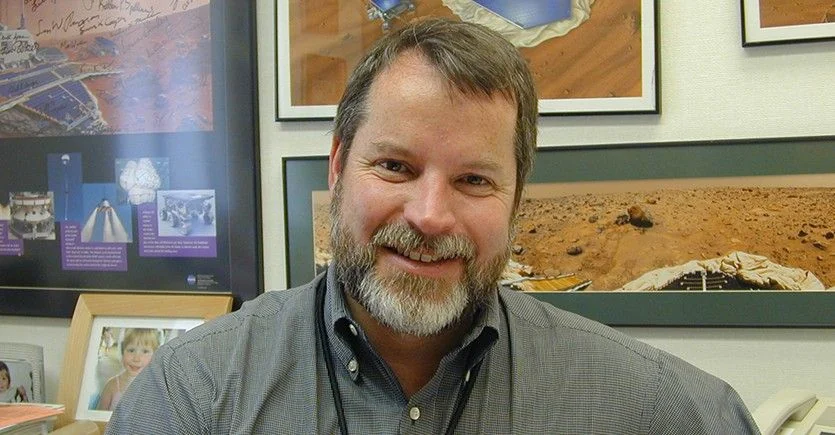
Rob Manning — a continuous history of Mars landing, from Pathfinder to human-scale payloads
Rob Manning’s career connects mission crises, EDL architectures, software, testing and engineering trade-offs to a continuous professional trajectory. Technical detail is developed when it explains what he learned, decided, challenged or transmitted within JPL’s Mars teams.
I. Origins, education and systems thinking: learning to see interfaces before Mars
Mathematics, physics, then engineering: training built while working. Rob Manning graduated from Whitman College in 1980 with a combined degree in mathematics and physics. He joined JPL in 1981 and completed a second bachelor’s degree in engineering and applied science at Caltech in 1982. The sequence matters because specialization was being built in contact with real flight work: mathematical and physical tools came first, while applied engineering deepened inside a laboratory developing interplanetary spacecraft.. Manning joined JPL in the early 1980s with training in mathematics and physics that he continued to supplement with engineering. His early work on Galileo, Magellan and Cassini did not yet make him a “Mars landing specialist,” but it taught embedded systems, fault tolerance, communication constraints and the need to anticipate behavior that cannot be corrected in real time. By the time Pathfinder arrived, he already possessed a culture of interplanetary reliability. That foundation would support three decades of increasingly ambitious entry, descent and landing architectures.. Source Institutional source
1980–1982: learning spaceflight through reliable computing before landing systems. Manning completed a mathematics and physics degree at Whitman College in 1980 and joined JPL in 1981, later completing a second bachelor's degree at Caltech. His early work did not begin with a Mars parachute. It developed inside a culture where onboard computing, avionics and fault tolerance were becoming essential for spacecraft that no engineer could repair after launch. Programs including Galileo, Magellan and Cassini exposed him to very different interplanetary systems before Mars landing became the center of his career.
Galileo, Magellan and Cassini: learning reliability before Mars EDL. Before Mars Pathfinder, Manning held key roles on Galileo, Magellan and Cassini. The destinations differed, but the engineering problem shared a theme: deterministic behavior far from Earth. Onboard computers have to accept sensor data, command hardware, manage sequences and sometimes protect themselves when ground control cannot respond quickly. Source.
Rob Manning is one of the most useful figures for understanding a part of Mars exploration that offers almost no opportunity for correction once it begins: entry, descent and landing. JPL records a career that included work on Galileo, Magellan and Cassini before Mars Pathfinder, followed by leadership in Mars engineering and contributions across multiple rover generations.[1] His career connects flight computers, fault tolerance, airbags, rover systems and the sky crane. More importantly, it shows how engineering organizations learn to manage the minutes in which a mission built over years can be lost.
JPL states that Manning graduated from Whitman College in 1980 with degrees in mathematics and physics, studied engineering and applied science at Caltech, and joined JPL in 1981.[1] Those fields are a natural foundation for EDL because no single discipline owns the sequence. Aerodynamics, structures, computing, guidance, propulsion and navigation must all agree on one evolving state.
Work on missions such as Galileo, Magellan and Cassini also exposed Manning to spacecraft architectures very different from Mars landers. That variety is useful. Destinations change, but reliability problems recur: power must be managed, flight software must respond to uncertain sensors, communications are delayed, and fault protection has to decide when to intervene. Systems engineers learn to recognize these invariants across spacecraft.
From a Navy childhood to Puget Sound: learning to see machines as systems rather than isolated objects
Robert M. Manning's professional life is often summarized through the spectacular images of Mars landings, yet the useful biography begins much earlier, with the habits of observation that preceded any formal responsibility at the Jet Propulsion Laboratory. NASA's biographical account describes a childhood shaped by repeated moves in a Navy family before the family settled in Washington State, where he attended Burlington-Edison High School and later Whitman College. [1] The geographical details matter less than the pattern: an engineer who would spend his career integrating changing teams and changing hardware first grew up adapting to changing environments.
He has recalled the cultural force of Mercury, Gemini and Apollo, but also the magazines, television coverage and model building that made spacecraft understandable as made objects rather than distant icons. Walter Cronkite, National Geographic, Life and the illustrated volumes of the space age helped connect public drama to hardware. Science fiction supplied a second strand: the idea that machines could extend human agency into places where people could not yet go.
This mixture is important because landing on Mars never becomes only a problem in equations. It is a problem in physical intuition, communication, imagination and discipline. A parachute is governed by fluid dynamics, but the decision to trust it is governed by test evidence, uncertainty and an organization's willingness to listen to bad news. A flight computer is an electronic device, but its value depends on whether the people writing software and the people designing sensors agree about the same state of the spacecraft.
Manning's later description of systems engineering fits this early pattern. He portrays the systems engineer as someone who connects complex technical elements and complex human organizations to mission objectives. [1] The definition resists the myth of the solitary inventor. Mars landing is a collective activity in which the dangerous gaps often lie between disciplines.
For a future human program, this is already a first lesson. The decisive skills will not come only from specialists who know propulsion, structures, navigation or software in isolation. The program will need people who can understand enough of several domains to identify incompatible assumptions before they become flight behavior.
Whitman, Caltech and the first JPL work: mathematics, applied physics and the discipline of drawing what must actually connect
Manning studied mathematics and physics at Whitman College and then engineering and applied science at Caltech. JPL's 1998 announcement of his appointment as Mars Surveyor Program chief engineer records his Whitman degree in 1980, Phi Beta Kappa recognition, a Caltech degree in engineering and applied science in 1982, and later graduate work in computer engineering and control at the University of Southern California. [2] That combination is unusually well aligned with autonomous spacecraft: mathematics for models, physics for the environment, engineering for implementation and control theory for deciding how a machine should respond when reality diverges from the plan.
NASA also describes an early part-time job at JPL as a draftsman preparing Galileo schematics. [1] Drafting can appear remote from the drama of landing, but a schematic teaches a severe form of honesty. Every signal, connector, power path and interface must go somewhere. Ambiguity that can survive in conversation becomes visible on a drawing.
His later assignments on Galileo, Magellan and Cassini expanded the same logic. JPL's biography for the NASA Engineering and Safety Center notes about thirty-five years of work on robotic spacecraft, including those outer-planet and Venus missions before the Mars sequence for which he became widely known. [11] The work developed familiarity with computers, fault tolerance, autonomous operation and the fact that an interplanetary spacecraft must survive without immediate help.
Cassini is particularly relevant because Manning served as a cognizant engineer for onboard computers before Mars Pathfinder. [2] A computer on a deep-space mission is not merely an office machine sent farther away. It is part of the vehicle's survival logic. It receives imperfect measurements, applies sequences, handles timing and must continue to function through environments that cannot be reproduced perfectly on Earth.
That background helps explain why Manning's Mars career cannot be reduced to mechanical devices such as airbags or the sky crane. His recurring subject is the state of the spacecraft: how it knows where it is, what phase it is in, what sensors to trust and what action must occur before the next state becomes unrecoverable.
Autonomy before Mars: why a distant spacecraft must be allowed to decide without waiting for Earth
The light-time between Earth and Mars makes real-time piloting impossible. Even at favorable geometry, a command-response loop is far too slow for entry, descent and landing, a sequence measured in minutes and sometimes seconds. The vehicle therefore carries a local model of what should happen and a set of rules for recognizing the events that move it from one phase to another.
This requirement makes autonomy different from convenience automation. A cruise spacecraft can sometimes enter a safe state and wait for instructions. A lander descending toward Mars cannot stop the atmosphere, suspend gravity or ask mission control whether the parachute should deploy. Every essential transition must be executable locally.
Manning's background in onboard computing and control therefore becomes central. Sensors do not report an abstract truth; they report measurements with noise, latency, limits and failure modes. Software turns those measurements into an estimate of vehicle state. Guidance and control then translate that estimate into actions. A wrong state estimate can make perfectly functioning hardware execute the wrong command at the wrong time.
The engineering challenge is not to maximize autonomy indiscriminately. Every additional branch in flight software creates new states to verify. A robust design asks which decisions must be autonomous, which can be scheduled, which require voting among sensors, and which anomalies should simply be tolerated until the vehicle reaches a less dangerous phase.
Human Mars landing will intensify this question. The crew may be physically present, but computers will still operate far faster than people during peak entry and terminal descent. The architecture must decide where human authority remains meaningful and where automation must act before a person could understand the situation. Manning's career provides a long historical preparation for that boundary.
Pathfinder and Faster, Better, Cheaper: innovation under constraint and the hidden price of a small team
Mars Pathfinder became a symbol of NASA's Faster, Better, Cheaper era. It was expected to demonstrate that a relatively small, lower-cost project could reach Mars, deliver a lander and operate a mobile rover. Manning served as flight-system chief engineer and led the design, development, testing and operation of the entry, descent and landing system. [2]
The engineering architecture was intentionally unlike Viking. Instead of a large throttleable terminal propulsion system carrying the lander gently to the surface, Pathfinder combined atmospheric entry, a supersonic parachute, solid rockets and airbags. The integrated spacecraft had a 12.7-meter parachute, rocket-assisted deceleration and an airbag system intended to absorb the final impact and repeated bounces. [3]
The solution was not simply a cheaper copy of something already qualified. It redistributed complexity. A solid rocket is relatively simple but offers little flexibility after ignition. Airbags tolerate uncertainty in exact touchdown velocity and terrain, but they must survive violent impact and abrasion. The folded lander must right itself and then deploy. Every saving in one subsystem can create a new requirement elsewhere.
Manning has described both the creative energy and the danger of the small-team culture. Pathfinder succeeded, but he later emphasized that there were too few independent eyes and not enough documentation. [1] That is a valuable distinction: success proves that the vehicle survived; it does not prove that every programmatic shortcut was a good practice.
For human exploration, the lesson is not to imitate Pathfinder's budget model. It is to understand how constraint can produce architectural invention while still preserving independent review, configuration control and enough documentation for the next generation to know why the system worked.
A chain of energy management: turning interplanetary speed into a survivable bounce
Entry, descent and landing is fundamentally an energy-management problem. A spacecraft reaches Mars with enormous kinetic energy. No single device removes all of it. The atmosphere, heat shield, parachute, rockets and airbags divide the work across different velocity and altitude regimes.
Pathfinder's heat shield first used atmospheric drag while protecting the spacecraft from heating. The parachute then operated in a thin atmosphere at supersonic conditions. Near the surface, three solid rocket motors on the backshell fired to reduce velocity before the lander was released on a bridle. JPL's documentation describes the motors as producing roughly a ton of force each for a little more than two seconds, firing tens of meters above the surface. [4]
The airbags then converted the remaining translational energy into deformation, internal pressure and repeated rebounds. Postflight reconstruction showed a parachute descent velocity close to prediction, a rocket-assisted phase and a first ground impact followed by many bounces. [5] The landing therefore cannot be understood by asking whether the airbags “worked.” The entire energy chain had to place the lander inside the airbags' survivable envelope.
This way of thinking becomes essential when missions scale. If payload mass increases, the velocity range assigned to one device may become impossible. A parachute cannot simply be enlarged indefinitely; an airbag cannot absorb arbitrary momentum; a rocket cannot be added without changing propellant mass, structure and plume interaction.
Manning's later career repeatedly revisits this partition. The hardware changes, but the systems question remains: which technology is responsible for which portion of the energy, and how much uncertainty can be handed from one phase to the next?
II. Pathfinder: building, testing and landing a new architecture
That prehistory explains his later influence on entry, descent and landing. A landing is never just a parachute or an engine; it is a tightly timed chain in which navigation, computers, sensors, pyrotechnics, software and vehicle dynamics must remain mutually consistent for a few irreversible minutes. Pathfinder then allowed Manning to turn a culture of spacecraft reliability into a landing architecture. Airbags worked within a certain mass range; when Curiosity grew far heavier, the relevant expertise was not loyalty to the old solution but the ability to recognize its limit and help invent a new sequence. [rm1] [rm2] [rm5]
1993–1997: Pathfinder turns an audacious landing into a testable sequence. Manning served as Mars Pathfinder flight system chief engineer from 1993. The spacecraft would enter Mars directly, deploy a parachute, fire retrorockets, inflate airbags and finally release Sojourner. The combination was new enough that confidence could not come from heritage alone. Engineers had to break the descent into measurable events, model dispersions, test subsystems and demonstrate that the full chain remained robust when actual conditions moved away from nominal values. Source.
Pathfinder landed on July 4, 1997. JPL records that Manning led the team that designed, developed, tested and operated the entry, descent and landing system. Yet success still produced new engineering data: terminal velocity under the parachute was higher than expected. A mature engineering culture keeps that discrepancy rather than erasing it from the story. The difference between model and reality becomes input to the next mission.
Rob Manning served as Mars Pathfinder’s flight system chief engineer. The mission is an extraordinary EDL lesson: heat shield, parachute, rockets, airbags and autonomous sequences all had to work in the right order while Earth could not pilot the event in real time. JPL’s post-flight account says the landing occurred almost as planned while still revealing measurable deviations, including a higher-than-expected terminal velocity under parachute. [RM1] [RM2]
From Pathfinder to Curiosity, Manning worked across several generations of solutions: airbags for smaller landers, increasingly autonomous sequences, and then the sky crane when Curiosity's mass made older approaches inadequate. What looks in retrospect like a sequence of dramatic inventions was primarily a response to a problem that changed with vehicle mass and required precision.
Pathfinder demonstrated that a constrained mission could land a spacecraft and a small rover through a complex sequence of heat shield, parachute, radar, retrorockets, airbags and controlled bouncing.
From airbags to sky crane: knowing when a successful solution has reached its limit. After Pathfinder, Manning became chief engineer of the broader Mars Surveyor program. Spirit and Opportunity could still use airbags, but Curiosity was much heavier. The old architecture could not simply be enlarged indefinitely. This is one of the hardest transitions in engineering: a previously successful solution feels safer than a new one even after its operating envelope has been exceeded.
The Pathfinder and Mars Exploration Rover airbags could not be scaled indefinitely. Curiosity approached one metric ton; its wheels and instruments had to be protected, landing precision had to improve and the rover needed to arrive ready to drive. The answer combined a guided capsule, supersonic parachute, powered descent and a stage that lowered the rover on bridles. [RM3] [RM4]
Pathfinder demonstrated a landing chain using a parachute, rockets and airbags. Spirit and Opportunity inherited parts of that concept, but increasing mass eventually made the airbag approach impractical. Curiosity required a different regime. The sky crane was not selected for spectacle; it allowed a roughly one-ton rover to be placed directly on its wheels without a landing platform, while meeting constraints that the earlier architecture could no longer satisfy.
1998: turning one mission’s experience into memory for the next ones. After Pathfinder, JPL named Manning chief engineer of the Mars Surveyor Program. The role was explicitly cross-project: coordinate Mars engineering, participate in reviews and solve problems that exceeded a single mission. This reveals another dimension of his contribution. Launch windows are separated, teams change and vehicles evolve; without active transfer, lessons can disappear before they are needed again. [RM2] [RM3]
Manning’s move from Pathfinder chief engineer to program-level engineering also shows how organizations retain knowledge. Lessons cannot disappear when a successful mission team disperses. A Mars settlement will need the same institutional memory: anomaly reports, design reviews, raw telemetry, corrected procedures and reasons behind every margin should remain accessible to the next generation. On Mars, forgetting a technical lesson learned through an earlier incident may cost far more than schedule or money.
From one lander to the next: each success makes the next problem harder. Manning is most revealing when Pathfinder, the Mars Exploration Rovers, and Curiosity are not treated as three unrelated successes. Pathfinder demonstrated a lightweight EDL chain using airbags; the next rovers reused parts of that logic at another scale; Curiosity became too heavy simply to repeat the previous solution and forced the team toward the sky-crane architecture. Success therefore creates the next difficulty. Scientists ask for a more capable vehicle, more instruments, and more mobility, increasing mass until the former architecture loses its margin. Manning’s career follows that escalation. He learned to treat landing as a complete system whose interfaces must work together even though no Earth test can reproduce Martian entry exactly. That accumulated experience helped turn a one-mission specialty into an engineering discipline.
Manning became Mars Pathfinder flight system chief engineer and led major aspects of entry, descent and landing. JPL's 1998 announcement appointing him chief engineer of the Mars Surveyor Program explicitly recalled that Pathfinder role.[1] The mission is popularly remembered for its airbags bouncing across Mars, but the airbags were only the last part of a much longer sequence.
The vehicle first had to survive atmospheric entry behind a heat shield, reduce speed enough for parachute deployment, estimate altitude, use terminal propulsion and then release a lander protected by inflated bags. Every subsystem had to deliver conditions the next subsystem could accept. A perfect parachute deployed outside its safe window would not save the mission. Robust airbags could not compensate for an impact velocity beyond their energy capacity.
The architecture therefore distributed energy and uncertainty. Atmospheric drag removed the largest share of velocity, the parachute continued the process, rockets controlled the terminal phase and airbags converted the final contact into a series of survivable impacts. The system deliberately accepted bouncing and rolling because tests and models showed the lander could tolerate those states.
The architecture also contained its own scaling limit. Airbags were efficient for Pathfinder's mass and remained usable for the larger Mars Exploration Rovers, but eventually the mass and geometry required for Curiosity made them unattractive. A successful technology can be mature and still be the wrong solution outside its original domain.
Spirit and Opportunity reused a family of landing techniques related to Pathfinder, including airbags. Their 2004 successes could have encouraged the belief that the architecture had become universal. Instead, the next rover exposed its limits. JPL's later history of the sky crane explains that the airbags needed for a Curiosity-class rover became impractically large and heavy.[2]
Engineering heritage has to be described with its envelope. “Airbags worked on Mars” is true but incomplete. The useful statement includes payload mass, impact conditions, terrain assumptions, bag geometry and acceptable damage. Only then can a new project decide whether it is genuinely reusing heritage or merely borrowing a familiar name.
JPL podcasts about Mars rover operations describe Manning as an engineer whose work spans all five U.S. rover generations.[3] That continuity provides a rare comparison. Pathfinder innovations became MER heritage. MER's mass limits helped motivate Curiosity's architecture. Perseverance then reused major Curiosity elements while adding new guidance and autonomy.
From Pathfinder to the sky crane, Manning's history shows engineering that inherits without copying blindly. Airbags succeed and then reach a scaling limit. The sky crane looks radical and later becomes flight heritage. Each step is supported by tests, models and flight data.
Testing Pathfinder: proving a sequence when no terrestrial facility can reproduce Mars
The problem of Mars landing is that the complete environment cannot be recreated on Earth. Gravity is different, atmospheric density is different, entry speed is difficult to reproduce, and the final sequence combines aerodynamic and mechanical events that occur over large distances. Pathfinder therefore had to be qualified through a mosaic of evidence rather than one perfect end-to-end test.
JPL's prelaunch reports describe spin-balance, acoustic and thermal-vacuum testing after lander and rover integration. [3] Other campaigns challenged airbags, rockets, separation devices and software separately. The engineering task was to decide which physical similarity mattered in each test and how the pieces could be combined into a credible mission-level prediction.
A useful test is not simply one that looks like Mars. It is one that interrogates a known uncertainty. A drop test can reproduce impact loads while failing to reproduce Mars gravity. A thermal-vacuum chamber can reproduce pressure and temperature while not reproducing entry dynamics. A parachute test can reach a relevant Mach number while using a different atmospheric composition or trajectory. Each test therefore has a domain of validity.
Manning's career repeatedly returns to this epistemic discipline. Engineers do not “prove Mars” on Earth; they build a chain of partial proofs, models and margins. The chain is only as strong as the assumptions connecting one piece to another.
For a human-class lander the problem becomes more severe because a full-scale test vehicle may be too large and expensive to exercise through every regime. The program will need subscale tests, high-fidelity components, Earth flight demonstrations and robotic Mars precursors. The architecture of evidence becomes a system in its own right.
Pathfinder's autonomous sequence: software as the thread that turns hardware into a landing system
Airbags, rockets and a parachute can be listed as separate components, but they do not constitute an EDL system until software and sensors connect them in time. The vehicle must recognize atmospheric entry, detect deceleration, deploy the parachute, separate hardware, sense altitude and velocity, fire terminal rockets and release the lander in a sequence that does not wait for Earth.
This creates a special form of software verification. The code must be correct, but the events it reacts to must also be physically meaningful. A threshold selected from simulation may encounter noise, vibration or timing dispersions in flight. A sensor can be healthy while its reading is temporarily misleading. The flight logic therefore embeds assumptions about the dynamics of the entire vehicle.
Manning's earlier work with spacecraft computers gave him a natural vantage point on these interactions. The most dangerous failure is not always a dead computer; it can be a computer faithfully executing a command that became inappropriate because the state estimate is wrong.
Pathfinder also illustrates why autonomous sequencing should be made observable. Engineers need enough telemetry to reconstruct which transitions occurred and why. If the vehicle survives, the data calibrate models. If it fails, they may be the only record of the final seconds.
The same logic scales directly to human landing. Software must manage propulsion, guidance, sensors, landing-site diversion and possibly abort modes. That makes software architecture inseparable from safety architecture. A late software change is not “only software” if it alters a physical phase transition.
July 4, 1997: the difference between what the spacecraft knows and what mission control thinks it knows
Pathfinder's landing day became a lesson in both autonomy and human interpretation. Because of light-time, the spacecraft completed its critical sequence long before the team could react to anything seen in telemetry. Mission control could only receive evidence of events already committed.
Manning has described a moment when the team feared that the wrong version of flight software might be aboard, a scare driven by the interpretation of telemetry rather than by an actual software load error. [1] The episode is valuable because it shows that a control room can be wrong even when the spacecraft is right.
As signals arrived through the Deep Space Network, the team used limited information to infer survival. Manning has recalled the importance of the Madrid complex and the long delay between physical events at Mars and the knowledge reaching Earth. [1] The famous excitement of a landing room sits on top of a severe information problem: every display is an interpretation of delayed radio evidence.
For engineering, this distinction creates a requirement for clear telemetry semantics. Operators must know whether a flag reports a measured physical event, a software inference or an expected timeline point. Confusing those categories can send a team toward the wrong diagnosis.
A crewed vehicle will add local humans to the loop, but Earth will remain delayed. The architecture must therefore define which information is authoritative onboard, what the crew sees, what Earth sees later and how conflicting interpretations are reconciled after the fact.
After success: reconstructing the descent instead of treating the landing as proof that the model was perfect
Successful missions create a dangerous temptation: because the vehicle survived, assumptions can be retroactively treated as correct. Pathfinder's value came partly from resisting that temptation and reconstructing what actually happened.
JPL reported measured values from the landing sequence, including a parachute descent speed close to the predicted value, terminal rocket firing and an impact followed by roughly sixteen major bounces. [5] Later orbital imaging of the site helped identify surface hardware and offered another way to compare the reconstructed path with the real terrain. [8]
Postflight reconstruction asks which margins were used, how winds affected horizontal velocity, whether deployment times matched the model, and what loads the hardware actually experienced. A success with unexpectedly high loads may reveal more risk than a failed ground test that teaches the team how to fix a model.
This culture is fundamental to cumulative exploration. MER could use Pathfinder's data because Pathfinder's team did not simply archive the headline “landed successfully.” Curiosity could then inherit atmospheric and operational understanding from several generations.
Future cargo flights should be designed with the same objective. Every landing to a human outpost should be instrumented so that it becomes a controlled experiment on the next landing system, especially before the first crew arrives.
1998: becoming Mars Surveyor Program chief engineer and moving from one spacecraft to a portfolio
In 1998 JPL named Manning chief engineer of the Mars Surveyor Program. The announcement described a role coordinating engineering across Mars spacecraft and instruments, participating in engineering councils, reviews and study teams, and helping maintain technical coherence across the program. [2]
The shift is important. A project chief engineer can optimize a specific spacecraft. A program chief engineer must watch for assumptions that cross project boundaries: common suppliers, shared navigation methods, relay assets, interfaces with instruments, heritage claims and lessons from previous failures.
This is also where systems engineering becomes institutional. A finding on one project may need to change review criteria on another. A risk accepted by one mission can become unacceptable when the same design is reused at higher mass. The chief engineer has to ask not only “does this design close?” but “what does this decision teach or endanger across the portfolio?”
The timing meant that Manning would occupy this broader perspective through one of the most consequential periods in the modern Mars program. The successes of Pathfinder were followed rapidly by the 1999 losses, forcing NASA and JPL to examine whether the cadence and management model were preserving enough independent technical scrutiny.
That transition helps explain why his later public accounts often emphasize people, communication and documentation as much as mechanisms. A program fails through interfaces just as a spacecraft does.
III. From the 1999 failures to the Mars Exploration Rovers: turning experience into rules
The sky crane was therefore not spectacle added for television. It resulted from a chain of constraints, and that chain had to be justified without a full Earth test at Martian gravity, atmosphere and velocity. That paradox defines much of Manning’s work: assemble enough partial evidence to trust a complete event that will have only one opportunity to succeed. [RM3] [RM4] [RM5]
Spirit and Opportunity could still use airbags, but a rover in Curiosity’s mass class changed the problem. Airbag loads, structural demands and terrain interactions became too severe, forcing a different terminal-descent solution.
Manning's value is that the history does not reduce to one favorite device. Pathfinder used one architecture. Spirit and Opportunity extended it. Phoenix used a powered terminal descent. Curiosity crossed a mass threshold that helped drive the development of the sky crane. Perseverance reused much of that architecture while adding more precise landing capabilities. Heritage survives where it still fits, and the mission changes architecture where mass, terrain or objectives invalidate the old assumptions.
A crewed base will face the same logic. Two identical pumps can both be vulnerable to the same electrical fault or contamination. Functional diversity may provide better resilience than numerical duplication. Manning's background reminds future designers to ask not only how many backups exist, but whether they share the same cause of failure.
The losses of Mars Climate Orbiter and Mars Polar Lander in 1999 made the importance of interfaces and verification unmistakable. Their causes were not identical and should not be collapsed into a single story, but the program-level response emphasized stronger review, systems thinking and attention to how assumptions move across organizational boundaries.
A chief engineer works in the space between local anomaly and general rule. If an interface has failed, which other interfaces use similar assumptions? If a sensor logic could trigger at the wrong time, where else does the same pattern exist? The value of a failure investigation is not merely to explain the lost spacecraft. It is to alter decisions on hardware that has not yet flown.
This can accelerate a program rather than merely slow it. A prototype that fails early can eliminate a weak architecture before years are committed to it. Manning's engineering culture values the test that changes the design before Mars performs the final, irreversible test.
This avoids two opposite mistakes. Heritage should not become a fetish in which flown hardware is automatically best for every new mission. Novelty should not become a fetish either, replacing a mature solution merely because a concept looks cleaner on paper. Engineering balances maturity, performance and uncertainty.
Industrialization does not mean trivializing risk. Commercial aviation became safe by turning complex operations into strongly instrumented routines. Mars is harder because each vehicle may remain extremely expensive, early traffic will be sparse and feedback cycles are long. The challenge is to preserve space-mission rigor while developing the repeatability of a logistics service.
The 1999 losses: when Mars engineering had to examine the organization around the spacecraft
Mars Climate Orbiter was lost in September 1999 and Mars Polar Lander disappeared on arrival in December. NASA responded not only with mission-specific investigations but with a Mars Program Independent Assessment Team charged to review recent successes and failures, relationships among NASA Headquarters, JPL, Caltech and industry, scientific involvement and the revised program. [34] The scope itself is revealing: NASA treated reliability as an organizational property as well as a technical one.
Mars Climate Orbiter is remembered for a mismatch between English and metric units in navigation-related data, but the investigation identified broader contributing factors involving communication, verification, problem tracking and mission assurance. [35] The unit mismatch mattered because the surrounding process failed to expose and close its consequences.
Mars Polar Lander illustrated a different systems failure. The review found that the most likely scenario involved a spurious indication associated with landing-leg deployment being interpreted as touchdown, potentially causing the descent engines to shut down while the vehicle was still above the surface. [36] A sensor signal does not carry meaning by itself; flight logic assigns meaning to it.
Manning should not be presented as the sole author of NASA's post-1999 recovery. The reforms involved many managers, engineers, scientists and independent reviewers. His program-level engineering position nevertheless placed him inside a culture forced to reconsider how much heritage could be trusted, how independent reviews should work and how project pressure affected documentation.
The episode is directly relevant to human Mars exploration. Human-rated systems will accumulate thousands of interfaces. A program that treats each discrepancy as a local nuisance rather than asking whether it reveals a systemic weakness can reproduce the same organizational failure at a much larger scale.
From Pathfinder to the Mars Exploration Rovers: reuse is a redesign problem, not a copy command
After Pathfinder, the Mars Exploration Rover concept reused the broad logic of aeroshell, parachute, terminal rockets and airbags, but at a larger scale and with a far more capable rover. The NESC biography credits Manning with helping conceive the modification of Pathfinder and Sojourner into the MER architecture and later leading rover systems engineering and EDL work. [11]
Heritage can reduce risk because it provides flight data and known manufacturing methods, but it can also create false confidence. A heavier rover changes the loads on airbags, the descent system and structural interfaces. The new vehicle may occupy a region of the design space the older mission never demonstrated.
The engineering task is therefore to identify which parts of heritage are physical laws, which are qualified components and which are merely historical resemblance. A parachute with similar geometry may experience different dynamic pressure. An airbag using the same material may see a different impact energy. A software pattern may be reusable while its thresholds must change completely.
MER turned Pathfinder's success into a family of evidence rather than an artifact to be copied. That distinction becomes a central theme in Manning's career and later explains why airbags could be retained for Spirit and Opportunity but rejected for Curiosity.
For a human architecture, the same discipline will be vital when reusing cargo hardware for crews. “It flew on Mars” is evidence, but only inside the conditions that flight actually covered.
Spirit: using transverse rockets to fight horizontal velocity before the airbags meet the ground
Spirit's January 2004 landing showed how the Pathfinder-derived architecture had evolved. The terminal system included transverse rockets intended to reduce horizontal motion before the bridle was cut and the airbag-protected lander dropped to the surface. JPL's landing coverage identified Manning as the EDL manager and described the sequence of rocket firing, bridle cut and multiple bounces. [13]
Horizontal velocity is easy to underappreciate when landing is described only as a vertical descent. An airbag may survive a downward impact yet suffer severe scraping or rolling if winds produce lateral motion. The terminal system therefore had to estimate not merely altitude but a vector state.
This is a systems interaction between atmospheric uncertainty, inertial sensing, radar, rocket performance and mechanical survivability. The airbags' capability cannot be specified independently from the rockets that prepare the impact.
Spirit's successful landing also validated a carefully rehearsed operational process. The team had to monitor a sequence it could not control in real time and be ready to interpret partial signals. The event was an engineering experiment as well as the beginning of a science mission.
The larger lesson is that a landing system is defined by the interfaces between phases. The quality of the parachute matters, but so does the state it hands to terminal descent. The quality of the airbags matters, but so does the velocity vector handed to them by the rockets.
Opportunity: repetition as a test of whether success can become a capability
Only weeks after Spirit, Opportunity approached Mars with a closely related architecture. When confirmation arrived, Manning's “We're on Mars, everybody!” became one of the remembered moments of the landing. [14] The engineering value of the second success, however, is deeper than celebration.
A single successful landing can contain luck. Two vehicles built from a common architecture and delivered to different sites provide more evidence about manufacturing repeatability, navigation, atmosphere and operations. Opportunity therefore helped turn MER EDL from a one-time success into a demonstrated capability.
The twin missions also created a controlled comparison. Differences in atmospheric conditions, site geometry and actual descent performance could be examined against a shared vehicle design. That kind of repetition is rare in planetary exploration, where each mission is often unique.
For future Mars logistics, repetition will be normal rather than exceptional. Cargo systems must not merely survive qualification and one demonstration; they must be manufactured repeatedly across launch windows. MER offers an early model of how common hardware and common teams can create learning between flights.
The limitation is equally important. Spirit and Opportunity still flew only twice. Human settlement logistics may require dozens of arrivals. Reliability then becomes a property of production, maintenance and institutional continuity, not only design.
Rover systems engineering: why the machine delivered to Mars must be designed together with the machine that delivers it
Manning's MER responsibility extended beyond the descent system into rover systems engineering. [11] That overlap matters because the boundary between rover and lander is not arbitrary. The rover's mass, shape, center of gravity, deployment needs and structural limits all affect EDL.
If a science team adds an instrument, the change can propagate into power, thermal control and mechanical packaging. Added mass can alter entry ballistic coefficient, parachute performance or airbag loads. A change that appears local to surface science may therefore consume landing margin.
Systems engineering exists to make these propagation paths visible before hardware is frozen. A mass margin is not just an accounting column; it is an agreement among subsystems about how much uncertainty remains available. The chief engineer must understand when a late addition is affordable and when it creates hidden requalification work.
This connection becomes even more severe for human vehicles. Habitat volume, crew seats, life support, surface mobility and cargo access all change lander geometry. Designing “the lander” separately from “the surface system” would recreate an artificial boundary that Manning's rover experience shows to be dangerous.
The mission succeeds when the delivered system can perform its purpose, not merely when the descent stage reports touchdown. That is why deployment, egress and usable orientation belong in the architecture from the beginning.
When airbags stopped scaling: learning to retire a successful technology before it becomes a liability
Pathfinder and MER made airbags one of the most recognizable Mars landing technologies. Their success could easily have encouraged indefinite reuse. Curiosity's much greater size forced the team to confront the opposite lesson: a technology can be excellent and still become wrong when the mission leaves its domain.
The problem is driven by energy and geometry. A larger rover requires larger or more heavily loaded airbags, which must still deploy, survive impact, avoid rocks and then release the vehicle. At some point the packaging and loads become less attractive than creating a new terminal descent method.
NASA and JPL histories of Curiosity explicitly describe the need for a new approach because the rover was too large for the airbag techniques used by Spirit and Opportunity. [16] The decision is a useful counterexample to simplistic heritage thinking.
Manning's importance here is not that he “rejected airbags” by personal decree. The engineering team compared architectures, modeled their consequences and looked for a way to place a heavy rover directly on its wheels. His experience with the earlier systems helped the team understand which benefits had to be preserved even as the mechanism changed.
Human Mars landing will face the same moment repeatedly. Parachutes, aeroshells, engines and landing gear will each encounter scales where the old solution no longer closes. Maturity means recognizing that boundary before flight forces the lesson.
February 2000 and the sky-crane idea: moving propulsion above the rover to separate landing from surface operations
JPL's history of the sky crane traces an early version of the concept to February 2000, when Manning considered placing the propulsion system above the rover rather than beneath it. [16] The arrangement initially seemed counterintuitive because rockets normally sit below the mass they support.
The geometry solved several problems at once. Keeping engines away from the ground reduced concern that exhaust would excavate a crater or throw debris against the rover. Lowering the rover on cables allowed it to arrive directly on its wheels, eliminating a separate lander platform and egress system.
But the concept created new questions: could the suspended rover swing uncontrollably, could the descent stage maintain stable control while paying out the bridle, would cables separate cleanly, and could the stage fly away without striking the rover? A clever sketch therefore became a multi-year verification problem.
The name “sky crane” reflected an analogy to helicopter external-load operations, where a load hangs beneath a flying vehicle. [16] The analogy was useful because it gave engineers a physical way to think about pendulum motion and control rather than treating the configuration as unprecedented mathematics.
The architecture demonstrates systems innovation at its best: not invention for spectacle, but rearrangement of interfaces so that several constraints become easier simultaneously.
The sky crane as a trade: direct-on-wheels landing, fewer surface mechanisms, more autonomous choreography
Landing directly on the rover's wheels saves the mass and complexity of ramps or deployment petals, but it transfers complexity into the final seconds. The descent stage must hover or descend steadily, deploy bridles, sense touchdown, cut the cables and perform a divert maneuver. Each operation must occur autonomously.
The rover also becomes part of the flight-control problem while suspended. Its motion changes the forces seen by the descent stage. Cable dynamics, center of gravity and touchdown sensing must remain inside the control system's assumptions.
The trade illustrates why complexity cannot be counted by the number of parts alone. Removing a lander platform may remove mechanisms from the surface while increasing software and dynamic-control complexity in the air. A systems engineer compares mission-level burden rather than declaring one subsystem “simpler.”
Curiosity's eventual success made the choreography look inevitable in hindsight, but JPL's retrospective emphasizes how strange the concept initially appeared and how much testing was required before trust emerged. [16]
Future human systems may make similarly unfamiliar trades. The relevant question is not whether a configuration resembles traditional landing gear or rockets, but whether the complete sequence can be demonstrated with enough margin and diagnostic evidence.
Guided entry: changing the landing ellipse before the parachute ever opens
Curiosity's innovation did not begin with the sky crane. The spacecraft used guided entry to control lift and steer through the atmosphere, reducing the landing ellipse relative to earlier rover missions. NASA's description of the entry sequence places this guidance in the first major phase of EDL, before parachute deployment. [19]
Guided entry turns the aeroshell from a mostly ballistic object into an actively managed vehicle. By adjusting bank angle, the guidance system changes the direction of lift and corrects accumulated range error. The benefit is not only geometric precision; a smaller ellipse allows scientists to consider sites that would be too hazardous if the vehicle might land tens of kilometers away.
The capability adds requirements for inertial measurement, software, aerodynamic models and control authority. A bad model can steer the vehicle in the wrong direction. The guidance therefore has to be robust across atmospheric density variations and navigation error.
This is a recurring feature of Manning's generation of Mars engineering: greater precision is purchased by moving intelligence earlier into the sequence. The system does not wait for the terminal phase to fix all dispersion; it manages uncertainty continuously.
Human landing will almost certainly require this philosophy because a base cannot accept continent-scale uncertainty. Precision must be built from interplanetary navigation through entry, powered descent and local hazard avoidance as one connected chain.
IV. Curiosity: sky crane, guided entry and a break in scale
Manning’s career is a reminder that Mars landing is not one technology. Atmospheric entry, aerodynamic stability, parachutes, radar, propulsion, mobility and surface geometry have to work as a sequence, and the best solution changes with vehicle mass. Pathfinder, the Mars Exploration Rovers and Curiosity therefore represent different points in a continuing design problem rather than repeated versions of the same landing system. [source]
Manning works where physics becomes architecture. Heat shield, parachute, radar, propulsion, software and structure all have to remain compatible with one another and with an environment that cannot be reproduced end-to-end on Earth.
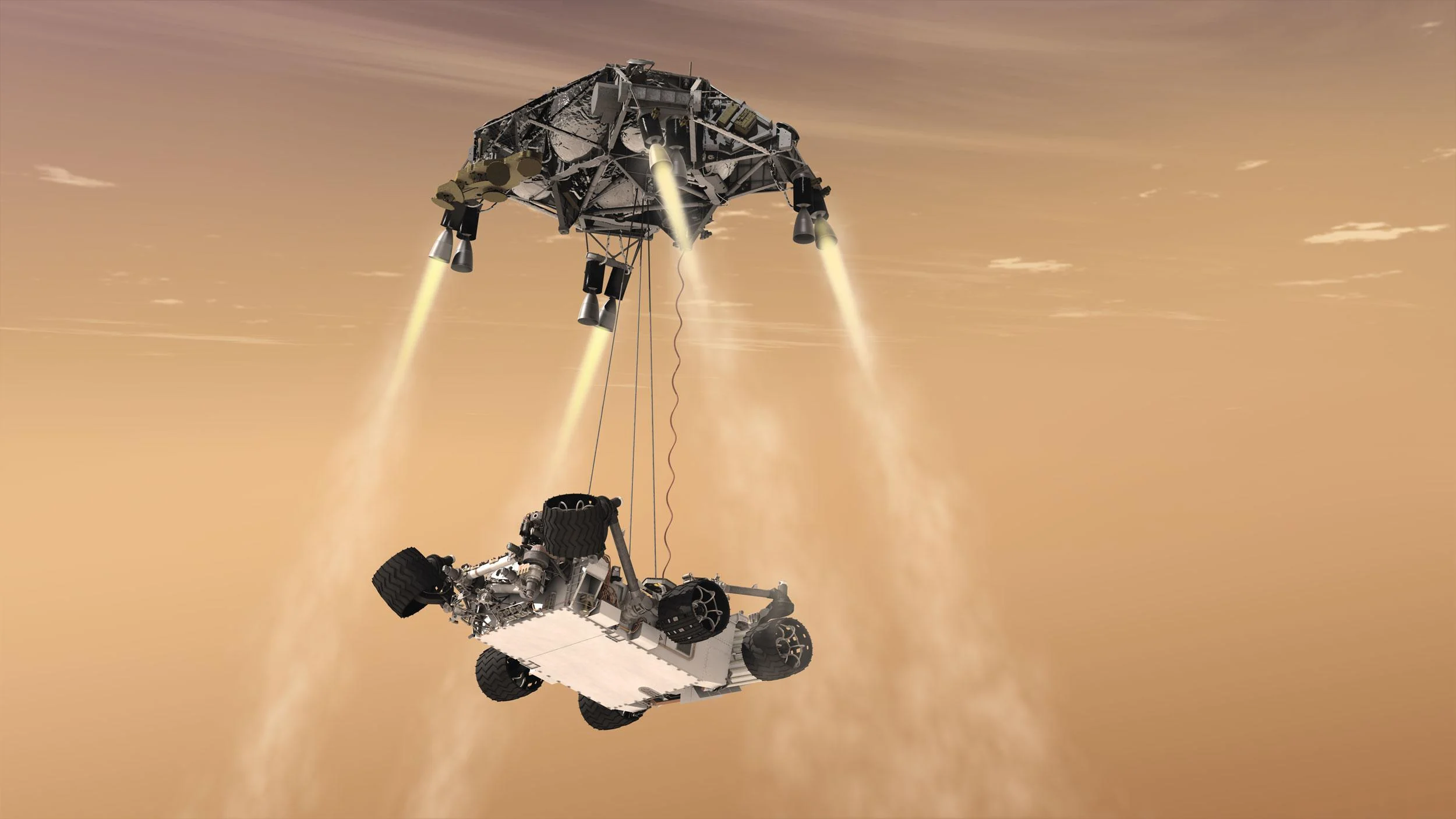
The sky crane keeps the propulsive stage above the rover while lowering the rover on cables to land directly on its wheels. The idea looked exotic, but it answered concrete constraints involving mass, ground clearance and rocket-plume interaction.
Rob Manning’s career is closely tied to the most unforgiving transition in Mars exploration: turning an interplanetary trajectory into a functioning vehicle at rest on the surface. Entry, descent and landing is not a collection of independent devices. Heat shield, parachute, radar, propulsion, software and structure operate in narrow time windows and in states that depend on one another. An altitude or velocity error passed to the next phase can make a perfectly healthy subsystem irrelevant.
JPL's history of Curiosity's sky crane describes Manning as one of the engineers involved in the concept's development around 2000.[2] The design problem was difficult. Airbags no longer scaled well, while landing a large rover on a conventional platform and then driving it down ramps would add structure, deployment mechanisms and terrain constraints.
The sky crane kept a powered descent stage above the surface and lowered the rover on cables. The rover touched down on its wheels, the system detected load transfer, cut the bridle and sent the descent stage away to crash at a safe distance. Visually the architecture appeared more complicated than simply placing a lander on the ground. Functionally, it removed the need for a separate landing platform and ramps.
Curiosity's 2012 landing made the sky crane a flight-proven architecture. The system had undergone extensive structural, parachute, propulsion, software and mechanism testing. Still, no terrestrial facility could reproduce the entire martian EDL chain at full scale: interplanetary entry speed, Mars gravity, thin atmosphere, supersonic parachute, powered descent and final rover touchdown.
Manning's history argues strongly against solving this by multiplication. Curiosity and Perseverance are extraordinary demonstrations, but a multi-tens-of-tonnes crewed vehicle occupies a different regime. The new technologies need their own progressive chain of modeling, tests and precursor flights.
Rover history also shows that no spectacular subsystem succeeds alone. Curiosity did not land because “the sky crane” was brilliant in isolation. Heat shield, navigation, parachute, radar, propulsion, software, bridle and rover formed a coherent chain. A neglected interface can defeat an excellent component.
Descent radar: teaching the spacecraft to measure a world it has never seen at full scale
After parachute deployment, Curiosity still had to know how high it was above the ground and how rapidly it was moving in several directions. That job belonged partly to the terminal descent radar, a sensor whose performance depended on terrain, vehicle attitude, antenna geometry and the presence of a large spacecraft around it.
JPL tested the radar in unusual ways. Helicopter campaigns carried representative equipment over terrain to exercise altitude and velocity measurements, while an F/A-18 was used in another campaign to expose the system to higher-speed flight regimes. [20] [21] The tests illustrate how planetary engineering borrows terrestrial platforms without pretending that any one of them is Mars.
Radar creates a classic interface problem. The navigation software wants a clean estimate; the hardware delivers signals affected by reflections, geometry and noise. The structure team may place components where packaging allows, but antenna placement changes sensor behavior. The guidance team may need data before the radar has reached its best operating regime. Systems engineering must negotiate those competing constraints.
The final test is not whether the radar can measure height in a laboratory. It is whether the complete vehicle can recognize the relevant measurements soon enough to perform powered descent and sky-crane deployment with safe margins.
Human landers will face the same issue at greater scale. Dust, plumes and prepared infrastructure may alter the sensing environment during the last tens of meters. A robust architecture will probably fuse radar, lidar, inertial navigation, optical terrain relative navigation and local beacons rather than treating any single sensor as an oracle.
The supersonic parachute: heritage hardware operating near a new frontier
Curiosity retained a disk-gap-band parachute lineage with deep Mars heritage, but a much heavier entry vehicle pushed the system into demanding conditions. Parachute design is deceptive because the basic object looks simple. In practice it is a flexible supersonic aerodynamic structure whose inflation, oscillation and loads depend on a flow field that is difficult to reproduce.
Manning has emphasized in later interviews that Mars parachute tests repeatedly revealed how incomplete engineering intuition could be. In the JPL podcast discussing the secrets of Mars rovers, he recalls very large parachute tests near Kauai at nearly Mach 2 in which hardware destroyed itself, forcing the team to acknowledge gaps in understanding. [10]
A failed test in this context is not merely a setback. It is a measurement of model inadequacy. If a parachute tears in a regime predicted to be safe, the correct response is not to average the result away but to investigate the dynamic mechanism the model missed.
This history is one reason parachutes cannot be scaled mechanically to human-class payloads. Diameter, inflation time, material loads and deployment conditions all change. NASA's human EDL studies therefore combine aerodynamic decelerators with powered methods rather than assuming that a vastly larger parachute solves the mass problem.
Manning's contribution to Mars landing culture is visible here: confidence should grow from tests that have the power to falsify assumptions, not from heritage labels alone.
No complete dress rehearsal: building confidence from tests that each reproduce only part of the truth
Curiosity's EDL sequence could not be flown end to end on Earth. A full vehicle could not enter an Earth atmosphere at Mars conditions, deploy its Mars parachute in the correct density profile, fire the descent stage and lower the rover under Martian gravity. This means mission assurance depended on decomposition.
Heat-shield materials were tested in high-energy facilities. Parachutes were tested in atmospheric flight. Radar was flown on aircraft. Engines operated on stands. Cable deployment and touchdown logic were exercised in terrestrial rigs. Software ran through simulations containing large ensembles of possible atmospheric and navigation states.
The difficult intellectual step is recombination. A component can pass its test while the integrated vehicle remains unsafe if the boundary conditions are inconsistent. The parachute may hand a velocity to powered descent that differs from the assumed distribution; the radar may acquire later than expected; guidance may consume more propellant margin.
Systems engineers therefore spend enormous effort on interfaces, verification matrices and uncertainty budgets. Every requirement needs evidence, and every test must be traceable to the requirement it is meant to satisfy. “We tested it” is not sufficient if the test did not exercise the failure mechanism of interest.
Human Mars landing makes this philosophy unavoidable. A twenty-ton-class system will also lack a perfect Earth analog. The safety case will have to combine component qualification, integrated Earth demonstrations, high-fidelity simulation and Mars precursor flights into a transparent chain of evidence.
Chief engineer of Mars Science Laboratory: responsibility for coherence rather than ownership of every subsystem
The NESC biography records Manning's move into the Mars Science Laboratory chief engineer role in 2007, with responsibility for the design and test approach and for helping the engineering team maintain mission-level coherence. [11] The title can be misunderstood if read as “the person who designed Curiosity.” Thousands of decisions belonged to specialized teams.
The chief engineer's distinctive responsibility is integration. If thermal protection changes mass, if mass changes entry performance, if entry performance changes parachute loads, and if parachute performance changes powered-descent propellant, someone must keep the chain visible. The role is less about personally calculating every number than ensuring that the numbers connect.
This requires technical authority and social credibility. Specialists need freedom to solve their problems, but the project also needs a place where subsystem optimization can be challenged when it harms the mission. The chief engineer must be able to say that a local success is a system failure.
Curiosity was especially demanding because several major innovations were coupled: guided entry, a large supersonic parachute, powered descent, descent radar and the sky crane. None could be certified in isolation from the state handed to it by the previous phase.
The human analogue will be even more multidisciplinary. Life support, crew protection, propulsion, surface infrastructure and abort logic all interact with EDL. Manning's MSL experience demonstrates why a strong system-level technical function cannot be replaced by a collection of excellent subsystem teams.
Reviews, margins and dissent: how a project converts uncertainty into decisions it can defend
Flight projects cannot eliminate uncertainty. They decide how much uncertainty remains acceptable and what evidence supports that decision. Formal reviews are one mechanism for exposing assumptions to engineers who did not create them, while margins provide quantitative space for unknowns that cannot be removed.
A mass margin protects against growth; a propellant reserve protects against trajectory and performance dispersion; computational margin protects against unexpected processing needs. But a margin only has meaning if the project knows which uncertainty it is covering. Double-counting the same reserve across teams creates fictional robustness.
Independent review matters for the same reason. Teams close to a design naturally learn how it is supposed to work. Reviewers can ask naïve questions that reveal an assumption everyone inside the project stopped seeing. Manning's reflections on Pathfinder's small-team culture make this need concrete: creativity benefited from speed, but too few independent eyes can leave blind spots. [1]
Dissent is therefore a technical resource. A mature project distinguishes obstruction from evidence-based concern and gives unresolved concerns a documented path. The point is not to require consensus on every issue; it is to prevent schedule pressure from erasing a risk without a decision.
For crewed Mars flight, this culture becomes as important as redundancy. A vehicle can carry multiple computers and engines yet remain unsafe if the organization systematically suppresses weak signals before launch.
August 2012: Curiosity turns a radical architecture into flight heritage
Curiosity reached Mars in August 2012 with an EDL sequence the public would come to know as the “seven minutes of terror.” The phrase was effective because the sequence truly contained many tightly timed autonomous events, but the engineering meaning is more precise: the vehicle had to transition through atmospheric guidance, parachute descent, heat-shield separation, radar acquisition, powered descent and sky-crane touchdown without ground intervention.
JPL's landing communications plan itself reflected the complexity. Direct-to-Earth tones provided a low-rate indication, while UHF telemetry was sent to Mars Odyssey for immediate relay and to Mars Reconnaissance Orbiter for recording and later playback. [37] Multiple information paths made it more likely that the team would know where the sequence succeeded or failed.
When Curiosity landed, the sky crane changed status from an audacious proposal to demonstrated Mars hardware. That did not make the architecture universally appropriate; it established a flight point in the design space at roughly rover scale.
The success also validated years of organizational work: test teams, software teams, navigation, telecommunications, structures, propulsion and operations. The control-room celebration compresses that distributed effort into a few minutes, but the engineering achievement is precisely that all those specialties behaved as one system.
For Manning, the landing marked the culmination of a concept line that began in the limitations of airbags and an early sketch more than a decade earlier. It also created the next problem: deciding how far the new heritage could be trusted for future vehicles.
After Curiosity: a successful sky crane is evidence, not permission to stop asking questions
Successful flight hardware acquires prestige quickly. Engineers can become reluctant to modify a mechanism that has worked on another planet. Yet Mars Science Laboratory data still had to be reconstructed in detail to understand actual loads, atmosphere, navigation performance and consumed margins.
The sky crane's success proved that a rover could be lowered on bridles from a rocket-powered descent stage and land directly on its wheels. It did not prove that the same geometry would scale to a ten- or twenty-ton payload, or that the same engines could operate safely near a human outpost.
This distinction between heritage and extrapolation is one of the strongest themes in Manning's career. Pathfinder's airbags worked and later became inadequate. The MER architecture worked and still needed redesign. Curiosity's system worked and Perseverance could reuse much of it because the mission stayed in a comparable mass class while adding new navigation capabilities.
Heritage is therefore best understood as reduction of uncertainty inside a bounded domain. It lowers the number of unknowns, but it does not erase the need to test changes that move the vehicle outside that domain.
A human program should make those domains explicit. Every reused technology should carry a statement of what mass, velocity, environment and operational conditions have actually been demonstrated. That prevents “Mars heritage” from becoming a rhetorical substitute for qualification.
V. Phoenix, InSight and Perseverance: several landing families, one discipline
Phoenix: a different branch of the Mars landing family and the value of not forcing one architecture onto every mission
Phoenix landed near Mars' northern polar region in 2008 using an architecture that differed from the rover line. The lander descended under a parachute and then used pulsed rocket engines to reach the surface on legs rather than airbags or a sky crane. Manning participated in the broader Mars engineering environment and publicly narrated the logic of the Phoenix sequence, emphasizing that the spacecraft had to execute the entire descent autonomously after entering the atmosphere at more than twelve thousand miles per hour. [25]
The comparison is instructive because Phoenix demonstrates that Mars engineering did not converge on a single universal landing mechanism. A stationary polar lander had different mass, deployment and surface requirements from MER or Curiosity. Heritage from earlier designs could be reused where appropriate without making the missions architecturally identical.
Powered terminal descent also provided another body of experience with throttle and surface interaction. Even when engines differ from future systems, flight data improve understanding of navigation, control and the practical operation of propulsion near the ground.
For program engineering, diversity creates a tension. Multiple architectures increase the number of technologies and suppliers that must be maintained, but they can avoid forcing a poor solution onto a mission simply for standardization. The right question is where commonality genuinely reduces risk and where it creates artificial constraints.
Human Mars exploration will likely preserve that diversity. Cargo landers, crew vehicles, ascent vehicles and small scientific payloads may not share the same terminal system even if they share navigation, communications and software infrastructure.
InSight: heritage, autonomy and the thousands of steps hidden inside a landing that looks familiar
InSight's 2018 landing reused substantial Phoenix heritage, yet JPL emphasized that EDL still involved thousands of programmed steps and had to be executed without intervention from Earth. Manning helped explain this autonomy publicly, reminding audiences that a landing which appears visually simpler than Curiosity's still contains a dense chain of events. [26]
Heritage does not remove the need to revalidate mission-specific conditions. InSight had its own mass properties, landing site, arrival geometry and software configuration. The program could reuse demonstrated design principles while still asking whether the new vehicle remained inside the qualified envelope.
The mission also illustrates the importance of communications during EDL. A separate set of small MarCO spacecraft demonstrated a new relay concept, while other assets and direct signals contributed to knowledge of the landing. The landing system itself remained autonomous, but the program improved the way humans learned what had happened.
This distinction is useful for future crews. Communications can be redundant and rich without becoming part of the real-time control loop. Earth may observe a human landing in extraordinary detail while still being physically unable to fly it.
Manning's public role around InSight reflects another recurring function in his career: translating the complexity of a mission into language that preserves engineering truth rather than replacing it with spectacle.
Perseverance: preserving the sky-crane core while changing where and how the rover chooses to land
Perseverance returned to the broad Curiosity EDL architecture because the rover remained in a comparable mass and configuration class. Reuse allowed Mars 2020 to inherit aeroshell, parachute, powered descent and sky-crane concepts that had already flown. But the mission did not simply repeat 2012.
JPL's retrospective on the sky crane emphasizes two major improvements: Range Trigger adjusted parachute deployment using the actual navigation state rather than relying only on a fixed velocity condition, and Terrain-Relative Navigation allowed the descent stage to compare images with an onboard map and divert away from hazards. [16]
These changes show an important form of maturation. Instead of replacing the entire physical architecture, engineers inserted more information and decision capability into phases that dominated landing dispersion and hazard exposure.
That is often a more efficient route to performance than increasing mechanical strength. If a vehicle can know its position better, it may avoid hazards rather than being designed to survive every hazard. If it can deploy the parachute at a more useful point along the trajectory, it can reduce the footprint without a new parachute fabric.
Human landing will likely rely on the same principle: information can substitute for some brute-force margin. But it creates dependence on maps, sensors, software and configuration control, so improved autonomy must be accompanied by equally improved verification.
Range Trigger: replacing a fixed event with a decision based on where the spacecraft actually is
Traditional event logic often uses thresholds such as velocity, time or altitude. Range Trigger added another layer for Perseverance: the spacecraft could use its estimated range to the target to decide when to deploy the parachute, improving the final landing footprint compared with a purely predetermined event. [16]
The idea sounds modest, but it changes the relationship between navigation and hardware. Parachute deployment becomes an active guidance decision rather than a phase transition isolated from the target geometry.
This requires confidence in the state estimate. If navigation error is biased, a “smart” trigger can make a systematically wrong decision. The system therefore needs bounded uncertainty and logic that behaves safely when estimates are less reliable than expected.
The broader lesson is that precision is built by coupling systems that older architectures kept more separate. Navigation can improve aerodynamics; terrain mapping can improve propulsion; communications can improve postflight diagnosis.
A human-class vehicle may use many such adaptive triggers. The challenge will be to keep the decision logic explainable enough that crews and engineers understand why the vehicle selected a particular transition.
Terrain-Relative Navigation: making a map part of the flight-control system
Terrain-Relative Navigation gave Perseverance a capability that earlier rovers lacked at the same level: during descent it could photograph the surface, compare visible features with an onboard map and estimate its position relative to known hazards. The vehicle could then select a safer reachable point rather than blindly accepting the nominal trajectory.
This turns planetary mapping into safety-critical flight data. The map must be geometrically consistent with the navigation frame, correctly identify hazards and remain traceable to the version loaded on the spacecraft. A cartographic error can become a flight-software error even if every line of code works as written.
TRN also creates a new definition of landing-site qualification. Instead of requiring an entire ellipse to be uniformly safe, the program can tolerate more internal hazards if the system can recognize and avoid them with sufficient reliability.
For humans, that flexibility could be transformative. Scientific and resource-rich sites often contain terrain that is operationally interesting precisely because it is not flat and featureless. Hazard-relative navigation can increase the fraction of Mars that is practically reachable.
But the architecture must still include fallbacks. Dust, lighting, sensor degradation or map mismatch can reduce optical performance. A safe design defines what the vehicle does when terrain matching confidence falls below a threshold rather than assuming perception will always succeed.
ASPIRE and the parachute problem: testing at the edge of what Earth flight can provide
Large supersonic parachutes remain a demanding part of Mars EDL because their inflation dynamics occur in a rare combination of Mach number and low density. NASA's later Advanced Supersonic Parachute Inflation Research Experiment campaigns used sounding rockets to place test articles into relevant high-altitude conditions, continuing a test philosophy familiar to Manning's generation.
The reason for such elaborate tests is simple: fabric structures can fail through transient dynamics that are difficult to infer from static strength. The peak opening event may dominate design even though it lasts only seconds.
Test campaigns also show why scale matters. A parachute qualified for one vehicle does not automatically qualify a larger one. Diameter, mass flow, porosity and structural loads do not all scale linearly.
Manning's podcast recollection of destructive parachute tests is therefore not merely a colorful anecdote. [10] It captures a central rule of planetary engineering: when a test destroys hardware, it may have exposed a hidden physical regime that simulation could not reveal.
Human Mars architectures will probably need to move beyond parachutes as the sole large-scale decelerator, but the same experimental discipline will apply to deployable aeroshells, inflatable devices and powered descent.
Instrumenting EDL: MEDLI and the decision to measure the environment instead of assuming the model is right
Mars Science Laboratory carried instrumentation intended to measure pressure and temperature conditions during entry. Perseverance extended this philosophy with a new generation of entry, descent and landing instrumentation. The underlying principle is that the landing system can serve as a scientific instrument for engineering.
Flight data answer questions that ground tests cannot close completely: what heating actually occurred, how pressure evolved across the heat shield, how atmospheric density differed from prediction, and what loads were experienced at real Mars velocity.
This information is valuable only if it is connected back to models and requirements. Data collection without a postflight reconstruction process becomes archival noise. The program needs analysts prepared to compare predictions with measurements and revise uncertainty distributions for the next mission.
For human-class landers, dedicated engineering instrumentation should be treated as mission infrastructure. Early cargo flights offer rare opportunities to measure plume-surface interaction, structural dynamics and navigation behavior before crews depend on the same architecture.
Manning's multi-generation career makes this cumulative loop visible: each Mars arrival should leave not only a spacecraft on the surface but a better model of Mars in the engineering databases on Earth.
VI. Decelerators, retropropulsion and mass: where robotic heritage stops being enough
For human Mars missions, his career reinforces a severe rule: increasing payload is not a matter of mechanically scaling the previous solution. Crossing mass thresholds can force completely different aerodynamic regimes, terminal propulsion and guidance logic. Manning's history is therefore about learning when heritage should be preserved and when extending it becomes the dangerous choice.
Manning was part of the engineering lineage that led, with Adam Steltzner and the EDL team, to the sky-crane concept. The problem was reframed: decelerate a one-ton rover and place it directly on its wheels without forcing it to drive off a landing platform. For future Mars cargo the lesson is fundamental. Landing systems do not scale by copying the previous generation; a change in mass can force an architectural reset and a new campaign of simulation, testing and qualification.
Mars’s atmosphere is dense enough to heat an entering spacecraft but too thin for a parachute alone to land a heavy payload gently. That combination creates a unique problem: increasing mass means dissipating more energy while having relatively little atmosphere available for braking.
Human architectures magnify the problem. Habitats, cargo landers and ascent vehicles may reach masses far beyond what present robotic missions routinely deliver to the surface.
Manning’s career therefore points to the quantitative question that matters: not simply whether we can land on Mars, but what mass can be landed, with what precision, reliability and terrain tolerance. Settlement architecture depends on that answer.
Fault tolerance is not the same as duplicating everything. Spacecraft mass is limited, and some EDL events cannot be repeated. There is no practical “second try” after a bad parachute deployment. Designers therefore choose where redundancy is valuable, where cross-checks are sufficient, where a degraded mode exists and where residual risk has to be accepted. The architecture is a hierarchy of protection, not an infinite collection of backups.
Human missions should treat heritage the same way. The purpose of flight history is to reduce uncertainty, not to grant a technology permanent authority. Every increase in mass, size or required safety level must reopen the assumptions that made the earlier system work.
This is a classic scaling problem. As payload mass and geometry change, energy absorption, bag volume, fabric loads and interaction with rocks do not all increase in the same proportion. A technology may become inefficient long before a simple material strength limit is reached. System mass can grow faster than the benefit it provides.
Validation must emphasize dispersion rather than the nominal trajectory. Atmospheric density, mass properties, sensor bias, wind and timing vary. Monte-Carlo simulations explore combinations of those variables, while hardware tests and software verification examine the logic that responds. A system that succeeds in average conditions but fails in a plausible corner of the envelope is not robust.
Rover mass has increased dramatically across Mars exploration, but a crewed habitat, ascent vehicle or major cargo lander may require another large step. Mars' atmosphere then becomes especially awkward. The vehicle carries enormous kinetic energy, yet atmospheric density is too low for conventional parachute systems to remove all of it before the ground arrives.
As ballistic coefficient increases, a vehicle tends to retain more speed deeper into the atmosphere unless drag area grows substantially. Larger heat shields help, but launch vehicle fairings impose geometric limits. Deployable or inflatable decelerators are attractive because they can create a large aerodynamic area without requiring the entire structure to fit rigidly inside a giant fairing.
Supersonic retropropulsion is another major concept: ignite engines while the vehicle still moves rapidly through the atmosphere. This introduces complex interaction between rocket plumes and the external flow and requires substantial propellant, but it may become necessary when parachutes reach their practical limits.
Human payloads also carry safety reserves. Pressure, thermal control, power and guidance must remain functional through degraded cases. Those reserves add mass, which the EDL system itself must carry and slow. The design problem is coupled: safety equipment changes the landing architecture that is supposed to make the mission safe.
Adding a universal “abort to orbit” capability is not free. Propellant and engines required to reverse descent add mass that must itself be landed. A vehicle sized for terminal descent may not have the performance to climb back to orbit from every altitude and velocity. The safety benefit must therefore be evaluated against the new mass and complexity.
Assumptions have to be traceable as well. If the atmospheric model changes, engineers should know which analyses depend on it. If a test uses a slightly different mass or gravity environment, the difference must be carried through modeling rather than forgotten. Without that chain, the phrase “tested successfully” says little about mission confidence.
Manning is associated with some of the most visually memorable devices in Mars history, but his deeper legacy is how architectures evolve. A solution is selected because it fits a domain, then tested, flown and measured. The next project either reuses it with evidence or replaces it because new mass, terrain or objectives move outside the proven envelope.
LDSD: exploring the gap between rover-scale Mars landing and the masses human missions will require
The Low-Density Supersonic Decelerator program addressed a problem that becomes obvious when Mars payloads grow: the traditional parachute and aeroshell family cannot simply be assumed to scale forever. Manning served as chief engineer for LDSD, according to his NASA Engineering and Safety Center biography. [11] The assignment connects his rover history directly to technology intended to push beyond it.
LDSD used high-altitude Earth tests to approximate aspects of the thin, supersonic Mars environment. It explored inflatable aerodynamic devices and very large parachutes, not because one demonstration would produce a complete human lander, but because the program needed data in a regime that existing Mars missions had not occupied.
The test philosophy is as significant as any one device. Large atmospheric decelerators involve coupled flexible structures, aerodynamics and deployment dynamics. Models can narrow the design space, but flight tests reveal instabilities and transient loads that are easy to miss.
Some LDSD tests experienced parachute failures. That is not evidence that the program was useless; it is evidence that the hardware reached a regime where its assumptions could be challenged. A development program that never sees a failure may simply be testing too gently.
For human Mars EDL, LDSD represents a bridge in method rather than a finished architecture. It asks how to extend the useful aerodynamic phase so that propulsion does not have to remove all remaining velocity, while still acknowledging that very large payloads will need a different combination of technologies.
Inflatable and deployable aeroshells: increasing drag without launching a rigid heat shield of the same diameter
A central scaling challenge is launch-vehicle diameter. A large rigid aeroshell creates more drag at Mars but may not fit inside a practical launch fairing. Hypersonic inflatable aerodynamic decelerators and other deployable concepts attempt to break that geometric link by launching compactly and expanding before entry.
NASA studies of human Mars EDL have examined very large deployable or inflatable systems in combination with powered descent. One white paper illustrates the scale by discussing roughly twenty metric tons of usable payload and an inflatable decelerator on the order of eighteen meters, with intermediate demonstrations needed before such a system could be trusted. [28]
Deployability creates a new family of risks. The structure must unfold or inflate correctly after months in space, retain a predictable shape under aerodynamic load, survive heating and provide guidance authority. Packaging mechanisms become mission-critical even though they are used only once.
The systems trade is therefore not “inflatable equals lighter.” A deployable aeroshell can reduce some rigid-structure constraints while adding inflation systems, flexible materials, seams, sensors and deployment verification.
Manning's historical lesson about technology boundaries applies directly. The objective is not to preserve the shape of previous Mars capsules; it is to assign atmospheric energy dissipation to a system that can be launched, tested and qualified at the required scale.
Supersonic retropropulsion: using engines while the vehicle is still moving faster than sound
For sufficiently heavy Mars payloads, propulsion may need to begin before the vehicle has slowed to subsonic speed. NASA technical studies describe supersonic retropropulsion as an enabling technology for payload classes above roughly five metric tons, with human-scale concepts often discussed around twenty metric tons or more. [22]
This regime is difficult because rocket plumes interact with the incoming supersonic flow around the vehicle. The engines are not operating in the relatively quiet environment of a final hover; they reshape pressure fields, shocks and aerodynamic forces while guidance is still managing a high-energy trajectory.
The engineering problem couples propulsion and aerodynamics in a way that conventional staging often tries to separate. Engine placement influences stability, flow influences engine environment, and guidance must understand both simultaneously.
Terrestrial launch vehicles have created useful supersonic retropropulsion experience, but Mars conditions remain different in atmospheric composition, density profile, gravity and mission geometry. NASA risk studies therefore examine which flight regimes can be demonstrated on or near Earth and which uncertainties still require Mars-specific evidence. [23]
A human program will need to avoid two opposite errors: dismissing terrestrial heritage because it is not Mars, or treating terrestrial success as complete Mars qualification. The correct approach is to map precisely which physics and control regimes each demonstration covers.
From one-ton rovers to twenty-ton-class human payloads: why the difference is qualitative, not merely numerical
Perseverance and Curiosity are roughly one-ton-class rovers on the surface. NASA human EDL studies discuss useful payloads exceeding twenty metric tons, more than an order of magnitude larger and often described as over twenty times current robotic landed mass. [29] That gap cannot be closed by multiplying every robotic component by twenty.
Mass changes ballistic coefficient, parachute size, structural load, propellant need and the ability to divert. It also changes what happens after touchdown: a twenty-ton cargo cannot be moved with the same mechanisms used for a rover.
Crew presence changes requirements again. Human loads may be constrained by acceleration and vibration; reliability targets become more severe; abort options may be necessary; touchdown stability must consider people and life-support systems rather than only rugged electronics.
The architecture therefore experiences coupled nonlinear growth. More propellant increases mass, which can require more propellant. Larger decelerators add structure, which changes entry dynamics. Added redundancy increases mass but may be required for safety.
Manning's career is useful precisely because he has already seen one smaller version of this process. Airbags stopped being the right answer before anyone claimed that airbags were a bad technology. Human EDL will require the same willingness to declare a successful robotic solution out of scale.
Plume-surface interaction: the final meters become a planetary-environment problem
The sky crane was partly motivated by the desire to keep descent-stage engines away from the surface and from the rover, reducing excavation and debris hazards. [16] Human-scale powered descent magnifies the same concern because much more thrust may be required near the ground.
Rocket exhaust striking regolith can excavate craters, accelerate particles and create dust clouds. Those particles can damage engines, radiators, sensors, habitats or previously delivered equipment. Optical navigation can also degrade just as the vehicle needs the best view of the landing zone.
This makes the landing site part of the propulsion system's environment. Engine geometry, cutoff altitude, vehicle height, pad preparation and acceptable standoff distance all become coupled design variables.
Early cargo missions should therefore carry diagnostic instrumentation. Cameras, pressure sensors and dust collectors can measure the real interaction at Mars before the first crewed vehicle arrives. A cargo flight can fail to be maximally efficient and still be valuable if it buys decisive knowledge.
Robotic missions have repeatedly turned landing hardware into a source of engineering data. Human exploration should institutionalize that principle and treat every precursor as a test article for the next mass class.
Landing-site selection as a systems trade: safety, science, resources, mobility and energy
For robotic missions, landing-site selection already balances scientific value against terrain safety and atmospheric constraints. As EDL precision improved, missions could target more geologically interesting regions. Human missions add resources and infrastructure to the trade.
Water ice may favor certain latitudes or terrains; solar power may favor others. Low elevation gives an entry vehicle more atmosphere to dissipate energy, but the best resource site may not be the lowest. Terrain that is acceptable to a rover may be dangerous to a large lander or difficult for heavy surface transport.
Precision landing does not eliminate these conflicts. It gives planners a larger feasible set from which to choose. The final site must still be reachable by the EDL system with sufficient margin and must support surface objectives after arrival.
Terrain-Relative Navigation demonstrates how EDL technology can alter the trade space. A vehicle that recognizes hazards can tolerate a more complex region than one that only aims for the center of a broad ellipse.
A durable Mars base may ultimately need a network of qualified landing zones rather than one point. That creates resilience and scientific reach, but it also multiplies infrastructure and mapping requirements. The EDL architecture becomes part of settlement geography.
The Martian atmosphere is not a static input file: density, dust and weather as flight variables
Every Mars entry passes through an atmosphere that changes with season, time of day, altitude and dust loading. Engineers therefore do not design against a single density profile. They use distributions and margins intended to cover plausible conditions.
Pathfinder's postflight data, later missions and orbital weather observations progressively improved those models. Before Curiosity's landing, Mars Reconnaissance Orbiter observations were used to assess contemporary weather conditions near the landing period. [5] The operational system thus combines long-term climate knowledge with mission-specific monitoring.
Atmospheric uncertainty propagates through the whole sequence. Higher or lower density changes deceleration and heating, which changes where the parachute deploys and how much energy powered descent must remove.
For human missions the sensitivity may increase because heavier vehicles have less room for surprise. A logistics cadence also means landings may occur over many seasons rather than under one carefully selected set of conditions.
The long-term answer may involve a local weather network, orbital sounders and data assimilation supporting each approach. Landing then becomes a service that consumes a shared planetary environmental model rather than a mission carrying all knowledge inside one project.
From precision landing to a Martian spaceport: when repeatability changes the problem again
A single robotic mission aims for a safe point. A sustained human presence will need repeated arrivals near valuable infrastructure. That changes precision landing from scientific convenience into logistics.
A spaceport concept requires predictable approach corridors, separation between landing zones and habitats, recovery routes, communications coverage and procedures for a damaged pad. A vehicle that can land within tens of meters may still be operationally poor if those meters place exhaust or debris near sensitive equipment.
Prepared pads can reduce terrain uncertainty but create dependence on infrastructure. The first missions must land before such pads exist, so the architecture may evolve from rugged autonomous touchdown on natural ground toward more efficient operations on prepared surfaces.
This evolution mirrors Manning's Mars history. Pathfinder had to tolerate a broad natural environment through airbags. Curiosity used more navigation and direct-on-wheels landing. Perseverance used a map to avoid hazards. Each generation traded some brute-force tolerance for better knowledge and control.
The future spaceport is therefore not a break from robotic EDL so much as the logical endpoint of increasing precision: the landing system and the surface system eventually become one infrastructure.
VII. Reliability, software, configuration and degraded modes: EDL as a critical system
At JPL he developed expertise in spacecraft computing and fault-tolerant systems. A probe computer is not a desktop machine. It must continue operating with little power, long communication delays and no technician who can replace a failed board. That culture of anticipating faults became a foundation for the landing systems he would later help lead on Mars. [source]
Those missions also teach interface thinking. The computer is part of thermal, electrical, communications and control systems. When Manning later moved into entry, descent and landing, that perspective became crucial. A landing sequence is a cascade of tightly timed events; the software has to make the right transition while the physical environment changes every second.
That is exactly what makes a successful flight useful to engineering. Celebration is followed by comparison between flight data and models, looking for margins that were tight or generous. On Mars, each landing becomes a full-scale experiment that cannot be perfectly reproduced on Earth. [RM2] [RM3]
Reviews, models, anomaly histories, margin criteria and documented decisions become an invisible infrastructure. Future human Mars operations will depend on the same ability not to relearn old errors by losing new vehicles. Manning’s career marks the transition from engineer of a system to engineer of continuity. [RM3] [RM4]
No Earth test site can reproduce the entire Mars entry sequence. Engineering has to decompose the problem into parachute tests, dynamics, propulsion, sensors, software, atmospheric models, hardware-in-the-loop and statistical simulations.
Manning’s career is closely linked to that culture of evidence. The final system becomes credible not because it has flown end-to-end beforehand, but because a structured test architecture connects subsystem behavior to models and margins.
Manning’s background in spacecraft computing and fault-tolerant systems is as important here as aerodynamics. During the critical minutes, a Mars vehicle cannot wait for instructions from Earth. EDL is autonomous. The system must estimate what is happening, detect transitions and trigger the correct action with imperfect measurements. That requirement is a preview of settlement engineering: local systems must protect crews during periods when Earth can provide advice only after the event has already unfolded.
His biography can be read as a book about the boundary between model and reality. Trajectories can be calculated with extraordinary precision while the atmosphere varies. Parachutes can be tested without reproducing every martian condition simultaneously. Software can be verified but still has to make decisions using imperfect sensors. Engineering does not eliminate uncertainty. It defines an uncertainty envelope and builds a system intended to remain safe inside it.
JPL specifically noted Manning's expertise in spacecraft computing and fault-tolerant systems.[1] During EDL that expertise is central because the computer cannot call Earth. It has to decide when to deploy, separate, ignite and cut. Events may depend on time, estimated velocity, altitude, acceleration and filtered sensor states. Mechanical robustness cannot rescue a mission if the software initiates a correct mechanism at the wrong state.
The lesson is not that strange ideas are automatically innovative. It is that intuition about visual simplicity can be misleading. A sequence that looks elaborate may produce states that are easier to analyze and test than a supposedly simple alternative. Engineering compares margins and failure modes, not appearances.
That does not make the landing “untested.” It changes the structure of verification. Heat-shield materials are tested under appropriate thermal loads. Parachutes are exercised in relevant aerodynamic regimes. Guidance software is driven through simulations and hardware-in-the-loop configurations. Mechanical devices are cycled and loaded. Models connect these separate domains into an integrated prediction.
Protection logic must also manage noisy observations. If one bad sensor sample triggers an irreversible separation, the architecture can be fragile. If the software waits too long for confirmation, the correct action may become impossible. Filters and voting strategies are therefore trade-offs between false positives and false negatives under severe time pressure.
This is where robotic extrapolation clearly ends. Manning's work teaches how to analyze states, margins, software and demonstrations. It does not define acceptable crew risk by itself. Human programs will need new criteria while preserving the engineering discipline that made robotic landing reliable.
Each test should answer a defined question. Structural tests demonstrate load margins. Thermal tests characterize protection materials. Parachute tests explore Mach number and dynamic pressure. Monte-Carlo simulations expose sensitivity to dispersions. Hardware-in-the-loop testing hunts for interface and timing errors. The integrated argument has to cover credible failure mechanisms.
That changes vehicle margins. Better site knowledge can reduce navigation uncertainty. Recovery robots can make a larger landing dispersion less expensive. Ground infrastructure may allow vehicles to simplify some functions, just as terrestrial airports provide services aircraft do not carry themselves.
Landing systems are often summarized by a probability of success, but one number can hide the structure of risk. If many events are required and each can fail, overall mission reliability depends on how those events combine. Even individually reliable components can yield a less impressive chain when there are many of them. More importantly, the assumption that failures are independent must itself be justified.
Two identical computers do not protect against the same software defect. Two sensors located together can be fooled by the same environment. Two power paths may share a connector. Common-cause failures turn apparent redundancy into vulnerability. Reliability engineering therefore maps physical, software and organizational dependencies rather than merely counting backups.
Repeated cargo flights can eventually provide something rare robotic missions cannot: fleet statistics. That evidence has to be interpreted carefully. Ten successes do not prove that the next mission has a 100 percent chance of success. They update confidence in a defined configuration and environment. If vehicle mass, software or landing site changes, part of that evidence may no longer transfer directly.
A settlement can use repetition scientifically by instrumenting every arrival as an experiment: atmospheric profile, propellant use, landing dispersion, structural loads, plume effects and surface damage. Operational data then becomes certification evidence. Trends can reveal gradual loss of margin before a binary failure occurs.
Standard cargo vehicles can create major benefits. Common geometry, software, engines and handling interfaces produce comparable data. Anomalies become easier to recognize because operators have a strong definition of normal behavior. Surface tools, spares and recovery equipment can also be shared across the fleet.
Certification can then evolve from fully unique mission analysis toward family qualification plus strict configuration control. Other industries use this approach, but Mars will require caution because flight counts remain low. A few dozen successful landings cannot support the same statistical confidence as millions of terrestrial transport cycles.
Reliability is not a single percentage: modeling chains of events, dependencies and uncertainty
Entry, descent and landing is often described with a mission-level probability of success, but that number can hide the structure that produces it. A landing contains sequential events, parallel redundancies and common dependencies. The reliability of the complete sequence is therefore not obtained simply by assigning each box an optimistic number and multiplying.
Some events are nearly independent; others share power, software, sensors or assumptions. Two redundant computers that run the same flawed algorithm can fail together. Two valves from the same production lot can share a manufacturing weakness. A parachute and a radar can be functionally separate while both depending on an atmospheric model that is wrong.
Systems engineering therefore distinguishes random hardware failure from systematic design error and common-cause failure. The latter categories are often more difficult because adding another copy of the same thing does not necessarily add safety.
Manning's experience across multiple Mars generations gives this problem a practical dimension. Each mission inherited some known components and introduced some new ones. Reliability assessments had to respect the difference between flight-proven behavior and behavior inferred from similarity.
For human Mars landing, numerical reliability targets will be necessary, but they should be treated as outputs of an evidence structure rather than promises. The meaningful question is what failures dominate the number, what data support each estimate, and which uncertainties remain epistemic rather than statistical.
Fault trees and FMEA: forcing the project to ask how a mission can fail before Mars answers the question
Fault-tree analysis begins with an unwanted top event, such as loss of vehicle during powered descent, and works backward through combinations of failures that could produce it. Failure Modes and Effects Analysis starts closer to components and asks what happens when each element fails. Neither method predicts every possible accident, but both force explicit reasoning about causal paths.
For an EDL system, the process can reveal surprising dependencies. Loss of an altitude measurement may be recoverable if inertial navigation remains accurate; loss of a timing source may affect several subsystems; a software reset may be harmless during cruise and catastrophic during terminal descent.
The methods are most useful when engineers challenge the model rather than fill out forms. A fault tree that assumes away every difficult interaction produces a comforting diagram, not safety. The analysis must be updated when tests or flight data expose new mechanisms.
The 1999 Mars failures are powerful examples because investigation turned real accidents into causal models for future programs. [34] A good organization converts those findings into design and review questions rather than storing reports as historical documents.
Human missions will need fault models that cross spacecraft boundaries. A lander may depend on an orbital relay, a navigation satellite, a prepared pad or a surface rescue vehicle. The “system” whose failure tree matters will extend far beyond the entering spacecraft.
Configuration control: knowing exactly which spacecraft, software, map and procedure are actually flying
Complex projects produce many versions of hardware drawings, software builds, parameter files and operational procedures. The danger is not only using an old file; it is believing that a test applies to the flight configuration when a relevant difference has appeared since the test.
Pathfinder's landing-day software-version scare, as recalled by Manning, illustrates how quickly configuration uncertainty can dominate a control room even when the feared error is not real. [1] The response to such risk is disciplined configuration identification: every critical artifact must have a known version, owner and approval history.
Modern terrain-relative navigation expands the problem. The map itself is flight-critical configuration. A change in hazard classification or coordinate frame must propagate consistently into simulation, onboard data and mission documentation.
For a future spaceport, configuration control may include surface infrastructure. The lander needs the correct status of pads, beacons and exclusion zones. A map that was accurate six months earlier may be unsafe after construction or a previous landing altered the terrain.
Manning's systems perspective makes configuration management more than bureaucracy. It is the mechanism that lets evidence remain attached to the thing actually flying.
Validating flight software: correctness, timing and physical meaning
Flight software can be logically correct and still produce a dangerous mission if its assumptions about timing or sensor meaning are wrong. EDL therefore requires validation at several levels: unit testing of algorithms, integrated testing with hardware, simulations across dispersed environments and rehearsals of off-nominal behavior.
Timing matters because events happen rapidly. A calculation that finishes too late is functionally incorrect even if its arithmetic is perfect. Processor load, communication delays and interrupt behavior become physical safety parameters.
Physical meaning matters because code reacts to interpreted sensor states. The Mars Polar Lander review illustrates the extreme consequence of a transition logic that may have interpreted a transient signal as touchdown. [36] The software did not need a syntax error to destroy the vehicle.
Simulation is powerful but can also repeat the same model bias as the software under test. Independent models, hardware-in-the-loop rigs and tests that deliberately inject impossible or inconsistent sensor values help expose hidden assumptions.
Human landing adds crew interfaces to the validation problem. Alerts, automated mode changes and manual overrides must be tested together so that the crew does not become another unmodeled component in the most time-critical phase.
Degraded modes: designing a vehicle that can be imperfect without becoming uncontrollable
Not every failure should trigger an abort, and not every sensor loss should end the mission. A robust system defines degraded modes in which essential functions continue with reduced performance.
A navigation system may lose one measurement source and continue with larger uncertainty. A communication link may disappear while the autonomous landing sequence proceeds normally. A thruster may be isolated if the remaining control authority can preserve stability.
The engineering challenge is to keep degraded modes simpler than the nominal system rather than creating a maze of contingency branches. Every additional mode must itself be tested and can introduce transition errors.
For robotic landers, the vehicle may accept a larger landing error in exchange for survival. For human vehicles, a degraded mode might select a safer but less useful site, preserve propellant for an abort or reduce maneuver aggressiveness to protect the crew.
The principle aligns with Manning's broader message that systems should be designed around mission objectives. If the primary objective becomes crew survival, the software must be permitted to sacrifice scientific or logistical goals without ambiguity.
Abort is a geometry problem before it is an emergency procedure
Human missions introduce a concept largely absent from robotic Mars landing: the possibility that continuing toward the planned surface site is no longer the safest choice. But an abort option exists only if the vehicle has a physically reachable alternative state.
Before atmospheric entry, that alternative might be a different trajectory or delayed commitment. During entry, lift and propulsion authority may allow only limited changes. During terminal descent, returning to orbit can require enormous delta-v and may be impossible unless the architecture was designed around that capability.
Abort analysis therefore maps the sequence into regions of recoverability. At each point engineers ask what failures can occur, what destinations remain reachable, how much propellant is required and how quickly the crew or automation must decide.
The presence of an abort system can create new risk through mass, complexity and interfaces. It must not be treated as a free safety feature. A capability that is rarely usable or cannot be verified may provide psychological comfort without meaningful survival benefit.
Manning's EDL history offers the discipline needed to approach the problem: define states, transitions and evidence honestly, and do not preserve a familiar architecture if the new mission objective changes the trade.
Cargo and crew should not automatically share the same risk posture
Uncrewed cargo can accept some risks that a crewed lander cannot. A cargo vehicle may use a more aggressive trajectory, carry less redundancy or accept a higher probability of loss if the base has inventory reserves and the shipment is not time-critical.
This does not mean cargo can be unreliable. Losing critical power hardware or life-support consumables before the crew arrives can create an indirect human hazard. Reliability requirements should therefore depend on consequence, not merely on whether people are physically onboard.
Separate cargo and crew architectures also create an opportunity to use cargo as a technology precursor. A new propulsion or guidance mode can fly repeatedly with instrumentation before crews depend on it. The program can gather Mars-specific evidence instead of asking the first crewed mission to be both exploration and qualification test.
The trade is economic as well as technical. Maintaining two vehicle variants increases development burden, but forcing every low-value cargo to meet the full human-rating architecture may make sustained logistics unaffordable.
A mature Mars campaign may therefore develop a family of vehicles sharing propulsion, navigation and software infrastructure while carrying different redundancy, abort and accommodation requirements.
Common-cause failure: why redundancy can lie
Redundancy is persuasive because two units appear safer than one. Yet two identical units can fail for the same reason: a shared software defect, environmental condition, design assumption or manufacturing process.
Mars EDL is especially exposed to common causes because the environment itself is shared. Two navigation sensors may both depend on an incorrect atmospheric model; multiple engines may ingest the same dust; two computers may execute the same corrupted map.
True robustness sometimes requires diversity rather than duplication. Different sensing principles can cross-check one another. Independent software implementations can reduce systematic error, although they increase verification burden. Physical separation can prevent one event from damaging redundant hardware.
The correct design is not maximally diverse in every subsystem. Diversity can create interfaces and maintenance complexity. Systems engineering weighs common-cause reduction against the cost of operating unlike components.
Human Mars safety cases should explicitly identify where redundancy is genuinely independent and where it only multiplies copies of one assumption. Otherwise reliability calculations can become numerically impressive and physically fragile.
Margins as a living budget: mass, propellant, processing, thermal and schedule reserve
Margins translate uncertainty into resources. Mass margin protects against growth, propellant margin protects against trajectory and performance dispersion, thermal margin protects against imperfect environmental prediction, and schedule reserve protects the program against discoveries that require redesign.
The difficulty is that margins interact. Consuming mass margin may increase propellant need. A software workaround can consume processor margin. A delayed test can consume schedule reserve and force managers to accept more technical risk.
Good margin management therefore tracks trends, not just current values. A subsystem that is still “inside margin” but consuming it rapidly may be the dominant future threat.
The chief engineer helps make those trades visible at mission level. One team cannot spend a reserve that another team is also assuming exists. Clear ownership and common definitions prevent double counting.
Human EDL will need especially transparent margins because no one number can absorb all uncertainty. A vehicle should know which reserves cover atmospheric dispersion, engine-out behavior, landing-site diversion and abort, and which risks remain unprotected.
VIII. Systems engineering, leadership and knowledge transfer: the organization behind the machines
Technical governance therefore becomes a safety system. Who can accept a deviation? What evidence closes a risk? When should a test be repeated rather than explained away? An organization that rewards schedule alone can convert uncertainty into silence. Engineering leadership has to preserve the ability to say that the evidence is not yet strong enough.
The systems engineer as translator: converting specialist truths into one vehicle that can actually fly
Specialists often use the same words differently. “Margin” can mean structural capability to one team, energy reserve to another and schedule slack to a manager. A systems engineer must recognize these differences before they become hidden contradictions.
Manning's NASA biography emphasizes the integration of complex systems and people around mission objectives. [1] The people component is not an accessory. Technical information has to cross organizational boundaries with enough precision that another discipline can act on it correctly.
This translation is difficult because every team has legitimate local priorities. Propulsion wants adequate tank volume; structures want stiffness; thermal engineers want insulation; science wants instruments; software wants processing margin. The system-level design is the negotiated physical consequence of all those constraints.
The translator does not need to replace specialists. He or she must know enough to ask whether an assumption is compatible with the neighboring subsystem and to know when a disagreement is a real physical conflict rather than vocabulary.
For human Mars missions, the number of disciplines expands to medicine, life support, crew operations and surface logistics. The quality of interfaces between communities may therefore become a stronger determinant of safety than incremental performance inside any one component.
Technical leadership and the right to say “we do not know yet”
High-profile missions create pressure for certainty. Schedules, budgets and public expectations reward definitive answers, while engineering reality often contains unresolved distributions. Technical leadership must protect the difference between “not yet demonstrated” and “impossible,” and between “likely” and “qualified.”
Manning's public explanations often preserve uncertainty rather than hiding it. In discussing Mars parachute testing, he has emphasized that destructive tests revealed that engineers did not understand the behavior as well as they thought. [10] That willingness to revise confidence is an engineering strength.
A chief engineer must create an environment in which specialists can bring bad news early. If a test anomaly threatens schedule, the easiest organizational response is to classify it as unrepresentative. The safer response is to ask what evidence would be required to justify that classification.
Technical authority also means stopping debate when sufficient evidence exists. Endless analysis can be as damaging as premature confidence. The project needs decision criteria established before the desired schedule outcome becomes known.
Human Mars programs will need particularly strong protection against optimism bias because political and emotional investment will be enormous. The culture must allow a launch to be delayed when the evidence does not close, without treating caution as failure of ambition.
Mentoring: preserving judgment that cannot be copied from a requirement database
JPL records show Manning participating not only in flight projects but in systems-engineering mentoring. [31] This role matters because experienced judgment contains patterns that are difficult to formalize: which anomaly deserves escalation, which test is too clean, which interface is likely to become a late surprise.
Mentoring should not become transfer of unquestioned tradition. A younger engineer must understand why a rule exists and be free to challenge it when the mission leaves the rule's domain. The best mentor teaches how to construct evidence rather than which historical answer to reuse.
Hands-on work is part of that education. Manning advises young people to build things, learn mathematics and physics, study computing and mechanics, and understand statistics and random variables. [1] The breadth reflects systems engineering's need to move between deterministic models and uncertain real hardware.
A Mars settlement program will operate longer than a single engineering career. Mentoring therefore becomes a program requirement. People who design the first cargo vehicles must train successors capable of understanding the architecture when suppliers, software tools and surface infrastructure have changed.
Institutional memory survives only when new engineers can reconstruct the reasoning, not merely repeat the procedure.
Why an engineer who lands robots on Mars tells students to study the humanities
Manning's educational advice includes a striking instruction: become human first and put robots last. [1] In a technical biography, that statement deserves more than a decorative quotation.
Systems engineering is partly a discipline of communication and judgment. Engineers write arguments, negotiate priorities, interpret ambiguous evidence and make decisions whose consequences affect other people. History and literature can strengthen the ability to understand context, motives and the limits of one's own perspective.
Humanities also matter because large space programs are public institutions. A decision to accept a risk, choose a landing site or allocate resources is not purely mathematical. Technical analysis informs the decision, but values define what outcomes matter.
For robotic exploration, the ethical consequences are usually indirect. For crewed Mars missions, systems engineers will participate in decisions about human exposure, rescue, planetary protection and long-duration settlement. Numerical competence alone cannot resolve those questions.
Manning's advice therefore broadens the definition of technical maturity: an engineer should be able to calculate a system and also explain, question and defend the human purpose for which the system exists.
Trumpet in mission control: rituals, morale and the human side of high-consequence operations
Manning is known for playing trumpet around Mars landing events, a tradition he has discussed in interviews about the rover missions. [10] The anecdote can seem trivial beside propulsion and guidance, yet it reveals something about the culture of mission operations.
Teams spend years preparing for a sequence they cannot repeat. Landing day combines fatigue, uncertainty and public attention. Rituals give people a way to mark the transition from preparation to execution and to share identity across disciplines.
Ritual does not replace procedure. A strong culture is one in which morale and rigor coexist. Celebration after a safe landing should not discourage postflight reconstruction; familiarity among colleagues should not prevent independent dissent before launch.
Human missions will intensify the emotional dimension. Operations teams will know the crew personally. The ability to maintain disciplined communication under stress will depend partly on trust built long before an emergency.
The trumpet is therefore a small reminder that spacecraft systems are operated by social systems. Reliability includes the ability of people to perform under pressure without becoming either detached machines or uncontrolled crowds.
Writing an inside account of Curiosity: converting engineering memory into a public technical narrative
Manning later coauthored Mars Rover Curiosity: An Inside Account from Curiosity's Chief Engineer, a work noted in his NESC biography. [11] The existence of such a book is itself relevant to institutional memory.
Formal project documentation records requirements, anomalies and test results, but it rarely captures the full sequence of arguments that made an architecture possible. Personal technical narratives can preserve the evolution of ideas, rejected options and moments when a team changed its understanding.
They must be read with care because memory is selective and one participant cannot represent every team. The strongest historical method combines such firsthand accounts with project reports, NASA archives, technical papers and the testimony of other contributors.
For Delta-Sierra's open-book biography, Manning's own narrative is therefore a source category rather than an authority that erases collective authorship. It helps explain the experience of systems engineering while institutional records establish dates, roles and technical facts.
Future Mars programs would benefit from deliberately preserving this kind of narrative evidence, especially around decisions where the formal record shows what was chosen but not why competing alternatives lost.
Public communication: explaining risk without turning engineering into mythology
Manning has frequently appeared in NASA and JPL public material explaining how Mars landings work. This communication role matters because EDL is unusually vulnerable to mythmaking. A vivid mechanism such as airbags or the sky crane can overshadow the thousands of less visible interfaces that make it possible.
Good technical communication uses metaphor without letting metaphor become the model. “Sky crane” gives audiences an intuitive image, but the real system includes guidance, radar, throttle control, cable dynamics and fault logic. “Seven minutes of terror” conveys autonomy and consequence, but it should not imply that the team was merely gambling.
Public explanations can also improve engineering culture by forcing experts to state assumptions clearly. If a concept cannot be explained without hiding key dependencies, the difficulty may reveal unresolved thinking.
There is a responsibility to separate demonstrated capability from aspiration. A rover landing does not prove that humans can be landed with the same system; a terrestrial engine test does not prove Mars qualification. Precision in public language protects future decisions from inflated heritage claims.
Manning's most useful public persona is therefore not “hero inventor” but experienced systems engineer who shows why difficult machines become trustworthy only through accumulated evidence.
Recognition and awards: how institutions identify the significance of EDL work
Manning's career has received multiple NASA and professional honors. In 2021 the National Space Society's Space Pioneer Awards recognized Rob Manning and Bobby Braun for contributions to entry, descent and landing. NASA reported the recognition in the context of work that enabled increasingly capable Mars missions. [33]
Awards should not be used as substitutes for technical evidence, but they can help map how a field understands leadership. EDL achievements are inherently collective, so recognition often identifies individuals who connected multiple programs or helped establish methods that outlived one spacecraft.
JPL has also described Manning as an Engineering Fellow associated with systems-engineering leadership in EDL and precision landing. [32] The title reflects a role broader than project management: maintaining technical depth and mentoring across organizational boundaries.
For biography, this prevents a narrow chronology in which every career step is a new job title. The deeper progression is from subsystem and computer work, to Pathfinder flight-system integration, to program-level engineering, to MSL chief engineering and technology maturation for future landing regimes.
The institutional recognition makes sense only when placed against that continuous responsibility for interfaces and evidence.
Five rover generations as one learning sequence: Sojourner, Spirit, Opportunity, Curiosity and Perseverance
Manning has worked on the landing systems associated with every NASA Mars rover generation from Pathfinder's Sojourner through Perseverance. NASA's overview of how the agency lands on Mars uses his perspective to explain why each mission created a new challenge rather than repeating a solved problem. [6]
Sojourner was delivered by a compact lander using airbags. Spirit and Opportunity scaled the airbag architecture for larger mobile laboratories. Curiosity crossed the boundary where airbags no longer closed and adopted guided entry and sky crane. Perseverance inherited that physical architecture while adding more adaptive navigation.
The sequence is a useful antidote to technological determinism. Progress did not consist of making one mechanism larger and better. It consisted of knowing which parts to preserve and which to replace.
It also shows why flight heritage is relational. Perseverance's sky crane is credible partly because Curiosity demonstrated a similar configuration, but Perseverance still needed its own qualification because its maps, software, instruments and arrival conditions differed.
For human Mars EDL, the most valuable heritage may therefore be this organizational ability to manage discontinuity without discarding accumulated knowledge.
IX. From one landing to a Mars logistics service: cadence, infrastructure and learning
The progression is a warning against linear scaling. A solution qualified for a small rover does not automatically become a solution for several tonnes by making components stronger. At certain scales the physics, margins and interactions change enough to require a new architecture. Future cargo and crewed landers will operate precisely in that difficult region. They must dissipate far more energy and land accurately enough to reach existing infrastructure. Manning’s history makes mass a structural variable, not a number added late in design.
A future Mars cargo network will need this program perspective. Every descent provides data on atmosphere, guidance error, propulsion performance and local terrain. Those data should update the models used by later vehicles. A fleet is not a stack of independent copies; it is a learning system whose design authority must decide when accumulated evidence justifies a change.
For human-scale cargo, this discipline becomes essential. A system with successful flights is attractive because it reduces unknowns, but a large extrapolation can create unknowns of its own. Designers should identify scaling thresholds early instead of discovering late that an inherited architecture has become heavier and riskier than a new solution.
Robotic landers can often be separated by hundreds or thousands of kilometers. A settlement brings repeated powered arrivals near valuable infrastructure. Engine plumes then become a community safety problem. Supersonic jets interacting with loose martian regolith can erode the surface, accelerate particles and expose nearby equipment to debris.
Repeated traffic may justify prepared landing surfaces, stabilized soil, berms or landing zones intentionally placed far from the main habitat. Those facilities require energy and construction work, but they become economical when many arrivals use them. The first cargo may land on natural terrain. A mature settlement is effectively building a spaceport.
Landing precision also becomes an economic variable. A science rover can tolerate a large safe ellipse if its targets remain reachable. A settlement needs cargo close enough to recover but far enough to protect infrastructure from plumes. Every additional kilometer can consume vehicle time, crew effort and energy. Precise landing therefore reduces logistics cost as well as risk.
Risk reduction may move upstream: better site certification, weather observations, redundant navigation, cargo demonstrations and multiple prepared landing zones. After a certain point, diverting to an alternate surface site may be more realistic than attempting orbital recovery.
The settlement itself can support this safety architecture. Rescue vehicles, local navigation beacons, medical capability and alternate landing zones reduce the consequence of off-target arrivals. Safety is distributed between spacecraft and infrastructure rather than carried entirely in the descent vehicle.
A permanent settlement changes the purpose of a landing site. Cargo must arrive where it can be connected to roads, storage, power and handling equipment. Ascent vehicles need safe separation from habitats but practical access. Repeated arrivals create a network problem rather than a series of isolated trajectories.
Repeated operations also introduce cadence and inspection. Dust damage and surface erosion have to be assessed after arrivals. Approach corridors should avoid critical infrastructure. Landing-zone maintenance becomes a scheduled activity. A settlement with regular traffic is effectively operating a port authority.
Human Mars transportation will be even more systemic. A lander may depend on orbital assets, weather services, prepared sites, surface rescue capability and propellant logistics. Safety has to be evaluated for the complete chain. A highly reliable vehicle cannot compensate for immature infrastructure on which its mission depends.
Manning's biography therefore ends with an open engineering question rather than a device: how can Mars receive people and multi-tens-of-tonnes cargo repeatedly, accurately and without damaging the settlement that traffic is meant to support? Robotic missions have built an extraordinary evidence base. The next step should obey the same rule that made those missions possible: measure, test, learn, and never confuse heritage with proof outside the conditions in which it was earned.
A science mission can mobilize an exceptional team around a rare landing. A settlement requires a different economy of attention. If cargo arrives regularly, every descent cannot depend on thousands of people treating the event as a one-time campaign. The system has to become industrializable through standard procedures, stable interfaces, automated checks and predefined launch or landing criteria.
Standardizing too early can freeze an immature architecture. Early settlement years will probably produce major changes. Designers therefore need a stable compatibility core—data protocols, lifting points, service connectors—while allowing other subsystems to evolve. A useful standard permits improvement without breaking the infrastructure around it.
Cadence also creates statistical process control. Landing dispersion, propellant use, temperatures, vibration and sequence timing can be compared across flights. A slow trend may reveal manufacturing drift or environmental change before a vehicle is lost. The fleet becomes its own continuing test program.
For crews, cargo cadence is part of resilience. Losing one shipment should not immediately convert the settlement into a survival emergency. Inventory and schedules need to absorb missed flights. Network reliability therefore includes not just the probability that each lander succeeds, but the ability of the settlement to continue functioning when one does not.
A settlement also needs the site to work after touchdown. A perfectly flat plain far from ice or habitat infrastructure can impose years of surface logistics. Landing too close to existing facilities increases plume and collision risk. The optimum therefore belongs to the complete system: EDL, resources, roads, safety and future growth.
Repeated cargo arrivals can build much richer risk maps. Each descent measures atmosphere and confirms terrain. Surface robots can survey zones before the next flight. Infrastructure can gradually remove uncertainties that early missions had to absorb entirely within the spacecraft design.
Cargo cadence: turning Mars landing from a one-off mission into a recurring transport service
Robotic Mars projects are still largely singular. Even when they reuse a design family, each mission has its own development cycle, launch window and operations team. A permanent human presence changes the unit of analysis. Landing must become a logistics service that works repeatedly across decades.
Reliability under repetition differs from reliability for one flagship mission. The program has to maintain suppliers, test equipment, software tools and skilled people between roughly twenty-six-month launch opportunities. An architecture that is excellent but requires rebuilding an entire industrial ecosystem for every flight may be operationally weak.
MER offered an early glimpse of repeated capability because Spirit and Opportunity shared substantial hardware and teams. Curiosity and Perseverance later created another heritage pair. Yet the gaps between generations remain much larger than a settlement's logistics chain can tolerate.
Production quality therefore becomes part of EDL safety. The tenth descent stage must match the configuration that was qualified, or the differences must be explicitly evaluated. Obsolescence, supplier substitutions and manufacturing drift become flight risks.
A future Mars program should measure not only per-flight probability of success but fleet availability: can enough vehicles be built, tested and launched to sustain the surface plan even after one failure or delay?
Maintaining EDL capability on Earth between launch windows
Technical knowledge decays when it is not practiced. Engineers change jobs, test rigs are dismantled, software environments become unsupported and vendors discontinue parts. A design can remain frozen on paper while the organization's ability to reproduce it quietly disappears.
This is why a sustained Mars program needs permanent testbeds and reference hardware. Rover teams have long used terrestrial test vehicles to reproduce mobility and software anomalies. Comparable infrastructure for landing systems can support configuration checks, operator training and regression testing after software changes.
Legacy software is a particular challenge. A compiler or operating environment that was qualified fifteen years earlier may no longer run on supported computers. Migrating to a new toolchain can change binary behavior and therefore require requalification. Technical debt becomes safety debt.
Materials and processes also drift. A parachute fabric, adhesive, propellant component or sensor produced by a new supplier may satisfy the same purchase description while differing in characteristics that mattered to the original qualification.
Manning's long span across Mars generations demonstrates the value of people who remember why an apparently minor requirement exists. A recurring human program must convert that personal memory into living institutional capability before the individuals retire.
After touchdown: unloading and mobility belong to the landing architecture
A cargo vehicle can touch down within its allowable loads and still fail the mission if its payload cannot be used. Surface height, orientation, access doors, dust contamination and distance from the habitat determine whether delivered mass becomes useful logistics.
Pathfinder and MER already contained this lesson in miniature because rovers had to egress from their landers. Curiosity avoided a separate lander deck by arriving directly on its wheels. The architecture shifted complexity from surface deployment into airborne delivery.
A twenty-ton cargo lander may need built-in ramps, cranes or autonomous unloading vehicles during early missions, when no heavy infrastructure exists. Later, common surface equipment may allow each lander to become simpler. The optimal architecture therefore changes as the base matures.
Powered descent also constrains where cargo can be placed. Exhaust and debris may require landing at a safe distance from habitats, increasing the need for horizontal transport. Precision landing and surface mobility become parts of one logistics problem.
The system boundary should therefore extend beyond touchdown. Success means the payload reaches a usable operational state, not merely that landing sensors register contact.
Reusable Mars landers: separating economic appeal from maintenance reality
Reusability has transformed parts of launch economics on Earth, but Mars creates a different trade. A descent vehicle that survives landing might in principle be refueled for local transport or ascent, yet doing so requires propellant production, inspection, dust management and confidence that entry and landing loads have not degraded critical hardware.
Curiosity's descent stage is deliberately disposable. After the bridle is cut it diverts away and impacts the surface, because keeping it nearby would add hazards and provide little value to a one-time rover mission.
A human settlement could change the economics. If local industry produces methane and oxygen, recovering propulsion hardware may become attractive. If propellant and spare parts must arrive from Earth, the mass and maintenance burden may erase the advantage.
Reusability also changes verification. A system qualified for one flight is not automatically qualified for ten cycles. Inspection intervals, life limits and cumulative thermal or structural damage become part of safety.
The systems-engineering lesson is to treat reuse as a mission-level variable rather than an ideology. The best early cargo lander could be expendable while a mature Mars economy later supports reusable vehicles.
Prepared landing pads: when changing Mars can reduce the mass carried by every future vehicle
Early missions will likely land on natural terrain. Repeated heavy landings may make surface preparation economically attractive. A compacted or constructed pad can reduce rock hazards, plume excavation and uncertainty in touchdown geometry.
The trade is global. Building a pad requires machines and energy delivered in advance, but the infrastructure may allow dozens of later landers to carry less shielding, stronger landing gear or dust protection. One surface investment can replace recurring airborne mass.
Prepared pads can also carry navigation aids or surveyed reference points. Terrain-relative navigation then evolves from recognition of natural features to approach toward managed infrastructure whose location and condition are known precisely.
The pad cannot become a single point of failure. An accident may damage it or leave debris, so multiple zones or a repair capability may be necessary. The base must also prevent exhaust from threatening nearby people and equipment.
Robotic Mars missions did not have the option to prepare their sites, but their increasing precision creates the precondition for future infrastructure: a vehicle can only benefit from a pad if it can reliably reach it.
One base or several landing zones: resilience versus duplicated infrastructure
Concentrating arrivals near one base simplifies power, communications, rescue and cargo movement. It also creates common vulnerability. A damaged pad, unexpected terrain behavior or regional environmental condition can threaten the entire logistics chain.
Multiple qualified sites provide resilience and scientific diversity, but they require more roads, beacons, weather monitoring and surface transport. The answer depends on vehicle range, energy availability and how much infrastructure can be predeployed robotically.
Robotic missions have landed in geologically distinct regions such as Gusev, Meridiani, Gale and Jezero. The differences demonstrate that Mars should not be treated as one uniform environment for EDL or surface operations.
A human campaign may therefore begin with a primary base and maintain alternate landing zones within reachable distance, expanding later as transport capability grows. Precision navigation would make such contingency geography practical.
The trade again crosses organizational boundaries. EDL engineers cannot choose it alone because the value of an alternate site depends on what surface systems can do after landing.
The learning loop: model, test, fly, reconstruct, change, fly again
If Manning's career can be compressed into one engineering method, it is this loop. Teams build models, design tests that challenge assumptions, fly a mission, reconstruct actual behavior and then carry the revised understanding into the next vehicle.
Pathfinder produced data on airbags, winds and terminal descent. MER expanded the mass and site experience. Curiosity changed the architecture and produced new entry and powered-descent data. Perseverance reused that architecture while adding new navigation and instrumentation.
The loop only works if negative evidence is preserved. A destroyed parachute test is valuable; a false alarm in mission control is valuable; a model that overpredicts margin is valuable if the discrepancy is documented. Organizational pressure to present only successful tests destroys the learning mechanism.
Human precursor flights should be designed around this logic. Cargo missions need enough instrumentation and schedule separation that their results can influence the first crewed system. Otherwise “precursor” becomes a label without feedback.
Manning's lasting significance is therefore not any single landing device but participation in an institution that learned to change its landing architecture while preserving evidence across generations.
The limit of robotic heritage: what Mars rovers teach and what they cannot qualify for humans
Robotic missions have validated heat shields, parachutes, radars, engines, autonomous guidance and complex flight software at Mars. They have also improved atmosphere models and operational procedures. That heritage is enormous.
It does not mean “we know how to land humans on Mars.” Mass class changes the physics; crew presence changes acceptable risk; recurring logistics changes economics; nearby infrastructure changes plume and navigation constraints. The combined human system occupies a different design space.
Robotic heritage should instead be decomposed into qualified subproblems. Atmospheric entry models are better. Terrain-relative navigation is proven at rover scale. Throttleable powered descent has Mars experience. Relay networks and autonomous sequencing are mature concepts.
Each of those pieces still needs a human-scale integration argument. NASA studies of twenty-ton-class EDL explicitly identify the technology gap rather than treating rover success as closure. [29]
Manning is especially useful as a guide to this distinction because his career includes technologies that reached their limits. The lesson of airbags is not that heritage is worthless; it is that heritage has boundaries.
Rob Manning as the history of a discipline that learns when to preserve a solution and when to replace it
Rob Manning is more than “the sky-crane engineer.” His career begins in spacecraft drawings and computers, moves through Pathfinder's airbags, program-level Mars engineering, the twin rovers, Curiosity, Phoenix, precision landing and technology work aimed at larger payloads.
The recurring questions are systems questions: how does the vehicle know its state, what phase owns which energy, how do tests represent a planet that cannot be reproduced on Earth, where does margin live, and how do organizations preserve evidence between generations?
The solutions change because the missions change. Pathfinder embraced airbags and bouncing. MER stretched that architecture. Curiosity abandoned airbags and put propulsion above the rover. Perseverance kept the sky crane but changed navigation. Human landing will require another discontinuity toward much larger decelerators, supersonic retropropulsion and infrastructure-aware operations.
The story is also collective. Manning's chief-engineer roles do not make him the sole inventor of these systems. Their significance lies in connecting specialized teams and carrying lessons across programs while recognizing the work of hundreds of engineers and scientists.
The most transferable contribution is therefore a way of thinking. Engineering maturity is not loyalty to a successful mechanism. It is the capacity to know why it worked, where it stops working, and what evidence is required before trusting the next solution.
X. Failures, evidence and communications: making autonomous descent observable and improvable
The sky-crane architecture is especially useful biographically because it shows what engineering judgement looks like before an idea becomes obvious in hindsight. Teams had to compare alternatives that all carried unfamiliar risks and then test the chosen system until the organisation could defend it. Manning’s contribution is thus partly technical and partly methodological: make uncertainty explicit, eliminate weaker architectures and build enough evidence around the remaining one to fly it. [source]
Turning Mars landing into a discipline: thirty years of systems that cannot be fully tested on Earth. Rob Manning is associated with a fundamental feature of Mars engineering: entry, descent and landing cannot be reproduced exactly on Earth. Gravity, atmospheric density, velocity regimes and communication delays are different. Teams must therefore combine partial tests, simulation, analysis and mission heritage to decide that a system is credible enough to send to a planet where hardware correction will be impossible.
Repeated success also creates a cultural risk: familiarity can suppress questions. Manning's career across several generations demonstrates the opposite behavior. Preserve what remains valid, but let new requirements force a redesign when the evidence says the old solution no longer closes.
Each piece of evidence has an envelope. Engineers need to state what a test reproduces and what it does not. A dramatic demonstration is weak evidence if it avoids the critical load case. A partial experiment can be strong evidence if it isolates the failure mechanism that controls the design. Verification is therefore an argument built from many tests.
Long experience also creates tacit knowledge. An engineer may notice a telemetry relationship that looks wrong even when each number remains inside its formal limits. That intuition is useful but fragile because it can leave with the person. Mature organizations try to convert it into trend displays, automated checks, anomaly records and training cases.
The same principle extends to habitats: automate loops that need second-by-second response, make state visible, design understandable degraded modes and avoid irreversible responses to weak evidence when time allows. Mars EDL is an extreme laboratory for responsible autonomy.
1999 revisited: why the failures moved the engineering question from components to the whole institution
Manning's appointment as Mars Surveyor Program chief engineer in 1998 came at a moment when NASA hoped to turn Mars Global Surveyor and Pathfinder into a steady sequence of exploration missions. The role was deliberately broader than one mechanism or one spacecraft: JPL described responsibilities spanning engineering coordination, councils, reviews and study teams across the program. [2] The losses of Mars Climate Orbiter and Mars Polar Lander soon made that program-level perspective unavoidable.
The Mars Program Independent Assessment Team was chartered to examine recent successful and failed missions, the relationships among NASA Headquarters, JPL, Caltech and industry, the involvement of scientists and the revised Mars program. [34] Reliability was being investigated as a property of institutions as much as hardware.
Mars Climate Orbiter's unit mismatch is often retold as a simple cautionary tale, but the Phase I and Phase II investigations identified a larger environment of inadequate cross-checking, communication and mission assurance. [35] The physical discrepancy became fatal because the program did not force incompatible assumptions to collide early enough.
Mars Polar Lander provided a different warning: a likely false indication associated with leg deployment may have been interpreted by the flight software as touchdown, shutting engines down prematurely. [36] The failure path crossed mechanics, sensors, software and test assumptions.
It would be historically wrong to attribute NASA's recovery to Manning alone. The value of his biography is instead that his system-level role places him inside a period when Mars engineering explicitly relearned the need for independent scrutiny, documentation and program-wide propagation of lessons.
Observability during EDL: a spacecraft can be autonomous without being opaque
Mission control cannot save a Mars lander in real time because the radio delay is far longer than the critical descent. Nevertheless, telemetry remains essential. It confirms survival, identifies the last known successful event and provides the evidence needed to improve the next mission.
Pathfinder's control room worked with relatively limited signals. Manning's recollections of the Deep Space Network and the Madrid station emphasize how much meaning could be extracted from a radio indication arriving long after the event had physically happened. [1]
Curiosity was designed with a richer and deliberately redundant communication architecture. JPL documented direct-to-Earth radio-frequency tones and higher-rate UHF telemetry sent to orbiters. Mars Odyssey could relay UHF data immediately while Mars Reconnaissance Orbiter recorded it for later playback. [37]
The design shows that EDL communications are not a public-relations accessory. They are part of engineering observability. A system that fails silently can leave the next team unable to distinguish among several radically different failure mechanisms.
Human vehicles will need even more structured observability. The crew must see a trustworthy local state, Earth must receive enough information for later reconstruction, and nearby surface assets may need status data to prepare rescue or recovery. Those information products must be designed alongside guidance and propulsion, not after them.
Mars Relay Network: landing depends on spacecraft that are not landing
Over time Mars acquired an orbital telecommunications infrastructure. Mars Global Surveyor, Odyssey, Mars Reconnaissance Orbiter and MAVEN provided or demonstrated relay services that greatly increased the amount of data surface spacecraft could return. JPL describes the Mars Relay Network as a lifeline for surface missions because most high-volume data travel first to an orbiter and then through the Deep Space Network to Earth. [39]
This architecture creates program-level dependency. A perfectly healthy rover can lose substantial science productivity when relay capacity degrades. Conversely, a science orbiter can continue generating value for missions designed years later because it carries the right telecommunications hardware.
The Electra UHF transceiver illustrates network maturation. JPL notes that the software-defined radio can adapt data rate to changing signal geometry as the orbiter passes over a rover. [40] Intelligence is distributed across the network rather than residing only in the lander.
During EDL, the choreography is unusually strict. An orbiter must be in the right orbital position, configured to receive and pointed appropriately during a sequence lasting only minutes. The landing spacecraft cannot wait for a missed pass.
A human settlement will probably turn this inherited network concept into explicit infrastructure: navigation satellites, redundant relays, weather observation and local beacons. EDL will become a service consumed from a planetary network rather than a self-contained mission phase.
Communication geometry can shape the trajectory itself
Curiosity's mission planning demonstrates how deeply communications can enter trajectory design. JPL reported a choice between arrival strategies in which one geometry favored direct-to-Earth communication while another kept Mars orbiters visible through touchdown. [38]
The difference in information rate was dramatic. Direct tones could convey only very low-rate status, while UHF relay through orbiters could carry thousands of bits per second. That richer telemetry was valuable because Curiosity's EDL had more moving stages and more diagnostic states than earlier missions.
This means telecommunications are part of a navigation trade. A trajectory with slightly different timing can change which antennas and orbiters are available, which in turn changes how well engineers can observe the sequence.
Human missions may face similar choices on a larger scale. Arrival time can determine not only lighting and weather but visibility to relay constellations, surface stations and rescue assets. The optimal trajectory may therefore be the one that keeps the largest safety network available rather than the one that minimizes a single propulsion metric.
The systems lesson is that geometry belongs to many subsystems at once. Navigation, communications, thermal conditions and operations all consume the same trajectory.
Making every landing an engineering experiment on its own performance
A spacecraft can land successfully while still proving the model wrong in important details. Postflight instrumentation and reconstruction therefore ask how much margin was actually used, what atmosphere was encountered and whether transitions occurred where predictions said they would.
Pathfinder returned enough EDL data to estimate parachute descent, terminal rocket behavior and the sequence of impacts and bounces. [5] Later missions deliberately increased engineering instrumentation, including suites that measured heat-shield pressure and thermal conditions during atmospheric entry.
This distinction separates validation from learning. Validation asks whether requirements were met. Learning asks whether the model deserves more confidence next time. A mission can pass the first question while exposing weaknesses in the second.
For human precursor cargo, instrumentation should be treated as a strategic investment. Sensors can measure plume-surface interaction, structural loads, navigation performance, dust and actual landing dispersion before a crew depends on the same architecture.
The recurring Mars sequence in Manning's career makes this accumulation visible. Flight data turn Mars from an unknown environment into a progressively better calibrated engineering domain, but only if the program captures and uses the evidence.
EDL determines scientific access: landing technology silently decides which geology can be studied
Scientific teams can only explore terrain the landing system can reach with acceptable risk. A broad ellipse forces mission planners toward large safe regions. Greater precision allows targets with more internal hazards, steeper boundaries or more specific geologic context.
Curiosity's guided entry significantly reduced landing dispersion relative to the Mars Exploration Rovers, and Perseverance added terrain-relative navigation to avoid hazards within the reachable region. [19] These are engineering capabilities that expand scientific freedom.
The relationship is reciprocal. Scientists may prefer a site because it preserves ancient sediments or contains mineralogical evidence of water. Engineers may reject it because elevation, slopes or rock abundance leave too little margin. The selected site is a negotiated result between scientific value and vehicle capability.
Human exploration adds water resources, power, mobility and rescue to the trade. A site with excellent geology can still be poor for a base if it is too high for EDL or too far from accessible ice.
Manning's work therefore influences Mars science even when he is not the scientist choosing hypotheses. Improving EDL changes the set of places where science becomes operationally possible.
Cost and schedule as engineering variables: a design that cannot be tested or sustained is not a closed design
EDL hardware operates for minutes but can require years of facilities, simulations, reviews and specialized manufacturing. Mission architecture must therefore include the cost of producing evidence, not just the mass of flight hardware.
Pathfinder's Faster, Better, Cheaper environment showed both sides of constraint. A small team could innovate rapidly, but Manning has also described insufficient documentation and too few independent eyes as risks that should not be romanticized merely because the mission succeeded. [1]
At the opposite extreme, testing every conceivable scenario at maximum fidelity can make a project unaffordable. Technical leadership must identify which uncertainties dominate mission loss and concentrate scarce test resources there.
Human-class EDL will magnify the problem because some full-scale demonstrations may be prohibitively expensive or physically unable to reproduce Mars. Programs will need a planned evidence portfolio: subscale experiments, high-fidelity components, Earth flight demonstrations, simulation and Mars precursor missions.
The resulting “verification architecture” should be budgeted and scheduled from the start. A design that only works if qualification is treated as an afterthought is not mature enough to be a design.
XI. From robots to crews: fault protection, human constraints and the physics of large landers
What robotic landing teaches human Mars. Crewed vehicles add constraints that robotic rovers can partly ignore: tolerable acceleration, deeper redundancy, abort logic, safe separation from infrastructure, dust raised by engines and a requirement for rescue or ascent. Robotic technologies provide building blocks, but they do not yet constitute a complete human landing solution. Supersonic retropropulsion, terrain-relative navigation and large decelerators should therefore be understood as elements of an architecture still being developed, not proof that landing tens of tonnes is already solved.
Human exploration will need exactly that intellectual discipline. Robotic landing systems certified around payloads of roughly a tonne cannot be assumed to scale to habitats or logistics vehicles of tens of tonnes. Plume effects, stability, stopping distance, aerodynamic loading and failure consequences change. Manning's contribution is therefore not a finished answer to human landing. It is a method for recognizing when a successful solution has left its domain of validity.
For human payloads, the sky crane should be treated as an example of problem decomposition, not as a device that can be enlarged indefinitely. Habitats and crewed landers occupy different mass and safety regimes. The transferable principle is to return to physical functions when heritage reaches a limit instead of forcing a familiar architecture beyond the evidence that supports it.
Human landing will demand an even stronger chain of proof. Heavy cargo flights can mature technologies before crews use them. The first crew should not also be the first meaningful integrated demonstration of every major landing innovation when precursor missions can reduce uncertainty. Manning's history strongly supports progressive demonstration as a safety strategy.
A settlement will need the same conversion. Early residents will learn practical behavior of dust, seals, radiators, cables and soil that no Earth test captured perfectly. If those lessons remain personal stories, the base becomes dependent on individuals. If they become structured records connected to measurements, they become collective technology.
For heavy cargo, the effect can be much larger than for existing robotic landers. Dust and grains can threaten radiators, optics, seals and solar arrays. The safe distance between landing zones and habitats has to be based on plume and ejecta models supported by experiments, not on the visual impression that a flat site is empty.
Local weather also enters the architecture. Atmospheric density, winds and airborne dust vary with season, elevation and time. Guidance has to accept realistic envelopes, while dispatch rules may delay or redirect a landing when conditions move outside them. That requires reserves and alternate sites.
A human crew does not eliminate this need. Astronauts cannot manually fly every fast control loop while under acceleration and with limited information. Automation handles the rapid dynamics while the crew supervises higher-level state and retains authority where meaningful intervention is possible.
A robotic lander can enter safe modes before EDL, but once a Mars descent has passed some states there may be no practical way to return to orbit. For a crew, that one-way characteristic becomes much harder to accept. Human architecture has to define where an abort remains possible, where a divert is possible and where the safest action is to continue toward the surface.
Human-scale systems should expand this philosophy into precursor demonstrations. One cargo mission might validate a deployable heat shield, another high-thrust terminal propulsion, and later flights the integrated architecture. The goal is to reduce the number of simultaneously unproven elements on the first crewed descent.
For human systems, probability is only part of the decision. Consequence and recoverability matter. A low-probability failure that certainly loses the crew is treated differently from a more frequent failure that merely increases landing error. Risk combines likelihood with severity and with the options that remain after the initiating event.
Human landing maturity will likely combine probabilistic analysis, diversity, uncrewed demonstrations and surface infrastructure that reduces consequence. No percentage can replace understanding of failure modes. The purpose of reliability analysis is not to hide risk inside a number but to identify where it lives and what options remain when a failure actually occurs.
Manning's rover history points toward this industrial future. Each mission demanded unique rigor, yet the succession of missions also demonstrates how heritage can improve the next one. A settlement pushes that principle into fleet operations: vehicles should be similar enough to learn from one another and adaptable enough to incorporate what the fleet has learned.
Moving to multi-tens-of-tonnes cargo and crewed landers requires the same discipline. Robotic systems provide knowledge but not certification by analogy. Mass, plume effects, precision, abort options and failure consequence create a new engineering class.
Fault protection during EDL: deciding what the machine should fight, ignore or survive
Fault protection is unusually difficult during entry and landing because the vehicle cannot simply stop. During cruise, a spacecraft can often enter safe mode, stabilize and wait for instructions. During terminal descent, waiting is another word for impact.
The design therefore distinguishes failures that require immediate reconfiguration from anomalies that should be tolerated until a safer phase. Temporary communication loss must not interrupt guidance. A suspect sensor may be rejected if other measurements preserve navigation. A propulsion fault may demand rapid isolation and redistribution of control authority.
Every protective branch can itself create risk. Mars Polar Lander's most likely failure scenario is an extreme illustration: logic intended to recognize touchdown may have reacted to a transient signal associated with leg deployment and shut the engines down early. [36] A safety function can become the failure mechanism if its assumptions are wrong.
The correct objective is therefore not maximum automation but predictable behavior under bounded uncertainty. Engineers need to know which faults are detected, which are masked, which trigger mode changes and which cannot be recovered after a specific transition.
A crewed lander adds another authority layer. Some responses must occur faster than people can act; others may need crew confirmation. The interface should present a small number of meaningful state decisions rather than hundreds of subsystem alarms during the most time-critical minutes.
Dust, plumes and sensor blindness: terminal propulsion changes the environment it needs to observe
Powered descent solves one problem by creating another. Engines remove velocity, but their exhaust interacts with the surface. The sky crane partly addressed the issue by keeping the descent-stage engines above and away from the rover, reducing the chance of excavating directly beneath the vehicle or throwing debris into sensitive hardware. [16]
Human-class thrust will increase the potential for regolith excavation and high-speed particle transport. Dust can obscure optical terrain navigation, contaminate radiators, strike structures and create hazards for previously landed equipment.
The interaction must therefore be included in terminal guidance. Engine cant angle, throttle schedule, cutoff height, pad geometry and touchdown distance all influence the dust environment. There is no clean boundary between propulsion design and civil engineering of the surface site.
NASA studies continue to treat supersonic retropropulsion as enabling for large payloads, so the answer is not simply to avoid engines. [22] Instead, the program must measure and model plume-surface effects with the same seriousness given to aerodynamics earlier in entry.
Precursor cargo flights provide the best opportunity to collect Mars-specific data before crews arrive. Instrumentation should be positioned to survive and observe the very dust cloud that may challenge later landers.
From a landing point to a logistics corridor: organizing arrivals around infrastructure
A permanent settlement will need more than a coordinate. It will need approach corridors, landing zones, exclusion areas, cargo-recovery routes and fallback sites. Precision navigation turns this geography into an operational system.
Several pads or qualified natural zones may be maintained so that one accident does not close the entire base. Vehicles can select among them based on weather, pad condition, surface traffic and available rescue or unloading capability.
Local navigation aids may eventually complement orbital maps. A prepared site can include surveyed markers, beacons and updated hazard maps. But that infrastructure creates a configuration problem: the lander, surface operations and mission control must all use the same current representation of the site.
A construction change that moves a berm or marks a pad unavailable is therefore safety-critical data. Geographic configuration must be controlled as rigorously as flight software.
Manning's systems-engineering emphasis on interfaces expands naturally here. The interface is no longer between two boxes inside one spacecraft; it is between a landing fleet, a changing landscape, orbital networks and a surface settlement.
After the pioneers: preventing Mars EDL from becoming dependent on irreplaceable individuals
Large space projects often become associated with a few visible engineers, but real capability resides in teams. That creates a continuity problem when experienced people retire: documents may survive while the reasoning behind the documents disappears.
Manning's own mentoring role and educational advice emphasize breadth—mathematics, physics, computer science, mechanics, statistics and the humanities. [1] The breadth is not ornamental. Dangerous problems often emerge at disciplinary boundaries.
Institutional transfer requires more than archiving final requirements. Decision records should explain alternatives, assumptions and the evidence that closed a trade. Testbeds should remain active enough for new engineers to reproduce anomalies. Staff should rotate through integration roles where they can see how subsystem choices propagate.
A human Mars campaign will last longer than the careers of many original designers. The engineers who qualify the first cargo lander may not be present when the architecture has flown twenty times and the surface infrastructure has changed.
Institutional memory is therefore part of reliability. A requirement whose rationale has been forgotten is vulnerable to apparently reasonable optimization. Manning's long cross-generation career shows the value of people who remember the history; a mature program must reproduce that value without depending on one person's memory.
What four decades of robotic EDL do—and do not—allow us to claim about landing people on Mars
Robotic missions have demonstrated guided atmospheric entry, supersonic parachutes in specific regimes, terminal propulsion, radar navigation, terrain-relative navigation, autonomous sequencing and complex relay communications at Mars. Those are major pieces of a future system.
They have also established boundaries. Airbags worked brilliantly and reached a scale where they no longer made sense. Parachutes face increasingly severe scaling constraints. Human EDL studies discuss payload classes above twenty metric tons, far beyond the roughly one-ton robotic rovers landed by the sky-crane architecture. [29]
What has not been demonstrated is the integrated human system. Large propulsion affects surface interaction; crew safety affects redundancy and abort; landing precision affects infrastructure; infrastructure affects site geometry. Combining qualified pieces can create unqualified interactions.
The strongest use of Manning's history is therefore methodological. Every mission should define its own problem, identify where heritage truly applies, and build an evidence chain for the new domains it enters.
Maturity is not the confidence to say “Mars landing has been solved.” It is the discipline to specify exactly which part has been solved, under what conditions, and what must still be demonstrated before people depend on the next step.
The aeroshell as the first landing machine: shape, heating and stability before any parachute can help
Public descriptions of Mars landing often begin with the parachute, but the aeroshell has already done enormous work before that event. It converts hypersonic kinetic energy into atmospheric heating and drag while keeping the payload inside a controlled attitude envelope.
The vehicle's shape determines ballistic coefficient, aerodynamic stability and how deeply it penetrates before slowing. A heavier payload behind the same frontal area generally carries more momentum per unit drag area, pushing the design toward larger aeroshells, lift generation or earlier propulsion.
Thermal protection is coupled to that geometry. Heat-shield material must survive peak flux and total heat load while remaining structurally compatible with pressure forces and separation mechanisms. Adding thickness protects temperature margin but adds mass exactly where entry dynamics may already be difficult.
Curiosity's guided entry used lift from the aeroshell to control range, which meant the system had to know attitude accurately and command bank reversals while the atmosphere itself was uncertain. [19] The heat shield was therefore both protection and a controllable aerodynamic surface.
For human-class vehicles, the aeroshell trade may change radically toward deployable or inflatable systems. The underlying systems question remains the same: what geometry can be launched, survive months in space, deploy if necessary, tolerate heating and hand a manageable state to the next phase?
Guidance, navigation and control: three words that describe three different jobs
Guidance decides where the spacecraft should go, navigation estimates where it is, and control commands hardware to make the actual trajectory follow the desired one. In casual language these functions blur together, but their separation is essential to understanding EDL.
Navigation combines inertial sensors, radar, timing and sometimes optical terrain measurements into a state estimate. Guidance compares that estimate with the target and computes a desired maneuver. Control turns the maneuver into bank-angle changes, thruster commands or engine throttling.
A failure can therefore occur even when two of the three functions work perfectly. Guidance can compute the right trajectory from a wrong navigation state. Navigation can estimate the state correctly while a control actuator lacks authority. Control can respond exactly to a guidance command that was based on an inappropriate target.
Manning's career crosses all three through onboard computers, Pathfinder sequencing, MSL guided entry and powered descent. The value of a systems perspective is to ask not merely whether each algorithm passes its own test but whether the state, command and physical response remain consistent across the interfaces.
A human vehicle will add another guidance input: strategic constraints such as abort corridors, crew acceleration limits and infrastructure exclusion zones. The GNC system becomes a real-time executor of mission policy as well as physics.
Monte Carlo analysis: testing thousands of possible Mars arrivals before flying one
Because atmosphere, navigation, hardware performance and timing all contain uncertainty, EDL design is not evaluated only on one nominal trajectory. Engineers run large ensembles of simulations in which variables are dispersed across plausible distributions.
The resulting landing cloud shows whether the system remains inside requirements across combinations that no single hand-picked case would reveal. Some simulated trajectories may use more propellant, deploy the parachute later or encounter higher loads. The tails of those distributions often drive margin decisions.
Monte Carlo results are only as trustworthy as the distributions entered. If the atmosphere model omits a realistic density variation, ten thousand simulations can create false confidence. Flight data and independent reviews are therefore needed to challenge the assumptions behind the random variables.
Manning's advice to students explicitly includes statistics and random variables, an unusual detail that makes sense in this context. [1] Planetary systems engineering lives in distributions, not just deterministic textbook answers.
Human missions will need even stronger treatment of correlated uncertainty. Engine performance, vehicle mass and atmospheric conditions may not be independent; crew constraints can make rare combinations unacceptable even when average performance is excellent. Probabilistic analysis must remain physically interpretable rather than becoming a single confidence percentage.
Throttleable propulsion: turning chemical energy into a controlled terminal trajectory
Terminal powered descent requires more than sufficient total thrust. Engines must produce the right thrust at the right time while the vehicle's mass decreases and navigation estimates evolve. Throttle authority determines whether guidance can correct errors without creating instability.
Curiosity's descent stage had to decelerate the combined system, transition to the sky-crane phase and maintain controlled motion while lowering the rover. The propulsion system therefore served guidance continuously rather than providing one fixed braking impulse.
Throttleability introduces engineering costs: valves, combustion stability, minimum-thrust behavior, transient response and engine-out control all need qualification. The guidance model must know how quickly commanded thrust becomes real thrust.
Human-class supersonic retropropulsion expands that coupling because engines may operate while strong aerodynamic forces are still present. [22] Control authority becomes a combination of aerodynamic and propulsive effects rather than a clean handoff.
Systems engineering must therefore treat engines as dynamic actuators embedded in a vehicle, not independent thrust producers. The interface between command, actual thrust and navigation response is where terminal precision is won or lost.
Landing gear and touchdown: the last centimeters can invalidate the previous seven minutes
After atmospheric entry, parachute flight and powered descent, a vehicle can still be lost through a poor final contact with the ground. Landing gear must accommodate slope, rocks, residual horizontal velocity and uncertainty in surface stiffness without tipping or transmitting unacceptable loads.
The robotic missions Manning worked on solved this problem in radically different ways. Pathfinder and MER wrapped the lander in airbags and accepted bouncing. Phoenix used legs beneath a powered lander. Curiosity and Perseverance used the rover's own wheels as landing gear after sky-crane delivery.
Each solution couples touchdown to surface operations. Wheels eliminate a later egress mechanism but require the rover structure to accept landing loads. Legs can provide a stable platform but leave the payload elevated. Airbags tolerate impact but need deflation and deployment sequences afterward.
Human vehicles will add crew acceleration limits, large center-of-gravity effects and the possibility of uneven settling under much greater mass. A stable touchdown must also leave doors, cranes and ascent systems in usable orientations.
This final interface reinforces a central Manning theme: EDL is not finished when vertical speed reaches zero. It is finished when the delivered system is stable, safe and capable of beginning its mission.
Sensor fusion: no single instrument knows the whole truth about descent
Inertial measurement units provide rapid estimates of rotation and acceleration but accumulate drift. Radar measures altitude and velocity relative to the surface but may have acquisition limits. Optical navigation can recognize terrain but depends on lighting, maps and image quality.
Sensor fusion combines these imperfect sources so that their strengths overlap. The estimator can use inertial data continuously and correct drift when radar or optical observations become available. It can also reject measurements that conflict strongly with predicted behavior.
The danger is hidden correlation. Two sensors may appear independent while relying on the same calibration, coordinate frame or timing source. A map error can affect both navigation and hazard selection. Systems engineers therefore trace not only instruments but shared assumptions.
Perseverance's Terrain-Relative Navigation demonstrates the power of adding visual information to an architecture already rich in inertial and radar sensing. Better knowledge of location allows the system to avoid terrain instead of merely absorbing its uncertainty.
Human landing will likely add local beacons and infrastructure data, making sensor fusion even more networked. The challenge will be to preserve a safe degraded mode when one external source disappears or becomes inconsistent.
Mars as a participant in the system: terrain, atmosphere and dust cannot be treated as passive background
Earth test campaigns often isolate the spacecraft from the environment by representing Mars through boundary conditions. Flight repeatedly shows that the planet itself can dominate behavior: density changes entry timing, winds change horizontal velocity, rocks change impact loads and dust changes sensors and mechanisms.
Pathfinder's bounces, MER's lateral-control rockets and Curiosity's hazard considerations are all responses to the fact that surface and atmosphere are active parts of the landing problem.
A human settlement deepens the interaction because the mission begins changing the environment locally. Prepared pads, excavations, deposited structures and repeated rocket plumes alter the terrain future landers see. The “Mars model” therefore becomes time-dependent around a base.
Continuous mapping and environmental monitoring should be treated as configuration data. Weather stations, orbital imaging and surface surveys feed the EDL safety case for later arrivals.
Manning's multi-mission perspective encourages this broader boundary: the spacecraft is not the system by itself. The mission is an interaction between hardware, software, people and a planet whose uncertainty must be measured rather than wished away.
Integration campaigns: when the spacecraft stops being a collection of departments
During design, subsystems can be developed in parallel. Integration is where those separate technical worlds become one physical spacecraft and contradictions become harder to hide. Harnesses must reach connectors, software must talk to actual electronics, structures must carry real mass and test procedures must operate the flight-like configuration.
Pathfinder's prelaunch program included full lander-rover integration followed by environmental testing such as acoustic and thermal-vacuum exposure. [3] The sequence matters because environmental tests performed before final integration may miss interface failures introduced later.
Integration also forces configuration discipline. A software change during hardware testing can invalidate earlier results if the changed logic affected the requirement being verified. A sensor replacement can change calibration constants that must propagate into simulation and flight files.
For the systems engineer, integration is therefore a period of evidence management as much as assembly. Every discrepancy needs ownership and closure; every waiver needs an explicit rationale; every late change needs an assessment of which tests must be repeated.
Human landers will make physical integration even more challenging because life support, crew accommodations, ascent systems and large propellant tanks share volume. The architecture should preserve access for inspection and repair rather than designing only for the geometry of a pristine first assembly.
“Test like you fly” has limits: the honest objective is to know exactly where the test stops being flight-like
Space engineering often uses the principle “test like you fly, fly like you test.” For Mars EDL, the phrase is aspirational because a terrestrial facility cannot reproduce every Mars condition simultaneously.
The useful interpretation is transparency about similarity. A radar test from a helicopter can reproduce target geometry and signal processing while not reproducing the complete spacecraft dynamics. A supersonic parachute test can reproduce Mach and dynamic pressure while not matching Mars gravity or every atmospheric parameter. A sky-crane rig can reproduce cable deployment while not reproducing low gravity.
Engineers then use models to translate between test and flight. The translation itself becomes a source of uncertainty and should be reviewed just like hardware.
Manning's accounts of parachute testing are powerful precisely because tests sometimes broke the expected translation. [10] When hardware failed, the team learned that the supposedly relevant similarity parameters were incomplete.
Human EDL will rely on the same honesty. No amount of confidence language can turn an Earth demonstration into a Mars end-to-end flight. The safety case must identify what each demonstration covers and what Mars precursor flight is still required.
Anomaly culture: treating the unexplained as a debt, even when the next test passes
Complex development programs generate anomalies that disappear on retest. The dangerous response is to declare the problem solved because it did not recur. An unexplained anomaly may still represent a rare failure mechanism that the flight will encounter once.
Strong programs preserve anomaly records, hypotheses, test conditions and disposition rationale. A finding can be closed because a cause is understood, because the affected condition is excluded from flight, or because quantified risk is accepted. “Could not reproduce” should not automatically mean “not real.”
The Mars Climate Orbiter lessons include concern with problem reporting, tracking and closeout. [35] That programmatic history makes anomaly discipline a concrete Mars issue rather than generic quality language.
The chief engineer often has to decide when uncertainty is small enough to proceed. The decision should be traceable so that a later project reusing the hardware knows which unknowns were genuinely resolved and which were merely accepted.
Human Mars projects will need even stronger institutional memory because rare anomalies can accumulate across a fleet. A problem seen once on an uncrewed cargo vehicle may be the only warning before a crewed configuration encounters the same mechanism.
Model validation: matching one flight is not enough if the model gets the right answer for the wrong reason
Postflight analysis often compares predicted and measured trajectories. A close match is encouraging, but engineers also ask whether several model errors may have canceled one another. Correct endpoint prediction does not guarantee correct physics.
Validation therefore uses multiple observables: acceleration history, pressure, heating, parachute timing, radar acquisition, propellant use and touchdown state. A model that matches only landing location may still misrepresent the path.
Multiple missions are especially valuable because they challenge the model under different atmospheres, sites and masses. Pathfinder, Spirit, Opportunity, Curiosity and Perseverance provide a sequence of independent Mars cases rather than one calibration point.
The model should also predict uncertainty, not only a nominal trajectory. If actual outcomes repeatedly lie near the edge of predicted dispersions, the central prediction may look good while the confidence model is poor.
Human EDL will depend heavily on validated models because full-scale testing is limited. The credibility of those models should therefore be treated as an engineering product with version control, test evidence and explicit domains of applicability.
Interface documents: where administrative precision becomes physical safety
Many spacecraft failures originate at interfaces, and interfaces are often controlled through documents specifying signals, units, timing, geometry, mechanical loads and responsibility. Such documents can seem bureaucratic until a disagreement between two teams becomes a trajectory error.
Mars Climate Orbiter is the canonical reminder that a numerical value without a shared unit convention is not a shared quantity. [35] The lesson extends to coordinate frames, sign conventions, time systems and software packet definitions.
A good interface document is testable. It should define how both sides demonstrate compliance and how changes are communicated. If the document merely records a negotiated sentence that neither team uses in verification, it does not control the real interface.
Human Mars architectures will contain interfaces across organizations and nations as well as subsystems. Cargo providers, relay networks, surface infrastructure and crew vehicles may be built by different entities with different engineering cultures.
Manning's systems role is useful here because integration is fundamentally the discipline of making those contracts physical. The spacecraft does not care which organization owns an ambiguity; it experiences only the resulting behavior.
Operations rehearsals: training the team to interpret evidence before the one sequence that cannot be paused
Although EDL is autonomous, mission operations teams rehearse extensively. The purpose is not to teach people how to joystick the vehicle; it is to teach them how to recognize events, communicate status and respond correctly to incomplete information.
Rehearsals can include simulated telemetry faults, delayed communications and ambiguous indicators. Controllers learn which calls are authoritative and when a specialist should escalate a concern to the mission manager.
Pathfinder's landing-day software-version scare demonstrates why interpretation itself needs practice. [1] Under pressure, teams can construct a frightening narrative from partial data. A rehearsed process slows that cognitive cascade and asks what the telemetry actually proves.
For human landing, rehearsals will also involve the crew. Earth and spacecraft teams need a shared vocabulary for autonomous mode changes, abort status and landing-site diversion so that the crew is not surprised by what the software is authorized to do.
Operations readiness is therefore another form of systems verification: proving that the human organization can correctly inhabit the information architecture designed around the spacecraft.
The value of precision is not a smaller ellipse by itself; it is the new mission architecture that the smaller ellipse enables
Precision landing is often presented as a performance metric measured in kilometers or meters. Its real value appears when the mission uses that precision to change what is possible.
A rover can reach a geologic boundary instead of spending months driving from a safe plain. A cargo lander can arrive close enough to a base that surface transport is manageable. A crew vehicle can stay inside communications and rescue coverage.
Precision can also reduce carried hardware. If the surface is well mapped and hazard avoidance is reliable, landing gear may not need to tolerate the worst terrain inside a vast ellipse. Information substitutes for some physical robustness.
That substitution creates a new dependence on maps and sensing. If the precision system fails, the vehicle may no longer possess the broad-terrain tolerance of earlier designs. Degraded modes must therefore be planned explicitly.
Manning's path from Pathfinder to Perseverance shows this trade evolving: early missions absorbed uncertainty mechanically, later missions increasingly measured and avoided it. Human Mars infrastructure will likely continue that direction while retaining enough fallback capability to survive information loss.
Human entry loads: decelerating a habitat without treating the crew as rugged electronics
Robotic spacecraft can tolerate accelerations, vibration and attitude transients that would be unacceptable for people. Human-class EDL therefore introduces physiological limits into guidance and structural design.
A trajectory that minimizes propellant may create higher peak deceleration. A larger lifting entry can spread deceleration over time but may require a different aeroshell and guidance architecture. Seat orientation, restraint systems and crew condition after months in microgravity further influence acceptable loads.
The design must also account for off-nominal events. An emergency maneuver that keeps the vehicle from terrain may impose loads greater than nominal but still need to remain survivable. Human-rating is therefore not simply a lower acceleration requirement; it is a distribution of tolerable loads across normal and contingency states.
This constraint couples directly to mass. Stronger structures and crew protection add mass, which makes deceleration harder. A system-level solution must balance trajectory, vehicle shape, propulsion and interior design rather than assign human tolerance to one subsystem.
Manning's robotic experience cannot supply the medical limits, but the same integration discipline applies: a requirement created by one community changes the physics handled by several others.
The crew interface during autonomous landing: knowing enough to trust the machine without trying to outfly it
A human crew will be physically present during a sequence that still has to be largely autonomous. This creates an unusual cockpit design problem. The crew needs situational awareness and meaningful authority, but excessive manual involvement can degrade a control loop that operates faster than human perception.
Displays should therefore focus on mission-level state: navigation confidence, propulsion status, remaining divert capability, selected landing target and abort availability. Hundreds of raw sensor values can be recorded for engineering without being shown as equal-priority alarms.
Automation must also explain its decisions sufficiently for the crew to build correct mental models. If terrain-relative navigation changes the landing point, the crew should understand whether the change is a nominal hazard avoidance, a degraded sensor response or an emergency diversion.
Manual override should exist only where the crew can realistically improve the outcome. A control that is physically too late to matter can invite harmful intervention. Conversely, an architecture that gives the crew no path to reject an obviously corrupted automatic decision may be equally unsafe.
The systems-engineering challenge is to define authority boundaries before flight and test them with crews in high-fidelity simulations. This is the human extension of Manning's recurring problem: which part of the system is allowed to decide what, based on which evidence?
Predeploying the base: using uncrewed landings to build the safety case for the first crew
A rational human Mars campaign can separate infrastructure delivery from crew arrival. Power systems, communications, mobility, food reserves and ascent propellant production can be landed first, reducing the number of unproven dependencies carried by the crewed vehicle.
Those cargo flights also become EDL demonstrations. If they share propulsion, navigation and terminal sensing with the crewed lander, each mission provides Mars-specific evidence under realistic arrival conditions.
The campaign should be sequenced so that data from early cargos can change later designs. Launching all precursor vehicles in one window may build infrastructure quickly but reduce the learning loop because findings arrive too late to modify the next vehicle.
Predeployment can also prepare landing sites. Robots may survey terrain, place beacons or construct pads before people arrive. EDL then becomes progressively less dependent on natural uncertainty.
This strategy follows the logic visible throughout Manning's career: reduce unknowns by flying instruments and robots first, then reuse the knowledge rather than pretending the final human mission can be qualified entirely on Earth.
Rescue geography: precision landing matters only if survival assets are within reach
A crewed landing site should be evaluated not just by touchdown safety but by what happens after a damaged landing. If the vehicle cannot support the crew, how far away are shelter, power, a pressurized rover or another ascent vehicle?
This creates a geographic safety envelope. Landing precision, surface mobility and suit endurance determine how large the envelope can be. A site may be technically reachable by EDL but operationally unacceptable because an off-nominal touchdown would isolate the crew.
Redundant bases or caches can expand that envelope, but they require substantial predeployment. A second landing zone is not meaningful rescue infrastructure if no vehicle can reach it in time.
Abort and rescue therefore connect airborne and surface systems. The EDL vehicle's diversion capability should be evaluated against real reachable assets rather than arbitrary distance targets.
Manning's robotics did not have to solve crew rescue, but the systems method again translates directly: mission success depends on interfaces beyond the lander, and safety claims must be tied to physically reachable states.
Propellant reserve as decision freedom: every kilogram saved or spent changes the set of reachable outcomes
Propellant is often treated as a performance margin measured at landing. For a crewed vehicle it is also decision freedom. Reserve fuel can support a divert, compensate for atmospheric dispersions or keep an abort option alive for longer.
The value of reserve therefore depends on the state of the mission. Ten percent propellant margin may be extremely valuable before terminal descent and nearly useless after touchdown if the vehicle cannot ascend.
Guidance algorithms should account for this future value rather than optimizing only the immediate trajectory. A small correction early in entry can preserve a large powered-descent reserve; an aggressive late divert can consume the margin intended for engine-out behavior.
Margin policy must be transparent to the crew and mission planners. If a reserve is protected for contingency, normal operations should not gradually spend it through optimistic performance assumptions.
This is another form of systems budgeting familiar from chief engineering. Propellant, mass and landing-site access are linked currencies, and spending one changes the options available to the entire vehicle.
Fleet data: once Mars receives many landers, reliability can become empirical rather than mostly predictive
Planetary missions historically provide very small statistical samples. A technology may fly once or twice, making it difficult to infer rare failure rates from flight history. Sustained settlement logistics changes that situation.
With dozens of cargo landings, the program can track distributions of navigation error, engine performance, dust effects, structural loads and component anomalies. Reliability models can then be updated with actual fleet evidence rather than relying almost entirely on ground qualification.
The data must be collected consistently. If every mission changes sensors, definitions or logging formats, comparisons become difficult. Standard engineering telemetry across the fleet can turn operations into a long-term experiment.
Privacy or commercial boundaries may complicate data sharing if several providers operate Mars transport. Safety governance should therefore define which anomaly and performance data must be shared even when detailed proprietary designs remain protected.
Manning's Mars sequence represents the early, sparse version of this learning process. A mature human transport system could institutionalize it at much higher cadence, provided it resists the temptation to hide embarrassing anomalies.
Industrializing EDL: from project craftsmanship to controlled production without losing technical judgment
Robotic Mars spacecraft are often built as bespoke projects with extensive attention from specialists. A sustained cargo program may need production rates that push landing hardware toward industrial methods.
Industrialization can improve consistency through standardized processes, automated inspection and supplier qualification. It can also create complacency if a “production” item is assumed to need less engineering attention even after materials or tooling change.
The key is controlled replication. Critical processes should have measurable acceptance criteria, and deviations should trigger engineering review proportional to their effect on qualification.
Software creates an unusual production problem because every vehicle can in principle receive a unique late update. Fleet standardization argues for common baselines, while mission-specific landing sites may require different maps and parameters. Configuration management must distinguish reusable code from mission data.
Manning's career spans a period when each rover generation remained a major project. Human logistics will need to preserve that culture of evidence while increasing cadence enough that Mars transport is not reinvented every two years.
XII. Synthesis: success as evidence, organizational learning and the next architecture
Manning has also discussed weaknesses in the “faster, better, cheaper” development culture, including sparse documentation and limited independent review of some tests. That is an important engineering lesson: mission success does not automatically make every development practice ideal.
“Landing” hides several physical regimes. A spacecraft arrives at interplanetary speed, converts energy into heat and drag, may deploy a parachute while still supersonic, and must then remove the remaining velocity before contact. Mars has enough atmosphere to create major heating and aerodynamic forces but too little atmosphere for parachutes alone to solve the problem for heavy payloads. This intermediate environment is one reason Mars EDL has repeatedly required unusual combinations of technologies.
Testing was central. Engineers dropped inflated systems, impacted them against representative hazards and measured structural response. Yet no Earth test can simultaneously reproduce martian gravity, atmospheric density, full flight speed and actual terrain. Confidence had to come from a network of partial tests connected by analysis. That principle became a recurring feature of Mars EDL engineering.
JPL named Manning chief engineer of the Mars Surveyor Program in 1998.[1] The shift from one spacecraft to a program changes the engineering question. A project can optimize around its own schedule and hardware. A program also has to preserve methods, inspect common risks and ensure that one mission's lesson modifies the next mission before the same failure repeats.
It also kept the descent engines away from the rover and allowed the rover's own suspension to participate in touchdown. But those benefits came with coupled dynamics: a suspended rover and a powered stage had to remain stable, cable motion had to be controlled, altitude had to be estimated and touchdown detected correctly. After separation, the stage had to fly far enough away.
Mars itself remains the final integrated environment. The famous “seven minutes of terror” should not be interpreted as seven minutes of improvisation. It is the opposite: years of work devoted to making a sequence autonomous and predictable precisely because no correction from Earth is possible.
Experience can become a hazard if it turns into “we have always done it this way.” The value of a veteran engineer is instead the ability to recognize when a failure pattern is familiar and when the new mission has crossed a threshold that invalidates the analogy. Similar symptoms can arise from different causes; different-looking missions can share the same interface weakness.
Manning's career therefore demonstrates that repeated missions should produce more than confidence. They should produce a better model of the planet, a better model of the machines and a better model of how the organization itself can fail.
The EDL problem therefore evolves from “can one spacecraft survive Mars?” to “can a transport system arrive repeatedly without damaging the place it serves?” Manning's systems perspective provides the right bridge between those questions.
Light-time makes EDL autonomy absolute. When Earth receives a signal indicating atmospheric entry, the spacecraft may already be safely on the surface or already lost. Guidance, navigation, deployment and engine-control decisions therefore occur onboard. This autonomy is not a labor-saving feature. It is imposed by physics.
Mars engineering requires accepting that some complete mission environments cannot be reproduced on Earth before flight. The wrong responses are either to pretend a terrestrial test is identical or to conclude that testing is futile. The correct response is to build a traceable chain of representativeness.
Prepared surfaces can become worthwhile. Stabilized ground reduces erosion. Local weather stations improve atmospheric knowledge. Beacons and mapped landmarks can support terminal navigation. Berms can protect equipment. An alternate site can make a divert operationally meaningful. Components of the landing system gradually move from the spacecraft into the landscape.
Manning did not design such a city, but his career provides the method for thinking about it: start from physics, define critical states, test assumptions, learn from every flight and update the system. The transition from one extraordinary landing to a transport service is the same transition that separates exploration from settlement.
EDL makes this especially important because several actions are irreversible. Parachute deployment, heat-shield separation or cutting a sky-crane bridle cannot be repeated. Safety may depend on robust trigger logic, consistency checks among measurements and architecture that prevents a single bad observation from issuing a catastrophic command.
This is consistent with Manning's career because it values experience without turning it into authority by anecdote. A previous flight is useful when it was measured, analyzed and shown to be comparable. Otherwise “it worked before” is history, not a safety case.
The best way to extend Manning's legacy is therefore not to preserve every device. It is to preserve the method: identify constraints, define the validity envelope, test what can be tested, document what cannot be reproduced exactly and use every flight to improve the next. That is how a spectacular landing can eventually become a routine operation of a martian port.
A Mars landing site is not passive background. Elevation determines how much atmosphere is available for deceleration, topography affects touchdown hazards and surrounding relief constrains terminal navigation. Robotic missions have progressively reduced landing ellipses and improved hazard avoidance, opening terrain that earlier systems could not safely target.
This reflects a central Manning lesson: performance does not always live inside the vehicle. Better site knowledge, local sensors and prepared terrain may improve safety as much as additional flight hardware. Once Mars is inhabited, landing becomes a property of the vehicle-and-territory system.
Pathfinder after the applause: flight data as evidence, not as permission to stop questioning
Mars Pathfinder’s success on July 4, 1997 created a powerful temptation that accompanies every successful engineering demonstration: to compress a complicated chain of evidence into the sentence “the system worked.” That sentence is true, but incomplete. The lander reached Mars, deployed its parachute, fired its solid rockets, inflated its airbags, survived repeated impacts, opened its petals and delivered Sojourner. Yet the engineering value of the mission came from much more than the binary outcome. It came from measuring how the real atmosphere, real parachute, real rockets, real structural dynamics and real terrain interacted, then feeding those data into the next design cycle. JPL’s post-mission account emphasized that future landers and rovers would inherit Pathfinder’s technologies, and it quoted Rob Manning on measured descent performance that could be compared with preflight predictions. [41]
That distinction matters because Mars is an environment in which a successful result can conceal a narrow margin. A parachute may deploy and still produce higher loads than predicted. An airbag may survive and still experience abrasion or rebound geometry that makes the next mass increase dangerous. A radar can provide adequate information for one architecture yet become insufficient when the vehicle must divert laterally. A guidance law can succeed inside one landing ellipse while proving unsuitable for a site surrounded by hazards. Flight therefore produces a distribution of lessons, not a certificate that all inherited assumptions are safe forever.
Pathfinder also demonstrated why documentation is part of technical performance. Manning has spoken openly about the downside of a very small team: there were fewer independent eyes and less documentation than he would later consider desirable. [1] This is not retrospective criticism of the people who made the mission succeed. It is a systems lesson about organizational redundancy. The design of a spacecraft includes the paths by which assumptions are challenged. A review board, an interface-control document, a test report and a configuration baseline are not bureaucratic decorations when they prevent two disciplines from silently solving different versions of the same problem.
The growth from Pathfinder to Spirit and Opportunity illustrates this point. JPL’s fifth-anniversary review of Pathfinder noted that the Mars Exploration Rover lander would be heavier, that the airbags had to be redesigned with additional abrasion resistance and layers, and that a successful Pathfinder landing did not guarantee a repeat performance. [42] Heritage reduced uncertainty, but it did not erase the need to requalify the architecture. The increasing mass altered contact energy, fabric loads, bounce behavior and the consequences of terrain.
For a human-scale Mars program, the same logic becomes stricter. A cargo lander that succeeds once is valuable evidence, but not an adequate statistical basis for crew risk by itself. Programs will need repeated precursor flights, instrumented landings, careful reconstruction of actual trajectories, measurements of plume effects and dust transport, and configuration control that allows engineers to understand exactly which version of the system produced each outcome. The closer a vehicle moves toward carrying people, the less acceptable it becomes to treat “it worked” as the end of analysis.
1999: when Mars failures exposed interfaces between organizations as engineering variables
The losses of Mars Climate Orbiter and Mars Polar Lander in 1999 changed the institutional environment in which Manning served as Mars program chief engineer. The popular memory of Mars Climate Orbiter often stops at the mismatch between English and metric units. The formal record is more useful. The unit error occurred in a ground software interface, but the failure chain also involved verification, communication, navigation, project processes and the ability of warning signs to trigger corrective action. NASA’s mishap material therefore became a case study in how a seemingly simple numerical inconsistency can pass through an organization when interfaces are weak. [43]
Mars Polar Lander added a different kind of uncertainty. Unlike Climate Orbiter, no complete telemetry stream survived to give investigators a definitive last state. One leading scenario was premature engine shutdown after touchdown-leg deployment generated a transient signal that software could interpret as surface contact. The specific mechanism mattered, but the broader systems lesson mattered just as much: a sensor event only becomes meaningful through software logic, timing, filtering and assumptions about the physical sequence. [44]
For Manning, whose work repeatedly linked sensors, flight computers and physical hardware, 1999 reinforced the idea that fault protection cannot be bolted onto a finished vehicle. It has to be designed around credible failure modes and around the phase of flight. In cruise, a spacecraft may have time to detect an anomaly, safe itself and wait for Earth. During terminal descent, a false event can trigger an irreversible command in milliseconds. The same fault-protection action that is conservative in one phase can be fatal in another.
The institutional response also matters for Mars history. NASA commissioned independent reviews that examined more than isolated hardware. They considered program organization, relationships among NASA, JPL, Caltech and contractors, engineering practices, verification and the way lessons should propagate across missions. That breadth acknowledged an uncomfortable fact: spacecraft do not fail only because parts fail. They can fail because information fails to cross a boundary, because a schedule compresses a test, because ownership is ambiguous or because no person has the authority and system view required to connect symptoms.
Curiosity and Perseverance would later fly with far more elaborate verification campaigns, simulation environments, independent reviews and explicit entry-descent-landing teams. Those processes should not be romanticized as perfect or cost-free. They are part of the price of operating near the edge of what can be tested. The 1999 losses helped make that price visible.
Human Mars landing will multiply these organizational interfaces: launch systems, transfer stages, surface power, ascent vehicles, habitats, communications, medical systems, cargo manifests and international partners may be developed by different organizations. Manning’s era provides a warning that the architecture of responsibility must be treated with the same seriousness as the architecture of propulsion. A unit conversion, timing convention, software state or interface assumption can become a mission-level hazard if governance does not make mismatches visible early.
The sky crane was not a theatrical idea: it was a response to the scaling limits of everything that came before
The sky crane is easy to remember because its final seconds look improbable: a rocket-powered descent stage hovers above Mars, lowers a rover on bridles, detects touchdown, cuts the cables and flies away. Remembered only as spectacle, however, the architecture loses the engineering logic that produced it. By the time the Mars Science Laboratory was being conceived, Curiosity’s mass made Pathfinder-style airbags unattractive. JPL’s retrospective history of the system describes a decisive period in early 2000 when engineers explored a “smart” landing system using improved radar and powered maneuvering, and it identifies Rob Manning as one of the people working on the initial concept in February of that year. [45]
The key insight was not simply to invent a crane. It was to stop carrying a conventional lander platform whose only purpose was to place the rover on the ground. If the rover already had wheels strong enough to support it, those wheels could become the landing gear. Propulsion could remain on a separate descent stage above the rover, keeping rocket engines farther from the surface and avoiding the need to drive down ramps. This removed some hardware while creating new problems: pendulum motion, cable dynamics, accurate altitude and velocity estimation, touchdown detection, clean separation and a fly-away maneuver that could not endanger the rover.
That trade is characteristic of systems engineering. There is rarely a moment when complexity disappears; instead it changes location. Airbags absorb uncertainty mechanically through fabric deformation and bouncing. Sky crane shifts more responsibility into sensing, guidance, propulsion and software. The design becomes attractive when the mass and geometry of the rover make the alternative worse, not because cables are intrinsically simpler than airbags.
The seven-minute entry sequence made the coupling severe. Curiosity entered Mars at interplanetary speed, generated enormous heating, flew a guided entry, deployed a supersonic parachute, separated its heat shield, acquired the ground with radar, detached from the backshell, transitioned to powered descent, performed sky crane and then required the descent stage to depart after touchdown. JPL’s public “Seven Minutes of Terror” explanation emphasized that the entire sequence had to occur autonomously because Earth was too far away to intervene. [46] The dramatic phrase is justified by time compression, but the engineering achievement lies in the state machine that makes each transition contingent on evidence about the vehicle.
Curiosity’s successful landing in August 2012 turned the sky crane from an unflown concept into Mars heritage. Yet the correct lesson was not that every future lander should use it. Perseverance could reuse and improve the architecture because its mass and configuration remained in the same broad family. Human-class cargo does not. The value of Manning’s contribution is therefore methodological: when scaling causes an old architecture to become irrational, the program must be willing to change the architecture while preserving the lessons embedded in the old one.
Landing is also a communications problem: knowing what happened when Earth cannot help
Entry, descent and landing is normally described through aerodynamics, parachutes and propulsion, yet mission control experiences it through radio. A Mars lander must survive without real-time commands, but engineers still need enough information to reconstruct the sequence, distinguish success from failure and improve the next mission. Curiosity therefore used several communications paths with different capabilities during descent. JPL explained that direct-to-Earth communication covered only part of the sequence as Mars rotated the spacecraft out of view, while orbiters such as Mars Odyssey could receive the UHF signal and relay or store information. [47]
This turns communications into an EDL subsystem in the systems sense. Antenna geometry changes as the spacecraft separates heat shield, backshell and descent stage. Plasma and vehicle attitude can degrade links. Different orbiters have different visibility windows. A design that maximizes scientific telemetry at the expense of robustness may produce little information if the vehicle fails. Conversely, a low-rate tone system can communicate essential state transitions even when a broadband link is unavailable.
During Curiosity’s landing, mission control heard a sequence of calls reflecting this layered information: entry interface, deceleration, parachute deployment, heat-shield separation, radar lock, powered flight, sky-crane initiation and finally touchdown. The received information did not guide the spacecraft; it told Earth what the autonomous spacecraft believed it had done. [48] That distinction is fundamental. Telemetry is not control authority, but it is evidence.
The Mars relay network later became a durable infrastructure serving surface missions. Orbiters can carry data between rovers and Earth with higher efficiency than direct links alone, and this shared network means that a mission’s communications reliability partly depends on assets launched for other missions. The architecture of Mars exploration therefore extends beyond the lander itself. A rover can be locally healthy while its effective scientific productivity depends on orbiters, Deep Space Network time, operational schedules and protocols.
Human exploration will make the infrastructure character even clearer. Crewed vehicles and cargo landers will need navigation aids, surface networks, orbiting relays and redundant emergency communication modes. An EDL vehicle should not require a network to stay alive during the final seconds, but the program will require the network to understand the event, coordinate surface operations and recover from off-nominal landings. Manning’s systems perspective makes this invisible layer part of the landing story rather than an afterthought.
From one-ton rovers to tens-of-ton human landers: the point where Mars heritage stops scaling
The most dangerous misuse of Mars heritage is to extrapolate a successful robotic system beyond its physical domain. Curiosity and Perseverance proved that roughly one-ton rovers can be delivered with a 4.5-meter-class aeroshell, supersonic parachute and powered sky-crane descent. Human-scale studies move into a different regime. NASA technical work on retropropulsion for human Mars exploration compares the historical sequence from Viking through Mars 2020 with projected human landers whose entry mass may reach roughly 40 to 65 metric tons and whose landed mass may be on the order of 26 to 36 tons. In that regime, the presentation explicitly describes a new EDL paradigm rather than a simple extension of rover techniques. [49]
The problem begins with ballistic coefficient, aeroshell diameter and atmospheric density. A larger, denser vehicle carries more momentum relative to the drag area available to slow it. Mars offers enough atmosphere to create severe heating but not enough to make Earth-like parachute scaling easy. Parachutes also face packaging, inflation loads, structural constraints and a limited Mach-altitude envelope. At some point, the vehicle must begin powered descent while still moving supersonically.
Supersonic retropropulsion changes the integration problem. Engines fire into an oncoming flow. Plumes interact with the shock structure and the atmosphere, while the vehicle must maintain stability and control. Propellant mass becomes a major architectural driver, which in turn increases entry mass. Landing-site altitude and atmospheric season affect margins. Surface plume effects can excavate material, produce dust clouds, damage nearby hardware and complicate navigation sensors. The landing pad, if one exists, becomes part of the EDL system.
NASA’s Low-Density Supersonic Decelerator program explored another part of this scaling challenge by testing inflatable aerodynamic decelerators and very large supersonic parachutes at high altitude on Earth. NASA described the motivation plainly: future robotic and human missions need to land heavier payloads than the Viking-derived parachute family can comfortably support. [50] LDSD did not solve human Mars landing, but it illustrated how a program can isolate a regime that is difficult to reproduce and create a flight test specifically around it.
For Manning’s biography, the importance of human-scale EDL is not that he possesses a single preferred solution. It is that his career teaches how to recognize a scaling break. Pathfinder’s airbags were excellent within one envelope and inappropriate beyond it. Sky crane solved a different envelope and should not be treated as a universal answer. Human Mars landing will probably require another architectural transition, and the correct response is to map the new physics, identify which heritage remains valid, and create demonstrations for the parts that no existing mission has exercised.
A credible human program would therefore fly cargo first for more than logistical convenience. Repeated heavy cargo landings could validate guidance, propulsion, plume models, touchdown sensors, navigation infrastructure and surface preparation while building an empirical database under real Martian conditions. The cargo missions would be engineering experiments embedded in useful deliveries. That is exactly the kind of progression suggested by Manning’s career: move from analysis to subsystem test, from subsystem test to integrated flight, and from integrated flight to measured evidence before increasing the consequence of failure.
Documentary references for the fused monograph
- NASA Science — Rob Manning biography
- JPL — Manning Named Chief Engineer of Mars Surveyor Program
- JPL — Mars Pathfinder Lander and Rover Fully Integrated
- JPL — Pathfinder backshell and solid retrorockets
- JPL — Mars Pathfinder Concludes Primary Science Mission
- JPL — Secrets of the Mars Rovers, Rob Manning interview
- NASA Science — Rob Manning, systems engineering and autonomy
- JPL — New NASA Orbiter Sees Details of 1997 Pathfinder Site
- NASA/NTRS — Mars Climate Orbiter mishap case material
- JPL — Secrets of the Mars Rovers: parachutes and landing heritage
- NASA NESC Academy — Robert M. Manning biography
- JPL — Pathfinder's 5th Anniversary Reveals Big Future for Mars Exploration
- JPL — Spirit landing reconstruction and transverse rockets
- JPL — NASA Hears from Opportunity Rover on Mars
- JPL — Opportunity Rolls Onto Martian Ground
- JPL — Here’s How Curiosity’s Sky Crane Changed the Way NASA Explores Mars
- JPL — Sky-crane concept history and suspended-load dynamics
- JPL — Sky crane as a heavier-rover delivery architecture
- JPL — Mars 2020 Landing Press Kit
- JPL — Radar Testing for Mars Science Laboratory
- JPL — Airborne Testing for Mars Landing Radar by Dryden F/A-18
- NASA/NTRS — Retropropulsion for Human Mars Exploration
- NASA/NTRS — Human Mars entry, descent and landing technology studies
- JPL — Curiosity’s Seven Minutes of Terror
- JPL — Guided Tour of Mars Landing: Phoenix EDL with Rob Manning
- JPL — InSight Landing on Mars, Rob Manning explains EDL
- JPL — InSight Landing Press Kit
- NASA/NTRS — HIAD technology for human Mars EDL
- NASA/NTRS — Human-scale Mars EDL mass and retropropulsion
- NASA/NTRS — Mars atmospheric characterization for future EDL
- NASA Science — Rob Manning: career and systems-engineering mentoring
- NASA Science — 2018 Autonomy Workshop: Rob Manning biography
- NASA Science — Rob Manning, JPL engineering leadership
- NASA/NTRS — Mars Program Independent Assessment Team
- NASA/NTRS — Mars Climate Orbiter investigation and organizational lessons
- NASA Science — Mars Polar Lander / Deep Space 2 mission and failure analysis
- JPL — Mars in a Minute: Phoning Home during Curiosity landing
- JPL — Curiosity landing communications and relay geometry
- JPL — The Mars Relay Network Connects Us to NASA’s Martian Explorers
- JPL — Mars Relay Network / Electra UHF relay infrastructure
- JPL — Mars Pathfinder Concludes Primary Science Mission
- JPL — Pathfinder's 5th Anniversary Reveals Big Future for Mars Exploration
- NASA/NTRS — Mars Climate Orbiter mishap and interface failures
- NASA Science — Mars Polar Lander / Deep Space 2
- JPL — How Curiosity’s Sky Crane Changed Mars Exploration
- JPL — Curiosity’s Seven Minutes of Terror
- JPL — Phoning Home: Communicating from Mars
- JPL — Curiosity Has Landed, mission-control transcript
- NASA/NTRS — Retropropulsion for Human Mars Exploration
- NASA — Low-Density Supersonic Decelerator testing for large Mars payloads
Primary and institutional sources
Verification rule: this biography prioritizes institutional, archival and primary sources. Statements about living people or active programs are dated and attributed; uncertain or disputed points must remain explicitly qualified.
- NASA Science — Rob Manning
- NASA NESC Academy — Robert M. Manning
- NASA/JPL — How Curiosity’s sky crane changed Mars exploration
- NASA Science — How we land on Mars
- NASA/JPL — Manning Named Chief Engineer of Mars Surveyor Program
- NASA/JPL — Manning named chief engineer of Mars Surveyor Program
- NASA/JPL — How Curiosity’s sky crane changed Mars exploration
- NASA/JPL — On a Mission: How to drive a Mars rover