


DLR — Influence of Mars Topography on Radiation Dose (2026)
The peer-reviewed paper explicitly links topography, RAD measurements, and albedo radiation, supporting a dedicated chapter on radiation-aware site selection.
Martian radiation risk combines chronic exposure with shorter events whose dose depends on spectrum, shielding, geometry and time spent outside. Physical measurement, absorbed dose, biological weighting and operational decision-making therefore have to remain distinct. Permanent shielding and a reinforced shelter do not solve exactly the same problem and must be connected to EVA planning, dosimetry and alert scenarios.
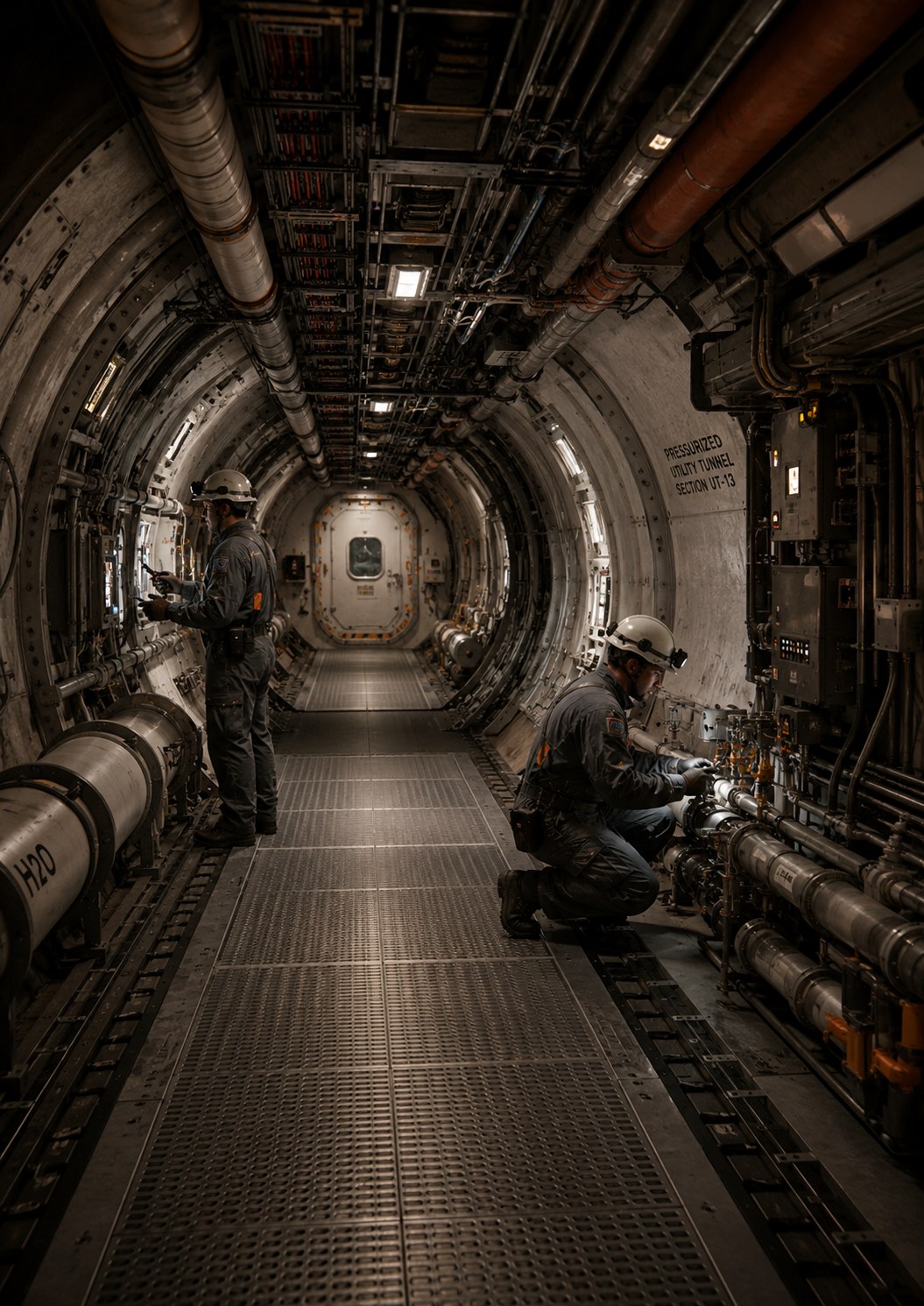
Essential foundations already established
Radiation protection changes vehicle mass, habitat siting and daily operations; the practical Mars colonization roadmap shows where shielding and storm-shelter capability become prerequisites rather than isolated health features.
The sky may be clear, winds light and temperatures manageable while energetic charged particles pass through the habitat, ionize matter, upset electronics and damage cells. Radiation is difficult to picture because it does not look like dust, fire or decompression. There is no smell and usually no immediate symptom. A human Mars system nevertheless has to treat it as a continuously monitored environmental variable.
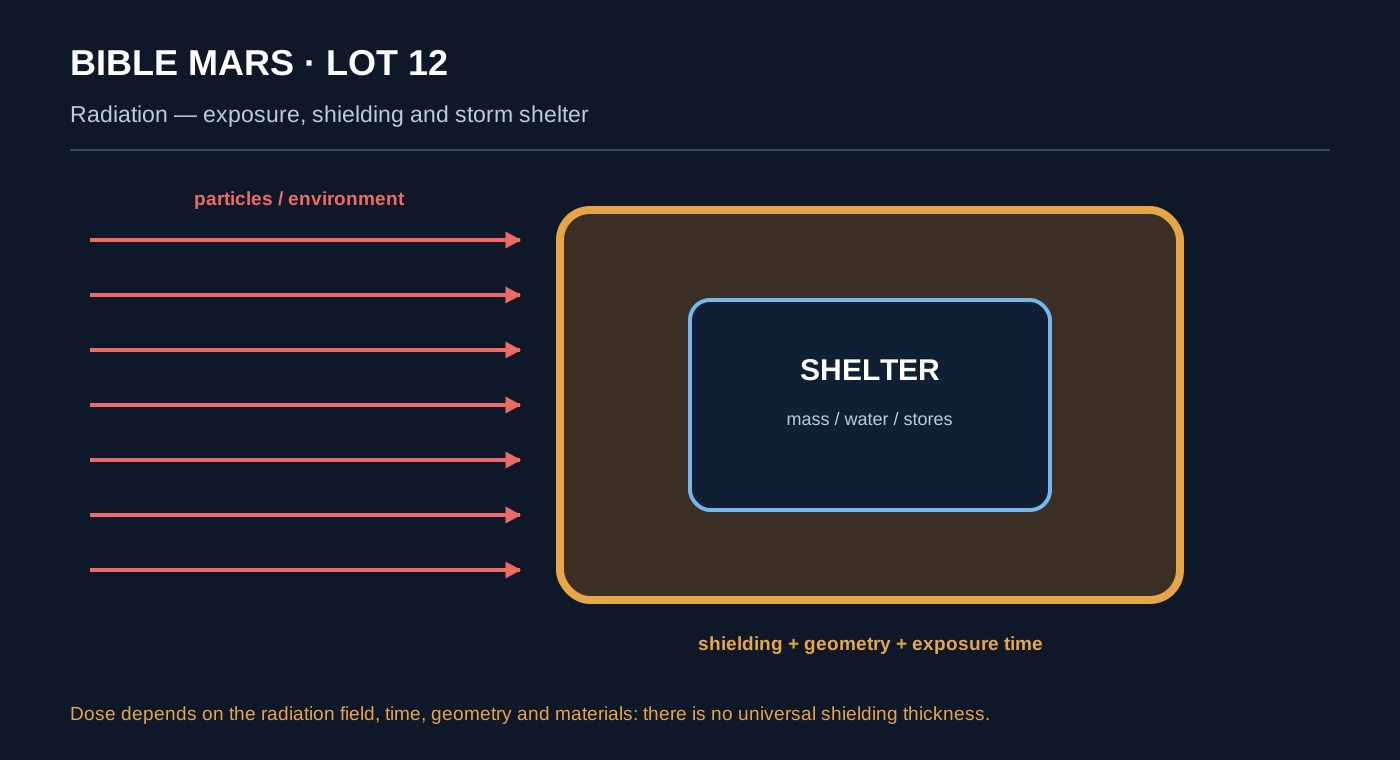
Two broad families dominate the discussion. GCR arrives mainly from outside the Solar System: protons, helium nuclei and a smaller but important population of very energetic heavy ions. It creates a persistent background that changes with solar activity and penetrates modest shielding. SPE, by contrast, is associated with solar activity and can increase particle flux sharply for hours or days. Protection strategy therefore differs: a compact heavily shielded refuge can strongly reduce the acute hazard from a major solar event, while the chronic GCR problem is much harder to eliminate.
Curiosity made this discussion far more concrete. Its Radiation Assessment Detector measured the environment during cruise to Mars and continued on the surface. That provides a rare bridge between interplanetary exposure inside a spacecraft and the Martian surface, where the planet blocks part of the sky and the atmosphere provides some shielding but there is no Earth-like global magnetic field or thick atmosphere.
This page therefore avoids the misleading idea of one universal “Mars radiation number.” Source, spectrum, energy, geometry, solar conditions, altitude, shielding, mission duration and biological metric all matter.
The operational lesson is that radiation cannot be delegated to a wall. Trajectory design, warning systems, shelter access, rover procedures, EVA scheduling, medical follow-up and settlement zoning all contribute to exposure. If any one of those functions is treated as someone else’s subsystem, the final dose budget can fail even when the shielding calculation itself is correct. Radiation protection is therefore a cross-cutting architecture discipline.
Martian radiation was not discovered by one rover. The physics of ionizing radiation, solar particles and cosmic rays developed over more than a century. What interplanetary exploration adds is the ability to measure the field encountered behind spacecraft shielding and then on another planet’s surface. The Radiation Assessment Detector on Mars Science Laboratory provided that unusually valuable continuity during cruise and after landing.
Radiation measurement is not a single counter. Instruments record particles and energy deposition; transport models must then consider spacecraft material, the Martian atmosphere, regolith and the secondary particles produced when energetic nuclei strike matter. Two quoted “dose” values are meaningful only when the quantity, geometry, time period and biological weighting are known.
This is why a reference work should treat historical numbers as observations, not universal constants. Galactic cosmic rays vary with solar modulation. Solar particle events are episodic. Atmospheric column depth changes with season and elevation. Local shielding varies from one room to another. Current NASA work still treats GCR as a particularly difficult long-duration driver while acute SPE exposure can be mitigated more effectively with local shielding, monitoring and procedures.
A settlement turns this physics into metrology: personal dosimeters, fixed monitors, individual dose histories, space-weather models, shielding maps and operational thresholds. The hazard becomes a measurable mission budget rather than an invisible fear.
Absorbed dose measures ionizing energy deposited per unit mass. Its SI unit is the gray: 1 Gy = 1 joule per kilogram. That physical quantity is essential, but equal absorbed doses from photons, protons, neutrons and high-energy heavy ions do not necessarily have equal biological effect.
Biologically weighted quantities expressed in sieverts are therefore used to account for radiation type and, depending on the quantity, tissue sensitivity. A measured value in µGy/day cannot simply be converted into mSv/day without assumptions about the particle field and quality factors.
LET helps explain why heavy ions matter. High-LET radiation deposits substantial energy along a short track, producing dense ionization. HZE ions in GCR can create complex biological damage. Shielding complicates the field further because a high-energy primary can strike a nucleus in the shielding and generate fragments or secondary neutrons through spallation.
That is why more thickness does not automatically mean a proportional reduction in all radiation risk. Additional mass can be highly effective against many SPE protons, while GCR requires transport modeling that includes secondaries and composition. NASA’s Spaceflight Human-System Standard therefore links radiation-environment definition to both system design and operational constraints.
Absorbed dose, equivalent dose and biological risk should never be collapsed into one number without stating the conversion. A gray is one joule of ionizing energy deposited per kilogram. A sievert applies radiation-weighting concepts because a sparse track of energy deposition and a dense heavy-ion track can produce different biological consequences even when absorbed energy is equal. LET adds another layer by describing how densely energy is deposited along a particle track. These distinctions are not academic vocabulary; they determine how measurements are interpreted and how shielding trades are compared.
For Mars design, the safest practice is therefore to state exactly which quantity is being quoted: particle flux, absorbed dose, dose equivalent, organ dose or effective dose, and over what time interval. Mixing daily surface dose with a mission-integrated effective-dose limit produces apparent precision while comparing different things.
If mission phases have different dose rates, the simplest useful model is a time integral:
The Greek capital sigma Σ means “sum all terms.” Only compatible dose quantities and units may be added.
Take a deliberately illustrative scenario close to historical RAD-era orders of magnitude, not a mission prediction: 1.8 mSv/day for 180 days outbound, 0.7 mSv/day for 500 days on the surface, then 1.8 mSv/day for 180 days inbound. Outbound = 1.8 × 180 = 324 mSv. Surface = 0.7 × 500 = 350 mSv. Return = 324 mSv. Total = 998 mSv, approximately 1 Sv.
If transit falls to 120 days each way while every other assumption is frozen, transit becomes 1.8 × 120 × 2 = 432 mSv; surface remains 350 mSv; total becomes 782 mSv. The difference is 216 mSv. This does not prove that faster transit is always preferable—propulsion, mass, reliability and trajectory change too—but it shows why time itself can be a radiation countermeasure.
A flight design would require much more: spacecraft geometry, distributed materials, water, food, equipment, particle spectra, individual dosimetry, biological uncertainty and margins. The professional object is a versioned mission model, not one universal “Mars dose.”
A mission dose budget works like any other engineering budget: define phases, durations, environments and uncertainty. Transit outbound, surface stay, EVA, storm-shelter periods and return transit are not interchangeable. If a crew spends 180 days in one radiation field and 500 days in another, the arithmetic has to preserve those durations. The result should then be carried as a range rather than a single immortal number because solar conditions and shielding geometry vary.
The same discipline applies within a settlement. Sleeping quarters may sit behind more areal density than laboratories; rovers may provide less protection than the habitat; an EVA may be postponed when space-weather conditions deteriorate. Personal dosimetry then closes the loop between design assumptions and the dose actually accumulated by each individual.
During the rover’s early surface campaign, RAD observed a background dominated by galactic cosmic rays with an absorbed dose rate around 210 µGy/day under the conditions then measured. NASA also documented day-night differences related to atmospheric shielding, seasonal variation and Forbush decreases. NASA Science — Radiation Measurements on Mars.
Using RAD cruise and surface data, NASA published an illustrative Mars-mission comparison in which roughly 180 days outbound, 500 days on the surface and 180 days return produced an order of magnitude near 1 sievert, with comparable contributions from the three phases. This 2013 reference graphic is neither a future mission prediction nor a current exposure limit. It remains useful as a scale-setting example. NASA source.
More recent NASA work continues to separate the hazards. A 2024 review, The Martian Radiation Environment and Human Health Risks, emphasizes that real-time dosimetry and shielding are useful against acute solar-particle exposure, while GCR remains deeply penetrating. A 2025 NASA chapter on The Space Radiation Environment likewise describes dedicated storm shelters as an important SPE countermeasure.
Solar cycle matters too. Conditions during one measurement campaign do not represent every year of a future mission. Mission timing changes the trade without removing the hazard.
Mass along the particle path matters, but composition matters too. Hydrogen-rich materials such as water and polyethylene are attractive because hydrogen can slow many protons and neutrons without introducing as many heavy nuclei as dense metals. Metals remain structurally essential; protection is therefore a systems problem involving many layers and already-required commodities.
Martian regolith has one extraordinary advantage: it does not have to be launched from Earth. Engineers can move tonnes locally, although those tonnes still require excavators, power, wear parts and construction time. Areal density is a useful way to think. A bulk density of 1,500 kg/m³ and a one-metre layer corresponds to about 1,500 kg/m²; two metres correspond to about 3,000 kg/m².
Scenario: ρ = 1,500 kg/m³, A = 200 m², h = 2 m. Volume = 400 m³. Mass = 1,500 × 400 = 600,000 kg, or 600 tonnes. This is not a shielding prescription. It exposes the construction workload hidden inside the phrase “cover the habitat with regolith.”
GCR performance is not linear with thickness because secondary particles are created. NASA’s Safe Human Expeditions Beyond Low Earth Orbit discusses the continuing challenge of passive GCR shielding and the more tractable design of SPE storm shelters.
Hydrogen-rich materials are attractive for many high-energy particle environments because hydrogen nuclei are efficient at slowing protons and can produce a different secondary-particle spectrum from high-atomic-number metals. Water and polyethylene therefore appear frequently in Mars shielding studies. Regolith is attractive for another reason: it is already on Mars and can provide large areal density without being launched from Earth.
But composition and geometry still matter. A thick wall can generate secondary neutrons and nuclear fragments when energetic primaries interact with nuclei. The design question is not ‘which material blocks radiation?’ but ‘what particle field exists behind this exact stack of materials, thicknesses and angles?’ That requires transport modelling and measurement, not a universal centimetres-to-sieverts conversion.
For a simple X-ray beam, the intuition “thicker is better” is useful. Space radiation is more complicated. High-energy GCR nuclei lose energy in shielding but can also fragment and generate secondary particles, including neutrons. The material and thickness therefore reshape the field behind the wall rather than merely subtracting particles.
Hydrogen-rich materials such as water and some polymers are attractive because their nuclear composition can reduce certain secondary-production penalties compared with heavier materials. That does not mean a water tank stops galactic cosmic rays. At high energies the residual field remains difficult, and very large passive mass eventually brings diminishing practical returns. Mission design therefore combines material selection, transit time, solar monitoring, storm shelters and medical risk management.
Regolith offers a different advantage: it is already on Mars. Moving hundreds of tonnes locally may be far easier than launching the same mass from Earth. But useful thickness depends on real density, composition, geometry and the protection objective. A cover that reduces radiation can also complicate inspection, add structural load and make access to leaks more difficult.
That is why engineers often think in areal density, such as g/cm², rather than metres of unspecified wall. Two layers of equal thickness but different density do not place the same mass in the particle path, and two materials with the same areal density may generate different secondary fields.
Space shielding is counter-intuitive because matter is not merely an obstacle. When a very energetic proton or heavy nucleus strikes a material, it can ionize atoms, fragment nuclei and generate a cascade of secondary particles. Neutrons are particularly important because they carry no electric charge and interact differently from charged particles. The field behind a wall is therefore the result of both the incoming radiation and what that radiation creates while crossing the structure.
Radiation teams consequently use transport codes such as HZETRN, GEANT, FLUKA and other specialized tools instead of a single attenuation rule. These models follow particle interactions and secondary spectra through a specified geometry. They must be compared with measurements; Curiosity RAD data have been used precisely to benchmark several model families for the Martian surface. Differences among models identify where particle species, energies or geometries remain difficult rather than implying that nothing is known.
This is also why an “optimal thickness” cannot be copied from one paper to every habitat. Aluminium, water, polyethylene and regolith do not create identical secondary fields. A real shell combines structure, insulation, equipment, storage and local shielding. The relevant object is the complete mass distribution around the crew, not one material in isolation.
At city scale, radiation modelling can become geographic. Every room has a different mass distribution around it: a water tank on one side, a workshop on another, overburden above, an access tunnel nearby. A dose map can then guide function placement. Sleeping quarters and medical spaces occupy better-protected zones; transit corridors can accept a different exposure; storm shelters are identified before an event.
The chain of evidence should remain explicit: external environment → transport model → real geometry → measured or calculated dose → estimated biological effect → operational rule. Skipping a link is how a useful scientific number turns into false certainty. A reader should always be able to tell whether a value is measured, simulated, required by a standard or introduced as a transparent teaching scenario.
Radiation transport also links shielding to geometry. A slab calculation does not automatically describe a real habitat with doors, windows, equipment racks, water tanks and penetrations. Particles arrive from many directions, scatter, fragment and encounter regions with different areal density. Monte Carlo transport models and local dosimeters are therefore complementary: the model predicts where weak spots should be, while measurements reveal whether the built configuration behaves as expected.
This matters when a settlement changes. Moving a water tank, opening a new corridor or adding a surface workshop changes local shielding. Radiation configuration should therefore be managed like any other safety configuration, with drawings, material records and dose surveys updated when the physical layout changes. The shield is not only the wall specified at design review; it is the mass distribution that exists around people on that day.
An SPE refuge does not need to be the whole habitat. It needs enough protected volume and life support for the dangerous interval. That opens an elegant design strategy: arrange water, food and other hydrogen-rich supplies around a compact central refuge so commodities perform both logistics and shielding functions.
Dual use does not remove systems engineering. Concentrating every water tank around one room can create a common-cause vulnerability if a local leak, fire or impact damages both the refuge and the reserve. The shelter needs independent ventilation, CO₂ control, oxygen, water, lighting, communications, power, dosimetry and waste-management provisions for the planned occupancy time.
Operations matter as much as material. The crew must know who orders sheltering, which radiation instrument triggers the decision and how long it takes every crewmember to reach the protected volume. Mars communication delay means the decision must be possible locally. A slightly less massive refuge reached in two minutes may be operationally safer than a theoretically ideal one that takes forty minutes to configure.
The storm shelter can exploit mass that the mission already needs. Water tanks, food stores and selected equipment can be arranged around a small refuge so that logistics become shielding. The arrangement must remain maintainable: the crew still needs access to valves, inventory and fire boundaries, and a leak in one tank must not defeat both water supply and radiation protection at once.
A credible refuge has independent life support for the intended occupancy time. Oxygen, CO₂ removal, ventilation, power, communications, dosimetry, drinking water, sanitation and medical provisions all belong in the requirement. The shelter is therefore a small emergency habitat embedded inside the larger habitat, not simply a closet with thick walls.
Emergency protection has a time dimension. The crew must recognize an alert, stop or safe current activities, move into the protected volume and establish a stable life-support configuration. Drills reveal bottlenecks that radiation-transport models cannot: blocked access, missing dosimeters, a medical patient who cannot move quickly, a valve that takes too long to configure or communications equipment stored outside the refuge.
Readiness therefore has measurable criteria: maximum time to shelter, minimum oxygen and CO₂-control duration, independent power endurance, water available inside, dosimetry status and communication capability. These are engineering requirements derived from operations, not merely human-factors decoration.
A storm shelter is useful only if every person can reach it in time and remain there while critical life-support functions continue. It needs breathable air, carbon-dioxide removal, water, communications, minimum power and medical capability. The design must work in a degraded habitat, not only in a nominal computer model.
Its geometry can exploit mass that already has to fly: water tanks, food, consumables, batteries and equipment can surround a smaller protected volume. This integration is especially attractive during transit, when every kilogram has launch and propulsion cost. On Mars, moved regolith can add local mass, provided construction has been completed before the shelter is credited as an operational capability.
Operations begin before an alert. Crews need clear triggers, accountability procedures, EVA-abort rules, dosimeter handling, spacecraft configuration steps and authority to act without waiting for Earth. Mars communication delays make a shelter that depends on real-time terrestrial approval fundamentally unsafe.
Drills should measure the time from warning to protected configuration. A blocked hatch, badly stowed cargo or unavailable suit can invalidate a beautiful paper design. As with fire safety, a shelter that has never been exercised is not yet a mature capability.
In interplanetary space, radiation arrives from nearly all directions and the crew depends mostly on vehicle mass. On Mars, the planet blocks the lower half-space and the atmosphere adds angle-, altitude- and pressure-dependent shielding. The ground also creates secondary particles. A transit dose rate therefore cannot simply be copied into a surface model.
Site altitude and atmospheric column can influence the environment, but radiation is only one site-selection driver. Ice, landing safety, power, thermal conditions, science, communications and mobility must be traded together. See Choosing a site and deploying a Mars base.
Heavy surface infrastructure can eventually make shielding easier than during cruise because berms, trenches and burial are possible. The first crew, however, arrives before the mature city. Initial protection must therefore be landed from Earth or constructed robotically before crew arrival.
Transit is exposed to deep-space radiation with only vehicle shielding, while the Martian surface gains partial protection from the planet beneath the crew and a thin atmosphere above them. That difference does not make the surface ‘safe’; it changes the angular and energy distribution of the field and adds secondaries produced in atmosphere and ground. An architecture that shortens transit can therefore reduce one part of the exposure while leaving a long surface campaign that still needs shielding and operational controls.
Outside the habitat, the crew leaves part of its shielding behind. A mobile spacesuit cannot reproduce a refuge surrounded by tonnes of water and regolith. EVA planning can therefore incorporate current particle environment, space-weather forecasts and accumulated dose.
If an illustrative exterior environment is 1.2 mSv/day and an EVA lasts 6 h = 0.25 day, the added dose is 1.2 × 0.25 = 0.30 mSv. This is not a Mars forecast; it demonstrates the arithmetic.
Robotics can then be treated as a radiation countermeasure: repetitive exterior work can be automated so human exposure is reserved for tasks where human judgment or dexterity is worth the dose and operational risk.
An SPE shelter only helps if the crew knows when to enter it. A complete architecture therefore combines local detectors, space-weather forecasts, Earth updates, propagation models and pre-authorized procedures. Not every flare or coronal mass ejection produces a dangerous particle event at Mars; direction, particle energy and timing matter.
Earth–Mars delay demands local authority. The crew should not wait for detailed permission when mission dosimetry crosses a predefined threshold. Procedures identify who shelters, which EVA is cancelled, what equipment is shut down and how an injured crewmember is moved.
The analogy is terrestrial severe-weather warning, except that a Mars settlement cannot evacuate to another region. The refuge therefore belongs in routine architecture and training rather than in a forgotten emergency appendix.
Because Earth cannot command an emergency response instantly, Mars needs local space-weather awareness. Solar observations, onboard particle detectors, alert thresholds and pre-rehearsed actions should connect directly to operations. The decision chain has to answer practical questions: who has authority to terminate an EVA, how long does it take to reach shelter, what happens to a rover crew that cannot return immediately, and which autonomous systems continue exterior work while people are protected?
GCR intensity and solar-particle-event probability do not vary in the same way through the solar cycle. A mission architecture therefore cannot treat one year of measurements as a timeless constant. Long-duration planning needs a range of solar conditions and explicit uncertainty rather than a single “average Mars” environment.
Operationally, this means dose forecasts, current detector readings and shelter readiness belong in mission planning. Exterior maintenance can be postponed when the particle environment is unfavorable; robots can perform some tasks; sleeping areas can be located behind additional mass; water and food inventory can be arranged to improve shielding without making emergency access impossible.
Radiation protection is therefore not a single subsystem bought once before launch. It is a continuous interaction among trajectory, construction, logistics, forecasting, crew scheduling and medicine.
A proton or heavy ion can deposit energy in tissue and can also disturb a semiconductor. Single-event upsets may flip memory bits; more severe events can trigger latch-up, while total ionizing dose contributes to component aging. A settlement therefore manages biological dosimetry and electronic reliability at the same time.
Countermeasures differ. Computers can use ECC memory, redundancy, voting, rad-hard parts and autonomous reboot. Humans cannot. Conversely, electronics can be buried in a small heavily shielded vault while people need habitable volume and mobility. Protection level is therefore distributed by function and criticality.
See Electronics, components and sensors and the durability/FDIR chapter for the systems side of the same environment.
Electronics and humans respond through different failure mechanisms. A person accumulates biological risk through tissue exposure; electronics can suffer single-event upsets, latch-up, displacement damage or long-term total ionizing dose. Shielding that is acceptable for people may not be sufficient for a sensitive component, and rad-hard electronics do not make the crew safer. A resilient habitat therefore has separate radiation requirements for occupants, sensors, computers, power electronics and stored data.
Exposure limits developed for medically selected professional astronauts on finite missions cannot simply be copied to a city containing children, pregnant people, older residents and inhabitants exposed for decades. For a permanent population, radiation policy moves beyond mission completion and must define what chronic risk, uncertainty and lifetime exposure a society is prepared to accept and reduce.
Biological uncertainty associated with GCR, especially heavy ions, makes the answer difficult. Cancer, cardiovascular, central-nervous-system and other risks remain research topics. NASA’s 2025 Moon to Mars Architecture Definition Document, Revision C still identifies radiation as a significant architecture driver and distinguishes relatively better-understood SPE shielding from the harder GCR problem.
A permanent settlement will probably distribute protection: heavily shielded sleeping or refuge zones, covered habitats, individual dosimetry, robotic execution of the most exposed tasks, solar monitoring and time accounting for exterior work. Surface activity need not become forbidden; instead, every exterior task should be planned with radiation exposure in mind.
A permanent settlement introduces people for whom the professional-astronaut model may be inappropriate: older adults, people with different medical histories and eventually children or pregnancies. Risk policy can no longer rely solely on selecting a small exceptionally healthy cohort for a finite mission. The settlement must decide what protection level is owed to ordinary residents, how individual dose history is recorded, who may accept higher occupational exposure and which activities are restricted. Those are engineering, medical and governance questions at the same time.
Early crews will probably be highly selected and medically monitored for defined missions. A permanent population is different. What is acceptable exposure for people who may live decades on Mars, for workers who spend far more time outside, for older residents, pregnant people and eventually children? Direct human evidence for a lifetime in the Martian radiation environment does not exist.
The answer cannot simply be a professional-astronaut career rule scaled upward. A settlement would need individual dosimetry, longitudinal medicine, work rules, heavily protected communal zones and transparent methods for allocating higher-exposure tasks. A person performing frequent EVA accumulates a different risk history from a person working in shielded underground infrastructure.
This becomes a civic issue as well as a medical one. What minimum shielding is required for housing? Can an employer assign more outside work to someone with lower cumulative dose? How should uncertainty enter occupational health, insurance or family planning? Engineering cannot answer these questions alone.
A rigorous reference should therefore distinguish acute high-dose effects, probabilistic long-term risks estimated from models and terrestrial/space data, and the much less certain consequences of a lifetime combining partial gravity with chronic space radiation. Stating uncertainty is part of scientific accuracy.
A first base may stack water bags around bunks. A city needs geometry. Not every room needs identical shielding: a corridor occupied for minutes, an airlock and a bedroom occupied eight hours per day have different time-integrated exposure. Radiation-aware planning puts long-duration functions in the best-protected zones and uses lighter zones for brief access or equipment.
“Heavy cores” could contain sleeping quarters, medical care, storm shelter, biological archives and critical control functions. Water and stores can be arranged around them. Tunnels can receive progressively more overburden as the settlement matures. The same geometry may also improve thermal stability and protection from some surface hazards.
Maintenance is the counterweight. Deeply buried pressure vessels are difficult to inspect. A leak beneath metres of fill requires access routes, sensors and excavation capability. Shielding must not imprison the pressure shell. Galleries, removable layers and robotic access paths should be designed from the beginning.
At one thousand residents, radiation therefore influences neighbourhood depth, EVA distances, hospital location, water storage, shelter access and mobility between districts. Protection has stopped being a component; it has become a property of the urban fabric.
Popular summaries favor round thicknesses. Radiation transport does not. Attenuation depends on density, elemental composition, particle spectrum, geometry and the biological quantity of interest. Two metres of low-density material do not have the same areal density as two metres of dense material, and equal mass of different materials can create different secondary fields.
Good practice therefore states areal mass and uses particle-transport models or experimental data for the specific spectrum. Regolith can be extremely valuable because it is local, but no simple thickness makes the GCR problem disappear.
Radiation risk combines measured particle fields with models of transport and biological response. Each layer carries uncertainty. A settlement should therefore preserve raw dosimetry, model version, shielding configuration and individual exposure history so future science can update earlier estimates. A margin is meaningful only when the uncertainty it covers is named. This is especially important for children and long residence times, where Earth has no direct epidemiological equivalent to decades in the Martian radiation environment.
Uncertainty belongs in the architecture rather than in a footnote. Instrument calibration, solar-cycle variability, biological quality factors, future crew demographics and the exact geometry of shielding all contribute. A defensible design therefore publishes assumptions, sensitivity cases and margin. No credible model can know a 20-year cancer risk to several decimal places; the useful question is which design decisions remain robust across plausible ranges.
The same discipline should be applied to long-term health interpretation. Dose limits written for professional astronauts, organ-specific models, age and sex effects, and future evidence can change the policy without changing the underlying particle field. A settlement should therefore retain raw dosimetry and exposure history in forms that can be reinterpreted as medical knowledge evolves, instead of preserving only one risk score calculated years earlier.
That archive is a scientific asset as well as a medical one.
Operational note. A radiation-protection decision is only as good as the distinctions it preserves: absorbed dose is not the same quantity as dose equivalent, chronic galactic-cosmic-ray exposure is not the same event as a solar-particle storm, and more shielding is not automatically better for every particle spectrum. A safe design therefore links dosimetry, material choice, occupancy time, warning, shelter access and uncertainty. The aim is not to reduce the subject to one annual number, but to show which exposure can be avoided, which must be monitored and what action the crew can take when conditions change.
Speaking of “the radiation level on Mars” as a fixed value is misleading. Curiosity's RAD instrument has measured since 2012 an environment dominated by galactic cosmic rays, modulated by solar activity, atmospheric pressure and local geometry, with solar energetic particle events superimposed. A NASA resource based on the first ten months reported an absorbed dose rate from mostly galactic cosmic rays of about 210 µGy per day. Gy, gray, measures absorbed energy per unit mass; µGy means microgray, one millionth of a gray. It is not directly a biological dose in sieverts because particle type and radiation quality matter.
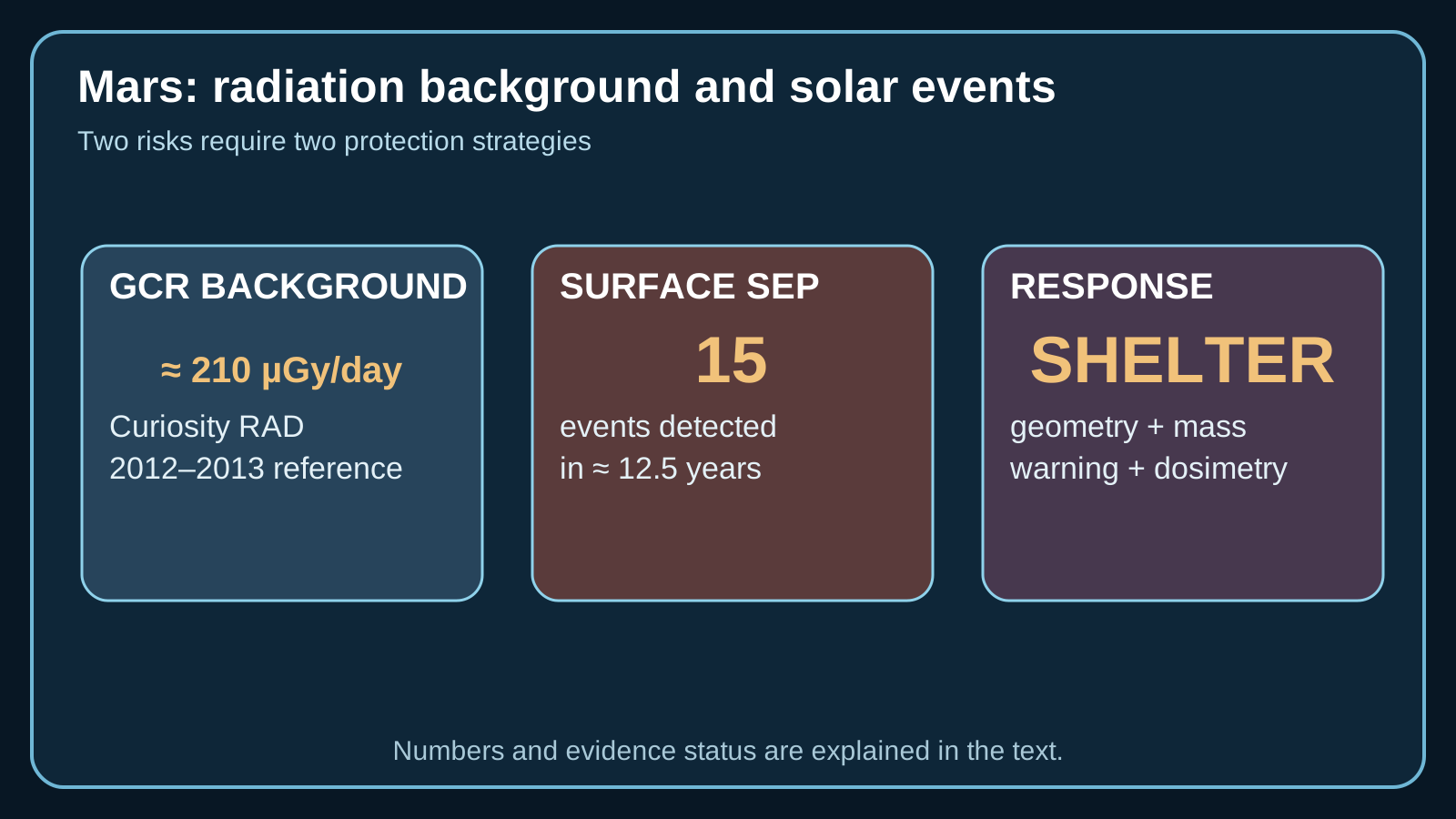
Turn 210 µGy/day into an annual scale without cheating on biology. If that historical reference value were held constant — a deliberately simplified assumption — absorbed dose over 365 days would be:
D = 210 µGy/day × 365 days = 76,650 µGy = 76.65 mGy.
D is absorbed dose and mGy is milligray, equal to one thousand micrograys. The arithmetic is valid but biologically incomplete. The result cannot be converted into individual cancer risk by a simple factor because spectrum, heavy ions, secondary neutrons, age, sex, exposed tissues and radiobiological uncertainty all matter. A reference site must keep the boundary between “measured quantity” and “inferred health risk” explicit.
Solar events are filtered by the atmosphere, not eliminated. A recent NASA NTRS study of Mars Ground Level Enhancements reports roughly fifteen solar particle events detected at the surface over about twelve and a half years of RAD observations. The Martian atmosphere prevents a portion of lower-energy solar particles from reaching the ground directly, but it does not make Mars Earth-like. Architecture therefore needs two strategies: sensible everyday shielding against the background and a rapidly accessible storm shelter when space-weather warning indicates a significant event.
The best shielding material is not necessarily just a “heavy wall”. High-energy particles can create secondary radiation when traversing matter. Performance therefore depends on material composition and geometry, not only tonnage. Hydrogen-rich materials such as water and selected polymers can be useful in some architectures, while Martian regolith offers abundant local mass for additional areal density. Designers can also give already-required stores a second function: water tanks, food and other hydrogen-rich supplies can be arranged around a protected volume rather than scattered arbitrarily.
A storm shelter has to remain liveable during the storm. Excellent shielding is useless if people cannot stay inside with breathable air, controlled CO₂, water, sanitation, communications, medical supplies and emergency power. The shelter is therefore a combined radiation, ECLSS, human-factors and operations problem. A city adds another layer: every pressurized district needs to know how many people it can protect, for how long, and along which route if a warning arrives while part of the population is working outside.
Primary sources: NASA Science — Radiation Measurements on Mars; NASA NTRS — Mars’ Surface Radiation Environment Measured with MSL/RAD; NASA NTRS — Mars Ground Level Enhancements and solar energetic particles.
Understanding the units prevents a common error: turning a physical measurement directly into medical risk. Absorbed dose describes energy deposited by radiation per unit mass; its SI unit is the gray (Gy), one joule per kilogram. Equivalent dose weights absorbed dose for radiation type and is expressed in sievert (Sv). Effective dose adds tissue weighting to estimate whole-body detriment. The quantities are related but are not interchangeable.
The historical surface value of roughly 210 µGy per day measured by RAD is an absorbed dose under specific instrument and time conditions. As an order-of-magnitude exercise only, 210 µGy/day × 365 days = 76,650 µGy = 76.65 mGy per year. The prefix µ means micro, one millionth; m means milli, one thousandth. That calculation is not an annual cancer-risk estimate. Biological risk requires particle spectrum and quality, exposed organs, age, sex, duration and risk models.
An annual average hides two different design problems. Galactic cosmic radiation is a chronic background. Solar particle events are intermittent. A NASA analysis of surface detections reports only 15 solar energetic particle events in about 12.5 years, partly because the Martian atmosphere prevents a substantial fraction of lower-energy particles from directly reaching the surface. Rare does not mean irrelevant: a severe event is an emergency requiring warning, short travel to shelter and a protection geometry known before the event.
Shielding is not simply “add as much mass as possible”. Some high-energy particles produce secondary radiation in nuclear interactions, so material composition and geometry matter. Hydrogen-rich materials such as water and some polymers are attractive in several architectures. Martian regolith may contribute when placed around or above a habitat. The correct solution depends on the spectrum and requires radiation-transport calculation rather than a simple rule linking centimeters to safety.
A settlement can turn consumables into shielding. Water tanks, food, polymers, equipment and external regolith can be arranged around a storm shelter so mass serves more than one function. The geometry must remain controlled: if a tank empties or stores move, shielding changes. Radiation protection therefore becomes connected to inventory management.
At city scale, dosimetry becomes a network. Four astronauts can wear personal dosimeters and track where they work. Hundreds or thousands of residents occupy homes, workshops, greenhouses and vehicles with different shielding. The city must map dose by zone, track occupational exposure, detect changes as structures age, and maintain shelters reachable within known travel times. Radiation protection becomes urban infrastructure rather than a property of one habitat.
Primary source: NASA NTRS — Mars Ground Level Enhancements in the Context of the Solar Energetic Particle Clock.
The dose registry becomes part of the city’s memory. A durable settlement should preserve individual and geographic exposure histories: cumulative dose, surface work, solar events, housing changes and shielding used. The registry supports medicine, urban design and occupational comparison. It is still protected health information: mapping collective risk does not justify publishing an individual resident’s radiation history.
Martian radiation is not one number to place on a poster. It varies with visible sky, topography, atmosphere, solar cycle, shielding material, and the secondary particles produced. Protecting a population therefore requires a dose architecture, not merely a wall thickness.
Terms such as GCR, solar particle event, absorbed dose, and equivalent dose describe different phenomena. A design chapter must preserve those distinctions so that a reassuring number in one context is not misapplied to another.
Galactic cosmic rays. GCR form a chronic background of very energetic particles whose shielding itself produces secondaries; the problem is not simply stopping a projectile.
Solar particle events. can rapidly increase particle flux and justify a high-mass shelter reachable within minutes or hours depending on warning.
Absorbed dose. measures energy deposited per unit mass; by itself it does not capture biological differences among radiation types.
Equivalent dose. Quality factors partly represent different biological effectiveness, making it dangerous to mix grays and sieverts without explanation.
Secondaries and neutrons. Shielding can generate secondary particles; material and geometry therefore matter as much as raw areal mass.
Curiosity's RAD instrument is irreplaceable because it actually measures the Martian surface field. But one local measurement during one period is not a universal constant for every future base.
Time series. Variation with solar activity and local conditions shows the value of continuous monitoring rather than one fixed number.
Topography. DLR's 2026 work shows that terrain influences observed dose and radiation albedo, directly linking radiation protection to site selection.
Visible sky. A rocky horizon blocks some arrival directions while also changing secondary contributions from surrounding terrain.
Atmosphere. The Martian atmosphere provides some attenuation and produces secondaries; site altitude changes the atmospheric column above the habitat.
Local instrumentation. A town needs its own environmental and personal dosimeters so that activity and maintenance can respond to conditions actually measured.
σ = ρ × e
Density ρ in kg/m³ multiplied by thickness e in m gives areal mass σ in kg/m². This allows thicknesses to be compared without forgetting the mass that must actually be moved.
The value of terrain cannot be judged from a radiation map alone. Horizon, access, power, ice, landing, communications, and the ability to build protected habitats must be considered together.
Natural depressions. A depression may reduce part of the visible sky while complicating dust drainage, communications, or lighting.
Cliffs and relief. A rock wall provides mass in some directions but can create access and safety constraints.
Lava tubes and cavities. A cavity could provide substantial natural mass, but exploration, stability, access, communications, and pressure containment then dominate.
Site altitude. Atmospheric column changes with altitude; this factor must be traded against EDL requirements and ice access.
Storage as shielding. Water, food, or consumables can be placed around sensitive volumes provided access and temperature control remain practical.
Adding mass often helps, but composition and layer order change secondary production. The goal is not the heaviest wall; it is dose reduction with a buildable and maintainable architecture.
Hydrogen-rich materials. Water and some polymers are attractive for several components of the radiation field and can also serve storage functions.
Regolith. Local material can provide large shielding mass without interplanetary transport, but excavation, dust, and pressure-vessel access remain real costs.
Metals. High-atomic-number materials are not automatically optimal for every radiation field because secondary production must be considered.
Functional layers. A wall can separate structure, pressure tightness, thermal control, micrometeoroids, and radiation shielding so each function uses appropriate material.
Areal density. Expressing shielding as mass per unit area allows materials and thicknesses to be compared without confusing volume with shielding capability.
D_total = Σ(d_i × t_i)
Total exposure across several environments can be approximated by summing dose rate d_i times duration t_i for each phase. Units and dose type must remain consistent.
A shelter that exists on paper but is too far from a workshop or greenhouse does not protect the people working there. Radiation protection is therefore also an urban-planning and travel-time problem.
Access time. Every work zone needs a known route to shelter and a realistic travel time under degraded conditions.
Shelter capacity. The shelter must accommodate all relevant people with air, water, communications, sanitation, and power during the event.
Warning data. Solar monitoring, communications, and trigger rules need to be robust enough to avoid improvised decisions.
External activities. An EVA or remote convoy needs a specific strategy because the main shelter may be unreachable at the critical moment.
Distributed shelters. Several smaller shelters can reduce access time and single-point dependence at the cost of additional mass and maintenance.
Radiation protection policy is not merely an annual limit. It allocates activities, tracks individual doses, and adapts external missions as conditions change.
Individual dosimetry. Each person needs to know cumulative exposure and relate it to the tasks, locations, and events that produced it.
EVA planning. Duration, route, terrain, and space-weather conditions should be integrated into EVA decisions.
High-exposure workers. External maintenance and surface operations can create dose differences among occupations; work policy should avoid systematically concentrating risk.
Exceptional events. A large unplanned exposure should change subsequent activity planning and create a medical and operational record.
Biological uncertainty. Effects of long exposure combined with Martian gravity and other stressors remain uncertain; management should retain margins rather than pretend everything is known.
F = D_protégée / D_référence
A factor below 1 indicates reduction relative to a defined reference. It can only be interpreted when spectrum, geometry, and dose quantity are stated.
At urban scale, radiation protection becomes a property of the town: district location, depth of spaces, transport, schedules, and storage all contribute to collective dose.
Buried districts. Sleeping and long-stay areas can receive more shielding mass than spaces occupied for only a few minutes.
Tunnel network. Covered links reduce routine travel exposure but increase excavation, ventilation, and maintenance.
Surface workshops. Some activities require external access; their organization should minimize exposure without making maintenance impossible.
Protected medical facility. A medical facility must remain functional during a solar event and protect patients unable to move quickly.
School and civilian population. A durable town must include children and vulnerable people in protection planning, not only a selected professional crew.
A reference chapter should end by separating direct Martian data, models, analogs, and unknowns. That hierarchy prevents shielding simulations from becoming promises that medical risk is solved.
Direct measurements. RAD provides a real surface field at defined locations and times; it is an exceptional validation base but geographically limited.
Transport models. Transport codes explore materials and geometries that cannot all be tested on Mars, but depend on physical models and input spectra.
Human biology. Cancer, central nervous system, and other risks carry uncertainties specific to long-duration space radiation.
Partial gravity. The combination of 0.38 g, radiation, and other stressors has no decades-long human reference population.
Revisable decisions. Protection policy should be able to evolve with measurements from the first base instead of freezing a doctrine designed before arrival.
T_EVA = n_sorties × durée_moyenne
The calculation converts operational policy into external exposure time. It can then be combined with a measured or modeled dose rate to compare jobs and scenarios.
Solar alert during a remote EVA
A team is working several kilometers away. The scenario compares return to the vehicle, mobile shelter, warning time, and extra exposure, then asks whether the mission should have been authorized under those space-weather conditions.
A district dosimeter drifts
An abnormally low reading is detected through comparison with a second instrument. Response involves calibration, reconstructing exposures, and deciding whether to temporarily limit occupancy.
Shielding blocks access to a leak
A heavily shielded wall develops a pressure leak. The case tests whether the architecture allows local shielding removal and rapid repair.
The town expands beyond protective terrain
A new district is planned in a more exposed area. The decision compares extra excavation, shielding mass, travel time, and shifting long-duration activities into better-protected zones.
The peer-reviewed paper explicitly links topography, RAD measurements, and albedo radiation, supporting a dedicated chapter on radiation-aware site selection.
RAD provides the measurement chain that anchors surface discussion in direct Martian data rather than terrestrial analogs alone.
The human research program frames radiation as biological risk and uncertainty rather than only wall physics.
Transport studies show why material, secondaries, and spectrum need to be considered together; they are design models, not long-duration human trials.
Concepts combining local material and hydrogen-rich shielding illuminate mass/composition trades without constituting one universal wall recipe.
The human-system risk map places radiation among other mission hazards and prevents it from being isolated from overall health.
Curiosity provides a real measured surface radiation environment; recent work on topographic effects shows that dose need not be uniform around a site. A rocky horizon, depression, or wall can modify directions from which primaries and secondary radiation arrive. This does not mean a canyon automatically provides adequate shielding, but it means radiological site selection deserves mapping. Two sites equivalent in ice and power may differ in sky visibility, subsurface access, and local shielding mass. Urban planning can then reserve better-protected areas for sleeping quarters, storm shelters, medical functions, or biologically sensitive stores, while short-duration activities occupy more exposed zones.
Talking about tonnes of regolith without geometry can mislead. Protection depends on areal density along particle paths, material composition, direction, and radiation type. Water and hydrogen-rich materials can be useful for some components, while regolith is abundant and can provide large thicknesses. Added matter can also generate secondaries, so design must rely on radiation-transport analysis rather than a slogan that thicker is always better. For a base, robust protection combines architecture: water storage around occupied volumes, berms, partial burial, a more heavily shielded storm shelter, and limits on time spent in less-protected zones.
A four-person base can manage exposure through individual decisions. A town of a thousand must track occupations, possible pregnancies, children, EVA teams, and industrial workers with different exposure profiles. Radiation protection becomes public health. Dosimeters need to be linked to location and activity, and work rules must prevent a small group from carrying most collective dose. A town could even relocate work or alter schedules based on solar conditions. This transition from individual dose to collective governance is one reason an annual limit alone cannot describe the architecture.
An effective storm shelter is not only a mass-surrounded volume. It must be reached quickly and have air, water, electrical power, communications, sanitation, medicines, and enough space for the expected duration. If people remain there for hours or days, heat and CO2 become sizing constraints. The shelter should not depend on the system just lost: a major electrical failure combined with a solar event must not make protection unusable. In a town, several distributed shelters may be preferable to one central bunker because access time matters along with shielding thickness when an alert arrives.
Martian radiation measurements are real, but translating them into health risk over decades still relies partly on models. Local topography, shielding composition, solar activity, occupancy profile, and biological susceptibility all modify exposure. Habitat design must therefore combine in-situ measurements, personal dosimetry, and periodic revision of protection assumptions.
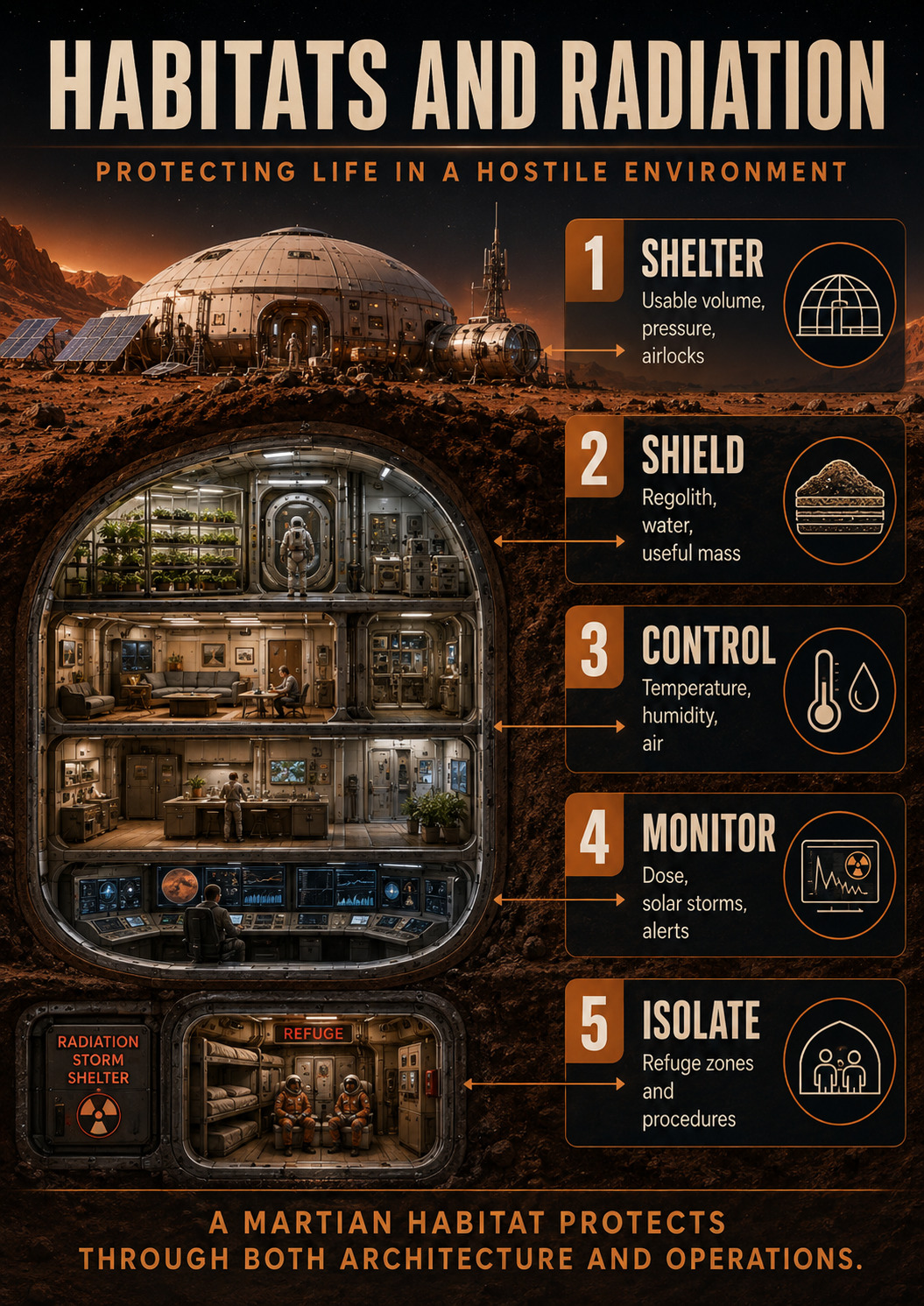
Mars radiation combines chronic background exposure with more episodic solar events, and those problems are not sized identically. Habitat geometry and materials address daily exposure, while a shelter must be quickly accessible when the environment changes. Absorbed dose, dose equivalent and biological risk must retain their units and context.
A settlement can use mass already needed for water, stores or regolith protection, but average thickness is not enough. Geometry and weak directions have to be checked around the places where people actually spend time.