





NASA NTRS — Joule-Heated Molten Regolith Electrolysis
The concept explicitly addresses oxygen and metals on Moon and Mars and shows that high-temperature reactor containment is a central problem.
MARS BIBLE — METALLURGY · METALS · ALLOYS · OXIDES
Producing metals and alloys from local resources
Local metallurgy would be one of the steps that turns a resupply-dependent base into a settlement able to repair and expand infrastructure. It is much harder than simply “melting rocks.”

Essential foundations already established
Metallurgy starts before the furnace. Prospecting must characterize mineralogy, useful concentration, associated phases and spatial variability. A material rich in iron is not automatically a good ore: the chemical form of the iron, impurities and separation energy matter. On Mars, moving tonnes of regolith may cost as much as heating them. The first mine is therefore a system of reconnaissance, excavation, crushing, sorting and beneficiation rather than simply a hole in the ground.
Pre-concentration can save large amounts of downstream energy. Magnetic separation, particle-size sorting, density methods or spectroscopic sorting may enrich a stream before reduction, but every stage adds motors, wear surfaces, dust and maintenance. The optimum chain is not the one producing the purest intermediate; it is the one minimizing energy, consumables and risk for the final requirement. Structural steel, electrical conductor and spring material demand different chemistry, so geology and end use must be linked from the beginning.
Why metals are strategic. A city needs metals for structures, pipes, tanks, wiring, heat exchangers, tools, motors, bearings, robots and electrical systems. Martian crustal materials contain iron, aluminium, magnesium and other useful elements largely bound in oxides and silicates.
The challenge is separation and purification at acceptable energy cost.
Producing metal requires more than a rich mineral deposit. Metallurgy converts mineral feed into usable metallic product. Between those states lie beneficiation, chemical or electrochemical reaction, phase separation, casting, refining and quality control. The process must also handle residue and recycle process materials. On Mars the right question is therefore not “is iron present?” but “can a known metal composition be produced repeatedly with acceptable energy and maintenance demand?”
NASA research on lunar resources has investigated molten-oxide or molten-regolith electrolysis. In experiments around 1,600 °C, such processes can release oxygen at the anode and form metallic products at the cathode. More recent work continues to investigate electrode materials and oxygen separation. These are valuable technology building blocks, but much of the evidence concerns lunar simulants and experimental reactors. A Martian implementation must confirm local feed composition, reactor corrosion, efficiency and the quality of recovered metals.
High temperature explains much of the engineering difficulty: electrical power, insulation, refractories, electrodes, cold start and heat recovery become major subsystems. A crucible or anode may be harder to replace than the raw regolith itself.
The mass balance must close
A serious plant accounts for every kilogram. If 100 kg enters, the sum of recovered metal, glass or slag, dust, gases and measured losses should approach 100 kg. This mass balance reveals drift, filter accumulation and product loss.
For one target element, a simple relationship is: recovered mass = mass contained in the feed × recovery efficiency. The equation is elementary but prevents a common conceptual mistake: confusing geological grade with actual production.
Metal leaving a reactor may contain multiple elements or inclusions. It may require refining, alloying, remelting, casting or conversion into powder, wire or billet. These downstream steps determine what the settlement can actually build. Early local metal might sensibly serve as ballast, shielding, simple structures or noncritical hardware long before the colony can make a turbine-grade alloy or pressure-vessel material.
That gradual climb in product quality is more realistic than imagining a complete Martian metallurgical industry appearing at once.
Primary references: NASA NTRS — Molten Oxide Electrolysis ↗ · NASA NTRS — improved molten-regolith electrolysis ↗.
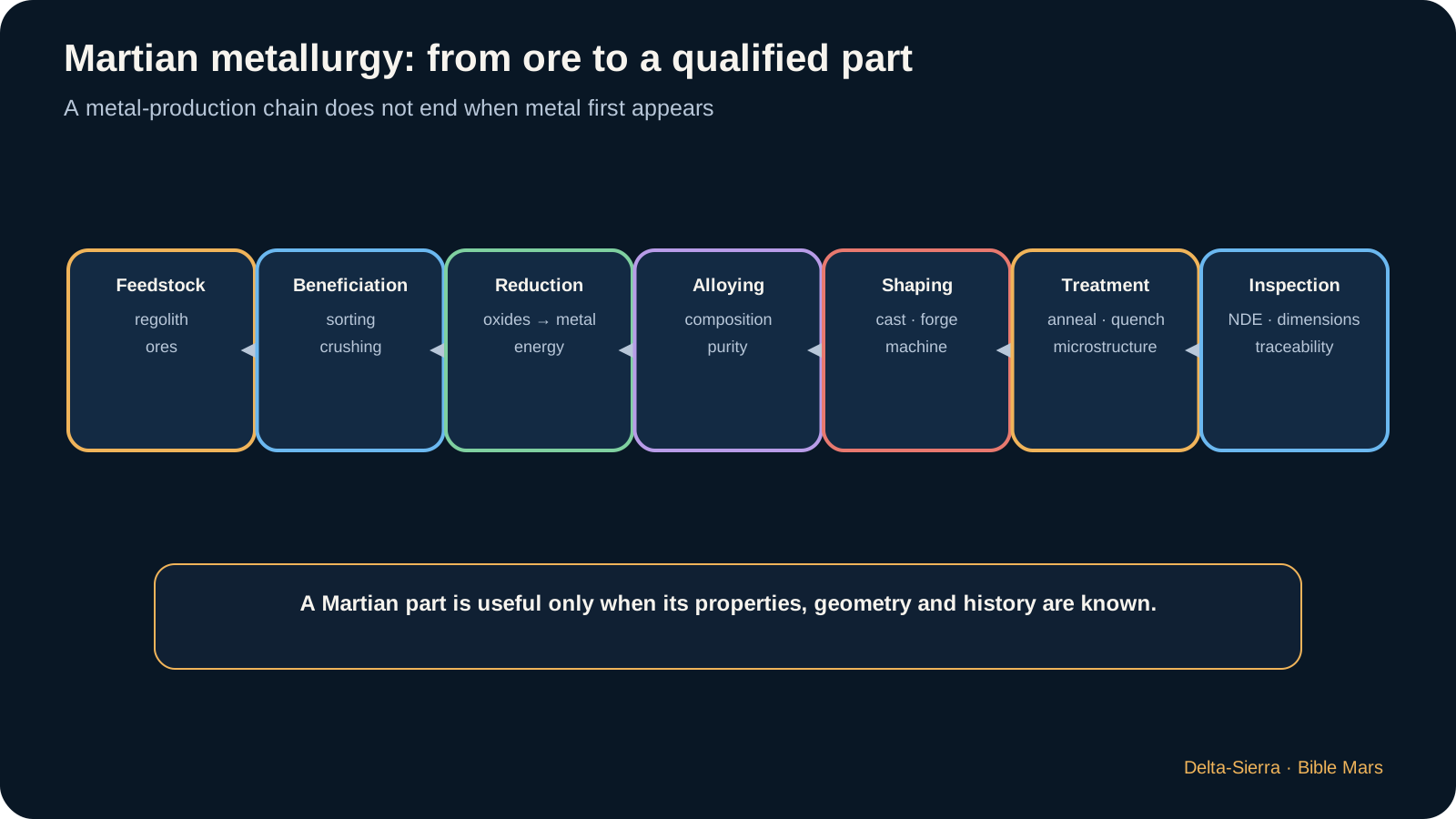
Most useful metals are chemically bound to oxygen in minerals, so production requires breaking strong bonds. Terrestrial metallurgy often relies on carbon, but a Mars settlement may favour hydrogen, molten electrolysis, salts or other routes depending on resources. Temperature, efficiency, purity, reagent recycling and electricity availability dominate the trade. Mini-ROXY studies, for example, investigate electrochemical routes intended to recover metals and oxygen from regolith-like feedstocks.
The energy character of metallurgy is easy to underestimate. A plant is sized not only in kilograms per day but in continuous kilowatts or megawatts, peak power, waste heat and availability. If a furnace must remain hot for hours, a power failure can destroy a batch, freeze metal in a transfer line or damage a crucible. Metallurgy therefore has to be integrated with the settlement microgrid, including planned shedding, safe shutdown and restart capability.
Choose metallurgy around power and reagents. Martian metallurgy will trade thermal, electrochemical and chemical routes. High-temperature melting can simplify some separations but demands power; chemical reduction may lower temperature but consumes reagents that must be produced, recycled or imported. Process choice therefore belongs inside the whole settlement energy and chemistry system.
Good processes can create multiple valuable outputs. Oxygen released during oxide reduction may support life support or propellant production after purification, while problematic residues can make an otherwise attractive metal route undesirable.
Primary production is an energy project as much as a mining project. Separating metals from oxides demands energy and suitable reagents or electrochemical processes. Metallurgy must therefore be designed together with settlement power, heat recovery and by-product management.
Consider a pedagogical scenario in which a small line must deliver 100 kilograms of useful metal per day. If the complete electrical and thermal chain — crushing, beneficiation, reduction, melting, pumps and auxiliaries — consumes 25 kWh per kilogram, daily energy is 2,500 kWh. Spread over 24 hours, that is 104 kW average before margin. If plant availability is only 80 percent, operating power or production time must change. The 25 kWh/kg value is not a universal NASA number; it is an explicit scenario showing how process assumptions become power-system requirements.
At one tonne per day the same example becomes 25 MWh daily, about 1.04 MW average. Metallurgy is then a major microgrid customer. Waste heat might support preheating or other processes, but only when temperature levels and distances allow useful integration. Martian plants must therefore be designed as coupled energy systems rather than isolated boxes.
Restart energy matters too. A furnace cooled by a power failure may need hours to recover; batches can be lost and transfer lines can freeze. Avoiding short interruptions may be more valuable than a small gain in nominal efficiency. Plant availability and grid reliability become one engineering problem.
Producing metal is only half the problem; the settlement must shape it. Casting handles large geometries and recycles scrap well but needs moulds, crucibles, solidification control and final machining. Powder metallurgy and additive manufacturing can create complex parts but require tightly controlled powder or wire and rigorous defect inspection. Forging or rolling can improve microstructure but require heavy presses and tooling. Process choice therefore depends as much on the available industrial equipment as on the material itself.
A Martian production cell may deliberately combine processes: cast a near-net-shape blank, machine critical interfaces, then use local heat treatment or additive repair. Hybrid routes reduce machine time and chips while keeping demanding surfaces precise. They also support recycling because sprues, supports and machining swarf can be returned to the feedstock stream. Industrial efficiency grows when every process is designed with its waste stream as the next process's input.
From raw metal to qualified parts. Composition, porosity, inclusions, heat treatment, weldability, fatigue and corrosion all matter. Pressure hardware cannot be accepted simply because an additive machine produced the right shape.
Metrology, non-destructive testing and qualification coupons are part of metallurgy, not optional extras.
Metallurgy is not “finding metal”: it is building a transformation chain. Martian rocks contain metallic elements largely bound to oxygen or incorporated in minerals. Producing usable metal requires separation, concentration, chemical or electrochemical reduction, purification, alloy control and forming.
A realistic sequence may begin with recycling imported metals before complete primary extraction from regolith.
Two parts with the same chemical composition can behave very differently. Grain size, precipitates, phases, porosity and residual stress depend on cooling rate, heat treatment and manufacturing route. Earth metallurgy benefits from decades of data and standards. Mars will have to rebuild part of that evidence for every new feedstock-process-alloy combination. The objective is not merely to know composition but to connect process, microstructure and mechanical properties.
Alloying elements become strategic dependencies. Small additions of chromium, nickel, molybdenum, copper, silicon or magnesium can transform corrosion, hardness or high-temperature capability. If some elements are rare locally, importing kilograms of high-value alloy additions may unlock tonnes of local base metal. Industrial autonomy therefore does not eliminate interplanetary trade; it shifts trade toward products with exceptionally high functional value per kilogram.
Alloys expose hidden dependencies. Reliable structures rarely use perfectly pure iron or aluminium. Small alloying additions can control strength, corrosion resistance and fatigue and may be harder to obtain locally than the bulk metal. Mars may therefore produce most of a part’s mass while importing low-mass, high-value additions for a long time.
That is why mass autonomy is not the same as complete autonomy. The industrial dependency register should expose every imported catalyst, alloying element, coating or lubricant that remains mission-critical.
Alloy and heat treatment: composition is not enough. Two parts with the same chemistry can have different properties depending on cooling, deformation and heating history. Process recipes therefore include temperature, time, atmosphere, cooling rate and verification.
The first readily available refined metal on Mars will already have been manufactured on Earth: retired cargo structures, tanks, frames, cables and failed parts. This urban mine is often far richer and more predictable than regolith. A disassembly and alloy-sorting system may therefore precede mining. Critical hardware should retain material identification so that composition, heat treatment and reuse restrictions remain known decades later.
Recycling does not mean melting all metals together. Unknown mixtures can create material that is impossible to qualify. Streams need alloy identity, contaminant analysis and separation of incompatible materials. Low-consequence applications such as ballast, brackets or shielding can absorb less controlled material; pressure, fatigue and structural applications require much better chemistry and process evidence.
Recycling may come first. The easiest early Martian metal feedstock may be imported hardware with known alloy composition. Scrap and retired structures can be remelted or machined before primary local metal production reaches scale.
Recycle first: every kilogram already on Mars is a concentrated mine. Retired structures, tanks, pipes and machines contain materials that are more concentrated and better characterized than raw regolith. Recycling can therefore become one of the settlement's first mines.
Alloy sorting matters: randomly mixing aluminium or steel grades can create material with poorly known properties.
Decision case: remelt a structure or preserve it as qualified hardware?. A 300-kilogram aluminium cargo frame looks like excellent feedstock, but remelting destroys geometry, heat treatment, interfaces and possible future functions. Before recycling, the settlement should ask whether the frame can serve as structure, fixture, bridge or certified spare. Recycling is irreversible; Earth-delivered hardware is both material and already manufactured functionality.
If remelting is justified, material identity still matters. Mixing aluminium alloys can change weldability, corrosion behaviour and heat-treatment response. Chemical analysis and batch segregation preserve useful properties. Uncertain mixtures can be directed toward ballast, supports or other low-consequence uses rather than critical pressure or fatigue hardware.
This creates a physical and digital material bank: mass by alloy family, condition, location, service history and authorized uses. Inventory becomes a portfolio of industrial options rather than a pile of scrap.
Inspection closes the loop between fabrication and trust. Internal defects may be invisible: porosity, lack of fusion, cracks, inclusions or delamination. Nondestructive evaluation methods — ultrasound, radiography where practical, eddy current, thermography, penetrant or acoustic techniques — each have limits. NASA has invested heavily in additive-manufacturing qualification and NDE precisely because correct geometry does not guarantee acceptable internal structure.
A settlement also needs reference standards, witness coupons and process histories. Laser-power drift, a miscalibrated thermocouple or contaminated powder can alter quality without obvious changes in shape. Important lots should connect feedstock, machine, parameters, inspection and authorized use. Metrology is not laboratory decoration; it prevents local manufacturing from becoming a common-cause failure generator.
Qualify material without a nearby terrestrial laboratory. Reliable metallurgy requires composition analysis, mechanical tests, dimensional measurement and sometimes non-destructive testing. Qualification depth must match the consequence of failure.
2026 boundary: producing metal does not remove qualification. NASA additive-manufacturing and nondestructive-evaluation work offers a useful lesson for Mars: process variability must be connected to part integrity. No single inspection method sees every defect. Ultrasound, X-ray, thermography, eddy current and witness coupons have different resolutions, geometric limits and costs. A settlement must therefore connect manufacturing method, credible failure mode and inspection technique.
NASA’s 2026–2027 technology solicitations for lunar welding and surface inspection still emphasize autonomous quality assessment, locally derived metals and long-duration reliability. Although lunar, the requirement is Mars-forward: an off-Earth weld must be inspectable with limited crew intervention and with equipment that survives the local environment.
Evidence should scale with consequence. Secondary hardware may need dimension and functional testing; pressure structure requires material identity, process control, inspectability, defect acceptance and service history. Local autonomy does not relax this requirement — it forces the settlement to reproduce the evidence chain locally.
Qualification boundary: local metal can be useful long before it is pressure-vessel grade. A settlement should avoid a false choice between imported aerospace alloy and fully local certified metal. Early local metal can serve ballast, shielding supports, frames, tools, fixtures and noncritical structural work. Each application teaches casting, forming, machining and corrosion behaviour while keeping failure consequences manageable.
As chemistry and process control improve, the service envelope can expand. Witness coupons, heat-treatment records, tensile tests and nondestructive evaluation build evidence. Only after stable production should locally produced metal enter highly loaded or pressure-critical structures. This staged authorization extracts value early without pretending that first metal equals mature metallurgy.
A serious mass balance follows losses at every step. One hundred kilograms of regolith may contain only a fraction of the desired element; beneficiation rejects mass, reduction produces by-products, melting creates slag and oxides, machining produces swarf. A credible chain must state where each kilogram goes and what can return to the loop. By-products may become resources in their own right: oxygen, silicates, residual oxides, heat or fill material.
Consumables deserve the same accounting. Crucibles, electrodes, filters, shielding gases, lubricants, abrasives and cutting tools may become more limiting than ore. Mature Martian metallurgy will try to close these loops, standardize interfaces and design equipment around replaceable wear items. A useful maturity metric is therefore not just kilograms of metal produced but operating time before the plant requires a consumable or part that the settlement cannot yet replace.
A simple material balance to expose losses
Start with 100 kg of sorted scrap. Suppose 92 kg reach useful melt after preparation and 85 kg become conforming parts after machining. Part/input yield is 85/100=85%.
The useful question is where the other 15 kg went and how much can be returned to the loop.
A realistic path starts with recycling and repair, proceeds to remelting known alloys, then introduces locally produced metals into tolerant applications. Later stages add composition control, heat treatment, deliberate alloy production and qualification for higher-consequence parts. This progression may take years or decades, but it is cumulative: each level creates the tools, data and skills needed by the next.
At settlement scale, metallurgy is also a capacity-reserve problem. One smelting line might meet average annual demand yet remain a single point of failure. Two smaller lines, common spares and the ability to fall back temporarily on recycling may provide better resilience. Like power and life support, industry must be sized not only for nominal throughput but for maintenance outages, failures and bad years.
This system within the settlement
Eight questions in the chain. DELTA-SIERRA / ARCADIA PROSPECTIVE ARCHITECTURE
Go deeper with ArcadiaAdditional interfaces and boundary conditions
Reducing oxides. Terrestrial metallurgy uses carbon, hydrogen, electricity and other reducing routes. Mars-specific choices would depend on local feedstock, power and valuable co-products such as oxygen.
Molten-regolith electrolysis is being studied for lunar resources and illustrates the possibility of producing oxygen and metal alloys together. It is not a Mars demonstration; Mars feedstock and plant design would require dedicated development.
Martian metallurgy is often compressed into “extract iron from regolith.” A real production chain has to cross several yields: select feedstock, concentrate useful phases, reduce oxides, separate metal from slag, control impurities, adjust alloy chemistry, form the material, heat-treat it and inspect the result. Every step can lose mass or degrade performance. Producing a metal button demonstrates a reaction; it does not demonstrate an industrial chain.
NASA's molten-regolith-electrolysis system work is primarily lunar, but it is useful as a systems case study. A reduction process may co-produce oxygen and metal alloys, then require additional separation and refining. Lunar numerical results must not be copied directly to Mars. The transferable lesson is functional: excavation, feed preparation, high-temperature energy, electrodes, separation, product handling and qualification all have to close as one plant.
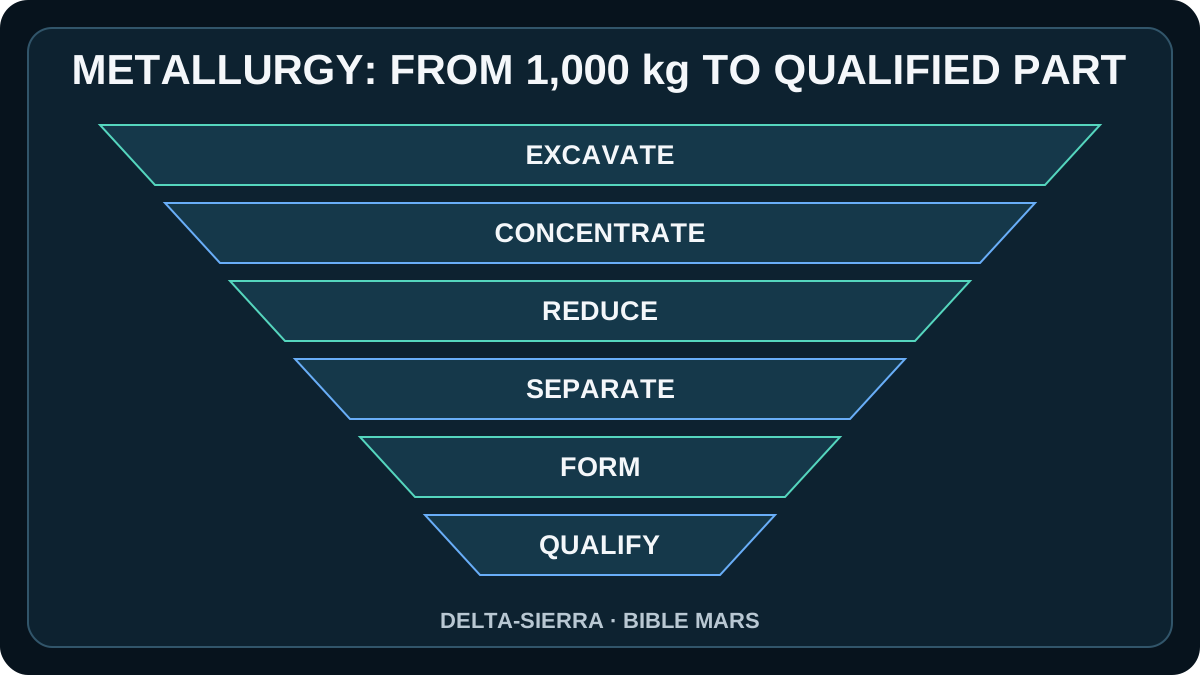
Take a deliberately generic example. Of 1,000 kg excavated, the targeted recoverable metal fraction is 18%, or 180 kg. Reduction and separation recover 85% of that mass, giving 153 kg. Forming and qualification retain 92%, so 153 × 0.92 = 140.76 kg. Final qualified output is therefore about 14.1% of the excavated mass.
Mqualified = 1,000 × 0.18 × 0.85 × 0.92 ≈ 141 kg.
Each factor represents a separate assumption: useful grade, metallurgical recovery, and forming/qualification yield.
The calculation is why energy and material handling should be expressed per kilogram of qualified output, not per kilogram of ore. Excavation, crushing and thermal processing handle a tonne while downstream manufacturing receives roughly one hundred kilograms. Improving separation yield by a few points can therefore reduce mining, heat and waste throughout the plant.
It also highlights recycling. Machining chips and rejected parts have already been concentrated and their chemistry may be known. In a mature settlement, the easiest “ore body” for some metals may be the stock of imported hardware that has reached end of life and can be recovered into a controlled recycling loop.
Go further in the books
Document check: 2026-08-10.
Martian metallurgy begins long before an ingot is poured. Useful minerals must be identified and concentrated, energy must break stable oxides, hot melts must be contained, and impure metal must be turned into material whose properties a workshop can actually certify.

Metallurgy should not heat undifferentiated soil. A credible pathway begins with mapping, sorting, and concentration so that useless mass does not pass through the most energy-intensive stages.
Mineralogy. Identifying phases and grades determines whether a process can target iron, aluminum, silicon, or other elements with acceptable yield.
Crushing. Reducing particle size liberates some phases but consumes power and accelerates abrasive wear.
Physical separation. Magnetic, density, or other separation can enrich a stream before chemical or electrolytic processing.
Sampling. Representative analysis requires a sampling strategy because a heterogeneous pile cannot be characterized by one grain.
Ore stockpiles. Identified lots allow process parameters to be adjusted and prevent mixing compositions that would produce unstable metal.
Martian metals are largely bound to oxygen. Releasing them requires chemical reactions, electrolysis, or high temperatures; energy balance has to come before promises of massive local production.
Molten oxide electrolysis. MRE/MOE concepts target oxygen and metals from molten oxides but require temperatures around 1,600 °C and demanding reactor materials.
Joule heating. Current-driven self-heating can help maintain the molten bath, directly linking reactor geometry to electrical demand.
Anodes and cathodes. Stable electrodes in aggressive melts become a critical dependency; their lifetime belongs in the industrial balance.
Oxygen coproduct. A metallurgical pathway can also produce oxygen, creating a potential coupling with other base systems.
Thermal losses. At high temperature, insulation, radiation, and startup cycles can dominate a significant part of actual energy use.
Q = m × c_p × ΔT
This relation gives a thermodynamic minimum for heating mass m with heat capacity c_p through ΔT. Furnace losses and phase changes must then be added.
Composition, porosity, inclusions, and microstructure determine properties. A town cannot claim it produces steel or aluminum merely because metallic material leaves a reactor.
Chemical analysis. Composition must be measured before selecting use because a few percent of elements or impurities can strongly change properties.
Alloying. Adding or removing elements can tune strength, corrosion, or weldability while creating dependency on potentially scarce alloying elements.
Degassing. Dissolved gases and porosity can weaken parts; melting and casting processes need to control the gas environment.
Inclusions. Oxides and nonmetallic particles can become crack initiators and require filtration or refining.
Heat traceability. Each heat should retain the history of ore, process, composition, and treatment so defects can be linked to causes.
A metallurgical pathway has value only when metal can become useful geometry. Several processes will likely complement each other depending on size, quantity, precision, and criticality.
Casting. can produce near-net shapes but requires molds, thermal control, and defect management.
Forging and forming. Deformation can improve some properties and create robust shapes at the cost of tooling and mechanical force.
Machining. provides precision and functional interfaces but generates chips, tool wear, and metrology demand.
WAAM and directed deposition. Wire-arc and other directed-deposition processes can manufacture or repair large parts with material qualification and path control.
Hybrid manufacturing. Depositing material and then machining interfaces combines build speed with local precision.
η = m_métal_utile / m_alimentation
Yield must state whether the denominator is raw ore, concentrate, or purified oxide. That boundary radically changes interpretation.
After shaping, temperature and time can profoundly change microstructure and performance. Martian metallurgy therefore needs furnaces and characterization, not just printers.
Annealing. can reduce residual stress or alter microstructure; its cycle must be reproducible and tied to the actual material.
Aging. Some alloys derive properties from controlled aging, making time and temperature quality parameters.
Quenching. Cooling rates can determine resulting phases and therefore require appropriate fluids or equipment.
Residual stress. Welding and additive manufacturing can introduce stresses that distort or crack a part if not controlled.
Witness coupons. Coupons processed with the batch enable mechanical testing and quality control without sacrificing the final part.
The boundary between improvisation and industry lies in evidence. A local part should be linked to material, process, inspection, and a fitness decision proportional to its criticality.
Mechanical testing. Tension, hardness, fatigue, or toughness tests should be selected according to part function and failure risk.
Nondestructive evaluation. Radiography, ultrasound, penetrant, or other methods can detect defects without destroying an expensive part.
Dimensional metrology. A chemically perfect part remains unusable if dimensions or functional surfaces do not fit the assembly.
Use criticality. A door handle and a pressure component do not require the same level of evidence; qualification should be proportional to risk.
Defect-to-process feedback. Observed defects should change parameters, feedstock preparation, and inspection so the factory genuinely learns.
r = m_rebut / m_produit_total
Scrap rate directly translates porosity, defects, and nonconformance into extra material and energy that must be recycled.
Early habitats, vehicles and cargo will already bring tonnes of refined metal to Mars. When equipment reaches end of life, that stock has one remarkable property: its metal concentration is far higher than raw ore. Dismantling, sorting and remelting selected hardware may therefore become an industrial pathway before full-scale Martian mining is economical.
Recycling is not free. Alloys have to be identified; coatings, polymers and lubricants separated; some parts will be oxidized, irradiated or contaminated. Remelting can change chemistry. Yet the energy cost of geological concentration and terrestrial refining has already been paid. A robust strategy may combine three streams: imported metal reused directly, locally recycled metal, and metal progressively extracted from regolith.
This combination also reduces the need for universal high purity. Some applications can tolerate controlled recycled alloy while others require tighter chemistry. A mature Martian industrial economy will grade metal by quality and destination, just as it will grade water and process gases.
Ore composition shifts
A new mining face increases an impurity. Response requires analysis, changes to sorting, and process adjustment before an entire metal batch goes out of specification.
A critical electrode wears twice as fast
Planned spares no longer cover the next logistics window. The town compares reduced throughput, locally making an electrode, and changing operating conditions.
A WAAM part shows porosity
The defect is detected before final machining. The scenario requires deciding whether the part can be repaired, downgraded to a less critical use, or recycled.
Heat treatment drifts
A furnace sensor under-reads temperature. Traceability identifies affected batches and prevents mixing parts whose properties are no longer assured.
NASA NTRS — Joule-Heated Molten Regolith Electrolysis
The concept explicitly addresses oxygen and metals on Moon and Mars and shows that high-temperature reactor containment is a central problem.
NASA NTRS — From Oxygen Generation to Metals Production
This historical study targets a prototype using lunar regolith and Martian soil; it provides technology lineage, not current industrial capability.
NASA NTRS — Metal Additive Manufacturing in Space
Space metal-additive work helps compare wire, beam, and other processes, especially across the manufacture-inspect-repair chain.
NASA NTRS — CMT Wire-Arc Additive Manufacturing
WAAM development highlights wire feedstock, path control, vacuum, monitoring, and material qualification; it is used as a process analog, not a Martian demonstration.
NASA NTRS — Evaluation of an Al-Cu-Zn-Mg alloy for wire-fed AM
The negative result on some properties reminds us that a printed part is not automatically equivalent to a reference wrought material.
NASA NTRS — Metal Additive Manufacturing for Spaceflight
The diversity of processes and qualification used in propulsion illustrates how much evidence is required before declaring a process fit for flight or critical service.
Experiments melting Mars simulants and concepts for molten-regolith electrolysis show that oxides can supply oxygen and metals. Real composition, however, will vary with site and mined layer. Iron, silicon, aluminum, magnesium, and minor elements will not occur in the same proportions everywhere. Before selecting a process, the town must analyze feedstock, separate fractions, and identify impurities that poison electrodes, embrittle alloys, or shift melting temperatures. The first metallurgical machine is therefore a characterization laboratory. Without it, the plant transforms unknown material into a product whose properties remain unknown.
Molten-regolith processes operate at temperatures where vessels, electrodes, seals, and insulation become critical. A cell that produces metal for a few hours is not an industry if its hot components erode faster than they can be replaced. Maintenance balances must therefore include refractory mass and lifetime, heat cycles, contamination of the melt by vessel walls, and the ability to manufacture selected consumables locally. At that scale, gaining a few efficiency points may matter less than doubling campaign duration between shutdowns. Real availability is built around the limiting component, not maximum thermodynamic efficiency.
Mechanical properties come from composition and thermal history. Two parts containing the same elements can have different strength, ductility, and fatigue performance if solidification, forming, or heat treatment differs. Martian metallurgy therefore needs recipes tied to use classes: secondary structure, mechanism part, pipe, shielding, or tool. Destructive coupon testing and nondestructive evaluation become part of production capability. A batch that fails qualification need not always be discarded; it can be downgraded to a less critical use or remelted. This reduces waste while preventing an uncontrolled material from entering a vital function.
For a long time, much metal available on Mars will arrive in vehicles, packaging, structures, and imported parts. This resource is already refined and often alloyed, potentially making recycling cheaper than regolith extraction. Randomly mixing alloys destroys that value. The town should mark, sort, and trace metals from arrival. An end-of-life part can become additive-manufacturing feedstock, ingot, or repair material if its composition is known. This creates a circular material register: origin, alloy, number of remelts, contaminants, previous uses, and new properties. Martian metallurgy therefore begins before the first mine, with a policy for dismantling and recovering Earth-supplied hardware.
Martian metallurgy still has to bridge the gap between studied or demonstrated processes and continuous qualified production. Ore composition, refractories, process atmosphere, heat treatment, and metrology can all change the final metal. A settlement will therefore need to qualify specific material-process pairs rather than speak abstractly of 'metal made on Mars'.
Iron, aluminum, silicon and magnesium are not generally waiting as ready-to-use nuggets. They occur in oxides and silicates. Metal production therefore requires feed preparation, energy, reduction or electrolysis, product separation and enough refining for the intended use. Every step adds equipment, heat, gases, electrodes, consumables and maintenance.
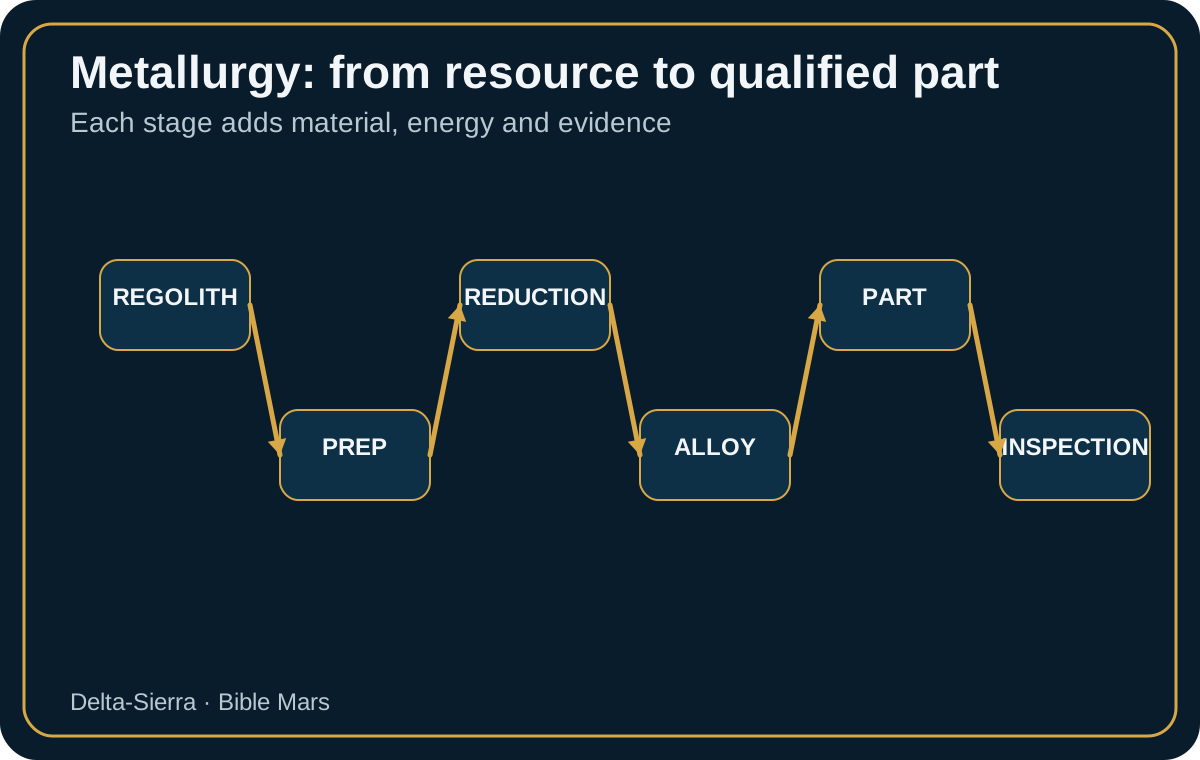
NASA's Molten Regolith Electrolysis project, listed as completed and updated in May 2026, melts regolith and passes current through the melt to separate oxygen and metals. The same mineral feed can potentially provide oxygen and alloy precursors. The difficulty lies in high temperature, reactor materials, electrode behavior, corrosion, phase separation and electrical demand.
Heating 100 kg of feed from 200 K to 1,800 K with an assumed average heat capacity of 1 kJ/(kg·K) requires Q = m c ΔT = 160,000 kJ, about 44.4 kWh before latent heat, furnace losses and electrochemical energy. ΔT means temperature difference. This explains why insulation, heat recovery and operating continuity can matter as much as electrochemical efficiency.
An intermittent plant that cools fully between batches may waste energy reheating its own hardware. A continuously hot plant consumes energy even while idle. Metallurgy is therefore coupled to the power network and maintenance calendar.
Extracted iron may contain impurities that alter ductility, weldability and corrosion behavior. Steel requires controlled carbon and alloying, heat treatment and microstructure. The same logic applies to aluminum and silicon. A Mars base will likely create application classes: bulk shielding or weights, secondary structure, and highly qualified pressure or safety hardware.
MMOST combines size sorting, magnetic beneficiation, hydrogen reduction, electrolysis and refining to target iron/steel and oxygen. Extraterrestrial Metals Processing explores iron, silicon and light metals. These projects do not prove a ready Martian steel mill; they identify operations that an eventual production chain must connect.
Material yield must include the residual stream
If 1,000 kg of regolith produces 120 kg of usable metal, overall mass yield is 12%. The remaining 880 kg is not automatically waste. Silica-rich material may support glass or ceramics, other oxides may feed additional extraction, and coarse fractions may become aggregate. Industrial efficiency depends on co-products rather than a single optimized output.
A locally produced part must remain tied to feed batch, process, temperature history, machine and inspection result. Tensile testing, hardness, metallography and nondestructive evaluation create trust. Early products can tolerate broad properties; pressure and safety hardware require much stronger evidence.
Recycling is also a higher-grade ore. Imported alloys, machining chips, retired cables and structures already have known composition. Sorting and remelting them can use far less refining energy than starting from raw regolith. Martian waste management should treat metals as an urban mine.
Recovering a metallic product from regolith is only half the problem. A mechanical part needs controlled composition, geometry, metallurgical condition and integrity evidence. Iron with significant impurities may serve as ballast or a massive bracket but not a highly loaded shaft. Martian metallurgy therefore needs graded products rather than the simple claim “we can make metal.”
Heating 100 kg of iron from 220 K to roughly 1,800 K with an assumed average heat capacity of 0.7 kJ/(kg·K) requires 100 × 0.7 × 1,580 ≈ 110,600 kJ, about 30.7 kWh, before melting, furnace losses and chemical reactions. Real energy is higher. Product heat recovery and furnace insulation can therefore save substantial energy per batch.
Recycling changes the economics. A worn part contains metal whose composition may be better known than local ore. Sorting and remelting reduces extraction, but mixing unknown alloys can destroy properties. The settlement needs alloy identification, separated streams and material history.
Heat treatments turn one composition into different properties. Annealing, quenching, tempering or aging change hardness, ductility and strength. Availability of controlled atmosphere, quench media and accurate furnaces becomes part of industrial capacity. Machining steel without restoring the proper metallurgical state can make a dangerous “correct-looking” part.
Nondestructive examination provides confidence as criticality rises: ultrasound, penetrant methods where compatible, radiography or electromagnetic techniques. Acceptance should follow function; a nonpressure support beam and a landing-system mechanism do not require identical evidence.
Alloying elements may remain scarce. Instead of immediately reproducing every terrestrial alloy, Mars may redesign equipment around simpler grades and reserve scarce additions for applications where they are truly necessary.
Before reduction, feedstock must be characterized and prepared. Crushing, magnetic separation, size classification or chemical beneficiation may concentrate useful phases and remove troublesome material. Every beneficiation step costs power and equipment but can reduce the mass that enters high-temperature reactors. The correct trade is energy and maintenance per kilogram of qualified product, not merely extraction yield.
Reduction routes create different co-products. Electrochemical regolith processing can combine oxygen production with metals or metal-rich products; other routes may use hydrogen, carbon-bearing reagents or molten salts. The settlement should value all outputs. A process that produces oxygen needed elsewhere can be more attractive than one judged only by kilograms of metal.
Casting is likely to remain useful even in an additive-manufacturing future. Simple molds can make billets, plates, wheels or near-net shapes with high throughput. These products can then be machined only where precision is needed. Hybrid routes reduce machine hours and recover scrap efficiently.
Alloy control requires weighing, mixing and analytical verification. If one scarce alloying element drifts from 1% to 0.5%, the final mechanical behavior may change substantially. Local laboratories therefore need composition measurement and reference materials. “Made from Martian iron” is not an engineering material specification.
Residual stress and defects link process history to performance. A printed or welded metal component can warp after machining or crack under cyclic load even when static strength appears adequate. Stress relief, heat treatment and test coupons become part of manufacturing, not optional refinements.
Over decades, metallurgy will influence Martian design language. If certain alloys are easy to make and others remain expensive imports, structures, fasteners and machines will be designed around the local material palette. Industrial autonomy changes not only where parts are produced but which parts engineers choose to design.
A handling arm needs a new clevis. The specified Earth alloy is unavailable, but local metallurgy can produce a simpler steel whose estimated yield strength is 20% lower. The right response is neither “impossible” nor “print it anyway.” The design must be requalified for the material that actually exists.
If nominal maximum stress is 180 MPa and the Earth alloy yielded at 500 MPa, the simple ratio was 500 ÷ 180 ≈ 2.78. A local 400 MPa material reduces it to 2.22. That is not a qualification by itself—fatigue, defects, welds and property scatter matter—but it shows lost margin.
Engineers can increase section, change geometry or reduce operating load. A prototype is heat treated, measured and subjected to representative load. If it remains inspectable and replaceable, a temporary operating restriction may be acceptable until a better grade exists.
The lesson is distinctly Martian: design must evolve with the local material catalog. Exact reproduction of every Earth alloy matters less than the ability to recalculate, test and document substitutions safely.
A laboratory can produce grams or kilograms of a metallic product without proving that tonnes can be made continuously. Scale-up changes heat transfer, mixing, refractory life, electrode wear, feed preparation and product handling. Industrial planning should therefore distinguish chemistry demonstrated in a test from plant availability demonstrated over thousands of hours.
Furnace atmosphere can be part of the product specification. Oxidation, decarburization or contamination may occur during heating and cooling. Vacuum or inert gas can improve quality but adds pumps, seals and gas inventory. Mars may favor processes tolerant of its available atmosphere rather than copying Earth heat treatment exactly.
Refractory materials become a hidden dependency. A furnace cannot run indefinitely if linings, crucibles or electrodes wear faster than they can be replaced. Local ceramic capability may therefore unlock metal production. Industrial sectors that look separate on a diagram are linked by consumables.
Quality should be tracked statistically. Tensile or hardness results from each batch reveal mean performance and scatter. A local grade with slightly lower average strength but tightly controlled variation may be more useful than a stronger process with unpredictable defects.
Large structures can use different grades in different locations. Highly loaded joints receive the best material, while shields, frames and noncritical supports use simpler metal. Graded design conserves alloying elements and high-quality furnace time.
Eventually, scrap return closes the loop. The metallurgical system should know where each alloy resides in the settlement so dismantling can recover clean streams. Design for disassembly becomes part of future ore strategy.
Casting yield should be tracked separately from chemical extraction yield. A plant may recover 90% of metal from feedstock but lose substantial material in gates, risers, machining chips and rejected castings. Closed-loop scrap return can recover much of that mass, but it consumes remelting energy and machine time.
Joining technology determines what the material catalog can build. Welding, brazing and mechanical fastening impose different requirements for atmosphere, filler materials, heat input and inspection. A settlement that can make plate but cannot join it reliably has only partial structural capability.
Corrosion and environmental compatibility also matter even in Mars' dry exterior environment because habitats, water systems and chemical plants create local wet and reactive conditions. Material qualification should follow the actual service environment rather than assuming one universal 'Mars corrosion' case.
Powder production for additive manufacturing introduces its own hazards and quality variables. Particle size distribution, shape, oxidation and contamination affect flow and fusion. A metallurgy plant that can cast bulk metal is not automatically able to make qualified additive feedstock.
Machining chips should be treated differently from dirty mixed scrap. Clean, known-alloy chips can return efficiently to remelting, while contaminated material may need separation. Workshop housekeeping therefore influences metallurgical yield.
Mechanical property databases should include temperature. An alloy suitable in a warm habitat may behave differently in an external cold mechanism. Qualification should reflect the range of service conditions expected on Mars.
Making metal on Mars requires three problems to be separated: finding useful feedstock, chemically reducing an oxide, and producing a material whose mechanical properties are known. Regolith is not crushed ingot. It contains several mineral phases, broad particle-size distributions, and site-dependent composition. Metallurgy therefore begins with sampling, crushing, sizing, beneficiation, and characterization. Preparing the feed can use less energy than processing tonnes of low-grade material indiscriminately. It also creates by-products that may become construction aggregate, shielding, or mineral filler. Industrial yield should be calculated on the whole stream rather than the mass of metal alone.
TechPort's molten regolith electrolysis work illustrates an ambitious route: melt oxidized regolith and use electrolysis to separate oxygen and metals. The project is now completed. Its vacuum demonstration sustained a molten charge above 1,700 °C for more than twelve hours and measured oxygen production, but that is not a ready Martian steelworks. At such temperatures, refractories, electrodes, electrical supply, melt handling, and selective metal recovery are major subsystems. The value of the project is that it records what was actually integrated and what remains: feed loading, process control, metal extraction, oxygen measurement, lifetime, and operation of a complete system at relevant scale.
Other routes can be more selective. NASA-backed concepts for iron production have combined regolith beneficiation with hydrogen or other reducing gases, followed by purification and powder production. Such a chain might target iron first because a modest-quality metal can support rails, counterweights, tools, frames, and noncritical parts. The calculation needs ore grade, beneficiation recovery, reductant consumption, heating energy, and gas recycle. If reducing gas is regenerated, initial inventory can remain modest; if contaminants accumulate, purge streams appear. Local metallurgy therefore depends as much on gas processing as on the furnace.
The word steel introduces another industry. Pure iron has uses, but engineering steel needs controlled carbon and alloy content, a thermal history, and often mechanical processing. Early Martian steel will not reproduce every terrestrial grade. The rational strategy is to select a small family of forgiving alloys for recurring needs, document composition, and measure tensile strength, hardness, toughness, fatigue, and weldability. Pressure structures or rotating parts require stronger qualification than brackets and rails. Ranking applications by criticality allows imperfect local metal to become useful early instead of waiting for a complete metallurgical ecosystem.
Heat treatment can become the invisible bottleneck. Cast, printed, or welded parts can contain residual stress, porosity, and undesirable microstructures. Annealing, stress relief, quenching, or tempering change properties but require furnaces that control temperature, atmosphere, and time. Large parts may exceed the available furnace envelope, forcing modular designs or assemblies. Furnaces themselves need maintenance, calibration, and sometimes protective gas. Industrial thermal loads must appear in the power plan, particularly when several high-temperature processes operate together.
Metal quality is proved after production. Chemical analysis checks composition; coupons measure strength; radiography, ultrasonics, penetrant testing, or other NDE methods search for defects; dimensional metrology verifies geometry. The first settlement will not possess every laboratory technique. It can begin with low-criticality parts accepted by dimensions, mass, and simple tests, then increase rigor as measurement capability grows. Traceability must connect material lot, process, parameters, operator, post-treatment, and test result. Without that chain, a failure cannot teach the process anything.
Scrap is a resource. Machining chips, rejected parts, additive supports, and assembly offcuts contain metal that has already been extracted and is often better characterized than raw regolith. Mixing alloys indiscriminately destroys that advantage. The workshop needs sorting, contamination control, and rules for which streams may return to a melt, become dilution feed, or be downgraded to less critical uses. Recycling shortens the energy chain but adds identification and analytical work. At city scale, a material bank with lot identity may be as valuable as a pile of ore.
Throughput must connect to real demand. A plant producing 100 kg per day would deliver 36.5 tonnes per year at perfect availability. At 75 percent availability, annual output falls to about 27.4 tonnes. That simple change shows why furnace maintenance, electrode replacement, and quality holds belong in the announced capacity. A growing settlement also cannot allocate every kilogram to expansion; repair and strategic stock consume part of the production. Industrial sizing should start with a portfolio of uses and measured availability, not the peak rate observed during a test.
The deeper threshold for metallurgical autonomy is the ability to maintain the equipment that makes metal. Crucibles, heaters, electrodes, bearings, seals, pumps, sensors, and refractory linings can be more critical than the output itself. Some components will depend on Earth supply until local precision manufacturing and refractory production mature. The plant should identify those dependencies and support replacement or workaround paths. A highly efficient process based on one exotic Earth-only consumable can be less useful than a more energy-hungry process that is locally maintainable. Lifecycle support depth is part of process selection on Mars.
Metallurgy is only the bridge between resources and parts. Metal still has to become castings, plate, bar, powder, wire, machined components, or additive feedstock. Each intermediate form brings its own tolerances and defects. Powder needs controlled particle size and cleanliness; welding wire needs composition and diameter; plate needs thickness, flatness, and directional properties. The settlement will need to standardize a limited set of stock forms so that machine diversity remains manageable. That standardization matters more to repair capacity than the symbolic achievement of producing the first Martian ingot.
Making useful metal on Mars requires more than separating an element from regolith. Feed must be selected, particle size prepared, impurities removed or accepted, heat and reagents supplied, metal separated from slag, composition adjusted, material solidified and formed, heat treated and inspected. Each step creates a yield and a quality state. A plant that produces metallic mass but cannot control composition or defects cannot supply critical hardware.
The first question is therefore the destination. Ballast, rail, a secondary bracket, a pressure component and a machine shaft require radically different purity and property evidence. Industrial capability can climb through criticality classes: first tolerant bulk products, then mechanical parts, then demanding materials. This evidence ladder avoids promising locally made aerospace alloys merely because a process produces iron.
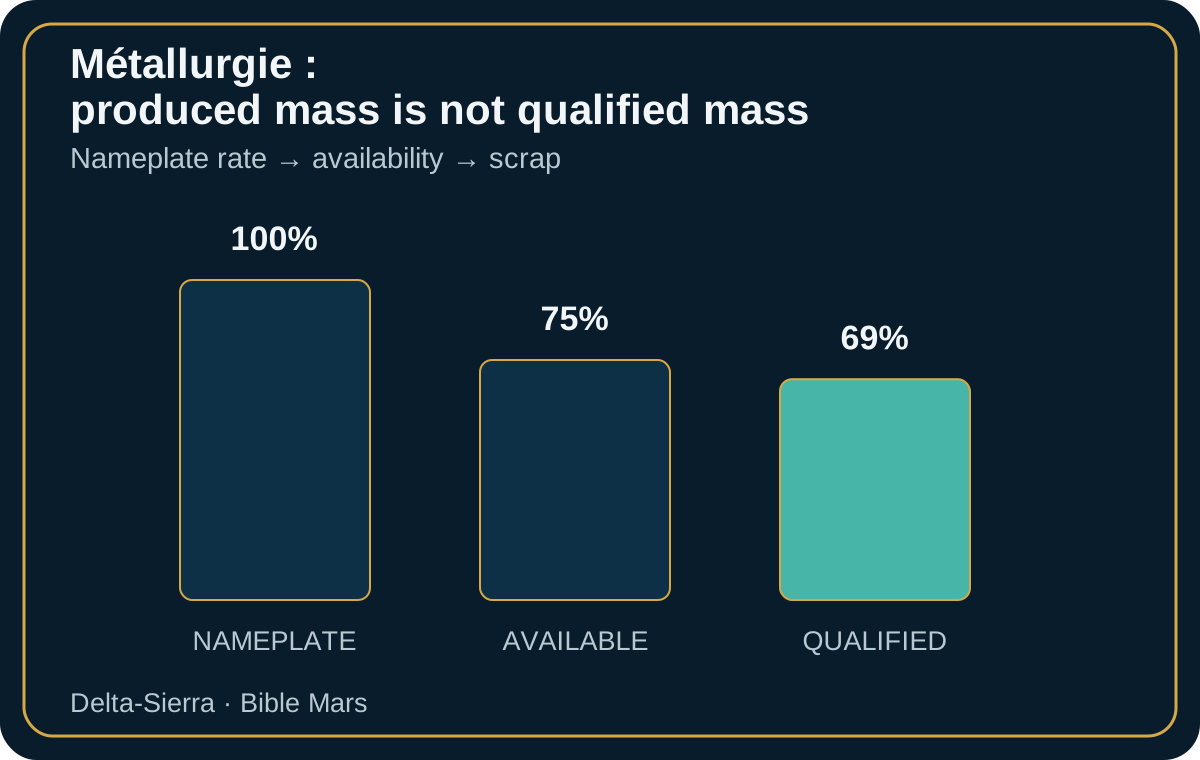
A plant rated at 100 kg/day does not automatically deliver 36.5 tonnes per year. At 75% operational availability, ideal output becomes 100 × 365 × 0.75 = 27,375 kg/year, about 27.4 t/year. If another 8% is lost to scrap, rework or out-of-specification material, deliverable output is about 25.2 t/year. The calculation separates nameplate capacity from qualified capacity.
Buffer stocks of semi-finished material can decouple energy-intensive upstream processing from the workshop. Ingots, billets, bars, sheet or standardized powder allow machining to continue while a reactor is maintained. Stock form should match downstream processes. Producing only bespoke shapes may save one transformation but reduce flexibility.
Two parts with the same nominal composition can have different properties after different cooling, tempering, annealing or ageing histories. Furnaces are therefore critical equipment: temperature uniformity, atmosphere, sensors, calibration and power all matter. Poor heat treatment can create a part that looks correct and measures correctly but has unacceptable hardness, toughness or residual stress.
Furnace energy must enter the settlement power model. Heating a simplified 200 kg combined load and tooling mass from 20 °C to 900 °C with an average heat capacity of 600 J/kg/K would require Q = m × c × ΔT = 200 × 600 × 880 ≈ 105.6 MJ, about 29.3 kWh of ideal heat. Furnace losses and soak time increase this number. Q denotes thermal energy and ΔT temperature change.
A metallurgy laboratory must answer three families of questions. Is chemistry correct? Did the microstructure receive the intended thermal history? Does the part contain defects incompatible with its function? Depending on criticality, tools range from weighing, hardness and microscopy to ultrasonic, radiographic or penetrant inspection. No single machine “certifies” metal; qualification is a chain of evidence.
Traceability links feed batch, process parameters, melt, heat treatment, witness samples and final part. This industrial memory becomes essential as local production evolves. If a crack appears months later, engineers need to identify which other parts share the same batch or furnace cycle. Without traceability, one local failure may force an entire hardware family out of service.
Metal scrap from imported hardware often has a better known composition than native regolith. Machining chips, retired parts and dismantled structures can therefore become priority feed. The challenge is alloy separation, contamination control and compensation for elements lost during remelting. Material identification from the day hardware arrives on Mars can make recycling easier years later.
Recycling does not eliminate primary extraction. Some losses are irreversible, some alloys need makeup elements and settlement growth increases total inventory. The industrial goal is to slow imports while gradually creating local pathways for the most critical elements.
NASA TechPort lists Molten Regolith Electrolysis as a completed technology project. The work advanced an integrated high-temperature vacuum system and produced oxygen and metals from molten regolith. That is valuable evidence for technical feasibility and integration, not evidence that an industrial Martian steelworks is ready. Extreme temperature, reactor materials, electrodes, lifetime and product separation remain scale-up problems.
Other projects explore different routes to iron or steel. The useful comparison is not a universal “winner,” but which process fits which feed, energy system, purity requirement, scale and final product. An early outpost may accept lower-performance metal for noncritical functions while a mature city develops more selective metallurgy.
A series of mechanical parts made from one local metal batch meets dimensional requirements but shows hardness below the expected range. Rejecting everything without investigation wastes scarce material; accepting it because the parts look correct is unsafe. The investigation must move upstream through composition, melt temperature, hold time, cooling, heat-treatment cycle and the measurement system itself.
The first step is to verify hardness measurement with a reference or known coupon. If the result is confirmed, specimens from the batch can show whether the problem is uniform or local. Slightly different chemistry may require a different thermal cycle. A miscalibrated furnace can affect several heats. Traceability turns one out-of-specification number into a targeted investigation.
Depending on alloy and defect, repeat heat treatment or remelting may recover the material. That option should enter energy and production planning. A tonne of local metal is not necessarily lost when one part is rejected; it can return to inventory when material segregation and traceability support recycling.
Criticality still governs the decision. Furniture may tolerate a downgraded property class; pressure hardware should not be reclassified without analysis and evidence. Use classes prevent two extremes: discarding everything that misses the highest grade, or using insufficiently proven material everywhere.
Martian metallurgy will likely be an industry of explicit compromises
Earth supply chains support hundreds of specialized alloys. A Martian city will probably reduce that variety: a smaller family of metals and alloys covering many uses, supplemented by imported material for extreme functions. Standardization simplifies furnaces, stock, heat treatment, welding, machining, recycling and training.
Success will not be immediate reproduction of the terrestrial catalogue. It will be a product range broad enough that each new tonne of local material removes a major dependency without creating ten new qualification chains.
The capacity of a metallurgical chain is the capacity of its slowest step: feed preparation, reactor, casting, heat-treatment furnace, forming or inspection. A reactor capable of 100 kg/h has little value if the downstream furnace can process only 300 kg/day. The flowsheet should therefore attach throughput, availability and batch size to every operation.
Suppose crude metal production is 600 kg/day, while one furnace processes 150 kg batches in six hours and is available 20 h/day. It can complete at most three full batches, or 450 kg/day, without overlap or margin. The furnace becomes the bottleneck. A second furnace, shorter cycle or intermediate stock are different solutions. The calculation turns a production promise into an investment decision.
If every critical batch requires two hours of testing and only one metrology station is available, the laboratory can constrain the entire chain. Qualified industry must size inspection and documentation with the same care as melting. Test coupons, chemical analysis, hardness, dimensional inspection and nondestructive evaluation consume time, equipment and skilled labor.
This can justify use classes. Bulk shielding metal may receive a simpler acceptance path than pressure hardware. The same plant can therefore deliver more total mass while reserving the most demanding inspection capacity for critical products.
Hot metal, powder, slag and reactive feed require cranes, containers, protective atmospheres and safe transfer routes. A furnace cannot be treated as an isolated box. If a crucible needs replacement after a limited number of cycles, crucible inventory becomes part of annual capacity. If powder oxidizes or contaminates during storage, downstream properties change.
Dust and fumes also interact with habitat safety. Hot processes are likely to be physically separated from living volumes, which adds transport and remote handling requirements. Industrial geography therefore becomes part of production reliability.
Growth should remain synchronized across the chain
Early metal production will probably favor simple shapes and tolerant use classes. Higher throughput should be matched by furnace capacity, laboratories, power, material handling and recycling. A “larger factory” is not one larger reactor; it is a balanced network whose bottlenecks move as the settlement grows.
It would be tempting to copy every terrestrial material specification as an absolute requirement. Some requirements are fundamental; others embody supply-chain choices that may not exist on Mars. Local engineering should preserve safety functions while asking whether tolerances, grades or metallurgical states can be simplified for noncritical uses.
This does not mean lowering quality arbitrarily. It demands stronger justification: actual load, environment, failure mode, inspection and margin. A simpler specification tied directly to function can be more robust than an incomplete copy of a terrestrial standard that local industry cannot execute consistently.
Joining locally produced metal changes microstructure near the joint. Filler composition, heat input, shielding, cooling and contamination all affect properties. A qualified parent material can therefore become an unqualified assembly if welding procedure is uncontrolled. Repair and fabrication plans should treat welding parameters as part of the material history.
Witness coupons and procedure qualification can establish a repeatable route for common joints. The settlement may deliberately standardize joint geometries and material families so that a smaller set of welding procedures covers more hardware.
Exterior Mars is cold and dry, but metals will also operate inside humid habitats, water systems, chemical plants and oxygen-rich equipment. Galvanic couples, chlorides or process chemicals can create corrosion environments very different from the open surface. Material selection must therefore follow the actual service environment rather than a generic statement that “Mars is dry.”
Inspection intervals should reflect these environments. A structural beam inside a dry industrial volume, a water-system fitting and an exterior rover component may need completely different monitoring even if they use related alloys.
The material database becomes a design tool
Every locally produced batch adds evidence: chemistry, process, tests, accepted uses and in-service behavior. Over years, this database can support more ambitious designs because allowable properties are based on local history rather than one imported assumption. It also reveals which process changes improve consistency.
This gradual evidence accumulation is how local metallurgy moves from bulk material to trusted engineering material. The transition is not one technological breakthrough but a disciplined series of measured, traceable production cycles.
Hot metal, slag and furnace exhaust carry energy that may be reused for feed preheating, building heat or another industrial process. The value depends on temperature and contamination boundaries. Heat that cannot be transferred safely is not a resource merely because it exists. Industrial heat integration should therefore identify temperature level, timing and distance between producer and user.
Batch scheduling can exploit this. A furnace operated in campaigns may allow downstream heat treatment or glass production to use a shared high-power period while other city loads are reduced. The industrial network becomes a flexible electrical load rather than a rigid consumer.
A settlement does not need equal quantities of every alloy. Construction may consume tonnes of tolerant material while pumps and pressure systems need kilograms of high-grade stock. Demand forecasts should therefore separate bulk, mechanical and critical classes. This prevents scarce alloying elements and test capacity from being consumed by low-value uses.
Forecasts should include the installed asset base. As the city ages, replacement demand rises even if population stops growing. Long-lived structures need little annual metal, while vehicles and machinery create recurring wear. Recycling rates and repair practices therefore influence future metallurgy capacity.
Early batches may require extensive testing because the process is new. Once hundreds of consistent heats exist, statistical process control can reduce the amount of destructive testing while preserving confidence. That transition requires stable measurement, controlled procedures and traceability. It is earned through evidence, not declared by schedule.
Conversely, a change in ore source, electrode, furnace lining or control software may require requalification because it changes the process. Configuration management therefore applies to metallurgy just as it does to spacecraft hardware.
Progress should be tracked through mass produced, qualified yield, batch-to-batch stability, downtime, energy, consumables and the diversity of approved uses. A small line that repeatedly delivers known metal can be more useful than a spectacular process with unstable output. Reproducible confidence is the milestone that lets designers use local material without rebuilding the evidence case for every part.
The same memory should follow metal throughout its life. A retired part may become feedstock again, but its composition and service history help determine which recycling class is safe. Critical chains may require strict segregation, while bulk uses can tolerate more mixing. Organizing these flows from the beginning prevents future recycling from being undermined by missing identification.
Material identity also affects welding and heat treatment. Mixing two visually similar alloys may produce cracking or an unexpected thermal response. Labels, machine-readable records and simple verification tests therefore protect both the scrap yard and the workshop. Recycling is not only melting old material; it is preserving enough knowledge to use the recovered material responsibly.
When one melt or heat-treatment cycle produces several critical parts, witness specimens made from the same batch can be sacrificed for strength, hardness or microstructure measurements. They do not automatically prove that every finished part is defect-free, but they provide evidence about material condition and can reveal a process change before all hardware enters service.
Sampling should be proportional. Destroying one specimen for every kilogram would be unrealistic; never testing would leave the process blind. As stability is demonstrated, sampling can evolve under statistical control, with rules that return the plant to enhanced inspection after significant process changes. This is how throughput can increase without abandoning evidence.
Martian regolith is a mineral mixture, not prepared ore. Before reduction or electrolysis, an industry has to excavate, sort, crush, perhaps concentrate selected phases and characterize each batch. Those steps may consume more machine mass, power and operating time than the reactor that attracts public attention. NASA TechPort work on fundamental regolith handling emphasizes the practical gaps involved in digging, transport, reactor feeding and product capture without losing the resource.
Overall yield multiplies stage yields. If excavation/sorting retains 90% of useful material, concentration 80%, reduction 75% and refining 90%, chain yield is:
0.90 × 0.80 × 0.75 × 0.90 = 0.486.
In this scenario only 48.6% of theoretically useful starting material reaches the final product. Producing 100 kg therefore requires roughly 100 / 0.486 ≈ 206 kg of useful-material equivalent upstream of the losses.
This is not a measured Mars yield; it demonstrates the multiplicative effect of stage efficiency. Improving one reactor may deliver little system benefit if an upstream stage remains poor.
NASA studies, for example, model molten-regolith electrolysis to produce oxygen and metal alloys from lunar regolith. Such work is useful for learning how to close mass and energy balances for an extraterrestrial plant, but Mars has different mineralogy, an atmosphere, different gravity and access to CO₂ or potential water resources that change the architecture. The analogue informs method; it does not automatically transfer performance.
Mature Martian metallurgy will probably combine routes: recovery and remelting of imported metal, relatively simple local processing for low-demand uses, then more ambitious extraction once power, metrology and chemistry can support it. Recycling one kilogram of already qualified alloy may remain much cheaper than extracting one new kilogram. The richest “ore” of the first decades may therefore be an Earth-made part reaching the end of its first service life.
Martian metallurgy closes three budgets at once: material, energy and quality. Extracting a metal does not show that the process is energetically affordable or that the alloy has the required properties. Losses through concentration, reduction, melting and forming multiply and determine the feedstock that must actually be mined.
Recycling becomes strategic when the workshop can recover its own scrap and retired parts. That reduces virgin extraction and creates a known local material inventory, but it requires alloy sorting, contamination control and reliable measurement. Without metrology, recycling can turn valuable feedstock into uncertain material.
NASA NTRS — System Modeling of Molten Regolith Electrolysis Plant
Molten Regolith Electrolysis; Moon to Mars Oxygen and Steel Technology; Extraterrestrial Metals Processing; and MMELT.
NASA TechPort — Molten Regolith Electrolysis is a completed project and should be cited as technology evidence, not operational capability. NASA TechPort — On-Demand Multimaterial Manufacturing addresses a different part of the chain: turning metallic feed into hardware and qualifying it. Metallurgy and manufacturing are linked, but their evidence is not interchangeable.