Fire, depressurization and refuge: surviving habitat emergencies
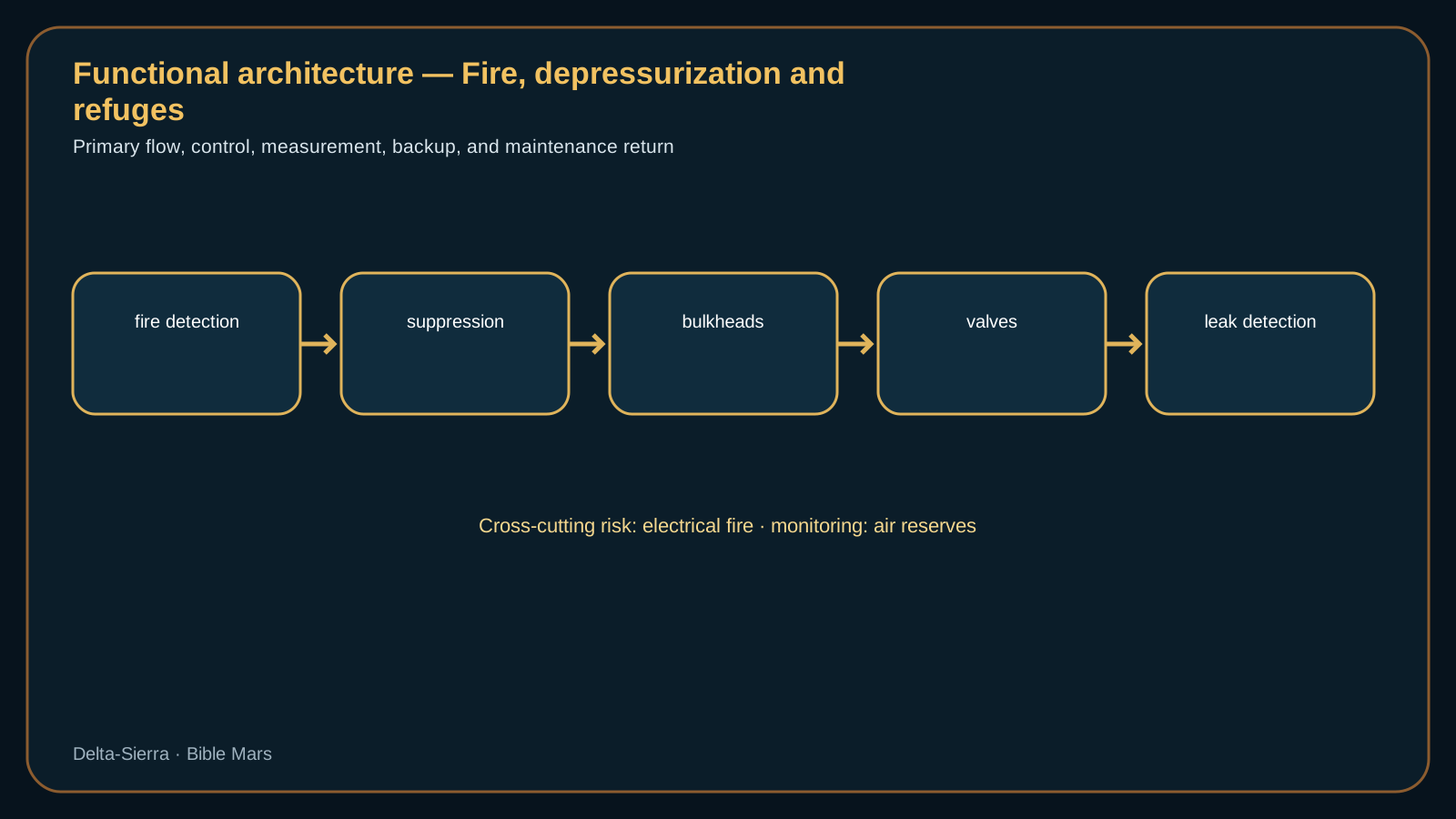
Fire or depressurization first creates a need for decision time. Compartmentation, detection, suppression, volume isolation, breathable reserves and refuge capacity must form one coherent chain; if a supposedly redundant function depends on the compartment already lost, the redundancy is illusory. A safe haven is therefore sized as temporary autonomous capacity with an explicit duration, consumables and exit criteria.
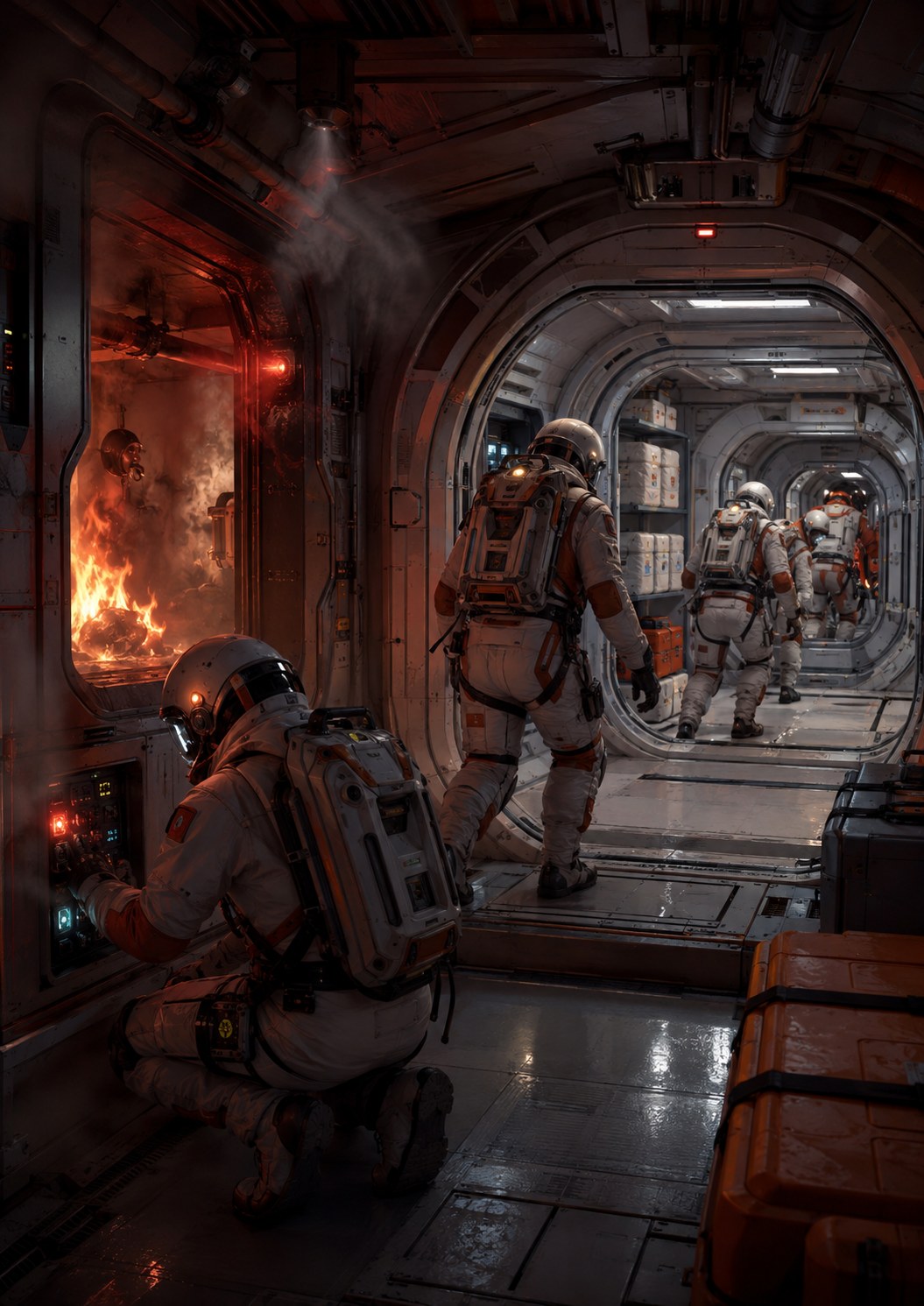
Conceptual habitat-fire visualization: detection, isolation, compartmentation, respiratory protection and refuge must limit propagation while preserving a habitable zone.
Fire and pressure loss: two emergencies that turn a habitat into a ship
“Fire, depressurization and refuge: surviving habitat emergencies” addresses habitat emergencies in which fire and atmosphere loss can demand conflicting actions.
Emergency monitoring should prioritize pressure, pressure-decay rate, smoke, particles, temperature, O₂/CO₂, hatch state and refuge endurance.
NASA human-system requirements make detection, atmosphere, emergency access and evacuation one integrated system problem
Detect, isolate and breathe: the first minutes of a crisis
The timeline for Fire, depressurization and refuge: surviving habitat emergencies runs from preparation through configuration, measurement acquisition, authorization, action, mode transition, confirmation and recovery.
The severe habitat case combines a leak with fire, preventing ventilation, isolation, and suppression from being sequenced independently.
Designing the refuge before it is needed
isolating quickly enough without trapping crew or destroying suppression capability, then preserving a safe refuge path
Operational log: pressure, pressure-decay rate, smoke, particles, temperature, O₂/CO₂, hatch state and refuge endurance.
Returning to a safe habitat after the emergency
Deepening — treat the habitat like a compartmented ship that cannot simply be evacuated
A Martian fire is first an atmosphere-control problem
On Earth, fire response often includes opening, ventilating, evacuating and calling outside help. In a Mars habitat, opening to the exterior means losing atmosphere; ventilation can spread smoke and combustion products; evacuation may require suits under stress. Strategy must therefore be designed around containment. Early detection, electrical isolation, compartment closure, airflow control and preservation of a breathable volume are architectural functions, not merely crew actions.
Fire consumes oxygen and produces gases that may become dangerous before the whole module becomes visibly hot. Detection should therefore combine several signals: smoke or particulates, carbon monoxide, temperature, atmospheric composition and electrical state. A generic “fire” alarm is of limited value if the team must still guess which volume and equipment to inspect.
Materials, wiring and assemblies should also limit ignition and flame propagation. Prevention never removes the hazard completely. Dust, batteries, lubricants, experiments and maintenance create potential ignition sources. Safety architecture should therefore assume that fire remains possible even in a carefully controlled material system.
Depressurization is understood through air inventory and time-to-limit
A leak is not just a hole; it is a race between loss rate, available volume and isolation capability. Consider an illustrative 100 m³ volume at 70 kPa and about 293 K. The ideal-gas relation pV = nRT uses pressure p, volume V, amount of gas n, gas constant R and absolute temperature T. The result is roughly 2,870 moles, on the order of 80 kg of atmosphere if a molar mass near terrestrial air is assumed. The point is not exact mission design; it is the intuition that cabin atmosphere is a finite material inventory.
Actual leak rate depends on opening size, pressure, temperature and flow regime. A slow leak allows localization and repair; a major rupture demands immediate isolation. Pressure sensors therefore need enough precision to identify a gradual trend, but the habitat must also be compartmented so the team can do something with that information. Detection without isolatable volumes is not a complete safety function.
Operators need a conservative time-to-limit estimate rather than a bare “low pressure” message. How long until a survival threshold is crossed? How long before an adjacent volume is at risk? That estimate should update as measurements change and retain margin because a leak can worsen.
A safe haven must be an autonomous capability, not a labelled room
NASA studies of deep-space safe havens illustrate why multiple pressure volumes can justify their mass. Beyond low Earth orbit, there is no rescue vehicle that returns the crew within hours. A credible refuge therefore needs real endurance: breathable atmosphere, carbon-dioxide removal, water, food, communications, thermal control, minimum hygiene, medicine and access to critical vehicle functions.
Architectures range from a smaller haven sized for days or weeks of repair to a second volume capable of supporting the crew for much longer. Surface bases can distribute risk among connected modules; transit spacecraft face tighter volume constraints. In either case, the haven should not share every common cause with the primary habitat. One electrical fire or pressure-line failure must not disable both.
At settlement scale, the idea becomes a network of refuges: neighbouring pressurized buildings, tunnels, vehicles and district shelters. Emergency response becomes geography. Residents need to know where survivable pressure and life support remain available when one sector is lost.
The first minutes should be rehearsed until they are simple
During an emergency, complex reasoning degrades. Initial actions should therefore be few, observable and trained: identify the event, protect breathing, stop dangerous sources, isolate, account for people, verify refuge status and only then begin detailed diagnosis. A twenty-branch decision tree in the first minute invites failure.
Exercises should include ambiguity. If everyone knows that Tuesday’s drill is always “fire in module B,” they learn the script rather than the capability. Conflicting sensor data, an unavailable crew member, a door that does not seal or failed internal communications reveal hidden dependencies.
Post-drill review should measure time and resources, not only pass/fail. How long to detection? How long to isolation? How much atmosphere was lost? Which tool could not be found? Which information was missing? Those measurements turn training into a design-improvement loop.
After the emergency comes a second mission: recovering a safe state
Extinguishing a fire or patching a leak does not make a module habitable. Smoke can contaminate filters and surfaces; extinguishing agents can damage electronics; heated or depressurized structure may have seen abnormal loads; a temporary patch may be valid only under limited pressure. Recovery therefore needs inspection, measurement, sampling and explicit return-to-service criteria.
The most important discipline is resisting a premature return to nominal operations. Operational pressure will push the team to regain lost volume or electrical capacity. A mature system requires independent checks, enhanced monitoring and observation time. A repaired crack is not automatically equivalent to new structure.
Finally, every incident should change the knowledge base. If a seal, battery, maintenance practice or ventilation configuration contributed, corrective action should propagate to similar modules and future construction. Settlement safety is built not by never having accidents, but by learning before the same mechanism strikes twice.
Treating the safe haven as continuity architecture, not a spare room
Quantify what it means to lose a pressurized volume
Depressurization becomes easier to reason about when pressure, volume and gas inventory are connected. In an ideal-gas approximation, pV = nRT. Here p is pressure, V is volume, n is the amount of gas in moles, R is the gas constant and T is absolute temperature in kelvins. At fixed pressure and temperature, doubling volume roughly doubles the gas inventory that must be protected or replaced. A large settlement therefore cannot treat atmosphere as free: each compartment has an inventory, a leak-down time, isolation capability and recovery cost.
The operational variables are not simply “leak detected” but leak rate, remaining pressure, time to a critical threshold, mask availability, closure time and reserve gas. Those numbers distinguish a manageable small leak from a rupture requiring immediate evacuation.
Make the refuge independent of the failure that disabled the primary system
A safe haven is independent only if the initiating event cannot readily disable it as well. An electrical fire in a central module should not remove power, communications and environmental control from the refuge. A pipe rupture should not empty both volumes through a common manifold that cannot be isolated. This is a common-cause problem involving cable routes, hull penetrations, air distribution, software, sensors and emergency stores.
Duration should be expressed in person-hours. Oxygen, CO₂ removal, water, power, thermal control and minimum living functions must all support that duration. A refuge sized for four people for twelve hours provides 48 person-hours; with twenty people and no other change it provides only 2.4 hours, because 48 ÷ 20 = 2.4. Population growth therefore demands architectural change, not just larger lockers.
Design the recovery phase, not only the emergency
The scenario does not end when everyone reaches the refuge. Teams still have to locate the leak or fire, sample the atmosphere, isolate combustion products, restore power in stages and decide whether the damaged volume is recoverable. Re-entry resembles an indoor EVA: protective equipment, sensors, buddy rules, communications and turn-back criteria. Continuity planning has to include the tools, spares and measurement points required for that phase.
At town scale, this becomes a pressurized fire and rescue service. Habitats need sectors, evacuation paths, distributed refuges, trained responders and temporary rehousing capacity. Mission safety begins to merge with urban planning and civil protection: resilience means continuity of a community, not merely survival of a crew.
Deep monograph
Understanding combustion and smoke in an artificial atmosphere
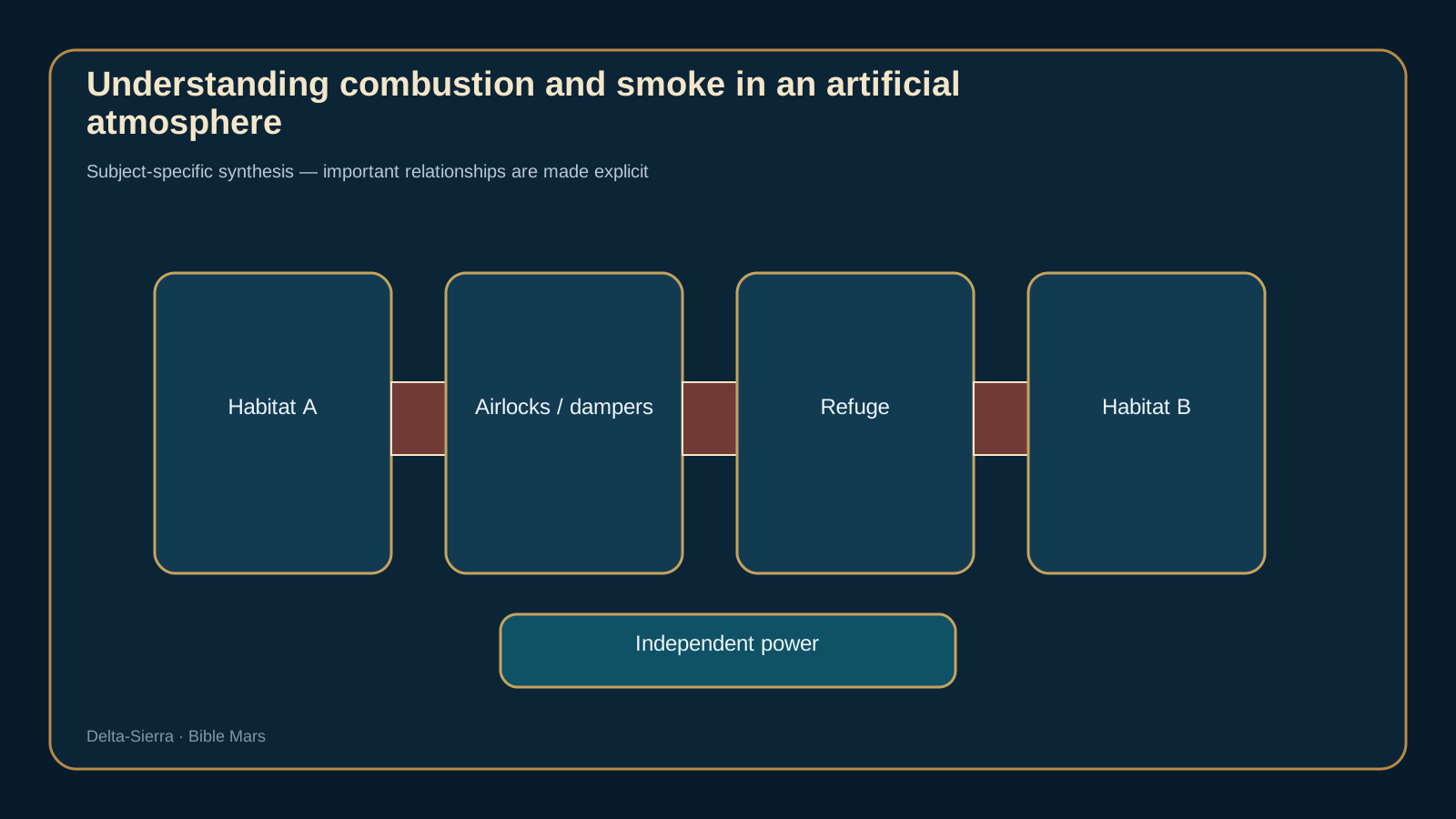
Understanding combustion and smoke in an artificial atmosphere.
Fire, depressurization and refuge: surviving habitat emergencies — functional architecture showing the flows, interfaces and dependencies developed in the chapter.Fire, depressurization and refuge: surviving habitat emergencies — visual synthesis of the system-specific choices and constraints.
A Martian habitat must be designed to be sacrificed in sections.
Fire triangle: fuel, oxidizer, energy and the closed-environment problem.
Detection: smoke, particles, gases and heat without false confidence.
Detection: smoke, particles, gases and heat without false confidence. Who may modify leak detection?
Smoke: the flame can be out while chemical danger continues.
Batteries: thermal runaway and energy isolation Batteries: thermal runaway and energy isolation.
Batteries: thermal runaway and energy isolation.
Isolating fire and leakage before losing the whole habitat
Slow depressurization: detecting a drifting mass balance.
Doors and valves: safety depends on simple devices working under stress.
Refuge: air, water, communications, power and medical capability.
Indoor pressure suits: the last barrier when habitable volume is lost.
Evacuation: movement through smoke, darkness and casualties.
Reproducible calculations specific to this subject
Time before a pressure threshold
t = ΔP/|dP/dt|; de 55 à 45 kPa: 10/0,5 = 20 h; à 2 kPa/h: 5 h
The same total pressure loss can leave twenty hours or only five depending on leak rate. That time controls the action sequence: locate, isolate, shelter, repair or abandon the volume.
Three-day refuge CO₂ capacity
M = N × q × t = 8 × 1 kg/j × 3 j = 24 kg
The q = 1 kg/person/day rate is a teaching assumption to be replaced by the adopted profile. The point is that a refuge needs its own scrubbing capacity independent of the system that may just have burned.
Refuge power with margin
P = 12 kW × 1,35 = 16,2 kW
If minimum refuge functions require 12 kW, a 35% margin gives 16.2 kW of capacity that must be guaranteed. That power source must itself survive fire, electrical isolation and loss of part of the network.
A refuge must survive the failure that made it necessary
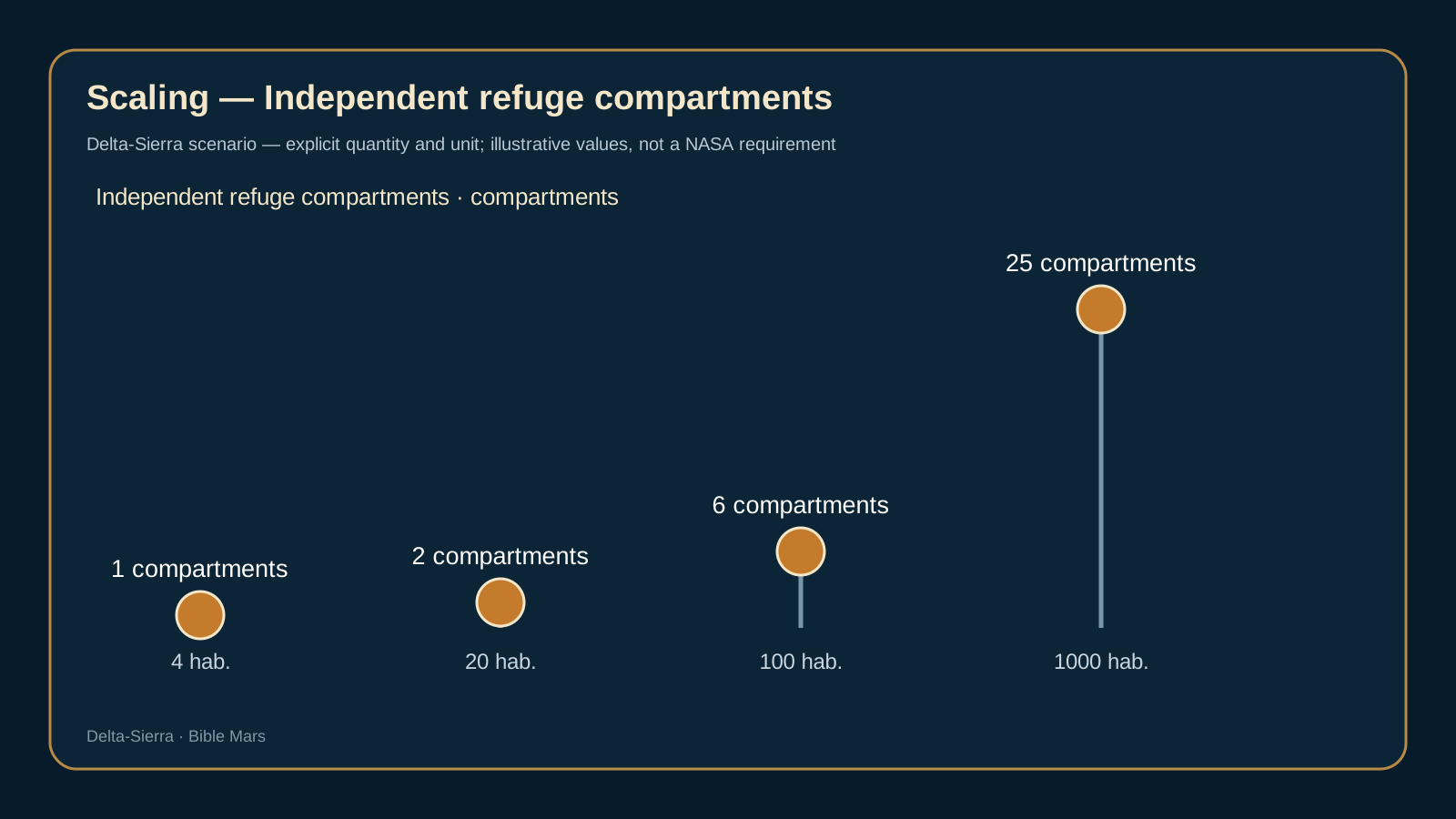
Four people: few volumes and therefore few refuge options.
Twenty people: multiple linked habitats and ability to lose one module.
One hundred people: fire network, teams, procedures and drills.
One thousand people: fire service, regulation and safety urbanism.
Hazardous storage: oxygen, solvents, batteries and reagents away from sleeping areas.
After the incident: air, structures, cables and contamination assessment. Diagnosis remains useful only if evacuation plans can still be read during electrical fire.
Independent refuge compartments — scaling scenario: the quantity and unit are illustrative and are not a NASA requirement.
Four architecture scenarios that materially change the decision
Smoke behind a panel
Smoke behind a panel. Odor and particles appear with no visible flame. Shutting down the entire zone may make diagnosis harder, but waiting can let the fire grow. The scenario tests distributed detection, access, thermal imaging, electrical isolation and controlled opening strategy.
Slow breach after an impact
Slow breach after an impact. Pressure falls slowly, providing time but also encouraging normalization of the anomaly. The crew must locate the leak, isolate volumes sequentially and decide whether external repair is possible. The scenario turns a pressure number into an action timeline.
Smoke reaches the refuge
Smoke reaches the refuge. Smoke leakage crosses a door or duct meant to separate the refuge. Geographic redundancy is worthless if ventilation creates a common link. The scenario checks dampers, filtration, pressure differential and true network isolation.
Reopening after the fire
Reopening after the fire. The fire is out, but combustion products, thermal damage and suppression residue remain. Return to service requires inspection, atmospheric analysis, electrical tests and structural requalification. The scenario prevents confusing “fire extinguished” with “habitat safe.”
Compartmenting a Martian city as a survival architecture
Recovery: returning to service without erasing the failure cause.
Training: automating first actions without automating thought.
Compound failure: fire plus power loss plus casualty.
Refuge as an architecture test: can people survive for days with half the base?.
Monitoring of pressure doors has to survive sensor failure, not merely nominal operation.
After fire or depressurization, the hard problem begins when the refuge door closes
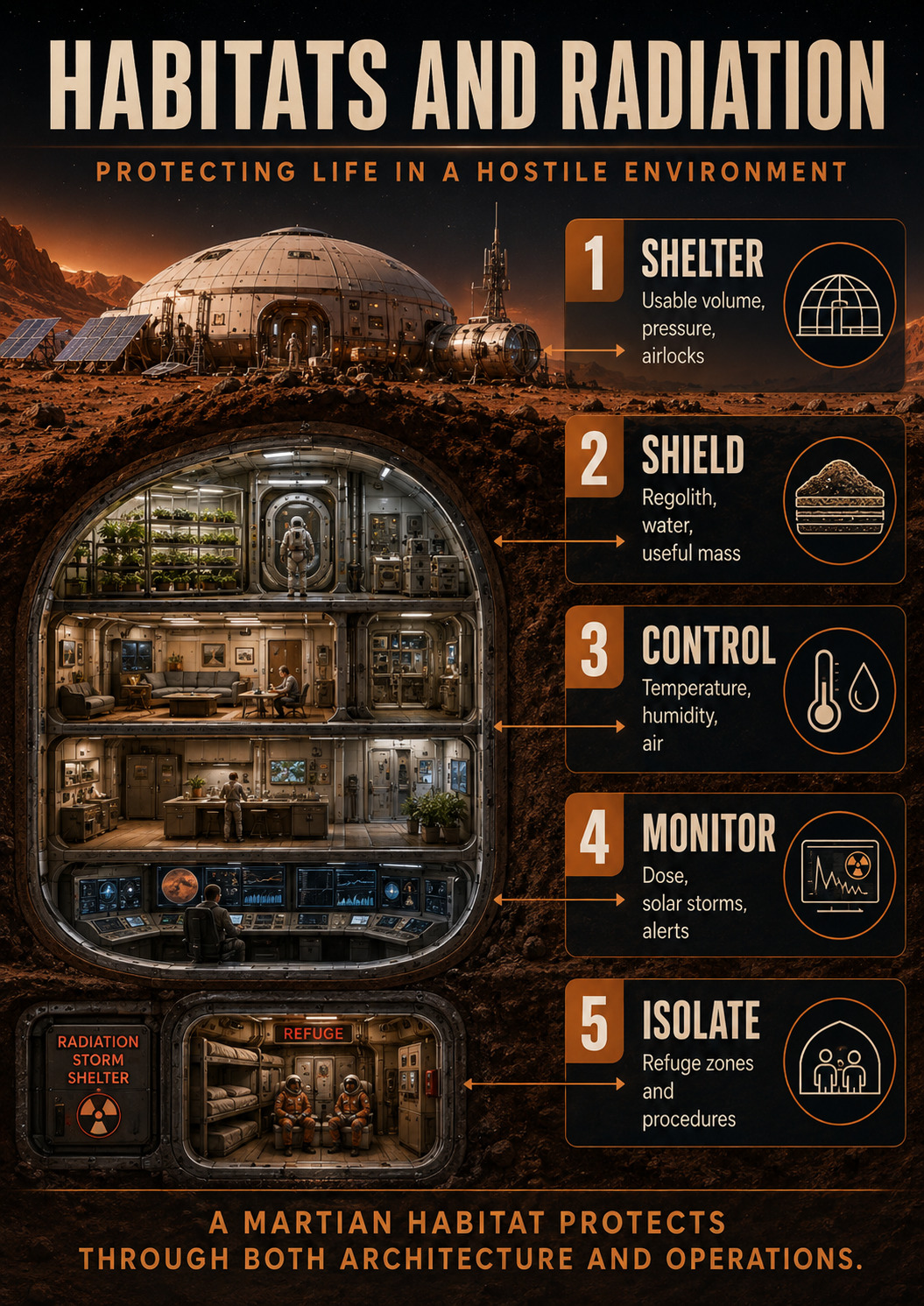
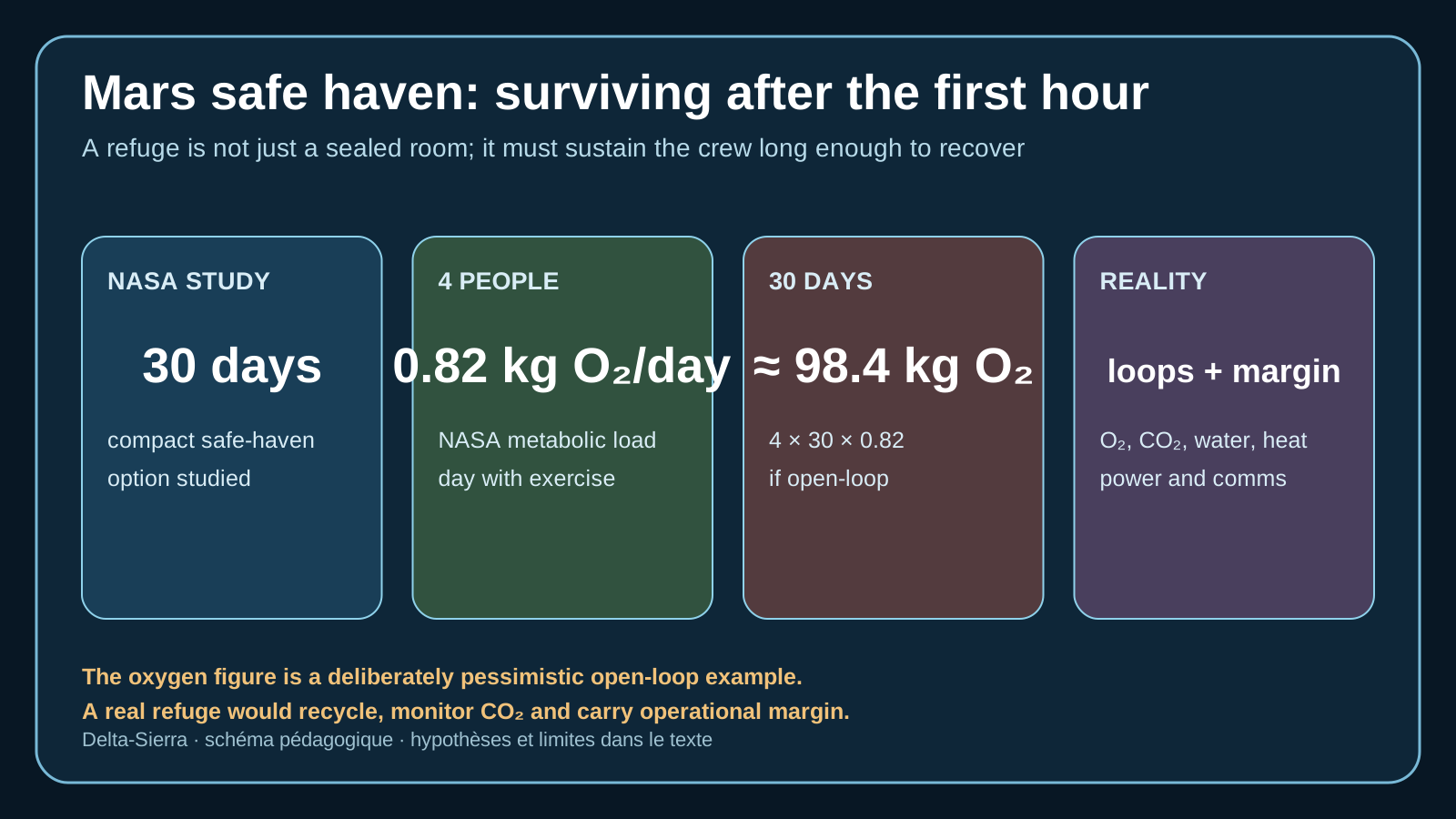
A Mars safe haven is often drawn as a sealed room with emergency bottles. NASA deep-space studies ask a harder question: for how long must that room become an autonomous habitat? Concepts have examined a small haven supporting crew for up to 30 days as well as redundant volumes capable of full-duration survival. Mars adds the fact that surviving the first event does not create a rapid Earth rescue option.
The calculation shows the scale of a no-recycling refuge; a real architecture would recycle, control CO2 and carry margins.
A simple oxygen calculation gives scale. NASA’s metabolic-load bulletin lists about 0.82 kg O₂ per person per day for a standard day including exercise. Four people for thirty days would require 4 × 30 × 0.82 = 98.4 kg O₂ in a fully open-loop case. That is metabolism only; CO₂, water, humidity, heat, leakage and contingency reserve still remain. A real safe haven therefore needs recycling, but the arithmetic shows why a few emergency bottles are not a thirty-day architecture.
Fire behavior is itself non-intuitive. Saffire existed because small flammability tests cannot fully predict spacecraft-scale fire. Saffire VI examined roughly 1.5–3.2 kW fires in 17–19 m³ volumes. Those were microgravity conditions, not Martian gravity, but they demonstrate the coupling among flame spread, smoke, acid gases, heat and post-fire cleanup.
Mars design should isolate propagation paths: wiring, batteries, textiles, locally produced oxygen, polymers, hot workshops and chemical stores. A refuge that depends on the same power distribution and ventilation network as the failed module is not independent. It needs separate or rapidly reconfigurable power, air cleaning, communications, detection and thermal control.
The haven must support repair, not just waiting. Thirty days are useless if no one can restore the damaged habitat. Tools, leak-repair hardware, pressure-test equipment, spare seals and access to EVA should be reachable from the safe volume rather than stored behind the hazard.
At settlement scale, redundancy can become geographic: two isolatable habitats or separated neighborhoods may be safer than one enormous pressure vessel. That costs mass and power but turns a module catastrophe into a district emergency. A durable Mars city is not merely pressurized; it is compartmented so that one loss does not become total loss.
A refuge must be sized for repair, not merely waiting. After depressurization the crew has to locate the leak, isolate volumes, restore pipes and perhaps reconstruct a wall. That consumes power, gases, water, labour and hardware. A thirty-day safe haven is meaningful only if the base has a credible plan for using those thirty days to recover capability.
Fire brings different physics from Earth. Saffire experiments were designed to study relevant-scale spacecraft fires, including kilowatt-class events in real volumes. Mars has partial gravity and a radically different exterior atmosphere, but the pressurized interior remains an environment where materials, ventilation and oxygen availability control fire growth. Stopping a fan may slow one fire while degrading air quality elsewhere: emergency response is a coupled-system problem.
A mature base should be able to sacrifice one compartment. Doors, valves and networks need to tolerate temporary loss of a section without losing the entire habitat. This costs mass and volume but turns a local rupture into a survivable incident. The true Martian luxury is not extra room; it is the ability to lose room without losing the mission.
A safe haven is useful only if people can actually live there for the time needed to diagnose and recover. Air, water, power, communications, medicine, hygiene and thermal control matter, but so do physical connections to the damaged area. A sealed door is insufficient if common power or fluid lines carry the failure through it.
Leaving refuge deserves a protocol as rigorous as entering it. The disappearance of an alarm does not prove a fire- or depressurization-damaged zone is safe; pressure, combustion products, structure and system state have to be verified before reoccupation. The refuge primarily buys time to establish that evidence.
NASA NTRS — Safe Haven Configurations for Deep Space Transit Habitats — The safe-haven study after smoke, fire or pressure loss compares compartmentation, added mass and autonomous survival duration. It shows that a refuge is a continuity architecture, not merely a room with a door.
NASA — Crew Systems / Orion ECLSS — Crew systems provide examples of detection, atmosphere, water and survival management. They are used as operational building blocks; a Mars base additionally requires settlement-scale compartmentation, inventory and recovery without rapid return.
A refuge only helps if its endurance can be demonstrated. After a fire or depressurization, closing a hatch is not enough. Designers need to know how many people enter, how much oxygen is available, how carbon dioxide is removed, how heat is rejected, how water and communications are maintained, and how long those functions can be sustained. A space labelled “safe haven” without a resource balance can become a trap when the primary repair takes longer than expected. Endurance therefore needs several cases: nominal occupancy, an additional casualty, partial loss of power, and inability to re-enter the main volume.
Return to service is a second emergency phase. After a fire, pressure may be restored while smoke, combustion products, or particles remain unsafe. After a leak, a mechanical repair still needs a pressure-hold test and continued monitoring. Re-entry criteria should be written before the incident: which measurements must return to normal, how long must they remain stable, and what independent method confirms the diagnosis? A refuge strategy then becomes a complete chain—detect, isolate, survive, repair, verify, and reoccupy.
Emergency equipment must remain reachable after the event it is intended to manage. A fire extinguisher behind a smoke-filled passage or a patch kit stored in the depressurized compartment has little practical value. Layout reviews should therefore test access paths under each isolation state, including loss of lighting and reduced mobility. Distribution of masks, portable oxygen, detectors, communication devices, and repair kits can be evaluated with the same route-based logic used for evacuation.
Sources and documentary findings
Understanding combustion and smoke in an artificial atmosphere: the references below are retained because they contribute a result, technology status or verification framework directly useful to this subject.
NASA — Environmental Control and Life Support Systems (ECLSS)
NASA — Establishing Crew Exposure Limits of Martian Dust (2026)
A safe haven does not make dust irrelevant: contamination transferred after EVA or recirculated from another compartment can degrade a small refuge volume quickly. NASA's preliminary 2026 limit is therefore used here to couple refuge duration with filtration and air monitoring, not merely with bottled reserves.
CHAPEA Mission 2 is not a real fire experiment, but its limited resources, isolation and delayed communications are useful for emergency organization. A refuge procedure has to remain executable by a small crew already occupied with diagnosis, communications and degraded equipment.
NASA — Extravehicular Activity and Human Surface Mobility
In a habitat emergency, suits and airlocks can become part of a fallback route. Their availability has to be assessed with mobility, rescue vehicles and consumables; an isolated suit is not by itself an evacuation strategy.