


MARS BIBLE — HISTORY
Wernher von Braun and Mars: From Early Rockets to The Mars Project
The history of modern rocketry from Tsiolkovsky and Oberth to Peenemünde, V-2, Paperclip, The Mars Project and Saturn V — with the technology kept inside its historical context.
Full biography: Wernher von Braun
A dedicated profile covers the technical legacy, Das Marsprojekt, Saturn V, Nazism, SS membership and forced labor in the V-2 program.

Tsiolkovsky, Goddard and Oberth. Before a Mars expedition could be designed, spaceflight had to become calculable and buildable. Tsiolkovsky formalized the mass-ratio problem of rockets. Robert Goddard demonstrated liquid-propellant flight. Hermann Oberth helped popularize technically serious interplanetary rocketry in Europe and directly influenced the young Wernher von Braun.
The young von Braun. Von Braun’s early fascination with spaceflight developed inside Germany’s amateur and theoretical rocket culture. By the early 1930s, military funding offered the resources to scale experiments. That transition is central to the story: the technology needed for spaceflight and long-range missiles shared propulsion, guidance and test infrastructure.
Paperclip and the American transition
At the end of the war, the United States transferred von Braun and other German specialists to the United States. At Fort Bliss and White Sands they worked with captured hardware and U.S. military programs. This transfer accelerated American missile and rocket expertise while creating enduring ethical and historical controversy.
Operation Paperclip moved personnel, documents and practical knowledge into the United States at the beginning of the Cold War. The transfer accelerated American access to large-rocket experience, but it also created a long-running ethical controversy about recruitment, accountability and the selective treatment of wartime records. For the history of Mars, the important point is institutional: ideas about interplanetary flight were carried into an environment with military budgets, test ranges and eventually a civilian space agency. The technical dream survived because it found new institutions, not because the 1940s architecture itself was ready to fly.
Saturn V and the road not taken
Von Braun’s Marshall team became central to Saturn development and Apollo. Mars remained part of his long-range thinking, but Apollo was the program that received national political urgency and funding. The contrast is a lesson in program architecture: technical ambition becomes hardware only when institutions, money and political objectives align.
Apollo proved that a political system could mobilize enormous industrial capacity for a time-limited lunar objective. It did not prove that the same coalition would fund the larger duration, logistics and surface infrastructure of Mars. Von Braun’s post-Apollo proposals therefore illuminate the difference between technical continuity and programmatic continuity. Hardware families, engineering teams and experience can persist while the objective disappears. Mars remained a long-range possibility because the institutional requirement—stable funding and purpose over many years—was harder to preserve than the rocket technology itself.
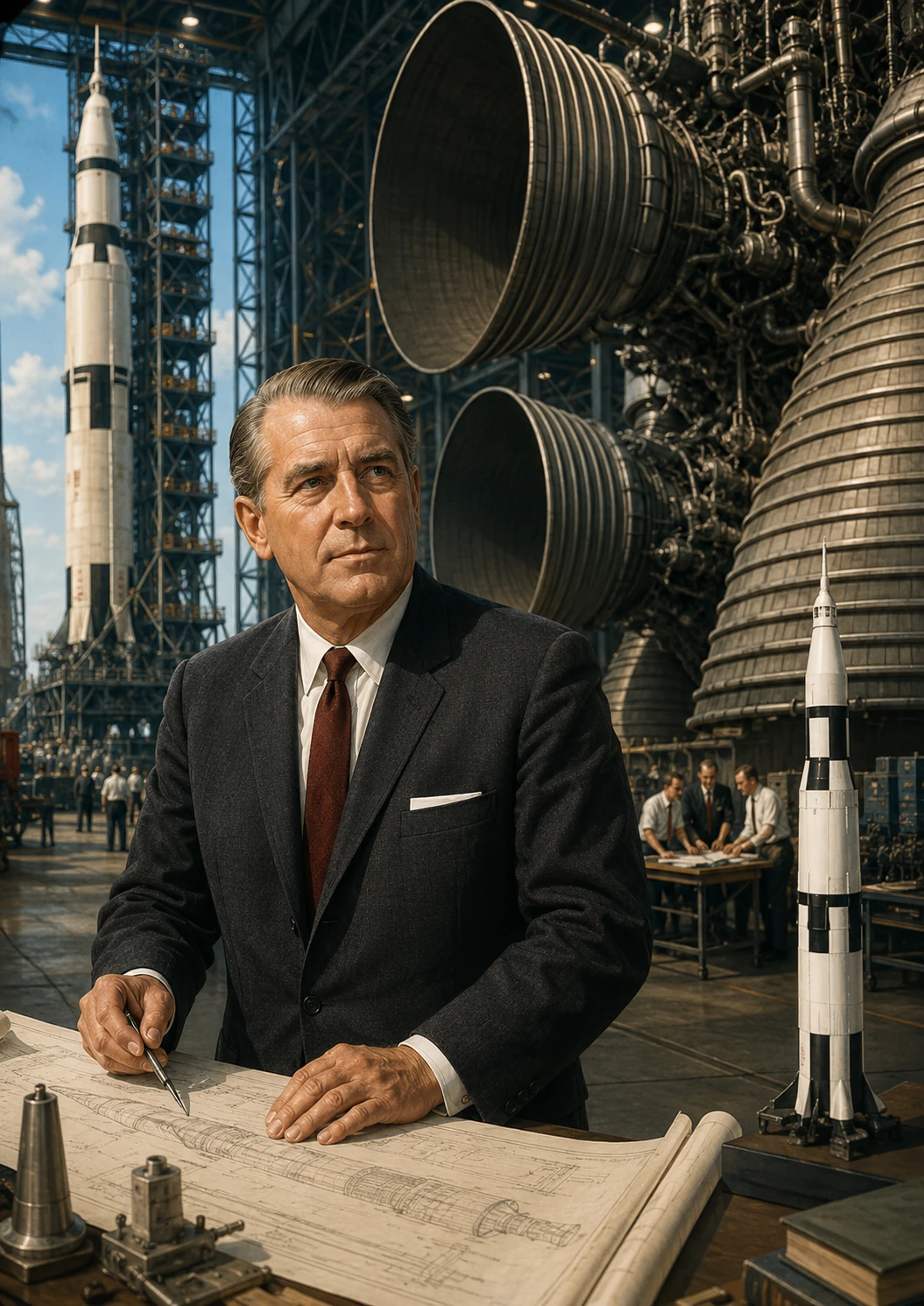
Space vision and military power must be told together
Von Braun’s biography contains an early passion for spaceflight and direct work inside Nazi Germany’s weapons program. A serious history cannot turn the V-2 into a clean stepping stone to Apollo, nor flatten von Braun into a one-dimensional symbol. Technical achievement, institutions, forced labor and personal responsibility all require documentation.
Why military funding accelerated rocketry
Modern liquid rockets require metallurgy, pumps, combustion chambers, guidance, telemetry, test stands and industrial production. Enthusiast societies could prove ideas; military states could finance systems. That difference explains both the speed of technical development and its moral cost.
The Mars Project was an architecture, not a prophecy
Its lasting value is not that every number remains correct. It does not. The value is the systems method: fleet, mass, orbital assembly, trajectory, crews, landing, surface operations and return. It already treats Mars as a coupled architecture, while also showing how wrong environmental assumptions can invalidate entire vehicle concepts.
Popular imagery was part of the program
Collier’s, Chesley Bonestell and Disney helped translate technical concepts into public imagination. Visual beauty is not evidence, but strong visual explanation can make people willing to engage with the evidence and understand an architecture that would otherwise remain abstract.
Why rocketry had to become an engineering discipline before Mars could become a plan
A human Mars expedition could not emerge from astronomy alone. It required a way to calculate motion under gravity, a propulsion technology with measurable performance, structures able to survive acceleration, guidance, staging and an industrial system capable of manufacturing large launch vehicles. Konstantin Tsiolkovsky supplied a theoretical foundation for rocket flight; Robert Goddard demonstrated liquid-propellant hardware; Hermann Oberth helped turn interplanetary flight into a subject that could be discussed with equations rather than only fiction. Those streams formed the technical culture in which Wernher von Braun developed.
Peenemünde and the V-2: technical achievement inside a criminal system
Von Braun’s German career cannot be presented as a clean preface to Apollo. The V-2 was a Nazi weapon. Its development at Peenemünde and later mass production were embedded in the German war economy, and production at Mittelwerk was associated with brutal forced labor and mass death. [S07][S19] The rocket was technically significant because it demonstrated large liquid-propellant engines, turbopumps, guidance and high-altitude ballistic flight at a new scale; historically, that technical significance must be stated alongside the human cost and political system that made the program possible.
That dual legacy is precisely why a serious Mars history should resist heroic simplification. Von Braun was a gifted systems thinker and an influential advocate of spaceflight, but his biography also raises questions about responsibility, accommodation to power and the migration of military technology into civilian exploration. Operation Paperclip later moved German specialists, including von Braun, into the United States, where missile development became intertwined with the emerging American space program. [S09][S20]
Fort Bliss, 1947: the paradoxical birthplace of the first large Mars mission study
After Operation Paperclip transferred von Braun and members of his team to the United States, they worked for the U.S. Army at Fort Bliss and White Sands. NASA History dates the beginning of the manuscript that became The Mars Project to 1947, while von Braun was still engaged in Army rocket work. [S50]
This chronology matters. The study was conceived before Sputnik, before NASA, before any human or satellite had reached Earth orbit. Von Braun was already asking how a fleet could be assembled in orbit and sent to another planet when orbital spaceflight itself had not yet been demonstrated.
Das Marsprojekt; Studie einer interplanetarischen Expedition appeared in Frankfurt in 1952. The Library of Congress catalogs the original German book as an 81-page study of Mars spaceflight and spacecraft. [S51] Its archives also preserve files specifically devoted to The Mars Project. [S38]
Why was the fleet so enormous?
Because the design predates miniaturization, practical orbital rendezvous and decades of spacecraft operations. Von Braun assumed that a serious expedition would need crews, surface vehicles, reserves and redundancy on a scale that required many launches and a fleet assembled in Earth orbit. The numbers are obsolete; the systems insight is not. “Go to Mars” had been decomposed into launch, assembly, transfer, braking, descent, surface operations, return and life support.
1969: Why Apollo did not automatically become Mars
Apollo demonstrated that a national industrial system could solve an extraordinary spaceflight problem when a political decision sustained the budget. It did not demonstrate that the next destination would automatically be approved. Post-Apollo studies examined stations, reusable transportation and eventual Mars expeditions, but NASA history shows how economic realities eliminated most of the proposed architecture, with the Space Shuttle becoming the major approved program. [S39]
For von Braun the lesson was severe: building the most capable launch vehicle of the era was not the same as creating a durable political program for Mars. Technical capability and political commitment are separate systems.
Before uniforms: European spaceflight leaves the pages of fiction
At the beginning of the twentieth century, leaving Earth was no longer only a literary idea. Tsiolkovsky had shown that rocket motion could be expressed mathematically; Goddard was experimenting with liquid propellants in the United States; Oberth's German-language work influenced a generation of young enthusiasts. The movement was still fragile: clubs, lectures, improvised tests and chronic shortages of money. Turning the rocket from a dream into an industrial machine required workshops, test stands, specialist teams and budgets private societies could not provide.
That is the setting in which Wernher von Braun's trajectory becomes inseparable from the German state and military. His interest in spaceflight was genuine and early, but the institution that gave his generation the means to build large rockets was a military institution. A serious history has to hold two truths together: an extraordinary acceleration of technical capability and a political system that selected the weapon as the immediate purpose.
1945: Why the United States wanted rockets, documents and people
At the end of the war, V-2 hardware and German teams represented a concentration of practical knowledge no victorious power wanted to leave to a rival. The United States recovered equipment, records and specialists through the program that became Project Paperclip. Smithsonian histories trace the transition into American rocketry. [S57]
The paradox appears immediately. The engineers worked on military rockets at White Sands and Fort Bliss, yet several continued to think in terms of spaceflight. NASA history notes that von Braun began the manuscript that would become Das Marsprojekt at Fort Bliss in 1947. One of the first large, calculated post-war Mars expedition studies was therefore born inside a missile program. [S50]
The Mars Project: why imagine such an enormous fleet?
Seen from the present, von Braun's architecture looks gigantic: multiple large spacecraft, a substantial expedition and enormous masses assembled in Earth orbit. It should not be judged only with today's technology in mind. The design reflected unknowns of the period, limited automation, the propulsion and life-support technologies available, incorrect assumptions about the Martian atmosphere and an expeditionary culture in which redundancy often meant more vehicles and more crew. The Library of Congress preserves the 1952 German edition and related Mars Project papers. [S51] [S38]
Its deeper importance is intellectual. Mars ceases to be merely a setting for fiction. The problem is decomposed into Earth launch, orbital assembly, interplanetary transfer, arrival, surface operations, return and logistics. Individual numbers would age, but the structure of the reasoning resembles a modern mission architecture study. The historical leap is from dream to a system that can be calculated and argued over.
The Mars Project: architecture, assumptions and historical legacy
Von Braun wrote a detailed Mars expedition architecture in the post-war period, published in German in 1952 and in English in 1953. Its scale was enormous by modern standards, but its importance lies in systems thinking: trajectories, orbital assembly, multiple spacecraft, crews, landing and return were treated as one coupled problem.
The Mars Project is historically valuable because it exposes its assumptions. A large expedition fleet, extensive assembly and a substantial crew made sense inside a technological horizon in which launch vehicles, reliability, navigation and life support were imagined differently from today. The scale is therefore evidence, not embarrassment: it shows what engineers had to assume when they lacked reusable heavy lift, modern electronics and decades of robotic Mars data. Reading the architecture this way prevents a common mistake—judging an old design only by whether its numerical choices match a twenty-first-century vehicle.
The importance of The Mars Project lies less in the fact that its exact architecture is obsolete than in the way it treated Mars as a system problem. Von Braun imagined a large expedition assembled in Earth orbit, with multiple ships, crews, cargo, landing craft and a carefully calculated interplanetary trajectory. [S06][S38] The scale was enormous because launch technology, propulsion assumptions, knowledge of the Martian atmosphere and ideas about surface operations were all very different from today. Yet the conceptual move was durable: a Mars mission could be decomposed into mass, propulsion, staging, assembly, transit, landing, surface logistics and return.
Later popularizations in Collier’s magazine and television collaborations helped turn complex astronautics into a public future people could visualize. The Library of Congress papers preserve material connected with The Mars Project and von Braun’s broader public communication work. [S37][S38] This matters because the Mars idea did not spread through equations alone. It required drawings, stories, institutional sponsorship and a public language capable of making an enormous technical undertaking appear imaginable.
The importance of von Braun's 1952 Mars architecture is not that its fleet can be copied into a modern program. It cannot. Its historical importance is methodological. Mars became a problem that could be decomposed into masses, trajectories, crew size, vehicle roles, logistics and schedule. Interplanetary travel moved from narrative speculation toward mission engineering. Modern architectures reject many of the assumptions and technologies of that era, but they still ask recognizably similar families of questions: how much mass, how many vehicles, which transit, what redundancy, what surface capability and what return path?
NASA historical material notes that von Braun began the manuscript in 1947 while working at Fort Bliss and that the English-language book appeared in 1952. The scale was deliberately grand. That scale is useful to modern readers not as a recommendation but as a contrast: it shows how strongly architecture changes when propulsion performance, launch economics, rendezvous strategy, life support and risk philosophy change. Comparing old and new Mars plans becomes a way to see which assumptions dominate mission mass.
The technical story must, however, remain attached to the political and human system that produced the V-2. The missile program served Nazi Germany; production at Mittelwerk used forced labour under murderous conditions. NASA's own historical biography explicitly identifies this context and notes that scholarship continues to assess von Braun's responsibility. Treating that history as a footnote would create a false narrative in which engineering knowledge appears without institutions, coercion or victims.
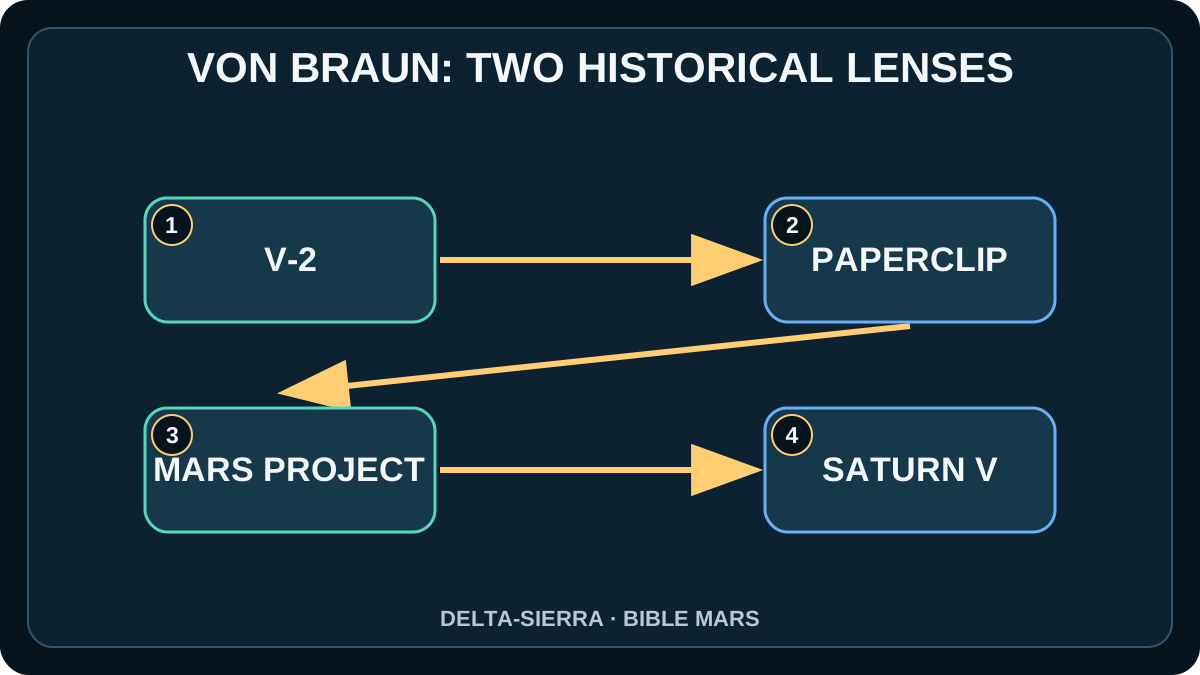
The enduring value of von Braun’s study is methodological even where its numerical assumptions became obsolete.
The expedition was conceived as a fleet assembled in Earth orbit, revealing how mass requirements could explode when every contingency was carried from Earth.
Navigation, crew operations, surface exploration, landing, ascent and return were considered as linked mission phases rather than independent inventions.
Atmospheric assumptions available before spacecraft reconnaissance affected landing concepts and demonstrate why planetary data are part of vehicle design.
The large crew and redundancy reflected uncertainty and the desire to survive failures during a mission with no possibility of quick terrestrial rescue. For Mars, consequences propagate.
The study forced advocates to attach quantities and interfaces to a dream, making criticism possible and therefore making the proposal more technically serious.
Later reference architectures inherited the same discipline of exposing assumptions even when they reached very different solutions.
1969: Why Saturn V did not automatically become a Mars program
When Apollo demonstrated that humans could reach another world, Mars looked like an obvious next horizon to many advocates. Von Braun presented crewed Mars concepts and participated in post-Apollo planning debates. Yet launch capability does not create political commitment. A Mars expedition adds long transit times, much greater autonomy, new landing problems and a requirement for sustained funding across administrations. [S24] [S39]
Apollo had been enabled by an exceptional geopolitical moment. Once the lunar objective was achieved, national priorities, public interest and budgetary choices changed. Von Braun's story therefore also reveals a limit of engineering power: an engineer can mature an architecture and even possess a giant launch vehicle, but cannot alone create the political will that turns the architecture into a program.
What von Braun's Mars work changed even when its hardware became obsolete
The lasting influence of the Mars Project is not a specific fleet size or landing vehicle. It is the insistence that an interplanetary expedition has to close as a system. Launch mass drives the number of Earth departures; propulsion affects transfer time and propellant; crew size affects life support; the atmosphere affects landing hardware; surface duration affects logistics and return opportunities. Once those couplings are written down, Mars becomes an engineering architecture rather than a heroic destination.
That is why the study remains historically useful even when modern engineers reject many of its numerical assumptions. It provides a reference point against which later architectures can be understood. Mars Direct, NASA reference missions and modern Starship concepts all make different choices, but they are answering a family of questions that von Braun helped make explicit: how much mass, how many launches, what sequence, what redundancy, what surface capability, and how to come home.
It also changes the way later failures are read. A mission concept can fail politically while still contributing methods, terminology and engineering questions to the next generation. In that sense, von Braun’s Martian work belongs to the history of systems engineering as much as to the history of Mars advocacy.
Why Mars needed a profession of rocketry before it needed a spacecraft
Interplanetary travel became an engineering subject only when propulsion, structures and trajectories could be treated quantitatively.
Tsiolkovsky’s rocket equation made the relation among exhaust velocity, mass ratio and achievable velocity explicit, showing why staging and high-performance propulsion mattered.
Goddard turned theoretical possibility into experimental liquid-propellant hardware and had to solve ignition, feed, stability and control problems in real machines.
Oberth helped create an intellectual environment in which spaceflight could be discussed as physics and engineering rather than fantasy alone.
Amateur rocket societies became training grounds where enthusiasm met instrumentation, test failure and practical constraints. For Mars, consequences propagate.
The profession matured because each launch exposed problems that an equation alone could not reveal.
By the time governments invested heavily, a community already existed that could translate funding into rapidly advancing hardware.
1945 And the transfer of a technical ecosystem
The postwar race was not merely for a few famous engineers but for documents, hardware, manufacturing knowledge and accumulated practice.
American and Soviet teams both searched for components, plans and specialists because rebuilding the knowledge from scratch would consume years.
V-2 launches in the United States became scientific opportunities, carrying instruments into high-altitude regions that conventional aircraft could not reach.
Von Braun’s team initially worked under Army structures, linking the wartime missile lineage to later U.S. ballistic-missile development.
Operation Paperclip remains historically controversial because strategic value often competed with rigorous scrutiny of individual wartime records. For Mars, consequences propagate.
Redstone and Jupiter demonstrated continuity in propulsion and systems experience before the creation of a fully civilian lunar launcher program.
This period shows why technological capability is distributed across teams and procedures rather than residing in one charismatic individual.
Why von Braun remains important without turning him into a simple hero or villain
Von Braun occupies an uncomfortable place in the history of Mars because two statements are simultaneously true. He was a central figure in the development of large liquid-propellant rockets and later became one of the most influential public advocates of human spaceflight in the United States. He also held a leading technical position in a weapons program embedded in the Nazi state, while V-2 production became associated with forced labor and mass death. A serious Mars history cannot solve the tension by deleting one side. Technical continuity matters because later launch systems genuinely inherited knowledge, people and procedures from the wartime program; moral continuity matters because the conditions under which that knowledge was produced are part of the historical record.
The Mars studies are best understood in that complicated frame. They reveal a mind accustomed to thinking in systems large enough to require institutions: fleets, orbital assembly, crews, surface vehicles and a long logistics chain. They also reveal the limitations of pre-spacecraft knowledge. Before Mariner, atmospheric properties and surface conditions were uncertain enough that landing concepts could be based on assumptions later shown to be wrong. The value of the documents is therefore not that they predicted the hardware of a future colony. Their value is that they forced an interplanetary ambition to expose masses, sequences and dependencies. Once exposed, those assumptions could be challenged and improved.
The archival record also makes it possible to move beyond the mythology surrounding a single famous engineer. Engineering organizations at Peenemünde, the U.S. Army and later Marshall Space Flight Center depended on thousands of people, contractors, test crews and production workers. Public campaigns with Collier’s, Bonestell and Disney added another layer: a large space program needs an audience capable of imagining why the infrastructure exists. Von Braun’s historical importance therefore lies partly in his ability to move between technical calculation, institutional management and public persuasion. Those skills helped build support for ambitious spaceflight, even though they did not secure a post-Apollo Mars program.
The lesson for later Mars advocates is demanding. A powerful rocket is not a settlement architecture, a coherent architecture is not a funded program, and a funded program is not automatically a durable political commitment. Von Braun’s career crossed all three boundaries and showed how difficult it is to keep them aligned. His Mars work deserves close study precisely because it combines extraordinary technical ambition, major institutional achievements, obsolete assumptions and profound ethical controversy in one historical trajectory.
The surviving papers are especially valuable because they show this evolution between public certainty and private iteration. A published architecture tends to look finished; working files reveal alternatives, calculations and discarded choices. For Mars history, those traces matter as much as the famous illustrations because they prevent hindsight from turning a contingent design into destiny. Von Braun’s real contribution is therefore best measured in the discipline of turning a distant objective into a system that can be criticized, not in the accuracy of every number he chose before Mars had been explored by spacecraft.
There is another reason the von Braun period deserves more than a short biographical summary: it is the point at which the dream of Mars becomes inseparable from large-scale systems management. A liquid rocket engine can be understood as a machine, but a Mars expedition must be understood as a program. It needs launch sites, production lines, testing, tracking, crew training, logistics, mission control and a funding institution able to keep all of those elements synchronized. Von Braun’s experience in military and later civilian organizations made him unusually attentive to that scale. The result was both a strength and a weakness of his Mars concepts. He could imagine complete campaigns rather than isolated vehicles, but the campaigns became so large that political and economic feasibility were as important as propulsion. This tension survives in modern studies whenever a technically robust architecture requires a launch rate, budget or industrial base that may be harder to sustain than the vehicle itself.
The 1969 moment makes that institutional lesson especially clear. The United States had just demonstrated a lunar landing and possessed Saturn V, enormous test infrastructure and experienced human-spaceflight teams. Yet capability did not automatically create the next destination. Apollo had a deadline, a geopolitical rival and an unusually concentrated political mandate. A Mars program would have required a different justification and a commitment lasting across administrations. Post-Apollo choices therefore moved toward other objectives even while engineers continued to study Mars. The episode is essential because it destroys the comforting idea that technological maturity inevitably produces exploration. A society must decide repeatedly to preserve the industrial chain long enough for the next architecture to become real.
Another archival advantage is that it separates chronology from memory. Later interviews and biographies inevitably compress long technical processes into a few recognizable milestones, while contemporary files preserve the mundane work between them: schedules, calculations, correspondence, test problems and alternative configurations. Those details are where systems engineering actually lives. They show that the path from a rocket club to a Mars study and then to Saturn V was not a single straight line but a sequence of institutional transitions, each with different objectives and constraints. Reading the history at that level prevents the famous end points from erasing the years of engineering, negotiation and failure that made them possible. It also helps explain why transferring people after 1945 did not instantly transfer a complete space program: facilities, suppliers, test culture, manufacturing quality and political purpose all had to be rebuilt in a new environment.
The same caution applies to the familiar phrase ‘rocket genius.’ Technical leadership mattered, but no individual could personally design, manufacture, test and operate every subsystem in a program of this scale. Guidance engineers, materials specialists, machinists, test crews, contractors and operators created the reliability that public narratives often attribute to a single name. Restoring those networks to the story does not diminish von Braun’s importance; it explains what his importance actually was. He helped define objectives, integrate disciplines, manage organizations and communicate programs large enough to require national resources. That managerial dimension is directly relevant to Mars, where the difficult task is not merely inventing one advanced machine but coordinating hundreds of systems whose schedules, interfaces and failure modes must remain compatible for years.
That systems perspective is the bridge from biography to Mars engineering. It explains why the surviving documents matter: they show how ambitions were translated into interfaces, schedules and organizations, and why changing one assumption could reorganize the entire expedition.
A deeper reading of the Mars Project also reveals the importance of uncertainty management. The architecture carried very large reserves, multiple vehicles and a sizable crew partly because an expedition so far from Earth could not rely on rapid rescue. Redundancy was therefore a design response to ignorance as much as to known failure rates. Modern architectures try to reduce mass through better reliability data, autonomy and local-resource concepts, but they face the same fundamental question: how much capability must be carried because something may fail at the worst possible time? Seen from that angle, the gigantic fleet is not merely an obsolete extravagance. It is evidence of how an engineer compensates when the environment and hardware are insufficiently characterized.
Von Braun's later American career also illustrates how technical authority can be built through successful intermediate programs. Redstone, Jupiter and Saturn created credibility because they converted theoretical competence into hardware that worked under increasingly demanding conditions. The lunar program then provided an institutional stage on which systems integration, propulsion, guidance and operations could mature together. Mars advocacy after Apollo drew power from that record, but it also inherited a problem: the political coalition that funded a race to the Moon had achieved its immediate goal. Technical success had expanded the menu of possible futures at the same moment that political urgency was shrinking.
The technical lineage also passed through propulsion details that are easy to overlook when the story is reduced to vehicle names. Reliable pumps, injectors, combustion chambers, cooling methods and guidance hardware had to move from experimental devices into manufactured systems. A Mars mission magnifies every weakness because propulsion stages cannot be serviced easily once the expedition has departed Earth. The historical growth of rocketry is therefore a story of manufacturing repeatability as much as theoretical performance. An engine that achieves high thrust on a test stand is not yet a fleet engine; it must be built repeatedly, inspected, integrated and operated within known margins. That distinction between demonstration and operational maturity became central in Saturn and remains central in modern heavy-launch programs.
Von Braun's Mars architectures also illuminate the economics of launch before launch economics had become a separate public debate. If every kilogram delivered to orbit requires expensive expendable hardware, assembling a large expedition implies a formidable number of launches and an industrial campaign measured in years. The fleet concept made that burden visible. Modern proposals answer differently — reusable stages, orbital refueling, local propellant production — but they are responding to the same mass multiplication. The history is useful precisely because the old architecture exposes the cost pressure in a form so extreme that later innovations can be understood as attempts to remove specific multipliers rather than as isolated inventions.
Public memory often compresses the Saturn era into a sequence of triumphant launches, yet the program was saturated with ground testing, qualification and failure analysis. That culture matters for Mars. Long-duration missions cannot depend on discovering critical weaknesses only after departure, so test infrastructure becomes part of exploration architecture. The lesson carried from missiles to Saturn and from Saturn into later human-spaceflight programs is that reliability is manufactured through repeated exposure to off-nominal conditions, documentation and corrective action. A Mars expedition may be remembered for its departure and landing, but its probability of survival will be shaped years earlier in factories, test stands and review rooms.
From spectacular machines to an interplanetary logistics system
The history of large rockets can easily become a catalogue of vehicles, but the more useful narrative follows the changing unit of thought. Early experimenters often thought in terms of a single rocket: can it ignite, remain stable and reach a greater altitude? Military development turned the question into a production system: can engines, guidance equipment, structures and ground operations be repeated with acceptable reliability? Orbital launch added staging, tracking and payload integration. A Mars expedition then forces the unit of thought to expand again. Launch vehicles, orbital assembly, departure stages, crew systems, landers, surface equipment and return vehicles become one campaign whose schedule and failure modes are coupled.
This systems perspective is where von Braun's Mars work remains historically important even when specific numbers are obsolete. The scale of the proposed fleet makes the logistics burden impossible to ignore. Launches must occur in sequence, elements must rendezvous, crews must depend on hardware assembled before departure, and every additional vehicle creates interfaces and opportunities for delay. Modern architectures may use far fewer vehicles, reusable stages or orbital refueling, yet they still confront the same conceptual problem: interplanetary capability is created by a chain of operations, not by the maximum payload number of a single booster.
The transition from wartime rocketry to the American space program also shows that technical knowledge never travels alone. Engineers move through institutions, requirements change, funding mechanisms change and public narratives change. A ballistic missile and a lunar launch vehicle can share propulsion ancestry while serving entirely different political purposes. For Mars history, this matters because it warns against treating technology as if it automatically seeks the most ambitious destination available. Hardware develops inside organizations, and organizations pursue goals that can change faster than the machines themselves.
Apollo made the political dimension unmistakable. The United States proved that it could mobilize a national industrial effort for a spectacular human destination, but the exceptional conditions that produced Apollo did not become a permanent budget rule. Once the lunar race was won, proposals for Mars had to compete with other civil and military priorities, Earth-orbit infrastructure and changing views of acceptable risk. Von Braun could describe pathways beyond the Moon, but no technical diagram could recreate the geopolitical urgency that had accelerated Saturn V.
The lasting question is therefore not whether the engineering imagination of the 1950s was “right.” It is which parts of that imagination survived contact with better data and different economics. Orbital assembly, mission staging, large logistics campaigns and the need to design an expedition as an integrated system remain recognizable. Other assumptions vanished as spacecraft measured Mars directly. Reading the old plans against the modern ones turns history into a technical instrument: it shows which constraints are fundamental and which were artifacts of the knowledge, launch costs and institutions of their time.
From Paperclip to Saturn V: why technical continuity did not make Mars inevitable
After the war, Project Paperclip transferred von Braun and members of his rocket team to the United States. Their expertise fed Army missile development, then the Redstone and Jupiter programs, and ultimately NASA's Marshall Space Flight Center. The Saturn V demonstrates the extraordinary engineering capacity that emerged from this institutional transition, but it also explains why a Mars mission did not automatically follow Apollo. A launch vehicle is only one layer of an interplanetary architecture.
A crewed Mars campaign would have required long-duration habitation, closed-loop life support, radiation management, large-scale logistics, reliable deep-space propulsion, surface systems and a political willingness to fund a program for many years. Apollo proved that a national program could solve a tightly defined lunar objective under exceptional political pressure. It did not prove that a permanent Mars transportation and surface system already existed in latent form.
This distinction helps correct a recurring historical myth: that humanity “could have gone to Mars in the 1970s” and simply chose not to. There were serious studies and ambitious proposals, but proposal, enabling technology, integrated system maturity and funded flight program are different categories. A technically imaginable architecture can still lack life-support maturity, operations evidence, budget stability or acceptable risk. The history is more instructive when those categories remain separate.
Moving from a drawing to a mission architecture changed how Mars could be imagined
Popular images often let one rocket stand for the whole journey. Von Braun's engineering made the rocket only the first link. Vehicles had to be assembled, trajectories managed, functions divided among elements and a return path planned. Even where the technology of The Mars Project has aged, this decomposition remains influential because it makes the difference between “achieve a velocity” and “close an architecture” visible.
That is also why Saturn V does not prove that a crewed Mars mission was simply waiting after Apollo. The launcher solved a major part of Earth departure; it did not automatically solve years of life support, radiation exposure, maintenance, cryogenic storage, surface operations and return. Engineering history becomes more useful when it exposes those interfaces instead of reducing unrealized past options to a single question of political will.
The same lesson applies to contemporary architecture. A new launch vehicle can dramatically change the mass budget and still leave the rest of the mission open. Von Braun's enduring contribution to Mars history is therefore partly conceptual: he helped turn the destination into a coupled set of engineering problems, even though later generations would solve them differently.
Mars before Mariner: designing for a poorly known planet
When von Braun developed his Mars architecture, engineers did not have the modern data later returned by Mariner, Viking, Mars Global Surveyor and the rovers. Atmospheric pressure, detailed topography, weather and even the nature of major surface features were poorly constrained. Some proposed arrival and exploration methods therefore assumed a Mars that no longer exists in current scientific understanding.
That does not make the study useless. It makes it a powerful example of how an internally coherent architecture can rest on incorrect environmental inputs. Excellent mathematics cannot rescue a bad starting assumption.
Von Braun’s place in Mars history is larger than one rocket or one mission date. His important contribution was to treat Mars as a complete architecture problem: fleets, trajectories, logistics, crew, surface vehicles and operational sequence. Many numbers aged, but the discipline of making all subsystems close together remains recognizable in modern mission design.
The history must also remain whole. The Nazi context of the V-2 program, the crimes connected with its production and the postwar transfer of specialists belong to the technical and moral record. Understanding continuity does not require erasing later achievements or artificially separating technology from the institutions that produced it.
Von Braun's large fleets reveal how strongly architecture depends on technology assumptions
An architecture is never simply “huge” or “light” in isolation. Its scale follows assumptions about propulsion, structure, rendezvous, life support, margins and mission duration. The fleets imagined in the early 1950s reflected the technologies available or anticipated at the time. Change dry mass, specific impulse or transit duration and the entire campaign can change.
That is why old studies remain technically useful. Engineers do not read them to reproduce the drawing; they can read them as sensitivity cases showing how one generation closed the equations with its available tools. Comparing The Mars Project with Mars Direct, NASA reference missions or Starship reveals the evolution of assumptions as much as the evolution of rockets.
The public image of spaceflight mattered because large programs require political imagination as well as equations
Von Braun's work with magazines and television helped convert technical diagrams into a public vocabulary for space stations, Moon expeditions and Mars travel. That role should not be confused with flight approval, but it mattered historically. Before a society funds a large technical system, enough people must be able to imagine what the system is for.
The relationship between engineering and public narrative can be uncomfortable. Simplification makes an architecture legible but can hide uncertainty. Spectacular art can communicate scale while making difficult technology look settled. The von Braun era therefore offers an early example of a tension that remains visible in modern Mars advocacy: the image can recruit attention faster than engineering can retire risk.
Ethical history belongs inside technical history, not in a separate appendix
The V-2 program demonstrates why technological lineage cannot be treated as morally neutral. Rocket performance, institutional knowledge and production experience were obtained within a criminal regime and a forced-labour system. The later American success of the rocket team does not erase that origin. Conversely, acknowledging the crimes does not require pretending the technical knowledge had no influence on later launch vehicles.
Keeping both facts together produces a more mature history. Technology is created by institutions, incentives and people; its genealogy carries more than equations. A Mars library that wants to become a reference should therefore teach readers how to hold engineering achievement and historical responsibility in the same frame.
Staging changed Mars from a single-rocket fantasy into a systems problem
Early interplanetary visions often concentrated on the vehicle as one object. Large-scale studies in the mid-twentieth century made the architecture more explicit: assembly, multiple launches, crew transport, surface systems and return had to be closed together. Once staging and rendezvous are taken seriously, the “Mars rocket” becomes a campaign rather than a machine.
This systems view survived even as individual designs became obsolete. Modern architectures may use different propulsion, smaller or larger crews, orbital refilling or very different landing concepts, but they still have to answer the same family of questions: where is mass accumulated, which element performs each velocity change, how is abort handled, what is reused, and how do surface assets arrive before the people who depend on them?
Industrial scale was embedded in the old architectures
Von Braun's large fleets assumed not only rocket technology but an industrial society capable of manufacturing, launching and operating many heavy vehicles. That background capacity is easy to overlook when focusing on drawings of spacecraft. A Mars campaign is downstream of factories, test sites, launch infrastructure, tracking networks and trained organizations.
The lesson remains current. A vehicle specification can look impressive while the production and operational system needed to repeat the mission remains immature. Historical architecture should therefore track both the craft and the industrial machine behind it.
Historical continuity should not erase design discontinuity
It is tempting to draw a straight line from von Braun to Apollo and then to every modern Mars plan. The real lineage is messier. Institutions changed, technologies matured unevenly, nuclear propulsion rose and fell in priority, robotic missions transformed knowledge of the target, and political objectives repeatedly moved. Some concepts were inherited; others were rejected.
That discontinuity makes the history more useful. It shows that architecture is contingent. Future Mars systems will also be shaped by constraints and discoveries that current designers do not yet know.
The continuity from German wartime rocketry to American spaceflight must be described without converting biography into a technical relay race. Peenemünde’s achievements were inseparable from a weapons program, and V-2 production was tied to the lethal forced-labor system at Mittelwerk. Paperclip then transferred people and expertise into a new political context. The engineering lineage is real, but so is the moral discontinuity between learning how to build large rockets and deciding what purposes those capabilities should serve.
Fort Bliss is important in the Mars story because the subject was not yet an operational national objective. Von Braun could explore fleet size, staging and mission duration on paper while his official work remained tied to military rocketry. The Mars Project therefore records a moment when quantitative planning outran programmatic commitment: the equations became detailed before institutions had agreed to build such a mission.
Von Braun’s Mars legacy has to be read with two timelines visible at once. One is technical: liquid-fuel rocketry, the V-2, post-war missile development, the Saturn program, and the emergence of large launch vehicles able to place substantial mass into orbit. The other is historical and moral: the wartime V-2 program was embedded in the Nazi weapons system and depended on coercion and forced labor. Treating only the later spaceflight achievements as the “real” story would amputate the conditions under which part of the technical knowledge was produced. Treating the entire later career as nothing more than a continuation of the wartime program would also erase the institutional and technological transformations that followed. A serious Mars history has to hold both facts together.
The Mars Project is especially useful when kept in its proper status. It was a design study, not a funded expedition. Its fleets, crew counts, orbital assembly, landing concepts, and mission sequencing show how an engineer of that era tried to make interplanetary travel internally coherent with the technologies and assumptions available to him. The value for a modern reader is comparative. Modern architectures use different propulsion trades, digital navigation, far more capable automation, different knowledge of the atmosphere and surface, and a completely different understanding of life-support closure. Yet the same categories still reappear: launch mass, staging, transit time, landing mass, surface duration, return, redundancy, and the cost of carrying margins.
Project Paperclip and the transfer of German specialists to the United States also changed the institutional history of American rocketry. The important point for Mars is not to turn that history into a simple origin myth. American rocketry drew on multiple military, academic, industrial, and governmental strands, while the Army, NACA/NASA, contractors, and later the Apollo program built organizations that were much larger than any one engineer. Von Braun’s influence was substantial, particularly in public advocacy and large-rocket development, but a historically mature account separates individual influence from the institutional machinery that made Saturn V possible.
That separation helps explain why von Braun’s Mars studies remained studies even after Saturn V existed. A heavy launcher solves only one layer of an interplanetary expedition. Life support for long missions, radiation protection, reliable in-space propulsion, high-mass Mars entry and landing, surface power, medical autonomy, communications, and a credible return chain remain independent architecture problems. The historical lesson is therefore not “the rocket existed, so Mars was within reach.” It is that launch capability can advance far ahead of the rest of the system required for a human Mars campaign.
Continuity without absolution: how to read the technical lineage
Technical continuity after 1945 is real, but it should not be confused with moral continuity or historical absolution. The United States acquired people, documents and experience from the German missile program through Project Paperclip, while the V-2 program itself had been embedded in a coercive wartime system that used forced labour. A serious Mars history must hold both facts at once. The later value of guidance, propulsion, staging and large-project management cannot erase the conditions in which part of that expertise was produced. Conversely, acknowledging those conditions does not require pretending that the engineering lineage disappeared when the war ended.
The archival record is especially useful because it prevents a second simplification: imagining von Braun's Mars work as a single immutable master plan. The Mars Project, later public articles and subsequent NASA-era work belong to different institutional contexts, budgets and technical assumptions. A very large fleet could look rational in a period when mission designers compensated for uncertain reliability by multiplying vehicles and crews. Later studies attacked the same problem with different propulsion assumptions, rendezvous strategies, launch vehicles and risk models. The enduring historical object is therefore not one preferred fleet size but the habit of converting an interplanetary ambition into masses, trajectories, schedules and failure consequences.
Public communication also belongs to this technical history. The Collier's series and Disney productions did more than popularize rockets: they translated system architecture into images, sequences and narratives that non-specialists could discuss. That mattered because large space programs require political authorization, public legitimacy and long-term budgets as well as equations. The same tension remains visible in modern Mars advocacy. A compelling image can mobilize attention, but the engineering record must still distinguish what is illustrative, what is calculated, what has been tested and what can be operated repeatedly.
Three pioneers, three different ways of making spaceflight technically possible
The familiar sequence Tsiolkovsky–Goddard–Oberth is useful only if their contributions are not flattened into the same story. Konstantin Tsiolkovsky developed a theoretical framework in which rocket performance, staging and orbital or interplanetary travel could be treated mathematically. Robert Goddard concentrated on experimental machinery: liquid propellants, feed systems, guidance, gyroscopic control and repeated flight testing. Hermann Oberth gave European readers and young engineers a rigorous argument that liquid-propellant rockets, orbital stations and other elements of spaceflight belonged inside technical discussion rather than only fiction. Wernher von Braun entered a field that already had equations, experiments and a growing technical culture. His distinctive historical role was the integration of many disciplines into large rocket programs.
From a component to an industrial system
A large rocket cannot be understood as an engine with a tank above it. It requires structures that survive handling and flight, pumps and valves that work within timing limits, guidance that can detect attitude errors, electrical power, telemetry, ground support equipment, launch procedures, test facilities and an organization capable of manufacturing many parts to controlled standards. Peenemünde mattered historically because these functions were brought together at an unprecedented scale. That systems lesson later became central to large launch vehicles. It also explains why a Mars architecture cannot be reduced to a single powerful booster: transportation is a chain of production, launch, rendezvous, navigation, arrival and logistics.
The moral context cannot be separated from the technical record
The V-2 was a weapon developed for Nazi Germany, and its production became linked to brutal forced labor and mass death. Von Braun joined the Nazi Party and became an SS officer. Those facts are not side notes to be hidden behind later Apollo achievements. At the same time, a historical account still needs to examine the engineering methods, organizations and hardware because they influenced postwar rocketry. Holding both layers together prevents two opposite errors: turning technical success into moral absolution, or pretending that morally compromised programs left no technical legacy worth understanding. The history of spaceflight is often uncomfortable precisely because institutions, ambitions and technologies cross political ruptures.
Why postwar Mars studies were so large
Von Braun’s early Mars studies imagined fleets, assembly in Earth orbit and large crews because he was reasoning before high-performance computers, modern autonomous navigation, compact electronics, precision landing and decades of robotic Mars reconnaissance. His solution to uncertainty was often scale: more vehicles, more crew, more equipment and redundancy by numbers. Modern mission studies can reject many of those numerical choices while still learning from the systems question he posed: what complete chain of vehicles and operations is required to move people from Earth, sustain them through interplanetary flight, operate at Mars and bring them back? The answer changes with technology, but the need to close the whole chain does not.
Public communication became part of the architecture
The Collier’s articles and Disney television programs demonstrated that engineering projects of extraordinary cost require a public language. Cutaway drawings, staged mission sequences and clear explanations turned abstract astronautics into something citizens and political leaders could imagine. This was not merely publicity added after the engineering. Public support, budgets and institutional continuity determine whether an architecture can be built. The lesson for a modern Mars reference is to preserve the distinction between an illustration and an approved program while still using strong visual explanation. A picture can clarify dependencies; it must never be allowed to manufacture false certainty.
From Saturn V to Mars: capability is not destination
Apollo proved that the United States could organize the launch vehicles, spacecraft, navigation, communications, training and ground systems needed to land humans on the Moon. It did not automatically create a Mars program. A Mars mission requires longer-duration life support, far more autonomous operations, different entry and landing systems, larger logistics reserves and a political commitment extending across many launch windows. The historical discontinuity after Apollo is therefore as instructive as the technical continuity: possessing a powerful rocket does not determine what a society chooses to do with it.
Documentary anchors: NASA histories of Tsiolkovsky, Goddard and von Braun; NASA’s history of early space-station concepts; institutional histories of Apollo and postwar rocketry. The historical sections distinguish demonstrated hardware, contemporary proposals and later interpretation rather than reading today’s capabilities backward into the 1940s and 1950s.
How to read a historical Mars proposal without turning it into prophecy
Historical engineering documents should be read against the capabilities of their own time. A mass estimate that looks absurd after decades of miniaturisation may have been a rational response to the computers, guidance systems, life-support assumptions and launch vehicles then available. The opposite error is equally dangerous: a clean drawing of a fleet does not prove that the materials, reliability, entry technology or logistics had been solved. A useful historical analysis therefore separates the question a proposal was trying to answer from the hardware maturity available when the answer was written. This is particularly important for Mars because the destination remained constant while the enabling technologies changed radically.
That method also prevents hindsight from becoming a substitute for explanation. The reader should be able to see why a designer selected a particular staging scheme, crew size, assembly method or mission duration, which contemporary constraint drove the choice, and which later development removed or replaced that constraint. History then becomes more than a parade of famous names. It becomes a laboratory in which one can watch assumptions fail, engineering disciplines mature and institutions learn how to convert ambitious objectives into testable programmes.
Sources and bibliography
- S06 Smithsonian National Air and Space Museum — Mars Project: Wernher von Braun as a Science-Fiction Writer.
- S07 Smithsonian NASM — Von Braun research files / Rocket and the Reich.
- S08 NASA — Wernher von Braun.
- S09 Smithsonian — Project Paperclip and American Rocketry after World War II.
- S19 Smithsonian NASM — V-2 Missile (historique et travail forcé).
- S20 Smithsonian NASM — Project Paperclip and American Rocketry after World War II.
- S21 Smithsonian NASM — The Missing History of the Explorer 1 Satellite.
- S23 NASA NTRS — W. von Braun, The next 20 years of interplanetary exploration (1965).
- S24 NASA NTRS — Wernher von Braun, Manned Mars Landing.
- S37 Library of Congress — Wernher Von Braun Papers, 1796–1970
- S38 Library of Congress — The Mars Project, Wernher Von Braun Papers
- S39 NASA History — Space Task Group Report and post-Apollo Mars planning (1969)
- S50 NASA History — MAVEN Continues Mars Exploration Begun 50 Years Ago by Mariner 4 (von Braun commence The Mars Project en 1947)
- S51 Library of Congress — Das Marsprojekt; Studie einer interplanetarischen Expedition, édition 1952
- S52 Library of Congress — Wernher von Braun Papers, dossiers Collier's, 1951-1953
- S53 NASA — Wernher von Braun, biographie historique et responsabilité autour de Mittelwerk
- S54 NASA History — Sputnik Biographies: Wernher von Braun
- S55 United States Holocaust Memorial Museum — Dora-Mittelbau et travail forcé
- S56 Smithsonian National Air and Space Museum — V-2 Missile
- S57 Smithsonian National Air and Space Museum — Project Paperclip and American Rocketry after World War II
- S58 Smithsonian National Air and Space Museum Archives — Peenemünde Document Collection
- S59 NASA History — First Launch of a Saturn Rocket
Paperclip, U.S. missiles and Saturn
After 1945 the United States brought von Braun and part of his team to America. Their work gradually moved from missiles toward launch vehicles. Explorer 1, Redstone, Jupiter and then Saturn structured this new phase.
At Marshall, von Braun became a major figure in Saturn V development, the launch vehicle that sent Apollo missions toward the Moon. The technical legacy is immense: propulsion systems, integration, industrialization and program management at unprecedented scale.
The organizational legacy of Saturn
Saturn V was not the work of one man. Tens of thousands of people across NASA centers, contractors and suppliers designed, qualified and operated the system. Von Braun’s role was that of a technical leader and integrator inside that enormous organization. Calling Saturn his “personal rocket” would be historically wrong and would erase the collective work.
The distinction matters to Mars because crewed architectures are systems of systems. Leadership matters, but success depends on organizations able to control interfaces, configuration, testing and defects at a scale no individual can fully contain.
Peenemünde: technology, infrastructure, coercion and responsibility
The A-4/V-2 program achieved unprecedented rocket performance, but its history is inseparable from Nazi warfare and the exploitation of forced labor in production. Any technically serious account must keep those facts in the same frame. The engineering legacy cannot be narrated as a clean heroic prelude to the Space Age.
Peenemünde cannot be treated as a neutral laboratory chapter. The missile program was embedded in the Nazi war system, and production later relied heavily on forced labor under brutal conditions. This is not a footnote added to balance an engineering success story; it changes how the story itself is told. Technical maturation, organizational scale and human suffering occurred in the same program. Any lineage from V-2 to later launch vehicles therefore has to preserve the difference between learning how to build large rockets and judging the political and moral system that made wartime production possible.
The A-4/V-2 required simultaneous progress in turbopumps, injectors, cooling, materials, supersonic aerodynamics, inertial guidance, telemetry and test organization. Smithsonian archival collections preserve Peenemünde memoranda, correspondence and technical reports, some bearing the names of the senior figures in the program. [S58]
The first successful A-4 flight in October 1942 demonstrated a liquid-propellant ballistic vehicle on an unprecedented scale. Technically it influenced later American, Soviet and European launch vehicles. Historically it was also a weapon built for a dictatorship and fired against cities.
After the 1943 bombing of Peenemünde, production moved underground to Mittelwerk. The United States Holocaust Memorial Museum documents the Dora-Mittelbau forced-labor system. [S55] NASA's current historical biography states that von Braun knew of the terrible conditions and was involved in decision-making concerning slave labor. [S53] Any serious history of Mars exploration has to keep this moral reality beside the technical lineage.
The V-2 story must hold technical achievement and criminal exploitation in the same frame.
Peenemünde coordinated propulsion development, guidance, aerodynamics, structures, test stands, production decisions and launch operations at a scale earlier clubs could not approach.
Military funding supplied resources because the objective was a weapon, not exploration, and that institutional purpose shaped priorities and schedules.
Production later relied on forced labor under brutal conditions associated with Mittelwerk and the Mittelbau-Dora camp system.
Engineering history that celebrates performance while hiding the victims produces a false account of how the system actually operated. For Mars, consequences propagate.
The technical lessons nevertheless migrated after the war into both American and Soviet missile and launch programs.
The ethical lesson is equally durable: institutional purpose and human cost are part of the history of a technology, not external footnotes.
Peenemünde matters because the rocket was treated as a complete system rather than a spectacular engine. Teams had to produce turbopumps, stabilize combustion, handle propellants, build light structures, develop guidance, organize ground control, instrument tests and learn from failures. The center created a development culture whose scale anticipated later ballistic and space programs. Smithsonian archival material from Peenemünde documents that industrialization of the problem. [S58]
From Army missiles to Saturn V
In the United States von Braun’s team first worked inside the missile program, then became central to the launch vehicles that opened the Space Age and ultimately to the Saturn V. Explorer 1, the transfer of the team into NASA, the development of heavy launch capability and the Apollo program transformed what had been paper architecture into a national industrial system. [S08][S21] Saturn V did not take humans to Mars, but it demonstrated that government, industry and engineering could coordinate a launch system on a scale previously confined to studies.
Public imagination becomes part of the engineering ecosystem
Von Braun also understood that a program of this scale needed an audience. Technical studies, magazine series, illustrations and television did not replace engineering; they created a cultural bridge between specialist calculations and public support. The Collier’s material preserved in the Library of Congress papers shows how closely popular communication and technical advocacy could interact. [S37] The famous paintings and cutaway scenes associated with the era made orbital assembly, winged Mars landers and fleets of spacecraft imaginable to readers who would never open a trajectory report.
That communication success had a lasting consequence. Later Mars advocates repeatedly inherited not only von Braun’s equations but his method of presenting a complete future as a coherent visual system. It is one reason Mars plans can become culturally powerful long before their budgets, technologies and schedules are settled. A historical account therefore has to read the drawings in two ways at once: as engineering proposals containing assumptions that can be tested, and as persuasive artifacts designed to make an unprecedented project feel politically and socially possible.
1969: Mars appears on the horizon immediately after the Moon
Von Braun did not stop thinking about Mars once Apollo succeeded. In August 1969 he briefed a “Manned Mars Landing” concept in the context of post-Apollo planning. [S24] At the same time the Space Task Group considered alternative futures for the American space program, including paths that could eventually lead to human Mars expeditions. [S39] The episode is revealing: even at the moment of maximum lunar momentum, a technically described Mars mission still had to compete with budget limits, political priorities and other space goals. The history of human Mars planning is therefore as much a history of institutions as of rockets.
Collier's, Bonestell and Disney: making space architecture legible to the public
In the early 1950s, von Braun became a public communicator. Library of Congress holdings include dedicated Collier's files from 1951-1953. [S52] NASA also records his role as spokesman in three Disney television programs on space travel. [S53]
The communication strategy combined calculations with vivid images. Chesley Bonestell's paintings made future hardware feel visible before it existed. The lesson remains relevant to Mars programs today: technically plausible projects compete for political attention, funding and public patience. A diagram can explain a vehicle; an image can make an entire generation believe the vehicle is worth building.
An expedition of that size cannot leave the notebook if no society is willing to fund launch vehicles, infrastructure and risk. Von Braun understood that public communication was part of the problem. Library of Congress records preserve his work connected with the Collier's series of the early 1950s. [S52]
Chesley Bonestell's illustrations gave stations, ships and planetary landscapes a physical presence. Work with Walt Disney broadened the audience further. The public was not simply told that a rocket might fly; it was shown sequences, destinations and a possible future. The ability to narrate an architecture would remain part of major space programs, from Apollo artwork to modern Starship animations.
A technically coherent Mars plan still requires a society willing to fund a sequence of costly intermediate capabilities.
Collier’s paired technical explanation with compelling artwork so readers could visualize stations, vehicles and expeditions that did not yet exist.
Chesley Bonestell’s images gave speculative machines a visual realism that helped spaceflight escape the appearance of pure fantasy.
Von Braun learned to explain architecture as a sequence of understandable steps, a communication skill distinct from engineering calculation.
Disney television programs brought basic rocketry and future-space concepts into homes far beyond the professional aerospace community. For Mars, consequences propagate.
This communication campaign also participated in the construction of von Braun’s American public image and must be read critically alongside his wartime history.
Modern Mars programs face the same structural question: a mission can be physically plausible yet politically impossible if the public cannot understand its purpose or cost.
A large archival record still worth mining
The Library of Congress Wernher Von Braun Papers contain roughly 20,000 items spanning his work from Germany through the American missile and space programs. [S37] The finding aid explicitly identifies a file titled The Mars Project. [S38] For a serious history of Mars planning, such archives matter because they let readers separate what von Braun actually wrote or presented from later retellings.
Before Peenemünde: how a dream of spaceflight became an engineering profession
Von Braun's story is often compressed into a childhood fascination followed by Saturn V. The real transition was institutional. In interwar Germany, the ideas of Tsiolkovsky and especially Hermann Oberth inspired clubs and young experimenters who tried to move rockets from fiction into hardware. The field had no mature space industry, no standardized test infrastructure and no digital simulation. Every larger rocket required the simultaneous invention of tools, facilities and procedures needed to understand it.
The German Army supplied the resources that private enthusiasts could not. NASA notes that von Braun regarded Army Ordnance support for expensive research on atomization, combustion and gas expansion at Kummersdorf as a major opportunity. [S53] That support changed the scale of rocketry, while also fixing it inside a military purpose that cannot be separated from the history.