


MARS BIBLE — ORGANISATIONS
Roscosmos and the Russian space heritage
From Soviet Mars missions to Phobos-Grunt and ExoMars: a historic power whose current public Mars roadmap is less transparent.
BEFORE MARS — HOW THE ORGANIZATION WAS BORN
Part I — From Tsiolkovsky to the design bureaux: a space system without one central agency
Before Mars: how Roscosmos and the Russian space program came into being
Treating “Roscosmos” as if the organization had existed since Sputnik would be historically wrong. The Soviet space program is much older than the present Russian state and was built around design bureaus, ministries, factories and leaders such as Korolev. After the collapse of the USSR, the Russian Federation had to reconstruct an administrative framework to manage that technical, industrial and human inheritance.
A Russian space agency emerged in 1992 and then went through several institutional transformations. The current Roscosmos state corporation was created by law in 2015. It combines policy, industrial coordination and operational functions in a sector where many companies themselves have lineages far older than the present institution.
That distinction is essential when reading Russia’s Mars history. Soviet Mars probes, the Phobos program and the design bureaus behind them were not products of the Roscosmos corporation created in 2015; they belong to an inheritance that contemporary Russia received, reorganized and at times attempted to revive.
The dossier must therefore tell two intertwined stories: the history of Soviet space power and the history of Russian institutional reconstruction after 1991. Only by keeping those layers separate can present-day Mars ambitions, international cooperation and industrial difficulties be understood clearly.
Founding sources: Kremlin — Law on State Corporation Roscosmos · Roscosmos — history reference to 1992
Part II — Sputnik, Luna, Venera and Soviet robotic exploration
Sputnik, Luna and secrecy: science, prestige and strategy become inseparable
Sputnik established not only a technological milestone but also part of the Soviet institutional culture of spaceflight. Successes could be announced with enormous symbolic force while programmes, responsibilities and failures remained secret. For years Korolev's name itself was hidden from the wider public. Secrecy had military reasons, but it also distorted the public picture of engineering. Success appeared almost linear even though engineers lived through prototypes, launch failures, redesigns and institutional rivalry.
The Luna programme shows how learning actually occurred. Several attempts failed before Luna 2 became the first human-made object to reach another celestial body in 1959 and Luna 3 photographed the Moon's far side. The successful missions were therefore not isolated miracles; they were the visible products of repeated experiments in guidance, communications, thermal control and trajectory design. Mars would prove far less forgiving. Launch windows were sparse, cruise times long and autonomous reliability much more demanding.
The comparison among the Moon, Venus and Mars became one of the most revealing features of Soviet planetary exploration. Lunar missions benefited from relatively rapid learning cycles. Venus, although physically brutal, eventually became a domain of extraordinary Soviet competence through the repeated Venera and Vega series. Mars resisted. It is therefore meaningless to label an entire national programme simply “good” or “bad” at planetary exploration. Performance depends on target, architecture, cadence, team continuity and whether a failure can be converted into a corrected vehicle before institutional memory dissipates.
Part III — Vostok, Voskhod and Soyuz: building crewed continuity
Vostok, Voskhod and Soyuz: the other Russian story, built on human-flight continuity
While Mars remained difficult, human spaceflight became the field in which Soviet and then Russian organisations built exceptional continuity. Vostok carried Yuri Gagarin into orbit on 12 April 1961. Voskhod produced new milestones including Alexei Leonov's spacewalk. The architecture that endured, however, was Soyuz. It is misleading to imagine one unchanged spacecraft flying for six decades: successive versions replaced electronics, rendezvous equipment, communications and other systems while retaining a recognisable overall architecture.
The value of that continuity is cumulative experience. Human systems do not become safe after one successful mission. Procedures, anomaly databases, trained controllers and crews, manufacturing controls and recovery teams matter. Soyuz also suffered fatal accidents, notably Soyuz 1 and Soyuz 11, and those losses forced design and procedural changes. Maturity is therefore historical, not rhetorical.
The architecture remains operational in the 2020s. In July 2026 NASA reported Soyuz MS-29 launching from Baikonur with one NASA astronaut and two Roscosmos cosmonauts for the ISS. [R7] Soyuz is not a Mars spacecraft, but its operating history demonstrates something Mars will need: a production and operations system able to repeat crew launch, rendezvous, docking, return and recovery over decades.
Part IV — Salyut, Progress, Mir and the learning of orbital permanence
Salyut and Progress: long-duration presence becomes a logistics problem
Space stations changed the nature of Soviet human flight. A short mission can carry most of what it needs. A months-long presence requires resupply, replacement parts, waste management, experiments and new crews. Salyut 6's two docking ports allowed a cargo craft to arrive while a crewed Soyuz remained attached. Progress emerged from this operational requirement.
Progress used much of the Soyuz architecture but replaced the return capsule with cargo and tanks. The first vehicle reached Salyut 6 in 1978. NASA's history traces how successive Progress variants then supported Salyut, Mir and the ISS, enabling progressively longer crew stays. [R8] The conceptual step is profound: the station is no longer a single spacecraft launched with everything it will ever need. It becomes a node inside a supply chain.
Mars will require the same logic but under much harsher constraints. Consumables, strategic reserves, locally repairable parts and items that must still arrive from Earth must all be separated. A Mars settlement must combine the Progress philosophy of scheduled logistics with much greater autonomy because a replacement cannot arrive within days. Logistics becomes part of survival engineering rather than an administrative afterthought.
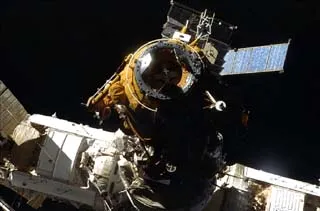
Part V — Energia, Buran, launch vehicles and propulsion schools
Energia and Buran: technical capability does not guarantee programme sustainability
Late Soviet Energia and Buran reveal another side of the system: an ability to mobilise enormous industrial resources for advanced cryogenic launch vehicles, guidance and reusable spacecraft, but also vulnerability to economic collapse. Buran's uncrewed orbital flight in November 1988 ended in an automated landing and demonstrated an extraordinarily ambitious guidance chain. NASA's history of Mir notes that the first Buran flight was highly successful but no further missions followed as the Soviet Union disintegrated. [R11]
The Mars lesson is to separate technical feasibility from sustainable architecture. A system can work and still be economically unsustainable. Energia-Buran required factories, ground infrastructure, trained workforces and recurring funding. When the political and economic environment collapsed, the programme could not continue. Mars proposals often focus on whether a vehicle can be built; settlements depend instead on whether the entire industrial chain can survive for decades.
Post-Soviet Russia often made the opposite choice, relying on already mature systems such as Soyuz and Proton rather than sustaining every late-Soviet advanced programme. That preserved operations under financial stress but made generational replacement more difficult. Angara can be read partly as an attempt to renew launch infrastructure without destroying continuity overnight.
Part VI — 1991: surviving the disappearance of the Soviet Union
1991–1992: a space programme outlives the state that created it
The dissolution of the Soviet Union produced an institutional problem almost unique in space history. Crews were flying, Mir was operating and factories still held active programmes, but borders, budgets and ownership changed. Baikonur suddenly stood inside independent Kazakhstan. Industrial facilities that had once belonged to one planned economy were divided among several new states. Russia created a space agency in 1992 to manage its civil programme during an exceptionally severe financial contraction. A recent NASA technical survey dates the Russian agency's creation to 1992 after the Soviet breakup. [R12]
Survival depended on several mechanisms: continued priority for human flight, commercial launch activity, international contracts and the advantage of maintaining already industrialised vehicles. Shuttle-Mir then turned cooperation into an additional strategic resource. The outcome was mixed. Russia preserved world-class human-spaceflight and launch capabilities, but planetary exploration lost the cadence needed to keep some specialised knowledge continuously exercised.
For Mars, this period is a case study in institutional resilience. Space infrastructure lasts longer than governments and corporate structures. A settlement meant to exist for generations must therefore be designed to survive changes in suppliers, national priorities and ownership. Technical documentation is necessary, but so are transferable skills, open interfaces and the ability for a new organisation to inherit and continue critical systems.
Part VII — Roscosmos, design bureaux and the contemporary industry
Roscosmos as an industrial umbrella: Energia, Lavochkin, Khrunichev, Progress and specialised centres
The modern corporation sits above a broad industrial ecosystem. RKK Energia carries much of the lineage associated with Korolev and remains central to crewed spacecraft and orbital systems. NPO Lavochkin is linked to a large part of Soviet and Russian robotic exploration. Khrunichev produced Proton and develops Angara. The Progress centre at Samara is central to Soyuz launch-vehicle production. Other organisations provide navigation, communications, ground systems, instrumentation and propulsion.
This structure means that programme performance is an interface problem. A Mars spacecraft depends on platform, instruments, launcher, upper stage, tracking network, software and scientific operations. If responsibilities change during a long development cycle, even strong individual organisations can suffer schedule and integration problems.
The state-corporation model seeks to provide stronger coherence between public strategy and industrial assets. Yet coherence should not mean erasing specialised technical cultures. Mars will benefit from specialisation; the role of central governance is to make those competencies compatible, stable and accountable over time.
Part VIII — Baikonur, Plesetsk, Vostochny and launch infrastructure
Baikonur: a Russian launch system physically located in independent Kazakhstan
Baikonur makes institutional history tangible. Built in Soviet Kazakhstan, the cosmodrome became part of independent Kazakhstan after 1991. Russia continued to use it through lease and cooperation arrangements, and Soyuz and Progress still depart from Baikonur for the ISS. NASA's Office of Inspector General identifies Baikonur as Roscosmos's historic major launch centre while noting the corporation's role in its management. [R2]
The site demonstrates the inertia of infrastructure. Launch pads, propellant systems, tracking stations, integration buildings and safety zones do not move when a political border changes. This is one reason Vostochny became strategically important: Russia sought a large modern launch capability on its own territory.
The Mars analogy is straightforward. Earth-side infrastructure supporting a settlement will need to survive political cycles. Dependence on one launch site, one foreign supplier or one transport corridor is a resilience risk. Geographic redundancy is therefore not merely a military concept; it is part of civilisation-scale logistics.
Part IX — Science, navigation, Earth observation and orbital services
Deep-space communications: a spacecraft matters only if Earth can still hear it
Soviet missions to Venus, Mars and comets required long-distance ground antennas capable of receiving extremely weak signals. Mission success depends simultaneously on the onboard high-gain antenna, spacecraft attitude, ground stations, frequency stability and signal processing.
This infrastructure is easy to overlook. “Loss of contact” can result from power, attitude, software or ground-network problems, and modern operations must schedule antenna time among multiple missions.
Mars settlement will magnify the requirement. It will need relay orbiters, large local antennas and multiple Earth stations, together with plans for orbiter failures and solar conjunction. Communications are physical infrastructure, not an invisible service that can be assumed to exist.
Part X — Accidents, investigation boards and safety culture
Nedelin, 1960: when schedule pressure destroys safety barriers
This case completes the institutional picture by isolating a mechanism that short chronologies often miss. On 24 October 1960, preparation of the R-16 missile at Baikonur became a catastrophe while work incompatible with a fuelled launch vehicle continued on the pad. Many people were killed, including Marshal Mitrofan Nedelin, making the accident one of the starkest cases of schedule pressure in rocket-system history.
The technical mechanism needs to be followed down to interfaces. The system combined hypergolic propellants, electrical and pyrotechnic sequences, a large workforce and operations performed on an already hazardous vehicle. Engineering cannot be separated from configuration state: an action acceptable on an inert stage may be unacceptable on a fuelled and armed system. This means examining hardware state, available signals and transition conditions between phases rather than isolating a component from its operating environment.
Safety becomes clearest when the nominal path disappears. The lesson is not merely to forbid one command. A political deadline, hierarchy or the presence of senior officials must never be able to neutralise exclusion zones, interlocks and the authority to stop an operation that has become unsafe. A robust architecture preserves ways to observe the real state, stop dangerous evolution and return toward a known configuration without creating a second anomaly.
Organisation then determines whether knowledge becomes durable improvement. The catastrophe shows why safety organisations need independent authority, written criteria and independent barriers. A launch review matters only if it can genuinely declare no-go and if that decision remains valid under external pressure. Repeatability is what turns success into capability: the same function, controlled configuration, comparable data and the ability to correct without starting from zero.
For ‘Nedelin, 1960: when schedule pressure destroys safety barriers’, long-term analysis also needs to ask how this competence ages. On 24 October 1960, preparation of the R-16 missile at Baikonur became a catastrophe while work incompatible with a fuelled launch vehicle continued on the pad. Many people were killed, including Marshal Mitrofan Nedelin, making the accident one of the starkest cases of schedule pressure in rocket-system history. Teams, suppliers and software can change; Availability needs to be measured across the whole chain because one unavailable interface can cancel the performance of an otherwise excellent subsystem.
Mars transfer must begin from function and rebuild every budget. A Mars base will also handle propellants, batteries, pressure vessels, reactors or pyrotechnics where evacuation is difficult. Stop-work culture and hazardous-zone isolation therefore become even more important than on Earth. Mass, power, delay, inventory, maintenance and autonomy need recalculation for a base where terrestrial rescue cannot arrive within the day.
For ‘Nedelin, 1960: when schedule pressure destroys safety barriers’, Mars governance therefore needs to give local crews data and tools sufficient to act before Earth expertise arrives. The specific mechanism to preserve is this: The system combined hypergolic propellants, electrical and pyrotechnic sequences, a large workforce and operations performed on an already hazardous vehicle. Engineering cannot be separated from configuration state: an action acceptable on an inert stage may be unacceptable on a fuelled and armed system. Documentation and isolation criteria then become physical parts of redundancy rather than administrative background.
The final boundary remains essential. R-16 was a military missile rather than a Mars programme. Its relevance lies in governance of high-energy hazards and configuration discipline, not in a direct technical continuity with present-day Roscosmos. Such caution does not diminish Russian heritage; it identifies precisely what can be reused, what needs requalification and what still has to be invented.
Part XI — Human factors, life support, isolation and Mars preparation
Mars500: 520 days of isolation to test delay, routine and psychology for a Mars mission
This case deserves a separate chapter because it connects hardware, procedure and organisation directly. From June 2010 to November 2011 six participants spent 520 days in the Mars500 facility at Moscow's Institute of Biomedical Problems with ESA participation. The scenario reproduced outbound cruise, simulated Mars operations, return and communication delay.
The experiment reproduced neither microgravity nor radiation, but it isolated other variables: confinement, monotony, work rhythm, delayed communication, crew organisation and resource consumption over a duration comparable to an interplanetary journey.
Delay changes the relationship with mission control because a question and answer can be separated by tens of minutes. The crew therefore needs more local decision authority while the ground becomes delayed expertise rather than a real-time pilot.
Mars500 also provides a methodological lesson: terrestrial analogues should not be judged by their ability to imitate all of Mars. Their value comes from studying selected variables in a controlled, instrumented environment.
For ‘Mars500: 520 days of isolation to test delay, routine and psychology for a Mars mission’, long-term analysis also needs to ask how this competence ages. From June 2010 to November 2011 six participants spent 520 days in the Mars500 facility at Moscow's Institute of Biomedical Problems with ESA participation. The scenario reproduced outbound cruise, simulated Mars operations, return and communication delay.
For a real mission, these results need to be combined with ISS data, long-duration flights, radiobiology and partial-gravity research. No single simulation can qualify humans for years away from Earth.
For ‘Mars500: 520 days of isolation to test delay, routine and psychology for a Mars mission’, Mars governance therefore needs to give local crews data and tools sufficient to act before Earth expertise arrives. The specific mechanism to preserve is this: The experiment reproduced neither microgravity nor radiation, but it isolated other variables: confinement, monotony, work rhythm, delayed communication, crew organisation and resource consumption over a duration comparable to an interplanetary journey.
The final boundary remains essential. Mars500 nevertheless represents one of the few Russian research heritages explicitly organised around a full Mars mission scenario. It therefore deserves a central place in evaluating Russia's contribution to Mars human factors.
Part XII — The 2036 programme and the real Russian capability balance for Mars
National space project through 2036: reading four trillion rubles as policy funding rather than delivered hardware
A reference treatment needs to look beyond the date and reconstruct the chain that made the event possible. In 2025 the Russian government presented a new national project for space activity through 2030 and toward 2036. A July 2025 government meeting discussed roughly four trillion rubles of funding over that horizon.
A funding envelope does not map directly to capability. It needs allocation across infrastructure, satellites, launchers, research, workforce and other projects, then conversion into contracts, hardware and operations.
The useful method is to follow physical indicators: satellites available, launcher availability, infrastructure renewal, tests and delivered services. Budget describes effort rather than result.
The national project includes areas presented as strategic, including science and space nuclear power. Their presence in a public portfolio must be distinguished from flight qualification or an operational system.
For ‘National space project through 2036: reading four trillion rubles as policy funding rather than delivered hardware’, long-term analysis also needs to ask how this competence ages. In 2025 the Russian government presented a new national project for space activity through 2030 and toward 2036. A July 2025 government meeting discussed roughly four trillion rubles of funding over that horizon.
For Mars, this filter is essential: an international architecture needs delivered capabilities and verified milestones, while public budgets can only help estimate the probability of future maturation.
For ‘National space project through 2036: reading four trillion rubles as policy funding rather than delivered hardware’, Mars governance therefore needs to give local crews data and tools sufficient to act before Earth expertise arrives. The specific mechanism to preserve is this: A funding envelope does not map directly to capability. It needs allocation across infrastructure, satellites, launchers, research, workforce and other projects, then conversion into contracts, hardware and operations.
The final boundary remains essential. Amounts may be revised, reallocated or executed differently. The book therefore preserves date and status of the announcement rather than presenting it as money already spent.
Why the “birth of Roscosmos” is not the birth of the Russian space programme
The Russian case requires three historical layers to be kept separate. The first is the Soviet inheritance: design bureaux, research institutes, factories, launch sites and teams built over decades around missiles, satellites, probes and human spaceflight. The second is the federal organisation created after the dissolution of the USSR, when Russia had to maintain a now-national space system under radically different economic and administrative conditions. The third is the present Roscosmos State Corporation, whose legal form was established by Federal Law No. 215-FZ of 13 July 2015.
This distinction answers the question of the first workforce. Contemporary Roscosmos did not have to recruit thousands of launcher and spacecraft engineers from zero. It reorganised a huge ecosystem of already existing enterprises, institutes and public organisations. The central historical problem was therefore less “where do the first engineers come from?” than “how does a new state preserve, finance, coordinate and renew a technical inheritance created under another state and another industrial system?”
2015: a governance and ownership reform, not Russia’s first day in space
The 2015 federal law defines the State Corporation for Space Activities and its legal status. Subsequent government measures address, among other matters, the exercise of Russian Federation ownership rights over federal enterprises and institutions placed within the space-sector perimeter. The reform is therefore about concentrating governance, assets and industrial responsibility. A careful Mars history must not assign every Soviet success or failure to the corporation created in 2015; those events form its technical inheritance, not the record of a legal entity that did not yet exist.
Mars as a severe test of both continuity and rupture
Soviet and Russian Mars missions accumulated substantial technical experience alongside many failures. More recently, ExoMars linked ESA and Russia before cooperation broke down and Europe reconfigured the Rosalind Franklin mission. That episode explains why a Roscosmos monograph has to connect engineering, institutions and geopolitics. A space system may possess capable engineers and advanced hardware while still being profoundly affected by interstate relations, industrial governance and programme-level decisions.
Sources: Russian Government — Federal Law No. 215-FZ on Roscosmos · Russian Government — measures establishing the State Corporation.
2015: a recent legal entity above a much older industrial inheritance
Roscosmos presents a particular historical problem. The state corporation created by federal law in 2015 is very recent, yet it sits above capabilities that reach back through the Soviet programme and the Russian reorganisations of the 1990s and 2000s. Saying that today's Roscosmos 'built Sputnik' would therefore be legally inaccurate; saying that contemporary Russia inherited nothing from Soviet design bureaus would be equally misleading. A serious monograph has to hold both truths together.
The 2015 corporation was designed in part to bring agency functions and a large industrial perimeter closer together. The relevant workforce is therefore not confined to an administrative headquarters. Critical competence also resides in propulsion and launch companies, spacecraft manufacturers, control systems, test centres and scientific institutes. This helps explain why reforms of the Russian space sector are often industrial-governance reforms as much as programme reforms.
For Mars, that historical depth provides substantial experience in propulsion, navigation, orbital operations and planetary science, but it does not erase failures or disruptions in international cooperation. ExoMars demonstrated that technical capability alone is insufficient when a programme depends on partnerships that can disappear. Any assessment of a future Russian role at Mars must therefore separate three questions: which capabilities genuinely exist, which industrial chains remain available, and what political framework could sustain cooperation for the full lifetime of a mission.
Direct answer: why Roscosmos and the Russian space heritage matters to the story of Mars
Roscosmos and the Russian space heritage deserves its own dossier because the Soviet Union conducted a long sequence of Mars missions. [1] The goal is not to rank organizations but to understand one as a system: history, decision centers, infrastructure, technologies, successes, failures and the capabilities it contributes — directly or indirectly — to Mars exploration.
From Soviet Mars missions to Phobos-Grunt and ExoMars: a historic power whose current public Mars roadmap is less transparent.
Essential timeline
- 1960s1960s Soviet Mars attempts
- 19711971 Mars 3
- 19881988 Phobos 1/2
- 19961996 Mars 96 failure
- 20112011 Phobos-Grunt failure
- 20162016 Russian instruments on ExoMars TGO
- 20222022 ExoMars partnership rupture
- post-2030post-2030 Phobos sample-return concepts discussed publicly
Understand the organisation before looking at its rockets
To understand Roscosmos and the Russian space heritage, one must separate political goal-setting, program management, engineering centers, industrial manufacturing, science teams and mission operations. In this case, one useful anchor is that the Soviet Union conducted a long sequence of Mars missions. [1] Another is that post-Soviet Russia attempted Mars 96 and Phobos-Grunt. [2] These are verifiable facts; by themselves they do not guarantee success of any future program. [1][2]
Why Mars exposes the true maturity of a space program
Mars is an unforgiving maturity test. Looking at Roscosmos and the Russian space heritage through Mars therefore reveals not only what it announces but which capabilities it can actually integrate, test and operate. In this case, one useful anchor is that post-Soviet Russia attempted Mars 96 and Phobos-Grunt. [2] Another is that Phobos-Grunt failed in Earth orbit in 2011. [3] These are verifiable facts; by themselves they do not guarantee success of any future program. [2][3]
The technical chain from Earth to the Martian system
The theme of propulsion and launch illustrates this systems view. Integration is therefore a capability in its own right. In this case, one useful anchor is that Phobos-Grunt failed in Earth orbit in 2011. [3] Another is that the IKI Space Research Institute led Russian science contributions to ExoMars. [4] These are verifiable facts; by themselves they do not guarantee success of any future program. [3][4]
Why failures often teach more than success releases
Space history is full of failures, anomalies and redesigns. In this case, one useful anchor is that the IKI Space Research Institute led Russian science contributions to ExoMars. [4] Another is that ESA-Roscosmos cooperation on the ExoMars rover phase ended after 2022. [1] These are verifiable facts; by themselves they do not guarantee success of any future program. [4][1]

Communications: commanding a machine that is no longer “live”
At interplanetary distance the word remote control changes meaning. Light-time delay cannot be negotiated away. The theme of Phobos therefore combines ground antennas, radio power, coding, onboard storage, mission planning and autonomous software. In this case, one useful anchor is that ESA-Roscosmos cooperation on the ExoMars rover phase ended after 2022. [1] Another is that the public sources used here do not establish a robust current schedule for a Russian crewed Mars mission. [2] These are verifiable facts; by themselves they do not guarantee success of any future program. [1][2]
Why mass governs almost everything
The architectures of Roscosmos and the Russian space heritage can therefore be read as repeated trades among mass, energy, risk, cost and schedule. In this case, one useful anchor is that the public sources used here do not establish a robust current schedule for a Russian crewed Mars mission. [2] Another is that the Soviet Union conducted a long sequence of Mars missions. [3] These are verifiable facts; by themselves they do not guarantee success of any future program. [2][3]
Science and engineering must learn each other’s language
Strong missions make these communities converge early. The theme of European cooperation shows how a scientific question becomes a requirement, an instrument, an interface, an operations sequence and finally interpretable data. In this case, one useful anchor is that the Soviet Union conducted a long sequence of Mars missions. [3] Another is that post-Soviet Russia attempted Mars 96 and Phobos-Grunt. [4] These are verifiable facts; by themselves they do not guarantee success of any future program. [3][4]
From one-off missions to infrastructure
This is why the history of Roscosmos and the Russian space heritage is more interesting than a list of launches: the key question is which capabilities persist across generations. In this case, one useful anchor is that post-Soviet Russia attempted Mars 96 and Phobos-Grunt. [4] Another is that Phobos-Grunt failed in Earth orbit in 2011. [1] These are verifiable facts; by themselves they do not guarantee success of any future program. [4][1]
Partners: autonomy does not mean isolation
Cooperation can accelerate a mission but also creates dependencies. In this case, one useful anchor is that Phobos-Grunt failed in Earth orbit in 2011. [1] Another is that the IKI Space Research Institute led Russian science contributions to ExoMars. [2] These are verifiable facts; by themselves they do not guarantee success of any future program. [1][2]
Technical data explained in plain language
In this case, one useful anchor is that the IKI Space Research Institute led Russian science contributions to ExoMars. [2] Another is that ESA-Roscosmos cooperation on the ExoMars rover phase ended after 2022. [3] These are verifiable facts; by themselves they do not guarantee success of any future program. [2][3]
Maturity: demonstrated, qualified, planned or merely studied
For Roscosmos and the Russian space heritage, this dossier separates achievements, committed programs, announced schedules and prospective concepts so that ambition is not silently converted into fact. In this case, one useful anchor is that ESA-Roscosmos cooperation on the ExoMars rover phase ended after 2022. [3] Another is that the public sources used here do not establish a robust current schedule for a Russian crewed Mars mission. [4] These are verifiable facts; by themselves they do not guarantee success of any future program. [3][4]
What this organisation contributes specifically to Mars
The Mars relevance of Roscosmos and the Russian space heritage is better measured through transferable capabilities — interplanetary reliability, deep-space navigation, autonomy, sample return, surface operations, instrumentation or transportation — than by counting how often the word Mars appears in public messaging. In this case, one useful anchor is that the public sources used here do not establish a robust current schedule for a Russian crewed Mars mission. [4] Another is that the Soviet Union conducted a long sequence of Mars missions. [1] These are verifiable facts; by themselves they do not guarantee success of any future program. [4][1]
The people behind the systems
Vehicles are visible; organizations are less so. In this case, one useful anchor is that the Soviet Union conducted a long sequence of Mars missions. [1] Another is that post-Soviet Russia attempted Mars 96 and Phobos-Grunt. [2] These are verifiable facts; by themselves they do not guarantee success of any future program. [1][2]
What to watch over the next decade
To follow Roscosmos and the Russian space heritage, it is more useful to watch funded missions, hardware entering integration, system tests, launch contracts, planetary windows and qualification of critical elements than to count distant announcements. In this case, one useful anchor is that post-Soviet Russia attempted Mars 96 and Phobos-Grunt. [2] Another is that Phobos-Grunt failed in Earth orbit in 2011. [3] These are verifiable facts; by themselves they do not guarantee success of any future program. [2][3]
Mars as a system of systems
The theme of Phobos is therefore one node in a larger architecture. Studying Roscosmos and the Russian space heritage helps reveal which nodes are already mature, which are developing and which still depend on other actors. In this case, one useful anchor is that Phobos-Grunt failed in Earth orbit in 2011. [3] Another is that the IKI Space Research Institute led Russian science contributions to ExoMars. [4] These are verifiable facts; by themselves they do not guarantee success of any future program. [3][4]
What a non-specialist should retain
Applied to Roscosmos and the Russian space heritage, these questions separate institutional messaging from operational reality without falling into cynicism. In this case, one useful anchor is that the IKI Space Research Institute led Russian science contributions to ExoMars. [4] Another is that ESA-Roscosmos cooperation on the ExoMars rover phase ended after 2022. [1] These are verifiable facts; by themselves they do not guarantee success of any future program. [4][1]
GO FURTHER
Mars Library
From Soviet heritage to ExoMars: separating Russian history, modern Roscosmos and terminated cooperation
Russian Mars history is larger than modern Roscosmos
Russia’s Mars heritage begins long before Roscosmos existed in its modern institutional form. Soviet Mars and Phobos programs accumulated attempts, failures and a few pioneering achievements. Mars 3 made the first confirmed soft landing on Mars in 1971, although surface transmission ended almost immediately. The record demonstrates real experience in interplanetary navigation, propulsion, radio science and spacecraft development while also showing how difficult Mars proved for Soviet and later Russian missions.
A reference dossier therefore has to separate at least three layers: the Soviet legacy, programs of the Russian Federation and the modern Roscosmos organization. Technical continuities exist, but budgets, industrial structures, partners and objectives changed. Treating all of this as one timeless “Russian program” would erase important institutional breaks.
ExoMars: cooperation that produced a real science orbiter
ExoMars illustrates both the value and fragility of international cooperation. The Trace Gas Orbiter, launched in 2016 under the ESA–Roscosmos program, continues science operations around Mars. ESA notes that its four instruments include two European-led and two Russian-led instruments, ACS and FREND, with international science teams. The data remain available to the scientific community. This scientific TGO mission was not part of the 2022 cancellation of the rover and surface-platform cooperation.
History should not be rewritten solely from the current political situation. The partnership produced actual hardware, teams and data. It also created dependencies: launch, descent hardware, components and operations were distributed among partners. When geopolitical conditions changed, those dependencies became program constraints.
2022: suspension and termination of Rosalind Franklin cooperation
On March 17, 2022, ESA’s Council acknowledged that continuing cooperation with Roscosmos for a 2022 ExoMars rover launch had become impossible. In July, ESA mandated termination of cooperation on the rover and surface platform. The decisions followed Russia’s invasion of Ukraine and the resulting political and sanctions environment. European hardware then had to be reorganized around a different mission architecture.
Rosalind Franklin itself was not abandoned. ESA rebuilt the mission and in 2024 formalized new cooperation with NASA for major contributions including launch service and elements needed for landing. The mission is working toward a 2028 launch opportunity. This is a useful case study in program resilience: a science mission can survive loss of a critical partner, but doing so requires time, money, new interfaces and redesign.
What this teaches future Mars architectures
For future human exploration, the lesson extends beyond today’s geopolitics. Any architecture dependent on one supplier for a launcher, engine, software stack or ground station has a vulnerability. International cooperation can reduce cost and provide unique expertise, but it should be supported by documentation, open interfaces, substitution plans and a precise map of dependencies.
The Russian Mars dossier therefore should not be caricatured. It contains a substantial history of attempts, scientific contributions that remain active on TGO and a major rupture in rover cooperation. All three facts can coexist. A rigorous reading should date status statements and never confuse historical heritage, present capability and future plans.
Deep reading: what this trajectory teaches
To understand the place of Roscosmos et l’héritage spatial russe in a serious history of Mars, two opposite shortcuts have to be avoided: reducing the organization to a list of missions, or treating one successful capability as proof that the whole Mars chain already exists. The thread of this dossier is the legacy of Soviet programs, launch capabilities and planetary-mission experience shaped by both successes and failures. The sections “Before Mars: how Roscosmos and the Russian space program came into being”, “Why the “birth of Roscosmos” is not the birth of the Russian space programme” and “2015: a governance and ownership reform, not Russia’s first day in space” should therefore be read as parts of one engineering question: which capabilities are real, in what environment have they been demonstrated, and which dependencies would still have to be closed before they could support a durable human presence?
The second reading level is maturity rather than visibility. When the dossier moves through “Mars as a severe test of both continuity and rupture” and “2015: a recent legal entity above a much older industrial inheritance”, the useful questions become: what is already operational, what has been demonstrated only in another context, what requires major scaling, and what remains prospective? This separation protects the reader from inflated extrapolation while making it easier to identify the particular competence or hard-won operational experience that Roscosmos et l’héritage spatial russe can contribute.
Institutional continuity and the Mars learning curve
For the Russian programme, historical continuity has to be handled carefully. Soviet planetary engineering, present-day Roscosmos structures and international ExoMars cooperation belong to connected but not identical institutional periods. A rigorous Mars history therefore distinguishes inherited technical culture from current organisational responsibility, and it records how changes in partnerships can alter instruments, launch arrangements, schedules and systems integration without erasing the underlying scientific objective. [institutional source]
Institutional reading: separate Soviet heritage, Roscosmos and contemporary cooperation
Russia possesses an immense planetary heritage, but an institutional monograph must resist projecting Soviet capability automatically onto today’s organization. Design bureaus, launch vehicles, engineering traditions and probe experience form a legacy; Roscosmos, its programs, budgets and partnerships belong to another institutional period. The distinction is necessary to understand what was actually inherited and what has to be rebuilt, funded or requalified. [institutional source]
ExoMars also illustrates how modern programs depend on international interfaces. Instruments, platforms, launch services, operations and science can be divided among partners, increasing available competence while creating political and industrial dependencies. For Mars, the Russian case therefore carries two lessons: a long history does not guarantee immediately available capability, and an international mission is robust only when responsibilities, alternatives and supply chains are understood before a crisis. [institutional source]
The Russian signature: separating technical heritage, current institution and cooperation
The Russian dossier requires a separation that popular history often blurs. Soviet probes, the engineering school inherited from Korolev, the present Roscosmos institution and contemporary international partnerships are not one continuous entity. Treating them separately makes it possible to assign successes, failures, decisions and responsibilities correctly. [institutional source]
For Mars, that distinction is more than historical. An international architecture must know which capabilities actually exist today, in which organisation, with which interfaces and with what funding continuity. Heritage can supply methods and people; it is not by itself a present operational capability. ExoMars illustrates exactly that difference between technical legacy and a partnership that is actually available. [institutional source]
Roscosmos is not simply “the Soviet space programme renamed”: four historical layers must be separated
The first requirement for understanding Roscosmos is to reject a convenient but misleading shortcut. The State Space Corporation Roscosmos is an institution of the Russian Federation, recent in its present legal form. It did not launch Sputnik, put Yuri Gagarin into orbit, build the first Salyut stations or send the Venera landers to Venus. Those achievements belonged to the Soviet system. Yet modern Roscosmos obviously did not start from nothing either. It inherited factories, design traditions, launch vehicles, mission-control practices, training centres and a large part of the industrial culture created before 1991. The interesting history lies precisely in this mixture of continuity and rupture.
This distinction matters especially when Mars is discussed. It would be historically wrong to attribute every Soviet Mars failure, from the 1M probes to Mars 2, Mars 3, the 1973 campaign and Phobos, to the modern corporation. Many were designed by organisations such as Korolev's OKB-1 or the Lavochkin organisation inside ministerial structures that had no equivalent to today's Roscosmos. It would be equally wrong, however, to ignore the immense operational inheritance that passed into post-Soviet Russia. Soyuz, Progress, Mir and then the Russian segment of the International Space Station preserved a long-duration human-spaceflight culture through political and economic transformations. NASA still lists Roscosmos as one of the five partner agencies operating the ISS, with each partner managing and controlling the hardware it provides. [R1]
A useful reading therefore separates at least four layers: the Russian and Soviet intellectual roots of astronautics; the Soviet network of design bureaux and factories; the post-1991 Russian space agency and its struggle to preserve capabilities; and the present state corporation created through a new phase of institutional consolidation in the mid-2010s. NASA's Office of Inspector General described the previous agency as having been reorganised into the State Space Corporation Roscosmos in January 2016, with headquarters in Moscow, mission control in Korolev, cosmonaut training at Star City and Baikonur as its historic major launch centre. [R2]
Before the agency: a network of design bureaux rather than a Soviet equivalent of NASA
A second misconception is to search the Soviet system for one organisation that exactly matched NASA. Soviet astronautics grew through a far more distributed structure: ministries, military organisations, research institutes, experimental design bureaux, production plants, state commissions and the Academy of Sciences all shared responsibility. Chief designers wielded exceptional influence, but they competed for resources and political support. Korolev, Glushko, Chelomei, Yangel and later Babakin were not interchangeable managers inside a single agency. Each represented a technical school with its own people, facilities, industrial partners and priorities.
After the Second World War the Soviet Union, like the United States, studied captured German V-2 technology and used German specialists during an initial period of assimilation. The R-1 remained close to the V-2, but successive systems became increasingly indigenous. The decisive break was the R-7. Designed as an intercontinental ballistic missile, it possessed enough performance to become the launch system for Sputnik and then human spacecraft. The paradox is central to the story: an architecture born from strategic competition became the ancestor of a launcher family that would later carry multinational crews to an international station.
For Mars, the lesson is that a launcher is never an isolated machine. Behind it stand engine plants, structural workshops, test stands, telemetry networks, guidance laboratories, rail transport, launch pads and thousands of specialists. Sputnik's visible payload was a small sphere transmitting radio beeps; the invisible system behind those beeps was an enormous industrial organism. Any future Mars settlement must be judged in the same way. A spectacular vehicle on the surface matters only if the industrial system can produce, test, launch, monitor, repair and replace it repeatedly.
Venera: the planetary achievement often lost behind the stories of Gagarin and Soyuz
The Venera series is essential if Soviet planetary engineering is to be judged fairly. Venus is an extraordinarily hostile surface environment, with temperatures around 735 kelvins, immense atmospheric pressure and conditions that rapidly destroy unprotected electronics. Yet Soviet engineers progressed from atmospheric probes to soft landers, surface science, images and finally radar orbiters. A NASA chronology records Venera 7's soft landing in December 1970, Venera 8 in 1972, Venera 9 and 10 in 1975, Venera 13 and 14 in 1982, and the Venera 15 and 16 radar mappers in 1983. [R3]
The key lesson is iterative engineering. Each mission refined knowledge of the atmosphere and forced changes in pressure vessels, thermal design, communications and instruments. Venera 15 and 16 later used radar to map the surface through the clouds. Vega combined Venus atmospheric work, including balloons, with encounters with Halley's comet. Modern NASA scientific summaries still note that Venera and Vega landers supplied unique direct surface-composition measurements. [R4]
Why was Venus ultimately more successful for the Soviet Union than Mars? No single explanation is sufficient. Trajectories, thermal environments, communications and mission designs differ. But continuity matters. Repeating related architectures allows engineers to build a memory of materials, failures and operations. Long gaps and organisational disruption weaken that memory. The Venera–Mars contrast therefore becomes a lesson in institutional engineering: sustained exploration requires not only money for one spacecraft, but cadence, stable teams and an explicit mechanism for carrying knowledge from one mission into the next.
The early Mars probes: losing missions before the planet becomes the problem
Soviet attempts to reach Mars began almost immediately after the early lunar successes. Two probes launched in 1960 failed to escape Earth correctly. At the time, every interplanetary mission concentrated a daunting number of immature technologies: upper stages, long-distance navigation, thermal regulation, attitude control, communications and autonomous sequencing. A launcher or departure-stage failure could erase years of spacecraft work before the instruments ever faced the Martian environment.
Mars 1, launched in 1962, travelled much farther and returned valuable engineering experience, but an attitude-control problem progressively impaired its ability to point correctly and contact was lost before the planned flyby. Zond 2, launched in 1964, also suffered difficulties. These stories matter because they show what “spacecraft reliability” really means. A brilliant camera or spectrometer is useless when an antenna cannot be pointed toward Earth or solar arrays cannot be maintained in the proper orientation.
The modern discipline of fault detection, isolation and recovery grew from exactly these kinds of problems across many programmes. A deep-space spacecraft must recognise some failures, protect itself and wait for instructions. Mars settlement pushes the same requirement to a human scale. With communications delayed by minutes and resupply delayed by months, vehicles and habitats must remain safe when Earth cannot provide immediate control.
1971: Mars 2 and Mars 3, a world first followed by only seconds of surface data
The 1971 campaign is one of the most revealing episodes in Mars exploration. Mars 2 and Mars 3 combined orbiters with landers and arrived during a planet-encircling dust storm. Mars 2's descent vehicle crashed. Mars 3 achieved the first soft landing on Mars, yet its surface transmission ended after only seconds. Decades later NASA's Mars Reconnaissance Orbiter imaged features in the expected region that may correspond to elements of the Mars 3 landing system. [R5]
Calling the mission simply a “success” or “failure” therefore destroys useful information. Entry, descent and touchdown had worked to a historic degree, while sustained surface science had not. A serious engineering programme distinguishes launch success, cruise, arrival, orbital insertion, landing, commissioning, operational lifetime, data return and scientific value. Different parts of the architecture can succeed or fail independently.
The orbiters continued to provide information, which illustrates the value of distributed mission architectures. When one element fails, another can preserve part of the programme. This principle scales directly to human Mars operations. A settlement whose oxygen production, power or communications rely on one non-redundant device is not yet a resilient architecture. Mars 3's brief surface life remains a reminder that reaching the ground and being able to live there are two different engineering problems.
The 1973 campaign: four spacecraft and four different ways for Mars to resist
In 1973 the Soviet Union launched Mars 4, 5, 6 and 7, distributing orbital and landing objectives among several spacecraft. The campaign did not produce the sweeping breakthrough planners wanted. Mars 4 missed orbital insertion but returned flyby data; Mars 5 reached orbit and worked for a limited period; Mars 6 transmitted data during descent before failing; Mars 7 missed the planet. NASA's historical chronologies preserve this complex picture rather than reducing the campaign to one verdict. [R6]
The timing of Mars makes such failures unusually expensive. Useful Earth–Mars launch windows occur roughly every twenty-six months. A defect discovered after departure cannot always be corrected on another vehicle a few weeks later. Teams, budgets and technologies may change before the next opportunity. That slow feedback loop is one reason why robust ground testing, Earth-orbit demonstrators and transferable lunar demonstrations matter so much.
The campaign also shows that launching several similar vehicles is not a substitute for a completed learning cycle. Replication can raise the probability that at least one spacecraft works, but systematic faults can be repeated. A sustainable Mars logistics chain will therefore need both fleet redundancy and rapid incorporation of lessons: detect, understand, correct, requalify, then fly again.
Mir: fifteen years in orbit and a full-scale school of maintenance
Mir may be the Soviet and Russian heritage most directly relevant to a future distant human outpost. Its core module launched in 1986, building on Salyut experience, and later modules turned the station into the first genuinely modular long-lived orbital complex. NASA notes that Mir spent fifteen years in orbit, was occupied by humans for thirteen years, and hosted 125 cosmonauts and astronauts from twelve countries. [R9] Those numbers represent thousands of days of managing air, water, electrical power, thermal control, communications, scientific hardware and crew behaviour inside a closed environment.
Mir also experienced serious anomalies: ageing systems, a fire associated with an oxygen-generating device, the collision of Progress M-34 with the Spektr module, leaks and repeated equipment failures. The value of the history is not to romanticise those events but to study recovery. When Spektr was damaged, crews and controllers had to isolate the module and preserve the rest of the station. A Mars base will likewise encounter events that designers did not predict perfectly. Its resilience will depend on compartment isolation, rerouting of power and fluids, spare parts and human improvisation as much as nominal reliability.
Mir became a political bridge as well. Shuttle-Mir, based on agreements reached in 1992, brought American astronauts for long stays and US shuttles for docking missions. NASA treats it as direct preparation for the ISS. [R10] Engineers had to make different control centres, languages, safety rules and logistics cultures work together. An international Mars outpost would face the same problem at greater distance and with far less opportunity for rescue.
Shuttle-Mir: learning to cooperate after decades of strategic competition
The early-1990s political opening transformed Mir into an international laboratory. Government agreements signed in 1992 led to crew exchanges, shuttle dockings and long-duration stays by American astronauts. NASA describes Shuttle-Mir as Phase 1 of the ISS programme: seven US astronauts accumulated nearly a thousand days aboard Mir and American shuttles rendezvoused with the station ten times. [R10]
The technical learning involved docking, payload integration, medicine and logistics, but the institutional learning was just as important. Houston and Korolev had to understand different command chains and risk cultures. American science hardware was tested in Russian facilities, shipped to Baikonur and integrated into Progress cargo flights. NASA's history of Progress M-24 provides a concrete example of that process in 1994. [R13]
A Mars partnership would need this interoperability long before launch. Mechanical interfaces, atmosphere standards, electrical voltages, data protocols and emergency procedures cannot be improvised after modules have landed. Shuttle-Mir proved that different engineering cultures can be joined, but only through sustained testing and procedures. That invisible work is what turns international declarations into an operational system.
The ISS: Russian hardware inside a twenty-first-century multinational architecture
Russia's inclusion as a full ISS partner in 1993 transformed Mir experience into part of a much larger multinational design. Zarya, launched in 1998, was Russian-built but US-funded. Zvezda became a core service element of the Russian segment, followed by additional modules and docking components. NASA's Office of Inspector General summarised Roscosmos contributions around Soyuz, Progress, Zvezda, Pirs and Zarya. [R2]
The Russian segment's deepest transferable expertise lies in crew transport, resupply and long-duration operations. After the US Space Shuttle retired in 2011, Soyuz became for years the regular means by which US astronauts travelled to the ISS. That dependence was geopolitical and commercial, but also technical evidence of an operating production and mission chain.
The ISS is not a direct Mars analogue. It is close to Earth, protected by much of Earth's magnetic environment and supplied within days. Yet its modular maintenance, propulsion, docking, EVA procedures and management of hardware built in different decades are directly relevant. Mars will require the same disciplines while removing the possibility of rapid external rescue.
Soyuz and Progress in the 2020s: maturity and modernity are not the same thing
The continuing use of Soyuz and Progress can look like technological stagnation if their history is ignored. In reality both families have undergone repeated modernisation while preserving mature architecture. In March 2026 NASA reported the launch of Progress 94; one KURS rendezvous antenna did not deploy as expected, yet other systems were working and controllers continued troubleshooting. [R14] This is exactly what operational maturity looks like: anomalies are expected possibilities, not automatic mission loss.
Long-lived systems accumulate reliability data, trained staff and known procedures. Their drawback is that old architectures can constrain performance and make eventual replacement harder. “Mature” therefore does not mean “optimal for every future mission”, just as “new” does not mean “ready”.
Mars architectures will need both attitudes. Some functions require radical advances in propulsion, life support and autonomy, while other components should be deliberately conservative because they have been demonstrated for thousands of hours. The Soyuz-Progress heritage is a reminder that repeatability itself is a strategic technology.
Vostochny: rebuilding sovereign launch infrastructure without instantly replacing Baikonur
Vostochny in Russia's Far East is one of the most important infrastructure projects of the post-Soviet period. It does not make Baikonur obsolete overnight, but it reduces dependence on an external national territory and allows new launch complexes to be built around newer vehicles. Soyuz flights began from the site and Angara-A5 achieved a symbolic milestone with its first Vostochny launch on 11 April 2024. Roscosmos documented both the first flight and the associated ground-system testing. [R15]
Official reporting in 2025 showed that Vostochny remained a construction project as well as an operating cosmodrome: airport facilities, communications, utilities and technical infrastructure for Angara-A5M were still being built or upgraded. [R16] This is the hidden scale of launch capability. Rockets require roads, transport, water, power, storage, testing and housing long before ignition.
A Mars settlement will be the same. Habitats are only the visible component of a much larger infrastructure of energy, maintenance, warehousing, communications and safe operating zones. Vostochny is a useful reminder that spaceflight is first an infrastructure project and only briefly a launch spectacle.
Angara: the difficult transition from inherited launch families to a modular successor
Angara is one of the clearest measures of Russia's ability to renew launch capability. Developed by Khrunichev, the family uses modular propulsion units to support configurations ranging from light to heavy. One objective is to replace some functions historically performed by Proton while using propellants that avoid Proton's highly toxic hypergolic combination and supporting operations from Russian territory.
The programme's development has been long and its flight rate limited, but the 2024 heavy launch from Vostochny joined two strategic projects: a newer launcher and a newer cosmodrome. In 2025 Roscosmos management still described production of the Angara family as a priority for Khrunichev and for future government programmes. [R17]
The Mars lesson is industrial rather than promotional. Developing a launch vehicle is not the same as producing it at useful cadence. A settlement architecture requiring many launches per opportunity needs factories, suppliers, quality controls and launch infrastructure capable of repetition. Angara therefore offers a live case study in the difficult transition from prototype and low-rate production toward infrastructure.
GLONASS, weather and Earth observation: the less glamorous infrastructure of a space power
A national space programme does not live only through interplanetary probes. Navigation, communications, meteorology, Earth observation and data-relay spacecraft represent continuous operational work. GLONASS is the best-known Russian example: a navigation service requires a constellation, replenishment satellites, ground-control facilities and long-term frequency management. It is therefore a better model of “space as infrastructure” than a one-off spectacular mission.
The same applies to weather and observation fleets. Constellations age, individual satellites fail and orbital slots must be maintained. Data processing becomes as important as the spacecraft themselves. A Mars settlement will eventually need its own equivalents: local navigation, relay communications, weather monitoring, resource mapping and perhaps orbital surveillance of dust and radiation conditions.
This broader view corrects a heroic bias in space history. The value of Roscosmos cannot be measured only by firsts or flagship missions. A mature space system also provides services every day. Mars colonisation is precisely the transition from “mission” to “infrastructure”, when users expect orbital assets to work quietly and continuously.
Spektr and orbital science: Russian space activity beyond launchers and crew transport
Post-Soviet Russia has also maintained scientific observatory programmes, including the Spektr series. Spektr-R supported radio astronomy, while Spektr-RG carried major X-ray astronomy instruments and involved international scientific cooperation. These programmes should not be portrayed as a seamless continuation of every Soviet planetary capability; their institutions and partnerships differ. They do show, however, that Russian space science extends beyond human transport and launcher production.
For Mars, that scientific ecosystem matters. A civilisation operating far from Earth will need space-weather monitoring, radiation science, astrophysics, geophysics and autonomous instruments. Technologies and scientific communities developed for observatories can feed other mission families. More fundamentally, science prevents a space programme from becoming only a transportation bureaucracy.
The Russian case also illustrates a universal budget tension. Large crewed infrastructure can absorb resources that might otherwise support robotic science. A durable Mars strategy therefore needs protected scientific continuity; otherwise human presence risks becoming a costly logistics operation without a renewing intellectual purpose.
Phobos 1 and Phobos 2: ambitious return to Mars at the end of the Soviet era
The twin Phobos missions of 1988 were an ambitious Soviet return to the Martian system after a long interval. They were designed to study Mars, its plasma environment and especially Phobos. Phobos 1 was lost during cruise after an erroneous command disabled attitude control, a classic example of how procedure and software can destroy physically healthy hardware. Phobos 2 reached Mars in January 1989 and returned useful observations, but contact was lost in March before the planned close operations at Phobos were completed. NASA technical histories place both spacecraft inside the broader evolution of Soviet Mars exploration. [R18]
The Phobos 1 accident is particularly valuable as a systems-engineering lesson. Safety-critical spacecraft software should be designed so that dangerous commands require validation and some survival modes cannot be casually defeated. Modern fault protection, command authorisation and autonomous safing embody precisely that philosophy.
A human settlement must go further. Operator errors are inevitable over years of operation. Life-critical systems should make a single mistaken instruction recoverable rather than catastrophic. The Phobos story therefore belongs not only to planetary history but to the design history of operational safety.
Mars 96: an enormous science mission lost before interplanetary flight began
Mars 96 was intended to re-establish Russian Mars exploration with an unusually rich architecture: an orbiter, two small surface stations and two penetrators. The Jet Propulsion Laboratory press kit described it as part of a long-term Russian Mars programme and documented its broad international instrument complement. [R19]
The mission launched on 16 November 1996 but failed to enter its intended interplanetary trajectory. The spacecraft and upper-stage hardware re-entered Earth's atmosphere. Years of spacecraft and instrument development were therefore lost before the Martian environment became relevant. This is a pure demonstration of chain reliability: the most sophisticated surface package has zero scientific value if the departure stage fails.
For settlement logistics, the lesson is to avoid concentrating all critical value on one launch. A unique reactor, oxygen plant or set of irreplaceable spares should not ride on a single vehicle if mission architecture can distribute them. Pre-deploying hardware and confirming that it works before a crew leaves Earth is one way to convert a Mars 96-type launch risk from a crew-survival problem into a schedule problem.
Phobos-Grunt: an attempted planetary restart that never escaped Earth orbit
Phobos-Grunt was meant to restore a major Russian deep-space capability. Launched in November 2011, it was designed to travel to Phobos, collect material and return samples to Earth. The mission therefore required navigation, proximity operations, sampling, ascent and interplanetary return. Instead it remained stranded in Earth orbit when the planned departure burns failed and re-entered in January 2012.
The loss became symbolic because it occurred while Russia was successfully operating Soyuz, Progress and its part of the ISS. NASA historical reviews of Russian planetary exploration have highlighted this contrast between robust human-orbit operations and the difficulty of rebuilding a regular deep-space science cadence. [R20]
Capability decays when it is not exercised. Drawings and equations may remain while suppliers change, test equipment ages and experienced engineers retire. Mars settlement will therefore require frequent practice of critical skills. Technologies that are used once every fifteen years cannot be assumed to remain operational capabilities merely because an archive exists.
Luna 25: rebuilding an exploration chain is harder than recovering an old programme name
Luna 25, launched in 2023, was intended to restart Russia's lunar surface exploration and begin a new polar sequence. It reached lunar orbit but was lost following an orbital manoeuvre that did not proceed as intended. Although this page concerns Mars, the mission is relevant because it demonstrates a general truth about deep-space engineering: a capability cannot simply be retrieved from history after decades of inactivity.
Components, software and suppliers change, while much operational knowledge is tacit rather than fully contained in documents. A company can inherit the name and archives of a celebrated organisation without automatically inheriting every practised skill. The important question is therefore what the next mission changes after failure.
This is not a uniquely Russian issue. American, European, Japanese, Indian and private lunar missions have also failed. The meaningful standard is the learning loop: document the anomaly, identify causal chains, change the design or procedure and demonstrate the correction. Mars does not require organisations that never fail; it requires organisations that do not repeatedly lose missions for the same reason.
ExoMars 2016: ESA–Roscosmos cooperation produced a successful orbiter and a failed landing demonstration
ExoMars became one of the most important recent examples of European–Russian planetary cooperation. The 2016 launch carried the Trace Gas Orbiter and the Schiaparelli entry, descent and landing demonstrator. Russia supplied the Proton launch and scientific contributions, while ESA led the programme. TGO entered Mars orbit and became a durable science and communications platform. Schiaparelli, by contrast, crashed after its descent sequence ended prematurely.
The mixed result is analytically useful. The orbiter proved that partners with different industrial histories could integrate launch, spacecraft, instruments and operations. The lander showed again how unforgiving the final minutes to the Martian surface remain. ExoMars was meant to continue with the Rosalind Franklin rover and a Russian landing platform.
TGO's continuing relay role also illustrates Mars becoming infrastructure rather than a collection of isolated missions. Human exploration will need dedicated communications orbiters with interoperable protocols and long replacement cycles. Such networks only work when institutional partnerships remain stable beyond one launch.
2022: the ExoMars rupture makes geopolitical risk an engineering variable
Russia's full-scale invasion of Ukraine in February 2022 transformed European–Russian space cooperation. ESA suspended ExoMars cooperation with Roscosmos in March and its Council formally terminated cooperation on the rover mission in July. [R21] Rosalind Franklin was already substantially built, but its mission architecture depended on Russian elements, including the landing platform. Europe therefore had to redesign critical portions of the mission.
This was not a technical failure of the rover or landing hardware. It was a geopolitical change that made a technical architecture unavailable. Systems engineering must nevertheless respond to the same practical result: a critical subsystem disappears and the mission must be reconfigured.
An international Mars settlement should explicitly model that category of failure. If one partner uniquely provides power, return transport or communications, political withdrawal can become a survival threat. Open interfaces, substitutable suppliers and strategic reserves are therefore not bureaucratic luxuries. ExoMars shows why geopolitical dependence belongs inside a mission risk register.
The present state corporation: one institution spanning policy, industry and infrastructure
Modern Roscosmos is not simply a procurement agency standing outside industry. Institutional consolidation in the mid-2010s brought public-policy functions and industrial assets into a closer state-corporation structure. NASA's Office of Inspector General describes Roscosmos as responsible for implementing government space policy, providing state services, managing public property, conducting international cooperation and overseeing activities involving space and missile technology. [R2]
Centralisation can theoretically align strategy, production and infrastructure. It also concentrates responsibility: poor prioritisation can propagate through a large part of the sector. Actual performance therefore depends on stable funding, industrial quality, transparent learning and preservation of specialised competencies.
Roscosmos's official 2026 public activity spans Soyuz and Progress operations, Angara, navigation and Earth-orbit programmes, cosmonaut operations and launch infrastructure. [R22] The useful question for Mars is not “which rocket does Roscosmos have?” but “which end-to-end functions can its industrial system operate repeatedly?” Human operations and logistics remain strong; sustained post-Soviet planetary exploration remains much less demonstrated.
Launch failures, quality control and cadence: judging an industrial system rather than its best vehicle
Every large launch industry experiences failures. The analytical question is how quickly causal chains are identified and corrected. Russia's post-Soviet launch history includes Proton, Soyuz and Progress losses from different causes. In December 2016, for example, a Progress cargo mission to the ISS was lost after an anomaly during third-stage operation. NASA reported that the ISS crew remained safe and that a Russian state commission would investigate the failure. [R23]
Investigation is not a public-relations exercise; it should transform an anomaly into a verified change in design, parts, manufacturing, inspection or procedure. Mars requires an even stronger discipline because defects discovered after months of cruise cannot be corrected by returning a vehicle to its factory.
Production cadence matters as well. Regular manufacturing keeps suppliers and inspection teams practised and makes statistical drift easier to detect. Very low-rate production turns each vehicle into something closer to a unique prototype. Any Mars architecture requiring many launches per window must therefore demonstrate repeatable industrial quality, not merely a successful inaugural flight.
Russian “ruggedness”: separate cultural cliché from the real engineering value of repairability
Russian spacecraft are often described as “rugged” or “simple”. Such language can become caricature. An old-looking system may contain enormous complexity, while a modern interface may hide hardware that cannot be repaired. The useful heritage is not aesthetics but operational practice: crews on Soviet and Russian stations were frequently trained to isolate failures, replace blocks and restore functions with equipment already aboard.
Mir provided many examples. The ability to recover from failure does not excuse unreliable equipment; it adds a layer of resilience after reliability has been exhausted. Mars will need exactly that layer. No terrestrial engineering team can promise that every pump, valve and computer will work for years without fault.
A settlement should therefore rank repairability as a first-class requirement: redundant life-critical functions, accessible replaceable units, lower-level repair where practical, locally manufacturable simple parts and procedures that crews can execute without real-time experts on Earth. The genuinely useful “Russian lesson” is not that Mars needs crude machines, but that systems must be understandable and recoverable when they fail.

What Roscosmos can genuinely contribute to Mars: long operations, logistics, rendezvous and propulsion
A functional breakdown gives a more useful assessment than national prestige. Russia's strongest Mars-relevant inheritance is probably long-duration human operation. Salyut, Mir and the ISS produced deep practical experience in microgravity, life support, rendezvous, docking, EVA, flight medicine and crew psychology. A second strength is routine logistics through Progress. A third is chemical propulsion and launch-vehicle engineering. A fourth is continuous mission control for crewed systems.
Those strengths do not equal a complete Mars capability. Crewed interplanetary habitats, much more closed life support, surface power at high scale, heavy Mars landing and deep-space autonomy would still need demonstration. Russia would also need to re-establish a reliable sequence of robotic deep-space missions.
The right conclusion avoids two opposite myths. Historic achievements do not automatically prove modern readiness for every Mars function, but recent planetary failures do not erase decades of operational knowledge. Serious engineering asks function by function: where has it been demonstrated, for how long, how often and in what environment?
What remains missing before Mars: planetary cadence, heavy landing, surface power and autonomy
No modern organisation has yet demonstrated the complete chain required for a permanent Mars settlement, and Roscosmos is no exception. One gap is sustained planetary exploration cadence. Phobos-Grunt and Luna 25 show the need to rebuild a sequence in which robotic missions achieve objectives and pass knowledge forward. Another is heavy Mars entry, descent and landing; nobody has yet placed the tens of tonnes required for human habitats. High-power surface energy, tightly closed life support and local resource production are additional gaps.
Navigation, communications, medical autonomy and industrial maintenance also become harder at interplanetary distance. ISS systems benefit from nearby Earth support. Mars forces the crew to become its own maintenance department, emergency medical team and part of its own mission-control organisation.
These are not uniquely Russian weaknesses. They show why comparative analysis matters. Russia contributes unusual depth in human operations and orbital logistics; Europe contributes cooperative programme management and robotic science; the United States currently leads several heavy-transport and Mars-robotics capabilities; other nations are building their own strengths. A successful international architecture would combine demonstrated capabilities while designing redundancy across political and technical boundaries.
Geopolitics and cooperation: technical compatibility is not the same as political availability
Since 2022, European–Russian space relations have made a difficult systems lesson visible. Hardware can remain technically compatible while becoming politically unavailable. ExoMars is the clearest example, but launch services and industrial relations were affected more broadly. At the same time, ISS operations continued to require operational NASA–Roscosmos coordination, including crew transport. Soyuz MS-29 in July 2026 still carried a NASA astronaut alongside two Roscosmos cosmonauts. [R7]
Absolute statements therefore fail. It is incorrect to say that all space cooperation with Russia ended; it is equally incorrect to pretend that the institutional environment did not change deeply. Each programme has its own legal and operational framework.
Mars architecture should treat partner withdrawal like a failure mode. Can another provider replace the module? Are data and interface specifications available? Can crews service hardware built by another country? Are strategic reserves large enough to bridge a political interruption? The answers will matter as much as engine redundancy in a settlement meant to survive for decades.
2025–2026: what current operations actually demonstrate
By the middle of the 2020s, Roscosmos can be assessed through operating systems rather than Soviet nostalgia. Soyuz and Progress continue ISS missions. Angara-A5 began using Vostochny in 2024 and its production remains a stated industrial priority. Vostochny continues to receive airport, utility and technical construction, including work for Angara-A5M. [R16] Navigation and Earth-orbit programmes continue, while the corporation's official site in 2026 reports crew operations and industrial activity. [R22]
The picture is of a major space power with deep infrastructure facing a renewal challenge. Mature systems must be kept operational while new launch families are industrialised, new infrastructure is built and deep-space science capability is rebuilt. Sanctions and reduced Western cooperation complicate some industrial and commercial relationships, while remaining ISS relationships still require coordination.
The critical editorial discipline is to distinguish what is operational, what has been demonstrated, what is under development and what is merely announced. Angara from Vostochny is demonstrated. A complete Russian Mars settlement architecture is not.
If a Mars settlement used Russian heritage, which roles would be most credible?
A hypothetical international architecture can now be discussed without pretending it is an official Roscosmos plan. Russian experience is particularly relevant to rendezvous and docking, where Soyuz, Progress and stations provide decades of practice; modular habitation and maintenance, where Salyut, Mir and the Russian ISS segment offer a rare operational heritage; chemical propulsion; and long-duration mission operations.
It would still be premature to assign Russia a complete Mars chain. Crewed interplanetary transport, heavy surface landing, large-scale local resource production and surface power require new qualification. A serious international architecture assigns functions according to demonstrated competence and then designs replacement paths rather than placing national flags on a conceptual diagram.
The best use of Russian history is therefore neither nostalgia nor dismissal. It is to take seriously what its engineers learned: long-lived systems require logistics; stations require repair; failures must become corrections; and a vehicle is only as robust as the industrial and operational system that can support it repeatedly.
Conclusion: from Sputnik to Mars, the Russian story is ultimately one of industrial memory
Roscosmos cannot be understood as an eternal “Russian NASA”, nor as an institution that suddenly appeared in the mid-2010s without history. It is the contemporary governance layer of a system whose roots extend into Soviet astronautics but whose borders, ownership, budgets and alliances changed repeatedly. That history explains its paradoxes: unmatched early firsts, deep station experience, extraordinary Soviet success at Venus, repeated difficulty at Mars, institutional survival after 1991 and uneven recovery of planetary-science cadence.
For Mars, the complexity is the point. A settlement capability is never only a rocket. It requires stable industry, a testing culture, failure memory, mission control, logistics, trained crews and political support that lasts longer than a crisis or an electoral cycle. The Russian experience also demonstrates that space infrastructure can survive enormous political transformation when enough skills and operational usefulness are preserved.
The next chapter will depend on whether Russia can renew launchers, infrastructure and scientific missions while retaining the strongest part of its inheritance: continuity of operations. Mars, as always, will be an unforgiving judge. It rewards neither historic prestige nor announcements, only systems that continue working when Earth is too far away to repair them.
Almaz and Salyut: one public label concealed different civil and military lineages
Soviet station history was more complicated than a simple Salyut-to-Mir sequence. Some stations belonged to the civil DOS lineage, while others derived from Vladimir Chelomei's military Almaz programme. Secrecy meant that different vehicles could appear publicly under the Salyut name. The distinction matters because it shows how structural modules, rendezvous systems, propulsion and Earth-observation technologies can migrate between institutional purposes.
Almaz hardware also left technical descendants. Functional cargo blocks and heavy modules from this industrial lineage influenced later Mir and ISS hardware. NASA's histories explicitly connect the Russian ISS segment to technologies developed through Salyut, Almaz and Mir. [R9]
The Mars lesson is modular reuse rather than military history. Hardware and interfaces can outlive the programme that created them. A sustainable settlement should similarly favour components that can be repurposed safely: cargo volumes becoming workshops, tanks becoming storage, and logistics vehicles providing emergency functions.
Proton: a heavy launcher connecting stations, planetary probes and commercial payloads
Proton became one of the central launch vehicles of Soviet and Russian spaceflight. Developed through Chelomei's organisation and produced by Khrunichev, it used storable hypergolic propellants that offered operational advantages while imposing severe toxicity and environmental costs. It launched heavy station modules, interplanetary spacecraft and, in the post-Soviet era, many commercial communications satellites.
Mir modules, Russian ISS elements, Mars 96 and ExoMars 2016 all illustrate how one heavy-launch infrastructure can serve very different missions. Proton's history spans Soviet state programmes, commercial adaptation and gradual replacement.
For Mars, two lessons stand out. Propellant choice affects the entire ground system, not merely engine performance. And a versatile heavy launcher becomes strategically valuable when one infrastructure can support many payload classes. A settlement supply chain will need the same versatility, ideally with propellants compatible with frequent operations and, eventually, local production.
From R-7 to Soyuz-2: changing avionics without throwing away a proven architecture
The familiar R-7 silhouette can make the launcher family look almost unchanged. In reality, the transition to Soyuz-2 modernised avionics, guidance and performance while preserving a general configuration that retained enormous infrastructure and operational experience. It is an unusually long example of incremental modernisation.
Incremental change reduces transition risk because vehicle, launch pad, production and procedures do not all become new at once. Its drawback is that inherited constraints can remain for decades. The balance between continuity and radical redesign is therefore strategic.
Mars systems may benefit from the same logic. Habitats should not be completely reinvented on every launch if docking interfaces and structural standards already work. New generations can improve electronics, recycling or shielding while preserving compatibility. Stable interfaces are a form of accumulated knowledge.
Propulsion schools: from RD-107/RD-108 to the RD-170 family
Russian launch history is inseparable from a deep liquid-propulsion tradition. Modernised descendants of RD-107 and RD-108 remain part of the R-7 lineage. The RD-170 family, developed for Energia, led to powerful descendants including RD-171 and RD-180. The latter was used for years on the American Atlas V, an important reminder that space technology supply chains historically crossed political boundaries.
No heritage engine can simply be dropped into a future Mars system. Reuse, manufacturing cadence and propellant choices change requirements. What matters is the industrial culture of turbopumps, combustion stability, materials and high-pressure testing.
Mars will require propulsion at many scales, from interplanetary transfer and landing to ascent and local logistics. The Russian experience shows that propulsion is not a catalogue item; it is an industrial ecosystem that survives only when test stands, suppliers and expert teams remain active.
TsUP in Korolev: mission control as the invisible half of the spacecraft
Launch imagery hides the organisation that watches systems for months. Russia's mission-control centre, TsUP, in Korolev near Moscow is central to crewed operations and is identified by NASA's Inspector General as one of Roscosmos's key facilities. [R2]
A control centre is not merely a room of screens. It defines who monitors propulsion, atmosphere, power and trajectory; who can authorise manoeuvres; how anomalies move between shifts; and how procedures are updated. Mir and the ISS forced controllers to manage complexes whose configuration changed whenever spacecraft docked or modules were added.
Mars changes the balance. Earth control remains valuable for planning and analysis, but delay prevents real-time intervention. Some of TsUP's intelligence must move into onboard software and crew procedures. Deep-space autonomy is therefore partly the distribution of mission control away from Earth.
Star City: training crews for abnormal situations, not only nominal flight
The Yuri Gagarin Cosmonaut Training Center at Star City is another part of the programme rarely visible in rocket histories. Cosmonauts train on spacecraft systems, emergency procedures, survival after landing, station operations, spacesuits and international cooperation. The point is not only to execute the nominal mission but to recognise abnormal behaviour and recover when procedures become incomplete.
Training therefore tests the vehicle as well as the human. A theoretically redundant system can still fail operationally if interfaces are confusing under stress. Simulations expose those weaknesses before flight.
Mars crews will need much broader cross-training: medicine, mechanics, electrical systems, software, geology, water chemistry, agriculture and crisis management. Star City demonstrates what it means to create a profession of spacecraft operator; Mars requires turning that profession into a self-reliant technical community.
Valeri Polyakov's 437 days: a useful analogue, not proof that Mars is easy
Physician-cosmonaut Valeri Polyakov spent more than 437 consecutive days aboard Mir in 1994–1995, setting a record for a single spaceflight. The mission showed that humans could work through an interval longer than many projected Mars transfers. Yet Mir still received supplies, had nearby medical support and remained inside much of Earth's magnetic protection.
The real value is empirical data about physiology, exercise, psychology, sleep and long-duration work. Russian long-flight experience was later expanded by multinational ISS missions.
Mars adds interplanetary radiation, communication delay, no quick return and partial gravity after arrival. Polyakov therefore does not “prove” Mars feasibility, but he helps replace speculation about duration with observed human performance.
Nauka and Prichal: the Russian ISS segment still changed after two decades
The arrival of Nauka and then the Prichal docking module in 2021 showed that the Russian ISS segment did not remain frozen in its original configuration. Nauka added laboratory volume and additional systems; Prichal expanded docking capability. Nauka's exceptionally long development is itself a lesson in the difficulty of introducing old-design hardware into a programme whose environment has evolved for decades.
After docking, unintended thruster firing temporarily disturbed station attitude before controllers recovered the complex. The event again shows the difference between anomaly and catastrophe: modularity, multiple control systems and trained teams can contain a serious event.
Mars settlements will inevitably receive late modules designed years after the first habitat. Interface control and documentation therefore become more important as a base ages.
The commercial launch era: international demand helped preserve post-Soviet industry
During the financial crisis of the 1990s, commercial activity became important for several Russian organisations. Proton launched communications satellites, Soyuz entered broader international services, and Russian engines found foreign customers. These contracts did not solve every structural problem, but they kept factories, suppliers and skilled workers active when domestic budgets were constrained.
A market can therefore preserve knowledge. A production line receiving orders continues to inspect suppliers and train technicians; an unused capability can disappear even when its drawings remain available.
Mars infrastructure may need the same economic logic. Technologies used only once in a rare expedition are expensive to preserve. Systems serving orbital, lunar, commercial and Martian markets can use ordinary cadence to finance the industrial knowledge needed for the most distant missions.
Industrial links with Ukraine: the Soviet supply chain was divided by new national borders
The Soviet Union distributed aerospace industry across many republics without expecting them to become separate countries. Ukraine hosted major launcher and propulsion capabilities, especially around Dnipro and the Yuzhnoye/Yuzhmash complex. After 1991 some Russian programmes remained dependent on cross-border components while others gradually sought replacements.
Zenit is emblematic. The launcher combined expertise and hardware from organisations that became parts of different states and later supported international commercial projects such as Sea Launch. Political deterioration turned an industrial network into a strategic vulnerability.
Mars logistics must map the same hidden dependencies. A supposedly national habitat may rely on a critical foreign valve or semiconductor. Long-duration resilience requires alternative suppliers, available drawings and a realistic estimate of how long local production would take to recreate.
IKI and the Academy of Sciences: planetary science extends beyond Roscosmos's corporate chart
Russian scientific missions involve research institutions such as the Space Research Institute of the Russian Academy of Sciences, known as IKI. That distinction matters: the corporation provides governance, infrastructure and programme resources, while scientific questions and instruments also emerge from academic communities.
Venera, Mars, Phobos and space-astronomy missions all required scientists and engineers to negotiate between scientific ambition and limits of mass, power, temperature and telemetry. The spacecraft is an interface between those cultures.
A human Mars settlement should preserve the same relationship. Logistics without an active scientific community would weaken both the purpose of exploration and the ability to understand local hazards and resources.
Luna sample return: automating the complete chain from landing back to Earth
Luna 16, Luna 20 and Luna 24 returned lunar material robotically during the 1970s. That capability required much more than landing: sampling, storage, ascent from the Moon, Earth targeting and capsule recovery. It is a conceptual ancestor of modern Mars sample-return architectures.
The Moon is much easier in communications and travel time, but the operational logic remains valuable. The missions demonstrated an automated outbound-and-return chain without a crew.
A Mars settlement will perform similar cycles routinely at larger scale: acquire local material, process it, move it, use it and sometimes return samples or products to orbit. Sample-return engineering is therefore a miniature version of interplanetary logistics.
LEND on Lunar Reconnaissance Orbiter: Russian science aboard a NASA mission
Cooperation is not limited to space stations. Russian instruments have flown on foreign spacecraft. The LEND neutron detector was provided for NASA's Lunar Reconnaissance Orbiter to help characterise hydrogen near the Moon's poles. NASA's Inspector General cites it among scientific partnerships involving Roscosmos. [R2]
This model is efficient: one partner supplies the spacecraft while another contributes a specialised instrument. It keeps scientific teams active without requiring each nation to rebuild a complete mission.
Mars infrastructure will probably rely on the same modular international model. That makes interface standards, schedule discipline and data-sharing rules as important as the detector itself.
Roscosmos and military space: do not assign every Russian orbital activity to the civil corporation
Russia, like the United States and other major space powers, has distinct civil and military activities even though technologies and industrial facilities overlap. Roscosmos is central to industry and public space policy, but Russian military space operations should not simply be attributed to the civil corporation.
The historical overlap is deep: R-7 began as a missile, Plesetsk has major military heritage and many design organisations served both strategic and civil programmes. Yet a technology's origin does not fix its later use.
For Mars analysis, institutional ownership matters. A national capability cannot automatically be assumed available to a scientific or international project. One must ask which organisation controls the facility, budget and technology.
After the ISS: Russian station concepts and the need for caution with future schedules
Russia has studied a national orbital station intended eventually to follow its present ISS participation. Names, configurations and schedules have evolved over time. That variability demands editorial discipline: hardware under construction must be distinguished from concepts and political schedules.
A future station could support tests of life support, autonomy and long-duration operations relevant to Mars. Yet low Earth orbit remains fundamentally different from an interplanetary voyage and cannot demonstrate heavy Mars landing or deep-space radiation protection by itself.
The correct use of station announcements is therefore as evidence of industrial direction, not proof of capability already achieved. This is the same standard applied throughout Delta-Sierra: future systems remain conditional until materially demonstrated.
An engineering culture shaped by constraint: standardisation, redundancy and procedure
Soviet and Russian space programmes often operated under severe constraints: political deadlines, unstable budgets, ageing equipment, remote infrastructure and high safety requirements. Such conditions encouraged formal procedures, repeated simulation and continued use of proven subsystems.
It would be misleading to turn these practices into a permanent national character. Engineering cultures change with companies and generations. Yet thousands of days of human-spaceflight operations do create organisational habits: reviews, simulations, clear responsibility and anomaly reporting.
Mars will need that social memory as much as hardware. A settlement must document modifications, keep procedures current and train newcomers without relying on one irreplaceable expert. Industrial memory is ultimately a human institution before it is a library of drawings.
How to read Roscosmos without nostalgia or caricature
A simple method now becomes possible. When a Soviet achievement is cited, ask which organisation actually produced it and whether the skill remained active. When a modern Russian mission fails, ask whether the cause is local to a vehicle or points to a broader institutional chain. When a future project is announced, ask which parts exist, which are funded and which remain conceptual.
Mars forces the same discipline on every agency and company. The planet does not respond to reputation; it imposes mass, energy, radiation, dust, delay and maintenance requirements. Relevance therefore comes from demonstrated analogous functions rather than historical prestige.
Roscosmos remains uniquely valuable as a case study because its history contains almost every problem of a spacefaring civilisation: rapid innovation, secrecy, accidents, stations, logistics, cooperation, state collapse, industrial restructuring and renewal. Few organisations offer a richer laboratory for learning how a Mars system might endure.
Mars operations as a different profession: why low-Earth-orbit excellence does not automatically transfer
Roscosmos's strongest operational heritage lies in low Earth orbit, where crews, cargo vehicles and controllers work inside an environment with frequent communication and relatively rapid resupply. Mars spacecraft require a different operational profession. Commands must be prepared farther in advance, navigation uncertainties accumulate over millions of kilometres and fault recovery must tolerate long periods without immediate ground intervention.
The Soviet programme encountered these difficulties repeatedly. Mars 1's attitude problems, the partial success of Mars 3, the mixed 1973 campaign and the Phobos losses all show that deep-space operations exercise a separate chain of knowledge. This helps explain how a country can simultaneously possess outstanding human-flight expertise and a weaker recent planetary record.
For modern Roscosmos, rebuilding Mars capability therefore means more than constructing another probe. It means maintaining navigation teams, deep-space communications, planetary scientists, autonomous-software specialists and mission-operations procedures across multiple launches. One successful mission would be important, but cadence is what converts success into institutional competence.
The same principle applies to every Mars settlement proposal. A company that has flown many launch vehicles has not automatically demonstrated life-support operations; a station operator has not automatically demonstrated interplanetary navigation. Capability claims should always be decomposed into the exact operational domains already practised.
Baikonur logistics: launch capability begins long before the countdown
Baikonur's enduring role reveals the scale of ground logistics behind Russian crewed flight. Soyuz spacecraft, launch vehicles, crews and support equipment move through a sequence of industrial preparation, rail transport, integration, fuelling and pad operations. The cosmodrome is effectively a small industrial region whose output is a few minutes of launch followed by a mission lasting months.
Because Baikonur lies in Kazakhstan, the process also depends on cross-border agreements and long-term access. The facility demonstrates how political arrangements become embedded inside routine technical operations. Controllers and engineers can normalise that complexity only because procedures and institutions remain stable enough to make each mission resemble the previous one.
A Mars supply chain will be much more demanding. Cargo may need to move from factories to ports, launch sites, orbital depots and interplanetary vehicles. Each transfer introduces handling risk, schedule risk and configuration control. A missing connector discovered at the final integration site can be as mission-threatening as a sophisticated propulsion defect.
The lesson from Baikonur is that logistics itself should be designed and rehearsed as a technical system. Future Mars programmes will need digital configuration records, redundant transport routes and clear responsibility for every handover long before anyone boards the spacecraft.
Mir's human lessons: isolation, conflict, fatigue and adaptation are engineering variables too
Long stays aboard Mir produced more than biomedical data. They exposed crews to confinement, workload peaks, equipment failures and the psychological effects of living inside an ageing machine. International crews added language and cultural differences. These factors did not sit outside the technical system; they changed how maintenance was performed, how errors were communicated and how risk was perceived.
Shuttle-Mir studies later helped NASA prepare for ISS long-duration missions. NASA reports that more than 150 principal investigators developed roughly 75 long-duration investigations during Phase 1, covering human life sciences, biology, technology and station-risk mitigation. [R24] The station therefore became a laboratory for both hardware and the humans operating it.
Mars will intensify every factor. Communication delay reduces emotional contact with Earth; emergency return is impossible for long periods; crew conflict cannot be solved by rapid rotation; and maintenance failures may directly threaten survival. Architecture must therefore include privacy, workload management, meaningful recreation and decision processes, not only oxygen and power.
The Russian long-duration heritage is valuable precisely because it is imperfect and real. The crews did not live in idealised simulation habitats. They operated an actual station with noise, breakdowns, tight schedules and changing team dynamics. Those histories deserve to be studied alongside propulsion data.
From Progress to a Mars economy: resupply changes once transport time becomes months
Progress established a powerful operational concept: keep a station useful by separating the permanent complex from expendable cargo transport. Food, fuel, experiments, replacement hardware and atmosphere supplies can arrive as needed. In low Earth orbit, this makes long stays practical without requiring the station to carry its entire lifetime inventory.
Mars breaks the short-cycle assumption. Launch windows and travel times make “send another Progress” impossible as an emergency response. The concept must therefore evolve into layered inventory. Some goods can be scheduled each window; others need multi-year reserves; critical components require redundancy; simple parts should be manufactured locally; and water, oxygen and eventually propellants should come from Martian resources wherever feasible.
The Russian logistics heritage remains valuable because it teaches inventory discipline, docking operations and integration of cargo into a living complex. But the settlement step is a shift from supply chain to economy. Local production, repair and recycling become as important as transportation.
Seen this way, Progress is not a model spacecraft for Mars. It is an early institutional ancestor of a much larger idea: a settlement survives when transport, storage, consumption, repair and waste are managed as one material-flow system.
The institutional test for the next decade: can renewal occur without losing operational continuity?
Roscosmos faces a challenge common to ageing space systems but unusually visible in Russia. Soyuz, Progress, established control centres and mature launch infrastructure remain operationally valuable. At the same time, Angara, Vostochny, new orbital plans and renewed science ambitions require new investment and new industrial practices. Funding one generation while operating another is expensive.
Replacing old systems too quickly can destroy reliable capability before successors are mature. Replacing them too slowly can trap an organisation in declining infrastructure and shrinking industrial relevance. The correct transition therefore requires overlap: fly the proven system while demonstrating the replacement often enough to build confidence, then transfer missions progressively.
Mars settlement would face the same issue forever. A colony twenty years old will already contain obsolete equipment while new systems arrive from Earth or local workshops. The civilisation must upgrade without interrupting air, water, power or transport. Roscosmos's current renewal problem is therefore a terrestrial-scale version of a permanent Martian governance problem.
The long Russian history suggests that continuity is possible through enormous disruption, but not automatic. It requires keeping people, facilities and procedures useful enough that the next generation has something real to inherit rather than only monuments and archives.
Solar conjunction: even excellent ground networks must sometimes accept reduced conversation
Mars missions regularly face a constraint that low-Earth-orbit crews do not: solar conjunction. When Mars lies close to the Sun as seen from Earth, radio signals pass through disturbed solar plasma and communications become less reliable. Operators reduce commanding and prepare spacecraft to function with greater autonomy for days or weeks. For Soviet and Russian probes, as for American, European and Chinese missions, this geometry turns autonomy from an optional feature into a recurring operational requirement.
A human settlement will need to treat the same condition as normal. It will not be permanently cut off from Earth, but power, water, atmosphere, maintenance and safety must continue when data rates fall or communication is interrupted. Procedures therefore need to be defined beforehand: which non-essential activities stop, which decisions remain local, which data are stored for later transmission and which thresholds trigger safe operating modes?
Russian long-duration operations provide part of the required culture, but Mars extends it. ISS crews can normally reach ground experts quickly. Mars crews must become their own first line of engineering support. A mature architecture will therefore treat degraded communication as a planned, simulated operating mode rather than an improvised emergency.
Archives are not enough: historical memory must become living operational competence
Russia possesses an extraordinary documentary heritage of reports, drawings, photographs, engineering memoirs and preserved hardware. Yet an archive is not itself an operational capability. Knowledge remains alive only when new engineers can understand it, test it against modern components and integrate it into current procedures. Long programme gaps expose the difference: documents survive more easily than suppliers, software environments and the tacit judgement of experienced teams.
A Mars settlement will face exactly the same problem across generations. The original builders will eventually leave, retire or die. The base must therefore record not only what was built, but why decisions were made, which alternatives failed and what margins are actually available. Memory becomes a safety subsystem. The deepest Russian lesson is that continuity does not reside in a logo; it resides in a community able to transmit reasons, errors and methods to people who were not present when the system was created.
The system behind the Soviet rockets: design bureaux, ministries, factories and the military customer
A serious history of the Russian space programme has to move beyond a list of spacecraft and records. For most of the Soviet period there was no single institution equivalent to a NASA that designed, funded, procured and operated every major programme. High-level decisions were taken through the Party, the government and state commissions. Design responsibility was distributed among competing bureaux. Manufacturing belonged to factories organised through sectoral ministries. The armed forces were major customers and operators of infrastructure. The Academy of Sciences and specialist institutes shaped scientific objectives and instruments. This distributed structure is the reason why the term “Soviet space programme” is usually more accurate than “Soviet space agency”. It also explains why attributing an achievement or failure to one organisation can distort the historical record.
Sergei Korolev, Vladimir Chelomei, Mikhail Yangel and Valentin Glushko were not merely managers of interchangeable departments. Their organisations developed different technical lineages, industrial partners, political relationships and priorities. Competition could stimulate alternatives, but it could also divide resources and complicate the choice of a common architecture. NASA’s historical biography of Korolev places the R-7, Sputnik and the early human and lunar programmes within this wider organisational environment rather than treating them as the work of a lone inventor. The practical lesson is that spacecraft architecture and institutional architecture evolve together.
The arrangement made interface control a central problem. A launch vehicle might combine structures from one factory, engines from another organisation, guidance from a specialist institute, a launch site operated through a military chain and a scientific payload assembled elsewhere. Each element could pass its own tests and still fail as part of the complete system if requirements were inconsistent. State commissions, acceptance testing, configuration documentation and integrated launch procedures were therefore technological assets in their own right. They are less visible than engines, but they determine whether multiple industrial cultures can produce one functioning vehicle.
The N1 lunar launcher exposed the limits of integration under extreme schedule pressure. Four test launches failed. Reducing the story to the number of engines in the first stage misses the deeper issues: limited opportunities for full-scale ground testing, rapid configuration changes, interactions among propulsion, structure, feed systems and control, and the political urgency created by Apollo. NASA’s historical material on the N1 rollout and test campaign documents the scale of the system and the pressures surrounding it. A complex failure normally emerges from a chain, not from a single spectacular component.
The succession after Korolev demonstrates that organisations themselves are part of the technical system. Vasily Mishin inherited an overloaded portfolio. The 1974 restructuring that ultimately produced NPO Energia under Glushko changed priorities and consolidated capabilities. Soyuz continued to evolve, orbital stations became a durable programme, Progress created a specialised cargo service, and Energia-Buran represented a very different high-technology peak. The lineage survived by reorganising rather than by remaining institutionally frozen.
For Mars, the transferable lesson is not the Soviet governance model. It is the need for clear authority over interfaces in a system assembled from many specialised contributors. A human Mars architecture will combine transit vehicles, surface habitats, energy, communications, logistics and local production. If responsibilities overlap or political milestones outrun system maturity, the risk resembles the historical integration problems seen in large Soviet programmes. If configuration ownership, verification and independent review remain strong, a network of specialised organisations can achieve far more than one monolithic institution.
From OKB-1 to RSC Energia: continuity in a school of crewed systems engineering
The industrial lineage connecting Korolev’s OKB-1 to today’s RSC Energia is one of the most consequential continuities in Russian spaceflight. It does not mean that a single company has remained unchanged since the 1940s. Names, legal structures, leadership and political authorities changed repeatedly. What persisted was a concentration of expertise in crewed spacecraft, rendezvous, station architecture and logistics. Vostok, Voskhod, Soyuz, the civil Salyut lineage, Mir, Progress and important Russian contributions to the ISS belong to this long technical family.
Soyuz is the clearest example of controlled evolution. Its three-module arrangement separates living space in orbit, the descent capsule that returns through the atmosphere, and the instrumentation and propulsion section. NASA still describes the contemporary spacecraft through those three elements and their distinct functions. The architecture avoids carrying the entire orbital volume through atmospheric re-entry. It also allows the vehicle to allocate mass to functions that are discarded when they are no longer needed. The familiar external shape therefore conceals decades of changes in avionics, rendezvous systems, communications, parachutes and operational procedures.
The system is more than a capsule. Launch, orbit insertion, rendezvous, docking, months of docked standby, undocking, deorbit, module separation, atmospheric entry and landing form one chain. Each phase requires nominal and contingency logic. A spacecraft that serves as a lifeboat must remain capable of returning its crew after a long period during which many of its critical systems cannot receive depot-level maintenance. That requirement places ageing, battery condition, seals, pyrotechnics and stored consumables inside the safety case.
Progress emerged from the same engineering school but changed the operational economics of stations. By removing the requirement to return people, it could devote capacity to cargo, propellants and waste disposal. NASA’s history of Progress traces the service from its first flight in 1978 and notes variants that delivered station modules as well as supplies. The important innovation was not a single cargo spacecraft. It was the conversion of resupply into a repeatable service that allowed orbital infrastructure to outlive the consumables carried at launch.
Long continuity also creates a renewal problem. The ability to keep a proven vehicle flying can reduce the pressure to replace infrastructure, but factories, test stands, suppliers and experienced operators age even when the basic design remains successful. New components must be qualified without losing knowledge of why the old configuration worked. The technical archive has to be paired with active teams. Otherwise the programme can preserve drawings while losing the tacit expertise required to manufacture and operate them safely.
A Mars programme should not attempt to build a “Martian Soyuz” by analogy. The more useful inheritance is functional separation, disciplined rendezvous, contingency design and logistics treated as an operational service. A sustainable Mars architecture will need vehicles whose roles are clear, rescue concepts adapted to long communication delays, cargo systems that fly repeatedly and interfaces stable enough to survive decades. Energia’s lineage demonstrates how a prototype becomes strategic only when an organisation can operate and renew it across generations.
Lavochkin and the separate industrial memory of Russian planetary exploration
The history of Soviet planetary exploration cannot be reconstructed solely through the organisation that produced Soyuz. NPO Lavochkin became a crucial home for automated lunar and planetary spacecraft after responsibility for several programmes moved away from Korolev’s organisation. That transfer created a specialist culture focused on deep-space navigation, long-duration thermal control, scientific payloads, communications, landing mechanisms and autonomous operation. These are different problems from keeping a crew alive in low Earth orbit, and the separation of industrial lineages helps explain why Russian strengths are uneven across mission classes.
The later Luna missions demonstrate the value of that specialisation. The Soviet Union achieved soft landings, operated Lunokhod rovers and returned lunar samples robotically. A sample-return architecture requires far more than a drill. The spacecraft must land, acquire and transfer material, launch an ascent stage from another celestial body, navigate back to Earth and recover a return capsule. NASA’s reference material on Soviet lunar missions provides a useful mission-by-mission framework for those achievements. The sequence shows how navigation, mechanisms, propulsion and science had to be integrated into one autonomous chain.
Venera extended that engineering culture into an extreme environment. Surface operations on Venus required hardware to function under pressure and temperature conditions that destroy ordinary electronics quickly. The engineering objective was not indefinite survival but reliable scientific return inside a known lifetime. That is an important principle for Mars as well. Some instruments, probes or drilling assemblies may be deliberately consumable if their mission value is completed before their planned loss. Reliability must be defined against the required function, not against an abstract desire for permanence.
The post-Soviet era shows the difficulty of reactivating a lineage after a long interruption. Mars 96 was lost immediately after launch. Phobos-Grunt failed to depart Earth orbit in 2011. Luna 25 reached lunar orbit in 2023 but crashed after a manoeuvre, with NASA’s Lunar Reconnaissance Orbiter later imaging a new crater consistent with the impact site. These events do not erase Soviet experience. They demonstrate that historical experience is not equivalent to a current production and operations cadence.
A planetary programme stays alive through repeated design, integration, test and flight. Suppliers change, engineers retire, processors become obsolete and software practices evolve. A mission flown after a multi-decade gap may carry an old programme name while being, in engineering terms, a new system. This is why planned follow-ons such as Luna 26, Luna 27 or later return concepts should be treated as objectives until hardware is qualified and flown. Announced dates are evidence of planning, not evidence of capability.
For Mars, Lavochkin remains a strategically relevant industrial inheritance. Deep-space platforms, navigation, mechanisms and robotic science could support an international architecture. But critical human logistics would require recent and repeated demonstrations. The central lesson is that heritage is valuable when it accelerates current learning. It cannot substitute for flight evidence produced by the teams that will actually operate the next mission.
Samara and the R-7 family: reliability is manufactured, not inherited from a drawing
The R-7 family is usually told as a design history beginning with the missile that became the launcher for Sputnik and later evolved through Vostok, Voskhod and Soyuz. It is equally a production history. Repeating structures, tanks, engines, lines, electrical systems and separation hardware with controlled variation is what turns a successful prototype into infrastructure. Samara and the organisation now known as Progress became central to that serial production. Decades of manufacturing transformed an architecture born for a strategic missile into a launch family serving satellites, scientific missions, cargo and crews.
A production line is a knowledge system. Some tolerances live in drawings. Other knowledge lives in welding procedures, test interpretation, fixture setup, acceptance criteria and the judgement of experienced inspectors. Regular cadence generates feedback. Teams see how small manufacturing variations behave in test and flight. When cadence collapses, there are fewer opportunities to detect drift, suppliers may leave and tacit knowledge can disappear. Historical flight reliability therefore belongs to an industrial system, not permanently to the geometry of the rocket.
Soyuz-2 illustrates how a mature family can be modernised without abandoning its entire physical architecture. Digital guidance, updated avionics and revised interfaces provide capabilities not present in the earliest variants. Every modernisation nevertheless changes the configuration that must be verified. A common external appearance can hide substantially different electronics and operating procedures. Configuration management becomes more important as several generations coexist.
Current ISS operations demonstrate that this is not only history. Soyuz MS-29 carried NASA astronaut Anil Menon and Roscosmos cosmonauts Pyotr Dubrov and Anna Kikina to the station in July 2026. The mission depended on contemporary manufacturing, Baikonur launch operations, current rendezvous systems and international certification. Each successful flight therefore provides fresh evidence about the living production and operations chain rather than merely repeating a Cold War achievement.
The economic side matters. Factories, test equipment, rail transport, launch infrastructure and specialist staff create fixed costs whether one launcher or ten are produced. Low cadence raises the burden carried by each mission and makes workforce continuity harder. A Mars transportation system would face the same problem at much larger scale. If cargo flights occur only sporadically, every vehicle risks becoming a bespoke project. Sustainable settlement requires industrial rhythm.
The useful Martian lesson is therefore not to reproduce R-7 hardware. It is to understand the relationship among series production, controlled change and operational trust. A settlement supplied over decades would need launchers and cargo vehicles produced often enough that manufacturing quality can be measured statistically, anomalies can be corrected and new workers can learn on real campaigns. Samara’s history is a rare long-duration case study of that relationship.
Khrunichev, Proton and Angara: replacing a proven system without creating an access gap
Khrunichev represents another major Russian industrial lineage. Proton supported heavy payloads, planetary spacecraft, Mir modules, ISS elements and commercial satellites. It also embodies compromises inherited from a different era, including toxic hypergolic propellants and dependence on launch infrastructure at Baikonur in Kazakhstan. Angara was developed in part to provide a modular family using liquid oxygen and kerosene in its core propulsion and to expand heavy-launch capability from Russian territory. The strategic objective is therefore broader than performance alone.
Replacing Proton requires far more than a new rocket. The old family is embedded in production lines, transport procedures, ground equipment, mission analysis, customer interfaces and experienced launch teams. A replacement has to build an equivalent ecosystem while the old capability remains available. Ending Proton too early risks a gap. Maintaining it indefinitely consumes funds and workforce that could support the new family. This is a classic transition-management problem found in every long-lived critical infrastructure.
Angara’s modular concept seeks to reuse common rocket modules across multiple performance classes. Commonality can reduce the number of industrial families that must be sustained, but only if the modules are genuinely produced in useful volume. A common component may still experience different structural and thermal environments depending on its position in a vehicle. Modular architecture reduces some complexity and creates new verification tasks.
Industrial transfer adds another challenge. Moving larger shares of manufacturing to Omsk requires tooling, measurement systems, trained personnel and quality culture to be recreated. A drawing can define dimensions but cannot capture every detail of shop-floor practice. Early production at a new site often exposes hidden dependencies that were taken for granted at the original plant. Qualification therefore has to include the process as well as the finished article.
Post-2022 restrictions make substitution and supplier resilience more important. Space hardware may depend on electronics, materials, machine tools, software and test equipment whose replacement requires redesign and requalification. It would be inaccurate to claim either that Russian industry has become unable to manufacture or that restrictions impose no technical cost. The meaningful evidence is sustained cadence and the demonstrated reliability of substituted parts.
For Mars, Proton-to-Angara is an instructive case of generational transition. A settlement cannot accept a multi-year interruption in cargo because Earth launch systems are being replaced. Overlapping capability, compatible interfaces and reserve stocks would be required. The first successful flight of a new launcher is only the beginning of that transition. The strategic milestone is routine operation without dependence on the retiring system.
Energomash and the Russian engine school: propulsion as an experimental inheritance
One of the most durable Soviet and Russian technical contributions is a school of high-performance liquid propulsion. NPO Energomash and its predecessors accumulated experience in high-thrust engines, high chamber pressure, turbomachinery and oxygen-rich staged-combustion cycles. The RD-107 and RD-108 lineage supports the long R-7 family. The later RD-170, created for Energia, pushed kerosene and liquid-oxygen propulsion to a different scale with four combustion chambers fed by a common turbopump system. Historical NASA assessments highlighted its chamber pressure, throttling potential and relevance to heavy-lift studies.
The word “engine” hides a system. Turbopumps, preburners, valves, cooling passages, ignition equipment, sensors, actuators, structures and control logic must function together under vibration, rapid thermal gradients and enormous pressure. A design calculation cannot replace hot-fire testing because combustion instability, transient behaviour and manufacturing variation emerge in the physical hardware. Test stands, instrumentation and the people who know how to interpret a pressure trace are therefore strategic assets. A country can possess an engine drawing and still lack the capability to reproduce the engine reliably.
The RD-170 lineage also demonstrates technological inheritance beyond a parent programme. Energia itself flew only twice, but related engine technology continued in Zenit, Atlas V through the RD-180 lineage, and Angara through the RD-191 family. This matters to programme economics. A cancelled vehicle does not necessarily erase the value of its technology if the knowledge, production methods and qualification evidence can be transferred to another architecture. The survival of propulsion lineages is one of the clearest examples of technical capital outliving the political programme that created it.
That inheritance should not be mistaken for a ready-made Mars propulsion system. A departure stage assembled in Earth orbit might require long-duration propellant management, multiple restarts, dormancy, refuelling and very different mission assurance. A Martian lander would place a premium on deep throttling, plume interaction and safe operation near a dusty surface. Surface ascent might rely on propellants produced locally. Each function changes the optimisation. Energomash provides depth in combustion and turbomachinery, but the mission must still define a new engine system around the actual operating environment.
Supply-chain continuity is equally important. High-performance engines depend on specialised alloys, machining, coatings, welding and non-destructive inspection. Changing a material grade or supplier may require a new test campaign even when the part looks identical. Under restricted access to some foreign technologies, substitution becomes an engineering programme rather than a purchasing decision. Resilience belongs to organisations that retain metallurgy, metrology and test capability, not merely to organisations that can announce domestic replacement.
Human Mars transportation would require propulsion to become a service with quantified life, not a spectacular one-time firing. Reusable systems would add cycle counting, inspection intervals and cumulative damage. Long-dormant stages would require evidence that seals, valves and sensors remain functional after months in space. The Russian engine school offers a rich experimental tradition that could contribute to such work, but its most transferable lesson is methodological: performance becomes strategic only after it is repeatable, diagnosable and maintainable.
A Russian launch campaign: horizontal integration, rail transport and the ground system as part of the vehicle
The iconic image of a Soyuz standing at Baikonur can make the launch campaign look as if it begins at the pad. In practice, the mission begins much earlier. Stages, spacecraft, fairings and interfaces are inspected and assembled in dedicated buildings. The R-7 family is traditionally integrated horizontally and transported by rail before being raised at the launch complex. That choice shapes the geometry of the facilities, the way technicians access the vehicle, the transport loads that must be tolerated and the sequence in which tests can be performed.
The pad is itself a machine. Support arms, propellant lines, electrical networks, communications, environmental systems, fire protection and command links must all be available at the same time. A healthy launcher can be grounded by failed support equipment. Ground-system availability therefore contributes directly to launch cadence. The historical R-7 support arrangement, with the vehicle suspended and the support arms falling away as thrust builds, is visually distinctive, but the deeper engineering point is the integration of vehicle and site into one verified configuration.
Rail transport creates its own requirements. Clearances, vibration, temperature and handling procedures become design inputs. Once the integrated vehicle arrives at the pad, teams must confirm that transport has not changed any critical configuration. Every connector, sensor and access panel becomes part of a chain of custody. Spaceflight safety depends heavily on preventing small human errors from passing undetected through the sequence. Checklists are not bureaucracy added after the engineering. They are one of the mechanisms through which engineering remains correct when hundreds of operations are performed by different teams.
Crewed campaigns add life-support verification, emergency planning and medical operations. The Soyuz spacecraft is tested as a vehicle, the launcher is tested as a vehicle, and then the combined stack must be treated as a new system. Contemporary missions such as Soyuz MS-29 in July 2026 show that this historical infrastructure continues to support current international human spaceflight. The heritage is therefore continuously exposed to modern safety requirements rather than preserved as a museum practice.
For Mars, the ground-system lesson becomes more demanding. A departure vehicle could be assembled from several launches, filled from orbital depots and checked over weeks or months. Configuration changes to one module would have to propagate to simulations and procedures used by the entire stack. On Mars, ascent vehicles and surface logistics would require another set of “ground” systems far from Earth. The launch campaign becomes a distributed industrial process spanning two planets.
The core lesson is that launch capability is not identical to rocket capability. A settlement architecture that draws vehicles without factories, test stands, integration facilities, propellant handling and maintenance has left out the majority of the operational system. Russian launch practice provides one of the longest real examples of how those invisible elements must be treated as part of the flight vehicle.
Inside Soyuz: three modules, layered survival logic and a return architecture shaped by geography
Soyuz deserves to be studied as an architecture rather than as a familiar capsule. The orbital module provides living volume and carries the docking interface. The descent module contains the crew for launch, entry and landing. The instrumentation and propulsion module houses major propulsion, power, thermal and avionics functions. NASA’s current partner-spacecraft documentation describes this three-part arrangement in detail. The arrangement allows most of the in-orbit volume and hardware to be discarded before atmospheric entry so that only the compact descent capsule needs a full heat shield.
This choice creates a critical separation sequence. After deorbit, the modules must disconnect correctly. Historical off-nominal entries have shown that residual connections can alter attitude until aerodynamic forces complete the separation. Such events illustrate a broader safety principle: a crewed system should anticipate that a supposedly simple irreversible event may not occur perfectly. Robustness is created by a sequence that can tolerate some faults without immediately losing the crew.
The descent capsule can generate modest lift by controlling its attitude and centre-of-mass offset. Nominal guidance limits loads and improves landing accuracy. A ballistic mode offers a degraded but robust alternative when full guidance is unavailable, at the cost of higher acceleration and a less precise landing point. The hierarchy is clear: preserve life before preserving comfort or recovery convenience. A Mars descent vehicle will need a comparable hierarchy, even though the atmospheric and propulsion regime is completely different.
Soyuz lands on land under parachutes, with small rockets firing close to touchdown to reduce impact velocity. Custom seat liners help distribute loads. That method is inseparable from the geography of recovery in Kazakhstan. A spacecraft architecture is shaped by the territory into which it returns. Mars will magnify this relationship. A crew could land kilometres from a habitat with no helicopter fleet waiting. Landing accuracy, post-landing life support, mobility and rescue must therefore be designed as one surface system.
Docked Soyuz spacecraft also serve as return vehicles for station crews. That mission forces long-duration assurance on systems that are mostly dormant while attached to the ISS. Batteries, propellant systems, seals, parachutes and pyrotechnic devices must remain trustworthy after months in orbit. The safety case has to be maintained throughout the docked period. A vehicle that was acceptable on launch day cannot simply be assumed acceptable half a year later without monitoring and life-limit control.
Mars would extend that problem beyond current practice. A return vehicle might wait on the surface for hundreds of days, exposed to dust, cold and radiation, before ignition. Functional separation remains attractive because it avoids carrying unnecessary mass through every phase, but the dormant element must survive a much harsher and longer storage environment. Soyuz provides a mature example of separation and layered contingency. Mars requires those principles to be requalified at a very different scale.
Progress as a logistics system: cargo, propellant, reboost and the hidden economics of waste
Calling Progress an “uncrewed Soyuz” explains its ancestry but underestimates its strategic importance. Since 1978, Progress has made resupply a recurring operational function. Food, equipment, gases, fuel and other consumables can be delivered after a station is already occupied. The vehicle can then be filled with waste and deliberately destroyed during re-entry. NASA’s history of Progress follows this service across Salyut, Mir and the ISS and notes that Progress-derived vehicles also delivered modules such as Pirs, Poisk and Prichal.
Propulsion makes the cargo vehicle part of station-keeping infrastructure. The ISS must periodically counter atmospheric drag, adjust its orbit for visiting vehicles and sometimes manoeuvre for debris avoidance. Progress spacecraft docked to the Russian segment can contribute to those functions. NASA reported a Progress 93 reboost in April 2026 as part of preparation for the next cargo arrival. The cargo ship therefore delivers not only mass but also orbital energy.
Waste disposal is equally revealing. In low Earth orbit, unwanted material can be loaded into a departing cargo vehicle and burned up in the atmosphere. Mars will not offer an equivalent cheap sink. Packaging, filters, worn clothing, broken hardware and biological waste will have to be recycled, processed or stored. Progress makes visible a function that settlement concepts often omit: logistics includes the outbound or transformation path of every material stream, not just delivery from Earth.
Inventory management is another hidden requirement. A resupply flight is only useful if the manifest matches what the station needs. Consumables must be forecast, spares tracked and unexpected failures accommodated. In low Earth orbit, a mistake can often be corrected on the next flight. Mars transfer windows make that assumption unacceptable. A settlement will need probabilistic spare planning, repair capability and local fabrication to absorb forecasting errors.
The ISS is also beginning to diversify some reboost capability through US cargo systems. That does not make Progress historically irrelevant. It demonstrates the normal evolution of an architecture away from a single dependency. NASA’s updated ISS FAQ still describes Russian propulsion and Roscosmos cargo vehicles as central to reboost and attitude functions while complementary capability develops elsewhere.
A Martian equivalent of Progress would not be one vehicle. Interplanetary cargo carriers, orbital transfer systems, surface haulers, propellant storage and waste-processing equipment would divide the functions. The Russian experience shows what maturity looks like: logistics stops being a heroic mission and becomes a predictable service that other infrastructure can assume will arrive.
Kurs and TORU: automate rendezvous without pretending that manual backup is automatically safer
Rendezvous is one of the most repeatedly exercised Russian orbital skills. The chaser must estimate relative position and velocity, perform corrections at the right orbital phases, reduce closing speed and align with a docking target. Modern Soyuz and Progress operations use the Kurs automated rendezvous system for much of this work. Automation reduces crew workload and allows uncrewed cargo spacecraft to approach the station. It does not make the operation trivial. A sensor or antenna fault close to a large station remains a collision hazard.
Progress therefore retains the TORU remote manual-control capability from the station as a backup. A 2026 mission offered a direct example. One Kurs antenna on a Progress approach did not deploy as planned. NASA explained that cosmonaut Sergey Kud-Sverchkov was prepared to use TORU from the Zvezda module if automated docking could not be completed safely. Backup capability has operational value only when it is trained, available and supported by enough information to make a safe decision.
History demonstrates that manual control is not intrinsically safer. In June 1997 Progress M-34 struck Mir during a test of manual rendezvous. The Spektr module was depressurised and the station lost a significant portion of its electrical generation. The joint Phase 1 report later emphasised that simplistic accounts assigning responsibility to one person or one organisation did not capture the full causal chain. Human control introduces perception, workload, display design and decision-time limits of its own.
A robust system therefore treats transitions between automatic and manual modes as designed states. The operator must know why automation was abandoned, which measurements remain trustworthy, how much time is available and which safety boundaries must not be crossed. Simulations must include degraded sensors, delayed information and partial failures. A backup that works only under the conditions in which the primary system is already healthy is not meaningful redundancy.
Docking also depends on interface standards. Perfect navigation is useless if mechanical, electrical or fluid connectors are incompatible. Soviet and Russian docking systems evolved through several generations, while the ISS brought multiple international standards into one complex. Rendezvous is therefore inseparable from interface management. Future Mars vehicles from different agencies may need to exchange people, power, data or propellant, making standardisation even more consequential.
Mars adds one decisive constraint: Earth cannot teleoperate a time-critical approach because of communication delay. Local crews and onboard autonomy must handle proximity operations. Kurs and TORU provide a mature case study in functional redundancy, while the Mir collision shows why backup control must be supported by adequate sensing, training and explicit safety envelopes.
Russian station life support: regeneration, repair and the engineering value of imperfect closure
A long-duration station is ultimately an environmental machine. Pressurised volume is useful only while oxygen remains available, carbon dioxide is removed, humidity and temperature stay within limits, contaminants are controlled and water is managed. Soviet and Russian stations accumulated decades of operational experience with these functions. Systems such as Elektron for oxygen generation and Vozdukh for carbon-dioxide removal illustrate an architecture that regenerates some resources while continuing to depend on resupply for others. The important lesson is not that the Russian segment forms a closed ecological system. It is that real crews have maintained partially regenerative hardware for years, including through failures and degraded modes.
The ISS adds another layer through dissimilar redundancy. NASA explicitly notes that life-support systems exist on both the US Orbital Segment and the Russian Segment, and that having different systems provides additional safety and supports a larger crew. Dissimilar systems can be more robust against common-mode faults because they do not fail for exactly the same technical reason. They also create operational cost: different spares, expertise, maintenance procedures and interfaces must be supported at the same time.
Maintenance is not an exception to life support. It is part of the normal mission. Electrolysis cells degrade, pumps wear, filters load with contaminants, sensors drift and fluid loops can trap gas or particles. Low Earth orbit makes many failures recoverable because a replacement part can arrive on the next cargo mission. Mars removes that assumption. The transport delay, narrow launch windows and distance from industrial repair facilities require equipment designed for access, diagnosis and repair by the local crew. A component that cannot be reached without dismantling half an habitat is a design failure even if its nominal reliability is excellent.
Closure has to be evaluated over mission duration. A heavy water-recovery system may look inefficient for a short flight but save enormous launch mass across several years. Conversely, a highly efficient process can become dangerous if it depends on fragile catalysts or unique components with no repair path. Settlement engineering therefore needs a broader metric than percentage recovery. Availability, spare mass, maintenance time, energy consumption and tolerance to contaminated input all matter. Station experience provides the kind of long operational record needed to understand those trade-offs.
Waste streams also have to be viewed as resources. Carbon dioxide contains oxygen and carbon, urine contains water and nutrients, and packaging contains material that may be reusable. A Mars base will have much stronger incentives than the ISS to close these loops because every imported kilogram is expensive. Russian station systems do not solve that complete problem, but they expose the unglamorous realities of pumps, seals, filters and crew labour that any future closed-loop concept must survive.
The operational data are particularly valuable because hardware does not age exactly as accelerated laboratory tests predict. Deposits accumulate, flexible parts change stiffness, sensors are recalibrated and crews develop workarounds. Over decades, the difference between a system that is theoretically regenerative and one that crews can actually keep running becomes obvious. Mir and the ISS provide an experimental record that cannot be recreated quickly in a ground chamber.
For Mars, availability should therefore dominate headline efficiency. A system recovering 95 percent of a resource is not superior if it fails in a way that cannot be repaired. A slightly less efficient system with transparent diagnostics, common parts and manual bypass may be safer. Russian long-duration operations contribute evidence on precisely this relationship between performance and maintainability.
The ultimate transfer to Mars would require further closure, radiation tolerance, dust isolation and much longer logistics autonomy. Those are major gaps. The useful inheritance is a culture in which life support is treated as an operating plant requiring continuous attention, not as a sealed box that is installed once and forgotten.
Orlan and EVA operations: working outside when the suit itself becomes a spacecraft
The Orlan spacesuit lineage represents another long-lived Russian capability that is easily hidden behind the larger history of stations. During an extravehicular activity, the suit is effectively a small independent spacecraft. It must provide pressure, oxygen, carbon-dioxide removal, thermal control, communications, electrical power and monitoring while permitting the wearer to perform precise mechanical work. Every tool must remain secured and every route around the exterior must respect handrails and tether logic. EVA is therefore an integrated system of suit, airlock, task design, training and ground support.
Orlan designs evolved through generations used on Salyut, Mir and the ISS. Changes affected materials, controls, mobility, electronics and lifetime. The characteristic rear-entry concept supports efficient donning inside a station environment, but the specific geometry matters less for Mars than the operating discipline accumulated around it. Thousands of hours of planning and training have shown how rapidly a seemingly simple repair becomes difficult when gloves reduce dexterity, visibility is limited and body reaction forces must be managed without a stable floor.
Task design is as important as suit design. An engineer can make a maintenance point technically accessible and still make it impossible to service while suited. Connectors need enough clearance, fasteners must be captive, tools must be operable through gloves and translation paths must protect the crew from sharp edges. Full-scale mock-ups and rehearsal expose these problems before flight. A Martian base should apply the same process to solar arrays, radiators, antennas, drilling equipment and surface vehicles long before the hardware leaves Earth.
Mars changes the environment profoundly. The pressure outside remains far too low for unprotected humans, but the surface has gravity and pervasive dust. A walking suit experiences falls, repeated joint motion, abrasion and contamination that station suits do not face in the same way. Dust can migrate toward seals, bearings and life-support interfaces. The crew may travel kilometres from an airlock rather than remaining tethered to a station structure. Those differences mean Orlan itself is not a Mars suit, despite the transferable experience behind it.
Surface operations also change rescue logic. During an ISS EVA, the airlock is nearby and another crew member is present. A Mars explorer could suffer a suit fault at a remote geological site. The architecture must consider buddy rescue, rover shelter, emergency oxygen, navigation and communication loss. Suit telemetry should support local diagnosis rather than assume immediate intervention from Earth. Delayed communication makes the crew the first and often only emergency team.
EVA time is expensive. Preparation, prebreathing strategy, equipment checks, airlock cycling, the EVA itself and post-activity servicing consume many crew-hours. A settlement cannot solve every maintenance problem by sending people outside. External hardware should therefore maximise robotic inspection, replaceable modules and service access from pressurised volumes. The suit is a necessary capability, not permission to design poor maintainability.
Russian experience can contribute operational methods, semi-rigid suit heritage, tool interfaces, training and long-term suit servicing. It can also contribute failure cases and maintenance records that show what wears out in repeated use. Those are valuable inputs to a Martian suit programme even if almost every environmental requirement must be revalidated.
The correct conclusion is therefore bounded. Orlan demonstrates a mature EVA culture in vacuum and microgravity. Mars requires a new surface mobility system. The heritage is significant because it shortens the learning curve, but qualification for a different planet has to be earned through new testing.
Russian space medicine from Polyakov onward: what very long missions actually prove and what they do not
Soviet and Russian stations created a uniquely long record of human adaptation to microgravity. Salyut missions progressively extended duration, while Mir supported stays measured in many months. Valeri Polyakov remained aboard Mir for more than 437 days from 1994 to 1995, still one of the central historical references for continuous human spaceflight duration. NASA places his mission within the broader progression of long-duration flights that ultimately supported ISS operations. The scientific value lies not in proving that a Mars mission is medically solved, but in observing what countermeasures become necessary as exposure accumulates.
Microgravity affects bone, muscle, cardiovascular conditioning, balance, fluid distribution and many other physiological systems. Exercise becomes scheduled work rather than recreation. Hardware must provide resistance and aerobic loading, which consumes volume, power and maintenance time. Nutrition, sleep, medical monitoring and workload interact with the physical countermeasures. A mission architecture that ignores two hours of daily health maintenance has underestimated both crew time and spacecraft resources.
Mars creates a different sequence of environments. A crew may spend months in microgravity or some form of artificial gravity, then arrive in 0. 38 g and immediately need enough strength and balance to survive landing and emergency operations. Surface activity continues for many months before another long transit and Earth re-entry. The relevant requirement is therefore not merely survival during cruise. It is preservation of functional performance at each transition.
Polyakov’s record also has strict limits as an analogue. Mir remained in low Earth orbit. Communication delay was negligible, Earth-return opportunities existed and the geomagnetic environment reduced some radiation exposure compared with interplanetary space. A 437-day duration around Earth does not produce the same total risk as 437 days distributed across deep-space cruise and Mars surface operations. Treating time alone as the comparison variable would exaggerate what the historical record proves.
Psychology and team dynamics are equally important. Long station missions exposed crews to confinement, monotony, interpersonal stress and dependence on a distant ground organisation. Shuttle-Mir added cross-cultural work between teams with different language, engineering and operational traditions. A Mars crew will experience stronger autonomy because ground teams cannot intervene in real time. Conflict management and shared mental models become safety functions, not just personnel concerns.
Medical capability is also an engineering problem. If a countermeasure requires a large exercise machine, the vehicle must carry it. If a drug degrades over years, the pharmacy has to account for shelf life. If an injury requires imaging or invasive treatment, the mission must decide which procedures can be performed locally. Long-duration station data help identify likely conditions but do not answer every autonomous-care question.
Radiation remains one of the major gaps. Low Earth orbit experience supports epidemiology and operational dosimetry, but a Mars crew spends long periods outside the strongest protection of Earth’s magnetic field. Solar particle events and galactic cosmic radiation change cumulative exposure and acute-event planning. Protection strategies may require storm shelters, material placement and mission-timing choices that have no direct equivalent on Mir.
The credible Russian contribution is therefore a deep operational culture of long-duration monitoring, countermeasure scheduling and integration of medicine into daily flight planning. That is substantial. It should be described as a foundation for Mars medicine, not as proof that a multi-year interplanetary mission is already medically mature.
TsUP in Korolev: mission control as the operational memory of the spacecraft
The Mission Control Center at Korolev, commonly known as TsUP, is one of the less visible infrastructures behind Mir and the Russian segment of the ISS. Controllers monitor telemetry, send commands, coordinate manoeuvres, support rendezvous and maintain a shared model of spacecraft state. NASA’s current description of ISS operations notes that mission-control centres in Houston and Moscow command and control their respective segments. International integration therefore coexists with clearly allocated technical authority.
Mission-control expertise is largely contextual. A pressure reading has little meaning without knowing recent valve commands, sensor history, thermal conditions and maintenance activity. Experienced controllers recognise patterns that may not yet violate an automatic limit. They also know which sensors are unreliable and which combinations of symptoms point to a common cause. Operational logs and anomaly databases become a form of engineering memory that grows with every expedition.
Planning is another engineering function. Science wants experiment time, maintenance requires crew access, orbital mechanics demands a manoeuvre, visiting vehicles impose attitude constraints and the crew must sleep. Controllers turn competing requirements into a sequence that can actually be executed. As a station ages, maintenance can consume a larger share of the schedule. Operational performance therefore cannot be measured only by scientific output. Keeping the facility healthy is itself productive work.
Simulations convert historical knowledge into preparedness. Teams rehearse depressurisation, fire, failed docking, computer faults and communications loss. The purpose is not to predict one exact future emergency. It is to train the organisation to identify priorities, exchange information and avoid contradictory actions under pressure. A crew and control room that have practised together form a more reliable system than either group considered separately.
Low Earth orbit permits intensive ground involvement because communications are fast. Mars removes that assumption. A round-trip light time can stretch toward tens of minutes. Mission control on Earth will still perform analysis and long-horizon planning, but it cannot direct a rapidly evolving emergency. Local crews and onboard software must inherit decisions that are currently made on the ground.
TsUP experience is valuable precisely because it reveals which decisions must be transferred. Procedures, flight rules, telemetry interpretation and troubleshooting logic can be converted into onboard knowledge bases, simulations and decision-support tools. The goal is not to eliminate Earth expertise, but to move the time-critical layer closer to the crew while Earth retains strategic analysis.
A Mars settlement would likely need multiple control levels: local operators responsible for immediate safety, automated monitoring that watches thousands of parameters continuously, and Earth teams providing deep specialist support on delay-tolerant timescales. The Russian record of crew-ground division offers decades of data for designing that hierarchy.
The broader lesson is that mission control is part of the vehicle even though it never leaves Earth. When communication delay forces some of its functions to move off Earth, the programme must explicitly package operational knowledge that once lived in people and rooms. That transformation will be one of the hardest steps from station operations to planetary autonomy.
Zarya, Zvezda, Poisk, Rassvet, Nauka and Prichal: the Russian segment as a multi-decade evolving architecture
The Russian segment of the ISS was not launched as one complete station. Zarya became the first ISS element in orbit in 1998 and initially provided important propulsion and control functions. Zvezda arrived in 2000 with crew accommodations, life-support functions, flight control and docking capability. Poisk and Rassvet added interfaces and working volume. Nauka, launched in 2021 after an unusually long development history, added a multipurpose laboratory. Prichal then provided additional docking capacity. The result is an architecture assembled over more than two decades while the station remained operational.
Every new module creates interfaces that may remain for the lifetime of the complex. Structural loads pass through connections. Pressurised hatches must remain sealed. Power, data, ventilation and sometimes fluids cross module boundaries. A component designed in one technological generation may therefore have to communicate with hardware built twenty years later. Modular design moves some complexity away from the module and into interface management.
The ISS illustrates this at the full-partnership level. NASA states that Russian propulsion supports reboost, some attitude control and debris-avoidance functions, while US gyroscopes provide routine attitude control. US-generated power supplements needs on the Russian side, and communications and life support also involve cross-segment dependence. NASA explicitly says that no partner segment can currently operate independently of the other.
That technical interdependence has political consequences. The partnership has continued through severe geopolitical tension partly because separating the station is not a realistic near-term engineering option. Structural, electrical, software and operational links are embedded in the design. Infrastructure can therefore preserve cooperation, but it can also create vulnerability when relations deteriorate. Engineers inherit consequences from political assumptions made decades earlier.
Age diversity is another challenge. Some components date from the earliest station years, while Nauka and Prichal are far newer. Maintenance policy must account for different life histories, spare availability and documentation generations. A common maintenance organisation has to understand hardware designed under different standards and built by different teams.
Mars settlement will almost certainly be modular because launching one complete city is impossible. The ISS shows why modularity needs stable standards for docking, data, power, fluids and emergency isolation. Without them, each expansion creates a custom integration problem. The longer a base survives, the more generations of equipment it will contain.
The Russian segment also shows that modules can outlive the programmes that originally justified them. A habitat added for one expedition may later support entirely different science or logistics. Flexible volume and accessible interfaces therefore create long-term value that is difficult to quantify at launch.
The correct Martian lesson is not that every module should be independent. Full duplication would be prohibitively expensive. Critical life-support and safety functions need graceful degradation, while non-critical services can remain shared. The ISS offers a real twenty-five-year experiment in exactly that balance.
The ISS in 2026: a Russian operational partnership that survived wider political rupture
Any description of Russian international space cooperation in August 2026 has to distinguish programmes rather than treating the post-2022 environment as one undifferentiated break. Many relationships were suspended or sharply reduced, but the International Space Station continues to be operated jointly. NASA updated its ISS frequently asked questions on 5 August 2026 and states that Russia is currently planning to extend operations of the Russian segment through 2030, aligning the practical end-of-life horizon more closely with the other major partners. That is a current operational commitment, not a historical footnote.
The crew exchange mechanism is equally concrete. Soyuz MS-29 launched in July 2026 with NASA astronaut Anil Menon and Roscosmos cosmonauts Pyotr Dubrov and Anna Kikina. NASA’s visiting-vehicle records at that time listed the Soyuz and multiple Progress vehicles attached to the station. Such flights require integrated emergency planning, compatible docking operations, common traffic rules and continuous coordination between control centres. They cannot be reduced to diplomatic symbolism.
The reason this cooperation persists is partly architectural. NASA’s current description of ISS interdependence states that Russian propulsion supports reboost and important attitude-control functions, while the US segment provides routine gyroscopic control, electrical power support and communications infrastructure used across the complex. Both sides also retain segment-specific expertise that the other crew is not fully trained to replace. The station was designed as a partnership, and the hardware makes that partnership operationally real.
This should not be interpreted as a broad return to pre-2022 relations. ExoMars demonstrates the opposite. That programme could be restructured because the rover had not yet launched and the partnership could be unwound, albeit at enormous schedule and engineering cost. The ISS contains people in orbit and a structure that cannot simply be separated into politically independent halves. The two cases show that the resilience of cooperation depends on the phase of the programme and the depth of physical integration.
Extending operations to 2030 also changes the technical problem. Early station years focused on assembly and expansion. The final years increasingly involve ageing management, repair, spare availability and preparation for deorbit. Russian systems are therefore contributing to a mature infrastructure whose oldest elements are approaching three decades from manufacture. This phase may teach as much about future settlement as the initial construction did, because planetary bases will also face decisions about how long to keep old assets in service.
Mixed fleets make end-of-life planning harder. Soyuz and Progress continue to use established interfaces, while new US vehicles provide additional transportation and, increasingly, complementary reboost capability. Each new function must be integrated without creating unsafe interactions. The retirement of the station therefore becomes a transition programme rather than a single final event.
For Mars, the current ISS demonstrates both the strength and danger of deep interdependence. Shared systems can sustain cooperation through political stress because every side has incentives to keep the infrastructure safe. The same interdependence can become a strategic vulnerability if one partner suddenly becomes unavailable. A settlement architecture should identify which services can be shared efficiently and which life-critical functions need locally controlled fallback.
The 2026 situation also provides fresh evidence about Russian operational competence. Crewed transport, cargo, mission control and station propulsion are not capabilities inferred from Mir-era history. They are still being exercised. That distinction matters when building a capability matrix: current repetition is stronger evidence than historical prestige.
At the same time, low Earth orbit remains close to Earth. Spare parts can arrive within days or months, experts can speak to the crew continuously, and emergency return is possible. None of these facts proves deep-space autonomy. The correct interpretation is narrower and more useful: Roscosmos retains a mature operational role in long-duration orbital infrastructure through 2026.
The Zvezda transfer-tunnel leak: structural ageing becomes an operational discipline
The ageing of the ISS is not theoretical. The partnership has spent years monitoring a leak in a transfer tunnel associated with the Zvezda service module. Crews and ground teams have searched for suspected crack locations, applied repairs and measured leak rates. In June 2026 NASA reported that repair work was being paused while teams gathered more measurements and evaluated the behaviour of the area before deciding on further action. The pause is itself an engineering decision: intervention is not automatically safer than observation when the mechanism is not fully understood.
A pressure leak is a rate problem as much as a location problem. A small stable loss may be compensated temporarily. A crack that is growing changes the hazard entirely. Engineers therefore need trends, pressure histories, structural context and evidence about how the defect responds to temperature and load. The derivative matters. A single measurement cannot distinguish harmless noise from accelerating deterioration.
Isolation provides another safety barrier. Closing a hatch can protect the remainder of the station if a local volume becomes unacceptable. But isolation has operational consequences. Access routes change, docking functions may be constrained and emergency procedures must be revised. Safety therefore involves choosing among imperfect configurations rather than preserving every capability at all times.
Repair in orbit is also different from repair on the ground. Crews have limited tools, limited access and no ability to remove the entire pressure shell for laboratory inspection. Adhesives, patches and sealants must be applied in a confined environment without introducing contamination. The ground team depends on imagery, crew reports and indirect measurements. That makes diagnostic design an important feature of the original spacecraft even decades after launch.
A Mars habitat would make this problem more severe. Replacement pressure modules cannot arrive quickly. The local crew must be able to locate leaks, inspect cracks, isolate compartments and install temporary or permanent repairs. Non-destructive evaluation tools such as ultrasound could become routine settlement equipment. Structural health monitoring may be as important as environmental monitoring.
The Zvezda case also illustrates why pressure architecture should contain survivable compartments. One giant undivided habitat maximises internal flexibility but creates a catastrophic common volume. A network of modules with closable passages sacrifices some convenience but allows damage isolation. The ISS has repeatedly demonstrated the operational value of hatches as safety boundaries.
Ageing models must incorporate cumulative thermal cycling, pressure cycling, launch loads, dockings and maintenance interventions. Qualification before launch cannot predict every detail of a thirty-year service life. Periodic inspection and trend analysis therefore become part of certification. A Martian settlement expected to operate for generations must be designed from the beginning for recurrent structural examination.
The public treatment of the Zvezda issue provides another lesson. Reporting a leak, measuring it and changing the repair plan do not imply that the station is about to fail. Mature engineering communicates uncertainty and manages margins. A future settlement will need the same culture, in which local crews can report defects without either minimising them or treating every anomaly as an existential crisis.
The real transfer from the Russian segment to Mars is therefore not a particular repair material. It is the operational experience of keeping an old pressurised structure safe while it remains occupied and productive. That is exactly the problem a permanent base will eventually face.
Baikonur after 1991: when a country’s principal spaceport ended up in another sovereign state
The dissolution of the Soviet Union created an unusual infrastructure problem. Baikonur, the launch complex associated with Sputnik, Gagarin, the lunar programme, Proton and Soyuz, became part of independent Kazakhstan. Russia retained access through bilateral agreements and a long-term lease framework. The technical system therefore continued, but its legal geography changed overnight. Launch capability could no longer be analysed only through rockets and factories. Diplomacy, sovereignty, environmental rules and cross-border logistics became permanent parts of the system.
Baikonur is difficult to replace because a mature spaceport is a dense accumulation of specialised infrastructure. Launch pads, integration buildings, rail lines, propellant services, telemetry sites, crew facilities, emergency services and housing all grew around decades of operations. A new pad can reproduce one function relatively quickly. Reproducing the operational ecosystem and workforce takes much longer. This is why Russian strategy has sought additional domestic capability without simply abandoning Baikonur.
Geography influences mission performance. The latitude and available launch azimuths shape achievable orbital inclinations and payload. The ISS orbit at 51. 6 degrees is compatible with the long Soyuz operating pattern from Baikonur. Return geography matters as well: Soyuz capsules land in Kazakhstan, where recovery teams deploy across large steppe regions. The spacecraft, launch site and landing-support network are therefore components of a single mission architecture.
Stage-drop zones add another territorial dimension. Launchers that discard stages over land need corridors in which the risk is managed. Changes in route can have environmental and political consequences. A mission-planning choice made in a design office may therefore affect communities hundreds of kilometres downrange. Mature launch operations have to incorporate these constraints rather than treating the sky as empty.
The post-Soviet arrangement is a case study in negotiated dependence. Russia possesses the technical capacity to operate Soyuz, but its most established crewed launch infrastructure relies on a relationship with Kazakhstan. Dependence is not automatically weakness when agreements are stable and mutually beneficial. It remains a strategic variable that must be acknowledged, particularly for a programme intended to operate across many political cycles.
Vostochny responds partly to that concern, but building a domestic spaceport does not instantly substitute every Baikonur function. Crewed systems, heavy-lift systems and specific integration chains need their own qualified facilities. The transition occurs capability by capability. This is analogous to replacing a port or airport while traffic continues: the network matters more than the ceremonial opening date.
For Mars, the Baikonur lesson is institutional as much as technical. International settlements may contain modules, reactors, communications assets or launch sites funded by different states. Those physical assets cannot be moved when political relationships change. Governance must define continuity of essential services and access rights before the crisis occurs.
It also suggests that infrastructure agreements should outlive individual programmes. A power reactor or landing field might support several generations of vehicles. Legal arrangements tied narrowly to one expedition could become obsolete long before the hardware does. The Soviet breakup demonstrates how quickly political labels can change relative to concrete and steel.
Baikonur therefore belongs in a reference work not only because it is historically famous, but because it shows that space infrastructure has geography, law and political lifetime. Every future planetary base will inherit the same problem in a more distant environment.
Vostochny: building a new cosmodrome means rebuilding an industrial ecosystem
Vostochny Cosmodrome in the Russian Far East embodies the strategic desire to expand launch capability from Russian territory. The objective appears simple when expressed as sovereignty: build domestic pads and reduce dependence on Baikonur. The engineering programme is much larger. A spaceport requires transport links, power, communications, propellant handling, payload-processing buildings, integration facilities, telemetry, range safety and a community capable of operating all of them. It is an industrial city organised around launches.
Distance from the historical manufacturing centres creates logistical consequences. Large rocket elements must travel across Russia, often by rail. Transport loads and dimensional limits influence the vehicle and its packaging. Spare equipment and specialist staff must also reach the site. A remote spaceport therefore shifts some risk from politics to logistics. Sovereignty does not eliminate dependency. It changes the dependency map.
Commissioning is incremental. A first successful launch proves that a particular vehicle and pad combination can work. It does not certify every payload, upper stage or crew operation. Each mission class introduces new ground interfaces and emergency scenarios. The mature state is reached only after repeated campaigns make operations routine and teams have experienced anomalies as well as nominal flows.
Angara makes Vostochny especially important because Russia seeks modern heavy-launch capability from national territory. That requires dedicated infrastructure whose readiness has to converge with launcher production. A completed pad with no regular vehicles becomes an expensive idle asset. Vehicles without a qualified pad become inventory. Industrial planning must therefore synchronise factories, transport, ground systems and customer demand.
New infrastructure also offers a chance to modernise work practices. Digital configuration control, automated checkout and newer environmental systems can be introduced without carrying every historical constraint of an older site. But new systems lack decades of operational learning. Early campaigns must deliberately capture lessons so that local practice develops rather than relying indefinitely on imported expertise from Baikonur.
For Mars, a surface launch site would face an analogous convergence problem. An ascent vehicle is useful only if the settlement can produce or store propellant, inspect the vehicle, communicate with it, clear a safe area and support the crew. If propellant is manufactured from Martian resources, the production plant effectively becomes part of the spaceport. That integration has to be proven before humans depend on the departure system.
A Mars settlement may eventually operate multiple landing and launch zones. Geography will matter for terrain, dust, prevailing winds, access to power and proximity to habitation. Moving a pad is not trivial after roads, tanks and communications have grown around it. Vostochny is therefore a terrestrial reminder that site selection creates decades of path dependence.
The strategic conclusion is straightforward: sovereign access to space costs more than a sovereign rocket. It requires sovereign or reliably shared infrastructure, trained people and recurring operations. Vostochny should be evaluated by functions actually brought into service, not by the existence of construction alone.
The 1990s: economic survival, international opening and the cost of preserving industrial memory
The collapse of the Soviet Union was an economic shock to the space sector as well as a political transformation. Organisations built around state planning faced shrinking budgets, disrupted supply chains and new national borders. Salaries and procurement became difficult, while factories still contained highly specialised people and equipment that could not simply be recreated later. Human spaceflight, launch services and some scientific work continued, but continuity was achieved under severe strain. Any account that treats the 1990s as either total collapse or effortless persistence misses the complexity.
International commercial work became one source of survival. Russian launch vehicles entered global markets, Russian propulsion attracted Western customers and cooperative programmes brought funding into organisations that otherwise faced limited domestic demand. Shuttle-Mir and later the ISS were important not only diplomatically but industrially. They created contracts, interfaces and recurring work that helped keep human-spaceflight capabilities active.
Opening the system also forced a cultural change. Soviet organisations accustomed to secrecy had to provide information to foreign partners, meet joint schedules and accept external review. Engineers on both sides discovered that familiar terminology could hide different assumptions about acceptable risk, documentation and decision authority. Cooperation therefore became an exercise in translating engineering culture as much as hardware.
The Shuttle-Mir period generated difficult lessons. The 1997 Progress M-34 collision with Spektr, the fire earlier that year and repeated equipment problems occurred while foreign astronauts lived aboard Mir. Rather than ending the partnership, the incidents became subjects of joint analysis. The Phase 1 final report documents how the collision had more complex causes than early attempts to assign blame to a single person or organisation suggested.
Commercial opening carried its own dependency. Revenue from foreign launches or contracts can protect a capability during domestic austerity, but it also makes the industrial line sensitive to external markets and politics. If customers migrate to another launcher or sanctions remove a market, cadence can fall quickly. Long-term resilience therefore requires a balance between domestic strategic demand and international business.
The period also exposed the vulnerability of tacit knowledge. Buildings can survive a decade of low funding, but engineers may retire or move to other sectors. Recreating a team later is harder than restoring a machine. The loss is particularly severe in low-volume space production, where specialists may have spent careers learning how rare anomalies appear during tests.
For Mars, this economic history is directly relevant. A settlement programme will span recessions, political changes and corporate failures on Earth. Life-critical logistics cannot depend on annual enthusiasm. Funding structures, stockpiles, interface standards and alternative suppliers must be designed to survive economic discontinuity.
It also argues for preserving operational teams even when flight rates temporarily fall. A Mars transport architecture paused for one transfer window could lose people whose expertise is needed two years later. Training and documentation must therefore be funded as infrastructure, not treated as optional overhead.
The Russian 1990s demonstrate a paradox: openness helped preserve capabilities built by a closed system. The resulting partnerships later became strategic dependencies of their own. That pattern is a valuable warning for every multinational Mars architecture.
IKI, the Academy of Sciences and Roscosmos: who actually defines the science of a Russian mission?
A reference history of the Russian space programme needs to separate the organisation that manages national space activity from the institutions that formulate scientific questions. The Space Research Institute of the Russian Academy of Sciences, usually known by its Russian acronym IKI, has played a central role in planetary science, astrophysics and space plasma research. It develops instruments, participates in mission definition, interprets data and maintains scientific collaborations. Roscosmos, by contrast, is responsible for a broader state and industrial system that includes launchers, spacecraft production, infrastructure and programme management. Treating the two as interchangeable hides how science missions are actually conceived.
The distinction matters because a planetary spacecraft is not scientifically useful simply because it reaches its target. Mission requirements must begin with questions that can be converted into measurable quantities. An investigation of the Martian atmosphere may require spectral resolution, vertical coverage, temporal cadence and calibration stability. A search for subsurface volatiles imposes different wavelength, geometry and thermal constraints. Instrument teams translate these objectives into detectors, optics, electronics, pointing requirements and data-processing chains. Those requirements then compete for mass, power and telemetry within the spacecraft.
The Soviet and Russian system historically distributed these responsibilities across institutes, design organisations and state structures rather than concentrating them under one agency. That can create formidable specialisation, but it also makes interface governance critical. An instrument developed by a scientific institute must survive mechanical loads defined by a launcher, thermal environments defined by the spacecraft, electromagnetic constraints created by other payloads and operational sequences controlled by a mission centre. Scientific excellence therefore depends on systems engineering that protects instrument performance while respecting the vehicle’s limits.
IKI’s role in ExoMars illustrates this pattern in a modern multinational context. Russian scientific teams contributed instruments to the 2016 Trace Gas Orbiter and had planned additional participation in the rover mission before the cooperation was suspended in 2022. The institute’s own ExoMars material shows that scientific participation extended beyond supplying a piece of hardware: it involved experiment design, calibration and data interpretation. This distinction is important when geopolitical events interrupt a mission. Hardware contracts can be cancelled, but scientific communities, datasets and methodological expertise do not disappear on the same timetable.
For Mars settlement, the lesson is broader than institutional history. A permanent outpost will need a science-governance model that prevents engineering urgency from reducing every experiment to an optional payload. Geological reconnaissance, atmospheric monitoring, radiation dosimetry, environmental microbiology and resource prospecting will affect operational safety as well as research. The people defining measurements must therefore be connected directly to those designing habitats, power systems and traverses.
At the same time, scientists cannot define an ideal instrument without regard to maintenance and logistics. A detector that requires consumables unavailable on Mars, a calibration source that cannot be replaced or an analysis chain requiring constant high-bandwidth transmission to Earth may be unsuitable for settlement operations. Russian experience with institute-led payloads across long programmes demonstrates the need for recurring negotiation between scientific ambition and platform reality.
That negotiation also protects institutional memory. When launch cadence falls, scientific institutes may preserve models, calibration records, archived data and expertise that industrial organisations no longer exercise continuously. Conversely, an institute cannot replace the manufacturing knowledge required to produce a reliable spacecraft. A mature programme therefore needs both communities and a governance mechanism capable of reconnecting them after interruptions.
The correct historical picture is consequently a network rather than a logo. Roscosmos is essential to the contemporary Russian system, but Russian space science also depends on IKI, the Academy of Sciences, universities and specialist laboratories. Mars exploration becomes understandable only when those relationships are visible.
Spektr-R and Spektr-RG: maintaining astrophysics beyond the visible human-spaceflight programme
Russian space activity is often narrated through crewed vehicles because Soyuz, Mir and the ISS are highly visible and operationally continuous. That emphasis can obscure a separate scientific lineage in orbital astrophysics. Spektr-R and Spektr-RG show why a national programme should be assessed by the diversity of functions it can sustain, not only by launch count or human presence in orbit. They also demonstrate how scientific capability depends on instruments, ground observatories and international data communities that may outlive individual political arrangements.
Spektr-R, launched in 2011, carried a large radio telescope intended for space very-long-baseline interferometry. The spacecraft did not work as an isolated observatory. Its scientific power came from combining signals with radio telescopes on Earth so that the effective interferometric baseline could become comparable to the distance between the spacecraft and the terrestrial antennas. That architecture is an extreme example of a recurring principle: the mission is distributed across space and ground. Timing, ephemerides, data recording and correlation are as important as the orbiting dish itself.
Spektr-RG pursued a different science objective through X-ray astronomy. The mission carried the Russian ART-XC instrument and the German eROSITA telescope, with operations around the Sun-Earth L2 region before later changes in mission use. The programme demonstrates how modern observatories can be multinational even when the spacecraft and launch are associated primarily with one state. Instrument responsibilities, calibration teams and scientific access can cross institutional borders.
For a history of Roscosmos, these missions matter because they preserve specialised engineering that crewed programmes do not automatically maintain. High-stability pointing, low-noise detectors, long-duration thermal control, scientific telemetry and deep-space navigation are different competencies from docking a Soyuz or operating a station module. A country can possess world-class human-spaceflight experience and still lose a particular scientific capability if the mission cadence is too low.
The same observation applies to Mars. A human expedition does not eliminate the need for robotic and astronomical science. Before landing, orbital instruments must map weather, dust and potential resources. During settlement, remote sensing will continue to guide traverses and monitor environmental changes. Scientific spacecraft may operate at Mars, around the Sun or at relay locations where crewed vehicle heritage provides only part of the required technology.
Spektr missions also reveal the importance of archival continuity. Astrophysical datasets can remain scientifically useful for decades because new analysis techniques and comparisons with later observations extract additional value. A programme that preserves calibrated data, instrument documentation and software therefore retains capability even after a spacecraft stops operating. The archive becomes an extension of the observatory.
International disruption adds another lesson. Scientific partnerships are vulnerable when geopolitical relations deteriorate, but the effect is not binary. Some datasets remain usable, some instruments may continue in altered modes, and scientific teams may retain knowledge even when formal cooperation ends. A reference history should record these distinctions rather than treating a mission as either fully international or entirely national.
For a Martian settlement, this becomes a governance question. Data systems should be designed so that the loss of one institutional partner does not make irreplaceable observations unreadable. Open formats, replicated archives and documented calibration pipelines are strategic resilience measures. Spektr-R and Spektr-RG therefore belong in the Roscosmos story not as side notes, but as evidence that scientific infrastructure is a long-lived system of spacecraft, instruments, ground networks, software and people.
Deep-space networks: a Mars probe exists operationally only while Earth can still hear it
The romantic image of planetary exploration focuses on the spacecraft crossing interplanetary space. Operationally, that vehicle is only one half of a communications system. Antennas on Earth must acquire a weak signal, determine range and velocity, transmit commands, recover telemetry and support navigation. The farther the vehicle travels, the tighter the link budget becomes. Antenna diameter, transmitter power, coding, pointing and scheduling therefore form a terrestrial infrastructure that is as essential to Mars exploration as propulsion.
The Soviet Union developed deep-space communications facilities to support lunar, Venusian and Martian missions. Large antennas and tracking stations became part of a network whose history is less visible than the probes themselves. When mission cadence declines, preserving that network is difficult because large radio systems require maintenance, trained operators, frequency planning and continual upgrades. An old dish is not automatically a functioning deep-space network.
Planetary operations also require radiometric navigation. Small errors in estimated velocity accumulate over millions of kilometres. Doppler and ranging measurements from ground stations allow teams to refine the trajectory and design correction manoeuvres. Near arrival, uncertainty must be reduced enough for an orbit-insertion burn or atmospheric entry corridor. A spacecraft may have excellent onboard sensors and still depend on the ground system for the long-period estimation that makes arrival possible.
Communications scheduling becomes more complex when several missions share antennas. A planetary network has to allocate time according to geometry, spacecraft emergencies, critical manoeuvres and science priorities. Maintenance on an antenna can therefore remove capacity from multiple missions at once. Redundancy must exist at network level, not merely inside the spacecraft. An antenna in another geographic region may also be needed because Earth rotation can move one site out of view.
Russian experience around Mars 96, Phobos-Grunt and earlier Soviet missions shows why continuity of deep-space operations matters when planetary missions are separated by long gaps. Teams do not only need hardware. They need flight-dynamics methods, command procedures, anomaly protocols and software that have been exercised recently enough to remain trustworthy. Rebuilding an interplanetary mission after a long interruption means requalifying much of this invisible infrastructure.
A human Mars mission would dramatically raise the stakes. The communications network would support not only science telemetry but crew health, navigation products, software updates, emergency consultation and high-volume operational data. Because one-way light time varies from minutes to more than twenty minutes, however, the network cannot function like a remote-control link. It must provide information and planning while local systems retain authority for time-critical decisions.
That changes the desired architecture. Mars orbiters, surface relays, Earth stations and perhaps optical communication terminals become one resilient network. A settlement should be able to lose one relay or one Earth antenna without becoming isolated. Store-and-forward capability, multiple frequencies, autonomous routing and local navigation sources would reduce dependence on uninterrupted direct contact.
The Russian record therefore contributes two lessons. First, planetary capability must include the ground segment in every honest inventory. Second, a deep-space network is not preserved by leaving antennas standing. It survives only through recurring operations, maintenance, calibration, software evolution and trained teams.
Six decades of Russian and Soviet Mars attempts: classify failures instead of simply counting them
The Soviet and Russian record at Mars contains enough failures that raw mission statistics can overwhelm serious analysis. Counting successes and losses is useful, but it is not sufficient. A launch failure, a cruise-phase command error, a propulsion malfunction at planetary arrival and a lander lost during descent are different engineering events. They exercise different parts of the architecture and demand different corrective actions. A reference work should therefore classify failure by phase and mechanism rather than use a single success percentage.
NASA’s historical summary of Mars exploration captures the scale of the early Soviet campaign: many attempts in the 1960s failed before or during interplanetary cruise, while the 1970s produced partial successes with orbiters and landers. It also records the later losses of Phobos 1, the premature end of Phobos 2, Mars 96 at launch and Phobos-Grunt in Earth orbit. The sequence is valuable precisely because the failure modes moved as capability evolved.
Early launch failures tell us about access to interplanetary trajectory, upper-stage reliability and quality control. Once spacecraft consistently leave Earth, cruise failures expose power, thermal management, command systems and navigation. Reaching Mars shifts risk again toward orbit insertion, entry, descent and landing. Progress in planetary exploration can therefore occur even during an era with many lost spacecraft, because the boundary of what the system can reliably accomplish moves outward.
This does not mean failures should be romanticised. A programme that repeatedly loses vehicles for preventable quality defects is not demonstrating healthy learning. The relevant question is whether the cause is understood, whether corrective action reaches design and operations, and whether the modification is validated before the next mission. Learning is an organisational process, not an automatic consequence of failure.
The Soviet strategy of launching multiple spacecraft during the same Mars opportunity sometimes created a form of portfolio redundancy. One failure did not necessarily eliminate all scientific return from a window. But parallel spacecraft can also share common-mode defects in design, production or upper stages. Quantity is not equivalent to independent redundancy. The architecture must identify which risks are genuinely diversified.
For settlement planning, the classification method becomes indispensable. Cargo landing, crew transport, surface power, life support and ascent each have different consequences of failure. A mission architecture should maintain a hazard ledger that distinguishes loss of mission, loss of cargo, loss of redundancy and loss of crew. Treating every anomaly as the same category prevents resources from being directed toward the most consequential vulnerabilities.
Historical statistics also need denominator discipline. A flyby that returns data should not be judged by the same objectives as a sample-return mission. A partial success can be scientifically valuable even when a secondary element fails. Conversely, a spacecraft that reaches orbit but cannot perform its primary investigation may be an engineering achievement with limited mission success. The words used in a chronology should make those distinctions explicit.
Russian Mars history is therefore most useful when transformed from a scoreboard into a failure taxonomy. That approach reveals genuine maturation, identifies recurring weaknesses and produces lessons that can be transferred to a future human architecture without either dismissing the programme or excusing its losses.
From 1960 to 1973: the Soviet Union learned Mars through series rather than isolated flagship missions
The first Soviet Mars campaigns make more sense when treated as series of experiments in interplanetary engineering. Launch windows occur roughly every twenty-six months, so a team that waits for the result of one mission before beginning the next can lose years. Soviet planners often prepared more than one spacecraft for an opportunity. This compressed learning, increased the chance that at least some data might be returned and supported a production system in which similar vehicles could be assembled in parallel.
The cost of that strategy was exposure to common faults. If two spacecraft shared an upper stage or a design weakness, parallel launches could reproduce the same vulnerability. Early missions were frequently lost before meaningful Mars science because launch vehicles or spacecraft systems failed. The experience nevertheless exercised trajectory design, long-duration power, thermal control and communications. Interplanetary flight had to be learned as a complete operating regime.
Mars 1, launched in 1962, became one of the early Soviet vehicles to escape Earth and head toward Mars, although communication was lost before encounter. That outcome is neither a complete success nor an irrelevant failure. The mission demonstrated portions of cruise while revealing that maintaining a spacecraft for months across interplanetary distance was itself a major challenge. The boundary of failure had moved farther from Earth.
The 1971 campaign represented another level of ambition. Mars 2 and Mars 3 each combined orbital and landing elements. Mars 2’s lander failed to achieve a soft landing, while Mars 3 is credited with the first soft landing on Mars but transmitted only briefly. The orbiters provided useful observations. NASA’s Mars histories record the mixture of partial successes across these missions and the later 1973 series.
Mars 4 through Mars 7 in 1973 further demonstrate why objective-specific classification matters. Some vehicles returned data during flybys or brief orbital operation, while lander attempts failed or missed the planet. A simple table that marks every mission green or red hides the technical information. Navigation, propulsion, communications and entry systems reached different maturity levels on different vehicles.
The series approach also affected teams. Engineers saw related hardware move through integration and launch repeatedly, allowing procedural knowledge to accumulate. Production workers learned which operations were fragile. Controllers practised interplanetary navigation more than once. That cadence is a form of infrastructure because it keeps knowledge active. Long gaps later in the Russian planetary programme would make the contrast increasingly visible.
A Mars settlement programme can use the same principle without copying the Soviet model. Early cargo missions should repeat key functions before crew dependence is introduced. Several power units, communications relays or surface vehicles can be deployed across windows, allowing reliability data to accumulate. Common-mode risk must be controlled through configuration diversity, staged design changes and independent verification.
The early Soviet campaigns therefore deserve attention beyond their headline success rate. They show how a new mission class is learned by repetition, how partial success can shift the frontier of capability and why cadence becomes a technical asset in its own right.
Phobos 1 and Phobos 2: autonomy, software and navigation beside a tiny Martian moon
The 1988 Phobos missions represented a major change from the early Mars series. Rather than concentrating primarily on the planet, the two spacecraft were designed to study Mars and approach its irregular inner moon Phobos, with ambitious plans for close observations and surface packages. Working near such a small body creates unusual navigation problems because gravity is weak, shape is irregular and conventional assumptions about a stable low orbit do not apply in the same way as around a planet.
Phobos 1 was lost during cruise after an erroneous command sequence disabled attitude control. NASA’s later historical summaries describe the loss as occurring en route to Mars. The deeper lesson is about command safety. A ground-generated instruction can be as hazardous as a hardware failure if software accepts an unsafe state without adequate validation. Command systems need syntax checks, state checks, protected functions and operational procedures that make a single human error less likely to become mission-ending.
Phobos 2 reached Mars orbit and returned valuable observations, including detailed imagery of Phobos, before contact was lost in March 1989 shortly before the planned close operations and deployment of surface packages. NASA records that the spacecraft mapped much of the moon before the mission ended. The achievement matters because it demonstrates that the programme had solved many of the cruise and Mars-orbit problems that defeated earlier missions even though the full objective was not completed.
Operations near Phobos would have required precise relative navigation. The target is small, poorly approximated by a sphere and moving rapidly around Mars. Optical navigation therefore becomes important alongside radio tracking. Surface interactions are equally difficult because extremely weak gravity means that a lander can rebound or escape if contact dynamics are not controlled. Small-body exploration forces mission designers to think in terms of centimetres per second rather than the high-energy descent regime of a planetary surface.
The missions also carried an unusually international scientific complement for their era. That expanded scientific return but increased integration complexity. Instruments from different institutions have different power cycles, thermal needs, data formats and pointing requirements. A spacecraft bus has to manage these demands without allowing one payload to compromise another. International science therefore becomes a systems-engineering problem as well as a diplomatic achievement.
For Mars settlement, the command-loss lesson from Phobos 1 is particularly important. Delayed communications mean that crews and autonomous systems will execute plans without immediate Earth supervision. Dangerous actions should require contextual validation and, where appropriate, independent confirmation. Software must know enough about vehicle state to reject commands that are syntactically valid but operationally catastrophic.
Phobos itself could also become relevant to future Mars architectures as a science target or logistics location, although such concepts remain speculative. What is already demonstrated is that operations near tiny bodies demand different navigation and surface-contact logic from planetary landing.
Phobos 1 and 2 therefore capture both progress and fragility at the end of the Soviet era. One mission was lost to a command pathway; the other reached Mars and conducted substantial observations but ended before its most ambitious phase. Together they show why software assurance and mission operations belong beside propulsion and structures in any inventory of planetary capability.
Mars 96: an extraordinary scientific payload lost before it could become a planetary mission
Mars 96 was designed as a dense scientific observatory rather than a minimalist technology demonstrator. The mission combined an orbiter with two small surface stations and two penetrators. Instruments were intended to study the atmosphere, plasma environment, surface composition and internal structure. The JPL press material prepared before launch shows how broad the programme had become and documents international experiments carried aboard the Russian spacecraft.
That richness makes the loss especially instructive. The spacecraft never began its interplanetary mission because the upper stage failed to place it on the intended trajectory after launch in November 1996. NASA’s historical Mars summaries record the vehicle as lost following the launch-stage failure. None of the sophistication of the orbiter or landers could compensate for failure in the transport chain that was supposed to deliver them beyond Earth.
The architecture demonstrates a fundamental reliability rule: mission success is the product of serial dependencies. If launcher reliability is 0. 98, cruise reliability 0. 95 and entry reliability 0. 90, the combined probability is not the best of those values. It is approximately their product, 0. 98 × 0. 95 × 0. 90 = 0. 8379, or about 83. 79 percent, before considering other phases. Each additional single-point stage lowers the end-to-end probability unless redundancy or recovery is introduced.
Mars 96 also illustrates the difficulty of concentrating many science objectives in one launch. A highly capable flagship can be efficient when it succeeds because one bus supports many instruments. It also creates correlated loss: one transport failure removes the entire portfolio. A sequence of smaller missions distributes risk but may duplicate buses, launch costs and operations. Programme architecture has to balance scientific concentration against portfolio resilience.
Surface penetrators are particularly relevant to Mars because subsurface measurements can reveal thermal and mechanical properties inaccessible to orbital remote sensing. But penetrators also require a controlled impact regime, reliable communications after emplacement and instruments capable of surviving shock. Designing the payload is therefore only part of the problem. Delivery becomes a scientific enabling system.
The mission occurred during the financially difficult post-Soviet period. That context should be acknowledged without turning it into a universal explanation. Economic strain can affect testing, staffing and schedule, but the proximal technical failure still has to be identified. Institutional context explains why risk may grow; it does not replace engineering analysis.
For a human Mars architecture, the central lesson is that expensive surface infrastructure should not depend on one fragile chain. Power plants, ascent propellant equipment and communications relays should be pre-deployed with enough duplication that one failed launch or landing does not eliminate the crewed mission. Critical capabilities need portfolio-level redundancy.
Mars 96 therefore belongs in the history as more than a failed launch. It was evidence of substantial scientific ambition and international integration, while its loss demonstrated that the weakest transport link can erase years of payload development in seconds.
Phobos-Grunt: why restarting planetary competence is harder than preserving drawings
Phobos-Grunt was intended to restore Russian deep-space exploration with an exceptionally ambitious objective: travel to Mars, land on Phobos, collect material and return a sample to Earth. It also carried China’s Yinghuo-1 Mars orbiter. The mission therefore combined interplanetary cruise, Mars-system navigation, small-body landing, sample acquisition, ascent from Phobos and Earth return. Each function was demanding by itself; together they required an integrated planetary organisation that Russia had not exercised continuously since the Soviet era.
Launched in November 2011, the spacecraft reached Earth parking orbit but failed to execute the burns needed to depart for Mars. NASA’s overview of Mars exploration records that Phobos-Grunt remained in low Earth orbit and re-entered in January 2012. As with Mars 96, the planetary systems never had the opportunity to prove themselves because failure occurred before interplanetary departure.
The mission is an important counterexample to the idea that historical success can simply be reactivated. Soviet engineers had operated vehicles at Mars and near Phobos, but organisations, suppliers, components and software environments had changed over two decades. Some knowledge existed in documents and experienced personnel. Other knowledge was tacit, embedded in routines that disappear when teams stop flying. A restarted programme must rediscover which details were truly essential.
Modern electronics create an additional complication. Reusing an old architecture is rarely literal because components become obsolete. New processors, sensors and software replace older systems. That can improve performance while introducing interfaces and failure modes never experienced by the original programme. Heritage must therefore be requalified at subsystem and system level rather than invoked as a general assurance.
The mission also concentrated many first-return capabilities into one step. A lower-risk rebuilding strategy might separate deep-space bus qualification, Mars arrival, Phobos proximity operations and sample return across several missions. Such staging costs time and money, but it creates evidence before the most complex objective depends on every capability simultaneously. Programme managers must decide how much integration risk can be accepted when cadence is low.
For Mars settlement, the lesson is direct. A dormant capability should not be classified as operational merely because a predecessor demonstrated something similar decades earlier. If a heavy lander has not flown recently, its readiness must be established by contemporary tests and missions. The same applies to nuclear power, regenerative life support or surface ascent.
Phobos-Grunt also shows the value of independent end-to-end rehearsal. Components can pass their own tests while the flight sequence fails because the interaction between timing, software state, navigation and propulsion has not been exercised under sufficiently realistic conditions. Integrated mission simulations should therefore include launch-to-commissioning transitions and off-nominal states.
The appropriate conclusion is not that Russia lost all planetary competence after the Soviet Union. It is more precise: planetary competence is a living system that degrades when missions stop. Phobos-Grunt exposed how difficult it is to reconstruct that system in one leap.
Luna 25: returning to the Moon after forty-seven years and discovering the distance between heritage and current capability
Luna 25 was presented as the return of Russian robotic lunar exploration after a gap extending back to Luna 24 in 1976. That interval matters more than the similarity of the name. The Soviet sample-return programme had once demonstrated landing, drilling, ascent from the Moon and recovery on Earth. Yet the industrial system that produced those missions no longer existed in the same form. A new lunar lander therefore had to prove contemporary design, production, software and operations rather than inherit readiness from historical success.
The spacecraft launched successfully in August 2023 and entered lunar orbit. During preparations for landing, however, a manoeuvre did not proceed as intended and the vehicle impacted the Moon. NASA’s Lunar Reconnaissance Orbiter later imaged a new crater considered consistent with the likely impact location. The mission had therefore demonstrated launch and lunar transfer while failing during the sequence that mattered most for restoring soft-landing capability.
The event illustrates why capability should be decomposed by phase. Saying that Russia “returned to the Moon” is true in the sense of reaching lunar orbit. Saying that it restored the Soviet lunar-landing capability would be false. The difference is not semantic. A programme deciding whether a later rover or sample mission is ready needs to know exactly which functions have contemporary flight evidence.
Long interruptions also change the assurance environment. Components are different, simulation tools evolve, suppliers disappear and organisational responsibility moves. Even when old design documentation survives, the current team may not have lived through the anomalies that created particular margins or procedural rules. A requirement without its historical rationale is vulnerable to being relaxed because its significance is not understood.
Luna 25 also shows why software and manoeuvre validation deserve the same attention as propulsion hardware. Modern spacecraft depend on command sequences, onboard timing and state estimation that connect physical subsystems. A burn that lasts longer or produces an unexpected state can move the vehicle outside a recoverable trajectory even if the engine itself is functioning.
For a Mars programme, the analogy is strong. A country or company that once landed a spacecraft cannot automatically claim current readiness for a new crewed lander after a long hiatus. The mass class, atmosphere, software and industrial chain may all have changed. Flight heritage decays when it is not refreshed.
The correct response to such an event is neither to erase historical achievements nor to treat them as guarantees. The Soviet Luna programme remains a major technical inheritance. Luna 25 provides a separate data point about present-day execution. Reference history becomes useful when it holds both facts at the same time.
That distinction is central to the maturity matrix later in this work: historical demonstration is evidence, but it occupies a different category from a function repeatedly demonstrated by the current organisation with current hardware.
ExoMars 2016: TGO shows what a Russian-European planetary architecture could actually deliver
The 2016 ExoMars launch is one of the clearest examples of Russian capability operating inside a modern European planetary programme. A Proton-M launcher and Breeze-M upper stage sent the Trace Gas Orbiter and Schiaparelli entry demonstrator toward Mars. European industry led much of the spacecraft architecture, while Russian institutions contributed the launch service and scientific instruments. The mission therefore cannot be assigned honestly to one agency. It was a deliberately interdependent system.
Trace Gas Orbiter entered Mars orbit and, after aerobraking, became a long-lived science and relay platform. Its investigations of atmospheric trace gases and its role in communications demonstrate a function that matters directly to future Mars operations: orbital infrastructure can serve several generations of surface missions. The value of the spacecraft is not confined to the original launch campaign.
Russian instruments on TGO illustrate how scientific participation creates durable competence. Detector teams have to calibrate hardware before launch, understand how it behaves after years in space, produce processing pipelines and interpret spectra in collaboration with international colleagues. Those activities maintain expertise even when a country is not the prime contractor for the spacecraft bus.
Schiaparelli, by contrast, was lost during descent. The European investigation traced a chain involving inertial measurement saturation, software interpretation and premature transition in the landing sequence. The failure does not cancel TGO’s success, nor does TGO’s success make the landing system successful. One launch produced two very different capability outcomes. That is precisely why subsystem-level assessment is necessary.
The cooperation also created dependencies. Proton provided access to interplanetary trajectory, while Russian hardware and science were embedded in the programme. Europe planned the next ExoMars phase around an even larger Russian contribution to launch and landing. Once that cooperation became politically unavailable, redesign was not equivalent to changing a supplier. Major architecture had to be rebuilt.
For Mars settlement, TGO demonstrates the advantage of shared infrastructure. A relay orbiter can support assets from several countries if interfaces and access rules are agreed. Shared navigation and communications reduce duplicated mass. The architecture becomes more efficient, but it also becomes more exposed to institutional rupture.
Resilience therefore requires two forms of planning. Technical interfaces should be standardised enough that another provider can eventually replace a lost service. Governance should define data access, operational priorities and continuity before a crisis. Redundancy at institutional level may cost more but can protect essential functions.
ExoMars 2016 is thus a useful counterweight to narratives focused only on national prestige. It shows that planetary capability can be assembled across borders and that the success of one element can coexist with the failure of another. Both lessons matter for a multinational human Mars architecture.
ExoMars 2022: when geopolitics becomes an architecture-level failure mode
The second ExoMars mission was designed around the Rosalind Franklin rover and a Russian-supported route to the Martian surface. By early 2022, hardware, science teams and launch planning had accumulated years of work. Russia’s full-scale invasion of Ukraine changed the institutional environment almost instantly. On 17 March 2022, ESA announced the suspension of cooperation with Roscosmos on ExoMars and concluded that the planned 2022 launch could not proceed.
The immediate engineering consequence was much larger than a schedule slip. The mission depended on Russian launch services and major elements associated with descent and the surface platform. ESA later moved to rebuild the architecture with European and NASA contributions. Replacing that contribution required new design, qualification and programme funding because interfaces had been created around the original partnership.
This event should be treated as a systems-engineering lesson as well as a political history. Traditional reliability analysis often concentrates on hardware failure rates. A twenty-year exploration programme also has institutional failure modes: sanctions, export controls, war, bankruptcy, withdrawal of a partner or loss of launch access. If one partner supplies a unique critical function, political discontinuity can have the same mission-level effect as a failed component.
The answer is not complete national duplication of every system. That would destroy much of the economic value of cooperation. Instead, architecture reviews should identify which international dependencies are recoverable and which are irreversible. Standard interfaces, documented intellectual property, alternative launch accommodations and modular software can shorten recovery when a partnership changes.
Scientific collaboration has a different time constant from programme governance. Researchers who worked together may retain professional relationships and knowledge even after formal institutional cooperation stops. Data from TGO continue to exist. Historical instruments remain part of the mission record. A reference work therefore needs to distinguish political availability from technical heritage.
For human Mars settlement, the implications are stronger because people cannot wait years for a redesign after departure. Essential life-support, power, navigation and return functions should not depend on a single Earth government remaining cooperative at all times. Once crews are in transit or on the surface, continuity rules need to override routine political disagreement wherever possible.
Contracts alone cannot guarantee that continuity. Physical redundancy, local autonomy and transparent interfaces are required. A settlement that can keep operating for a prolonged period without one partner’s resupply is more resilient than one that assumes permanent diplomatic stability.
ExoMars 2022 therefore marks a major boundary in the history of Roscosmos and European Mars exploration. It demonstrates that geopolitics is not external to space architecture. Over long timescales, it is one of the environments the architecture has to survive.
2015: why the Roscosmos State Corporation is not simply an agency with a new name
The present Roscosmos institutional form dates from a 2015 federal law that created the State Corporation for Space Activities. The change followed years of attempts to reorganise a sector facing quality problems, fragmented ownership and uneven financial performance. The resulting entity combines responsibilities that, in some other countries, would be distributed among a government agency, industrial holding structures and state policy bodies.
This legal history matters because statements such as “Roscosmos launched Sputnik” are institutionally inaccurate. Sputnik, Gagarin and the early planetary missions belonged to the Soviet system of design bureaux, ministries, military structures, academies and state commissions. Contemporary Roscosmos inherited parts of that industrial lineage, but not an uninterrupted agency identity stretching back to 1957.
After the Soviet collapse, Russia created administrative structures for civil space activity and reorganised them several times. Enterprises that had once been embedded in the Soviet command economy became companies or federal organisations with different legal relationships to the state. The 2015 corporation was an attempt to bring policy execution and much of the industry under a more unified governance umbrella.
Such concentration can make strategic coordination easier because launcher, spacecraft and infrastructure decisions can be aligned across a common system. It can also create governance challenges. The same organisation may influence policy priorities, allocate resources and oversee enterprises that execute the work. Strong technical review therefore remains necessary so that centralisation does not reduce independent challenge.
The corporation model also complicates simple international comparison. NASA is primarily a federal agency that contracts much of its hardware from industry. ESA is an intergovernmental organisation owned by member states. Roscosmos operates in a system with extensive state ownership and corporate integration. Budget figures, employee counts and procurement mechanisms are therefore not directly comparable without explaining institutional scope.
For a Mars programme, organisational form is less important than whether responsibilities are explicit. Who owns mission requirements? Who certifies crew safety? Who accepts residual risk? Who can stop a launch? Who maintains configuration authority across contractors? A unified corporation can answer these questions well or poorly, just as a distributed agency-industry model can.
The historical transition also shows that reorganisation is not free. Changing ownership or reporting lines can interrupt programmes, move experienced personnel and alter incentives. Institutional reform should therefore protect technical baselines and operational teams while governance structures change around them.
Calling Roscosmos a “state corporation” is consequently more than terminology. It is a clue to how contemporary Russian space activity is governed. Understanding that legal form prevents the history from collapsing seventy years of very different institutions into one fictitious continuous agency.
The Russian space programme to 2036: separate announced funding, approved programmes and delivered capability
Russia has moved toward a longer planning horizon extending to 2036, with official statements covering satellite constellations, launch systems, infrastructure, scientific missions and broader industrial objectives. Government material published in 2025 described a national space project and an extension of the state programme framework through 2036. The horizon is important because space infrastructure cannot be planned effectively through one-year budget cycles.
Long plans nevertheless require careful reading. An announced project is not the same as an authorised annual appropriation. A total financing envelope can combine federal budget spending, corporate investment and other expected sources. Inflation, exchange rates, sanctions and changing priorities can alter the purchasing power of a nominal amount over a decade.
A reference work should therefore track three levels. The first is policy intent: what authorities say they want to achieve. The second is contractual and budget commitment: money appropriated, contracts signed and hardware ordered. The third is delivered capability: satellites launched, pads commissioned, services operating and missions producing data. Conflating these levels turns a strategic document into a false chronology of accomplished events.
The emphasis on satellite services is itself significant. Navigation, communications, meteorology and Earth observation often produce more daily national value than a single prestigious exploration mission. Official planning documents have highlighted constellation growth and service provision rather than treating spacecraft as isolated objects.
Industrial cadence is the bridge between plans and services. A constellation needs repeated production and launch, replacement satellites, ground software and user terminals. If one satellite prototype succeeds but serial production stalls, the public service remains fragile. The programme therefore has to synchronise factories, launchers and ground infrastructure over many years.
Exploration missions face the opposite risk: being continually postponed while service constellations consume available resources. A national strategy must decide which scientific competencies require continuity even when their immediate economic return is lower. Planetary exploration is particularly sensitive because missing one launch window can add roughly two years to schedule.
For Mars settlement, the planning lesson is straightforward. A thirty-year architecture should distinguish aspirations from funded milestones and operational gates. Crew launch should depend on verified delivery of power, communications and return capability rather than on calendar dates printed in a strategy document.
The 2036 framework is therefore historically important even though much of it remains prospective. Its value lies in showing the priorities Russia intends to pursue. The eventual historical assessment must compare those intentions with budgets, contracts, launches and services actually delivered.
The Russian Orbital Station, ROS: a transition project, not yet an operational successor to the ISS
Russia has developed plans for a future national orbital station generally known as ROS. The project is often described as a successor for Russian human-spaceflight activity after the ISS, but that wording can imply a continuity that has not yet been demonstrated. As of 2026, ROS remains a planned infrastructure with schedules that have changed several times. Public statements have discussed initial module launches near the end of the 2020s and a phased assembly extending into the 2030s.
Station transition is difficult because the capability is larger than the modules. Crews require launch and return vehicles, mission control, training, communications, resupply, spacesuits, ground tracking and emergency procedures. Experiments need payload processing and data systems. A new station therefore becomes operational only when this ecosystem works together.
Orbital inclination is another architectural choice. Different inclinations change ground coverage, launch energy, radiation exposure and access from particular cosmodromes. A station designed around national Earth observation or high-latitude coverage may accept different operational trade-offs from the ISS. Those choices affect crew transport and the regions over which emergency landing is possible.
Power is a useful example of hidden dependency. The Russian ISS segment benefits from power relationships within the multinational station architecture. A national station must provide sufficient generation, storage and distribution for its own modules and growth. Thermal rejection, attitude control and propulsion must likewise be sized for the whole future configuration, not merely the first launched module.
Transition timing also creates workforce risk. If ISS operations wind down before ROS offers comparable recurring work, experienced teams may leave. If both systems operate in parallel for several years, the programme must fund two infrastructures simultaneously. The optimal overlap is therefore not simply a political decision but an industrial workforce problem.
For Mars planning, ROS is relevant as a potential future laboratory for long-duration systems, autonomous operations and station maintenance. But those contributions should be described as prospective until hardware is flying and used. A concept drawing cannot be entered in the same maturity column as decades of Mir and ISS operations.
The distinction is especially important because national programmes often use future stations as symbols of strategic continuity. Engineering history must resist that temptation. It should record design objectives and approved milestones while reserving the word “capability” for functions that have been demonstrated.
ROS therefore belongs in the contemporary Roscosmos chapter as a transition programme whose progress should be followed module by module, contract by contract and launch by launch. Its eventual significance will depend on the infrastructure actually assembled and operated, not on the name of the project.
After 2022: sanctions, substitution and the rupture of industrial chains
The geopolitical rupture after Russia’s invasion of Ukraine affected space activity through several channels at once. Cooperative missions were suspended, launch-service relationships changed, export controls tightened and access to some foreign components became more difficult. The effect varied by programme. Human-spaceflight cooperation on the ISS continued in a constrained form, while projects such as ExoMars were fundamentally reconfigured.
Industrial substitution is often discussed as if one domestic component can simply replace an imported part. Space hardware makes the problem more complex. A replacement electronic component may require new board design, radiation testing, software drivers and thermal analysis. A different material can change mass or outgassing. Even a mechanically compatible part may lack the flight history used in the original reliability argument.
Qualification therefore becomes a bottleneck. Producing a prototype is not the same as certifying it for a crewed vehicle or long-duration satellite. Test facilities, documentation and statistical production control are needed. If many substitutions occur simultaneously, verification resources can become overloaded and programme schedules lengthen.
Sanctions also alter supplier economics. Low-volume space components are expensive partly because their market is small. A national replacement line may be strategically desirable but difficult to sustain if only a few units are needed each year. Designers may respond by standardising components across spacecraft families, increasing production volume and reducing the number of unique parts.
Loss of international launch customers has another effect: lower cadence can increase unit cost and reduce the frequency with which production teams exercise their processes. A launcher may remain technically available while the industrial system behind it becomes less efficient. Capability therefore has economic as well as engineering dimensions.
The ISS provides a contrasting example of managed interdependence. Despite severe political tension, crew transport and station operations continued because the physical system and safety obligations remained shared. NASA’s current descriptions still emphasise the mutual dependencies of the Russian and US segments. This does not erase political conflict; it demonstrates how strongly architecture can constrain institutional choices.
For Mars settlement, the lesson is to identify components whose supply interruption would threaten survival. Local inventories, common standards, repair capability and multiple suppliers can reduce exposure. But complete autarky is unrealistic for sophisticated electronics and specialised materials. Resilience means managing dependency, not pretending dependency can be eliminated.
The post-2022 period will ultimately provide evidence on how successfully Russian industry can redesign around these constraints. In a reference work, claims of substitution should therefore be linked to hardware that has passed qualification and flown, not merely to announcements that domestic production is planned.
Quality and investigation boards: an anomaly matters only if it becomes a verified change
Space programmes accumulate long lists of anomalies, but organisational maturity is revealed by what happens after them. The purpose of an investigation is not only to name the failed part. It is to reconstruct the chain of conditions that made the event possible, identify other hardware exposed to the same mechanism and verify that corrective action actually removes or controls the cause.
Russian launch and spacecraft history contains examples across every scale: manufacturing defects, sensor installation errors, software problems, propulsion anomalies and operational mistakes. The temptation after a visible failure is to find one person or one defective component. Complex systems rarely permit such a simple conclusion. The 1997 Progress collision with Mir is a useful documented case because the joint Shuttle-Mir analysis stressed a broader causal context than early blame narratives suggested.
A strong investigation separates proximate cause from latent conditions. A wrongly installed sensor may be the immediate trigger, but the deeper questions concern drawing clarity, inspection access, training, configuration control and whether an independent check should have detected the installation. Correcting only the individual sensor leaves the process capable of reproducing a similar error elsewhere.
Corrective action also needs closure evidence. A changed procedure should be tested in a realistic work flow. A software patch should be exercised against the state that produced the failure. A redesigned component should pass environmental qualification. Without verification, a programme has produced an explanation rather than a reliability improvement.
Recurrence tracking is equally important. Similar anomalies across different vehicles may indicate a supplier, process or cultural problem. Databases need enough common terminology to connect events that occurred years apart. This is one reason institutional memory matters: a new team may not recognise that its “new” anomaly resembles a failure investigated a decade earlier.
For crewed Mars missions, investigation discipline must extend to precursor cargo flights. A lander that reaches the surface but shows unexpected thermal behaviour should not be classified simply as successful if later crew vehicles depend on the same design. Anomaly data from uncrewed missions are valuable precisely because they allow corrective action before lives depend on the system.
Transparency affects learning as well. International partners cannot independently evaluate shared risk if investigation results are too vague to show mechanism and corrective action. Security and proprietary constraints may limit disclosure, but safety-critical interfaces require enough technical evidence for partners to make informed decisions.
The central rule is therefore simple: failure is not experience until the organisation captures the evidence, modifies the system and verifies the modification. That principle is more transferable to Mars than any specific Russian vehicle design.
GLONASS: a constellation is a permanent service, not a spectacular one-off mission
GLONASS belongs in the Roscosmos story because it represents a category of space capability very different from a planetary probe. A navigation constellation has value only when enough satellites, control facilities and user services operate continuously. The achievement is therefore not the launch of one spacecraft but the maintenance of geometry, timing accuracy, orbital control and replacement cadence across a fleet.
The Soviet Union began developing the system during the Cold War, but maintaining full service through the post-Soviet economic transition was difficult. Later replenishment rebuilt the constellation. That history demonstrates how a service can degrade gradually rather than fail in one dramatic event. Users may experience reduced coverage, lower accuracy or loss of redundancy long before the constellation disappears entirely.
Navigation satellites require extremely stable timing. Their clocks and orbital ephemerides are converted into position estimates by receivers that compare signals from several spacecraft. Errors in time become errors in distance. The ground segment therefore monitors satellite clocks, predicts orbits and uploads corrections. The visible satellites are only the broadcast layer of a larger metrology system.
Constellation management also forces industrial serialisation. A country must be able to produce replacement spacecraft repeatedly instead of treating each as a unique flagship. Common buses, qualified components and standard launch interfaces reduce cost and schedule risk. The programme becomes closer to maintaining a transportation network than to building a single scientific instrument.
Roscosmos currently presents GLONASS alongside communications, Earth observation and search-and-rescue services as part of Russia’s operational orbital infrastructure. That placement is revealing: national space power includes services used daily by sectors that may have little connection with exploration.
For Mars settlement, the analogy is direct. A base cannot rely indefinitely on Earth-based navigation. Local orbiters, surface beacons or other positioning references will eventually need to provide repeated service. Accuracy, integrity and availability matter more than the prestige of any one satellite.
The integrity concept is especially important for human operations. A navigation system should not merely output a position; it should indicate whether that solution can be trusted. Rovers, aircraft and landing vehicles may need alert thresholds and independent checks when the constellation geometry or signal environment becomes poor.
GLONASS therefore contributes a systems lesson that is easy to overlook in a Mars-focused narrative: infrastructure becomes mature when users can treat it as a utility while specialists quietly sustain the satellites, clocks, control centres and replacement pipeline behind it.
Roscosmos and military space: preserve an analytical boundary between sectors that overlap
The Soviet space programme developed in intimate contact with military missile and satellite requirements. The R-7 originated as an intercontinental ballistic missile before becoming the ancestor of launch vehicles that carried satellites and crews. Other launcher families, reconnaissance satellites and ground infrastructures likewise crossed institutional boundaries. Contemporary Russia still has a space sector in which civil industry and national-security programmes share suppliers, launch sites and technological foundations.
A reference work should acknowledge this overlap without collapsing all Russian space activity into one military narrative. Roscosmos has civil responsibilities that include crewed flight, Earth observation, navigation services, communications and scientific programmes. The Russian Ministry of Defence and Aerospace Forces operate separate missions and infrastructure. Some industrial organisations serve both sectors. The exact boundary may be difficult to reconstruct publicly because military programmes disclose less information.
This creates a source discipline problem. Claims about classified spacecraft should not be inferred from civil launch announcements unless the evidence supports them. Likewise, a technology such as high-performance propulsion or secure communications can have dual-use applications without every civil mission becoming a military programme. Analytical precision is preferable to rhetorical association.
Shared industrial capacity can nevertheless affect civil schedules. If the same factory, component supplier or launch range supports several customers, priority decisions influence cadence. Military demand can preserve a production line during weak commercial markets, but it can also consume resources. Budget analysis therefore needs to distinguish public civil funding from wider state expenditure wherever possible.
Export controls are another consequence of dual use. Advanced electronics, propulsion technology, imaging systems and navigation components may be subject to restrictions precisely because they have strategic applications. International scientific cooperation must operate inside this regulatory environment. The post-2022 sanctions period magnified these dependencies.
For Mars, dual-use concerns will not disappear. High-resolution mapping, autonomous navigation, nuclear power and secure communications have both civil and security relevance. Multinational settlement governance will need rules for data access, cyber protection and technology transfer without turning every life-supporting infrastructure into a geopolitical hostage.
The Russian historical record is useful because it shows how deeply a space industrial base can be shaped by national-security demand over generations. That legacy affects organisations, launch sites and technical culture long after specific missile programmes are retired.
The appropriate conclusion is therefore bounded: civil and military space in Russia are related but not identical. An honest reference history marks where evidence is public, where functions overlap and where uncertainty remains rather than filling classified gaps with speculation.
Software, avionics and data: the least visible modernisation of the Russian space sector
Photographs make launcher evolution easy to see. Software evolution is harder to illustrate, yet it changes spacecraft just as profoundly. Modern vehicles depend on digital flight computers, serial data buses, programmable navigation, telemetry processing and large ground-software systems. Replacing analogue or early digital electronics therefore means redesigning interfaces and assurance methods even when the outer shape of a spacecraft changes little.
Soyuz provides a useful example of hidden evolution. The vehicle lineage has retained its three-module concept while avionics, displays, communications and navigation have been upgraded across generations. A spacecraft can therefore remain architecturally conservative while becoming a different information system internally. This is one reason “old design” is an imprecise description.
Software introduces failure modes that differ from mechanical wear. A program does not fatigue like a bearing, but requirements can be incomplete, state transitions can be wrong and numerical assumptions can fail outside the tested envelope. The Phobos 1 command loss and the later Schiaparelli descent failure in the European-Russian ExoMars programme both show how information processing can transform a recoverable physical situation into mission loss.
Verification must therefore include more than code review. Hardware-in-the-loop simulation, timing tests, sensor fault injection and end-to-end mission rehearsal are needed. The software should be challenged with impossible values and degraded communications rather than tested only against nominal inputs. Configuration management must also guarantee that the code loaded for flight is the code that passed qualification.
Ground systems are part of the same chain. Mission control needs databases describing telemetry channels, command constraints and vehicle configuration. If those databases diverge from the spacecraft, an operator can interpret a perfectly valid signal incorrectly. Modernisation therefore has to preserve semantic consistency between flight and ground software.
Data archives become another strategic asset. Earth observation, astrophysics and planetary missions generate measurements that can be reprocessed years later. Preserving raw data without calibration files, software versions and instrument metadata may make the archive scientifically useless. Long-lived programmes need reproducible pipelines.
Mars settlement will intensify these requirements because local autonomy will depend on software for power management, environmental control, navigation and maintenance. Earth-based teams cannot approve every time-critical action. Safety architecture should separate high-level planning from protected low-level functions and provide understandable degraded modes when software services fail.
The Russian experience therefore contributes a broader principle: modernisation should be measured not only by new vehicles but by the quality of their information architecture. Software, configuration databases, simulations and data preservation are infrastructure even when no visitor can see them on the launch pad.
Post-Soviet industrial fragmentation: Ukraine as an example of supply chains becoming international overnight
The dissolution of the Soviet Union did not respect the boundaries of aerospace supply chains. Design bureaux, engine factories, electronics producers and launch infrastructure that had belonged to one state system suddenly found themselves in different sovereign countries. Ukraine became one of the clearest examples because major rocket and spacecraft organisations were located there. What had been an internal procurement relationship became an international dependency.
This transformation demonstrates why maps matter in industrial history. A launcher can be described as “Russian” while containing hardware or design heritage from enterprises outside the Russian Federation. Conversely, Ukrainian organisations inherited programmes that depended on Russian customers, components or launch services. National labels imposed after 1991 can obscure architectures created before the border existed.
For several years, commercial and state programmes continued through contracts across those borders. That continuity could make the fragmentation seem manageable. Political deterioration after 2014 and the much larger rupture after 2022 revealed how exposed such chains were. Replacing a supplier requires drawings, tooling, qualified materials and experienced personnel, not just a purchase order to a new company.
Interface ownership becomes critical during substitution. If specifications were incomplete because engineers on both sides had relied on long personal familiarity, a replacement supplier may not know the hidden tolerances that made the original component work. This is a classic failure of tacit knowledge at national scale.
The same problem can affect maintenance of existing systems. A component may no longer be manufactured, while changing it triggers requalification of higher-level assemblies. Programmes can accumulate “last buy” inventories to bridge the gap, but stockpiles only postpone the redesign.
For Mars settlement, the analogy is powerful. A multinational base will be assembled from components built in many countries. Earth politics may change while the hardware is already on Mars. Technical documentation, spare interfaces and local repair methods must therefore be sufficient for one partner to maintain critical infrastructure even if the original supplier becomes unavailable.
This does not mean every partner should copy every factory. It means the architecture should identify sovereign choke points. Unique cryptographic keys, proprietary software, undocumented connectors or single-source consumables can become as dangerous as a single-point mechanical failure.
The post-Soviet fragmentation of space industry is thus more than regional political history. It is a real-world demonstration of how quickly an integrated technical system can become an international supply network and how difficult resilience becomes when institutional borders change faster than hardware.
A Russian Mars capability matrix: demonstrated, transferable, needs rebuilding, or absent
Assessing Russian relevance to human Mars exploration requires a vocabulary more precise than “experienced” or “not ready.” This work therefore separates capabilities into four categories. The first is currently demonstrated: functions exercised repeatedly with contemporary hardware and teams. The second is historically demonstrated or strongly transferable but not equivalent to the Mars requirement. The third needs substantial rebuilding or requalification. The fourth is not demonstrated at the required scale.
Current strengths include recurring crew launch and return with Soyuz, automated cargo logistics with Progress, rendezvous and docking, long-duration station operations, EVA procedures, mission control and human-spaceflight medicine. These are active systems with recent operational evidence. They show that Russia can contribute mature functions to a multinational exploration architecture.
Historically demonstrated capabilities include long-duration independent station operations on Mir, modular orbital assembly, robotic lunar sample return in the Soviet era and sophisticated planetary spacecraft. They remain important evidence but should not be counted as current operational capability without modern validation. Luna 25 and Phobos-Grunt illustrate why historical lineage is not enough.
Transferable but requiring requalification are life support for much longer logistics gaps, deep-space communications, radiation operations, autonomous navigation and surface EVA practice. ISS systems operate near Earth with frequent resupply and an emergency return path. Mars removes those assumptions. The engineering principles transfer more readily than the hardware.
Major gaps remain for a sovereign human Mars mission. Russia has not demonstrated landing tens of tonnes on Mars, launching humans from the Martian surface, operating a crewed interplanetary habitat for multi-year missions, producing ascent propellant on Mars or maintaining a closed-loop life-support system with the autonomy required by settlement. Heavy-lift launch capacity for such an architecture is likewise not demonstrated as a current integrated system.
The matrix should also include industrial cadence. A technically adequate design that cannot be produced repeatedly is not a mature logistics capability. Similarly, a deep-space mission concept is not operational if ground networks and teams have not been exercised recently.
Institutional availability forms a separate axis. A capability can exist technically while being politically unavailable to a particular partnership. ExoMars after 2022 is the clearest example. Human Mars planning therefore needs both a technical maturity rating and a cooperation-assurance rating.
The value of the matrix is that it allows a nuanced conclusion. Russian experience is substantial and in several domains unique, especially in long-duration orbital operations. That does not add up automatically to a complete Mars architecture. The credible contribution lies in specific functions whose maturity and limitations can be stated explicitly.
A credible Russian contribution to a human Mars mission: functions rather than flags
If political conditions ever allowed deep exploration cooperation to expand again, the strongest case for Russian participation would not be a symbolic national module added for prestige. It would be assignment of functions that match demonstrated experience. Crew transport operations, docking systems, life-support maintenance, space medicine, EVA procedure, cargo logistics and mission-control expertise all have clear heritage in long-duration flight.
That contribution could take many technical forms. Russian-designed subsystems might be incorporated into an international transfer habitat. Mission controllers and medical teams could share responsibility for long-duration operations. Docking or propulsion technology could support orbital assembly. The exact hardware would need contemporary qualification, but the operational knowledge behind it has value independent of branding.
Planetary science could form another contribution. IKI and related institutes retain expertise in atmospheric, plasma and planetary instruments. Mars surface missions need meteorology, radiation monitoring, subsurface sounding and geochemical analysis continuously, not only during the first expedition. Scientific capability can therefore remain relevant even if Russia does not provide the primary crew vehicle.
Several tempting claims should be rejected. Soyuz does not scale automatically into an interplanetary ship. Progress does not prove Mars logistics. Mir does not prove a settlement can operate without Earth resupply. Soviet lunar sample return does not prove current Mars ascent capability. Each heritage system provides engineering evidence, not a shortcut around new qualification.
Partnership design should also avoid recreating the ExoMars vulnerability in life-critical form. If one state alone supplies a unique return engine or environmental-control component, political rupture could threaten the entire crew. Critical functions need either shared technical authority, replaceable interfaces or enough local redundancy to survive institutional loss.
Standards are therefore more important than national ownership. Compatible docking, data, power and fluid interfaces allow partners to contribute modules without making every dependency permanent. A settlement that can accept replacement cargo or hardware from several providers is more resilient than a collection of isolated national systems.
The operational culture of joint ISS work demonstrates that politically different organisations can maintain safety cooperation when lives depend on shared hardware. That experience should not be romanticised, but it is real. NASA’s contemporary ISS material still describes the functional interdependence of Russian and US systems.
The credible Mars argument is therefore conditional and specific. Russia could contribute meaningful functions because of accumulated human-spaceflight and scientific experience. The architecture should select those functions on evidence, then requalify them for Mars rather than treating national heritage as certification.
Training the next generation: transmission of know-how is itself strategic infrastructure
The most fragile component of a long space programme is often not a machine but the community that knows how to operate and modify it. A launch vehicle can remain stored while an experienced engineer retires. Drawings may survive while the reason for a particular tolerance is forgotten. The Russian programme, with its long technical lineages and periods of low funding, provides unusually clear evidence that knowledge continuity needs deliberate management.
Formal training is only the first layer. Engineers learn procedures from manuals, but they also learn through reviews, test campaigns and anomalies. A senior controller may recognise a telemetry pattern because of an event that occurred years earlier. A technician may know which assembly step requires unusual care even though the drawing appears straightforward. This tacit knowledge is difficult to capture after the person has left.
Mentoring therefore needs to be built into programme cadence. Junior engineers should participate in real tests rather than only classroom simulations. Controllers should rotate through nominal and off-nominal scenarios. Investigation reports should be teachable documents that explain causal reasoning, not merely administrative records marking actions complete.
Digital archives can help but only if they are searchable and contextualised. Thousands of scanned documents are not the same as accessible institutional memory. Configuration histories should link requirements to test evidence and anomaly decisions so that a future engineer can understand why the system evolved.
The challenge becomes acute when generations of hardware are separated by long gaps. Planetary exploration in Russia experienced precisely this discontinuity. A new mission cannot assume that expertise from a 1970s programme remained intact through the 2000s. Rebuilding teams must be treated as part of mission development.
For Mars settlement, the problem is even more demanding because knowledge must exist locally. The crew cannot depend on one specialist on Earth to explain every repair through a delayed link. Cross-training, diagnostic documentation and onboard technical libraries should allow essential systems to be maintained when a particular expert is unavailable.
Training also has to cover organisational interfaces. A power engineer should understand enough of thermal and life-support consequences to recognise when an apparently local decision affects habitation. Systems thinking is learned by working across disciplines, not by memorising one subsystem.
The final strategic lesson is that workforce continuity deserves the same long-range planning as launch pads and factories. If an organisation can build a rocket but cannot explain why it was built that way, the capability is already degrading. The history of Russian spaceflight shows that the most valuable inheritance is a living community able to transmit reasons, errors and methods to the next generation.
From Salyut to Mir: learning that a station is not a vehicle but an infrastructure that evolves
The Salyut-Mir lineage is one of the Soviet programme’s deepest contributions to human spaceflight. The first stations demonstrated that crews could live and work for weeks and then months inside a dedicated orbital facility. Later generations added a more consequential capability: the station could be resupplied, visited by multiple vehicles and modified during its operational life. With Salyut 6 and Salyut 7, two docking ports allowed a Soyuz to remain attached while a Progress cargo vehicle or visiting crew arrived. The station was becoming a logistics node rather than a spacecraft launched in a final configuration.
Mir extended that principle. The base block launched in 1986 was not intended to be the finished station. Kvant-1 arrived in 1987, followed by Kvant-2, Kristall, Spektr and Priroda. NASA’s Mir history notes that Kvant-1 made Mir the first truly modular space station and that later modules added laboratories, EVA capability and docking interfaces.
Modularity imposes a different engineering discipline from a monolithic vehicle. Every added module changes mass properties, power demand, heat rejection, data networks and docking geometry. An expandable station therefore needs reserved interfaces, margin and standards capable of accepting hardware that may not even exist when the first element launches. Deferred decisions can extend infrastructure life, but only when the original architecture leaves room for them.
Mir also showed that adding modules changes internal topology. Crew routes, storage volumes and emergency isolation boundaries evolve. The 1997 Progress collision with Spektr forced the crew to isolate the damaged module and demonstrated that station segmentation can turn a potentially catastrophic breach into the partial loss of infrastructure. Compartmentation is therefore an architectural safety function.
Long operation created another form of knowledge. Systems were repaired, relocated, bypassed and sometimes used beyond planned life. Teams learned which interfaces were genuinely serviceable, where cables and stored equipment created obstacles and how maintenance gradually changed the configuration. Those lessons cannot be obtained fully from ground testing because an inhabited station becomes a lived industrial environment.
Mars makes the principle even more important. A settlement is unlikely to arrive as a complete final city in one landing. Power units, laboratories, workshops, greenhouses, airlocks and additional habitation will be added over time. Each extension must connect without interrupting critical services. Modularity has to be designed before expansion is needed.
Isolation will matter as much as growth. Fire, chemical contamination or pressure loss should be containable within a zone rather than destroy the entire base. That requires hatches, valves, segmented power and alternate escape paths. Mir provides real operational evidence for the value of this architecture.
The Salyut-Mir sequence should therefore be understood as a school of evolving inhabited infrastructure. The ISS inherited many of those lessons. A Martian settlement will need to extend them further through repairability, standard interfaces and the ability to survive the loss of one module while the rest of the base remains habitable.
The Soyuz abort system: treat launch-vehicle failure as a mission of its own
Crew safety cannot be measured only by the probability that the launch vehicle works. It also depends on what happens when it does not. Soyuz has accumulated unusually valuable experience with abort scenarios: a pad fire, ascent anomalies and ballistic return after premature separation. These events show that an escape system is not an accessory on top of a rocket. It is a parallel architecture that must remain available precisely while the primary system is disintegrating or leaving its nominal trajectory.
The event of 26 September 1983 is the most dramatic example. Soyuz T-10-1 was still on the pad when fire developed around the booster. The normal automatic path was compromised, but ground control eventually activated the escape system by radio. The tower pulled the crew-containing portion of the spacecraft away only seconds before the launch vehicle exploded. NASA’s significant-incident database documents the event and the very high acceleration experienced during escape.
On 11 October 2018, Soyuz MS-10 provided a different demonstration. A booster anomaly during ascent led to separation of the spacecraft and a ballistic landing. NASA astronaut Nick Hague and Roscosmos cosmonaut Alexey Ovchinin were recovered in good condition, and NASA immediately stated that a full investigation would follow. The launch failed, but the safety architecture prevented that failure from becoming a crew loss.
These cases demonstrate temporal coverage. A launch escape tower is not useful throughout the entire ascent. After it is jettisoned, different separation and return modes must provide survival. Abort options therefore depend on altitude, velocity, aerodynamic environment and available energy. A complete safety architecture has to bridge the transitions between those regimes without leaving a period in which no viable response exists.
Recovery is part of that system. Escaping from the booster is insufficient if the capsule lands in an inaccessible region without medical support. Search-and-rescue teams track possible corridors and must reach the crew quickly. Aircraft, ground vehicles, communications and medicine therefore belong to the abort architecture even though they are not carried inside the spacecraft.
Mars makes this problem much harder. No helicopter fleet will arrive within minutes when a vehicle comes down far from the base. A surface or ascent abort may have to keep the crew alive for hours or days using resources carried in the vehicle. Rescue range, rover access and environmental protection become design requirements.
Abort scenarios should therefore be developed before the nominal Mars vehicle is frozen. What happens after an engine failure thirty seconds into ascent? What if a lander can no longer reach the prepared zone? What if the ascent vehicle cannot achieve orbit? Every answer changes reserve propellant, navigation, shelter capability and the geography of surface rescue.
The transferable Soyuz heritage is not merely an escape tower. It is the philosophy that launch failure is credible and deserves a complete survival architecture. Human Mars systems will need the same discipline under conditions where external rescue is far less available.
Energia and Buran: demonstrating extraordinary capability without creating a sustainable service
The Energia-Buran system was one of the technological peaks of the Soviet programme and one of its most useful warnings. Energia was a heavy launch vehicle, while Buran was a reusable winged orbiter. The November 1988 flight demonstrated a remarkable level of automation: Buran completed its only orbital mission without a crew and landed automatically. The technical achievement never became a recurring operational capability.
NASA’s Mir history notes that Buran flew an almost flawless first mission in 1988 while the Soviet Union was approaching economic and political collapse, after which no further Buran flights occurred and several planned orbiters remained unfinished. The case forces a distinction between a function demonstrated once and a service that an industrial system can finance, reproduce and operate repeatedly.
Energia required a huge industrial chain. RD-170 engines, tanks, structures, control systems and specialised launch facilities had to remain aligned with a mission portfolio large enough to justify them. Without cadence, test stands and teams become expensive fixed assets. The most powerful launcher is therefore not automatically the most useful launcher.
Buran also shows that reusability has economic value only when flight rate is sufficient to amortise development and refurbishment infrastructure. A reusable orbiter needs thermal protection, landing systems, inspection and dedicated processing. If the programme ends after one flight, those investments never produce the expected lifecycle advantage.
The programme nevertheless left technical inheritance. RD-170 propulsion influenced later engine families. Automated flight, integration facilities and re-entry studies contributed knowledge that survived cancellation. A cancelled system can therefore transmit capability even when its primary product disappears.
For Mars, the distinction between demonstration and service is fundamental. One successful super-heavy launch or heavy lander does not create a settlement transport system. Cadence, replacement hardware, trained teams, test facilities and funding must reproduce the mission across decades.
A Mars architecture should also avoid dependence on Earth infrastructure so specialised that a temporary cadence reduction destroys the economics of the system. Common production methods, standardised interfaces and shared facilities may matter more than maximum performance from a unique vehicle.
Energia-Buran should consequently be remembered both as a technological success and as a failure to create durable operations. Space capability becomes infrastructure only when it can be repeated, maintained and financed long enough to serve missions beyond the demonstration itself.
Soviet space reactors: real nuclear heritage that does not yet prove a Martian power plant
The Soviet Union accumulated a type of flight experience held by very few space programmes: operation of nuclear reactors in orbit. Reconnaissance satellites used reactors in the BES-5 family, while more advanced thermionic systems led to TOPAZ. NASA technical records confirm both the flight heritage of Soviet space reactors and the later US-Russian evaluation of TOPAZ technology.
This history is directly relevant to Mars because a durable settlement will need power that is not wholly dependent on daylight or clear skies. Nuclear fission is therefore often proposed for base-load generation. It would be wrong, however, to treat Soviet orbital heritage as evidence that a Mars surface reactor is already available. Power levels, lifetime, thermal environment and safety requirements are different.
The historical reactors powered satellites rather than human habitats. A Mars base may need tens or hundreds of kilowatts of dependable electrical power, high availability over years and maintenance that a local crew can manage. Energy conversion, radiators, shielding, transport and surface deployment all need to be redesigned around those requirements.
Soviet experience contributes important safety evidence. Cosmos 954 re-entered uncontrollably in 1978 and scattered radioactive debris over Canada. Other incidents led to changes in end-of-life strategy. The lesson is that a space reactor must be designed with launch accidents, failed orbit insertion and final disposition in mind from the beginning.
Mars does not eliminate the safety problem simply because the site is remote from Earth’s population. An accident could contaminate an operational zone, expose a crew and compromise biological investigations. A reactor needs enough separation from habitation for radiation protection while remaining connected through reliable power transmission and accessible for planned servicing.
Redundancy creates another system trade. One large plant may minimise mass but become a catastrophic single point of failure. Several smaller units provide graceful degradation at the cost of additional equipment. TOPAZ-era experience with relatively modest power levels contributes evidence to this trade without supplying a ready settlement solution.
Mars qualification must also consider dust, partial gravity, thermal cycling and the inability to return a failed unit to a terrestrial facility. Hardware must survive interplanetary transport and then operate for years on the surface. That end-to-end environment has never been demonstrated by Soviet orbital reactors.
The Russian inheritance should therefore be classified as valuable historical competence in space nuclear conversion and reactor operation, not as current proof of a colony-scale Martian power system. Here more than anywhere, heritage and present qualification must remain separate categories.
Meteor-M, Elektro-L and Arktika-M: Earth observation as a continuous service rather than a technology demonstration
A history focused only on crewed flight and planetary exploration would distort the Russian space programme. A large part of practical activity consists of observing Earth for meteorology, disaster monitoring, oceanography, mapping and public or economic services. Meteor-M, Elektro-L and Arktika-M illustrate different orbital geometries: polar orbit for global coverage, geostationary orbit for persistent views of a broad terrestrial disk, and highly elliptical orbit for improved high-latitude observation.
Roscosmos currently presents Earth observation and the Meteor-M, Elektro-L and Arktika-M families among its active orbital systems and services. Their continuity shows that a weather satellite becomes useful only through collection, calibration, processing and distribution. A raw image in orbit has little operational value until it is converted into information used by forecasting and emergency services.
Meteorology requires regularity. Numerical models need observations at predictable times. A gap of several months in a constellation can degrade products even if the replacement spacecraft is technically superior. Operators therefore have to launch replenishment before older satellites fail and preserve an industrial chain capable of producing spacecraft, instruments and ground systems repeatedly.
Russia’s high-latitude geography explains the special value of Arktika-M. Geostationary satellites view polar regions at poor geometry, while a highly elliptical orbit can provide long periods of visibility over the north. National geography therefore becomes orbital geometry. Space does not erase terrestrial location; it transforms it into constellation design.
Mars will need an equivalent service. A human settlement will require local and regional meteorology able to track dust, pressure, temperature, water-ice clouds and storm development. Orbital measurements should be combined with surface stations. Weather information will affect solar-power forecasts, EVA safety and landing decisions, not merely scientific papers.
Observation systems should also serve multiple users. The same image can support navigation, traverse selection, resource monitoring and science. Shared data products increase the value of a constellation and make common formats more important.
Archives become part of the service. Comparing calibrated observations across years reveals trends that one image cannot. A Mars settlement seeking to understand dust deposition, frost cycles or changing resource sites will depend on stable time series and preserved metadata.
Russian Earth-observation families therefore provide a less dramatic but fundamental lesson: mature space infrastructure produces regular information for everyday services. A Martian settlement will need the same transition from occasional “missions” to dependable environmental monitoring.
Luch, Gonets and relay architecture: space operations cannot depend on a single communications path
Russian space communications extend beyond direct links between a Soyuz and the ground. Systems such as Luch provide relay functions, while Gonets supports data-communications services. Roscosmos currently presents both among its orbital systems. Their relevance to a Mars reference work lies less in their specific implementation than in the network logic they represent.
A direct ground link requires the spacecraft and station to be mutually visible. For a low-Earth-orbit vehicle, that condition lasts only minutes during each pass. Higher relay satellites can receive data from the vehicle and forward it to ground stations, dramatically increasing contact availability. Communications therefore become a multi-hop network rather than a collection of isolated local passes.
This architecture requires standard interfaces. The relay needs compatible frequencies, protocols and scheduling. It must support several users and allocate capacity according to mission priority. Failure of one relay should not eliminate every critical path. Redundancy consequently becomes a network-topology problem, not only a matter of duplicated electronics.
A Martian settlement will depend on the same principle. Habitats, rovers, aircraft, weather stations, power systems and orbital vehicles will need local links, while orbiters relay traffic toward Earth. It would be inefficient for every surface device to maintain an independent Earth-pointing terminal. Terrain will also block line of sight between many users.
Interplanetary delay changes the network’s function. Mars-Earth communication cannot behave like terrestrial broadband. Protocols must tolerate minutes of latency, outages and scheduled visibility. Store-and-forward operation becomes normal. Safety decisions remain local even when long-distance communication disappears temporarily.
Cybersecurity becomes life-critical. Relay infrastructure can concentrate command and telemetry traffic, making authentication, segmentation and key management essential. The system should retain useful local operation even if the Earth-facing network is isolated during an incident.
Communication constellations also require replenishment. Coverage depends on ageing satellites, antennas and routing software. A relay service is not preserved because a satellite once worked; it survives through replacement, maintenance and continual operational exercise.
The Mars conclusion is clear: communications need a distributed architecture with multiple paths and local autonomy. Luch and Gonets do not provide a ready Martian network, but they place Roscosmos within a long history of treating orbital connectivity as infrastructure rather than a secondary feature of individual spacecraft.
Debris and orbital traffic: operating in space also means managing what previous generations left behind
As space activity grows, low Earth orbit increasingly behaves like a traffic environment. Active satellites, abandoned stages, fragments from breakups and non-manoeuvrable objects share the same regions. Russia, like every major space operator, has to include this hazard in human-spaceflight and satellite operations. ISS conjunction manoeuvres show that orbital traffic management is an operational reality rather than a distant policy debate.
NASA’s current ISS material describes the need to track objects and alter the station’s orbit when conjunction risk justifies action. Russian Progress vehicles have historically provided part of the propulsion available for such manoeuvres. Detection and propulsion therefore form one safety chain: identifying a risk matters only if teams can decide in time and execute a feasible response.
Conjunction warnings always contain uncertainty. Object trajectories are estimated from observations, and uncertainty regions evolve with time. Operators must choose when to manoeuvre without responding unnecessarily to every alert. Decision thresholds combine probability, consequence, fuel use and disruption to other operations.
Debris also creates intergenerational responsibility. A stage launched decades ago can threaten a spacecraft today. Passivation, disposal orbits and controlled re-entry policies therefore protect future missions, not just the vehicle that created the object.
Mars will initially have a much cleaner orbital environment, but a permanent settlement could eventually create its own abandoned ascent stages, dead relays and discarded mission hardware. Responsible architecture should plan disposition before congestion develops.
Phobos and Deimos add an unusual geographic constraint. Useful relay or staging orbits may concentrate traffic in particular regions around Mars. Separation rules and ephemeris sharing should exist before the first serious conjunction occurs.
Surface operations have a related form of traffic management. Landing zones, ascent corridors, engine plumes and descent debris can threaten habitats or other vehicles. A mature settlement will eventually manage these areas more like ports and airfields than isolated exploration sites.
Russian orbital operations contribute practical experience in making decisions under tracking uncertainty. The Mars objective should be to apply those lessons early enough that a new planetary environment does not inherit decades of avoidable debris.
After Soyuz landing: ground recovery is part of the crewed spacecraft system
A Soyuz mission does not end when the descent module touches the ground. The capsule may land far from its nominal point, in cold weather, high winds or difficult terrain. Search-and-rescue teams therefore follow the trajectory, position assets in advance and reach the spacecraft by helicopter or ground vehicle. This infrastructure is largely absent from spacecraft diagrams, yet it belongs to the real safety system.
The Soyuz MS-10 abort in 2018 demonstrated the point. After the booster anomaly and ballistic return, recovery forces deployed to the landing region and Nick Hague and Alexey Ovchinin were recovered in good condition. A successful abort is therefore a coupled spacecraft-and-rescue operation.
Kazakhstan’s geography shapes the architecture. Potential return zones cover large areas and weather can be severe. Survival equipment gives crews margin while recovery teams travel. Search forces need the latest trajectory and communications even when the capsule comes down away from the planned point.
Medical support matters as well. After months in microgravity, a returning crew member may have difficulty standing. A ballistic entry or abnormal landing can add high loads or injury. Recovery procedures therefore include medical assessment, extraction and transport, not simply opening the hatch.
Mars changes the scale completely. A crew landing fifty kilometres from the habitat cannot expect terrestrial helicopters. Mission planners must know which rescue rover can reach the site, how long the journey takes and how much life support the lander must retain during the wait.
Landing accuracy therefore becomes a logistics variable as well as a navigation metric. A larger ellipse demands greater rescue range and more mobile infrastructure. Better precision can reduce the mass and complexity of the recovery network.
The same principle applies to cargo. A payload may survive landing yet become operationally useless if it comes down too far away for available vehicles to move it to the base. Roads, landing zones and transport capacity are part of the delivery architecture.
Soyuz recovery experience reinforces a simple definition: a crew vehicle includes everything required to return people to actual safety. On Mars, that definition will extend to rescue rovers, intermediate shelters, local communications and the medical capability of the settlement.
Apollo-Soyuz: when the interface matters more than the identity of the vehicle
The 1975 Apollo-Soyuz Test Project occupies a special place in Soviet space history because it did not attempt to merge two architectures. Apollo and Soyuz remained profoundly different spacecraft built around different pressures, procedures, standards and industrial cultures. The challenge was to create an interface that allowed those systems to cooperate without forcing either side to become a copy of the other.
NASA describes the mission as a test of compatible rendezvous and docking systems and of the possibility of international space rescue. Apollo and Soyuz docked on 17 July 1975 after several years of joint preparation. The political symbolism was dramatic, but the engineering lesson lies in the detailed work required to define geometry, forces, signals, procedures and responsibilities that both sides could trust.
The different cabin atmospheres required a docking module that also functioned as an airlock. This is a general interoperability principle: when two mature systems cannot economically be made identical, an adapter can absorb the difference. The adapter then becomes a critical subsystem that has to be verified against both sides of the interface.
The docking mechanism itself relied on compatibility developed jointly. The successful mission demonstrated that two separate industries could build to a shared interface standard without using identical internal methods. Engineers did not need to agree on every design practice. They needed the behaviour at the boundary to satisfy the same contract.
This distinction will matter on Mars. An international settlement cannot require every country to manufacture the same rover, habitat or power system. It can require common interfaces for docking, power, data, fluids, communications and selected maintenance items. Industrial diversity can then coexist with operational interoperability.
Interfaces also need to include rescue. If one partner’s vehicle cannot accept another crew during an emergency, cooperation remains shallow. Apollo-Soyuz explicitly linked docking compatibility with the concept of mutual assistance. Mars will make that principle even more important because the nearest vehicle may be the only realistic refuge.
Standards should nevertheless avoid freezing technology too early. Stable functions need to be separated from implementations that can evolve. A connector or protocol can preserve high-level compatibility while electronics and materials improve internally.
Apollo-Soyuz therefore remains an early demonstration of a principle central to multinational Mars operations: architectural unity does not require one manufacturer. It can be achieved through interfaces precise enough that independent systems can genuinely support one another.
Cospas-Sarsat: space as rescue infrastructure and the value of systems nobody notices when they work
Cospas-Sarsat is a useful example of Soviet and Russian participation in a space service that is neither exploration nor national prestige. The international search-and-rescue system uses satellites to detect distress beacons and transmit information needed to locate people in danger. Roscosmos continues to list Cospas-Sarsat among the operational systems supported by Russian space infrastructure.
The value of the service comes from the complete chain. A beacon must transmit according to an agreed standard. A satellite has to receive the signal. Ground facilities must process it and deliver the alert to organisations able to act. International rescue infrastructure exists only when responsibilities remain coherent from the user to the response team.
The programme also demonstrates the advantage of standards that permit multiple providers. Satellites from different constellations and countries can contribute to the same rescue function when they respect agreed interfaces. Resilience increases because capability does not depend on one spacecraft or one nation.
Time performance is crucial. For a distress beacon, the difference between immediate detection and an alert hours later can change the outcome. Rescue systems therefore need to be evaluated by availability and response delay, not only by technical positioning accuracy.
Mars will need an analogous layer. A disabled rover, isolated crew member or vehicle that has lost its primary communications should be able to transmit a simple emergency beacon that several relays can hear. The message should communicate identity, location, status and essential needs through a protocol robust enough for degraded operation.
The settlement must also define who receives the alert and who commands the response. On Earth, national organisations may dispatch helicopters or ships. On Mars, rescue resources will be scarce and shared. Diverting a rover for an emergency may interrupt another critical task. Alert infrastructure therefore needs to connect directly to a doctrine for prioritisation and command.
Simplicity will have unusual value. A distress beacon should continue to work when the main computing network has failed. Independent power, a minimal protocol and several receiving paths may be safer than a more sophisticated solution dependent on nominal infrastructure.
Cospas-Sarsat illustrates that some of the most important space applications become nearly invisible until an emergency occurs. The maturity of a Mars settlement will likewise be measured partly by its ability to locate and rescue people or vehicles after ordinary systems have stopped working.
Luna 16, 20 and 24: robotic sample return as a complete mission chain
The Luna programme contributes a capability that accounts focused on crewed flight can easily overlook: collecting material on another world, loading it into an ascent vehicle, leaving the surface and returning a capsule to Earth without a crew. Luna 16 achieved the first successful robotic sample return from beyond Earth in September 1970. Luna 20 repeated the operation in 1972 and Luna 24 did so again in 1976. NASA’s current Moon mission chronology lists all three Soviet missions as successful sample returns.
The engineering value lies in the chain rather than any isolated mechanism. The lander has to reach terrain that can be sampled without damaging the ascent stage. The acquisition system must penetrate the regolith, move material into a container and preserve enough scientific integrity for later analysis. The ascent vehicle must then orient itself, ignite from an extraterrestrial surface and place the return capsule onto the required trajectory.
Luna 16 also illustrates the consequences of avoiding orbital rendezvous. Its return element departed the lunar surface on a direct path to Earth. Removing a rendezvous operation simplified one part of the architecture while placing demanding requirements on departure geometry and navigation. Mars creates a different trade: stronger gravity, atmosphere, distance and larger mission mass make direct return much harder, which is why later Mars sample-return concepts have often separated ascent from Earth-return functions.
Luna 20 and Luna 24 matter because they demonstrate repetition. An institution does not truly possess a capability if it survives only as one extraordinary mission. Conducting related operations years apart requires procedures, test infrastructure, specialist teams, production knowledge and lessons from earlier campaigns to remain accessible. Repeatability is one of the clearest differences between a technical first and an operational competence.
Robotic acquisition also depends on uncertainty about the material being touched. A drill or sampling mechanism can encounter soil very different from test simulants. Torque, power, depth, fragment handling and contamination control require margins. Mars would add much stronger planetary-protection requirements if samples were selected for possible biosignatures.
The return capsule creates another set of linked functions: containment, atmospheric entry, post-landing location and transfer to laboratories. A future Mars sample container would require a much stricter containment strategy than the Luna missions. Soviet lunar experience therefore does not directly qualify a Mars-return system, but it proves the architectural value of treating acquisition, transfer, ascent and recovery as one end-to-end chain.
Scientific return also continues after landing on Earth. A few tens or hundreds of grams become valuable only when they are curated, catalogued, distributed and analysed with instruments capable of preserving context. Ground laboratories and curation procedures are therefore part of the mission architecture just as surely as the launch vehicle.
For a human settlement on Mars, the lesson extends beyond sending samples to Earth. Crews will routinely need to collect, package, move and analyse geological or biological material between field sites and laboratories. Chain of custody, contamination control, traceability and robotic handling will become ordinary operational functions.
Luna 16, 20 and 24 should therefore be counted among the Soviet capabilities genuinely relevant to Mars, with a precise qualification: they demonstrate a mature concept for robotic acquisition and return, not a present Russian system ready to bring Martian material home. The historical competence is real; interplanetary requalification remains a separate task.
Venera and Vega: surviving Venus and learning to design for an environment that destroys the machine
Mars occupied a major place in Soviet planetary ambitions, yet Venus produced some of the programme’s most remarkable planetary achievements. Venera gradually turned an almost inaccessible environment into an engineering problem: entry into an extremely dense atmosphere, descent, crushing surface pressure, temperatures capable of rapidly disabling electronics and a limited period in which useful data had to be transmitted. NASA’s deep-space chronology identifies Venera 4 as the first successful planetary atmospheric-entry probe, Venera 7 as the first spacecraft to transmit data from the surface of another planet, and Venera 9/10 as the missions that returned the first surface photographs from Venus.
This progression is best understood as a school of environmental design. A Venus lander could not merely carry a little extra thermal margin. Engineers had to decide where insulation was most valuable, how long the interior would remain within component limits, which structures could resist pressure and which measurements absolutely had to be completed before heat ended the mission. Time itself became an engineering resource.
Success followed repeated failure and partial success. Early Venus attempts suffered launch and communications problems. The important institutional lesson is that later missions did not merely repeat the same hardware. Pressure vessels, descent systems, thermal control and instrument sequencing evolved as the environment became better understood and as failure information was translated into design changes.
Venera 9 and 10 added a systems dimension by combining orbiters and landers. The orbital element became a scientific spacecraft in its own right while the lander performed the high-risk surface phase. Dividing functions among vehicles is directly relevant to Mars, where orbiters, cargo landers, surface systems and ascent vehicles are likely to form a distributed architecture rather than one universal spacecraft.
Vega 1 and Vega 2 extended this school in the mid-1980s by combining Venus operations with a later encounter with Halley’s comet. Each mission released a Venus descent package that included an atmospheric balloon, while the carrier continued into deep space. The programme therefore had to coordinate different vehicles, navigation regimes and scientific environments in one campaign. That is a useful precedent for multi-element exploration architecture.
The analogy with Mars must nevertheless remain disciplined. The Martian atmosphere is thin while the Venus atmosphere is extremely dense, so entry, parachute and thermal problems are not interchangeable. What transfers is the method: characterise the environment, derive requirements from physical measurements, reproduce the critical conditions on Earth and design mission sequences around the phases most likely to destroy the hardware.
Mars will impose a different collection of hazards: fine dust, radiation, thermal cycling, low temperatures, abrasive particles, perchlorates and long periods without outside maintenance. A settlement will have to do at large scale what Venera did for a short-lived probe: make the environment a first-order requirement for every seal, connector, cable, mechanism, material and electronic assembly.
Venus experience also highlights the role of qualification facilities. Nominal testing is inadequate when repair after arrival is impossible. Temperature, pressure, vibration and combined mission sequences have to be reproduced with margins. Human Mars systems will extend that philosophy to habitats, pressure vessels, suits, power equipment and industrial machinery that must survive for years rather than minutes.
Venera and Vega are therefore major Soviet inheritances not because their hardware can simply be transferred to Mars, but because they demonstrate an engineering culture capable of converting a lethal environment into measurable requirements and qualified machines. For a permanent Martian settlement, that discipline matters more than superficial similarity between planetary missions.
After Korolev: Vasily Mishin and the problem of succeeding a system architect
This chapter goes beyond chronology. Sergei Korolev's death in January 1966 removed the Soviet programme's principal integrator just as the lunar race demanded unusually fast trade-offs. Vasily Mishin inherited OKB-1 and then TsKBEM while N1, Soyuz, stations and several lunar objectives competed for the same specialists.
The architecture is best understood through its functions. The difficulty was not simply whether a successor was technically capable. Korolev had accumulated informal authority, political access and a capacity to arbitrate among competing teams; none of those properties transfer automatically with an organisation chart. Interfaces among engines, launcher, spacecraft and mission plan therefore became harder to freeze.
Reliability is then revealed by scenarios outside the nominal path. A programme that depends heavily on one key individual accumulates continuity risk. Decisions may be documented while the deeper rationale, trust networks and implicit compromises remain largely tacit. Once the central figure disappears, apparently unchanged files can produce very different decisions.
Industrial organisation and decision chains matter as much as hardware. Mishin's tenure highlights the need for governance that distributes technical authority. Configuration boards, a clearly bounded chief-engineer function and reproducible decision criteria reduce dependence on one irreplaceable arbiter.
Historical comparison becomes useful when it yields a transferable rule. The episode encourages a systems reading of N1 rather than a one-man blame narrative: schedule, many engines, incomplete test infrastructure, institutional rivalry and political pressure reinforced one another.
Within a Mars architecture that rule changes scale. For Mars, the lesson is direct: an architecture lasting several decades must survive the departure of its founding designers. Interface decisions, margins, safety criteria and the reasons behind major choices must be transmissible to teams that did not participate in the original design.
A firm boundary must nevertheless remain between heritage and demonstrated capability. This history does not prove that all centralisation is harmful. During early design, strong integration authority can accelerate trade-offs. The danger appears when that authority is not backed by institutions able to inherit the function without losing accumulated reasoning.
Glushko and NPO Energia: closing the N1 era and reorganising crewed spaceflight
Behind the episode lies a systems question often hidden by a narrative of firsts. In 1974 Valentin Glushko took control of the organisation descended from OKB-1, soon reshaping it as NPO Energia. The change followed four N1 failures and marked the abandonment of Korolev's lunar architecture in favour of different priorities.
The central technical issue is the chain of interfaces. Glushko brought an exceptional propulsion school but also a different architectural vision. The system was not merely rearranged around personalities; programmes, bureaux, test chains and industrial responsibilities were recomposed.
A mature system is judged partly by how it absorbs degradation. A post-failure reorganisation can eliminate an unaffordable architecture, but it can also erase rare competences. The decision must distinguish what should be stopped from what should be retained as technical heritage.
That ability depends on responsibility, test infrastructure and industrial memory. The transition to Energia illustrates how quickly Soviet authorities could redraw institutional boundaries. Such flexibility created concentration, yet it complicates historical accountability: the organisation's name changes while many teams and methods continue.
History becomes operationally useful when it reveals mechanism rather than legend. The useful comparison is not a caricatured Korolev-versus-Glushko contest. It is to trace the functions that survived: crewed flight, rendezvous, stations, propulsion and system integration continued, but within a different portfolio.
For Mars, the relevant mechanism is not literal replication of historic hardware but preservation of function. A Mars architecture will probably span several generations of managers. It must be able to change launchers or engines without losing vital standards, test data and the ability to diagnose historical anomalies.
The analogy must finally remain bounded by differences in environment and cadence. Cancelling a major programme can be rational even after enormous sunk investment. Money already spent should not by itself justify continuation of a system unable to achieve acceptable cadence or reliability.
Chelomei, UR-500 and Almaz: another school of Soviet astronautics
The value of this case is not merely historical. Vladimir Chelomei led OKB-52, later TsKBM, and built a lineage distinct from Korolev's. UR-500 became Proton, while Almaz formed a military-station family whose flown elements were publicly presented under the Salyut designation.
It shows how one technical choice propagates through a chain of consequences. Competing bureaux produced architectural diversity. Chelomei worked on heavy launchers, stations and circumlunar concepts with technical choices different from those of Korolev, creating both innovation and fragmentation.
Margins become visible when the mission meets anomaly or unexpected constraint. When several organisations pursue neighbouring goals with incompatible interfaces, the state must decide whether competition continues to prototype stage or whether convergence is imposed. Without a clear rule, rivalry can consume resources without producing useful redundancy.
The response then depends on decision structure and the ability to modify the system without losing configuration control. Almaz also shows that the civil-military boundary does not always align with public programme names. Rigorous institutional history must follow customer, mission, payload, command chain and funding rather than relying on the visible label.
A broader lesson follows about building durable capability. Proton illustrates the longevity of a system born in a different strategic context and later repurposed for stations, probes and commercial satellites. That reuse did not erase constraints associated with hypergolic propellants and specialised infrastructure.
A Mars presence would need to convert that lesson into concrete interfaces, procedures and reserves. For Mars, the history suggests that an architecture can benefit from competing suppliers only if interface standards allow one element to be replaced without redesigning the whole system. Useful competition occurs beneath a common architecture, not instead of one.
Historical continuity must never be confused with automatic qualification for Mars. It would be misleading to portray Chelomei as merely an unsuccessful alternative to Korolev. Proton and Almaz produced durable legacies. The analytical question is why some lineages found recurrent service while others were abandoned.
N1: four failures and the difference between component testing and system testing
This chapter goes beyond chronology. The N1 lunar launcher flew four times between 1969 and 1972 without reaching orbit. Its first stage clustered thirty NK-15 engines under KORD control. The absence of a full static firing of the complete first stage became one of the campaign's defining features.
Testing an engine individually does not demonstrate the behaviour of thirty engines, plumbing, vibration modes, wiring and control laws operating simultaneously. Interactions create failure modes that isolated component tests cannot reveal.
N1 shows how saving money on test infrastructure can become extremely expensive when the flight vehicle becomes the test stand. A lost launch destroys hardware, schedule and confidence while sometimes yielding less diagnostic data than an instrumented ground firing.
Schedule pressure created by Apollo amplified the risk. When a political deadline becomes more important than closing technical margins, managers may accept uncertainties that engineering alone would prefer to reduce.
Engine count is not by itself a design error; modern architectures demonstrate that large clusters can work. The difference lies in control quality, instrumentation, integrated testing and the ability to isolate a failure without cascading effects.
A Mars architecture using dozens of thrusters, modules or power units will need system-level interaction testing. Digital benches cannot fully replace physical tests when thermal, fluid or vibration coupling dominates.
The N1 lesson is therefore not simply 'use fewer engines'. It is to avoid confusing part qualification with architecture qualification and to prevent scarcity of test infrastructure from silently defining the acceptable level of risk.
Soyuz 1: when catastrophe forces changes to vehicle, testing and governance
Soyuz 1 launched in April 1967 with Vladimir Komarov. A chain of anomalies affected solar-array deployment and attitude control, and the parachute system then failed during return. Komarov died on impact.
The accident shows why a crewed programme cannot treat return systems as secondary. A spacecraft may survive orbital operations yet lose its crew in the final minutes if extraction, parachutes, sensors or impact attenuation lack adequate margins.
An accumulation of preflight anomalies creates a decision problem: each may appear acceptable in isolation, while their combination reduces options once the mission departs from nominal. Flight readiness reviews must therefore evaluate cumulative risk rather than merely closing independent paperwork items.
After the accident, Soyuz underwent modification and a pause before returning to flight. The value of such a stand-down depends on converting causes into design, test and procedural changes that remain verifiable on subsequent vehicles.
Soyuz later became one of the longest-lived crewed systems, so Soyuz 1 cannot fairly be used as proof of an inherently bad architecture. It instead shows that an architecture can mature if failures are genuinely absorbed by the industrial system.
On Mars, a return-vehicle failure could leave a crew without external rescue. Entry and landing systems will need end-to-end testing, with contingency modes that remain available after years of dormant storage.
Finally, the accident should not be mythologised through simplified stories about individual decisions. Useful analysis examines what information actually existed, how reviews worked and how the organisation handled warning signals before they became catastrophe.
Soyuz 11: depressurisation and the return of pressure suits
The value of this case is not merely historical. In June 1971 Georgy Dobrovolsky, Viktor Patsayev and Vladislav Volkov returned from Salyut 1 aboard Soyuz 11. Rapid depressurisation occurred during module separation before re-entry. All three cosmonauts died although the capsule itself returned automatically.
The case brutally separates two concepts: vehicle survival and crew survival. An intact structure, correct trajectory and nominal parachutes are insufficient if cabin atmosphere disappears within seconds.
At the time, the three-person crew did not wear pressure suits during return. Subsequent modifications temporarily reduced the crew to two so that Sokol pressure suits could be worn before later configurations evolved again.
The decision illustrates how protective equipment can cost mass, volume and ergonomics while providing an independent barrier when the primary structure fails. Safety engineering often means accepting such penalties to prevent one failure from becoming immediately fatal.
The valve behaviour and module-separation dynamics also show the need to test transients rather than only steady states. Many accidents occur during the few seconds in which a system changes configuration.
A Mars mission will multiply critical transitions: habitat separation, atmospheric entry, deliberate depressurisation for EVA, airlocks and fluid transfers. Each transition needs its own sensors, limits and recovery procedures.
Soyuz 11 does not mean a pressure suit solves every depressurisation scenario. It protects against a class of pressure loss for a limited time. Prevention still requires understanding the leak source and limiting common-cause failures.
Salyut 1: inventing station operations before they became routine
This chapter goes beyond chronology. Salyut 1, launched in April 1971, became the world's first space station. Soyuz 10 docked but did not achieve a successful crew transfer; Soyuz 11 then delivered the first long-duration occupants before the fatal return accident.
A station imposes functions that a short-duration spacecraft encounters only partially: durable atmosphere, storage, continuous power, attitude control, experiments, sleep, hygiene and waste management. Every additional day adds opportunities for wear and human error.
Early crews must also invent procedures. The amount of available equipment is not enough; they need to know where it is, how to maintain it and how to reconfigure the station when a system fails.
Salyut 1 therefore reveals operations as a distinct engineering discipline. After launch, a station changes status: it is no longer merely a factory product but a living infrastructure whose daily decisions are shared between crew and mission control.
The station did not yet possess the logistics that would define later generations. Without recurring cargo vehicles or multiple ports, its useful life depended much more directly on consumables and crew scheduling.
Mars requires the same conceptual shift: a base is not simply a large spacecraft placed on the ground. It becomes infrastructure that must be operated, inventoried, repaired and modified for years by a gradually changing team.
Salyut 1's short life limits direct comparison with a settlement. Its historical value lies precisely in exposing problems as they first appeared, before decades of experience made them seem routine.
Salyut 6: two docking ports turn a station into a logistics system
Salyut 6, launched in 1977, introduced two docking ports and enabled the arrival of Progress cargo spacecraft. The combination changed Soviet station logic: a Soyuz could remain available as the return vehicle while cargo or a visiting crew used the other port.
The second port is more than duplication. It decouples functions that previously competed for the same interface. The station can receive propellant, consumables and experiments without forcing the resident crew to surrender its rescue vehicle.
Progress added planned maintenance and resupply: stocks could be replenished and some waste removed. Mission duration was no longer determined solely by what launched with the station or the initial crew.
The architecture also creates cadence dependence. A station designed around regular resupply becomes vulnerable to launcher, cargo or production interruptions. Safety stocks must be sized against the time required to mount the next possible flight.
Visiting and international crews on Salyut 6 also showed that a station could become a cooperation platform rather than only a national laboratory. That role adds language interfaces, common procedures and equipment compatibility.
On Mars, multiple ports, airlocks and logistics interfaces will have the same effect. A habitat able to accept only one vehicle at a time creates a bottleneck; several standard interfaces increase options for rescue and expansion.
The fundamental difference is delay. Salyut 6 could be resupplied from Earth after days or weeks of preparation. Mars imposes launch windows and months of transit, turning routine logistics into campaign planning.
Salyut 7: the repair mission that made maintenance a strategic capability
The value of this case is not merely historical. In 1985 Salyut 7 stopped responding to ground control after electrical problems. Vladimir Dzhanibekov and Viktor Savinykh flew Soyuz T-13 to rendezvous with a cold, partly powerless station whose exact condition was uncertain.
The rendezvous itself became unusual because the station could not provide all the functions of a normal cooperative target. The crew had to approach an object whose attitude and system availability were uncertain.
Once aboard, the priority was not to resume experiments but to restore a hierarchy of functions: safe atmosphere, power, temperature, communications and only then mission systems. The sequence forms a genuine doctrine for recovering from a general outage.
The episode shows the value of crews able to perform technical diagnosis. Cosmonauts are not merely users; they need enough understanding of wiring, power, thermal behaviour and procedures to adapt actions to a situation not reproduced exactly in a manual.
Success also depended on the ground reconstructing hypotheses and preparing sequences. Crisis maintenance is therefore cooperation between local autonomy and remote expertise, much richer than simple telecommand.
For Mars, Salyut 7 is a major precedent. A base may lose power or automatic control. The crew will need to enter survival mode, determine what remains healthy and progressively rebuild capability.
The analogy has a limit: Salyut 7 remained in Earth orbit and a rescue spacecraft could be launched from Earth. On Mars the repair team will probably already be on site. Spares, tools and procedures must therefore be positioned before the failure.
The Mir base block: designing a station that is intentionally incomplete at launch
This chapter goes beyond chronology. The Mir base block launched in February 1986. Its forward node provided several ports for future modules while the aft port could accept Soyuz or Progress. The station was therefore designed as infrastructure expected to change shape.
Designing an expandable core requires reserving interfaces, power, thermal capacity and control authority for elements that do not yet exist. Margin becomes an architectural resource consumed by later extensions.
Growth also changes dynamics. Mass, inertia and structural flexibility evolve as modules are attached. Control laws that worked for the initial block must remain stable on a much larger and asymmetric assembly.
Mir shows the value of a recurring docking standard. The ability to accept successive modules turns the initial investment into a durable platform, but the standard must remain supported throughout industrial chains for years.
Expandability also creates configuration debt: every module adds software, cables, equipment and procedural exceptions. A mature station needs inventory and documentation able to describe its real state rather than its original plan.
For Mars, the first base will probably be incomplete. It must therefore accept additional power, laboratories, workshops, storage and living space without requiring reconstruction of already operational vital functions.
Modularity does not automatically mean simplicity. As generations of modules multiply, inherited interfaces can constrain newer technologies. Transitional gateways are needed so the architecture can evolve without breaking vital compatibility.
Kvant-1: when a module refuses to dock, the architecture must support on-orbit investigation
Kvant-1 launched toward Mir in 1987. An initial docking attempt did not complete correctly. Cosmonauts later found a foreign object in the docking interface and removed it during an EVA before the configuration could be secured.
The incident shows that an apparently simple interface remains vulnerable to contamination, alignment, tolerances and foreign objects. Ground qualification does not eliminate hazards introduced during launch and rendezvous.
A station that permits external inspection possesses a recovery option unavailable to an inaccessible system. Cameras, lighting, tools and EVA procedures therefore become part of architectural maintainability.
On-orbit investigation also requires precise configuration knowledge: what should have been present at the interface, what was actually observed and which actions can be taken without damaging sealing surfaces.
The module subsequently delivered important scientific capability and expanded the station. The initial anomaly did not define its career; it became an episode absorbed by an architecture able to diagnose and repair.
On Mars, interfaces among habitats, vehicles and tanks will need to be inspectable. A connector inaccessible behind permanent structure can turn a minor anomaly into a major loss of function.
This does not mean crews should be able to repair everything. Some areas will remain dangerous or non-repairable. Maintainability should target interfaces whose failure has high impact and plausible probability.
Mir 1997: the fire reveals the station as a degraded human environment
The value of this case is not merely historical. In February 1997 a solid-fuel oxygen generator caused a fire aboard Mir. The event temporarily filled the atmosphere with smoke, degraded visibility and forced the crew to manage firefighting, respiratory protection and access to return vehicles simultaneously.
A station fire differs from a terrestrial one: smoke does not simply rise, combustion products remain inside a closed volume and opening a window is not an option. Ventilation and filtration directly shape contaminant transport.
Safety requires routes to rescue vehicles to remain accessible. Stored equipment or a fire located in a passage can turn internal geometry into a risk factor. Everyday housekeeping therefore becomes part of safety certification.
The incident occurred on an ageing, heavily loaded station where crews handled many tasks. Human factors such as fatigue, communication and prioritisation were as important as the hardware characteristics of the oxygen generator itself.
Shuttle-Mir experience gave NASA and its partners a concrete basis for ISS planning. Cooperation exposed real risks before assembly of the next station and forced teams to discuss different safety thresholds.
A Mars base will need to treat fire as a central threat: materials, atmosphere, detectors, extinguishers, compartmentation and refuge capability must be designed together. The impossibility of rapid evacuation increases the value of local containment.
The event should not be reduced to a dramatic image of Mir in crisis. Its methodological value lies in showing how inhabited infrastructure must remain safe when visibility, atmosphere, communication and access all degrade at once.
Progress M-34 and Spektr: compartmentation as survival after loss of a module
This chapter goes beyond chronology. On 25 June 1997 Progress M-34 collided with the Spektr module during a manual rendezvous test. Spektr's pressure shell was damaged and the module depressurised, forcing the crew to isolate it rapidly from the rest of Mir.
Closing the hatch was complicated by cables routed through the opening. This apparently mundane detail shows how field modifications can defeat a designed barrier when cable routing does not preserve emergency closure capability.
The station lost a module without losing its entire pressurised volume. Compartmentation therefore converted a local hull breach into loss of an element rather than loss of the whole station.
The accident also created an electrical problem because Spektr carried important solar arrays. Loss of volume and loss of power combined; risk analysis must therefore follow functional dependencies beyond the component directly damaged.
NASA and Russian teams subsequently analysed the event within Shuttle-Mir. The joint approach demonstrates the value of an investigation extending beyond operator blame to design, procedure, training and available information.
On Mars, compartmentation must be a baseline function. Habitats, greenhouses, laboratories and tunnels should be isolatable without cutting cables or fluids essential to the rest of the base.
The lesson is not to add unlimited bulkheads. Every hatch adds mass, seals and maintenance. Damage boundaries should be chosen to match vital-function topology and credible leak scenarios.
Shuttle-Mir: learning international integration with systems that already existed
Between 1994 and 1998 Shuttle-Mir organised cross-flights, nine Shuttle dockings with Mir after the precursor rendezvous, and long-duration American stays. It served as a preparatory phase for the International Space Station.
Its engineering value comes from the fact that the systems were not designed together. Electrical standards, communications, procedures, training and established control cultures had to be connected. Integration therefore occurred through interfaces and agreements rather than complete redesign.
Mir incidents confronted partners with different risk perceptions. Mature cooperation needs a mechanism for turning such differences into common decisions, especially when crews from several countries share the same vehicle.
The programme gave American astronauts long-duration experience unavailable since Skylab. It also trained ground teams to work with Moscow, exchange data and procedures and solve problems in real time.
The cooperation did not eliminate partner sovereignty. Each organisation kept its authority chains while accepting decision interfaces where safety and mission were shared. That institutional architecture directly prefigured the ISS.
A multinational Mars mission will need comparable learning long before departure. Partners should jointly operate analogue facilities, mix crews and test decision processes before communication delay makes misunderstandings dangerous.
Shuttle-Mir does not prove cooperation survives every political crisis. It proves operational interoperability can be built between former competitors when a common objective, precise interfaces and time to learn together exist.
From Polyakov to ISS crews: turning long duration into a medical discipline
The value of this case is not merely historical. Valeri Polyakov spent more than 437 days aboard Mir in 1994-1995. Other Soviet and Russian cosmonauts had progressively extended endurance records, turning long exposure to microgravity into a recurring medical subject rather than an isolated feat.
Long-duration medicine tracks cardiovascular deconditioning, muscle and bone loss, balance, sleep, immunity and psychological factors. A single pre- and post-flight measurement is insufficient; repeated time series and reproducible protocols are required.
Countermeasures become a system in their own right: exercise devices, crew time, maintenance, nutrition and medical monitoring. Their effectiveness depends on daily compliance and equipment availability, not only on physiological theory.
Russian experience matters because it spans several station generations. It allows protocols to be compared and shows how procedures evolve with vehicles, instruments and scientific understanding.
For Mars, transit microgravity is only part of the problem. The crew must then work in 0. 38 g, perhaps after months of travel, and later depart again. Countermeasures must prepare people for immediate operational work after landing.
Long-duration low-Earth orbit also does not reproduce interplanetary radiation, logistical isolation or communication delay. It provides a physiological foundation, not complete validation of Mars health protection.
The institutional challenge is continuity of data. For a programme lasting decades to learn, methods, calibration and metadata must permit cohort comparison despite changes in equipment and organisations.
Star City: making training a permanent technical infrastructure
This chapter goes beyond chronology. The Cosmonaut Training Center near Moscow developed simulators, procedures, survival training, medical preparation and spacecraft knowledge. Crews did not learn only the nominal profile; they rehearsed anomalies and contingency scenarios.
An effective simulator must reproduce the information actually available to crews. If it exposes data absent from the spacecraft or simplifies delays too much, it trains a skill that disappears during the real incident.
Collective training also builds a common language. Crew members need to announce anomalies, allocate actions and confirm commands in a sufficiently standardised way to work under stress and within international crews.
Post-landing survival expands the definition of the spacecraft. Soyuz crews train to wait for recovery in difficult environments, recognising that the mission continues after ground contact.
Training must evolve with hardware. New avionics, a new rendezvous mode or a procedural change requires updating simulators and instructors before flight; otherwise the real fleet and the training fleet diverge.
On Mars, crews will require deeper technical competence because Earth assistance arrives with delay. Base simulators should therefore support rehearsal of electrical maintenance, leaks, fire, rover failure and medical emergencies on site.
Training cannot compensate for poor design. Asking crews to memorise an extremely complex procedure to work around a fragile interface shifts engineering cost onto humans without removing the underlying risk.
Baikonur as a system: railways, integration buildings and launch pads
Baikonur is not a single launch pad but a connected infrastructure complex: assembly buildings, railways, fuelling systems, tracking stations, crew areas and multiple launch complexes built for different vehicle families.
Soyuz horizontal integration imposes a particular logistics chain. The assembled launcher travels by rail and is erected at the pad. Each step has mechanical interfaces, tolerances and safety rules that form part of the launch system.
Ground infrastructure ages too. A launcher considered reliable depends on cranes, electrical networks, piping and ground equipment that require maintenance. A support-system failure can ground the fleet just as effectively as an engine anomaly.
After 1991, location in Kazakhstan added legal and diplomatic dimensions. Site access, leasing, drop zones and environmental responsibilities became matters of shared sovereignty.
Baikonur's longevity demonstrates the value of a complete ecosystem: suppliers know interfaces, crews accumulate practical knowledge and facilities fit the vehicle family. Replacing the site means rebuilding that memory as much as rebuilding concrete.
On Mars, a spaceport will have the same depth. Landing area, propellant storage, workshops, communications, shelters, mobility and weather procedures must operate together. The vehicle alone does not constitute transport capability.
Baikonur should not be copied literally. Some Soviet facilities were sized for particular supply chains and hazards. The transferable lesson is systemic: the ground segment is part of the extended vehicle.
Proton: heavy performance, hypergolic propellants and the operational cost of an old choice
The value of this case is not merely historical. Proton descended from Chelomei's UR-500 and for decades became one of the principal Soviet and Russian heavy launchers. It placed stations, modules, probes and commercial satellites into orbit using several upper-stage configurations.
Its lower stages use storable hypergolic propellants, operationally convenient and easy to ignite but toxic. That choice affects storage, handling, workforce protection, drop zones and environmental treatment.
A launcher therefore cannot be judged only by tonnes to orbit. External costs and safety infrastructure are part of operational performance. An architecture can be technically effective while becoming politically or environmentally difficult to sustain.
Proton's long career nevertheless demonstrates the value of industrial repetition. Teams progressively understand anomalies, procedures stabilise and the vehicle can support very different missions without restarting learning from zero.
Transition toward Angara aims among other goals to replace inherited dependencies and use more conventional propellants. Replacing an old launcher requires the successor to provide cadence, interfaces and customer confidence, not merely equivalent performance on paper.
For Mars, propellant choices must include the whole chain: production, months of storage, toxicity, maintenance, local availability and refuelling. Energy density is only one criterion among many.
Proton finally shows how an old system can remain useful for a long time while accumulating replacement pressure. Maturity should not become an excuse for indefinitely postponing transition to a more sustainable architecture.
Soyuz-2: modernising avionics without discarding a proven launch architecture
This chapter goes beyond chronology. The Soyuz-2 family preserves the broad geometry of the R-7 lineage while introducing digital avionics and engine and performance improvements. It illustrates incremental modernisation rather than complete replacement.
Moving from analogue to digital control changes more than the computer. Sensors, software, test interfaces, telemetry and validation methods must evolve together so that old and new layers do not create ambiguous behaviour.
Modernising a mature architecture benefits from a huge experience base in structures, propulsion and operations. It must nevertheless avoid assuming that historical reliability transfers automatically to new software.
Keeping a family alive also reuses sites, tooling and skills. That continuity reduces transition cost but may preserve geometric or procedural constraints that would not be chosen in a clean-sheet design.
For customers, incremental evolution can be easier to accept when payload interfaces remain familiar. Commercial value therefore depends on stability as much as improved performance.
Mars infrastructure will likewise evolve by generations. A second-generation rover, habitat or power unit should be able to use much of the first generation's interface structure without shutting down the entire base during transition.
Incrementalism has a limit: some technological transitions require a new system. The strategic difficulty is identifying when heritage reduces risk and when it starts preventing a better architecture.
Angara: modularity, industrial independence and the slow construction of cadence
Angara is built around Universal Rocket Modules intended to cover several payload classes and gradually replace inherited launcher families. Angara-A5 flew demonstration missions before its first launch from Vostochny in April 2024.
Modularity promises common engines, tanks and production. It does not automatically produce economic benefit if flight rate remains low. Factory and launch-site fixed costs must be spread across real cadence.
Angara uses kerosene and liquid oxygen on its primary modules, avoiding some issues associated with Proton's hypergolic propellants. The change nevertheless requires new infrastructure and qualification chains.
Launch from Vostochny gives the programme a sovereignty dimension. Capability becomes independent only when production, pad, upper stages, tracking systems and crews can support required missions regularly.
The long transition shows why retiring the old system too early is dangerous. Until the new vehicle demonstrates sufficient cadence, the inherited fleet may remain necessary to preserve access to space.
For Mars, transitions between transport generations will need overlap. A settlement cannot depend on a single vehicle that has completed only a few demonstration missions.
Angara should therefore not be judged solely by successful flights. The strategic criterion is transformation from recurring prototype to predictable industrial service with controlled schedule, cost and supply chain.
Fregat and Briz-M: the upper stage as a mission inside the mission
The value of this case is not merely historical. Fregat and Briz-M upper stages allowed Russian launchers to address very different orbits and trajectories. After the main launcher shuts down, the upper stage may perform multiple burns, ballistic coasts and precise attitude manoeuvres.
This function makes the upper stage resemble a small autonomous spacecraft. It has propulsion, guidance, energy and software sequences that must remain valid for hours, sometimes longer, after liftoff.
A programming or attitude anomaly can lose the mission even when the lower stages performed perfectly. Launch success must therefore be understood as a chain rather than as the performance of one engine or structure.
The diversity of profiles increases configuration challenge. Each mission may require different coast times, impulses and thermal constraints. Mission-preparation and verification tools become as important as reused hardware.
Russian upper stages also served international customers, requiring separation interfaces, safety documentation and joint campaigns. Mission engineering becomes a competence exported with the hardware.
For Mars, transfer manoeuvres, corrections and rendezvous require vehicles capable of long autonomous phases between burns. Upper-stage logic offers useful precedents for navigation and sequence management.
An upper stage designed for hours is not a months-long interplanetary tug. Radiation, ageing, fault tolerance and repairability fundamentally change the required qualification level.
RD-180 and Atlas: when Russian technology became an American dependency
This chapter goes beyond chronology. The RD-180, derived from Energomash's RD-170 school, powered American Atlas III and then Atlas V for years. The arrangement combined Russian propulsion with a U.S. launch system important to government and science missions.
The case shows that interdependence can sit very deep inside an architecture. Replacing an engine is not simply changing a supplier; structures, feed systems, controls and launcher qualification depend on its characteristics.
Engine performance and reliability made the cooperation industrially rational, yet the relationship became a strategic issue when political conditions changed. The best available component can therefore create sovereignty vulnerability.
The American response required development of new propulsion and vehicle chains, a process measured in years. The timescale shows why substitution policy cannot be improvised after a rupture.
For Russia, export provided revenue, technical recognition and exposure to different customer requirements. Yet an industry cannot assume that a strategic foreign market will remain available indefinitely.
A multinational Mars architecture should map irreplaceable dependencies down to engines, controllers and software. For vital functions, a second source or strategic stock may be worth more than marginal performance gain.
The lesson is not autarky. Cooperation can be technically and economically excellent. It should simply be designed with an explicit rupture scenario and realistic replacement horizon.
ILS, Starsem and Sea Launch: Russian industry meets the global market
After the Soviet collapse, several commercial arrangements brought Proton, Soyuz and Ukrainian-Russian hardware into the international launch market. International Launch Services, Starsem and Sea Launch illustrate different models of cooperation, marketing and integration.
Commercial customers impose schedule, insurance, technical transparency and financial-accountability requirements different from a closed state programme. Suppliers must explain risk and document interfaces for outside teams.
Export revenue helped some industrial chains survive a difficult budget period. Dependence on external markets also made cadence vulnerable to commercial cycles and geopolitical decisions.
Sea Launch demonstrated a genuinely multinational architecture involving a maritime platform, Zenit launcher, stages and companies from several countries. Technical performance depended on a contractual chain as complex as the vehicle itself.
These programmes also provided international comparison. Russian suppliers competed with Ariane, Atlas and other systems, exposing the importance of cadence, price, reliability and customer service.
A future Mars logistics market could likewise involve suppliers from several countries. Technical and contractual standards will need to define liability, insurance, data ownership and responses to critical delay.
Commercial logic does not replace sovereign capability when a function is vital. A base cannot allow its oxygen supply to depend solely on a contract without fallback. Market efficiency must be bounded by resilience.
Quality control: reliability lives in lots, suppliers and traceability
The value of this case is not merely historical. Russian launchers have experienced periods of high reliability and clusters of anomalies that reopened debate about quality control, suppliers and production discipline. A mature vehicle is not protected from manufacturing drift merely because its design is old.
Traceability must link an anomaly to material batch, part, workshop, operator, supplier and configuration. Without that chain, an investigation may know what broke but not which other vehicles carry the same risk.
Low-rate production can make the problem harder. Teams repeat operations less often and suppliers maintain lines for small batches. Process stability becomes a resource that must be actively preserved.
Final inspection cannot detect every hidden error. Some characteristics must be guaranteed by the process itself: torque, cleanliness, heat treatment, loaded software, sensor orientation. Quality must therefore be built during manufacturing.
Effective investigations produce actions whose effect can be measured: design changes, error-proof tooling, independent checks, new tests or supplier changes. A vague recommendation does not close a risk.
On Mars, local manufacturing will reproduce this challenge with fewer resources. Locally produced parts will need identity, material history and test results, especially when they enter pressure or power systems.
Quality culture should not become paralysing bureaucracy. The goal is not to multiply signatures but to obtain evidence proportional to risk that the actual part matches the approved configuration.
Soyuz-T and Soyuz-TM: evolving the spacecraft without breaking the crewed chain
Soyuz-T and then Soyuz-TM progressively modernised avionics, rendezvous, propulsion and endurance while preserving the spacecraft's three-module logic. Soyuz-TM became the routine vehicle of Mir and the early years of international cooperation. The point deserves isolation because it describes a function rather than merely a calendar event.
The technical challenge lies in managing inherited interfaces: mass, centre of gravity, separation, re-entry system and station compatibility must remain coherent while sensors and electronics change. The interfaces that enable the function must be followed end to end: power, data, mechanics, software, procedures and ground environment form one performance chain.
Incremental evolution can introduce hidden incompatibilities among hardware versions, software and simulators. The exact configuration of each spacecraft therefore becomes safety data. The right metric is therefore not only nominal success but how many options remain when the mission degrades and how long it takes to restore a safe state.
Within a vehicle family, technical governance must keep qualification, simulators, documentation and flight configuration aligned. A local hardware change can alter training, control software or ground procedure, so the definition record must follow the spacecraft that actually flies. In the specific case of ‘Soyuz-T and Soyuz-TM: evolving the spacecraft without breaking the crewed chain’, governance must remain tied to the following technical constraint: The technical challenge lies in managing inherited interfaces: mass, centre of gravity, separation, re-entry system and station compatibility must remain coherent while sensors and electronics change. The definition record is useful only when it describes the configuration actually operated.
Historical data becomes most useful when connected to exact configuration and decision context. A family can change enough between generations that earlier experience remains relevant as method while no longer serving as direct proof of performance. For ‘Soyuz-T and Soyuz-TM: evolving the spacecraft without breaking the crewed chain’, that principle becomes concrete through this fact: Soyuz-T and then Soyuz-TM progressively modernised avionics, rendezvous, propulsion and endurance while preserving the spacecraft's three-module logic. Soyuz-TM became the routine vehicle of Mir and the early years of international cooperation. Context prevents a general rule from becoming boilerplate detached from the real system.
Repetition matters only when it concerns the same function under controlled configuration. In ‘Soyuz-T and Soyuz-TM: evolving the spacecraft without breaking the crewed chain’, Incremental evolution can introduce hidden incompatibilities among hardware versions, software and simulators. The exact configuration of each spacecraft therefore becomes safety data. Anomaly data, industrial habits and team memory therefore need to remain attached to this exact history rather than to an abstract notion of maturity.
Mars transport vehicles will also span several generations. The ability to upgrade navigation or communications without redesigning the entire system will reduce the cost of maintaining a fleet for decades. In this particular case, Mars transfer should begin with the function described by ‘Soyuz-T and Soyuz-TM: evolving the spacecraft without breaking the crewed chain’ and then rebuild mass, energy, delay and maintenance budgets for the Red Planet. Analogy has value only after that requalification.
For durable human presence, multi-year availability must be reconstructed from the constraints specific to ‘Soyuz-T and Soyuz-TM: evolving the spacecraft without breaking the crewed chain’. Spares, documentation, tooling and skills need to be planned consistently with this Mars requirement: Mars transport vehicles will also span several generations. The ability to upgrade navigation or communications without redesigning the entire system will reduce the cost of maintaining a fleet for decades. Inventory and training therefore become architectural parameters rather than logistics footnotes.
Continuity must not become immobility; eventually some inherited constraints cost more than developing a new architecture. That boundary is essential if the book is to separate historical memory, current competence and genuinely demonstrated Mars capability.
After Soyuz landing: search, extraction and medicine are part of the spacecraft
Soyuz capsules return to land in the Kazakh steppe, aiming at a designated zone but with possible dispersion. Helicopters, ground vehicles, medical teams and communications form the recovery chain.
A contingency ballistic re-entry can increase loads and shift the landing area. The system must still locate the capsule and protect the crew after a non-nominal profile.
After months of microgravity, extraction and medical care are not formalities. A crew may be physically unable to perform some actions unaided immediately after hatch opening.
In the specific case of ‘After Soyuz landing: search, extraction and medicine are part of the spacecraft’, governance must remain tied to the following technical constraint: A contingency ballistic re-entry can increase loads and shift the landing area. The system must still locate the capsule and protect the crew after a non-nominal profile.
This reading requires following the whole chain from design and production through testing, operations and feedback. An isolated success is informative, but maturity appears when the organisation can repeat the function and absorb an anomaly without losing the entire capability. For ‘After Soyuz landing: search, extraction and medicine are part of the spacecraft’, that principle becomes concrete through this fact: Soyuz capsules return to land in the Kazakh steppe, aiming at a designated zone but with possible dispersion. Helicopters, ground vehicles, medical teams and communications form the recovery chain.
In ‘After Soyuz landing: search, extraction and medicine are part of the spacecraft’, After months of microgravity, extraction and medical care are not formalities. A crew may be physically unable to perform some actions unaided immediately after hatch opening.
On Mars the equivalent must exist without helicopters arriving from another planet. Rescue rovers, beacons, shelters and stocks must cover the largest credible landing dispersion. In this particular case, Mars transfer should begin with the function described by ‘After Soyuz landing: search, extraction and medicine are part of the spacecraft’ and then rebuild mass, energy, delay and maintenance budgets for the Red Planet. Analogy has value only after that requalification.
For durable human presence, multi-year availability must be reconstructed from the constraints specific to ‘After Soyuz landing: search, extraction and medicine are part of the spacecraft’. Spares, documentation, tooling and skills need to be planned consistently with this Mars requirement: On Mars the equivalent must exist without helicopters arriving from another planet. Rescue rovers, beacons, shelters and stocks must cover the largest credible landing dispersion.
Terrestrial recovery remains far easier than Mars recovery; it offers a systems logic, not comparable difficulty.
Progress, Progress-M and Progress-MS: logistics as an evolving family
Since Progress 1 in 1978, Russian cargo vehicles have evolved through several generations while retaining a stable role: deliver cargo and propellant, support orbital control and dispose of waste through destructive re-entry.
Successive versions modernise communications, navigation and station compatibility. The value of a logistics family comes from repetition: each flight enriches loading, rendezvous and transfer procedures.
A cargo failure is more than a lost mission when a station depends on resupply. Remaining stocks, next launch date and alternate vehicles determine the real severity.
In the specific case of ‘Progress, Progress-M and Progress-MS: logistics as an evolving family’, governance must remain tied to the following technical constraint: Successive versions modernise communications, navigation and station compatibility. The value of a logistics family comes from repetition: each flight enriches loading, rendezvous and transfer procedures.
Maintainability also needs to be addressed from the design stage. High-performing equipment that is inaccessible, unsupported by spares or poorly documented can become less useful than a more modest system that crews can repair and understand completely. For ‘Progress, Progress-M and Progress-MS: logistics as an evolving family’, that principle becomes concrete through this fact: Since Progress 1 in 1978, Russian cargo vehicles have evolved through several generations while retaining a stable role: deliver cargo and propellant, support orbital control and dispose of waste through destructive re-entry.
In ‘Progress, Progress-M and Progress-MS: logistics as an evolving family’, A cargo failure is more than a lost mission when a station depends on resupply. Remaining stocks, next launch date and alternate vehicles determine the real severity.
On Mars a cargo vehicle becomes a seasonal link rather than a frequent service. The same functions must be sized for intervals of months and limited launch opportunities. In this particular case, Mars transfer should begin with the function described by ‘Progress, Progress-M and Progress-MS: logistics as an evolving family’ and then rebuild mass, energy, delay and maintenance budgets for the Red Planet. Analogy has value only after that requalification.
For durable human presence, multi-year availability must be reconstructed from the constraints specific to ‘Progress, Progress-M and Progress-MS: logistics as an evolving family’. Spares, documentation, tooling and skills need to be planned consistently with this Mars requirement: On Mars a cargo vehicle becomes a seasonal link rather than a frequent service. The same functions must be sized for intervals of months and limited launch opportunities.
Progress history does not prove a derivative can simply fly interplanetary distances; endurance, energy, communications and protection change scale.
Kurs and TORU: automated docking, human takeover and the false comfort of redundancy
Kurs automates rendezvous and docking for many Soyuz and Progress vehicles. TORU allows a cosmonaut aboard the station to control a Progress when automation does not complete the approach correctly.
The two paths do not use exactly the same information or skills. True redundancy requires identifying common causes such as shared sensors, bad range estimates or the same incorrect procedure.
The Progress M-34 collision with Mir shows that manual takeover can itself create risk when visibility, geometry and dynamics are poorly understood.
In the specific case of ‘Kurs and TORU: automated docking, human takeover and the false comfort of redundancy’, governance must remain tied to the following technical constraint: The two paths do not use exactly the same information or skills. True redundancy requires identifying common causes such as shared sensors, bad range estimates or the same incorrect procedure.
Analysis should finally separate physical cause, human factor and institutional constraint. In space systems these dimensions often combine; correcting only the final broken part can leave intact the mechanism that made the accident possible. For ‘Kurs and TORU: automated docking, human takeover and the false comfort of redundancy’, that principle becomes concrete through this fact: Kurs automates rendezvous and docking for many Soyuz and Progress vehicles. TORU allows a cosmonaut aboard the station to control a Progress when automation does not complete the approach correctly.
In ‘Kurs and TORU: automated docking, human takeover and the false comfort of redundancy’, The Progress M-34 collision with Mir shows that manual takeover can itself create risk when visibility, geometry and dynamics are poorly understood.
On Mars autonomy will be essential because of communication delay. Local operators must be able to take over, but only through interfaces and training designed around real human limits. In this particular case, Mars transfer should begin with the function described by ‘Kurs and TORU: automated docking, human takeover and the false comfort of redundancy’ and then rebuild mass, energy, delay and maintenance budgets for the Red Planet. Analogy has value only after that requalification.
For durable human presence, multi-year availability must be reconstructed from the constraints specific to ‘Kurs and TORU: automated docking, human takeover and the false comfort of redundancy’. Spares, documentation, tooling and skills need to be planned consistently with this Mars requirement: On Mars autonomy will be essential because of communication delay. Local operators must be able to take over, but only through interfaces and training designed around real human limits.
The existence of a manual mode does not prove safety; the human must have enough time, information and authority.
Zarya and Zvezda: two founding modules, two funding and operational logics
Zarya, launched in 1998, became the first ISS element. Built in Russia but funded by the United States, it was followed by Zvezda in 2000, a Russian service module providing crew quarters, propulsion and other support functions.
The history shows that industrial nationality, funding and operational responsibility can belong to different actors. Legal interfaces are as real as electrical ones.
Zvezda's central functions create long-term dependence. When an old module becomes structurally important, maintaining it carries value far beyond the original hardware cost.
For a station, the organisation must manage daily operations and configuration evolution at the same time. Design expertise cannot disappear completely after launch because anomalies and extensions continue to demand deep knowledge of interfaces. In the specific case of ‘Zarya and Zvezda: two founding modules, two funding and operational logics’, governance must remain tied to the following technical constraint: The history shows that industrial nationality, funding and operational responsibility can belong to different actors. Legal interfaces are as real as electrical ones.
For ‘Zarya and Zvezda: two founding modules, two funding and operational logics’, that principle becomes concrete through this fact: Zarya, launched in 1998, became the first ISS element. Built in Russia but funded by the United States, it was followed by Zvezda in 2000, a Russian service module providing crew quarters, propulsion and other support functions.
In ‘Zarya and Zvezda: two founding modules, two funding and operational logics’, Zvezda's central functions create long-term dependence. When an old module becomes structurally important, maintaining it carries value far beyond the original hardware cost.
For Mars one partner may fund a module built by another. Maintenance responsibility, technical data and modification rights must be defined before launch. In this particular case, Mars transfer should begin with the function described by ‘Zarya and Zvezda: two founding modules, two funding and operational logics’ and then rebuild mass, energy, delay and maintenance budgets for the Red Planet. Analogy has value only after that requalification.
For durable human presence, multi-year availability must be reconstructed from the constraints specific to ‘Zarya and Zvezda: two founding modules, two funding and operational logics’. Spares, documentation, tooling and skills need to be planned consistently with this Mars requirement: For Mars one partner may fund a module built by another. Maintenance responsibility, technical data and modification rights must be defined before launch.
ISS success does not mean every dependency is desirable; vital functions need rupture and replacement scenarios.
Pirs, Poisk and Rassvet: small modules with large effects on station topology
Pirs, Poisk and Rassvet added docking, airlock, storage and research functions to the Russian segment. Their mass was modest compared with a major laboratory, yet they changed traffic routes and available interfaces.
An interface module can have disproportionate value because it unlocks use of other vehicles. Station topology should be evaluated as a network rather than a sum of volumes.
Removal of Pirs in 2021 to clear the port for Nauka shows that modular architecture also needs retirement paths. Adding without decommissioning eventually saturates interfaces.
In the specific case of ‘Pirs, Poisk and Rassvet: small modules with large effects on station topology’, governance must remain tied to the following technical constraint: An interface module can have disproportionate value because it unlocks use of other vehicles. Station topology should be evaluated as a network rather than a sum of volumes.
For ‘Pirs, Poisk and Rassvet: small modules with large effects on station topology’, that principle becomes concrete through this fact: Pirs, Poisk and Rassvet added docking, airlock, storage and research functions to the Russian segment. Their mass was modest compared with a major laboratory, yet they changed traffic routes and available interfaces.
In ‘Pirs, Poisk and Rassvet: small modules with large effects on station topology’, Removal of Pirs in 2021 to clear the port for Nauka shows that modular architecture also needs retirement paths. Adding without decommissioning eventually saturates interfaces.
On Mars nodes, airlocks and adapters will be scarce resources. An evolving base should be able to relocate or retire some elements without interrupting vital functions. In this particular case, Mars transfer should begin with the function described by ‘Pirs, Poisk and Rassvet: small modules with large effects on station topology’ and then rebuild mass, energy, delay and maintenance budgets for the Red Planet. Analogy has value only after that requalification.
For durable human presence, multi-year availability must be reconstructed from the constraints specific to ‘Pirs, Poisk and Rassvet: small modules with large effects on station topology’. Spares, documentation, tooling and skills need to be planned consistently with this Mars requirement: On Mars nodes, airlocks and adapters will be scarce resources. An evolving base should be able to relocate or retire some elements without interrupting vital functions.
Modularity does not eliminate dependency; a small adapter can become a single point of failure for an entire vehicle.
Nauka in 2021: twenty-five years of development and an anomaly immediately after docking
Nauka originated as hardware initially built as a backup to Zarya. After long modification and delay, it reached the ISS in July 2021. Shortly after docking, its thrusters fired unexpectedly and disturbed station attitude.
Hardware stored and modified for decades accumulates an exceptional configuration history. Every change must remain traceable down to the software and hardware actually installed for flight.
The post-docking anomaly illustrates a special risk: a vehicle that has become part of the station may still possess actuators able to affect the entire infrastructure.
In the specific case of ‘Nauka in 2021: twenty-five years of development and an anomaly immediately after docking’, governance must remain tied to the following technical constraint: Hardware stored and modified for decades accumulates an exceptional configuration history. Every change must remain traceable down to the software and hardware actually installed for flight.
For ‘Nauka in 2021: twenty-five years of development and an anomaly immediately after docking’, that principle becomes concrete through this fact: Nauka originated as hardware initially built as a backup to Zarya. After long modification and delay, it reached the ISS in July 2021. Shortly after docking, its thrusters fired unexpectedly and disturbed station attitude.
In ‘Nauka in 2021: twenty-five years of development and an anomaly immediately after docking’, The post-docking anomaly illustrates a special risk: a vehicle that has become part of the station may still possess actuators able to affect the entire infrastructure.
On Mars new modules must transition from vehicle mode to infrastructure mode with clear, verified and independent inhibits before receiving authority over common functions. In this particular case, Mars transfer should begin with the function described by ‘Nauka in 2021: twenty-five years of development and an anomaly immediately after docking’ and then rebuild mass, energy, delay and maintenance budgets for the Red Planet. Analogy has value only after that requalification.
For durable human presence, multi-year availability must be reconstructed from the constraints specific to ‘Nauka in 2021: twenty-five years of development and an anomaly immediately after docking’. Spares, documentation, tooling and skills need to be planned consistently with this Mars requirement: On Mars new modules must transition from vehicle mode to infrastructure mode with clear, verified and independent inhibits before receiving authority over common functions.
The event should not obscure Nauka's subsequent operation; it highlights the cost of an unusually long gestation for a complex system.
Prichal: a docking node as an investment in future configurations
Prichal reached the ISS in late 2021 and added a node with multiple ports. Its main role is less spectacular than a laboratory but increases geometric options for the Russian segment.
A node distributes loads, data, crew access and docking compatibility. Its design must anticipate future vehicles whose schedules may change after the node launches.
The value of an interface not immediately used can be difficult to defend in budgets, yet it represents physical margin for station evolution.
In the specific case of ‘Prichal: a docking node as an investment in future configurations’, governance must remain tied to the following technical constraint: A node distributes loads, data, crew access and docking compatibility. Its design must anticipate future vehicles whose schedules may change after the node launches.
For ‘Prichal: a docking node as an investment in future configurations’, that principle becomes concrete through this fact: Prichal reached the ISS in late 2021 and added a node with multiple ports. Its main role is less spectacular than a laboratory but increases geometric options for the Russian segment.
In ‘Prichal: a docking node as an investment in future configurations’, The value of an interface not immediately used can be difficult to defend in budgets, yet it represents physical margin for station evolution.
On Mars standard nodes could expand a base without opening the pressurised core for every extension. They must nevertheless handle dust, thermal cycling and external maintenance. In this particular case, Mars transfer should begin with the function described by ‘Prichal: a docking node as an investment in future configurations’ and then rebuild mass, energy, delay and maintenance budgets for the Red Planet. Analogy has value only after that requalification.
For durable human presence, multi-year availability must be reconstructed from the constraints specific to ‘Prichal: a docking node as an investment in future configurations’. Spares, documentation, tooling and skills need to be planned consistently with this Mars requirement: On Mars standard nodes could expand a base without opening the pressurised core for every extension. They must nevertheless handle dust, thermal cycling and external maintenance.
An available port is not capability if no compatible vehicle exists; interface and fleet must evolve together.
The ISS in 2026: cross-flights preserve concrete operational interdependence
In 2026 NASA astronauts continue to fly on Soyuz and Roscosmos cosmonauts on Crew Dragon under cross-flight arrangements. Soyuz MS-29 arrived at the station in July with Anil Menon, Pyotr Dubrov and Anna Kikina.
The principle is to preserve at least one person with the required segment expertise even if one vehicle family becomes temporarily unavailable. Redundancy therefore becomes human as well as hardware.
Operations show that some cooperation can survive wider political rupture when safety and infrastructure continuity require it.
For a contemporary programme, the essential discipline is to separate announcement, contract, test and operational capability. A public date becomes credible when connected to material milestones and an observable industrial chain. In the specific case of ‘The ISS in 2026: cross-flights preserve concrete operational interdependence’, governance must remain tied to the following technical constraint: The principle is to preserve at least one person with the required segment expertise even if one vehicle family becomes temporarily unavailable. Redundancy therefore becomes human as well as hardware.
For ‘The ISS in 2026: cross-flights preserve concrete operational interdependence’, that principle becomes concrete through this fact: In 2026 NASA astronauts continue to fly on Soyuz and Roscosmos cosmonauts on Crew Dragon under cross-flight arrangements. Soyuz MS-29 arrived at the station in July with Anil Menon, Pyotr Dubrov and Anna Kikina.
In ‘The ISS in 2026: cross-flights preserve concrete operational interdependence’, Operations show that some cooperation can survive wider political rupture when safety and infrastructure continuity require it.
On Mars a multinational architecture should distribute critical skills across crews so that no vital vehicle or module depends on one nationality being present. In this particular case, Mars transfer should begin with the function described by ‘The ISS in 2026: cross-flights preserve concrete operational interdependence’ and then rebuild mass, energy, delay and maintenance budgets for the Red Planet. Analogy has value only after that requalification.
For durable human presence, multi-year availability must be reconstructed from the constraints specific to ‘The ISS in 2026: cross-flights preserve concrete operational interdependence’. Spares, documentation, tooling and skills need to be planned consistently with this Mars requirement: On Mars a multinational architecture should distribute critical skills across crews so that no vital vehicle or module depends on one nationality being present.
This resilience does not eliminate geopolitical risk; it only reduces immediate consequences of transport unavailability.
The Zvezda leak in 2026: operating an ageing structure under uncertainty
The PrK transfer tunnel of Zvezda has experienced small leaks for years. In June 2026 Roscosmos observed an increased leak rate and considered a more intrusive inspection before pausing the work to gather more measurements, a decision supported by NASA.
The case shows the difficulty of distinguishing local defect, propagation mechanism and global structural risk when a module cannot be returned to Earth for examination.
A repair can itself increase risk if it requires cutting or altering ageing structure. The decision must compare uncertainty in the present condition with hazards introduced by intervention.
In the specific case of ‘The Zvezda leak in 2026: operating an ageing structure under uncertainty’, governance must remain tied to the following technical constraint: The case shows the difficulty of distinguishing local defect, propagation mechanism and global structural risk when a module cannot be returned to Earth for examination.
For ‘The Zvezda leak in 2026: operating an ageing structure under uncertainty’, that principle becomes concrete through this fact: The PrK transfer tunnel of Zvezda has experienced small leaks for years. In June 2026 Roscosmos observed an increased leak rate and considered a more intrusive inspection before pausing the work to gather more measurements, a decision supported by NASA.
In ‘The Zvezda leak in 2026: operating an ageing structure under uncertainty’, A repair can itself increase risk if it requires cutting or altering ageing structure. The decision must compare uncertainty in the present condition with hazards introduced by intervention.
Mars habitats will likewise age under thermal cycles, dust and pressure. They will need non-destructive inspection, isolatable zones and an explicit policy for repair under uncertainty. In this particular case, Mars transfer should begin with the function described by ‘The Zvezda leak in 2026: operating an ageing structure under uncertainty’ and then rebuild mass, energy, delay and maintenance budgets for the Red Planet. Analogy has value only after that requalification.
For durable human presence, multi-year availability must be reconstructed from the constraints specific to ‘The Zvezda leak in 2026: operating an ageing structure under uncertainty’. Spares, documentation, tooling and skills need to be planned consistently with this Mars requirement: Mars habitats will likewise age under thermal cycles, dust and pressure. They will need non-destructive inspection, isolatable zones and an explicit policy for repair under uncertainty.
The 2026 status remains a process of monitoring and mitigation; it would be incorrect to infer imminent failure of the entire Russian segment.
Through 2030: extending the ISS while preparing an uncertain successor
NASA states that Russia now plans to continue operating its ISS segment through 2030. The extension brings the Russian timeline closer to the planned end of the international station's service life.
Extending infrastructure requires assessment of structures, replaceable systems, spare availability and supplier ability to support hardware designed decades earlier.
Transition is difficult because the same teams may have to maintain the old system while designing the new one. Competence can be lost if operations and development are separated too early.
In the specific case of ‘Through 2030: extending the ISS while preparing an uncertain successor’, governance must remain tied to the following technical constraint: Extending infrastructure requires assessment of structures, replaceable systems, spare availability and supplier ability to support hardware designed decades earlier.
For ‘Through 2030: extending the ISS while preparing an uncertain successor’, that principle becomes concrete through this fact: NASA states that Russia now plans to continue operating its ISS segment through 2030. The extension brings the Russian timeline closer to the planned end of the international station's service life.
In ‘Through 2030: extending the ISS while preparing an uncertain successor’, Transition is difficult because the same teams may have to maintain the old system while designing the new one. Competence can be lost if operations and development are separated too early.
On Mars early infrastructure may need to operate beyond nominal life when replacements are delayed. A life-extension policy should exist from the design stage. In this particular case, Mars transfer should begin with the function described by ‘Through 2030: extending the ISS while preparing an uncertain successor’ and then rebuild mass, energy, delay and maintenance budgets for the Red Planet. Analogy has value only after that requalification.
For durable human presence, multi-year availability must be reconstructed from the constraints specific to ‘Through 2030: extending the ISS while preparing an uncertain successor’. Spares, documentation, tooling and skills need to be planned consistently with this Mars requirement: On Mars early infrastructure may need to operate beyond nominal life when replacements are delayed. A life-extension policy should exist from the design stage.
The 2030 date is an operational objective, not a guarantee that every module will retain exactly the same role until then.
GLONASS: sustaining a constellation is a permanent industrial profession
GLONASS provides navigation through a satellite constellation, control segment and users expecting continuous availability. GLONASS-M and later K generations illustrate progressive fleet renewal.
Accuracy depends not on one satellite but on constellation geometry, clocks, ephemerides and control-segment quality.
A constellation ages continuously. If replacement launches are delayed, service can degrade without a single dramatic event marking the transition.
An orbital service requires governance different from a one-off mission: recurring budget, satellite replacement, performance monitoring, data management and user support become permanent functions. In the specific case of ‘GLONASS: sustaining a constellation is a permanent industrial profession’, governance must remain tied to the following technical constraint: Accuracy depends not on one satellite but on constellation geometry, clocks, ephemerides and control-segment quality.
For ‘GLONASS: sustaining a constellation is a permanent industrial profession’, that principle becomes concrete through this fact: GLONASS provides navigation through a satellite constellation, control segment and users expecting continuous availability. GLONASS-M and later K generations illustrate progressive fleet renewal.
In ‘GLONASS: sustaining a constellation is a permanent industrial profession’, A constellation ages continuously. If replacement launches are delayed, service can degrade without a single dramatic event marking the transition.
Mars will probably need local navigation combining orbiters, surface beacons and inertial systems. Constellation experience demonstrates the importance of service maintenance rather than initial deployment alone. In this particular case, Mars transfer should begin with the function described by ‘GLONASS: sustaining a constellation is a permanent industrial profession’ and then rebuild mass, energy, delay and maintenance budgets for the Red Planet. Analogy has value only after that requalification.
For durable human presence, multi-year availability must be reconstructed from the constraints specific to ‘GLONASS: sustaining a constellation is a permanent industrial profession’. Spares, documentation, tooling and skills need to be planned consistently with this Mars requirement: Mars will probably need local navigation combining orbiters, surface beacons and inertial systems. Constellation experience demonstrates the importance of service maintenance rather than initial deployment alone.
Earth-orbit GLONASS validates neither the Martian environment nor interplanetary communications; the transferable element is service logic.
Meteor-M: meteorology as a daily data chain
Meteor-M satellites provide meteorological and observation functions that depend on repeated passes, receiving stations and ground processing chains.
Operational value comes less from the raw image than from delay between acquisition, processing, distribution and decision. Data arriving too late can be scientifically correct yet operationally useless.
Continuity requires multiple satellites and replacement plans. A weather service cannot wait years after a failure to rebuild coverage.
In the specific case of ‘Meteor-M: meteorology as a daily data chain’, governance must remain tied to the following technical constraint: Operational value comes less from the raw image than from delay between acquisition, processing, distribution and decision. Data arriving too late can be scientifically correct yet operationally useless.
For ‘Meteor-M: meteorology as a daily data chain’, that principle becomes concrete through this fact: Meteor-M satellites provide meteorological and observation functions that depend on repeated passes, receiving stations and ground processing chains.
In ‘Meteor-M: meteorology as a daily data chain’, Continuity requires multiple satellites and replacement plans. A weather service cannot wait years after a failure to rebuild coverage.
On Mars forecasting dust storms, temperature and landing conditions will require a comparable chain connecting orbit and surface stations. In this particular case, Mars transfer should begin with the function described by ‘Meteor-M: meteorology as a daily data chain’ and then rebuild mass, energy, delay and maintenance budgets for the Red Planet. Analogy has value only after that requalification.
For durable human presence, multi-year availability must be reconstructed from the constraints specific to ‘Meteor-M: meteorology as a daily data chain’. Spares, documentation, tooling and skills need to be planned consistently with this Mars requirement: On Mars forecasting dust storms, temperature and landing conditions will require a comparable chain connecting orbit and surface stations.
Earth instruments cannot simply be transplanted; spectral bands, aerosols and calibration needs will differ.
Elektro-L and Arktika-M: choosing orbit around the service
Elektro-L uses geostationary orbit for continuous meteorological observation, while Arktika-M targets high latitudes from highly elliptical orbits. The two families show that orbit is part of the function.
No single orbit simultaneously optimises coverage, resolution, latency and illumination geometry. Selection should begin with user need before spacecraft design.
Specialised constellations increase the number of segments to maintain and the complexity of merged data products.
In the specific case of ‘Elektro-L and Arktika-M: choosing orbit around the service’, governance must remain tied to the following technical constraint: No single orbit simultaneously optimises coverage, resolution, latency and illumination geometry. Selection should begin with user need before spacecraft design.
For ‘Elektro-L and Arktika-M: choosing orbit around the service’, that principle becomes concrete through this fact: Elektro-L uses geostationary orbit for continuous meteorological observation, while Arktika-M targets high latitudes from highly elliptical orbits. The two families show that orbit is part of the function.
In ‘Elektro-L and Arktika-M: choosing orbit around the service’, Specialised constellations increase the number of segments to maintain and the complexity of merged data products.
For Mars some relays may prioritise poles, landing sites or near-continuous coverage of inhabited bases. Orbital architecture should derive from priority services. In this particular case, Mars transfer should begin with the function described by ‘Elektro-L and Arktika-M: choosing orbit around the service’ and then rebuild mass, energy, delay and maintenance budgets for the Red Planet. Analogy has value only after that requalification.
For durable human presence, multi-year availability must be reconstructed from the constraints specific to ‘Elektro-L and Arktika-M: choosing orbit around the service’. Spares, documentation, tooling and skills need to be planned consistently with this Mars requirement: For Mars some relays may prioritise poles, landing sites or near-continuous coverage of inhabited bases. Orbital architecture should derive from priority services.
Martian navigation and weather needs will differ; the analogy concerns service-driven design method.
Luch: data relay as invisible operations infrastructure
Luch satellites provide relay capability allowing data exchange between low-Earth-orbit vehicles and ground stations beyond direct visibility periods.
Relay reduces dependence on a global ground-station network and increases contact time, while creating a new dependence on relay satellites themselves.
Resilience requires multiple communication paths and the ability to operate temporarily without high bandwidth.
In the specific case of ‘Luch: data relay as invisible operations infrastructure’, governance must remain tied to the following technical constraint: Relay reduces dependence on a global ground-station network and increases contact time, while creating a new dependence on relay satellites themselves.
For ‘Luch: data relay as invisible operations infrastructure’, that principle becomes concrete through this fact: Luch satellites provide relay capability allowing data exchange between low-Earth-orbit vehicles and ground stations beyond direct visibility periods.
In ‘Luch: data relay as invisible operations infrastructure’, Resilience requires multiple communication paths and the ability to operate temporarily without high bandwidth.
On Mars orbital relays and surface networking will be essential to connect rovers, habitats and Earth. Vital systems must nevertheless tolerate prolonged network loss. In this particular case, Mars transfer should begin with the function described by ‘Luch: data relay as invisible operations infrastructure’ and then rebuild mass, energy, delay and maintenance budgets for the Red Planet. Analogy has value only after that requalification.
For durable human presence, multi-year availability must be reconstructed from the constraints specific to ‘Luch: data relay as invisible operations infrastructure’. Spares, documentation, tooling and skills need to be planned consistently with this Mars requirement: On Mars orbital relays and surface networking will be essential to connect rovers, habitats and Earth. Vital systems must nevertheless tolerate prolonged network loss.
Luch experience concerns near-Earth geometry; interplanetary delay and link power impose different constraints.
Spektr-R / RadioAstron: making orbit part of a giant instrument
Spektr-R, launched in 2011, worked in very-long-baseline interferometry with ground radio telescopes. The real scientific instrument was therefore a network combining spacecraft, stations and correlated processing.
Scientific precision depends on clocks, known orbit, synchronisation and processing of large data volumes, not only the sensitivity of the space antenna.
A distributed mission has distributed failure modes: healthy spacecraft but unavailable station, received data but poor calibration, or overloaded processing chain.
A science mission turns measurements into knowledge only when instrument, calibration, communications and archive form a traceable chain. Scientific value therefore never reduces to nominal spacecraft operation. In the specific case of ‘Spektr-R / RadioAstron: making orbit part of a giant instrument’, governance must remain tied to the following technical constraint: Scientific precision depends on clocks, known orbit, synchronisation and processing of large data volumes, not only the sensitivity of the space antenna.
For ‘Spektr-R / RadioAstron: making orbit part of a giant instrument’, that principle becomes concrete through this fact: Spektr-R, launched in 2011, worked in very-long-baseline interferometry with ground radio telescopes. The real scientific instrument was therefore a network combining spacecraft, stations and correlated processing.
In ‘Spektr-R / RadioAstron: making orbit part of a giant instrument’, A distributed mission has distributed failure modes: healthy spacecraft but unavailable station, received data but poor calibration, or overloaded processing chain.
Mars will likewise require distributed instruments and services between orbit and surface. Performance must be budgeted end to end. In this particular case, Mars transfer should begin with the function described by ‘Spektr-R / RadioAstron: making orbit part of a giant instrument’ and then rebuild mass, energy, delay and maintenance budgets for the Red Planet. Analogy has value only after that requalification.
For durable human presence, multi-year availability must be reconstructed from the constraints specific to ‘Spektr-R / RadioAstron: making orbit part of a giant instrument’. Spares, documentation, tooling and skills need to be planned consistently with this Mars requirement: Mars will likewise require distributed instruments and services between orbit and surface. Performance must be budgeted end to end.
RadioAstron is a specialised science mission; it does not prove a general Mars communications architecture.
Spektr-RG: international science, shared data and political vulnerability
Spektr-RG launched in 2019 toward the L2 region carrying German eROSITA and Russian ART-XC. The mission illustrates science architecture in which instruments, teams and data rights are international.
Science depends on cross-calibration, observation planning and processing chains belonging to several institutions.
After 2022 eROSITA operations were suspended, showing that physically healthy hardware can lose its scientific function for institutional reasons.
In the specific case of ‘Spektr-RG: international science, shared data and political vulnerability’, governance must remain tied to the following technical constraint: Science depends on cross-calibration, observation planning and processing chains belonging to several institutions.
For ‘Spektr-RG: international science, shared data and political vulnerability’, that principle becomes concrete through this fact: Spektr-RG launched in 2019 toward the L2 region carrying German eROSITA and Russian ART-XC. The mission illustrates science architecture in which instruments, teams and data rights are international.
In ‘Spektr-RG: international science, shared data and political vulnerability’, After 2022 eROSITA operations were suspended, showing that physically healthy hardware can lose its scientific function for institutional reasons.
For Mars international laboratories will need to define data access, instrument-stop authority and continuity procedures before the mission. In this particular case, Mars transfer should begin with the function described by ‘Spektr-RG: international science, shared data and political vulnerability’ and then rebuild mass, energy, delay and maintenance budgets for the Red Planet. Analogy has value only after that requalification.
For durable human presence, multi-year availability must be reconstructed from the constraints specific to ‘Spektr-RG: international science, shared data and political vulnerability’. Spares, documentation, tooling and skills need to be planned consistently with this Mars requirement: For Mars international laboratories will need to define data access, instrument-stop authority and continuity procedures before the mission.
The vulnerability does not cancel benefits of cooperation; it requires governance to be treated as a subsystem.
Luna 9: the first survivable lunar landing as an end-to-end demonstration
Luna 9 achieved the first survivable lunar landing in February 1966 and transmitted images from the surface. The success closed a chain that had failed repeatedly before.
Navigation, braking, proximity sensing, capsule separation and impact survival all have to work in the correct sequence.
Earlier attempts show how learning occurs through series; each failure may reduce uncertainty without producing science return.
In the specific case of ‘Luna 9: the first survivable lunar landing as an end-to-end demonstration’, governance must remain tied to the following technical constraint: Navigation, braking, proximity sensing, capsule separation and impact survival all have to work in the correct sequence.
For ‘Luna 9: the first survivable lunar landing as an end-to-end demonstration’, that principle becomes concrete through this fact: Luna 9 achieved the first survivable lunar landing in February 1966 and transmitted images from the surface. The success closed a chain that had failed repeatedly before.
In ‘Luna 9: the first survivable lunar landing as an end-to-end demonstration’, Earlier attempts show how learning occurs through series; each failure may reduce uncertainty without producing science return.
Mars requires an even more complex landing chain, including atmosphere and significant aerodynamic uncertainty. The useful heritage is sequential qualification logic. In this particular case, Mars transfer should begin with the function described by ‘Luna 9: the first survivable lunar landing as an end-to-end demonstration’ and then rebuild mass, energy, delay and maintenance budgets for the Red Planet. Analogy has value only after that requalification.
For durable human presence, multi-year availability must be reconstructed from the constraints specific to ‘Luna 9: the first survivable lunar landing as an end-to-end demonstration’. Spares, documentation, tooling and skills need to be planned consistently with this Mars requirement: Mars requires an even more complex landing chain, including atmosphere and significant aerodynamic uncertainty. The useful heritage is sequential qualification logic.
Luna 9 is not a mass or environmental precedent for human Mars landing.
Lunokhod: driving a planetary robot with a complete Earth team
Lunokhod 1 and Lunokhod 2 demonstrated durable teleoperated mobility on the Moon in the early 1970s. The rovers moved through a ground team interpreting imagery, terrain and vehicle condition.
Driving depends on image quality, delay, orientation and knowledge of mechanical limits. Mobility is a perception-decision-action system.
Wear, dust and temperature impose energy and risk management unlike a terrestrial vehicle that can be recovered.
In the specific case of ‘Lunokhod: driving a planetary robot with a complete Earth team’, governance must remain tied to the following technical constraint: Driving depends on image quality, delay, orientation and knowledge of mechanical limits. Mobility is a perception-decision-action system.
For ‘Lunokhod: driving a planetary robot with a complete Earth team’, that principle becomes concrete through this fact: Lunokhod 1 and Lunokhod 2 demonstrated durable teleoperated mobility on the Moon in the early 1970s. The rovers moved through a ground team interpreting imagery, terrain and vehicle condition.
In ‘Lunokhod: driving a planetary robot with a complete Earth team’, Wear, dust and temperature impose energy and risk management unlike a terrestrial vehicle that can be recovered.
On Mars crewed rovers and robots must decide more locally because of Earth-Mars delay. Lunokhod provides an operational ancestor, not a modern autonomy solution. In this particular case, Mars transfer should begin with the function described by ‘Lunokhod: driving a planetary robot with a complete Earth team’ and then rebuild mass, energy, delay and maintenance budgets for the Red Planet. Analogy has value only after that requalification.
For durable human presence, multi-year availability must be reconstructed from the constraints specific to ‘Lunokhod: driving a planetary robot with a complete Earth team’. Spares, documentation, tooling and skills need to be planned consistently with this Mars requirement: On Mars crewed rovers and robots must decide more locally because of Earth-Mars delay. Lunokhod provides an operational ancestor, not a modern autonomy solution.
The Moon permits near-real-time teleoperation; Mars changes that parameter radically.
Zond 5 to 8: returning from circumlunar space without a human crew
Late-1960s Zond missions used a Soyuz-derived spacecraft for automated circumlunar trajectories. Zond 5 notably returned living organisms after a lunar flyby.
The programme tested deep-space navigation, high-speed re-entry and recovery, functions needed for crewed flight but first demonstrated without crew.
Several flights experienced trajectory or landing anomalies, showing that covering distance is insufficient; return accuracy is part of the mission.
In the specific case of ‘Zond 5 to 8: returning from circumlunar space without a human crew’, governance must remain tied to the following technical constraint: The programme tested deep-space navigation, high-speed re-entry and recovery, functions needed for crewed flight but first demonstrated without crew.
For ‘Zond 5 to 8: returning from circumlunar space without a human crew’, that principle becomes concrete through this fact: Late-1960s Zond missions used a Soyuz-derived spacecraft for automated circumlunar trajectories. Zond 5 notably returned living organisms after a lunar flyby.
In ‘Zond 5 to 8: returning from circumlunar space without a human crew’, Several flights experienced trajectory or landing anomalies, showing that covering distance is insufficient; return accuracy is part of the mission.
For Mars uncrewed demonstrations should precede human flights for the most critical return, entry and recovery phases. In this particular case, Mars transfer should begin with the function described by ‘Zond 5 to 8: returning from circumlunar space without a human crew’ and then rebuild mass, energy, delay and maintenance budgets for the Red Planet. Analogy has value only after that requalification.
For durable human presence, multi-year availability must be reconstructed from the constraints specific to ‘Zond 5 to 8: returning from circumlunar space without a human crew’. Spares, documentation, tooling and skills need to be planned consistently with this Mars requirement: For Mars uncrewed demonstrations should precede human flights for the most critical return, entry and recovery phases.
Circumlunar missions last only days and do not reproduce Mars endurance or environment.
Venera 4, 5 and 6: learning Venus through probes not required to survive the surface
Venera 4 transmitted measurements while descending through Venus's atmosphere in 1967, followed by Venera 5 and 6 in 1969. The data forced revisions to pressure and temperature estimates.
Designing a probe to measure during descent produces science even before surface survival is mastered. The objective is decomposed into steps of increasing difficulty.
Environmental models are updated by flight and the next generation is strengthened. Science becomes direct design input.
In the specific case of ‘Venera 4, 5 and 6: learning Venus through probes not required to survive the surface’, governance must remain tied to the following technical constraint: Designing a probe to measure during descent produces science even before surface survival is mastered. The objective is decomposed into steps of increasing difficulty.
For ‘Venera 4, 5 and 6: learning Venus through probes not required to survive the surface’, that principle becomes concrete through this fact: Venera 4 transmitted measurements while descending through Venus's atmosphere in 1967, followed by Venera 5 and 6 in 1969. The data forced revisions to pressure and temperature estimates.
In ‘Venera 4, 5 and 6: learning Venus through probes not required to survive the surface’, Environmental models are updated by flight and the next generation is strengthened. Science becomes direct design input.
Human Mars missions will require the same loop between robotic reconnaissance and surface-system sizing. In this particular case, Mars transfer should begin with the function described by ‘Venera 4, 5 and 6: learning Venus through probes not required to survive the surface’ and then rebuild mass, energy, delay and maintenance budgets for the Red Planet. Analogy has value only after that requalification.
For durable human presence, multi-year availability must be reconstructed from the constraints specific to ‘Venera 4, 5 and 6: learning Venus through probes not required to survive the surface’. Spares, documentation, tooling and skills need to be planned consistently with this Mars requirement: Human Mars missions will require the same loop between robotic reconnaissance and surface-system sizing.
Venus is a very different environment; the lesson concerns instrumented progression, not the hardware itself.
Venera 7 and 8: surface survival turns an atmospheric probe into a lander
Venera 7 became the first spacecraft to transmit data from the surface of another planet in December 1970. Venera 8 then improved duration and measurement quality.
The difference came from structure and thermal design sized for extreme pressures and temperatures better understood after earlier missions.
Surface lifetime remained short but sufficient to close an end-to-end mission chain and confirm survival in the real environment.
In the specific case of ‘Venera 7 and 8: surface survival turns an atmospheric probe into a lander’, governance must remain tied to the following technical constraint: The difference came from structure and thermal design sized for extreme pressures and temperatures better understood after earlier missions.
For ‘Venera 7 and 8: surface survival turns an atmospheric probe into a lander’, that principle becomes concrete through this fact: Venera 7 became the first spacecraft to transmit data from the surface of another planet in December 1970. Venera 8 then improved duration and measurement quality.
In ‘Venera 7 and 8: surface survival turns an atmospheric probe into a lander’, Surface lifetime remained short but sufficient to close an end-to-end mission chain and confirm survival in the real environment.
For Mars an early robotic demonstration of pressure or local-production systems can be useful even if it does not yet reach human-base duration. In this particular case, Mars transfer should begin with the function described by ‘Venera 7 and 8: surface survival turns an atmospheric probe into a lander’ and then rebuild mass, energy, delay and maintenance budgets for the Red Planet. Analogy has value only after that requalification.
For durable human presence, multi-year availability must be reconstructed from the constraints specific to ‘Venera 7 and 8: surface survival turns an atmospheric probe into a lander’. Spares, documentation, tooling and skills need to be planned consistently with this Mars requirement: For Mars an early robotic demonstration of pressure or local-production systems can be useful even if it does not yet reach human-base duration.
Success for tens of minutes does not validate years of operation; demonstration criteria must remain explicit.
Venera 9 to 14: imaging, chemistry and repeated engineering in a hostile world
Venera 9 and 10 returned the first images from the Venusian surface in 1975. Venera 13 and 14 in 1982 extended measurements and performed soil analysis.
Repetition allowed improvements to cameras, insulation, soil interaction and autonomous sequencing. A mission lineage produces competence that one prototype cannot.
Every additional minute of operation requires expensive thermal control; time itself becomes a central engineering metric.
In the specific case of ‘Venera 9 to 14: imaging, chemistry and repeated engineering in a hostile world’, governance must remain tied to the following technical constraint: Repetition allowed improvements to cameras, insulation, soil interaction and autonomous sequencing. A mission lineage produces competence that one prototype cannot.
For ‘Venera 9 to 14: imaging, chemistry and repeated engineering in a hostile world’, that principle becomes concrete through this fact: Venera 9 and 10 returned the first images from the Venusian surface in 1975. Venera 13 and 14 in 1982 extended measurements and performed soil analysis.
In ‘Venera 9 to 14: imaging, chemistry and repeated engineering in a hostile world’, Every additional minute of operation requires expensive thermal control; time itself becomes a central engineering metric.
Mars is cooler but imposes dust, cold, radiation and long duration. Environment-driven qualification remains directly relevant. In this particular case, Mars transfer should begin with the function described by ‘Venera 9 to 14: imaging, chemistry and repeated engineering in a hostile world’ and then rebuild mass, energy, delay and maintenance budgets for the Red Planet. Analogy has value only after that requalification.
For durable human presence, multi-year availability must be reconstructed from the constraints specific to ‘Venera 9 to 14: imaging, chemistry and repeated engineering in a hostile world’. Spares, documentation, tooling and skills need to be planned consistently with this Mars requirement: Mars is cooler but imposes dust, cold, radiation and long duration. Environment-driven qualification remains directly relevant.
Venera success does not mean today's Russian industry automatically retains every production chain from that era.
Vega: combining lander, atmospheric balloon and comet encounter
Vega 1 and 2, launched in 1984, combined Venera-derived platforms, balloons in Venus's atmosphere and later encounters with Comet Halley.
The mission required coordination of several sub-missions with very different environments, schedules and communications.
Composite architecture increases scientific return while multiplying interfaces and critical separation sequences.
In the specific case of ‘Vega: combining lander, atmospheric balloon and comet encounter’, governance must remain tied to the following technical constraint: The mission required coordination of several sub-missions with very different environments, schedules and communications.
For ‘Vega: combining lander, atmospheric balloon and comet encounter’, that principle becomes concrete through this fact: Vega 1 and 2, launched in 1984, combined Venera-derived platforms, balloons in Venus's atmosphere and later encounters with Comet Halley.
In ‘Vega: combining lander, atmospheric balloon and comet encounter’, Composite architecture increases scientific return while multiplying interfaces and critical separation sequences.
Mars may use orbiters, balloons or aircraft, landers and rovers in one campaign. Vega shows the value of coherent multi-vehicle architecture. In this particular case, Mars transfer should begin with the function described by ‘Vega: combining lander, atmospheric balloon and comet encounter’ and then rebuild mass, energy, delay and maintenance budgets for the Red Planet. Analogy has value only after that requalification.
For durable human presence, multi-year availability must be reconstructed from the constraints specific to ‘Vega: combining lander, atmospheric balloon and comet encounter’. Spares, documentation, tooling and skills need to be planned consistently with this Mars requirement: Mars may use orbiters, balloons or aircraft, landers and rovers in one campaign. Vega shows the value of coherent multi-vehicle architecture.
Venus balloon technology does not directly transfer to Mars's much thinner atmosphere.
Mars 2 and Mars 3: first contact with the Martian surface, almost no surface science
The 1971 Mars 2 and Mars 3 missions combined orbiters with descent modules. Mars 2 crashed; Mars 3 achieved the first successful soft landing on Mars but stopped transmitting after roughly twenty seconds.
Successful landing and near-immediate loss of science show that EDL and surface operations are distinct problems.
A mission can achieve a historical first while validating only a fraction of the desired capability.
In the specific case of ‘Mars 2 and Mars 3: first contact with the Martian surface, almost no surface science’, governance must remain tied to the following technical constraint: Successful landing and near-immediate loss of science show that EDL and surface operations are distinct problems.
For ‘Mars 2 and Mars 3: first contact with the Martian surface, almost no surface science’, that principle becomes concrete through this fact: The 1971 Mars 2 and Mars 3 missions combined orbiters with descent modules. Mars 2 crashed; Mars 3 achieved the first successful soft landing on Mars but stopped transmitting after roughly twenty seconds.
In ‘Mars 2 and Mars 3: first contact with the Martian surface, almost no surface science’, A mission can achieve a historical first while validating only a fraction of the desired capability.
For human Mars missions landing success is not enough; power, communications, thermal control and mobility must work immediately after touchdown. In this particular case, Mars transfer should begin with the function described by ‘Mars 2 and Mars 3: first contact with the Martian surface, almost no surface science’ and then rebuild mass, energy, delay and maintenance budgets for the Red Planet. Analogy has value only after that requalification.
For durable human presence, multi-year availability must be reconstructed from the constraints specific to ‘Mars 2 and Mars 3: first contact with the Martian surface, almost no surface science’. Spares, documentation, tooling and skills need to be planned consistently with this Mars requirement: For human Mars missions landing success is not enough; power, communications, thermal control and mobility must work immediately after touchdown.
Historical evidence on why Mars 3 stopped remains limited; established facts should be separated from hypotheses involving the storm or hardware.
Mars 4 to Mars 7: four missions in 1973 to learn from an entire launch window
The Soviet Union launched Mars 4, 5, 6 and 7 during the 1973 window, distributing orbit and descent objectives across several spacecraft. None fully accomplished its nominal plan.
The series nevertheless provided several kinds of information: flyby, brief orbital operation, transmission during descent and trajectory performance.
A multi-spacecraft campaign can reduce the risk of losing an entire window provided the vehicles do not share exactly the same common cause.
In the specific case of ‘Mars 4 to Mars 7: four missions in 1973 to learn from an entire launch window’, governance must remain tied to the following technical constraint: The series nevertheless provided several kinds of information: flyby, brief orbital operation, transmission during descent and trajectory performance.
For ‘Mars 4 to Mars 7: four missions in 1973 to learn from an entire launch window’, that principle becomes concrete through this fact: The Soviet Union launched Mars 4, 5, 6 and 7 during the 1973 window, distributing orbit and descent objectives across several spacecraft. None fully accomplished its nominal plan.
In ‘Mars 4 to Mars 7: four missions in 1973 to learn from an entire launch window’, A multi-spacecraft campaign can reduce the risk of losing an entire window provided the vehicles do not share exactly the same common cause.
Human Mars exploration will likely use campaigns combining cargo, relays and demonstrators before crew; functional diversity can create launch-window resilience. In this particular case, Mars transfer should begin with the function described by ‘Mars 4 to Mars 7: four missions in 1973 to learn from an entire launch window’ and then rebuild mass, energy, delay and maintenance budgets for the Red Planet. Analogy has value only after that requalification.
For durable human presence, multi-year availability must be reconstructed from the constraints specific to ‘Mars 4 to Mars 7: four missions in 1973 to learn from an entire launch window’. Spares, documentation, tooling and skills need to be planned consistently with this Mars requirement: Human Mars exploration will likely use campaigns combining cargo, relays and demonstrators before crew; functional diversity can create launch-window resilience.
Multiplying spacecraft does not replace reliability; it can simply multiply losses when a defect is common to the series.
Phobos 1 and 2: autonomy, commanding and navigation near a small moon
Phobos 1 was lost en route to Mars after an erroneous command disabled solar pointing. Phobos 2 reached Mars in 1989 and observed Phobos before a failure ended the mission ahead of planned lander deployment.
Phobos 1 shows how a single command can defeat protections when authorisation and verification logic are not robust enough.
Phobos 2 illustrates the difficulty of navigation and operations near a small irregular body using the computing and sensors of the era.
In the specific case of ‘Phobos 1 and 2: autonomy, commanding and navigation near a small moon’, governance must remain tied to the following technical constraint: Phobos 1 shows how a single command can defeat protections when authorisation and verification logic are not robust enough.
For ‘Phobos 1 and 2: autonomy, commanding and navigation near a small moon’, that principle becomes concrete through this fact: Phobos 1 was lost en route to Mars after an erroneous command disabled solar pointing. Phobos 2 reached Mars in 1989 and observed Phobos before a failure ended the mission ahead of planned lander deployment.
In ‘Phobos 1 and 2: autonomy, commanding and navigation near a small moon’, Phobos 2 illustrates the difficulty of navigation and operations near a small irregular body using the computing and sensors of the era.
On Mars delayed commands should be validated locally and vehicles able to reject instructions inconsistent with survival constraints. In this particular case, Mars transfer should begin with the function described by ‘Phobos 1 and 2: autonomy, commanding and navigation near a small moon’ and then rebuild mass, energy, delay and maintenance budgets for the Red Planet. Analogy has value only after that requalification.
For durable human presence, multi-year availability must be reconstructed from the constraints specific to ‘Phobos 1 and 2: autonomy, commanding and navigation near a small moon’. Spares, documentation, tooling and skills need to be planned consistently with this Mars requirement: On Mars delayed commands should be validated locally and vehicles able to reject instructions inconsistent with survival constraints.
Modern software and computers change the difficulty dramatically; the lesson concerns command governance and safe autonomy.
Mars 96: an orbiter, two small stations and two penetrators lost together
Mars 96 combined a large science orbiter, two small surface stations and two penetrators. The November 1996 Proton launch failed to send the stack correctly toward Mars, and the entire payload was lost.
The architecture concentrated broad science on a single launch. That mass efficiency created common risk: launch failure destroyed every experiment at once.
The loss came after years of preparation in a difficult post-Soviet context, making team reconstruction even more costly.
In the specific case of ‘Mars 96: an orbiter, two small stations and two penetrators lost together’, governance must remain tied to the following technical constraint: The architecture concentrated broad science on a single launch. That mass efficiency created common risk: launch failure destroyed every experiment at once.
For ‘Mars 96: an orbiter, two small stations and two penetrators lost together’, that principle becomes concrete through this fact: Mars 96 combined a large science orbiter, two small surface stations and two penetrators. The November 1996 Proton launch failed to send the stack correctly toward Mars, and the entire payload was lost.
In ‘Mars 96: an orbiter, two small stations and two penetrators lost together’, The loss came after years of preparation in a difficult post-Soviet context, making team reconstruction even more costly.
For human Mars some functions can be grouped, but essential survival capability should avoid such concentration that one launch can lose an entire campaign. In this particular case, Mars transfer should begin with the function described by ‘Mars 96: an orbiter, two small stations and two penetrators lost together’ and then rebuild mass, energy, delay and maintenance budgets for the Red Planet. Analogy has value only after that requalification.
For durable human presence, multi-year availability must be reconstructed from the constraints specific to ‘Mars 96: an orbiter, two small stations and two penetrators lost together’. Spares, documentation, tooling and skills need to be planned consistently with this Mars requirement: For human Mars some functions can be grouped, but essential survival capability should avoid such concentration that one launch can lose an entire campaign.
Launch failure does not directly assess the quality of instruments or landers that never reached their intended environment.
Phobos-Grunt: a sample-return architecture blocked before the first interplanetary step
Phobos-Grunt launched in November 2011 to reach Phobos, collect a sample and return it to Earth while carrying China's Yinghuo-1 orbiter. The spacecraft remained stranded in Earth orbit after planned departure burns failed.
A sample-return mission contains several sequential chains; failure at the first prevents testing all later ones and leaves much of the design unvalidated in flight.
Restarting planetary competence after a long interruption requires software, testing, navigation, ground networks and experienced teams at the same time.
In the specific case of ‘Phobos-Grunt: a sample-return architecture blocked before the first interplanetary step’, governance must remain tied to the following technical constraint: A sample-return mission contains several sequential chains; failure at the first prevents testing all later ones and leaves much of the design unvalidated in flight.
For ‘Phobos-Grunt: a sample-return architecture blocked before the first interplanetary step’, that principle becomes concrete through this fact: Phobos-Grunt launched in November 2011 to reach Phobos, collect a sample and return it to Earth while carrying China's Yinghuo-1 orbiter. The spacecraft remained stranded in Earth orbit after planned departure burns failed.
In ‘Phobos-Grunt: a sample-return architecture blocked before the first interplanetary step’, Restarting planetary competence after a long interruption requires software, testing, navigation, ground networks and experienced teams at the same time.
For Mars sample or crew return should be decomposed into demonstrations that test subchains before combining every risk in one mission. In this particular case, Mars transfer should begin with the function described by ‘Phobos-Grunt: a sample-return architecture blocked before the first interplanetary step’ and then rebuild mass, energy, delay and maintenance budgets for the Red Planet. Analogy has value only after that requalification.
For durable human presence, multi-year availability must be reconstructed from the constraints specific to ‘Phobos-Grunt: a sample-return architecture blocked before the first interplanetary step’. Spares, documentation, tooling and skills need to be planned consistently with this Mars requirement: For Mars sample or crew return should be decomposed into demonstrations that test subchains before combining every risk in one mission.
Phobos-Grunt does not show that Russia has no interplanetary competence; it demonstrates the difficulty of restart after interruption.
Luna 25: forty-seven years after Luna 24, heritage does not replace current qualification
Luna 25 launched in 2023 as the first Russian lunar mission since Luna 24 in 1976. It entered lunar orbit but crashed after an abnormal manoeuvre before the planned landing.
The long interruption means suppliers, software, test methods and personnel are no longer those of the 1970s. A programme carrying the same name does not automatically possess the same competence chain.
A sequencing or burn-duration error in a critical phase can quickly turn an orbit into an impact trajectory.
In the specific case of ‘Luna 25: forty-seven years after Luna 24, heritage does not replace current qualification’, governance must remain tied to the following technical constraint: The long interruption means suppliers, software, test methods and personnel are no longer those of the 1970s. A programme carrying the same name does not automatically possess the same competence chain.
For ‘Luna 25: forty-seven years after Luna 24, heritage does not replace current qualification’, that principle becomes concrete through this fact: Luna 25 launched in 2023 as the first Russian lunar mission since Luna 24 in 1976. It entered lunar orbit but crashed after an abnormal manoeuvre before the planned landing.
In ‘Luna 25: forty-seven years after Luna 24, heritage does not replace current qualification’, A sequencing or burn-duration error in a critical phase can quickly turn an orbit into an impact trajectory.
For Mars rarely used capabilities should be maintained through periodic demonstration rather than assumed available because they worked decades earlier. In this particular case, Mars transfer should begin with the function described by ‘Luna 25: forty-seven years after Luna 24, heritage does not replace current qualification’ and then rebuild mass, energy, delay and maintenance budgets for the Red Planet. Analogy has value only after that requalification.
For durable human presence, multi-year availability must be reconstructed from the constraints specific to ‘Luna 25: forty-seven years after Luna 24, heritage does not replace current qualification’. Spares, documentation, tooling and skills need to be planned consistently with this Mars requirement: For Mars rarely used capabilities should be maintained through periodic demonstration rather than assumed available because they worked decades earlier.
Luna 25 alone cannot predict the outcome of later Russian lunar missions; analysis must follow corrective actions and new flight evidence.
TGO: the Russian-European contribution still operating around Mars
Trace Gas Orbiter, launched in 2016 on Proton under ExoMars, operates around Mars with a science payload developed through European and Russian cooperation. It also serves as a communications relay.
The orbiter demonstrates successful cooperation even though Schiaparelli failed and the rover phase was later broken politically.
An architecture can simultaneously contain an operational subsystem and an interrupted institutional partnership; hardware in flight and future programme must be separated.
In the specific case of ‘TGO: the Russian-European contribution still operating around Mars’, governance must remain tied to the following technical constraint: The orbiter demonstrates successful cooperation even though Schiaparelli failed and the rover phase was later broken politically.
For ‘TGO: the Russian-European contribution still operating around Mars’, that principle becomes concrete through this fact: Trace Gas Orbiter, launched in 2016 on Proton under ExoMars, operates around Mars with a science payload developed through European and Russian cooperation. It also serves as a communications relay.
In ‘TGO: the Russian-European contribution still operating around Mars’, An architecture can simultaneously contain an operational subsystem and an interrupted institutional partnership; hardware in flight and future programme must be separated.
For human Mars existing science relays demonstrate the value of persistent orbital infrastructure, but base traffic and service levels will be much higher. In this particular case, Mars transfer should begin with the function described by ‘TGO: the Russian-European contribution still operating around Mars’ and then rebuild mass, energy, delay and maintenance budgets for the Red Planet. Analogy has value only after that requalification.
For durable human presence, multi-year availability must be reconstructed from the constraints specific to ‘TGO: the Russian-European contribution still operating around Mars’. Spares, documentation, tooling and skills need to be planned consistently with this Mars requirement: For human Mars existing science relays demonstrate the value of persistent orbital infrastructure, but base traffic and service levels will be much higher.
TGO does not prove current Russian autonomous Mars capability; it is an international mission with shared responsibilities.
Deep-space ground networks: antennas, network time and navigation as national capability
Soviet missions to Venus, Mars, Phobos and comets required large antennas and centres able to track extremely weak signals. Ground infrastructure evolved with distance and spacecraft generations.
A large antenna alone does not constitute a network; scheduling, geographic redundancy, orbit determination, data standards and skilled personnel are required.
Post-Soviet border changes also altered access to some historical infrastructure, showing that ground capability has political geography.
In the specific case of ‘Deep-space ground networks: antennas, network time and navigation as national capability’, governance must remain tied to the following technical constraint: A large antenna alone does not constitute a network; scheduling, geographic redundancy, orbit determination, data standards and skilled personnel are required.
For ‘Deep-space ground networks: antennas, network time and navigation as national capability’, that principle becomes concrete through this fact: Soviet missions to Venus, Mars, Phobos and comets required large antennas and centres able to track extremely weak signals. Ground infrastructure evolved with distance and spacecraft generations.
In ‘Deep-space ground networks: antennas, network time and navigation as national capability’, Post-Soviet border changes also altered access to some historical infrastructure, showing that ground capability has political geography.
A Mars presence will need several Earth-Mars paths and local ability to continue operations during loss of contact. In this particular case, Mars transfer should begin with the function described by ‘Deep-space ground networks: antennas, network time and navigation as national capability’ and then rebuild mass, energy, delay and maintenance budgets for the Red Planet. Analogy has value only after that requalification.
For durable human presence, multi-year availability must be reconstructed from the constraints specific to ‘Deep-space ground networks: antennas, network time and navigation as national capability’. Spares, documentation, tooling and skills need to be planned consistently with this Mars requirement: A Mars presence will need several Earth-Mars paths and local ability to continue operations during loss of contact.
Modern Russian networks should not be assumed equivalent in coverage to NASA's Deep Space Network without comparable availability data.
The Russian space programme through 2036: reading a portfolio as a promise to verify
Russian authorities approved a national space framework extending through 2036 with objectives covering constellations, launchers, science, infrastructure and human spaceflight. Announced funding and priorities describe public-policy intent.
A portfolio becomes capability only when contracts, design, production, testing and launches convert budget lines into operational hardware.
Long programmes are exposed to inflation, priority changes and supplier delay. A date in a strategy document should therefore be followed through material milestones.
Institutional structure should not be treated as commentary outside engineering. Budget, decision rights, supplier responsibility and data availability can open or close very concrete technical options. In the specific case of ‘The Russian space programme through 2036: reading a portfolio as a promise to verify’, governance must remain tied to the following technical constraint: A portfolio becomes capability only when contracts, design, production, testing and launches convert budget lines into operational hardware.
For ‘The Russian space programme through 2036: reading a portfolio as a promise to verify’, that principle becomes concrete through this fact: Russian authorities approved a national space framework extending through 2036 with objectives covering constellations, launchers, science, infrastructure and human spaceflight. Announced funding and priorities describe public-policy intent.
In ‘The Russian space programme through 2036: reading a portfolio as a promise to verify’, Long programmes are exposed to inflation, priority changes and supplier delay. A date in a strategy document should therefore be followed through material milestones.
For Mars any multi-decade plan should clearly distinguish political objective, funded programme, hardware in production, qualified system and available service. In this particular case, Mars transfer should begin with the function described by ‘The Russian space programme through 2036: reading a portfolio as a promise to verify’ and then rebuild mass, energy, delay and maintenance budgets for the Red Planet. Analogy has value only after that requalification.
For durable human presence, multi-year availability must be reconstructed from the constraints specific to ‘The Russian space programme through 2036: reading a portfolio as a promise to verify’. Spares, documentation, tooling and skills need to be planned consistently with this Mars requirement: For Mars any multi-decade plan should clearly distinguish political objective, funded programme, hardware in production, qualified system and available service.
The 2036 horizon alone does not establish that every named project will be delivered in its current form.
ROS: designing a post-ISS station while the ISS still has to be operated
The future Russian Orbital Station, ROS, remains under development with schedules that have changed several times. 2026 statements describe phased deployment from an initial module late in the 2020s into the early or mid-2030s.
Designing a successor offers an opportunity to modernise avionics, maintenance and data architecture without inheriting every ISS interface.
The primary risk is transition: if the old system ends before the new one has sufficient crews, cargo vehicles and modules, human-spaceflight continuity is broken.
In the specific case of ‘ROS: designing a post-ISS station while the ISS still has to be operated’, governance must remain tied to the following technical constraint: Designing a successor offers an opportunity to modernise avionics, maintenance and data architecture without inheriting every ISS interface.
For ‘ROS: designing a post-ISS station while the ISS still has to be operated’, that principle becomes concrete through this fact: The future Russian Orbital Station, ROS, remains under development with schedules that have changed several times. 2026 statements describe phased deployment from an initial module late in the 2020s into the early or mid-2030s.
In ‘ROS: designing a post-ISS station while the ISS still has to be operated’, The primary risk is transition: if the old system ends before the new one has sufficient crews, cargo vehicles and modules, human-spaceflight continuity is broken.
For Mars ROS could eventually test autonomy, maintenance and new systems, but only experience actually flown will count as evidence. In this particular case, Mars transfer should begin with the function described by ‘ROS: designing a post-ISS station while the ISS still has to be operated’ and then rebuild mass, energy, delay and maintenance budgets for the Red Planet. Analogy has value only after that requalification.
For durable human presence, multi-year availability must be reconstructed from the constraints specific to ‘ROS: designing a post-ISS station while the ISS still has to be operated’. Spares, documentation, tooling and skills need to be planned consistently with this Mars requirement: For Mars ROS could eventually test autonomy, maintenance and new systems, but only experience actually flown will count as evidence.
ROS must remain described as a future project in August 2026, not an already available station.
Industrial substitution after 2022: replacing a component means requalifying a system
After 2022 the loss of suppliers and cooperation forced parts of the Russian space sector to substitute components, software or equipment previously imported.
A component equivalent on paper can change power, thermal behaviour, radiation response, software behaviour and test procedures. Substitution is therefore an engineering change rather than simple procurement.
If several substitutions accumulate in one vehicle, the new configuration may diverge enough from the qualified version to require additional integrated testing.
Institutional structure should not be treated as commentary outside engineering. Budget, decision rights, supplier responsibility and data availability can open or close very concrete technical options. In the specific case of ‘Industrial substitution after 2022: replacing a component means requalifying a system’, governance must remain tied to the following technical constraint: A component equivalent on paper can change power, thermal behaviour, radiation response, software behaviour and test procedures. Substitution is therefore an engineering change rather than simple procurement.
For ‘Industrial substitution after 2022: replacing a component means requalifying a system’, that principle becomes concrete through this fact: After 2022 the loss of suppliers and cooperation forced parts of the Russian space sector to substitute components, software or equipment previously imported.
In ‘Industrial substitution after 2022: replacing a component means requalifying a system’, If several substitutions accumulate in one vehicle, the new configuration may diverge enough from the qualified version to require additional integrated testing.
On Mars the base will likewise replace parts through local manufacturing or alternate suppliers. A simplified but rigorous requalification process will be essential. In this particular case, Mars transfer should begin with the function described by ‘Industrial substitution after 2022: replacing a component means requalifying a system’ and then rebuild mass, energy, delay and maintenance budgets for the Red Planet. Analogy has value only after that requalification.
For durable human presence, multi-year availability must be reconstructed from the constraints specific to ‘Industrial substitution after 2022: replacing a component means requalifying a system’. Spares, documentation, tooling and skills need to be planned consistently with this Mars requirement: On Mars the base will likewise replace parts through local manufacturing or alternate suppliers. A simplified but rigorous requalification process will be essential.
The real impact of sanctions must be measured programme by programme; sweeping generalisation would be misleading.
Orel: replacing Soyuz requires more than a new capsule design
Russia's proposed next-generation crew spacecraft, often called Orel, has for years aimed to provide a more modern capability than Soyuz for future missions. Its schedule has slipped and depends on other launch-system elements.
A replacement must certify abort system, re-entry, landing, life support, software, launcher and ground operations as one coherent chain.
Soyuz longevity creates a strong internal competitor: while the old vehicle still performs the mission, the new one must justify transition cost and risk.
In the specific case of ‘Orel: replacing Soyuz requires more than a new capsule design’, governance must remain tied to the following technical constraint: A replacement must certify abort system, re-entry, landing, life support, software, launcher and ground operations as one coherent chain.
For ‘Orel: replacing Soyuz requires more than a new capsule design’, that principle becomes concrete through this fact: Russia's proposed next-generation crew spacecraft, often called Orel, has for years aimed to provide a more modern capability than Soyuz for future missions. Its schedule has slipped and depends on other launch-system elements.
In ‘Orel: replacing Soyuz requires more than a new capsule design’, Soyuz longevity creates a strong internal competitor: while the old vehicle still performs the mission, the new one must justify transition cost and risk.
Mars will need new-generation vehicles, but their certification should begin with near-Earth missions before interplanetary commitment. In this particular case, Mars transfer should begin with the function described by ‘Orel: replacing Soyuz requires more than a new capsule design’ and then rebuild mass, energy, delay and maintenance budgets for the Red Planet. Analogy has value only after that requalification.
For durable human presence, multi-year availability must be reconstructed from the constraints specific to ‘Orel: replacing Soyuz requires more than a new capsule design’. Spares, documentation, tooling and skills need to be planned consistently with this Mars requirement: Mars will need new-generation vehicles, but their certification should begin with near-Earth missions before interplanetary commitment.
Orel remains a development programme and should not be counted as current operational capability.
Soyuz-5 / Irtysh: rebuilding a launcher class inside an already loaded industry
Soyuz-5, also associated with the name Irtysh, is being developed as a medium-class launcher using an RD-171MV-powered first stage. The programme forms part of industrial renewal efforts.
Developing a launcher requires engine, tanks, avionics, test stands, pad and production chain. Reusing an engine family reduces some risks without eliminating vehicle qualification.
Schedule also depends on infrastructure and a mission portfolio able to provide enough cadence.
In the specific case of ‘Soyuz-5 / Irtysh: rebuilding a launcher class inside an already loaded industry’, governance must remain tied to the following technical constraint: Developing a launcher requires engine, tanks, avionics, test stands, pad and production chain. Reusing an engine family reduces some risks without eliminating vehicle qualification.
For ‘Soyuz-5 / Irtysh: rebuilding a launcher class inside an already loaded industry’, that principle becomes concrete through this fact: Soyuz-5, also associated with the name Irtysh, is being developed as a medium-class launcher using an RD-171MV-powered first stage. The programme forms part of industrial renewal efforts.
In ‘Soyuz-5 / Irtysh: rebuilding a launcher class inside an already loaded industry’, Schedule also depends on infrastructure and a mission portfolio able to provide enough cadence.
For Mars the lesson is that a new transport system becomes real only when its entire industrial chain can produce and fly it regularly. In this particular case, Mars transfer should begin with the function described by ‘Soyuz-5 / Irtysh: rebuilding a launcher class inside an already loaded industry’ and then rebuild mass, energy, delay and maintenance budgets for the Red Planet. Analogy has value only after that requalification.
For durable human presence, multi-year availability must be reconstructed from the constraints specific to ‘Soyuz-5 / Irtysh: rebuilding a launcher class inside an already loaded industry’. Spares, documentation, tooling and skills need to be planned consistently with this Mars requirement: For Mars the lesson is that a new transport system becomes real only when its entire industrial chain can produce and fly it regularly.
Soyuz-5 must be judged by future tests and flights; announced performance is not demonstration.
Amur-SPG: reusability and methane as a project rather than an operational service
The Amur-SPG concept targets a methane-oxygen launcher with first-stage reuse ambitions. It represents a break from historically operational Russian families.
Reuse requires return guidance, propellant reserve, cyclic structures, inspection and refurbishment economics. The engine is only one part of the loop.
A reusable project can remain in design for a long time if the market does not justify investment in cadence and infrastructure.
In the specific case of ‘Amur-SPG: reusability and methane as a project rather than an operational service’, governance must remain tied to the following technical constraint: Reuse requires return guidance, propellant reserve, cyclic structures, inspection and refurbishment economics. The engine is only one part of the loop.
For ‘Amur-SPG: reusability and methane as a project rather than an operational service’, that principle becomes concrete through this fact: The Amur-SPG concept targets a methane-oxygen launcher with first-stage reuse ambitions. It represents a break from historically operational Russian families.
In ‘Amur-SPG: reusability and methane as a project rather than an operational service’, A reusable project can remain in design for a long time if the market does not justify investment in cadence and infrastructure.
On Mars methane is attractive because of ISRU possibilities, but local production, purification and liquefaction form a separate industrial programme. In this particular case, Mars transfer should begin with the function described by ‘Amur-SPG: reusability and methane as a project rather than an operational service’ and then rebuild mass, energy, delay and maintenance budgets for the Red Planet. Analogy has value only after that requalification.
For durable human presence, multi-year availability must be reconstructed from the constraints specific to ‘Amur-SPG: reusability and methane as a project rather than an operational service’. Spares, documentation, tooling and skills need to be planned consistently with this Mars requirement: On Mars methane is attractive because of ISRU possibilities, but local production, purification and liquefaction form a separate industrial programme.
Amur-SPG should not be counted as demonstrated Russian reusable-launch capability in 2026.
Soviet space reactors and modern nuclear concepts: real heritage, absent Mars qualification
The Soviet Union operated BES-5 and TOPAZ space reactors on some missions, creating real experience with nuclear power conversion in orbit. Later Russian concepts have also examined nuclear-electric propulsion or transport.
A space nuclear system combines reactor, control, conversion, radiators, shielding and launch safety. Core performance alone does not define the system.
Historic architectures used power levels and missions very different from a human base. Ageing, maintenance and crew proximity require new demonstrations.
For a Mars settlement, governance of the function will matter as much as nominal performance. The architecture must define who may modify the system, which spares are interchangeable and which decisions crews can take without waiting for Earth. In the specific case of ‘Soviet space reactors and modern nuclear concepts: real heritage, absent Mars qualification’, governance must remain tied to the following technical constraint: A space nuclear system combines reactor, control, conversion, radiators, shielding and launch safety. Core performance alone does not define the system.
For ‘Soviet space reactors and modern nuclear concepts: real heritage, absent Mars qualification’, that principle becomes concrete through this fact: The Soviet Union operated BES-5 and TOPAZ space reactors on some missions, creating real experience with nuclear power conversion in orbit. Later Russian concepts have also examined nuclear-electric propulsion or transport.
In ‘Soviet space reactors and modern nuclear concepts: real heritage, absent Mars qualification’, Historic architectures used power levels and missions very different from a human base. Ageing, maintenance and crew proximity require new demonstrations.
Mars could benefit from stable nuclear power through seasons and dust storms, but the system must be specifically qualified for surface operation, dust, gravity and local maintenance. In this particular case, Mars transfer should begin with the function described by ‘Soviet space reactors and modern nuclear concepts: real heritage, absent Mars qualification’ and then rebuild mass, energy, delay and maintenance budgets for the Red Planet. Analogy has value only after that requalification.
For durable human presence, multi-year availability must be reconstructed from the constraints specific to ‘Soviet space reactors and modern nuclear concepts: real heritage, absent Mars qualification’. Spares, documentation, tooling and skills need to be planned consistently with this Mars requirement: Mars could benefit from stable nuclear power through seasons and dust storms, but the system must be specifically qualified for surface operation, dust, gravity and local maintenance.
Soviet heritage is evidence of historical competence, not an available Mars power plant today.
Mars life support: moving from station recycling to campaign autonomy
Soviet stations, Mir and the ISS accumulated experience in partial water and oxygen regeneration, carbon-dioxide control, humidity and contaminant management. The Russian segment contributes through several specific systems.
A station near Earth can receive parts, water and consumables. The closure rate needed for Mars should be based on actual rescue time rather than an abstract preference for 100 percent recycling.
Life-support loops can share common causes such as power, pumps, sensors or software. Function redundancy requires separation of dependencies too.
In the specific case of ‘Mars life support: moving from station recycling to campaign autonomy’, governance must remain tied to the following technical constraint: A station near Earth can receive parts, water and consumables. The closure rate needed for Mars should be based on actual rescue time rather than an abstract preference for 100 percent recycling.
For ‘Mars life support: moving from station recycling to campaign autonomy’, that principle becomes concrete through this fact: Soviet stations, Mir and the ISS accumulated experience in partial water and oxygen regeneration, carbon-dioxide control, humidity and contaminant management. The Russian segment contributes through several specific systems.
In ‘Mars life support: moving from station recycling to campaign autonomy’, Life-support loops can share common causes such as power, pumps, sensors or software. Function redundancy requires separation of dependencies too.
A Mars base must store months of margin, repair locally and may use local resources for water or oxygen. In this particular case, Mars transfer should begin with the function described by ‘Mars life support: moving from station recycling to campaign autonomy’ and then rebuild mass, energy, delay and maintenance budgets for the Red Planet. Analogy has value only after that requalification.
For durable human presence, multi-year availability must be reconstructed from the constraints specific to ‘Mars life support: moving from station recycling to campaign autonomy’. Spares, documentation, tooling and skills need to be planned consistently with this Mars requirement: A Mars base must store months of margin, repair locally and may use local resources for water or oxygen.
ISS experience does not demonstrate complete Mars life-support autonomy without resupply today.
Heavy Mars landing: the major capability absent from current Russian heritage
The Soviet Union attempted several Mars landings and achieved a very brief success with Mars 3. Post-Soviet Russia has not since demonstrated an operational heavy Mars lander.
Human EDL must dissipate the energy of tens of tonnes in an atmosphere too significant to ignore but too thin for a simple Earth-style parachute architecture.
Soyuz Earth re-entry or lunar descent competence does not close this challenge because aerodynamics, speed and gravity differ.
In the specific case of ‘Heavy Mars landing: the major capability absent from current Russian heritage’, governance must remain tied to the following technical constraint: Human EDL must dissipate the energy of tens of tonnes in an atmosphere too significant to ignore but too thin for a simple Earth-style parachute architecture.
For ‘Heavy Mars landing: the major capability absent from current Russian heritage’, that principle becomes concrete through this fact: The Soviet Union attempted several Mars landings and achieved a very brief success with Mars 3. Post-Soviet Russia has not since demonstrated an operational heavy Mars lander.
In ‘Heavy Mars landing: the major capability absent from current Russian heritage’, Soyuz Earth re-entry or lunar descent competence does not close this challenge because aerodynamics, speed and gravity differ.
Any Russian contribution to a human Mars mission must either develop this function or depend on a partner that has demonstrated it. In this particular case, Mars transfer should begin with the function described by ‘Heavy Mars landing: the major capability absent from current Russian heritage’ and then rebuild mass, energy, delay and maintenance budgets for the Red Planet. Analogy has value only after that requalification.
For durable human presence, multi-year availability must be reconstructed from the constraints specific to ‘Heavy Mars landing: the major capability absent from current Russian heritage’. Spares, documentation, tooling and skills need to be planned consistently with this Mars requirement: Any Russian contribution to a human Mars mission must either develop this function or depend on a partner that has demonstrated it.
This is a gap in demonstrated capability, not a claim that Russian industry could never develop it.
Mars ISRU: no station heritage substitutes for a surface factory
Russian programmes possess experience in propulsion, fluids and orbital operations but no demonstrated large-scale chain producing oxygen, water or propellant from Martian resources.
An ISRU plant combines extraction, processing, purification, cryogenic storage, quality control and power. Failure of one stage can stop the entire return cycle.
The system should operate long before crew departure if return propellant depends on local production, converting a chemical promise into measured inventory.
In the specific case of ‘Mars ISRU: no station heritage substitutes for a surface factory’, governance must remain tied to the following technical constraint: An ISRU plant combines extraction, processing, purification, cryogenic storage, quality control and power. Failure of one stage can stop the entire return cycle.
For ‘Mars ISRU: no station heritage substitutes for a surface factory’, that principle becomes concrete through this fact: Russian programmes possess experience in propulsion, fluids and orbital operations but no demonstrated large-scale chain producing oxygen, water or propellant from Martian resources.
In ‘Mars ISRU: no station heritage substitutes for a surface factory’, The system should operate long before crew departure if return propellant depends on local production, converting a chemical promise into measured inventory.
Russian experience could contribute engines, pumps, automation or power, but the integrated function remains to be demonstrated. In this particular case, Mars transfer should begin with the function described by ‘Mars ISRU: no station heritage substitutes for a surface factory’ and then rebuild mass, energy, delay and maintenance budgets for the Red Planet. Analogy has value only after that requalification.
For durable human presence, multi-year availability must be reconstructed from the constraints specific to ‘Mars ISRU: no station heritage substitutes for a surface factory’. Spares, documentation, tooling and skills need to be planned consistently with this Mars requirement: Russian experience could contribute engines, pumps, automation or power, but the integrated function remains to be demonstrated.
An ISRU concept or methane engine should never be presented as evidence of an available Martian industrial chain.
Mars logistics: moving from frequent Progress flights to seasonal inventory
Progress enables frequent logistics in low-Earth orbit. Mars imposes spaced launch windows and months of transit, fundamentally changing the concept of safety stock.
Consumables must be classified by use rate, repairability, local production and time to next replacement. Rare spares may be worth more than tonnes of common material.
Waste management also changes; there is no cargo vehicle that can simply be filled and burned in Earth's atmosphere every rotation.
In the specific case of ‘Mars logistics: moving from frequent Progress flights to seasonal inventory’, governance must remain tied to the following technical constraint: Consumables must be classified by use rate, repairability, local production and time to next replacement. Rare spares may be worth more than tonnes of common material.
For ‘Mars logistics: moving from frequent Progress flights to seasonal inventory’, that principle becomes concrete through this fact: Progress enables frequent logistics in low-Earth orbit. Mars imposes spaced launch windows and months of transit, fundamentally changing the concept of safety stock.
In ‘Mars logistics: moving from frequent Progress flights to seasonal inventory’, Waste management also changes; there is no cargo vehicle that can simply be filled and burned in Earth's atmosphere every rotation.
Progress experience provides cargo-priority, inventory and transfer practices, but a settlement must close more loops and manufacture locally. In this particular case, Mars transfer should begin with the function described by ‘Mars logistics: moving from frequent Progress flights to seasonal inventory’ and then rebuild mass, energy, delay and maintenance budgets for the Red Planet. Analogy has value only after that requalification.
For durable human presence, multi-year availability must be reconstructed from the constraints specific to ‘Mars logistics: moving from frequent Progress flights to seasonal inventory’. Spares, documentation, tooling and skills need to be planned consistently with this Mars requirement: Progress experience provides cargo-priority, inventory and transfer practices, but a settlement must close more loops and manufacture locally.
The comparison concerns logistics discipline, not flight frequency or the vehicle itself.
Governing an international Mars architecture: what ISS and ExoMars teach together
The ISS demonstrates that deep interdependence among Russia, the United States, Europe, Japan and Canada can function for decades. ExoMars shows that cooperation can also be interrupted rapidly by a geopolitical event outside the project.
Governance must therefore define interfaces, responsibility, data ownership, modification rights and partner-withdrawal scenarios.
A vital function assigned to one actor becomes an architectural risk if no continuity solution exists.
In the specific case of ‘Governing an international Mars architecture: what ISS and ExoMars teach together’, governance must remain tied to the following technical constraint: Governance must therefore define interfaces, responsibility, data ownership, modification rights and partner-withdrawal scenarios.
For ‘Governing an international Mars architecture: what ISS and ExoMars teach together’, that principle becomes concrete through this fact: The ISS demonstrates that deep interdependence among Russia, the United States, Europe, Japan and Canada can function for decades. ExoMars shows that cooperation can also be interrupted rapidly by a geopolitical event outside the project.
In ‘Governing an international Mars architecture: what ISS and ExoMars teach together’, A vital function assigned to one actor becomes an architectural risk if no continuity solution exists.
Mars will require contracts and standards that allow a supplier to be replaced without losing habitat, transport or communications. In this particular case, Mars transfer should begin with the function described by ‘Governing an international Mars architecture: what ISS and ExoMars teach together’ and then rebuild mass, energy, delay and maintenance budgets for the Red Planet. Analogy has value only after that requalification.
For durable human presence, multi-year availability must be reconstructed from the constraints specific to ‘Governing an international Mars architecture: what ISS and ExoMars teach together’. Spares, documentation, tooling and skills need to be planned consistently with this Mars requirement: Mars will require contracts and standards that allow a supplier to be replaced without losing habitat, transport or communications.
Complete political redundancy is impossible; the goal is to reduce consequences of rupture, not eliminate all dependency.
Earth-Mars delay: turning mission control into delayed expertise
Russian station operations historically rely on close cooperation between crew and TsUP. On Mars one-way delay can reach tens of minutes depending on planetary geometry.
Procedures must distinguish immediate local decisions, delay-tolerant advice and actions requiring Earth authorisation but able to wait.
A system that waits for ground confirmation to stop a leak or isolate a vital circuit is poorly architected for Mars.
In the specific case of ‘Earth-Mars delay: turning mission control into delayed expertise’, governance must remain tied to the following technical constraint: Procedures must distinguish immediate local decisions, delay-tolerant advice and actions requiring Earth authorisation but able to wait.
For ‘Earth-Mars delay: turning mission control into delayed expertise’, that principle becomes concrete through this fact: Russian station operations historically rely on close cooperation between crew and TsUP. On Mars one-way delay can reach tens of minutes depending on planetary geometry.
In ‘Earth-Mars delay: turning mission control into delayed expertise’, A system that waits for ground confirmation to stop a leak or isolate a vital circuit is poorly architected for Mars.
TsUP heritage remains useful as remote expertise and knowledge base, but operational authority must shift more toward crew and local automation. In this particular case, Mars transfer should begin with the function described by ‘Earth-Mars delay: turning mission control into delayed expertise’ and then rebuild mass, energy, delay and maintenance budgets for the Red Planet. Analogy has value only after that requalification.
For durable human presence, multi-year availability must be reconstructed from the constraints specific to ‘Earth-Mars delay: turning mission control into delayed expertise’. Spares, documentation, tooling and skills need to be planned consistently with this Mars requirement: TsUP heritage remains useful as remote expertise and knowledge base, but operational authority must shift more toward crew and local automation.
Autonomy does not mean total independence; strategic decisions and scientific analysis will continue to benefit from Earth.
Planetary protection and sample return: technical heritage must include biosafety
Soviet and Russian missions to Mars and Phobos targeted landing, penetration or sample return, but a modern architecture must incorporate contemporary planetary-protection standards.
Cleanliness begins with assembly, materials, sterilisation, trajectory and containment. Adding a quarantine box at the end does not fix contamination introduced upstream.
Sample return adds the reverse direction of risk: protect Mars from Earth and then Earth from uncharacterised material.
In the specific case of ‘Planetary protection and sample return: technical heritage must include biosafety’, governance must remain tied to the following technical constraint: Cleanliness begins with assembly, materials, sterilisation, trajectory and containment. Adding a quarantine box at the end does not fix contamination introduced upstream.
For ‘Planetary protection and sample return: technical heritage must include biosafety’, that principle becomes concrete through this fact: Soviet and Russian missions to Mars and Phobos targeted landing, penetration or sample return, but a modern architecture must incorporate contemporary planetary-protection standards.
In ‘Planetary protection and sample return: technical heritage must include biosafety’, Sample return adds the reverse direction of risk: protect Mars from Earth and then Earth from uncharacterised material.
Human missions make complete sterilisation impossible; zones, waste, sampling and scientific goals must be managed under a framework different from robotic probes. In this particular case, Mars transfer should begin with the function described by ‘Planetary protection and sample return: technical heritage must include biosafety’ and then rebuild mass, energy, delay and maintenance budgets for the Red Planet. Analogy has value only after that requalification.
For durable human presence, multi-year availability must be reconstructed from the constraints specific to ‘Planetary protection and sample return: technical heritage must include biosafety’. Spares, documentation, tooling and skills need to be planned consistently with this Mars requirement: Human missions make complete sterilisation impossible; zones, waste, sampling and scientific goals must be managed under a framework different from robotic probes.
Historical probe experience does not automatically satisfy modern requirements; each mission must be qualified under its own risk category.
Maturity matrix: Soviet heritage, current Russian capability and Mars functions not to confuse
After decades of missions, Russia possesses exceptional heritage in human spaceflight, rendezvous, liquid propulsion, stations, operations, long-duration medicine and some forms of planetary science. Part remains directly active while part is historical.
The correct method is to classify each function: operational today, historically demonstrated but needing reconstruction, transferable after requalification, under development, or not demonstrated.
The matrix avoids two symmetrical errors: treating the USSR as a technological capability still materially intact, or assuming every competence vanished because some recent missions failed.
In the specific case of ‘Maturity matrix: Soviet heritage, current Russian capability and Mars functions not to confuse’, governance must remain tied to the following technical constraint: The correct method is to classify each function: operational today, historically demonstrated but needing reconstruction, transferable after requalification, under development, or not demonstrated.
For ‘Maturity matrix: Soviet heritage, current Russian capability and Mars functions not to confuse’, that principle becomes concrete through this fact: After decades of missions, Russia possesses exceptional heritage in human spaceflight, rendezvous, liquid propulsion, stations, operations, long-duration medicine and some forms of planetary science. Part remains directly active while part is historical.
In ‘Maturity matrix: Soviet heritage, current Russian capability and Mars functions not to confuse’, The matrix avoids two symmetrical errors: treating the USSR as a technological capability still materially intact, or assuming every competence vanished because some recent missions failed.
For Mars the most credible strengths remain long operations, crews, rendezvous, orbital logistics, propulsion and maintenance. Major gaps include heavy landing, ISRU, fully autonomous life support and recent planetary cadence. In this particular case, Mars transfer should begin with the function described by ‘Maturity matrix: Soviet heritage, current Russian capability and Mars functions not to confuse’ and then rebuild mass, energy, delay and maintenance budgets for the Red Planet. Analogy has value only after that requalification.
For durable human presence, multi-year availability must be reconstructed from the constraints specific to ‘Maturity matrix: Soviet heritage, current Russian capability and Mars functions not to confuse’. Spares, documentation, tooling and skills need to be planned consistently with this Mars requirement: For Mars the most credible strengths remain long operations, crews, rendezvous, orbital logistics, propulsion and maintenance. Major gaps include heavy landing, ISRU, fully autonomous life support and recent planetary cadence.
This conclusion is an evidence snapshot in August 2026, not a final judgement on what Russia could develop over later decades.
IKI and science governance: who turns a research question into flight hardware?
The Space Research Institute of the Russian Academy of Sciences, IKI, plays a central role in several scientific missions and instruments, including planetary work. The science chain therefore does not coincide with Roscosmos's industrial organisation chart.
Turning a science question into an instrument requires measurable objectives, mass and power budgets, calibration, software, processing and archiving. Scientists and industry need precise interfaces so that design trade-offs do not quietly destroy the science objective.
A mission can function technically yet fail scientifically if calibration, observing geometry or data quality no longer satisfy the original assumptions.
In the specific case of ‘IKI and science governance: who turns a research question into flight hardware?’ , governance must remain tied to the following technical constraint: Turning a science question into an instrument requires measurable objectives, mass and power budgets, calibration, software, processing and archiving. Scientists and industry need precise interfaces so that design trade-offs do not quietly destroy the science objective.
For ‘IKI and science governance: who turns a research question into flight hardware?’ , that principle becomes concrete through this fact: The Space Research Institute of the Russian Academy of Sciences, IKI, plays a central role in several scientific missions and instruments, including planetary work. The science chain therefore does not coincide with Roscosmos's industrial organisation chart.
In ‘IKI and science governance: who turns a research question into flight hardware?’ , A mission can function technically yet fail scientifically if calibration, observing geometry or data quality no longer satisfy the original assumptions.
On Mars a human base will itself become a science platform; instrument governance, sample access and resource priority will need to be separated from purely operational decisions. In this particular case, Mars transfer should begin with the function described by ‘IKI and science governance: who turns a research question into flight hardware?’ and then rebuild mass, energy, delay and maintenance budgets for the Red Planet. Analogy has value only after that requalification.
For durable human presence, multi-year availability must be reconstructed from the constraints specific to ‘IKI and science governance: who turns a research question into flight hardware?’ Spares, documentation, tooling and skills need to be planned consistently with this Mars requirement: On Mars a human base will itself become a science platform; instrument governance, sample access and resource priority will need to be separated from purely operational decisions.
Institutional roles vary by programme; IKI or Roscosmos should not be assigned uniform responsibility for every Russian mission.
Planetary data archives: preserving data, calibration and the reasons behind corrections
Planetary missions produce data whose value can increase years after flight as new methods allow reprocessing. Science archives therefore need raw data, calibrated products, geometry and documentation.
A file without calibration version or instrument description becomes difficult to compare with another mission. Scientific traceability resembles industrial configuration management: users need to know exactly which transformation produced the published result.
Institutional rupture can make archives more fragile than hardware. Proprietary formats, unsupported servers or scattered documentation can erase memory from an otherwise successful mission.
In the specific case of ‘Planetary data archives: preserving data, calibration and the reasons behind corrections’, governance must remain tied to the following technical constraint: A file without calibration version or instrument description becomes difficult to compare with another mission. Scientific traceability resembles industrial configuration management: users need to know exactly which transformation produced the published result.
For ‘Planetary data archives: preserving data, calibration and the reasons behind corrections’, that principle becomes concrete through this fact: Planetary missions produce data whose value can increase years after flight as new methods allow reprocessing. Science archives therefore need raw data, calibrated products, geometry and documentation.
In ‘Planetary data archives: preserving data, calibration and the reasons behind corrections’, Institutional rupture can make archives more fragile than hardware. Proprietary formats, unsupported servers or scattered documentation can erase memory from an otherwise successful mission.
On Mars local archives must work even during Earth outages and preserve environmental, maintenance and health histories useful to base safety. In this particular case, Mars transfer should begin with the function described by ‘Planetary data archives: preserving data, calibration and the reasons behind corrections’ and then rebuild mass, energy, delay and maintenance budgets for the Red Planet. Analogy has value only after that requalification.
For durable human presence, multi-year availability must be reconstructed from the constraints specific to ‘Planetary data archives: preserving data, calibration and the reasons behind corrections’. Spares, documentation, tooling and skills need to be planned consistently with this Mars requirement: On Mars local archives must work even during Earth outages and preserve environmental, maintenance and health histories useful to base safety.
The presence of online files does not by itself demonstrate a complete archive; accessibility, metadata and preservation need separate verification.
From APAS to modern standards: docking as an international interface contract
Apollo-Soyuz, Shuttle-Mir and ISS cooperation used and evolved docking mechanisms compatible across vehicles from different industries. The interface is a mechanical, electrical, geometric and operational contract.
A mechanism must tolerate misalignment, contact loads, capture, rigidisation and sealing while remaining compatible with contingency procedures. The standard must define envelopes rather than only external shape.
An international interface overly dependent on one supplier can become a vulnerability; conversely, independent implementations require rigorous cross-testing.
In the specific case of ‘From APAS to modern standards: docking as an international interface contract’, governance must remain tied to the following technical constraint: A mechanism must tolerate misalignment, contact loads, capture, rigidisation and sealing while remaining compatible with contingency procedures. The standard must define envelopes rather than only external shape.
For ‘From APAS to modern standards: docking as an international interface contract’, that principle becomes concrete through this fact: Apollo-Soyuz, Shuttle-Mir and ISS cooperation used and evolved docking mechanisms compatible across vehicles from different industries. The interface is a mechanical, electrical, geometric and operational contract.
In ‘From APAS to modern standards: docking as an international interface contract’, An international interface overly dependent on one supplier can become a vulnerability; conversely, independent implementations require rigorous cross-testing.
Mars would benefit from docking and fluid-transfer standards allowing cargo, habitats and rescue vehicles from different suppliers to cooperate without improvised adapters. In this particular case, Mars transfer should begin with the function described by ‘From APAS to modern standards: docking as an international interface contract’ and then rebuild mass, energy, delay and maintenance budgets for the Red Planet. Analogy has value only after that requalification.
For durable human presence, multi-year availability must be reconstructed from the constraints specific to ‘From APAS to modern standards: docking as an international interface contract’. Spares, documentation, tooling and skills need to be planned consistently with this Mars requirement: Mars would benefit from docking and fluid-transfer standards allowing cargo, habitats and rescue vehicles from different suppliers to cooperate without improvised adapters.
Geometric compatibility does not automatically imply atmospheric, electrical or software compatibility; each layer needs explicit qualification.
Crew psychology: long duration is also social architecture
Long stays on Salyut, Mir and ISS produced substantial experience with confinement, workload, isolation, crew relationships and ground contact. These factors directly influence safety and decision quality.
An overloaded schedule can degrade sleep and maintenance; unresolved conflict can reduce information sharing. Human factors therefore belong in performance analysis rather than being treated only as comfort issues.
Ground teams also shape the operational climate through the way priorities, anomalies and schedule changes are communicated.
In the specific case of ‘Crew psychology: long duration is also social architecture’, governance must remain tied to the following technical constraint: An overloaded schedule can degrade sleep and maintenance; unresolved conflict can reduce information sharing. Human factors therefore belong in performance analysis rather than being treated only as comfort issues.
For ‘Crew psychology: long duration is also social architecture’, that principle becomes concrete through this fact: Long stays on Salyut, Mir and ISS produced substantial experience with confinement, workload, isolation, crew relationships and ground contact. These factors directly influence safety and decision quality.
In ‘Crew psychology: long duration is also social architecture’, Ground teams also shape the operational climate through the way priorities, anomalies and schedule changes are communicated.
Mars amplifies isolation, inability to return quickly and communication delay. Selection, conflict training and collective autonomy become safety functions. In this particular case, Mars transfer should begin with the function described by ‘Crew psychology: long duration is also social architecture’ and then rebuild mass, energy, delay and maintenance budgets for the Red Planet. Analogy has value only after that requalification.
For durable human presence, multi-year availability must be reconstructed from the constraints specific to ‘Crew psychology: long duration is also social architecture’. Spares, documentation, tooling and skills need to be planned consistently with this Mars requirement: Mars amplifies isolation, inability to return quickly and communication delay. Selection, conflict training and collective autonomy become safety functions.
Orbital experience does not fully reproduce Mars duration or absence of rescue; it provides behavioural data, not psychological guarantee.
Food, water and inventory: ordinary consumables become critical systems
Crewed stations depend on precise management of food, water, clothing, medical consumables and routine spares. Available volume is insufficient if crews cannot quickly locate the needed item.
Inventory must track quantity, date, location and sometimes shelf life. An administrative error can become an operational problem if it hides the actual absence of a vital consumable.
Stocks also create mass and clutter circulation routes, potentially increasing fire risk or blocking maintenance panels.
In the specific case of ‘Food, water and inventory: ordinary consumables become critical systems’, governance must remain tied to the following technical constraint: Inventory must track quantity, date, location and sometimes shelf life. An administrative error can become an operational problem if it hides the actual absence of a vital consumable.
For ‘Food, water and inventory: ordinary consumables become critical systems’, that principle becomes concrete through this fact: Crewed stations depend on precise management of food, water, clothing, medical consumables and routine spares. Available volume is insufficient if crews cannot quickly locate the needed item.
In ‘Food, water and inventory: ordinary consumables become critical systems’, Stocks also create mass and clutter circulation routes, potentially increasing fire risk or blocking maintenance panels.
On Mars inventory must cover years, local production and inability to replace items quickly. Consumption forecasts need to connect to actual events and survival margins. In this particular case, Mars transfer should begin with the function described by ‘Food, water and inventory: ordinary consumables become critical systems’ and then rebuild mass, energy, delay and maintenance budgets for the Red Planet. Analogy has value only after that requalification.
For durable human presence, multi-year availability must be reconstructed from the constraints specific to ‘Food, water and inventory: ordinary consumables become critical systems’. Spares, documentation, tooling and skills need to be planned consistently with this Mars requirement: On Mars inventory must cover years, local production and inability to replace items quickly. Consumption forecasts need to connect to actual events and survival margins.
Simply multiplying stocks is not a solution; transport mass requires combining reserves, repairability and local production.
Software and telemetry: modernising the least visible layer of space heritage
Vehicles inherited from the Soviet era have progressively received modern computers, telemetry and software. This layer is less visible than a new launcher but transforms navigation, diagnosis and maintenance.
Richer telemetry allows trends to be detected before failure, provided sensors are calibrated and data is archived in usable form.
Software also creates its own risks: wrong version, incorrect parameters, library dependencies and cybersecurity. Configuration management must include the binary actually installed.
In the specific case of ‘Software and telemetry: modernising the least visible layer of space heritage’, governance must remain tied to the following technical constraint: Richer telemetry allows trends to be detected before failure, provided sensors are calibrated and data is archived in usable form.
For ‘Software and telemetry: modernising the least visible layer of space heritage’, that principle becomes concrete through this fact: Vehicles inherited from the Soviet era have progressively received modern computers, telemetry and software. This layer is less visible than a new launcher but transforms navigation, diagnosis and maintenance.
In ‘Software and telemetry: modernising the least visible layer of space heritage’, Software also creates its own risks: wrong version, incorrect parameters, library dependencies and cybersecurity. Configuration management must include the binary actually installed.
On Mars predictive maintenance and autonomy will depend heavily on local telemetry and tools able to explain anomalies without permanent Earth connection. In this particular case, Mars transfer should begin with the function described by ‘Software and telemetry: modernising the least visible layer of space heritage’ and then rebuild mass, energy, delay and maintenance budgets for the Red Planet. Analogy has value only after that requalification.
For durable human presence, multi-year availability must be reconstructed from the constraints specific to ‘Software and telemetry: modernising the least visible layer of space heritage’. Spares, documentation, tooling and skills need to be planned consistently with this Mars requirement: On Mars predictive maintenance and autonomy will depend heavily on local telemetry and tools able to explain anomalies without permanent Earth connection.
Digital modernisation does not automatically turn an old system into a new architecture; inherited mechanical and power constraints remain.
Mikhail Yangel and R-16: separating the missile school from the spacecraft school
The episode becomes most useful when treated as a system rather than an anecdote. Mikhail Yangel led OKB-586 in Dnipropetrovsk and developed a missile school distinct from Korolev's. R-16 belonged to that lineage, using storable propellants and readiness requirements different from those of human spaceflight.
Hypergolic propellants simplify some aspects of storage but impose toxicity, corrosion, protective equipment and severe fuelling procedures. A propulsion architecture can never be judged only by specific impulse or ignition simplicity.
Yangel's history also shows that the phrase 'Soviet space programme' covers industrial schools serving different customers and objectives. Combining their heritage into one monolithic organisation creates a false picture.
After 1991, the geography of these lineages became an international industrial problem: a bureau or factory once inside the USSR could now lie in another state. Technical continuity then depended on contracts, inventories, documentation and substitution. The common thread with other cases is not generic wording but the need to attach evidence to the exact vehicle, production lot and actual state of infrastructure.
For ‘Mikhail Yangel and R-16: separating the missile school from the spacecraft school’, long-term analysis also needs to ask how this competence ages. Mikhail Yangel led OKB-586 in Dnipropetrovsk and developed a missile school distinct from Korolev's. R-16 belonged to that lineage, using storable propellants and readiness requirements different from those of human spaceflight. Teams, suppliers and software can change; In an industry spanning decades, competence is a stock that decays when teams no longer build, test or operate the function regularly.
For Mars, the lesson is to document the real origin of subsystems and supplier dependency even when one integrator name appears on the vehicle. A remote base cannot discover after departure that a critical part depends on a fragile geopolitical chain.
For ‘Mikhail Yangel and R-16: separating the missile school from the spacecraft school’, Mars governance therefore needs to give local crews data and tools sufficient to act before Earth expertise arrives. The specific mechanism to preserve is this: Hypergolic propellants simplify some aspects of storage but impose toxicity, corrosion, protective equipment and severe fuelling procedures. A propulsion architecture can never be judged only by specific impulse or ignition simplicity.
The final boundary remains essential. The chapter does not turn Yangel's missiles into operational Mars heritage. It illuminates Soviet industrial diversity and the consequences of that diversity for modern traceability.
Soyuz 5: abnormal re-entry and the value of a capsule that can survive imperfect separation
Historical depth matters here because one function can be traced across several levels of decision-making. In January 1969 Soyuz 5 experienced a dangerous re-entry when the service module did not separate cleanly from the descent module. Boris Volynov endured a phase with the capsule in an unfavourable attitude before remaining connections finally failed under thermal and dynamic loads.
The descent module's geometry and load paths gave the system some tolerance, but the event shows that pyrotechnic separation belongs to the survival chain. An interface that fails to open immediately changes aerodynamics and thermal loading.
A separation sequence should be monitored through several indicators: pyrotechnic current, separation switches, acceleration, attitude and timing. Missing one signal is not enough to describe the actual physical state.
The value of feedback lies in changes to attachments, procedures and re-entry scenarios, but also in training crews to recognise that a vehicle can enter a region not represented by the nominal manual. Memory becomes productive when it changes tests, tooling or procedures; it becomes decorative when it merely records that a problem existed before.
For ‘Soyuz 5: abnormal re-entry and the value of a capsule that can survive imperfect separation’, long-term analysis also needs to ask how this competence ages. In January 1969 Soyuz 5 experienced a dangerous re-entry when the service module did not separate cleanly from the descent module. Boris Volynov endured a phase with the capsule in an unfavourable attitude before remaining connections finally failed under thermal and dynamic loads. Teams, suppliers and software can change; A clear boundary among demonstrated fact, interpretation and projection is essential if comparison with Mars is to remain technically useful.
For Mars, separations among cruise stage, entry vehicle, heat shield, parachutes and descent stage will be equally critical. A robust architecture needs detection of incomplete separation and margins that preserve more than one outcome.
For ‘Soyuz 5: abnormal re-entry and the value of a capsule that can survive imperfect separation’, Mars governance therefore needs to give local crews data and tools sufficient to act before Earth expertise arrives. The specific mechanism to preserve is this: The descent module's geometry and load paths gave the system some tolerance, but the event shows that pyrotechnic separation belongs to the survival chain. An interface that fails to open immediately changes aerodynamics and thermal loading.
The final boundary remains essential. Soyuz 5 demonstrates contingent resilience, not a universal guarantee. Earth and Mars entry environments differ greatly and historical tolerance cannot replace mission-specific qualification.
Soyuz 18a: aborting after ignition and accepting a contingency re-entry
In April 1975 the mission generally known as Soyuz 18a failed to reach orbit after a separation anomaly during ascent. The abort system sent the descent module onto an Earth-return trajectory with high loads, but the crew survived.
The case shows that escape capability is not limited to the visible tower on top of the rocket. During later phases the architecture still needs logic able to separate the spacecraft, select an attitude and return the crew within a survivable envelope.
Abort trajectories are therefore a family of missions in their own right, with their own load maps, landing zones and medical constraints. They need to be simulated before flight rather than improvised after failure.
Abort performance depends on sensors, onboard logic and decision criteria. Triggering too early or too late can create a new hazard, so the system needs to be designed around genuinely verified flight envelopes. Availability needs to be measured across the whole chain because one unavailable interface can cancel the performance of an otherwise excellent subsystem.
For ‘Soyuz 18a: aborting after ignition and accepting a contingency re-entry’, long-term analysis also needs to ask how this competence ages. In April 1975 the mission generally known as Soyuz 18a failed to reach orbit after a separation anomaly during ascent. The abort system sent the descent module onto an Earth-return trajectory with high loads, but the crew survived. Teams, suppliers and software can change; Repeatability is what turns success into capability: the same function, controlled configuration, comparable data and the ability to correct without starting from zero.
A crewed Mars mission will also contain phases in which rescue changes character: Earth launch, cruise, insertion, descent and ascent. Each phase needs a realistic survival path even when immediate return to Earth becomes impossible.
For ‘Soyuz 18a: aborting after ignition and accepting a contingency re-entry’, Mars governance therefore needs to give local crews data and tools sufficient to act before Earth expertise arrives. The specific mechanism to preserve is this: The case shows that escape capability is not limited to the visible tower on top of the rocket. During later phases the architecture still needs logic able to separate the spacecraft, select an attitude and return the crew within a survivable envelope.
The final boundary remains essential. The event concerns an older Soviet system. It does not imply that current medical limits or abort algorithms are identical; it documents the need for continuous coverage of failure modes.
Soyuz T-10-1: seconds before explosion, the escape system becomes the primary vehicle
On 26 September 1983 a fire began at the base of a Soyuz launch vehicle on the pad. Control cables were damaged before the crew could trigger the system; a radio command from the ground eventually activated escape and pulled the capsule away shortly before the booster exploded.
The event is remarkable because several barriers failed while another remained available. Normal lines were lost, but an independent path could still initiate the sequence. Useful redundancy is therefore diversity of paths, not two duplicate cables routed through the same fire.
The capsule experienced high acceleration followed by descent under an emergency parachute. The rescue chain includes separation, solid motors, stabilisation, parachute and recovery; every element must work while the launch vehicle becomes a hostile environment.
The case belongs in ground-test, fire-analysis and crew-simulation programmes. Above all it shows that emergency interfaces cannot casually share power, cables and physical zones with the system they are intended to escape. In an industry spanning decades, competence is a stock that decays when teams no longer build, test or operate the function regularly.
For ‘Soyuz T-10-1: seconds before explosion, the escape system becomes the primary vehicle’, long-term analysis also needs to ask how this competence ages. On 26 September 1983 a fire began at the base of a Soyuz launch vehicle on the pad. Control cables were damaged before the crew could trigger the system; a radio command from the ground eventually activated escape and pulled the capsule away shortly before the booster exploded. Teams, suppliers and software can change; The common thread with other cases is not generic wording but the need to attach evidence to the exact vehicle, production lot and actual state of infrastructure.
For Mars, a base needs shelters, emergency power and evacuation systems designed with the same physical-separation logic. Redundancy installed in the same compartment as the fire or leak is not genuinely independent.
For ‘Soyuz T-10-1: seconds before explosion, the escape system becomes the primary vehicle’, Mars governance therefore needs to give local crews data and tools sufficient to act before Earth expertise arrives. The specific mechanism to preserve is this: The event is remarkable because several barriers failed while another remained available. Normal lines were lost, but an independent path could still initiate the sequence. Useful redundancy is therefore diversity of paths, not two duplicate cables routed through the same fire.
The final boundary remains essential. The 1983 rescue does not validate a Mars architecture. It provides historical evidence that physical independence of emergency paths can determine survival when an accident evolves in seconds.
Soyuz MS-10: in 2018 a separation failure showed that assembly remains a flight function
Behind the familiar narrative lies a broader engineering question. On 11 October 2018 Soyuz MS-10 suffered an anomaly during separation of the Soyuz-FG strap-on boosters. The crew aborted and landed safely. Investigation linked the event to a separation element damaged during launch-vehicle assembly.
The separation mechanism works only if geometry, sensors, pyrotechnics and pressure remain within a precise envelope. Damage introduced on the ground can remain hidden until aerodynamics amplify its effect in flight.
The case illustrates the difference between documentary and physical conformity. A signed traveller is not sufficient evidence if assembly can introduce damage that is not checked by an independent measurement.
Industrial response must connect tooling, training, inspection and configuration records. Lessons matter only if they alter how later vehicles are actually assembled and if that change is verified. A clear boundary among demonstrated fact, interpretation and projection is essential if comparison with Mars is to remain technically useful.
For ‘Soyuz MS-10: in 2018 a separation failure showed that assembly remains a flight function’, long-term analysis also needs to ask how this competence ages. On 11 October 2018 Soyuz MS-10 suffered an anomaly during separation of the Soyuz-FG strap-on boosters. The crew aborted and landed safely. Investigation linked the event to a separation element damaged during launch-vehicle assembly. Teams, suppliers and software can change; Memory becomes productive when it changes tests, tooling or procedures; it becomes decorative when it merely records that a problem existed before.
A Mars architecture assembled partly in orbit or on the surface will face the same tolerance and tooling problems. Checks need to be executable by crews with simple instruments and unambiguous criteria.
For ‘Soyuz MS-10: in 2018 a separation failure showed that assembly remains a flight function’, Mars governance therefore needs to give local crews data and tools sufficient to act before Earth expertise arrives. The specific mechanism to preserve is this: The separation mechanism works only if geometry, sensors, pyrotechnics and pressure remain within a precise envelope. Damage introduced on the ground can remain hidden until aerodynamics amplify its effect in flight.
The final boundary remains essential. The successful MS-10 abort confirms the value of an escape chain but should not hide the origin of the anomaly: final robustness also depends on manufacturing and assembly quality on the ground.
Progress M-27M: when two acceptable systems become incompatible together
In April 2015 Progress M-27M was lost after launch on Soyuz-2.1a. Analysis presented to joint NASA-Roscosmos bodies indicated that a peculiarity of the spacecraft–third-stage combination, not exposed by testing, generated oscillations and depressurisation around engine cutoff.
The essential point is interaction. Cargo spacecraft and launcher could each have satisfactory heritage while the new stack possessed its own dynamics. Structural frequencies, masses and separation conditions therefore need qualification for the exact configuration.
Interface analysis cannot be reduced to dimensions and connectors. Dynamic coupling, transient loads, guidance software and separation timing also belong to the contract between systems.
The investigation shows the value of cross-organisational boards that examine the boundary between launcher and spacecraft. Interface failures can disappear analytically when each team studies only its own hardware.
For ‘Progress M-27M: when two acceptable systems become incompatible together’, long-term analysis also needs to ask how this competence ages. In April 2015 Progress M-27M was lost after launch on Soyuz-2. 1a. Analysis presented to joint NASA-Roscosmos bodies indicated that a peculiarity of the spacecraft–third-stage combination, not exposed by testing, generated oscillations and depressurisation around engine cutoff.
For Mars, assemblies of cargo craft, tugs, habitats and transfer stages will create many new configurations. The integrated system, including vibration modes and transients, must be tested rather than relying on a stack of separate certificates.
For ‘Progress M-27M: when two acceptable systems become incompatible together’, Mars governance therefore needs to give local crews data and tools sufficient to act before Earth expertise arrives. The specific mechanism to preserve is this: The essential point is interaction. Cargo spacecraft and launcher could each have satisfactory heritage while the new stack possessed its own dynamics. Structural frequencies, masses and separation conditions therefore need qualification for the exact configuration.
The final boundary remains essential. The case does not mean Soyuz-2. 1a and Progress are intrinsically incompatible. It documents the need to qualify a new combination even when its components have already flown.
Proton-M in 2013: inverted sensors and the fragility of an assembly chain
On 2 July 2013 a Proton-M carrying three GLONASS satellites failed seconds after liftoff. The Russian investigation concluded, among other findings, that angular-rate sensors had been installed in the wrong orientation even though the mechanical design allowed that error.
The problem is a classic production-engineering issue: if a critical part can be installed backwards, procedure and inspection must compensate for ambiguity. An even stronger solution is often to make the error physically impossible through keying or asymmetric design.
Launch data then showed attitude diverging rapidly. An incorrectly oriented sensor can produce commands fully consistent with false information; software then obeys an erroneous instrument reality.
Prevention combines mistake-proof design, independent inspection, operator traceability, photographs or orientation measurements and functional tests able to detect actual polarity before final integration.
For ‘Proton-M in 2013: inverted sensors and the fragility of an assembly chain’, long-term analysis also needs to ask how this competence ages. On 2 July 2013 a Proton-M carrying three GLONASS satellites failed seconds after liftoff. The Russian investigation concluded, among other findings, that angular-rate sensors had been installed in the wrong orientation even though the mechanical design allowed that error.
On Mars, maintenance will often be performed by people who did not manufacture the hardware. Connectors, parts and sensors should therefore reduce orientation errors through design, simple local verification and robust visual documentation.
For ‘Proton-M in 2013: inverted sensors and the fragility of an assembly chain’, Mars governance therefore needs to give local crews data and tools sufficient to act before Earth expertise arrives. The specific mechanism to preserve is this: The problem is a classic production-engineering issue: if a critical part can be installed backwards, procedure and inspection must compensate for ambiguity. An even stronger solution is often to make the error physically impossible through keying or asymmetric design.
The final boundary remains essential. The example concerns one Proton failure and does not justify generalisation to all Russian industry. Its value is as a case in human factors and production design.
Nauka in 2021: after docking, a propulsion anomaly immediately becomes a whole-station problem
After Nauka docked with the ISS in July 2021, module thrusters fired unexpectedly and disturbed the station's attitude. Controllers used other propulsion assets to regain control of the complex.
The event shows that a module ceases to be autonomous once rigidly integrated. Its propulsion, software and tanks become elements capable of applying force to the entire international structure.
Barriers must therefore cover mode transitions after docking: thruster inhibition, control handover, command validation and the ability to isolate a subsystem that still believes it should manoeuvre.
Recovery requires shared knowledge of the attitude-control capabilities of different partners. ISS interdependence becomes a resource here because several elements can contribute to stopping unwanted rotation.
For ‘Nauka in 2021: after docking, a propulsion anomaly immediately becomes a whole-station problem’, long-term analysis also needs to ask how this competence ages. After Nauka docked with the ISS in July 2021, module thrusters fired unexpectedly and disturbed the station's attitude. Controllers used other propulsion assets to regain control of the complex.
A Mars architecture assembled in orbit or on the surface needs explicit transition states. Adding a module must not allow local software to command actuators capable of endangering the whole system without additional barriers.
For ‘Nauka in 2021: after docking, a propulsion anomaly immediately becomes a whole-station problem’, Mars governance therefore needs to give local crews data and tools sufficient to act before Earth expertise arrives. The specific mechanism to preserve is this: The event shows that a module ceases to be autonomous once rigidly integrated. Its propulsion, software and tanks become elements capable of applying force to the entire international structure.
The final boundary remains essential. Nauka remains an operational ISS module. Its initial anomaly should not be confused with permanent incapacity; it chiefly documents post-docking integration risk.
Luna 25: Russia’s lunar return interrupted during preparation for the pre-landing orbit
In August 2023 Luna 25 was lost after a manoeuvre intended to establish a lower pre-landing orbit. The mission was meant to return Russia to lunar surface operations after Luna 24 in 1976.
A planetary landing mission combines navigation, state estimation, propulsion, orbital timing and command logic. An error in burn duration or state can turn a safe trajectory into impact before final descent even begins.
The long interruption between generations complicates the idea of heritage. Drawings and programme memory may survive while suppliers, software, test instruments and teams have changed profoundly.
Credible rebuilding therefore requires a new qualification chain rather than a simple return to historic methods. Investigation has to become specification, testing and review criteria for later missions.
For ‘Luna 25: Russia’s lunar return interrupted during preparation for the pre-landing orbit’, long-term analysis also needs to ask how this competence ages. In August 2023 Luna 25 was lost after a manoeuvre intended to establish a lower pre-landing orbit. The mission was meant to return Russia to lunar surface operations after Luna 24 in 1976.
For Mars, the competence analogy is direct: a capability is not automatically recovered because a country demonstrated it decades earlier. Continuity needs to be measured in people, facilities and recent flight experience.
For ‘Luna 25: Russia’s lunar return interrupted during preparation for the pre-landing orbit’, Mars governance therefore needs to give local crews data and tools sufficient to act before Earth expertise arrives. The specific mechanism to preserve is this: A planetary landing mission combines navigation, state estimation, propulsion, orbital timing and command logic. An error in burn duration or state can turn a safe trajectory into impact before final descent even begins.
The final boundary remains essential. Luna 25 was lunar rather than Martian. It nevertheless illuminates the real cost of reactivating an interrupted planetary chain, a central issue in judging Russia's ability to return regularly to Mars.
Phobos-Grunt: an interplanetary mission lost before leaving Earth orbit
Phobos-Grunt launched in November 2011 to reach Phobos and return samples, but its departure stages failed to send the spacecraft onto an interplanetary trajectory. The vehicle remained in Earth orbit until re-entry in January 2012.
The mission combined departure propulsion, autonomous navigation, rendezvous with a small body, sampling, ascent and Earth return. Losing the spacecraft at the beginning shows that an ambitious architecture produces no science if departure capability is not extremely robust.
Long gaps between planetary flights also increase software risk: development environments, components, teams and test procedures change from one project to another, reducing the protective value of historical heritage.
Rebuilding competence therefore benefits from intermediate missions and testbeds able to close the command-sensor-actuator loop. A sample-return flagship should not be the only vehicle for relearning basic functions.
For ‘Phobos-Grunt: an interplanetary mission lost before leaving Earth orbit’, long-term analysis also needs to ask how this competence ages. Phobos-Grunt launched in November 2011 to reach Phobos and return samples, but its departure stages failed to send the spacecraft onto an interplanetary trajectory. The vehicle remained in Earth orbit until re-entry in January 2012.
For Mars, Phobos-Grunt is particularly instructive because Mars sample return requires an even longer chain. Each link needs independent demonstration before the whole system is committed to one launch window.
For ‘Phobos-Grunt: an interplanetary mission lost before leaving Earth orbit’, Mars governance therefore needs to give local crews data and tools sufficient to act before Earth expertise arrives. The specific mechanism to preserve is this: The mission combined departure propulsion, autonomous navigation, rendezvous with a small body, sampling, ascent and Earth return. Losing the spacecraft at the beginning shows that an ambitious architecture produces no science if departure capability is not extremely robust.
The final boundary remains essential. Failure does not negate the scientific quality of the objectives or individual competence in the programme. It documents the difference between designing a very ambitious mission and possessing repeatable interplanetary capability.
State commissions and investigation boards: turning anomaly into a verifiable modification
Soviet and later Russian programmes have often used state commissions or investigation boards to analyse launch and spacecraft accidents. Their effectiveness depends less on the prestige of the report than on linking each accepted cause to a technically verifiable action.
A robust investigation needs to preserve telemetry, debris, configuration logs and testimony before pressure to resume flight erases evidence. Hypotheses should be tested against data rather than selected because they enable a quick return to flight.
The result then needs to change drawings, tooling, software, training or inspection criteria. Without evidence that the corrective action exists on the next vehicle, a recommendation remains an administrative document.
International programmes complicate responsibility because a defect may lie at the interface between two companies or agencies. Joint boards then become essential for sharing data and accepting causality that crosses organisation charts.
For ‘State commissions and investigation boards: turning anomaly into a verifiable modification’, long-term analysis also needs to ask how this competence ages. Soviet and later Russian programmes have often used state commissions or investigation boards to analyse launch and spacecraft accidents. Their effectiveness depends less on the prestige of the report than on linking each accepted cause to a technically verifiable action.
A Mars architecture needs local investigation capability even when Earth experts are many communication-minutes away. Crews need to freeze configuration, collect evidence and avoid destroying information during recovery.
For ‘State commissions and investigation boards: turning anomaly into a verifiable modification’, Mars governance therefore needs to give local crews data and tools sufficient to act before Earth expertise arrives. The specific mechanism to preserve is this: A robust investigation needs to preserve telemetry, debris, configuration logs and testimony before pressure to resume flight erases evidence. Hypotheses should be tested against data rather than selected because they enable a quick return to flight.
The final boundary remains essential. Not all commissions are public or documented to the same depth. The book therefore distinguishes accessible institutional findings from external interpretations that cannot be directly verified.
TsNIIMash: the analysis, testing and expertise layer behind Roscosmos’s public image
TsNIIMash, the Central Research Institute of Machine Building, occupies an important place in Russian space-sector technical expertise. It supports analysis, methods, human-spaceflight systems, flight dynamics and investigations, far from the simplified image of an agency that merely orders rockets.
A durable space industry needs organisations able to preserve models, standards and cross-cutting competence among multiple manufacturers. Without that layer, each company risks relearning the same problems with its own tools.
The value of a central institute becomes clearest when an anomaly ignores industrial boundaries: materials, dynamics, thermal behaviour or software may require experts belonging to neither launcher nor spacecraft contractor.
Governance must nevertheless prevent expertise from becoming merely another approval layer. The institute needs the ability to challenge assumptions and produce genuinely independent measurements or models.
For ‘TsNIIMash: the analysis, testing and expertise layer behind Roscosmos’s public image’, long-term analysis also needs to ask how this competence ages. TsNIIMash, the Central Research Institute of Machine Building, occupies an important place in Russian space-sector technical expertise. It supports analysis, methods, human-spaceflight systems, flight dynamics and investigations, far from the simplified image of an agency that merely orders rockets.
For Mars, the equivalent will be technical memory distributed between Earth and the base: databases, models and procedures need local availability while allowing remote experts to reproduce analysis.
For ‘TsNIIMash: the analysis, testing and expertise layer behind Roscosmos’s public image’, Mars governance therefore needs to give local crews data and tools sufficient to act before Earth expertise arrives. The specific mechanism to preserve is this: A durable space industry needs organisations able to preserve models, standards and cross-cutting competence among multiple manufacturers. Without that layer, each company risks relearning the same problems with its own tools.
The final boundary remains essential. TsNIIMash does not design every Russian system. Its relevance here is institutional: understanding the research and expertise layer connecting multiple programmes.
NPO Tekhnomash: manufacturing processes, industrialisation and the invisible problem of repeatability
Industrial-technology organisations such as NPO Tekhnomash show that space capability rests on more than design bureaux. Welding, treatments, nondestructive inspection, assembly and special processes need to be repeatable across workshops and decades.
A drawing defines geometry but does not always contain the full know-how needed to manufacture it. Temperature, tool speed, surface preparation or inspection sequence may live in process instructions or operator experience.
Losing that know-how creates a paradox: drawings still exist, but the newly made part no longer has the properties of the qualified one. Requalification then becomes a programme activity rather than a formality.
Industrialisation therefore needs process capability, machine calibration, operator qualification and supplier evolution. A mature space chain measures dispersion rather than only the conformity of one article.
For ‘NPO Tekhnomash: manufacturing processes, industrialisation and the invisible problem of repeatability’, long-term analysis also needs to ask how this competence ages. Industrial-technology organisations such as NPO Tekhnomash show that space capability rests on more than design bureaux. Welding, treatments, nondestructive inspection, assembly and special processes need to be repeatable across workshops and decades.
For Mars, local production needs to recreate this logic at small scale. Manufacturing a part on site matters only if its properties can be measured and shown to satisfy the required safety function.
For ‘NPO Tekhnomash: manufacturing processes, industrialisation and the invisible problem of repeatability’, Mars governance therefore needs to give local crews data and tools sufficient to act before Earth expertise arrives. The specific mechanism to preserve is this: A drawing defines geometry but does not always contain the full know-how needed to manufacture it. Temperature, tool speed, surface preparation or inspection sequence may live in process instructions or operator experience.
The final boundary remains essential. The existence of a process organisation does not prove uniform quality across Russian industry. It reveals an essential industrial function often missing from vehicle-centred narratives.
NPO Kompozit and materials: preserving property knowledge after decades in orbit
Space materials experience vacuum, thermal cycling, atomic oxygen, radiation, mechanical loads and ageing. Specialist organisations such as Kompozit operate in the layer where a crack or degradation cannot be understood from geometry alone.
Characterisation requires coupons, manufacturing history, metallography or surface analysis and propagation models. A life assessment therefore depends on connecting laboratory specimens to the lot actually installed on the vehicle.
Ageing of the Russian ISS segment makes this competence especially current. NASA-Roscosmos discussions on the PrK tunnel have specifically involved materials and structures specialists to converge on crack cause and behaviour.
A materials organisation also needs to preserve negative data: failed tests, abandoned process variants and operating limits. Without them, a later generation can repeat a choice already ruled out.
For ‘NPO Kompozit and materials: preserving property knowledge after decades in orbit’, long-term analysis also needs to ask how this competence ages. Space materials experience vacuum, thermal cycling, atomic oxygen, radiation, mechanical loads and ageing. Specialist organisations such as Kompozit operate in the layer where a crack or degradation cannot be understood from geometry alone.
On Mars, habitats will face internal pressure, dust, thermal cycling and radiation for years. Witness coupons, periodic inspection and repair thresholds need to be designed in from the beginning.
For ‘NPO Kompozit and materials: preserving property knowledge after decades in orbit’, Mars governance therefore needs to give local crews data and tools sufficient to act before Earth expertise arrives. The specific mechanism to preserve is this: Characterisation requires coupons, manufacturing history, metallography or surface analysis and propagation models. A life assessment therefore depends on connecting laboratory specimens to the lot actually installed on the vehicle.
The final boundary remains essential. Orbital materials expertise is not direct qualification for a Mars habitat. Environment and materials may differ, but the methods of characterisation and ageing surveillance remain highly transferable.
Plesetsk: a high-latitude cosmodrome revealing the civil-military boundary
Plesetsk in northwestern Russia originated in the strategic-missile context before becoming a major orbital launch site. Its latitude and geography favour certain inclinations and missions but do not replace Baikonur for every trajectory.
A cosmodrome is a system including railways, storage, payload preparation, integration, telemetry, safety and drop zones. The value of a site therefore cannot be reduced to the number of pads visible on a map.
High latitude also imposes orbital choices. Any comparison among Plesetsk, Baikonur and Vostochny must include launch energy, allowed azimuths and overflight constraints rather than a simple sovereignty argument.
The site also illustrates the historical overlap between military infrastructure and space activity. The book therefore avoids automatically attributing every mission launched from a Russian cosmodrome to Roscosmos.
For ‘Plesetsk: a high-latitude cosmodrome revealing the civil-military boundary’, long-term analysis also needs to ask how this competence ages. Plesetsk in northwestern Russia originated in the strategic-missile context before becoming a major orbital launch site. Its latitude and geography favour certain inclinations and missions but do not replace Baikonur for every trajectory.
For Mars, the lesson concerns infrastructure geography: trajectory, safety and logistics need to be designed together. A politically ideal site may be less efficient energetically or operationally.
For ‘Plesetsk: a high-latitude cosmodrome revealing the civil-military boundary’, Mars governance therefore needs to give local crews data and tools sufficient to act before Earth expertise arrives. The specific mechanism to preserve is this: A cosmodrome is a system including railways, storage, payload preparation, integration, telemetry, safety and drop zones. The value of a site therefore cannot be reduced to the number of pads visible on a map.
The final boundary remains essential. Plesetsk is not a Mars centre. It completes the picture of Russian access to space and the analytical separation required between civil and military activity.
Vostochny and Angara: building a new pad means qualifying a complete industrial chain
Development of Vostochny is intended in part to provide launch infrastructure on Russian territory for several vehicle families. Bringing Angara there requires not only a pad but buildings, networks, procedures and teams adapted to a different architecture.
A modern launch pad combines electrical power, fluids, purge, control, communications, instrumentation, fire safety and mechanical interfaces. Changing launchers can therefore require qualification of many ground systems invisible at liftoff.
Commissioning needs to be progressive: tests without a vehicle, pathfinders, fuelling checks and operational rehearsals reveal interactions before an expensive payload is entrusted to the system.
Governance of a major space-infrastructure project also needs as-built configuration. Original drawings are insufficient if cables, pipes or software actually installed differ after years of construction.
For ‘Vostochny and Angara: building a new pad means qualifying a complete industrial chain’, long-term analysis also needs to ask how this competence ages. Development of Vostochny is intended in part to provide launch infrastructure on Russian territory for several vehicle families. Bringing Angara there requires not only a pad but buildings, networks, procedures and teams adapted to a different architecture.
A Mars base follows the same logic when expanding launch or power infrastructure. Each extension needs system-level qualification before being declared available for a vital mission.
For ‘Vostochny and Angara: building a new pad means qualifying a complete industrial chain’, Mars governance therefore needs to give local crews data and tools sufficient to act before Earth expertise arrives. The specific mechanism to preserve is this: A modern launch pad combines electrical power, fluids, purge, control, communications, instrumentation, fire safety and mechanical interfaces. Changing launchers can therefore require qualification of many ground systems invisible at liftoff.
The final boundary remains essential. Exact schedules for future launches from Vostochny can change. The chapter therefore focuses on infrastructure function and separates delivered hardware from announced dates.
Baikonur: when one cosmodrome accumulates generations of pads and operating rules
Baikonur contains decades of infrastructure: R-7/Soyuz, Proton, human-spaceflight facilities, integration zones and networks inherited from different eras. This layering turns the cosmodrome into a material archive as much as an operational tool.
Each pad has its own wind limits, fuelling procedures, evacuation routes and interfaces. Teams therefore manage several ground configurations in parallel without automatically transferring a rule from one complex to another.
Ageing of concrete, piping, cables and service structures becomes a safety activity. Ground infrastructure can be the oldest component of a mission whose spacecraft has just been modernised.
Lease arrangements with Kazakhstan add a governance dimension: access, investment, responsibilities and political evolution need to remain compatible with continuity of Russian operations.
For ‘Baikonur: when one cosmodrome accumulates generations of pads and operating rules’, long-term analysis also needs to ask how this competence ages. Baikonur contains decades of infrastructure: R-7/Soyuz, Proton, human-spaceflight facilities, integration zones and networks inherited from different eras. This layering turns the cosmodrome into a material archive as much as an operational tool.
A Mars base will also age in layers. The real age, repairs and limits of each network need to be known rather than treating infrastructure as a permanent homogeneous background.
For ‘Baikonur: when one cosmodrome accumulates generations of pads and operating rules’, Mars governance therefore needs to give local crews data and tools sufficient to act before Earth expertise arrives. The specific mechanism to preserve is this: Each pad has its own wind limits, fuelling procedures, evacuation routes and interfaces. Teams therefore manage several ground configurations in parallel without automatically transferring a rule from one complex to another.
The final boundary remains essential. Baikonur remains a living system rather than a museum. Historical analysis helps explain how an installation is maintained while vehicles and standards evolve around it.
Soyuz in French Guiana: exporting a launch architecture requires transferring more than the rocket
From 2011 to 2022 Soyuz launchers operated from the Guiana Space Centre through cooperation between Russian and European actors. The programme required buildings, equipment and procedures adapted to a site very different from Baikonur.
Traditional horizontal Soyuz integration, transport to the pad and interfaces with European payloads had to coexist with Guiana Space Centre rules. Exported capability is therefore a combination of hardware and operational know-how.
Lower latitude changes performance for some missions but also introduces new climate, logistics and regulatory constraints. The same launcher is never exactly the same system when its launch environment changes.
The end of this cooperation after 2022 also illustrates the risk of international infrastructure dependent on a political relationship. Physical assets may remain while the organisation that made them operational disappears.
For ‘Soyuz in French Guiana: exporting a launch architecture requires transferring more than the rocket’, long-term analysis also needs to ask how this competence ages. From 2011 to 2022 Soyuz launchers operated from the Guiana Space Centre through cooperation between Russian and European actors. The programme required buildings, equipment and procedures adapted to a site very different from Baikonur.
Mars will require even more transfer of procedures between remote sites. Standards need to allow a local team to operate a system without permanent dependence on the original supplier's personnel.
For ‘Soyuz in French Guiana: exporting a launch architecture requires transferring more than the rocket’, Mars governance therefore needs to give local crews data and tools sufficient to act before Earth expertise arrives. The specific mechanism to preserve is this: Traditional horizontal Soyuz integration, transport to the pad and interfaces with European payloads had to coexist with Guiana Space Centre rules. Exported capability is therefore a combination of hardware and operational know-how.
The final boundary remains essential. The chapter does not present Soyuz at Kourou as a current capability; it is a completed episode used to analyse transferability, international interfaces and interruption risk.
RD-180 and RD-181: when propulsion excellence becomes an international industrial dependency
Russian engines derived from the RD-170 school, notably RD-180 and RD-181, were used for years on American Atlas V and Antares launch vehicles. The episode demonstrates both the quality of a propulsion lineage and the depth of cross-border industrial dependency.
Integrating a foreign engine requires compatible tanks, structures, avionics, ground tests and certification. An engine is not an interchangeable commodity; its cycle, interfaces and transients become part of the buyer's launch architecture.
Dependency also works in the other direction: the producer may rely on a market and associated revenue. When political context changes, buyer and supplier each need to rebuild part of industrial strategy.
Sovereignty analysis therefore needs to examine critical components, intellectual property, test stands, production capacity and inventory rather than only the country written on the launch vehicle.
For ‘RD-180 and RD-181: when propulsion excellence becomes an international industrial dependency’, long-term analysis also needs to ask how this competence ages. Russian engines derived from the RD-170 school, notably RD-180 and RD-181, were used for years on American Atlas V and Antares launch vehicles. The episode demonstrates both the quality of a propulsion lineage and the depth of cross-border industrial dependency.
For Mars, ascent or transfer engines need supply chains compatible with programme duration. International dependency can be acceptable if interfaces, inventories and replacement paths are designed before a crisis.
For ‘RD-180 and RD-181: when propulsion excellence becomes an international industrial dependency’, Mars governance therefore needs to give local crews data and tools sufficient to act before Earth expertise arrives. The specific mechanism to preserve is this: Integrating a foreign engine requires compatible tanks, structures, avionics, ground tests and certification. An engine is not an interchangeable commodity; its cycle, interfaces and transients become part of the buyer's launch architecture.
The final boundary remains essential. Historic use of Russian engines in the United States does not mean they remain available for new programmes today. The book therefore separates commercial heritage from current availability.
Zenit and Sea Launch: a Soviet chain becoming Ukrainian-Russian-international after 1991
Zenit, developed in the Soviet ecosystem with Yuzhnoye/Yuzhmash in Ukraine and Russian engines, became after 1991 a striking example of a supply chain split across states. Sea Launch added an ocean platform and international partners.
Launcher performance depended on industrial interfaces originally designed without an international border. Political separation therefore suddenly turned internal transfers into exports, contracts, customs and availability risks.
Sea Launch also illustrates the link between site and performance: launching near the equator can improve some missions but moves complexity into maritime logistics, weather, safety and mobile-platform maintenance.
An international capability can work for years while incentives remain aligned. It becomes vulnerable if an essential component has no second supplier or documentation does not allow the part to be recreated elsewhere.
For ‘Zenit and Sea Launch: a Soviet chain becoming Ukrainian-Russian-international after 1991’, long-term analysis also needs to ask how this competence ages. Zenit, developed in the Soviet ecosystem with Yuzhnoye/Yuzhmash in Ukraine and Russian engines, became after 1991 a striking example of a supply chain split across states. Sea Launch added an ocean platform and international partners.
For Mars, the lesson extends beyond launchers: habitats, electronics or power systems may come from several countries. Dependency mapping therefore needs to be maintained as mission-safety data.
For ‘Zenit and Sea Launch: a Soviet chain becoming Ukrainian-Russian-international after 1991’, Mars governance therefore needs to give local crews data and tools sufficient to act before Earth expertise arrives. The specific mechanism to preserve is this: Launcher performance depended on industrial interfaces originally designed without an international border. Political separation therefore suddenly turned internal transfers into exports, contracts, customs and availability risks.
The final boundary remains essential. Zenit is not an entirely Roscosmos lineage and should remain identified as the product of a shared ecosystem. That nuance avoids attributing all Soviet heritage to a single institution.
RD-0120: Soviet liquid-hydrogen experience and what it says about loss of a production lineage
Energia used four RD-0120 liquid-hydrogen/liquid-oxygen engines on its core stage. The experience placed Soviet industry among those that mastered a demanding large cryogenic cycle, but the lineage did not become a durable service after Energia ended.
Hydrogen imposes low density, insulation, leakage, embrittlement, purging and thermal-management constraints. Mastering an engine is therefore insufficient; tanks, ground systems, procedures and production chain need to be maintained together.
When cadence disappears, suppliers and test stands can be repurposed. Historically demonstrated capability then becomes documentary heritage rather than something that can be mobilised quickly.
Reactivating a cryogenic lineage would require current materials, processes, test infrastructure and teams. Maturity must therefore be judged by the present chain rather than only a successful flight in 1987 or 1988.
For ‘RD-0120: Soviet liquid-hydrogen experience and what it says about loss of a production lineage’, long-term analysis also needs to ask how this competence ages. Energia used four RD-0120 liquid-hydrogen/liquid-oxygen engines on its core stage. The experience placed Soviet industry among those that mastered a demanding large cryogenic cycle, but the lineage did not become a durable service after Energia ended.
For Mars, hydrogen and oxygen may play roles in energy or propulsion, but long-duration storage presents a different problem from a terrestrial launcher fuelled shortly before liftoff.
For ‘RD-0120: Soviet liquid-hydrogen experience and what it says about loss of a production lineage’, Mars governance therefore needs to give local crews data and tools sufficient to act before Earth expertise arrives. The specific mechanism to preserve is this: Hydrogen imposes low density, insulation, leakage, embrittlement, purging and thermal-management constraints. Mastering an engine is therefore insufficient; tanks, ground systems, procedures and production chain need to be maintained together.
The final boundary remains essential. RD-0120 is therefore historical evidence of cryogenic competence, not proof that an equivalent capability is currently ready for a Mars architecture.
Buran: a complete autonomous orbital flight and the difference between demonstration and service
In November 1988 Buran completed an uncrewed orbital flight and returned for an automatic runway landing after two orbits. The event remains notable for integrating guidance, navigation, atmospheric control and landing without a pilot.
Autonomy covered several physical regimes: orbital propulsion, hypersonic entry, aerodynamic transition, approach and runway touchdown. Mission software therefore had to change models while preserving sufficiently reliable state estimation.
A single demonstration does not create cadence. Buran did not become a regular operational system; economics and political transformation ended the programme despite technical flight success.
The history separates functional maturity from service sustainability. A system can demonstrate autonomy, thermal protection and navigation while remaining unable to be maintained or financed for decades.
For ‘Buran: a complete autonomous orbital flight and the difference between demonstration and service’, long-term analysis also needs to ask how this competence ages. In November 1988 Buran completed an uncrewed orbital flight and returned for an automatic runway landing after two orbits. The event remains notable for integrating guidance, navigation, atmospheric control and landing without a pilot.
For Mars, autonomous entry and landing are essential, but comparison should focus on software architecture, validation and mode transitions rather than the shape of an Earth shuttle.
For ‘Buran: a complete autonomous orbital flight and the difference between demonstration and service’, Mars governance therefore needs to give local crews data and tools sufficient to act before Earth expertise arrives. The specific mechanism to preserve is this: Autonomy covered several physical regimes: orbital propulsion, hypersonic entry, aerodynamic transition, approach and runway touchdown. Mission software therefore had to change models while preserving sufficiently reliable state estimation.
The final boundary remains essential. Buran did not demonstrate Mars landing or an economically reusable fleet. It does show that Soviet industry integrated a complex autonomous system through precise recovery.
Polyus in 1987: Energia’s first flight shows that a successful launcher can still lose its payload through mission logic
Energia's first flight in May 1987 carried Polyus. The main launcher worked, but the payload did not reach its intended orbit after problems in its orientation and propulsion sequence. Launcher success alone therefore does not define mission success.
A mission composed of several software-controlled stages needs to manage handover of authority between launcher and payload. Reference frames, angles, timing and activation conditions must be coherent when a previously passive vehicle becomes autonomous.
Separate tests can miss a sequence error that exists only after separation. Qualification therefore needs end-to-end simulations reproducing the timing, states and reference frames actually exchanged among systems.
Classification of the event is also instructive: saying only 'Energia succeeded' hides the fact that the requested service, delivering the payload to its operational state, was not achieved.
For ‘Polyus in 1987: Energia’s first flight shows that a successful launcher can still lose its payload through mission logic’, long-term analysis also needs to ask how this competence ages. Energia's first flight in May 1987 carried Polyus. The main launcher worked, but the payload did not reach its intended orbit after problems in its orientation and propulsion sequence. Launcher success alone therefore does not define mission success.
For Mars, success of the Earth launcher does not guarantee transit, insertion or descent success. Mission criteria need to be defined function by function until the vehicle reaches a genuinely useful state for crew or cargo.
For ‘Polyus in 1987: Energia’s first flight shows that a successful launcher can still lose its payload through mission logic’, Mars governance therefore needs to give local crews data and tools sufficient to act before Earth expertise arrives. The specific mechanism to preserve is this: A mission composed of several software-controlled stages needs to manage handover of authority between launcher and payload. Reference frames, angles, timing and activation conditions must be coherent when a previously passive vehicle becomes autonomous.
The final boundary remains essential. Polyus had a particular context and was not a Mars mission. The case serves to show the importance of the full chain and handover between autonomous systems.
BOR and Spiral: small demonstrators as a way to reduce risk before a full orbital vehicle
Spiral and BOR vehicles explored lifting shapes, thermal materials and re-entry before and during the Buran era. Several suborbital or orbital demonstrators allowed specific functions to be studied without immediately building a complete crewed system.
A well-designed demonstrator reduces a clearly identified uncertainty: heating, stability, guidance or material. It loses value when too many objectives are added or its configuration diverges too far from the final system.
Re-entry data are especially difficult to reproduce completely on the ground. Flight therefore provides essential validation of models, provided instrumentation and archiving connect results to pre-flight assumptions.
This progression is almost the opposite of an architecture attempting to demonstrate every novelty on its first operational mission. It creates intermediate steps that allow correction before consequences become catastrophic.
For ‘BOR and Spiral: small demonstrators as a way to reduce risk before a full orbital vehicle’, long-term analysis also needs to ask how this competence ages. Spiral and BOR vehicles explored lifting shapes, thermal materials and re-entry before and during the Buran era. Several suborbital or orbital demonstrators allowed specific functions to be studied without immediately building a complete crewed system.
Mars will need entry, mobility, ISRU and life-support demonstrators able to close one question at a time. Precursor missions should be judged by the uncertainty they remove from the human programme.
For ‘BOR and Spiral: small demonstrators as a way to reduce risk before a full orbital vehicle’, Mars governance therefore needs to give local crews data and tools sufficient to act before Earth expertise arrives. The specific mechanism to preserve is this: A well-designed demonstrator reduces a clearly identified uncertainty: heating, stability, guidance or material. It loses value when too many objectives are added or its configuration diverges too far from the final system.
The final boundary remains essential. BOR and Spiral are experimental heritage rather than reusable Mars vehicles. Their relevance lies in the strategy of maturation through successive demonstrators.
Kliper: an ambitious crewed concept showing that an advanced project is not a capability
In the early 2000s Energia presented Kliper as a reusable crewed spacecraft concept intended to succeed Soyuz. Several configurations were studied, but the project did not become an operational system.
Crewed spacecraft design can become detailed without propulsion, structure, software, escape system, ground infrastructure and budget being simultaneously committed. Maturity therefore needs evidence rather than attractive drawings.
A replacement project also has to coexist with the existing system for years. As long as Soyuz carries the real mission, sustaining it consumes resources that can constrain funding for the successor.
Cancellation of a concept is not necessarily technical failure; it may result from budget trade-offs, changed cooperation or new requirements. History therefore needs to distinguish demonstrated defect from portfolio decision.
For ‘Kliper: an ambitious crewed concept showing that an advanced project is not a capability’, long-term analysis also needs to ask how this competence ages. In the early 2000s Energia presented Kliper as a reusable crewed spacecraft concept intended to succeed Soyuz. Several configurations were studied, but the project did not become an operational system.
Mars will generate many paper architectures. Comparison needs to distinguish study, tested technology, prototype, flight demonstration and recurring service before assigning a function to a partner.
For ‘Kliper: an ambitious crewed concept showing that an advanced project is not a capability’, Mars governance therefore needs to give local crews data and tools sufficient to act before Earth expertise arrives. The specific mechanism to preserve is this: Crewed spacecraft design can become detailed without propulsion, structure, software, escape system, ground infrastructure and budget being simultaneously committed. Maturity therefore needs evidence rather than attractive drawings.
The final boundary remains essential. Kliper is not a current Roscosmos capability. It is useful precisely because it teaches not to confuse a public concept with an available industrial chain.
Orel: judging a Soyuz successor by evidence rather than years spent in planning
The Russian crewed-spacecraft project generally known as Orel descends from successive studies of a prospective piloted transport system. Its long history shows how slowly a replacement need can become a qualified capsule when launcher, infrastructure and objectives change together.
A new spacecraft must close pressure structure, thermal protection, parachutes or other recovery, avionics, communications, software, life support and launch escape. Completing a mock-up closes only a fraction of that chain.
Launcher dependence is decisive. A capsule cannot be qualified independently of the vibration environment, electrical interfaces and abort trajectory of the launch vehicle actually selected.
The useful way to read Orel is through material milestones: structural tests, complete systems, integrated campaigns and flights. Announced dates remain secondary until those proofs exist in a coherent chain.
For ‘Orel: judging a Soyuz successor by evidence rather than years spent in planning’, long-term analysis also needs to ask how this competence ages. The Russian crewed-spacecraft project generally known as Orel descends from successive studies of a prospective piloted transport system. Its long history shows how slowly a replacement need can become a qualified capsule when launcher, infrastructure and objectives change together.
For Mars, a transport or ascent vehicle needs the same treatment. An architecture cannot allocate a vital function to a system that has not moved beyond concept or prototype.
For ‘Orel: judging a Soyuz successor by evidence rather than years spent in planning’, Mars governance therefore needs to give local crews data and tools sufficient to act before Earth expertise arrives. The specific mechanism to preserve is this: A new spacecraft must close pressure structure, thermal protection, parachutes or other recovery, avionics, communications, software, life support and launch escape. Completing a mock-up closes only a fraction of that chain.
The final boundary remains essential. Orel schedules can change. The chapter therefore avoids treating target dates as promises and classifies the project by public evidence rather than a calendar claim.
IBMP: a biomedical institution linking orbital stations, terrestrial analogues and Mars preparation
The Institute of Biomedical Problems, IBMP, has conducted research since the Soviet era on physiology, isolation, countermeasures and the human environment. Its role extends beyond cosmonaut medical monitoring to terrestrial experimental facilities.
This institutional continuity matters because human factors require long datasets: cardiovascular adaptation, muscle, bone, sleep and behaviour cannot be understood from one mission alone.
IBMP also allows real-flight and analogue data to be combined. A ground environment can test communication or confinement protocols at lower cost before they are applied in orbit or in a longer simulation.
Preserving medical records obviously requires governance, confidentiality and comparability of instruments. A historical series has scientific value only if measurement methods and protocol changes remain traceable.
For ‘IBMP: a biomedical institution linking orbital stations, terrestrial analogues and Mars preparation’, long-term analysis also needs to ask how this competence ages. The Institute of Biomedical Problems, IBMP, has conducted research since the Soviet era on physiology, isolation, countermeasures and the human environment. Its role extends beyond cosmonaut medical monitoring to terrestrial experimental facilities.
For Mars, IBMP can contribute to countermeasure and human-operations design, but Martian gravity, deep-space radiation and absence of rapid return require additional evidence.
For ‘IBMP: a biomedical institution linking orbital stations, terrestrial analogues and Mars preparation’, Mars governance therefore needs to give local crews data and tools sufficient to act before Earth expertise arrives. The specific mechanism to preserve is this: This institutional continuity matters because human factors require long datasets: cardiovascular adaptation, muscle, bone, sleep and behaviour cannot be understood from one mission alone.
The final boundary remains essential. The institute is not Roscosmos in the legal sense. The book treats it as a scientific component of the Russian ecosystem, avoiding confusion between the State Corporation and the entirety of national biomedical research.
SIRIUS: continuing isolation research by breaking the human question into testable pieces
After Mars500, the SIRIUS programme continued isolation campaigns of different durations at IBMP with international cooperation. The approach allows communication, crew composition, scientific tasks and autonomy to be studied in scenarios that can change from campaign to campaign.
A series of experiments can be more valuable than one record-length run when each campaign tests a different hypothesis. Protocols therefore need common measures while allowing researchers to vary selected factors.
Analogues also allow observation of group procedures: role allocation, decision-making, conflict, fatigue and communication with control teams. These elements are difficult to reduce to one biomedical indicator.
Interpretation must remain cautious because participants know a door can be opened in an emergency. Absence of real danger and microgravity limits psychological load compared with an interplanetary mission.
For ‘SIRIUS: continuing isolation research by breaking the human question into testable pieces’, long-term analysis also needs to ask how this competence ages. After Mars500, the SIRIUS programme continued isolation campaigns of different durations at IBMP with international cooperation. The approach allows communication, crew composition, scientific tasks and autonomy to be studied in scenarios that can change from campaign to campaign.
For Mars, SIRIUS is valuable for building procedures and metrics before flight. Results then need to be confronted with real data from long crewed missions.
For ‘SIRIUS: continuing isolation research by breaking the human question into testable pieces’, Mars governance therefore needs to give local crews data and tools sufficient to act before Earth expertise arrives. The specific mechanism to preserve is this: A series of experiments can be more valuable than one record-length run when each campaign tests a different hypothesis. Protocols therefore need common measures while allowing researchers to vary selected factors.
The final boundary remains essential. Schedules and partners for individual campaigns can change. The chapter therefore focuses on experimental function and method rather than presenting a fixed roadmap.
BIOS-3: closing more life-support loops without confusing a ground laboratory with a space habitat
At Krasnoyarsk, Soviet BIOS experiments explored closed ecological systems combining humans, plants, water and recycling. BIOS-3 became one of the historical examples of research intended to reduce dependence on consumables from outside the habitat.
Closing a loop does not mean achieving one hundred percent recycling. Losses, impurity accumulation, nutrients, power, maintenance and biological stability need to be tracked. A nearly closed loop may still depend on one small consumable that is hard to replace.
Biological systems add long time constants and sensitivity to disease or environmental change. They therefore need physical-chemical backups able to protect crews while biological production is degraded.
The value of BIOS-3 lies in long-duration material balances and the relationship among agriculture, atmosphere and waste. Such research complements station systems that remain more open to resupply.
For ‘BIOS-3: closing more life-support loops without confusing a ground laboratory with a space habitat’, long-term analysis also needs to ask how this competence ages. At Krasnoyarsk, Soviet BIOS experiments explored closed ecological systems combining humans, plants, water and recycling. BIOS-3 became one of the historical examples of research intended to reduce dependence on consumables from outside the habitat.
For Mars, progressive loop closure will be decisive for reducing mass launched from Earth. Historical results nevertheless require requalification for Martian gravity, dust, radiation and crops actually selected for a base.
For ‘BIOS-3: closing more life-support loops without confusing a ground laboratory with a space habitat’, Mars governance therefore needs to give local crews data and tools sufficient to act before Earth expertise arrives. The specific mechanism to preserve is this: Closing a loop does not mean achieving one hundred percent recycling. Losses, impurity accumulation, nutrients, power, maintenance and biological stability need to be tracked. A nearly closed loop may still depend on one small consumable that is hard to replace.
The final boundary remains essential. BIOS-3 belongs to a Soviet scientific ecosystem broader than Roscosmos. Including it helps separate national research heritage from the industrial capability of the present corporation.
Bion: using biosatellites to isolate biological effects of spaceflight
Bion satellites continue a Soviet and Russian tradition of automated biological missions carrying organisms, tissues or experiments. Their value lies in producing spaceflight exposure without dedicating a complete crewed mission to each protocol.
A biosatellite needs control of temperature, atmosphere, feeding, recovery and experimental timing. A biological experiment becomes unusable if the actual environment departs for too long from protocol assumptions.
Rapid recovery after landing belongs to scientific quality because some biomarkers change as soon as Earth gravity returns. Recovery logistics therefore extends the orbital laboratory.
Automated missions allow experiments to be repeated and species or devices to vary, but they do not reproduce psychology, decision-making or the complexity of a human crew.
For ‘Bion: using biosatellites to isolate biological effects of spaceflight’, long-term analysis also needs to ask how this competence ages. Bion satellites continue a Soviet and Russian tradition of automated biological missions carrying organisms, tissues or experiments. Their value lies in producing spaceflight exposure without dedicating a complete crewed mission to each protocol.
For Mars, biosatellites or precursor platforms can test radiation, artificial partial gravity or biology before humans depart. They reduce risk by separating selected questions from the main crewed vehicle.
For ‘Bion: using biosatellites to isolate biological effects of spaceflight’, Mars governance therefore needs to give local crews data and tools sufficient to act before Earth expertise arrives. The specific mechanism to preserve is this: A biosatellite needs control of temperature, atmosphere, feeding, recovery and experimental timing. A biological experiment becomes unusable if the actual environment departs for too long from protocol assumptions.
The final boundary remains essential. Bion provides a research method, not proof that the biological effects of a Mars journey are already mastered. Duration, radiation and partial gravity remain different.
Foton: microgravity, materials and recoverable experiments on an automated platform
Foton missions use automated capsules to conduct microgravity experiments and then return samples to Earth. They extend a recoverable-vehicle logic inherited from Soviet satellite families and allow campaigns without crew.
Physical sample return enables laboratory analyses impossible in orbit. It also requires a traceability chain from preparation through flight environment, re-entry, recovery and container opening.
A repeatable platform becomes a scientific tool when it provides standard power, command and recovery interfaces. Researchers can then focus on the experiment rather than a complete satellite.
Cadence matters because unexpected results need reproduction. One flight is insufficient to distinguish a microgravity effect from an anomaly specific to one specimen.
For ‘Foton: microgravity, materials and recoverable experiments on an automated platform’, long-term analysis also needs to ask how this competence ages. Foton missions use automated capsules to conduct microgravity experiments and then return samples to Earth. They extend a recoverable-vehicle logic inherited from Soviet satellite families and allow campaigns without crew.
For Mars, standard experimental platforms could accelerate biological and materials research in transit or on the surface by avoiding redevelopment of power and data acquisition for every experiment.
For ‘Foton: microgravity, materials and recoverable experiments on an automated platform’, Mars governance therefore needs to give local crews data and tools sufficient to act before Earth expertise arrives. The specific mechanism to preserve is this: Physical sample return enables laboratory analyses impossible in orbit. It also requires a traceability chain from preparation through flight environment, re-entry, recovery and container opening.
The final boundary remains essential. Foton simulates neither Martian gravity nor years of transit. Its relevance lies in experimental repeatability and controlled sample return.
Interkosmos: international cooperation within a Soviet architecture before the ISS
Beginning in the late 1960s, Interkosmos associated Soviet partner countries with satellites, experiments and crewed flights. Several non-Soviet cosmonauts flew on Soyuz and visited Salyut before the Shuttle-Mir and ISS eras.
Integrating a foreign participant requires language training, common procedures, compatible experiments and allocation of responsibility. Even when the architecture remains Soviet, the mission becomes organisationally international.
The programme shows an early form of human standardisation: documentation, simulators and operations need to be explicit enough to accommodate someone who did not grow up inside the design organisation.
Cooperation remained more asymmetric than the modern ISS. Partners did not all contribute comparable critical segments and today's governance model should not be projected backwards.
For ‘Interkosmos: international cooperation within a Soviet architecture before the ISS’, long-term analysis also needs to ask how this competence ages. Beginning in the late 1960s, Interkosmos associated Soviet partner countries with satellites, experiments and crewed flights. Several non-Soviet cosmonauts flew on Soyuz and visited Salyut before the Shuttle-Mir and ISS eras.
For Mars, the experience shows that cooperation begins before hardware. Training, language, procedures and decision culture need integration years before departure.
For ‘Interkosmos: international cooperation within a Soviet architecture before the ISS’, Mars governance therefore needs to give local crews data and tools sufficient to act before Earth expertise arrives. The specific mechanism to preserve is this: Integrating a foreign participant requires language training, common procedures, compatible experiments and allocation of responsibility. Even when the architecture remains Soviet, the mission becomes organisationally international.
The final boundary remains essential. Interkosmos belongs to the political context of its era. Its relevance here is historical and organisational rather than a model to reproduce unchanged.
Training international crews: Star City as a human interface among organisations
With Shuttle-Mir and then ISS, the Gagarin Cosmonaut Training Center routinely trained foreign astronauts in Soyuz, Russian-segment systems, emergency procedures and work with TsUP. Training became an institutional interface as important as docking mechanisms.
Simulators need to reflect the exact mission configuration and documentation has to be accessible in the required languages. An approximate translation of an alarm or procedure can create delay at the worst moment.
Cross-training also creates contingency capability: a crew member needs enough understanding of a partner system to isolate a hazard or assist a colleague when the primary expert is unavailable.
Certification needs to distinguish knowledge, simulated practice and authority to perform an action. In an international crew, not everyone can modify every system without configuration control.
For ‘Training international crews: Star City as a human interface among organisations’, long-term analysis also needs to ask how this competence ages. With Shuttle-Mir and then ISS, the Gagarin Cosmonaut Training Center routinely trained foreign astronauts in Soyuz, Russian-segment systems, emergency procedures and work with TsUP. Training became an institutional interface as important as docking mechanisms.
For Mars, training needs to go further because crews will lack immediate help. Vital functions require multiple competent people and diagnostic documents that can be understood without a ground interpreter.
For ‘Training international crews: Star City as a human interface among organisations’, Mars governance therefore needs to give local crews data and tools sufficient to act before Earth expertise arrives. The specific mechanism to preserve is this: Simulators need to reflect the exact mission configuration and documentation has to be accessible in the required languages. An approximate translation of an alarm or procedure can create delay at the worst moment.
The final boundary remains essential. Training foreign astronauts on Soyuz does not mean all industrial knowledge was transferred. The book distinguishes operator competence from design or manufacturing capability.
Sokol: a pressure-survival suit designed for the spacecraft, not for spacewalking
The Sokol suit worn during Soyuz launch, docking and re-entry is primarily intended to protect crews against cabin depressurisation. It is therefore distinct from Orlan, which is designed for work outside the spacecraft.
The suit is part of a system including ventilation, oxygen, seat connections, gloves, visor and check procedures. Leakage is not merely a textile property; connectors and the crew-spacecraft interface determine survival.
The history of Soyuz 11 explains why pressure suits during critical phases returned as a necessary barrier despite the mass and volume they impose.
A survival barrier needs testing in the real configuration: moulded seat, harness, accessible controls and time required to close or pressurise the system. An excellent suit in isolation can become unusable in a cramped cabin.
For ‘Sokol: a pressure-survival suit designed for the spacecraft, not for spacewalking’, long-term analysis also needs to ask how this competence ages. The Sokol suit worn during Soyuz launch, docking and re-entry is primarily intended to protect crews against cabin depressurisation. It is therefore distinct from Orlan, which is designed for work outside the spacecraft.
For Mars, pressurised vehicles will also need individual barriers adapted to risk phases. Choice between a light survival suit and a surface suit should remain functional rather than symbolic.
For ‘Sokol: a pressure-survival suit designed for the spacecraft, not for spacewalking’, Mars governance therefore needs to give local crews data and tools sufficient to act before Earth expertise arrives. The specific mechanism to preserve is this: The suit is part of a system including ventilation, oxygen, seat connections, gloves, visor and check procedures. Leakage is not merely a textile property; connectors and the crew-spacecraft interface determine survival.
The final boundary remains essential. Sokol does not protect against the external Martian environment and should not be presented as a planetary suit. Its value lies in the logic of a second pressure envelope.
Kazbek and moulded seats: crewed re-entry is designed around an actual human body
Soyuz Kazbek seats use moulded liners fitted to individual crew members to distribute re-entry and landing loads. This customisation shows that vehicle structure and the human body form one mechanical problem during dynamic phases.
Pelvis, spine and head orientation influence acceleration tolerance. A seat is therefore not furniture but a safety interface with tolerances, materials and installation procedure.
Customisation also creates logistics. The correct liner must be installed in the correct position and remain associated with the intended crew member, including after a late crew swap or different return mission.
Non-nominal loads such as ballistic re-entry need to be included in injury envelopes. Human safety margin cannot be derived only from capsule structural strength.
For ‘Kazbek and moulded seats: crewed re-entry is designed around an actual human body’, long-term analysis also needs to ask how this competence ages. Soyuz Kazbek seats use moulded liners fitted to individual crew members to distribute re-entry and landing loads. This customisation shows that vehicle structure and the human body form one mechanical problem during dynamic phases.
For Mars, descent seats and pressurised vehicles need to account for crews after months of microgravity. Earth-tested tolerance for a rested crew will not automatically apply.
For ‘Kazbek and moulded seats: crewed re-entry is designed around an actual human body’, Mars governance therefore needs to give local crews data and tools sufficient to act before Earth expertise arrives. The specific mechanism to preserve is this: Pelvis, spine and head orientation influence acceleration tolerance. A seat is therefore not furniture but a safety interface with tolerances, materials and installation procedure.
The final boundary remains essential. Kazbek is not a universal solution; it documents the depth of the human-structure interface in a crewed re-entry system.
Soyuz ballistic re-entry: retaining a less comfortable but simpler return mode
Soyuz can return through a contingency ballistic profile when lifting guidance or some nominal functions are unavailable. Loads are higher and the landing area can change, but the mode provides an additional return path.
Robustness comes from a degraded mode requiring fewer assumptions about atmospheric steering. In exchange, crew, parachute, seat and recovery system need to accept a harsher envelope.
Computers and sensors need to identify correctly when the transition is needed. A contingency mode depending on the same failed sensor as nominal guidance does not create genuine independence.
Recovery planning must cover additional dispersion. A survivable capsule that cannot be found for hours in an extreme environment can still endanger the crew.
For ‘Soyuz ballistic re-entry: retaining a less comfortable but simpler return mode’, long-term analysis also needs to ask how this competence ages. Soyuz can return through a contingency ballistic profile when lifting guidance or some nominal functions are unavailable. Loads are higher and the landing area can change, but the mode provides an additional return path.
For Mars, a degraded entry mode might reduce precision while preserving survival. The base would then need mobility and supplies able to recover a crew far from the nominal site.
For ‘Soyuz ballistic re-entry: retaining a less comfortable but simpler return mode’, Mars governance therefore needs to give local crews data and tools sufficient to act before Earth expertise arrives. The specific mechanism to preserve is this: Robustness comes from a degraded mode requiring fewer assumptions about atmospheric steering. In exchange, crew, parachute, seat and recovery system need to accept a harsher envelope.
The final boundary remains essential. Mars's thin atmosphere prevents direct transfer. The lesson is architectural: preserve a simpler path when precision guidance is lost.
After eight months in orbit: medical recovery begins before the hatch opens
Soyuz crews returning from long missions are met by recovery and medical teams immediately after landing. Orthostatic tolerance, muscle strength, balance and cardiovascular function have been altered by months of microgravity.
Return preparation begins in orbit through exercise, medical monitoring, hydration and procedures. The goal is not merely to survive re-entry but to help the body progressively recover terrestrial function.
A rescue plan needs to account for a crew member who may be unable to exit the capsule unaided. Teams, chairs, stretchers and ground vehicles therefore belong to crew-system safety.
Recovery medical data help measure readaptation speed and compare countermeasures. They need to be connected to mission duration, exercise programme and individual characteristics.
For ‘After eight months in orbit: medical recovery begins before the hatch opens’, long-term analysis also needs to ask how this competence ages. Soyuz crews returning from long missions are met by recovery and medical teams immediately after landing. Orthostatic tolerance, muscle strength, balance and cardiovascular function have been altered by months of microgravity.
On Mars, crews need to function after months of transit without an Earth team to carry them from the vehicle. Descent therefore needs an activity profile compatible with potentially degraded physical condition.
For ‘After eight months in orbit: medical recovery begins before the hatch opens’, Mars governance therefore needs to give local crews data and tools sufficient to act before Earth expertise arrives. The specific mechanism to preserve is this: Return preparation begins in orbit through exercise, medical monitoring, hydration and procedures. The goal is not merely to survive re-entry but to help the body progressively recover terrestrial function.
The final boundary remains essential. Soyuz experience provides data on return to 1 g, not the exact response to arrival in Martian gravity. That difference must remain explicit.
Progress and ISS reboost: a cargo vehicle also becomes part of station propulsion
Progress cargo vehicles do more than deliver supplies. When docked to the ISS they can contribute to orbital reboosts and some manoeuvres, using their propulsion for the benefit of the much larger station.
This function turns the docking interface into a load path and navigation software into cooperation between vehicle and infrastructure. Thrust, duration and direction need to remain compatible with station structure and attitude.
Propellant inventory also becomes a shared service. A reboost decision consumes a resource that may have other uses and needs to be integrated into logistics planning.
Propulsion redundancy needs to account for which vehicles are present, their condition and reserves. A theoretical capability does not exist if the cargo able to provide it has just departed.
For ‘Progress and ISS reboost: a cargo vehicle also becomes part of station propulsion’, long-term analysis also needs to ask how this competence ages. Progress cargo vehicles do more than deliver supplies. When docked to the ISS they can contribute to orbital reboosts and some manoeuvres, using their propulsion for the benefit of the much larger station.
For Mars, cargo vehicles or tugs could similarly become temporary elements of a larger infrastructure. Interfaces would then need qualification to transmit force, power or fluids beyond simple cargo transfer.
For ‘Progress and ISS reboost: a cargo vehicle also becomes part of station propulsion’, Mars governance therefore needs to give local crews data and tools sufficient to act before Earth expertise arrives. The specific mechanism to preserve is this: This function turns the docking interface into a load path and navigation software into cooperation between vehicle and infrastructure. Thrust, duration and direction need to remain compatible with station structure and attitude.
The final boundary remains essential. The low-Earth-orbit context permits frequent resupply that Mars will not have. The function is transferable, but its logistics model requires complete requalification.
Transferring propellant with Progress: orbital plumbing as a critical logistics function
Progress vehicles can carry propellant for tanks in the Russian segment. Orbital transfer requires compatible tanks, valves, pressurisation, connectors and procedures able to manage hazardous fluids inside a crewed-station architecture.
Quantity measurement is difficult in microgravity because liquid does not behave as in a terrestrial tank. Pressure, temperature and fluid-management models become part of inventory accounting.
A leak or incorrect connection can create toxic and operational risk. Procedures therefore need isolation, detection and valve verification before and after transfer.
Transfer reduces the need to replace complete modules when only propellant is missing. It turns a consumable into a replenishable logistics resource.
For ‘Transferring propellant with Progress: orbital plumbing as a critical logistics function’, long-term analysis also needs to ask how this competence ages. Progress vehicles can carry propellant for tanks in the Russian segment. Orbital transfer requires compatible tanks, valves, pressurisation, connectors and procedures able to manage hazardous fluids inside a crewed-station architecture.
For Mars, transfer of water, oxygen or methane among plants, storage and vehicles will be central. Connection, cleanliness and metering standards need to be common across suppliers.
For ‘Transferring propellant with Progress: orbital plumbing as a critical logistics function’, Mars governance therefore needs to give local crews data and tools sufficient to act before Earth expertise arrives. The specific mechanism to preserve is this: Quantity measurement is difficult in microgravity because liquid does not behave as in a terrestrial tank. Pressure, temperature and fluid-management models become part of inventory accounting.
The final boundary remains essential. Martian fluids and pressures may differ from those used by Progress. The useful heritage is transfer and accounting discipline rather than exact hardware.
Elektron: producing oxygen onboard and learning that regenerative systems remain useful only if repairable
The Russian Elektron system produces oxygen by water electrolysis in the Russian ISS segment. Its operational history includes maintenance and failures, showing that regenerative hardware does not eliminate the need for spares and human intervention.
An electrolyser combines power, controlled-quality water, gas separation, sensors and handling of products. Loop performance therefore depends on several subsystems outside the electrolysis stack itself.
Real availability needs mean time between failures, repair time, critical spares and redundancy. High efficiency has limited value if one pump can disable the system for weeks.
Stations can temporarily compensate with stored supplies or other systems. That bridging capability allows repair without turning a failure immediately into crew loss.
For ‘Elektron: producing oxygen onboard and learning that regenerative systems remain useful only if repairable’, long-term analysis also needs to ask how this competence ages. The Russian Elektron system produces oxygen by water electrolysis in the Russian ISS segment. Its operational history includes maintenance and failures, showing that regenerative hardware does not eliminate the need for spares and human intervention.
For Mars, oxygen and perhaps propellant production need the same maintainability logic but with much longer contingency periods and fewer available spares.
For ‘Elektron: producing oxygen onboard and learning that regenerative systems remain useful only if repairable’, Mars governance therefore needs to give local crews data and tools sufficient to act before Earth expertise arrives. The specific mechanism to preserve is this: An electrolyser combines power, controlled-quality water, gas separation, sensors and handling of products. Loop performance therefore depends on several subsystems outside the electrolysis stack itself.
The final boundary remains essential. Elektron is low-Earth-orbit station experience rather than proof of complete Mars autonomy. It chiefly demonstrates the value and maintenance burden of a regenerative loop.
Vozdukh: continuously removing CO2 and treating atmosphere as a dynamic inventory
The Russian-segment Vozdukh system removes carbon dioxide from station atmosphere. The function appears mundane until one recognises that a sealed cabin continuously converts human metabolism into a chemical load that must be removed.
Performance depends on airflow, adsorbents or cycles, sensors and intake placement. An acceptable average CO2 level can hide local pockets when air circulation is poor.
The system needs to handle temporary increases in population during crew rotations. Nominal capacity therefore needs peak load rather than only average occupancy.
Maintenance of filters, valves and fans belongs to atmospheric safety. A ventilation failure can make an otherwise capable removal system locally ineffective.
For ‘Vozdukh: continuously removing CO2 and treating atmosphere as a dynamic inventory’, long-term analysis also needs to ask how this competence ages. The Russian-segment Vozdukh system removes carbon dioxide from station atmosphere. The function appears mundane until one recognises that a sealed cabin continuously converts human metabolism into a chemical load that must be removed.
For Mars, CO2 control needs integration with greenhouses, airlocks, workshops and habitats. The base must be able to redistribute or isolate volumes without losing air quality in occupied areas.
For ‘Vozdukh: continuously removing CO2 and treating atmosphere as a dynamic inventory’, Mars governance therefore needs to give local crews data and tools sufficient to act before Earth expertise arrives. The specific mechanism to preserve is this: Performance depends on airflow, adsorbents or cycles, sensors and intake placement. An acceptable average CO2 level can hide local pockets when air circulation is poor.
The final boundary remains essential. ISS experience does not cover Martian dust or years without resupply. It provides atmospheric-loop data rather than complete qualification of a planetary system.
Mir 1997: an oxygen-generator fire reveals the real importance of smoke, access and escape paths
In February 1997 a chemical oxygen generator caught fire aboard Mir. The crew fought the fire in a confined environment where smoke, visibility and fire location complicated access to firefighting equipment and return vehicles.
Spacecraft fire hazard extends beyond flame: smoke, toxic products, different convection and inability to evacuate outside can rapidly turn the entire pressurised volume into a survival problem.
Emergency equipment needs to remain accessible when the nominal route is blocked. An extinguisher behind the fire or a mask stored inside a smoke-filled zone is not a credible barrier.
Post-incident work needs to examine materials, storage, use procedure and training. The immediate generator cause is insufficient if module organisation makes the event harder to contain.
For ‘Mir 1997: an oxygen-generator fire reveals the real importance of smoke, access and escape paths’, long-term analysis also needs to ask how this competence ages. In February 1997 a chemical oxygen generator caught fire aboard Mir. The crew fought the fire in a confined environment where smoke, visibility and fire location complicated access to firefighting equipment and return vehicles.
For Mars, fire and smoke will be among the most critical habitat scenarios. Compartmentation, refuges, detection and multiple routes need design for dust and absence of external rescue.
For ‘Mir 1997: an oxygen-generator fire reveals the real importance of smoke, access and escape paths’, Mars governance therefore needs to give local crews data and tools sufficient to act before Earth expertise arrives. The specific mechanism to preserve is this: Spacecraft fire hazard extends beyond flame: smoke, toxic products, different convection and inability to evacuate outside can rapidly turn the entire pressurised volume into a survival problem.
The final boundary remains essential. Mir provides a real orbital confinement case, but Martian habitat materials and volumes will differ. The lesson concerns safety topology and training.
PrK in 2026: a chronic leak turns the ISS into a structural-ageing laboratory
The PrK transfer tunnel associated with Zvezda has undergone years of monitoring and repair because of air leaks. In 2025 and 2026 NASA and Roscosmos continued joint work to understand cracks and their cause.
A slow leak is difficult because operations can continue while risk debt accumulates. Teams need to measure rate, pressure, crack evolution and repair effects without destroying access needed for analysis.
Joint meetings involve structures and materials specialists, including TsNIIMash and other Russian experts. The case shows the need for shared understanding when a structure belongs to one partner but affects the whole station.
In June 2026 some intervention was deliberately paused to obtain more data before proceeding. This is an important engineering decision: repairing too quickly can erase evidence needed to understand the mechanism.
For ‘PrK in 2026: a chronic leak turns the ISS into a structural-ageing laboratory’, long-term analysis also needs to ask how this competence ages. The PrK transfer tunnel associated with Zvezda has undergone years of monitoring and repair because of air leaks. In 2025 and 2026 NASA and Roscosmos continued joint work to understand cracks and their cause.
For Mars, habitats need pressure monitoring, leak localisation, crack inspection and the ability to isolate a volume. Local crews need to live with controlled degradation while analysis progresses.
For ‘PrK in 2026: a chronic leak turns the ISS into a structural-ageing laboratory’, Mars governance therefore needs to give local crews data and tools sufficient to act before Earth expertise arrives. The specific mechanism to preserve is this: A slow leak is difficult because operations can continue while risk debt accumulates. Teams need to measure rate, pressure, crack evolution and repair effects without destroying access needed for analysis.
The final boundary remains essential. The complete cause of PrK should not be asserted beyond public institutional findings. The chapter distinguishes observations, repairs and hypotheses still under study.
Cross-flights and ISS through 2030: operational interdependence persists despite political rupture
In 2026 mixed crews continue to use Soyuz and U.S. vehicles under cross-flight arrangements. Soyuz MS-29 carried NASA astronaut Anil Menon with Roscosmos cosmonauts Pyotr Dubrov and Anna Kikina to the ISS in July 2026.
The cross-flight principle helps maintain minimum partner representation on station even if one vehicle or fleet is temporarily unavailable. Redundancy therefore becomes a distribution of human competence as well as hardware.
According to NASA information available in 2026, Russia plans to continue its segment through 2030. That extends the need to synchronise crews, cargo, propulsion and maintenance during station end-of-life.
Interdependence does not erase geopolitical risk; it shows that an architecture can preserve common functions when actors share operational interest and established interfaces.
For ‘Cross-flights and ISS through 2030: operational interdependence persists despite political rupture’, long-term analysis also needs to ask how this competence ages. In 2026 mixed crews continue to use Soyuz and U. S. vehicles under cross-flight arrangements. Soyuz MS-29 carried NASA astronaut Anil Menon with Roscosmos cosmonauts Pyotr Dubrov and Anna Kikina to the ISS in July 2026.
For Mars, the experience supports standards that keep operations possible even if political cooperation degrades. Vital functions nevertheless need continuity plans before departure.
For ‘Cross-flights and ISS through 2030: operational interdependence persists despite political rupture’, Mars governance therefore needs to give local crews data and tools sufficient to act before Earth expertise arrives. The specific mechanism to preserve is this: The cross-flight principle helps maintain minimum partner representation on station even if one vehicle or fleet is temporarily unavailable. Redundancy therefore becomes a distribution of human competence as well as hardware.
The final boundary remains essential. Continuation through 2030 is current planning rather than an absolute calendar guarantee. The book therefore records the 2026 status without turning intention into a certain future fact.
Dmitry Bakanov and governance since 2025: changing leadership without confusing strategy with technical capability
Dmitry Bakanov has led Roscosmos since 2025 and represents the corporation in government work on the new national space project. The leadership change comes while the sector must simultaneously sustain the ISS, renew constellations and prepare several new systems.
A director general controls priorities, portfolio and organisation but does not replace engineering chains. Engines, software, factories and test centres have maturation times far longer than a leadership cycle.
Evaluation of a new strategy should therefore look for changes in budgets, contracts, responsibilities and material milestones. Public statements can indicate direction without yet proving industrial effect.
Leadership succession since creation of the corporation in 2015 shows that an organisation needs memory independent of individuals. Essential technical criteria cannot be reinvented with every governance change.
For ‘Dmitry Bakanov and governance since 2025: changing leadership without confusing strategy with technical capability’, long-term analysis also needs to ask how this competence ages. Dmitry Bakanov has led Roscosmos since 2025 and represents the corporation in government work on the new national space project. The leadership change comes while the sector must simultaneously sustain the ISS, renew constellations and prepare several new systems.
For Mars, a multi-decade programme will necessarily span many leaders. Partner commitments therefore need attachment to interfaces, evidence and procedures rather than confidence in an individual.
For ‘Dmitry Bakanov and governance since 2025: changing leadership without confusing strategy with technical capability’, Mars governance therefore needs to give local crews data and tools sufficient to act before Earth expertise arrives. The specific mechanism to preserve is this: A director general controls priorities, portfolio and organisation but does not replace engineering chains. Engines, software, factories and test centres have maturation times far longer than a leadership cycle.
The final boundary remains essential. The chapter makes no political judgement on current leadership. It uses governance change to distinguish strategic decision, funding and technical maturation.
ROS at 51.6 degrees: an orbital-inclination choice can reveal priority given to ISS transition
By late 2025 Russian government information indicated approval of a 51.6-degree inclination for the future Russian Orbital Station, matching the general inclination of the ISS. In 2026 project officials discussed progressive deployment potentially extending to 2034.
Inclination governs accessible launch sites, ground coverage and energy required for plane changes. Choosing the same inclination as ISS can simplify some continuity in launch and operational experience.
A future station depends on much more than orbit: modules, power, thermal control, visiting vehicles, communications and funding need to become available in a coherent sequence.
Transition is particularly difficult if ISS remains operational through 2030. The same teams and factories may be required to sustain the old system while qualifying the new one.
For ‘ROS at 51. 6 degrees: an orbital-inclination choice can reveal priority given to ISS transition’, long-term analysis also needs to ask how this competence ages. By late 2025 Russian government information indicated approval of a 51. 6-degree inclination for the future Russian Orbital Station, matching the general inclination of the ISS. In 2026 project officials discussed progressive deployment potentially extending to 2034.
For Mars, the situation illustrates the cost of generational transitions: a base cannot simply stop its existing habitat the day a new module appears. Overlap periods need to be budgeted.
For ‘ROS at 51. 6 degrees: an orbital-inclination choice can reveal priority given to ISS transition’, Mars governance therefore needs to give local crews data and tools sufficient to act before Earth expertise arrives. The specific mechanism to preserve is this: Inclination governs accessible launch sites, ground coverage and energy required for plane changes. Choosing the same inclination as ISS can simplify some continuity in launch and operational experience.
The final boundary remains essential. ROS remains a development project. The book clearly separates announced inclination or schedule from a station actually assembled and operated.
GLONASS and BeiDou: navigation interoperability as international service policy
Russia and China have developed cooperation between GLONASS and BeiDou, and 2026 government documents mention a satellite-navigation cooperation roadmap for 2026-2030. The issue extends beyond the mere existence of two constellations.
Interoperability can involve signal compatibility, monitoring stations, performance and services. For users, value comes from combining multiple sources to improve availability or geometry.
Such cooperation also requires coherent time and geodetic references. Precise position depends on clocks, orbits and conventions that need to be known with high accuracy.
Service resilience does not automatically follow from satellite count. Receivers, algorithms and users must actually be able to switch or combine constellations.
For ‘GLONASS and BeiDou: navigation interoperability as international service policy’, long-term analysis also needs to ask how this competence ages. Russia and China have developed cooperation between GLONASS and BeiDou, and 2026 government documents mention a satellite-navigation cooperation roadmap for 2026-2030. The issue extends beyond the mere existence of two constellations.
For Mars, a local navigation infrastructure could similarly use multiple providers or layers: surface beacons, satellites and inertial navigation. Common references would be essential.
For ‘GLONASS and BeiDou: navigation interoperability as international service policy’, Mars governance therefore needs to give local crews data and tools sufficient to act before Earth expertise arrives. The specific mechanism to preserve is this: Interoperability can involve signal compatibility, monitoring stations, performance and services. For users, value comes from combining multiple sources to improve availability or geometry.
The final boundary remains essential. The 2026-2030 roadmap is a cooperation framework rather than proof that every contemplated service is already deployed. That distinction remains explicit.
Space nuclear power in Russian strategy: separating BES-5/TOPAZ heritage from new projects
Russia possesses real Soviet heritage in BES-5 and TOPAZ space reactors, while contemporary government priorities again present space nuclear power as a strategic area. These two layers should not be conflated.
A modern space nuclear system requires reactor, power conversion, radiators, control, shielding, launch safety and end-of-life strategy. Historical mastery of one subsystem does not automatically close that modern chain.
Historical nuclear-satellite incidents show that safety needs to cover launch and accidental re-entry, not merely nominal orbital operation. Orbit choice or final disposal belongs to the safety concept.
New programmes therefore need classification by milestones: fuel tests, conversion, integrated demonstrators and flight. The phrase 'space nuclear power' covers very different maturity levels.
For ‘Space nuclear power in Russian strategy: separating BES-5/TOPAZ heritage from new projects’, long-term analysis also needs to ask how this competence ages. Russia possesses real Soviet heritage in BES-5 and TOPAZ space reactors, while contemporary government priorities again present space nuclear power as a strategic area. These two layers should not be conflated.
For Mars, nuclear power can reduce dependence on sunlight but needs maintainability and protection against dust, accidents and crew exposure. Russian heritage is relevant without constituting a ready-to-install solution.
For ‘Space nuclear power in Russian strategy: separating BES-5/TOPAZ heritage from new projects’, Mars governance therefore needs to give local crews data and tools sufficient to act before Earth expertise arrives. The specific mechanism to preserve is this: A modern space nuclear system requires reactor, power conversion, radiators, control, shielding, launch safety and end-of-life strategy. Historical mastery of one subsystem does not automatically close that modern chain.
The final boundary remains essential. The book does not turn a contemporary budget priority into operational capability. It explicitly separates flight heritage, current research and future systems not yet demonstrated.
Amur-SPG and methane: when reusability remains a development path rather than a service
Russian projects such as Amur-SPG have been associated with methane propulsion and reusability objectives. They indicate an effort to explore an architecture different from traditional Soyuz and Angara families.
Methane is attractive for storage, cleaner combustion and potential compatibility with production from local resources. But a methane engine alone does not create a reusable launcher; structure, guidance, recovery and inspection are equally decisive.
Reusability changes certification because condition must be measured after every flight. The question becomes not only 'did the vehicle work?' but 'how much life remains and how do we know?'
A commercial architecture also needs to close cadence and refurbishment cost. A reusable prototype requiring very long inspection may fail to produce the intended economic advantage.
For ‘Amur-SPG and methane: when reusability remains a development path rather than a service’, long-term analysis also needs to ask how this competence ages. Russian projects such as Amur-SPG have been associated with methane propulsion and reusability objectives. They indicate an effort to explore an architecture different from traditional Soyuz and Angara families.
For Mars, methane and reusability may be attractive for an ascent vehicle if propellant can be produced locally. The complete ISRU chain still needs separate demonstration.
For ‘Amur-SPG and methane: when reusability remains a development path rather than a service’, Mars governance therefore needs to give local crews data and tools sufficient to act before Earth expertise arrives. The specific mechanism to preserve is this: Methane is attractive for storage, cleaner combustion and potential compatibility with production from local resources. But a methane engine alone does not create a reusable launcher; structure, guidance, recovery and inspection are equally decisive.
The final boundary remains essential. Amur-SPG is treated as a project rather than a launch capability currently available. Future schedules and configurations can change.
Soyuz-5 / Irtysh: rebuilding a launcher class without assuming Zenit heritage is sufficient
The Soyuz-5 project, also associated with the Irtysh name, targets a launcher class using a large engine derived from the RD-170 school. It is often compared with Zenit in some industrial respects but still requires qualification as a new system.
Reusing an engine lineage does not close structure, tanks, avionics, software, separation or launch facilities. Each change alters loads and transients and can create interactions absent from the historical vehicle.
Maturity therefore needs stage tests, firings, integration and flight rather than design progress alone. Announced schedules can slip when infrastructure evolves in parallel.
The programme illustrates the difficulty of entering a new mass class while sustaining existing launchers. The same engine teams, factories and budgets may be demanded by competing families.
For ‘Soyuz-5 / Irtysh: rebuilding a launcher class without assuming Zenit heritage is sufficient’, long-term analysis also needs to ask how this competence ages. The Soyuz-5 project, also associated with the Irtysh name, targets a launcher class using a large engine derived from the RD-170 school. It is often compared with Zenit in some industrial respects but still requires qualification as a new system.
For Mars, availability of a future launcher needs classification by cadence evidence. One successful flight cannot guarantee the dozens of launches a large campaign might require.
For ‘Soyuz-5 / Irtysh: rebuilding a launcher class without assuming Zenit heritage is sufficient’, Mars governance therefore needs to give local crews data and tools sufficient to act before Earth expertise arrives. The specific mechanism to preserve is this: Reusing an engine lineage does not close structure, tanks, avionics, software, separation or launch facilities. Each change alters loads and transients and can create interactions absent from the historical vehicle.
The final boundary remains essential. Soyuz-5 remains under development in this analysis. The book therefore avoids assigning it Mars capability before operational demonstrations.
From isolated satellite to orbital service: Russia’s new space project should be judged by what works every day
Recent Russian government priorities emphasise communications, navigation, meteorology and observation as economic services. This framing matters because it shifts evaluation from launch prestige to availability of a daily product.
An orbital service depends on constellation, ground segment, processing, distribution and users. A healthy satellite creates little value if data arrive too slowly or are not converted into usable products.
Availability is measured over time: coverage, latency, accuracy, outages and satellite renewal. Replacement cadence can matter more than record performance of one spacecraft.
This logic forces industry to plan serial production, spares and ground-segment upgrades. It makes space more like public infrastructure than a sequence of exceptional projects.
For ‘From isolated satellite to orbital service: Russia’s new space project should be judged by what works every day’, long-term analysis also needs to ask how this competence ages. Recent Russian government priorities emphasise communications, navigation, meteorology and observation as economic services. This framing matters because it shifts evaluation from launch prestige to availability of a daily product.
For Mars, communications, navigation, local weather and mapping also need treatment as permanent services. A settlement cannot depend on one experimental satellite.
For ‘From isolated satellite to orbital service: Russia’s new space project should be judged by what works every day’, Mars governance therefore needs to give local crews data and tools sufficient to act before Earth expertise arrives. The specific mechanism to preserve is this: An orbital service depends on constellation, ground segment, processing, distribution and users. A healthy satellite creates little value if data arrive too slowly or are not converted into usable products.
The final boundary remains essential. National-project objectives do not yet prove future constellation performance. The book therefore proposes following operational metrics rather than announcements alone.
Mars spares: Russian maintenance heritage becomes useful only with a local manufacturing strategy
Salyut, Mir and ISS taught Russian crews to replace pumps, fans, valves, electronics and mechanical components. That experience is valuable, but it still relies on cargo vehicles able to bring new spares regularly.
A Mars base needs to decide which parts to stock, repair or manufacture. Classification depends on failure rate, mass, complexity, production time, feedstock and criticality of the supported function.
Local manufacturing needs metrology. A printed or machined part that resembles the original may have insufficient strength, sealing or fatigue resistance without property control.
Historical maintenance records therefore need conversion into inventory models: which failures recur, which parts disable a system and which can be cannibalised without creating another risk.
For ‘Mars spares: Russian maintenance heritage becomes useful only with a local manufacturing strategy’, long-term analysis also needs to ask how this competence ages. Salyut, Mir and ISS taught Russian crews to replace pumps, fans, valves, electronics and mechanical components. That experience is valuable, but it still relies on cargo vehicles able to bring new spares regularly.
Russian contribution to Mars could be especially strong in maintenance doctrine if extended through manufacturing, metrology and multi-year inventory adapted to the absence of Progress.
For ‘Mars spares: Russian maintenance heritage becomes useful only with a local manufacturing strategy’, Mars governance therefore needs to give local crews data and tools sufficient to act before Earth expertise arrives. The specific mechanism to preserve is this: A Mars base needs to decide which parts to stock, repair or manufacture. Classification depends on failure rate, mass, complexity, production time, feedstock and criticality of the supported function.
The final boundary remains essential. Repairability of an orbital station does not prove self-sufficiency of a settlement. The boundary between those levels remains explicit in the final matrix.
From TsUP to Mars: which decisions must leave the ground when latency becomes unavoidable?
The Russian model of crewed operations relies on close cooperation between crew and TsUP, with procedures and experts available in near-real time in low Earth orbit. Mars imposes a physical delay no network can eliminate.
Decisions need classification: immediate automatic shutdown, crew decision, delayed consultation or strategic Earth authorisation. This authority architecture is as important as software executing commands.
Procedures also need enough local diagnosis to avoid a simple 'call mission control' instruction. Knowledge bases, failure histories and analysis tools need to be onboard and synchronised with Earth.
Autonomy does not mean removing the ground. Earth experts retain major analytical capacity, but their recommendations arrive after initial safing actions have already been decided.
For ‘From TsUP to Mars: which decisions must leave the ground when latency becomes unavoidable?’ , long-term analysis also needs to ask how this competence ages. The Russian model of crewed operations relies on close cooperation between crew and TsUP, with procedures and experts available in near-real time in low Earth orbit. Mars imposes a physical delay no network can eliminate.
TsUP experience provides an excellent starting point for identifying what is currently delegated to ground teams and must migrate to crew or automation for Mars.
For ‘From TsUP to Mars: which decisions must leave the ground when latency becomes unavoidable?’ , Mars governance therefore needs to give local crews data and tools sufficient to act before Earth expertise arrives. The specific mechanism to preserve is this: Decisions need classification: immediate automatic shutdown, crew decision, delayed consultation or strategic Earth authorisation. This authority architecture is as important as software executing commands.
The final boundary remains essential. This migration remains to be demonstrated on a real Mars mission. It is a transformation of doctrine and software rather than a simple extension of ISS procedures.
Heavy Mars landing: the major gap Russian heritage must not obscure
The Soviet Union reached Mars with small landers and acquired remarkable Venus experience, but no Russian architecture has demonstrated controlled delivery of tens of tonnes to Mars as required for human habitat or a large ascent vehicle.
Mars's atmosphere is dense enough to create heating and aerodynamic loads but too thin for parachutes alone to stop very high mass. Heat shield, lift, propulsion and guidance need combination in an envelope not yet demonstrated at that scale.
Experience with powerful engines or Earth re-entry does not remove this problem. Thrust needs to operate in atmospheric flow near the surface with dust and precision constraints very different from terrestrial cases.
The appropriate strategy is a series of demonstrators progressively increasing mass and complexity. The first human mission should not also be the first qualification of heavy-descent architecture.
For ‘Heavy Mars landing: the major gap Russian heritage must not obscure’, long-term analysis also needs to ask how this competence ages. The Soviet Union reached Mars with small landers and acquired remarkable Venus experience, but no Russian architecture has demonstrated controlled delivery of tens of tonnes to Mars as required for human habitat or a large ascent vehicle.
Roscosmos could contribute propulsion, navigation, testing or materials, but the complete function should currently be classified as a major gap rather than available heritage.
For ‘Heavy Mars landing: the major gap Russian heritage must not obscure’, Mars governance therefore needs to give local crews data and tools sufficient to act before Earth expertise arrives. The specific mechanism to preserve is this: Mars's atmosphere is dense enough to create heating and aerodynamic loads but too thin for parachutes alone to stop very high mass. Heat shield, lift, propulsion and guidance need combination in an envelope not yet demonstrated at that scale.
The final boundary remains essential. This conclusion is deliberately restrictive: it prevents the richness of Russian space history from verbally filling a capability that has never been demonstrated.
Mars ISRU: methane engines and chemical experience do not yet equal a return-propellant factory
Russia has extensive propulsion and fluid-handling heritage and modern projects are interested in methane. But no operational Russian chain has demonstrated extraction, purification, production and storage of return propellant on Mars.
An ISRU plant is a system of systems: resource intake, chemical reactors, compressors, separation, cryogenics, power, quality control and storage. Laboratory reaction efficiency describes only a small part of final availability.
Production needs to begin early enough for return inventory to be measured before the crew departs. This philosophy turns ISRU into pre-deployed infrastructure whose failure can still be absorbed by deciding not to launch humans.
Plant hardware needs maintenance in dust and with limited power. Availability over hundreds of days matters more than peak output in a short demonstration.
For ‘Mars ISRU: methane engines and chemical experience do not yet equal a return-propellant factory’, long-term analysis also needs to ask how this competence ages. Russia has extensive propulsion and fluid-handling heritage and modern projects are interested in methane. But no operational Russian chain has demonstrated extraction, purification, production and storage of return propellant on Mars.
Russian experience can contribute engines, pumps, automation, nuclear power or chemistry, but qualification needs to cover the complete Martian chain and its autonomy.
For ‘Mars ISRU: methane engines and chemical experience do not yet equal a return-propellant factory’, Mars governance therefore needs to give local crews data and tools sufficient to act before Earth expertise arrives. The specific mechanism to preserve is this: An ISRU plant is a system of systems: resource intake, chemical reactors, compressors, separation, cryogenics, power, quality control and storage. Laboratory reaction efficiency describes only a small part of final availability.
The final boundary remains essential. The final matrix therefore classifies return-propellant ISRU as undemonstrated even though several constituent technologies have real heritage.
Final Roscosmos matrix: what is operational, historical, needs rebuilding, and remains absent
In the Russian programme's current technical state, Russian heritage can be classified function by function. Soyuz/Progress, ISS operations, rendezvous, some life-support functions and long-duration medicine remain operational or close to current operations; other competences are mainly historical.
Repeatable planetary capability is more fragile: Soviet Luna and Venera achievements are major but separated from the current generation by decades, while Luna 25 shows the cost of reactivation. TGO represents real contemporary Mars cooperation but is shared with ESA.
Future projects such as Orel, ROS, Soyuz-5, Amur or new nuclear systems remain in a separate category until the corresponding demonstrations are completed. A calendar never substitutes for flight evidence.
For human Mars missions, Russia could reasonably contribute long-duration operations culture, maintenance, propulsion, medicine, rendezvous, training and some transport infrastructure. Heavy landing, complete ISRU and multi-year surface autonomy remain major gaps.
For ‘Final Roscosmos matrix: what is operational, historical, needs rebuilding, and remains absent’, long-term analysis also needs to ask how this competence ages. In the Russian programme's current technical state, Russian heritage can be classified function by function. Soyuz/Progress, ISS operations, rendezvous, some life-support functions and long-duration medicine remain operational or close to current operations; other competences are mainly historical.
This matrix should be revised after each flight rather than frozen as a national judgement. Future success can move a function from project to demonstrated, while loss of cadence can move a historically achieved capability backward.
For ‘Final Roscosmos matrix: what is operational, historical, needs rebuilding, and remains absent’, Mars governance therefore needs to give local crews data and tools sufficient to act before Earth expertise arrives. The specific mechanism to preserve is this: Repeatable planetary capability is more fragile: Soviet Luna and Venera achievements are major but separated from the current generation by decades, while Luna 25 shows the cost of reactivation. TGO represents real contemporary Mars cooperation but is shared with ESA.
The final boundary remains essential. The book's conclusion is therefore methodological: respect the scale of Soviet and Russian history while refusing to turn prestige, age or announcements into Mars capabilities that have not been materially verified.
From Sputnik to 2036: closing the book without closing the history
The Russian space programme spans several states, ministries, design bureaux, agencies and finally the Roscosmos State Corporation. This remarkable continuity should not hide rupture: some lineages remain active while others survive mainly through documents, museums, retired specialists or reconstruction concepts.
A reference work therefore needs to preserve several scales at once: mission, vehicle, factory, design bureau, infrastructure, governance and public policy. None alone explains why a capability appears, disappears or returns.
Failure history matters as much as firsts. Nedelin, N1, Soyuz 1, Soyuz 11, Mars 96, Phobos-Grunt, Progress M-27M and Luna 25 reveal different mechanisms and therefore different lessons.
The 2026 state remains a snapshot: ISS and cross-flights continue, the national project looks toward 2036 and several future systems remain under development. The page needs to accept updates without artificially rewriting earlier history.
For ‘From Sputnik to 2036: closing the book without closing the history’, long-term analysis also needs to ask how this competence ages. The Russian space programme spans several states, ministries, design bureaux, agencies and finally the Roscosmos State Corporation. This remarkable continuity should not hide rupture: some lineages remain active while others survive mainly through documents, museums, retired specialists or reconstruction concepts.
For Mars, the strongest contribution of this heritage is not a miraculous rocket but a collection of competences, analysed failures, methods and limits that any serious international architecture should examine function by function.
For ‘From Sputnik to 2036: closing the book without closing the history’, Mars governance therefore needs to give local crews data and tools sufficient to act before Earth expertise arrives. The specific mechanism to preserve is this: A reference work therefore needs to preserve several scales at once: mission, vehicle, factory, design bureau, infrastructure, governance and public policy. None alone explains why a capability appears, disappears or returns.
The final boundary remains essential. Closing the one-hundred-thousand-word objective means reaching enough reference depth to move to another entry, not claiming that the subject is permanently exhausted. Future updates remain appropriate when new flights materially change the matrix.
Primary and institutional sources
- IKI — ExoMars: Russian part
- IKI — ExoMars archive
- IKI — ExoMars scientific programme
- ESA — ExoMars
- ESA — ExoMars suspended, 17 March 2022
- ESA — termination of rover cooperation, July 2022
- ESA — ExoMars rebirth FAQ
- ESA — ESA and NASA join forces for Rosalind Franklin
- Institutional source 01 — NASA / Roscosmos / ESA
- Institutional source 02 — NASA / Roscosmos / ESA
- Institutional source 03 — NASA / Roscosmos / ESA
- Institutional source 04 — NASA / Roscosmos / ESA
- Institutional source 05 — NASA / Roscosmos / ESA
- Institutional source 06 — NASA / Roscosmos / ESA
- Institutional source 07 — NASA / Roscosmos / ESA
- Institutional source 08 — NASA / Roscosmos / ESA
- Institutional source 09 — NASA / Roscosmos / ESA
- Institutional source 10 — NASA / Roscosmos / ESA
- Institutional source 11 — NASA / Roscosmos / ESA
- Institutional source 12 — NASA / Roscosmos / ESA
- Institutional source 13 — NASA / Roscosmos / ESA
- Institutional source 14 — NASA / Roscosmos / ESA
- Institutional source 15 — NASA / Roscosmos / ESA
- Institutional source 16 — NASA / Roscosmos / ESA
- Institutional source 17 — NASA / Roscosmos / ESA
- Institutional source 18 — NASA / Roscosmos / ESA
- Institutional source 19 — NASA / Roscosmos / ESA
- Institutional source 20 — NASA / Roscosmos / ESA
- Institutional source 21 — NASA / Roscosmos / ESA
- Institutional source 22 — NASA / Roscosmos / ESA
- Institutional source 23 — NASA / Roscosmos / ESA
- Institutional source 24 — NASA / Roscosmos / ESA
- source R1 — NASA — Dawn of the Space Age
- source R2 — NASA History — Soviet N1 lunar rocket programme
- source R3 — NASA — What Is the Soyuz Spacecraft?
- source R4 — NASA History — Progress 1 begins the era of space-station resupply
- source R5 — NASA Science — Moon missions chronology
- source R6 — NASA — LRO observes crater likely from Luna 25 impact
- source R7 — NASA — Soyuz MS-29 arrives at the ISS, July 2026
- source R8 — NASA NTRS — RD-170 in advanced launch-vehicle propulsion studies
- source R9 — NASA — Progress 93 reboost, April 2026
- source R10 — NASA — International Space Station FAQ
- source R11 — NASA — Progress 94 launch, Kurs anomaly and TORU backup, March 2026
- source R12 — NASA History — Shuttle-Mir Phase 1 Program Joint Report
- source R13 — NASA — International Space Station FAQ, dissimilar life-support systems
- source R14 — NASA History — Long-duration missions and Valeri Polyakov
- source R15 — NASA — Space Station Visiting Vehicles
- source R16 — NASA — Update on the Zvezda transfer-tunnel leak, June 2026
- source R17 — IKI — ExoMars scientific programme and Russian instrument participation
- source R18 — ESA — The way forward to Mars after ending ExoMars cooperation with Roscosmos
- source R19 — Government of the Russian Federation — Federal Law No. 215-FZ on the Roscosmos State Corporation
- source R20 — Government of the Russian Federation — State programme ‘Space Activities of Russia’ extended to 2036
- source R21 — Government of the Russian Federation — Strategic session on the national space project to 2036
- source R22 — Government of the Russian Federation — Meeting with Roscosmos CEO Dmitry Bakanov, July 2025
- source R23 — TASS — Russian Orbital Station planned for full deployment by 2034, April 2026
- source R24 — NASA History — Launch of Mir space station’s first module and modular expansion
- source R25 — NASA — Statement on Soyuz MS-10 launch abort
- source R26 — NASA Safety and Mission Assurance — Significant Incidents and Close Calls
- source R27 — NASA NTRS — TOPAZ-2 space nuclear power system
- source R28 — Roscosmos — official portal and current orbital systems
- source R29 — NASA — Apollo-Soyuz Test Project
- source R30 — NASA Science — Moon missions, Luna 16/20/24 sample returns
- source R31 — NASA Science — Deep Space Robotic Firsts, Soviet Luna and Venera milestones
- source R1 — After Korolev: Vasily Mishin and the problem of succeeding a system architect
- source R2 — Glushko and NPO Energia: closing the N1 era and reorganising crewed spaceflight
- source R3 — Chelomei, UR-500 and Almaz: another school of Soviet astronautics
- source R4 — N1: four failures and the difference between component testing and system testing
- source R5 — Soyuz 1: when catastrophe forces changes to vehicle, testing and governance
- source R6 — Soyuz 11: depressurisation and the return of pressure suits
- source R7 — Salyut 1: inventing station operations before they became routine
- source R8 — Salyut 6: two docking ports turn a station into a logistics system
- source R9 — Salyut 7: the repair mission that made maintenance a strategic capability
- source R10 — The Mir base block: designing a station that is intentionally incomplete at launch
- source R11 — Kvant-1: when a module refuses to dock, the architecture must support on-orbit investigation
- source R12 — Mir 1997: the fire reveals the station as a degraded human environment
- source R13 — Progress M-34 and Spektr: compartmentation as survival after loss of a module
- source R14 — Shuttle-Mir: learning international integration with systems that already existed
- source R15 — From Polyakov to ISS crews: turning long duration into a medical discipline
- source R16 — Star City: making training a permanent technical infrastructure
- source R17 — Baikonur as a system: railways, integration buildings and launch pads
- source R18 — Proton: heavy performance, hypergolic propellants and the operational cost of an old choice
- source R19 — Soyuz-2: modernising avionics without discarding a proven launch architecture
- source R20 — Angara: modularity, industrial independence and the slow construction of cadence
- source R21 — Fregat and Briz-M: the upper stage as a mission inside the mission
- source R22 — RD-180 and Atlas: when Russian technology became an American dependency
- source R23 — ILS, Starsem and Sea Launch: Russian industry meets the global market
- source R24 — Quality control: reliability lives in lots, suppliers and traceability
- source R25 — Soyuz-T and Soyuz-TM: evolving the spacecraft without breaking the crewed chain
- source R26 — After Soyuz landing: search, extraction and medicine are part of the spacecraft
- source R27 — Progress, Progress-M and Progress-MS: logistics as an evolving family
- source R28 — Kurs and TORU: automated docking, human takeover and the false comfort of redundancy
- source R29 — Zarya and Zvezda: two founding modules, two funding and operational logics
- source R30 — Pirs, Poisk and Rassvet: small modules with large effects on station topology
- source R31 — Nauka in 2021: twenty-five years of development and an anomaly immediately after docking
- source R32 — Prichal: a docking node as an investment in future configurations
- source R33 — The ISS in 2026: cross-flights preserve concrete operational interdependence
- source R34 — The Zvezda leak in 2026: operating an ageing structure under uncertainty
- source R35 — Through 2030: extending the ISS while preparing an uncertain successor
- source R36 — GLONASS: sustaining a constellation is a permanent industrial profession
- source R37 — Meteor-M: meteorology as a daily data chain
- source R38 — Elektro-L and Arktika-M: choosing orbit around the service
- source R39 — Luch: data relay as invisible operations infrastructure
- source R40 — Spektr-R / RadioAstron: making orbit part of a giant instrument
- source R41 — Spektr-RG: international science, shared data and political vulnerability
- source R42 — Luna 9: the first survivable lunar landing as an end-to-end demonstration
- source R43 — Lunokhod: driving a planetary robot with a complete Earth team
- source R44 — Zond 5 to 8: returning from circumlunar space without a human crew
- source R45 — Venera 4, 5 and 6: learning Venus through probes not required to survive the surface
- source R46 — Venera 7 and 8: surface survival turns an atmospheric probe into a lander
- source R47 — Venera 9 to 14: imaging, chemistry and repeated engineering in a hostile world
- source R48 — Vega: combining lander, atmospheric balloon and comet encounter
- source R49 — Mars 2 and Mars 3: first contact with the Martian surface, almost no surface science
- source R50 — Mars 4 to Mars 7: four missions in 1973 to learn from an entire launch window
- source R51 — Phobos 1 and 2: autonomy, commanding and navigation near a small moon
- source R52 — Mars 96: an orbiter, two small stations and two penetrators lost together
- source R53 — Phobos-Grunt: a sample-return architecture blocked before the first interplanetary step
- source R54 — Luna 25: forty-seven years after Luna 24, heritage does not replace current qualification
- source R55 — TGO: the Russian-European contribution still operating around Mars
- source R56 — Deep-space ground networks: antennas, network time and navigation as national capability
- source R57 — The Russian space programme through 2036: reading a portfolio as a promise to verify
- source R58 — ROS: designing a post-ISS station while the ISS still has to be operated
- source R59 — Industrial substitution after 2022: replacing a component means requalifying a system
- source R60 — Orel: replacing Soyuz requires more than a new capsule design
- source R61 — Soyuz-5 / Irtysh: rebuilding a launcher class inside an already loaded industry
- source R62 — Amur-SPG: reusability and methane as a project rather than an operational service
- source R63 — Soviet space reactors and modern nuclear concepts: real heritage, absent Mars qualification
- source R64 — Mars life support: moving from station recycling to campaign autonomy
- source R65 — Heavy Mars landing: the major capability absent from current Russian heritage
- source R66 — Mars ISRU: no station heritage substitutes for a surface factory
- source R67 — Mars logistics: moving from frequent Progress flights to seasonal inventory
- source R68 — Governing an international Mars architecture: what ISS and ExoMars teach together
- source R69 — Earth-Mars delay: turning mission control into delayed expertise
- source R70 — Planetary protection and sample return: technical heritage must include biosafety
- source R71 — Maturity matrix: Soviet heritage, current Russian capability and Mars functions not to confuse
- source R72 — IKI and science governance: who turns a research question into flight hardware?
- source R73 — Planetary data archives: preserving data, calibration and the reasons behind corrections
- source R74 — From APAS to modern standards: docking as an international interface contract
- source R75 — Crew psychology: long duration is also social architecture
- source R76 — Food, water and inventory: ordinary consumables become critical systems
- source R77 — Software and telemetry: modernising the least visible layer of space heritage
- source R01 — Nedelin, 1960: when schedule pressure destroys safety barriers
- source R02 — Mikhail Yangel and R-16: separating the missile school from the spacecraft school
- source R03 — Soyuz 5: abnormal re-entry and the value of a capsule that can survive imperfect separation
- source R04 — Soyuz 18a: aborting after ignition and accepting a contingency re-entry
- source R05 — Soyuz T-10-1: seconds before explosion, the escape system becomes the primary vehicle
- source R06 — Soyuz MS-10: in 2018 a separation failure showed that assembly remains a flight function
- source R07 — Progress M-27M: when two acceptable systems become incompatible together
- source R08 — Proton-M in 2013: inverted sensors and the fragility of an assembly chain
- source R09 — Nauka in 2021: after docking, a propulsion anomaly immediately becomes a whole-station problem
- source R10 — Luna 25: Russia’s lunar return interrupted during preparation for the pre-landing orbit
- source R11 — Phobos-Grunt: an interplanetary mission lost before leaving Earth orbit
- source R12 — State commissions and investigation boards: turning anomaly into a verifiable modification
- source R13 — TsNIIMash: the analysis, testing and expertise layer behind Roscosmos’s public image
- source R14 — NPO Tekhnomash: manufacturing processes, industrialisation and the invisible problem of repeatability
- source R15 — NPO Kompozit and materials: preserving property knowledge after decades in orbit
- source R16 — Plesetsk: a high-latitude cosmodrome revealing the civil-military boundary
- source R17 — Vostochny and Angara: building a new pad means qualifying a complete industrial chain
- source R18 — Baikonur: when one cosmodrome accumulates generations of pads and operating rules
- source R19 — Soyuz in French Guiana: exporting a launch architecture requires transferring more than the rocket
- source R20 — RD-180 and RD-181: when propulsion excellence becomes an international industrial dependency
- source R21 — Zenit and Sea Launch: a Soviet chain becoming Ukrainian-Russian-international after 1991
- source R22 — RD-0120: Soviet liquid-hydrogen experience and what it says about loss of a production lineage
- source R23 — Buran: a complete autonomous orbital flight and the difference between demonstration and service
- source R24 — Polyus in 1987: Energia’s first flight shows that a successful launcher can still lose its payload through mission logic
- source R25 — BOR and Spiral: small demonstrators as a way to reduce risk before a full orbital vehicle
- source R26 — Kliper: an ambitious crewed concept showing that an advanced project is not a capability
- source R27 — Orel: judging a Soyuz successor by evidence rather than years spent in planning
- source R28 — Mars500: 520 days of isolation to test delay, routine and psychology for a Mars mission
- source R29 — IBMP: a biomedical institution linking orbital stations, terrestrial analogues and Mars preparation
- source R30 — SIRIUS: continuing isolation research by breaking the human question into testable pieces
- source R31 — BIOS-3: closing more life-support loops without confusing a ground laboratory with a space habitat
- source R32 — Bion: using biosatellites to isolate biological effects of spaceflight
- source R33 — Foton: microgravity, materials and recoverable experiments on an automated platform
- source R34 — Interkosmos: international cooperation within a Soviet architecture before the ISS
- source R35 — Training international crews: Star City as a human interface among organisations
- source R36 — Sokol: a pressure-survival suit designed for the spacecraft, not for spacewalking
- source R37 — Kazbek and moulded seats: crewed re-entry is designed around an actual human body
- source R38 — Soyuz ballistic re-entry: retaining a less comfortable but simpler return mode
- source R39 — After eight months in orbit: medical recovery begins before the hatch opens
- source R40 — Progress and ISS reboost: a cargo vehicle also becomes part of station propulsion
- source R41 — Transferring propellant with Progress: orbital plumbing as a critical logistics function
- source R42 — Elektron: producing oxygen onboard and learning that regenerative systems remain useful only if repairable
- source R43 — Vozdukh: continuously removing CO2 and treating atmosphere as a dynamic inventory
- source R44 — Mir 1997: an oxygen-generator fire reveals the real importance of smoke, access and escape paths
- source R45 — PrK in 2026: a chronic leak turns the ISS into a structural-ageing laboratory
- source R46 — Cross-flights and ISS through 2030: operational interdependence persists despite political rupture
- source R47 — National space project through 2036: reading four trillion rubles as policy funding rather than delivered hardware
- source R48 — Dmitry Bakanov and governance since 2025: changing leadership without confusing strategy with technical capability
- source R49 — ROS at 51.6 degrees: an orbital-inclination choice can reveal priority given to ISS transition
- source R50 — GLONASS and BeiDou: navigation interoperability as international service policy
- source R51 — Space nuclear power in Russian strategy: separating BES-5/TOPAZ heritage from new projects
- source R52 — Amur-SPG and methane: when reusability remains a development path rather than a service
- source R53 — Soyuz-5 / Irtysh: rebuilding a launcher class without assuming Zenit heritage is sufficient
- source R54 — From isolated satellite to orbital service: Russia’s new space project should be judged by what works every day
- source R55 — Mars spares: Russian maintenance heritage becomes useful only with a local manufacturing strategy
- source R56 — From TsUP to Mars: which decisions must leave the ground when latency becomes unavoidable?
- source R57 — Heavy Mars landing: the major gap Russian heritage must not obscure
- source R58 — Mars ISRU: methane engines and chemical experience do not yet equal a return-propellant factory
- source R59 — Final Roscosmos matrix: what is operational, historical, needs rebuilding, and remains absent
- source R60 — From Sputnik to 2036: closing the book without closing the history
External links open in a new tab.