


MARS BIBLE — PEOPLE & PIONEERS
Wernher von Braun
Wernher von Braun, born in 1912 in the German Empire and naturalized as a United States citizen in 1955, was a German-American engineer whose career links the A-4/V-2, the American space program, Saturn V and some of the earliest detailed architectures for human missions to Mars. His historical record requires holding together his major contributions to astronautics and his participation in the Nazi regime’s weapons program. Wernher von Braun is one of the most consequential figures in the history of rockets and twentieth-century space architecture. Fascinated while young by astronomy and propulsion, he participated in the rise of German rocketry before becoming in the United States one of the principal architects of Saturn V and an early advocate of Mars missions. His biography must be read in its full historical complexity, yet his technical influence on launch vehicles, stations and interplanetary thinking remains impossible to ignore.
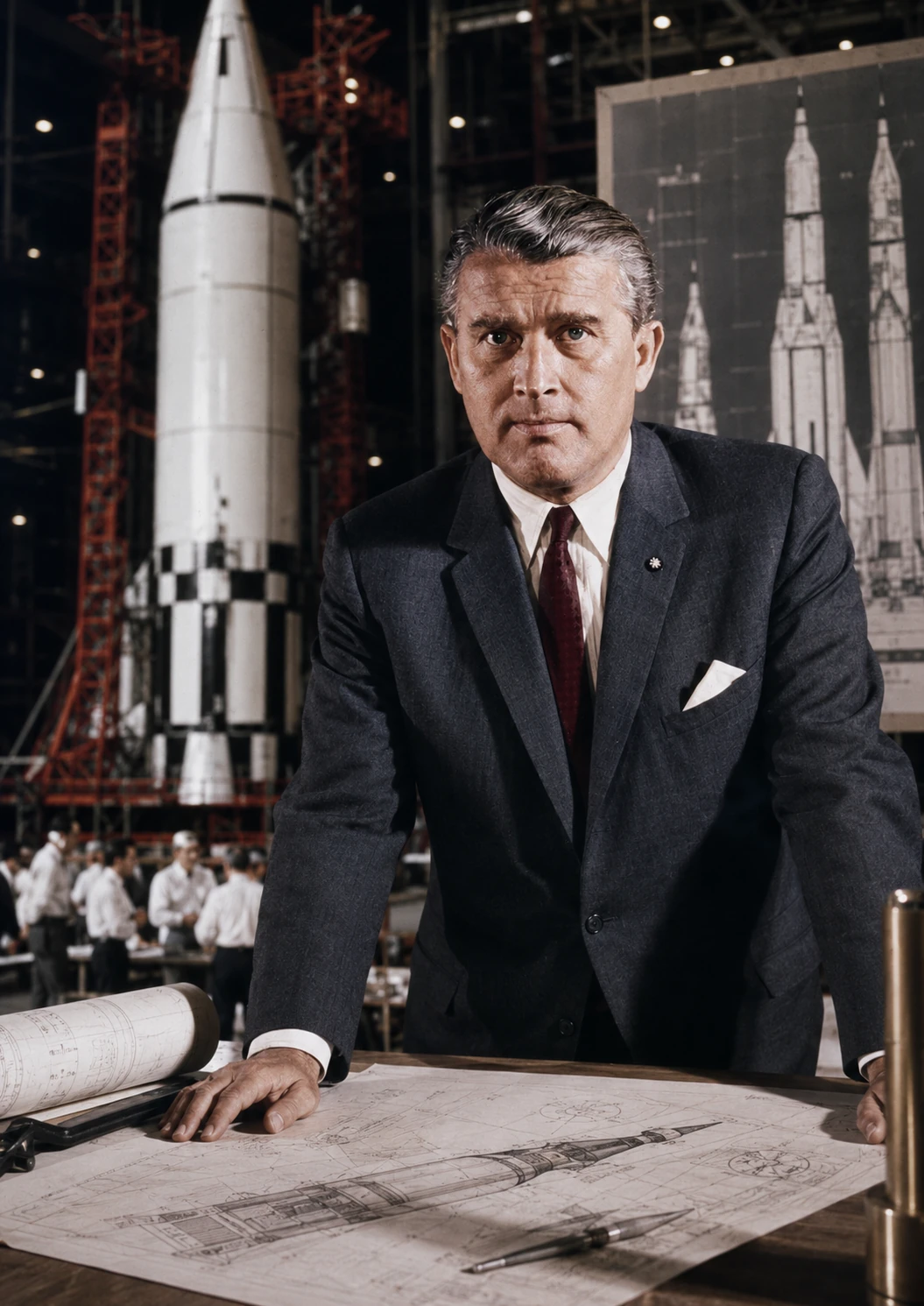
Chronological biography
1912–1932 — Childhood, Oberth and learning the mathematics of rocketry
The group’s early liquid-rocket work was crude, dangerous, and empirical. Engines had to be ignited, fed, cooled, and measured before anyone could pretend to design a reliable launch vehicle. Von Braun completed engineering studies in Berlin and in 1932 entered German Army rocket work, where access to state funding and test facilities dramatically increased what the team could attempt. That move also bound his technical career to a military and political system whose crimes cannot be treated as a footnote to the engineering story.
Turning missing knowledge into a curriculum
NASA's account of the young von Braun struggling with Oberth's equations matters because it replaces the myth of effortless genius with a useful mechanism: he could not understand the mathematics, so he studied it. In Berlin he then worked around Oberth, Klaus Riedel and Rudolf Nebel. The 1930 Kegeldüse test — roughly seven kilograms of thrust for ninety seconds — was small, but it gave the group a real combustion system whose behaviour could be observed rather than imagined.
Raketenflugplatz: a workshop before there was an industry
The Berlin rocket field ran on improvisation, scavenged materials and a division of labour among people who brought different practical skills. A public firing in 1931 failed when a vehicle did not continue its climb. The pressurisation system was found unreliable and corrected; successful flights followed. The important story is not embarrassment followed by triumph, but the engineering loop: symptom, diagnosis, change, retest.
Learning the missing mathematics: the first engineering decision
Von Braun's early interest in space is easy to romanticize and more useful to analyse. NASA's biographical material connects his youthful enthusiasm to Hermann Oberth's 1923 book on interplanetary rocketry. The crucial point is not that a teenager already possessed a finished vision of Saturn V. He did not. He encountered mathematics he could not yet follow and treated that deficiency as a task. Calculus and trigonometry became necessary because without them the rocket remained a story rather than a physical machine. NASA — Wernher von Braun.
This is the first reason his biography matters to an engineering history of Mars. Skills are not born fully formed. A future systems leader begins by identifying what he does not understand, then deliberately building the knowledge required to close the gap. That pattern will recur at every larger scale: mathematics for trajectories, laboratory work for combustion, flight vehicles for guidance, organizations for integration, and finally entire national programs for lunar or interplanetary objectives.
Oberth and the VfR: before there was a rocket industry
Berlin's early rocket community provided an unusual school. Hermann Oberth supplied theoretical arguments for liquid-propellant spaceflight; Klaus Riedel, Rudolf Nebel and other members of the Verein für Raumschiffahrt supplied practical experience, contacts and labor. Von Braun entered a culture in which a test stand, a tank, a valve and a calculation could matter as much as a published idea. The Smithsonian describes the VfR's Raketenflugplatz as a site where liquid-fuel rocket experiments were conducted from 1930 onward. Smithsonian — Early Rocket Societies.
The work also destroys the myth of the lone inventor. A liquid rocket requires combustion knowledge, pressure vessels, plumbing, structures, ignition, instrumentation and flight stability. Even a small experimental vehicle is already a system. What von Braun learned in this environment was not simply how to sketch a rocket; he learned that progress depended on people with different specialties making their interfaces work.
The 1931 public failure: a small event with a large lesson
NASA's Earth Observatory preserves one of the most instructive episodes from the Raketenflugplatz. During a public demonstration in 1931, a rocket started to move up the launcher and then settled back down. The failure was embarrassing, but the team identified unreliable pressurization of the fuel tanks as the problem. After the pressurization system was corrected, successful flights became frequent and the rocket reached about one thousand feet. NASA Earth Observatory — A Public Firing.
The episode is worth more than a date. It shows the engineering loop in miniature: observe a symptom, isolate a cause, modify the system, and test again. A failed prototype is valuable when it produces information. This approach is more important to von Braun's later career than any legend about effortless genius, because the same logic is what allows an organization to climb from a small liquid engine to an operational launch vehicle.
Before Peenemünde: how von Braun actually learned to build rockets
The years between a teenager's fascination with space and the technical directorship of Peenemünde are the years that explain the engineer. Von Braun had to learn mathematics in order to understand Oberth, then work inside a community where “rocket engineer” was not yet a standard profession. He learned from engines that leaked, ignition systems that were hazardous, launches that failed and a design problem whose complexity increased faster than the size of the vehicle.
1932–1945 — The German army, Peenemünde, the Nazi regime and the V-2
1932–1945: state funding turns a small experimental community into an industrial weapons program. Von Braun’s move into German Army rocket work in 1932 changed the scale of everything around him. Small experiments associated with civilian enthusiasts were replaced by military funding, dedicated test sites, larger teams, and a requirement to produce weapons. Kummersdorf and later Peenemünde created the infrastructure needed to develop the A-series rockets and ultimately the A-4/V-2. The engineering progression involved propulsion, guidance, aerodynamics, structures, manufacturing, test ranges, and the organizational problem of making specialist groups converge on one vehicle. Failed tests were not peripheral. They were how the program discovered unstable designs, weak components, control problems, and gaps between laboratory assumptions and flight behavior. NASA historical material on von Braun emphasizes the technical progression, but a complete biography must keep the political setting in the same chronology rather than separating it into a footnote. NASA — Wernher von Braun
The V-2 became a major technical achievement inside a criminal regime and a brutal production system that used forced labor, with catastrophic human consequences. Von Braun’s membership in Nazi organizations, his position inside the program, and the use of prisoners at Mittelwerk are inseparable from the historical record. The biography therefore cannot offer the reader a clean engineering ascent from Oberth to Saturn V. The same career that developed powerful systems-engineering methods was embedded in institutions responsible for war and exploitation. This is not an argument that technical learning did not occur; it is the reason the learning must be narrated together with the conditions under which it was obtained.
Kummersdorf: military funding changes both scale and purpose
A Smithsonian oral-history record has von Braun describing a 1932 demonstration to the German Army and his hiring at Kummersdorf. Army sponsorship brought secure ranges, instruments and continuity that the VfR could not sustain. It also changed the purpose of the work. A desire to build vehicles capable of spaceflight now developed inside an institution interested in ballistic weapons. Any serious biography has to hold those facts together rather than invent a cleaner transition.
A-3 to A-5: failure forces the programme to simplify its experiment
Four A-3 launches failed in 1937. The response was the A-5, a redesigned vehicle used as a test bed, especially for guidance work. This is one of the clearest examples of failure becoming engineering knowledge: when a prototype contains too many coupled unknowns, the team creates an experimental system on which variables can be isolated. The method is more important than the record-setting narrative.
Late 1932: military money changes both scale and purpose
Von Braun entered German Army rocket work in late 1932, before Hitler became chancellor in January 1933. That chronology matters because the move should not be written as an invented cinematic scene in which a Nazi official suddenly appears and recruits a reluctant space dreamer. Military interest in rockets already existed, and the Army could offer what the amateur society could not: secure ranges, instruments, salaries, manufacturing resources and a sustained program. NASA dates von Braun's move into Army liquid-fuel missile development to late 1932. NASA — institutional biography.
The transition is more revealing precisely because it is institutional rather than theatrical. Resources expand the technical possibilities, but they also redefine the mission. The rocket is no longer funded primarily as a path toward spaceflight. It is being developed as a weapon. Secrecy, military requirements and a chain of command become part of the engineering environment. The political regime then changes around that program and ultimately turns it into one component of Nazi warfare.
A-1 and A-2: learning at a scale small enough to understand
The Smithsonian traces the Army's A-series through experimental A-1 and A-2 rockets of roughly 300 kilograms of thrust. Two A-2 vehicles were successfully flown from Borkum Island in December 1934. Smithsonian — V-2 Missile history.
The importance of these vehicles is methodological. A small test article can expose problems in combustion, stability and instrumentation at a cost and complexity that a much larger vehicle would magnify. The future A-4 did not appear because the team simply enlarged a drawing. Each increase in thrust changed feed systems, loads, control requirements and aerodynamic behavior. The sequence therefore created a ladder of evidence.
A-3 failure and the A-5 test bed: simplifying the experiment
The A-3 represented a much larger step, with roughly 1,500 kilograms of thrust. Four flight attempts in 1937 failed. The Smithsonian identifies the redesigned A-5 as a crucial test bed for guidance systems after those failures. Smithsonian — A-3/A-5 sequence.
That decision is one of the best examples of engineering maturity in the early program. When too many unknowns are coupled in one experimental vehicle, changing several things at once can make the next result difficult to interpret. A dedicated test bed reduces the number of simultaneous unknowns. The A-5 was therefore not an embarrassing retreat from the A-4 goal. It was a deliberate instrument for learning about aerodynamic behavior and guidance before betting everything on a much larger missile.
Peenemünde: from about ninety people to a research establishment of thousands
In April 1937, the rocket group, then numbering about ninety people according to the Smithsonian, moved to the new secret Peenemünde center. By 1942, Peenemünde-East had grown to a workforce of about five thousand engineers, technicians, scientists and other personnel. Smithsonian — Peenemünde growth.
This numerical change transformed von Braun's job. In a group of dozens, a technical leader can still follow many experiments directly. In an organization of thousands, no one can personally own every drawing, valve, gyro, weld and test. Management becomes an engineering function. The program needs discipline leaders, documentation, configuration control, test procedures and a mechanism for turning failures observed by one group into design changes understood by others.
How a rocket team is recruited when “rocket engineer” barely exists
Peenemünde could not hire hundreds of people with previous experience building large ballistic rockets; such experience did not exist. It had to recruit from adjacent domains: electrical engineering, aerodynamics, high-voltage research, mechanics, instrumentation, production and control. Werner Gengelbach is one documented example. The Smithsonian records that he was an electrical engineer and high-voltage researcher before von Braun invited him to Peenemünde in 1942, where he took responsibilities connected with testing and launching completed missiles. Smithsonian — Werner K. Gengelbach.
This is how new technological fields are usually staffed. The organization does not find fully formed specialists for a profession that has not yet matured. It finds deep competence in neighboring disciplines and creates new interfaces between them. Von Braun's growing importance lay partly in his ability to understand enough of those interfaces to keep propulsion, guidance, structures, tests and production converging on the same vehicle.
Propulsion at A-4 scale: why “make the engine bigger” is not an instruction
The A-4 was projected at about twenty-five metric tons of thrust. At that scale, propellant feed becomes a thermal and hydraulic system in its own right. Liquid oxygen and water-alcohol must reach the combustion chamber at the required pressure and flow. The chamber has to survive extreme heat. A steam generator and turbopump drive the propellant supply. Smithsonian artifacts preserve the pump, chamber and related components, making clear that the engine is an assembly of interacting subsystems rather than a single flame-producing device. Smithsonian — V-2 turbopump.
Scaling the vehicle therefore creates new failure modes. Pressure, flow, seals, temperatures, mixture ratio and vibration can all affect performance. The practical lesson is fundamental to later launch vehicles and to any future Mars transportation architecture: scale changes the problem. A component that works in isolation can fail when placed in a system whose loads and transients are different.
Guidance and control: propulsion cannot rescue a vehicle that cannot steer
A-4 also needed to know and control its attitude. Gyroscopes, electrical control, actuators and aerodynamic or jet-control devices became specialized systems. The Smithsonian preserves an air-vane actuator associated with V-2 roll control and notes the work of guidance specialists such as Helmut Hoelzer. Smithsonian — V-2 air-vane actuator.
The key organizational insight is that guidance cannot be “added” at the end. Sensor errors, actuator response, structural motion and propulsion transients interact. This is exactly the kind of interface problem that later defines systems engineering: the subsystem boundaries on the organization chart do not prevent physics from crossing them.
June, August, October 1942: success after failed flight attempts
The first flight vehicles did not immediately work. Smithsonian history records failed launches in June and August 1942 before the successful V4 flight on 3 October 1942. That vehicle reached roughly sixty miles altitude and about 125 miles range in a 296-second flight. Smithsonian — early A-4 flights.
The sequence matters because it resists hindsight. Once a technology becomes famous, history often compresses development into a straight line. The engineers of 1942 did not possess that certainty. Each failed test forced them to decide whether the fault belonged to a component, an interface, an assumption or a test procedure. Success was the accumulated result of repeated diagnosis, not proof that the original design had been correct in every detail.
Never reduce the V-2 story to a technical victory
Von Braun's entry into Army rocket work predated Hitler's chancellorship, but his later career in Germany was deeply embedded in the Nazi state. NASA states that he joined the Nazi Party in 1937 and became a junior SS officer in 1940. The same NASA biography explains that underground Mittelwerk production relied on enslaved labor from Mittelbau-Dora and that von Braun knew about the terrible conditions and participated in decisions concerning the use of slave labor. NASA — Wernher von Braun.
The Smithsonian's Michael Neufeld estimates that twenty to twenty-five thousand detainees died in the Mittelbau camp system and has argued that at least ten thousand deaths may be attributable to the V-2 program at Mittelwerk. Smithsonian — Wonder Weapons and Slave Labor. These facts are not an ethical appendix to an otherwise neutral production story. They are part of the industrial system that produced the weapon.
Production changes the problem again
A successful test flight did not make the missile a reproducible capability. Mass production required drawings, tooling, inspection, acceptance criteria and control of design changes. Peenemünde grew into an industrial and test ecosystem, and later production was moved underground after Allied bombing. The organization then became entangled with forced-labor systems on a massive scale. The distinction between prototype and production is technically important and historically inseparable from that criminal context.
This experience also shaped the postwar systems culture the German team carried into the United States. The ethical and political context of NASA was fundamentally different, but the practical need to coordinate thousands of interfaces, suppliers and tests remained. Understanding that continuity helps explain why a group trained on missiles could later become central to large launch-vehicle programs.
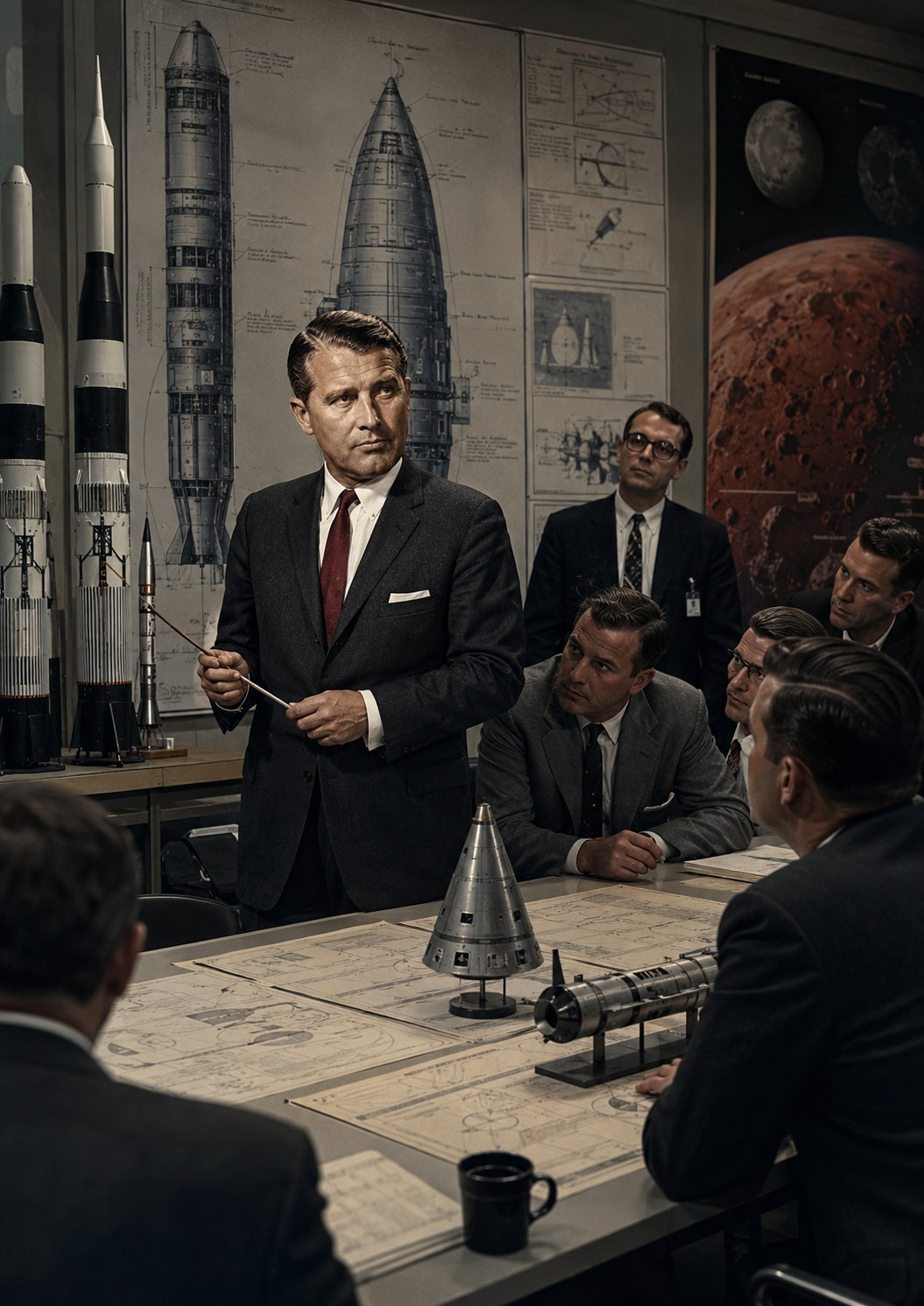
Recruiting a rocket organisation means recruiting interfaces
Sources for this section: NASA Earth Observatory; Smithsonian V-2 history; Smithsonian 1967 interview record.
1945–1958 — Paperclip, Fort Bliss, Huntsville and the American transition
1945–1960: Paperclip, White Sands, Redstone, and the transfer of a team as well as hardware. At the end of the war, von Braun and many colleagues entered U.S. custody and were brought to the United States under Operation Paperclip. The transfer was not only about captured V-2 hardware. It moved people who carried tacit knowledge about engine testing, guidance, integration, launch operations, and program organization. At Fort Bliss and White Sands the team worked with American personnel and V-2 hardware before moving to Huntsville, Alabama. There the organization participated in Army missile development, including Redstone and Jupiter. The chronology matters because the American space-launch capability associated with von Braun did not begin with Saturn V. It grew through years of adapting people, procedures, and designs to a new institutional environment.
Sputnik then changed the political meaning of that capability. The Jupiter-C/Redstone heritage helped launch Explorer 1 in 1958, and in 1960 the Huntsville organization became NASA’s Marshall Space Flight Center with von Braun as its first director. By this point his job was no longer primarily to calculate an engine or design a component. It was to coordinate a large technical institution and make interfaces visible: propulsion had to match structures, stages had to separate, guidance had to know what vehicle it was controlling, ground systems had to support launch operations, and contractors had to deliver hardware that fit together. That organizational experience became central to Saturn.
At the end of the war, the United States acquired captured V-2 hardware, documentation and German specialists through the effort that became Project Paperclip. The Smithsonian describes a transfer involving more than 1,600 German scientists, engineers and technicians across several fields; von Braun and roughly 125 colleagues became important to U.S. Army rocketry. His group first worked within the Army system, then at Huntsville, before the center and much of the team entered NASA in 1960. The transfer preserved technical knowledge while also creating political and moral questions about the wartime records of the specialists being recruited. Smithsonian — Project Paperclip.
The American chapter is not simply a clean “new beginning.” It is a transfer of knowledge into a new strategic age dominated by competition with the Soviet Union. Missiles, satellites and launch vehicles share technologies and infrastructure. NASA’s historical biography describes von Braun as director of Marshall Space Flight Center and a principal architect of the Saturn V system. That role finally gives him resources to build giant launchers whose public purpose is exploration.
Its historical value lies elsewhere: Mars is treated as a complete mission system, not merely a rocket. NASA historians regard it as one of the earliest major end-to-end technical studies of human Mars exploration. It is an intellectual ancestor of modern architecture studies, best read with respect for its ambition and scrutiny of its assumptions.
1945 and Paperclip: transferring organizational memory as well as people
What moved across the Atlantic was not merely a list of talented individuals. It was organizational memory: which designs had failed, which test methods were useful, which interfaces were dangerous, how a firing program was run, and how configuration changes had to be controlled. That tacit memory is one reason technological capability can transfer faster through teams than through documents alone.
White Sands and Fort Bliss: a team learns a new institutional language
In the United States, captured V-2s were reassembled and launched at White Sands. German specialists advised American technicians and engineers while military institutions determined new priorities. The period is important because the team had to translate its knowledge into different standards, suppliers, documentation practices and chains of command. Technical continuity did not mean organizational continuity.
The transition also complicates any simple redemption narrative. The United States deliberately valued technical expertise that had been produced inside the Nazi war system. Some information about backgrounds and affiliations was classified or politically managed. A serious biography has to describe both the technical consequences of the transfer and the moral controversy surrounding it.
White Sands also changed the epistemology of the team. In Germany the A-4 had been developed as a weapon under wartime pressure; in New Mexico, captured V-2 hardware became a repeatable test platform. The National Park Service records that the first captured V-2 was static-fired at White Sands in March 1946 and launched in April. Between 1946 and 1951 the Army launched sixty-seven V-2s from the range. Those flights did more than demonstrate that the captured missiles still worked. They allowed American teams to learn assembly, checkout, range safety, instrumentation, trajectory measurement and the practical discipline of conducting a launch campaign. National Park Service — White Sands V-2 Launching Site.
That repetition matters because complex engineering knowledge is partly tacit. Drawings specify dimensions, materials and interfaces, but they do not automatically teach a new organization how experienced technicians recognize a bad connection, how a test crew sequences operations, which measurements deserve suspicion, or how an anomaly is turned into a change request. The German specialists therefore served not only as designers but as carriers of procedural memory. At the same time, American soldiers, engineers and contractors converted that memory into their own documentation, facilities and practices. The technology was being translated institutionally as well as linguistically.
For Mars, this episode is unusually instructive. A settlement architecture will also depend on knowledge that cannot be transported merely as a folder of specifications. Crews must know how systems actually behave, maintainers must recognize weak signals before failure, and organizations must preserve lessons across personnel changes. The transfer from Peenemünde to White Sands shows, in a morally very different setting, that capability is a combination of hardware, people, procedures, test infrastructure and accumulated memory. If one of those elements is missing, a technically impressive design can remain unusable.
Huntsville: from a German core to a much larger American organization
In 1950, von Braun's group moved to Redstone Arsenal in Huntsville and became the core of much larger Army missile and later NASA launch-vehicle organizations. By the Sputnik era the German-led group numbered in the thousands, with the overwhelming majority native-born Americans. Years of missile and launch-vehicle work meant that the Soviet launch of Sputnik in October 1957 encountered an organization with accumulated hardware, test and integration experience; that capability helped launch Explorer 1, the first U.S. satellite, in 1958. Smithsonian — postwar American rocketry.
This expansion is the second great team-building story of von Braun's career. Peenemünde had taught him how to coordinate a large technical establishment under military authority. Huntsville required integration with American industry, universities, government procurement and eventually a civilian agency. The rocket became a national industrial system rather than the product of a single laboratory.
The Mars Project: applying systems thinking beyond Earth
The Library of Congress preserves von Braun's papers and specific files for The Mars Project; the German Das Marsprojekt appeared in 1952. Library of Congress — The Mars Project. The design was enormous by modern standards and rested on assumptions made before spacecraft had revealed Mars in detail, yet it is historically important because it treated a crewed Mars expedition as an architecture to be calculated rather than merely imagined.
Mass, vehicles, trajectories, crew operations and logistics were placed in relation to one another. This is where the biography reconnects directly to the history of human Mars planning. Von Braun's enduring contribution is not a particular 1950s vehicle that should be copied today. It is the habit of asking what complete chain of capabilities must exist for an interplanetary objective to become operationally coherent.
From captured hardware to an American launch-vehicle institution
White Sands: a weapon becomes an experimental platform
Redstone and Jupiter: learning to redesign rather than merely copy
When the group moved to Huntsville in 1950, the goal shifted from handling captured V-2s to developing new American missile systems. NASA's institutional biography identifies Redstone and Jupiter among the systems developed by the Huntsville team. NASA — Huntsville and Redstone Arsenal.
The distinction matters. An organization proves maturity when it can stop treating an inherited design as sacred. Redstone was influenced by German experience, but it had to fit American requirements, materials, factories, electronics and warheads. Each redesign forced the team to decide which principles were general and which details belonged only to the circumstances of the A-4. That is precisely the kind of reasoning required when a Mars architecture moves from one generation of vehicles to another.
Sputnik and Explorer 1: technical readiness meets political timing
The lesson is political as well as technical. A team can possess a substantial capability without receiving permission to use it for the mission it considers most important. Sputnik changed national priorities and accelerated decisions. The launch of Explorer 1 therefore illustrates an interaction that recurs throughout large technology programs: readiness, authority and urgency have to align. Engineering alone does not schedule history.
Collier's and Disney: engineering becomes public narrative
During the 1950s von Braun deliberately entered mass communication. NASA notes his articles for magazines such as Collier's and his role as a spokesman in Walt Disney television programs about space travel. NASA — public advocacy.
This activity mattered technically because large space programs require durable political support. A design that exists only in specialist reports may never receive the budget needed to become hardware. Von Braun learned to translate orbital mechanics, rockets and mission sequences into images the public could understand. That talent increased his influence, but it also contributed to the construction of a simplified public persona in which the morally compromised German period could recede behind the image of the American space visionary. A serious biography must explain both effects.
Das Marsprojekt: an architecture before the planet was well known
1960–1969 — Marshall, Saturn V, Apollo and the return of Mars planning
1960: Marshall Space Flight Center and the move into a civil institution. When the Army Ballistic Missile Agency development team was transferred to NASA and Marshall Space Flight Center was created in 1960, von Braun became the center's first director. His task changed scale. He was no longer mainly leading a rocket-development group; he had to make engines, structures, guidance, test facilities, contractors and NASA headquarters decisions behave as one program. That institutional transition is central to understanding Saturn. The technical achievement did not come from one inventor drawing a giant rocket. It came from building an organization able to verify thousands of interfaces while still preserving a coherent vehicle architecture.
Von Braun’s mature American career was less about personally solving every equation than about making very large teams converge on one vehicle. Marshall had to connect propulsion, structures, guidance, manufacturing, test facilities, contractors and launch operations while political schedules continued to move. That systems-management role is essential to understanding why his later Mars proposals were so large: he had learned to think in fleets, staging, orbital assembly and institutional mobilisation rather than in a single rocket. [source]
Apollo also changed the scale at which von Braun had to think about verification. No complete Saturn V could be tested on the ground under every flight condition, so confidence emerged from a hierarchy of component tests, stage tests, simulations, instrumented flights and configuration control. That logic belongs directly in a Mars biography because a future interplanetary system would face the same impossibility at even greater scale: the full settlement cannot be rehearsed once as a complete object before people depend on it. [source]
His public communication work added another capability that is easy to dismiss as publicity. Collier’s and Disney were not substitutes for engineering, but they helped translate orbital assembly, space stations and Mars expeditions into narratives that policymakers and families could imagine. Large technical programmes require coalitions that survive beyond engineering teams, and von Braun learned to build those coalitions alongside the hardware. [source]
That combination of technical integration and public coalition-building helps explain why von Braun remains important to Mars history even though his own detailed Mars architectures are obsolete. The transferable lesson is not the exact fleet size or timetable; it is the discipline of turning an enormous objective into stages, interfaces, test programmes and institutions that can be argued about in concrete terms. [source]
The same experience also explains the limits of the analogy with a future Mars settlement. Apollo could concentrate national resources on a short campaign with a clear political objective. A permanent settlement would instead have to operate for decades, repair itself, produce locally and survive when public attention fades. Von Braun’s biography therefore provides both a model of large-scale programme integration and a warning against assuming that a successful mobilisation can automatically become a durable civilization. [source]
The Mars relevance is therefore double: von Braun demonstrated how a gigantic technical objective can be decomposed into programmes that institutions can execute, while the history of those programmes shows how deeply technical achievement depends on political systems, labour, ethics and long-term funding. A serious Mars biography has to keep both dimensions visible at the same time. [source]
Kennedy, Apollo and the calendar: engineering under a political deadline. President Kennedy's lunar commitment transformed launch-vehicle development into a national schedule problem. Von Braun's influence lay partly in translating an extraordinary political objective into staged engineering work: test stands, engine programs, clustered stages, facilities, mission analysis and increasingly formal systems engineering. The deadline created pressure, but it also concentrated resources and decision authority. The Mars lesson is double-edged. Ambitious schedules can accelerate development when funding and governance are aligned, yet a calendar cannot repeal physics. Hardware still has to survive vibration, combustion instability, structural loads and the cumulative consequences of thousands of design decisions.
Saturn V: the mature form of the systems lesson
By the Apollo era, no one engineer could understand every detail of Saturn V. Von Braun's value was not that he personally designed every pump, tank, guidance computer or engine. It was that he operated inside a management structure capable of making those subsystems converge. Reviews, testing, configuration control and responsibility at interfaces became as important as equations. The mythology of the single genius becomes least useful exactly where the achievement becomes greatest.
That distinction matters for Mars. A human Mars architecture will not be invented by one charismatic person. It will require interacting organizations that can manage propulsion, life support, communications, medicine, surface power, maintenance and logistics over years. Von Braun's career is useful because it makes the organizational dimension of difficult engineering visible.
1960: a military development organization becomes a NASA center
This was not a cosmetic rebranding. The center now had to serve a civilian exploration program and work through a vast American industrial network. The technical inheritance of missile development remained, but the program's stated purpose changed. Launch reliability, payload integration, schedule and public accountability became part of a national project whose most visible objective was human lunar exploration.
Saturn I and Saturn IB: why an intermediate vehicle is not wasted time
The path to Saturn V included intermediate launchers. Saturn I and Saturn IB allowed engineers to learn about clustered engines, stage structures, guidance, ground operations and increasingly Apollo-like missions before the complete lunar launch vehicle existed. This is the same experimental principle visible decades earlier in the A-5: build a configuration that can isolate meaningful problems before every dependency is coupled at maximum scale.
For Mars planners, the comparison is valuable. A program that attempts to jump directly from today's systems to a complete settlement architecture risks combining too many unproven interfaces in one mission. Intermediate cargo vehicles, surface demonstrators and long-duration life-support tests are not evidence of insufficient ambition. They are how ambitious systems acquire evidence.
Saturn V: leadership becomes interface management
The scale of Saturn V makes the lone-genius story untenable. Engines, stages, guidance, structures, ground support and spacecraft were developed by different teams and contractors. Von Braun could not personally design every component. His significance increasingly lay in helping to organize technical authority, reviews and integration across a system too large for individual mastery.
This mature form of systems leadership is one reason his career continues to be studied. The most dangerous failures in a huge vehicle may occur not inside a well-understood component but between components: loads passed from one structure to another, commands interpreted differently by two systems, vibration affecting propulsion or guidance, or a schedule forcing an unready interface. Large-program management is therefore part of engineering, not administration added after the engineering is complete.
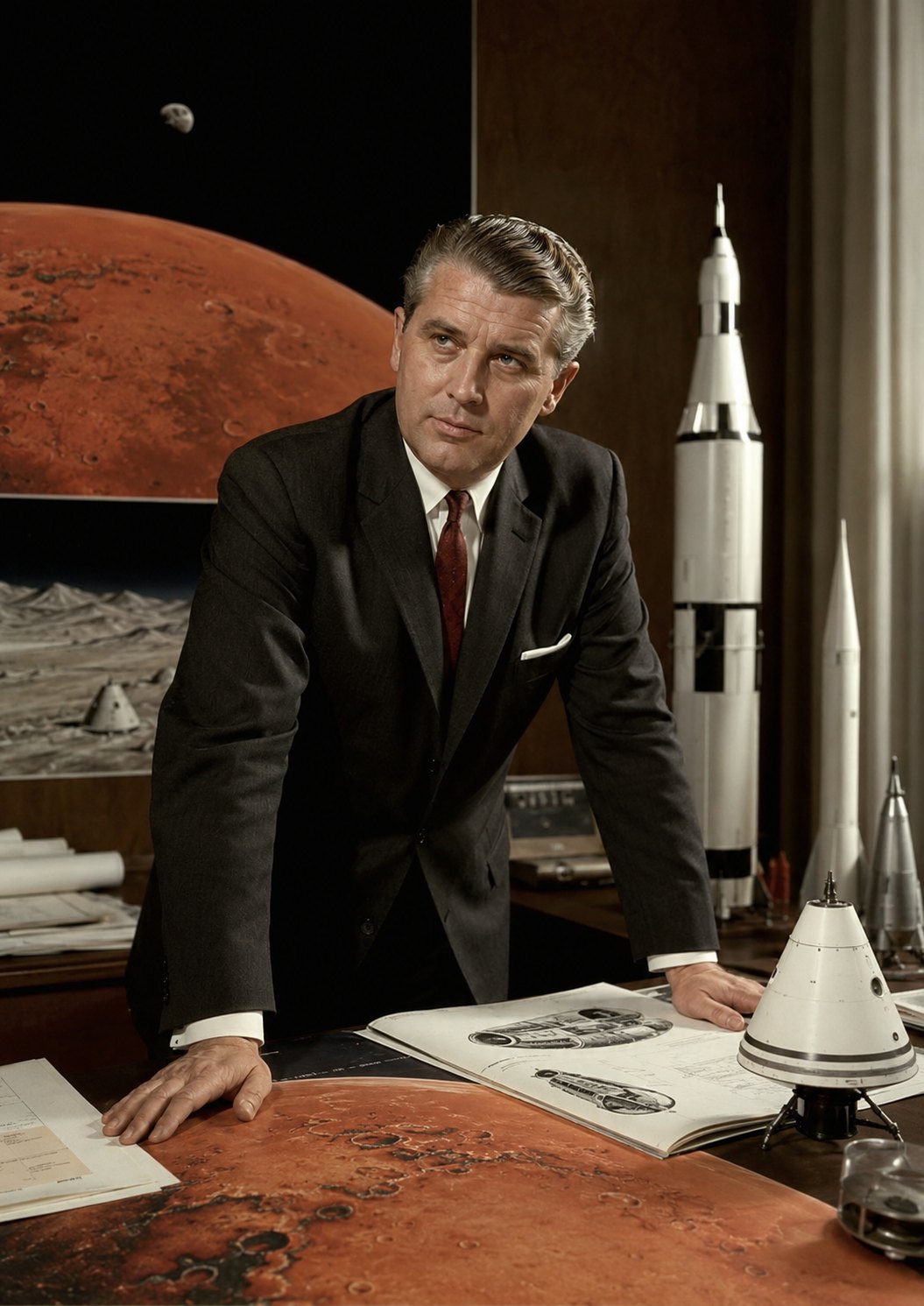
Mariner and Viking: a Mars architect has to survive reality
Early concepts of Mars were produced before spacecraft reconnaissance revealed the planet with modern precision. As Mariner and Viking missions replaced speculative planetary models with measurements and images, every serious Mars architecture had to be reconsidered. This is a powerful counterweight to technological hero stories: even a brilliant engineer can optimize the wrong mission if the environmental assumptions are wrong.
The deeper legacy is therefore epistemic. Architecture must be revisable. The correct response to better data is not to defend an old drawing because its author is famous; it is to change the design. A Mars reference work should preserve the older concepts as history while making clear which assumptions were superseded by observation.
The 1969 Mars planning horizon: Apollo success does not automatically create Mars
At the end of the Apollo build-up, von Braun remained interested in a larger human-spaceflight sequence that included space stations and eventual Mars expeditions. Yet the political coalition that funded Apollo did not simply continue at the same intensity. The post-Apollo period demonstrates that technical success can actually expose the next problem more clearly: maintaining the industrial and political system required for another giant objective.
This makes Mars fundamentally different from a single heroic launch. A sustainable interplanetary program needs repeated logistics, long-duration operations, budget continuity and institutional learning. Apollo proved that a nation could mobilize for an extraordinary objective. It did not prove that the same level of mobilization would continue indefinitely.
Changing architecture when the evidence changes
A large technical leader is often judged by the concepts he invents, but an equally important skill is recognizing when an attractive concept should be abandoned. The Apollo program forced Marshall and the wider NASA organization to compare different mission architectures, interfaces and risk distributions. Von Braun's public identity was strongly associated with very large launch vehicles and direct, visibly powerful approaches, yet the final lunar architecture depended on a complex division of functions between spacecraft and on decisions made across NASA rather than by one center alone.
This matters because engineering maturity cannot be measured by attachment to one's first solution. A Mars architecture will change as propulsion performance, life-support evidence, landing technology and budgets change. The useful lesson is not “von Braun's architecture was right”; it is that architecture is a decision process constrained by evidence, politics, schedule and the maturity of multiple technologies.
Making problems visible before they become launch failures
As programs grow, bad news becomes an organizational risk. Engineers closest to a component may understand a problem long before senior management sees it. A center director therefore needs mechanisms that make anomalies visible across layers of hierarchy. Reviews, test reports and interface meetings are not bureaucratic decoration; they are ways of preventing optimistic assumptions from becoming system-level surprises.
Von Braun's career from Peenemünde to Marshall is useful here because it spans a change in scale from experimental groups to institutions managing thousands of people. The leader's technical contribution increasingly consists of asking whether the right tests have been run, whether two groups are using the same assumptions, and whether an unresolved anomaly is being hidden by schedule pressure. That is the kind of systems discipline a Mars settlement would need when maintenance and safety decisions must be made far from Earth.
1970–1977 — Strategy, leaving NASA and the final years
Apollo 11 and the limit of a launch-vehicle victory. Apollo 11 was the culmination of the Saturn system, but for von Braun it did not represent the end of space development. The lunar landing proved that a large national program could integrate launch, navigation, life support, mission control and surface operations. It did not prove that the same architecture could simply be stretched to Mars. The distinction matters because von Braun's own Mars studies had always required fleets, assembly, long-duration habitation and a much larger logistics chain. Apollo therefore validated institutional capability while leaving most Mars-specific problems—duration, radiation, entry, surface support and return logistics—open.
1970–1977: strategy, industry and the final phase. Von Braun left Marshall in 1970 for a planning role at NASA Headquarters, then moved to Fairchild Industries in 1972. His final years were increasingly devoted to strategy and public advocacy rather than day-to-day launch-vehicle management. He also helped establish the National Space Institute, an organization that later merged into the National Space Society. This closing phase matters because the career arc is complete: adolescent enthusiast, military rocket engineer, wartime program manager, transferred specialist, NASA center director and finally public advocate for a larger space future. He died in 1977, before the shuttle era matured and long before a human Mars program existed.
1970: leaving Marshall changes the kind of influence he can exert
The Library of Congress chronology places von Braun in Washington from 1970 to 1972 as NASA Deputy Associate Administrator for Planning, after a decade directing Marshall. He then became a vice president at Fairchild Industries and later helped found the National Space Institute. Library of Congress — biographical chronology.
This late-career shift is revealing. At Marshall, influence could be exerted through an organization that designed, tested and procured hardware. In Washington and later in industry or advocacy, influence became more strategic and persuasive. The distinction helps explain why ambitious post-Apollo ideas did not automatically become programs. A visionary can describe a pathway; only institutions with authority, money and enduring political support can make the pathway operational.
1977: the end of a career, not the end of the argument
Von Braun died in 1977. By then the United States had completed the Apollo lunar landings, operated Skylab and entered a different phase of human spaceflight. Mars remained beyond the practical horizon of crewed missions. His death therefore closed a career in which the most spectacular implemented objective was the Moon, while Mars remained primarily an architectural and cultural project.
The unresolved distance between those two achievements is part of his legacy. Saturn V demonstrates that a highly mobilized industrial system can build an extraordinary launch capability. The absence of a crewed Mars program immediately afterward demonstrates that launch capability alone is not enough. Interplanetary settlement requires a longer chain: transportation, life support, surface power, logistics, maintenance, medicine, communications, governance and economic continuity.
Supplementary documentary analysis
Biographical analysis, context and legacy
Thematic analysis and deeper reading
Essential timeline
- Born in Wirsitz, then part of the German Empire.
- Influenced by Hermann Oberth and joins the Verein für Raumschiffahrt.
- Develops German rockets and the V-2; the technology is militarized and forced labor is used in production.
- Moves to the United States with part of his team under Operation Paperclip.
- Publishes Das Marsprojekt, an exceptionally ambitious human-Mars expedition study.
- Explorer 1 launches on a Jupiter-C developed by his team.
- Leads NASA’s Marshall Space Flight Center and plays a central role in Saturn and Saturn V development.
- Dies in the United States.
Oberth, mathematics and the spaceflight dream
As a young man von Braun was deeply influenced by Hermann Oberth’s work on interplanetary flight. NASA notes that the book drove him to master the mathematics needed to understand rocketry. He then joined German rocket societies and worked in Oberth’s orbit.
This matters to the history of Mars exploration because modern rocketry began not only as a military or national industry but also through a transnational network of theorists, enthusiasts and engineers thinking explicitly about space travel.
Archives, memory and the difference between a public image and a historical record
Von Braun became a powerful public communicator in the United States. Magazine articles, television appearances and later Apollo success helped create a public image centered on exploration. The Library of Congress collection is useful precisely because it preserves a much broader documentary record: correspondence, speeches, writings, subject files and material spanning rocketry, missiles and space programs. Library of Congress — Wernher Von Braun Papers.
A serious biography therefore has to resist two shortcuts. It cannot turn a public advocate for space into an uncomplicated hero by treating the German period as a footnote. It also cannot erase the technical and organizational significance of his work because the political and moral history is uncomfortable. Historical understanding requires both records to remain visible at the same time.
Why the postwar story does not cancel the earlier one
The later achievements of Huntsville, Explorer 1 and Saturn V cannot erase von Braun's Nazi Party and SS memberships or the forced-labor system tied to V-2 production. Conversely, acknowledging those facts does not make Saturn V technically insignificant. NASA and Smithsonian sources make both records available, and the obligation of a modern biography is to keep them in the same frame. NASA — biography and Mittelwerk history.
This is not an exercise in finding a comfortable midpoint between praise and condemnation. It is a demand for analytical precision. Technical contribution, political affiliation, institutional responsibility and moral responsibility are different questions. They overlap, but none should be substituted for another.
Long-term historical interpretation
Von Braun's relevance to Mars is larger than his 1950s expedition design. His life exposes how a new technical field forms: theory creates questions; small groups learn by experiment; state money changes scale; failures create test programs; organizations recruit expertise from adjacent disciplines; mass production creates configuration and quality problems; and national politics determines which architectures become hardware.
The biography is therefore most useful when it stops being a catalogue of famous vehicles. The reader should be able to follow the causal chain from a teenager unable to understand Oberth's equations to a systems leader capable of discussing fleets bound for Mars. The same reader should also understand the human cost and political context of the German weapons program. Only then does the biography explain both the power and the danger of treating technical capability as something separate from the institutions that create it.
Decision-making, adaptation and the limits of personal control
Two historical simplifications to avoid
The first simplification is technological hero worship. It turns a complex team and institutional history into the actions of one exceptional man. That erases Oberth, Riedel, Nebel, Dornberger, guidance engineers, propulsion specialists, production personnel, American contractors and thousands of later engineers. It also makes engineering harder to understand, because it hides the interfaces through which real programs succeed or fail.
The second simplification is the opposite: treating the moral and political record as a reason to stop analysing the technical work. That prevents the reader from understanding why the V-2 changed postwar rocketry and why the Huntsville organization became so capable. The responsible approach is more demanding. It studies the technology closely enough to understand its significance and the historical context closely enough to understand the cost, coercion and responsibility attached to it.
The final systems lesson: capability is accumulated memory
One more thread connects the entire biography. Every stage of the career inherits lessons from the stage before it. Raketenflugplatz experiments teach the value of measurable tests. Kummersdorf introduces institutional funding and military requirements. A-3 failures make the value of an intermediate test bed visible. Peenemünde teaches large-team integration. White Sands shows how knowledge can be transferred between organizations. Huntsville turns that inherited experience into new American vehicles. Saturn V then demonstrates what happens when systems engineering, industrial capacity and political priority align at national scale.
None of those transitions means that later achievements morally redeem earlier choices. They mean that technical capability has memory. Procedures, habits, specialists and failure histories survive individual projects and can reappear in new institutions. Future Mars programs will build the same kind of memory. The crucial question is whether it is accumulated under institutions whose goals, accountability and treatment of people are worthy of the technology they make possible.
That is the deepest reason to study von Braun in detail. His life is not merely a path from V-2 to Saturn V. It is a case study in how knowledge, organization, politics and ethics become inseparable when engineering grows large enough to change history.
For a Mars reader, that accumulated memory is also a practical warning. A settlement architecture will inherit assumptions from launch vehicles, life-support tests, surface demonstrators and institutions created decades earlier. Some inherited habits will be valuable; others will deserve to be challenged. The discipline is to preserve hard-won evidence without preserving obsolete goals or unethical organizational practices merely because they arrived together with technical competence. That distinction matters because institutional memory can accelerate progress only when later generations remain willing to examine how that memory was acquired and what it should no longer carry forward.
Expanded biography — the open book
This expanded edition treats Wernher von Braun as a complete historical figure: technical formation, institutions, responsibility, teams, propaganda, the V-2 programme and forced labour, the American transfer, Saturn, Apollo and Mars architectures.
1912–1929 — A privileged childhood, but not a vocation written in advance
Wernher Magnus Maximilian Freiherr von Braun was born on 23 March 1912 in Wirsitz, then in the Prussian province of Posen and now Wyrzysk in Poland. He grew up in an aristocratic, conservative family whose social, cultural and material resources were far removed from those available to most German children of the period. His father, Magnus von Braun, held senior administrative and political posts during the Weimar Republic; his mother, Emmy, encouraged music, science and an interest in the sky. It would nevertheless be misleading to treat this environment as a straight launch ramp toward Saturn V. In a Germany transformed by the defeat of 1918, inflation, political violence and social change, the young von Braun grew up while the world that had supported his family’s status was itself being rearranged. The contrast between family security and national instability is an important background to his later life: large institutions can change abruptly, and a technical program never exists outside the society that funds it.
Popular biographies often preserve the episode in which the boy strapped fireworks to a small toy wagon and sent it careening through a Berlin street. The story is memorable because it makes the future rocket engineer appear fully formed in childhood. It deserves caution, as do many anecdotes polished by repetition after fame has arrived. What is better documented is the evolution of his interests. Von Braun was not initially a mathematical prodigy. He cared about music, played piano and cello, enjoyed astronomy and absorbed stories of exploration. In other words, fascination preceded technical competence. That order matters because it anticipates a pattern in his later work: he often began with a distant image of what he wanted and then sought the knowledge, people and institutions capable of making it credible.
A major turning point was his encounter with Hermann Oberth’s work, especially Die Rakete zu den Planetenräumen. NASA’s biography notes that the mathematics he could not initially follow pushed him to take calculus, trigonometry and physics seriously. This is more revealing than the myth of spontaneous genius. Spaceflight became a curriculum. The same logic later shaped his teams: to pursue an ambitious architecture, one must identify missing knowledge, turn those gaps into disciplines, and connect propulsion, structures, guidance, communications, medicine and operations. Before it is a story about engines, von Braun’s life is therefore a story about desire forcing the deliberate construction of competence.
The intellectual context matters just as much. In 1920s Europe, astronautics sat at the boundary of science, emerging engineering, popular literature and speculation. Konstantin Tsiolkovsky had established theoretical foundations; Robert Goddard was experimenting with liquid-propellant rockets in the United States; Oberth offered German-speaking readers a technically serious vision of spaceflight. The German teenager did not invent the idea of leaving Earth by himself. He entered a transnational network of books, lectures, clubs and experimenters. War and national competition later obscured those exchanges, yet they explain why rocket history cannot honestly be reduced to isolated “fathers” of astronautics. Ideas crossed borders before governments locked the hardware inside secret programs.
1929–1932 — Berlin, the VfR and the transition from dream to workshop
By the end of the 1920s von Braun had joined the Verein für Raumschiffahrt, or VfR, the Society for Space Travel. The group included engineers, enthusiasts, popularizers, students and practical experimenters who wanted to show that liquid-fuel rockets could become more than a lecture-hall possibility. The Raketenflugplatz at Berlin-Reinickendorf, improvised on a former ammunition-storage site, looked nothing like a modern space center. That was precisely why it was formative. Components had to be improvised or recovered, test stands had to be built, leaks understood, combustion instabilities confronted and failures distinguished from useful data. The experience taught von Braun that an equation becomes a vehicle only after a long chain of manufacturing, instrumentation, testing and correction.
The VfR was also a school in human organization. Rocket experiments did not progress merely because a calculation was correct; they depended on whoever found money, machined a part, measured pressure, kept notes and agreed to rebuild after a prototype failed. Von Braun developed in this environment a skill he would use throughout his career: the ability to speak to technicians, patrons and the public at the same time. He could present a vision large enough to mobilize people while remaining close enough to hardware to discuss why an experiment had gone wrong. That quality later made him an unusually effective program leader, but it also meant that his power was tied to his ability to fit personal ambitions inside the priorities of institutions much larger than himself.
The economic crisis weakened the amateur model. Serious liquid-fuel experimentation demanded money, sites, instrumentation and continuity. The German Army, constrained by the Treaty of Versailles yet interested in technologies that might bypass some limitations placed on conventional artillery, watched the civilian rocket movement. Walter Dornberger became the crucial bridge between enthusiasts and military sponsorship. For von Braun, the attraction of Army support was not merely ideological; it was material. The military could supply instruments, personnel, land, budgets and long-term continuity that the VfR could not. Accepting that support, however, also changed the definition of success. Performance was no longer measured mainly by how close a rocket came to making spaceflight possible, but by the military utility of a long-range weapon.
The 1932 transition should not be romanticized. It reveals a tension that followed von Braun for the rest of his life: rocket technology is inherently dual-use. The same physics can carry a scientific instrument, a crew or a warhead. Saying that he had always dreamed of space therefore does not explain away the institutional choices he made. The engineer accepted military employment because it allowed him to build larger rockets; the Army accepted the engineer because it wanted a weapon. Those goals coexisted without being morally equivalent. A serious biography has to keep both realities in view instead of using one to erase the other.
1932–1937 — Kummersdorf: learning state-funded engineering
At Kummersdorf, south of Berlin, von Braun discovered what stable institutional funding changed. Experiments moved from advanced amateur work into program logic: objectives, assigned personnel, repeatable measurements, reports, accountability and schedules. Working with Dornberger and the Army, the team advanced through the Aggregat series. The early vehicles did not form a smooth progression of successes. Their real value was the acquisition of knowledge about combustion chambers, propellant feed, cooling, structures, stability, guidance and instrumentation. One principle emerged that would recur at Peenemünde and later at Huntsville: a well-instrumented failure can be more valuable than a poorly understood success.
The A-1, A-2, A-3 and A-5 also taught why a rocket is a system rather than an engine. More thrust is not enough. The vehicle must preserve attitude, survive vibration, keep propellants usable, maintain structural integrity and return enough measurements for engineers to understand what happened. The A-3 suffered serious problems; the A-5 became a more robust learning vehicle. These steps are less famous than the V-2 or Saturn V, yet they matter because they built organizational memory. Later success rested on hundreds of decisions accumulated in prototypes that most people would never remember.
Von Braun continued formal study during this period and received a doctorate in physics in 1934. His academic work, connected to combustion and rocket propulsion, was partly classified at the time. The degree matters less as a credential than as evidence of a dual identity he cultivated: a field engineer willing to stand near test hardware and a technically educated scientist able to converse across dynamics, thermodynamics and trajectories. That ability later served him as a director. He did not need to be the best expert in every subsystem; he needed to understand critical interfaces and make specialists explain decisions in terms the rest of the system could absorb.
Kummersdorf also exposed the price of institutional dependence. The larger and more capable the program became, the less von Braun controlled its purpose. The Army supplied resources, set requirements and kept the work secret. After 1933 the sponsoring state was the Nazi dictatorship. The idea that von Braun simply “used the Army” to reach space reverses the power relationship too comfortably. The institution used his talent for its own ends as well. His German career has to be read as a relationship of mutual utility between an engineer seeking capability and a state seeking weapons.
1937–1942 — Peenemünde: rocketry becomes systems industry
The Peenemünde center on the Baltic coast gave German rocketry a scale it had never possessed. Laboratories, test stands, workshops, guidance facilities, launch areas and instrumentation were assembled to turn the Aggregat series into an operational weapon. Von Braun served as technical director of the Army development establishment. The phrase “he invented the V-2” is therefore much too simple. The vehicle emerged from a network of propulsion, aerodynamics, structures, gyroscopes, servos, telemetry, manufacturing, testing and ballistics specialists. Von Braun’s central function was to preserve coherence across that network and arbitrate interfaces when improving one subsystem made another worse.
The A-4 represented a major jump in mass, performance and complexity. Its successful flight on 3 October 1942 demonstrated that a large liquid-propellant rocket could follow a ballistic trajectory at speeds and altitudes that placed the machine in a new technological category. The flight was a turning point in launch-vehicle history, but it cannot be detached from the machine’s purpose. The A-4 was designed as a missile. When Nazi propaganda renamed it V-2, a “retaliation weapon,” the technology that might later make spaceflight possible was directly embedded in a war of destruction. Technical continuity from V-2 to later American and Soviet rockets is real; it does not retroactively convert the wartime weapon into a scientific program.
Peenemünde functioned as a vast school of integration. Engineers encountered phenomena no textbook could yet explain fully: combustion instability, coupled vibration, turbopump fragility, guidance failures, thermal loads and manufacturing variation. Testing therefore demanded a feedback system. Each anomaly had to be located, interpreted and converted into a design or procedural change. This culture partly explains how quickly members of the German team later adapted to American programs. They had already learned to work on vehicles in which a failure rarely belonged to only one discipline.
The center’s scale also meant political integration. The Nazi state controlled funding, careers and the military apparatus. Von Braun joined the Nazi Party in 1937 and later received rank in the SS. These facts cannot be treated as a footnote, nor do they by themselves explain his entire personality. They demonstrate that the engineer was not outside the regime that enabled his work. Historians continue to debate motives, conviction and career pressure, but the documentary record requires rejection of the image of an entirely apolitical scientist who merely happened to work inside dictatorship.
1943–1945 — Bombing, Mittelwerk and forced labor: technical achievement inside a criminal system
On the night of 17–18 August 1943 the Royal Air Force bombed Peenemünde. The raid accelerated the decision to move A-4 production underground near Nordhausen. The Mittelwerk factory operated in tunnels and relied on concentration-camp labor supplied from Mittelbau-Dora. The United States Holocaust Memorial Museum documents the creation of the camp complex, its murderous conditions and the mass exploitation of prisoners. V-2 production thus became inseparable from a system in which hunger, disease, violence and exhaustion killed thousands. Any history that admires a turbopump or guidance system while making the coerced workers invisible would reproduce a morally indefensible hierarchy of memory.
Von Braun’s personal role has to be described precisely. He did not command the concentration camp and was not the sole organizer of the SS labor system. He did, however, visit the Mittelwerk area repeatedly, knew the conditions under which production took place and remained a technical leader of a program that used those prisoners. NASA’s current biography explicitly states that he was aware of the terrible conditions and participated in decision-making connected with the use of slave labor. That institutional wording matters because it differs from older American narratives that treated Dora as peripheral. Historical responsibility is not limited to asking who signed the criminal order; it also asks what experts knew, accepted and enabled by continuing their work.
Von Braun was briefly arrested by the Gestapo in 1944 amid accusations that included comments about spaceflight, pessimism about the war and fears that he might flee. Dornberger and the military apparatus secured his release because his expertise was considered essential. The episode was later used to demonstrate fundamental distance from Nazism. It certainly shows that his relationship with the SS and police state was not simple. It does not erase party membership, SS status or participation in the weapons program. An authoritarian state can distrust a specialist and exploit that specialist at the same time.
As Germany collapsed, the team understood that its knowledge would be valuable to the victors. Von Braun and other leaders preserved documents and arranged to surrender to American rather than Soviet forces. The decision was rational for their safety and professional future. It also prepared one of the most consequential transfers of technical expertise of the postwar period. Engineers, plans, components and captured missiles became strategic assets in the emerging Cold War. Von Braun’s personal trajectory changed political systems without resetting the knowledge accumulated under the previous one.
1945–1950 — Paperclip, White Sands and the rebuilding of an American career
Project Paperclip brought an initial group of roughly 125 German rocket specialists to the United States. At Fort Bliss in Texas and nearby White Sands Proving Ground in New Mexico, captured V-2s were reassembled and launched. The flights helped American engineers understand German technology and supported upper-atmosphere and scientific experiments. The paradox is striking: a missile built for warfare was quickly repurposed as a research vehicle. That change illustrates the dual-use nature of rocket hardware, but repurposing is not amnesia. An object can acquire a new function without losing the history of how it was produced.
For von Braun, Fort Bliss was a period of constrained ambition. The United States wanted to absorb the team’s knowledge but did not immediately hand it a national space-launch program. Daily work centered on missiles, testing and Army requirements. At the same time, von Braun began developing the material that became Das Marsprojekt. The contrast between institutional reality and private vision was enormous. Writing became a way to preserve a long-term direction while the organization around him was not ready to fund it.
The American years also required the reconstruction of a public identity. The former German military engineer did not instantly become a NASA hero. Army control, immigration status and the political sensitivity of Paperclip shaped what could be said. Over time, public presentation changed: captured specialist became American rocket expert, then popularizer, then national space leader. This transformation was partly technical, but it was also a media process. The story of the childhood dream and the future in space became increasingly prominent while Peenemünde and Mittelwerk receded from the public narrative for decades.
American engineering did not simply copy the V-2. Hermes studies, high-altitude experiments, new guidance work and later missiles combined German experience with an enormous American industrial base. The familiar line “V-2 led to Saturn V” is therefore true only at the level of technological genealogy. Saturn depended on American engine companies, manufacturing methods, electronics, contract structures and thousands of engineers who had never worked in Germany. Von Braun brought an important core of knowledge and a program culture; the United States supplied an industrial depth that transformed the scale of what could be built.
1950–1957 — Huntsville, Redstone, Jupiter and learning the American industrial system
The team moved to Redstone Arsenal in Huntsville, Alabama, in 1950. The Korean War and military priorities gave missile development new urgency. Redstone became a major project. Technically it still belonged to a lineage informed by V-2 experience, yet reliability, control systems and integration improved substantially. For von Braun, Huntsville also meant learning a new environment: projects had to be executed through American industry, broad supply chains and formal military requirements. Managing contractual interfaces became as important as understanding a combustion chamber.
Jupiter and the wider Redstone family brought the team deeper into ballistic-missile development. The Army Ballistic Missile Agency, created in 1956, gave von Braun and his colleagues a more visible position. He also became a naturalized U.S. citizen in 1955. The symbolism is powerful: a decade after surrender, he formally belonged to the country that would soon ask his group to answer Soviet space achievements. Citizenship, however, did not erase the earlier chapters of his biography. It added another national identity to a career that would remain transnational and contested.
Military work forced the team to think about operation, not merely performance. A missile has to be transportable, maintainable, testable and usable by people who did not design it. Procedures, documentation, checkout and logistics therefore became part of the engineering problem. Those disciplines later served launch vehicles. Human spaceflight demanded a much higher level of safety, but Huntsville did not begin from zero in 1960; it inherited a culture that already understood that capability includes hardware, organization and procedure.
Huntsville itself changed as the program grew. German specialists and their families settled, American engineers joined the laboratories, contractors arrived and the city acquired a new technical identity. Large programs create places as well as machines. They concentrate skills, influence schools and suppliers, reshape careers and produce a community. Marshall inherited this ecosystem. The later “von Braun style” should therefore be understood less as one man issuing commands than as an environment in which thousands of people shared review practices, test discipline and methods for escalating problems.
1951–1956 — Collier’s, Disney and the public manufacture of the future
Few engineers invested in communication as aggressively as von Braun. The Collier’s spaceflight series beginning in 1952 turned orbital stations, lunar missions and Mars expeditions into images that millions of readers could understand. Chesley Bonestell’s illustrations were crucial. They gave physical presence to architectures before most Americans had seen a real space launcher. Von Braun understood that future programs needed not only technical feasibility but also a public capable of imagining what public money might build.
The advocacy was not politically neutral. Orbital stations were described in a Cold War framework that included surveillance, military power and national security as well as science. Von Braun repeatedly linked his own exploration goals to the concerns of the institutions around him. This was one of his strongest political skills: translating a distant objective into the vocabulary of the moment. It also carried a danger. If justification can always be adjusted to the sponsor, the means of achieving the vision may escape moral scrutiny.
The Walt Disney collaborations expanded the audience again. Man in Space, Man and the Moon and Mars and Beyond combined animation, demonstrations and technical commentary. The National Air and Space Museum emphasizes how these programs helped convince the public that human spaceflight was approaching reality rather than remaining fantasy. Television altered the scale of persuasion. Millions of viewers encountered staged rockets, rotating stations and planetary travel as organized consequences of science and engineering.
This is why von Braun belongs in the history of political technology as well as rocket engineering. He helped create a constituency for space. Sputnik later supplied urgency, but the American public already possessed images of what a national space program might do. Collier’s and Disney did not cause Apollo, yet they made the proposition culturally legible. A modern Mars program faces a similar challenge: if citizens cannot understand what is being built, what it costs and what intermediate benefits it produces, a technically coherent architecture may never become politically durable.
1947–1956 — The Mars Project: gigantic expedition as a method of thinking
Von Braun began developing his Mars concept while at Fort Bliss in the late 1940s. Its importance lies less in whether its numbers remain valid than in its attempt to close the problem of an entire expedition. He did not merely say a rocket could reach Mars. He calculated trajectories, masses, propulsion, an orbital assembly campaign, a fleet, landing craft and a timetable. The major early version envisioned ten ships and seventy crew members. Assembly in Earth orbit would require roughly 950 ferry launches. The scale seems extravagant today, but it demonstrates that he treated Mars as industrial logistics rather than as a single spectacular launch.
The architecture used the Mars knowledge available before Mariner 4. Von Braun assumed a denser atmosphere and designed large winged landers that would glide to horizontal landings. One craft was to land on a polar cap, believed to offer a smooth surface, after which an advance party would make an enormous overland journey toward an equatorial base and prepare a runway for other gliders. Modern data make that concept untenable. Yet the error is intellectually useful: an architecture can be internally rigorous while resting on incorrect environmental assumptions. Human mission design therefore requires a continuous feedback loop between robotic reconnaissance and vehicle design.
The fleet scale also reflected a philosophy. Von Braun thought in terms of large polar and maritime expeditions: multiple ships, many specialists, substantial supplies and collective redundancy. He was not optimizing for minimum mass. He was using size to buy capability and reduce some forms of risk. Robert Zubrin’s Mars Direct would later attack precisely this tendency by trying to remove mass and dependencies. The contrast is valuable because both approaches ask the same question — how to make a human Mars mission credible — while answering with opposite strategies.
Von Braun revised his own design. Criticism of “gigantomania” and evolving technology led to a far smaller concept in The Exploration of Mars, written with Willy Ley. That revision matters. It shows that a long-term vision can survive radical architectural change. The useful legacy of The Mars Project is therefore not a specific fleet to imitate; it is the discipline of quantifying a concept until its weak assumptions become visible enough to challenge.
1957–1958 — Sputnik, Vanguard and Explorer 1: a political window opens
Sputnik 1 transformed the American political environment on 4 October 1957. The Soviet achievement was not merely the existence of a satellite. The R-7’s performance implied the ability to carry payloads over intercontinental distances, giving the event strategic as well as scientific meaning. Space became a problem of national prestige, security and education. Von Braun, who had long argued that missile-derived launchers could orbit a satellite, suddenly found the political window he had been waiting for.
The Navy’s Vanguard program retained priority for the official civilian satellite effort, but its dramatic launch failure in December intensified pressure. The Army Ballistic Missile Agency was authorized to prepare a launch. On 31 January 1958 a Jupiter-C/Juno I placed Explorer 1 in orbit. The spacecraft carried James Van Allen’s instrument package and contributed to discovery of the radiation belts. The mission therefore produced science as well as symbolism. It also demonstrated the value of latent capability: an organization that had preserved people, hardware and procedures could convert military experience into a space result quickly once authority changed.
The episode illustrates how readiness differs from formal program status. A nation may not have approved a particular mission but can maintain engines, test stands, teams and options that shorten the path when policy changes. Von Braun repeatedly tried to keep a space option alive inside missile work. That can be described as persistence and as dual-use institutional strategy at the same time. Both are accurate.
Explorer 1 greatly strengthened von Braun’s public position. He became one of the faces of the American response to Sputnik. NASA was established later in 1958. The question was no longer whether the United States would create a major national space effort, but how existing organizations would be combined. Huntsville possessed unusual heavy-launch experience. Its transfer to NASA would turn a missile-development organization into the core of America’s lunar-launch capability.
1959–1961 — From Army to NASA: Marshall is born and the mission changes
The transfer of the Army Ballistic Missile Agency’s Development Operations Division to NASA was approved in late 1959 and took effect in 1960. Marshall Space Flight Center was established in Huntsville with von Braun as its first director. This was more than a change in institutional branding. Goals, accountability and relations with contractors changed as the center became part of a civilian agency. At the same time, the arsenal culture of close hardware knowledge, internal laboratories and aggressive testing survived. That continuity became one of Marshall’s strengths.
Saturn development predated Kennedy’s lunar decision. Early concepts sought much greater payload capability than existing missiles and were often associated with assembly of large systems in Earth orbit. The 1959 Saturn development planning documents show that heavy-lift capacity existed as an institutional trajectory before Apollo. Thus the Moon decision did not create a large rocket from nothing. When Kennedy set the end-of-decade landing goal in 1961, an organization, a family of launch concepts and a culture of heavy propulsion were already present.
Marshall also learned to work with American industry on an unprecedented scale. Boeing, North American Aviation, Douglas, Rocketdyne and many other firms entered the program. The center became an architect and integrator that needed enough internal competence to challenge contractor claims about cost, design and manufacturing. NASA’s official Power to Explore history describes a “dirty-hands management” culture: Marshall engineers wanted intimate knowledge of hardware so they would not become dependent on slide presentations or contractual abstractions.
This model is directly relevant to Mars. A human Mars architecture would necessarily involve many organizations. If the central program loses the technical competence needed to judge suppliers, integration becomes fragile. Marshall’s answer was to retain laboratories, test stands and reference expertise. Technical governance was a form of program sovereignty: the integrator could negotiate with industry because it understood enough of the hardware to know when a claim was weak.
1961–1963 — Kennedy, mission modes and the skill of changing one’s mind
After Alan Shepard’s suborbital flight in May 1961, President John F. Kennedy committed the United States to landing a man on the Moon and returning him safely before the decade ended. The decision transformed launch-vehicle requirements, but it also forced NASA to choose an overall mission architecture: direct ascent, Earth-orbit rendezvous or lunar-orbit rendezvous. Von Braun and Marshall initially preferred approaches that preserved the logic of very large launchers and Earth-orbit assembly, consistent with his long-standing interest in orbital stations and staged exploration.
Lunar Orbit Rendezvous, championed most famously by John Houbolt and engineers at Langley, proposed a different mass strategy. A main spacecraft would remain in lunar orbit while a small specialized lander descended to the surface and returned. The concept reduced the mass that had to land and lift off again but required rendezvous and docking far from Earth, which many engineers considered dangerous. NASA’s historical account makes clear that resistance included von Braun and Robert Gilruth. The episode is valuable precisely because it is not a story of an infallible visionary.
By 1962 the analysis had shifted, and von Braun accepted LOR. Changing his mind was evidence of engineering competence, not weakness. A large program cannot be governed by the chief’s emotional commitment to a first architecture. Mass trades, operational risks and schedule can overturn preference. The willingness to adopt a better solution developed elsewhere in the agency is one of the most modern lessons in von Braun’s career.
Mars needs the same distinction between destination and architecture. “Send humans to Mars” can remain stable while choices about propulsion, assembly, entry-descent-landing, return vehicles or in-situ resource use change repeatedly. Treating fidelity to a particular vehicle design as fidelity to the mission would prevent learning. Von Braun often loved large systems; in the LOR decision he demonstrated that leadership can preserve the objective by abandoning a favored method.
1961–1967 — Saturn I, Saturn IB and Saturn V: turning scale into method
The Saturn family is best understood as a progression of learning rather than as an icon viewed backward from Apollo 11. Saturn I validated a large clustered first-stage approach and the operations of a heavy launch vehicle. Saturn IB increased performance and became essential for testing Apollo systems in Earth orbit. Saturn V then combined three stages of unprecedented power and complexity for an American program. Each step absorbed knowledge from the previous one. The schedule was aggressive, but the United States did not leap directly from Redstone to a lunar booster.
The S-IC first stage used five F-1 engines burning RP-1 kerosene and liquid oxygen. The S-II second stage used five J-2 engines burning liquid hydrogen and oxygen, and the S-IVB third stage used one J-2. The combination reflected different needs across the trajectory. Kerosene delivered enormous liftoff thrust; hydrogen offered higher specific impulse later in flight but required large cryogenic tanks and demanding manufacturing. Saturn V was therefore not the embodiment of one propulsion philosophy. It was a sequence of compromises matched to different phases of the mission.
The F-1 itself illustrates a testing philosophy. High-power combustion instability was a major obstacle. Engineers developed ways to deliberately disturb combustion and verify that the engine would return to stable operation. Robustness was not demonstrated by hoping the failure mode would never appear; the program tried to create the failure in controlled conditions. This principle remains central to modern launch development: dangerous unknowns should be converted into measured behavior before flight.
Large stages created equally difficult manufacturing and logistics problems. Tanks had to be light enough to preserve performance, strong enough to survive loads and precise enough to mate with hardware built by different contractors. Configuration control, transport, traceability and documentation became engineering disciplines in their own right. The outer shape of Saturn V hides a bureaucratic achievement: thousands of changes had to be incorporated without allowing different factories to build incompatible versions of the same vehicle.
1967–1969 — Apollo 4 through Apollo 11: reliability is built before it becomes symbolism
Apollo 4, the first complete Saturn V flight in November 1967, demonstrated the bold “all-up” test philosophy. Rather than spend years flying each stage separately, NASA accepted the risk of a highly integrated first mission to accelerate system learning. The success increased confidence. Apollo 6 then encountered serious issues, including pogo oscillation and J-2 engine anomalies. The crucial point is not that Saturn V was flawless. It is that instrumentation and engineering analysis allowed the organization to understand defects before entrusting the system with lunar crews.
Apollo 8 in December 1968 sent humans around the Moon. Less than a year before Kennedy’s deadline, the program had demonstrated navigation, communications, propulsion and return from lunar distance. For Marshall, the mission validated the idea that an enormous organization could produce a launch vehicle with extraordinary operational confidence. It also gave the nation a visible proof that the landing goal was no longer merely aspirational.
On 16 July 1969 Saturn V SA-506 launched Neil Armstrong, Buzz Aldrin and Michael Collins. Four days later Armstrong and Aldrin landed on the Moon. The event became so dominant that it compressed von Braun’s biography into a single image. Yet the rocket was only the most visible part of Apollo: mission control, tracking networks, command-service module, lunar module, procedures, training, contractors and political decisions were equally indispensable. Giving the Moon to von Braun alone would reproduce the solitary-genius myth that his own management career contradicts.
What Apollo does demonstrate is his ability to operate inside an institution capable of converting vision into requirements, requirements into contracts, contracts into hardware, hardware into tests and tests into flights. That chain is less romantic than a childhood dream, but far more relevant to Mars. A human Mars program will not succeed because of a single brilliant idea. It will succeed, if it ever does, because an organization can preserve a comparable chain for decades.
1969–1972 — After the Moon: Skylab, stations and Mars in a country unwilling to fund Apollo forever
Apollo’s success did not guarantee Apollo-level funding after the geopolitical objective had been achieved. By the late 1960s NASA was already trying to define a post-lunar future in a tighter budget. Von Braun retained his interest in orbital stations, permanent human presence and long-range missions. The Apollo Applications Program explored ways to use Saturn hardware for new purposes. Skylab became the most concrete outcome, with Marshall playing a central role in adapting an S-IVB stage into an orbital workshop.
The debate between a “wet workshop,” in which a stage used during launch would be converted in orbit, and a “dry workshop” equipped on the ground illustrates another architecture trade. In 1969 von Braun backed the dry workshop launched by Saturn V because it permitted more equipment, greater habitability, redundancy and thorough ground checkout. Skylab was launched in 1973 after he had left Marshall. It suffered a major launch anomaly, yet crews repaired it and demonstrated long-duration living, solar astronomy and human adaptability in orbit.
Von Braun simultaneously imagined larger stations, reusable shuttles, space tugs, lunar bases and Mars expeditions. The central obstacle was no longer simply technical. The United States did not intend to sustain the exceptional mobilization of Apollo indefinitely. Vietnam, domestic priorities and a changing relationship with the Soviet Union reduced the political value of another giant commitment. The leader who had learned to align a dream with national urgency now discovered that when urgency faded, the coalition supporting the dream could disappear as well.
He moved to Washington in 1970 as NASA’s Deputy Associate Administrator for Planning. The post should have given him influence over long-range direction, but it moved him away from Marshall’s hardware culture, where his style had been most effective. Large future architectures did not receive Apollo-scale funding. The period reveals a limit of visionary leadership: it is easier to optimize a rocket once policy has fixed the goal than to manufacture the political decision that will justify the next rocket.
1972–1977 — Fairchild, social uses of space and the end of the career
Von Braun left NASA in 1972 and joined Fairchild Industries. His public work broadened toward the practical use of satellites for communications, education and development as well as continued advocacy for exploration. This reflected a wider question in space policy: how can investment be justified beyond prestige and competition? Weather, communications and Earth-observation satellites offered an everyday answer that a Moon landing or Mars expedition could not. Space infrastructure could become socially indispensable precisely by becoming less dramatic.
His health deteriorated in the mid-1970s. Von Braun died in Alexandria, Virginia, on 16 June 1977 from cancer. His death came as the space system he had helped build entered a new generation. Saturn was no longer in production; Skylab’s crewed missions were over; the Space Shuttle was under development. The American program turned away from expendable super-heavy launchers for decades. The modern return of very large rockets and renewed Mars planning gives unexpected relevance to questions he had already explored: reuse, orbital assembly, logistics at extraordinary scale, and the relationship between Earth orbit, the Moon and Mars.
His public image was already firmly established: space visionary, Saturn V leader, master communicator. The German dossier was far less present in American popular culture. Historical research, archival access and museum scholarship gradually brought Peenemünde, Mittelbau-Dora, Nazi Party membership, the SS and Paperclip back to the center of analysis. This change matters because memory is not fixed when a person dies. It develops with new evidence and with questions that earlier institutions preferred not to ask.
Delta-Sierra therefore should end neither in total celebration nor in a condemnation that makes his technical importance unintelligible. Von Braun is valuable precisely because he forces several dimensions into one story: program leadership, persuasive communication, dependence on institutions, continuity between weapons and launch vehicles, ethical responsibility and the ability to reason beyond incomplete planetary data. A future Martian civilization would require formidable technical skill. His life is a warning that it would equally require political and ethical mechanisms capable of governing what that skill makes possible.
The people behind the architect: Dornberger, Rees, Debus, Stuhlinger and a school of cooperation
Walter Dornberger is indispensable to the German part of the story. As an artillery officer he recognized the military potential of rockets and became the bridge between experimental groups and Army resources. Without military sponsorship, von Braun’s young team probably could not have moved from VfR-scale experiments to the A-4 before the war. Without von Braun and the specialists around him, Dornberger would not have had a group capable of turning military ambition into a functioning system. Their relationship illustrates a basic program principle: the visionary engineer and institutional sponsor make one another more powerful. It also demonstrates that funding is not neutral. The sponsor defines what the technical work is for.
Eberhard Rees represented a different complement. Educated in engineering and production, he became one of von Braun’s key deputies in Germany and the United States and eventually succeeded him as Marshall director. NASA histories make clear that the partnership worked partly because the men did not have identical strengths. Von Braun was stronger in vision, communication and integration; Rees brought deep production and organizational competence. Large programs are safer when senior teams are complementary rather than composed of replicas of the chief.
Kurt Debus carried experience in testing and launch operations from Peenemünde into the American program and became the first director of NASA’s Launch Operations Center, later Kennedy Space Center. His career reminds us that a launch vehicle does not end at the factory door. Pads, fueling systems, checkout, countdown rules, anomaly response and the authority to stop a sequence are all part of the vehicle system. Apollo launch operations were built by people who had learned over decades that even a well-designed rocket can be lost through poorly controlled ground operations.
Ernst Stuhlinger, a propulsion and space-science specialist, represented more directly the transition from military rocketry toward exploration. Other former German team members played major roles while carrying their own difficult wartime histories. A serious biography must therefore resist two opposite simplifications: attributing every achievement to von Braun, or treating everyone else as an anonymous mass. The program’s strength lay in a network of people whose distinct expertise could challenge and complete the leader’s perspective.
Mars will demand the same principle. A human interplanetary mission cannot be the product of one entrepreneur, administrator or chief engineer. It requires people who own complete subsystems and possess enough authority to contradict leadership when evidence requires it. The chief’s job is partly to recruit people good enough that ignoring them becomes dangerous. Von Braun understood this organizationally even when the public story around him increasingly favored a single heroic name.
Redstone, Jupiter and the military continuity Apollo tends to hide
Popular memory often jumps from Paperclip to Explorer 1 and then to Saturn V. In between, however, the Huntsville team worked primarily for defense. Redstone was a short-range ballistic missile; Jupiter was an intermediate-range system; related work contributed directly to American Cold War military capability. This continuity explains how launcher engineering remained funded for fifteen years before NASA absorbed the group. The state did not preserve a large rocket organization solely because it dreamed of Mars. It preserved the organization because ballistic missiles had become strategically central.
Military requirements created useful engineering disciplines. A missile had to be more than powerful. It had to be transportable, maintainable, checked under operational conditions, guided with adequate accuracy and prepared through repeatable procedures. The team learned operational reliability before NASA demanded human-flight reliability. The standards were not equivalent, but Huntsville entered the civilian space age with a mature understanding that hardware, documentation, infrastructure and trained operators form one system.
Mercury-Redstone shows the conversion directly. The missile-derived vehicle was modified to launch Alan Shepard and Gus Grissom on suborbital human flights. The adaptation demanded reliability and interface changes, but it allowed NASA to use a technological base already understood. America’s first human space launches were therefore not products of a completely separate “civil” technology; they belonged to a continuum. The same is true today for many launch, navigation, observation and communications systems.
Explorer 1 offers another conversion. A vehicle with military ancestry became the carrier of an instrument that helped identify the Van Allen radiation belts. Institutions can redirect capability toward radically different ends. The degree of flexibility, however, depends on architecture and governance. Well-understood interfaces and preserved expertise can create options never anticipated by the original sponsor.
Mars programs will face dual-use questions of their own. Propulsion, communications, sensing and interplanetary navigation will have strategic implications. The historical lesson is not that civil and military activity can be perfectly separated. It is that law, transparency and governance must prevent technical capability from defining its own purpose. Von Braun’s career shows how quickly the function of the same expertise can change when the political sponsor changes.
Saturn V in detail: why five engines, three stages and engineering margins matter more than the silhouette
Saturn V became an icon, but its outer shape conceals the compromises that made it successful. The S-IC first stage used five F-1 engines burning RP-1 and liquid oxygen. The S-II second stage used five J-2 engines burning liquid hydrogen and oxygen; the S-IVB third stage used a single J-2. Kerosene provided enormous liftoff thrust; hydrogen delivered superior specific impulse higher in the trajectory but required large cryogenic tanks and exceptionally demanding manufacturing. Saturn V was not the triumph of one propulsion philosophy. It matched different technologies to different parts of the mission.
F-1 development was itself a campaign against combustion instability. At high power, pressure oscillations could threaten engine survival. Engineers developed tests that deliberately disturbed combustion to determine whether the chamber returned to stable operation. This is a profound methodology. Robustness is not proven by hoping a failure mode will never occur. The dangerous behavior is deliberately invoked under controlled conditions until it becomes measurable. Modern launch development repeatedly rediscovers the same principle.
The stages brought manufacturing challenges just as difficult as propulsion. Huge tanks had to be light, strong and geometrically accurate enough to mate with hardware manufactured by different contractors. Transport routes, configuration control and parts traceability became engineering concerns. Digital product-lifecycle systems did not exist in modern form, so documentation, review boards and disciplined configuration baselines carried a large portion of the burden.
The Instrument Unit reminds us that the rocket was also a flying computer and control system. Inertial sensors, guidance logic and command sequences had to work through vibration, acceleration, staging and engine events. A future Mars vehicle will carry computers incomparably more capable than Saturn’s, but the systems lesson is unchanged. Autonomy must be treated as critical hardware: tested against real interfaces, protected against common-mode failures and understood well enough that operators know when not to trust it.
Saturn V’s reputation for reliability does not mean that anomalies were absent. Apollo 6 is important precisely because serious problems occurred and were investigated. Reliability is not a mystical property of a good design. It is an organizational process in which instrumentation, analysis, margin and repeated verification allow defects to be discovered before they become catastrophic.
The Mars Project with modern knowledge: a machine for exposing assumptions
The most striking feature of The Mars Project today is the contrast between precise calculation and uncertain planetary data. Von Braun could compute trajectories and masses to impressive detail while relying on a model of the Martian atmosphere that spacecraft would later overturn. The situation is universal in engineering: one can calculate with great precision from a false assumption. Technical quality therefore depends as much on the provenance and uncertainty of input data as on the sophistication of the mathematics.
The winged landers are the clearest example. Mars’s real atmosphere is too thin for vehicles of the imagined mass to behave as 1950s illustrations suggested. Mariner 4 and later missions forced designers to confront hypersonic entry, limited aerodynamic braking and difficult transitions to other descent systems. Von Braun’s design became wrong, but the error remains educational. It demonstrates why robotic reconnaissance is not merely preliminary science; it is part of human-system design.
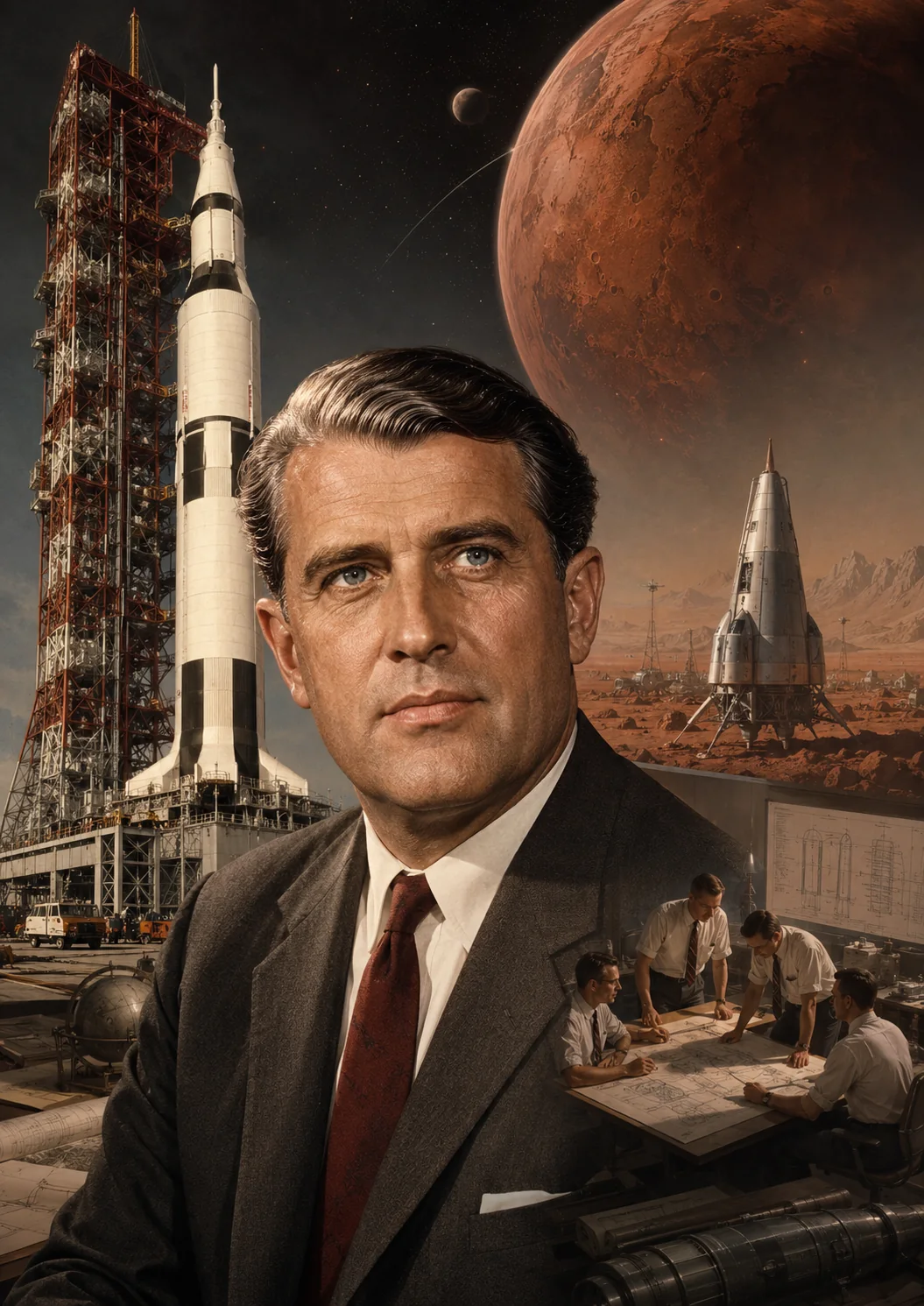
The 950-launch orbital assembly campaign seems extreme, yet its logic reappears whenever reusable launch vehicles make repeated flight inexpensive enough. Many launches are not automatically bad. The correct trade involves cadence, per-flight reliability, refueling capability, marginal cost, common infrastructure and vulnerability to schedule slips. Von Braun already understood that very large expeditions required access to orbit to become routine rather than exceptional.
The ten-ship fleet also represented collective redundancy. Multiple vehicles shared transport, cargo and survival functions. Modern architectures often try to minimize vehicle count to simplify integration. The approaches carry opposite risks: a fleet creates more interfaces but more rescue options; a single vehicle reduces coordination but can concentrate catastrophic failure modes. The right answer depends on demonstrated reliability rather than aesthetic preference for either simplicity or grandeur.
Finally, the mission duration emphasizes orbital mechanics. Mars cannot be treated like a distant airport reached on demand. Launch windows, transfer trajectories and Earth–Mars geometry impose long stays or high energy. The Mars Project confronted this temporal structure explicitly. Any modern promise that quotes only outbound travel time while ignoring surface stay, return window and abort logic is describing only part of the mission.
Public, politics and credibility: why von Braun the communicator matters as much as von Braun the engineer
Von Braun understood that a space program had to be credible at multiple levels. Engineers needed masses, engines and trajectories. Administrators needed schedules, budgets and ownership. Politicians needed national objectives. Citizens needed a picture clear enough to distinguish a plausible program from fantasy. Collier’s and Disney show his ability to move between those levels without stripping away every technical element.
The same skill carried an ambiguity. Beautiful presentations can make unsolved problems look solved. Bonestell’s art made stations and interplanetary vehicles feel almost familiar before any human had reached orbit. Visual power shifted the boundary of what the public considered possible, but it did not constitute technical readiness. Modern readers should therefore learn to separate a concept that looks convincing from a system whose technologies have demonstrated maturity.
Communication also shaped memory. Cold War America had strong reasons to present von Braun as a symbol of Western scientific capability and a hopeful future. The childhood dream, rockets and Moon were emphasized; Nazi Party membership, SS rank and forced labor were far less visible. That selection was not solely his own work. It reflected Army, NASA and media incentives to create a simple public figure. Historians therefore have to examine not only what a famous engineer said about himself, but why an institution found a certain version of the story useful.
A modern site should not solve the problem by abandoning visual storytelling. It should combine visual power with documentary honesty. Concept art should be labeled as concept art; figures should point to sources; contested claims should distinguish evidence, accusation and interpretation. Perhaps the best way to inherit von Braun’s gift for explanation is to preserve its clarity while refusing the historical tendency to smooth away what made the story uncomfortable.
The end of Apollo as a lesson in political sustainability
Apollo proved that an industrial superpower could achieve in less than a decade a goal that seemed nearly impossible when announced. It also proved that exceptional mobilization is not automatically sustainable. Once the central political objective — beating the Soviet Union to a lunar landing — had been achieved, support for continued peak spending declined. Apollo missions were cancelled, production lines closed and Saturn V manufacturing ended. The system capable of sending enormous payloads toward the Moon disappeared at the same moment its engineers were imagining more distant destinations.
Von Braun therefore confronted a contradiction. Engineering could propose a logical sequence of station, Moon and Mars, but politics did not have to fund a logical sequence. It responded to crises, coalitions, annual budgets and competing priorities. Late-1960s architectures involving large stations, nuclear tugs or Mars expeditions assumed continuity that the political system did not provide. Failure to secure that continuity was not simply the failure of a visionary. It exposed a structural property of public programs: legitimacy has to be renewed.
That lesson should shape contemporary Mars design. An architecture that works only under ten or fifteen consecutive years of extraordinary funding is politically fragile even if technically elegant. Intermediate stages should produce useful infrastructure and capabilities even if the final destination slips. Political sustainability becomes a design parameter like mass or energy.
Von Braun partly understood this by promoting stations and satellite applications, yet his public visions often remained orderly sequences. Post-Apollo history is less orderly: cancelled systems, abandoned production lines, technologies revived decades later. A serious Mars architecture must be robust not only to component failures but also to elections, recessions, wars and changing national priorities.
Reading von Braun in the twenty-first century: neither canonization nor erasure
Public debate sometimes swings between two symmetrical simplifications. One celebrates von Braun as the “father of Saturn V” and relegates Nazism to a footnote. The other reduces his entire career to the V-2 and treats any discussion of Apollo contributions as exoneration. Neither produces understanding. A reference biography must be able to describe technical achievement precisely while keeping the violent political context and personal responsibility visible.
Historical knowledge has changed because archives and scholarship made the heroic version harder to sustain. Museums and NASA now speak much more explicitly about concentration-camp production of the V-2 and von Braun’s awareness of it. That is not arbitrary rewriting. It is what historical inquiry does when evidence improves and society asks questions that older institutional narratives avoided. A biography should therefore be intellectually versioned: what a Marshall brochure could say in 1969 is not an adequate standard for what a documentary site should say now.
The same precision should be applied to achievement. Saturn V is not a vague legend; its engines, stages, tests, mission-mode debates and multi-center responsibilities can be documented. Explorer 1 was not merely “von Braun’s answer to Sputnik”; it involved the ABMA, Jet Propulsion Laboratory, James Van Allen’s science team, launch operations and national policy. Restoring the network does not diminish the person. It places him inside the system that makes his influence intelligible.
The result is a more difficult but more useful figure: an exceptional organizer, a communicator who changed American space culture, a participant in a Nazi weapons program, a beneficiary of Paperclip, the first director of Marshall and the author of Mars architectures that were visionary in method while wrong in important assumptions. That plurality is not a flaw in the biography. It is what allows the page to become a genuine open book rather than a long caption under a famous rocket.
A chronology of decisions rather than a chronology of records
If von Braun’s career is read only as a sequence of records — A-4, Explorer 1, Saturn V, Apollo — the most instructive layer disappears: the decisions between them. In 1932 he chose military resources over the fragility of the VfR. In 1945 he helped arrange surrender to the Americans. During the 1950s he turned a military position into a public platform for space. After Sputnik he exploited a political window. During Apollo he accepted a lunar-rendezvous architecture he had not initially preferred. After the Moon he tried to preserve a path toward stations and Mars as budgets contracted. Continuity came less from executing an unchanging plan than from redirecting whatever means existed toward a durable horizon.
This perspective also separates opportunism from adaptation. Opportunism changes justification to preserve position; adaptation changes method because evidence or constraints have changed. Both elements can appear in von Braun’s life. His ability to serve radically different institutions raises obvious moral questions. His willingness to abandon a technical preference when a better architecture emerged is, by contrast, an engineering virtue. A serious biography should not force every change into one moral category.
Future Mars programs will need the same distinction. Vehicles, schedules and mission sequences must remain adaptable, while some ethical limits should not: minimum safety standards, respect for persons, transparent risk, freedom from coercion and accountability to crews and affected communities. Von Braun’s life shows what happens when a stable technical ambition passes through political systems whose standards are radically different. The contemporary challenge is to preserve technical adaptability without making principles equally negotiable.
What Saturn V does not prove: avoiding easy analogies with Mars
Saturn V’s success is sometimes used rhetorically: because the United States built the lunar rocket rapidly, an Apollo-style mobilization should be enough to send humans to Mars on a similarly compressed schedule. The analogy is incomplete. Apollo had an objective relatively simple to state — travel to the Moon, land, return — and an environment in which rescue or return could occur within days. Mars adds months of transit, widely spaced launch windows, no practical immediate return, cumulative radiation, long-duration life support, much harder heavy-mass atmospheric entry and an extended surface logistics problem.
Saturn V therefore demonstrates the power of industrial mobilization, not equivalence between destinations. Its useful lesson is organizational. When a goal is decomposed into accountable subsystems, funded, tested and reviewed against measurable criteria, learning can accelerate dramatically. But applying Apollo’s calendar to Mars without recreating technical and political conditions is a category error. Distance alone is not the issue; the entire rescue and autonomy regime changes.
Von Braun himself understood part of the distinction because his Mars expedition was vastly heavier and longer than his lunar scenarios. The Mars Project can appear extravagant, yet it refuses to treat Mars as Apollo plus a larger fuel tank. Modern technology can reduce mass enormously through electronics, materials, autonomy and improved propulsion, but contemporary architectures must still show where functions once purchased by fleet size and margin have gone.
A place in the Mars Bible: how institutions learn to aim farther
The reason to devote a book-length biography to von Braun is not to make him a patron saint of Mars. His life is an unusually rich historical laboratory. It shows how a marginal idea becomes a discipline, how amateur clubs become state programs, how military technology can become scientific infrastructure, how communication creates political support and how an organization learns to build a system too complex for any individual to master in full.
It also shows the failures of that process. Expertise can become dependent on a criminal sponsor; technical success can be produced through invisible human suffering; public narrative can simplify the past; precise engineering can rest on wrong environmental data; and national mobilization can end before the sequence its designers imagined is complete. Each of these failures has a modern analogue in proposals for large-scale Mars exploration.
A useful Mars Bible therefore has to preserve both sides of the ledger. It should inherit the discipline of calculation, testing, interfaces, logistics and communication while adding governance, ethics, uncertainty tracking, transparency and political sustainability. Only then does von Braun’s history become more than an album of rockets. It becomes preparation for the kinds of choices a real interplanetary program would force societies to make.
Failure as a management instrument: from A-series explosions to Apollo 6
One of the most important continuities across von Braun’s technical career is not any particular engine or vehicle. It is the treatment of failure as information. Rocket development makes this unavoidable. The energies involved are large, the number of interacting components is high and early prototypes necessarily contain unknowns. A culture that hides failure may preserve careers temporarily, but it destroys the very feedback needed to make the next vehicle safer. From the small Aggregat vehicles through Redstone and Saturn, the organizations around von Braun repeatedly confronted the need to convert spectacular hardware loss into disciplined diagnosis.
The principle is easy to praise and difficult to practice. A failure has political and financial consequences. Contractors may fear blame; managers may defend schedules; engineers may become attached to explanations that preserve their design. Good test culture therefore requires more than sensors. It requires incentives that allow bad news to move upward. Marshall’s historical culture of reviews, laboratory depth and hardware knowledge was partly designed to reduce the chance that an inconvenient anomaly could be dismissed as someone else’s problem. This is one reason internal technical competence mattered: an integrator that cannot independently understand a contractor’s data is vulnerable to optimistic interpretation.
Apollo 6 is an especially useful example because Saturn V’s later reputation can make the development program look inevitable. The flight suffered engine and vibration problems that would have been unacceptable on a lunar crew mission. Rather than treating the near-success as proof that the vehicle was “good enough,” engineers analyzed the causes, modified hardware and procedures and used ground testing to increase confidence. Reliability emerged from correction, not from public mythology. The fact that later Saturn V flights were extraordinarily successful should therefore be read as the consequence of a system that took anomalies seriously.
Mars makes the lesson harsher. A crew traveling months from Earth cannot rely on rapid physical intervention from the launch site. Test programs for life support, power, propulsion, software, radiation protection and surface operations will have to discover failure modes before departure, and they will have to do so across long durations. The organizational requirement is the same one von Braun’s teams learned: failures must be made visible early, in environments where correction is still possible. A program that celebrates only successful demonstrations will systematically underestimate its own risk.
From propaganda to public education: a changing responsibility of the space expert
Von Braun’s public role crossed several very different information environments. Under Nazi rule, rocket development was secret and later wrapped in the propaganda language of the “Vengeance Weapon.” In the United States, his public identity was rebuilt through Army-approved appearances, magazine articles, lectures and television. The same engineer therefore experienced both radical secrecy and mass communication. The contrast is useful because it shows how information policy shapes what society believes a technology is for.
The Collier’s and Disney years are often remembered simply as successful popularization. They were also exercises in agenda setting. By choosing which architectures to illustrate and which uses to emphasize, the programs defined a sequence of future development for audiences who had little other basis for comparison. A wheel station, lunar ship or Mars fleet can become “the obvious next step” when it is the only technically detailed future most viewers have seen. The expert who communicates thus acquires power over the public imagination even without formal political office.
Modern space communication carries a different burden because information is far more fragmented and immediate. Test failures can be streamed live; independent analysts can compare imagery and telemetry; employees and contractors speak publicly; documents can be searched in seconds. The appropriate lesson from von Braun is not to reproduce mid-century certainty. It is to preserve his insistence that complex engineering can be explained to non-specialists while adding explicit uncertainty, alternative architectures and source transparency.
For Delta-Sierra, that means the visual and narrative ambition of these pages should never become a substitute for evidence. A beautiful concept image has to be labeled; historical reconstructions have to be distinguished from photographs; mission numbers have to state whether they are measured, planned or calculated. Von Braun’s success as a communicator is worth studying precisely because modern communication can improve on its limitations.
Industrial geography: why Huntsville, Cape Canaveral and contractor plants became part of the rocket
Large launch vehicles are often presented as if they were built in one place. Saturn demonstrates the opposite. Marshall in Huntsville defined and integrated major portions of the launch vehicle, but engines, stages, instrumentation and spacecraft hardware were distributed across different companies and facilities. Launch operations took place in Florida. Test stands, manufacturing plants, waterways and transportation systems formed a physical network extending across the United States. The “rocket” therefore included geography.
This distribution created both resilience and complexity. Specialized companies could apply deep manufacturing expertise, and regional facilities could grow around particular functions. At the same time, a change in one stage could affect interfaces hundreds or thousands of kilometers away. Configuration control had to make sure that drawings, hardware and procedures remained synchronized. Transportation itself became a design constraint: a stage too large for available roads or aircraft required waterways, barges or specialized infrastructure.
Von Braun’s earlier experience had already taught him the importance of place. Peenemünde concentrated development and test functions; Mittelwerk demonstrated the horrific political consequences of underground production chosen for wartime protection; White Sands supplied an enormous safe range; Huntsville created a technical community around an arsenal. In the American program, these places were not interchangeable boxes on an organization chart. Each accumulated tacit knowledge and facilities that could not be recreated quickly elsewhere.
Mars planners face a comparable issue at a larger scale. A sustained interplanetary program will depend on launch sites, propellant production, vehicle factories, test deserts, tracking networks, deep-space communications and perhaps orbital depots. The architecture should therefore account for terrestrial industrial geography as part of mission resilience. A technically elegant spacecraft can still be politically or operationally fragile if its entire supply chain depends on a single irreplaceable facility.
Money, schedule and the danger of interpreting Apollo as an engineering blank check
Von Braun’s Apollo-era career benefited from extraordinary national spending, but money did not eliminate engineering tradeoffs. Even during peak mobilization, managers had to choose between test programs, vehicle variants, contractor approaches and schedule margin. Resources can accelerate parallel work and buy facilities; they cannot repeal thermodynamics, manufacturing yield or the time needed to observe some failure modes. The historical achievement was therefore not simply “NASA had money.” It was that money was converted into an organization capable of learning fast enough to meet a political deadline.
Schedule pressure cut both ways. A clear deadline forced decisions and prevented endless optimization. It also created incentives to accept risk. Apollo’s success can encourage hindsight bias in which every aggressive choice appears justified because the program ultimately landed crews safely. A more useful reading recognizes that major programs can succeed while still taking risks that would be difficult to justify under different circumstances. Learning from Apollo requires examining the decision process, not merely copying its urgency.
Von Braun often operated effectively under deadlines because he insisted on technical visibility. Yet his German career provides the darker counterexample: when political urgency becomes absolute and human costs are externalized, schedule can become an excuse for abuse. The difference between disciplined urgency and coercive mobilization is therefore not a matter of engineering technique; it is a matter of governance and rights.
A Mars program will need long horizons that outlast a single electoral cycle while retaining milestones concrete enough to prevent indefinite drift. Too little urgency and the architecture becomes a permanent study. Too much urgency and crews may inherit risks that tests have not retired. The proper legacy of von Braun’s schedule-driven programs is not “go faster at any cost.” It is to design institutions where deadlines sharpen choices without silencing evidence.
The final systems lesson: a launch vehicle is memory made physical
Saturn V embodied decades of accumulated memory. Some of that memory came from German experiments, some from American missile programs, some from contractor manufacturing, some from failures on test stands and some from entirely new research. Every valve specification, inspection rule and checkout procedure contained a fragment of earlier experience. This is why mature engineering organizations are difficult to replace. The hardware can be copied more easily than the history of why each detail exists.
Von Braun’s career repeatedly benefited from carrying teams forward. The group that moved from Germany to Fort Bliss, from Fort Bliss to Huntsville and from the Army into NASA retained shared language and lessons. The continuity could produce insularity, and the moral problems of Paperclip should never be minimized, but from a systems perspective it explains why capability survived institutional boundaries. People carried tacit knowledge that documents alone could not capture.
The danger appears when a program ends. Production lines close, experts retire, suppliers leave and the reasons behind old requirements disappear. Decades later, a new generation may possess better tools yet have to rediscover problems its predecessors already solved. The United States’ long absence from super-heavy launch production after Saturn illustrates how capability can atrophy even in a technologically advanced society.
Mars will magnify this issue because the program could span generations. Knowledge preservation must therefore be designed explicitly: traceable requirements, test archives, anomaly databases, training pipelines, open scientific results and institutions able to explain why systems are the way they are. Von Braun is remembered as a man of rockets, but perhaps the deeper lesson of his career is that the true vehicle was accumulated organizational memory made physical in each launch.
Mars, the Moon and the sequence problem: when a roadmap becomes an assumption
Von Braun’s public architectures often arranged exploration into an orderly sequence: reusable access to orbit, a station, lunar expeditions, permanent orbital infrastructure and eventually Mars. The sequence was technically appealing because each stage appeared to build capability for the next. A station could serve as a laboratory and assembly point; lunar operations could develop deep-space experience; heavy launchers could evolve toward interplanetary logistics. This kind of roadmap remains attractive because it transforms an enormous objective into a ladder.
History shows, however, that ladders can be interrupted. The United States reached the Moon before building the rotating station von Braun had once treated as a prerequisite. Apollo bypassed some of the infrastructure his 1950s visions considered necessary because a political deadline favored a more direct architecture. Later, the Space Shuttle flew without the giant permanent station originally imagined alongside it, and the International Space Station emerged through a very different international path. The sequence changed while individual capabilities survived.
The lesson is not that roadmaps are useless. They are essential for identifying dependencies. The lesson is that a dependency has to be physical, not merely traditional. If a Mars mission requires a particular capability, the architecture should explain why. If a lunar base is proposed as a prerequisite, it must show which risks, technologies or resources the lunar step retires more efficiently than alternatives. Otherwise a roadmap can become a chain of politically convenient projects rather than a logically necessary system.
Von Braun’s own career contains both tendencies. He sometimes promoted grand sequences because they created a coherent public vision. During Apollo he also accepted that the country could skip directly to a lunar architecture unlike his earlier station-centered progression. That flexibility is worth preserving. A modern Mars program should maintain a long-range map while treating every intermediate step as a hypothesis to be tested rather than a ritual to be obeyed.
Why this biography must remain open
No final page can fully settle Wernher von Braun. New archival work can refine the history of Peenemünde and Mittelwerk; scholarship can change interpretations of responsibility; technical historians can recover the roles of less famous engineers; NASA records can reveal how decisions actually moved through Marshall. An “open book” is therefore appropriate not only because the subject is large, but because historical knowledge is revisable.
The page should grow by adding evidence, not by inflating prose. If a new source merely repeats a familiar claim, it should strengthen verification rather than generate another paragraph saying the same thing. If a source contradicts an established narrative, the contradiction deserves explicit treatment. If uncertainty cannot be closed, it should remain visible. This is the same discipline that good engineering applies to a technical assumption: record what is known, what is inferred and what still has to be measured.
That method also protects against both hagiography and retrospective moral simplification. Von Braun’s contributions to American spaceflight can be documented without excusing the German program; his complicity in a criminal war economy can be described without pretending that Saturn V was therefore technically insignificant. The difficult task is to keep every important fact in the same frame.
For a reader returning to this biography over several evenings, that is the real promise. The page is not meant to deliver a slogan about whether von Braun was “hero” or “villain.” It is meant to reconstruct how a human being, an engineering culture, several states and millions of technical decisions converged to create some of the most consequential rockets in history — and why the same history should make future space programs more demanding about evidence, institutions and ethics.
Primary and institutional sources
Verification rule: institutional, archival and primary sources are preferred. Company statements are treated as statements, not proof of future achievement. Contested or potentially harmful claims are included only when supported by identifiable documentary sources, with uncertainty stated when necessary.
- NASA — Wernher von Braun
- NASA History — Sputnik biography: Wernher von Braun
- NASA — Humans to Mars: Fifty Years of Mission Planning
- NASA NTRS — Human Mars Mission Design
- USHMM — Mittelbau (Dora) main camp
- Smithsonian NASM — Mars Project: Wernher von Braun as a science-fiction writer
- Smithsonian — von Braun and the lunar-orbit rendezvous decision
- Smithsonian National Air and Space Museum — “Wonder Weapons” and Slave Labor
- Smithsonian National Air and Space Museum — Project Paperclip and American Rocketry
- NASA History / NTRS — Humans to Mars: Fifty Years of Mission Planning
- NASA — Space Stations, historical overview
- NASA History — Realizing the Dream of Flight: Wernher von Braun as engineer and manager
- NASA NTRS — The Saturn Management Concept
- NASA History — Historical origins of space stations and von Braun’s orbital concepts
- NASA History / NTRS — Humans to Mars: Fifty Years of Mission Planning
- NASA Marshall — public communication, Collier’s and Walt Disney in von Braun’s advocacy
- Smithsonian National Air and Space Museum — The Mars Project and its historical assumptions
- NASA History — Post-Apollo space-station and Space Task Group context
- NASA History — A Brief History of NASA and the transfer of the Huntsville rocket team
- NASA NTRS — Manned Mars Landing, 1969 briefing
- NASA Marshall — 65 Years of Ingenuity, Teamwork
- NASA NTRS — Wernher von Braun: Reflections on His Contributions to Space Exploration
- NASA — Space Stations historical overview
- NASA — Marshall Space Flight Center History
- NASA — Story of Explorer 1
- NASA — Mercury-Redstone Launch Vehicle
- NASA — 60 Years Ago: First Launch of a Saturn Rocket
- NASA History — The Human Touch: History of Skylab
Sources verified and expanded for this version on 22 August 2026. Future objectives are dated and separated from demonstrated capabilities.
A career that forces technology, politics and responsibility into the same narrative
Wernher von Braun’s biography cannot be read as a simple rise from a young rocket enthusiast to Saturn V. His expertise developed inside institutions of radically different character: civilian enthusiast circles, the German military rocket program, a wartime industrial system, and later the United States Army and civilian space program. At every transition, knowledge of propulsion, guidance, structures and systems integration acquired a different political meaning. The scientist and engineer therefore cannot be separated from the institution that funds, directs and uses the work.
This is essential when assessing his importance to Mars. Von Braun’s Mars studies were historically significant because they treated human interplanetary flight as an integrated architecture involving assembly in Earth orbit, multiple vehicles, transfer trajectories, landing, surface exploration and return. Yet that technical ambition cannot erase the environment in which he acquired a decisive part of his experience. The A-4/V-2 program belonged to the Nazi war machine, and production became inseparable from forced labor and concentration-camp deaths. A page that honors von Braun’s importance to astronautics must be strong enough to state that history without euphemism.
After 1945, Operation Paperclip and the transfer of German engineers to the United States moved expertise without making its origins disappear. At White Sands and then through Redstone, Jupiter and Saturn, von Braun worked within a new institutional system and gradually became one of the public faces of American space exploration. His influence was not only technical. He was unusually capable of translating complex mission architectures into narratives understandable to officials and the public. Work with Collier’s, Chesley Bonestell and Walt Disney helped turn calculations and diagrams into a popular vision of spaceflight.
For a twenty-first-century reader, the value of this career lies precisely in its complexity. It demonstrates that space progress is not a pure product of science: political regimes, budgets, war, institutions, industrial chains and moral choices all shape what becomes technically possible. Von Braun is simultaneously central to rocket history, an architect of Mars visions that influenced generations, and a figure whose past makes hagiography impossible. The most serious tribute is therefore to understand the full record rather than to detach the achievements from the systems that enabled them.