


MARS BIBLE — ORGANISATIONS
UAE Space Agency & MBRSC
Hope Probe, national strategy and Mars 2117: using Mars as an accelerator of scientific and industrial capability.
BEFORE MARS — BUILDING A SECTOR IN ONE GENERATION
From five engineers in 2006 to a federal agency in 2014: how the UAE built its first space capabilities
The Emirati case is almost the inverse of JPL or China’s early program. It did not begin by converting a decades-old military rocket effort into exploration; it required building a national skills base quickly in a country with a young domestic space sector. The UAE Space Agency’s official history traces a longer interest back to Sheikh Zayed’s meetings with Apollo-era NASA representatives in the 1970s and later commercial satellite activity. The decisive institutional break came in 2006 when Sheikh Mohammed bin Rashid Al Maktoum launched the Emirates Institution for Advanced Science and Technology, the organization that would later be integrated into the Mohammed Bin Rashid Space Centre.
2006: five engineers, not an army of specialists
MBRSC supplies an unusually revealing number: the center began with five engineers. That figure captures the real scale of the problem. A team that small cannot immediately reproduce an entire satellite-development chain. The central question therefore becomes how knowledge is acquired: which disciplines should be learned first, which partners can transfer useful experience, and how can a partnership deliver not only a spacecraft but also an Emirati team able to assume progressively more responsibility?
DubaiSat-1: using an operational mission as an engineering school
DubaiSat-1 played that role. MBRSC states that its development was important to building the knowledge and skills of the first Emirati space-specialist engineers, including training in South Korea. International cooperation functioned as an institutional learning mechanism. The objective was not to claim instant autonomy; it was to circulate expertise so that design, integration, testing, operations, image processing and program management could gradually become internal capabilities.
That approach helps explain later missions. DubaiSat-2 and then KhalifaSat increased the share of responsibility carried locally. The center was no longer merely using satellites; it was creating an engineering community, procedures and project memory. In 2015 EIAST was merged into the Mohammed Bin Rashid Space Centre, giving the technical nucleus a broader institutional identity.
2014: why create a federal agency when a technical center already existed?
The UAE Space Agency was established under Federal Law by Decree No. 1 of 2014. It was designed as a federal public entity with legal personality and financial and administrative autonomy, reporting to the Council of Ministers. Its distinction from MBRSC is essential. The center develops and operates major technical programs; the agency shapes national policy, cooperation, regulation and broader sector development. The Emirati system is therefore an ecosystem with different institutional functions rather than a single agency doing everything.
Hope: turning Mars into a human-capital accelerator
The Emirates Mars Mission fits this model. For a young space program, a Mars probe is a scientific objective but also a mechanism for increasing capability. It forces teams and institutions to work on interplanetary navigation, deep-space communications, orbital dynamics, flight software, science operations and international research partnerships. The challenge stretches the organization far beyond the demands of an Earth-observation satellite in low orbit.
The UAE therefore matters to a Mars reference work not because of the number of decades accumulated, but because of the speed with which a five-engineer nucleus was turned into an ecosystem able to participate in an interplanetary mission. It is a useful case study in how recruitment, overseas training, partnerships and missions selected partly for their learning value can create national technical capability within one generation.
Institutional sources: MBRSC — About: five engineers in 2006 and DubaiSat-1 training · UAE Space Agency — History of UAE Space Sector · UAE Space Agency — status and mandate
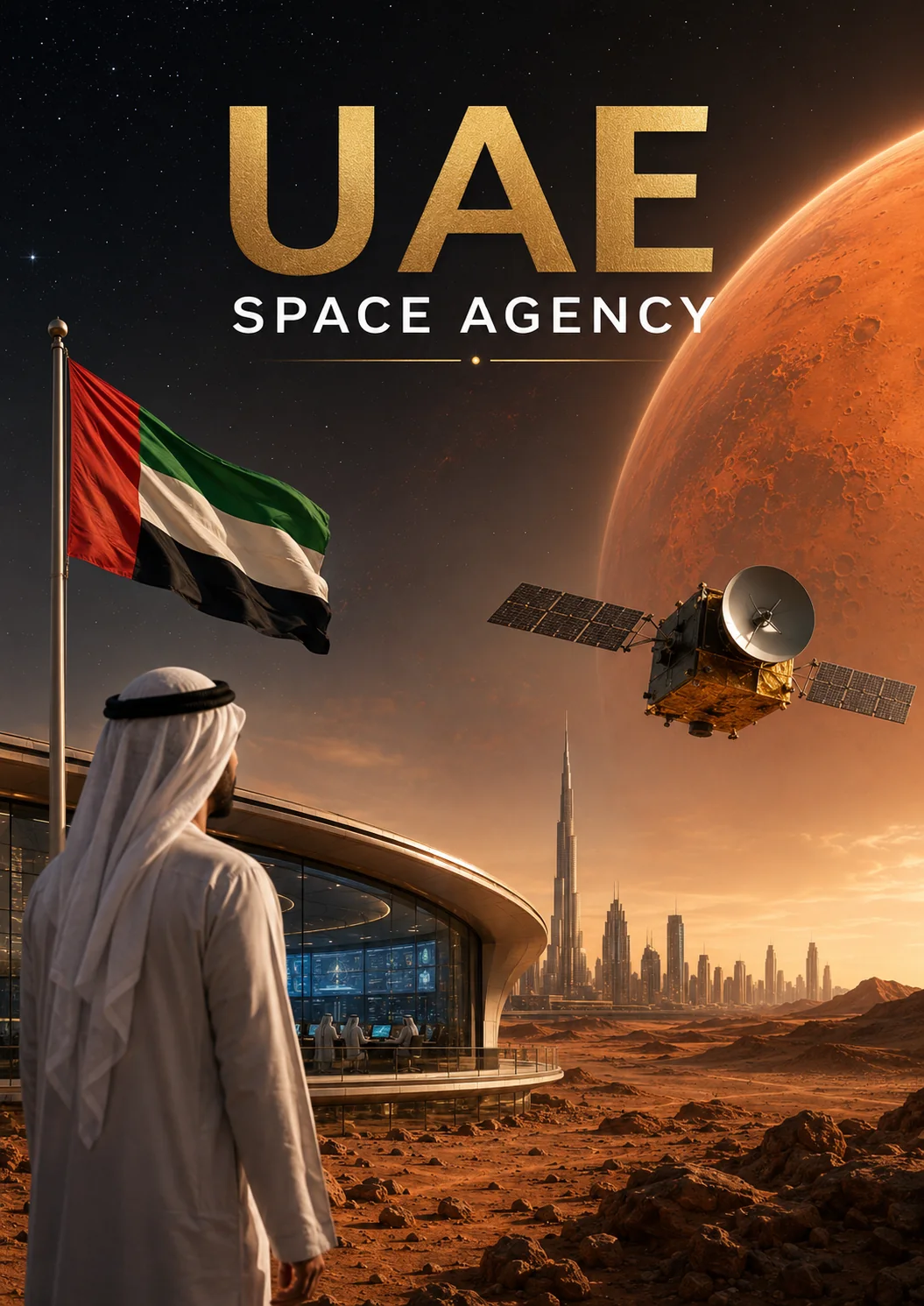
Building a national team through knowledge transfer rather than simply purchasing hardware
The UAE space programme faced a different problem from older space powers. It emerged late, in a country with substantial financial capacity but a much smaller initial pool of engineers who had already delivered an interplanetary mission. The institutional response was dual. The Mohammed Bin Rashid Space Centre, growing from a trajectory begun in the 2000s, developed satellite design and operations capability; the UAE Space Agency, created in 2014, then provided a national function for strategy, regulation, cooperation and sector development.
Emirates Mars Mission is especially revealing as a model of recruitment and learning. The programme did not simply purchase a turnkey spacecraft abroad. Emirati teams worked with American universities, particularly the University of Colorado's Laboratory for Atmospheric and Space Physics, to design, test and operate Hope while transferring know-how. The distinction matters: a procurement contract can deliver an object; a development partnership can leave behind engineers able to specify and manage the next system.
For Mars, that may be Hope's most important legacy. The mission gave a generation of engineers and scientists end-to-end interplanetary experience in design, integration, navigation, deep-space operations, data processing and scientific production. The real measure of maturity for the UAE is therefore not only the success of a first probe, but whether it retains those people, enables them to mentor subsequent generations and converts acquired experience into institutions and programmes that continue after the founding mission ends.
Direct answer: why UAE Space Agency & MBRSC matters to the story of Mars
UAE Space Agency & MBRSC deserves its own dossier because MBRSC was established in 2006. [1] The goal is not to rank organizations but to understand one as a system: history, decision centers, infrastructure, technologies, successes, failures and the capabilities it contributes — directly or indirectly — to Mars exploration.
Hope Probe, national strategy and Mars 2117: using Mars as an accelerator of scientific and industrial capability.
Essential timeline
- 20062006 MBRSC
- 20142014 UAE Space Agency
- 20172017 Mars 2117 announcement
- 20192019 National Space Strategy 2030
- 20202020 Hope launch
- 20212021 Hope Mars arrival
- long-termlong-term Mars 2117 research
Understand the organisation before looking at its rockets
To understand UAE Space Agency & MBRSC, one must separate political goal-setting, program management, engineering centers, industrial manufacturing, science teams and mission operations. In this case, one useful anchor is that MBRSC was established in 2006. [1] Another is that Hope Probe launched in 2020 and reached Mars on 9 February 2021. [2] These are verifiable facts; by themselves they do not guarantee success of any future program. [1][2]
Why Mars exposes the true maturity of a space program
Mars is an unforgiving maturity test. Looking at UAE Space Agency & MBRSC through Mars therefore reveals not only what it announces but which capabilities it can actually integrate, test and operate. In this case, one useful anchor is that Hope Probe launched in 2020 and reached Mars on 9 February 2021. [2] Another is that the UAE became the first Arab country to reach Mars. [3] These are verifiable facts; by themselves they do not guarantee success of any future program. [2][3]
The technical chain from Earth to the Martian system
The theme of capability transfer illustrates this systems view. Integration is therefore a capability in its own right. In this case, one useful anchor is that the UAE became the first Arab country to reach Mars. [3] Another is that Hope studies the Martian atmosphere and climate. [4] These are verifiable facts; by themselves they do not guarantee success of any future program. [3][4]
Why failures often teach more than success releases
Space history is full of failures, anomalies and redesigns. In this case, one useful anchor is that Hope studies the Martian atmosphere and climate. [4] Another is that Mars 2117 is framed as a century-long objective to develop knowledge needed for human settlement. [1] These are verifiable facts; by themselves they do not guarantee success of any future program. [4][1]
Communications: commanding a machine that is no longer “live”
At interplanetary distance the word remote control changes meaning. Light-time delay cannot be negotiated away. The theme of international partnerships therefore combines ground antennas, radio power, coding, onboard storage, mission planning and autonomous software. In this case, one useful anchor is that Mars 2117 is framed as a century-long objective to develop knowledge needed for human settlement. [1] Another is that the National Space Strategy 2030 structures development of the UAE space sector. [2] These are verifiable facts; by themselves they do not guarantee success of any future program. [1][2]
Why mass governs almost everything
The architectures of UAE Space Agency & MBRSC can therefore be read as repeated trades among mass, energy, risk, cost and schedule. In this case, one useful anchor is that the National Space Strategy 2030 structures development of the UAE space sector. [2] Another is that MBRSC was established in 2006. [3] These are verifiable facts; by themselves they do not guarantee success of any future program. [2][3]
Science and engineering must learn each other’s language
Strong missions make these communities converge early. The theme of Mars 2117 shows how a scientific question becomes a requirement, an instrument, an interface, an operations sequence and finally interpretable data. In this case, one useful anchor is that MBRSC was established in 2006. [3] Another is that Hope Probe launched in 2020 and reached Mars on 9 February 2021. [4] These are verifiable facts; by themselves they do not guarantee success of any future program. [3][4]
From one-off missions to infrastructure
This is why the history of UAE Space Agency & MBRSC is more interesting than a list of launches: the key question is which capabilities persist across generations. In this case, one useful anchor is that Hope Probe launched in 2020 and reached Mars on 9 February 2021. [4] Another is that the UAE became the first Arab country to reach Mars. [1] These are verifiable facts; by themselves they do not guarantee success of any future program. [4][1]
Partners: autonomy does not mean isolation
Cooperation can accelerate a mission but also creates dependencies. In this case, one useful anchor is that the UAE became the first Arab country to reach Mars. [1] Another is that Hope studies the Martian atmosphere and climate. [2] These are verifiable facts; by themselves they do not guarantee success of any future program. [1][2]
Technical data explained in plain language
In this case, one useful anchor is that Hope studies the Martian atmosphere and climate. [2] Another is that Mars 2117 is framed as a century-long objective to develop knowledge needed for human settlement. [3] These are verifiable facts; by themselves they do not guarantee success of any future program. [2][3]
Maturity: demonstrated, qualified, planned or merely studied
For UAE Space Agency & MBRSC, this dossier separates achievements, committed programs, announced schedules and prospective concepts so that ambition is not silently converted into fact. In this case, one useful anchor is that Mars 2117 is framed as a century-long objective to develop knowledge needed for human settlement. [3] Another is that the National Space Strategy 2030 structures development of the UAE space sector. [4] These are verifiable facts; by themselves they do not guarantee success of any future program. [3][4]
What this organisation contributes specifically to Mars
The Mars relevance of UAE Space Agency & MBRSC is better measured through transferable capabilities — science orbit, deep-space navigation, autonomy, sample return, surface operations, instrumentation or transportation — than by counting how often the word Mars appears in public messaging. In this case, one useful anchor is that the National Space Strategy 2030 structures development of the UAE space sector. [4] Another is that MBRSC was established in 2006. [1] These are verifiable facts; by themselves they do not guarantee success of any future program. [4][1]
The people behind the systems
Vehicles are visible; organizations are less so. In this case, one useful anchor is that MBRSC was established in 2006. [1] Another is that Hope Probe launched in 2020 and reached Mars on 9 February 2021. [2] These are verifiable facts; by themselves they do not guarantee success of any future program. [1][2]
What to watch over the next decade
To follow UAE Space Agency & MBRSC, it is more useful to watch funded missions, hardware entering integration, system tests, launch contracts, planetary windows and qualification of critical elements than to count distant announcements. In this case, one useful anchor is that Hope Probe launched in 2020 and reached Mars on 9 February 2021. [2] Another is that the UAE became the first Arab country to reach Mars. [3] These are verifiable facts; by themselves they do not guarantee success of any future program. [2][3]
Mars as a system of systems
The theme of international partnerships is therefore one node in a larger architecture. Studying UAE Space Agency & MBRSC helps reveal which nodes are already mature, which are developing and which still depend on other actors. In this case, one useful anchor is that the UAE became the first Arab country to reach Mars. [3] Another is that Hope studies the Martian atmosphere and climate. [4] These are verifiable facts; by themselves they do not guarantee success of any future program. [3][4]
What a non-specialist should retain
Applied to UAE Space Agency & MBRSC, these questions separate institutional messaging from operational reality without falling into cynicism. In this case, one useful anchor is that Hope studies the Martian atmosphere and climate. [4] Another is that Mars 2117 is framed as a century-long objective to develop knowledge needed for human settlement. [1] These are verifiable facts; by themselves they do not guarantee success of any future program. [4][1]
GO FURTHER
Mars Library
Hope in 2026: from national milestone to a science infrastructure extended through 2028
A mission that moved beyond national demonstration
The Emirates Mars Mission initially had a major national-capability objective: train teams, develop engineering expertise and establish the United Arab Emirates in planetary science. Once Hope entered Mars orbit, however, the mission’s value had to be judged by more than symbolism. Its instruments built a global and repeated view of the Martian atmosphere using an orbit designed to sample different local times and connect lower-atmosphere weather with escape toward space.
That architecture complements spacecraft in more specialized orbits. It also shows how a comparatively small science community can create a useful niche when mission design is aligned with a clear question. For future human activity, atmospheric science is operationally relevant: dust, temperature, upper-atmosphere dynamics and space-environment interactions influence communications, surface operations and hardware protection.
Extension through 2028 and open scientific data
In April 2026, the UAE Space Agency said the Hope mission had been extended through 2028 following strong operational performance and scientific success. The agency also reported more than 10 terabytes of open scientific data. Extension is a different maturity test from launch success. Keeping a spacecraft scientifically productive for years requires navigation, planning, calibration, data processing, archiving and renewal of science objectives.
Open data increases mission value beyond the size of the national team. Properly documented Mars data can be used by researchers who did not build the spacecraft. Hope is therefore a useful example of how a focused mission can increase scientific return through archives, transparency and international reuse.
MBRSC, the UAE Space Agency and ecosystem building
The Emirati program distributes roles across institutions including the UAE Space Agency and the Mohammed Bin Rashid Space Centre. That institutional architecture matters as much as the spacecraft. A country has to finance programs, recruit and train engineers, cooperate with universities and convert one high-profile mission into skills that remain after the mission ends. Hope has acted as an accelerator for that ecosystem.
The next phases of the national program include destinations beyond Mars, including the Emirates Mission to the Asteroid Belt. It would be misleading to present every new mission as an automatic step toward a Martian settlement. The stronger lesson is capability accumulation: an organization matures by repeating complete cycles of design, operations and science across different missions.
What Hope actually contributes to future human presence
Hope is neither a landing system nor a habitat demonstrator. Its contribution to human Mars questions is indirect but real: improving knowledge of the Martian atmospheric system and developing the capability to operate a long-lived planetary mission. A settlement would need persistent atmospheric and space-weather monitoring, dust forecasting, density models for arriving vehicles and archives that compare seasons across decades.
Hope’s legacy can therefore be read as a knowledge and institutional-capability layer. The necessary caution is not to treat the long-term “Mars 2117” vision as a validated technical architecture. Hundreds of systems lie between a strategic vision and a functioning city. Hope is a successful science step on that path, not evidence that the remaining systems are solved.
Deep reading: what this trajectory teaches
To understand the place of Programme spatial des Émirats arabes unis in a serious history of Mars, two opposite shortcuts have to be avoided: reducing the organization to a list of missions, or treating one successful capability as proof that the whole Mars chain already exists. The thread of this dossier is the rapid construction of scientific and institutional capacity around a Mars mission, with cooperation and training playing a major role. The sections “From five engineers in 2006 to a federal agency in 2014: how the UAE built its first space capabilities”, “2006: five engineers, not an army of specialists” and “DubaiSat-1: using an operational mission as an engineering school” should therefore be read as parts of one engineering question: which capabilities are real, in what environment have they been demonstrated, and which dependencies would still have to be closed before they could support a durable human presence?
The second reading level is maturity rather than visibility. When the dossier moves through “2014: why create a federal agency when a technical center already existed?” and “Hope: turning Mars into a human-capital accelerator”, the useful questions become: what is already operational, what has been demonstrated only in another context, what requires major scaling, and what remains prospective? This separation protects the reader from inflated extrapolation while making it easier to identify the particular competence or hard-won operational experience that Programme spatial des Émirats arabes unis can contribute.
Hope: using Mars to build national scientific capability
The Emirates Mars Mission and its Hope orbiter are more than a prestige exercise. The program develops teams, procedures, navigation experience and a scientific community able to work with planetary data. Hope entered Mars orbit in 2021 and focuses on atmospheric dynamics, including connections between lower and upper atmospheric processes. Its orbit provides temporal coverage that complements other Mars spacecraft.
For a relatively young space power, that choice is structurally important. A mission built around a clear scientific question trains specialists inside the realities of an interplanetary program. Sustainable settlement will require exactly this broadening of capability: human infrastructure on Mars cannot be maintained if only a few countries possess engineers able to understand planetary operations.
A national mission built through partnership
Hope was developed with substantial international cooperation, including work with U.S. universities, while retaining Emirati program leadership. The arrangement avoids a false choice between total dependence and absolute autonomy. An organization can learn faster with experienced partners if knowledge transfer is genuine and local responsibility increases as the program matures.
The same lesson applies to settlement. Early habitats will depend on many terrestrial suppliers and experts. Martian autonomy should not mean eliminating cooperation; it should mean removing single dependencies that can stop a life-critical function. Healthy cooperation increases local capability rather than substituting for it.
From Hope to a broader space strategy
The United Arab Emirates places its Mars mission inside a wider strategy for research, skills and space-sector development. In 2026 Hope remains an important scientific and institutional reference while the country advances other exploration projects. Mars therefore acts as a catalyst: a distant destination forces improvements in project governance, science, education and international partnership at the same time.
The Emirati case shows that a Mars mission can create major terrestrial effects long before settlement. The most durable outcomes may be the teams, methods and institutions built to make the mission possible. A future Martian city will depend on such Earth-based ecosystems for many years before economic autonomy becomes realistic.
Institutional continuity and the Mars learning curve
The Emirates Mars Mission therefore matters beyond the spacecraft itself. Hope connected universities, mission operations, atmospheric science and international partnerships in a programme with a clear national capacity-building function. The important institutional question is what survives after the mission: trained teams, scientific practice, data-management habits, procurement experience and the confidence to define a subsequent deep-space programme rather than merely celebrate a first success. [institutional source]
Hope also created an operational bridge between national ambition and routine scientific practice. Atmospheric data products, mission planning, spacecraft operations and international publication require long-lived processes that continue after launch day. For Mars capability, that institutional layer is as important as the visible spacecraft because it trains teams to manage anomalies, calibrate instruments, release data and sustain a scientific programme over several years. [institutional source]
Mars 2117 should therefore be read as a long-horizon national objective rather than evidence that a settlement architecture already exists. Its practical value is to force questions about education, research, technology development and international cooperation across generations. The difference between aspiration and engineering evidence must remain explicit: Hope demonstrates real interplanetary mission capability, while a future human settlement would require many additional systems that the current programme does not yet claim to have demonstrated. [institutional source]
Open book — from early Emirati satellites to a very long-term Mars strategy
This part examines the gradual construction of Emirati space capability through institutions, engineering education, international partnerships, MBRSC, the Hope mission and open scientific data. It distinguishes domestic capability-building from external dependence and treats Mars 2117 as a long-horizon national programme rather than an operational colonization project.
Before 2014: telecommunications, EIAST and the gradual construction of a sector
The Emirati institutional story reaches back to telecommunications and Earth observation well before Hope: Thuraya was established in 1997, Yahsat in 2007, while EIAST was created in 2006 before being merged into MBRSC in 2015. Those programmes gave the country users, contracts, engineers and operations before its first interplanetary mission. [institutional source]
The learning logic runs through successive satellite generations and partnerships. Early teams did not try to manufacture everything immediately: they learned specifications, integration, operations and data processing, then progressively increased local responsibility. Sovereignty was therefore built as a capability curve rather than a declaration.
Behind ‘Before 2014: telecommunications, EIAST and the gradual construction of a sector’, people and professions must be placed back into the decision chain. Programme leaders trade cost against schedule, systems engineers close interfaces, test teams hunt faults before flight and operators discover real behaviour after launch. That diversity avoids reducing an organisation to its chief executive or founder: collective competence lies in coordinating hundreds of specialised decisions.
For Mars, the trajectory shows that ordinary infrastructure—telecommunications, data, control centres and training—often precedes spectacular missions. A durable settlement will likewise need an economy and teams able to operate every day between major exploration campaigns.
The main risk is hidden dependency: a capability looks national as long as the partner, supplier or foreign infrastructure remains available. Serious assessment therefore separates what the organisation can reproduce, what it can only operate and what it purchases as a service. This map does not diminish achievement; it shows where investment is needed to make the next generation more robust. Sheikh Zayed’s meeting with the Apollo team in the 1970s belongs to the official long-term narrative, but it should not be converted into direct technical causation. Measurable capabilities emerged mainly decades later through companies, centres, budgets and documented programmes.
2014: a federal agency to organise a sector, not build everything itself
The UAE Space Agency was created in 2014 as a federal entity with legal personality and administrative and financial autonomy. It is not the same as MBRSC: the agency structures policy, partnerships, regulation and national strategy, while the Dubai centre develops and operates several satellites, missions and astronaut programmes. [institutional source]
The separation makes the national system understandable as a network. Federal authorities, MBRSC, Yahsat, Thuraya, universities, ministries, industry and foreign partners hold different responsibilities. A modern agency can therefore be influential without owning every factory, antenna or control room itself.
Behind ‘2014: a federal agency to organise a sector, not build everything itself’, people and professions must be placed back into the decision chain.
A future international Mars architecture would need a similar distinction between authority, operators and industry. Safety, licensing, liability and scientific rules cannot be left solely to companies building vehicles.
Another risk comes from showcase effects. Highly visible space programmes naturally attract political and corporate communication, but an announcement is not a qualification, a flight or operational experience. The chronology should therefore preserve three distinct states: proposed capability, capability in development and demonstrated capability. Mixing them creates an illusion of maturity that becomes dangerous when reasoning about Mars. Directly comparing the UAE Space Agency with NASA hides differences in scale, budget, history and function. It is more accurate to examine what each institution actually coordinates and which technical responsibilities are assigned to MBRSC or other actors.
2016-2019: moving space from national vision to regulatory framework
The National Space Sector Policy was approved in 2016 with objectives covering economic development, skills, science and national interests. At the end of 2019, a federal law regulating the space sector consolidated the agency’s role and created a framework for authorisations, commercial activity and international compliance. [institutional source]
Regulation becomes invisible infrastructure. A country seeking to host companies, sensitive data, space objects and investors must define who authorises an activity, how it is registered and who bears responsibility for damage. Without that predictability, legal risk increases for every project.
Behind ‘2016-2019: moving space from national vision to regulatory framework’, people and professions must be placed back into the decision chain.
Mars will make those questions harder: habitat liability, access to resources, planetary protection, health data, safety and conflicts among operators. Terrestrial laws do not settle Martian law, but they train the administrations that will have to negotiate such rules.
Possible failure must remain part of the story. Mass, power, thermal and schedule margins are limited while teams work with incomplete information. A healthy organisation therefore does not promise the absence of error; it builds reviews, tests, redundancy and detection mechanisms able to prevent a local error from becoming mission loss. National regulation remains constrained by international treaties and cannot unilaterally create universal planetary rights. The page should therefore distinguish a business-friendly environment from broader claims about sovereignty in space.
From five engineers to a mission organisation: the MBRSC laboratory
MBRSC’s official history emphasises EIAST’s modest beginnings, with a small team sent to learn alongside partners. DubaiSat-1, DubaiSat-2, KhalifaSat and later generations progressively increased local responsibility for design, integration, operations and image processing. [institutional source]
Technology transfer is real only when the team can make decisions itself and reproduce the result. That requires documenting tests, owning tools, training several people per function and understanding the causes of defects rather than merely applying procedures written elsewhere.
Behind ‘From five engineers to a mission organisation: the MBRSC laboratory’, people and professions must be placed back into the decision chain.
A Mars settlement will need exactly this organisational learning capability: early systems may be imported, but maintenance, modification and replacement must progressively become local. A team that can only operate a black box remains vulnerable.
The least visible fragility is often human. Technology may be documented yet remain practically dependent on a few people who remember workarounds, past anomalies and the reasons behind a decision. Long programmes must organise succession, cross-training and retention of raw data or competence can disappear faster than hardware. MBRSC’s growing autonomy does not mean autarky. Launches, some technologies and many partnerships remain international. Progress should be measured by responsibilities actually internalised rather than by a narrative of wholly national manufacture applied to the entire sector.
MBZ-SAT in 2025: when Earth observation becomes a local industrial line
MBZ-SAT launched on 14 January 2025 from Vandenberg on Falcon 9. MBRSC presents it as entirely developed by Emirati engineers and as a new generation of high-resolution Earth observation, producing more images and faster data transfer than the centre’s previous satellites. [institutional source]
The challenge extends beyond optics. Increasing image volume requires attitude stability, storage, compression, communications, imaging schedules, ground stations and servers able to absorb the throughput. A visible improvement in the end product therefore rests on a much less visible chain.
Behind ‘MBZ-SAT in 2025: when Earth observation becomes a local industrial line’, people and professions must be placed back into the decision chain.
The same logic would apply on Mars to a local constellation monitoring weather, dust, water, infrastructure and movement. The terrestrial satellite does not validate the interplanetary environment, but managing a repeatable data service is a useful organisational capability.
The main risk is hidden dependency: a capability looks national as long as the partner, supplier or foreign infrastructure remains available. Serious assessment therefore separates what the organisation can reproduce, what it can only operate and what it purchases as a service. This map does not diminish achievement; it shows where investment is needed to make the next generation more robust. MBZ-SAT remains an Earth-observation satellite launched to orbit by a foreign provider. Its local design should not be extrapolated into complete national autonomy in launch, deep-space navigation or human missions.
Etihad-SAT: adding radar to the national observation toolkit
Etihad-SAT launched in March 2025 and became MBRSC’s first SAR satellite. Developed with Satrec Initiative, it is intended to provide high-resolution radar imagery at night and through cloud for uses including environment, disasters, maritime navigation and infrastructure. [institutional source]
Synthetic-aperture radar does not produce a conventional photograph: it combines many radio echoes recorded during motion to reconstruct a fine image. This requires timing, calibration and mathematical signal processing, creating a new skills community beyond optical imaging.
Behind ‘Etihad-SAT: adding radar to the national observation toolkit’, people and professions must be placed back into the decision chain.
Mars uses radar differently—for subsurface sounding, ice and structures—but expertise in radio frequency and complex processing remains relevant. A settlement should combine several sensor types rather than depend on one observation mode.
Another risk comes from showcase effects. Highly visible space programmes naturally attract political and corporate communication, but an announcement is not a qualification, a flight or operational experience. The chronology should therefore preserve three distinct states: proposed capability, capability in development and demonstrated capability. Mixing them creates an illusion of maturity that becomes dangerous when reasoning about Mars. The programme remains an example of cooperation and progressive localisation, not a technology developed entirely without a partner. MBRSC describes increasing responsibility; analysis should preserve that nuance rather than reduce the satellite to an absolute national label.
Hope: an orbit chosen to understand Martian weather as a system
Hope launched in July 2020 and entered Mars orbit on 9 February 2021. Its elliptical orbit allows large portions of the planet to be observed at different local times. EXI, EMIRS and EMUS combine imaging, infrared and ultraviolet measurements to connect lower atmosphere, weather and escape of species to space. [institutional source]
Mission geometry is as much a scientific decision as an orbital one. Rather than maximise resolution over a small terrain, Hope prioritises temporal coverage able to track dust, cloud, temperature, water vapour, ozone, hydrogen and oxygen in a global framework.
Behind ‘Hope: an orbit chosen to understand Martian weather as a system’, people and professions must be placed back into the decision chain.
For human presence, the atmosphere affects solar power, thermal control, vehicle entry, operations and safety. Hope does not provide a habitat architecture, but it improves environmental knowledge needed by designers of a Martian presence.
Possible failure must remain part of the story. Mass, power, thermal and schedule margins are limited while teams work with incomplete information. A healthy organisation therefore does not promise the absence of error; it builds reviews, tests, redundancy and detection mechanisms able to prevent a local error from becoming mission loss. A successful orbiter does not demonstrate landing, rovers or human transport. Mars capability should therefore be described precisely: science orbiter, instruments, operations and data, with partners supporting some navigation and communications functions.
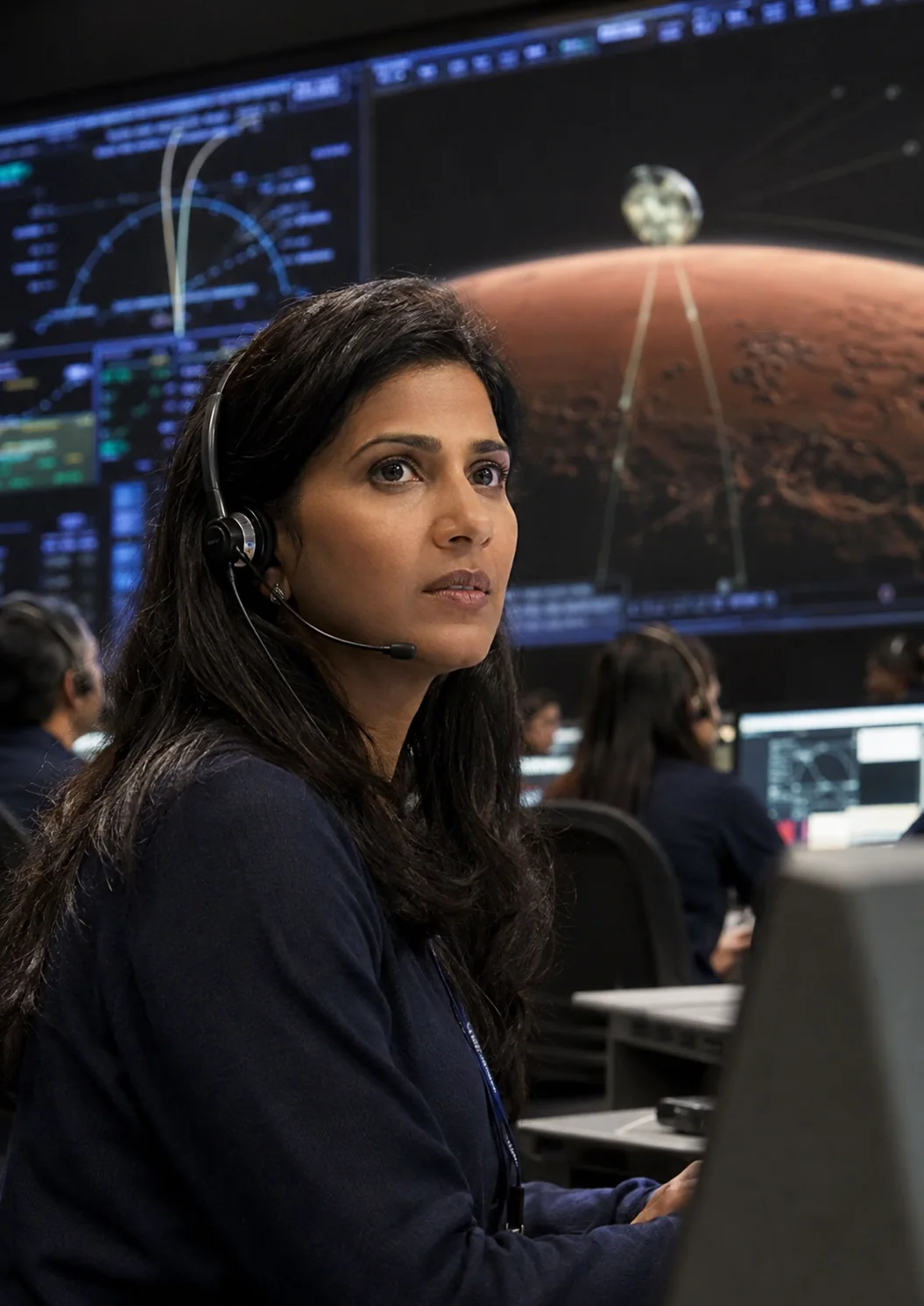
Hope’s ground segment: the Mars mission continues on Earth around the clock
The Emirates Mars Mission ground segment combines antenna networks, navigation, mission operations, science planning, a data centre and instrument-team facilities. MBRSC in Dubai and LASP in Colorado provide complementary and backup functions, with shared telemetry and archives. [institutional source]
A probe thus becomes a continuous service. Teams plan commands, verify spacecraft health, estimate trajectories, turn received bits into science products and preserve data for years. The mission visible to the public is the endpoint of a much larger digital and human infrastructure.
Behind ‘Hope’s ground segment: the Mars mission continues on Earth around the clock’, people and professions must be placed back into the decision chain.
Human Mars operations will further reduce the possibility of direct control from Earth. Experience with delay and deep-space planning is useful, but a settlement will have to move more decisions to local software and teams in order to survive without immediate instruction.
The least visible fragility is often human. Technology may be documented yet remain practically dependent on a few people who remember workarounds, past anomalies and the reasons behind a decision. Long programmes must organise succession, cross-training and retention of raw data or competence can disappear faster than hardware. Hope uses international infrastructure and expertise; this demonstrates partner integration rather than national ownership of a worldwide network comparable to NASA’s. That dependency should remain explicitly mapped.
2026-2028: extending Hope so competence does not end with the nominal mission
In February 2026, the UAE Space Agency extended Hope through 2028. By July it highlighted more than ten terabytes of open science data and new observations, including Deimos and interstellar object 3I/ATLAS, enabled by the continued health of the instruments. [institutional source]
An extension increases science value by adding Martian seasons and allowing transient phenomena to be separated from cycles. It also keeps operators active until MBR Explorer, avoiding the dissolution of a generation of specialists between major projects.
Behind ‘2026-2028: extending Hope so competence does not end with the nominal mission’, people and professions must be placed back into the decision chain.
A settlement would need this organisational permanence: teams could not be reconstructed at each launch window. Procedures and expertise would have to live as a continuous public or industrial service, with succession and regular exercises.
The main risk is hidden dependency: a capability looks national as long as the partner, supplier or foreign infrastructure remains available. Serious assessment therefore separates what the organisation can reproduce, what it can only operate and what it purchases as a service. This map does not diminish achievement; it shows where investment is needed to make the next generation more robust. Extending an ageing mission also involves trade-offs: antenna time, team cost, failure risk and marginal science value. Longevity is not free and should be judged against resources required by subsequent programmes.
2019: Hazzaa AlMansoori opens the human-spaceflight chapter
Hazzaa AlMansoori reached the ISS in September 2019 on the UAE’s first human space mission. The flight was short, but it forced the national programme into an international chain of selection, training, medicine, experiments, emergency procedures and coordination with Roscosmos and Station partners. [institutional source]
The durable benefit comes from people who return to Earth. An experienced astronaut can become instructor, office manager, technical counterpart and witness to procedures actually lived. The mission therefore produces human capital extending far beyond the days spent in orbit.
Behind ‘2019: Hazzaa AlMansoori opens the human-spaceflight chapter’, people and professions must be placed back into the decision chain.
For Mars, this first contact with human spaceflight is only a beginning. Long isolation, medical autonomy, maintenance without immediate rescue and decisions under radio delay still need to be learned, but ISS experience provides a concrete baseline from which to measure those gaps.
Another risk comes from showcase effects. Highly visible space programmes naturally attract political and corporate communication, but an announcement is not a qualification, a flight or operational experience. The chronology should therefore preserve three distinct states: proposed capability, capability in development and demonstrated capability. Mixing them creates an illusion of maturity that becomes dangerous when reasoning about Mars. The flight was achieved using foreign vehicles and infrastructure. It would therefore be incorrect to count it as autonomous Emirati human-transport capability; it demonstrates crew selection, preparation, science and operational integration.
Sultan AlNeyadi in 2023: six months and an EVA change the depth of experience
Sultan AlNeyadi spent about six months aboard the ISS during Expedition 69 and performed a 7-hour 1-minute spacewalk, presented as the first EVA by an Arab astronaut. MBRSC says he participated in more than two hundred experiments and studies with international and Emirati partners. [institutional source]
Six months requires living the system rather than visiting it: physical exercise, sleep, maintenance, time management, crew interactions and fatigue accumulate. An EVA adds suit operations, depressurisation, tool preparation and safety coordination with the ground.
Behind ‘Sultan AlNeyadi in 2023: six months and an EVA change the depth of experience’, people and professions must be placed back into the decision chain.
Mars will require far greater autonomy and different surface EVA, but this experience trains leaders who genuinely know orbital-habitat constraints and can help define later analogue and medical programmes.
Possible failure must remain part of the story. Mass, power, thermal and schedule margins are limited while teams work with incomplete information. A healthy organisation therefore does not promise the absence of error; it builds reviews, tests, redundancy and detection mechanisms able to prevent a local error from becoming mission loss. The ISS still protects its crew with frequent logistics and immediate terrestrial assistance. The mission should therefore not be described as a complete Mars analogue, but as an essential stage in human learning.
HERA: testing isolation and procedures without waiting for a Mars spacecraft
The UAE analogue programme has participated in NASA HERA campaigns. In 2024, Emirati crew members spent 45 days in the Johnson Space Center habitat and conducted experiments, including several proposed by national universities, on behaviour, physiology and operations. [institutional source]
A terrestrial analogue allows confinement, workload, simulated communications and procedures to be repeated at far lower cost than spaceflight. It also gives national researchers the opportunity to design protocols, analyse data and improve the next campaign.
Behind ‘HERA: testing isolation and procedures without waiting for a Mars spacecraft’, people and professions must be placed back into the decision chain.
For Mars, these tests are particularly useful for time organisation, ergonomics, cohesion and decision autonomy. They need to be combined with ISS, lunar missions and technology tests to form a chain of evidence rather than one demonstrator.
The least visible fragility is often human. Technology may be documented yet remain practically dependent on a few people who remember workarounds, past anomalies and the reasons behind a decision. Long programmes must organise succession, cross-training and retention of raw data or competence can disappear faster than hardware. HERA reproduces neither radiation, Martian gravity nor the real danger of failure far from Earth. Participants know help is nearby, so behavioural results must be interpreted within that limitation.
MBR Explorer: an asteroid mission that requires retaining a team for eight years
The Emirates Mission to the Asteroid Belt plans MBR Explorer, a journey of about five billion kilometres using gravity assists at Venus, Earth and Mars, followed by flybys of seven asteroids before rendezvous with 269 Justitia. Launch is planned for the first quarter of 2028. [institutional source]
The mission is far longer than Hope and imposes ageing, electric propulsion, power, navigation and knowledge-retention constraints over many years. In 2026, after critical design review, the programme entered hardware assembly, integration and testing.
Behind ‘MBR Explorer: an asteroid mission that requires retaining a team for eight years’, people and professions must be placed back into the decision chain.
For Mars, the gravity assist and long operations develop autonomy, deep-space navigation and team endurance. The most important benefit may be institutional: learning to manage a spacecraft whose original designers may change jobs before the mission ends.
The main risk is hidden dependency: a capability looks national as long as the partner, supplier or foreign infrastructure remains available. Serious assessment therefore separates what the organisation can reproduce, what it can only operate and what it purchases as a service. This map does not diminish achievement; it shows where investment is needed to make the next generation more robust. As of August 2026, most performance remains planned or under test. Flight is required before duration, precision and reliability objectives become demonstrated capabilities.
The Justitia lander: bringing local start-ups into surface hardware
The asteroid-belt mission plans a small lander for 269 Justitia. Its concept review involved experts, the science team and Emirati start-ups, creating a project in which young companies must meet the interfaces, reviews and qualification constraints of an interplanetary programme. [institutional source]
Landing on a small body is unlike Mars: extremely weak gravity makes rebound and escape possible, while anchoring and contact dynamics become critical. It is nevertheless an excellent school of autonomy and surface hardware for a still-young industrial sector.
Behind ‘The Justitia lander: bringing local start-ups into surface hardware’, people and professions must be placed back into the decision chain.
For a Mars settlement, the most transferable contribution is the emergence of suppliers able to deliver a qualified subsystem to a deep-space mission. A future surface economy will depend less on one prime contractor than on a network of disciplined smaller companies.
Another risk comes from showcase effects. Highly visible space programmes naturally attract political and corporate communication, but an announcement is not a qualification, a flight or operational experience. The chronology should therefore preserve three distinct states: proposed capability, capability in development and demonstrated capability. Mixing them creates an illusion of maturity that becomes dangerous when reasoning about Mars. The lander is still under development; no surface success should be attributed before flight. The difference between concept review, integrated hardware and successful mission must remain visible in the chronology.
A UAE deep-space ground station: reducing one dependency without pretending to cover the whole planet
UAE Space Agency publications have studied the value of a deep-space communications station on national territory for Emirati missions, cooperation and radio astronomy. The issue is strategic because Hope and future missions depend on antennas able to detect extremely weak signals millions of kilometres away. [institutional source]
Such a station requires radio-frequency systems, timing, calibration, local weather knowledge, maintenance and international scheduling. It does not replace a worldwide network: Earth’s rotation requires multiple longitudes for continuous spacecraft contact.
Behind ‘A UAE deep-space ground station: reducing one dependency without pretending to cover the whole planet’, people and professions must be placed back into the decision chain.
Mars would require orbital relays and multiple Earth stations, but owning part of the ground segment improves understanding, resilience and the ability to offer antenna time to partners. It is diplomatic infrastructure as much as technical infrastructure.
Possible failure must remain part of the story. Mass, power, thermal and schedule margins are limited while teams work with incomplete information. A healthy organisation therefore does not promise the absence of error; it builds reviews, tests, redundancy and detection mechanisms able to prevent a local error from becoming mission loss. The existence of studies does not mean a UAE network comparable with the DSN is already operational. The monograph should follow construction and real capabilities before changing that classification.
From symbol to economy: retaining skills between exploration missions
National strategies seek to connect exploration, satellite services, regulation, economic zones and training. The combination is essential to prevent a major mission from creating a brilliant team for five years and then losing it for lack of contracts between exploration windows. [institutional source]
Earth observation, telecommunications and commercial applications can provide regular industrial workload. They also force companies to serve real users, meet schedules and maintain operational systems rather than focus only on government-funded demonstrators.
Behind ‘From symbol to economy: retaining skills between exploration missions’, people and professions must be placed back into the decision chain.
A Mars settlement would need a similar maintenance and services economy. It could not live as a series of separate heroic expeditions; most work would be repetitive, logistical and invisible, exactly the kind of capability a terrestrial space market can train.
The least visible fragility is often human. Technology may be documented yet remain practically dependent on a few people who remember workarounds, past anomalies and the reasons behind a decision. Long programmes must organise succession, cross-training and retention of raw data or competence can disappear faster than hardware. Growth indicators should nevertheless be placed in the absolute size of the sector. High percentages from a small base do not yet mean industrial depth comparable with the largest space powers.
Mars 2117: using a century-long horizon without turning it into a false industrial deadline
Mars 2117 was announced in 2017 as a very long-term vision aimed at human settlement on Mars. Its main function is to give research, education and skills a direction across generations; it is not a complete industrial plan with launcher, habitat, budget and schedule already under contract. [institutional source]
The programme gains credibility when intermediate milestones produce observable capability: Hope science, astronaut experience, analogues, satellites and MBR Explorer. A century-long vision can survive changing technologies if it is built as a succession of verifiable learning steps.
Behind ‘Mars 2117: using a century-long horizon without turning it into a false industrial deadline’, people and professions must be placed back into the decision chain.
For Mars, the value of the long horizon is accepting that closed-loop life support, local industry, autonomous medicine and community governance remain open problems. Policy can fund work without pretending that the final architecture is known today.
The main risk is hidden dependency: a capability looks national as long as the partner, supplier or foreign infrastructure remains available. Serious assessment therefore separates what the organisation can reproduce, what it can only operate and what it purchases as a service. This map does not diminish achievement; it shows where investment is needed to make the next generation more robust. The date 2117 is neither a scientific forecast nor a public guarantee. It should remain presented as an official long-term vision whose achievement depends on decisions and technologies not yet known.
What the UAE can actually do for Mars in August 2026
The demonstrated capability map includes Hope and its Mars operations, atmospheric instruments, a data centre, a growing Earth-observation industry, trained astronauts and six-month ISS experience. It also includes institutional ability to launch and regulate programmes with many partners. [institutional source]
Capabilities under development include MBR Explorer, the Justitia lander, new satellites, lunar projects and maturation of a space economy. Major gaps remain: no national heavy launcher, crew spacecraft, Mars landing, autonomous habitat or demonstrated Martian ISRU chain.
Behind ‘What the UAE can actually do for Mars in August 2026’, people and professions must be placed back into the decision chain.
In a Mars coalition, the UAE could contribute atmospheric science, data, operations, funding, selected satellites and human research while purchasing transport and heavy infrastructure. Such specialisation can create real influence without reproducing every capability of a superpower.
Another risk comes from showcase effects. Highly visible space programmes naturally attract political and corporate communication, but an announcement is not a qualification, a flight or operational experience. The chronology should therefore preserve three distinct states: proposed capability, capability in development and demonstrated capability. Mixing them creates an illusion of maturity that becomes dangerous when reasoning about Mars. This picture should be updated after 2028 missions and future human or lunar programmes. A living page must regularly replace ambitions with demonstrated performance—or document failures—instead of freezing 2026 communications.
Hope in 2026: when a Mars mission becomes open scientific infrastructure
By July 2026, six years after Hope launched, the mission was no longer merely a navigation success celebrated in national ceremonies. The UAE Space Agency highlighted more than ten terabytes of open scientific data, a mission extended through 2028 and observations beyond the original plan, including Deimos and interstellar object 3I/ATLAS. The programme’s value therefore increasingly lies in what other researchers can reuse. [institutional source]
Open data requires a chain far less visible than the spacecraft itself: calibration, validation, metadata, archiving, instrument documentation, product versions and distribution mechanisms. Researchers who did not build the mission must understand uncertainties well enough not to mistake an instrumental artefact for a Martian phenomenon. Scientific maturity is therefore visible in the ability to keep a measurement intelligible long after acquisition.
Continuity also changes professional roles. Operators who learned to fly Hope become mentors for MBR Explorer; scientists who developed the first products become reviewers and teachers; universities can train students using genuine national data. The programme stops being an exceptional interlude and begins to create a community capable of preserving a common mission language from one project to the next.
The extension through 2028 has an institutional role as important as its scientific role. It avoids an abrupt gap between the end of a Mars orbiter and the build-up to the asteroid-belt mission. Keeping an operations centre active, procedures alive and specialists dealing with an ageing vehicle is a form of continuous training that a simulator cannot replace.
For a future human presence on Mars, open data becomes infrastructure alongside power and communications. New crews will need decades of climatology, dust, temperature and atmospheric-escape measurements to plan solar energy, surface activity and entry windows. A mission such as Hope therefore contributes more to Mars when its data remain understandable and accessible than when it merely accumulates national records.
Longevity should not become an automatic argument for endless extension. Antenna time, team cost, instrument ageing and new priorities must be traded. The sound decision is to continue while scientific, operational or training value justifies the resources, then close the mission properly while preserving its archive.
Primary and institutional sources
- MBRSC — About
- UAE Space Agency — National Space Strategy 2030
- UAE Space Agency — Mars 2117
- UAE Space Agency — Mars 2117/SDGs
- UAE Space Agency — Space Symposium 2026 / Hope extended to 2028
- UAE Space Agency — Emirates Mars Mission
- MBRSC — Emirates Mars Mission
- UAE Space Agency — History of UAE Space Sector
- UAE Space Agency — About the Agency
- UAE Space Agency — Achievements and national policy
- MBRSC — About
- MBRSC — MBZ-SAT launch
- MBRSC — Etihad-SAT launch
- UAE Space Agency — Emirates Mars Mission
- Emirates Mars Mission — Ground Segment
- UAE Space Agency — Hope Probe six-year update, 19 July 2026
- MBRSC — Missions and Projects / UAE Astronaut Programme
- MBRSC — About / UAE Analog Programme milestones
- UAE Space Agency — Emirates Mission to the Asteroid Belt
- UAE Space Agency — Deep Space Ground Station publication
- UAE National Space Strategy
External links open in a new tab.
Institutional reading: Hope as an accelerator of national scientific capability
Hope matters not only because it was the UAE’s first Mars mission, but because the program forces a young national space system to learn an entire chain: science formulation, development, interplanetary navigation, operations, calibration, data archiving and publication. International partnerships do not cancel that learning; they enable it only if knowledge actually reaches the teams that will operate the mission and prepare what follows. [institutional source]
The UAE trajectory therefore shows another way into Mars exploration. A country does not have to begin with a heavy launcher or an autonomous rover. A well-bounded science mission can act as a national-scale training project. The decisive question then becomes institutional: convert a visible success into routines, laboratories, careers and programs that can outlive the political and media cycle of a single mission. [institutional source]
The Emirati signature: using a Mars mission as an accelerator of capability
Hope acted as a scientific project but also as a mechanism for building capability. A national team had to learn how to formulate objectives, integrate a spacecraft, prepare interplanetary navigation, operate instruments and publish data inside an international environment. That chain matters more in the long term than the prestige of a first arrival. [institutional source]
For a future contribution to human exploration, the challenge is therefore continuity. A mission becomes a durable space policy only if it leaves behind careers, laboratories, procedures, partnerships and a generation able to prepare the next mission. The Emirati model is especially useful for understanding how a young programme can use Mars as an institutional accelerator. [institutional source]