

Inputs
- launchers and vehicles
- propulsion and power
- transit life support
- cargo manifest
- landing and return architecture
MARS BIBLE — TRANSPORT · FLEET · PROPULSION · LOGISTICS
Launch windows, cargo, crews, propulsion and fleet architecture
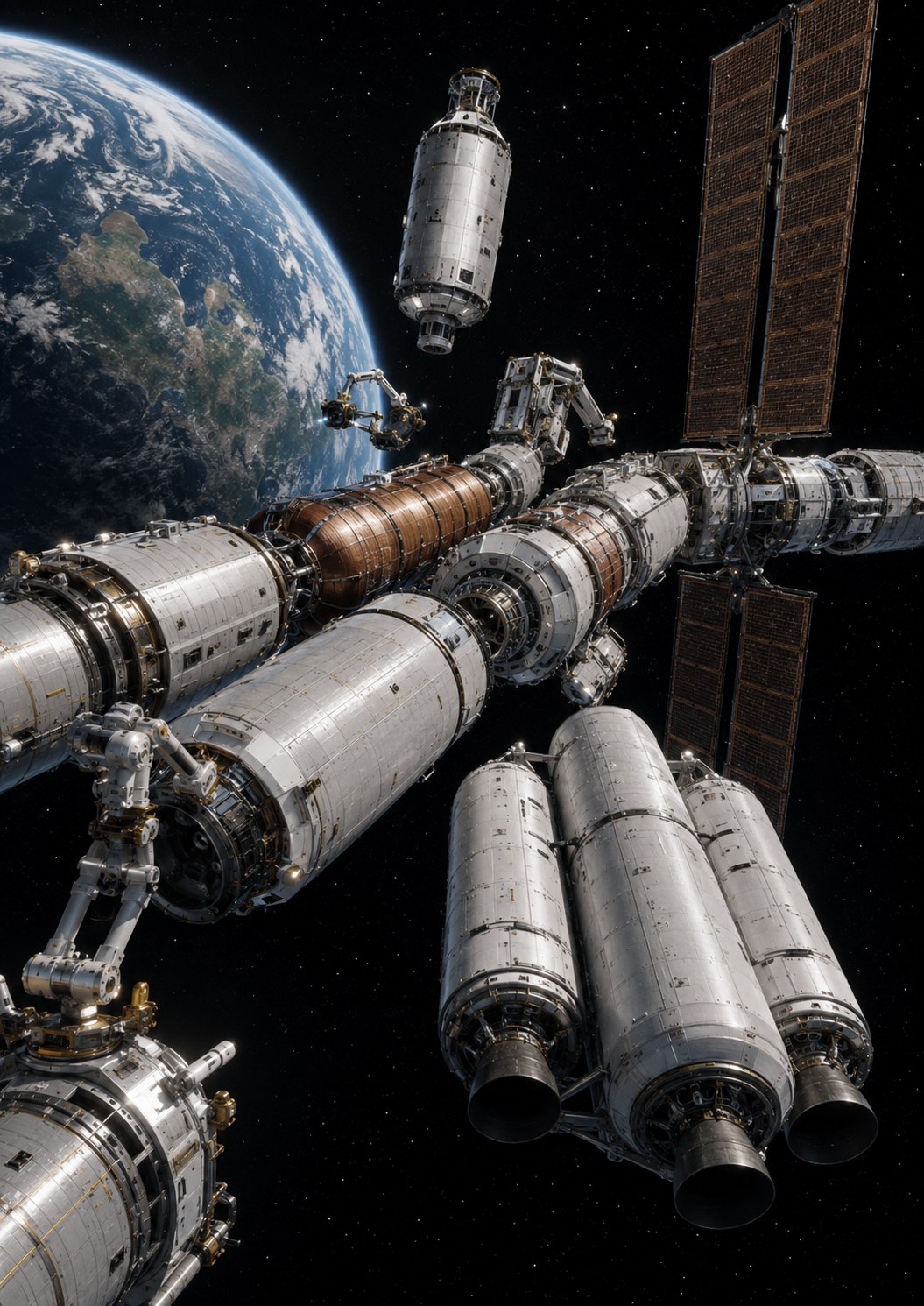
What is proven: robotic interplanetary transfers to Mars are routine and chemical/electric propulsion are established families; NASA currently studies multiple human Mars transportation options.
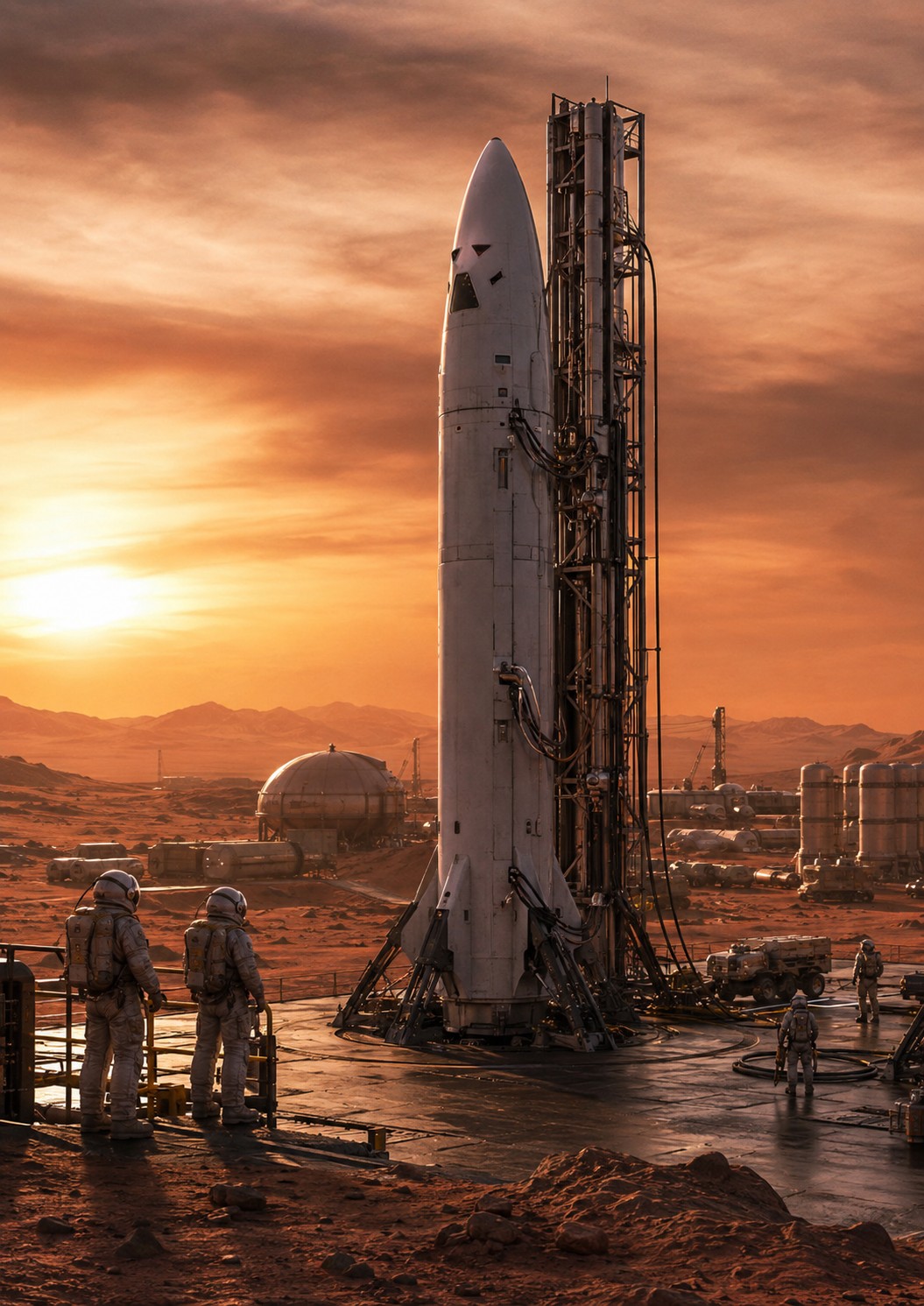
What remains to be demonstrated: no human Earth–Mars transport system has flown to Mars; propulsion, assembly, cadence and return choices remain open.
A settlement depends on what arrives before it. Habitats, power, robots, spares, contingency food, medical equipment and return systems must be manifested across multiple flights. Cargo does not need the same trajectory or redundancy as crew.
NASA’s current Mars Transportation work lists four propulsion families under consideration: nuclear thermal, hybrid nuclear electric/chemical, hybrid solar electric/chemical and all chemical. These are trade-space options with different maturity and risk, not one settled answer.
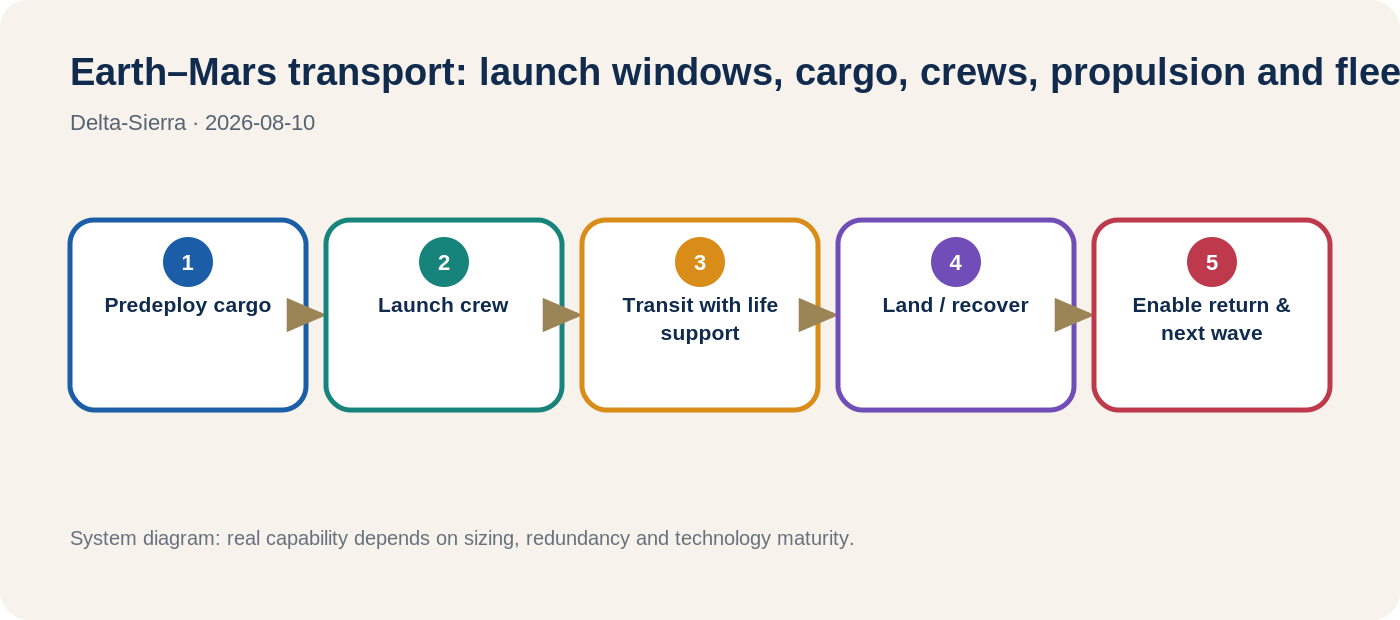
Sequence is the decisive issue. Before a crew depends on a habitat, power plant or reserve, those elements should be delivered, powered, tested and monitored long enough to expose early failures. Transport therefore becomes infrastructure rather than a succession of launches: each flight prepares the next, every cargo has a role in the campaign, and reserves must be sized against the next realistic replacement opportunity rather than only against nominal daily demand.
Cargo can accept longer transit if that reduces propellant or enables efficient electric propulsion. Crew accumulates radiation dose, consumables and confinement time, making duration a health and mass driver.
A settlement may use different cargo trajectories, but arrival dates must support installation sequence. Critical equipment should be landed, inspected and tested before crew departure from Earth.
Cargo and crew therefore buy different things with flight time. Cargo can tolerate delayed arrival, low thrust or an energy-optimized profile as long as it still supports the surface deployment sequence. For people, every additional day means more consumables, radiation exposure, life-support duty and confinement. A rational campaign may consequently use several trajectory families in one fleet instead of forcing every vehicle into the same transfer profile.
Earth–Mars geometry creates favorable launch opportunities roughly every 26 months, though exact trajectories vary. This cadence makes logistics mistakes slow to correct.
The settlement therefore needs inventory beyond the next nominal resupply. A launch or landing loss may not be quickly replaceable; critical stocks and local manufacturing compensate for calendar rigidity.
This calendar constraint changes the meaning of inventory. On Earth, a missing component may be replaced in hours or days; on the Earth–Mars route, replacing a heavy item can depend on the next launch campaign plus months of cruise. Operators therefore need to know not only how much stock remains but also time to consequence, local manufacturing lead time and the next realistic resupply date. Logistics becomes a direct safety function.
Chemical propulsion offers high thrust and broad operational heritage. Electric propulsion can save propellant but typically provides low thrust over long periods. Nuclear concepts pursue other time/mass trades but remain to be developed and qualified for human Mars missions.
The “best engine” depends on cargo, crew, orbital assembly, vehicle power, safety and return strategy. A fleet may use more than one propulsion family.
The relevant metric is not the peak performance of an isolated engine but the performance of the complete system. A concept may shorten transit while demanding more dry mass, electrical power, radiators or maintenance; another may be excellent for freight yet unattractive for a crewed vehicle. Serious comparison puts injected mass, delta-v, power, duration, maturity, abort options, thermal constraints and campaign effects on the same page.
A crew vehicle is also a temporary habitat: air, water, waste, food, exercise, medicine, sleep, communication and radiation refuge must work throughout transit. Longer trips increase maintenance and consumables-recovery demands.
Artificial gravity can be studied but should not be treated as available by default. Without it, crew reaches Mars after prolonged microgravity and must adapt to 0.38 g, tying transport to surface health.
The transfer vehicle is a temporary habitat in an environment where evacuation is impossible. Water, air, hygiene, waste, sleep, exercise, medicine, fire, leakage and radiation are one operational problem. Maintainability matters as much as nominal efficiency: an accessible filter, replaceable pump or isolatable loop may be worth more than a small theoretical performance gain during a mission lasting many months.
A vehicle that reaches Mars but cannot deliver payload to the surface does not build a city. Mass to orbit, mass to surface and mass recoverable at the site are different metrics.
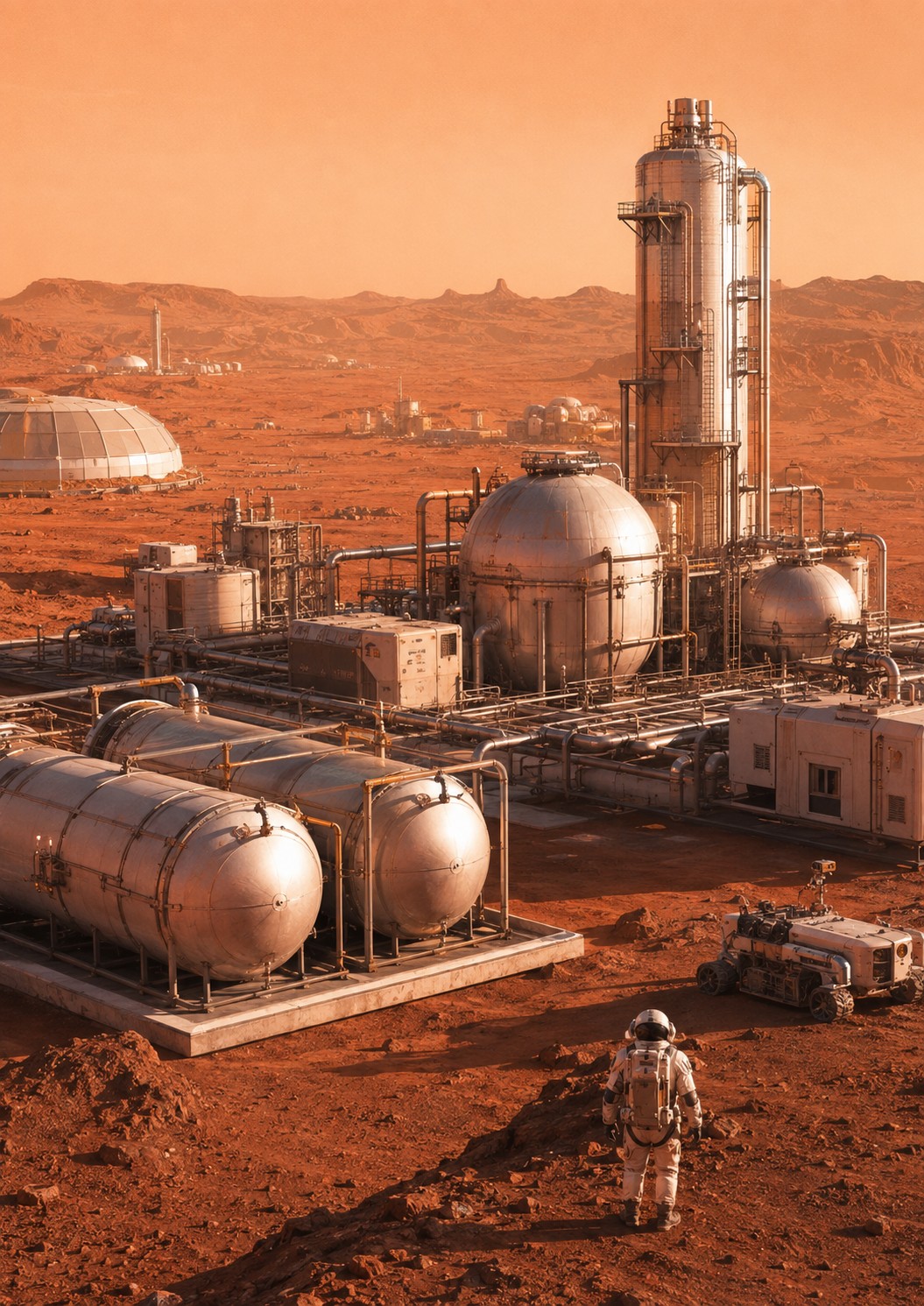
Architecture includes cargo interfaces, landing zones, recovery rovers, lifting equipment and storage. Standardized containers and connections reduce mission-by-mission adaptation.
Useful mass actually available on Mars is therefore more meaningful than mass merely dispatched toward the planet. Every kilogram must cross successive boundaries: launch, injection, cruise, arrival, entry, descent, landing, recovery and delivery to its point of use. An architecture that performs brilliantly to Mars orbit but cannot regularly place heavy cargo near the settlement has moved the bottleneck rather than solved it.
NASA notes that Mars ascent remains a major trade space and no orbital ascent has yet been attempted from Mars. An ascent vehicle can arrive fueled or depend partly on ISRU.
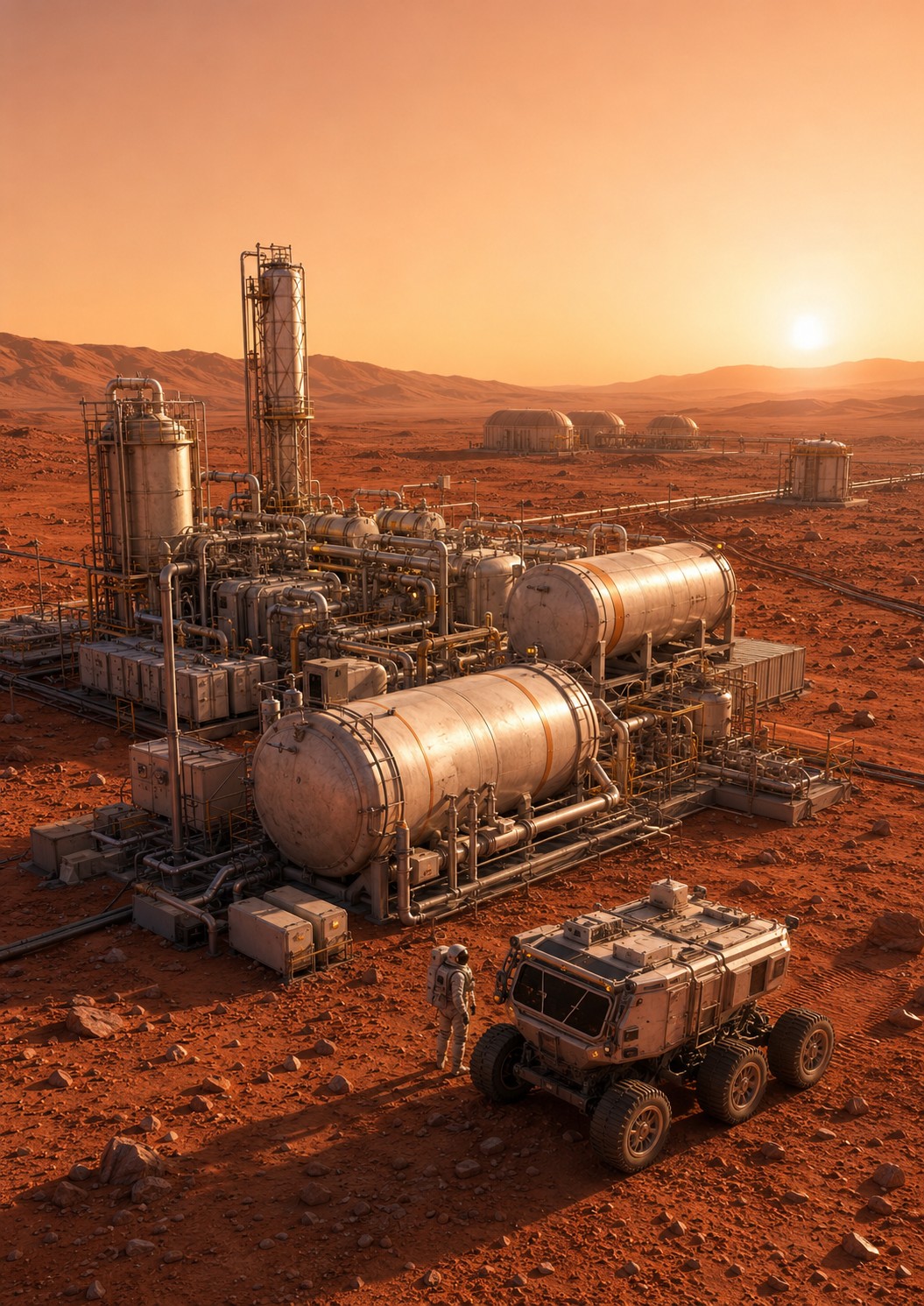
If local propellant is used, production, liquefaction and verified storage become mission gates. Settlement should not turn an unverified plant into a human dependency.
Return adds another discipline: ascent hardware, propellant, critical spares, departure windows and rendezvous capability must be closed before the crew is committed. If any part of that chain depends on resources made on Mars, measurable go/no-go criteria should prove production capability before Earth departure. Return is therefore not a final chapter added to the mission plan; it is part of the authorization to leave.
MARS BIBLE — THE JOURNEY DOES NOT END IN ORBIT
Transport: sending mass toward Mars is different from placing it intact at the right surface location. A transport architecture contains several successive problems: leave Earth, potentially refuel in orbit, navigate for months, perform trajectory corrections, enter the Martian atmosphere, slow down, land accurately, then make the vehicle or cargo useful on the surface. High performance in the first step does not guarantee success in the later ones.
The EDL barrier grows with mass. Techniques that delivered rover-scale payloads do not simply scale to human vehicles of many tens of tonnes. NASA high-mass EDL work treats supersonic retropropulsion as an enabling capability: engines begin powered deceleration while the vehicle is still moving supersonically.
Plume -surface interaction becomes infrastructure design. Large engines near the ground can erode regolith and throw particles toward the vehicle, facilities or nearby cargo. Landing zones, prepared surfaces and separation from habitats therefore have to be designed with the vehicle rather than improvised after arrival.
Separate agency architecture from company ambition. NASA develops an evolving Moon to Mars architecture; SpaceX presents Starship as a Mars-capable system and publishes its own capacity and schedule ambitions. Both are useful primary sources, but they have different evidentiary status: a company plan is not a Mars-demonstrated capability.
Primary and technical sources used for this deep dive: NASA NTRS — Human Mars Entry, Descent, and Landing Architecture Study Overview · NASA — Moon to Mars architecture ↗ · SpaceX — Mars plan ↗
The voyage is not a line between two planets. On a classroom diagram, going to Mars looks like an arrow. In mission architecture, that arrow does not exist. A mass must first climb out of Earth’s gravity well, possibly be assembled or refueled in orbit, depart inside a limited interplanetary opportunity, preserve power, attitude, thermal control, communications and human life for months, then arrive with a velocity that must still be canceled, redirected or converted into aerodynamic heat. Earth–Mars transportation is therefore less a single vehicle than a logistics chain in which every link changes the others. A tonne added to a radiation shelter can demand more structure, more propellant, a larger tank and ultimately several extra tonnes at launch. Conversely, a kilogram produced at destination may avoid carrying several kilograms through the entire chain. This propagation of design choices is why two architectures using the same launcher can have radically different mass, risk and cost.
NASA reference studies are valuable because they impose a common language for comparing scenarios, but they should be read for what they are: reference architectures and trade spaces, not a prophecy of a mission already selected. Current Moon to Mars documentation separates transportation, habitation, logistics, power, communications and resource utilization into coupled sub-architectures. The sound sequence is therefore to ask what function must be performed, with what margin and at what maturity level, and only then ask which vehicle can perform it. This discipline avoids a classic exploration trap: starting from an attractive rocket and forcing the entire mission to fit its dimensions and performance.
Settlement adds a problem that a one-off expedition can postpone: repetition. An architecture that works once at exceptional cost is not yet an interplanetary transportation route. Departures must be repeatable every opportunity, launch delays must be absorbed, a lost cargo flight must be replaceable, spares must be staged for years, crew and freight priorities must be managed, and a single unavailable Earth-made component must not be allowed to immobilize the colony. The question is no longer merely ‘can we reach Mars?’ but ‘can we maintain a service that survives several failures without stopping base growth?’ That is the difference between a heroic demonstration and infrastructure.
Cargo before crew: pre-position survival. For a first settlement, cargo is not a companion to the crew; it is life insurance deposited months or years earlier. A robust logic sends surface power, communications, consumables, spares, mobility, perhaps oxygen or propellant production, and at least some emergency habitation before people commit to the voyage. The scenario can then be tested before a human return depends on it. Instruments can measure actual production, dust effects, temperature, leakage, battery health and water availability. If an essential system does not reach its threshold, the crewed mission can be postponed instead of turned into a wager. This pre-positioning philosophy has long appeared in NASA Mars studies and in resource-utilization architectures; it becomes even more important for a settlement that must grow in waves.
Cargo and crew do not necessarily share the same optimal trajectory. An uncrewed container can accept a longer flight, more radiation exposure and different thermal constraints if that lowers departure energy or propellant mass. A crew, by contrast, pays for every month of transit in food, water, oxygen, habitat mass, maintenance and exposure to deep space. This is why low-energy freight transfers and faster crew transfers should be compared rather than assuming one solution suits every payload. The industrial consequence is significant: a future ‘Mars port’ could receive cargo on a different cadence from passenger vehicles, just as terrestrial ports distinguish bulk carriers, container ships and ferries.
Pre-positioning does not mean piling tonnes at random. Every item must arrive at a usable location, match power and data interfaces, survive Martian storage, remain inspectable, and stay reachable even if another lander misses its intended zone. Logistics must therefore be designed together with navigation and EDL. A power plant fifteen kilometers from the habitat can be technically healthy yet operationally useless if no vehicle can move it or connect it. Landing precision, surface mobility and standardized interfaces become transportation-system performance metrics, not details that begin after the voyage.
Compare propulsion without promising miracles. Chemical propulsion is today the mature reference for high thrust. It can accelerate a vehicle quickly, which matters during departures and captures where burn duration matters. Its handicap is the Tsiolkovsky rocket equation: as required Δv rises, mass ratio grows exponentially. For a teaching example, consider an ideal stage asked to provide 3.6 km/s. At 370 s specific impulse, initial-to-final mass ratio is about 2.70; roughly 63% of initial mass would therefore be propellant before real-vehicle margins and complications are added. At 450 s the ratio falls to about 2.26; at 900 s, about 1.50. The calculation does not select a technology. It shows why a few hundred seconds of Isp can fundamentally reshape an architecture.
The list is useful because it shows that there is no simple contest between ‘chemical’ and ‘nuclear.’ Electric propulsion can deliver excellent propellant efficiency at low thrust and may be attractive for cargo or pre-positioning if long thrust arcs and transit times are acceptable. Nuclear thermal propulsion aims for high thrust with specific impulse above conventional chemical engines, but introduces reactor, fuel, testing, safety and hydrogen-storage challenges. Hybrid architectures exist precisely to assign each technology to the phase where it offers the strongest advantage.
Engine performance must also be separated from system performance. A highly efficient engine fed by a propellant that cannot be stored for a year may produce a less robust architecture than a less glamorous engine. NASA continues to emphasize the difficulty of long-duration cryogenic storage and transfer in microgravity: heat leak causes vaporization, tank self-pressurization and potentially venting. Zero-boil-off work seeks to remove that heat actively. For Mars, cryogenic management can therefore be as important as the combustion chamber. The ‘best engine’ does not exist independently of tanks, cryocoolers, electrical power, mission duration and refueling capability.
A worked mass budget: why margins compound. A serious mass budget starts with what must actually be delivered: crew, habitat, consumables, spares, science payload, surface systems or return hardware. Structure, tanks, propulsion, thermal control, communications, power, avionics and margin are then added. Propellant mass depends on Δv and Isp and therefore on final mass itself. This is a loop, not a linear sum. As a teaching example only, suppose a vehicle has a 100 t mass after an ideal 3.6 km/s maneuver. At Isp = 370 s and mass ratio 2.70, it would have needed about 270 t before the maneuver, or 170 t of propellant. If a change raises final mass from 100 to 110 t while everything else remains idealized, initial mass rises to roughly 297 t: 10 t added at the end produces about 27 t at the beginning of that single stage.
This compounding explains the attraction of depots and orbital refueling. Instead of launching from Earth with every mission burn already fueled, vehicle and propellant can be separated, multiple tankers launched, and departure delayed until tanks are filled. No physical law disappears: all propellant tonnes still have to be launched and transferred. But the interplanetary vehicle is decoupled from the instantaneous performance of a single launcher and reuse can become possible. The cost is operational: rendezvous, docking, fluid transfer, bubble and ullage management, thermal control, launch scheduling and the ability to cope with a delayed tanker. A simple drawing becomes a complex campaign.
A settlement must finally reason in average flow, not merely mass per departure. If a wave of 100 people requires several hundred tonnes of imported freight during its early years, the problem becomes the number of launches and landings per window, storage before solar conjunction, surface-vehicle availability and reserve after the loss of a cargo ship. A system becomes resilient when it has redundancy, margin and alternatives, not when its statistical average is exactly sufficient. In that sense, a carefully selected tonne of reserve inventory may be worth more than a tonne of prestigious payload.
What is demonstrated, studied or still to be invented. The cleanest way to avoid misleading futurism is to label maturity. Orbital launch, rendezvous, docking, months-long missions, robotic interplanetary navigation, trajectory correction, Mars orbit insertion and Earth re-entry all have substantial precedent. Large-scale orbital transfer of cryogenic propellants, operational nuclear-thermal propulsion for a Mars crew, multi-year autonomous habitation beyond the magnetosphere, and high-cadence reusable interplanetary transport are not routine capabilities today. Some have demonstrators or maturation programs; others remain architecture studies. The distinction does not dismiss the concepts. It identifies the remaining work.
Industrial goals must likewise be separated from demonstrated data. SpaceX presents Starship as the core of an ambition for a self-sustaining city and publishes very large cadence and mass goals. Those statements matter because they change the scenario space: an architecture assuming tens or hundreds of tonnes per flight is no longer framed as it was in 1990. But an announced capability, a capability tested in terrestrial flight, one placed in orbit, one refueled in orbit, one that survives Mars transit, and one that lands on Mars are six different maturity levels. A technical reference must discuss all of them without collapsing them into one claim.
For the reader, this maturity framework turns the page into a decision tool. It shows what a program could procure or test now, what needs an orbital demonstrator, what should wait for robotic Mars flights, and what remains a political or industrial choice. Earth–Mars transportation stops being a collection of imaginary rockets and becomes a sequence of evidence to be obtained, each test retiring risk before a crew depends on the system.
From expedition architecture to a repeatable transportation economy. A transportation architecture becomes strategically different when it is sized for a settlement rather than a single expedition. The first expedition can tolerate bespoke hardware, exceptional staffing and a logistics chain optimized around one launch opportunity. A settlement cannot. It needs standardized interfaces, predictable loading plans, scheduled tanker operations, compatible cargo containers, repairable vehicles and enough reserve to survive a missed or lost shipment. The campaign therefore begins to resemble an industrial network. Earth departure, transit, Mars arrival and surface handling must share mass accounting and configuration control. A change in container dimensions can propagate into payload bay geometry, unloading equipment, landing-zone clearance and warehouse design. Repetition turns what looked like spacecraft design into supply-chain engineering.
The same shift changes how cost should be discussed. Cost per launch is only one term. A settlement cares about cost per kilogram delivered intact to the required place and time, including tankers, failed missions, inventory held in reserve, maintenance, launch-site operations, recovery and the opportunity cost of missing a window. A reusable vehicle that requires a long refurbishment bottleneck can have excellent nominal performance and poor campaign throughput. Conversely, an apparently less efficient architecture may be strategically superior if it can fly predictably, tolerate a vehicle loss and use multiple suppliers. This is why the transport problem should be evaluated with fleet availability, dispatch reliability and delivered-mass statistics rather than vehicle brochure figures alone.
Finally, return capability must be designed into the outbound chain. Crew rescue, samples, failed hardware, reusable vehicles and future trade all create flows from Mars toward Earth. Even a settlement that aims for increasing self-sufficiency benefits from a transportation system that can move people and selected goods in both directions. Return propellant, ascent vehicles, orbital rendezvous and Earth-entry hardware therefore belong in the architecture from the beginning. A one-way cargo route can start a base; a durable interplanetary economy eventually needs a network.
Orbital cryogenic refueling: what is demonstrated in 2026, and what is not yet. Orbital refueling is often drawn as though the only difficulty were bringing two spacecraft together. Cryogenic propellants make that picture incomplete. A mission must store an ultra-cold liquid for days or months, know how much fluid is really inside a tank in microgravity, control pressure and temperature, connect two systems, start flow without unacceptable gas ingestion, transfer substantial mass and then disconnect without leakage. Every verb in that sentence is a technology and a control sequence.
An important milestone occurred on Starship’s third flight in March 2024: NASA technical material describes transfer of thousands of pounds of cryogenic propellant between internal tanks of the same vehicle. That demonstration must not be confused with refueling between two independent spacecraft. In June 2026 NASA still stated explicitly that in-orbit cryogenic refueling between two spacecraft had not yet been done. The maturity ladder is therefore: internal transfer demonstrated in flight; rendezvous interfaces and cryocouplers under development; large-scale vehicle-to-vehicle cryogenic transfer still to be demonstrated.
NASA is also pursuing LOXSAT, the Liquid Oxygen Flight Demonstration developed with Eta Space and integrated with a Rocket Lab Photon spacecraft. NASA’s May 2026 description planned a roughly nine-month mission demonstrating eleven cryogenic-fluid-management technologies. As of 14 August 2026, Rocket Lab still listed LOXSAT among upcoming 2026 missions without a firm public launch date. It would therefore be wrong to describe LOXSAT as having already validated an operational depot. Its purpose is to mature storage, gauging, pressure control and liquid-oxygen transfer in orbit.
For Mars architecture, this distinction changes fleet reliability. If a heavy departure vehicle requires several refueling events before trans-Mars injection, mission success depends not only on the launcher and spacecraft but also on tanker availability, rendezvous success, propellant retention, departure-window timing and the ability to detect leakage or incomplete transfer. The correct model is a probabilistic logistics chain rather than a single box labeled refuel.
Boil-off creates a time penalty. Tanks receive heat through radiation, structural conduction and equipment; part of the liquid may vaporize unless that heat is managed. Insulation, sun shields, vehicle attitude, active cooling and pressure control can reduce loss but add mass, power demand and failure modes. Zero-boil-off is an active thermal-management objective in some designs, not an automatic property of a space tank.
Evidence levels should therefore be tracked separately. Cryogenic-fluid handling and many subsystems have extensive heritage; significant internal cryogenic transfer has been demonstrated in flight on Starship; NASA is developing and testing cryocouplers and LOXSAT; but automated, repeatable, large-scale cryogenic refueling between two distinct vehicles at the scale implied by a Mars fleet remains a capability to qualify. This distinction should be updated as public demonstrations occur.
DELTA-SIERRA / ARCADIA PROSPECTIVE ARCHITECTURE
Move from “the spacecraft” to a repeatable transport chain. Arcadia treats settlement as waves of precursors, cargo, crews, return and growth. This is prospective architecture and must be recalibrated to the vehicles, propulsion and standards actually available when a mission is chosen.
Status: architecture proposal, not evidence of an existing capability.
Explore ArcadiaGo further in the books. The Mars Bible remains a self-contained public resource. For a complete city architecture and its narrative counterpart, three complementary reading paths are available.
NASA’s 2026 Moon to Mars material discusses several propulsion families in the Mars transportation trade space: all-chemical, nuclear thermal, and hybrid concepts combining nuclear-electric or solar-electric propulsion with chemical stages. The list is a trade space, not an announcement of a selected crew vehicle. Architecture has to compare transit time, injected mass, orbital assembly, propellant storage, electrical and thermal demand, reliability, operations, and recovery from failures.
The engine with the best propulsive efficiency may require a major power plant, radiators, and a long thrusting phase. A chemical architecture may be more straightforward while demanding a high propellant fraction and large tanks. Nuclear thermal concepts can shift time and mass trades but introduce different safety and integration constraints. Comparing specific impulse alone therefore ignores much of the spacecraft.
The useful unit of comparison is often the complete campaign: how many Earth launches, how many assembly events, which masses are prepositioned, which critical operations remain after crew boarding, and what happens when an element is late? An architecture that looks better in an isolated performance table can be less robust if it depends on a long chain of rendezvous with little schedule margin.
Cargo does not share every crew constraint. It may accept a longer transfer, different acceleration, or less comfort-related redundancy. Prepositioning habitats, consumables, and equipment before crew departure reduces what the inhabited vehicle must carry, but creates a confirmation requirement: the mission needs evidence that critical equipment arrived and works before committing people.
This separation creates a fleet architecture. Cargo vehicles can depart in several opportunities, crewed vehicles on another cadence, and some elements may be reused in space. Synchronization of inventories and capabilities becomes a system problem. A habitat that arrives without one critical interface part, or a propellant cache below its required inventory, can cancel a mission even when every major vehicle is present.
A food example shows the coupling with transit time. Suppose a crew of four uses an average 0.75 kg of dry food per person per day. For 240 days, gross dry food is 4 × 0.75 × 240 = 720 kg before packaging, reserve, and losses. For 180 days it is 540 kg. Saving sixty days removes 180 kg of dry food in this simplified example, but the mass and complexity required to shorten the trip must be compared with that saving.
High propulsion performance is useful only if propellant is still available when the maneuver occurs. Cryogenic propellants introduce insulation, pressure management, possible active cooling, and boil-off control. Storable propellants bring different toxicity, materials, and performance issues. Architecture should therefore state how long each fluid must be retained and which losses are acceptable.
A loss rate of 0.05% per day may look small. Over 200 days, a linear approximation already suggests 10% of the initial inventory; a precise exponential calculation would differ slightly. The point is not to prescribe that rate, which depends entirely on technology. It is to show how a small daily loss becomes a campaign issue over months. Propellant accounting must connect loss rate, duration, maneuver margin, and abort reserve.
Orbital refueling can move rather than eliminate the problem. It reduces the mass that one launch must deliver but adds rendezvous, fluid transfer, interfaces, quantity measurement, and schedule risk. The real trade is not simply “refuel or not”; it depends on the number of transfers, their maturity, the ability to repeat a failed operation, and the consequence of losing one delivery.
Earth–Mars opportunities do not behave like daily airline departures. A major delay can cost months or force a wait for the next favorable window. Campaign design therefore needs to determine which elements can wait, which consumables age, how crews are supported, and which orbital infrastructure can remain safe during a long hold.
The schedule needs decision margin. If a critical cargo vehicle stops responding, the crewed mission may need a go/no-go point weeks before its own launch. If a correction maneuver consumes extra propellant, planners need to know which reserve protects arrival, abort, or return. Schedule margin without resource margin is not real margin.
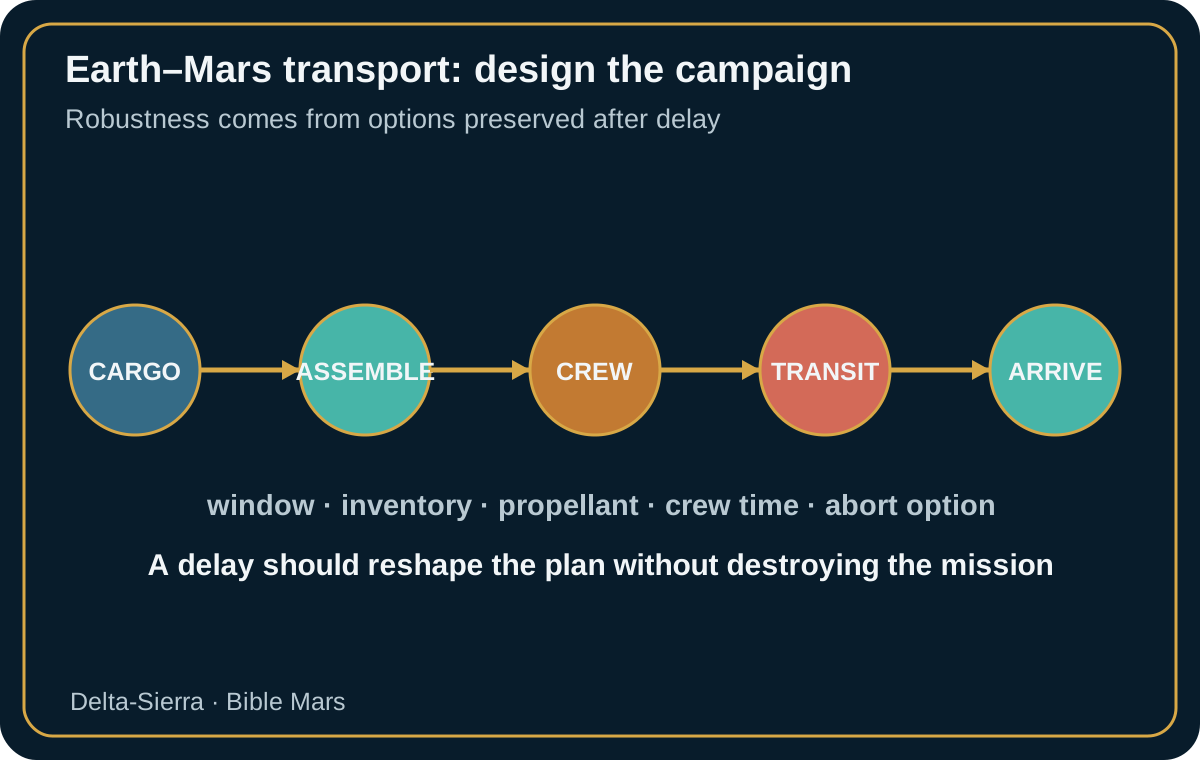
Robustness can be understood as the number of options left after a failure. A campaign with only one valid sequence — A then B then C — is fragile. A campaign where B can be delayed, a second cargo vehicle carries part of the critical stock, and the crewed vehicle retains an early-return option has more recovery paths even when it costs additional mass.
Transportation is not only propulsion. For months the vehicle must feed, protect, occupy, and treat its crew, store spares, support maintenance, and manage waste. A propulsion mass saving that makes the habitat too small or inaccessible can harm mission performance. Design therefore couples transit time, habitable volume, radiation, logistics, maintenance, and human performance.
Repairability is a major difference from an uncrewed probe. Crew can replace a module, reconfigure a circuit, or fabricate a simple part if the vehicle was designed for intervention. That capability may justify less hardware duplication in some areas, but more access, instrumentation, tools, and spares. Mass shifts from duplicated units toward maintenance capability.
Mars transportation therefore becomes a campaign of services: propel, guide, inhabit, cool, power, repair, communicate, and preserve options. Propulsion remains fundamental, but it is only one function that has to remain true throughout the journey.
A sustainable Earth–Mars transport system is measured by how much useful mass and how many people it can deliver over repeated windows while surviving missed launches, vehicle maintenance and surface delays. Cargo sent one opportunity earlier can reduce crew risk, but it also creates storage and reliability requirements on Mars. Reusing a transport stage may reduce manufacturing demand while increasing inspection and turnaround constraints. The fleet therefore needs a cadence model: vehicles available, launch slots, propellant, transfer duration, landing capacity and reserve hardware. One successful voyage demonstrates a trajectory; a settlement requires a transport service that can recover from a bad window without losing the surface system it is meant to support.
Launching more cargo is useful only if Mars can receive, unload, store and maintain it. Landing pads, cranes, power connections, propellant handling and protected storage therefore belong to transport throughput. A campaign can be launch-rich but surface-constrained. Planning should match orbital and interplanetary cadence to the rate at which the settlement can safely absorb arriving vehicles and payloads.
A credible Mars campaign should survive bad news before the crew even departs. Imagine a cargo vehicle carrying spares, food, and one surface subsystem is delayed long enough to miss its launch opportunity. The crew vehicle is nearly ready. The decision should not collapse into “launch or cancel”; architecture should reveal what can be redistributed, what can wait, and what makes the mission impossible.
The first step is to classify cargo by function. Some spares may already exist on a second vehicle; some food can be added to the crew vehicle; a science payload may be dropped; a single nonredundant survival component may instead become a stop condition. This analysis needs inventory by function and criticality, not merely total mass.
Suppose the missing cargo carries 1,200 kg of items of which 450 kg are required before crew arrival. The crew vehicle has only 180 kg of payload margin and a second cargo can accept 140 kg. The remaining shortfall is 450 − 180 − 140 = 130 kg. That deficit is small compared with total mission mass, yet if it represents one unique function it can still prevent departure.
The campaign can then examine options: a small catch-up vehicle if geometry permits, a lighter substitute, use of equipment already at Mars, or postponing crew departure. Each answer changes cost, risk, and schedule. Architecture preserves these options when interfaces are standardized and critical functions are not all concentrated in one shipment.
Delay also exposes ground-side dependencies. Food ages, stored batteries need maintenance, some propellants require management, and human teams change. A wait of several months is not free. Campaign design therefore includes a safe storage configuration and revalidation criteria before the next attempt.
The broader lesson is that transportation robustness is measured as much by replanning options as by delta-v. A campaign that can absorb loss of one cargo without improvising from zero begins to resemble interplanetary infrastructure rather than a single expedition.
DEEP DIVE — TRAJECTORIES AND WINDOWS
From fleet design to orbital calendar: transport is also a rendezvous problem. Fleet architecture cannot be evaluated only in tonnes and engines. Orbital mechanics imposes departure dates, injection states, cruise corrections and arrival targeting. Favorable Earth–Mars geometry recurs on a synodic rhythm near 780 days, coupling logistics, inventory and contingency endurance.
A teaching calculation. In a simplified solar Hohmann model, Earth = 1 AU and Mars ≈1.524 AU. Transfer semi-major axis =1.262 AU; full ellipse period ≈1.418 yr; half-transfer ≈259 days; simplified Mars lead angle ≈44°. Operational trajectories use precise ephemerides and optimization.
Corrections are normal operations. Post-launch tracking updates the state estimate and supports trajectory correction maneuvers. Human-scale logistics must treat navigation delta-v, tracking coverage, sensor redundancy and correction capability as normal resources.
Better logistics metrics. A mature line should measure injected mass, arrived mass, usable delivered mass, landing dispersion, cargo recovery, handling availability, damage rate, commissioning time and survival after a missed launch opportunity.
Earth–Mars transportation is often reduced to propulsion. That is misleading. A real architecture places Earth launch, possible assembly, fueling, trans-Mars departure, transit habitation, trajectory corrections, Mars arrival, EDL or capture, and eventual return or refurbishment on the same timeline. The “best engine” has meaning only inside that chain.
NASA’s 2026 Mars trade space still discusses several in-space propulsion families, including chemical, nuclear thermal, hybrid nuclear-electric/chemical and hybrid solar-electric/chemical approaches. Being in a trade study is not the same as being selected for flight. Each family shifts risk differently among transit time, propellant mass, power-system mass, heat rejection, operational complexity and technology maturity.
Separating cargo and crew is one of the strongest architectural levers. Uncrewed cargo can accept a longer flight if that reduces propellant or enables efficient low-thrust transport. Crewed transport pays for every month through food, water, consumables, maintenance, radiation exposure and human time. Different propulsion and staging approaches for people and tonnes can therefore be rational rather than inelegant.
A shorter flight can reduce total exposure to some hazards but usually requires more energy or higher propulsion performance. A longer flight can ease other constraints while increasing the duration for which life support, equipment and stores must remain reliable. The optimum is not monotonic: saving thirty days can matter if it removes a large logistics burden, but not if it requires an enormous growth in propulsion and thermal systems.
Consider only food order of magnitude. At 2.2 kg of food plus packaging per person per day, four people for 220 days represent about 1,936 kg. Over 300 days the same assumption produces 2,640 kg, 704 kg more before margin and before any time effect on water, spares or maintenance. The numbers are illustrative; they show that flight duration is a mass variable even while the main engine is off.
Time is also a medical and behavioral variable, but this transport book keeps the systems boundary clear: any propulsion architecture must reserve the volume, power, stores and repair capability required by its actual transit duration, not by an abstract average.
For an ideal propulsive maneuver, Tsiolkovsky’s equation is Δv = Isp·g₀·ln(m₀/m₁). Δv is velocity change, Isp is specific impulse in seconds, g₀ is standard Earth gravity at about 9.80665 m/s², m₀ is mass before the burn and m₁ mass after propellant is consumed. The natural logarithm means that additional delta-v drives an increasingly severe mass ratio.
For example, with Isp = 450 s and Δv = 3,600 m/s, m₀/m₁ = exp(3,600 / (450 × 9.80665)) ≈ 2.26. If dry mass, payload and reserves after the burn total 50 t, this idealized single-maneuver relationship implies about 113 t before the burn. It is not a mission design: losses, stages, reserves, boil-off and other maneuvers are omitted. It simply shows the exponential nature of the problem.
This is why architecture studies consider staging, prepositioning, higher-Isp propulsion and distributed maneuvers. High Isp alone does not declare a winner. Thrust, power-system mass, operating time, reliability and heat rejection can move the optimum elsewhere.
A Mars vehicle may launch as one element or be assembled from several. Orbital assembly reduces dependence on one launch but creates rendezvous, interfaces, post-assembly verification and schedule risk. If one element arrives late, an entire Mars opportunity can be threatened. Transportation architecture therefore begins before the interplanetary burn.
Cryogenic refueling, when considered, adds storage, transfer, measurement and thermal management. Technology demonstration, active development and operational capability must be kept distinct. Boil-off, cooling power and connection repeatability can all become architectural variables. A paper design still has to prove that the operation can be repeated on a real campaign schedule.
Launch windows turn these operations into a critical path. A few days of rendezvous margin can look generous in Earth orbit yet become unacceptable near the end of a Mars departure window. The architecture needs decision points: when is assembly abandoned to preserve another opportunity? Which element can wait for the next cycle? Which cargo must depart before the crew?
A crewed mission should not discover after landing that a supposedly available resource is missing. Prepositioning habitats, stores, backup power or mobility turns cargo into operational evidence. The strongest architecture is not necessarily the one that sends the first people earliest; it is the one that reduces how many unproven assumptions remain simultaneous when they arrive.
Prepositioning creates a new requirement: assets must survive alone. Cargo arriving twenty months before the crew must manage thermal conditions, power, dust, communications, self-diagnostics and perhaps robotic maintenance. Transport and reliability meet here. Cargo is useful only if the promised function still exists when people arrive.
A durable settlement cannot depend on one exceptional departure. It needs crew and cargo waves over multiple opportunities. Repetition changes the criteria: vehicle reuse, interface standards, ground-team availability, stage production, propellant storage, launch-site capacity and resilience to a lost launch.
Imagine a campaign delivering 600 t of useful cargo every 26 months using ten 60 t cargo vehicles. Losing one removes 10% of nominal capacity. If cargos are highly specialized — one for power, one for food, one for habitat — functional loss can be much greater than 10%. A fleet architecture should distribute critical functions or provide substitution so one failure does not cancel the campaign.
Cadence also creates a learning loop. Later waves can incorporate anomalies from earlier vehicles, but evolution must remain compatible with equipment and spares already on Mars. A fleet therefore becomes a long-term configuration program, not merely a sequence of trajectories.
2026 references: NASA Moon to Mars Architecture White Papers, including Mars Transportation, the Mars Architecture Trade Space, and Architecture Components. The propulsion families named here are trade-space options, not declared flight selections. Mass and cadence examples are explicit Delta-Sierra engineering scenarios.
Tsiolkovsky gives Δv = I_sp g₀ ln(m₀/m_f). For Δv = 4,000 m/s and I_sp = 450 s, m₀/m_f = exp[4,000/(450×9.80665)] ≈ 2.48. I_sp is specific impulse, g₀ standard gravity, m₀ initial mass and m_f final mass.
Every kilogram of spare parts or water crosses several segments; cargo missing a window may wait nearly a synodic period. Surface autonomy is therefore part of transport architecture.
Review follows mass, Δv, vehicle availability, windows and surface demand across several campaigns, including a missed launch or delayed arrival.
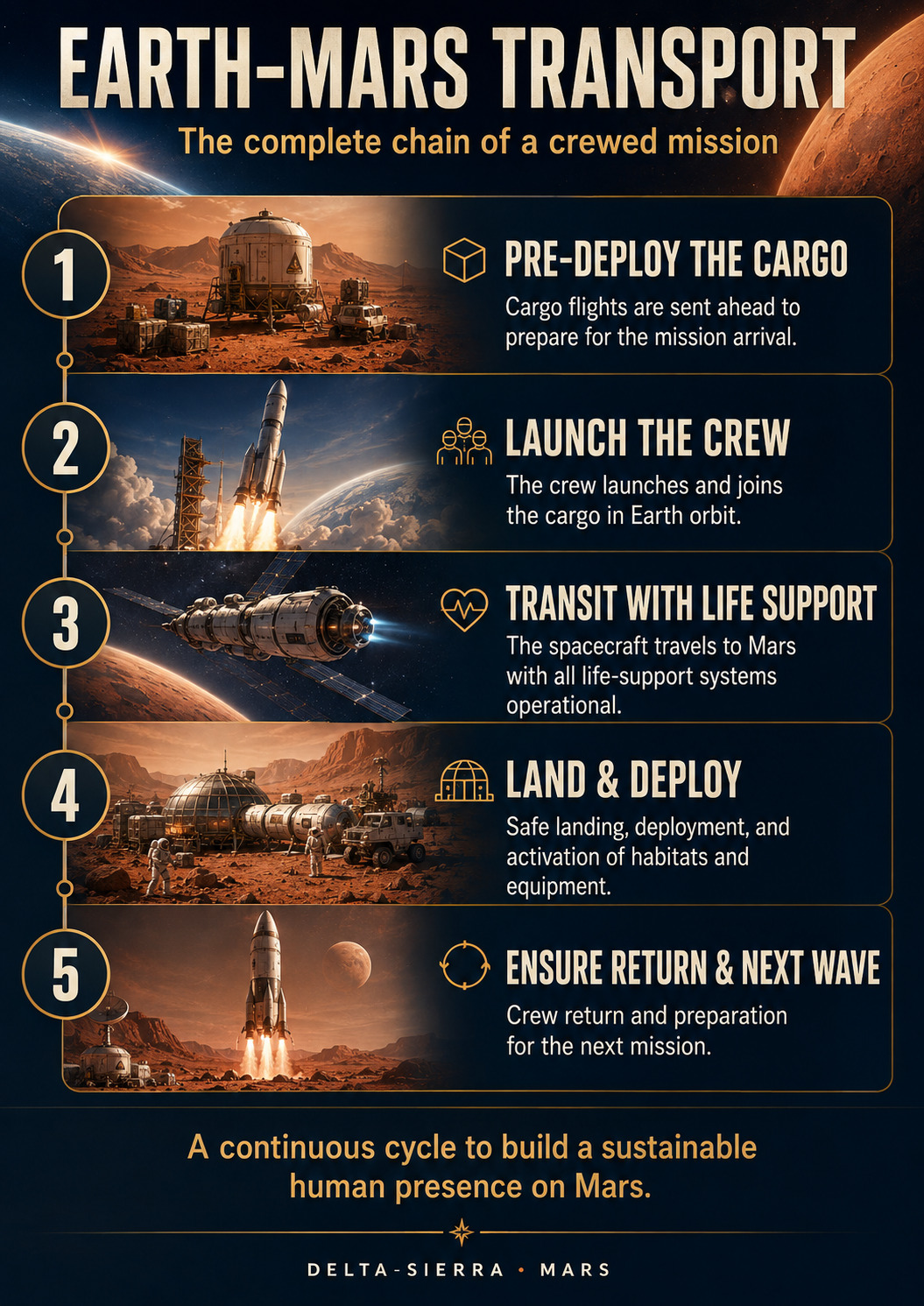
A Mars journey is not just an engine. It combines Earth launch, assembly or refueling, transit habitat, propulsion, power, thermal control, communications, navigation, consumables, Mars arrival, and return capability.
Changing propulsion alters duration, propellant mass, power, radiators, and sometimes assembly architecture. Complete missions must therefore be compared, not isolated specific-impulse values.
NASA currently keeps several families in the trade space: all-chemical, nuclear thermal, hybrid nuclear-electric/chemical, and hybrid solar-electric/chemical. Keeping multiple options means major architectural choices are not all frozen.
Cargo and crew do not necessarily need the same vehicle. Cargo may accept a longer trip if it reduces mass or cost, while crew pay for extra days in consumables, exposure, and medical risk.
Hundreds of transit days require a habitat that functions as a closed world. Habitable volume, repair, sleep, exercise, food, and privacy cannot be deferred until arrival.
Reducing flight time may reduce some exposures while increasing propulsion and power requirements. The optimum is not necessarily the fastest trajectory; it depends on mass, maturity, and total risk.
Abort options change radically after departure. Moon to Mars white papers emphasize that return or diversion may take months. The vehicle must therefore stabilize serious failures for long periods.
Crewed transit must be designed around reserve days and degraded modes. A failure is not truly tolerated merely because the system survives three hours; the crew must last until a realistic recovery opportunity.
A useful comparison shows injected mass, propellant mass, power, transit duration, number of launches, critical assembly events, refueling operations, and abort capability. Without common metrics, every technology can appear superior on its favorite indicator.
Habitat mass is not independent of duration. Longer transit adds food, consumables, spares, and sometimes shielding or redundancy. Heavier propulsion may therefore be offset or amplified by what it changes elsewhere in the spacecraft.
The number of Earth launches creates campaign risk: delays, orbital storage, propellant life, and assembly sequence. A paper-efficient vehicle can become fragile if preparation depends on a long chain of perfect rendezvous.
Historical reference architectures must be dated. A SAC21 study or transit concept is a snapshot of design space, not an announcement of a formally selected mission.
At 25 kg of a defined consumables-and-packaging bundle per person per day, four people over 600 days already represent 60,000 kg: 25 × 4 × 600. The assumption is deliberately visible; changing rate or duration immediately changes the result.
If a system has 0.995 availability during a period when its loss is critical, residual risk is not simply 'low'; outage duration, repairability, and redundancy still matter. The number does not replace the scenario.
An architecture requiring eight independent launches each with 98% success probability would, under an independence assumption, have 0.98⁸ ≈ 85.1% probability that all eight succeed. The exponent 8 means 0.98 is multiplied by itself eight times; the example shows why campaign complexity matters.
A stricter medical limit on transit time can favor a more energetic solution despite its mass. The trade must be recalculated, not merely discussed.
A launch delay can miss a window and strand already assembled elements. Orbital storage and schedule margin then become transportation-architecture characteristics.
A propulsion failure after departure must be translated into reachable trajectories: return, Mars flyby, contingency orbit, or degraded continuation. The answer depends on exact date and reserves, not a generic rule.
Finally, separating cargo and crew can reduce human risk while increasing total vehicle count. It is a typical local optimization that moves complexity into campaign operations.
NASA’s 2026 Moon to Mars material does not reduce human transportation to a simple chemical-versus-nuclear contest. It describes four broad propulsion families in the trade space: all-chemical, hybrid solar-electric/chemical, hybrid nuclear-electric/chemical, and nuclear thermal. The fact that multiple options remain under study is itself important: there is not yet one definitive official architecture that should be written as settled fact.
Each family moves risk. All-chemical approaches simplify some thrust phases but require more propellant and injected mass. Electric propulsion can save propellant but creates long thrust arcs and makes power, radiators, and thruster lifetime decisive. Nuclear thermal propulsion offers high thrust with higher specific impulse than conventional chemical systems, yet adds a reactor, cryogenic hydrogen, radiation integration, and qualification of a crewed system that has never flown. Architecture comparison must therefore compare dependency chains, not just Isp.
Transit time alone also fails to capture human exposure. A faster trajectory may reduce radiation dose and isolation time, while a more complex architecture may increase failure probability or eliminate some abort options. Useful metrics include mass in orbit, departure energy, launch windows, abort capability, cumulative thruster operating time, propellant storage, maintenance, power, and return contingencies.
This changes the meaning of 'best'. A system that is attractive for one first mission may be less attractive for an industrial cadence of several departures per launch opportunity. As traffic grows, reuse, orbital refueling, propellant production, assembly nodes, and launcher availability become architecture parameters. Earth-Mars transportation then starts to resemble a logistics infrastructure rather than one heroic spacecraft.
Shortening a journey can reduce crew exposure to several constraints, but the benefit needs decomposition. Fewer days means less food and some consumables, less operating time for selected hardware, and less time for failures whose likelihood grows with exposure. The propulsion or power needed to save those days can instead increase mass, heat, complexity, and the number of critical operations.
A useful comparison separates quantities that scale roughly with duration from those driven by events. Food and some cumulative consumption track days fairly directly. A trajectory correction, rendezvous, or deployment does not necessarily disappear when transit is shorter. A rare failure may depend both on time exposed and on the number of cycles or demanding operations.
Transit choice must also consider arrival conditions. Arriving faster is not automatically better if the geometry produces higher arrival speed, an unfavorable season, or infrastructure that is not yet ready. Flight time is a campaign variable coupled to surface readiness and other vehicles.
This view avoids the slogan of the “fastest trip.” Architecture should seek a transit time that improves the complete balance among resources, health, propulsion, arrival, reserve, and operations. The best number is the one that leaves the mission most robust, not simply the smallest value in one column.
Transport architecture is also schedule architecture. A crew vehicle can perform perfectly and still deliver an unusable mission if the surface power system, ascent propellant plant, spares or communications infrastructure misses its earlier window. Campaign design therefore tracks dependencies across launch opportunities: which asset must be demonstrated before crew departure, which can be duplicated, and which delay forces the mission to wait for another synodic opportunity.
This is why cargo reliability can be more important than minimum transit time. Sending two smaller infrastructure packages on separate launches may cost more propulsion yet reduce the chance that one launch failure removes the entire surface capability. The trade belongs at campaign level, where schedule, probability of loss, storage lifetime and launch cadence can be compared together.
A propulsion option that looks attractive from departure Δv can lose that advantage if its propellant must remain usable through long loiter or contingency periods. Storage temperature, insulation, active cooling and transfer operations therefore belong in the campaign comparison. The architecture should ask how performance changes when a launch slips or a surface asset forces the vehicle to wait, not only how it behaves on the nominal schedule.
Sources used for this expansion, checked 2026-08-14.
These references support the maturity statements above. A design study is not treated as an operational demonstration.
Document check: 2026-08-10.
The 2026 paper explicitly presents four propulsion families still under study and provides the status reference for this chapter.
The 2026 page frames crew/cargo transport, EDL, surface stay, and return as coupled decisions within one system of systems.
SAC21 provides a dated, quantified roughly two-year mission case; it is used as a trade study, not as an official program.
This analysis compares the four transportation options within human Mars architecture and helps avoid single-metric comparisons.