


MARS BIBLE — ORGANISATIONS
Jet Propulsion Laboratory (JPL)
The interplanetary workshop: spacecraft, rovers, autonomy, navigation and the Deep Space Network.
From Caltech's Origins to NASA: The Birth of an Unusual Laboratory
BEFORE MARS — HOW THE LABORATORY WAS BORN
From the Arroyo Seco to JPL: how a handful of experimenters became a laboratory of hundreds
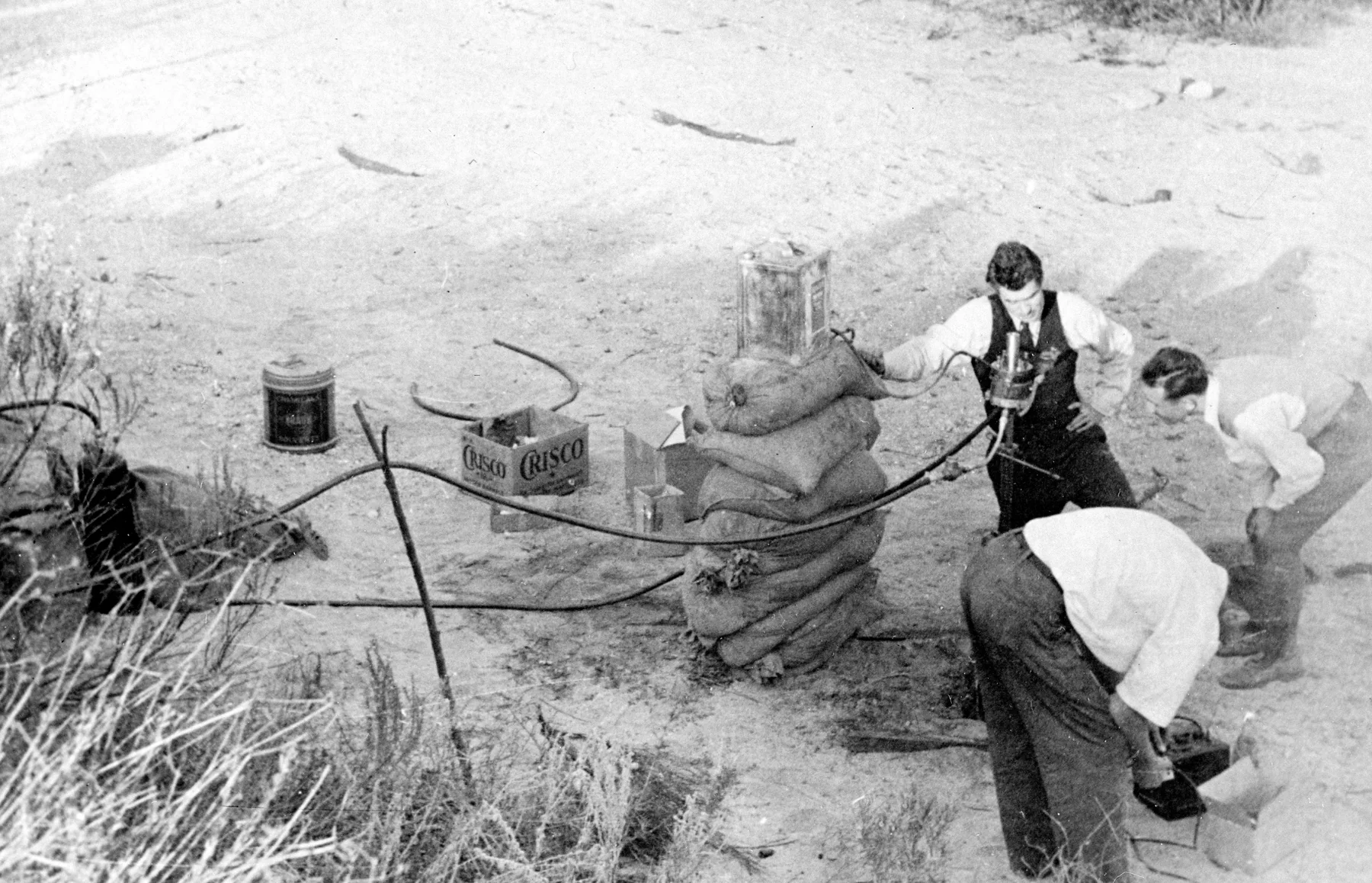
The Jet Propulsion Laboratory began before NASA and before “Jet Propulsion Laboratory” was even the formal name of an organization. In the 1930s Frank Malina studied rocket propulsion at Caltech under Theodore von Kármán. Because the experiments were too hazardous for the campus, the group moved to the Arroyo Seco, a mostly dry wash north of Pasadena’s Rose Bowl. On October 31, 1936, experimenters conducted the first alcohol-fueled rocket-motor tests there. The setting was almost the opposite of a modern space center: primitive structures, instrumentation assembled by the researchers, dusty terrain and few established procedures.
The first team: seven people around an experimental rocket motor
JPL’s historical accounts allow the small early circle to be seen as people rather than an anonymous institution. Frank Malina, Jack Parsons, Edward Forman, Apollo M. O. Smith and other Caltech-associated experimenters formed the nucleus, and JPL’s “Spark of a New Era” describes a seven-person group setting up the 1936 motor. This is an important point about recruitment: there was no JPL human-resources department recruiting a complete organization. The nucleus formed through Caltech, its students and researchers, local rocket enthusiasts and von Kármán’s scientific network.
The team attracted money because its tests produced useful results. Malina’s work on rocket-assisted aircraft takeoff led to Air Corps grants in the late 1930s. As war approached, military interest changed the scale. The Army helped Caltech obtain land in the Arroyo Seco for test pits and temporary workshops. Recruitment accordingly became less informal: the program needed engineers, technicians, propellant specialists and eventually guidance and instrumentation skills capable of turning scientific experiments into repeatable military systems.
1943-1944: the JPL name appears before the modern laboratory fully exists
In 1943 the Army asked von Kármán for a technical assessment of the German V-2 program. The Caltech team’s proposal used the name “Jet Propulsion Laboratory” for the first time. In 1944 the Army Ordnance Corps formally funded the laboratory’s work. This chronology matters: 1936 marks the experimental roots, 1943 the appearance of the name, and 1944 the institutionalization of the project under a military contract. JPL grew in stages as its mission, resources and accountability changed.
From seven experimenters to a staff approaching 300 by 1945
Growth was remarkably fast. JPL’s official history says that by 1945 the staff was approaching 300. In less than a decade, a tiny experimental group had become an organization capable of developing missiles, launching test vehicles from White Sands and monitoring performance using radio and war-surplus radar. That increase in headcount also transformed the laboratory itself. Early recruitment had grown out of scientific proximity and enthusiasm for rockets; wartime work required an organization where design, fabrication, testing, instrumentation and operations could be coordinated at scale.
1958: moving from missiles toward planetary exploration without losing Caltech
The next decisive institutional transition came with NASA. After Explorer 1, the first U. S. satellite, JPL was transferred from the Army to the new civilian space agency on December 3, 1958, while continuing to be managed by Caltech. That arrangement still explains much of JPL’s identity: it is NASA’s only federally funded research and development center operated by a university. The laboratory therefore maintains an unusual bridge among academic research, systems engineering, spacecraft construction and deep-space mission operations.
By the time Mars became a defining destination, the institutional culture already existed. JPL was not created for Mars. It had spent two decades learning how to move from bench experiments to flight hardware and how to organize enough people to operate complex systems without losing technical memory. That accumulated capability, more than any single vehicle, helps explain why JPL became one of the central workshops of robotic Mars exploration.
Historical sources: NASA/JPL — History · NASA/JPL — The Spark of a New Era · NASA/JPL — early directors
From Caltech experimenters to a national laboratory: how JPL built its first capabilities
JPL's history shows that a major space centre does not begin with a complete organisation chart drawn in advance. In 1936, around Theodore von Kármán at Caltech, Frank Malina, Jack Parsons and several collaborators experimented with rockets in the Arroyo Seco. The early tests were hazardous, improvised and far removed from the controlled engineering culture that would later characterise the laboratory. Their value is precisely that they show how capability emerges: through instrumented experiments, failures, calculations and constant confrontation between theory and hardware.
Military funding then transformed the group. Work on jet-assisted takeoff rockets imposed objectives, schedules and repeatability requirements. By 1943 the name Jet Propulsion Laboratory was in use, and the workforce expanded rapidly. JPL's official history states that the team approached three hundred people by 1945. That growth could not be achieved by hiring pre-existing 'space specialists', because the profession barely existed. It required chemists, mechanics, electronics experts, mathematicians, technicians and engineers who could learn a new field together.
This origin helps explain JPL's particular strength in Mars exploration. The laboratory preserved a culture in which science, engineering, system testing, navigation and mission operations meet inside one institution. For Mars that continuity matters enormously: a rover is not only a vehicle, but a chain running from the scientific question to the Deep Space Network, through onboard software, mechanics, qualification and daily operations on another world. JPL therefore provides a concrete example of how a small experimental community can accumulate enough technical memory over decades to undertake missions that had never been performed before.
Direct answer: why Jet Propulsion Laboratory (JPL) matters to the story of Mars
Jet Propulsion Laboratory (JPL) deserves its own dossier because JPL is a Caltech division managed for NASA. [1] The goal is not to rank organizations but to understand one as a system: history, decision centers, infrastructure, technologies, successes, failures and the capabilities it contributes — directly or indirectly — to Mars exploration.
The interplanetary workshop: spacecraft, rovers, autonomy, navigation and the Deep Space Network.
Understand the organisation before looking at its rockets
To understand Jet Propulsion Laboratory (JPL), one must separate political goal-setting, program management, engineering centers, industrial manufacturing, science teams and mission operations. In this case, one useful anchor is that JPL is a Caltech division managed for NASA. [1] Another is that Explorer 1 in 1958 helped launch the United States into the Space Age. [2] These are verifiable facts; by themselves they do not guarantee success of any future program. [1][2]
From a rocket group to a NASA center managed by Caltech
The history of the Jet Propulsion Laboratory is unusual because the institution did not begin as a civilian space center. Its roots lie in rocket experiments around Caltech and propulsion work later carried out for the U. S. Army. Explorer 1 in 1958 marked a decisive transition. When NASA began operations, JPL was transferred from Army jurisdiction to the new civilian agency. The laboratory already brought expertise in propulsion, guidance, control, systems integration, testing and telecommunications. That origin helps explain part of its culture: making complete systems work rather than developing an isolated instrument.
JPL remains institutionally distinctive. It is NASA’s only Federally Funded Research and Development Center and is managed by Caltech. The arrangement combines a public mission, federal program requirements and close proximity to a research-university environment. For Mars, this hybrid model has mattered because planetary missions demand skills across many disciplines: interplanetary navigation, software, telecommunications, structures, thermal engineering, science, operations, mission control and risk management.
The Caltech relationship does not make JPL simply a university laboratory, just as the NASA relationship does not make it identical to an agency field center. The model supports long technical continuity and access to a broad scientific ecosystem while delivering government missions. That continuity is one reason lessons from one spacecraft can be embedded in the next.
Mars as a systems school: from Pathfinder to an infrastructure network
The loss of Mars Observer in 1993 helped reshape the American approach. JPL then led or managed a sequence of more frequent missions, with Mars Pathfinder serving as a highly visible technology demonstration and Sojourner becoming the first successful rover on Mars. Later missions gradually built an ecosystem: mapping and relay orbiters, rovers, landers, navigation, operations and the Deep Space Network. Mars is no longer only a destination for an isolated probe; it is a domain in which missions can support one another through accumulated knowledge, communications and data.
That progression is directly relevant to human settlement. A colony cannot depend on a single vehicle. It will require a network of functions: prior mapping, weather, communications relays, navigation, robotic reconnaissance, surface transport, logistics depots, power and maintenance. JPL experience shows how reliability can emerge not from a perfect component but from an architecture in which knowledge and infrastructure accumulate from mission to mission.
The Deep Space Network captures that logic. The Mars vehicle is only half the system; terrestrial antennas, planning, software and data processing are part of the mission. A permanent settlement will have to extend the same reasoning to surface networks and orbital relays. A JPL history page is therefore more than an agency biography: it is a study in how an institution learns to turn episodic exploration into durable infrastructure.
1936, Arroyo Seco: JPL begins as a risky experiment, not as a giant laboratory
The story begins in 1936 around Theodore von Kármán at Caltech, when Frank Malina, Jack Parsons, and Ed Forman tested rocket motors in the Arroyo Seco away from the campus. The group was not yet the Jet Propulsion Laboratory. Its immediate purpose was to understand rocket propulsion and obtain reproducible measurements in a field where tests could explode, burn equipment, or teach almost nothing if instrumentation was poor. [source]
The founding capability was therefore not a particular rocket but a method: design, instrument, test, measure the gap between calculation and reality, and iterate. That experimental loop became one of the laboratory's enduring habits, from early propulsion work to Mars entry systems.
This episode deserves to be read at two levels. In the short term it concerns 1936, arroyo seco: jpl begins as a risky experiment, not as a giant laboratory and the decisions made by the teams of the period. In the long term it shows how an organization accumulates capability: procedures, simulators, test data, and trained people remain available to later programs. The visible object — launcher, spacecraft, rover, or module — should therefore not be confused with the broader capability that grew around it.
The Caltech connection was crucial. It placed the work at the boundary between academic research, applied engineering, and public needs from the beginning. That hybrid position explains much of JPL's later culture.
From a systems-engineering perspective, 1936, arroyo seco: jpl begins as a risky experiment, not as a giant laboratory forces attention to interfaces. A local improvement can move a problem elsewhere: more mass requires more propulsion, more power produces more heat, and more autonomy demands more software and verification. The historical value of the episode is that it shows teams learning to treat a mission as a coupled system rather than a set of independent components.
For Mars, the legacy is immediate: a credible architecture cannot remain a drawing. It must become a sequence of tests in which margins, defects, and unexpected behavior become data. [source]
For the general reader, the value of this episode is that it makes visible the path from an idea to durable capability. 1936, Arroyo Seco: JPL begins as a risky experiment, not as a giant laboratory is not merely a date on a timeline; it is an experiment that changes what teams know how to build, what they know how to measure, and what they know to reject when margin is insufficient.
JATO, war, and Aerojet: when rocket research becomes a national capability
In the late 1930s and early 1940s, the group worked on jet-assisted takeoff, or JATO. Military demand accelerated funding, procedures, and manufacturing. Members of the group also helped create Aerojet, showing how a common body of expertise could spread across a laboratory, government programs, and industry without those institutions becoming identical. [source]
Moving from a laboratory rig to hardware usable on aircraft forced attention to manufacturing quality, repeatability, safety, storage, ignition, and behavior in real operating conditions. These were systems problems, not merely propellant chemistry.
The history of jato, war, and aerojet: when rocket research becomes a national capability is also a history of margin. Nominal performance is never enough in spaceflight: teams need to understand what happens when temperature, power, data rate, mass, or schedule moves away from the planned value. An institution becomes mature when it converts those deviations into design rules rather than merely celebrating the final result. That memory of limits is what makes the experience valuable to later missions.
War also changed the scale of public control. Research choices became tied to contracts, schedules, and defense requirements. The future JPL learned early that technical innovation exists inside a concrete institutional framework.
Chronology matters because it prevents anachronism. When jato, war, and aerojet: when rocket research becomes a national capability occurred, computers, materials, communications networks, budgets, and planetary knowledge were not those of 2026. Judging older choices with current tools removes the real difficulty. Conversely, admiring an earlier achievement does not mean its solution can simply be reused; transferable method must be separated from obsolete technology.
Mars settlement would demand the same change of scale: moving from attractive prototypes to equipment produced, verified, stored, and maintained with industrial discipline. [source]
This is especially useful when reading current programs without slogans. The existence of jato, war, and aerojet: when rocket research becomes a national capability does not prove that every adjacent problem is solved; it is evidence limited to particular conditions. A rigorous history preserves the boundary between what was demonstrated, what was only studied, and what still has to be invented.
1944: the Jet Propulsion Laboratory name and the apprenticeship of missile programs
In 1944 the activity was formalized as the Jet Propulsion Laboratory within Caltech's relationship with the U.S. Army. The laboratory worked on guided missiles such as Corporal and later Sergeant. This period is sometimes treated as an awkward military prelude before the 'real' era of space exploration, yet it is essential for understanding the origins of capabilities in guidance, electronics, telemetry, propulsion, testing, and complex program organization. [source]
A guided missile forces several disciplines to work together in real time. A sensor error can become a command error, and a command error can become a lost trajectory. That culture of interfaces transferred directly to interplanetary spacecraft.
It is also necessary to look at what public narratives leave outside the frame. 1944: the Jet Propulsion Laboratory name and the apprenticeship of missile programs depended on ground teams, analysis tools, suppliers, tests, software, and budget decisions that do not appear in official photographs. Success is distributed. Reading the history this way avoids the myth of a single hero and reveals the actual chains of responsibility needed when capability is reused in a different architecture.
This history also reminds us that JPL did not begin as a civilian NASA center: it predates NASA. Its move into the NASA system in 1958 was therefore a major institutional transformation, not a creation from nothing.
The episode also clarifies the difference between demonstration and infrastructure. 1944: the Jet Propulsion Laboratory name and the apprenticeship of missile programs may prove that a function can work once; a durable campaign requires it to become repeatable, documented, maintainable, and financially supportable. The transition from achievement to service is often longer than the achievement itself. That distinction matters enormously for Mars because human presence cannot depend forever on unique prototypes.
On Mars, reliability will depend on the same interface thinking: propulsion, navigation, power, telecommunications, and software must be validated as a coherent chain. [source]
The consequence for a long-duration architecture is clear: hardware changes, but methods of verification, documentation, and lessons learned can survive. 1944: the Jet Propulsion Laboratory name and the apprenticeship of missile programs therefore adds a layer of institutional memory that future programs can use only if the people and archives needed to understand it are not lost.
Explorer 1: from rocket technology to space science in a matter of months
After Sputnik, the United States accelerated its response. Explorer 1 launched on January 31, 1958. JPL contributed to the Jupiter-C launch system, built the satellite, and supported communications and data handling. James Van Allen's instrument revealed the radiation belts, showing how a mission could make a major scientific discovery using infrastructure that had grown partly from earlier military work. [source]
Explorer 1 illustrates conversion of capability: a propulsion and guidance system becomes a way to place a scientific laboratory in orbit. The change of purpose requires scientists to become much more deeply integrated into mission definition.
From a systems-engineering perspective, explorer 1: from rocket technology to space science in a matter of months forces attention to interfaces.
The success arrived while U. S. space policy was being reorganized. It gave JPL technical credibility that helped its incorporation into the new NASA system only months later.
Another useful angle is the flow of information. Around explorer 1: from rocket technology to space science in a matter of months, sensors create measurements, software transforms them, teams interpret them, and decisions return to the vehicle or program. Error can enter anywhere in that chain. Space organizations therefore learn to treat information quality — units, version, traceability, uncertainty — as a mission property almost as physical as mass or power.
For Mars, the lesson is that infrastructure has meaning only when tied to questions: geology, climate, resources, and habitability. Engineering serves a scientific and operational chain. [source]
Explorer 1: from rocket technology to space science in a matter of months is not merely a date on a timeline; it is an experiment that changes what teams know how to build, what they know how to measure, and what they know to reject when margin is insufficient.
1958: a NASA laboratory managed by Caltech, an institutional anomaly turned into a strength
When NASA was created in 1958, JPL moved from the Army framework into the new civilian agency while remaining managed by Caltech. The arrangement is unusual: JPL is a federally funded research and development center managed for NASA by a university. It is therefore neither an ordinary Caltech department nor a NASA field center operating exactly like the others. [source]
The structure preserves a strong relationship with research, scientific recruitment, and experimentation while imposing the requirements of a major public agency. It also creates governance, contract-management, and accountability obligations that mission-centered narratives often overlook.
Chronology matters because it prevents anachronism. When 1958: a nasa laboratory managed by caltech, an institutional anomaly turned into a strength occurred, computers, materials, communications networks, budgets, and planetary knowledge were not those of 2026.
Understanding that governance is essential for assigning decisions correctly. A spacecraft can be a NASA mission built or managed by JPL with instruments supplied by universities and companies. The visible logo alone does not reveal who decides what.
Finally, 1958: a nasa laboratory managed by caltech, an institutional anomaly turned into a strength shows that space policy is never separate from engineering. Budgets determine how much testing is possible, partnerships define interfaces, political schedules can accelerate or delay decisions, and available industry limits what can actually be manufactured. An agency history must therefore connect technology and institutions instead of presenting machines as if they were designed in a vacuum.
An international Mars campaign will probably require comparable arrangements in which different operators carry portions of responsibility under a shared public authority. [source]
The existence of 1958: a nasa laboratory managed by caltech, an institutional anomaly turned into a strength does not prove that every adjacent problem is solved; it is evidence limited to particular conditions.
2025-2026: Dave Gallagher and a new question over the Caltech contract
Dave Gallagher became JPL's eleventh director in June 2025. In May 2026 NASA announced its intention to compete the contract to operate the laboratory, while Caltech's current agreement ends September 30, 2028. Caltech stated that it will participate in an open competition. The development is institutional but may affect a management relationship dating to NASA's creation. [source]
A management transition would not make capability disappear overnight. People, facilities, missions, and contractual obligations create strong continuity. But authority, employment, and accountability arrangements can change.
This episode deserves to be read at two levels. In the short term it concerns 2025-2026: dave gallagher and a new question over the caltech contract and the decisions made by the teams of the period.
The issue reminds us that even an institution portrayed as stable for seven decades depends on periodic contractual decisions. JPL history is still being written through governance as much as spacecraft.
From a systems-engineering perspective, 2025-2026: dave gallagher and a new question over the caltech contract forces attention to interfaces.
For Mars programs lasting decades, institutional continuity must be designed to survive changes of operator, leadership, or policy without losing technical memory. [source]
2025-2026: Dave Gallagher and a new question over the Caltech contract therefore adds a layer of institutional memory that future programs can use only if the people and archives needed to understand it are not lost.
Before JPL: GALCIT, the Arroyo Seco, and the habit of making theory survive contact with hardware
The Jet Propulsion Laboratory did not begin as a NASA center and it did not begin with Mars. Its roots lie in the 1930s at the California Institute of Technology, where Theodore von Kármán's Guggenheim Aeronautical Laboratory created an environment in which mathematical analysis, wind-tunnel work, industrial problems, and experimental propulsion could coexist. Frank Malina's interest in rocket propulsion was initially a fringe subject by the standards of mainstream aeronautics, but von Kármán treated it as a legitimate engineering problem if it could be studied rigorously. [1]
The experiments moved into the Arroyo Seco partly because rocket tests were too dangerous for the campus. That physical separation became a symbolic feature of the future laboratory: teams had to build, instrument, fire, measure, fail, and modify real systems. Even a small rocket motor forced interactions among combustion, feed systems, structures, instrumentation, safety, and data interpretation. This was already systems engineering before the phrase acquired its modern institutional meaning.
The deeper legacy is the closed loop between model and test. A calculation generated an expectation; an experiment contradicted or confirmed it; the discrepancy became a new engineering question. JPL would later apply the same intellectual pattern to spacecraft that could not be fully tested in their final environment. Mars entry, deep-space communications, and autonomous surface operations are all domains in which the institution must combine partial tests with models and then live with the residual uncertainty.
Military sponsorship: when experimental rocketry became a deliverable capability
World War II changed the scale and purpose of the work. Jet-assisted takeoff systems and other propulsion projects were no longer simply research topics. They had schedules, customers, production constraints, and safety consequences. This forced the emerging organization to develop documentation, qualification methods, supplier relationships, and configuration control. [2]
Aerojet's creation in 1942 also illustrates an enduring boundary between academic research, government need, and industrial production. JPL would later operate under a different institutional model, but the ecosystem was already visible: a laboratory can invent and integrate without manufacturing every component itself. The ability to define interfaces and verify external work becomes as important as the ability to design internally.
Malina, von Kármán, Parsons, and the danger of a single-founder story
Institutional history becomes distorted when it assigns complex organizations to one heroic founder. Frank Malina brought academic rigor to rocket performance; Theodore von Kármán provided scientific legitimacy, networks, and strategic vision; Jack Parsons contributed extraordinary experimental intuition in propellants. Many less celebrated engineers and technicians made the work repeatable. The future JPL was collective before it was bureaucratic.
This matters because the laboratory's durable advantage was never one genius. It was the capacity to create a structure in which specialists could disagree productively and still build one machine. Every interplanetary mission requires translation among disciplines that use different units, margins, models, and failure criteria. Later failures such as Mars Climate Orbiter would show what happens when that translation breaks down.
Corporal and Sergeant: learning the complete chain before building planetary spacecraft
Postwar missile programs forced the laboratory to move beyond propulsion components into guided systems. Telemetry, control, structures, flight testing, and operational procedures had to work together. William Pickering, whose background included telemetry and remote control, became increasingly important and eventually assumed the directorship in 1954. [4]
The later shift from missiles to spacecraft changed the mission but preserved much of the technical grammar. A planetary spacecraft is also an irreversible sequence of events executed far from help. Guidance, communication, power, software, and structure must function as one system. The target changed from a terrestrial trajectory to another world, while the demand for integration became even more severe.
Sputnik: why institutional preparation matters more than the myth of an 84-day miracle
The Soviet launch of Sputnik in October 1957 turned a latent capability into a national priority. JPL and Wernher von Braun's Army team had already proposed a satellite for the International Geophysical Year, while JPL's solid-motor work and re-entry test programs had produced hardware and experience. After Vanguard's public launch failure, the Army-JPL option was authorized. [5]
Explorer 1 was prepared for launch in 84 days after the emergency authorization, but the engineering did not materialize in 84 days. It rested on years of propulsion, telemetry, tracking, and systems work. That distinction is a useful warning for future Mars programs. A government may announce a mission on a particular date, but the apparent speed of execution depends on capabilities that must already exist: facilities, people, software, suppliers, standards, and validated technology.
Explorer 1: the moment a rocket organization learned that carrying science changes the purpose of the machine
JPL supplied the satellite, telecommunications, and upper stages, while James Van Allen's cosmic-ray instrument turned the mission into a scientific observatory. The discovery of trapped radiation belts made a crucial institutional point: spaceflight could produce knowledge, not merely demonstrate national technical power. [6]
That science-engineering relationship would become central to JPL. Scientists cannot simply demand ideal measurements; they work within mass, power, thermal, telemetry, and schedule constraints. Engineers cannot define success only as spacecraft survival; the machine exists to enable observations. Project scientists, instrument teams, systems engineers, and review boards evolved in part to manage this productive conflict.
1958: joining NASA without becoming an ordinary federal field center
When NASA began operations, JPL presented an unusual institutional problem. The new civilian agency needed the laboratory's spacecraft competence, but JPL was a Caltech organization emerging from Army sponsorship. The solution preserved Caltech as the operator while transferring the laboratory's mission to NASA. Today JPL is NASA's only federally funded research and development center operated by a university. [7]
The arrangement has practical consequences. JPL employees are Caltech employees; NASA funds and directs the federal missions; the laboratory director also holds a Caltech leadership role; missions are accountable to NASA program offices and public budgets. This hybrid structure gives JPL academic connections and management flexibility while imposing a dense layer of contractual and federal responsibility.
William Pickering: continuity across the fastest transformation in American spaceflight
Pickering directed JPL from 1954 to 1976, spanning the transition from missiles to Explorer 1, Ranger, Surveyor, Mariner, Viking-era work, and the beginnings of Voyager. Few technical institutions experience such rapid change under one director. [8]
His value was not simply longevity. Pickering repeatedly translated engineering capability into scientific and political arguments. Explorer 1's scientific return helped justify a civilian exploration program. That ability to connect technical work with public purpose became part of JPL's institutional survival strategy.
The JPL director as both laboratory leader and Caltech vice president
The director of JPL occupies an unusual institutional position. Because Caltech manages the laboratory for NASA, the director also serves in Caltech leadership. This dual role makes the laboratory neither a conventional NASA field center nor an ordinary university department. Federal missions, public funding, Caltech employment, contractual obligations, and academic culture coexist in one governance structure.
The arrangement creates advantages in recruiting and scientific connection, but it also produces complex accountability. NASA owns the mission requirements and public budgets; Caltech manages the workforce and institutional systems; project leaders must deliver within federal program constraints. Understanding JPL's Mars history therefore requires understanding this legal and managerial architecture, not only the spacecraft.
William Pickering's long tenure: continuity while the definition of spaceflight changed
Pickering directed the laboratory for twenty-two years. During that interval JPL moved from Army missiles through Explorer 1, Ranger, Surveyor, Mariner, Viking-era work, and the start of Voyager. The technical organization changed from a relatively compact rocketry laboratory into a large multidisciplinary space institution.
Such continuity can be powerful because teams have time to accumulate experience and leaders can sustain a technical culture across programs. It can also create institutional inertia. The historical interest lies in how JPL repeatedly changed mission type without losing its identity as a systems laboratory.
Caltech as more than a management logo
The Caltech-JPL relationship is not limited to a contract signature. Researchers move between campus and laboratory, students participate in projects, and scientists collaborate across the institutional boundary. This gives JPL access to an academic environment in which new scientific questions and methods develop before they become flight requirements.
The two organizations remain different. Campus research can pursue curiosity without a launch date; JPL must satisfy mission cost, safety, schedule, and federal accountability. The value lies in the connection without complete merger.
Propulsion after the rocket era: why JPL still deserves its name
JPL no longer builds the national launch vehicles suggested by its name, but propulsion remains central in spacecraft maneuvering, electric propulsion, and Mars descent systems. Deep Space 1 demonstrated ion propulsion as an operational planetary technology, while Mars landers depend on carefully controlled terminal propulsion.
Electric propulsion illustrates a different optimization from chemical rockets: low thrust over long duration in exchange for high propellant efficiency. Cargo to Mars may exploit similar trade spaces when travel time is less important than delivered mass.
Principal Investigators: scientific authority can originate outside JPL
Competitive mission programs often place principal investigators at universities or other institutions. JPL may provide project management, systems engineering, navigation, or spacecraft implementation while the scientific leadership remains external.
This model broadens the source of ideas but requires clear governance. The PI seeks scientific return; the implementing organization must manage cost, schedule, and technical risk. Conflict is inevitable and should be structured rather than personalized.
Louis Dunn and the under-told transition years
Popular histories move quickly from Theodore von Kármán to William Pickering, but Louis Dunn led JPL during years when the organization professionalized its missile work and expanded systems capability. Those less glamorous years mattered because they established processes that later planetary programs inherited.
Institutional history should pay attention to consolidation periods. Procurement, test discipline, documentation, and organization-building often create more long-term capability than a single public milestone.
Launch integration: the spacecraft begins with another organization's rocket
JPL-managed spacecraft interface with launch vehicles supplied by external providers. Mechanical loads, separation systems, electrical interfaces, fairing contamination, ground support, and countdown procedures must all match.
Regular Mars logistics would benefit from standardized launch and payload interfaces so every cargo mission does not require a bespoke integration effort.
2026: competition for the Caltech management contract changes the institutional question
In May 2026 Caltech announced that NASA intends to compete the contract for operating JPL, with the current agreement ending on September 30, 2028. Since 1958 Caltech has managed the laboratory for NASA through a contractual relationship that has been reviewed and renewed repeatedly. Competition therefore does not mean that JPL disappears or that Caltech has already lost responsibility. It means that a relationship often treated as part of the laboratory's permanent landscape is now explicitly subject to competitive procurement. [35]
The moment matters because it separates the identity of the laboratory from the legal identity of its operator. JPL was founded by Caltech researchers; the director is also a Caltech vice president; scientific exchange with campus is part of its history. Yet NASA funds and directs the public mission. The contract competition is a reminder that JPL is an FFRDC serving a federal purpose. Technical continuity must be demonstrated even while the management framework is being reconsidered.
For Mars, the lesson is direct. A thirty- or fifty-year architecture will outlive particular contracts, administrations, corporate partners, and perhaps agencies. Institutional interfaces must therefore be documented with the same seriousness as electrical ones. Who owns data? Who employs operators? Who may change a standard? Which organization accepts a safety risk? Who has authority during an emergency? Such questions look legal until they stop an operational decision.
Detailed institutional timeline, 1936–2026
This timeline does not replace the narrative; it lets missions, facilities, leadership, and organizational change be seen together. Each entry states why the event matters to laboratory continuity.
- 1936 — First motor tests in the Arroyo Seco by the Caltech group that would become JPL. The event enlarges the technical memory available to later projects.
- 1941 — JATO work turns experimental propulsion into a program answering a concrete military need. This stage changes interfaces among science, engineering, and operations.
- 1944 — The Jet Propulsion Laboratory name becomes established in the Army rocket-program context. The milestone shows how a one-time capability can become a durable function.
- 1947 — Corporal work strengthens guidance, telemetry, and system integration. The date matters because it connects an institutional decision with an observable technical consequence.
- 1954 — William Pickering becomes director, beginning a twenty-two-year tenure. The event enlarges the technical memory available to later projects.
- 1958 — Explorer 1 becomes the first U.S. satellite; NASA's creation leads to JPL's transfer to the civilian agency. This stage changes interfaces among science, engineering, and operations.
- 1959 — Early Goldstone stations support Pioneer and foreshadow the Deep Space Network. The milestone shows how a one-time capability can become a durable function.
- 1961 — Construction of the Spacecraft Assembly Facility for Ranger and Mariner. The date matters because it connects an institutional decision with an observable technical consequence.
- 1962 — Mariner 2 completes the first successful U.S. interplanetary planetary flyby, at Venus. The event enlarges the technical memory available to later projects.
- 1963 — Pickering formally establishes the Deep Space Network on December 24. This stage changes interfaces among science, engineering, and operations.
- 1964 — Building 230, the Space Flight Operations Facility, is dedicated; Ranger 7 succeeds after earlier failures. The milestone shows how a one-time capability can become a durable function.
- 1965 — Mariner 4 returns the first close-up images of Mars; the Canberra DSN complex enters service. The date matters because it connects an institutional decision with an observable technical consequence.
- 1966 — Surveyor 1 achieves a soft lunar landing and validates robotic descent techniques. The event enlarges the technical memory available to later projects.
- 1969 — Mariners 6 and 7 fly by Mars and expand scientific coverage. This stage changes interfaces among science, engineering, and operations.
- 1971 — Mariner 9 becomes the first spacecraft to orbit another planet. The milestone shows how a one-time capability can become a durable function.
- 1973 — High Bay 1 reaches much stricter cleanliness standards, reflecting Ranger and planetary lessons. The date matters because it connects an institutional decision with an observable technical consequence.
- 1975 — The Viking orbiters, built by JPL, launch toward Mars. The event enlarges the technical memory available to later projects.
- 1976 — Bruce Murray succeeds Pickering; High Bay 2 is completed for Voyager. This stage changes interfaces among science, engineering, and operations.
- 1977 — Voyager 1 and 2 launch, beginning extremely long-lived operations. The milestone shows how a one-time capability can become a durable function.
- 1978 — Seasat demonstrates JPL's growing role in radar observation of Earth. The date matters because it connects an institutional decision with an observable technical consequence.
- 1982 — Lew Allen becomes director during a period of budgetary and technical consolidation. The event enlarges the technical memory available to later projects.
- 1989 — Voyager 2 flies by Neptune; major DSN antennas have been enlarged for distant signals. This stage changes interfaces among science, engineering, and operations.
- 1991 — Edward Stone becomes director while remaining a major Voyager scientist. The milestone shows how a one-time capability can become a durable function.
- 1992 — TOPEX/Poseidon launches and begins a long record of precision ocean altimetry. The date matters because it connects an institutional decision with an observable technical consequence.
- 1993 — Mars Observer is lost before orbital insertion; the Mars program must be rebuilt. The event enlarges the technical memory available to later projects.
- 1994 — Donna Shirley takes charge of the Office of Mars Exploration, signaling more explicit Mars program governance. This stage changes interfaces among science, engineering, and operations.
- 1996 — Cassini assembly is completed at JPL before a long environmental test campaign. The milestone shows how a one-time capability can become a durable function.
- 1997 — Pathfinder and Sojourner land on Mars and become both a scientific and public phenomenon. The date matters because it connects an institutional decision with an observable technical consequence.
- 1998 — A new deep-space operations center in the SFOF colocates teams previously distributed across facilities. The event enlarges the technical memory available to later projects.
- 1999 — Mars Climate Orbiter and Mars Polar Lander are lost, triggering deep examination of program practices. This stage changes interfaces among science, engineering, and operations.
- 2001 — Charles Elachi becomes director; Mars Odyssey launches in the rebuilt Mars program. The milestone shows how a one-time capability can become a durable function.
- 2002 — GRACE inaugurates a new way to measure changes in Earth's gravity field using twin satellites. The date matters because it connects an institutional decision with an observable technical consequence.
- 2003 — Spirit and Opportunity leave Earth for Mars, using a common architecture at two different sites. The event enlarges the technical memory available to later projects.
- 2004 — Both MER rovers begin operations; the DSN marks forty years as an integrated network. This stage changes interfaces among science, engineering, and operations.
- 2005 — Mars Reconnaissance Orbiter launches with a payload and data rate that change the scale of Mars mapping. The milestone shows how a one-time capability can become a durable function.
- 2007 — Dawn launches toward Vesta and Ceres with ion propulsion, another demonstration of long-duration navigation. The date matters because it connects an institutional decision with an observable technical consequence.
- 2008 — Phoenix lands in the Martian north polar region and confirms accessible ice. The event enlarges the technical memory available to later projects.
- 2009 — The OCO observatory is lost at launch; the decision to rebuild eventually leads to OCO-2. This stage changes interfaces among science, engineering, and operations.
- 2011 — Curiosity is assembled and tested in High Bay 1 and the large Space Simulator before launch. The milestone shows how a one-time capability can become a durable function.
- 2012 — Curiosity lands using the sky crane; Voyager 1 later crosses the heliopause. The date matters because it connects an institutional decision with an observable technical consequence.
- 2013 — The Deep Space Network marks fifty years and continues expanding capability. The event enlarges the technical memory available to later projects.
- 2014 — OCO-2 launches to measure atmospheric carbon dioxide with high precision. This stage changes interfaces among science, engineering, and operations.
- 2015 — SMAP launches to observe soil moisture and freeze-thaw state. The milestone shows how a one-time capability can become a durable function.
- 2016 — Michael Watkins becomes director; JPL enters a period combining Mars 2020, Europa Clipper, and Earth missions. The date matters because it connects an institutional decision with an observable technical consequence.
- 2018 — InSight lands on Mars to study the planet's interior. The event enlarges the technical memory available to later projects.
- 2019 — High Bay 1 hosts Mars 2020 while NISAR and Europa Clipper occupy the next industrial pipeline. This stage changes interfaces among science, engineering, and operations.
- 2020 — Perseverance is completed, tested, and launched despite pandemic constraints. The milestone shows how a one-time capability can become a durable function.
- 2021 — Perseverance and Ingenuity begin operations; the DSN adds a new multi-band antenna at Madrid. The date matters because it connects an institutional decision with an observable technical consequence.
- 2022 — Laurie Leshin becomes director; SWOT launches to measure Earth's surface water. The event enlarges the technical memory available to later projects.
- 2023 — The Psyche independent review remains a recent reference on organizational conditions behind mission delay. This stage changes interfaces among science, engineering, and operations.
- 2024 — JPL first reduces its workforce by about 530 people and later by about 325 more amid budget pressure. The milestone shows how a one-time capability can become a durable function.
- 2025 — Dave Gallagher becomes director; NISAR launches in July; another reduction of about 550 positions accompanies a fall reorganization. The date matters because it connects an institutional decision with an observable technical consequence.
- 2026 — NASA announces competition for the JPL management contract, with the current Caltech agreement ending in September 2028. The event enlarges the technical memory available to later projects.
1936–1941: from the GALCIT group to the first motors
To understand this moment, it helps to place it inside the laboratory's longer trajectory. JPL's story begins before the name Jet Propulsion Laboratory existed. Around Theodore von Kármán, Frank Malina, and young Caltech experimenters, tests in the Arroyo Seco turned an academic curiosity about propulsion into organized experimental work. The short loop between calculation, workshop practice, and live firing became an early feature of this engineering culture. [1]
Technically, propulsion was not yet a complete space system. The team had to learn ignition, combustion, feed systems, structural survival, and measurement. More important than any one motor was a method: instrument the test, document failure, and change hardware quickly. The change also has to be read against the period's constraints: limited computing, scarce communications, less integrated components, and test infrastructure that was itself still evolving. Because the tools were imperfect, teams had to formalize practices that later became normal: margins, qualification, interface ownership, and structured lessons learned.
The central point is that laboratory performance never resides in one object. It emerges from a chain in which design, verification, operations, documentation, and governance remain compatible. In the case of “1936–1941: from the GALCIT group to the first motors,” success in this setting is multidimensional. A program must deliver hardware, protect the team, preserve competence, maintain a credible schedule, and return data that remain understandable after operations end. A choice that optimizes one of those dimensions can weaken another.
The history of “1936–1941: from the GALCIT group to the first motors” also helps separate demonstrated capability from extrapolation. JPL builds reliable chains by accumulating evidence through tests, models, and flight operations. Yet that evidence always belongs to a particular envelope of mass, environment, duration, and organization. Changing scale means that part of the proof has to be rebuilt.
For human Mars, the lesson is therefore not to copy the historical object. It is to copy the discipline: define interfaces, preserve evidence, know what is redundant, and organize replacement before critical capability disappears. For “1936–1941: from the GALCIT group to the first motors,” that is how laboratory history becomes a design resource rather than a catalogue of records.
The sequence mainly shows how a research group becomes an institution able to promise a result to an external sponsor. As responsibility grows, useful early improvisation has to be complemented by configuration, safety, and documentation practices that make work transferable. In that frame, “1936–1941: from the GALCIT group to the first motors” becomes a case study linking a dated decision to a durable capability without turning historical experience into a universal recipe.
1941–1945: JATO, wartime work, and scaling up
This chapter exposes an institutional mechanism that often disappears behind mission imagery. Jet-assisted takeoff work placed the group in a direct relationship with the U.S. wartime effort. The laboratory had to move from hand-built prototypes toward devices that could be reproduced, handled by other teams, and documented to standards that extended beyond the inventors themselves. [1]
Technically, scaling forced design, fabrication, inspection, testing, and operational use to become distinct functions. That separation created interfaces and therefore new risks: a device could work in the hands of its designers and fail when transferred into an industrial or military chain.
The history also shows that competence does not survive merely because it appears on an organization chart. It survives because it is practiced, reviewed, documented, and passed through successive projects. In the case of “1941–1945: JATO, wartime work, and scaling up,” success in this setting is multidimensional.
The history of “1941–1945: JATO, wartime work, and scaling up” also helps separate demonstrated capability from extrapolation.
Applied to human Mars, the experience favors durable services over one-time demonstrations: communications, navigation, maintenance, data, and logistics must outlive individual vehicles. For “1941–1945: JATO, wartime work, and scaling up,” that is how laboratory history becomes a design resource rather than a catalogue of records.
In that frame, “1941–1945: JATO, wartime work, and scaling up” becomes a case study linking a dated decision to a durable capability without turning historical experience into a universal recipe.
1944–1954: Corporal, Sergeant, and the discipline of guidance
Chronology alone is not enough; the important question is what this stage changed in the way work was organized. The Corporal and later Sergeant missile programs gave the future JPL experience with complete systems: propulsion, guidance, telemetry, structure, power, sequencing, and ground operations. William Pickering arrived with expertise in telemetry and remote control and gradually became central to this transition. [60]
Technically, guidance turned the rocket into an information machine. Trajectory now depended as much on sensors, computation, and communications as on thrust. That continuity between guided missile and interplanetary probe explains part of the competence transferred into the first spacecraft.
An institutional reading must also account for hidden costs: expert time, shared facilities, software maintained for decades, and margins kept to absorb the unexpected. In the case of “1944–1954: Corporal, Sergeant, and the discipline of guidance,” success in this setting is multidimensional.
The history of “1944–1954: Corporal, Sergeant, and the discipline of guidance” also helps separate demonstrated capability from extrapolation.
Transfer to Mars must remain cautious. Robotic experience reduces some uncertainties, but it does not validate crew physiology, human-scale mass, power, or settlement procedures. For “1944–1954: Corporal, Sergeant, and the discipline of guidance,” that is how laboratory history becomes a design resource rather than a catalogue of records.
In that frame, “1944–1954: Corporal, Sergeant, and the discipline of guidance” becomes a case study linking a dated decision to a durable capability without turning historical experience into a universal recipe.
1954–1958: Pickering, Explorer 1, and the turn toward space
The episode becomes clearer when the visible event is separated from the internal transformation it produced. William Pickering became director in 1954 and led the laboratory when the space competition changed abruptly. Explorer 1, launched in January 1958, combined a JPL spacecraft, an Army Ballistic Missile Agency launch vehicle, and James Van Allen's scientific instrument. The success illustrated a form of cooperation that would remain typical of the U.S. space program. [59]
Technically, explorer 1 also showed that a science mission is not a rocket. It combines objectives, instruments, a spacecraft platform, launch, tracking, data processing, and institutional responsibility. JPL's transfer to the new NASA would give that chain a lasting civilian framework.
JPL repeatedly learned that a local improvement can move risk elsewhere. A decision has to be reread at full-system level, including human interfaces. In the case of “1954–1958: Pickering, Explorer 1, and the turn toward space,” success in this setting is multidimensional.
The history of “1954–1958: Pickering, Explorer 1, and the turn toward space” also helps separate demonstrated capability from extrapolation.
For settlement, the history mainly argues for organizing memory before an emergency. A failure tens of millions of kilometers away leaves little time to reconstruct the rationale behind a fifteen-year-old decision. For “1954–1958: Pickering, Explorer 1, and the turn toward space,” that is how laboratory history becomes a design resource rather than a catalogue of records.
In that frame, “1954–1958: Pickering, Explorer 1, and the turn toward space” becomes a case study linking a dated decision to a durable capability without turning historical experience into a universal recipe.
The GALCIT culture: theory, workshop, and live firing in one loop
At this point in the laboratory's history, institutional detail matters as much as the visible result. 1936–1944 provides the chronological frame. The GALCIT rocket group worked before U.S. liquid propulsion had become an industrial field. Physical proximity among researchers, mechanics, and test sites shortened the loop between hypothesis and observation and created a culture in which equations quickly had to meet real hardware. [1] The historical fact matters most when tied to program constraints: schedule, funding, availability of experienced staff, condition of shared facilities, component maturity, and dependence on organizations outside JPL. In a large laboratory these variables do not remain separate. A decision that looks local can move work into testing, operations, software, documentation, procurement, or the Deep Space Network.
The technical mechanism is more specific. Thrust measurement, propellant feed, ignition, combustion stability, and structural survival had to be learned together. Their interdependence foreshadowed later systems thinking: a propulsion improvement could worsen vibration, thermal load, or control behavior. That forces a distinction between nominal performance and the ability to diagnose drift, reproduce system state, and make decisions under uncertainty. The distinction explains why margins, simulation, configuration records, independent reviews, and end-to-end tests carry so much weight. A deep-space vehicle cannot be repaired like a bench prototype after launch; many of the best repairs are actually architectural choices made months or years earlier while change is still affordable.
The human layer is equally important. The group's small size made responsibility visible but also created dependence on individuals. Scaling gradually forced tacit shop knowledge into procedures that other people could reproduce. People are not interchangeable, yet a program cannot allow critical capability to exist only in one person's memory. Technical peers, subsystem leads, operations teams, decision archives, mentoring, and movement between projects are therefore part of engineering capacity. Careers that cross missions move tacit knowledge with them, while formal records preserve the parts of a decision that future teams need to challenge rather than merely repeat.
Within the specific chapter “The GALCIT culture: theory, workshop, and live firing in one loop,” At institutional scale, The consequence is durable: the next mission rarely inherits a complete solution, but it does inherit people, procedures, software, testbeds, and ways of framing problems. Success and failure can then be compared instead of remembered as isolated stories. Recurrent assumptions become visible, fragile interfaces can be named, and teams can identify where an old solution should not be copied into a new environment. The objective is not universal standardization. It is selective standardization combined with enough technical independence to reopen a standard when scale, environment, or mission purpose changes.
This distinction also clarifies JPL's relationship with NASA Headquarters, Caltech, principal investigators, contractors, and international partners. Authority is distributed: science objectives, project management, procurement, launch services, tracking, and flight operations can belong to different institutions. Mature systems engineering therefore includes agreements about who can decide, who must be consulted, what evidence is required, and how disagreements are elevated before schedule pressure turns them into hidden assumptions.
For human Mars, transfer has to remain bounded. A Mars base would need a similarly short loop between engineering, workshop activity, and operations without falling back into undocumented craft practice. Local learning would have to remain configuration-controlled and intelligible to Earth-based teams. A permanent settlement would need the same discipline of evidence, shared networks, independent verification, and reversible decisions, but it would add domains that robotic missions do not validate: crew health, daily maintenance, local production, legal responsibility, and social continuity. JPL's strongest inheritance is therefore a method for building and operating complex remote systems, not proof that a human Mars settlement has already been engineered.
From missiles to spaceflight: preserving capability while changing purpose
This sequence is best viewed from inside the organization because it reveals a capability that cannot be located in a single spacecraft. 1944–1958 provides the chronological frame. Corporal and Sergeant gave the laboratory experience in guidance, telemetry, propulsion, and integration that was later redirected toward early space missions. The transition did not erase military history; it reused professions and infrastructure within a new scientific purpose. [59] The historical fact matters most when tied to program constraints: schedule, funding, availability of experienced staff, condition of shared facilities, component maturity, and dependence on organizations outside JPL.
The technical mechanism is more specific. Changing purpose required success criteria to be rewritten. A missile and a planetary probe do not share duration, environment, or data-return logic. JPL had to preserve capabilities while rebuilding the requirements that governed them.
The human layer is equally important. The transition illustrates the value of people able to translate knowledge across domains. Teams that understand a technology's real limits prevent transfer from becoming a superficial analogy.
Within the specific chapter “From missiles to spaceflight: preserving capability while changing purpose,” At institutional scale, That continuity helps explain how a laboratory can change destination radically while retaining a recognizable technical identity. The objective is not universal standardization.
For human Mars, transfer has to remain bounded. For Mars, the same principle will apply to terrestrial, lunar, and robotic technology: inheritance is useful only when requirements are rewritten for the Martian environment, duration, and human consequences.
Explorer 1: when urgency does not eliminate architecture
The important question is not only what JPL built, but how it organized the work required to build, verify, operate, and preserve it. 1957–1958 provides the chronological frame. Explorer 1 is often summarized as a rapid response to Sputnik. Its speed, however, depended on years of prior work in launch vehicles, guidance, tracking stations, and instruments. Political urgency accelerated the assembly of prepared elements rather than creating an entire capability from nothing. [62] The historical fact matters most when tied to program constraints: schedule, funding, availability of experienced staff, condition of shared facilities, component maturity, and dependence on organizations outside JPL.
The technical mechanism is more specific. The vehicle, James Van Allen's instrument, trajectory, tracking stations, and data recovery had to form one chain. Scientific discovery depended as much on interpreting detector counts as on launch success.
The human layer is equally important. Relationships among the Army, JPL, Caltech, and science teams already showed distributed governance. A visible national success rested on institutional responsibilities that did not align neatly.
Within the specific chapter “Explorer 1: when urgency does not eliminate architecture,” At institutional scale, Experience does not remove risk; it makes risk more explicit, measurable, and discussable before it becomes irreversible. The objective is not universal standardization.
For human Mars, transfer has to remain bounded. Mars infrastructure would likewise have to exist before a crisis. Recovery capability cannot be invented during a major failure; it must already exist, be exercised, and have known interfaces.
The Caltech–NASA model: technical autonomy under public responsibility
A complete history of JPL has to move beyond a list of firsts and examine the mechanisms that make firsts reproducible. 1958–2026 provides the chronological frame. Since 1958, JPL has operated as a NASA laboratory managed by Caltech under contract. The arrangement gives the laboratory a strong connection to a research university while placing it inside the priorities, budget rules, and responsibilities of a federal agency. Institutional structure therefore became part of technical history. [90] The historical fact matters most when tied to program constraints: schedule, funding, availability of experienced staff, condition of shared facilities, component maturity, and dependence on organizations outside JPL.
The technical mechanism is more specific. A management contract does more than define a financial flow. It organizes authority, property, responsibility, oversight, and accountability. Administrative mechanisms shape what the laboratory can buy, hire, subcontract, or decide directly.
The human layer is equally important. The dual JPL/Caltech identity supports circulation of researchers and methods but also requires clarity about representation and authority. Historically the JPL director has also served as a Caltech vice president, embodying that boundary.
Within the specific chapter “The Caltech–NASA model: technical autonomy under public responsibility,” At institutional scale, The capital is fragile: if it is not practiced, documented, and transferred, a few departures or a few years of interruption can erase it. The objective is not universal standardization.
For human Mars, transfer has to remain bounded. For Mars, institutional questions will be central: who owns infrastructure, funds renewal, authorizes critical changes, and carries risk? JPL demonstrates that legal architecture can be as structuring as hardware architecture.
Directorship as a continuity function, not a hero narrative
The episode shows that planetary exploration is a chain of decisions, tests, and handoffs before it becomes a spectacular image. 1954–2026 provides the chronological frame. From William Pickering to Dave Gallagher, JPL directors span periods in which the laboratory changed scale, mission portfolio, and relationship with NASA Headquarters. Individual careers matter, but they are most useful as markers of each era's dominant problems: transition to space, flagships, diversification, cost discipline, or recovery after crisis. [41] The historical fact matters most when tied to program constraints: schedule, funding, availability of experienced staff, condition of shared facilities, component maturity, and dependence on organizations outside JPL.
The technical mechanism is more specific. Leadership must arbitrate among competing projects, preserve capabilities not yet funded by a flight mission, and decide which shared facilities deserve long-term investment. It therefore acts on the future before that future has a mission number.
The human layer is equally important. Leadership transitions test the true depth of an institution. If strategy, a NASA relationship, or a safety culture disappears with one person, it was never sufficiently institutionalized.
Within the specific chapter “Directorship as a continuity function, not a hero narrative,” At institutional scale, Institutional maturity is therefore measured less by the number of past successes than by the ability to understand what actually produced those successes. The objective is not universal standardization.
For human Mars, transfer has to remain bounded. A durable Mars presence would also undergo leadership succession. Transfer of authority would need to preserve decision rationale, commitments, and monitored weak signals, not merely a list of open tasks.
Ranger, Surveyor, Mariner, and Viking: Inventing Planetary Exploration
Ranger: learning publicly through failure before succeeding at the Moon
Early Ranger missions to the Moon accumulated difficulties before Ranger 7 succeeded in 1964. Launch-vehicle failures, power problems, operational errors, and subsystem failures showed how space demands an unbroken reliability chain with no possibility of repair. The later success of Rangers 7, 8, and 9 should not erase those setbacks: the laboratory learned to turn anomalies into design and procedural changes. [source]
A robust organization is not one that never fails, but one that can distinguish an immediate cause from a systemic cause. Replacing a component without fixing the interface, test process, or review that allowed the failure is insufficient.
Ranger: learning publicly through failure before succeeding at the Moon may prove that a function can work once; a durable campaign requires it to become repeatable, documented, maintainable, and financially supportable.
Ranger helped establish a review culture that became central to planetary missions. It can be costly and cumbersome, but it is an institutional response to the fact that errors are rarely confined to one discipline.
This episode deserves to be read at two levels. In the short term it concerns ranger: learning publicly through failure before succeeding at the moon and the decisions made by the teams of the period.
At Mars, where launch opportunities are roughly twenty-six months apart, losing a mission can mean losing years. The ability to learn before launch therefore becomes a strategic resource. [source]
Ranger: learning publicly through failure before succeeding at the Moon therefore adds a layer of institutional memory that future programs can use only if the people and archives needed to understand it are not lost.
Mariner 2: the first successful U.S. interplanetary crossing
Mariner 2 flew past Venus in December 1962 and became the first fully successful U.S. interplanetary mission. The spacecraft had to survive for months, maintain attitude, generate power, communicate over unprecedented distances, and perform science both during cruise and near the planet. Each function expanded the problem far beyond launch alone. [source]
Interplanetary cruise changes the philosophy of reliability. A machine must cross changing thermal, radiation, and geometric environments while executing delayed commands. The ground team becomes part of the technical system.
Another useful angle is the flow of information. Around mariner 2: the first successful u. s. interplanetary crossing, sensors create measurements, software transforms them, teams interpret them, and decisions return to the vehicle or program. Error can enter anywhere in that chain.
Mariner 2 also required coordination among JPL, NASA, the launch system, tracking stations, and scientists. Its success showed that the institutional architecture created in 1958 could work on a project beyond Earth orbit.
The history of mariner 2: the first successful u. s. interplanetary crossing is also a history of margin.
Mars requires the same capability at greater distance and duration. Experience gained on the way to Venus therefore became a direct prelude to Mariner 4. [source]
Mariner 2: the first successful U. S. interplanetary crossing is not merely a date on a timeline; it is an experiment that changes what teams know how to build, what they know how to measure, and what they know to reject when margin is insufficient.
Mariner 4: twenty-one images that destroyed part of the old imagined Mars
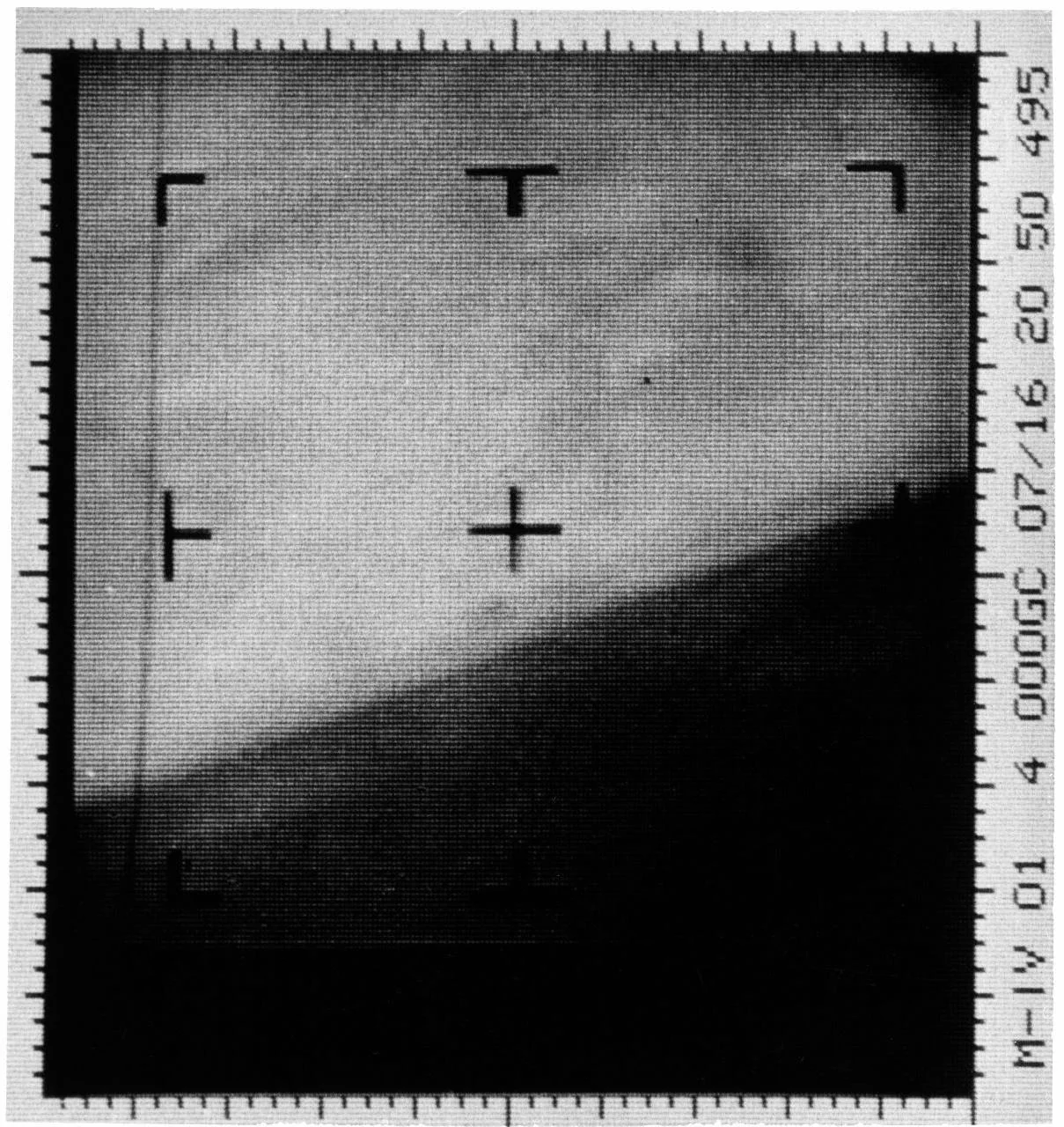
Mariner 4 flew past Mars on July 14, 1965. It returned a little more than twenty close-up images and measurements indicating an atmosphere far thinner than many earlier scenarios had assumed. The cratered terrain initially made Mars look Moon-like, although later missions revealed a much more diverse planet. [source]
The achievement was informational as much as spatial. Data had to be recorded, transmitted at very low bit rates, received on Earth, and reconstructed. The quantity seems tiny by modern standards, yet every bit then cost dearly in power, antenna time, and processing capability.
This episode deserves to be read at two levels. In the short term it concerns mariner 4: twenty-one images that destroyed part of the old imagined mars and the decisions made by the teams of the period.
Mariner 4 shows the political value of a measurement that contradicts expectations. A credible scientific institution must accept that a mission can close popular scenarios instead of confirming the preferred story.
From a systems-engineering perspective, mariner 4: twenty-one images that destroyed part of the old imagined mars forces attention to interfaces.
Any human architecture must absorb this lesson: the real planet corrects plans. A settlement cannot be designed for fictional Mars but for a Mars continually revised by observation. [source]
Mariner 4: twenty-one images that destroyed part of the old imagined Mars therefore adds a layer of institutional memory that future programs can use only if the people and archives needed to understand it are not lost.
Mariner 9: when mapping changed the scale of Martian questions
Mariner 9 became the first spacecraft to orbit another planet in 1971. It arrived during a global dust storm and had to wait for the atmosphere to clear. The mission then revealed giant volcanoes, canyons, valley networks, and geology far more varied than Mariner 4's first close-up images had suggested. [source]
Orbit transformed a handful of views into systematic coverage. The question changed from 'what does Mars look like?' to 'how do regions differ, what processes formed them, and where should we go next?'
The history of mariner 9: when mapping changed the scale of martian questions is also a history of margin.
The mission also illustrates adaptive operations. Waiting for dust to clear, replanning observations, and exploiting a long mission require an organization able to make new decisions after launch.
Chronology matters because it prevents anachronism. When mariner 9: when mapping changed the scale of martian questions occurred, computers, materials, communications networks, budgets, and planetary knowledge were not those of 2026.
For humans, mapping becomes infrastructure: site selection, safety, ice resources, surface routes, communications, and risk forecasting all depend on global knowledge of the planet. [source]
Mariner 9: when mapping changed the scale of Martian questions is not merely a date on a timeline; it is an experiment that changes what teams know how to build, what they know how to measure, and what they know to reject when margin is insufficient.
Viking: JPL orchestrates the orbiters while Langley carries the landers
The 1976 Viking missions are often told as a single homogeneous program. In reality the institutional split was more subtle: JPL developed the orbiters and played a major role in planetary operations, while Langley Research Center managed the Viking project and lander development. The arrangement forced teams to connect orbital navigation, landing-site reconnaissance, data relay, and surface operations. [source]
Viking built a distributed architecture ahead of its time. The orbiter was not merely a science platform; it supported site observation and later data return. The mission system therefore extended beyond any single spacecraft.
Viking: JPL orchestrates the orbiters while Langley carries the landers depended on ground teams, analysis tools, suppliers, tests, software, and budget decisions that do not appear in official photographs. Success is distributed.
This division shows why attributing an entire mission to one center erases essential history. JPL became powerful precisely because it could operate in chains where other centers and contractors carried critical responsibilities.
Viking: JPL orchestrates the orbiters while Langley carries the landers may prove that a function can work once; a durable campaign requires it to become repeatable, documented, maintainable, and financially supportable.
A Mars base will rely on this kind of distributed architecture: orbiters, relays, cargo systems, habitats, and surface vehicles will have to function as a network rather than isolated missions. [source]
The existence of viking: jpl orchestrates the orbiters while langley carries the landers does not prove that every adjacent problem is solved; it is evidence limited to particular conditions.
Ranger: failure as a governance crisis before it became lunar competence
The Ranger program is essential because it prevents the backward projection of JPL's later reputation onto its early space years. Several early spacecraft failed for different reasons. The failures damaged confidence and forced changes in project organization, testing, and responsibility. Eventually Ranger 7 succeeded in 1964 and returned thousands of close lunar images before impact.
The enduring product was not merely a successful camera sequence. JPL learned that complex programs survive repeated failure only when investigations become institutional change: stronger system testing, better configuration discipline, clearer authority, and more explicit handling of anomalies. Modern mission assurance is partly accumulated memory from such painful episodes.
Surveyor: controlled landing before mobile Mars exploration
Surveyor added the challenge of soft landing. Radar, propulsion, guidance, and landing dynamics had to function as a tightly timed chain. The program supported Apollo by characterizing the lunar surface, but it also gave JPL experience in autonomous descent and terminal events. [9]
The Moon is not Mars: there is no atmosphere and the communication delay is much shorter. Yet the organizational lesson is transferable. Landing is a sequence in which sensor interpretation drives irreversible actions. Later Mars missions would make the chain more complex, not fundamentally different in its need for integrated reasoning.
Mariner 2: the first successful U.S. interplanetary mission as an architecture lesson
Mariner 2's 1962 Venus flyby required months of autonomous survival, attitude control, solar power, communications over unprecedented distances, and accurate trajectory correction. It helped establish a classic deep-space architecture: keep power generation oriented toward the Sun, communications toward Earth, instruments toward the target, and use radio tracking to refine the trajectory. [10]
Each subsystem depended on the others. Attitude affected thermal conditions and antenna pointing; communications supported navigation; navigation determined science geometry. The mission therefore taught JPL to think in coupled constraints rather than independent components.
Mariner 4: Mars enters the age of direct measurement
In July 1965, Mariner 4 completed the first successful Mars flyby and returned the first close-up images of another planet. The data rate was tiny by modern standards. Images were received line by line, and the team's famous hand-colored numerical printout reflected the desire to see the image before the full digital reconstruction was complete. [11]
The cratered terrain challenged popular expectations of a more Earthlike Mars. Scientifically, that disappointment was a success. Exploration has value because it can destroy an attractive hypothesis. JPL's role was not to confirm a narrative but to build instruments capable of forcing a revision.
Mariner 6 and 7: repetition as scientific and industrial method
The paired 1969 flybys demonstrated the value of related spacecraft. Repetition spreads development effort, provides comparative data, and lets teams carry lessons from one vehicle to another. Mars launch windows recur roughly every 26 months, making program continuity more valuable than isolated brilliance.
Standardization must remain selective. Reusing an architecture is valuable only when the mission does not conceal important differences. The later rover program would repeatedly apply the same principle: inherit what is understood so that innovation can be concentrated where it creates new capability.
Mariner 9: orbit changes Mars from a sample of pictures into a mappable world
Mariner 9 entered Mars orbit in November 1971 and became the first spacecraft to orbit another planet. A global dust storm initially obscured the surface. Because the mission was an orbiter rather than a brief flyby, the team could wait, observe the atmosphere, and then map the emerging terrain. [12]
The mission revealed giant volcanoes, the Valles Marineris canyon system, channels, and a geologically diverse planet. Operationally, it showed the value of time margin and flexible planning. Planetary environments do not obey project schedules; a robust mission must be able to revise its plan after launch.
Viking: distributed responsibility across NASA centers and contractors
Viking is often remembered as one program, but its responsibilities were distributed. Langley managed the overall project and landers, while JPL developed the Mariner-derived orbiters and provided major navigation and operations capabilities. The success therefore depended on organizational interfaces as well as spacecraft interfaces. [13]
The orbiters supported landing-site selection and surface operations while performing their own science. This multi-vehicle logic foreshadowed today's Mars network, in which orbiters provide communications and context for surface systems.
Mars Surveyor: turning one lost flagship into a cadence of missions
After Mars Observer, NASA moved toward more frequent Mars missions, taking advantage of launch opportunities roughly every 26 months. Smaller spacecraft were expected to reduce cost and allow continuous learning. JPL became central to this cadence.
The strategy created new stresses. Multiple projects could compete for the same specialists and facilities. Cost pressure reduced margins, while rapid schedules increased the cost of late discoveries. The lesson of the 1990s is not that small missions are inherently unsafe; it is that cadence must be supported by equally mature systems engineering.
Cameras: from tiny Mariner frames to sensors that also navigate and diagnose
Imaging systems evolved from low-data-rate planetary pictures to high-resolution orbital mapping and rover stereo vision. Cameras now serve science, engineering, navigation, public communication, and hardware inspection.
This multi-use value is important for Mars infrastructure. A maintenance camera can become a science instrument if calibration and metadata are preserved. Sensors should be designed as shared information assets rather than isolated project accessories.
Ranger: turning a string of failures into an industrial method
Its historical value lies as much in the constraints it exposed as in the final result. Early Ranger spacecraft failed one after another before Rangers 7, 8, and 9 succeeded. The sequence forced JPL to examine not only failed components but also how it designed, assembled, tested, and decided. Cleanliness, system integration, and configuration discipline became progressively more rigorous. [48]
Technically, the important lesson was organizational. When successive failures do not share the same immediate cause, the response cannot be a local repair. The institution must search for common conditions that allow defects to escape reviews or tests.
Historical value finally comes from continuity: methods born on one mission can be reused, but only after their domain of validity is checked again. In the case of “Ranger: turning a string of failures into an industrial method,” success in this setting is multidimensional.
The history of “Ranger: turning a string of failures into an industrial method” also helps separate demonstrated capability from extrapolation.
The Mars benefit comes from systems method: every kilogram, watt, bit, and hour of expert attention belongs to a shared architecture rather than to one mission considered in isolation. For “Ranger: turning a string of failures into an industrial method,” that is how laboratory history becomes a design resource rather than a catalogue of records.
In the first planetary missions, the problem is no longer simply to build an object that works. A navigation, tracking, processing, and decision chain has to be organized even though no single team possesses the whole truth. That interdependence becomes a lasting feature of JPL programs. In that frame, “Ranger: turning a string of failures into an industrial method” becomes a case study linking a dated decision to a durable capability without turning historical experience into a universal recipe.
Surveyor: landing softly before Apollo
In JPL history, this stage functioned as a full-scale test of the organization itself. Surveyor posed a different challenge from Ranger: not merely reaching the Moon but braking, controlling descent, and surviving contact. The landers also returned information about soil bearing strength and surface properties relevant to Apollo. JPL learned to connect robotic exploration with human-program needs without treating their architectures as identical. [59]
Technically, this experience foreshadows a Mars rule: a precursor robot has greatest value when it measures the uncertainties that change a human decision. A spectacular image may be less useful than a measurement of bearing strength, dust, temperature, or mechanical stability.
The sequence shows why technical reviews also act as memory mechanisms. They force a project to state assumptions that might otherwise remain inside a few people's heads. In the case of “Surveyor: landing softly before Apollo,” success in this setting is multidimensional.
The history of “Surveyor: landing softly before Apollo” also helps separate demonstrated capability from extrapolation.
The Martian consequence is institutional as well as technical: crews will need authority rules, configuration records, and fallback paths as robust as their machines. For “Surveyor: landing softly before Apollo,” that is how laboratory history becomes a design resource rather than a catalogue of records.
That interdependence becomes a lasting feature of JPL programs. In that frame, “Surveyor: landing softly before Apollo” becomes a case study linking a dated decision to a durable capability without turning historical experience into a universal recipe.
Mariner 2: first interplanetary success and the birth of deep-space navigation
The moment reveals the laboratory not as a brand but as a system of professions, rules, and interfaces. Mariner 2 to Venus in 1962 brought JPL into real interplanetary operations. The mission required navigation, trajectory correction, long-distance communications, and interpretation of measurements in a poorly known environment. It turned laboratory capabilities into an operational service at inner-solar-system scale. [59]
Technically, deep-space navigation is not a calculation performed once at launch. It is continuous estimation: observe the signal, update the spacecraft state, predict its evolution, then decide whether a correction justifies its risk and propellant cost.
In the case of “Mariner 2: first interplanetary success and the birth of deep-space navigation,” success in this setting is multidimensional.
The history of “Mariner 2: first interplanetary success and the birth of deep-space navigation” also helps separate demonstrated capability from extrapolation.
For “Mariner 2: first interplanetary success and the birth of deep-space navigation,” that is how laboratory history becomes a design resource rather than a catalogue of records.
That interdependence becomes a lasting feature of JPL programs. In that frame, “Mariner 2: first interplanetary success and the birth of deep-space navigation” becomes a case study linking a dated decision to a durable capability without turning historical experience into a universal recipe.
Mariner 4 and Mariner 9: two ways of changing Mars
Its deeper significance appears when the interfaces it created or forced JPL to repair are followed over time. Mariner 4 returned the first close-up images of Mars and helped overturn popular expectations. Mariner 9, the first spacecraft to orbit another planet, arrived during a global dust storm and later mapped volcanoes, canyons, channels, and ancient terrain. Between the two missions, Mars changed from a telescopic disk into a geological world. [59]
Technically, the sequence shows why a program can be more powerful than an isolated mission. One vehicle reduces broad ignorance; the next reformulates the questions and carries instruments suited to that new state of knowledge.
In the case of “Mariner 4 and Mariner 9: two ways of changing Mars,” success in this setting is multidimensional.
The history of “Mariner 4 and Mariner 9: two ways of changing Mars” also helps separate demonstrated capability from extrapolation.
For “Mariner 4 and Mariner 9: two ways of changing Mars,” that is how laboratory history becomes a design resource rather than a catalogue of records.
That interdependence becomes a lasting feature of JPL programs. In that frame, “Mariner 4 and Mariner 9: two ways of changing Mars” becomes a case study linking a dated decision to a durable capability without turning historical experience into a universal recipe.
Ranger: failure as a systems and governance problem
JPL appears here as a technical institution: many professions, levels of authority, and layers of accumulated memory must converge on one result. 1961–1965 provides the chronological frame. Early Ranger missions failed repeatedly before Rangers 7, 8, and 9 returned the intended lunar imagery. The series became foundational: repeating hardware without changing the organization can repeat failure, while revising responsibility and verification can turn the same objective into success. [3] The historical fact matters most when tied to program constraints: schedule, funding, availability of experienced staff, condition of shared facilities, component maturity, and dependence on organizations outside JPL.
The technical mechanism is more specific. Each anomaly had to be separated into component failure, integration, power, command sequencing, and launch-environment effects. That decomposition pushed JPL toward more formal interface control and end-to-end testing.
The human layer is equally important. Political pressure after a public series of failures creates a temptation to find a culprit. Learning instead requires reviews able to trace technical causes into the organizational conditions that allowed them.
Within the specific chapter “Ranger: failure as a systems and governance problem,” At institutional scale, This is also what separates an exploration campaign from a collection of missions: assets, data, and methods begin to behave as a shared system. The objective is not universal standardization.
For human Mars, transfer has to remain bounded. On Mars, a cargo or construction campaign would probably experience recurring anomalies. The organization would need to resist fixing only the visible part when the real defect lies in integration or authority chains.
Surveyor: learning landing as a complete discipline
The chapter turns on the difference between possessing a technology and possessing an organization able to use it reliably. 1966–1968 provides the chronological frame. Surveyor demonstrated multiple controlled lunar landings before Apollo. For JPL, the value exceeded surface success: navigation, radar, terminal propulsion, structure, communications, and operations had to be coordinated through a descent window that would not tolerate late inconsistency. [4] The historical fact matters most when tied to program constraints: schedule, funding, availability of experienced staff, condition of shared facilities, component maturity, and dependence on organizations outside JPL.
The technical mechanism is more specific. Descent turns modest errors into rapid consequences. A bias in altitude or velocity can move ignition timing and consume margins throughout the sequence. Sensitivity therefore requires coupled verification of sensors, algorithms, and actuators.
The human layer is equally important. The program also shows that landing capability is never possessed once and for all. It depends on vehicle, terrain, gravity, atmosphere, and available navigation methods.
Within the specific chapter “Surveyor: learning landing as a complete discipline,” At institutional scale, The consequence is durable: the next mission rarely inherits a complete solution, but it does inherit people, procedures, software, testbeds, and ways of framing problems. The objective is not universal standardization.
For human Mars, transfer has to remain bounded. For human Mars, Surveyor, Viking, Pathfinder, and Curiosity form a useful lineage, but none directly validates crewed payloads of tens of tonnes. The lesson is to preserve EDL discipline while rebuilding architecture at the required scale.
Mariner: learning to do science with an extremely constrained machine
This moment becomes especially instructive when human and documentary interfaces are followed as closely as hardware interfaces. 1962–1971 provides the chronological frame. Mariners 2, 4, and 9 show three maturity steps: complete an interplanetary crossing, return close-up images of Mars, and then operate an orbiter able to wait through a global dust storm before mapping. Each step required turning spacecraft constraint into science strategy. [59] The historical fact matters most when tied to program constraints: schedule, funding, availability of experienced staff, condition of shared facilities, component maturity, and dependence on organizations outside JPL.
The technical mechanism is more specific. Memory, transmission, and pointing capabilities were extremely limited. Observation selection and planning were therefore not administrative details; they directly determined what the mission could know.
The human layer is equally important. Scientists and engineers had to negotiate priorities in a shared language of time, power, geometry, and risk. This is one origin of the science-operations culture that later became central to rover missions.
Within the specific chapter “Mariner: learning to do science with an extremely constrained machine,” At institutional scale, That continuity helps explain how a laboratory can change destination radically while retaining a recognizable technical identity. The objective is not universal standardization.
For human Mars, transfer has to remain bounded. A Mars base would likewise arbitrate among science, maintenance, communications, and production. Resource allocation could not be separated from scientific and safety priorities.
Viking: distributing a mission across centers without losing the system
1975–1982 provides the chronological frame. Viking joined JPL, Langley, NASA Headquarters, contractors, and science teams in an architecture where orbiters and landers did not belong to exactly the same responsibility chains. Success showed that a distributed mission can work when interfaces are treated as first-class technical objects. [3] The historical fact matters most when tied to program constraints: schedule, funding, availability of experienced staff, condition of shared facilities, component maturity, and dependence on organizations outside JPL.
The technical mechanism is more specific. Orbiter-to-surface communications, navigation, landing windows, and science scheduling connected subsystems built by different organizations. System control therefore depended as much on interface agreements and data as on hardware itself.
The human layer is equally important. Distribution can also dilute risk perception: each team may assume a problem lies on the other side of a contractual boundary. Integrated reviews exist precisely to rebuild a shared view.
Within the specific chapter “Viking: distributing a mission across centers without losing the system,” At institutional scale, Experience does not remove risk; it makes risk more explicit, measurable, and discussable before it becomes irreversible. The objective is not universal standardization.
For human Mars, transfer has to remain bounded. An international Mars infrastructure would be even more distributed than Viking. Interface, responsibility, and anomaly-resolution rules would need to exist before multiple nations or private operators depend on the same critical service.
Voyager, Galileo, Cassini, and Earth: Expanding a Systems Culture
Voyager: learning to operate a machine for decades and reprogram the unknown
Voyager 1 and Voyager 2, launched in 1977, became a concentrated expression of JPL culture: interplanetary navigation, gravity assists, reprogramming, management of declining resources, and scientific operation far beyond the duration designers initially had to guarantee. Voyager 2 visited Jupiter, Saturn, Uranus, and Neptune; Voyager 1 continued toward interstellar space. [source]
Longevity does not come from physical immortality. It results from continuous tradeoffs: shutting instruments down, changing sequences, bypassing anomalies, reducing power use, and preserving knowledge of old software. Operations become a form of remote maintenance.
From a systems-engineering perspective, voyager: learning to operate a machine for decades and reprogram the unknown forces attention to interfaces.
Voyager also demonstrates the value of intergenerational teams. People operating a mission decades after launch may not have been present at design. Documentation and knowledge transfer therefore become system components.
Another useful angle is the flow of information. Around voyager: learning to operate a machine for decades and reprogram the unknown, sensors create measurements, software transforms them, teams interpret them, and decisions return to the vehicle or program. Error can enter anywhere in that chain.
Mars infrastructure meant to last for generations will have to institutionalize the same memory: procedures, failure histories, software configurations, and maintenance decisions must outlive individuals. [source]
Voyager: learning to operate a machine for decades and reprogram the unknown therefore adds a layer of institutional memory that future programs can use only if the people and archives needed to understand it are not lost.
Voyager: when duration itself becomes a technology
Voyager matters to a Mars history because it forced JPL to learn how to operate a spacecraft for decades, preserve knowledge as personnel changed, and reprogram aging hardware under declining power and communications margins. [15]
An extended mission is not simply a nominal mission repeated indefinitely. Components age, documentation becomes harder to interpret, and teams must decide how aggressively to use remaining resources. That experience later became directly relevant to Odyssey, Opportunity, Curiosity, and other missions that lived far beyond their primary lifetimes.
Galileo: preserving science when the hardware does not behave nominally
Galileo's high-gain antenna failed to fully deploy. JPL and its partners responded with improved data compression, ground processing, modified sequencing, and creative use of the low-gain antenna. The mission returned major science despite losing much of its intended communications capability.
This is a textbook example of graceful degradation. A robust system is not one that never fails; it is one that can preserve valuable functions when a major element becomes unavailable. Mars infrastructure will need the same philosophy at larger scale.
Cassini-Huygens: international complexity as a rehearsal for multi-actor exploration
Cassini combined NASA, ESA, and the Italian Space Agency. JPL managed the mission and orbiter while Europe supplied Huygens and other contributions. Interfaces crossed not only spacecraft boundaries but legal systems, budgets, data policies, and institutional cultures. [16]
Human Mars exploration is likely to be at least as international. The lesson is not that cooperation automatically reduces risk. Cooperation works when responsibilities, standards, decision rights, and failure responses are explicit.
Earth science: why a planetary laboratory benefits from looking homeward
JPL's public image is dominated by planetary missions, yet Earth observation, radar, oceanography, atmospheric sounding, and gravity missions are major parts of its portfolio. These programs sustain expertise in remote sensing, signal processing, optics, data systems, and calibration.
The boundary between Earth and planetary science is technologically porous. Techniques developed to map Earth's surface or atmosphere can migrate to Mars, Venus, or icy worlds. A Mars-focused institution would be weaker if it became a technological monoculture.
Containment: protecting Earth science and protecting Mars science at the same time
Returned samples must be protected from terrestrial contamination, while Earth must also be protected according to planetary-protection requirements until the samples are adequately characterized. This creates nested containment and handling rules.
The engineering challenge crosses biology, materials, seals, transportation, and laboratory design. It is a model for the multi-domain safety systems that human Mars exploration will require.
Earth science: a JPL capability that indirectly prepares Mars
Describing JPL only as a planetary laboratory would erase a major part of its work. The laboratory also develops and manages Earth-observing missions, climate instruments, radars, altimeters, and processing systems that study oceans, ice, atmosphere, and continental surfaces. This diversification is relevant to Mars because it sustains expertise in remote sensing, calibration, geodesy, large-scale data processing, and environmental modeling that can move between domains.
SWOT, developed with CNES and other partners, measures surface-water elevation using wide-swath radar interferometry. NISAR joins NASA and ISRO around synthetic-aperture radar observations of changing land and ice. EMIT maps the mineral composition of dust-source regions from the International Space Station. None is a rehearsal for Mars in a literal sense. All exercise institutional muscles that Mars also needs: precise instruments, calibration, ground validation, international interfaces, data systems, and service to a broad science community.
A human Mars presence will eventually require continuous environmental observation rather than occasional exploration. Dust activity, ice, slope stability, atmospheric conditions, and surface change will need to feed mobility and safety decisions. The useful model is therefore not only the rover but also the observing fleet that turns long time series into knowledge services. JPL's Earth-science experience demonstrates that the transition from spectacular image to environmental record depends on calibration, continuity, and comparability across generations of instruments.
Asteroids and comets broaden JPL's engineering vocabulary
Small-body missions force engineers to work with weak gravity, irregular shapes, uncertain surfaces, and unusual navigation geometry. Deep Impact, Stardust, and later asteroid projects expanded capabilities beyond classical planetary flybys and orbiters. Optical navigation, encounter timing, sample-related operations, and flight around poorly characterized bodies create a different kind of systems challenge.
Mars architecture may eventually include Phobos and Deimos, whose environments differ radically from the surface. Relays, depots, or science operations around the moons cannot be treated as rover missions in miniature. Weak gravity changes mobility, anchoring, dust behavior, and proximity operations. An institution with experience across many environment classes is less likely to rely on false analogies.
Voyager: designing for a duration no ground test can reproduce
Voyager forced JPL to think beyond the duration of any test campaign. The two spacecraft crossed the outer solar system and continued into interstellar space. Their longevity depends on redundancy, power management, reconfiguration procedures, and the ability to understand hardware designed decades earlier. [59]
Technically, long duration turns documentation into a component. A missing diagram, an implicit convention, or a decision whose rationale has been lost can become an institutional failure decades after launch.
In the case of “Voyager: designing for a duration no ground test can reproduce,” success in this setting is multidimensional.
The history of “Voyager: designing for a duration no ground test can reproduce” also helps separate demonstrated capability from extrapolation.
Transfer to Mars must remain cautious. For “Voyager: designing for a duration no ground test can reproduce,” that is how laboratory history becomes a design resource rather than a catalogue of records.
Flagship systems require both a mission view and a portfolio view. The same experts, facilities, and software support several projects, so a local decision about schedule or testing can change another program’s risk. Institutional maturity means exposing those dependencies before they turn into crises. In that frame, “Voyager: designing for a duration no ground test can reproduce” becomes a case study linking a dated decision to a durable capability without turning historical experience into a universal recipe.
Galileo: saving a mission after losing a central capability
Galileo illustrates a different form of robustness. Its high-gain antenna failed to deploy as intended, sharply reducing expected communications capacity. Teams compensated through compression, software changes, inventive use of the low-gain antenna, and reorganization of the science plan. The mission remained productive despite a major degradation. [59]
Technically, robustness therefore does not mean everything continues as planned. It can mean an institution knows how to redefine success when the real machine is no longer the one described in the original requirements.
In the case of “Galileo: saving a mission after losing a central capability,” success in this setting is multidimensional.
The history of “Galileo: saving a mission after losing a central capability” also helps separate demonstrated capability from extrapolation.
For “Galileo: saving a mission after losing a central capability,” that is how laboratory history becomes a design resource rather than a catalogue of records.
In that frame, “Galileo: saving a mission after losing a central capability” becomes a case study linking a dated decision to a durable capability without turning historical experience into a universal recipe.
Cassini: the flagship mission as a technical coalition
Cassini combined a large architecture, many instruments, a major European contribution through Huygens, and long-duration operations at Saturn. For JPL, such a program tested interface management: every instrument and partner had its own logic, while the spacecraft could not tolerate contradictions in mass, power, data, schedule, or contamination constraints. [59]
Technically, the lesson is less spectacular than an image of Saturn but fundamental to a future Mars network: interfaces are technical contracts. They must remain verifiable when separate organizations change their own subsystems.
In the case of “Cassini: the flagship mission as a technical coalition,” success in this setting is multidimensional.
The history of “Cassini: the flagship mission as a technical coalition” also helps separate demonstrated capability from extrapolation.
For “Cassini: the flagship mission as a technical coalition,” that is how laboratory history becomes a design resource rather than a catalogue of records.
In that frame, “Cassini: the flagship mission as a technical coalition” becomes a case study linking a dated decision to a durable capability without turning historical experience into a universal recipe.
Seasat, TOPEX, and diversification toward Earth
Post-Apollo budget pressure pushed JPL to diversify. Seasat and later altimetry missions showed that techniques developed to observe other planets could measure Earth's ocean, ice, and gravity. This was not merely a detour: it created radar, processing, and metrology capabilities that later fed back into planetary exploration. [59]
Technically, a durable laboratory thereby avoids technical monoculture. Earth missions impose different cadences, data volumes, and user communities, broadening the institution's methods.
In the case of “Seasat, TOPEX, and diversification toward Earth,” success in this setting is multidimensional.
The history of “Seasat, TOPEX, and diversification toward Earth” also helps separate demonstrated capability from extrapolation.
For “Seasat, TOPEX, and diversification toward Earth,” that is how laboratory history becomes a design resource rather than a catalogue of records.
In that frame, “Seasat, TOPEX, and diversification toward Earth” becomes a case study linking a dated decision to a durable capability without turning historical experience into a universal recipe.
Voyager: designing a mission that outlives generations of engineers
1977–2026 provides the chronological frame. Voyager 1 and 2 became NASA's longest-lived operating missions and continued producing interstellar science decades after their planetary encounters. Their longevity turned a Grand Tour project into an institutional experiment in maintaining a system as original designers gradually retired. [80] The historical fact matters most when tied to program constraints: schedule, funding, availability of experienced staff, condition of shared facilities, component maturity, and dependence on organizations outside JPL.
The technical mechanism is more specific. Software, procedures, and diagnostic knowledge have to survive even as ground technology changes radically. Teams operate flight computers, formats, and power constraints designed in the 1970s while modernizing the terrestrial tools around them.
The human layer is equally important. Voyager's later small team illustrates the difference between maintaining a mission and maintaining the organization that built it. Knowledge transfer becomes daily work rather than an end-of-project exercise.
Within the specific chapter “Voyager: designing a mission that outlives generations of engineers,” At institutional scale, The capital is fragile: if it is not practiced, documented, and transferred, a few departures or a few years of interruption can erase it. The objective is not universal standardization.
For human Mars, transfer has to remain bounded. A Mars base could outlast the careers of many original leaders. Succession procedures, readability of old software, and the ability to explain historical compromises would then become survival capabilities.
Galileo: recovering science after loss of a central capability
1989–2003 provides the chronological frame. Galileo's failure to fully deploy its high-gain antenna threatened the planned data rate to Earth. JPL and partners compensated through software, compression, revised communications strategies, and use of the low-gain antenna, preserving a major share of science objectives. [3] The historical fact matters most when tied to program constraints: schedule, funding, availability of experienced staff, condition of shared facilities, component maturity, and dependence on organizations outside JPL.
The technical mechanism is more specific. Recovery did not restore nominal hardware. It redefined the system around remaining capability: onboard processing, scheduling, DSN support, data selection, and new procedures became a substitute architecture.
The human layer is equally important. The recovery required teams able to question the objective rather than obsess over the original means. Preserving science became more important than preserving the initial plan.
Within the specific chapter “Galileo: recovering science after loss of a central capability,” At institutional scale, Institutional maturity is therefore measured less by the number of past successes than by the ability to understand what actually produced those successes. The objective is not universal standardization.
For human Mars, transfer has to remain bounded. On Mars, damaged infrastructure may not always be restored to nominal condition. Essential services would need to be reformulated around what remains available, while preventing emergency workarounds from becoming hidden permanent debt.
Cassini: managing an international mission as both political and technical system
1982–2017 provides the chronological frame. Cassini-Huygens combined NASA, ESA, the Italian Space Agency, many instruments, and decades of development and operations. JPL led the orbiter and mission while depending on partners whose budget processes, schedules, and responsibilities were not identical. [3] The historical fact matters most when tied to program constraints: schedule, funding, availability of experienced staff, condition of shared facilities, component maturity, and dependence on organizations outside JPL.
The technical mechanism is more specific. Interfaces were institutional as well as mechanical: mass, power, data, separation sequences, navigation, and operating rules had to remain compatible across distributed decision chains.
The human layer is equally important. A long mission also creates multiple generations of teams. Design decisions must remain understandable to operators who may apply them fifteen or twenty years later.
Within the specific chapter “Cassini: managing an international mission as both political and technical system,” At institutional scale, This is also what separates an exploration campaign from a collection of missions: assets, data, and methods begin to behave as a shared system. The objective is not universal standardization.
For human Mars, transfer has to remain bounded. An international Mars settlement would face the same issues at larger social scale: common standards, unsynchronized budgets, legal responsibility, and continuity despite political change on Earth.
Earth Science: diversifying the laboratory to renew its methods
1978–2026 provides the chronological frame. From Seasat through TOPEX/Poseidon, GRACE, OCO-2, SMAP, SWOT, and NISAR, JPL developed an Earth portfolio using radar, altimetry, spectroscopy, radiometry, and large-scale data processing. The branch prevents the laboratory from being reduced to planetary exploration alone. [55] The historical fact matters most when tied to program constraints: schedule, funding, availability of experienced staff, condition of shared facilities, component maturity, and dependence on organizations outside JPL.
The technical mechanism is more specific. Earth missions often impose high data rates, repeated calibration, and comparison with ground measurement networks. They develop statistical validation and science-production methods different from rare planetary encounters.
The human layer is equally important. Diversification creates bridges among radar, software, data, and instrumentation teams. It also provides institutional resilience when the planetary portfolio slows.
Within the specific chapter “Earth Science: diversifying the laboratory to renew its methods,” At institutional scale, The consequence is durable: the next mission rarely inherits a complete solution, but it does inherit people, procedures, software, testbeds, and ways of framing problems. The objective is not universal standardization.
For human Mars, transfer has to remain bounded. Mars will need continuous observation of its own weather, resources, and infrastructure. Earth Science experience shows how to move from isolated measurements toward long-lived monitoring services.
Europa Clipper: building a modern flagship planetary system
2015–2024 provides the chronological frame. Europa Clipper was assembled and tested at JPL as one of NASA's largest planetary spacecraft. Development involved multiple institutions and instruments while the laboratory integrated a vehicle intended for the intense radiation environment around Jupiter. [81] The historical fact matters most when tied to program constraints: schedule, funding, availability of experienced staff, condition of shared facilities, component maturity, and dependence on organizations outside JPL.
The technical mechanism is more specific. The architecture imposes shielding, mass control, thermal management, electromagnetic compatibility, and verification of heterogeneous instruments. System-level testing becomes the last terrestrial opportunity to discover interactions invisible at subsystem level.
The human layer is equally important. Integrating the large spacecraft in the Spacecraft Assembly Facility highlights technicians, metrology staff, logistics specialists, and test engineers who are rarely visible in mission narratives.
Within the specific chapter “Europa Clipper: building a modern flagship planetary system,” At institutional scale, That continuity helps explain how a laboratory can change destination radically while retaining a recognizable technical identity. The objective is not universal standardization.
For human Mars, transfer has to remain bounded. For human Mars, the lesson concerns large systems made of separately qualified equipment: real compatibility must be demonstrated at whole-system level, including maintenance operations.
Returning to Mars: Observer, Pathfinder, 1999, and Program Reconstruction
Mars Observer: a loss before arrival that forced the design chain to be reconsidered
Mars Observer launched in 1992 with an ambitious remote-sensing payload. Contact was lost in August 1993 only days before orbital insertion. The investigation could not establish a single certain cause but examined, among other possibilities, a propulsion-system rupture during pressurization. Failure came after a long cruise when nearly everything had appeared successful. [source]
The event reminds engineers that reliability must include rare phases, sometimes executed only once. A mechanism dormant for months can become critical at the precise moment when no real rehearsal is possible.
Chronology matters because it prevents anachronism. When mars observer: a loss before arrival that forced the design chain to be reconsidered occurred, computers, materials, communications networks, budgets, and planetary knowledge were not those of 2026.
The response was not merely to identify a faulty part. It influenced mission reviews, redundancy philosophy, and the later practice of distributing scientific objectives across smaller spacecraft.
Finally, mars observer: a loss before arrival that forced the design chain to be reconsidered shows that space policy is never separate from engineering.
For a crewed mission, a failure just before arrival would be catastrophic. Insertion, separation, and landing sequences must therefore be treated as high-risk systems long before departure. [source]
Mars Observer: a loss before arrival that forced the design chain to be reconsidered is not merely a date on a timeline; it is an experiment that changes what teams know how to build, what they know how to measure, and what they know to reject when margin is insufficient.
Pathfinder and Sojourner: “faster, better, cheaper” first succeeds brilliantly
Mars Pathfinder landed on July 4, 1997 with a daring architecture: heat shield, parachute, retrorockets, and airbags. The small Sojourner rover became the first vehicle to drive on Mars. The goal was technological as well as scientific: demonstrate that a planetary mission could be built more quickly and at lower cost than earlier flagship projects. [source]
Airbags, the rover, communications, and surface operations opened several technology branches. The success showed that a compact team could take calculated risks when it knew which functions were essential and which could be simplified.
Pathfinder and Sojourner: “faster, better, cheaper” first succeeds brilliantly may prove that a function can work once; a durable campaign requires it to become repeatable, documented, maintainable, and financially supportable.
Pathfinder also became a cultural precedent. Its success encouraged a policy of more frequent, cheaper missions. The difficulty was avoiding the conversion of one successful case into a universal rule for every project.
This episode deserves to be read at two levels. In the short term it concerns pathfinder and sojourner: “faster, better, cheaper” first succeeds brilliantly and the decisions made by the teams of the period.
Settlement will need the same ability to simplify, but never at the expense of life-critical functions. The challenge is distinguishing frugal innovation from dangerous removal of margin. [source]
The existence of pathfinder and sojourner: “faster, better, cheaper” first succeeds brilliantly does not prove that every adjacent problem is solved; it is evidence limited to particular conditions.
1999: Mars Climate Orbiter and Mars Polar Lander end an illusion of simplicity
In 1999 Mars Climate Orbiter was lost at arrival after a famous interface error: one team supplied impulse data in English units while navigation software expected metric units. Mars Polar Lander was also lost months later. Two failures in quick succession produced a deep crisis at JPL and in the 'faster, better, cheaper' policy. [source]
The unit error is often told as a humorous anecdote, obscuring the real problem: verification and communication processes failed to detect a fundamental incompatibility. The technical cause was simple; the organizational cause was much deeper.
Another useful angle is the flow of information. Around 1999: mars climate orbiter and mars polar lander end an illusion of simplicity, sensors create measurements, software transforms them, teams interpret them, and decisions return to the vehicle or program. Error can enter anywhere in that chain.
The reviews that followed imposed greater systems discipline, testing, and accountability. The laboratory had to recognize that a culture of speed and cost reduction can accumulate risk when teams, interfaces, and margins are all compressed at once.
The history of 1999: mars climate orbiter and mars polar lander end an illusion of simplicity is also a history of margin.
On Mars, a unit mismatch in consumables, propulsion, or life support could be lethal. The lesson is therefore less 'use metric units' than 'design interfaces that detect inconsistency'. [source]
1999: Mars Climate Orbiter and Mars Polar Lander end an illusion of simplicity therefore adds a layer of institutional memory that future programs can use only if the people and archives needed to understand it are not lost.
Mars Observer: a lost spacecraft whose instruments continued to shape the program
Mars Observer launched in 1992 as the first U.S. Mars mission since Viking, but contact was lost in August 1993 shortly before orbit insertion. [17]
The loss did not erase the scientific investment. Instruments and objectives were redistributed across later spacecraft including Mars Global Surveyor, Odyssey, and Mars Reconnaissance Orbiter. This is a powerful form of institutional resilience: a vehicle can be lost while knowledge, hardware designs, and scientific questions remain available for reuse.
Pathfinder: proving a method rather than maximizing science
Mars Pathfinder demonstrated a lower-cost delivery system, airbag landing, and the first successful Mars rover. Sojourner was tiny, but mobility changed the logic of surface exploration. [18]
Airbags did not eliminate landing risk; they redistributed it into inflation, abrasion, bounce dynamics, petal deployment, and rover egress. Pathfinder succeeded because those interactions were treated as a system. Its near-real-time public web presence also changed how planetary missions interacted with society.
Sojourner: limited autonomy as the beginning of an unavoidable trend
The communications delay made joystick driving impossible. Operators sent goals and sequences; the rover performed local obstacle handling and protection. Each later rover expanded this balance between human planning and machine autonomy.
Human crews on Mars will face the same physical delay in a different form. Local organizations must have authority to handle urgent decisions without Earth approval. Autonomy is therefore both a software property and a governance property.
Faster, Better, Cheaper: valuable discipline, dangerous slogan
The 1990s push for smaller and faster missions sought to escape the pattern in which every planetary project became a decade-long flagship. Pathfinder appeared to validate the approach. But a management slogan cannot suspend the geometry of risk.
Interfaces still need verification, software still needs testing, and navigation still needs independent checks. The 1999 failures showed that schedule and cost compression can become dangerous when they reduce these functions below a viable threshold.
Mars Climate Orbiter: the unit mismatch was real, but the organizational lesson is larger
Mars Climate Orbiter was lost in 1999 after an interface supplied impulse data in English units while another part of the system expected metric units. [19]
The famous explanation is correct but incomplete. A robust organization should also detect an anomalous trajectory trend, challenge inconsistent products, and verify critical interfaces. The enduring lesson is to specify not just the data field but its units, sign convention, reference frame, timing, tolerance, and validation method.
Mars Polar Lander: when a plausible false signal can trigger an irreversible action
Mars Polar Lander disappeared during descent in December 1999. An investigation identified a likely scenario in which a transient signal associated with landing-leg deployment could have been interpreted as touchdown, causing premature engine shutdown. [20]
A sensor does not report physical truth directly; it produces a measurement that software interprets. Defensive logic must therefore ask whether the signal is plausible given altitude, velocity, timing, and other sensors. Human Mars systems will need the same skepticism around automatic shutdowns and emergency actions.
1999 as an institutional reset
Two Mars losses in one year forced NASA and JPL to revise organization, review processes, staffing, and risk management. The response did not simply abandon faster missions; it attempted to preserve useful agility while restoring stronger mission assurance.
This ability to revise doctrine is a mark of maturity. A method that produced one success is not automatically appropriate for every later project. Institutions must be willing to change the development model when evidence shows that its assumptions no longer hold.
Mars as a network: the most important conceptual shift since Pathfinder
Early planetary missions were often conceived as relatively self-contained expeditions: one vehicle, one launch window, one team. Modern Mars exploration increasingly behaves like a network. Orbiters map landing sites, relay data, monitor the atmosphere, and provide context; surface missions consume those services; the Deep Space Network connects the entire architecture to Earth. A failure in one orbiter can therefore affect multiple surface missions.
This interdependence improves efficiency but creates systemic risk. A mature network must identify single points of failure, reserve capacity, and plan replacements before old spacecraft fail. Human crews cannot depend on one relay satellite or one Earth station. JPL already operates a real-world laboratory for the transition from isolated missions to shared infrastructure.
Pathfinder and the web: almost real-time planetary exploration
Pathfinder arrived as the public web was becoming mainstream. Rapid image publication generated enormous traffic and changed expectations. Planetary missions became events that citizens could follow during operations rather than years later.
Open access also increased reuse by educators, researchers, and enthusiasts. The downside is that raw data can be overinterpreted before calibration and peer review. A mature data policy distinguishes raw observations, calibrated products, and scientific conclusions.
From Sojourner to Perseverance: mass growth as a compressed history of complexity
Sojourner weighed about eleven kilograms. Perseverance is over a metric ton. The increase reflects more than size: instrument suites, mobility, power, processing, sample handling, and science ambition all grew.
The mass growth also explains architectural discontinuities in EDL. Airbags cannot simply scale forever. Sky crane solved a larger robotic class but should not be assumed to scale to crewed landers. Engineering maturity includes recognizing those thresholds.
Mars interface standards: the organizational descendant of Mars Climate Orbiter
As vehicles and vendors multiply, interfaces need published standards for power, data, mechanical attachment, docking, fluids, time, units, and navigation. A company should be able to build a compatible cargo system without knowing every internal detail of the base.
Standards also need version governance. Equipment already on Mars may remain in service for decades, so abrupt interface changes could strand valuable assets. Backward compatibility becomes an infrastructure requirement.
Mars Observer: losing the spacecraft and rebuilding a strategy
The loss of Mars Observer in 1993, shortly before orbital insertion, showed that program success cannot be measured only by the care invested in one spacecraft. Institutional response matters as much: revisit assumptions, redistribute instruments, redefine cadence, and rebuild political and scientific confidence. [59]
Technically, the Mars program that followed increasingly adopted a cadence of more frequent, complementary missions. That strategy reduced the risk that a single failure would interrupt the entire knowledge chain for a decade.
In the case of “Mars Observer: losing the spacecraft and rebuilding a strategy,” success in this setting is multidimensional.
The history of “Mars Observer: losing the spacecraft and rebuilding a strategy” also helps separate demonstrated capability from extrapolation.
For “Mars Observer: losing the spacecraft and rebuilding a strategy,” that is how laboratory history becomes a design resource rather than a catalogue of records.
The return to Mars reveals the difference between restarting and learning. A new mission does not erase the previous failure; lessons have to appear in interfaces, margins, reviews, and stop criteria. That is how a program gradually rebuilds scientific and political confidence. In that frame, “Mars Observer: losing the spacecraft and rebuilding a strategy” becomes a case study linking a dated decision to a durable capability without turning historical experience into a universal recipe.
Pathfinder: technology demonstrator, science mission, and public event
Pathfinder combined a relatively light lander, airbags, direct communications, and the small Sojourner rover. It demonstrated technologies while producing science and reconnecting the public with Mars. Early use of the Web to distribute images also changed the relationship between mission operations and public communication. [63]
Technically, pathfinder shows that a technology demonstrator is useful only if its claims are separated: what it proves, what it suggests, and what it does not test. That discipline prevents a small-scale success from becoming an unsupported promise about much heavier vehicles.
In the case of “Pathfinder: technology demonstrator, science mission, and public event,” success in this setting is multidimensional.
The history of “Pathfinder: technology demonstrator, science mission, and public event” also helps separate demonstrated capability from extrapolation.
For “Pathfinder: technology demonstrator, science mission, and public event,” that is how laboratory history becomes a design resource rather than a catalogue of records.
In that frame, “Pathfinder: technology demonstrator, science mission, and public event” becomes a case study linking a dated decision to a durable capability without turning historical experience into a universal recipe.
1999: Climate Orbiter and Polar Lander as a systems crisis
The loss of Mars Climate Orbiter and then Mars Polar Lander created an institutional shock. The famous units mismatch was only one symptom: team interfaces, verification, communication, workload, and program governance became subjects of review. The response helped change how JPL and NASA managed later Mars missions. [59]
Technically, a serious learning culture does not reduce a complex failure to an anecdote. It separates physical cause, software cause, process deficiency, and organizational conditions that allowed the chain to become fragile.
In the case of “1999: Climate Orbiter and Polar Lander as a systems crisis,” success in this setting is multidimensional.
The history of “1999: Climate Orbiter and Polar Lander as a systems crisis” also helps separate demonstrated capability from extrapolation.
Transfer to Mars must remain cautious. For “1999: Climate Orbiter and Polar Lander as a systems crisis,” that is how laboratory history becomes a design resource rather than a catalogue of records.
In that frame, “1999: Climate Orbiter and Polar Lander as a systems crisis” becomes a case study linking a dated decision to a durable capability without turning historical experience into a universal recipe.
Mars Global Surveyor and Odyssey: rebuilding through orbiters
Mars Global Surveyor and then Mars Odyssey restored a durable orbital presence. They mapped the surface, measured composition and environment, and also became communications infrastructure for surface missions. The orbiter's role changed: it was no longer only an observatory, but a service node for other assets. [59]
Technically, this evolution is central to human Mars. A mature architecture separates functions: some vehicles produce science, others move data, others map or monitor weather. Redundancy can emerge from the network rather than from each machine alone.
In the case of “Mars Global Surveyor and Odyssey: rebuilding through orbiters,” success in this setting is multidimensional.
The history of “Mars Global Surveyor and Odyssey: rebuilding through orbiters” also helps separate demonstrated capability from extrapolation.
For “Mars Global Surveyor and Odyssey: rebuilding through orbiters,” that is how laboratory history becomes a design resource rather than a catalogue of records.
In that frame, “Mars Global Surveyor and Odyssey: rebuilding through orbiters” becomes a case study linking a dated decision to a durable capability without turning historical experience into a universal recipe.
Mars Observer: losing a mission without losing its intellectual investment
1992–1993 provides the chronological frame. Mars Observer was lost before orbital insertion, yet parts of its instrument set and science objectives reappeared on later missions. The failure therefore became an example of recovering intellectual capital despite losing the spacecraft. [64] The historical fact matters most when tied to program constraints: schedule, funding, availability of experienced staff, condition of shared facilities, component maturity, and dependence on organizations outside JPL.
The technical mechanism is more specific. Reuse requires separating elements whose design remains valid from those coupled to the lost architecture. An instrument can survive conceptually while its interface, thermal environment, or software cannot simply be reused.
The human layer is equally important. Science and engineering teams also have to preserve program momentum without minimizing failure. Continuity comes from honest analysis and a new mission sequence, not from simple rebranding.
Within the specific chapter “Mars Observer: losing a mission without losing its intellectual investment,” At institutional scale, Experience does not remove risk; it makes risk more explicit, measurable, and discussable before it becomes irreversible. The objective is not universal standardization.
For human Mars, transfer has to remain bounded. A human Mars campaign would need to preserve reusable data, designs, and components after a major loss. Institutional resilience begins with distinguishing what failed from what remains valid.
Pathfinder: demonstrating a new mission economy without confusing frugality with under-engineering
1993–1997 provides the chronological frame. Pathfinder succeeded with a deliberately constrained architecture and small rover, becoming an icon of Faster Better Cheaper. Its success showed that cost pressure can stimulate innovation when objectives, margins, and responsibilities remain compatible. [63] The historical fact matters most when tied to program constraints: schedule, funding, availability of experienced staff, condition of shared facilities, component maturity, and dependence on organizations outside JPL.
The technical mechanism is more specific. Airbags, petals, communications, and Sojourner formed a landing and operations chain in which several novel technologies had to cooperate. The apparent simplicity of the mission therefore depended on intense integration work.
The human layer is equally important. Public success can become dangerous if converted into universal doctrine. An organization must distinguish a method that worked from the specific conditions that made it possible.
Within the specific chapter “Pathfinder: demonstrating a new mission economy without confusing frugality with under-engineering,” At institutional scale, The capital is fragile: if it is not practiced, documented, and transferred, a few departures or a few years of interruption can erase it. The objective is not universal standardization.
For human Mars, transfer has to remain bounded. For human Mars, frugality will remain necessary, but it cannot come from compressing life-critical safety margins. Innovation must reduce complexity without hiding the true cost of reliability.
1999: turning two losses into program reform
1998–2001 provides the chronological frame. Mars Climate Orbiter and Mars Polar Lander were lost within months of one another. The shock challenged not only technical details but how the program distributed review, oversight, communication, and workload. [64] The historical fact matters most when tied to program constraints: schedule, funding, availability of experienced staff, condition of shared facilities, component maturity, and dependence on organizations outside JPL.
The technical mechanism is more specific. The Climate Orbiter units case illustrates an unverified interface, while Polar Lander highlights the danger of onboard logic sensitive to a false signal. Both show that a chain can look locally coherent and still be unsafe at system level.
The human layer is equally important. After failure, independent reviews and increased program discipline changed culture. Institutional correction cost time and money, but became an investment in later missions.
Within the specific chapter “1999: turning two losses into program reform,” At institutional scale, Institutional maturity is therefore measured less by the number of past successes than by the ability to understand what actually produced those successes. The objective is not universal standardization.
For human Mars, transfer has to remain bounded. A Mars base would need an equivalent independent investigation function. Without root-cause analysis, pressure to maintain operations can turn an anomaly into systemic repetition.
Mars Global Surveyor, Odyssey, and MRO: rebuilding through orbital infrastructure
1996–2026 provides the chronological frame. Mars Global Surveyor, Odyssey, and Mars Reconnaissance Orbiter are not only science missions. They progressively created mapping, relay, and repeat-observation capability on which later landers and rovers depend. [59] The historical fact matters most when tied to program constraints: schedule, funding, availability of experienced staff, condition of shared facilities, component maturity, and dependence on organizations outside JPL.
The technical mechanism is more specific. Using orbiters as relays changes surface mission design. Part of the data link can shift to UHF and overflight windows, altering antennas, energy use, and ground operations.
The human layer is equally important. The infrastructure emerged progressively without being commissioned as a complete network from the beginning. That creates value but also dependence on aging spacecraft funded mission by mission.
Within the specific chapter “Mars Global Surveyor, Odyssey, and MRO: rebuilding through orbital infrastructure,” At institutional scale, This is also what separates an exploration campaign from a collection of missions: assets, data, and methods begin to behave as a shared system. The objective is not universal standardization.
For human Mars, transfer has to remain bounded. Human presence could not rely on an opportunistic network. Relays, navigation, and weather would need to become services with replacement schedules, capacity reserves, and explicit responsibility.
From Rovers to Mobile Laboratories: MER, Curiosity, Perseverance, and Autonomy
Partners: autonomy does not mean isolation
Cooperation can accelerate a mission but also creates dependencies. In this case, one useful anchor is that JPL states that it designed, built and operated all five successful U.S. Mars rovers. [4] Another is that JPL manages the Deep Space Network for NASA. [5] These are verifiable facts; by themselves they do not guarantee success of any future program. [4][5]
Spirit and Opportunity: two ninety-sol rovers that redefined useful lifetime
Spirit and Opportunity landed in January 2004 with nominal missions of 90 sols. Spirit operated for more than six years; Opportunity for nearly fifteen. The rovers explored distinct geological environments and produced major evidence of past water. Their longevity transformed operations into evolving scientific campaigns. [source]
The extra lifetime was not free. Teams learned to manage wheel wear, dust accumulation, seasonal power changes, and mechanical anomalies. A rover becomes an aging system whose margins must be continually redefined.
This episode deserves to be read at two levels. In the short term it concerns spirit and opportunity: two ninety-sol rovers that redefined useful lifetime and the decisions made by the teams of the period.
Longevity also imposes human-management challenges. Teams change, science priorities evolve, and software is modified. The mission becomes an institutional organism that must preserve its history and discipline.
From a systems-engineering perspective, spirit and opportunity: two ninety-sol rovers that redefined useful lifetime forces attention to interfaces.
For crewed Mars operations, aging equipment will be normal. Rover experience shows that maintenance planning must begin at design and assume degradation rather than immortal machines. [source]
The existence of spirit and opportunity: two ninety-sol rovers that redefined useful lifetime does not prove that every adjacent problem is solved; it is evidence limited to particular conditions.
Curiosity: the sky crane and the decision to land a nearly one-ton laboratory
Mars Science Laboratory and the Curiosity rover landed in 2012 using an entry, descent, and landing architecture radically different from Pathfinder and the Mars Exploration Rovers. After heat shield and supersonic parachute phases, a powered descent stage lowered the rover on cables and then flew away. The sky crane enabled delivery of a much more massive rover. [source]
The system shows how mass constraints force a new architecture. Yet every novelty adds failure modes: radar, propulsion, separation, cables, software, and timing must all work during a sequence of minutes without real-time human intervention.
The history of curiosity: the sky crane and the decision to land a nearly one-ton laboratory is also a history of margin.
Development requires subsystem tests and integrated simulation because the full Martian EDL environment cannot be reproduced exactly on Earth. JPL must combine partial physical evidence with numerical models.
Chronology matters because it prevents anachronism. When curiosity: the sky crane and the decision to land a nearly one-ton laboratory occurred, computers, materials, communications networks, budgets, and planetary knowledge were not those of 2026.
The problem becomes much harder for human habitats weighing tens of tons. Curiosity proves a method, not a solution that can simply be scaled without a fundamental step change. [source]
Curiosity: the sky crane and the decision to land a nearly one-ton laboratory therefore adds a layer of institutional memory that future programs can use only if the people and archives needed to understand it are not lost.
InSight: a mission can succeed even when one instrument misses its objective
InSight landed in 2018 to study Mars' interior. Its seismometer delivered major science, while the German-supplied HP3 heat-flow probe failed to penetrate as intended because the soil's mechanical behavior surprised the team. The lander eventually stopped communicating in 2022 as dust reduced solar power too far. [source]
HP3 is a textbook case: a mechanism can be sound for an assumed material model and fail when the real material does not provide expected forces. The mission therefore teaches about the soil as well as the instrument.
InSight: a mission can succeed even when one instrument misses its objective depended on ground teams, analysis tools, suppliers, tests, software, and budget decisions that do not appear in official photographs. Success is distributed.
The team attempted several recovery strategies instead of declaring immediate failure. That operational flexibility shows the value of an organization able to test new hypotheses after arrival.
InSight: a mission can succeed even when one instrument misses its objective may prove that a function can work once; a durable campaign requires it to become repeatable, documented, maintainable, and financially supportable.
For a base, the lesson is critical: excavators, drills, and anchors will encounter varied soils. Tools must support diagnosis and adaptation, not merely work in one simulant. [source]
InSight: a mission can succeed even when one instrument misses its objective is not merely a date on a timeline; it is an experiment that changes what teams know how to build, what they know how to measure, and what they know to reject when margin is insufficient.
Perseverance and Ingenuity: exploration becomes a team of complementary robots
Perseverance landed in Jezero crater in 2021 to study an ancient lake environment, select and cache samples, and demonstrate technologies relevant to future exploration. It carried Ingenuity, initially intended for only a handful of flights, which demonstrated powered controlled flight in the Martian atmosphere and flew far more often than planned. [source]
The mission shows the value of specialized robots working together: a heavy rover for science and sampling, a light aircraft for aerial reconnaissance. Specialization reduces the need to make one platform do everything.
From a systems-engineering perspective, perseverance and ingenuity: exploration becomes a team of complementary robots forces attention to interfaces.
Perseverance is also an ecosystem project: JPL, NASA, international instruments, MRO, DSN, and science teams share interfaces. The later sample-return program showed that the next step can become far more difficult institutionally and financially.
Another useful angle is the flow of information. Around perseverance and ingenuity: exploration becomes a team of complementary robots, sensors create measurements, software transforms them, teams interpret them, and decisions return to the vehicle or program. Error can enter anywhere in that chain.
For humans, teams of robots could prepare routes, inspect equipment, move cargo, and explore hazardous areas before a crew arrives. [source]
The existence of perseverance and ingenuity: exploration becomes a team of complementary robots does not prove that every adjacent problem is solved; it is evidence limited to particular conditions.
2026: Perseverance learns to localize itself with greater autonomy
In February 2026 JPL described Mars Global Localization, a capability allowing Perseverance to determine its position more precisely from orbital data and local observations without depending in the same way on Earth-based localization. Mars has no GPS constellation, so navigation must reconstruct its own reference. [source]
Autonomous localization does not mean absence of human control. It moves a function onto the vehicle to reduce delay and operational workload. It is a concrete example of intelligent allocation between local automation and Earth supervision.
Chronology matters because it prevents anachronism. When 2026: perseverance learns to localize itself with greater autonomy occurred, computers, materials, communications networks, budgets, and planetary knowledge were not those of 2026.
The development is enabled by years of orbital imagery, mapping, rover software, and navigation experience. Autonomy is cumulative: it depends on earlier data infrastructure.
Finally, 2026: perseverance learns to localize itself with greater autonomy shows that space policy is never separate from engineering.
A settlement cannot ask Earth to localize every rover or convoy. Local autonomous navigation will become a service function analogous to terrestrial GPS, even if its architecture is different. [source]
2026: Perseverance learns to localize itself with greater autonomy therefore adds a layer of institutional memory that future programs can use only if the people and archives needed to understand it are not lost.
2026: an AI-planned Mars route, but checked in a digital twin
In 2026 JPL announced that Perseverance had completed drives whose routes were prepared with generative AI using orbital imagery and terrain-slope models. Commands were not transmitted blindly: they were checked in a digital twin against hundreds of thousands of telemetry variables before being sent. [source]
The important point is not the slogan 'AI drives on Mars' but the trust architecture. A new method proposes a route; an independent verification chain looks for incompatibilities; the vehicle then retains its own local protections.
2026: an AI-planned Mars route, but checked in a digital twin may prove that a function can work once; a durable campaign requires it to become repeatable, documented, maintainable, and financially supportable.
JPL therefore treats AI as a component inside a mission system, not as an autonomous authority. That distinction will be essential as generative tools enter space operations.
This episode deserves to be read at two levels. In the short term it concerns 2026: an ai-planned mars route, but checked in a digital twin and the decisions made by the teams of the period.
For crewed Mars operations, AI may reduce crew workload, but critical functions will need independent checks, limits, and degraded modes. [source]
2026: an AI-planned Mars route, but checked in a digital twin is not merely a date on a timeline; it is an experiment that changes what teams know how to build, what they know how to measure, and what they know to reject when margin is insufficient.
Mars Odyssey: rebuilding confidence by becoming useful to more than one mission
2001 Mars Odyssey reached the planet after the 1999 failures and became both a scientific orbiter and a long-lived communications asset. Its mapping helped establish the presence of abundant near-surface hydrogen at high latitudes, while its relay role grew in importance as new landers and rovers arrived. By 2024 the spacecraft had completed 100,000 orbits and had relayed data for multiple surface missions. [21]
The institutional lesson is that an asset can become more valuable to the system than its original mission definition suggests. An orbiter designed for science can evolve into shared infrastructure. Once that happens, operations, fuel, radio health, and scheduling become system-level concerns because the spacecraft supports other projects.
Spirit and Opportunity: two copies as a strategy for learning, not merely redundancy
The Mars Exploration Rover mission launched two near-identical rovers to different geological environments. This shared development architecture reduced nonrecurring engineering per rover and created comparative operational learning. Spirit and Opportunity were designed for 90 sols but survived for years. [22]
Two vehicles also created a form of institutional redundancy. A lesson from one rover could immediately influence operations on the other. Future Mars logistics may benefit from the same principle: several similar systems can provide more resilience and learning than one irreplaceable bespoke asset.
Spirit's flash-memory crisis: software can immobilize healthy hardware
Shortly after landing, Spirit entered repeated resets associated with its flash file system. The rover was mechanically intact but functionally trapped by software behavior. Engineers had to diagnose the problem through limited telemetry, use reduced modes, and recover the vehicle without physical access.
The episode shows why software is not a secondary layer. It controls access to otherwise healthy hardware. A human Mars outpost will need local diagnostic tools, safe boot configurations, version rollback, and crew members capable of reasoning about software-hardware interaction under pressure.
Opportunity: extended missions require a different risk philosophy
Opportunity survived for nearly fifteen years before the 2018 global dust storm ended communications. Over such a lifetime, components age, energy margins change, memory degrades, and risk decisions evolve. The project cannot simply repeat the rules of the first 90 sols forever. [23]
Teams gradually spend remaining capability in exchange for science. That is not recklessness; it is rational lifecycle management. Mars habitats and power systems will face the same challenge: preserve enough margin for survival while using finite hardware to produce value.
Rover driving: translating geological intent into executable machine behavior
Surface operations are a translation process. Scientists identify targets; engineers assess terrain, power, thermal state, memory, and mechanical constraints; planners convert those goals into commands. The next sol depends on the previous sol's result, making each plan a small systems experiment.
Over time, JPL built 3D visualization, planning tools, autonomous navigation, and richer simulation. The improvement was organizational as much as algorithmic. As the rover gained local decision authority, humans could work at a higher level of intent.
Mars Reconnaissance Orbiter: camera, mineral mapper, landing-site scout, and router
MRO combined high-resolution imaging, mineral spectroscopy, atmospheric observations, and powerful relay communications. Its data changed landing-site selection by making hazards and geological targets visible at scales earlier missions could not resolve.
An orbiter that supports several phases of several missions has infrastructure value. It can reduce landing risk before arrival, increase data return after arrival, and provide environmental context throughout operations. Human Mars architecture should measure such assets by network services, not only by their own instrument publications.
Aerobraking: treating the atmosphere as a resource with uncertainty
Mars orbiters have used aerobraking to lower apoapsis while conserving propellant. The technique uses atmospheric drag during repeated periapsis passes, but upper-atmosphere density varies with season, solar activity, dust, and local conditions.
The operation therefore turns an environmental resource into a controlled risk. Teams monitor density, thermal response, and orbital changes, then adjust the next pass. This is analogous to future in-situ resource utilization: natural resources reduce carried mass only when the architecture includes sensors, models, operational margins, and abort options.
Phoenix: recovering value from hardware and concepts that outlived an earlier program
Phoenix reused hardware heritage from the canceled Mars Surveyor 2001 lander and successfully reached the northern polar region in 2008. The University of Arizona led the science, JPL managed the mission, and Lockheed Martin built the lander.
The project shows why cancellation does not have to erase prior investment. Hardware, instruments, software, and expertise can be preserved and recombined under a new governance model. Institutional memory includes physical assets as well as documents.
Curiosity: a larger rover forced a new landing architecture
Mars Science Laboratory exceeded the mass range that made airbags practical. JPL developed guided entry, a supersonic parachute, powered descent, and the sky-crane maneuver that lowered Curiosity directly onto its wheels. [24]
The system could not be tested end-to-end on Earth under real Martian conditions. Instead, parachutes, radars, propulsion, cables, structures, and software were tested in representative pieces, and analytical models connected the evidence. This evidence mosaic is central to high-consequence engineering.
Perseverance: heritage is a starting point, not a proof
Perseverance inherited major elements from Curiosity, including rover architecture and much of the entry-descent-landing system, but added new science, sample caching, Terrain-Relative Navigation, Range Trigger, and Ingenuity. Reuse reduced development burden, yet every changed environment or interface still required analysis and qualification.
The word "heritage" is dangerous when used lazily. A design is only inherited within the domain in which it was demonstrated. Mass, software, thermal conditions, suppliers, and mission profile can change the evidence. JPL's review culture tries to make those deltas explicit.
Terrain-Relative Navigation: orbital maps become part of the landing system
During Perseverance's descent, cameras and onboard processing compared observed terrain to a stored map, allowing the vehicle to estimate its location and divert toward a safer reachable area. The system connected years of orbital imaging, hazard mapping, vision algorithms, and descent guidance.
This is a striking example of cumulative infrastructure. Data collected by earlier missions is transformed into real-time safety for a later one. Knowledge itself becomes a spacecraft subsystem.
Ingenuity: innovation protected by a risk boundary
Ingenuity arrived as a technology demonstration whose failure was not allowed to jeopardize Perseverance's primary science mission. After completing its planned five flights, it transitioned into an operational demonstration and ultimately flew far more times than expected. [25]
The governance principle is as important as the helicopter. Experimental technology should be introduced behind a boundary that prevents it from becoming a single point of failure before it has earned trust.
MOXIE: a small oxygen experiment as a disciplined step toward ISRU
MOXIE demonstrated oxygen production from the Martian carbon-dioxide atmosphere. Its output was tiny compared with crew-scale needs, but the experiment operated in the real environment across varying conditions.
A technology demonstration should reduce a specific uncertainty. MOXIE does not prove that a large propellant plant will work automatically. It provides data on process behavior, control, thermal management, and environmental sensitivity that can inform the next scale.
AI and autonomy: useful only when decision rights and verification remain visible
JPL has increasingly used autonomous planning, navigation, machine vision, and AI-assisted analysis. These tools are valuable when communication delay makes detailed human control inefficient or when data volume exceeds manual capacity.
Operational use requires governance. A route planner should be constrained by safety rules and tested in simulation. The question is not whether AI replaces engineers but which decisions can be delegated, how errors are detected, and who remains accountable.
Construction robotics: a new class between rover and industrial machine
Science rovers are optimized for careful observation rather than moving tons of material. A base will need machines that grade landing areas, move regolith, trench cables, deploy structures, and handle large cargo. They must operate thousands of hours and be repairable.
JPL can contribute autonomy, perception, navigation, and remote operations, while terrestrial heavy-equipment companies bring actuators, hydraulics, mechanical durability, and industrial maintenance. Human Mars infrastructure will likely require that partnership rather than a pure space-agency solution.
Do not extrapolate five rover landings into proof of human-scale EDL
JPL has unmatched experience landing robotic spacecraft on Mars, but crew and cargo concepts may be tens of times heavier. Parachutes and sky cranes do not scale linearly. Aerodynamic, structural, and propulsion regimes change.
The transferable skill is therefore not a fixed landing recipe. It is the ability to build a new evidence chain through models, subsystem tests, high-altitude demonstrations, and precursor cargo missions.
Rover science operations: an international community condensed into a daily plan
Rover instrument teams include scientists across institutions and countries. They identify targets and propose observations, but every activity consumes time, power, memory, mechanism life, and downlink. Daily planning turns scientific desire into a constrained executable sequence.
This produces a specialized operational culture in which scientists learn engineering limits and engineers learn enough geology and chemistry to understand the purpose of requests. Human Mars crews will need a similar translation layer between distant science teams and limited local crew time.
Environmental common-cause failures: the lesson of Opportunity's final dust storm
Opportunity survived many local challenges but could not survive indefinitely when a planet-encircling dust storm cut solar energy. Common-cause environmental events can defeat redundant components if they share the same vulnerability.
Two identical solar arrays are not independent against a global dust event. Human systems need diversity of energy source, storage, and operating mode.
Autonomy should reduce cognitive load, not merely increase machine independence
Human crews will face limited attention. Autonomous systems should handle routine monitoring, route planning, inventory checks, and fault detection so crews can focus on decisions that require judgment.
Poor autonomy can do the opposite by generating confusing alarms and unpredictable behavior. The goal is not maximum autonomy but understandable delegation with clear handoff between machine and human.
Sky crane: elegant for rovers because it solves a particular set of constraints
Sky crane keeps descent engines above the rover and lowers the vehicle directly onto its wheels. It avoids a heavy landing platform and enables immediate mobility.
The architecture should be understood in context. It solves a robotic mass class and rover geometry problem. It is not a universal landing method for habitats or cargo modules.
Terrain-Relative Navigation: precision as risk reduction and scientific access
TRN allows Perseverance to compare descent imagery with a stored map and avoid known hazards. Precision landing is therefore partly a data problem: reliable orbital maps and onboard computation improve physical safety.
Human cargo landing could use more advanced versions, potentially combined with surface beacons. The goal is repeatability near infrastructure rather than simply landing somewhere safe.
Spirit and Opportunity: two copies, two operational histories
The Mars Exploration Rovers shared nearly the same design but followed very different operational histories. Spirit suffered memory problems, eventually became immobile, and continued as a stationary science platform; Opportunity traveled tens of kilometers and operated for almost fifteen years. The comparison shows the value of a common architecture exposed to different local environments. [59]
Technically, a Mars fleet benefits from shared parts, software, interfaces, and training without assuming two units remain identical after years of use. Maintenance must manage progressive divergence in configuration.
In the case of “Spirit and Opportunity: two copies, two operational histories,” success in this setting is multidimensional.
The history of “Spirit and Opportunity: two copies, two operational histories” also helps separate demonstrated capability from extrapolation.
For “Spirit and Opportunity: two copies, two operational histories,” that is how laboratory history becomes a design resource rather than a catalogue of records.
With heavy rovers, complexity comes less from the absolute number of parts than from interaction among perception, software, mobility, power, telecommunications, and science. Autonomy does not remove operators; it moves responsibility into design for situations Earth teams cannot correct in time. In that frame, “Spirit and Opportunity: two copies, two operational histories” becomes a case study linking a dated decision to a durable capability without turning historical experience into a universal recipe.
Curiosity: integrating a laboratory and inventing a new landing system
Curiosity changed both scientific and landing scale. A much heavier rover carried a laboratory designed to investigate habitability, while entry, descent, and landing used guided entry, parachute, and sky crane. The project had to validate a chain whose full sequence could not be reproduced end-to-end on Earth. [49]
Technically, the inability to perform a full terrestrial test forced evidence to be assembled from pieces: simulations, subsystem tests, margins, and comparison with physical models. This is valuable competence, but its domain must be reconsidered for human payloads.
In the case of “Curiosity: integrating a laboratory and inventing a new landing system,” success in this setting is multidimensional.
The history of “Curiosity: integrating a laboratory and inventing a new landing system” also helps separate demonstrated capability from extrapolation.
For “Curiosity: integrating a laboratory and inventing a new landing system,” that is how laboratory history becomes a design resource rather than a catalogue of records.
In that frame, “Curiosity: integrating a laboratory and inventing a new landing system” becomes a case study linking a dated decision to a durable capability without turning historical experience into a universal recipe.
Perseverance and Ingenuity: one mission becomes a platform for multiple demonstrations
Perseverance reused parts of Curiosity's architecture while adding Terrain-Relative Navigation, a complex sampling chain, MOXIE, and the Ingenuity helicopter. The mission combines science, sample-return preparation, and technology demonstrations that do not share the same success metric. [59]
Technically, that plurality demands clear governance: a technology demonstration can fail without invalidating the primary mission, while a sample-cache interface may become critical to a future architecture. Functions therefore do not deserve identical protection priorities.
In the case of “Perseverance and Ingenuity: one mission becomes a platform for multiple demonstrations,” success in this setting is multidimensional.
The history of “Perseverance and Ingenuity: one mission becomes a platform for multiple demonstrations” also helps separate demonstrated capability from extrapolation.
For “Perseverance and Ingenuity: one mission becomes a platform for multiple demonstrations,” that is how laboratory history becomes a design resource rather than a catalogue of records.
In that frame, “Perseverance and Ingenuity: one mission becomes a platform for multiple demonstrations” becomes a case study linking a dated decision to a durable capability without turning historical experience into a universal recipe.
Autonomy: from local safety to assisted planning
Rover autonomy has evolved from local protection and obstacle avoidance toward richer navigation capabilities. Recent localization and AI-assisted planning remain bounded by physical constraints, maps, safety rules, and human validation. JPL therefore treats autonomy as a chain of responsibility rather than a magical replacement for operations. [59]
Technically, for human Mars, the goal is not an AI that 'decides everything' but systems that can continue when Earth cannot respond immediately, while leaving crews and controllers able to understand the reasons for and limits of automated action.
In the case of “Autonomy: from local safety to assisted planning,” success in this setting is multidimensional.
The history of “Autonomy: from local safety to assisted planning” also helps separate demonstrated capability from extrapolation.
For “Autonomy: from local safety to assisted planning,” that is how laboratory history becomes a design resource rather than a catalogue of records.
In that frame, “Autonomy: from local safety to assisted planning” becomes a case study linking a dated decision to a durable capability without turning historical experience into a universal recipe.
MER: two rovers as an experiment in programmatic redundancy
2003–2018 provides the chronological frame. Spirit and Opportunity were built as closely related vehicles launched in the same window. The choice provided two science sites and a form of programmatic redundancy: one launch or landing failure would not have erased the entire campaign. [3] The historical fact matters most when tied to program constraints: schedule, funding, availability of experienced staff, condition of shared facilities, component maturity, and dependence on organizations outside JPL.
The technical mechanism is more specific. Duplication is not free. Two vehicles require additional hardware, testing, operations, and staffing, while similarity can also create common-mode vulnerabilities. Redundancy therefore has to be evaluated against common causes.
The human layer is equally important. The rovers' long lives then turned primary-mission teams into long-term operations organizations, with gradual staff reduction and transfer of responsibility.
Within the specific chapter “MER: two rovers as an experiment in programmatic redundancy,” At institutional scale, The consequence is durable: the next mission rarely inherits a complete solution, but it does inherit people, procedures, software, testbeds, and ways of framing problems. The objective is not universal standardization.
For human Mars, transfer has to remain bounded. For human Mars, identical units can simplify maintenance and spares, but a homogeneous fleet can also share a critical defect. Deliberate diversity can sometimes be more robust than perfect duplication.
Curiosity: the sky crane as a consequence of mass growth
2004–2012 provides the chronological frame. Curiosity was far heavier than the MER rovers and could not simply reuse the same airbag architecture. JPL developed guided entry and the sky crane to place the rover directly on its wheels, turning a mass constraint into a new EDL architecture. [83] The historical fact matters most when tied to program constraints: schedule, funding, availability of experienced staff, condition of shared facilities, component maturity, and dependence on organizations outside JPL.
The technical mechanism is more specific. The system links heat shield, supersonic parachute, radar, propulsion, descent stage, and final separation. Each transition must occur with state knowledge accurate enough to keep the next stage inside its operating domain.
The human layer is equally important. The architecture forces historically separate specialists to share assumptions. EDL leadership becomes an integrator of models, tests, and decisions from many teams.
Within the specific chapter “Curiosity: the sky crane as a consequence of mass growth,” At institutional scale, That continuity helps explain how a laboratory can change destination radically while retaining a recognizable technical identity. The objective is not universal standardization.
For human Mars, transfer has to remain bounded. The sky crane should not be mythologized as a human landing solution. Its real value is the method used to create a new architecture when the previous domain of validity had been exceeded.
Perseverance: turning location and terrain into onboard decision inputs
2013–2021 provides the chronological frame. Mars 2020 added Range Trigger and Terrain-Relative Navigation to improve precision and avoid hazardous areas during descent. The spacecraft compared observed terrain with onboard maps and could select a safer point within an allowed region. [71] The historical fact matters most when tied to program constraints: schedule, funding, availability of experienced staff, condition of shared facilities, component maturity, and dependence on organizations outside JPL.
The technical mechanism is more specific. Autonomy is not unlimited freedom. Maps, safety criteria, uncertainty, and decision envelopes are defined on Earth. The algorithm exercises local authority inside a space of possibilities prepared and verified before flight.
The human layer is equally important. The architecture changes the operator's role: people do not choose each micro-action during the event, but must establish beforehand that onboard decision rules will remain safe.
Within the specific chapter “Perseverance: turning location and terrain into onboard decision inputs,” At institutional scale, Experience does not remove risk; it makes risk more explicit, measurable, and discussable before it becomes irreversible. The objective is not universal standardization.
For human Mars, transfer has to remain bounded. For human Mars, autonomy would be distributed between systems and crew. Authority boundaries must be explicit so automation cannot create irreversible conditions outside its intended domain.
Ingenuity: turning a five-flight demonstration into a 72-flight campaign
2021–2024 provides the chronological frame. Ingenuity arrived as a technology demonstration with five planned flights and ultimately completed 72. The small helicopter changed status from proof of concept to operational scout and source of data about aerial mobility on Mars. [3] The historical fact matters most when tied to program constraints: schedule, funding, availability of experienced staff, condition of shared facilities, component maturity, and dependence on organizations outside JPL.
The technical mechanism is more specific. The vehicle had to fly with substantial autonomy because of communications delay, estimate motion from onboard sensors, and operate in an extremely thin atmosphere. Visual-navigation limits became especially visible over low-texture terrain.
The human layer is equally important. Mission extension also required a small demonstration team to become an operations and anomaly-analysis team. Extension decisions had to reassess risk as the vehicle aged.
Within the specific chapter “Ingenuity: turning a five-flight demonstration into a 72-flight campaign,” At institutional scale, The capital is fragile: if it is not practiced, documented, and transferred, a few departures or a few years of interruption can erase it. The objective is not universal standardization.
For human Mars, transfer has to remain bounded. Mars aircraft could become terrain or maintenance scouts, but their value would depend on charging, spares, communications, and local airspace rules absent from an isolated demonstration.
NeBula and multi-robot autonomy: deciding under uncertainty rather than following a script
2017–2026 provides the chronological frame. JPL's NeBula work targets robot teams able to move through unknown environments with imperfect perception, intermittent communications, and uncertainty about their own state. Demonstrations in subterranean environments emphasize cooperation among heterogeneous platforms. [72] The historical fact matters most when tied to program constraints: schedule, funding, availability of experienced staff, condition of shared facilities, component maturity, and dependence on organizations outside JPL.
The technical mechanism is more specific. The core problem is not simple image recognition. The system must estimate belief and risk, plan trajectories, share maps, tolerate lost links, and decide when a robot should continue or retreat.
The human layer is equally important. Such systems move human expertise toward defining criteria, validating behavior, and analyzing edge cases. The challenge becomes verifying decisions as much as verifying sensors.
Within the specific chapter “NeBula and multi-robot autonomy: deciding under uncertainty rather than following a script,” At institutional scale, Institutional maturity is therefore measured less by the number of past successes than by the ability to understand what actually produced those successes. The objective is not universal standardization.
For human Mars, transfer has to remain bounded. A Mars base would likely need multiple robots for inspection, excavation, and transport. Multi-agent autonomy is therefore relevant, but it would have to be integrated with human authority and much stricter physical safety rules.
Building Reliability: Software, Testing, Mission Assurance, and Configuration
Flight software: JPL’s hardest machine to photograph
Public imagery shows clean rooms, rovers, and antennas, yet an increasing fraction of a mission lives in software. Attitude control, sequencing, fault management, data compression, navigation, autonomy, and instrument interfaces are executed by programs that must operate under constrained resources and long radio delays. [source]
Software can be corrected after launch, which is powerful, but flexibility creates another risk: an update can introduce regression. Teams must manage versions, testing, simulators, configurations, and compatibility with hardware that cannot be replaced.
Another useful angle is the flow of information. Around flight software: jpl’s hardest machine to photograph, sensors create measurements, software transforms them, teams interpret them, and decisions return to the vehicle or program. Error can enter anywhere in that chain.
Software continuity explains why documentation and configuration management are institutional functions as important as the code itself. A long-lived mission must remain understandable to engineers who joined after launch.
The history of flight software: jpl’s hardest machine to photograph is also a history of margin.
A Mars base will become a vast distributed software system. The ability to return to a safe version, isolate faults, and maintain dependencies without constant connectivity will be as vital as mechanical maintenance. [source]
The existence of flight software: jpl’s hardest machine to photograph does not prove that every adjacent problem is solved; it is evidence limited to particular conditions.
Mission assurance: quality as organized memory of how missions are lost
Mission assurance combines independent reviews, risk analysis, quality controls, verification, validation, and lessons learned. It does not eliminate risk; it tries to make failure chains visible before they become irreversible. The 1999 crisis and more recent difficulties, including those that led to the independent Psyche review, show that the function must remain active even in an experienced institution. [source]
A review has value only if it can change the project. If schedule and budget are already immovable, experts may identify risk without any margin to correct it. Mission assurance is therefore a governance function, not merely a checklist.
Finally, mission assurance: quality as organized memory of how missions are lost shows that space policy is never separate from engineering.
JPL experience also shows the danger of reputation: a celebrated institution can believe its history of success protects it. External reviews partly exist to prevent cultural confidence from replacing evidence.
Mission assurance: quality as organized memory of how missions are lost depended on ground teams, analysis tools, suppliers, tests, software, and budget decisions that do not appear in official photographs. Success is distributed.
On Mars, where some functions will be life-critical every day, mission assurance must become a permanent operating discipline tied to maintenance and change management. [source]
Mission assurance: quality as organized memory of how missions are lost therefore adds a layer of institutional memory that future programs can use only if the people and archives needed to understand it are not lost.
The JPL signature: mission memory linking science, software and operations
JPL is distinguished less by a single vehicle than by accumulated mission memory. Pathfinder, the Mars Exploration Rovers, Curiosity, InSight and Perseverance forced successive generations of teams to reuse, correct and formalise methods for navigation, EDL, surface operations and data handling. Capability becomes institutional when it no longer depends on one individual. [institutional source]
For a human settlement, that continuity would be decisive. Life-support systems, rovers, communications and field science would continuously generate anomalies and decisions that have to be documented. The JPL model shows that a robust Mars organisation would need not only good engineers, but an explicit mechanism for turning each mission and each incident into reusable knowledge. [institutional source]
Wheel damage: reliability means adapting use, not freezing the asset
Curiosity's wheels experienced more damage in some terrains than initially expected. JPL changed routes, driving techniques, inspection frequency, and software practices. The objective was not to eliminate all wear but to convert remaining hardware life into maximum scientific return.
This is a useful distinction for Mars operations. Reliability is not identical to conservative inactivity. It is the ability to understand degradation well enough to use margin deliberately.
Mission assurance: an institution designed to distrust its own enthusiasm
Project teams understand their designs deeply and are naturally invested in making them succeed. That expertise can create blind spots because the people closest to an assumption may stop noticing it as an assumption. Independent review, mission assurance, and technical authority create deliberate institutional distance.
The purpose is not to block innovation. It is to require evidence: requirements that close, risks with owners, tests that cover critical environments, anomalies that are understood, and margins that remain credible. A daring design such as sky crane needs more disciplined evidence precisely because it is daring.
PDR and CDR: formal pauses in the momentum of a complex project
Preliminary Design Review asks whether the architecture is sufficiently mature to meet requirements with credible margins. Critical Design Review asks whether the detailed design is ready to proceed toward fabrication and integration. These are not guarantees of success; they are governance mechanisms that allow the organization to stop and challenge momentum.
A weak review culture turns the milestone into a ceremony whose goal is to "pass." A strong review culture preserves the possibility that the correct outcome is redesign, additional testing, or a delayed schedule.
Configuration management: knowing exactly which spacecraft exists
In a system with thousands of parts, drawings, firmware versions, test procedures, and deviations, the phrase "the design" is meaningless unless configuration is controlled. Teams must know which revision is authoritative, what physical hardware corresponds to it, and what changes were approved.
Human Mars infrastructure will make this even harder because local repairs will alter hardware over years. A replacement fabricated on Mars or a field software patch must become part of the official configuration history, or Earth and Mars will gradually reason about different systems.
Fault protection: deciding what the machine should do while nobody can answer
Deep-space spacecraft use fault-protection logic to recognize certain dangerous states, enter safer configurations, preserve power, and maintain or restore communications. Safe mode is not magical protection; it is a carefully designed trade in which science is sacrificed to increase recoverability.
Mars Polar Lander demonstrates the opposite risk: protective logic can become dangerous if it reacts to a false or context-free signal. Modern fault protection therefore uses voting, timing, cross-checks, and state awareness. Human habitats will need the same caution around automatic shutdowns.
Test as you fly, fly as you test: an ideal bounded by physics
The principle urges teams to test flight hardware and software in conditions as close as possible to actual use. Mars makes complete fidelity impossible. Earth cannot reproduce Martian gravity, atmosphere, cruise duration, radiation, and full-scale landing dynamics simultaneously.
Qualification is therefore a mosaic. Thermal-vacuum chambers cover one domain, vibration tables another, parachute tests another, software simulations another. Engineering maturity is partly the ability to identify gaps between those domains rather than pretending the mosaic is a single perfect test.
Ground twins: keeping a machine on Earth that can answer questions about the machine on Mars
Surface missions maintain testbeds and rover replicas for troubleshooting. Engineers can try a sequence, reproduce a mechanical interaction, or test a software change before sending commands. The twin is never perfectly identical to an aging flight vehicle, but it reduces uncertainty.
This principle should become standard for human Mars systems. Earth-based digital and physical twins can help remote experts diagnose problems without pretending they control operations in real time.
Software-in-the-loop and hardware-in-the-loop: testing decisions, not only structures
Modern missions are too software-dependent for purely mechanical testing. Simulations execute flight code against models of sensors and actuators; hardware-in-the-loop systems connect real avionics to simulated environments. Faults that would be expensive or dangerous to create physically can be injected safely.
The organizational benefit is a shared diagnostic environment. Software, avionics, and systems engineers can observe the same failure and test competing explanations. This is the digital descendant of the early Arroyo Seco experiment loop.
Cybersecurity: deep-space systems are increasingly networked systems
Early spacecraft operated in a much more isolated digital ecosystem. Modern missions rely on complex software supply chains, networks, cloud-like data processing, and remote collaboration. Cybersecurity therefore intersects with mission assurance.
A human Mars base will blur information technology and operational technology. Compromise of a maintenance network could affect power or life support. Segmentation, authentication, least privilege, secure updates, and local recovery must be built into architecture.
Remote software updates: the power and danger of changing a spacecraft after launch
JPL has uploaded new software and modified operational logic on vehicles millions or billions of kilometers away. This capability can recover missions and add features, but a bad update can sever the very communication needed to repair it.
Safe update architecture uses tested images, rollback paths, redundant partitions, and staged activation. Human Mars systems will need similar methods even when technicians are present locally, because software scope will be much larger.
Test facilities as physical memory
A test facility encodes decades of engineering practice in sensors, fixtures, procedures, software, and acceptance criteria. Preserving a capability means preserving both equipment and the people who know how to interpret results.
JPL's environmental, robotics, communications, and software test infrastructure supports many missions. Human Mars development will require analogous long-lived facilities on Earth because full integrated testing in Mars conditions will remain impossible.
Thermal-vacuum testing: reproducing two aspects of space while acknowledging the rest are missing
Space simulators expose hardware to vacuum and extreme temperatures. They can reveal outgassing, thermal gradients, radiator behavior, lubricant issues, and cold-start problems that are invisible at room conditions.
The test still occurs in Earth gravity and without the full radiation environment. Engineers must therefore state exactly which requirements the test validates. "Space qualified" is always a bundle of specific evidence, not one universal condition.
Vibration and acoustic testing: a short event with mission-ending potential
Launch produces structural loads, acoustic pressure, and vibration unlike deep-space cruise. Components and interfaces must survive a violent few minutes before they can perform delicate science.
This creates an engineering contradiction: a spacecraft must be strong enough for launch yet light enough for interplanetary transport. Structural margins and test levels balance those competing goals.
Electromagnetic compatibility: preventing the spacecraft from jamming itself
Power converters, radios, motors, and digital electronics can interfere with sensitive instruments or receivers. EMC testing measures emissions and susceptibility and verifies grounding and shielding strategies.
A dense Mars base will be an even more complex electromagnetic environment. High-power converters, radios, industrial motors, science sensors, and medical systems will need site-level spectrum and interference management.
Metrology: every statement of conformance contains an uncertainty
Dimensions, voltages, temperatures, and forces are never measured with infinite precision. Calibration systems ensure that test instruments remain traceable and that tolerances are interpreted correctly.
Local manufacturing on Mars will require its own metrology infrastructure. Calibration standards must survive transport, aging, and environmental exposure so repaired hardware can be trusted.
Radiation-tolerant electronics: why a slower processor may be the better spacecraft computer
Flight computers often lag commercial processors in raw speed because radiation tolerance, validation history, power, and deterministic behavior matter more than benchmark performance. Error-correcting memory, watchdogs, redundancy, and conservative architectures protect against single-event effects.
Human bases can use more commercial hardware because devices can be shielded and replaced, but critical control systems will still need fault containment. The architecture may shift from "never fail" toward "detect, isolate, and replace" without abandoning rigor.
Field robotics: terrestrial analog testing without pretending Earth is Mars
Rovers are tested in deserts, rocky yards, dunes, and slopes. These environments reveal mobility, perception, and operational problems. They do not reproduce Martian gravity, atmosphere, and soil mechanics simultaneously.
An analog should therefore answer a specific question. "Mars-like" is not an engineering requirement. Human mission demonstrations in deserts or polar regions need the same discipline about what has and has not been proven.
Delay-tolerant software testing
Ground systems can simulate latency, communication outages, and limited bandwidth. Applications that work perfectly on a local network can fail badly when acknowledgments take tens of minutes.
Mars software should therefore be designed offline-first: messages queue, files synchronize later, and users can continue working through outages. Connectivity must be treated as intermittent by design.
Suppliers: mission reliability extends beyond the organization chart
A flight component can fail because of manufacturing variation, material substitution, process drift, or undocumented supplier change. Quality assurance therefore reaches into the supply chain through qualification, inspections, traceability, and change notification.
Commercial-off-the-shelf hardware can be attractive for cost and performance, but terrestrial success does not prove radiation or thermal suitability. COTS must be evaluated in the actual mission environment.
Cruise: quiet months that are still part of the mission
During cruise, teams monitor health, perform navigation maneuvers, calibrate instruments, and rehearse arrival. The lack of public drama can hide substantial operational work.
For crews, cruise becomes an even larger mission phase involving health, maintenance, training, and preparation. Robotic cruise operations provide only part of the needed model.
Arrival compresses years of work into minutes
Entry, descent, and landing concentrate risk in a short autonomous sequence. Communications delay prevents Earth intervention. Every critical state transition must therefore have been reasoned about before launch.
Human architectures may seek to reduce this concentration of risk through staged systems, prepositioned infrastructure, and more abort options, but some autonomous critical phases will remain unavoidable.
Cargo cadence changes reliability from a binary mission metric into statistics
For a one-off rover, mission success is often binary. A logistics system with dozens of landers is measured by delivery rate, accuracy, availability, and cost per useful kilogram.
That may justify architectures in which individual vehicles are less exquisite but the fleet is resilient. Critical cargo must be distributed so one loss does not endanger the crew. Reliability becomes a property of the network.
Simulation as team training, not only system test
Mission simulations can inject failures unknown to participants, forcing teams to diagnose, communicate, and make decisions. The exercise trains interpersonal coordination as much as technical procedure.
Human Mars crews need repeated simulations of decompression, fire, medical emergencies, power loss, suit failure, and communication isolation. The goal is to make rare emergencies familiar enough that roles remain clear under stress.
Mentoring as reliability engineering
Experienced engineers often recognize patterns before they can fully articulate them. Mentoring gives younger staff repeated exposure to that judgment while the expert is still available to explain.
This is not a soft benefit. If a rare skill disappears between missions, the next project may repeat old mistakes. Mentoring should therefore be treated as part of capability maintenance.
Flight software: JPL's least photogenic spacecraft subsystem
Public imagery shows antennas, wheels, parachutes, and rockets. Software remains invisible even though it controls state estimation, sequencing, communications, thermal responses, mobility, and fault protection. A software defect can therefore create a mission-ending event without any failed physical component.
Software engineering for deep space emphasizes determinism, review, test coverage, configuration control, and defensive behavior. The code must remain understandable years after development and under hardware constraints far below modern desktop systems.
Verification versus validation
Verification asks whether the system was built according to requirements. Validation asks whether those requirements produce a system that solves the real mission need. A perfectly verified system can still fail if the original requirement was wrong.
Mars architecture needs both. A water plant can meet its technical specification and still be useless if local ice is less accessible than assumed. Validation therefore reaches into environmental knowledge and operations.
Software reuse and hidden assumptions
Reusing proven code can reduce risk, but software carries assumptions about timing, sensors, processor performance, and state models. A module copied into a new vehicle may behave incorrectly if those assumptions change.
Heritage software should therefore be treated like heritage hardware: identify the demonstrated domain, document changes, and retest interfaces. "It flew before" is evidence, not exemption.
Digital twins: model plus configuration plus live data
A useful digital twin is more than a 3D model. It combines current configuration, operational history, sensor data, and validated behavior models so engineers can explore scenarios.
For a Mars settlement, the Earth-side twin should track field modifications and component aging. Otherwise Earth experts will simulate a pristine system that no longer exists.
Software obsolescence: a mission can outlive its development environment
Long missions may depend on compilers, operating systems, hardware interfaces, and file formats that disappear from mainstream use. Teams must preserve or emulate old environments while maintaining cybersecurity.
A settlement designed for decades should avoid dependence on cloud services or proprietary formats that cannot be maintained locally. Critical software needs durable source, documentation, build systems, and test suites.
Open source and mission software
Open-source libraries can accelerate development and improve transparency, but flight use requires careful dependency management and verification. A widely used library is not automatically qualified for a critical control function.
Human Mars infrastructure may benefit from open standards and inspectable code, especially when multiple nations and companies collaborate. Qualification should focus on actual evidence rather than licensing model.
Cybersecurity patches versus configuration stability
Security software encourages frequent updates; mission assurance values stable configurations. Deep-space systems must balance the risk of known vulnerabilities against the risk of changing a tested system.
Mars habitats will live inside that tension permanently. Update policy should classify systems by exposure and criticality, use staged testing, and maintain rollback capability.
Cruise as an operational mission phase
Months of cruise include navigation, health monitoring, calibration, software maintenance, and preparation for arrival. Teams use this time to rehearse critical sequences and refine state estimates.
Human crews will add life support, medicine, exercise, maintenance, and psychology. Robotic cruise operations remain a useful organizational baseline even though the biological challenges are new.
Obsolescence: when a component disappears before launch
Space-development schedules create a paradox in which electronic parts may become commercially obsolete before a spacecraft launches. A project begins with an available device; the supplier later ends production, changes the process, or revises documentation. The team must then buy lifetime stock, qualify a replacement, or redesign a board. The problem is especially acute for radiation-tolerant electronics whose market is much smaller than consumer electronics.
The institutional response combines parts management, testing, supplier surveillance, and replacement architecture. Engineers must know where a component is used, which missions depend on it, which alternatives have been qualified, and which manufacturing lots have unusual histories. A parts list becomes a dependency network. Procurement is therefore not outside engineering; industrial availability shapes design.
On Mars, obsolescence would take another form. Crews could not instantly replace every system with the latest Earth model. Stable interfaces, modularity, and local fabrication of simple parts may matter more than the maximum performance of a proprietary component that cannot be reproduced. Long missions therefore point toward a maintenance philosophy: document, standardize, and plan substitution before it becomes an emergency.
Digital twins: living models rather than perfect copies
Ground models, simulators, and engineering twins are sometimes described as copies of the flight system. No twin perfectly reproduces Mars. Its value comes from representing behavior well enough to test a hypothesis. The model therefore requires configuration discipline: which parameters match the flight vehicle, which remain approximate, and which updates were introduced after anomalies?
When an operations team reproduces rover behavior on Earth, it creates a chain of evidence. If a twin reproduces an anomaly and stops reproducing it after a change, confidence increases but never becomes absolute. Gravity, temperature, aging, dust, and mechanical history remain different. Good engineering uses the model as a reasoning instrument and documents its domain of validity.
A Mars base will likely use digital twins for power networks, habitats, vehicles, inventories, and environmental systems. Their usefulness will depend on live data and disciplined updates. A model that still represents launch configuration after five years of local repairs can be dangerous precisely because it looks precise. JPL's heritage shows why simulation and configuration must evolve together.
Mission formulation: before the first bolt, learn how to kill bad ideas
A large share of JPL work occurs before a project is formally a mission. Teams study concepts, compare trajectories, estimate mass, assess technologies, and build cost scenarios. Many concepts never fly. From outside, that can look unproductive. Institutionally it is one of the mechanisms that prevents a compelling idea from becoming an irreversible commitment before its constraints are understood.
Formulation asks several questions at once. Is the science distinctive? Is there a feasible trajectory? Does the mass fit a plausible launch vehicle? Can instruments survive? Is the communications rate adequate? Is power available during the worst case? Are critical technologies mature enough for schedule? A concept can fail on any one of these dimensions or become unaffordable when the margins needed across all of them are combined.
Trade studies do not search for a perfect answer; they map a boundary of possibilities. Adding an instrument can increase science return while demanding more power, cooling, storage, bandwidth, and mass. Cutting mass may remove redundancy. A faster trajectory can increase launch energy. Each decision shifts several constraints. A strong formulation team makes those couplings visible before the organization becomes emotionally attached to one architecture.
Human Mars planning will require even more discipline because poor architectural choices propagate for decades. A habitat cannot be optimized independently of cargo, power, communications, emergency return, and maintenance. Early studies must compare complete systems rather than spectacular objects. JPL's robotic formulation heritage offers a useful principle: explore many concepts early, then narrow the decision space as evidence accumulates.
Technology Readiness Levels: useful only when they are not mistaken for the whole truth
NASA's Technology Readiness Levels distinguish early concepts from laboratory demonstrations, relevant-environment tests, and operationally demonstrated systems. The scale helps prevent an attractive diagram from being described as flight-ready. It also identifies where technology programs and demonstrations are needed before a capability is placed on the critical path.
A high TRL does not guarantee easy integration. A mature component may become fragile at a new temperature, with different software, or under a new operational sequence. Conversely, a lower-TRL device can be reasonable as a secondary demonstration when failure cannot jeopardize primary objectives. Ingenuity is an instructive pattern: experimental capability was carried in a way intended not to endanger Perseverance's primary science mission.
Human Mars architecture must distinguish component maturity from system maturity. A commercial pump may be mature on Earth yet unproven through dusty, cold, low-gravity cycles. An oxygen-production technology may operate for hours without demonstrating thousands of cycles under limited maintenance. The JPL-style question is not only "has it worked?" but "under what conditions, for how long, with what supervision, and with what margins?"
Facilities atlas: the physical geography of competence
Facilities are not scenery. They determine what can be assembled, tested, observed, and repeated. A complete JPL history therefore has to follow buildings as well as spacecraft.
| Facility | Period | Historical role |
|---|---|---|
| Spacecraft Assembly Facility / High Bay 1 | 1961 | Ranger, Mariner, Viking orbiters, Spirit, Opportunity, Curiosity, Perseverance, and many instruments were assembled there. Cleanliness standards became far stricter over the decades. |
| High Bay 2 | 1976 | Built for Voyager, the second major clean room later supported Galileo, Cassini, and Earth projects. |
| 25-foot Space Simulator | années 1960– | Historic thermal-vacuum chamber used from Mariner through Europa Clipper and Mars 2020. |
| Space Flight Operations Facility | 1964– | Building 230 centralizes deep-space operations, data flow, and coordination with the DSN. |
| Goldstone Deep Space Communications Complex | 1958– | U.S. DSN site in the Mojave Desert, with 34- and 70-meter antennas and planetary-radar capability. |
| Madrid Deep Space Communications Complex | 1964– | European complex providing longitudinal continuity to the global network. |
| Canberra Deep Space Communication Complex | 1965– | Southern-hemisphere site, critical for some Voyager 2 geometries. |
| Microdevices Laboratory | époque moderne | Development of miniaturized components, sensors, electronics, and technologies adapted to space constraints. |
| Observational Instruments Laboratory | 1992– | Facility built to bring sensitive-instrument integration and calibration into a controlled environment. |
| Mars Yard / test beds | époque rover | Test terrain and beds reproduce geometry, slope, obstacles, and mechanical interactions well enough to verify software and mobility. |
High Bay 1 and High Bay 2: the clean factory as physical memory
The Spacecraft Assembly Facility, built in 1961, concentrates the laboratory's material history. High Bay 1 hosted Ranger, Mariner, and the Mars rovers; High Bay 2, completed in 1976 for Voyager, also supported Galileo and Cassini. Cleanliness procedures became stricter as JPL learned the effects of dust, debris, and biological contamination. [47]
Technically, a clean room is a socio-technical system. Filtration, solvents, garments, access control, handling, and inspection matter only if human behavior remains consistent. The building therefore encodes lessons accumulated through failure.
In the case of “High Bay 1 and High Bay 2: the clean factory as physical memory,” success in this setting is multidimensional.
The history of “High Bay 1 and High Bay 2: the clean factory as physical memory” also helps separate demonstrated capability from extrapolation.
Transfer to Mars must remain cautious. For “High Bay 1 and High Bay 2: the clean factory as physical memory,” that is how laboratory history becomes a design resource rather than a catalogue of records.
JPL facilities make an abstract idea visible: reliability is manufactured on the ground. A clean room, simulator, or vibration table matters only when surrounded by measurement, acceptance, nonconformance, and decision processes. The building guarantees nothing by itself; the evidence system around it creates confidence. In that frame, “High Bay 1 and High Bay 2: the clean factory as physical memory” becomes a case study linking a dated decision to a durable capability without turning historical experience into a universal recipe.
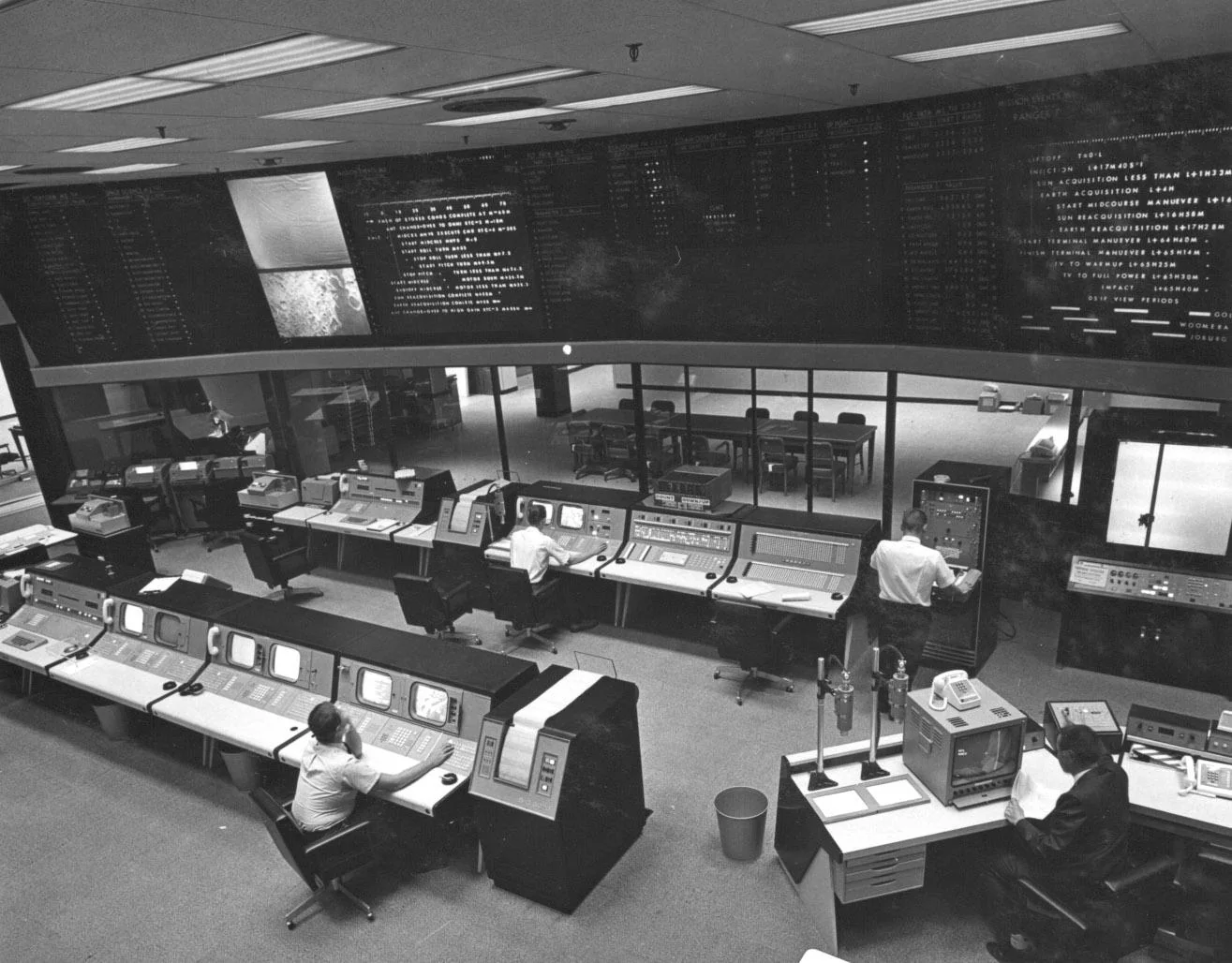
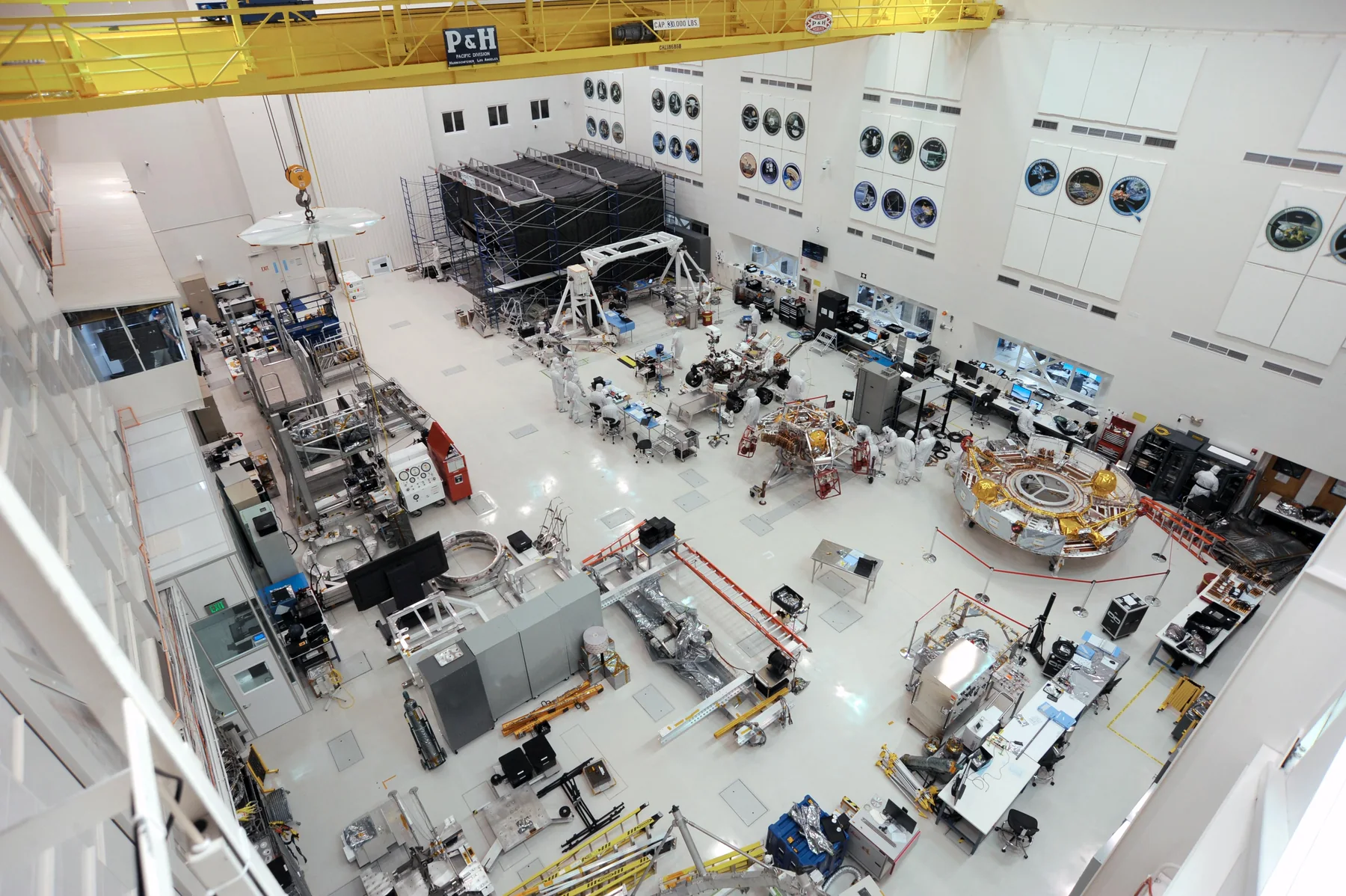
The 25-foot Space Simulator: manufacturing vacuum, cold, and sunlight
JPL's large Space Simulator subjects spacecraft to high vacuum and thermal cycles, using chilled walls and powerful lights to reproduce solar heating. Mariner, Voyager, Cassini, and Mars rover hardware have been tested there. For Mars 2020, the stack experienced vacuum, cold, and simulated sunlight while suspended inside the chamber. [49]
Technically, the chamber does not reproduce space; it reproduces selected stresses with richer instrumentation than flight can provide. Qualification means showing that physical models and separately tested hardware jointly cover the expected domain.
In the case of “The 25-foot Space Simulator: manufacturing vacuum, cold, and sunlight,” success in this setting is multidimensional.
The history of “The 25-foot Space Simulator: manufacturing vacuum, cold, and sunlight” also helps separate demonstrated capability from extrapolation.
For “The 25-foot Space Simulator: manufacturing vacuum, cold, and sunlight,” that is how laboratory history becomes a design resource rather than a catalogue of records.
In that frame, “The 25-foot Space Simulator: manufacturing vacuum, cold, and sunlight” becomes a case study linking a dated decision to a durable capability without turning historical experience into a universal recipe.
Mission Control and Building 230: the control room as infrastructure
The Space Flight Operations Facility was dedicated in 1964. It became the center through which Deep Space Network data and many mission operations flowed. Consoles, displays, and computer networks changed radically over the decades, but the function remained: make distant spacecraft state observable and coordinate distributed decisions. [50]
Technically, mission control is not merely a room. It is a model of authority, information flow, and responsibility transfer among teams. For a Mars base, that logic would have to be shared between Mars and Earth rather than centralized in one building.
In the case of “Mission Control and Building 230: the control room as infrastructure,” success in this setting is multidimensional.
The history of “Mission Control and Building 230: the control room as infrastructure” also helps separate demonstrated capability from extrapolation.
For “Mission Control and Building 230: the control room as infrastructure,” that is how laboratory history becomes a design resource rather than a catalogue of records.
In that frame, “Mission Control and Building 230: the control room as infrastructure” becomes a case study linking a dated decision to a durable capability without turning historical experience into a universal recipe.
Acoustic, vibration, and electromagnetic testing
A spacecraft must survive very different environments: launch vibration, acoustic pressure, thermal vacuum, electrostatic discharge, and electromagnetic emissions from its own equipment. Modern campaigns move between clean rooms, vibration tables, acoustic chambers, and EMC tests, with inspection and reconfiguration between stages. [12]
Technically, the value of the sequence lies in traceability. If a measurement changes after a test, the team must know what was moved, connected, powered, or modified. Without configuration discipline, the test loses part of its evidentiary value.
In the case of “Acoustic, vibration, and electromagnetic testing,” success in this setting is multidimensional.
The history of “Acoustic, vibration, and electromagnetic testing” also helps separate demonstrated capability from extrapolation.
For “Acoustic, vibration, and electromagnetic testing,” that is how laboratory history becomes a design resource rather than a catalogue of records.
In that frame, “Acoustic, vibration, and electromagnetic testing” becomes a case study linking a dated decision to a durable capability without turning historical experience into a universal recipe.
Spacecraft Assembly Facility: the building as a mission component
1960s–2026 provides the chronological frame. The Spacecraft Assembly Facility has hosted generations of spacecraft, from historic probes to modern flagships. Its value lies not only in volume: cleanliness, lifting systems, access, metrology, entry procedures, and integration-campaign organization directly affect delivered hardware quality. [92] The historical fact matters most when tied to program constraints: schedule, funding, availability of experienced staff, condition of shared facilities, component maturity, and dependence on organizations outside JPL.
The technical mechanism is more specific. A clean room is a controlled environment whose rules become system requirements. Particles, molecular contamination, tooling, and personnel movement have to be managed as seriously as electrical parameters.
The human layer is equally important. Technicians who move and connect the spacecraft possess irreplaceable practical knowledge. Procedures must be precise enough to protect the system without suppressing professional judgment when an unplanned case appears.
Within the specific chapter “Spacecraft Assembly Facility: the building as a mission component,” At institutional scale, This is also what separates an exploration campaign from a collection of missions: assets, data, and methods begin to behave as a shared system. The objective is not universal standardization.
For human Mars, transfer has to remain bounded. A Mars base would likewise need clean areas, workshops, and lifting capability. Those buildings would have to be treated as critical systems with maintenance, calibration, and availability requirements.
Thermal-vacuum testing: reproducing an environment that can never be duplicated completely
1960s–2026 provides the chronological frame. Thermal-vacuum chambers expose instruments and spacecraft to representative space temperatures and pressures. They never reproduce an entire mission: duration, radiation, aging, and full-system interactions remain partly modeled. [49] The historical fact matters most when tied to program constraints: schedule, funding, availability of experienced staff, condition of shared facilities, component maturity, and dependence on organizations outside JPL.
The technical mechanism is more specific. Qualification therefore relies on a combination of testing, analysis, and margin. A good test program does not naively imitate every second of flight; it selects environments that stress relevant failure mechanisms.
The human layer is equally important. Teams must decide which differences between test and flight are acceptable. The decision needs traceable rationale so a future engineer can understand why a configuration was qualified despite a test limitation.
Within the specific chapter “Thermal-vacuum testing: reproducing an environment that can never be duplicated completely,” At institutional scale, The consequence is durable: the next mission rarely inherits a complete solution, but it does inherit people, procedures, software, testbeds, and ways of framing problems. The objective is not universal standardization.
For human Mars, transfer has to remain bounded. On Mars, replacement equipment could not always be retested on Earth before use. Local test capability would be needed to verify critical mechanisms with more limited resources.
Hardware-in-the-loop: forcing software to meet physics before flight
1990s–2026 provides the chronological frame. Hardware-in-the-loop testbeds connect flight software, processors, simulated sensors, and sometimes real actuators to exercise mission dynamics without committing the complete spacecraft. They expose interface errors hidden in purely abstract software tests. [88] The historical fact matters most when tied to program constraints: schedule, funding, availability of experienced staff, condition of shared facilities, component maturity, and dependence on organizations outside JPL.
The technical mechanism is more specific. The difficulty is model fidelity. A simulator that is too simple creates false confidence, while an overly complex simulator becomes a system that itself requires verification. JPL therefore has to configuration-control the testbed as rigorously as the vehicle.
The human layer is equally important. Operators use these systems to rehearse nominal sequences and anomalies. That brings development and operations closer and allows teams to discover procedural ambiguity before real-time flight.
Within the specific chapter “Hardware-in-the-loop: forcing software to meet physics before flight,” At institutional scale, That continuity helps explain how a laboratory can change destination radically while retaining a recognizable technical identity. The objective is not universal standardization.
For human Mars, transfer has to remain bounded. A Mars settlement would benefit from digital twins and local physical testbeds, but they would need continuous recertification as real hardware ages and is repaired.
Flight software: a system that lives long after initial delivery
1970s–2026 provides the chronological frame. JPL flight software evolved from extremely constrained computers to architectures supporting advanced autonomy, compression, navigation, and replanning. The fundamental constraint remains: a remote software change must improve the spacecraft without introducing a more serious failure. [71] The historical fact matters most when tied to program constraints: schedule, funding, availability of experienced staff, condition of shared facilities, component maturity, and dependence on organizations outside JPL.
The technical mechanism is more specific. Each patch must target a precise configuration, be verified on simulators, and include a fallback or safe-mode strategy when possible. Memory state and task dependencies become configuration items just like physical connectors.
The human layer is equally important. Software teams may have to maintain build and test tools older than some of the engineers using them. Preserving the development environment becomes part of mission operations.
Within the specific chapter “Flight software: a system that lives long after initial delivery,” At institutional scale, Experience does not remove risk; it makes risk more explicit, measurable, and discussable before it becomes irreversible. The objective is not universal standardization.
For human Mars, transfer has to remain bounded. On Mars, software would control power, mobility, environment, and logistics. Update policy would therefore need to distinguish emergency action, experimentation, and certified configuration, with the ability to return to a known state.
Mission assurance: institutionalizing doubt before schedule pressure crushes it
1990s–2026 provides the chronological frame. Modern missions strengthened mission assurance, independent review, and examination of cross-cutting risk. The purpose is not to add administrative layers but to give structured authority to questions that cross subsystem boundaries. [86] The historical fact matters most when tied to program constraints: schedule, funding, availability of experienced staff, condition of shared facilities, component maturity, and dependence on organizations outside JPL.
The technical mechanism is more specific. A critical risk can be technically known yet institutionally weak if nobody has responsibility to elevate it. Boards and reviews create formal paths for challenging an assumption or requesting additional evidence.
The human layer is equally important. The quality of these mechanisms depends on culture: a review that punishes problem reporting encourages teams to present an overly optimistic picture. Technical transparency becomes a reliability condition.
Within the specific chapter “Mission assurance: institutionalizing doubt before schedule pressure crushes it,” At institutional scale, The capital is fragile: if it is not practiced, documented, and transferred, a few departures or a few years of interruption can erase it. The objective is not universal standardization.
For human Mars, transfer has to remain bounded. In a Mars base, an independent safety function would need authority to stop an operation despite production or schedule pressure. The authority to say no must exist before an emergency.
Governing JPL: Caltech, Directors, Budgets, Contracts, Suppliers, and Workforce
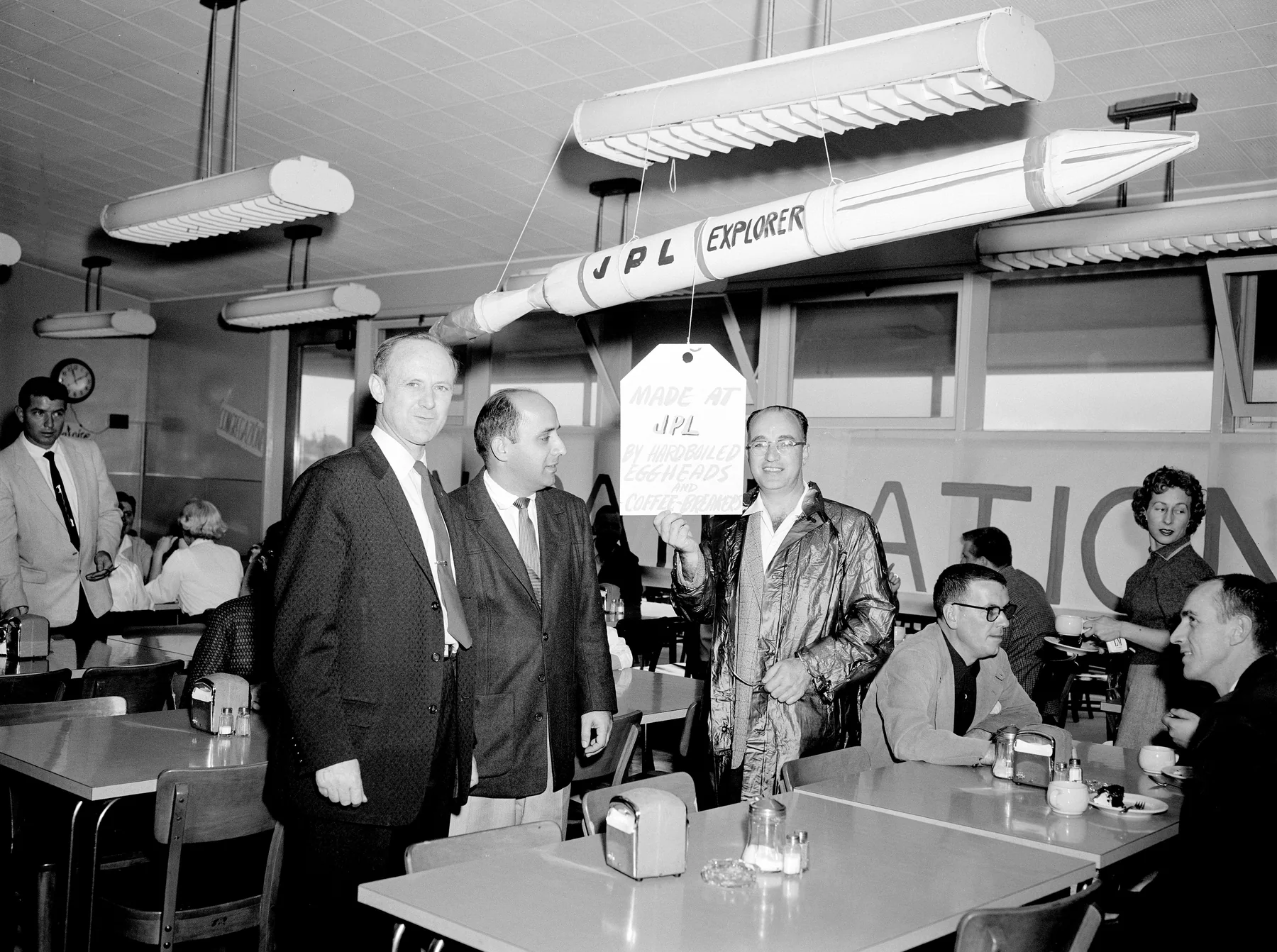
Why mass governs almost everything
The architectures of Jet Propulsion Laboratory (JPL) can therefore be read as repeated trades among mass, energy, risk, cost and schedule. In this case, one useful anchor is that JPL is a Caltech division managed for NASA. [1] Another is that Explorer 1 in 1958 helped launch the United States into the Space Age. [2] These are verifiable facts; by themselves they do not guarantee success of any future program. [1][2]
Governance, capability and responsibility: why JPL is not simply 'NASA'
JPL occupies an unusual institutional position: Caltech manages the laboratory for NASA. That relationship matters because it combines a university culture, mission-engineering teams and the responsibilities of a federally funded center. It also prevents a common shortcut. A Mars mission operated by JPL can involve NASA, Caltech, the laboratory, contractors, universities and international partners whose responsibilities are not interchangeable. JPL — Who We Are
The laboratory's Mars capability comes above all from operational continuity. Pathfinder, Spirit, Opportunity, Curiosity, InSight and Perseverance built teams able to connect navigation, EDL, robotics, field science, telecommunications and daily mission operations. Human exploration would not simply scale up those rovers, but it would need the same kind of institutional memory: how real anomalies change procedures, how configuration knowledge is preserved and how multiple missions share communications infrastructure. JPL — Mars
The Deep Space Network illustrates the transition from mission to infrastructure. A spacecraft is useful only if Earth can receive its data and send commands. Human presence would require an even more distributed architecture with Mars relays, local navigation, autonomy and traffic prioritisation. JPL therefore contributes not one single 'Mars technology' but a systems capability accumulated across decades of missions and networks. JPL — Deep Space Network
JPL and universities: science is not subcontracted at the end of the project
Instruments and science teams on JPL missions often come from universities, national laboratories, companies, or international partners. The laboratory must integrate communities with different priorities. The scientist seeks a measurement; the engineer must make it possible within constraints of mass, power, data, environment, and schedule. [source]
The best architecture emerges when a science question is translated into measurable performance: resolution, precision, duration, geometry, or sampling depth. That translation avoids an artificial opposition between science and engineering.
The history of jpl and universities: science is not subcontracted at the end of the project is also a history of margin.
Caltech facilitates this permeability, but it remains governed by NASA rules and mission responsibilities. The hybrid model is powerful precisely because it does not confuse academic freedom with program authority.
Chronology matters because it prevents anachronism. When jpl and universities: science is not subcontracted at the end of the project occurred, computers, materials, communications networks, budgets, and planetary knowledge were not those of 2026.
On Mars, scientists will be permanent users of infrastructure. Designing the base with them from the beginning can prevent a technically viable settlement from being scientifically blind. [source]
The existence of jpl and universities: science is not subcontracted at the end of the project does not prove that every adjacent problem is solved; it is evidence limited to particular conditions.
Project manager and project scientist: institutionalizing productive tension
Large planetary projects generally separate responsibility for delivery from responsibility for scientific coherence. The project manager owns cost, schedule, technical performance, and execution. The project scientist works with the science community to preserve the mission's scientific purpose.
The tension is intentional. An instrument can improve science while threatening mass and schedule. Good governance does not eliminate the conflict; it provides forums where tradeoffs are explicit and recorded.
The chief engineer: coherence rather than omniscience
A chief engineer is not the person who knows every component best. The job is to maintain a system view across requirements, interfaces, margins, verification, anomalies, and technical decisions.
This is especially important on Mars. A few kilograms added to an instrument can affect entry-descent-landing, structure, energy, and launch. Systems leadership is the discipline of seeing those secondary consequences early enough to act.
Directors as markers of institutional eras
William Pickering symbolizes the transition from missiles to planetary exploration. Lew Allen brought experience in high-level Air Force systems. Edward Stone combined laboratory leadership with deep scientific involvement in Voyager. Charles Elachi led through a period rich in Mars rovers, Cassini, Earth science, and radar missions. Michael Watkins brought navigation, gravity science, and Curiosity mission experience. Laurie Leshin combined planetary science with senior NASA and university leadership and became JPL's first female director. Dave Gallagher, selected in 2025, came from decades of optical systems, astrophysics, and strategic integration. [26]
It would be misleading to assign each launch to the director in office at the time. Large missions span multiple leadership terms. A director often inherits projects formulated years earlier and invests in capabilities whose payoff appears after departure. Leadership should therefore be judged through portfolio health, technical workforce, risk decisions, and institutional continuity rather than launch counts alone.
Lew Allen: importing strategic-systems experience without turning planetary science into a military program
Lew Allen arrived with a background in the U. S. Air Force and national technical systems. His era underscores how expertise in reliability, communications, command, and large technical organizations can transfer into civilian science without dictating scientific objectives.
The useful lesson is that organizational methods are portable even when missions differ. Human Mars systems will likewise combine practices from aerospace, nuclear operations, medicine, remote industry, and scientific fieldwork. No single sector already contains the complete model.
Michael Watkins: navigation and mission-system experience moving into the director's office
Watkins spent much of his career in navigation, gravity missions, and Mars Science Laboratory before becoming director in 2016. He had been mission manager and mission system manager for Curiosity and led reviews or development teams for several major missions. [28]
His path demonstrates how mission operations and system integration can prepare leaders for broader institutional decisions. The same habits used to balance navigation, spacecraft, and science constraints become relevant when balancing workforce, budget, and portfolio constraints.
Laurie Leshin: first female director, planetary scientist, and leader during programmatic stress
Leshin became JPL director in 2022 after senior roles at NASA and in university leadership. Her appointment marked an important institutional milestone as JPL's first female director. [29]
Her tenure included major launches and developments but also severe budget pressure and workforce reductions. That combination is a reminder that scientific leadership includes managing contraction, not only growth. A laboratory can be technically successful while facing structural funding challenges.
Dave Gallagher: leading JPL in a more commercial space ecosystem
Gallagher became the laboratory's eleventh director in 2025 after a long JPL career spanning optical systems, astrophysics, and strategic integration. He was part of the effort that developed the Wide Field and Planetary Camera 2 used to correct Hubble's optical problem. [30]
His leadership begins in an era when commercial firms provide increasingly capable launch, spacecraft, and data services. JPL therefore must define what a publicly funded R&D laboratory uniquely contributes: missions with unusually high technical uncertainty, scientific instruments without mature markets, deep systems integration, and long-horizon capabilities.
Workforce reductions: institutional capability is made of people, not abstract organizational charts
JPL announced workforce reductions in 2024 and 2025 amid budget pressure and restructuring. [27] The immediate accounting effect is obvious; the deeper technical effect depends on which skills leave, which teams fragment, and how knowledge transfer is handled.
A headcount is not a capability metric. Ten experienced specialists in a rare field may be more difficult to replace than hundreds of positions in a broader labor market. Mars programs that plan in decades must therefore track critical-skill continuity explicitly.
Decadal Surveys: JPL operates inside a scientific governance system larger than itself
U. S. planetary priorities are strongly influenced by National Academies decadal surveys. Those reports do not order JPL to fly a particular spacecraft, but they represent community consensus and help shape NASA and congressional decisions.
This constrains institutional self-interest. A laboratory with strong technical capability does not get to choose every scientific priority. It must respond to a broader scientific community, while showing which mission architectures can make those priorities feasible.
Data rate and link budgets: communications is physics, not a subscription plan
Deep-space data rate depends on transmitter power, antenna gain, frequency, distance, coding, receiver performance, and pointing. The signal arriving at Earth from Mars may be extraordinarily weak. Higher data volume therefore competes with mass, power, and antenna size.
Mission planners use link budgets to estimate whether a communication mode closes with sufficient margin. Human Mars systems will need the same discipline at larger scale. Video, medical data, scientific imagery, and software cannot all be assumed to flow continuously without a designed capacity plan.
Program cost is an engineering variable, not an accounting afterthought
Mass, power, memory, and thermal margin are familiar spacecraft quantities. Cost and schedule are equally real system constraints. A lighter component that depends on a unique supplier, exotic material, and years of additional testing may be less robust programmatically than a heavier, well-understood alternative.
Good project management therefore works in a multidimensional design space. Technical performance, cost reserve, workforce loading, schedule margin, and supply-chain risk interact. A design that looks optimal in one dimension can be fragile in the whole system.
Budget reserves behave like technical margins
Projects carry financial reserves because not every problem can be predicted. Without reserve, a late anomaly may force cancellation of science, reduced testing, or acceptance of technical risk.
Too little reserve is dangerous; too much apparent reserve can make a mission uncompetitive during selection. The institutional skill lies in credible estimation and honest updates when the evidence changes.
Independent cost and schedule review: asking whether the project believes its own optimistic story
Project teams know their plans in extraordinary detail, but that familiarity can generate optimism. External estimators compare the plan with historical missions, staffing patterns, technology maturity, and known schedule relationships.
Independent estimates are not automatically correct. Their value is in creating a second model that can expose assumptions the project has normalized. Human Mars programs will need strong independent review because political pressure for ambitious dates will be intense.
Sunk cost: money already spent is not a technical requirement
Large projects become emotionally and politically difficult to stop after years of investment. Yet past expenditure should not determine whether future expenditure is rational. Decision makers should compare remaining cost, remaining risk, and expected value.
This principle will be essential for long-duration Mars infrastructure. A design can become obsolete while under development. Governance must permit redesign or cancellation without treating every change as institutional failure.
Option value: technology programs create future choices
Autonomous navigation, optical communications, high-performance EDL, advanced instruments, and robotic construction may not have one immediate mission customer. Funding them can nevertheless create options for several future missions.
That option value is difficult to measure because the benefit appears later. JPL's technology portfolio helps prevent every flight project from inventing critical technology under schedule pressure.
Make or buy: deciding what capability must remain inside the laboratory
No laboratory should manufacture every component. JPL relies on contractors and vendors for structures, mechanisms, electronics, and many other elements. The strategic question is which capabilities are too critical, immature, or knowledge-intensive to outsource completely.
Systems integration, deep-space navigation, mission assurance, and certain instrument and software capabilities are part of JPL's institutional identity. Other functions can be commercial when requirements and verification are strong.
Commercial space: partner, supplier, and source of pressure to redefine public value
Private companies now provide highly capable launch vehicles, spacecraft buses, communications, software, and lunar systems. JPL should neither ignore those capabilities nor assume they make a public R&D laboratory obsolete.
The right boundary depends on market maturity and public purpose. Mature transportation services may be purchased. High-risk scientific instruments and one-of-a-kind planetary missions may still require public technical integration. The decision should be evidence-based rather than ideological.
Buying services instead of hardware changes the engineering contract
When NASA buys a service rather than owning the entire vehicle, engineering responsibility shifts toward requirements, verification, interfaces, and performance monitoring. The government may no longer control every internal design detail.
This can be efficient, but only if service-level requirements capture what actually matters. Human Mars logistics may increasingly use commercial cargo and communications, making contract engineering a mission-critical skill.
Technological sovereignty is not the same as autarky
A nation may need strategic space capabilities without manufacturing every component domestically. Practical sovereignty means understanding dependencies and maintaining alternatives for functions whose loss would threaten national goals.
JPL contributes by preserving hard-to-rebuild expertise in deep-space systems. An international Mars settlement will need a similar balance between specialization and resilience.
Data governance for a multinational settlement
A settlement will generate scientific data, medical records, industrial telemetry, personal communications, security information, and commercial data. Open-data principles cannot be applied identically to every category.
Scientific and environmental measurements should generally be shareable; personal medical information needs strong privacy; critical infrastructure details may require cybersecurity restrictions. Data policy should be designed before the base begins producing petabytes.
The first confirmed biosignature would create a governance crisis as well as a scientific discovery
If a sample contained convincing evidence of independent Martian life, decisions about access, replication, publication, contamination, and future site operations would carry enormous public importance.
An institution prepared only for normal science could be overwhelmed by the political and ethical response. Governance scenarios should therefore be considered before such a discovery, not improvised afterward.
Psyche: when a mission delay becomes an institutional diagnosis
The 2022 Psyche delay is unusually valuable because NASA and JPL did not treat it as a single-component failure. The mission had not reached the required readiness in time for its launch opportunity, with flight software and verification among the central concerns. An independent review board therefore examined both the project and the institutional environment around it. The board identified an imbalance between workload and available workforce, communication weaknesses, technical-leadership gaps, and erosion of some line-organization technical depth. The lesson is broader than Psyche: a mission can be in trouble even when no single piece of hardware deserves to be called the cause. The production system itself can create the conditions for delay. [31]
For a laboratory that depends on highly specialized people, staffing is not a simple head-count problem. Two excellent projects can both become fragile if they require the same scarce guidance, software, test, or systems experts during overlapping critical phases. Portfolio management therefore becomes a technical activity. Leadership must know not only how much money each mission has but which competencies are saturated, which reviews need experienced independent voices, and which schedules assume that the same person can be in two places at once.
The response to the review illustrates organizational learning when an audit is treated as data rather than as an insult. Psyche added experienced leaders and specialists, JPL changed review and reporting practices, and NASA delayed VERITAS in part to free experienced people for projects further along in development. A portfolio is therefore not a set of independent boxes. Missions compete for the same laboratories, integration technicians, software expertise, managers, and institutional attention. [31]
2024-2025 workforce reductions: a technical issue as well as a budget issue
The workforce reductions of 2024 and 2025 belong in any detailed institutional history of JPL. In February 2024 the laboratory announced a reduction of about 530 employees, roughly eight percent of the workforce, plus contractor reductions, amid budget uncertainty and a sharply lower Mars Sample Return planning level. In November 2024 another roughly 325 positions, about five percent, were affected. In October 2025 JPL announced a further realignment involving approximately 550 colleagues across technical, business, and support areas. These numbers should neither be sensationalized nor reduced to accounting. JPL's primary productive asset is accumulated capability. [33] [34]
A factory can sometimes lower output and later purchase equivalent machines. A deep-space systems laboratory cannot instantly recreate a team with twenty years of navigation, integration, mission-assurance, or operations experience. The departure of one person does not equal the loss of a capability because knowledge is distributed and documented. But clustered departures can remove context that procedures alone do not preserve. The relevant question is therefore not only total workforce size but the density, mentoring depth, and availability of critical competencies.
JPL leadership framed the reductions as an effort to match available resources while preserving core technical capabilities. Whether that balance succeeds cannot be determined from a layoff count alone. The evidence emerges later through mission delivery, review findings, schedule performance, hiring, and the ability to train the next generation. Some consequences of restructuring are immediate; others appear years later when a new project enters a phase that requires expertise no longer available in sufficient depth.
FFRDC logic: a public capability operated by a nonfederal institution
The FFRDC model is intended to preserve long-term public-purpose expertise that does not fit neatly into ordinary project-by-project procurement. Government defines and funds the mission; the operator provides an organization, employment system, and research connections. At JPL this structure preserved a Caltech identity while executing NASA programs. It also creates a continuing obligation to show why the arrangement provides distinctive value.
The 2026 competition can therefore be understood as a governance test rather than an accomplished rupture. The laboratory must continue to fly missions while its future management framework is discussed. Critical infrastructure often faces exactly that condition: operations cannot stop while governance is renegotiated. A Mars communications or navigation service would need comparable continuity mechanisms.
Suppliers and industry: the laboratory never builds alone
The phrase "built by JPL" simplifies a much larger industrial network. The laboratory designs and integrates some subsystems, contracts others to industry, buys specialized components, and depends on suppliers whose quality and financial health can become mission variables. A tiny part in the bill of materials can carry disproportionate risk if only one qualified source exists. Program robustness therefore includes knowledge of the supply chain.
Make-or-buy decisions are not ideological. A capability should remain internal when mastery is essential to architecture, integration, or technical independence. Other elements are produced more effectively by companies with specialized processes. The boundary changes over time. Experimental technology may begin inside the laboratory and later become a commercial procurement; a commercial dependency can become critical enough to justify internal investment.
Industrial contracts must translate physical requirements into verifiable obligations. "Reliable" is not an adequate requirement. Temperature, vibration, radiation, shelf life, allowable contamination, lot documentation, acceptance testing, and change control must be defined. A small manufacturing-process change can trigger new analysis. Space quality is therefore a form of traceability.
A Mars economy would face the same problem at larger distance. A settlement cannot depend forever on every seal, circuit board, or filter arriving from Earth, yet complete early autonomy is equally unrealistic. Supplies will need classification: items that can be stored for years, items that should be locally manufactured, items requiring multiple Earth suppliers, and items whose standardized interfaces allow repair with interchangeable parts. JPL offers not a ready-made settlement economy but a long record of managing interfaces between laboratory and industry.
Supplier qualification: evidence travels with the part
For interplanetary missions, a vendor certificate is often only the beginning. Critical components may receive inspection, acceptance tests, process controls, and lot analysis. Nonconformances must be recorded and assessed against mission effect. Accepting an out-of-specification part can be rational when the deviation is understood and harmless; automatically replacing it late in the schedule can sometimes create more risk.
This controlled-waiver logic requires technical authority that is not subordinate only to schedule pressure. As launch approaches, the incentive to accept and move forward grows. Mission-assurance processes create places where a technical objection can slow a program despite immediate cost. Mars operations will need equivalent authority locally. A settlement that cannot stop a dangerous operation because the next logistics window is expensive would reproduce the worst bias of schedule-driven programs.
The cost of interfaces: every organizational boundary can become a failure boundary
Mars Climate Orbiter became a symbol because an units mismatch provides a memorable summary of a complex failure. Institutionally, the important concept is the interface. Two teams can each produce locally coherent products and together create an incoherent system. Systems engineering exists to expose assumptions that cross boundaries: units, signs, coordinate frames, exchange rates, precision, formats, and responsibility for verification.
International programs multiply such interfaces. A European instrument can fly on an American spacecraft, launch on a commercial rocket, use several tracking networks, and be operated by a distributed science team. Each partner has its own schedule, standards, and authority chain. Success does not require eliminating those differences. It requires translating them into explicit, testable interface agreements.
A multinational Mars settlement would make this life critical. Shared power cannot depend on implicit conventions; water systems cannot use incompatible pressure assumptions; software cannot interpret the same command differently by supplier. Standards must be stable enough for interoperability and flexible enough to evolve. JPL's history of mission integration offers a method: define, simulate, test, and control interfaces as design objects in their own right.
Directorships as chapters in the institution
No director ever embodies the whole laboratory, but changes in leadership provide useful markers for priorities, constraints, and forms of continuity. [41]
William H. Pickering — 1954–1976
Pickering connects three JPLs: the missile laboratory, the builder of Explorer 1, and then NASA's robotic planetary center. His long tenure gives unusual continuity to the early space decades. During 1954–1976, leadership had to trade among flight programs, new proposals, facility upkeep, and recruitment of expertise that might not produce visible results for years.
Bruce C. Murray — 1976–1982
A planetary scientist and member of Mars imaging teams, Murray led the laboratory through post-Apollo contraction and argued for smaller, more frequent missions well before that logic became a NASA slogan. During 1976–1982, leadership had to trade among flight programs, new proposals, facility upkeep, and recruitment of expertise that might not produce visible results for years.
Lew Allen Jr. — 1982–1990
A physicist and former U. S. Air Force chief of staff, Allen brought large-system, security, and governance experience during a period of consolidation and diversification. During 1982–1990, leadership had to trade among flight programs, new proposals, facility upkeep, and recruitment of expertise that might not produce visible results for years.
Edward C. Stone — 1991–2001
A Voyager scientist for half a century, Stone oversaw Pathfinder, Mars Global Surveyor, Deep Space 1, TOPEX/Poseidon, and Cassini's launch, linking deep-space exploration with Earth observation. During 1991–2001, leadership had to trade among flight programs, new proposals, facility upkeep, and recruitment of expertise that might not produce visible results for years.
Charles Elachi — 2001–2016
A radar specialist, Elachi led an exceptionally dense mission era and major Mars expansion while maintaining important Earth programs. During 2001–2016, leadership had to trade among flight programs, new proposals, facility upkeep, and recruitment of expertise that might not produce visible results for years.
Michael Watkins — 2016–2021
A JPL engineer and scientist, Watkins led during development of Mars 2020, Europa Clipper, and several Earth missions, as autonomy and large payloads became central. During 2016–2021, leadership had to trade among flight programs, new proposals, facility upkeep, and recruitment of expertise that might not produce visible results for years.
Laurie Leshin — 2022–2025
A geochemist and former NASA leader, Leshin arrived with broad academic and institutional experience. Her tenure included post-Psyche corrective work, Mars Sample Return pressure, and two major workforce reductions. During 2022–2025, leadership had to trade among flight programs, new proposals, facility upkeep, and recruitment of expertise that might not produce visible results for years.
Dave Gallagher — 2025–
Former JPL strategic-integration leader Gallagher became director in June 2025. His tenure begins with NISAR, another workforce realignment, and preparation for competition of the management contract. During 2025–, leadership had to trade among flight programs, new proposals, facility upkeep, and recruitment of expertise that might not produce visible results for years.
From Pickering to Murray: two visions after the heroic age
Pickering led JPL for twenty-two years, from missile work through Viking and the launch of Voyager. Bruce Murray succeeded him in 1976 as planetary budgets contracted and the laboratory had to argue for a new generation of missions. The contrast illuminates a shift from continuous expansion to a period when institutional survival itself became an issue. [41]
Technically, a director does not design every instrument. Yet the director sets priorities, chooses acceptable organizational risks, negotiates with NASA and Caltech, and influences how scarce competence is divided between present missions and future capability.
In the case of “From Pickering to Murray: two visions after the heroic age,” success in this setting is multidimensional.
The history of “From Pickering to Murray: two visions after the heroic age” also helps separate demonstrated capability from extrapolation.
For “From Pickering to Murray: two visions after the heroic age,” that is how laboratory history becomes a design resource rather than a catalogue of records.
Governance directly affects engineering because it decides when margin becomes too expensive, when delay remains acceptable, and when competence should be preserved without an immediate mission. Directors change, but the responsibility to trade present delivery against future capacity remains. In that frame, “From Pickering to Murray: two visions after the heroic age” becomes a case study linking a dated decision to a durable capability without turning historical experience into a universal recipe.
Lew Allen and Edward Stone: consolidation, Earth, and Mars renewal
Lew Allen became director in 1982 after a career in the U.S. Air Force and scientific intelligence community. Edward Stone succeeded him in 1991 while remaining deeply associated with Voyager. Under Stone, JPL saw Pathfinder, Mars Global Surveyor, Deep Space 1, TOPEX/Poseidon, and the launch of Cassini, reflecting substantial scientific diversification. [41]
Technically, laboratory continuity therefore does not depend on one discipline. It depends on a portfolio that keeps propulsion, navigation, radar, software, telecommunications, and science sufficiently active that capability can be remobilized when a new political window opens.
In the case of “Lew Allen and Edward Stone: consolidation, Earth, and Mars renewal,” success in this setting is multidimensional.
The history of “Lew Allen and Edward Stone: consolidation, Earth, and Mars renewal” also helps separate demonstrated capability from extrapolation.
For “Lew Allen and Edward Stone: consolidation, Earth, and Mars renewal,” that is how laboratory history becomes a design resource rather than a catalogue of records.
In that frame, “Lew Allen and Edward Stone: consolidation, Earth, and Mars renewal” becomes a case study linking a dated decision to a durable capability without turning historical experience into a universal recipe.
Charles Elachi and the era of simultaneous missions
Charles Elachi led JPL from 2001 to 2016. His tenure covered an exceptionally dense period: Odyssey, MER, MRO, Phoenix, Curiosity, Cassini, Stardust, Deep Impact, Dawn, Juno, GRAIL, and numerous Earth missions. That density made portfolio management as central as engineering each individual project. [41]
Technically, when several missions depend on the same clean rooms, specialists, networks, or test facilities, one project's schedule becomes a constraint on others. Portfolio management therefore must handle shared resources and expertise that cannot be purchased instantly.
In the case of “Charles Elachi and the era of simultaneous missions,” success in this setting is multidimensional.
The history of “Charles Elachi and the era of simultaneous missions” also helps separate demonstrated capability from extrapolation.
Transfer to Mars must remain cautious. For “Charles Elachi and the era of simultaneous missions,” that is how laboratory history becomes a design resource rather than a catalogue of records.
In that frame, “Charles Elachi and the era of simultaneous missions” becomes a case study linking a dated decision to a durable capability without turning historical experience into a universal recipe.
Watkins, Leshin, and Gallagher: governing in a more competitive environment
Michael Watkins led JPL beginning in 2016, Laurie Leshin from 2022 to 2025, and Dave Gallagher from June 2025. The recent period combines technical success, an independent review of Psyche, pressure around Mars Sample Return, workforce reductions, and preparation for new competition over the laboratory management contract. [41]
Technically, contemporary governance must protect quality while responding to more visible economic pressure. Reducing infrastructure may improve near-term efficiency but can also weaken rare expertise; the challenge is to distinguish structural cost, critical capability, and genuinely unnecessary redundancy.
In the case of “Watkins, Leshin, and Gallagher: governing in a more competitive environment,” success in this setting is multidimensional.
The history of “Watkins, Leshin, and Gallagher: governing in a more competitive environment” also helps separate demonstrated capability from extrapolation.
For “Watkins, Leshin, and Gallagher: governing in a more competitive environment,” that is how laboratory history becomes a design resource rather than a catalogue of records.
In that frame, “Watkins, Leshin, and Gallagher: governing in a more competitive environment” becomes a case study linking a dated decision to a durable capability without turning historical experience into a universal recipe.
2024–2025: workforce reductions as a technical event
In February 2024, JPL announced roughly 530 layoffs, about 8 percent of its workforce, plus contractors, amid a reduced Mars Sample Return allocation. In November 2024, about 325 additional positions were affected. In October 2025, another reduction of roughly 550 people accompanied a broader reorganization. [44]
Technically, these figures are not merely social or budgetary. They affect mentoring capacity, review chains, maintenance of legacy software, and availability of experts who understand historical interfaces. Rapid reduction can create deferred technical debt that does not immediately appear in financial accounts.
In the case of “2024–2025: workforce reductions as a technical event,” success in this setting is multidimensional.
The history of “2024–2025: workforce reductions as a technical event” also helps separate demonstrated capability from extrapolation.
For “2024–2025: workforce reductions as a technical event,” that is how laboratory history becomes a design resource rather than a catalogue of records.
In that frame, “2024–2025: workforce reductions as a technical event” becomes a case study linking a dated decision to a durable capability without turning historical experience into a universal recipe.
2026: competition for the Caltech management contract
In May 2026, NASA announced its intent to compete the contract for operating JPL. Caltech has managed the laboratory for NASA since 1958, and the current agreement ends on September 30, 2028. The decision does not automatically mean a new operator, but it turns a historically stable relationship into an explicit competition. [42]
Technically, the milestone forces a distinction between JPL's scientific identity and its contractual mechanism. Teams, facilities, missions, and culture can survive governance change, but incentives, decision chains, and interfaces with NASA could shift. It is a major historical episode that remains open.
In the case of “2026: competition for the Caltech management contract,” success in this setting is multidimensional.
The history of “2026: competition for the Caltech management contract” also helps separate demonstrated capability from extrapolation.
For “2026: competition for the Caltech management contract,” that is how laboratory history becomes a design resource rather than a catalogue of records.
In that frame, “2026: competition for the Caltech management contract” becomes a case study linking a dated decision to a durable capability without turning historical experience into a universal recipe.
Matrix organization: sharing experts without diluting responsibility
1970s–2026 provides the chronological frame. JPL combines line organizations that preserve capabilities with temporary projects that must deliver missions. An engineer can belong to a technical section while working for a project with different schedule and priorities. [41] The historical fact matters most when tied to program constraints: schedule, funding, availability of experienced staff, condition of shared facilities, component maturity, and dependence on organizations outside JPL.
The technical mechanism is more specific. The matrix enables reuse of scarce expertise but creates allocation tension. A project may want to retain a specialist while the institution needs to prepare the next mission. Validation authority must therefore remain explicit despite dual management chains.
The human layer is equally important. Line managers act as custodians of professional memory and quality, while project leaders own cost, schedule, and performance. Friction between these perspectives can be productive when it remains visible.
Within the specific chapter “Matrix organization: sharing experts without diluting responsibility,” At institutional scale, Institutional maturity is therefore measured less by the number of past successes than by the ability to understand what actually produced those successes. The objective is not universal standardization.
For human Mars, transfer has to remain bounded. A Mars settlement would likewise share scarce specialists across maintenance, science, construction, and emergencies. A local matrix would need to prevent the loudest priority from permanently monopolizing critical experts.
The prime contract: when laboratory governance itself becomes subject to competition
2026 provides the chronological frame. In May 2026, NASA and Caltech announced that the contract for managing and operating JPL would be competed. The event does not retroactively change laboratory identity, but it makes visible that a decades-old institutional model rests on a contract mechanism that can be reevaluated. [90] The historical fact matters most when tied to program constraints: schedule, funding, availability of experienced staff, condition of shared facilities, component maturity, and dependence on organizations outside JPL.
The technical mechanism is more specific. A management transition would have to protect missions in flight, data, clearances, workforce, facilities, and intellectual property. The contract is not a simple service purchase; it supports active infrastructure whose continuity cannot be abruptly interrupted.
The human layer is equally important. For employees, institutional uncertainty can affect hiring and retention even if missions continue nominally. Transition communication therefore becomes part of human-risk reduction.
Within the specific chapter “The prime contract: when laboratory governance itself becomes subject to competition,” At institutional scale, This is also what separates an exploration campaign from a collection of missions: assets, data, and methods begin to behave as a shared system. The objective is not universal standardization.
For human Mars, transfer has to remain bounded. A durable Mars organization would likewise need to survive operator change, supplier failure, or ownership transfer without losing vital services. Institutional portability has to be designed before it is needed.
Workforce cycles: preserving capability when the portfolio contracts
2024–2026 provides the chronological frame. Workforce reductions announced in 2024 and 2025 show that a laboratory may need rapid staffing adjustment when budgets and portfolio change. Such decisions have technical consequences because some capabilities cannot be recreated instantly when funding returns. [44] The historical fact matters most when tied to program constraints: schedule, funding, availability of experienced staff, condition of shared facilities, component maturity, and dependence on organizations outside JPL.
The technical mechanism is more specific. Institutional capability depends on experience chains: junior engineers, experienced peers, discipline leads, and niche experts. Uniform reduction can break those chains even when total headcount looks compatible with budget.
The human layer is equally important. Retention choices become future architecture choices. Preserving navigation, testing, or radio-frequency capability can look expensive before a mission requires it, but absence later lengthens development.
Within the specific chapter “Workforce cycles: preserving capability when the portfolio contracts,” At institutional scale, The consequence is durable: the next mission rarely inherits a complete solution, but it does inherit people, procedures, software, testbeds, and ways of framing problems. The objective is not universal standardization.
For human Mars, transfer has to remain bounded. On Mars, the specialist population would be much smaller. Losing one person could mean losing an entire function, making cross-training and succession procedures essential.
Suppliers and make-or-buy: deciding where capability should live
1960s–2026 provides the chronological frame. JPL does not manufacture every mission component internally. The laboratory works with major aerospace companies, specialized suppliers, universities, and other NASA centers. Each make-or-buy decision determines where knowledge, configuration control, and recovery capability reside. [41] The historical fact matters most when tied to program constraints: schedule, funding, availability of experienced staff, condition of shared facilities, component maturity, and dependence on organizations outside JPL.
The technical mechanism is more specific. Buying can reduce cost and schedule when a mature market exists, while internal development may be necessary for unique technology or critical interfaces. The choice must also consider obsolescence, second sources, and access to design data.
The human layer is equally important. Effective supplier relationships require stable requirements and technical dialogue. A contract that poorly defines an interface merely postpones uncertainty until final integration.
Within the specific chapter “Suppliers and make-or-buy: deciding where capability should live,” At institutional scale, That continuity helps explain how a laboratory can change destination radically while retaining a recognizable technical identity. The objective is not universal standardization.
For human Mars, transfer has to remain bounded. A Mars base could not quickly replace an Earth supplier. Procurement decisions would therefore need to include transport delay, repair rights, manufacturing data, and the ability to substitute a component locally.
Budget, reserve, and cost truth: funding the unexpected without hiding it
1960s–2026 provides the chronological frame. Major missions need cost and schedule reserves because first-of-a-kind exploration necessarily contains uncertainty. Problems begin when reserve is treated as waste or, conversely, used to hide unrealistic initial estimates. [86] The historical fact matters most when tied to program constraints: schedule, funding, availability of experienced staff, condition of shared facilities, component maturity, and dependence on organizations outside JPL.
The technical mechanism is more specific. Management must follow trends, risk, and margin consumption rather than expenditure alone. A subsystem that appears on budget can create future debt if testing is deferred or an interface remains unresolved.
The human layer is equally important. Technical leaders need to explain the consequences of proposed savings in program language. Without that translation, cost and reliability become separate conversations.
Within the specific chapter “Budget, reserve, and cost truth: funding the unexpected without hiding it,” At institutional scale, Experience does not remove risk; it makes risk more explicit, measurable, and discussable before it becomes irreversible. The objective is not universal standardization.
For human Mars, transfer has to remain bounded. On Mars, reserves would include not only money but mass, energy, food, human time, and spares. An honest architecture would make margin consumption visible before a crisis.
Making Science: Instruments, Data, Archives, Planetary Protection, and Samples
Science and engineering must learn each other’s language
Strong missions make these communities converge early. The theme of Mars EDL shows how a scientific question becomes a requirement, an instrument, an interface, an operations sequence and finally interpretable data. In this case, one useful anchor is that Explorer 1 in 1958 helped launch the United States into the Space Age. [2] Another is that JPL played a central role in Mariner 4 and robotic Mars exploration. [3] These are verifiable facts; by themselves they do not guarantee success of any future program. [2][3]
Technical data explained in plain language
In this case, one useful anchor is that JPL manages the Deep Space Network for NASA. [5] Another is that JPL is a Caltech division managed for NASA. [1] These are verifiable facts; by themselves they do not guarantee success of any future program. [5][1]
Communications: data rate is a physical resource, not a digital entitlement
Mars missions generate ever more data, but distance limits data rates and imposes communication windows. Orbiters relay UHF traffic from rovers and then transmit toward Earth in X or Ka band. Teams must compress, prioritize, and schedule what crosses the link. [source]
This constraint turns data into a budget comparable to mass or power. A camera can physically acquire more images than the network can return. Science therefore depends on a selection policy.
Communications: data rate is a physical resource, not a digital entitlement may prove that a function can work once; a durable campaign requires it to become repeatable, documented, maintainable, and financially supportable.
Instrument, operations, and telecommunications teams must negotiate that budget. A mission system is also a governance system for information.
This episode deserves to be read at two levels. In the short term it concerns communications: data rate is a physical resource, not a digital entitlement and the decisions made by the teams of the period.
Humans will generate far more data and need private, medical, scientific, and operational communications. A settlement must keep functioning when bandwidth drops or links disappear. [source]
Communications: data rate is a physical resource, not a digital entitlement therefore adds a layer of institutional memory that future programs can use only if the people and archives needed to understand it are not lost.
Planetary protection: explore without destroying the scientific question being asked
Mars missions must meet planetary-protection requirements related to biological contamination. JPL works with NASA and scientific communities to clean, assemble, document, and operate spacecraft in ways compatible with mission categories. Requirements depend in part on destination and the potential search for life. [source]
The problem is epistemic as much as sanitary: if a mission carries terrestrial organisms into an area being studied for Martian life, it can make results ambiguous. Cleanliness therefore protects the scientific value of the experiment.
Another useful angle is the flow of information. Around planetary protection: explore without destroying the scientific question being asked, sensors create measurements, software transforms them, teams interpret them, and decisions return to the vehicle or program. Error can enter anywhere in that chain.
These rules impose cost, procedure, and sometimes site constraints. They show that a mission is not free to maximize technical performance alone; it must preserve shared scientific assets.
The history of planetary protection: explore without destroying the scientific question being asked is also a history of margin.
Human arrival will transform this logic because a base cannot be sterile. The challenge will become separating research zones, routes, waste, and sampling so credible science remains possible. [source]
Planetary protection: explore without destroying the scientific question being asked is not merely a date on a timeline; it is an experiment that changes what teams know how to build, what they know how to measure, and what they know to reject when margin is insufficient.
Mars samples: the hard part begins after the tube is filled
Perseverance selects, cores, and seals Martian samples as part of a sample-return strategy. Simply filling a tube requires field geology, cleanliness, traceability, drilling mechanisms, and storage. Returning those tubes to Earth requires an additional architecture whose cost and complexity have prompted major reassessment. [source]
A sample has value only if its context is preserved. A rock without location, stratigraphy, imagery, and handling history loses information. The mission is therefore also a scientific chain-of-custody system.
Finally, mars samples: the hard part begins after the tube is filled shows that space policy is never separate from engineering.
The program shows how a local success can open a larger problem. JPL can succeed at sampling while NASA still has to resolve architecture, budget, and partnerships for return.
Mars samples: the hard part begins after the tube is filled depended on ground teams, analysis tools, suppliers, tests, software, and budget decisions that do not appear in official photographs. Success is distributed.
Humans would simplify some sampling operations but complicate contamination. Scientific value will require stricter protocols, not looser ones. [source]
The existence of mars samples: the hard part begins after the tube is filled does not prove that every adjacent problem is solved; it is evidence limited to particular conditions.
Sample caching: engineering an interface to a future mission that may change
Perseverance drills, documents, seals, and stores samples that could be recovered by future vehicles. The tube is therefore an interface across time. The rover team must preserve scientific context and contamination knowledge for missions whose final architecture may not yet be fixed.
Human Mars logistics will depend on similar forward-compatible interfaces: cargo pallets, power connectors, propellant couplings, navigation aids, and digital standards must remain useful to future systems that do not yet exist.
Edward Stone: science leadership and institutional leadership in the same career
Edward Stone remained closely associated with Voyager as project scientist while also serving as JPL director. His career illustrates JPL's unusual ability to place active scientists in major institutional roles. That proximity can help leadership understand why scientific requirements matter beyond abstract mission metrics.
But Voyager's longevity also demonstrates why the institution cannot depend on any one scientist. Teams, archives, succession plans, and technical documentation must allow a mission to continue after its most famous leaders depart.
Charles Elachi: a radar scientist leading an increasingly diverse laboratory
Elachi's background in synthetic-aperture radar and remote sensing reflected JPL's Earth-science side as much as its planetary side. During his directorship, the laboratory managed or contributed to Spirit, Opportunity, Cassini, Deep Impact, Dawn, Curiosity, and many Earth-observing missions.
A diverse portfolio can act as a technical ecosystem. Radar, navigation, optics, software, and data-system expertise migrate across mission families. The management challenge is to make that migration routine rather than accidental.
Planetary protection: translating scientific ethics and international obligations into hardware rules
Planetary protection is not simply sterilization. Mission categories depend on target, activity, and scientific sensitivity. Requirements may include bioburden control, trajectory constraints, cleaning, or sterilization of specific hardware.
Human presence will force a different regime because crews inevitably carry a terrestrial microbiome. The future problem is likely to involve zoning, contamination monitoring, protected scientific regions, and clean robotic access rather than pretending a settlement can be biologically sterile.
Instrument engineering: turning a laboratory method into a device that cannot be touched after launch
Scientific instruments are often born in terrestrial laboratories with stable power, human operators, and the ability to repeat measurements. Flight hardware must automate the method, survive vibration and radiation, fit within strict mass and thermal budgets, and provide calibration without easy maintenance.
JPL frequently integrates instruments built by universities, partner agencies, or other centers. Mechanical, electrical, thermal, and data interfaces make the science part of system architecture from the beginning.
Spectrometers: composition is an inference, not a label printed by the instrument
Infrared, X-ray, gamma-ray, laser, and mass spectrometers convert physical interactions into signals that scientists interpret through calibration and models. A spectral feature rarely gives a complete answer by itself.
This is crucial for astrobiology. Organic molecules are not automatically biological, and minerals formed in water do not prove life. Instrument suites are valuable because independent lines of evidence can constrain competing hypotheses.
Radar and remote sensing: Earth-science expertise feeding planetary exploration
JPL's long work in synthetic-aperture radar and remote sensing supported Earth missions, Magellan at Venus, Cassini at Titan, and many other projects. The technical base includes signal processing, antenna design, calibration, and geophysical inversion.
For Mars, radar can help characterize buried structure and ice. For human exploration, those data can guide drilling and resource assessment. This is a direct example of a terrestrial capability becoming a planetary infrastructure tool.
Archives: preserving reasoning, not only iconic photographs
JPL's archives contain photographs, engineering reports, internal publications, films, plans, and oral histories. Their value is practical as well as historical because they reveal why architectures were selected and how anomalies were understood.
Long-term Mars exploration should treat archives as active infrastructure. File formats change, software disappears, and people retire. Metadata, migration, and preservation of key code and decision records are therefore technical responsibilities.
Mars weather: science today, safety service tomorrow
Landers and rovers measure pressure, temperature, wind, and dust; orbiters observe regional and global atmospheric behavior. For robotic missions those measurements support science and operations. For crews, weather becomes a safety service affecting EVA planning, solar power, landing visibility, thermal control, and dust exposure.
A single weather station cannot characterize an entire planet. Human exploration would benefit from distributed surface sensors and continuous orbital observation. JPL's existing datasets provide a foundation, but operational forecasting will require greater spatial density and continuity.
Planetary protection after humans arrive: from sterilization toward zoning and provenance
Human crews cannot be biologically sterile. Once people and habitats are present, the scientific objective shifts toward containing and documenting contamination. Industrial areas, habitation zones, protected science regions, and clean robotic access may need different rules.
JPL's planetary-protection experience is valuable because it treats contamination as an engineering quantity with requirements and verification. The future framework will be different, but the discipline of provenance remains essential.
Samples as a chain of custody rather than a box of rocks
Perseverance's tubes are valuable because each sample carries context: location, geology, imaging, instrument measurements, handling history, and contamination knowledge. A future crew could collect far more material, making chain-of-custody discipline even more important.
Some samples may be analyzed locally, some returned, and some preserved untouched for future techniques. A Mars sample archive may eventually resemble a geological museum combined with a forensic laboratory.
Instrument the settlement itself
The first habitats, power systems, seals, excavators, and water processors will be prototypes operating in an environment that cannot be replicated completely on Earth. They should therefore produce engineering telemetry as carefully as a spacecraft.
Every maintenance event becomes data. If standardized and shared, those records can improve later generations. The settlement should be treated as a long-duration experiment on its own infrastructure.
Science as a sequence of better questions
JPL's Mars history can be read as a progression of questions. Mariner 4 asked what Mars looked like at close range. Mariner 9 mapped a globally diverse planet. Viking tested surface chemistry and biology. Mars Global Surveyor and Odyssey reshaped understanding of topography, minerals, and water. Spirit and Opportunity investigated ancient aqueous environments. Curiosity asked whether ancient Mars was habitable. Perseverance searches for ancient biosignatures and prepares samples.
The important institutional feature is that missions do not merely collect more data. They refine the next question. A healthy exploration program changes direction when previous evidence makes the old question too coarse.
Planetary data archives: a mission continues after the spacecraft stops
Well-documented datasets can be reanalyzed decades later using new methods. Mars observations are especially valuable because they allow long-baseline comparison across missions and seasons.
Archiving therefore affects scientific return as much as instrument performance. Metadata, calibration, geometry, and software context must survive project closeout.
Data as an intergenerational infrastructure
A binary file without documentation becomes useless quickly. Planetary archives use standards so future researchers can interpret measurements without relying on the original team.
Human Mars operations will generate vastly more data. The same principle applies to engineering telemetry, environmental records, medical datasets, and maintenance histories. Preservation policy must be designed before the volume becomes overwhelming.
Science communications and uncertainty
Planetary missions often produce preliminary findings that change as calibration and analysis improve. Communicating uncertainty is difficult because media incentives favor definitive headlines.
JPL's best practice is to distinguish observation from interpretation. For example, detecting an organic molecule is not equivalent to detecting life. A human Mars program will need the same discipline when discoveries carry enormous public consequence.
Science instruments as public infrastructure
Some long-lived instruments generate datasets used far beyond their original teams. MRO imaging, Odyssey thermal mapping, and rover environmental observations become reference layers for many later studies.
That suggests a useful future model: certain Mars instruments should be funded explicitly as public services with stable calibration and continuity, not only as temporary project payloads.
Operational science and the ethics of limited resources
A rover cannot perform every requested observation. Scientific teams must prioritize among competing hypotheses. This allocation is an ethical as well as technical issue because scarce public mission time determines which questions receive evidence.
Human crews will face the same problem more sharply. EVA hours, drill time, and laboratory capacity will be limited. Transparent prioritization methods can reduce conflict and make tradeoffs auditable.
Ka-band and optical communications: scaling the network before robotic data becomes a human bottleneck
Higher radio frequencies and optical links can provide greater throughput, but they introduce new pointing and weather sensitivities. Optical communication is particularly attractive for large data volumes, while terrestrial clouds can interrupt a ground terminal.
Human Mars architecture will likely require multiple communication technologies rather than one. Radio provides robust baseline connectivity; optical links may carry high-volume data when geometry and weather permit. Resilience comes from diversity.
Timekeeping: navigation, science, and distributed systems need a shared clock
Precise time is fundamental to ranging, Doppler, event correlation, and scientific observation. Frequency standards in the DSN and spacecraft clocks support the reconstruction of what happened and where.
A Mars navigation network would need its own time service linked carefully to terrestrial standards. Clock failure or inconsistent time conventions could disrupt navigation and distributed software even when every individual device remains healthy.
Landing precision: kilometers saved become science gained
Early Mars landing ellipses were enormous. Improved navigation, guided entry, and Terrain-Relative Navigation reduced the region within which a vehicle might land.
Higher precision lets missions target scientifically rich sites near hazards. For human logistics, precision becomes even more important because cargo needs to arrive near prepared infrastructure rather than merely somewhere inside a broad safe plain.
Site selection as an explicit negotiation between science and engineering
Scientists often prefer complex terrain; landing engineers prefer low slopes, fewer rocks, favorable altitude, and broad safety margins. JPL site-selection campaigns turn that conflict into a documented process using orbital data, hazard models, and scientific ranking.
Human site selection will add water resources, construction terrain, radiation, power, and expansion. The trade should remain explicit rather than being hidden behind a single score.
Onboard science: deciding what data deserves scarce bandwidth
Spacecraft can increasingly process observations locally, identify interesting events, and prioritize downlink. This is useful when instruments produce more data than communication systems can return.
A Mars base may use similar methods at enormous scale. Edge processing can reduce bandwidth, but raw data should be preserved when scientifically important because future methods may extract information the current algorithm ignores.
Data provenance: knowing how a number became a decision
Scientific and engineering data pass through calibration, filtering, derived products, and analysis. Provenance records preserve those transformations so users can reproduce or challenge conclusions.
AI-generated summaries make provenance even more important. A recommendation should link back to measurements, models, and assumptions rather than becoming an opaque new source of authority.
Mars Sample Return: when the architecture becomes larger than one laboratory
Returning samples from Mars has been a long-standing scientific goal because terrestrial laboratories can perform analyses far beyond the mass and power limits of a rover. The challenge is not one spacecraft but a chain: select samples, preserve them, retrieve them, launch them from Mars, rendezvous in orbit, contain them, return to Earth, and receive them safely.
Each interface links projects, agencies, and years of schedule. This makes sample return a governance problem as much as a propulsion problem. JPL's role in Perseverance gives it responsibility for the first physical link in that chain.
Sample context: the difference between a rock and scientific evidence
A returned sample is valuable only if its geological context is known. Images, stratigraphy, nearby measurements, orientation, and contamination history affect interpretation.
Perseverance therefore treats documentation as part of collection. Future human geologists may collect larger volumes, but they will still need disciplined provenance. Quantity cannot replace context.
Protected science zones
Human settlement may need areas where biological release, drilling, exhaust, or heavy traffic are restricted. Robotic missions could enter those regions under stricter cleanliness standards.
Zoning allows exploration and preservation to coexist better than a false choice between total prohibition and unrestricted access. JPL's history of site selection and planetary protection can inform such governance.
Scientific archives of physical samples
NASA preserves lunar samples for decades so future instruments can analyze material with techniques that did not exist when the samples were collected. Mars should use the same long-term philosophy.
Not every returned sample should be consumed by the first generation of experiments. Preserving sealed witness material is an investment in future science.
Sample return as rehearsal for round-trip logistics
Launching material from Mars, rendezvousing in orbit, and returning it safely to Earth uses elements relevant to future human logistics. The scale is vastly different, but the chain tests interfaces that one-way robotic missions do not.
The correct lesson is not that sample return proves crew return. It is that each successful link reduces uncertainty in a larger architecture.
Optical links: higher data rates create a new weather problem
Laser communications can offer substantially higher data rates than radio under favorable conditions, but they require very precise pointing and are more sensitive to the terrestrial atmosphere at the receiving site. Clouds, turbulence, and visibility create communications weather. The answer is therefore unlikely to be a simple replacement of radio dishes by optical telescopes. It is a layered network with multiple technologies and geographically diverse stations.
For Mars, redundancy should be designed rather than added after a failure. An optical relay may carry high-volume traffic when ground stations are available while radio maintains a robust command path. This resembles the historical evolution of the DSN itself: new capabilities are added without instantly making older ones irrelevant. Durable infrastructure tolerates heterogeneity and can degrade service without losing control.
Technical archives: a mission does not end when the last signal disappears
JPL's history is also a history of documents. Photographs, test logs, drawings, software listings, decision memoranda, anomaly records, and configuration reports reveal how a mission was actually built. Without them, institutional history collapses into a list of launches and discoveries. The archives preserve uncertainty, rejected options, mass trades, corrections after tests, and negotiations between science and engineering. They describe process rather than only outcome.
Long missions turn preservation into an operational requirement. Voyager is the extreme case: the spacecraft use computing architectures, data formats, and practices rooted in the 1970s. Contemporary teams must understand systems whose original tools and designers belong to earlier technical generations. JPL has described Voyager and the Deep Space Network as having grown up together. Maintaining such a mission is not preserving a frozen museum; it is building bridges between old spacecraft and modern ground infrastructure. [37]
Useful preservation requires more than passive storage. A digital file may become inaccessible if its reader, compiler, or dependency disappears. Reproducibility may require the build environment that produced the flight binary, not only the source code. Configuration therefore extends to the documentary ecosystem.
A Mars settlement would intensify this challenge. Systems would be repaired, modified, and replaced locally over decades. A component retired fifteen years earlier might be the only source of a compatible part; old software might still control a secondary subsystem. The settlement would need a technical library capable of functioning during degraded Earth communications. JPL's long-mission experience suggests that an interplanetary infrastructure should archive the reasons behind decisions as carefully as the decisions themselves.
Scientific data: turning a radio signal into verifiable knowledge
The path of planetary data does not end at the antenna. Received signals must be decoded, synchronized, associated with the correct instrument configuration, calibrated, and converted into usable products. A raw spectrometer or camera number does not directly mean mineral, temperature, or rock type. Instrument models, geometric corrections, and calibration files connect digital values to scientific quantities. That chain is as much a part of the mission as the spacecraft.
Planetary archives add time. Researchers reanalyze data decades later with new methods or questions that were not central during the mission. The value of an old dataset therefore depends on metadata that explain how it was produced. Scientific archiving is a form of evidence preservation. An image without geometry, time, instrument state, and processing history loses part of its meaning.
For human Mars operations, the boundary between scientific and operational data will become porous. An atmospheric measurement collected for climate research may later support dust-storm forecasting. A terrain map can serve a geologist and an emergency vehicle. Formats, quality levels, and access policies must allow reuse without hiding uncertainty. JPL's experience matters because the laboratory serves both immediate mission teams and scientific communities that continue working long after operations end.
Planetary defense: extending navigation and radar toward collective safety
JPL also contributes to planetary defense through orbital dynamics, tracking, and radar expertise. Predicting an asteroid trajectory requires repeated observations, gravitational modeling, correct propagation of uncertainty, and continuous updating as new measurements arrive. The mathematics resembles interplanetary navigation with the problem reversed: instead of guiding a known spacecraft toward a target, analysts determine whether an incompletely known natural object may cross Earth's path.
Goldstone has historically supported radar observations of solar-system objects. Radar can improve knowledge of range, velocity, and sometimes shape. Orbit analysis then turns observations into future-encounter probabilities. Public communication is difficult because an impact probability can rise before falling simply as the orbit becomes better constrained. Institutions must explain uncertainty without turning every update into an alarm.
This probabilistic risk culture is relevant to Mars. Environmental and engineering hazards will rarely be purely binary. A dust storm, wheel degradation, or slow leak creates distributions of possible outcomes. Operators need thresholds, contingency branches, and the ability to update decisions as evidence arrives. Navigation and planetary defense show how uncertainty can be converted into action without pretending uncertainty has vanished.
Mars Sample Return: when the architecture becomes larger than one laboratory
Mars Sample Return is a useful case for understanding the limits of even a highly experienced institution. The campaign has involved surface elements, a Mars ascent vehicle, orbital operations, Earth return, sample receiving, and cooperation with the European Space Agency. JPL has major roles in several elements, but the complete system crosses NASA Headquarters, other centers, contractors, and international partners. This is exactly the kind of program in which local technical excellence is insufficient; interfaces become the architecture.
The science value is exceptional. Perseverance selects, cores, documents, and seals samples whose value depends on geological context, traceability, and controlled contamination. Returning the tubes would allow Earth laboratories to use instruments too large, power-hungry, or not yet invented when the samples were collected. Every step, however, adds constraints: retrieve the tubes, transfer them, launch them from Mars, conduct orbital rendezvous, contain the material, return it to Earth, and deliver it to facilities designed for both scientific integrity and safety.
The 2023 independent review highlighted complexity, cost, and schedule concerns. In 2024 NASA concluded that the architecture then under consideration could cost roughly $8-11 billion and return samples as late as 2040. The agency therefore requested alternative approaches from industry, NASA centers, JPL, and APL to seek a faster, lower-cost, less complex path. A high-priority science objective does not make one architecture untouchable. [38] [39]
Change the architecture without losing the science
When a program is judged too expensive, the simplest reaction is to remove elements. Yet each removal changes science, resilience, and interfaces. Eliminating one vehicle can reduce development cost while increasing dependence on another. Removing redundancy can accelerate schedule while creating fragility. Replanning is therefore not subtraction; it is reconstruction of a coherent system.
The 2024 study effort is a useful governance pattern because the decision space remained open. NASA asked multiple teams to propose alternatives and planned to compare them. For JPL, that means accepting that years of work can be reconsidered without declaring the work wasted. Technologies, interface analyses, sample-handling tests, and engineering experience retain value even if the final configuration changes.
Human Mars programs will require the same flexibility. A base architecture drawn in the 2030s will be modified by precursor results, actual costs, and new technology. Goals may remain stable while means stay revisable. Institutions that confuse commitment to mission with commitment to the first diagram become vulnerable to sunk-cost thinking.
Public archives allow history to challenge the story told at the time
JPL archives are valuable because they let later readers reassess decisions. A prelaunch presentation records contemporary assumptions; an anomaly report records what occurred; oral histories can reveal organizational tensions not visible in formal documents. Comparing these sources prevents institutional memory from becoming promotion.
A serious historical work needs that plurality. Successes belong beside difficulties, failures beside constraints, and famous individuals beside the collective labor that made missions possible. Institutional quality is not the absence of problems but the ability to document them and turn them into changed practice.
On Mars, archives will also be governance infrastructure. Future generations must be able to understand why a science zone was protected, why a safety standard exists, or why an energy architecture was abandoned. If only final decisions survive, later teams will repeat old debates without the evidence that produced earlier choices. Archiving is therefore a long-duration social technology.
Planetary Data System: the mission continues after the spacecraft
A science mission is not finished when the last signal is received. Data must be calibrated, documented, archived, and made reusable. JPL participates in a planetary archive culture in which formats, metadata, and calibration information determine whether a dataset remains interpretable decades later. [59]
Technically, for human Mars, preservation becomes more complex: habitat operations data, maintenance logs, and environmental measurements will also have scientific and safety value. Programs will need to decide what remains local, what is replicated to Earth, and what must be preserved in durable form.
In the case of “Planetary Data System: the mission continues after the spacecraft,” success in this setting is multidimensional.
The history of “Planetary Data System: the mission continues after the spacecraft” also helps separate demonstrated capability from extrapolation.
For “Planetary Data System: the mission continues after the spacecraft,” that is how laboratory history becomes a design resource rather than a catalogue of records.
Science follows a different timescale from delivery engineering. An instrument may work perfectly yet produce hard-to-use data if calibration, context, or archiving are weak. Laboratory value therefore includes the ability to keep results reusable long after flight operations end. In that frame, “Planetary Data System: the mission continues after the spacecraft” becomes a case study linking a dated decision to a durable capability without turning historical experience into a universal recipe.
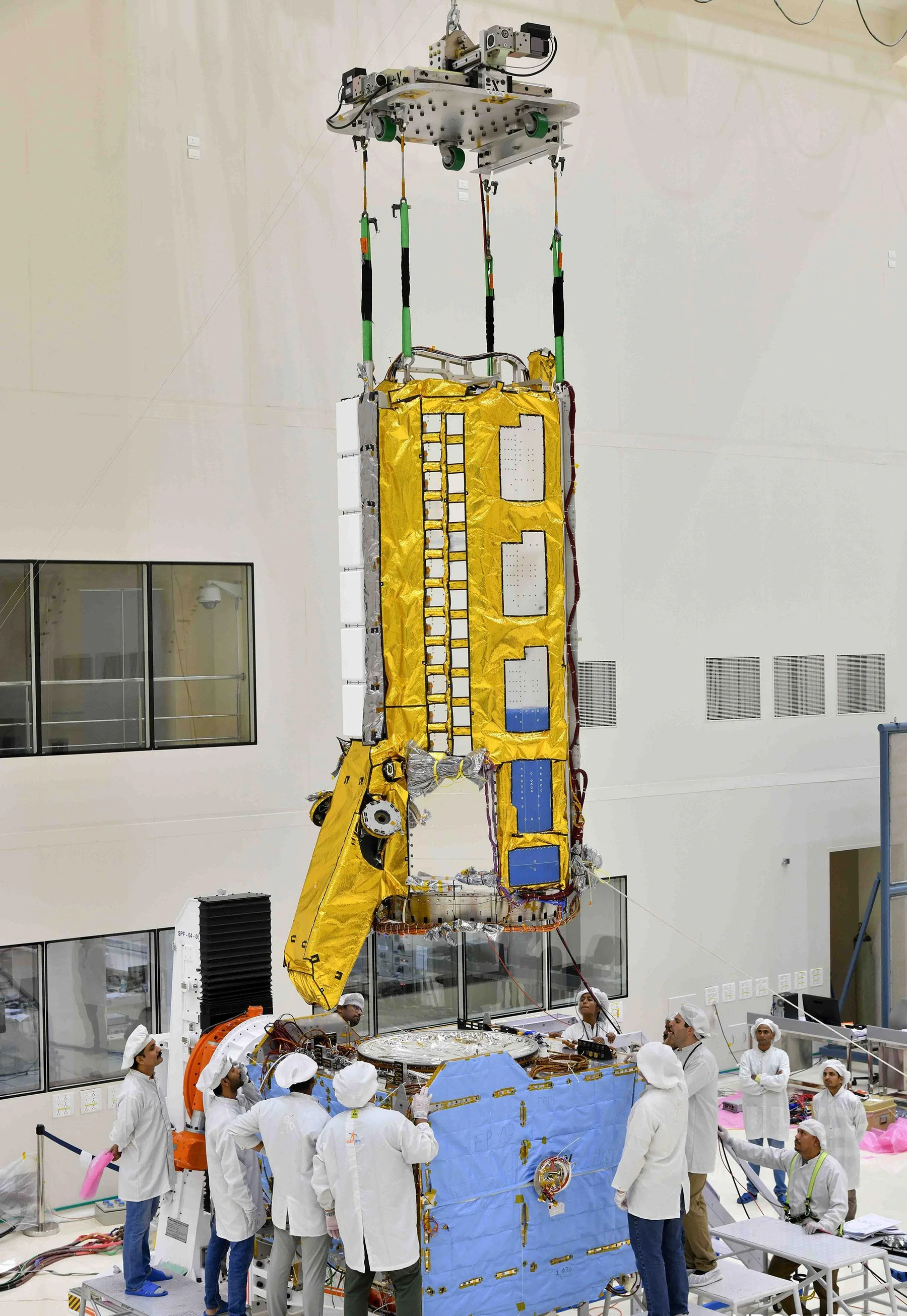
NISAR: Earth radar as an international instrumentation project
NISAR combines an L-band radar developed by JPL with an S-band radar from ISRO, a twelve-meter deployable antenna, and a very high-rate data system. Launched in July 2025, the satellite illustrates cooperation in which hardware is designed on two continents and then integrated into a common architecture. [55]
Technically, the mission requires unusually explicit interfaces: mechanical, radio-frequency, thermal, control, data, transportation schedule, and testing. International cooperation becomes an engineering discipline as much as a diplomatic arrangement.
In the case of “NISAR: Earth radar as an international instrumentation project,” success in this setting is multidimensional.
The history of “NISAR: Earth radar as an international instrumentation project” also helps separate demonstrated capability from extrapolation.
For “NISAR: Earth radar as an international instrumentation project,” that is how laboratory history becomes a design resource rather than a catalogue of records.
Science follows a different timescale from delivery engineering. In that frame, “NISAR: Earth radar as an international instrumentation project” becomes a case study linking a dated decision to a durable capability without turning historical experience into a universal recipe.
SWOT: measuring global water with a French-American architecture
SWOT, launched in December 2022, combines NASA and CNES with Canadian and British contributions. Its Ka-band radar interferometer and other instruments measure the height of oceans, lakes, rivers, and reservoirs. JPL plays a major role in the payload and science processing. [68]
Technically, sWOT demonstrates that a planetary laboratory can maintain extremely precise metrology through Earth work. Radar, calibration, and distributed processing techniques then enrich the portfolio available for other destinations.
In the case of “SWOT: measuring global water with a French-American architecture,” success in this setting is multidimensional.
The history of “SWOT: measuring global water with a French-American architecture” also helps separate demonstrated capability from extrapolation.
Transfer to Mars must remain cautious. For “SWOT: measuring global water with a French-American architecture,” that is how laboratory history becomes a design resource rather than a catalogue of records.
Science follows a different timescale from delivery engineering. In that frame, “SWOT: measuring global water with a French-American architecture” becomes a case study linking a dated decision to a durable capability without turning historical experience into a universal recipe.
SMAP, OCO-2, and continuity of Earth records
SMAP has measured soil moisture and freeze-thaw state since 2015. OCO-2, launched in 2014 after the first OCO was lost at launch in 2009, measures atmospheric carbon dioxide. These missions show that JPL also builds long records used to understand climate and Earth-system cycles. [69]
Technically, scientific continuity depends on calibration stability as much as spacecraft lifetime. Poorly connected generations can hide a real trend or create a false discontinuity. The same requirement will apply to multi-decade Mars weather records.
In the case of “SMAP, OCO-2, and continuity of Earth records,” success in this setting is multidimensional.
The history of “SMAP, OCO-2, and continuity of Earth records” also helps separate demonstrated capability from extrapolation.
For “SMAP, OCO-2, and continuity of Earth records,” that is how laboratory history becomes a design resource rather than a catalogue of records.
Science follows a different timescale from delivery engineering. In that frame, “SMAP, OCO-2, and continuity of Earth records” becomes a case study linking a dated decision to a durable capability without turning historical experience into a universal recipe.
Sample return: from the tube to the chain of evidence
Mars sample return combines disciplines rarely brought together: acquisition, sealing, traceability, rendezvous, planetary protection, Earth receiving, and scientific governance. Perseverance's caching activity already creates an obligation to preserve the exact context of each tube and the operational history that produced it. [44]
Technically, the cost and difficulty of the program also show that an ambitious science chain cannot be treated as a late assembly of independent missions. Interfaces must be designed as a continuous evidentiary system, or a future step can erase value created upstream.
In the case of “Sample return: from the tube to the chain of evidence,” success in this setting is multidimensional.
The history of “Sample return: from the tube to the chain of evidence” also helps separate demonstrated capability from extrapolation.
For “Sample return: from the tube to the chain of evidence,” that is how laboratory history becomes a design resource rather than a catalogue of records.
Science follows a different timescale from delivery engineering. In that frame, “Sample return: from the tube to the chain of evidence” becomes a case study linking a dated decision to a durable capability without turning historical experience into a universal recipe.
Microdevices Laboratory: a mission can begin at micrometer scale
1990s–2026 provides the chronological frame. The Microdevices Laboratory develops detectors, diffraction gratings, bolometers, and other devices that enable new measurements in Earth, planetary, and astrophysical science. Institutional capability can therefore exist many levels below the visible spacecraft. [74] The historical fact matters most when tied to program constraints: schedule, funding, availability of experienced staff, condition of shared facilities, component maturity, and dependence on organizations outside JPL.
The technical mechanism is more specific. Such components require specialized fabrication, characterization, metrology, and qualification. A laboratory innovation becomes useful in flight only when it can survive vibration, vacuum, temperature, radiation, and integration constraints.
The human layer is equally important. Microtechnology teams often work long before a specific mission is selected. Their funding maintains a reserve of technical options that future projects can draw upon.
Within the specific chapter “Microdevices Laboratory: a mission can begin at micrometer scale,” At institutional scale, The capital is fragile: if it is not practiced, documented, and transferred, a few departures or a few years of interruption can erase it. The objective is not universal standardization.
For human Mars, transfer has to remain bounded. For Mars, miniaturized sensors could multiply environmental monitoring and equipment diagnostics. Their value would depend on local calibration and replacement capability, not just low mass.
Instrumenting without confusing precision with truth
1960s–2026 provides the chronological frame. A space-science measurement passes through sensor, electronics, calibration, software, geometry, and processing before becoming a published number. JPL therefore has to distinguish resolution, precision, accuracy, and uncertainty so stated performance reflects what an instrument truly measures. [89] The historical fact matters most when tied to program constraints: schedule, funding, availability of experienced staff, condition of shared facilities, component maturity, and dependence on organizations outside JPL.
The technical mechanism is more specific. Preflight calibration provides a reference, but thermal drift, radiation, and aging can change response. Missions use reference observations, internal redundancy, or cross-comparison to track evolution.
The human layer is equally important. Scientists and engineers share responsibility for the evidence chain. A technically nominal instrument can still produce a wrong interpretation if processing limits are forgotten.
Within the specific chapter “Instrumenting without confusing precision with truth,” At institutional scale, Institutional maturity is therefore measured less by the number of past successes than by the ability to understand what actually produced those successes. The objective is not universal standardization.
For human Mars, transfer has to remain bounded. On Mars, health, water, or production decisions may depend on local sensors. Standards, calibration histories, and decision rules that account for uncertainty would therefore be required.
Planetary Data System: turning a finished mission into knowledge that remains usable
1989–2026 provides the chronological frame. The Planetary Data System preserves and distributes data from many missions using standards, documentation, and metadata intended to support reuse. The archive therefore extends scientific value long after an operations team is no longer funded. [89] The historical fact matters most when tied to program constraints: schedule, funding, availability of experienced staff, condition of shared facilities, component maturity, and dependence on organizations outside JPL.
The technical mechanism is more specific. Archiving is not copying files to a server. Units, calibration, geometry, software versions, product descriptions, and relationships between raw and derived data must be preserved. Without context, an intact file can become scientifically unusable.
The human layer is equally important. Archive preparation must therefore begin before mission end. Teams that wait until experts leave discover too late that some decisions were never written down.
Within the specific chapter “Planetary Data System: turning a finished mission into knowledge that remains usable,” At institutional scale, This is also what separates an exploration campaign from a collection of missions: assets, data, and methods begin to behave as a shared system. The objective is not universal standardization.
For human Mars, transfer has to remain bounded. A Mars base would need to treat technical logs, medical data, resource records, and maps as living operational archives. Reconstructing a past state would be essential for diagnosing slow drift.
Planetary protection: cleanliness as a science and governance requirement
1970s–2026 provides the chronological frame. Mars missions manage terrestrial contamination to protect life-detection science and comply with planetary-protection policy. Cleanliness therefore becomes a science requirement affecting materials, assembly, testing, and operations. [75] The historical fact matters most when tied to program constraints: schedule, funding, availability of experienced staff, condition of shared facilities, component maturity, and dependence on organizations outside JPL.
The technical mechanism is more specific. Bioburden, organic contamination, and access to sensitive surfaces must be controlled using measurable methods. A maintenance action that would be routine elsewhere can become scientifically significant.
The human layer is equally important. Planetary protection forces scientists, engineers, and mission managers to negotiate objectives that can conflict: accessibility, cost, hardware safety, and sample integrity.
Within the specific chapter “Planetary protection: cleanliness as a science and governance requirement,” At institutional scale, The consequence is durable: the next mission rarely inherits a complete solution, but it does inherit people, procedures, software, testbeds, and ways of framing problems. The objective is not universal standardization.
For human Mars, transfer has to remain bounded. Human presence would multiply Martian contamination. Settlement planning would therefore need to separate habitation, industrial zones, and protected science sites if it is to preserve the ability to answer the question of indigenous life.
Sample caching: building a chain of custody on another planet
2020–2026 provides the chronological frame. Perseverance cores, documents, seals, and deposits tubes intended to remain scientifically interpretable through a future return chain. The caching system turns drilling into a long-duration traceability problem. [73] The historical fact matters most when tied to program constraints: schedule, funding, availability of experienced staff, condition of shared facilities, component maturity, and dependence on organizations outside JPL.
The technical mechanism is more specific. Each tube must remain linked to geological context, tool state, contamination controls, and imagery. Sample value therefore resides not only in physical material but in the record that accompanies it.
The human layer is equally important. Teams develop procedures intended to survive multiple organizations and many years. Chain of custody begins on Mars but must remain intelligible to a future Earth laboratory.
Within the specific chapter “Sample caching: building a chain of custody on another planet,” At institutional scale, That continuity helps explain how a laboratory can change destination radically while retaining a recognizable technical identity. The objective is not universal standardization.
For human Mars, transfer has to remain bounded. For a human settlement, similar discipline would be needed for biological, medical, and environmental samples. Human proximity would make contamination more likely and documentation even more important.
Connecting Worlds: DSN, Navigation, Time, Relays, and Optical Communications
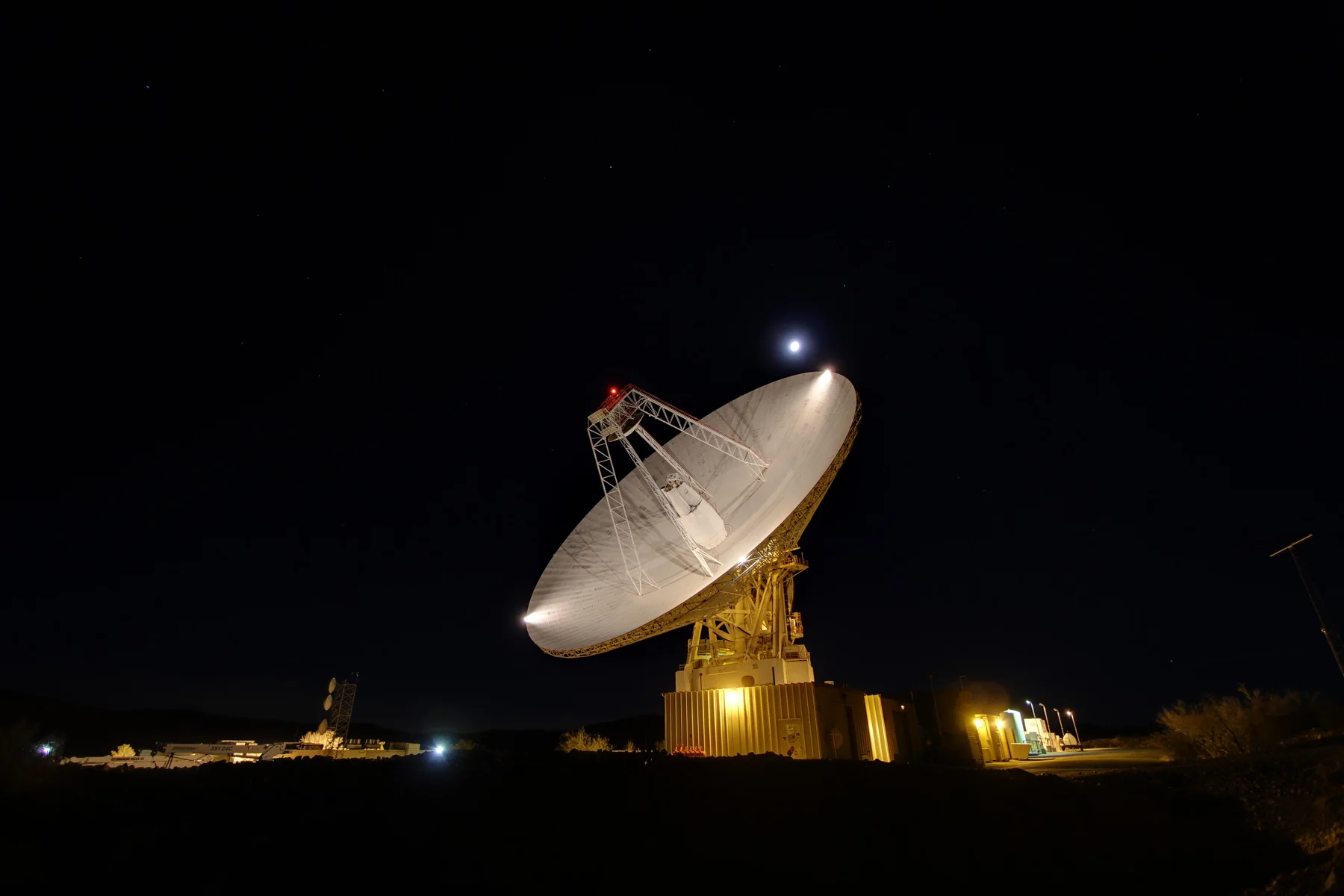
Communications: commanding a machine that is no longer “live”
At interplanetary distance the word remote control changes meaning. Light-time delay cannot be negotiated away. The theme of Deep Space Network therefore combines ground antennas, radio power, coding, onboard storage, mission planning and autonomous software. In this case, one useful anchor is that JPL manages the Deep Space Network for NASA. [5] Another is that JPL is a Caltech division managed for NASA. [1] These are verifiable facts; by themselves they do not guarantee success of any future program. [5][1]
The Deep Space Network: the invisible infrastructure that turns a distant spacecraft into a mission
The Deep Space Network was organized in the 1960s around complexes separated by roughly 120 degrees of longitude so spacecraft could remain in contact as Earth rotates. Goldstone in California, Madrid in Spain, and Canberra in Australia now form the network's core. JPL manages it for NASA, but it serves many agency and partner missions. [source]
A large antenna alone solves little. Operations must schedule time, know frequency and geometry precisely, synchronize clocks, correct propagation effects, extract extremely weak signals, and preserve data continuity. The network is therefore radio engineering, software, operations, and metrology at once.
Finally, the deep space network: the invisible infrastructure that turns a distant spacecraft into a mission shows that space policy is never separate from engineering.
The DSN is also a shared and finite resource. Several missions can request the same antenna at the same time. This constraint shows that exploration depends on common infrastructure whose capacity must be planned years ahead.
The Deep Space Network: the invisible infrastructure that turns a distant spacecraft into a mission depended on ground teams, analysis tools, suppliers, tests, software, and budget decisions that do not appear in official photographs. Success is distributed.
Human presence on Mars would need an even more resilient network: direct links, orbital relays, local storage, data prioritization, and autonomy whenever Earth is unavailable. [source]
The existence of the deep space network: the invisible infrastructure that turns a distant spacecraft into a mission does not prove that every adjacent problem is solved; it is evidence limited to particular conditions.
The Deep Space Network: the invisible infrastructure that turns a distant machine into a mission
A spacecraft that cannot be commanded or return data has little practical value. The Deep Space Network evolved into three primary complexes in California, Spain, and Australia, positioned so Earth's rotation can hand a spacecraft from one site to another. Extremely sensitive receivers, stable frequency standards, large antennas, and precise navigation processing recover signals that arrive with vanishingly small power. [14]
The DSN is also a governance system. Antenna time is finite and must be allocated among missions. A spacecraft anomaly can demand emergency coverage and displace planned science elsewhere. Infrastructure therefore creates a shared-resource problem, not just a radio problem.
Interplanetary navigation: the ground system as part of the spacecraft
Radio range and Doppler measurements are combined with solar-system models to estimate trajectory. Maneuvers must be planned when they are cheap enough in propellant but informed by sufficiently recent tracking. Navigation is therefore a continuous estimation problem under uncertainty.
This makes the mission larger than the launched hardware. Models, analysts, tracking stations, software, and operational procedures on Earth are part of the functional vehicle. The same will be true for a human Mars architecture, even if local autonomy increases dramatically.
Optical navigation: when imagery becomes trajectory information
Spacecraft can use stars, planetary limbs, moons, and surface features to refine relative position. Optical navigation complements radio tracking and becomes especially important near poorly known small bodies or during precision landing.
Terrain-Relative Navigation extends the idea to Mars landing. A future local navigation system may combine orbiters, beacons, inertial systems, and optical terrain matching so vehicles can operate with less Earth dependence.
Local navigation: from Earth-based tracking toward a Mars positioning service
Current Mars navigation relies heavily on DSN tracking, orbital ephemerides, onboard inertial systems, and mission-specific local navigation. A busier Mars environment could justify a local positioning architecture combining orbiting beacons, timing references, and surface transponders.
The technical problem is broader than launching navigation satellites. Signal standards, clock maintenance, orbit control, user equipment, fault detection, and access policy would all need governance. JPL's history in deep-space navigation makes it a natural contributor, but the transition from mission support to public infrastructure would require new operational models.
The Deep Space Network as a shared planetary utility
The DSN is managed under JPL's technical direction for NASA, but its functional role extends across many missions and agencies. Deep-space communication is expensive infrastructure, so sharing large antennas is more efficient than building a separate global network for every spacecraft.
Shared infrastructure requires governance. Antenna time is scheduled, priorities change during critical events, and emergencies can displace routine science. A future Mars communications architecture will need explicit rules for human-safety traffic, scientific data, commercial services, and international users.
Goldstone, Madrid, and Canberra: terrestrial geography as part of interplanetary system design
The three main DSN complexes are separated in longitude so Earth's rotation can hand off spacecraft coverage. Site location depends on radio interference, terrain, logistics, and political stability. A planetary mission therefore includes geography on Earth as surely as it includes trajectory in space.
Mars infrastructure will face a similar local problem. Terrain can block line of sight, high latitudes change power conditions, and relay orbit geometry determines communication windows. Network architecture must be designed with the planet's geography rather than added afterward.
Light-time: bandwidth does not repeal causality
Even an ideal link cannot eliminate the propagation delay between Earth and Mars. Depending on orbital geometry, one-way latency ranges from several minutes to more than twenty minutes.
This forces a separation between communication quality and operational control. Earth can provide expertise but cannot drive an emergency procedure step by step. JPL's robotic mission model already treats remote systems as autonomous executors of delayed intent.
Solar conjunction: predictable communication degradation as an operational season
When the Sun lies near the Earth-Mars line of sight, solar plasma interferes with radio signals. Missions reduce commanding and rely more heavily on onboard autonomy and stored sequences.
Human settlements will need conjunction operating modes with local technical libraries, medical capability, spare procedures, and reduced dependence on interactive Earth support. A predictable astronomical event becomes a governance and readiness requirement.
Telemetry: the spacecraft's language for explaining its own health
Telemetry channels report voltage, current, temperature, mode state, counters, memory errors, mechanism positions, and hundreds or thousands of other parameters. The design challenge is deciding what to measure because sensors and downlink are finite.
Good telemetry anticipates anomalies. A parameter that seems unimportant during design may become the only clue after a failure. Human Mars infrastructure should therefore treat observability as a design requirement rather than an afterthought.
Communications operations as a profession
DSN operators and mission communications engineers maintain a 24-hour service across missions of very different ages and technical standards. Some spacecraft use decades-old designs; others push modern bandwidth and coding techniques.
This backward compatibility is itself a capability. Mars infrastructure built over decades must avoid becoming a collection of incompatible generations. Standards need evolution paths rather than abrupt replacement.
Radioisotope power: paying complexity to reduce environmental dependence
Curiosity and Perseverance use radioisotope power, which provides relatively stable energy independent of sunlight and dust. The technology has limited fuel availability and specific safety requirements.
The general lesson is not that nuclear always wins. It is that architecture should value independence from common environmental hazards. A settlement may combine nuclear, solar, and storage rather than optimize around one source.
DSN operators: talking to machines older than some of their teammates
The Deep Space Network supports spacecraft spanning generations of communications technology. Operators maintain compatibility with old protocols while bringing newer missions online.
This backward-compatibility challenge will appear on Mars as infrastructure ages. A new relay or habitat should not instantly make decade-old vehicles unusable. Interface evolution needs deliberate compatibility plans.
Telemetry limits and the art of choosing what to measure
No spacecraft can downlink every internal variable at unlimited rate. Designers select channels, sample rates, compression, and event-triggered data. This choice determines what future anomaly teams will be able to infer.
Observability is therefore a design trade. A sensor that adds little nominal value may be priceless during failure. Human systems can carry more instrumentation, but data overload creates a new problem: operators need prioritization and intelligent summarization.
Autonomous navigation as a continuum
Sojourner had limited obstacle avoidance; later rovers developed more capable AutoNav; Perseverance can perform longer autonomous drives and use sophisticated onboard perception. Autonomy increases because communication delay makes human micro-control inefficient.
The correct level is mission-dependent. More autonomy can improve productivity but also makes behavior harder to predict. Verification, operator understanding, and safe fallback modes must grow with algorithmic complexity.
The next Deep Space Network: more capacity without repealing physics
The Deep Space Network continues to expand because mission count and data volume are increasing faster than antenna time. NASA is adding 34-meter dishes through the network's aperture-enhancement program. A new Canberra antenna is expected to enter service in 2029; Madrid commissioned a new dish in 2022 and Goldstone has also been expanding capacity. The historic geometry of three complexes roughly 120 degrees apart remains, but each site increasingly behaves as a cluster of antennas that can be scheduled and in some cases arrayed. [36]
Growth does not remove the fundamental constraints. Deep-space communication remains a problem of weak received power, propagation delay, geometry, and finite spectrum. More antennas create more scheduling capacity and arraying options, but they do not turn Mars into a terrestrial network. Human missions will generate far larger demands: video, medical data, software, science, maintenance records, operational telemetry, and private crew communications. The architecture will therefore need DSN capacity, Mars relays, compression, local storage, prioritization, and likely optical communications.
The DSN already has the conceptual structure of a critical service: geographically separated sites, centralized scheduling, continuous operations, standards, and contingency procedures. A future Earth-Mars infrastructure will need stronger service classes. A safety command should not depend on the same availability assumptions as a bulk science transfer. Human communications can tolerate variable quality; critical software or emergency instructions require integrity, authentication, and confirmation.
Navigation and communications: infrastructure noticed mainly when it fails
A human base needs persistent knowledge of the position of vehicles and people. Current Mars systems combine inertial navigation, imagery, orbital estimates, and Earth tracking. Perseverance has demonstrated increasing onboard localization and autonomous-driving capability. Such functions can become elements of a wider local service, but a permanent Mars positioning network would require a constellation, time references, maintenance, and interface standards.
Communications follow the same path. Science orbiters gradually became relay assets for surface missions. An opportunistic benefit can become a designed architecture: dedicated relay satellites, surface links, distributed storage, emergency paths, and service priorities. JPL has the DSN and Mars-relay heritage, but crewed networks would demand higher availability, security, and fault isolation.
The deeper lesson is that successful infrastructure becomes visually invisible. The public sees the rover, not the Canberra antenna receiving its data, the scheduling software reserving a pass, the clock aligning measurements, the operator validating packets, or the standard that lets a relay understand a vehicle designed a decade later. A settlement will depend precisely on those invisible layers.
Public communication: explain complexity without turning it into incomprehensible spectacle
JPL has developed a distinctive public culture around missions. Press conferences, press kits, trajectory animations, visualizations, mission journals, and technical pages translate complex systems into accessible narratives. This communication is not entirely external to the mission. A publicly funded institution must explain why an architecture costs what it does, what a result means, and why a failure is not automatically evidence of incompetence.
Simplification can distort in both directions. Sky crane can be described as a crazy gamble when it was the result of years of analysis and testing. Mars Climate Orbiter can become a joke about units when the failure actually exposes interface and verification problems. Good communication therefore needs layers: a clear first explanation and progressively deeper paths toward technical evidence.
This structure will matter even more for human Mars exploration. Taxpayers, international partners, and crew families will need understandable accounts of risk, objectives, and program changes. An institution that communicates only success destroys credibility when an accident occurs. Publishing investigations and explaining corrective action instead turns crisis into evidence of accountability.
1963: formal birth of the Deep Space Network
The deep-space network grew from tracking stations created for early probes, and William Pickering formally established their integration into the Deep Space Network in December 1963. Goldstone was complemented by overseas sites so contact could continue as Earth's rotation carried a spacecraft below one station's horizon. [51]
Technically, geography becomes part of the space architecture. The system exists neither only on the spacecraft nor only at JPL; it extends around Earth, with responsibility handed among complexes and teams.
In the case of “1963: formal birth of the Deep Space Network,” success in this setting is multidimensional.
The history of “1963: formal birth of the Deep Space Network” also helps separate demonstrated capability from extrapolation.
For “1963: formal birth of the Deep Space Network,” that is how laboratory history becomes a design resource rather than a catalogue of records.
The DSN shows that interplanetary exploration depends on terrestrial assets as critical as spacecraft. Antenna maintenance, schedule conflicts, or loss of radio capacity can limit a vehicle that is perfectly healthy in space. Ground infrastructure must therefore be treated as an extended flight system. In that frame, “1963: formal birth of the Deep Space Network” becomes a case study linking a dated decision to a durable capability without turning historical experience into a universal recipe.
Goldstone, Madrid, Canberra: three complexes, one service
Today's Goldstone, Madrid, and Canberra complexes are spaced roughly 120 degrees apart in longitude. That geometry provides continuous coverage for much of the deep-space fleet. Canberra also has a special role for Voyager 2 because of the spacecraft's southern sky trajectory. [54]
Technically, a global network is not simple duplication. Sites do not always have identical antennas, frequency bands, or visibility. Scheduling must exploit their complementarity and preserve recovery options when equipment is under maintenance.
In the case of “Goldstone, Madrid, Canberra: three complexes, one service,” success in this setting is multidimensional.
The history of “Goldstone, Madrid, Canberra: three complexes, one service” also helps separate demonstrated capability from extrapolation.
For “Goldstone, Madrid, Canberra: three complexes, one service,” that is how laboratory history becomes a design resource rather than a catalogue of records.
In that frame, “Goldstone, Madrid, Canberra: three complexes, one service” becomes a case study linking a dated decision to a durable capability without turning historical experience into a universal recipe.
From 26-meter antennas to 70 meters and new 34-meter dishes
The DSN evolved with mission demand. Early 26-meter antennas were joined by 64-meter dishes, later enlarged to 70 meters. High-efficiency and beam-waveguide 34-meter antennas added bands and more flexible maintenance. The current program continues adding antennas to increase capacity and resilience. [53]
Technically, the history shows that infrastructure is never 'finished.' Spacecraft generate more data, mission count grows, and old antennas age. Renewal must therefore be funded while service continues, a logic very close to that of a permanent Mars network.
In the case of “From 26-meter antennas to 70 meters and new 34-meter dishes,” success in this setting is multidimensional.
The history of “From 26-meter antennas to 70 meters and new 34-meter dishes” also helps separate demonstrated capability from extrapolation.
For “From 26-meter antennas to 70 meters and new 34-meter dishes,” that is how laboratory history becomes a design resource rather than a catalogue of records.
In that frame, “From 26-meter antennas to 70 meters and new 34-meter dishes” becomes a case study linking a dated decision to a durable capability without turning historical experience into a universal recipe.
Scheduling the DSN: radio capacity as a scarce resource
The network must divide antennas, frequency bands, and time among dozens of operating missions and new spacecraft in development. A critical event, anomaly, or science window may require priorities to move. Scheduling is therefore a form of scientific and operational resource allocation. [53]
Technically, for Mars, bandwidth cannot be assumed unlimited. A human base would add video, maintenance, medical, science, navigation, and industrial data to existing robotic demand. The architecture would need service classes and explicit behavior when a relay or primary link is lost.
In the case of “Scheduling the DSN: radio capacity as a scarce resource,” success in this setting is multidimensional.
The history of “Scheduling the DSN: radio capacity as a scarce resource” also helps separate demonstrated capability from extrapolation.
Transfer to Mars must remain cautious. For “Scheduling the DSN: radio capacity as a scarce resource,” that is how laboratory history becomes a design resource rather than a catalogue of records.
In that frame, “Scheduling the DSN: radio capacity as a scarce resource” becomes a case study linking a dated decision to a durable capability without turning historical experience into a universal recipe.
Radio navigation and science: the signal does more than communicate
The same radio links used to command a spacecraft can measure range, radial velocity, and propagation effects. Doppler, ranging, and interferometric techniques contribute to navigation, while occultations or signal perturbations can themselves become science experiments. [2]
Technically, this versatility is a feature of mature infrastructure: communications equipment also becomes a sensor, timing reference, and diagnostic tool. For a Mars settlement, such shared functions can save mass and maintenance provided common-mode dependencies are understood.
In the case of “Radio navigation and science: the signal does more than communicate,” success in this setting is multidimensional.
The history of “Radio navigation and science: the signal does more than communicate” also helps separate demonstrated capability from extrapolation.
For “Radio navigation and science: the signal does more than communicate,” that is how laboratory history becomes a design resource rather than a catalogue of records.
In that frame, “Radio navigation and science: the signal does more than communicate” becomes a case study linking a dated decision to a durable capability without turning historical experience into a universal recipe.
DSN scheduling: sharing a global resource among missions that cannot simply wait
1963–2026 provides the chronological frame. The Deep Space Network allocates antennas, frequency bands, and time among many missions. Critical events, occultations, planetary encounters, and anomalies do not arrive on a perfectly smooth schedule. [94] The historical fact matters most when tied to program constraints: schedule, funding, availability of experienced staff, condition of shared facilities, component maturity, and dependence on organizations outside JPL.
The technical mechanism is more specific. Scheduling combines visibility geometry, antenna capability, received power, radio compatibility, and operational priority. A mission may have to surrender some data so an antenna can support an irreversible event elsewhere in the solar system.
The human layer is equally important. Network schedulers become arbiters of shared capacity. Their work requires an inter-mission perspective that individual project teams do not always possess.
Within the specific chapter “DSN scheduling: sharing a global resource among missions that cannot simply wait,” At institutional scale, Experience does not remove risk; it makes risk more explicit, measurable, and discussable before it becomes irreversible. The objective is not universal standardization.
For human Mars, transfer has to remain bounded. Mars infrastructure would face comparable conflicts among telemedicine, science, navigation, video, and maintenance. Service classes and priority rules would need definition before bandwidth becomes scarce.
Modernizing antennas without interrupting service
1980s–2026 provides the chronological frame. Goldstone, Madrid, and Canberra modernize receivers, transmitters, and antennas while continuing to support active missions. Transformation of global infrastructure must therefore be sequenced around a service that cannot simply shut down for several years. [95] The historical fact matters most when tied to program constraints: schedule, funding, availability of experienced staff, condition of shared facilities, component maturity, and dependence on organizations outside JPL.
The technical mechanism is more specific. Adding a new 34-meter antenna can increase capacity and resilience, but it must integrate with existing control, timing, data, and scheduling systems. Backward compatibility is an architectural problem in its own right.
The human layer is equally important. Infrastructure teams work on horizons longer than most projects. They must defend investments whose benefit may become visible only when a future mission needs the capacity that was created.
Within the specific chapter “Modernizing antennas without interrupting service,” At institutional scale, The capital is fragile: if it is not practiced, documented, and transferred, a few departures or a few years of interruption can erase it. The objective is not universal standardization.
For human Mars, transfer has to remain bounded. On Mars, replacing a relay or antenna would likewise have to occur while service continues. Temporary redundancy during transition would need to be budgeted rather than assumed free.
DSOC: adding optical communications without pretending radio disappears overnight
2023–2026 provides the chronological frame. The Deep Space Optical Communications demonstration flying with Psyche explores laser links capable of greatly increasing deep-space data rates. Optical communication augments rather than instantly replaces radio because weather, pointing, and terminal availability introduce new constraints. [87] The historical fact matters most when tied to program constraints: schedule, funding, availability of experienced staff, condition of shared facilities, component maturity, and dependence on organizations outside JPL.
The technical mechanism is more specific. An optical link requires much finer pointing and a different link budget. The ground system must track the spacecraft, account for atmospheric visibility, and coordinate terminals that are not interchangeable with large radio dishes.
The human layer is equally important. Coexistence of two technologies can increase resilience while complicating operations. Teams must know when to switch, what data to prioritize, and how to diagnose medium-specific degradation.
Within the specific chapter “DSOC: adding optical communications without pretending radio disappears overnight,” At institutional scale, Institutional maturity is therefore measured less by the number of past successes than by the ability to understand what actually produced those successes. The objective is not universal standardization.
For human Mars, transfer has to remain bounded. A Mars base could combine radio and optical links between Mars and Earth. The real gain would come from a multi-link architecture with recovery policies, not one high-rate link assumed always available.
Deep-space navigation: turning sparse radio measurements into state knowledge
1960s–2026 provides the chronological frame. Interplanetary navigation combines Doppler, ranging, gravitational models, spacecraft dynamics, and sometimes optical navigation. JPL developed teams able to turn indirect measurements into position and velocity estimates accurate enough for trajectory corrections, orbital insertion, or atmospheric entry. [94] The historical fact matters most when tied to program constraints: schedule, funding, availability of experienced staff, condition of shared facilities, component maturity, and dependence on organizations outside JPL.
The technical mechanism is more specific. The solution is never an exact number; it carries covariance and assumptions. Maneuver decisions therefore have to consider navigation uncertainty and how a correction can reduce one error while creating another.
The human layer is equally important. Navigation is a continuity profession in which experience from previous campaigns matters greatly. Cross-checks and validated tools prevent a numerically elegant solution from being accepted without physical understanding.
Within the specific chapter “Deep-space navigation: turning sparse radio measurements into state knowledge,” At institutional scale, This is also what separates an exploration campaign from a collection of missions: assets, data, and methods begin to behave as a shared system. The objective is not universal standardization.
For human Mars, transfer has to remain bounded. Local Mars infrastructure would need position and timing references independent of Earth for daily operations. JPL navigation heritage is most relevant as a culture of uncertainty management and cross-validation.
From Missions to Infrastructure: Mars Networks, Power, Weather, Logistics, and Standards
From one-off missions to infrastructure
This is why the history of Jet Propulsion Laboratory (JPL) is more interesting than a list of launches: the key question is which capabilities persist across generations. In this case, one useful anchor is that JPL played a central role in Mariner 4 and robotic Mars exploration. [3] Another is that JPL states that it designed, built and operated all five successful U.S. Mars rovers. [4] These are verifiable facts; by themselves they do not guarantee success of any future program. [3][4]
Mars as a system of systems
The theme of Deep Space Network is therefore one node in a larger architecture. Studying Jet Propulsion Laboratory (JPL) helps reveal which nodes are already mature, which are developing and which still depend on other actors. In this case, one useful anchor is that JPL manages the Deep Space Network for NASA. [5] Another is that JPL is a Caltech division managed for NASA. [1] These are verifiable facts; by themselves they do not guarantee success of any future program. [5][1]
Mars power: from solar arrays to nuclear generators, architecture follows mission needs
JPL missions have used different power strategies. Pathfinder, Spirit, Opportunity, and InSight relied heavily on solar power; Curiosity and Perseverance use radioisotope thermoelectric generators. Choices depend on latitude, season, dust, required power, lifetime, and available mass. [source]
The contrast is instructive. Solar arrays are simple in some conditions but sensitive to dust and season. Nuclear systems provide steadier power but carry availability, safety, and public-policy constraints.
Chronology matters because it prevents anachronism. When mars power: from solar arrays to nuclear generators, architecture follows mission needs occurred, computers, materials, communications networks, budgets, and planetary knowledge were not those of 2026.
An agency therefore does not choose by physics alone. Industrial supply chains, authorization, and material stocks determine what is actually available when a mission flies.
Finally, mars power: from solar arrays to nuclear generators, architecture follows mission needs shows that space policy is never separate from engineering.
A settlement will probably require a redundant energy mix. Robotic experience helps quantify environments, but human habitat demand changes the scale by orders of magnitude. [source]
The existence of mars power: from solar arrays to nuclear generators, architecture follows mission needs does not prove that every adjacent problem is solved; it is evidence limited to particular conditions.
Stop-work authority: safety must have operational power
A safety rule is meaningful only if someone can stop an activity when conditions are not satisfied. Launch windows and major tests create enormous pressure to continue, which makes explicit stop authority important.
Future Mars crews will need the same principle locally. A life-support technician or EVA specialist must be able to halt a high-value activity when a critical hazard is identified, even if Earth leadership strongly prefers to proceed.
Communities of practice: the informal network that keeps formal standards alive
Much technical knowledge is tacit. Engineers learn which assumptions are fragile, which test results deserve skepticism, and which suppliers require special attention through repeated interaction with colleagues. Communities of practice carry this knowledge across projects.
Remote work and organizational churn can weaken that transfer unless institutions deliberately create forums for cross-project learning. A Mars settlement will face the same issue in miniature: a small local community must make rare expertise visible and teachable.
The Mars Relay Network: a service layer that emerged from scientific orbiters
Odyssey, Mars Reconnaissance Orbiter, and MAVEN have all supported relay services. Rovers commonly send UHF data to an orbiter during a pass, after which the orbiter stores the data and transmits it to Earth using a more powerful deep-space link.
For human Mars exploration, this service should eventually become an explicitly designed infrastructure. Dedicated communications spacecraft could provide higher throughput, better availability, and redundancy. Crew missions will generate far more data than robotic missions: science, medical information, maintenance telemetry, software, video, and personal communications.
Landing sites as multi-decade infrastructure decisions
Robotic landing sites are selected for the objectives and constraints of individual missions. A human outpost changes the time horizon. Topography, resources, power, communications, scientific value, dust, traffic routes, and room for expansion must be considered together.
Decades of JPL mapping can inform the decision, but no engineering metric can eliminate the political trade. A site rich in accessible ice may be less scientifically pristine; a spectacular geology site may impose difficult landing or power conditions. The weights should be explicit.
Precursor cargo: use robots to prove infrastructure before lives depend on it
A credible human architecture should send cargo before crews: power systems, communications, spares, surface mobility, consumables, and possibly propellant-production equipment. Each cargo mission becomes a system demonstration. If a critical asset fails, crew launch can be delayed.
This strategy fits JPL's institutional strengths. Robots can inspect, characterize, deploy, and verify. The challenge is that construction robots need different performance metrics from science rovers: uptime, lifting force, excavation rate, connector standardization, and maintainability.
Power: from hundreds of watts to a settlement-scale grid
Rovers manage power tightly, prioritizing heaters, mobility, instruments, and communications. A human base will need orders of magnitude more power for life support, thermal management, water processing, oxygen production, laboratories, communications, and industry.
The operational logic still transfers. Loads need priority levels, energy storage, fault isolation, black-start capability, and degraded modes. A robust grid should survive the loss of one generator without collapsing life support.
Spare parts reveal the economics of the entire settlement
Every spare shipped from Earth consumes mass, volume, and launch capacity. Carrying a spare for every possible failure is impossible; carrying none is reckless. Planners must combine failure rates, criticality, repairability, commonality, and local fabrication.
Human presence changes design incentives. A slightly heavier module that can be opened and repaired may be better than an exquisitely compact sealed box. JPL's traditional no-maintenance spacecraft philosophy will need to merge with industrial maintainability.
Firsts are evidence, not infrastructure
JPL can claim a long list of firsts: first U. S. satellite participation, first successful U. S. interplanetary mission, first successful Mars flyby, first planetary orbiter, first Mars rover, first sky-crane landing, and first powered flight on another planet.
A first demonstrates possibility. Infrastructure demonstrates repeatability, maintainability, standards, and predictable service. Human Mars exploration will require the second category much more than the first.
Infrastructure commonality: fewer part types can be more valuable than maximum local optimization
Robotic missions often optimize tightly around one vehicle, but a settlement benefits from common connectors, fasteners, pumps, batteries, software interfaces, and tools. Commonality reduces spares and training burden.
The trade is that a common component may be less efficient for a particular subsystem. Systems engineering must evaluate fleet-level logistics rather than local performance only.
Stop-work authority: caution must have operational power
A written safety policy is weak if nobody can stop a test or operation. High-profile schedules create pressure to continue, especially near launch windows.
Mars crews should distribute stop authority. A life-support specialist must be able to halt an EVA or industrial operation when a critical condition is uncertain, even if the scientific value is high.
Powered descent: engines become guidance devices
Terminal propulsion controls vertical and horizontal velocity while responding to navigation estimates. Throttleability, plume behavior, sensor performance, and control laws all interact.
For heavy landers, plume-surface interaction may damage infrastructure or eject hazardous debris. Landing-zone engineering must therefore be linked to vehicle propulsion design.
Landing pads: infrastructure changes the vehicle problem
A prepared surface can reduce dust, improve slope knowledge, and provide visual or radio references. Building it costs cargo and robotic effort but may simplify every later landing.
This is a classic systems trade: spend more on early infrastructure to reduce recurring vehicle risk. JPL's history has mostly optimized self-contained landers; settlement architecture may reward the opposite choice.
Landing multiple cargos: traffic management emerges
A settlement receiving repeated landers must separate trajectories, keep dust and debris away from habitats, track active landing zones, and coordinate surface vehicles.
What begins as mission EDL evolves into a traffic-management problem. Navigation and communications services become shared infrastructure rather than project-specific tools.
A Mars program is not a mission: preserving continuity across vehicles that do not look alike
One of JPL's major institutional evolutions is the shift from isolated missions toward a program in which each vehicle can prepare the next. Pathfinder demonstrates airbag landing and lightweight mobility; Mars Global Surveyor establishes reference mapping; Odyssey detects hydrogen and becomes a relay; Mars Reconnaissance Orbiter provides high-resolution imaging, mineralogy, landing-site support, and communications; Phoenix studies high-latitude ice; the Mars Exploration Rovers develop mobile field geology; Curiosity adds a heavy laboratory and a new landing architecture; Perseverance reuses that architecture while adding Terrain-Relative Navigation, sample caching, and Ingenuity.
This sequence was never a perfectly scripted master plan. Missions respond to competitions, budgets, scientific priorities, and political choices that change. Some technologies appear because one project needs them; others enter as opportunistic demonstrations. Yet the program learns to capitalize on previous assets. Orbiter maps reduce landing risk. A long-lived relay increases the science return of a rover that did not exist when the orbiter was designed. Reusing infrastructure beyond its original objective is a sign of maturity.
Human exploration should intensify this logic. Precursors should be judged not only by individual science return but by the uncertainty they remove from later architecture. A weather station can become forecasting infrastructure; an orbiter can become a relay; an ice map can change logistics; a technology demonstrator can leave useful beacons. The metric becomes more than mission success: how much durable capability and decision-quality did the mission create?
Mars Relay Network: science orbiters become infrastructure
Odyssey, Mars Reconnaissance Orbiter, and MAVEN gradually took on relay roles for surface missions. The network was not built in one step; it emerged from science spacecraft whose communications capabilities were used collectively. This is one of the clearest examples of moving from missions toward Mars infrastructure. [59]
Technically, but the infrastructure is aging and depends on extension decisions made mission by mission. Human presence could not treat that opportunistic model as sufficient; relays would need to be designed as a service, replaced before failure, and given planned redundancy.
In the case of “Mars Relay Network: science orbiters become infrastructure,” success in this setting is multidimensional.
The history of “Mars Relay Network: science orbiters become infrastructure” also helps separate demonstrated capability from extrapolation.
For “Mars Relay Network: science orbiters become infrastructure,” that is how laboratory history becomes a design resource rather than a catalogue of records.
Moving from missions to infrastructure changes the metric of success. A mission can meet defined objectives and stop; a service has to remain available, be renewed, and accept future users not yet known. That continuity logic becomes essential when several spacecraft depend on the same relay, standard, or data repository. In that frame, “Mars Relay Network: science orbiters become infrastructure” becomes a case study linking a dated decision to a durable capability without turning historical experience into a universal recipe.
NISAR and SWOT: learning to manage data torrents
Modern Earth missions change the scale of processing. NISAR is designed to generate extremely large data volumes, and SWOT returns about a terabyte of raw data per day. JPL therefore must treat storage, cloud processing, open distribution, calibration, and automation as integral parts of the mission. [56]
Technically, a Mars settlement will also produce more data than the interplanetary link can continuously carry. It will need local processing, prioritization, summarization, and replication. Earth missions therefore provide a useful laboratory for distributed computation.
In the case of “NISAR and SWOT: learning to manage data torrents,” success in this setting is multidimensional.
The history of “NISAR and SWOT: learning to manage data torrents” also helps separate demonstrated capability from extrapolation.
For “NISAR and SWOT: learning to manage data torrents,” that is how laboratory history becomes a design resource rather than a catalogue of records.
In that frame, “NISAR and SWOT: learning to manage data torrents” becomes a case study linking a dated decision to a durable capability without turning historical experience into a universal recipe.
Standards and interfaces: building an ecosystem rather than one mission
When multiple spacecraft share relays, data formats, frequencies, archive tools, and navigation conventions, an interface decision outlives the project that created it. Standards therefore become technical capital. They reduce future integration cost but can also fossilize old choices if never revisited. [59]
Technically, for human Mars the stakes will be higher: power, connectors, maintenance protocols, map formats, part identification, and safety rules will have to work across equipment from different suppliers and generations.
In the case of “Standards and interfaces: building an ecosystem rather than one mission,” success in this setting is multidimensional.
The history of “Standards and interfaces: building an ecosystem rather than one mission” also helps separate demonstrated capability from extrapolation.
For “Standards and interfaces: building an ecosystem rather than one mission,” that is how laboratory history becomes a design resource rather than a catalogue of records.
In that frame, “Standards and interfaces: building an ecosystem rather than one mission” becomes a case study linking a dated decision to a durable capability without turning historical experience into a universal recipe.
Prepositioning before crews: robots as builders of context
JPL has long experience with robotic precursors that map, characterize environments, and reduce uncertainty before the next decision. For human Mars, that logic can extend to resource reconnaissance, route verification, beacon deployment, inspection of prepositioned equipment, and weather monitoring. [59]
Technically, the credible transfer is therefore informational and robotic before it is architectural. Nothing in JPL history proves that a rover can simply be scaled into a habitat; it does show how autonomous machines can prepare a better-understood situation for humans.
In the case of “Prepositioning before crews: robots as builders of context,” success in this setting is multidimensional.
The history of “Prepositioning before crews: robots as builders of context” also helps separate demonstrated capability from extrapolation.
For “Prepositioning before crews: robots as builders of context,” that is how laboratory history becomes a design resource rather than a catalogue of records.
In that frame, “Prepositioning before crews: robots as builders of context” becomes a case study linking a dated decision to a durable capability without turning historical experience into a universal recipe.
From the Mars Relay Network to a planetary telecommunications service
2001–future provides the chronological frame. Odyssey, MRO, and MAVEN relayed surface data for years, giving Mars a de facto infrastructure. The capability, however, is attached to aging science orbiters and extension decisions made mission by mission. [59] The historical fact matters most when tied to program constraints: schedule, funding, availability of experienced staff, condition of shared facilities, component maturity, and dependence on organizations outside JPL.
The technical mechanism is more specific. A dedicated service would need guaranteed throughput, availability targets, radio interfaces, replacement schedules, and recovery capacity. It would no longer be enough for an orbiter to be able to relay; an architecture would have to guarantee continuity.
The human layer is equally important. Governance also changes: who pays for infrastructure used by multiple missions, and how is capacity allocated when scientific or commercial interests differ?
Within the specific chapter “From the Mars Relay Network to a planetary telecommunications service,” At institutional scale, The consequence is durable: the next mission rarely inherits a complete solution, but it does inherit people, procedures, software, testbeds, and ways of framing problems. The objective is not universal standardization.
For human Mars, transfer has to remain bounded. For human presence, the network would need treatment like electricity or water: a vital service maintained before failure, exercised in degraded modes, and designed for growth.
Interoperability standards: avoiding a planet built from incompatible islands
2020s–future provides the chronological frame. As more nations and companies consider Mars, compatibility of communications, data, navigation, and mechanical interfaces becomes an infrastructure issue. Historical missions show the cost of late translation between different conventions. [88] The historical fact matters most when tied to program constraints: schedule, funding, availability of experienced staff, condition of shared facilities, component maturity, and dependence on organizations outside JPL.
The technical mechanism is more specific. A useful standard must define units, tolerances, error behavior, and versions, not only a connector or nominal format. It also needs governance able to evolve it without breaking the ecosystem.
The human layer is equally important. JPL brings experience from multi-partner missions, but no laboratory can impose a planetary standard alone. Legitimacy would have to come from open agreements among operators.
Within the specific chapter “Interoperability standards: avoiding a planet built from incompatible islands,” At institutional scale, That continuity helps explain how a laboratory can change destination radically while retaining a recognizable technical identity. The objective is not universal standardization.
For human Mars, transfer has to remain bounded. For human Mars, interoperability of parts, software, and services would reduce spare mass and enable mutual assistance among bases. It becomes a form of collective safety.
Local computing: when distance forces processing before transmission
2000s–future provides the chronological frame. JPL missions increasingly use onboard processing for compression, navigation, science selection, and autonomy. The trend responds to a simple fact: Earth link capacity and communications delay do not allow everything to be transmitted or every decision to be made on the ground. [71] The historical fact matters most when tied to program constraints: schedule, funding, availability of experienced staff, condition of shared facilities, component maturity, and dependence on organizations outside JPL.
The technical mechanism is more specific. Local computing must prioritize data without destroying information that may later prove important. Enough raw context must be preserved, transformations explained, and reanalysis kept possible.
The human layer is equally important. Science and software teams therefore define together what can be summarized automatically. That negotiation turns an algorithm into an institutional science decision.
Within the specific chapter “Local computing: when distance forces processing before transmission,” At institutional scale, Experience does not remove risk; it makes risk more explicit, measurable, and discussable before it becomes irreversible. The objective is not universal standardization.
For human Mars, transfer has to remain bounded. A Mars base would produce industrial, medical, and science data volumes far beyond the interplanetary link. Local processing would need to be auditable, replicated, and able to operate for days without Earth.
Prepositioned logistics: when a cargo mission becomes part of a permanent system
JPL appears here as a technical institution: many professions, levels of authority, and layers of accumulated memory must converge on one result. future provides the chronological frame. JPL's Mars campaign experience suggests a surface mission gains robustness when it can use preexisting assets: maps, relays, weather knowledge, and landing data. Human architecture would extend the logic to physical supplies. [71] The historical fact matters most when tied to program constraints: schedule, funding, availability of experienced staff, condition of shared facilities, component maturity, and dependence on organizations outside JPL.
The technical mechanism is more specific. Prepositioning power, consumables, spares, and robots creates dependence on their actual condition when crew arrives. Telemetry, autonomous inspection, robotic maintenance, and formal acceptance criteria would therefore be required before Earth departure.
The human layer is equally important. The organization must be able to declare a site unready despite sunk investment. That decision requires a culture willing to lose a launch window rather than expose crew to uncertain infrastructure.
Within the specific chapter “Prepositioned logistics: when a cargo mission becomes part of a permanent system,” At institutional scale, The capital is fragile: if it is not practiced, documented, and transferred, a few departures or a few years of interruption can erase it. The objective is not universal standardization.
For human Mars, transfer has to remain bounded. JPL can contribute robotics, communications, and verification methods for such depots, but human requirements would need to be established with organizations responsible for life support and crewed operations.
The Human Institution: Professions, Knowledge Transfer, Operations, and Safety Culture
The people behind the systems
Vehicles are visible; organizations are less so. In this case, one useful anchor is that JPL played a central role in Mariner 4 and robotic Mars exploration. [3] Another is that JPL states that it designed, built and operated all five successful U.S. Mars rovers. [4] These are verifiable facts; by themselves they do not guarantee success of any future program. [3][4]
The people behind the machines: teams, specialists, and technical authority
A JPL mission mobilizes dozens or hundreds of specialties: scientists, systems engineers, mechanical and electrical engineers, radio specialists, software developers, quality teams, operators, navigators, and contractors. Public project figures represent only a fraction of the organization. Repeated success depends on moving information across disciplines without erasing responsibility. [source]
Systems engineering provides a connecting language. It converts scientific goals into requirements, tracks interfaces, and asks how a local change affects mass, power, software, thermal design, or operations elsewhere.
This episode deserves to be read at two levels. In the short term it concerns the people behind the machines: teams, specialists, and technical authority and the decisions made by the teams of the period.
Such an organization inevitably produces tension: science versus margin, cost versus redundancy, schedule versus testing. Quality comes not from eliminating conflict but from processes that make tradeoffs explicit.
From a systems-engineering perspective, the people behind the machines: teams, specialists, and technical authority forces attention to interfaces.
A Mars settlement will need clear technical authority; otherwise local optimizations can weaken the overall survival system. [source]
The people behind the machines: teams, specialists, and technical authority is not merely a date on a timeline; it is an experiment that changes what teams know how to build, what they know how to measure, and what they know to reject when margin is insufficient.
Mission control: a terrestrial extension of the interplanetary spacecraft
An interplanetary spacecraft is never completely autonomous. Ground teams plan sequences, analyze telemetry, detect anomalies, reconstruct vehicle state, and prepare commands. As radio delay grows, the relationship becomes asynchronous: the ground makes decisions from information already several minutes old. [source]
That asymmetry requires onboard safing. The vehicle must protect itself without waiting for a response and then present enough information for engineers to understand what happened.
Mission control: a terrestrial extension of the interplanetary spacecraft depended on ground teams, analysis tools, suppliers, tests, software, and budget decisions that do not appear in official photographs. Success is distributed.
Operations are therefore a design product. If a subsystem cannot be diagnosed or reconfigured remotely, its weakness often appears too late. JPL increasingly incorporates operational perspective during design reviews.
Mission control: a terrestrial extension of the interplanetary spacecraft may prove that a function can work once; a durable campaign requires it to become repeatable, documented, maintainable, and financially supportable.
A crewed base will move much of that authority to Mars. Earth will remain a support and expertise layer, but crews must diagnose and decide without waiting through a full radio cycle. [source]
Mission control: a terrestrial extension of the interplanetary spacecraft therefore adds a layer of institutional memory that future programs can use only if the people and archives needed to understand it are not lost.
Anomaly response teams: temporary organizations built around a problem rather than an org chart
A serious anomaly can cross propulsion, software, power, thermal, and navigation at once. Projects assemble focused teams that build hypotheses, search for discriminating data, and run tests. The structure follows the failure rather than normal management boundaries.
This is a useful crisis-governance model. Mars crews will need the ability to form small multidisciplinary response teams locally, with Earth experts contributing asynchronously rather than directing every step.
Succession: an institution that lasts longer than careers must train people before it needs them
Long missions expose a structural fact: spacecraft can outlive the careers of their designers. Voyager, Odyssey, and Opportunity all required generational handover. Succession must therefore be built into normal operations rather than treated as an emergency when a senior expert retires.
Training is most effective when younger engineers receive real responsibility while mentors are still available. Documentation helps, but judgment develops through participation in reviews, tests, and anomalies.
The sol as an operational unit
Using sol numbers creates a local mission chronology tied to the actual surface cycle. Plans, data products, and anomalies can be indexed to the rover's lived time rather than Earth calendars.
A human settlement will likely develop similar conventions. Standardizing local time, seasons, communication windows, and mission-day numbering is more than language; it prevents coordination errors across organizations.
Press kits and public explanation: technical transparency at a useful level
JPL has long produced detailed mission press kits explaining spacecraft architecture, science, timelines, and operational milestones. These documents occupy a useful middle ground between marketing and engineering documentation.
For human Mars exploration, public trust will depend on similarly honest explanation. Safety risks cannot be reduced to slogans, but neither can public accountability require citizens to read thousands of technical pages. Institutions need layered transparency.
Education and recruitment: exploration programs need a pipeline longer than one mission
JPL's internships, educational resources, outreach programs, and public events help convert mission excitement into future technical talent. This is not merely public relations for a laboratory whose missions may last decades.
Voyager demonstrates that spacecraft can outlive career stages. A Mars settlement will be even more dependent on generational renewal. Training, mentorship, and documentation are therefore strategic infrastructure.
End-of-mission closeout: preventing knowledge from leaving with the team
When a project ends, people rapidly move to new assignments. That is exactly when lessons, final configuration records, and operational knowledge are most at risk of being lost.
Closeout documentation and archives should be treated as deliverables. A century-long Mars program cannot afford to rediscover the same failure every generation.
International partners: cooperation increases capability and adds political dependencies
JPL has worked with ESA, ASI, CNES, and many other agencies. International contributions can add instruments, infrastructure, launch support, and scientific expertise.
They also introduce budget decisions outside NASA's control. Long Mars programs should therefore identify which dependencies are critical, where alternatives are needed, and which functions can tolerate a partner delay or withdrawal.
A just culture: distinguishing error, negligence, and system weakness
Not every mistake has the same meaning. A deliberate violation of a critical rule differs from an action taken within an ambiguous interface or misleading procedure. Organizations need accountability without creating fear that suppresses reporting.
People are sensors for organizational risk. If engineers or crews hesitate to report uncertainty, the system loses information before it loses hardware.
During crewed operations: robots as reach extenders rather than replacements
Human presence does not make robotic systems obsolete. Robots can scout unstable terrain, inspect external infrastructure during dangerous conditions, transport cargo, and enter regions where biological contamination or radiation make direct human access undesirable.
Local teleoperation from a Mars habitat removes most of the Earth-Mars latency problem. A crew member could control a robot in a cave or on a steep slope with near-real-time feedback while remaining physically protected.
An institution of people, not only spacecraft
Mission histories naturally highlight directors, project managers, principal investigators, and famous engineers. Yet spacecraft depend on thousands of less visible roles: technicians who install harnesses, DSN operators, quality engineers, planners, procurement specialists, software testers, contamination-control staff, document managers, and facilities crews.
Recognizing these roles is technically important. Institutional capability may depend on a technician who knows how a connector behaves, an operator who recognizes an unusual telemetry signature, or a scheduler who understands hidden dependencies. Workforce strategy should therefore map actual skills rather than famous job titles.
Integration technicians: the last people to touch hardware that may never be touched again
Final assembly demands strict procedure: torque values, cleanliness, inspections, witness requirements, electrical checks, and configuration records. A small workmanship error can remain hidden through launch and surface only when repair is impossible.
Human Mars crews will partly inherit this role because they will perform maintenance locally. Hardware should be designed so a broadly trained crew can complete critical interventions with limited specialist support from Earth.
Women at JPL: from hidden technical work to senior institutional leadership
Early aerospace institutions were strongly male-dominated, yet women contributed in computing, science, operations, and engineering. Over time access to technical and leadership roles widened, culminating in milestones such as Laurie Leshin becoming the first woman to direct JPL and Leslie Livesay becoming the first woman deputy director.
An honest history should neither erase the barriers nor imply the work is finished. Inclusion affects recruitment, retention, team culture, and the range of perspectives available in high-stakes decisions.
Psychological safety: the ability to say "I think we have a problem"
Weak signals are often noticed by someone without final authority. If that person expects punishment or dismissal, the organization loses a sensor. Complex-system safety therefore depends on whether technical dissent can travel upward.
Formal review procedures help, but daily management culture matters more. Small Mars crews will need even stronger norms because personal relationships and hierarchy will be intense in isolation.
Heroic work culture and fatigue
Landing nights and major anomalies can require intense effort. Teams often take pride in extraordinary commitment, but chronic fatigue increases error probability and weakens analytical judgment.
Sustainable operations need rotations, staffing depth, and realistic workload. A settlement cannot live permanently in launch-night mode.
The danger of "graybeard dependence"
Senior experts are valuable but can become single points of organizational failure if decisions rely on intuition that has never been documented. The organization must convert heuristics into examples, models, review questions, and training cases.
Human Mars operations make this urgent because Earth experts cannot always respond in time. Local teams need the rationale behind rules, not merely the rule itself.
Cross-project reviews: moving experience before people move
Bringing engineers from other missions into a review exposes assumptions that the project team may no longer see. An external reviewer who recently faced a similar anomaly can ask a question that no checklist contains.
This is one of the strongest arguments for maintaining a portfolio rather than isolated projects. Experience remains alive because people and lessons circulate.
Mission control: a terrestrial extension of the spacecraft
Deep-space missions are operated through rooms, servers, procedures, teams, and communications systems on Earth. The spacecraft is physically distant, but the functional system includes all of those terrestrial elements. Navigation products, command sequences, fault assessments, and science plans are generated outside the vehicle.
This is why a mission can fail without a hardware failure in space. Ground software, procedures, incorrect assumptions, or configuration errors can produce dangerous commands. Mission assurance must therefore include the entire ground segment.
Operations rules: decisions pre-made before the stressful moment
Mission teams create rules for known situations: when to stop an activity, when to enter safe mode, when to preserve a communication pass, and which limits require escalation. These rules reduce improvisation under pressure.
They should still allow expert judgment when the real event differs from the anticipated case. The purpose of rules is to create a safe baseline, not to prevent thinking.
Operations as experiment design
Sometimes the next command is chosen not to restore normal function but to discriminate among competing failure hypotheses. A small actuator movement, a sensor read, or a mode switch can generate diagnostic information.
This is engineering as science: change one variable, observe the result, update the model. Mars crews should be trained in the same disciplined diagnostic method rather than trial-and-error repair.
Long-duration operations and organizational memory
A mission that lasts fifteen years accumulates workarounds, revised constraints, and component histories that did not exist at launch. New operators need to understand not only the original design but the evolved vehicle.
Configuration and operations records therefore become increasingly important with age. A Mars base will be a constantly modified system; its operational history must remain searchable.
Institutional memory must survive hiring cycles
Turnover is normal. The requirement is that old mistakes do not become new discoveries. Mission reports, anomaly databases, design rules, lessons-learned systems, and training provide one layer of memory. Another layer is apprenticeship: attending a review, participating in a night test, watching an anomaly evolve, and understanding why a senior engineer rejects a waiver. That tacit knowledge is difficult to compress into a procedure.
A long-lived Mars infrastructure would make the problem harder. Earth and Mars teams will change over decades. Some experts will be separated by many light-minutes; others will have left the program. Documentation will need to capture not only the nominal definition of a system but its operational history: which margins have been consumed, which anomalies have occurred, which workarounds have been used, and which assumptions were never actually tested. JPL's extended missions show how documentation gradually becomes part of the spacecraft itself.
Robots and humans: design cooperation rather than rivalry
Public debate sometimes frames robotic and human exploration as competing alternatives. A durable Mars architecture benefits from combining them. Robots are well suited to repetitive, hazardous, or slow tasks such as exterior inspection, mapping, monitoring, cargo movement, and data collection. Humans adapt quickly to unplanned situations, integrate diverse evidence, and can perform complex repairs. The system should exploit both.
Cooperation changes design requirements. A robot operating near crew needs safe-stop behavior, exclusion zones, understandable interfaces, and predictable motion. A suited astronaut cannot be treated as merely another obstacle in a navigation map. Maintenance procedures should allow local diagnosis without specialized Earth-only equipment. Software should expose enough internal state for the crew to decide whether continued operation is safe.
In that sense JPL is not "the agency that will build the colony." It is a repository of methods for building the robotic, scientific, navigational, and information layer that can make human presence less blind and less fragile. That claim is more modest and more defensible.
The project–discipline matrix: why experts belong to multiple histories
Large technical organizations often use a matrix structure: a mission has its project chain, while specialists also belong to discipline organizations that preserve methods, tools, and competence between projects. Much of JPL's continuity comes from this double anchoring. [41]
Technically, the matrix also creates tension: project priority versus discipline development, simultaneous load across missions, technical authority versus schedule pressure. Quality depends on making those tradeoffs visible rather than allowing them to become informal conflicts.
In the case of “The project–discipline matrix: why experts belong to multiple histories,” success in this setting is multidimensional.
The history of “The project–discipline matrix: why experts belong to multiple histories” also helps separate demonstrated capability from extrapolation.
Transfer to Mars must remain cautious. For “The project–discipline matrix: why experts belong to multiple histories,” that is how laboratory history becomes a design resource rather than a catalogue of records.
The laboratory’s human history shows that competence is collective. Procedures make work repeatable, but they do not replace an experienced group’s ability to recognize an unusual situation. Preserving distributed intelligence requires mentoring time and real opportunities to practice the craft. In that frame, “The project–discipline matrix: why experts belong to multiple histories” becomes a case study linking a dated decision to a durable capability without turning historical experience into a universal recipe.
Training new engineers: tacit knowledge cannot be downloaded
A large part of laboratory knowledge is not stored in a manual. It resides in how an expert recognizes a suspicious measurement, chooses an extra test, or knows which historical interface deserves a question. This knowledge moves through reviews, mentoring, simulations, rotations, and joint anomaly work. [44]
Technically, workforce reductions make this issue especially sensitive. Replacing a headcount does not instantly replace trust networks and distributed memory that make a review effective.
In the case of “Training new engineers: tacit knowledge cannot be downloaded,” success in this setting is multidimensional.
The history of “Training new engineers: tacit knowledge cannot be downloaded” also helps separate demonstrated capability from extrapolation.
For “Training new engineers: tacit knowledge cannot be downloaded,” that is how laboratory history becomes a design resource rather than a catalogue of records.
The laboratory’s human history shows that competence is collective. In that frame, “Training new engineers: tacit knowledge cannot be downloaded” becomes a case study linking a dated decision to a durable capability without turning historical experience into a universal recipe.
Independent reviews: creating useful institutional opposition
A review has value only if it can genuinely challenge the project. Investigations after the 1999 losses or the Psyche difficulties show the importance of a view not trapped in the same assumptions and schedule incentives as the delivery team. [59]
Technically, independence does not mean ignorance of context. A good review combines technical expertise, sufficient hierarchical distance, and access to evidence. It must distinguish a knowingly accepted risk from one that became invisible because everyone grew accustomed to it.
In the case of “Independent reviews: creating useful institutional opposition,” success in this setting is multidimensional.
The history of “Independent reviews: creating useful institutional opposition” also helps separate demonstrated capability from extrapolation.
For “Independent reviews: creating useful institutional opposition,” that is how laboratory history becomes a design resource rather than a catalogue of records.
The laboratory’s human history shows that competence is collective. In that frame, “Independent reviews: creating useful institutional opposition” becomes a case study linking a dated decision to a durable capability without turning historical experience into a universal recipe.
Public communication: telling the story without simplifying it into error
JPL has produced some of the most famous images in space exploration and developed a strong communication culture. Pathfinder on the Web, Mars panoramas, landing broadcasts, and interactive visualizations bring the public closer to work that would otherwise remain highly abstract. [59]
Technically, the difficulty is avoiding the conversion of a teaching narrative into excessive certainty. Saying a technology 'paves the way' does not prove it works at every scale or in every architecture. Communication should preserve domains of validity just as technical reporting does.
In the case of “Public communication: telling the story without simplifying it into error,” success in this setting is multidimensional.
The history of “Public communication: telling the story without simplifying it into error” also helps separate demonstrated capability from extrapolation.
For “Public communication: telling the story without simplifying it into error,” that is how laboratory history becomes a design resource rather than a catalogue of records.
The laboratory’s human history shows that competence is collective. In that frame, “Public communication: telling the story without simplifying it into error” becomes a case study linking a dated decision to a durable capability without turning historical experience into a universal recipe.
The invisible professions: technicians, schedulers, controllers, and archivists
1936–2026 provides the chronological frame. Public narratives emphasize directors, project managers, and scientists. JPL missions also depend on clean-room technicians, DSN schedulers, configuration specialists, flight controllers, archivists, metrology staff, and data administrators. [41] The historical fact matters most when tied to program constraints: schedule, funding, availability of experienced staff, condition of shared facilities, component maturity, and dependence on organizations outside JPL.
The technical mechanism is more specific. These professions manage the transitions between spectacular moments. Their work reduces daily variance: correct tool in the correct place, correct document version, appropriate antenna time, recoverable calibration, and procedures executed in the intended order.
The human layer is equally important. A mature institution therefore values ordinary reliability as much as exceptional innovation. Careers and training have to preserve expertise and attractiveness in these functions.
Within the specific chapter “The invisible professions: technicians, schedulers, controllers, and archivists,” At institutional scale, Institutional maturity is therefore measured less by the number of past successes than by the ability to understand what actually produced those successes. The objective is not universal standardization.
For human Mars, transfer has to remain bounded. A Mars base would depend even more on maintenance and logistics professions that may be less visible than explorers. Public culture would need to recognize that survival is produced by repetitive operations.
Mentoring and mobility: moving memory from one mission to the next
1960s–2026 provides the chronological frame. JPL benefits from careers in which engineers move among planetary and Earth missions, development and operations, or subsystem and system responsibility. Such mobility carries knowledge that is difficult to codify completely. [80] The historical fact matters most when tied to program constraints: schedule, funding, availability of experienced staff, condition of shared facilities, component maturity, and dependence on organizations outside JPL.
The technical mechanism is more specific. Mentoring explains why a rule exists and under what conditions it can be challenged. Without that layer, a new engineer may apply a standard as ritual or remove a precaution whose origin is no longer understood.
The human layer is equally important. Personnel movement must remain compatible with project continuity. Too much turnover during a critical phase can destroy local memory faster than the wider institution can replace it.
Within the specific chapter “Mentoring and mobility: moving memory from one mission to the next,” At institutional scale, This is also what separates an exploration campaign from a collection of missions: assets, data, and methods begin to behave as a shared system. The objective is not universal standardization.
For human Mars, transfer has to remain bounded. On Mars, crews would likewise have to teach continuously. Every critical function should have at least one trained successor and documentation enabling takeover after injury or departure.
Anomalies as training: practicing degraded modes before they are needed
1970s–2026 provides the chronological frame. Voyager, Galileo, Spirit, Curiosity, and other missions show that real operations encounter states absent from the nominal story. Teams learn to diagnose with partial data, protect the spacecraft, and sequence recovery tests. [80] The historical fact matters most when tied to program constraints: schedule, funding, availability of experienced staff, condition of shared facilities, component maturity, and dependence on organizations outside JPL.
The technical mechanism is more specific. Anomaly simulations are useful when they force teams to use the same communication channels and authority rules as a real event. An exercise that is too scripted tests memory of the script rather than reasoning ability.
The human layer is equally important. After recovery, lessons need to change procedures or models when appropriate. Otherwise the organization celebrates the fix without capitalizing the cause.
Within the specific chapter “Anomalies as training: practicing degraded modes before they are needed,” At institutional scale, The consequence is durable: the next mission rarely inherits a complete solution, but it does inherit people, procedures, software, testbeds, and ways of framing problems. The objective is not universal standardization.
For human Mars, transfer has to remain bounded. A Mars base would need to rehearse power loss, fire, depressurization, network failure, and medical unavailability before they occur. Simulations would need to include fatigue, competing priorities, and ambiguous information.
Education and recruitment: renewing an institution whose long missions age with their teams
1960s–2026 provides the chronological frame. JPL brings students, interns, and young engineers into an environment where some missions last for decades. Generational renewal is therefore more than employment policy; it determines the ability to operate old systems while developing new technology. [41] The historical fact matters most when tied to program constraints: schedule, funding, availability of experienced staff, condition of shared facilities, component maturity, and dependence on organizations outside JPL.
The technical mechanism is more specific. Early responsibilities must be real enough to create learning but paired with review appropriate to risk. An institution that never entrusts decisions to newcomers creates a future shortage of experienced leaders.
The human layer is equally important. Diversity of background can also reduce blind spots when people trained in different disciplines examine the same problem. Diversity has to reach decision mechanisms rather than exist only as a hiring metric.
Within the specific chapter “Education and recruitment: renewing an institution whose long missions age with their teams,” At institutional scale, That continuity helps explain how a laboratory can change destination radically while retaining a recognizable technical identity. The objective is not universal standardization.
For human Mars, transfer has to remain bounded. A Mars settlement could not instantly recruit an Earth specialist. It would need local learning pathways, qualifications, and a culture in which teaching is part of everyone's profession.
What JPL Can Really Contribute to Human Mars — and Where Its Evidence Stops
Essential timeline
- 19361936 rocket research roots
- 19581958 Explorer 1/NASA transfer
- 19651965 Mariner 4
- 19761976 Viking support
- 19971997 Pathfinder/Sojourner
- 20042004 MER
- 20122012 Curiosity
- 20212021 Perseverance
- DSNDSN continuous modernization
Why Mars exposes the true maturity of a space program
Mars is an unforgiving maturity test. Looking at Jet Propulsion Laboratory (JPL) through Mars therefore reveals not only what it announces but which capabilities it can actually integrate, test and operate. In this case, one useful anchor is that Explorer 1 in 1958 helped launch the United States into the Space Age. [2] Another is that JPL played a central role in Mariner 4 and robotic Mars exploration. [3] These are verifiable facts; by themselves they do not guarantee success of any future program. [2][3]
The technical chain from Earth to the Martian system
The theme of flight software illustrates this systems view. Integration is therefore a capability in its own right. In this case, one useful anchor is that JPL played a central role in Mariner 4 and robotic Mars exploration. [3] Another is that JPL states that it designed, built and operated all five successful U.S. Mars rovers. [4] These are verifiable facts; by themselves they do not guarantee success of any future program. [3][4]
Why failures often teach more than success releases
Space history is full of failures, anomalies and redesigns. In this case, one useful anchor is that JPL states that it designed, built and operated all five successful U.S. Mars rovers. [4] Another is that JPL manages the Deep Space Network for NASA. [5] These are verifiable facts; by themselves they do not guarantee success of any future program. [4][5]
Maturity: demonstrated, qualified, planned or merely studied
For Jet Propulsion Laboratory (JPL), this dossier separates achievements, committed programs, announced schedules and prospective concepts so that ambition is not silently converted into fact. In this case, one useful anchor is that JPL is a Caltech division managed for NASA. [1] Another is that Explorer 1 in 1958 helped launch the United States into the Space Age. [2] These are verifiable facts; by themselves they do not guarantee success of any future program. [1][2]
What this organisation contributes specifically to Mars
The Mars relevance of Jet Propulsion Laboratory (JPL) is better measured through transferable capabilities — interplanetary navigation, deep-space navigation, autonomy, sample return, surface operations, instrumentation or transportation — than by counting how often the word Mars appears in public messaging. In this case, one useful anchor is that Explorer 1 in 1958 helped launch the United States into the Space Age. [2] Another is that JPL played a central role in Mariner 4 and robotic Mars exploration. [3] These are verifiable facts; by themselves they do not guarantee success of any future program. [2][3]
What to watch over the next decade
To follow Jet Propulsion Laboratory (JPL), it is more useful to watch funded missions, hardware entering integration, system tests, launch contracts, planetary windows and qualification of critical elements than to count distant announcements. In this case, one useful anchor is that JPL states that it designed, built and operated all five successful U.S. Mars rovers. [4] Another is that JPL manages the Deep Space Network for NASA. [5] These are verifiable facts; by themselves they do not guarantee success of any future program. [4][5]
What a non-specialist should retain
Applied to Jet Propulsion Laboratory (JPL), these questions separate institutional messaging from operational reality without falling into cynicism. In this case, one useful anchor is that JPL is a Caltech division managed for NASA. [1] Another is that Explorer 1 in 1958 helped launch the United States into the Space Age. [2] These are verifiable facts; by themselves they do not guarantee success of any future program. [1][2]
Deep reading: what this trajectory teaches
To understand the place of Jet Propulsion Laboratory in a serious history of Mars, two opposite shortcuts have to be avoided: reducing the organization to a list of missions, or treating one successful capability as proof that the whole Mars chain already exists. The thread of this dossier is robotic-mission engineering culture, where design, navigation, operations, software and science must remain coherent for years. The sections “From the Arroyo Seco to JPL: how a handful of experimenters became a laboratory of hundreds”, “The first team: seven people around an experimental rocket motor” and “1943-1944: the JPL name appears before the modern laboratory fully exists” should therefore be read as parts of one engineering question: which capabilities are real, in what environment have they been demonstrated, and which dependencies would still have to be closed before they could support a durable human presence?
The second reading level is maturity rather than visibility. When the dossier moves through “From seven experimenters to a staff approaching 300 by 1945” and “1958: moving from missiles toward planetary exploration without losing Caltech”, the useful questions become: what is already operational, what has been demonstrated only in another context, what requires major scaling, and what remains prospective? This separation protects the reader from inflated extrapolation while making it easier to identify the particular competence or hard-won operational experience that Jet Propulsion Laboratory can contribute.
Entry, descent, and landing: JPL masters a family of solutions, not one universal recipe
From Viking to Pathfinder and Mars Exploration Rover airbags, and later the sky-crane systems of Curiosity and Perseverance, landing systems evolved because mass, site, and objectives changed. Each architecture combines hypersonic aerodynamics, parachutes, propulsion, radar, software, and control with different margins. [source]
The Martian paradox is familiar: the atmosphere is dense enough to create significant heating and aerodynamic loads, yet too thin for parachutes alone to stop large masses. As payload grows, final descent increasingly requires propulsion and control.
From a systems-engineering perspective, entry, descent, and landing: jpl masters a family of solutions, not one universal recipe forces attention to interfaces.
JPL retains a memory of tests, models, and flight data that reduces uncertainty, but every major mass increase can invalidate extrapolations. Experience is capital, not a guarantee.
Another useful angle is the flow of information. Around entry, descent, and landing: jpl masters a family of solutions, not one universal recipe, sensors create measurements, software transforms them, teams interpret them, and decisions return to the vehicle or program. Error can enter anywhere in that chain.
The jump to tens-of-tons cargo and crews remains a research challenge. Robotic successes do not prove that human-scale landing is already solved. [source]
Entry, descent, and landing: JPL masters a family of solutions, not one universal recipe is not merely a date on a timeline; it is an experiment that changes what teams know how to build, what they know how to measure, and what they know to reject when margin is insufficient.
What JPL does not prove: extraordinary robots do not mean settlement is already solved
JPL's record can create an illusion of continuity between exploring Mars with robots of hundreds of kilograms or a few tons and settling dozens of humans with thousands of tons of cumulative infrastructure. The functions are not the same: life support, medicine, industry, habitats, food, waste, large-scale power, construction, and return logistics extend far beyond the laboratory's experience. [source]
The right interpretation is to identify transferable building blocks: navigation, remote operations, robotic EDL, autonomy, mapping, communications, systems integration, planetary protection, and science. These reduce some risks but do not close the human architecture.
The history of what jpl does not prove: extraordinary robots do not mean settlement is already solved is also a history of margin.
The distinction also protects JPL from unrealistic expectations. A center can be exceptional in its field without becoming the organization responsible for an entire settlement program.
Chronology matters because it prevents anachronism. When what jpl does not prove: extraordinary robots do not mean settlement is already solved occurred, computers, materials, communications networks, budgets, and planetary knowledge were not those of 2026.
JPL's most plausible contribution to future settlement is therefore strengthening the robotic and information network that precedes, accompanies, and protects humans. [source]
What JPL does not prove: extraordinary robots do not mean settlement is already solved is not merely a date on a timeline; it is an experiment that changes what teams know how to build, what they know how to measure, and what they know to reject when margin is insufficient.
A future Mars role: building the robotic and information layer around humans
JPL history suggests a coherent future role without artificially assigning the laboratory leadership of a settlement. It could continue developing or integrating relay orbiters, high-resolution mapping, science rovers, aerial vehicles, autonomous navigation, instruments, planning software, and robotic precursor systems. [source]
This information layer is essential because humans should not arrive in an unknown environment. Every kilogram of robotics sent ahead can reduce uncertainty about terrain, resources, weather, dust, and routes.
A future Mars role: building the robotic and information layer around humans depended on ground teams, analysis tools, suppliers, tests, software, and budget decisions that do not appear in official photographs. Success is distributed.
Success would still depend on partnerships with human-spaceflight centers, foreign agencies, industry, and surface operators. JPL would be a node in the system, not necessarily its apex.
A future Mars role: building the robotic and information layer around humans may prove that a function can work once; a durable campaign requires it to become repeatable, documented, maintainable, and financially supportable.
That conclusion is faithful to its history: since 1936 the laboratory has been most useful when it turns a difficult question into a measurable, operable, learning machine. [source]
The existence of a future mars role: building the robotic and information layer around humans does not prove that every adjacent problem is solved; it is evidence limited to particular conditions.
Yellowknife Bay: a better question produced a better scientific result
Curiosity did not simply ask whether life existed. It asked whether ancient Mars had environments with the ingredients and conditions compatible with microbial life. That reframing made the mission more scientifically robust. Measurements at Yellowknife Bay supported the conclusion that an ancient lake environment was habitable.
Science strategy matures when each mission uses previous answers to formulate a sharper next question. The sequence from water to habitability to biosignatures is an example of institutional learning expressed as mission design.
Human operators are part of the system
Calling an incident "human error" often ends analysis too early. Operators act through interfaces, procedures, schedules, information displays, and organizational pressure. If a dangerous command is easy to send and difficult to detect, the system design shares responsibility.
JPL missions use cross-checks, simulations, command approval rules, and display design to reduce this risk. Human Mars crews will face fatigue and isolation, so human factors must be treated as safety engineering rather than training alone.
Documenting the recovery: turning one heroic night into twenty years of competence
A recovery has institutional value only if its lessons survive. Anomaly reports, updated procedures, changed design rules, and lessons-learned systems help later missions avoid repeating the same trap.
The challenge is retrieval. A thousand-page report can be technically complete and functionally invisible. Modern search and AI tools may help surface old knowledge, but they cannot recover reasoning that was never documented.
Matrix organization: preserving expertise beyond one mission
JPL's technical workforce is organized into disciplines and line organizations while projects draw people from those groups. This allows a thermal engineer, navigator, or software specialist to carry knowledge from one project to another.
The model also creates tension: a project wants speed and delivery; a line organization wants standards and long-term technical health. Clear technical authority is needed when those interests conflict.
Technical authority: giving someone permission to say the schedule is not the highest requirement
High-consequence organizations need a path for technical objections to remain visible even when a project is under schedule pressure. Independent engineering and mission-assurance roles can elevate concerns outside the normal project chain.
The mechanism works only if culture supports it. A formal right to object is weak if careers are punished for using it. Psychological safety therefore becomes a real reliability parameter.
Matrix organization: why expertise lives in line organizations while missions borrow it
JPL's thousands of scientists and engineers cannot all belong permanently to one flight project. Disciplines are organized into technical line organizations, while missions assemble cross-functional teams. A navigation specialist, thermal engineer, or software architect can therefore carry lessons from one mission to another.
The matrix creates productive tension. Projects prioritize delivery; line organizations protect technical standards and professional development. A mature governance model must define how disagreements are escalated when schedule pressure conflicts with engineering judgment.
Core capabilities: skills that must survive even when no current mission pays for them directly
Project-based funding can erode rare expertise during gaps between missions. Yet capabilities such as deep-space navigation, Mars EDL, planetary protection, mission assurance, and DSN engineering cannot be recreated quickly after a long interruption.
JPL therefore has a strategic problem similar to maintaining a reserve force: identify the skills that the nation will need before the next crisis or flagship exists. Research tasks, technology programs, and smaller missions can keep those communities active.
Academic independence: why a mission institution benefits from scientists who can disagree with its narrative
Planetary science loses credibility if researchers are expected to confirm programmatic expectations. Mars exploration repeatedly produced results that changed the preferred story: Mariner 4's cratered surface, Viking's ambiguous biology results, and later evidence for ancient water all forced revisions.
An academic connection helps protect the idea that a mission succeeds by producing reliable evidence, even when that evidence is inconvenient. Human Mars exploration will need the same intellectual independence around resources, health risks, and environmental effects.
Spacecraft assembly: cleanliness as measurable engineering
Clean rooms control particles and, for sensitive planetary missions, biological contamination. Filters, garments, cleaning procedures, sampling, material restrictions, and documentation turn invisible contamination into a managed requirement.
Mars 2020's sampling chain makes this especially important. A sample intended for eventual laboratory analysis must carry a credible contamination history. Cleanliness therefore affects material selection, assembly flow, packaging, and operations.
Concurrent mission design: evaluating a whole concept before details become expensive
Mission formulation teams combine trajectory, power, thermal, communication, structures, science, cost, and risk to assess whether a concept closes. The purpose is not to complete the design quickly; it is to expose dominant constraints early.
Human Mars architecture needs the same discipline. A site that looks attractive for water may be poor for power or landing. A heavier radiation shield may change the transport system. Concurrent design makes those interactions visible before political commitments harden.
Simulation: spacecraft exist as models long before they exist as hardware
Trajectory, thermal behavior, structures, control, communications, and operations are modeled extensively before fabrication. Simulation allows thousands of cases that cannot be physically tested.
Models are useful only inside validated domains. Teams must compare them with tests, quantify uncertainty, and avoid treating numerical precision as physical certainty. Human Mars designs will rely even more heavily on such models because full-scale integrated testing will often be impossible.
Latency as a social systems constraint
The one-way light time between Earth and Mars ranges from several minutes to more than twenty minutes. Increasing bandwidth does not change that. Human crews therefore cannot be managed like the International Space Station, where mission control participates in near-real-time decisions.
Earth teams will provide deep expertise, planning, and analysis, but local crews need authority over immediate maintenance, medicine, and emergencies. JPL's robotic operations already show how to separate intent from execution under delay.
Machine health as a local discipline
JPL mission teams monitor trends in temperature, current, voltage, vibration, memory errors, and mechanism performance. Experienced operators often recognize subtle signatures before a component fails.
A Mars settlement should generalize this into predictive maintenance. Automated systems may detect anomalies, but replacement decisions must consider spare inventory, crew time, and intervention risk. The correct action is a logistics decision as much as a diagnostic one.
Dust as a system-wide contaminant
Spirit and Opportunity experienced solar-panel dust accumulation; natural cleaning events extended their lives. InSight's solar power declined as dust accumulated. Human activity will create much more local disturbance, and dust will affect seals, radiators, filters, joints, optics, suits, and habitats.
The engineering response should include materials, geometry, electrostatic or mechanical removal, airlock procedures, and maintenance schedules. Decades of robotic observations provide data, but crew operations will create new contamination regimes.
Mars time: when organizational design collides with biology
Early surface operations sometimes place Earth teams on a schedule tied to the 24-hour-39-minute Martian sol. Each Earth day the work shift slides by roughly 39 minutes, eventually moving through nights and mornings.
The practice makes operational sense but is hard on human circadian rhythms and family life. Later missions adapted procedures to reduce the burden. The lesson is that technically elegant schedules still need human-factors design.
The danger of mission mythology
Successful missions develop simplified stories: a single genius invented the landing system, one dramatic night saved the rover, one image changed science. Those stories help public memory but can hide the collective and iterative nature of engineering.
An institutional history should preserve the drama without erasing teams, failed prototypes, review decisions, and previous missions. Otherwise future organizations learn charisma rather than method.
Store-and-forward: memory as a buffer between productive machines and intermittent links
Orbiters and rovers store observations until a communication opportunity occurs. Data priorities determine what is protected and what can be overwritten if storage fills.
A human base will need larger-scale versions of the same system: local replication, offline-first applications, delayed synchronization, and policies for critical versus replaceable data. Continuous connectivity should never be assumed as a safety dependency.
Command validation: preventing the ground system from becoming the failure source
Commands can damage a perfectly healthy spacecraft if they are malformed, mistimed, or inconsistent with state. Mission teams therefore validate sequences, use constraint checking, simulate critical commands, and control authorization.
As Mars operations become more autonomous, the same safeguards need to exist locally. A crew member under pressure should not be able to send a catastrophic command through a simple interface mistake.
Clean rooms are social systems as much as filtration systems
Particle and biological cleanliness depend on human behavior: garments, tool handling, entry procedures, movement, and documentation. The clean-room hardware cannot compensate for a culture that treats procedures casually.
Protected science zones on Mars will face the same problem. Crews must understand why contamination controls exist, or compliance will erode under operational pressure.
Materials engineering: first-day performance is not enough
Space materials are selected for strength, thermal stability, outgassing, radiation response, friction, and chemical compatibility. Adhesives, polymers, lubricants, and coatings may behave differently after years of storage or thermal cycling.
Settlement hardware will add abrasion by dust and frequent human maintenance. Materials databases must therefore evolve from one-mission qualification toward lifecycle engineering.
The Mars Yard: a place where mistakes consume schedule instead of spacecraft
Terrain test areas allow teams to rehearse drives, examine wheel-soil interaction, and train operators. The value is partly technical and partly cognitive: engineers build intuition about what the rover can safely do.
Human crews will benefit from comparable training grounds and digital replicas before departure. Operational intuition is difficult to create from manuals alone.
Earth-site resilience: earthquakes and wildfires can threaten a spacecraft on another world
JPL's Southern California location is exposed to natural hazards. Mission continuity planning must account for facility loss, evacuation, utility disruption, and transportation limits.
This is a reminder that remote spacecraft can have terrestrial single points of failure. Distributed operations centers and secure remote capability can increase resilience, provided configuration and authority remain coherent.
Simulation drills: practicing failure before it becomes real
Mission teams conduct simulations in which unexpected anomalies are injected. Participants practice recognition, communication, escalation, and decision making under time pressure.
Human Mars crews will need even more aggressive drills covering fire, decompression, medical emergencies, power loss, communication isolation, and vehicle failure. Rehearsal converts rare events into practiced team behavior.
Competitive mission programs: JPL must win some work rather than receive it automatically
Programs such as Discovery require mission teams to propose and compete. JPL can partner with external principal investigators or lead implementation concepts. Competition can improve discipline because the mission must explain science value, feasibility, cost, and risk against alternatives.
Competition also creates incentives to underestimate complexity. Strong independent cost methods and realistic reserves are therefore necessary to keep proposal optimism from becoming flight-program crisis.
Transparency after failure: public reports as a shared safety asset
Investigations of Mars Climate Orbiter, Mars Polar Lander, and other failures exposed uncomfortable details but allowed the wider aerospace community to learn. Public accountability increases the social return of a failure even though it cannot recover the lost mission.
Human missions will require even stronger investigation practice. The objective should be causal understanding and prevention, not a simplified search for one person to blame.
The difference between a famous mission and an institutional capability
Explorer 1, Mariner 4, Voyager, Pathfinder, and Curiosity are famous because they produced visible firsts. But capability lives in the repeatable machinery underneath: navigation software, thermal analysis, supplier networks, review practice, test facilities, and experienced people.
This distinction matters for Mars policy. Funding one spectacular mission does not automatically preserve the capacity to do the next one. Capability must be maintained between launches.
Margins are not waste
Mass, power, memory, propellant, and schedule margins are reserves against uncertainty. Projects under pressure often see margin as an opportunity for additional capability, but consuming it early makes later problems harder to absorb.
Margin management is therefore governance. A request to add an instrument or activity consumes a shared resource and should have an explicit decision owner.
Propellant reserve as future decision capital
Fuel not spent on one maneuver may enable a correction, extended mission, or contingency later. The value of reserve is its ability to preserve options under uncertainty.
The same logic applies to human Mars stocks of water, oxygen, energy, and spares. A reserve may look inefficient in nominal operations and become priceless after a failure.
Mars launch windows and schedule pressure
Mars opportunities recur roughly every 26 months. Missing a window can mean a multi-year delay, which creates enormous pressure near integration.
A healthy program must still allow a no-go decision if readiness is insufficient. Schedule cannot outrank safety merely because orbital mechanics makes delay expensive.
Launch vehicles as external interfaces
JPL spacecraft depend on launch providers. Mechanical loads, electrical interfaces, fairing environments, fueling rules, and ground procedures must be coordinated for years.
Commercial launch diversity increases options but does not eliminate integration. Standard interfaces can lower recurring cost for a regular Mars campaign.
JPL should not be described as "the agency that will do Mars"
JPL has extraordinary robotic Mars expertise, but it is not an independent space agency and it does not contain every capability required for human exploration. Johnson Space Center brings crewed-spaceflight operations, Kennedy brings launch and ground systems, Marshall brings propulsion and large systems, commercial firms bring industrial production, and international partners bring additional vehicles and science.
JPL's likely comparative advantage lies in robotic systems, deep-space navigation, communications, autonomous operations, planetary science, precision landing, and systems integration. That is already a large role without turning the laboratory into a fictional all-purpose Mars authority.
Before crews: map, measure, demonstrate, and preposition
Robotic precursors can reduce uncertainties that directly affect human architecture: accessible water ice, soil mechanics, radiation, weather, landing hazards, communications geometry, and ISRU performance. Cargo systems can deploy power and verify it before a crew leaves Earth.
The most useful precursor mission is not necessarily the one with the most novel science. It is the one that converts a critical unknown into a decision-quality measurement. JPL's history of instrumented robotic exploration makes it particularly suited to that role.
After settlement begins: preserve the scientific baseline
Human activity will alter the local environment through dust, exhaust, heat, waste, microbes, and construction. Science teams will need reference sites that remain minimally disturbed so future measurements can distinguish natural Mars from settlement effects.
JPL's combination of planetary protection and autonomous robotics could support a protected science layer: clean instruments, remote stations, and robotic missions into restricted regions.
The Mars port: design an interface instead of one perfect lander
A prepared logistics zone could provide navigation beacons, surface communications, emergency power, handling equipment, and possibly hardened landing areas. Incoming vehicles would use standardized services rather than each carrying every support function.
JPL's navigation and landing knowledge is relevant, while civil engineering and industrial operations would require different organizations. The key is to define the interface between flight vehicle and surface infrastructure.
Buffer stock: survival requires inventory, not perfect schedules
Mars launch windows and travel times make just-in-time logistics impossible for critical goods. Food, filters, medical supplies, spares, and repair materials need multi-month or multi-year buffers.
Inventory is mass, but it is also risk reduction. Modeling stock levels should be part of mission architecture from the beginning, not a logistics detail after the habitat design is fixed.
Abandonment decisions: knowing when not to save an asset
JPL teams have repeatedly attempted spacecraft recovery, but they eventually stop when the probability of success no longer justifies DSN time and personnel. Opportunity received many recovery commands before the mission was formally ended.
A Mars settlement will face similar decisions about aging vehicles and equipment. Repairing one machine may consume parts needed for another. Criteria for abandonment should be agreed before emotional attachment and sunk cost dominate the decision.
Graceful degradation at settlement scale
Galileo's antenna problem, rover wheel wear, and degraded power modes all demonstrate the value of preserving reduced capability after a failure. A settlement should be explicitly designed with degraded operating states.
If one habitat module is lost, the remaining modules should support emergency occupancy. If power falls, nonessential science and industrial loads should shed automatically while life support remains stable. Resilience should be visible in architecture diagrams, not just emergency manuals.
Human repair changes the optimal spacecraft design
Robotic spacecraft are often sealed and highly integrated because no technician will ever open them. Human Mars systems can be designed for access, modular replacement, standardized tools, and diagnostic ports.
This may increase mass and volume but reduce lifecycle risk. JPL's experience with inaccessible robots remains valuable because it teaches fault isolation, while human presence allows a new maintainability philosophy.
Oral history: capturing the reasoning that formal reports leave out
JPL and NASA oral histories preserve memories of why teams made choices, how conflicts were resolved, and what engineers feared at the time. These details may never appear in official design documents.
Oral testimony must be checked against records because memory is fallible, but it provides context that purely technical archives often lack. A future Mars program should preserve structured interviews after major missions and incidents.
Closeout discipline: the final engineering product is memory
After mission end, teams disperse quickly. Final configuration, anomaly history, calibration, operational workarounds, and lessons should be captured before that dispersal.
A century-long Mars enterprise will be judged partly by whether each generation leaves the next one a comprehensible technical record.
Public recognition and collective credit
Iconic photographs often show a small group celebrating a landing. The actual mission community may number thousands across agencies and contractors. Credit systems should make collective contribution visible without erasing accountable leadership.
For future Mars settlement, this matters because public mythology can distort policy. Infrastructure will be maintained by ordinary professional competence much more often than by dramatic individual heroism.
Command sequencing: writing tomorrow's spacecraft behavior today
Because of communication delay and limited contact windows, many activities are packaged into sequences that execute later. Engineers and scientists review those sequences against spacecraft state, resource limits, geometry, and operational constraints.
The sequence is effectively temporary onboard policy. Once transmitted, the spacecraft may execute it when Earth cannot intervene. Human Mars infrastructure will use the same idea at larger scale through schedules, automated workflows, and local procedures.
Event records: reconstructing causality after something unexpected happens
When an anomaly occurs, teams need to know the exact order of states, commands, telemetry changes, and timing. Event logs and synchronized clocks allow engineers to reconstruct the chain.
Human settlements should preserve similarly detailed logs for critical infrastructure. After a power trip or atmospheric leak, the difference between two events separated by seconds may reveal cause and effect.
Trending: failure often announces itself gradually
Mission teams examine long-term trends in current, temperature, pressure, mechanism cycles, radiation events, and memory errors. Slow drift can reveal aging before a hard limit is crossed.
Predictive maintenance on Mars should formalize this practice. Components can be replaced during planned maintenance rather than after emergency failure, provided the trend models are trustworthy.
Alarm design: too many warnings can be as dangerous as too few
A system that alarms on every small deviation can overwhelm operators and cause warning fatigue. A system with too few alarms can hide a developing emergency. Limits need context, persistence rules, and severity levels.
Human Mars control systems should emphasize actionable information. Automation should reduce cognitive load, not produce hundreds of low-value alerts during a crisis.
Shift handover: one of the most ordinary and important interfaces
Twenty-four-hour operations require teams to hand responsibility from one shift to another. Important context can be lost if the handover is informal. Structured logs, open-item lists, and verbal briefings create continuity.
A Mars settlement will depend on the same practice. The most dangerous information may be a subtle change that has not yet become an alarm. Handover quality is therefore a reliability issue.
Authority during anomaly response
Normal organizations may have several layers of approval. An anomaly requires rapid clarity: who coordinates, who can command, who owns the technical assessment, and who communicates externally.
Too much centralization can slow expertise; too little can produce conflicting actions. JPL's experience suggests a temporary incident structure with clear command and multidisciplinary analysis.
Recovery planning: restore observability before restoring full capability
After a fault, the first objective is often to stabilize the spacecraft and recover reliable communications, not to resume science immediately. Engineers need trustworthy state information before attempting complex recovery.
This principle applies directly to habitats. After a power or atmosphere fault, establish a stable safe configuration and instrumentation before restarting nonessential systems.
Requirements traceability: every important behavior should have a reason
A requirement should connect mission need to system design and verification. Traceability allows reviewers to ask why a behavior exists and how it was proven.
Untraceable requirements create two risks: unnecessary features remain because nobody knows why they exist, or essential behavior is removed because its purpose was forgotten. Human Mars systems will change over decades, making rationale preservation especially important.
AI route planning: proposals must remain constrained by physics and safety
Modern AI techniques can help identify paths, classify terrain, or prioritize data. Their operational role should be bounded by explicit safety envelopes. A route proposal can be evaluated in simulation before use.
For human systems, AI should provide options and monitoring while preserving auditable rules for life-critical actions. The more consequential the action, the stronger the requirement for explanation, testing, and human override.
Forward contamination: a scientific risk before it is an environmental philosophy
Earth microbes carried to Mars could confuse future life-detection experiments. Even if they cannot thrive broadly, their molecules and DNA can complicate interpretation.
Robotic missions control this risk through cleanliness and planetary-protection rules. Human presence makes complete prevention impossible, so future policy should focus on documentation, containment, and protection of sensitive regions.
Backward contamination: why extremely low probability can still justify expensive controls
Most scientists consider harmful Martian biology unlikely, but the consequence of an unknown biological hazard could be high. Risk policy therefore does not rely on probability alone; it considers consequence and uncertainty.
This is a useful systems lesson. Some hazards deserve strong barriers even when likelihood is low because recovery would be difficult or impossible.
Mars laboratories: what should be analyzed locally and what should return to Earth?
A crewed base can carry instruments far more capable than a rover, but still far less diverse than terrestrial laboratories. Some analyses will be time-critical locally; others may justify return.
The optimal laboratory architecture should consider sample stability, contamination risk, crew time, equipment mass, and scientific value. JPL's instrument-integration experience is directly relevant to that trade.
Biological cleanliness versus crew health
Human habitats require a healthy microbiome and cannot be sterilized like spacecraft hardware. Planetary protection must therefore avoid policies that compromise crew health for unrealistic cleanliness goals.
The challenge becomes controlled interfaces: clean sample rooms, suitports, waste management, and robotic handling that reduce cross-contamination without treating humans as contaminants to be eliminated.
Negative results still matter
A sample campaign that finds no biosignature in selected rocks would not prove Mars was always sterile. It would constrain specific environments and methods.
This is another reason context and hypothesis design are crucial. Exploration should be structured so a negative result narrows the question rather than simply producing disappointment.
Launch windows: orbital mechanics creates management pressure
Mars launch opportunities occur roughly every 26 months. Missing one can delay a program by years, create workforce gaps, and increase storage or redesign costs.
This makes schedule pressure unusually intense, but orbital mechanics should not become an argument for launching unready hardware. Readiness criteria must remain stronger than calendar pressure.
Entry: convert interplanetary velocity into survivable heat and deceleration
Mars entry begins with high kinetic energy and a thin atmosphere. The heat shield protects the vehicle while aerodynamics reduce speed. The atmosphere is thick enough to matter and thin enough to make deceleration difficult.
This intermediate regime is why Mars landing is uniquely challenging. Human-scale vehicles may need combinations of larger drag devices and propulsion that go beyond current rover architectures.
Parachutes: a mature technology with a difficult scaling problem
Supersonic parachutes have supported several Mars landings, but larger payloads increase forces and deployment challenges. Full-scale Mars conditions are hard to reproduce on Earth.
Testing uses high-altitude or other representative environments, but scaling to heavy crew vehicles may require entirely new systems. Heritage should not be confused with unlimited scalability.
Abort options: robotic missions tolerate irreversible sequences that human missions may not
A rover can execute EDL with no practical abort once entry begins. Human missions require more attention to escape, loiter, alternate landing, or safe-haven options where physically feasible.
Mars makes many abort modes difficult. Systems engineering must identify which phases truly allow recovery and avoid using the word "abort" for scenarios that are only theoretical.
Post-landing commissioning: success is not touchdown
After landing, a vehicle must establish power, communications, thermal control, deploy mechanisms, verify software state, and inspect itself. A cargo lander may also need to connect to local networks or unload equipment.
Human logistics should define commissioning as a formal phase with acceptance criteria. A payload that lands but cannot be accessed is not operationally delivered.
The 2023 follow-up: improvement must itself be reviewed
The follow-up board in 2023 assessed the response very positively, citing progress in staffing, metrics, technical roles, management visibility, and pathways for raising concerns. This is evidence that a large technical institution can change practices quickly when the problem is defined clearly. It is not evidence that culture can be repaired once and then ignored. The important pattern is iterative: detect, expose, correct, measure again. [32]
A human Mars architecture would need that loop before systems become life critical. Power, communications, mobility, water processing, thermal control, and life support will cross organizational boundaries. Independent reviews must be able to question assumptions, test whether skilled people are actually available, and distinguish schedule confidence from evidence of readiness. An organization that only welcomes review after a failure would be unsuitable for settlement-scale operations.
Cross-domain missions also prevent a technical monoculture
An organization focused too narrowly on one destination can optimize every method around a particular environment. Earth science, astrophysics, planetary missions, and technology demonstrations force JPL to retain multiple technical families. A radar instrument, a space telescope, and a Mars rover have very different constraints, yet they share review processes, software practices, facilities, and specialist communities. Diversity can therefore accelerate transfer of ideas.
It can also intensify resource competition, as Psyche demonstrated. The same experienced engineers may be requested by multiple projects. Diversity is beneficial only when the portfolio has sufficient visibility into those shared constraints. A detailed history of JPL must preserve both truths: variety feeds innovation, and variety consumes finite institutional capacity.
From robotic exploration to human Mars: define the domain of competence instead of promising automatic continuity
JPL's Mars experience is exceptional, but its transfer to human missions must be described precisely. A one-ton rover and a vehicle carrying tens of tons do not share the same entry energy, atmospheric trajectory, landing system, or safety requirement. A robotic mission can accept loss probabilities that are unacceptable for crew. A rover anomaly may be studied for weeks before a recovery attempt; a pressurized habitat may require a decision in seconds. The principal inheritance is therefore not one magical technology but a method for reducing unknowns progressively.
The method begins with observation. Orbiters map topography, minerals, ice, dust, and weather. Landers measure local properties, and rovers test mobility, sampling, and autonomy. Each mission converts a broad hypothesis into a more useful distribution of risk. For human exploration, precursor science should increasingly support infrastructure decisions: where can heavy cargo land with margin, which ice is truly accessible, which slopes remain traversable, and which seasons create unacceptable dust or power constraints?
JPL can also contribute to the robotic layer before crews arrive. Machines can inspect sites, deploy beacons, bury cables, verify connectors, move cargo, and watch power equipment. Autonomy becomes an economic requirement because every teleoperated action from Earth consumes human time and suffers propagation delay. Earth teams should specify goals and limits while local machines handle navigation, avoidance, and selected anomalies.
The tube as a chain of evidence
A Mars sample is not only material. It carries an information history: location, orientation, pre-sampling observations, images, local analyses, tube identity, mechanism state, and storage conditions. Break that chain and scientific value decreases. Sample-return architecture therefore devotes enormous effort to handling, sealing, identification, and contamination control in addition to propulsion.
JPL robotics work on returned-sample handling illustrates the depth of the problem. Systems must open or deintegrate containers, protect tubes, extract gases and solids, transfer material to analysis hardware, and preserve contamination barriers. These tasks appear small beside launching from Mars, but they are the final interface between an interplanetary campaign and a laboratory measurement. [40]
Human exploration would add another layer. Crews may analyze some material locally, while reference samples sent to Earth require rigorous provenance and custody. JPL's history suggests that serious exploration does not merely collect. It preserves the ability to prove what was actually measured.
Reference missions: what each program adds to laboratory capability
This matrix is not an attempt to summarize every JPL mission. It shows how very different projects feed a common stock of capability: navigation, testing, radar, software, operations, data, and cooperation.
| Mission | Period | Institutional and technical contribution |
|---|---|---|
| Explorer 1 | 1958 | First U.S. satellite built by JPL; combined JPL, the Army Ballistic Missile Agency, and Van Allen science. The project therefore enlarges a capability reused beyond its immediate destination. The exact JPL role must still be distinguished by mission: sometimes spacecraft lead, sometimes responsibility for an instrument, navigation, operations, or part of data processing. |
| Ranger 7–9 | 1964–1965 | After earlier failures, the final Rangers returned thousands of lunar images before impact and validated a corrected engineering chain. Its institutional value lies as much in methods developed as in the final science result. The exact JPL role must still be distinguished by mission: sometimes spacecraft lead, sometimes responsibility for an instrument, navigation, operations, or part of data processing. |
| Mariner 2 | 1962 | First successful U.S. interplanetary mission, including navigation and trajectory correction to Venus. The experience later becomes a review reference for projects that may look very different. The exact JPL role must still be distinguished by mission: sometimes spacecraft lead, sometimes responsibility for an instrument, navigation, operations, or part of data processing. |
| Mariner 4 | 1964–1965 | First successful U.S. Mars flyby and first close-up images of the planet. The program adds another layer of operational memory to the laboratory and its partners. The exact JPL role must still be distinguished by mission: sometimes spacecraft lead, sometimes responsibility for an instrument, navigation, operations, or part of data processing. |
| Mariner 9 | 1971–1972 | First spacecraft to orbit another planet; global Mars mapping after a dust storm. The project therefore enlarges a capability reused beyond its immediate destination. The exact JPL role must still be distinguished by mission: sometimes spacecraft lead, sometimes responsibility for an instrument, navigation, operations, or part of data processing. |
| Viking orbiters | 1975–1980 | JPL-built orbiters providing mapping and relay support for the Viking landers. Its institutional value lies as much in methods developed as in the final science result. The exact JPL role must still be distinguished by mission: sometimes spacecraft lead, sometimes responsibility for an instrument, navigation, operations, or part of data processing. |
| Voyager 1 et 2 | 1977– | Outer-solar-system Grand Tour followed by interstellar operations, a reference for longevity and DSN support. The experience later becomes a review reference for projects that may look very different. The exact JPL role must still be distinguished by mission: sometimes spacecraft lead, sometimes responsibility for an instrument, navigation, operations, or part of data processing. |
| Seasat | 1978 | Early ocean-radar mission that helped establish Earth observation as a lasting JPL domain. The program adds another layer of operational memory to the laboratory and its partners. The exact JPL role must still be distinguished by mission: sometimes spacecraft lead, sometimes responsibility for an instrument, navigation, operations, or part of data processing. |
| Galileo | 1989–2003 | Jupiter exploration partly rescued through software and data processing after the high-gain antenna failed to deploy. The project therefore enlarges a capability reused beyond its immediate destination. The exact JPL role must still be distinguished by mission: sometimes spacecraft lead, sometimes responsibility for an instrument, navigation, operations, or part of data processing. |
| TOPEX/Poseidon | 1992–2006 | French-U.S. precision ocean altimetry and a long sea-level record. Its institutional value lies as much in methods developed as in the final science result. The exact JPL role must still be distinguished by mission: sometimes spacecraft lead, sometimes responsibility for an instrument, navigation, operations, or part of data processing. |
| Mars Observer | 1992–1993 | Loss before orbital insertion followed by reconstruction of the Mars program. The experience later becomes a review reference for projects that may look very different. The exact JPL role must still be distinguished by mission: sometimes spacecraft lead, sometimes responsibility for an instrument, navigation, operations, or part of data processing. |
| Mars Pathfinder / Sojourner | 1996–1997 | Airbag landing, small rover, and a new public relationship through the Web. The program adds another layer of operational memory to the laboratory and its partners. The exact JPL role must still be distinguished by mission: sometimes spacecraft lead, sometimes responsibility for an instrument, navigation, operations, or part of data processing. |
| Mars Global Surveyor | 1996–2006 | Long-lived mapping, altimetry, and repeat imaging that redefined Mars as an active geological system. The project therefore enlarges a capability reused beyond its immediate destination. The exact JPL role must still be distinguished by mission: sometimes spacecraft lead, sometimes responsibility for an instrument, navigation, operations, or part of data processing. |
| Mars Climate Orbiter | 1998–1999 | Failure that became a systems-engineering case study in interfaces, units, verification, and governance. Its institutional value lies as much in methods developed as in the final science result. The exact JPL role must still be distinguished by mission: sometimes spacecraft lead, sometimes responsibility for an instrument, navigation, operations, or part of data processing. |
| Mars Polar Lander | 1999 | Landing loss that, with Climate Orbiter, led to deep program review. The experience later becomes a review reference for projects that may look very different. The exact JPL role must still be distinguished by mission: sometimes spacecraft lead, sometimes responsibility for an instrument, navigation, operations, or part of data processing. |
| Mars Odyssey | 2001– | Science orbiter that became a long-lived relay for multiple Mars surface assets. The program adds another layer of operational memory to the laboratory and its partners. The exact JPL role must still be distinguished by mission: sometimes spacecraft lead, sometimes responsibility for an instrument, navigation, operations, or part of data processing. |
| GRACE | 2002–2017 | Twin satellites measuring changes in Earth's gravity and transforming hydrology and cryosphere science. The project therefore enlarges a capability reused beyond its immediate destination. The exact JPL role must still be distinguished by mission: sometimes spacecraft lead, sometimes responsibility for an instrument, navigation, operations, or part of data processing. |
| Spirit | 2003–2010 | MER rover whose history includes software recovery, degraded mobility, and stationary science. Its institutional value lies as much in methods developed as in the final science result. The exact JPL role must still be distinguished by mission: sometimes spacecraft lead, sometimes responsibility for an instrument, navigation, operations, or part of data processing. |
| Opportunity | 2003–2018 | Rover designed for 90 sols that became a nearly fifteen-year mission and traveled more than 45 km. The experience later becomes a review reference for projects that may look very different. The exact JPL role must still be distinguished by mission: sometimes spacecraft lead, sometimes responsibility for an instrument, navigation, operations, or part of data processing. |
| Mars Reconnaissance Orbiter | 2005– | High-resolution imaging, atmospheric science, and high-rate UHF relay for surface missions. The program adds another layer of operational memory to the laboratory and its partners. The exact JPL role must still be distinguished by mission: sometimes spacecraft lead, sometimes responsibility for an instrument, navigation, operations, or part of data processing. |
| Phoenix | 2007–2008 | Polar lander that dug to ice and expanded experience with high-latitude operations. The project therefore enlarges a capability reused beyond its immediate destination. The exact JPL role must still be distinguished by mission: sometimes spacecraft lead, sometimes responsibility for an instrument, navigation, operations, or part of data processing. |
| Dawn | 2007–2018 | Ion propulsion and successive rendezvous with Vesta and Ceres, demonstrating a highly flexible orbital architecture. Its institutional value lies as much in methods developed as in the final science result. The exact JPL role must still be distinguished by mission: sometimes spacecraft lead, sometimes responsibility for an instrument, navigation, operations, or part of data processing. |
| OCO puis OCO-2 | 2009 / 2014– | Launch loss of the first observatory followed by rebuild and a long CO2 record with OCO-2. The experience later becomes a review reference for projects that may look very different. The exact JPL role must still be distinguished by mission: sometimes spacecraft lead, sometimes responsibility for an instrument, navigation, operations, or part of data processing. |
| Curiosity / MSL | 2011– | Heavy mobile laboratory, guided entry and sky crane, followed by long-duration science operations in Gale. The program adds another layer of operational memory to the laboratory and its partners. The exact JPL role must still be distinguished by mission: sometimes spacecraft lead, sometimes responsibility for an instrument, navigation, operations, or part of data processing. |
| SMAP | 2015– | Radiometry for soil moisture and freeze-thaw state, demonstrating a durable Earth science mission. The project therefore enlarges a capability reused beyond its immediate destination. The exact JPL role must still be distinguished by mission: sometimes spacecraft lead, sometimes responsibility for an instrument, navigation, operations, or part of data processing. |
| InSight | 2018–2022 | Mars seismology, fixed-lander operations, and management of a heat-flow instrument that did not meet its deployment goal. Its institutional value lies as much in methods developed as in the final science result. The exact JPL role must still be distinguished by mission: sometimes spacecraft lead, sometimes responsibility for an instrument, navigation, operations, or part of data processing. |
| Perseverance | 2020– | Jezero science, terrain-relative navigation, sample caching, and preparation for a future return chain. The experience later becomes a review reference for projects that may look very different. The exact JPL role must still be distinguished by mission: sometimes spacecraft lead, sometimes responsibility for an instrument, navigation, operations, or part of data processing. |
| Ingenuity | 2021–2024 | Technology demonstrator that became a 72-flight campaign, opening a new domain of planetary aerial mobility. The program adds another layer of operational memory to the laboratory and its partners. The exact JPL role must still be distinguished by mission: sometimes spacecraft lead, sometimes responsibility for an instrument, navigation, operations, or part of data processing. |
| SWOT | 2022– | NASA-CNES mission measuring nearly all surface water and producing large data volumes. The project therefore enlarges a capability reused beyond its immediate destination. The exact JPL role must still be distinguished by mission: sometimes spacecraft lead, sometimes responsibility for an instrument, navigation, operations, or part of data processing. |
| Psyche | 2023– | Mission to a metal asteroid whose delay triggered an independent review important to JPL culture. Its institutional value lies as much in methods developed as in the final science result. The exact JPL role must still be distinguished by mission: sometimes spacecraft lead, sometimes responsibility for an instrument, navigation, operations, or part of data processing. |
| Europa Clipper | 2024– | One of NASA's largest planetary spacecraft, assembled and tested at JPL to investigate Europa's habitability. The experience later becomes a review reference for projects that may look very different. The exact JPL role must still be distinguished by mission: sometimes spacecraft lead, sometimes responsibility for an instrument, navigation, operations, or part of data processing. |
| NISAR | 2025– | First NASA-ISRO hardware collaboration on an Earth mission, with JPL L-band radar and massive data volumes. The program adds another layer of operational memory to the laboratory and its partners. The exact JPL role must still be distinguished by mission: sometimes spacecraft lead, sometimes responsibility for an instrument, navigation, operations, or part of data processing. |
Budget cycle: why a technical mission begins in Congress and NASA Headquarters
JPL choices are constrained by NASA budgets, congressional appropriations, Science Mission Directorate priorities, and program decisions made in Washington. Mars Sample Return funding changes illustrate the reality starkly: an architecture may be technically ambitious yet become unstable if its financial trajectory is not credible. [44]
Technically, a major program therefore needs a financial architecture as legible as its functional one: irreversible commitments, transition costs, reserves, descoping options, and the effect of a pause on expertise.
In the case of “Budget cycle: why a technical mission begins in Congress and NASA Headquarters,” success in this setting is multidimensional.
The history of “Budget cycle: why a technical mission begins in Congress and NASA Headquarters” also helps separate demonstrated capability from extrapolation.
For “Budget cycle: why a technical mission begins in Congress and NASA Headquarters,” that is how laboratory history becomes a design resource rather than a catalogue of records.
Finally, JPL’s limits matter as much as its achievements. The laboratory has extraordinary robotic and deep-space experience, but human settlement adds medicine, habitat, industrial production, collective safety, and mass logistics. Rigorous history preserves that boundary rather than hiding it. In that frame, “Budget cycle: why a technical mission begins in Congress and NASA Headquarters” becomes a case study linking a dated decision to a durable capability without turning historical experience into a universal recipe.
The value of Earth missions for Mars: transfer methods, not environments
GRACE, SMAP, OCO-2, SWOT, and NISAR obviously do not operate in the Martian environment. Yet they strengthen radar, metrology, calibration, large-scale processing, international cooperation, and long-record capabilities. Those methods can transfer without pretending that the physical environments are equivalent. [55]
Technically, the distinction protects against a common reasoning error: confusing methodological kinship with proof of performance. Earth radar expertise can help design a Mars radar; it does not automatically validate its thermal, dust, or deployment behavior on Mars.
In the case of “The value of Earth missions for Mars: transfer methods, not environments,” success in this setting is multidimensional.
The history of “The value of Earth missions for Mars: transfer methods, not environments” also helps separate demonstrated capability from extrapolation.
For “The value of Earth missions for Mars: transfer methods, not environments,” that is how laboratory history becomes a design resource rather than a catalogue of records.
Finally, JPL’s limits matter as much as its achievements. Rigorous history preserves that boundary rather than hiding it. In that frame, “The value of Earth missions for Mars: transfer methods, not environments” becomes a case study linking a dated decision to a durable capability without turning historical experience into a universal recipe.
The value of small bodies: learning precision navigation and material return
Stardust, Deep Impact, Dawn, and contributions to other small-body missions exposed JPL to weak gravity, irregular targets, precision navigation, and operations where a small geometric error can dominate. Stardust's return of comet dust also added practical experience with an extraterrestrial sample chain. [59]
Technically, these domains do not teach how to live on Mars, but they strengthen the ability to plan encounters, manage unusual geometry, protect samples, and design operations with little room for late correction.
In the case of “The value of small bodies: learning precision navigation and material return,” success in this setting is multidimensional.
The history of “The value of small bodies: learning precision navigation and material return” also helps separate demonstrated capability from extrapolation.
Transfer to Mars must remain cautious. For “The value of small bodies: learning precision navigation and material return,” that is how laboratory history becomes a design resource rather than a catalogue of records.
Finally, JPL’s limits matter as much as its achievements. Rigorous history preserves that boundary rather than hiding it. In that frame, “The value of small bodies: learning precision navigation and material return” becomes a case study linking a dated decision to a durable capability without turning historical experience into a universal recipe.
JPL after 2026: identity, contract, and critical capability
Looking toward 2026–2028, JPL occupies a paradoxical position: its historical identity remains extremely strong while the contract mechanism linking Caltech and NASA is being competed. The laboratory must simultaneously operate flight missions, deliver new projects, maintain the DSN, and preserve competence after several workforce reductions. [42]
Technically, the historical question is therefore not only 'who will manage JPL?' but 'which capabilities must remain continuous through any transition?' Successful governance must protect mission chains, safety, archives, and expertise before seeking new organizational efficiency.
In the case of “JPL after 2026: identity, contract, and critical capability,” success in this setting is multidimensional.
The history of “JPL after 2026: identity, contract, and critical capability” also helps separate demonstrated capability from extrapolation.
For “JPL after 2026: identity, contract, and critical capability,” that is how laboratory history becomes a design resource rather than a catalogue of records.
Finally, JPL’s limits matter as much as its achievements. Rigorous history preserves that boundary rather than hiding it. In that frame, “JPL after 2026: identity, contract, and critical capability” becomes a case study linking a dated decision to a durable capability without turning historical experience into a universal recipe.
GO FURTHER
Mars Sample Return: a campaign that reveals the difficulty of closing the Mars–Earth loop
2020s provides the chronological frame. Mars Sample Return aims to bring Perseverance samples to Earth using multiple vehicles and partners. Architecture evolved as cost, risk, and the capabilities of Perseverance and Ingenuity were reassessed, showing that a multi-mission campaign remains a system under negotiation. [75] The historical fact matters most when tied to program constraints: schedule, funding, availability of experienced staff, condition of shared facilities, component maturity, and dependence on organizations outside JPL.
The technical mechanism is more specific. The problem spans tube retrieval, transfer, launch from Mars, orbital rendezvous, containment, and Earth entry. Every interface has to preserve both scientific integrity and biological safety.
The human layer is equally important. Architecture changes demonstrate the need to abandon a solution when cost or risk becomes disproportionate. Maturity is not defending the first design but preserving the objective through revisable architecture.
Within the specific chapter “Mars Sample Return: a campaign that reveals the difficulty of closing the Mars–Earth loop,” At institutional scale, Experience does not remove risk; it makes risk more explicit, measurable, and discussable before it becomes irreversible. The objective is not universal standardization.
For human Mars, transfer has to remain bounded. For human Mars, the campaign is a partial rehearsal of interplanetary logistics but remains robotic. It informs interfaces and chain of custody without validating crew return, life support, or human transport cadence.
Mars Ascent Vehicle: launching from Mars changes mission logic
2020s provides the chronological frame. The Mars Ascent Vehicle is designed as a small rocket to place a sample container into Mars orbit. For JPL and partners, it introduces an unprecedented event: transport, maintain, and then launch a propulsion system after a long cruise and residence on Mars. [78] The historical fact matters most when tied to program constraints: schedule, funding, availability of experienced staff, condition of shared facilities, component maturity, and dependence on organizations outside JPL.
The technical mechanism is more specific. Solid motors, thermal protection, storage, launch platform, and rendezvous geometry become one chain. A late failure could nullify years of upstream sample collection.
The human layer is equally important. The program must therefore verify not only motor performance but aging, lander interfaces, and preparation sequences. Launch capability remains dormant through much of the mission.
Within the specific chapter “Mars Ascent Vehicle: launching from Mars changes mission logic,” At institutional scale, The capital is fragile: if it is not practiced, documented, and transferred, a few departures or a few years of interruption can erase it. The objective is not universal standardization.
For human Mars, transfer has to remain bounded. A crew ascent vehicle would be in a different class. MAV work informs Martian storage and launch operations, but no direct equivalence with crew safety or mass should be claimed.
Robotic manipulation: protecting the sample all the way to the laboratory
2020s provides the chronological frame. JPL sample-handling work examines tube transfer, containment, extraction, and processing while preserving cleanliness and traceability. The scientific object becomes a payload for which every contact has to be justified. [79] The historical fact matters most when tied to program constraints: schedule, funding, availability of experienced staff, condition of shared facilities, component maturity, and dependence on organizations outside JPL.
The technical mechanism is more specific. Robotic mechanisms must operate with tight tolerances, avoid jams, and provide evidence of state. Simulations and handling testbeds explore cases that would be difficult to correct once samples are enclosed.
The human layer is equally important. Science, robotics, planetary protection, and curation therefore meet at the same interface. No single group can define acceptable handling alone.
Within the specific chapter “Robotic manipulation: protecting the sample all the way to the laboratory,” At institutional scale, Institutional maturity is therefore measured less by the number of past successes than by the ability to understand what actually produced those successes. The objective is not universal standardization.
For human Mars, transfer has to remain bounded. In a human base, robots could handle hazardous material or sensitive samples to reduce crew exposure. Design would still need safe human intervention when automation jams.
JPL's domain of evidence: stating what a century-scale history still does not prove
1936–future provides the chronological frame. JPL's mission record demonstrates exceptional ability to design, test, navigate, and operate remote robotic systems. It does not demonstrate that a robotics laboratory alone can create a self-sufficient society, medical system, closed agriculture, or human governance on Mars. [88] The historical fact matters most when tied to program constraints: schedule, funding, availability of experienced staff, condition of shared facilities, component maturity, and dependence on organizations outside JPL.
The technical mechanism is more specific. Rigor therefore requires a boundary between demonstrated inheritance and extrapolation. Communications, navigation, autonomy, robotics, science, and systems engineering have direct evidence; physiology, mass habitation, economics, and law belong to other institutions and other experiments.
The human layer is equally important. That boundary strengthens rather than diminishes JPL's value. An expert organization becomes more credible when it can say where its experience ends and which partners are required beyond it.
Within the specific chapter “JPL's domain of evidence: stating what a century-scale history still does not prove,” At institutional scale, This is also what separates an exploration campaign from a collection of missions: assets, data, and methods begin to behave as a shared system. The objective is not universal standardization.
For human Mars, transfer has to remain bounded. For human Mars, JPL's deepest contribution may be this discipline: building remote systems while preserving evidence, margin, diagnostic capability, and memory. Everything beyond that must be demonstrated by a much larger interinstitutional architecture.
Closing the institutional loop: from one hundred thousand words of history to an operational doctrine
A long institutional history is useful only if it changes what a future team can do. JPL's record now spans experimental propulsion, military-guided missiles, the first American satellite, lunar impactors, soft landers, interplanetary flybys, Mars orbiters and landers, outer-planet flagships, Earth-observing radar missions, autonomous robots, deep-space communications, data archives, and the continuing redesign of Mars Sample Return. The common thread is not a single technology. It is the repeated conversion of uncertain scientific ambition into a chain of responsibilities that can survive design, procurement, integration, testing, launch, cruise, operations, anomaly response, archiving, and eventual handover. [88] The lesson becomes clearest when the glamorous object is removed from the center of the story. A spacecraft is temporary. The engineering institution must preserve methods, people, test capability, software, agreements, and evidence so the next spacecraft does not begin from zero.
This also changes the meaning of completion. A successful launch does not complete institutional work, and neither does a nominal prime mission. The Deep Space Network may support the vehicle for decades. Navigation teams may continue refining trajectories and reference frames. Science archives have to preserve calibration and geometry after the original investigators retire. Flight software may require a patch long after the compiler that built the original image has become obsolete. Facilities have to be renewed while missions remain active. Contracts and workforce structures can change while responsibility for operating spacecraft continues. A mature laboratory therefore treats lifecycle closure as a set of overlapping transitions rather than one finishing date. The test of continuity is whether another qualified team can reconstruct the current state, understand why key decisions were made, identify known limitations, and safely change the system without relying on oral tradition alone.
For a human Mars architecture, that doctrine is more important than any direct imitation of a rover or orbiter. A settlement would combine systems whose lifetimes differ radically: software may change weekly, filters and bearings may need replacement in months, pressure vessels and structures may last years, communications infrastructure may be upgraded over decades, and the scientific record should remain meaningful for generations. Governance must therefore connect configuration control with maintenance planning, procurement, training, spare strategy, and data preservation. It must also separate emergency authority from normal change authority. A crew may need to bypass a rule to save life immediately, yet the bypass should become a controlled anomaly afterward, with evidence preserved and the baseline either formally changed or restored. That discipline is recognizable in deep-space operations even though the human consequences on Mars would be much greater.
Within the specific chapter “Closing the institutional loop: from one hundred thousand words of history to an operational doctrine,” The final boundary is equally important. JPL's history provides strong evidence for remote systems engineering, robotics, autonomy, navigation, communications, planetary science, software operations, and learning from anomalies. It does not provide direct evidence for long-duration human physiology, settlement law, agriculture at population scale, closed-loop public health, social legitimacy, or the economics of a Martian city. A credible Mars program should use JPL where its accumulated evidence is strongest and deliberately connect it to organizations whose evidence covers the missing domains. The result is not a claim that one laboratory can build Mars. It is a model for how one highly experienced institution can contribute to a much larger architecture while remaining precise about the limits of its competence.
A final continuity test: what must still work when people, contractors, and technologies change
The deepest continuity test for JPL is not whether a particular mission survives but whether the laboratory can continue to operate safely when the surrounding institutional environment changes. The 2026 decision to compete the management contract makes that issue unusually visible. Missions in flight, Deep Space Network commitments, classified or export-controlled activities, clean rooms, software repositories, calibration records, supplier relationships, safety processes, and thousands of careers cannot be paused while a governance question is resolved. [90] Continuity therefore depends on separating the enduring technical obligations of the laboratory from the particular administrative arrangement used to satisfy them. That distinction does not make governance unimportant. It makes governance responsible for protecting the technical chain during transition.
Technology change creates a similar problem. JPL repeatedly operates spacecraft whose onboard computers are generations older than the ground systems now supporting them. New cybersecurity rules, cloud platforms, network protocols, programming languages, and storage technologies appear while old mission interfaces must remain available. Replacing everything at once would create unacceptable risk, yet refusing modernization would eventually make the ground system unmaintainable. The practical solution is staged migration with controlled gateways, duplicated capability during transition, regression testing, and explicit retirement criteria. This is infrastructure engineering rather than mission engineering, but without it mission engineering eventually loses the ability to talk to its own spacecraft.
A Mars settlement would face the same tension under harsher logistics. Its oldest pressure sensors, power controllers, rovers, databases, and habitat software could coexist with much newer systems delivered in later launch windows. Some components would be impossible to replace with identical models. Teams would need adapters, verified emulation, documented interfaces, and criteria for deciding when compatibility is no longer worth preserving. A locally manufactured substitute would have to be accepted on evidence rather than familiarity. The institutional habit of preserving old capability while introducing new capability is therefore directly relevant, provided the settlement also builds local repair authority instead of assuming Earth can remain its permanent maintenance department.
Within the specific chapter “A final continuity test: what must still work when people, contractors, and technologies change,” Seen this way, JPL's century-scale value is not a museum of famous spacecraft. It is evidence that technical institutions can accumulate capability across radical changes in mission, technology, leadership, funding, and political context. That accumulation is never automatic. It has to be reproduced through archives, training, facilities, reviews, open technical disagreement, and enough organizational slack to investigate anomalies before the next deadline consumes attention. Human Mars exploration would require an even broader institution, but it would need exactly this kind of continuity if the first successful landing is to become something more durable than an isolated expedition.
Mars Library
Primary and institutional sources
- JPL — Who We Are
- JPL — Mars
- JPL — Deep Space Network
- JPL — Timeline
- JPL — DSN at 60
- JPL History
- JPL Timeline
- NASA JPL overview
- Explorer 1
- Mariner 2
- Mariner 4 history
- Deep Space Network
- Mars Pathfinder
- Mars Climate Orbiter
- Mars at JPL
- InSight mission closeout
- Psyche independent review response
- JPL documentary series
- Dave Gallagher, JPL Director
- Caltech announcement on JPL contract
- Perseverance Mars Global Localization
- Perseverance AI-planned drive
- Mars exploration legacy
- 1. JPL — History
- 2. JPL — The First Rocket Motor Firing
- 3. JPL and the Space Age — documentary history
- 4. JPL — Faces of Leadership: The Directors of JPL
- 5. JPL — Explorer 1: The Beginning of American Space Science
- 6. JPL — Explorer 1 mission
- 7. NASA — Jet Propulsion Laboratory overview
- 8. JPL — Faces of Leadership: The Directors of JPL
- 9. JPL — Surveyor 1 mission
- 10. JPL — Mariner 2 mission
- 11. JPL — Mariner 4 mission
- 12. JPL — Mariner 9 mission
- 13. JPL — NASA's Legacy of Mars Exploration
- 14. JPL — Deep Space Network
- 15. JPL — Two Voyagers Taught Us How to Listen to Space
- 16. JPL — Cassini-Huygens mission
- 17. JPL — Mars exploration history
- 18. JPL — NASA Marks 25 Years Since Pathfinder Touched Down on Mars
- 19. JPL — Mars Climate Orbiter
- 20. NASA Science — Mars Polar Lander / Deep Space 2
- 21. JPL — Mars Odyssey
- 22. JPL — NASA's Legacy of Mars Exploration
- 23. JPL — Opportunity mission legacy
- 24. JPL — How Curiosity's Sky Crane Changed Mars Exploration
- 25. JPL — Ingenuity Mars Helicopter
- 26. JPL — Faces of Leadership: The Directors of JPL
- 27. JPL — Workforce Update
- 28. JPL — Faces of Leadership: The Directors of JPL
- 29. JPL — Faces of Leadership: The Directors of JPL
- 30. JPL — Dave Gallagher Named 11th Director of JPL
- 31. JPL — NASA Responds to Independent Psyche Review
- 32. JPL — Psyche Follow-on Review
- 33. JPL — Workforce Update
- 34. JPL — Workforce Update (2025)
- 35. Caltech — JPL Management Contract Competition
- 36. JPL — Deep Space Network Starts New Dish in Australia
- 37. JPL — Two Voyagers Taught Us How to Listen to Space
- 38. JPL — Independent Review of Mars Sample Return
- 39. JPL — NASA Sets Path to Return Mars Samples
- 40. JPL Robotics — Mars Returned Sample Handling Architecture
- 41. JPL — Faces of Leadership: The Directors of JPL
- 42. Caltech — Management of the JPL Contract, 22 May 2026
- 43. JPL — Prime Contract Update, 22 May 2026
- 44. JPL — Workforce Update, 6 Feb. 2024
- 45. JPL — Workforce Update, 12 Nov. 2024
- 46. JPL — Workforce Update, 13 Oct. 2025
- 47. JPL — Spacecraft Assembly Facility: 50 Years
- 48. JPL — Space History Is Made in This NASA Robot Factory
- 49. JPL — Mars 2020 Gets a Dose of Space Here on Earth
- 50. JPL — Mission Control, 1964 (PIA21120)
- 51. JPL — Deep Space Network Celebrates 40 Years
- 52. JPL — Deep Space Network Celebrates 50 Years
- 53. JPL — Deep Space Network Looks to the Future
- 54. JPL — New Canberra Dish and 60 Years in Australia
- 55. JPL — NISAR Mission
- 56. JPL — NISAR Press Kit
- 57. JPL — NISAR First Radar Images
- 58. JPL — NISAR Science
- 59. JPL — History
- 60. JPL — William H. Pickering
- 61. JPL — Bruce C. Murray
- 62. JPL — Explorer 1
- 63. JPL — Mars Pathfinder Lander and Rover Fully Integrated
- 64. JPL — Mars Climate Orbiter
- 65. JPL — Psyche Independent Review Response
- 66. NASA Planetary Data System
- 67. JPL — GRACE Follow-On Press Kit
- 68. JPL — SWOT Mission
- 69. JPL — SMAP Mission
- 70. JPL — Orbiting Carbon Observatory 2
- 71. JPL Strategic Implementation Plan — Autonomous Systems & Artificial Intelligence
- 72. JPL Robotics — NeBula Autonomy
- 73. JPL Robotics — Sampling
- 74. JPL Microdevices Laboratory — Capabilities
- 75. JPL — Mars Sample Return mission
- 76. JPL — NASA Begins Testing Robotics to Bring First Samples Back From Mars
- 77. JPL — Testing Mars Sample Return lander legs
- 78. JPL — Mars Ascent Vehicle continues progress
- 79. JPL Robotics — Mars Returned Sample Handling Architecture
- 80. JPL — Voyager logs 45 years in space
- 81. JPL — Europa Clipper assembly
- 82. JPL — Deep Space Network Goldstone Complex
- 83. JPL — Mars Rover Curiosity with Wheel on Ramp
- 84. JPL — Perseverance twin drives into the Mars Yard
- 85. JPL — Voyager: Installing the Golden Record
- 86. JPL — Psyche independent review response
- 87. NASA — Deep Space Optical Communications
- 88. NASA — Systems Engineering Handbook
- 89. NASA Planetary Data System
- 90. Caltech — Management of the JPL Contract, May 2026
- 91. JPL — Prime Contract Update, May 2026
- 92. JPL — Spacecraft Assembly Facility history
- 93. JPL — Space history is made in this NASA robot factory
- 94. JPL — Deep Space Network looks to the future
- 95. JPL — Deep Space Network new Canberra dish
External links open in a new tab.