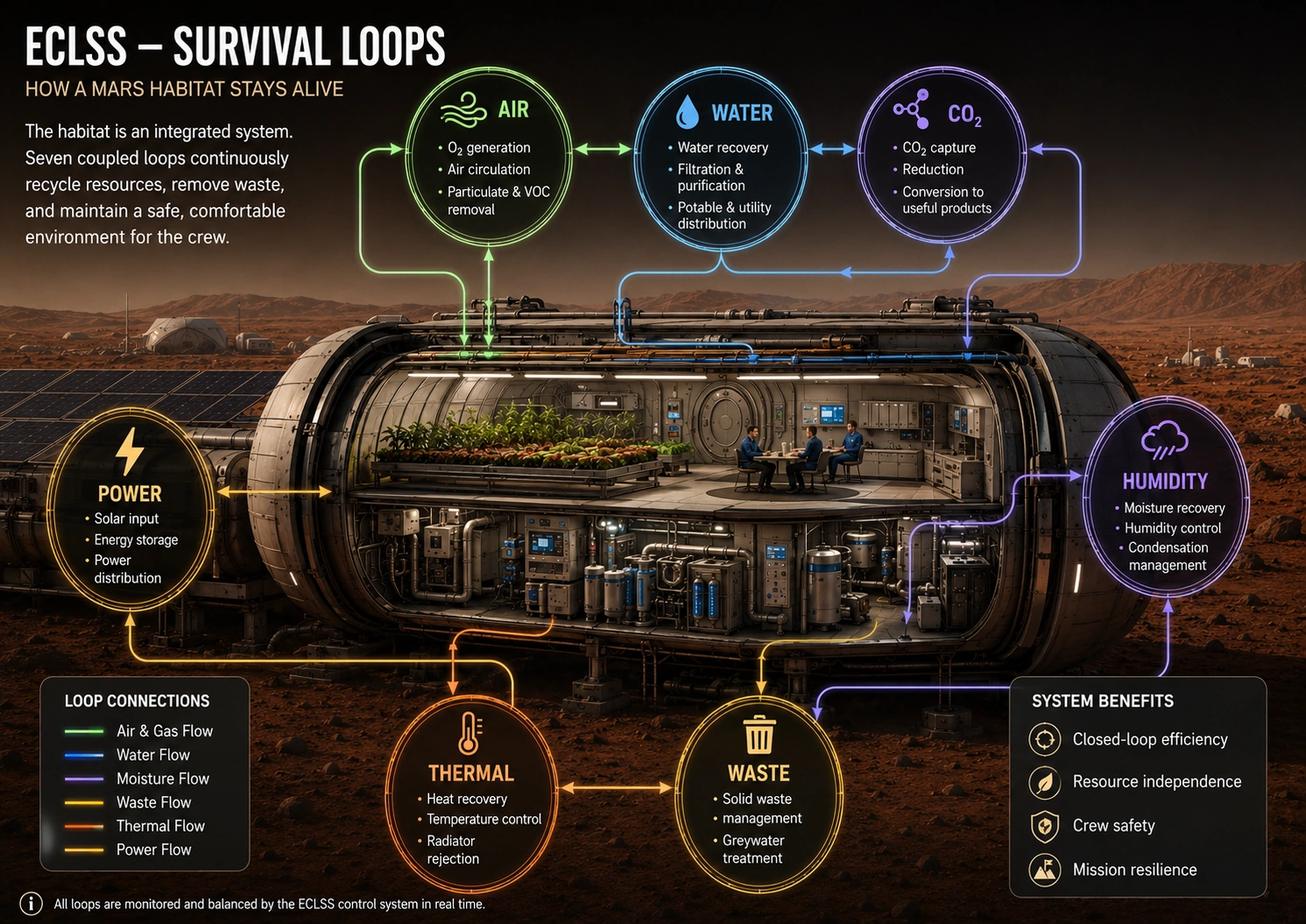
Mars habitat ECLSS: complete survival-loop architecture
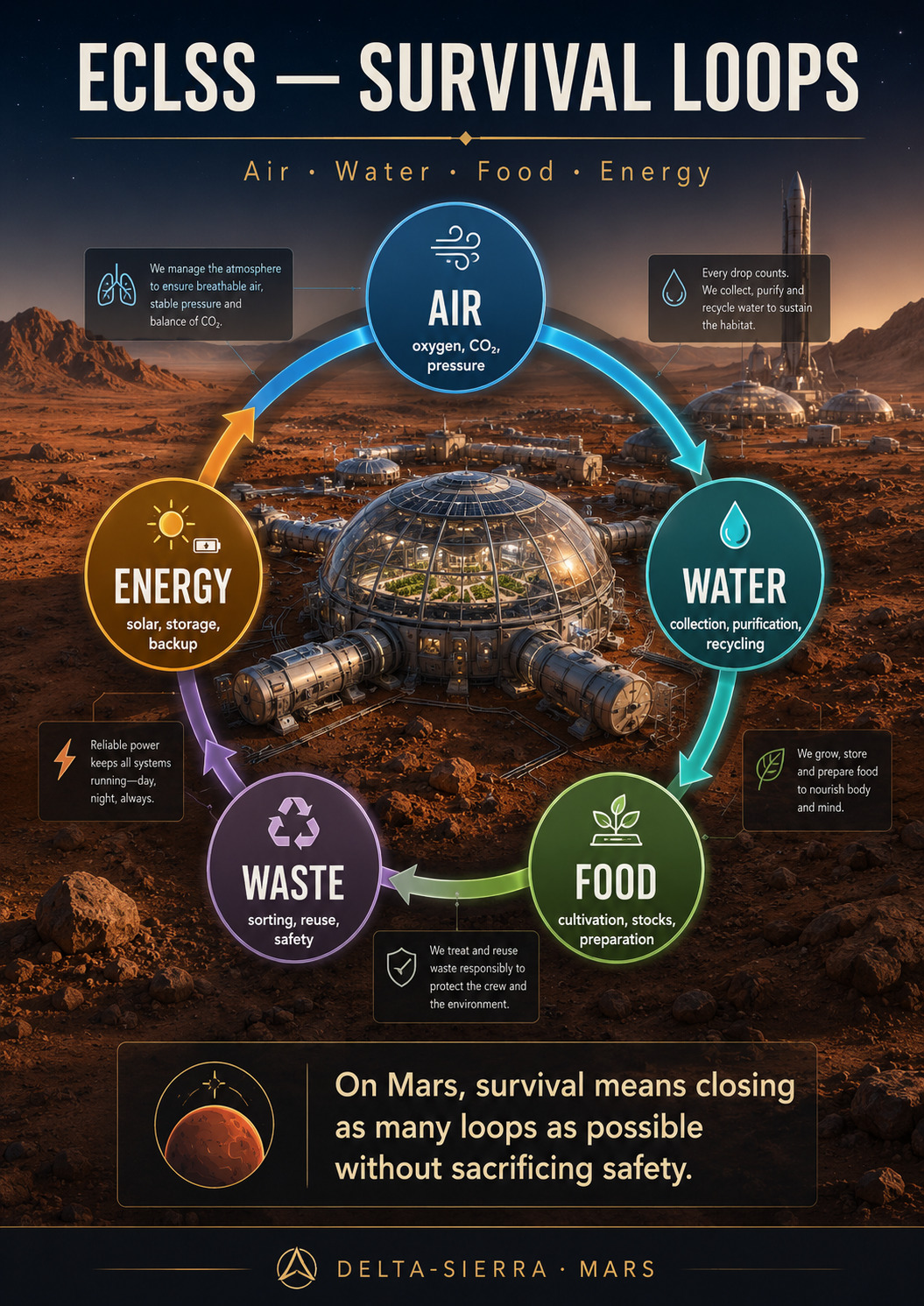
A Martian ECLSS is a network of coupled loops rather than one machine. Oxygen, carbon dioxide, water, humidity, waste, heat, electrical power and sensors share interfaces; closing a loop further can reduce logistics while increasing common dependencies. The central question is therefore which functions can be isolated, bypassed or repaired without losing air, water and thermal control at the same time.
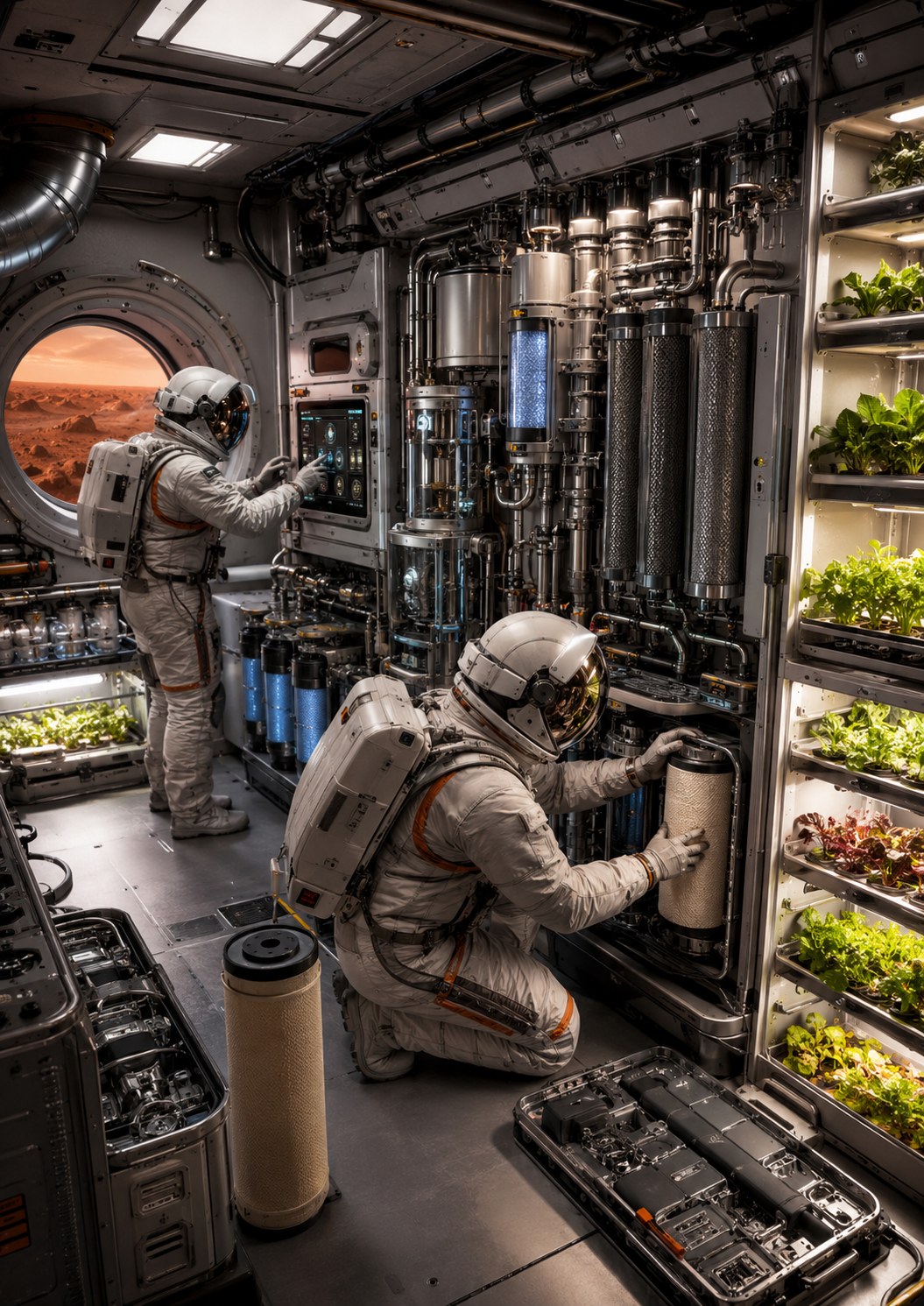
Conceptual habitat where physicochemical and biological loops coexist. Crops may contribute to the overall system, but they do not remove the need for treatment, measurement, redundancy and buffer storage.
ECLSS: one acronym hides several plants that must survive together
ECLSS is often spoken of as if it were a single machine. NASA reference architecture distinguishes major Water Recovery, Air Revitalization and Oxygen Generation systems. A real habitat also depends on waste management, fire detection and suppression, thermal control, sensors, tanks, fans, electrical distribution and software. On Mars, the interfaces are as important as the processors.
Water recovery handles urine, humidity condensate and other wastewater; air revitalisation removes CO₂, humidity and trace contaminants; electrolysis converts water into oxygen and hydrogen; a Sabatier reactor can combine H₂ with crew CO₂ to make water and methane. A failure in one loop therefore migrates into another. Low water recovery can starve oxygen generation. Power rationing can make ventilation and CO₂ removal more urgent than electrolysis. Interdependence is what turns equipment into life support.
“Closing the loop” never means eliminating every loss
A closed-loop architecture reuses a high fraction of material, but purges, consumables, solid waste, hard-to-recover molecules, leaks and maintenance losses remain. Even 98% water recovery leaves a non-zero makeup requirement. For oxygen, closure depends on how exhaled CO₂ is treated and where carbon goes. In the Sabatier reaction, CO₂ + 4H₂ → CH₄ + 2H₂O: water is recovered, but venting methane exports hydrogen and carbon from the loop.
The useful metric is therefore not one closure percentage but element-by-element mass balance: hydrogen, oxygen, carbon, nitrogen, salts and nutrients. A second balance tracks expendables: sorbent beds, membranes, resins, catalysts, filters, biocides, lubricants, sensors and mechanical parts. A loop that recycles 99% of water but consumes an irreplaceable filter every month is not strategically autonomous.
From four people to a thousand: scale forces architectural change
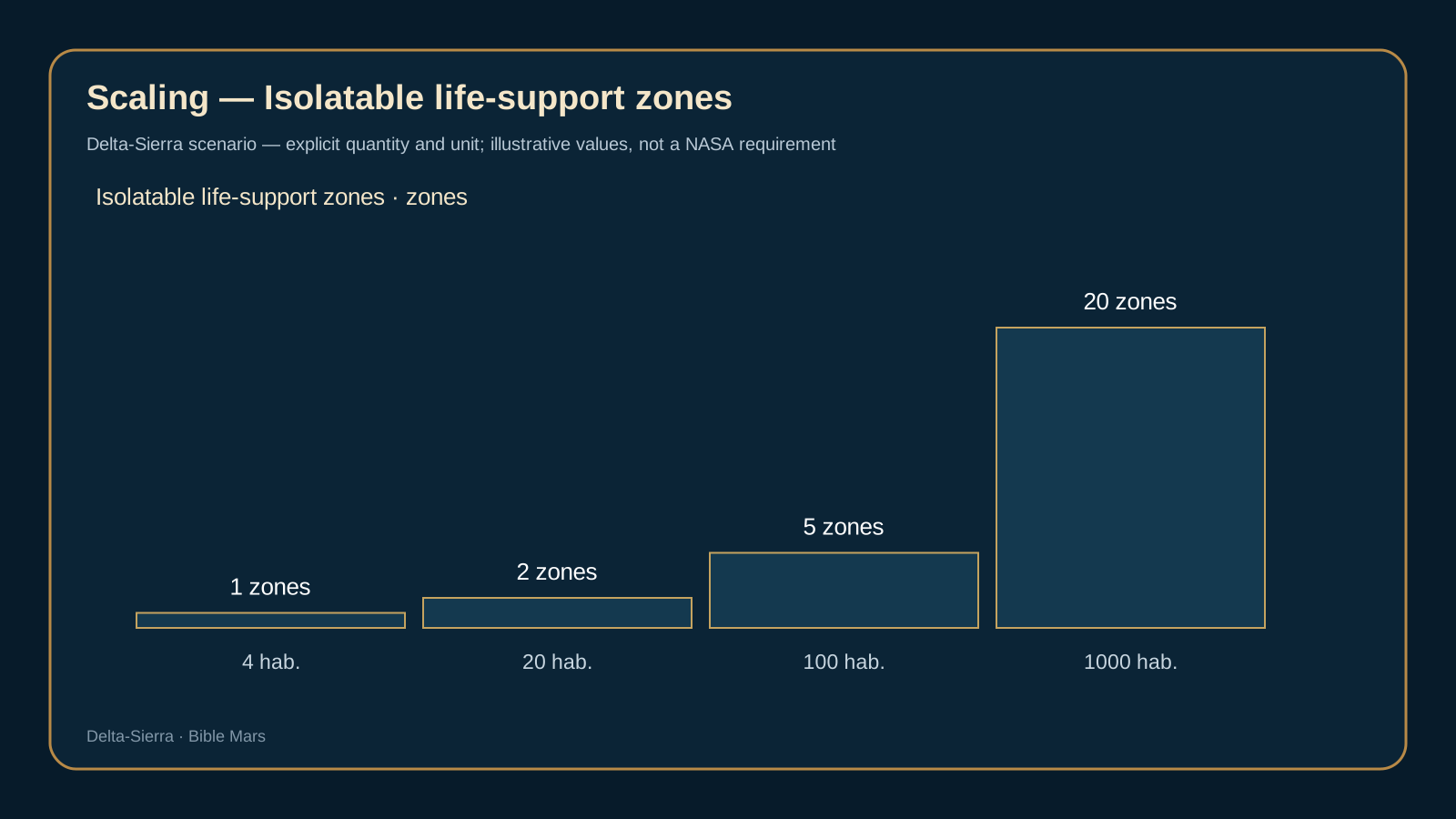
For four people, ECLSS can remain relatively centralised. At twenty, redundancy becomes important. At one hundred, concurrent maintenance and pressure zoning shape the network. At one thousand, a single central treatment train is a systemic risk. Multiple islandable modules with controlled transfer of water, oxygen and treatment capacity become more attractive.
Using reference metabolic flows of 0.84 kg O₂ consumed and 1 kg CO₂ produced per person per day, one thousand inhabitants require about 840 kg/day of net oxygen production and generate about one tonne/day of metabolic CO₂ before margin. A 30% CO₂ sizing margin gives 1.3 tonnes/day. Divide the town into five districts of two hundred and each district can carry roughly 260 kg/day of CO₂-removal capacity with margin. Total capacity is similar, but the consequence of one failure is very different.
Water networks face the same trade. Interconnection lets a healthy district support another during maintenance, but creates pathways for contamination. Isolation valves, interface sampling and transfer rules are therefore part of resilience. Sharing and separation must be designed together.
Maintenance is a life-support function
ISS experience demonstrates that regenerative systems require maintenance, replacement and reconfiguration. Mars removes rapid resupply. Every subsystem should therefore be evaluated by MTTR, spare consumption, filter-media life and bypass options. A 200-gram valve can be more mission-critical than a multi-tonne tank if it stops the entire loop.
Redundancy should also consider common cause. Identical pumps can share a manufacturing defect; identical controllers can share software; identical filters can share contaminated media. For fast-fatal functions, a technologically different backup can be more valuable than a perfect duplicate. Consumable emergency CO₂ cartridges, for example, can buy hours or days while a regenerative machine is repaired.
Degraded modes must be designed before the failure
A habitat needs more than “normal” and “dead”. It should have nominal, economy, emergency and refuge modes. Economy postpones non-vital loads. Emergency sheds industrial activity and dedicates power to ventilation, CO₂ removal, communications, sensing and the smallest viable habitable volume. The architecture must define who commands the transition, which thresholds trigger it and how normal operation is recovered.
If a hundred-person base loses half its CO₂-removal capacity, leaving everyone spread across all compartments may be the wrong response. Temporarily concentrating people in sectors with healthy treatment can reduce the number of volumes that must be controlled, while damaged equipment is isolated. Yet concentration increases heat and humidity. Degraded operation must be simulated as a coupled system.
State of the art in 2026: research is increasingly about integration
NASA work published in 2025 and 2026 extends ISS experience toward exploration architectures: reliability of regenerative loops, combined CO₂/humidity removal, water management, ISRU integration and exchanges of reactants between life support and propulsion. The direction is clear: optimising each box separately is no longer sufficient. Some of the largest gains come from treating habitat, water plant, ISRU, power and inventories as one material architecture.
Integration must still remain fail-safe. If a propellant plant can use excess potable water, propulsion failure must never be able to drain life support. Interfaces need physical priorities—valves, separated tanks and flow limits—not only software priorities. Human survival must retain an independent path when industrial functions are shed. A Martian ECLSS is ultimately a miniature public utility: generation, network, laboratories, maintenance, stores, watch teams, emergency procedures and configuration history.
Closing loops does not eliminate logistics; it changes what must be shipped
A more regenerative ECLSS reduces some recurring consumables, but it does not make the life-support system self-sufficient. Filters, sorbents, pumps, valves, seals, sensors, catalysts, microbial-control hardware, calibration standards and tools still age or fail. The logistics problem therefore shifts from carrying all water and oxygen from Earth toward carrying the parts and materials that keep recovery equipment trustworthy. For Mars, this distinction is crucial: a nominally high-closure architecture can still be fragile if a single non-repairable component disables several loops at once.
Integrated research is consequently moving toward functions that share hardware or recover resources across subsystem boundaries. That can reduce mass, but it can also create common-cause failures. A combined carbon-dioxide and humidity-removal device, for example, may be attractive only if isolation, bypass and repair are designed with the same care as nominal efficiency. The settlement-level architecture should therefore ask what happens when one processor is unavailable for hours, days or weeks, how much reserve atmosphere and water are consumed during that interval, and which neighbouring habitat can provide refuge without overloading its own life-support capacity.
This is where Mars differs from a short demonstration. The relevant measure of maturity is not merely whether a process works once, but whether crews can diagnose it, isolate it, restore it and live safely while it is unavailable. Redundancy, partitioning, spares and maintainability are therefore part of “loop closure” in the practical sense even though they do not improve the percentage printed on a recovery chart.
Closing loops without trapping the crew inside a fragile machine
“Mars habitat ECLSS: complete survival-loop architecture” addresses ECLSS as a coupled network of loops rather than one machine that “recycles everything”.
Scope — atmosphere control, water, waste, thermal interfaces, storage and makeup functions inside the habitat.
ECLSS diagnosis depends on air and water flow, oxygen, carbon dioxide, humidity, pressure, water quality, power, consumables and filter state.
Relationship used here: stock(t+Δt)=stock(t)+production+recovery-consumption-losses.
ISS ECLSS is real operating heritage, but a Mars base adds logistics delay, local maintenance and long autonomy
Air, water, waste and heat: when loops influence one another
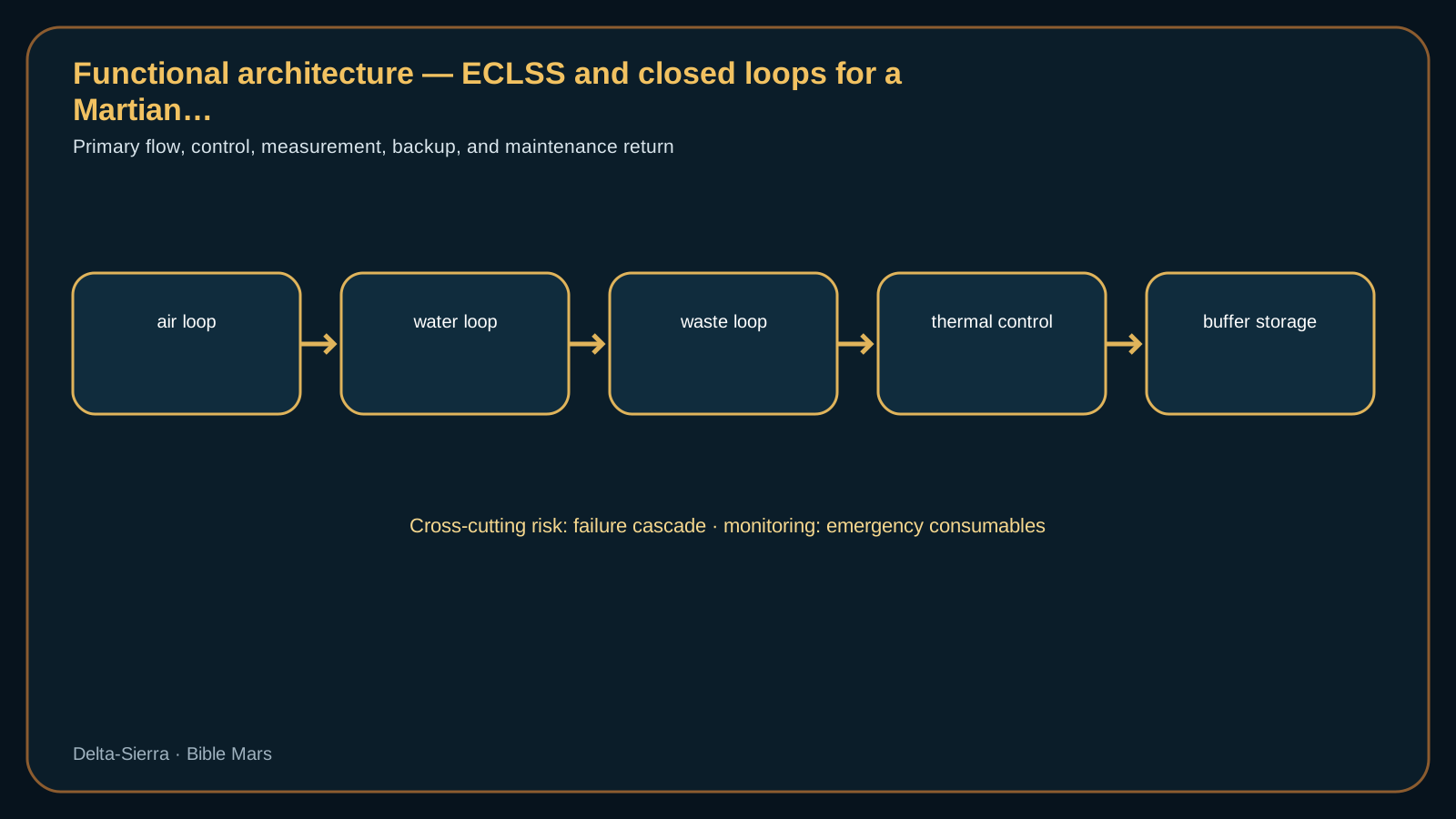
The most consequential common-cause scenario is a power or ventilation loss that degrades several life-support functions at once.
Redundancy and maintenance: designing ECLSS for bad days
closing loops while keeping losses visible and preserving buffers, isolation capability and refuge modes
duration testing, instrumented mass balance, controlled contamination, maintenance demonstrations and injected faults
Operational log: air and water flow, oxygen, carbon dioxide, humidity, pressure, water quality, power, consumables and filter state.
From crew life support to the industrial ecology of a city
Deep monograph
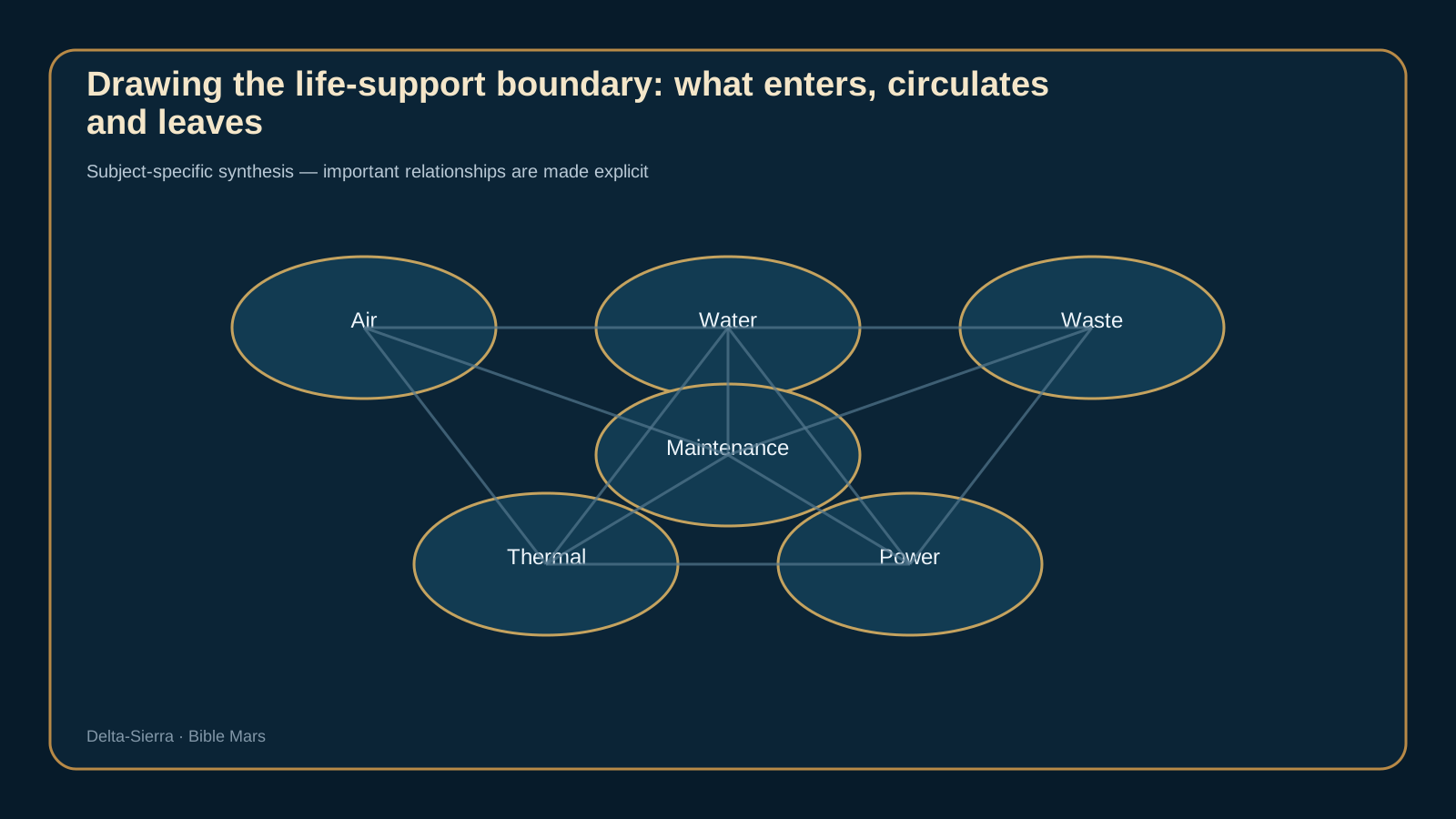
Drawing the life-support boundary: what enters, circulates and leaves
Drawing the life-support boundary: what enters, circulates and leaves.
Mars habitat ECLSS: complete survival-loop architecture — functional architecture showing the flows, interfaces and dependencies developed in the chapter.Mars habitat ECLSS: complete survival-loop architecture — visual synthesis of the system-specific choices and constraints.
Closing a loop never means eliminating every external input.
System boundaries: what enters, circulates, accumulates, leaks and must be purged.
Water loop: urine, condensate, graywater and potable quality.
Air loop: oxygen, CO₂, humidity and contaminants as coupled flows.
Solid waste: mass, carbon, nitrogen, salts, fibers, plastics and biological risk. End of life for ECLSS hardware is not ordinary disposal. A retired pump may yield a motor, bearings, or a machined housing; a water-processing module may still contain reusable valves and sensors, while a sorbent bed or membrane may need to be isolated as contaminated waste. Before cannibalization, the crew has to separate parts whose condition can be verified from parts whose chemical aging remains hidden. Pressure, temperature, contamination, and maintenance history become decision data. Recovery only helps when salvaged components are identified, tested, and returned to inventory with a clear status; otherwise the settlement turns scrap into fictitious spares. For a life-support loop, circularity must preserve quality as rigorously as mass. The interface with the electronics volume stops at sensing and control; treatment of boards, memories, and radiation-damaged components remains in the electronics book to avoid duplication.
Buffer storage: why a perfect paper loop still needs tanks.
Buffers buy time: gases, water, power and spares
Power: a closed loop stops when pumps, heaters and controllers go dark.
Heat: every purification step moves energy and creates thermal load.
Sensors and inventories: closing matter starts with knowing where it is.
Biofilms: biology exploits the niches engineering forgets.
Redundancy: duplicating machines without duplicating design flaws.
Degraded mode: surviving with less comfort, less recycling and more consumables.
Reproducible calculations specific to this subject
Net loop closure
ηnet = 1 − L/Q = 1 − 25/1 000 = 97,5 %
A loop processing 1,000 clearly defined physical units per day but losing 25 is not 100% closed. The calculation forces attention to interface, purge and maintenance losses rather than only one component’s efficiency.
Buffer autonomy
t = S/L = 1 200 L / 30 L/j = 40 jours
A 1,200-litre buffer offsets forty days of net loss at 30 L/day. The buffer does not improve efficiency; it buys time to diagnose, repair or switch to another loop.
The example adds four hypothetical vital loads—air, water, controls and ventilation—and applies a 30% margin. Its main lesson is that a refuge must be sized for the sum of minimum vital functions, not for the base’s average load.
Maintaining the artificial metabolism of a habitat
First-line maintenance: filters, pumps, valves and sensors.
Deep maintenance: disassemble, clean, requalify and reconfigure. A stuck pump should be diagnosed from electrical load, flow, and pressure evidence rather than from a single power indication.
Four people: maximizing simplicity and repairability.
Four people: maximizing simplicity and repairability. Emergency consumables must remain countable and reachable while a failure cascade is unfolding.
Twenty people: splitting loops so one failure cannot stop the base. The settlement can begin to divide water processing, carbon-dioxide removal and oxygen generation into independent trains, with cross-connections that are normally closed. This allows one train to be isolated for repair while the other carries a reduced essential load. The design challenge is to avoid false redundancy: two units fed from the same electrical bus, coolant loop or control computer can still fail together.
Twenty people: splitting loops so one failure cannot stop the base.
One hundred people: multi-habitat network, control laboratory and strategic stores. At one hundred residents, ECLSS becomes a network service. Different habitats may have their own local loops, but quality control, strategic consumables and specialist maintenance increasingly benefit from shared laboratories and stores. The network should tolerate one module being quarantined without forcing the entire settlement onto emergency mode. That requires compatible interfaces, clear water and gas quality specifications, and enough reserve capacity to absorb temporary imbalances while a local plant is cleaned, repaired or requalified.
One thousand people: ECLSS becomes public-utility industry
Reliability depends on trained shifts, configuration control, laboratories, maintenance planning, spare-part logistics and an institutional memory that survives personnel turnover. The system must also publish service states that other functions can act on: agriculture, hospitals and industry need to know whether water, oxygen or cooling is nominal, constrained or in emergency allocation. At this scale, resilience comes from organization as much as from hardware.
One thousand people: ECLSS becomes public-utility industry.
Isolatable life-support zones — scaling scenario: the quantity and unit are illustrative and are not a NASA requirement.
Four architecture scenarios that materially change the decision
Simultaneous air and water maintenance
Simultaneous air and water maintenance. Two planned maintenance activities on different subsystems turn out to depend on the same power source and controller. A schedule that looked safe creates a maintenance-induced common-cause failure. The scenario requires a real dependency map and industrial-style lockout planning.
A sensor corrupts the mass balance
A sensor corrupts the mass balance. The system reports nearly perfect recovery while the buffer inventory slowly declines. The contradiction between calculated balance and physical inventory becomes the main clue. The scenario shows why a closed loop needs independent measurements able to reveal drift hidden in one instrument.
A biofilm crosses an interface
A biofilm crosses an interface. Contamination originating in the water loop changes a heat exchanger and eventually affects cabin humidity. The subsystem boundary disappears. This case forces ECLSS to be treated as a coupled network whose interfaces move matter, heat, microbes and diagnostic errors.
One thousand residents, twenty isolatable zones
One thousand residents, twenty isolatable zones. A city can no longer depend on one monolithic loop. Each zone has local functions, controlled interconnections and the ability to receive or transfer water, gas and power. The scenario then trades global efficiency against the ability to isolate a sick zone without stopping the entire settlement.
Toward repairable ECLSS partly supplied by Mars
Coupling to ISRU: water makeup, local oxygen and purification
Coupling to ISRU: water makeup, local oxygen and purification. For depleted emergency stock, reserve monitoring must be separated from isolation decisions and from the test that authorizes a return to normal operation. When an operator suspends emergency consumables because depleted emergency stock is suspected, data, threshold, and hypothesis should be recorded so another team can reconstruct the decision.
Coupling to ISRU: water makeup, local oxygen and purification.
Coupling to agriculture: nutrients, humidity, CO₂ and contamination.
Coupling to agriculture: nutrients, humidity, CO₂ and contamination. Who may modify ISRU interfaces?
Measuring actual closure: recovery rate, irreversible losses and inventories.
Measuring actual closure: recovery rate, irreversible losses and inventories. Uncertainty — measuring actual closure: recovery rate, irreversible losses and inventories.
The ultimate question: which loop remains safe after years of imperfect repairs?
Long-duration credibility depends on what happens after the original equipment has been opened, repaired and modified many times. Connectors are replaced, sensors come from different production lots, software parameters change and locally manufactured parts enter service. The settlement therefore needs periodic requalification: leak tests, calibration checks, contamination sampling and functional tests that prove the repaired loop still meets its safety purpose. A system that worked on landing day but cannot demonstrate its condition ten years later is not a closed-loop life-support architecture; it is a collection of aging machines.
The ultimate question: which loop remains safe after years of imperfect repairs?.
NASA NTRS — Closure of Regenerative Life Support Systems — LMLSTP tests are used to show that loop “closure” is a measurable degree, not a magical state. The record describes integrated long-duration campaigns and high water-recovery levels, useful for discussing residual losses, consumables and operational stability.
NASA NTRS — ECLSS reliability modeling with recent ISS data (2025) — Reliability modeling is used here to separate failure frequency, repairability, spares inventory and delivered-service availability. It reinforces the doctrine that a closed loop only matters if it remains maintainable for years.
A city-scale ECLSS cannot remain separate from the rest of industry. On a spacecraft or small station it is convenient to draw life support as a self-contained box: crew consume oxygen and water, release carbon dioxide and humidity, and machinery closes part of those loops. A Mars settlement changes the problem. Water is also demanded by agriculture, industry and potentially propellant production; hydrogen and carbon dioxide become chemical feedstocks; oxygen is simultaneously breathing gas, industrial oxidizer and emergency inventory. A 2026 NASA/ICES study on the mass economy of integrated ECLSS and propulsion architecture illustrates this transition by examining shared resources and Sabatier chemistry. It is an architecture study, not an operational Mars plant, but it shows why rigid boundaries between “life support” and “industry” may become inefficient at settlement scale.
Sabatier chemistry shows why metabolic CO₂, water, hydrogen and oxygen can form a resource network rather than a sequence of wastes.
Stoichiometry: count atoms before counting factories. The simplified Sabatier reaction is:
CO₂ + 4 H₂ → CH₄ + 2 H₂O.
CO₂ is carbon dioxide, H₂ hydrogen, CH₄ methane and H₂O water. A mole is an amount of substance containing about 6.022 × 10²³ entities. For a mass balance, rounded molar masses are 44 g/mol for CO₂, 2 g/mol for H₂, 16 g/mol for CH₄ and 18 g/mol for H₂O. The ideal reaction therefore consumes 44 g of CO₂ and 8 g of hydrogen to produce 16 g of methane and 36 g of water. At kilogram scale:
44 kg CO₂ + 8 kg H₂ → 16 kg CH₄ + 36 kg H₂O.
Total input mass is 52 kg and total output mass is 52 kg. That is conservation of mass. This is a stoichiometric balance: it says nothing about real conversion efficiency, energy, losses, purity, catalyst life or product separation.
Electrolysis closes another part of the reasoning. Ideal water electrolysis can be written 2 H₂O → 2 H₂ + O₂. Thirty-six kilograms of water correspond theoretically to 4 kg of hydrogen and 32 kg of oxygen. Again, this is the molecular balance only. A real architecture adds electricity, water conditioning, purge gases, compressors, tanks, heat rejection and maintenance. Yet the arithmetic explains why ECLSS should be viewed as a network of matter transformations: a stream rejected by one subsystem may become feedstock for another.
The danger of elegant integration: common-cause failure. A single plant that supplies breathing oxygen, recovers water and feeds a methane chain can save mass while creating a catastrophic common point of failure. Integration therefore requires compartmentation. A settlement should be able to lose an industrial Sabatier train without losing breathable air; lose a high-capacity electrolyzer without exhausting all emergency oxygen; and isolate questionable industrial water without contaminating the potable network. The best system is not the one in which everything is connected, but the one in which useful connections can be cleanly disconnected.
Above one hundred residents, ECLSS starts to look like urban infrastructure. A settlement no longer has one “survival system.” It has multiple pressurized volumes, laboratories, farms, workshops, hospitals and safe havens. ECLSS becomes analogous to municipal water, sanitation and energy infrastructure, except that on Mars the outside environment is not a fallback. The useful metrics therefore become remaining capacity after loss of one train, time to limit exceedance, buffer-gas inventory, clean-water reserve, interchangeability of pumps, mean repair time, and the ability to black-start after a power failure.
ECLSS closure must remain reversible. Greater coupling reduces consumables but also creates interfaces through which contamination or control errors can spread. A Mars architecture therefore balances high recovery with rapid isolation and a simpler temporary path for a vital function.
Maintenance is indirectly a biological function: a sorbent bed, pump or sensor can become a human-health risk before it is treated as an industrial failure. Wear parts, cleaning procedures, post-repair tests and trend data deserve the same design attention as nominal flow rates.
ECLSS should be coupled without becoming inseparable. Oxygen, carbon dioxide, water, and humidity form loops that can exchange mass and energy. That is valuable: water produced by one reaction can return to electrolysis, and captured carbon dioxide can become a feedstock rather than a simple waste stream. Each coupling, however, is also a propagation path. A contaminant, a bad sensor, or a wrong setting can cross several subsystems unless boundaries exist. Interfaces therefore need isolation, sampling, and manual operating options. Good integration does not eliminate separation; it makes transfers intentional, measurable, and reversible.
Degraded operation reveals more than a nominal flow diagram. A settlement may temporarily reduce comfort, suspend selected activities, or concentrate occupants in fewer volumes to reduce treatment loads. Such strategies only work when the loops know their real inventories and minimum capabilities. Operators need to know how much clean water, carbon-dioxide removal capacity, stored oxygen, and electrical power remain, then estimate time to a limit. ECLSS resilience therefore depends as much on inventories and fallback modes as on peak equipment efficiency under nominal conditions.
Sources and documentary findings
Drawing the life-support boundary: what enters, circulates and leaves: the references below are retained because they contribute a result, technology status or verification framework directly useful to this subject.
NASA — Environmental Control and Life Support Systems (ECLSS)
NASA TechPort — Life Support Systems: Oxygen Generation and Recovery
The project was listed active in late 2025 and targets oxygen generation, recovery of oxygen from metabolic CO₂, and recycling to the cabin atmosphere. Oxygen loops therefore connect electrolysis, CO₂, hydrogen, purity and compression.
This active 2026 project studies reducing food-system water content from about 45% toward 30% so that more efficient water recovery can produce real mass savings. A mission water balance therefore includes food formulation.