Mars habitat air: oxygen, carbon dioxide, humidity and contaminants
In a pressurized habitat, air quality is not an oxygen-percentage problem alone. Total pressure, partial pressures, carbon dioxide, humidity, particles and trace contaminants evolve together with ventilation and crew activity. The architecture therefore has to measure those quantities, detect drift and preserve a breathable degraded mode when a fan, filter or post-EVA contamination-control step no longer performs as intended.
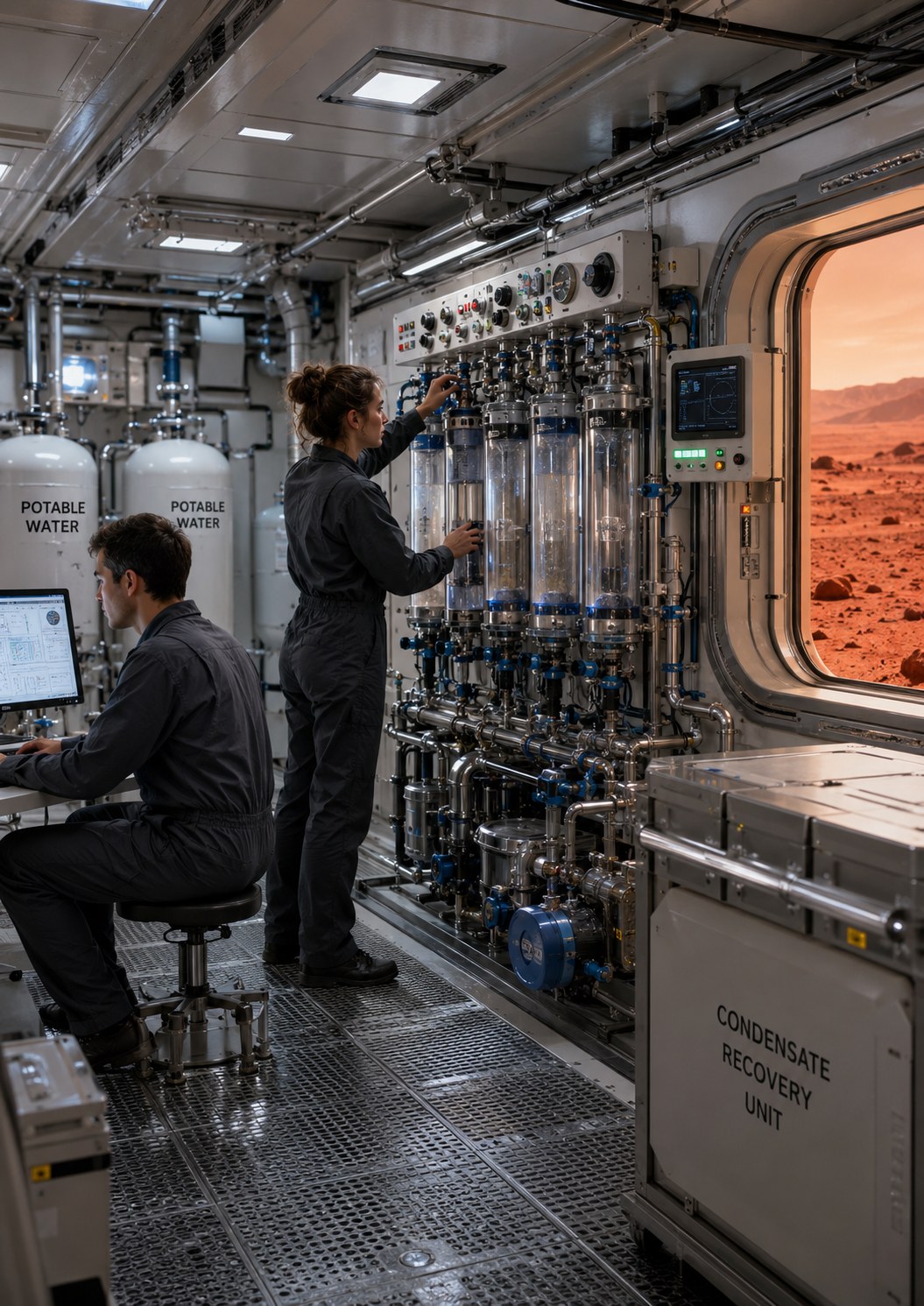
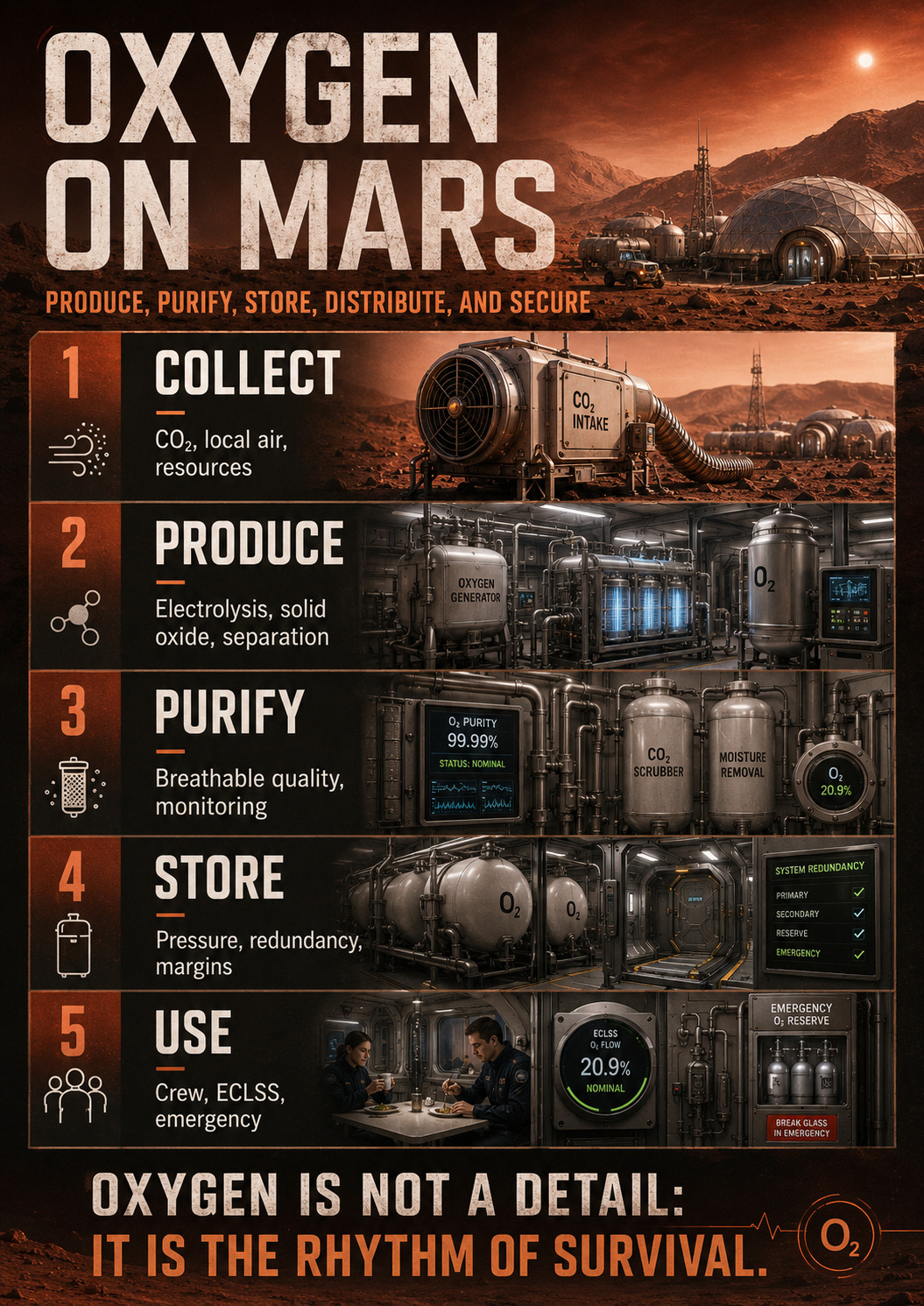
Conceptual ECLSS maintenance visualization: air quality depends on sensors, valves, filters, circulation and backup capacity that must remain accessible and verifiable.
Habitat air is a controlled mixture, not simply “oxygen”
A Martian settlement lives behind a wall separating two radically different atmospheres. Outside, pressure is only a few millibars and carbon dioxide dominates. Inside, people need a breathable, stable and well-mixed atmosphere compatible with fire safety. The key concept is partial pressure. Total pressure alone does not tell the lungs how much oxygen is available.
For an ideal mixture, a component’s partial pressure is approximately pᵢ = xᵢ × P, where pᵢ is the partial pressure of gas i, xᵢ its fraction and P total pressure. Two habitats can therefore have different total pressures while providing similar oxygen partial pressure, yet they are not equivalent for decompression, leakage, convection, acoustics or fire. Atmosphere selection is a system trade.
Four, twenty, one hundred, one thousand people: breathing becomes an industrial flow
Use reference metabolic sizing values of 0.84 kg O₂ consumed per person per day and about 1.00 kg CO₂ produced. They are engineering order-of-magnitude values, not fixed biology. Activity level, body size, diet and health alter the flows.
Oxygen demand is MO2 = N × 0.84 kg/day. Four inhabitants need 3.36 kg/day; twenty need 16.8; one hundred need 84; one thousand need 840 kg/day. Over one year, a thousand inhabitants breathe an order of magnitude of 306.6 tonnes of oxygen. CO₂ removal scales similarly: 4, 20, 100 and 1,000 kg/day before margin. A 30% sizing margin gives removal capacities of 5.2, 26, 130 and 1,300 kg CO₂/day.
This is why a town is not merely a large capsule. At a thousand inhabitants, atmosphere equipment is a distributed utility. Production and CO₂ removal should be partitioned among pressure districts connected by buffers, with the ability to isolate a failed district. One fault must not make the whole settlement unbreathable.
Removing CO₂ is only half of air revitalisation
NASA air-revitalisation systems deal not only with carbon dioxide but also humidity and trace contaminants emitted by electronics, plastics, cleaning products and people. A compound that appears harmless at a low instantaneous concentration can accumulate in a closed volume over weeks. Adsorption, catalytic oxidation, particulate filtration, condensation and monitoring must therefore work together.
Humidity is an engineering variable, not cosmetic comfort. Too little causes discomfort and can aggravate electrostatic issues; too much drives condensation, corrosion, microbial growth and water films in hidden locations. Ventilation must reach dead zones behind equipment, inside technical cabinets and along rarely used ducts. Moving air is part of life support.
Buffer gas is a strategic resource
Making oxygen from water or Martian CO₂ does not automatically solve the buffer-gas problem. The ISS resupplies nitrogen. Mars’ atmosphere contains small fractions of nitrogen and argon that might be separated locally, but separation requires compressors, sorbents or cryogenic processes, energy, high-pressure storage and maintenance.
Buffer gas also matters after a leak. Replacing only oxygen would progressively distort the mixture. A pressure district must be repressurised with a complete safe composition. Nitrogen/argon stocks can therefore be strategic consumables even though they receive less attention than oxygen.
Leak, fire and contamination are three different emergencies
A leak rewards rapid isolation and gas conservation. A fire requires fast detection and suppression without creating a second contamination problem. A chemical release can make a compartment unsafe while pressure and oxygen readings remain normal. Life support must therefore track several dimensions at once: pressure, composition, particles, temperature, humidity and toxicity.
A refuge follows directly from this logic. Its capacity is not a label but a people-hour budget. A refuge for 20 people for 48 hours represents 960 person-hours of CO₂ to remove, oxygen to supply, heat to reject and humidity to control. Unless those flows close, the refuge is only a room with a reassuring name.
The safest atmosphere is one whose state can be understood at every moment
The most subtle failure is slow degradation without a clear alarm: a drifting sensor, stopped fan, local CO₂ pocket, saturated bed, slow leak or software that misinterprets conflicting measurements. Robust architecture uses diverse sensors, independent checks, trends and simple procedures that allow crews to verify what automation claims.
At settlement scale, air is a network. Compartments, valves, fans, buffer tanks and sensors become as important as the oxygen generator. A breathable Martian city will be defined less by one spectacular machine than by hundreds of ordinary components keeping pressures, flows and air quality within safe bounds for years.
Air quality is a spatial problem, not only a cabin-average number
A single cabin-average oxygen or carbon-dioxide reading can hide local trouble. A long habitat contains ducts, equipment bays, sleeping volumes, exercise areas and corners where convection is weak. The control system therefore needs representative sampling and enough circulation to prevent stagnant zones, while operators need trends rather than isolated readings. The design question is not simply “what is the CO₂ concentration?” but “where was it measured, how fast is it changing, and what ventilation path connects that location to the removal hardware?” This is also why humidity control cannot be separated from condensation, microbial growth and heat rejection.
For a Mars settlement, atmospheric inventory becomes a strategic resource. Oxygen can in principle be regenerated, but buffer gases such as nitrogen or argon must also be accounted for because leaks remove the complete mixture. A refuge volume, an airlock cycle and a damaged module therefore have different consequences for stored gas reserves. The operational log should track pressure, partial pressures, humidity, trace contaminants, leakage and scrubber performance together, so that a crew can distinguish a sensor fault from a real atmosphere-control failure before committing scarce reserve gas.
Habitat air: what the human body forces the machine to provide
“Mars habitat air: oxygen, carbon dioxide, humidity and contaminants” addresses air quality as composition, pressure, circulation and contaminant removal.
Scope — the occupied pressure volume and the equipment that generates, mixes, measures or cleans its atmosphere.
Atmospheric control depends on continuously tracking total pressure, partial pressures, O₂, CO₂, humidity, trace contaminants, ventilation flow and local gradients.
Relationship used here: p_i = x_i P for an ideal-gas mixture.
NASA-STD-3001 and OCHMO guidance provide health/performance constraints rather than one universal “Mars atmosphere” setting
When the atmosphere drifts: detection, diagnosis and refuge
The reference atmospheric scenario combines misleading sensing, a poorly ventilated pocket, degraded CO₂ removal, or local condensation.
Choosing an air architecture that remains maintainable for years
balancing health, fire behavior, prebreathe interfaces, gas inventory and equipment robustness
Operational log: total pressure, partial pressures, O₂, CO₂, humidity, trace contaminants, ventilation flow and local gradients.
Turning atmosphere control into city infrastructure rather than a box
Deep monograph
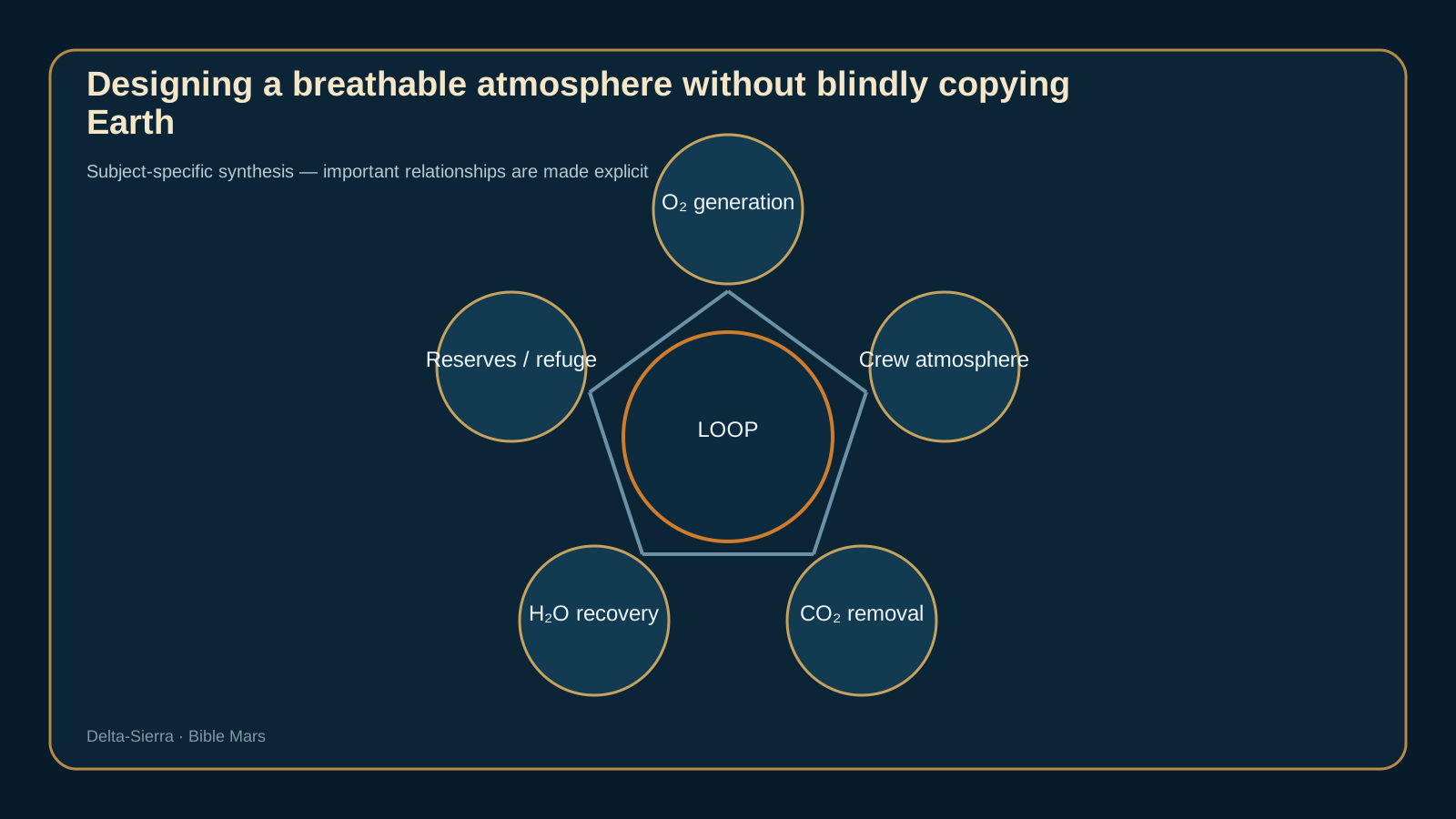
Designing a breathable atmosphere without blindly copying Earth
Designing a breathable atmosphere without blindly copying Earth.
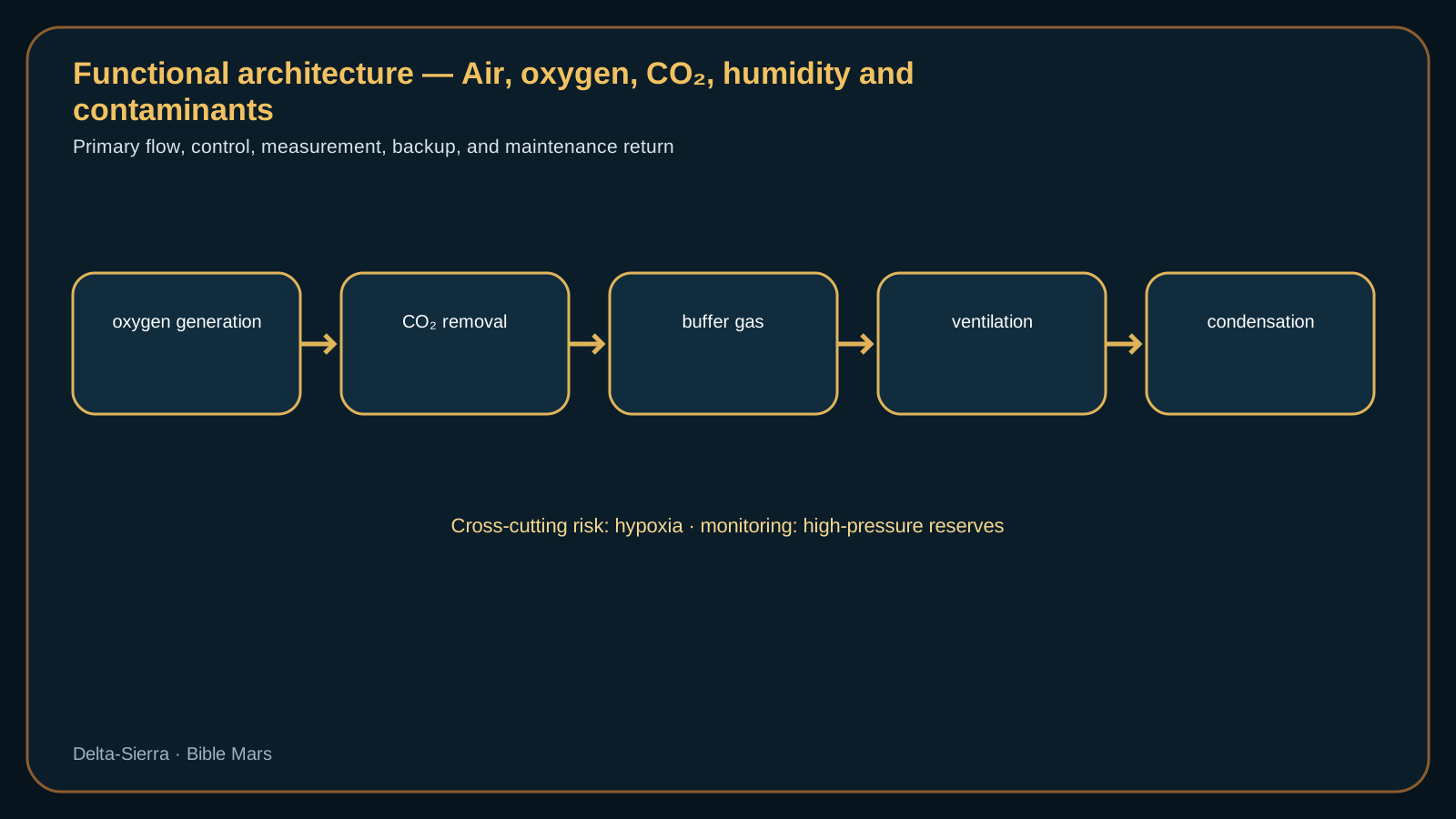
Mars habitat air: oxygen, carbon dioxide, humidity and contaminants — functional architecture showing the flows, interfaces and dependencies developed in the chapter.Mars habitat air: oxygen, carbon dioxide, humidity and contaminants — visual synthesis of the system-specific choices and constraints.
Total pressure and partial pressures: why breathing is not just a percentage.
Generating oxygen: electrolysis, storage, makeup and the ISRU trade.
Removing CO₂ before it becomes a cognitive and physiological problem.
Reducing CO₂: when Sabatier turns metabolic waste into water.
Humidity: recovering water without hidden condensation, mold or corrosion.
Keeping a refuge from becoming a toxic-chemistry chamber
Ventilation in low gravity: preventing local CO₂ and heat pockets.
Trace contaminants: plastics, solvents, human biology and accidental chemistry.
Martian dust indoors: source, airlocks, particle size and filtration.
Fire: life-support oxygen becomes the oxidizer that accelerates disaster.
Leaks: separating leak rate, localization, makeup and buffer-gas loss.
Sensors: measuring O₂, CO₂, humidity and toxics without trusting one instrument
Atmosphere control depends on disagreement between measurements as much as on the measurements themselves. Oxygen, carbon dioxide, humidity and trace-contaminant sensors can drift at different rates, respond differently to temperature and fail without an obvious alarm. A Mars habitat should therefore compare independent channels, use calibration checks and watch trends over time. The crew also needs portable instruments that can challenge the fixed network after maintenance or an unexplained reading. A single precise number is not enough evidence when the consequence of being wrong is loss of consciousness, fire risk or chronic exposure.
Reproducible calculations specific to this subject
Oxygen partial pressure
pO₂ = xO₂ × P = 0,32 × 55 kPa = 17,6 kPa
With an oxygen mole fraction xO₂ of 0.32 and a total pressure P of 55 kPa, the resulting partial pressure is 17.6 kPa. Oxygen percentage is physiologically meaningful only together with total pressure; changing P without recalculating pO₂ changes the breathing environment.
Mass lost through a slow leak
n = PV/(RT), puis m = nM; 500 m³ × 0,5 %/jour à 55 kPa et 295 K ≈ 1,6 kg/jour
This order-of-magnitude example assumes a 500 m³ habitat loses 0.5% of its gas volume per day and treats the mixture approximately as dry air. The roughly 1.6 kg/day result is not a NASA requirement; it is a teaching scenario showing how a small continuous leak becomes hundreds of kilograms per year.
CO₂ scrubbing reserve in a refuge
M = N × q × t = 6 × 1 kg/j × 2 j = 12 kg de capacité équivalente
Using a teaching assumption q = 1 kg of CO₂ produced per person per day, six people confined for forty-eight hours require 12 kg of equivalent scrubbing capacity before margin. A real design must replace q with the adopted metabolic profile.
From habitat loop to a city-scale atmospheric utility
Calibration and drift: knowing when a plausible reading is still wrong. The transferable part may concern buffer gas, monitoring of particle filtration, or work organization; non-transferable parts include duration, gravity, resupply, evacuation, and terrestrial infrastructure.
Calibration and drift: knowing when a plausible reading is still wrong. Monitoring of trace-contaminant control has to survive filter saturation, not merely nominal operation.
Air network for a twenty-person base: isolation, valves and compartments.
Scaling to one hundred people: from habitat ECLSS to atmospheric infrastructure.
Scaling to one hundred people: from habitat ECLSS to atmospheric infrastructure. Recovery case — rapid depressurization.
Scaling to one thousand: distributed production, reserves, maintenance and public utility.
Gas storage: pressure, tank mass, placement and mechanical risk
Stored gas is both a life-support reserve and a pressure vessel hazard. Concentrating all oxygen or buffer gas in one location simplifies plumbing but creates a single fire, impact or isolation vulnerability. Distributing storage across separated modules can improve survivability, yet it adds valves, regulators, inspection points and inventory bookkeeping. The useful metric is therefore not tank capacity alone: operators must know how much breathable reserve remains after one storage bank, one corridor or one regulator station is lost. That turns gas storage into a resilience problem rather than a warehouse problem.
Gas storage: pressure, tank mass, placement and mechanical risk.
Common-cause failure: two identical scrubbers can share the same defect.
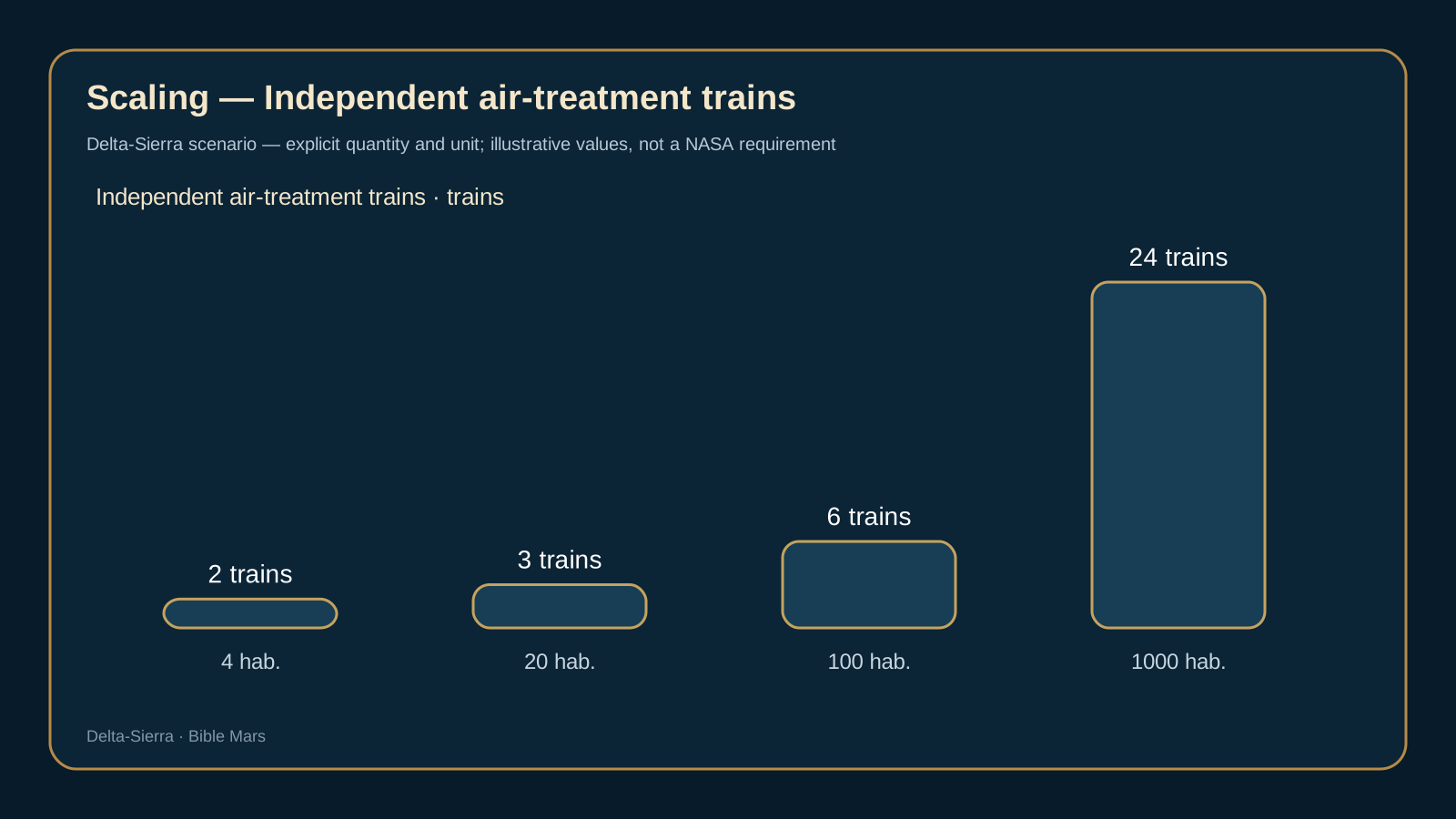
Independent air-treatment trains — scaling scenario: the quantity and unit are illustrative and are not a NASA requirement.
Four architecture scenarios that materially change the decision
A slow leak during the night
A slow leak during the night. Pressure falls slowly enough not to trigger immediate evacuation but fast enough to consume buffer gas over several days. The team must distinguish a real leak from sensor error, locate the affected volume, isolate it without depriving the rest of the base of ventilation, and decide when to enter refuge mode. The case simultaneously tests sensors, valves, reserves, leak-search procedures and repair under reduced pressure.
Two scrubbers, one common defect
Two scrubbers, one common defect. Two identical CO₂ scrubbers appear redundant until the same sorbent batch or software version degrades both. The answer is not merely “two machines” but diversity of principle, consumable backup, regeneration capability and independent monitoring. This scenario tests whether claimed redundancy actually survives common-cause failures.
A dust-loaded EVA return
A dust-loaded EVA return. A construction EVA brings much more dust than expected into the transition zone. Filter pressure drop rises, humidity condenses on some surfaces and an optical sensor begins to drift. Instead of treating these as three unrelated anomalies, the architecture must recognize the common origin and prevent airlock contamination from becoming a habitat-wide atmosphere problem.
Refuge after a fire
Refuge after a fire. A compartment is isolated after a fire and the crew moves into an intact volume whose atmosphere system must now operate without part of the main network. The scenario checks oxygen storage, CO₂ removal, emergency power, residual-smoke filtration and the ability to sleep there for several nights. A refuge is credible only if it remains functional when the main system is unavailable.
Knowledge boundaries and design decisions
Refuge mode: what must be preserved when part of the base becomes uninhabitable
A refuge is credible only if it can support people when the rest of the base is already failing. It needs enough breathable atmosphere, carbon-dioxide removal, humidity control, thermal control, communications and power to remain occupied while the damaged zone is isolated. The crew should also be able to verify refuge air quality with instruments that do not depend on the failed module. Designing this mode in advance changes normal architecture: valves, duct isolation and reserve cylinders are placed so that the safe volume can be separated quickly rather than improvised during an alarm.
Refuge mode: what must be preserved when part of the base becomes uninhabitable.
Maintenance: sorbent beds, compressors, fans, seals, filters and wear parts
Air-system maintenance is dominated by ordinary components whose failure can become extraordinary in a closed habitat. Fans lose performance, filters load with dust, seals harden, compressors wear and sorbent beds gradually lose capacity. The maintenance plan therefore needs access, spares, contamination control and post-repair verification, not just replacement intervals. After a component change, operators should confirm flow, pressure drop, gas composition and alarm behavior before declaring the loop restored. A repair that restores motion but changes calibration or bypass leakage is not yet a successful repair.
Maintenance: sorbent beds, compressors, fans, seals, filters and wear parts.
Hybrid architecture: regenerative loop, emergency consumables and local resources
Hybrid architecture: regenerative loop, emergency consumables and local resources.If uncertainty about poorly ventilated dead zone can alter the size of oxygen generation, redundancy type, or settlement layout, it deserves an early test. This prioritization avoids demanding perfect knowledge before action. This point also depends on settlement geography.The experience represented by ISS ECLSS and major-constituent analysis provides a reference point, but the Martian question is longer: what happens to oxygen generation after hundreds of cycles and several local repairs?
Hybrid architecture: regenerative loop, emergency consumables and local resources.
Hybrid architecture: regenerative loop, emergency consumables and local resources. Architecture choices for hybrid architecture: regenerative loop, emergency consumables and local resources should remain falsifiable. Revision thresholds should therefore be tied to field data.
What remains unknown: multi-year aging, real Martian dust and civilian population.
NASA NTRS — ISS lessons for future regenerative ECLSS (2025) — ISS experience is used as a reliability and maintenance evidence base with an essential limitation: ISS benefits from Earth support and resupply that Mars will not have. Observed mechanisms are transferred, not the logistics context.
NASA — Establishing Crew Exposure Limits of Martian Dust (2026) — The 2026 NASA source shows why indoor-air design must treat Martian dust as both a health and maintenance contaminant. It provides a preliminary exposure framework and emphasizes uncertainty because authentic airborne Martian dust has not been returned to Earth.
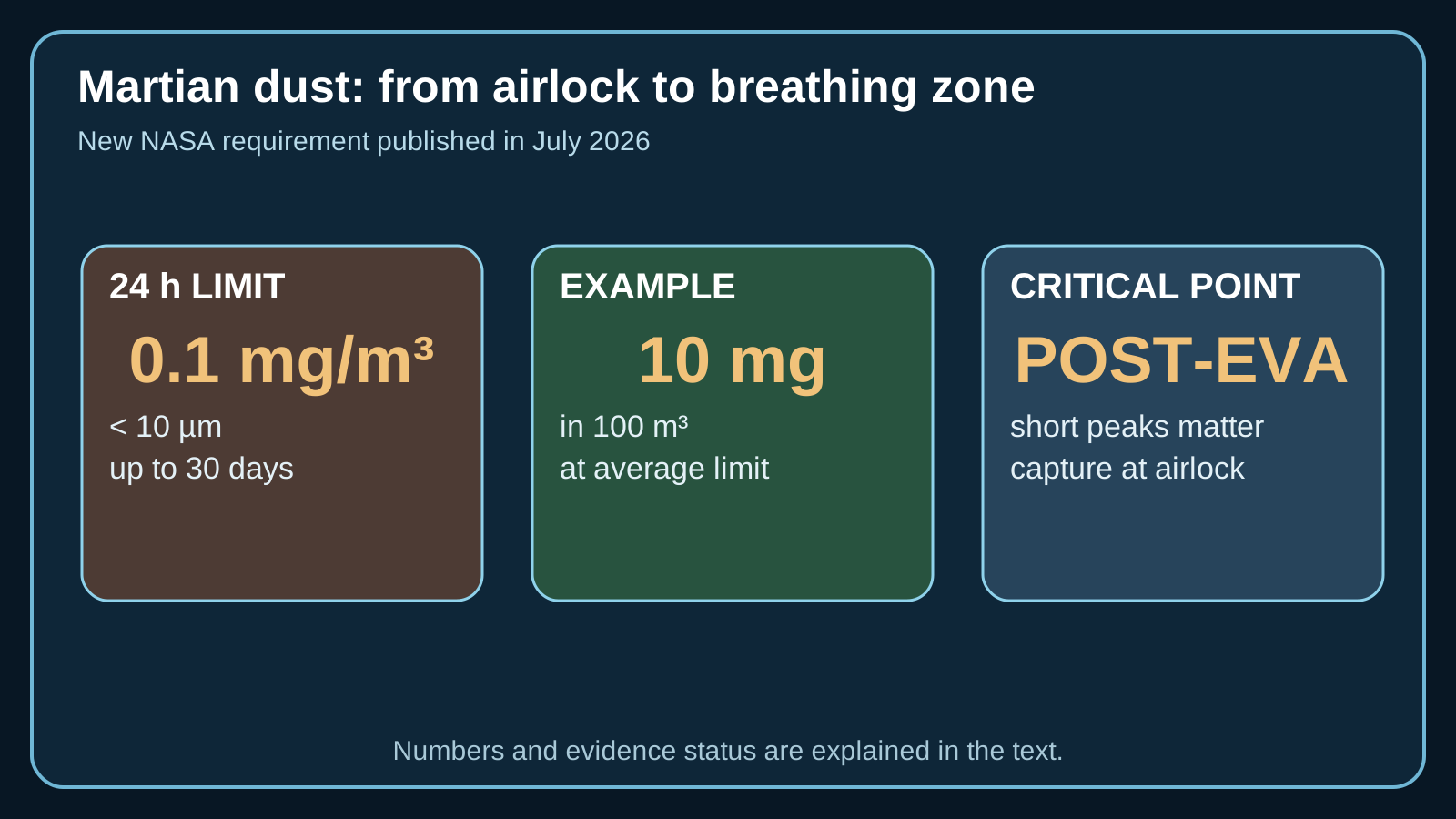
Martian dust changes category: in 2026 it becomes a measurable cabin-air requirement. A Mars base can have an excellent oxygen generator and still become unsafe to inhabit. Breathing is not merely a matter of maintaining oxygen partial pressure and removing carbon dioxide. The atmosphere must also be protected from a contamination chain that begins outside, on boots, gloves, suit joints and tools. In July 2026 NASA published the outcome of a working group on Martian dust exposure limits. For continuous exposure scenarios lasting up to thirty days, the proposed requirement uses a 24-hour time-weighted average of 0.1 mg/m³ for Martian dust particles smaller than 10 µm. A micrometre, written µm, is one millionth of a metre; mg/m³ means milligrams of material per cubic metre of air.
This value must not be turned into a permanent safety truth for a future city. NASA explicitly notes that no authentic airborne Martian dust sample has yet been returned to Earth. The preliminary limit therefore combines rover and lander mineralogy, simulants and toxicological analogues, with an uncertainty factor. It is intended to support early mission design and is expected to evolve. Yet it already changes habitat engineering: dust is no longer only a mechanical nuisance; it is a quantity the atmosphere-control system must measure, limit and reconstruct over time.
A very low concentration can correspond to only milligrams suspended in the cabin, which is why control must begin at the airlock before dust is dispersed through the habitat.
A milligram-scale calculation that changes airlock design. Take a purely illustrative 100 m³ habitable volume. If the air were perfectly mixed and exactly at 0.1 mg/m³, the airborne dust mass corresponding to that concentration would be:
m = C × V = 0.1 mg/m³ × 100 m³ = 10 mg.
Here m is airborne dust mass, C mass concentration and V air volume. The cubic metres cancel, leaving milligrams. Ten milligrams is 0.010 gram. This does not mean that a module may simply contain ten milligrams of dust: particles deposit on surfaces, filters capture part of the inventory, and NASA's requirement is a time-weighted concentration for a specified size fraction. The calculation reveals a more useful engineering truth: the mass that must be kept out of suspension is tiny compared with the material a dusty suit can carry inward. Source control at the airlock, suitport, tool cleaning and local capture therefore become as important as central filtration.
A 24-hour average must not hide post-EVA peaks. A time-weighted average can be acceptable while a crewmember briefly experiences a much larger concentration after an airlock opens. NASA's working group specifically highlighted short-duration peaks. A robust system therefore records particle concentrations near the airlock, in the general volume and in sleeping areas, then correlates those data with operations: EVA return, filter change, tool cleaning or a containment failure. A single alarm at the ceiling of a large habitat cannot reconstruct that exposure history.
A second 2026 development: connect suit life support and habitat life support. An ICES 2026 paper in NASA NTRS describes development of CDRILS-I, an approach in which a mobility suit's carbon-dioxide and humidity removal unit is paired with a regenerator in the habitat for a two-person Mars-surface concept. This is not an operational Mars capability. It is valuable because it illustrates a systems lesson: as a settlement grows, treating every suit as a completely separate world becomes increasingly inefficient. Sorbent regeneration, consumables, sensor data and maintenance can become common infrastructure, provided that common-cause failures do not disable both suits and habitat at the same time.
What a real settlement would have to build. With four people, nearly every EVA return can still be managed individually. At twenty, airlocks, cleaning and measurement need a repeatable workflow. At one hundred or one thousand, dust control becomes an industrial utility: clean and dirty zones, transition garments, controlled traffic flows, filters tracked by batch, a particle laboratory, surface monitoring, decontamination protocols, and the ability to isolate a sector without shutting the entire city. Dust metrology must then connect to suit maintenance, respiratory health, cleaning, agriculture and planetary protection.
Knowledge boundary. The 0.1 mg/m³ value is a preliminary framework for limited-duration exposure, not proof of multi-year safety and certainly not a childhood standard. Fine-particle composition, surface reactivity, cumulative effects and ingestion pathways remain major unknowns. A serious Mars reference must keep that uncertainty visible.
Closing this subject means reasoning about air quality, not oxygen production alone. A settlement can have sufficient O₂ and still become uninhabitable if CO₂, humidity, trace contaminants or dust drift faster than the loop can sense and remove them. Design therefore couples flow rates and buffer volumes with sensor placement, filtration capacity and maintainable access.
The hardest long-duration problem is gradual change: fouling, sorbent aging, small leaks and contamination carried back from EVA. Human limits define a boundary; the architecture must still show that it can detect approach to that boundary, isolate the cause and remain safe long enough for the crew to act in a degraded mode.
NASA 2026 — Martian dust limit
NASA’s July 2026 preliminary requirement addresses Martian dust particles below 10 µm and calls for the habitable atmosphere to remain below a 24-hour time-weighted average of 0.1 mg/m³ for exposure scenarios up to 30 days. NASA also stresses toxicology uncertainty and post-EVA peaks.
Operational synthesis for a habitable atmosphere. A Mars base does not manage “air” as one resource. It manages total pressure, oxygen and carbon-dioxide partial pressures, humidity, trace contaminants, and circulation at the same time. A ventilation failure can therefore become dangerous while the settlement still owns a large oxygen inventory. Conversely, an oxygen sensor may show a reassuring value while a local compartment accumulates carbon dioxide. Safety then depends on network geography: isolatable volumes, valves, fans, return paths, and the ability to compare measurements taken in different places. The useful metric is not merely the settlement-wide average concentration. Operators need to know which compartment is drifting, how fast the drift is developing, and how much time remains before masks, relocation, or internal evacuation become necessary.
Reserve architecture needs the same precision. High-pressure oxygen storage does not perform the same function as an oxygen generator, and a buffer tank does not replace purification. Reserves mainly bridge periods in which production or treatment is unavailable. Their value therefore depends on the degraded-mode consumption rate, the habitable volume that remains occupied, and the time needed to diagnose and restore equipment. A credible design combines dissimilar sensing methods, manual sampling capability, compartment isolation, breathing reserves, fire procedures, and contaminant checks after repair. That combination is more informative than a generic redundancy count because it shows how an apparently atmospheric failure can propagate into power, ventilation, fire, and medical problems.
Sources and documentary findings
Designing a breathable atmosphere without blindly copying Earth: the references below are retained because they contribute a result, technology status or verification framework directly useful to this subject.
NASA — Environmental Control and Life Support Systems (ECLSS)
ECLSS provides the atmosphere, water and waste-control functions required for life in a closed environment. For Mars the key lesson is integration: one loop’s performance directly changes consumables, heat loads and maintenance demands elsewhere.
NASA TechPort — Life Support Systems: Oxygen Generation and Recovery
The late-2025 project matters to cabin-air design because it couples oxygen generation with recovery of oxygen from metabolic CO₂ and return to the atmosphere. For the habitable volume, purity, pressure, intermediate storage, and drift detection must therefore be tracked alongside nominal electrolysis flow.
The project explores regenerative adsorption to remove and concentrate CO₂ from crewed cabin air while reducing power demand. For Mars, capture, regeneration and material recovery have to be sized together.
NASA — Establishing Crew Exposure Limits of Martian Dust (2026)
NASA's preliminary 2026 limit for respirable Martian particles acts here as a cabin-air constraint: monitoring must distinguish a post-EVA peak from persistent average exposure, and filtration has to be evaluated together with resuspension inside the habitable volume.
NASA TechPort — NextSTEP Phase 2 ECLSS Modularity Study
This project, listed as completed and updated in December 2025, targeted a modular ECLSS architecture evolvable toward deep-space exploration, with dynamic modeling, interfaces and control prototypes. It supports reconfigurable, maintainable life support rather than a monolithic block.