Human factors, anomalies and training for a Mars crew
On Mars, a technical anomaly quickly becomes a human problem: the crew must interpret alarms, set priorities, distribute workload and act despite communication delay with Earth. Training therefore cannot stop at nominal procedures. It has to prepare the crew for ambiguity, combined failures, local decisions and recovery from error without allowing fatigue to become a second failure.
A technical anomaly quickly becomes a human-factors problem
“Human factors, anomalies and training for a Mars crew” addresses training as preparation to recognize, contain and understand anomalies under fatigue and uncertainty.
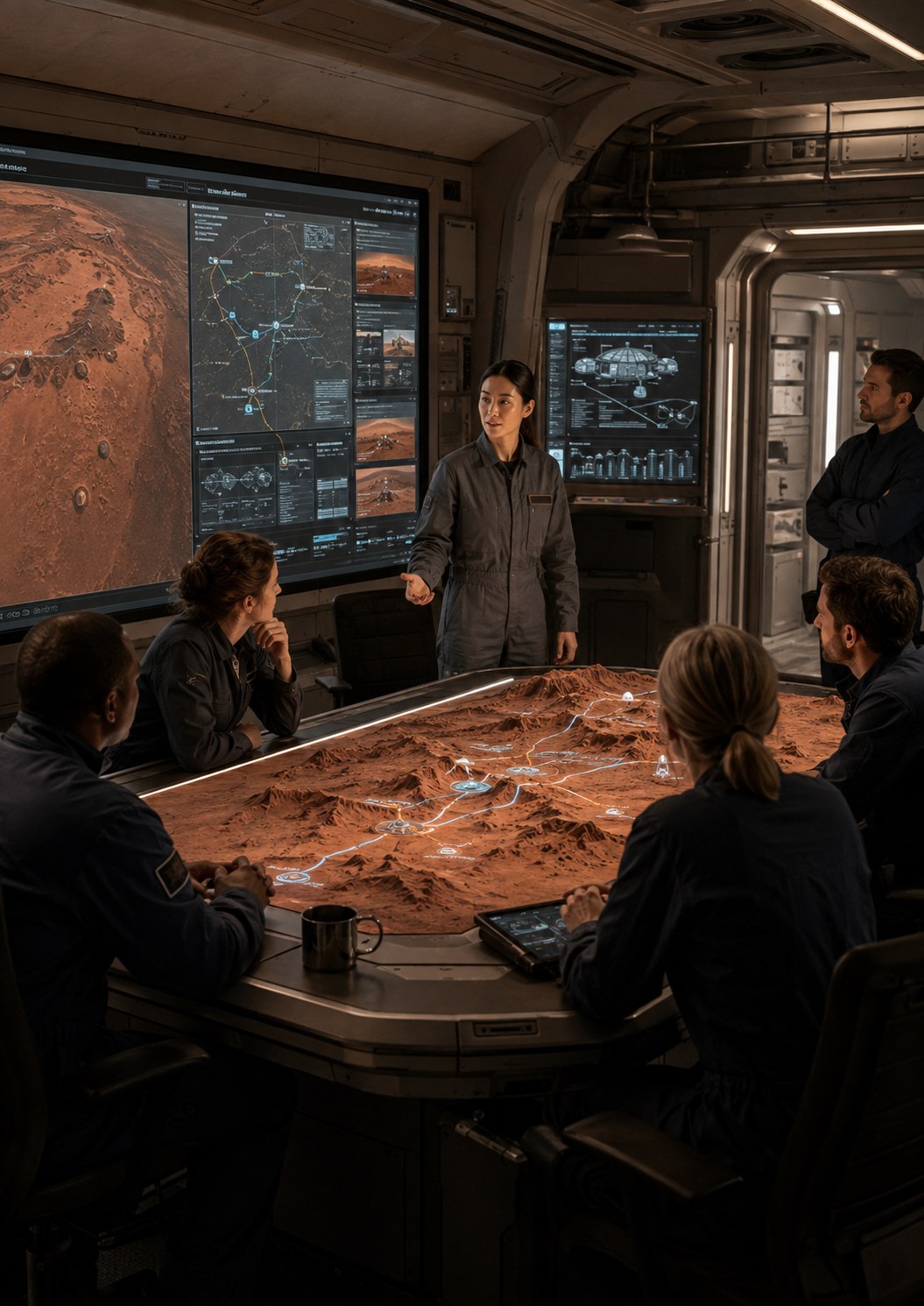
Conceptual visualization of team response to anomalies: procedures, role allocation, training and communication quality matter as much as nominal equipment performance.
Scope — technical skill, team communication, procedures, simulations and debriefing that turn error into learning.
Human-performance monitoring should follow reaction time, error rate, mental workload, sleep, communication quality, procedure success and recurrence.
Relationship used here: human performance requires multiple indicators and trends rather than one scalar equation.
CHAPEA supplies analog isolation, limited resources, delayed communications and simulated equipment malfunctions
Recompute human performance requires multiple indicators and trends rather than one scalar equation with units visible.
Training decisions when information is incomplete
The human-factors reference case begins with one mistake amplified by confirmation bias, ambiguous alarms, or weak coordination.
Designing procedures, alarms and authority to prevent error cascades
standardizing what must be repeatable while preserving autonomy to recognize a situation never rehearsed exactly
progressive scenarios, surprise failures, human observation, no-blame debriefs and procedure changes
Operational log: reaction time, error rate, mental workload, sleep, communication quality, procedure success and recurrence.
Turning crew experience into operational memory
Deepening — design the organization for humans who are tired, imperfect and still indispensable
Human error is often the last visible step in a design problem
When an operator misses a valve, misreads an alarm or selects the wrong procedure, it is easy to stop at “human error.” A more useful analysis asks why the error was possible: similar controls, ambiguous display, fatigue, conflicting procedure, poor handover, time pressure or weak training. The human may be the last visible link in a chain created by the system.
This approach does not erase responsibility. It separates individual acts from conditions that make mistakes likely. Deliberate misconduct is not the same as a perception error; a rule routinely bypassed to get work done may reveal an unusable official procedure. Investigation should therefore look at decisions, interfaces, organization and culture together.
On Mars, the discipline matters because design weaknesses can persist for years. If an interface repeatedly causes confusion, “be more careful” is not a durable fix. Changing the display, adding a confirmation or redesigning the sequence is often more effective than another reminder.
Alarms should support decisions rather than merely create noise
A complex failure can trigger many alarms because one fault affects several sensors. If twenty warnings appear in ten seconds, the operator must know which signal is causal, which are consequences and which demand immediate action. Alarm systems therefore need prioritization, grouping and context.
A useful alarm answers four questions: what is abnormal, what hazard results, how much time remains and what first action is safe? A terse engineering code may be enough for a specialist, but a larger population may need more explicit language. Critical systems can preserve technical identifiers while adding operational meaning.
Nuisance alarms are also dangerous. A warning that sounds every day without consequence becomes background. Either the threshold is poor or the condition is genuinely chronic; both require correction. A culture that says “ignore that one” is accumulating accident potential.
Fatigue should be managed as an operational variable
Sleep loss, night work, difficult EVAs and prolonged anomalies reduce performance. Small bases will be tempted to keep using the most skilled person. Yet an exhausted expert can become less reliable than a rested colleague following a strong procedure. Planning therefore needs awareness of cognitive availability as well as qualification.
A simple example shows the burden of continuous watch. Four people covering 24 hours with one person continuously awake on duty spend six hours each on watch before normal work is counted. Repeating that model for days conflicts with adequate sleep. The solution is organizational: automation, shifts, reinforcement, rest rules and the ability to reduce nonessential activity.
At one hundred or one thousand residents, fatigue becomes occupational health and labour policy. Standby duties, shift work, outdoor trades and emergency services need rules. A Martian society cannot indefinitely depend on pioneer culture in which everyone is expected to exceed normal limits.
Training must preserve rare skills and teach uncertainty
Exploration task inventories show the breadth of capability a remote crew may need. The problem is not only learning before departure; it is retaining rarely used skills. Emergency medicine, high-voltage troubleshooting or suit repair may go months without practice. Recurrent training becomes maintenance of the human system.
The best exercises do not merely test recall. They provide incomplete information and require operators to decide what must be checked before acting. An operator who can say “I do not yet know whether the sensor is wrong or the loop is truly hot” may be safer than one who too quickly recognizes a familiar scenario.
Simulation should also train stop-work authority. If every exercise rewards completing the procedure, people learn to continue even when assumptions fail. Robust culture rewards stopping, returning to a safe state and seeking a second assessment.
Automation should keep humans informed without turning them passive
More autonomy creates a paradox: humans intervene less often but must understand the system when automation fails. This is the out-of-the-loop problem. If software performs perfectly for weeks, the operator may lose the mental model needed for an unusual event.
Interfaces should expose state, intent and limits. “Automatic mode” is not enough; operators should see what the system is trying to maintain, which constraints are approaching and why an action is proposed. AI recommendations need the same transparency: a suggestion should be traceable to data and assumptions.
Role allocation depends on timescale. Fast control loops belong to machines; slower choices with social, medical or strategic consequences belong more strongly to humans. Between them is a cooperative zone that must be tested. A Mars base will be safe neither by automating everything nor by asking tired humans to manually watch every parameter.
Designing an organization for tired, imperfect and replaceable humans
Judge an alarm by the decision it enables
A system that produces one hundred alarms during a complex event does not deliver one hundred useful pieces of information. It may saturate attention instead. Alarm architecture has to rank urgency, consequence and expected action, separate probable causes from cascading effects and prevent twenty symptoms from hiding the initiating event. The practical test is simple: can a tired operator determine within seconds which system is threatened, what must be stopped and how much time remains?
Interfaces also need to expose uncertainty. An inconsistent sensor should not appear authoritative merely because it displays three decimal places. Operators need to know whether independent sensors agree, whether a value is filtered, whether redundancy has switched and which measurements are missing. This reduces blind obedience to a confident-looking interface with incomplete evidence.
Refresh rare skills before they decay
Critical skills that are seldom used fade. A base that has had no fire for three years may become more vulnerable because its residents have lost the reflexes they once demonstrated. Training should cross frequency of use with consequence of error. Frequent reversible tasks can be maintained through practice; rare potentially lethal tasks require dedicated drills, simulation and assessment.
The cost must be visible. If twenty residents spend two hours each week on drills, that is forty person-hours per week. It is not wasted time but an operational insurance premium, adjusted according to incident data, task difficulty and the arrival of new hardware.
Build a culture in which reporting an error improves the system
An organization that automatically punishes the first visible person associated with an error learns to hide errors. Deliberate misconduct, reckless behavior and expected human error in a complex system need different treatment. Near misses should be captured because they reveal weak barriers before severe consequences appear. Analysis then looks for contributing factors such as ambiguous procedures, interfaces, fatigue, schedule pressure, training, environment or design.
At town scale this culture becomes institutional. High-risk occupations need qualifications, independent investigation, lessons-learned systems and protection for good-faith reporting. Safety stops being a crew checklist and becomes a durable social function comparable with aviation, medicine or industrial operations.
Verification cases and operational margin
Test the organization with scenarios in which several things fail together
Exercises should not always present one clean isolated fault. A realistic scenario can combine fatigue, an ambiguous sensor, an EVA in progress and partial communications loss. The objective is not to trick participants but to test priorities: who has authority, which activity stops, what information is shared and which decisions can wait. Multi-failure drills expose organizational couplings that separate technical procedures may never reveal.
Post-exercise review should measure more than the final outcome. Time to detection, time to stabilization, misread alarms, missing communications, unnecessary actions and moments of hesitation are data. Repeating a scenario after a procedure or interface change allows the settlement to test whether the change actually improves human performance rather than merely producing a cleaner document.
Deep monograph
Designing real work rather than ideal procedures
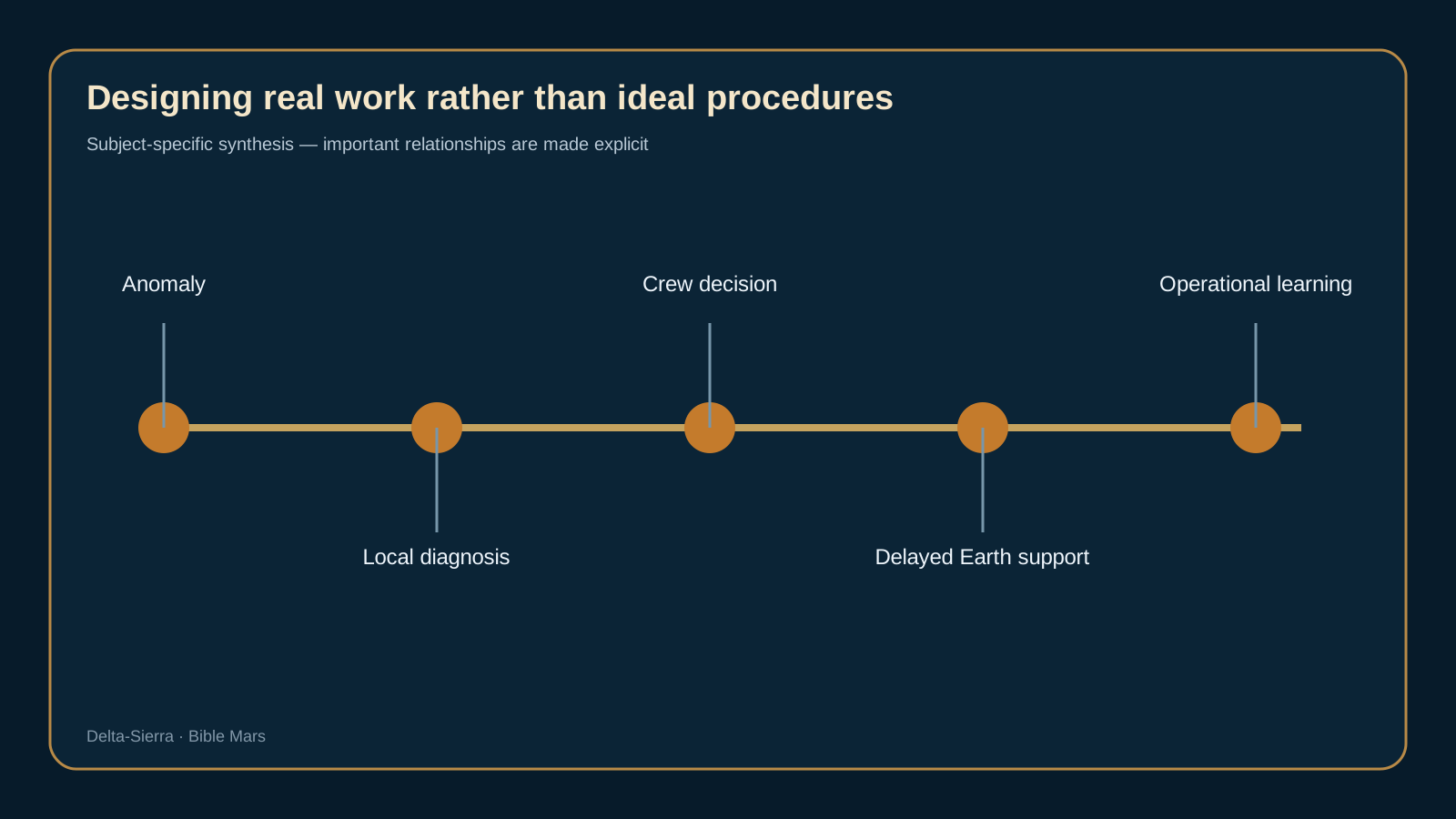
Designing real work rather than ideal procedures.
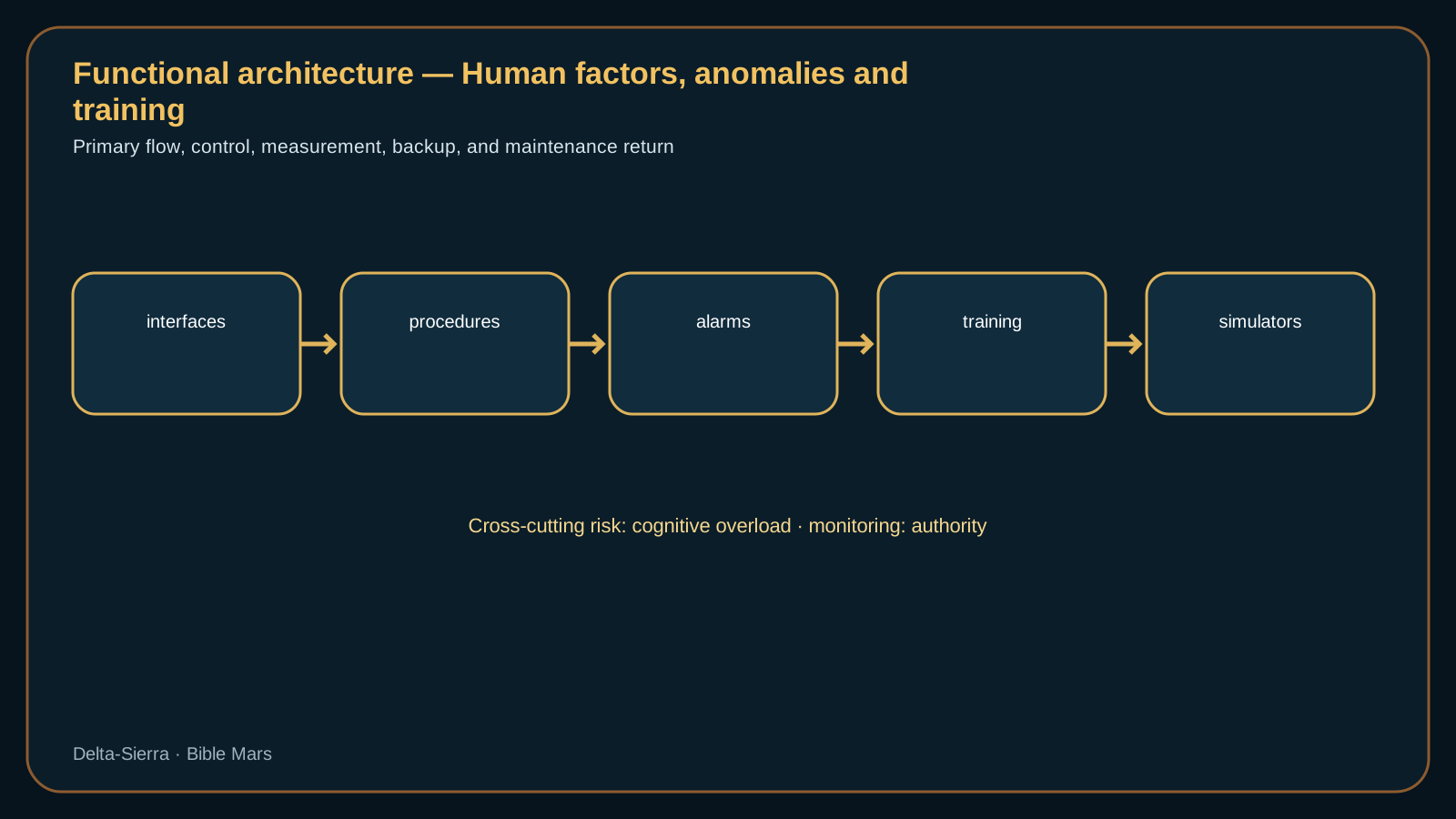
Human factors, anomalies and training for a Mars crew — functional architecture showing the flows, interfaces and dependencies developed in the chapter.Human factors, anomalies and training for a Mars crew — visual synthesis of the system-specific choices and constraints.
The technical system must be designed for real humans, not ideal operators.
Fatigue: the brain becomes a limited resource like power.
Sleep: schedules, noise, light, emergencies and cumulative debt.
Alarms: attracting attention without creating an alarm storm.
Interfaces: showing state, trend and uncertainty.
Procedures: precise enough to help, flexible enough for the unknown.
Training for rare anomalies without exhausting the crew
Bias: confirmation, fixation, authority and normalization of deviance.
Automation: when to trust and when to take over.
Initial training: learning systems before learning incidents.
Recurrent training: retaining skills unused for months.
Recurrent training: retaining skills unused for months. The observation chain for training must remain credible after conflict.
Simulation: experiencing rare failures without breaking real hardware.
Delayed communication: commanding without instant conversation with Earth. <
Reproducible calculations specific to this subject
Fraction of the workday consumed by an incident
Hplan = 4 × 8 h = 32 h-équipage; 10 h imprévues / 32 = 31,25 %
Ten person-hours of unplanned work consume almost one third of the planned work capacity of a four-person crew on an eight-hour day. Human resilience is therefore also a capacity problem.
Decision loop with Earth
T = 2 × 20 min + 10 min = 50 min
With twenty minutes of delay each way and ten minutes of ground processing, a question requiring a round trip cannot yield an answer for fifty minutes. Some decisions must therefore be designed for local execution.
Weekly unplanned workload
f = 42 h / (4 × 8 h × 7 j) = 18,75 %
Forty-two person-hours of anomalies in a week represent almost one fifth of the theoretical capacity of a four-person crew. Schedule margin must be explicit or maintenance consumes science, training and rest.
Living procedures, cross-skills and operational learning
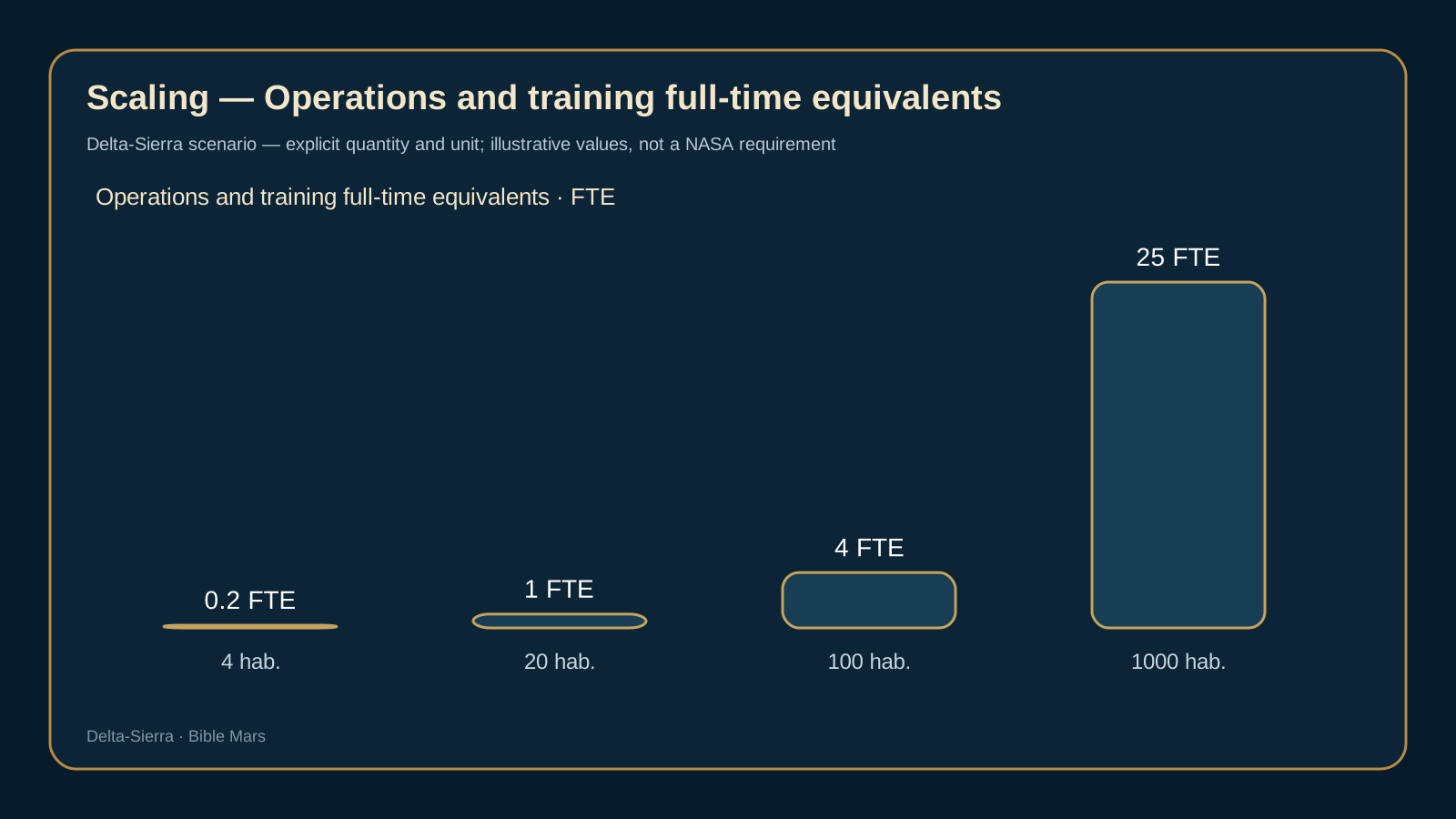
Four people: everyone must be able to cover for someone else.
Twenty people: specialties, relief and first priority conflicts.
Twenty people: specialties, relief and first priority conflicts. Who may modify training?
One hundred people: management, training, occupational health and local procedures.
One hundred people: management, training, occupational health and local procedures. Competence at that scale cannot be transmitted by procedures alone; fatigue and rest must remain observable even when automation is opaque.
One hundred people: management, training, occupational health and local procedures. Uncertainty — one hundred people: management, training, occupational health and local procedures.
One thousand people: institutions, professions, regulation and safety culture.
Compound incident: technical failure, casualty, communications and fatigue together.
Debriefing: analyzing without searching for a convenient culprit.
Operations and training full-time equivalents — scaling scenario: the quantity and unit are illustrative and are not a NASA requirement.
Four architecture scenarios that materially change the decision
Two weeks without mission control
Two weeks without mission control. A simulated loss-of-communication period forces the team to plan, prioritize and handle anomalies locally. The useful result is not to prove the crew “can cope,” but to observe which information, authority and skills are actually missing. Earth-centered procedures must then be rewritten around that autonomy.
Alarm cascade at 03:00
Alarm cascade at 03:00. A minor failure triggers multiple derived alarms while two crewmembers have just been awakened. Interface quality, alarm prioritization and cognitive load become safety functions. The scenario also measures sleep recovery after the event.
The specialist is unavailable
The specialist is unavailable. The only expert on a system is injured or busy with another emergency. A robust organization needs secondary skills, diagnostic aids and procedures that allow a qualified non-specialist to contain the situation. The case reveals the fragility of excessive specialization.
Maintenance consumes the mission
Maintenance consumes the mission. Accumulated minor anomalies consume a growing share of available time week after week. Science, training, exercise and then rest are cut back. The scenario requires maintenance-debt indicators and a threshold at which objectives are reduced instead of continuing to overload the crew.
Building a learning culture without turning every error into blame
Tacit knowledge: what manuals do not capture. Monitoring of alarms has to survive time pressure, not merely nominal operation.
Job rotation: avoiding the indispensable single expert.
Hard decision: stopping valuable work to protect survival margin.
A learning society: turning errors into improvement rather than silence.
On Mars, autonomy is not a cultural preference; it is a consequence of light speed
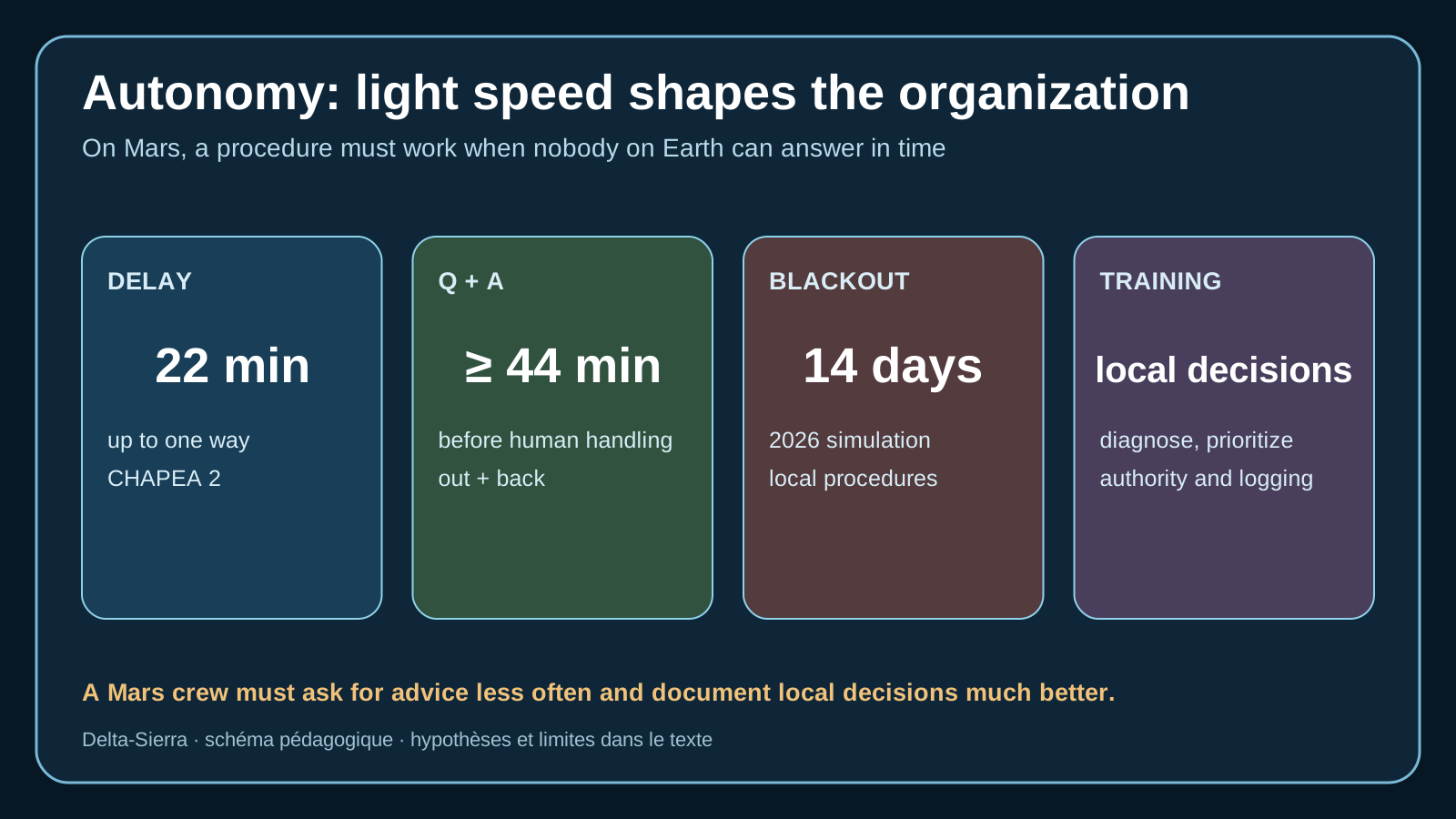
CHAPEA Mission 2 provides a concrete 2026 analog: four people, 378 days, constrained resources, equipment failures, crop work, robotic operations and communication delay up to 22 minutes one way. In May 2026 the crew also entered a simulated two-week loss-of-signal period. It is not Mars, but it is an organizational laboratory: what remains of a mission-control model when Earth temporarily disappears?
Delay forces real decision authority, knowledge and diagnostic capability toward the crew.
A question-and-answer loop is already at least 44 minutes when delay reaches 22 minutes each way: 22 + 22 = 44 min, before anyone on Earth reads, consults experts and replies. A fire, medical event or electrical fault therefore cannot be handled like a video call to mission control. Procedures need decision criteria, not merely instructions to request.
A fourteen-day blackout equals 14 × 24 = 336 hours without normal operational dialogue. Local databases must therefore contain diagnostic trees, maintenance history, medical thresholds, configuration data and contingency plans. AI may help navigate that material, but it must be grounded in validated local procedures and cannot replace human authority.
Training must combine failures. Earth teams often practice “compressor failure” or “medical injury.” Mars teams should practice “compressor unavailable while two people are outside and one crewmember is injured.” Scenarios have to force tradeoffs among immediate safety, conservation, repair and fatigue.
Performance monitoring should avoid one-dimensional scores. Sleep, fatigue, cognitive load, conflict, error rate and decision speed change differently among people. Data should detect drift and redistribute work, not create a permanent ranking system that teaches crew members to hide fatigue.
Autonomy also needs a doctrine of authority. Which medical decisions can be made locally? Who can shut down an oxygen plant? When may a commander consume strategic reserve without Earth approval? How is the decision reconstructed later? Those answers should exist before the emergency.
Cross-training is therefore a resilience system. A four-person crew with four unique specialties has four human single points of failure. If every vital function has a second competent person, illness, EVA or sleep does not erase capability. Martian redundancy must exist in people as well as machines.
A complex failure is also a collective-memory problem. At the critical moment nobody should depend on one person's recollection. Diagnostics, recent modifications, accepted deviations and the reasoning behind decisions need a usable log. A new shift should be able to understand within minutes what is normal, temporary and dangerous.
Communication delay changes procedure design. An Earth procedure may say “call the expert.” A Mars procedure must state when the local team can act, what evidence must be retained and which thresholds make a decision irreversible. CHAPEA's simulated delay of up to 22 minutes one way illustrates the problem: Earth remains a major intellectual resource but no longer functions as real-time control.
Training has to preserve rare skills. A capability unused for eighteen months can exist on paper and be lost in practice. Training schedules therefore need spaced repetition, unannounced simulations and cross-training. The objective is not for everyone to know everything; it is to ensure that temporary loss of one person never turns a vital function into inaccessible knowledge.
Earth–Mars delay makes human autonomy an architectural property, not merely a desirable astronaut trait. Procedures must say what the crew can decide locally, which information must be available onboard, and when a situation changes criticality. A procedure that requires an Earth response before action is incomplete for Mars.
The most revealing training combines technical faults, fatigue, ambiguous information and competing priorities. It exposes organizational interfaces: who coordinates, who preserves the big picture, who can stop unsafe work, and how the team returns to a known configuration. The objective is cautious autonomy under pressure.
APEX 2026 — isolated teams
APEX reports a standardized measurement suite across 40 teams in 2026. This chapter uses it to support longitudinal team monitoring while retaining the distinction between analog missions, spaceflight and future Mars conditions.
NASA NTRS — Training for Mars — The source documents skill-retention challenges on long missions and the limits of real-time ground support. It is used to justify onboard training, spaced refresh, anomaly simulation and learning during the mission.
NASA NTRS — Overview of Crew Operations for Transit to Mars — The document treats crew time as an architecture resource. It is used to turn fatigue, maintenance, training and science into quantifiable trades rather than separate themes.
Human factors become measurable when they are tied to real work. Fatigue, cognitive load, conflict, and skill loss are not abstract categories: they change how long it takes to understand an alarm, the probability of skipping a step, the quality of a handover, and the ability to improvise during a failure. A Mars organization should therefore watch task-related indicators such as repeated errors, diagnosis time, deferred maintenance, sleep debt, interruptions, and rising supervision demand. The purpose is not to monitor every emotion; it is to detect when the work environment starts producing systematic error.
Training should reproduce the conditions that make procedures fragile. A useful drill does more than rehearse a checklist; it introduces incomplete information, an unavailable specialist, delayed communications, fatigue, or a secondary failure. The debrief then compares the decision with the information that was actually available at the time. This exposes which skills need duplication and which can be supported by documentation or software. As population grows, the problem changes again: collective competence must survive job rotation, specialization, and the arrival of people who never experienced the settlement’s original configuration.
Sources and documentary findings
Designing real work rather than ideal procedures: the references below are retained because they contribute a result, technology status or verification framework directly useful to this subject.
NASA — CHAPEA Mission 2
CHAPEA Mission 2, which began in October 2025 for 378 days with four volunteers, is directly relevant to workload and decision autonomy: limited resources, isolation, communication delay and simulated failures force the team to organize responses without instant help from Earth.
NASA's July 2026 selection of seven companies for advanced robotic Mars mobility is relevant here chiefly as a human-factors case: as a vehicle becomes faster and more autonomous, designers must decide what the operator supervises, when control is handed back, how alerts are prioritized, and how the crew preserves situation awareness.
NASA/JPL — Perseverance completes first AI-planned drives (2026)
Perseverance executed drives in December 2025 whose waypoints were prepared with AI using orbital imagery and terrain data; NASA published the result in January 2026. It illustrates growing route-planning autonomy without removing system validation and terrain constraints.
NASA — Extravehicular Activity and Human Surface Mobility
For training, spacesuits have to be practiced together with vehicles, airlocks, tools and recovery of a crew member in difficulty. Training them separately would create nominal skills while leaving the team to discover the interfaces on the day those interfaces become critical.