


NASA NTRS — Mars ISRU methane and oxygen production
Methane/oxygen architectures using Martian resources structure CO2, H2, water, and power balances without proving an already available industrial plant.
MARS BIBLE — TECHNICAL DEEP DIVE
Building useful chemistry without assuming a complete terrestrial chemical complex from the first sols
A Martian settlement will consume many substances that disappear from high-level diagrams: acids and bases, salts, solvents, lubricants, resins, polymers, adsorbents, technical gases, disinfectants, fertilizers and analytical reagents. Chemical autonomy is less about reproducing all terrestrial industry than identifying critical molecules, precursors, recycling routes and the processes that become rational as population grows.
Essential foundations already established
Purity is an industrial function. Potable water, electrolyzer feed water, laboratory water and cooling water need different specifications; breathable gas, process gas and purge gas do too. Local production is therefore incomplete without contaminant measurement and quality assurance. Filtration, distillation, membranes, adsorption, crystallization and selective chemistry are accompanied by sensors, standards and regeneration procedures.
Absolute purity is often unnecessary and expensive. Martian industry should create grades so it does not waste power and consumables. A salt used for mining can tolerate impurities that would be unacceptable in analytical chemistry, while trace metals or organics may poison a catalyst or contaminate crops. The correct question is always: what purity does this function require, how is it verified, and where does off-spec material go?
Reagents, laboratories and purity. Industrial chemistry depends on analytical chemistry. A laboratory reagent or calibration solution needs a known concentration; trace contamination can invalidate measurements or damage biological processes. An autonomous settlement therefore needs imported reference standards and local purification, with clear distinctions between technical, food, medical and analytical grades.
Purity: the right molecule can still be unusable if contaminated. Electrolysis water, drinking water, analytical reagent and industrial fluid do not always require the same purity. Impurities can poison catalysts, corrode hardware or make product unsafe.
MOXIE as a scaling lesson, not a shortcut. NASA reports that MOXIE produced 122 grams of oxygen over sixteen Mars runs and reached up to 12 g/h. At 12 g/h continuously, one day would yield 288 grams. One tonne would then require roughly 3,472 days from a single unit at that rate. This intentionally simple calculation shows why a technology demonstration and a propellant plant are different engineering objects.
An operational plant must scale throughput by orders of magnitude while adding compression, purification, storage and availability. It must handle Martian atmospheric variation, dust and maintenance and be integrated with a power system sized for continuous operation. MOXIE demonstrates the physical pathway on Mars; it does not remove the need for the surrounding industrial infrastructure.
The same caution applies to Sabatier chemistry and water electrolysis. The equations are short, while the plant includes feed conditioning, heat exchangers, catalysts, separation, water recycle and cryogenic storage. Industry begins where the chemistry diagram becomes maintainable equipment.
A simplified nutrient-stock balance: how grams become tonnes. Assume a pedagogical case in which a crop system requires an average 20 grams per person per day of make-up nutrient salts that are not yet fully regenerated. For 100 residents that is 2 kg/day or 730 kg/year. For 1,000 residents it becomes 7.3 tonnes per year. The 20-gram value is not an agronomic requirement; it is an explicit scenario showing how tiny daily flows become industrial logistics at settlement scale.
The calculation immediately raises the real question: what fraction is actually consumed and what fraction can be recovered from plant and human residues? If 90 percent of an element is recovered, make-up drops by a factor of ten; if contamination forces regular purge, it rises. Closure must therefore be tracked element by element rather than as one generic recycling percentage.
Industrial chemistry supplies the tools: analysis, precipitation, ion exchange, membranes, biological digestion and selective reactions. The food–chemistry interface becomes as important as the food–power interface.
Large structures attract attention, but machines often stop because of a seal, cable jacket or lubricant. Polymers provide electrical insulation, membranes, hoses, seals, clothing, coatings and lightweight components. Elastomers must remain flexible through cold, radiation and ageing. Lubricants have to work with dust, low pressure and thermal cycling. Producing these families from local feedstocks will be far harder than recycling known polymers, but their small mass does not make them unimportant.
A realistic first step is to identify, sort and recycle imported polymer families while standardizing designs to reduce the number of feedstocks. Producing organic precursors from CO₂, CO, H₂ or biomass is a later prospect requiring catalysis, purification and molecular control. Settlement design can reduce vulnerability by preferring replaceable seals, durable metallic solutions where practical and lubricants selected for long storage life.
Polymers: useful but hard to close. Seals, flexible tubing, insulation, coatings, textiles and printed parts use polymers. They are light and versatile but their formulations contain many additives. In the near term, mechanical recycling of imported polymers and production of selected simple resins is more plausible than reproducing a complete petrochemical sector. Equipment design should deliberately reduce the number of polymer families.
Recover heat, water and solvents. Exothermic reactions and furnaces release heat that can preheat streams, warm districts or regenerate adsorbents. Condensates and solvents should be recovered rather than vented. Energy integration and recycling therefore become part of chemical design itself. On Mars, discarding a useful stream often means reproducing it with limited power.
Polymers, seals, adhesives and coatings: quiet materials that prevent leaks. A Martian city uses seals, insulation, cables, adhesives, coatings and plastics. These age under radiation, temperature, oxygen, abrasion and pressure cycles.
Local polymer production can become strategic but requires precursors, catalysts, additives and formulation control. Recycling and standardization are often earlier steps.
A chemical reactor never exists alone. It needs pumps, valves, heat exchangers, sensors, piping, insulation, electrical power, software and shutdown systems. Many processes become dangerous when flow stops, cooling disappears or gas accumulates. Process safety — limited inventories, detection, ventilation, isolation, relief devices and containment zones — belongs in the first generation of Martian chemical plants, not in a later industrial phase.
Catalysts illustrate a subtle dependency. A few kilograms of active material may enable tonnes of production, yet contamination or ageing can stop the entire chain. Activity, temperature and chemical poisons must be monitored and regeneration may need its own process. When catalysts rely on scarce elements, a strategic stock may be more sensible than premature local manufacture. Autonomy also means knowing which tiny dependencies deserve years of reserve.
Process safety becomes a life-critical discipline. Flammable gases, concentrated oxygen, high pressure, acids, bases, solvents and reactive dust require detection, ventilation, containment, material compatibility and safe shutdown procedures.
A chemical plant should be arranged so that one leak or runaway event cannot easily contaminate the habitat or destroy several critical chains at once.
Catalysts multiply capability but create dependencies. A catalyst accelerates a reaction without being consumed like a normal reactant, yet it can degrade or be poisoned. A Sabatier chain therefore also depends on catalyst availability, regeneration and monitoring.
Dimensioning failure: the pump that turns a stable reactor into a hazardous inventory. In a chemical chain, one pump may maintain flow, cooling or reagent dosing. Its failure can stop the process safely — or allow heat, pressure or reactive inventory to accumulate if the system is badly designed. Safety should therefore use passive features where possible: limited inventories, volumes that accept expansion, valves that move to a safe state without power, and independent sensing for critical variables.
Mars adds another constraint: the response team is the same small population the plant is meant to support. A toxic leak must not contaminate the habitat or expose all specialists at once. Plants need compartmentation, isolation from life-support air, robotic access and safe venting or capture strategies appropriate to the chemistry.
Process safety is therefore part of autonomy. A local plant that removes an Earth-supply dependency but creates a base-wide evacuation risk is not a resilience improvement.
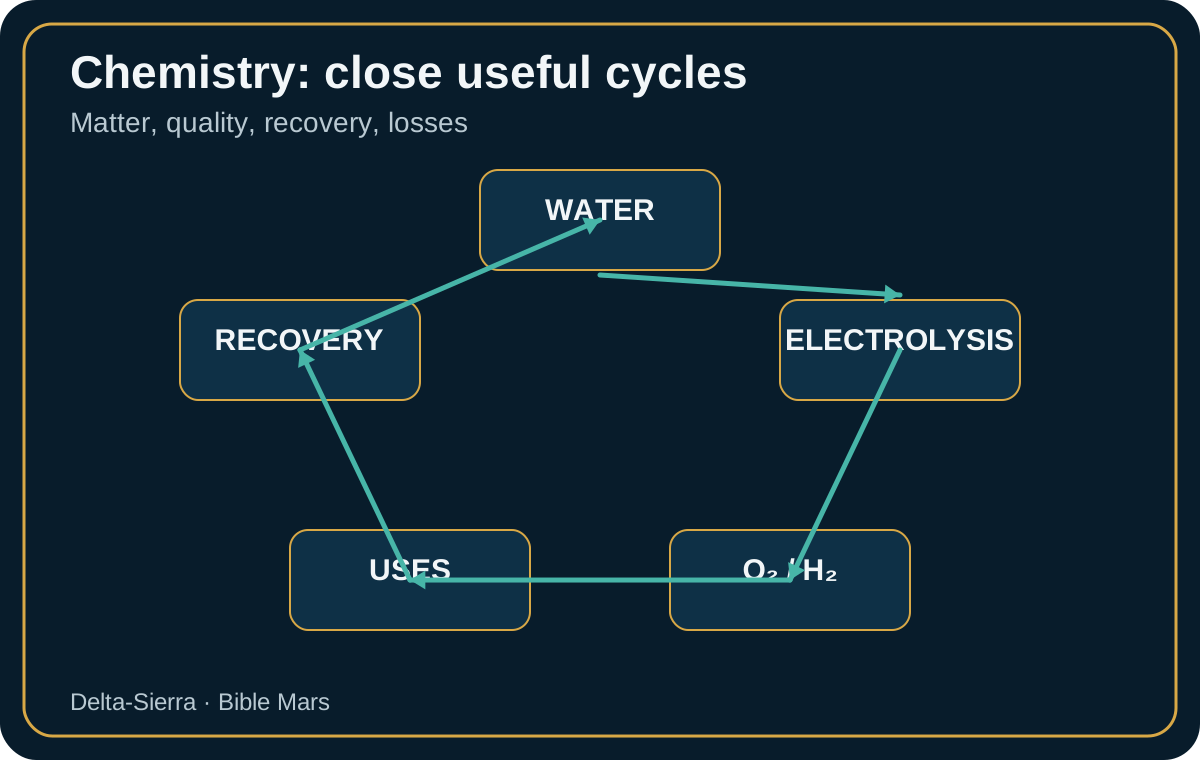
A closed settlement should treat waste as feedstock. Carbon in organic residues, nitrogen in urine, phosphorus and mineral salts all have industrial value. Biological and physicochemical loops can recover them, but no real loop is perfect: deposits, sludge, contaminants and losses require purges. A serious elemental balance follows C, H, O, N, P, S and critical trace elements rather than talking vaguely about '100 percent recycling.'
That accounting also reveals toxic accumulation. A species recovered too effectively can become a problem when there is no outlet; contaminants can concentrate with each pass. Loops therefore need separation, storage and sometimes controlled disposal pathways. Settlement chemistry is as much a science of purification as synthesis.
Fertilizers and nutrient cycling. Agriculture needs nitrogen, phosphorus, potassium and trace elements in bioavailable forms. Some can be recovered from human and plant waste; other inputs may need extraction or import. The critical issue is sanitary closure: recovering a nutrient does not mean applying raw waste to crops. Treatment, microbiological analysis and dosing must protect both plants and crew.
Fertilizers: agriculture depends on nutrient chemistry. Plants need nitrogen, phosphorus, potassium and smaller amounts of other elements. The settlement should recover nutrients from waste and supplement deficits using qualified stocks or local resources.
The challenge is not merely “having nitrogen”; it must be converted into a form usable by the agricultural system while concentrations and unwanted ions are controlled.
With four people, local chemistry focuses on water, oxygen, a few gases and waste treatment; many other reagents can be stocked. At twenty, volumes justify permanent units and professional chemical management. At one hundred, farming, maintenance and manufacturing consume enough material for local synthesis to become attractive. At one thousand, clean and industrial zones must be separated, toxicity and fire managed, maintenance planned and laboratories maintained to detect drift before it contaminates several loops.
Growth should be modular. One plant sized for a thousand people is too large for the first base, while ten tiny reactors may be inefficient later. The useful architecture introduces units that operate early and can then be paralleled, upgraded or repurposed. Chemistry becomes a network of services — gases, water grades, nutrients, cleaning and material feedstocks — rather than one monolithic factory.
Maturity: distinguish the building block from the complete system
This system within the settlement
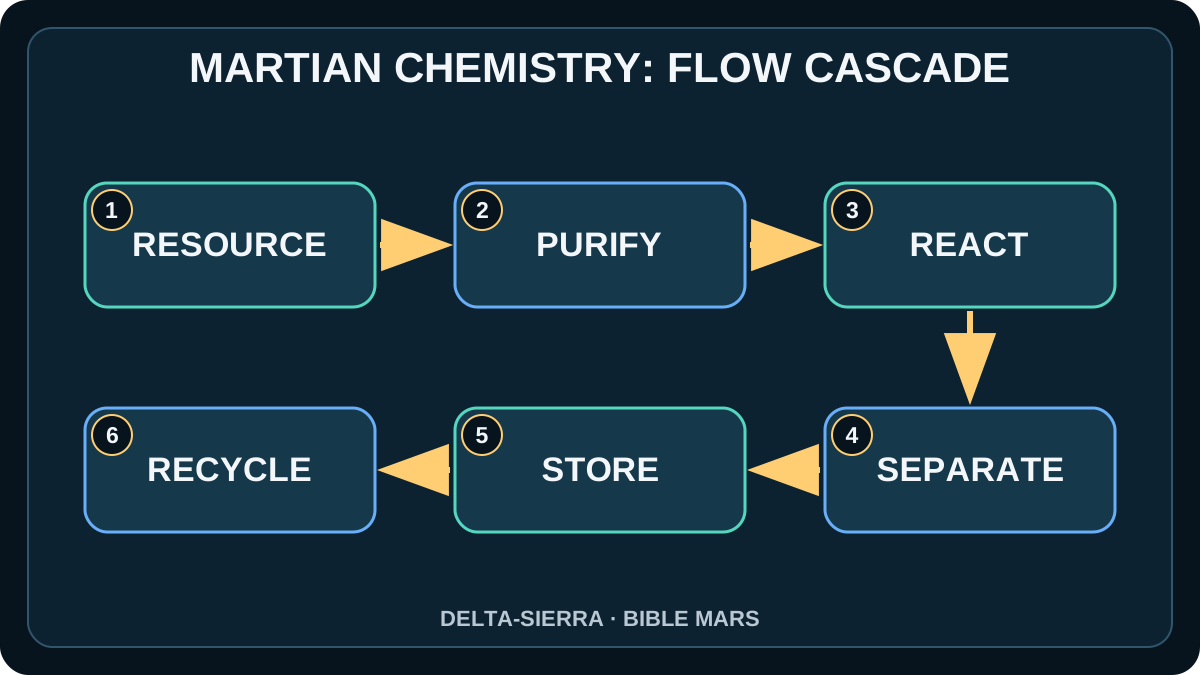
Start with vital flows. The first chemical processes should serve multiple functions. Water, carbon dioxide, oxygen, hydrogen and methane already form a chemical core connected to life support and propellants. From that base, selected gases, salts and cleaning solutions could be prepared locally when feedstocks and purity are controlled. The chemical plant should be designed as a network of flows rather than isolated reactors.
What belongs to Arcadia and what is demonstrated. Basic chemistry, separation processes and recycling are industrial on Earth, and NASA develops ISRU chains for producing commodities from local resources. A broad Martian chemical complex supplying fertilizers, polymers and reagents at city scale remains prospective. The Arcadia master plan is used here to explore system integration, not to claim the plant already exists.
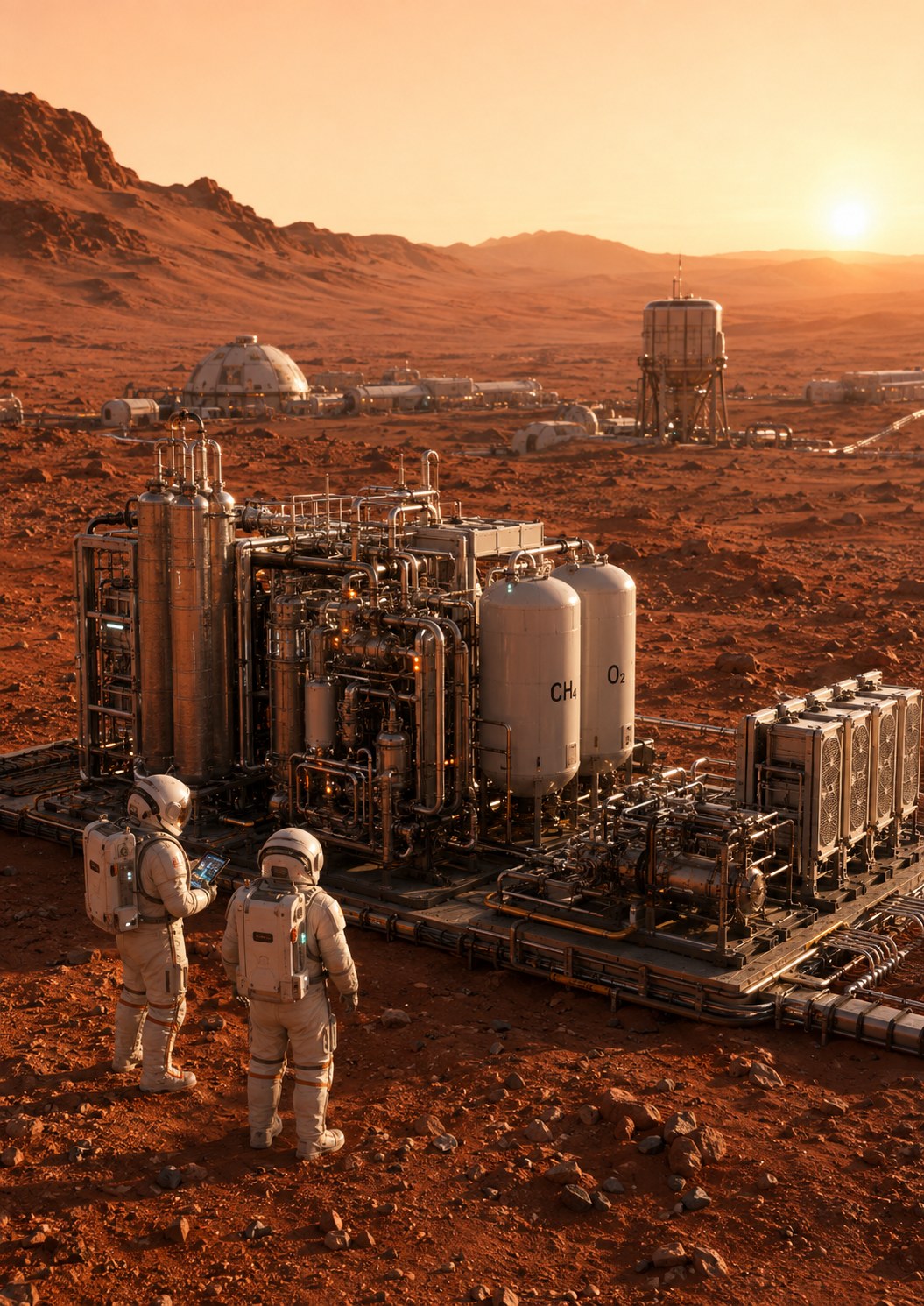
Martian chemistry begins by separating simple streams. The Martian atmosphere is dominated by carbon dioxide but also contains smaller amounts of nitrogen and argon. Industrial chemistry can therefore treat the atmosphere as feedstock: intake, dust filtration, compression, cooling and separation processes to produce cleaner streams. NASA studies have explicitly examined extracting compressed CO₂, nitrogen/argon buffer gases, water, oxygen, carbon monoxide or carbon from the Martian atmosphere.
The key word is purity. A reactor, fuel cell, crop chamber and scientific instrument may not accept the same raw mixture. A settlement will need several grades: technical gas, breathing-gas constituent, chemical reactant, pressurization gas and instrument-grade material.
Nitrogen is essential to proteins, nucleic acids and crops. Much can be recycled from organic waste, but losses eventually require makeup. Ammonia is one industrial gateway: Haber–Bosch combines nitrogen and hydrogen according to N₂ + 3 H₂ ⇌ 2 NH₃. The double arrow matters because the reaction is reversible; industrial plants separate unconverted gases and recycle them.
On Mars, hydrogen could come from water electrolysis and nitrogen would need concentration from the atmosphere or another stored source. But the equation does not design the factory: compression, heating, catalysis, separation, gas recycle and ammonia storage all require power and maintenance.
A greenhouse needs more than nitrogen. Plants also require phosphorus, potassium, calcium, magnesium, sulfur and trace elements. NASA and ESA have investigated nutrient recovery from biomass and waste in regenerative crop systems. The important lesson is that recovering elements is not enough: their concentrations must be rebalanced for the crop, while undesirable organics and microbial effects are controlled.
A robust architecture therefore combines chemical analysis, bioprocessing, mineral makeup and agronomic control. “Martian fertilizer” is likely to be a portfolio of controlled nutrient streams rather than one universal product.
Mars offers carbon through CO₂ and hydrogen through water, but that does not make every plastic easy to manufacture. Between small molecules and a final polymer lie synthesis, catalysts, separations, purification, molecular-weight control, extrusion or molding. Catalysts and additives can be harder to provide than carbon itself.
An early industrial strategy may therefore recycle imported polymers for as long as possible, standardize a limited number of material families, avoid inseparable mixtures and locally produce only those molecules or resins whose entire process chain can actually be maintained.
Primary references: NASA NTRS — Mining the Mars Atmosphere ↗ · ESA — MELiSSA Closed Loop Compartments ↗ · NASA NTRS — recycling crop residues into hydroponic nutrients ↗.
Material balance: understanding 90% yield
A process receives 100 kg of theoretical useful feed and operates at 90% yield. In this simplified model, 90 kg become desired product and 10 kg remain as by-products, losses or unconverted material.
The next question is how much of the 10 kg can be separated and recycled and what impurities accumulate.
Priority one: the chains that keep people alive. Before sophisticated products, a settlement must master water loops, oxygen, carbon-dioxide removal, waste treatment and nutrient recovery. A purification failure matters more than a shortage of a convenience polymer.
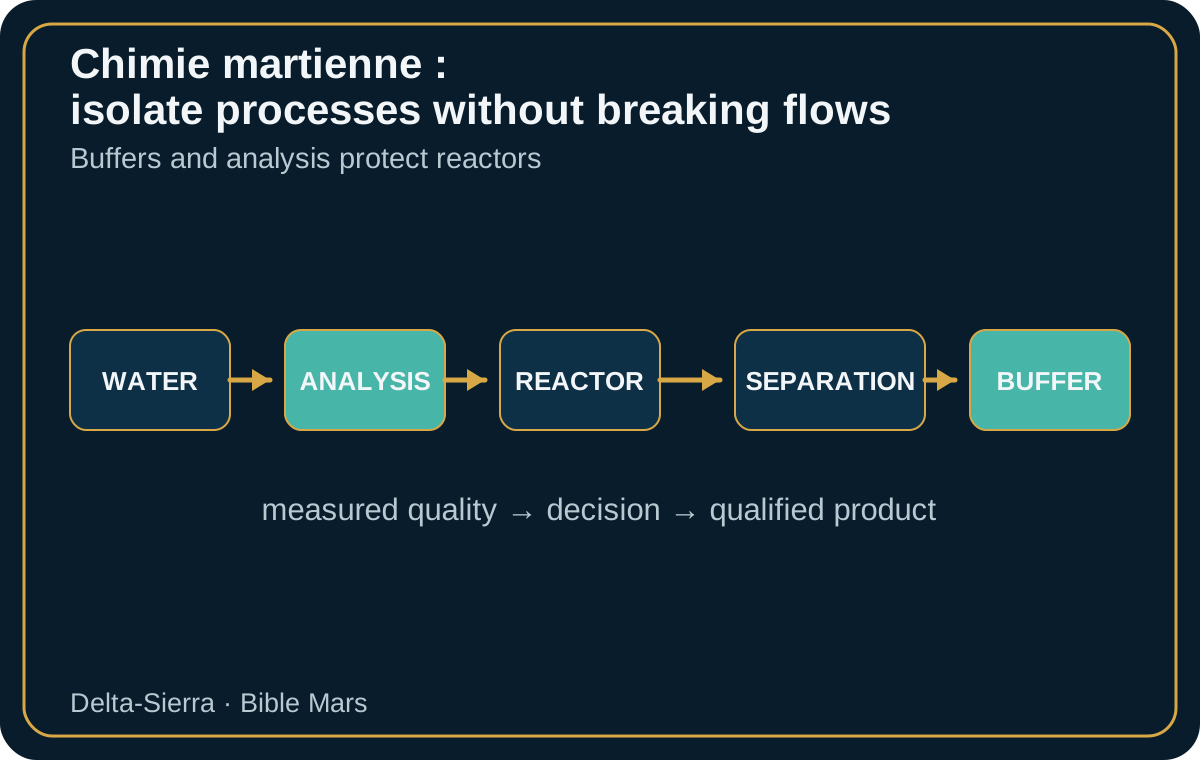
Chemical industry is a flow chain, not just an equation on paper. A chemical equation says which reactants can become which products. A plant must also manage purity, temperature, pressure, mixing, catalysis, separation, recycle, waste, corrosion and safety.
On Mars, industrial chemistry directly links life support, local resources, fertilizers, materials, cleaners, lubricants, polymers and propellants.
DELTA-SIERRA / ARCADIA PROSPECTIVE ARCHITECTURE
Go deeper with ArcadiaCapabilities use a conservative maturity label: a study or test does not automatically become an operational Martian capability.
Document check: 2026-08-10.
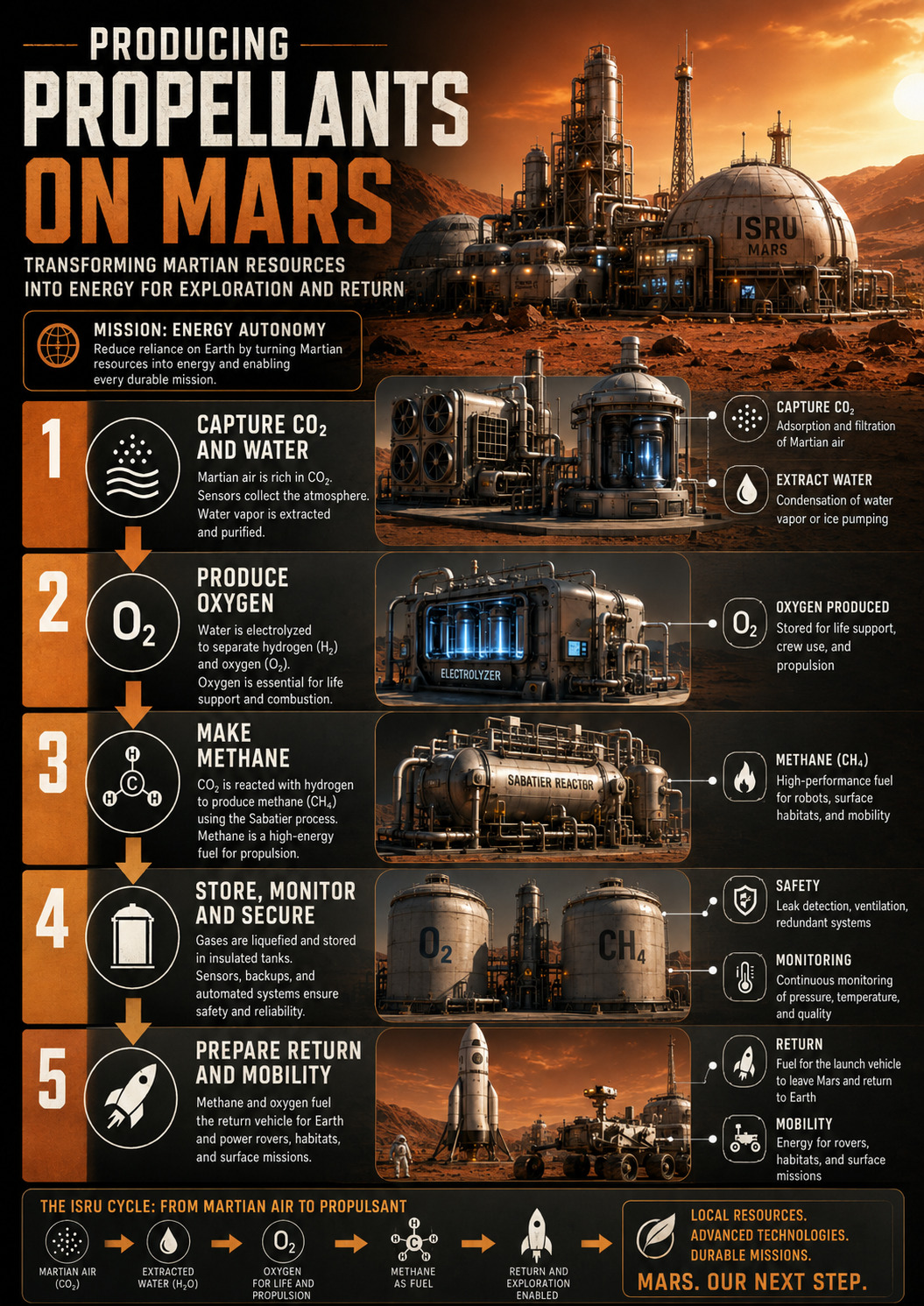
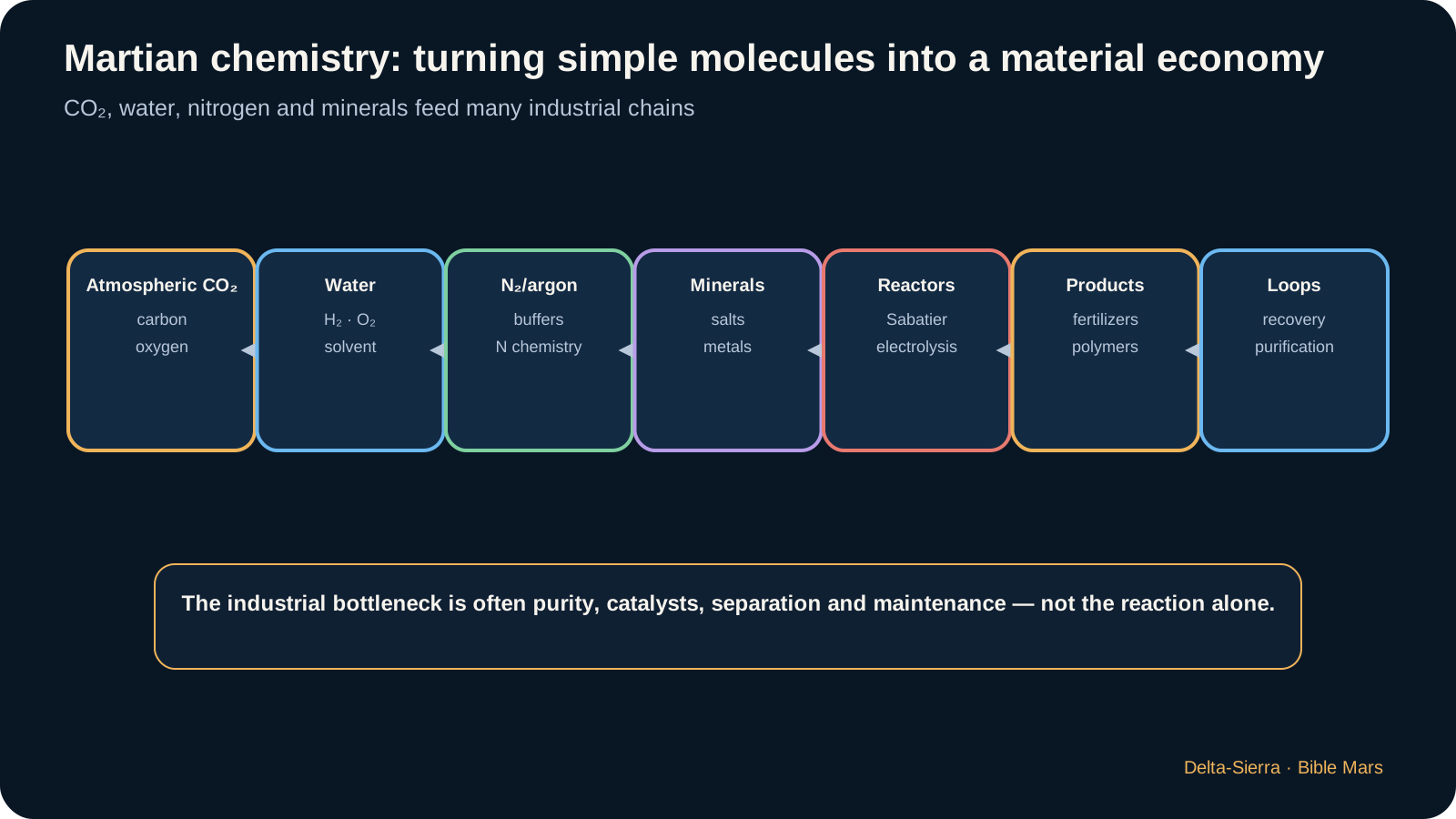
Industrial chemistry is the point where a base stops merely extracting resources and starts manufacturing useful molecules. On Mars, the main streams are easy to name—CO2, water, minerals, gases—but hard to purify, store, convert, and certify. A real chemical industry therefore has to be designed as a network of processes connected by mass and energy balances.
Chemistry begins with feedstock quality. A CO2-rich atmosphere, water extracted from soil, and a mineral concentrate do not arrive at a reactor as laboratory-grade reagents.
CO2 acquisition. Compression, adsorption, membranes, or other techniques must provide a stream clean and stable enough for the selected process.
Process water. Water for electrolysis or synthesis may require different purity than drinking water; specifications should be separated.
Trace gases. Argon, nitrogen, and atmospheric contaminants can be resources or impurities depending on the process and must be measured rather than ignored.
Mineral concentrates. Mineral chemistry requires sorting, crushing, separation, and analysis so that a process is not fed with unknown composition.
Recycled feedstocks. Used polymers, solvents, salts, and industrial waste need characterization before reuse because recycled streams accumulate impurities from cycle to cycle.
Water electrolysis links life support, propulsion, and chemistry. It produces two valuable gases but requires electricity, water purity, separation, drying, and safe storage.
Reactive hydrogen. Hydrogen is a feedstock for Sabatier and other synthesis routes; leaks and losses are therefore both a safety and mass-balance problem.
Multi-use oxygen. Life support, metallurgy, and propulsion can compete for the same oxygen; purity requirements should be matched to the use.
Gas storage. Pressure, temperature, tank materials, and safety determine storage mass and separation distances between chemistry and habitation.
Power coupling. An electrolyzer can act as a controllable load when the grid has surplus power, provided downstream storage can absorb variation.
Cell maintenance. Membranes, electrodes, seals, and sensors degrade and must be included in chemical-plant spares and maintenance capability.
CO₂ + 4 H₂ → CH₄ + 2 H₂O
One mole of CO2 theoretically requires four moles of H2 and produces one mole of CH4 and two of water. Industrial balance must then add conversion, recycle, and losses.
The Sabatier reaction is famous because it links CO2 and hydrogen to methane and water. Its industrial importance appears when reactants, heat, separation, and recycle are followed rather than one equation alone.
Stoichiometry. Molar balance sets minimum reactant amounts, while actual yield depends on reactor conversion and separation.
Water coproduct. Produced water can be recovered and electrolyzed, connecting Sabatier to a broader loop rather than an isolated reaction.
Methane fuel. Methane can serve as fuel or chemical intermediate; its value depends on mobility, propulsion, and synthesis demands.
Catalysts. Catalyst activity, poisoning, and temperature become maintenance and feed-purity variables.
Startup and shutdown. Transient cycles can require purges and consumptions different from steady state and should be included in annual balances.
A greenhouse needs nutrients in assimilable and controlled forms. Chemical industry must therefore turn mineral stocks, wastes, and imported inputs into reproducible recipes.
Available nitrogen. Atmospheric or recycled nitrogen must be converted into crop-available forms, with energy demand and concentration control.
Phosphorus. is used in small mass but is essential; recovery and strategic stocks must prevent a minor element from stopping crop production.
Potassium and salts. Useful ions can accumulate or become imbalanced in a recirculating loop; chemical analysis should guide correction.
Urine and organic waste. These streams contain nutrients but also salts, pathogens, and unwanted compounds; treatment is needed before agricultural reuse.
Crop-specific recipes. One universal solution is not ideal for all stages and species; chemistry must prepare differentiated, traceable batches.
η_global = η₁ × η₂ × η₃
Three stages at 95%, 90%, and 92% give an overall yield of about 78.7%. Multiplying stage yields prevents cumulative losses from hiding behind one efficient step.
A settlement consumes seals, hoses, insulation, films, parts, and packaging. Producing or recycling some polymers can therefore remove a logistical dependency disproportionate to their mass.
Carbon-derived polymers. Studies explore chains from CO2 or methane toward carbon intermediates; each step adds reactants, catalysts, and separation.
Mechanical recycling. Grinding, sorting, and remelting can extend thermoplastic life, but properties degrade with contamination and thermal cycling.
Chemical recycling. Depolymerization can recover cleaner molecules at the cost of a more complex and energy-intensive plant.
Critical elastomers. Seals and membranes can become more strategic than bulk commodity plastic; formulation and aging must be tracked.
Material qualification. A recycled spool or locally produced polymer cannot automatically be used in a critical part without property and aging tests.
Chemistry concentrates temperatures, pressures, reactants, and mixtures. Its autonomy depends less on how many reactions are known than on the ability to control, stop, and restore them after drift.
Online analysis. Composition, humidity, pressure, and temperature should be monitored at points that diagnose the process rather than merely inspect final product.
Laboratory sampling. An independent laboratory can confirm or challenge online sensors and qualify sensitive batches.
Safe shutdown. Valves, inerting, ventilation, and software sequences must bring the plant to a stable state after loss of power or cooling.
Habitat-industry separation. Flammable gases, corrosives, and dust justify siting where an industrial incident does not disable the habitat.
Spares and consumables. Catalysts, membranes, filters, seals, and minor reagents should be ranked by criticality and local-production feasibility.
ṅ = ṁ / M_molaire
Mass flow divided by molar mass converts kg/h to mol/h and allows reaction stoichiometry to be applied correctly.
Poisoned catalyst
Sabatier conversion gradually drops. The scenario detects drift through composition data, isolates the cause, shifts or reduces flow, and decides whether the catalyst can be regenerated locally.
Loss of cooling
An exothermic unit loses cooling. The correct response is a preplanned safe shutdown rather than trying to sustain output until temperature limits are exceeded.
Off-spec fertilizer batch
Analysis finds an ionic imbalance before greenhouse injection. The batch is isolated, the cause reconstructed, and traceability prevents several chambers from being contaminated.
Critical elastomer shortage
Compatible seal inventory falls faster than expected. The town compares priority import, local reformulation, controlled reuse, and temporary reduction of processes using that material.
Methane/oxygen architectures using Martian resources structure CO2, H2, water, and power balances without proving an already available industrial plant.
Atmospheric acquisition technologies show that the first stage of chemistry is often separating a sufficiently clean feed stream.
This conceptual chain links Sabatier and Fischer–Tropsch chemistry to polymer production; it explores pathway depth rather than proving Martian industrial yield.
This work illustrates pathways toward more complex molecules from local carbon, with increasing catalyst and separation requirements.
MOXIE demonstrates oxygen production from the Martian atmosphere at experimental scale; that evidence must be distinguished from a town-scale plant.
State-of-the-art reviews allow several pathways and maturity levels to be compared rather than selecting one reaction simply because it is familiar.
Mars offers an atmosphere dominated by CO2, but an industrial plant does not receive pure CO2 at industrial pressure. It must draw extremely thin gas, remove dust and unwanted species, compress and dry it, then deliver stable flow to the process. Compression energy and filter lifetime therefore belong in the chemical balance. A Sabatier reactor or high-temperature electrolysis process can be thermodynamically attractive while being constrained by gas preparation, thermal cycling, or catalyst replacement. Martian chemical chains should therefore be drawn from real resource to stored product, with analytical checkpoints between stages.
Sustainable agriculture needs nitrogen, phosphorus, potassium, and trace elements in forms plants can use. Finding an element in regolith does not mean it is immediately bioavailable. Extraction, purification, pH adjustment, and contaminant control are required. Nitrogen is especially strategic because it is only a minor component of the Martian atmosphere and losses from habitat or agriculture may be difficult to replace. Biological waste therefore becomes a secondary mine: recovering nitrogen and phosphorus from human streams reduces both waste and external dependency. Agricultural chemistry must couple to water treatment, microbiological control, and metrology.
Making plastic is not merely polymerizing a monomer. Precursors, catalysts, temperature control, sometimes solvents or protective gases, and material characterization are required. A town can begin by mechanically recycling imported polymers, separating families, and reserving virgin resins for critical uses. As local chemistry advances, some carbon chains could derive from CO2 or biomass, but purity becomes decisive. A slightly contaminated polymer may be acceptable for a storage box and forbidden for a pressure seal. Industrial doctrine should therefore tie each material batch to authorized uses rather than merely declare 'plastic made on Mars'.
A reaction can show 95% conversion and still be poor for the settlement if the remaining 5% becomes a toxic waste that cannot be treated. Balances must track mass, energy, wash water, purge gas, and off-spec product. Useful secondary streams should be identified: reusable heat, recoverable water, or gas feeding another process. Corrosive or toxic streams instead require storage, detection, and neutralization. This accounting allows industrial symbiosis in which one plant's outputs become another's inputs, but only when purity and flow are compatible. Closing loops is an engineering result, not an aesthetic requirement.
An integrated Martian chemical industry has never operated. Individual reactions may be well understood, yet their coupling under purity, recycling, corrosion, maintenance, and safety constraints remains to be demonstrated. Early plants will need to characterize each local feedstock, close balances progressively, and preserve fallback paths before relying heavily on local production.
A Mars chemical industry will not begin by reproducing Earth's entire product catalog. It will first seek molecules that close several chains at once. Water serves crew, electrolysis and processing. Atmospheric carbon dioxide supplies carbon and oxygen but at very low pressure. Oxygen supports breathing, oxidation and potentially propellant. Hydrogen is harder to obtain and store, making it valuable for oxide reduction and hydrocarbon synthesis. Regolith salts may be resources, contaminants, or both.
MARS-C, active in NASA TechPort in May 2026, illustrates this direction: an electrochemical cell is fed with mineral-bearing water and Martian CO₂ to target oxygen, hydrogen and C1/C2 hydrocarbons. It is not an operational Mars factory. It is a technology path attempting to reduce pretreatment and process steps, and its project status must remain explicit.
If 100 kg of water is electrolyzed per day, stoichiometry gives roughly 11.1 kg of hydrogen and 88.9 kg of oxygen in the feed. Real recovery is lower because conversion, Faradaic efficiency, drying, compression and losses matter. “Efficiency” must therefore specify what it measures: chemical conversion, mass recovery, electrical efficiency or plant availability.
Recycling can dominate logistics. If 95% of a 200-kg solvent inventory is recovered each cycle, 10 kg is lost. Thirty identical cycles require 300 kg of makeup solvent if no other losses occur. A seemingly excellent recovery percentage can still create a large resupply burden.
Plants require nutrients in specific forms. Mars' atmosphere is dominated by CO₂ and contains only a small fraction of nitrogen, so agriculture depends on stored nutrients, recovery from human waste, water-loop control and local extraction where mineralogy permits. Finding an element in soil is not enough; it must be converted into a plant-available form without importing toxic contaminants.
A plausible strategy combines concentrated startup inventory, nitrogen and phosphorus recovery, low-loss water processing and selective local chemistry. Perchlorates show the ambiguity of local salts: they are a hazard in biological systems, yet chlorine and oxygen are chemically useful. Food-related purification has a much higher assurance threshold than an industrial process.
Hydrocarbons made from CO₂ can feed fuels or polymers, but converting simple molecules into reliable materials requires catalysis, purification, molecular-weight control, additives and forming processes. Early local products may target films, temporary seals, insulation foams, packaging or noncritical piping. Pressure-bearing and safety-critical parts require much stronger qualification.
Recycling imported polymers offers another route. Waste already contains refined matter and energy. Sorting, cleaning and reformulating it can be cheaper than synthesizing polymer from CO₂, but thermal cycling degrades some chains and mixed resins complicate properties. Material identification and history become industrial functions.
Hydrogen, oxygen, solvents, acids, bases and compressed gases create hazards incompatible with casual operation inside a habitat. Chemical plants need separation, ventilation, leak detection, compatible materials, ignition control and isolation capability. A process that saves imported mass while endangering the habitat does not improve autonomy.
Scale should be expressed through throughput and availability. A 10-kg/h plant operating at 50% long-term availability produces about 10 × 24 × 30 × 0.50 = 3,600 kg over thirty days if feedstock and power remain available. Maintenance and cleaning turn nameplate flow into real production.
An early chemical industry cannot reproduce Earth's catalog. It should begin with a limited set of high-leverage streams: purified water, oxygen, hydrogen, carbon dioxide, nitrogen when available, useful acids and bases, salts, solvents or polymer precursors compatible with chosen processes. Priority depends less on product sophistication than on how many chains it enables—life support, agriculture, metallurgy, cleaning, energy storage or polymers.
Mass balance imposes a simple discipline: every atom enters, leaves or accumulates. In ideal water electrolysis, 18 kg of H₂O contains about 2 kg hydrogen and 16 kg oxygen. Processing 100 kg of water therefore corresponds theoretically to 11.1 kg H₂ and 88.9 kg O₂. Real systems add efficiency, purity, residual gas, drying, compression and energy. This prevents claims of “100 kg oxygen from 100 kg water.”
Small losses dominate over years. A loop recovering 95% of a solvent loses 5% of net throughput if material is not recovered elsewhere. Processing 1,000 kg therefore creates 50 kg of replacement demand. For imported material that is direct logistics dependence; for local material it sizes extraction and purification.
Quality is central. “Oxygen” is not automatically breathable, propulsion-grade or furnace-ready. Moisture, CO, dust, chlorides or reactive traces can make a stream unsuitable. A city needs specifications by use and sampling points, not one label called “local product.”
Heat integration creates leverage. Exothermic reaction heat can preheat another stream; metallurgy can support drying; cold expansion can serve another process. Designing plants as a network reduces electrical demand. The chemical system becomes an industrial ecology of matter, heat and water.
Coupling also creates common causes. If agriculture, life support and polymers depend on one nitrogen reserve or one purification train, a failure becomes systemic. Closed cycles therefore need buffers, alternatives and isolation procedures.
Agriculture needs more than water and carbon dioxide. Nitrogen, phosphorus, potassium and trace nutrients must be placed into forms plants can use, while salts must not accumulate to toxic levels in recirculating systems. A Martian fertilizer industry therefore starts with chemical analysis of feedstocks and waste streams. Human waste, inedible biomass and process residues may contain valuable nitrogen and phosphorus, but recovery must separate pathogens, pharmaceuticals, heavy metals and unwanted salts.
Nitrogen is especially strategic because the Martian atmosphere is dominated by CO₂ and contains only a small fraction of nitrogen. Capturing, purifying and preserving nitrogen may be more valuable than using it in low-value processes. Ammonia production, nitrate chemistry and nutrient recovery should be connected to agriculture and life-support inventories rather than treated as an isolated chemical plant.
Polymers create another dependency chain. Terrestrial plastics rely on a huge petrochemical industry, additives and carefully controlled monomers. Mars may initially favor a narrow portfolio of polymers whose feedstocks are realistic, whose processing equipment is maintainable and whose recycling is practical. The most useful local plastic is not necessarily the highest-performance resin; it is the one that can be repeatedly produced, repaired and reprocessed with controlled properties.
Recycling polymers is limited by contamination and degradation. Thermal history can shorten chains, fillers can accumulate, and mixing incompatible polymers can make a poor material. Sorting and material identification therefore belong upstream of recycling. Some waste may be better converted chemically into feedstock or fuel than remelted into another low-quality part.
Chemical storage shapes habitat safety. Oxygen, hydrogen, acids, bases and solvents require compatible vessels, ventilation, leak detection and separation. The amount stored should balance supply continuity against accident consequence. A small plant with buffer tanks may be safer than a massive central reserve if multiple production trains exist.
As the settlement grows, chemistry becomes a network of quality-controlled streams. The achievement is not a long list of molecules; it is a small set of reliable conversion paths that close nutrients, support metallurgy, feed manufacturing and keep dangerous inventories understandable.
A settlement shares one nitrogen inventory among buffer atmosphere, agricultural nutrients and chemical synthesis. A purification failure halves net production. Dividing supply “one third each” is not rational because consequences differ. Atmospheric reserve may cover months while a crop stage cannot wait for another logistics campaign.
If 1,200 kg are available, vital uses consume 6 kg/day and industrial uses 10 kg/day, inventory covers 1,200 ÷ 16 = 75 days without production. Suspending 8 kg/day of deferrable demand extends endurance to 1,200 ÷ 8 = 150 days. Operational prioritization doubles time without producing more nitrogen.
Agriculture may recover more organic nitrogen, chemistry may delay synthesis and life support may tighten leakage. Yet purity boundaries matter: a recovered waste stream does not directly become breathing-gas inventory.
Repair also protects contamination control. Opening the purification train near chemicals can introduce moisture or impurities. Isolation, purge, sampling and controlled return to service protect other users. A common molecule becomes strategic because several sectors depend on the same quality-controlled stream.
Local production is only useful when composition is known. Gas chromatography, spectroscopy, pH, conductivity, ion analysis and simpler wet-chemistry methods can verify feedstock and product streams. A settlement that produces oxygen but cannot detect harmful trace contaminants has not created a safe oxygen industry.
Sampling design matters. A measurement from one tank does not necessarily represent a process that is stratified or cycling. Operators need defined sample points, flushing volumes, frequencies and reference materials. This creates a chain from reactor condition to release decision.
Waste streams may carry valuable elements at low concentration. Recovering them can save imports, but concentration can also accumulate contaminants. Closed loops therefore need periodic purge or selective removal. “100% closed” is often less realistic than a controlled loop with measured make-up and waste.
Chemical plants need compatible materials. Acids, oxidizers and solvents attack seals, pipes and coatings differently. Local materials may require lower temperature, different concentration or shorter inspection intervals. Process design must match the material catalog available on Mars rather than copy terrestrial equipment blindly.
Hazard analysis becomes more important as industry grows. Hydrogen and oxygen production can create flammable mixtures; oxidizers can turn ordinary materials into severe fire hazards; pressurized gases store mechanical energy. Separation, ventilation, detection and inventory limits are chemical design decisions.
A mature chemical economy will therefore be built around evidence: stream composition, batch history, equipment condition and material compatibility. The most valuable laboratory on Mars may be the one that tells every other factory whether its product is truly what the label claims.
Water quality links many of these chemical loops. A stream acceptable for washing may be unsuitable for electrolysis because impurities poison electrodes; water adequate for an industrial coolant may be inappropriate for crops or drinking. Treating all recovered water as one inventory hides purification work and cross-contamination risk.
Catalysts deserve their own life-cycle records. Activity can fall gradually through poisoning, fouling or thermal damage, so process output may drift before a hard failure occurs. Measuring conversion efficiency over time allows regeneration or replacement to be planned rather than triggered by an unexpected production collapse.
Chemical autonomy also benefits from flexible reactors. Early Mars plants may favor modular vessels, pumps and separators that can be reconfigured for several campaigns instead of one highly optimized single product. Flexibility costs efficiency but can be valuable when demand and available feedstock change rapidly.
The chemical network should publish inventory in chemical equivalents as well as kilograms where reactions matter. Ten kilograms of one reagent may not substitute for ten kilograms of another. Stoichiometry, concentration and purity determine usable reaction capacity.
Process control needs independent safety limits. A production controller may optimize temperature or pressure for yield, while a separate protective layer trips equipment at unsafe conditions. Separating optimization from protection reduces the chance that one software fault defeats both functions.
As industry expands, laboratories should maintain retained samples from important batches. If a material fails months later, archived samples allow investigators to distinguish production defect, storage degradation and service damage.
A credible Martian chemical industry begins with impurities. Atmospheric carbon dioxide may be abundant as a fraction of the air and still be difficult to use: it must be captured at low pressure, compressed, stripped of dust and unwanted species, and delivered at a known purity. Water extracted from soil or regolith carries its own chemistry—salts, particles, perchlorates, metals, and site-to-site variation. A process that works with laboratory water does not prove that it will tolerate raw Martian brine. Before discussing polymers, fertilizer, or propellant, the production chain must show solid-liquid separation, filtration, ion exchange where needed, drying, storage, and analytical control. Every preparation step produces secondary streams that must be recycled, stabilized, or stored. A mass balance is only honest when those side streams appear.
MARS-C, an active TechPort project updated in May 2026, is valuable because it investigates an electrochemical route using atmospheric CO2 and mineral-bearing water to produce oxygen, hydrogen, and C1/C2 hydrocarbons near Martian conditions. Its status matters: it is an active technology project, not a ready industrial plant. The engineering question is whether reduced pretreatment can lower the mass and complexity of supporting equipment while tolerating imperfect resources. Comparing MARS-C with a more conventional electrolysis-plus-Sabatier chain therefore requires measured energy per kilogram, product purity, flow rate, electrode life, sensitivity to salts, maintenance burden, and restart behavior. Without those quantities, a low-SWaP claim remains a development objective rather than an architecture decision.
Fertilizer forces the analysis beyond the NPK shorthand. Nitrogen must be captured, separated, and converted into usable chemical forms; phosphorus and potassium must come from geological materials whose composition varies; sulfur, magnesium, calcium, and trace elements also matter. Biological recycling can return part of this inventory, but it cannot create atoms lost through unrecovered waste, leaks, or discarded crop material. The correct calculation starts with an elemental inventory. For a population of one thousand, a loss of only a few grams per person per day becomes tonnes over years. A food system should state which nutrient loops are truly closed, which rely on waste recovery, and which still require mineral extraction or imports. That accounting prevents the phrase “agricultural autonomy” from hiding a single Earth-supplied micronutrient bottleneck.
Polymer production is even easier to overstate. Carbon and hydrogen are not the same thing as a qualified elastomer for a pump seal or an oxygen-compatible electrical polymer. Between simple molecules and engineering materials lie monomer synthesis, catalysts, molecular-weight control, fillers, stabilizers, processing, and testing. Early settlements can probably localize low-criticality products first: containers, protective covers, conduits, or non-pressure hardware. Seals, membranes, cable insulation, and medical parts require tighter properties and stronger traceability. Ranking products by criticality lets Mars gain useful autonomy without pretending to recreate the entire terrestrial petrochemical industry.
Process safety is harsher inside a closed settlement. Hydrogen, oxygen enrichment, solvents, or corrosive reagents cannot simply disperse into an unlimited atmosphere. Chemical areas need separation from living volumes, ventilation or containment appropriate to the hazard, detection, and a decontamination strategy. High-temperature or high-pressure reactors need a safe state that does not depend only on software. Relief devices, quench capacity, buffer volume, and physical barriers may be more valuable than a small efficiency gain. Maintenance must also be designed: which suit, airlock, tool set, and procedure allow equipment that carried hazardous material to be opened? A compact chemical plant is useless if every repair contaminates the habitat.
A chemical complex must know how to restart. Terrestrial continuous processes assume stable grids, utilities, and specialized staff. On Mars, one power interruption can stop heating, pumping, and control at the same time. The defining case is what happens next: preventing a melt from freezing, protecting a catalyst, keeping lines above their freeze point, relieving pressure, and restarting without creating a dangerous mixture. Those requirements create buffers and sometimes redundant equipment. They may also favor batch processes that are less efficient but easier to isolate. Industrial trades should compare nominal yield with recoverability after interruption.
Metrology closes the chemical loop. Concentration, pH, conductivity, humidity, gas composition, flow, pressure, temperature, and purity must connect to calibration methods. A slowly drifting analyzer can produce off-spec material for weeks while reporting plausible numbers. Critical measurements need validation through standards, independent analyses, material balances, or sensors based on different physical principles. A national laboratory is not required during the first mission. It is to decide which production decisions truly require high-quality measurements and which can be monitored with simpler indicators. That hierarchy makes chemistry controllable as an industrial service.
Scaling should be organized by product families rather than straight-line multiplication. A four-person outpost mainly needs oxygen, water conditioning, maintenance reagents, and diagnostic capability. Twenty people justify more purification, basic salts, and a nutrient loop. At one hundred, specialized units and a permanent laboratory begin to make sense. At one thousand, the system becomes a network of intermediates: industrial gases, acids, bases, solvents, monomers, fertilizer streams, and maintenance materials. New processes appear when demand and skills make them viable, while low-volume or hard-to-qualify products may remain imported. Growth therefore changes the topology of industry, not just its throughput.
Evidence must be separated by maturity. A laboratory experiment demonstrates a mechanism; a TechPort campaign may demonstrate an integrated prototype; a material standard defines a quality requirement. None of those alone proves twenty years of operation in Martian dust, cold, and partial gravity. For every proposed process, the book should record what was tested, with which resource, at what flow rate and duration, in which environment, and with which supporting subsystems absent. That boundary turns promising research into a test roadmap rather than a futuristic assertion.
Martian chemistry becomes strategic when its outputs are mapped into other industries. Oxygen serves life support, propulsion, and metallurgy. Hydrogen can support oxide reduction, synthesis, and energy storage. Polymers become seals, cables, containers, filters, and laboratory hardware. Acids and bases support water processing, extraction, and maintenance. A shortage of one precursor can therefore stop several workshops that looked independent. Dependency mapping tells planners what to stock, what to produce through multiple routes, and which feedstocks deserve redundancy. Industrial autonomy is not the count of products made locally; it is the number of critical dependencies that possess a credible alternative.
A Martian chemical industry should not begin with “what can industry make on Earth?” but with an inventory of local streams: atmospheric carbon dioxide, extracted and recycled water, mineral regolith, salts, pyrolysis products, organic waste, metals and imported reagents. Each stream has purity, variability and an energy cost. An attractive reaction can be useless if it depends on an unavailable catalyst, an expensive purification step or a consumable the settlement cannot regenerate.
The first industrial map therefore links feedstocks, separations, reactions and coproducts. CO₂ may feed pathways toward oxygen, carbon monoxide or hydrocarbons; water provides hydrogen and oxygen through electrolysis; minerals may supply sulfur, chlorine, magnesium, calcium, iron or silicon depending on geology and process. The point is not to claim that every element is easy to extract. It is to expose dependencies before a production chain is built around a single missing reagent.
Chemical design cannot rely on kilograms alone because stoichiometry matters. For water electrolysis, 2 H₂O → 2 H₂ + O₂: an ideal 36 g of water can produce 4 g hydrogen and 32 g oxygen. Producing 100 kg of O₂ therefore requires at least about 112.5 kg of water by stoichiometry, before purity, losses and energy are considered. This does not size a plant; it identifies the minimum material inventory implied by the reaction.
If overall recovery from feed water to useful product is only 85%, feed water becomes 112.5 ÷ 0.85 ≈ 132 kg for those 100 kg of oxygen. The symbol “÷” means division. A real architecture should state what this efficiency contains: electrochemical conversion, separation, purge, gas losses, maintenance and availability. Combining all of them into one number can hide the dominant loss mechanism.
Plants require nitrogen, phosphorus, potassium, calcium, magnesium, sulfur and micronutrients. A settlement should not equate “fertilizer” with an imported bag. It must know the source, plant-available chemical form, loss pathway and recovery route for each element. Martian atmospheric nitrogen is a minor constituent; phosphorus or potassium may exist in minerals but require processing. Human and plant waste therefore becomes a chemical inventory that must be recycled without concentrating pathogens, unwanted metals or salts.
An annual balance can expose the size of the problem. If crops have a net throughput of 40 kg/year of one nutrient and 92% is recovered into usable loops, theoretical loss is 40 × (1 − 0.92) = 3.2 kg/year. Over ten years that is 32 kg of replacement material if no other effects are considered. Real values depend on the nutrient, exported biomass, purge and treatment efficiency. The calculation mainly forces a distinction between circulating inventory and irreversible makeup.
A useful polymer needs a complete material chain: monomer, polymerization, additives, shaping, inspection and recycling. Some pathways from locally available carbon and hydrogen could make interesting precursors, but real polymer parts often contain plasticizers, fillers, pigments, stabilizers, fibers or flame retardants. A colony able to produce base resin but not a critical additive remains dependent.
Qualification also depends on function. A storage bin, a low-pressure hose and a life-support component do not need the same evidence. Critical uses may require control of composition, moisture, ageing, flammability, outgassing and mechanical properties. Chemical production therefore meets metrology and test laboratories at the point where material becomes hardware.
Hydrogen, concentrated oxygen, solvents, acids, bases and pressurized gases require separation, ventilation, detection, material compatibility and emergency procedures. On Mars, a leak can simultaneously threaten operators, contaminate a habitat and remove a scarce reagent. Buffer storage should allow one unit to be isolated without shutting down the entire network.
One useful architecture divides the plant into islands that can be safed independently. Shared piping becomes a critical interface: valves, checks, sensors, purge and composition analysis. A wrong mixture may poison a catalyst or create a hazardous gas. Settlement chemistry is therefore as much an interface architecture as a list of reactions.
NASA TechPort lists MARS-C as an active technology project in 2026. It studies an electrochemical approach using CO₂ and mineralized water to produce products including oxygen, hydrogen and C1/C2 hydrocarbons under conditions relevant to Mars. The systems value is obvious: several useful products might emerge from one equipment family. The limitation is equally important: an active development project is not a certified factory and not evidence of city-scale production efficiency.
A useful reading follows maturity: what reactor was tested, with what feed, purity, power, duration and maintenance? Then ask what continuous production still requires: pumps, filters, separators, catalysts, cleaning, quality control and spare hardware. Moving from reaction to installation is the step that turns a technology into infrastructure.
An electrochemical chain designed around stable feed begins receiving water with rising salt concentration. Electrical efficiency falls and electrode deposits accelerate. “Increase power” is not a solution. Operators need to identify which ions changed and whether they precipitate, poison a catalyst, alter conductivity or attack materials.
A robust architecture places analysis before the reactor: conductivity, pH, key-ion measurements or periodic laboratory sampling as the process requires. When feed moves outside the allowed envelope, the chain can dilute, pretreat, purge or switch to buffer inventory. Those functions cost energy and consumables, but they protect equipment that may be much harder to replace.
If one unit consumes 500 kg of water per day and operators want four days to isolate the source, at least 2,000 kg of usable buffer inventory is required before margins and unusable volume. This storage does not replace purification; it buys time to understand a drift without immediately losing oxygen or reagent production.
The same logic applies to gases and chemical intermediates. Small inventories between plants decouple failures and preserve priority uses. Excessive storage, however, adds mass, chemical hazard and pressure volume. Buffer size should therefore follow realistic diagnosis and repair duration.
Every purification produces a concentrate, every reaction a coproduct, and every cleaning operation moves contamination elsewhere. Discharging these streams may sometimes be acceptable, but it can also destroy a scarce resource or create a future hazard. Design should identify where salts, sludges, solvents, spent catalysts and rinse water go. Waste from plant A becomes feed for plant B only when composition is known.
Industrial chemistry therefore becomes a discipline of closing cycles. Progress is measured not only by reactor efficiency, but by how much of the network can recover material without accumulating impurities until the entire system becomes unusable.
A process can be convincing at grams per hour and difficult at tonnes per day. Heat transfer, product separation, electrode or catalyst life and cleaning scale differently. A reaction that reaches 95% conversion in a small reactor does not guarantee 95% plant yield once pumps, purge, downtime and out-of-specification product are included.
Nameplate throughput should be separated from availability. A 1,000 kg/day line available 80% of the time delivers an ideal average of only 800 kg/day before scrap. If settlement growth requires 900 kg/day, the system is already undersized despite a “one tonne per day” label. A second line, buffer inventory or alternate process may be more robust than one larger reactor.
Scale-up also changes surface-to-volume relationships. Walls, exchangers and filters do not necessarily grow at the same rate as reactor volume. Mixing and diffusion times change. Pilot stages are therefore needed between laboratory demonstration and permanent production. Maturity caution is not merely editorial; it protects against naive geometric extrapolation.
Oxygen for a process, oxygen for a crew system and oxygen for propulsion may have different impurity limits. Water suitable for one industrial reaction may damage another. A polymer precursor can meet concentration targets yet contain a contaminant that later degrades the final material. Product specifications should therefore be linked to use, not described only as “produced.”
Sampling strategy matters. Continuous sensors can monitor pressure, conductivity or selected species, while periodic laboratory analysis checks what online sensors cannot see. Reference standards and calibration become part of the chemical plant. If an analyzer drifts, it can cause good product to be discarded or poor product to enter another system.
Catalysts, membranes, electrodes, pumps, seals and filters have finite life. A plant should record hours, cycles, feed quality and cleaning history so replacement is based on evidence. Some components may be regenerated locally; others need imported stock. The spare-parts model must therefore be attached to the process model.
A maintenance shutdown also changes inventory. If a reactor producing a critical gas is down for four days, storage must cover four days of priority demand or a second production path must exist. Chemical redundancy can be achieved through parallel trains, buffer storage or alternate chemistry, depending on which failure dominates.
Electrolysis, furnaces, compression and separation can be major electrical loads and heat sources. Scheduling some production during periods of abundant power can reduce storage demand. Waste heat may be useful for preheating or habitat services if temperature levels and contamination boundaries permit.
Industrial chemistry is therefore not an isolated building. Material, power, thermal control, storage, maintenance and safety balances have to close together. A process that makes oxygen while consuming all available night-time power has not solved the settlement problem.
Martian processes will work with feedstocks whose real variability is not fully known today. A plant should therefore reserve capability for sampling, analysis and process adjustment. A line optimized around one theoretical composition can become fragile when a new extraction site contains more sulfur, chlorine, fine particles or another impurity.
This learning capability favors modular units, bypasses and pilot reactors. The laboratory is not separate from production; it is the organ that lets production adapt to the actual ground encountered. Martian chemistry is therefore likely to be an evolving industry built around local measurement rather than a fixed terrestrial flowsheet copied once.
Conductivity, pH, temperature, pressure and gas composition can drift because the process changed or because the instrument changed. A single sensor should not automatically trigger a costly purge or shutdown. Reference checks, redundant measurements for critical variables and material balances provide independent evidence.
If gas analysis reports falling product purity while reactor current and feed composition remain normal, operators should test the analyzer before changing reactor conditions. Conversely, two independent indicators moving together provide stronger evidence that chemistry has changed. The plant should be designed around this hierarchy of evidence.
A reactor may be efficient at steady state but consume purge gas, heat or catalyst life every time it starts. If intermittent power forces daily shutdown, annual consumption can be much higher than a steady-state calculation predicts. Scheduling production in longer campaigns may reduce these losses even if larger buffers are required.
Suppose each startup discards 5 kg of off-specification material. Daily startup creates 1,825 kg/year of loss; weekly startup creates only about 260 kg/year. The example is generic, but it shows why operating mode belongs in the material balance.
Industrial chemistry needs a hierarchy of purity
Not every product needs the same purity. High-purity oxygen for one application, process oxygen for another and oxidizing atmosphere for waste treatment may support different specifications. The same is true for water, acids, bases and polymer feed. Cascading lower-grade streams into tolerant uses can reduce purification energy and waste.
The hierarchy must be controlled so that lower-grade material cannot accidentally enter a critical loop. Labels, connectors, storage zones and analysis form the boundary between useful cascading and dangerous cross-contamination.
The first months of a Martian plant would likely be a commissioning period rather than immediate full production. Operators can vary feed rate, temperature, pressure and recycle within controlled limits to discover how the actual local feed behaves. The resulting operating map becomes more valuable than one nominal design point because it tells the crew how much flexibility exists during changing resource quality.
Commissioning also establishes reference values for maintenance. Pressure drop across a clean filter, electrode voltage, pump current, separator performance and product purity are recorded when the system is healthy. Years later, those reference values help distinguish normal variation from degradation.
Storing gases, solutions and polymers is not lossless. Containers leak, water can absorb contamination, reactive compounds can degrade, and stored feed may settle or separate. Inventory management therefore needs age, container history, purity checks and compatibility. A tank labeled only by quantity is insufficient for critical chemistry.
When material moves between plants, chain of custody matters. A batch of recovered solvent may be acceptable for cleaning but not for a high-purity synthesis. Segregating grades lets the settlement reuse material aggressively without allowing low-grade recycle to contaminate critical production.
A high-efficiency process using one exotic membrane can be less robust than a slightly less efficient route based on common pumps, vessels and replaceable electrodes. Mars changes the optimization objective because repair time and supply risk carry large penalties. Technology selection should therefore compare efficiency with maintainability, feed tolerance, number of unique spare parts and quality-control burden.
Autonomy should be measured by qualified output over time. Producing a gas for one hour is a milestone; producing it for months, purifying it, storing it, maintaining equipment and recovering waste is infrastructure. That distinction prevents a technology demonstration from being described as an industrial plant.
Process documentation should also let a future crew understand the limits of every product. A batch is more than mass in a tank: it has an origin, analysis, date, purity grade and approved uses. This memory prevents different grades from being mixed and supports investigation when a crop, part or machine behaves abnormally. In an isolated industry, chemical traceability is a safety function.
Waste classification deserves the same care. A stream may be unsuitable for one process but valuable for another if its contaminants are known. Recording composition and history turns waste into a potential feedstock instead of an unknown liability. That information is especially important when new recycling technology appears years after the material was first produced.
A plant may be able to keep producing with feed slightly outside its target, yet that choice can accelerate membrane, electrode or catalyst wear. The laboratory should provide enough evidence to choose among three responses: temporarily accept the drift, adjust pretreatment, or stop the line. The decision depends on product value, buffer inventory and the difficulty of replacing the affected equipment.
Graduated operating limits are more useful than one threshold. A normal zone allows full production; a caution zone reduces rate and increases sampling; a stop zone protects equipment. Limits should be based on test evidence and can evolve as Martian operating experience accumulates. This avoids treating every new feed composition either as a full shutdown or as an unmeasured risk.
A chemically elegant reaction can still be a poor settlement process if it consumes excessive power, requires unrealistic purity or monopolizes scarce technical labour. Martian chemical plants therefore need system-level metrics: mass of qualified product, electrical and thermal energy, reactant recovery, catalyst or electrode life, cleaning frequency and the mass of imported consumables. Two routes to the same molecule may impose very different logistics.
NASA's MARS-C project, still listed as an active technology project in 2026, is useful because it explicitly explores process simplification. The concept feeds atmospheric CO₂ and mineral-bearing water to an electrochemical cell intended to produce oxygen, hydrogen and C1/C2 hydrocarbons near Martian ambient conditions. It is not an operational Mars plant. The active-development status means scale-up, contamination tolerance, durability and real system efficiency remain engineering questions. Its importance here is methodological: eliminating pretreatment or intermediate steps can matter as much as improving one reaction's laboratory efficiency.
Assume a plant rated at 1,000 kg of product per day. At an impossible 100% availability it would make 365 tonnes per year. At 85% availability the maximum becomes 1,000 × 365 × 0.85 = 310,250 kg, about 310 t/year. At 70% availability it becomes 255.5 t/year. The difference between 85% and 70% is 54.75 tonnes per year even though the nameplate throughput has not changed.
Myear = q × 365 × A
q = nameplate throughput in kg/day; A = availability as a decimal fraction.
For q = 1,000 kg/day and A = 0.85: Myear = 310,250 kg/year.
This is why maintenance belongs inside the chemistry chapter. An electrode replacement interval, fouling filter or impurity-poisoned catalyst can cost more annual production than a few percentage points of reaction efficiency. On Mars, technician time and spare-part mass are process variables.
A mature plant should therefore expose at least four numbers: nameplate throughput, availability, material yield and off-specification fraction. If the line makes 310 t/year but 4% requires reprocessing, directly usable output falls again. Buffer storage can decouple production from demand, but increases inventory, volume, chemical safety requirements and instrumentation. Industrial chemistry begins when these tradeoffs are accounted for together rather than hidden behind a reaction equation.
Oxygen receives natural attention because it serves breathing and propellant. An agricultural society needs other elements whose flows are less spectacular. Nitrogen participates in proteins and buffer gas; phosphorus and sulfur matter to biology and fertilizers; chlorine, sodium, calcium and magnesium can be resources or contaminants depending on concentration. Mature Martian chemistry therefore has to manage elemental inventories rather than a few headline molecules.
The first objective may be conservation rather than large-scale extraction. Every kilogram of nutrient imported and then lost through waste, water purge or agricultural residue recreates dependence. Measuring biological flows, recovering urine, treating solids and separating contaminants become extensions of chemical industry. The boundary among ECLSS, agriculture and industry progressively disappears.
Closure also requires sanitation discipline. Recycling does not mean returning everything to the greenhouse. Pathogens, undesirable molecules, concentration effects and long-term accumulation have to be understood. A loop is valuable not only for recovery percentage but for the quality of the product delivered to the next system.
NASA TechPort's active MARS-C — Mars Atmospheric Reactor for Synthesis of Consumables project illustrates an important direction. Its stated goal is to use atmospheric CO₂ together with mineral-bearing water derived from Martian regolith to electrochemically produce oxygen, hydrogen and C1/C2 hydrocarbons. This is not a demonstrated Martian factory; it is an active technology project. Its architecture is interesting because it attempts to reduce intermediate steps and pretreatment. On Mars, every pump, separator, dryer and heat exchanger that can genuinely be removed may reduce mass, power, maintenance and spares — provided chemistry remains controllable.
A shorter flowsheet does not make the chemistry simple. Real Martian CO₂ contains impurities; extracted water or brine can carry salts; electrodes age; products still need separation, analysis and storage. A reactor capable of forming a hydrocarbon is only one unit operation. Lifetime, purity, yield, contaminant tolerance, component regeneration and restart after faults or cold soak still have to be demonstrated.
A settlement gains leverage when a small set of base molecules feeds many uses. Hydrogen can support methanation, selected reduction reactions and organic synthesis. Oxygen supports breathing, oxidation, thermal processing and potentially propellant. Methane may be fuel, reagent or intermediate. Multipurpose feedstocks reduce the import catalogue but increase the criticality of the equipment that produces and purifies them.
Design therefore has to follow flows rather than factory names. For product i, a first-order balance can be written as future inventory = initial inventory + local production + imports − consumption − losses. If a plant supplies 50 kg/day of a shared product, nominal demand is 42 kg/day and losses are 2 kg/day, only 6 kg/day remains to rebuild reserve. Ten days of outage require at least 420 kg to cover nominal consumption alone, before restart allowance or abnormal losses. Buffer inventory is part of the chemical system.
Margin example: 50 − 42 − 2 = 6 kg/day available to replenish reserve.
Ten-day autonomy: 42 × 10 = 420 kg minimum, excluding restart margin and abnormal loss.
Martian chemistry should be judged by complete production chains, not by the number of reactions that are theoretically possible. Oxygen is an important early product, but a local economy also needs acids, bases, solvents, fertilizers, polymers and intermediates whose material and energy flows interact. Substitution is therefore an industrial supply-chain question.
The maturity gap sits between laboratory chemistry and qualified production. A high-yield reaction may remain unusable if purification is too costly, the reactor material cannot be replaced, or analytical control is unavailable. Critical products benefit from more than one synthesis path, while small-mass, high-complexity molecules can remain strategic imports until analytical control and reactor maintenance justify local synthesis.
NASA TechPort describes MARS-C as an active technology project investigating electrochemical ISRU routes toward oxygen, hydrogen and C1/C2 hydrocarbons. It is evidence of a research direction, not an operational chemical plant on Mars.
NASA TechPort MARS-C, active, May 2026; ISRU-O₂ Production on Mars; and Mars Aqueous Processing System.
NASA TechPort — MARS-C provides current project status and objectives. NASA TechPort — Molten Regolith Electrolysis is a completed project that illuminates the very different challenges of high-temperature oxygen and metal production from molten regolith. These are distinct technologies and should never be collapsed into one generic efficiency assumption.