




NASA NTRS — Repair Maintenance and Fabrication Facility
The ability to address many failures with a limited set of workshop functions illustrates autonomy through functional coverage rather than part catalog size.
MARS BIBLE — INDUSTRY · AUTONOMY · MAINTENANCE · GROWTH
A settlement does not become self-sufficient because it owns a few 3D printers. Industrial autonomy is a decades-long progression: repair first, then simple parts, local materials, metals and ceramics, and only much later selected advanced electronics.

Essential foundations already established
A settlement is not autonomous because it makes many objects. It is autonomous when a growing share of its critical functions can be sustained despite an interrupted Earth cargo stream. The useful measure is therefore not a flattering global percentage but a dependency map: air, water, power, heat, communications, mobility, tooling, medicines, electronics, lubricants, seals, filters and calibration standards. A system can be 95 percent locally produced by mass and remain completely dependent on one imported controller. This Mars Bible therefore treats autonomy as a graph of functions and critical links rather than as a political or commercial slogan.
That view separates three levels that are often mixed together. Continuity autonomy means surviving and maintaining equipment for months without resupply. Repair autonomy means diagnosing, disassembling, restoring, recalibrating and returning hardware to service. Reproduction autonomy means remaking parts, materials and eventually some of the machines that manufacture those parts. Each level demands more energy, metrology, documentation, process control and skill. Progress will therefore be asymmetric: a base may become highly autonomous in shielding, water, civil works and simple mechanical parts while remaining dependent on Earth for advanced semiconductors or specialized pharmaceuticals for a long time.
Autonomy is not autarky. Even a large Martian city would probably depend on Earth for some high-technology components, medicines, scientific instruments and production machines for a long time. The useful metric is therefore not “zero imports” but the ability to survive delayed resupply and replace items whose failure can stop a vital function.
That leads to a production hierarchy: seals, pipes, fasteners, structural parts, glass, ceramics, wiring, tanks and tooling before advanced processors.
Measure autonomy by critical dependencies, not by one magic percentage. Saying a city is “80% autonomous” tells very little if the remaining 20% includes the drug, seal, electronic controller or tool that can stop a life-critical system. Autonomy should therefore be described by functions and criticality, not only by the mass produced locally.
A useful autonomy matrix. For every good or service, the settlement can track annual use, stock, resupply lead time, repair capability, available local feedstock, required machinery, required skills and consequence of shortage. An ordinary fastener and a control board may each weigh only grams while having completely different criticality.
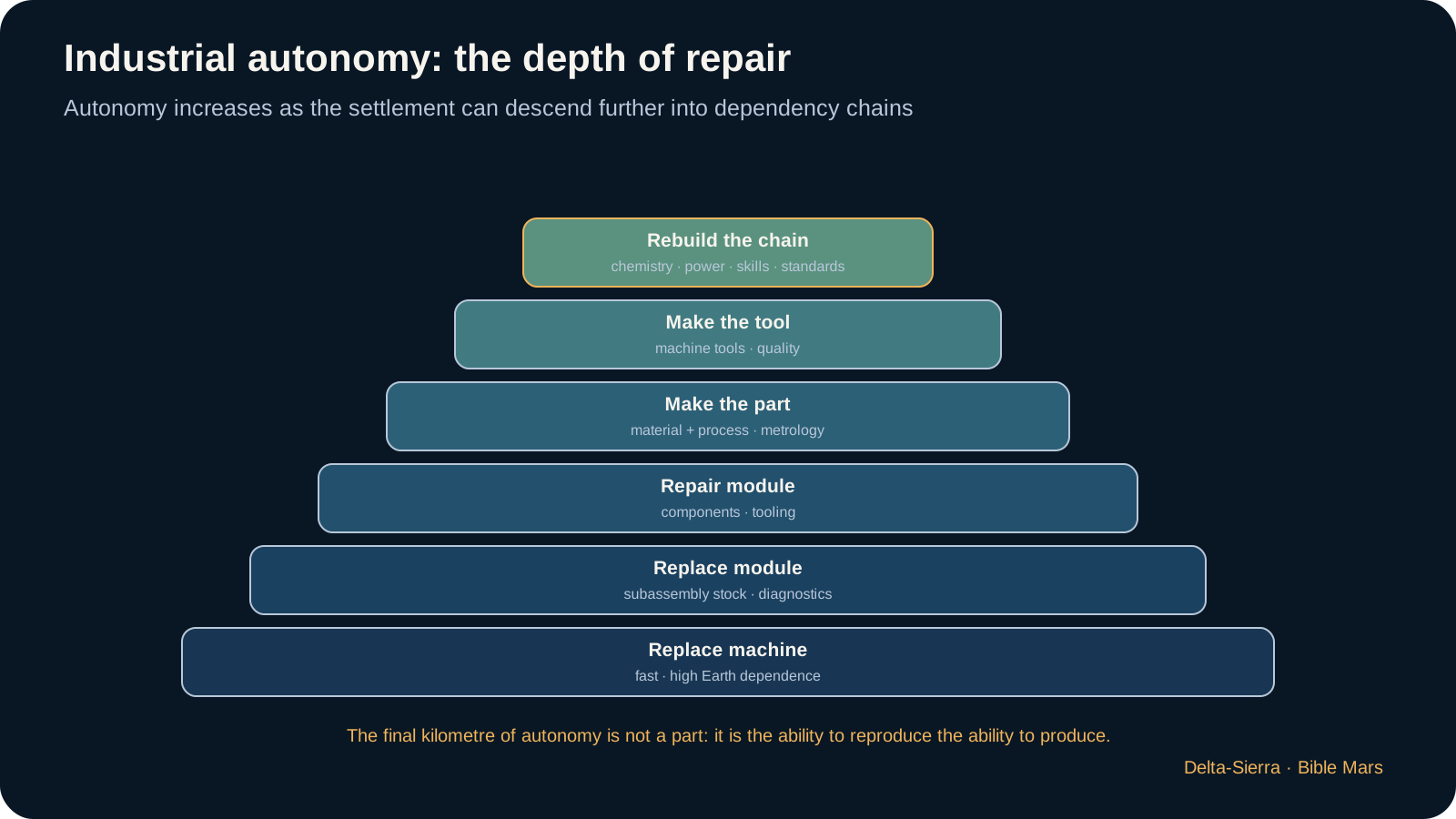
The industrial threshold is the ability to restore production capability itself. An early base swaps modules. A mature settlement repairs modules. A proto-city makes selected parts. A more autonomous industrial system must then repair the machines that make the parts: bearings, motors, drives, cutting tools, furnaces, metrology, lubricants, software and safety systems. Autonomy becomes recursive.
Simple indicator: stock coverage. If a critical item is consumed at an average of 6 units per year and 18 qualified units are in stock, average coverage is 18 ÷ 6 = 3 years. The number still needs margin for clustered failures, manufacturing time and the next Earth transport window. Three years of stock is not three years of guaranteed safety.
Industrial failure modes to plan for. A Mars industrial system is therefore a dependency network: a large factory is fragile if one tiny non-reproducible link can stop it.
References: NASA — Moon to Mars Architecture; ESA — Dependability.
ENGINEERING READING
To reason correctly about this system, we must consider vital functions, critical imports, repair capability, substitution, manufacturing and reconstruction times together.
Long-term autonomy is better represented as a dependency tree than as a count of machines. A settlement may machine a replacement housing locally while still importing the cutting inserts, lubricant, sensor, alloying element or calibration reference that makes the repair possible. The important metric is therefore the fraction of critical functions that can be restored after their upstream dependencies are traced. This encourages investment in bottlenecks: metrology, heat treatment, electronics repair, process chemicals and skilled labor may unlock more real independence than adding another high-throughput printer. Autonomy grows when a failure can be diagnosed, supplied and qualified locally, not merely when a part can be shaped locally.
LEARNING SCENARIO — assume 36 critical parts are genuinely usable and average demand is 4 parts per day. Gross coverage is 36 ÷ 4 = 9 days. That number is only an indicator: it fails if part numbers are not interchangeable, several failures consume the same family, or an item on the shelf is not qualified for the required use.
For long-term industrial autonomy, the adverse case pairs a failure of the machine expected to reproduce spares with discovery of a defect in an existing batch. Inventory then falls while the ability to regenerate it is also lost. The lesson is not to duplicate every machine, but to identify production assets whose loss turns a local fault into a long-lived logistics debt.
Industrial recovery is reached only when the workshop can again turn available feedstock into a qualified part, measure its critical characteristics, release it for service, and rebuild a production buffer. A machine that merely restarts without metrology, substitute material, or trained operators has not restored industrial autonomy.
Consider a settlement that tracks twenty critical function families: air, water, power, thermal control, staple food, local communications, Earth communications, mobility, excavation, mechanical workshop, electronics, emergency medicine, fire response, pressure integrity, chemical analysis, software, cryogenic storage, construction, agriculture and waste treatment. Each function receives one of three states: sustainable for twelve months without cargo, sustainable only in degraded mode, or a blocking dependency. The model does not pretend to summarize the economy; it reveals where logistics interruption becomes existential.
If fourteen functions are sustainable, four degraded and two blocking, calling the settlement '70 percent autonomous' would be misleading. The two blocking functions might be one essential pharmaceutical and one unique controller, making them more important than several tonnes of locally produced construction material. The matrix therefore needs criticality and recovery-time weighting. It turns autonomy into a prioritized engineering program rather than a marketing percentage.
The same matrix can be updated before every launch window. A dependency may move from red to amber when inventory covers two resupply cycles, and to green when diagnosis, repair and acceptance testing can be performed locally. Decision-makers can then compare investments: a spectacular new factory versus eliminating one quiet dependency capable of stopping life support for months.
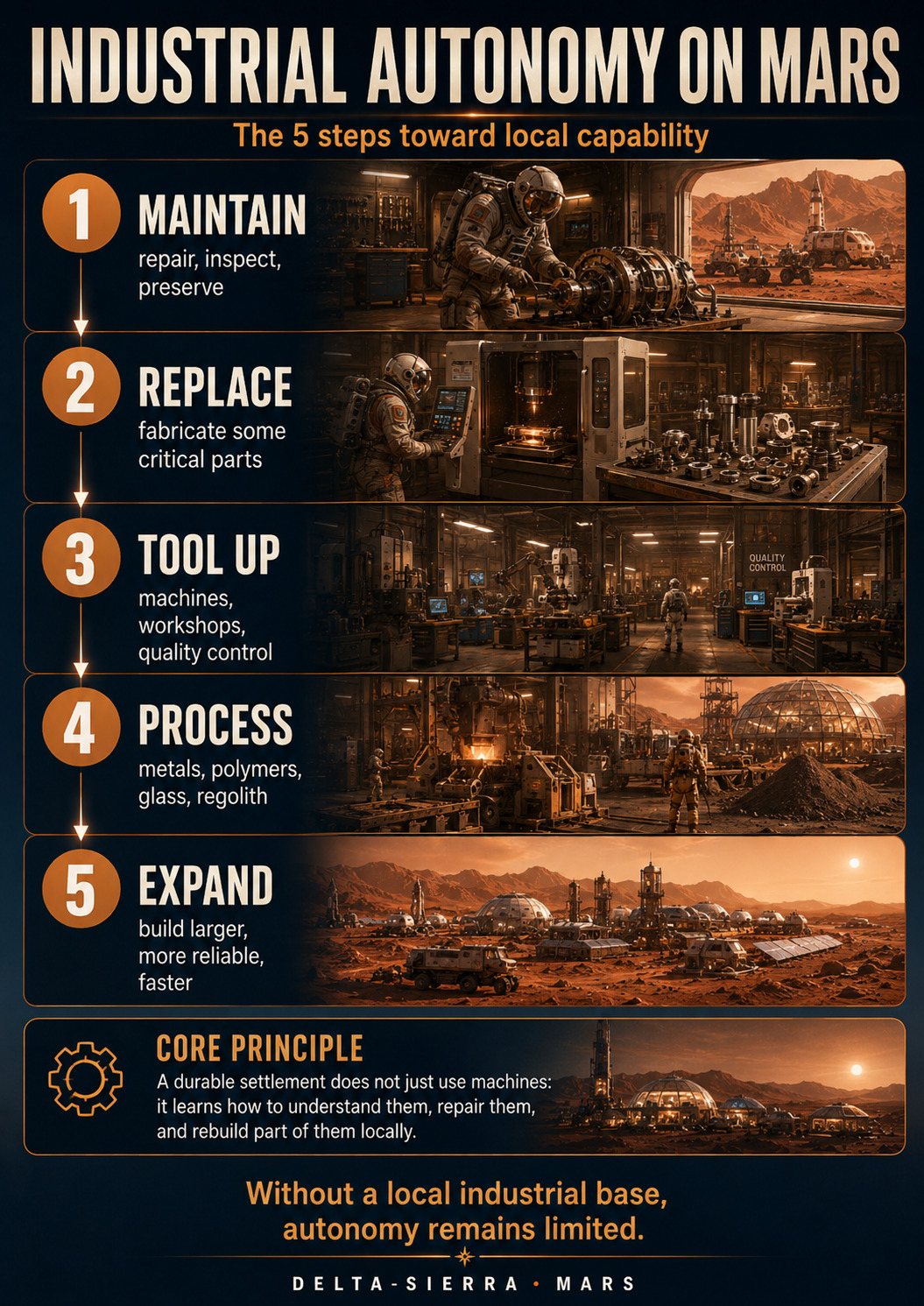
The first industrial gain probably comes not from a Martian steel mill but from a workshop that avoids throwing hardware away. A worn pump may be recovered by replacing a bearing, regrinding a shaft, rewinding a motor or producing a seal. A disabled rover can become a reservoir of motors, cables, gearboxes and sensors. Repair turns every imported kilogram into durable capital. That requires equipment designed to be opened, standardized interfaces, accessible drawings, traceable part numbers and diagnostic procedures. A sealed proprietary unit that is acceptable on Earth can become an operational liability in an isolated settlement.
The mass leverage is easy to see. Suppose an 18-kilogram actuator fails because of a 0.4-kilogram bearing. If the settlement can identify the fault, remove the bearing, inspect the seats, install a qualified replacement and revalidate the actuator, it avoids importing 17.6 kilograms that would add no new function. This simplified example explains why maintenance, measurement and documentation come before heavy industry. A real Martian workshop begins with instruments, benches, cutting tools, cleaning equipment and test capability; primary materials production becomes useful only after the settlement can prove what it has made or repaired.
Repair before primary production. Maintenance is the first industry. A failed bearing, power board or sensor can stop an entire plant. Early workshops must diagnose faults, recondition parts, cannibalize hardware, fabricate replacements and maintain digital design inventories.
This stage still relies heavily on imported feedstock and components, but it can already collapse the number of unique spares that must be shipped from Earth.
No industrial settlement can rely on one universal material. Steel offers strength and weldability but requires ore preparation, reduction, alloying and metallurgical control. Aluminium is light but energy-intensive to separate from oxides. Glass can serve technical windows, fibres, insulation and containers, while ceramics are valuable for high-temperature, electrical and wear applications. Polymers are essential for seals, cable jackets, membranes and lightweight parts, yet their feedstocks and radiation ageing must be controlled. Material selection therefore becomes a trade among local feedstock, energy, available tooling, repairability and required quality.
The material palette should also support substitution. If a complex terrestrial alloy cannot be made, can a component be redesigned in a simpler, heavier but locally manufacturable steel? If a technical polymer is unavailable, can a metallic geometry with a replaceable seal perform the same function? If an advanced ceramic is out of reach, can extra thickness of a lower-performance material close the requirement? Mars will sometimes reward local manufacturability over terrestrial optimization. That does not mean accepting poor quality; it means treating production capability as a design input from the beginning.
Metals, glass, ceramics and structures. Metals and alloys support beams, pipes, tanks, frames, wires and machinery. Silicates can support glass, fibres, ceramics and shielding materials. On Mars, energy and high-temperature equipment maintenance may be more limiting than raw material abundance.
Every process must be evaluated as a full chain from excavation to quality control and scrap recycling.
The decisive step comes when a workshop can maintain not only settlement hardware but its own means of production. A milling machine depends on spindles, guides, motors, sensors, lubrication and cutting tools. A furnace depends on insulation, heaters, thermocouples, power electronics and control. A metal printer depends on qualified feedstock, energy delivery, atmosphere control and inspection. The factory-of-machines concept therefore treats machine tools as systems with their own bills of material, wear parts and calibration needs rather than as permanent black boxes.
This recursion sets a realistic ceiling on autonomy. Making a screw does not prove that the lathe producing the screw can be remade; printing a metal part does not prove that the laser, optics and power electronics of the printer can be manufactured locally. A sensible strategy is to maintain a versatile core — turning, milling, cutting, welding, heat treatment, additive processes and metrology — while stocking the hardest-to-reproduce components of that core. The short-term objective is not zero imports; it is increasing the time for which the manufacturing system can keep itself alive.
The multiplier: machines that can make machines. A settlement crosses an important threshold when it can build or repair lathes, mills, presses, furnaces, pumps, robots, handling equipment and multi-material printers. NASA’s “bootstrap manufacturing” concept follows this logic: a seed production system gradually makes more capable production equipment.
A milling machine makes parts but depends on bearings, encoders, screws, motors and cutting tools. The motor depends on insulated copper, magnets, laminations and power electronics. Electronics depends on components the settlement may not be able to fabricate. Industrial autonomy is therefore a dependency tree whose branches open more branches. Trying to close the entire tree immediately causes a complexity explosion. The practical strategy is to choose repair depth by function and secure deeper layers through stock, redundancy or compatible design.
A useful ladder is repair depth. Level 0 replaces the complete machine. Level 1 replaces a module. Level 2 repairs the module with standardized parts. Level 3 fabricates those parts. Level 4 fabricates some of the tooling needed to make them. Level 5 attempts to reproduce fundamental components of the tooling itself. Mechanical systems may reach levels 3 or 4 while selected optics, chips or scientific instruments remain at levels 1 or 2 for decades.
This hierarchy changes procurement on Earth. Imported equipment should be selected not only for efficiency or mass but for attainable repair depth on Mars. Two pumps with similar performance are not equivalent if one uses standard bearings and seals while the other relies on a sealed proprietary cartridge. Earth purchasing policy therefore becomes part of Martian autonomy years before local industry exists.
Electronics reveals the difference between local assembly and deep autonomy. A settlement may fairly early fabricate enclosures, cables, harnesses, simple boards, antennas, some sensors and printed conductors, and it can repair boards by replacing standardized components. An advanced semiconductor fab is another world: ultrapure water, high-purity gases and chemicals, cleanrooms, lithography, contamination control and nanometre-scale metrology. The realistic early goal is therefore repairability, standardization and intelligent inventories of components rather than a local cutting-edge microprocessor industry.
Software is part of the spare. Without firmware, cryptographic keys, calibration constants, schematics and compatible versions, a physically available component may remain unusable. Settlement archives therefore need to preserve CAD models, bills of materials, source and binary software, procedures, certificates and configuration history as industrial assets. When Earth support is delayed or unavailable, losing a configuration file can immobilize a system just as effectively as losing a bearing or power transistor.
Advanced electronics are the final lock. Printing a conductor, building a simple sensor and fabricating a modern microprocessor are completely different industrial levels. Advanced semiconductors require extreme purity, cleanrooms, metrology and many deposition, lithography, doping and packaging steps.
A realistic path therefore starts with repair, recycling, hybrid boards and printed electronics long before advanced integrated circuits.
A part is not usable merely because it resembles the drawing. It has to be measured, inspected and connected to an engineering requirement. A pressure flange may require dimensions, finish, material condition, heat treatment, leak tightness and nondestructive evaluation. An electronic board needs electrical, thermal and functional tests. An additively manufactured structure needs evidence about porosity, defects and properties. Metrology, qualification and quality control are therefore survival infrastructure: they provide the confidence needed to replace an Earth-made part with a Mars-made part without turning every repair into a hazardous experiment.
Quality effort should scale with consequence. A storage bracket may need little more than dimensional inspection; a pressure-boundary part, structural fitting or life-support component requires far stronger evidence. Manufacturing records should connect feedstock, batch, machine, parameters, operator or software, inspections and final acceptance. Traceability makes it possible to diagnose failures, recall a bad batch and reproduce a successful process. Martian industry becomes credible when it can say not only 'we can make this' but 'we can demonstrate why this part is fit for its intended service.'
Materials, construction, recycling and quality. This cluster connects raw matter to a product, then the product to qualification, maintenance and recycling. Read it as one industrial chain.
When an Earth-made part is replaced by a Mars-made version, the question is not simply whether it works but where it may be authorized. The same manufacturing process might be acceptable for a low-consequence bracket and prohibited for a pressure boundary. A settlement therefore needs service classes linked to available evidence: identified feedstock, machine history, dimensional inspection, mechanical testing, nondestructive evaluation and accumulated service experience.
This approach avoids freezing innovation behind impossible certification while protecting survival systems. Workshops can begin with low-consequence uses, collect data and gradually expand qualified domains. Every documented success grows the local catalogue; every anomaly refines its limits. Industry becomes a learning institution rather than a collection of machines operated on confidence alone.
At scale, the qualified-parts catalogue becomes strategic knowledge. For each item it can record material, process, version, temperature domain, allowable loads, environment and required inspection. It connects workshop, maintenance and systems engineering, and it preserves knowledge across generations. A settlement that loses its qualification records may still own the same machines but become industrially dependent again because it can no longer prove what those machines can safely produce.
With four people, industry is mostly a maintenance workshop surrounded by stocks. At twenty, equipment diversity begins to justify specialists and a small fabrication cell. At one hundred, waste streams, metals, polymers and worn parts become large enough to sustain continuous recycling loops. At one thousand, the problem becomes industrial planning: separate incompatible shops, manage feedstocks, train operators, maintain laboratories, reserve power and decide which supply chains deserve local capital. Scale changes organization as much as it changes machine count.
A useful indicator is the number of critical functions that can be sustained for twelve months without a cargo flight. That number is more informative than a vague '60 percent autonomous.' A settlement may make 90 percent of its consumed mass locally and still be vulnerable to ten irreplaceable circuit boards. Another may import many comfort goods while mastering every survival-critical function. Strategy should therefore eliminate the dependencies whose loss would stop the settlement first, and only then broaden the local product range for economic growth and quality of life.
This system within the settlement. DELTA-SIERRA / ARCADIA PROSPECTIVE ARCHITECTURE
Turning a long-term vision into a testable architecture. Arcadia is used as an integration exercise across systems, never as evidence that a capability already exists. The Bible keeps current technology, development programmes and prospective architecture separate.
Go deeper with ArcadiaMartian rocks and regolith contain useful elements and basaltic materials, but “contains an element” is not the same as “economically mineable ore.” Grade, mineralogy, contaminants, extraction energy and process yield matter.
Industry therefore starts with prospecting and materials processing, not with an imaginary steel mill placed wherever the first habitat lands.
A settlement may own printers, lathes, furnaces and a small chemical plant while remaining deeply Earth-dependent. One precision bearing, sensor, qualified metal feedstock, pharmaceutical or electronic component can preserve an external single point of failure. A more useful indicator is therefore critical imported mass: the annual mass of items whose absence can stop an essential function, considered together with time to shortage and available substitutes.
This changes industrial priority. Localizing a heavy but easy-to-stock construction material can save enormous transport mass without reducing the most serious operational risk. Conversely, learning to diagnose a control board or make a reliable seal may remove a system-level vulnerability even though the part weighs grams. Early Martian industry should therefore be selected by its effect on dependencies, not by visual impressiveness.
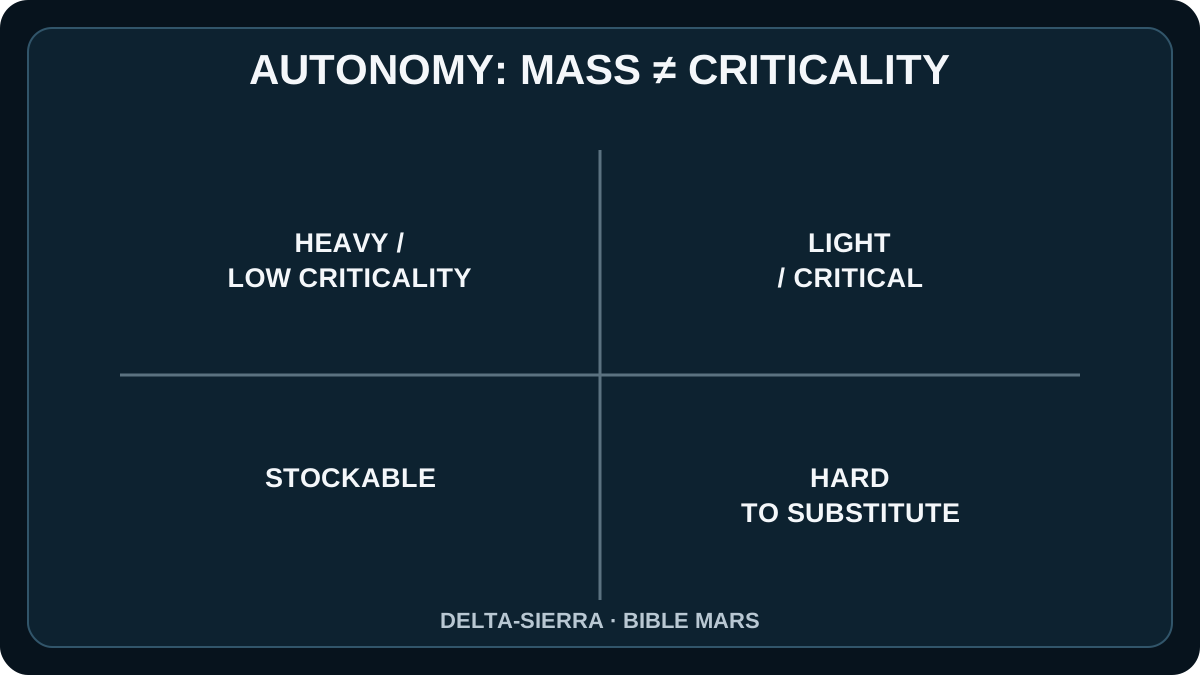
Consider two annual flows. Flow A is 20 tonnes of imported construction material, but deliveries can stop for two years without threatening life support. Flow B is only 5 kg of control components, but running out can disable water purification after six months. Localizing 90% of Flow A saves 18 tonnes — a major logistics achievement — yet it does not remove the life-support break point created by the five kilograms in Flow B.
A simple non-physical prioritization score can make this visible: priority = criticality × inverse time-to-shortage × substitution difficulty. The score is not a universal scientific unit; it is a decision aid. Its purpose is to force a documented answer to the question “why manufacture this item before that one?” A stockpile may remain the best solution for many years. Local production becomes attractive when failure probability, transport delay, cumulative consumption and obsolescence make inventory less robust.
Scale changes the institution around the machines. Four residents can bridge many dependencies with spares. At twenty, recurring consumption begins to justify local processing. At one hundred, the workshop becomes a network of production, quality assurance, documentation and supply. At one thousand, the settlement needs industrial disciplines, specialist training, metrology and obsolescence management. Industrial autonomy therefore changes structure, not just throughput.
Document check: 2026-08-10.
Autonomy is not the absence of exchange with Earth. It is the ability to sustain life and infrastructure when resupply is delayed, a supplier disappears, or a failure requires a new solution. It is built in layers: stocks, repair, manufacturing, materials, knowledge, institutions, and the ability to choose dependencies rather than suffer them.
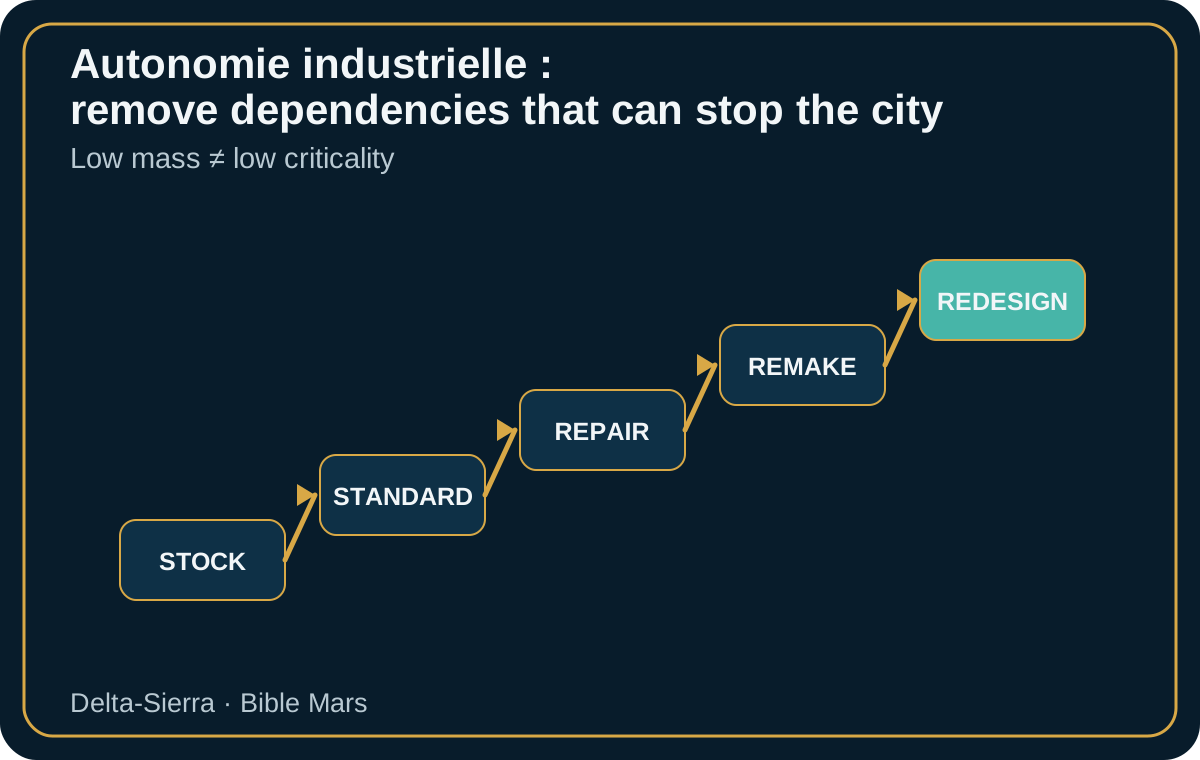
A settlement can produce tons of water and remain dependent on a sensor weighing grams. Analysis should therefore focus on critical functions and dependency chains rather than local mass fraction alone.
Functional dependency. Each vital service should be decomposed down to elements whose loss truly stops the function.
Material dependency. A scarce material can block several part families even if the rest of the mass is locally available.
Information dependency. Drawings, software, parameters, and knowledge need to be local if Earth is temporarily unavailable.
Human dependency. A skill held by one person is as real a single point of failure as a unique component.
Governance dependency. The town must be able to authorize a repair or local material under defined rules rather than await a decision that cannot arrive in time.
Inventory is not the opposite of autonomy. It buys time to diagnose, repair, manufacture, or wait for a transport window. The goal is to intelligently stock what cannot yet be replaced locally.
Days of cover. Consumables should be expressed in operating days under several regimes rather than number of boxes.
Critical dormant spares. Some spares may never be used yet remain essential because their absence during failure would have disproportionate consequences.
Inventory rotation. Medicines, polymers, batteries, and chemicals age; inventory must manage shelf life and requalification.
Distributed inventory. Separating some reserves prevents a fire or contamination event from destroying both primary resource and backup.
Import priorities. Each logistics window should target dependencies the base still cannot cover, not merely replace what was consumed.
C = fonctions_critiques_couvertes / fonctions_critiques_totales
If 72 critical functions out of 100 can be restored without essential external hardware, C = 0.72. The number only matters if the function list is explicit and maintained.
Industrial autonomy is a progression. Repairing with an imported spare, manufacturing with imported feedstock, and producing the feedstock locally are three different levels and should not be conflated.
Repair level. The first step is restoring functions with local diagnosis, disassembly, parts, and testing.
Manufacturing level. Machines and drawings allow some geometries to be replaced while still depending on imported feedstock, tools, and sensors.
Material level. Metallurgy, chemistry, and recycling reduce feedstock dependency while increasing power, processing, and quality-control needs.
Equipment level. Manufacturing a complete machine tool or electrolyzer requires a much deeper industrial chain than making a simple part.
Knowledge level. Local ability to modify and redesign prevents dependency on a terrestrial definition that has become obsolete.
A town using a hundred connector families and fifty thread systems wastes inventory and training. But rigid standardization can block better solutions. Autonomy needs governed standards rather than frozen ones.
Common interfaces. Electrical, mechanical, fluid, and digital interfaces can be standardized within families to enable substitution and shared spares.
Material grades. Reducing the number of qualified grades simplifies inventory, testing, and processing as long as functional needs remain covered.
Version management. Every local modification should remain identifiable so the correct drawing, software, and procedure are known for each installation.
Controlled deviations. A crisis may justify a substitute or nonstandard repair, but the deviation should be limited, documented, and reevaluated.
Retiring old standards. When the base adopts a new interface, transition and inventory must be managed so two incompatible systems do not persist for decades.
J = stock_disponible / consommation_journalière
The formula turns inventory into service duration, allowing consumables of very different mass to be compared.
Industry can own all its machines and still lose capability if it does not preserve why processes work, how to measure them, and how to train new operators.
Local documentation. Procedures, schematics, and test results need to be available offline and synchronized with the actual state of installations.
Training for understanding. An operator who understands the physical mechanism responds better to an unknown failure than someone trained only to follow a screen.
Apprenticeship. Rare trades need to transmit tacit knowledge, craft, and judgment that documents alone capture poorly.
Simulation and training. Simulated failures test collective capability before a real event reveals gaps.
Decision archives. Architecture decisions should retain assumptions and rationale so the next generation knows when they can be revisited.
A settlement does not switch from dependent to autonomous on one date. It reduces some dependencies, discovers others, and needs honest metrics to know where to invest the next ton of hardware and year of research.
Share of functions covered. A useful metric counts critical functions recoverable locally, not merely the percentage of mass made on Mars.
Resupply-independent duration. The number of months the town can sustain functions under several scenarios expresses the depth of stocks and repairs.
Recovery time. The ability to restore infrastructure after a major failure is more informative than nominal redundancy alone.
Unique dependencies. The number of functions blocked by one part number or skill should decline over the years.
Substitution capability. A mature town has known and tested alternatives when a material, supplier, or process becomes unavailable.
R = P_panne × conséquence
This simplified product does not replace PRA, but it separates likelihood from consequence and helps prioritize dependencies to eliminate.
A settlement with two years of food but one irreplaceable sensor on a critical pump does not have two years of autonomy. A simple indicator is to estimate, for every essential function, the time until a consumable, wear item or obsolete component creates a dependency that cannot be recovered locally. The shortest of those times becomes a rough “break horizon.” The metric is imperfect, but it forces attention onto the weakest link.
As local capability grows, the horizon should move outward. Seal inventory grows from six months to five years; motor overhaul avoids complete replacement; local machining removes one imported reference. Yet a dependency can reappear elsewhere — tool material, calibration artefact, proprietary software or medicine. Autonomy is therefore a continuous investigation of moving dependencies.
This view helps set research priorities. The question is not simply “can we manufacture more?” but “which new capability extends the settlement's break horizon the most?” That is much closer to operational resilience.
Two resupply windows missed
The town must last far longer than planned. The exercise reveals which functions still depend on irreplaceable consumables and which activities must be reduced to protect vital stock.
A component supplier disappears
The team analyzes remaining inventory, equivalents, redesign, and local manufacturing capability before the last spare is consumed.
A generation of specialists retires
Continuity depends on apprentices, documents, and exercises prepared in advance. The scenario tests knowledge transfer as genuine human redundancy.
The town adopts a new connector standard
The commonality benefit has to be compared with conversion cost, existing inventory, and temporary coexistence of two families.
A town able to mine thousands of tonnes of regolith may still depend on a seal, microcontroller, or medicine weighing grams. Adding locally produced mass therefore gives a false picture of autonomy. Useful analysis maps functional chains and searches for single points: parts with no substitute, software without local expertise, catalysts, measurement standards, specialized bearings, or seed. For each point, the town calculates time to shortage, stock, repairability, and substitution. A dependency becomes critical when time to shortage is shorter than realistic time to replace or bypass it. This method often shows that autonomy begins with information, diagnosis, and spares before it begins with very large factories.
Water may become largely local early if accessible deposits exist, while advanced electronics will likely remain imported much longer. Food may be partly local while depending on micronutrients, seed, or plant-health products. Metallurgy may make simple forms before critical alloys. The settlement should therefore publish a function-by-function table: water, gases, food, structures, maintenance, electronics, medicine, and information. Each row states local capability, remaining dependencies, and stock horizon. This is more honest than one global percentage and allows investment to follow actual shortage risk.
A written procedure does not always replace skill. Welding, surgery, electronics diagnosis, plant cultivation, and metrology require experience. A colony with all the machines but without people able to use them can lose autonomy overnight. Human redundancy therefore matters: multiple operators for critical skills, cross-training, simulators, work records, and documentation that explains reasons rather than only steps. AI tools can help retrieve or combine knowledge, but they become dependencies in compute, data, and maintenance. Intellectual autonomy needs usable paths when a network or model is unavailable.
Trying to make everything locally from the beginning can waste enormous mass and energy on rarely used capabilities. A more robust strategy first maximizes resilience: adequate stocks, repair, substitution, standardized interfaces, and local production of the heaviest or most frequently consumed items. Industrial capability grows as experience reveals which dependencies are costly or genuinely threaten the mission. This preserves trade with Earth while preventing it from being an immediate condition for survival. Success is therefore not a date when Mars 'no longer depends on Earth' but a continuous increase in how long the town can remain safe, functional, and able to repair its own mistakes.
No experiment can yet provide a universal percentage for Martian autonomy. A town may be independent for water while remaining Earth-dependent for electronics, selected medicines, or specialized machines. The useful measure is therefore a portfolio of dependencies, each tied to time-to-shortage, stocks, substitutes, and local recovery capability.
A settlement can own many machines and remain Earth-dependent if bearings, cutting tools, electronic boards, catalysts or software are imported. Autonomy is measured by unresolved critical dependencies and the time society can continue repairing and producing without resupply.
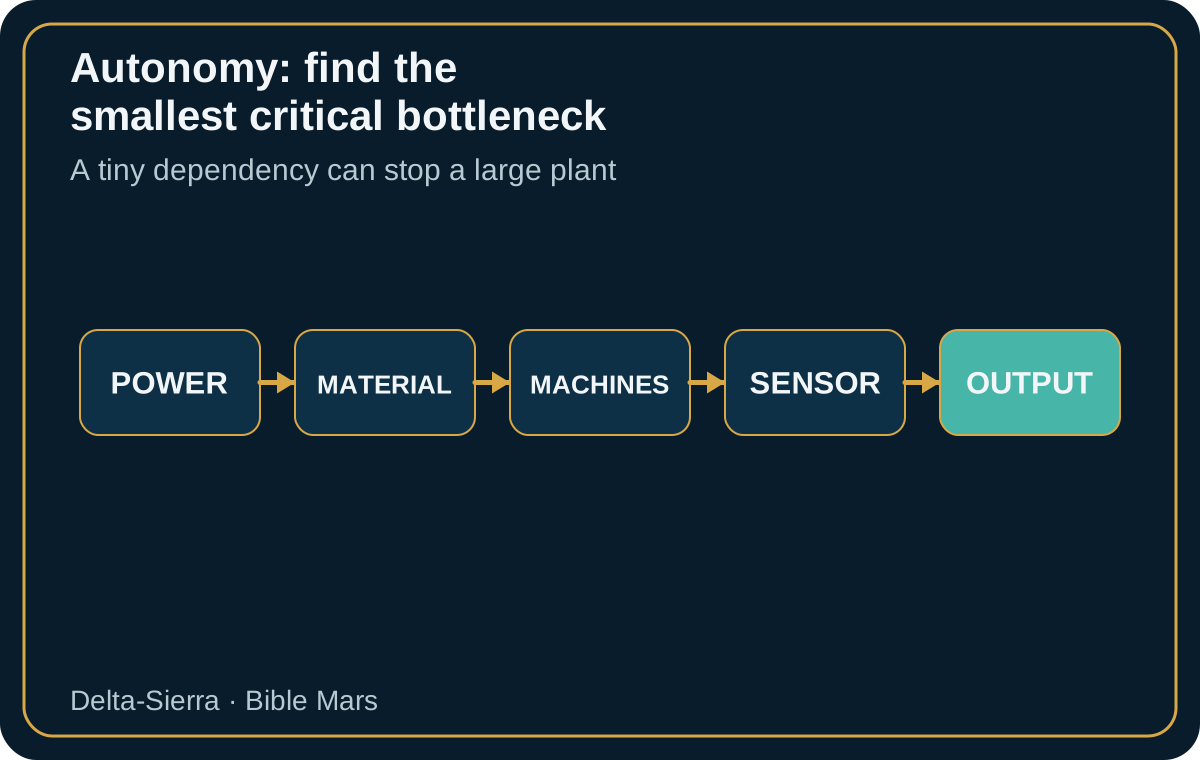
NASA's earlier “bootstrap manufacturing” concept proposed a seed system using regolith to make major structural parts and spares, then expanding its own capability. The systems lesson remains useful: Martian industry grows through capabilities that reinforce one another. The path from workshop to economy still requires power, mining, chemistry, metrology, electronics, training and inventory.
For every product, ask whether feedstock is local, the process is local, wear parts are replaceable, measurement is local, software and technical data are available, and substitutes exist. A locally machined pump that depends on an irreplaceable bearing remains a single point of logistical failure.
A dependency matrix is often more useful than one autonomy percentage. Rows can represent materials, energy, machines, tooling, metrology, skills and consumables; cells can be local, recyclable, stockpiled, substitutable or import-only. The map exposes which missing capability blocks an entire chain.
A CNC machine supports mobility, habitat, power and agriculture. Metallurgy supplies structure, fasteners, tooling and spares. Oxygen production supports life, processing and propulsion. Early local capabilities should be judged by cross-sector leverage.
The Common Habitat RMAF study applies this logic on a smaller scale by identifying repair functions that cover many critical failures. At city scale, generic cutting, welding, machining, printing, chemical analysis and nondestructive evaluation may yield more resilience than an early attempt to reproduce one complex product end-to-end.
Inventory remains necessary in a productive society
Manufacturing capability does not eliminate stock. A part that can be produced in two days does not protect a system that must be repaired in two hours. Critical components combine immediate inventory with reproduction capability.
If a component family uses twelve pieces per year and the next reliable logistics window is 26 months away, average demand over that period is 12 × 26/12 = 26 pieces before variability and safety stock. Interplanetary windows are therefore industrial parameters.
A society that can make a part but cannot demonstrate its quality remains fragile. Traceability, calibration, test procedures, batch records and acceptance criteria turn fabrication into infrastructure. Metrology is an autonomy technology alongside mining and furnaces.
Early local parts can be restricted to noncritical uses while process data accumulate. Stable processes then move into more demanding applications. Electronics and high-precision components may remain among the hardest sectors to localize; realistic autonomy reduces critical imports progressively rather than pretending they disappear at once.
A global autonomy percentage can mislead. A city may produce 95% of its annual mass locally yet depend on a few grams of one imported component. The useful question is which dependency has the shortest depletion time and which vital function it will stop. Autonomy becomes bottleneck analysis.
Suppose a component family consumes 18 units per year and stock contains 40. Without manufacturing or substitution, mean gross endurance is 40 ÷ 18 ≈ 2.22 years. If failures rise by 50% during a difficult period, use becomes 27 per year and endurance falls to 40 ÷ 27 ≈ 1.48 years. Historical averages are not enough for interplanetary logistics.
Substitution is an industrial capability. Replacing an unavailable sensor may require a mechanical adapter, different power, software modification, recalibration and new qualification. The settlement therefore stocks integration knowledge as well as parts. A resilient economy can redesign around shortages.
Capability growth can follow risk: repair and reuse first; simple parts next; materials and intermediate components later; sophisticated chains only when the supporting knowledge and infrastructure exist. Mars need not make everything immediately, but it must know which next capability removes the largest critical dependence.
Human skills are inventory. A process known by one person is a common cause. Documentation, cross-training, simulators and practical apprenticeship create multiple holders of the knowledge. The ability to transmit a trade is as strategic as a spare machine.
Long-term autonomy is not isolation. Mars may continue exchanging data, culture and high-value products with Earth. The technical goal is that temporary trade interruption does not immediately threaten air, water, food, power, health or safety. An autonomous society chooses imports rather than requiring them to stay alive.
Some industries are far harder to localize than bulk materials. Semiconductor fabrication requires extreme purity, controlled environments, complex equipment and a vast supply chain. A settlement may manufacture housings, cables and simple boards long before it can make advanced processors. Autonomy planning should identify these hard sectors honestly and design long-lived, replaceable architectures around them.
Catalysts can create similar hidden dependence. A chemical plant may process tonnes of local material but rely on kilograms of a specialized catalyst. Catalyst lifetime, regeneration and substitutes should therefore be included in logistics. A tiny imported mass can control a huge local throughput.
Precision bearings, seals, sensors and optics sit between simple workshop products and advanced electronics. These intermediate industries may offer high leverage because many systems share them. Developing local capability in one class can reduce dependencies across mobility, power, life support and manufacturing.
Standard interfaces increase substitution options. If pumps, sensors or power modules share electrical and mechanical conventions, a locally available replacement can be adapted more easily. Standardization is thus a form of inventory: it stores future options in the architecture.
Economic autonomy also requires deciding when not to localize. If an imported component has tiny mass, very long shelf life and extremely difficult production, carrying decades of stock may be rational. Local production should focus first on heavy, failure-prone, time-critical or cross-sector components.
The frontier of autonomy will move as population and skill grow. What is an imported black box for the first crew may become a repairable assembly for a town and a locally manufactured product for a city. The roadmap should therefore be staged, evidence-based and revisited after every campaign.
A critical purification unit stops because of a 30 g electronic sensor. The settlement can reproduce most of the machine's mass but not the sensor technology. This is why locally produced tonnage is a poor autonomy metric.
Three responses exist: hold more sensors, adapt a different sensor or modify control to operate temporarily using another measurement. Adaptation requires mechanics, power, software protocol and recalibration; degraded operation may reduce performance or safety. Autonomy is the ability to choose among these paths.
If inventory holds 12 sensors and observed consumption is three per year, mean gross endurance is four years. A common batch defect, however, can invalidate several at once. Diversity of supplier or sensing principle may be more resilient than simply doubling identical stock.
The settlement should therefore maintain a list of “small dependencies with large consequences.” Those items become priorities for substitution, standardization or local development. Autonomy advances by removing bottlenecks, not by adding production tonnes.
Industrial dependence is often described through physical parts, but design knowledge can be equally critical. A machine may be locally repairable while its control software, calibration algorithm or material specification remains an external black box. Long-term autonomy requires access to documentation, source code where appropriate, test methods and configuration history.
Standards provide shared language. Thread sizes, electrical interfaces, data protocols, material grades and drawing conventions reduce the number of adapters the city must invent. Too many proprietary interfaces turn every shortage into a custom engineering project. A curated local standards base is therefore part of industrial infrastructure.
Digital archives need redundancy and migration. A file stored for twenty years may become unreadable because software, format or cryptographic keys changed. Critical definitions should exist in durable, documented formats with multiple independent copies and procedures to verify integrity.
Engineering education is another production line. If knowledge only arrives with each new Earth crew, local capability remains dependent on transport. Apprenticeship, laboratories and technical schools must create new maintainers, machinists, chemists and systems engineers on Mars. Training capacity sets a ceiling on industrial growth just as power and material do.
Governance affects technical resilience. Who may approve a substitute material, change a safety-critical drawing or release a locally repaired medical device? Clear authority and evidence requirements prevent both paralysis and unsafe improvisation.
Autonomy therefore means preserving the ability to understand and change the systems on which life depends. A warehouse can delay dependence; a living technical culture can progressively remove it.
Financial or accounting concepts will eventually enter technical prioritization. Two local capabilities may remove similar import mass but differ greatly in required power, skilled labor and infrastructure. A settlement needs a way to compare avoided logistics risk with the opportunity cost of building each new industry.
Population scale changes the answer. A process too complex for twenty people may become rational at one thousand because its fixed equipment and expertise support a much larger demand. Autonomy roadmaps should therefore include thresholds where a capability changes from stockpile strategy to local production.
External trade can strengthen autonomy when it builds buffers rather than permanent fragility. Mars may import advanced electronics while exporting data or specialized products, provided enough stock and substitution exist to survive interruption. Resilience is compatible with exchange; it is incompatible with immediate collapse when exchange pauses.
A settlement may produce 95% of its consumed mass locally and remain completely Earth-dependent if the remaining 5% consists of controllers, catalysts, bearings, medicines or sensors that cannot be replaced. “Local mass fraction” is therefore an incomplete metric. A dependency map should distinguish quantity, criticality, replenishment delay and substitutability.
A simple example makes the point. A 100-tonne plant may depend on one 300 g sensor with no local substitute. If its failure stops production for twenty-six months until another logistics opportunity, those 300 g have disproportionate criticality. Real autonomy is limited by the smallest irreplaceable bottleneck. Industrial strategy should therefore rank dependencies by consequence, not by mass.
A teaching index can combine four dimensions scored from 1 to 5: failure consequence C, frequency or probability F, replenishment delay D and lack of substitute S. A simple score R = C × F × D × S is not a standard; it is a sorting tool. A component scoring 5 × 2 × 5 × 5 = 250 probably deserves more attention than a consumable scoring 2 × 4 × 1 × 2 = 16. The exact values depend on the rubric; the benefit is that assumptions become visible and debatable.
The answer is not always “manufacture locally.” Designers can add redundancy or stock, standardize an interface, select an alternate component, extend service life, import test capability, or redesign a system to remove the dependency. Autonomy is an architecture property before it is a factory property.
First-generation industry depends on imported machines. A second generation can make parts for other systems but cannot repair its machine tools, furnaces, robots or instruments. A third starts reproducing wear components, motors, cables, simple boards, sensors and tooling. Industry becomes recursive when it can sustain the means that sustain the city.
Recursion will never be complete. Some semiconductors, pharmaceuticals, and precision components are likely to remain strategic imports during early industrial growth. Strategy should therefore identify a sovereign core sufficient to prevent collapse: power, water, air, food, structure, mobility, workshop capability, metrology, local communications and basic medical capacity.
With four people, the goal is survival and exceptional repair. Around twenty, a permanent workshop becomes plausible. Around one hundred, professional specialization, material stocks and small-series production become more useful. Around one thousand, industry needs planning, quality systems, waste flows, training and redundant sites. Scaling is not a linear multiplication of machines; it changes social organization and supply-chain depth.
Suppose a population of 1,000 operates 2,000 tonnes of durable equipment with an average 4% annual renewal. That is 80 tonnes of hardware to replace or upgrade each year before expansion. If local industry can deliver only 20 tonnes of useful parts annually, the gap must be covered by repair, longer life or imports. The numbers are only a scenario; they show how the installed asset base eventually drives industrial demand.
Growth adds another load. Building ten new habitats in one year may consume more material than maintaining the entire earlier outpost. Industrial planning should separate three flows: upkeep of the existing stock, replacement of failures and new construction. Investments that increase productive capacity may temporarily consume large resources before they improve autonomy.
If every pump uses a different connector, bearing and voltage, inventory explodes. Standard interfaces allow motors, controllers, seals and parts to be shared. Standardization does not require one universal machine; it reduces critical variety. In an isolated settlement, that logistics advantage may be more valuable than a few percent of performance gained by bespoke optimization.
Standards must also evolve. A poor interface can lock the city into obsolete technology. Technical governance therefore needs revision control, compatibility rules, transition periods and documentation. Autonomy requires configuration memory as much as metal stock.
A machine without skilled people is not a capability. The settlement must preserve welding, machining, chemistry, automation, metrology, maintenance and quality skills with human redundancy. One person able to diagnose a furnace or power network becomes a single point of failure. Cross-training, procedures, simulators and documentation are productive capital.
Over time, technical education must teach principles rather than only procedures. When original parts no longer exist, teams must be able to redesign, calculate and qualify replacements. That adaptive competence may be one of the deepest measures of autonomy.
NASA Moon to Mars Architecture organizes needs by subarchitecture and illustrates that autonomy, logistics, power, mobility, habitation and resource use are coupled. This book extends that systems logic toward a permanent city; it is an extrapolation, not an official NASA colony architecture.
The city identifies three dependencies: a special bearing that can idle an excavator for thirty days, an imported catalyst used by a chemical plant, and an electronic controller whose replacement may take twenty-six months. Their masses may be a few kilograms, a few hundred grams and less than one kilogram. Ranking them by mass would be meaningless. Consequence, frequency, stock, substitution and local qualification time matter more.
The bearing may be redesigned toward a common stocked family. The catalyst may remain a strategic reserve while regeneration is developed. The controller may be redesigned around a more common electronics architecture. Three dependencies therefore produce three different strategies: standardization, stock/regeneration and redesign. Autonomy is a portfolio of decisions.
An annual exercise can simulate logistics and decision isolation: no new parts, no teleoperation and no synchronous expert support for several weeks. Teams maintain priority services, diagnose, repair and document. The point is not theater; it reveals which functions still depend on invisible external resources.
Results become an investment plan. If the main weakness is diagnosis, buying another machine tool does not help. If reference standards are missing, metrology needs investment. If people can repair but wait for one electronic board, standardization or stock becomes the priority. The exercise turns “autonomy” into specific gaps.
First settlers know imported machines because they received or assembled them. Thirty years later, technicians will maintain systems modified several times. Documentation, education, standards and preservation of reference parts are therefore long-term infrastructure. A society that loses the knowledge required to rebuild its own equipment can become more dependent even as its industrial base grows.
Real autonomy combines matter, energy, machines, data and skills. None is sufficient alone. The Martian challenge is to build a system in which each can support the others when Earth temporarily becomes unavailable.
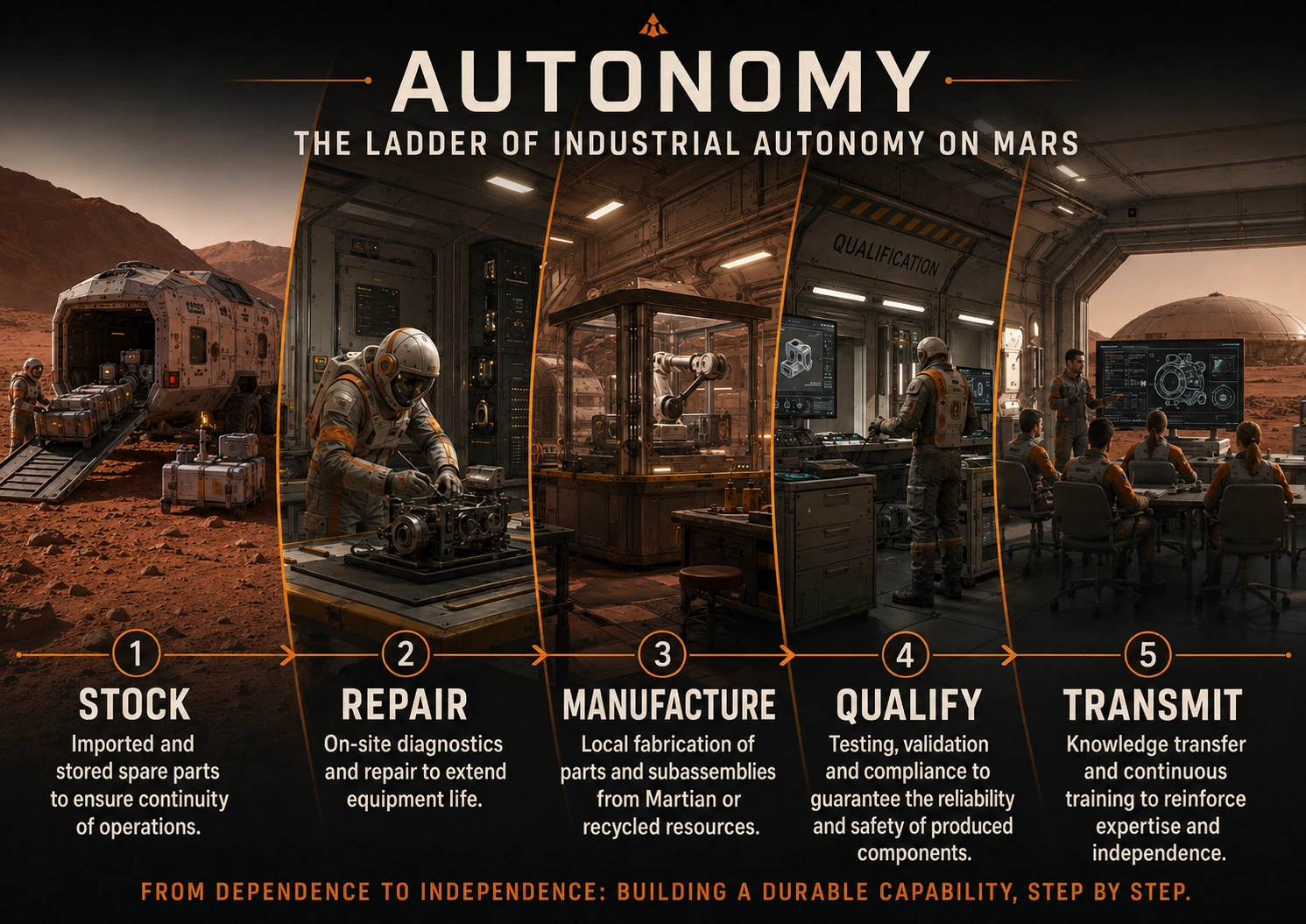
Industrial autonomy is a gradient rather than a switch from dependence to independence. A settlement may produce tonnes of construction material while still depending on kilograms of electronics, enzymes, medicines or instruments. The better measure is whether essential functions continue through a temporary interruption in Earth supply.
Population growth creates another transition: industry must serve multiple customers, reserve capacity, arbitrate emergencies and renew productive capital. Machines that build or repair other machines then become infrastructure on the same strategic level as water and energy.
A base may own a metal printer, lathe, furnace and small chemical plant while remaining deeply Earth-dependent. One unavailable lubricant, qualified powder, fiber, temperature sensor or proprietary controller may stop the chain. The useful question is therefore not “how many processes do we have?” but “which critical functions still have only one viable supply route?”
A simple matrix makes this visible: critical functions on rows and replacement routes on columns. A pump might be restored through an identical imported spare, a locally machined replacement, a compatible alternative pump or a temporary bypass architecture. A row with only one viable cell remains a bottleneck. Industrial growth should attack those red rows first, even when the relevant capability is less visually impressive than a new factory.
NASA TechPort's O₂ Production on Mars project reports, among other work, larger electrolysis cells, co-electrolysis tests and long-duration integrated SOXE–methanation laboratory operation. Those are maturation steps, not an operational Mars capability. Likewise, MOXIE demonstrated small-scale oxygen production on Mars while TechPort describes it as roughly a one-percent-scale model of a target plant. Compressors, filtration, storage, thermal control, power, maintenance and availability sit between a reaction and an industrial service.
This distinction provides a reading rule for every autonomy claim: separate demonstrated reaction, integrated subsystem, durable plant and maintainable production capacity. Only the last state truly converts a logistics dependency into a Martian resource.
Long-term autonomy is best described as a dependency graph that changes over time. Early settlements may import complete machines; later they may import only precision subassemblies, catalysts, electronics, medicines, or specialized feedstocks. Progress occurs when a dependency is removed without creating a more fragile one elsewhere. Producing a metal locally, for example, does not create autonomy if the furnace depends on an imported consumable that cannot be substituted. Each localization project should therefore identify the upstream materials, power, tooling, metrology, software, and skills it adds to the settlement’s burden.
This makes industrial sequencing a strategic problem. High-mass, frequently demanded, technically tractable goods are natural early candidates for localization. Low-mass items with extreme manufacturing complexity may remain imported for much longer even if they are critical. The settlement gains resilience when it can bridge the supply delay for those imports through stock, repair, redesign, and alternative technologies. Industrial independence is therefore not a moment when imports fall to zero; it is a measured increase in the number of essential functions that can be restored after Earth supply is interrupted.
The ability to address many failures with a limited set of workshop functions illustrates autonomy through functional coverage rather than part catalog size.
The active standard helps structure maintainability and feedback as designed properties, directly linking autonomy to architecture.
Measurement and calibration are treated as trust infrastructure: without them, local manufacturing cannot prove its output.
The history of ISFR development shows that autonomy has long been treated as a combination of repair, fabrication, and local resources.
Moon to Mars architecture separates power, logistics, habitation, mobility, and ISRU functions, reminding us that autonomy cannot be assessed through one system alone.
The example of a habitat with workshops, laboratories, and social functions illustrates autonomy as an ecosystem of interconnected capabilities.
NASA — Moon to Mars Architecture Components
NASA NTRS — Overview of NASA ISRU Plans, Priorities, and Activities
A Bootstrap Approach to Martian Manufacturing; NASA Repair, Maintenance and Fabrication Facility; Molten Regolith Electrolysis; and MARS-C.