


1 — Autonomous local network
The city keeps operating if Earth contact disappears.
MARS BIBLE — REFERENCE GUIDE
Rovers, habitats, orbital relays, UHF, X-band, large Earth antennas, store-and-forward and redundancy: design communication as permanent infrastructure.
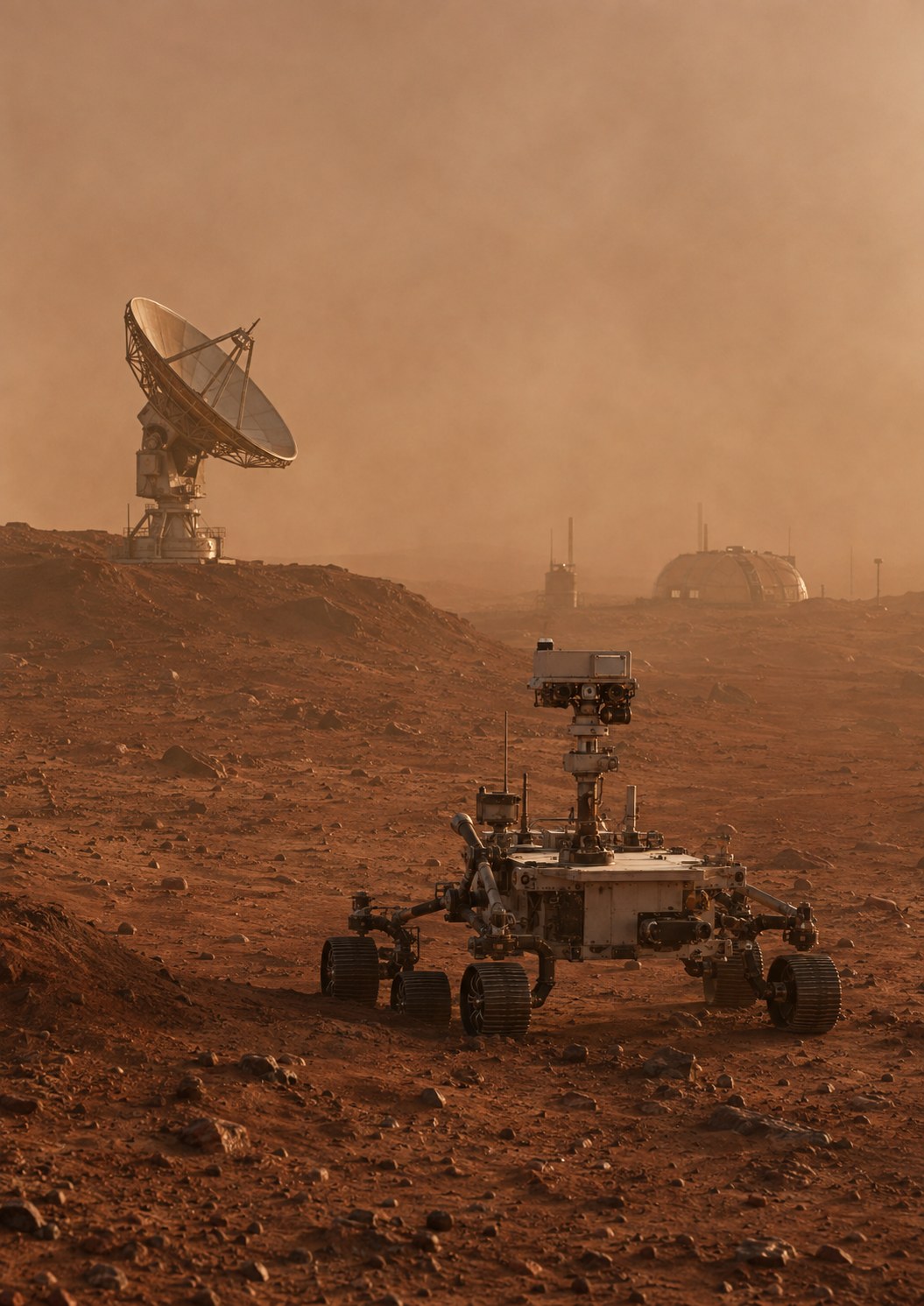
Mars communication is not a single Mars-to-Earth arrow. A rover talks to an orbiter; the orbiter stores and forwards; large Earth antennas receive; a habitat then distributes data locally. Commands and software travel in the opposite direction through scheduled windows.
A permanent settlement needs communications that support local authority rather than remote control; the Mars colonization roadmap shows where relay networks and operational autonomy enter the sequence from first base to durable settlement.
The current Mars Relay Network is already an early form of that architecture. NASA Science’s 2026 page describes an international four-orbiter relay constellation after MAVEN ended and explains why surface missions benefit from orbiters with more power, larger radios and better Earth contact.
A relay architecture should be evaluated over orbital geometry, occultations and surface-user demand. One relay can provide excellent service during part of an orbit and no line of sight during another. Constellation size, orbit choice, cross-links and surface scheduling therefore determine continuity. The network metric is not simply peak data rate but how reliably critical users can obtain contact when their operations need it.
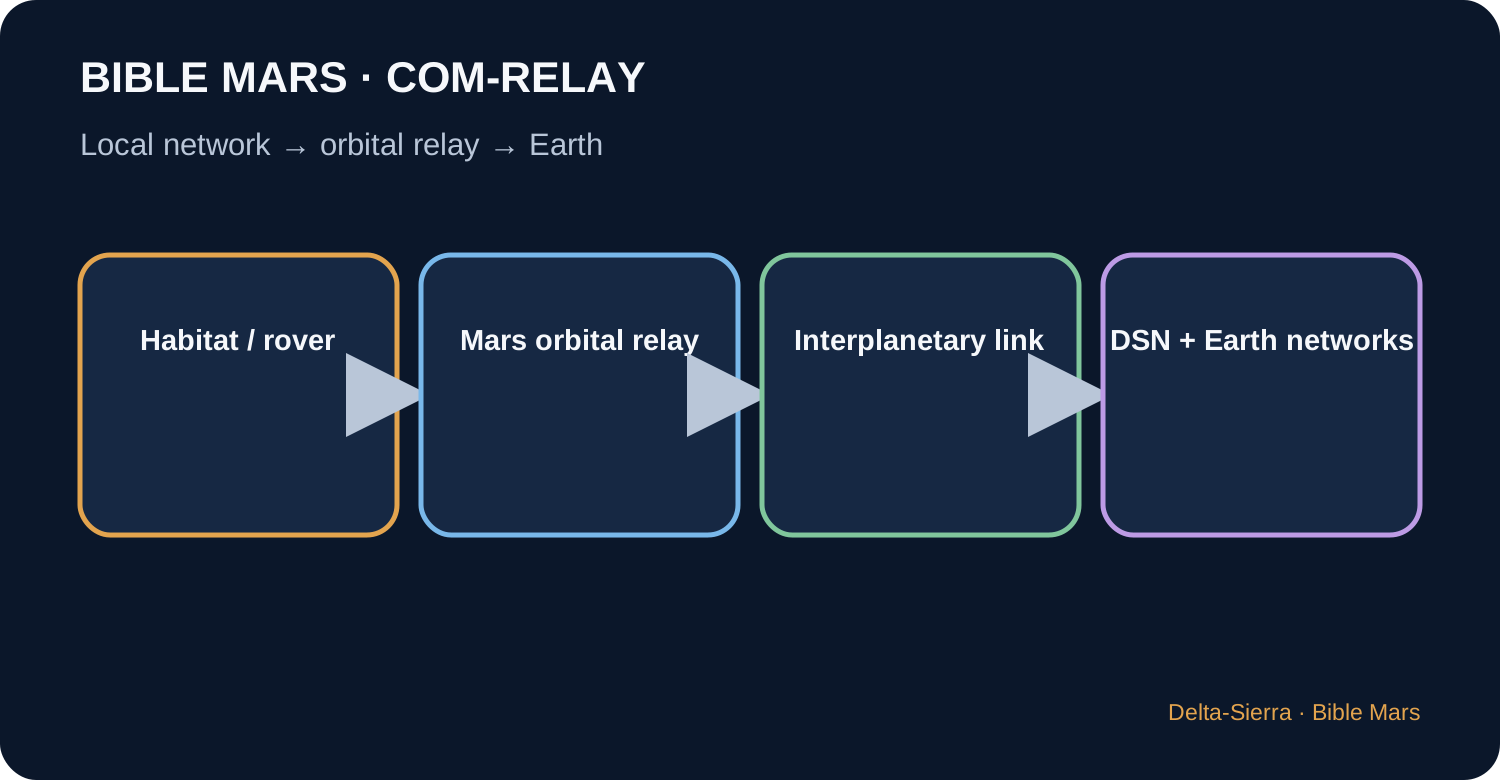
1. Separate networks by scale
Inside a habitat, distances are metres and data rates can be huge. Base-to-mine links span kilometres, surface-to-orbiter visibility changes with orbit, and Earth links cross tens to hundreds of millions of kilometres. One technology cannot optimize every scale.
A hierarchy combines fiber and local radio, surface links, orbital relays and interplanetary communications, each with suitable power, antennas, bands and protocols.
2. Why the rover prefers the orbiter
Perseverance uses UHF around 400 MHz for orbiter relay and NASA lists rates up to roughly 2 Mbit/s under suitable conditions. The local distance is tiny compared with Earth.
Direct X-band remains important for telemetry and backup, but the small rover cannot match an orbiter designed with more power and stronger deep-space communications.
3. Store-and-forward accepts delay
The orbiter is not always overhead. Data waits on the rover, transfers during a pass, waits on the orbiter, and later travels to Earth. Production and path availability are decoupled.
A settlement can use the same principle at scale: urgent traffic gains priority while bulk files wait for suitable windows. The network becomes digital logistics.
4. The 2026 network shows that relays age
NASA declared MAVEN ended on June 3, 2026 and other orbiters absorbed relay demand. Orbital infrastructure is not permanent.
A human settlement must launch replacements before failure, maintain compatible standards and preserve spare capacity rather than wait for outages.
5. Deep Space Network: giant Earth segment
JPL operates DSN complexes in California, Spain and Australia, spaced so Earth rotation passes deep-space tracking from one complex to another.
The DSN provides communications and radio navigation, and will remain a major Earth-side dependency for Mars settlement unless comparable alternatives are built.
6. Capacity and priorities
Emergency alerts, medical results and safe-mode commands cannot wait behind non-urgent video. Traffic classes need explicit priority and reserved capacity.
Buffers, queues and emergency paths must be managed so bulk transfers cannot starve critical packets.
7. Path redundancy
Habitats may have primary and backup antennas, surface relays and multiple orbiters, but common power, software or location can defeat apparent redundancy.
Geographic diversity matters too: one local accident or power failure should not remove every communication path.
8. Solar conjunction and degraded seasons
When the Sun lies near the Earth-Mars line of sight, missions reduce complex commanding. A settlement should treat such periods as planned degraded-network seasons.
Caches, local procedures and pre-authorized decisions allow continued operations when Earth contact is reduced.
9. Cybersecurity and operational sovereignty
Networks commanding life-support and vehicles require authentication, segmentation and recovery. Earth cybersecurity response is delayed by light time.
Local teams need authority and tools to isolate compromised segments and restore trusted configurations.
10. The city local network
Fiber can link habitats, compute centers, power plants and laboratories while radio provides mobility and backup. Local services must not require Earth for every lookup or procedure.
Maps, medical data, manufacturing models, software and scientific databases need replicated local copies. Earth synchronization enriches local knowledge rather than replacing it.
11. Capacity grows faster than population
A few rovers mostly return telemetry and images; a city creates industrial, educational, medical, social and machine-to-machine traffic.
Architecture must add relay satellites, antennas and capacity without replacing the entire network. Open interfaces reduce lock-in.
12. Toward a Mars-orbit-Earth backbone
Long-term Mars settlement will likely need orbiters dedicated primarily to relay instead of science missions carrying relay as a secondary function.
A backbone can improve availability and data rate but cannot remove light time. Its purpose is a Mars-appropriate network, not a copy of terrestrial Internet behavior.
18. Network governance allocates scarce capacity
When capacity is constrained, technical design meets governance. Medical diagnostics, science, industrial backups and personal communication may compete. Opaque rules create conflict, while purely automatic rules can miss human context.
A settlement should publish priority classes, maintain exception procedures and log allocation decisions. Resilience is not merely having two antennas; it includes institutions capable of allocating scarce communication capacity transparently and reversibly.
17. Optical communications are a complement, not magic. NASA has demonstrated deep-space optical communications with DSOC and continues developing laser communications for higher data return. Narrow optical beams can support very high throughput, but they demand precise pointing and ground optical links are affected by clouds and atmospheric conditions.
A Mars architecture may therefore combine robust radio with high-rate optical links instead of treating one as an instant replacement for the other. Acquisition, optical ground stations, weather diversity and fallback paths belong in the architecture.
16. From telemetry to city-scale traffic
Robotic missions mainly exchange commands, telemetry and science data. A city adds medical data, education, delayed calls, software updates, backups, industrial models, large scientific files, entertainment and continuous machine-to-machine traffic.
Traffic classes need explicit service priorities. Non-urgent video should never delay a depressurization alarm or safety command. Congestion control becomes part of life-support architecture.
15. Contact windows follow orbital geometry. A low Mars orbiter is visible to a rover only during part of each pass. Contact duration depends on altitude, orbital geometry, terrain, antenna pattern and minimum elevation. Network planning therefore resembles a dynamic logistics schedule in which stored data waits for suitable passes.
Multiple orbiters in different planes can improve contact frequency, but every additional spacecraft creates launch, software, spectrum and replacement obligations. Coverage should be measured as achieved availability rather than satellite count.
14. Modulation and coding put bits on a wave. A carrier wave by itself is not a file transfer. A transmitter varies signal properties according to a modulation scheme and protects information using coding. Higher throughput in a difficult channel requires tradeoffs among robustness, power, spectral efficiency and complexity.
Error-correcting codes are especially valuable when retransmission is expensive in time. A receiver can reconstruct some corrupted information without asking for the same packet again. A Mars city therefore needs expertise in the digital layer as well as antennas and transmitters.
13. Frequency, band and channel are not synonyms. Frequency tells how many wave cycles occur each second. A band is a range of frequencies. A channel is an organized slice of that resource used for a link. A real communication design also specifies modulation, bandwidth, coding, power, polarization and regulatory constraints.
Changing band does not magically make the network faster. Performance depends on the full link budget, available bandwidth, noise, antenna gain, pointing and coding. The best band for a rover-to-orbiter hop is not necessarily the best band for an orbiter-to-Earth link.
23. Minimum operational glossary
Uplink sends toward a spacecraft or Mars; downlink returns data. A relay receives then retransmits. Store-and-forward keeps data until a path becomes available. Bandwidth is the frequency resource used by a signal.
Data rate is information per unit time. Latency is delay. Quality of service defines traffic priority. Path redundancy provides alternative routes. A single point of failure is one component whose loss can end the entire service.
22. Last-resort communications
Main communications can fail because of power loss, antenna faults or relay loss. A last-resort path may offer very low data rate yet preserve health status, coordinates, emergency requests and minimal commands.
It must be exercised. An unused spare antenna, obsolete software or expired cryptographic key is not real redundancy.
21. Data synchronization and conflicts
Mars and Earth may edit local copies of the same document before the next synchronization. The system then needs explicit conflict rules: which version wins, how changes merge and how decisions are recorded.
This matters for procedures, software, medical databases and manufacturing models. Versioned replication is more realistic than pretending a remote file behaves like a terrestrial network drive.
20. Vital messages versus large files
A pressure alarm may be only a few bytes yet matter more than a multi-gigabyte science image. Priority does not follow volume. Routers and protocols should reserve minimum capacity for life-critical traffic.
At the same time, permanently starving science in the name of safety destroys mission value. Quality-of-service rules need measurable thresholds and transparent emergency policies.
19. Queue example: average throughput matters. Suppose a base creates 50 gigabytes while only 10 gigabytes can be transmitted. Forty remain queued. If the next contact can send 30 gigabytes but 20 new gigabytes are created meanwhile, the queue becomes 40 + 20 − 30 = 30 gigabytes. Capacity must therefore be compared with traffic generation over time.
A network sized only by peak instantaneous rate can accumulate permanent backlog. Operators need queue size, data age and recovery time as health metrics.
27. Communications operations become a permanent profession
A city network needs spectrum planning, relay scheduling, key management, anomaly response, antenna maintenance, software upgrades and traffic policy. These are continuous services, not tasks performed only during spacecraft arrival.
Communications staff and facilities should therefore be treated as civic infrastructure. As the settlement grows, network operations centers, training, spare equipment and documented procedures become as normal as power-grid operations.
26. Optical and radio links can form a layered service. Radio links remain valuable for robust command, acquisition and operation through conditions that challenge narrow optical beams. Optical links can add very high data return when geometry, pointing and Earth weather permit. A layered design can schedule bulk transfers over optical while preserving radio command paths.
This is more realistic than declaring that lasers will simply replace radio. High-capacity systems need diversity because the reasons for optical outage and radio degradation are not identical. Diversity is useful precisely when failure modes differ.
25. Interoperability is strategic resilience. Mars infrastructure will likely include equipment built by different organizations and generations. Shared relay protocols, frequency coordination, authentication methods and data interfaces make it possible for new spacecraft to use existing infrastructure and for old assets to remain useful longer.
Closed or undocumented interfaces can turn one supplier into a long-term single point of failure. A city-scale architecture should therefore treat interoperable standards and test facilities as part of resilience, even when proprietary internal implementations remain.
24. Capacity planning needs a growth model. A settlement should forecast traffic by source: crew, science, industrial telemetry, software distribution, medical imaging, autonomous vehicles and backups. Machine traffic may grow faster than population because every new pump, rover and laboratory becomes a network node. Capacity planning therefore needs scenarios rather than a simple number of inhabitants.
The model should include degraded periods, not only average demand. A relay outage can create backlog that must later be drained while new traffic continues arriving. Reserve capacity is what allows the network to recover instead of remaining permanently congested after one bad week.
EXPERT LAYER — SYSTEM ARCHITECTURE
Treat data as cargo that needs multiple routes. A mature Mars communication architecture can store, prioritize, retransmit and reroute. Availability matters as much as peak data rate.
1 — Autonomous local network
The city keeps operating if Earth contact disappears.
2 — Multiple orbital relays
No single orbiter becomes a global single point of failure.
3 — Degraded direct Earth path
A minimal direct link preserves command and telemetry when relay is unavailable.
4 — Storage and priority
Data waits safely and life-critical traffic goes first.
Check before depending on the system
What this changes for a real Mars city
A real Mars society cannot treat communication as an optional commercial service. It is life-supporting infrastructure carrying commands, diagnostics, knowledge, coordination and the connection to Earth. Unlike electrical energy, a lost orbital contact window cannot be stored for later.
A reference network should therefore be judged by availability, margin, recovery time, degraded capability and path diversity—not merely impressive peak throughput.
Propagation delay forces a separation between local control and distant information. The speed of light is enormous but finite. Across an illustrative 56 million kilometres, a radio signal takes about 187 seconds, a little over three minutes, one way. Across 400 million kilometres, travel time is roughly 1,334 seconds, or 22.2 minutes. The calculation is t = d/c, where t is time, d distance and c the speed of light. A simple interactive exchange can therefore require from six to more than forty minutes of physical round-trip delay.
Higher bandwidth does not solve latency. An optical link can send more bits per second, but its first bit cannot outrun light. Local functions — rover control, habitat safety, electrical protection or surgery — must therefore work without waiting for Earth. Interplanetary networking moves information and expertise; it cannot replace local control loops.
The architecture should reflect this explicitly: real-time local network, broader surface network, orbital relays and Earth link. Each layer has different delay, availability, protocol and authority. Doors, pumps and traffic control should not depend on an interplanetary round trip.
DTN treats data like cargo that can wait for the next route. Many terrestrial Internet protocols assume an end-to-end path exists long enough for interactive exchange. Earth-Mars communication instead has scheduled contacts, occultations and relay constraints. Delay/Disruption Tolerant Networking stores information and forwards it when the next contact becomes available.
A message can then carry priority, lifetime, destination and security requirements. A medical alert and a multi-gigabyte science archive should not be handled identically. Queues need policy: what moves first, what stays cached and what expires when its information is no longer useful?
At settlement scale, the same logic covers backups, updates, mail, video, science and commercial traffic. Earth-Mars bandwidth becomes shared infrastructure. Governance must prevent one bulk user from degrading life-critical services.
Relay orbiters should become a service constellation. The present Mars Relay Network still relies on valuable scientific orbiters serving as relays. Human missions will demand stronger availability. Dedicated infrastructure must consider coverage, capacity, ageing, redundancy, possible orbital servicing and generational replacement. NASA’s 2026 Mars Telecommunications Network procurement points toward telecommunications as a service rather than an incidental mission function.
Orbit choice drives visibility, satellite count, surface link distance, occultations and terminal requirements. Low orbit can provide favourable surface links but short passes; higher orbits increase visibility while changing link budgets. A mature constellation may combine roles.
The surface should survive one relay loss. Terminals need alternate spacecraft, local storage and degraded direct-Earth paths where feasible. Network redundancy is not satellite count; it is the ability to preserve priority services after failure.
Capacity is a peak-and-queue budget, not only an average data rate. A network advertised at 100 Mbit/s can still saturate when several users transmit at once. Science imaging, medical diagnostics, backups and video sessions create peaks. Useful capacity therefore depends on contact windows and queue size. A daily average can hide a twenty-minute bottleneck.
Safety data must be prioritized. Vital telemetry is often small but urgent; imagery and models are large but delay-tolerant. Protocols should prevent a bulk file from blocking an alert. Quality of service can use explicit, auditable traffic classes.
Compression is also a trade. It saves bandwidth but consumes compute and may discard information. Raw science, medical records, video and backups need different rules. Mature infrastructure applies policy by data type rather than one universal setting.
The network becomes a sovereignty and civil-continuity issue. A small mission can place almost all network authority in one agency. A town contains local government, operators, hospitals, businesses, universities and private users. Who allocates rare Earth-link capacity? Who can override priority in an emergency? Which logs are retained? These are technical and political questions at once.
Cybersecurity must protect availability as well as confidentiality. Saturating a relay or blocking a command may be more dangerous than unauthorized reading. Life-critical networks need segmentation, command authentication and verified updates, while emergency procedures must still work if a terrestrial certificate authority is unreachable.
Eventually the settlement needs a network that functions locally for weeks without Earth. Residents must communicate, work, treat patients and control infrastructure even if the interplanetary link disappears. The ultimate test of Martian digital autonomy is not bandwidth to Earth; it is civil continuity when Earth is temporarily silent.
Separate propagation delay, throughput and availability. Three quantities that are often confused describe different problems. Delay is dominated by distance: at 56 million kilometres, light needs about 56,000,000 ÷ 299,792 ≈ 187 seconds, a little over three minutes one way. At 400 million kilometres, the value approaches 1,334 seconds, more than twenty-two minutes. Throughput measures how many bits can move per second. Availability measures how much of the time the service actually exists. A link can therefore be fast when open yet unavailable for much of a sol.
Applications respond differently. Interactive control is dominated by delay; high-resolution mapping by data volume; safety services by outages. A Mars network should expose those qualities separately rather than reducing everything to one “connected” icon.
Treat queues as part of network capacity. When capacity varies, data accumulate. Science imagery, telemetry, software updates, medical traffic and personal communications cannot all have identical priority. DTN, Delay/Disruption Tolerant Networking, stores and forwards bundles across interruptions, but policy still has to define priority, retention, encryption, quotas and behavior when storage fills.
A camera generating 100 Mbit/s for ten minutes creates 100 × 600 = 60,000 Mbit, or 60 Gbit. If the later downlink is 10 Mbit/s, that one queue needs at least 6,000 seconds, 100 minutes, to drain even before other traffic is considered. Local storage and contact planning are therefore as real a capacity element as antenna gain.
Prepare for communications as an essential social service. The present Mars Relay Network grew around robotic missions and orbiters acting as relays. Human presence requires continuity, safety traffic, navigation support, medical data, industry, administration and civil communications. NASA’s move toward a dedicated Mars Telecommunications Network illustrates the architectural shift toward constellation, ground segment, interfaces, operations and replenishment.
At a thousand residents, communications also becomes governance. Who allocates capacity during an emergency? Which services remain local when the Earth link is saturated? Which data must never depend on Earth? How does the town operate if its primary provider fails? Communications stops being a mission subsystem and becomes critical public infrastructure.
Define service levels instead of a vague promise of connectivity. A Martian public network should publish understandable service classes: emergency, critical command, navigation, operations, science data, personal communications and deferrable bulk transfer. Each class can carry priority, maximum delay, acceptable loss and encryption rules. This prevents an imaging campaign from filling queues when medical data or emergency commands need capacity.
The network also needs degraded-mode exercises. Loss of an orbiter, failure of a surface station, solar conjunction or storage saturation should trigger known policies: what is discarded, what remains cached, which services become local and which traffic uses backup routes. Resilience is proven through these scenarios, not nominal throughput alone.
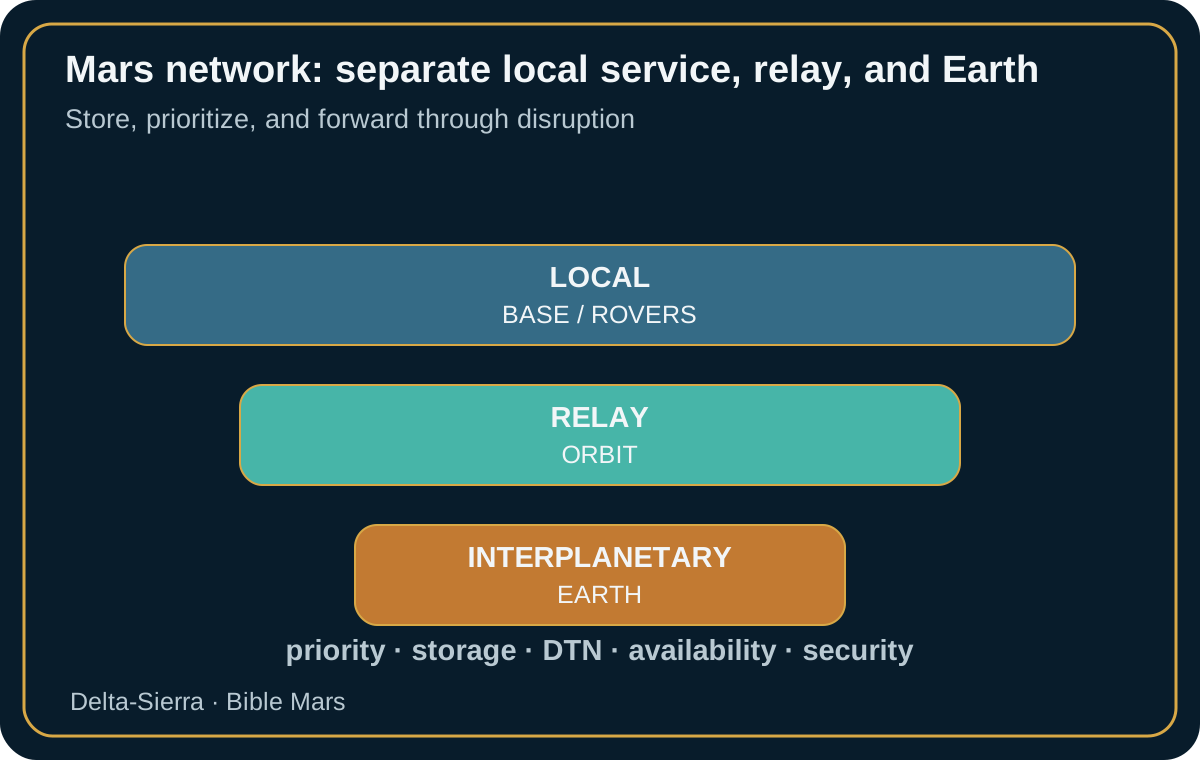
A crewed mission or settlement does not move generic “bits.” It carries commands, critical telemetry, conversations, medical files, science data, maps, software updates, and backups. Each class has a different acceptable delay, priority, integrity need, and sometimes confidentiality requirement. Architecture should therefore define services before selecting data rates.
A safety message can occupy only a few kilobytes and still matter more than a multi-gigabyte video. Queue policy should preserve critical messages when a link degrades, while bulk transfers resume later without monopolizing the network. That discipline becomes especially important during solar conjunction, relay failure, or reduced visibility.
NASA’s current Mars Relay Network still relies on science orbiters that also provide relay service. The Mars Telecommunications Network effort announced in 2026 points toward infrastructure more explicitly designed for future needs. Moving from opportunistic capacity toward dedicated service changes the architecture questions: availability, storage, orbital redundancy, and constellation maintenance become first-class requirements.
A 2 Mbit/s link does not mean a mission transmits at 2 Mbit/s continuously. Visibility, a functioning relay, ground-station support, pointing, and a contact slot are all required. Daily volume is therefore data rate multiplied by useful contact time. At 2 Mbit/s for eight minutes, gross volume is 2 × 10⁶ × 480 = 960 × 10⁶ bits, or about 120 MB before protocol overhead, coding, and retransmission.
The calculation shows why contact duration matters as much as peak rate. Doubling rate does not help if visibility is cut in half or local storage fills before the next pass. Architecture should track three budgets: instantaneous link capacity, transferable volume over a period, and the probability that service is available when data becomes urgent.
Storage is part of the network. If a base produces an aggregate 50 Mbit/s for twelve hours with no external contact, gross data volume reaches 50 × 10⁶ × 43,200 ≈ 2.16 × 10¹² bits, about 270 GB. The system has to decide what remains local, what is compressed, what is summarized, and what may be discarded. Data management is therefore an operational strategy rather than a disk-size question.
In an ideal free-space model, received power falls with the square of distance. Doubling distance adds about 20 log10(2) = 6.02 dB of path loss. The decibel, dB, expresses a logarithmic power ratio here. The penalty must be recovered through antenna gain, transmit power, lower data rate, coding, integration, or other margins.
A link budget should preserve its assumptions: frequency, power, gains, pointing losses, noise temperature, bandwidth, coding, and margin. A margin value without those parameters is difficult to interpret. Optical and radio links also have different constraints. Optical communications can support high data rates but demands precise pointing and has to contend with atmospheric conditions at Earth; radio trades bandwidth, gain, and power differently.
The local Mars network has another geometry. A rover behind terrain may lose direct contact with the base while an orbital relay remains visible. A settlement inside a depression may have a poor radio horizon. Surface antennas, masts, and relays therefore interact with topography and mobility even when site selection is treated in a separate book.
Delay/Disruption Tolerant Networking begins with a simple premise: an end-to-end route is not always available. Data can be stored and forwarded hop by hop when contacts exist. Bundle Protocol provides a layer for this model, while routing methods can exploit predictable contact schedules.
The concept does not remove the need for planning. Queue capacity, priority, retention time, and behavior when multiple routes become available still matter. Custody, acknowledgment, and retransmission mechanisms must be sized so that a local outage does not create cascading storage saturation.
Recent CCSDS publications show continued evolution of the DTN ecosystem, including a Bundle Protocol experimental specification based on RFC 9171 and custody-transfer work. Those publications define protocols; they do not by themselves guarantee a Mars network architecture. Systems work must connect protocol behavior with storage capacity, orbital schedules, security, and mission priorities.
Once several teams, operators, and vehicles share the network, the problem becomes institutional. Who may reserve a scarce contact? Which traffic wins during an emergency? How is a compromised device isolated without cutting a life-critical service? Who manages keys, certificates, protocol versions, and audit logs? These decisions need preparation before the network becomes indispensable.
Resilience requires local modes. A base should keep functioning when Earth is unreachable; nearby vehicles should be able to communicate without a distant relay; critical commands must remain authenticated in degraded operation. Network autonomy is therefore more than bandwidth. It is the ability to preserve identity, message ordering, priority, and evidence of action through disruption.
Over time, communications architecture becomes infrastructure comparable to electrical power. It needs service levels, reserve, repair procedures, availability metrics, and an upgrade path. Moving from four science orbiters used as relays toward dedicated infrastructure represents exactly that change in perspective: the network is no longer merely how mission data travels; it becomes one of the services that makes collective life on Mars possible.
Imagine a relay orbiter becomes unavailable while a Mars base is simultaneously accumulating medical data, engineering logs, and inspection imagery after an anomaly. The network should not treat every file as equivalent. The first minutes are used to confirm the outage, recompute upcoming contacts, and reorder queues.
Urgent medical data can be small but high priority. Logs needed to diagnose a life-critical system come next. High-resolution imagery can be compressed, summarized, or segmented. Good architecture preserves metadata so that the receiver knows whether a file is complete, partial, or superseded by a newer version.
Suppose 18 GB of priority data are waiting and the next contact lasts 25 minutes at an effective 1.5 Mbit/s. Transferable volume is 1.5 × 10⁶ × 1,500 = 2.25 × 10⁹ bits, about 281 MB. Clearly not everything can leave. Data management must extract information that changes a decision while the remainder stays in storage for later contacts.
DTN can retain and forward bundles as paths return, but the mission still has to prevent infinite queues. Lifetime, priority, and deletion policies are required. Diagnostic data that are three days old may become less useful than a fresh system state, while some science data remain valuable for years.
Relay loss should also change local operations. If the base knows high-rate service will be absent for twelve hours, it can reduce some acquisitions and increase local summarization. Data autonomy reduces dependence on interplanetary capacity without hiding the event from Earth.
When the relay returns or another path becomes available, the system should avoid a recovery storm. Queues are drained according to priority, capacity, and freshness. The case shows that Mars network resilience is measured as much by storage decisions as by antenna power.
The current Mars relay network proves the value of orbit. Rovers need not carry large, power-hungry radios for continuous direct-to-Earth links; they communicate with nearby orbiters that relay data onward. NASA describes the 2026 Mars Relay Network as an international constellation of four orbiters, with surface-to-orbit rates up to about 2 Mbps in some cases. That system is remarkable, but it was built around intermittent science missions rather than a populated settlement depending on communications every day.
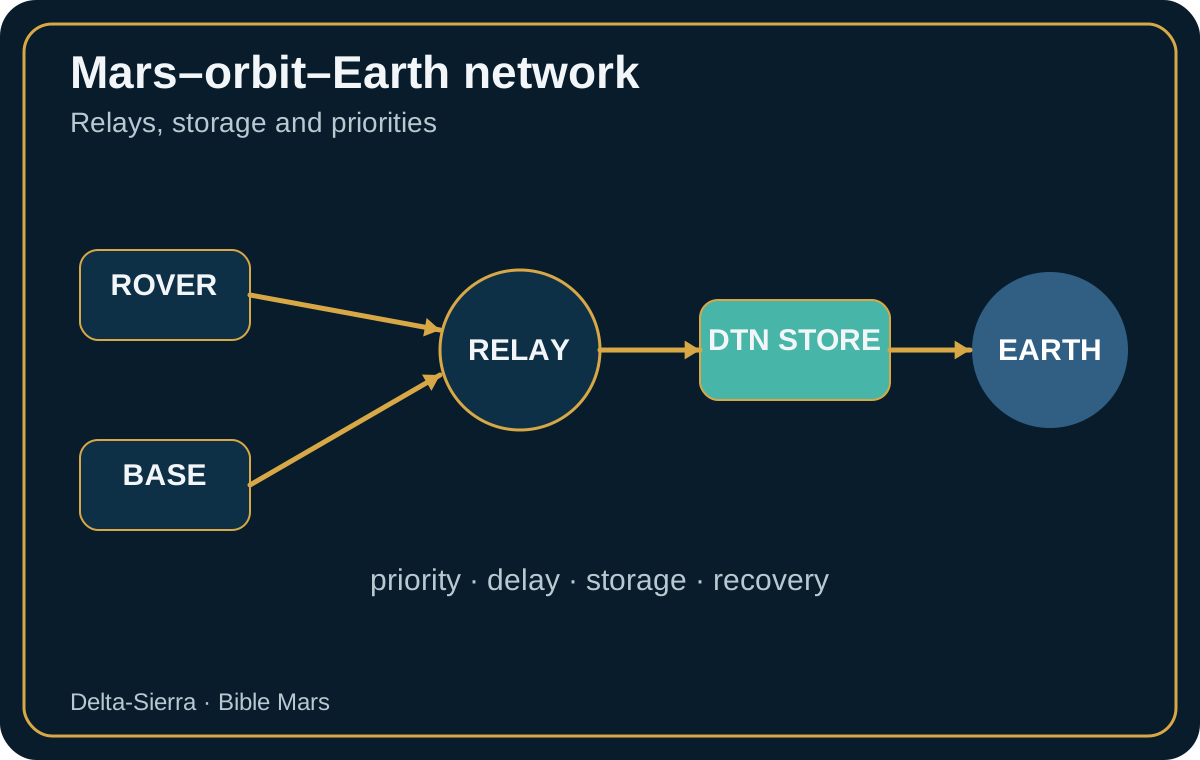
A settlement needs layers: habitat local networks, links among sites, orbital relays, interplanetary links and storage. Critical functions must continue when Earth cannot respond in real time. The network transports not only science data but time, software, alerts, maps, delayed telemedicine, industrial records and command authority.
Suppose a base generates 2 TB of raw video, science, maintenance and sensor data per day. If only 15% must ultimately go to Earth after local processing, that is 0.30 TB/day, roughly 2.4×10¹² bits. Spread evenly over a day, average useful rate is about 2.4×10¹² ÷ 86,400 ≈ 27.8 Mbps before coding, outages and margin. A video-rich society therefore changes the scale dramatically compared with a few robotic missions.
Local processing becomes a network function. Compression, science summarization, event detection and deferred archiving reduce interplanetary demand. Autonomy here means Mars decides what must be transmitted first rather than asking Earth to inspect every stream.
In May 2026 NASA issued a request for proposals for a Mars Telecommunications Network using high-performance Mars telecom orbiters to support future surface, orbital and human exploration, with service requested at Mars no later than 2030. It is not yet a city network, but it marks an institutional shift: Martian communications are being treated as infrastructure rather than a subsystem owned separately by each mission.
Permanent infrastructure needs capacity management, coverage, failure tolerance and constellation replacement. Two relays built around the same vulnerable component can share a common-cause failure. Surface stations must switch among relays, retain messages and work through intermittent visibility.
Delay/Disruption Tolerant Networking accepts that an end-to-end connection may not continuously exist. Data are stored and forwarded when contacts become available. Contact plans, priority, expiration and custody become as important as raw rate. A local antenna failure should delay critical information in a controlled way rather than destroy it.
Human interfaces must reflect this reality. A medical query to Earth should display send time, data age and expected reply delay; an operational instruction must never look like a real-time command if it will arrive many minutes later. Network architecture and social architecture are linked.
When Mars lies near the Sun's direction as seen from Earth, communications can be strongly degraded. A permanent base prepares with current procedures, local decision authority and cached information. A Mars orbital network can continue to serve Martian users even while the Earth link is degraded.
Eventually multiple cities, mines, farms and observatories create a true planetary network. Identity, cybersecurity, routing, timing, access rights and quality of service become public infrastructure. Colonization turns antennas into a Martian digital utility.
A city has competing traffic: vital telemetry, robot control, mapping, science video, private communications, software updates and backups. Treating every packet equally allows bulk transfer to delay critical information. Networks need service classes, priority and congestion policies tied to operational consequence.
Latency also separates throughput from responsiveness. A high-capacity interplanetary link still has minutes of propagation delay. More bandwidth does not enable Earth to drive a Mars vehicle in real time. Applications need command confirmation, validity times and protection against an old instruction arriving after the situation changed.
Local caches have operational value. Maps, medical references, software, procedures and technical databases should be replicated on Mars. Earth may hold authoritative copies, but a communications outage must not prevent opening a manual or restoring software. Replication policy is continuity planning.
Cybersecurity must account for delay. Intrusion response cannot wait for Earth. Martian networks need segmentation, local identity management and revocation capability. Yet an aggressive false positive can isolate life-critical equipment, so security and safety have to be designed together.
Orbital relays also need renewal. No spacecraft lasts forever. Constellations should overlap generations, preserve protocol compatibility and migrate services gradually. Letting every relay age together creates a replacement wave the settlement may be unable to absorb.
With multiple operators, technical governance becomes unavoidable: spectrum, identifiers, synchronization, emergency priority and service responsibility. Communications infrastructure becomes political as well as physical.
Link budgets and optical communications reveal where network capacity really comes from. Radio performance is governed by transmitter power, antenna gains, free-space loss, receiver noise, coding and required margin. Distance is unforgiving: free-space path loss grows with the square of distance in power terms. High-gain antennas and low-noise receivers compensate, but pointing and hardware size become important.
A useful network design keeps margin explicit. If a link closes with 3 dB of margin under nominal assumptions, roughly a factor of two in received power separates prediction from threshold. Dust, pointing error, equipment aging and solar effects can consume that margin. “Works in the spreadsheet” is not the same as operational availability.
Optical communications can offer much higher data rates for a given aperture and power, but narrow beams demand precise pointing and Earth weather can interrupt ground reception. A robust Mars network may therefore combine radio for availability and optical links for high-volume transfer rather than declaring one technology the universal winner.
Surface-to-orbit links and orbit-to-Earth links have different geometries. A settlement may have frequent short contacts with local relays while Earth visibility and ground-station schedules vary. Storage on orbiters decouples these schedules. This is another reason relay capacity includes memory and contact planning, not just antennas.
Network timing becomes a navigation and cybersecurity resource. Reliable timestamps help order events, correlate faults and authenticate data freshness. As Mars develops local PNT services, telecommunications and navigation infrastructure may share orbiters, clocks and ground assets.
Deep-space communications therefore scales through architecture: better coding, higher frequencies, optical terminals, larger apertures, more relays and smarter data selection. A city-level system will likely use all of them rather than one spectacular technology.
Case study: relay loss during a medical operation. A patient at a remote base sends a large medical package toward the main habitat and Earth just as the nominal orbital relay becomes unavailable. The network must preserve critical messages while deferring bulk science backups.
DTN stores bundles, selects a later contact and displays the new delay. Users know the file is delayed rather than lost—an important operational distinction in a network where disruption is normal.
If an emergency direct radio path offers only 2 Mbps, 500 MB is roughly 4,000 Mbit, requiring 4,000 ÷ 2 = 2,000 seconds, a little over 33 minutes before overhead. The system can therefore send essential images and parameters first instead of the whole package.
After the event, replication policy changes: key medical references are cached locally and critical health data get a dedicated priority class. Relay failure becomes an architecture lesson rather than merely a communications anomaly.
A Mars network needs explicit availability, capacity and recovery targets. Network design should state service goals. “High bandwidth” is vague; a settlement needs expected availability, minimum emergency rate, maximum acceptable outage and recovery time for each service class. Medical, navigation and life-critical telemetry may have stricter requirements than bulk science transfer.
Availability depends on more than radio hardware. Power, pointing, orbital geometry, ground-station weather for optical links, software and scheduling all contribute. A network with redundant transmitters but one shared power converter can still have poor true availability.
Capacity planning should include peaks. Routine average traffic may be modest while a landing campaign, medical event or software distribution produces a surge. Buffer storage can absorb some peaks, but critical real-time local traffic needs reserved capacity.
Recovery from relay loss should be rehearsed. Surface terminals need alternate contact plans, correct ephemerides and credentials before the primary relay fails. If reconfiguration data are stored only on Earth, a conjunction or outage can make redundancy unusable.
Protocols and interfaces should support relay replacement. New orbiters may have higher frequencies or optical terminals while old users remain on radio. Gateway functions can bridge generations so the network evolves without forcing every surface asset to upgrade at once.
As Mars grows, network metrics become public-service metrics: availability by region, latency, queued volume and outage cause. A communications utility can then be engineered and governed from evidence rather than anecdote.
Service monitoring should distinguish outage from backlog. A relay may remain connected while queues grow faster than they drain. Queue age and priority distribution can reveal an approaching service failure before the link reaches zero availability.
Time synchronization should survive network partition. Local clocks can drift while Earth contact is absent, so Mars needs holdover standards and procedures to reconcile time after reconnection. Reliable time supports navigation, logs, science and security.
Emergency communications should be tested with reduced infrastructure. A settlement should know what minimum data can move if only one low-rate relay or local radio remains. Designing a small 'survival network' prevents critical operations from depending on nominal broadband capacity.
Antenna pointing and scheduling are operational resources. High-gain links may require attitudes that compete with science, thermal control or power generation. Network planning should therefore publish contact demands early enough for spacecraft operations to resolve conflicts rather than treat communications as always available.
Ground-segment diversity on Earth also matters. Weather can disrupt optical links and station outages can reduce radio coverage. A Mars architecture should consider multiple terrestrial sites and service providers where possible, because interplanetary reliability depends on both ends of the link.
Data integrity needs end-to-end checks across store-and-forward hops. A file may spend hours on a relay before reaching Earth; checksums, custody records and duplicate handling prevent corruption or retransmission from becoming ambiguous. The network should know which copy is authoritative.
For crewed operations, privacy and governance enter the design. Medical and personal communications share infrastructure with safety telemetry and science. Access controls must protect sensitive content without allowing security mechanisms to block emergency use. A city-scale network is social infrastructure as well as engineering.
The network should preserve a minimal emergency directory even when central services fail. Surface nodes need stored relay schedules, fallback frequencies and identities so they can reconnect without contacting a server that is itself unreachable. Recovery information belongs at the edge.
Software updates for network equipment should be staged. Updating every relay or surface terminal at once creates a common configuration risk. Rolling deployment with compatibility checks allows one generation to remain available while another is verified.
Communications planning should finally include human expectations. Users who understand why some traffic is delayed and how priority works are less likely to create workarounds that bypass security or overload the network. Operational transparency is part of capacity management.
Institutional and primary sources
Go further with Arcadia
This public guide stands on its own. Arcadia — Manual of the First Martian City develops these systems as an integrated city architecture.
Four sources each producing 5 Mbit/s for two hours accumulate V = N R t = 4 × 5 × 7,200 = 144,000 Mbit, about 18 GB. A 50 Mbit/s relay visible for twenty minutes drains only about 7.5 GB gross. Storage and scheduling are therefore network functions just as important as the antenna.
After loss of one orbiter, health, navigation, voice and commands need a service class distinct from bulky products. DTN accepts periods in which no end-to-end route exists.
A simulated week with missed contacts and traffic surges checks maximum telemetry age, priority-bundle loss and backlog drain time.
The current Mars Relay Network is a concrete example of science spacecraft becoming infrastructure. NASA describes the 2026 MRN as four Mars orbiters that relay data for Curiosity and Perseverance in addition to their own mission work. Local rover-to-orbiter links can reach up to about 2 Mbit/s in appropriate conditions. That local rate is not continuous Earth access: service depends on orbital passes, geometry, orbiter availability and the capacity of the Earth return path.
Human presence changes the demand. A robotic mission can schedule contacts and delay scientific gigabits. A crewed habitat adds voice, delayed telemedicine, software, maps, observations, backups, data synchronization, vehicle command and civil communications. Networking becomes critical infrastructure whose failure affects operations, social life and the settlement’s ability to learn.
NASA’s May 14, 2026 Request for Proposal for a Mars Telecommunications Network marks this architectural shift. NASA seeks high-performance Mars telecommunications orbiters supporting future surface, orbital and human exploration, with the network requested to be ready to operate at Mars no later than 2030. An RFP is not an operational network; it is an acquisition action and target schedule and should be described that way.
Four quantities that are often mixed describe different problems. Data rate is bits per second. Propagation latency is the physical travel time of the signal. Availability is the fraction of time a service can be used. Volume is the total amount transferred over an interval. A link can provide a high rate for ten minutes and low daily availability, or be frequently available but unable to deliver a large file before its deadline.
For example, a 2 Mbit/s relay pass lasting eight minutes has a simple raw upper bound of 2,000,000 × 480 = 960,000,000 bits, about 120 MB before protocol overhead, coding, losses and margin. The multiplication sign “×” denotes multiplication. This does not claim that a rover always receives 120 MB of useful capacity per pass; it shows why contact duration and rate must be combined before talking about volume.
A settlement also adds priorities. A small medical file with a deadline can be more important than gigabytes of mapping data. The network therefore needs criticality, deadline, retransmission rules and loss consequences. That logic resembles freight logistics more than continuous terrestrial broadband.
Delay/Disruption Tolerant Networking is designed for large delays, intermittent contacts and links that may not be simultaneously connected end to end. Bundle Protocol systems can store messages at one node and forward them when a later contact becomes available.
That model fits Mars naturally. A rover can send to an orbiter, the orbiter can retain the bundle, and later send toward Earth. A settlement may add surface nodes and multiple orbital relays. Queues become an engineering resource: memory capacity, data age, deadlines and deletion policies must be sized, not left to chance.
CCSDS DTN work continues to evolve. A Bundle Protocol specification based on RFC 9171 was published as an experimental CCSDS specification in 2025, alongside standards for contact-aware routing and reliability functions. A Mars architecture should distinguish mature standards, experimental profiles and mission-qualified implementations rather than treating “DTN” as one finished product.
Solar conjunction, occultations, relay failures or a Deep Space Network outage can create intervals in which Mars must continue without useful Earth exchange. Local functions cannot depend on a remote database for every decision. Maps, procedures, medical references, critical software and engineering knowledge need local availability.
Continuity needs layers. Local networks connect habitats, vehicles and installations. Regional relays can overcome terrain masking. Orbiters provide planetary coverage and interplanetary return. Failure of one layer should not erase all the others. A disabled vehicle behind terrain still needs a local rescue path even when Earth is unavailable.
A link budget combines gains and losses to determine whether received signal quality supports a required service. But margin is meaningful only relative to the service: vital telemetry, voice, video, software transfer or science data have different rate, delay and reliability needs.
In a simplified free-space relationship, path loss grows with the square of distance, corresponding to 20 log₁₀(d₂/d₁) dB when distance alone changes. Doubling range adds about 20 log₁₀(2) ≈ 6.02 dB of loss. A link that is comfortable at favorable Earth–Mars geometry can therefore become much harder at larger separation without any change to transmitter or antenna.
The system can trade antenna gain, transmit power, data rate, coding, contact duration and relay choice. Mars networking is therefore adaptive: it exchanges speed for robustness as geometry and mission priority change.
As population grows, scarcity does not vanish immediately. Capacity must be protected for operations, safety, navigation and emergencies while supporting science, education, culture and personal communication. Transparent service classes and dynamic allocation are more robust than whoever transmits first or shouts loudest.
Cybersecurity also becomes physical continuity. Vehicle commands, software updates and emergency alerts require authenticity and integrity. Security mechanisms, however, should not create a single administrative failure that blocks the network when a central authority or key service is temporarily unavailable.
Current references: NASA Science — Mars Relay Network, NASA — Mars Telecommunications Network RFP, May 2026, and CCSDS DTN publications. Settlement traffic values are teaching scenarios; MTN remains an acquisition and target service, not an already deployed Mars network.
Network availability depends on several links: local terminal, relay, interplanetary link, Earth station, and data systems. If four required links were strictly independent and each available 99.5% of the time, series availability would be 0.995⁴ ≈ 0.980, about 98.0%. The small calculation shows how excellent local availability can erode when dependencies multiply.
Independence is often false. Two relays may share the same software error, two ground stations the same terrestrial network, or several services the same scheduling system. Common causes therefore need investigation before multiplying probabilities. Effective redundancy may require geographic, technical, or organizational diversity depending on the hazard.
Service also needs classes. A network can be unavailable for high-rate video while remaining perfectly capable of carrying a few kilobits of command. Robust architecture therefore defines levels: minimum safety service, telemetry and commanding, operational voice/data, and then high-rate science. Failures degrade the level progressively instead of switching the entire network from “available” to “unavailable.”
Solar conjunction provides a useful planning case. Detailed performance and procedures depend on geometry and systems, but the general strategy is to prepare activities that tolerate reduced communication, increase local autonomy, and avoid operations that require rapid Earth interaction. Data continue to be produced; they need storage, priority, and controlled draining when capacity returns.
Operations should therefore publish more than one availability percentage. Time in minimum service, undelivered volume, delay of priority traffic, duration of queue saturation, and number of route switches are closer to real user experience. A ten-minute outage during a critical event can matter more than an hour of planned downtime.
Over time, those measurements become the foundation for service engineering. They show where another relay, more storage, an additional ground site, an optical path, or more local autonomy produces the most value. The Mars network then grows from observed demand rather than an abstract goal of “more bandwidth.”
A user should not have to infer network state from one “connected” light. A link may exist with very low rate, high delay, saturated queues, or a high probability of interruption. The system should expose understandable service quality: commanding available, delayed voice, limited file transfer, high-rate service unavailable, for example.
Applications can then adapt. A camera may lower cadence, synchronization software may wait, and a medical consultation may send a structured summary before full imagery. Local adaptation prevents every application from continuing to produce data as though capacity were infinite.
Thresholds should be tied to measurements: useful rate, queue occupancy, estimated delivery delay, and expected duration of the next contact. A 20 GB queue is not equally serious if a 100 Mbit/s contact starts in ten minutes or if the next useful path is twelve hours away. Capacity always needs calendar context.
Network maturity is therefore visible in graceful degradation. A mission that preserves commanding, vital telemetry, and priority messages through a high-rate outage has real resilience. The objective is not to promise a perfect connection; it is to make performance loss understandable while the most important functions continue to flow.
A surface weather station, a crew medical consultation and a rover software image have different latency and reliability needs. A relay architecture should expose those differences through service classes rather than treating every packet equally. Critical command and health data may require reserved capacity and redundant routes; bulk science can wait for lower-priority windows.
This approach also makes scaling visible. As more users arrive, contention becomes an engineering quantity that can be measured and simulated. The network can then justify another orbiter, more storage or a new ground link from service demand rather than from a vague expectation that “more bandwidth” will be needed.
NASA Science — Mars Relay Network describes the current four-orbiter network and surface relay rates; NASA — Mars Telecommunications Network, May 14, 2026 describes the planned infrastructure; NASA — Delay/Disruption Tolerant Networking provides the store-and-forward framework.