ISRU industry, construction and local manufacturing on Mars
ISRU becomes industrially useful only when a local resource can move through the entire chain to a qualified product. Excavating or capturing feedstock is not enough: it must be prepared, transformed, characterized, supplied with energy, stripped of unwanted by-products and finally shown to meet the function required of the resulting fluid or part. Local manufacturing is therefore judged by yield and quality across a process chain, not by the mere presence of regolith or carbon dioxide.
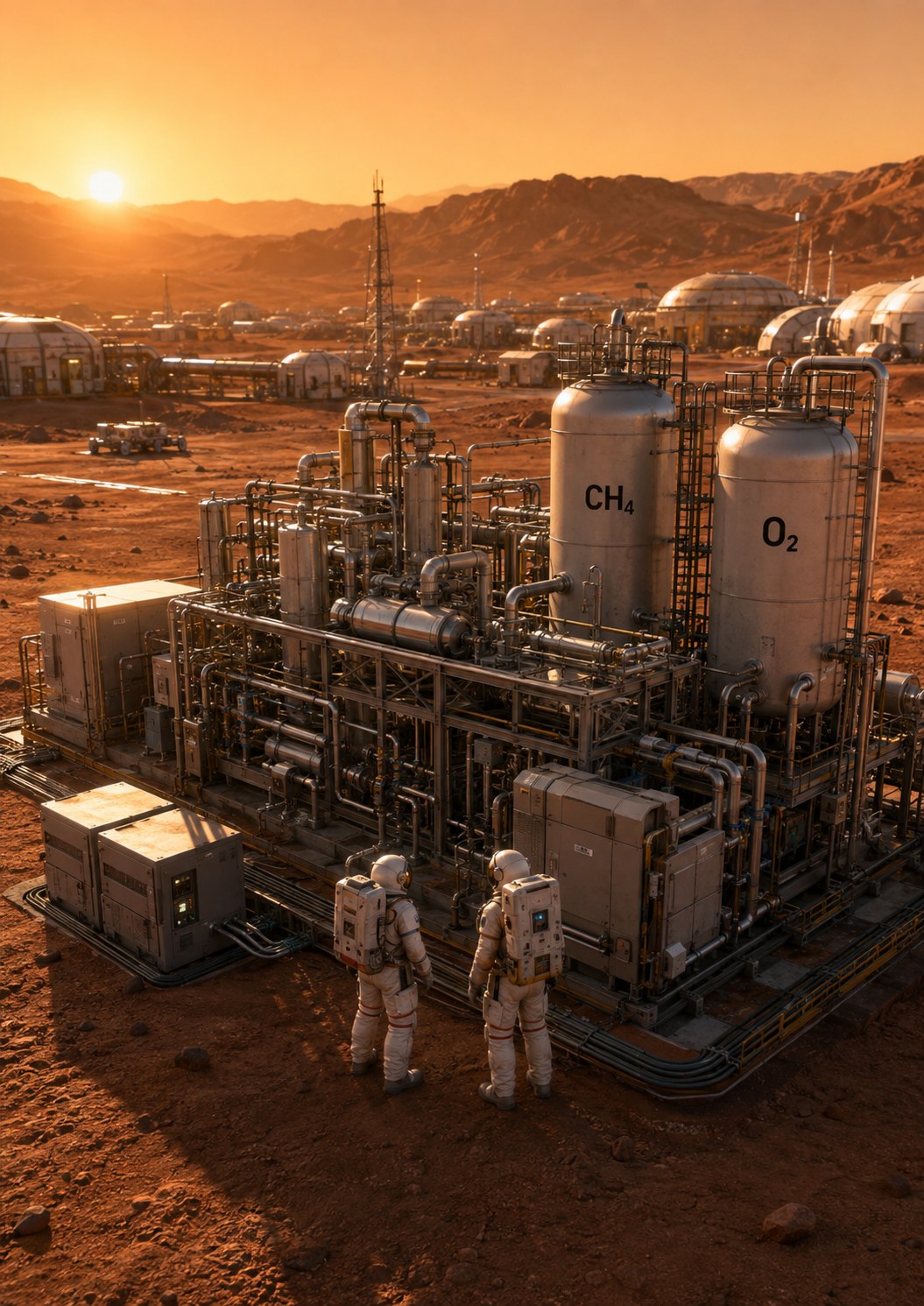
Conceptual ISRU chain: extracting a local resource is only the first step; it must then be purified, transformed, products controlled, by-products managed and the plant maintained.
A successful chemical reaction is not yet an industry
“ISRU industry, construction and local manufacturing on Mars” addresses local industry as an extraction–processing–storage–manufacturing–inspection chain rather than one isolated ISRU machine.
ISRU becomes strategically useful only when it reduces dependence across the whole settlement; the practical Mars colonization roadmap places local resources in that staged growth, while the colony life-support guide shows the immediate resource loops that must be supplied.
Scope — from characterized local feedstock to a locally made product qualified for a defined use.
Industrial control should track material flow, purity, specific energy, availability, wear, intermediate stock, scrap and metrology.
Relationship used here: net production = flow × availability × yield - scrap.
NASA ISRU and manufacturing programs identify functions to demonstrate; site production rates remain scenarios until measured
From raw regolith to a usable part: all the hidden steps
The industrial break point is either feedstock outside specification or a bottleneck machine whose loss stops the entire production chain.
Building workshops that can diagnose and repair their own machines
accepting a less optimized local product when producibility and repair greatly reduce logistics dependence
feedstock characterization, duration campaigns, quality control, coupons, witness parts and post-repair requalification
Operational log: material flow, purity, specific energy, availability, wear, intermediate stock, scrap and metrology.
Measuring real autonomy instead of declaring independence
From demonstrator to factory: ISRU becomes strategic only when the full industrial chain closes
MOXIE demonstrated oxygen production from Martian atmospheric carbon dioxide. That is a major technology demonstration. Yet between producing small quantities in an instrument and routinely supplying a base, workshop or vehicle lies an entire industrial chain: gas intake or excavation, preparation, filtration, reaction, separation, compression, storage, quality control, maintenance, power, spare parts and safety procedures.
A chemical reaction is not a capability until rate and availability are guaranteed
A useful process needs at least four descriptors: nominal production rate, energy demand, availability and product quality. A machine that produces rapidly for one hour but needs two days of maintenance provides a different service from a slower continuous unit. Production must therefore be described as an industrial service, not a laboratory record.
The same applies to water, construction materials and metals. The resource deposit is only the beginning. Equipment must extract without destroying itself, process variable feedstock, remove impurities and verify the final product.
Regolith is heterogeneous feedstock, not “free concrete”
NASA-supported construction work explores methods using lunar and Martian regolith simulants, binders, melting and robotic fabrication. These approaches demonstrate possible paths, but a town must characterize local feedstock: grain size, mineralogy, volatiles, abrasiveness and thermal behavior. Two Martian sites may require different process recipes.
A printed structure must then be qualified. Compressive strength, thermal cracking, sealing, interfaces, anchors, day-night cycles and repairability matter as much as print speed. The dramatic image of a robot printing a wall must not hide foundations, joints, doors, utilities and inspection.
The factory must be able to repair the factory
Industrial autonomy advances when production machines can themselves be maintained locally. That requires standardized motors, bearings, sensors, replaceable electronics, documented software, machine tools, metrology and feedstock inventory. If the furnace producing critical parts depends on one unique bearing shipped from Earth, local production exists without robust autonomy.
Industrial depth can therefore be described by levels: local assembly from imported parts; manufacture of simple parts; production of materials; manufacture of functional components; then production and repair of the machines that make those components. Each level reduces some dependencies while increasing requirements for power, quality control and skill.
At one thousand residents, ISRU becomes infrastructure policy
A small mission can operate one unit as an experiment or backup. A thousand-person town needs planned capacity, buffer stocks, redundancy and distribution networks. Oxygen, industrial water, construction materials and selected gases become public utilities. Failures, allocation priorities and quality standards require governance.
The real autonomy indicator is therefore not “percentage of mass made on Mars.” Criticality matters. A settlement could manufacture 90% of its annual mass and remain vulnerable to a few grams of electronics it cannot produce or substitute. Dependency maps must weight criticality as well as kilograms.
Energy connects every industrial ambition
Extraction, heating, compression, melting and machining all consume energy. Two processes using the same local resource can impose very different loads on the power system. Industrial planning should state average power, peak demand, ability to run during surplus periods and whether the process can stop safely without destroying work in progress. A flexible plant can help absorb power variability; a plant demanding constant power becomes another critical load.
This coupling gives a planning rule: before promising local production, trace material + energy + maintenance + quality control. If one of the four remains completely Earth-dependent, capability should be described as partial.
Early local production should target items with high logistics value
The best candidate is not necessarily the heaviest object. A small part that frequently immobilizes a critical system can have enormous logistics value. Early local manufacturing should therefore combine mass, demand frequency, criticality, manufacturing complexity and qualification difficulty. The method may favor seals, brackets, simple tubing, fasteners and wear parts before more spectacular components.
Deep monograph
Excavating, moving and preparing regolith without losing product
Reagents: hydrogen, carbon, salts and chemical loops.
Metals: reduction, melting, alloying and contamination.
Ceramics and glass: turning silicates into useful products.
Construction: shielding, grading, printing, sintering and inspecting.
Additive manufacturing: geometry is only half the problem.
Machining: functional surfaces, bearings, threads and tolerances.
Reproducible calculations specific to this subject
Plant nameplate capacity
Qnom = Qutile / A = 1,0 t/j / 0,80 = 1,25 t/j
To deliver one useful tonne per day with 80% operational availability, the plant must produce 1.25 tonnes per operating day. Availability is therefore part of process sizing.
Recoverable water from a regolith batch
m = 10 t × 2 % × 70 % = 140 kg
The example assumes 2% water in processed material and 70% overall recovery. These values are a scenario, not a Martian resource map. They show why concentration, recovery and excavation throughput must be stated together.
Daily process energy
E = 12 kWh/kg × 1 250 kg/j = 15 MWh/j
A hypothetical 12 kWh/kg energy intensity applied to 1.25 tonnes per day gives 15 MWh/day. This kind of calculation directly links process, power generation, storage and continuous-versus-intermittent operation.
Qualifying local production before trusting it with vital functions
Heat treatment: giving material its properties, not just its shape.
Quality control: chemistry, dimensions, internal defects and traceability.
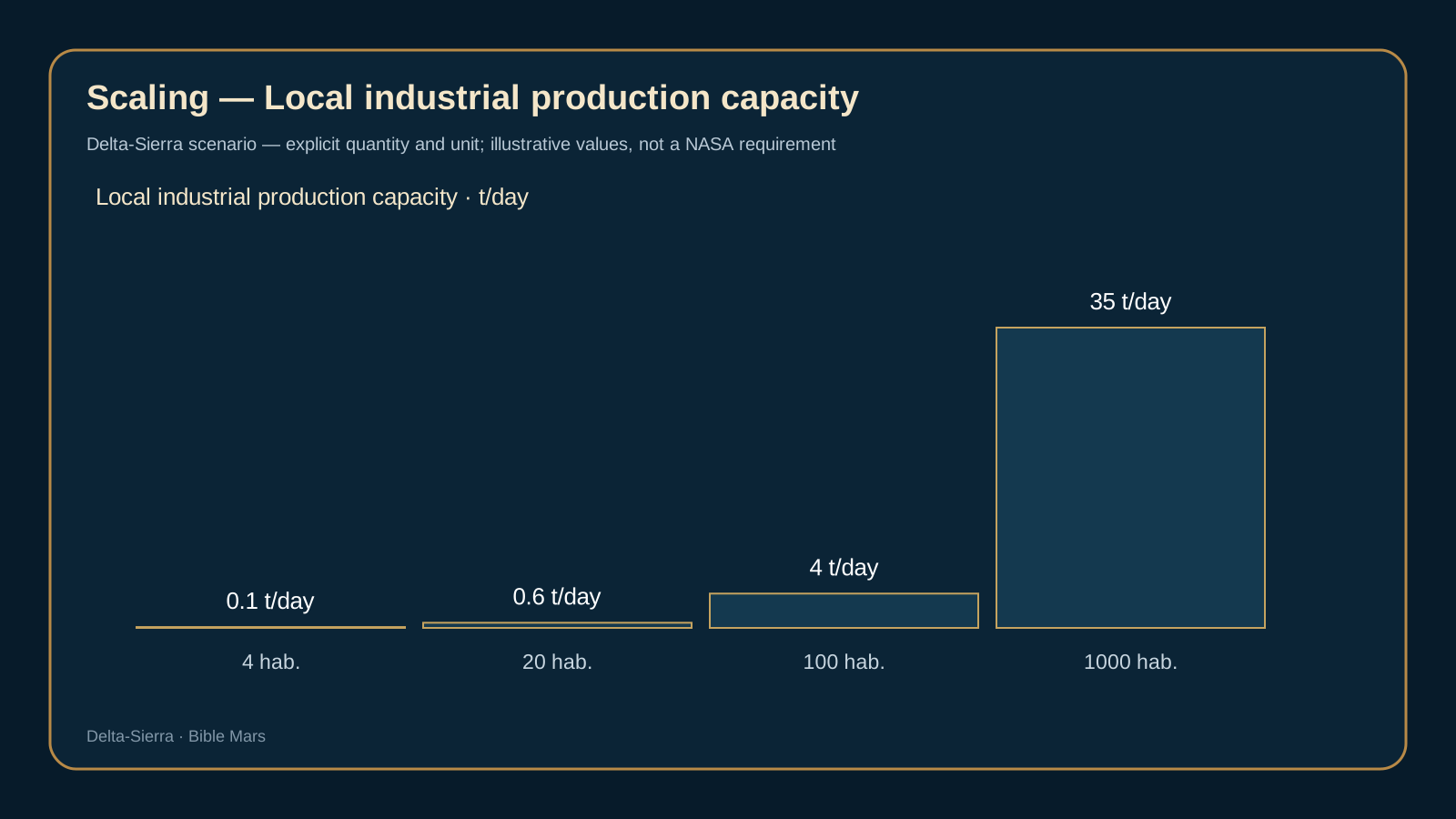
Four people: demonstrators and backup, not real industry. Diagnosis remains useful only if reactor can still be read during power demand.
Four people: demonstrators and backup, not real industry.
Twenty people: multi-process workshop and first regular production.
One hundred people: materials plant, maintenance and short-run production.
One hundred people: materials plant, maintenance and short-run production. Diagnostic condition — prospecting can still be read during dust.
One thousand people: industrial chain, standards, energy and specialization
One thousand people: industrial chain, standards, energy and specialization.
Local industrial production capacity — scaling scenario: the quantity and unit are illustrative and are not a NASA requirement.
Four architecture scenarios that materially change the decision
The plant works, but too slowly
The plant works, but too slowly. The process reaches target purity but throughput is below the base’s demand. The issue becomes availability, storage and nameplate capacity rather than chemistry alone. The scenario shows why a proof of concept is not yet infrastructure.
The deposit changes over a few hundred metres
The deposit changes over a few hundred metres. Ice or mineral concentration measured during reconnaissance is not uniform at production scale. The plant must tolerate variable feed or control it upstream. The scenario links mapping, excavation, blending and product quality.
The excavator fails
The excavator fails. The reactor works perfectly but no longer receives feedstock. The ISRU chain stops at its first mechanical link. The scenario requires spares, towing, repair capability and possibly multiple feed methods.
Local metal is out of specification
Local metal is out of specification. A part can be made, but inspection finds porosity or composition unsuitable for a vital function. The industrial system needs a lower-criticality use or reprocessing route rather than forcing acceptance. Metrology and qualification become integral to ISRU.
Martian industry becomes strategic when it can repair its own machines
Energy: every local kilogram has an electrical and thermal cost. <
Dust: the plant must protect its own machines from the material it processes.
Material economics: deciding which inputs justify local production. For a poorly characterized resource, geological uncertainty, process alarms, quarantine of off-spec material and restart criteria belong to different control layers.
Material economics: deciding which inputs justify local production.
The true transition: producing a qualified critical part from Martian feedstock.
The true transition: producing a qualified critical part from Martian feedstock. Who may modify extraction?
A settlement does not live on an ISRU demonstration; it lives on an available plant
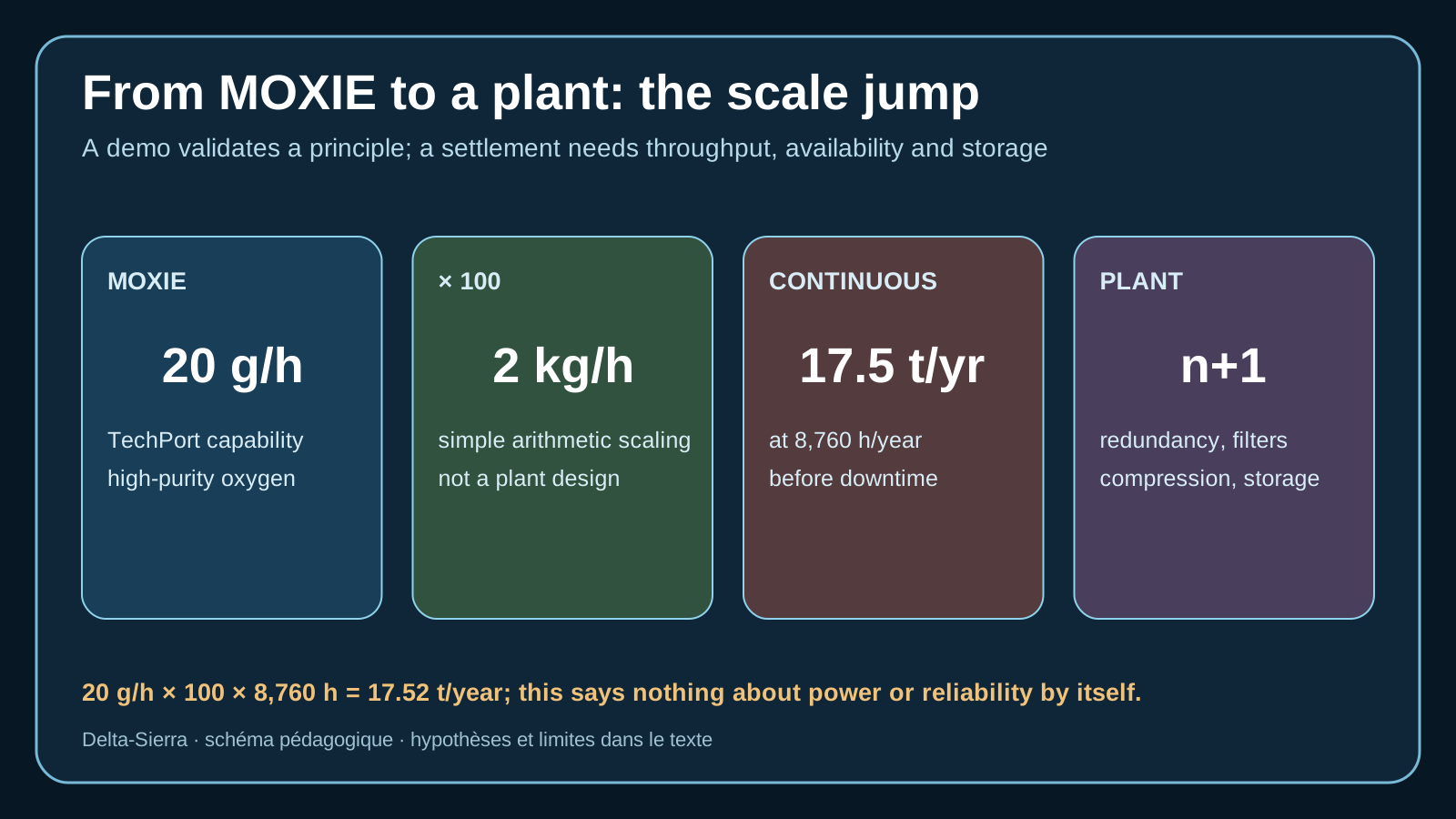
MOXIE changed the discussion because it demonstrated on Mars that atmospheric carbon dioxide could be collected and converted to high-purity oxygen using solid-oxide electrolysis. NASA TechPort’s 2026 update describes the experiment as roughly a one-percent-scale processing plant with capability on the order of 20 g of oxygen per hour. That is a major proof, but only the first line of an industrial specification.
Multiplying throughput is not plant design: power, compression, storage, maintenance and availability can dominate.
Simple throughput arithmetic shows the scale jump. Multiplying 20 g/h by 100 gives 2 kg/h. If that rate were sustained for all 8,760 hours of a year, production would be 17,520 kg, or 17.52 tonnes of O₂. This is intentionally not a plant prediction. A hundred-times scale-up does not imply exactly one hundred times the power, mass or maintenance. It shows why availability soon becomes more important than headline capacity.
At 90% availability the same nominal plant makes about 15.77 t/year; at 70%, about 12.26 t/year. A settlement must therefore choose some combination of oversizing, inventory and parallel units. Industrial systems often use an “n+1” philosophy so demand can still be met during maintenance. On Mars, that principle has to be balanced against imported mass, dust exposure and repair capability.
Oxygen is only one product in a resource network. A mature ISRU architecture links water extraction, electrolysis, CO₂ processing, perhaps methane or chemical feedstock production, purification, compression and storage. NASA’s current Moon to Mars architecture explicitly treats ISRU as a sub-architecture. Interfaces therefore matter: water purity at an electrolyzer inlet, gas quality, tank compatibility, fire safety and the ability to redirect production among life support, industry and mobility.
Robotic precursors should build an operational learning curve before the crew arrives. A pilot unit should run through seasons and record filter loading, performance versus atmospheric pressure, dust effects, compressor wear, maintenance hours and product contamination. A process that has never survived a Martian winter or a dusty season is not yet a dependable resource.
Storage is a silent factory. Gas production has little value unless the settlement can compress or liquefy it, meter it, keep it and distribute it without unacceptable leakage. Every kilogram produced becomes inventory, so valves, sensors, relief devices and purity monitoring require the same qualification culture as the core reactor.
At larger populations, growth itself should be tied to demonstrated local capacity. A prudent settlement would not call itself increasingly autonomous because a prototype once succeeded; it would require measured production margins, repair history and reserve days. Martian autonomy is a record of tonnes produced, hours available and days of inventory.
The real scale jump is availability. A nominal 2 kg O₂/h unit operating 90% of the year produces 2 × 8,760 × 0.90 = 15,768 kg/year, or 15.77 tonnes. At 70% availability the same hardware falls to 12.26 tonnes. A 3.5-tonne gap is not a footnote; it becomes missing inventory or imported mass. Availability A can be introduced as A = operating time / total time. A Mars plant therefore needs a guaranteed annual delivery figure, not only an instantaneous nameplate rate.
Feedstock has to be qualified like ore. The atmosphere is relatively uniform in composition, but dust, pressure and temperature change compressor and filter behavior. Soil resources are even more heterogeneous. Every ISRU chain needs characterization: concentration, contaminants, particle size and separation energy. Without that measurement, “local resource” is a slogan rather than an engineering input.
A plant should survive loss of one sub-chain. Compression, purification, reaction, separation, storage and distribution need isolation boundaries. Buffer tanks turn a short failure into maintenance rather than an immediate life-support emergency. Early Mars plants will likely be oversized not because engineers miscalculated, but because uncertainty and lack of resupply demand margins in throughput, storage and spares.
ISRU becomes industrial when local production is predictable, storable and maintainable. Demonstrator flow rate alone is insufficient: annual availability, purity, consumables, intermediate storage, waste and restart capability matter all the way to final use.
The first payoff may be incremental rather than total independence. Replacing shielding, makeup water, oxygen, construction feedstock or one heavy reagent can remove substantial imported mass while complex components still arrive from Earth. Gradual substitution avoids asking the first Mars plant to reproduce an entire terrestrial economy.
NASA — Overview: In-Situ Resource Utilization — The ISRU overview is used to frame the chain resource → acquisition → processing → storage → use. The page emphasizes that a production demonstration is not autonomous industry until throughput, maintenance and quality control are closed.
NASA/JPL — Perseverance and 3D-printed metal parts — Additively manufactured metal parts on Perseverance illustrate maturity of a manufacturing family while clearly separating Earth-qualified production from local Martian manufacturing using in-situ feedstock.
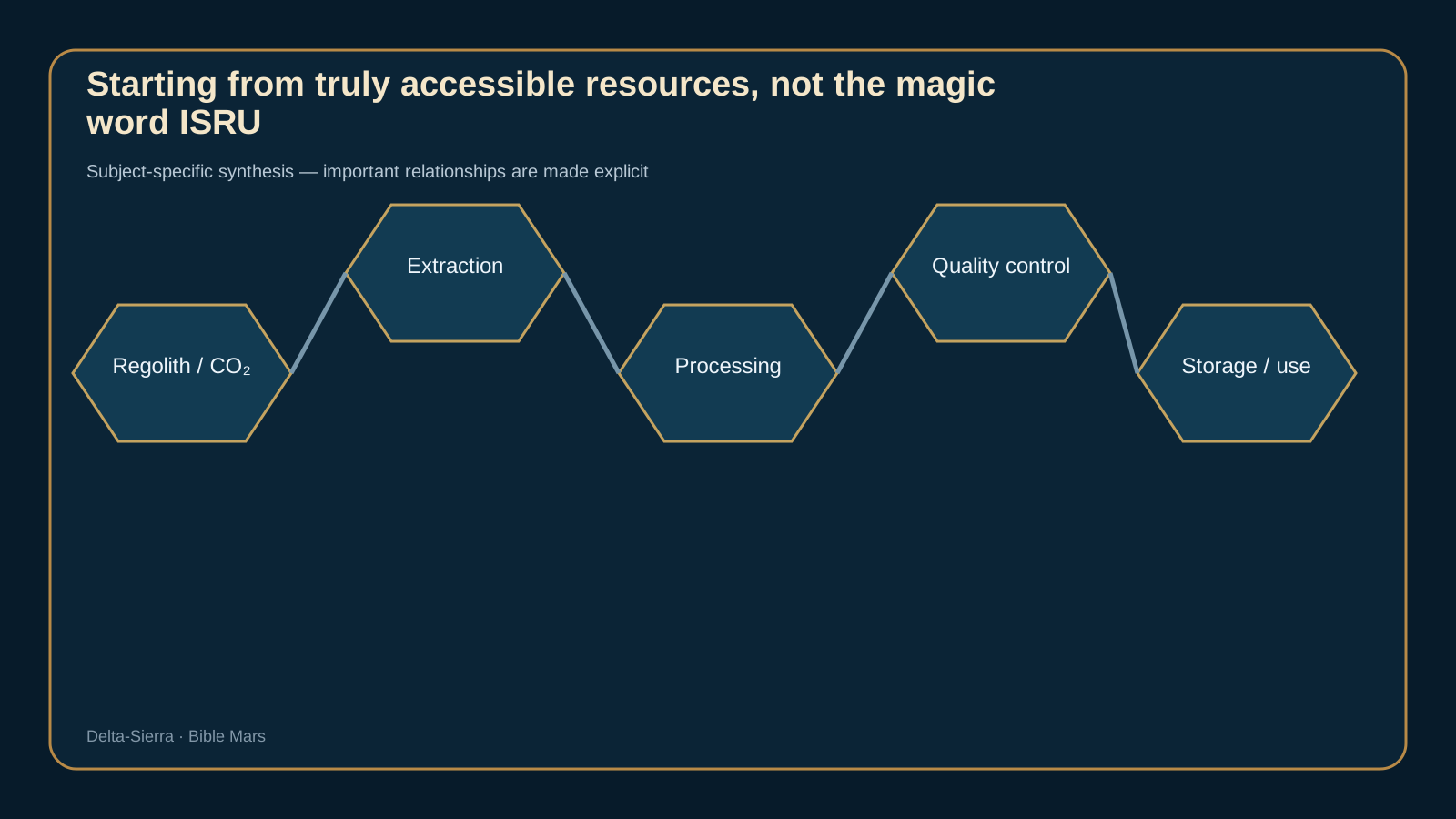
Starting from truly accessible resources, not the magic word ISRU
Starting from truly accessible resources, not the magic word ISRU.
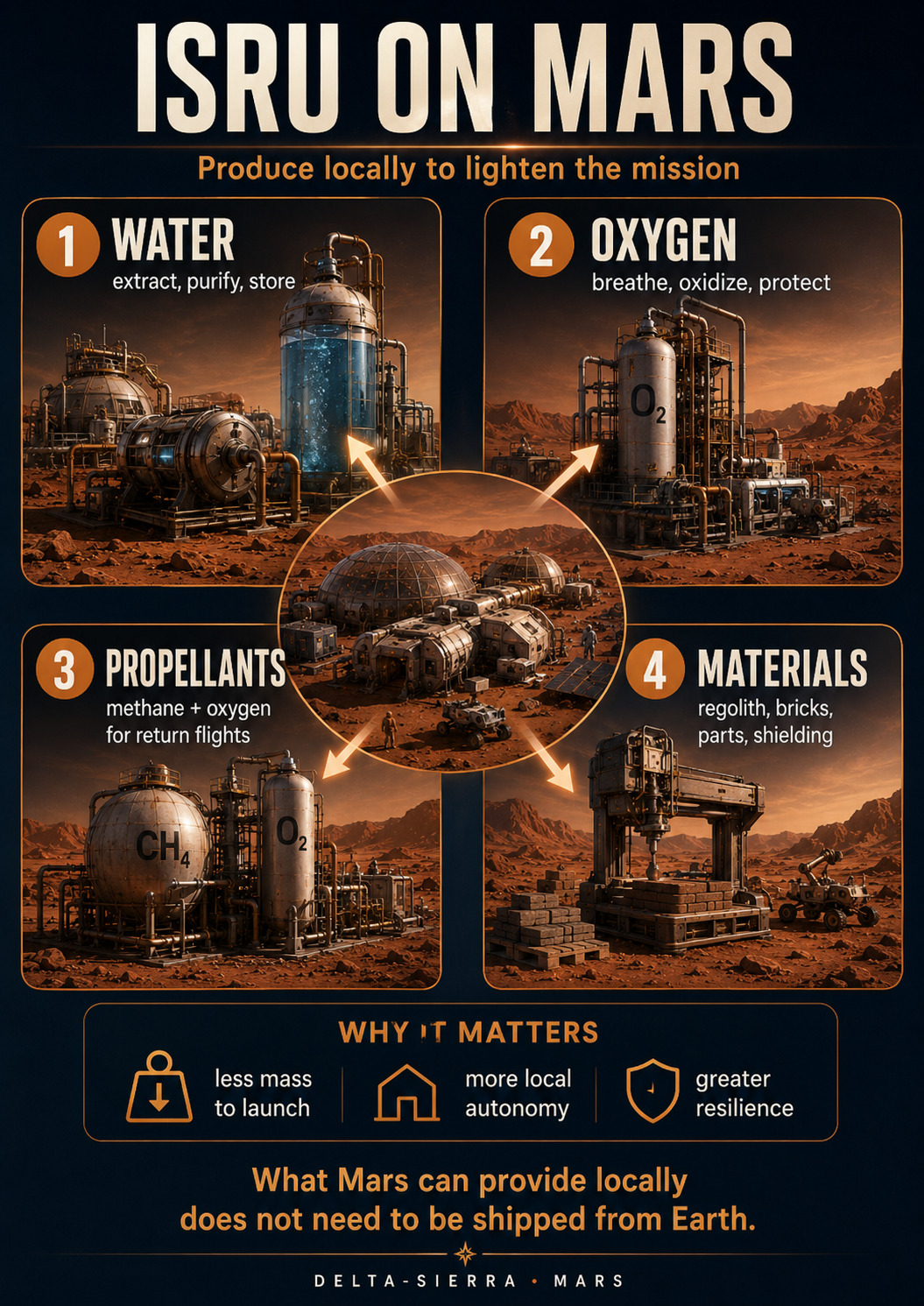
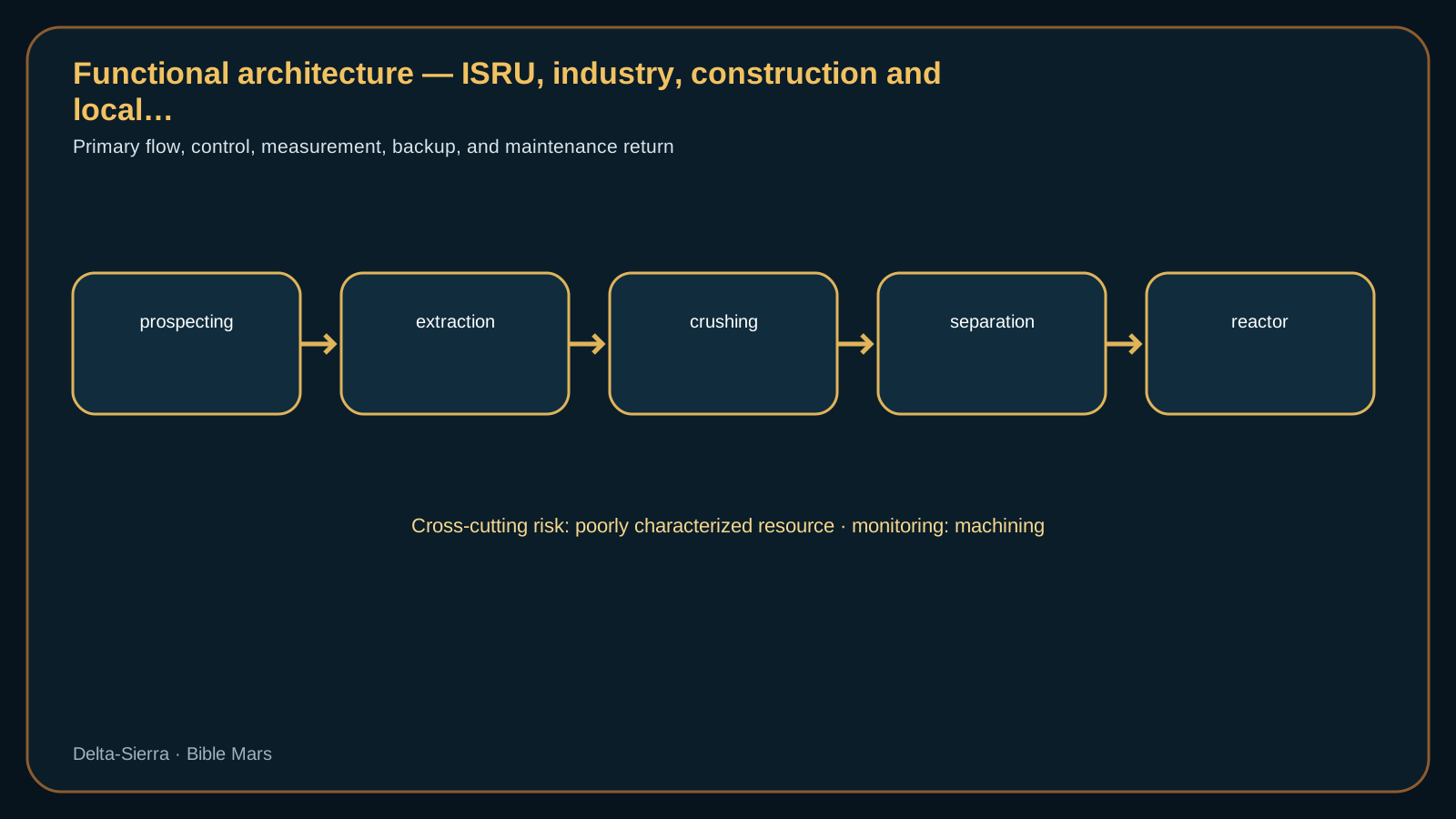
ISRU industry, construction and local manufacturing on Mars — functional architecture showing the flows, interfaces and dependencies developed in the chapter.ISRU industry, construction and local manufacturing on Mars — visual synthesis of the system-specific choices and constraints.
ISRU: using a local resource is not enough; a complete chain is required
ISRU: using a local resource is not enough; a complete chain is required. Versions, parameters, logs, and rollback capability must therefore be retained. The experience represented by MOXIE as a Martian oxygen demonstrator provides a reference point, but the Martian question is longer: what happens to prospecting after hundreds of cycles and several local repairs?
Uncertainty — isru: using a local resource is not enough; a complete chain is required.
Prospecting: mapping quantity, quality, depth and variability.
Extraction: digging in cold, abrasive, dusty ground.
Preparation: crushing, screening, drying and separation
Feedstock preparation determines whether downstream chemistry and forming behave predictably. Excavated regolith arrives with a particle-size distribution, agglomerates, dust, possible ice or adsorbed water, salts and mechanically abrasive grains. Crushing can consume significant energy and accelerate tool wear; screening trades throughput against a narrower size distribution; drying changes both mass balance and handling; magnetic or electrostatic separation can enrich selected mineral fractions but also creates reject streams that must be stored or reused. The process therefore needs sampled batches, moisture and particle-size measurements, wear tracking and buffer bins between stages. A reactor or printer should receive a qualified feedstock envelope, not whatever the excavator delivered that hour. If preparation drifts outside that envelope, the plant should divert the batch and diagnose the upstream cause rather than propagate uncertainty into every later product.
Preparation: crushing, screening, drying and separation.
Water: extracting, condensing, purifying, storing and distributing
Water: extracting, condensing, purifying, storing and distributing. When a reactor constrains the local production chain, the comparison is not between two generic 'redundancy' options: it is between adding reaction capacity, preserving spare catalyst and seals, or redesigning the downstream machining schedule so that a short chemical outage does not stop every workshop.
Water: extracting, condensing, purifying, storing and distributing.
Atmospheric oxygen: what MOXIE demonstrated and what a plant must still prove. MOXIE demonstrated on Mars that oxygen can be extracted from atmospheric carbon dioxide with solid-oxide electrolysis. An industrial chain must still demonstrate what the technology demonstrator was not required to provide: continuous throughput, compression and storage, durable power, dust management, replacement of hot components, purity control, and restart after an outage. Scaling from an experiment to a plant is therefore an integration and availability problem, not a simple multiplication of hourly output.
ISRU becomes industrial when throughput is dependable, not when a resource merely exists. The presence of water, carbon dioxide, or usable regolith says little about the amount of product delivered to the next process. Between resource and product lie geological characterization, excavation, handling, separation, purification, power, wear parts, and quality control. Each step has its own yield and availability. A chain that produces impressive output during a test campaign but then stops for months because a bearing or filter is unavailable is not yet settlement infrastructure. Sizing therefore has to combine process yield with real availability and compare the resulting annual output with settlement demand.
Local manufacturing also needs a deliberate boundary. Producing a plate, brick, or machined part can be attainable when feedstock, machines, and metrology exist; reproducing a rocket engine, complex medicine, or advanced semiconductor may require an entire industrial ecosystem. Useful autonomy therefore selects product families whose local production removes a genuinely critical dependency. Selection criteria include import mass avoided, demand frequency, inspection complexity, energy use, machine time, and the consequence of an out-of-spec batch. That progression turns ISRU into an industrial strategy rather than a slogan.
Sources and documentary findings
Starting from truly accessible resources, not the magic word ISRU: the references below are retained because they contribute a result, technology status or verification framework directly useful to this subject.
NASA TechPort — MARS-C
MARS-C is listed active in 2026 and explores an electrochemical cell using atmospheric CO₂ and mineral-bearing water to produce oxygen, hydrogen and hydrocarbons near Martian ambient conditions. It illustrates an integrated production path still under development, not an already available operational plant.
NASA TechPort — FLEET regolith handling and water capture
FLEET, completed in 2026, worked on excavation, regolith transport and product capture to close gaps that exist before the ISRU reactor itself. A Martian plant must therefore size solids handling as seriously as chemistry.
NASA TechPort — Regolith to Steel Powder, Oxygen & Water
MARS-C is useful here because it connects operations that are often described separately: regolith preparation, concentration, oxide reduction, water handling and production of usable metallic feedstock. The industrial problem is compatibility among those steps and final-product quality, not the isolated existence of each reaction.
Mars water-extraction concepts can process material after excavation or attempt treatment close to the deposit. For an ISRU industry, that choice changes the entire chain: excavation equipment, bulk transport, heating, separation, filtration, corrosion control, storage, and maintenance are sized differently.
NASA TechPort — Advanced Mars Water Acquisition System
From an industrial perspective, AMWAS illustrates the sequence required between water-bearing soil and a usable stream: heating, carbon-dioxide circulation, condensation, separation and purification. Every step adds equipment, energy demand, maintenance and product-quality criteria.