


MARS BIBLE — ORGANISATIONS
Blue Origin
New Shepard, BE-4, New Glenn and the gradual construction of space transportation infrastructure.
BEFORE MARS — HOW THE ORGANIZATION WAS BORN
Blue Origin before the large launch vehicles: the small team, first flying machines and a culture of slow learning
Blue Origin was created in 2000 by Jeff Bezos around an idea much broader than suborbital tourism: progressively lower the cost and difficulty of reaching space so that durable space infrastructure can be built over generations. The company now describes that ambition as building a road to space and places reusability at the center of its technical strategy. It would nevertheless be misleading to project today’s factories, New Glenn and lunar contracts backward onto the opening years. Early Blue Origin was a far smaller, deliberately quiet organization centered on experimentation.
A deliberately quiet origin, with a sparse public record of the first hires
Unlike a public agency, Blue Origin has not published a complete roster of its first recruits, early organization charts or initial budgets. That documentary limit should be stated rather than filled with invented detail. One unusually useful primary anchor does exist: Blue Origin says engineer Gary Lai joined in 2004 and was among the company’s first twenty employees. He later became a chief architect of New Shepard and held roles spanning system architecture, capsule development, design engineering and advanced research. The record gives a sense of scale: four years after creation, the organization was still small enough for one engineer to work across major portions of a complete flight system.
The safest conclusion is therefore not that Blue Origin began like a mature aerospace prime with hundreds of specialists, but that it grew from a compact technical nucleus in which broad systems competence mattered. That matches the logic of its first public vehicles: build something small enough to fly, measure it, recover it, and increase complexity only after the team has learned from the previous machine.
Charon in 2005: learning to design, build, fly and recover
The first Blue Origin flying vehicle documented by the company is Charon. Built as an early development project in 2005, the roughly 9,500-pound test vehicle used four vertically mounted aircraft jet engines to demonstrate vertical takeoff and landing technologies. Blue Origin later explained that Charon provided valuable design, build and operations experience. The significance lies less in the vehicle’s sophistication than in the organizational loop it created: a small team had to design a machine, integrate it, operate it, understand deviations and bring the lessons back into the next iteration.
That loop foreshadows the much harder problem of reusable launch systems. Reuse is not only an impressive landing. It requires avionics, propulsion, structures, ground operations, inspection, maintenance and turnaround to be designed as one system. Charon did not prove those capabilities at rocket scale, but it gave the organization early experience with a recoverable vertical vehicle and with the disciplines required to operate one.
Goddard in 2006: moving toward the New Shepard architecture
On November 13, 2006, the Goddard development vehicle launched and landed during a low-altitude test. Blue Origin’s own account emphasized methodical progress, smaller steps and frequent learning. That language matters because it connects institutional history with engineering practice: the company was not merely choosing a vertical-landing architecture; it was teaching itself to become a test organization. Each vehicle could create procedures, habits, instrumentation practice and shared technical memory.
What the opening years still explain
Blue Origin later expanded into New Shepard, the BE-3 and BE-4 engines, New Glenn, large industrial facilities, lunar systems and NASA partnerships. The early history prevents two simplistic readings. Blue Origin did not suddenly appear with a heavy launcher, and it was not founded as a Mars company. It began with a small team, spent years on demonstrators and built competence around reuse and operations. For Mars that genealogy is relevant because a durable interplanetary architecture depends less on a single machine than on an organization able to test for years, industrialize, inspect, repair, repeat and preserve technical memory.
Founding and early-team sources: Blue Origin — About Blue · Blue Origin — Gary Lai, among the first 20 employees · Blue Origin — Charon, first flying vehicle · Blue Origin — Goddard / New Shepard flight test
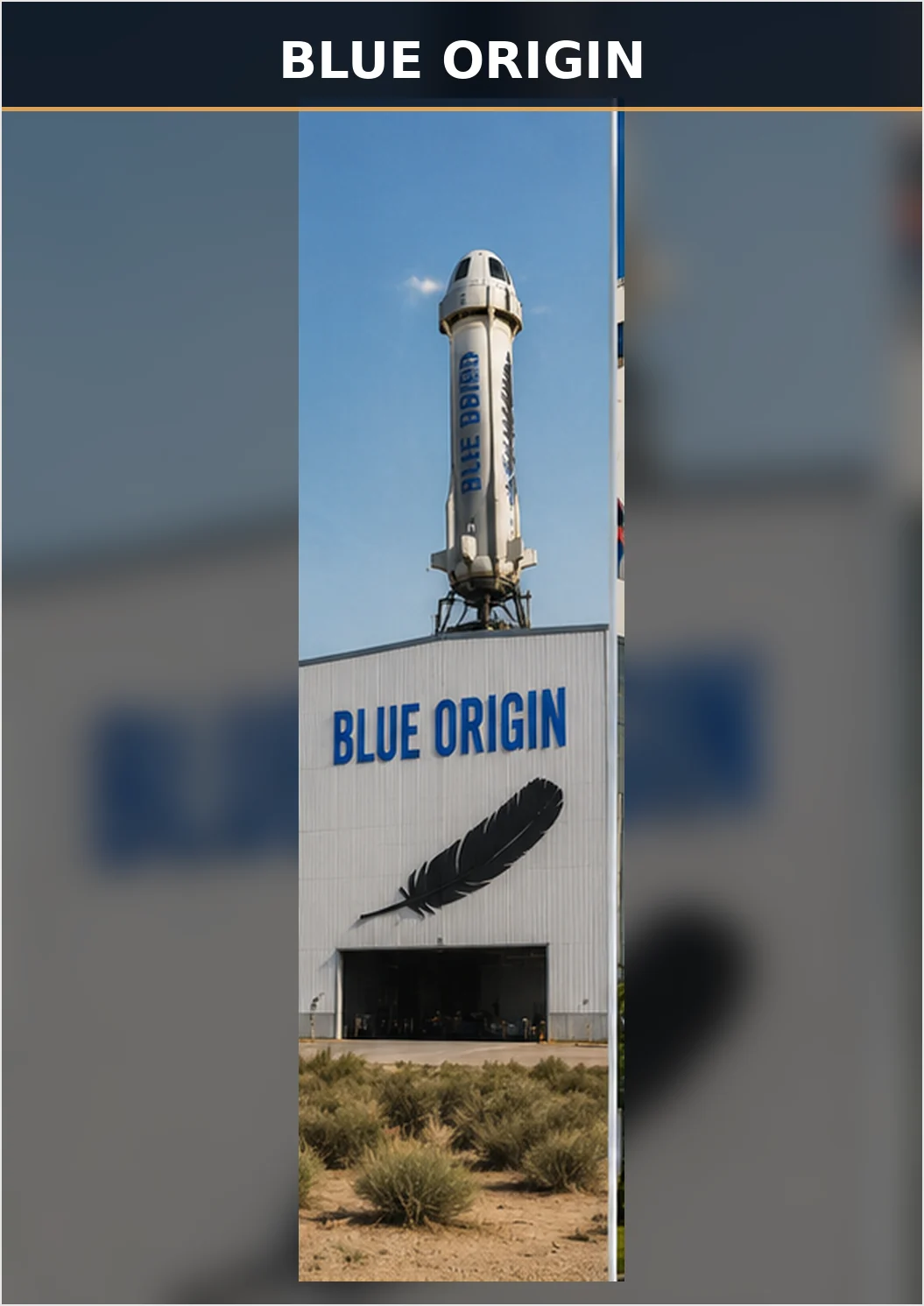
From a small team to systems capability: how a private organisation learns to become a space industrial company
Blue Origin's earliest years are difficult to document in detail because the company long communicated far less than many competitors. That documentary scarcity should be treated as a limit rather than filled with assumptions. One useful institutional trace comes from Blue Origin itself: engineer Gary Lai, later a major technical figure in New Shepard, says that he joined the company in 2004 and was among its first twenty employees. That gives at least an order of magnitude. In the mid-2000s this was not yet a large industrial workforce, but a small team in which a limited number of people necessarily carried broad technical responsibility.
That context helps explain why Charon and then Goddard matter historically. Charon, flown as an experimental vehicle in 2005, did not demonstrate an orbital system; it forced the young team to close a fast loop between propulsion, flight software, structure, testing and operations. Goddard extended the vertical-takeoff and vertical-landing logic. For an organisation still being built, each flight produced more than performance data: it converted generalist engineers into subsystem specialists, forced procedures to be written, revealed what had to be instrumented and created technical memory that could not simply be purchased ready-made.
New Shepard and then New Glenn changed both scale and profession. The company had to recruit and coordinate specialists in cryogenic engines, structures, avionics, quality, launch operations, manufacturing and safety. For Mars, the useful lesson is therefore not merely that another rocket exists. A credible interplanetary architecture depends on an organisation able to turn repeated tests into design rules, industrialise what works and investigate anomalies without losing programme continuity. That growth in organisational capability is more informative than spectacular imagery when assessing what Blue Origin can actually contribute to future Mars missions.
Direct answer: why Blue Origin matters to the story of Mars
Blue Origin deserves its own dossier because Blue Origin develops New Shepard, BE-4 engines and the orbital New Glenn vehicle. [1] The goal is not to rank organizations but to understand one as a system: history, decision centers, infrastructure, technologies, successes, failures and the capabilities it contributes — directly or indirectly — to Mars exploration.
New Shepard, BE-4, New Glenn and the gradual construction of space transportation infrastructure.
Essential timeline
- 20002000 foundation
- NewNew Shepard development
- BE-4BE-4 engine program
- 20252025 NG-1 orbit
- 20252025 NG-2 ESCAPADE/booster landing
- futurefuture civil/commercial missions
Understand the organisation before looking at its rockets
To understand Blue Origin, one must separate political goal-setting, program management, engineering centers, industrial manufacturing, science teams and mission operations. In this case, one useful anchor is that Blue Origin develops New Shepard, BE-4 engines and the orbital New Glenn vehicle. [1] Another is that New Glenn’s first stage is designed for reuse. [2] These are verifiable facts; by themselves they do not guarantee success of any future program. [1][2]
Why Mars exposes the true maturity of a space program
Mars is an unforgiving maturity test. Looking at Blue Origin through Mars therefore reveals not only what it announces but which capabilities it can actually integrate, test and operate. In this case, one useful anchor is that New Glenn’s first stage is designed for reuse. [2] Another is that New Glenn reached orbit on NG-1 in January 2025. [3] These are verifiable facts; by themselves they do not guarantee success of any future program. [2][3]
The technical chain from Earth to the Martian system
The theme of liquid methane and oxygen illustrates this systems view. Integration is therefore a capability in its own right. In this case, one useful anchor is that New Glenn reached orbit on NG-1 in January 2025. [3] Another is that NG-2 deployed NASA’s ESCAPADE spacecraft in November 2025 and landed the first stage. [4] These are verifiable facts; by themselves they do not guarantee success of any future program. [3][4]
Why failures often teach more than success releases
Space history is full of failures, anomalies and redesigns. In this case, one useful anchor is that NG-2 deployed NASA’s ESCAPADE spacecraft in November 2025 and landed the first stage. [4] Another is that ESCAPADE will study solar-wind interaction with the Martian magnetic environment. [5] These are verifiable facts; by themselves they do not guarantee success of any future program. [4][5]
Communications: commanding a machine that is no longer “live”
At interplanetary distance the word remote control changes meaning. Light-time delay cannot be negotiated away. The theme of orbital logistics therefore combines ground antennas, radio power, coding, onboard storage, mission planning and autonomous software. In this case, one useful anchor is that ESCAPADE will study solar-wind interaction with the Martian magnetic environment. [5] Another is that Blue Origin develops New Shepard, BE-4 engines and the orbital New Glenn vehicle. [1] These are verifiable facts; by themselves they do not guarantee success of any future program. [5][1]
Why mass governs almost everything
The architectures of Blue Origin can therefore be read as repeated trades among mass, energy, risk, cost and schedule. In this case, one useful anchor is that Blue Origin develops New Shepard, BE-4 engines and the orbital New Glenn vehicle. [1] Another is that New Glenn’s first stage is designed for reuse. [2] These are verifiable facts; by themselves they do not guarantee success of any future program. [1][2]
Science and engineering must learn each other’s language
Strong missions make these communities converge early. The theme of commercial model shows how a scientific question becomes a requirement, an instrument, an interface, an operations sequence and finally interpretable data. In this case, one useful anchor is that New Glenn’s first stage is designed for reuse. [2] Another is that New Glenn reached orbit on NG-1 in January 2025. [3] These are verifiable facts; by themselves they do not guarantee success of any future program. [2][3]
From one-off missions to infrastructure
This is why the history of Blue Origin is more interesting than a list of launches: the key question is which capabilities persist across generations. In this case, one useful anchor is that New Glenn reached orbit on NG-1 in January 2025. [3] Another is that NG-2 deployed NASA’s ESCAPADE spacecraft in November 2025 and landed the first stage. [4] These are verifiable facts; by themselves they do not guarantee success of any future program. [3][4]
Partners: autonomy does not mean isolation
Cooperation can accelerate a mission but also creates dependencies. In this case, one useful anchor is that NG-2 deployed NASA’s ESCAPADE spacecraft in November 2025 and landed the first stage. [4] Another is that ESCAPADE will study solar-wind interaction with the Martian magnetic environment. [5] These are verifiable facts; by themselves they do not guarantee success of any future program. [4][5]
Technical data explained in plain language
In this case, one useful anchor is that ESCAPADE will study solar-wind interaction with the Martian magnetic environment. [5] Another is that Blue Origin develops New Shepard, BE-4 engines and the orbital New Glenn vehicle. [1] These are verifiable facts; by themselves they do not guarantee success of any future program. [5][1]
Maturity: demonstrated, qualified, planned or merely studied
For Blue Origin, this dossier separates achievements, committed programs, announced schedules and prospective concepts so that ambition is not silently converted into fact. In this case, one useful anchor is that Blue Origin develops New Shepard, BE-4 engines and the orbital New Glenn vehicle. [1] Another is that New Glenn’s first stage is designed for reuse. [2] These are verifiable facts; by themselves they do not guarantee success of any future program. [1][2]
What this organisation contributes specifically to Mars
The Mars relevance of Blue Origin is better measured through transferable capabilities — BE-4 engine, deep-space navigation, autonomy, sample return, surface operations, instrumentation or transportation — than by counting how often the word Mars appears in public messaging. In this case, one useful anchor is that New Glenn’s first stage is designed for reuse. [2] Another is that New Glenn reached orbit on NG-1 in January 2025. [3] These are verifiable facts; by themselves they do not guarantee success of any future program. [2][3]
The people behind the systems
Vehicles are visible; organizations are less so. In this case, one useful anchor is that New Glenn reached orbit on NG-1 in January 2025. [3] Another is that NG-2 deployed NASA’s ESCAPADE spacecraft in November 2025 and landed the first stage. [4] These are verifiable facts; by themselves they do not guarantee success of any future program. [3][4]
What to watch over the next decade
To follow Blue Origin, it is more useful to watch funded missions, hardware entering integration, system tests, launch contracts, planetary windows and qualification of critical elements than to count distant announcements. In this case, one useful anchor is that NG-2 deployed NASA’s ESCAPADE spacecraft in November 2025 and landed the first stage. [4] Another is that ESCAPADE will study solar-wind interaction with the Martian magnetic environment. [5] These are verifiable facts; by themselves they do not guarantee success of any future program. [4][5]
Mars as a system of systems
The theme of orbital logistics is therefore one node in a larger architecture. Studying Blue Origin helps reveal which nodes are already mature, which are developing and which still depend on other actors. In this case, one useful anchor is that ESCAPADE will study solar-wind interaction with the Martian magnetic environment. [5] Another is that Blue Origin develops New Shepard, BE-4 engines and the orbital New Glenn vehicle. [1] These are verifiable facts; by themselves they do not guarantee success of any future program. [5][1]
What a non-specialist should retain
Applied to Blue Origin, these questions separate institutional messaging from operational reality without falling into cynicism. In this case, one useful anchor is that Blue Origin develops New Shepard, BE-4 engines and the orbital New Glenn vehicle. [1] Another is that New Glenn’s first stage is designed for reuse. [2] These are verifiable facts; by themselves they do not guarantee success of any future program. [1][2]
GO FURTHER
Mars Library

2025–2026 update: New Glenn moves from development program to a launcher that has actually sent a Mars mission
NG-1, NG-2 and NG-3: what was actually demonstrated
Blue Origin crossed two milestones in 2025 that materially changed its connection to Mars. On January 16, New Glenn reached its intended orbit on the NG-1 mission while the first-stage recovery attempt was unsuccessful. The distinction matters: orbital access was demonstrated on the first flight, but recovery was not yet established. On November 13, 2025, NG-2 launched NASA’s twin ESCAPADE spacecraft and the first stage landed on the Jacklyn platform. New Glenn had therefore become not only an orbital heavy launcher but a vehicle that had launched a science mission ultimately bound for Mars.
ESCAPADE is not flying a conventional direct transfer. The spacecraft entered an Earth-proximity phase and are scheduled to use an Earth gravity assist before heading toward Mars. That trajectory is architecturally interesting because a Mars mission does not necessarily have to leave Earth on a classic direct transfer at launch. It does not eliminate orbital mechanics or planetary alignment, but it offers a different way to manage launch timing and the interplanetary departure sequence.
On April 19, 2026, New Glenn then flew NG-3 carrying AST SpaceMobile’s BlueBird 7 satellite. The booster that had landed after NG-2 was returned to the campaign, adding an operational reuse milestone before the ground-test anomaly the following month. For Mars planning, the lesson is methodological: orbital flights, landings, actual reuse, cadence and infrastructure incidents should be tracked separately instead of reducing launcher maturity to a single successful mission.
A Mars payload as a test of industrial maturity
ESCAPADE’s launch is revealing because many chains had to work together: seven BE-4 engines on the first stage, upper-stage propulsion, fairing separation, accurate injection, deployment of two spacecraft and booster recovery. A company can describe a capability for years; the technical history changes when that chain works with an external science payload and measurable mission requirements.
The success should not be overinterpreted. New Glenn remains a young launch system, and a future large Mars logistics architecture would require more than isolated successes. Cadence, ground maintenance, engine production, spares, quality assurance and reliable repetition across many campaigns would matter. The key indicator is therefore not one dramatic launch image but whether the industrial system can reproduce the result.
The May 2026 anomaly: why a ground incident matters to Mars
On May 28, 2026, an integrated New Glenn hotfire test at Launch Complex 36 suffered a significant anomaly. Blue Origin reported at the end of June that the investigation was continuing and that early analysis pointed toward the aft section of the first stage. The company said that the lightning tower, transporter-erector and hydraulic cylinders were lost or damaged while other major facilities remained in good condition, and it was working toward a return to flight later in the year.
For Mars architecture, the episode is valuable because resilience includes ground systems. An interplanetary transportation chain does not depend only on a flight vehicle. Test stands, handling equipment, fluid systems, quality control and the ability to rebuild after an event are part of the real capability. A test anomaly is neither proof of permanent failure nor a trivial detail; it is evidence about how an industrial organization learns, repairs and resumes operations.
Blue Origin and Mars: demonstrated contribution versus extrapolation
As of August 2026, Blue Origin’s clearest demonstrated Mars contribution is the successful launch of ESCAPADE, not a public Mars-settlement program comparable to SpaceX’s stated ambitions. New Glenn, BE-4 and reusable-launch work nevertheless create capabilities relevant to possible interplanetary logistics: high launch capacity, engine production, recovery operations and potentially broader orbital infrastructure.
Keeping those categories separate is essential. It is reasonable to analyze how Blue Origin capabilities might support future Mars logistics; it would be incorrect to turn that analysis into an official settlement schedule. The dossier therefore distinguishes what has flown, what is contractually committed and what remains a Delta-Sierra engineering extrapolation.
Deep reading: what this trajectory teaches
To understand the place of Blue Origin in a serious history of Mars, two opposite shortcuts have to be avoided: reducing the organization to a list of missions, or treating one successful capability as proof that the whole Mars chain already exists. The thread of this dossier is the potential place of a transport and infrastructure company in a Mars ecosystem while separating demonstrated capability, development paths and extrapolation. The sections “Blue Origin before the large launch vehicles: the small team, first flying machines and a culture of slow learning”, “A deliberately quiet origin, with a sparse public record of the first hires” and “Charon in 2005: learning to design, build, fly and recover” should therefore be read as parts of one engineering question: which capabilities are real, in what environment have they been demonstrated, and which dependencies would still have to be closed before they could support a durable human presence?
The second reading level is maturity rather than visibility. When the dossier moves through “Goddard in 2006: moving toward the New Shepard architecture” and “What the opening years still explain”, the useful questions become: what is already operational, what has been demonstrated only in another context, what requires major scaling, and what remains prospective? This separation protects the reader from inflated extrapolation while making it easier to identify the particular competence or hard-won operational experience that Blue Origin can contribute.
From New Shepard to New Glenn: what matters to Mars and what is not demonstrated yet
Blue Origin built capability in stages: experimental vehicles, suborbital New Shepard, the BE-4 engine and then New Glenn. For Mars the useful question is not whether the company 'wants Mars' in the same sense as SpaceX, but which industrial capabilities can matter in an interplanetary architecture: large-engine production, heavy orbital-launch integration, recovery operations and the ability to serve NASA science payloads. Blue Origin — NG-1
Launching ESCAPADE gives New Glenn a concrete Mars connection. The vehicle carries a NASA science mission intended to study the interaction between the solar wind and the Martian environment. That obviously does not turn New Glenn into a human Mars transport. It demonstrates something narrower and more useful: a new heavy launcher has to become capable of sending a real payload onto an interplanetary trajectory and fitting that operation into an institutional science campaign. NASA — ESCAPADE on New Glenn
Booster recovery and returns to flight after anomalies should also be followed as maturity indicators rather than symbols. Mars architecture needs cadence, maintenance, diagnosis and a stable industrial chain. Blue Origin therefore provides a second useful example of a private actor trying to move from technology development to heavy orbital service. Comparison with SpaceX should focus on demonstrated capability and industrial models, not slogans. Blue Origin — New Glenn return to flight
Open book — from New Shepard to orbital, lunar and Martian infrastructure
This part follows Blue Origin through its own industrial trajectory: engines, launch vehicles, test infrastructure, suborbital operations, New Glenn development and public contracts. It consistently separates demonstrated capability from systems still under development, then asks what the company could realistically contribute to a future Mars logistics chain without turning plans into achievements.
2000: Bezos, long time horizons and a company financed to wait
Blue Origin was founded in 2000 by Jeff Bezos around a long-term vision: reduce the cost of access to space and build infrastructure enabling many more people to live and work there. For many years the company remained quiet while developing propulsion, vertical-hop vehicles and test methods before its large orbital launcher. [institutional source]
Founder financing allows long development cycles without immediate dependence on a single public programme. In return, the model concentrates strategic risk: a personal vision must be converted into an organisation capable of producing, delivering and meeting commitments to external customers.
Behind ‘2000: Bezos, long time horizons and a company financed to wait’, people and professions must be placed back into the decision chain. Programme leaders trade cost against schedule, systems engineers close interfaces, test teams hunt faults before flight and operators discover real behaviour after launch. That diversity avoids reducing an organisation to its chief executive or founder: collective competence lies in coordinating hundreds of specialised decisions.
Mars requires multi-decade horizons, but a general vision of millions of people in space is not a detailed Mars plan. Blue Origin’s Mars relevance must be derived from launchers, engines, lunar systems, stations and logistics actually being developed.
The main risk is hidden dependency: a capability looks national as long as the partner, supplier or foreign infrastructure remains available. Serious assessment therefore separates what the organisation can reproduce, what it can only operate and what it purchases as a service. This map does not diminish achievement; it shows where investment is needed to make the next generation more robust. It would be misleading to assign the company a Mars-settlement schedule it has not published. Its visible operational priorities in 2026 are mainly New Glenn, Blue Moon, engines, orbital infrastructure and the Moon.
Goddard in 2006: learning the control loop before aiming for orbit
The Goddard experimental vehicle conducted a short vertical flight in Texas in November 2006. The test looks modest compared with New Glenn, but it already closed the sensor-software-actuator loop required for vertical takeoff, attitude control and controlled descent. [institutional source]
Small vehicles also build field operations: fuelling, telemetry, range safety, emergency shutdown, data recovery and post-test analysis. A company thereby learns the routines needed to repeat campaigns without reinventing every procedure.
Behind ‘Goddard in 2006: learning the control loop before aiming for orbit’, people and professions must be placed back into the decision chain.
The Mars connection lies in propulsive vehicle control and progressive testing philosophy. Atmosphere, dust, gravity and lack of local support would require a very different vehicle; the Goddard flight is only a methodological building block.
Another risk comes from showcase effects. Highly visible space programmes naturally attract political and corporate communication, but an announcement is not a qualification, a flight or operational experience. The chronology should therefore preserve three distinct states: proposed capability, capability in development and demonstrated capability. Mixing them creates an illusion of maturity that becomes dangerous when reasoning about Mars. Early tests should not be told as an inevitable march toward success. Their value comes precisely from the ability to abandon a configuration, discover a limit and change the architecture before financial or human stakes become much higher.
2011: losing a vehicle and deciding what failure must teach
In 2011 a development vehicle was lost during a test after flight instability. Blue Origin published an update explaining the loss and continuation of the programme. The episode is a reminder that a flying test bed may exist precisely to expose faults before they reach an operational vehicle. [institutional source]
The value of failure depends on telemetry and review discipline. Destruction without data teaches little; synchronised sensors, software logs and models can instead reconstruct the causal chain, modify hardware and then verify whether the correction actually works.
Behind ‘2011: losing a vehicle and deciding what failure must teach’, people and professions must be placed back into the decision chain.
On Mars, repair and diagnosis would be even more critical because a replacement might be a whole launch window away. Systems must therefore be designed to record their state, operate in degraded modes and be understood by a small local team.
Possible failure must remain part of the story. Mass, power, thermal and schedule margins are limited while teams work with incomplete information. A healthy organisation therefore does not promise the absence of error; it builds reviews, tests, redundancy and detection mechanisms able to prevent a local error from becoming mission loss. A culture willing to accept destructive testing on Earth is not yet a culture of planetary maintenance. Terrestrial workshops, parts, experts and rescue resources must be explicitly removed from the reasoning when extrapolating to Mars.
New Shepard: vertical reuse becomes a service rather than only a demonstration
New Shepard combines a reusable BE-3PM-powered booster and a separable capsule. The first development flight in 2015 sent the capsule on a suborbital trajectory but lost the booster during recovery; later campaigns eventually demonstrated propulsive returns, parachutes and repeated reuse. [institutional source]
Reuse means inspecting, measuring wear, deciding which parts remain flightworthy and processing the vehicle quickly enough for economics to change. A spectacular recovery has industrial value only if it leads to refurbishment cheaper than building a new vehicle.
Behind ‘New Shepard: vertical reuse becomes a service rather than only a demonstration’, people and professions must be placed back into the decision chain.
For Mars, repetition and propulsive control are relevant, but New Shepard reproduces neither long-duration habitation, dust, interplanetary radiation nor autonomous maintenance. Its value lies in safety, propulsion and operations building blocks, not a complete Mars scenario.
The least visible fragility is often human. Technology may be documented yet remain practically dependent on a few people who remember workarounds, past anomalies and the reasons behind a decision. Long programmes must organise succession, cross-training and retention of raw data or competence can disappear faster than hardware. The suborbital programme should remain distinct from orbital programmes. A few minutes of microgravity and a ballistic trajectory do not provide the experience of a station, interplanetary spacecraft or surface vehicle.
2021-2026: human flight forces Blue Origin to industrialise safety
The first crewed New Shepard flew in July 2021 with Jeff Bezos, Mark Bezos, Wally Funk and Oliver Daemen. Later missions created recurring suborbital human operations with private passengers, researchers and guests, forcing the company to stabilise preparation, weather criteria, recovery and medical screening. [institutional source]
The 2022 uncrewed anomaly, in which the capsule escape system functioned while the booster was lost, became an unintended but important demonstration of an independent survival function. The programme could correct the booster while retaining evidence that emergency separation performed its role.
Behind ‘2021-2026: human flight forces Blue Origin to industrialise safety’, people and professions must be placed back into the decision chain.
Mars would need similar philosophies of independent survival, but escape options disappear quickly after departure from Earth. Safety must then rely on redundancy, repair, fault isolation and autonomy rather than immediate return.
The main risk is hidden dependency: a capability looks national as long as the partner, supplier or foreign infrastructure remains available. Serious assessment therefore separates what the organisation can reproduce, what it can only operate and what it purchases as a service. This map does not diminish achievement; it shows where investment is needed to make the next generation more robust. The number of passengers carried does not measure duration experience. The programme demonstrates a short human-flight chain; it should not be converted into the equivalent of six months on the ISS or interplanetary travel.
BE-4: industrialising an oxygen-rich staged-combustion methane-oxygen engine
BE-4 burns liquid oxygen and liquefied natural gas in an oxygen-rich staged-combustion cycle. Seven engines power New Glenn’s first stage and two also power ULA’s Vulcan, giving the engine an industrial base not dependent solely on Blue Origin’s launcher. [institutional source]
The difficulty is not only high thrust: turbomachinery, materials and combustion must remain stable in a harsh environment and then tolerate multiple cycles if reuse becomes routine. Serial production additionally requires tolerances and tests able to detect variation among engines.
Behind ‘BE-4: industrialising an oxygen-rich staged-combustion methane-oxygen engine’, people and professions must be placed back into the decision chain.
Methane naturally invites Mars comparisons, where methane and oxygen could theoretically be produced from carbon dioxide and hydrogen. But BE-4 uses terrestrial propellants: it develops a relevant propulsion family, not a Martian ISRU plant.
Another risk comes from showcase effects. Highly visible space programmes naturally attract political and corporate communication, but an announcement is not a qualification, a flight or operational experience. The chronology should therefore preserve three distinct states: proposed capability, capability in development and demonstrated capability. Mixing them creates an illusion of maturity that becomes dangerous when reasoning about Mars. A complete Martian chain would add extraction, purification, electricity, cryogenic storage, transfer, quality control and restart after long periods. The engine represents one link, however important.
New Glenn: moving from suborbital flight to a heavy launcher over 98 metres tall
New Glenn stands over 98 metres tall, uses seven BE-4 engines on the first stage, two BE-3Us on the second and a seven-metre fairing. Blue Origin advertises roughly 45 tonnes to low Earth orbit and a first stage designed for at least twenty-five missions, recovered on the sea platform Jacklyn. [institutional source]
The industrial leap is enormous: large tanks, stage transport, payload integration, Cape Canaveral range coordination, orbital trajectory and sea recovery must function as one chain. The seven-metre fairing also creates particular value for bulky payloads constrained by diameter as much as mass.
Behind ‘New Glenn: moving from suborbital flight to a heavy launcher over 98 metres tall’, people and professions must be placed back into the decision chain.
For Mars, the immediate function is logistics: place large habitats, tanks, cargo or spacecraft elements into Earth orbit for later assembly or refuelling. New Glenn is not a Mars lander, but it can become part of the terrestrial transport chain.
Possible failure must remain part of the story. Mass, power, thermal and schedule margins are limited while teams work with incomplete information. A healthy organisation therefore does not promise the absence of error; it builds reviews, tests, redundancy and detection mechanisms able to prevent a local error from becoming mission loss. Advertised performance and theoretical booster life must be tested against actual cadence. By 2026 the system has completed several important flights, but its history remains short compared with launchers operated across many missions.
2025: succeeding at orbit before succeeding at recovery
The first New Glenn reached orbit in January 2025 but did not recover its booster. On the second flight in November 2025, NASA’s ESCAPADE mission launched and the first stage landed on Jacklyn. The sequence clearly separates the launcher’s primary mission from the additional objective of reuse. [institutional source]
The progression shows the value of an architecture able to fulfil its orbital contract even when recovery fails. Data from the first attempt can then modify return control and operations without invalidating the entire launch chain.
Behind ‘2025: succeeding at orbit before succeeding at recovery’, people and professions must be placed back into the decision chain.
ESCAPADE creates a direct relationship with Mars: NASA’s two spacecraft are intended to study the magnetic environment and atmospheric escape. Blue Origin thus becomes launch provider for a Mars mission, while science navigation and operations near Mars remain the responsibility of other teams.
The least visible fragility is often human. Technology may be documented yet remain practically dependent on a few people who remember workarounds, past anomalies and the reasons behind a decision. Long programmes must organise succession, cross-training and retention of raw data or competence can disappear faster than hardware. Launch success does not guarantee ESCAPADE’s final scientific success. The distinction is important for assigning responsibility correctly when a major mission involves several organisations.
NG-3 in April 2026: reuse finally becomes fleet data
New Glenn’s third flight launched on 19 April 2026 with BlueBird 7. Blue Origin reused the Never Tell Me The Odds booster, which had already launched and been recovered on the previous mission. Actual reuse is more economically informative than merely recovering a stage that never flies again. [institutional source]
Between missions, structures, engines, protection, avionics and recovery systems must be inspected. The time and degree of disassembly required becomes an industrial variable as important as flight performance because it determines cadence and fleet size.
Behind ‘NG-3 in April 2026: reuse finally becomes fleet data’, people and professions must be placed back into the decision chain.
A Martian transport economy would need systems able to repeat cycles with limited workshops. Terrestrial experience of ageing and return to service therefore provides a useful baseline even though dust and planetary maintenance radically change the context.
The main risk is hidden dependency: a capability looks national as long as the partner, supplier or foreign infrastructure remains available. Serious assessment therefore separates what the organisation can reproduce, what it can only operate and what it purchases as a service. This map does not diminish achievement; it shows where investment is needed to make the next generation more robust. Two uses of a booster remain a tiny statistical base. New Glenn’s economic robustness will need to be judged over years of cadence, refurbishment cost and the actual number of flights achieved by each first stage.
May-August 2026: the hotfire anomaly reveals dependence on the ground system
An anomaly during a third first-stage hotfire in May 2026 heavily damaged LC-36A facilities. On 5 August Blue Origin said the origin had been confirmed at the main oxygen valve of one BE-4 and announced small component modifications along with a different pad rebuild. [institutional source]
The event shows that a launcher also includes lightning protection, transporter-erector, hydraulics, propellant supply, safety networks and evacuation procedures. Losing ground equipment can immobilise already-manufactured vehicles: cadence depends on the resilience of the entire infrastructure.
Behind ‘May-August 2026: the hotfire anomaly reveals dependence on the ground system’, people and professions must be placed back into the decision chain.
Mars amplifies this lesson. A settlement that loses a crane, electrolyser or test stand may immobilise several systems if it lacks redundancy or local repair capability. Maintenance infrastructure must therefore be treated as mission hardware.
Another risk comes from showcase effects. Highly visible space programmes naturally attract political and corporate communication, but an announcement is not a qualification, a flight or operational experience. The chronology should therefore preserve three distinct states: proposed capability, capability in development and demonstrated capability. Mixing them creates an illusion of maturity that becomes dangerous when reasoning about Mars. The incident remains recent as of 22 August 2026. Its final impact on schedule, cadence and LC-36 architecture should remain open until return-to-flight testing and actual reconstruction.
ESCAPADE: New Glenn’s first service directly connected with Mars
ESCAPADE consists of two small NASA orbiters intended to study how the solar wind interacts with Mars’s magnetic environment and contributes to atmospheric loss. Their launch on the second New Glenn in November 2025 gave the new launcher its first real reference on a mission whose scientific destination is Mars. [institutional source]
The trajectory includes a phase around Earth before trans-Mars injection, showing that interplanetary launch can use complex energy architectures. Blue Origin’s role nevertheless remains launch service and separation conditions, not Mars science and spacecraft operations.
Behind ‘ESCAPADE: New Glenn’s first service directly connected with Mars’, people and professions must be placed back into the decision chain.
For a human architecture, New Glenn could place cargo, depots or vehicle elements into orbit. ESCAPADE demonstrates a smaller but concrete portion of that chain: serving a planetary mission with a new reusable heavy launcher.
Possible failure must remain part of the story. Mass, power, thermal and schedule margins are limited while teams work with incomplete information. A healthy organisation therefore does not promise the absence of error; it builds reviews, tests, redundancy and detection mechanisms able to prevent a local error from becoming mission loss. New Glenn’s success must be distinguished from ESCAPADE’s final success. If a spacecraft later encounters an anomaly unrelated to launch, correct attribution of responsibility protects the documentary value of the page.
Blue Moon Mark 1: lunar cargo, cryogenics and precision before human flight
Blue Moon Mark 1 is being developed as a multi-tonne lunar cargo lander. Blue Origin plans missions intended to exercise BE-7, cryogenic-fluid management, navigation and precision landing before the Mark 2 architecture intended for Artemis astronauts. [institutional source]
Storing liquid hydrogen and oxygen for long periods is an engineering problem in itself: heat, boil-off, pressurisation and transfer can consume mission margin. Lunar demonstrations allow those functions to be exercised in a remote environment without immediately committing a crew.
Behind ‘Blue Moon Mark 1: lunar cargo, cryogenics and precision before human flight’, people and professions must be placed back into the decision chain.
Mars adds atmosphere, dust and different gravity, but autonomous guidance, precision landing and cryogenic management remain transferable building blocks. The value is in accumulating surface experience, not pretending a lunar lander is already a Mars lander.
The least visible fragility is often human. Technology may be documented yet remain practically dependent on a few people who remember workarounds, past anomalies and the reasons behind a decision. Long programmes must organise succession, cross-training and retention of raw data or competence can disappear faster than hardware. Mark 1 remains under development. Its technical objectives should be presented as such until flights and demonstrations occur on the lunar surface.
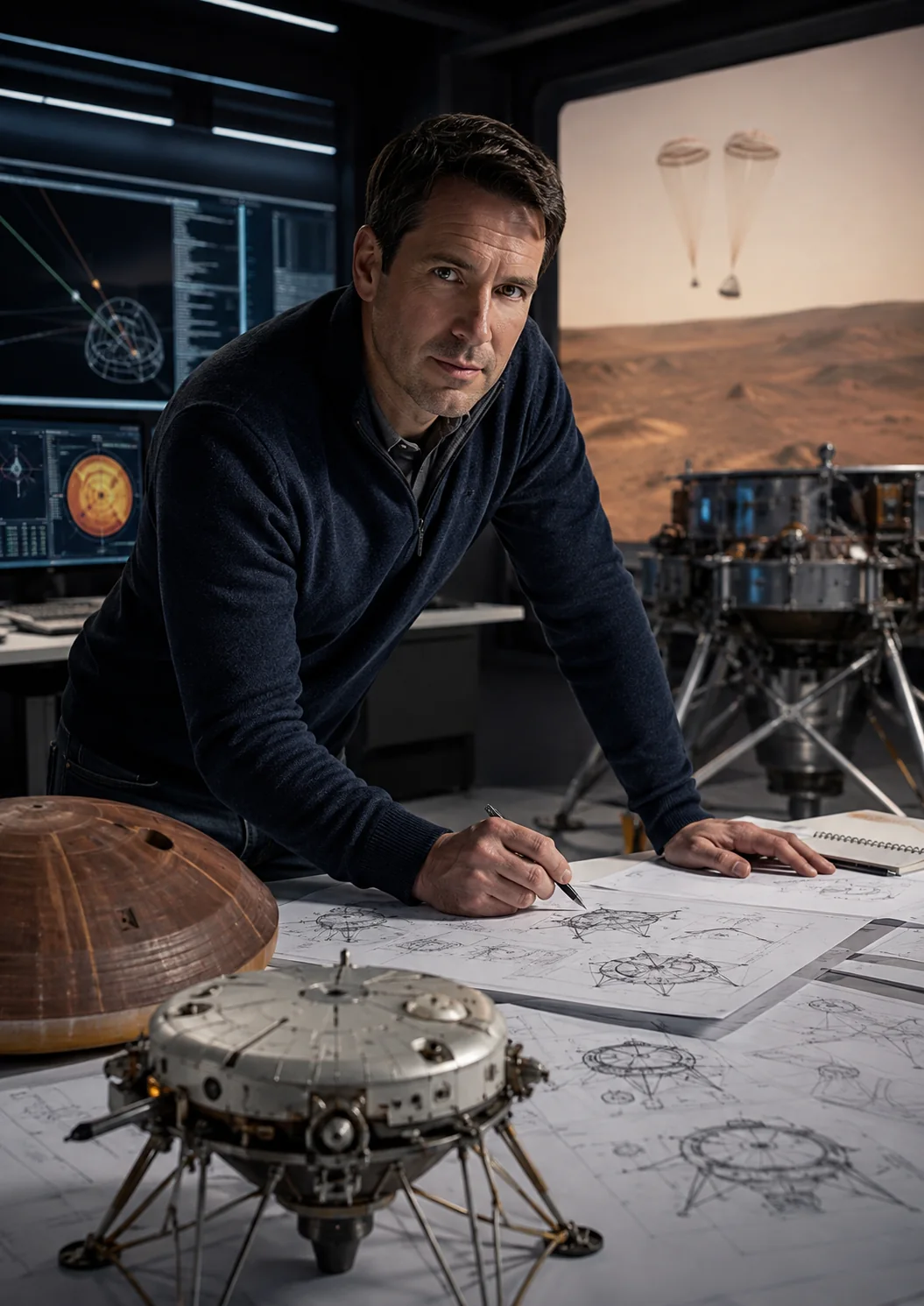
Blue Moon Mark 2: Artemis V forces the transition from cargo to crew survival
NASA selected the Blue Origin team to develop a second Human Landing System for a future Artemis V mission. The programme plans Mark 1 steps followed by an uncrewed Mark 2 demonstration before the crewed lander, according to the maturation logic described by NASA’s Inspector General in 2026. [institutional source]
Human flight adds life support, pressurisation, human factors, fault tolerance, Gateway interfaces and direct responsibility for safety. NASA purchases a service from a private company but retains an obligation for sufficient oversight to accept crew risk.
Behind ‘Blue Moon Mark 2: Artemis V forces the transition from cargo to crew survival’, people and professions must be placed back into the decision chain.
For Mars, this experience would be far more relevant than suborbital flight if it succeeds: surface operations, life support, rendezvous and a crewed lander. Atmospheric entry, interplanetary duration, Martian dust and ascent from stronger gravity would still need to be added.
The main risk is hidden dependency: a capability looks national as long as the partner, supplier or foreign infrastructure remains available. Serious assessment therefore separates what the organisation can reproduce, what it can only operate and what it purchases as a service. This map does not diminish achievement; it shows where investment is needed to make the next generation more robust. Artemis schedules change regularly. The monograph should follow reviews and demonstrations rather than engrave a future date as operational certainty.
Orbital Reef: a commercial station as a laboratory for permanent life
Orbital Reef is being developed with partners under NASA’s commercial low-Earth-orbit destination programmes. The station targets several user types and must combine power, thermal control, life support, rendezvous, logistics, maintenance and safety in continuously used infrastructure. [institutional source]
NASA-funded milestones include life-support system testing and human-in-the-loop evaluations. A station becomes credible when subsystems stop being isolated prototypes and begin to work together under real crew constraints.
Behind ‘Orbital Reef: a commercial station as a laboratory for permanent life’, people and professions must be placed back into the decision chain.
A Mars settlement will resemble a permanently inhabited station more than a launcher: air, water, waste, maintenance, fire, toxicity and logistics will dominate daily life. Real Orbital Reef experience could therefore provide highly transferable lessons.
Another risk comes from showcase effects. Highly visible space programmes naturally attract political and corporate communication, but an announcement is not a qualification, a flight or operational experience. The chronology should therefore preserve three distinct states: proposed capability, capability in development and demonstrated capability. Mixing them creates an illusion of maturity that becomes dangerous when reasoning about Mars. Orbital Reef is not yet operational. Development milestones and system tests must be distinguished from years of experience with crews and customers that still have to be acquired.
Blue Ring: adding a logistics layer between launcher and destination
Blue Ring is presented as an orbital mobility platform able to transport, host and deploy multiple payloads while providing power, communications and operations. The concept seeks to separate orbital transport service from the customer spacecraft, like a tug or logistics stage. [institutional source]
The architecture imposes strict interface discipline: multiple payloads must coexist without a failure, electrical disturbance or software error in one endangering the others. The vehicle must also retain enough propulsion and margin to deliver different destinations.
Behind ‘Blue Ring: adding a logistics layer between launcher and destination’, people and professions must be placed back into the decision chain.
For Mars, orbital tugs, depots and transfer platforms could reduce the number of functions carried by each cargo. Mature logistics around Earth would therefore be an interesting building block before longer interplanetary operations.
Possible failure must remain part of the story. Mass, power, thermal and schedule margins are limited while teams work with incomplete information. A healthy organisation therefore does not promise the absence of error; it builds reviews, tests, redundancy and detection mechanisms able to prevent a local error from becoming mission loss. The platform must be assessed from real missions rather than advertised capability alone. Until cadence and operational duration are demonstrated, potential should remain distinct from operational experience.
LC-36, Huntsville, Kent and Van Horn: a launcher is first an industrial network
Blue Origin distributes design, production, engines, testing and launch across several sites: Kent, Huntsville, Texas and Florida, with LC-36 rebuilt for New Glenn. Engines must reach the right stage, configurations remain synchronised and ground infrastructure be available precisely when the vehicle is ready. [institutional source]
This geography creates a supply chain and industrial memory. A test-stand failure, pad accident or supplier delay can limit the entire cadence. Billions invested in factories and launch complexes are therefore as much part of capability as engine performance.
Behind ‘LC-36, Huntsville, Kent and Van Horn: a launcher is first an industrial network’, people and professions must be placed back into the decision chain.
Mars would remove the possibility of quickly transporting a component among these sites. A settlement must therefore condense workshops, diagnostics, stocks, production and testing locally—a miniature industrial ecosystem rather than a simple astronaut base.
The least visible fragility is often human. Technology may be documented yet remain practically dependent on a few people who remember workarounds, past anomalies and the reasons behind a decision. Long programmes must organise succession, cross-training and retention of raw data or competence can disappear faster than hardware. Investment, employment and supplier figures often come from Blue Origin itself and should be attributed accordingly. A reference monograph distinguishes corporate data from independent public statistics.
BE-7, BE-3U and BE-4: why an engine family matters more than one thrust record
Blue Origin operates or develops several families: BE-3PM on New Shepard, BE-4 on New Glenn and Vulcan, BE-3U for New Glenn’s upper stage and BE-7 for Blue Moon. Each engine addresses a different environment—atmospheric, vacuum, reuse, precision descent—and requires different test methods. [institutional source]
An industrial family can share professions, test assets, quality tools and suppliers while avoiding forcing one engine to perform contradictory missions. Specialisation can improve performance and safety, but increases the number of chains that must be maintained simultaneously.
Behind ‘BE-7, BE-3U and BE-4: why an engine family matters more than one thrust record’, people and professions must be placed back into the decision chain.
For Mars, the diversity is instructive: Earth departure, transfer, landing and ascent do not necessarily require the same engine. The question is not to find one magical propulsion system, but to optimise several phases while limiting distinct parts and skill sets.
The main risk is hidden dependency: a capability looks national as long as the partner, supplier or foreign infrastructure remains available. Serious assessment therefore separates what the organisation can reproduce, what it can only operate and what it purchases as a service. This map does not diminish achievement; it shows where investment is needed to make the next generation more robust. BE-7 and some capabilities remain under development. A promising engine family must be assessed by tests, production, flights and observed maintenance, not technical sheets alone.
Cadence, reuse and customers: the real economic test is only beginning
New Glenn combines large volume, a reusable first stage and commercial or government customers. The economic model assumes initial booster manufacture is amortised over several missions, but the saving depends on actual flights, refurbishment time and demand able to fill the manifest. [institutional source]
A launcher can be technically reusable without being economically reused if inspection, repair or logistics take too long. The decisive evidence will therefore be cadence accumulated over several years rather than the theoretical mission count announced for a new stage.
Behind ‘Cadence, reuse and customers: the real economic test is only beginning’, people and professions must be placed back into the decision chain.
Mars will require a repeatable transport economy: cargo, parts and crews cannot depend on one exceptional launch every several years. Progress in terrestrial cadence is therefore an indirect but fundamental condition of durable interplanetary logistics.
Another risk comes from showcase effects. Highly visible space programmes naturally attract political and corporate communication, but an announcement is not a qualification, a flight or operational experience. The chronology should therefore preserve three distinct states: proposed capability, capability in development and demonstrated capability. Mixing them creates an illusion of maturity that becomes dangerous when reasoning about Mars. Because real prices are not very transparent, the page should not invent a cost per kilogram from marketing statements. Cadence, observed reuse, contracts and availability are better public indicators.
Bezos, Dave Limp and the transformation from founder project to serial-production company
Blue Origin remains associated with Jeff Bezos, but its present scale requires operational leadership able to coordinate engines, launcher, landers, station, suppliers and customers. Under Dave Limp, the visible challenge is converting capital and vision into production cadence, contractual milestones and return to flight after anomalies. [institutional source]
A small team can operate with large amounts of tacit knowledge; an organisation of thousands cannot. Interfaces, responsibilities, reviews and acceptance criteria must become formal, especially when multiple vehicles are produced or tested in parallel.
Behind ‘Bezos, Dave Limp and the transformation from founder project to serial-production company’, people and professions must be placed back into the decision chain.
Mars will require organisations that survive founders and political cycles. The ability to transfer memory, change leaders and maintain standards over decades is therefore a planetary capability in its own right.
Possible failure must remain part of the story. Mass, power, thermal and schedule margins are limited while teams work with incomplete information. A healthy organisation therefore does not promise the absence of error; it builds reviews, tests, redundancy and detection mechanisms able to prevent a local error from becoming mission loss. The internal decisions of a private company are less publicly documented than those of an agency subject to audits and archives. The narrative should therefore rely on contracts, flights and attributed statements while clearly separating interpretations of corporate culture.
Moon, orbit and Mars: testing intermediate building blocks without making the Moon a mandatory detour
Blue Origin concentrates much of its strategy on cislunar space and the Moon. For Mars, the value does not come from claiming every Mars mission must pass through the Moon, but from transferable building blocks: cryogenics, rendezvous, landing, life support, maintenance and orbital logistics. [institutional source]
The Moon can serve as a remote test ground where teams learn to maintain hardware and manage crews without instant return. But its gravity, dust, thermal cycle and lack of atmosphere differ from Mars; each lesson must therefore be requalified before transfer.
Behind ‘Moon, orbit and Mars: testing intermediate building blocks without making the Moon a mandatory detour’, people and professions must be placed back into the decision chain.
A good Mars architecture uses intermediate infrastructure only if it reduces total risk, mass or cost. The engineering question is not ‘Moon or Mars’ but ‘which experiences actually make the first Mars mission less fragile?’.
The least visible fragility is often human. Technology may be documented yet remain practically dependent on a few people who remember workarounds, past anomalies and the reasons behind a decision. Long programmes must organise succession, cross-training and retention of raw data or competence can disappear faster than hardware. Not every Blue Origin lunar programme should therefore be described as an automatic step toward Mars. The connection must be demonstrated technology by technology and updated using actual system performance.
What Blue Origin can actually do for Mars in August 2026
Demonstrated capabilities include liquid engines, many reusable suborbital flights, short human operations and three New Glenn missions including booster recovery and reuse. Launching ESCAPADE adds a real reference on a mission destined for Mars even though the company does not build the spacecraft. [institutional source]
Capabilities under development include Blue Moon, BE-7, Orbital Reef, Blue Ring and expanded New Glenn infrastructure. They could provide lunar-surface, life-support, cryogenic and orbital-logistics experience, but should not be counted as operational experience before demonstration.
Behind ‘What Blue Origin can actually do for Mars in August 2026’, people and professions must be placed back into the decision chain.
Major Mars gaps remain: no Mars lander or ascent vehicle, no Martian ISRU, no long-duration interplanetary habitat and no surface experience under Martian dust, gravity and radio delay. The most immediate contribution would therefore probably be launch and infrastructure around Earth.
The main risk is hidden dependency: a capability looks national as long as the partner, supplier or foreign infrastructure remains available. Serious assessment therefore separates what the organisation can reproduce, what it can only operate and what it purchases as a service. This map does not diminish achievement; it shows where investment is needed to make the next generation more robust. This picture should be revised after future flights, return to flight after the 2026 anomaly and Blue Moon demonstrations. A living monograph should move capabilities from ‘planned’ to ‘demonstrated’ only when evidence exists.
Stennis in July 2026: separating upper-stage testing from launch-pad cadence
On 24 July 2026, Blue Origin and NASA announced an agreement allowing New Glenn upper-stage hotfire testing at Stennis’s B Test Complex. The decision matters as more than a change of location: it adds a test site to an industrial architecture whose LC-36 launch pad had already shown how a single facility can become a bottleneck after an anomaly. [institutional source]
Decoupling part of the test programme from the launch pad reduces schedule conflicts. An upper stage can be qualified while another vehicle is integrated in Florida; a test anomaly does not necessarily immobilise the same infrastructure needed for launch. The real economic benefit therefore comes as much from facility scheduling as from engine performance.
The extension also links a private company to a historic NASA site. Blue Origin engineers must adapt procedures, instrumentation and safety to a facility with its own operating culture. Stennis teams contribute decades of large-propulsion test experience. Capability appears in making the two organisations compatible without blurring responsibility.
For New Glenn, this redundancy can shorten recovery after incidents and support higher cadence. It also increases the amount of test hardware, software and configuration information that must remain consistent across sites. Resilience is therefore not free: it trades one dependency for a broader configuration and coordination problem.
A durable Mars logistics chain would require exactly this kind of bottleneck analysis. If a cargo fleet depends on one workshop, one engine stand or one crane, failure of a secondary asset can block the entire chain. New Glenn’s terrestrial infrastructure therefore offers a useful industrial laboratory for sizing redundancy before exporting the idea to a far harsher environment.
The Stennis agreement remains a developing test capability in 2026, not proof of higher operational cadence. Actual campaigns, utilisation frequency and effects on the manifest need to be observed before assigning a quantified availability gain.
LC-36B in August 2026: resilience becomes built infrastructure
On 12 August 2026, Blue Origin announced construction of LC-36B for the New Glenn 9x4 variant while LC-36A is intended to remain the operational home of the 7x2. The project also includes a new Vertical Integration Facility and Payload Processing Facility. The schedule comes less than three months after the hotfire anomaly damaged several elements of the existing complex. [institutional source]
Two pads only provide resilience if genuinely critical dependencies are also distributed. Propellant networks, payload-processing equipment, software, cranes, qualified teams and spares must be mapped so that one shared component does not make redundancy merely theoretical. Resilience therefore requires a functional inventory rather than simply counting pads.
Construction involves Florida suppliers, Blue Origin teams, range authorities and government partners. Every new facility creates a generation of operators who must be trained before advertised cadence can become real. Recruitment, certification and rehearsal timelines can therefore matter as much as concrete or steel.
The expansion also reveals the launcher’s scaling strategy. The 9x4 variant and vertical facilities broaden the classes of payload and mission the company intends to handle. The task is no longer merely proving New Glenn can fly, but organising a site able to support multiple configurations and customers with different security requirements.
For Mars, the lesson is that access to space begins long before the interplanetary vehicle. Habitats, tanks, cargo and surface systems must leave Earth through an industrial chain able to absorb delays without losing an entire launch window. Targeted infrastructure duplication may matter more than a marginal performance improvement in the launcher.
LC-36B is not operational in August 2026. It should therefore be classified as infrastructure under construction rather than demonstrated capability. Its real value will become visible after the site has processed payloads, supported campaigns and shown that it actually improves New Glenn availability.
Quartz in August 2026: Blue Origin adds communications to its infrastructure portfolio
On 13 August 2026, Blue Origin announced that the first three Quartz ground stations had been installed and tested in Bermuda, New Zealand and Australia, with rollout planned across nine sites by year-end. The network targets telemetry, tracking and command for customer missions rather than use limited to the company’s own vehicles. [institutional source]
The first phase uses 3.7-metre antennas in S and X band for low-Earth-orbit operations. The company then plans nine-metre antennas supporting L, S, X and Ka bands to extend services toward GTO, GEO, cislunar space and beyond. The system must also manage contact scheduling, security, radiometric tracking and incident response through a common operations centre.
Building a worldwide network adds professions far removed from propulsion: radio frequency, cybersecurity, networks, remote-site maintenance, regulatory coordination and customer support. That diversification matters because a durable space economy depends as much on everyday service as on the spectacular moment of launch.
Quartz may also reduce Blue Origin’s internal dependence on third-party ground-station providers for some missions while creating a new commercial service. But owning antennas across several continents creates its own risks: terrestrial connectivity, electrical power, weather, local authorisations and synchronisation of software configurations.
For Mars, communications will be safety-critical infrastructure. A commercial terrestrial network does not replace the large antennas of the Deep Space Network, but experience in global scheduling, secure telemetry and multi-site availability is directly relevant to a future relay chain connecting Earth, Mars orbit and the surface.
As of August 2026, only the first three sites are announced as installed and tested. The nine-site year-end network and nine-metre antennas remain part of the rollout plan. The monograph should follow actual commissioning before treating advertised coverage as achieved.
Blue Alchemist: producing oxygen, metals and power from soil as an industrial problem
In September 2025, Blue Origin announced that Blue Alchemist had passed its Critical Design Review. The programme aims to process lunar regolith into oxygen, metals and materials usable in solar cells. The idea is often summarised by the term ISRU, but its real significance appears only when the entire industrial chain from a handful of dust to a qualified product is decomposed. [institutional source]
Material must be collected and prepared, grain size controlled, an electrochemical or thermal process fed, heat and dust managed, products separated, purity verified and a working component manufactured. Every step consumes power, parts and maintenance time. A local resource is therefore useful only if the whole process costs less mass and risk than importing the equivalent product.
The programme brings propulsion, materials science, electrochemistry, robotics and power production into the same chain. Specialists who do not traditionally work on one vehicle must share quality criteria and interfaces. That interdisciplinarity resembles a planetary factory more than a conventional launch system.
Lunar success could reduce the mass of some infrastructure launched from Earth and give Blue Origin capability beyond transport. It would also shift the challenge toward the reliability of autonomous factories, spare availability and quality control in an environment where every repair is expensive.
Mars makes the idea even more interesting because its atmosphere contains carbon dioxide and its regolith has chemistry different from the Moon’s. Processes will therefore not transfer unchanged. The engineering method—characterise a resource, size the power system, close material balances and create local maintenance—is directly relevant to Martian oxygen, metals, water and construction materials.
Blue Alchemist has not yet demonstrated an operating factory on the Moon, much less on Mars. Critical Design Review is an engineering milestone, not extraterrestrial industrial production. The page must preserve that boundary rather than turn promising technology into an already available capability.
Primary and institutional sources
- Blue Origin — New Glenn
- Blue Origin — NG-1
- Blue Origin — NG-2
- Blue Origin — ESCAPADE award
- Blue Origin — ESCAPADE launch
- Blue Origin — NG-1
- Blue Origin — NG-3
- NASA — ESCAPADE launch on New Glenn
- Blue Origin — New Glenn return to flight, 30 June 2026
- Blue Origin — About Blue
- Blue Origin — Goddard development update
- Blue Origin — 2011 development update
- Blue Origin — New Shepard
- Blue Origin — New Glenn / BE-4
- Blue Origin — New Glenn
- Blue Origin — New Glenn NG-3
- Blue Origin — GS1-3 Hotfire Updates, 2026
- NASA — ESCAPADE
- Blue Origin — Blue Moon
- NASA OIG — Human Landing System Program Management, 2026
- NASA — Commercial LEO Destinations / Orbital Reef
- Blue Origin — Blue Ring
- Blue Origin / NASA — New Glenn upper-stage tests at Stennis, 24 July 2026
- Blue Origin — construction de LC-36B, 12 August 2026
- Blue Origin — Quartz ground station network, 13 August 2026
- Blue Origin — Blue Alchemist CDR
External links open in a new tab.
What Blue Origin can actually contribute to a Mars architecture
Blue Origin is not currently a Mars programme in the same sense as a dedicated planetary-science mission. Its relevance comes from capabilities that an interplanetary architecture could reuse: propulsion, heavy-launch development, launch infrastructure, powered landing and the gradual construction of an industrial organisation. The useful reading therefore separates a capability demonstrated on Earth or in near-Earth space from a Mars capability that would still have to be designed and qualified. [institutional source]
That distinction avoids two opposite mistakes: dismissing a company because it has not yet flown to Mars, or assigning it a Mars architecture that it has neither announced nor demonstrated. For the reader, Blue Origin is primarily a case study in building durable space-industrial capacity and in understanding how engines, launchers and landing systems can become critical dependencies inside a much larger programme. [institutional source]