


1 — Rank parts by criticality and recurrence. Not every part deserves local manufacturing. A seal consumed every week, a standard bearing or a pipe fitting may justify rapid local production, while advanced electronics are better treated as strategic imports until local metrology and process control mature. The settlement therefore needs a living parts database combining failure rate, resupply time, mass, survival criticality and substitutability. That knowledge base can become almost as important as the machine tools themselves.
MARS BIBLE — TECHNICAL GUIDE
The industry that turns a Mars base into a durable society
Industrial maintenance: foundations of the chapter
Essential foundations already established
Manufacturing becomes a colonization threshold when repairs and replacement parts no longer wait for the next Earth shipment; see how humans could colonize Mars step by step for the broader transition from expedition logistics to local industrial autonomy.
Repair before production: maintenance is the first Martian industry
The first useful Martian industry is unlikely to be a steel mill. It is a workshop that can diagnose a leak, remake a cable, machine a bushing, overhaul a pump and document the repair. Every failure recovered without full replacement avoids an object that otherwise travels for months. Maintenance converts skill and tooling directly into avoided logistics mass.
This priority changes imported-system design. Equipment needs test points, access to wear items, standardized connectors, offline procedures and disassembly with available tools. A perfect sealed machine becomes a dependency. A slightly less efficient but repairable machine can be far more resilient for a settlement.
Maintenance before manufacturing. The first Martian workshops mainly need to repair. A failed pump, valve, motor, sensor or seal can immobilize a life-critical system. Before dreaming of complete local machines, the settlement needs metrology, tooling, test benches, documentation and critical spares. Preventive maintenance becomes a civic function as important as energy.
Design for repair: maintainability becomes a survival requirement. On Earth, a sealed or difficult-to-open device can often be replaced quickly. On Mars, the same design choice may create a long logistics dependency. Where performance allows, equipment should favour accessible fasteners, standard interfaces, documented parts, replaceable sensors and architectures that isolate failed subassemblies.
Maintainability does not mean primitive machines. It means evaluating performance together with access time, required tooling, skill level, spares, calibration and post-repair testing.
Reasoning example
Two pumps have the same efficiency. One depends on a proprietary controller that cannot be repaired locally; the other uses a documented replaceable controller shared with several systems. For an isolated base, the second may be more resilient even if slightly heavier.
MARS BIBLE — INDUSTRIAL AUTONOMY
Autonomy is measured by how many failures the settlement can repair. Importing a machine does not automatically import the ability to maintain it. A truly autonomous base needs to know the wear parts, special tools, lubricants, software, calibration procedures and skills on which each machine depends. Martian industry therefore starts with a dependency map.
Standardize before manufacturing. If every pump uses a different motor, voltage, bearing and fastener family, spare inventory explodes. A settlement gains enormous leverage from reducing part variety: common connectors, shared bearings and sensors where reasonable, documented mechanical interfaces and exchangeable modules.
3D printing: making the geometry is only one step. Additive manufacturing can rapidly make some shapes, but a critical part also needs the right material, microstructure, dimensions and traceable process history. Metrology, heat treatment and non-destructive inspection become part of the practical “printer” system.
MTBF and MTTR: MTBF describes mean time between failures; MTTR describes mean time to repair. A highly reliable machine that waits six months for a unique spare can be less available than a simpler redundant machine repaired in an hour.
Choose what local industry should make first. Early local manufacturing will not reproduce Earth’s full industrial economy. It should target heavy, bulky, frequently replaced or locally feedstock-compatible items: selected simple parts, shielding, pipes, structures and consumables. Advanced semiconductors, complex medicines and highly qualified alloys may remain Earth-dependent much longer.
Private industry provides building blocks, not a Mars guarantee. Companies are developing relevant technologies: ICON works on additive construction and built the CHAPEA analog habitat; Redwire develops regolith manufacturing and surface-infrastructure concepts. These are useful building blocks, but operating an autonomous Mars industrial chain still requires qualification, power, maintenance and logistics.
Primary and technical sources used for this deep dive: NASA — Moon to Mars architecture ↗ · ICON — additive construction ↗ · Redwire — regolith infrastructure ↗
Import intelligently: keep Earth for the hardest grams
Autonomy does not require reproducing everything. Rare pharmaceuticals, advanced chips, metrology instruments, selected bearings, catalysts or coatings may remain rational imports for a long time because functional value per kilogram is enormous. The objective is to reserve transport for hard items rather than dogmatically eliminate every import.
A strategic bill of material can classify items into three horizons: make locally, repair/recondition locally, or secure through stock and Earth suppliers. The classification changes over time. An imported item can become locally manufacturable when metrology, chemistry or machine capability advances.
What should still be imported. Advanced semiconductors, some medicines, precision instruments and specialized components will remain easier to import for a long time. Industrial policy is not about absolute autarky but about reducing dependencies that could kill the settlement. Light, complex components may come from Earth; heavy, simple and frequently replaced items are stronger candidates for local production.
Hybrid workshop: machining, additive, foundry, welding and assembly
No manufacturing technology is sufficient alone. Additive processes create shapes and reduce geometry inventory; machining reaches surfaces and tolerances; foundry work transforms bulk metal; welding repairs and joins; heat treatment adjusts properties. A Martian workshop is a network of overlapping processes.
Diversity can provide redundancy. If a printer is unavailable, a simple component may be machined; if a foundry stops, semi-finished stock can keep machining alive. Multiple manufacturing routes for critical parts prevent one machine from becoming the new single point of failure.
Additive manufacturing, machining and foundry work. 3D printing is valuable for complex shapes and short runs, but it does not replace machining, casting, heat treatment or non-destructive testing. A real Martian industry combines processes. It also recycles scrap: an imported metal or polymer should ideally pass through several useful lives before being lost.
Design for repair: standardization, access and diagnosis
Repairability is designed. Removable covers, common fasteners, standardized bearing families, documented electrical interfaces and space for tools reduce intervention time. Permanent bonding, proprietary parts and sealed modules shift mass from the machine to replacement logistics.
Diagnosis should also be built in. Internal sensors, fault logs and test points allow technicians to replace the actual failed element instead of swapping modules blindly. Industrial settlements gain not only by making things but by locating failure before consuming reserves.
Redundancy and standardization. Too many connector, pump or fastener standards complicate inventories. A remote city benefits from standardized interfaces, interchangeable subassemblies and fewer families of critical parts. Standardization must not create a single point of failure, however; diverse technologies can coexist when diversity improves resilience.
Documentation, skills and digital thread: knowledge is a spare part
Drawings are not enough. Process parameters, software versions, materials, treatments, torque values, wear limits, anomaly history and acceptance criteria form an immaterial spare part. Without that record, physically intact machinery may become impossible to maintain.
Skills also need redundancy. One specialist able to repair a critical asset is a human single point of failure. Cross-training, simulators, procedures and exercises convert individual expertise into institutional capability. Across generations, knowledge transfer becomes infrastructure.
Documentation and skills. A machine without manuals, diagnostic software or trained technicians may become unusable. The settlement must preserve drawings, procedures, source code, tolerances and maintenance histories. Knowledge transmission is industrial infrastructure: technical schools, apprenticeships, simulators and mentoring matter as much as machine tools.
Metrology and quality: manufacturing is not authorization
A part leaving a machine is not yet an authorized part. It must be measured and, according to criticality, tested or inspected. Quality connects feedstock, batch, tooling, operator, parameters and result. If an anomaly appears, traceability identifies other potentially affected parts.
Evidence should remain proportional. A wall hook does not need the same campaign as a pressure line. Graded assurance prevents the workshop from being paralyzed while preserving strict discipline for survival systems.
Metrology and quality control: making a part is not proving it is good. Metrology is the science of measurement. It is less spectacular than a foundry, but it is essential to reliability. Parts must meet dimensional, surface, material or electrical requirements.
The settlement therefore needs measurement instruments, standards, calibration procedures and inspection methods. The complete loop becomes specify → make → measure → test → document → install → monitor in service.
Invisible dependencies: tools, lubricants, software and consumables
A milling machine depends on lubricant, cutting tools, filters, bearings, seals, sensors, power and software. A printer may depend on nozzles, powder, gas, optics or heaters. These consumables can be more critical than the frame of the machine. Autonomy must count flows required to maintain the production tools themselves.
Industrial inventory can track 'spares for spares': parts and consumables on which the repair workshop depends. If the only grinder fails and its bearing is unavailable, several fabrication chains may stop. Second-order dependencies belong in criticality analysis.
Invisible dependencies: what a machine consumes in order to keep existing. A machine is not just metal. It depends on lubricants, seals, bearings, filters, cables, connectors, sensors, cleaning agents, measurement standards, software, tools and electronic parts.
Industrial planning should build a dependency tree for each critical asset: what wears out, what material is required, which tool replaces it, which measurement proves correct assembly, and which other machine makes or repairs that tool?
This exposes second-order dependencies: a part may be locally manufacturable only because a machine tool uses a critical imported bearing.
From workshop to industrial economy: measure sustainable functions
Industrial maturity can be measured by how many functions the settlement sustains without cargo for a defined time. Repairing a pump, rebuilding its motor, producing its casing metal and producing its controller electronics are four different depths. One autonomy percentage hides them.
At scale the workshop becomes an industrial economy of specialized suppliers, internal service agreements, inventory, quality, training, design and feedback. A city does not become autonomous on the day it owns enough machines; it becomes progressively autonomous when failure no longer means 'wait for Earth' by default.
When a real industrial economy emerges
Local industry becomes transformative when it no longer merely maintains imported assets but creates new capacity: habitats, vehicles, greenhouses, networks and scientific equipment. That is the transition from a base that survives to a city that invests. Energy and materials then become economic growth constraints as well as survival constraints.
EXPERT LAYER — SYSTEM ARCHITECTURE
Industrial autonomy starts with repair before it starts with making everything
A settlement becomes resilient when it can diagnose, disassemble, repair, refurbish and then locally produce the parts that fail most often. The goal is not instant autarky but a steady reduction in critical dependencies.
2 — Build a capability pyramid. The first workshop may cut, drill, weld, machine and print polymers. The next level handles metals, precision parts and motor repair. Later come local feedstocks, electronics, chemistry, optics and perhaps much more advanced fabrication. Each level depends on the earlier ones: a sophisticated plant is still fragile if the colony cannot repair its own pumps, sensors, bearings and power supplies.
3 — Make metrology a vital utility. Making a part is not enough; dimensions, material condition and performance must be verified. Gauges, scanners, sensors, test benches and qualification procedures create an infrastructure of trust. On Earth, a dubious component can be returned to a supplier. On Mars, quality assurance must determine whether it can be installed in life-critical equipment, restricted to secondary use or recycled into feedstock.
4 — Design for predictive maintenance and cannibalization. Distance from Earth makes it valuable to detect vibration, temperature, leakage and performance drift before failure. Systems should be designed to come apart, using standardized interfaces and replaceable modules. In a crisis, non-critical machinery may become a parts bank for air, water, power or communications. That possibility should be planned into the architecture rather than discovered under emergency pressure.
Before the settlement depends on this system
- parts criticality/frequency database
- manual tools and conventional machine tools
- additive and subtractive manufacturing
- metrology and qualification capability
- condition-based maintenance sensors
- standard interfaces and cannibalizable modules
Primary source: NASA — Moon to Mars sub-architectures for logistics, infrastructure, robotics and ISRU
A dashboard better than one “autonomy percentage”. A single autonomy percentage can mislead. A settlement might make 90% of its daily mass locally yet remain dependent on a tiny sensor it cannot replace. Better indicators include:
- share of critical failures repairable locally;
- mean restoration time for vital systems;
- critical items with at least two replacement paths;
- coverage time for non-local consumables;
- machine tools whose own maintenance is locally supportable;
- quality-control and calibration capability after manufacturing.
Industrial autonomy is a property of the dependency system, not merely the mass produced.
From spare stock to reproducing the industrial toolchain. Early missions can carry many spares. A durable settlement must progressively move the boundary: repair first, manufacture simple parts, produce some materials, maintain machine tools, and eventually renew part of the industrial equipment itself.
- Level 1 — module replacement: swap in imported stock;
- Level 2 — local repair: restore the module;
- Level 3 — part manufacturing: make selected mechanical components;
- Level 4 — subassemblies: produce increasingly complex assemblies within demonstrated capability;
- Level 5 — production-equipment renewal: repair and make part of the machine-tool base;
- Level 6 — broader industrial ecosystem: materials, chemistry, electronics and quality control cover a growing share of critical needs.
These are maturity levels, not a calendar.
The autonomy pyramid: diagnose before trying to manufacture everything. Saying that a settlement “can manufacture” is too vague. Industrial autonomy can be described as a pyramid of capabilities. At its base are the least glamorous but most essential tasks: inspect, measure, diagnose, disassemble, clean, adjust and reassemble. Above that come repair, simple part production, subassemblies and complete machines.
At the top is a much harder capability: making the machines that make other machines. A 3D printer does not make a city autonomous if its motors, sensors, bearings, electronics or feedstock cannot be replaced locally.
Local-production maturity is better measured by recoverable critical functions after failure than by a single percentage of locally manufactured mass.
Additional interfaces and boundary conditions
How to read this pageA Martian workshop has to distinguish what it can actually manufacture from what it may manufacture later. Process maturity is therefore tied to available machines, qualified feedstocks, metrology, consumables and the ability to recover from a non-conforming part.
The boundary conditions are what prevent a workshop plan from turning into a catalogue of machines. A repair route has to specify the part definition, material state, allowable dimensional error, surface condition, inspection method and the evidence required before the asset returns to service. It also has to expose dependencies outside the workshop: electrical power, cooling, clean gas, software, calibration references, lifting equipment and trained operators. If any of these are single points of failure, nominal manufacturing capacity can exist while usable repair capacity is zero. A machine is operationally valuable only when the settlement can repeat the complete qualified route after a fault, using the operators, tooling, metrology, feedstock and consumables that are actually on Mars.
ESTABLISHED FACTACTIVE ENGINEERINGPROSPECTIVE DESIGN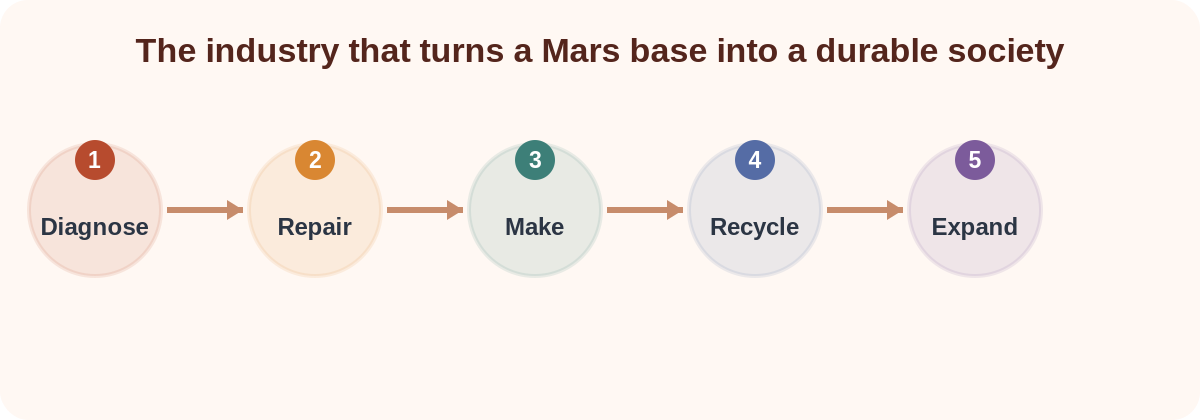
Institutional and primary sources
- NASA NTRS — Advanced Manufacturing in Space
- NASA Moon to Mars Architecture
- NASA — Technology for humans to Mars
Primary sources for this expansion
Continue through the Mars Bible
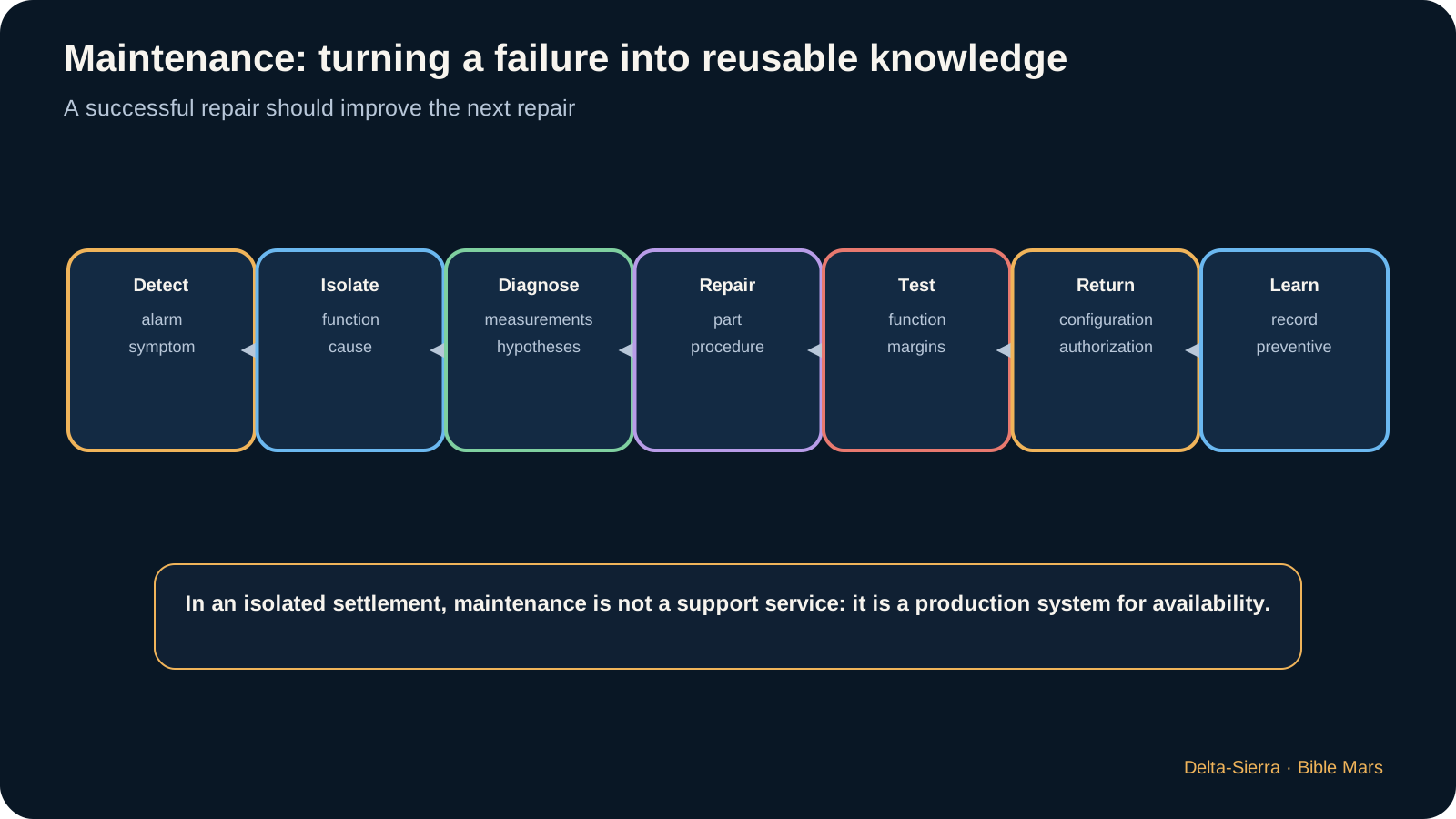
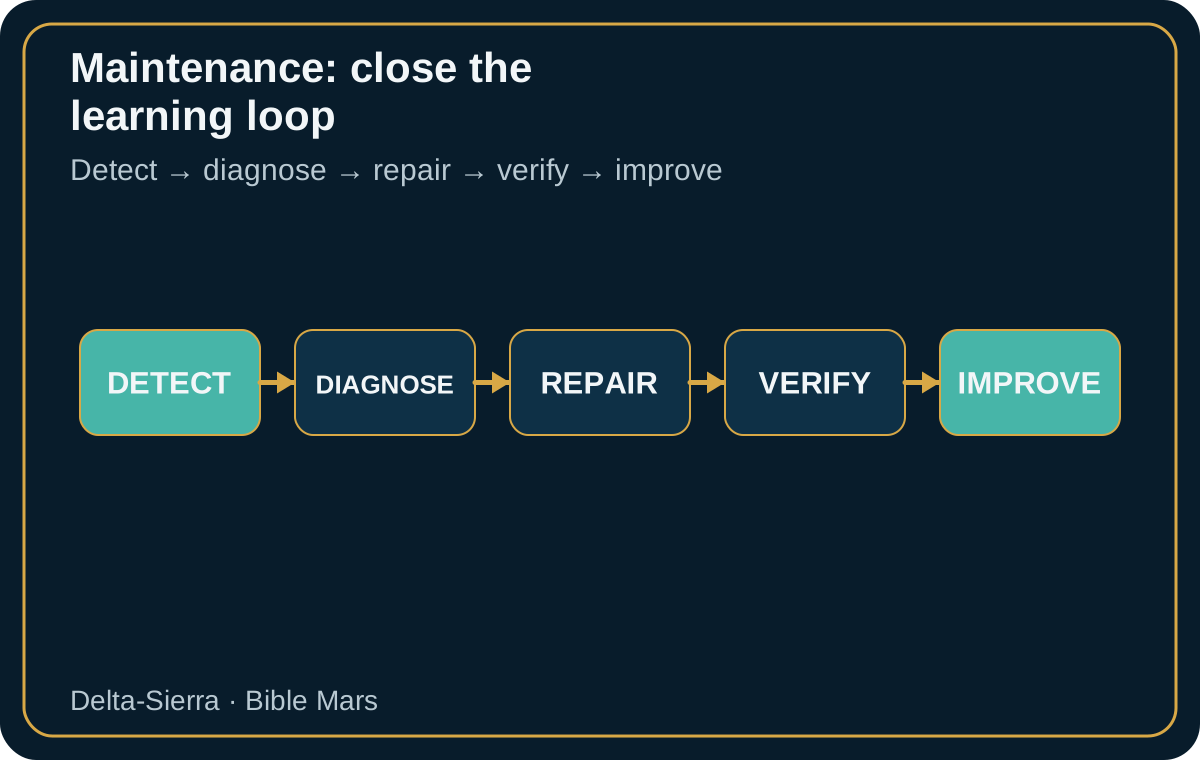
Martian maintenance has to close the whole loop: detect, diagnose, isolate, repair, verify and document
Local industry becomes resilient only when repair itself is a controlled process. Detecting an anomaly is not enough. The team must locate the cause, isolate equipment without losing the entire function, choose repair or replacement, return the system to service, and verify that performance has actually recovered. Configuration records then have to change with the hardware. A settlement that performs many undocumented repairs slowly builds systems that no one fully understands.
This is why metrology and documentation are as important as machine tools. A replacement part may physically fit while being out of tolerance under load, temperature or vibration. A weld can look sound and hide a defect. A software change can restore nominal operation while damaging a rare mode. Return-to-service therefore needs acceptance criteria matched to consequence.
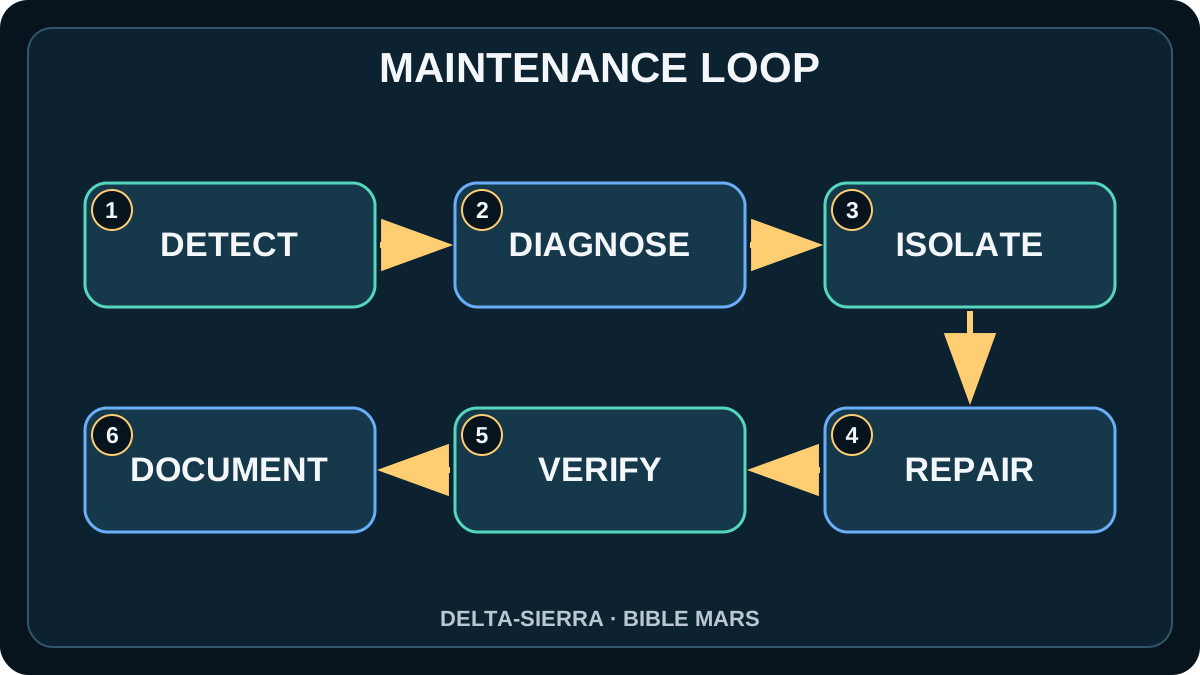
Delta-Sierra calculation: availability depends on repair time as well as failure frequency
For a simple repairable system, a useful teaching approximation is A = MTBF / (MTBF + MTTR). MTBF is mean time between failures; MTTR is mean time to repair. With a 1,000-hour MTBF and a 20-hour MTTR, A ≈ 1,000 / 1,020 = 98.0%. If the same hardware remains down for 100 hours because diagnosis or a spare is unavailable, A ≈ 1,000 / 1,100 = 90.9%.
A = MTBF / (MTBF + MTTR)
1,000 h / (1,000 + 20) h ≈ 0.980.
1,000 h / (1,000 + 100) h ≈ 0.909.
The roughly seven-point availability loss is not caused by less reliable equipment. It is caused by slower maintenance. On Mars, diagnosis, tooling, documentation, physical access and spare inventory become availability multipliers. A spare without a test procedure can remain unusable; a perfect procedure without the required tool or reference standard cannot restore the system.
The model is intentionally simple. Real failure distributions may not be exponential, subsystems interact and preventive maintenance changes the statistics. The lesson remains useful: reducing MTTR can sometimes be cheaper and lighter than duplicating hardware. A mature settlement needs both levers — reduce failure frequency and reduce the time required to recover safely.
Go further in the books



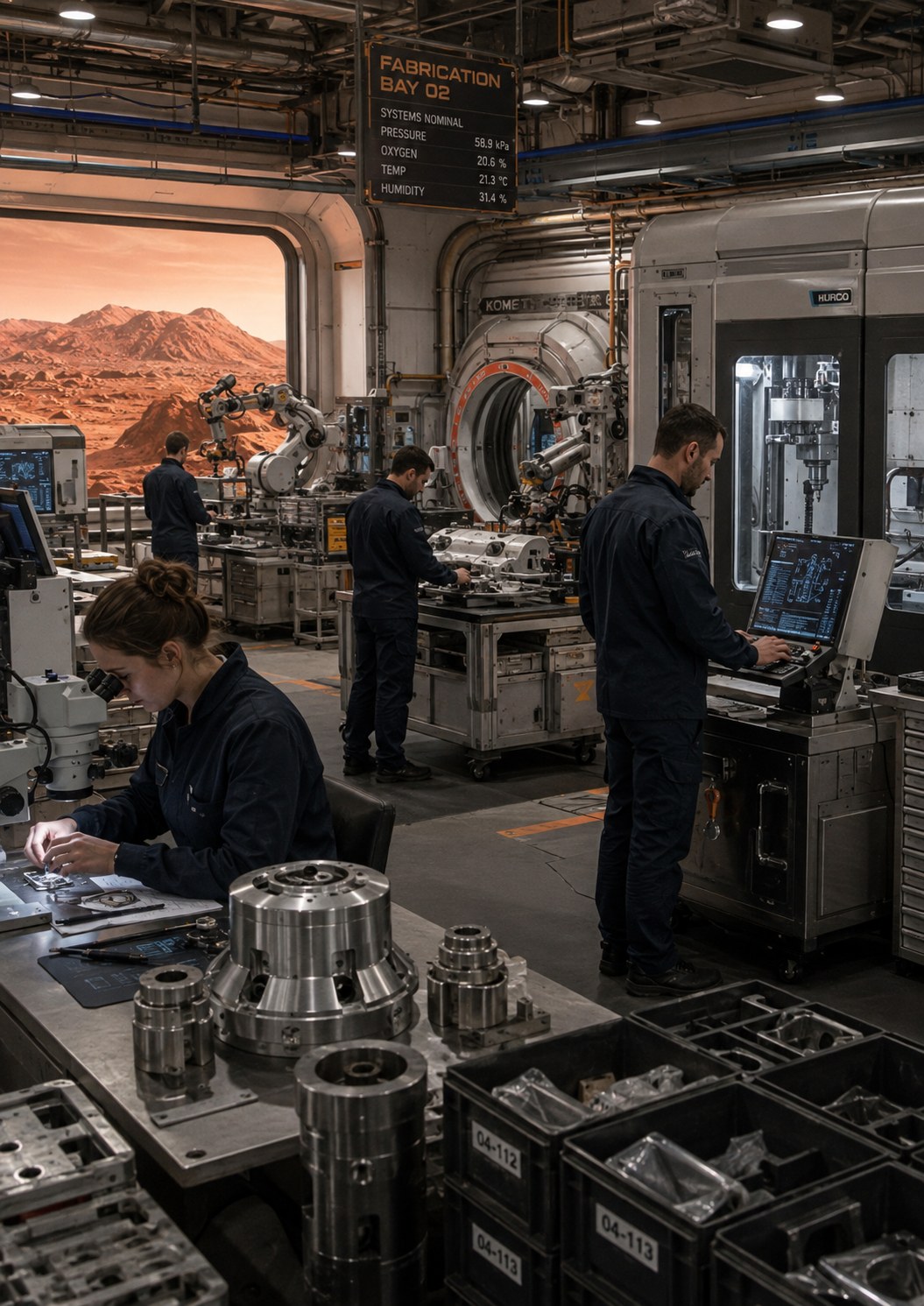
The first Martian industry will probably not manufacture consumer products; it will keep alive the systems that keep the base alive. The challenge is to turn maintenance, diagnostics, spares, and fabrication into an organized capability that progressively reduces the number of failures that cannot be repaired locally.
Repair before manufacturing
Not every failure justifies a new part. Adjustment, cleaning, consumable replacement, or targeted repair often use fewer resources than complete remanufacture.
Condition-based maintenance. Vibration, temperature, current, or leakage can target maintenance rather than replacing everything on a fixed schedule.
Local diagnosis. Operators need to understand symptoms and access required data without depending on an immediately available terrestrial center.
Subassembly repair. Repairing at the right level avoids discarding a complete module for a replaceable connector, bearing, or sensor.
Industrial cleaning. Dust and contamination make cleaning a technical function before measurement, opening, or reassembly.
Post-maintenance test. An intervention is complete only when function is demonstrated and the system returned to a known configuration.
Spares become a decision science
Carrying everything is impossible, and making everything locally is also impossible. Inventory must combine criticality, failure probability, logistics delay, repairability, and substitutability.
Criticality. A lightweight part with no substitute may justify several spares while a heavy locally repairable component may need fewer.
Resupply window. Inventory must survive until the next realistic transport opportunity, not merely until an Earth purchase date.
Commonality. Common components across machines reduce inventory variety and increase the value of each spare.
Cannibalization. Removing parts from inactive equipment can save a vital function but must be tracked so it does not create a ghost fleet that cannot be restored.
Obsolescence. A multi-decade settlement will outlive terrestrial part numbers; files, alternatives, and local capability must anticipate that break.
Reproducible calculation — Simplified safety stock
S = demande_moyenne × délai + marge
Mean demand over the logistics period provides a base; margin must cover variability, clustered failures, and timing uncertainty.
Manufacture what reduces dependence most
The priority is not to reproduce the whole terrestrial economy. It is to manufacture part families that save the most imported mass and downtime for reasonable industrial complexity.
High-turn simple parts. Seals, brackets, pipes, fasteners, and wear parts can be good early candidates if their materials are controlled.
Tooling. Fixtures, jigs, and special tools multiply the ability to repair other systems and provide strong leverage.
Substitute parts. A local geometry can fulfill the same function as a terrestrial part without reproducing the original process or shape exactly.
Difficult electronics. Some electronics will remain difficult to make locally for a long time; strategy should emphasize modularity, inventory, and board-level repair.
Test capability. Making a critical part without a matching test capability does not truly reduce dependency because the town cannot prove that it is safe.
Organize industrial flow
A poorly prioritized work queue can immobilize a base despite good machines. Industry must manage information, material, capacity, people, and urgency as one system.
Work order. Each intervention should describe function, urgency, configuration, resources, and return-to-service criteria.
Capacity planning. Machines, operators, and metrology have different bottlenecks; increasing one resource can move rather than solve the queue.
Material management. Metals, polymers, consumables, and recycled streams need quality identification so the wrong grade is not used.
Configuration control. Drawings and parameters must match equipment actually installed, including after years of local modifications.
Lessons learned. Recurring failures should change inventory, design, and maintenance rather than remain isolated events.
Reproducible calculation — Equipment availability
A = MTBF/(MTBF+MTTR)
Availability combines failure frequency and repair speed. Two systems with the same MTBF can deliver very different service if one is extremely difficult to repair.
From central workshop to industrial network
A town of a thousand residents cannot route every task through one workshop. Some capabilities need distribution while retaining standards, traceability, and mutual support.
District workshops. Rapid repair and common tooling can live near users while heavy processes remain centralized.
Central laboratory. Rare or expensive analysis can be concentrated in a reference laboratory serving all workshops.
Strategic reserve. Some common spares should remain outside routine consumption to preserve recovery capability after a major crisis.
Internal logistics. A repaired part, motor, or bottle must move across the town with appropriate handling interfaces.
Progressive standardization. Reducing variety in fasteners, connectors, and bearings lowers inventory and simplifies training without eliminating needed diversity.
Measure industrial autonomy
The number of machines does not say whether a base is autonomous. Useful indicators concern restored functions, delays, avoided imports, and the share of failures still impossible to handle locally.
Actual MTTR. Observed mean time to repair shows whether diagnosis, parts, and access work together.
Local repair rate. The fraction of failures restored without critical Earth-supplied hardware measures a direct part of remaining dependency.
Avoided import mass. Comparing locally made part mass with manufacturing infrastructure mass avoids celebrating an industry that costs more mass than it saves.
Queue time. A technical capability can exist yet be unusable in an emergency if the work queue is saturated.
Irreplaceable dependencies. The inventory of functions the town can neither repair nor manufacture should remain visible and guide development priorities.
Reproducible calculation — Workshop load
L = Σ(t_i × n_i)
The sum of task times t_i times number of operations n_i gives an hourly load to compare with operator and machine capacity.
Documentation is an intangible spare part
A remote settlement can own the physical part and still be unable to repair equipment if it lacks torque values, allowable clearances, disassembly sequence, software version or qualification procedure. Drawings, configuration history and lessons learned are therefore intangible spares. They must be stored locally, version controlled and usable without an Earth connection.
The issue becomes critical once the settlement modifies hardware. A pump that began identical to its Earth model may later receive a different seal, a locally machined component and a changed control parameter. Ten years later, the model number no longer describes the real machine. Actual configuration has to be reconstructed from its record. Without that discipline, maintenance becomes technical archaeology.
Skill transfer belongs in the same loop. A procedure understood only by its author is a human dependency. Rare operations have to be rehearsed, documented and taught before specialists depart or retire. A durable Martian society must preserve know-how as carefully as physical spares.
Four crises that test industrial capability
Two critical failures arrive in the same week
The workshop cannot do everything at once. It ranks consequences, protects one function through degraded operation, and reallocates machines and people according to risk.
A terrestrial part number is discontinued
The town learns that a stocked component will no longer be manufactured. It analyzes function, equivalents, local redesign, and transition quantities to import before the supply chain disappears.
Metrology invalidates a month of parts
A reference standard is found to have drifted. Traceability identifies affected measurements, ranks parts by criticality, and organizes reinspection or withdrawal without blindly scrapping all inventory.
The central workshop becomes unavailable
A fire temporarily closes the area. Secondary workshops must preserve vital functions while heavy work is delayed or transferred.
A Martian factory begins with diagnosis and ends with proof of return to service
RMAF shows why a workshop needs multiple processes
NASA's Repair, Maintenance and Fabrication study identified 53 critical failures and 14 functions able to address a broad repair set, then defined five workstations: workbench/computer, CNC, multi-material printing, welding, and glovebox. The numbers are not a prescription for Mars, but they demonstrate a central idea: no single process covers repair of a complex system. A settlement needs disassembly, cleaning, measurement, machining, material addition, joining, contaminant isolation, and testing. Workshop value comes from combining functions and moving a part between stations without losing traceability.
Diagnosis prevents manufacturing the wrong part
A pump that no longer delivers flow may have a bearing problem, blockage, electrical-supply fault, or bad sensor. Immediately manufacturing an impeller consumes time and material without addressing the cause. The workshop therefore needs operating data, schematics, failure history, and metrology. Mature Martian maintenance begins with a testable failure hypothesis, then chooses adjustment, repair, replacement, or fabrication. That discipline prevents the temptation to solve every problem through 3D printing and uses operator time much more effectively.
Repair capability should be measured by failure families
Saying that the base can 'make parts' is too vague. It needs to know which failures it can actually handle: pipe leak, damaged connector, electronics board, bearing, structural crack, drifting sensor, seal, motor, pump, or corrupted software. For each family, diagnosis, tools, material, skill, time, and return-to-service test can be listed. This matrix exposes capability gaps and guides investment. An expensive machine may be justified if it closes several critical failure families; another can wait if it serves one rare product. Industrial autonomy thus becomes a portfolio of covered repairs rather than an impressive machine inventory.
Return to service must produce evidence
After repair, the question is not 'does it start?' but 'does the function again meet requirements?' A pump may rotate while vibrating abnormally; a circuit may transmit data with excessive error rate; a part may look intact while containing a crack. Acceptance testing must therefore check the quantities that matter, record results, and define enhanced monitoring when a repair is temporary. That record creates learning: if the defect returns, the settlement can change design, stock, or procedure. Proof of return to service turns an isolated repair into collective knowledge.
What Mars still has to demonstrate
Industrial autonomy is not measured by the number of machines installed but by the ability to diagnose, manufacture, inspect, and return critical systems to service. Current architectures mostly describe intended capabilities. On Mars, repair time, scrap rates, failures of production equipment, and dependence on consumables must become design parameters in their own right.
A Martian workshop is not a 3D printer: it is a chain of diagnosis, fabrication and evidence
A settlement becomes industrially robust when failure stops being an automatic logistics verdict. Between a broken object and return to service lie diagnosis, isolation, correct technical definition, repair-or-replace choice, process selection, material preparation, fabrication, measurement, cleaning, testing and configuration records. NASA's Common Habitat Repair, Maintenance and Fabrication Facility is useful because it does not reduce the workshop to one fashionable technology. It combines a workbench and computing station, CNC machining, multi-material additive manufacturing, welding and a glovebox for work presenting contamination hazards.
The diversity reflects a fundamental fact: failure modes are more varied than fabrication processes. A cracked part may be welded; a bearing seat may need machining; a housing may be printed; an electronic board may require component-level repair and electrical test. The design question is therefore not simply which machine to fly, but which critical repair families must be absorbed when Earth can no longer function as the emergency workshop.
From diagnosis to a return-to-service record
Consider a pump whose flow has fallen by 15%. Replacing the entire pump wastes inventory if the cause is a clogged filter, drifting sensor, mechanical clearance or bearing. Rational troubleshooting starts with inlet and outlet pressure, motor current, vibration, temperature, flow and fluid condition. Rising vibration and temperature together may point to mechanics; an isolated implausible flow value may point to instrumentation. Metrology prevents manufacturing parts for a failure that does not exist.
After repair, evidence matters as much as action. A critical part is not returned to service because it “looks good.” Geometry, material, assembly, leak tightness or load behavior must be checked according to function. That boundary separates survival improvisation from dependable industry. Repair records then become learning data: if twenty pumps show the same wear, the settlement can change material, lubrication, inspection interval or design.
Size the workshop by critical work hours, not only by equipment mass
Suppose a population of 1,000 generates an average of 1.2 technical interventions per person per year across all infrastructure, with 2.5 effective labor-hours per intervention. Annual workload is 1,000 × 1.2 × 2.5 = 3,000 technical hours. If a specialist provides about 1,500 useful hours per year after training, meetings, inspections and leave, two full-time equivalents cover only the average. Peaks, simultaneous failures, different skills and maintenance of the workshop itself require more capacity. Growth turns a “generalist technician” into teams, trades and on-call coverage.
Machine time follows a similar logic. If a CNC center needs 2,000 productive hours per year and operational availability is 90%, it must offer roughly 2,000 ÷ 0.90 ≈ 2,222 scheduled hours to absorb planned and unplanned downtime. One machine may be statistically sufficient yet remain a single point of failure. Redundancy may mean a second identical machine, a simpler backup covering essential operations, critical spares or temporary cannibalization.
Manufacturing data are strategic inventory
Material and machine capacity are useless without the authorized revision, tolerances, heat treatment, assembly procedure and acceptance criteria. A Martian city must manage 3D models, drawings, process parameters, configuration history and test evidence as carefully as physical reserves. The wrong revision can make a hundred dimensionally accurate but incompatible parts.
Digital configuration also enables local improvement. An Earth design can be adapted to material available on Mars, but the change must be qualified. The complete loop becomes failure → measurement → analysis → redesign → prototype → test → decision → updated definition. Industrial autonomy is therefore not simply making more objects; it is learning without losing traceability.
Mature maintenance turns failures into usable statistics
Early in a settlement every failure looks unique. After years, histories support frequencies, repair times and cause distributions. If ten identical motors accumulate 80,000 operating hours and experience four comparable failures, the crude observed MTBF is about 80,000 ÷ 4 = 20,000 hours. Four events give large uncertainty, but the value already allows comparison between Martian reality and design assumptions.
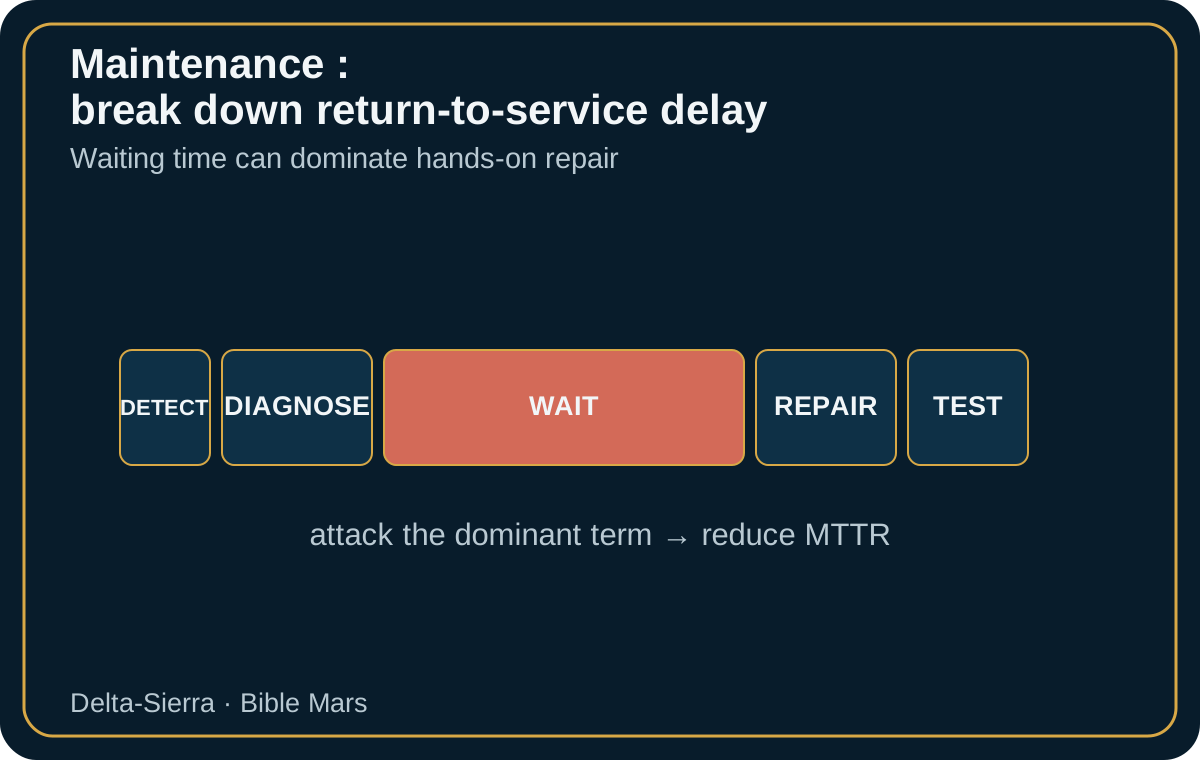
MTTR should be decomposed. A twelve-hour repair may contain two hours of hands-on work and ten hours waiting for a part, cooldown or diagnosis. Reducing MTTR may require better inventory or access rather than a faster technician. Records should separate detection, safing, diagnosis, waiting, intervention, test and return to service.
Preventive maintenance should follow risk. Replacing too early wastes spares; replacing too late increases failure probability. Condition indicators—vibration, current, temperature, clearance, contamination—support condition-based maintenance. A remote settlement has strong reason to use remaining life rather than an arbitrary Earth calendar.
Temporary repairs need explicit status. A workaround may save a function while changing load, temperature or future maintenance. Configuration control should flag it and require later inspection or permanent replacement. Otherwise “temporary” changes become invisible permanent design.
The workshop itself is critical infrastructure. A CNC machine cannot be the only means of repairing its own spindle. Nested capability—hand tools, simpler backup equipment, spares and alternate processes—protects the repair system. The deepest autonomy test asks how the workshop repairs itself.
Finally, field evidence should change future equipment. If repeated repairs show an inaccessible filter, weak connector or dust-sensitive sensor, later builds should incorporate the lesson. Martian industry becomes not only a distant workshop but a laboratory for machine evolution.
Spare strategy and repair capability should be designed together
Traditional spare planning asks how many replacement units should be stocked. A Mars settlement must add whether the failed unit can be diagnosed, cannibalized, repaired or remanufactured. Each option changes required inventory. A nonrepairable unit may need multiple complete spares; a repairable unit may need seals, bearings and test equipment instead.
Criticality changes the acceptable delay. A pump supporting a redundant noncritical loop may wait two days for fabrication; a component that protects cabin atmosphere may need a ready spare in minutes. Spares should therefore be classified by consequence and maximum tolerable outage, not only failure probability.
Cannibalization can bridge shortages but carries configuration risk. Removing a functioning component from one system creates a new unavailable function and can spread contamination or damage connectors. Every cannibalization should be recorded with origin, remaining life and follow-up action.
Repair parts themselves need shelf-life management. Elastomers, adhesives, lubricants, batteries and some electronic parts age while sitting in storage. Inventory quantity without condition is a false reserve. Periodic inspection and environmental control turn stock into usable capability.
Training should follow the repair tree. Crew do not all need to become master machinists, but enough people should be able to diagnose common failures, make equipment safe and perform first-line repair. Specialists can then focus on complex tasks. Skill redundancy protects against illness, injury and workload peaks.
Ultimately the workshop, inventory database and equipment health system should share information. Predicted failure creates a work order, checks stock and machine capacity, reserves tools, then updates reliability statistics after repair. This integration turns maintenance from emergency response into a managed industrial service.
Case study: machine-tool failure threatens repair capacity
The main CNC develops spindle drift while a critical pump part is due. Continuing risks an out-of-tolerance component; stopping removes the shop's most precise capability. Runout, vibration, temperature and repeatability measurements distinguish spindle, tool, workholding and metrology problems.
If the machine now holds only ±0.10 mm while the part requires ±0.03 mm, direct manufacture is unacceptable. The shop can split the process: rough-machine on the degraded center and finish one critical surface elsewhere, temporarily redesign the part or use stock. Industrial capability is the sum of such alternate routes.
The CNC repair itself must be supported by bearings, lubricants, sensors, removal tools and alignment procedures. A machine that cannot be recalibrated locally remains a strategic dependency even if it is perfect on day one.
After repair, a reference artifact verifies geometry before critical production resumes. Restart alone does not restore qualification. Maintenance, metrology and fabrication are one autonomy system.
Maintenance engineering should influence the design of every new Martian machine
Machines built for Earth often assume specialist tools, large supply chains and replacement modules arriving quickly. Mars should design from the opposite direction. Filters, bearings, seals, electronics and wear surfaces should be accessible without dismantling unrelated equipment. The number of unique fasteners and tools can be deliberately limited.
Diagnostic access is equally important. Test ports, current sensing, vibration locations and software logs reduce the time between “something is wrong” and a defensible diagnosis. A sealed black box may save launch integration effort but transfer a large burden to future maintenance.
Components should be classified by repair level: in-place adjustment, line-replaceable unit, workshop repair, remanufacture or nonrepairable. This classification guides spares, tooling and crew skill. It also prevents sending an entire assembly to the workshop when one field-replaceable element is enough.
Design reviews can quantify maintenance burden. If a valve takes four hours and two people to reach, then a predicted replacement every six months creates 16 person-hours per year before the repair itself. Across hundreds of components, access design becomes a major crew-time budget.
Common hardware has leverage. Standard motors, connectors, bearings and controller interfaces increase the value of every spare. However, commonality can create common-cause vulnerability if one flawed design dominates the settlement. Standardization should preserve at least some diversity for life-critical functions.
A Martian manufacturing system is therefore successful when new equipment is easier to sustain than the generation before it. Maintenance evidence must flow back into design requirements rather than remain an operations problem.
Organize maintenance as a continuous industrial flow
At a distant base, maintenance is not a secondary activity performed “when something breaks.” It consumes labor, parts, floor space, data and energy every day. As population grows, installed equipment grows faster than any individual can know it. Maintenance must shift from craft practice to an industrial system: asset inventory, criticality, preventive plans, condition monitoring, work orders, configuration control and feedback.
The first issue is not to confuse availability with absence of failure. A reliable but unrepairable machine can be less useful than a simpler one whose fault is quickly isolated. Design should therefore include detection, access, interchangeability and post-repair test. Interfaces that accelerate removal, measurement points and common parts become performance characteristics.
From weak signal to work order
An alarm is only an input. A useful chain turns measurement, trend or operator observation into diagnosis and prioritized action. Temperature, vibration, current, pressure or cycle time may reveal degradation before failure. Monitoring everything all the time would create a flood of data, so parameters should be tied to known failure modes and to possible actions.
For example, a motor whose average current rises by 8% over two months may indicate friction, higher load, misalignment or electrical degradation. Current alone is not a diagnosis. Combining current with vibration, bearing temperature and production rate reduces uncertainty. Condition-based maintenance works when measurement is connected to a physical mechanism.
Break MTTR apart to find the real delay
Mean Time To Repair, MTTR, is often treated as one number. It can be separated into detection, access, diagnosis, wait for parts, repair, test and return to service. Suppose these take 0.5 h, 1 h, 3 h, 20 h, 2 h and 1.5 h respectively: total delay is 28 h. Cutting hands-on repair from 2 h to 1 h saves one hour; making the part locally in 4 h instead of waiting 20 h saves sixteen. Improvement should target the dominant term.
This is why spare stock should not be ranked by purchase price alone. A tiny cheap part that blocks twenty machines may deserve several copies. A large expensive part used rarely may be better held as a standard blank or replaced by manufacturing capability.
Configuration: repair the correct hardware with the correct definition
After several years, two nominally identical machines may have different updates. Software, sensors, seal materials, wiring and replacement parts can change. A technician needs the actual configuration before using a procedure. The maintenance record therefore links asset identity, revision, interventions, installed parts and acceptance results.
A local repair creates a new configuration
If an Earth-made part is replaced by a Mars-made part, the asset is no longer exactly the original manual configuration. The record should preserve material, geometry, process, measurements and any limitations. This prevents a later team from installing an incompatible second modification or misinterpreting behavior.
Configuration control is equally important for software and parameter changes. A control-software update may fix one problem and create another in a rare mode. Version, rationale, test evidence and rollback path must remain available locally.
The test stand separates repair from hope
A rebuilt pump should be tested for flow, pressure, leakage, current and vibration before returning to a life-critical loop. An electronic board should be tested with current-limited power, simulated loads and relevant temperatures. The test stand protects the main system from an incorrect repair and generates comparable data across interventions.
Test infrastructure can be modular. Shared power, data acquisition, fluid services and safety functions receive equipment-specific adapters. This reduces specialized hardware and simplifies calibration. The shared facility itself must not become a single point of failure.
Scale maintenance organization with the city
With four people, everyone covers several roles and some heavy work can wait. At one hundred inhabitants, dedicated technicians become necessary. Around one thousand, the system resembles municipal infrastructure: shifts, stores, planning, laboratories, safety, engineering and specialized shops. Workload follows installed assets, age and automation, not population alone.
Turn backlog into a risk indicator
Backlog should be sorted by consequence. One hundred cosmetic tasks do not equal one overdue inspection on a critical vessel. A useful metric combines late labor hours with criticality. Five overdue critical tasks of 4 h each represent 20 h of high-risk maintenance debt, more significant than one hundred hours of optional improvements.
A steadily growing backlog can reveal a structural problem: insufficient staff, ageing hardware, poor documentation or unavailable parts. Adding technicians does not fix missing spares; making more parts does not fix procedures that cannot be executed. Management should diagnose the flow rather than merely close tickets.
Local repair rate is a more concrete autonomy measure
The settlement can track the fraction of hardware failures returned to service without a new imported part. If 120 material incidents occur in one year and 90 are resolved through stock, repair or local manufacture, the rate is 90 ÷ 120 = 75%. It must be interpreted with criticality: one unresolved life-critical fault matters more than ten trivial repairs. Combined with delay and imported mass, however, the metric shows whether autonomy is improving.
The goal is not an artificial 100%. Some components may rationally remain imported. The objective is to know dependencies and reduce those that threaten city continuity.
Feedback should change both design and stock
If the same seal leaks every six months, maintenance should not only improve replacement technique. It should investigate material, installation, temperature, pressure and design. A material or geometry change may remove the task. Likewise, a spare that sits unused for a decade may be oversized while another item repeatedly runs out.
Periodic review turns history into decisions: redesign, change inspection interval, increase or reduce inventory, improve sensing, modify a procedure or train more people. The industrial system learns from its own failures.
When Earth cannot answer in time, local engineering becomes permanent
Communication delay and the impossibility of immediately obtaining a terrestrial expert require autonomous diagnosis. Technical data must be available locally: schematics, models, histories, procedures, acceptance criteria and test results. A base that requires a terrestrial server or synchronous authorization to repair life-critical hardware is poorly designed.
Artificial intelligence can help search symptoms and compare history, but it does not replace physical evidence. A recommendation should be tied to measurements, known configuration and a safe procedure. When ambiguity remains, the team must be able to return to engineering principles and test hypotheses.
The isolated workshop needs a degraded documentation mode
Databases, CAD tools, catalogues and histories should exist in local copies with backups and exportable formats. An unavailable proprietary tool can make a definition unusable. Essential drawings, tolerance tables and critical procedures must remain accessible even if a major information system fails.
Documentation is therefore an intangible spare part. It lets one generation of technicians understand the decisions of the previous one and prevents accidental relearning. In a Martian city, losing technical memory can be as serious as losing a machine.
Case study: a vital pumping system becomes the center of a week-long crisis
A primary pump stops. The redundant pump starts, but vibration is higher than normal. Service still exists, yet margin is sharply reduced. Maintenance must preserve the remaining pump, diagnose the failed one, reserve workshop capacity and verify spares at the same time. This is exactly the situation in which industrial organization matters more than heroic intervention.
The first decision is to reduce load if possible so the surviving pump operates farther from its limit. Diagnosis of the failed pump begins before disassembly: current history, pressure, temperature, events and operating hours. A bearing hypothesis can be checked through manual rotation and inspection. If the needed part is not stocked, manufacturing or substitution should be evaluated before opening equipment whose reassembly depends on that part.
Planning must protect the remaining redundancy
The backup pump should not be treated as if normal status had returned. Inspection frequency increases, a temporary load limit is imposed, and a total-loss scenario is prepared. A buffer tank or reduced consumption may provide extra hours if the second pump fails. Maintenance and operations become one risk-management team.
When the primary returns to service, confidence is not restored instantly. A period of enhanced monitoring checks current, flow, vibration and temperature. Redundancy is considered restored only after evidence. This prevents an apparent repair from being counted as real margin.
The incident report should change the future
If the failure reveals faster wear than expected, inspection intervals change. If diagnosis was slow because a measurement point was missing, the next design receives a sensor or access feature. If a local part succeeded, its process route gains qualification evidence. A crisis becomes useful when it reduces the probability or duration of the next one.
At city scale, this cycle creates technical culture. Failures are neither hidden nor treated as isolated events; they become data for design, inventory, training and procedures.
Industrial maintenance needs redundancy of its own
One central workshop can become a single point of failure after fire, decompression or contamination. As the city grows, some capabilities should be distributed: emergency tools in districts, small stocks of vital parts, portable diagnostics and at least two paths for critical repairs. This does not require two complete factories; it protects essential functions.
Industrial geography matters. A large machine near habitats reduces transport time but increases the consequence of fire or a hazardous process. Hot, chemical and pressurized workshops may be separated while remaining connected by logistics and data. Urban planning becomes part of maintainability.
Skill transfer is maintenance of the social system. Expertise concentrated in one person is a latent failure. Each critical function should have several people capable of diagnosis and action, with competence levels made explicit. Real interventions become opportunities for supervised training.
Procedures should explain why, not only list steps. When configuration changes or a part no longer exists, technicians need to understand the function that must be preserved. That depth of knowledge makes substitution possible without reproducing the original Earth solution exactly.
A Martian workshop should be designed as a return-to-service chain
A NASA study of a Repair, Maintenance and Fabrication Facility describes five workstation families for a common habitat: bench/computer work, CNC machining, multi-material additive manufacturing, welding and a glovebox for hazardous or potentially contaminated work. The value of the model is not that it freezes the ideal Mars workshop. It demonstrates that “having a 3D printer” covers only one part of maintenance. Crews must measure, disassemble, clean, machine, join, inspect and sometimes isolate the work from the inhabited volume.
The central metric is return-to-service time. A repair requires diagnosis, access, spare retrieval or fabrication, post-processing, inspection, reassembly and functional test. A part printed in two hours can still disable a system for two days if access takes eight hours and qualification requires multiple cycles. A less elegant part that can be machined and verified quickly may produce higher overall availability.
Scenario MTTR: 3 h diagnosis + 5 h access/disassembly + 6 h fabrication + 4 h inspection/post-processing + 3 h reassembly/test = 21 h.
This is a Delta-Sierra teaching scenario, not a quoted NASA performance figure; it shows why print time alone is not repair time.
Workshop consumables are hidden spares
Drills, grinding media, welding gas, filters, solvents, abrasives, cutting inserts, oils, gloves, resins, powders and metrology standards can stop a repair as decisively as a missing motor. The spare inventory therefore has to include the means required to make spares. As production becomes more local, the settlement must understand the consumption rate of manufacturing consumables.
At 100 inhabitants a workshop may operate a limited schedule; at 1,000, machine availability, scheduling, training and quality control become a service infrastructure. Industrial autonomy is no longer one skilled person fixing a part. It is an organization moving many simultaneous failure cases through constrained resources.
Maintenance turns Martian industry into a durable system when it stops being merely a reaction to failure. Machine hours, inspections, vibration trends, consumables, software revisions and repair history have to feed an availability plan. Preserving every asset at any cost is the wrong objective; maintenance must protect the functions the settlement cannot afford to lose.
Local manufacturing belongs inside that loop. A printed or machined part has to be identified, measured, tested and entered into the actual equipment configuration. Without traceability, a workshop can increase the number of parts while reducing confidence in the repaired system.
Primary references
NASA NTRS — Repair, Maintenance and Fabrication Facility in the Common Habitat Architecture describes five workstation families including CNC, multi-material printing, welding and a glovebox. NASA Advanced Manufacturing Technologies covers space manufacturing and qualification.
References for workshop and maintenance architecture
NASA NTRS — Repair, Maintenance and Fabrication Facility in the Common Habitat Architecture provides functional evidence for critical repair and workstation planning. NASA-STD-8729.1A Reliability and Maintainability is an active R&M standard; applying it to a Martian city would require adaptation to local operations and governance.
Additional primary sources
NASA — Reliability and Maintainability
NIST — In-Situ Metrology for Metal Additive Manufacturing
NASA NTRS — Metal Extraction from Trash for 3D Printing
Documents for organizing repair, spares, and manufacturing
NASA NTRS — Repair Maintenance and Fabrication Facility
The 53 critical failures and 14 repair functions analyzed provide a concrete way to size capability rather than a decorative workshop.
NASA NTRS — In-Situ Fabrication and Repair
This historical source explicitly connects fabrication, repair, life support, and local resources, showing why the problem is long-standing but still unsolved at town scale.
NASA NTRS — Developing Fabrication Technologies for Moon and Mars
The paper emphasizes power, mass, and volume constraints and prevents imagining a terrestrial shop merely transported to Mars.
NASA NTRS — Common Habitat variant selection
Maintenance capability and repair-scenario assessments show that habitability includes the ability to sustain the system over time.
NASA NTRS — Metal Additive Manufacturing for Spaceflight
Space metal-manufacturing processes illustrate the qualification needed before counting a part family as truly covered.
NASA Standards — Reliability and Maintainability
The active R&M standard is used here to structure availability, maintainability, and feedback rather than copied as a generic summary everywhere.