


Additive manufacturing builds parts layer by layer. It can reduce imported spare inventory but does not remove the need for feedstock, machines, post-processing, metrology and qualification.
Spacecraft: architecture, power, thermal and avionics
New reference dossiers connecting systems design, vehicle subsystems, failures, testing, maintenance and preparation for durable Mars infrastructure.
- Interplanetary Mars spacecraft system architecture: designing a machine that must survive for months
- Electrical power for an Earth-Mars spacecraft: generate, store, distribute and survive failures
- Thermal control of a Mars spacecraft: surviving heat, cold and vacuum
- Avionics, flight software and FDIR: how a Mars spacecraft observes, decides and saves itself
- Spacecraft structures, mechanisms and integration for Mars: survive loads, deploy and remain compatible
MARS BIBLE — ANALYTICAL INDEX
All Mars Bible topics — A to Z index
Analytical index of the Mars Bible: systems, technologies, resources, health, transport, industry, daily life and scientific concepts.

192 topics shown
This index brings together the topics and concepts that are useful for understanding the system. It is not an automatic heading dump, but an editorial map of the entries that matter.
A
From fresh-crop supplements to a genuine food-production system
A maneuver that uses atmospheric drag to reduce orbital energy and save propellant. It requires accurate atmospheric and heating models and is not the same as a full landing.
Plant cultivation in which roots receive nutrient mist instead of soil. It can reduce water use but adds nozzles, pumps, microbial control and power dependence.
Analytical index of technologies, risks, resources and questions about Mars settlement on Delta-Sierra.
Turning extracted metal into parts with controlled properties
Artificially created acceleration, often by rotation, intended to load the human body. It remains a research and design avenue for long missions or equipment; no standard Mars-settlement architecture has been demonstrated.
B
A mound or barrier of material used to separate or protect areas from debris, plume effects or other hazards.
Protecting people, crops, systems and science without pretending a settlement can be sterile
Ability of a power system to restart after a total blackout without relying on an already energized external grid, using independent reserves and staged energization. On Mars, black-start design should prioritize life-critical loads and the converters required for restart.
Vapor generation or loss when a cryogenic fluid absorbs heat. Controlling it helps determine how long LOX, methane or hydrogen can be stored without excessive inventory loss.
Equipment that supplies or filters safe breathing air for work in smoke or contaminated atmosphere.
Construction topics connect local geology to actual building practice: characterize regolith, choose a process, control dust and water demand, make test coupons, verify strength and leak-tightness, and maintain the resulting structures under pressure and thermal cycling.
C
Controlled recovery of parts from lower-priority equipment to restore a more critical system.
A process in which a catalyst assists oxidation of contaminants, used in some air or water purification trains. It requires controlled temperature, catalyst health and product monitoring.
Chemical formula for methane. Some Mars architectures could produce it from CO₂ and hydrogen through Sabatier and use it as fuel, provided the complete industrial chain is available.
A system that recovers material and feeds it back into the process instead of losing it. Real loops are never perfect: losses, purges, maintenance and exported products must be measured.
Waste and recycling pages follow materials after use: what can be cleaned and reused directly, what must be reprocessed, what becomes a chemical feedstock, and what must remain isolated because recovery would cost more energy or create more risk than it saves.
A subsystem that removes carbon dioxide from habitat air to prevent unsafe accumulation.
Distance imposes a cultural as well as a technical change: a Martian city cannot be managed in real time from Earth. Communications can transport data, but ur
Division of a habitat or utility network into isolatable pressure zones so depressurization, fire, contamination or a service failure can be contained instead of propagating through the whole settlement.
A distant settlement must keep deciding when Earth cannot respond
Discipline that tracks hardware and software versions so compatible parts, procedures and settings are known.
Carbon dioxide, the dominant gas in the Martian atmosphere and a product of human metabolism. It can be removed from cabin air and used as feedstock for MOXIE, Sabatier or plant systems.
Human time available to operate, maintain, repair, learn and live; a mission resource in its own right.
A protected part of the network reserved for equipment that retains priority in degraded conditions.
Training multiple people to perform a critical function so the system does not depend on one specialist.
A refrigerator that removes heat at cryogenic temperature. In a propellant depot it can reduce boil-off but adds continuous power demand and another maintenance-critical function.
Determination of usable fluid inventory in a cryogenic tank. Temperature, pressure and level sensing may be combined, and measurement uncertainty belongs in mission margins.
Cryogenic Fluid Management on Mars: insulation, boil-off, active cooling, gauging, transfer and safety for propellant storage.
Engineering of very low temperatures. In a propellant architecture it includes liquefaction, insulation, cooling, gauging, pressure control and transfer of LOX, methane or hydrogen.
Ability of a system to continue or recover essential functions despite attack, error or compromise.
D
Ability to make and execute decisions locally without waiting for Earth. Communication delay makes this an operational requirement for emergencies, robotics and resource arbitration.
A measure of a vehicle’s velocity-change capability, usually expressed in meters or kilometers per second. It helps compare maneuver requirements but does not alone describe mass, duration or propulsion.
Intentional or accidental reduction of compartment pressure requiring isolation, crew protection and controlled restoration.
A transition area where surface dust and equipment are contained before entering clean occupied volumes.
Measurement of radiation dose received by a person or location. A Mars settlement would need personal dosimetry and area maps to connect exposure with operations and medical decisions.
E
Radio communication delay between Earth and Mars, varying with planetary geometry. It prevents immediate human teleoperation from Earth and requires greater local autonomy.
Design Mars transport as a system: cargo, crew, interplanetary windows, chemical/electric/nuclear propulsion, logistics, EDL and return.
Environmental Control and Life Support System: the systems that control pressure, oxygen, CO₂, ventilation, water, waste and several safety functions. ISS operates mature components; a Mars city would require greater autonomy and repairability.
Martian life support: pressure, oxygen, CO₂, humidity, water recovery, fire detection, redundancy and maintenance for an autonomous ECLSS.
Processing data close to the systems that generate it to reduce dependence on distant communications and latency.
Entry, Descent and Landing: the sequence from atmospheric entry to touchdown. On Mars, high mass complicates deceleration and makes powered descent, navigation and plume effects important.
Mars Entry, Descent and Landing: thermal protection, guidance, braking, retropropulsion, landing sites, plume effects and the gap between rovers and human-class payloads.
A process using electricity to split water into hydrogen and oxygen. It is operational in spacecraft life support, while integration with local Martian water and propulsion-scale use remains to be demonstrated.
Extravehicular Activity: human work outside a pressurized habitat or vehicle while using a spacesuit and portable life support. On Mars it adds dust, radiation, autonomy, cooling and depressurization constraints.
F
Analyze cascading failures, defense in depth, degraded modes, refuges and the hard limits of rescue launched from Earth.
A permanent settlement must turn food into a reliable biological and industrial system: protected crops, lighting, recycled water, nutrients, emergency stocks
A safe habitat must survive accidents, not only nominal operation
Power actually available under a defined adverse condition rather than nominal installed generation. It accounts for outages, season, dust, storage and margin.
Electric power from a small fission system deployed on a planetary surface. NASA is actively developing a minimum 10-kWe lunar demonstration unit extensible to Mars needs; it is not an operating Mars reactor.
Organization of cargo, crew, orbital and surface vehicles with trajectories, interfaces, schedules and contingencies. Durable settlement depends on a repeatable chain rather than one spacecraft.
A critical history of human Mars mission planning from Tsiolkovsky, Goddard, Oberth and von Braun to NASA reference missions and Moon to Mars Architecture.
G
Galactic Cosmic Rays, high-energy particles from outside the solar system that contribute to chronic space-radiation exposure. Management combines shielding, exposure time, dosimetry and biomedical research.
Industrial materials derived from oxides and silicates.
Wastewater from washing and domestic use excluding toilet streams under common definitions. It can be recovered but carries soaps, particles, microbes and other contaminants requiring treatment.
H
Equipment that transfers heat between fluids or loops without directly mixing them. It connects life support, power, chemical processes and heat recovery.
A sealed device using evaporation and condensation of a working fluid to transport heat passively.
Designing autonomous care when rapid evacuation to Earth does not exist
A settlement is neither one company nor an endless science mission. Over time it must finance infrastructure, allocate scarce resources, reward work and decid
A realistic Mars colonization roadmap covering precursor robots, cargo, landing sites, life support, settlement growth, risks and the limits of current plans.
The stages by which a fragile Mars outpost could become a city through redundancy, local industry, districts, education, institutions and civic identity.
Chemical, nuclear and electric propulsion, plus arrival and EDL.
Inventory placed between variable production and continuous demand.
Redundancy using a different path, technology or component to reduce common-mode failure.
Instead of trying to run everything normally, the settlement shuts down less important loads so the essentials survive.
Inventory physically or logically protected from routine stock so it remains available after contamination, leakage or operational error.
Prospective system-of-systems architecture for a Martian city.
Mission margin is deliberately unused capacity—mass, power, time, volume, data, or consumables—reserved to absorb uncertainty and problems.
Safety concept in which a system can still perform a function after loss of one defined component or branch.
Redundancy means having another way to provide a function when one component fails.
Resilience is the ability to absorb a fault or disturbance, keep essential services operating, and recover.
A system of systems is a collection of major systems that remain distinct but depend on each other—power, water, air, computing, industry, mobility, medicine, and logistics.
Technology maturity describes how far a technology has progressed from basic principle to tested prototype and operational system.
A realistic guide to Mars transfer windows, months-long transit, cargo pre-deployment, heavy-payload entry, descent, landing and surface logistics.
How a Mars settlement could govern emergencies, scarce resources, crime, work, contracts and local autonomy while remaining legally connected to Earth.
Human capacity intentionally left uncommitted during normal operations to absorb emergencies, failures and unexpected work.
Very light gas produced for example by water electrolysis. In a Mars architecture it can feed Sabatier, but its low molecular mass makes containment, storage and losses important.
How to produce and manage hydrogen on Mars: electrolysis, water quality, safety, storage, Sabatier and settlement mass balance.
Plant cultivation in nutrient solution without conventional soil. It supports controlled nutrients and water recovery but depends on pumps, sensors, lighting and disease control.
Showers, washing, toilets, grey/black water, dust, biosafety and dignity: hygiene and sanitation architecture for a Mars settlement.
I
Breathable air is a controlled system, not simply an oxygen supply
Building useful chemistry without assuming a complete terrestrial chemical complex from the first sols
In-Situ Resource Utilization: using local resources to produce useful products such as water, oxygen, materials or propellants. A complete ISRU chain includes prospecting, extraction, processing, storage, quality control and maintenance.
A durable settlement cannot remain a camp supplied entirely from Earth. ISRU — in-situ resource utilization — turns local ice, atmosphere and regolith into wa
L
Turning the settlement into a scientific observatory without contaminating what it seeks
A prepared surface intended to reduce erosion and ejecta during landing or takeoff.
A period when geometry and performance permit a given transfer between celestial bodies. Favorable Earth–Mars opportunities recur roughly every 26 months, making logistics discontinuous.
Intentional, prioritized disconnection of electrical loads to protect the grid and preserve higher-priority functions when generation or storage is insufficient. A settlement should define its shedding order before an emergency.
General idea of replacing some imports with resources found and processed on Mars. ISRU becomes useful only when the complete chain is more robust than the transported alternative.
Abbreviation for liquid oxygen. It can serve as propulsion oxidizer but requires liquefaction, cryogenic storage, compatible materials, gauging and transfer.
M
Machine tools, metrology and additive manufacturing.
Every EVA connects a clean pressurized habitat to a dusty unbreathable world
Expanded definitions of technical terms used throughout the Mars Bible, with synonyms, maturity context and links to full system guides.
A public introduction to Mars colonization: rockets, travel time, landing, cargo, oxygen, water, energy, habitats, medicine, maintenance and the growth of a settlement.
Generating power is not enough: the grid must survive faults and restart
What we know and do not know about Martian partial gravity: adaptation, bone, muscle, circulation, work, reproduction and artificial-gravity concepts.
Follow official NASA, ESA and SpaceX Mars missions, launches, live broadcasts, scientific data, technical reports and verified social accounts.
Accessible engineering overview of a Mars settlement: power, ISRU, life support, habitats, reliability, communications, medicine and technology readiness.
Up to six selectable space live streams, official NASA and SpaceX events, and two live news feeds covering Mars, missions and technology.
Mars’ very thin, carbon-dioxide-dominated gaseous envelope. It is a feedstock for some ISRU processes but is not breathable and does not provide Earth-like protection.
Martian dust is more than a nuisance. It can enter mechanisms, reduce solar output, contaminate airlocks and carry chemicals that demand a strict separation d
Repair, printed electronics, recycling and semiconductor limits.
Long-term progression from repair to local industrial production.
A Martian solar day of about 24 h 39 min 35 s. Mission operations use “sol” to number days since landing and organize surface schedules.
Growing a base without turning the entire city into one failure point
Local metal production, alloys and qualification.
CH₄ hydrocarbon that can serve as fuel. A Mars ISRU architecture can consider Sabatier production from CO₂ and H₂ followed by liquefaction and storage.
Science and infrastructure of measurement. Martian industry needs local measurement of dimensions, pressure, flow, composition and performance to qualify parts and processes without relying on an Earth laboratory.
Measuring correctly to manufacture, treat patients and survive
A local electrical network coordinating generation, storage, conversion and loads, with the ability to island or segment. On Mars it must also manage load shedding, redundancy, black start and priority for life-critical functions.
Water or hydroxyl bound within some minerals. Its presence does not necessarily mean easily excavated ice and may require more processing energy.
Prospecting and qualification before industrial extraction.
Prospecting, excavation, sorting and beneficiation before metallurgy
A precise framework for the technical, logistical, institutional and ethical obligations of each level of human presence on Mars.
A porous material that separates molecules according to size and interaction. Air-revitalization systems use molecular sieves for CO₂ removal and require cyclic operation or regeneration.
A Martian city cannot function if every trip becomes an expedition. Mobility links landing zones, habitats, mines, power plants, construction sites and rescue
Mars Oxygen In-Situ Resource Utilization Experiment aboard Perseverance, which produced oxygen from Martian CO₂. NASA reports 122 g total and up to 12 g/h at 98% purity or better; this demonstrates the process, not a settlement plant.
N
O
P
Gravity between microgravity and Earth gravity. Mars provides about 0.38 g, but human effects of continuous multi-year exposure remain insufficiently known.
The contribution of one gas to the total pressure of a mixture; it determines, among other things, the oxygen actually available to the body. In a habitat, physiology and fire risk depend on oxygen and CO₂ partial pressures, not only total pressure.
Salts containing perchlorate ion, detected in Martian soil. They matter for chemistry, toxicology and resource processing and require controlled treatment rather than direct unprocessed use.
Practices intended in part to limit biological contamination between Earth and other worlds. Human presence on Mars makes separation of sensitive science areas and settlement activities especially complex.
Understand biological contamination, special regions, zoning and the rules required around a human settlement on Mars.
The portable system that provides suit life support during an EVA.
Position, Navigation and Timing: functions providing position, velocity, time and reference data for navigation. Local Mars PNT could support rovers, robots, landings and construction mapping.
Maintaining known, verifiable authority over a system even under disrupted conditions.
Cleaning, analysis and inspection after suppression before a volume can be declared habitable again.
Solar, fission, batteries, long-duration storage, load shedding and microgrids: a robust power architecture for a Mars settlement.
Local-resource production deployed and tested before human arrival. It can build inventory, verify throughput and expose faults before crew dependence.
Maintaining an internal atmosphere at pressure compatible with physiology and equipment. On Mars every pressurized habitat must manage leaks, seals, airlocks, compartmentation and gas reserves.
A protected volume with local life-support resources sufficient to shelter occupants during an emergency.
A surface vehicle allowing crew to travel and work in a pressurized cabin. It extends range but becomes a small habitat with its own air, power, communication and contingency requirements.
Water intended for a technical process rather than direct consumption. Its quality can be specified for electrolysis, cleaning or industry and kept separate from potable inventory.
O₂ production from Martian CO₂ or water: MOXIE, electrolysis, purity, storage, redundancy and the scale change required for propellants.
A substance used by a propulsion system; depending on the technology it can be fuel, oxidizer or both. In a methane/oxygen architecture, CH₄ is the fuel and LOX the oxidizer.
R
GCR, solar particle events, transit and surface exposure: shielding, emergency shelters, dosimetry and exposure rules for long-term settlement.
A more heavily shielded area where crew can shelter during a solar particle event. It needs local air, power, water, communication and medical capability for the required duration.
Fraction of material recovered by a process relative to what could theoretically be recovered. A high percentage can still hide a large absolute loss at high throughput.
Loose surface material composed of dust and rock fragments. It can provide shielding mass and potential feedstock, but composition, dust and salts require characterization and processing.
Consolidation of regolith grains by heating to form a denser part or surface. It may support pads, shielding or construction but requires energy and quality control.
Maintenance diagnosis or assistance using remote data and experts. Mars latency allows delayed expert support but not instant interactive repair from Earth.
Observation from a distance using orbiters, radar, spectrometers or imaging. It helps identify ice, minerals or hazards but often needs local confirmation before resource dependence.
A settlement cannot scale if every landing throws hazardous debris at its infrastructure
One of the best ways to reduce human risk is to send work before sending residents. Mapping, site preparation, power deployment, excavation and inspection can
Controlled return to a known software version after a failed or abnormal update.
S
Chemical reaction converting CO₂ and hydrogen into methane and water. It is used in ISS life support; producing tonnes of Mars propellant would require a much larger industrial chain.
CO₂ + H₂ to CH₄ + H₂O, integrated with electrolysis, oxygen, cryogenics and return inventory: what is operational and what remains to be proven on Mars.
Structured transfer of system state, anomalies and decisions between successive operating teams.
Surveying, grading, compaction, excavation and stabilization performed before construction.
Propulsion using solar electricity to power electric thrusters. It generally provides low thrust over long durations and can be useful for some cargo architectures depending on mission design and maturity.
Compare solar, fission, storage and microgrids for a Mars base or city facing dust, seasonal variation and equipment failures.
An episode of elevated energetic particles emitted by the Sun. It can require rapid sheltering in a more heavily shielded area and is distinct from chronic GCR exposure.
A material that captures a substance through adsorption or absorption. Life-support sorbents can remove CO₂, humidity or contaminants, and their capacity and regeneration must be monitored.
Autonomy begins with knowing what must be stocked before failure occurs
Common abbreviation for Solar Particle Event. It is a radiation hazard that can require a more heavily shielded temporary shelter and rapid sheltering procedures.
Energy stored per unit mass, used to compare storage media or fuels. It is not sufficient alone because power, temperature, lifetime and safety also matter.
Protected stock reserved for defined crisis scenarios and kept distinct from routine working inventory.
A pressure-wall interface that docks a spacesuit to a habitat or vehicle and lets a crewmember enter it from the pressurized volume while keeping most of the contaminated exterior outside, reducing dust transfer into the clean habitat.
Using rocket engines while a vehicle is still moving very rapidly through an atmosphere to contribute to deceleration. It is studied for heavy Mars payloads because the thin atmosphere limits purely aerodynamic solutions.
Ability to keep a system operating with available maintenance, spares, tools, documentation, crew time and logistics.
A state in which only functions essential to life and system integrity remain powered. It should have a defined duration, inventory and recovery strategy.
Subsurface Water Ice Mapping, a project combining data from several missions to map areas where water ice may be accessible below the Martian surface. SWIM guides prospecting but does not replace local resource characterization.
T
Transmission of measurements describing system state. In a Mars settlement, local telemetry and history support fault prediction while Earth transmission supports delayed expertise and research.
Remote operation of a robot by a human. Earth–Mars latency limits interactive teleoperation from Earth, so local operators or autonomous systems must handle rapid tasks.
Large-scale modification of a planetary environment to make it more Earth-like. Present technology does not make Mars terraforming a practical settlement solution; local habitats are a very different maturity level.
Pressure, atmosphere, cold, dust, radiation and planetary cycles: the measured constraints that must be understood before designing a crewed settlement.
A condition in which loss of heat transport or rejection threatens equipment even if electrical power remains available.
A cold planet can still produce overheating inside a settlement
A circuit that collects and transports heat among producers, exchangers, storage and rejection systems.
A surface designed to reject heat mainly by radiation. In space and on Mars, thermal control can depend heavily on radiators because external convection is weak or absent depending on the environment.
Thermal Protection System protecting a vehicle from atmospheric-entry heating. Sizing depends on trajectory, velocity, geometry and materials.
Low-concentration compounds that can still become toxic or corrosive in a closed habitat.
U
W
From NASA SWIM maps to potable water: prospecting, excavation, extraction, purification, storage and recycling for a Mars settlement.
How could a Mars colony obtain water, oxygen, food and reliable energy? Examine ice mining, recycling, agriculture, solar and nuclear power.
A durable human presence will have to combine international space law, the rules of originating states and organizations, habitat safety and local institution
A realistic day in a Mars settlement: the 24 h 39 min sol, maintenance, meals, exercise, privacy, communication delay, clothing, recreation and culture.
A realistic review of Mars health risks: radiation, 0.38 g gravity, isolation, dust, delayed medicine, exercise, surgery, reproduction and uncertainty.
The birth and education of children would mark a historic transition: a settlement designed for selected adults would become an intergenerational society. The
Why no reliable date or price exists for a Mars colony, and how launch systems, mission scope, risk, infrastructure and repeated cargo determine both.
How to choose a Mars colony site by balancing water ice, altitude, landing safety, sunlight, temperature, science, terrain, communications and growth.
Explore how buried modules, regolith shielding and lava tubes could protect the first Mars colony from radiation, cold, dust and pressure loss.
How should the first Mars colonists be selected? Explore essential skills, team balance, psychology, ethics, training and crew resilience.
Why go to Mars? Examine the scientific, civilizational, industrial and political case for building a permanent human settlement on the Red Planet.
Why go to Mars, and how could a permanent human settlement work? Explore transport, habitats, resources, health, law, cost and city growth.
Technical resilience also depends on how people actually work
Why Mars settlement does not require terraforming, why present technology cannot create an Earth-like planet, and how local habitats could expand instead.
ISS Water Recovery System, which recovers water from multiple streams and currently reaches about 90% recovery according to NASA. It is an operational reference, not yet an autonomous Martian-city water utility.
Z
An A–Z map becomes more useful when it exposes bridges between disciplines
An alphabetical index finds a term; an engineering library should also reveal dependencies. “Water” connects extraction, quality, storage, agriculture, electrolysis, hygiene and medicine. “Dust” connects spacesuits, airlocks, filtration, mechanisms, optics, solar power and health. “Metrology” connects manufacturing, maintenance, sensors, medicine and material qualification. These bridges matter because a Martian problem often changes discipline before it is solved.
The index can therefore be used in three modes. For rapid lookup, choose a letter and term. To understand a system, open the specialist page and trace its upstream dependencies. To investigate a failure, start from the observed effect — pressure loss, production decline, inconsistent measurement or overheating — and move through several disciplines toward plausible causes. That is the difference between a table of contents and a navigational tool for a technical library.
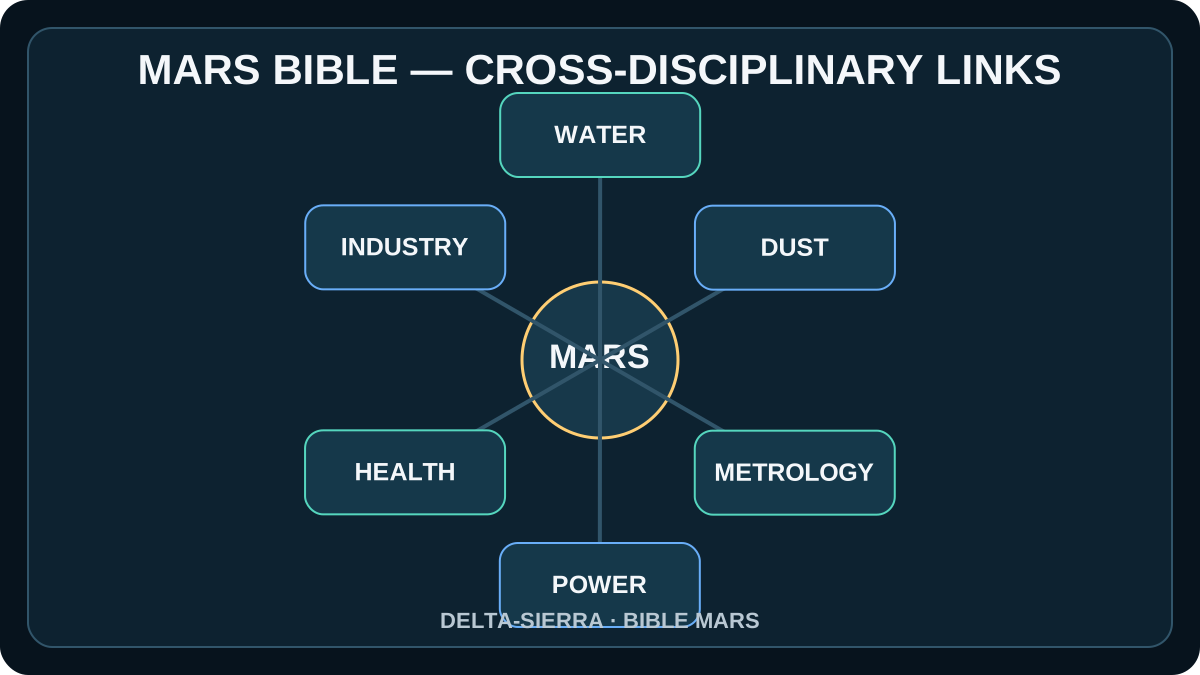
A suggested way to use the index: follow an imaginary failure through the system
Try a simple mental exercise: “oxygen production has fallen by 20%.” The first page may be ECLSS or ISRU, but diagnosis quickly crosses other entries: sensors, filters, power, thermal control, chemistry, maintenance, spares and metrology. If the measurement is wrong, increasing process power may be the wrong response. If feedwater chemistry changed, the problem belongs to pretreatment and chemistry. If the plant is healthy but the electrical network is shedding load, the root cause is elsewhere.
The same method works for fever, a pressure leak, an immobilized rover or declining crop yield. The A–Z map becomes valuable when it makes those disciplinary transitions visible. A Martian settlement would be a network of coupled systems; learning how to move between subjects is already an introduction to systems reasoning.
Go further in the books
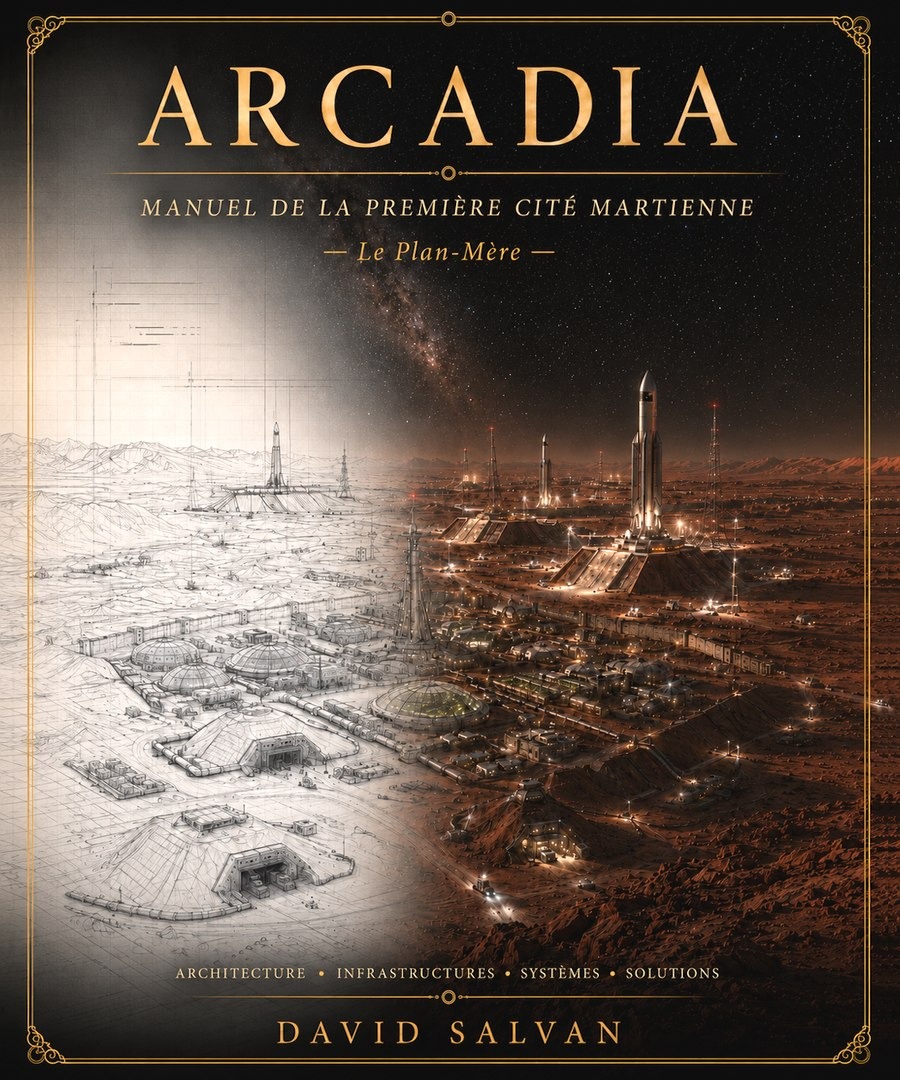


Six entry routes depending on what the reader is trying to understand
The overall project: start with Why Mars, the engineering overview and How humans could colonize Mars. Survival: atmosphere, water, ECLSS, food, health and refuge. Transportation: launch windows, trajectories, spacecraft, EDL and ascent. Industry: ISRU, chemistry, metallurgy, materials, machine tools and metrology. Society: psychology, children, demography, work and governance. History: origins of observation, von Braun, NASA, SpaceX and the general history of Mars.
These routes do not replace the alphabetical index. They reduce the entry cost for readers who do not yet know the technical vocabulary. Someone asking “how do people stay alive?” may not know the term ECLSS; someone asking “how do we repair things?” may not think of metrology. Thematic doors translate intent into technical concepts.
An encyclopedic index is useful when it helps the reader cross levels of explanation. A term such as perchlorate, ECLSS, delta-v or metrology should lead to the phenomenon, its parent system, the calculation that sizes it and the neighboring pages that depend on it. The index becomes a map of relationships rather than an alphabetical list.
Coherence is tested in the reverse direction too: major chapters should use concepts with compatible evidence status and point to the reference treatment instead of redefining the term differently. That discipline is what turns 37 page pairs into one library.
Entry, descent and landing (EDL)
- Mars entry, descent and landing: understanding the full EDL chain
- Mars atmospheric entry: heat shield, entry corridor and guidance
- Mars parachutes and supersonic retropropulsion: where architecture changes
- Terrain-relative navigation, hazards and Mars landing-site selection
- Terminal descent, engine plumes and the Mars landing zone
- Human Mars lander: the EDL problem above 20 tonnes
Survive: ECLSS, health and resilience
- Mars habitat ECLSS: complete architecture of survival loops
- Mars habitat air: oxygen, CO₂, humidity and contaminants
- Mars water: 98% recovery, storage, quality and make-up
- Fire, depressurization and refuge: surviving habitat emergencies
- Mars radiation: shielding, dose and storm shelter
- Spacesuits, EVA and dust: working outside without contaminating the base
- Food, crops and medicine: biological and medical autonomy on Mars
- Psychology, fatigue and multiple failures: human resilience of a Mars base
Operations, industry, reliability and team
- Choosing a site and deploying a Mars base
- Mars surface mobility, robotics and logistics
- Mars ISRU industry, construction and local manufacturing
- Reliability, redundancy and common causes in a Mars base
- Durability, tightness, electronics and FDIR on Mars
- Mars maintenance, spares, qualification and configuration
- Crew operations, procedures and Earth-Mars communications
- Human factors, anomalies and training for a Mars team