


Psychology, fatigue and multiple failures: human resilience of a Mars base
Human resilience matters most when several constraints arrive together: sleep loss, equipment trouble, competing priorities, communication delay and cognitive load. A Mars base therefore has to watch not only individual psychological state but also team performance, recovery, decision quality and the ability to redistribute work before a small error feeds a larger failure cascade.
Fatigue is not discomfort: it changes the probability of a bad decision
“Psychology, fatigue and multiple failures: human resilience of a Mars base” addresses human resilience when isolation, fatigue, communication delay and technical failures combine.

Scope — decisions, shifts, sleep, communications, procedures and refuge resources of a crew that cannot wait for Earth on every anomaly.
Resilience assessment should watch sleep time, workload, errors, alarms, task conflicts, communication delay, refuge resources and performance trends.
Relationship used here: crew workload = sum of critical-task durations assigned to each crewmember over the chosen window.
CHAPEA and NASA communication-delay research let teams study autonomy, limited resources and simulated malfunctions
Recompute crew workload = sum of critical-task durations assigned to each crewmember over the chosen window with units visible.
When multiple failures arrive together, organization becomes a safety system
The operational risk becomes acute when fatigue degrades diagnosis during a multiple-failure event and triggers a second error.
Designing work, alarms and reserves for a crew that is never perfect
preserving performance and cooperation without creating an organization too rigid to adapt to novel situations
long analog simulations, injected incidents, debriefing, error/response-time analysis and human-factor trend monitoring
Operational log: sleep time, workload, errors, alarms, task conflicts, communication delay, refuge resources and performance trends.
Building human resilience that lasts longer than a mission
Sleep, schedules and error: the temporal architecture of safety
A Martian sol lasts about 24 hours 39 minutes, close enough to Earth to feel familiar yet different enough to complicate scheduling. Robotic mission teams have worked on Mars time on Earth; a settlement would instead live permanently with local civil time while interacting with Earth-based teams.
Safety therefore needs a scheduling doctrine. Night shifts, emergency callouts and EVAs cannot be planned only around hardware availability. Recovery, circadian timing, light exposure and cognitive load matter. A non-urgent task can become riskier simply because it is scheduled after prolonged wakefulness.
At city scale the problem becomes labor organization. Power, ECLSS, hospital, security, communications and industry require continuous coverage. Staffing, on-call duty and human redundancy must be designed like material redundancy. Two exhausted operators are not truly two independent safety channels.
Incidents should also be analyzed without a blame culture. If the same human error repeats, the useful question is why the system makes it likely: confusing interface, long procedure, alarm overload, inadequate training or structural fatigue. Human resilience improves by changing the system, not merely telling people to pay more attention.
From selected crew to public mental health: the psychological scaling transition
Earth analogues such as CHAPEA and Mars500 can study isolation, workload, sleep, delayed communication and small-group living. Their value is real, but so are their limits: Earth gravity remains, emergency extraction exists, society is physically nearby and participants know the experiment ends. A permanent Martian town adds birth, aging, bereavement, civil conflict, job changes and the possibility that some residents never return to Earth.
Sleep is safety infrastructure
Poor scheduling creates risk. Critical work should not be assigned only by immediate availability. The settlement must track wake time, night rotations, EVA recovery, alarm cascades and periods of intense workload. Prevention means avoiding a system in which the same person becomes irreplaceable expert, on-call operator and crisis decision maker for several consecutive days.
The useful indicator is not simply “everyone says they are fine.” Objective but privacy-respecting signals can include repeated errors, performance trends in selected tasks, reported sleep quality, conflict, team overload and mental-health service demand. Those data must not become disciplinary surveillance. Their purpose is to reveal a work system that is exhausting its people.
Multiple failures: organization becomes the last layer of redundancy
Two technical failures can produce a third human failure through cognitive overload, wrong prioritization or a missed verification. A resilient base therefore prepares short procedures, explicit roles, load-shedding thresholds and moments when non-essential services are deliberately sacrificed to protect air, water, power or health. A town has an organizational safe mode as well as technical safe modes.
Training should include contradictory information. If an oxygen sensor, software display and operator observation disagree, who can stop the plant? How is the measurement confirmed? Who takes over if the responsible person is exhausted? Psychology, FDIR and governance meet in those questions.
At one thousand residents, psychology becomes public health and labor law
A civilian population cannot be run like a selected mission crew. It needs confidential mental-health care, rules against harassment, rest, recreation, private space, associations, accessible justice and mediation. Urban design matters too: noise, light, density, retreat spaces and the ability to experience different environments all affect long-term well-being.
The deepest mistake would be to normalize suffering in the name of the mission. A durable society must allow residents to say that work is badly organized, a leader is abusive or a rule should be challenged without being accused of endangering Mars. Resilience is not obedience. It is the collective ability to absorb mistakes, repair institutions and keep functioning.
Conflict is not a failure to eliminate; it must be contained constructively
A durable community will disagree about schedules, resources, relationships, scientific priorities and politics. Demanding permanent harmony would encourage concealment. Resilience means legitimate channels for disagreement that do not endanger critical systems: mediation, complaints, team processes, independent review and, as population grows, civil justice. Conflict becomes dangerous when there is no accepted way to express it.
Mission command and town government therefore cannot remain identical forever. Emergencies may justify a short authority chain; ordinary civilian life requires predictable rules and checks.
Bereavement and collective accidents belong in the scenarios
A real settlement will eventually lose a resident. The impact may be disproportionate in a small community where everyone knows one another and some skills are rare. Emergency planning must therefore include not only functional replacement of a role but psychological support, chosen rituals and recovery time. An organization that asks only “who replaces the victim?” creates a second crisis.
When the city is tired: designing an organization that remains safe when people are not
Psychology in a Martian settlement is not merely morale or personality selection. Fatigue, interruptions, alarm load, conflicting objectives and cognitive overload change error probability. A durable settlement must therefore treat human state as a safety variable, just as it treats habitat pressure or power-system temperature.
Behavioral risk becomes systems risk
NASA distinguishes behavioral health, team performance, sleep and workload risks. Operations combine them. A sleep-deprived person interprets an alarm less reliably; a stressed team communicates less effectively; multiple failures encourage procedural shortcuts; and distance from Earth removes immediate arbitration by ground control. The design target is not a perfect human but an organization tolerant of real humans.
This affects alarm design, shift length, independent checks, rest, task rotation and the authority to pause operations. A culture that rewards heroic endurance can become less safe than one in which fatigue can be declared without stigma.
From elite expedition to civilian society
Early crews will be highly selected, trained and monitored. A city of one thousand will include children, couples, aging residents, specialists, introverts, grieving people and residents who do not share the pioneers' original motivations. Psychological support designed for a two-year expedition cannot simply be stretched to a lifetime.
A settlement therefore needs confidential care, mediation, private space, leisure and institutions capable of resolving conflict without redefining every disagreement as a safety threat. This social transition is as important as moving from one generator to a redundant power grid.
Multiple failures: resilience depends on how decisions are made under pressure
If power loss degrades ECLSS while Earth communications are unavailable, the local team must rank several hazards at once. Procedures matter, but understanding priorities matters more. A rigid procedure can fail when the event differs from the script; unbounded improvisation can create contradictory actions. Resilience lies between them: clear doctrine, reliable information, defined authority and the ability to deviate while documenting why.
Training should therefore teach reasoning as well as rehearsed scenarios: identify the vital function, estimate time to consequence, search for common causes, choose a degraded configuration and preserve a decision record. Every real incident should then update procedures, spares and training.
Mars psychology is moving beyond anecdotes: analog programs are building comparable longitudinal datasets
Isolation studies often generate powerful stories that are difficult to generalize. One crew “got along,” another experienced tension, one participant slept badly. Without common instruments, such observations are hard to compare. Recent NASA work is explicitly addressing that problem. A 2026 summary of the APEX — Assessment of Psychology in Extreme Environments standardized suite reports data from 121 individuals in 40 teams, with groups of three to nine people living and working in isolation. The sample includes astronauts in space for roughly 150–350 days and terrestrial analog participants isolated for 45–240 days. The value is not a mythical average astronaut; it is the ability to track behavioral health, interpersonal relationships, team functioning and performance with common measures over time.
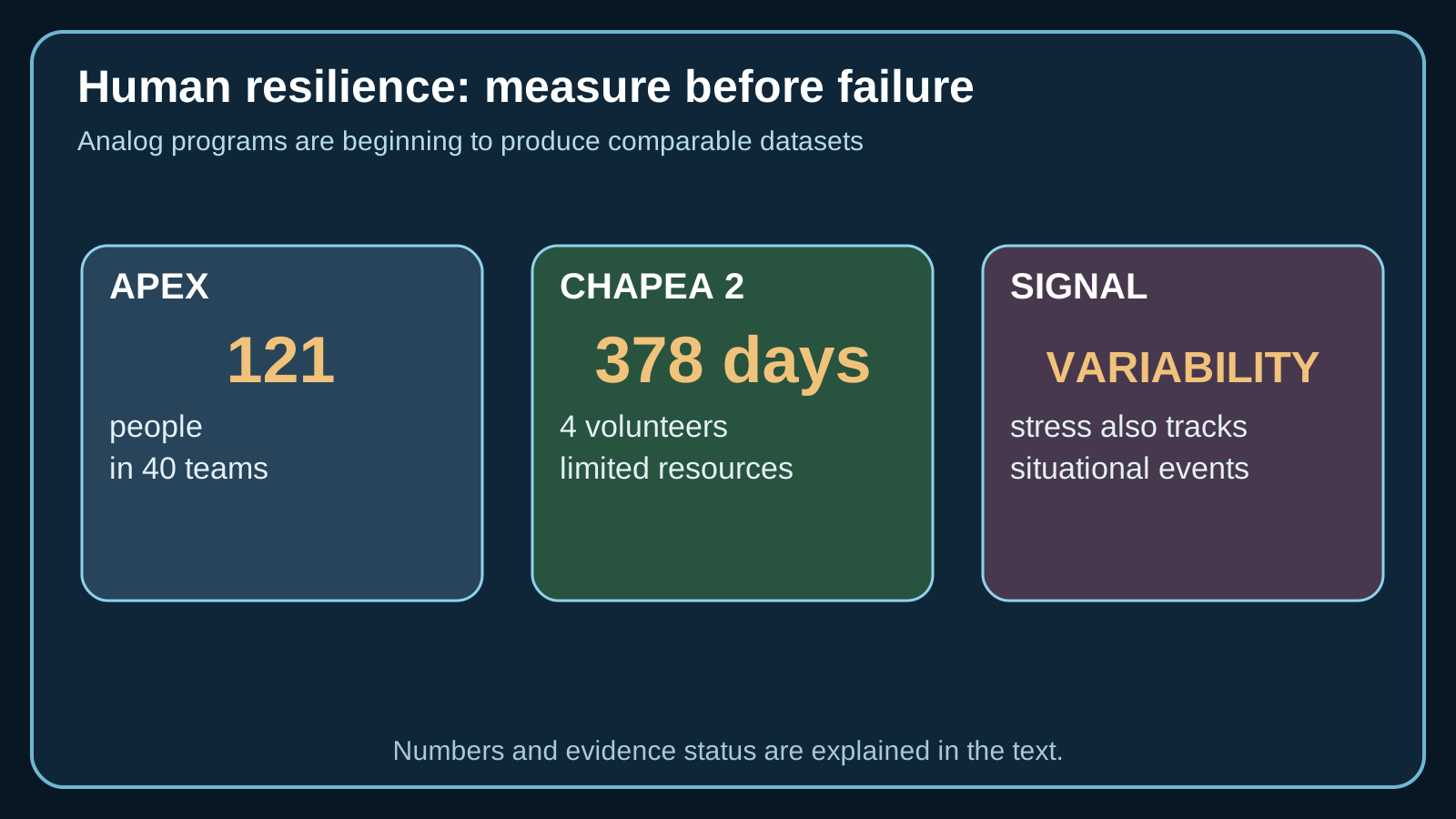
CHAPEA Mission 2 adds a long-duration case, but it is still not Mars. The second CHAPEA mission began on 19 October 2025 with four volunteers scheduled for 378 days inside Mars Dune Alpha. NASA simulates limited resources, prolonged isolation, equipment failures, simulated Marswalks and communication delay reaching 22 minutes in the scenario. By 7 May 2026 the mission had passed 200 days. It is valuable because maintenance, crops, exercise, science tasks and simulated anomalies coexist for nearly a year. Yet gravity remains 1 g, the outside hazard is not real, and the crew knows Earth emergency response exists. Psychological fidelity therefore remains incomplete.
The right metric is not “morale: 7/10”. A resilient settlement needs several dimensions that can diverge. A person may report acceptable mood while reaction time deteriorates; a polite team may avoid necessary disagreement; a high performer may accumulate sleep debt that becomes visible only during a failure. Useful monitoring combines sleep, workload, cognition, mood, conflict, cohesion, error patterns, recovery time and trend. The trajectory matters more than one isolated score.
Multiple failures are also a psychological architecture problem. If a water-system failure arrives after three poor nights of sleep during a difficult communication period with Earth, the technical event and the human state are not independent. Interfaces should reduce cognitive load: short first-minute procedures, clear display of remaining margins, pre-agreed load-shedding priorities, a second-check path, and automation of repetitive tasks without removing the crew's understanding of the system. Behavioral resilience is therefore partly designed into software, ergonomics and maintenance.
A city must treat conflict as a normal risk, not a moral failure. With four astronauts, selection can exclude many profiles. With one thousand residents, a society necessarily contains different personalities, ages, occupations, cultures and interests. Mediation, medical confidentiality, rest, fair work allocation and private space become public-health infrastructure. Operational resilience does not assume conflict can be eliminated. It limits the routes by which conflict, fatigue or individual distress can propagate into air, power, safety, medical care or other mission-critical functions.
Recent primary sources: NASA NTRS — Summary Results from the APEX Standardized Suite, 2026; NASA — CHAPEA Mission 2; NASA HRP — Human Factors and Behavioral Performance risks.
Real resilience is not “keeping morale up”: it is remaining a team that can decide when several things go wrong at once. Resilience is often described as a personality trait. For a Mars base that definition is inadequate. A resilient team continues to detect, understand, decide, act and recover while fatigue, isolation, communication delay and technical failure interact. The risk is not limited to depression or open conflict. It can be quieter: a skipped check, premature diagnosis, an unchallenged assumption, a slowly shrinking sleep period, or one specialist becoming the single route through every critical decision.
NASA’s 2026 APEX results are valuable because they challenge the simplistic idea that teams necessarily degrade in a uniform way with time. The dataset includes 121 individuals in 40 teams, including astronauts in space for roughly 150–350 days and terrestrial analog participants isolated for roughly 45–240 days. In the reported sample the authors note no incidents of clinically elevated depression, a decrease in positive affect over time, and substantial person-to-person variability in negative affect and stress, which appeared more strongly associated with situational stressors than with duration alone. Calendar time by itself is therefore a poor predictor of team state.
What this changes: follow trends, not a single “psychological score”. A useful human-performance dashboard should not label a person green or red. It should combine sleep, reaction time, simple-task errors, reported workload, mood, perceived cohesion, conflict, social withdrawal, minor mishaps, procedural omissions and recovery after difficult days. A single observation can mislead; a repeated trend is more informative. Privacy is essential: if every answer feels disciplinary, people learn to give the system the answer it wants.
The dangerous failure is the technical problem arriving at the wrong human moment. Imagine a greenhouse cooling loop degrading after a week of intense work. The hardware fault is the same whether it occurs after rest or during accumulated sleep debt, but system risk is not. A tired team may detect drift later, communicate more sharply, accept the first diagnosis too quickly and omit a lockout step. Human and technical data therefore need to be connected: a critical alarm during degraded performance should trigger more independent checking, not more pressure.
Four, twenty, one hundred and one thousand residents are different systems. With four people, behavioral health is almost the same problem as crew dynamics. At twenty, shifts, rest and critical duties must already be separated. At one hundred, managers, clinicians, teachers, technicians and families make mental health a public-health service rather than an astronaut-support function. At one thousand, privacy, medical confidentiality, harassment prevention, private space, recreation, culture, mediation and job mobility matter. A method designed for four highly selected adults cannot simply be scaled into a society.
Earth–Mars delay requires a new decision discipline. CHAPEA Mission 2 simulates up to 22 minutes one way. A question to Earth can therefore require at least 44 minutes for signal round trip before anyone has read, analyzed or written a response. Ground control becomes a provider of procedures, decision libraries and training rather than the voice that resolves every incident. The settlement must define what is local by default, what can wait for delayed consultation, what is irreversible, and when an operator may stop a procedure without asking permission.
Design consequence. A resilient colony does not search for humans without weakness. It assumes that every person can be tired, worried, distracted or in disagreement, then uses rest, decision redundancy, procedures, private space, cautious measurement and a reporting culture so that a temporary human state does not become a catastrophe.
2026 primary sources: NASA NTRS — Summary Results From the Assessment of Psychology in Extreme Environments (APEX) Standardized Suite; NASA — CHAPEA Mission 2.
Behavioral health must be designed into schedules, architecture and command structure. The built environment can either amplify or reduce human stress. Acoustic privacy, controllable lighting, personal storage, visual separation between work and sleep, access to plants or changing visual scenes, and the ability to be alone for a short period all influence whether confinement feels manageable. These features compete with mass and volume, but treating them as decoration is a false economy when human error can threaten life-support systems.
Shift design is part of fault tolerance. A settlement that requires the same expert to respond to every alarm creates a human single point of failure. Cross-training, on-call rotations and protected sleep periods create redundancy in knowledge just as duplicate pumps create hardware redundancy. The system should also distinguish genuine emergency work from tasks that merely feel urgent. Chronic interruption can erode performance even when total scheduled work hours appear acceptable.
Teams need a language for disagreement. High-reliability organizations do not eliminate conflict; they make it safe to challenge assumptions before commitment. A Mars crew can use explicit independent check rules for irreversible actions, structured handovers, independent confirmation of critical calculations and post-event reviews that separate learning from blame. Those procedures matter most when hierarchy is strong, because junior members may otherwise remain silent when they notice a problem.
Measurement must not become surveillance. Wearables and computerized tests can collect sleep, activity, reaction time and physiological signals. More data are not automatically better. Residents need to know what is collected, why, how long it is retained and who can access individual results. Aggregate trends may be enough for staffing decisions, while clinical details remain confidential. A system that violates trust can destroy the very signal it was built to measure because people change behavior or avoid reporting symptoms.
Recovery should be measurable too. After a major incident, the question is not only whether the hardware has been repaired. Did sleep return to baseline? Did team communication recover? Are operators avoiding a location associated with the event? Are near-misses increasing? Psychological recovery is therefore part of return-to-service. A settlement that tracks only the machine may declare itself recovered while its human operators are still operating with reduced margin.
Specialized sources — fatigue, teams and human factors
- NASA Human System Risks — behavioral, team, sleep and workload risks
- NASA Human Research Program — Five Hazards — isolation, distance and hostile closed environments
- ESA — Mars500 — isolation and confinement analogue
- NASA — Human Factors and Behavioral Performance — sleep, cognition, cohesion and performance
Psychological resilience is not equivalent to selecting highly motivated people. Fatigue, isolation, priority conflicts and accumulating minor failures change the performance of competent teams. Trends, departures from normal behavior and effects on collective work are often more informative than one questionnaire score.
Habitat design can reduce part of this burden through recovery time, privacy, lighting, noise control, realistic scheduling and authority to stop unsafe work. Flight and analog data support hypotheses, but a multi-year Martian society will create social conditions no analogue fully reproduces.
The 2026 APEX summary covers 121 individuals in 40 teams of 3–9 people, including astronauts isolated for 150–350 days and terrestrial analog participants for 45–240 days. It broadens comparative evidence without reproducing a multi-year Martian society.
Psychological resilience is most useful when translated into operating limits. A crew does not become unsafe because a questionnaire score crosses an abstract line; risk grows when fatigue, stress, conflict, or reduced attention begin to alter real decisions. Useful indicators therefore include deferred maintenance, repeated procedural deviations, missed cross-checks, slower anomaly diagnosis, communication breakdown, and the erosion of recovery time between demanding events. These signals can be tracked without turning the habitat into a surveillance environment.
Multiple failures are especially important because they consume the same human reserve. A technical alarm, an injured crewmember, poor sleep, and delayed Earth support may each be manageable alone while their combination exceeds the team’s cognitive and staffing capacity. Degraded-mode procedures should therefore include crew-time budgets just as they include power or oxygen budgets. When the available people cannot safely execute every task, the architecture needs rules for which work stops first, which systems can wait, and how the team returns to a sustainable workload after the emergency.