


MARS BIBLE — ORGANISATIONS
European Space Agency (ESA)
Mars Express, ExoMars, Trace Gas Orbiter and Rosalind Franklin: Europe builds its own Mars capabilities.
From precursor organisations to a single agency
COPERS: inventing cooperation before the agency
At the start of the 1960s Western Europe had laboratories, sounding rockets and industrial expertise, but no common institution able to stabilise space policy. The ‘COPERS: inventing cooperation before the agency’ case lets COPERS, site selection, scientific committees and intergovernmental negotiation be read as a collective construction rather than an isolated object. Decisions are taken at different moments by teams with different constraints. ESA’s role is to preserve a common technical intent across legal and national boundaries. Robustness depends on being able to trace a local anomaly upward to system consequences and then back down to the contracts and tests needed to close the risk.
COPERS, established in 1961, acted as a preparatory commission: it organised scientific discussions, prepared conventions, examined the location of future centres and created multilateral working habits before an operational agency existed. The case also separates expertise, a qualified system and an available service. Around COPERS, site selection, scientific committees and intergovernmental negotiation, Europe may understand a technology without sustaining the industrial cadence needed to reproduce it, or maintain a service through ground infrastructure that attracts little attention. Those levels are not interchangeable. Autonomy therefore means being able to reproduce, operate, maintain and replace a function, not merely pointing to a prototype or a past success.
The phase turned a political intuition into administrative and technical mechanisms able to outlive national political changes. This history also explains why contract law and engineering cannot be separated. A mass reserve, test requirement or interface responsibility has a cost and has to belong to someone. If the contract discourages disclosure of risk, the organisation loses time before the failure even exists. Joint reviews provide places where technical evidence can change the programme without every correction being interpreted as political failure.
The central difficulty was deciding who paid, where common capabilities would be located and how scientists could retain credible selection without every government turning the programme into a national showcase. Collective expertise around COPERS, site selection, scientific committees and intergovernmental negotiation contains substantial tacit knowledge: operational sequences, sensor sensitivities, supplier behaviour and test techniques. When people move, that knowledge can disappear without a single file being deleted. Durable organisations invest in transfer and critical re-reading of decisions. This intangible capital helps explain why reconstructing an interrupted capability often costs much more than surviving drawings suggest.
For Mars the lesson is institutional: a multinational base has to allocate responsibilities, costs and interfaces before hardware makes political compromises irreversible. The visible outcome around COPERS, site selection, scientific committees and intergovernmental negotiation is the survivor of a selection process. Competing concepts, incomplete partnerships and resized architectures disappear from simplified narratives. Restoring them shows where uncertainty actually lay. It also makes transfer to Mars more disciplined: what worked in one European configuration is not a physical law requiring the same organisation for a future campaign.
For COPERS, site selection, scientific committees and intergovernmental negotiation, margin has to be tied to evidence. Adding mass, time or redundancy without understanding the protected scenario can move risk rather than reduce it. Safety analysis links each barrier to an identifiable threat and verifies that several barriers do not fail for the same cause. The discipline becomes more demanding when the system depends on shared services operated by several organisations.
This case is integrated into the wider history of ESA so that demonstrated heritage, real dependencies and transfer to new uses remain distinct. Institutional source.
ESRO: science as the first common language
The ESRO Convention entered into force on 20 March 1964. The institutional significance of ‘ESRO: science as the first common language’ lies in the way ESRO, scientific peer review, shared establishments and distributed instruments cross several layers of responsibility. At ESA, a local change can affect schedule, industrial distribution, qualification and operations at the same time. Control comes less from adding partners than from making interfaces explicit enough to test, challenge and revise before the cost of change becomes prohibitive.
The organisation focused on scientific research, satellites, sounding rockets and the facilities needed to design and operate them. Another useful distinction is among know-how, production capacity and operational availability. ESRO, scientific peer review, shared establishments and distributed instruments can be technically understood while depending on a scarce supplier, a unique test facility or an intermittent launch chain. Conversely, an old service can remain robust because procedures, spares and teams are maintained. This provides a more demanding measure of European autonomy than counting hardware carrying a European flag.
ESRO-2B, launched in 1968, opened a sequence of missions that built a European culture of peer selection, instruments supplied by several countries and shared operations. Distributed industrial work on ESRO, scientific peer review, shared establishments and distributed instruments requires decision points where evidence is confronted. PDR, CDR, test reviews and acceptance matter only when they can genuinely stop or change an insufficiently demonstrated solution. Their purpose is not to confirm a schedule that has already been decided but to expose remaining uncertainty. The ability to say no is one of the most important mechanisms of mission assurance.
More importantly, ESRO created or consolidated establishments that later became pillars of ESA, including ESTEC, ESOC and ESRIN. The long timescales of ESRO, scientific peer review, shared establishments and distributed instruments create a question rarely visible in public timelines: who remembers why? A requirement may look excessive a decade later if the incident that created it has been forgotten. Removing it for simplicity can then reintroduce an old risk. Good engineering memory links requirements, anomalies, tests and decisions so later generations can challenge inherited practice without ignoring its evidence.
Science offered a cooperation domain less directly tied to military sovereignty or commercial markets, but it did not yet solve the questions of autonomous launch, applications or operational services. The history of ESRO, scientific peer review, shared establishments and distributed instruments has to be read through the constraints of its period. Launcher availability, national policy or a supplier failure can steer architecture as strongly as a performance equation. Recognising that contingency does not diminish technical achievement; it reveals the ability of teams to produce robust solutions from an imperfect choice space and separates engineering principles from historical compromises.
Mars Express and ExoMars inherit this culture directly: nationally supplied instruments have to operate as one mission with shared data, interfaces and scientific selection. Finally, off-nominal cases involving ESRO, scientific peer review, shared establishments and distributed instruments have to remain operable by real teams. An over-complex recovery procedure, ambiguous telemetry or an unavailable tool can erase a redundancy that is correct on paper. Exercises and simulations test the whole person-procedure-software-hardware chain. That socio-technical approach is essential for long missions where fatigue, staff rotation and communication delay become risk factors in their own right.
ELDO and Europa: the launcher failure that became a founding lesson
ELDO was created to develop the Europa launcher by distributing stages and responsibilities among several countries. ‘ELDO and Europa: the launcher failure that became a founding lesson’ illustrates a permanent feature of European programmes: ELDO, Europa, distributed stages and system authority rarely belong to one actor. Technical decisions move among the Agency, primes, suppliers, test centres and contributing states. Distribution is not inherently weak, but it requires clarity over who arbitrates, who supplies evidence and who accepts residual risk. Without that chain, cooperation can multiply blind spots rather than capabilities.
On paper this division satisfied political balance; in testing it exposed the limits of an architecture in which system authority and interfaces were not integrated strongly enough. The word capability hides several realities. For ELDO, Europa, distributed stages and system authority, the questions are whether Europe can design, qualify, reproduce, operate and eventually renew the function. A positive answer to only one is insufficient. Industrial continuity and preservation of test infrastructure become as important as theoretical knowledge. ESA history contains strong capabilities that had to be rebuilt after production cadence or skilled teams were interrupted.
Europa’s successive failures became a negative school of systems engineering. As ELDO, Europa, distributed stages and system authority are distributed among partners, contractual interfaces become safety interfaces. Ambiguous responsibility can leave two firms each assuming that the other handles a boundary case. Cross-checking requirements, configuration control and independent technical authority reduce that risk. System coherence survives when commercial boundaries do not create boundaries in understanding of the overall behaviour.
When the programme was abandoned, the goal of autonomous launch remained, but Europe had learned that a launcher could not be a simple sum of juxtaposed national contributions. ESA also acts as a device for retaining expertise between missions. For ELDO, Europa, distributed stages and system authority, one programme can end before the next has secured stable funding, dispersing teams. Technology activities, technical centres and support contracts reduce that gap without eliminating it. Portfolio planning therefore has to treat continuity of people and facilities as a risk variable, not only the budget availability of each mission considered separately.
The crisis concerned less the individual quality of each contribution than the ability to arbitrate interfaces, schedules and responsibilities when the integrated vehicle did not behave as expected. Branch points associated with ELDO, Europa, distributed stages and system authority also show that strategy is often built through correction. Failures and delays can remove assumptions that appeared reasonable at design start. Useful history therefore does not claim that ESA always foresaw the final outcome; it shows how the organisation changed criteria as evidence accumulated. The capacity to revise a plan is itself an institutional capability.
An international Mars architecture will meet the same risk in power, habitats, communications and logistics: a political interface has to become a testable engineering interface. From a safety perspective, ELDO, Europa, distributed stages and system authority have to be studied as a network of common causes. Two redundant functions may share software, a supplier, ground station, power source or budget decision. Physical duplication does not create independence by itself. Degraded scenarios, dependency analysis and fallback paths are used to establish whether a transversal fault can disable several protections that appeared separate on a functional diagram.
Historical context and deeper reading
1960–1975: before ESA, Europe had two space organisations to reconcile
ESA was not created as an empty office that then had to hire an entire space programme from scratch. It was a consolidation. In the early 1960s western European states separated two ambitions: ELDO was created to develop the Europa launcher, while ESRO was created mainly for scientific satellite programmes. The split produced different technical cultures, decision chains and facilities. When ELDO accumulated technical problems, cost overruns and political disputes, the central question became how to preserve acquired expertise while ending the fragmentation of European space policy.
The European Space Conferences of 1972, 1973 and 1975 progressively built the answer. The “Second Package Deal” linked institutional unification to concrete programmes: the French L3-S design, later Ariane, cooperation with NASA on Spacelab, and new applications programmes. The future agency therefore began with work that already had to be delivered, not merely with a political declaration.
30 May 1975: a new agency built around experienced people and facilities
The Convention establishing the European Space Agency was signed in Paris on 30 May 1975. ESA functioned de facto from the following day, even though the Convention entered into force only in 1980 after ratification. That matters when asking how the first staff were recruited. Much of the human capital came from the predecessor organisations. Scientists, engineers, operations specialists and administrators from ESRO became part of the nucleus of ESA, while existing European programmes and facilities were reorganised under a single institution. ESOC is a useful example of this continuity: European spacecraft operations capability existed before ESA itself and was carried forward into the new agency.
Why this origin still matters for Mars
This history explains a durable ESA skill: integrating distributed capabilities. A European Mars mission combines ESA centres, national industries, partner agencies, universities and institutes across several states. ExoMars Rosalind Franklin makes that inheritance visible today. The rover mission targets launch in 2028 and landing in 2030; in 2026 teams are still qualifying tangible elements such as landing legs and rover deployment ramps. The institutional lesson from 1975 remains relevant: Europe succeeds in deep-space exploration when nationally distributed expertise is turned into one traceable chain of engineering responsibility.
Origin sources: ESA — 1975 Convention history · ESA — European Space Conference 1975 · ESA — ExoMars.
An agency that did not recruit from zero: inheriting the ESRO and ELDO workforces
Talking about ESA's 'first employees' as though the agency were a start-up would be misleading. When the 1975 Convention brought together the legacies of ESRO and ELDO, Europe already possessed centres, scientific teams, engineers, industrial contracts and programmes in progress. Creating ESA was therefore as much an integration of existing capability as a recruitment exercise. It had to reconcile different cultures: space science, launchers, applications, relations with member states and industry.
That distributed architecture is both a strength and a constraint. It allows specialised national capabilities to be mobilised, but demands precise interfaces, responsibilities and configuration rules. European centres and industrial partners are not interchangeable; the agency has to make their differences work together. This experience becomes directly relevant to Mars Express and ExoMars, where instruments, spacecraft, launch, operations and science can depend on actors in several countries.
The agency's origins therefore explain its contemporary operating model. ESA was designed as a permanent machine for technical cooperation. For Mars, the question is not only whether Europe possesses a particular technology, but whether political, budgetary and industrial agreements can remain stable long enough for distributed teams to build and operate a common system. European capability lies as much in managing those interdependencies as in any individual instrument.
Direct answer: why European Space Agency (ESA) matters to the story of Mars
European Space Agency (ESA) deserves its own dossier because Mars Express has studied Mars since 2003. [1] The goal is not to rank organizations but to understand one as a system: history, decision centers, infrastructure, technologies, successes, failures and the capabilities it contributes — directly or indirectly — to Mars exploration.
Mars Express, ExoMars, Trace Gas Orbiter and Rosalind Franklin: Europe builds its own Mars capabilities.
Why Europe merged scientific research and space development
The European Space Agency emerged from an institutional history that predates the 1975 Convention. Europe had ESRO for space research and ELDO for launcher development. Coordination difficulties and the desire for a more coherent European capability led to a single agency. The Convention was signed in Paris on 30 May 1975 and entered into force in 1980. That origin still explains ESA’s structure today: an intergovernmental organization assembling national budgets, laboratories, industrial capabilities and teams across multiple countries.
The model creates particular strengths and constraints. Missions can draw on distributed expertise, but scientific and industrial responsibilities must be allocated among Member States. On a Mars project, an instrument may be scientifically led in one country, built with contributions from several others, integrated by an industrial prime and operated within an ESA framework. Understanding that architecture is essential before judging a mission only by the agency name on a press release.
ESA has also learned to operate through international partnerships. Mars Express used a Soyuz-Fregat launcher and some instruments inherited work from the Russian Mars 96 program. ExoMars has undergone major partnership reorganizations. International cooperation is therefore not diplomatic decoration; it directly affects schedules, interfaces, responsibilities and risk.
Mars Express and ExoMars: scientific continuity, cooperation and institutional resilience
Mars Express is a major milestone because it was Europe’s first fully fledged mission to another planet. Entering Mars orbit on 25 December 2003, it has studied the surface, subsurface, atmosphere and Martian moons. Its longevity is itself an engineering result. A mission designed for a much shorter lifetime has been extended repeatedly and continues to return data more than two decades after launch. Long duration changes the cost-to-science relationship because an existing platform can observe long-term phenomena and support a wider exploration ecosystem.
The Beagle 2 story is a reminder that a space program is never a linear sequence of successes. The small lander was declared lost in 2004 and was identified years later in Mars Reconnaissance Orbiter imagery. Separating the successful orbiter from the failed landing attempt is pedagogically useful: a mission contains phases and subsystems whose outcomes can differ.
For future settlement, ESA experience highlights structured cooperation and longevity. Martian systems will have to accept contributions from multiple organizations without allowing interfaces to become fragile. Standards, responsibilities, data policies and configuration procedures will be as important as the performance of any individual piece of hardware.
1945-1962: Europe’s space effort began as a political and scientific capacity problem
To understand the European Space Agency, it is necessary to begin before ESA, before Ariane and before the first European satellites. Post-war Western Europe retained outstanding universities, observatories, engineering schools and industrial traditions, but no single state could reproduce the scale of the United States or the Soviet Union. The central question was therefore not simply how to build a rocket. It was whether countries that had recently fought devastating wars could learn to share laboratories, budgets, technical risk, industrial work and long-term scientific ambition.
The CERN model mattered. Scientists including Pierre Auger and Edoardo Amaldi argued that Europe could pool resources for space research just as it had for high-energy physics. The idea was institutional before it was technological: create a framework in which governments could support facilities and programmes too expensive or politically difficult to justify nationally. European space cooperation was born as a method for aggregating capability.
GEERS and then the preparatory commission COPERS turned the idea into plans for a scientific programme, a multi-year budget, establishments and governance. This is a recurring feature of European space history. Before Europe possessed a major launcher, it invested in the rules by which different countries would decide what to build together.
This origin explains why ESA should not be treated as a simple European equivalent of NASA. NASA belongs to one federal state. ESA is an intergovernmental organisation whose members keep their own national agencies and policies. CNES, DLR, ASI, UK Space Agency and others do not disappear into ESA. The agency is the layer at which projects become European.
That architecture is directly relevant to Mars. A durable European presence would almost certainly combine propulsion, structures, software, science, operations and industrial production from different countries. ESA’s deepest historical skill is precisely the conversion of distributed competence into a single mission. [source] [source]
ESRO and ELDO: two organisations for two problems that could not remain separate
In 1962 European governments created two separate institutions. ESRO was intended to conduct scientific space research and develop satellites. ELDO was created to develop a European launcher, eventually known as Europa. The division looked rational: payloads and science on one side, launch vehicles on the other. In practice, it revealed how strongly those domains are coupled.
ESRO built laboratories and operational competence that survived into ESA. ESRIN in Italy, ESOC in Germany and ESTEC in the Netherlands created communities of specialists in Earth observation, mission operations, systems engineering, integration and testing. European capacity was becoming embodied not only in spacecraft but in teams and facilities.
ELDO struggled with technical failures, cost growth and political disagreement. Europa became a lesson in the difference between distributing work and owning a system. Stages built under different national responsibilities still had to function as one launch vehicle. Interfaces, authority and verification could not be divided indefinitely.
Kourou also became strategically important. France selected the site in French Guiana in the 1960s and opened it to European cooperation. Its low latitude is technically advantageous, but its political value is equally important: Europe can operate a spaceport without requesting launch access from another major power.
The ELDO experience remains useful for Mars architecture. A habitat, lander, power system, rover, ascent vehicle and communications network built by separate partners require a clear systems authority. Political partnership does not automatically produce technical integration. ESA’s later institutional design was partly a response to that fact. [source] [source]
1971-1975: package deals created a durable European method of compromise
The early 1970s were not simply about merging acronyms. Governments had to solve a more difficult question: how could states with different scientific and industrial priorities support a common space programme? Europe’s answer was to build packages. A country might accept a programme that was not its first priority because another element of the package better served its interests.
The second package deal was decisive. It combined the creation of a single agency with the launcher programme that became Ariane, cooperation with NASA on Spacelab and operational applications. Europe therefore did not choose between autonomy and international cooperation. It invested in both at the same time.
The ESA Convention was signed in Paris on 30 May 1975. It formally entered into force in 1980, although the agency operated under its new identity from 1975. The new organisation broadened the scope inherited from ESRO and ELDO, allowing science, applications, launchers and technology to be handled inside one framework.
The package logic also foreshadowed ESA’s financial structure. Mandatory activities provide a common foundation, while optional programmes allow states to subscribe according to interest. This makes the agency flexible, but it also means that major initiatives require coalition-building rather than a single parliamentary appropriation.
A Mars programme spanning decades would face the same political problem. It would have to be divided into useful, fundable layers while preserving an overall architecture. The European art is not simply to agree on a grand destination, but to design a sequence in which many governments have reasons to remain committed. [source] [source]
COPERS, ESRO and ELDO: Europe had to engineer an institution before it could engineer a durable space power
Reducing the birth of the European Space Agency to a succession of acronyms obscures the most difficult achievement of the 1960s and early 1970s. Europe did not lack physicists, engineers or governments capable of funding advanced national work. What it lacked was a political mechanism able to turn different national ambitions into common capabilities that would survive changes of government. COPERS, the European Preparatory Commission for Space Research established in 1960, should be understood in that light. It was not yet a unified operational agency. It created rules, scientific priorities, planning habits and a community accustomed to making collective choices. Its 1961 Blue Book set out a programme involving scientific satellites, sounding rockets and shared research facilities. This helps explain why science and cross-border laboratory cooperation became embedded so deeply in Europe's later space institutions. European space capability was built through institutional design as much as through hardware. ESA archives on the European space pioneers
The decision to create ESRO for space research and ELDO for launcher development can look inefficient from the perspective of a later ESA that combines both domains. At the time, however, the separation reflected political realities. Scientific objectives such as ionospheric research, astronomy and environmental measurements were comparatively easy to present as shared knowledge goals. Launcher development raised harder issues of sovereignty, propulsion technology, test sites, industrial workshare and financing. The two organisations therefore followed different trajectories. ESRO gradually established satellite programmes, technical centres and a cooperative scientific culture. ELDO struggled with the Europa launcher and with an organisational arrangement that made integrated system authority difficult. The contrast mattered. It encouraged European governments to seek a more coherent framework in which science, applications and access to space could be treated as parts of one political system rather than as permanently separate institutions. ESA history of ESRO ESA history of ELDO and Europa
ESRO also introduced an issue that would remain one of the defining and most debated features of the European model: how could industrial contracts be distributed fairly among contributing states without turning every spacecraft into an inefficient collection of national quotas? The principle that evolved into geographical return was not simply a political favour. It addressed coalition stability. A government is more likely to invest in a shared organisation if it can show that its universities, engineers and companies participate in the value created. Yet from the beginning this generated a tension between two legitimate goals. One favours the most competitive supplier for each task. The other seeks to preserve a distributed European industrial base so that membership creates capabilities across the continent. Much of ESA's later industrial policy can be read as an attempt to balance these goals without allowing geography to overwhelm technical efficiency. Current debates over competitiveness, SMEs and strategic autonomy are therefore extensions of a problem identified before ESA formally existed. ESA on the ESRO Convention and juste retour
The permanent centres created during this period provided another decisive legacy. Before ESA existed in its final legal form, European cooperation already had a physical geography: ESTEC in the Netherlands for technology and testing, the operations centre in Darmstadt that became ESOC, ESRIN in Italy and a growing network of specialised facilities. An institution becomes much harder to dissolve once it consists not merely of a treaty but of laboratories, clean rooms, test equipment, control facilities, documentation systems and people who have learned to work together. Those assets create distributed institutional memory. A spacecraft may be conceived by a multinational team, assembled by an industrial consortium, tested in another country, controlled from Germany and scientifically exploited by researchers across the continent. What can look like European complexity from the outside is also the mechanism through which continuity survived national political cycles. ESTEC ESOC
Europa's failures became a particularly costly lesson in system integration. The launcher combined stages and responsibilities supplied by different countries. No single explanation covers all of its difficulties, but the programme exposed the risk of fragmenting technical authority. A launcher requires propulsion, structures, guidance, sequences, interfaces, testing and operations to converge on one coherent vehicle. Europe's conclusion was not that multinational cooperation itself was impossible. It was that cooperation needed a stronger system-level organisation. When the French L3S proposal became the basis of the future Ariane, the change was institutional as well as technical: Europe retained shared participation while moving toward clearer programme leadership and integration. This history helps explain why systems engineering later became such an important part of ESA's culture. The lesson was that national contributions have value only when they can be transformed into a functioning system. European Space Conference and L3S
This first period also shows why launcher counts alone are a poor measure of European space history. An organisation can lose a vehicle and gain a method. It can fail to stabilise one launcher while succeeding in creating centres and decision rules that remain useful half a century later. COPERS, ESRO and ELDO produced precisely that kind of institutional capital. They established the idea that European space programmes needed multi-year planning, a relationship between research and industry, permanent technical facilities and sufficiently predictable rules for governments to commit resources. ESA was therefore not a clean break in 1975. It consolidated fifteen years of experiments, preserving structures that worked and redesigning those that did not. That is why ESA could mark fifty years in 2025 while tracing many of its operational roots to organisations and facilities created well before the Convention was signed. ESA at fifty
From the package deals to the Convention: the compromises of the 1970s that made a European agency durable
ESA did not emerge from a sudden moment in which European governments agreed to pool everything. It was produced by negotiation precisely because the participating states did not rank the same goals in the same order. Some considered independent access to space essential; others prioritised scientific missions; others saw telecommunications and applications as the strongest economic justification. The package deals negotiated in the early 1970s were a political answer to this diversity. Instead of requiring every country to want the same programme, the states assembled a portfolio in which several ambitions could coexist. The 1973 settlement linked the French L3S launcher project that became Ariane, European participation in Spacelab and application programmes while preparing institutional unification. Solidarity therefore rested less on permanent unanimity about each spacecraft than on a portfolio broad enough for different governments to find projects matching their national priorities. ESA key dates 1960-2026
This logic explains ESA's unusual combination of mandatory and optional programmes. Core activities, including the scientific programme and general infrastructure under the Convention's rules, are supported through mandatory contributions. Optional programmes allow different groups of states to participate at different levels. The arrangement avoids two extremes. An agency funded only project by project would be fragile because every new mission would require a fresh political coalition. An agency forcing every state to fund exactly the same activities would generate repeated vetoes. ESA developed a middle course. The flexibility makes its finances harder for outsiders to read, but it has allowed countries with very different industrial structures and priorities to remain within one organisation for decades. A global figure for ESA's budget therefore never tells the whole story; one must ask which programme is involved, which states participate and over what period subscriptions are committed. ESA Convention
The Convention was opened for signature on 30 May 1975. Ten states signed that day, and Ireland joined the process later in 1975. The Convention formally entered into force on 30 October 1980 after the required national ratifications. ESA nevertheless operated during the intervening years through transitional arrangements and the practical merger of structures inherited from ESRO and ELDO. The dates are not contradictory. They describe different stages: political creation, operational transition and full legal entry into force. This distinction matters when writing institutional history because international organisations often begin functioning before every domestic ratification procedure has ended. Europe's ability to keep programmes and centres working during this interval also demonstrated that the merger had acquired practical momentum beyond the text of the treaty itself. ESA on fifty years of the Convention
Roy Gibson, the first Director General, had to translate the political settlement into daily administration. His challenge was not simply to direct a spacecraft programme. He had to bring together organisations with different missions, contracting traditions and management cultures while keeping existing projects alive. Procurement rules, cost control, technical authority and decision procedures had to become compatible. This is a form of institutional systems engineering. A merger can fail even when everyone agrees on the strategic objective if the underlying procedures remain mutually incompatible. ESA gradually developed a common language of requirements, milestones, interfaces, reviews, prime-contractor responsibilities and acceptance evidence. That decision infrastructure is much less visible than a launcher, yet it determines whether a multinational organisation can actually build one. ESA on Roy Gibson and ESA's first years
The Convention also established an important distinction between ESA and the European institutions that would later become today's European Union. ESA is an intergovernmental organisation based on its own Convention, not a supranational directorate of the EU. Its Council brings together member states and approves policy and financial commitments according to ESA rules. This matters when examining later programmes such as Galileo and Copernicus. The European Union can own a public policy, provide large-scale financing and define operational services, while ESA supplies technical development and programme-management expertise. European space power therefore evolved into a multi-layer system involving ESA, the EU, national agencies, research organisations, meteorological bodies and industry. The complexity is real, but it also allows responsibilities to be assigned according to their nature rather than forcing every function into one institution. ESA and the European Union
The 1970s settlement should not be romanticised. Optional programmes can intensify competition between priorities; geographical return can complicate industrial optimisation; major investments remain exposed to changing political contexts. Yet ESA's longevity provides empirical evidence that the arrangement is resilient. States with different economies, languages and industrial traditions have financed shared centres and programmes across multiple generations of governments. For a future multinational Mars effort, this is a significant governance lesson. A crewed Mars architecture would have to survive economic crises, elections and strategic disagreements over perhaps two decades before the first expedition was complete. ESA's Convention is not a ready-made constitution for Mars, but it is a real example of technical cooperation maintained for fifty years without requiring every partner to possess identical priorities. ESA at fifty
Reading the archives as a history of decisions, not an anniversary album
The useful unit of analysis here is not the spacecraft alone but the system that makes the spacecraft possible. In this case, the records of COPERS, ESRO, ELDO and the early European conferences reveal coalitions built through experiments, compromises and abandoned options. The most useful reference points are COPERS, ESRO, ELDO, Europa, L3S and the 1975 Convention. Each can be told as a self-contained episode, but together they reveal a decision chain in which law, funding, engineering and operations constrain one another. That chain matters more than the prestige of a single mission because it determines whether competence survives after a spacecraft retires. It also explains why a later programme can inherit methods without inheriting the same hardware. ESA Archives — European space pioneers / COPERS ; ESA — History of Europe in space / ESRO
Institutionally, this subject begins with a specific constraint: the records of COPERS, ESRO, ELDO and the early European conferences reveal coalitions built through experiments, compromises and abandoned options. An intergovernmental agency must convert different national interests into common requirements and then into programmes, contracts, interfaces and acceptance criteria. For COPERS, ESRO, ELDO, Europa, L3S and the 1975 Convention, cooperation is therefore a design variable rather than diplomatic decoration. Resilience depends on explicit responsibility, identifiable decision points and understood change authority. Those mechanisms also determine whether preserving decision memory when a Mars programme spans several decades can remain possible after a partner, supplier, budget line or political priority changes.
Systems engineering provides a second reading of the records of COPERS, ESRO, ELDO and the early European conferences reveal coalitions built through experiments, compromises and abandoned options. Across COPERS, ESRO, ELDO, Europa, L3S and the 1975 Convention, risk often accumulates at boundaries where mass, power, thermal control, software, structures, propulsion, communications and operations can assume incompatible conditions. A mature organisation exposes those conflicts early, preserves a controlled reference configuration and records the origin of significant margins. Applied to preserving decision memory when a Mars programme spans several decades, configuration knowledge becomes a preventive mechanism: an old decision remains understandable, testable and revisable instead of surviving as an unexplained rule inherited by the next team.
Operationally, COPERS, ESRO, ELDO, Europa, L3S and the 1975 Convention pose a different test: can the system be planned, monitored, reconfigured and explained when behaviour departs from the nominal script? Because the records of COPERS, ESRO, ELDO and the early European conferences reveal coalitions built through experiments, compromises and abandoned options, capability depends on procedures, simulators, ground software, on-call teams, telemetry interpretation and configuration discipline as much as on acceptance testing. Short missions can hide this labour; long operations expose it. Its relevance to Mars is therefore measured by preserving decision memory when a Mars programme spans several decades, not by pretending that each cited programme is itself a Mars system.
The fourth layer is industrial depth. When work is divided across countries and companies, the question is not only who manufactures a unit but who can still diagnose, modify, requalify and reproduce it a decade later. Technical autonomy is therefore deeper than the nationality of a prime contractor. It depends on design data, facilities, specialist teams, suppliers, test equipment and the ability to restart production without losing tacit knowledge. The records of copers, esro, eldo and the early european conferences reveal coalitions built through experiments, compromises and abandoned options should be read through that industrial-continuity lens. ESA — History of Europe in space / ELDO and Europa ; ESA — 50 years of the ESA Convention
Evidence has to be calibrated to the records of COPERS, ESRO, ELDO and the early European conferences reveal coalitions built through experiments, compromises and abandoned options. For COPERS, ESRO, ELDO, Europa, L3S and the 1975 Convention, three levels must be kept separate: what has actually flown or been operated, what can reasonably be inherited as method or competence, and what remains an extrapolation until representative qualification exists. Low-Earth-orbit success is not automatic proof of Mars suitability; lunar operations do not establish interplanetary logistics by themselves; laboratory research is not human-rated life support. Those programmes can nevertheless demonstrate software discipline, review culture, qualification methods and systems competence. The Mars-relevant standard is therefore preserving decision memory when a Mars programme spans several decades, not the rhetorical proximity of the programme to exploration.
Time changes the meaning of COPERS, ESRO, ELDO, Europa, L3S and the 1975 Convention. The programme family evolves through ministerial decisions, redesigns, supplier changes, anomaly investigations and new scientific priorities, while the records of COPERS, ESRO, ELDO and the early European conferences reveal coalitions built through experiments, compromises and abandoned options. Engineers arriving a decade later therefore need more than drawings: they need the reasoning that explains why interfaces were frozen, why alternatives were rejected and which assumptions were considered acceptable. Documentary continuity is easy to underestimate because it never appears in a mission photograph, yet for multi-decade exploration it behaves like a technical subsystem. Loss of design intent can create risk as surely as loss of a sensor or computer, especially when the Mars-relevant objective is preserving decision memory when a Mars programme spans several decades.
For Mars, the transferable lesson is therefore preserving decision memory when a Mars programme spans several decades. Stating the lesson functionally avoids two symmetrical errors: dismissing Europe because it does not possess a complete Mars architecture today, or exaggerating Europe by relabelling every space activity as a Mars technology. A credible contribution has to be expressed as functions, maturity, interfaces and dependencies. It also has to show the remaining development path from heritage to an operational service. That gap is not an embarrassment; it is the central engineering information needed by decision-makers.
International cooperation has to be read through the concrete dependency pattern created by COPERS, ESRO, ELDO, Europa, L3S and the 1975 Convention. Because the records of COPERS, ESRO, ELDO and the early European conferences reveal coalitions built through experiments, compromises and abandoned options, a partner can provide a capability that Europe deliberately does not duplicate while Europe still retains enough knowledge to specify interfaces, verify performance and reconfigure the mission if circumstances change. The reverse is equally important: a European-built unit can contain external dependencies in electronics, materials, software or facilities. For preserving decision memory when a Mars programme spans several decades, the useful question is therefore not whether a system is simply 'European' or 'foreign' but whether each dependency is visible, testable and recoverable.
The chronology of this topic must remain updateable because the records of COPERS, ESRO, ELDO and the early European conferences reveal coalitions built through experiments, compromises and abandoned options. Tracking COPERS, ESRO, ELDO, Europa, L3S and the 1975 Convention therefore requires primary mission pages, Council decisions, annual reports and technical notices, with dates attached to any parameter that can change. That evidence makes it possible to test whether preserving decision memory when a Mars programme spans several decades is actually advancing or whether only strategic language has moved. A serious space reference is not a frozen monument but a verifiable state of knowledge, designed so that future readers can see which assumptions were confirmed, revised or abandoned across political cycles, technology generations and changing partnerships.
Why ESA is not simply an enlarged ESRO
This sequence becomes more revealing when read as organisational history rather than as a list of dates. In this case, ESA's creation brought together cultures that had previously been separated between science, launchers, applications and international cooperation. The most useful reference points are mandatory science, optional programmes, Ariane, Spacelab and industrial policy. ESA — History of Europe in space / ESRO ; ESA — ESA Convention and programme framework
Institutionally, this subject begins with a specific constraint: ESA's creation brought together cultures that had previously been separated between science, launchers, applications and international cooperation. For mandatory science, optional programmes, Ariane, Spacelab and industrial policy, cooperation is therefore a design variable rather than diplomatic decoration. Those mechanisms also determine whether making heterogeneous functions coexist without pretending that they belong to a single command chain can remain possible after a partner, supplier, budget line or political priority changes.
Systems engineering provides a second reading of ESA's creation brought together cultures that had previously been separated between science, launchers, applications and international cooperation. Across mandatory science, optional programmes, Ariane, Spacelab and industrial policy, risk often accumulates at boundaries where mass, power, thermal control, software, structures, propulsion, communications and operations can assume incompatible conditions. Applied to making heterogeneous functions coexist without pretending that they belong to a single command chain, configuration knowledge becomes a preventive mechanism: an old decision remains understandable, testable and revisable instead of surviving as an unexplained rule inherited by the next team.
Operationally, mandatory science, optional programmes, Ariane, Spacelab and industrial policy pose a different test: can the system be planned, monitored, reconfigured and explained when behaviour departs from the nominal script? Because ESA's creation brought together cultures that had previously been separated between science, launchers, applications and international cooperation, capability depends on procedures, simulators, ground software, on-call teams, telemetry interpretation and configuration discipline as much as on acceptance testing. Its relevance to Mars is therefore measured by making heterogeneous functions coexist without pretending that they belong to a single command chain, not by pretending that each cited programme is itself a Mars system.
The fourth layer is industrial depth. Esa's creation brought together cultures that had previously been separated between science, launchers, applications and international cooperation should be read through that industrial-continuity lens. ESA — European Space Conference 1975 and L3S/Ariane ; ESA — Spacelab, European human-spaceflight heritage
Evidence has to be calibrated to ESA's creation brought together cultures that had previously been separated between science, launchers, applications and international cooperation. For mandatory science, optional programmes, Ariane, Spacelab and industrial policy, three levels must be kept separate: what has actually flown or been operated, what can reasonably be inherited as method or competence, and what remains an extrapolation until representative qualification exists. The Mars-relevant standard is therefore making heterogeneous functions coexist without pretending that they belong to a single command chain, not the rhetorical proximity of the programme to exploration.
Time changes the meaning of mandatory science, optional programmes, Ariane, Spacelab and industrial policy. The programme family evolves through ministerial decisions, redesigns, supplier changes, anomaly investigations and new scientific priorities, while ESA's creation brought together cultures that had previously been separated between science, launchers, applications and international cooperation. Loss of design intent can create risk as surely as loss of a sensor or computer, especially when the Mars-relevant objective is making heterogeneous functions coexist without pretending that they belong to a single command chain.
For Mars, the transferable lesson is therefore making heterogeneous functions coexist without pretending that they belong to a single command chain.
International cooperation has to be read through the concrete dependency pattern created by mandatory science, optional programmes, Ariane, Spacelab and industrial policy. Because ESA's creation brought together cultures that had previously been separated between science, launchers, applications and international cooperation, a partner can provide a capability that Europe deliberately does not duplicate while Europe still retains enough knowledge to specify interfaces, verify performance and reconfigure the mission if circumstances change. For making heterogeneous functions coexist without pretending that they belong to a single command chain, the useful question is therefore not whether a system is simply 'European' or 'foreign' but whether each dependency is visible, testable and recoverable.
The chronology of this topic must remain updateable because ESA's creation brought together cultures that had previously been separated between science, launchers, applications and international cooperation. Tracking mandatory science, optional programmes, Ariane, Spacelab and industrial policy therefore requires primary mission pages, Council decisions, annual reports and technical notices, with dates attached to any parameter that can change. That evidence makes it possible to test whether making heterogeneous functions coexist without pretending that they belong to a single command chain is actually advancing or whether only strategic language has moved.
Institutional continuity as an invisible technology
The importance of this subject is not merely historical: it shows how European capability accumulates under controlled interfaces. In this case, a mature space agency produces continuity through rules, archives, reviews, contracts and team transmission as much as through hardware. The most useful reference points are fifty years of ESA, successive director generals, ministerial councils and multi-decade missions. ESA — 50 years of ESA ; ESA — Key dates 1960-2026
Institutionally, this subject begins with a specific constraint: a mature space agency produces continuity through rules, archives, reviews, contracts and team transmission as much as through hardware. For fifty years of ESA, successive director generals, ministerial councils and multi-decade missions, cooperation is therefore a design variable rather than diplomatic decoration. Those mechanisms also determine whether preventing a Mars architecture from being reinvented at every political cycle or engineering generation can remain possible after a partner, supplier, budget line or political priority changes.
Systems engineering provides a second reading of a mature space agency produces continuity through rules, archives, reviews, contracts and team transmission as much as through hardware. Across fifty years of ESA, successive director generals, ministerial councils and multi-decade missions, risk often accumulates at boundaries where mass, power, thermal control, software, structures, propulsion, communications and operations can assume incompatible conditions. Applied to preventing a Mars architecture from being reinvented at every political cycle or engineering generation, configuration knowledge becomes a preventive mechanism: an old decision remains understandable, testable and revisable instead of surviving as an unexplained rule inherited by the next team.
Operationally, fifty years of ESA, successive director generals, ministerial councils and multi-decade missions pose a different test: can the system be planned, monitored, reconfigured and explained when behaviour departs from the nominal script? Because a mature space agency produces continuity through rules, archives, reviews, contracts and team transmission as much as through hardware, capability depends on procedures, simulators, ground software, on-call teams, telemetry interpretation and configuration discipline as much as on acceptance testing. Its relevance to Mars is therefore measured by preventing a Mars architecture from being reinvented at every political cycle or engineering generation, not by pretending that each cited programme is itself a Mars system.
The fourth layer is industrial depth. A mature space agency produces continuity through rules, archives, reviews, contracts and team transmission as much as through hardware should be read through that industrial-continuity lens. ESA — Past Directors General of ESA ; ESA — ESA Strategy 2040
Evidence has to be calibrated to a mature space agency produces continuity through rules, archives, reviews, contracts and team transmission as much as through hardware. For fifty years of ESA, successive director generals, ministerial councils and multi-decade missions, three levels must be kept separate: what has actually flown or been operated, what can reasonably be inherited as method or competence, and what remains an extrapolation until representative qualification exists. The Mars-relevant standard is therefore preventing a Mars architecture from being reinvented at every political cycle or engineering generation, not the rhetorical proximity of the programme to exploration.
Time changes the meaning of fifty years of ESA, successive director generals, ministerial councils and multi-decade missions. The programme family evolves through ministerial decisions, redesigns, supplier changes, anomaly investigations and new scientific priorities, while a mature space agency produces continuity through rules, archives, reviews, contracts and team transmission as much as through hardware. Loss of design intent can create risk as surely as loss of a sensor or computer, especially when the Mars-relevant objective is preventing a Mars architecture from being reinvented at every political cycle or engineering generation.
For Mars, the transferable lesson is therefore preventing a Mars architecture from being reinvented at every political cycle or engineering generation.
International cooperation has to be read through the concrete dependency pattern created by fifty years of ESA, successive director generals, ministerial councils and multi-decade missions. Because a mature space agency produces continuity through rules, archives, reviews, contracts and team transmission as much as through hardware, a partner can provide a capability that Europe deliberately does not duplicate while Europe still retains enough knowledge to specify interfaces, verify performance and reconfigure the mission if circumstances change. For preventing a Mars architecture from being reinvented at every political cycle or engineering generation, the useful question is therefore not whether a system is simply 'European' or 'foreign' but whether each dependency is visible, testable and recoverable.
The chronology of this topic must remain updateable because a mature space agency produces continuity through rules, archives, reviews, contracts and team transmission as much as through hardware. Tracking fifty years of ESA, successive director generals, ministerial councils and multi-decade missions therefore requires primary mission pages, Council decisions, annual reports and technical notices, with dates attached to any parameter that can change. That evidence makes it possible to test whether preventing a Mars architecture from being reinvented at every political cycle or engineering generation is actually advancing or whether only strategic language has moved.
Governance, Member States and industrial policy
The 1975 Convention: ESA’s constitutional framework
The Convention establishing the European Space Agency was signed on 30 May 1975 and entered into force in 1980. A European Mars presence would need an equally explicit framework for responsibility, risk acceptance, data ownership and emergency authority. The ‘The 1975 Convention: ESA’s constitutional framework’ sequence shows how ESA converts a coalition into an operational system. Around the ESA Convention, Council, the Director General and industrial policy, partners have to converge on requirements, evidence and schedules. Maturity appears when responsibilities stop being implicit: every interface has an owner, every waiver a rationale and every change a requalification path. That work may look administrative from outside but directly determines whether hardware made by different organisations behaves as one system.
It defines peaceful purposes, governing bodies, financial rules, industrial policy and programme participation. the ESA Convention, Council, the Director General and industrial policy can be assessed across three horizons: demonstrating a function once, reproducing it on demand and operating it at a known service level. Each horizon adds requirements for quality, maintenance and resources. ESA has often excelled at unique scientific demonstrations; operational programmes reveal the additional cost of turning a success into infrastructure that users expect to be available every day.
Ten countries signed the founding text in May 1975 and Ireland joined the same year. In this class of programme, a successful review does not mean that no problems exist; it means that enough is visible to manage them. Contracts need to turn an anomaly into a verifiable chain of action: causal analysis, modification, regression testing and updated configuration. Without that closure, the same defect can reappear in another mission under a slightly different form. Traceability is therefore a way to preserve the value of public investment.
Membership then expanded gradually; Slovenia became the twenty-third Member State on 1 January 2025. Programme duration makes institutional memory decisive. the ESA Convention, Council, the Director General and industrial policy can pass through several generations of leadership before launch. Preserving drawings is not enough: teams also need the reasons behind a margin, anomalies already encountered and assumptions that led an option to be rejected. An organisation that retains that history avoids reopening old arguments periodically without knowing which evidence drove the previous decision.
ESA remains an intergovernmental organisation distinct from the European Union. The chronology of the ESA Convention, Council, the Director General and industrial policy contains genuine branch points. A programme could have been more centralised, selected another technology or depended on another partner. The chosen compromise reflects what was financeable and qualifiable at that moment. Studying those branches prevents history from becoming a narrative of natural progress and helps separate robust engineering principles from contingent choices that can be reconsidered by a later generation.
Legal stability protects continuity but requires new subjects – security, constellations, faster commercialisation and digital sovereignty – to be absorbed without turning every strategic evolution into a rewrite of the founding pact. A further lesson concerns degraded modes of the ESA Convention, Council, the Director General and industrial policy. A design built only around nominal operation can contain extensive redundancy yet remain difficult to recover if transitions are not exercised. Testing therefore needs sensor loss, delayed commands, scarce resources and unavailable partners. Robustness is the ability to sustain an understandable minimum function, not just the calculated probability of the ideal scenario.
Mandatory and optional programmes: Europe’s variable geometry
ESA combines mandatory activities funded under common rules with optional programmes to which states choose to subscribe. The ‘Mandatory and optional programmes: Europe’s variable geometry’ case lets mandatory activities, optional programmes, subscriptions and programme boards be read as a collective construction rather than an isolated object.
The core Science Programme therefore enjoys a particular continuity, while launchers, exploration, telecommunications or Earth observation may involve different groups of participants. Around mandatory activities, optional programmes, subscriptions and programme boards, Europe may understand a technology without sustaining the industrial cadence needed to reproduce it, or maintain a service through ground infrastructure that attracts little attention. Those levels are not interchangeable.
This variable geometry allows progress without requiring twenty-three governments to share identical priorities at the same time.
It also explains why the expression ‘ESA budget’ aggregates several distinct funding communities. Collective expertise around mandatory activities, optional programmes, subscriptions and programme boards contains substantial tacit knowledge: operational sequences, sensor sensitivities, supplier behaviour and test techniques.
Flexibility enables ambitious programmes, but it can fragment dependencies when a critical function relies on a participant whose contribution or political commitment changes during development. The visible outcome around mandatory activities, optional programmes, subscriptions and programme boards is the survivor of a selection process. Restoring them shows where uncertainty actually lay.
On Mars the method could distribute communications, cargo, science or life support among groups of states; life-critical functions would nevertheless need multi-year commitments and fallback solutions. For mandatory activities, optional programmes, subscriptions and programme boards, margin has to be tied to evidence.
Geographical return: political coalition and industrial constraint
The geographical-return principle seeks to ensure that states contributing financially to ESA activities also receive an equitable share of industrial contracts, taking account of the technological value of the work. ‘Geographical return: political coalition and industrial constraint’ illustrates a permanent feature of European programmes: return coefficients, national contributions, industrial competitiveness and procurement rarely belong to one actor.
The Agency calculates return coefficients and monitors balance across programmes and periods. The word capability hides several realities. For return coefficients, national contributions, industrial competitiveness and procurement, the questions are whether Europe can design, qualify, reproduce, operate and eventually renew the function. A positive answer to only one is insufficient.
The rule is not a simple mechanical quota: it coexists with competition, economy and technical excellence. As return coefficients, national contributions, industrial competitiveness and procurement are distributed among partners, contractual interfaces become safety interfaces.
It nevertheless influences the composition of industrial teams and the real location of value added. For return coefficients, national contributions, industrial competitiveness and procurement, one programme can end before the next has secured stable funding, dispersing teams.
Governance has to prevent the search for balance from sacrificing critical competence while distributing enough industrial benefit for the coalition of states to remain politically sustainable. Branch points associated with return coefficients, national contributions, industrial competitiveness and procurement also show that strategy is often built through correction.
On Mars safety would have to override geographical return at life-critical interfaces; industrial balance would need to be built upstream across the portfolio rather than imposed on every component. From a safety perspective, return coefficients, national contributions, industrial competitiveness and procurement have to be studied as a network of common causes.
Historical context and deeper reading
Understand the organisation before looking at its rockets
To understand European Space Agency (ESA), one must separate political goal-setting, program management, engineering centers, industrial manufacturing, science teams and mission operations. In this case, one useful anchor is that Mars Express has studied Mars since 2003. [1] Another is that Trace Gas Orbiter launched in 2016. [2] These are verifiable facts; by themselves they do not guarantee success of any future program. [1][2]
Partners: autonomy does not mean isolation
Cooperation can accelerate a mission but also creates dependencies. In this case, one useful anchor is that the rover is designed to drill as deep as two meters. [1] Another is that the program searches for evidence of past or present life and develops European landing and exploration capabilities. [2] These are verifiable facts; by themselves they do not guarantee success of any future program. [1][2]
An agency built around cooperation: what European governance changes for Mars
ESA is not simply a centralised national agency at European scale. Its member states fund a common science programme and choose participation in optional programmes. For Mars this creates both strength and constraint: the model aggregates scientific and industrial capability distributed across several countries, but it also requires durable agreements about responsibilities, budgets and partners. ESA — Facts and figures
Mars Express demonstrates the value of continuity. Launched in 2003, it has produced a long record of observations and also supports surface communications. ExoMars adds another layer: Europe develops its own orbiter, surface-science and rover capabilities while working with international partners. Changes in cooperation around Rosalind Franklin show that a space architecture must sometimes absorb political rupture without discarding the technical knowledge already accumulated. ESA — Mars Express
For a human settlement the European lesson is institutional as much as technical. A Mars city supported from Earth would probably depend on several agencies, industries and laboratories. ESA already has experience with programs whose responsibilities are distributed across states and partners. That does not guarantee a future human Mars mission, but it provides a real laboratory for international technical governance. ESA — ExoMars
How ESA actually works: Council, Director General, mandatory programmes and optional subscriptions
Public images of space agencies tend to show a hierarchy: a director, engineers and spacecraft. ESA is more complex. Its Council represents Member States; major political and financial decisions are periodically taken at ministerial level. The Director General and programme directorates then manage missions and infrastructure implemented with national agencies, research institutes and industry.
The split between mandatory and optional programmes prevents disagreement in one domain from freezing the entire agency. Some states can invest heavily in launchers, others in Earth observation, exploration, telecommunications or technology. This creates a complicated funding map, but it also allows coalitions of the willing to form around particular capabilities.
Industrial policy adds another dimension. Geographic return has historically helped distribute contracts in relation to national contributions and thereby created a broad European industrial base. Yet the same mechanism is debated when Europe seeks greater competition, speed and cost efficiency. ESA has to balance political cohesion with industrial concentration and market pressure.
Ministerial councils are therefore moments when strategy becomes money. At Bremen in November 2025, ESA announced record subscriptions of roughly €22. 3 billion in the final figures, covering science, exploration, technology, Earth observation, navigation, telecommunications and resilience-related applications. Those subscriptions are not directly comparable to a single annual national-agency budget; they are multi-programme commitments that provide planning visibility.
For Mars, this governance implies a layered strategy. Europe is unlikely to approve a complete settlement architecture in one decision. It will fund communications, landing technology, robotics, science, habitats and other capabilities in successive packages. The political task is to make each package useful on its own while keeping it compatible with the long-term system. [source]
Directors General: institutional style changes while organisational memory persists
ESA’s history passes through different Directors General, from Roy Gibson and Reimar Lüst to Jean-Marie Luton, Antonio Rodotà, Jean-Jacques Dordain, Jan Wörner and Josef Aschbacher. Each operated in a different context: consolidation, post-Cold War cooperation, ISS construction, commercial launch competition, private-sector disruption and renewed geopolitical pressure.
Yet ESA’s intergovernmental structure limits personal authority. A Director General cannot simply announce a huge programme and fund it. Member States have to subscribe. Coalition-building is therefore one of the job’s central skills.
This constraint can slow decisions, but it also makes certain commitments harder to reverse unilaterally. Programmes backed by multiple governments gain a degree of institutional inertia.
A Mars programme lasting thirty years will outlive several Directors General. Vision matters only if it becomes contracts, facilities, standards, budgets and professional communities that survive leadership change.
The maturity of ESA is therefore measured partly by its ability to transmit strategy beyond individual personalities.
NASA, Japan, Russia and other partners: diplomacy becomes a mission subsystem
ESA rarely explores in isolation. Spacelab was tied to NASA. Huygens travelled with Cassini. The ISS links the United States, Russia, Europe, Japan and Canada. BepiColombo is an ESA-JAXA mission. ExoMars passed through major NASA and Roscosmos partnerships before its present configuration.
International missions exchange interfaces, schedules and guarantees. Every partner accepts that some of its success depends on another organisation. That can spread cost and expertise, but it can also create political dependency.
Cooperation works best when contributions can be independently verified and interfaces are explicit. Huygens is a classic example: ESA built the probe, but its delivery and data relay depended on Cassini.
Human Mars operations will extend diplomacy into safety. Who commands a shared base? Who provides rescue? Who owns consumables or landing assets? Treaties will have to become operational procedures.
ESA’s long experience of technical diplomacy is a major asset, but ExoMars also proves that partnerships can end. The best architecture is cooperative by design and resilient by structure.
Geographical return: political constraint, coalition mechanism and industrial systems problem
ESA faces a structural challenge that national agencies encounter in a different form. Member states fund common programmes while also expecting a reasonable share of industrial work to return to their economies. ESA's geographical-return principles help maintain political support and distribute capability across Europe. They also make industrial architecture more complicated because one spacecraft can involve companies in many countries.
The mechanism should not be caricatured as simple inefficiency. Without a credible return, some governments could reasonably ask why their taxpayers are financing only foreign industrial capacity and reduce participation. Yet if the mechanism becomes too rigid, political distribution can conflict with the technically simplest supply chain. ESA must continuously balance efficiency, competition, sovereignty and coalition stability.
Mars would magnify that tension. A European base could involve life-support hardware from one country, structures from another, software from several others and launch services from still another industrial chain. The architecture must remain maintainable even if a supplier changes or a national contribution is delayed.
The engineering answer is standardisation and configuration control. Interfaces must be documented independently of the company that built the original component. Critical units should have qualified substitutes or sufficient spares. Geographical diversity then becomes a source of resilience rather than merely a political obligation. ESA's industrial model is therefore a useful precursor to the governance of a truly multinational settlement.
From Roy Gibson to Josef Aschbacher: Directors General as markers of ESA's changing strategic eras
A mission-by-mission history can hide the way ESA itself changed scale. The successive Directors General provide a useful thread, not because any one individual could determine Europe's entire space policy, but because each led the organisation in a different political, industrial and technological environment. Roy Gibson's 1975-1980 term belonged to the era of institutional merger. Erik Quistgaard then led an agency that had to prove the founding compromises could sustain regular programmes. Reimar Lüst, from 1984, presided over a more ambitious period in which Ariane 5, Horizon 2000 and European human-spaceflight choices were being shaped simultaneously. The office was becoming that of a portfolio architect: the Director General had to connect science, launchers, applications and international cooperation into a strategy that member states could finance together. ESA, past Directors General
Reimar Lüst's period illustrates the close relationship between scientific planning and industrial choices. The 1985 Ministerial Council in Rome approved preparatory work on Ariane 5 while Horizon 2000 gave space science a long-term framework. Two years later The Hague expanded commitments to Ariane 5, Columbus and the Hermes spaceplane. Hermes would ultimately be cancelled, but the period still generated technologies, industrial relationships and a durable European ambition in human spaceflight. Lüst's era shows ESA trying to become more than a collection of unrelated missions. The Agency was learning to manage transportation, science and human activity as parts of one long-term European portfolio. Cooperation on the emerging international space station at the end of the decade also introduced a model in which Europe could gain strategic weight by supplying critical elements to a wider architecture rather than duplicating every capability independently. ESA, Reimar Lüst
Jean-Marie Luton, Director General from 1990 to 1997, inherited an organisation facing the geopolitical transformation that followed the Cold War. Cooperation with the Soviet Union and then Russia entered a new phase, while the international space station evolved toward a broader partnership. At Toulouse in 1995, European ministers confirmed participation built around the Columbus laboratory and the Automated Transfer Vehicle. The decisions established a pattern that would endure: Europe would often create systems valuable enough to make it an indispensable partner even when it did not operate the entire human-spaceflight architecture. ATV, and later the European Service Module for Orion, exemplify that approach. Luton's period also coincided with enlargement and with the need to reconcile a wider membership with increasingly complex programmes. ESA, Jean-Marie Luton
Antonio Rodotà and then Jean-Jacques Dordain led ESA while its relationship with the European Union became increasingly important. Navigation and Earth observation were evolving from technical programmes into public infrastructures expected to deliver services every day. Galileo and what became Copernicus required clear distinctions between spacecraft development, political ownership, operational service and data distribution. Dordain, Director General from 2003 to 2015, also oversaw a period rich in exploration and human spaceflight: Mars Express, Rosetta, Columbus and ATV all matured while international partnerships deepened. ESA therefore became simultaneously a science agency, a technical programme manager for European public infrastructure, a human-spaceflight partner and an industrial-policy instrument. The diversity increased the Agency's value but also made it harder to describe using the single-mission narratives associated with some national programmes. Past Directors General
Jan Wörner, who served from 2015 to 2021, entered office as the commercial space sector was changing expectations about launch cost, development speed and private investment. His Moon Village concept was less a blueprint for one European lunar base than a framework for multiple public and private actors to cooperate around lunar activity. During the same period ESA had to manage the transition to Ariane 6, expand space-safety activities and prepare a new generation of scientific missions. The strategic test was changing. Europe no longer needed merely to prove it could build sophisticated spacecraft; it had to show that it could do so with the cadence, cost and adaptability required in a market transformed by reusable launch systems and rapidly growing constellations. Competitiveness therefore became inseparable from sovereignty. Past Directors General
Josef Aschbacher took office in 2021 and first framed priorities through Agenda 2025, followed by the longer horizon of Strategy 2040. His term has been shaped by a sequence of events that exposed dependencies: the break with Russia after the full-scale invasion of Ukraine, the resulting reconstruction of ExoMars, a temporary European launcher gap, and growing competition in constellations and commercial services. By 2026 Ariane 6 and Vega-C were restoring launch capability, but the experience changed the political meaning of resilience. The task was no longer to prove Europeans could cooperate. It was to make that cooperation capable of continuing when a supplier or international partner became unavailable. Strategy 2040's five goals, spanning climate, exploration, autonomy, competitiveness and inspiration, reflect that broader understanding of what a space agency is expected to provide. ESA Strategy 2040
Using Directors General as historical markers also prevents a misleading "great man" narrative. ESA's Director General does not control national budgets as a corporate chief executive might control a single firm's investment plan. Major decisions depend on Council and on participating states. The office matters because it constructs compromises, frames programmes as a coherent portfolio, manages the permanent institution and keeps long-duration projects moving through changing political conditions. That is precisely the kind of leadership a multinational Mars architecture would require: not absolute command from one capital, but the ability to maintain shared direction while each partner retains its own parliament, budget, industry and strategic interests. ESA's leadership history is therefore best understood as a history of continuity through negotiated authority. ESA Directors General
Ministerial Councils: European space strategy is renewed in major political cycles rather than funded once and left on autopilot
ESA cannot be understood from one annual budget number. Its largest strategic turns occur at Councils at ministerial level, where member states establish priorities and subscribe to programmes over several years. These meetings act as episodes of political recapitalisation. Between ministerials, engineering teams design, test, launch and operate. At the ministerial, governments reassess what they are prepared to finance in the economic and geopolitical circumstances of the time. This explains why technically attractive missions may wait for political commitment, why programmes are often divided into phases and why a headline subscription figure should not be confused with cash spent in one year. A subscription is a multi-year programmatic commitment. Treating it as an annual budget would distort any long-term comparison. ESA key dates
Rome in 1985 and The Hague in 1987 illustrate the model. Rome approved preparatory work for Ariane 5 and endorsed Horizon 2000, giving science a long planning horizon. The Hague then committed Europe more deeply to Ariane 5, Columbus and Hermes. Hermes was later cancelled, but that does not make the ministerial irrelevant. Large technology policies produce more than the vehicle named in the decision: they create facilities, industrial teams, requirements, studies and political experience that can be redirected. A ministerial programme should therefore be evaluated over decades. Some commitments produce the intended hardware; others are reshaped; some disappear while leaving skills used elsewhere. Long-term technological policy necessarily operates under uncertainty, and ESA's system makes periodic political reassessment part of the architecture rather than treating it as an external disturbance. ESA on the 1980s ministerials
During the 1990s and 2000s the portfolio became harder to balance. ESA had to sustain launchers and mandatory science while entering the International Space Station and participating in major application infrastructures. Toulouse in 1995 consolidated Columbus and ATV. Later ministerials had to choose between exploiting existing capabilities and funding the next generation, while enlargement increased the range of national priorities. Optional programmes allowed variable coalitions to form: one state could place strong emphasis on Earth observation while another preferred telecommunications, launchers or exploration. The flexibility strengthened institutional resilience, but it also makes public accounting less intuitive. There is no single European space budget. National programmes, ESA contributions, EU budgets and other public activities overlap without being interchangeable. ESA Convention
The 2022 Ministerial Council took place in an unusually difficult context. Europe was emerging from the pandemic, absorbing the consequences of Russia's invasion of Ukraine and reconstructing projects whose architecture had assumed Russian cooperation. ExoMars Rosalind Franklin was a prominent example. At the same time, the transition between European launcher generations created temporary dependence on external launch services. Space spending could no longer be described only as scientific prestige. Launch access, Earth-observation data, navigation, communications and orbital safety had become parts of economic and strategic infrastructure. ESA remained a civilian organisation, yet the political vocabulary around its programmes increasingly included resilience, autonomy and protection of critical services. That shift would become explicit in Strategy 2040. ESA Strategy 2040
At Bremen on 26-27 November 2025, the CM25 ministerial produced subscriptions totalling €22.3 billion, the largest amount announced in ESA's history. ESA described this as 31% above the 2022 ministerial in nominal terms and 17% higher after inflation. The distinction matters. A nominal comparison uses the amounts as stated in the money of each period. An inflation-adjusted comparison attempts to measure purchasing power on a common basis. If prices rise substantially between two ministerials, a 31% larger nominal commitment does not buy 31% more engineering, hardware and services. The 17% real increase is therefore more informative about the change in resources, though even that comparison does not account for changes in programme composition. ESA on CM25 subscriptions
CM25 also demonstrates how broad strategy must be translated into technical lines of work. Governments do not merely vote for a slogan such as autonomy or exploration. They subscribe to programme envelopes that sustain launchers, science, Earth observation, navigation, telecommunications, technology, space safety, operations and exploration. The important question is therefore not just how large the total is but what enduring capabilities it maintains. Funding a test facility, propulsion line, scientific instrument or communications programme may produce effects for ten or twenty years. Conversely, stopping funding can dissolve a specialist supply chain that cannot be recreated instantly when politics changes again. Continuity of money is consequently a technical variable as well as a financial one. CM25
For a future crewed Mars programme, the ministerial model offers a concrete lesson. No expedition lasting a decade from early development to post-mission operations could rely on one political vote followed by automatic execution. It would cross elections, recessions and changes of international relations. A robust architecture would need intermediate investments that remain useful even if the ultimate schedule moves: communications relays, life-support demonstrators, cargo systems, standards, navigation and surface technology. ESA has experience keeping programmes alive through multiple ministerials. That does not mean it currently possesses the funding or architecture for human Mars exploration. The proven capability is multinational continuity; the complete Mars system remains hypothetical until governments explicitly subscribe to it. ESA Convention CM25
From ten original signatories to twenty-three member states: ESA enlargement as progressive capability building rather than instant membership
ESA enlargement did not simply replicate the founding group. Ten states signed the Convention on 30 May 1975, Ireland signed before the end of that year, and additional countries joined over subsequent decades as their national space policies, industries and financial commitments matured. By 2025 ESA had twenty-three member states. Each accession changes the Agency's political and industrial geography. A new member adds a voice in Council, mandatory contributions and a new population of companies, laboratories and national priorities. Enlargement is therefore more than diplomacy. ESA has to integrate new participants without fragmenting its portfolio or turning geographical return into simple redistribution. Accession works best when it creates national capabilities able to contribute useful science, technology or services to shared programmes. ESA at fifty
Intermediate cooperation statuses are important to this process. ESA has used cooperation agreements, European Cooperating State arrangements and association as pathways through which countries can learn procurement rules, place companies into selected programmes, train officials and build domestic structures capable of managing international commitments. Full membership is therefore not merely a foreign-policy decision. The national ecosystem must be able to absorb contracts, co-fund activities and meet ESA technical expectations. Gradual participation reduces the risk that a country contributes financially while lacking companies or institutes capable of turning that contribution into useful scientific or industrial work. It also lets ESA evaluate how new partners operate before responsibilities expand. ESA member and cooperating states
Slovenia illustrates the pathway, becoming ESA's twenty-third member state on 1 January 2025 after earlier stages of cooperation and association. The important point is not the numerical ranking but the sequence. A smaller space nation does not join a high-technology organisation in order to reproduce immediately the large prime contractors of France, Germany or Italy. It can develop specialist niches, enter European supply chains and use ESA programmes to grow firms and research groups able to work under international standards. ESA can therefore act as a mechanism for spreading technical capability across Europe, provided participation is accompanied by training and coherent national investment rather than being treated only as symbolic membership. ESA member states
Enlargement also makes decision-making harder. As the number of delegations grows, industrial and political preferences become more diverse. Optional programmes become even more important because they allow ESA to remain one institution without requiring twenty-three governments to finance every project in identical proportions. Coalition-building can slow decisions, yet it also creates political durability. A programme supported by many participating states has a wider base that is harder for one national election to dismantle. Governance transaction cost can therefore purchase continuity. The relationship between speed and coalition resilience is one of ESA's defining institutional trade-offs. ESA Convention
For a future international Mars architecture, gradual integration is a more realistic model than assembling partners only after one country has already designed the entire vehicle. Participants could mature through functions such as science instruments, communications, logistics, life support, habitats, energy or operations. Shared standards and precursor programmes could qualify agencies and companies before they became responsible for life-critical elements. Not every partner would need an identical contribution. What matters is that responsibilities are compatible, verifiable and stable over decades of development. ESA enlargement does not prove a Martian coalition would succeed, but it demonstrates that a technical organisation can absorb new partners progressively without rewriting its institutional foundation for each accession. ESA at fifty
The Convention: the legal machinery behind cooperation
A superficial account remembers the mission name; an engineering account follows requirements, interfaces and responsibility. In this case, the Convention allocates authority between Council, the Director General, mandatory programmes and optional commitments by Member States. The most useful reference points are votes, contributions, programmes, budgets, annual reports and Director General responsibilities. ESA — Convention booklet, 9th edition (2025) ; ESA — ESA Convention and programme framework
Institutionally, this subject begins with a specific constraint: the Convention allocates authority between Council, the Director General, mandatory programmes and optional commitments by Member States. For votes, contributions, programmes, budgets, annual reports and Director General responsibilities, cooperation is therefore a design variable rather than diplomatic decoration. Those mechanisms also determine whether distinguishing a durable political partnership from a project-specific coalition can remain possible after a partner, supplier, budget line or political priority changes.
Systems engineering provides a second reading of the Convention allocates authority between Council, the Director General, mandatory programmes and optional commitments by Member States. Across votes, contributions, programmes, budgets, annual reports and Director General responsibilities, risk often accumulates at boundaries where mass, power, thermal control, software, structures, propulsion, communications and operations can assume incompatible conditions. Applied to distinguishing a durable political partnership from a project-specific coalition, configuration knowledge becomes a preventive mechanism: an old decision remains understandable, testable and revisable instead of surviving as an unexplained rule inherited by the next team.
Operationally, votes, contributions, programmes, budgets, annual reports and Director General responsibilities pose a different test: can the system be planned, monitored, reconfigured and explained when behaviour departs from the nominal script? Because the Convention allocates authority between Council, the Director General, mandatory programmes and optional commitments by Member States, capability depends on procedures, simulators, ground software, on-call teams, telemetry interpretation and configuration discipline as much as on acceptance testing. Its relevance to Mars is therefore measured by distinguishing a durable political partnership from a project-specific coalition, not by pretending that each cited programme is itself a Mars system.
The fourth layer is industrial depth. The convention allocates authority between council, the director general, mandatory programmes and optional commitments by member states should be read through that industrial-continuity lens. ESA — Member States and cooperating states ; ESA — ESA Annual Reports
Evidence has to be calibrated to the Convention allocates authority between Council, the Director General, mandatory programmes and optional commitments by Member States. For votes, contributions, programmes, budgets, annual reports and Director General responsibilities, three levels must be kept separate: what has actually flown or been operated, what can reasonably be inherited as method or competence, and what remains an extrapolation until representative qualification exists. The Mars-relevant standard is therefore distinguishing a durable political partnership from a project-specific coalition, not the rhetorical proximity of the programme to exploration.
Time changes the meaning of votes, contributions, programmes, budgets, annual reports and Director General responsibilities. The programme family evolves through ministerial decisions, redesigns, supplier changes, anomaly investigations and new scientific priorities, while the Convention allocates authority between Council, the Director General, mandatory programmes and optional commitments by Member States. Loss of design intent can create risk as surely as loss of a sensor or computer, especially when the Mars-relevant objective is distinguishing a durable political partnership from a project-specific coalition.
For Mars, the transferable lesson is therefore distinguishing a durable political partnership from a project-specific coalition.
International cooperation has to be read through the concrete dependency pattern created by votes, contributions, programmes, budgets, annual reports and Director General responsibilities. Because the Convention allocates authority between Council, the Director General, mandatory programmes and optional commitments by Member States, a partner can provide a capability that Europe deliberately does not duplicate while Europe still retains enough knowledge to specify interfaces, verify performance and reconfigure the mission if circumstances change. For distinguishing a durable political partnership from a project-specific coalition, the useful question is therefore not whether a system is simply 'European' or 'foreign' but whether each dependency is visible, testable and recoverable.
The chronology of this topic must remain updateable because the Convention allocates authority between Council, the Director General, mandatory programmes and optional commitments by Member States. Tracking votes, contributions, programmes, budgets, annual reports and Director General responsibilities therefore requires primary mission pages, Council decisions, annual reports and technical notices, with dates attached to any parameter that can change. That evidence makes it possible to test whether distinguishing a durable political partnership from a project-specific coalition is actually advancing or whether only strategic language has moved.
Ministerial councils: periodically rebuilding Europe’s space portfolio
This chapter makes visible a mechanism that disappears from many popular histories of European spaceflight. In this case, ministerial councils are not merely budget announcements but moments when states rebalance science, transportation, observation, exploration, safety and competitiveness. The most useful reference points are subscriptions, national priorities, optional programmes, CM25 and Strategy 2040. ESA — ESA Strategy 2040 ; ESA — CM25 record subscriptions, November 2025
Institutionally, this subject begins with a specific constraint: ministerial councils are not merely budget announcements but moments when states rebalance science, transportation, observation, exploration, safety and competitiveness. For subscriptions, national priorities, optional programmes, CM25 and Strategy 2040, cooperation is therefore a design variable rather than diplomatic decoration. Those mechanisms also determine whether understanding that a European Mars undertaking would have to survive several subscription cycles can remain possible after a partner, supplier, budget line or political priority changes.
Systems engineering provides a second reading of ministerial councils are not merely budget announcements but moments when states rebalance science, transportation, observation, exploration, safety and competitiveness. Across subscriptions, national priorities, optional programmes, CM25 and Strategy 2040, risk often accumulates at boundaries where mass, power, thermal control, software, structures, propulsion, communications and operations can assume incompatible conditions. Applied to understanding that a European Mars undertaking would have to survive several subscription cycles, configuration knowledge becomes a preventive mechanism: an old decision remains understandable, testable and revisable instead of surviving as an unexplained rule inherited by the next team.
Operationally, subscriptions, national priorities, optional programmes, CM25 and Strategy 2040 pose a different test: can the system be planned, monitored, reconfigured and explained when behaviour departs from the nominal script? Because ministerial councils are not merely budget announcements but moments when states rebalance science, transportation, observation, exploration, safety and competitiveness, capability depends on procedures, simulators, ground software, on-call teams, telemetry interpretation and configuration discipline as much as on acceptance testing. Its relevance to Mars is therefore measured by understanding that a European Mars undertaking would have to survive several subscription cycles, not by pretending that each cited programme is itself a Mars system.
The fourth layer is industrial depth. Ministerial councils are not merely budget announcements but moments when states rebalance science, transportation, observation, exploration, safety and competitiveness should be read through that industrial-continuity lens. ESA — Key outcomes of the 347th ESA Council meeting, June 2026
Evidence has to be calibrated to ministerial councils are not merely budget announcements but moments when states rebalance science, transportation, observation, exploration, safety and competitiveness. For subscriptions, national priorities, optional programmes, CM25 and Strategy 2040, three levels must be kept separate: what has actually flown or been operated, what can reasonably be inherited as method or competence, and what remains an extrapolation until representative qualification exists. The Mars-relevant standard is therefore understanding that a European Mars undertaking would have to survive several subscription cycles, not the rhetorical proximity of the programme to exploration.
Time changes the meaning of subscriptions, national priorities, optional programmes, CM25 and Strategy 2040. The programme family evolves through ministerial decisions, redesigns, supplier changes, anomaly investigations and new scientific priorities, while ministerial councils are not merely budget announcements but moments when states rebalance science, transportation, observation, exploration, safety and competitiveness. Loss of design intent can create risk as surely as loss of a sensor or computer, especially when the Mars-relevant objective is understanding that a European Mars undertaking would have to survive several subscription cycles.
For Mars, the transferable lesson is therefore understanding that a European Mars undertaking would have to survive several subscription cycles.
International cooperation has to be read through the concrete dependency pattern created by subscriptions, national priorities, optional programmes, CM25 and Strategy 2040. Because ministerial councils are not merely budget announcements but moments when states rebalance science, transportation, observation, exploration, safety and competitiveness, a partner can provide a capability that Europe deliberately does not duplicate while Europe still retains enough knowledge to specify interfaces, verify performance and reconfigure the mission if circumstances change. For understanding that a European Mars undertaking would have to survive several subscription cycles, the useful question is therefore not whether a system is simply 'European' or 'foreign' but whether each dependency is visible, testable and recoverable.
The chronology of this topic must remain updateable because ministerial councils are not merely budget announcements but moments when states rebalance science, transportation, observation, exploration, safety and competitiveness. Tracking subscriptions, national priorities, optional programmes, CM25 and Strategy 2040 therefore requires primary mission pages, Council decisions, annual reports and technical notices, with dates attached to any parameter that can change. That evidence makes it possible to test whether understanding that a European Mars undertaking would have to survive several subscription cycles is actually advancing or whether only strategic language has moved.
Enlargement, associate states and cooperation: building European depth
ESA is especially instructive here because capability, industrial ownership and operational execution are rarely held by one actor. In this case, ESA enlargement diffuses capability while also increasing the number of industrial, scientific and political interests that must be coordinated. The most useful reference points are 23 Member States, associate states, cooperation agreements, SMEs and national centres. ESA — Member States and cooperating states ; ESA — Industrial policy and geographical distribution
Institutionally, this subject begins with a specific constraint: ESA enlargement diffuses capability while also increasing the number of industrial, scientific and political interests that must be coordinated. For 23 Member States, associate states, cooperation agreements, SMEs and national centres, cooperation is therefore a design variable rather than diplomatic decoration. Those mechanisms also determine whether turning institutional diversity into useful redundancy rather than paralysing fragmentation can remain possible after a partner, supplier, budget line or political priority changes.
Systems engineering provides a second reading of ESA enlargement diffuses capability while also increasing the number of industrial, scientific and political interests that must be coordinated. Across 23 Member States, associate states, cooperation agreements, SMEs and national centres, risk often accumulates at boundaries where mass, power, thermal control, software, structures, propulsion, communications and operations can assume incompatible conditions. Applied to turning institutional diversity into useful redundancy rather than paralysing fragmentation, configuration knowledge becomes a preventive mechanism: an old decision remains understandable, testable and revisable instead of surviving as an unexplained rule inherited by the next team.
Operationally, 23 Member States, associate states, cooperation agreements, SMEs and national centres pose a different test: can the system be planned, monitored, reconfigured and explained when behaviour departs from the nominal script? Because ESA enlargement diffuses capability while also increasing the number of industrial, scientific and political interests that must be coordinated, capability depends on procedures, simulators, ground software, on-call teams, telemetry interpretation and configuration discipline as much as on acceptance testing. Its relevance to Mars is therefore measured by turning institutional diversity into useful redundancy rather than paralysing fragmentation, not by pretending that each cited programme is itself a Mars system.
The fourth layer is industrial depth. Esa enlargement diffuses capability while also increasing the number of industrial, scientific and political interests that must be coordinated should be read through that industrial-continuity lens. ESA — ESA, an intergovernmental customer ; ESA — Key outcomes of the 347th ESA Council meeting, June 2026
Evidence has to be calibrated to ESA enlargement diffuses capability while also increasing the number of industrial, scientific and political interests that must be coordinated. For 23 Member States, associate states, cooperation agreements, SMEs and national centres, three levels must be kept separate: what has actually flown or been operated, what can reasonably be inherited as method or competence, and what remains an extrapolation until representative qualification exists. The Mars-relevant standard is therefore turning institutional diversity into useful redundancy rather than paralysing fragmentation, not the rhetorical proximity of the programme to exploration.
Time changes the meaning of 23 Member States, associate states, cooperation agreements, SMEs and national centres. The programme family evolves through ministerial decisions, redesigns, supplier changes, anomaly investigations and new scientific priorities, while ESA enlargement diffuses capability while also increasing the number of industrial, scientific and political interests that must be coordinated. Loss of design intent can create risk as surely as loss of a sensor or computer, especially when the Mars-relevant objective is turning institutional diversity into useful redundancy rather than paralysing fragmentation.
For Mars, the transferable lesson is therefore turning institutional diversity into useful redundancy rather than paralysing fragmentation.
International cooperation has to be read through the concrete dependency pattern created by 23 Member States, associate states, cooperation agreements, SMEs and national centres. Because ESA enlargement diffuses capability while also increasing the number of industrial, scientific and political interests that must be coordinated, a partner can provide a capability that Europe deliberately does not duplicate while Europe still retains enough knowledge to specify interfaces, verify performance and reconfigure the mission if circumstances change. For turning institutional diversity into useful redundancy rather than paralysing fragmentation, the useful question is therefore not whether a system is simply 'European' or 'foreign' but whether each dependency is visible, testable and recoverable.
The chronology of this topic must remain updateable because ESA enlargement diffuses capability while also increasing the number of industrial, scientific and political interests that must be coordinated. Tracking 23 Member States, associate states, cooperation agreements, SMEs and national centres therefore requires primary mission pages, Council decisions, annual reports and technical notices, with dates attached to any parameter that can change. That evidence makes it possible to test whether turning institutional diversity into useful redundancy rather than paralysing fragmentation is actually advancing or whether only strategic language has moved.
Centres and networks: the ESA behind the acronym
ESTEC: the technical heart where promises become test evidence
ESTEC in Noordwijk is ESA’s principal technical centre. To understand ‘ESTEC: the technical heart where promises become test evidence’, it is more useful to examine the commitments created around ESTEC, thermal-vacuum testing, vibration, EMC and product assurance than the final symbol alone. Design decisions carry contractual and industrial consequences, while funding decisions can constrain technical options in return. System governance keeps continuity between those domains. A well-defined interface is therefore also an industrial-policy tool because it lets work be distributed without losing coherence of the vehicle or service.
Originating in ESRO’s establishment decisions, it brings together engineering teams, laboratories and major test facilities for thermal vacuum, vibration, acoustics, electromagnetic compatibility, materials and product assurance. Technical heritage around ESTEC, thermal-vacuum testing, vibration, EMC and product assurance remains alive only when it can be mobilised. Drawings and reports may survive after suppliers, tooling or software environments disappear. In the opposite direction, a service may remain effective because its operations organisation stays stable while the spacecraft ages. Capability therefore has to be measured through people, supply chain, facilities and support model as closely as through flight hardware.
In a distributed agency ESTEC acts as a concrete integrator. Procurement structure directly affects the quality of ESTEC, thermal-vacuum testing, vibration, EMC and product assurance. Excessive fragmentation can multiply interfaces, while excessive concentration reduces competition and substitution paths. ESA therefore trades continuity, expertise, price and the ability to change suppliers. The issue becomes acute when programmes last long enough for firms to merge, abandon a product line or lose the specialists who originally created it.
Subsystems developed by different companies and countries have to demonstrate that they meet common interfaces and survive launch and space environments. One lesson from ESTEC, thermal-vacuum testing, vibration, EMC and product assurance is that experience has to remain retrievable. Accumulating reports after anomalies is insufficient if future teams cannot find them or if recommendations are not tied to future requirements. Common taxonomies, accessible archives and lessons-learned reviews turn a past event into a preventive barrier. That institutional function is as real as antennas or clean rooms even though it is harder to photograph.
Test capacity is itself an industrial resource: long or competing campaigns can create bottlenecks, and facility availability has to be planned as carefully as the availability of flight components. The evolution should not be told as though its present outcome were inevitable. Decisions on ESTEC, thermal-vacuum testing, vibration, EMC and product assurance were made with the technologies, budgets, partners and political constraints of their time. Abandoned options often reveal the real constraints better than the hardware that eventually flew. They define the validity domain of an architecture and remind us that a historical solution is not automatically optimal when scale, cadence or politics change.
For Mars hardware ESTEC cannot reproduce all of Mars, but it can eliminate many possible causes before departure and impose common discipline on distributed suppliers. Reliability around ESTEC, thermal-vacuum testing, vibration, EMC and product assurance depends less on the number of backups than on their real independence. Different chains can converge on the same component, operator or software assumption. Common-cause analysis maps those convergences before an anomaly exposes them. This is particularly important in multinational architectures, where an organisational dependency can overlap a technical dependency without appearing in the block diagram.
ESOC: operating spacecraft across decades
The Darmstadt centre was created under ESRO and became ESOC in 1967. The ‘ESOC: operating spacecraft across decades’ sequence shows how ESA converts a coalition into an operational system. Around ESOC, mission control, flight dynamics, simulation and anomaly response, partners have to converge on requirements, evidence and schedules.
Since then it has operated generations of satellites and probes, developed flight-dynamics software, prepared procedures, trained teams on simulators and managed anomalies far from Earth. ESOC, mission control, flight dynamics, simulation and anomaly response can be assessed across three horizons: demonstrating a function once, reproducing it on demand and operating it at a known service level.
This continuity makes ESOC a form of European operational memory.
An interplanetary mission depends not only on the quality of its spacecraft but on centres, software and people able to understand an ageing system long after much of the development team has moved on. Programme duration makes institutional memory decisive. ESOC, mission control, flight dynamics, simulation and anomaly response can pass through several generations of leadership before launch.
The costs of long operations are often invisible at launch: software obsolescence, control-system renewal, expert turnover, documentation and maintenance of tools still have to be funded for the whole mission. The chronology of ESOC, mission control, flight dynamics, simulation and anomaly response contains genuine branch points.
Mars communication delay requires even more local autonomy; ESOC brings a culture of supervision and procedure, but crewed systems would have to remain safe without waiting for an Earth decision. A further lesson concerns degraded modes of ESOC, mission control, flight dynamics, simulation and anomaly response.
ESTRACK and specialised centres: a polycentric agency
ESA relies on a network of ground stations and specialised centres spread across Europe and beyond. Emergency roles must nevertheless remain explicit and communications need independent paths. The ‘ESTRACK and specialised centres: a polycentric agency’ case lets ESTRACK, deep-space antennas, ESRIN, ESAC, EAC, ECSAT and ESEC be read as a collective construction rather than an isolated object.
ESTRACK connects deep-space antennas such as Cebreros, New Norcia and Malargüe with distant missions. Around ESTRACK, deep-space antennas, ESRIN, ESAC, EAC, ECSAT and ESEC, Europe may understand a technology without sustaining the industrial cadence needed to reproduce it, or maintain a service through ground infrastructure that attracts little attention. Those levels are not interchangeable.
ESRIN in Frascati concentrates on Earth observation and data, ESAC near Madrid on science operations and archives, EAC in Cologne on astronauts, while ECSAT and ESEC carry other capabilities.
This geography distributes expertise while creating strong digital and organisational interdependence. Collective expertise around ESTRACK, deep-space antennas, ESRIN, ESAC, EAC, ECSAT and ESEC contains substantial tacit knowledge: operational sequences, sensor sensitivities, supplier behaviour and test techniques.
Specialisation improves technical depth but exposes programmes to network failures, antenna-scheduling conflicts and local loss of expertise; resilience therefore has to be designed at network level rather than centre by centre. The visible outcome around ESTRACK, deep-space antennas, ESRIN, ESAC, EAC, ECSAT and ESEC is the survivor of a selection process. Restoring them shows where uncertainty actually lay.
A Mars presence will also be polycentric: operations, science, medicine and logistics will be distributed. For ESTRACK, deep-space antennas, ESRIN, ESAC, EAC, ECSAT and ESEC, margin has to be tied to evidence.
Historical context and deeper reading
A distributed agency: Paris, ESTEC, ESOC, ESRIN, EAC and the centres that make European missions real
ESA is not one campus. Political headquarters are in Paris, while technical, operational and scientific work is distributed across Europe. ESTEC in Noordwijk is the major technology and test centre. ESOC in Darmstadt operates spacecraft and navigation. ESRIN in Frascati is deeply linked to Earth observation. The European Astronaut Centre near Cologne trains astronauts. Other facilities extend the network.
ESTEC illustrates why institutional infrastructure matters. Spacecraft built by multinational industrial teams must be integrated and qualified against vibration, thermal vacuum, electromagnetic and other environments. A mission to Mars cannot rely on the assumption that components that work separately will work together after launch. Verification is a capability in its own right.
ESOC represents a different discipline. Once launch is complete, controllers must plan commands, calculate trajectories, manage anomalies and coordinate communications. Mars Express helped Europe build a continuous body of interplanetary operations experience. That knowledge resides in software, procedures, simulations and people, not only in the spacecraft.
Distributed centres also create a knowledge-retention problem. Missions can last twenty years from early studies to final operations. People retire, contractors merge and software changes. ESA has to preserve methods and organisational memory across generations.
A European Mars settlement would likely resemble this distributed model: specialised centres for medicine, power, robotics, communications and science connected through common interfaces. ESA has decades of experience making such networks function, but the lesson is that interface ownership must be explicit. [source] [source]
Estrack: the antennas that make deep-space missions possible without appearing on posters
Deep-space exploration is useless if spacecraft cannot exchange commands and data with Earth. ESA therefore operates Estrack, a global ground-station network that includes 35-metre deep-space antennas at New Norcia in Australia, Cebreros in Spain and Malargüe in Argentina.
These antennas point with extreme precision, serve multiple frequency bands and share time among missions. They are centrally managed from ESOC, making the network both geographical and software-defined.
In 2026 a new 35-metre antenna entered service at New Norcia, increasing capacity and resilience. The expansion reflects a basic physical reality: as more deep-space missions operate simultaneously, antenna time becomes a scarce resource.
Mars communications are not simply about bandwidth. Light-time delay prevents continuous teleoperation. Surface systems need autonomy, local storage, relay orbiters and scheduled high-capacity links.
A human base would multiply demand for science, medical data, software updates, crew communications and navigation. Ground antennas are therefore strategic infrastructure on the same level as launch systems. [source] [source]
ESTEC: Europe learned that a spacecraft must survive before it can be brilliant
At Noordwijk in the Netherlands, ESTEC is ESA's major technical centre. Its roots go directly back to ESRO. The centre was created to assess instruments proposed by European scientific teams, integrate payloads and develop the ability to test complete spacecraft before launch. ESA's own history explains how the Netherlands became home to the technical centre in the 1960s and how ESTEC evolved into the place where most ESA spacecraft and technology programmes are prepared. [1]
The purpose of an environmental-test centre is deliberately destructive in spirit: find weaknesses while engineers can still fix them. Launch vibration, acoustic loads, thermal vacuum, electromagnetic compatibility, structural behaviour and materials all need verification. A loose fastener, contaminating material, resonant structure or software response to a degraded sensor can end an interplanetary mission even when the scientific instrument itself is perfect.
That philosophy matters enormously for Mars. A human settlement would need test infrastructure proportionate to the hardware on which lives depend: pressure cycling, dust exposure, thermal chambers, vibration, radiation screening, accelerated ageing and repeated maintenance demonstrations. It is not enough for a pump to work when new; engineers need to understand how seals, lubricants, electronics and filters change after years of service.
ESTEC therefore represents something more important than one European campus. It represents the institutionalisation of doubt. Engineers are paid to assume that apparently successful hardware still contains hidden failure modes and to reveal them before launch. Any civilisation trying to live on Mars will need the same culture on Earth and eventually on Mars itself, because local workshops will have to qualify repaired or newly manufactured parts without relying on terrestrial laboratories.
ESOC: more than half a century keeping unreachable machines alive
The European Space Operations Centre in Darmstadt was inaugurated in 1967, before ESA itself formally existed. Its mission history follows Europe from small ESRO satellites to deep-space spacecraft. ESA records more than eighty spacecraft operated from ESOC and highlights missions such as Giotto at Halley's comet, Huygens at Titan and Rosetta/Philae at comet 67P. [2]
A mission-control centre is an organisation for making decisions under uncertainty. Teams schedule commands, calculate trajectories, monitor spacecraft health, coordinate tracking stations, simulate failures and decide when an anomaly requires a safe mode. Deep-space missions force the organisation to think ahead because radio delay makes continuous manual control impossible. Command sequences must be validated before transmission and the spacecraft must survive intervals when Earth cannot intervene.
For Mars this is directly relevant. Human crews will not wait for Earth to approve every local action, yet Earth-based experts will remain valuable for planning and analysis. The future control architecture must therefore distribute intelligence between Earth teams, onboard automation and the crew. ESOC's history is one of the long preparations for that transition.
Mars Express provides a concrete example of operational endurance. A spacecraft designed around a limited prime mission became a long-lived scientific and communications asset because platform health, ground operations and extension budgets remained viable. Mars settlement will require the same mentality: the launch is not the end of the engineering project but the beginning of years of operations, maintenance and adaptation.
Estrack as a planetary nervous system: tracking stations turn distant spacecraft into operable assets
ESA's tracking network links spacecraft to Earth through stations distributed across several continents. For deep-space missions, the large antennas at New Norcia in Australia, Cebreros in Spain and Malargüe in Argentina are particularly important. Their geographic separation helps provide visibility at different times while large dishes and sensitive receivers recover signals that have crossed millions or billions of kilometres.
The network has evolved as mission demand increased. New Norcia's first 35-metre deep-space antenna entered service in the early 2000s, followed by Cebreros and Malargüe. A second large antenna at New Norcia is scheduled to enter nominal operations in April 2026, expanding capacity as ESA's deep-space mission portfolio grows. Ground infrastructure is therefore being enlarged because spacecraft numbers and data volumes grow faster than a fixed antenna network can comfortably support.
For Mars, communications capacity is a resource that must be scheduled just like electrical power. A crewed settlement would generate far more routine traffic than today's robotic missions: operations data, high-definition science, medical information, software updates and personal communications. Relying on a few overloaded ground stations would become a systemic bottleneck.
Estrack therefore offers a useful preview of a future interplanetary network. Mars needs not only spacecraft radios but a complete end-to-end service involving relay orbiters, planetary surface antennas, Earth stations, time allocation, error correction and contingency modes. The communications system is not an accessory attached after the vehicle is designed; it is one of the settlement's essential utilities.
ESTRACK and communications continuity: a Mars mission cannot survive with a single antenna
ESA’s distant missions depend on a ground network able to track spacecraft, measure trajectories precisely, transmit commands and receive scientific telemetry. ESTRACK connects geographically distributed stations, including thirty-five-metre antennas used for deep-space missions. This distribution is not merely convenient. Earth’s rotation forces handovers from one station to another, while operations must absorb maintenance, outages and weather constraints. [12]
For Mars, communications must be designed as an end-to-end chain rather than as one spectacular dish. A signal leaves an onboard transmitter, crosses millions of kilometres, reaches a terrestrial network and becomes usable information for navigation, flight-dynamics and mission-control teams. Commands follow the reverse path. Every link has its own margins, delays and failure modes. Robust infrastructure therefore aims less at making every component perfect than at preventing the loss of one component from silencing the mission.
A human settlement would add another layer: Mars-orbiting relays, perhaps later relays associated with Phobos or Deimos, local links between habitats and vehicles, and several Earth networks capable of mutual support. Propagation delay would make direct control of urgent situations impossible. Martian crews would need genuine operational autonomy, while Earth teams would concentrate on longer-horizon analysis, planning and complex diagnostic assistance.
European experience is relevant because it shows that communications resilience is organisational as well as radio-frequency engineering. A station can belong to one network, support a spacecraft built in another country and deliver data to a control centre elsewhere. Scheduling, handover and validation procedures become as important as transmitter power. A future Mars coalition would likely require the same logic: interoperable networks, published interface standards, strong authentication and the ability to switch to a partner when one segment becomes unavailable.
The deeper lesson is that Mars distance creates more than a bandwidth problem. It turns communication into a governance discipline. Operators must decide which information has priority, which commands can wait, which decisions remain local and how a reliable record of exchanges is preserved. A settlement designed around continuous contact with one terrestrial control centre would be fragile by construction. A mature architecture would instead treat degraded-communications periods as a normal operating state and rehearse them regularly.
ESTEC: the technical heart where national contributions are turned into common European engineering methods
Calling ESTEC in Noordwijk ESA's technical centre is accurate but understates its historical role. Its importance lies in the concentration of functions that allow a multinational organisation to determine whether a spacecraft is genuinely a system rather than a collection of good components. The site opened in the late 1960s, before ESA formally existed, and inherited ESRO's need for a permanent European engineering capability. Over time it became a place where requirements are developed, industrial work is technically supervised, interfaces are challenged and spacecraft are exposed to representative launch and space environments. The continuity of those methods matters as much as the facilities. Individual satellites come and go; lessons about contamination, materials, thermal balance, electromagnetic compatibility, mechanisms and qualification remain and are refined by later missions. ESTEC therefore carries a form of technical memory that links generations of spacecraft which may otherwise have little in common. ESA, ESTEC
Its test centre makes visible the difference between equipment that works in a laboratory and a space system that has earned confidence against launch and orbital environments. Structures are exposed to vibration, acoustic loads and shock. Spacecraft undergo thermal-vacuum cycling, electromagnetic tests, antenna measurements and checks of mass properties. No facility can reproduce every aspect of space perfectly. The objective is instead to create a controlled body of evidence around representative or deliberately severe conditions. Qualification and acceptance therefore form an industrial language. Engineers specify what the hardware must survive, how the test will demonstrate it, what margins are required and who has authority to accept the evidence. For a programme supplied by companies in many countries, that common definition of proof is itself part of the infrastructure. Without it, every supplier would bring a different understanding of what "space qualified" means. ESA, fifty years of ESTEC
ESTEC also acts as a guardian of interfaces. No individual can mentally contain the full detail of a modern spacecraft. Thermal engineers, structural analysts, propulsion specialists, software teams, power engineers, communications designers and payload scientists all use different models. A local improvement can create a system-level problem: additional electrical power means more heat, stronger structure means more mass, a new antenna changes geometry and pointing constraints. Systems engineering is the discipline that makes these interactions visible while the design can still be changed. Mass, power, data-rate and risk budgets are not administrative paperwork added after engineering; they are methods for forcing different disciplines to describe one common vehicle. ESA's multinational setting makes this particularly important because disciplinary boundaries often coincide with contractual and national boundaries. ECSS
The Concurrent Design Facility extends that principle into the earliest project phases. Instead of having each discipline prepare an isolated study and pass a document to the next, specialists work around a shared representation of the proposed mission. A change in trajectory can immediately be tested against propulsion. A more powerful payload can be confronted with solar-array area, thermal rejection, communications and mass. The facility does not replace detailed design. Its value is to accelerate convergence while architectural decisions remain relatively cheap to change. This is directly relevant to exploration systems where the loops between energy, logistics, life support and communications become extremely strong. It does not mean that the CDF has already designed a ready-to-build Martian settlement. It means Europe possesses a mature method for comparing multidisciplinary architectures before interfaces are frozen. ESA Concurrent Design Facility
Standardisation provides another layer of continuity. ECSS is a wider European cooperation rather than simply an ESTEC rulebook, but the technical centre sits at the heart of the ecosystem in which agencies and industry replaced incompatible national practices with common expectations for engineering, management and product assurance. This has economic consequences. A supplier that understands a stable European framework for configuration, software and verification can move between programmes without rebuilding its entire quality system each time. Standards can nevertheless become a barrier if applied mechanically to low-risk or fast-cycle projects. The contemporary challenge is therefore not whether standards should exist, but how to tailor them to mission criticality. A crew-safety function and an experimental camera should not automatically require identical evidence. Mature engineering means being able to justify why the chosen degree of rigour matches the consequence of failure. ECSS
Perhaps the least visible function is the preservation of anomaly experience. A mature space organisation does not close an investigation when the cause is named. It turns the result into modified requirements, new test cases, design guidance or review questions. This is difficult over decades because staff retire, companies merge and software platforms disappear. Memory therefore has to be embodied in documents, databases, experts and project rituals. Fifty years of ESTEC give Europe a reservoir of recurring problem families. Engineers beginning a new mission can draw on structural, thermal, contamination or electronics problems seen on earlier systems. This cannot prevent every failure, because new architectures create new failure modes, but it reduces the chance of rediscovering exactly the same lesson at full mission cost. That accumulation is especially valuable for Mars, where a hardware repair from Earth may be impossible. ESTEC history
ESTEC is consequently a form of sovereignty less visible than a launcher. A country may possess a vehicle design and still depend deeply on others if it cannot test components, characterise materials, validate software or sustain systems expertise. Conversely, a test facility has strategic value only if it is kept modern and connected to a competitive industrial base. Autonomy is therefore not a static inventory of technologies owned in a given year. It is the capacity to design, qualify and reproduce the next generation when the current generation has disappeared. ESTEC is one of the places where Europe maintains that reproductive capacity. For a long-duration exploration programme, such continuity would matter more than the ownership of any one spacecraft. ESA, ESTEC centre
ESOC, ESTRACK, ESRIN, ESAC, EAC and ESEC: ESA is a distributed agency whose true infrastructure is the network
ESA does not operate from one technical headquarters that controls every mission. Its architecture is deliberately and historically distributed. ESOC in Darmstadt grew from ESRO's data and operations activities and was inaugurated under its present role in 1967. A control room is only the visible layer. Behind the consoles are orbit determination, flight dynamics, command preparation, anomaly management, contact planning, mission-control software, simulators and procedures. A scientific spacecraft that lasts fifteen or twenty years requires those capabilities to survive changes in computers, networks and staff. Mission operations are therefore an exercise in continuity. The ground system must evolve without losing the ability to communicate safely with hardware designed in a very different computing era. Mars Express, still operating in its third decade, makes that problem concrete. ESA history of ESOC
ESTRACK supplies the radio infrastructure connecting missions to the ground. Since 1975 ESA has built a network that serves Earth-orbiting spacecraft and deep-space missions. Large antennas at sites such as Cebreros in Spain, New Norcia in Australia and Malargüe in Argentina illustrate the geometry of interplanetary communications. Stations are distributed in longitude because Earth's rotation continuously changes which parts of the sky are visible. The concept is simple; the service is not. Antennas, transmitters, receivers, frequency allocations, precision timing, weather, terrestrial networks and staffing all have to be available simultaneously. Redundancy is constrained by physics: another station may not see the spacecraft at the required time or may not support the same frequency and power. Resilience therefore comes from network design and scheduling rather than from assuming every station is interchangeable. ESA ESTRACK network
ESRIN at Frascati followed a different path. Originally associated with advanced research, it evolved into a major centre for Earth-observation data, ground-segment functions and archives, while also hosting activities connected with Vega. Its history demonstrates how permanent centres can change purpose without losing institutional value. Earth observation itself changed from a sequence of experiments into an information infrastructure producing long time series and widely distributed datasets. Calibration, provenance, storage and accessibility became as important as the satellite. A climate measurement has limited value if it cannot be compared with older observations or reprocessed using improved algorithms. ESRIN therefore represents the transformation of spaceflight into a long-lived digital public asset. The spacecraft is temporary; the data record can remain scientifically productive for generations. ESA, fifty years of ESRIN
ESAC near Madrid concentrates science operations and archives for astronomy and Solar System missions. It represents the second half of the mission lifecycle. Building and launching the spacecraft is only the beginning; observations must be converted into usable products, calibrated, documented and preserved. Archives from missions such as XMM-Newton, Gaia and Mars Express can support research years after the observation was acquired. ESA therefore manages more than temporary vehicles. It manages scientific memory whose value increases when datasets can be combined. A future Mars settlement would make that archival role operational as well as scientific. Geological maps, resource measurements, weather records, radiation environments and equipment-performance histories would have to remain comparable across successive crews and hardware generations. Planetary Science Archive
The European Astronaut Centre in Cologne embodies another specialisation. European astronaut selections began before EAC was formally established in 1990, but the centre institutionalised recruitment, training, mission preparation and astronaut support. Training covers far more than piloting. Astronauts must understand spacecraft systems, emergency procedures, robotics, science operations, medicine and the working methods of international partners. On the ISS they operate equipment belonging to several agencies and work with several control centres. This repetition distinguishes a real human-spaceflight capability from a one-off flight. An institution that sends one citizen to space does not necessarily possess a professional astronaut system. An institution that maintains selection, qualification, operations and lessons learned creates a capability that can be reproduced. European Astronaut Centre
ESEC at Redu in Belgium demonstrates the strategic value of smaller specialised sites. Tracking activities there date to 1968. Over time the site has supported satellite control, telecommunications, navigation testing, space-weather activities and more recently cybersecurity and education functions. The history is one of adaptation. An antenna built for one generation can be upgraded or replaced; the local operational knowledge can migrate to new services. This adaptability is a strength of a distributed institution. Not every centre needs to grow into a giant complex, but each can preserve a specialism that would be difficult to recreate quickly elsewhere. Distributed centres also broaden political ownership by making European space activity physically present in several member states. ESA ESEC Redu
Together these sites offer a better definition of what a space agency is. ESA is not the sum of its satellites. It is the ability to turn a political decision into requirements, contracts, tests, launch, control, scientific products, training and institutional memory. Each centre performs only part of that chain, yet the network makes the chain continuous. Distribution brings coordination costs and demands disciplined interfaces. It also creates resilience by preventing every competence from residing in one building or country. A human Mars programme would need a similar network on a larger scale: Earth control centres, deep-space antennas, science teams, logistics organisations and increasingly autonomous local systems. ESA already understands distributed operations; it does not yet possess the Mars-specific network that human settlement would require. ESA Operations
ESTEC: where interfaces become testable objects
In this case, ESTEC concentrates systems engineering, laboratories, environmental testing, reviews and project support, turning abstract requirements into physical evidence. The most useful reference points are thermal vacuum, vibration, acoustics, electromagnetic compatibility, structures and the CDF. ESA — ESTEC, European Space Research and Technology Centre ; ESA — ESTEC, European Space Research and Technology Centre
Institutionally, this subject begins with a specific constraint: ESTEC concentrates systems engineering, laboratories, environmental testing, reviews and project support, turning abstract requirements into physical evidence. For thermal vacuum, vibration, acoustics, electromagnetic compatibility, structures and the CDF, cooperation is therefore a design variable rather than diplomatic decoration. Those mechanisms also determine whether qualifying on Earth interfaces that cannot be repaired once they are on their way to Mars can remain possible after a partner, supplier, budget line or political priority changes.
Systems engineering provides a second reading of ESTEC concentrates systems engineering, laboratories, environmental testing, reviews and project support, turning abstract requirements into physical evidence. Across thermal vacuum, vibration, acoustics, electromagnetic compatibility, structures and the CDF, risk often accumulates at boundaries where mass, power, thermal control, software, structures, propulsion, communications and operations can assume incompatible conditions. Applied to qualifying on Earth interfaces that cannot be repaired once they are on their way to Mars, configuration knowledge becomes a preventive mechanism: an old decision remains understandable, testable and revisable instead of surviving as an unexplained rule inherited by the next team.
Operationally, thermal vacuum, vibration, acoustics, electromagnetic compatibility, structures and the CDF pose a different test: can the system be planned, monitored, reconfigured and explained when behaviour departs from the nominal script? Because ESTEC concentrates systems engineering, laboratories, environmental testing, reviews and project support, turning abstract requirements into physical evidence, capability depends on procedures, simulators, ground software, on-call teams, telemetry interpretation and configuration discipline as much as on acceptance testing. Its relevance to Mars is therefore measured by qualifying on Earth interfaces that cannot be repaired once they are on their way to Mars, not by pretending that each cited programme is itself a Mars system.
The fourth layer is industrial depth. Estec concentrates systems engineering, laboratories, environmental testing, reviews and project support, turning abstract requirements into physical evidence should be read through that industrial-continuity lens. ESA — ESTEC technical centre ; ESA — Concurrent Design Facility
Evidence has to be calibrated to ESTEC concentrates systems engineering, laboratories, environmental testing, reviews and project support, turning abstract requirements into physical evidence. For thermal vacuum, vibration, acoustics, electromagnetic compatibility, structures and the CDF, three levels must be kept separate: what has actually flown or been operated, what can reasonably be inherited as method or competence, and what remains an extrapolation until representative qualification exists. The Mars-relevant standard is therefore qualifying on Earth interfaces that cannot be repaired once they are on their way to Mars, not the rhetorical proximity of the programme to exploration.
Time changes the meaning of thermal vacuum, vibration, acoustics, electromagnetic compatibility, structures and the CDF. The programme family evolves through ministerial decisions, redesigns, supplier changes, anomaly investigations and new scientific priorities, while ESTEC concentrates systems engineering, laboratories, environmental testing, reviews and project support, turning abstract requirements into physical evidence. Loss of design intent can create risk as surely as loss of a sensor or computer, especially when the Mars-relevant objective is qualifying on Earth interfaces that cannot be repaired once they are on their way to Mars.
For Mars, the transferable lesson is therefore qualifying on Earth interfaces that cannot be repaired once they are on their way to Mars.
International cooperation has to be read through the concrete dependency pattern created by thermal vacuum, vibration, acoustics, electromagnetic compatibility, structures and the CDF. Because ESTEC concentrates systems engineering, laboratories, environmental testing, reviews and project support, turning abstract requirements into physical evidence, a partner can provide a capability that Europe deliberately does not duplicate while Europe still retains enough knowledge to specify interfaces, verify performance and reconfigure the mission if circumstances change. For qualifying on Earth interfaces that cannot be repaired once they are on their way to Mars, the useful question is therefore not whether a system is simply 'European' or 'foreign' but whether each dependency is visible, testable and recoverable.
The chronology of this topic must remain updateable because ESTEC concentrates systems engineering, laboratories, environmental testing, reviews and project support, turning abstract requirements into physical evidence. Tracking thermal vacuum, vibration, acoustics, electromagnetic compatibility, structures and the CDF therefore requires primary mission pages, Council decisions, annual reports and technical notices, with dates attached to any parameter that can change. That evidence makes it possible to test whether qualifying on Earth interfaces that cannot be repaired once they are on their way to Mars is actually advancing or whether only strategic language has moved.
ESOC: making a mission endure after launch
In this case, ESOC turns a launched spacecraft into an operable mission through flight dynamics, control, ground software, planning and anomaly handling. The most useful reference points are LEOP, interplanetary navigation, control teams, degraded modes and long cruise phases. ESA — ESOC, European Space Operations Centre ; ESA — Operations and secure ground infrastructure
Institutionally, this subject begins with a specific constraint: ESOC turns a launched spacecraft into an operable mission through flight dynamics, control, ground software, planning and anomaly handling. For LEOP, interplanetary navigation, control teams, degraded modes and long cruise phases, cooperation is therefore a design variable rather than diplomatic decoration. Those mechanisms also determine whether operating Mars infrastructure when light-time delays make instant control impossible can remain possible after a partner, supplier, budget line or political priority changes.
Systems engineering provides a second reading of ESOC turns a launched spacecraft into an operable mission through flight dynamics, control, ground software, planning and anomaly handling. Across LEOP, interplanetary navigation, control teams, degraded modes and long cruise phases, risk often accumulates at boundaries where mass, power, thermal control, software, structures, propulsion, communications and operations can assume incompatible conditions. Applied to operating Mars infrastructure when light-time delays make instant control impossible, configuration knowledge becomes a preventive mechanism: an old decision remains understandable, testable and revisable instead of surviving as an unexplained rule inherited by the next team.
Operationally, LEOP, interplanetary navigation, control teams, degraded modes and long cruise phases pose a different test: can the system be planned, monitored, reconfigured and explained when behaviour departs from the nominal script? Because ESOC turns a launched spacecraft into an operable mission through flight dynamics, control, ground software, planning and anomaly handling, capability depends on procedures, simulators, ground software, on-call teams, telemetry interpretation and configuration discipline as much as on acceptance testing. Its relevance to Mars is therefore measured by operating Mars infrastructure when light-time delays make instant control impossible, not by pretending that each cited programme is itself a Mars system.
The fourth layer is industrial depth. Esoc turns a launched spacecraft into an operable mission through flight dynamics, control, ground software, planning and anomaly handling should be read through that industrial-continuity lens. ESA — History: ESOC, Darmstadt, 1967 ; ESA — ESTRACK and interplanetary communications
Evidence has to be calibrated to ESOC turns a launched spacecraft into an operable mission through flight dynamics, control, ground software, planning and anomaly handling. For LEOP, interplanetary navigation, control teams, degraded modes and long cruise phases, three levels must be kept separate: what has actually flown or been operated, what can reasonably be inherited as method or competence, and what remains an extrapolation until representative qualification exists. The Mars-relevant standard is therefore operating Mars infrastructure when light-time delays make instant control impossible, not the rhetorical proximity of the programme to exploration.
Time changes the meaning of LEOP, interplanetary navigation, control teams, degraded modes and long cruise phases. The programme family evolves through ministerial decisions, redesigns, supplier changes, anomaly investigations and new scientific priorities, while ESOC turns a launched spacecraft into an operable mission through flight dynamics, control, ground software, planning and anomaly handling. Loss of design intent can create risk as surely as loss of a sensor or computer, especially when the Mars-relevant objective is operating Mars infrastructure when light-time delays make instant control impossible.
For Mars, the transferable lesson is therefore operating Mars infrastructure when light-time delays make instant control impossible.
International cooperation has to be read through the concrete dependency pattern created by LEOP, interplanetary navigation, control teams, degraded modes and long cruise phases. Because ESOC turns a launched spacecraft into an operable mission through flight dynamics, control, ground software, planning and anomaly handling, a partner can provide a capability that Europe deliberately does not duplicate while Europe still retains enough knowledge to specify interfaces, verify performance and reconfigure the mission if circumstances change. For operating Mars infrastructure when light-time delays make instant control impossible, the useful question is therefore not whether a system is simply 'European' or 'foreign' but whether each dependency is visible, testable and recoverable.
The chronology of this topic must remain updateable because ESOC turns a launched spacecraft into an operable mission through flight dynamics, control, ground software, planning and anomaly handling. Tracking LEOP, interplanetary navigation, control teams, degraded modes and long cruise phases therefore requires primary mission pages, Council decisions, annual reports and technical notices, with dates attached to any parameter that can change. That evidence makes it possible to test whether operating Mars infrastructure when light-time delays make instant control impossible is actually advancing or whether only strategic language has moved.
ESTRACK: terrestrial geography as a component of the space system
In this case, a ground-station network converts Earth rotation, radio visibility and geographic distribution into operational availability. The most useful reference points are Cebreros, Malargüe, New Norcia, deep-space antennas, telemetry, telecommand and radiometric tracking. ESA — ESTRACK tracking network ; ESA — ESTRACK and interplanetary communications
Institutionally, this subject begins with a specific constraint: a ground-station network converts Earth rotation, radio visibility and geographic distribution into operational availability. For Cebreros, Malargüe, New Norcia, deep-space antennas, telemetry, telecommand and radiometric tracking, cooperation is therefore a design variable rather than diplomatic decoration. Those mechanisms also determine whether preparing the move from occasional relay to a guaranteed Mars communications and navigation service can remain possible after a partner, supplier, budget line or political priority changes.
Systems engineering provides a second reading of a ground-station network converts Earth rotation, radio visibility and geographic distribution into operational availability. Across Cebreros, Malargüe, New Norcia, deep-space antennas, telemetry, telecommand and radiometric tracking, risk often accumulates at boundaries where mass, power, thermal control, software, structures, propulsion, communications and operations can assume incompatible conditions. Applied to preparing the move from occasional relay to a guaranteed Mars communications and navigation service, configuration knowledge becomes a preventive mechanism: an old decision remains understandable, testable and revisable instead of surviving as an unexplained rule inherited by the next team.
Operationally, Cebreros, Malargüe, New Norcia, deep-space antennas, telemetry, telecommand and radiometric tracking pose a different test: can the system be planned, monitored, reconfigured and explained when behaviour departs from the nominal script? Because a ground-station network converts Earth rotation, radio visibility and geographic distribution into operational availability, capability depends on procedures, simulators, ground software, on-call teams, telemetry interpretation and configuration discipline as much as on acceptance testing. Its relevance to Mars is therefore measured by preparing the move from occasional relay to a guaranteed Mars communications and navigation service, not by pretending that each cited programme is itself a Mars system.
The fourth layer is industrial depth. A ground-station network converts earth rotation, radio visibility and geographic distribution into operational availability should be read through that industrial-continuity lens. ESA — Estrack: ESA's global ground station network ; ESA — Operations and secure ground infrastructure
Evidence has to be calibrated to a ground-station network converts Earth rotation, radio visibility and geographic distribution into operational availability. For Cebreros, Malargüe, New Norcia, deep-space antennas, telemetry, telecommand and radiometric tracking, three levels must be kept separate: what has actually flown or been operated, what can reasonably be inherited as method or competence, and what remains an extrapolation until representative qualification exists. The Mars-relevant standard is therefore preparing the move from occasional relay to a guaranteed Mars communications and navigation service, not the rhetorical proximity of the programme to exploration.
Time changes the meaning of Cebreros, Malargüe, New Norcia, deep-space antennas, telemetry, telecommand and radiometric tracking. The programme family evolves through ministerial decisions, redesigns, supplier changes, anomaly investigations and new scientific priorities, while a ground-station network converts Earth rotation, radio visibility and geographic distribution into operational availability. Loss of design intent can create risk as surely as loss of a sensor or computer, especially when the Mars-relevant objective is preparing the move from occasional relay to a guaranteed Mars communications and navigation service.
For Mars, the transferable lesson is therefore preparing the move from occasional relay to a guaranteed Mars communications and navigation service.
International cooperation has to be read through the concrete dependency pattern created by Cebreros, Malargüe, New Norcia, deep-space antennas, telemetry, telecommand and radiometric tracking. Because a ground-station network converts Earth rotation, radio visibility and geographic distribution into operational availability, a partner can provide a capability that Europe deliberately does not duplicate while Europe still retains enough knowledge to specify interfaces, verify performance and reconfigure the mission if circumstances change. For preparing the move from occasional relay to a guaranteed Mars communications and navigation service, the useful question is therefore not whether a system is simply 'European' or 'foreign' but whether each dependency is visible, testable and recoverable.
The chronology of this topic must remain updateable because a ground-station network converts Earth rotation, radio visibility and geographic distribution into operational availability. Tracking Cebreros, Malargüe, New Norcia, deep-space antennas, telemetry, telecommand and radiometric tracking therefore requires primary mission pages, Council decisions, annual reports and technical notices, with dates attached to any parameter that can change. That evidence makes it possible to test whether preparing the move from occasional relay to a guaranteed Mars communications and navigation service is actually advancing or whether only strategic language has moved.
Access to space: Europa, Ariane and Vega
From Europa to Ariane 1: changing the integration method
After Europa’s difficulties the French L3S proposal became the core of the future Ariane launcher. The institutional significance of ‘From Europa to Ariane 1: changing the integration method’ lies in the way L3S, Ariane 1, Kourou and integrated launcher responsibility cross several layers of responsibility.
The break was not simply a new stage or engine: system responsibility became more integrated, the industrial chain more coherent and the Guiana Space Centre the common launch infrastructure. L3S, Ariane 1, Kourou and integrated launcher responsibility can be technically understood while depending on a scarce supplier, a unique test facility or an intermittent launch chain.
The first Ariane 1 succeeded on 24 December 1979. Distributed industrial work on L3S, Ariane 1, Kourou and integrated launcher responsibility requires decision points where evidence is confronted.
Europe thus turned a series of failures into a doctrine of autonomy: owning launch capability does not mean manufacturing every part domestically, but being able to decide on a mission without complete dependence on an outside power. The long timescales of L3S, Ariane 1, Kourou and integrated launcher responsibility create a question rarely visible in public timelines: who remembers why?
Autonomy requires continuing expenditure to maintain infrastructure, skills, cadence and institutional demand; it cannot be reactivated instantly after years of interruption. The history of L3S, Ariane 1, Kourou and integrated launcher responsibility has to be read through the constraints of its period.
A Mars cargo campaign would require multi-year launch cadence and stable interfaces between launcher, transfer stage and payload; one successful flight would not be enough. Finally, off-nominal cases involving L3S, Ariane 1, Kourou and integrated launcher responsibility have to remain operable by real teams.
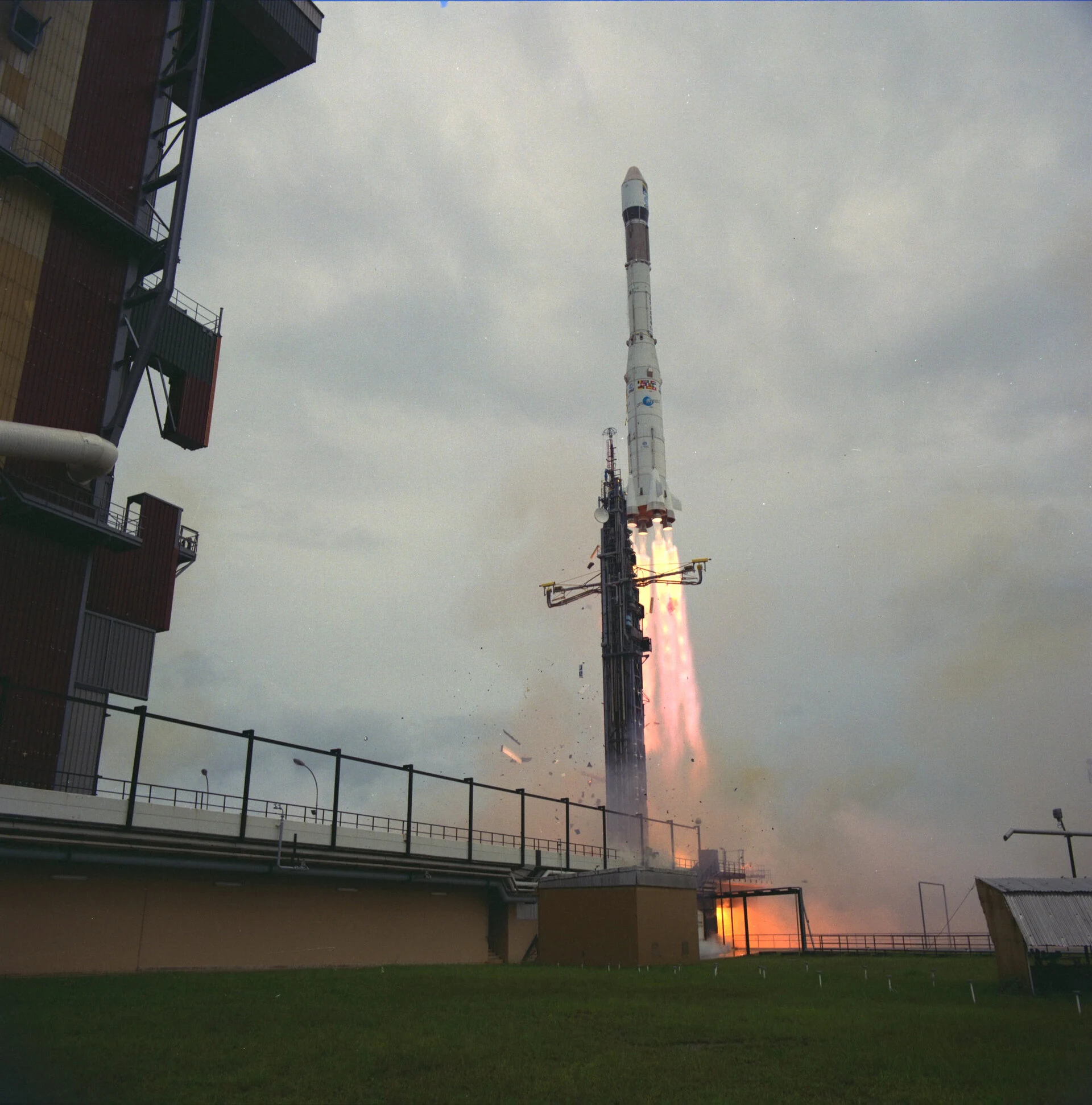
Ariane 4: commercial cadence as a school of maturity
Ariane 4 gave Europe a period of strong presence in the commercial telecommunications-satellite market. ‘Ariane 4: commercial cadence as a school of maturity’ illustrates a permanent feature of European programmes: Ariane 4, modular boosters, Arianespace and commercial cadence rarely belong to one actor.
Its modularity, using different combinations of strap-on boosters, allowed performance to be matched to the mission. The word capability hides several realities. For Ariane 4, modular boosters, Arianespace and commercial cadence, the questions are whether Europe can design, qualify, reproduce, operate and eventually renew the function. A positive answer to only one is insufficient.
The programme also clarified the separation between development supported by states and ESA and commercial operations structured around Arianespace. As Ariane 4, modular boosters, Arianespace and commercial cadence are distributed among partners, contractual interfaces become safety interfaces.
Repeated campaigns, payload processing and manifest management became capabilities in their own right: maturity was no longer simply a launcher working once but its ability to provide regular service to different customers. For Ariane 4, modular boosters, Arianespace and commercial cadence, one programme can end before the next has secured stable funding, dispersing teams.
Launcher success in one market can become a vulnerability if satellite architecture, prices or competition change faster than the next generation is ready. Branch points associated with Ariane 4, modular boosters, Arianespace and commercial cadence also show that strategy is often built through correction.
Mars will require repetitive logistics and a service operator rather than a technology demonstration; cadence then becomes a system requirement. From a safety perspective, Ariane 4, modular boosters, Arianespace and commercial cadence have to be studied as a network of common causes.
Ariane 5: inaugural failure, investigation and reliability
Ariane 5 was designed for heavier payloads in a period when Europe still considered Hermes. Mars systems will also evolve through generations; the essential lesson is to preserve qualification limits with the code rather than the code alone. To understand ‘Ariane 5: inaugural failure, investigation and reliability’, it is more useful to examine the commitments created around Ariane 5, inertial software, independent redundancy and qualification assumptions than the final symbol alone. System governance keeps continuity between those domains.
Its 1996 inaugural flight failed after a software exception in the inertial reference system, linked to reuse of functions designed for a different flight domain. Technical heritage around Ariane 5, inertial software, independent redundancy and qualification assumptions remains alive only when it can be mobilised.
The inquiry became a reference case for software assumptions and the independence of redundant chains. Procurement structure directly affects the quality of Ariane 5, inertial software, independent redundancy and qualification assumptions.
The family later achieved an exceptionally strong reliability record and launched many commercial and science missions, including the James Webb Space Telescope in 2021. One lesson from Ariane 5, inertial software, independent redundancy and qualification assumptions is that experience has to remain retrievable.
The history shows that a spectacular failure can improve an organisation when causes are translated into engineering rules. Decisions on Ariane 5, inertial software, independent redundancy and qualification assumptions were made with the technologies, budgets, partners and political constraints of their time.
A reputation for reliability must never freeze assumptions: every change of software, supplier, configuration or mission requires checking that heritage remains valid. Reliability around Ariane 5, inertial software, independent redundancy and qualification assumptions depends less on the number of backups than on their real independence.
Ariane 6 and Vega: rebuilding autonomous access in the mid-2020s
Ariane 6 made its inaugural flight in July 2024. A short series of successes does not yet prove the economics of a system across twenty years; recurring cost, upgrades, institutional demand and production capacity still have to be observed. The ‘Ariane 6 and Vega: rebuilding autonomous access in the mid-2020s’ sequence shows how ESA converts a coalition into an operational system. Around Ariane 62, Ariane 64, P160C, Vega-C and Europe’s Spaceport, partners have to converge on requirements, evidence and schedules.
After the transition period that had left Europe without regular autonomous heavy-launch access, flights increased through 2025 and 2026. Ariane 6 can contribute robotic or Mars-infrastructure elements, but complete human transport will probably require orbital assembly, additional propulsion and partnerships. Ariane 62, Ariane 64, P160C, Vega-C and Europe’s Spaceport can be assessed across three horizons: demonstrating a function once, reproducing it on demand and operating it at a known service level.
The four-booster Ariane 64 configuration flew in February 2026 and boosters based on the higher-propellant P160C were used in June.
The launcher has a restartable upper stage and two- or four-booster configurations. Programme duration makes institutional memory decisive. Ariane 62, Ariane 64, P160C, Vega-C and Europe’s Spaceport can pass through several generations of leadership before launch.
Vega-C covers a lighter class. The chronology of Ariane 62, Ariane 64, P160C, Vega-C and Europe’s Spaceport contains genuine branch points.
The real measure of success is now cadence, recurring reliability, cost and supplier stability. A further lesson concerns degraded modes of Ariane 62, Ariane 64, P160C, Vega-C and Europe’s Spaceport.
Historical context and deeper reading
Ariane: autonomy was built as an industrial chain, not as a slogan
After Europa’s difficulties, the French L3S proposal became the basis of Ariane. Ariane 1’s first launch from Kourou on 24 December 1979 marked a strategic change: Europe had a launcher designed around its own requirements and could build an independent institutional and commercial access-to-space policy.
The value of Ariane lay in the industrial system that followed. Production became repeatable, launch infrastructure expanded and Arianespace developed commercial operations. Ariane 4 captured a significant share of the commercial market. Ariane 5, after its difficult beginning, became one of the world’s major heavy launchers and flew 117 times between 1996 and 2023.
Ariane 5’s inaugural failure is as important as its later reliability. A new architecture exposed a software and systems problem, the investigation identified causes, and the programme recovered. Mars systems will also need organisations capable of learning rather than claiming infallibility.
Ariane 5 launched scientific missions and international payloads including Rosetta, Juice and the James Webb Space Telescope. European autonomous launch capacity therefore did not mean isolation. It created choice: Europe could launch its own priorities and also provide services to partners.
That distinction matters for Mars. Sovereignty does not require duplicating every component, but it does require enough capability to avoid a single irreplaceable external dependency. The Ariane story is Europe’s most visible demonstration of that principle. [source] [source]
Ariane 6: a launch-access crisis, recovery and a new search for resilience
The transition from Ariane 5 to Ariane 6 showed that autonomy is not permanent. The end of Ariane 5, delays to Ariane 6, the temporary unavailability of Vega-C and the end of Soyuz operations from French Guiana created a period in which Europe lacked the level of independent launch access it had built over previous decades.
Ariane 6 made its inaugural flight on 9 July 2024. Its second flight in March 2025 was the first commercial mission. The launcher then increased cadence. In February 2026 the four-booster configuration flew for the first time, and in June 2026 an upgraded booster version set a new European mass record by deploying 36 satellites to low Earth orbit.
The programme is also a reminder that launch policy cannot be judged only by headline payload. Availability, flight rate, reliability, infrastructure and manifest access matter. A Mars mission has to depart within narrow planetary windows; a launcher that is unavailable during that window is functionally useless regardless of its theoretical performance.
ESA, ArianeGroup, Arianespace, CNES and participating states have different responsibilities. Development, industrial production, commercial operation and spaceport management therefore require interfaces just as spacecraft subsystems do.
The renewed European focus on resilience is likely to produce more launcher diversity, not less. For Mars, designing payloads with adaptable launch interfaces could reduce dependence on one vehicle, provided that flexibility is engineered from the beginning. [source] [source]
Ariane 6 after inaugural flight: the real test is no longer launch, but operational cadence
Ariane 6 completed its inaugural flight on 9 July 2024, but one successful first mission could not by itself restore European launch autonomy. The more important transition was toward regular service. The first commercial mission followed in March 2025, and subsequent flights began testing whether production, launch preparation and supplier coordination could support a meaningful cadence rather than a demonstration programme. By 2026, ESA and European industry were also flying the four-booster Ariane 64 configuration and introducing performance improvements.
This distinction matters because launch systems become infrastructure only when customers can plan around them. A vehicle that flies once every several years may be technically successful yet strategically insufficient. Regular cadence requires engines, structures, electronics, launch crews, range services and payload processing all to arrive at the right time. Delays can propagate across the entire industrial chain.
Mars magnifies this requirement. A settlement architecture might need several heavy cargo flights within a single planetary window. The question would no longer be “can Europe launch this payload?” but “can Europe produce and process multiple vehicles predictably enough for one missed launch not to destroy the campaign?” Ariane 6's post-inaugural years therefore matter more to Mars than the inaugural headline itself.
The broader lesson is that sovereignty is operational. Europe does not gain autonomous access to space merely by owning a launcher design. It gains it when launch sites, factories, suppliers and institutional customers can sustain a flight rhythm. Mars will demand the same move from capability to service at a much larger scale.
Ariane 1 to Ariane 5: from independent access to space to the slower construction of industrial reliability
The first Ariane lifted off from Kourou on 24 December 1979. It is rightly remembered as a milestone in autonomous European access to space, but autonomy needs a precise definition. A launcher capability is not merely a set of engine drawings or one successful demonstration flight. It requires a launch base, suppliers, production, campaign procedures, anomaly investigation and enough flight activity to keep the entire chain competent. Ariane 1 therefore marked the start of a system rather than its completion. It converted lessons from Europa into a more integrated programme and exploited the geographic advantage of the Guiana Space Centre for missions toward geostationary orbit. European governments were beginning to connect public investment, industrial capability and a commercial launch market in a single strategy. ESA, forty years of Ariane
Ariane 1, 2 and 3 accumulated experience, but Ariane 4 transformed the commercial scale. Its modular arrangement of strap-on boosters allowed performance to be adapted to different payloads, particularly telecommunications satellites. From 1988 to 2003 it built a long operational record and helped establish Arianespace as a major commercial launch provider. The achievement had an institutional consequence: a programme created partly for sovereignty could also support a market business. Yet commercial success introduced a new dependence. If satellite markets or competition changed, the economics of sustaining autonomous launch changed with them. Ariane's history is therefore shaped by two goals that do not always align perfectly: Europe wants guaranteed access for strategic and institutional reasons, while commercial launch volume can help pay for the industrial capability needed to provide that access. ESA Ariane history
Ariane 5 was conceived in a different environment, initially linked to Europe's ambitions for the Hermes crewed spaceplane and designed for much heavier payloads. Its first flight on 4 June 1996 ended about forty seconds after launch when the vehicle was destroyed. Flight 501 became a classic software-engineering case. A numeric conversion generated an exception in the inertial reference system; software reused from Ariane 4 was operating under assumptions that did not match Ariane 5's flight trajectory. The value of the case is not the simplistic story that "one line of code destroyed the rocket". It is the interaction of assumptions, reuse, requirements, redundancy and validation. Two redundant computers executing the same software and the same invalid assumption do not protect against a common-mode design error. Hardware redundancy cannot compensate automatically for identical logic. ESA Ariane 5
The recovery mattered more than the initial failure. A launcher organisation must investigate transparently enough to isolate causes, modify the system and rebuild confidence without allowing the schedule to erase uncomfortable evidence. Ariane 5 returned to development, evolved through several versions and became Europe's main heavy launcher. Its later ability to carry two commercial geostationary satellites on one mission became central to its business model. Reliability emerged from repeated flights, industrial discipline and the handling of deviations rather than from the original design claim. This is why generational transitions remain dangerous even when the new launcher uses familiar technologies. Closing one production chain before the replacement has demonstrated real cadence can create a capability gap invisible in a paper comparison of payload performance. Forty years of Ariane
The industrial model also evolved. ESA manages launcher development with participating states; industrial prime contractors and supply chains manufacture the hardware; Arianespace provides launch services; and the Guiana Space Centre supplies critical range and launch infrastructure. Success or failure should therefore not be attributed to "ESA" as if one organisation performed every task. European launch capability is an ecosystem with distinct technical and commercial responsibilities. Its strength depends on the clarity of those boundaries: who specifies, who designs, who verifies, who accepts, who operates and who pays for the next evolution. Ambiguity becomes dangerous when responsibility for a system-level risk falls between contractual layers or when commercial incentives no longer match the strategic objective of maintaining launch access. ESA business and industry
For Mars, Ariane 1 through 5 do not form a direct engineering lineage to a crewed Mars launcher. The payload scales and mission requirements would be profoundly different. Their transferable value lies elsewhere: Europe learned to finance transportation systems across generations, industrialise cryogenic and solid propulsion, run a launch base and recover from major failure. A sustainable Mars architecture would need all of those forms of continuity at far greater mass and cadence. Saying that Ariane proves Europe can already send humans to Mars would be technically indefensible. Saying that five decades of launcher development contribute nothing would be equally wrong. The inheritance is industrial and organisational capital that can reduce the distance to a future system without eliminating it. ESA Ariane
Ariane history also suggests a useful distinction between performance, reliability and availability. Performance is what a launcher can theoretically deliver to a trajectory. Reliability describes the probability of mission success. Availability asks whether the launcher can actually be produced, scheduled and flown when the architecture needs it. Exploration logistics require all three. A very powerful launcher that flies too rarely can become the bottleneck of a cargo campaign. Europe accumulated those dimensions across Ariane generations and then had to rebuild them during the transition to Ariane 6. For a single science probe a delay can be painful; for a Mars supply chain tied to interplanetary windows, unavailable transportation could become a system-level hazard. Ariane history
Ariane 6, Vega-C and the transition crisis: a space capability only becomes real when it can fly repeatedly
Ariane 6 was conceived under pressure from a changing launch market and a persistent criticism of Ariane 5's economics. The new family sought lower production costs and greater flexibility through Ariane 62 with two boosters and Ariane 64 with four. Its inaugural flight on 9 July 2024 demonstrated the central launch architecture and multiple upper-stage burns, although a late anomaly prevented the full planned final sequence. The flight was therefore both a successful entry into orbit and a reminder that an inaugural mission remains a test conducted on the real vehicle. A launcher is not mature because its first unit reaches space. It becomes operational when manufacturing, acceptance, launch campaigns and customer missions can be repeated without extraordinary one-off mobilisation. ESA Ariane 6
The second flight on 6 March 2025 successfully delivered CSO-3 and marked Ariane 6's first commercial service. This transition from demonstration to service is more significant than the wording suggests. The organisation now has to move from teams concentrated on one historic first flight toward a production system that can support a manifest. Engines, structures, avionics and boosters must arrive at the required rhythm, be accepted consistently and integrated without quality depending on a small number of irreplaceable individuals. The main risk gradually moves from pure vehicle design to industrial throughput. Every flight still provides engineering information, but schedule performance increasingly depends on factories, transport, workforce and range operations. ESA, second Ariane 6 flight
On 12 February 2026 the VA267 mission introduced Ariane 64, using four boosters to carry 32 Amazon Leo satellites. A further Ariane 64 mission in June carried another large group of satellites. By August 2026 the programme had therefore moved beyond the inaugural phase and into the challenge of cadence, with additional missions including MTG-I2 planned for late August. Cadence is an industrial concept, not merely a row of dates on a manifest. It requires a steady flow of propulsion units and stages, launch-base capacity, trained campaign teams and an organisation able to incorporate lessons from one vehicle without freezing production of the next. The strategic value of Ariane 6 will ultimately depend as much on that repeatability as on maximum payload. Current Ariane 6 programme
The capability gap that preceded this recovery was strategically instructive. Ariane 5 made its final flight in July 2023 before Ariane 6 had flown. Vega-C had been grounded after its December 2022 failure. Soyuz operations from Kourou had already ended after the rupture with Russia in 2022. Europe therefore experienced a period in which the technological knowledge to build launchers existed while practical autonomous access was sharply constrained. The episode demonstrates that technological autonomy can exist on paper and still be unavailable when needed. A robust transition requires overlap, schedule margin and explicit acceptance that complex developments often slip. Optimising a transition on the assumption that every milestone will occur on time may reduce short-term cost while increasing strategic risk. Ariane 6
Vega and Vega-C address a different payload class. Vega's first flight in 2012 gave Europe a dedicated small-launch capability useful for scientific and Earth-observation spacecraft. Vega-C, first launched in July 2022, increased performance and introduced the P120C booster family linked technically with Ariane. Its failure in December 2022 grounded the vehicle for almost two years. Investigation, hardware modification and requalification led to a successful return to flight in December 2024. The important capability here is not the absence of failures; no serious launch history can promise that. It is the institutional ability to find a weakness, correct a supply chain, reproduce qualification evidence and regain authority to fly. That recovery process is itself a strategic asset. ESA, Vega-C return to flight
In May 2026 Vega-C launched the Smile science mission, continuing its operational recovery. The family still faces the same economic equation as other European launch systems: sovereignty, market volume, price and industrial continuity have to be balanced. A domestic or European launcher can be strategically important even when a foreign commercial provider offers a lower marginal price. Conversely, strategic language cannot justify unlimited inefficiency. The cost of autonomy resembles an insurance premium against geopolitical or commercial unavailability, but insurance has to be priced and tested. Europe therefore needs enough institutional missions and competitive commercial activity to maintain a viable chain rather than treating launch sovereignty as a symbolic capability flown too rarely to remain proficient. ESA Vega
For Mars logistics, Ariane 6 and Vega-C provide a severe lesson about scale and availability. A human architecture could not depend on a launcher that is merely expected to be ready. It would require demonstrated cadence, spare capacity and contingency planning, while interplanetary launch windows make delays less forgiving than ordinary commercial rescheduling. Europe in 2026 is restoring autonomous access with two launcher families, but it does not possess a transportation system sized for the tens or hundreds of tonnes associated with a human Mars campaign. Ariane 6 is therefore a real strategic recovery and an important industrial foundation. Calling it a Mars launcher would nevertheless confuse the existence of launch capability with the much larger logistics problem of crewed interplanetary exploration. Ariane 6 Vega
Ariane as an industrial system before it is a rocket
In this case, the Ariane family depends on an architecture of responsibilities distributed across ESA, national agencies, prime contractors, engine suppliers, Kourou and the commercial operator. The most useful reference points are Ariane 1 through 6, Kourou, integration, Vulcain, Vinci, P120C and Arianespace. ESA — 40 years of Ariane ; ESA — Ariane 6
Institutionally, this subject begins with a specific constraint: the Ariane family depends on an architecture of responsibilities distributed across ESA, national agencies, prime contractors, engine suppliers, Kourou and the commercial operator. For Ariane 1 through 6, Kourou, integration, Vulcain, Vinci, P120C and Arianespace, cooperation is therefore a design variable rather than diplomatic decoration. Those mechanisms also determine whether judging Mars capability by cadence, logistics and repeatability, not only nominal performance can remain possible after a partner, supplier, budget line or political priority changes.
Systems engineering provides a second reading of the Ariane family depends on an architecture of responsibilities distributed across ESA, national agencies, prime contractors, engine suppliers, Kourou and the commercial operator. Across Ariane 1 through 6, Kourou, integration, Vulcain, Vinci, P120C and Arianespace, risk often accumulates at boundaries where mass, power, thermal control, software, structures, propulsion, communications and operations can assume incompatible conditions. Applied to judging Mars capability by cadence, logistics and repeatability, not only nominal performance, configuration knowledge becomes a preventive mechanism: an old decision remains understandable, testable and revisable instead of surviving as an unexplained rule inherited by the next team.
Operationally, Ariane 1 through 6, Kourou, integration, Vulcain, Vinci, P120C and Arianespace pose a different test: can the system be planned, monitored, reconfigured and explained when behaviour departs from the nominal script? Because the Ariane family depends on an architecture of responsibilities distributed across ESA, national agencies, prime contractors, engine suppliers, Kourou and the commercial operator, capability depends on procedures, simulators, ground software, on-call teams, telemetry interpretation and configuration discipline as much as on acceptance testing. Its relevance to Mars is therefore measured by judging Mars capability by cadence, logistics and repeatability, not only nominal performance, not by pretending that each cited programme is itself a Mars system.
The fourth layer is industrial depth. The ariane family depends on an architecture of responsibilities distributed across esa, national agencies, prime contractors, engine suppliers, kourou and the commercial operator should be read through that industrial-continuity lens. ESA — 40 years of Ariane ; ESA — Ariane
Evidence has to be calibrated to the Ariane family depends on an architecture of responsibilities distributed across ESA, national agencies, prime contractors, engine suppliers, Kourou and the commercial operator. For Ariane 1 through 6, Kourou, integration, Vulcain, Vinci, P120C and Arianespace, three levels must be kept separate: what has actually flown or been operated, what can reasonably be inherited as method or competence, and what remains an extrapolation until representative qualification exists. The Mars-relevant standard is therefore judging Mars capability by cadence, logistics and repeatability, not only nominal performance, not the rhetorical proximity of the programme to exploration.
Time changes the meaning of Ariane 1 through 6, Kourou, integration, Vulcain, Vinci, P120C and Arianespace. The programme family evolves through ministerial decisions, redesigns, supplier changes, anomaly investigations and new scientific priorities, while the Ariane family depends on an architecture of responsibilities distributed across ESA, national agencies, prime contractors, engine suppliers, Kourou and the commercial operator. Loss of design intent can create risk as surely as loss of a sensor or computer, especially when the Mars-relevant objective is judging Mars capability by cadence, logistics and repeatability, not only nominal performance.
For Mars, the transferable lesson is therefore judging Mars capability by cadence, logistics and repeatability, not only nominal performance.
International cooperation has to be read through the concrete dependency pattern created by Ariane 1 through 6, Kourou, integration, Vulcain, Vinci, P120C and Arianespace. Because the Ariane family depends on an architecture of responsibilities distributed across ESA, national agencies, prime contractors, engine suppliers, Kourou and the commercial operator, a partner can provide a capability that Europe deliberately does not duplicate while Europe still retains enough knowledge to specify interfaces, verify performance and reconfigure the mission if circumstances change. For judging Mars capability by cadence, logistics and repeatability, not only nominal performance, the useful question is therefore not whether a system is simply 'European' or 'foreign' but whether each dependency is visible, testable and recoverable.
The chronology of this topic must remain updateable because the Ariane family depends on an architecture of responsibilities distributed across ESA, national agencies, prime contractors, engine suppliers, Kourou and the commercial operator. Tracking Ariane 1 through 6, Kourou, integration, Vulcain, Vinci, P120C and Arianespace therefore requires primary mission pages, Council decisions, annual reports and technical notices, with dates attached to any parameter that can change. That evidence makes it possible to test whether judging Mars capability by cadence, logistics and repeatability, not only nominal performance is actually advancing or whether only strategic language has moved.
Ariane 64 in 2026: power matters only when it becomes cadence
In this case, the first Ariane 64 flight on 12 February 2026 demonstrated the four-P120C configuration and long fairing while shifting the question toward sustained production. The most useful reference points are sixth Ariane 6 flight, 32 Amazon Leo satellites, about 21.6 tonnes stated for low Earth orbit and Ariane 62/64 modularity. ESA — Ariane 6 ; ESA — Ariane 6 takes flight for the second time
Institutionally, this subject begins with a specific constraint: the first Ariane 64 flight on 12 February 2026 demonstrated the four-P120C configuration and long fairing while shifting the question toward sustained production. For sixth Ariane 6 flight, 32 Amazon Leo satellites, about 21. 6 tonnes stated for low Earth orbit and Ariane 62/64 modularity, cooperation is therefore a design variable rather than diplomatic decoration. Those mechanisms also determine whether separating the ability to launch a heavy payload from the ability to sustain a Mars logistics flow across multiple windows can remain possible after a partner, supplier, budget line or political priority changes.
Systems engineering provides a second reading of the first Ariane 64 flight on 12 February 2026 demonstrated the four-P120C configuration and long fairing while shifting the question toward sustained production. Across sixth Ariane 6 flight, 32 Amazon Leo satellites, about 21. 6 tonnes stated for low Earth orbit and Ariane 62/64 modularity, risk often accumulates at boundaries where mass, power, thermal control, software, structures, propulsion, communications and operations can assume incompatible conditions. Applied to separating the ability to launch a heavy payload from the ability to sustain a Mars logistics flow across multiple windows, configuration knowledge becomes a preventive mechanism: an old decision remains understandable, testable and revisable instead of surviving as an unexplained rule inherited by the next team.
Operationally, sixth Ariane 6 flight, 32 Amazon Leo satellites, about 21. 6 tonnes stated for low Earth orbit and Ariane 62/64 modularity pose a different test: can the system be planned, monitored, reconfigured and explained when behaviour departs from the nominal script? Because the first Ariane 64 flight on 12 February 2026 demonstrated the four-P120C configuration and long fairing while shifting the question toward sustained production, capability depends on procedures, simulators, ground software, on-call teams, telemetry interpretation and configuration discipline as much as on acceptance testing. Its relevance to Mars is therefore measured by separating the ability to launch a heavy payload from the ability to sustain a Mars logistics flow across multiple windows, not by pretending that each cited programme is itself a Mars system.
The fourth layer is industrial depth. The first ariane 64 flight on 12 february 2026 demonstrated the four-p120c configuration and long fairing while shifting the question toward sustained production should be read through that industrial-continuity lens. ESA — First Ariane 6 with four boosters, 12 February 2026
Evidence has to be calibrated to the first Ariane 64 flight on 12 February 2026 demonstrated the four-P120C configuration and long fairing while shifting the question toward sustained production. For sixth Ariane 6 flight, 32 Amazon Leo satellites, about 21. 6 tonnes stated for low Earth orbit and Ariane 62/64 modularity, three levels must be kept separate: what has actually flown or been operated, what can reasonably be inherited as method or competence, and what remains an extrapolation until representative qualification exists. The Mars-relevant standard is therefore separating the ability to launch a heavy payload from the ability to sustain a Mars logistics flow across multiple windows, not the rhetorical proximity of the programme to exploration.
Time changes the meaning of sixth Ariane 6 flight, 32 Amazon Leo satellites, about 21. 6 tonnes stated for low Earth orbit and Ariane 62/64 modularity. The programme family evolves through ministerial decisions, redesigns, supplier changes, anomaly investigations and new scientific priorities, while the first Ariane 64 flight on 12 February 2026 demonstrated the four-P120C configuration and long fairing while shifting the question toward sustained production. Loss of design intent can create risk as surely as loss of a sensor or computer, especially when the Mars-relevant objective is separating the ability to launch a heavy payload from the ability to sustain a Mars logistics flow across multiple windows.
For Mars, the transferable lesson is therefore separating the ability to launch a heavy payload from the ability to sustain a Mars logistics flow across multiple windows.
International cooperation has to be read through the concrete dependency pattern created by sixth Ariane 6 flight, 32 Amazon Leo satellites, about 21. 6 tonnes stated for low Earth orbit and Ariane 62/64 modularity. Because the first Ariane 64 flight on 12 February 2026 demonstrated the four-P120C configuration and long fairing while shifting the question toward sustained production, a partner can provide a capability that Europe deliberately does not duplicate while Europe still retains enough knowledge to specify interfaces, verify performance and reconfigure the mission if circumstances change. For separating the ability to launch a heavy payload from the ability to sustain a Mars logistics flow across multiple windows, the useful question is therefore not whether a system is simply 'European' or 'foreign' but whether each dependency is visible, testable and recoverable.
The chronology of this topic must remain updateable because the first Ariane 64 flight on 12 February 2026 demonstrated the four-P120C configuration and long fairing while shifting the question toward sustained production. Tracking sixth Ariane 6 flight, 32 Amazon Leo satellites, about 21. 6 tonnes stated for low Earth orbit and Ariane 62/64 modularity therefore requires primary mission pages, Council decisions, annual reports and technical notices, with dates attached to any parameter that can change. That evidence makes it possible to test whether separating the ability to launch a heavy payload from the ability to sustain a Mars logistics flow across multiple windows is actually advancing or whether only strategic language has moved.
Vega-C and component synergies: standardising without making everything identical
In this case, Vega-C illustrates how common building blocks can support different launchers while mission chains and markets remain distinct. The most useful reference points are P120C shared with Ariane 6, solid stages, AVUM+, return to flight and institutional missions. ESA — Vega ; ESA — Vega-C complete for return to flight
Institutionally, this subject begins with a specific constraint: Vega-C illustrates how common building blocks can support different launchers while mission chains and markets remain distinct. For P120C shared with Ariane 6, solid stages, AVUM+, return to flight and institutional missions, cooperation is therefore a design variable rather than diplomatic decoration. Those mechanisms also determine whether using component families to reduce the logistical diversity of a distant architecture without creating a single common-mode failure can remain possible after a partner, supplier, budget line or political priority changes.
Systems engineering provides a second reading of Vega-C illustrates how common building blocks can support different launchers while mission chains and markets remain distinct. Across P120C shared with Ariane 6, solid stages, AVUM+, return to flight and institutional missions, risk often accumulates at boundaries where mass, power, thermal control, software, structures, propulsion, communications and operations can assume incompatible conditions. Applied to using component families to reduce the logistical diversity of a distant architecture without creating a single common-mode failure, configuration knowledge becomes a preventive mechanism: an old decision remains understandable, testable and revisable instead of surviving as an unexplained rule inherited by the next team.
Operationally, P120C shared with Ariane 6, solid stages, AVUM+, return to flight and institutional missions pose a different test: can the system be planned, monitored, reconfigured and explained when behaviour departs from the nominal script? Because Vega-C illustrates how common building blocks can support different launchers while mission chains and markets remain distinct, capability depends on procedures, simulators, ground software, on-call teams, telemetry interpretation and configuration discipline as much as on acceptance testing. Its relevance to Mars is therefore measured by using component families to reduce the logistical diversity of a distant architecture without creating a single common-mode failure, not by pretending that each cited programme is itself a Mars system.
The fourth layer is industrial depth. Vega-c illustrates how common building blocks can support different launchers while mission chains and markets remain distinct should be read through that industrial-continuity lens. ESA — Ariane 6 ; ESA — Ariane
Evidence has to be calibrated to Vega-C illustrates how common building blocks can support different launchers while mission chains and markets remain distinct. For P120C shared with Ariane 6, solid stages, AVUM+, return to flight and institutional missions, three levels must be kept separate: what has actually flown or been operated, what can reasonably be inherited as method or competence, and what remains an extrapolation until representative qualification exists. The Mars-relevant standard is therefore using component families to reduce the logistical diversity of a distant architecture without creating a single common-mode failure, not the rhetorical proximity of the programme to exploration.
Time changes the meaning of P120C shared with Ariane 6, solid stages, AVUM+, return to flight and institutional missions. The programme family evolves through ministerial decisions, redesigns, supplier changes, anomaly investigations and new scientific priorities, while Vega-C illustrates how common building blocks can support different launchers while mission chains and markets remain distinct. Loss of design intent can create risk as surely as loss of a sensor or computer, especially when the Mars-relevant objective is using component families to reduce the logistical diversity of a distant architecture without creating a single common-mode failure.
For Mars, the transferable lesson is therefore using component families to reduce the logistical diversity of a distant architecture without creating a single common-mode failure.
International cooperation has to be read through the concrete dependency pattern created by P120C shared with Ariane 6, solid stages, AVUM+, return to flight and institutional missions. Because Vega-C illustrates how common building blocks can support different launchers while mission chains and markets remain distinct, a partner can provide a capability that Europe deliberately does not duplicate while Europe still retains enough knowledge to specify interfaces, verify performance and reconfigure the mission if circumstances change. For using component families to reduce the logistical diversity of a distant architecture without creating a single common-mode failure, the useful question is therefore not whether a system is simply 'European' or 'foreign' but whether each dependency is visible, testable and recoverable.
The chronology of this topic must remain updateable because Vega-C illustrates how common building blocks can support different launchers while mission chains and markets remain distinct. Tracking P120C shared with Ariane 6, solid stages, AVUM+, return to flight and institutional missions therefore requires primary mission pages, Council decisions, annual reports and technical notices, with dates attached to any parameter that can change. That evidence makes it possible to test whether using component families to reduce the logistical diversity of a distant architecture without creating a single common-mode failure is actually advancing or whether only strategic language has moved.
Space science and continuity across decades
Horizon 2000: programming science beyond a political cycle
Horizon 2000, prepared during the 1980s, structured European space science around large and medium-scale missions. In ‘Horizon 2000: programming science beyond a political cycle’, the central question is not only whether Horizon 2000, cornerstone missions, peer selection and long-term technology preparation work, but who can demonstrate that they do and under which assumptions. European architectures are often distributed across countries and firms, so they require common rules for requirements, margins, configuration and acceptance. This discipline turns an industrial mosaic into a verifiable architecture and prevents late disagreement from being treated merely as commerce when it has already become a safety issue.
Long-term planning changed the relationship with the community: themes were prioritised, technologies prepared and missions became the outcome of a strategy rather than a sequence of opportunistic proposals. Technical sovereignty around Horizon 2000, cornerstone missions, peer selection and long-term technology preparation is not equivalent to the nationality of components. It depends on being able to diagnose faults, modify software, restart production and maintain the facilities that provide evidence of conformity. That view exposes less visible dependencies in tooling, licences, design data, specialist personnel and lower-tier suppliers. Losing them can constrain a programme as severely as losing access to a launcher.
The mandatory nature of the Science Programme protected a measure of budget continuity. Contracts and technical reviews form part of the architecture here. A defect can originate at a subcontractor, be discovered in a test centre, corrected by a prime and accepted by an ESA team somewhere else. Information therefore has to cross the same boundaries as hardware. Healthy governance rewards early disclosure of anomalies instead of allowing them to become disputes after schedule and budget are already committed.
The results appeared in observatories and interplanetary missions that can require more than a decade of development before launch. The risk of amnesia increases when programmes involving Horizon 2000, cornerstone missions, peer selection and long-term technology preparation pause or change partners. Formal documents capture final decisions but not always the doubts, failed tests and compromises that shaped them. Reviews, lessons learned, software archives and mentoring therefore complement hardware configuration. Useful memory lets a new team understand the validity domain of a solution rather than reproduce it mechanically.
Long-range planning still has to remain revisable: it protects technology investment but can also preserve a priority for too long if scientific reviews are not genuinely decision-making. Retrospective accounts of Horizon 2000, cornerstone missions, peer selection and long-term technology preparation can easily imply that every step prepared the next. That is misleading. Political and industrial calendars closed some options before their technical value was fully known. Keeping track of alternatives matters: an approach abandoned for low maturity in 1995 may be relevant thirty years later, while a once-dominant standard may have lost its industrial ecosystem.
Human presence may prioritise operational urgency; a protected science programme would be needed so climate, geology, astrobiology and archives do not become adjustment variables. Safety also requires searching for hidden dependencies in Horizon 2000, cornerstone missions, peer selection and long-term technology preparation. A backup can have different wiring while still using the same data model or configuration tool. Independent review and end-to-end testing seek those convergence points. The goal is not to eliminate every dependency, which is impossible in a finite system, but to know which ones exist and deliberately decide which residual couplings are acceptable.
Cosmic Vision and Voyage 2050: starting from scientific questions
Cosmic Vision and then Voyage 2050 extended the principle of a science programme built with the community. The ‘Cosmic Vision and Voyage 2050: starting from scientific questions’ case lets Cosmic Vision, Voyage 2050, Large missions, Medium missions and Fast missions be read as a collective construction rather than an isolated object.
ESA organises consultations, selection committees, early phase studies and technology development before freezing mission architecture. Around Cosmic Vision, Voyage 2050, Large missions, Medium missions and Fast missions, Europe may understand a technology without sustaining the industrial cadence needed to reproduce it, or maintain a service through ground infrastructure that attracts little attention. Those levels are not interchangeable.
Voyage 2050 prepares themes for major missions beyond 2035 and coexists with medium, small and fast mission classes.
This diversity of cadence prevents all science from being trapped behind a few giant projects and gives emerging disciplines more frequent entry points. Collective expertise around Cosmic Vision, Voyage 2050, Large missions, Medium missions and Fast missions contains substantial tacit knowledge: operational sequences, sensor sensitivities, supplier behaviour and test techniques.
Selection has to remain transparent so competition between communities does not become a contest of institutional weight; reasons for rejection are almost as important as the visibility of a chosen mission. The visible outcome around Cosmic Vision, Voyage 2050, Large missions, Medium missions and Fast missions is the survivor of a selection process. Restoring them shows where uncertainty actually lay.
On Mars the science question should continue to precede the vehicle: building a habitat does not guarantee that biological, geological or climate goals are best served by humans. For Cosmic Vision, Voyage 2050, Large missions, Medium missions and Fast missions, margin has to be tied to evidence.
Giotto, Huygens and Rosetta: navigating difficult worlds
Giotto at Halley’s comet, Huygens on Titan and Rosetta around 67P represent several generations of European interplanetary navigation. The institutional significance of ‘Giotto, Huygens and Rosetta: navigating difficult worlds’ lies in the way Giotto, Huygens, Rosetta, Philae and deep-space navigation cross several layers of responsibility.
Huygens demonstrated ESA’s ability to own an autonomous and critical element inside the international Cassini mission. Giotto, Huygens, Rosetta, Philae and deep-space navigation can be technically understood while depending on a scarce supplier, a unique test facility or an intermittent launch chain.
Rosetta, with its long journey, comet rendezvous and Philae lander, pushed autonomy, relative navigation and operations around a poorly known body much further. Distributed industrial work on Giotto, Huygens, Rosetta, Philae and deep-space navigation requires decision points where evidence is confronted.
Philae’s bounce and difficult power configuration also showed that a mission can retain major scientific value after a non-nominal event. The long timescales of Giotto, Huygens, Rosetta, Philae and deep-space navigation create a question rarely visible in public timelines: who remembers why?
Scientific recovery after anomaly has to be designed before failure: degraded modes, autonomy, energy understanding and team procedures determine whether an unexpected event becomes total loss. The history of Giotto, Huygens, Rosetta, Philae and deep-space navigation has to be read through the constraints of its period.
A Mars base likewise has to preserve useful functions after loss of mobility, power or communications; safety cannot depend on an immediate return to nominal state. Finally, off-nominal cases involving Giotto, Huygens, Rosetta, Philae and deep-space navigation have to remain operable by real teams.
BepiColombo, Juice, Gaia and Euclid: maintaining transversal capability
BepiColombo must survive Mercury’s thermal environment, Juice travel to Jupiter’s icy moons, Gaia measure stellar positions with extreme precision and Euclid map the dark Universe. ‘BepiColombo, Juice, Gaia and Euclid: maintaining transversal capability’ illustrates a permanent feature of European programmes: BepiColombo, Juice, Gaia, Euclid and transversal engineering capability rarely belong to one actor.
Their environments and instruments are very different, yet they rely on the same chains of selection, industrial management, testing, operations and archives. The word capability hides several realities. For BepiColombo, Juice, Gaia, Euclid and transversal engineering capability, the questions are whether Europe can design, qualify, reproduce, operate and eventually renew the function. A positive answer to only one is insufficient.
Their coexistence forces ESA to maintain transversal capability in thermal engineering, navigation, optics, software, metrology and data processing rather than rebuilding a miniature agency for every mission. As BepiColombo, Juice, Gaia, Euclid and transversal engineering capability are distributed among partners, contractual interfaces become safety interfaces.
Portfolio diversity can disperse budgets and specialists; the challenge is reusing competence without imposing artificial standardisation where the physical environment requires a specific solution. For BepiColombo, Juice, Gaia, Euclid and transversal engineering capability, one programme can end before the next has secured stable funding, dispersing teams.
Mars will combine thermal control, navigation, optics, autonomy and data processing; these missions provide building blocks, but their recomposition for a crewed system will have to be demonstrated. Branch points associated with BepiColombo, Juice, Gaia, Euclid and transversal engineering capability also show that strategy is often built through correction.
From a safety perspective, BepiColombo, Juice, Gaia, Euclid and transversal engineering capability have to be studied as a network of common causes.
PRODEX: bringing national laboratories into flight instruments
The PRODEX programme helps scientific institutes in participating states develop experiments and instruments for space missions by drawing on ESA and industrial expertise. Martian laboratories will likewise need instruments that can be renewed and repaired; a model connecting researchers, industry and standards can prevent every experiment from becoming an isolated system that cannot be maintained locally. In ‘PRODEX: bringing national laboratories into flight instruments’, the central question is not only whether PRODEX, scientific institutes, instrument procurement and flight qualification work, but who can demonstrate that they do and under which assumptions.
It forms a distinctive interface among academic research, national agencies, industrial procurement and flight requirements. Technical sovereignty around PRODEX, scientific institutes, instrument procurement and flight qualification is not equivalent to the nationality of components.
A laboratory may own the scientific idea without having all the quality, documentation or contracting processes needed to turn a prototype into qualified hardware.
PRODEX helps bridge that gap through project and procurement support. The risk of amnesia increases when programmes involving PRODEX, scientific institutes, instrument procurement and flight qualification pause or change partners.
The effect extends beyond one instrument by sustaining a community able to propose, build and operate successive generations of experiments. Retrospective accounts of PRODEX, scientific institutes, instrument procurement and flight qualification can easily imply that every step prepared the next. That is misleading.
Scientific value depends on preserving both academic creativity and flight discipline without allowing either to suppress the other; translation between those cultures has to be organised and funded. Safety also requires searching for hidden dependencies in PRODEX, scientific institutes, instrument procurement and flight qualification. Independent review and end-to-end testing seek those convergence points.
Historical context and deeper reading
The Science Programme: continuity across political cycles
ESA’s mandatory Science Programme provides an institutional foundation for missions whose development spans many years. Selection remains competitive and budgets remain constrained, but the programme gives European science a continuity that would be difficult if every mission had to be renegotiated from zero after each national election.
COS-B belongs to ESA’s earliest major missions. Giotto became the agency’s first deep-space mission and flew past Halley’s Comet in 1986. Hipparcos transformed astrometry. Ulysses explored the solar poles with NASA. Later missions including XMM-Newton, Integral, Herschel, Planck, Gaia and Euclid accumulated expertise in precision instruments, thermal stability, guidance and long-duration operations.
These capabilities are relevant to Mars even when the mission target is not a planet. Deep-space navigation, radiation-tolerant electronics, optical systems, onboard software and long-term mission operations are transferable disciplines. Scientific missions preserve engineering skills between planetary opportunities.
Giotto is especially instructive. It had to navigate toward a poorly known comet nucleus at high relative velocity and survive a hazardous dust environment. It was later redirected to another comet. That ability to extend a spacecraft’s purpose in flight became part of ESA’s operations culture.
Human Mars exploration will also require science to shape engineering. Site selection, contamination control, drilling, sample handling and environmental monitoring are scientific requirements with architectural consequences. ESA already has an institutional tradition in which scientific communities participate early in mission definition. [source]
Huygens and Rosetta: delivering machines where Europe had never operated before
Huygens and Rosetta reveal how far European deep-space capability evolved. Huygens was built by ESA as part of the NASA/ESA/ASI Cassini-Huygens mission. After a seven-year journey, it separated from Cassini and entered Titan’s atmosphere on 14 January 2005, becoming the first probe to land on a world in the outer Solar System.
The landing depended on far more than the capsule. Heat shield, parachutes, power, instruments, radio relay through Cassini and ground reception all had to function as one chain. It is an early example of a surface system depending on an orbital partner for communications, a pattern directly relevant to Mars.
Rosetta demanded another class of navigation and operations. The spacecraft rendezvoused with comet 67P/Churyumov-Gerasimenko and deployed Philae. The lander’s anchoring system did not work as planned and Philae bounced, but the overall mission produced extraordinary science and operational experience.
Rosetta also showed that mission success is not binary. A subsystem can fail while the larger mission remains highly valuable. A decades-long Mars programme needs the same capacity to preserve useful operations after partial failures instead of treating every deviation as total loss.
Both missions also gave ESA a strong public identity. Long programmes require citizens and governments to understand why they matter. Public engagement cannot replace engineering, but it can help sustain the political continuity that deep-space missions require. [source] [source]
BepiColombo and Juice: learning to survive both too much Sun and too little
BepiColombo at Mercury and Juice in the Jovian system expose European spacecraft to opposite environmental extremes. BepiColombo must survive intense solar heating and difficult thermal geometry. Juice travels far from the Sun, depends on large solar arrays and operates in a radiation environment shaped by Jupiter's enormous magnetosphere. Both missions also require long-duration navigation through complex gravity-assist sequences.
This matters because Mars technology rarely originates only in programmes labelled “Mars”. Thermal-control methods, radiation-tolerant electronics, autonomy, trajectory optimisation and high-reliability mechanisms migrate between mission families. A broad science programme creates a technology reservoir that specialised exploration programmes can later draw upon.
For a settlement, such cross-fertilisation becomes essential. Hardware will face cold nights, dust, radiation, long dormant periods and changing energy conditions. Engineering teams experienced only in one benign environment are less prepared than teams that have repeatedly designed for extremes.
ESA's deep-space portfolio therefore matters to Mars even when the destination is Mercury, Jupiter or a comet. It preserves the human and industrial competence needed to solve rare problems before those problems become crew-survival issues.
Gaia and Euclid: modern space capability is also a gigantic data industry
Gaia and Euclid illustrate a different kind of European scale. Gaia produced an astrometric data set of extraordinary breadth, while Euclid is designed to investigate the large-scale structure of the dark Universe through enormous volumes of calibrated observations. In both cases, the spacecraft is only one part of the scientific system. Processing centres, archives, algorithms and distributed research teams are equally essential.
Mars settlement will generate its own continuous flood of data: environmental monitoring, medical measurements, resource surveys, maintenance histories, power telemetry, images and scientific observations. Sensors alone do not create knowledge. Data need formats, metadata, versioning, validation and long-term archives.
The European experience of distributed scientific consortia demonstrates how many institutes can share one data infrastructure without losing traceability. That is a governance skill as much as a software skill. Mars will need records understandable decades after the engineers who created the first habitat have left or retired.
In this sense, Gaia and Euclid belong in a Mars book because they teach a civilisation-scale lesson: a spacefaring society is not only a society that launches machines. It is a society capable of preserving and interpreting the knowledge those machines produce.
Hera and planetary defence: proximity operations around small bodies add another Mars-relevant skill
ESA's Hera mission to the Didymos binary asteroid system follows NASA's DART impact and is designed to characterise the altered asteroid in detail. The mission develops precision navigation, geophysical investigation and operations with small companion spacecraft around an object with extremely weak gravity.
That environment may appear unrelated to Mars settlement, but small-body operations are directly relevant to Phobos and Deimos. A future Mars infrastructure could use the moons as scientific sites, communications locations, staging areas or resource depots. Operating around such bodies requires dynamics very different from orbiting a planet.
Rosetta already gave Europe unique experience in approaching and operating around a comet; Hera extends that school of navigation. These missions build autonomy, image-based navigation and operational discipline that can later be combined with Mars systems.
The deeper lesson is that a versatile agency develops capabilities indirectly. The programme that ultimately supports a Mars depot may inherit software from an asteroid mission, thermal components from Mercury, radiation design from Jupiter and operations concepts from a comet. A mature space ecosystem is valuable precisely because its missions cross-fertilise one another.
Horizon 2000: when European space science became a multi-decade portfolio instead of a sequence of opportunities
ESA's science programme is defined not only by the missions it selects but by an institutional need to protect long-term scientific reasoning from the temptation to fund only what is politically fashionable at a given moment. Horizon 2000, adopted in the mid-1980s, was a major step because it organised scientific priorities on a timescale extending beyond any normal government term. Ideas were solicited from the scientific community, evaluated competitively and grouped around long-term questions. Missions of different sizes could then be developed within a relatively stable planning framework. This did not remove budget constraints, but it made them more predictable. Instrument teams could invest years in specialist technology because they knew ESA maintained a roadmap and repeatable selection process. That continuity helped preserve European schools of expertise in optics, detectors, spectroscopy, cryogenics and other fields across successive generations of missions. ESA Science programme history
Giotto, launched in 1985, predates much of the Horizon 2000 portfolio but became a foundational demonstration of European deep-space ambition. It flew past Comet Halley in March 1986 and returned the first close images of its nucleus, surviving a demanding dust environment. The spacecraft was later reactivated for a flyby of Comet Grigg-Skjellerup in 1992. Giotto's importance is not simply that Europe achieved a "first". The mission built operational experience in interplanetary navigation, scientific instrumentation, international coordination and long-distance communications. Those capabilities form lineages. Rosetta, BepiColombo and Juice did not emerge from an institution with no deep-space memory; they were developed by communities that could draw on previous missions, archived data and operational methods. Space science therefore compounds experience in much the same way that an industrial production line compounds manufacturing knowledge. ESA, Giotto overview
Hipparcos, launched in 1989, illustrates a different form of scientific and operational risk. Precision astrometry lacks the immediate imagery of a planetary flyby, yet accurate stellar positions and distances provide a reference infrastructure for astronomy. Soon after launch, the apogee motor failed to place the spacecraft in its intended geostationary orbit. Rather than abandon the mission, teams redesigned operations around the resulting elliptical orbit and ultimately produced catalogues of extraordinary scientific value. This is a powerful example of degraded-mode recovery. Space engineering cannot promise that every mission will remain nominal. It must preserve enough observability and operational flexibility to extract value when reality differs from the plan. Hipparcos also established a conceptual and technical lineage later transformed by Gaia into astrometry on an entirely different scale. ESA, Hipparcos overview
Horizon 2000 and its extensions enabled a portfolio spanning high-energy astrophysics, infrared astronomy, cosmology, solar physics and planetary exploration. XMM-Newton, Integral, Herschel and Planck are scientifically very different, yet they depend on a common institutional framework for selection, industrial development, mission operations and archives. Planck transformed measurements of the cosmic microwave background; Herschel opened a powerful far-infrared window using a large cooled observatory; XMM-Newton continued productive X-ray observations far beyond its original design life. The strength of the model lies in diversity. ESA does not need one exclusive "European science speciality". It maintains a platform capable of serving multiple scientific communities while reusing systems-engineering, operations and data expertise. This portfolio structure is one reason institutional memory can survive between missions that share little hardware. ESA Science missions
Rosetta pushed long-duration planning even further. Launched in 2004, it required multiple gravity assists before reaching Comet 67P/Churyumov-Gerasimenko a decade later. The spacecraft had to wake from hibernation, navigate around an irregular low-gravity body and release the Philae lander under conditions unlike conventional planetary orbit. Philae's anchoring systems did not operate as intended, and the lander bounced before coming to rest in an unfavourable orientation. Yet the mission as a whole generated an exceptional scientific dataset. The history is most useful when success and anomaly are not artificially separated. Rosetta demonstrated extraordinary European deep-space navigation while simultaneously revealing the difficulty of physically interacting with a poorly characterised small body. A mature programme can learn from both outcomes without allowing one to erase the other. ESA Rosetta
The scientific programme also has a distinctive economic structure. ESA finances spacecraft and programme activities, while instruments are often contributed by national agencies, universities and multinational consortia. PRODEX helps participating countries develop scientific experiments and hardware. This distributes cost, but more importantly it distributes expertise. Detector physics, optics, radio science, electronics and sample-analysis skills remain rooted in laboratories that can contribute to several missions over decades. A long interruption between projects can make a specialist community disappear even if the formal design documents remain. A stable scientific roadmap therefore acts as industrial and academic policy. It creates enough continuity for experienced engineers and scientists to train the next generation before the expertise becomes irrecoverable. ESA PRODEX
For Mars, this scientific model is directly relevant but not sufficient. Human exploration would require geology, atmospheric science, meteorology, radiation measurements, biological investigation and resource mapping. European institutes already possess strong capabilities in many of those instruments. A settlement, however, also needs industrial-scale energy, life support, maintenance and logistics that the science programme was never designed to provide. Horizon 2000 is therefore a precedent for continuity of knowledge, not a colonisation architecture. Its deepest lesson is temporal: priorities formulated in the 1980s generated spacecraft and data for decades. Serious Mars exploration would require the same patience, with scientific and operational objectives maintained long enough for technology, infrastructure and human expertise to mature together. ESA Science
Cosmic Vision, Voyage 2050 and archives: a mission's value does not end with its last engine burn
Cosmic Vision renewed ESA's scientific planning around broad questions rather than a fixed list of destinations. How do planets form and how does life emerge? How does the Solar System work? What are the fundamental physical laws of the Universe? How did cosmic structure develop? Framing the programme in this way allows technically different mission concepts to be judged against their contribution to scientific questions. A Mercury spacecraft, a cosmology observatory and a Jupiter mission do not compete only as hardware proposals; they occupy different parts of a strategic knowledge portfolio. The process uses competitive calls, independent scientific evaluation and successive study phases. It can appear slow, but the slowness protects missions that may take fifteen years to develop from decisions driven by a single news cycle. ESA Science
BepiColombo demonstrates the long temporal chain involved. Launched in 2018, the joint ESA-JAXA mission uses planetary flybys and solar-electric propulsion to reshape its heliocentric orbit before beginning full operations at Mercury. The architecture combines ESA's Mercury Planetary Orbiter and JAXA's Mio magnetospheric spacecraft during the cruise. International cooperation here is not simply a division of invoices. Thermal design, mechanical interfaces, operations and science planning must make two distinct spacecraft function as one mission during a long journey close to the Sun. Each partner contributes an identifiable capability while the scientific return depends on complementarity. That model is relevant to future exploration partnerships: independent modules can reduce duplication, but only if the interfaces are stable enough that one partner's system remains usable inside the combined architecture. ESA Science missions
Juice, launched in 2023 toward the Jovian system, extends Europe's deep-space operational experience. Multiple gravity assists precede arrival at Jupiter, followed by observations of the icy moons and ultimately orbit around Ganymede. Distances create communication delay, power constraints and contact planning unlike low Earth orbit. Each mission of this class adds operational capital in trajectory design, autonomous sequencing and use of ESTRACK's large antennas. This is not equivalent to human Mars operations, where life-critical systems would impose far higher availability requirements. It is nevertheless a significant difference from starting without interplanetary experience. Teams learn to build procedures around delay, limited contact windows and hardware that cannot be repaired physically, all of which are foundations for more ambitious deep-space operations. ESA Science
Gaia and Euclid illustrate another transformation: the spacecraft becomes one element of a vast data-production system. Gaia maps positions, motions and properties of stellar populations at unprecedented scale. Euclid surveys large areas of the sky to investigate dark matter and dark energy through cosmic structure and geometry. Raw telemetry is not the final scientific product. It must be calibrated and processed by distributed consortia, versioned, documented and released over years. A mission therefore becomes a socio-technical network composed of spacecraft, ground stations, data centres, software and researchers. This model is highly relevant to Mars. A sustained surface presence would generate continuous scientific and engineering data whose usefulness would depend on maintaining provenance and comparability across changing instruments, crews and software generations. Planetary Science Archive
Voyage 2050 pushes the planning horizon toward the middle of the century. The name describes the governance problem: ambitious missions require technology decisions now for launches that may take place decades later. The roadmap identifies high-priority themes while deliberately retaining room for scientific change. It has to be specific enough to justify technology maturation but flexible enough not to lock a 2045 mission to the assumptions of 2020. ESA uses early studies and technology development as options. Not every concept is promised a flight, but promising ideas are prevented from becoming impossible solely because no one invested in their enabling technology early enough. This is a practical way to govern uncertainty without pretending to predict science thirty years in advance. ESA Voyage 2050
Archives extend this long-term strategy beyond mission operations. Data from Mars Express, Rosetta and earlier missions can be recalibrated, combined with later observations or analysed using techniques unavailable at the time of acquisition. ESA's Planetary Science Archive preserves data products together with metadata and documentation. That preservation is part of scientific quality. A numerical value that has lost information about instrument mode, calibration or geometry is not a useful historical record. As machine-learning methods become more common, provenance becomes even more important. Algorithms can discover patterns in enormous archives, but they cannot reconstruct missing context reliably. The more automated analysis becomes, the more disciplined versioning and metadata need to be. Planetary Science Archive
Cosmic Vision and Voyage 2050 therefore demonstrate a distinctive institutional skill: maintaining a conversation between the present and a future that current decision makers will not personally operate. Today's missions embody choices made fifteen or twenty years ago. Today's technology investments will determine what future scientists can select. That delay makes purely reactive management impossible. Some resources must support capabilities whose political visibility is small now but whose absence would be irreversible later. Mars presents the same problem on a heavier industrial scale. Habitats, life support and logistics cannot be invented when an interplanetary launch window opens. ESA's science programme provides a proven method for long maturation, while leaving open the much larger funding decisions required for a human system. Voyage 2050
Mission families rather than a catalogue: the Sun, the Universe, planets and astrometry as European lineages of competence
A mission-by-mission history can make ESA science look like a museum in which each spacecraft occupies a separate display case. Continuity becomes clearer when missions are treated as lineages. In solar and heliospheric science, the joint ESA-NASA Ulysses mission used an exceptional trajectory in the 1990s to observe the Sun's polar regions from outside the ecliptic plane. SOHO, launched in 1995 and operating around the Sun-Earth L1 region, became an extraordinarily long-lived solar observatory. Solar Orbiter, launched in 2020, combines remote sensing and in-situ measurements while gradually increasing its viewing latitude. These spacecraft do not share one platform, but they pass forward expertise in instrumentation, solar thermal design, plasma environments, Lagrange-region operations and long time-series analysis. A scientific lineage therefore preserves methods even when the physical architecture changes completely. ESA Science solar missions
The lineage has operational consequences beyond fundamental science. Understanding solar activity contributes to space-weather awareness. Flares, coronal mass ejections and energetic particles can affect satellites, communications, terrestrial infrastructure and human crews beyond Earth's magnetic protection. A Mars mission would be exposed to radiation events during transit and at the surface. Heliophysics therefore supports models and warning systems that become part of crew safety. Knowledge should not be confused with perfect prediction. More observations will not make every hazardous event predictable days in advance. Human architecture would need monitoring combined with radiation shelters, dosimetry and procedures that remain effective when warning time is short. Scientific capability reduces uncertainty; engineering still has to tolerate the uncertainty that remains. ESA Space Safety
High-energy astronomy forms another chain. EXOSAT, XMM-Newton and Integral use detector technologies and analysis methods very different from ordinary visible-light telescopes. XMM-Newton, launched in 1999, provides a large collecting area for studying black holes, neutron stars, hot plasmas and extragalactic sources. Integral, launched in 2002, observes the gamma-ray Universe and transient phenomena. Their institutional importance includes the persistence of science teams and ground systems. Missions that remain productive can operate far beyond original design expectations, forcing ESA to preserve software and expertise created in earlier computing eras. The same operational problem appears in Mars Express. Longevity is therefore not a peculiarity of one spacecraft but a cross-cutting capability: the Agency has to keep useful scientific instruments alive while modernising everything around them. ESA Science
Herschel and Planck illustrate how missions can share launch and destination logic while pursuing radically different science. Launched together in 2009 toward the Sun-Earth L2 environment, both depended on sensitive thermal and cryogenic engineering. Herschel examined the cold Universe in far-infrared and submillimetre wavelengths; Planck measured the cosmic microwave background with exceptional precision. Their finite cryogenic resources also demonstrate that not every mission can be extended through clever software. Spacecraft lifetime may be limited by propellant, battery condition, a cryogenic consumable, detector degradation or another non-renewable resource. Mission operations have to identify which resource truly closes the life envelope. That distinction determines whether extended operations are practical or whether the physics of the instrument imposes a hard end. ESA astrophysics missions
Astrometry provides one of the clearest conceptual continuities. Hipparcos measured stellar positions and parallaxes for more than one hundred thousand stars at unprecedented precision for its time. Gaia, launched in 2013, transformed the principle into a survey of more than a billion astronomical sources. The difference is not just a better sensor. It includes optical stability, thermal control, digital detectors, communications and above all a data-processing system of an entirely new scale. Gaia cannot be understood without its distributed processing consortium. A scientific lineage can therefore change architecture radically while retaining one underlying question: how can the dynamic geometry of the Galaxy be measured? Methods and lessons from one generation become assumptions from which the next begins. Hipparcos ESA Science
Planetary exploration produces an even more diverse lineage. Giotto opened ESA deep-space exploration; Huygens, carried by Cassini, landed on Titan in 2005; SMART-1 demonstrated electric propulsion and lunar technologies; Venus Express reused substantial Mars Express heritage for a new planetary environment; Rosetta rendezvoused with a comet; BepiColombo and Juice extended operations toward Mercury and Jupiter. Reuse here is intellectual as well as material. Venus Express could be developed rapidly because platform experience existed, but the thermal environment and mission geometry at Venus still required adaptation. Heritage saves time only when engineers understand which assumptions remain valid. Copying a previous solution without rechecking its context is the opposite of mature reuse, as launcher history has also shown. ESA planetary science
Missions operating near Lagrange points form another operational family. SOHO at L1 and Herschel, Planck, Gaia and Euclid around the L2 region gave Europe long experience with trajectories where Sun-Earth geometry creates useful observation conditions. These missions require navigation, station-keeping, deep-space communications relative to Earth-orbiting satellites and disciplined thermal design. Future observatories continue to use these regions. Human exploration may also use cislunar or Sun-Earth dynamical regions as scientific, communications or logistics nodes, although crewed systems would add safety and transportation requirements absent from observatories. The transferable asset is experience in multi-body dynamics and distant operations, not a ready-made human station architecture. ESA Science
European science also has a long tradition of contributing to missions led by other agencies when scientific return justifies cooperation. Hubble, Cassini-Huygens, the James Webb Space Telescope and many instrument partnerships show that scientific value is not determined by which logo appears first on the mission. Providing one unique instrument or system can give European researchers access to an observatory far larger than ESA could rationally duplicate. This model requires agreements on responsibilities, data rights, schedules and operations. The science programme therefore functions as an international network in which ESA has to preserve sovereign competence while selecting partnerships that create greater scientific and technological return than isolation would provide. ESA Science
Thinking in lineages gives a more rigorous way to assess ESA's possible contribution to Mars. Relevant competence does not require an old spacecraft to look physically like a future habitat. It can reside in deep-space navigation, electric propulsion, thermal control, spectroscopy, long-duration operations, data systems and international programme management. Those assets can be recombined into new architectures, but recombination is never free. Every new interface has to be designed and qualified. A fifty-year agency therefore possesses substantial technological and human capital without automatically possessing the future system that capital might enable. Distinguishing competence heritage from operational architecture is the key to evaluating European Mars potential without either dismissing it or exaggerating it. Horizon 2000 Voyage 2050
Selecting a science mission: building legitimacy before building a spacecraft
In this case, structured science programmes force the community to compare questions, costs, maturity and mission windows before industrial commitment. The most useful reference points are Horizon 2000, Cosmic Vision, Voyage 2050, science committees and competing concepts. ESA Science — Horizon 2000 programme history ; ESA Science — Voyage 2050
Institutionally, this subject begins with a specific constraint: structured science programmes force the community to compare questions, costs, maturity and mission windows before industrial commitment. For Horizon 2000, Cosmic Vision, Voyage 2050, science committees and competing concepts, cooperation is therefore a design variable rather than diplomatic decoration. Those mechanisms also determine whether building a hierarchy of Mars science questions that survives fascination with any single technology can remain possible after a partner, supplier, budget line or political priority changes.
Systems engineering provides a second reading of structured science programmes force the community to compare questions, costs, maturity and mission windows before industrial commitment. Across Horizon 2000, Cosmic Vision, Voyage 2050, science committees and competing concepts, risk often accumulates at boundaries where mass, power, thermal control, software, structures, propulsion, communications and operations can assume incompatible conditions. Applied to building a hierarchy of Mars science questions that survives fascination with any single technology, configuration knowledge becomes a preventive mechanism: an old decision remains understandable, testable and revisable instead of surviving as an unexplained rule inherited by the next team.
Operationally, Horizon 2000, Cosmic Vision, Voyage 2050, science committees and competing concepts pose a different test: can the system be planned, monitored, reconfigured and explained when behaviour departs from the nominal script? Because structured science programmes force the community to compare questions, costs, maturity and mission windows before industrial commitment, capability depends on procedures, simulators, ground software, on-call teams, telemetry interpretation and configuration discipline as much as on acceptance testing. Its relevance to Mars is therefore measured by building a hierarchy of Mars science questions that survives fascination with any single technology, not by pretending that each cited programme is itself a Mars system.
The fourth layer is industrial depth. Structured science programmes force the community to compare questions, costs, maturity and mission windows before industrial commitment should be read through that industrial-continuity lens. ESA Science — Missions and programme ; ESA — ESA Strategy 2040
Evidence has to be calibrated to structured science programmes force the community to compare questions, costs, maturity and mission windows before industrial commitment. For Horizon 2000, Cosmic Vision, Voyage 2050, science committees and competing concepts, three levels must be kept separate: what has actually flown or been operated, what can reasonably be inherited as method or competence, and what remains an extrapolation until representative qualification exists. The Mars-relevant standard is therefore building a hierarchy of Mars science questions that survives fascination with any single technology, not the rhetorical proximity of the programme to exploration.
Time changes the meaning of Horizon 2000, Cosmic Vision, Voyage 2050, science committees and competing concepts. The programme family evolves through ministerial decisions, redesigns, supplier changes, anomaly investigations and new scientific priorities, while structured science programmes force the community to compare questions, costs, maturity and mission windows before industrial commitment. Loss of design intent can create risk as surely as loss of a sensor or computer, especially when the Mars-relevant objective is building a hierarchy of Mars science questions that survives fascination with any single technology.
For Mars, the transferable lesson is therefore building a hierarchy of Mars science questions that survives fascination with any single technology.
International cooperation has to be read through the concrete dependency pattern created by Horizon 2000, Cosmic Vision, Voyage 2050, science committees and competing concepts. Because structured science programmes force the community to compare questions, costs, maturity and mission windows before industrial commitment, a partner can provide a capability that Europe deliberately does not duplicate while Europe still retains enough knowledge to specify interfaces, verify performance and reconfigure the mission if circumstances change. For building a hierarchy of Mars science questions that survives fascination with any single technology, the useful question is therefore not whether a system is simply 'European' or 'foreign' but whether each dependency is visible, testable and recoverable.
The chronology of this topic must remain updateable because structured science programmes force the community to compare questions, costs, maturity and mission windows before industrial commitment. Tracking Horizon 2000, Cosmic Vision, Voyage 2050, science committees and competing concepts therefore requires primary mission pages, Council decisions, annual reports and technical notices, with dates attached to any parameter that can change. That evidence makes it possible to test whether building a hierarchy of Mars science questions that survives fascination with any single technology is actually advancing or whether only strategic language has moved.
From Giotto to Rosetta: learning to approach difficult bodies
In this case, European comet missions show a progression from fast flyby to prolonged rendezvous, mapping and interaction with an unpredictable environment. The most useful reference points are Giotto, Halley, Rosetta, 67P, optical navigation, deep-space operations and Philae. ESA Science — Rosetta mission ; ESA — Giotto overview
Institutionally, this subject begins with a specific constraint: European comet missions show a progression from fast flyby to prolonged rendezvous, mapping and interaction with an unpredictable environment. For Giotto, Halley, Rosetta, 67P, optical navigation, deep-space operations and Philae, cooperation is therefore a design variable rather than diplomatic decoration. Those mechanisms also determine whether transferring navigation, autonomy and environmental-characterisation discipline to Mars without pretending a comet and a planet are equivalent can remain possible after a partner, supplier, budget line or political priority changes.
Systems engineering provides a second reading of European comet missions show a progression from fast flyby to prolonged rendezvous, mapping and interaction with an unpredictable environment. Across Giotto, Halley, Rosetta, 67P, optical navigation, deep-space operations and Philae, risk often accumulates at boundaries where mass, power, thermal control, software, structures, propulsion, communications and operations can assume incompatible conditions. Applied to transferring navigation, autonomy and environmental-characterisation discipline to Mars without pretending a comet and a planet are equivalent, configuration knowledge becomes a preventive mechanism: an old decision remains understandable, testable and revisable instead of surviving as an unexplained rule inherited by the next team.
Operationally, Giotto, Halley, Rosetta, 67P, optical navigation, deep-space operations and Philae pose a different test: can the system be planned, monitored, reconfigured and explained when behaviour departs from the nominal script? Because European comet missions show a progression from fast flyby to prolonged rendezvous, mapping and interaction with an unpredictable environment, capability depends on procedures, simulators, ground software, on-call teams, telemetry interpretation and configuration discipline as much as on acceptance testing. Its relevance to Mars is therefore measured by transferring navigation, autonomy and environmental-characterisation discipline to Mars without pretending a comet and a planet are equivalent, not by pretending that each cited programme is itself a Mars system.
The fourth layer is industrial depth. European comet missions show a progression from fast flyby to prolonged rendezvous, mapping and interaction with an unpredictable environment should be read through that industrial-continuity lens. ESA Science — Missions and programme ; ESA — Operations and secure ground infrastructure
Evidence has to be calibrated to European comet missions show a progression from fast flyby to prolonged rendezvous, mapping and interaction with an unpredictable environment. For Giotto, Halley, Rosetta, 67P, optical navigation, deep-space operations and Philae, three levels must be kept separate: what has actually flown or been operated, what can reasonably be inherited as method or competence, and what remains an extrapolation until representative qualification exists. The Mars-relevant standard is therefore transferring navigation, autonomy and environmental-characterisation discipline to Mars without pretending a comet and a planet are equivalent, not the rhetorical proximity of the programme to exploration.
Time changes the meaning of Giotto, Halley, Rosetta, 67P, optical navigation, deep-space operations and Philae. The programme family evolves through ministerial decisions, redesigns, supplier changes, anomaly investigations and new scientific priorities, while European comet missions show a progression from fast flyby to prolonged rendezvous, mapping and interaction with an unpredictable environment. Loss of design intent can create risk as surely as loss of a sensor or computer, especially when the Mars-relevant objective is transferring navigation, autonomy and environmental-characterisation discipline to Mars without pretending a comet and a planet are equivalent.
For Mars, the transferable lesson is therefore transferring navigation, autonomy and environmental-characterisation discipline to Mars without pretending a comet and a planet are equivalent.
International cooperation has to be read through the concrete dependency pattern created by Giotto, Halley, Rosetta, 67P, optical navigation, deep-space operations and Philae. Because European comet missions show a progression from fast flyby to prolonged rendezvous, mapping and interaction with an unpredictable environment, a partner can provide a capability that Europe deliberately does not duplicate while Europe still retains enough knowledge to specify interfaces, verify performance and reconfigure the mission if circumstances change. For transferring navigation, autonomy and environmental-characterisation discipline to Mars without pretending a comet and a planet are equivalent, the useful question is therefore not whether a system is simply 'European' or 'foreign' but whether each dependency is visible, testable and recoverable.
The chronology of this topic must remain updateable because European comet missions show a progression from fast flyby to prolonged rendezvous, mapping and interaction with an unpredictable environment. Tracking Giotto, Halley, Rosetta, 67P, optical navigation, deep-space operations and Philae therefore requires primary mission pages, Council decisions, annual reports and technical notices, with dates attached to any parameter that can change. That evidence makes it possible to test whether transferring navigation, autonomy and environmental-characterisation discipline to Mars without pretending a comet and a planet are equivalent is actually advancing or whether only strategic language has moved.
From Hipparcos to Gaia and Euclid: turning precision into scientific infrastructure
In this case, European astrometry and space cosmology show that mission value comes as much from metrological stability and catalogues as from spectacular imagery. The most useful reference points are Hipparcos, Gaia, Euclid, calibration, data pipelines, archives and multi-generation exploitation. ESA — Hipparcos overview ; ESA Science — Missions and programme
Institutionally, this subject begins with a specific constraint: European astrometry and space cosmology show that mission value comes as much from metrological stability and catalogues as from spectacular imagery. For Hipparcos, Gaia, Euclid, calibration, data pipelines, archives and multi-generation exploitation, cooperation is therefore a design variable rather than diplomatic decoration. Those mechanisms also determine whether applying to Mars a culture in which geodetic, mapping and environmental data become durable infrastructure for every team can remain possible after a partner, supplier, budget line or political priority changes.
Systems engineering provides a second reading of European astrometry and space cosmology show that mission value comes as much from metrological stability and catalogues as from spectacular imagery. Across Hipparcos, Gaia, Euclid, calibration, data pipelines, archives and multi-generation exploitation, risk often accumulates at boundaries where mass, power, thermal control, software, structures, propulsion, communications and operations can assume incompatible conditions. Applied to applying to Mars a culture in which geodetic, mapping and environmental data become durable infrastructure for every team, configuration knowledge becomes a preventive mechanism: an old decision remains understandable, testable and revisable instead of surviving as an unexplained rule inherited by the next team.
Operationally, Hipparcos, Gaia, Euclid, calibration, data pipelines, archives and multi-generation exploitation pose a different test: can the system be planned, monitored, reconfigured and explained when behaviour departs from the nominal script? Because European astrometry and space cosmology show that mission value comes as much from metrological stability and catalogues as from spectacular imagery, capability depends on procedures, simulators, ground software, on-call teams, telemetry interpretation and configuration discipline as much as on acceptance testing. Its relevance to Mars is therefore measured by applying to Mars a culture in which geodetic, mapping and environmental data become durable infrastructure for every team, not by pretending that each cited programme is itself a Mars system.
The fourth layer is industrial depth. European astrometry and space cosmology show that mission value comes as much from metrological stability and catalogues as from spectacular imagery should be read through that industrial-continuity lens. ESA — Planetary Science Archive ; ESA — ESA Strategy 2040
Evidence has to be calibrated to European astrometry and space cosmology show that mission value comes as much from metrological stability and catalogues as from spectacular imagery. For Hipparcos, Gaia, Euclid, calibration, data pipelines, archives and multi-generation exploitation, three levels must be kept separate: what has actually flown or been operated, what can reasonably be inherited as method or competence, and what remains an extrapolation until representative qualification exists. The Mars-relevant standard is therefore applying to Mars a culture in which geodetic, mapping and environmental data become durable infrastructure for every team, not the rhetorical proximity of the programme to exploration.
Time changes the meaning of Hipparcos, Gaia, Euclid, calibration, data pipelines, archives and multi-generation exploitation. The programme family evolves through ministerial decisions, redesigns, supplier changes, anomaly investigations and new scientific priorities, while European astrometry and space cosmology show that mission value comes as much from metrological stability and catalogues as from spectacular imagery. Loss of design intent can create risk as surely as loss of a sensor or computer, especially when the Mars-relevant objective is applying to Mars a culture in which geodetic, mapping and environmental data become durable infrastructure for every team.
For Mars, the transferable lesson is therefore applying to Mars a culture in which geodetic, mapping and environmental data become durable infrastructure for every team.
International cooperation has to be read through the concrete dependency pattern created by Hipparcos, Gaia, Euclid, calibration, data pipelines, archives and multi-generation exploitation. Because European astrometry and space cosmology show that mission value comes as much from metrological stability and catalogues as from spectacular imagery, a partner can provide a capability that Europe deliberately does not duplicate while Europe still retains enough knowledge to specify interfaces, verify performance and reconfigure the mission if circumstances change. For applying to Mars a culture in which geodetic, mapping and environmental data become durable infrastructure for every team, the useful question is therefore not whether a system is simply 'European' or 'foreign' but whether each dependency is visible, testable and recoverable.
The chronology of this topic must remain updateable because European astrometry and space cosmology show that mission value comes as much from metrological stability and catalogues as from spectacular imagery. Tracking Hipparcos, Gaia, Euclid, calibration, data pipelines, archives and multi-generation exploitation therefore requires primary mission pages, Council decisions, annual reports and technical notices, with dates attached to any parameter that can change. That evidence makes it possible to test whether applying to Mars a culture in which geodetic, mapping and environmental data become durable infrastructure for every team is actually advancing or whether only strategic language has moved.
Earth, navigation and telecommunications
ERS, Envisat and Earth Explorers: building planetary time series
Earth observation built an ESA tradition of long time series and rigorous validation. To understand ‘ERS, Envisat and Earth Explorers: building planetary time series’, it is more useful to examine the commitments created around ERS, Envisat, Earth Explorers, calibration, validation and archives than the final symbol alone. System governance keeps continuity between those domains.
ERS and Envisat combined radar, altimetry, atmosphere and ocean measurements; Earth Explorer missions then targeted questions such as gravity, soil moisture, the cryosphere or magnetic fields. Technical heritage around ERS, Envisat, Earth Explorers, calibration, validation and archives remains alive only when it can be mobilised.
Scientific value depends on a complete chain: instrument calibration, ground validation, processing, reanalysis and archives. Procurement structure directly affects the quality of ERS, Envisat, Earth Explorers, calibration, validation and archives.
This culture turns the Agency into a producer of data infrastructure rather than only spacecraft. One lesson from ERS, Envisat, Earth Explorers, calibration, validation and archives is that experience has to remain retrievable.
A gap between generations can damage decades of data; continuity therefore has to be treated as a scientific requirement, with overlap, intercalibration and preservation of software. Decisions on ERS, Envisat, Earth Explorers, calibration, validation and archives were made with the technologies, budgets, partners and political constraints of their time.
A Mars settlement will need decades of dust, weather, water, radiation and resource monitoring; occasional measurements will not be enough to manage risk or understand site evolution. Reliability around ERS, Envisat, Earth Explorers, calibration, validation and archives depends less on the number of backups than on their real independence.
Copernicus and Sentinel: when space becomes public service
Copernicus connects the European Union, ESA, Eumetsat and national actors. The ‘Copernicus and Sentinel: when space becomes public service’ sequence shows how ESA converts a coalition into an operational system. Around Copernicus, Sentinel, the European Commission, Eumetsat and open data services, partners have to converge on requirements, evidence and schedules.
ESA develops and qualifies a major share of the Sentinel spacecraft and ground segment, while the EU carries services and much of the operational funding. Copernicus, Sentinel, the European Commission, Eumetsat and open data services can be assessed across three horizons: demonstrating a function once, reproducing it on demand and operating it at a known service level.
Open data shifted part of the value toward research, public authorities and downstream companies.
The programme shows that mature space infrastructure is judged as much by continuity of products, service commitments and ease of data access as by the number of satellites built. Programme duration makes institutional memory decisive. Copernicus, Sentinel, the European Commission, Eumetsat and open data services can pass through several generations of leadership before launch.
Institutional sharing has to specify who funds operational maintenance, who accepts service interruption and who decides upgrades so that no responsibility gap appears. The chronology of Copernicus, Sentinel, the European Commission, Eumetsat and open data services contains genuine branch points.
Around Mars, mapping, weather, navigation and resource data could become common services used by several agencies; their value would come from open standards and continuity rather than ownership of one vehicle. A further lesson concerns degraded modes of Copernicus, Sentinel, the European Commission, Eumetsat and open data services.
Galileo and ARTES: navigation, telecommunications and service autonomy
Galileo is a civil infrastructure owned by the European Union for which ESA carries a major share of technical development and evolution. In ‘Galileo and ARTES: navigation, telecommunications and service autonomy’, the central question is not only whether Galileo, timing, ground segments, ARTES, optical links and service evolution work, but who can demonstrate that they do and under which assumptions.
Its history includes delays, industrial changes and gradual growth toward a global service based on constellation, ground segment, clocks, security and replenishment. Technical sovereignty around Galileo, timing, ground segments, ARTES, optical links and service evolution is not equivalent to the nationality of components.
In telecommunications, ARTES programmes support payloads, optical links, flexible technology and partnerships with operators.
These domains make ESA resemble a public technology investor: success is measured by service adoption and the ability to evolve faster than classical science missions. The risk of amnesia increases when programmes involving Galileo, timing, ground segments, ARTES, optical links and service evolution pause or change partners.
Infrastructure becomes critical precisely when it is widely adopted; resilience, cybersecurity, satellite replenishment and supplier independence then have to grow with user dependence. Retrospective accounts of Galileo, timing, ground segments, ARTES, optical links and service evolution can easily imply that every step prepared the next. That is misleading.
A future Mars network of beacons, orbital relays, timing and optical communications could follow the same progressive service logic, first for robots and later for cargo and crews. Safety also requires searching for hidden dependencies in Galileo, timing, ground segments, ARTES, optical links and service evolution. Independent review and end-to-end testing seek those convergence points.
Earth Explorers: focused missions, risky technologies and climate records
Earth Explorer missions use focused scientific objectives to demonstrate new measurements of the atmosphere, oceans, ice, magnetic field or biomass. The ‘Earth Explorers: focused missions, risky technologies and climate records’ case lets Earth Explorers, novel instruments, calibration and transition from demonstration to service be read as a collective construction rather than an isolated object.
GOCE, CryoSat, SMOS, Swarm, Aeolus and Biomass illustrate a model in which an often unprecedented instrument has to be pushed to flight readiness before it can produce a useful data record. Around Earth Explorers, novel instruments, calibration and transition from demonstration to service, Europe may understand a technology without sustaining the industrial cadence needed to reproduce it, or maintain a service through ground infrastructure that attracts little attention. Those levels are not interchangeable.
Aeolus demonstrated global wind measurements with an orbital lidar, while Biomass uses P-band radar to investigate forests.
These missions show how a public agency can accept calculated technology risk in order to create an observing capability that later influences operational services, models and successor missions. Collective expertise around Earth Explorers, novel instruments, calibration and transition from demonstration to service contains substantial tacit knowledge: operational sequences, sensor sensitivities, supplier behaviour and test techniques.
An innovative demonstration has to be connected from the start to calibration, validation, archiving and possible succession, otherwise an instrument breakthrough may fail to become a continuous scientific record. The visible outcome around Earth Explorers, novel instruments, calibration and transition from demonstration to service is the survivor of a selection process. Restoring them shows where uncertainty actually lay.
A Mars infrastructure will likewise need to test new weather, resource and environmental sensors before declaring them critical services; demonstration missions can reduce risk without making crews immediately dependent on immature technology. For Earth Explorers, novel instruments, calibration and transition from demonstration to service, margin has to be tied to evidence.
Historical context and deeper reading
Earth observation: an apparently non-Martian programme that builds a civilisation of data
Much of ESA’s work looks back toward Earth. ERS, Envisat, Earth Explorer missions and the Sentinel families built capabilities in climate, ocean, atmosphere, land and geophysical observation. ESA works with the European Union through Copernicus and with Eumetsat in meteorology.
A Mars settlement would need the same habits at a smaller scale: continuous weather monitoring, dust tracking, ice mapping, crop surveillance, thermal monitoring and resource assessment. The scientific details differ, but calibration, data fusion, archiving and service continuity are directly relevant.
Earth observation also taught Europe how to turn spacecraft into operational services. Data must be received, processed, distributed and maintained for users over many years. That transition from mission to infrastructure is exactly what Mars colonisation would require.
Copernicus also demonstrates the institutional relationship between ESA and the European Union. ESA can develop space infrastructure while the Union funds and organises policy-facing services. Mars governance may require a comparable separation between technical operator and political authority.
A permanent presence will be credible when navigation, weather and communications become routine services rather than heroic experiments. ESA’s applications programmes are therefore as important to long-term Mars planning as its planetary probes.
Galileo: navigation as strategic infrastructure
Galileo is more than a constellation. Satellite navigation supports transport, timing, telecommunications, emergency services and economic activity. The programme’s development with the European Union shows how a space capability can become both a public infrastructure and an instrument of strategic autonomy.
Galileo suffered delays and governance difficulties, but persistence created a system on which users can depend without thinking about orbital mechanics. That is the real mark of infrastructure: the technology becomes ordinary.
A Mars navigation system would require different constellations, clocks, reference frames and geodesy, yet the institutional challenge would be familiar. Performance would have to be specified, monitored and maintained as a service for rovers, aircraft, crews and autonomous machines.
Interoperability would also matter. Europe can use GPS while maintaining Galileo. On Mars, networks operated by different partners could provide mutual backup if standards are agreed.
The lesson is that settlement depends on invisible systems. A spectacular landing creates history; a reliable navigation service creates daily life.
From Meteosat to Copernicus: Earth observation becomes continuous public infrastructure rather than a sequence of satellites
European Earth observation followed a different logic from planetary exploration. A science probe can complete a unique dataset and end. Weather forecasting, climate monitoring, oceans, ice, land use and disaster response require continuity. Meteosat, developed with ESA before operational meteorology became institutionalised around EUMETSAT, introduced this service logic. The satellite was not only an experiment; users expected new observations every day. This requirement changes engineering priorities. Replacements must be prepared before predecessors fail, calibration between generations must be controlled and data must reach users quickly. The same institutional transition later shaped Copernicus: the goal is not merely to demonstrate that Europe can image Earth, but to guarantee an information service over decades. ESA Copernicus
ERS-1 in 1991, followed by ERS-2 and Envisat, substantially expanded European capability. Synthetic-aperture radar, radar altimetry and atmospheric instruments allowed observations independent of ordinary visible-light imaging. Envisat, launched in 2002, carried a particularly broad instrument suite and produced a decade of measurements important to environmental research. The scientific value of these programmes increasingly depended on consistency over time. A sea-level or atmospheric measurement made once is not a climate record. Repeating calibrated observations across generations allows trends to be distinguished from instrument changes. Engineering therefore has to treat continuity and cross-calibration as first-order mission requirements rather than archival concerns addressed after launch. ESA Earth observation
The Earth Explorers add a research-driven layer. GOCE mapped Earth's gravity field with exceptional precision; CryoSat measures ice thickness; SMOS observes soil moisture and ocean salinity; Swarm studies the magnetic field; Aeolus demonstrated global wind measurements by lidar; Biomass, launched in 2025, uses P-band radar to improve estimates of forest biomass. These missions are not simply smaller versions of the operational Sentinels. They test measurements and answer focused scientific questions that can later influence operational services. ESA therefore maintains an orbital laboratory alongside public-service infrastructure. The two systems reinforce each other: exploratory missions mature techniques, while operational families provide long data records and stable services. ESA Earth Explorers
Copernicus formalises the transition from spacecraft to service. It is a European Union programme in which ESA has a major responsibility for the space component and spacecraft development. The Sentinel families provide radar, optical imaging, altimetry and atmospheric measurements designed to support continuous services. Institutional precision matters here. Saying "Copernicus is an ESA mission" is incomplete, while suggesting ESA is merely a contractor is equally misleading. The Union provides the public-policy framework and long-term service logic; ESA contributes the space-development competence and programme infrastructure required to build and sustain the satellite component. The arrangement became a defining feature of contemporary European space governance. Copernicus ESA and the EU
Open-data policy multiplied the impact of Earth observation. When large volumes of imagery and derived products are widely reusable, the value shifts from the satellite alone toward an ecosystem of research, agriculture, insurance, disaster management, urban planning, air-quality monitoring, maritime surveillance and climate services. Space policy becomes partly digital policy. Data centres, cloud processing, algorithms, cybersecurity and provenance become strategic. ESA's responsibility for reliable calibrated measurements connects to EU and downstream responsibilities for access and services. The resulting system is much closer to a public information utility than to the traditional image of a single spacecraft achieving one objective and retiring. Copernicus
This Earth experience indirectly prepares a problem that a human Mars presence would face. A settlement would need continuous measurements of local weather, dust, radiation, terrain change, resource conditions and infrastructure performance. Precursor mapping alone would not be enough. Mars observation would have to become an operational service with regular acquisition, defined availability, useful products and long-term archives. Mars Express and international orbiters provide scientific heritage, but not the real-time service guarantees a settlement would require. Copernicus demonstrates how to move from "a satellite exists" to "a function is continuously delivered". The governance and data-service experience is transferable even though Mars would require different sensors, orbits and reliability assumptions. Mars Express Copernicus
Earth observation also reveals why duration can become a performance metric. A spectacular satellite that cannot be replaced may break a time series and reduce cumulative scientific value. Sentinel families are therefore designed as generations with continuation and replacement in mind. That requires industry, ground systems and budgets to remain active over multiple cycles. This is one of the deepest transitions in ESA's history: moving from succeeding at a mission to guaranteeing a function. The institutional challenge begins to resemble maintenance of terrestrial infrastructure. Any extraterrestrial settlement would require exactly that culture. Peak performance of one machine matters less than the ability to maintain the service through failures, replacement and changing technology. ESA Copernicus
Galileo, telecommunications and ARTES: the changing boundary between technical agency, European Union policy and the market
Galileo is often described as Europe's GPS, a useful shorthand for function but an incomplete description of governance. Galileo is an infrastructure of the European Union developed with major technical participation from ESA and operated through a framework involving several European institutions and operators. This division of responsibility reflects the evolution of European space activity. ESA can specify, develop and qualify spacecraft and ground systems. The European Union can provide the political authority and long-term public financing for a navigation service. Building Galileo therefore required more than satellites and atomic clocks. It required rules for security, spectrum, certification, open services and regulated services. The infrastructure is physical, but its public value depends on policy decisions governing who can use which signal and under what assurance. ESA Galileo
Navigation also demonstrates how extremely small timing errors become position errors. Satellites broadcast signals referenced to highly stable clocks, while ground systems monitor both orbit and time. Receivers derive their position from signal travel times measured from multiple spacecraft. The user experience hides a sophisticated metrological and operational chain. Developing Galileo therefore built European expertise in clocks, constellation control, navigation algorithms, security and receiver ecosystems. Those competencies are relevant to lunar or Martian navigation, where local positioning may eventually need to move beyond dependence on Earth-based tracking. But the geometry and infrastructure would be different. A Mars positioning system would require its own constellation, time reference, surface and orbital architecture. Galileo provides experience, not a set of satellites that could simply be transferred. Galileo
Telecommunications programmes operate under a different economic logic. ESA's ARTES activities support technology, platforms and services in partnership with industry. Unlike a science mission, where knowledge is the principal return, telecommunications systems usually require a market and customers. Public support is often justified by technology risk, strategic capability or the need to help European industry cross a development gap the market would not finance alone. The boundary is difficult. Too little support can allow an industrial capability to disappear. Poorly designed support can preserve an uncompetitive solution indefinitely. ARTES therefore functions as industrial policy as much as engineering. It exposes ESA directly to commercial cycles that move more rapidly than traditional institutional spacecraft programmes. ESA business with industry
Large low-Earth-orbit constellations have intensified that challenge. The traditional model of a few large geostationary communications satellites now coexists with networks of hundreds or thousands of smaller spacecraft produced in series and refreshed quickly. European industry must therefore compete not only on the excellence of an individual satellite but on manufacturing rate, software integration, network management and upgrade cycles. ESA has to adapt support mechanisms without applying identical processes to every risk class. A unique interplanetary probe and a commercial constellation should not automatically be managed with the same verification depth. Yet pressure for speed must not become an excuse to neglect functions whose failure could affect an entire service. Tailoring process to consequence is becoming a strategic competence. Strategy 2040
The ESA-EU relationship is consequently central. Copernicus and Galileo show that responsibilities can be divided productively: ESA can develop and technically qualify space elements while the Union embeds services within public policy and provides continuity through its own legal and financial instruments. Tensions nevertheless arise over governance, responsibility and political visibility. The two organisations do not have identical memberships or decision procedures. ESA includes countries outside the European Union, while the Union has regulatory competences ESA does not possess. European space power therefore should not be framed as a contest between "ESA" and "the EU". Its effectiveness depends on using their different instruments without building unnecessary duplication. ESA and the European Union
For Mars, Galileo and telecommunications programmes are relevant because navigation and communications cease to be optional science support once people depend on them. A robotic mission can often tolerate intermittent contact. A settlement would need local networks, orbital relays, prioritised traffic, cybersecurity, precise timing and service restoration procedures. Governance would matter as much as radio engineering: who owns the relay network, who guarantees availability, which protocols are shared and how do different agencies gain access during an emergency? Europe already has experience separating technical prime, public owner, service operator and user community. That institutional experience could be highly valuable when designing a multinational Mars communications utility. ESTRACK
Ultimately these programmes show that autonomy is never identical to autarky. Galileo reduces dependence on foreign navigation systems, yet it still exists within global supply chains and international spectrum coordination. European telecommunications programmes preserve capabilities while competing in global markets. A realistic strategic objective is therefore not to manufacture every input domestically, but to ensure that critical functions can continue when an external supplier or political partner becomes unavailable. Strategy 2040 increasingly frames autonomy as resilience. Mars would make that definition even more important: supply chains would be slow by physics rather than merely by geopolitics, and local systems would need to survive degraded conditions for much longer than terrestrial infrastructure normally tolerates. ESA Strategy 2040
ERS, Envisat and Sentinel: continuity can matter more than a technology record
In this case, Earth observation becomes a service when a sequence of satellites maintains comparable measurements, calibration procedures and data chains over time. The most useful reference points are ERS, Envisat, Earth Explorers, Sentinel, Copernicus and climate archives. ESA — Earth Explorers ; ESA — Copernicus
Institutionally, this subject begins with a specific constraint: Earth observation becomes a service when a sequence of satellites maintains comparable measurements, calibration procedures and data chains over time. For ERS, Envisat, Earth Explorers, Sentinel, Copernicus and climate archives, cooperation is therefore a design variable rather than diplomatic decoration. Those mechanisms also determine whether treating Mars sensors as a permanent observatory of atmosphere, water, dust and resources rather than isolated experiments can remain possible after a partner, supplier, budget line or political priority changes.
Systems engineering provides a second reading of Earth observation becomes a service when a sequence of satellites maintains comparable measurements, calibration procedures and data chains over time. Across ERS, Envisat, Earth Explorers, Sentinel, Copernicus and climate archives, risk often accumulates at boundaries where mass, power, thermal control, software, structures, propulsion, communications and operations can assume incompatible conditions. Applied to treating Mars sensors as a permanent observatory of atmosphere, water, dust and resources rather than isolated experiments, configuration knowledge becomes a preventive mechanism: an old decision remains understandable, testable and revisable instead of surviving as an unexplained rule inherited by the next team.
Operationally, ERS, Envisat, Earth Explorers, Sentinel, Copernicus and climate archives pose a different test: can the system be planned, monitored, reconfigured and explained when behaviour departs from the nominal script? Because Earth observation becomes a service when a sequence of satellites maintains comparable measurements, calibration procedures and data chains over time, capability depends on procedures, simulators, ground software, on-call teams, telemetry interpretation and configuration discipline as much as on acceptance testing. Its relevance to Mars is therefore measured by treating Mars sensors as a permanent observatory of atmosphere, water, dust and resources rather than isolated experiments, not by pretending that each cited programme is itself a Mars system.
The fourth layer is industrial depth. Earth observation becomes a service when a sequence of satellites maintains comparable measurements, calibration procedures and data chains over time should be read through that industrial-continuity lens. ESA — Earth Explorers ; ESA — ESA Highlights 2025 / Earth observation and programme context
Evidence has to be calibrated to Earth observation becomes a service when a sequence of satellites maintains comparable measurements, calibration procedures and data chains over time. For ERS, Envisat, Earth Explorers, Sentinel, Copernicus and climate archives, three levels must be kept separate: what has actually flown or been operated, what can reasonably be inherited as method or competence, and what remains an extrapolation until representative qualification exists. The Mars-relevant standard is therefore treating Mars sensors as a permanent observatory of atmosphere, water, dust and resources rather than isolated experiments, not the rhetorical proximity of the programme to exploration.
Time changes the meaning of ERS, Envisat, Earth Explorers, Sentinel, Copernicus and climate archives. The programme family evolves through ministerial decisions, redesigns, supplier changes, anomaly investigations and new scientific priorities, while Earth observation becomes a service when a sequence of satellites maintains comparable measurements, calibration procedures and data chains over time. Loss of design intent can create risk as surely as loss of a sensor or computer, especially when the Mars-relevant objective is treating Mars sensors as a permanent observatory of atmosphere, water, dust and resources rather than isolated experiments.
For Mars, the transferable lesson is therefore treating Mars sensors as a permanent observatory of atmosphere, water, dust and resources rather than isolated experiments.
International cooperation has to be read through the concrete dependency pattern created by ERS, Envisat, Earth Explorers, Sentinel, Copernicus and climate archives. Because Earth observation becomes a service when a sequence of satellites maintains comparable measurements, calibration procedures and data chains over time, a partner can provide a capability that Europe deliberately does not duplicate while Europe still retains enough knowledge to specify interfaces, verify performance and reconfigure the mission if circumstances change. For treating Mars sensors as a permanent observatory of atmosphere, water, dust and resources rather than isolated experiments, the useful question is therefore not whether a system is simply 'European' or 'foreign' but whether each dependency is visible, testable and recoverable.
The chronology of this topic must remain updateable because Earth observation becomes a service when a sequence of satellites maintains comparable measurements, calibration procedures and data chains over time. Tracking ERS, Envisat, Earth Explorers, Sentinel, Copernicus and climate archives therefore requires primary mission pages, Council decisions, annual reports and technical notices, with dates attached to any parameter that can change. That evidence makes it possible to test whether treating Mars sensors as a permanent observatory of atmosphere, water, dust and resources rather than isolated experiments is actually advancing or whether only strategic language has moved.
Galileo: judging space infrastructure by the service it delivers
In this case, Galileo shifts attention from the individual satellite to a constellation, ground segment, clocks, signals, updates and service commitments. The most useful reference points are constellation, reference time, navigation, ground segment, civilian users and cooperation with the European Union. ESA — Galileo ; ESA — ESA and the European Union
Institutionally, this subject begins with a specific constraint: Galileo shifts attention from the individual satellite to a constellation, ground segment, clocks, signals, updates and service commitments. For constellation, reference time, navigation, ground segment, civilian users and cooperation with the European Union, cooperation is therefore a design variable rather than diplomatic decoration. Those mechanisms also determine whether designing local Mars navigation as a common service on which vehicles, drones, construction and emergency response depend can remain possible after a partner, supplier, budget line or political priority changes.
Systems engineering provides a second reading of Galileo shifts attention from the individual satellite to a constellation, ground segment, clocks, signals, updates and service commitments. Across constellation, reference time, navigation, ground segment, civilian users and cooperation with the European Union, risk often accumulates at boundaries where mass, power, thermal control, software, structures, propulsion, communications and operations can assume incompatible conditions. Applied to designing local Mars navigation as a common service on which vehicles, drones, construction and emergency response depend, configuration knowledge becomes a preventive mechanism: an old decision remains understandable, testable and revisable instead of surviving as an unexplained rule inherited by the next team.
Operationally, constellation, reference time, navigation, ground segment, civilian users and cooperation with the European Union pose a different test: can the system be planned, monitored, reconfigured and explained when behaviour departs from the nominal script? Because Galileo shifts attention from the individual satellite to a constellation, ground segment, clocks, signals, updates and service commitments, capability depends on procedures, simulators, ground software, on-call teams, telemetry interpretation and configuration discipline as much as on acceptance testing. Its relevance to Mars is therefore measured by designing local Mars navigation as a common service on which vehicles, drones, construction and emergency response depend, not by pretending that each cited programme is itself a Mars system.
The fourth layer is industrial depth. Galileo shifts attention from the individual satellite to a constellation, ground segment, clocks, signals, updates and service commitments should be read through that industrial-continuity lens. ESA — ESA Strategy 2040 ; ESA — Key outcomes of the 347th ESA Council meeting, June 2026
Evidence has to be calibrated to Galileo shifts attention from the individual satellite to a constellation, ground segment, clocks, signals, updates and service commitments. For constellation, reference time, navigation, ground segment, civilian users and cooperation with the European Union, three levels must be kept separate: what has actually flown or been operated, what can reasonably be inherited as method or competence, and what remains an extrapolation until representative qualification exists. The Mars-relevant standard is therefore designing local Mars navigation as a common service on which vehicles, drones, construction and emergency response depend, not the rhetorical proximity of the programme to exploration.
Time changes the meaning of constellation, reference time, navigation, ground segment, civilian users and cooperation with the European Union. The programme family evolves through ministerial decisions, redesigns, supplier changes, anomaly investigations and new scientific priorities, while Galileo shifts attention from the individual satellite to a constellation, ground segment, clocks, signals, updates and service commitments. Loss of design intent can create risk as surely as loss of a sensor or computer, especially when the Mars-relevant objective is designing local Mars navigation as a common service on which vehicles, drones, construction and emergency response depend.
For Mars, the transferable lesson is therefore designing local Mars navigation as a common service on which vehicles, drones, construction and emergency response depend.
International cooperation has to be read through the concrete dependency pattern created by constellation, reference time, navigation, ground segment, civilian users and cooperation with the European Union. Because Galileo shifts attention from the individual satellite to a constellation, ground segment, clocks, signals, updates and service commitments, a partner can provide a capability that Europe deliberately does not duplicate while Europe still retains enough knowledge to specify interfaces, verify performance and reconfigure the mission if circumstances change. For designing local Mars navigation as a common service on which vehicles, drones, construction and emergency response depend, the useful question is therefore not whether a system is simply 'European' or 'foreign' but whether each dependency is visible, testable and recoverable.
The chronology of this topic must remain updateable because Galileo shifts attention from the individual satellite to a constellation, ground segment, clocks, signals, updates and service commitments. Tracking constellation, reference time, navigation, ground segment, civilian users and cooperation with the European Union therefore requires primary mission pages, Council decisions, annual reports and technical notices, with dates attached to any parameter that can change. That evidence makes it possible to test whether designing local Mars navigation as a common service on which vehicles, drones, construction and emergency response depend is actually advancing or whether only strategic language has moved.
ARTES and telecommunications: maturing a market as well as a technology
In this case, telecommunications programmes combine technology demonstration, industry, operators and service needs, which differs from a one-off science mission. The most useful reference points are ARTES, payloads, platforms, connectivity, public-private partnerships and competitiveness. ESA — ESA and the European Union ; ESA — ESA Strategy 2040
Institutionally, this subject begins with a specific constraint: telecommunications programmes combine technology demonstration, industry, operators and service needs, which differs from a one-off science mission. For ARTES, payloads, platforms, connectivity, public-private partnerships and competitiveness, cooperation is therefore a design variable rather than diplomatic decoration. Those mechanisms also determine whether preparing Mars communications able to evolve with demand rather than a single relay frozen by its original design can remain possible after a partner, supplier, budget line or political priority changes.
Systems engineering provides a second reading of telecommunications programmes combine technology demonstration, industry, operators and service needs, which differs from a one-off science mission. Across ARTES, payloads, platforms, connectivity, public-private partnerships and competitiveness, risk often accumulates at boundaries where mass, power, thermal control, software, structures, propulsion, communications and operations can assume incompatible conditions. Applied to preparing Mars communications able to evolve with demand rather than a single relay frozen by its original design, configuration knowledge becomes a preventive mechanism: an old decision remains understandable, testable and revisable instead of surviving as an unexplained rule inherited by the next team.
Operationally, ARTES, payloads, platforms, connectivity, public-private partnerships and competitiveness pose a different test: can the system be planned, monitored, reconfigured and explained when behaviour departs from the nominal script? Because telecommunications programmes combine technology demonstration, industry, operators and service needs, which differs from a one-off science mission, capability depends on procedures, simulators, ground software, on-call teams, telemetry interpretation and configuration discipline as much as on acceptance testing. Its relevance to Mars is therefore measured by preparing Mars communications able to evolve with demand rather than a single relay frozen by its original design, not by pretending that each cited programme is itself a Mars system.
The fourth layer is industrial depth. Telecommunications programmes combine technology demonstration, industry, operators and service needs, which differs from a one-off science mission should be read through that industrial-continuity lens. ESA — ESA, an intergovernmental customer ; ESA — Key outcomes of the 347th ESA Council meeting, June 2026
Evidence has to be calibrated to telecommunications programmes combine technology demonstration, industry, operators and service needs, which differs from a one-off science mission. For ARTES, payloads, platforms, connectivity, public-private partnerships and competitiveness, three levels must be kept separate: what has actually flown or been operated, what can reasonably be inherited as method or competence, and what remains an extrapolation until representative qualification exists. The Mars-relevant standard is therefore preparing Mars communications able to evolve with demand rather than a single relay frozen by its original design, not the rhetorical proximity of the programme to exploration.
Time changes the meaning of ARTES, payloads, platforms, connectivity, public-private partnerships and competitiveness. The programme family evolves through ministerial decisions, redesigns, supplier changes, anomaly investigations and new scientific priorities, while telecommunications programmes combine technology demonstration, industry, operators and service needs, which differs from a one-off science mission. Loss of design intent can create risk as surely as loss of a sensor or computer, especially when the Mars-relevant objective is preparing Mars communications able to evolve with demand rather than a single relay frozen by its original design.
For Mars, the transferable lesson is therefore preparing Mars communications able to evolve with demand rather than a single relay frozen by its original design.
International cooperation has to be read through the concrete dependency pattern created by ARTES, payloads, platforms, connectivity, public-private partnerships and competitiveness. Because telecommunications programmes combine technology demonstration, industry, operators and service needs, which differs from a one-off science mission, a partner can provide a capability that Europe deliberately does not duplicate while Europe still retains enough knowledge to specify interfaces, verify performance and reconfigure the mission if circumstances change. For preparing Mars communications able to evolve with demand rather than a single relay frozen by its original design, the useful question is therefore not whether a system is simply 'European' or 'foreign' but whether each dependency is visible, testable and recoverable.
The chronology of this topic must remain updateable because telecommunications programmes combine technology demonstration, industry, operators and service needs, which differs from a one-off science mission. Tracking ARTES, payloads, platforms, connectivity, public-private partnerships and competitiveness therefore requires primary mission pages, Council decisions, annual reports and technical notices, with dates attached to any parameter that can change. That evidence makes it possible to test whether preparing Mars communications able to evolve with demand rather than a single relay frozen by its original design is actually advancing or whether only strategic language has moved.
Human spaceflight and international exploration
Spacelab: entering human spaceflight through the laboratory
Spacelab emerged from the European compromises of the early 1970s. For Mars Europe could again choose critical functions rather than a complete vehicle; the choice should provide genuine operational responsibility without creating a dependency that cannot be replaced. The institutional significance of ‘Spacelab: entering human spaceflight through the laboratory’ lies in the way Spacelab, the Space Shuttle, Ulf Merbold and NASA integration cross several layers of responsibility.
Instead of immediately developing an independent crewed capsule, Europe supplied the US Space Shuttle with a pressurised laboratory and experiment pallets. Spacelab, the Space Shuttle, Ulf Merbold and NASA integration can be technically understood while depending on a scarce supplier, a unique test facility or an intermittent launch chain.
The first flight in 1983 carried Ulf Merbold, the first ESA astronaut to fly. Distributed industrial work on Spacelab, the Space Shuttle, Ulf Merbold and NASA integration requires decision points where evidence is confronted.
The programme exposed European industry and teams to human-safety requirements, NASA integration, experiment planning and crew operations. The long timescales of Spacelab, the Space Shuttle, Ulf Merbold and NASA integration create a question rarely visible in public timelines: who remembers why?
It therefore built human-spaceflight capability through contribution to a partner system rather than through complete autonomy. The history of Spacelab, the Space Shuttle, Ulf Merbold and NASA integration has to be read through the constraints of its period.
An essential contribution provides experience and influence, but remains dependent on the schedule and policy of the main system; the end of the Shuttle illustrated the fragility of that asymmetry. Finally, off-nominal cases involving Spacelab, the Space Shuttle, Ulf Merbold and NASA integration have to remain operable by real teams.
Columbus and ATV: from hosted experiments to orbital service
With Columbus, Europe operates a permanent laboratory on the International Space Station whose operations extend far beyond a single mission. ATV heritage matters less because of destination than because of the discipline of rendezvous, compatibility and delivery to crewed infrastructure. ‘Columbus and ATV: from hosted experiments to orbital service’ illustrates a permanent feature of European programmes: Columbus, ATV, automated rendezvous, ISS logistics and long-duration operations rarely belong to one actor.
The Automated Transfer Vehicle added another capability: five European cargo vehicles between 2008 and 2015 performed automated rendezvous, resupply, fluid transfer and station reboost. The word capability hides several realities. For Columbus, ATV, automated rendezvous, ISS logistics and long-duration operations, the questions are whether Europe can design, qualify, reproduce, operate and eventually renew the function. A positive answer to only one is insufficient.
These programmes changed Europe’s relationship with human spaceflight. As Columbus, ATV, automated rendezvous, ISS logistics and long-duration operations are distributed among partners, contractual interfaces become safety interfaces.
The task was no longer merely flying an experiment but providing recurring functions inside infrastructure where an error could affect the entire station and its international crew. For Columbus, ATV, automated rendezvous, ISS logistics and long-duration operations, one programme can end before the next has secured stable funding, dispersing teams.
Ending a production line can rapidly disperse suppliers, tooling, software and expertise even after a successful series; preserving capability therefore requires more than keeping drawings. Branch points associated with Columbus, ATV, automated rendezvous, ISS logistics and long-duration operations also show that strategy is often built through correction.
A Mars settlement will depend on repetitive logistics. From a safety perspective, Columbus, ATV, automated rendezvous, ISS logistics and long-duration operations have to be studied as a network of common causes.
European Service Module: carrying life-critical functions in Orion
Orion’s European Service Module extends part of the ATV heritage. The ESM proves that Europe can carry life-critical functions in an international crewed system; a Mars transit would still require durations, repairs and reserves far beyond this current domain. To understand ‘European Service Module: carrying life-critical functions in Orion’, it is more useful to examine the commitments created around Orion, the European Service Module, human qualification, propulsion and life-support consumables than the final symbol alone. System governance keeps continuity between those domains.
For the US spacecraft Europe supplies propulsion, electrical power, water, oxygen and thermal control. Technical heritage around Orion, the European Service Module, human qualification, propulsion and life-support consumables remains alive only when it can be mobilised.
The contribution is structural: without the service module Orion cannot perform its mission beyond low Earth orbit. Procurement structure directly affects the quality of Orion, the European Service Module, human qualification, propulsion and life-support consumables.
Human qualification, traceability and configuration control between units impose requirements beyond those of a robotic demonstrator. One lesson from Orion, the European Service Module, human qualification, propulsion and life-support consumables is that experience has to remain retrievable.
The industrial chain connects many European suppliers and has to produce several coherent units rather than one unique prototype. Decisions on Orion, the European Service Module, human qualification, propulsion and life-support consumables were made with the technologies, budgets, partners and political constraints of their time.
Repetition turns the programme into a production problem: supplier changes, obsolescence and differences between units have to be controlled as rigorously as the design of the first article. Reliability around Orion, the European Service Module, human qualification, propulsion and life-support consumables depends less on the number of backups than on their real independence.
Gateway and Argonaut: toward an identifiable surface-logistics capability
ESA contributes to Gateway through habitation, communications and logistics elements while developing Argonaut as a European lunar cargo lander. The ‘Gateway and Argonaut: toward an identifiable surface-logistics capability’ sequence shows how ESA converts a coalition into an operational system. Around Gateway, Argonaut, lunar cargo, surface interfaces and repeated logistics, partners have to converge on requirements, evidence and schedules.
The trajectory reflects an ambition different from Spacelab: not only to provide a subsystem inside a partner architecture but to possess an identifiable delivery service on a planetary surface. Gateway, Argonaut, lunar cargo, surface interfaces and repeated logistics can be assessed across three horizons: demonstrating a function once, reproducing it on demand and operating it at a known service level.
The Moon becomes a learning ground for navigation, dust, power, teleoperations, cargo preparation and payload standardisation.
The real maturity criterion will be the ability to repeat deliveries with controlled configuration and industrial chains. Programme duration makes institutional memory decisive. Gateway, Argonaut, lunar cargo, surface interfaces and repeated logistics can pass through several generations of leadership before launch.
The Moon should not automatically be presented as a dress rehearsal for Mars: gravity, atmosphere, communication delay, launch windows and thermal conditions differ enough to require function-by-function validation. The chronology of Gateway, Argonaut, lunar cargo, surface interfaces and repeated logistics contains genuine branch points.
Argonaut can nevertheless build a European culture of surface cargo, standard interfaces and repeated operations, three disciplines that are essential before Mars crews arrive. A further lesson concerns degraded modes of Gateway, Argonaut, lunar cargo, surface interfaces and repeated logistics.
European Astronaut Centre: selecting, training and sustaining human capability
The European Astronaut Centre in Cologne concentrates selection, training, medicine, mission support and proficiency maintenance for European astronauts. The institutional significance of ‘European Astronaut Centre: selecting, training and sustaining human capability’ lies in the way European Astronaut Centre, crew selection, recurrent training and multinational operations cross several layers of responsibility.
For ISS missions, training has to connect European, American, Russian, Japanese and Canadian systems, shared procedures, languages, emergency operations and scientific work. European Astronaut Centre, crew selection, recurrent training and multinational operations can be technically understood while depending on a scarce supplier, a unique test facility or an intermittent launch chain.
EAC illustrates a fundamental difference between robotic and human flight: the person is part of the certified system and must remain proficient through years of waiting, assignment and mission preparation. Distributed industrial work on European Astronaut Centre, crew selection, recurrent training and multinational operations requires decision points where evidence is confronted.
New astronaut classes and the shift toward lunar exploration also require curricula to evolve without losing lessons accumulated through decades of orbital operations. The long timescales of European Astronaut Centre, crew selection, recurrent training and multinational operations create a question rarely visible in public timelines: who remembers why?
Human proficiency degrades when it is not exercised; simulators, recurrent training and medical standards therefore have to be treated as permanent infrastructure rather than a one-time pre-launch cost. The history of European Astronaut Centre, crew selection, recurrent training and multinational operations has to be read through the constraints of its period.
For Mars, crews will need to master repairs and decisions that cannot be delegated to Earth in real time; training will have to cover cross-system maintenance, medicine, science operations and degraded modes with much greater autonomy than in low Earth orbit. Finally, off-nominal cases involving European Astronaut Centre, crew selection, recurrent training and multinational operations have to remain operable by real teams.
Historical context and deeper reading
Deep reading: what this trajectory teaches
To understand the place of Agence spatiale européenne in a serious history of Mars, two opposite shortcuts have to be avoided: reducing the organization to a list of missions, or treating one successful capability as proof that the whole Mars chain already exists. The thread of this dossier is multinational cooperation, science, orbiters, landers and partnerships that make Mars a collective program rather than a simple competition. The sections “Before Mars: how European Space Agency (ESA) came into being”, “1960–1975: before ESA, Europe had two space organisations to reconcile” and “30 May 1975: a new agency built around experienced people and facilities” should therefore be read as parts of one engineering question: which capabilities are real, in what environment have they been demonstrated, and which dependencies would still have to be closed before they could support a durable human presence?
The second reading level is maturity rather than visibility. When the dossier moves through “Why this origin still matters for Mars” and “An agency that did not recruit from zero: inheriting the ESRO and ELDO workforces”, the useful questions become: what is already operational, what has been demonstrated only in another context, what requires major scaling, and what remains prospective? This separation protects the reader from inflated extrapolation while making it easier to identify the particular competence or hard-won operational experience that Agence spatiale européenne can contribute.
Spacelab: Europe entered human spaceflight through laboratories rather than an independent capsule
Western Europe did not begin human spaceflight by building a national crew transport system. It entered through Spacelab, a reusable laboratory carried in the US Space Shuttle. The arrangement was politically revealing: Europe provided a major system and received flight opportunities, gaining competence without duplicating the entire American transportation chain.
Spacelab’s first flight in 1983 carried Ulf Merbold, ESA’s first astronaut in space. The laboratory supported dozens of experiments and established practices later seen on the International Space Station: standard racks, pressurised workspaces, human-machine interfaces and continuous scientific operations.
Spacelab demonstrated that human spaceflight is not only about the vehicle that reaches orbit. Habitable volume, air quality, lighting, noise, procedures, experiment integration and fault tolerance determine whether people can work effectively.
The industrial continuity was equally important. Spacelab experience flowed into Columbus, ATV and other European ISS contributions. Capability accumulated rather than being reinvented for each project.
A Mars strategy can use the same logic. Europe does not need to own every transportation element in order to gain critical experience. The key is to identify which competencies must become European and which can be acquired through stable cooperation. [source]
From Spacelab to Mir: learning to work inside two major spaceflight cultures
European astronauts gained experience not only with NASA but also with Soviet and Russian systems. Ulf Merbold flew to Mir on Soyuz during EuroMir 94. Thomas Reiter completed a long-duration Mir mission and performed spacewalks using Russian equipment. Those missions exposed ESA crews to different operational cultures.
American, Russian and European programmes do not distribute responsibility, documentation and training in identical ways. An astronaut who has to function across systems forces the agency to become an institutional translator.
In 1998 ESA Member States consolidated national astronaut groups into a single European Astronaut Corps. The decision strengthened a common operational identity while preserving national backgrounds.
Mars crews will face similar cultural challenges on a much larger scale. Procedures, medical rules, language, authority and emergency decision-making must remain coherent during years of isolation and communication delay.
The Mir experience also reminds Europe that cooperation can be both valuable and politically contingent. Long-term Mars architecture should distinguish useful partnership from dependence that has no substitute. [source]
Columbus and ATV: Europe becomes responsible for permanent orbital infrastructure
Columbus changed Europe’s status in human spaceflight. Attached to the ISS in 2008, it was not a temporary laboratory carried for one Shuttle mission but a permanent research element for which ESA assumed long-term operational responsibility.
The Automated Transfer Vehicle added logistics and autonomous rendezvous. Five ATVs resupplied the ISS between 2008 and 2015, carrying cargo, fluids and propellant and performing orbit reboosts. Rendezvous, navigation, safety software and integration with a crewed station are directly relevant to future Mars logistics.
ATV also emerged from a history of cooperation involving Russian station concepts and the ISS. Its interfaces had to work inside a multinational operational architecture.
The most important lesson is that construction is only the beginning. A permanent module must be maintained, scheduled, supplied and continually integrated into crew operations. Mars settlement will be even more dominated by that operational phase.
ISS participation created European teams who think in terms of continuous human operations rather than short missions. That institutional experience may prove more valuable for Mars than any single piece of hardware. [source]
Orion's European Service Module: Europe now carries life-critical responsibility beyond low Earth orbit
The European Service Module, or ESM, represents a major change in Europe's human-spaceflight role. Europe is no longer only providing a laboratory carried by another nation's vehicle or a module attached to an established station. The ESM provides Orion with propulsion, electrical power, thermal control, air and water. During Artemis II in April 2026, a European Service Module supported the first crewed journey beyond low Earth orbit in more than fifty years. ESA reported that the module sustained Orion and its crew through a voyage of more than one million kilometres. [3]
This is not a symbolic contribution. Engines, solar arrays, thermal systems, tanks and life-support consumables are mission-critical. ESA describes the module's propulsion system as containing a main engine, eight auxiliary engines and twenty-four smaller reaction-control thrusters, each serving different manoeuvre and attitude-control functions. [4] The architecture therefore gives European industry practical experience in integrating several classes of propulsion with crew-support functions.
The leap to Mars remains enormous. Lunar missions are far shorter, rescue options are better and Orion is not a closed-loop interplanetary habitat. But capability develops through increments. Spacelab taught Europe crewed laboratory operations; Columbus created permanent station responsibility; ATV built autonomous rendezvous and cargo experience; ESM now places Europe inside the propulsion and support chain of a crewed deep-space vehicle.
For a future Mars mission, this evolutionary sequence matters more than slogans about “European autonomy”. The question is which life-critical functions have actually been designed, manufactured, tested, flown and reviewed after flight. ESM adds several important entries to that ledger.
Gateway: learning to assemble an international station around the Moon before attempting one around Mars
ESA participates in the lunar Gateway through several planned elements. Lunar I-Hab will provide habitation volume, Lunar View will add storage, refuelling functions and windows, and Lunar Link will provide communications. NASA, Canada, Japan and the United Arab Emirates contribute other major systems. ESA's official Gateway description therefore presents an outpost that no single partner owns in its entirety. [5]
This is an institutional experiment as much as a hardware programme. Mechanical, electrical, thermal and software interfaces need to remain stable for years while different partners build their elements under different procurement systems. A delay in one country can affect the utility or schedule of hardware built elsewhere. Training must prepare astronauts to operate systems created under several engineering cultures.
That is highly relevant to Mars. A multinational settlement might distribute power, habitation, communications, logistics and science across several partners. If interfaces are closed or replacement paths are absent, cooperation can increase single points of failure rather than reduce them. Gateway allows agencies to learn these lessons in a much more accessible environment.
The important result is not that Gateway itself is a Mars station. It is that the partners are practising modular multinational governance in deep space. Mars will demand the same skill while adding months of travel, communication delay and far fewer rescue options.
Argonaut: Europe moves from contributing hardware to building a repeatable lunar cargo service
Argonaut represents another strategic shift. ESA is developing a family of cargo landers intended to deliver instruments, rovers and resources autonomously to the Moon. In 2025 the agency signed a contract with Thales Alenia Space for the first lunar descent element and described Argonaut as part of Europe's independent and sustained lunar-exploration capability, with Ariane 6 in the launch chain. [6]
The key word is not “lander” but “family”. A one-off science mission can accept many bespoke interfaces. Logistics becomes useful only when it is repeatable. Cargo envelopes, power, communications, landing accuracy and ground handling need stable standards that allow different payloads to fly without redesigning the entire vehicle.
This is conceptually close to Mars settlement. A colony cannot depend on heroic unique deliveries. It needs a service in which food, instruments, spares, reactors or construction equipment can be manifested on successive flights using predictable interfaces.
The Moon is far easier: communication delay is small and travel time short. Yet Argonaut already forces Europe to confront autonomy during descent, storage before use, cargo standardisation and the relationship between launch and surface operations. If Europe can make such a system routine at the Moon, it will have built a much more credible foundation for robotic Mars logistics.
EAC in Cologne: building a European astronaut corps for systems Europe does not own alone
The European Astronaut Centre in Cologne selects, trains and supports ESA astronauts. Their operational world has always been multinational: historically Soyuz as well as US systems, Europe's Columbus laboratory, Canadian robotics, common ISS procedures and now the Artemis architecture. European astronauts therefore train to cross institutional boundaries as a normal part of professional life.
That is valuable preparation for Mars. Technical competence will not be enough if crews cannot communicate across languages, documentation cultures and national procedures. An international expedition will need a common operational language and an agreed method for resolving conflicts when procedures disagree.
The EAC model also highlights the relationship between specialist and generalist knowledge. An astronaut cannot be the world's leading expert in every subsystem, but must understand enough to diagnose failures and work with remote experts.
Mars pushes that balance toward greater local competence. Communication delay means crews will sometimes act before Earth can answer. The astronaut therefore becomes not just a user of equipment but part of the maintenance and engineering system. Training centres must prepare crews for judgement, not merely procedure execution.
The European Service Module and more than one hundred suppliers: distributed production becomes a mission system
The European Service Module shows what the phrase “European industry” means in practice. ESA reports that ESM hardware is integrated by Airbus in Bremen with contributions from more than one hundred suppliers across Europe. [7] Structures, electronics, propulsion components, solar-array hardware and other systems therefore converge from a wide industrial network into one crew-critical spacecraft.
Distributed production has political and technical advantages. It spreads competence and allows many national industries to participate. But it demands exceptionally strong configuration control. A drawing changed in one company may affect a test fixture or cable produced elsewhere. Documentation, traceability and acceptance tests become part of the spacecraft even though they have no mass.
Mars supply chains will be larger and longer-lived. A settlement may still need replacement parts twenty years after the first habitat was manufactured. The original supplier may have merged, changed product line or disappeared. Critical designs therefore need qualified alternatives, archived manufacturing data and eventually local fabrication methods.
ESA's distributed industrial programmes are an early version of that problem. They teach that resilience is not achieved by having many suppliers unless the system can actually move work from one supplier to another without losing the interfaces and knowledge required for safe integration.
Artemis II in 2026: flight experience converts European Service Module design assumptions into operational evidence
Before a crewed mission flies, engineering knowledge consists of analysis, qualification tests, simulations and previous uncrewed experience. Artemis II added a different category: an operational crewed deep-space mission in which Europe's service module had to support four astronauts around the Moon and back. ESA reported the safe splashdown in April 2026 after the module had provided power, breathable air, drinking water, thermal control and propulsion throughout the journey. [8]
Post-flight data matter because real missions combine loads and operational circumstances that test campaigns approximate separately. Temperatures, engine firings, power use, crew demand and communication constraints occur in an evolving sequence rather than in isolated laboratory cases. Engineers can compare predicted behaviour with actual performance and update margins for later modules.
For Mars, this is how capability should be built: not by leaping from paper studies directly to a multi-year crewed expedition, but by accumulating evidence through increasingly demanding missions. Each flight should retire specific uncertainties and feed measured data into the next design.
Europe's role in Orion therefore has value beyond political participation in Artemis. It gives European teams a repeated production and flight-feedback loop for crew-critical deep-space hardware. That loop is one of the foundations needed before Europe could responsibly contribute similar functions to a Mars transit system.
Spacelab, Mir and the astronaut corps: Europe learned human spaceflight through contribution, training and repetition
European human spaceflight did not begin with Columbus. During the 1970s Spacelab placed Europe in a distinctive partnership with the United States. ESA and European industry developed a pressurised laboratory and experiment pallets carried in the Space Shuttle's payload bay, while NASA provided crewed transportation. The first Spacelab mission in 1983 demonstrated a strategy that would recur throughout European human spaceflight: gain a durable place in an international architecture by providing an element valuable enough to create reciprocal dependence. Europe was not autonomous in crew transportation, but it learned to design habitable hardware, integrate experiments, train scientist-astronauts and operate within another agency's safety and mission procedures. Those are narrower capabilities than an independent spacecraft, but they are real and reproducible elements of a human-spaceflight system. ESA human-spaceflight heritage
Spacelab also created a culture of utilisation. An orbital laboratory is valuable only if experiments can be prepared on Earth, installed, operated by crew members, supported by ground specialists and returned as data or samples. Human interfaces therefore become as important as mechanical ones. A scientifically excellent payload that requires procedures too complex for the available crew time is a poor operational experiment. European teams learned to prepare timelines, train crews, manage anomalies and connect principal investigators with controllers. That experience anticipated Columbus. Human spaceflight is a continuous service in which hundreds of people on Earth enable a comparatively small number of productive hours in orbit. Placing a laboratory in space is only the first step; sustaining its scientific use for years is the real operational capability. European human-spaceflight history
Cooperation with the Soviet Union and later Russia broadened the experience. European astronauts flew missions to Mir during the 1990s, including Euromir flights, and learned Russian systems and operational culture. When the International Space Station eventually brought former Cold War programmes into one partnership, this experience became especially useful. European astronauts increasingly became professionals trained to work across the boundaries of agencies rather than national guests making isolated flights. This is a form of human interoperability. Technical interface standards are insufficient if crews and controllers cannot communicate under stress, understand which centre holds authority for a particular system, or operate equipment designed under a different engineering culture. Multinational procedures have to be practised repeatedly before they become reliable behaviour. European Astronaut Centre
The formal establishment of the European Astronaut Centre in Cologne in 1990 institutionalised selection, training, mission preparation and astronaut support. Successive recruitment campaigns brought in scientific, military, engineering and medical backgrounds. Basic training builds a common foundation before astronauts specialise for particular flights. The ISS environment requires qualification on equipment and procedures belonging to American, Russian, Japanese, Canadian and European partners. This breadth is a safety capability. In an emergency, crew members cannot ignore a neighbouring module because it belongs to another agency. They must understand the station as an integrated survival environment. The EAC therefore contributes not just people but a repeatable training system in which lessons from one crew can be incorporated into the next. ESA EAC
Recent selection policy also reflects the need for a wider talent pool than the number of immediately available seats. The reserve created after the 2021-2022 selection allows several European countries to develop candidates without implying that every reserve member has a guaranteed near-term flight. This can be politically sensitive, but it addresses a genuine operational fact: astronaut preparation takes time while commercial missions, ISS opportunities and lunar exploration schedules can change. Sophie Adenot's 2026 flight belongs to the renewal of European orbital experience and demonstrates that capability is sustained only through use. Human expertise decays faster than institutional memory can preserve it if an entire generation stops flying. A written procedure cannot fully replace the judgement created by operating real systems in orbit. ESA key dates 1960-2026
European human spaceflight therefore rests on an acknowledged asymmetry. ESA does not own a complete independent orbital crew-transport system, yet it maintains astronauts, laboratories, service-module technology, training centres and experience integrating into several international architectures. This can be described both as dependency and as specialisation. Dependency appears where crew access relies on partners. Specialisation appears when European hardware becomes difficult to replace without redesigning the wider system. A mature strategy needs to decide which functions require sovereign European control and which can be shared. Declaring that Europe needs total autonomy in every component would be extraordinarily expensive; accepting dependence in every critical function would be strategically fragile. EAC
For Mars, the transferable inheritance is organisational rather than a ready-made vehicle. Spacelab, Mir and the ISS have taught European crews how to live and work under multinational procedures supported by several control centres. Mars would amplify the difficult parts: communication delays, no rapid evacuation, much greater medical and technical autonomy, confinement over years and the need to solve locally what ISS crews can currently discuss with specialists almost instantly. ESA possesses some of the human and operational culture required, but not experience at that degree of isolation. A six-month ISS expedition is therefore a precursor, not a scaled copy of a Mars mission. The difference is qualitative because emergency response and resupply assumptions change completely. European Astronaut Centre
Columbus, ATV, Orion, Gateway and Argonaut: Europe builds influence by supplying critical functions rather than a complete crewed system
The Columbus laboratory, installed on the International Space Station in 2008, was the result of ambitions formulated decades earlier and repeatedly reshaped as station plans evolved. Once attached, Columbus became a permanent European laboratory supported from the Columbus Control Centre in Germany and by science teams across Europe. Permanence changed the programme. Spacelab operated as a sequence of Shuttle missions; Columbus had to survive crew rotations, hardware replacements, software updates and changing scientific priorities year after year. ESA therefore gained experience not merely in building pressurised hardware but in operating a long-lived inhabited scientific facility. The value resides in the organisation that keeps experiments, thermal control, power, data and crew procedures working over time, not simply in the cylindrical structure orbiting Earth. ESA Columbus
The Automated Transfer Vehicle added a particularly valuable capability between 2008 and 2015. Five European cargo vehicles performed automated rendezvous with the ISS, delivered dry cargo, water, gases and propellant, reboosted the station and eventually executed controlled destructive reentries. Approaching a crewed station autonomously requires a high level of safety. The vehicle has to estimate relative position, remain inside defined corridors and abort the approach if parameters leave acceptable limits. ATV therefore demonstrated avionics, relative navigation, propulsion, software and operations far beyond the simple concept of a cargo container. More importantly, the industrial and technical heritage did not disappear when ATV flights ended. It became part of the foundation for Europe's later service-module contribution to Orion. ESA ISS and ATV heritage
The European Service Module for Orion uses that heritage to provide propulsion, electrical power, water, oxygen and thermal functions for the American crew vehicle in the Artemis programme. Europe does not build the crew capsule, yet it supplies a module without which the spacecraft cannot perform its mission. This is deliberate interdependence. ESA gains access and astronaut opportunities within a broader exploration partnership; NASA receives a European industrial capability that already has relevant flight heritage. Reciprocal dependency can be more stable than a partnership in which one participant contributes only money. It also gives European industry responsibility for systems whose failure would affect mission success directly, maintaining a deeper technical role than symbolic participation. ESA Orion European Service Module
Gateway extends this pattern into lunar orbit. European contributions include habitation, communications and logistics elements within the international programme. The strategic value lies partly in moving operations beyond low Earth orbit. The ISS can be reached and resupplied comparatively quickly; cislunar operations have more restrictive trajectories, communications geometries and contingency options. Each step outward allows partners to test greater autonomy while still remaining close enough to Earth for realistic rescue and resupply planning. For ESA, participation also provides continuity beyond the ISS era. Human-spaceflight expertise is difficult to preserve if there is a long gap between programmes, especially when specialist teams disperse and supply chains disappear. ESA human exploration
Argonaut marks an important change because ESA is developing a European lunar cargo lander intended to deliver useful payload mass to the surface. Cargo is strategically significant. Before crews can work sustainably, an architecture must deliver energy systems, science equipment, mobility, spares and consumables. An uncrewed lander can accept a different risk profile from a human vehicle and can build flight experience progressively. Argonaut is not a Martian lander: Mars entry, descent and landing involve a substantial atmosphere and entirely different energy management. But logistics, autonomous landing, payload interfaces and surface delivery are capabilities that can support later deep-space architectures. Learning to deliver cargo reliably is a necessary step before claiming an ability to sustain people. ESA Argonaut
The sequence Spacelab-Columbus-ATV-Orion-Gateway-Argonaut is therefore better understood as accumulation of functions than as evolution of one spacecraft. Pressurised laboratory operations, autonomous rendezvous, service-module systems, cislunar participation and cargo delivery are distinct capabilities. Their combination still does not give Europe a complete autonomous human-exploration system, but it expands the set of responsibilities ESA can credibly assume. This specialisation has an advantage: each contribution can remain useful in an international architecture. It also carries a strategic risk. If Europe never masters certain indispensable functions, it cannot choose to conduct an independent mission even if all of its supplied subsystems are excellent. The balance between specialisation and autonomy must therefore be decided explicitly rather than emerging accidentally from each partnership. Strategy 2040
Mars requires a disciplined comparison. Orion's service module supports missions far shorter than a Mars transit. Columbus depends on regular ISS logistics. Gateway remains close enough for near-real-time communication. Argonaut targets the Moon, where surface delivery has a different physical environment. Mars would require life support with much higher closure, years of spare capacity, local maintenance and the ability to survive the loss of a resupply opportunity. Europe's heritage gives it real building blocks already integrated with human systems. The missing element is an end-to-end chain connecting high-mass launch, long transit, heavy Mars landing, surface habitat and return. Recognising that gap does not diminish European achievements; it defines the technology programme still required. Columbus Orion Argonaut
From Spacelab to Columbus: learning to operate a crewed laboratory
In this case, Europe's human-spaceflight contribution grew through scientific operations, multinational interfaces and subsystem responsibility before moving toward deep-space exploration elements. The most useful reference points are Spacelab, Mir, Columbus, ISS, control centres and science teams. ESA — Spacelab, European human-spaceflight heritage ; ESA — Columbus laboratory
Institutionally, this subject begins with a specific constraint: Europe's human-spaceflight contribution grew through scientific operations, multinational interfaces and subsystem responsibility before moving toward deep-space exploration elements. For Spacelab, Mir, Columbus, ISS, control centres and science teams, cooperation is therefore a design variable rather than diplomatic decoration. Those mechanisms also determine whether transferring a culture of distributed crewed operations to Mars without pretending that the ISS reproduces Martian isolation can remain possible after a partner, supplier, budget line or political priority changes.
Systems engineering provides a second reading of Europe's human-spaceflight contribution grew through scientific operations, multinational interfaces and subsystem responsibility before moving toward deep-space exploration elements. Across Spacelab, Mir, Columbus, ISS, control centres and science teams, risk often accumulates at boundaries where mass, power, thermal control, software, structures, propulsion, communications and operations can assume incompatible conditions. Applied to transferring a culture of distributed crewed operations to Mars without pretending that the ISS reproduces Martian isolation, configuration knowledge becomes a preventive mechanism: an old decision remains understandable, testable and revisable instead of surviving as an unexplained rule inherited by the next team.
Operationally, Spacelab, Mir, Columbus, ISS, control centres and science teams pose a different test: can the system be planned, monitored, reconfigured and explained when behaviour departs from the nominal script? Because Europe's human-spaceflight contribution grew through scientific operations, multinational interfaces and subsystem responsibility before moving toward deep-space exploration elements, capability depends on procedures, simulators, ground software, on-call teams, telemetry interpretation and configuration discipline as much as on acceptance testing. Its relevance to Mars is therefore measured by transferring a culture of distributed crewed operations to Mars without pretending that the ISS reproduces Martian isolation, not by pretending that each cited programme is itself a Mars system.
The fourth layer is industrial depth. Europe's human-spaceflight contribution grew through scientific operations, multinational interfaces and subsystem responsibility before moving toward deep-space exploration elements should be read through that industrial-continuity lens. ESA — European Astronaut Centre ; ESA — ESA Strategy 2040
Evidence has to be calibrated to Europe's human-spaceflight contribution grew through scientific operations, multinational interfaces and subsystem responsibility before moving toward deep-space exploration elements. For Spacelab, Mir, Columbus, ISS, control centres and science teams, three levels must be kept separate: what has actually flown or been operated, what can reasonably be inherited as method or competence, and what remains an extrapolation until representative qualification exists. The Mars-relevant standard is therefore transferring a culture of distributed crewed operations to Mars without pretending that the ISS reproduces Martian isolation, not the rhetorical proximity of the programme to exploration.
Time changes the meaning of Spacelab, Mir, Columbus, ISS, control centres and science teams. The programme family evolves through ministerial decisions, redesigns, supplier changes, anomaly investigations and new scientific priorities, while Europe's human-spaceflight contribution grew through scientific operations, multinational interfaces and subsystem responsibility before moving toward deep-space exploration elements. Loss of design intent can create risk as surely as loss of a sensor or computer, especially when the Mars-relevant objective is transferring a culture of distributed crewed operations to Mars without pretending that the ISS reproduces Martian isolation.
For Mars, the transferable lesson is therefore transferring a culture of distributed crewed operations to Mars without pretending that the ISS reproduces Martian isolation.
International cooperation has to be read through the concrete dependency pattern created by Spacelab, Mir, Columbus, ISS, control centres and science teams. Because Europe's human-spaceflight contribution grew through scientific operations, multinational interfaces and subsystem responsibility before moving toward deep-space exploration elements, a partner can provide a capability that Europe deliberately does not duplicate while Europe still retains enough knowledge to specify interfaces, verify performance and reconfigure the mission if circumstances change. For transferring a culture of distributed crewed operations to Mars without pretending that the ISS reproduces Martian isolation, the useful question is therefore not whether a system is simply 'European' or 'foreign' but whether each dependency is visible, testable and recoverable.
The chronology of this topic must remain updateable because Europe's human-spaceflight contribution grew through scientific operations, multinational interfaces and subsystem responsibility before moving toward deep-space exploration elements. Tracking Spacelab, Mir, Columbus, ISS, control centres and science teams therefore requires primary mission pages, Council decisions, annual reports and technical notices, with dates attached to any parameter that can change. That evidence makes it possible to test whether transferring a culture of distributed crewed operations to Mars without pretending that the ISS reproduces Martian isolation is actually advancing or whether only strategic language has moved.
ATV: autonomous rendezvous as accumulated capability
In this case, the Automated Transfer Vehicle forced Europe to master relative navigation, autonomous rendezvous, propulsion, approach safety and interfaces with a crewed station. The most useful reference points are Jules Verne and later ATVs, ISS rendezvous, reboost, cargo, fluids and disposal. ESA — Spacelab, European human-spaceflight heritage ; ESA — European Service Module for Orion
Institutionally, this subject begins with a specific constraint: the Automated Transfer Vehicle forced Europe to master relative navigation, autonomous rendezvous, propulsion, approach safety and interfaces with a crewed station. For Jules Verne and later ATVs, ISS rendezvous, reboost, cargo, fluids and disposal, cooperation is therefore a design variable rather than diplomatic decoration. Those mechanisms also determine whether reusing rendezvous and logistics principles for assembling or servicing interplanetary vehicles without calling ATV a Mars freighter can remain possible after a partner, supplier, budget line or political priority changes.
Systems engineering provides a second reading of the Automated Transfer Vehicle forced Europe to master relative navigation, autonomous rendezvous, propulsion, approach safety and interfaces with a crewed station. Across Jules Verne and later ATVs, ISS rendezvous, reboost, cargo, fluids and disposal, risk often accumulates at boundaries where mass, power, thermal control, software, structures, propulsion, communications and operations can assume incompatible conditions. Applied to reusing rendezvous and logistics principles for assembling or servicing interplanetary vehicles without calling ATV a Mars freighter, configuration knowledge becomes a preventive mechanism: an old decision remains understandable, testable and revisable instead of surviving as an unexplained rule inherited by the next team.
Operationally, Jules Verne and later ATVs, ISS rendezvous, reboost, cargo, fluids and disposal pose a different test: can the system be planned, monitored, reconfigured and explained when behaviour departs from the nominal script? Because the Automated Transfer Vehicle forced Europe to master relative navigation, autonomous rendezvous, propulsion, approach safety and interfaces with a crewed station, capability depends on procedures, simulators, ground software, on-call teams, telemetry interpretation and configuration discipline as much as on acceptance testing. Its relevance to Mars is therefore measured by reusing rendezvous and logistics principles for assembling or servicing interplanetary vehicles without calling ATV a Mars freighter, not by pretending that each cited programme is itself a Mars system.
The fourth layer is industrial depth. The automated transfer vehicle forced europe to master relative navigation, autonomous rendezvous, propulsion, approach safety and interfaces with a crewed station should be read through that industrial-continuity lens. ESA — Operations and secure ground infrastructure ; ESA — ESA Strategy 2040
Evidence has to be calibrated to the Automated Transfer Vehicle forced Europe to master relative navigation, autonomous rendezvous, propulsion, approach safety and interfaces with a crewed station. For Jules Verne and later ATVs, ISS rendezvous, reboost, cargo, fluids and disposal, three levels must be kept separate: what has actually flown or been operated, what can reasonably be inherited as method or competence, and what remains an extrapolation until representative qualification exists. The Mars-relevant standard is therefore reusing rendezvous and logistics principles for assembling or servicing interplanetary vehicles without calling ATV a Mars freighter, not the rhetorical proximity of the programme to exploration.
Time changes the meaning of Jules Verne and later ATVs, ISS rendezvous, reboost, cargo, fluids and disposal. The programme family evolves through ministerial decisions, redesigns, supplier changes, anomaly investigations and new scientific priorities, while the Automated Transfer Vehicle forced Europe to master relative navigation, autonomous rendezvous, propulsion, approach safety and interfaces with a crewed station. Loss of design intent can create risk as surely as loss of a sensor or computer, especially when the Mars-relevant objective is reusing rendezvous and logistics principles for assembling or servicing interplanetary vehicles without calling ATV a Mars freighter.
For Mars, the transferable lesson is therefore reusing rendezvous and logistics principles for assembling or servicing interplanetary vehicles without calling ATV a Mars freighter.
International cooperation has to be read through the concrete dependency pattern created by Jules Verne and later ATVs, ISS rendezvous, reboost, cargo, fluids and disposal. Because the Automated Transfer Vehicle forced Europe to master relative navigation, autonomous rendezvous, propulsion, approach safety and interfaces with a crewed station, a partner can provide a capability that Europe deliberately does not duplicate while Europe still retains enough knowledge to specify interfaces, verify performance and reconfigure the mission if circumstances change. For reusing rendezvous and logistics principles for assembling or servicing interplanetary vehicles without calling ATV a Mars freighter, the useful question is therefore not whether a system is simply 'European' or 'foreign' but whether each dependency is visible, testable and recoverable.
The chronology of this topic must remain updateable because the Automated Transfer Vehicle forced Europe to master relative navigation, autonomous rendezvous, propulsion, approach safety and interfaces with a crewed station. Tracking Jules Verne and later ATVs, ISS rendezvous, reboost, cargo, fluids and disposal therefore requires primary mission pages, Council decisions, annual reports and technical notices, with dates attached to any parameter that can change. That evidence makes it possible to test whether reusing rendezvous and logistics principles for assembling or servicing interplanetary vehicles without calling ATV a Mars freighter is actually advancing or whether only strategic language has moved.
ESM, Gateway and Argonaut: moving from supplied hardware to an exploration chain
In this case, the European Service Module for Orion, Gateway contributions and Argonaut extend European responsibility toward power, propulsion, consumables and lunar logistics. The most useful reference points are ATV heritage, ESM, Orion, Gateway, Lunar I-Hab, ESPRIT and Argonaut. ESA — European Service Module for Orion ; ESA — Argonaut lunar lander
Institutionally, this subject begins with a specific constraint: the European Service Module for Orion, Gateway contributions and Argonaut extend European responsibility toward power, propulsion, consumables and lunar logistics. For ATV heritage, ESM, Orion, Gateway, Lunar I-Hab, ESPRIT and Argonaut, cooperation is therefore a design variable rather than diplomatic decoration. Those mechanisms also determine whether learning to provide repeatable critical functions in an international architecture before considering analogous elements for Mars can remain possible after a partner, supplier, budget line or political priority changes.
Systems engineering provides a second reading of the European Service Module for Orion, Gateway contributions and Argonaut extend European responsibility toward power, propulsion, consumables and lunar logistics. Across ATV heritage, ESM, Orion, Gateway, Lunar I-Hab, ESPRIT and Argonaut, risk often accumulates at boundaries where mass, power, thermal control, software, structures, propulsion, communications and operations can assume incompatible conditions. Applied to learning to provide repeatable critical functions in an international architecture before considering analogous elements for Mars, configuration knowledge becomes a preventive mechanism: an old decision remains understandable, testable and revisable instead of surviving as an unexplained rule inherited by the next team.
Operationally, ATV heritage, ESM, Orion, Gateway, Lunar I-Hab, ESPRIT and Argonaut pose a different test: can the system be planned, monitored, reconfigured and explained when behaviour departs from the nominal script? Because the European Service Module for Orion, Gateway contributions and Argonaut extend European responsibility toward power, propulsion, consumables and lunar logistics, capability depends on procedures, simulators, ground software, on-call teams, telemetry interpretation and configuration discipline as much as on acceptance testing. Its relevance to Mars is therefore measured by learning to provide repeatable critical functions in an international architecture before considering analogous elements for Mars, not by pretending that each cited programme is itself a Mars system.
The fourth layer is industrial depth. The european service module for orion, gateway contributions and argonaut extend european responsibility toward power, propulsion, consumables and lunar logistics should be read through that industrial-continuity lens. ESA — The making of the European Service Modules ; ESA — ESA Strategy 2040
Evidence has to be calibrated to the European Service Module for Orion, Gateway contributions and Argonaut extend European responsibility toward power, propulsion, consumables and lunar logistics. For ATV heritage, ESM, Orion, Gateway, Lunar I-Hab, ESPRIT and Argonaut, three levels must be kept separate: what has actually flown or been operated, what can reasonably be inherited as method or competence, and what remains an extrapolation until representative qualification exists. The Mars-relevant standard is therefore learning to provide repeatable critical functions in an international architecture before considering analogous elements for Mars, not the rhetorical proximity of the programme to exploration.
Time changes the meaning of ATV heritage, ESM, Orion, Gateway, Lunar I-Hab, ESPRIT and Argonaut. The programme family evolves through ministerial decisions, redesigns, supplier changes, anomaly investigations and new scientific priorities, while the European Service Module for Orion, Gateway contributions and Argonaut extend European responsibility toward power, propulsion, consumables and lunar logistics. Loss of design intent can create risk as surely as loss of a sensor or computer, especially when the Mars-relevant objective is learning to provide repeatable critical functions in an international architecture before considering analogous elements for Mars.
For Mars, the transferable lesson is therefore learning to provide repeatable critical functions in an international architecture before considering analogous elements for Mars.
International cooperation has to be read through the concrete dependency pattern created by ATV heritage, ESM, Orion, Gateway, Lunar I-Hab, ESPRIT and Argonaut. Because the European Service Module for Orion, Gateway contributions and Argonaut extend European responsibility toward power, propulsion, consumables and lunar logistics, a partner can provide a capability that Europe deliberately does not duplicate while Europe still retains enough knowledge to specify interfaces, verify performance and reconfigure the mission if circumstances change. For learning to provide repeatable critical functions in an international architecture before considering analogous elements for Mars, the useful question is therefore not whether a system is simply 'European' or 'foreign' but whether each dependency is visible, testable and recoverable.
The chronology of this topic must remain updateable because the European Service Module for Orion, Gateway contributions and Argonaut extend European responsibility toward power, propulsion, consumables and lunar logistics. Tracking ATV heritage, ESM, Orion, Gateway, Lunar I-Hab, ESPRIT and Argonaut therefore requires primary mission pages, Council decisions, annual reports and technical notices, with dates attached to any parameter that can change. That evidence makes it possible to test whether learning to provide repeatable critical functions in an international architecture before considering analogous elements for Mars is actually advancing or whether only strategic language has moved.
Engineering, operations, data and safety
ECSS, software and configuration: a common language for distributed engineering
ECSS standards cover management, engineering, product assurance, software, components and operations. Mars software will need greater autonomy and will probably be updated locally. In ‘ECSS, software and configuration: a common language for distributed engineering’, the central question is not only whether ECSS, software assurance, configuration management, verification and traceability work, but who can demonstrate that they do and under which assumptions.
They are developed with agencies and industry to provide common vocabulary and requirements to teams separated legally and geographically. Configuration control will have to include local versions, any AI models and safe ways to return to a known state. Technical sovereignty around ECSS, software assurance, configuration management, verification and traceability is not equivalent to the nationality of components.
In flight software the discipline covers requirements, architecture, verification, anomalies, versions and traceability.
Documentation is useful only when it can connect observed behaviour to a precise configuration and to the assumptions under which it was accepted. The risk of amnesia increases when programmes involving ECSS, software assurance, configuration management, verification and traceability pause or change partners.
Compliance therefore does not replace judgement; it makes judgement auditable. Retrospective accounts of ECSS, software assurance, configuration management, verification and traceability can easily imply that every step prepared the next. That is misleading.
A mechanically applied standard can produce large amounts of documentation without reducing risk; value comes from understanding the hazard or failure mode that each requirement is meant to control. Safety also requires searching for hidden dependencies in ECSS, software assurance, configuration management, verification and traceability. Independent review and end-to-end testing seek those convergence points.
Science archives: a mission has to outlive its team
ESA science centres preserve archives that allow data to be reused long after operations end. On Mars the archive will also become operational: histories of weather, radiation, soil, failures, maintenance and resources will need to remain comparable across decades to keep the site safe. The ‘Science archives: a mission has to outlive its team’ case lets ESAC, the Planetary Science Archive, metadata, calibration and long-term preservation be read as a collective construction rather than an isolated object.
To remain genuinely usable, files need metadata, calibration, instrument descriptions, geometry and sometimes software. Around ESAC, the Planetary Science Archive, metadata, calibration and long-term preservation, Europe may understand a technology without sustaining the industrial cadence needed to reproduce it, or maintain a service through ground infrastructure that attracts little attention. Those levels are not interchangeable.
ESAC hosts important astronomy and planetary-science archives.
Preservation turns one-time mission cost into durable scientific capital and enables new discoveries when new analysis methods emerge years later. Collective expertise around ESAC, the Planetary Science Archive, metadata, calibration and long-term preservation contains substantial tacit knowledge: operational sequences, sensor sensitivities, supplier behaviour and test techniques.
It nevertheless requires continuing funding after the mission is no longer prominent in the news. The visible outcome around ESAC, the Planetary Science Archive, metadata, calibration and long-term preservation is the survivor of a selection process. Restoring them shows where uncertainty actually lay.
Open access is not enough: downloadable data that are poorly described, cannot be recalibrated or depend on vanished software are not genuinely reusable by a new generation of researchers. For ESAC, the Planetary Science Archive, metadata, calibration and long-term preservation, margin has to be tied to evidence.
Space Safety and Hera: protecting the space environment in use
ESA’s Space Safety programme brings together debris, space weather, asteroid and space-surveillance activities. The institutional significance of ‘Space Safety and Hera: protecting the space environment in use’ lies in the way Space Safety, Hera, Zero Debris, space weather and shared environmental risk cross several layers of responsibility.
Hera is travelling to the Didymos system after NASA’s DART impact to characterise the physical consequences of a deflection. Space Safety, Hera, Zero Debris, space weather and shared environmental risk can be technically understood while depending on a scarce supplier, a unique test facility or an intermittent launch chain.
In parallel ESA is developing a Zero Debris approach and space-situational-awareness capabilities. Distributed industrial work on Space Safety, Hera, Zero Debris, space weather and shared environmental risk requires decision points where evidence is confronted.
This evolution marks a change in maturity: when space becomes infrastructure, safety concerns not only the individual vehicle but also the shared environment used by many operators. The long timescales of Space Safety, Hera, Zero Debris, space weather and shared environmental risk create a question rarely visible in public timelines: who remembers why?
Environmental safety creates collective costs that each mission would prefer to avoid if optimising only its own budget; common rules are therefore needed to prevent degradation of a shared resource. The history of Space Safety, Hera, Zero Debris, space weather and shared environmental risk has to be read through the constraints of its period.
Mars will face an analogous problem with relay orbits, landing zones, surface debris and biological contamination; rules need to exist before traffic makes them difficult to impose. Finally, off-nominal cases involving Space Safety, Hera, Zero Debris, space weather and shared environmental risk have to remain operable by real teams.
Cybersecurity: the ground segment becomes critical infrastructure
As ESA operates navigation, observation, communications and interplanetary missions, its ground networks become critical infrastructure. Systems would need safe local modes and continue operating even when the Earth link is deliberately isolated. ‘Cybersecurity: the ground segment becomes critical infrastructure’ illustrates a permanent feature of European programmes: ground networks, identity, software supply chains, logging, isolation and incident response rarely belong to one actor.
The attack surface includes operator workstations, identities, software, supply chains, remote maintenance, partner interfaces and cloud services. The word capability hides several realities. For ground networks, identity, software supply chains, logging, isolation and incident response, the questions are whether Europe can design, qualify, reproduce, operate and eventually renew the function. A positive answer to only one is insufficient.
Cybersecurity therefore has to enter the architecture from the start through segmentation, logging, access control, software signing, incident response and recovery. As ground networks, identity, software supply chains, logging, isolation and incident response are distributed among partners, contractual interfaces become safety interfaces.
International cooperation increases Agency capability but also multiplies trust boundaries that have to be documented. For ground networks, identity, software supply chains, logging, isolation and incident response, one programme can end before the next has secured stable funding, dispersing teams.
A policy that is too closed can damage cooperation and open science, while one that is too permissive exposes critical commands and services; classification has to be functional rather than uniform. Branch points associated with ground networks, identity, software supply chains, logging, isolation and incident response also show that strategy is often built through correction.
A Mars cyber compromise could affect power, air, mobility or communications. From a safety perspective, ground networks, identity, software supply chains, logging, isolation and incident response have to be studied as a network of common causes.
Concurrent Design Facility: exposing architecture conflicts before hardware
ESTEC’s Concurrent Design Facility brings specialists from different disciplines together around a shared model to explore mission concepts rapidly. A Mars architecture combining habitat, power, mobility, communications, science and logistics would particularly benefit from this approach because a local change can move mass, maintenance burden and risk across several systems at once. ‘Concurrent Design Facility: exposing architecture conflicts before hardware’ illustrates a permanent feature of European programmes: Concurrent Design Facility, shared models, multidisciplinary trade-offs and early systems engineering rarely belong to one actor.
Mass, power, thermal control, communications, propulsion, structures, operations, cost and risk can be changed while their consequences remain visible to the whole team during early studies. The word capability hides several realities. For Concurrent Design Facility, shared models, multidisciplinary trade-offs and early systems engineering, the questions are whether Europe can design, qualify, reproduce, operate and eventually renew the function. A positive answer to only one is insufficient.
The benefit is not only speed: trade-offs become explicit before each discipline optimises its subsystem independently. As Concurrent Design Facility, shared models, multidisciplinary trade-offs and early systems engineering are distributed among partners, contractual interfaces become safety interfaces.
The method has spread to other European centres and partners. For Concurrent Design Facility, shared models, multidisciplinary trade-offs and early systems engineering, one programme can end before the next has secured stable funding, dispersing teams.
It illustrates the evolution of systems engineering toward digital environments where data, assumptions and versions have to stay coherent across disciplines rather than move through separate documents produced in sequence. Branch points associated with Concurrent Design Facility, shared models, multidisciplinary trade-offs and early systems engineering also show that strategy is often built through correction.
Concurrent design does not eliminate uncertainty; it exposes it earlier, provided models state their assumptions clearly and do not give false precision to parameters that remain immature. From a safety perspective, Concurrent Design Facility, shared models, multidisciplinary trade-offs and early systems engineering have to be studied as a network of common causes.
Historical context and deeper reading
Essential timeline
- 20032003 Mars Express
- 20162016 ExoMars TGO
- 20162016 Schiaparelli descent data/landing failure
- 20222022 end of Roscosmos partnership for rover phase
- 20242024 NASA-ESA landing cooperation
- 20282028 planned Rosalind Franklin launch
- 20302030 target landing scenario
Why Mars exposes the true maturity of a space program
Mars is an unforgiving maturity test. Looking at European Space Agency (ESA) through Mars therefore reveals not only what it announces but which capabilities it can actually integrate, test and operate. In this case, one useful anchor is that Trace Gas Orbiter launched in 2016. [2] Another is that Rosalind Franklin targets launch in 2028. [3] These are verifiable facts; by themselves they do not guarantee success of any future program. [2][3]
The technical chain from Earth to the Martian system
The theme of deep drilling illustrates this systems view. Integration is therefore a capability in its own right. In this case, one useful anchor is that Rosalind Franklin targets launch in 2028. [3] Another is that the rover is designed to drill as deep as two meters. [4] These are verifiable facts; by themselves they do not guarantee success of any future program. [3][4]
Why failures often teach more than success releases
Space history is full of failures, anomalies and redesigns. In this case, one useful anchor is that the rover is designed to drill as deep as two meters. [4] Another is that the program searches for evidence of past or present life and develops European landing and exploration capabilities. [1] These are verifiable facts; by themselves they do not guarantee success of any future program. [4][1]
Communications: commanding a machine that is no longer “live”
At interplanetary distance the word remote control changes meaning. Light-time delay cannot be negotiated away. The theme of European landing capability therefore combines ground antennas, radio power, coding, onboard storage, mission planning and autonomous software. In this case, one useful anchor is that the program searches for evidence of past or present life and develops European landing and exploration capabilities. [1] Another is that Mars Express has studied Mars since 2003. [2] These are verifiable facts; by themselves they do not guarantee success of any future program. [1][2]
Why mass governs almost everything
The architectures of European Space Agency (ESA) can therefore be read as repeated trades among mass, energy, risk, cost and schedule. In this case, one useful anchor is that Mars Express has studied Mars since 2003. [2] Another is that Trace Gas Orbiter launched in 2016. [3] These are verifiable facts; by themselves they do not guarantee success of any future program. [2][3]
Science and engineering must learn each other’s language
Strong missions make these communities converge early. The theme of programmatic resilience shows how a scientific question becomes a requirement, an instrument, an interface, an operations sequence and finally interpretable data. In this case, one useful anchor is that Trace Gas Orbiter launched in 2016. [3] Another is that Rosalind Franklin targets launch in 2028. [4] These are verifiable facts; by themselves they do not guarantee success of any future program. [3][4]
From one-off missions to infrastructure
This is why the history of European Space Agency (ESA) is more interesting than a list of launches: the key question is which capabilities persist across generations. In this case, one useful anchor is that Rosalind Franklin targets launch in 2028. [4] Another is that the rover is designed to drill as deep as two meters. [1] These are verifiable facts; by themselves they do not guarantee success of any future program. [4][1]
Technical data explained in plain language
In this case, one useful anchor is that the program searches for evidence of past or present life and develops European landing and exploration capabilities. [2] Another is that Mars Express has studied Mars since 2003. [3] These are verifiable facts; by themselves they do not guarantee success of any future program. [2][3]
Maturity: demonstrated, qualified, planned or merely studied
For European Space Agency (ESA), this dossier separates achievements, committed programs, announced schedules and prospective concepts so that ambition is not silently converted into fact. In this case, one useful anchor is that Mars Express has studied Mars since 2003. [3] Another is that Trace Gas Orbiter launched in 2016. [4] These are verifiable facts; by themselves they do not guarantee success of any future program. [3][4]
The people behind the systems
Vehicles are visible; organizations are less so. In this case, one useful anchor is that Rosalind Franklin targets launch in 2028. [1] Another is that the rover is designed to drill as deep as two meters. [2] These are verifiable facts; by themselves they do not guarantee success of any future program. [1][2]
What to watch over the next decade
To follow European Space Agency (ESA), it is more useful to watch funded missions, hardware entering integration, system tests, launch contracts, planetary windows and qualification of critical elements than to count distant announcements. In this case, one useful anchor is that the rover is designed to drill as deep as two meters. [2] Another is that the program searches for evidence of past or present life and develops European landing and exploration capabilities. [3] These are verifiable facts; by themselves they do not guarantee success of any future program. [2][3]
Europe as a system of competencies rather than a single national agency
ESA is not an administrative duplicate of NASA. It combines member-state contributions, national agencies, European industry and a distributed scientific community. On Mars that produces instruments, ground segments, prime contractors and partner teams spread across several countries. The arrangement can make decision-making more complex, but it also creates a deep pool of expertise and shares the cost of major programs beyond one national budget.
For a Mars city, this is a useful model only if governance is engineered as carefully as hardware. Infrastructure will have owners, operators and users that are not always the same organizations. Someone must define who funds replacement, who owns data, which safety rules apply and how a scarce resource is prioritized during degraded operations. European experience shows that an international system is not resilient by default. It becomes resilient when political and contractual interfaces are treated as part of the technical architecture.
European failures: why a mature agency must preserve accidents in its institutional memory
Europa failed and helped drive institutional reform. Ariane 5’s first launch was lost and became a systems-software case study. Beagle 2 stopped communicating. Schiaparelli crashed. Ariane 6 arrived later than planned. These events are not one category of mistake, but each adds to organisational memory.
The causes differ: integration, software, landing sequences, industrial management, funding and schedule. Treating all failures as proof of incompetence is useless. Treating them as embarrassing exceptions is equally dangerous.
Mars systems will fail. Cargo vehicles may be lost and equipment will degrade. Resilient architecture assumes a realistic failure rate and includes margin, redundancy and recovery options.
The key institutional skill is disciplined investigation: preserve data, identify root causes, separate human error from system conditions and verify that corrective actions propagate into later designs.
A base on Mars will depend more on this learning culture than on any promise of perfect reliability.
Reading ESA without propaganda: neither a European super-NASA nor a powerless bureaucracy
Two caricatures obscure ESA. One presents it as the full European equivalent of NASA in every domain. The budgets, military responsibilities, independent human launch capability and political structures are clearly different. The opposite caricature describes ESA as a slow bureaucracy unable to compete with modern private companies. That ignores decades of first-rate science, launch capability, navigation, Earth observation and deep-space operations.
A better interpretation is institutional. ESA performs particularly well when a problem requires long scientific continuity, multinational interfaces and shared infrastructure. It struggles more when markets demand extremely rapid commercial iteration or when states do not share a priority.
Mars will require both agency-grade reliability and industrial cadence. The public-versus-private argument is therefore less useful than assigning functions to organisations according to their strengths.
ESA can be strong in standards, qualification, common infrastructure, science and multinational commitments. Companies may be better at production scale and iteration. National agencies retain specialised expertise.
A credible European Mars effort would therefore be an ecosystem rather than a single institution. ESA’s history is essentially the history of learning how to build such an ecosystem.
Space debris and end-of-life responsibility: Europe learns that space itself requires maintenance
As orbital populations grow, ESA has expanded activities in space safety, debris monitoring and end-of-life design. This can look peripheral compared with exploration, but it signals a profound transition: near-Earth space is becoming shared infrastructure that requires maintenance, traffic awareness and rules about what happens after a mission ends.
Mars will eventually face the same issue. A busy settlement will deploy communications relays, navigation satellites, depots and transfer vehicles. Dead spacecraft can become collision hazards or occupy valuable orbital geometries. Deorbiting, passivation, retrieval or disposal orbits need to be planned from the beginning.
That requirement changes design philosophy. A mission cannot be judged only by whether it achieves its prime objective; engineers must consider what happens to tanks, batteries, propulsion systems and structural debris afterwards.
The European focus on space safety therefore contributes to a broader concept of sustainability. A multiplanetary civilisation cannot simply export the disposable practices of early spaceflight to every new orbital environment it reaches.
ECSS, product assurance and configuration management: the documentary infrastructure that makes European systems reproducible
To outsiders, ECSS standards can look like documentation surrounding the "real" engineering. In a multinational space programme they solve a fundamental engineering problem: how can hundreds of teams produce evidence that many components form one verifiable system? The European Cooperation for Space Standardization brings agencies and industry together around families of standards covering management, engineering, product assurance and sustainability. The objective is not to dictate one design. It is to create a common language for requirements, verification, configuration and non-conformances. A supplier in Italy, a prime contractor in France, an ESA team in the Netherlands and operators in Germany must share enough definitions to know what state of the system is being discussed. Without such common rules, complexity grows faster than the number of partners because every interface becomes a unique negotiation. ECSS
Configuration management is a central example. A launcher or spacecraft never exists as one final drawing. It passes through versions of drawings, software, parts lists, procedures and test results. When an anomaly occurs, investigators need to know exactly which hardware unit was installed, which software build was loaded and which deviations had been accepted. Even a minor change has to be assessed for effects elsewhere. Configuration is therefore not clerical housekeeping. It provides the traceability needed to connect physical behaviour with the actual state of the system. Without it, two engineering teams can believe they are discussing the same spacecraft while referring to different versions. On a deep-space mission where late correction is extraordinarily expensive, this discipline prevents coordination errors from becoming hardware failures. ECSS
Product assurance adds quality, reliability, safety, materials, components and process control. Space hardware is often produced in quantities too small to learn statistically from millions of examples as consumer electronics can. Confidence therefore depends more strongly on analysis, qualification, process control and heritage. This rigour is costly and can become excessive when applied without tailoring. Commercial space approaches have consequently pushed agencies to distinguish between functions that deserve highly conservative assurance and those where greater risk is acceptable. An experimental camera and a system protecting crew survival should not automatically demand identical evidence. The mature question is not whether to be rigorous, but where rigour produces real risk reduction and how deviations can be justified transparently. ECSS
Reviews turn this documentary infrastructure into decisions. System Requirements Reviews, Preliminary Design Reviews and Critical Design Reviews are not supposed to be calendar ceremonies. They ask different questions at different levels of maturity: are requirements coherent, can the architecture satisfy them, is the design stable enough to manufacture, are test anomalies understood, is the system ready to operate? A weak review becomes a presentation ritual where assumptions go unchallenged. A strong review creates an authorised opportunity to stop, redesign or demand evidence before the cost of change becomes prohibitive. Review culture therefore depends on technical independence and willingness to expose uncertainty, not merely on the volume of documentation supplied. CDF and systems engineering
European supply chains make the task deeper. A critical unit may contain components made outside Europe, third-party software and manufacturing processes controlled by a very small number of suppliers. Assurance has to look beyond the first contractual layer. Semiconductor shortages and geopolitical tensions have shown that a part available during design can become unavailable before the final spacecraft is assembled. A ten-year mission development must therefore manage obsolescence, lifetime buys, substitutions and requalification. This is a strategic-autonomy issue. Owning the drawing of a satellite does not guarantee the ability to reproduce it if a critical component or process has disappeared. Sovereignty has to be evaluated through the actual depth of the supply chain. Strategy 2040
Documentation also transmits knowledge between generations. The team that designed a subsystem may have dispersed when an anomaly appears fifteen years later. Justification files, test data and configuration records need to let new engineers reconstruct enough of the original reasoning to act safely. Mars Express makes the challenge tangible: an spacecraft launched in 2003 is still operated in a world of completely different computing hardware and personnel. That would be impossible if all useful knowledge remained tacit in the minds of the original designers. Standards and archives do not replace experienced people, but they are the medium through which experience can survive staff turnover. Mars Express
A Martian settlement would make this discipline even more critical and would also force it to evolve. Maintenance would often be performed by people who did not design the equipment and who could not wait for a real-time answer from Earth. Systems would need local documentation, digital models, maintenance histories and explicit descriptions of the consequences of modifications. Yet it would be counterproductive to export every layer of Earth-based programme bureaucracy to the surface of Mars. The objective would be to preserve traceability where it protects safety while giving the crew authority to adapt and repair. ECSS provides a methodological foundation, but autonomous settlement would likely require stronger emphasis on maintainability, reconfiguration and local manufacturing than traditional robotic missions do. ECSS
Flight software, FDIR, ground systems, cybersecurity and archives: the invisible spacecraft that keeps operating after launch
Software progressively changed the nature of European spacecraft. Early satellites contained comparatively limited digital functionality. Modern missions depend on onboard software, computers, data buses, navigation algorithms, image processing and extensive ground software for much of their behaviour. This brings flexibility: modes can be changed after launch, some anomalies can be worked around and algorithms can improve. It also creates common-mode risk. The same software fault can affect redundant computers, as Ariane 5 flight 501 famously demonstrated. A software update can remove one problem while introducing another. Qualification therefore has to evaluate system behaviour and state transitions, not just whether individual lines of code compile and pass isolated unit tests. Ariane 5 software lessons
FDIR means Fault Detection, Isolation and Recovery. The phrase describes a core philosophy of autonomous spacecraft. A vehicle must identify that a measurement is inconsistent, determine whether it reflects a failed sensor or a real physical state, isolate the problem and enter a safe or redundant mode. Communication delay makes these functions increasingly important with distance. Yet more aggressive automatic recovery is not automatically safer. A system that incorrectly diagnoses a healthy component can create the emergency it was meant to prevent. Designers therefore choose which faults demand immediate autonomous action, which can wait for the ground and which checks can prevent one bad estimate from propagating through the control system. Schiaparelli's descent showed how quickly state estimation and software logic can become physically decisive. ESA Schiaparelli
The ground segment is the other half of mission software. ESOC and science centres maintain control systems, telemetry databases, planning tools, flight dynamics and simulators. These systems may outlive the computing platforms on which they were created. Migration has to occur without discarding accumulated validation. A seemingly harmless change in a numerical library, operating system or network dependency can alter behaviour. Software ageing therefore becomes part of spacecraft ageing. Mars Express again provides a useful example: extending a mission launched in 2003 means preserving understanding of interfaces created around the turn of the century while operating them through modern ground infrastructure. Longevity depends as much on digital preservation and controlled migration as on remaining propellant. ESA Operations
Cybersecurity now sits explicitly within this system. Spacecraft depend on ground stations, networks, data centres, suppliers and software chains. An attacker does not need to perform the cinematic act of "hacking the satellite" directly to disrupt a space service. Compromising credentials, software distribution, terrestrial networks or support systems can reduce availability or expose sensitive engineering data. Security therefore has to be end-to-end and maintained throughout the mission lifetime. A twenty-year-old spacecraft may rely on assumptions and protocols created before contemporary threat models were common. Engineers need to protect the evolving ground environment while keeping compatibility with a remote vehicle that cannot be upgraded as casually as an office computer. ESA Space Safety ESA Operations
Scientific archives complete the invisible infrastructure. The Planetary Science Archive preserves measurements with metadata, observation geometry, calibration versions and documentation. Provenance is essential. A numerical value has little scientific meaning if researchers cannot determine which instrument mode and processing chain produced it. The growth of machine-learning methods makes this even more important. Automated analysis can search enormous archives for patterns, but it does not magically correct undocumented calibration changes. Better algorithms increase the value of well-preserved data and the danger of poorly characterised data at the same time. Version control, persistent formats and metadata are therefore part of scientific quality rather than administrative aftercare. Planetary Science Archive
ESA must also manage different regimes of information. Scientific products benefit from open distribution, while operational control data, security details and proprietary industrial information cannot all be published freely. Modern space infrastructure therefore contains several data classes with different access, retention and audit requirements. A future international human settlement would make this more difficult. Medical records, life-support status, scientific observations and safety information would need to move between partners while preserving privacy and operational security. Access control would have to be designed into the architecture rather than added as a policy document after deployment. ESA Operations
Space systems have consequently become deeply cyber-physical: structures, engines and sensors work only as parts of software, network, data and human systems. Mars would amplify this because communication delay prevents the ground from resolving every fast-moving event. Local systems would have to diagnose more failures and preserve useful operating modes through periods of lost contact. ESA has decades of autonomous robotic-spacecraft experience, but crewed habitat autonomy has a different safety requirement. A robotic spacecraft can often enter a safe mode that shuts down most functions until controllers recover it. A human habitat cannot place oxygen, thermal control or medical systems into an equivalent low-power sleep without considering the people inside. FDIR for human Mars operations would therefore have to protect both machinery and continuous life. ESA Operations ESTRACK
Cluster, Ariane 5, CryoSat, Vega and Schiaparelli: an agency is also defined by how it converts failure into new rules
Institutional histories naturally emphasise discoveries, firsts and missions that worked. For a technical organisation, failures are equally valuable evidence. They show the point at which assumptions, interfaces or organisations stopped protecting the system. ESA has experienced losses with very different causes: the four Cluster spacecraft on Ariane 5's first flight in 1996, CryoSat at launch in 2005, Vega in 2019, Vega-C in 2022 and Schiaparelli at Mars in 2016. Grouping them under a generic category of "European failure" would have little engineering value. Useful lessons come from identifying what was specific to each causal chain and then asking which barriers can generalise: validation of assumptions, interface control, independent review, representative testing and the ability to detect an impossible state before it becomes irreversible. ESA Ariane 5 Schiaparelli investigation
Cluster demonstrates how a science programme can be destroyed by a transportation system outside the payload itself. The four satellites were intended to study Earth's magnetosphere in formation. Their loss could have ended the scientific objective. Europe instead rebuilt the constellation as Cluster II, which launched in 2000. Rebuilding spacecraft is not simply manufacturing the same parts again. Teams have to be retained or reassembled, obsolescence managed and new funding defended after much of the previous investment has been destroyed. Cluster shows that a science programme consists of more than completed hardware. It includes a scientific objective, community, industrial knowledge and operational preparation that may justify reconstruction when the question remains important. Institutional resilience means being able to distinguish a mission worth rebuilding from one whose objective has become obsolete. ESA Science
Ariane 5 flight 501 offers a different lesson because the launcher was new while the relevant software contained heritage from Ariane 4. Reuse is normally valuable. Flight-proven components can reduce both cost and uncertainty. Heritage becomes dangerous when the assumptions that made a component valid are not re-examined in the new system. Ariane 5's trajectory produced values outside those expected in the Ariane 4 environment. The lesson is therefore not to avoid software reuse but to revalidate interface assumptions and variable domains whenever architecture changes. Heritage is evidence only within a defined context. Moving a proven component into a different environment creates a new claim that needs its own verification. Ariane 5
CryoSat's loss in October 2005 illustrates the risk of external launch interfaces. A sequencing problem on the Rokot launcher prevented the spacecraft from reaching orbit. ESA chose to rebuild, and CryoSat-2 eventually launched in 2010, restoring an important ice-monitoring objective. The case raises a system-responsibility problem common to international missions. A customer agency cannot and should not duplicate every function of the launch authority, yet the science programme still loses years of work if the launch fails. Contractual delegation therefore does not remove mission risk. The customer needs enough technical access and assurance to understand whether launch-service evidence is adequate without pretending to own the provider's entire engineering process. ESA Science
Vega flight VV15 in July 2019 introduced another failure family when an anomaly associated with the Zefiro-23 second stage led to the loss of FalconEye1. Corrective action preceded return to flight. Vega-C then failed in December 2022 through a different Zefiro-40 issue and required another investigation and recovery. The important discipline is to resist superficial pattern matching. Two failures involving solid stages do not automatically have one root cause. Solid propulsion can look mechanically simpler than a liquid turbopump system, yet materials, thermal interfaces, nozzles and manufacturing consistency have extremely narrow margins. A serious investigation distinguishes design weakness, production variation and acceptance evidence rather than applying a generic explanation because the hardware belongs to the same launcher family. Vega-C return to flight
Schiaparelli is especially useful because it demonstrates interaction across disciplines. The inertial unit saturated in a more severe rotational environment; software propagated an erroneous attitude state; altitude estimation became physically implausible; landing logic then responded to that estimate. Replacing the sensor alone would not necessarily have created a robust design. Changing software without improving knowledge of parachute dynamics could have left another weakness. Systems engineering therefore has to travel up and down the causal chain, ensuring corrective actions reinforce one another rather than move risk elsewhere. This is what distinguishes a technical inquiry from a search for one person or component to blame. ESA Schiaparelli investigation
Publishing investigation findings also builds trust and shared technical capital. Publicly funded agencies have strong reasons to explain losses, although transparency must coexist with industrial intellectual property, security and contractual responsibilities. The value of a report is not simply its page count. It should reveal enough causal structure that later programmes can understand what changed and why. Ariane and Schiaparelli became teaching cases because their logic could be studied beyond the original teams. In that sense, a costly failure can generate collective capital if the knowledge spreads. An organisation that confines every anomaly to the smallest possible contractual circle risks paying twice for the same lesson when a related failure appears elsewhere. ECSS
There is an opposite danger: institutionalising "lessons learned" so thoroughly that databases fill with generic statements no one uses. A lesson matters only when it changes a requirement, test, training method, tool or decision. "Improve communication" is difficult to verify. Requiring a plausibility check, extending simulation to a defined dynamic range or mandating an independent review produces a barrier that can be assessed. The quality of learning therefore appears in later programmes, not in the number of post-flight recommendations written. Converting incidents into durable process is one of the core functions of an organisation intended to outlive the engineers who experienced the original event. ECSS
Human Mars exploration would make this culture life-critical. An architecture too complex to guarantee zero incidents must instead prevent known causes, detect deviation, retain degraded modes and learn from each expedition. Early crews would generate experience that changes later hardware, and operators would need access to causal histories rather than only final procedures. ESA already has a tradition of investigation and programme reconstruction after major losses. Human exploration would require extending it to systems where a defect threatens not only an expensive spacecraft but people who cannot return rapidly to Earth. The acceptable evidence threshold for life-critical design would therefore be different even when the investigative principles remain familiar. ESA Operations
ECSS: standardising interfaces to enable industrial diversity
In this case, ECSS standards structure management, engineering, product assurance and sustainability so that different organisations can produce compatible and verifiable elements. The most useful reference points are requirements, traceability, configuration, quality, software, materials, testing and reviews. ECSS — European Cooperation for Space Standardization ; ESA — ESTEC, European Space Research and Technology Centre
Institutionally, this subject begins with a specific constraint: ECSS standards structure management, engineering, product assurance and sustainability so that different organisations can produce compatible and verifiable elements. For requirements, traceability, configuration, quality, software, materials, testing and reviews, cooperation is therefore a design variable rather than diplomatic decoration. Those mechanisms also determine whether making some Mars suppliers or hardware generations replaceable without losing understanding of interfaces can remain possible after a partner, supplier, budget line or political priority changes.
Systems engineering provides a second reading of ECSS standards structure management, engineering, product assurance and sustainability so that different organisations can produce compatible and verifiable elements. Across requirements, traceability, configuration, quality, software, materials, testing and reviews, risk often accumulates at boundaries where mass, power, thermal control, software, structures, propulsion, communications and operations can assume incompatible conditions. Applied to making some Mars suppliers or hardware generations replaceable without losing understanding of interfaces, configuration knowledge becomes a preventive mechanism: an old decision remains understandable, testable and revisable instead of surviving as an unexplained rule inherited by the next team.
Operationally, requirements, traceability, configuration, quality, software, materials, testing and reviews pose a different test: can the system be planned, monitored, reconfigured and explained when behaviour departs from the nominal script? Because ECSS standards structure management, engineering, product assurance and sustainability so that different organisations can produce compatible and verifiable elements, capability depends on procedures, simulators, ground software, on-call teams, telemetry interpretation and configuration discipline as much as on acceptance testing. Its relevance to Mars is therefore measured by making some Mars suppliers or hardware generations replaceable without losing understanding of interfaces, not by pretending that each cited programme is itself a Mars system.
The fourth layer is industrial depth. Ecss standards structure management, engineering, product assurance and sustainability so that different organisations can produce compatible and verifiable elements should be read through that industrial-continuity lens. ESA — Concurrent Design Facility ; ESA — Operations and secure ground infrastructure
Evidence has to be calibrated to ECSS standards structure management, engineering, product assurance and sustainability so that different organisations can produce compatible and verifiable elements. For requirements, traceability, configuration, quality, software, materials, testing and reviews, three levels must be kept separate: what has actually flown or been operated, what can reasonably be inherited as method or competence, and what remains an extrapolation until representative qualification exists. The Mars-relevant standard is therefore making some Mars suppliers or hardware generations replaceable without losing understanding of interfaces, not the rhetorical proximity of the programme to exploration.
Time changes the meaning of requirements, traceability, configuration, quality, software, materials, testing and reviews. The programme family evolves through ministerial decisions, redesigns, supplier changes, anomaly investigations and new scientific priorities, while ECSS standards structure management, engineering, product assurance and sustainability so that different organisations can produce compatible and verifiable elements. Loss of design intent can create risk as surely as loss of a sensor or computer, especially when the Mars-relevant objective is making some Mars suppliers or hardware generations replaceable without losing understanding of interfaces.
For Mars, the transferable lesson is therefore making some Mars suppliers or hardware generations replaceable without losing understanding of interfaces.
International cooperation has to be read through the concrete dependency pattern created by requirements, traceability, configuration, quality, software, materials, testing and reviews. Because ECSS standards structure management, engineering, product assurance and sustainability so that different organisations can produce compatible and verifiable elements, a partner can provide a capability that Europe deliberately does not duplicate while Europe still retains enough knowledge to specify interfaces, verify performance and reconfigure the mission if circumstances change. For making some Mars suppliers or hardware generations replaceable without losing understanding of interfaces, the useful question is therefore not whether a system is simply 'European' or 'foreign' but whether each dependency is visible, testable and recoverable.
The chronology of this topic must remain updateable because ECSS standards structure management, engineering, product assurance and sustainability so that different organisations can produce compatible and verifiable elements. Tracking requirements, traceability, configuration, quality, software, materials, testing and reviews therefore requires primary mission pages, Council decisions, annual reports and technical notices, with dates attached to any parameter that can change. That evidence makes it possible to test whether making some Mars suppliers or hardware generations replaceable without losing understanding of interfaces is actually advancing or whether only strategic language has moved.
Concurrent Design Facility: accelerating design without erasing disagreement
In this case, concurrent design places mass, power, thermal control, communications, propulsion, operations, cost and risk in a shared representation at the same time. The most useful reference points are CDF, Phase 0 studies, mass and power budgets, operational scenarios and cost. ESA — Concurrent Design Facility ; ESA — ESTEC, European Space Research and Technology Centre
Institutionally, this subject begins with a specific constraint: concurrent design places mass, power, thermal control, communications, propulsion, operations, cost and risk in a shared representation at the same time. For CDF, Phase 0 studies, mass and power budgets, operational scenarios and cost, cooperation is therefore a design variable rather than diplomatic decoration. Those mechanisms also determine whether detecting early contradictions in a Mars base where habitat, power, mobility, communications and local production constrain one another can remain possible after a partner, supplier, budget line or political priority changes.
Systems engineering provides a second reading of concurrent design places mass, power, thermal control, communications, propulsion, operations, cost and risk in a shared representation at the same time. Across CDF, Phase 0 studies, mass and power budgets, operational scenarios and cost, risk often accumulates at boundaries where mass, power, thermal control, software, structures, propulsion, communications and operations can assume incompatible conditions. Applied to detecting early contradictions in a Mars base where habitat, power, mobility, communications and local production constrain one another, configuration knowledge becomes a preventive mechanism: an old decision remains understandable, testable and revisable instead of surviving as an unexplained rule inherited by the next team.
Operationally, CDF, Phase 0 studies, mass and power budgets, operational scenarios and cost pose a different test: can the system be planned, monitored, reconfigured and explained when behaviour departs from the nominal script? Because concurrent design places mass, power, thermal control, communications, propulsion, operations, cost and risk in a shared representation at the same time, capability depends on procedures, simulators, ground software, on-call teams, telemetry interpretation and configuration discipline as much as on acceptance testing. Its relevance to Mars is therefore measured by detecting early contradictions in a Mars base where habitat, power, mobility, communications and local production constrain one another, not by pretending that each cited programme is itself a Mars system.
The fourth layer is industrial depth. Concurrent design places mass, power, thermal control, communications, propulsion, operations, cost and risk in a shared representation at the same time should be read through that industrial-continuity lens. ECSS — European Cooperation for Space Standardization ; ESA — ESA Strategy 2040
Evidence has to be calibrated to concurrent design places mass, power, thermal control, communications, propulsion, operations, cost and risk in a shared representation at the same time. For CDF, Phase 0 studies, mass and power budgets, operational scenarios and cost, three levels must be kept separate: what has actually flown or been operated, what can reasonably be inherited as method or competence, and what remains an extrapolation until representative qualification exists. The Mars-relevant standard is therefore detecting early contradictions in a Mars base where habitat, power, mobility, communications and local production constrain one another, not the rhetorical proximity of the programme to exploration.
Time changes the meaning of CDF, Phase 0 studies, mass and power budgets, operational scenarios and cost. The programme family evolves through ministerial decisions, redesigns, supplier changes, anomaly investigations and new scientific priorities, while concurrent design places mass, power, thermal control, communications, propulsion, operations, cost and risk in a shared representation at the same time. Loss of design intent can create risk as surely as loss of a sensor or computer, especially when the Mars-relevant objective is detecting early contradictions in a Mars base where habitat, power, mobility, communications and local production constrain one another.
For Mars, the transferable lesson is therefore detecting early contradictions in a Mars base where habitat, power, mobility, communications and local production constrain one another.
International cooperation has to be read through the concrete dependency pattern created by CDF, Phase 0 studies, mass and power budgets, operational scenarios and cost. Because concurrent design places mass, power, thermal control, communications, propulsion, operations, cost and risk in a shared representation at the same time, a partner can provide a capability that Europe deliberately does not duplicate while Europe still retains enough knowledge to specify interfaces, verify performance and reconfigure the mission if circumstances change. For detecting early contradictions in a Mars base where habitat, power, mobility, communications and local production constrain one another, the useful question is therefore not whether a system is simply 'European' or 'foreign' but whether each dependency is visible, testable and recoverable.
The chronology of this topic must remain updateable because concurrent design places mass, power, thermal control, communications, propulsion, operations, cost and risk in a shared representation at the same time. Tracking CDF, Phase 0 studies, mass and power budgets, operational scenarios and cost therefore requires primary mission pages, Council decisions, annual reports and technical notices, with dates attached to any parameter that can change. That evidence makes it possible to test whether detecting early contradictions in a Mars base where habitat, power, mobility, communications and local production constrain one another is actually advancing or whether only strategic language has moved.
FDIR, degraded modes and software: designing the mission that survives anomalies
In this case, operational reliability depends on fault detection, isolation and recovery, safe modes, ground procedures and strict software version management. The most useful reference points are FDIR, safe mode, telemetry, time-tagged commands, configuration, validation and simulators. ECSS — European Cooperation for Space Standardization ; ESA — Operations and secure ground infrastructure
Institutionally, this subject begins with a specific constraint: operational reliability depends on fault detection, isolation and recovery, safe modes, ground procedures and strict software version management. For FDIR, safe mode, telemetry, time-tagged commands, configuration, validation and simulators, cooperation is therefore a design variable rather than diplomatic decoration. Those mechanisms also determine whether increasing Mars autonomy without creating software opacity that becomes impossible to diagnose from Earth can remain possible after a partner, supplier, budget line or political priority changes.
Systems engineering provides a second reading of operational reliability depends on fault detection, isolation and recovery, safe modes, ground procedures and strict software version management. Across FDIR, safe mode, telemetry, time-tagged commands, configuration, validation and simulators, risk often accumulates at boundaries where mass, power, thermal control, software, structures, propulsion, communications and operations can assume incompatible conditions. Applied to increasing Mars autonomy without creating software opacity that becomes impossible to diagnose from Earth, configuration knowledge becomes a preventive mechanism: an old decision remains understandable, testable and revisable instead of surviving as an unexplained rule inherited by the next team.
Operationally, FDIR, safe mode, telemetry, time-tagged commands, configuration, validation and simulators pose a different test: can the system be planned, monitored, reconfigured and explained when behaviour departs from the nominal script? Because operational reliability depends on fault detection, isolation and recovery, safe modes, ground procedures and strict software version management, capability depends on procedures, simulators, ground software, on-call teams, telemetry interpretation and configuration discipline as much as on acceptance testing. Its relevance to Mars is therefore measured by increasing Mars autonomy without creating software opacity that becomes impossible to diagnose from Earth, not by pretending that each cited programme is itself a Mars system.
The fourth layer is industrial depth. Operational reliability depends on fault detection, isolation and recovery, safe modes, ground procedures and strict software version management should be read through that industrial-continuity lens. ESA — ESOC, European Space Operations Centre ; ESA — Estrack: ESA's global ground station network
Evidence has to be calibrated to operational reliability depends on fault detection, isolation and recovery, safe modes, ground procedures and strict software version management. For FDIR, safe mode, telemetry, time-tagged commands, configuration, validation and simulators, three levels must be kept separate: what has actually flown or been operated, what can reasonably be inherited as method or competence, and what remains an extrapolation until representative qualification exists. The Mars-relevant standard is therefore increasing Mars autonomy without creating software opacity that becomes impossible to diagnose from Earth, not the rhetorical proximity of the programme to exploration.
Time changes the meaning of FDIR, safe mode, telemetry, time-tagged commands, configuration, validation and simulators. The programme family evolves through ministerial decisions, redesigns, supplier changes, anomaly investigations and new scientific priorities, while operational reliability depends on fault detection, isolation and recovery, safe modes, ground procedures and strict software version management. Loss of design intent can create risk as surely as loss of a sensor or computer, especially when the Mars-relevant objective is increasing Mars autonomy without creating software opacity that becomes impossible to diagnose from Earth.
For Mars, the transferable lesson is therefore increasing Mars autonomy without creating software opacity that becomes impossible to diagnose from Earth.
International cooperation has to be read through the concrete dependency pattern created by FDIR, safe mode, telemetry, time-tagged commands, configuration, validation and simulators. Because operational reliability depends on fault detection, isolation and recovery, safe modes, ground procedures and strict software version management, a partner can provide a capability that Europe deliberately does not duplicate while Europe still retains enough knowledge to specify interfaces, verify performance and reconfigure the mission if circumstances change. For increasing Mars autonomy without creating software opacity that becomes impossible to diagnose from Earth, the useful question is therefore not whether a system is simply 'European' or 'foreign' but whether each dependency is visible, testable and recoverable.
The chronology of this topic must remain updateable because operational reliability depends on fault detection, isolation and recovery, safe modes, ground procedures and strict software version management. Tracking FDIR, safe mode, telemetry, time-tagged commands, configuration, validation and simulators therefore requires primary mission pages, Council decisions, annual reports and technical notices, with dates attached to any parameter that can change. That evidence makes it possible to test whether increasing Mars autonomy without creating software opacity that becomes impossible to diagnose from Earth is actually advancing or whether only strategic language has moved.

Mars Express and learning at Mars
Mars Express: a rapid mission that became scientific infrastructure
Mars Express launched in June 2003 and arrived around Mars at the end of that year. To understand ‘Mars Express: a rapid mission that became scientific infrastructure’, it is more useful to examine the commitments created around Mars Express, HRSC, MARSIS, long-duration operations and relay support than the final symbol alone. System governance keeps continuity between those domains.
Developed on a compressed schedule, the mission reused some approaches and carried European and international instruments focused on the surface, subsurface, atmosphere and plasma. Technical heritage around Mars Express, HRSC, MARSIS, long-duration operations and relay support remains alive only when it can be mobilised.
Its longevity gradually turned the orbiter into infrastructure: datasets cover many seasons and the spacecraft can also relay communications with surface vehicles. Procurement structure directly affects the quality of Mars Express, HRSC, MARSIS, long-duration operations and relay support.
Mission cost looks different when operations continue producing value for more than twenty years. One lesson from Mars Express, HRSC, MARSIS, long-duration operations and relay support is that experience has to remain retrievable.
Useful extension must not become a replacement strategy: an ageing orbiter can remain excellent for science but should not be the sole support of a critical capability without a planned successor. Decisions on Mars Express, HRSC, MARSIS, long-duration operations and relay support were made with the technologies, budgets, partners and political constraints of their time.
Human presence will require dedicated weather, mapping, communications and navigation orbiters with guaranteed service levels rather than opportunistic dependence on ageing science probes. Reliability around Mars Express, HRSC, MARSIS, long-duration operations and relay support depends less on the number of backups than on their real independence.
Beagle 2: absence of signal is not proof of destruction
Beagle 2 travelled to Mars with Mars Express but transmitted no signal after separation. For crews, equipment being able to explain its state after failure will be a safety function: local diagnostics, independent sensors and recovery procedures have to survive the main function. The ‘Beagle 2: absence of signal is not proof of destruction’ sequence shows how ESA converts a coalition into an operational system. Around Beagle 2, loss of signal, orbital imaging, deployment states and diagnostic telemetry, partners have to converge on requirements, evidence and schedules.
For years it was impossible to determine the exact stage at which the mission failed. Beagle 2, loss of signal, orbital imaging, deployment states and diagnostic telemetry can be assessed across three horizons: demonstrating a function once, reproducing it on demand and operating it at a known service level.
Orbital images eventually showed the lander on the surface with evidence consistent with incomplete solar-array deployment.
The episode changed the engineering interpretation: entry and landing probably completed more steps than radio silence had suggested. Programme duration makes institutional memory decisive. Beagle 2, loss of signal, orbital imaging, deployment states and diagnostic telemetry can pass through several generations of leadership before launch.
It is a reminder that in exploration lack of telemetry can leave causality deeply uncertain. The chronology of Beagle 2, loss of signal, orbital imaging, deployment states and diagnostic telemetry contains genuine branch points.
An inquiry that chooses a scenario too early can correct the wrong subsystem; missions therefore need enough diagnostic telemetry to make deployment states observable even after nominal operations are lost. A further lesson concerns degraded modes of Beagle 2, loss of signal, orbital imaging, deployment states and diagnostic telemetry.
Mars relay: inter-agency cooperation becomes daily practice
Mars orbiters from several agencies relay data from surface missions and periodically support one another. An international base will probably need separate safety, operations, science and routine-communications traffic, with multiple relay paths and common standards defined before network saturation. In ‘Mars relay: inter-agency cooperation becomes daily practice’, the central question is not only whether Mars relay orbiters, UHF cross-support, scheduling, common protocols and service levels work, but who can demonstrate that they do and under which assumptions.
Mars Express has participated in this infrastructure, requiring coordinated passes, compatible protocols, shared orbital predictions and trade-offs between science and relay service. Technical sovereignty around Mars relay orbiters, UHF cross-support, scheduling, common protocols and service levels is not equivalent to the nationality of components.
This operational cooperation is less visible than a political launch agreement but creates daily interdependence.
It reduces the risk that a rover depends on one orbiter while revealing that antennas, frequencies and network time are finite resources. The risk of amnesia increases when programmes involving Mars relay orbiters, UHF cross-support, scheduling, common protocols and service levels pause or change partners.
Best-effort support can suit science but not a life-critical function. Retrospective accounts of Mars relay orbiters, UHF cross-support, scheduling, common protocols and service levels can easily imply that every step prepared the next. That is misleading.
When users become dependent, agreements have to evolve toward explicitly measurable service, availability and recovery levels. Safety also requires searching for hidden dependencies in Mars relay orbiters, UHF cross-support, scheduling, common protocols and service levels. Independent review and end-to-end testing seek those convergence points.
Historical context and deeper reading
Mars Express: turning a rapid mission into durable scientific infrastructure
Mars Express launched in June 2003 and entered Mars orbit at the end of that year. ESA emphasizes that it was developed quickly by reusing technical heritage and equipment from other programs. Yet the orbiter became a long-lived scientific infrastructure. It has mapped the surface, investigated the atmosphere and subsurface, and observed Phobos. Its value therefore cannot be judged only by the original development phase. Long, stable data series and the ability to compare phenomena across multiple Martian years make an old spacecraft more useful with time.
That longevity is directly relevant to settlement. The most valuable systems will not always be the newest. A relay orbiter, weather station or geodetic network can become more important as its calibration history grows and its data remain compatible with later generations. Mars Express demonstrates how software maintenance, careful consumables management and mission extensions can turn a scientific vehicle into contextual infrastructure for the wider Mars ecosystem.
Mars Express: a rapid, relatively economical mission that became long-lived scientific infrastructure
Mars Express launched in June 2003 as Europe’s first mission to Mars. The project reused platform and instrument heritage to reduce development time and cost. It entered Mars orbit at the end of 2003 and began science operations in 2004.
Its instruments study geology, mineralogy, atmosphere and subsurface structure. HRSC provides stereo imaging, MARSIS uses radar to investigate the subsurface and ionosphere, and other instruments analyse minerals and atmospheric processes. The mission helped reshape understanding of water and environmental history.
Mars Express also trained Europe in multi-decade interplanetary operations. Aging hardware, fuel management, communications geometry and mission extensions require continuous engineering judgement.
The spacecraft has served as a communications relay for surface missions, turning a science orbiter into shared infrastructure. That dual use is a model for future Mars networks.
ESA operations pages still list Mars Express as active in 2026. A spacecraft designed around the turn of the century continues to return value decades later, showing that longevity can be an important form of cost efficiency. [source]
Beagle 2: why loss of communication is not the same thing as proven destruction
Mars Express carried the British Beagle 2 lander. After separation, the lander failed to establish communications and for years was treated as lost. Later orbital images showed what appeared to be the spacecraft on the surface with incomplete deployment, suggesting that it may have reached Mars but failed during the final deployment and communications sequence.
The case matters because silence does not immediately identify a failure mode. A vehicle can be destroyed, disabled, power-starved or unable to communicate. Investigation must distinguish observation from inference.
Distributed projects also require strong systems oversight. A scientific sub-project can possess substantial autonomy, but mass, interfaces, test margins and communications still belong to the mission-level architecture.
For crewed Mars logistics, the lesson is obvious. If a cargo lander stops transmitting, orbiters, independent beacons or inspection vehicles may be needed to determine whether supplies are recoverable.
Beagle 2 should not be used as proof that Europe cannot land on Mars. Every major Mars programme has suffered failures. Its value is in the engineering lessons carried forward into later entry, descent and landing work.
Mars Express: develop quickly, operate for decades and learn how to keep a spacecraft alive beyond the computing generation that launched it
Mars Express was approved in the late 1990s under an approach that sought to reduce development time and cost by reusing technologies and experience from other programmes. Launched by Soyuz-Fregat from Baikonur on 2 June 2003, it reached Mars in December. The "Express" name reflected in part this comparatively rapid development philosophy. The architecture combined a European orbiter with the British Beagle 2 lander. It followed NASA's losses of Mars Climate Orbiter and Mars Polar Lander in 1999, a period that had reminded every space agency how unforgiving Mars exploration could be. Successful orbital insertion was therefore not routine. The mission gave Europe its first spacecraft in orbit around Mars and created an operational presence that ultimately lasted far beyond its original primary mission. ESA Mars Express
Mars Express uses an elliptical orbit that supports several observation geometries. Near periapsis instruments can obtain detailed measurements; farther from the planet the spacecraft can observe broader structures and support different science campaigns. Its payload includes the HRSC stereo camera, OMEGA imaging spectrometer, MARSIS subsurface and ionospheric radar, SPICAM atmospheric instrument, PFS spectrometer and ASPERA plasma package. No single instrument "explains Mars". The scientific strength comes from combinations: morphology can be compared with mineral composition, subsurface structure with surface geology, atmospheric properties with solar-wind interaction. Long mission duration increases the value of this multidisciplinary design because discoveries made by one instrument can motivate targeted observations by others years after launch. Mars Express instruments and science
Longevity became an engineering subject in its own right. Operating a spacecraft for more than twenty years is not simply repeating the first year's plan. Propellant, batteries, thermal behaviour and hardware availability evolve. Ground software ages. Team members change and scientific priorities move. Operators revise procedures, improve resource estimates and sometimes change what had originally been treated as a fixed operating mode. The spacecraft becomes a laboratory for managing ageing. Every additional year offers science, but also forces ESA to preserve competence in a system designed around early-2000s technology. Mission extension is therefore an active engineering activity rather than passive survival. ESA, twenty years of Mars Express
The move toward gyroless operations is a striking example. Ageing inertial-measurement gyroscopes were becoming a lifetime constraint. From 2018 the operations team greatly reduced their use by relying more heavily on star trackers and redesigned attitude-control strategies during suitable phases. This was not a matter of simply switching one unit off. The attitude-control system had been designed around assumptions about sensor availability, and changing those assumptions required analysis, software changes, simulation and new procedures. The result extended mission life and demonstrates an important deep-space principle: when hardware cannot be physically replaced, maintenance may take the form of software, operational redesign and more intelligent use of remaining resources. Mars Express gyroless operations
Mars Express also evolved into a communications relay. Over its career it has relayed data for multiple surface missions and supported spacecraft operated by other agencies. ESA highlighted a record involving seven surface missions across the years. Relay was not the orbiter's sole original purpose, yet a compatible communications package and useful orbit turned an ageing science mission into part of Mars infrastructure. International cooperation increases resilience because a rover need not rely exclusively on a single national orbiter for every data path. A human presence would require this concept on a much larger scale, with dedicated relay assets, explicit service guarantees and redundancy. Mars Express demonstrates the value of shared infrastructure but not the availability levels a crew would need. ESA Mars Express relay record
Recent extensions show that Mars Express continues to be judged by remaining scientific and operational value rather than age alone. ESA has extended operations at least through the end of 2026 and has considered continued activity in 2027-2028 in support of Japan's MMX mission, followed by post-operations work. A long-lived mission creates a real allocation question. Continuing an old spacecraft uses staff and money that could support a new project, but terminating a still-productive asset may discard a unique capability at relatively low marginal cost. Rational extension therefore depends on spacecraft health, science return, relay demand and the cost of retaining an expert team. Longevity is a success when it remains useful, not simply when an old transmitter can still be heard. ESA current Mars Express mission
For ESA, Mars Express created something more durable than an image catalogue: continuous Martian operational experience. Teams learned to plan across Martian seasons, use ESTRACK at interplanetary range, manage solar conjunction, coordinate observations with international missions and preserve planetary datasets over decades. Every one of those functions would be necessary in human exploration, but each would need stronger service assurance. A crew could not depend on an elderly science orbiter as its primary communication path. Mars Express is therefore a school and a heritage asset rather than a human-rated infrastructure. Its longevity is useful precisely because it makes the gap between an excellent robotic mission and a permanent service easier to define. Mars Express ESTRACK
From ancient water to Beagle 2: what Mars Express actually changed in Europe's understanding of Mars
One of Mars Express's most important contributions concerns the history of water and geological change. OMEGA mapped hydrated minerals and helped distinguish ancient terrains altered in aqueous environments from regions formed or modified under different conditions. That changed the search for past habitability. Morphology can reveal valleys and deposits, but mineralogy provides evidence about the chemical reactions that affected the rocks themselves. Mars emerged as a planet with a complex environmental history rather than one uniformly dry world. For future exploration, the distinction has practical consequences as well as scientific interest. Minerals, ice and geological structures influence where later missions may search for preserved biosignatures and where resources deserve more detailed local investigation. ESA, twenty years of Mars Express science
The High Resolution Stereo Camera, HRSC, supplied broad colour stereo coverage that can be converted into three-dimensional terrain models. Topography matters because a flat image cannot fully describe operational terrain. Slopes, scarps, channels, layered deposits and volumes must be measured to interpret geology and assess hazards. HRSC products gradually became a three-dimensional mapping resource used beyond the original instrument team. The continuity of coverage has value even when later cameras provide finer resolution over smaller areas. Future crewed landing-site assessment would require exactly this hierarchy: global context, regional stereo models, very high resolution reconnaissance and finally local surface measurements. Mars Express supplied an important layer of that hierarchy. Mars Express science
MARSIS uses low-frequency radar to investigate the ionosphere and subsurface interfaces. Its measurements have contributed to studies of strong radar reflections beneath the south polar layered deposits, including interpretations that generated significant scientific debate. The controversy is instructive. Radar does not photograph an underground lake. It records electromagnetic echoes whose strength and geometry have to be interpreted through models of material properties. Several physical explanations can sometimes fit aspects of the data. A serious reference therefore distinguishes observation from interpretation and follows how the scientific debate evolves. Archives make that possible because the original measurements can be reprocessed as laboratory measurements and models improve. Mars Express shows why a mission's value includes preserving uncertainty rather than freezing the most dramatic initial interpretation as permanent fact. Planetary Science Archive
Atmospheric and plasma instruments contributed another long-term record. SPICAM, PFS and ASPERA investigate composition, atmospheric structure and interaction with the solar wind. Understanding atmospheric escape helps reconstruct how Mars moved from ancient environments that could sustain more surface water toward the cold, dry planet observed today. Seasonal behaviour, dust and solar forcing require repeated observations and comparison with other missions. The same measurements have operational relevance for future crews. Atmospheric density affects entry and descent; dust influences power and thermal systems; upper-atmosphere behaviour matters for orbiters and communications. Mars Express was not designed as an astronaut weather service, but it adds to the knowledge base from which such a service would eventually have to be built. ESA Mars Express
Beagle 2 is the mission's most painful counterpoint. The lander separated successfully but no signal was received after its planned December 2003 landing. Its fate remained uncertain for more than a decade. Mars Reconnaissance Orbiter images eventually identified the vehicle on the surface in 2015 and suggested that it had probably reached the ground but that not all solar panels had deployed. Because the communications antenna was beneath the panels, incomplete deployment could have prevented radio contact. This changed the nature of the failure. Beagle 2 may not have been destroyed during descent; the mission could have lost all operational value in the final deployment sequence. The case demonstrates how a system can complete almost an entire interplanetary chain and still fail at one last interface. ESA Beagle 2
Beagle 2 also teaches caution in post-failure reconstruction. When telemetry stops before or during a critical phase, investigators work with incomplete evidence. Orbital imagery obtained years later can reveal information unavailable to the original review. Even then, locating hardware on the surface does not automatically reconstruct every second of descent and deployment. Engineering language should preserve confidence levels and separate observed facts, deductions and hypotheses. This is especially important at Mars, where direct physical inspection of a failed vehicle is rarely possible. Human missions would need more local recording, diagnostics and black-box-like evidence because delayed troubleshooting from Earth would be insufficient for life-critical systems. Beagle 2
After more than two decades, Mars Express's scientific legacy is therefore cumulative rather than reducible to one discovery. It has observed Mars across seasons and dust events, produced broad mapping products, contributed to atmospheric and subsurface debates and coordinated with later spacecraft. Its datasets have become part of the international system for studying Mars. For Europe, that sustained knowledge is a real asset in any future human-exploration role. It still does not substitute for high-resolution local resource prospecting or a dedicated operational monitoring constellation. A reference history should recognise both truths: Mars Express transformed Europe's position in Martian science, and human settlement would require a new level of infrastructure beyond it. Mars Express twenty-year review
Mars Express: the platform that learned to endure
In this case, Mars Express became an example of cumulative value in which orbiter, instruments, teams and archive continue producing results far beyond the original schedule. The most useful reference points are HRSC, MARSIS, SPICAM, OMEGA, PFS, ASPERA, navigation and extended operations. ESA — Mars Express ; ESA — Mars Express
Institutionally, this subject begins with a specific constraint: Mars Express became an example of cumulative value in which orbiter, instruments, teams and archive continue producing results far beyond the original schedule. For HRSC, MARSIS, SPICAM, OMEGA, PFS, ASPERA, navigation and extended operations, cooperation is therefore a design variable rather than diplomatic decoration. Those mechanisms also determine whether preferring Mars infrastructure designed for reuse, replanning and software maintenance rather than disposal after one campaign can remain possible after a partner, supplier, budget line or political priority changes.
Systems engineering provides a second reading of Mars Express became an example of cumulative value in which orbiter, instruments, teams and archive continue producing results far beyond the original schedule. Across HRSC, MARSIS, SPICAM, OMEGA, PFS, ASPERA, navigation and extended operations, risk often accumulates at boundaries where mass, power, thermal control, software, structures, propulsion, communications and operations can assume incompatible conditions. Applied to preferring Mars infrastructure designed for reuse, replanning and software maintenance rather than disposal after one campaign, configuration knowledge becomes a preventive mechanism: an old decision remains understandable, testable and revisable instead of surviving as an unexplained rule inherited by the next team.
Operationally, HRSC, MARSIS, SPICAM, OMEGA, PFS, ASPERA, navigation and extended operations pose a different test: can the system be planned, monitored, reconfigured and explained when behaviour departs from the nominal script? Because Mars Express became an example of cumulative value in which orbiter, instruments, teams and archive continue producing results far beyond the original schedule, capability depends on procedures, simulators, ground software, on-call teams, telemetry interpretation and configuration discipline as much as on acceptance testing. Its relevance to Mars is therefore measured by preferring Mars infrastructure designed for reuse, replanning and software maintenance rather than disposal after one campaign, not by pretending that each cited programme is itself a Mars system.
The fourth layer is industrial depth. Mars express became an example of cumulative value in which orbiter, instruments, teams and archive continue producing results far beyond the original schedule should be read through that industrial-continuity lens. ESA — 20 years of Mars Express: Mars as never seen before ; ESA — Planetary Science Archive
Evidence has to be calibrated to Mars Express became an example of cumulative value in which orbiter, instruments, teams and archive continue producing results far beyond the original schedule. For HRSC, MARSIS, SPICAM, OMEGA, PFS, ASPERA, navigation and extended operations, three levels must be kept separate: what has actually flown or been operated, what can reasonably be inherited as method or competence, and what remains an extrapolation until representative qualification exists. The Mars-relevant standard is therefore preferring Mars infrastructure designed for reuse, replanning and software maintenance rather than disposal after one campaign, not the rhetorical proximity of the programme to exploration.
Time changes the meaning of HRSC, MARSIS, SPICAM, OMEGA, PFS, ASPERA, navigation and extended operations. The programme family evolves through ministerial decisions, redesigns, supplier changes, anomaly investigations and new scientific priorities, while Mars Express became an example of cumulative value in which orbiter, instruments, teams and archive continue producing results far beyond the original schedule. Loss of design intent can create risk as surely as loss of a sensor or computer, especially when the Mars-relevant objective is preferring Mars infrastructure designed for reuse, replanning and software maintenance rather than disposal after one campaign.
For Mars, the transferable lesson is therefore preferring Mars infrastructure designed for reuse, replanning and software maintenance rather than disposal after one campaign.
International cooperation has to be read through the concrete dependency pattern created by HRSC, MARSIS, SPICAM, OMEGA, PFS, ASPERA, navigation and extended operations. Because Mars Express became an example of cumulative value in which orbiter, instruments, teams and archive continue producing results far beyond the original schedule, a partner can provide a capability that Europe deliberately does not duplicate while Europe still retains enough knowledge to specify interfaces, verify performance and reconfigure the mission if circumstances change. For preferring Mars infrastructure designed for reuse, replanning and software maintenance rather than disposal after one campaign, the useful question is therefore not whether a system is simply 'European' or 'foreign' but whether each dependency is visible, testable and recoverable.
The chronology of this topic must remain updateable because Mars Express became an example of cumulative value in which orbiter, instruments, teams and archive continue producing results far beyond the original schedule. Tracking HRSC, MARSIS, SPICAM, OMEGA, PFS, ASPERA, navigation and extended operations therefore requires primary mission pages, Council decisions, annual reports and technical notices, with dates attached to any parameter that can change. That evidence makes it possible to test whether preferring Mars infrastructure designed for reuse, replanning and software maintenance rather than disposal after one campaign is actually advancing or whether only strategic language has moved.
Mars Express as a relay: when a science mission becomes infrastructure
In this case, Mars Express relay operations show how a mission can acquire a network function no longer limited to its own instruments. The most useful reference points are Mars landers and rovers, UHF communications, orbital geometry, pass windows and relay records. ESA — Mars Express communications and relay operations ; ESA — Mars Express sets data relay record
Institutionally, this subject begins with a specific constraint: Mars Express relay operations show how a mission can acquire a network function no longer limited to its own instruments. For Mars landers and rovers, UHF communications, orbital geometry, pass windows and relay records, cooperation is therefore a design variable rather than diplomatic decoration. Those mechanisms also determine whether multiplying assets at Mars that can provide mutual services so a habitat does not depend on one specialised satellite can remain possible after a partner, supplier, budget line or political priority changes.
Systems engineering provides a second reading of Mars Express relay operations show how a mission can acquire a network function no longer limited to its own instruments. Across Mars landers and rovers, UHF communications, orbital geometry, pass windows and relay records, risk often accumulates at boundaries where mass, power, thermal control, software, structures, propulsion, communications and operations can assume incompatible conditions. Applied to multiplying assets at Mars that can provide mutual services so a habitat does not depend on one specialised satellite, configuration knowledge becomes a preventive mechanism: an old decision remains understandable, testable and revisable instead of surviving as an unexplained rule inherited by the next team.
Operationally, Mars landers and rovers, UHF communications, orbital geometry, pass windows and relay records pose a different test: can the system be planned, monitored, reconfigured and explained when behaviour departs from the nominal script? Because Mars Express relay operations show how a mission can acquire a network function no longer limited to its own instruments, capability depends on procedures, simulators, ground software, on-call teams, telemetry interpretation and configuration discipline as much as on acceptance testing. Its relevance to Mars is therefore measured by multiplying assets at Mars that can provide mutual services so a habitat does not depend on one specialised satellite, not by pretending that each cited programme is itself a Mars system.
The fourth layer is industrial depth. Mars express relay operations show how a mission can acquire a network function no longer limited to its own instruments should be read through that industrial-continuity lens. ESA — ESTRACK and interplanetary communications ; ESA — Operations and secure ground infrastructure
Evidence has to be calibrated to Mars Express relay operations show how a mission can acquire a network function no longer limited to its own instruments. For Mars landers and rovers, UHF communications, orbital geometry, pass windows and relay records, three levels must be kept separate: what has actually flown or been operated, what can reasonably be inherited as method or competence, and what remains an extrapolation until representative qualification exists. The Mars-relevant standard is therefore multiplying assets at Mars that can provide mutual services so a habitat does not depend on one specialised satellite, not the rhetorical proximity of the programme to exploration.
Time changes the meaning of Mars landers and rovers, UHF communications, orbital geometry, pass windows and relay records. The programme family evolves through ministerial decisions, redesigns, supplier changes, anomaly investigations and new scientific priorities, while Mars Express relay operations show how a mission can acquire a network function no longer limited to its own instruments. Loss of design intent can create risk as surely as loss of a sensor or computer, especially when the Mars-relevant objective is multiplying assets at Mars that can provide mutual services so a habitat does not depend on one specialised satellite.
For Mars, the transferable lesson is therefore multiplying assets at Mars that can provide mutual services so a habitat does not depend on one specialised satellite.
International cooperation has to be read through the concrete dependency pattern created by Mars landers and rovers, UHF communications, orbital geometry, pass windows and relay records. Because Mars Express relay operations show how a mission can acquire a network function no longer limited to its own instruments, a partner can provide a capability that Europe deliberately does not duplicate while Europe still retains enough knowledge to specify interfaces, verify performance and reconfigure the mission if circumstances change. For multiplying assets at Mars that can provide mutual services so a habitat does not depend on one specialised satellite, the useful question is therefore not whether a system is simply 'European' or 'foreign' but whether each dependency is visible, testable and recoverable.
The chronology of this topic must remain updateable because Mars Express relay operations show how a mission can acquire a network function no longer limited to its own instruments. Tracking Mars landers and rovers, UHF communications, orbital geometry, pass windows and relay records therefore requires primary mission pages, Council decisions, annual reports and technical notices, with dates attached to any parameter that can change. That evidence makes it possible to test whether multiplying assets at Mars that can provide mutual services so a habitat does not depend on one specialised satellite is actually advancing or whether only strategic language has moved.
Gyroless operations: extending a mission through operational engineering
In this case, adapting Mars Express to gyroless operations illustrates the difference between the nominal life of a component and the actual life of a system operated intelligently. The most useful reference points are gyro conservation, star trackers, procedures, software, risk analysis and ESOC teams. ESA — Mars Express: Five years of Gyroless Operations ; ESA — ESOC, European Space Operations Centre
Institutionally, this subject begins with a specific constraint: adapting Mars Express to gyroless operations illustrates the difference between the nominal life of a component and the actual life of a system operated intelligently. For gyro conservation, star trackers, procedures, software, risk analysis and ESOC teams, cooperation is therefore a design variable rather than diplomatic decoration. Those mechanisms also determine whether planning Mars reconfiguration strategies that accept gradual degradation rather than demanding immortal hardware can remain possible after a partner, supplier, budget line or political priority changes.
Systems engineering provides a second reading of adapting Mars Express to gyroless operations illustrates the difference between the nominal life of a component and the actual life of a system operated intelligently. Across gyro conservation, star trackers, procedures, software, risk analysis and ESOC teams, risk often accumulates at boundaries where mass, power, thermal control, software, structures, propulsion, communications and operations can assume incompatible conditions. Applied to planning Mars reconfiguration strategies that accept gradual degradation rather than demanding immortal hardware, configuration knowledge becomes a preventive mechanism: an old decision remains understandable, testable and revisable instead of surviving as an unexplained rule inherited by the next team.
Operationally, gyro conservation, star trackers, procedures, software, risk analysis and ESOC teams pose a different test: can the system be planned, monitored, reconfigured and explained when behaviour departs from the nominal script? Because adapting Mars Express to gyroless operations illustrates the difference between the nominal life of a component and the actual life of a system operated intelligently, capability depends on procedures, simulators, ground software, on-call teams, telemetry interpretation and configuration discipline as much as on acceptance testing. Its relevance to Mars is therefore measured by planning Mars reconfiguration strategies that accept gradual degradation rather than demanding immortal hardware, not by pretending that each cited programme is itself a Mars system.
The fourth layer is industrial depth. Adapting mars express to gyroless operations illustrates the difference between the nominal life of a component and the actual life of a system operated intelligently should be read through that industrial-continuity lens. ESA — Operations and secure ground infrastructure ; ESA — Mars Express
Evidence has to be calibrated to adapting Mars Express to gyroless operations illustrates the difference between the nominal life of a component and the actual life of a system operated intelligently. For gyro conservation, star trackers, procedures, software, risk analysis and ESOC teams, three levels must be kept separate: what has actually flown or been operated, what can reasonably be inherited as method or competence, and what remains an extrapolation until representative qualification exists. The Mars-relevant standard is therefore planning Mars reconfiguration strategies that accept gradual degradation rather than demanding immortal hardware, not the rhetorical proximity of the programme to exploration.
Time changes the meaning of gyro conservation, star trackers, procedures, software, risk analysis and ESOC teams. The programme family evolves through ministerial decisions, redesigns, supplier changes, anomaly investigations and new scientific priorities, while adapting Mars Express to gyroless operations illustrates the difference between the nominal life of a component and the actual life of a system operated intelligently. Loss of design intent can create risk as surely as loss of a sensor or computer, especially when the Mars-relevant objective is planning Mars reconfiguration strategies that accept gradual degradation rather than demanding immortal hardware.
For Mars, the transferable lesson is therefore planning Mars reconfiguration strategies that accept gradual degradation rather than demanding immortal hardware.
International cooperation has to be read through the concrete dependency pattern created by gyro conservation, star trackers, procedures, software, risk analysis and ESOC teams. Because adapting Mars Express to gyroless operations illustrates the difference between the nominal life of a component and the actual life of a system operated intelligently, a partner can provide a capability that Europe deliberately does not duplicate while Europe still retains enough knowledge to specify interfaces, verify performance and reconfigure the mission if circumstances change. For planning Mars reconfiguration strategies that accept gradual degradation rather than demanding immortal hardware, the useful question is therefore not whether a system is simply 'European' or 'foreign' but whether each dependency is visible, testable and recoverable.
The chronology of this topic must remain updateable because adapting Mars Express to gyroless operations illustrates the difference between the nominal life of a component and the actual life of a system operated intelligently. Tracking gyro conservation, star trackers, procedures, software, risk analysis and ESOC teams therefore requires primary mission pages, Council decisions, annual reports and technical notices, with dates attached to any parameter that can change. That evidence makes it possible to test whether planning Mars reconfiguration strategies that accept gradual degradation rather than demanding immortal hardware is actually advancing or whether only strategic language has moved.
ExoMars: science, failure, geopolitics and reconstruction
ExoMars: a European programme repeatedly redesigned
ExoMars is not a single mission designed once and then executed unchanged, but a sequence of architectures renegotiated as partners, budgets and schedules changed. The ‘ExoMars: a European programme repeatedly redesigned’ case lets ExoMars programme architecture, international partnerships, landing systems and rebaselining be read as a collective construction rather than an isolated object.
The programme moved through arrangements involving ESA with NASA and later Roscosmos before Russia’s invasion of Ukraine in 2022 made cooperation incompatible with decisions taken by ESA Member States. Around ExoMars programme architecture, international partnerships, landing systems and rebaselining, Europe may understand a technology without sustaining the industrial cadence needed to reproduce it, or maintain a service through ground infrastructure that attracts little attention. Those levels are not interchangeable.
ESA then had to rebuild a European landing capability, secure replacement industrial elements and preserve the Rosalind Franklin rover and its drilling system.
The reconstruction turned a science programme into a test of institutional and industrial resilience: maintaining the scientific objective while replacing mission functions that had already been deeply integrated into a shared architecture. Collective expertise around ExoMars programme architecture, international partnerships, landing systems and rebaselining contains substantial tacit knowledge: operational sequences, sensor sensitivities, supplier behaviour and test techniques.
Changing a partner late in development is not a matter of replacing a logo on an organisation chart: mechanical interfaces, propulsion, software, qualification, safety responsibility, funding and schedule have to be rebaselined together. The visible outcome around ExoMars programme architecture, international partnerships, landing systems and rebaselining is the survivor of a selection process. Restoring them shows where uncertainty actually lay.
A multinational human Mars architecture will need to survive the loss of a partner without losing the entire mission chain; that requires open interfaces, mass and power reserves, data rights and substitution scenarios prepared before a crisis. For ExoMars programme architecture, international partnerships, landing systems and rebaselining, margin has to be tied to evidence.
Trace Gas Orbiter: turning a science mission into a relay asset
The Trace Gas Orbiter launched in 2016 with Schiaparelli and entered Mars orbit before using a prolonged aerobraking campaign to reach its science orbit. Crews will need a Mars network designed as critical infrastructure, with redundancy, reserved capacity, health monitoring and planned succession; TGO provides useful experience but does not by itself constitute that level of assurance. The institutional significance of ‘Trace Gas Orbiter: turning a science mission into a relay asset’ lies in the way Trace Gas Orbiter, aerobraking, atmospheric science and Mars relay services cross several layers of responsibility.
Its instruments investigate trace gases in the atmosphere and their geological context. Trace Gas Orbiter, aerobraking, atmospheric science and Mars relay services can be technically understood while depending on a scarce supplier, a unique test facility or an intermittent launch chain.
TGO also has an infrastructure role: its telecommunications package can relay data from surface spacecraft. Distributed industrial work on Trace Gas Orbiter, aerobraking, atmospheric science and Mars relay services requires decision points where evidence is confronted.
That dual identity, both scientific observatory and network node, gives the programme value beyond publication output alone. The long timescales of Trace Gas Orbiter, aerobraking, atmospheric science and Mars relay services create a question rarely visible in public timelines: who remembers why?
It also requires trade-offs among science geometry, relay availability, operations of other missions and spacecraft longevity. The history of Trace Gas Orbiter, aerobraking, atmospheric science and Mars relay services has to be read through the constraints of its period.
A long-lived orbiter becomes more valuable when it turns into a shared service, but that dependence creates an obligation to plan succession, capacity and end of life rather than assume that an ageing asset will remain available indefinitely. Finally, off-nominal cases involving Trace Gas Orbiter, aerobraking, atmospheric science and Mars relay services have to remain operable by real teams.
Schiaparelli: learning from a failure chain rather than a symbol
The Schiaparelli demonstrator reached Mars in October 2016 but was lost during the terminal descent phase. For crewed payloads, certification will need far stronger evidence for boundary conditions, saturation and mode transitions; failure chains will have to be arrested before they propagate through multiple layers of the system. ‘Schiaparelli: learning from a failure chain rather than a symbol’ illustrates a permanent feature of European programmes: Schiaparelli descent, inertial sensing, software state estimation and failure investigation rarely belong to one actor.
The investigation identified an interaction among vehicle dynamics, inertial-sensor saturation, software handling of the measurement and an erroneous altitude estimate, leading to premature termination of the propulsion sequence. The word capability hides several realities. For Schiaparelli descent, inertial sensing, software state estimation and failure investigation, the questions are whether Europe can design, qualify, reproduce, operate and eventually renew the function. A positive answer to only one is insufficient.
The engineering value of the case lies in that chain: no isolated component explains the accident. As Schiaparelli descent, inertial sensing, software state estimation and failure investigation are distributed among partners, contractual interfaces become safety interfaces.
The event pushed ESA to examine requirements, simulation, saturation handling, software validation and test representativeness. For Schiaparelli descent, inertial sensing, software state estimation and failure investigation, one programme can end before the next has secured stable funding, dispersing teams.
It is a systems-engineering lesson rather than merely another reminder that landing on Mars is difficult. Branch points associated with Schiaparelli descent, inertial sensing, software state estimation and failure investigation also show that strategy is often built through correction.
A function can meet its local specification and still contribute to a system failure when assumptions about the data it receives or transmits are inconsistent with extreme cases of the complete vehicle. From a safety perspective, Schiaparelli descent, inertial sensing, software state estimation and failure investigation have to be studied as a network of common causes.
Rosalind Franklin: drilling to two metres for protected biosignatures
The Rosalind Franklin rover is designed to search for evidence of past life in an environment where the Martian surface is exposed to radiation and oxidising chemistry that is unfavourable to preservation of organic molecules. To understand ‘Rosalind Franklin: drilling to two metres for protected biosignatures’, it is more useful to examine the commitments created around Rosalind Franklin rover, two-metre drill, Oxia Planum and onboard analytical laboratory than the final symbol alone. System governance keeps continuity between those domains.
Its drill is intended to reach depths of up to about two metres, acquire samples and deliver them to an onboard analytical laboratory. Technical heritage around Rosalind Franklin rover, two-metre drill, Oxia Planum and onboard analytical laboratory remains alive only when it can be mobilised.
The selection of Oxia Planum, with ancient terrains containing clay minerals, therefore links geology, mobility, access to the subsurface and sample cleanliness. Procurement structure directly affects the quality of Rosalind Franklin rover, two-metre drill, Oxia Planum and onboard analytical laboratory.
After the break with Roscosmos, ESA has rebuilt the landing segment around a target 2028 launch and 2030 arrival while continuing rover and mechanism testing. One lesson from Rosalind Franklin rover, two-metre drill, Oxia Planum and onboard analytical laboratory is that experience has to remain retrievable.
Scientific depth has value only if the drill, sample path and laboratory preserve sufficient knowledge of contamination and provenance; an ambiguous biosignature is of limited value when the evidence chain cannot be reconstructed. Decisions on Rosalind Franklin rover, two-metre drill, Oxia Planum and onboard analytical laboratory were made with the technologies, budgets, partners and political constraints of their time.
Future bases will likewise need to separate scientific drilling, resource extraction and construction so that industrial activity does not destroy signatures that science is still trying to characterise. Reliability around Rosalind Franklin rover, two-metre drill, Oxia Planum and onboard analytical laboratory depends less on the number of backups than on their real independence.
Historical context and deeper reading
Beagle 2 and ExoMars: learning inside a distributed program
Europe’s Mars history also includes failures and major redesigns. Beagle 2, carried by Mars Express, did not establish communications after descent and was only identified years later in orbital imagery. ExoMars has experienced changes in partners, schedule and architecture. A serious account should not erase those difficulties. They show how strongly distributed missions depend on interfaces, governance and the ability to reconfigure a program when political or technical context changes.
A settlement will be even more distributed than ExoMars. It must survive delayed suppliers, changes in national commitments and incompatibilities discovered late. Resilience therefore cannot mean only duplicating a pump. It must also exist at the institutional level: open standards, documented responsibilities, the ability to replace a partner and sufficiently modular architecture that another actor can assume a critical function without rebuilding everything around it.
ExoMars: two decades of redesign show how deeply planetary missions depend on politics
ExoMars has never been a straight-line programme. Partners, launchers, schedules and architecture changed repeatedly while the scientific goal remained relatively stable: investigate whether life ever existed on Mars and develop European exploration capability.
NASA once had a major role, but US budget constraints led to withdrawal in 2012. ESA then rebuilt the programme with Roscosmos. Russia provided Proton launchers and scientific contributions. The 2016 mission paired the Trace Gas Orbiter with the Schiaparelli landing demonstrator, while a later mission was to combine a European rover with a Russian surface platform.
Changing partners is not a matter of changing logos. Launch interfaces, propulsion, qualification, industrial responsibilities and ground operations can all change. Reconfiguration consumes years and budget.
The programme therefore illustrates the difference between cooperation and dependency. Cooperation can share cost and skill; dependency becomes dangerous when a single partner controls an element that cannot be replaced.
A human Mars architecture would have to map those dependencies explicitly from the start. Political risk is a systems-engineering variable when mission hardware spans several states. [source]
TGO and Schiaparelli in 2016: one mission can contain a lasting orbital success and a landing failure
ExoMars 2016 launched from Baikonur on a Proton rocket on 14 March 2016. TGO and Schiaparelli travelled together to Mars. TGO successfully entered orbit, while Schiaparelli was lost during descent.
TGO later conducted aerobraking and began science operations focused on trace gases including methane. It also became an important communications relay for surface missions. Schiaparelli’s purpose was to demonstrate European entry, descent and landing technology; its failure nevertheless returned engineering data that informed later designs.
Reducing the mission to the loss of Schiaparelli would ignore TGO’s long-lived success. Ignoring the landing failure would be equally misleading. Mature programme analysis has to hold both facts at once.
The relay role of TGO is especially important for future exploration. Shared orbiters can support missions from different agencies, turning national hardware into common infrastructure.
Schiaparelli also demonstrates how quickly Mars landing sequences unfold. Sensor interpretation or software sequencing errors can become unrecoverable in seconds, which is why later landers must carry the lessons in their verification logic. [source]
2022: the end of Roscosmos cooperation turns ExoMars into a European resilience test
Russia’s invasion of Ukraine made the planned Roscosmos-supported rover launch impossible. In March 2022 ESA suspended cooperation activities. By July the Director General had been mandated to terminate cooperation on the rover and surface platform.
The consequences were technical as well as diplomatic. Proton was no longer available, the Russian surface platform and landing elements had to be replaced, and parts of a previously qualified architecture had to be redesigned. The Rosalind Franklin rover itself was already technically advanced.
ESA chose to continue and rebuild the mission around a more European landing system with selected international contributions. The rover’s scientific purpose remained compelling because its drill is designed to reach material shielded from the harshest surface radiation.
The episode demonstrates why dependencies should be classified by criticality. Some instruments can be replaced. Launch services, landing propulsion and thermal survival hardware may force system-level redesign.
Future human Mars projects will span longer political periods than ExoMars. They will therefore need contingency plans not only for hardware failure but also for partner withdrawal. [source] [source]
Rosalind Franklin: the shift from 2028 to 2030 shows why live sources must override old schedules
After 2022 ESA rebuilt the Rosalind Franklin mission. In 2024 ESA and NASA formalised US contributions including launch service, landing-propulsion elements and radioisotope heater units. For a period, official material referred to a 2028 launch.
However, ESA material published in August 2026, describing full-scale landing-leg tests, now refers to the rover mission in 2030. That change matters for a living reference work: an unflown mission date is not a historical constant. The newest official source must be dated and allowed to supersede earlier schedules.
The new landing system is simpler than the former Russian surface science platform. Its priority is to deliver and deploy the rover while validating European Mars-landing technology. Rosalind Franklin retains its distinctive two-metre drilling capability.
The mission has therefore changed political meaning. It began as a flagship ESA-Roscosmos cooperation and has become a demonstration of Europe’s ability to reconstruct a missing landing chain while using targeted NASA support.
The lesson is not that Europe should do everything alone. It is that critical capability should remain recoverable when the original partnership configuration disappears. [source] [source]
Rosalind Franklin in 2030: rebuilding a landing chain after geopolitical rupture
The Rosalind Franklin rover provides an unusually clear example of programme resilience. The rover's central scientific objective—drilling below the Martian surface to investigate material protected from the harshest radiation and oxidation—survived multiple redesigns of the mission around it. What changed were launch arrangements, the landing architecture, international responsibilities and schedule.
After ESA ended cooperation with Roscosmos in 2022, Europe had to replace Russian elements that had been integral to the original landing system. NASA later renewed contributions through a memorandum of understanding, while European industry took on additional work. Older official pages referred to a 2028 launch target, but ESA's August 2026 reporting on landing-platform leg tests now describes the mission as heading toward 2030. The change is precisely why a living encyclopaedia must prioritise the newest authoritative source over dates copied from older pages.
The engineering meaning is even more important than the calendar. Replacing one partner is not like changing a supplier of office equipment. Landing legs, propulsion, thermal systems, navigation and software interact during the most dynamic minutes of the mission. The redesigned architecture must be reanalysed and retested as a system.
Mars settlement programmes will face similar disruptions over decades. Rosalind Franklin demonstrates that preserving a scientific objective through institutional rupture is possible, but only if interfaces, funding and engineering teams can be rebuilt around a new architecture. Resilience therefore has a schedule cost, and honest planning should acknowledge it.
ExoMars before Rosalind Franklin: two decades of architecture changes in which geopolitics shaped engineering
ExoMars emerged in the early 2000s as a European effort to search for signs of past or present life while developing entry, descent, landing and surface-mobility technology. The concept changed repeatedly because the scientific ambition exceeded what a simple low-cost configuration could deliver. ESA studied combinations of orbiter, lander and rover and looked for partners able to share cost and critical functions. This history can be dismissed as a sequence of delays, but that misses its institutional significance. Technical architecture and political coalition were inseparable. A change of launcher, partner or available mass forced interfaces to be redesigned, sometimes after years of work. International cooperation lowers the burden on any one participant, but it also creates a structural risk: if a partner changes strategy, the spacecraft architecture may have to change with it. ESA ExoMars programme
NASA and ESA planned a deep ExoMars partnership around the end of the 2000s, but American budget choices led NASA to withdraw from that architecture in the early 2010s. ESA then formed a partnership with Roscosmos. Launch services, descent systems and scientific responsibilities were redistributed between Europe and Russia. The 2016 mission combined the Trace Gas Orbiter with the Schiaparelli entry-and-landing demonstrator. A subsequent mission was intended to carry the European Rosalind Franklin rover on a Russian surface platform. The arrangement preserved a path to Mars at a time when ESA could not fund every function alone, but it embedded dependencies that would become decisive after Russia's 2022 invasion of Ukraine. This is an important example of how a politically rational partnership can later become an engineering constraint. ExoMars
TGO launched in March 2016 and entered Mars orbit in October, followed by an extended aerobraking campaign before full science operations. It studies trace gases in the atmosphere, including methane, whose sources and distribution have been debated because measurements from surface and orbital instruments have not always appeared consistent. TGO's high sensitivity has placed strong constraints on some scenarios. Scientifically, a non-detection can be just as important as a detection. A mission need not confirm an exciting expectation to succeed; it can force models of production, destruction and variability to change. This is precisely where an institutional science programme has to resist promotional pressure. The value of TGO lies in the quality of the constraints it places on Mars, not in whether every result makes a dramatic headline. ESA Trace Gas Orbiter
TGO also became a communications relay for surface missions and was intended to support Rosalind Franklin. The orbiter therefore combines atmospheric science with infrastructure. Multi-purpose assets can increase the return on expensive interplanetary missions, but they also create questions of concentration risk. If too many critical services depend on one spacecraft, a single failure can affect several missions. A mature Mars network will likely use dedicated relays while exploiting secondary communications capabilities on science orbiters where useful. TGO contributes to an emerging international pattern in which surface missions can use orbital infrastructure beyond their own national programme. Human exploration would need formal service agreements and much greater redundancy, but the cooperative logic is already visible. TGO
Rosalind Franklin's defining scientific capability is its drill, designed to reach samples from as deep as about two metres below the Martian surface. The depth is tied to astrobiology. Organic molecules near the surface can be altered over geological time by radiation and oxidising chemistry. Subsurface samples have a better chance of preserving evidence from ancient environments. The rover therefore combines mobility with a complex chain of drilling, sample transfer and internal analysis. A failure in a small mechanism could eliminate much of the science even if the rover drives successfully. Search-for-life missions are consequently dominated by cleanliness, sample integrity and mechanical interfaces as much as by mobility. ESA Rosalind Franklin rover
Planetary protection is integral to this architecture. A mission looking for possible biosignatures must control terrestrial contamination well enough that its own organisms or organic material do not confuse interpretation. Requirements affect assembly, cleanliness, materials and biological burden. This is not merely environmental ethics; it is epistemology. If an organic molecule is measured, researchers need evidence that it did not arrive from the assembly facility. Human Mars activity would make such separation much harder because astronauts necessarily carry complex microbial ecosystems. Robotic missions such as Rosalind Franklin may therefore be uniquely valuable for examining sensitive environments before widespread human contamination occurs. Europe could contribute strongly to setting those scientific priorities because it has invested directly in planetary-protection practice. ESA Planetary Protection
ExoMars before 2022 therefore demonstrates both capability and vulnerability. Europe built a highly capable Mars orbiter and advanced astrobiology rover, but chose not to fund every delivery function independently. That choice was rational while cooperation was stable and costly when it ceased to be. The lesson is not that international partnership should be avoided. A human Mars programme is likely too large for every partner to duplicate every system. The lesson is to identify dependencies whose loss would make the mission impossible and decide whether contingency, alternative suppliers or sovereign reconstitution are worth the cost. After 2022 ESA would be forced to make exactly such a reconstitution for the landing system around an already highly developed rover. ESA ExoMars
Schiaparelli, the break with Roscosmos and a European landing platform: turning technical and geopolitical crises into new capability
On 19 October 2016 Schiaparelli entered the Martian atmosphere as an entry, descent and landing technology demonstrator. Much of the sequence worked and valuable atmospheric-entry and parachute data were returned, but the module struck the surface at high speed. The investigation reconstructed a chain in which stronger-than-expected angular motion led to saturation of the inertial measurement unit. Software then propagated an erroneous attitude estimate and calculated a negative altitude, triggering premature release of parachute and backshell and shutdown of the retrorockets after only a few seconds. Schiaparelli then fell from several kilometres above the surface. The accident is valuable precisely because it cannot be reduced to one failed part. Dynamics, sensor limits, state estimation and software logic interacted to produce the physical outcome. ESA Schiaparelli investigation
The inquiry focused on issues including modelling of parachute dynamics, treatment of IMU saturation and software robustness when estimated states became physically implausible. A negative altitude during descent could have triggered additional plausibility logic rather than being accepted unquestioned. That observation should not be simplified into a claim that one extra line of code would certainly have saved the mission. The deeper lesson is the value of independent barriers. Safety should not depend on one estimate always being correct. Plausibility checks, robust FDIR and tests that extend beyond nominal conditions create layers of defence. Schiaparelli became an important systems-engineering case because the chain is sufficiently documented to connect assumptions made during design with a measurable sequence of events on Mars. Schiaparelli inquiry
After the accident TGO continued operating while the rover programme prepared for a later launch with Russia. Then the full-scale invasion of Ukraine in February 2022 made the planned cooperation incompatible with European political decisions. ESA suspended and ultimately abandoned the Roscosmos-dependent mission configuration. The Rosalind Franklin rover already represented years of development, but the Russian launch and landing contributions could no longer be used as planned. The programme became a test of institutional resilience. Cancellation would have avoided part of the future cost but discarded a highly developed science asset and the competence surrounding it. Reconstruction required new European hardware, changed interfaces and several more years. Member states chose reconstruction. ESA, rebirth of ExoMars
The revised architecture targets launch in 2028 and landing in 2030, using a favourable interplanetary opportunity. ESA is developing a European landing platform while a NASA agreement covers contributions including launch service, descent-propulsion elements and radioisotope heater units. Some previously developed equipment can be retained, including elements of the parachute system, radar altimeter and onboard computer, but the complete chain has to be reintegrated and requalified around new responsibilities. "Rebuilding" therefore does not mean starting from a blank page. It means reconstructing a system architecture around a rover whose previous interfaces were designed for a partner that is no longer present. This is as much systems engineering as new manufacturing. ESA ExoMars FAQ ESA-NASA ExoMars cooperation
Tests during 2026 make the new landing system tangible. Drop campaigns in Turin use representative landing-platform structures and legs to measure energy absorption under different contact conditions. Tests on inclined surfaces and at several metres per second vertical velocity assess whether the landing gear can remain stable and protect the rover. Legs deploy rapidly in pairs using non-explosive actuators. Such details matter because "landing" is not a single event. At touchdown, kinetic energy has to be absorbed without excessive loads, structural damage or platform overturning. The Martian surface introduces slope, rocks and uncertainty, so qualification must establish margins rather than merely demonstrate one perfect flat-floor landing. ESA landing-leg testing
The parachute and rover deployment system face equally specialised qualification. In 2026 the roughly 35-metre parachute underwent a heat-based sterilisation process linked to planetary-protection requirements, while deployment ramps were tested in cold, vacuum and vibration. Sterilisation itself can affect material behaviour; ramps that work in a workshop must still operate after launch vibration and long exposure to a cold space environment. These campaigns show how environments accumulate. Qualification has to test the hardware in a state representative of arrival at Mars, not merely its ideal freshly manufactured condition. Every subsystem becomes an investigation into interactions between launch, cruise, planetary protection, descent and surface operation. ESA parachute bake-out ESA ramp qualification
Rebuilding ExoMars increases European landing expertise but does not create complete independence. The mission still uses major American contributions. It would therefore be misleading to describe the 2030 landing system as one hundred percent European. What changes is that Europe controls a larger share of the platform and preserves system knowledge that might otherwise have disappeared. Even so, landing a robotic rover of this class is very far from landing the tens of tonnes associated with a human Mars architecture. Entry, descent and landing do not scale linearly with mass. ExoMars is a critical competence step and a valuable institutional recovery, not a solved human-landing problem. European ExoMars landing platform
Schiaparelli and the 2022 rupture therefore represent two different crises, one technical and one geopolitical. ESA responded to both by attempting to convert disruption into institutional learning. After 2016, modelling, validation and descent logic were scrutinised. After 2022, the partnership and industrial architecture had to be rebuilt. A human Mars programme would be exposed to both categories simultaneously over a much longer development cycle. Robustness therefore means planning not only for failed sensors but also for the disappearance of a supplier or partner during a decade of development. ExoMars does not solve that general problem, but it provides Europe with a real and unusually well-documented case of paying the cost of dependency and then choosing to preserve the mission. ExoMars rebirth Schiaparelli investigation
Schiaparelli: writing the causal chain instead of summarising it as a crash
In this case, the Schiaparelli investigation connects dynamics, inertial-unit saturation, software processing, altitude estimation and propulsion sequencing in a chain where each link can look ordinary in isolation. The most useful reference points are atmospheric entry, parachute, IMU, state estimation, separation, engines and investigation report. ESA — Schiaparelli investigation and ExoMars lessons ; ESA — Schiaparelli landing investigation completed
Institutionally, this subject begins with a specific constraint: the Schiaparelli investigation connects dynamics, inertial-unit saturation, software processing, altitude estimation and propulsion sequencing in a chain where each link can look ordinary in isolation. For atmospheric entry, parachute, IMU, state estimation, separation, engines and investigation report, cooperation is therefore a design variable rather than diplomatic decoration. Those mechanisms also determine whether using failure investigations so a crewed architecture does not turn one small false assumption into a catastrophic loss can remain possible after a partner, supplier, budget line or political priority changes.
Systems engineering provides a second reading of the Schiaparelli investigation connects dynamics, inertial-unit saturation, software processing, altitude estimation and propulsion sequencing in a chain where each link can look ordinary in isolation. Across atmospheric entry, parachute, IMU, state estimation, separation, engines and investigation report, risk often accumulates at boundaries where mass, power, thermal control, software, structures, propulsion, communications and operations can assume incompatible conditions. Applied to using failure investigations so a crewed architecture does not turn one small false assumption into a catastrophic loss, configuration knowledge becomes a preventive mechanism: an old decision remains understandable, testable and revisable instead of surviving as an unexplained rule inherited by the next team.
Operationally, atmospheric entry, parachute, IMU, state estimation, separation, engines and investigation report pose a different test: can the system be planned, monitored, reconfigured and explained when behaviour departs from the nominal script? Because the Schiaparelli investigation connects dynamics, inertial-unit saturation, software processing, altitude estimation and propulsion sequencing in a chain where each link can look ordinary in isolation, capability depends on procedures, simulators, ground software, on-call teams, telemetry interpretation and configuration discipline as much as on acceptance testing. Its relevance to Mars is therefore measured by using failure investigations so a crewed architecture does not turn one small false assumption into a catastrophic loss, not by pretending that each cited programme is itself a Mars system.
The fourth layer is industrial depth. The schiaparelli investigation connects dynamics, inertial-unit saturation, software processing, altitude estimation and propulsion sequencing in a chain where each link can look ordinary in isolation should be read through that industrial-continuity lens. ECSS — European Cooperation for Space Standardization ; ESA — Operations and secure ground infrastructure
Evidence has to be calibrated to the Schiaparelli investigation connects dynamics, inertial-unit saturation, software processing, altitude estimation and propulsion sequencing in a chain where each link can look ordinary in isolation. For atmospheric entry, parachute, IMU, state estimation, separation, engines and investigation report, three levels must be kept separate: what has actually flown or been operated, what can reasonably be inherited as method or competence, and what remains an extrapolation until representative qualification exists. The Mars-relevant standard is therefore using failure investigations so a crewed architecture does not turn one small false assumption into a catastrophic loss, not the rhetorical proximity of the programme to exploration.
Time changes the meaning of atmospheric entry, parachute, IMU, state estimation, separation, engines and investigation report. The programme family evolves through ministerial decisions, redesigns, supplier changes, anomaly investigations and new scientific priorities, while the Schiaparelli investigation connects dynamics, inertial-unit saturation, software processing, altitude estimation and propulsion sequencing in a chain where each link can look ordinary in isolation. Loss of design intent can create risk as surely as loss of a sensor or computer, especially when the Mars-relevant objective is using failure investigations so a crewed architecture does not turn one small false assumption into a catastrophic loss.
For Mars, the transferable lesson is therefore using failure investigations so a crewed architecture does not turn one small false assumption into a catastrophic loss.
International cooperation has to be read through the concrete dependency pattern created by atmospheric entry, parachute, IMU, state estimation, separation, engines and investigation report. Because the Schiaparelli investigation connects dynamics, inertial-unit saturation, software processing, altitude estimation and propulsion sequencing in a chain where each link can look ordinary in isolation, a partner can provide a capability that Europe deliberately does not duplicate while Europe still retains enough knowledge to specify interfaces, verify performance and reconfigure the mission if circumstances change. For using failure investigations so a crewed architecture does not turn one small false assumption into a catastrophic loss, the useful question is therefore not whether a system is simply 'European' or 'foreign' but whether each dependency is visible, testable and recoverable.
The chronology of this topic must remain updateable because the Schiaparelli investigation connects dynamics, inertial-unit saturation, software processing, altitude estimation and propulsion sequencing in a chain where each link can look ordinary in isolation. Tracking atmospheric entry, parachute, IMU, state estimation, separation, engines and investigation report therefore requires primary mission pages, Council decisions, annual reports and technical notices, with dates attached to any parameter that can change. That evidence makes it possible to test whether using failure investigations so a crewed architecture does not turn one small false assumption into a catastrophic loss is actually advancing or whether only strategic language has moved.
Rosalind Franklin: rebuilding a European lander after 2022
In this case, the end of Roscosmos cooperation required rebuilding the landing chain, redistributing industrial responsibility and requalifying subsystems. The most useful reference points are Thales Alenia Space, Airbus, Sener, ALTEC, NASA, European landing platform, parachutes, engines, legs and ramps. ESA — FAQ: The rebirth of ExoMars Rosalind Franklin ; ESA — Rosalind Franklin rover will have a European landing platform
Institutionally, this subject begins with a specific constraint: the end of Roscosmos cooperation required rebuilding the landing chain, redistributing industrial responsibility and requalifying subsystems. For Thales Alenia Space, Airbus, Sener, ALTEC, NASA, European landing platform, parachutes, engines, legs and ramps, cooperation is therefore a design variable rather than diplomatic decoration. Those mechanisms also determine whether measuring European autonomy not by absence of partners but by the ability to reconfigure a mission when a partner disappears can remain possible after a partner, supplier, budget line or political priority changes.
Systems engineering provides a second reading of the end of Roscosmos cooperation required rebuilding the landing chain, redistributing industrial responsibility and requalifying subsystems. Across Thales Alenia Space, Airbus, Sener, ALTEC, NASA, European landing platform, parachutes, engines, legs and ramps, risk often accumulates at boundaries where mass, power, thermal control, software, structures, propulsion, communications and operations can assume incompatible conditions. Applied to measuring European autonomy not by absence of partners but by the ability to reconfigure a mission when a partner disappears, configuration knowledge becomes a preventive mechanism: an old decision remains understandable, testable and revisable instead of surviving as an unexplained rule inherited by the next team.
Operationally, Thales Alenia Space, Airbus, Sener, ALTEC, NASA, European landing platform, parachutes, engines, legs and ramps pose a different test: can the system be planned, monitored, reconfigured and explained when behaviour departs from the nominal script? Because the end of Roscosmos cooperation required rebuilding the landing chain, redistributing industrial responsibility and requalifying subsystems, capability depends on procedures, simulators, ground software, on-call teams, telemetry interpretation and configuration discipline as much as on acceptance testing. Its relevance to Mars is therefore measured by measuring European autonomy not by absence of partners but by the ability to reconfigure a mission when a partner disappears, not by pretending that each cited programme is itself a Mars system.
The fourth layer is industrial depth. The end of roscosmos cooperation required rebuilding the landing chain, redistributing industrial responsibility and requalifying subsystems should be read through that industrial-continuity lens. ESA — ESA and NASA join forces to land Europe's rover on Mars ; ESA — First Ariane 6 with four boosters, 12 February 2026
Evidence has to be calibrated to the end of Roscosmos cooperation required rebuilding the landing chain, redistributing industrial responsibility and requalifying subsystems. For Thales Alenia Space, Airbus, Sener, ALTEC, NASA, European landing platform, parachutes, engines, legs and ramps, three levels must be kept separate: what has actually flown or been operated, what can reasonably be inherited as method or competence, and what remains an extrapolation until representative qualification exists. The Mars-relevant standard is therefore measuring European autonomy not by absence of partners but by the ability to reconfigure a mission when a partner disappears, not the rhetorical proximity of the programme to exploration.
Time changes the meaning of Thales Alenia Space, Airbus, Sener, ALTEC, NASA, European landing platform, parachutes, engines, legs and ramps. The programme family evolves through ministerial decisions, redesigns, supplier changes, anomaly investigations and new scientific priorities, while the end of Roscosmos cooperation required rebuilding the landing chain, redistributing industrial responsibility and requalifying subsystems. Loss of design intent can create risk as surely as loss of a sensor or computer, especially when the Mars-relevant objective is measuring European autonomy not by absence of partners but by the ability to reconfigure a mission when a partner disappears.
For Mars, the transferable lesson is therefore measuring European autonomy not by absence of partners but by the ability to reconfigure a mission when a partner disappears.
International cooperation has to be read through the concrete dependency pattern created by Thales Alenia Space, Airbus, Sener, ALTEC, NASA, European landing platform, parachutes, engines, legs and ramps. Because the end of Roscosmos cooperation required rebuilding the landing chain, redistributing industrial responsibility and requalifying subsystems, a partner can provide a capability that Europe deliberately does not duplicate while Europe still retains enough knowledge to specify interfaces, verify performance and reconfigure the mission if circumstances change. For measuring European autonomy not by absence of partners but by the ability to reconfigure a mission when a partner disappears, the useful question is therefore not whether a system is simply 'European' or 'foreign' but whether each dependency is visible, testable and recoverable.
The chronology of this topic must remain updateable because the end of Roscosmos cooperation required rebuilding the landing chain, redistributing industrial responsibility and requalifying subsystems. Tracking Thales Alenia Space, Airbus, Sener, ALTEC, NASA, European landing platform, parachutes, engines, legs and ramps therefore requires primary mission pages, Council decisions, annual reports and technical notices, with dates attached to any parameter that can change. That evidence makes it possible to test whether measuring European autonomy not by absence of partners but by the ability to reconfigure a mission when a partner disappears is actually advancing or whether only strategic language has moved.
2026: leg and ramp tests make the lander tangible
In this case, the 2026 campaigns show the landing platform as a real set of mechanisms being tested against impact, cold, vacuum, vibration and deployment sequences. The most useful reference points are drop tests in January and May, ramp tests around -70 °C in July, leg deployment in August and a 2030 landing goal. ESA — Legs made for a Mars landing ; ESA — ExoMars ramps put up with cold, shaking and vacuum
Institutionally, this subject begins with a specific constraint: the 2026 campaigns show the landing platform as a real set of mechanisms being tested against impact, cold, vacuum, vibration and deployment sequences. For drop tests in January and May, ramp tests around -70 °C in July, leg deployment in August and a 2030 landing goal, cooperation is therefore a design variable rather than diplomatic decoration. Those mechanisms also determine whether demanding the same qualification discipline for future Mars cargo mechanisms that look secondary but determine egress and surface operations can remain possible after a partner, supplier, budget line or political priority changes.
Systems engineering provides a second reading of the 2026 campaigns show the landing platform as a real set of mechanisms being tested against impact, cold, vacuum, vibration and deployment sequences. Across drop tests in January and May, ramp tests around -70 °C in July, leg deployment in August and a 2030 landing goal, risk often accumulates at boundaries where mass, power, thermal control, software, structures, propulsion, communications and operations can assume incompatible conditions. Applied to demanding the same qualification discipline for future Mars cargo mechanisms that look secondary but determine egress and surface operations, configuration knowledge becomes a preventive mechanism: an old decision remains understandable, testable and revisable instead of surviving as an unexplained rule inherited by the next team.
Operationally, drop tests in January and May, ramp tests around -70 °C in July, leg deployment in August and a 2030 landing goal pose a different test: can the system be planned, monitored, reconfigured and explained when behaviour departs from the nominal script? Because the 2026 campaigns show the landing platform as a real set of mechanisms being tested against impact, cold, vacuum, vibration and deployment sequences, capability depends on procedures, simulators, ground software, on-call teams, telemetry interpretation and configuration discipline as much as on acceptance testing. Its relevance to Mars is therefore measured by demanding the same qualification discipline for future Mars cargo mechanisms that look secondary but determine egress and surface operations, not by pretending that each cited programme is itself a Mars system.
The fourth layer is industrial depth. The 2026 campaigns show the landing platform as a real set of mechanisms being tested against impact, cold, vacuum, vibration and deployment sequences should be read through that industrial-continuity lens. ESA — First Ariane 6 with four boosters, 12 February 2026 ; ESA — ExoMars stretches out its legs, 6 August 2026
Evidence has to be calibrated to the 2026 campaigns show the landing platform as a real set of mechanisms being tested against impact, cold, vacuum, vibration and deployment sequences. For drop tests in January and May, ramp tests around -70 °C in July, leg deployment in August and a 2030 landing goal, three levels must be kept separate: what has actually flown or been operated, what can reasonably be inherited as method or competence, and what remains an extrapolation until representative qualification exists. The Mars-relevant standard is therefore demanding the same qualification discipline for future Mars cargo mechanisms that look secondary but determine egress and surface operations, not the rhetorical proximity of the programme to exploration.
Time changes the meaning of drop tests in January and May, ramp tests around -70 °C in July, leg deployment in August and a 2030 landing goal. The programme family evolves through ministerial decisions, redesigns, supplier changes, anomaly investigations and new scientific priorities, while the 2026 campaigns show the landing platform as a real set of mechanisms being tested against impact, cold, vacuum, vibration and deployment sequences. Loss of design intent can create risk as surely as loss of a sensor or computer, especially when the Mars-relevant objective is demanding the same qualification discipline for future Mars cargo mechanisms that look secondary but determine egress and surface operations.
For Mars, the transferable lesson is therefore demanding the same qualification discipline for future Mars cargo mechanisms that look secondary but determine egress and surface operations.
International cooperation has to be read through the concrete dependency pattern created by drop tests in January and May, ramp tests around -70 °C in July, leg deployment in August and a 2030 landing goal. Because the 2026 campaigns show the landing platform as a real set of mechanisms being tested against impact, cold, vacuum, vibration and deployment sequences, a partner can provide a capability that Europe deliberately does not duplicate while Europe still retains enough knowledge to specify interfaces, verify performance and reconfigure the mission if circumstances change. For demanding the same qualification discipline for future Mars cargo mechanisms that look secondary but determine egress and surface operations, the useful question is therefore not whether a system is simply 'European' or 'foreign' but whether each dependency is visible, testable and recoverable.
The chronology of this topic must remain updateable because the 2026 campaigns show the landing platform as a real set of mechanisms being tested against impact, cold, vacuum, vibration and deployment sequences. Tracking drop tests in January and May, ramp tests around -70 °C in July, leg deployment in August and a 2030 landing goal therefore requires primary mission pages, Council decisions, annual reports and technical notices, with dates attached to any parameter that can change. That evidence makes it possible to test whether demanding the same qualification discipline for future Mars cargo mechanisms that look secondary but determine egress and surface operations is actually advancing or whether only strategic language has moved.
Industry, budget and strategic autonomy
Tendering and competition: turning policy into executable contracts
ESA procures most of its hardware and services from European industry through calls for tender, negotiations and structured contracts. A European Mars infrastructure would probably distribute power, communications, mobility, habitat and logistics among several contractors: contractual arrangements would then need to preserve interfaces and maintainability for decades beyond initial delivery. The ‘Tendering and competition: turning policy into executable contracts’ sequence shows how ESA converts a coalition into an operational system. Around ESA tendering, competition, contractual interfaces and industrial incentives, partners have to converge on requirements, evidence and schedules.
Companies have to meet technical, financial and programme requirements while the Agency simultaneously pursues competition, industrial continuity, geographical return and risk control. ESA tendering, competition, contractual interfaces and industrial incentives can be assessed across three horizons: demonstrating a function once, reproducing it on demand and operating it at a known service level.
Tendering is therefore not a peripheral formality: it determines who owns capabilities, where contractual interfaces sit and how cost, reserves, intellectual property and delivery responsibility are shared.
Programme quality also depends on whether a contract lets bad technical news travel upward without immediately turning it into a commercial dispute. Programme duration makes institutional memory decisive. ESA tendering, competition, contractual interfaces and industrial incentives can pass through several generations of leadership before launch.
An excessively rigid contract can discourage early reporting of problems; one that is too loose can make cost and responsibility uncontrollable. The chronology of ESA tendering, competition, contractual interfaces and industrial incentives contains genuine branch points.
Governance has to create incentives compatible with engineering reality. A further lesson concerns degraded modes of ESA tendering, competition, contractual interfaces and industrial incentives.
SMEs, new Member States and diffusion of capability
ESA enlargement does more than add votes in Council. A European Mars base could become a multi-decade programme sustaining industrial capability across many states, but only if common interfaces prevent distributed work from producing incompatible subsystems. In ‘SMEs, new Member States and diffusion of capability’, the central question is not only whether SME policy, new Member States, capability building and geographical distribution work, but who can demonstrate that they do and under which assumptions.
New Member States need to build scientific and industrial bases capable of participating in demanding programmes, while the Agency seeks to increase opportunities for small and medium-sized enterprises. Technical sovereignty around SME policy, new Member States, capability building and geographical distribution is not equivalent to the nationality of components.
Slovenia became the twenty-third Member State in 2025 after a path of cooperation and progressive integration.
Programmes for new members, return mechanisms and SME policies are intended to turn legal membership into genuine capability to design, manufacture or operate space subsystems. The risk of amnesia increases when programmes involving SME policy, new Member States, capability building and geographical distribution pause or change partners.
That diffusion can reduce concentration risk but requires training, quality assurance and continuity of workload. Retrospective accounts of SME policy, new Member States, capability building and geographical distribution can easily imply that every step prepared the next. That is misleading.
Distributing contracts is not sufficient to create sovereign capability: companies need several generations of projects, retention of skilled teams and the ability to move from prototype to qualified production. Safety also requires searching for hidden dependencies in SME policy, new Member States, capability building and geographical distribution. Independent review and end-to-end testing seek those convergence points.
ESA and the European Union: cooperation without institutional merger
ESA and the European Union are distinct organisations with memberships, treaties, budgets and decision chains that do not coincide. The ‘ESA and the European Union: cooperation without institutional merger’ case lets ESA-EU cooperation, Copernicus, Galileo and multi-level governance be read as a collective construction rather than an isolated object.
Their cooperation has nevertheless become central to large operational services such as Copernicus and Galileo, where Union policy objectives, ESA technical expertise, operating agencies and industry have to work together. Around ESA-EU cooperation, Copernicus, Galileo and multi-level governance, Europe may understand a technology without sustaining the industrial cadence needed to reproduce it, or maintain a service through ground infrastructure that attracts little attention. Those levels are not interchangeable.
The relationship creates multi-level governance: funding, ownership of infrastructure, security, procurement, data and operations may belong to different actors.
It shows that a European space system can be robust without a single institution, provided responsibilities remain explicit enough to avoid grey zones during a crisis. Collective expertise around ESA-EU cooperation, Copernicus, Galileo and multi-level governance contains substantial tacit knowledge: operational sequences, sensor sensitivities, supplier behaviour and test techniques.
An ambiguity that is tolerable during development can become dangerous in operations when someone has to decide quickly who pays for a correction, authorises a change or owns responsibility for service unavailability. The visible outcome around ESA-EU cooperation, Copernicus, Galileo and multi-level governance is the survivor of a selection process. Restoring them shows where uncertainty actually lay.
A European Mars programme could combine ESA, the Union, states, operators and industry; it would therefore need to define from the beginning who owns infrastructure, who provides services and who commands during emergencies. For ESA-EU cooperation, Copernicus, Galileo and multi-level governance, margin has to be tied to evidence.
CM25: financing a common strategy in a more contested environment
At the ministerial Council in Bremen in November 2025, Member States committed about €22. 3 billion to ESA programmes, presented as the largest amount in the Agency’s history and substantially above the previous cycle. The institutional significance of ‘CM25: financing a common strategy in a more contested environment’ lies in the way ESA ministerial subscriptions, optional programmes, portfolio governance and long-term funding cross several layers of responsibility.
Subscriptions cover launchers, science, Earth observation, navigation, exploration, space safety, telecommunications and technology. ESA ministerial subscriptions, optional programmes, portfolio governance and long-term funding can be technically understood while depending on a scarce supplier, a unique test facility or an intermittent launch chain.
A ministerial Council exposes ESA’s real nature: it does not vote one uniform state-like budget but aggregates mandatory contributions and optional choices. Distributed industrial work on ESA ministerial subscriptions, optional programmes, portfolio governance and long-term funding requires decision points where evidence is confronted.
Strategy is therefore produced by a portfolio of coalitions that must remain compatible despite different national priorities and a more contested geopolitical environment. The long timescales of ESA ministerial subscriptions, optional programmes, portfolio governance and long-term funding create a question rarely visible in public timelines: who remembers why?
A high subscription does not immediately become delivered capability: inflation, payment schedules, industrial maturity and risk management determine what the money actually produces years later. The history of ESA ministerial subscriptions, optional programmes, portfolio governance and long-term funding has to be read through the constraints of its period.
Continuity of a crewed Mars campaign would require several successive ministerial cycles; it therefore has to be structured in increments that deliver intermediate value so that political change does not leave only unfinished assets. Finally, off-nominal cases involving ESA ministerial subscriptions, optional programmes, portfolio governance and long-term funding have to remain operable by real teams.
Historical context and deeper reading
Airbus, Thales Alenia Space, OHB, ArianeGroup and smaller firms: ESA manages an industry it does not own
ESA is not a manufacturing company. It defines programmes, funds development, conducts reviews and operates infrastructure, while spacecraft and launch systems are built by European industry. Major primes coordinate long chains of suppliers across many states.
This creates a capability-retention problem. If a Mars lander is built only once every fifteen years, specialist teams can disappear between programmes. Technology programmes, recurring applications missions and industrial continuity therefore preserve skills that are not visible in one mission budget.
Geographic return historically helped build political support and a broad industrial base. Today Europe also debates how to improve competition, speed and cost in a market transformed by private US firms.
Mars settlement would require far more continuity than traditional one-off science missions. Habitats, power systems, logistics vehicles and surface equipment would need repeat production. Colonisation is an industrial programme, not a sequence of isolated prototypes.
ESA could act as an anchor customer and standards authority while private firms develop production and services. Its future Mars role may therefore be to make a European ecosystem interoperable rather than to own every asset.
ESA and the European Union: different institutions that increasingly operate as one space ecosystem
ESA is not an agency of the European Union. Membership does not perfectly overlap and the legal foundations are different. Yet ESA and the EU cooperate on major programmes including Galileo and Copernicus.
The separation can be useful. ESA retains a technical intergovernmental culture while the EU provides political, regulatory and service frameworks. It can also create overlap and governance complexity.
Security and resilience are making the relationship more strategic. The 2025 ministerial subscriptions increased support for applications in Earth observation, navigation and communications, all increasingly treated as critical infrastructure.
Mars will raise questions that exceed ESA’s technical convention: law, diplomacy, resources, migration, security and public finance. The EU and national governments would inevitably be involved alongside the space agency.
European Mars governance will therefore be multi-level. Europe already has experience managing such complexity; the challenge is to make institutional interfaces as explicit as engineering ones.
2025-2026: a fifty-year-old agency enters a harsher competitive era
ESA’s fiftieth anniversary arrived in a space environment very different from 1975. SpaceX changed launch economics and cadence, China developed end-to-end capability, India advanced rapidly, commercial constellations expanded and the war in Ukraine reshaped European cooperation with Russia.
The Bremen ministerial approved record contributions, showing that Member States again view space as strategically important. Science and exploration remain central, but resilience, communications, navigation and Earth observation have gained stronger political weight.
Ariane 6 moved into operational service in 2025 and 2026, including four-booster missions and a new European payload record in June 2026. At the same time, ESA strengthened its deep-space communications network with another 35-metre antenna at New Norcia.
ExoMars remains a reminder that maturity does not eliminate schedule risk. Landing-system tests continued in 2026 and the newest ESA material points to a 2030 rover mission rather than the older 2028 target.
The strategic challenge is therefore clear: combine ESA’s traditional reliability culture with greater industrial speed. Mars will reward both, and punish the absence of either. [source] [source] [source]
Ministerial councils: European space strategy is periodically rebuilt through negotiated subscriptions
ESA's optional programmes are not funded through one permanently fixed central budget. Member states choose subscriptions during ministerial negotiations, creating a distinctive relationship between technical roadmaps and political coalition building. The 2025 Council at Ministerial Level in Bremen produced record programme subscriptions of roughly €22. 3 billion, illustrating both the scale ESA can mobilise and the need to rebuild commitment periodically.
This process can look cumbersome compared with a single national appropriation, but it has advantages. Countries can specialise in programmes matching their political and industrial priorities while remaining part of the broader agency. It also forces major programmes to explain their value repeatedly to governments rather than assuming indefinite entitlement.
For Mars, however, short political cycles are dangerous. A settlement project may span several ministerial meetings before hardware even reaches the planet. Programmes must therefore be structured so that a change in subscription does not instantly strand life-critical infrastructure.
ESA's governance is consequently a real-world experiment in long-duration coalition financing. The lesson is not that Mars should copy every European procedure, but that any international settlement must create funding rules capable of surviving governments, recessions and changes of priority without treating each crisis as a complete programme restart.
Geographical return, competition and SMEs: ESA industrial policy as a compromise between efficiency and keeping Europe able to build
Geographical return is one of ESA's best-known and most frequently misunderstood rules. In broad terms, the Agency seeks to keep the value of contracts placed in participating states reasonably related, over an appropriate period and programme portfolio, to their financial contributions. A return coefficient compares a country's share of contract value with its share of contributions in the relevant accounting scope; a value near 1 represents approximate balance. This does not mean that every euro contributed is immediately returned through a contract in the same programme, nor that every procurement is automatically reserved for a supplier from the contributing country. The policy operates across portfolios while retaining competition. Its historical purpose is political and industrial: common European programmes should also create a genuinely distributed European capability. ESA industrial policy and geographical distribution
The mechanism creates a permanent tension. If geography became the only rule, ESA could be forced to distribute work by nationality rather than competence, multiply interfaces and increase programme costs. If geography were ignored completely, contracts might concentrate in a few larger states and make contributions politically difficult to justify elsewhere. Industrial policy therefore attempts to maintain both competitiveness and distribution. The balance can never be final because industry changes. A country may develop a specialist capability through repeated programme participation and later become naturally competitive in that niche. Conversely, preserving a weak capability indefinitely without technological improvement can turn institutional procurement into permanent subsidy. The correct question is therefore whether the policy creates durable competence, not whether one year's coefficient is perfectly equal to one. ESA geographical return
SME policies address a related structural risk. Large prime contractors are necessary for integrating complex systems, but an industrial base dominated by only a few groups may become less innovative and expose ESA to supplier concentration. The Agency uses different clauses and initiatives to improve access for small and medium-sized enterprises, encourage open subcontracting and reserve certain opportunities for categories of suppliers. The objective is not to make every small company a spacecraft prime. It is to preserve specialist suppliers in sensors, mechanisms, software, electronics and services and to allow new entrants to challenge established industrial structures. A healthy space sector resembles a layered ecosystem, with strong integrators supported by a broad base of specialist competence. ESA as an intergovernmental customer
The concept of value added is important in calculating what Europe actually retains. Awarding a contract to a company registered in one state does not mean all technical value is created there if critical components and subcontractors come from elsewhere. ESA's industrial rules can therefore examine nationality and value-added claims more deeply. This is increasingly relevant in global supply chains. A spacecraft described as European may depend on semiconductors, manufacturing equipment, materials or software that cannot be substituted quickly. If strategic autonomy is an objective, procurement statistics have to look below the address on the invoice and identify dependencies at the level where replacement becomes technically or economically difficult. A European final product can remain strategically fragile if one non-substitutable imported component blocks its production. ESA industrial rules
Launchers make the dilemma particularly visible. Ariane involves production sites in several states and launch infrastructure in French Guiana. Distribution creates broad political ownership and preserves specialist industrial nodes, but it also introduces logistics and coordination costs. Faced with vertically integrated competitors, Europe must distinguish which parts of its distributed chain represent genuine strategic capability and which can be simplified. The Ariane 6 competitiveness debate is therefore not merely about the posted price of one launch. It concerns the structure of the European compromise itself: how much additional cost is justified to preserve distributed capability, and how can governments verify that the cost is purchasing resilience rather than inertia? Ariane 6
Scientific instruments and applications create different economics. A specialist laboratory may manufacture only a handful of units but remain irreplaceable for a future mission. Preserving an optical, spectroscopic or cryogenic school cannot be evaluated like a high-volume factory. Public investment may be justified even when immediate commercial return is small, but the benefit should be stated clearly: strategic know-how, research capability, patents, public service, training or spillovers. A serious industrial policy has to avoid two opposite caricatures. Not every distributed contract is wasteful protectionism, and not every existing activity becomes beyond evaluation merely because it is labelled strategic. ESA's long history makes that tension especially visible because some capabilities require decades to build and can disappear within a few years. ESA business with industry
A human Mars architecture would amplify the problem. Production volumes and logistics reliability could be much greater than in one-off science missions. Maintaining a distributed European industrial base would be politically valuable, but excessive interfaces could become a risk when large quantities of hardware have to be produced, qualified and launched within limited windows. Geographical return therefore offers experience in building coalitions, not a manufacturing template that should be copied unchanged. A future programme might combine political distribution of major responsibilities with concentration of certain production lines where standardisation and throughput matter most. ESA's history suggests that this trade-off should be made explicitly, with evidence about cost and resilience, rather than hidden behind either free-market or sovereignty slogans. ESA industrial policy
Budgets, CM25 and Strategy 2040: what strategic autonomy means for an agency that does not own all European space spending
References to "the European space budget" often combine unlike categories. ESA's budget does not include every national space programme, all European Union spending, military activities or private investment. Even inside ESA one must distinguish mandatory resources, optional programmes and subscriptions made over multiple years. Historical comparison therefore requires a defined perimeter. An annual ESA resource figure, a ministerial subscription total and aggregate European public space spending answer different questions. Without that definition, two accurate numbers can appear contradictory simply because they measure different things. The same caution applies when comparing ESA with NASA, China or private companies. Their institutional boundaries and accounting responsibilities are not equivalent. ESA Convention and programme framework
The CM25 Ministerial Council in Bremen provides a well-defined recent reference. Member states committed €22.3 billion in subscriptions, the highest amount ESA had announced, which the Agency described as 31% above CM22 in nominal terms and 17% higher after inflation. The distinction can be expressed simply. Nominal growth compares the stated amounts. Real growth first adjusts for changes in price levels so that purchasing power is closer to a common basis. If engineering labour, materials and services cost more in 2025 than in 2022, a 31% larger cash commitment cannot purchase 31% more programme output. The 17% inflation-adjusted increase therefore gives a better sense of additional real resources, although changing programme composition still prevents a perfect like-for-like comparison. ESA CM25 subscriptions
The commitments respond to a context in which autonomy has gained a harder meaning. Europe experienced a period of restricted independent launch access after 2022; ExoMars had to be rebuilt after the end of Roscosmos cooperation; satellite communications and navigation are now recognised as critical economic infrastructure; orbital debris and space weather create cross-border risk. Autonomy in this context does not realistically mean manufacturing every screw, chip and launch vehicle for every mission inside Europe. Complete autarky would often be inefficient or impossible. A more useful objective is to identify functions whose loss through foreign political or commercial decisions would create unacceptable risk, then preserve enough European capability to deliver or reconstitute those functions. ESA Strategy 2040
Strategy 2040 defines five broad goals: protect planet and climate, explore and discover, strengthen autonomy and resilience, boost growth and competitiveness, and inspire Europe. The formulation clearly extends ESA's mission beyond building spacecraft. Climate information and infrastructure protection become policy goals; industrial competitiveness is treated as a condition of space capability; exploration and science remain engines of knowledge. The challenge is translating broad categories into choices. A strategy is useful only if it can also exclude lower-priority activity. If every possible space project can be linked to one of five goals, the text risks becoming a general justification rather than an allocation tool. Ministerial decisions therefore have to turn Strategy 2040 into discriminating priorities for programmes, technologies and infrastructure. Strategy 2040
The European Union is unavoidable in that translation. The EU finances major infrastructures such as Galileo and Copernicus and develops policies in connectivity, security and industry. ESA contributes an older intergovernmental mechanism, technical centres and optional programmes. National agencies add their own missions and investments. Europe's real space capability is therefore produced by coordinated layers rather than one budget. Full centralisation is neither required by existing treaties nor automatically desirable, but duplication and unclear responsibility can be expensive. A strong institutional architecture assigns political ownership, technical authority and operations to the level best equipped to perform each function while maintaining enough interoperability that the pieces form a European capability rather than unrelated national assets. ESA and EU
This explains why Europe can look weaker than it is in one simple budget ranking and stronger than it is in another. Adding every European public space euro does not automatically produce a shared capability if systems cannot be combined. Conversely, an ESA-developed capability can serve many states even if the Agency's own budget is smaller than that of a large national organisation. Evaluating a Mars architecture would therefore require functional accounting: how much mass can Europe launch, what can it land, which life-support functions can it certify, what communications availability can it guarantee, which crews can it train? Money becomes meaningful when connected to demonstrated functions and the cost of closing specific gaps. Strategy 2040
CM25 is consequently a strong political signal but not funding for a European crewed Mars mission. The €22.3 billion covers a much broader portfolio and will be implemented through different programmes over several years. Some investments strengthen capabilities relevant to later Mars exploration, including transportation, science, communications, technology and lunar exploration. A genuine human Mars programme would nevertheless require explicit decisions, architecture, responsibilities, schedules and dedicated funding. As of August 2026 ESA has an exploration strategy and a growing emphasis on resilience; it does not have a funded programme to land a European crew on Mars. Preserving that distinction is essential if the monograph is to remain a reference rather than promotional advocacy. CM25 Strategy 2040
United States, Russia, Japan, Canada and global partners: ESA built autonomy through cooperation as much as independence
ESA history is sometimes presented as a linear march toward independence from larger space powers. The reality is more sophisticated. Europe sought autonomy in selected functions while acquiring much of its capability through cooperation. Spacelab depended on the American Shuttle; European astronauts flew on American and Russian vehicles; Cassini-Huygens combined NASA and ESA; BepiColombo is shared with JAXA; the ISS involves the United States, Russia, Japan and Canada; Orion uses a European service module. This is not necessarily contradictory. An organisation can seek the ability to choose partnerships rather than being forced into one because it possesses no alternative. Autonomy then means negotiating from real competence, not doing everything alone. ESA Strategy 2040
The relationship with the United States is the oldest and broadest, spanning science, human spaceflight and exploration. Spacelab exchanged European hardware for flight opportunity. Hubble included European participation in a NASA-led observatory. Cassini-Huygens carried the European Huygens probe to Titan, where it landed in 2005 after being delivered by the American Cassini orbiter. The European Service Module now makes Europe's contribution a critical system within Artemis. The relationship therefore evolved from providing experiments toward assuming major system responsibility. ESA remains smaller than NASA in budgetary scale, but it can obtain significant scientific and operational influence when it brings capabilities a partner has reason not to duplicate. ESA Orion ESA Science
Cooperation with Russia followed a different trajectory. European astronauts gained experience on Mir and Soyuz, while Soyuz launchers operated for years from the Guiana Space Centre. ExoMars then became deeply dependent on Roscosmos contributions. After February 2022 that architecture became politically unavailable. The lesson is not that every international partner carries identical geopolitical risk. It is that geopolitical continuity belongs in the risk register when a programme depends on one partner for a non-substitutable function. A fifteen-year development plan has to examine fifteen years of political exposure alongside component obsolescence, launcher reliability and technical schedule. ExoMars made the cost of ignoring that category impossible to treat as theoretical. ExoMars reconstruction
Japan often represents a model of cooperation around clearly identifiable scientific contributions. BepiColombo combines two complementary orbiters around Mercury. EarthCARE joined European and Japanese contributions to study clouds, aerosols and radiation. JAXA's MMX Mars-moon mission is in turn expected to benefit from Mars Express support and European expertise. Partnerships of this kind can be robust when interfaces are clear and each organisation retains authority over a well-defined subsystem or function. They also expose teams to different engineering cultures, which can improve methods if responsibilities remain explicit. Diversity becomes an asset when organised and a source of confusion when system authority is diffuse. ESA Science Mars Express
Canada, as an ISS partner through its national programme, demonstrates a specialisation strategy comparable to Europe's in some respects. Canadarm2 and Dextre give Canada operational importance far greater than a simple count of independent crew vehicles would suggest. The lesson for ESA is that strategic influence can be built around a limited number of critical functions if excellence and continuity are maintained. Europe has pursued a similar logic with Columbus, ATV and Orion. International cooperation becomes an exchange of capabilities rather than a hierarchy between countries that "own the spaceship" and countries that are merely passengers. This is especially efficient when the total architecture is too large for rational duplication by every participant. Columbus Orion
Scientific cooperation with many additional countries adds a less visible layer. Instruments can come from consortia extending beyond ESA member states, data are used globally, and ground networks can support one another's missions. Interoperability reduces the need to build every antenna and every data chain several times. It also makes standards and agreements strategically important. A shared radio protocol or data format may provide more resilience than an additional isolated piece of hardware. Space diplomacy is therefore partly interface diplomacy: agreements allow networks to assist each other, observations to be combined and spacecraft to communicate without improvising technical arrangements during an emergency. ESTRACK
The ISS is the most mature laboratory of this interdependence. No partner owns the Station as it actually functions in isolation. Modules have defined responsibilities, but power, attitude, logistics, communications and safety create cross-dependencies. Control centres on several continents coordinate decisions affecting the whole complex. A Mars partnership would need similar governance with one major difference: communication delay would prevent Earth centres from negotiating every operational conflict in real time. More authority would have to be delegated locally. A multinational crew would need rules that let it act before all partner agencies on Earth had completed their own coordination. Mars thus turns international governance from a ground-management problem into part of onboard autonomy. ESA Columbus and ISS
A cooperation strategy should therefore ask three questions for each function. Which partner holds primary competence? How critical is the dependency if that partner disappears? What would a fallback capability cost? Duplicating everything in every country is economically irrational. Having no alternative for life-critical functions is operationally dangerous. ExoMars is a case where Europe had to rebuild a dependency after political rupture. The ISS is a case where deep interdependence is accepted and managed daily. A human Mars architecture would need to decide consciously where each model is appropriate, considering not only financial efficiency but the time required to replace a partner after a crisis. ExoMars Columbus
European autonomy can therefore be defined as freedom of choice backed by capability. If Europe contributes no critical function, it depends on what others agree to sell or share. If it attempts to duplicate every capability in the world, it spreads resources so thinly that it may excel at none. ESA historically occupied the middle ground: own selected infrastructures, build areas of excellence and enter partnerships in which those contributions have negotiating value. For Mars, this is more realistic than a wholly European programme in the near or medium term. It remains robust only if critical dependencies are mapped, standards allow substitution where possible and European industrial depth is sufficient to negotiate as a partner rather than a customer. ESA Strategy 2040
Budget: separating political authorisation, subscription and executed spending
In this case, ESA figures must be read according to their nature: annual budget, ministerial subscriptions, mandatory contributions, optional commitments and actual contracted expenditure are not interchangeable. The most useful reference points are 2026 budget, 2025 annual report, CM25, optional programmes and financial control. ESA — CM25 record subscriptions, November 2025 ; ESA — ESA Annual Reports
Institutionally, this subject begins with a specific constraint: ESA figures must be read according to their nature: annual budget, ministerial subscriptions, mandatory contributions, optional commitments and actual contracted expenditure are not interchangeable. For 2026 budget, 2025 annual report, CM25, optional programmes and financial control, cooperation is therefore a design variable rather than diplomatic decoration. Those mechanisms also determine whether avoiding a Mars programme cost claim based on a political envelope without a spending schedule or comparable scope can remain possible after a partner, supplier, budget line or political priority changes.
Systems engineering provides a second reading of ESA figures must be read according to their nature: annual budget, ministerial subscriptions, mandatory contributions, optional commitments and actual contracted expenditure are not interchangeable. Across 2026 budget, 2025 annual report, CM25, optional programmes and financial control, risk often accumulates at boundaries where mass, power, thermal control, software, structures, propulsion, communications and operations can assume incompatible conditions. Applied to avoiding a Mars programme cost claim based on a political envelope without a spending schedule or comparable scope, configuration knowledge becomes a preventive mechanism: an old decision remains understandable, testable and revisable instead of surviving as an unexplained rule inherited by the next team.
Operationally, 2026 budget, 2025 annual report, CM25, optional programmes and financial control pose a different test: can the system be planned, monitored, reconfigured and explained when behaviour departs from the nominal script? Because ESA figures must be read according to their nature: annual budget, ministerial subscriptions, mandatory contributions, optional commitments and actual contracted expenditure are not interchangeable, capability depends on procedures, simulators, ground software, on-call teams, telemetry interpretation and configuration discipline as much as on acceptance testing. Its relevance to Mars is therefore measured by avoiding a Mars programme cost claim based on a political envelope without a spending schedule or comparable scope, not by pretending that each cited programme is itself a Mars system.
The fourth layer is industrial depth. Esa figures must be read according to their nature: annual budget, ministerial subscriptions, mandatory contributions, optional commitments and actual contracted expenditure are not interchangeable should be read through that industrial-continuity lens. ESA — ESA budget 2026 ; ESA — Key outcomes of the 347th ESA Council meeting, June 2026
Evidence has to be calibrated to ESA figures must be read according to their nature: annual budget, ministerial subscriptions, mandatory contributions, optional commitments and actual contracted expenditure are not interchangeable. For 2026 budget, 2025 annual report, CM25, optional programmes and financial control, three levels must be kept separate: what has actually flown or been operated, what can reasonably be inherited as method or competence, and what remains an extrapolation until representative qualification exists. The Mars-relevant standard is therefore avoiding a Mars programme cost claim based on a political envelope without a spending schedule or comparable scope, not the rhetorical proximity of the programme to exploration.
Time changes the meaning of 2026 budget, 2025 annual report, CM25, optional programmes and financial control. The programme family evolves through ministerial decisions, redesigns, supplier changes, anomaly investigations and new scientific priorities, while ESA figures must be read according to their nature: annual budget, ministerial subscriptions, mandatory contributions, optional commitments and actual contracted expenditure are not interchangeable. Loss of design intent can create risk as surely as loss of a sensor or computer, especially when the Mars-relevant objective is avoiding a Mars programme cost claim based on a political envelope without a spending schedule or comparable scope.
For Mars, the transferable lesson is therefore avoiding a Mars programme cost claim based on a political envelope without a spending schedule or comparable scope.
International cooperation has to be read through the concrete dependency pattern created by 2026 budget, 2025 annual report, CM25, optional programmes and financial control. Because ESA figures must be read according to their nature: annual budget, ministerial subscriptions, mandatory contributions, optional commitments and actual contracted expenditure are not interchangeable, a partner can provide a capability that Europe deliberately does not duplicate while Europe still retains enough knowledge to specify interfaces, verify performance and reconfigure the mission if circumstances change. For avoiding a Mars programme cost claim based on a political envelope without a spending schedule or comparable scope, the useful question is therefore not whether a system is simply 'European' or 'foreign' but whether each dependency is visible, testable and recoverable.
The chronology of this topic must remain updateable because ESA figures must be read according to their nature: annual budget, ministerial subscriptions, mandatory contributions, optional commitments and actual contracted expenditure are not interchangeable. Tracking 2026 budget, 2025 annual report, CM25, optional programmes and financial control therefore requires primary mission pages, Council decisions, annual reports and technical notices, with dates attached to any parameter that can change. That evidence makes it possible to test whether avoiding a Mars programme cost claim based on a political envelope without a spending schedule or comparable scope is actually advancing or whether only strategic language has moved.
Geographical return: buying coalition while trying to preserve performance
In this case, geographical return seeks to align contract distribution with national contributions, supporting the political coalition while requiring careful industrial work-package engineering. The most useful reference points are return coefficients, tenders, competition, SMEs, national capabilities and subcontracting chains. ESA — ESRO Convention and ‘juste retour’ ; ESA — Industrial policy and geographical distribution
Institutionally, this subject begins with a specific constraint: geographical return seeks to align contract distribution with national contributions, supporting the political coalition while requiring careful industrial work-package engineering. For return coefficients, tenders, competition, SMEs, national capabilities and subcontracting chains, cooperation is therefore a design variable rather than diplomatic decoration. Those mechanisms also determine whether using European diversity as a supplier pool while protecting a Mars architecture from hidden dependencies and excessive interfaces can remain possible after a partner, supplier, budget line or political priority changes.
Systems engineering provides a second reading of geographical return seeks to align contract distribution with national contributions, supporting the political coalition while requiring careful industrial work-package engineering. Across return coefficients, tenders, competition, SMEs, national capabilities and subcontracting chains, risk often accumulates at boundaries where mass, power, thermal control, software, structures, propulsion, communications and operations can assume incompatible conditions. Applied to using European diversity as a supplier pool while protecting a Mars architecture from hidden dependencies and excessive interfaces, configuration knowledge becomes a preventive mechanism: an old decision remains understandable, testable and revisable instead of surviving as an unexplained rule inherited by the next team.
Operationally, return coefficients, tenders, competition, SMEs, national capabilities and subcontracting chains pose a different test: can the system be planned, monitored, reconfigured and explained when behaviour departs from the nominal script? Because geographical return seeks to align contract distribution with national contributions, supporting the political coalition while requiring careful industrial work-package engineering, capability depends on procedures, simulators, ground software, on-call teams, telemetry interpretation and configuration discipline as much as on acceptance testing. Its relevance to Mars is therefore measured by using European diversity as a supplier pool while protecting a Mars architecture from hidden dependencies and excessive interfaces, not by pretending that each cited programme is itself a Mars system.
The fourth layer is industrial depth. Geographical return seeks to align contract distribution with national contributions, supporting the political coalition while requiring careful industrial work-package engineering should be read through that industrial-continuity lens. ESA — ESA, an intergovernmental customer ; ESA — Doing business with ESA / procurement
Evidence has to be calibrated to geographical return seeks to align contract distribution with national contributions, supporting the political coalition while requiring careful industrial work-package engineering. For return coefficients, tenders, competition, SMEs, national capabilities and subcontracting chains, three levels must be kept separate: what has actually flown or been operated, what can reasonably be inherited as method or competence, and what remains an extrapolation until representative qualification exists. The Mars-relevant standard is therefore using European diversity as a supplier pool while protecting a Mars architecture from hidden dependencies and excessive interfaces, not the rhetorical proximity of the programme to exploration.
Time changes the meaning of return coefficients, tenders, competition, SMEs, national capabilities and subcontracting chains. The programme family evolves through ministerial decisions, redesigns, supplier changes, anomaly investigations and new scientific priorities, while geographical return seeks to align contract distribution with national contributions, supporting the political coalition while requiring careful industrial work-package engineering. Loss of design intent can create risk as surely as loss of a sensor or computer, especially when the Mars-relevant objective is using European diversity as a supplier pool while protecting a Mars architecture from hidden dependencies and excessive interfaces.
For Mars, the transferable lesson is therefore using European diversity as a supplier pool while protecting a Mars architecture from hidden dependencies and excessive interfaces.
International cooperation has to be read through the concrete dependency pattern created by return coefficients, tenders, competition, SMEs, national capabilities and subcontracting chains. Because geographical return seeks to align contract distribution with national contributions, supporting the political coalition while requiring careful industrial work-package engineering, a partner can provide a capability that Europe deliberately does not duplicate while Europe still retains enough knowledge to specify interfaces, verify performance and reconfigure the mission if circumstances change. For using European diversity as a supplier pool while protecting a Mars architecture from hidden dependencies and excessive interfaces, the useful question is therefore not whether a system is simply 'European' or 'foreign' but whether each dependency is visible, testable and recoverable.
The chronology of this topic must remain updateable because geographical return seeks to align contract distribution with national contributions, supporting the political coalition while requiring careful industrial work-package engineering. Tracking return coefficients, tenders, competition, SMEs, national capabilities and subcontracting chains therefore requires primary mission pages, Council decisions, annual reports and technical notices, with dates attached to any parameter that can change. That evidence makes it possible to test whether using European diversity as a supplier pool while protecting a Mars architecture from hidden dependencies and excessive interfaces is actually advancing or whether only strategic language has moved.
Strategy 2040: a compass, not a mission schedule
In this case, Strategy 2040 organises ambitions around five goals but should not be read as an automatic promise of every conceivable mission. The most useful reference points are planet and climate, exploration and discovery, autonomy and resilience, growth and competitiveness, inspiration. ESA — ESA Strategy 2040 ; ESA — CM25 record subscriptions, November 2025
Institutionally, this subject begins with a specific constraint: Strategy 2040 organises ambitions around five goals but should not be read as an automatic promise of every conceivable mission. For planet and climate, exploration and discovery, autonomy and resilience, growth and competitiveness, inspiration, cooperation is therefore a design variable rather than diplomatic decoration. Those mechanisms also determine whether placing Mars in a European strategy only when functions, budgets, partners and benefits can be connected to real programme decisions can remain possible after a partner, supplier, budget line or political priority changes.
Systems engineering provides a second reading of Strategy 2040 organises ambitions around five goals but should not be read as an automatic promise of every conceivable mission. Across planet and climate, exploration and discovery, autonomy and resilience, growth and competitiveness, inspiration, risk often accumulates at boundaries where mass, power, thermal control, software, structures, propulsion, communications and operations can assume incompatible conditions. Applied to placing Mars in a European strategy only when functions, budgets, partners and benefits can be connected to real programme decisions, configuration knowledge becomes a preventive mechanism: an old decision remains understandable, testable and revisable instead of surviving as an unexplained rule inherited by the next team.
Operationally, planet and climate, exploration and discovery, autonomy and resilience, growth and competitiveness, inspiration pose a different test: can the system be planned, monitored, reconfigured and explained when behaviour departs from the nominal script? Because Strategy 2040 organises ambitions around five goals but should not be read as an automatic promise of every conceivable mission, capability depends on procedures, simulators, ground software, on-call teams, telemetry interpretation and configuration discipline as much as on acceptance testing. Its relevance to Mars is therefore measured by placing Mars in a European strategy only when functions, budgets, partners and benefits can be connected to real programme decisions, not by pretending that each cited programme is itself a Mars system.
The fourth layer is industrial depth. Strategy 2040 organises ambitions around five goals but should not be read as an automatic promise of every conceivable mission should be read through that industrial-continuity lens. ESA — Key outcomes of the 347th ESA Council meeting, June 2026 ; ESA — ESA budget 2026
Evidence has to be calibrated to Strategy 2040 organises ambitions around five goals but should not be read as an automatic promise of every conceivable mission. For planet and climate, exploration and discovery, autonomy and resilience, growth and competitiveness, inspiration, three levels must be kept separate: what has actually flown or been operated, what can reasonably be inherited as method or competence, and what remains an extrapolation until representative qualification exists. The Mars-relevant standard is therefore placing Mars in a European strategy only when functions, budgets, partners and benefits can be connected to real programme decisions, not the rhetorical proximity of the programme to exploration.
Time changes the meaning of planet and climate, exploration and discovery, autonomy and resilience, growth and competitiveness, inspiration. The programme family evolves through ministerial decisions, redesigns, supplier changes, anomaly investigations and new scientific priorities, while Strategy 2040 organises ambitions around five goals but should not be read as an automatic promise of every conceivable mission. Loss of design intent can create risk as surely as loss of a sensor or computer, especially when the Mars-relevant objective is placing Mars in a European strategy only when functions, budgets, partners and benefits can be connected to real programme decisions.
For Mars, the transferable lesson is therefore placing Mars in a European strategy only when functions, budgets, partners and benefits can be connected to real programme decisions.
International cooperation has to be read through the concrete dependency pattern created by planet and climate, exploration and discovery, autonomy and resilience, growth and competitiveness, inspiration. Because Strategy 2040 organises ambitions around five goals but should not be read as an automatic promise of every conceivable mission, a partner can provide a capability that Europe deliberately does not duplicate while Europe still retains enough knowledge to specify interfaces, verify performance and reconfigure the mission if circumstances change. For placing Mars in a European strategy only when functions, budgets, partners and benefits can be connected to real programme decisions, the useful question is therefore not whether a system is simply 'European' or 'foreign' but whether each dependency is visible, testable and recoverable.
The chronology of this topic must remain updateable because Strategy 2040 organises ambitions around five goals but should not be read as an automatic promise of every conceivable mission. Tracking planet and climate, exploration and discovery, autonomy and resilience, growth and competitiveness, inspiration therefore requires primary mission pages, Council decisions, annual reports and technical notices, with dates attached to any parameter that can change. That evidence makes it possible to test whether placing Mars in a European strategy only when functions, budgets, partners and benefits can be connected to real programme decisions is actually advancing or whether only strategic language has moved.
A credible European contribution to human Mars exploration
MELiSSA: progressively closing life-support loops
The MELiSSA programme has for decades investigated regenerative life-support systems inspired by ecosystems, in which waste, carbon dioxide, water, nutrients and biological production are treated as recyclable flows rather than purely consumable logistics. ‘MELiSSA: progressively closing life-support loops’ illustrates a permanent feature of European programmes: MELiSSA, regenerative life support, biological loops and long-duration process control rarely belong to one actor.
The work combines biology, process control, microbiology, chemistry, safety and long-duration operation. The word capability hides several realities. For MELiSSA, regenerative life support, biological loops and long-duration process control, the questions are whether Europe can design, qualify, reproduce, operate and eventually renew the function. A positive answer to only one is insufficient.
MELiSSA’s value is not a promise of immediate total autonomy but measurement of which loops can be closed, at what efficiency, with what buffer stocks and what procedures when biology drifts. As MELiSSA, regenerative life support, biological loops and long-duration process control are distributed among partners, contractual interfaces become safety interfaces.
Closing loops reduces launch mass but also increases interdependence among subsystems and makes diagnosis more difficult. For MELiSSA, regenerative life support, biological loops and long-duration process control, one programme can end before the next has secured stable funding, dispersing teams.
Nominal efficiency is not enough: a biological system has to be evaluated for stability, restart, contamination, variability and the ability to operate with emergency stocks during prolonged maintenance. Branch points associated with MELiSSA, regenerative life support, biological loops and long-duration process control also show that strategy is often built through correction.
MELiSSA provides a European methodological base for water, air and nutrient recycling, but a Mars base would still need reserves and physicochemical fallback paths so that a biological failure does not immediately become life-threatening. From a safety perspective, MELiSSA, regenerative life support, biological loops and long-duration process control have to be studied as a network of common causes.
Planetary protection: separating life detection from human settlement
ESA applies planetary-protection requirements intended to limit contamination of scientifically sensitive bodies and to control the return of extraterrestrial material. Europe could contribute international standards for zoning, sampling, traceability and containment so that expansion of a base does not erase evidence sought through a century of robotic exploration. To understand ‘Planetary protection: separating life detection from human settlement’, it is more useful to examine the commitments created around planetary protection, biocontamination control, scientific zoning and human operations than the final symbol alone. System governance keeps continuity between those domains.
Mars concentrates those issues because searches for ancient or present life can be compromised by terrestrial organisms, molecules or materials introduced by missions. Technical heritage around planetary protection, biocontamination control, scientific zoning and human operations remains alive only when it can be mobilised.
Procedures address bioburden, cleanliness, assembly, documentation and in some cases trajectories. Procurement structure directly affects the quality of planetary protection, biocontamination control, scientific zoning and human operations.
Human arrival changes the scale: a settlement produces volumes of microbes, waste, dust and effluent that no robotic-spacecraft sterilisation regime can reproduce. One lesson from planetary protection, biocontamination control, scientific zoning and human operations is that experience has to remain retrievable.
Protection will therefore have to move from a vehicle-centred logic toward territorial management of contamination. Decisions on planetary protection, biocontamination control, scientific zoning and human operations were made with the technologies, budgets, partners and political constraints of their time.
Science and human presence can become competing objectives if biologically high-value zones are not identified and protected before heavy infrastructure or resource extraction begins. Reliability around planetary protection, biocontamination control, scientific zoning and human operations depends less on the number of backups than on their real independence.
Mars communications and navigation: moving from opportunistic relay to guaranteed service
ESA experience with ESTRACK, Mars Express, TGO, navigation and interplanetary operations provides building blocks for a Martian communications and positioning infrastructure. The ‘Mars communications and navigation: moving from opportunistic relay to guaranteed service’ sequence shows how ESA converts a coalition into an operational system. Around Mars relay, ESTRACK, timing, local navigation and guaranteed communications services, partners have to converge on requirements, evidence and schedules.
Current science missions can accept variable windows, priorities and data rates; habitats, pressurised vehicles and extravehicular operations will require known availability, alerting, time synchronisation and robust local positioning even when Earth cannot be reached. Mars relay, ESTRACK, timing, local navigation and guaranteed communications services can be assessed across three horizons: demonstrating a function once, reproducing it on demand and operating it at a known service level.
The architecture would have to combine orbital relays, surface-to-surface links, local beacons, store-and-forward operation and multiple bands or technologies.
Authority and spectrum would also need to be allocated among international partners before orbital and radio resources become congested. Programme duration makes institutional memory decisive. Mars relay, ESTRACK, timing, local navigation and guaranteed communications services can pass through several generations of leadership before launch.
A life-critical network cannot depend on best-effort agreements or a single orbiter; service levels, maintenance, replacement and traffic priorities have to be defined as critical infrastructure. The chronology of Mars relay, ESTRACK, timing, local navigation and guaranteed communications services contains genuine branch points.
ESA has relevant institutional experience for building a multinational service, but Earth-Mars latency means essential control and navigation must remain available locally even during a prolonged loss of the interplanetary network. A further lesson concerns degraded modes of Mars relay, ESTRACK, timing, local navigation and guaranteed communications services.
Historical context and deeper reading
BEFORE MARS — HOW THE ORGANIZATION WAS BORN
Before Mars: how European Space Agency (ESA) came into being
ESA did not emerge from a single country but from a European problem: no individual state on the continent could realistically reproduce the full scale of the American and Soviet programs. In the early 1960s Europe created two separate organizations — ESRO for scientific space research and ELDO for launch vehicles. The arrangement created expertise, but also coordination and funding difficulties.
On May 30, 1975, participating states signed the convention establishing the European Space Agency in Paris. ESA inherited and broadened the missions of its predecessors, bringing science, technology, applications and infrastructure into a common organization. The convention formally entered into force in 1980, although the agency was already operating under its new identity from 1975.
That history explains a defining feature of ESA: it is a cooperation organization. Its programs depend on member states, national contributions, centers distributed across several countries and an industrial base that is itself multinational. Its strength comes less from absolute centralization than from the ability to assemble distributed capabilities.
Mars Express, ExoMars and the Rosalind Franklin rover directly inherit that logic. When Europe explores Mars, it mobilizes a network of agencies, laboratories and companies rather than a single national chain. Understanding ESA’s creation therefore helps explain why its Mars missions are both technologically ambitious and institutionally complex.
Founding sources: ESA — Convention 1975 · ESA — History of Europe in space
What this organisation contributes specifically to Mars
The Mars relevance of European Space Agency (ESA) is better measured through transferable capabilities — atmospheric spectrometry, deep-space navigation, autonomy, sample return, surface operations, instrumentation or transportation — than by counting how often the word Mars appears in public messaging. In this case, one useful anchor is that Trace Gas Orbiter launched in 2016. [4] Another is that Rosalind Franklin targets launch in 2028. [1] These are verifiable facts; by themselves they do not guarantee success of any future program. [4][1]
Mars as a system of systems
The theme of European landing capability is therefore one node in a larger architecture. Studying European Space Agency (ESA) helps reveal which nodes are already mature, which are developing and which still depend on other actors. In this case, one useful anchor is that the program searches for evidence of past or present life and develops European landing and exploration capabilities. [3] Another is that Mars Express has studied Mars since 2003. [4] These are verifiable facts; by themselves they do not guarantee success of any future program. [3][4]
What a non-specialist should retain
Applied to European Space Agency (ESA), these questions separate institutional messaging from operational reality without falling into cynicism. In this case, one useful anchor is that Mars Express has studied Mars since 2003. [4] Another is that Trace Gas Orbiter launched in 2016. [1] These are verifiable facts; by themselves they do not guarantee success of any future program. [4][1]
The European signature: scientific continuity inside politically complex architectures
Mars Express and ExoMars reveal an important European characteristic: scientific continuity has to be maintained across multi-state programmes, distributed industrial contributions and sometimes broken partnerships. Institutional complexity becomes part of the system itself. A spacecraft works only when budgets, responsibilities, schedule, launcher, operations and scientific exploitation remain compatible. [institutional source]
That experience is valuable for any future Mars settlement. A durable coalition would have to survive changes of government, suppliers and priorities without losing technical memory. ESA therefore acts as a full-scale laboratory of cooperation: its strength lies not only in a particular spacecraft, but in its ability to keep distributed capabilities working as one programme. [institutional source]
What Europe already has for Mars, and what it still lacks
Europe already possesses many Mars-relevant capabilities: heavy launchers, spacecraft propulsion, interplanetary navigation, orbiters, radars, scientific instruments, deep-space communications, long-duration operations, ISS habitats, automated logistics, robotics and a broad industrial base.
It does not yet possess an autonomous end-to-end system for landing tens of tonnes on Mars, returning a crew, producing large quantities of propellant locally or sustaining a habitat for years without Earth support. Rosalind Franklin has not yet demonstrated the new European landing chain.
The obvious response would be to create one huge programme. ESA history suggests a more robust path: build useful pieces that have independent value. Communications orbiters support robotic missions. ISRU demonstrations generate science and engineering data. Landing systems increase cargo capacity. Lunar habitats test life-support and operations.
The danger is fragmentation. Without a reference architecture, useful pieces may never fit together. Mass, power, interfaces, communications and schedules need a system-level owner.
ESA can provide that coalition engineering, but a settlement-scale programme would also require the EU, national agencies and private industry. Its role may be to guarantee interoperability rather than to own the entire Mars enterprise.
If a European base existed on Mars: how responsibilities might be divided
A realistic European base could distribute responsibilities among countries and industrial consortia. One partner might lead habitat modules, another power, another mobility, while ESA owned common architecture, qualification and integrated operations.
The distribution must not repeat ELDO’s weaknesses. Critical interfaces need a clear system owner. Power connectors, data protocols, pressure standards and airlocks cannot be renegotiated for every delivery.
Funding could use optional-programme logic for non-critical modules, but life-support infrastructure cannot depend on a contribution that may disappear without replacement. Critical common systems would need a stronger financial foundation.
Operational command would also require new rules. Mars communication delay makes local autonomy unavoidable. A base commander could not request Earth approval for every urgent decision.
Europe’s strength would be its ability to turn diversity into architecture. Its weakness would be political latency if operational decisions had to move through many capitals. Mars governance would therefore require much greater delegation after common rules were agreed.
Conclusion: ESA is a machine for turning European fragmentation into space capability
From ESRO and ELDO onward, Europe has faced the same basic problem: no single state can rationally do everything, but together European science, industry and finance can support world-class programmes if they are coordinated.
Ariane, Giotto, Huygens, Rosetta, Mars Express, Gaia and Columbus are therefore products of both technology and governance. Europa, landing failures, launcher delays and ExoMars redesigns reveal the costs of complexity.
Europe is not starting from zero on Mars. It has direct orbital experience, a rover programme still in development, deep-space antennas, planetary-science expertise and decades of cooperative human spaceflight. What it lacks is the logistics scale and heavy-landing chain required for permanent settlement.
The relevant question is not whether Europe can “go to Mars” in the abstract. It is whether distributed European capabilities can be converted into a coherent infrastructure cadence over several decades.
ESA’s deepest legacy is the recognition that a mission is not only a machine. It is a durable agreement among institutions, budgets, people and interfaces. Mars would be the most demanding test of that model.
Europe's distinctive Mars advantage may be institutional: making systems work when no country owns every part
After fifty years, ESA's most distinctive capability may not be any single rocket or probe. It is the ability to turn politically independent countries, national agencies and industrial systems into programmes that function for decades. That complexity can slow decisions, but it is also continuous training in interoperability.
An international Mars settlement would probably have exactly this structure. Partners are unlikely to surrender all sovereignty to one global agency. Power, habitation, communications, transport and science may remain national or commercial contributions inside a shared architecture. Someone must define interfaces, contribution rules, decision procedures and replacement strategies.
Europe still has major capability gaps: no independent crewed orbital transport system, no demonstrated heavy Mars lander and no complete Mars-return chain. Those limits should be stated plainly. Yet Europe has already demonstrated something rare: programmes can remain multinational from scientific definition through industrial construction and decades of operations.
For Mars, that institutional competence could become as important as propulsion. A settlement fails if its partners cannot agree on interfaces, funding and responsibilities, even when every individual subsystem is technically excellent. ESA's history is therefore a fifty-year experiment in one of the hardest non-physical problems of becoming multiplanetary: learning to make sovereignty compatible with shared infrastructure.
MELiSSA: one of Europe's programmes most directly connected to permanent human life on Mars
Among ESA programmes, MELiSSA is one of the most directly relevant to the physical problem of a Mars settlement. The name stands for Micro-Ecological Life Support System Alternative. The concept emerged at the end of the 1980s and was organised in the early 1990s around a simple question: how can a crew reduce the enormous mass of water, oxygen and food that would otherwise have to be launched from Earth? ESA's history says the work was triggered by the long-term requirements of human missions to the Moon and Mars, with a multinational consortium formalised in 1993. [9]
The objective is not a magical machine that “recycles everything”. MELiSSA attempts to reproduce selected functions of a natural ecosystem in a controlled engineered loop. Microorganisms, chemical processes, algae and higher plants transform waste streams into water, oxygen, nutrients and eventually food. The architecture is divided into compartments so that individual biological processes can be measured and controlled before they are fully coupled. The MELiSSA Pilot Plant at the Universitat Autònoma de Barcelona exists to test these interactions at meaningful scale. ESA describes the long-term goal as a regenerative closed-loop life-support system that can sharply reduce resupply. [10]
The distinction from the ISS is critical. Today's orbital life-support systems recycle important water and air flows, but crews still depend on replacement filters, spare hardware and regular cargo. Mars removes the possibility of solving every shortage with another supply vehicle. Historic ESA calculations illustrated why: a multi-person crew on a multi-year Mars expedition would otherwise need tens of tonnes of metabolic consumables. Every additional percentage point of recovery therefore changes launch mass and reserve requirements.
Biological closure also creates new failure modes. A microbial reactor can change behaviour, a culture can be contaminated, a crop can underperform and trace compounds can accumulate. A regenerative system therefore needs sensors, automation, quality control and the ability to isolate one failing compartment without collapsing the entire life-support chain. Biology becomes an industrial process whose products are breathable air, potable water and food.
ESA continues to develop circular life-support research in 2026, including projects intended to convert more waste streams into useful resources. [11] MELiSSA is consequently a reminder that Europe's most important future Mars contribution may not be visible in a launch photograph. A settlement survives when the same atoms of water, carbon, nitrogen and oxygen can circulate through engineered ecosystems thousands of times instead of being treated as disposable cargo.
What Europe could realistically contribute to human Mars exploration: demonstrated functions, capabilities to mature and multinational interfaces
The most credible European contribution to a crewed Mars architecture would probably not begin with an isolated "European Mars ship". ESA's history suggests a function-based approach: identify capabilities with real European heritage, mature them to Martian requirements and integrate them into a wider architecture. Communications are one example. ESTRACK, Mars Express and TGO provide genuine experience in interplanetary tracking, contact planning and relay. Human missions would require much higher availability, throughput, redundancy and cybersecurity, probably including dedicated Mars relays and eventually optical links alongside radio. The foundation exists; the human-rated service does not. Keeping those two statements together prevents heritage from being exaggerated into operational readiness. ESTRACK TGO
Regenerative life support is a second identifiable area through MELiSSA. The programme has spent decades studying biological and physico-chemical loops intended to recycle waste, carbon dioxide and nutrients into water, oxygen and food, inspired by ecosystem processes. Closure matters greatly for Mars because every kilogram of consumable that cannot be recycled must be launched from Earth or produced locally. Yet laboratory and pilot systems are not equivalent to a life-support plant certified for years with people depending on it. Human exploration would require extremely high availability, maintainability and microbiological control, plus backup modes capable of surviving temporary biological-loop failure. MELiSSA is strategically valuable research, not a finished Martian life-support product. ESA MELiSSA
Pressurised laboratory and service-module experience forms a third family. Columbus gives Europe long-duration experience with an inhabited module; ATV demonstrated autonomous logistics and rendezvous; the European Service Module supplies propulsion, power and consumables to Orion. Those lineages could contribute to deep-space transit modules, cislunar infrastructure and later interplanetary logistics. Mars nevertheless adds requirements not proven by the existing systems: many months beyond realistic rescue, cumulative radiation exposure, life-support and spare storage across years and maintenance without rapid resupply. Europe could credibly supply critical modules after appropriate development, but a derivative of Columbus or Orion would not become a Mars habitat merely by increasing consumables. Structures, redundancy, shielding and maintainability would need to be redesigned and qualified for the mission. Columbus Orion
Navigation and robotic autonomy provide a fourth area. Galileo created European competence in satellite navigation, while Rosetta, Mars Express, BepiColombo, Juice and surface-mission participation built deep-space flight-dynamics experience. A sustained Mars presence would need positioning, navigation and timing around the planet and on the surface, probably evolving away from reliance on Earth-based solutions toward regional infrastructure. Europe could contribute to such a Martian PNT system, but it would have to be designed for Mars: constellation geometry, clocks, surface users and standards would differ from Galileo. The inheritance is methodological and industrial rather than a set of existing navigation satellites that can simply be relocated. Galileo
Science and planetary protection form a fifth contribution. Mars Express and ExoMars have given European teams deep expertise in Martian geology, atmosphere and astrobiology. Rosalind Franklin is designed to seek biosignatures in samples drilled as deep as two metres. This knowledge would be essential for selecting sites, preserving sensitive environments and distinguishing human contamination from possible Martian signatures. A crewed base, however, changes planetary protection fundamentally. Humans continuously release microorganisms and organic molecules; sterilisation comparable to a robotic spacecraft is impossible. Sensitive investigations may therefore need to be completed or geographically protected before large-scale human activity. Europe could play an important role in that scientific governance, while recognising that zero contamination around a settlement is not realistic. Planetary protection Rosalind Franklin
Standards and multinational programme management may be an even more important European contribution. ESA routinely builds systems whose components come from several countries and must share interfaces. ECSS, design reviews and fifty years of intergovernmental programmes provide a culture of interoperability. A multinational Mars architecture would need common standards for power, data, docking, fluids, atmospheres, medicine and emergency support. Apparent redundancy is useless if systems cannot connect. A spare oxygen source from one partner cannot rescue another habitat if pressures, fittings and control protocols are incompatible. Europe could therefore contribute strongly to interface engineering and standard governance, a field in which managing national complexity is already routine rather than exceptional. ECSS
This list is not a mission plan. It identifies capability families that could be matured toward Mars. The step from "Europe has done something related" to "Europe can provide a life-critical human function" is enormous and should be crossed through demonstrators, long-duration testing and intermediate missions. The Moon offers a logical proving ground. Argonaut, Gateway, Orion and lunar-surface activities can exercise logistics, interfaces and greater autonomy only days from Earth before those systems are committed to a journey of months. A credible European Mars strategy would therefore measure progress by capabilities acquired and retained, not by announcing a symbolic landing date. That approach is consistent with ESA's own history: durable competence emerges through programme lineages rather than one spectacular leap. Argonaut Strategy 2040
What is still missing: heavy landing, autonomous life support, local industry and mass logistics before Europe can honestly discuss a human Mars presence
The first major gap is heavy Mars landing. Rosalind Franklin and its new European landing platform are meaningful steps, but robotic scale cannot be extrapolated linearly. A crew, habitat, ascent system, energy equipment and consumables imply elements measured in many tonnes, potentially tens of tonnes per landed unit depending on architecture. Mars has enough atmosphere to create severe entry heating and make aerodynamics important, yet too little density for ordinary parachutes to slow very heavy payloads gently to the surface. Human-scale concepts therefore involve combinations of large aeroshells, lift, supersonic propulsion or other technologies not yet demonstrated at required mass. ESA in 2026 has no operational capability to land human-class payloads on Mars. That is a primary architecture problem, not a detail to solve after the transit vehicle exists. ExoMars landing platform
The second gap is fully autonomous life support. ISS recycles water and portions of the atmosphere, but it still receives food, spares and consumables and retains an evacuation option. Mars removes those safety nets. Life support would have to operate for years with limited replacement hardware, be repairable by the crew and tolerate degraded states without quickly becoming fatal. Producing some food locally might reduce logistics but introduces lighting, nutrients, microbial control and agricultural area. MELiSSA explores essential closure technologies, yet it has not demonstrated a complete human Mars life-support plant. The difficult step is not achieving a high recycling percentage in a controlled experiment. It is maintaining the integrated system through thousands of hours, contamination events, component failures and imperfect maintenance. MELiSSA
The third gap is local industrial production, commonly discussed as ISRU, In-Situ Resource Utilization. A durable settlement would benefit from producing water, oxygen, perhaps propellants, construction materials and selected spare parts from Martian resources. European research contributes relevant materials and technology knowledge, but there is no integrated Martian industrial chain demonstrated at operational scale in 2026. Producing grams of a substance experimentally and supplying a crew or ascent vehicle are different orders of magnitude. Any critical ISRU chain would have to be tested at useful scale, with its power demand, wear, dust sensitivity and maintenance burden measured before crew survival depended on it. A local resource is not practically a resource until it can be extracted reliably with the equipment actually available. Strategy 2040 technology maturation
The fourth gap is energy. A Mars base would need continuous power for life support, thermal control, communications, mobility, laboratories and resource processing. Solar energy is well proven robotically, but dust, season, latitude and storms impose storage and overcapacity. Surface nuclear power could provide a more continuous source, yet Europe has no operational human-scale Mars reactor system. Radioisotope heater units used to keep individual equipment warm belong to a completely different power class. Architecture should therefore begin with energy as a limiting resource rather than drawing an ideal habitat first and adding power later. Available electrical and thermal power determines how quickly water can be processed, how much oxygen can be produced, which scientific activities are possible and how much redundancy can be maintained. ExoMars and radioisotope heater units
The fifth gap is logistics. Even high recycling and local production would not eliminate the need for medicines, electronics, specialised tools, scientific equipment, clothing and unanticipated parts. Earth-Mars launch opportunities create a discontinuous supply chain. Losing one cargo mission could mean waiting a very long time for an equivalent replacement. Stocks, redundancy and local manufacturing would therefore need to exceed ISS practice substantially. Europe has operated ATV and is developing Argonaut, but those systems serve environments where replacement missions can be organised far more quickly. Mars turns logistics from a convenience into a survival function. Cargo performance must be evaluated together with launch-window reliability and the settlement's ability to survive the loss of one shipment. Argonaut
The sixth gap concerns human medicine and isolation. EAC trains astronauts for missions supported by continuous medical expertise on Earth and where emergency return, although difficult, remains conceivable. Mars introduces communication delay, radiation, long transit in microgravity, partial gravity after arrival and psychological isolation across years. Crews would need greater local diagnostic and medical capacity. Some emergencies would require action before a specialist on Earth could participate in the decision loop. ESA contributes to space-medicine research, but no agency has demonstrated a human mission at Martian duration and distance. Scientific caution requires treating this as a major unknown rather than assuming that six-month ISS experience scales smoothly to several years. European Astronaut Centre
Finally, an explicit political and financial decision is missing. Technical possibility is not the same as programme capability. An actual mission requires architecture, schedule, demonstrators, budgets and assigned responsibilities. In August 2026 ESA is working on lunar exploration, Martian science and technologies relevant to deep space, but it has no funded programme to land a European crew on Mars. The most credible medium-term scenario remains European participation in an international architecture, built progressively around functions Europe can demonstrate and sustain. This conclusion is not pessimistic. It turns an abstract destination into a list of work that can be measured. The purpose of a reference history is to end where future political choices begin, rather than write those future choices as if they had already been made. ESA Strategy 2040
Human Mars exploration: thinking in services rather than flags
In this case, a durable human presence can be decomposed into services: power, communications, navigation, habitat, life support, mobility, maintenance, science, logistics and data. The most useful reference points are ESTRACK, Galileo, Columbus, ESM, Argonaut, MELiSSA, science archives and ECSS standards. ESA — MELiSSA regenerative life support ; ESA — ESTRACK and interplanetary communications
Institutionally, this subject begins with a specific constraint: a durable human presence can be decomposed into services: power, communications, navigation, habitat, life support, mobility, maintenance, science, logistics and data. For ESTRACK, Galileo, Columbus, ESM, Argonaut, MELiSSA, science archives and ECSS standards, cooperation is therefore a design variable rather than diplomatic decoration. Those mechanisms also determine whether identifying functions where Europe already has real depth and those that would require a new demonstration programme can remain possible after a partner, supplier, budget line or political priority changes.
Systems engineering provides a second reading of a durable human presence can be decomposed into services: power, communications, navigation, habitat, life support, mobility, maintenance, science, logistics and data. Across ESTRACK, Galileo, Columbus, ESM, Argonaut, MELiSSA, science archives and ECSS standards, risk often accumulates at boundaries where mass, power, thermal control, software, structures, propulsion, communications and operations can assume incompatible conditions. Applied to identifying functions where Europe already has real depth and those that would require a new demonstration programme, configuration knowledge becomes a preventive mechanism: an old decision remains understandable, testable and revisable instead of surviving as an unexplained rule inherited by the next team.
Operationally, ESTRACK, Galileo, Columbus, ESM, Argonaut, MELiSSA, science archives and ECSS standards pose a different test: can the system be planned, monitored, reconfigured and explained when behaviour departs from the nominal script? Because a durable human presence can be decomposed into services: power, communications, navigation, habitat, life support, mobility, maintenance, science, logistics and data, capability depends on procedures, simulators, ground software, on-call teams, telemetry interpretation and configuration discipline as much as on acceptance testing. Its relevance to Mars is therefore measured by identifying functions where Europe already has real depth and those that would require a new demonstration programme, not by pretending that each cited programme is itself a Mars system.
The fourth layer is industrial depth. A durable human presence can be decomposed into services: power, communications, navigation, habitat, life support, mobility, maintenance, science, logistics and data should be read through that industrial-continuity lens. ESA — European Service Module for Orion ; ECSS — European Cooperation for Space Standardization
Evidence has to be calibrated to a durable human presence can be decomposed into services: power, communications, navigation, habitat, life support, mobility, maintenance, science, logistics and data. For ESTRACK, Galileo, Columbus, ESM, Argonaut, MELiSSA, science archives and ECSS standards, three levels must be kept separate: what has actually flown or been operated, what can reasonably be inherited as method or competence, and what remains an extrapolation until representative qualification exists. The Mars-relevant standard is therefore identifying functions where Europe already has real depth and those that would require a new demonstration programme, not the rhetorical proximity of the programme to exploration.
Time changes the meaning of ESTRACK, Galileo, Columbus, ESM, Argonaut, MELiSSA, science archives and ECSS standards. The programme family evolves through ministerial decisions, redesigns, supplier changes, anomaly investigations and new scientific priorities, while a durable human presence can be decomposed into services: power, communications, navigation, habitat, life support, mobility, maintenance, science, logistics and data. Loss of design intent can create risk as surely as loss of a sensor or computer, especially when the Mars-relevant objective is identifying functions where Europe already has real depth and those that would require a new demonstration programme.
For Mars, the transferable lesson is therefore identifying functions where Europe already has real depth and those that would require a new demonstration programme.
International cooperation has to be read through the concrete dependency pattern created by ESTRACK, Galileo, Columbus, ESM, Argonaut, MELiSSA, science archives and ECSS standards. Because a durable human presence can be decomposed into services: power, communications, navigation, habitat, life support, mobility, maintenance, science, logistics and data, a partner can provide a capability that Europe deliberately does not duplicate while Europe still retains enough knowledge to specify interfaces, verify performance and reconfigure the mission if circumstances change. For identifying functions where Europe already has real depth and those that would require a new demonstration programme, the useful question is therefore not whether a system is simply 'European' or 'foreign' but whether each dependency is visible, testable and recoverable.
The chronology of this topic must remain updateable because a durable human presence can be decomposed into services: power, communications, navigation, habitat, life support, mobility, maintenance, science, logistics and data. Tracking ESTRACK, Galileo, Columbus, ESM, Argonaut, MELiSSA, science archives and ECSS standards therefore requires primary mission pages, Council decisions, annual reports and technical notices, with dates attached to any parameter that can change. That evidence makes it possible to test whether identifying functions where Europe already has real depth and those that would require a new demonstration programme is actually advancing or whether only strategic language has moved.
MELiSSA: from biological test bed to survival system, the gap remains immense
In this case, MELiSSA explores biological and physicochemical recycling loops, but a Mars base would require qualification, redundancy, maintenance, microbiological control and fault management at another scale. The most useful reference points are water, oxygen, waste, biological compartments, regenerative loops, demonstrators and control. ESA — MELiSSA regenerative life support ; ESA — European Astronaut Centre
Institutionally, this subject begins with a specific constraint: MELiSSA explores biological and physicochemical recycling loops, but a Mars base would require qualification, redundancy, maintenance, microbiological control and fault management at another scale. For water, oxygen, waste, biological compartments, regenerative loops, demonstrators and control, cooperation is therefore a design variable rather than diplomatic decoration. Those mechanisms also determine whether never turning a promising research programme into proof that autonomous Mars life support already exists can remain possible after a partner, supplier, budget line or political priority changes.
Systems engineering provides a second reading of MELiSSA explores biological and physicochemical recycling loops, but a Mars base would require qualification, redundancy, maintenance, microbiological control and fault management at another scale. Across water, oxygen, waste, biological compartments, regenerative loops, demonstrators and control, risk often accumulates at boundaries where mass, power, thermal control, software, structures, propulsion, communications and operations can assume incompatible conditions. Applied to never turning a promising research programme into proof that autonomous Mars life support already exists, configuration knowledge becomes a preventive mechanism: an old decision remains understandable, testable and revisable instead of surviving as an unexplained rule inherited by the next team.
Operationally, water, oxygen, waste, biological compartments, regenerative loops, demonstrators and control pose a different test: can the system be planned, monitored, reconfigured and explained when behaviour departs from the nominal script? Because MELiSSA explores biological and physicochemical recycling loops, but a Mars base would require qualification, redundancy, maintenance, microbiological control and fault management at another scale, capability depends on procedures, simulators, ground software, on-call teams, telemetry interpretation and configuration discipline as much as on acceptance testing. Its relevance to Mars is therefore measured by never turning a promising research programme into proof that autonomous Mars life support already exists, not by pretending that each cited programme is itself a Mars system.
The fourth layer is industrial depth. Melissa explores biological and physicochemical recycling loops, but a mars base would require qualification, redundancy, maintenance, microbiological control and fault management at another scale should be read through that industrial-continuity lens. ECSS — European Cooperation for Space Standardization ; ESA — ESA Strategy 2040
Evidence has to be calibrated to MELiSSA explores biological and physicochemical recycling loops, but a Mars base would require qualification, redundancy, maintenance, microbiological control and fault management at another scale. For water, oxygen, waste, biological compartments, regenerative loops, demonstrators and control, three levels must be kept separate: what has actually flown or been operated, what can reasonably be inherited as method or competence, and what remains an extrapolation until representative qualification exists. The Mars-relevant standard is therefore never turning a promising research programme into proof that autonomous Mars life support already exists, not the rhetorical proximity of the programme to exploration.
Time changes the meaning of water, oxygen, waste, biological compartments, regenerative loops, demonstrators and control. The programme family evolves through ministerial decisions, redesigns, supplier changes, anomaly investigations and new scientific priorities, while MELiSSA explores biological and physicochemical recycling loops, but a Mars base would require qualification, redundancy, maintenance, microbiological control and fault management at another scale. Loss of design intent can create risk as surely as loss of a sensor or computer, especially when the Mars-relevant objective is never turning a promising research programme into proof that autonomous Mars life support already exists.
For Mars, the transferable lesson is therefore never turning a promising research programme into proof that autonomous Mars life support already exists.
International cooperation has to be read through the concrete dependency pattern created by water, oxygen, waste, biological compartments, regenerative loops, demonstrators and control. Because MELiSSA explores biological and physicochemical recycling loops, but a Mars base would require qualification, redundancy, maintenance, microbiological control and fault management at another scale, a partner can provide a capability that Europe deliberately does not duplicate while Europe still retains enough knowledge to specify interfaces, verify performance and reconfigure the mission if circumstances change. For never turning a promising research programme into proof that autonomous Mars life support already exists, the useful question is therefore not whether a system is simply 'European' or 'foreign' but whether each dependency is visible, testable and recoverable.
The chronology of this topic must remain updateable because MELiSSA explores biological and physicochemical recycling loops, but a Mars base would require qualification, redundancy, maintenance, microbiological control and fault management at another scale. Tracking water, oxygen, waste, biological compartments, regenerative loops, demonstrators and control therefore requires primary mission pages, Council decisions, annual reports and technical notices, with dates attached to any parameter that can change. That evidence makes it possible to test whether never turning a promising research programme into proof that autonomous Mars life support already exists is actually advancing or whether only strategic language has moved.
The gap list: what a serious reference work must refuse to hide
In this case, Europe does not currently possess a complete operational chain for transporting, landing and sustaining tens of tonnes of crewed infrastructure on Mars. The most useful reference points are heavy landing, surface power production, habitat, autonomous life support, industrial maintenance, ISRU, medical evacuation and logistics cadence. ESA — ExoMars programme ; ESA — MELiSSA regenerative life support
Institutionally, this subject begins with a specific constraint: Europe does not currently possess a complete operational chain for transporting, landing and sustaining tens of tonnes of crewed infrastructure on Mars. For heavy landing, surface power production, habitat, autonomous life support, industrial maintenance, ISRU, medical evacuation and logistics cadence, cooperation is therefore a design variable rather than diplomatic decoration. Those mechanisms also determine whether turning those gaps into a verifiable maturation programme instead of covering them with rhetorical extrapolation from lunar or robotic missions can remain possible after a partner, supplier, budget line or political priority changes.
Systems engineering provides a second reading of Europe does not currently possess a complete operational chain for transporting, landing and sustaining tens of tonnes of crewed infrastructure on Mars. Across heavy landing, surface power production, habitat, autonomous life support, industrial maintenance, ISRU, medical evacuation and logistics cadence, risk often accumulates at boundaries where mass, power, thermal control, software, structures, propulsion, communications and operations can assume incompatible conditions. Applied to turning those gaps into a verifiable maturation programme instead of covering them with rhetorical extrapolation from lunar or robotic missions, configuration knowledge becomes a preventive mechanism: an old decision remains understandable, testable and revisable instead of surviving as an unexplained rule inherited by the next team.
Operationally, heavy landing, surface power production, habitat, autonomous life support, industrial maintenance, ISRU, medical evacuation and logistics cadence pose a different test: can the system be planned, monitored, reconfigured and explained when behaviour departs from the nominal script? Because Europe does not currently possess a complete operational chain for transporting, landing and sustaining tens of tonnes of crewed infrastructure on Mars, capability depends on procedures, simulators, ground software, on-call teams, telemetry interpretation and configuration discipline as much as on acceptance testing. Its relevance to Mars is therefore measured by turning those gaps into a verifiable maturation programme instead of covering them with rhetorical extrapolation from lunar or robotic missions, not by pretending that each cited programme is itself a Mars system.
The fourth layer is industrial depth. Europe does not currently possess a complete operational chain for transporting, landing and sustaining tens of tonnes of crewed infrastructure on mars should be read through that industrial-continuity lens. ESA — Argonaut lunar lander ; ESA — ESA Strategy 2040
Evidence has to be calibrated to Europe does not currently possess a complete operational chain for transporting, landing and sustaining tens of tonnes of crewed infrastructure on Mars. For heavy landing, surface power production, habitat, autonomous life support, industrial maintenance, ISRU, medical evacuation and logistics cadence, three levels must be kept separate: what has actually flown or been operated, what can reasonably be inherited as method or competence, and what remains an extrapolation until representative qualification exists. The Mars-relevant standard is therefore turning those gaps into a verifiable maturation programme instead of covering them with rhetorical extrapolation from lunar or robotic missions, not the rhetorical proximity of the programme to exploration.
Time changes the meaning of heavy landing, surface power production, habitat, autonomous life support, industrial maintenance, ISRU, medical evacuation and logistics cadence. The programme family evolves through ministerial decisions, redesigns, supplier changes, anomaly investigations and new scientific priorities, while Europe does not currently possess a complete operational chain for transporting, landing and sustaining tens of tonnes of crewed infrastructure on Mars. Loss of design intent can create risk as surely as loss of a sensor or computer, especially when the Mars-relevant objective is turning those gaps into a verifiable maturation programme instead of covering them with rhetorical extrapolation from lunar or robotic missions.
For Mars, the transferable lesson is therefore turning those gaps into a verifiable maturation programme instead of covering them with rhetorical extrapolation from lunar or robotic missions.
International cooperation has to be read through the concrete dependency pattern created by heavy landing, surface power production, habitat, autonomous life support, industrial maintenance, ISRU, medical evacuation and logistics cadence. Because Europe does not currently possess a complete operational chain for transporting, landing and sustaining tens of tonnes of crewed infrastructure on Mars, a partner can provide a capability that Europe deliberately does not duplicate while Europe still retains enough knowledge to specify interfaces, verify performance and reconfigure the mission if circumstances change. For turning those gaps into a verifiable maturation programme instead of covering them with rhetorical extrapolation from lunar or robotic missions, the useful question is therefore not whether a system is simply 'European' or 'foreign' but whether each dependency is visible, testable and recoverable.
The chronology of this topic must remain updateable because Europe does not currently possess a complete operational chain for transporting, landing and sustaining tens of tonnes of crewed infrastructure on Mars. Tracking heavy landing, surface power production, habitat, autonomous life support, industrial maintenance, ISRU, medical evacuation and logistics cadence therefore requires primary mission pages, Council decisions, annual reports and technical notices, with dates attached to any parameter that can change. That evidence makes it possible to test whether turning those gaps into a verifiable maturation programme instead of covering them with rhetorical extrapolation from lunar or robotic missions is actually advancing or whether only strategic language has moved.
GO FURTHER
Mars Library
Primary and institutional sources
- ESA — ExoMars
- ESA — ExoMars Factsheet
- ESA — Mars exploration
- ESA — NASA cooperation for Rosalind Franklin
- ESA — Mars Express overview
- ESA — Mars Express mission
- Institutional source 01 — ESA
- Institutional source 02 — ESA
- Institutional source 03 — ESA
- Institutional source 04 — ESA
- Institutional source 05 — ESA
- Institutional source 06 — ESA
- Institutional source 07 — ESA
- Institutional source 08 — ESA
- Institutional source 09 — ESA
- Institutional source 10 — ESA
- Institutional source 11 — ESA
- Institutional source 12 — ESA
- Institutional source 13 — ESA
- Institutional source 14 — ESA
- Institutional source 15 — ESA
- Institutional source 16 — ESA
- Institutional source 17 — ESA
- Institutional source 18 — ESA
- Institutional source 19 — ESA
- Institutional source 20 — ESA
- Institutional source 21 — ESA
- Institutional source 22 — ESA
- Institutional source 23 — ESA
- Institutional source 24 — ESA
- Institutional source 25 — ESA
- Institutional source 26 — ESA
- Institutional source 27 — ESA
- Institutional source 28 — ESA
- Institutional source 29 — ESA
- Institutional source 30 — ESA
- Institutional source 31 — ESA
- Institutional source 32 — ESA
- Institutional source 33 — ESA
- Institutional source 34 — ESA
- Institutional source 35 — ESA
- Institutional source 36 — ESA
External links open in a new tab.
Additional institutional sources
- ESA Archives — European space pioneers / COPERS
- ESA — History of Europe in space / ESRO
- ESA — History of Europe in space / ELDO and Europa
- ESA — Convention booklet, 9th edition (2025)
- ESA — ESA Convention and programme framework
- ESA — ESRO Convention and ‘juste retour’
- ESA — ESTEC, European Space Research and Technology Centre
- ESA — ESOC, European Space Operations Centre
- ESA — ESTRACK tracking network
- ESA — European Space Conference 1975 and L3S/Ariane
- ESA — 40 years of Ariane
- ESA — Ariane 5 flight 501 failure, historical launcher lessons
- ESA — Ariane 6
- ESA Science — Horizon 2000 programme history
- ESA Science — Voyage 2050
- ESA Science — Rosetta mission
- ESA Science — Missions and programme
- ESA — Earth Explorers
- ESA — Copernicus
- ESA — Galileo
- ESA — Spacelab, European human-spaceflight heritage
- ESA — Columbus laboratory
- ESA — European Service Module for Orion
- ESA — Argonaut lunar lander
- ECSS — European Cooperation for Space Standardization
- ESA — Planetary Science Archive
- ESA — Space Safety
- ESA — Operations and secure ground infrastructure
- ESA — Mars Express
- ESA — Beagle 2
- ESA — Mars Express communications and relay operations
- ESA — ExoMars programme
- ESA — ExoMars Trace Gas Orbiter
- ESA — Schiaparelli investigation and ExoMars lessons
- ESA — Rosalind Franklin rover
- ESA — Doing business with ESA / procurement
- ESA — Member States and cooperating states
- ESA — ESA and the European Union
- ESA — Council at Ministerial Level 2025
- ESA — MELiSSA regenerative life support
- ESA — Planetary protection
- ESA — ESTRACK and interplanetary communications
- ESA — PRODEX
- ESA — Earth Explorers
- ESA — European Astronaut Centre
- ESA — Concurrent Design Facility
- ESA — 50 years of ESA
- ESA — Key dates 1960-2026
- ESA — 50 years of the ESA Convention
- ESA — Past Directors General of ESA
- ESA — ESA's first Director General at 100
- ESA — Professor Reimar Lüst, 1923-2020
- ESA — Jean-Marie Luton, 1942-2020
- ESA — ESA Strategy 2040
- ESA — CM25 record subscriptions, November 2025
- ESA — Industrial policy and geographical distribution
- ESA — ESA, an intergovernmental customer
- ESA — ESTEC, European Space Research and Technology Centre
- ESA — ESTEC technical centre
- ESA — History: ESOC, Darmstadt, 1967
- ESA — Estrack: ESA's global ground station network
- ESA — ESA celebrates 50 years of ESRIN
- ESA — ESEC / Redu
- ESA — 40 years of Ariane
- ESA — Ariane
- ESA — Ariane 6 takes flight for the second time
- ESA — Vega
- ESA — Vega-C complete for return to flight
- ESA — Giotto overview
- ESA — Hipparcos overview
- ESA — Mars Express
- ESA — 20 years of Mars Express: Mars as never seen before
- ESA — Mars Express sets data relay record
- ESA — Mars Express: Five years of Gyroless Operations
- ESA — FAQ: The rebirth of ExoMars Rosalind Franklin
- ESA — Schiaparelli landing investigation completed
- ESA — Rosalind Franklin rover will have a European landing platform
- ESA — Legs made for a Mars landing
- ESA — The great parachute bake-out
- ESA — ExoMars ramps put up with cold, shaking and vacuum
- ESA — ESA and NASA join forces to land Europe's rover on Mars
- ESA — Key outcomes of the 347th ESA Council meeting, June 2026
- ESA — First Ariane 6 with four boosters, 12 February 2026
- ESA — The making of the European Service Modules
- ESA — ESA Highlights 2025 / Earth observation and programme context
- ESA — ESA Annual Reports
- ESA — ExoMars stretches out its legs, 6 August 2026
- ESA — ESA budget 2026