


MARS BIBLE — PEOPLE & PIONEERS
Robert Goddard
Robert Goddard's documented nationality or citizenship is American; the documented birthplace is Worcester, Massachusetts, United States. Robert H. Goddard turned the modern rocket into an experimental object before spaceflight was an industry. Born in Massachusetts and fascinated from youth by reaching great heights, he pursued scientific studies, taught and experimented methodically until the first flight of a liquid-propellant rocket in 1926. His importance to Mars is foundational: engines, tanks, guidance and incremental testing still form the technical language of vehicles that may one day connect planets.
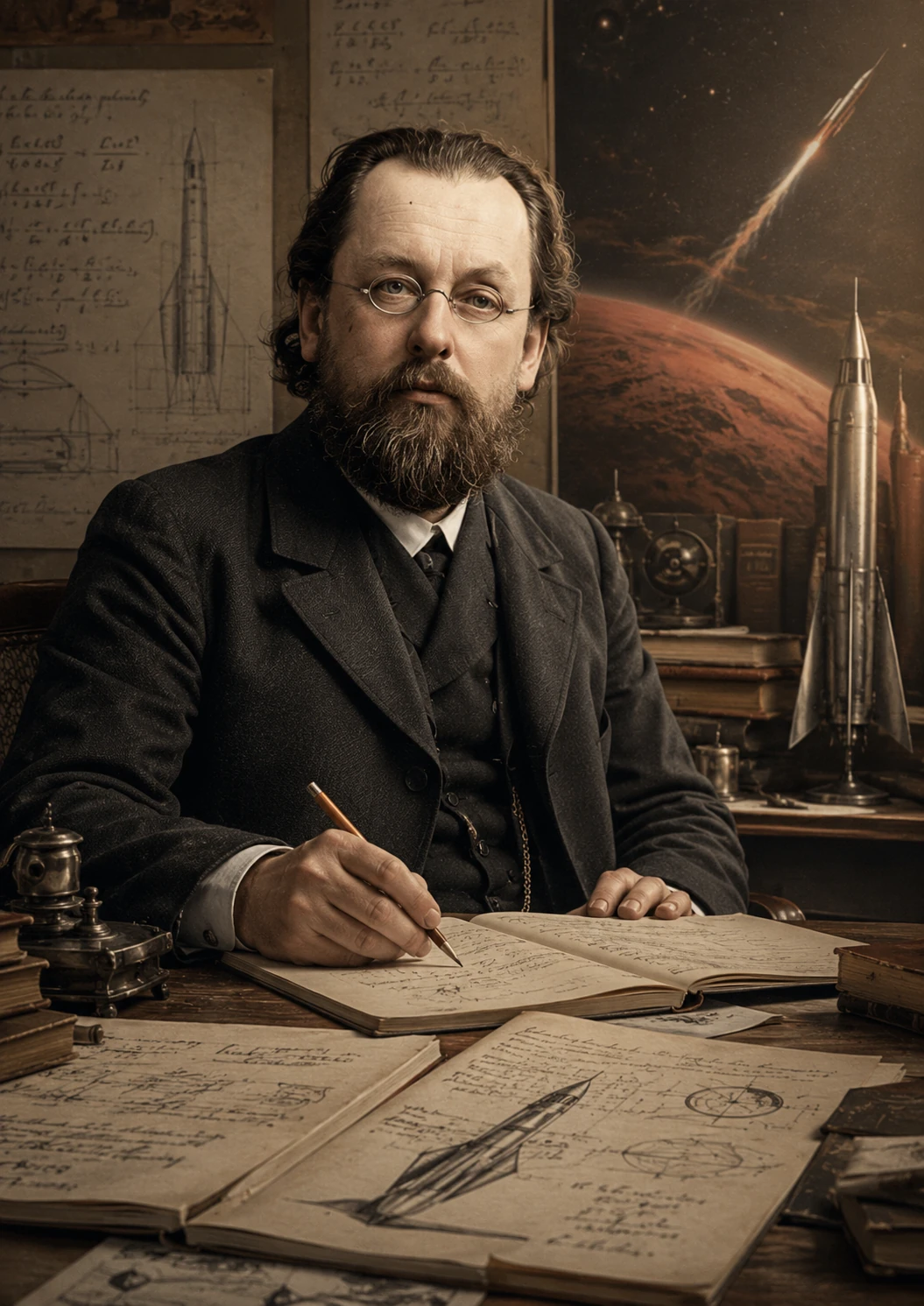
Chronological biography
1882–1913 — Worcester, Clark and the making of an experimental vocation
1914–1926 — Patents, theory and the first liquid-propellant flight
From Worcester to Roswell: inventing an experimental method when no one knew how to build a liquid rocket
Goddard's story is compelling because progress was not clean. He had to invent the engine, feed system, launch support equipment, filling procedures, guidance and measurement methods almost at once. A May 1926 report preserved by the Smithsonian describes a December 1925 test in which two separate engine systems proved almost impossible to operate together; a double-acting arrangement was then tested for twenty-seven seconds. The document exposes the real process: a configuration fails, the cause is narrowed, the design changes, and the next test becomes more informative.
1926: a poor flight can still be a decisive experiment
On March 16, 1926, Goddard's first liquid-propellant rocket climbed only about 41 feet and landed 184 feet away. He had put the engine above the tanks because he expected the geometry to improve stability. Later tests convinced him that putting the engine below the tanks was stable enough and mechanically simpler. The lesson is more valuable than the record: a pioneer still has to abandon an elegant intuition when hardware supplies better evidence.
The 1926 flight: tiny distance, enormous change
Goddard’s first liquid rocket did not cross the Atlantic or approach orbit. NASA notes that it climbed only a few dozen feet and flew for less than three seconds. Judging the experiment by distance misses the key point: engine, tanks, feed system and ignition operated together long enough to demonstrate the principle.
In engineering, a successful demonstration can be small while removing a fundamental uncertainty. The same logic helps evaluate MOXIE on Mars: its oxygen production was small, but it demonstrated the process in the real Martian environment. Scale is the next question, not the first.
The 1930s — Roswell: turning an engine into a measurable vehicle
Roswell: the engine becomes a complete vehicle problem
Funding associated with Charles Lindbergh and the Guggenheims enabled the Roswell work of the 1930s. Goddard pursued larger vehicles, gyroscopic control, pumps, cooling and structures. Smithsonian historians also identify a limitation: he often changed several variables between tests, making failures difficult to diagnose, while secrecy and a very small team restricted the spread of his methods. Innovation and institutional learning are not the same thing.
Sources: NASA; Smithsonian; Smithsonian Archives.
1941–1945 and after — War, death, recognition and legacy
A workshop, notebooks and repeated tests: how a rocket becomes a measurable object. Robert Goddard is sometimes portrayed as the lone inventor who foresaw all of modern astronautics. A more useful reading focuses on method. He spent years working on propulsion, filing patents, building test equipment and documenting experiments. The 16 March 1926 flight at Auburn, Massachusetts was short and modest, but it demonstrated that a liquid-fuelled rocket could actually operate.
The importance of liquid propellants was not only higher theoretical performance. They allowed tanks and chamber to be separated, feed systems to be controlled, pressures to be experimented with and architecture to evolve progressively. Each test generated measurements of combustion, cooling, stability and guidance. The rocket stopped being merely a spectacular projectile and became an experimental system whose subsystems could be improved.
For Mars, Goddard therefore represents the value of the test–measure–correct loop. Modern launch vehicles are incomparably more complex, but they still progress through instrumented tests, anomalies and design changes. A Mars architecture that does not budget for that loop on Earth — and later in space where possible — is not a development programme but a hypothesis.
Testing as a method. Goddard’s early rockets were sometimes modest or fragile, but they existed to teach. He tested, instrumented, modified and tried again. That test loop is as important as any individual component.
Mars demands the same culture: an ISRU plant or lander does not become credible because its diagram is elegant. It becomes credible when a test program characterizes performance, margins, failures and repeatability.
Supplementary documentary analysis
Biographical analysis, context and legacy
Thematic analysis and deeper reading
Essential timeline
- Born in Worcester, Massachusetts.
- Receives important patents covering rocket concepts including liquid propulsion and staging.
- Publishes A Method of Reaching Extreme Altitudes.
- First successful flight of a liquid-fueled rocket, in Auburn.
- More advanced test campaigns in New Mexico involving engines, guidance, pumps and vehicles.
- Dies before the Space Age he helped make possible.
Why liquid propellants changed the rocket
A liquid system separates tanks from the engine, allows greater control of feed systems and enables performance and burn durations difficult to obtain with early solid devices. Complexity increases sharply: tanks, plumbing, pressurization, injection, cooling and ignition.
Goddard accepted that complexity because it opened a technological path toward high performance. Modern launch-vehicle engines are distant descendants of that decision.
A pioneer often underestimated in his own time
Goddard often worked in relative isolation and faced public criticism. Later support allowed him to pursue more advanced tests in New Mexico.
The contrast with the present is striking: what once required isolated experiments has become a global industry. Yet the intellectual requirement remains the same — distinguish the idea, the prototype, the flight test and operational capability.
From patents to modern subsystems
Goddard worked on many elements that later became familiar: staging, nozzles, gyroscopes, pumps, control and propellant feed. It would be anachronistic to say he single-handedly “invented” every modern subsystem, but his test program shows an increasingly integrated understanding of the vehicle.
For a Mars site that progression is pedagogically useful: an engine is never isolated. It depends on tanks, structure, valves, sensors, control and test procedures. Modern rocketry emerges when these functions begin to be engineered together.
Deep reading: what this trajectory teaches
Robert Goddard before the rocket: Worcester, illness, reading and the making of an experimentalist
Robert Hutchings Goddard was born in Worcester, Massachusetts, on 5 October 1882, in an industrial region where workshops, machine tools, patents and the culture of invention were part of ordinary life. That setting matters more than a line in a birth record. Worcester was a city in which things were manufactured, inventions were patented and the idea that a new mechanism could become an industry was socially familiar. Institutional biographies also emphasize a childhood marked by poor health and repeated absences from school. There is no simple causal chain from illness to invention, but the circumstance helps explain why reading, private experimentation and self-directed learning became important to him. He learned early to move from imagination to a device that could test the idea. NASA Smithsonian Archives
The well-known episode in which the teenage Goddard later remembered imagining extreme-altitude flight while sitting in a cherry tree in October 1899 became a powerful symbol in accounts of his life. It should be read as autobiographical memory, not as evidence that an engineering program was born in one instant of revelation. The real trajectory took years. Mathematics, physics, workshop practice and repeated failures slowly turned fascination into a research method. That long maturation is more important than the myth of a solitary genius suddenly seeing the future. Goddard’s distinctive habit was to ask what measurement or apparatus would distinguish a plausible idea from a physical impossibility. NASA Clark University
Worcester Polytechnic Institute and then Clark University gave that habit a scientific language. Goddard graduated from WPI in 1908, pursued graduate work at Clark and earned advanced degrees in physics before also spending time in research at Princeton. His early career already shows a pattern that would persist: equations, instrumentation and hardware belonged together. At a time when rockets were still associated with fireworks, artillery and fiction, he treated propulsion as a problem in mechanics and thermodynamics. The question was no longer whether a projectile might somehow travel very high, but how much velocity could be obtained, what mass ratio would be required, how thrust could be generated and what efficiency a real system could achieve. Turning a dream into variables was the first decisive step. NASA History NASA Science
1912–1916: proving that a rocket does not need air to push against
One major conceptual obstacle in the early twentieth century was an intuitive but incorrect picture of rocket propulsion. If a rocket threw gas backward, many observers assumed that the gas had to push on surrounding air. Goddard worked directly against that misconception. By applying conservation of momentum and performing static tests, he showed that a rocket could generate thrust in a vacuum. The reaction comes from accelerating expelled mass, not from finding something external to push against. The point seems elementary today because it appears near the beginning of every propulsion textbook. In Goddard’s time it marked an important boundary between everyday intuition and a science capable of thinking seriously about spaceflight. NASA NASA Science
Between 1912 and 1914 he explored mathematically the use of rockets for extreme altitudes and secured patents that included multistaging and liquid propulsion. Patents were not incidental to his working style. Goddard lived in an industrial culture where legal protection of invention mattered greatly. The patent system encouraged him to define technical architectures with precision, but it also reinforced a habit of secrecy. Rather than building a large open school in which dozens of engineers argued publicly over results, he often worked with a small team and guarded details. That strategy protected inventions while limiting circulation, replication and technical cross-fertilization. NASA NASA History
Funding soon became as consequential as theory. Experiments consumed materials, workshop time, instruments and laboratory space. In 1916 Goddard wrote to the Smithsonian Institution describing a program for lifting scientific instruments beyond balloon altitudes. The Smithsonian decided to support him. American astronautics was not yet a federal enterprise measured in billions of dollars. It began in part through small grants, institutional trust and personal persuasion. Goddard had to convince patrons that the question was worth financing before he could demonstrate the performance he promised. The tension between evidence and funding would follow him for the rest of his career. National Air and Space Museum Smithsonian Archives
1919–1920: A Method of Reaching Extreme Altitudes, the Moon and the cost of ridicule
The Smithsonian publication of A Method of Reaching Extreme Altitudes mattered because it transformed scattered calculations and experiments into a public scientific argument. Most of the report was not a sensational manifesto about conquering the Moon. Goddard examined how instruments might be carried above the reach of balloons, which propulsion methods could work and how performance should be calculated. Yet a passage considering the possibility of sending a payload toward the Moon drew press attention. The contrast between the technical caution of the paper and the simplified public controversy was severe. Some commentary ridiculed the idea and repeated the mistaken belief that a rocket could not operate outside the atmosphere. Smithsonian NASA
The episode changed Goddard’s relationship with publicity. The ridicule was more than a personal injury; it became an organizational factor. He distrusted reporters, guarded data more closely and reduced the circulation of technical information. The response was understandable, but it carried a cost. Complex technology usually advances faster when many people can challenge assumptions, reproduce experiments and develop specialized subsystems. By remaining deliberately small and secretive, Goddard preserved intellectual freedom while sacrificing some of the advantages of collective engineering. NASA historians later described the paradox clearly: he anticipated or invented many features of modern rockets without building an organization able to integrate them at large scale. NASA History
The distinction remains useful for Mars. A contemporary Mars architecture can be physically plausible without being industrially executable. Goddard knew that equations permitted enormous velocities and that vacuum did not prevent propulsion. But moving from possibility to a reliable vehicle required valves, pumps, stable combustion, lightweight structures, guidance and repeated testing. One of the deepest lessons of his career is that “possible” in physics never means “ready” in engineering. The distance between those words is filled with material detail, institutional capacity and time. NASA History
1917–1918: war, military rockets and a career that could have taken another direction
American entry into the First World War created another application for rocket propulsion. Goddard worked on military devices and demonstrated at Aberdeen a reaction weapon whose technological lineage later contributed to the bazooka developed by Clarence Hickman and other engineers. The episode reminds us that modern propulsion was dual-use almost from its beginning. The same physics can lift a scientific instrument, assist an aircraft during takeoff or accelerate a military projectile. That ambiguity would persist in German, Soviet, American and Chinese space history throughout the twentieth century. NASA Science
The war might have converted Goddard’s program into a permanently military career. It did not. He retained the vision of rockets as tools for altitude and space. This distinguished his path from the German Army’s investment in ballistic missiles during the 1930s. The United States did not give Goddard a Peenemünde-scale institution between the wars. That limited his scale but also prevented his laboratory from being wholly absorbed by a weapons requirement. His career therefore occupied an unusual middle ground: university professor, inventor, private-foundation grantee and eventually Navy collaborator during the Second World War. NASA National Air and Space Museum archives
This hybrid position helps explain why his life looks different from those of Korolev or von Braun. Goddard did not command thousands of workers or benefit from a national missile infrastructure. His laboratory resembled an advanced research cell more than an industry. That allowed rapid conceptual changes but not the enormous databases of test results, standardized production and organizational redundancy that make large launch vehicles possible. Admiring his technical “firsts” therefore requires recognizing the small institution that produced them. The contrast is part of the achievement. Clark University
Why choose liquid propellants when they make nearly everything harder?
Choosing liquid propellants in the 1920s was almost paradoxical. A solid rocket is mechanically simpler: propellant is already inside the motor and ignition initiates a burn that may be difficult to stop but requires no cryogenic tank, complex plumbing or controlled injection. Liquids add exactly the subsystems that would trouble Goddard for years. Liquid oxygen must be handled at very low temperature, fuel must be stored and delivered, flows must be regulated, leaks prevented, ignition obtained in the right place and the chamber kept from destroying itself through heat. Why accept so many problems? Because the potential reward is large: higher performance, finer control and a path toward much more capable vehicles. NASA
Goddard was therefore confronting a principle that remains central to Mars systems. Engineers sometimes choose a more complicated architecture not because complexity is desirable, but because it opens a mission class unavailable to a simpler system. Modern launch vehicles use liquid propulsion for that reason. A human Mars mission may similarly accept local propellant production, aggressive water recycling, nuclear power or orbital rendezvous if those complications lower Earth-launch mass or improve overall resilience. Engineering does not treat “simple” and “complex” as moral categories; it compares competing risks and benefits. Goddard experienced that trade on every test stand. Smithsonian object collection
His progress came not from a single miraculous engine but from cumulative improvements in injectors, feed systems, cooling, tank arrangement, control and instrumentation. The fame of the 1926 flight can hide this slower story. Goddard’s modernity lies as much in treating the rocket as an interacting system as in achieving the first liquid flight. He tested one function, observed failure, changed a detail and tried again. Performance remained modest for a long time, but knowledge of failure accumulated. That is precisely how a new technology turns into an engineering discipline. Smithsonian
16 March 1926: four seconds that mattered more than forty feet
The first successful flight of a liquid-propellant rocket took place on a farm in Auburn, Massachusetts. The vehicle looks strange beside a modern launcher: the combustion chamber was mounted near the top, tanks and plumbing formed a light skeletal structure, and the machine seemed closer to an experimental apparatus than to a space vehicle. The flight lasted only a few seconds, reached roughly forty-one feet in altitude and travelled about 184 feet horizontally according to institutional accounts. Judged by spectacle, the result was unimpressive. Its importance lay elsewhere. A self-contained vehicle burning gasoline and liquid oxygen had generated thrust and flown. NASA History National Air and Space Museum
This distinction between absolute performance and proof of principle is fundamental in emerging technologies. The first workable transistor, aircraft, computer or planetary lander can look absurd beside its descendants. What matters is that a complete causal chain has worked. In 1926 the chain was short: storage, injection, combustion, thrust, ignition, structure and liftoff. But it was enough to change the nature of the argument. Liquid-fueled rocketry was no longer only a calculation or a patent. It was a flying machine. Smithsonian
It is equally important to resist hindsight. Goddard did not know during the flight that Saturn V would later use liquid engines to send humans toward the Moon. He did not possess turbopumps, modern alloys, digital guidance or industrial supply chains. His experiment did not automatically contain Apollo. It did open a route of learning, which is why American institutions commemorate the event as a turning point in propulsion history. NASA
1929–1930: a crash, Charles Lindbergh and the transformation of a small laboratory
The 1929 flight carrying scientific instruments shows how Goddard’s career sometimes advanced through unexpected events. The rocket rose, crashed and produced enough noise and fire to attract local attention. The incident helped bring his work to the notice of Charles Lindbergh. The world-famous aviator immediately grasped the long-term importance of rocket propulsion. His intervention with the Guggenheim family changed the laboratory’s financial position and allowed Goddard to contemplate a more sustained campaign at a more suitable site. Smithsonian 1929 motor National Air and Space Museum
Lindbergh’s role reveals a dimension often missing from inventor-centered stories: transformative technologies need intermediaries. A scientist may understand the physics and still struggle to persuade a foundation, government office or industrial board. Lindbergh brought outside credibility and knew how to speak to patrons. Harry Guggenheim provided unusually patient support for a program in which many flights failed to meet ambitious expectations. Without that social infrastructure, Goddard’s technical story would probably have been shorter. Smithsonian Smithsonian A-series object
The move to New Mexico answered practical constraints: open space, low population density, favorable weather and the ability to launch without endangering a residential neighborhood. Roswell therefore became part of the research architecture. A test range is not scenery. It determines safety, testing frequency, observable trajectory length and recovery options. Future launch centers and missile ranges would reproduce the same logic at much greater scale. NASA
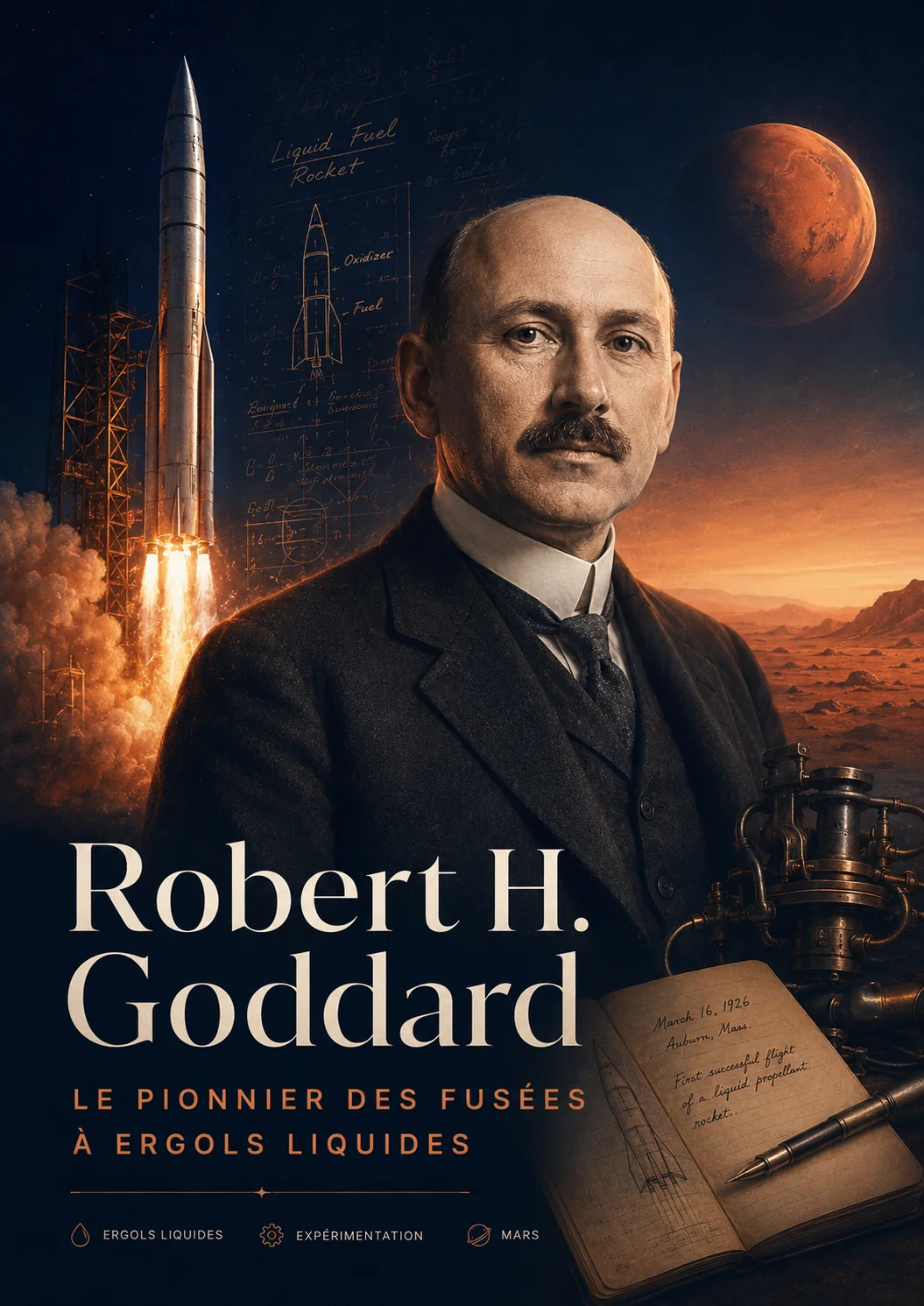
Roswell: from an engine experiment to a complete flight system
At Roswell, Goddard was no longer merely asking whether a combustion chamber produced thrust. The problem became the entire vehicle. A rocket had to remain stable, follow a trajectory, survive vibration and loads, feed its engine under acceleration, preserve propellants, record data and ideally allow the team to understand precisely why a test failed. This transition separates a component inventor from a system designer. Goddard’s archives and surviving hardware show a succession of configurations exploring gyroscopic control, jet vanes, movable engines and different feed arrangements. NASA Clark Papers
Guidance illustrates the increase in complexity. An unguided rocket can be relatively simple if accuracy does not matter. Once a target altitude or direction becomes important, the vehicle must sense attitude, calculate an error and apply a correcting torque. Goddard experimented with gyroscopes, jet control devices and eventually a gimbaled motor. These concepts would become standard in large launch vehicles. It would be misleading to claim that Saturn or the V-2 simply copied his laboratory; many developments were parallel or independent. The important point is that he encountered the same classes of engineering problem unusually early. NASA History Smithsonian
Roswell also exposed the limits of his organization. Goddard could invent at an extraordinary rate, yet the team remained small. He accumulated innovations without always turning them into a vehicle that reached the altitudes promised to patrons. NASA historians have emphasized this weakness in integration. It does not diminish his technical creativity. It explains why the history of large rockets became a history of management, configuration control, production, testing and quality assurance as much as of invention. Spaceflight requires thousands of correct decisions to work together. NASA Sputnik History
Measure in order to learn: instrumentation and the discipline of testing
An experimental rocket is of limited value if nobody can determine what happened during the few seconds in which it operated. Goddard understood this requirement early. The 1929 flight carried instruments including a barometer, thermometer and camera. More broadly, his campaigns relied on pressure measurements, timing, optical observation and records that could reconstruct vehicle behavior. This discipline is the ancestor of a modern practice performed at enormous scale: launch vehicles carry thousands of measurements, and every flight generates data used to validate models and diagnose anomalies. Smithsonian
The issue is directly relevant to Mars. An interplanetary mission cannot be improved after a failure through intuition alone. It must record enough information to identify the causal chain. A pressure drop might result from leakage, cavitation, a valve, a command error or a temperature condition. Attitude drift might begin with a sensor, estimator, controller, actuator or external disturbance. Goddard worked before modern telemetry and digital electronics, yet he already treated testing as a device for producing knowledge rather than a simple attempt at success. Clark University archives
This philosophy explains why a visibly unsuccessful flight may still be scientifically productive. The 1926 rocket fell after seconds; the 1929 vehicle crashed. Each event nevertheless closed unknowns. Popular history remembers first successes, while engineering proceeds through a less dramatic alternation of measurement, inspection and correction. Goddard therefore matters to Mars not only because of liquid propulsion, but because of the culture of test he helped embody. NASA History
Combustion chambers, cooling and feed systems: the invisible problems that make a rocket
A rocket combustion chamber operates in a physically hostile regime. Gas temperature is extreme, pressure must remain high enough to generate useful exhaust velocity, and the metal wall has to survive long enough to complete the mission. Goddard experimented with cooling methods and patented solutions that anticipated later practice. He also worked on propellant feed systems. Pressure-fed arrangements can support modest engines, but larger flows make pumps increasingly important. Institutional lists of his achievements include pumps suitable for rocket propellants. NASA historic firsts
These subsystems illustrate a frustrating law of engineering: a valid architecture can fail because one seal overheats, one pump cavitates or one line vibrates. A modern rocket engine is a meeting point of thermodynamics, fluid mechanics, materials and control. Goddard encountered this interdisciplinarity before a mature rocket industry existed. His laboratory had to invent parts of the product and parts of the method for studying the product at the same time. Smithsonian 1936 publication
For Mars, the story warns against discussing engines only through thrust and specific impulse. A high-performance engine that cannot restart after months of cruise, demands inaccessible maintenance or stores impractical propellants may be inferior to a less efficient but more robust alternative. Goddard did not formulate the Mars problem in those terms, but his career demonstrates how reliability gradually becomes as important as nominal performance. Smithsonian
1932–1937: gyroscopes, jet control and supersonic flight
By the middle of the 1930s Goddard’s rockets were far removed from the 1926 apparatus. Tests included gyroscopic guidance, vanes placed in the exhaust and, in 1937, a motor mounted on gimbals under gyro influence. NASA also credits Goddard with the first liquid-propellant rocket flight faster than sound in 1935. These milestones should not be treated as unrelated records. They form a logical progression: as speed and altitude increase, initial errors become more expensive and active control becomes more important. NASA
The gyroscope provides an attitude reference independent of the outside visual scene. A controller must then translate the difference between desired and measured orientation into mechanical action. In a modern launch vehicle that loop is digital, redundant and integrated with flight computers. Goddard’s versions were electromechanical and experimental, but the recognizable principle is the same: measure, compare, correct. That feedback loop is one of the quiet technologies without which no Mars mission can function, from cruise attitude control to the last seconds of a powered landing. NASA History
Supersonic flight introduced additional constraints. Aerodynamic loads changed, vibration increased and stability became more demanding. Goddard lacked modern computational fluid dynamics and large databases of wind-tunnel results. He combined theory, experiment and observation. The slow pace is therefore understandable: he worked on a frontier where relevant physical phenomena were sometimes understood separately but rarely integrated into a flying vehicle. Smithsonian A-series rocket
Goddard, Germany and the myth of a simple line from his patents to the V-2
After the Second World War, similarities between some Goddard solutions and German missile technology encouraged a narrative in which V-2 engineers had largely copied his inventions. The evidence is more complicated. NASA historians note that Goddard’s own secrecy limited the technical detail available to outsiders and that many similarities arose from independent responses to identical physical constraints. Large liquid rockets inevitably encounter feed, cooling, stability and control problems. Convergent solutions are not by themselves evidence of direct transfer. NASA Science
There was nevertheless mutual awareness among early pioneers. Goddard knew European work and became sensitive to competition. Hermann Oberth and German rocket societies popularized spaceflight with a much more public culture. The contrast is striking: Goddard protected details and remained small, while the VfR created a public movement before the German military absorbed much of the field. Neither organizational model is simple. Openness circulates ideas rapidly; military funding creates scale while redirecting technology toward weapons. NASA History
This comparison explains how Goddard can be a major pioneer while exerting less direct influence than a heroic narrative might imply. His patents establish early conception of many important solutions. But technology history is not a contest in which each component belongs to a single first inventor. It is a network of experiments, publications, patents, transfer, rediscovery and common physical constraints. That complexity makes Goddard’s actual achievements more credible, not less. NASA
Esther Goddard: partner, witness and architect of the historical record
Robert Goddard is often pictured as a man alone in a desert beside a rocket. The image erases Esther Christine Kisk Goddard. She accompanied important parts of the experimental program, photographed events and later played a major role in preserving the record of the work. Some photographs that define the visual memory of early American rocketry survive because she made or preserved them. After Robert’s death she devoted years to organizing archives and promoting serious recognition of his research. Clark University
The point matters for two reasons. First, technological innovation depends on human networks that do not always appear in engineering organization charts. Second, history itself has to be produced. Diaries and laboratory papers do not automatically become usable archives. Someone preserves, classifies, edits and opens them to researchers. Goddard’s posthumous reputation therefore depends partly on the quality of this transmission. Robert & Esther Goddard Collection
A long biography should make such dependencies more visible, not less. Assistants, technicians, patrons, spouses, secretaries, archivists and photographers can be essential to understanding a program. The protagonist remains central without becoming the sole cause of everything around him. Goddard then appears not as a magician but as the center of a small research ecosystem whose strengths and weaknesses shaped the results. Clark University
214 patents: what a portfolio of inventions can — and cannot — say about technological revolution
The number of patents associated with Goddard is impressive. They cover propulsion, control, feed systems and different vehicle concepts. Yet a patent is neither a successful flight nor industrial adoption. It is a legally defined claim to a solution, and its historical importance depends on what was demonstrated, transmitted or later reused. This distinction prevents technological history from becoming a simple list of priority claims. NASA Science Clark University
In Goddard’s case, however, the patent record reveals striking conceptual continuity. Multistaging, liquid propellants, cooling, guidance and propellant feed appear unusually early. It is useful to distinguish three levels: conceptual anticipation, experimental demonstration and industrialization. Goddard was exceptional at the first two. He did not possess the time or organization to accomplish the third at the scale later seen in national missile and space programs. NASA historic firsts
The same framework helps evaluate modern Mars proposals. An organization can patent an in-situ propellant process or habitat architecture, demonstrate a prototype on Earth and remain far from operational Mars capability. Conversely, an unpatented technique may become central if it is reliable and well integrated. Innovation is not a count of intellectual-property documents; it is the progressive conversion of an idea into capability. NASA History
Why Goddard is a systems-engineering case study before the term became common
A rocket is a system in which nearly every choice changes several other parameters. More propellant adds mass and requires stronger structure; stronger structure adds mass again; higher thrust raises loads and vibration; better guidance requires sensors, actuators and power. Goddard repeatedly encountered these loops. His work therefore became a primitive form of systems engineering. He could not optimize each component independently because complete-vehicle interactions appeared only when the subsystems were assembled. Smithsonian technical publication
This complexity also explains why a brilliant small team eventually reaches organizational limits. As interfaces multiply, an inventor’s memory is no longer enough. Controlled drawings, procedures, configuration management and reviews become necessary. Large missile and launch programs would institutionalize those methods later. Goddard stood just before that transformation: he proved that liquid rocketry was physically workable while his own laboratory demonstrated why the next step required another scale of management. NASA History
The analogy to a Mars base is immediate. A settlement will not be a collection of independent “good technologies.” Power determines water and oxygen production; maintenance determines spare-part mass; dust affects thermal and mechanical performance; food depends on water, light and nutrients. Goddard’s deepest legacy is therefore not one motor component but a systems lesson: once a technology moves beyond demonstration, interfaces become the real problem. NASA
Funding the improbable: Smithsonian, Guggenheim and patient capital for research
The money available to Goddard was tiny beside later space budgets, yet its historical function was large. The Smithsonian supported him when extreme-altitude rocketry remained speculative. The Guggenheim network later financed a more ambitious phase, in part because Lindbergh served as an intermediary. These patrons accepted an asymmetry common to breakthrough research: the probability of immediate success was uncertain, while the potential value of a genuine advance could be enormous. National Air and Space Museum Smithsonian
The relationship was not always comfortable. Patrons wanted results, publication and visible progress. Goddard sometimes promised altitudes he did not reach and resisted advice to expand his team or open his work. Funding was therefore not merely a check; it was a negotiation over research strategy. Mars programs face the same structural problem. A long-term vision must coexist with intermediate demonstrations credible enough to sustain support. Smithsonian
Goddard’s career also shows that innovation can require different institutions at different stages. A university provided scientific legitimacy and laboratories; foundations supplied flexible money; the military and Navy supplied applications; NASA and contractors later supplied industrial scale. No single actor contained every necessary function. That institutional plurality is a hidden component of technological progress. Smithsonian Archives
What Robert Goddard actually contributes to the human journey to Mars
Goddard did not design a detailed Mars architecture comparable with Mars Direct or contemporary mission studies. His connection to Mars is more fundamental. He turned liquid rocketry from theoretical possibility into experimental hardware. Every human Mars mission begins with the ability to impart several kilometers per second of velocity change to large masses. Launchers, interplanetary departure stages, landing vehicles and Mars ascent systems all depend on propulsion. Exact solutions vary, but converting stored energy into controlled velocity is central to the architecture. NASA
His guidance work is equally important. A Mars vehicle cannot simply be “aimed at Mars” as a ballistic projectile. It must make trajectory corrections, control attitude, point antennas and power systems, then manage entry and landing with narrow margins. The feedback loops Goddard explored are conceptual ancestors of vastly more sophisticated systems. NASA historic firsts
Finally, his career offers a method. Distant visions are useful when they force engineers to identify present unknowns. Goddard thought about space and the Moon, but his working days were spent on valves, stability, cooling and measurement. A serious Mars strategy must do the same: preserve the long-term objective while turning every unknown into a testable program. A dream becomes credible when it generates a concrete list of engineering work. NASA History
Solitary genius, father of modern rocketry, or one pioneer among several?
Labels such as “father of modern rocketry” are useful for public memory and inadequate for serious history. Tsiolkovsky independently developed a powerful theory of astronautics; Oberth systematized and popularized spaceflight in Europe; German, Soviet and American engineers later turned rockets into an industry. Goddard occupies a distinctive place because he connected theory with practical liquid-propellant experimentation unusually early in the United States. It is more accurate to treat him as one of several independent founders of modern rocketry than as the single source of a global technology. NASA History
That caution does not weaken the tribute. It reveals what Goddard accomplished with limited resources. He did not possess the Soviet state, the German Army or NASA. He had physics training, inventive ability, a handful of assistants, difficult-to-obtain funding and extraordinary persistence. Under those conditions, the number of problems he anticipated or experimentally addressed is remarkable. NASA Science
The most interesting story is therefore not that one man “invented the rocket” on a particular day. It is that a researcher helped convert nineteenth-century imagination into twentieth-century experimental discipline. The passage from conceivable to measurable, and from measurable to repeatable, is exactly the transformation that every future Mars technology must undergo. Smithsonian Archives
After 1945: from Goddard’s laboratory to Goddard Space Flight Center
Institutional recognition grew rapidly after Goddard’s death. When NASA established a major center at Greenbelt, Maryland, in 1959, it named the facility Goddard Space Flight Center. The symbolism is revealing. The center became known primarily for scientific spacecraft, Earth observation and astrophysics rather than as a rocket-engine laboratory. Goddard’s name therefore became associated not only with propulsion but with the larger idea of using rockets to carry instruments beyond the atmosphere, one of the goals that had motivated his earliest funding requests. NASA Goddard Space Flight Center history
This continuity can be more meaningful than a record. Goddard’s early work emphasized reaching altitudes beyond balloons. Decades later, launch vehicles became reliable enough to turn space into a permanent observation platform. Meteorology, astronomy, solar physics and Earth science then used an infrastructure that early rocket pioneers could only imagine through occasional flights. NASA Goddard
The same relationship exists between transport and Mars science. Rockets are not the destination. They create access that allows instruments, robots and eventually humans to produce knowledge. The best tribute to Goddard is therefore not to reduce his legacy to the flame of an engine. He helped make possible an entire mode of exploration in which propulsion becomes infrastructure for other sciences. NASA
The press, public misunderstanding and the long afterlife of a disputed idea
The 1920 controversy is often compressed into a simple morality tale in which a major newspaper mocked Goddard and history later proved him right. The deeper issue is more interesting. A well-educated public could still cling to an everyday intuition when physics demanded something less familiar. A rocket seemed as though it ought to push against something, just as a wheel pushes on the ground or a propeller works on air. Conservation of momentum is less intuitive. The dispute therefore became a classic example of the distance between scientific explanation and common mechanical imagery. NASA
For Goddard the episode reinforced the belief that publicity generated caricature rather than support. He became more guarded, which protected the laboratory but made community-building harder. Other pioneers followed different paths. Oberth published and lectured; European rocket societies created public movements; later military programs shared information widely inside closed institutions. Goddard remained unusually close to an artisanal research model. NASA History
The lesson remains relevant to Mars communication. A radical proposal should not ask for trust merely because it sounds visionary. It should expose equations, tests, assumptions and limits. Goddard was correct about propulsion in vacuum, yet his bad experience with the press encouraged less public explanation rather than more. Modern engineering needs both intellectual-property protection where necessary and enough transparency for evidence to be evaluated. Smithsonian
A small team: assistants, technicians and the limits of inventor-centered organization
The heroic image shows Goddard alone beside a rocket. In reality, experimental campaigns depended on assistants, university collaborators, patrons and logistics. Clarence Hickman worked with Goddard during the First World War and later contributed to military rocket development. At Roswell, assistants built, transported, instrumented and recovered vehicles. Esther Goddard photographed and preserved the record. Lindbergh and Guggenheim were not propulsion engineers, but without their support the program could not have continued at the same level. Even one of the most personalized stories in rocketry was organizational. Clark University Smithsonian archives
Small teams have advantages: fast decisions, clear responsibility and direct access to hardware. They also have structural weaknesses. One person must cover several disciplines, documentation can depend on memory, specialists may be absent and design errors are less likely to be caught through independent review. Large rocket programs later multiplied engineering groups, test stands and formal reviews, at the cost of far heavier bureaucracy. Goddard occupied the opposite end of the spectrum. NASA History
The comparison is important for early Mars crews. Their numbers will be small while the systems they maintain — power, water, air, computing, habitats and vehicles — are diverse. A viable architecture must therefore reduce dependence on one unique expert and make diagnosis transferable. Goddard’s history shows how far individual competence can go and where durable capability begins to require procedures and distributed knowledge. NASA
A catalogue of useful failures: when a rocket does not lift, veers or burns badly
Goddard’s campaigns included many tests in which an engine produced insufficient thrust, ignition failed, the vehicle followed the wrong trajectory or hardware was destroyed on impact. The Smithsonian preserves a May 1926 rocket that failed to leave the ground because it lacked adequate thrust. Such hardware is historically valuable because it proves that innovation is not a sequence of records. Between celebrated firsts lie far more ordinary results that reveal the actual margins of a system. Smithsonian
A failed test can belong to several categories. The physical hypothesis may be wrong; a component may be incorrectly sized; manufacturing may introduce a defect; instrumentation may mislead the team; or the complete system may fail through interactions among individually acceptable parts. Program maturity consists partly in learning to separate those causes. Goddard gradually built that diagnostic capacity with very limited resources. Smithsonian technical record
Modern organizations sometimes describe tests as “data rich.” That phrase captures the best part of Goddard’s method. Failure is not automatically useful. It becomes useful when the experiment has been designed so that the failure generates interpretable information. On Mars, where testing under actual conditions will be expensive and operational failures can threaten life support, the requirement becomes even more severe: anomalies must be detected, recorded and understood before they cascade. Clark University
Roswell as an early test-range problem: safety, weather, transport and recovery
The choice of Roswell was not simply a desire to escape curious observers. The rockets were becoming powerful enough to require geography designed around risk. Goddard needed open space where an inaccurate trajectory would not endanger homes, where propellants could be handled, tests observed and debris recovered. Weather and visibility mattered as well. The site itself was therefore an engineering subsystem before the construction of any elaborate infrastructure. NASA
The same logic later shaped White Sands, Cape Canaveral, Baikonur and other major ranges. Launch vehicles cannot be developed in arbitrary urban environments. Geography becomes part of system design through safety corridors, impact zones, transport access, propellant storage, telemetry and recovery. Goddard encountered an embryonic version of this institutional problem. Smithsonian
Mars site selection will work in a comparable way. A settlement near accessible ice, benign landing terrain and favorable energy resources has different operational possibilities from one selected only for scientific interest. Roswell’s history demonstrates that propulsion research can be constrained or enabled by its physical environment. A Mars settlement will likewise be a combination of technology and geography. NASA
Reading Goddard as an engineering book: from vision to verifiable system
Goddard becomes most instructive when his life is not compressed into three dates. The 1926 flight, Roswell tests and patent portfolio matter because they sit inside a much longer progression in which a curious child becomes a physicist, inventor, experimentalist, leader of a small team and finally a military propulsion specialist. Every stage adds competence and reveals a limit. Theory shows what is possible; a prototype shows what works once; a test program shows what can become repeatable. Clark University
That progression is exactly what a credible Mars program must follow. Producing oxygen from simulated Martian carbon dioxide in a laboratory is not the same as fueling an ascent vehicle. Growing plants in a chamber is not the same as feeding a crew for years. Flying a reusable prototype is not the same as sustaining reliable operations. Goddard’s history shows that the distance between those levels is filled with details that appear only through testing. NASA History
His legacy is therefore less a single answer than a method: turn the dream into an equation, the equation into hardware, hardware into a system, the system into a test and the test into knowledge. That cycle is how a civilization moves from imagination to capability. The 1926 rocket travelled only a short distance. The method represented by that flight travels much farther. NASA
Vacuum testing: why a measured force matters more than argument by intuition
The claim that a rocket needed air could be tested rather than debated indefinitely. Reduce surrounding pressure while measuring thrust. If the force vanished with the atmosphere, external “push” would become plausible; if thrust remained, another explanation was required. Goddard’s work helped establish the correct mechanical picture: accelerated exhaust carries momentum one way and the vehicle changes momentum the other way. NASA
The result also leads to a modern propulsion detail. Rocket nozzles can perform better in low ambient pressure because exhaust is able to expand more fully. Engines optimized for sea level and engines optimized for vacuum may therefore use different nozzle expansion ratios even when their basic chemistry is similar. Goddard did not possess modern computational tools, but the physical principle behind space propulsion was already being isolated experimentally. NASA Science
Mars ascent engines operate in a very thin atmosphere from the moment of ignition. Nozzle geometry, propellant storage and restart reliability therefore belong to the same family of questions. An early twentieth-century vacuum argument becomes a direct design issue for a twenty-first-century Mars vehicle. NASA historic firsts
Gasoline and liquid oxygen: simple chemistry, difficult propulsion
Goddard’s gasoline–liquid-oxygen combination illustrates the difference between chemical energy and controlled rocket propulsion. Hydrocarbon fuel and oxygen can release large energy, but an efficient engine must mix them rapidly, avoid destructive combustion instability, prevent leaks, manage ignition and accelerate hot gas through a nozzle. The chemical reaction is only the beginning of the engineering problem. Smithsonian
Liquid oxygen adds cryogenic logistics. At ordinary temperature it boils rapidly, requiring careful handling and pressure management. Modern oxygen–methane and oxygen–hydrogen launch systems inherit the same class of constraint at far greater scale. High-performance propellants can be operationally inconvenient. Smithsonian technical publication
The issue becomes critical on Mars. A prepositioned ascent vehicle may wait for months before use. Cryogenic propellants produced or stored locally need cooling, pressure control and autonomous verification. Goddard’s story therefore makes clear that propulsion is not merely a moment of flame. It is a logistics chain extending long before ignition. NASA
1936: finally publishing a decade of liquid-rocket development
The 1936 publication Liquid-Propellant Rocket Development exposed part of the Roswell program after years of guarded work. Goddard’s patrons wanted documented progress, and the report showed how far the program had moved beyond the 1926 apparatus. Configurations, control methods and propulsion work demonstrated an increasingly systematic research campaign. Smithsonian
Late publication had two sides. It protected inventions and reduced the risk of immediate imitation, but it also limited technical influence while other groups advanced independently. Goddard’s career thus demonstrates that information circulation has engineering value of its own. Communities improve faster when results can be compared, reproduced and criticized. National Air and Space Museum
Future Mars industries will face the same tension between proprietary technology and standardization. A company may keep engine details secret while common refueling interfaces, safety rules or rescue standards benefit from openness. Goddard offers an early historical case in which intellectual-property strategy and collective technical progress were not always aligned. NASA History
After the war: patents, recognition and the changing value of an inventor’s archive
Rapid postwar missile development gave new value to Goddard’s patent portfolio. Large industrial programs now used technologies resembling classes of solution he had claimed years earlier. Questions of intellectual property and compensation consequently acquired posthumous importance. A patent can remain economically dormant until industry finally becomes capable of using the underlying principle at scale. Clark University archives
Postwar recognition also fixed Goddard more firmly inside the American national narrative of spaceflight. NASA, museums and universities emphasized his experimental firsts and patents. Historical caution still matters: an early patent can anticipate a principle without being the exact engineering source of every later implementation. NASA History
The distinction is relevant to current Mars technology. Patents filed today do not guarantee future industrial leadership. Durable value belongs to solutions that survive testing, production and integration. Goddard was often conceptually early; the decades after his death show how industrialization can redistribute both credit and economic power. NASA Science
Goddard, Tsiolkovsky and Oberth: three founders and three different ways to create astronautics
Comparing the three major pioneers clarifies their different roles. Tsiolkovsky excelled in general theory and visions of space civilization. Goddard connected mathematics with hardware and flight experimentation. Oberth organized and publicized spaceflight theory in the German-speaking world and helped create a technical community. None is interchangeable and none alone explains modern rocketry. NASA History
Their institutional environments also differed. Tsiolkovsky worked largely as a teacher before receiving Soviet recognition. Goddard relied on a university and private patrons. Oberth moved among universities, teaching, rocket societies and European technical programs. Different institutions produced different research styles. NASA
Mars settlement will need all three functions at once: theory to close physical budgets, experimentation to reveal material problems, and communication to create a community capable of building and maintaining systems. The pioneers therefore map distinct capabilities required by any interplanetary project. Smithsonian Archives
Measure before believing: pressure, thrust, velocity and the test log as engineering memory
An experimental rocket teaches very little if it merely leaves the ground. What turns a spectacle into an experiment is measurement. Goddard therefore moved toward recording tank pressure, engine behavior, burn duration, vehicle stability, observed velocity and trajectory. The principle seems obvious in an age of digital telemetry and inertial navigation, but it represented an important methodological shift: rockets became objects whose successive tests could be compared rather than events described only as “successes” or “failures.” Smithsonian — Goddard technical documentation
This culture of data explains the value of his notebooks, photographs and reports. When an engine burns poorly, the useful question is not simply that the flame looked wrong, but when pressure changed, whether propellant feed became unbalanced or whether a component exceeded its thermal limits. Engineering advances when failure can be converted into information. An accident with an unknown cause is a debt; an instrumented accident can become a step toward reliability. Clark University — Robert H. Goddard Papers
The same discipline is indispensable on Mars. An electrolyzer that produces oxygen for eight hours on Earth is not yet a Martian utility. To become critical infrastructure, engineers need to know efficiency across temperature ranges, contamination, start-stop cycles, electrical quality, product purity and component wear. A settlement will need to record thousands of parameters because it cannot wait for a failure to recur before learning what caused it. NASA
That logic separates three levels often confused in public discussion. The first is a proof of principle: a reaction or mechanism works at least once. The second is an instrumented prototype: engineers can measure its states and reproduce the experiment. The third is an operational system: performance stays inside a known envelope despite disturbances, manufacturing variation and ageing. Goddard spent much of his career crossing these boundaries with limited resources. Large postwar programs would industrialize the same validation culture at a much greater scale. NASA History
This distinction matters whenever a reader evaluates a Mars-colonization announcement. A dramatic prototype video does not reveal how many vehicles were tested, what success rate was achieved, how much maintenance was required or whether the hardware can be repaired far from an industrial base. Goddard’s history shows that an ocean of testing separates a correct idea from a dependable system. Modern rocketry is not only a story of increasing power; it is also a story of increasing ability to measure what cannot be seen directly.
From Roswell to a Mars ascent vehicle: why propellant becomes an industrial chain
Goddard’s experiments force us to view propellant as more than fuel poured into a tank. It must be produced or delivered, stored, transferred, checked for purity, kept within pressure and temperature limits, and routed through valves and lines that must work at precisely the right moment. Liquid oxygen adds cryogenic operations to that chain. A rocket can therefore be grounded by logistics long before a combustion defect appears. Smithsonian
On Mars this becomes even more structural. An architecture using locally manufactured methane and oxygen must first obtain water or import hydrogen, provide substantial electrical power, capture atmospheric carbon dioxide, purify streams, operate reactors, liquefy products and preserve tonnes of propellant until departure. The chemical reaction is only one link in a distributed factory. Ascent reliability depends on the weakest link, whether it is a pump, heat exchanger, valve or pressure sensor.
The issue can be expressed with simple arithmetic. If a mission requires tens of tonnes of propellant for Mars departure, a plant producing a few kilograms per day is inadequate even if its chemical efficiency is excellent. Engineers must reason in average production rate, time available before departure, actual equipment availability and margin. A plant rated at 100 kilograms per day but available only 80 percent of the time averages 80 kilograms per day. Over 500 days the difference between nominal and real production is ten tonnes. This arithmetic of availability is a modern extension of Goddard’s experimental discipline.
Storage adds a second constraint. Cryogenic fluids absorb heat from their surroundings. Without adequate insulation and refrigeration, part of the inventory boils away and must be vented or reliquefied. For an Earth launch vehicle fueled hours before flight this is already a major issue; for a vehicle waiting months on Mars it becomes an architectural problem. Propulsion is then coupled to surface power, maintenance and spare parts. Failure of a cryocooler can threaten the return schedule as decisively as an engine failure.
The best lesson from Goddard is therefore not that he somehow invented a future Mars architecture. It is more demanding: every propulsion promise should be unfolded into the concrete operations that make it possible. The reader can then ask the right questions. Where does the energy come from? What is the production rate? How much must be stored? What redundancy exists? What repairs can be made without a terrestrial supply chain? The rocket ceases to be an icon and becomes again a machine at the end of an industrial system. NASA — propulsion history
An invention is never solitary: machinists, assistants, patrons and a spouse around Goddard’s workshop
The image of the isolated genius fits the material reality of a rocket program poorly. Goddard concentrated an extraordinary amount of design responsibility, yet he depended on people able to machine parts, assemble hardware, observe tests, take photographs, transport equipment and financially support research whose results remained uncertain. His archives reveal a program made of human relationships as well as equations. Clark University — Goddard archives
Esther Goddard became especially important in preserving that memory. After her husband’s death she helped organize records and defend his scientific legacy. Without such archival work, many experiments would be far harder to reconstruct today. The case reminds us that a discovery exists historically only when notebooks, photographs, instruments and correspondence survive long enough to be studied. Smithsonian Institution Archives
Private patrons also changed the pace of research. Charles Lindbergh recognized the importance of propulsion and helped Goddard connect with the Guggenheim family. The resulting support made it possible to move beyond the severe constraints of Massachusetts and establish a more ambitious program in New Mexico. Money does not replace an idea, but it buys time, equipment, space and the ability to try again after failure. NASA History
This dimension anticipates later large programs. A Mars base will never be the work of one founder even if one personality becomes its public symbol. It will depend on shift crews, fluid specialists, physicians, electricians, geologists, logisticians and people responsible for documenting every procedure. Goddard’s history therefore corrects a persistent illusion: innovation may acquire a famous face, but reliability almost always requires an organization.
Failure as data: why a rocket that does not fly can still advance a program
A serious test campaign necessarily produces failures: incomplete ignition, unstable feed, leaks, loss of control or disappointing trajectories. Goddard could not eliminate them by determination. He could only reduce uncertainty by changing a variable, observing the result and documenting the new configuration. That method separates engineering from a public demonstration. Smithsonian
On Mars this culture must exist before departure. A settlement that hides incidents will repeat them. A formal lessons-learned system should record failure, context, diagnosis, correction and verification. Technical memory then becomes a survival resource comparable to water or electricity. Goddard’s legacy includes this principle: reliability is not built by erasing the story of failure but by converting failure into usable knowledge.
Changing scale without changing physics
Between the small 1926 vehicle and launchers capable of placing tens of tonnes in orbit, dimensions change radically while the fundamental laws remain the same. Scale nevertheless introduces new problems: vibration, combustion instability, structural loads, repeatable manufacturing and coordination of hundreds of subsystems. Invention must become industry. NASA
Mars will demand the same transition. A resource-utilization demonstration may fit in one experiment; a settlement requires equipment manufactured repeatedly, repairable and operated for years. Goddard’s history therefore warns against extrapolating directly from prototype to infrastructure without analyzing what scale changes.
2026: a century after Auburn, what the first liquid-propellant flight still teaches us to measure
The centenary of the 16 March 1926 flight is a useful antidote to telling space history as a sequence of miraculous leaps. NASA’s centenary material emphasizes how small “Nell” actually was: the vehicle flew for only seconds and rose only about a dozen meters. Yet that modest result validated a new technical chain in flight: separate storage of fuel and oxidizer, feed to a combustion chamber, ignition, production of thrust, structural survival and free flight. Its historical significance lies less in altitude than in the fact that several functions previously discussed as separate problems worked together in a flying system. NASA
A century later, that remains a powerful way to judge a Mars demonstrator. An ISRU plant that produces only a few kilograms of oxygen may be strategically important if it proves extraction, filtration, compression, thermal control, dust tolerance and maintenance for months. Conversely, a spectacular experiment that depends on constant intervention from Earth is not yet settlement infrastructure. Goddard’s trajectory teaches the reader to ask exactly what was demonstrated, for how long, under which environment and with what degree of autonomy.
NASA’s modern retrospectives also reveal continuity between the problems of the first liquid engine and issues that still occupy launch-vehicle teams: moving reactive fluids, controlling pressure, preventing destructive instabilities, steering a vehicle and recording enough data to explain the next test. Materials, sensors and computational tools have changed beyond recognition, but the experimental logic remains familiar. This is why Goddard is most useful when read as a laboratory engineer rather than reduced to the ceremonial title “father of modern rocketry.” NASA Science
For a reader trying to understand Mars, the centenary supports one final methodological rule: innovation should not be dated only from the moment the public notices it. Before the 1926 launch came years of calculations, funding requests, bench tests, failures and invisible modifications. After it came many more years before liquid propulsion became a mature national industrial capability. Idea, prototype, reliable system and infrastructure are different levels of maturity. A serious Mars architecture should therefore identify which level each proposed technology has actually reached rather than treating every successful demonstration as if it were already ready for a settlement.
This reading method will guide future chapters: systematically distinguish physical principle, experimental demonstration, industrial maturity and operational capability. That hierarchy allows historical technologies and modern Mars proposals to be compared without confusing promise with readiness.
Primary and institutional sources
Verification rule: this biography prioritizes institutional, archival and primary sources. Statements about living people or active programs are dated and attributed; uncertain or disputed points must remain explicitly qualified.
- NASA — Robert H. Goddard, American Rocketry Pioneer
- NASA — 95 Years Ago: Goddard’s First Liquid-Fueled Rocket
- NASA — Goddard Space Flight Center History
- Clark University — Robert & Esther Goddard Papers
- Smithsonian NASM — Robert Goddard anniversary
- Smithsonian — Goddard, Liquid-Propellant Rocket Development (1936)
- NASA — Dr. Robert H. Goddard, American Rocketry Pioneer
- NASA — 95 Years Ago: Goddard’s First Liquid-Fueled Rocket
- NASA History — Sputnik Biography: Robert H. Goddard
- Smithsonian — Shaping Innovation in the United States
- Smithsonian NASM — Robert Goddard anniversary
- Smithsonian — Liquid-Propellant Rocket Development (1936)
- Smithsonian Institution — Goddard archival context
- Clark University — Robert & Esther Goddard Papers
- NASA Science — Robert H. Goddard (1882–1945)
- Smithsonian NASM — Robert Goddard anniversary
- Smithsonian — Goddard technical collections
- Smithsonian Archives — Goddard historical material
- NASA — Celebrating Goddard and the launch of modern spaceflight
- Smithsonian — Liquid-Propellant Rocket Development (1936)
- NASA — Goddard Space Flight Center History
Sources checked for this version on 17 August 2026. Future targets are dated and kept distinct from demonstrated capabilities.