


MARS BIBLE — TECHNICAL GUIDE
Communicating with Earth when the answer may take tens of minutes
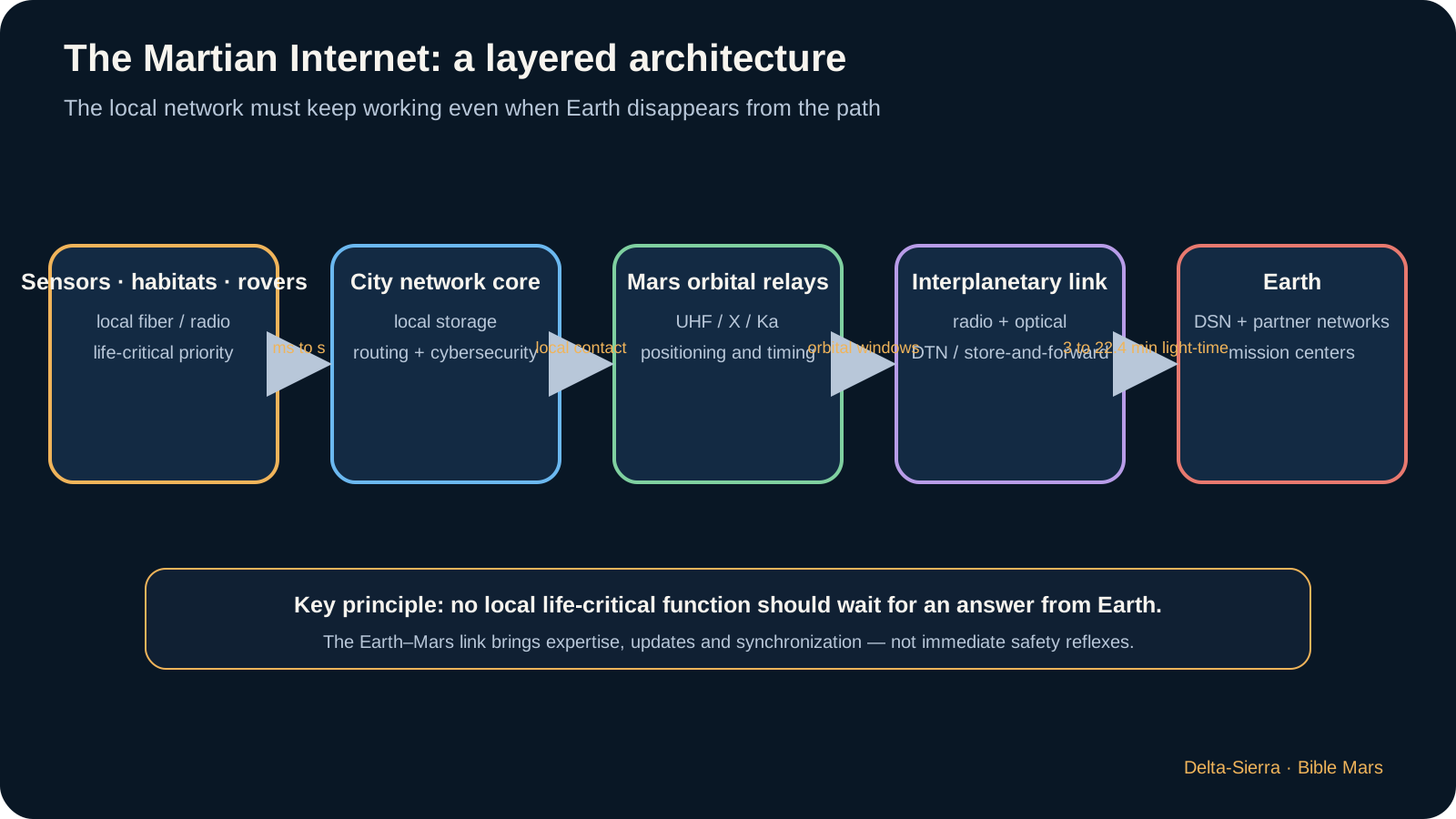
Distance imposes a cultural as well as a technical change: a Martian city cannot be managed in real time from Earth. Communications can transport data, but urgent decisions must remain local.

From science relay to public service: treating the Martian network as critical infrastructure
In 2026 the subject is no longer entirely speculative. Mars already has an international robotic relay network, NASA has asked industry for a high-performance Mars Telecommunications Network, and autonomous navigation plus disruption-tolerant networking have been demonstrated in space. The central question is therefore historical as well as technical: how does an infrastructure built for a few rovers evolve into the nervous system of permanent human presence?
The real network in 2026: four orbiters, scheduled passes and measurable traffic
The active Mars Relay Network uses Mars Odyssey, Mars Express, Mars Reconnaissance Orbiter and Trace Gas Orbiter. Rovers use orbiters because proximity links require far less power than direct-to-Earth high-rate transmission. NASA reports surface-to-orbit rates up to about 2 Mbit/s in suitable configurations. But this is not a permanently connected network: it relies on predicted passes, onboard storage, priorities and later forwarding.
Traffic figures for early 2026 show very different roles, with TGO and MRO carrying large relay volumes and Mars Express serving as backup. The end of MAVEN in June 2026 is an operational reminder that resilience depends on alternative paths and spare capacity. Human safety will demand that this lesson be designed in rather than learned after a failure.
MTN 2030: NASA asks for dedicated infrastructure
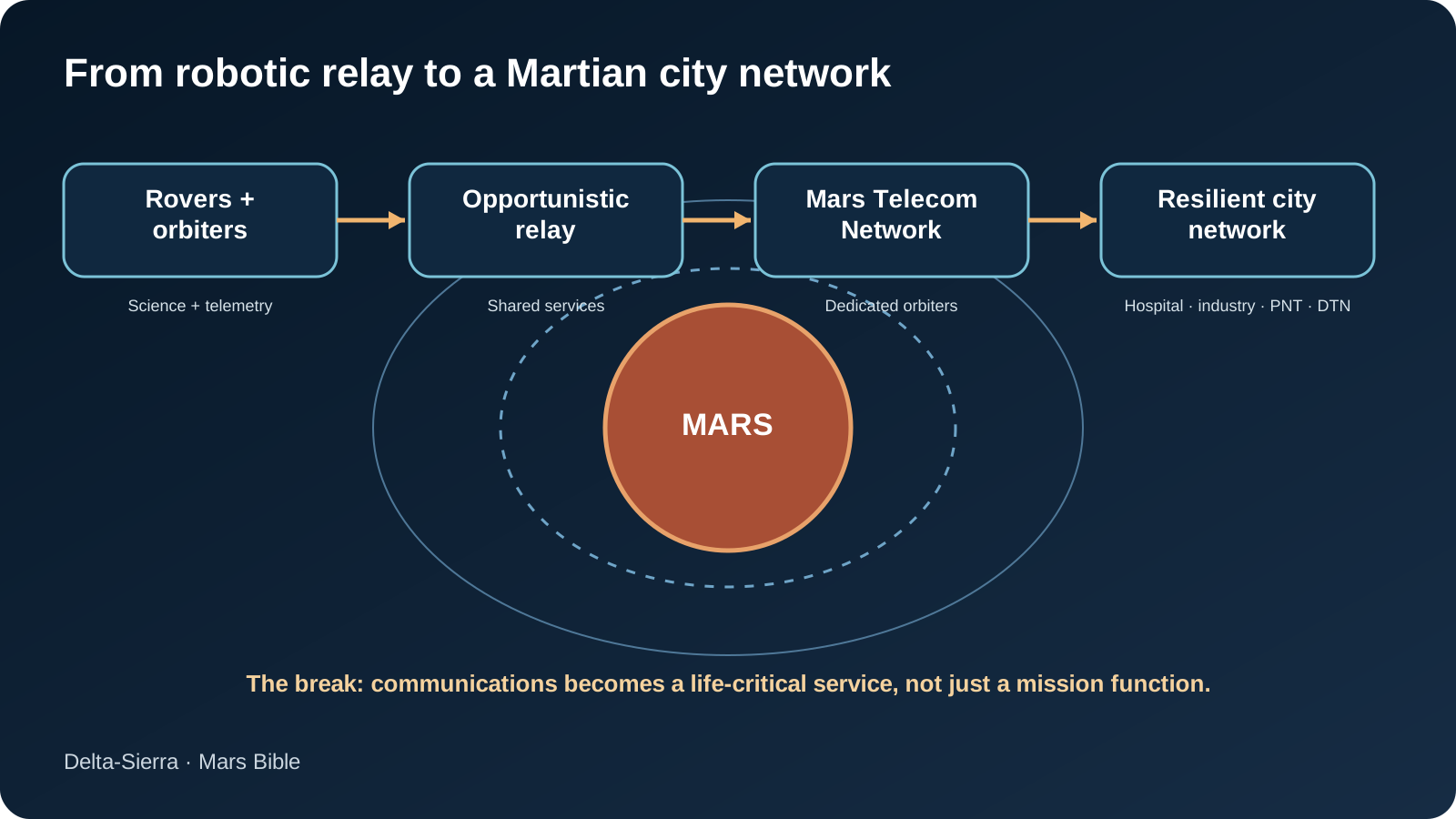
On May 14, 2026 NASA issued a Request for Proposal for a Mars Telecommunications Network using high-performance telecommunications orbiters. The system is intended to support surface, orbital and future human missions and is requested to be ready at Mars no later than 2030. That date does not imply a complete Martian internet. It marks a shift from opportunistic relay to spacecraft whose primary role is networking.
For a settlement, this is analogous to moving from construction radios to a utility. Services must be ranked by more than bandwidth: safety messages, telemedicine, vehicle command, time distribution, science, family video, software updates and backups have different latency, availability, integrity and priority requirements.
DTN and solar conjunction: operating when no end-to-end path exists
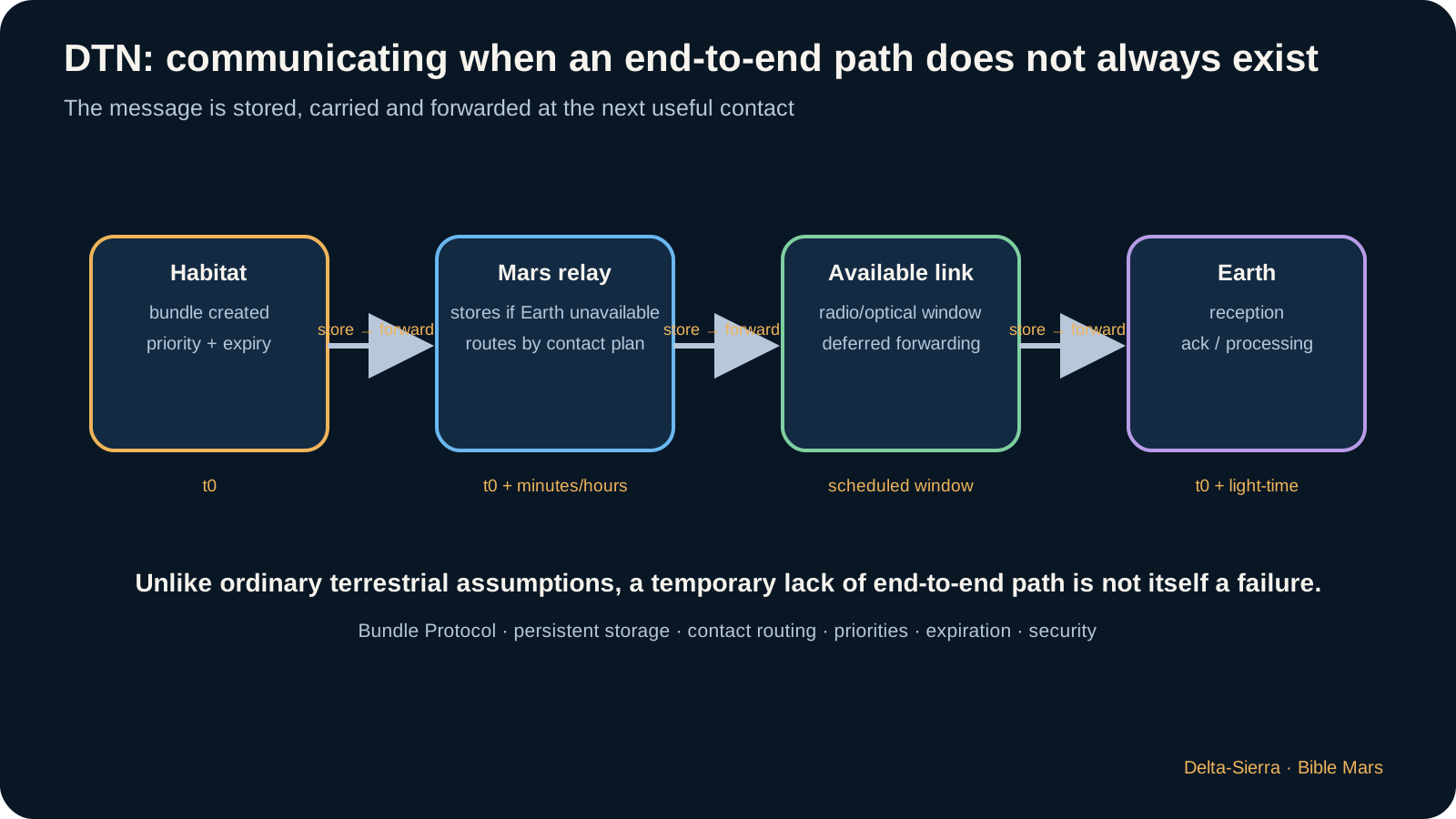
Delay/Disruption Tolerant Networking accepts a fundamental fact of interplanetary communication: a complete path may not exist when data is created. A bundle can be stored persistently, forwarded at the next contact, assigned a priority and expired when it is no longer useful. This matches orbital contacts and deep-space disruptions far better than assumptions of continuous connectivity.
Solar conjunction then becomes an autonomy test for the city. Local pumps, rovers, medical records, industrial control and transactions must continue. Earth remains an extraordinary source of expertise, but it cannot be a synchronous dependency for ordinary survival. A settlement that stops functioning when Earth goes quiet is not yet operationally autonomous.
Store-and-forward changes the meaning of a network outage
A Mars communications system should distinguish loss of an end-to-end path from loss of the information itself. Delay/Disruption Tolerant Networking concepts allow data to be stored at intermediate nodes and forwarded when contact resumes. That does not eliminate urgency: command, crew safety and time-critical navigation products need different expiration rules from science files or maintenance logs. Buffers therefore have capacity, priority and custody policies. If a relay disappears for several hours, the architecture should know which messages remain local, which can use another route and which decisions must proceed without Earth. Autonomy is strongest when the network makes delay visible and manageable rather than pretending that intermittent connectivity behaves like a terrestrial continuous link.
Local state should remain intelligible during communications loss
Autonomy is not merely an automatic controller continuing to run. Crew and onboard software need a coherent picture of current mode, pending commands, stored messages and time since the last trusted Earth product. When contact resumes, reconciliation must prevent a delayed command from undoing a newer local decision. Sequence numbers, timestamps and explicit command validity intervals are therefore safety features as well as networking details.
The day Houston cannot answer in time
Imagine an air leak in a Martian workshop. An alarm appears, a technician must choose between isolating a line and shutting down a pump, and the crew asks Earth for advice. Even in favorable geometry, the answer cannot return on terrestrial conversational timescales. At large separation, the radio round trip alone approaches three quarters of an hour before anyone on Earth has read the message, reconstructed the context and drafted a response. Communication delay therefore becomes an architectural constraint: the settlement needs local procedures, models, authority and data to survive between exchanges with Earth.
NASA currently gives an Earth–Mars one-way light time of roughly 3 to 22.4 minutes depending on planetary geometry. The arithmetic is already decisive: a three-minute one-way delay means at least six minutes round trip; 22.4 minutes means 44.8 minutes. Acquisition, routing, queues, human interpretation and response preparation come on top of that. This is not simply “the Internet with lag.” It is an operating culture in which immediate causality must remain local.
NASA’s Autonomous Systems and Operations work treats autonomy as a mission capability rather than a software convenience for exactly this reason. A Mars crew cannot wait for terrestrial flight controllers to approve every action. Earth remains enormously valuable for expertise, deferred analysis, strategic planning, tele-science and updates. Immediate safety, vehicle control, fire response and fault isolation, however, must be designed to work through periods of silence.
Machines face the same constraint. A rover seeing an obstacle, a power network sensing an overload or life support detecting rising carbon dioxide needs a loop far faster than interplanetary light time. Communications architecture therefore cannot be separated from autonomy, control, cybersecurity and operational governance.
The useful question is not merely how many minutes separate Mars from Earth, but which decisions become impossible to delegate once delay exceeds the dynamics of the event. A valve may need to close in seconds, a rover may brake in fractions of a second and a leak may need isolation within minutes, while a complex medical consultation may tolerate delayed exchange. A settlement therefore needs decision horizons: fast physical loops remain local, mission-level choices can be shared, and strategic decisions can wait for Earth. Light-time becomes an architecture of responsibility.
Delay also changes documentation. A Martian crew cannot depend on procedures that exist only in terrestrial cloud services. Electrical drawings, maintenance history, configuration records, emergency medical knowledge, maps, software, manufacturing models and recovery procedures must be stored locally, versioned and usable offline. At this scale, the network is not only a means of conversation; it becomes the distributed operational memory of the settlement.
A Mars network already exists — but it is only an embryo of human infrastructure
In 2026 the Mars Relay Network is an international constellation of four orbiters: Mars Odyssey, Mars Express, Mars Reconnaissance Orbiter and ExoMars Trace Gas Orbiter. Surface rovers do not attempt to send all science directly to Earth. They use proximity links to orbiters that have more power, larger antennas and better opportunities to contact terrestrial networks. NASA notes that surface-to-orbiter links can reach data rates up to about 2 Mbit/s under suitable conditions.
That architecture is already a systems lesson. A rover does not need to carry by itself the antenna, power and geometry required for every long-haul function. It delegates transport to an orbital layer. The concept resembles terrestrial networking: an end user does not communicate directly with every server on the planet; intermediate infrastructure carries and aggregates traffic. Mars therefore already has, in miniature, something resembling access networks and backhaul.
NASA’s 2026 MRN statistics also show that relays are not interchangeable. For February through May 2026, the agency lists average relay volumes of about 850.6 Mbit per day for MRO and 2,228.1 Mbit per day for TGO, while Mars Express primarily provides backup support. Those values are not a human-settlement requirement. They describe today’s robotic system and illustrate how capacity depends on orbit, pass geometry, spacecraft power, science priorities and Earth contacts.
A human presence would multiply the variety of traffic: telemedicine, maintenance video, mapping, science, manufacturing files, software, environmental monitoring, family communications, education, robotic operations and safety logs. The network can no longer be merely an opportunistic secondary function of science orbiters. It becomes infrastructure that must be intentionally sized, redundant and maintainable.
The current Mars Relay Network is already a powerful architectural lesson. Surface vehicles do not spend all their mass and energy maintaining high-volume direct links to Earth; much of their data is sent to orbiters that can relay it onward. A human settlement would need to turn that scientific arrangement into dedicated, renewable infrastructure: orbital coverage, local surface networking, mobile-vehicle access, common timing and the ability to continue after losing one relay.
The difference is traffic volume and criticality. A city would generate industrial telemetry, medical video, manufacturing files, scientific data, personal communications, local navigation and safety commands. Traffic classes would be unavoidable: life-critical command, alarm, telemaintenance, navigation, science, bulk transfer and entertainment. When bandwidth shrinks, the network must already know what it can sacrifice and what it must preserve.
The life of a data bundle: from rover to mission control
The word “relay” hides a chain of operations. A rover or lander first prepares the data it wants to transmit, considering onboard memory, available energy and the next orbital pass. When a compatible orbiter becomes visible, a proximity link can be established using frequencies suited to the short range. The orbiter receives the data, stores it, and later forwards it to Earth when geometry and scheduling allow. The data may therefore already be hours old before it reaches a Deep Space Network or partner antenna.
The Mars Relay Network Handbook published in August 2026 is valuable because it treats this network as a service with interfaces, capabilities and responsibilities. A relay is not permanently available magic: orbiters have trajectories, pointing constraints, their own science missions and shared communications resources. For human settlement, that operational reality becomes a lesson: bandwidth has to be scheduled like power and water.
MaROS: the infrastructure already has a coordination layer
The Mars Relay Operations Service — MaROS facilitates telecommunications coordination between landed and orbiting spacecraft operators. The “Martian internet” therefore begins not with antennas but with organization: who requests a pass, who resolves conflicts, how data flow is tracked, how incidents are investigated and how agencies cooperate. A human settlement would add permanent medical, safety, navigation, industrial-control and civil-communications needs to that scientific coordination.
The scale change is enormous. A rover can wait for another pass if a science image is delayed. A hospital cannot always treat clinical data the same way. A human network needs quality of service, priority, redundancy and pre-emption rules so that critical information can move ahead of bulk traffic without making the network useless for science and industry.
The Martian Internet will not be the terrestrial Internet with twenty minutes of delay
Terrestrial Internet protocols grew up in a world where an end-to-end path usually exists and a lost packet can often be requested again within milliseconds. Interplanetary space breaks that intuition. Mars can occult a relay, an orbiter can leave the horizon, optical ground stations can lose weather availability, and a high-value link can be scheduled for another mission. The complete path may not exist at the moment data are created.
Delay/Disruption Tolerant Networking, or DTN, is designed for that condition. Its central idea is store-and-forward: a node keeps a data “bundle” in persistent storage, waits for the next useful contact, then forwards it. Bundle Protocol does not assume a continuous circuit from Mars to the ultimate destination. Contact plans, priorities, expiration times and custody become first-class engineering concepts.
This changes storage design. An instrument producing 50 Mbit/s for eight hours generates 50 Mbit/s ÷ 8 = 6.25 MB/s, and 6.25 × 3,600 × 8 = 180,000 MB, or roughly 180 GB. If the transmission window disappears, those 180 GB are not an exceptional error condition; they are a physical queue that must be stored, prioritized, verified and perhaps compressed. At city scale, networking and storage are inseparable.
The network must also know what can wait. A medical alert of a few kilobytes can matter more than a terabyte of mapping already backed up elsewhere. Critical commands should not sit behind entertainment video. The quality of a Martian Internet will therefore be measured less by a peak-rate headline than by whether it preserves the right information in the right order on bad days.
Many terrestrial protocols were designed around an end-to-end path that exists during the exchange and acknowledgements that return quickly enough to guide transmission. Interplanetary space breaks those assumptions through orbital geometry, occultations, solar conjunction, pointing limits and long latency. DTN treats disruption as a normal property. A node can accept a bundle, keep it on persistent storage and forward it at the next scheduled or discovered contact. Information begins to move like cargo through a logistics network.
That immediately creates governance questions. How long is a bundle valid? Who may assign emergency priority? What happens if duplicate commands exist after recovery? How is a message authenticated after waiting for hours inside a relay? Delay tolerance therefore has to be coupled with identity, time, integrity, expiration rules and command semantics. DTN is not merely a throughput trick; it becomes part of system safety.
Will Mars have its own GPS? Position, navigation and timing become a shared service
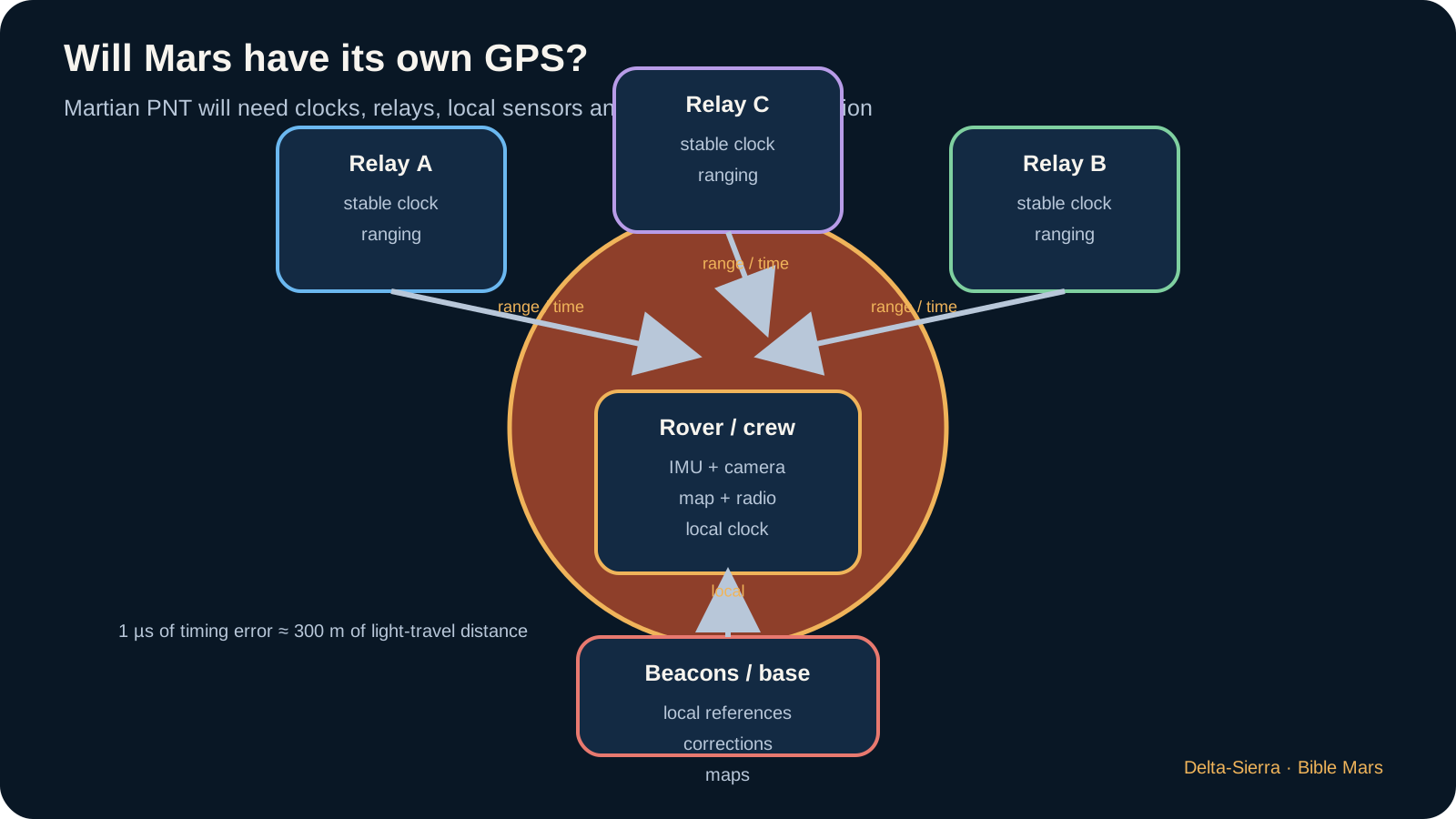
Earth GPS works because a constellation broadcasts extremely precise timing and orbital information. Mars has no equivalent constellation today. Rovers combine odometry, inertial sensing, imagery, orbital maps, radio and estimation support from Earth. That mosaic is adequate for slow robotic vehicles under strong supervision; it becomes far more restrictive when convoys, drones, construction machines, emergency vehicles and crews move over hundreds of kilometres.
The 2024 JPL study on Positioning, Navigation and Timing at the Moon and Mars explains why some lunar concepts do not scale outward. Weak terrestrial GNSS signals can still contribute to some lunar scenarios. At Mars they become impractical. Dedicated architecture, stable clocks, orbit determination and local services are needed.
Time then becomes distance. Light travels about 299,792,458 metres per second. A timing error of one microsecond — 1 µs = 0.000001 s — corresponds to about 299.8 metres of light-travel distance. Ten nanoseconds still correspond to roughly three metres. That does not mean a navigation system inherits those exact position errors, because multiple measurements are fused, but it shows why clocks are navigation sensors.
A Martian settlement could therefore grow its own PNT capability in stages: orbiting relays with stable clocks, surface beacons around inhabited zones, shared maps, local corrections, inertial navigation, vision and radio ranging. A “Mars GPS” may emerge first as islands of service around settlements before becoming a planet-wide system.
A Martian PNT service would probably not begin as a miniature copy of terrestrial GPS. It could start with stable clocks on a few relays, radio ranging, orbital maps, local beacons and fusion with onboard inertial and vision systems. As traffic grows, the value of a shared reference grows rapidly. Autonomous rovers, cranes, pressurized convoys, drones and EVA crews all need mutually consistent positions, maps and time to avoid conflicts.
Time is as important as position. A ranging measurement derived from propagation time can become wrong when clocks diverge. One microsecond corresponds to roughly three hundred metres of light-travel distance; that does not mean a complete PNT system automatically suffers a three-hundred-metre position error, because multiple measurements and geometry are combined, but it shows why synchronization cannot be treated as a convenience. A Martian city will eventually need timing as infrastructure.
Radio, Ka-band and laser: the future will probably be hybrid
Radio remains the robust, proven tool of deep space. Deep Space Network antennas communicate with distant spacecraft particularly in X and Ka bands. Radio offers mature acquisition and degraded-mode options, but a human mission’s demand for video, science, telemedicine, mapping and large software transfers pushes toward far higher capacity.
Optical communications concentrate energy into an extremely narrow beam. NASA/JPL’s DSOC demonstration showed data rates far beyond comparable radio systems and NASA reported in 2026 that the two-year demonstration completed reliable high-rate optical communications over interplanetary distances. That does not make radio obsolete. Optical links demand precise pointing and, for ground receivers, availability can be affected by weather and atmospheric conditions.
A credible architecture therefore layers multiple media: robust radio for commands, telemetry and degraded operation; higher-rate radio when geometry and resources permit; optical links for bulk data; local fiber and radio across the surface; orbital relays to aggregate traffic. Diversity reduces dependence on a single failure mode.
The lesson is industrial too. A superb optical terminal is useless if a pointing mechanism cannot be repaired. A high-performance Ka-band amplifier that has no spare path becomes a liability. Human networks must be designed around replaceable interfaces, low-rate survival modes and long periods of reduced capability.
Radio brings a deep heritage of robust commanding, telemetry and radiometric navigation. Higher radio frequencies can provide more bandwidth but demand tighter pointing and can be more sensitive to the terrestrial atmosphere. Optical communications can provide much higher rates for comparable aperture and power, as deep-space laser demonstrations have shown, yet require extremely accurate pointing and receiving sites that cannot see through clouds.
A resilient human architecture therefore benefits from diversity rather than technological dogma. Emergency commands may favor a mature low-rate radio path; bulk science may wait for an optical opportunity; surface networks can mix fiber, radio and other media. The important word is not 'laser' or 'Ka' but diversity: different physical media remove some common-cause failures and permit graceful degradation instead of total loss.
Solar conjunction: learning to operate when Earth becomes a distant partner
When the Sun approaches the Earth–Mars line of sight, solar plasma can seriously degrade radio propagation and increase the risk of corrupted commands. Robotic missions already plan conservative operating periods around solar conjunction. A human settlement cannot treat the event as a surprise: the geometry is predictable months in advance and should trigger a prepared operating mode.
Before conjunction the settlement can preload software, medical references, maintenance procedures, manufacturing files, education content, science plans and data expected to be useful during the reduced-contact period. Non-urgent activities are rescheduled. Decisions normally escalated to terrestrial authority receive explicit temporary delegation. Automated systems can adopt more conservative configurations while remote expertise is harder to reach.
NASA studies have also considered relay geometries intended to reduce conjunction outages. This illustrates that autonomy and infrastructure are complementary levers: make Mars more capable locally, and improve the network where practical. Neither eliminates the need to assume that contact can still be lost.
The honest test of a Martian communications architecture is simple: what happens if Earth disappears for a day, then for a week? Which services continue? Which degrade? Which decisions become local? What data must already be stored on Mars? That turns telecommunications resilience into an exercise in governance.
Solar conjunction is more than a slower connection. When Mars lies near the Sun in Earth's sky, solar plasma degrades radio propagation and increases the risk of corrupted commands. Missions adopt special procedures and often reduce commanding. A settlement should treat this recurrent geometry as an operational season: preload software, synchronize critical knowledge, prepare medical references, schedule industrial work and increase communication reserves before the link becomes poor.
This becomes a natural maturity test. If the settlement cannot operate for days with strongly reduced Earth support, it is not operationally autonomous. Conjunction can therefore be used as a planned resilience exercise that verifies local authority, automation, logistics and knowledge stores before a real emergency removes Earth unexpectedly.
Cybersecurity and authority: a network packet may command a pump, airlock or rover
On Earth, a cyber incident can stop a factory. On Mars, the boundary between cyber and physical safety is thinner. The same network carries commands to power, air, robots, airlocks, workshops and vehicles. A compromised identity, badly signed update or false timebase can therefore create immediate material consequences.
Security cannot rest on the belief that “nobody will attack Mars.” It begins with architecture: segmentation between life-critical and comfort networks, strong authentication, command signatures, auditable logs, local key management, least privilege, manual fallbacks and the ability to reject a syntactically valid command when it contradicts the locally observed physical state.
Earth–Mars delay also forces a doctrine of authority. Who may shut down a reactor? Who may close a shared airlock? Who can immobilize a rover owned by another organization? A terrestrial command received twenty minutes later may have become dangerous because the situation changed. Commands therefore need context, validity windows and local execution conditions.
This ties networking to governance. An information-autonomous settlement is not isolated from Earth; it is capable of deciding when an external message is advice, when it is strategic authority and when it can no longer be executed without local judgment.
On Mars, cybersecurity and industrial safety converge. A compromised credential may become an open valve; a corrupted update may disable life support; a false clock may invalidate a navigation sequence. Vital, scientific and personal networks should be segmented, privileges limited, software signed, known-good configurations retained and changes logged. Security recovery also has to work without Earth: revoking a key, isolating a segment or restoring a version cannot depend on an interplanetary round trip.
Autonomy does not mean software owns every decision. A pump may trip automatically on overpressure and a rover may avoid an obstacle, but a reconfiguration that permanently abandons part of a habitat or consumes strategic reserves belongs to a higher authority. Designing the network therefore also means designing boundaries of authority, escalation and human responsibility.
On Mars, a cyber incident can become a physical incident
A settlement network will connect systems that move matter and energy: pumps, valves, chargers, vehicles, doors, medical devices and crop systems. Cybersecurity therefore cannot be reduced to data theft. A malicious command or compromised update could create an air failure, collision or sterilization defect.
The first defence is architecture: segmentation between administrative networks and control systems, strong authentication, signed software, logging, least privilege, manual modes and offline backups. The second is recovery. A settlement must be able to rebuild a controller, restore a known configuration and continue operating even when part of the network is treated as hostile.
Earth delay makes local resilience more important. Terrestrial cybersecurity teams can help analyse an incident, but they cannot decide in real time which valves to isolate. Local operators need authority and tools, turning cybersecurity into a civil-safety competence.
From four people to a city: networking changes nature with scale
For four people, a local network may fit inside a handful of switches, radios and redundant computers. At twenty people, operations, health, laboratory work, maintenance and private use already compete. At one hundred, multiple teams, workshops, habitats and vehicles operate simultaneously. At one thousand, the problem resembles a critical utility: network core, local data centers, backups, identity services, public services and on-call teams.
Growth is not linear. Doubling population does not merely double traffic. The number of interactions grows, services diversify and a failure affects more people. Networking evolves from mission equipment into a civic institution with maintenance obligations, availability targets and separation between essential and optional services.
The 2026 National Academies science strategy reinforces the point: human campaigns on Mars aim to produce complex observations about life, geology, climate, water and the human environment. Science itself becomes a major consumer of storage, computation and telecommunications. A weak information infrastructure does not merely reduce comfort; it limits what human presence can learn from Mars.
The Martian network is therefore political infrastructure in the broadest sense: it determines who can communicate, which information survives disruption, how decisions are documented and how far a community can act without waiting for Earth. It may be one of the least visually dramatic systems and one of the most important in turning a base into a society.
With four people, much coordination can still happen by voice and a handful of consoles. At twenty, teams, workshops and shifts appear. At one hundred, identity management, traffic priorities, data retention and network maintenance become permanent jobs. At one thousand inhabitants, communications are no longer a mission subsystem; they are urban infrastructure with operators, physical redundancy, security governance, spares and defined levels of service.
Scaling also creates data-sovereignty questions. Medical records, manufacturing recipes, infrastructure drawings and scientific archives need replication, backups and ownership rules. 'Where is the truth?' becomes operational when two bases have spent hours editing different versions of a procedure. Version control, synchronization and conflict resolution become as important to continuity as antennas and transmitters.
2026: When Mars relay begins to look like infrastructure
For decades, Mars communications were assembled mission by mission. A rover carried a proximity radio, a science orbiter doubled as a relay, and the Deep Space Network returned the data to Earth. That opportunistic architecture has been remarkably successful, but it is not the scale of a human settlement. A crewed base produces life-critical telemetry, medical records, industrial models, navigation data, video, science, private communications and safety commands. It cannot treat communications as a useful side effect of aging science spacecraft.
On 14 May 2026 NASA issued a Request for Proposals for a Mars Telecommunications Network. The official notice calls for high-performance Mars telecommunications orbiters supporting surface, orbital and future human exploration, with the network expected to be ready to operate at Mars no later than 2030. That date is not a promise that a Martian Internet will be complete in 2030. The more important change is institutional: NASA is treating Mars communications as infrastructure worthy of dedicated vehicles and continuing service.
The existing Mars Relay Network explains the transition. Odyssey, Mars Reconnaissance Orbiter, Mars Express and Trace Gas Orbiter have served surface missions as relay assets. A short UHF hop from a rover to an orbiter can be far more efficient than a direct Earth link because the range is thousands rather than tens or hundreds of millions of kilometres. The orbiter stores data and forwards it when geometry and schedules allow. NASA's MaROS service makes this operational chain visible: data has a route, a pass, a relay, a delivery time and sometimes a retry.
For a city, that becomes a governance question. When does telecommunications stop being a mission subsystem and become a public utility? If hospitals, power plants, rovers and factories share the network, service classes, priorities, ownership and repair responsibilities must be explicit. A failed orbiter is no longer merely inconvenient for science; it may reduce medical capability or isolate a vehicle. The birth of the Mars Telecommunications Network is therefore a useful historical pivot from a network of missions toward infrastructure for society.
Mars Telecommunications Network: when a mission network becomes infrastructure
In May 2026 NASA released an industry request for proposals for a Mars Telecommunications Network intended to provide high-performance services to orbital, surface and future human missions, with capability requested at Mars no later than 2030. The historical importance lies less in the date than in the change of philosophy: instead of requiring every mission to carry nearly all of its own communications chain, the architecture begins to treat communications as a shared service.
Shared infrastructure changes mission economics. If a lander can rely on a powerful relay, its own long-range antenna can be smaller or its surface data rate much higher. If several vehicles use the same service, fixed orbital infrastructure costs can be distributed. But the shared dependency creates a common-mode risk: failure of the network affects many missions at once. The architecture therefore has to combine mutualization with resilience.
Eventually the issue becomes political. Who funds the network — NASA, ESA, private operators, the Martian settlement? Can a commercial operator prioritize its own vehicles? What minimum service remains available for emergencies? Who allocates spectrum and network identities? At what point does exploration infrastructure become a de facto public utility? Mars colonization begins to meet questions terrestrial societies already know from electricity, water and internet access.
DTN: design for the absence of connectivity
Terrestrial networking usually assumes that two endpoints can establish an interactive path with modest delay. Earth and Mars violate that assumption. Light time alone creates minutes of one-way latency, orbital motion creates visibility windows, an orbiter disappears behind the planet, and solar conjunction can make communications unreliable. Treating the system as ordinary Internet with a very long ping would build fragility into the architecture.
Delay/Disruption Tolerant Networking starts from the opposite assumption: disruption is normal. The Bundle Protocol can package information into units that are stored persistently at intermediate nodes and forwarded when a later contact becomes available. End-to-end connectivity need not exist when the data is generated. Routing can therefore depend on contact plans, priority, storage, expiration and custody rather than on a continuously open path.
That changes the meaning of network time. A leak alarm is nearly worthless if it arrives hours too late; a geological archive can wait; a signed medical record must remain authentic across multiple stores; a software update must never be mistaken for a complete file if only part arrived. The network must manage priority, integrity, lifetime and security, not merely move bytes.
A simple scenario shows the storage problem. A site generating 50 Mbit/s for eight hours without its primary link produces 50 × 28,800 = 1,440,000 megabits. Divide by eight to convert bits to bytes and the result is roughly 180 gigabytes before protocol overhead and replicas. Disruption therefore becomes a storage and policy problem as much as an antenna problem.
Inside a habitat, conventional low-latency networks will still make sense. Across planets, asynchronous networking is unavoidable. A Martian Internet will therefore be a federation of networks with radically different timing assumptions, linked by gateways that understand delay as a normal physical property.
Bundle Protocol, LTP and custody: design for disruption instead of suffering it
Much of terrestrial networking assumes that an end-to-end path exists while two systems communicate. Between Earth and Mars that assumption fails. Contacts are intermittent, delays are enormous and orbital geometry is partly predictable. Delay/Disruption Tolerant Networking turns the constraint into a model: a node can durably retain a unit of data — a bundle — until a useful contact becomes available.
LTP can provide reliable transfer across selected long-delay links, while custody mechanisms allow an intermediate node to accept responsibility for retaining data until it can forward them. Memory therefore stops being a temporary buffer and becomes a networking function.
A contact plan can exploit predictable geometry: a relay may be visible in forty-two minutes for an eight-minute pass, another station may become available later, and the router can select a path through time as well as space. A bundle bound for Earth begins to resemble freight moving through scheduled connections rather than a continuous phone call.
Prioritizing when everything cannot leave at once
Suppose a base accumulates 180 GB during an eight-hour interruption. A 200 MB emergency medical package, 2 GB of industrial fault logs and 150 GB of science imagery do not have the same urgency. The network needs service classes, expiration times and priority rules. But there is an obvious failure mode: if every department marks its traffic “critical,” priority stops meaning anything. Network governance therefore needs categories that survive operational and political pressure.
Security interacts with latency. A bundle may remain stored across several nodes for a long time. Integrity, authentication and access control must survive that journey. A command that arrives after the operational situation has changed can be dangerous even if it is authentic. Expiration and temporal context are therefore safety functions, not housekeeping.
Radio and optical links: bandwidth becomes a civic budget
Optical communications are compelling because a narrow beam can deliver very high data rates with limited transmitted power. JPL's DSOC demonstration achieved 267 Mbit/s at about 31 million kilometres and continued communicating at far greater distances. That does not mean a Mars colony will receive 267 Mbit/s at all times: range, pointing, weather at Earth terminals and station availability matter. It does demonstrate that high-rate deep-space optical communications have moved beyond a paper concept.
Human Mars networks will probably be hybrid rather than purely optical. Local links can use wired networks, UHF and other radio systems; relay orbiters can support several bands; Mars-to-Earth trunks may combine X/Ka radio and optical channels. The key word is diversity: different paths, different frequencies, different Earth stations and graceful degradation.
The architecture must then answer civic questions: how much energy is reserved for information, which data stays local, which services survive total Earth isolation, and which communication capability must survive the loss of a flagship relay? What a settlement chooses to store and protect reveals what it considers vital.
DSOC: turn a record into a human-scale data-transfer example
The Deep Space Optical Communications — DSOC demonstration achieved 267 Mbit/s from roughly 31 million kilometres. Converting the number gives intuition. A 100 GB file contains about 800 gigabits. In an idealized case where 267 Mbit/s remained constant and protocol overhead were ignored:
t = 800 Gbit ÷ 0.267 Gbit/s ≈ 2,996 s ≈ 49.9 min.
The calculation is deliberately ideal. Data rate falls with geometry and distance; terrestrial weather can close an optical site; pointing has to be extremely accurate; coding, protocols and contact schedules reduce useful throughput. But the example makes the scale difference between a few megabits per second and hundreds of megabits per second tangible.
For a settlement, optical links could carry bulk science, imagery, database replication, digital twins and cultural media. Radio will probably remain essential for robustness, commanding, poor-weather availability on Earth and many local links. The most resilient architecture is therefore likely hybrid rather than “laser only.”
Four, twenty, one hundred, one thousand people: scaling the network
For four people, simplicity is a safety feature. One habitat, a few rovers, a small number of relay paths, local caches and well-understood procedures may be enough. Critical backups can be physically separated and knowledge duplicated on independent media.
At twenty people the base becomes an organization. Multiple EVAs, laboratories, workshops and medical functions compete for capacity. Traffic must be segmented and logged; local services must remain usable when Earth is absent; storage becomes an operational library rather than a mission recorder.
At one hundred people, vehicles and industrial processes multiply the data faster than population alone would suggest. Identity management, off-site backup, network operations and cybersecurity become permanent jobs. Partial failure must not interrupt air, water or power.
At one thousand people the system resembles a critical infrastructure operator: several data centres, physically diverse paths, spectrum governance, orbital relays, local positioning and professional maintenance teams. Losing Earth for days should be a planned operating mode, not an apocalypse scenario.
A quantified scaling scenario — explicit assumptions, not a forecast
To make scale concrete, consider a pedagogical scenario in which the amount of data worth retaining averages 20 GB/day for four people, 80 GB/day for twenty, 500 GB/day for one hundred and 5 TB/day for one thousand. These are not NASA requirements or predictions. They simply illustrate how science, video, predictive maintenance, health records, digital twins and backups can grow with population.
| Population | Data retained / day | 14-day Earth-loss cache | Main issue |
|---|---|---|---|
| 4 | 20 GB | 280 GB | simplicity and survival |
| 20 | 80 GB | 1.12 TB | priority and redundancy |
| 100 | 500 GB | 7 TB | local services and replication |
| 1,000 | 5 TB | 70 TB | data centres, cyber and public service |
Raw storage is not the hard part: seventy terabytes is modest by modern terrestrial standards. The challenge is maintaining hardware, verifying backups, powering and cooling servers, replicating data and deciding what must be synchronized to Earth. A settlement can therefore become highly autonomous locally while remaining scientifically and culturally connected to its origin planet.
From mission network to Martian public utility: the 2026 turning point
For decades, Mars communications were built around individual missions. A rover carried a radio, a science orbiter might provide a relay pass, the Deep Space Network handled the long Earth link, and mission teams negotiated schedules. That architecture worked because the user population was small, identified years in advance and operated by a handful of specialist centers. Human settlement changes the category of the problem: communications stop being merely a mission subsystem and become a collective utility, as fundamental as power, water or air.
NASA crossed a symbolic threshold in May 2026 by issuing an industrial Request for Proposals for a Mars Telecommunications Network. The public requirement calls for high-performance Mars telecommunications orbiters supporting surface, orbital and future human exploration. The consultation’s target of having capability at Mars no later than 2030 does not mean a complete “Martian Internet” will exist by then. It means something more consequential: communications capacity is beginning to be treated as infrastructure to be supplied, rather than an accessory designed separately for every spacecraft.
The transition resembles the history of terrestrial utilities. At first every remote site owns its generator; later a power grid appears. At first every Mars mission owns a communications solution; as users multiply, shared orbiters, standards, planning, security and contingency capacity become rational. Infrastructure is not only about throughput. It introduces availability, quality of service, priority, spectrum governance, maintenance, replacement orbiters and continuity when one operator or asset disappears.
The real Mars Relay Network: an international network before the first human base
The Mars Relay Network already provides a concrete multi-mission model. Its participation documentation describes surface relay-service users, orbiter service providers, deep-space tracking networks and coordination tools. A rover need not continuously send a tiny signal all the way to Earth: during an orbiter pass it can transfer stored data over a much shorter path at higher rate, then let the orbiter carry the burden of the interplanetary link. This separation reduces surface radio mass, power and antenna size while increasing useful data return.
The 2025 Participation Guide states that orbital relay has become so central that more than 99 percent of the data for current rovers is returned through that type of chain. A settlement would extend the concept: local surface networks, high sites, mobile relays, orbiters, optical and radio terminals, then Earth–Mars backhaul. “Communications with Earth” should therefore stop being drawn as one heroic dish beside a habitat. A town will operate several nested networks, each capable of degrading without forcing all the others to vanish.
The 2026 Handbook: the real plumbing behind the word “relay”
NASA’s official Mars Relay Network portal now lists an updated MRN Handbook dated 3 August 2026, alongside the Participation Guide and Technical Support Package. For service architecture, the handbook is useful because it moves from block diagrams to actual orbiter capabilities, interfaces, procedures and planning constraints. It describes who requests a pass, who accepts it, how radio parameters are exchanged, how conflicts are resolved and under which rules a new agency or organisation joins the network.
The Participation Guide already reveals another important transition. NASA is preparing MaROS for a DTN-enabled future, including work on generating contact-graph routing plans from data already hosted in the relay coordination system and using them to simulate DTN transactions. The boundary between “relay scheduling” and “network routing” begins to blur. Orbital motion becomes network information: a link may not exist now, but the system knows that it should exist fourteen minutes from now for a six-minute interval and can prepare for that encounter.
Who owns the network of a Martian city?
An institutional question appears early. If an orbiter belongs to an agency, a surface station to a company and a hospital to a Martian municipality, who decides that an urgent medical bundle outranks a backlog of science imagery? Protocols can carry priority classes, but protocols do not define public policy. A settlement needs rules: protected capacity for life-safety services, emergency precedence, science allocations, mutual backup between operators and auditable logs explaining why data were delayed or discarded.
This need not begin as a grand “Martian Ministry of the Internet.” Early governance may simply be an operational agreement among a few partners. But at one thousand residents, water systems, autonomous vehicles, clinics, workshops and schools continuously exchange data. A network failure becomes a city failure. Information-system availability therefore becomes a safety property, as real as electrical redundancy.
Solar conjunction: design a city that does not wait for Earth to return
Solar conjunction is a powerful test of operational autonomy. When Earth, the Sun and Mars align unfavorably, solar plasma can degrade radio links and mission rules may reduce, delay or suspend some commanding. The difficulty is not merely that messages take longer. A settlement that needs Earth’s approval for every consequential action is structurally weak during these periods.
Preparation begins before the communications impairment: synchronize databases, download procedures, update maps and models, preload software, verify medical knowledge stores, rehearse emergencies and identify the decisions that local authorities are authorized to make. Conjunction becomes a rehearsal for operational sovereignty — Earth remains intellectually present but temporarily disappears from the control loop.
The network must also plan for accumulated data. If industrial systems generate gigabytes of diagnostics, a hospital stores imaging, and science continues acquiring observations, restoration of the link creates a transmission debt. Queues need to be reordered: safety alarms and event logs first, medical data needing Earth expertise next, then science and lower-priority archives. The end of the outage is not an instantaneous return to normal; it is the beginning of controlled backlog recovery.
A mature city must finally accept a counter-intuitive rule: Earth cannot be the primary server for daily Martian life. Mapping, local messaging, health records, industrial control, educational libraries and operational AI models must exist locally. The interplanetary link becomes a synchronization, enrichment, backup and consultation path — not a prerequisite for every click.
The operational relay network is already a shared international service
The present Mars Relay Network is not an abstract future architecture. Surface missions schedule UHF proximity passes with orbiters, data is stored aboard the relay, then forwarded to Earth through deep-space links. NASA and ESA assets have therefore become part of an operational chain in which a science orbiter can provide a communications service to another mission. That history matters because a human-era network will inherit procedures, spectrum practice and inter-agency coordination rather than start from a blank sheet.
MaROS makes this operational layer visible. A useful way to explain the network is to follow one data product from rover memory to a scheduled orbital contact, into relay storage, through a later Earth-facing pass and finally to the mission system. Missed contacts, competing users, geometry and urgency all affect when the data arrives. A city-scale system would add hospitals, industrial control, navigation services, scientific archives and public communications to that queue.
Resilience means deciding what remains local when Earth disappears
Solar conjunction turns a familiar engineering constraint into a governance test. Local maps, medical records, technical manuals, authentication material, software packages and critical scientific data cannot depend on immediate access to terrestrial servers. A Martian network must therefore define which information is authoritative locally, how long replicas are retained, how conflicting updates are reconciled and who is allowed to override normal priorities during an emergency.
Cybersecurity becomes physical safety in this setting. A compromised account that can only leak an email on Earth is not equivalent to an account that can command a rover, alter an environmental set-point or deny access to medical data. Segmentation, offline recovery, key rotation, signed software, audit trails and deliberately limited command authority belong inside the communications architecture, not in an appendix added after the network is built.
A human-era network is both transport and a public institution
The 2026 Mars Telecommunications Network procurement is important because it marks a shift in language: future relay capacity is being treated as infrastructure intended to serve multiple missions, including human missions. Once communications, positioning and emergency services are shared by many users, questions normally associated with public utilities appear. Who receives priority? What service level is promised? How is spectrum allocated? Which failure is acceptable? How does one operator prove that a maintenance action will not isolate another settlement?
That does not mean Mars already has a public internet. It means the engineering trajectory is moving from mission-specific links toward shared services. A useful history of Martian communications should therefore connect the robotic relay era to a future in which reliable information flow is as foundational to settlement as power, air and water.
A day in the Martian network: follow one dataset from surface to Earth
Imagine a rover producing a scientific image sequence at 10:00 local time. The files are first stored onboard. The next usable orbiter pass may occur later; the relay session must be planned, radios must wake at the right moment, and data move to the orbiter. Depending on the spacecraft, the orbiter may forward quickly or store the data for a later downlink. A file becomes a logistical object.
That is why raw bitrate is not enough. A 2 Mbit/s link for ten minutes offers a theoretical 1,200 megabits, roughly 150 megabytes before protocol overhead and margins. If several instruments want the same pass, priority policy is required. Human presence adds medicine, safety, maintenance and private communications.
Storage is therefore part of networking. At 100 Mbit/s of local production during an eight-hour disruption, raw volume reaches 2.88 terabits, about 360 gigabytes. A city cannot simply transmit everything it creates. It must filter, compress, replicate locally and decide what deserves interplanetary transport.
At one thousand residents the Martian network will primarily be a fast local network connected to Earth through a slow, variable and intermittent gateway. Maps, medical records, software, documentation, messaging, AI models and backups will need local hosting. Information autonomy begins when losing Earth degrades services without stopping society.
Case study — size autonomy from light-time
At 225 million kilometres, t = d/c with c ≈ 299,792 km/s gives about 750 s, or 12.5 minutes one way. A question and its answer cannot therefore close a loop in less than about 25 minutes before processing time. Urgent decisions have to be local.
A delayed command needs expected state, validity window and cancellation condition so it cannot act on a configuration already changed locally.
Exercises with artificial latency, relay loss and simultaneous incidents measure how long the base preserves vital functions without an Earth reply.
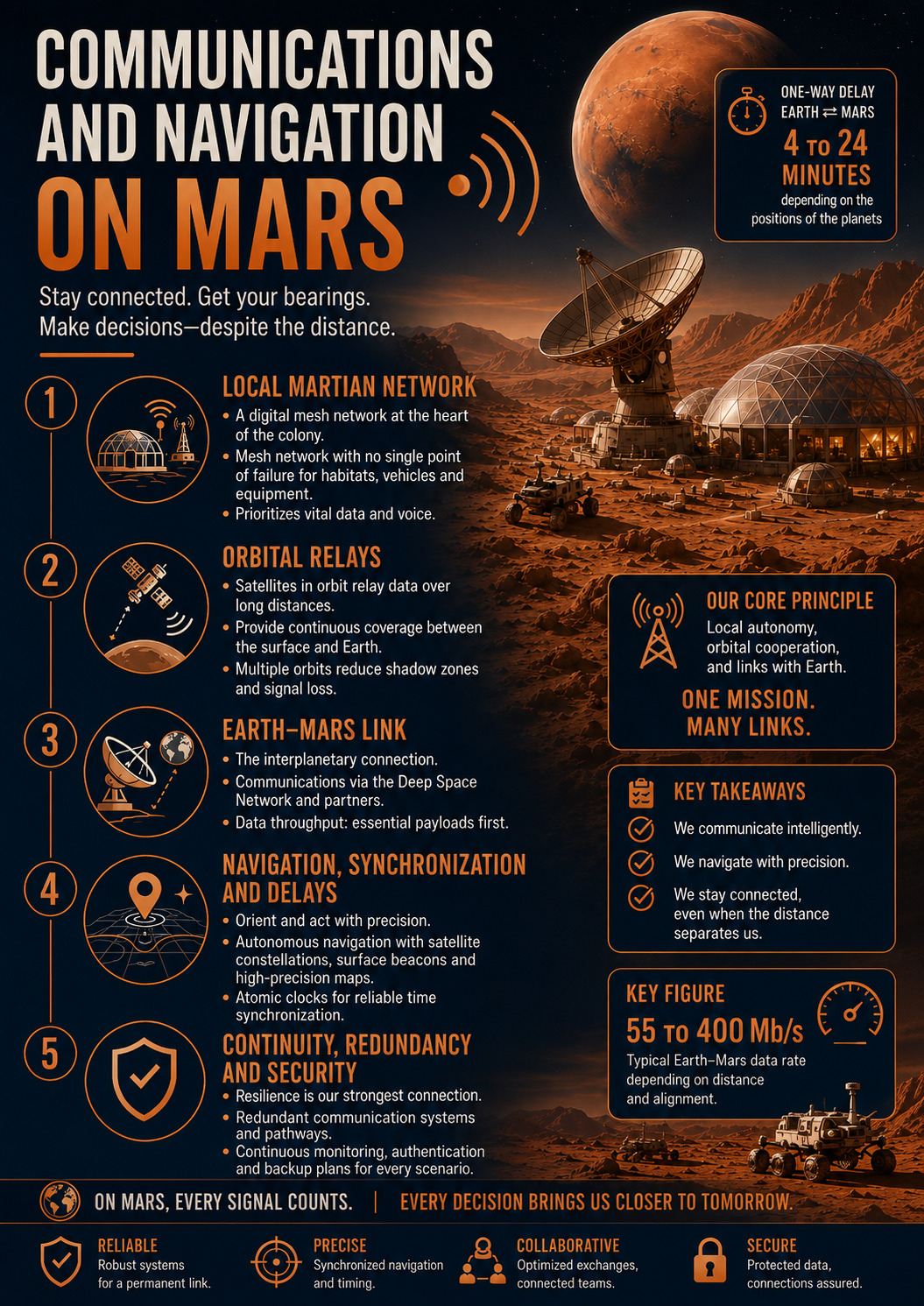
Turn the network into survival infrastructure: capacity, delay, autonomy and local authority
A human settlement on Mars cannot be operated as a distant laboratory in which every meaningful decision is escalated to Earth. Propagation delay is set by interplanetary geometry; more transmitter power cannot remove it. A mature architecture therefore separates four services that are often blended together: moving data, retaining data while paths are unavailable, maintaining shared position/navigation/time, and granting local authority when an Earth response would arrive too late. Once these functions are separated, communications becomes part of safety engineering rather than a convenience layer.
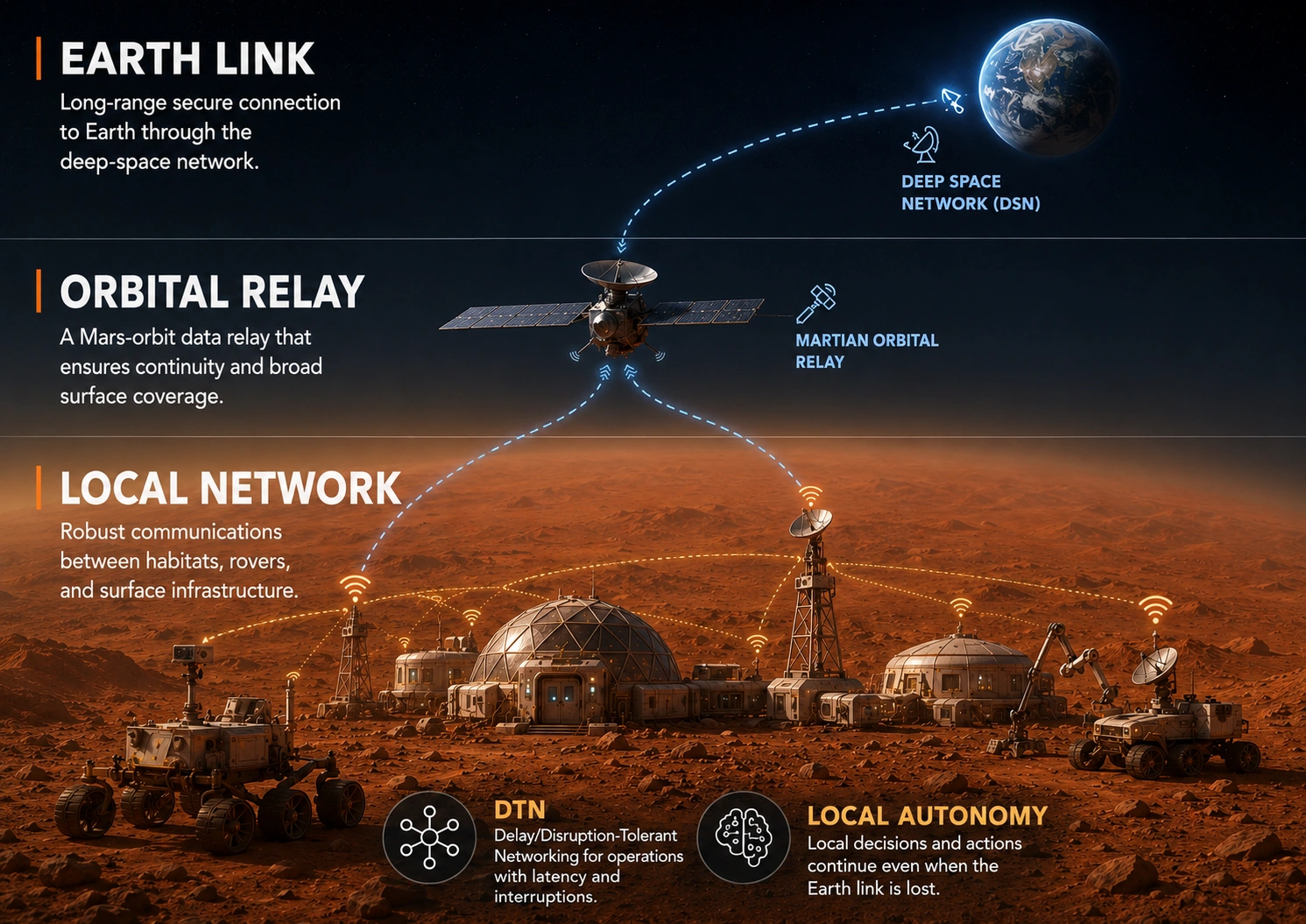
Physics sets the shortest possible conversation
Take an illustrative Earth–Mars distance d = 225,000,000 km and the speed of light c = 299,792 km/s. The minimum one-way propagation time is t = d / c, giving t ≈ 750.5 s ≈ 12.5 min. Here d is distance in kilometres, c is speed in kilometres per second and t is time in seconds. A simple question-and-answer exchange therefore already consumes roughly 2t ≈ 25 min before either end has spent time understanding the problem. The real distance varies greatly with orbital geometry; the point of the calculation is that latency is a physical boundary, not a software defect.
This boundary decides where authority must live. Fire response, rapid depressurisation, collision avoidance between surface vehicles and electrical load shedding all require local action. Earth can provide deep analysis, independent review and planning for later sequences, but it cannot close a real-time control loop. Operational autonomy is consequently a mission requirement even if every artificial-intelligence feature is removed from the design.
Rate, availability, timeliness and integrity are different service qualities
A high-rate link can still be poor for safety if it disappears at the wrong time. Conversely, a low-rate local channel can be invaluable if it remains available during a relay outage. A city-scale network should classify traffic by consequence and allowable delay. Emergency control messages, navigation updates, medical alerts and safe-mode commands must not compete blindly with bulk imagery, entertainment libraries or replicated archives.
A first capacity estimate is V = R × Δt, where V is transferable data volume, R is useful data rate and Δt is actual contact duration. At R = 20 Mbit/s for Δt = 1,800 s, the contact can move about 36,000 Mbit, or approximately 4.5 GB after dividing by eight bits per byte. This deliberately simple arithmetic exposes why peak data rate is not a mission budget by itself: contact windows, coding overhead, packet loss, retransmission and priority all matter.
DTN storage is operational reserve, not merely an Internet trick
Delay/Disruption Tolerant Networking allows a node to store information until a viable next hop exists. On Mars that principle should extend beyond the Earth backbone. Surface routers, rovers and operations centres may need to hold signed bundles during an orbital gap, preserve ordering where required, expire stale commands and prove that a file was not corrupted while waiting. Storage capacity, integrity checking and custody rules therefore become communication resources just like antenna gain and transmitter power.
Failure rehearsal: two relays disappear during an EVA
Consider a crew outside the habitat, 18 km away, when one orbiter drops below the horizon and another enters safe mode. A fragile network treats this as loss of communications. A resilient one preserves local voice and telemetry between suits, rover and habitat; queues bulk science data; keeps navigation usable from local maps and ranging; and forwards the stored traffic when an orbital path returns. The objective is not to make every service survive unchanged. It is to preserve the functions that keep people recoverable.
Optical communications add capacity but also a weather-and-pointing trade
NASA’s contemporary optical-communications work demonstrates why laser links are attractive for deep-space data volume, while the same engineering also highlights line-of-sight and pointing constraints. That argues for a hybrid architecture rather than a slogan that one technology replaces another. Radio links remain valuable for acquisition, robustness and broad service; optical links can carry high-volume traffic when geometry and pointing permit. Diversity is useful only if the supposedly independent paths do not share the same power bus, timing source, software defect or relay location.
Position, navigation and time become a public utility
A settlement needs more than an occasional Earth-derived ephemeris. Cargo vehicles must agree on where a route is; robots must timestamp observations; maintenance logs must correlate events; distributed power protection may depend on a common clock. Position, navigation and timing therefore evolve from mission support into shared infrastructure. The design question becomes not merely “Can this rover navigate?” but “What minimum local PNT service remains available after the loss of an orbital or ground node?”
Cybersecurity must include time and physical consequence
Authenticity is insufficient if a perfectly signed command is replayed after conditions have changed. Commands need validity windows, sequence controls, role-based authority and auditable provenance. Keys must be recoverable without making a single Earth-side authority a point of failure. A packet that operates a pump, airlock, vehicle or power switch is effectively a physical actuator command; network security and industrial safety therefore meet at the same interface.
From four crew members to a town
At settlement scale, spectrum allocation, identities, clock distribution, relay scheduling, emergency priority and maintenance ownership need explicit governance. The desirable failure pattern is graceful degradation: losing Earth does not destroy the Mars network; losing one orbiter does not eliminate local services; losing one server does not remove the procedures and maps needed for safe return. The network is mature when it can explain exactly what remains possible after each credible break in the chain.
Age of information can be more important than raw bandwidth
Autonomy is often discussed as if the only communications variable were data rate. For operations, the age and provenance of information can matter more. A rover may receive a high-rate map that is already obsolete because another vehicle has disturbed the route; a habitat controller may possess a complete maintenance procedure while lacking the latest configuration state of the valve it describes. Every critical data product therefore needs a time tag, a validity interval and a clear statement of which onboard state it was derived from.
This turns communications into part of the control architecture. Contact plans can prioritize not only file size but operational expiry: a few kilobytes describing a medical trend, a fault-isolation result or a new keep-out zone may deserve transmission before gigabytes of science imagery. When a relay pass is lost, store-and-forward logic should preserve the decision-critical queue and degrade gracefully rather than simply accumulating traffic in arrival order. The crew must also know when a product has become too old to use without local confirmation.
Navigation and timing services reinforce the same principle. A Mars settlement cannot assume that Earth will continuously provide a fresh position, clock solution or route authorization. Local orbiters, surface beacons, inertial sensors and peer-to-peer ranging can form a layered service in which each estimate carries uncertainty and age. A failed relay then reduces accuracy or update frequency instead of making the settlement blind. The engineering objective is not permanent connectivity; it is bounded loss of capability when connectivity is imperfect.
Specialized bibliography — communications, navigation and autonomy
- NASA — Mars Telecommunications Network (RFP 2026) — Demande de propositions 2026, orbiteurs dédiés et objectif de capacité à Mars au plus tard en 2030.
- NASA — Mars Relay Network — Architecture et exploitation du réseau actuel de relais martiens.
- NASA NTRS — Mars Planetary Network for Human Exploration Era – Potential Challenges and Solutions — Besoins de couverture, résilience, navigation et communications pour l’ère humaine.
- CCSDS — Space Internetworking Services / DTN — Bundle Protocol, stockage-transfert, LTP, sécurité et réseaux à connectivité intermittente.
- NASA/JPL — DSOC — Résultats de la démonstration de communications optiques en espace lointain.
- NASA — autoNGC — Navigation, planification et décision autonome embarquée.
- JPL — Deep Space Atomic Clock — Horloge embarquée et navigation autonome.
- NASA Science — Mars Relay Network Participation Guide + Technical Support Package (2025)
- NASA/JPL — Mars Relay Operations Service (MaROS)
- NASA/JPL — DSN Telecommunications Link Design Handbook 810-005
Who owns position and time when the network becomes public infrastructure?
A settlement-wide position and timing service creates authority questions that do not exist when one mission controls every user. A rover, medical team, construction crane and pressure-control system may all depend on the same time reference, yet they cannot all have the same priority or tolerance for interruption. The architecture therefore needs published service classes: expected accuracy, holdover time, authentication, update rate and the conditions under which a local user must reject a suspect reference.
That also changes fault containment. If a timing source is compromised or merely wrong, distributing it faster can make the settlement less safe. Independent clocks, cross-checks against orbital geometry, local inertial continuity and explicit “time invalid” states are safety features, not inconveniences. Position, navigation and time should be treated as a shared utility with measurable quality, not as invisible metadata carried by the network.