


NASA — Mars Entry, Descent, and Landing Challenges
The 2026 white paper provides the current frame for human Mars EDL challenges and avoids freezing an older architecture as the final solution.
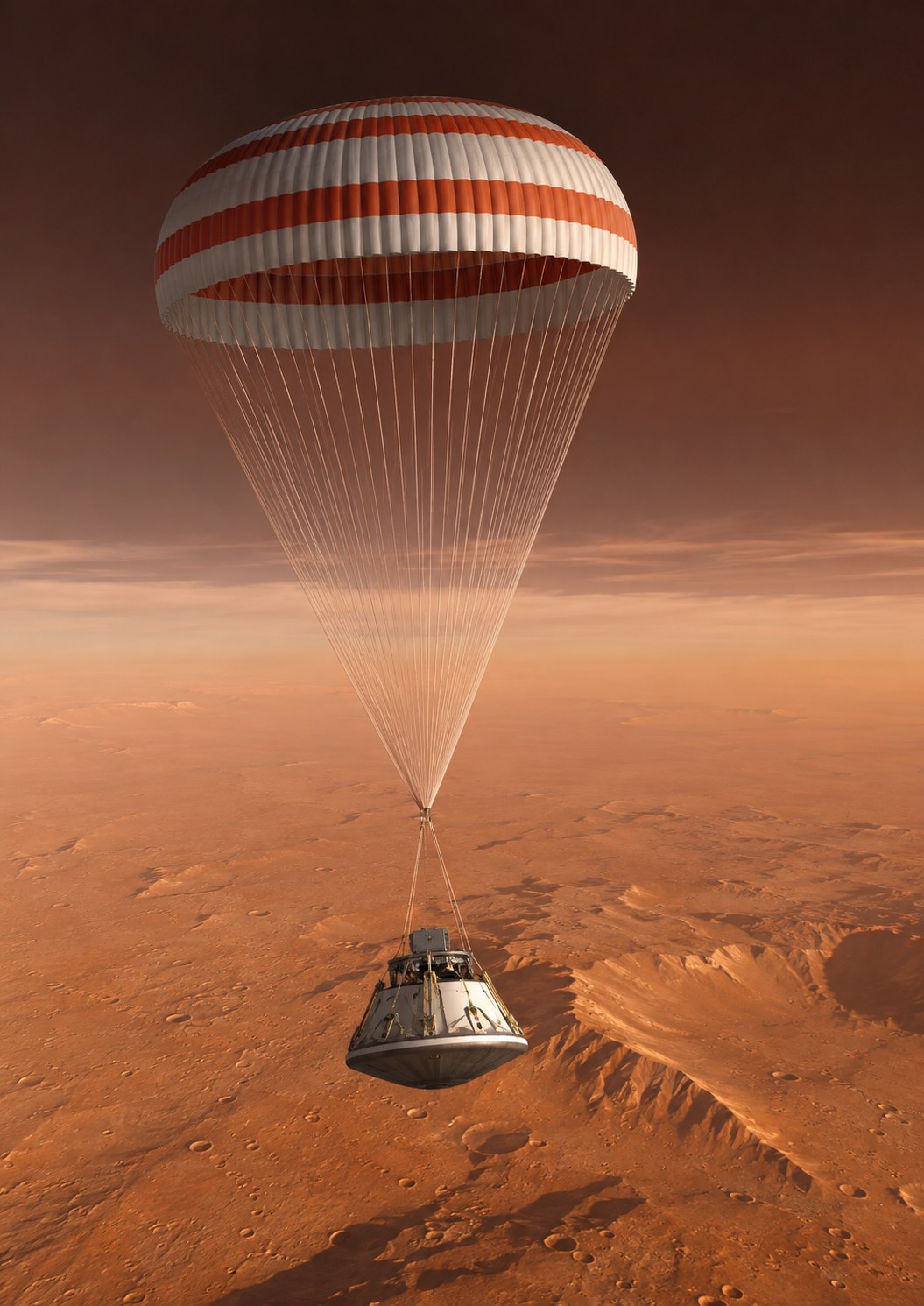
The problem addressed here concerns the point where parachute heritage stops scaling directly and powered deceleration carries more of the job.
The central observables are Mach number, dynamic pressure, deployment load, thrust, thrust-to-weight ratio and propellant consumption.
ASPIRE documents Mars 2020 parachute qualification while SRP research addresses propulsive deceleration at larger Mars scales
Mars landing begins with a paradox. The atmosphere is dense enough to create severe heating for a vehicle arriving at several kilometres per second, yet too thin to provide the generous aerodynamic braking available to many Earth-entry systems. Robotic missions learned to exploit it through a tightly choreographed sequence: heat shield, guided entry, supersonic parachute, then terminal propulsion or airbags depending on the mission. At rover scale this heritage is formidable. At human scale, however, the problem is not solved by enlarging every component. Mass, area, structural load, packed volume and transient inflation physics do not scale together, and that mismatch is where supersonic retropropulsion enters the architecture.
Parachute drag can be written D = q Cd A with q = ½ρv². D is drag in newtons, q dynamic pressure in pascals, ρ atmospheric density in kg/m³, v relative speed in m/s, Cd drag coefficient and A reference area. The equation is elementary; the real environment is not. Martian density varies with altitude, season, weather and topography. Speed appears squared. Inflation is a violent transient rather than a steady aerodynamic state. Fabric strength, suspension lines, wake dynamics, shock motion and vehicle attitude therefore belong to the same design problem.
A deliberately simplified example shows the sensitivity. Assume ρ = 0.015 kg/m³ and v = 500 m/s. Dynamic pressure is q = 0.5 × 0.015 × 500² = 1,875 Pa, or 1.875 kPa. At 1,000 m/s with the same assumed density it becomes 7.5 kPa. Doubling speed quadruples q. These are not mission predictions; they show why seconds of timing and atmospheric uncertainty can change loads substantially. That sensitivity should remain explicit instead of presenting one apparently exact deployment condition as universal.
The other key quantity is ballistic coefficient β = m/(CdA). Higher β means more mass must be decelerated by a given effective aerodynamic area. Human vehicles carry habitats, life support, reserves, surface systems and sometimes ascent hardware, so mass rises quickly while launch-vehicle, fairing, heat-shield and deployable-structure diameters remain constrained. NASA human-EDL studies have therefore explored very large aeroshells, inflatable decelerators and powered deceleration as ways to break this scaling trap.
Three maturity statements must remain separate. Supersonic parachutes have been demonstrated for Mars. Rocket engines have performed terminal powered descent on Mars, from Viking and InSight to the powered descent stages used for Curiosity and Perseverance. But a heavy human-class Mars vehicle has not demonstrated ignition and sustained retropropulsion while still supersonic in the Martian atmosphere. That boundary between heritage and extrapolation is the central fact of this chapter.
A simple way to feel the problem is to calculate dynamic pressure, written q. In an elementary model q = 1/2 × ρ × v², where ρ is atmospheric density and v is vehicle speed relative to the air. Using ρ = 0.015 kg/m³ only as an illustration, q is 1,875 Pa, or 1.875 kPa, at 500 m/s; at 1,000 m/s the speed doubles but q rises by a factor of four to 7,500 Pa. This is why deployment cannot be scheduled by altitude alone: density, velocity, Mach number, attitude and the qualified envelope all matter simultaneously. Actual values vary with season, landing site, local time and trajectory; the example exists to expose the v² dependence, not to define one universal Martian atmosphere.
Ballistic coefficient, β = m/(CᴅA), tells another part of the story. m is mass, Cᴅ drag coefficient and A reference area. With similar shape and Cᴅ, adding mass without enough area raises β, allowing the vehicle to retain momentum and penetrate more deeply before slowing. Consider an illustrative 50,000 kg vehicle with Cᴅ = 1.5 and A = 200 m²: β ≈ 50,000/(1.5×200) ≈ 167 kg/m². With 400 m² at the same mass it would fall to about 83 kg/m². These are teaching values, not a design claim; they show why diameter, deployable decelerators or a different aerodynamic architecture can matter as much as propellant mass.
This prevents a common misunderstanding. Mars does have an atmosphere and it can dissipate a great deal of energy, but it does not provide a comfortable flight envelope for free. The system must cross hypersonic, supersonic and subsonic regimes, sometimes within minutes, while staying between excessive heating, excessive aerodynamic load and insufficient braking. A technology can be excellent in one regime and irrelevant in the next. Human EDL is therefore a system of systems, not a choice between parachutes and engines.
q: dynamic pressure (Pa); ρ: density (kg/m³); v: speed (m/s); D: drag (N); Cd: drag coefficient; A: area (m²); β: ballistic coefficient (kg/m²); m: mass (kg).
Perseverance is an unusually valuable case because NASA published both the landing sequence and a dedicated qualification campaign. JPL lists the Mars 2020 parachute at roughly 21.5 m in diameter. ASPIRE used Black Brant IX sounding rockets to place full-scale parachute systems into Mars-relevant Mach and pressure conditions high in Earth’s atmosphere. During the third test, NASA/JPL reported a peak load near 67,000 pounds-force, roughly 300 kN, about 85 percent higher than the mission was expected to experience. That does not mean the parachute can be assigned to a human lander; it means Mars 2020 qualification deliberately established margin inside its own design envelope.
ASPIRE matters because supersonic parachute inflation is a coupled fluid-structure event. The wake deforms the canopy, the canopy reshapes the flow, shocks move, lines load and the vehicle can oscillate. Flight tests provide real time histories of shape, motion and load. CFD then tries to reproduce those histories and explore cases that would be prohibitively expensive to fly. Qualification emerges from the agreement and bounded disagreement among tests, simulations, instrumentation and structural margins, not from a single diameter or tensile-strength number.
Mars 2020 also demonstrates why deployment timing is part of navigation. Range Trigger selected parachute deployment based on distance to target rather than a simple fixed threshold. In the published landing sequence, the parachute deployed near 11 km altitude at about 1,512 km/h. Roughly twenty seconds later the heat shield separated so radar and the Lander Vision System could see the surface. The parachute therefore cannot be designed in isolation from upstream guidance and downstream sensing. For a human system, where engines may need to take over earlier, the handover state—altitude, Mach, dynamic pressure, navigation dispersion and residual energy—becomes one of the most important interface definitions in the vehicle.
The best handover is not automatically the lowest possible speed. A larger parachute costs mass, packing volume and structural load and may require deployment conditions the trajectory cannot provide. Abandoning aerodynamic braking too early transfers the energy-removal task to propellant. The parachute-to-engine boundary is an energy and risk trade: every metre per second removed aerodynamically saves propulsive delta-v, but each aerodynamic device must survive and be qualified in its real envelope.
Serious comparisons should therefore report entry mass, effective decelerator area, ballistic coefficient, deployment Mach and dynamic-pressure corridor, separation state, remaining propulsive delta-v, atmospheric margins and failure response. Vehicles with identical mass can need very different systems if geometry, landing-site elevation, acceptable dispersion or contingency philosophy differ.
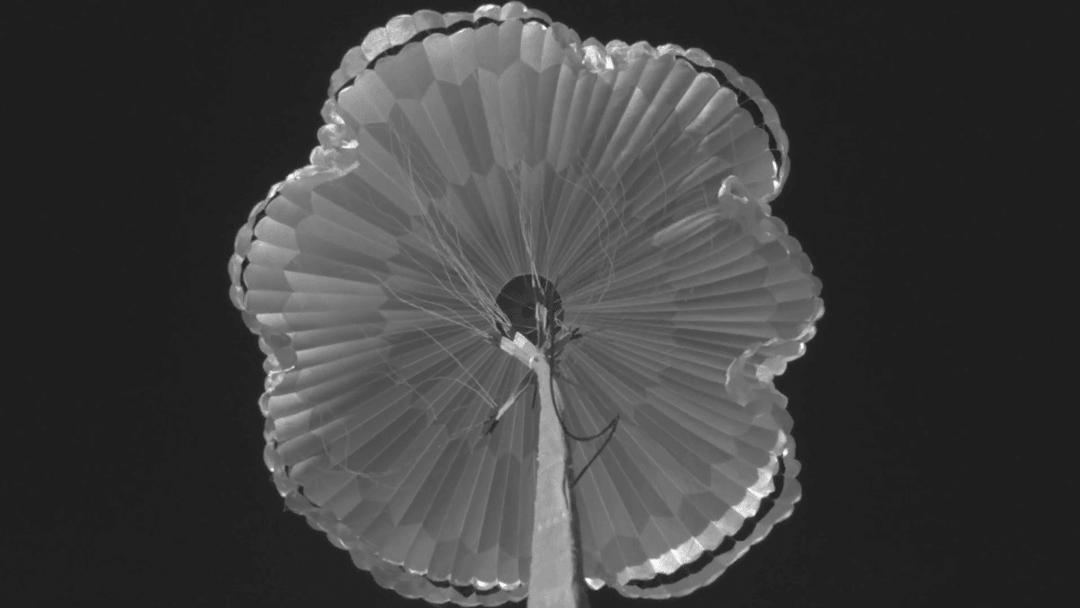
Mars 2020’s parachute makes the violence of the problem clearer than a photograph of fabric in the sky. Perseverance used a supersonic parachute about 21.5 metres in diameter. During ASPIRE, the third test exposed the system to roughly 67,000 pounds-force, close to 300 kN, which NASA described as about 85 percent above the load expected during the Mars 2020 landing. Qualification was therefore not merely proving that a parachute could open; it was proving a supersonic opening sequence with credible structural margin.
The qualification problem is harder because a parachute changes in a very short time from a compact pack to an enormous aerodynamic structure. Pressure is not applied uniformly over the fabric. Shock waves, an unsteady capsule wake, capsule oscillation, line elasticity and fabric porosity influence load paths. A single static load cannot represent that event. Testing, photogrammetry, structural dynamics and flow simulations must together reconstruct what happens during the first fractions of a second of inflation.
Perseverance then used that capability in a tightly coupled chronology: atmospheric entry near 19,500 km/h, parachute deployment while still supersonic, heat-shield separation and terrain-relative navigation, followed by powered descent. The parachute is a relay in a chain. It removes enough velocity for the next phase to become possible, but it provides neither the terminal precision nor the final stopping capability required by a heavy human lander.
ASPIRE also illustrates the distinction between component qualification and mission qualification. A parachute can survive its test load and still depend on correct mortar firing, line deployment, timing, vehicle attitude and separation logic in flight. The opening environment is created by the aeroshell wake, so a canopy cannot be certified in isolation from the vehicle that carries it. Engineers therefore care about the deployment envelope: not one Mach number, but a bounded region of Mach, dynamic pressure, angle of attack and atmospheric conditions in which the sequence is expected to work with margin.
A twenty-fold increase in delivered mass does not imply twenty times as much parachute. Structural strength, surface area, packed volume, opening load and natural frequency scale differently. A larger flexible decelerator must be extracted and inflated inside a shock-dominated turbulent wake. Longer suspension lines, greater textile mass and larger deployment bags interact with an entry structure that is already carrying heat-shield and aerodynamic loads. The difficulty is not one component becoming large; it is many coupled constraints changing at once.
Historic NASA studies often used entry masses of tens of tonnes and aeroshell diameters of tens of metres to illustrate the problem. Those values are study outputs, not universal requirements. A 20 t, 50 t and 100 t architecture may use different lift-to-drag ratios, shapes, decelerators and propulsion strategies. The responsible method is a trade matrix that places mass, L/D, β, diameter, ignition state, thrust, propellant reserve, landing dispersion, site elevation and failure criteria side by side.
Consider another teaching calculation. Mars gravity is about 3.71 m/s². A 50,000 kg vehicle therefore has local weight W = mg ≈ 185,500 N. If its engines can provide 1.0 MN total thrust at a given instant, T/W = 1,000,000 / 185,500 ≈ 5.39. T is thrust, W local weight, m mass and g Martian gravitational acceleration. A ratio above one is required for ideal hover capability, but 5.39 does not imply an automatic 5.39-g deceleration: thrust may be tilted, drag still contributes, mass changes as propellant is consumed, lateral guidance uses some authority and crew/structure limits cap allowable acceleration.
Propulsion adds a new set of constraints. Engines must start in a supersonic flow, reach commanded thrust within a known transient, remain stable while exhaust interacts with the external flow and then throttle as the vehicle slows and becomes lighter. Minimum stable thrust can be as important as maximum thrust. An engine that is powerful but cannot throttle deeply may force engine shutdowns, pulse-like strategies or different geometry near the ground.
Redundancy also has to be functional. Adding one extra engine is not enough if loss of a unit produces a torque the remaining engines cannot counter without saturating attitude control. Engine-out cases should be evaluated immediately after ignition, during the supersonic transition, during lateral divert and close to touchdown. Detection, isolation and recovery logic must preserve both stability and a reachable safe landing area.
The rover-to-human transition is dominated by scaling laws. If every dimension of an object is multiplied by a factor k while shape and density remain similar, mass grows approximately with k³ while aerodynamic area grows with k². The mass-to-area ratio therefore tends to increase with k. This is the simple cube-versus-square effect: making a vehicle bigger does not automatically give it enough braking area to compensate for added mass. Real architectures can change shape, materials and density, but they cannot repeal the geometry.
A giant parachute also creates packing, deployment and opening-load problems. Doubling diameter roughly quadruples area, while fabric, suspension lines, deployment hardware and reinforcement do not remain constant. More importantly, transient loads must pass through a vehicle weighing tens of tonnes. The cure — violent opening — must not destroy the structure it is intended to save. Human-scale studies therefore investigate combinations of large aeroshells, inflatable or deployable decelerators, parachutes where useful, and especially supersonic retropropulsion.
The operational question is not ‘what is the largest parachute we can build?’ but ‘how much velocity can each technology remove, in what Mach range, with what dispersion and risk?’ That wording allows architectures to be compared without turning any technology into doctrine. One concept may accept high ballistic coefficient because engines take over early; another may maximize aerodynamic braking to reduce propellant. Both move risk rather than eliminate it.
Scaling also changes the penalty of failure. A robotic lander can be designed around one tightly integrated descent architecture; a settlement may need different cargo classes, crew vehicles and repeat flights. If each class requires an entirely different decelerator, the qualification and logistics burden multiplies. If one family of devices can cover several masses, commonality improves but the device may be heavier or less optimized. Human Mars EDL is therefore partly a fleet-standardization problem: the best single landing design may not be the best architecture for a transportation system expected to fly many times.
Supersonic retropropulsion is counter-intuitive because rocket exhaust is normally pictured expanding into free space behind a vehicle. In SRP, jets point into the oncoming supersonic flow. They create high-pressure regions, move shocks and shear layers, and can produce strongly unsteady aerodynamics. NASA has used wind-tunnel testing and CFD to study these effects because they directly affect stability and controllability for large Mars landers. Saying that engines produce braking force is correct but incomplete: the exhaust temporarily reorganizes the flowfield around the vehicle.
That flowfield also changes what sensors experience. Radar, lidar, cameras, antennas and pressure measurements cannot be located as though the plumes were absent. Hot gas, vibration, optical emission, combustion products and shock motion can contaminate or bias measurements. Closer to the surface, the problem changes again as exhaust begins to strike regolith. The terminal-descent chapter treats plume-surface interaction in detail, but SRP architecture already has to treat it as the next regime in the chain.
Guidance must bridge another transition. During aerodynamic flight, lift, bank and small thrusters can shape the path. As main propulsion rises, the trajectory becomes increasingly thrust-driven. The design must avoid a region in which neither aerodynamic nor propulsive control has enough authority to reject disturbances. Margin therefore lives in a multidimensional corridor of speed, altitude, attitude, dynamic pressure, navigation error, available thrust and time-to-ground. A single advertised ignition Mach number is not a sufficient qualification statement.
Weather matters as well. Martian density varies seasonally and with elevation; winds alter lateral targeting; dust changes the optical environment. Engineering atmospheres from tools such as the Mars Climate Database can build statistical cases, but a real mission still needs conservative dispersions, onboard robustness and propellant margin. A settlement expecting regular cargo arrivals eventually needs local meteorology, atmospheric forecasting and flight rules as part of its landing infrastructure.
Earth reusable-booster landings provide valuable engineering heritage in restart, guidance, throttling and terminal control, but they do not by themselves demonstrate human-scale Mars SRP. Atmosphere, gravity, geometry, heating, navigation and ground interaction differ. Terrestrial flight experience can retire some technology risks while leaving the Mars-specific flow regime and integrated qualification open.
To see what ‘taking control with engines’ means, consider a 50-tonne lander. Its Mars weight is W = m×g = 50,000×3.71 ≈ 185,500 N, or 185.5 kN. A propulsion system producing only 185.5 kN would approximately balance gravity but would not slow the descent. A Mars thrust-to-weight ratio of 1.5 requires about 278 kN; the thrust above weight supplies vertical deceleration before lateral guidance, losses and margins are counted. This does not size a real engine. It shows why required thrust scales with mass and why a high headline thrust does not automatically mean large braking margin.
Stopping distance provides a second intuition. In a one-dimensional constant-net-deceleration model, d = v²/(2a). Removing 300 m/s at an average net deceleration of 5 m/s² requires about 90,000/10 = 9,000 m. At 10 m/s² that falls to 4.5 km. Real trajectories are neither vertical nor constant-acceleration; mass changes, aerodynamics continue to act and human limits matter. Yet the v² dependence explains why beginning a burn only seconds too late can consume kilometres of margin.
In supersonic retropropulsion the engine plumes do not expand into still air. They encounter the external flow around the vehicle, move shock structures and can change aerodynamic forces and moments. Multi-engine layouts add plume-plume interactions. Control must remain robust as Mach number, density and thrust change rapidly. NASA wind-tunnel work at Langley, CFD and multiple-nozzle campaigns are intended precisely to reduce this uncertainty before a full-scale vehicle depends on it.
Engine-out capability makes the thrust example more demanding. If a vehicle needs to survive the loss of one engine, the remaining engines must provide enough thrust and control authority without creating an unacceptable transient. That requirement affects engine count, spacing, throttling range and propellant reserve. Too few large engines can make a single failure severe; many smaller engines add valves, plumbing, ignition events and software complexity. Redundancy is not free. It shifts risk from the consequence of one failure toward a larger population of components and interactions that must all be monitored.
Mars systems cannot easily accumulate hundreds of full-scale qualification landings before crews depend on them. Evidence must therefore be layered. Component tests verify textiles, seams, lines, valves, chambers, igniters, sensors and computers. Subscale experiments and wind tunnels explore flow physics. Sounding rockets such as ASPIRE reach relevant Mach-pressure combinations for parachutes. CFD connects those points and sweeps dispersions. Flight demonstrations must then target the transitions that cannot be represented credibly on the ground.
Validation has to include bad days. A parachute can open late, inflate asymmetrically or transmit higher load than expected. An engine can start slowly, lose thrust or report misleading chamber pressure. An IMU can drift. Atmospheric density can sit in the tail of a distribution. Monte-Carlo campaigns, hardware-in-the-loop tests and sensor replay are not statistical decoration; they estimate whether the true dispersed trajectory still remains inside control, structural and propellant capability.
For settlement logistics, the criterion is not merely a successful first landing. The architecture must repeat. Decelerator mass, manufacturing cadence, inspection, reuse, weather support, exclusion zones and plume effects on the landing complex all matter. A system that only works in a narrow atmospheric window or contaminates nearby habitats every arrival is not a robust supply chain.
A mature decision should therefore maintain a technology-maturity ledger: supersonic parachute at the required scale, deployable heat shield if used, engines, feed system, supersonic ignition, attitude control, navigation, TRN, hazard detection and landing-site protection. Each line should state what has flown on Mars, what has flown elsewhere, what has only been ground-tested and what remains a proposed integration. That discipline prevents a visually convincing architecture from being mistaken for an operational capability.
The next question is where the vehicle should actually go. Losing velocity is only half the problem. The craft must still determine where it is, decide which reachable patch is safe, and do so before rocks, slopes, infrastructure and the vehicle’s own exhaust turn the final few hundred metres into the most unforgiving part of the journey.
Qualifying a human lander will require several layers of evidence. Wind tunnels can explore controlled combinations of Mach number, angle of attack and pressure ratio, but at reduced scale and with similarity limits. Numerical simulations can cover many conditions but depend on turbulence, chemistry, wall and mesh models. Earth engine and vehicle tests can prove ignition, throttling, redundancy and control, but Earth gravity and atmosphere do not reproduce Mars. No single layer is sufficient.
Transitions must be tested as systems because many accidents begin at interfaces: heat-shield separation, parachute release, engine start, a guidance-mode switch, or loss of an engine at the worst possible moment. A credible verification matrix therefore crosses flight phase, available sensors, actuators, latency, plausible faults and fallback strategy. A fault found early may be accommodated; the same fault discovered after an irreversible commitment can be fatal.
Finally, settlement architecture has to think about repetition. A single successful landing does not automatically turn a demonstration into an airline-like service. A fleet needs margins against atmospheric variability, mass dispersion, ageing, engine production lots, dusty weather and industrial cadence. The deeper maturity threshold is not merely ‘flew once’ but ‘can be manufactured, inspected, launched and used repeatedly with a documented probability of success.’ That is the difference between a feat and a transportation system.
A settlement-scale program also needs configuration control. A software update, nozzle change, tank mass change or new payload can move the EDL trajectory outside the data used for qualification. Engineers therefore need a traceable configuration for every flight and a method to decide which changes require analysis, ground test or flight demonstration. That discipline is especially important for reusable vehicles, where the hardware itself accumulates cycles. Repeatability comes from controlling what changed, not from assuming that the second landing is identical to the first.
For crewed missions, the evidence chain must also be understandable to operators. A crew may have only seconds to recognize that an automatic sequence has degraded, and many EDL events will remain fully autonomous because communications delay rules out Earth intervention. Telemetry, fault messages and cockpit indications therefore need to tell the crew what state the vehicle has actually reached, not merely which command was issued. Human factors become part of propulsion qualification because ambiguous mode awareness can turn a recoverable automation fault into the wrong manual response.
Supersonic parachutes have a remarkable Mars flight heritage. A relatively light textile system produces a large drag area after the heat shield has already removed substantial energy. Human-scale vehicles, however, face an unfavourable scaling law: mass increases, the atmosphere remains thin, opening loads become enormous, and the required system can become difficult to pack, deploy, and test.
Simplified drag is D = ½ ρ v² CDA. More force at the same density and speed requires larger A or higher CD. A larger parachute also means more fabric, lines, packing volume, and inflation dynamics. Opening is a violent transient, not a static load case.
Human landing studies therefore treat supersonic retropropulsion as a central option: engines begin braking while the vehicle remains supersonic. That does not mean parachutes have no role in every architecture. It means their role must be selected from mass and flight regime rather than inherited automatically from robotic systems.
On Mars, parachutes and retropropulsion are not independent solutions that can simply be added. The parachute changes velocity, attitude and often vehicle oscillation; propulsion must ignite in that real state while altitude continues to fall. A heavy architecture therefore needs a window in which the parachute still provides useful deceleration and another condition at which jettison is required to avoid interaction, recontact or loss of control authority. Engine plumes can also modify a supersonic flow field and alter aerodynamic forces before the vehicle reaches a low-speed regime.
Sizing must follow the dispersion of the handover: ignition time, available thrust, attitude, vertical and horizontal velocity, atmospheric density and navigation error. A nominal mean is not enough. The important question is whether the combined parachute–propulsion system retains a recoverable state set when a sensor is noisy, one engine builds thrust slowly or atmospheric deceleration has been weaker than expected.
A parachute is qualified for a range of Mach number, dynamic pressure, angle of attack and mass properties, not for the statement “supersonic deployment” in isolation. The vehicle must arrive inside that envelope after atmospheric entry dispersions. Retropropulsion has an analogous ignition envelope involving altitude, velocity, attitude, thrust buildup and propellant state. The architecture problem is to ensure those envelopes overlap with margin or to provide another means of deceleration between them. When payload mass grows, the overlap can shrink because the parachute reaches structural or packaging limits while propulsion must begin earlier. This is why scaling a robotic EDL sequence to human-class mass is a transition problem rather than a simple increase in component size.
Firing engines into supersonic oncoming flow changes shock structure and base flow. Plumes can interact with the vehicle and alter aerodynamic coefficients. Control laws must therefore operate in a regime where propulsion and aerodynamics are simultaneously important.
In a simplified vertical model, T = m(gM + a), where T is total thrust in newtons, m is mass in kg, gM ≈ 3.71 m/s², and a is desired upward deceleration in m/s². For 60,000 kg and a = 6 m/s², T ≈ 60,000 × 9.71 ≈ 583 kN. The relation neglects drag and thrust-vector geometry; it is an order-of-magnitude calculation.
Thrust sizing cannot rely on nominal operation only. Engine-out, thrust dispersion, or a stuck gimbal need a survivable trajectory. Multiple engines help, but cluster geometry also affects plume interaction and moments. Propulsive redundancy is geometric as well as numerical.
Propellant must absorb arrival dispersion, atmospheric variation, navigation error, divert demand, and possibly a failed engine. A generic “10% reserve” is meaningless unless the case it covers is stated. A useful budget comes from explicit scenarios: high entry speed, thin atmosphere, late ignition, engine-out, and alternate site.
The rocket equation, Δv = Isp g₀ ln(m₀/m₁), relates ideal velocity change to mass ratio. Isp is specific impulse in seconds, g₀ = 9.80665 m/s², m₀ is initial mass, and m₁ final mass. Real descent adds gravity loss, drag, control activity, and margins, so ideal Δv is only a starting point.
NASA has identified gaps in facilities and relevant data for multi-engine hot-gas retropropulsion in supersonic flow. Simulation is essential, but powered-descent trajectories depend on aerodynamic models that need validation. Human landing programs must therefore treat model maturation and testing as architecture work, not as an assumption that will disappear later.
This distinction matters in public writing. EDLAS produced credible studies and candidate performance; it did not turn human-scale supersonic retropropulsion into an operational Mars capability. Maturity runs from known physics to subscale testing, relevant environment, integrated flight demonstration, and qualification.
The vehicle reaches powered-descent altitude faster. Engines may need earlier ignition if propellant margin permits. The design must know the maximum speed and dynamic pressure at which ignition and control remain acceptable.
Remaining engines must recover both force and moment. Guidance may abandon a lateral divert or select a closer touchdown point to preserve margin.
Thrust command depends directly on that state. FDIR should compare measurement quality, history, and common causes. Dust can degrade some sensors at exactly the moment thrust authority becomes critical.
Terminal navigation must switch to measurements that remain reliable or freeze the target. Continuing an optical divert through an opaque dust cloud may be more dangerous than completing a stabilised descent.
NASA NTRS — New Developments in Retropropulsion Testing for Mars Entry, Descent, and Landing documents test and model-validation gaps, while NASA NTRS — Entry, Descent, and Landing Performance for a Mid-Lift-to-Drag Ratio Vehicle at Mars presents human-scale performance studies using SRP. Together they support both the promise and the maturity caution.
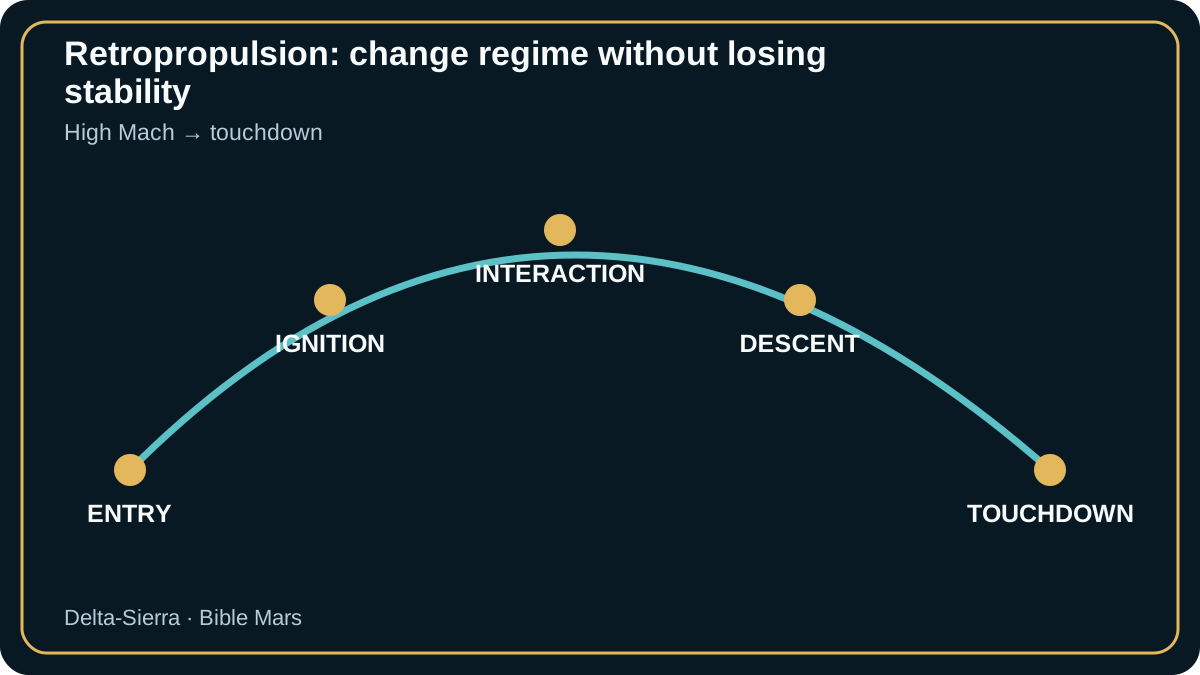
Parachutes can be extremely mass-efficient when dynamic pressure and vehicle mass fall inside their deployable envelope. Human-scale landers push beyond heritage combinations of diameter, Mach, load and deployment dynamics. Supersonic retropropulsion moves the architecture toward throttleable propulsion but introduces plume-aerodynamics interaction and propellant demand.
A cold-gas or static test can answer selected questions without validating hot multi-engine powered flight. NASA literature identifies gaps in representative testing and model validation. Maturity should therefore be described by what has actually been tested: component, wind tunnel, simulation, flight-like hot gas, or integrated flight.
Near the ground, plume-surface interaction adds a different regime involving dust, crater formation, debris and sensor obscuration. The system transitions from atmospheric deceleration to a surface-environment problem before touchdown.
For 25 t on Mars, weight is about 92.8 kN. With 250 kN retropropulsion, T/W = 250/(25×3.71) ≈ 2.70. T/W is thrust-to-weight. That margin must cover deceleration, gravity, attitude and dispersions at parachute release.
Igniting too early can create flow interactions; too late and altitude disappears. A partial fault during overlap between the two systems can open an unsolved state region.
Integrated simulation must connect parachute dynamics, release, thrust rise and engine control to show that the transition window remains recoverable.
From robotic parachutes to human-scale retropropulsion
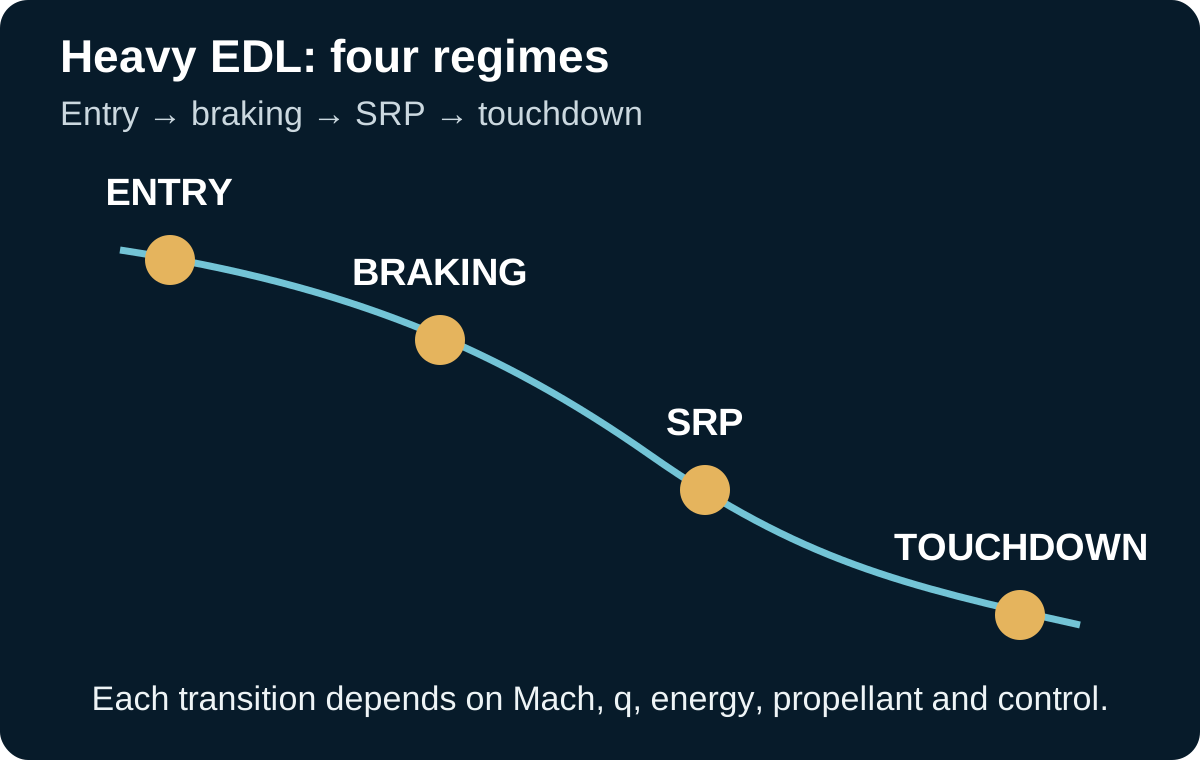
Mars' atmosphere is dense enough to heat and slow a vehicle yet thin enough to make deceleration of very large mass difficult. A supersonic parachute works inside a Mach and dynamic-pressure box that must be reached at the right time.
Perseverance used a 21.5 m parachute, strengthened and validated through high-energy tests. That success demonstrates robotic heritage; it does not prove that simply scaling the same parachute can land tens of tonnes.
For a given mass and frontal area, ballistic coefficient affects how quickly the vehicle decelerates. Heavier human payloads push toward regimes where parachutes become very large or retropropulsion must begin earlier.
Mars 2020 Range Trigger showed that deployment timing can be chosen more intelligently. That improves accuracy; it is not a universal solution to the mass problem.
For human-scale masses, NASA studies conclude that supersonic engine ignition becomes a major — in some design spaces the only presently viable — way to continue decelerating while retaining control authority.
The problem is aerodynamic as well as propulsive. Jets interact with supersonic flow, alter pressures and moments, and can change stability exactly when the vehicle must remain controllable.
Engine placement, count, and thrust therefore affect trajectory, structure, heating, and control simultaneously. An apparently local change can move the entire descent envelope.
Ground testing is difficult because it must reproduce supersonic flow, hot jets, and free-flight vehicle dynamics. That validation difficulty must remain visible when an architecture is presented as promising.
A powered lander must retain propellant for atmospheric dispersion, navigation error, divert, possible hover, and reserve. A nominal plan arriving nearly empty is incompatible with real Martian uncertainty.
Propellant mass increases entry mass, which can in turn increase deceleration demand. This loop explains why EDL cannot be sized by adding independent subsystems.
Near-ground plumes create dust, erosion, recirculation, and hazards to nearby infrastructure. Propellant reserve and terminal profile must therefore connect to site geometry and safety distances.
A human vehicle must also contemplate abandoning the nominal zone. Divert consumes propellant and may lead to less-prepared terrain; guidance must trade accuracy, fuel, and surface risk.
Dynamic pressure is q = 1/2 ρ V², where ρ is atmospheric density and V is speed. The square on V means doubling speed multiplies the velocity contribution to q by four if density is unchanged.
Ballistic coefficient can be written β = m/(C_D A). Larger mass m or smaller area A increases β and generally makes the vehicle harder to slow through drag alone. C_D is drag coefficient.
For powered descent, reserve can be expressed as Δv. If nominal descent uses 1,800 m/s and 200 m/s is held for dispersion and divert, the reserve is 200/1,800 ≈ 11.1% of nominal Δv; that percentage still does not replace probabilistic analysis.
A parachute opens later than expected. Retropropulsion begins at higher speed, changing propellant demand and heating. Guidance must recognize the new energy state rather than follow a fixed schedule.
One descent engine loses thrust. Control must redistribute effort among remaining engines without saturating attitude authority or exceeding propellant margin.
An atmospheric estimate is wrong and aerodynamic deceleration is weaker. The vehicle reaches ignition faster; reserve logic must absorb the dispersion.
Finally, a late divert avoids a hazard but moves the vehicle closer to infrastructure. Guidance must include dynamic exclusion zones, not only rocks mapped before the mission.
For human-scale payloads, the Martian atmosphere is dense enough to heat and disturb the vehicle yet too thin for heritage robotic parachutes to remove all the required energy. NASA studies of high-mass powered descent therefore describe retropropulsion initiated at supersonic speed as a key capability. That does not mean a human system is already qualified: the literature explicitly notes that no crewed vehicle has yet relied on this atmospheric descent mode.
Ignition immediately changes the aerodynamics. Jets penetrate the external flow, move pressure fields, can alter vehicle moments, and change what sensors experience. A trajectory model that treats thrust and drag as independent terms therefore misses part of the problem. Engine layout, jet-to-shield spacing, angle of attack, and engine count belong to one coupled aero-propulsive analysis.
Ignition timing is itself a probabilistic decision. Starting early uses more propellant; starting late leaves less reserve for a thinner-than-expected atmosphere, navigation error, or divert. The appropriate margin is not merely '10 percent fuel'. It should be linked to dispersions in density, mass, engine performance, and position. A crewed mission must also preserve a controllable state after loss of one engine or a major sensor.
Terminal descent is also coupled to the future base. Plumes can erode soil, accelerate particles, and damage nearby hardware. Landing zones, berms, roads, and habitat stand-off distances therefore have to be designed with the vehicle. As settlement traffic grows, EDL becomes an industrial urban-planning and traffic problem as well as a flight problem.
Deploying a parachute earlier may reduce velocity but can expose it to loads outside its tested envelope. Waiting longer preserves parachute margin but leaves less altitude for engine start, thrust buildup and divert. Powered descent itself consumes propellant that may also be the reserve for hazard avoidance. Transition logic therefore needs a state envelope rather than a single target altitude.
Engine ignition should be assessed with plume and aerodynamic interaction in mind. At supersonic speed, exhaust modifies the flow around the vehicle and can change forces before the engines dominate the trajectory. Testing and simulation must cover the coupled transition, not just a parachute case followed by an unrelated vacuum-thrust calculation.
Losing one engine after most of the velocity has been removed is not the same event as losing it immediately after ignition at high Mach number. Available thrust, propellant, altitude and aerodynamic forces change throughout the transition. Engine-out analysis should therefore identify the region in which the remaining engines can still arrest descent or divert, rather than claiming a single redundancy level for the whole powered-descent phase.
The 2026 white paper provides the current frame for human Mars EDL challenges and avoids freezing an older architecture as the final solution.
This study explains the importance of atmospheric retropropulsion for human-scale payloads and the strong aero-propulsive interactions involved.
The paper shows why the parachute Mach-dynamic-pressure box and ballistic coefficient push heavy payloads toward different architectures.
Perseverance provides a real sequence: supersonic parachute, Range Trigger, TRN, then powered descent, at masses far below a human system.