


MARS BIBLE — PEOPLE
Adam Steltzner
Adam Steltzner's documented nationality or citizenship is American; the documented birthplace is Not stated in the institutional sources cited. Adam Steltzner is one of the engineers who turned Mars landing into a discipline capable of handling ever heavier spacecraft. His path was far from conventional: music and a late return to science led to engineering studies, JPL, and eventually a central role in entry, descent and landing systems. His importance goes beyond Curiosity’s sky crane. His career illustrates a method: break an apparently impossible problem into testable pieces, build the right team, and make disciplined decisions under extreme technical constraints.
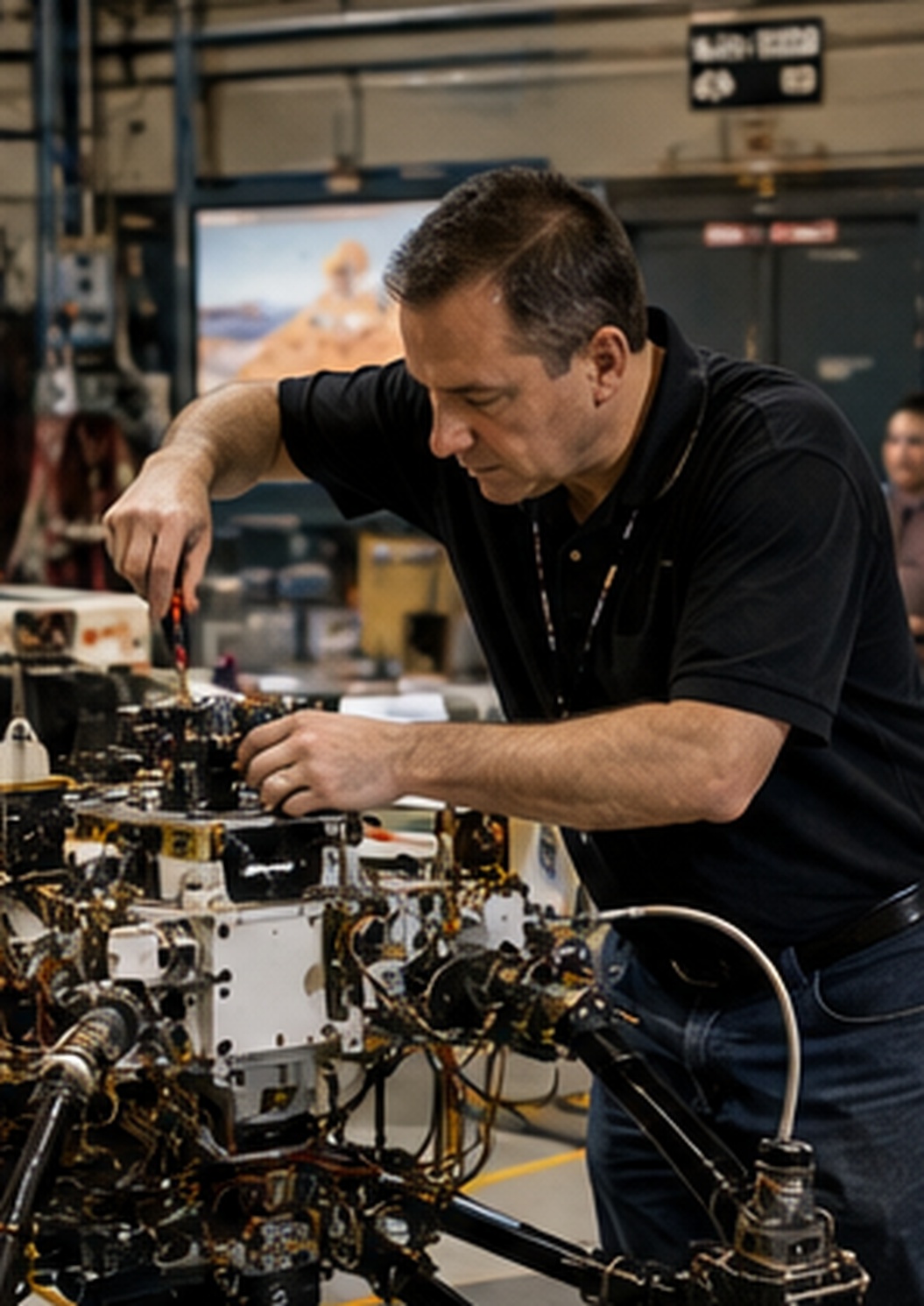
Chronological biography
From an unconventional path to systems engineering. Adam Steltzner’s career is often described because it does not fit the stereotype of an engineer who followed a straight line into aerospace from childhood. JPL profiles emphasize a gradual turn toward science and engineering, followed by training that led into applied mechanics and spacecraft systems. The detail matters because difficult missions benefit from people who approach problems with different intellectual habits. Mars landing requires aerodynamics, structures, software, controls, testing and operations to work together; no single discipline can own the full solution.
At JPL, Steltzner worked across missions before becoming one of the public faces of Mars Science Laboratory entry, descent and landing. His job was not simply to have a strange idea. A concept had to survive design reviews, testing and scrutiny from engineers who had not invented it. That collective verification is directly relevant to settlement engineering: an unconventional solution becomes acceptable only when other people can reproduce the reasoning and understand every critical interface.
At JPL — building expertise mission by mission
Before sky crane: expertise accumulated mission by mission. Institutional sources on Adam Steltzner document his technical career far better than his private childhood. Rather than inventing an origin story to fill that gap, a rigorous biography should say what can actually be supported: how an engineer gradually became a specialist in entry, descent and landing. JPL links his flight experience to missions including Galileo, Cassini, Mars Pathfinder and the Mars Exploration Rovers before Curiosity. Source.
Steltzner’s path is valuable precisely because it does not resemble the standard story of a prodigy who always knew he would become a space engineer. Music occupied much of his early life before curiosity about the apparent motion of stars drew him back toward mathematics and physics. He returned to school, moved through community college and mechanical engineering, and continued into graduate study. That late redirection became a strength: it taught him to ask basic questions without embarrassment, cross disciplinary boundaries and accept that elegant solutions can emerge from unconventional paths. Institutional source.
That sequence matters. Galileo and Cassini build habits for complex systems and distant operations. Pathfinder and Spirit/Opportunity add the violence of Mars arrival: in minutes the spacecraft must shed interplanetary speed, navigate atmospheric uncertainty and contact unknown ground with no human pilot able to intervene. Steltzner’s later breakthrough therefore grew out of an accumulated memory of heritage, limits and failure modes rather than from a single isolated idea. [source]
Institutional sources: JPL — Adam Steltzner profile · JPL — EDL career and NAE election
The sky-crane story also illustrates engineering leadership by elimination. The team did not begin with an extravagant solution and then search for reasons to defend it; it compared available architectures against the vehicle that actually had to be delivered and the constraints of the landing site. As alternatives exposed their limits, the chosen system became the least-bad combination of risks. That method explains Steltzner better than the image of a lone genius having one isolated idea. [source]
Curiosity — eliminating inadequate solutions until sky crane remained
The Curiosity problem: airbags reached the edge of their useful scale. Spirit and Opportunity inherited airbag landing from Pathfinder. Curiosity was much heavier. At that mass, simply enlarging the previous system became less attractive as impact loads, bag volume and deployment risks grew. The team had to accept one of engineering’s hardest conclusions: a solution that worked before may be less safe than a new architecture once its operating envelope has changed. Source.
Sky crane reframed the problem. A powered descent stage would slow the vehicle and lower the rover on bridles until its wheels carried load directly on the surface. The one-sentence description hides a new set of coupled questions: powered-stage stability, lateral motion, bridle dynamics, touchdown detection, separation and flyaway, all under atmospheric and navigation dispersions.
Institutional sources: JPL — sky-crane recognition
The 2012 landing changed the status of the sky crane. Before touchdown it was a new architecture whose stages had to be justified; after success it became heritage for Mars 2020. Heritage, however, is not permission to copy without requalification. Perseverance introduced terrain-relative navigation and other changes, and the team still had to prove that those changes preserved the margins learned on MSL.
A settlement will repeat this transition constantly. A power system proven at the first base cannot be assumed universal when population, latitude or industrial load changes. Steltzner’s experience shows that success converts an unknown risk into a better-characterized one. It does not remove the need to redo analysis when the context changes.
Proving a sequence that cannot be reproduced end-to-end on Earth. Mars EDL has a peculiar verification problem: Earth cannot reproduce the full sequence at the correct gravity, atmospheric density and velocity. The team therefore has to validate by decomposition — parachute tests, subsystem campaigns, high-fidelity simulations, dynamics experiments, representative hardware and extreme-case analysis. Confidence comes from a converging body of evidence rather than one impossible full-scale rehearsal. Source.
Steltzner became one of the public explainers of that logic before the 2012 landing. In JPL’s “Seven Minutes of Terror,” he describes an architecture that looks crazy but is the result of reasoned engineering thought. That is a useful definition of disruptive engineering: the design does not have to feel intuitive; it has to be physically argued, bounded and supported by enough evidence to justify flight.
Institutional sources: JPL — Seven Minutes of Terror
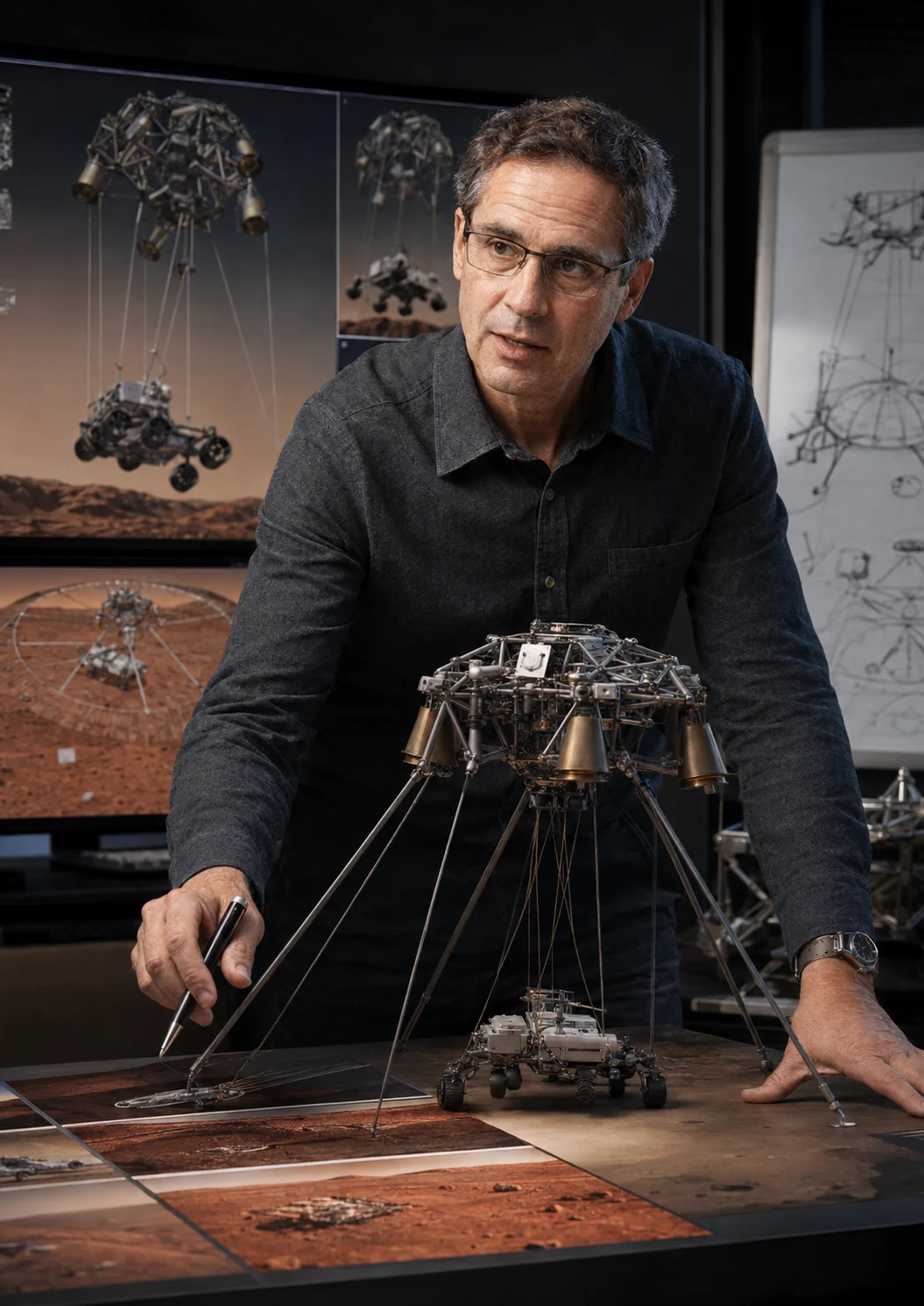
After Curiosity: turning a singular invention into institutional capability. Curiosity landed in 2012 and the sky-crane lineage was later used for Perseverance. Steltzner’s contribution, however, is broader than one mechanism. JPL recognized him for leadership and technical expertise in EDL systems and parachute dynamics, and he later served as Mars 2020 chief engineer and in broader planetary-access responsibilities.
For settlement-scale Mars, the lesson is that landing is not solved once the first architecture works. Greater mass, tighter landing precision or harder terrain can invalidate assumptions that were safe for the previous vehicle. The durable inheritance is a method: recognize when heritage has reached its limit, create a new architecture, decompose it into testable claims and preserve enough evidence that the next generation does not begin from zero.
Institutional sources: JPL — NAE and Mars 2020 roles
After 2012 — turning a singular architecture into institutional capability
Sky crane as the result of eliminating worse options. The sky crane looks dramatic because Curiosity hangs below a powered descent stage before the cables are cut. The better explanation starts with options that became unacceptable. Airbags did not scale to the rover’s mass; a conventional lander created ramp and stability problems; putting descent engines directly on the rover introduced other interactions with the surface. The selected architecture therefore emerged from constraints rather than from a desire to be spectacular.
The same method applies to habitats, oxygen plants and pressurized vehicles. Rejected alternatives and the reasons for rejection are part of the engineering record. Without that memory, a later team can reintroduce an old option without knowing which risk it created. The sky crane is therefore also a lesson in decision traceability: complexity can be rational when the path that produced it remains available for review.
The profession is built by changing problems: from structural motion to landing. Steltzner’s biography becomes more instructive when the sky crane is not presented as a single flash of invention. Training and early work drew him toward dynamics, structures, and systems in which real motion has to be predicted and controlled. At JPL that background met a new constraint: landing a Mars rover whose mass and geometry no longer allowed the airbag solution simply to be repeated. The team explored architectures, rejected some, tested subsystems, and gradually assembled an autonomous chain. Steltzner therefore became less the “inventor of a strange mechanism” than one of the leaders of a collective convergence process. The chronological reading is more useful for Mars because innovation appears when earlier skills meet a problem that makes familiar solutions inadequate.
Adam Steltzner is associated with the sky crane because he led the team that developed the architecture for Curiosity. JPL later recognized him as an Engineering Fellow for entry, descent and landing expertise. But reducing the story to one brilliant intuition is misleading. Curiosity was too heavy to reuse airbags directly and had to be placed on its wheels without leaving a propulsion stage attached to the rover. The architecture emerged from constraints that progressively removed alternatives. [AS1] [AS2]
Before landing, Steltzner publicly acknowledged that the solution looked crazy, then stressed that it resulted from careful choices. The second half is more important. In engineering, a counterintuitive solution can become rational when it meets the full requirement set better and every function is backed by tests, simulations and reviews. [AS2] [AS3]
Supplementary documentary analysis
Biographical analysis, context and legacy
Thematic analysis and deeper reading
Essential timeline
- 1990sCareer at JPL in flight and landing systems.
- Early 2000sWork on EDL architecture for a much heavier rover.
- 2004–2012Leadership in Mars Science Laboratory entry, descent and landing.
- August 5, 2012Curiosity completes the sky-crane sequence on Mars.
- 2016Elected to the National Academy of Engineering for contributions to Mars EDL.
Deep reading: what this trajectory teaches
Adam Steltzner: curiosity as a biographical turning point
Adam Steltzner is an American engineer at NASA's Jet Propulsion Laboratory whose career is more useful as a story of learning and systems engineering than as a lone-genius myth. The University of California, Davis, where he earned a mechanical-engineering degree in 1990, describes an unconventional path: difficulty with conventional schoolwork, years focused on music, then a return to study after a simple astronomical question caught his attention. Driving home from a gig, he noticed that Orion had changed position in the night sky and wanted to understand why. [source]
The detail matters because it begins a chain rather than a miracle. Astronomy required physics; physics required rebuilding study habits; those habits opened engineering. The College of Marin similarly identifies that community-college stage as decisive before his transfer to UC Davis. [source]
For a Mars settlement, the lesson is about human capital. A small society cannot assume that every essential specialist will follow a perfect educational path from childhood. It will need institutions that let adults retrain, recover from earlier failure and turn late curiosity into operational competence.
Music, weak school performance and the discovery of disciplined work
Institutional biographies do not present Steltzner as a teenager already preparing for aerospace engineering. UC Davis recounts his early focus on bass and drums in New Wave bands and a short period studying jazz at Berklee College of Music. It also describes academic struggles that made his later career far from obvious. [source]
It would be too neat to claim that playing in bands somehow created the sky crane. Music and engineering demand different forms of evidence and discipline. What the earlier life does show is that a technical identity need not be fixed at seventeen. Stage experience may later help communication, but the decisive transformation was the willingness to acquire mathematics, physics and detailed engineering methods when curiosity finally made them meaningful.
Mars crews and communities will face a similar problem. People will arrive with one specialty while the settlement's needs change. A robust educational system should therefore measure not only what a person already knows, but how effectively that person can learn a new field when the mission requires it.
College of Marin: physics becomes a doorway rather than a barrier
The College of Marin preserves Steltzner's account of trying to take astronomy and discovering that a physics prerequisite stood in the way. He credits instructor Stephen Prata with conveying the excitement of learning and helping turn that obstacle into an intellectual entry point. [source]
The sequence is important: observation generates a question; the question exposes a missing prerequisite; the prerequisite reveals that equations can explain the world rather than merely serve as school exercises. Curiosity did not remove the need for effort. It supplied a reason to sustain the effort.
A permanent Mars settlement will need exactly this kind of educational ladder. A power technician may need geology; a physician may need automation; a rover operator may need pressure-systems maintenance. With a small population, communities cannot afford to treat early educational failure as a permanent classification.
UC Davis, Caltech and Wisconsin: training in motion, structures and inference
Steltzner earned a bachelor's degree in mechanical engineering from UC Davis in 1990, a master's degree in applied mechanics from Caltech in 1991 and a doctorate in engineering physics from the University of Wisconsin-Madison in 1999. UC Davis and Wisconsin document that progression. [source] [source]
That training helps explain why his later work gravitates toward structures, dynamics and system behavior. Spacecraft are not static drawings. Panels vibrate, parachutes oscillate, cables load and unload, vehicles rotate, sensors infer states indirectly. Engineers must predict real motion while accepting that measurements and models are imperfect.
Entry, descent and landing magnifies those problems. The question is never simply whether a parachute is strong enough or an engine produces enough thrust. The atmosphere, vehicle attitude, flexible structures, sensors, software and event timing must remain mutually compatible through a rapid sequence that cannot be replayed after an error.
Entering JPL through structures and dynamics, not through a rover idea
UC Davis notes that Steltzner was already working at JPL while completing his doctorate, in the Spacecraft Structures and Dynamics Group. His early flight work included Galileo, Cassini, Mars Pathfinder and the Mars Exploration Rovers. JPL confirms that range when describing his election to the National Academy of Engineering. [source] [source]
This history prevents Curiosity from becoming a story with no technical ancestry. Galileo and Cassini expose engineers to complex interplanetary systems and long verification chains. Pathfinder, Spirit and Opportunity add the unforgiving physics of Mars arrival. Competence accumulates as a memory of interfaces, failure modes, margins and actual flight data.
A settlement will need to grow capability in the same way. It cannot jump directly to fifty-ton cargo operations and expect diagrams to substitute for experience. Smaller systems create evidence. The organisational challenge is to preserve that evidence well enough for later generations to know which lessons scale and which do not.
Galileo and Cassini: learning to respect invisible interfaces
Long-duration planetary missions teach that an interface error can remain hidden for years before becoming irreversible. Steltzner worked on such projects before Mars landing made him publicly recognizable. [source]
The deeper lesson is that organisational boundaries are not physical boundaries. A structural frequency can interact with an actuator; a mechanical tolerance can become a pointing problem; a mass change in one subsystem can remove margin elsewhere. Systems engineering begins when teams stop assuming that each department's successful component automatically creates a successful spacecraft.
Mars settlements will have the same cross-boundary risks. A habitat, power plant, rover and water system may be owned by different teams while sharing dust, spares, maintenance staff and energy. Many of the most dangerous failures will occur precisely where the organisation chart says one system ends and another begins.
Pathfinder and airbags: seeing a successful architecture before meeting its limit
Mars Pathfinder and Sojourner are part of the technical memory that precedes Curiosity. Airbags made it possible for a small lander to tolerate a dynamic contact with the surface rather than require a conventional gentle touchdown. JPL lists Pathfinder and the Mars Exploration Rovers among Steltzner's earlier projects. [source]
Success, however, creates its own cognitive hazard: heritage can become dogma. Spirit and Opportunity reused airbags, but Mars Science Laboratory's much greater mass forced the team to ask whether the method still lived inside a credible domain. The interesting moment in Steltzner's story comes when a proven solution stops being enough.
A settlement will encounter the same transition. A first habitat may rely on manual maintenance and large stocks of imported spares. A ten-habitat settlement cannot assume that multiplying the same method by ten remains practical. Scale changes the problem itself.
EDL is a coupled system, not three independent braking phases
EDL stands for Entry, Descent and Landing. The three words can sound like separate blocks, but the state at the end of one phase determines whether the next phase can even begin safely. Entry dispersion changes parachute deployment conditions; parachute dynamics influence separation; radar acquisition affects powered descent.
JPL lists Steltzner as an Engineering Fellow recognized for leadership and technical expertise in EDL systems engineering, particularly the sky crane, while the National Academy citation also points to parachute-dynamics contributions. [source] [source]
The word “system” is therefore the central idea. An excellent parachute is useless if the vehicle reaches it outside the tested envelope. Reliable engines cannot compensate for a wrong estimate of altitude. The mission succeeds because physics, software and timing remain coherent as a single chain.
Curiosity changes the scale: airbags cannot simply grow with the rover
JPL explicitly explains that earlier Mars rovers used airbags and that Curiosity's far greater mass required a different entry, descent and landing design. [source] The problem was not to improve the old architecture by a few percent. It was to preserve flagship-mission reliability while replacing a major part of the landing concept.
Scaling an airbag changes volume, surface area, internal pressure, impact energy and geometry in different proportions. “Make it bigger” is therefore not an engineering law. Heritage remains useful only inside the domain where its assumptions still apply.
Human landing systems will face a much larger version of this issue. Moving from roughly one-ton robotic rovers toward many tens of tonnes of cargo cannot be treated as a photographic enlargement of Curiosity. Aerodynamics, propulsion, structures and plume effects will force new trade studies.
Sky crane was not a solitary flash of inspiration
The famous image is a powered descent stage hovering above Mars while lowering the rover on bridles until its wheels reach the surface. Because the scene looks so unusual, public retellings can make it sound like one engineer suddenly proposed a wild idea. JPL's wording is more accurate: Steltzner led the team that developed the EDL system including the sky crane. [source]
The architecture emerged through elimination. Airbags became unsuitable at Curiosity's mass. A conventional lander created platform and egress problems. Putting descent engines directly on the rover introduced other interactions with the surface. Sky crane accepted visible complexity because it closed several constraints at once.
The lesson is not to reward unusual-looking solutions. It is to choose the architecture that produces the most controllable risk after all interfaces are considered. A visually simple idea can hide more dangerous complexity than an apparently strange one.
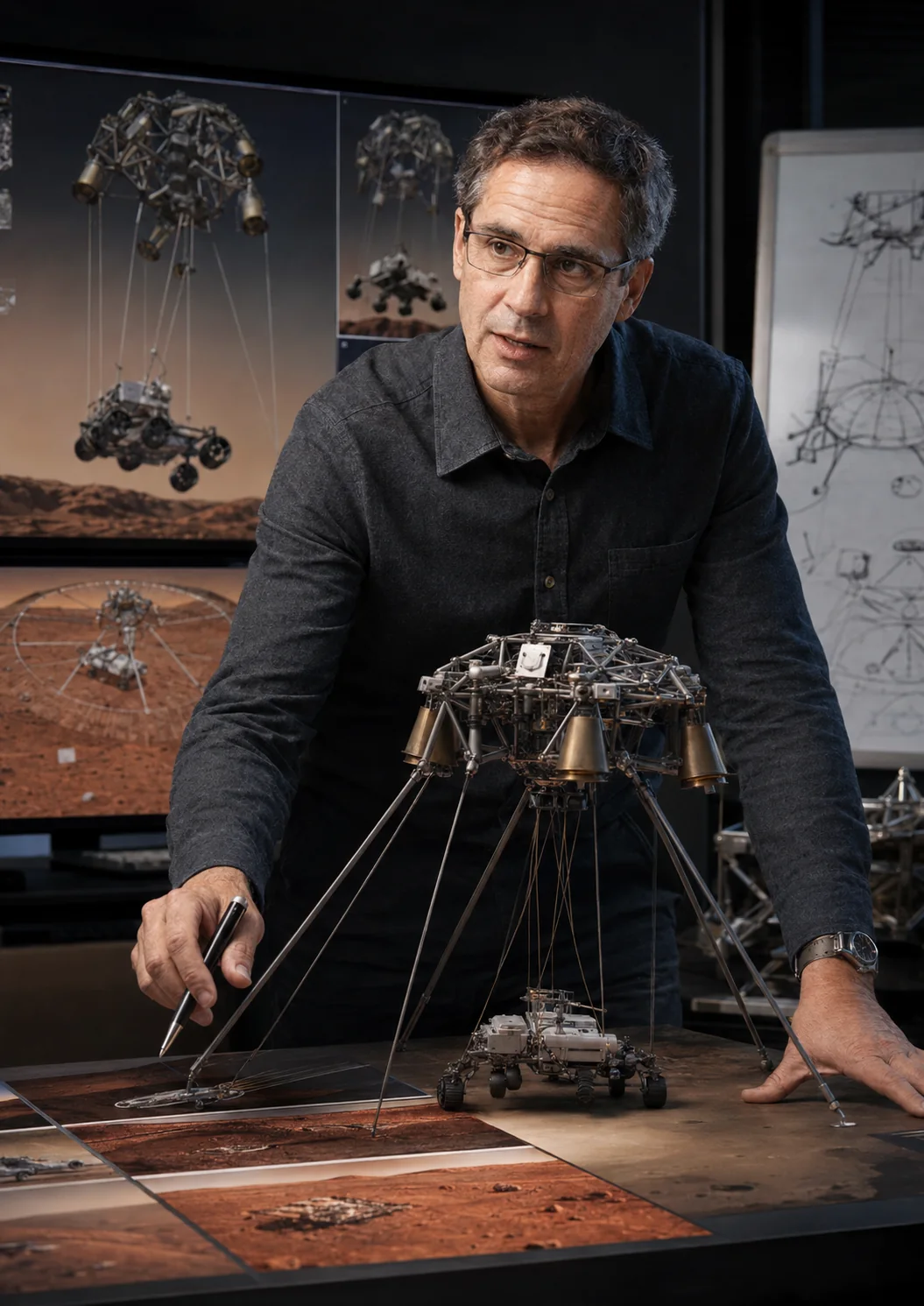
“Seven Minutes of Terror”: explaining autonomous engineering to the public
JPL's “Seven Minutes of Terror” presentation made EDL understandable to millions of people. Steltzner is one of its central communicators, emphasizing that the system can look crazy while still being the product of careful choices. [source]
The radio delay is the key fact. Earth cannot joystick Curiosity through atmospheric entry. By the time confirmation reaches mission control, the events have already happened. Sensors, algorithms, event criteria and margins therefore embody decisions made years earlier. Autonomy is not a convenience; it is physically required by distance.
Human Mars systems will preserve that requirement even when people are on the planet. Pressure loss, power faults and landing control can evolve faster than a committee or Earth support team can respond. A mature settlement must decide in advance which local systems are authorized to act and how those decisions are audited afterward.
Guided entry: using an uncertain atmosphere as part of the control system
Mars atmosphere provides valuable braking but is not a fixed engineering constant. Density varies with altitude, season, dust and weather. Mars Science Laboratory used guided entry to gain more control over its trajectory than a purely ballistic capsule would provide.
The systems challenge is to design for a distribution of atmospheric states rather than one average profile. Robustness means retaining margin when several uncertain variables move away from nominal at the same time. The nominal trajectory is only one member of a population of possible trajectories.
For human-scale vehicles, the issue becomes more severe because far more kinetic energy must be removed. Steltzner's EDL culture therefore supplies a method for reasoning about uncertainty, not a ready-made human lander.
The supersonic parachute: a flexible structure that can dominate a rigid spacecraft
Parachutes may appear mechanically simple because they are fabric rather than machinery, but supersonic inflation creates transient loads, oscillations and wake interactions. The National Academy of Engineering citation associated with Steltzner specifically mentions contributions to parachute dynamics. [source]
This is a useful systems lesson: flexible elements can govern overall behavior. Cables, membranes, seals and pressure fabrics can introduce dynamics that ideal rigid-body models do not capture. Qualification therefore needs both simulation and carefully designed tests.
Settlements will use inflatable structures, suit joints, flexible seals and pressurized membranes extensively. Their apparent simplicity should never make them secondary engineering concerns. Some of the most important failure modes live in materials designed to bend.
Radar and state estimation: acting depends on knowing where the vehicle really is
Powered descent cannot be commanded by time alone. The vehicle must estimate altitude, speed and its relationship to the ground. A sensor does not directly deliver “truth”; it produces measurements that software combines with models and previous state estimates.
This links naturally to Steltzner's training in dynamics. Engineering often requires reconstructing an unobserved physical state from incomplete observations. The goal is not a perfect measurement but an estimate whose uncertainty is small enough for the required decision.
Future settlements will use the same logic for navigation, subsurface-resource estimates and structural health. Sensors produce evidence; decision architecture determines when that evidence is trustworthy enough to justify action.
Powered descent: braking becomes a control problem
Once the parachute has done as much as it can, the descent stage must manage the remaining velocity and position. It has limited time and propellant while controlling vertical and lateral motion and maintaining stability.
Sky crane does not remove propulsion risk; it reorganizes it. The stage controls itself while the rover is lowered beneath it, then must recognize surface contact and complete separation. The physical chain remains tightly coupled.
For future heavy cargo, terminal propulsion may become even more important. Yet engine performance alone will not define success. Sensors, tanks, software, structures and ground interaction all determine whether thrust can be converted into a safe landing.
Bridles and lowering: controlling a geometry that changes in seconds
Lowering a rover on cables creates a mechanical system whose geometry changes throughout the maneuver. Tension, stage control and rover motion must remain compatible. The system must identify touchdown, cut the bridles and avoid leaving the descent stage above the rover.
The architecture therefore demands explicit off-nominal thinking. What if a sensor response is late? What if vertical velocity differs from prediction? What if the rover meets a slope? What if separation timing is imperfect? Reliability comes from understanding margins around nominal behavior rather than merely animating the intended sequence.
Settlements will use cranes, robotic manipulators and tethered systems for cargo and construction. Sky crane shows how an operation lasting only seconds can require years of characterization when failure is unrecoverable.
The descent stage must then leave: designing the end of a function
After delivering the rover, the descent stage has no useful role nearby. It cuts the connections and flies away to impact at a distance. That final step illustrates an often neglected design question: what happens to a subsystem after it has completed its job?
Temporary Mars hardware can become a hazard if its end state is not planned—spent stages, tanks, thermal hardware, cables or contaminated equipment. Removal, safing or reuse should therefore be part of the initial architecture rather than an afterthought.
Sky crane handles this problem within seconds. A settlement must extend the same thinking over years. Every major machine should have a credible end-of-life state compatible with an environment where waste cannot simply be shipped away.
Why the complete landing cannot be rehearsed perfectly on Earth
Earth's gravity, atmospheric density and available velocity conditions make it impossible to reproduce the entire Mars sequence in one perfectly representative terrestrial test. Teams therefore decompose the evidence: parachute tests, component qualification, structural testing, sensor validation, software simulations and partial dynamic experiments.
This changes the meaning of proof. One dramatic full-scale test cannot answer everything. Engineers must show that individual models are anchored to experiments, then use those models to explore conditions that cannot be created directly. Confidence comes from independent evidence converging on the same conclusion.
Settlement-scale systems will face the same issue. No Earth facility can run a perfect ten-year replica of a Martian mine, life-support network or local ecosystem. Validation must combine subsystem tests, models and operational margins.
Monte Carlo thinking: replacing one perfect scenario with a population of imperfect ones
When many parameters are uncertain, engineers run large families of simulations rather than one nominal case. Atmosphere, mass, sensor errors, timing, winds and performance can be varied within expected distributions to find where failures cluster and how much margin remains.
This statistical culture is the opposite of a promotional animation. A beautiful average trajectory can still be unsafe if an ordinary combination of modest deviations creates a loss. Reliability is partly the study of tails and interactions.
Mars settlements should apply the same thinking to water, energy and logistics. A life-support system cannot be sized only around average demand. It must survive plausible combinations of peak use, component failure, maintenance delay and resupply disruption.
2012 turns a new idea into flight heritage
Curiosity's successful landing in Gale Crater changed sky crane's status. Before flight it was a novel architecture supported by test and analysis. After flight it had real telemetry, observed margins and a sequence that could be compared with prediction. JPL later recognized Steltzner as an Engineering Fellow for his EDL leadership and expertise. [source]
Success does not mean the problem is permanently solved. It creates an evidence base. A later mission can reuse the architecture with greater confidence while still requalifying every changed assumption—mass, site, navigation, software or science requirements.
A settlement will mature the same way. The first power plant or drilling system creates real operational heritage. Its value depends on whether the data and configuration are preserved well enough for the next version to distinguish transferable lessons from site-specific luck.
National Academy recognition: crediting individual contribution without erasing the team
In 2016 Steltzner was elected to the National Academy of Engineering for development of Curiosity's landing system and contributions related to parachute dynamics. [source] JPL had already named him an Engineering Fellow in 2013 for exceptional leadership and technical expertise in EDL systems. [source]
These institutional descriptions are more precise than calling him simply “the inventor of sky crane.” They establish major personal responsibility—leadership, systems expertise, technical contribution—inside a program that required many specialist teams.
That distinction matters for future Mars organisations. Heroic stories can inspire, but safe engineering requires the contribution map to remain detailed enough that later teams know who understood each subsystem and why each decision was made.
Mars 2020: reusing sky crane without copying Curiosity blindly
When JPL announced Steltzner's National Academy election, it identified him as chief engineer for the Mars 2020 project and manager of a planetary entry, descent, landing and small-body-access office. [source] Perseverance retained broad Curiosity heritage while introducing capabilities suited to Jezero Crater and a different science mission.
This is how a mature system evolves. Flight heritage reduces uncertainty, but every changed element must be identified and requalified. The choice is neither “all new” nor “unchanged forever.” Engineering progress is controlled modification with traceable evidence.
A settlement will depend on configuration discipline even more strongly. Two systems carrying the same name may not be interchangeable if software, materials or suppliers changed. Heritage protects only when the organisation knows exactly what it inherited.
Terrain Relative Navigation: the lander begins comparing perception with expectation
Perseverance added Terrain Relative Navigation to improve landing-site safety at Jezero. The broad idea is to compare observations during descent with a preloaded map, refine position knowledge and use that knowledge to avoid known hazards within available constraints.
This represents a deeper form of autonomy than merely following a fixed timeline. The vehicle interprets perception against a model. That also creates new failure modes: a bad map, poor perception or overconfident classification can be dangerous. Autonomy therefore needs both capability and uncertainty management.
Future settlement vehicles will perform far more advanced versions of the same task while navigating near infrastructure and people. EDL heritage shows why autonomous decisions must carry confidence estimates and safe fallback behavior.
Chief engineer: connecting science desires with a vehicle that must still close technically
A chief engineer does not design every part. The role is to preserve technical coherence while requirements arrive from different communities: scientists want instruments and samples, operators want margin, contamination specialists require cleanliness, EDL teams protect mass and program management protects cost and schedule.
Steltzner's Mars 2020 role connects naturally to one of Perseverance's most demanding mechanisms, the Sample Caching System. [source] After a career associated with autonomous landing over minutes, the engineering challenge expands to a multi-hour robotic chain whose output may have to remain scientifically useful for years.
Settlement engineering will operate across even longer timescales. A maintenance decision made today can change safety next year. Technical leadership must therefore protect future operability, not just immediate function.
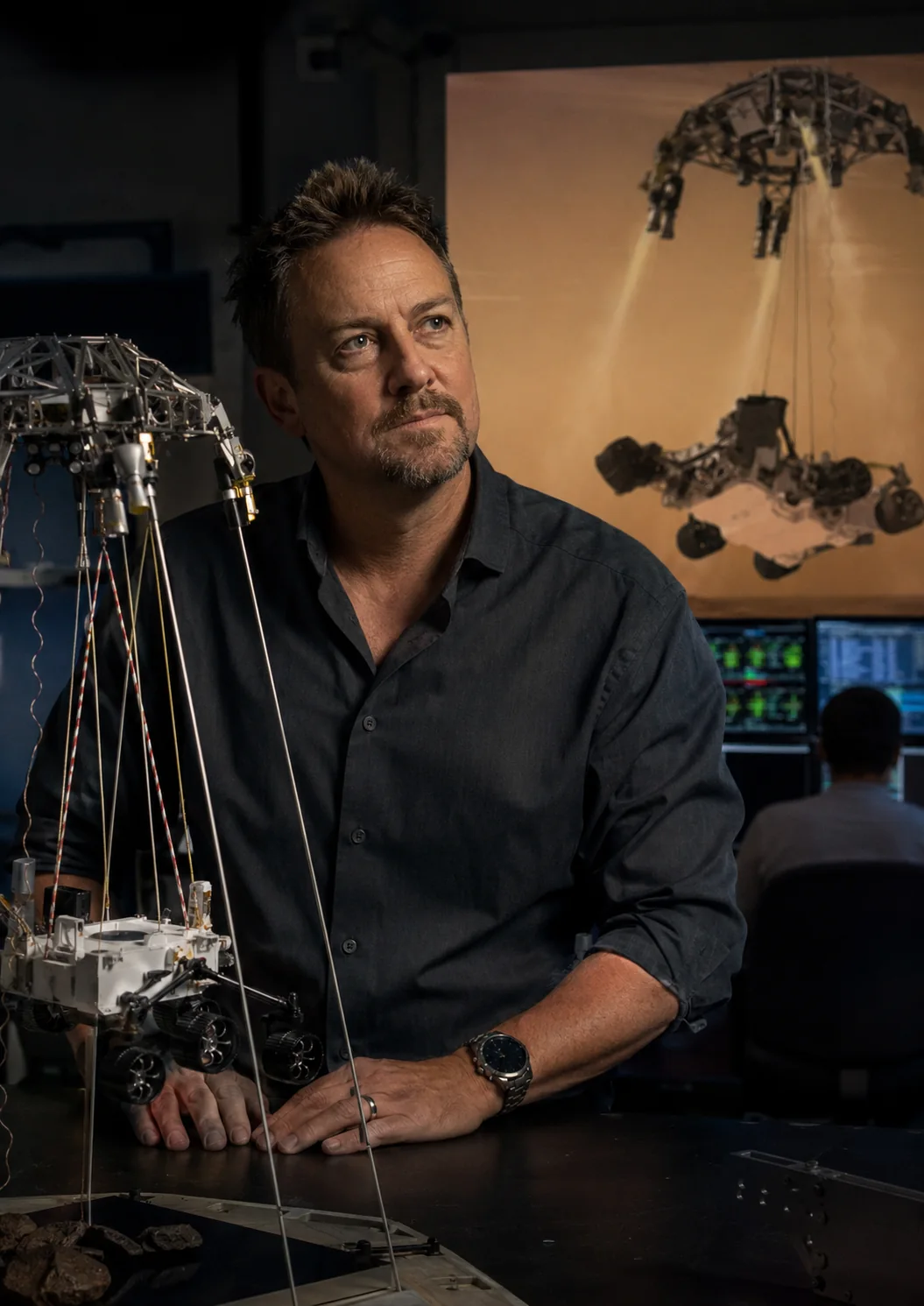
Sample Caching System: three robots in place of astronaut hands
Perseverance's sample system shows what “automation” really costs. JPL describes more than 3,000 parts and multiple coordinated robots that acquire a core, transfer a tube, measure and image it, seal it and store it. Steltzner explained that three robotic elements were required to perform a chain astronauts could otherwise execute directly. [source] [source]
Removing human hands does not necessarily simplify the mechanism. It shifts capability into motors, sensors, software, contamination control and state tracking. Robotic autonomy is therefore a trade, not free complexity reduction.
A Mars settlement will repeatedly choose between humans and robots. The right answer will depend on radiation, maintenance, dexterity, spares and time. The sample system is a reminder to calculate the complete support architecture rather than compare only the visible worker and visible robot.
Clean sample tubes: a scientific question becomes a mechanical requirement
Mars samples are valuable only if their contamination history is understood. NASA describes the need to seal samples in extremely clean vessels so Earth-originating organic material does not compromise later analysis. [source]
A biological question therefore propagates down into materials, assembly processes, clean-room procedures, mechanisms and software. “Could this molecule be Martian?” becomes an engineering requirement years before the analysis laboratory sees the sample.
A settlement will multiply such conflicts. Systems optimized for human convenience may contaminate nearby science. Instead of trying to make the whole settlement sterile, future teams will probably need limited clean chains whose provenance is rigorously documented.
Seven years of work for a mechanism most viewers never see
In JPL's Sample Caching System video, Steltzner notes that teams had worked for roughly seven years on the mechanism before Perseverance launched. [source] Public audiences encounter it as a short animation, but the apparent simplicity is the compressed result of thousands of hours of detailed work.
Tolerances, motors, cleanliness, state transitions and failure recovery are rarely as visually memorable as launch or landing. Yet these hidden functions determine whether the mission's central scientific promise can be fulfilled.
A settlement will need a culture that values such invisible work. Qualification, documentation and preventive maintenance may generate less public excitement than a new habitat, but they will determine whether the settlement remains safe after the ceremony ends.
The “Swiss watch” analogy: precision is only useful if failure states are understandable
NASA quoted Steltzner comparing the coordinated sample robots with Swiss-watch precision. [source] The analogy captures the need for sequencing but should not hide another systems question: what happens when one motion does not complete?
Robust automation needs sensors, state reporting, intermediate safe conditions and procedures for remote diagnosis. A mechanism can be exquisitely precise under nominal conditions and still be operationally weak if teams cannot determine why it stopped.
Mars settlements will need more repairability than today's one-way robotic missions. Still, the same principle applies: machines should expose enough internal state that local crews can distinguish a recoverable interruption from a condition that makes further movement dangerous.
Testing culture: discover on Earth what can still be changed on Earth
The Perseverance sampling team emphasized exhaustive preflight testing because no mechanic could redesign the system once it reached Mars. [source] That constraint produces a culture in which teams deliberately search for failure before launch.
Settlements will change the equation because local repair becomes possible, but testing will remain essential. The difference is that future communities can build local test stands, digital twins and maintenance workshops. They can validate a change under Mars conditions before installing it on a critical system.
Steltzner's projects therefore connect preflight verification with future repairability. Better testing reduces emergency work; better repairability prevents every missed test case from becoming fatal.
Technical leadership: make it safe for bad news to move upward
High-risk engineering cannot be made safe if specialists are rewarded for hiding anomalies. A systems leader must create reviews in which objections are useful, uncertainty can be admitted and criticism of an architecture is not treated as disloyalty to its designers.
The sky-crane story is valuable because the “crazy” appearance is not defended through confidence alone. The architecture becomes acceptable only after teams spend years trying to discover how it can fail. Leadership therefore includes organizing skepticism.
A Mars community will need that culture even more urgently. If the technician closest to a pressure system sees an anomaly, hierarchy must not force operations to continue merely because a schedule is politically important. Reporting bad news early is a safety function.
Public communication: make complexity memorable without pretending it is simple
Steltzner's stage background and media presence made him one of Curiosity's most recognizable engineers. UC Davis explicitly noted that his earlier performance experience translated into ease before an audience. [source] But useful technical communication requires more than charisma.
“Seven Minutes of Terror” works because the story preserves causality. Each phase has a reason and a consequence. Viewers do not need the equations to understand why the chain is dangerous. That is a model for publicly funded high-technology programs.
A permanent Mars effort will need the same contract with Earth. Engineers should be able to explain what an expensive margin buys, what remains uncertain and why a failure changes the next design. Trust cannot be maintained indefinitely through spectacle alone.
Do not give one man ownership of sky crane
Steltzner is strongly associated with sky crane because he led the Mars Science Laboratory EDL team and became its most visible public explainer. Yet JPL's own language remains collective: he led the team that developed the system. [source]
Parachute specialists, navigation engineers, propulsion teams, structural analysts, software developers, radar experts and operations staff all contributed. A mission architecture does not become the intellectual property of the person who explains it most memorably on camera.
This biography should honor Steltzner without erasing colleagues. A future settlement should apply the same discipline. Accurate attribution is not only ethical; it preserves technical memory by recording where specialized knowledge actually resides.
Curiosity to Perseverance: progress often looks like controlled reuse
Major space progress is not always an entirely new vehicle. Perseverance retained strong Curiosity heritage because a validated architecture can reduce risk while freeing engineering effort for navigation, sampling, software and science.
This kind of reuse is a sign of industrial maturity. Knowledge exists not only in drawings but also in learned tolerances, procedures, suppliers, test fixtures and previously encountered anomalies.
Settlements must become experts at this form of progress. Every habitat generation should not be a unique art project. Reliable infrastructure will standardize what works, improve what is weak and reserve radical reinvention for domains where heritage no longer closes the problem.
Sky crane has limits: a method is not a universal human-landing architecture
Curiosity and Perseverance do not prove that a many-tens-of-tonnes human habitat can simply hang beneath a scaled-up descent stage. Scale changes aerodynamic regime, engine flow, structure, fuel demand and ground interaction.
Steltzner's most transferable contribution to human Mars is therefore methodological. When mass changes enough, engineers must reopen the trade space rather than protect the solution that made their generation famous.
This ability to abandon one's own successful architecture when conditions change is a form of technical maturity. A settlement that turns every historical success into doctrine will eventually become trapped by its heritage.
Landing tens of tonnes turns EDL into civilizational logistics
A permanent settlement requires repeated delivery of habitats, power systems, excavation equipment, vehicles, food, spares and eventually industrial machinery. Landing accuracy must improve because every new cargo needs to arrive near existing infrastructure without endangering it.
That introduces settlement-scale constraints: landing zones must be far enough away for safety yet close enough for logistics; engine plumes can disturb soil; failures must not destroy the base; and cadence matters because the system becomes a transport network rather than a one-time mission.
Steltzner's EDL experience helps frame the questions: how do we decompose a sequence we cannot test perfectly, instrument each phase, preserve margins and turn every arrival into data that improves the next? That learning loop is what could transform landing from an achievement into infrastructure.
Dust and plume effects: the last metre can shape the entire settlement map
Powerful engines near the ground can mobilize regolith, eject particles and threaten nearby equipment. Curiosity's architecture reduces some direct rover interaction by keeping the descent stage separate, but future heavy cargo systems may face much greater plume effects.
This means EDL cannot be designed separately from settlement planning. Landing zones, prepared surfaces, barriers and stand-off distances may become permanent civil infrastructure. A change in landing technology could alter the geometry of the entire base.
Steltzner did not design that future city, but his career makes the unity of the problem visible: vehicle and terrain form one system. A landing site is not merely a latitude and longitude. It is part of the machine's operating environment.
Systems engineering means knowing exactly what is not demonstrated
Planetary missions can contain enormous amounts of analysis without eliminating uncertainty. Good technical review identifies the least validated assumptions, dominant parameters and regions where performance still depends on extrapolation.
EDL makes this discipline severe because there is no repair after atmospheric entry. Teams must reduce uncertainty, contain it with margin or explicitly accept the remaining risk. Hiding uncertainty is not confidence; it is loss of control.
Settlement systems may be even harder to model because biological, mining and social processes can be less predictable than spacecraft dynamics. It will therefore be essential to label what is measured, calculated, assumed and still unknown.
Recruiting lesson: select for learning capacity, not only perfect biographies
The contrast between a young musician struggling in school and a later JPL Engineering Fellow makes Steltzner's story memorable. Its operational value is that future competence was not obvious from his early academic record.
The College of Marin, UC Davis, Caltech and Wisconsin sequence also demonstrates multiple entry points into advanced technical work. [source] [source] Excellence did not require the first institution to be the most prestigious possible one.
A small Mars population will need local pathways for second chances and retraining. Permanently classifying people by early failure would waste scarce human capacity. Education itself will be part of settlement resilience.
Mars 2020 adds another inheritance: a sample is a promise made to future teams
Perseverance's cache was designed to preserve material that another mission architecture might recover later. Even as return plans evolve, the engineering idea remains profound: one robot prepares a scientifically meaningful object for a future system that is not present.
That requires compatibility through time. Tubes must remain identifiable, metadata must survive and future teams must understand why each sample was selected. The system is therefore not only mechanical; it is an intergenerational convention.
An entire settlement will operate this way. Tunnels, geological logs, spare inventories and environmental records will pass to people who were not there when they were created. Future operability begins with documentation that remains intelligible without the original designer.
Adam Steltzner in 2026: Engineering Fellow, not a settlement architect
JPL's current research profile lists Steltzner as an Engineering Fellow and retains the citation for his EDL systems leadership. [source] That is a more defensible current description in 2026 than automatically carrying forward Mars 2020 project titles documented for an earlier period.
This dating discipline matters for living people. Responsibilities change, projects end and organisational titles can become stale. A reference biography should distinguish current status from historical roles.
Steltzner is not presented here as the designer of a Mars colony. His documented contribution is narrower and more valuable: dynamics, systems engineering, EDL, validation, technical leadership and complex robotic chains. Those capabilities address some of the hardest bottlenecks between interplanetary flight and useful work on the surface.
The right kind of crazy: audacity matters only after evidence
Steltzner's public reputation is tied to the idea that a solution can look crazy. The dangerous reading is to celebrate boldness and forget selection. An extraordinary architecture becomes acceptable only after years of testing and analysis make its risk competitive with the alternatives.
This distinction protects Mars planning from beautiful concepts. A rendering can show a city, rocket or factory in minutes. Engineering must then ask for mass, power, interfaces, failure modes, repair and evidence. The “right” kind of crazy is not lack of caution; it is acceptance of a counterintuitive answer after unusually rigorous scrutiny.
His career therefore defends imagination without abandoning auditability. Mars settlement will need both qualities simultaneously.
Governance lesson: make every major technical decision reconstructible
Large architectures accumulate choices that can look arbitrary to later teams. If the reasons disappear, a new engineer may remove a margin that seems conservative or revive an alternative previously rejected for a serious reason. Programs therefore need a durable memory of reviews, tests and trade studies.
Sky crane can be understood because the problem that produced it can be reconstructed: rover mass, airbag limits, surface mobility requirements and controlled descent. Constraint and decision remain connected.
A Mars base should preserve the same link. Critical rules should point back to evidence, assumptions and version history. Decision traceability reduces dependence on founding personalities and lets later generations improve infrastructure without accidentally deleting invisible protection.
What Adam Steltzner actually contributes to the conquest of Mars
His legacy can be stated without exaggeration. He helped turn heavier robotic Mars landing into a systems discipline that moved beyond airbags, led the Curiosity EDL team, became a central figure in the maturation of sky crane, served as Mars 2020 chief engineer and worked publicly on one of the most complex robotic sample-handling systems ever flown to another planet. [source] [source]
What he does not provide is equally important: not the interplanetary launch system, habitat life support, food production or settlement medicine. Mars requires integration of specialties no single person owns.
That limitation is precisely why the biography is useful. It shows how one engineer can become exceptionally capable in a critical link, how that capability depends on teams and how an institution converts a one-time success into reusable heritage. A Martian civilization will emerge from the integration of such deep specialties, not from a universal hero.
From Curiosity to Perseverance: reuse an architecture without freezing it
Curiosity's success could have created a familiar engineering trap: treating sky crane as a universal recipe. Mars 2020 instead shows what it means to turn an innovation into flight heritage. Perseverance retains much of Curiosity's entry, descent and landing architecture, but the operational problem changes. Jezero contains more hazardous terrain, the science campaign has different priorities and landing accuracy becomes more valuable. JPL's landing documentation explains that Mars 2020 adds Range Trigger and Terrain-Relative Navigation so the rover can target terrain that would have been much harder to accept with Curiosity's landing system. [source]
Range Trigger changes the timing of parachute deployment according to the vehicle's actual position rather than following a fixed sequence alone. Terrain-Relative Navigation then compares descent imagery with an onboard map to identify hazards and select a safer destination. The lesson is important: heritage can remain valuable while new decision layers are added. Reuse should preserve evidence, not prevent learning.
A Mars settlement will face this problem constantly. A second-generation habitat may inherit proven valves, software or interfaces from the first, but “it worked before” cannot become the only requirement. Engineers will need to distinguish components whose robustness genuinely transfers from assumptions that fail when crew size, site, mission duration or available power changes.
Three robots to replace two human hands
Perseverance gives Steltzner's career a second striking example of autonomous systems engineering. The Sample Caching System is not a simple drawer for tubes. JPL describes it as one of the most sophisticated robotic systems built for space. Three robotic elements cooperate: the large arm positions the drill, the bit carousel moves bits and tubes between the exterior and interior of the rover, and a smaller handling arm performs imaging, volume assessment, sealing and storage. Steltzner drew a useful comparison with Apollo: where two astronauts could collect a sample directly, Perseverance needs three robots and thousands of parts to create a scientifically useful sealed core. [source] [source]
The comparison is not a simple celebration of automation. It exposes automation's systems cost. Removing the human removes immediate improvisation. Engineers replace part of that flexibility with sensors, software states, mechanical constraints, verification and recovery logic. A task that looks trivial on Earth becomes a chain of interfaces, each capable of blocking the science objective.
For human Mars operations, the lesson cuts both ways. Robots will be indispensable for precursor construction, inspection and hazardous work, but planners should distinguish tasks where automation truly reduces risk from tasks where a human presence simplifies the architecture. “Autonomous” and “simple” are not synonyms.
Cleanliness and provenance: engineering for laboratories that have not yet received the sample
Perseverance's cache has an unusual time horizon. Its scientific product is not consumed only by the rover. Tubes must remain interpretable by future laboratories, potentially using instruments not yet selected when the caching system was designed. JPL therefore emphasizes very clean vessels, sealing and carefully controlled sample handling. [source]
Cleanliness becomes scientific metadata. Contamination is not merely a mechanical nuisance; it can make an organic measurement ambiguous. The engineering team must therefore think on behalf of future scientists and institutions. Surfaces, procedures and records are designed so that an observation made years later can still be trusted.
A permanent Mars settlement will magnify the same issue. Habitat dust, lubricants, polymers, food residues, propellants and terrestrial microorganisms can move into nearby field sites. Sample provenance will have to link material not only to coordinates but also to human activity, tools and contamination history. Steltzner's work therefore connects directly to scientific governance: a system is not successful if it collects material but destroys confidence in what that material means.
Why sky crane cannot simply be scaled up fifty times
The success of Curiosity and Perseverance can encourage a misleading extrapolation: a future human lander might appear to need only a much larger sky crane. Scaling rarely behaves that cleanly. As mass rises, structural loads, terminal propulsion, propellant flow, thermal margins, cable dynamics, plume interaction with the surface and vehicle stability do not necessarily preserve the same relationships. A principle can remain useful while the specific implementation reaches a physical or operational boundary.
Steltzner's most transferable contribution is therefore method rather than shape. Curiosity did not receive sky crane because the team wanted a visually dramatic solution. The architecture emerged because airbag heritage no longer fit the rover's mass and other mission constraints. [source] A human landing system would need to reopen the trades: delivered mass, crew acceleration limits, plume excavation, landing-site preparation, fault tolerance, abort capability and the number of systems that must work concurrently.
This distinction matters for a public Mars reference. Respecting an engineering achievement should never turn its geometry into doctrine. Mature engineering preserves the reasoning and reopens the design space when the problem changes.
Test in order to make the system fail before Mars
In JPL's Sample Caching System video, engineers explicitly describe trying possible failure conditions on Earth because they cannot redesign the hardware after it reaches Mars. [source] That sentence captures a test culture different from a public demonstration. A useful qualification test is not designed merely to show that the nominal sequence works; it tries to identify where the sequence stops working.
Results must then feed back into the design. A failure in a terrestrial test is not an embarrassment to hide. It is a comparatively inexpensive discovery of a weakness before distance turns the same weakness into a mission loss. This culture requires schedule margin and leadership willing to accept bad news early.
A Mars base will need the same habit in life-support loops, batteries, airlocks, medical systems and maintenance robots. Teams should deliberately exercise degraded states. The question is not only whether a function works, but how it fails, how quickly the failure becomes visible and what useful capability remains after the primary path is lost.
Decision traceability: preserve why a choice was made
Large programs outlive individual assignments. Hardware and software can move from one mission generation to another after the people who negotiated the original trade have changed roles. The danger is preserving a decision while losing its reason. A margin looks wasteful, a sensor looks redundant or a procedure looks slow, and a later team removes the protection without knowing which previous failure it addressed.
Steltzner's projects illustrate a healthier form of technical memory. Sky crane can be reconstructed from rover mass, mobility and landing constraints; sample caching can be reconstructed from the need for clean, sealed and traceable material. When constraints remain connected to decisions, successors can challenge a design rationally rather than accepting it as tradition.
A long-lived Mars settlement will accumulate thousands of local modifications. Critical changes should retain their rationale, assumptions, verification evidence and the conditions that would trigger reconsideration. Technical heritage must become durable documentation rather than fragile oral memory.
Landing as embedded software: seven minutes when Earth cannot intervene
The “Seven Minutes of Terror” film emphasizes a constraint that the visual drama of sky crane can hide. By the time the signal reaches Earth, the landing sequence has already succeeded or failed. [source] Mechanical choreography is therefore only half the problem. Sensors, computers and software must recognize events and trigger transitions without real-time human commands.
This autonomy is not general intelligence. It depends on models, thresholds, measurements and decision branches designed for a bounded set of conditions. Engineers have to imagine enough off-nominal states that the vehicle remains governable when reality differs from simulation. The discipline is to provide enough autonomy to survive communications delay without pretending that software can solve an unspecified problem.
A Mars settlement will face the same boundary. Earth controllers cannot operate every pump, valve or airlock. Local systems must detect, isolate and recover from some failures by themselves. But autonomy should remain explainable, testable and bounded. A habitat that makes decisions nobody can reconstruct would be difficult to certify and even harder to repair.
Training successors: the real test of expert knowledge
An exceptional career can paradoxically weaken an institution if too much knowledge remains concentrated in a few people. Steltzner became a public face of Mars EDL, but Curiosity and Perseverance succeeded because methods were distributed across teams and preserved in reviews, models, procedures and tests. JPL now presents him as an Engineering Fellow rather than as the permanent owner of every Mars landing architecture. [source]
A senior expert's role is therefore not only to solve the hardest problem. It is also to make the organization less dependent on that expert: teach younger engineers, expose the reasoning behind trades, invite criticism and preserve verification culture. A team that can reproduce a decision only by asking its original author has not truly captured the knowledge.
This will matter even more on Mars, where personnel rotations may be slow and a critical specialty may be represented by only one resident. Every essential domain will need backups, cross-training and documentation that lets a competent successor take over. Expertise becomes durable when it is converted into collective capability.
Primary and institutional sources
Verification rule: this biography prioritizes institutional, archival and primary sources. Statements about living people or active programs are dated and attributed; uncertain or disputed points must remain explicitly qualified.
- NASA/JPL — Mars landing pioneer elected to NAE
- NASA/JPL — Curiosity landing, relive the excitement
- NASA/JPL — Newest Mars mission connects past and future
- JPL Research — Adam Steltzner, Engineering Fellow
- UC Davis Engineering — Biography of Adam Steltzner
- College of Marin — From COM to Mars: Adam Steltzner
- NASA/JPL — Curiosity’s Seven Minutes of Terror
- NASA/JPL — Perseverance Sample Caching System video
- NASA/JPL — The extraordinary sample-gathering system of Perseverance
- UC Davis Engineering — Steltzner education and JPL career
- NASA/JPL — Perseverance landing mission overview: Range Trigger and Terrain-Relative Navigation
- NASA/JPL — Perseverance sample system: three robots working as one