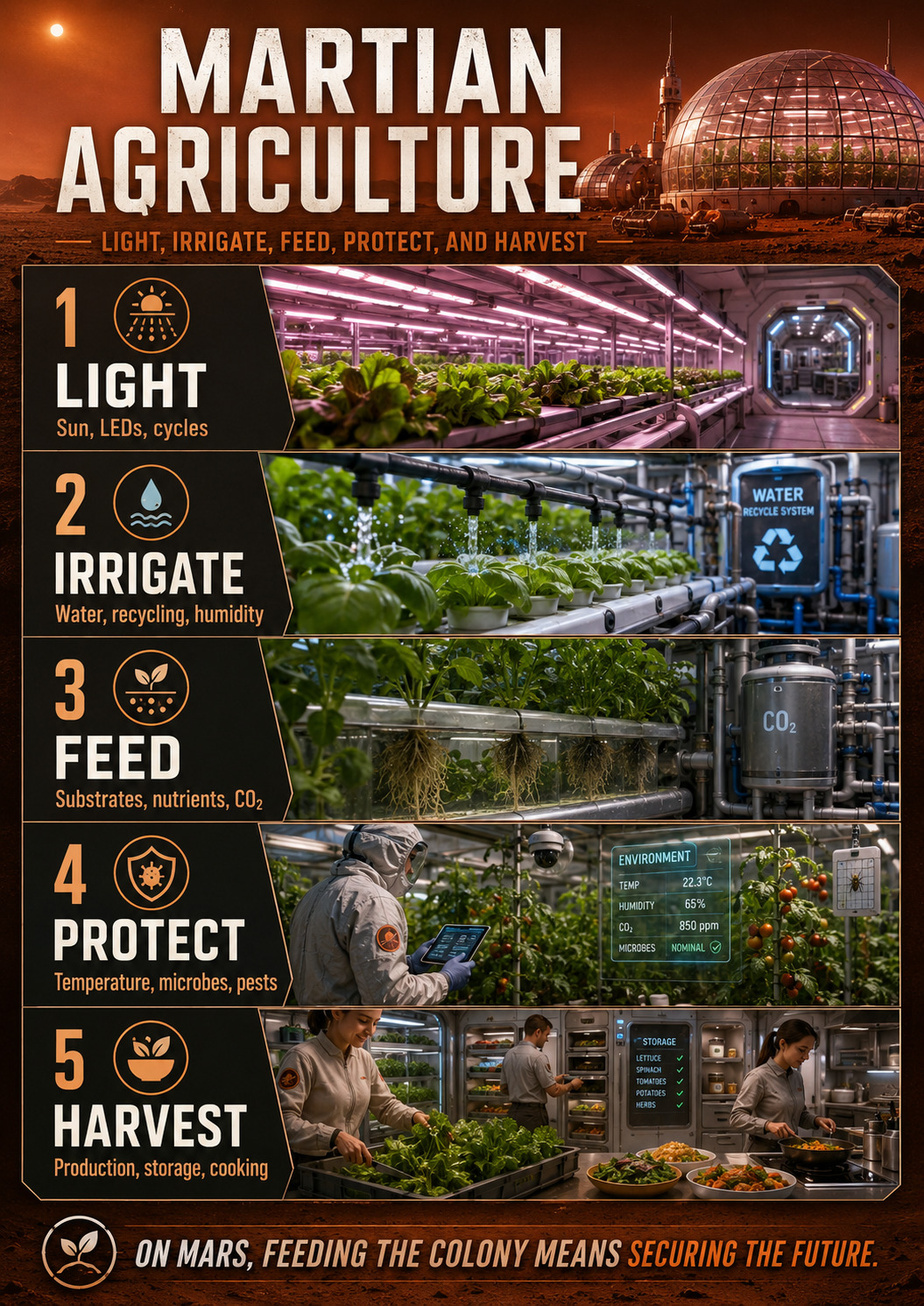


NASA — Space Crops
The 2026 road map links cultivar selection, horticulture, plant disease, nutrition, and bioregenerative life support.
Biological autonomy is not achieved by growing a few plants inside a habitat. Calories, water, nutrients, light, growing area, crew time, storage, microbiological safety and medical continuity have to be connected. Crops can reduce selected dependencies and provide fresh food, but they also create a living production system whose yields, diseases and maintenance demands must be integrated into life support.
Essential foundations already established
Crops and medical stocks are not independent subsystems: Mars colony life support connects food production to water, oxygen, waste recovery and resilient power before this dossier pushes toward nutritional and medical autonomy.
Picture the first Mars crew on the morning after landing. Power is available, the air loop is running, water circulates and the communications link works. Yet a much less dramatic question can decide whether the expedition remains healthy: what will the crew eat six months from now, two years from now, and after a failed harvest? On Earth, food is supported by farms, factories, warehouses, roads, cold chains, laboratories and pharmacies. On Mars, much of that invisible civilization has to be compressed into cargo, growth chambers, storage racks and a very small workforce.
A settlement therefore does not become food-independent when the first lettuce leaf is harvested. The credible transition is hybrid: long-life stored food + fresh crops + emergency reserves + a progressively larger local production system. A crop chamber may improve vitamins, variety and morale while supplying only a fraction of calories. Conversely, a warehouse can cover calories for months yet still lose quality, acceptability or vulnerable micronutrients as storage time increases.
NASA-STD-3001, Food and Nutrition treats food as more than payload mass. The system has to preserve food safety and nutrition, and NASA explicitly considers long-term acceptability, variety, texture and flavor because food that a crew stops eating is not an effective life-support provision.
This book therefore follows food as a life-critical system: human requirements, storage, crop production, light, water, CO₂, nutrients, microbiology, seed stocks, processing, waste, failures and growth from expedition scale to settlement scale. Medicine remains in the title deliberately. Over years, poor nutrition becomes a medical problem, while fresh food, dietary monitoring and biological production can become part of medical resilience.
Food autonomy should therefore be described in stages rather than as a binary achievement. Stage one is survival by imported stores. Stage two adds fresh crops for variety and selected nutrients. Stage three replaces a meaningful share of imported mass with local calories and protein. Stage four closes more nutrient and water loops. Each stage needs a fallback to the previous one. A settlement is resilient when the loss of a greenhouse reduces capability rather than immediately threatening survival.
Mars cargo can leave Earth before its crew. Food may therefore be manufactured, stored on Earth, launched months later, spend months in interplanetary transit, wait on the Martian surface and only then be consumed. The important variable is not merely “mission duration” but the true age of the food when it is eaten.
NASA exploration work has repeatedly identified shelf life as a major gap. Current shelf-stable items often do not preserve every quality attribute for the time required by Mars logistics; exploration scenarios can demand roughly five-year capability. Recent work continues to examine cold storage. NASA TechPort lists Mars Food Refrigeration, updated in 2026, because refrigeration or freezing can help preserve nutrients and quality that do not remain stable indefinitely at ambient storage conditions.
Cold storage, however, becomes another spacecraft system. It needs insulation, refrigeration hardware, electric power, heat rejection, sensors and backup strategy. A failed freezer can convert a strategic reserve into a food-safety problem. Thermostabilized and dehydrated foods simplify storage but may trade away texture, flavor or particular nutrient stability. No single preservation method wins for every item.
A credible architecture therefore mixes technologies: highly stable staples, selected refrigerated or frozen items, dry ingredients that enable flexible meal preparation, and fresh local production. NASA’s Deep Space Food Challenge explored production concepts intended to minimize resources and waste while maintaining safe, nutritious and acceptable food.
The strategic point is simple: crops do not instantly replace stored food; they progressively change what has to be stored. For four pioneers, importing energy-dense difficult-to-produce foods is rational. At one hundred people, repeating that logistics stream begins to justify heavier agricultural equipment. At one thousand, local food becomes an industry because every tonne no longer dedicated to routine meals can carry machinery, medicines or components that Mars cannot yet manufacture.
Prepositioning makes the clock more severe. A cargo can leave Earth one launch window before the crew, wait in Mars orbit or on the surface, and then remain in stores for much of the expedition. The relevant age is therefore manufacture-to-consumption, not merely crew-flight duration. A five-year requirement can contain several very different environments: terrestrial warehouse, launch vibration, cruise, cold or warm storage on Mars, and repeated handling after the habitat opens.
Refrigeration can preserve quality, but it creates a new dependency chain: compressors or pumps, power conversion, heat rejection, temperature sensors, seals and backup capacity. A settlement should know what happens after six hours, one day and one week without cooling. Some products may be moved to another cold volume, some consumed first, some processed immediately, and some discarded. The food system becomes resilient only when the failure mode is designed before the freezer fails.
Use a deliberately favorable average dry-food energy density of 4 kcal per gram, or 4,000 kcal/kg:
Per person per day: 3,035 ÷ 4,000 = 0.759 kg. For 100 people over 180 days: 0.759 × 100 × 180 = 13,662 kg, or 13.7 tonnes of ideal dry food. One thousand people need more than 136 tonnes for the same six-month energy reserve. Packaging, diversity, losses, water and less energy-dense foods are not included.
This arithmetic explains why local food becomes more valuable with scale. For a tiny crew, importing tonnes of reliable food may be safer than immediately deploying a complete farm. At a thousand residents, repeated hundreds-of-tonnes food streams compete directly with machinery, spares and medical cargo.
A simple mass calculation shows the scale. Assume, only for illustration, 0.60 kilograms of dry or concentrated food per person per day. Four people for one year require 0.60 × 4 × 365 = 876 kilograms. Twenty require 4.38 tonnes; one hundred require 21.9 tonnes; one thousand require 219 tonnes. Packaging, contingency reserves, water contained in non-dry foods and handling hardware increase the shipped mass. The calculation is not a menu prescription; it demonstrates why partial local production becomes economically and logistically attractive as population grows.
The easiest number to understand is food energy. The current public NASA-STD-3001 Volume 2 reference states an average provisioning value of 12,698 kJ, or 3,035 kcal per crewmember per day, unless an individualized estimated energy requirement is used. It also specifies 837 kJ, or 200 kcal, per EVA hour above nominal intake for moderate-to-heavy EVA work. These are not universal “Mars diet” numbers; they are a useful human-spaceflight design baseline. NASA source.
Using 3,035 kcal/person/day solely as a transparent example: 4 people require 12,140 kcal/day; 20 require 60,700; 100 require 303,500; 1,000 require 3,035,000 kcal/day. Over 365 days, 1,000 people represent about 1.108 billion kilocalories. The calculation says nothing about dietary quality; it only shows scale.
The engineering trap is to confuse energy with nutrition. Two menus with identical calories can have very different protein, fat, fiber, vitamin and mineral profiles. Micronutrients can degrade during storage. Texture and flavor change. Menu fatigue can reduce intake. NASA’s Human Research Program therefore treats inadequate food and nutrition as an exploration risk, not a catering inconvenience.
Requirements also move with activity. A maintenance day inside the habitat is not metabolically equivalent to a long suited excursion. Sex, age, body mass, health, planned exercise and adaptation to partial gravity all matter. A Mars food system should therefore preserve margin and monitor body mass, appetite, intake and relevant health indicators rather than merely multiplying one calorie number by mission duration.
At settlement scale, nutrition becomes public infrastructure: analytical laboratories, food-safety procedures, strategic reserves, allergen control, cold storage and traceability. A thousand-person Mars food system looks less like a garden and more like a vertical farm, food factory, microbiology laboratory and emergency warehouse operating as one network.
A design value is only the beginning of nutrition engineering. Energy expenditure changes with body size, sex, workload, illness and the cost of EVA. That is why a settlement needs feedback rather than a fixed ration table: body-mass trends, intake records, hydration, relevant biomarkers and crew preference all become part of the operating data. A person who repeatedly leaves food uneaten because texture or menu fatigue has become intolerable is not receiving the calories that the spreadsheet claims to provide. In a remote settlement, nutrition is therefore both physiology and reliability engineering.
The distinction between kilocalories and nutrient adequacy also matters over years. Protein quality, essential fatty acids, fibre, vitamins and minerals do not scale automatically with total energy. A menu can be energy-rich and still become nutritionally poor. This is one reason the NASA human-system standard treats food as a life-support function with safety, nutritional and acceptability requirements rather than as anonymous cargo mass.
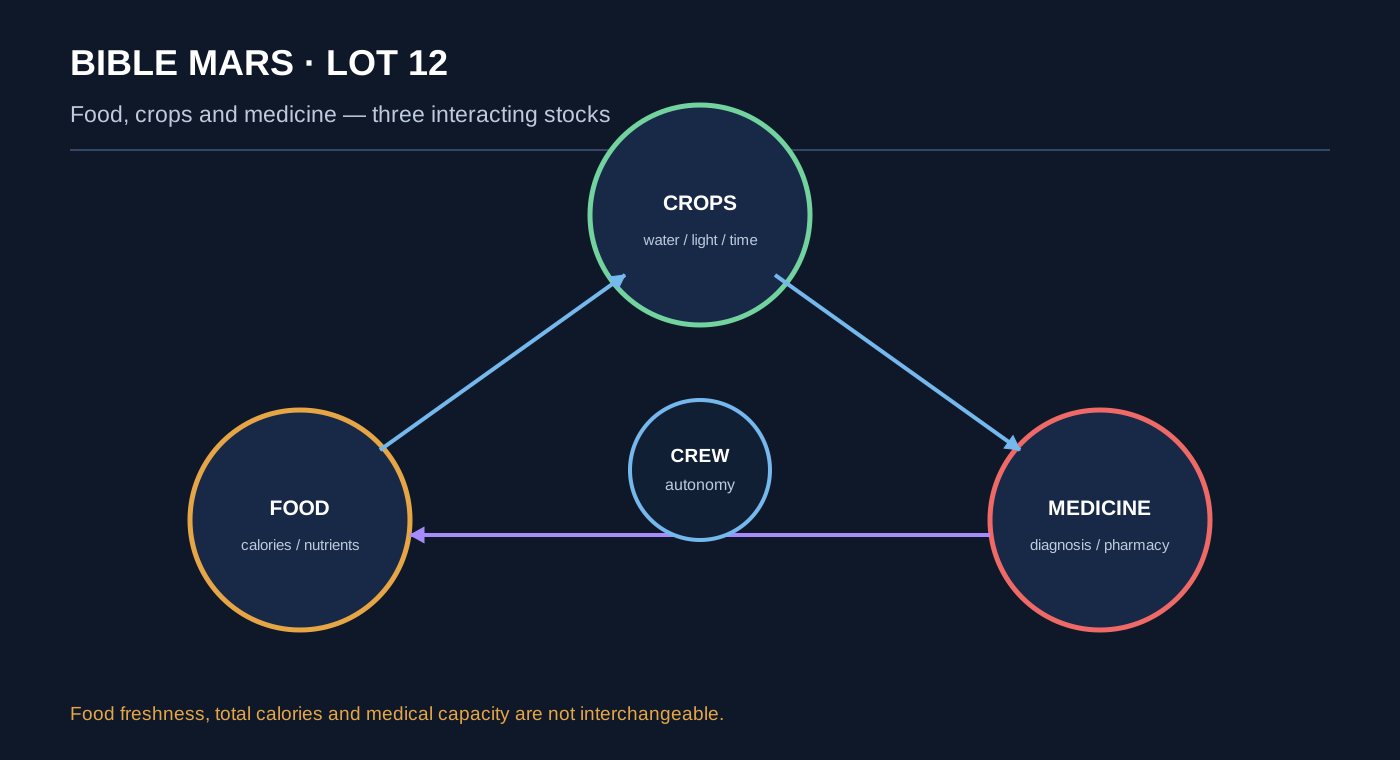
On a short flight, food and medicine can appear as separate subsystems. Over several years, they are coupled. Poor intake, loss of appetite, energy deficit, micronutrient deficiency and body-mass loss affect performance, recovery and resilience to other stresses. The food system therefore creates medical data as well as meals.
Fresh crops can also contribute to behavioral health. Growing, harvesting, cooking and sharing a meal provide sensory variety and a sense of control inside a closed environment. NASA’s human-system standard even requires the capability for crew to dine together. That does not turn a tomato into a drug; it recognizes that a human is not a calorimeter.
Medical operations should monitor food as a clinical variable: body mass, intake, hydration, gastrointestinal symptoms, oral health, biomarkers and activity. Future biological production may also target nutrients or selected compounds. NASA’s BioNutrients work explores on-demand biological production of nutrients whose shelf life may be problematic, but this remains technology development rather than an operational Mars pharmacy.
The medical connection runs in both directions. Illness can change appetite, absorption and dietary needs, while a poor food system can increase medical workload through deficiencies, gastrointestinal illness or loss of body mass. A remote clinic therefore needs access to food-system data: what was eaten, which batch supplied it, how long it was stored and whether other crew members report similar symptoms. Traceability is part of diagnosis.
Long missions also make food quality a countermeasure for behaviour and performance. Shared meals structure time, offer variety and can support morale during confinement. That does not make menu design a luxury. When resupply is delayed by orbital mechanics, a food system that people willingly eat is part of keeping cognition, physical performance and team behaviour stable for years.
A settlement can grow attractive salads and remain highly dependent on Earth. Dense calories, protein and some fats create different production problems. Protein crops often need more time or area than leaves. Vegetable oils require harvest and processing. Reproducing terrestrial livestock chains would be especially demanding in feed, water, space and labor.
That is why complementary technologies attract attention: precision fermentation, microbial biomass, algae and cyanobacteria. MELiSSA has long studied microorganisms as parts of regenerative loops, while Deep Space Food Challenge concepts explored compact food production with low water and waste.
But “a bioreactor will feed the city” is another simplification. A protein source must be safe, digestible, nutritionally useful and acceptable as food. It needs substrate, energy, sterilization, contamination control, separation equipment and maintenance. A mature Mars diet is more likely to combine crops and biotechnology than to replace one with the other.
Protein and fat deserve special attention because a crop plan optimized for rapid leafy biomass can look excellent while failing the diet. Legumes can contribute protein, oil crops can supply essential fatty acids, and microbial or fungal fermentation may eventually convert locally available carbon and nitrogen streams into edible products. Each route trades crop area against reactors, energy, downstream processing and food acceptance. A robust settlement is likely to combine several routes rather than bet biological continuity on one perfect crop.
Pictures of salad beneath LEDs make space agriculture intuitive. Protein and especially fat are harder to communicate. Plant systems can produce both, but yield, processing and menu diversity matter. A Mars architecture may combine crops, long-life imported food and complementary biological processes such as fermentation, fungi or microalgae, provided their safety, stability and resource cost are demonstrated.
Fermentation is attractive because it can turn relatively simple feedstocks into food ingredients or useful molecules. It is not free food. A bioreactor needs a stable culture, nutrient feed, temperature control, pH control, mixing or gas transfer, sensors, downstream separation and waste handling. It must remain repairable when specialist support is millions of kilometres away. Contamination can destroy a microbial process far faster than a field crop.
ESA’s MELiSSA programme is valuable precisely because it treats microorganisms, plants, waste, carbon dioxide, water and oxygen as coupled compartments. ESA still describes complete circularity as a difficult development problem and in 2026 funded additional work on biomass valorisation and resource efficiency. The Mars lesson is not that biology will effortlessly close the loop; it is that biological processes can reduce logistics only when physical-chemical backup paths remain available.
Fat deserves its own logistics plan. It is energy dense and supplies essential fatty acids. A settlement producing abundant vegetables but no reliable lipid stream would remain dependent on imported oils or ingredients. Oil crops, microbial lipids, stored terrestrial products and other pathways can be mixed. Autonomy is a sequence of substitutions, not a requirement to produce everything locally on the first mission.
The popular picture is a transparent greenhouse under a red sky. The physics is less romantic and more useful. Plants do not consume vague “brightness”; photosynthesis depends on useful photon flux in PAR. Engineers therefore track PPFD and integrate it over a day as DLI. Photoperiod, temperature, CO₂, VPD, nutrient chemistry and airflow complete the environment.
NASA crop research helped advance recirculating hydroponics, LED lighting and controlled-environment agriculture. NASA’s Contributions to Vertical Farming emphasizes the central trade: light drives productivity but is also a dominant energy cost. ISS systems such as Veggie and the Advanced Plant Habitat provide crop and microbiology experience, but they are not proof that a Mars settlement can already feed itself.
CHAPEA contributes an operational perspective. Mars Dune Alpha crews grow selected crops and live with constrained food systems. In 2026, CHAPEA Mission 2 crew reports included peppers, tomatoes, Swiss chard, bok choy, dill and basil. This is valuable evidence about workload, routine and human factors, while the boundary remains essential: CHAPEA is an Earth analog, not a demonstration under Martian gravity, radiation and actual logistics. NASA, CHAPEA 2 Audio Log 3.
Take PPFD = 300 µmol·m⁻²·s⁻¹ and LED efficacy = 3 µmol/J. Instantaneous electric power is 300 ÷ 3 = 100 W/m². With a 16-hour photoperiod, daily energy is 100 W × 16 h = 1.6 kWh/m²/day. This is an explicit scenario, not a NASA requirement.
Most of that electrical energy eventually becomes heat in or near the crop chamber. Cooling, dehumidification and air movement become part of the farm. Agricultural performance must therefore be measured not only as kilograms per square metre, but also calories per kilowatt-hour, edible mass per litre of make-up water, crew-hours per kilogram and failure tolerance.
The light budget is easiest to understand when separated into PPFD, photoperiod and DLI. PPFD describes the instantaneous flow of photosynthetically useful photons onto the crop; DLI integrates that flow over the day. Two farms can therefore deliver the same daily light with different intensities and schedules, yet produce different plant responses because temperature, dark periods, leaf heating and CO₂ supply also matter. Lighting control is not merely a dimmer switch: it couples biology to the electrical and thermal architecture of the settlement.
Most electrical energy used by lamps eventually appears as heat inside the controlled environment. That heat has to be moved somewhere. On Mars, where the outside atmosphere is thin, rejecting waste heat is not automatically easy just because the landscape is cold. Crop production therefore links directly to radiators, fluid loops, ventilation and power-management strategy. A farm that looks efficient in kilograms of lettuce per square metre can be poor in kilograms per kilowatt-hour or in total system mass.
Internet summaries often quote one area as if every crop system were interchangeable. It is not. Required area depends on crop selection, harvest index, light intensity, crop cycles, losses, dietary composition and the fraction of food still imported. NASA bioregenerative-life-support studies nevertheless provide a useful order of magnitude: highly optimized systems have discussed roughly 40–50 m² of crop area per person for near-complete dietary calories, while smaller areas can already provide fresh food or substantial oxygen regeneration. NASA bioregenerative life-support overview.
Use 45 m²/person strictly as a scenario. Four people imply 180 m² of lit crop area; 20 imply 900 m²; 100 imply 4,500 m²; 1,000 imply 45,000 m², or 4.5 hectares of actual growing surface. Five vertical layers can reduce floor footprint to 0.9 hectare, but they do not make the illuminated leaf area disappear.
Per person, 45 m² × 100 W/m² = 4.5 kW while lamps are on. Daily average: 4.5 × 16/24 = 3 kW. Four inhabitants: 12 kW average; 20: 60 kW; 100: 300 kW; 1,000: 3 MW average in this lighting scenario alone, before pumps, climate control, food processing and electrical losses.
This explains the hard link to water, oxygen, food and energy. Fully artificial lighting offers environmental control but moves the burden into power generation. Sunlight-assisted greenhouses can save electrical photons but introduce dust, optics, insulation, seasonal variation, structural and thermal problems. A mature settlement is likely to use a portfolio rather than one universal farm design.
A useful sizing exercise is to make the assumption explicit. If a highly optimized diet required 45 square metres of actively lit crop area per person, four people would require 180 square metres, twenty would require 900, one hundred would require 4,500 and one thousand would require 45,000 square metres. The symbol ‘square metres’ here refers to crop surface, not necessarily building footprint. Five stacked layers could reduce floor footprint by roughly a factor of five, but they would not erase the illuminated plant area or its lighting and cooling demand.
That is why no responsible architecture should publish one universal area-per-person number. A settlement importing cereals and oils while growing vegetables locally needs far less crop area than a settlement trying to close most of its calorie loop. Crop choice, edible fraction, harvest index, losses, growth cycle, light level, seed production and reserve policy all move the result. The correct number is an output of a diet-and-systems model, not a constant of Mars.
No perfect crop exists. A calorie-dense crop may be weak in vitamins; a micronutrient-rich leaf may deliver little energy; a fast crop may demand intense lighting; a protein crop may occupy a chamber for months. Selection is therefore multi-criteria: edible yield, crop-cycle duration, harvest index, protein, carbohydrate, fat, micronutrients, water, photon demand, root volume, pollination, processing, storage and use of residues.
NASA crop-production work uses exactly this kind of trade space, considering yield, nutrition, organoleptic qualities, light requirements and psychosocial value. Crop Production in Support of Exploration is useful because it does not pretend there is one Mars menu.
An early crop layer may favor speed and freshness: lettuce, herbs, radishes and leafy vegetables. A second layer targets energy: potatoes, wheat or other staples. A third targets protein and oil through soybean, legumes, oil crops or microbial production. As population grows, dedicated rooms and processes make more sense than asking one greenhouse to do everything.
Genetic diversity becomes insurance. A single optimized cultivar can be vulnerable to disease or environmental drift. A Mars seed bank should preserve multiple lines, separated lots and the ability to regenerate viable seed. Agriculture therefore becomes reproductive biology as well as crop production.
A crop portfolio also has to survive the calendar. Fast leafy crops can restore fresh food quickly after a failure, while potatoes, wheat, soy or other staples may take longer but carry much more energy and protein. Seed-production crops occupy space without immediately feeding the crew. Some rooms therefore optimize rapid recovery, some steady bulk calories and some genetic continuity. Treating every square metre as interchangeable hides those time constants.
The reserve policy should be designed around that biology. If the slowest essential crop takes months to recover after contamination, stored food has to bridge those months plus diagnosis, cleaning, restart and a second failed attempt. A ‘ninety-day reserve’ is meaningful only if ninety days actually covers the recovery path of the functions it is supposed to protect.
A Mars farm is unlikely to be a miniature copy of terrestrial agriculture. Even highly controlled farms on Earth receive many services almost for free: a breathable atmosphere, normal gravity, continental electrical grids, industrial water, replacement parts, specialist labour, waste treatment and access to enormous genetic diversity. On Mars, each of those services becomes a function that must be supplied, monitored and repaired. That is why space research increasingly treats crop production as part of a controlled environment and, at a more ambitious level, a bioregenerative life-support architecture.
The history matters. NASA growth chambers, orbital crop experiments and decades of regenerative life-support research, together with ESA’s MELiSSA programme, have moved the question beyond “can a plant grow away from Earth?” The engineering question is now: with what reliability, power demand, loop closure, microbiological safety and maintenance burden can plants contribute to a mission lasting years?
NASA’s CHAPEA campaigns illustrate another useful distinction. Crops in Mars Dune Alpha supplement a food system dominated by prepared shelf-stable foods. In 2026, CHAPEA 2 crew logs continued to describe seed-germination work, additional crop cycles and routine care and pollination. That is valuable operational research, but it is not evidence of a self-sufficient Mars food system. A reference site should make that boundary visible: crop demonstration is not the same as critical infrastructure feeding a settlement.
A serious farm therefore becomes an engineered network. Every crop consumes power, water, volume, crew time and heat-rejection capacity. Every nutrient solution is a chemical process. Every growth chamber must control humidity, spores and biofilms. A mature settlement will not have “a greenhouse”; it will operate several compartments optimized for calories, protein, fat, micronutrients, culinary diversity, seed multiplication and perhaps technical biomass.
Lettuce is attractive because it grows relatively quickly, much of it is edible and it provides freshness. It is not a civilization-scale food system. A population needs energy, protein, essential fats, fibre, vitamins, minerals and enough biological diversity that one disease or one environmental failure cannot destroy the entire diet. Crop selection is therefore a multi-criteria engineering problem: yield per square metre, yield per kilowatt-hour, edible fraction, cycle time, pollination requirements, seed mass, storability, disease resistance and nutritional value.
Starch-rich crops can deliver energy efficiently but often occupy chambers for longer periods and may require processing. Legumes contribute protein but do not eliminate the need for controlled nutrient chemistry. Leafy crops deliver vitamins and variety rapidly but few calories. Oil-bearing crops or alternative lipid pathways matter because a farm can look lush while still producing an energetically incomplete diet.
The robust answer is a portfolio, not a winner. It should mix fast and slow crops, fresh products and storable products, species with different failure modes and more than one genetic line. Diversity is an engineering redundancy as well as a culinary benefit. Two cultivars of the same crop may respond differently to temperature excursions, nutrient errors or disease.
Pollination shows how a small operational detail scales. Some plants self-pollinate; others need vibration, airflow, insects or manual help. CHAPEA crews have reported pollination work. For four people, hand pollination may be a manageable chore. For a thousand-person settlement, pollinating thousands of plants becomes an industrial operation that must be mechanized or designed out through crop choice.
Genetic continuity also needs protection. Seed banks should have independent storage, multiple copies, periodic germination checks and precise lot records. As resupply becomes slower and less certain, a seed bank becomes the biological equivalent of a strategic spare-parts warehouse.
A Mars farm must be treated as critical infrastructure. Some failures are immediate: power loss, pump stop, water leak, overheating. Others creep: pH sensor drift, declining LED output, nutrient imbalance, biofilm, plant pathogen, mold in a poorly ventilated zone, dosing error or loss of seed viability.
The first defense is compartmentation. Several independent growth rooms reduce the chance that one pathogen removes the whole food system. The second is biological diversity: different crops, cultivars and propagation methods. The third is an independent seed bank. The fourth is stored food. Even an excellent farm should be allowed to fail without instantly becoming a survival emergency.
If a store contains 91.05 million usable kcal for 100 inhabitants and e = 3,035 kcal/person/day, daily use is 303,500 kcal. Coverage is 91,050,000 ÷ 303,500 = 300 days. The result is only energetic coverage; protein, micronutrients, allergies, medical diets and storage losses still have to be checked.
Good crop operations therefore resemble reliability engineering. Each chamber has limits for temperature, humidity, VPD, conductivity, pH, flow, CO₂ and light. Alarms should catch drift before biomass visibly collapses. A well-managed farm failure is an industrial sequence: isolate, diagnose, preserve healthy material, repair, restart and requalify before returning the compartment to routine food production.
A settlement has to preserve not only food but the ability to make the next generation of crops. Seeds age, germination rates change and a high-yield cultivar can become a single point of biological failure. A credible seed bank therefore holds several independent lots, multiple cultivars and records of age, storage conditions and germination tests. Some species are reproduced mainly by seed, others by tubers or cuttings; each method creates a different storage and disease-control problem.
Pollination is another hidden function. Leaf crops can be harvested without producing seed, but fruiting plants and long-term seed renewal may require deliberate pollen transfer. Wind, vibration, hand pollination or biological pollinators all create different workload and biosecurity implications. What looks like a horticultural detail eventually becomes a settlement-level continuity requirement.
Crop diversity also protects the menu. If one pathogen removes a tomato room, a diverse food network still has staples, leaves, fermentation and stored reserves. A settlement that optimizes every square metre around one genetically uniform crop can achieve excellent nominal efficiency while creating fragile system-level risk.
Growing a potato, tomato or legume does not complete the food chain. Harvested material must be sorted, sometimes washed, cut, cooked, dried, fermented, chilled or stored. Every step consumes water, power, clean space and crew time, while producing peelings, wash water, heat and packaging. A Mars farm that ignores post-harvest work does not yet produce meals; it produces raw material.
This matters especially for calorie crops. Grains require threshing, milling and cooking; oils require extraction and protection from oxidation; tubers need storage that avoids sprouting and mould; microbial protein may require filtration and heat treatment. Crop selection should therefore include processing infrastructure. A high-yield species with a complicated downstream chain may be less attractive than a slightly less productive crop that can be eaten directly.
Cold storage is also a life-support function. NASA work on Mars food refrigeration reflects the difficulty of preserving some nutritional and sensory qualities for multi-year exploration. Yet every freezer or refrigerator adds compressors, heat exchangers, insulation, sensors and backup power. A settlement should classify products by criticality: what can remain dry at ambient conditions, what truly needs cold storage, what must be eaten quickly and what can be converted into a stable reserve.
At one hundred or one thousand residents, kitchens become collective infrastructure. Meals must serve people on different shifts, in EVA operations or distant work sectors. Menus need to accommodate allergies, clinical diets and cultural preferences without creating an impossible ingredient inventory. Food is also social infrastructure: a civilization designed only around functional rations would underestimate the role of shared meals already recognized in human-spaceflight habitability standards.
Food waste must finally connect to the rest of the settlement. Some fractions can return to biological or chemical processing; others must be stabilized. “Recycling” should never imply perfection: every process has efficiency losses, requires energy and may concentrate contaminants. Autonomy comes from controlled recovery plus planned makeup, not from an imaginary 100-percent circle.
Food safety becomes more serious when a small crew shares air, water, surfaces and critical maintenance duties. A contamination event that incapacitates several people at once removes operators precisely when medical workload rises. NASA requirements for microbial control, cross-contamination prevention and sanitation are therefore also crew-availability requirements.
A Mars food chain has critical points: receiving, storage, rehydration, cooking, cooling, harvest, washing, processing and preservation. HACCP-style thinking is valuable because it controls hazards before they reach the plate.
Fresh crops add an ecological challenge. Plant environments are humid and nutrient-rich, favorable to many microorganisms. Water, surfaces, biofilms and plant pathogens have to be monitored without destroying every beneficial microbial relationship. Food microbiology becomes a core settlement profession.
Terrestrial food-safety practice offers a useful principle: identify hazards, define critical control points, monitor them and retain records. Mars adds unusual consequences. A gastrointestinal outbreak can incapacitate several members of a small crew at once, consume medical supplies and contaminate recycled-water or waste-handling systems. The settlement therefore needs batch identity, cleaning validation, temperature records, microbial testing where justified and a plan for isolating suspect food without destroying all reserves.
The most dangerous assumption would be that a closed habitat is automatically clean. Closed systems can concentrate organisms as effectively as they concentrate resources. Condensate, drains, nutrient solutions, reusable food-contact surfaces and warm equipment cavities can all create niches. Hygiene must be designed as a system property, not left to heroic housekeeping.
Food poisoning on Earth can be serious; on Mars it can incapacitate several members of a tiny crew simultaneously, consume scarce medication and force disposal of food that cannot be replaced. Food safety therefore belongs in the same safety culture as air and water quality.
NASA-STD-3001 requires food safety across the product life cycle and includes contamination control, sanitation and separation of food areas from waste-management functions. A Mars settlement must extend that discipline to local production: seed lot identity, nutrient-solution records, harvest dates, sanitation histories, storage temperatures, allergen management, cold-chain logs and traceability after processing.
Traceability is particularly valuable in a closed system. If a crop tests positive for contamination, the crew must know which chamber, seed batch, water line, nutrient batch and tools were involved, and who consumed the product. Without that memory, the safest response is to discard far more food than necessary. At settlement scale this requires laboratories, digital records, retained samples and quality staff who are independent of production.
People can also contaminate crops. Clothing, skin, tools and airflow carry microorganisms. Clean and dirty zones, transfer airlocks and controlled ventilation therefore connect food engineering directly to habitat architecture. Food production becomes part of the settlement’s infection-control strategy.
Crop production can couple to life support. Plants consume CO₂ and release O₂ during photosynthesis. Much of the water taken up by roots is transpired, captured by humidity-control hardware and potentially returned to the water loop. But “closed loop” never means magically lossless: leaks, purge streams, harvest removal, salts, cleaning and imperfect recovery still create make-up needs.
ESA’s MELiSSA program has explored regenerative loops since 1989. The MELiSSA Pilot Plant breaks the artificial ecosystem into testable biological and physicochemical compartments that can transform waste, CO₂ and minerals toward water, oxygen and edible biomass. It does not prove a Mars colony can become materially closed, but it demonstrates a systems-engineering way to approach the problem.
Nutrients illustrate the difficulty. Nitrogen, phosphorus, potassium, calcium, magnesium, sulfur and trace elements have to be present in plant-available form and controlled concentration. Some fractions can be recovered from human and plant waste after treatment, some can be imported, and a future chemical industry may produce others locally. Directly pouring untreated waste into food crops would be the opposite of robust design: biological, chemical and operational barriers are required.
Raw Martian regolith is not a convenient bag of potting soil either. Particle properties and salts vary, and perchlorates have been detected in Martian materials. Hydroponics and engineered substrates decouple early food production from uncertain local soil chemistry. Later, local mineral processing may feed fertilizer production, linking agriculture to the settlement’s industrial chemistry.
Plant transpiration can return a large fraction of irrigation water to the cabin as humidity, where condensers recover it. The apparent elegance of that loop hides chemistry. Nutrient ions do not evaporate with the water; sodium or other unwanted species can accumulate; root-zone solutions drift; cleaning and sanitation create purge streams. Closing the water loop is therefore not the same as closing nitrogen, phosphorus, potassium and trace-element loops.
At larger scale, nutrient recovery becomes an industrial problem. Human waste, inedible biomass and food-processing residues contain useful elements, but converting them safely into crop nutrients requires separation, oxidation or biological treatment, pathogen control and monitoring for contaminants. A bioregenerative settlement is not a garden that happens to recycle; it is a chemical and microbiological plant whose products are eaten by the crew.
A growth chamber cannot be sized in isolation from the settlement’s power and water architecture. Pumps, lights, air movement, dehumidification and thermal control all draw electricity. Water captured from plant transpiration can return to the life-support loop, but make-up water, cleaning and nutrient management remain. During a power shortage, agriculture may be one of the largest controllable loads, yet switching it off for too long destroys the very biomass the settlement depends on.
This produces a load-shedding hierarchy. Life-critical air circulation and medical systems cannot be sacrificed for lettuce. Some crop rooms may tolerate reduced light for hours, while germination chambers or thermal control have different limits. A resilient farm therefore has defined degraded modes rather than one binary state called “on” or “off.”
At city scale, agriculture can also become a flexible load. Lighting schedules may be staggered to flatten the electrical peak, waste heat can be exchanged with other buildings, and stored water can buffer both irrigation and radiation shielding. These cross-links are why food belongs in the same engineering conversation as ECLSS, power and thermal control.
Strategic reserves cannot be managed by intuition. The settlement needs inventory thresholds, rotation rules, quarantine authority and a clear decision process for rationing after crop loss. When food becomes a shared life-support asset, data about remaining calories, nutrients, seed viability and production capacity become operational information. Good governance prevents a small technical failure from turning into panic or unequal access.
That staged model also gives managers measurable thresholds for when local production may safely replace imported contingency stock.
It also makes reserve drawdown auditable instead of intuitive during a crisis.
Mass and electrical power are not the only scarce resources. Crew time is a mission commodity. A farm that produces impressive theoretical yield but consumes hours every day in cleaning, pruning, pollination, harvesting, sampling and repair may be a poor system for a small expedition. Fully automated farming, on the other hand, adds sensors, actuators, software and spare-parts demands.
The balance changes with scale. Four pioneers can tolerate more manual intervention because crop production is limited and learning itself has value. At twenty people, dedicated procedures and rotating specialists become useful. At one hundred, crop science, microbiology, food processing and maintenance become occupations. At one thousand, food production is an industry with robotic handling, cold storage, laboratories and industrial sanitation.
A simple labour budget exposes unrealistic concepts. Suppose, purely as an engineering scenario, that a growth system requires 0.15 labour-hour per square metre per day. A 4,500 m² farm would then require 675 labour-hours every day. That result immediately shows that the architecture is impossible for a small crew unless the area, labour rate, crop mix or automation level changes. The point of the calculation is not the assumed number; it is to force labour into the design budget.
Food also becomes governance. Who can release strategic reserves? Who decides that a crop chamber must be quarantined? Who arbitrates between electrical power for food production and power for oxygen or water processing? Who can introduce a new microbial strain? At settlement scale these are regulated infrastructure decisions, not household choices.
At four people, robustness dominates. Most calories remain imported and crop production supplies fresh food, operational experience and selected nutrients. Equipment must be simple to clean and repair, and reserves must bridge long failures.
At twenty, multiple growth chambers can support different crops and schedules. A crew may justify specialist plant skills, and nutrient and water recovery become more structured.
At one hundred, food is infrastructure. Harvests are planned production; quality control, seed inventory, microbiology, preventive maintenance and food processing require dedicated roles. Meals become institutional food service with hygiene, allergens, waste and work scheduling.
At one thousand, the single greenhouse disappears as a meaningful concept. The settlement needs a distributed food network: staple production, propagation rooms, strategic stores, processing, cold chain, seed reserves and separated facilities so that fire, contamination or electrical failure cannot stop everything at once.
Scaling is nonlinear. Ten times the population eventually creates new functions rather than simply ten times more hydroponic channels: independent inspection, internal logistics, breeding and selection, maintenance of thousands of luminaires, consumable manufacturing, waste valorization and governance of strategic reserves. That is the transition from an expedition to a town.
Scaling changes the architecture qualitatively. Four people can tolerate a single growth chamber and manual pollination. Twenty justify specialized maintenance and a separate quarantine capability. One hundred begin to need independent crop rooms, seed-management records, laboratory support and dedicated food-processing equipment. At one thousand, agriculture has become a utility sector with staffing, spare parts, quality assurance, emergency reserves and production planning.
Distributed farms also reduce common-cause risk. If all fresh food is produced in one enormous chamber, one contamination event, fire, cooling failure or software defect can remove the entire harvest. Several partially independent modules cost more interfaces and equipment but allow one sector to be isolated while the others continue. Settlement growth therefore pushes food production from ‘a greenhouse’ toward a network.
It is tempting to imagine a Mars settlement rapidly replacing packaged food with greenhouses. Recent NASA work suggests a more nuanced transition. NASA Technical Memorandum NASA/TM-20250001897, published on July 1, 2024 and acquired by NTRS in February 2025, notes two very concrete constraints: the current ISS prepackaged food system contains about 46% water, while Mars assumptions require roughly five years or more of shelf life. The Mars Campaign Office is examining reduction of packaged-food water content toward 30%, while the consequences for variety, choice and nutritional intake still have to be evaluated. In parallel, Ohalo III is being developed as a supplemental crop-production capability, not an instant replacement for the entire diet.
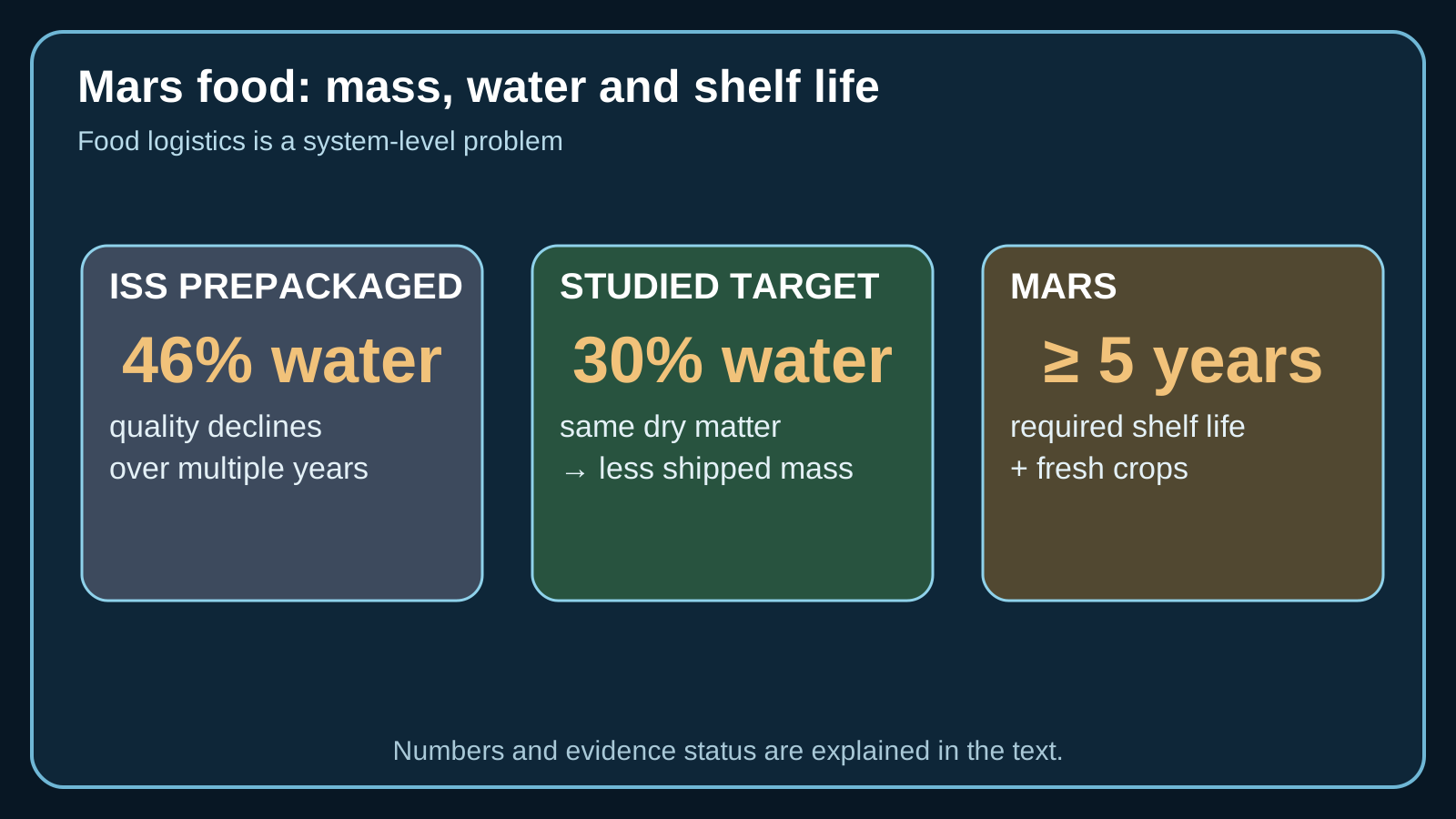
A constant-dry-mass calculation: why 46% and 30% are not just percentages. Imagine 1,000 kg of food containing 46% water. Dry matter is 1,000 × (1 − 0.46) = 540 kg. To ship the same 540 kg of dry matter at only 30% water, total mass M must satisfy 540 = M × 0.70. Therefore:
M = 540 / 0.70 ≈ 771.4 kg.
The nominal difference is about 228.6 kg for every reference tonne of food. This is not free mass reduction. Water must be added back during preparation, dehydration can change texture and quality, and multi-year nutritional stability remains difficult. Yet the arithmetic explains why food, ECLSS and logistics cannot be optimized independently. If water is recovered locally at very high efficiency, launching more dry solids and less “embedded” water may be attractive.
Crops serve three different functions that should not be confused. A farm may provide calories, but it may instead be optimized for fresh micronutrients, sensory variety and psychological benefit. Those functions select different crops. A plant that produces large biomass may be poor for morale; lettuce can be valuable for freshness while providing little energy; a protein-rich legume may demand more time, area or processing. The system therefore has to state its objective: kilocalories, protein, vitamin C, fibre, food enjoyment, oxygen, carbon-dioxide uptake or nutrient recycling.
The science bottleneck is shifting toward microbiomes and food safety. Veggie and the Advanced Plant Habitat show that edible plants can be grown in spaceflight, while NASA continues to investigate root-zone moisture, nutritional composition, microbiomes, plant pathogens and the safety of pick-and-eat crops. Mars adds partial gravity: water and gas flow around roots will be neither Earth-like nor microgravity-like. Martian agriculture is therefore not merely a lighting-efficiency problem; it is a controlled biological system in which one plant disease or contamination event can simultaneously affect food, water and air.
A more resilient approach: several food horizons. An early base can combine stable packaged food, fast-cycle fresh crops and nutritional reserves. A twenty-person settlement can expand production without making survival depend on a single harvest. At one hundred residents, local production may begin to provide a major share of calories and protein, but seeds, nutrients, lighting components, pumps and pathogen control become critical infrastructure. At one thousand, agriculture is no longer a “greenhouse.” It is an industrial sector with breeding, seed production, quarantine, processing, storage, quality assurance and geographic redundancy.
Recent primary sources: NASA NTRS — Space Crop Considerations for Human Exploration; NASA Science — Space Crops, roadmap updated in 2026; NASA Science — Advanced Plant Habitat.
A settlement does not become autonomous when it harvests its first lettuce. Every day it must supply calories, protein, fats, micronutrients, safety, variety, storage, and cooking—and then do it again through crop disease, lighting failures, or poor harvests. Martian agriculture is a complete food system.
Sizing should begin with what a population needs to eat and then work backward to crops and processes able to provide that profile. This prevents abundant biomass from being confused with a balanced diet.
Dietary energy. Daily calories provide a first-order scale but say nothing about nutritional quality or the split among carbohydrates, fats, and protein.
Complete protein. Protein sources should be evaluated by amino acids, digestibility, storage, and production resources rather than harvested mass alone.
Essential fats. Fats concentrate energy and provide essential fatty acids; their production can become a bottleneck distinct from plant calories.
Micronutrients. Vitamins and minerals require diversity, composition monitoring, and sometimes supplementation when crops do not cover all needs.
Menu acceptability. A theoretically complete ration can fail if it becomes monotonous, difficult to prepare, or poorly accepted over years.
A plant does not provide a constant industrial output. Growth depends on cultivar, light, water, nutrients, temperature, CO2, disease, and developmental stage.
Cultivar selection. Cultivars need to combine yield, cycle time, stature, nutritional quality, controlled-environment behavior, and seed availability.
Photoperiod and spectrum. Lighting duration and spectrum change growth and electrical demand; they become a trade between biology and base power.
Root zone. Water, aeration, support, and nutrients must reach roots without creating stagnation, pathogens, or hidden failures.
Controlled CO2. Crew-respired CO2 can support crops, but the optimum plant concentration should not dictate the atmosphere breathed by residents.
Plant disease. A closed environment can accelerate spread; monitoring, quarantine, and the ability to disinfect or sacrifice a zone need to be planned.
E = P_éclairage × t
A chamber using 20 kW of lighting for 16 hours consumes 320 kWh/day before ventilation and cooling. The calculation shows why crop scheduling is also power scheduling.
Crops can help recycle water and some nutrients, but the word loop must not hide losses, unwanted accumulation, and elements that remain difficult to close.
Recirculating hydroponics. Recirculating nutrient solution reduces water demand but requires conductivity, pH, ion, and microbiological monitoring.
Recovered transpiration. Much of the absorbed water leaves through leaves; greenhouse-air condensation can therefore become a major recovery stream.
Nutrient nitrogen. Plants require assimilable nitrogen forms; producing and balancing those nutrients is an industrial-chemistry problem as much as an agricultural one.
Phosphorus and trace elements. Some elements are required in small amounts yet their absence stops production; they must be inventoried and carefully recovered.
Organic loop. Crop residues and food waste can become resources after treatment, but the process must control pathogens, salts, and contaminants.
A Martian greenhouse is an energy system. When daylight is insufficient, every useful photon must be generated, delivered, and its heat removed, directly linking crop choices to electrical architecture.
Photon efficiency. A light source should be compared in useful photons per joule, not merely electrical watts or brightness perceived by the human eye.
Heat rejection. Energy not converted into biomass largely becomes heat and increases greenhouse thermal-control demand.
Guided sunlight. Mirrors, fibers, or light pipes can reduce electrical demand but add pointing, windows, dust, and geometric constraints.
Agricultural load shedding. During a power crisis, some crops can tolerate temporary lighting reduction while other developmental stages are more sensitive.
Cycle scheduling. Staggering planting and harvests avoids having every chamber reach peak power or labor demand at once.
S = besoin / productivité_surfacique
Required area depends directly on measured edible productivity. The formula is useful only with crop-specific values and uncertainty rather than a universal yield.
A harvest becomes truly useful when it can be washed, inspected, processed, preserved, and incorporated into a menu. Post-harvest handling is a food industry of its own.
Food hygiene. Surfaces, wash water, hands, and equipment must be managed so that local contamination does not reach the whole population.
Cold storage. Refrigeration and freezing extend some storage times but create continuous electrical loads and grid dependency.
Dehydration. Removing water can extend shelf life and reduce some risks while requiring energy and appropriate packaging.
Fermentation. Microbial processes can improve preservation, variety, and transformation of raw materials but require healthy cultures and process control.
Community kitchen. At town scale, cooking and preparation become services with throughput, hygiene, intermediate storage, and redundancy.
A civilian population changes food requirements as much as quantities: children, older adults, medical conditions, preferences, celebrations, physical work, and cultural choices make the system less homogeneous.
Differentiated diets. A hospital, a school, and a construction crew do not require exactly the same textures, intakes, or meal schedules.
Strategic reserves. Reserves should cover not only average consumption but also multiple crop failures and the inability to resupply quickly.
Backup seed banks. A physically separated seed bank protects the ability to restart after disease, cultivation error, or contamination.
Specialists and automation. As the system grows, agronomy, maintenance, microbiology, cooking, and automation become distinct professions.
Surplus economy. Surplus production can become reserve, processed material, or internal trade provided it is measured and storable.
M = N × ration_journalière × jours
For 100 people, a mean dry ration of 0.75 kg/day and 180 days gives 13,500 kg. Nutritional composition and shelf life must then be checked.
A greenhouse can fail without any motor breaking. Wrong nutrient concentration, misidentified seed, contamination, or a late decision can produce losses comparable to mechanical failure.
Bad sensor. A drifting pH or humidity sensor can make automation correct in the wrong direction; independent checking plausibility is essential.
Plant pathogen. Early detection and zoning determine whether response means treating one chamber or sacrificing an entire production run.
Nutrient recipe error. A wrong nutrient formulation can affect several chambers if they share one tank; batch separation reduces common cause.
Lighting failure. Crops tolerate interruption differently; restoration order should therefore depend on biological stage and crop value.
Food contamination. Traceability should allow one batch to be withdrawn without condemning the whole food system or losing its production history.
The first years will produce data no terrestrial model can fully replace: real productivity, disease, labor, failures, and preferences. A good architecture turns those observations into decisions.
Crop log. Each chamber should link seed, parameters, interventions, harvest, and incidents so that performance can actually be analyzed.
Useful yield. Harvested mass should be separated from the fraction actually eaten after sorting, processing, and losses.
Human labor. Planting, pruning, harvesting, cleaning, and testing create a labor cost that can constrain the system as much as power.
Health and behavior. Plants may provide behavioral and dietary benefits, but those effects should be studied rather than used as automatic justification for every greenhouse.
Menu evolution. The system should accept new crops and processes without destabilizing water, nutrient, and food-safety loops.
m_retour = m_apport × R
With 1,000 kg/day supplied and 0.98 recovery across a defined boundary, 980 kg/day returns to the loop and 20 kg/day becomes makeup before additional losses.
Two harvests lost
A pathogen forces two chambers to be destroyed. The scenario follows reserves, quarantine, restart from separated seed stocks, and menu changes over several months.
Power loss during flowering
The grid sheds part of the lighting load. Operators must choose which crops to protect, which tolerate interruption, and which chambers can be sacrificed without threatening overall nutrition.
Shared nutrient error
A wrongly formulated solution feeds several lines. The case shows the value of separated batches, chemical analysis, and traceability fine enough to stop propagation.
The town receives one hundred new residents
Population grows faster than crop chambers. The system combines stores, new growing area, short-cycle crops, residual imports, and power planning until balance is restored.
Space Crops work and plant-production programs remind us that agricultural yield is only part of the problem. Martian food must cover calories, amino acids, fats, micronutrients, fiber, acceptability, and microbiological safety. Highly productive crops may leave nutritional gaps that require other species or imported stores. Conversely, a lower-yield plant may provide a nutrient that is difficult to obtain otherwise. The menu is therefore a multi-criteria optimization problem. The edible fraction and post-harvest processing also matter: drying, cooking, milling, fermentation, and storage. A greenhouse delivering ten kilograms of biomass has not produced ten kilograms of available food if part is stem, inedible root, or processing loss.
Under electric lighting, every square meter of crops becomes a grid load. The useful quantity is not installed power alone but daily energy: a 300 W lamp operating 16 h consumes 4.8 kWh per day for the area served by that lamp. Scaling this to hundreds of modules can compete with water purification, workshops, or heating. Hybrid lighting, captured sunlight, or changed photoperiods alter the balance but add their own constraints. To avoid false precision, calculations must state area, power per area, lighting duration, and conversion efficiency where relevant. Only then can agriculture be compared honestly with stored food or other production methods.
On Earth, growers can often buy new seed, treatment products, or equipment within days. On Mars, disease, mold, or contamination could affect several cycles before resupply. The architecture therefore needs physically separated growth zones, protected healthy seed, tool sterilization, and rapid diagnosis. Cultivar diversity is not merely culinary; it reduces the chance that one pathogen or one physiological sensitivity eliminates the whole crop. The 2026 programs that explicitly include plant disease in the research road map matter because they move agriculture from demonstration toward continuous operations.
Ambitious local production does not justify eliminating reserves. Crops have irreducible biological delays: losing a harvest today does not mean it can be replaced tomorrow by adding power. Stores must bridge reseeding, regrowth, and restoration of a healthy environment. Stored food also preserves menu diversity during transition and protects against simultaneous crop and grid failures. The useful question is therefore not 'when are we self-sufficient?' but 'how much food independent of current harvests is required for each credible failure state?' That reserve can fall as Martian experience grows, but only when real statistics on yield, disease, and recovery exist.
Existing space-crop work reproduces neither decades of Martian food production nor the full ecology of a permanent population. Yields, plant disease, nutritional diversity, and stability of biological loops will require long-duration observation. A credible food architecture therefore keeps reserves and multiple production paths until Martian experience replaces extrapolation.
Mars agriculture belongs inside the food system rather than in an image of a self-sufficient greenhouse. Crops consume volume, power, water, nutrients, crew time, cleaning and safety testing; in return they may provide fresh food, micronutrients, variety and psychosocial benefits. The trade depends on the complete diet and stored-food strategy.
Food security also requires fallback. A failed harvest or crop disease must not become immediate famine. Long-life stores and biological production complement each other, and their balance can change as the settlement learns which crops and root-zone systems remain robust over long durations.
NASA/TM-20250001897 was published July 1, 2024 and acquired by NTRS in February 2025. It discusses roughly 46% water in ISS prepackaged food, study of a 30% level, and Mars shelf-life assumptions of at least five years. The “2025” report identifier is not treated as the publication year.
The 2026 road map links cultivar selection, horticulture, plant disease, nutrition, and bioregenerative life support.
The 2026 competition asks for a complete Earth-independent food system, forcing reasoning beyond a single crop or technology.
The active project targets a prototype operational crop-production system and documents water, volume, reliability, operations, and maintenance, helping distinguish a plant experiment from production hardware.
This work explicitly trades mass, volume, power, crew time, cleaning, safety, and nutritional benefits.
The completed project is useful as a study of an autonomous chamber combining Martian CO2, recirculating hydroponics, and hybrid lighting, but it is not an operational Martian farm.
The 2026 challenge launch places the problem in long-duration missions: feeding crews cannot rely only on shipping food from Earth.