Spacesuits, EVA and dust: working outside without contaminating the base
An EVA connects the suit to the entire base: preparation, airlock operations, consumables, communications, mobility, tools, dust control, inspection and post-EVA maintenance. Dust makes that chain more demanding because material carried on external surfaces can migrate toward seals, filters and habitable volumes. The relevant criterion is therefore not merely getting outside and back, but repeating the operation without progressively degrading the system.
A spacesuit is a small spacecraft that goes into the dust every day
“Spacesuits, EVA and dust: working outside without contaminating the base” addresses the spacesuit as a small pressure vehicle whose dust exposure is also a contamination and maintenance problem.
Scope — preparation and prebreathe through EVA, return, airlock operations, PLSS, mobility, thermal control, tools and cleaning.
EVA operations should continuously monitor suit pressure, O₂, CO₂, temperature, flow, battery, filter state, mobility and particulate contamination.
Relationship used here: return time = distance/speed, compared with real remaining endurance plus reserve.
NASA PLSS work and NASA-STD-3001 define functions and human constraints; no single internal suit pressure is presented as universally “typical for Mars”
Recompute return time = distance/speed, compared with real remaining endurance plus reserve with units visible.
An EVA begins at the airlock and ends long after return
The critical EVA case combines seal or filter degradation with a delayed return that consumes life-support margin.
Dust, wear and maintenance: the quiet enemies of outside work
reducing fatigue and prebreathe burden without sacrificing mobility, fire safety, sealing or maintainability
chamber tests, dust cycles, mobility testing, metabolic loading, seal inspection and rescue exercises
From a few scientific EVAs to an outdoor working economy
Deep monograph
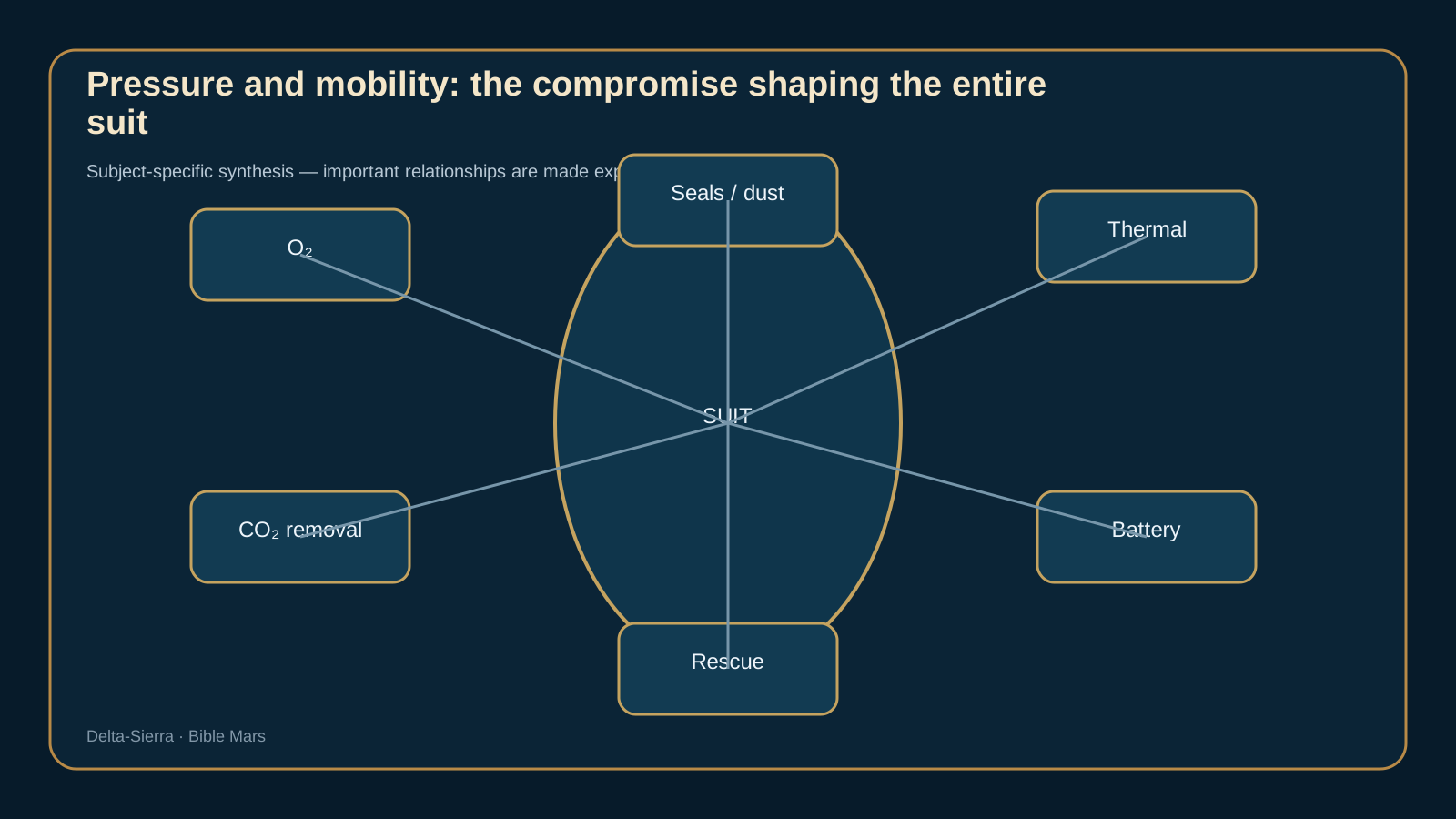
Pressure and mobility: the compromise shaping the entire suit
Pressure and mobility: the compromise shaping the entire suit.
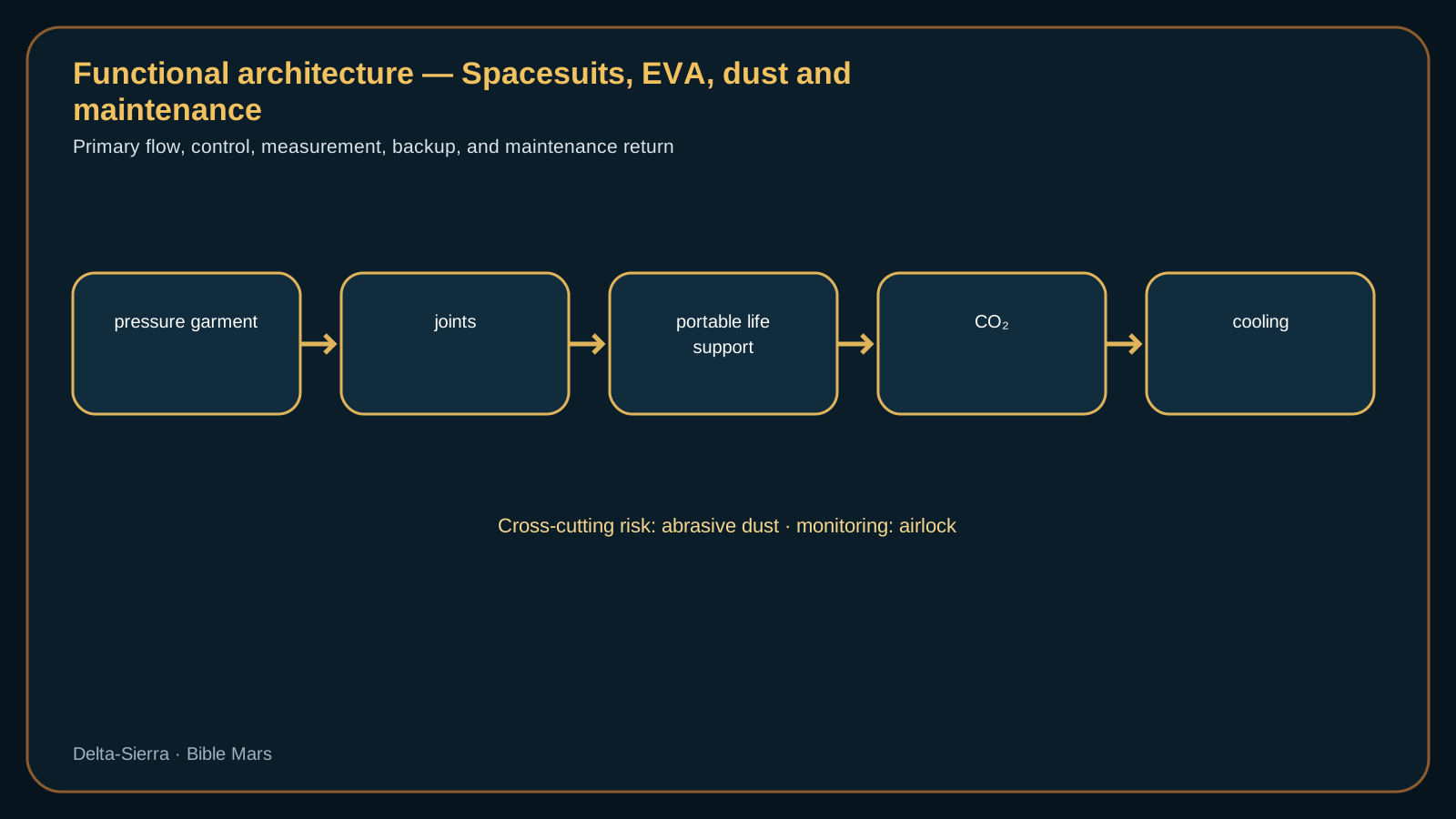
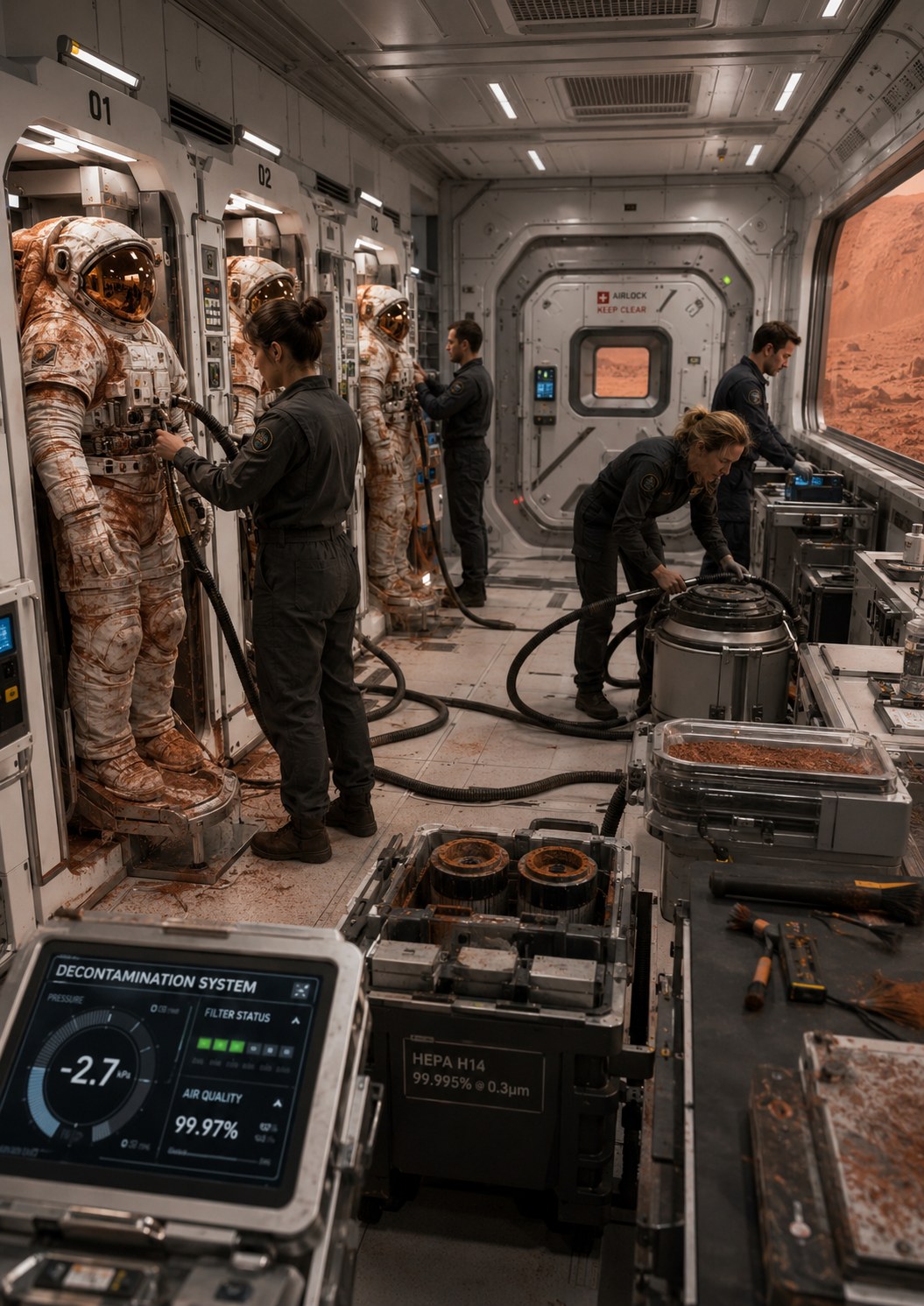
Spacesuits, EVA and dust: working outside without contaminating the base — functional architecture showing the flows, interfaces and dependencies developed in the chapter.Conceptual spacesuit workshop: seals, connectors, visors, gloves, life-support systems and dust-exposed surfaces require methodical servicing between excursions.
A Martian spacesuit is a pressurized vehicle worn on the body.
Pressure: mobility versus decompression risk.
Oxygen and CO₂: a small gas volume becomes a complete life-support system.
Thermal control: the body produces heat even in a cold desert.
Gloves: human dexterity at the cost of pressure, fatigue and wear.
Joints: bearings, seals, fabrics and abrasive dust.
Joints, bearings and dust: the mechanics of wear
Visor: scratches, dust, UV, condensation and visibility.
Dust: size, adhesion, electrostatics and indoor contamination.
Conventional airlock: bringing dust inside and then having to capture it.
Suitport and rear-entry interfaces: reducing dust transfer with other tradeoffs.
Cleaning: brushing, vacuum, electrostatics and real limits. <
Cleaning: brushing, vacuum, electrostatics and real limits.
Maintenance: pre-EVA inspection and periodic rebuild.
Maintenance: pre-EVA inspection and periodic rebuild. Who may modify EVA tools?
Reproducible calculations specific to this subject
EVA energy
E = 350 W × 8 h = 2,8 kWh; avec 25 % de réserve → 3,5 kWh de capacité nominale
The 350 W figure is a teaching assumption for average portable-system electrical power. Adding a 25% reserve gives 3.5 kWh nameplate capacity before aging, cold and losses.
Spacesuit fleet availability
12 scaphandres − 2 en maintenance − 1 en quarantaine = 9 disponibles; 9/12 = 75 %
A nominal fleet of twelve units may provide only nine immediately usable suits. Fleet sizing must include maintenance, contamination, sizing and wear parts, not merely worker count.
Duration before reserve
8 h nominales × (1 − 0,25) = 6 h utilisables avant d’entamer la réserve
With 25% of nominal duration reserved for contingency and return, an eight-hour sortie offers only six schedulable hours. Reserve is not hidden work time; it exists specifically for anomalies.
Maintaining and requalifying a fleet of suits
Wear parts: seals, gloves, bearings, connectors and filters
Wear parts: seals, gloves, bearings, connectors and filters.
Wear parts: seals, gloves, bearings, connectors and filters. Uncertainty — wear parts: seals, gloves, bearings, connectors and filters.
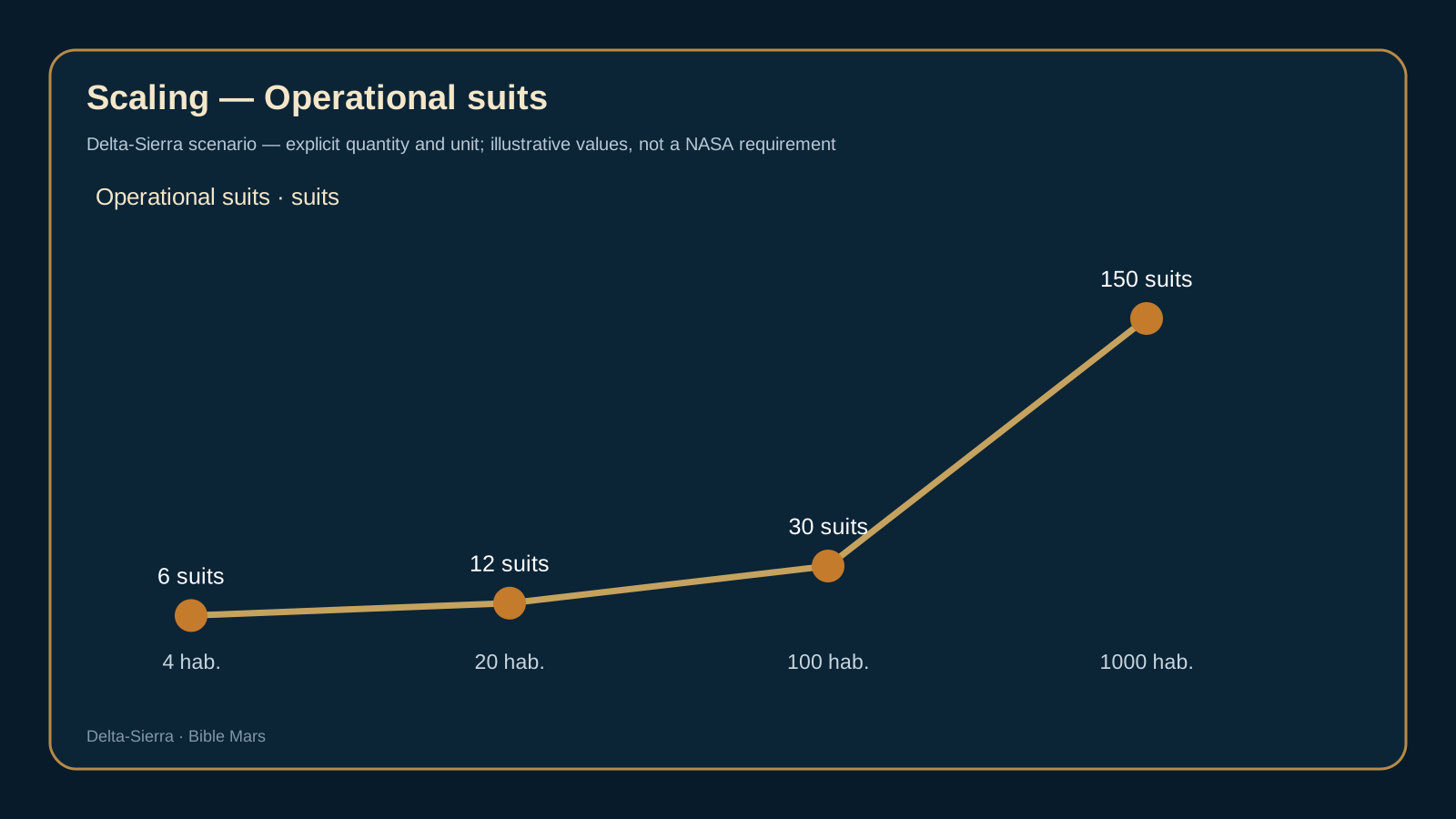
Four people: very few suits and little loss tolerance.
One hundred people: specialized EVA, industry, rescue and quality control.
One thousand people: the suit becomes regulated professional equipment.
EVA rescue: returning a crewmember who cannot walk.
Spacesuits, EVA and dust: working outside without contaminating the base — visual synthesis of the system-specific choices and constraints.Operational suits — scaling scenario: the quantity and unit are illustrative and are not a NASA requirement.
Four architecture scenarios that materially change the decision
A seal returns dust-coated
A seal returns dust-coated. The seal looks intact, but abrasive dust raises leak risk on the next EVA. The team must decide whether it can be cleaned, inspected and returned to service or must be replaced. The scenario links contamination, maintenance metrology and wear-part logistics.
PLSS performance degrades mid-EVA
PLSS performance degrades mid-EVA. An abnormal CO₂ or thermal trend appears without immediately crossing a critical limit. The system must estimate remaining time, shorten the task and select the safest return. Margins should be visible before they become an alarm.
Returning a crewmember who cannot walk
Returning a crewmember who cannot walk. The distance is short, but suit pressure, mass and terrain make transport difficult. The scenario tests harnesses, mobility aids, rescue rover, available time and coordination between two autonomous life-support systems.
A suit fleet for one hundred residents
A suit fleet for one hundred residents. The fleet contains different sizes, maintenance states and contamination levels. Planning EVAs requires knowledge of availability, consumables, spares and workshop time. The spacesuit becomes an industrial fleet, closer to a vehicle pool than to a unique personal garment.
When spacesuits become professional city equipment
Life-support failure: remaining time, return, assistance and mobile refuge.
Real work: tools, posture, visibility and task time.
Dust dose: linking EVA contamination to indoor air quality.
The real challenge: maintaining dozens of suits for years without an Earth factory.
Turning EVA into a routine industrial service
Treat EVA time as a scarce and expensive resource
An hour outside is not a net hour of productive work. A suit has to be prepared, leak-checked and configured; the crew passes through an airlock, travels to the job, returns, decontaminates equipment, performs maintenance and records anomalies. If a six-hour EVA requires two additional person-hours before and after, gross efficiency is already 6 ÷ 8 = 75% for that operator before travel and breaks are removed. A durable settlement therefore reduces unnecessary outside work through robotics, teleoperation, interior-accessible interfaces and maintainability-oriented design.
As the base grows, EVA cannot remain a heroic event that consumes the whole crew. The settlement needs schedules, support teams, spare suits, parts, charging areas and the ability to sustain several outdoor activities without exhausting emergency response capacity.
Keep dust outside instead of trying to clean everything later
Martian dust is simultaneously a mechanical, health and operational problem. It can abrade surfaces, contaminate interfaces, obscure optics and be carried into living volumes. The most robust strategy reduces transfer at the boundary: explicit dirty zones, suitable airlocks, exterior storage for contaminated equipment and, where architecture allows, suitport-like arrangements that keep much of the suit outside.
NASA’s preliminary work on respirable Martian dust also shows that visual cleanliness is not the only metric. Particle size, concentration and exposure duration matter. Monitoring, sampling and ventilation therefore have to ensure that cleaning does not simply resuspend particles in the habitat.
Make the spacesuit locally maintainable
A suit should be treated as a small spacecraft worn by a person. Seals, bearings, valves, sensors, batteries, electronics, thermal loops and softgoods all age. A stock of suits without consumables, seals, tools and test capability is not an EVA capability. Each model needs pre-EVA inspection, periodic checks, life-limited parts and post-maintenance verification.
At a thousand residents the question becomes broader: how many sizes, configurations and outside occupations must be supported? A Martian economy cannot expect every farmer, geologist and technician to use one system optimized for a handful of astronauts. The likely architecture expands into families of suits, pressurized vehicles and specialized protective systems supported by an industrial qualification process.
Deepening — turning the suit into a daily industrial tool rather than expedition hardware
A Martian EVA begins with a resource and risk budget
Going outside on Mars is not equivalent to putting on protective clothing. A spacesuit is a small crewed spacecraft: pressure, oxygen, carbon-dioxide removal, thermal control, communications, power, sensing and mobility must work together. Every EVA therefore consumes more than “astronaut time.” It cycles seals, bearings, filters, connectors and portable life-support hardware. A settlement planning thousands of EVA hours per year must treat that wear as an industrial cost.
Each EVA should carry a budget: nominal duration, return reserve, energy, consumables, distance to refuge, task difficulty and physical load. Two four-hour excursions are not equivalent if one remains 200 metres from the airlock and the other drives several kilometres away. Required margin depends on rescue time and on access to shared resources or a pressurized rover.
With four residents, EVA can be prepared as an exceptional operation. With twenty, it becomes daily routine. At one hundred, outdoor professions specialize. At one thousand, the settlement manages a fleet of suits, workshops, sizing, training, quality control and occupational rules. The transition from mission to town is visible in the number of outdoor work-hours that must be sustained without eroding safety.
The airlock is where dust, atmosphere and work organization meet
An airlock does more than equalize pressure. It is the boundary between a dusty exterior and an interior that should remain clean. Every cycle can bring particles in on gloves, boots, tools and suit surfaces. Cleaning, stowage and inspection must therefore be part of the EVA cycle, otherwise dust gradually becomes chronic interior contamination.
Suitport concepts aim to leave much of the suit outside and let the user enter through a rear interface. This can reduce imported dust, but it creates other qualification problems: repeated sealing, mechanical interface reliability, maintenance and rescue compatibility. No concept makes the boundary disappear; it moves functions and failure modes.
Throughput also matters. An airlock that slowly processes two people may be adequate for a small outpost. An industrial town may need several teams ready at the beginning of the same shift. Preparation, checkout, egress, decontamination, recharge and maintenance must therefore be sized like a highly technical industrial changing facility without removing safety gates.
Dust acts simultaneously as contaminant, abrasive and health hazard
Martian dust is not merely housekeeping. Fine particles can invade interfaces, increase wear, scratch surfaces and migrate inside. NASA’s 2026 work on exposure limits also reinforces that respirable fractions are a health issue under considerable toxicological uncertainty because true airborne Martian dust has not been returned to Earth for laboratory testing.
Defense should combine barriers: reduce adhesion when possible, remove particles before entry, filter interior air, measure concentration, shield mechanisms and use abrasion-tolerant materials. A single barrier will eventually leak some contamination. Defense in depth accepts that fact and prevents a small breach from becoming habitat-wide exposure.
Measurement matters as much as cleaning. If the base does not know how much dust is entering, where it accumulates and which operations generate the most contamination, it cannot improve. Particle sensing and filter inspection should therefore be correlated with EVA type, weather and decontamination method.
Spacesuit maintenance should resemble light-aircraft maintenance
A suit reused every day cannot be serviced only after failure. Components need inspection intervals tied to cycles and environment: visors, seals, gloves, bearings, wiring, batteries, pumps, fans, sensors and connections. Some items will be replaced preventively; others can be monitored through measured wear.
Mars adds logistics. A rare imported part can ground a suit for an entire launch opportunity. Planners must identify what must be stocked, what can be manufactured locally and what still requires terrestrial technology. Simple seals and mechanical parts become local-manufacturing targets long before advanced sensors or certified multilayer fabrics.
The workshop needs test equipment. After repair, a suit should be pressure-tested, leak-checked, electrically verified and functionally exercised without using a person as the validation instrument. Local requalification capability is one of the boundaries between a dependent outpost and autonomous infrastructure.
Outdoor productivity depends as much on ergonomics as on advanced technology
A simple terrestrial task can become slow through pressurized gloves, limited visibility and constrained posture. Sometimes the best way to “improve the suit” is to redesign the tool: larger handles, guided connectors, captive fasteners, tactile cues, torque-limited interfaces and designs that do not demand fine finger dexterity. The gloved hand becomes a standard infrastructure interface.
Operations should also manage cumulative fatigue. Heavy outdoor work followed by complex indoor repair can raise error probability. Planning should record exertion and use rotations. In a civilian settlement, the issue becomes occupational: which jobs require frequent EVA, what exposure is acceptable, what protection is owed by employers and how are incidents reported?
Maturity is not measured by sending more people outside. Robots, teleoperated arms, pressurized garages and vehicles should absorb dirty or repetitive work. Suits remain essential, but an advanced Mars town also demonstrates autonomy by reducing unnecessary human exposure while still maintaining its exterior infrastructure.
An EVA does not end when the astronaut comes inside; it ends when the dust is controlled
Martian dust links health, mechanisms, electronics and operations. In July 2026 NASA published a provisional exposure limit for Martian particles below 10 µm, using a 24-hour time-weighted average of 0.1 mg/m³ for specified scenarios. NASA also stresses the uncertainty: no authentic airborne Martian dust sample has been returned to Earth. For a habitat, that uncertainty makes measurement more important, not less.
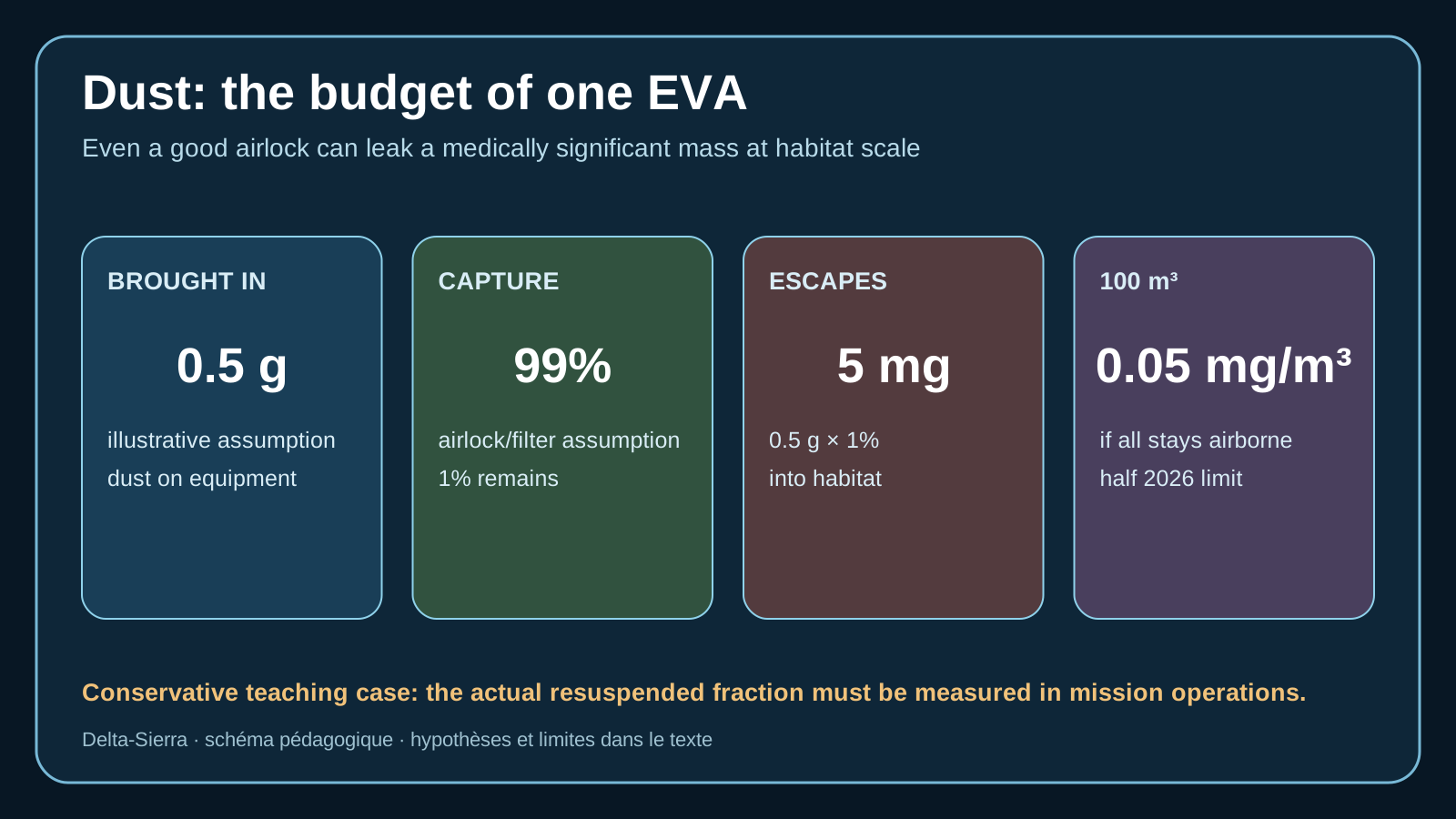
This is a design assumption, not a Mars measurement; it shows how small masses can matter at habitat scale.
A teaching case shows the sensitivity. Suppose a suit and tools bring 0.5 g of mobile dust into the airlock process. At 99% capture, 1% remains: 0.5 g × 0.01 = 0.005 g = 5 mg. If, as a deliberately conservative case, all 5 mg became airborne in 100 m³, concentration would be 0.05 mg/m³, half the 2026 average limit. Actual imported mass and airborne fraction must be measured; the example shows why apparently excellent capture can still matter.
Control should begin before the airlock: operating techniques that reduce dust mobilization, low-adhesion surfaces, brushing or electrostatic cleaning, dirty-tool segregation and fewer objects crossing the clean boundary. Suitports may keep most exterior suit surfaces outside the habitat, but introduce sealing, maintenance and contingency issues of their own.
Dust is not only a respiratory hazard. NASA work has long highlighted abrasion, electrostatic adhesion, visor obscuration, joint penetration and potential electrical effects. Decontamination therefore needs multiple metrics: mass removed, particles re-aerosolized, residual surface contamination and wear caused by cleaning.
Filter maintenance becomes an industrial stream. Capturing dust turns it into concentrated waste. Filters must be changed without release, pressure drop has to be monitored, consumables stocked and perhaps media regenerated. At settlement scale, dust trapped in filters, seals, clothing and airlocks becomes a managed waste stream.
The best protocol will be adaptive: measure post-EVA peaks, identify the dirtiest activities and change procedures. The useful question is not “is the airlock clean?” but how many milligrams cross the boundary per EVA and where they end up.
The best dust is the dust that never enters. Mitigation starts outside: suit geometry, low-adhesion surfaces, controlled brushing or cleaning, separated storage and an airlock sequence that prevents resuspension. Interior filtration is the final barrier, not the first. Every gram excluded reduces health risk, seal wear and cleaning-system load simultaneously.
The dust budget should be measured EVA by EVA. Estimated returned mass, particle counts in the airlock, filter pressure drop and seal inspections can build a trend history. Slow drift matters as much as an acute exceedance: if dust ingress doubles over twenty sorties, either the hardware or the procedure has changed.
EVA creates a maintenance debt. A six-hour excursion may require cleaning, drying, recharge, inspection, consumable replacement and data review afterwards. Planning therefore has to count the whole cycle rather than only hours outside. A settlement that expands EVA activity without industrializing suit turnaround may spend more time maintaining exploration than exploring.
A spacesuit is life-support equipment, a work tool and a potential contamination vector. Dust affects seals, visors, mechanisms, filters and cabin air; the EVA budget therefore includes cleaning, inspection and reconfiguration, not only time outside. High EVA cadence can become a dominant maintenance load.
The strongest strategy controls dust at the source with dirty/clean zoning, suitable airlocks and protected interfaces before relying on habitat filtration. Human exposure limits define the outcome; daily operations must show that procedures and hardware preserve that outcome as equipment ages.
NASA 2026 — dust and EVA cadence
NASA’s Martian-dust working group explicitly connects exposure control to EVA cadence, dust ingress and habitat environmental-control performance. The 0.1 mg/m³ 24-hour average is therefore an operational architecture constraint as well as a health limit.
NASA-STD-3001 Volume 2 — Spacesuits — The standard frames human and performance requirements for spacesuits. The page separates institutional requirement, design choice and Delta-Sierra scenario so a normative value is not turned into a prediction of a Mars system.
NASA NTRS — Dust Mitigation Technology Roadmap (2026) — The dust-mitigation roadmap is connected to airlocks, seals, visors, connectors and maintenance. It shows that “removing dust” spans multiple functions: prevent ingress, detach, capture, measure and manage contaminated waste.
NASA — Extravehicular Activity and Human Surface Mobility — NASA EVA/mobility material connects suit, human work and vehicle. The book focuses on the operational interface: power autonomy, repair, ergonomics and dust jointly change the actually useful duration of an EVA.
EVA dust should be treated as a contamination flow. It enters through suit surfaces, joints, tools, and maintenance operations. The problem therefore extends beyond astronaut comfort: particles can reach seals, connectors, filters, sensors, and the habitable volume. Architecture should reduce the quantity returned after each excursion, capture material that is shed, and track barrier performance over repeated cycles. The airlock becomes both an atmospheric boundary and a decontamination station whose consumables and waste streams also require management.
A spacesuit should then be treated as a maintainable small vehicle. Ventilation, carbon-dioxide removal, thermal regulation, communications, power, pressure integrity, and mobility need independent checks after maintenance. An anomaly observed during EVA should leave usable evidence after return: pressure history, alarms, duration, conditions, suspected part, and corrective action. That discipline prevents intermittent faults from simply being reset before the next excursion. Suit availability then depends as much on test equipment, wear parts, and technician time as on the nominal number of suits in the inventory.
Suit sizing and interchangeability also become operational constraints. A fleet nominally containing several suits may offer fewer usable combinations if hard upper torsos, gloves, boots, bearings, or life-support packs fit only part of the crew. Maintenance records should therefore track configuration by wearer and by component, while emergency procedures identify which substitute configurations remain acceptable. The inventory problem is not the number of suits on a shelf but the number of people who can safely perform a required EVA after one or more components are removed from service.
Sources and documentary findings
Pressure and mobility: the compromise shaping the entire suit: the references below are retained because they contribute a result, technology status or verification framework directly useful to this subject.
NASA — Extravehicular Activity and Human Surface Mobility
EVA architecture directly connects the suit to mobility, the airlock, tools and surface rescue. That full chain determines practical range and whether a crew member can be recovered or returned with a partially degraded system.
NASA NTRS — EVA and Human Surface Mobility ConOps (2026)
This 2026 concept-of-operations document links EVA, human surface mobility, work sequences and interfaces. It provides an entry point for reasoning about an operational system rather than isolated suit performance.
NASA NTRS — Dust Mitigation Technology Roadmap (2026)
The 2026 dust-mitigation roadmap addresses technologies intended to limit adhesion and contamination. On Mars this connects directly to suit seals, airlocks, filters and indoor air quality.
NASA — Establishing Crew Exposure Limits of Martian Dust (2026)
For EVA operations, NASA's preliminary 2026 dust limit shifts attention to the contamination path: particles carried back on equipment must be prevented from becoming a cabin inhalation exposure. Control begins outside, continues through the airlock and is verified with measurements inside the habitat.