

This systems overview distinguishes demonstrated life-support performance from engineering extrapolations for a Mars settlement. Values that come from terrestrial or orbital systems are not treated as automatically transferable to Mars.
Life-support reality
A recovery percentage must be converted into make-up demand
A stated 98% recovery is useful only after defining the stream and the missing fraction. In a simplified 100-unit flow, 98 units return and 2 units require make-up. Over a long settlement lifetime, that small fraction becomes a supply requirement, so engineers must identify where it leaves the loop and whether recovering more would cost more mass, energy and maintenance than extracting local water.
Power must be budgeted as a firm service, not a nameplate number
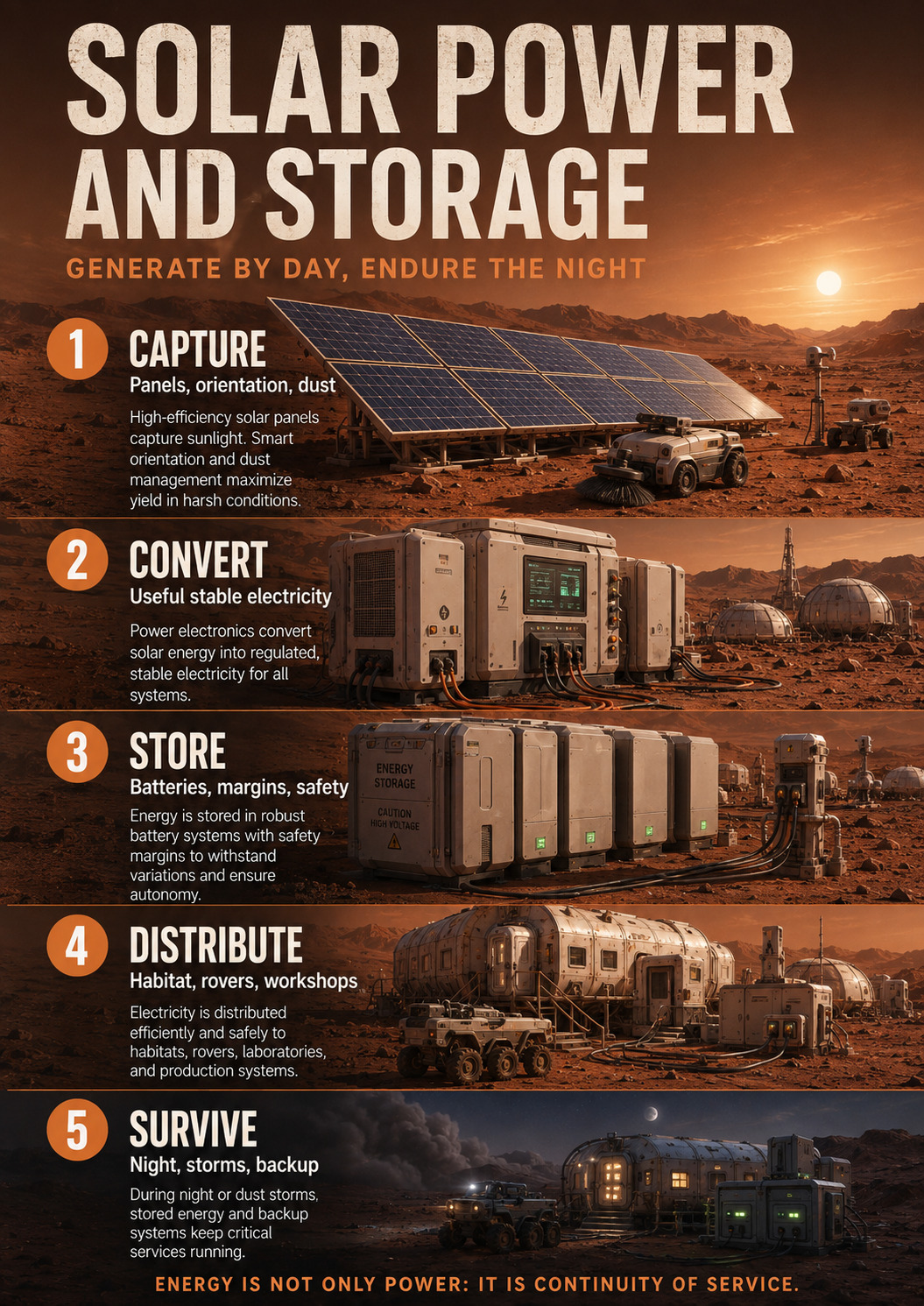
Water processing, electrolysis, refrigeration, lighting and agriculture all draw from the same electrical system. A settlement therefore needs to know what power remains available during dust, maintenance, battery degradation and a failed generator. The design question is not only how many megawatts are installed, but how many kilowatts of critical service can be guaranteed hour after hour.
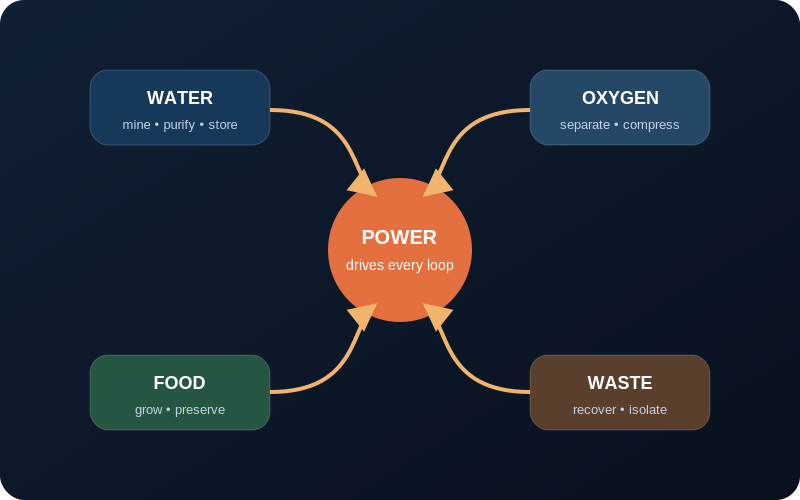
The colony does not need four resources; it needs one coupled system
Water, oxygen, food and energy are often presented as separate chapters. On Mars they are a single network. Water is consumed by people, crops, hygiene, cooling and industrial chemistry. Oxygen is needed for breathing and potentially in far larger quantities as rocket oxidizer. Food production consumes water, nutrients, carbon dioxide, light and crew labor. Every pump, heater, compressor, lamp and fan consumes electrical power. Waste treatment can recover resources, but it also adds machinery that must be cleaned and repaired.
The engineering objective is not a perfectly closed ecological loop from day one. It is a controlled set of loops with known losses, adequate storage and the ability to bypass a failed processor. A settlement that recycles 98 percent of its water but has no replacement pump may be less resilient than one that recycles 90 percent and carries several months of reserve.
Life-support is also where the practical value of Mars becomes clear. Water ice, atmospheric carbon dioxide and mineral-rich regolith are not abstract “space resources”. They are the on-site inputs that can gradually transform a fragile outpost into a resilient settlement. For the broader strategic rationale, see Why go to Mars?.
Water: the first local resource to industrialize
Robotic data show that subsurface water ice is present in parts of the Martian mid-latitudes, including regions where it may lie within roughly a meter of the surface. That does not mean settlers can simply melt clean blocks. Ice may be mixed with regolith, salts and dust. Its depth and concentration vary. Excavation equipment must work in cold, abrasive conditions and transfer material without releasing large amounts of vapor into the thin atmosphere.
A practical chain could involve enclosed excavation, insulated transport, thermal extraction, vapor capture, filtration, mineral removal and storage. The water system would then split into quality grades. Potable water requires the strictest treatment. Hygiene, cooling and industrial processes can often use lower grades. Fire reserves and radiation-shielding tanks can double as strategic storage.
Location decisions should therefore use delivered water cost, not just ice presence. That cost includes excavation energy, heater efficiency, contamination, equipment wear, distance from the habitat and the labor needed to maintain the plant.
Recycling water without creating a single point of failure
Space stations already recover water from humidity and urine, and future deep-space systems aim for higher closure. A Mars settlement would recycle cabin humidity, hygiene water and processed wastewater. Yet biological growth and industrial operations create streams more complex than those of a small spacecraft. Soil substitutes, nutrient solutions, cleaning chemicals and trace contaminants must be monitored continuously.
The safest design separates loops where necessary. Drinking water should not depend on one biological reactor. Crop water can tolerate different treatment pathways. Emergency tanks should be isolated from daily circulation. Sensors must be backed by manual sampling because a failed sensor can be as dangerous as contaminated water.
Oxygen: demonstrated on Mars, not yet industrialized
NASA’s MOXIE instrument operated sixteen times and produced oxygen from the carbon-dioxide-rich Martian atmosphere. It proved the central chemical principle under real Martian conditions. A colony-scale plant, however, would need to ingest and filter large volumes of thin, dusty air; compress it; heat an electrolysis stack; separate gases; reject heat; and store oxygen safely for years.
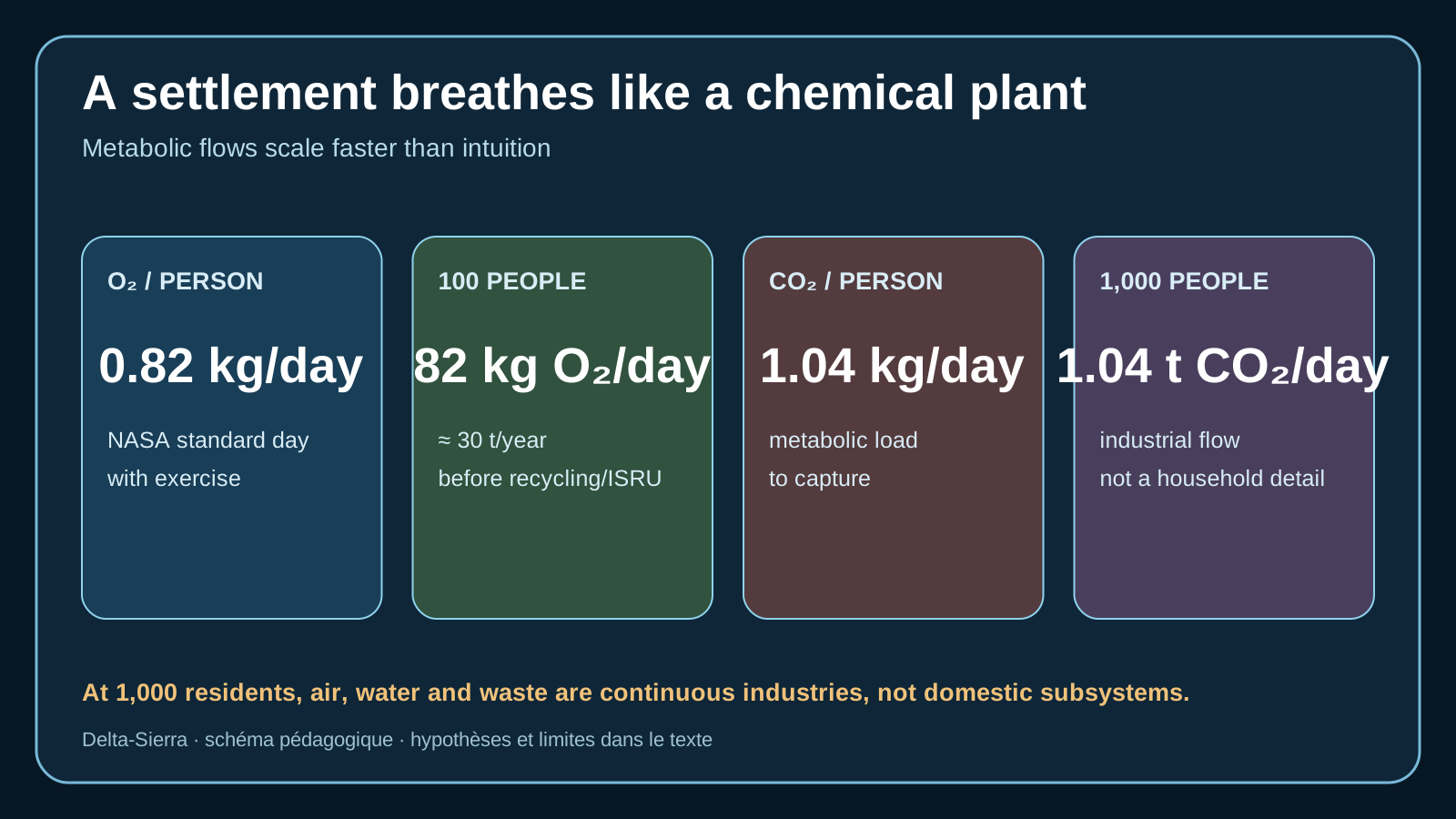
Breathing oxygen is only one demand. A crew of several people consumes a manageable daily quantity compared with the oxidizer required to launch a large vehicle from Mars. This is why mission architectures often connect oxygen production to propellant strategy. If return flight depends on local oxidizer, the plant must run long before the crew arrives and fill verified tanks with substantial margin.
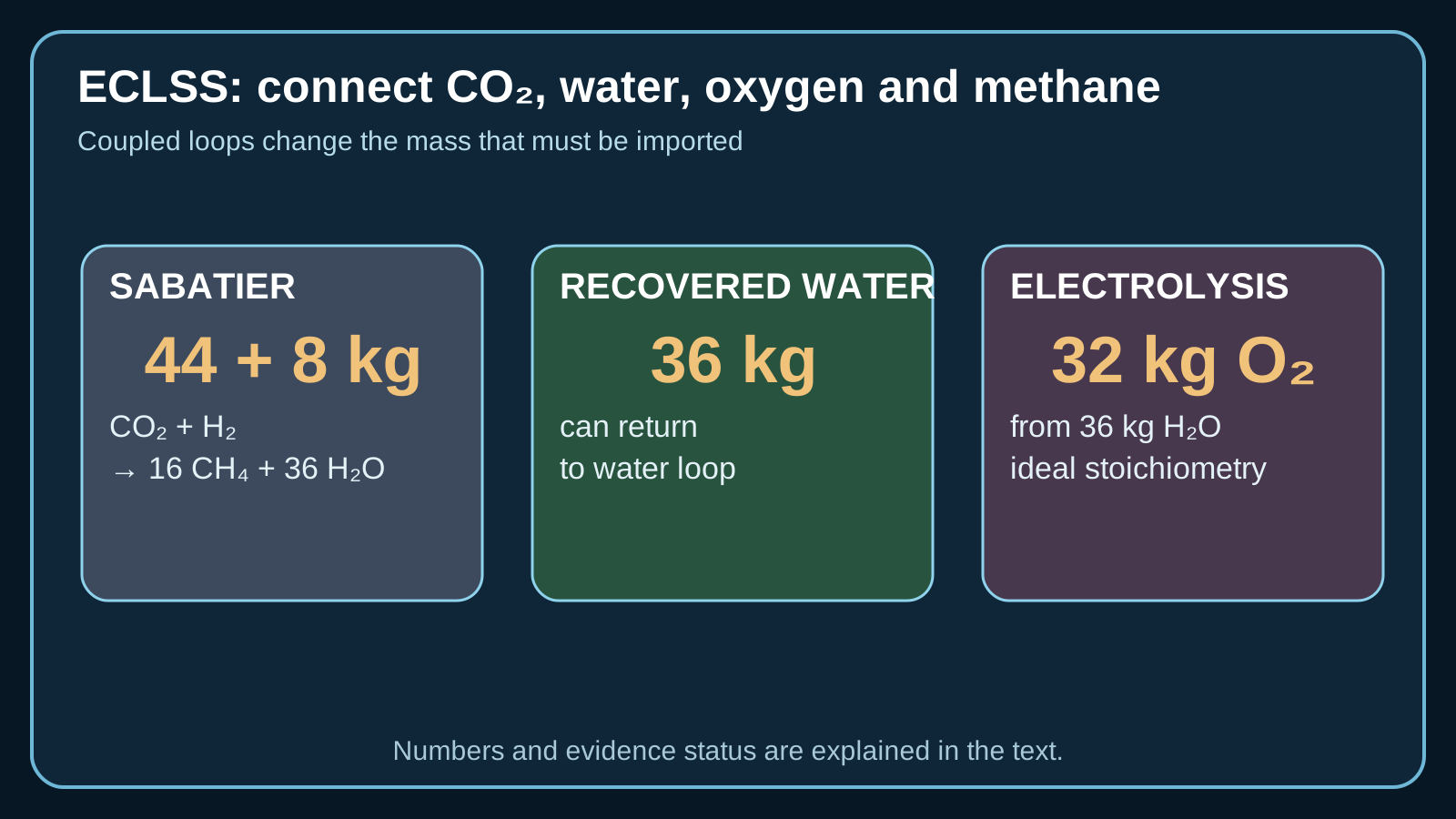
Oxygen can also be produced by electrolyzing water, which yields hydrogen as well. The best architecture may combine atmospheric carbon-dioxide processing with water electrolysis, using each pathway according to power availability, propellant chemistry and equipment condition.
Food: stored calories first, biological production second
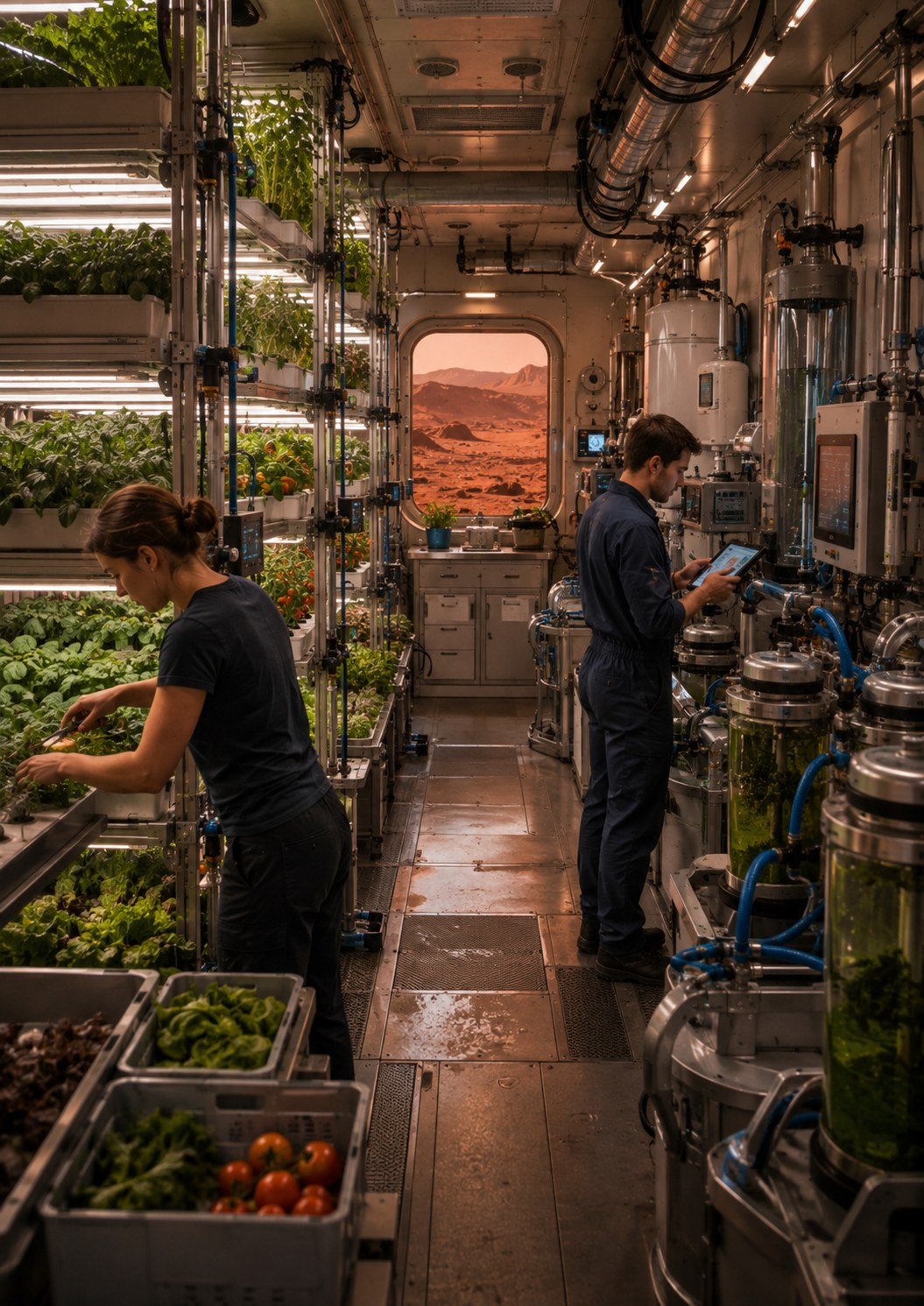
The first crews will not live entirely from Martian agriculture. Stored food provides predictable nutrition with far less power and hardware than crop production. Fresh crops nevertheless matter for vitamins, menu variety, morale and partial air and water regeneration. NASA’s space-crop research is explicitly aimed at sustainable production systems for deep-space exploration, but the technology remains an active field rather than a solved farm package.
Crops would grow in controlled chambers, not in untreated Martian soil. The chambers must regulate pressure, temperature, humidity, carbon dioxide, light, nutrients and pathogens. Martian regolith contains no organic ecosystem equivalent to agricultural soil and can contain chemically troublesome compounds. Processed local minerals may eventually contribute structural media, but nutrients and microbial management require deliberate systems.
A sensible food strategy develops in layers. Early missions carry all staple calories and grow small quantities of leafy vegetables and herbs. Later farms add compact crops with high edible yield, predictable cycles and useful nutritional profiles. Only a larger settlement can justify extensive staple production, oil crops and animal protein systems. Even then, cellular agriculture, fermentation and insect or aquaculture systems may use resources more efficiently than conventional livestock.
Waste is inventory in the wrong form
Human waste, crop residues, carbon dioxide and packaging all contain recoverable material. ESA’s MELiSSA program studies a regenerative loop intended to recover food, water and oxygen from waste streams using linked biological and physical processes. The long-term potential is significant, but biological loops introduce their own vulnerabilities: contamination, population instability, slow recovery and the difficulty of diagnosing invisible changes.
For that reason, early settlements should combine biological and physicochemical methods. Drying, oxidation, filtration, distillation, nutrient recovery and controlled bioreactors can be arranged as modular processes. Modules can be isolated, sterilized and restarted. A single elegant ecosystem that cannot be bypassed would be too fragile.
Energy: the resource that determines all the others
Power demand on Mars is not limited to lighting and computers. Ice extraction requires excavation and heat. Oxygen production requires compression and high-temperature electrochemistry. Habitats require continuous circulation, heating and carbon-dioxide removal. Greenhouses may require artificial light. Workshops, laboratories and medical systems create variable peaks.
Solar arrays are attractive because they are modular and have extensive operational heritage. Mars, however, receives less sunlight than Earth and experiences dust deposition and storms that can reduce output. Arrays require cleaning strategies, storage and enough excess capacity to survive seasonal lows. Fission surface power can provide continuous output independent of sunlight; NASA is developing systems first for lunar use with extension toward Mars. A robust settlement would likely value diversity more than ideological purity: distributed solar, storage, fission baseload and emergency generators serving separated microgrids.
Storage is not passive
Large tanks and batteries are often treated as secondary hardware. In reality, storage decides whether variable production can support continuous life. Water tanks buffer extraction outages. Oxygen tanks separate production from consumption. Food stores bridge crop failures. Batteries or other storage bridge night and transient demand. Thermal storage can preserve heat from industrial processes.
Inventory must be physically distributed. A fire, impact or pressure failure should not remove all reserve of one resource. Digital records should track quantity, quality, location and expiration, while local gauges allow verification when software or networks fail.
The governing design rule: fail gradually
Life-support systems should not switch from normal to fatal in one step. Loss of one greenhouse should reduce fresh food, not total calories. Loss of one oxygen unit should consume reserve while another unit increases output. Loss of a power source should shut down non-essential industry before cabin circulation. This hierarchy requires explicit load shedding, protected emergency buses and crew procedures tested under realistic delay and isolation.
The first Martian settlement will not be self-sufficient in the romantic sense. It can nevertheless become resilient by knowing every flow, keeping strategic reserves, diversifying production and designing every critical loop for inspection and repair.
Three simple calculations that make the coupled system visible
2,400 L usable at a net demand of 80 L/day gives 2,400 ÷ 80 = 30 theoretical days without production.
If one line produces 20 kg/day and the scenario demand is 16.8 kg/day, nominal surplus is 20 − 16.8 = 3.2 kg/day. That surplus is not a reserve: it disappears if the line stops.
Four 40 kW units would represent 160 kW of nameplate power if all could operate at that level. A real design must then account for maintenance, outages, losses and margins.
These calculations are deliberately pedagogical. They show the key questions: how much is stored, how fast can we produce, and how long can we endure if one function disappears?
Industrial priority: secure critical dependencies before pursuing total autonomy
- Measure and control. Reliable sensors, analysis and metrology.
- Secure power and thermal control. Without them, other loops slow or stop.
- Secure water. Local extraction, treatment, recycling, separated storage and emergency purification.
- Secure oxygen and atmosphere. Multiple production or reserve paths, leak detection and compartment isolation.
- Expand local food. Gradually, because biological systems require time, light, nutrients and biosafety.
- Recycle materials. Turn wastes and effluents into reusable inventories.
This is a priority logic, not a universal blueprint. Site conditions, population, transport capability and accepted risk can change the detailed order.
The real system bottleneck: energy available when it is needed
Mining ice, pumping fluids, electrolyzing water, compressing oxygen, heating a greenhouse and recycling waste all require energy. Two systems with the same maximum nameplate power can provide very different services if one is intermittent and the other dispatchable.
NASA is developing 40-kilowatt-class fission surface power concepts for continuous off-world operation. This illustrates an essential distinction: installed power is not automatically firm power available at every hour. A real architecture must include generation, storage, margins, maintenance, conversion losses and load-shedding priorities.
During a crisis, the relevant power figure is the firm capacity still available to air, water, thermal control, communications and shelter after the failed generation or storage element has been isolated.
Three reserve horizons: immediate, operational and strategic
Exact durations must be sized for the mission and risk model, but it is useful to separate several decision horizons.
Immediate reserve absorbs a short failure or planned maintenance. Operational reserve provides days to diagnose, repair and test. Strategic reserve protects against a longer outage, unavailable spare or missed resupply.
These labels do not imply universal values such as exactly 24 hours, 7 days or 30 days. Their purpose is to connect stored quantity to reaction time. A tank becomes a resilience tool, not merely a container.
A vital resource must be designed as a chain, not as a machine
For water, the full chain may be: prospecting → extraction → melting → filtration → purification → storage → distribution → use → collection → treatment → quality control → return to storage. Every arrow is a possible failure point.
Oxygen has its own chain: feedstock, production, purification, compression, storage, distribution, sensors and reserves. Food has another: seed or stored food, water, light, nutrients, growth, harvest, processing, storage, distribution and waste recycling.
The design question is therefore always double: what happens if one step stops? and what alternative path can maintain a minimum service?
Stock, flow and consumption: three numbers that must not be confused
A settlement can own a large amount of water and still face a shortage tomorrow morning. Three different quantities govern resources: stock, flow rate and consumption.
Stock answers “how much do we have now?” Flow rate answers “how much can we produce or process per hour?” Consumption answers “how much do we use over a given time?”
A huge stock does not permanently compensate for a treatment plant that is too slow. A fast plant does not protect against failure if there is no buffer stock. A robust system combines production capacity, reserves and the ability to reduce demand.
If a usable reserve contains 2,400 L and net consumption is 80 L/day with no production, the theoretical endurance is 2,400 ÷ 80 = 30 days, provided demand stays near 80 L/day and the full stock remains usable.
Related Mars guides
Where would humans actually live on Mars?
A realistic guide to Mars habitats: pressure shells, radiation shielding, regolith cover, lava tubes, dust control, interior design, repair and emergency zoning.
Who should be selected for the first permanent settlement on Mars?
A realistic framework for selecting the first Mars settlers: overlapping skills, medical risk, psychology, diversity, team compatibility, legitimacy and replacement planning.
How would the first Mars colony govern itself?
How a Mars settlement could govern emergencies, scarce resources, crime, work, contracts and local autonomy while remaining legally connected to Earth.
Explore the books behind the broader Mars project
This resource chapter stays focused on the coupled flows that keep a settlement alive: water, oxygen, food, and energy. Wider political, social, and architectural consequences are handled elsewhere so that the calculations here can remain explicit and auditable.
I Walked on Mars — Book 1
Explore Book 1Arcadia — Manual of the First Martian City
Explore ArcadiaI Walked on Mars — Complete Series
Explore the seriesFrequently asked questions
Is there enough water on Mars for a colony?
Mars contains abundant water ice, but usable supply depends on site, depth, concentration, contamination, excavation energy and processing reliability.
Has oxygen been made on Mars?
Yes. NASA’s MOXIE technology demonstration produced oxygen from atmospheric carbon dioxide. Colony-scale continuous production has not yet been demonstrated.
Could people grow food directly in Martian soil?
Not safely without processing and controlled conditions. Crops need pressure, water, nutrients, light and protection from contaminants; untreated regolith is not equivalent to fertile soil.
Is nuclear power necessary on Mars?
Not necessarily for every architecture, but continuous fission power can reduce dependence on sunlight and storage. A resilient settlement may combine fission and solar rather than rely on one source.
2026 Source update — 98% water recovery does not mean “no losses”
Two NASA figures are often quoted for water recycling, but they do not describe exactly the same system boundary. In 2023, after the Brine Processor Assembly was incorporated, NASA reported a demonstration of about 98% total water recovery aboard the ISS; the agency noted that overall recovery had previously been about 93–94%. A NASA ECLSS reference updated in 2025, meanwhile, describes the Water Recovery System as recovering about 90% of station water. Those figures should therefore never be copied as if they were a universal constant: the subsystem, configuration, denominator, and test period must be stated.
If an architecture reaches 98%, the pedagogical arithmetic is straightforward: out of 100 litres entering the chosen accounting boundary, 98 litres return as recovered water and 2 litres are not recovered within that boundary. NASA does not publish one universal breakdown saying that those 2% always correspond to fixed amounts of evaporation, purge, or leakage. Loss paths depend on hardware, operations, and what is included in the accounting boundary. A Mars architecture should therefore instrument losses explicitly: water retained in residues or brines, maintenance and purge flows, humidity that is not captured, water discarded with some waste streams, leakage, EVA losses, and water rejected because it fails quality limits.
The engineering consequence matters: a higher recovery fraction is useful only if quality, reliability, maintainability, and energy demand remain acceptable. NASA’s recovery chain uses multiple filtration and catalytic oxidation stages, checks water quality with sensors, and reprocesses water that does not meet standards. Cabin air follows the same closed-loop logic: the Air Revitalization System removes carbon dioxide and trace contaminants, while the Oxygen Generation System electrolyzes water to make breathing oxygen. Some hydrogen can then be sent to a Sabatier-type carbon-dioxide reduction process to recover water.
On Mars, closing the recycling loop is not enough: the settlement also needs a local make-up source. NASA’s Advanced Mars Water Acquisition System, updated in 2026, studies recovery and purification of water from Martian soils for life support, oxygen and fuel production, food production, and radiation shielding. NASA’s SWIM maps also identify regions where subsurface water ice has been detected, because access to ice can directly influence the choice of a human landing and settlement site.
Primary sources: NASA — 98% water recovery milestone · NASA — ECLSS reference · NASA TechPort — Advanced Mars Water Acquisition System · NASA — SWIM water-ice map.