


MARS BIBLE — ORGANISATIONS
Canadian Space Agency (CSA)
APXS and Martian geochemistry: a focused contribution can carry major scientific weight in an international mission.
BEFORE MARS — HOW THE ORGANIZATION WAS BORN
Before Mars: how Canadian Space Agency (CSA) came into being
The Canadian Space Agency was created in 1989, but Canada’s space history began much earlier. In 1962 Alouette 1 made Canada the third country to design and build its own satellite. For more than twenty-five years, space activities were distributed across government departments, research organizations and industry before a single agency was finally established to give the civilian program greater coherence.
CSA was therefore born from consolidation. It brought together functions that had previously been dispersed and became responsible for managing the country’s civil space activities. That history helps explain Canada’s specialization strategy: rather than reproduce every capability of a major space power, Canada invests heavily in selected areas where it can achieve world-class performance.
Robotics is the most visible example through Canadarm, but scientific instrumentation, Earth observation, telecommunications and international partnerships are equally important. This high-value niche strategy allows Canada to participate in missions far larger than its own space budget could support independently.
On Mars, Curiosity’s APXS illustrates the model perfectly. Canada does not send its own rover, but contributes an instrument capable of producing essential scientific information about the composition of rocks and soils. CSA’s Martian relevance therefore comes less from an autonomous Mars program than from its ability to become an indispensable technical partner.
Founding sources: CSA — Organization · CSA — History 1962–1999
An agency created in 1989 after more than a quarter-century of distributed capability
The Canadian Space Agency was created on 1 March 1989, with Larkin Kerwin as its first President. Canada, however, already had substantial space experience. Alouette I, launched in 1962, had made Canada the first nation after the Soviet Union and the United States to design and build its own artificial satellite. The Alouette effort had grown from a NASA invitation to cooperate: John Chapman and Eldin Warren proposed a Canadian ionospheric satellite, and a Defence Research Telecommunications Establishment team was formed under Chapman’s leadership.
This history matters when asking how the CSA recruited its first staff. In 1989 the country did not need to invent a technical community from zero. The new agency consolidated functions that had been distributed through federal institutions. Official records state that the CSA was created from divisions of the Ministry of State for Science and Technology, the National Research Council, the Department of Communications, and Energy Mines and Resources. The institution therefore centralised people and responsibilities that already existed across government.
Why Canada eventually wanted “one place” for space
Former CSA President William “Mac” Evans provides unusually useful first-hand institutional testimony. During the 1980s, Canadian space industry and international partners pressed for a recognisable national agency. The Ministry of State for Science and Technology prepared a proposal; the government announced in 1986 that it would create a space agency, which was formally established in 1989. Evans links the decision both to Canada’s major Space Station commitment and to the need for one authority where partners could understand Canadian space activity and develop cooperative programmes.
A culture of specialised contribution, including on Mars
That origin helps explain a durable Canadian pattern: maximise influence by supplying a capability that becomes important to a partner-led mission. On Mars, the clearest example is Curiosity’s Canadian APXS. In 2026 the CSA extended participation in Mars Science Laboratory through March 2029. By 1 February 2026 the Canadian instrument had analysed 1,761 samples and returned 3,943 results. Historically, this is consistent with the agency’s institutional logic: a focused technical and scientific contribution can give Canada a durable role in Mars exploration without requiring the country to finance an entire rover programme alone.
Sources: CSA — William “Mac” Evans on creating the Agency · CSA — institutional background · CSA — APXS on Curiosity.
Before 1989: an agency prepared by Alouette, industry and distributed federal functions
The creation of the Canadian Space Agency on 1 March 1989 did not mark the beginning of Canadian space activity. It brought together a long period in which capability and responsibility had been distributed among departments, laboratories, universities and companies. The Alouette programme had already shown in the 1960s that Canada could define a scientific question, assemble a team around John Chapman, work with NASA and develop a sufficiently original satellite to establish international credibility.
That history changes the meaning of recruitment. In 1989 the CSA did not have to discover where space engineers might exist; the country already possessed decades of expertise in communications, robotics, atmospheric science and satellites. The problem was to give those capabilities a recognisable federal authority. Former president William Mac Evans has explained that industry and international partners wanted a single Canadian space interlocutor; the political project was announced before the agency was formally created.
For Mars, this distributed accumulation of expertise remains visible. Canada often contributes high-value instruments or specialist knowledge rather than a complete national mission architecture. APXS on Curiosity is a useful example: a relatively compact scientific contribution can remain productive for years and return thousands of measurements. Future Canadian participation at Mars may therefore depend less on agency size than on maintaining niches of expertise deep enough to become indispensable to international missions.
Direct answer: why Canadian Space Agency (CSA) matters to the story of Mars
Canadian Space Agency (CSA) deserves its own dossier because the Canadian Space Agency was established in 1989. [1] The goal is not to rank organizations but to understand one as a system: history, decision centers, infrastructure, technologies, successes, failures and the capabilities it contributes — directly or indirectly — to Mars exploration.
APXS and Martian geochemistry: a focused contribution can carry major scientific weight in an international mission.
Essential timeline
- 19891989 CSA establishment
- PathfinderPathfinder APXS heritage
- 20042004 MER APXS heritage
- 20122012 Curiosity/APXS
- 20242024 sulfur-crystal contribution
- 20262026 continuing APXS operations
- Artemis/GatewayArtemis/Gateway capability development
Understand the organisation before looking at its rockets
To understand Canadian Space Agency (CSA), one must separate political goal-setting, program management, engineering centers, industrial manufacturing, science teams and mission operations. In this case, one useful anchor is that the Canadian Space Agency was established in 1989. [1] Another is that Canada provides the APXS instrument on the Curiosity rover. [2] These are verifiable facts; by themselves they do not guarantee success of any future program. [1][2]
Why Mars exposes the true maturity of a space program
Mars is an unforgiving maturity test. Looking at Canadian Space Agency (CSA) through Mars therefore reveals not only what it announces but which capabilities it can actually integrate, test and operate. In this case, one useful anchor is that Canada provides the APXS instrument on the Curiosity rover. [2] Another is that APXS measures the chemical composition of Martian rocks and soils. [3] These are verifiable facts; by themselves they do not guarantee success of any future program. [2][3]
The technical chain from Earth to the Martian system
The theme of robotic arm illustrates this systems view. Integration is therefore a capability in its own right. In this case, one useful anchor is that APXS measures the chemical composition of Martian rocks and soils. [3] Another is that the Canadian instrument extends a lineage used on Pathfinder and the Mars Exploration Rovers. [4] These are verifiable facts; by themselves they do not guarantee success of any future program. [3][4]
Why failures often teach more than success releases
Space history is full of failures, anomalies and redesigns. In this case, one useful anchor is that the Canadian instrument extends a lineage used on Pathfinder and the Mars Exploration Rovers. [4] Another is that the 2026-27 departmental plan says APXS support continues and links Artemis lunar capabilities to preparation for human Mars exploration. [1] These are verifiable facts; by themselves they do not guarantee success of any future program. [4][1]
Communications: commanding a machine that is no longer “live”
At interplanetary distance the word remote control changes meaning. Light-time delay cannot be negotiated away. The theme of NASA cooperation therefore combines ground antennas, radio power, coding, onboard storage, mission planning and autonomous software. In this case, one useful anchor is that the 2026-27 departmental plan says APXS support continues and links Artemis lunar capabilities to preparation for human Mars exploration. [1] Another is that the Canadian Space Agency was established in 1989. [2] These are verifiable facts; by themselves they do not guarantee success of any future program. [1][2]
Why mass governs almost everything
The architectures of Canadian Space Agency (CSA) can therefore be read as repeated trades among mass, energy, risk, cost and schedule. In this case, one useful anchor is that the Canadian Space Agency was established in 1989. [2] Another is that Canada provides the APXS instrument on the Curiosity rover. [3] These are verifiable facts; by themselves they do not guarantee success of any future program. [2][3]
Science and engineering must learn each other’s language
Strong missions make these communities converge early. The theme of mission longevity shows how a scientific question becomes a requirement, an instrument, an interface, an operations sequence and finally interpretable data. In this case, one useful anchor is that Canada provides the APXS instrument on the Curiosity rover. [3] Another is that APXS measures the chemical composition of Martian rocks and soils. [4] These are verifiable facts; by themselves they do not guarantee success of any future program. [3][4]
From one-off missions to infrastructure
This is why the history of Canadian Space Agency (CSA) is more interesting than a list of launches: the key question is which capabilities persist across generations. In this case, one useful anchor is that APXS measures the chemical composition of Martian rocks and soils. [4] Another is that the Canadian instrument extends a lineage used on Pathfinder and the Mars Exploration Rovers. [1] These are verifiable facts; by themselves they do not guarantee success of any future program. [4][1]
Partners: autonomy does not mean isolation
Cooperation can accelerate a mission but also creates dependencies. In this case, one useful anchor is that the Canadian instrument extends a lineage used on Pathfinder and the Mars Exploration Rovers. [1] Another is that the 2026-27 departmental plan says APXS support continues and links Artemis lunar capabilities to preparation for human Mars exploration. [2] These are verifiable facts; by themselves they do not guarantee success of any future program. [1][2]
Technical data explained in plain language
In this case, one useful anchor is that the 2026-27 departmental plan says APXS support continues and links Artemis lunar capabilities to preparation for human Mars exploration. [2] Another is that the Canadian Space Agency was established in 1989. [3] These are verifiable facts; by themselves they do not guarantee success of any future program. [2][3]
Maturity: demonstrated, qualified, planned or merely studied
For Canadian Space Agency (CSA), this dossier separates achievements, committed programs, announced schedules and prospective concepts so that ambition is not silently converted into fact. In this case, one useful anchor is that the Canadian Space Agency was established in 1989. [3] Another is that Canada provides the APXS instrument on the Curiosity rover. [4] These are verifiable facts; by themselves they do not guarantee success of any future program. [3][4]
What this organisation contributes specifically to Mars
The Mars relevance of Canadian Space Agency (CSA) is better measured through transferable capabilities — APXS, deep-space navigation, autonomy, sample return, surface operations, instrumentation or transportation — than by counting how often the word Mars appears in public messaging. In this case, one useful anchor is that Canada provides the APXS instrument on the Curiosity rover. [4] Another is that APXS measures the chemical composition of Martian rocks and soils. [1] These are verifiable facts; by themselves they do not guarantee success of any future program. [4][1]
The people behind the systems
Vehicles are visible; organizations are less so. In this case, one useful anchor is that APXS measures the chemical composition of Martian rocks and soils. [1] Another is that the Canadian instrument extends a lineage used on Pathfinder and the Mars Exploration Rovers. [2] These are verifiable facts; by themselves they do not guarantee success of any future program. [1][2]
What to watch over the next decade
To follow Canadian Space Agency (CSA), it is more useful to watch funded missions, hardware entering integration, system tests, launch contracts, planetary windows and qualification of critical elements than to count distant announcements. In this case, one useful anchor is that the Canadian instrument extends a lineage used on Pathfinder and the Mars Exploration Rovers. [2] Another is that the 2026-27 departmental plan says APXS support continues and links Artemis lunar capabilities to preparation for human Mars exploration. [3] These are verifiable facts; by themselves they do not guarantee success of any future program. [2][3]
Mars as a system of systems
The theme of NASA cooperation is therefore one node in a larger architecture. Studying Canadian Space Agency (CSA) helps reveal which nodes are already mature, which are developing and which still depend on other actors. In this case, one useful anchor is that the 2026-27 departmental plan says APXS support continues and links Artemis lunar capabilities to preparation for human Mars exploration. [3] Another is that the Canadian Space Agency was established in 1989. [4] These are verifiable facts; by themselves they do not guarantee success of any future program. [3][4]
What a non-specialist should retain
Applied to Canadian Space Agency (CSA), these questions separate institutional messaging from operational reality without falling into cynicism. In this case, one useful anchor is that the Canadian Space Agency was established in 1989. [4] Another is that Canada provides the APXS instrument on the Curiosity rover. [1] These are verifiable facts; by themselves they do not guarantee success of any future program. [4][1]
GO FURTHER
Mars Library
Canada on Mars in 2026: a specialist-contribution model rather than an independent Mars program
APXS: a small payload with a very long Mars history
Canada’s most durable current contribution on the Martian surface is Curiosity’s APXS, the Alpha Particle X-ray Spectrometer developed in Canada. Mounted on the rover’s robotic arm, the instrument measures elemental composition in rocks and soil. Its history illustrates a feature of the Canadian model: a country does not need to build an entire rover to provide a scientifically critical and long-lived function.
APXS itself belongs to an instrument lineage used on Pathfinder and the Mars Exploration Rovers. That continuity allows teams to compare generations of measurements and reuse mature methods. In an international architecture, specialization can therefore create scientific influence far larger than the physical mass of a contribution.
2026 status: participation extended to March 2029
The Canadian Space Agency page updated in April 2026 states that Canada extended participation in the Mars Science Laboratory mission to March 2029. As of February 1, 2026, Curiosity had travelled 36.2 kilometres and the Canadian APXS had analyzed 1,761 samples and returned 3,943 results. These numbers continue to change, so they are dated here rather than presented as permanent counters.
CSA also highlights an unexpected 2024 result: after Curiosity cracked a rock, APXS contributed to identifying pure sulfur crystals, something not previously observed on Mars. The significance extends beyond sulfur. Long missions need instruments capable of investigating surprises that did not exist in the original mission plan. Exploration repeatedly creates new targets because the planet does not follow our proposal documents.
Working with NASA while sustaining national capability
Canada operates on Mars as a partner in a NASA mission managed by JPL. That role may be less visible than owning a launch vehicle or rover, but it still requires a complete responsibility chain: public funding, industrial hardware capability, university science expertise, integration into an international team and support over years of operations.
Canadian company MDA built the APXS hardware around scientific leadership that includes the University of Guelph team. The model is relevant to human Mars architecture because a multinational settlement might divide responsibility by subsystem. Such specialization is robust only if the contributing partner retains knowledge, data, spares and the ability to support the system throughout its life.
What the Canadian model teaches a multinational settlement
A Martian city would not necessarily be built by one organization. Canada provides an example of specialization through robotics, instruments, science and participation in partner-led programs. A settlement could similarly distribute metrology, medicine, power or communications among actors with different strengths.
The corresponding risk is dependency. If a critical function exists only within a terrestrial partner and logistics are interrupted, specialization becomes vulnerability. The cooperative model therefore has to be paired with progressive autonomy: documentation, cross-training, inventories, repair capability and transfer of knowledge. Cooperation reduces the need for every partner to build everything alone; it does not remove the need to understand what the system depends on.
Deep reading: what this trajectory teaches
To understand the place of Agence spatiale canadienne in a serious history of Mars, two opposite shortcuts have to be avoided: reducing the organization to a list of missions, or treating one successful capability as proof that the whole Mars chain already exists. The thread of this dossier is robotics, instruments and the specialized contribution of a partner that need not lead an entire mission to be decisive. The sections “Before Mars: how Canadian Space Agency (CSA) came into being”, “An agency created in 1989 after more than a quarter-century of distributed capability” and “Why Canada eventually wanted “one place” for space” should therefore be read as parts of one engineering question: which capabilities are real, in what environment have they been demonstrated, and which dependencies would still have to be closed before they could support a durable human presence?
The second reading level is maturity rather than visibility. When the dossier moves through “A culture of specialised contribution, including on Mars” and “Before 1989: an agency prepared by Alouette, industry and distributed federal functions”, the useful questions become: what is already operational, what has been demonstrated only in another context, what requires major scaling, and what remains prospective? This separation protects the reader from inflated extrapolation while making it easier to identify the particular competence or hard-won operational experience that Agence spatiale canadienne can contribute.
Canada: creating value through instruments and robotics
Canada has not built an independent sequence of Mars orbiters and landers comparable with NASA’s program. Its model is specialized contribution. The APXS on Curiosity fits a broader Canadian tradition in which the space agency, universities and industry provide a scientific or robotic capability integrated into a larger international mission. This allows real Mars experience to accumulate without one country funding every vehicle, launch and ground segment.
That model is credible for future settlement. Not every nation needs a complete Earth-to-Mars transport chain. Some partners may supply robotic arms, instruments, vision software, medical systems or other critical subsystems. Their value will depend on reliability and on maintaining the competence across several generations of missions.
APXS: a small interface that reveals the chemistry of a landscape
Curiosity’s Alpha Particle X-ray Spectrometer measures the elemental composition of rocks and soils. It has to be placed against or very close to a target, linking science directly with robotic-arm geometry, planning and operations. The instrument is a reminder that a major mission result can depend on a relatively small device that is exceptionally well integrated into the operational chain.
Many settlement capabilities will have the same profile: water-quality sensors, gas analyzers, material diagnostic tools and inspection robots. They will be less visible than a launch vehicle, but their availability can determine whether an anomaly is understood before it becomes dangerous. Canadian experience highlights the strategic value of reliable, integrated components.
A contributing space power in an international ecosystem
Canada’s approach shows that space policy can pursue depth rather than a large number of national missions. Skills in robotics, operations and instrumentation can be reused across partnerships, but only if funding and training remain continuous. Industrial capability lost between missions cannot be recreated instantly when the next opportunity appears.
Canada is therefore a model of strategic specialization. An international Mars settlement will need partners able to guarantee a function for decades, not merely deliver a prototype. The important question becomes less who owns the spacecraft and more who can sustain the critical function when the first generation of hardware reaches end of life.
Institutional continuity and the Mars learning curve
Canada's Mars contribution is also a useful case study in specialization. The Canadian programme does not need its own Mars launcher or rover fleet to matter: instrument heritage, robotics, engineering participation and sustained collaboration can create a durable role inside larger missions. That model is relevant to a future international Mars architecture because responsibility can be distributed without becoming vague, provided interfaces, data ownership, verification duties and long-term expertise are explicit. [institutional source]
Open book — from Canadian science to lunar and Martian robotics
This part examines the Canadian Space Agency through Canada’s distinctive model of specialization: space robotics, scientific instruments, focused industrial capabilities and international partnerships. It separates capabilities controlled directly in Canada from those obtained through cooperation, then assesses how that model could support a sustained human presence on Mars.
Before the Agency: ionosphere, radio and the scientific state
Long before the Canadian Space Agency existed, Canada already had a strong tradition in ionospheric, auroral and radio-communications research, fields of obvious importance to a vast country exposed to polar phenomena. After the Second World War, the Defence Research Board and its Defence Research Telecommunications Establishment concentrated expertise that would become a scientific nucleus for the later national space programme. [institutional source]
This origin created a lasting difference from programmes born primarily from ballistic missiles: Canadian space activity grew around measurement, communications and instrumentation. Early teams had to make antennas, electronics, telemetry and scientific exploitation work as a single chain, encouraging a culture of reliable interfaces rather than one centred on an indigenous launch vehicle.
John H. Chapman became one of the defining figures of this period, but his role only makes sense within teams of physicists, radio engineers, technicians and industrial partners. The future programme was not the work of a single hero; it emerged from institutions able to retain expertise and transfer it from one project to the next.
The result was a trajectory in which science useful to the country prepared the ground for exploration. Measuring the ionosphere to understand long-distance communications was not yet Mars exploration, but it already meant turning an invisible environment into data, models, procedures and operational decisions.
For a Mars settlement, this culture is valuable: atmosphere, dust, radiation, communications and weather will all require instrument networks understood well enough to distinguish a real event from a sensor error. Canada’s contribution to Mars can therefore be read as an extension of an old national strength in measurement and interfaces.
It is important not to label this earlier constellation of organisations retrospectively as the CSA. The Agency itself dates from 1989. Continuity lies in expertise and people, not in an institution that remained unchanged since the 1950s.
Black Brant: learning space through suborbital flight
On 5 September 1959, the first all-Canadian Black Brant sounding rocket launched from the Churchill Research Range. The family became one of the most durable tools of Canadian space expertise. Unlike an orbital satellite, a sounding rocket provides a short learning cycle: preparation, launch, minutes of measurements, recovery or analysis, then another campaign. [institutional source]
That rhythm created a practical engineering school. Teams had to integrate payloads, verify centre of gravity, protect instruments from vibration, synchronise acquisition, account for weather and organise a safe range. Each launch turned a laboratory assumption into the real behaviour of a system exposed to acceleration and vacuum.
Churchill also mattered as a human environment. University scientists, federal personnel and industry learned to operate together in campaigns where one small omission could waste months of preparation. That collective discipline later became essential for satellites, robotics and planetary instruments.
Black Brant demonstrates how a country can build technical depth without immediately owning a large orbital launcher. A succession of well-designed experiments can train teams, qualify instrumentation and establish an industrial base before the most prestigious projects exist.
On Mars, the equivalent would be a strategy of frequent demonstrators: small sensors, local platforms, balloons, drones or precursor payloads that test a function before it becomes critical for humans. Repetition can reduce uncertainty more effectively than a single gigantic demonstration.
Black Brant should not be presented as proof that Canada now has autonomous orbital access. It represents exceptional suborbital and experimental capability, while the country remains structurally dependent on partners to place major payloads in orbit.
Alouette I: building a satellite when you have never built one before
An invitation from the newly created NASA to international partners led in 1959 to a Canadian proposal for a satellite that would probe the ionosphere from above. Alouette I launched on 29 September 1962. Canada thereby became, after the Soviet Union and the United States, the first country to design and build its own scientific satellite placed in orbit. [institutional source]
The achievement is especially instructive because the team had no previous satellite-building heritage. Engineers had to learn thermal control, solar-cell power production, deployable antennas, telemetry and compatibility with an American launch vehicle. A spacecraft designed for roughly one year ultimately returned useful data for more than a decade.
Companies such as RCA and Spar Aerospace gained important early space heritage through the programme. Roll-up antennas, integration methods and supplier management created an economy of expertise that survived far beyond Alouette. The satellite therefore became an industrial nursery as much as a scientific instrument.
That longevity had an institutional consequence: reliability created international trust. When a partner proves it can deliver a robust subsystem and exploit data for years, it becomes credible for more ambitious cooperation. Space capital is therefore reputational as well as technical.
For Mars, Alouette is a reminder that the value of hardware is not limited to its initial novelty. A sensor or robot useful to a settlement must continue operating after hundreds of thermal cycles in an environment where replacement is expensive. Durability can matter more than spectacular one-time performance.
Alouette was of course not launched by a Canadian rocket. Its success is precisely an example of cooperation: a national scientific architecture, launch access supplied by an ally and shared exploitation. That model of specialisation became a recurring Canadian pattern.
From Alouette to ISIS: learning programme continuity
Alouette was not an isolated success. Alouette II and the ISIS satellites extended ionospheric research and, more importantly, forced Canadian teams to move from a heroic one-off project to a real series. An organisation able to repeat, improve and document a system becomes fundamentally different because it no longer depends entirely on the informal memory of pioneers. [institutional source]
Continuity requires standardised testing, data archiving, training new engineers and deciding what should remain unchanged and what may evolve. The programme therefore built institutional technical memory. Configuration documents and procedures became nearly as important as the hardware itself.
This period also strengthened John Chapman’s influence and the debate over what a Canadian space programme should be: not a copy of the superpowers, but a strategy selecting fields in which the country could become indispensable. The idea of strategic specialisation was rooted in this experience.
The transition from Alouette to ISIS is a governance lesson: a technology demonstration has lasting value only if it produces teams, standards and reusable capabilities. Without that transfer, every mission starts again from zero and learning costs are paid repeatedly.
A Mars settlement will have to work the same way. The first water purifier or robotic arm remains only a prototype until procedures exist to maintain it, diagnose it, train replacement operators and manufacture or store the necessary parts.
The ISIS series did not mean Canada had found a final economic or institutional model. Responsibilities remained distributed among ministries, laboratories and companies for many years. That fragmentation helps explain why a national agency was eventually considered necessary.
Anik: space as infrastructure for a vast country
The launch of Anik A1 in 1972 made Canada the first country with a domestic communications satellite in geostationary orbit. The challenge was not merely technological: it was about connecting a continental territory, especially northern regions where conventional terrestrial infrastructure is costly or sometimes impractical. [institutional source]
Telesat, created by Parliament in 1969, gave this policy an operational and commercial form. The satellite was no longer only a scientific laboratory; it became a permanent service affecting television, telephony and territorial cohesion. That required planning capacity, redundancy, ground maintenance and orbital replacement.
This direction helped develop a Canadian industry able to work on communications satellites, antennas, integration and ground stations. It also showed that a space programme can be judged by the quality of service delivered to citizens, not only by the novelty of its missions.
Anik established a culture of space infrastructure: a system becomes critical when society organises daily activity around its continuous availability. Service continuity, failure recovery and renewal procedures then become matters of practical sovereignty.
On Mars, communications, local positioning, weather observation and data relay will have the same character: they must be treated as essential services rather than temporary payloads. A settlement will depend more on network continuity than on the spectacle of any individual satellite.
Anik nevertheless belonged to an ecosystem in which launchers and many components came from foreign partners. Canadian strength lay in service design and selected technologies, not autarky. That distinction is essential when translating the model to an international Mars presence.
The David Florida Laboratory: the invisible infrastructure of reliability
Opened in 1972, the David Florida Laboratory gave Canada a spacecraft integration and test capability. In public imagination a satellite exists when photographed on a rocket. For engineers it first exists in thermal chambers, vibration rigs and test campaigns designed to provoke on the ground the failures that must not be discovered in orbit. [institutional source]
The laboratory became a qualification node for numerous Canadian and international programmes. Testing means exposing hardware to extreme temperatures, vacuum, acoustic loads, launch vibration and electromagnetic constraints. Expertise lies as much in metrology and interpreting results as in the test equipment itself.
Such infrastructure promotes collective learning among government, industry and universities. The same teams can observe several generations of spacecraft and recognise recurring weaknesses. A test facility therefore becomes a machine for accumulating industrial memory.
The David Florida Laboratory shows why a space programme cannot be measured only by mission count. A qualification capability may serve dozens of projects without appearing in a launch table, yet it directly reduces mission risk and failure costs.
On Mars, a durable settlement will need comparable local infrastructure: diagnostic benches, clean areas, calibration, tests of repaired parts and the ability to reproduce stresses before returning critical equipment to service. Advanced maintenance is an industrial function, not merely a toolbox.
These Canadian capabilities have evolved and today’s institutional landscape is not identical to that of the 1970s. The important point is the birth of a qualification culture, not the idea that a single facility now represents the entire Canadian ecosystem.
Canadarm: choosing a speciality and becoming indispensable
In 1974, NASA assigned Canada responsibility for designing the Space Shuttle Remote Manipulator System. Canadarm, roughly fifteen metres long, became one of the country’s most recognisable signatures in space. The Canadian government funded initial development while Spar Aerospace and an industrial supply chain turned the concept into hardware qualified for human spaceflight. [institutional source]
The challenge was not simply building a large arm. Engineers had to produce precise joints, sensors, end effectors, software and operator interfaces predictable enough to move payloads near a crewed spacecraft. A few centimetres of error or an unexpected movement could damage hardware worth hundreds of millions of dollars.
The programme created skills beyond the arm itself: flexible-body dynamics, control, vision, safety, joint operations with NASA and human-rating disciplines. Canadian engineers learned to design a system whose behaviour had to remain understandable to trained astronauts operating under heavy workload.
Choosing robotics was strategic because it allowed Canada to provide a critical function without funding an entire shuttle. In return for a specialised contribution of high value, the country gained access, influence and flight opportunities for its astronauts. Cooperation became a mechanism of access rather than simple dependence.
On Mars, robotic arms will be essential for unloading cargo, inspecting structures, handling materials, maintaining exposed systems and reducing human excursions. Canadarm heritage is therefore more directly relevant to a Mars base than its visual association with the Shuttle might suggest.
Canadarm is not proof that an Earth-orbit robot could simply be placed on Mars. Gravity, dust, temperature, latency and lack of immediate human maintenance would require a different architecture. The relevant continuity is robotic expertise, not replication of historic hardware.
1984: Marc Garneau and Canada’s entry into human spaceflight
Marc Garneau’s 1984 flight aboard Challenger marked Canada’s entry into human spaceflight. The step was linked to the technology partnership with the United States: Canada did not develop its own capsule, but its contribution to the American programme opened crew opportunities and a new set of scientific and operational responsibilities. [institutional source]
Training an astronaut changes an organisation. It requires understanding spacecraft systems, emergencies, medicine, international operations and human limitations. The astronaut also becomes an interface among engineers, scientists, decision-makers and the public, translating a technical programme into an understandable human experience.
Canadian selections later produced astronauts who worked on the Shuttle and International Space Station. Chris Hadfield, for example, helped install Canadarm2 and became the first Canadian to perform a spacewalk, directly linking national robotics expertise with human work in space.
Human spaceflight also gave Canada experience in space medicine, human factors and microgravity science. These fields are less visible than rockets, but become central as mission duration increases and immediate return to Earth is no longer possible.
A Mars mission will require precisely this culture: multinational crews, shared procedures, cross-training and enough understanding of partner systems to intervene during failures. Canadian human-spaceflight experience is therefore that of an integrated participant in an international architecture.
Canada still does not operate a national crewed orbital transport system. Its astronauts fly on partner vehicles. Operational crew experience must therefore be distinguished from transportation autonomy when assessing a contribution to Mars.
1989: creating the Canadian Space Agency to unite a dispersed programme
The intention to create an agency was announced in 1986 and the Canadian Space Agency came into existence on 1 March 1989. A 1990 Act provided its legal framework. This was late compared with Alouette or Canadarm: the Agency did not start Canadian space activity, but sought to coordinate and give institutional visibility to long-established capabilities. [institutional source]
Centralisation answered a classic technology-policy problem: when several departments, laboratories, universities and companies fund or use space capabilities, no one necessarily owns the overall picture. An agency can set priorities, represent the country to partners and maintain strategy beyond a single project.
The headquarters at Saint-Hubert, Quebec, symbolises this consolidation by bringing together policy, operations, training and research functions. Yet the Canadian ecosystem remains distributed: companies, universities, federal facilities and teams abroad remain indispensable.
Creation of the CSA also made it possible to negotiate international contributions as elements of a national strategy. Space Station robotics, space science, Earth observation and astronauts could be linked to common objectives rather than managed as unrelated contracts.
For Mars, a medium-sized agency can play a similar role in a coalition: identify a few functions in which the country has genuine excellence, guarantee long-term funding and negotiate scientific access, crew opportunities or operational responsibilities in return.
A single agency does not eliminate politics or budget trade-offs. It can coordinate, but still depends on government choices and national industrial capability. Institutional stability reduces fragmentation without abolishing economic constraints.
RADARSAT: radar as sovereign and commercial capability
RADARSAT-1 and RADARSAT-2 established Canada as a major actor in radar Earth observation. Synthetic aperture radar can observe day or night and through many cloud conditions, an especially important advantage for monitoring the Arctic, sea ice, oceans, disasters and resources across a country with severe weather. [institutional source]
RADARSAT-2 also illustrates a public-private model: MDA owns and operates the spacecraft and ground segment, while the CSA contributed to initial funding and government recovered part of that investment through a data credit. The programme therefore became a public tool, industrial capability and commercial service at the same time.
Radar imaging requires a demanding processing chain. Raw data must be calibrated, geometrically corrected and transformed into usable products. A major share of economic value therefore lies in software, algorithms and interpretation, not only in the orbital antenna.
This expertise strengthened Canadian space industry and familiarised it with complex systems serving real operational users. When a service supports ice monitoring, emergency response or environmental surveillance, availability requirements begin to resemble those of critical infrastructure.
On Mars, radar observations could help map the shallow subsurface, track structures, characterise terrain or monitor large areas despite lighting constraints. More broadly, RADARSAT experience shows how an orbital instrument can be transformed into a regular service for users on the ground.
RADARSAT remains an Earth-observation family and should not be presented as already-qualified Mars technology. Frequencies, geometries, power needs and processing would require adaptation. Continuity lies in radar engineering and data exploitation.
Canadarm2: designing a robot that will never return to the workshop
Canadarm2 launched to the International Space Station in 2001. Seventeen metres long, it is larger and more robust, and crucially can move from attachment point to attachment point using identical end effectors at both ends. That mobility changed the logic of the arm: it became Station infrastructure rather than a tool carried by one vehicle. [institutional source]
Its design imposed a decisive constraint: unlike the Shuttle Canadarm, it would not routinely return to Earth for overhaul. Components therefore had to be replaceable in orbit and maintenance considered from the first drawings. Repairability became a design requirement rather than an improvised response to failure.
MDA designed, built and tested the system over many years while astronauts and controllers learned new procedures. The arm then helped assemble the Station, moved payloads, supported spacewalks and captured visiting cargo vehicles such as Dragon and HTV.
The evolution of operations is as important as the hardware: over time, many tasks could be commanded from the ground. The system therefore became an example of a robot shared between onboard operators and ground teams, with coordination procedures and remote monitoring.
On Mars, this philosophy is crucial. Settlement robots must operate for long periods without return to an Earth workshop, accept replaceable modules and support local maintenance. Canadarm2 provides concrete experience in designing for repairability in an inaccessible environment.
The Station is nevertheless close to Earth, with fast communications, regular resupply and crews able to intervene. Mars adds latency, dust, radiation and much harsher logistics. Canadarm2 is a school of experience, not a ready-made solution to copy.
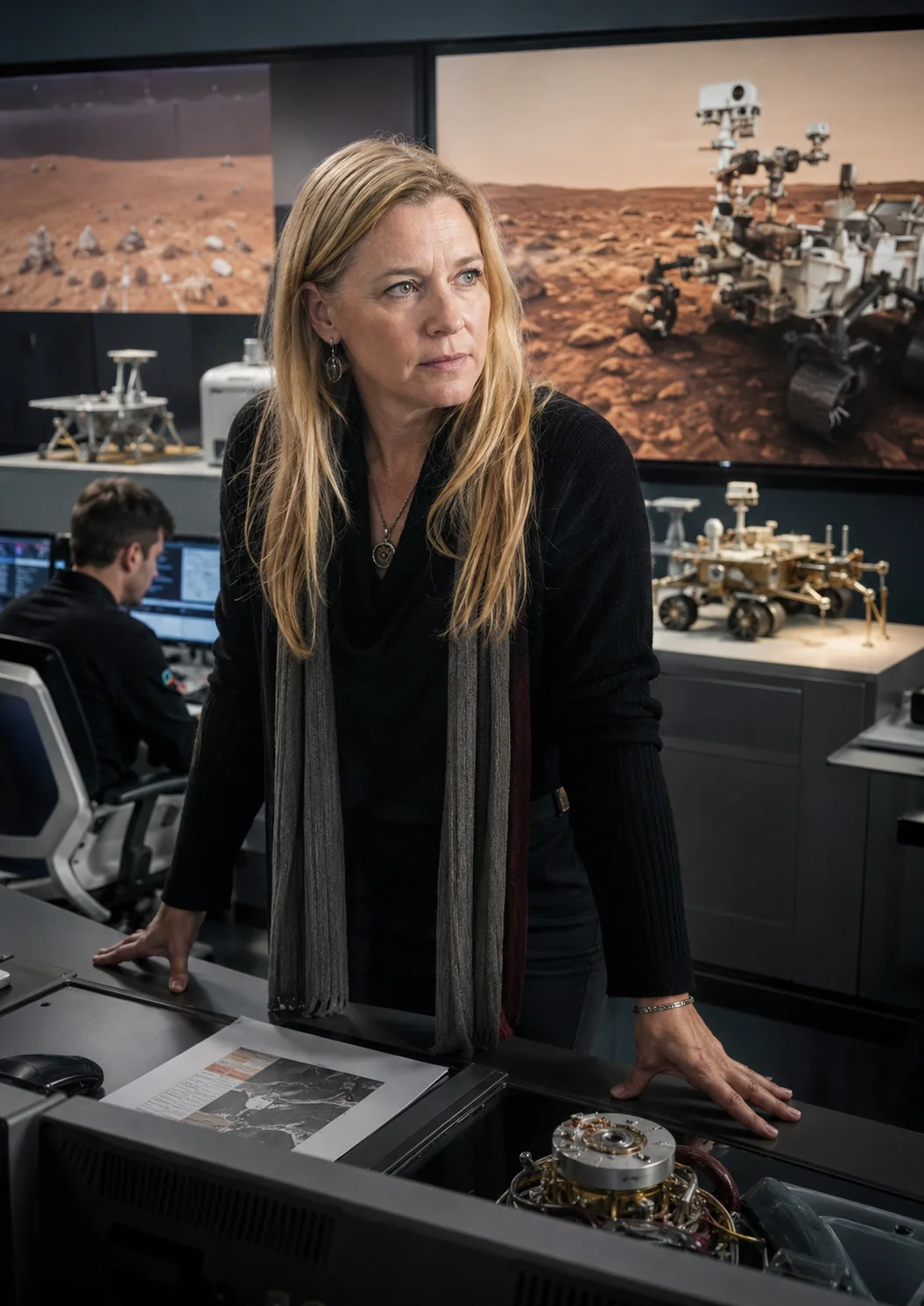
Dextre: reducing human spacewalks through robotic dexterity
Installed on the Station in 2008, Dextre is a two-armed robot designed for fine work on external equipment. It can replace components, handle batteries, test tools and operate with Canadarm2. Its value appears precisely in jobs that operators would prefer not to assign to an astronaut during a spacewalk. [institutional source]
A spacewalk consumes suits, airlock operations, preparation, medical monitoring and many hours of crew time. Replacing a dangerous human task with a robotic intervention therefore saves much more than a few minutes. Robotics becomes a multiplier of safety and human availability.
Dextre also requires equipment to be designed for robotic handling. Connectors, grapple features, interfaces and maintenance sequences must suit a machine. Robotics is therefore not an accessory added afterwards; it influences the design of the infrastructure it will maintain.
The system serves as a testbed for maintenance and servicing techniques. Every successful operation enriches procedures, force models and understanding of limitations. That accumulation is exactly what turns a spectacular robot into a reliable industrial tool.
A Mars base will need to reduce human excursions to limit radiation, dust, pressure and suit risks. Maintenance robots able to work on the exterior of habitats, solar arrays, radiators or vehicles will therefore be essential. Dextre provides directly relevant heritage.
Robotic dexterity does not eliminate all human work. Unexpected failures, deformed objects or damaged interfaces can exceed planned scenarios. A Mars architecture will need a combination of autonomous robotics, local teleoperation and exceptional human intervention.
Phoenix 2008: the day Canada physically reached Mars
When Phoenix landed in Vastitas Borealis on 25 May 2008, a Canadian meteorological station landed with it. For the first time, Canadian-provided hardware operated directly on the surface of Mars. The mission observed a Martian arctic region where water ice, dust and atmospheric exchange became daily measured phenomena. [institutional source]
The MET station measured temperature and pressure while its lidar observed clouds, fog and dust. Data helped confirm snow falling from clouds several kilometres above the site. This local meteorology demonstrated that a planetary environment that appears static can contain complex cycles.
The sensors involved several Canadian actors, including MDA for some hardware and a science community responsible for interpreting measurement series collected over more than five months. The instrument had to operate despite extremely low temperatures and diminishing solar energy as the season changed.
Phoenix shows that Martian meteorology is not decorative background. Temperature, pressure, dust, clouds and wind affect power generation, surface operations, atmospheric entry and future crew safety. Measuring these variables is an infrastructure function.
For a settlement, this type of instrument would need to become a network: sensors around habitats, on vehicles, near solar arrays and at remote stations. Canadian experience in instrumentation and meteorology could contribute to such a distributed architecture.
Phoenix was a NASA mission and the Canadian station was only one part of the system. Canada did not build the complete lander or independently provide entry, descent and landing. The importance of the contribution should not be confused with mastery of the entire mission.
APXS: a small sensor head across generations of rovers
The Canadian APXS instrument aboard Curiosity belongs to a lineage used previously on Mars Pathfinder and then Spirit and Opportunity. That continuity allows Martian environments to be compared using a proven method. The instrument exposes a target to alpha particles and X-rays and measures the response to infer elemental composition. [institutional source]
Mounted at the end of a robotic arm, the sensor must approach a rock at very close range, linking science and operations. Selection of an analysis point depends on imagery, geology, arm safety and available time. A chemical measurement is therefore the result of a multidisciplinary chain of decisions.
Principal investigator Ralf Gellert at the University of Guelph leads an international team. This illustrates the real structure of a national contribution: Canadian funding and instrument responsibility, but operations integrated into an American mission and an international scientific community.
In 2026 the CSA reported that the instrument had analysed more than 1,700 samples and that Canadian participation in Mars Science Laboratory had been extended through March 2029. A relatively small payload therefore produces scientific return over nearly two decades of development, mission and operations.
For a Mars settlement, instruments of this type could help select materials, verify soil composition, detect some contaminants or characterise resources. Their value would increase if they could be repaired, recalibrated and deployed on several local vehicles.
APXS is not a complete resource-prospecting system or medical laboratory. It measures elemental chemistry in a specific scientific context. Presenting it as proof that a settlement’s geological needs are already solved would be an unjustified extrapolation.
Curiosity in 2026: the value of an instrument that keeps learning
As of 1 February 2026, the CSA reported that Curiosity had travelled 36.2 kilometres and that its Canadian APXS had analysed 1,761 samples, returning 3,943 results. These figures matter less as records than for what they reveal: an instrument designed long before the 2012 landing continues to answer new geological questions. [institutional source]
Longevity requires careful management of rover and instrument resources. Teams monitor performance, calibration, integration time and measurement quality while the overall system ages. An old mission therefore becomes a school for understanding equipment ageing in the real Martian environment.
The 2024 event in which Curiosity broke open a rock containing elemental sulfur, later characterised using APXS and other instruments, illustrates the value of serendipity. A platform that survives long enough eventually encounters phenomena designers could not precisely plan in advance.
Canada’s extension through 2029 also shows that scientific operations must be funded after construction. Without teams able to plan, analyse, publish and archive, a functioning instrument does not automatically produce knowledge. Operations are part of the cost of science.
For human Mars operations, the lesson is that local instruments must live far beyond their initial campaign. Settlers will benefit from versatile equipment that can answer new problems rather than many disposable sensors designed for one question only.
The 2026 statistics should not obscure the fact that APXS depends on the rover, its arm, its power and NASA communications. Performance of one subsystem remains inseparable from the architecture that hosts it.
OLA and OSIRIS-REx: mapping Bennu in three dimensions
For NASA’s OSIRIS-REx mission, Canada provided the OSIRIS-REx Laser Altimeter, or OLA. This lidar scanned asteroid Bennu and helped build a precise three-dimensional model of its shape and topography, data essential both for understanding the body and supporting selection of a sampling site. [institutional source]
The principle is simple to state but demanding to execute: transmit a laser pulse, measure its round-trip time and reconstruct distance accurately while knowing spacecraft position and attitude. Repeated millions of times, the process turns an irregular small body into a measurable surface.
The Canadian contribution also included an interesting scientific exchange mechanism: in return for OLA, Canada receives four percent of the returned sample. Specialised technology thus becomes a form of currency providing national researchers direct access to rare extraterrestrial material.
The programme once again illustrates Canadian strategy: rather than independently funding an asteroid sample-return spacecraft, the country supplied a critical instrument, joined the team and gained a tangible share of the science. Specialisation increases the return from a limited budget.
For Mars, lidar mapping can support navigation, precision approach, terrain modelling and infrastructure inspection. OLA experience shows how to combine optics, geometry, data processing and operations where surface shape must be known very precisely.
Bennu is a small airless asteroid, not Mars. Ranges, dust, temperatures and geometry would differ on the Red Planet. The value of the heritage lies in ranging and processing methods, not direct transplantation of the instrument.
Artemis II 2026: Jeremy Hansen and the human return around the Moon
On 1 April 2026, Jeremy Hansen launched with Reid Wiseman, Victor Glover and Christina Koch aboard Orion for Artemis II. On 10 April the crew returned after a roughly ten-day journey around the Moon. Hansen became the first Canadian to travel beyond low Earth orbit and took part in the first human lunar flight since the Apollo era. [institutional source]
The mission was above all a test of human systems in deep space: navigation, communications, Orion propulsion, emergency procedures, thermal control, radiation environment and operational autonomy. The crew had to understand a vehicle that could not simply return to a nearby station or airfield if trouble occurred.
Canadian participation was a direct product of decades of partnership. A national robotics contribution to Gateway and the Canadarm heritage created flight opportunities for Canadian astronauts. Strategic specialisation therefore produced a very concrete human and political dividend.
Artemis II also set a new distance record for human spaceflight, surpassing Apollo 13. Beyond symbolism, the journey highlighted the psychological and operational consequences of distance: every trajectory correction and system diagnosis matters more when return requires several days.
Mars will magnify these constraints. Radio delay will be measured in minutes, transit in months and immediate return impossible. Lunar experience does not solve that problem, but it gives Canadian teams real participation in human-flight procedures beyond low Earth orbit.
It would be excessive to present Artemis II as a Mars dress rehearsal. The mission lasted only about ten days and remained relatively close to Earth. It was a learning step, not validation of long-duration interplanetary life support.
Canadarm3: toward more autonomous robotics around the Moon
Canada is providing Canadarm3 to Gateway, the international station planned for lunar orbit. The system includes a large arm, a smaller dexterous arm and interfaces enabling the robots to move and work around the station. The challenge is no longer merely assisting a continuously present crew: Gateway may spend long periods without astronauts onboard. [institutional source]
That constraint pushes autonomy further. The small arm is intended to help maintain and repair the large arm and replace components. Software, collision detection, vision and diagnostics must reduce dependence on immediate human intervention.
The Canadian contribution is negotiated as a strategic capability: by providing Gateway robotics, Canada gains science and technology opportunities as well as seats on lunar missions. The Canadarm model is therefore renewed at a new institutional and technical scale.
Development also requires a new generation of industrial teams, software engineers and operators. Historical expertise is not transmitted automatically; it must be reinvested, documented and adapted to new standards if it is to survive for decades.
For Mars, the relevance is direct. A settlement must continue inspecting, maintaining and moving hardware while crews sleep, work elsewhere or cannot go outside. Autonomous robotics around Gateway is a much closer step toward that need than fully manual operation of a historical arm.
Gateway remains a clean orbital environment without Martian dust, surface gravity or the much longer Earth-Mars logistics chain. Algorithms and architectures will still need adaptation before one can speak of an autonomous Mars robot.
The Space Station: learning medicine, operations and daily cooperation
Canada’s contribution to the International Space Station is not limited to robotics. In exchange for that infrastructure, the country gains scientific utilisation and astronaut opportunities. Canadian investigations include studies of microgravity effects on the human body, an essential field for preparing longer missions. [institutional source]
Daily life on the Station provides knowledge that simulators reproduce only imperfectly: disrupted sleep, confinement, exercise, maintenance, international coordination, cognitive workload and management of a dense science schedule. Every mission adds data to space medicine and human factors.
Canadian controllers also participate in robotics operations from the ground. Responsibilities are distributed among Houston, Saint-Hubert, the crew and other partners. Cooperation is not an abstract principle; it is embodied in procedures, schedules and decision rules.
The programme lets engineers work with ageing equipment in an environment where human safety demands exceptional documentation discipline. A software or hardware change must be understood by several organisations before use.
On Mars, medicine and human factors will become even more important: microgravity during transit, partial gravity after arrival, isolation, radiation and inability to evacuate quickly. ISS experience is a knowledge base, not a complete answer.
The Station remains partly protected by Earth’s magnetosphere and receives frequent resupply. Medical results therefore cannot be extrapolated without caution to a multi-year journey. Learning in low Earth orbit must be distinguished from interplanetary validation.
MDA and industry: government is not the only holder of expertise
A large share of Canadian space expertise resides in industry. Spar Aerospace, later MDA and other companies accumulated decades of experience in robotics, satellites, antennas, integration and operations. This industrial continuity helps explain why some Canadian contributions can be renewed from one programme generation to the next. [institutional source]
The model involves a complex relationship between public funding and industrial ownership. Government may fund strategic technology, purchase services or negotiate an international contribution while a company retains teams, patents, facilities and commercial customers. This can accelerate innovation but requires clear governance of responsibilities.
Robotics programmes illustrate this relationship particularly well: the political mission belongs to Canada and institutional management to the CSA, while design and manufacturing rely heavily on specialised companies. A national capability is therefore a network rather than one government building.
This organisation also creates risk: expertise can disappear if contracts stop for too long, teams disperse or a company changes strategy. Technological continuity therefore requires an industrial workload and training policy extending across decades.
For Mars, the lesson is fundamental. An international coalition must know who owns the drawings, who manufactures parts, who maintains software and who can restart a production line twenty years after the first unit. Functional sovereignty depends on the industrial chain as much as on the flag carried by a mission.
A Canadian company should not be confused with direct government control. Industrial groups have their own shareholders, markets and strategies. A robust Mars architecture will need contractual provisions for technical-data retention and access to critical parts.
The Canadian model: contribution power rather than complete autonomous programme
In 2026 Canada has a remarkable space history but does not attempt to reproduce every NASA function. It lacks a national heavy orbital launcher, crew transport system, complete interplanetary communications network and autonomous Mars-landing programme. Its strength is excellence in selected functions. [institutional source]
Robotics, scientific instrumentation, radar observation, operations and partnerships form a coherent portfolio. These capabilities can be inserted into foreign architectures without losing national identity, provided Canada retains the ability to design, qualify and operate the subsystems it supplies.
This strategy provides high political leverage: investment smaller than that of a major power can open astronaut seats, sample shares, scientific data and a place in programme governance. Specialisation becomes a form of diplomatic leverage.
The reverse side is dependency. If a partner cancels a launcher, changes an architecture or restricts access, Canada cannot necessarily continue alone. The strategy therefore depends on alliance quality and on making Canadian contributions valuable enough to remain wanted.
For a multinational Mars settlement, this model could be extremely effective: one country might take global responsibility for maintenance robotics, a weather network or a geochemistry laboratory without building the entire transport system. Specialisation reduces duplication and distributes cost.
A critical function should not depend on a single supplier without fallback. A settlement will need to combine international specialisation with minimum redundancy. The Canadian model inspires cooperation, not dependency without a safety net.
What Canada could bring to Mars — and what remains to be demonstrated
Reasoning from capabilities actually demonstrated, Canada could contribute inspection and maintenance robotics, geochemical instruments, weather sensors, lidar systems, radar remote-sensing expertise, operations software and a mature culture of multinational cooperation to a Mars architecture. [institutional source]
Those capabilities would need transformation for Mars. A Station arm must become more autonomous and dust-resistant; a scientific spectrometer locally maintainable; a single weather sensor a network; and an Earth-based control team must delegate more decisions to crew and software because of latency.
Canada also has human-spaceflight experience now strengthened by Artemis II, but still lacks a national demonstration of long-duration closed-loop life support, Martian energy production, surface habitats, heavy entry-descent-landing or interplanetary transport. These gaps do not diminish existing capabilities; they define their scope.
The best strategy would probably not be to fill every box. It would be to select a few critical functions where Canadian industry and research already have an advantage, then push them to Mars qualification through Gateway, lunar missions and terrestrial demonstrators.
Such an approach would make Mars settlement genuinely international: each partner would contribute a different historical depth. Canada could become the specialist in selected maintenance and measurement interfaces, as it already has in several international space programmes.
This remains a prospective scenario. No Canadian government has committed to a complete Mars-settlement architecture. The purpose here is to distinguish inherited capabilities, actually funded programmes and reasonable extrapolations toward a future mission.
After Artemis II: turning a historic flight into durable capability
Artemis II left Earth on 1 April 2026 and returned on 10 April after nine days, one hour and thirty-two minutes around the Moon. Jeremy Hansen became the first Canadian to take part in a lunar mission and the first non-American to travel in that region of space with a NASA crew. The symbolism is substantial, but the more important chapter begins after splashdown: what remains inside the organisation once a historic event is over? [institutional source]
A crewed mission produces technical, medical and operational data as well as human memory. Crew debriefs, alarm chronology, trajectory corrections, communications, sleep, cabin organisation and emergency procedures must be converted into documents, training and design requirements. Without that work, experience remains attached to individuals; with it, the experience becomes a collective asset usable by Canadarm3, Gateway and future astronaut teams.
Hansen is therefore more than a prestigious passenger. His experience connects astronaut selection, multinational training, Orion operations, public communication and post-flight learning. Around him, controllers, physicians, training staff, NASA engineers and Canadian teams also learn to operate in a campaign where decisions are made at several levels and national responsibilities remain embedded in an international system.
The flight also shifted the psychological baseline of the Canadian programme. For decades, national human-spaceflight experience centred on the Shuttle and International Space Station. Artemis II added lunar distance, a return that takes days rather than hours and an environment where some low-Earth-orbit rescue options no longer exist. That change in context affects training, medicine and the way risk is discussed.
For Mars, the lesson is not that ten days around the Moon reproduces an interplanetary voyage. The difference remains enormous: months of transit, radio delay, longer radiation exposure, medical autonomy and no rapid return. Canada now nevertheless has a crew member who has lived through a human mission beyond low Earth orbit. That experience provides a concrete basis for asking better questions about what still needs to be demonstrated before Mars.
It would be equally wrong to turn Artemis II into proof of Canadian autonomous spaceflight. SLS, Orion, launch facilities, communications networks and most of the architecture are American. The Canadian achievement is high-level human and political integration inside a partner architecture, consistent with the specialisation strategy followed since Alouette and Canadarm.
Primary and institutional sources
- CSA — APXS
- CSA — Curiosity
- CSA — Mars
- CSA — 2026–27 Departmental Plan
- Agence spatiale canadienne — jalons historiques
- Agence spatiale canadienne — Milestones
- Agence spatiale canadienne — Alouette
- Agence spatiale canadienne — David Florida Laboratory
- Agence spatiale canadienne — About the CSA
- Agence spatiale canadienne — RADARSAT-2
- Agence spatiale canadienne — Canadarm2
- Agence spatiale canadienne — Dextre
- Agence spatiale canadienne — Phoenix
- Agence spatiale canadienne — APXS
- Agence spatiale canadienne — OSIRIS-REx / OLA
- NASA — Artemis II
- Agence spatiale canadienne — Canadarm3
- Agence spatiale canadienne — ISS
- Agence spatiale canadienne — Departmental Plan 2026-27
- Agence spatiale canadienne — Artemis II, bilan de mission
External links open in a new tab.
Institutional reading: a contributing agency, not a miniature copy of the largest powers
The Canadian approach becomes clearer when the CSA is not judged only by the number of probes it leads. Its historical advantage lies in identifiable contributions: robotics, instruments, operations and partnerships. APXS instruments flown on several Mars rovers illustrate the model. A relatively compact component can become mission-critical when it supplies repeatable measurements, is understood by science teams and is integrated into an international decision chain. [institutional source]
That specialization requires strong institutional discipline. Contributing to a partner-led mission means holding interfaces, schedules, qualification requirements and documentation through changes of staff. For a future Mars program, this is a governance lesson as much as a technology lesson: autonomy does not mean every country builds everything; it means every critical function has a clear responsibility and a durable competence. [institutional source]
The Canadian signature: interfaces, instruments and continuity
Canada’s history shows that a space power does not have to own the launcher, rover, communications network and control centre by itself to become indispensable. Value can come from sustained mastery of precise interfaces. Robotics, scientific instrumentation, operations and partnerships all require an organisation to keep a technical promise for years, often inside a mission led by another agency. [institutional source]
For Mars, that culture of contribution is directly relevant to a multinational settlement. A colony would need responsibilities that are unmistakably assigned: who builds, qualifies, maintains, documents and replaces each critical function? The Canadian model shows how a contribution that is small in mass can still be systemically important when it becomes an irreplaceable link in the scientific or operational chain. [institutional source]