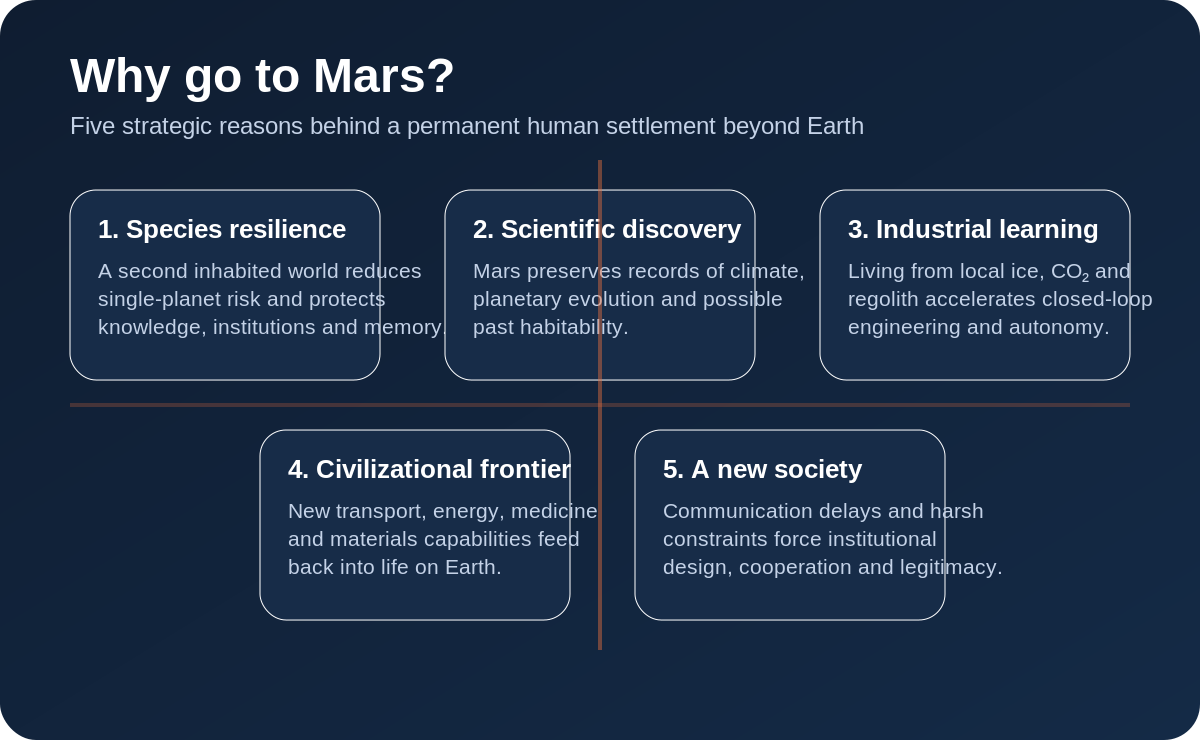
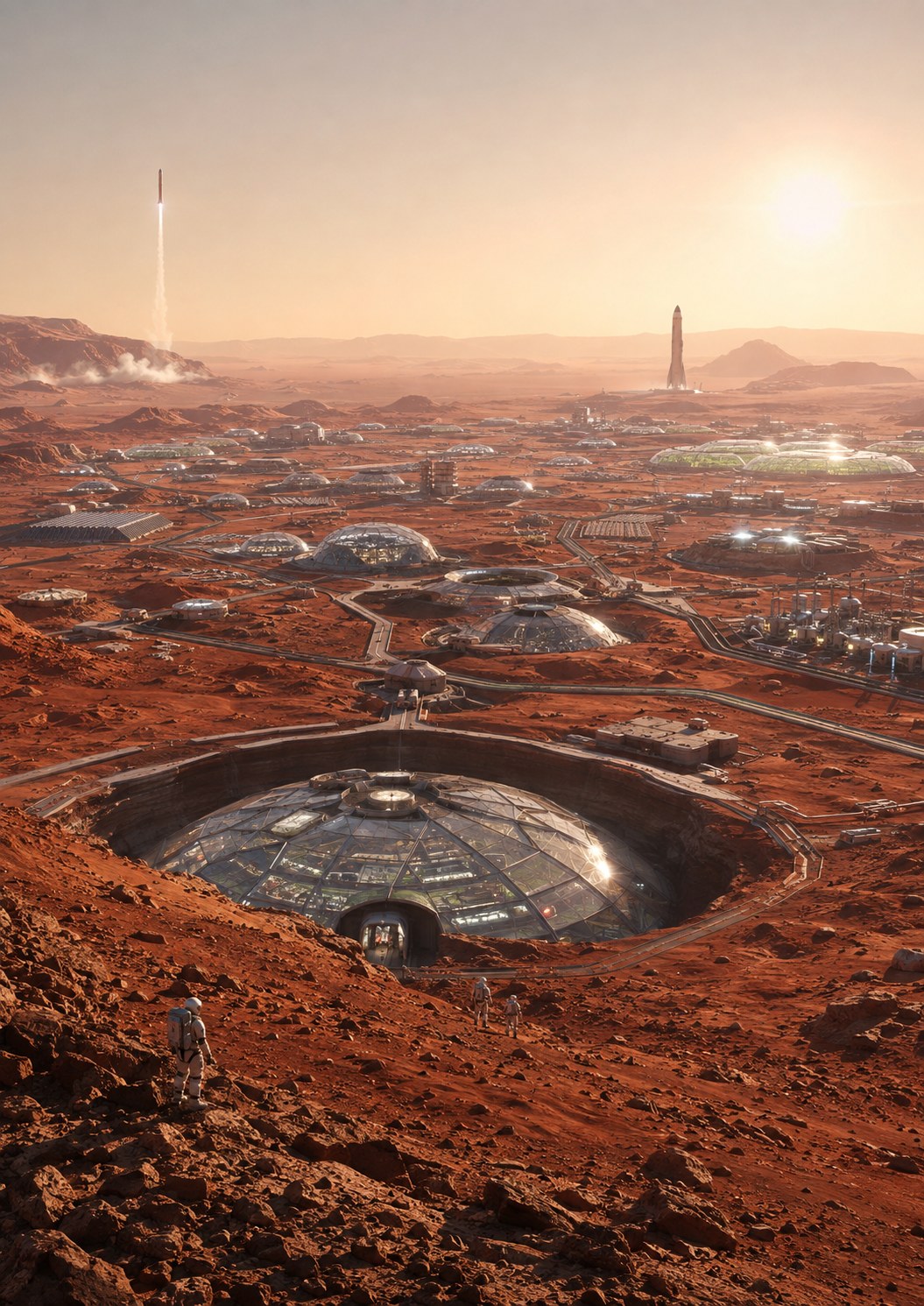
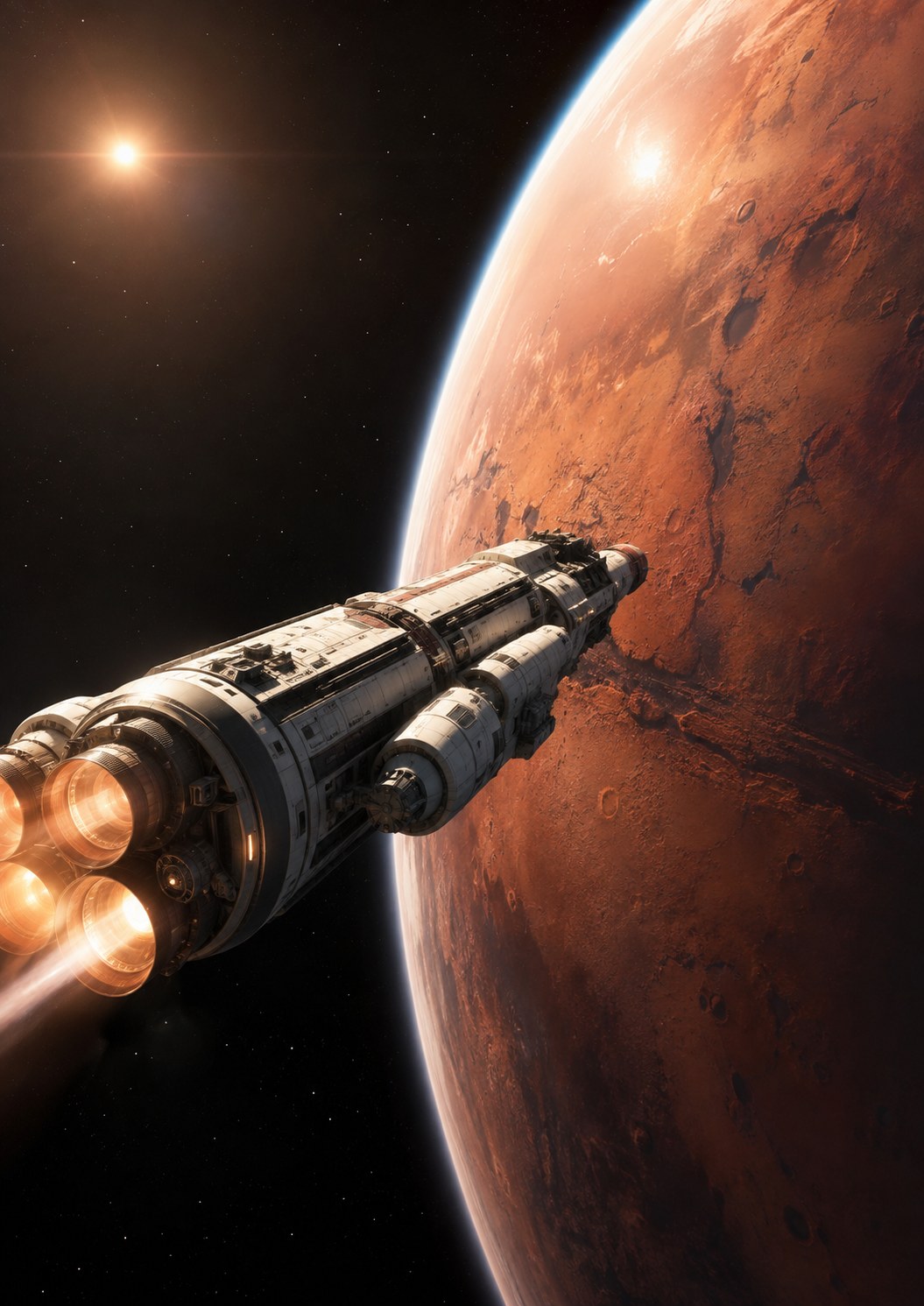
A serious answer begins long before rockets. Mars matters because it combines science, survival, industrial learning and the possibility of creating a second durable human world. The point is not spectacle. The point is to understand why one harsh planet could become a turning point in the history of civilization.
Central question: why build a permanent settlement on Mars?
The case for Mars is strongest when it is treated as a system: species resilience, science, local resources, industrial learning and institutional renewal reinforce one another.
24 h 39 minThe Martian day is close to Earth’s, which helps human routines and engineering cycles.
~38% of Earth gravityLow gravity creates medical challenges, but it is still far more workable than microgravity.
CO₂ atmosphere + water iceMars offers the raw ingredients for oxygen, methane fuel and life-support loops.
Communication delayBecause Mars cannot be governed in real time from Earth, any settlement must develop local operational autonomy.
Why colonize Mars instead of only exploring it?
Exploring Mars can produce science and test technology. Colonizing Mars asks a much harder question: can humans live far from Earth for years, close part of the water and air loops, produce energy and materials locally, repair complex systems and build institutions that can make decisions despite communication delay? Permanence turns Mars into a laboratory for engineering, biology, industrial autonomy and social organization.
That ambition does not automatically make a colony desirable or near-term. It does, however, create a rigorous way to compare potential benefits with cost, risk and alternatives instead of reducing the debate to a slogan for or against Mars.
This article separates established facts, active engineering and prospective design choices. It argues for Mars without pretending that the hard parts are solved.
Most public arguments about Mars focus on a single dimension. Some speak only about technological prestige. Others reduce the topic to a backup plan for humanity. Both are incomplete. A lasting case for Mars appears only when several reasons are considered together.
1. Protecting civilization from single-planet fragility
As long as all humans, archives, institutions and industrial capabilities remain concentrated on one world, a single chain of failures can threaten the whole species. A second inhabited world would not make humanity invulnerable. It would reduce single-planet dependence only after the settlement could preserve essential knowledge, maintain life-support systems and survive long interruptions in supply from Earth.
2. Opening a new scientific frontier
Mars is a record keeper. Its geology, ancient river systems, atmosphere loss and possible past habitability make it one of the best laboratories for understanding how rocky planets evolve and why Earth remained habitable while Mars became cold and arid.
3. Learning to live from local resources
The first permanent settlement will not survive by importing everything forever. It will have to extract water, make oxygen, recycle waste, produce fuel, grow food and fabricate structures locally. That pressure accelerates practical knowledge that also matters on Earth.
4. Expanding the human frontier
Every durable expansion of life demanded new tools, new institutions and new cultural forms. Mars would force advances in energy systems, closed-loop life support, medicine, robotics, construction, teleoperation and governance under delay.
5. Creating a new political experiment
A settlement on Mars would not simply be a copy of an Earth city. Communication delays, shared survival infrastructure and extreme dependence on maintenance would force the design of new rules, responsibilities, emergency doctrines and perhaps new forms of legitimacy.
A mature settlement would create resilience only through durable systems, local skills and the capacity to survive disruptions—not merely by placing people on another planet.
Why Mars specifically, and not only the Moon or orbital stations?
The Moon matters. It is close, strategically important and extremely useful for testing hardware, operations and partial-gravity procedures. Orbital stations matter too, because they allow continuous experimentation in space. Yet neither is the same as Mars.
Mars combines several features that make it especially important for long-duration settlement. Its day is only about forty minutes longer than Earth’s, which helps human circadian stability and routine planning. It offers a real planet to work with: weather, seasons, sedimentary history, a crust rich in geological evidence and enough gravity to avoid the total physiological disorientation of long-term weightlessness. It also appears to contain water ice in many regions and a carbon-dioxide atmosphere that can be used for oxygen production and methane synthesis.
The Moon is a crucial training ground. Mars is one of the leading candidates for a second long-term human home, although reaching that threshold would require decades of demonstrated safety and autonomy. The distinction is not rhetorical. It is architectural.
“The Earth is the cradle of humanity, but one cannot live in the cradle forever.” The idea is usually associated with Konstantin Tsiolkovsky, but the underlying principle also shaped later Mars thinkers such as Wernher von Braun: space settlement is meaningful when it is treated as the next step in humanity’s practical expansion, not as a tourist excursion.Historical lineage of astronautics, paraphrased for clarity.
The destination matters only if transport, arrival and surface operations form a dependable chain.
Mars as a scientific world, not only a destination
One powerful reason to settle Mars is that it is scientifically exceptional. It preserves the memory of a planet that once had a thicker atmosphere, flowing water on its surface and environments that may have been habitable. If we want to understand why Earth remained biologically rich while Mars became cold and dry, Mars is one of the clearest comparative cases in the Solar System.
That makes Mars relevant far beyond planetary science. Questions about climate history, atmosphere escape, hydrology, early chemistry and the transition from potentially habitable conditions to today’s cold, arid surface all touch the wider problem of life in the universe. A permanent human presence would not replace robots. It would multiply what exploration can do: longer traverses, more flexible sampling, more maintenance capacity, more cumulative field science and the ability to build large observatories or drilling systems incrementally over time.
Science also has a civic dimension. A world that sets itself the goal of building a permanent settlement on Mars publicly commits to long-horizon thinking. That affects education, engineering culture and the prestige structure of research. The best argument is therefore not “science versus settlement.” It is that settlement creates new scientific capabilities once the first foothold exists.
The hard question: why spend money, time and lives on Mars?
A serious case for Mars cannot be reduced to “because it is there” or “because a billionaire wants it.” Human settlement is defensible only if its scientific, technological and civilizational value is compared honestly with cost, risk and competing priorities. It also helps to separate three different propositions: robotic science on Mars is already real; human mission architectures have been studied for decades; a self-sustaining city remains prospective and has not been demonstrated by any actor.
Established: Mars records ancient water-rich environments and preserves geological evidence central to planetary science and astrobiology.
In development: heavy reusable transport, long-duration life support, in-situ resource use, autonomous operations and larger Mars landing systems.
Prospective: a population that can maintain health, reproduce, manufacture critical equipment and survive indefinitely without Earth.
Mars is a planetary archive
Earth’s surface has been repeatedly reshaped by plate tectonics, oceans, erosion and biology. Mars preserves ancient terrain that can help reconstruct how a rocky world changed from wetter conditions to the cold arid planet observed today. NASA’s current Mars Exploration Program explicitly links the search for potential life, geology and climate, and preparation for human exploration.
That science does not require a colony to be valuable. Humans could nevertheless add field geology, drilling, repair, flexible sampling and rapid hypothesis-testing at scales difficult for robotic missions.
The life question: a negative answer would matter too
In 2025 NASA described features studied by Perseverance as a potential biosignature in peer-reviewed work, while emphasizing that alternative explanations remain under consideration. “Potential” is not proof. Confirmed independent life would transform biology; a robust finding that an ancient habitable planet remained sterile would also constrain theories about how easily life begins.
Human exploration increases scientific capability but also contamination pressure. A settlement that wants to preserve astrobiology must map protected zones, take reference samples before construction and track terrestrial biological contamination.
Mars as a forcing function for autonomy
On Earth, failed systems can often call an external hospital, supplier, grid operator or specialist. On Mars, air, water, food, power, cooling, medicines, software, spare parts and skills become explicit life-support flows. A machine that requires a factory technician every month is a poor Mars machine. A farm that discards water and nutrients is a poor Mars farm.
This makes Mars a demanding laboratory for closed loops, repairability, distributed manufacturing, autonomous robotics and maintenance. It would still be misleading to promise that every space investment automatically creates a terrestrial spin-off; useful technology transfer must be demonstrated rather than assumed.
“Fix Earth first” deserves a real answer
Mars cannot replace Earth. It is not a near-term refuge for billions of people or a substitute for protecting terrestrial ecosystems. But requiring humanity to solve every terrestrial problem before funding exploration would also end most basic research. Modern societies fund health, infrastructure, education, security, culture and science simultaneously; the relevant question is how much investment is justified by the knowledge and capability created.
Funding should also be described accurately. SpaceX is a private company and states a long-term goal of making life multiplanetary, but modern spaceflight mixes private capital, commercial revenue and public contracts. NASA’s multibillion-dollar Human Landing System awards to SpaceX are lunar contracts, not public funding for a Martian city. They illustrate why “Elon Musk pays for Mars” is too simple a description of the broader ecosystem.
Musk, von Braun and Zubrin changed different parts of the question
Elon Musk did not invent the idea of Mars settlement. His distinctive influence has been to put transport cost, full reusability, orbital refilling and scale at the center of the discussion. A scientific mission can tolerate a very expensive one-off vehicle; a city receiving cumulative megatons of cargo cannot.
Wernher von Braun made an earlier conceptual leap: The Mars Project treated Mars as an integrated mission architecture with fleets, mass, trajectories, crews and surface operations. His technical legacy must be studied together with his leadership in the Nazi V-2 program, party and SS membership, and the enslaved labor used at Mittelwerk. NASA’s current biography states that he knew the terrible conditions and was involved in decisions about slave labor. After Project Paperclip he became a major U.S. rocket leader and later NASA Marshall’s first director and a chief architect of Saturn V.
Robert Zubrin and David Baker later proposed Mars Direct, emphasizing a smaller architecture and in-situ propellant production. The underlying question — what can Mars provide so Earth does not need to launch it? — became central to later ISRU thinking.
The Moon is close, easier to communicate with and valuable for learning sustained operations beyond Earth. Mars offers a different problem: a planetary surface, a near-Earth-length day, volatile resources, an atmosphere usable as feedstock and a distance that forces far greater operational independence. Lunar experience can inform Mars without becoming a perfect rehearsal; gravity, atmosphere, dust, thermal conditions and logistics differ.
Exploration, migration and the word “colonization”
Human history includes exploration and migration, but terrestrial colonial history also includes conquest, dispossession, slavery and cultural destruction. Mars has no known indigenous human society to dispossess, yet that does not erase ethical questions: biological contamination, worker dependence on life-support owners, emergency power, reproductive rights and the governance of children born into a dangerous environment all matter.
A civilizational argument for Mars is strongest when it rejects conquest mythology and asks how rights and dignity can survive where air, energy and transport are controlled infrastructures.
A civilization backup? Only after genuine independence
Two self-sustaining populations on two planets would reduce some single-planet existential risks. But an outpost dependent on Earth for medicines, electronics, seals or replacement machines is not yet a civilization backup. The relevant threshold is industrial, medical, demographic and educational continuity without Earth resupply.
Mars should therefore not be sold as an available “Planet B.” At most, it could become a second human home after generations of capability growth. That distinction turns a slogan into measurable engineering milestones.
The real test: what capability remains after the mission?
A Mars program has lasting value if it leaves more than a flag: data, laboratories, reusable transport, repairable life-support, autonomous operations, resource-processing plants, trained teams, standards, open scientific knowledge and infrastructure that makes the next mission safer. A settlement is simply the point at which those accumulated capabilities become durable enough to support a society.
The strongest case for Mars is not a promise; it is an experiment at planetary scale
Mars concentrates questions that Earth cannot isolate for us. How does a rocky planet lose much of its atmosphere? How long can liquid water shape a surface before climate changes? Could a biosphere have emerged under conditions very different from the planet we see today? Those scientific questions are paired with an engineering experiment without precedent: maintaining people on another planet where every imported kilogram is expensive and immediate outside help does not exist.
This dual value avoids two opposite exaggerations. One is to justify Mars only as a “backup for humanity,” even though an Earth-dependent outpost is not a backup. The other is to reduce Mars to robotic science as if human and robotic exploration must compete. Robots excel at duration, repetition and hazardous exposure. Humans can re-plan field work, interpret geological context in real time, repair complex systems and improvise differently. The productive question is therefore not “human or robot?” but which tasks genuinely justify a human presence and which should remain automated.
The honest test: what remains when the narrative is removed?
A durable reason for going to Mars should survive the disappearance of slogans. Remove the promised date, the spectacular city rendering and the language of inevitability, and measurable goals remain: study another planet, reconstruct its climate history, search for evidence of past habitable environments, develop systems that can operate far from terrestrial repair, and learn what multi-year human presence actually requires.
NASA now frames preparation for Mars as an evolving architecture: capabilities are developed and demonstrated, then combined into progressively more complex missions. That language matters because it permits uncertainty. A rational case for Mars does not need to claim that settlement will be easy or profitable. It needs to identify which knowledge and capabilities cannot be obtained in the same way elsewhere, what they cost, which risks they impose, and when a human mission creates additional value beyond robotics.
The answer can change with technology. More autonomous robotics may move tasks away from humans; propulsion improvements may alter transit exposure; reliable local production may reduce imported mass. “Why Mars?” should therefore remain a comparison among objectives, means and alternatives rather than a fixed doctrine. One rule should remain: a possible future civilization must never be presented as if it were an experimentally established outcome.
Opportunity cost belongs inside the question, not outside the story
A serious case for Mars has to accept comparison with what similar resources could accomplish elsewhere: robotic science, Earth observation, climate research, health, energy, infrastructure or lunar exploration. That does not mean one space-program euro mechanically substitutes for one social-program euro; budgets, industries and objectives are not perfectly interchangeable. It simply means that a major program has to explain its additional value rather than assume it is self-evident.
That value can be plural: science, useful technology, engineering education, international cooperation, industrial capability and culture. But each category should be evaluated separately. A possible technology spillover does not justify any cost; cultural ambition is not scientific evidence; a resilience outpost is not a “backup civilization” while it still requires continuous terrestrial logistics.
Mars also creates a planetary-protection responsibility. Searching for evidence of ancient habitability while carrying Earth's biosphere requires contamination mapping, protected zones and scientific reference sites. Going to Mars therefore adds not only freedom to explore but an obligation not to destroy the very scientific question the mission is trying to answer.
Science: Mars preserves archives that Earth has extensively recycled
Earth is an active planet. Plate tectonics, oceans, erosion, biology and metamorphism erase or transform much of the oldest record. Mars followed a different path. Ancient terrain, valley networks, hydrated minerals and sedimentary deposits can preserve information about the early evolution of rocky planets. That is one reason Mars remains scientifically important even if no settlement is ever built.
Human presence would not replace robotics in this research. It could change sampling speed, drilling capability, experiment reconfiguration and the ability to choose a new outcrop in response to a fresh observation. It would also add contamination, mass, cost and risk. A scientific human mission therefore has to show where those additional capabilities justify the new constraints.
Engineering: Mars forces a degree of autonomy that proximity to Earth can hide
In low Earth orbit, a problem can benefit from large ground teams, near-instant communications and sometimes relatively rapid replacement logistics. Mars imposes communication delay, transportation windows and no immediate medical evacuation. That environment forces systems to become more diagnosable, procedures more local and decision authority more distributed. Even without a future Martian city, learning to operate such systems would constitute a distinct engineering domain.
The value of that constraint depends on what genuinely transfers elsewhere. A mechanism designed for Martian dust does not automatically create terrestrial benefit. Remote-maintenance methods, more efficient water-loop closure or resilient microgrid architecture may have clearer analogues. The library therefore should resist vague promises of universal “spin-offs” and identify the transfer mechanism when one exists.
The case for human settlement should remain proportional to cost and risk. Science, preparation for farther exploration, technical capability and cultural value are distinct arguments; none by itself proves that permanent colonization is necessary. Keeping them separate makes the debate stronger.
The harder question is not whether Mars is fascinating, but which new capabilities justify the resources committed and which risks are acceptable. A sound answer keeps robotic, lunar and terrestrial alternatives visible and reserves the language of necessity for constraints that are genuinely physical.
Decision framework · benefits, costs and stop conditions
The strongest argument for Mars is a portfolio of capabilities, not a single slogan
“Why go to Mars?” sounds like one question, but public debate often mixes at least five different decisions. Should robots continue exploring Mars? Should humans visit it? Should humans maintain a recurring surface presence? Should an outpost become a permanent settlement? Should a settlement seek substantial independence from Earth? Each step has a different cost, risk and evidential burden. A scientific case that justifies robotic exploration does not automatically justify permanent settlement; a technology program that justifies a first crewed mission does not automatically justify a city.
A useful decision framework therefore separates scientific return, capability return, civilizational option value, economic spillovers and human/cultural value. None of these needs to be exaggerated. Mars can be worth exploring even if no profitable export industry ever appears. Human settlement can be worth testing even if it never becomes a “backup planet.” Conversely, inspiring language should not be used to hide a weak safety case or a technology that has not been demonstrated.
Five different kinds of value — and the evidence each one needs
Claim
What would support it?
What would weaken it?
Scientific value
Unique measurements, samples, field geology, astrobiology and climate records that cannot be obtained equivalently elsewhere.
Robotic methods that obtain the same knowledge at much lower risk and cost.
Engineering value
Demonstrated closed-loop life support, autonomous operations, power, ISRU, maintenance and long-duration human performance.
One-off hardware that leaves no reusable capability or operating knowledge.
Civilizational option
A genuinely independent population able to preserve knowledge and recover from loss of terrestrial supply.
A “colony” that fails within months if Earth stops sending parts, food or expertise.
Economic value
Services, intellectual property, communications, science, local production or markets that cover meaningful fractions of operating cost.
Business cases that depend on unspecified future customers or ignore transport and maintenance costs.
Cultural value
Education, inspiration, international cooperation, new institutions and durable public knowledge.
Prestige-only programs that disappear without preserving capability or evidence.
Option value: why a capability may matter before it is profitable
Economics uses the idea of an option: the ability to take an action later can have value even if exercising it today would not be optimal. Mars infrastructure can be analyzed in the same way. A reusable heavy-lift system, long-duration life support, autonomous medical procedures, high-reliability power electronics or closed-loop water recovery can create options for future missions whose precise value is not known when the technology is developed. This does not make every expense rational. It means the evaluation should ask whether a project creates a durable capability that can be used in multiple futures.
The distinction helps with the common argument that “if Mars does not immediately make money, it has no economic value.” Fundamental infrastructure rarely begins as a mature market. At the same time, “future options” can become an excuse for unlimited spending if they are never measured. A disciplined program therefore identifies which capability is being purchased, how it can be reused, what it costs to maintain, and what evidence would justify stopping.
“Backup civilization” is a late-stage outcome, not a reason to skip intermediate proof
The idea that a second planetary population could reduce single-planet risk is logically coherent only after the second population becomes sufficiently independent. If every critical computer, medical reagent, pressure seal and specialist must still come from Earth, a disaster that removes Earth’s industrial support also removes the settlement’s long-term viability. The word backup should therefore be treated as an engineering claim rather than a metaphor.
A credible path toward that distant goal would require local energy, water, air regeneration, substantial food production, repair and manufacturing, medical depth, education, replacement of specialized skills, data archives, governance and population continuity. It would also require the ability to recover from failures without Earth-based mission control. NASA’s current Mars communications work reinforces this point: one-way delays can reach roughly 22 minutes, and disruptions or blackouts can last much longer. A settlement is forced to become operationally autonomous long before it becomes economically or biologically independent.
Science gets stronger when the settlement is designed not to contaminate the evidence
Human presence can accelerate field science: people can recognize unexpected geology, improvise sampling strategies, repair instruments and revisit a site quickly. It can also threaten the very evidence scientists want to study. Human habitats shed terrestrial microbes, chemicals, plastics, fuels and exhaust products. Drilling, mining and traffic alter local environments. The closer a settlement operates to a high-priority astrobiological site, the more carefully the program must separate scientific zones from habitation and industrial zones.
This creates a useful rule: science is not merely a benefit of settlement; it is also a design constraint on settlement. A city that destroys pristine environments in order to study them would be self-defeating. Planetary-protection protocols, contamination monitoring, clean sampling chains and protected scientific preserves belong in the infrastructure discussion from the start.
Opportunity cost: compare Mars with alternatives, not with zero spending
Every large program consumes engineers, launch capacity, energy, public money, industrial attention and political capital. The correct comparison is therefore not “Mars or nothing.” It is Mars versus other uses of the same resources: Earth observation, climate science, telescopes, robotic planetary missions, lunar infrastructure, asteroid missions, public health, energy research or entirely non-space priorities. A serious pro-Mars case must survive that comparison rather than dismiss it.
One way to make the comparison more rigorous is to ask whether a Mars investment has multiple beneficiaries. High-reliability water recycling can support deep-space missions and terrestrial water treatment research. Autonomous maintenance and remote medicine can have Earth applications. Surface power, dust control, robotics and human-factors research can benefit lunar missions. Conversely, highly specialized hardware with no reuse may need a stronger mission-specific justification.
A simple scorecard should include reasons to stop
Advocacy usually publishes milestones for success and hides conditions for failure. Engineering does the opposite: it defines acceptance and rejection criteria. A Mars program can publish explicit stop conditions. Examples include an unacceptably high crew-health risk that cannot be reduced, a landing architecture that cannot achieve required reliability at useful payload mass, an ISRU chain whose energy or maintenance cost is worse than importing the product, or a contamination risk that cannot be reconciled with science goals.
Stop conditions do not weaken the case for Mars. They make it testable. If a program is valuable only when every future assumption is favorable, it is not a plan; it is a narrative. The strongest Mars case is one that can say, “we will proceed if these measurements support the next step, and we will redesign or stop if they do not.”
Pedagogical calculation: how “98% recycling” still creates a logistics stream
NASA demonstrated approximately 98% overall water recovery on the U.S. segment of the International Space Station in 2023. That is a major life-support milestone, but 98% is not the same as zero loss. Consider a simplified example in which a settlement circulates an average of 50 kilograms of recoverable water per person per day through hygiene, humidity, urine and other loops. This 50 kg value is a pedagogical assumption, not a NASA Mars design value. If the system recovers 98%, the unrecovered fraction is 2%.
For 20 people, the daily processed quantity in this example is:
50 kg/person/day × 20 people = 1,000 kg/day
The loss at 2% is:
1,000 kg/day × 0.02 = 20 kg/day
Over 30 days, that would be 600 kg of make-up water if no other source compensated the loss. The calculation deliberately simplifies real water accounting, because “recovery percentage” depends on the system boundary and which water streams are included. Its purpose is the discipline behind the question: where do the remaining two percent go? On Mars, the answer may be more local extraction, larger stores, lower losses, changed hygiene practices or a different accounting boundary. The percentage is useful only when the mass flow behind it is visible.
Human value without romanticizing risk
There is also a reason that cannot be reduced to kilograms or dollars: humans choose projects that enlarge their cultural horizon. Expeditions, observatories, particle accelerators, libraries and preservation programs have value partly because civilizations decide that knowledge and exploration matter. Mars can become one of those projects. That does not grant permission to ignore consent, risk, labor conditions or the opportunity cost imposed on people who will never travel there.
The mature argument is therefore neither “Mars at any price” nor “Mars has no value until Earth is perfect.” It is conditional: pursue steps that create verifiable knowledge and durable capability; expose the risks and alternatives; protect the science; and increase human dependence on Mars only as the evidence justifies it.
Comparative strategy · Moon, Mars and Earth are not substitutes
Moon versus Mars: compare functions, not destinations
The Moon and Mars are often presented as rivals for the same budget. Engineering gives a more useful view: they solve different problems and can be connected in a learning sequence. The Moon is close enough for much faster communication, emergency return and repeated logistics. That makes it valuable for practicing surface power, dust control, habitats, EVA, autonomous construction and operations away from Earth. Mars imposes a much stronger test of communication delay, abort limitations, long transport intervals and surface autonomy. A capability that works on the Moon is not automatically Mars-ready, but lunar operations can reveal weaknesses before the same class of failure occurs far from rapid support.
NASA’s Moon to Mars architecture explicitly uses this progressive logic and identifies capabilities that can be developed and refined before human Mars missions. The strategy is not proof that every lunar investment is necessary for Mars; it is evidence that the agency treats exploration as an evolvable architecture rather than two independent flags-and-footprints programs.
A capability matrix is more informative than a destination slogan
Illustrative comparison of where different environments are especially useful
Capability
Earth/LEO
Moon
Mars
Closed-loop life support
High-control testing and rapid intervention.
Long surface operations with limited logistics.
Earth-independent operation under major communication delay.
Dust control
Simulants and laboratory qualification.
Real abrasive lunar dust and vacuum.
Real Martian fines, atmosphere, chemistry and long exposure.
Autonomous maintenance
Test procedures and robotics safely.
Practice with remote but relatively reachable crews.
Operate when expert Earth support is delayed and rapid replacement is impossible.
ISRU
Process development and quality control.
Demonstrate extraction from lunar materials.
Exploit atmospheric CO₂ and local water resources in the actual destination environment.
Settlement governance
Analogs and simulations only.
Small crews remain tightly connected to Earth institutions.
Long delay and growing permanence force more local operational authority.
The reason to go can change as evidence changes
A 2030s or 2040s rationale does not have to be identical to a 2080s rationale. Early missions may be justified mainly by science and capability development. Later settlements might be justified by local economic activity, institutional continuity or civilizational option value. This flexibility is a strength only if each generation states its current case explicitly. Otherwise an old slogan survives after the evidence that once supported it has changed.
Delta-Sierra therefore treats “why Mars?” as a living dossier. New scientific discoveries, costs, safety data, alternative destinations and technology maturity should be allowed to strengthen or weaken the case. A reference work earns trust not by making the answer permanent, but by keeping the reasoning auditable.
Ethics and legitimacy · who bears risk, who gains knowledge
A permanent Mars program needs legitimacy as well as engineering
Engineering can determine whether a habitat holds pressure; it cannot by itself decide who should pay, who may accept risk, who owns scientific data or how a settlement should be governed. A permanent program therefore needs an institutional answer alongside the technical one. This matters because the first residents will live inside systems whose failures can be fatal and whose designers, owners, regulators and mission controllers may be millions of kilometres away.
The principle of informed consent becomes more demanding when uncertainty is high. A crew member can accept known launch risk, but long-duration exposure includes uncertainties that cannot yet be quantified with terrestrial confidence: partial-gravity health effects, reproductive biology, chronic dust exposure, radiation over multiple missions and the psychological consequences of deep isolation. Ethical communication must distinguish a measured risk from an unknown risk instead of merging both into one probability.
Risk should not be exported to the least powerful participant
A settlement architecture can hide institutional failure behind technical success. If schedules reward managers for keeping a reactor online, operators may feel pressure to postpone maintenance. If return seats are scarce, residents may hesitate to report health problems. If one company controls employment, housing, oxygen, transport, communications and dispute resolution, an ordinary labor disagreement can become a survival dispute. These are not arguments against settlement; they are reasons to design institutions before crises force them into existence.
Useful safeguards include independent safety authority, protected incident reporting, transparent maintenance criteria, medical confidentiality, appeal mechanisms and explicit emergency powers with limits. The details will depend on national and international law, but the engineering lesson is universal: governance can create common-cause risk just as surely as a shared electrical bus.
Knowledge generated with public risk should remain inspectable
Mars settlement will combine public agencies, private firms, universities and international partners. Proprietary technology can be legitimate, but safety-critical evidence needs enough transparency for independent review. A pressure-vessel failure, contamination event or life-support anomaly should not disappear into a marketing narrative. Data needed to understand hazards should be preserved with context: configuration, date, sensor uncertainty, operating mode and corrective action.
This is also good science. A century from now, the most valuable record may be the mundane operating history of the first habitats: leak rates, crop failures, repair times, dust ingress, medication stability, crew workload and energy use. A civilization becomes capable of learning when it preserves failure as carefully as success.
Settlement should not erase Mars in order to claim it
Mars currently has no known human population or indigenous civilization, so historical analogies with terrestrial colonization have limits. Yet the absence of known inhabitants does not imply the absence of responsibilities. Mars has scientific environments that may preserve evidence about planetary history or past habitability. Industrial activity can permanently disturb some of that record. A settlement should therefore distinguish habitation zones, industrial zones, protected science zones and sites whose status remains uncertain.
The moral argument is practical: irreversibility deserves a higher proof threshold. A road can be rerouted; a contaminated subsurface environment cannot easily be restored to its pre-human state. Where uncertainty is high and scientific value is potentially unique, restraint is itself an engineering option.
The public case for Mars should be updated like a safety case
A safety case is not a slogan that a system is safe. It is an organized body of evidence supporting specific claims under stated conditions. The public case for Mars can use the same discipline. Claim: human field science adds unique value. Evidence: tasks humans can perform better or faster than robots, balanced against contamination and cost. Claim: a capability reduces terrestrial dependence. Evidence: measured imported mass, repair autonomy and operating duration. Claim: settlement improves civilizational resilience. Evidence: actual industrial, biological and institutional independence, not population alone.
This structure prevents the reason for Mars from becoming immune to evidence. If a claim weakens, the program can change without pretending nothing happened. If a new capability becomes much cheaper or safer, the case can strengthen. A mature exploration culture should be able to update its ambitions without losing face.
What would justify the next step?
For robotic exploration, the threshold may be unique science at acceptable cost. For a first human mission, it must include an acceptable health/safety case and capabilities that humans uniquely advance. For a recurring base, it includes reliable logistics and surface operations. For permanent settlement, the threshold rises again: local repair, dependable energy, deeper medicine, governance, growing production and evidence that population growth does not increase fragility faster than capacity.
The answer to “why go to Mars?” is therefore not one sentence. It is a ladder of justifications. Each rung should be earned before the next is treated as inevitable.
Evidence test · when does human presence add enough value?
The case for humans is strongest when the task is explicit
A common debate asks whether robots or humans are “better” for Mars. That framing is too broad. Robots excel at long endurance, low life-support burden and operations that would expose people to unnecessary danger. Humans excel at perception across multiple cues, rapid improvisation, complex manipulation and adapting goals when the environment surprises them. The correct comparison is therefore task by task.
For each proposed human activity, the program can ask: what would a robot do instead, how much slower or less capable would it be, what extra infrastructure does a human require, what contamination is introduced, and does the human task also build capability needed for settlement? A field geologist who can inspect dozens of targets, repair instruments and change the day’s traverse may provide unique value. A human sent only to take a photograph where a rover could perform the same measurement does not.
Human presence creates a second return: operational knowledge
A crewed settlement produces knowledge that robotic science alone cannot fully generate: how people maintain equipment in partial gravity, how much dust really enters a busy airlock, which procedures remain usable under fatigue, how crews divide work under communication delay, how food systems affect morale, and how many hours are actually lost to maintenance. These are not side effects. They are data required for the next generation of human systems.
This is why a first settlement should be instrumented as carefully as a spacecraft. Power consumption, water balance, air quality, maintenance time, inventory use and near-miss events should be recorded in formats that allow later analysis. The settlement itself becomes an experiment whose subject is not “can humans survive one mission?” but “what does a human system need to remain healthy and repairable for decades?”
Public value should survive a failed settlement attempt
A robust justification asks a difficult counterfactual: if the first settlement is later abandoned, what remains? Scientific observations, tested technologies, improved spacecraft, medical knowledge, environmental-control systems, public datasets, standards, trained personnel and a detailed record of failure can still have enormous value. If nothing remains except abandoned hardware and promotional footage, the program was fragile intellectually as well as technically.
This does not make failure desirable. It means a responsible architecture creates value along the path, not only at the final destination. Each stage should leave humanity more capable and more informed even if the next stage is delayed for a generation.
Why Mars remains distinct despite that cautious standard
Mars combines a solid planetary surface, accessible atmosphere, day length close to Earth’s, evidence of abundant water ice in many regions, extraordinary geological history and a distance large enough to force genuine operational independence. No single feature makes it an easy home. Together they make it an unusually rich test of whether human civilization can extend beyond Earth while still preserving scientific rigor and technical accountability.
The cautious case is therefore still ambitious: Mars is worth pursuing precisely because it is hard enough to expose weak assumptions and rich enough scientifically that solving the problem can teach us far more than how to plant a flag.
Public decision test · four questions before escalation
Before moving from exploration to settlement, ask four questions in public
First: what unique value is the next step expected to create? It may be science, operational knowledge, a reusable technology or a strategic capability, but it should be named. Second: what new irreversible risk does the step create? Human exposure, contamination of a scientific site, long-lived infrastructure or institutional dependency can make later reversal harder. Third: what cheaper or safer alternative could produce most of the same value? Robots, lunar testing or terrestrial analogs may replace some tasks and fail to replace others. Fourth: what evidence would make us stop? A decision without a rejection condition is advocacy, not evaluation.
This framework also reduces a false moral conflict between spending on Earth and spending on Mars. The choice is not resolved by declaring one category noble. It is resolved by specifying objectives, costs, beneficiaries, opportunity costs and evidence. Some Mars investments can have broad scientific and technological spillovers; some will be highly destination-specific. Public legitimacy improves when those differences are visible rather than bundled into one grand narrative.
At settlement scale, the burden of proof rises because commitments become harder to reverse. A temporary mission can be cancelled and the crew returned. A community with children, homes, local industry and long-lived infrastructure creates obligations that outlast one contract or government. The “why” of Mars must therefore mature as the settlement matures: from curiosity, to capability, to responsibility for a real society.
Synthesis · a reason that can survive criticism
The durable case for Mars is conditional, cumulative and testable
A durable case for Mars does not need to prove that settlement is inevitable. It needs to show that the next step creates enough knowledge or capability to justify its cost and risk, while preserving the ability to stop. That is a more demanding argument than destiny, but it is also harder to discredit. Science can justify one mission. Operational learning can justify another. A demonstrated reduction in Earth dependence can justify a more permanent presence. Each claim stands on its own evidence instead of borrowing certainty from a distant vision.
This approach also changes how success is communicated. A delayed launch can still be progress if the delay closes a safety gap. A failed technology experiment can still be valuable if the failure is documented and prevents a more dangerous crewed failure. A robotic precursor that discovers a poor site can save enormous cost by disproving an assumption. Even a settlement concept that is eventually rejected can improve engineering if it exposes mass, energy or human constraints that simpler studies ignored.
The strongest reason to go to Mars is therefore not that Mars will certainly become humanity’s second home. It is that Mars offers a uniquely demanding environment in which science, autonomy, reliability and institutional design can be tested together. If those tests progressively support permanent settlement, the case grows stronger. If they do not, the same evidence should be allowed to slow, redirect or stop the project.
What would make the case stronger over the next decade?
Several kinds of evidence would materially improve the argument: repeated heavy-payload Mars landings; longer-duration regenerative life-support demonstrations; better knowledge of water-ice accessibility at candidate sites; validated high-reliability surface power; industrial-scale oxygen or propellant production; long-duration data on human health under partial gravity; robust autonomous medical and maintenance operations; and demonstrated logistics that can absorb vehicle loss without losing mission safety. None of these alone proves a city, but each removes a large assumption from the chain.
Just as important are institutional proofs: transparent incident reporting, international science protections, clear crew rights and responsibilities, standards for interoperability and mechanisms that prevent one technical provider from becoming an uncontestable authority over every vital service. A permanent settlement will be a human system long before it is a self-sufficient civilization.
That combination of ambition and falsifiability is the position of this dossier. Mars is worth taking seriously enough to calculate, test and challenge—not merely admire from a distance, and not merely promise.
Audit rule
A Mars justification should be re-opened whenever a major assumption changes
If launch cost changes by an order of magnitude, the logistics argument changes. If robots become much more capable, the balance between robotic and human field science changes. If long-duration partial gravity proves more harmful or less harmful than expected, the settlement case changes. If local water extraction is far easier or harder than models assumed, the industrial architecture changes. The rational response is not to defend an old conclusion; it is to update the conclusion from the new evidence.
This is why Delta-Sierra treats sources, dates and evidence status as part of the argument itself. A reader should be able to distinguish a result measured by a spacecraft, a capability demonstrated on the ISS, a NASA trade study, a company objective and a Delta-Sierra scenario. The purpose is not to make the page cautious to the point of paralysis. It is to ensure that confidence grows for the same reason engineering confidence grows: because uncertainty has been replaced by observation, test and operating history.
Public debate often swings between two caricatures. One claims Mars is a useless desert. The other imagines instant wealth from mining. The realistic position lies in between.
Mars offers resources of enormous value on Mars. Water ice is the most obvious. It can support drinking water, sanitation, agriculture, radiation shielding and industrial processing. Through electrolysis it also contributes oxygen and hydrogen. Carbon dioxide in the atmosphere can feed oxygen production directly and methane-fuel production indirectly via Sabatier-type pathways when hydrogen is available. Regolith can provide shielding, construction mass, bricks or sintered elements, and eventually feedstocks for ceramics, glass and metals after appropriate processing. Basaltic materials and salts are not treasure chests to ship home in the early era, but they are part of the practical industrial grammar of a settlement.
The true economic value of Mars is therefore not immediate export to Earth. Launching bulk raw materials back across interplanetary distances makes little economic sense for the foreseeable future. The gain is different: Mars forces humanity to master local-resource utilization at a much higher level. That has huge value for resilience engineering, remote industry, recycling systems and the economics of off-world infrastructure.
Water ice
Essential for drinking, agriculture, sanitation, shielding and oxygen production.
Atmospheric CO₂
Useful for oxygen extraction and for methane fuel pathways when hydrogen is available.
Regolith and minerals
Valuable mainly as local construction and industrial feedstock, not as a near-term export commodity.
Why a new society becomes possible on Mars
To say that Mars could host a new society does not mean that current human conflicts will magically disappear. Settlers will bring ambitions, disagreements, habits and power struggles with them. Yet Mars still creates unusual conditions for institutional innovation.
First, the Earth–Mars communication delay means no distant capital can manage every decision in real time. Emergencies, maintenance priorities, disputes and local planning will have to be handled on site. Second, survival infrastructure will be intensely shared. Air, water, energy, medical capacity and maintenance labor cannot be treated as invisible background systems in the way they often are on Earth. Third, any settlement will initially be small enough that legitimacy, competence and fairness are immediately visible.
That combination creates pressure for rules that are concrete rather than ceremonial. Who decides during a habitat breach? How is rationing justified? What rights does a private company have over life-support infrastructure? When does a settlement move from mission command to civic self-government? These are not science-fiction decorations. They are core political questions.
Mars therefore becomes a rare institutional laboratory: not because it promises utopia, but because it makes the foundations of society impossible to ignore.
The strongest objections—and why they matter
The serious case for Mars must also face the strongest objections. Mars is hostile. Radiation remains a major problem. Dust is abrasive and intrusive. Low gravity may cause long-term medical effects that are still imperfectly understood. Surface temperatures are severe. Psychological isolation is real. Settlement will be expensive, politically fragile and dependent on years of infrastructure before families or large populations become realistic.
These objections do not invalidate Mars settlement; they define its seriousness. Any credible project has to answer them in architecture, medicine, logistics and law. That is why the best Mars thinking rejects magical timelines and acknowledges capability gates: transport capacity, life-support reliability, medical autonomy, local production, repairability and legitimate governance.
In that sense, critics perform a useful role. They keep the project grounded. This is not a rhetorical contest between dreamers and skeptics. It is to understand the conditions under which settlement becomes real.
What Mars cannot promise
Mars is not an escape from Earth’s responsibilities, a near-term source of effortless mineral wealth or a guaranteed refuge from every global catastrophe. For many decades, any settlement would remain dependent on Earth for specialized equipment, knowledge and political support. The strongest case for Mars therefore complements climate protection, peace, public health and resilient infrastructure on Earth; it does not replace them.
The benefits described on this page are potential outcomes, not automatic rewards. They depend on transparent science, patient engineering, lawful conduct, planetary protection and institutions capable of learning from failure.
What Wernher von Braun understood early
Long before the current commercial age of spaceflight, Wernher von Braun treated Mars as a complete systems problem. His Mars studies did not imagine a single heroic landing followed by applause. They dealt with fleet architecture, assembly in orbit, transport, surface operations and long-duration human presence. Even where his numbers or assumptions now appear dated, the intellectual move remains important: Mars had to be thought as logistics plus engineering plus society.
That is also why Mars continues to attract engineers, military planners, infrastructure thinkers and policy-makers. It sits at the intersection of strategic transport, energy independence, biology, medicine, robotics and political design. A civilization capable of settling Mars would not merely reach another planet. It would have learned how to coordinate extreme complexity under unforgiving conditions.
Want to go further?
This page is designed to stand on its own and answer the public search question. The books take the next step: they imagine the human experience, the technical architecture and the long-term social consequences in much greater depth, without turning this page into a disguised advertisement.
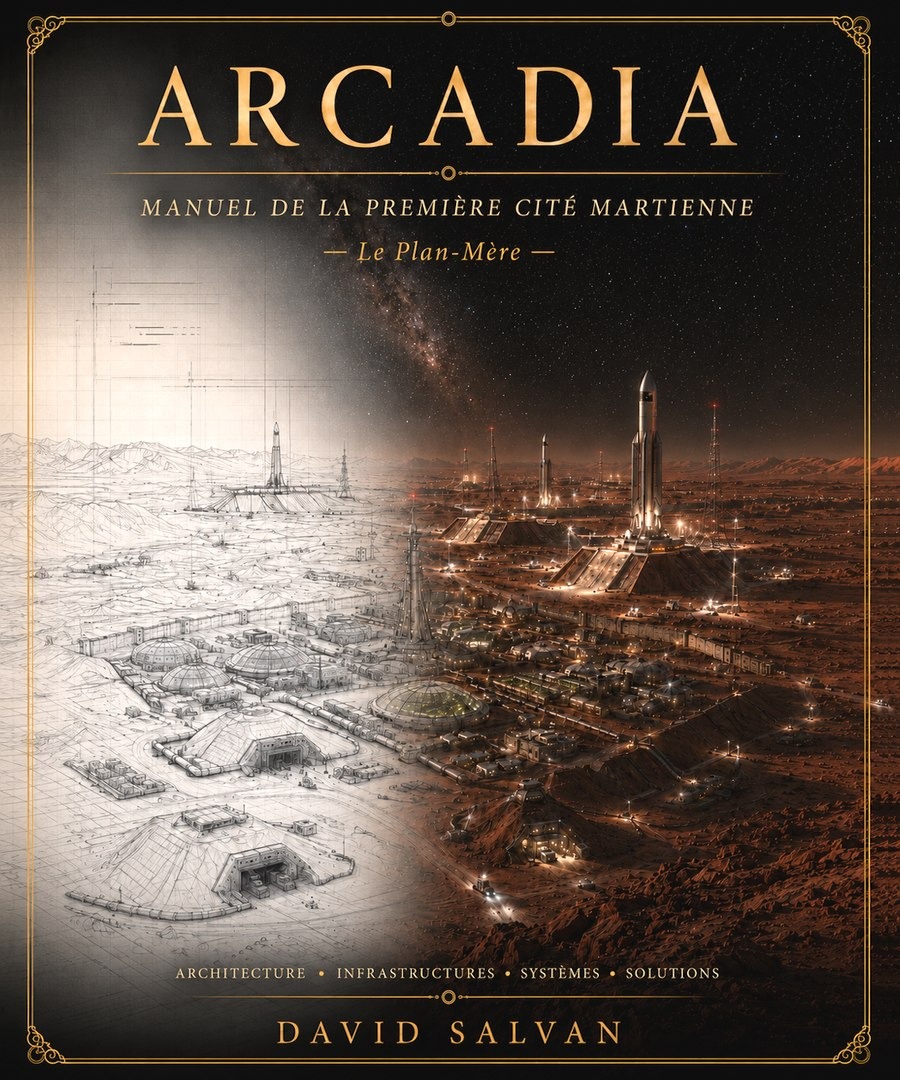
A technical companion devoted to settlement safety, underground structures, life-support loops, energy, industry and the logic of a real Martian city.
The Moon is nearer and crucial for space strategy, but Mars offers more of the ingredients needed for a long-term self-sustaining settlement: a near-Earth day length, richer geology, an atmosphere usable in industrial loops and significant water-ice potential.
Would Mars make people rich through mining exports?
Not in the near term. The key economic value is local use of Martian resources to support life, fuel, construction and industrial autonomy on site, while creating technological capabilities that could also benefit Earth.
Could a new society really emerge on Mars?
It could, because a permanent settlement would need institutions adapted to local conditions. Communication delay, shared life-support systems and local emergency decision-making would force original social and political arrangements.
Did von Braun take Mars seriously as an engineering project?
Yes. His Mars work is historically important because it framed Mars as a transport-and-settlement problem, not merely as a destination for a symbolic flag-planting mission.
Science is valuable only if the settlement protects the evidence it wants to study. Mars preserves very old terrains, minerals altered by water, and a climate record that Earth has partly erased through tectonics and erosion. Human presence is not required for that science, but people on the surface could change the pace of field decisions: choosing an outcrop after an unexpected result, adjusting a sampling plan, drilling, conducting local geophysics, or preparing samples without waiting for another interplanetary command cycle. The same presence can damage the record through traffic, heat, dust, drilling fluids, and biological contamination. Scientific value should therefore be measured by the quality of observations enabled, not by the mere fact that humans are present.
A biosignature is not necessarily a spectacular fossil. It may be mineralogical, chemical, isotopic, or morphological, and every candidate signal has non-biological alternatives that must be tested. A crewed field program would therefore need unusually strict contamination knowledge: microorganisms carried from Earth, organic compounds released by materials, vehicle deposits, and residues from drilling or cleaning. Sensitive sites should be separated from routine operations, while sample chains record where material came from and what touched it. The credibility of a discovery depends on instrument performance, geological context, blanks and controls, and the ability to show that exploration itself did not create the signal.
Distance turns maintenance into a scientific discipline. Communication delay and the impossibility of rapid Earth-side repair force a settlement to diagnose faults from local evidence, decide what risks can be accepted, repair with limited stock, and verify restoration. That makes modular systems, local metrology, configuration records, and the ability to fabricate simple replacement parts disproportionately valuable. It does not imply early independence. Advanced electronics, specialist medicines, software ecosystems, and remote expertise would remain tied to Earth for a long time. The engineering value lies in reducing the most dangerous dependencies methodically and measuring the residual ones rather than declaring an abstract state of self-sufficiency.
In-situ resource utilization becomes useful when it replaces a costly imported mass or function. Water can support drinking, hygiene, and electrolysis; atmospheric carbon dioxide can feed chemical processes; regolith can supply shielding mass or industrial feedstock. A geological resource, however, is not an industrial product. It must be located, excavated, handled, purified, supplied with energy, quality-controlled, and processed by machines that also need maintenance. ISRU is therefore a chain of yields and availabilities. It improves resilience only when the resulting production path is more dependable than the import dependency it is intended to replace.
Resilience is continuity of service, not a slogan. A remote settlement loses several protections that are ordinary on Earth: same-day delivery, immediate arrival of a specialist, rapid medical evacuation, and effortless replacement of failed equipment. The response is prioritization. Loss of ventilation is not equivalent to loss of a workshop; a greenhouse may tolerate temporary output reduction if stored food exists. This hierarchy of functions is useful well beyond Mars, but it should not be confused with a claim that a small Earth-dependent outpost is already a backup civilization. Planetary resilience would require long-duration autonomy that has actually been demonstrated.
The cost of Mars is not the price of one launch. Development, qualification, reserve vehicles, surface infrastructure, power, inventories, maintenance, communications, and equipment renewal continue for decades. The relevant comparison is therefore life-cycle cost. Importing a highly reliable component can make sense if local production would require a complex factory; locally producing a simple heavy part may be attractive because it avoids repeated interplanetary logistics. The useful economic question is not whether Mars will be “cheap,” but what additional capability an investment buys, what risk it reduces, and which dependency it moves elsewhere in the architecture.
The Moon and Mars teach different lessons. Lunar proximity supports faster iteration, more frequent logistics, and some rescue options. Mars adds delayed communications, a thin atmosphere, different gravity, and launch opportunities separated by long intervals. Lunar operations can mature methods for power, dust, habitats, logistics, and remote work without reproducing the Martian environment. NASA’s current Moon-to-Mars architecture explicitly treats capabilities as evolvable and the Mars trade space as still open rather than as one frozen mission design. That makes the useful question one of transferability: which lunar lessons genuinely retire Mars risk, and which must still be demonstrated under Martian conditions?
A durable settlement creates obligations before it creates political independence. Human activity can contaminate scientifically valuable environments, leave persistent waste, alter heritage sites, and lock future residents into technical or institutional decisions made before they were born. Consent becomes especially difficult around reproduction, hazardous work, medical risk, and dependence on life-support infrastructure. Ethics therefore goes beyond the vocabulary used for “colonization” or “settlement.” It requires rules for planetary protection, safety, risk disclosure, resource access, governance, and the rights of people whose survival depends on systems they did not design.
Many capabilities required on Mars are also valuable on Earth: water treatment, leak detection, energy management, telemedicine, predictive maintenance, controlled-environment agriculture, and logistics for critical stock. Transfer is never automatic. A technology optimized for a few dozen people in a closed habitat may be too expensive or complex for terrestrial infrastructure, while a robust Earth technology may fail if it assumes daily resupply. Useful spillover comes from reformulating the problem, measuring performance in the new context, and being willing to abandon a space-derived solution when its advantage disappears.
Maintenance and manufacturing become survival functions before they become industries. A workshop needs to identify a part, choose material, machine or print it, measure dimensions, test it under relevant load, and decide whether it can return to a critical system. That chain exposes the cost of poor repairability and rewards modular design. Yet distance does not guarantee productivity: machines, powders, cutters, gauges, software, and trained operators all have their own logistics. Innovation is valuable when it reduces the total dependency of the settlement, not when it merely adds a spectacular technology that cannot be sustained.
Calling Mars a “backup planet” can hide orders of magnitude. A catastrophe threatening billions of people on Earth would not be offset by a settlement of hundreds or thousands. For a long time, a Mars base would still depend on Earth for knowledge, components, institutions, and specialized production. The backup argument becomes credible only much later, if a population can maintain life support, renew infrastructure, preserve skills, educate successors, and survive multiple failure cycles without decisive resupply. Before that threshold, Mars is better described as a second inhabited site and an experiment in autonomy than as insurance capable of replacing Earth’s biosphere.
The success of a settlement should not be measured only by a flag, a first landing, or population count. A more demanding metric is continuity: surviving a missed logistics window, replacing aging equipment, training the next cohort, retaining rare skills, and preserving resource margins after repeated incidents. A growing city can become more fragile if every new service adds an imported dependency. A smaller settlement can become more robust if it controls water, air, power, maintenance, and critical parts. Progress is therefore better tracked through recoverable functions and demonstrated endurance than through tonnes delivered or floor area constructed.
A useful final test is reversibility. Some Mars investments are easy to stop if evidence weakens the case; others create long-lived commitments in launch systems, surface infrastructure, workforce, and political expectations. Early stages should therefore maximize information per unit of irreversible commitment. Robotic reconnaissance, technology demonstrations, analogue operations, and cargo pre-deployment can answer different questions before crews depend on the result. A settlement strategy becomes more credible when each phase has explicit evidence that must exist before the next phase begins, rather than assuming that momentum itself is proof of value.
Mars also forces a distinction between reasons to explore and reasons to settle. Scientific exploration can be justified by questions about planetary evolution, habitability, and comparative geology without requiring a permanent city. A settlement adds separate claims about continuity, autonomy, industry, culture, and the long-term value of a second inhabited world. Those claims should be evaluated on their own evidence. Keeping them separate is not anti-Mars; it prevents a strong scientific case from being used as a substitute for an unproven settlement case, and it prevents enthusiasm for settlement from weakening the standards applied to science.
The strongest case for Mars is therefore conditional rather than absolute. Scientific value is already real; settlement value depends on whether transport, life support, industry, medicine, and governance can cross thresholds that have not yet been demonstrated together. A responsible program can still be ambitious while keeping those thresholds explicit. It can celebrate a landing without calling it self-sufficiency, celebrate local oxygen without calling it industrial independence, and celebrate population growth without assuming that resilience has increased. That vocabulary matters because it ties political and public expectations to evidence instead of allowing every milestone to inherit the meaning of the final objective.
One additional discipline is to publish stop conditions as well as ambitions. If a resource cannot be extracted at the required rate, if life-support maintenance consumes an unsustainable share of crew time, or if repeated cargo campaigns fail to build reserve margin, the architecture should be revised rather than protected by sunk cost. Mars exploration becomes more credible when it is able to learn that a particular settlement path is wrong. The ability to change course is itself a measure of engineering maturity.
Official sources and live resources
The primary sources below support the scientific and programme context used in this argument. They document evidence and stated objectives; they do not settle the normative question of whether humanity should go to Mars.
Official corporate pages describe the organization’s own plans and announced schedules. Public social-media feeds are dynamic and may include unverified third-party content.
Primary and institutional sources
These sources help distinguish measured facts and current programs from the author’s longer-term analysis. External pages may change after this update.