MARS BIBLE — ELECTRONICS · SENSORS · CIRCUITS · SEMICONDUCTORS
Electronics on Mars
Repair, print and recycle before fabricating chips
Electronics may be one of the last major barriers to deep Martian autonomy. A settlement may print conductors and make simple sensors far earlier than it can reproduce a modern microprocessor.
Deep monograph
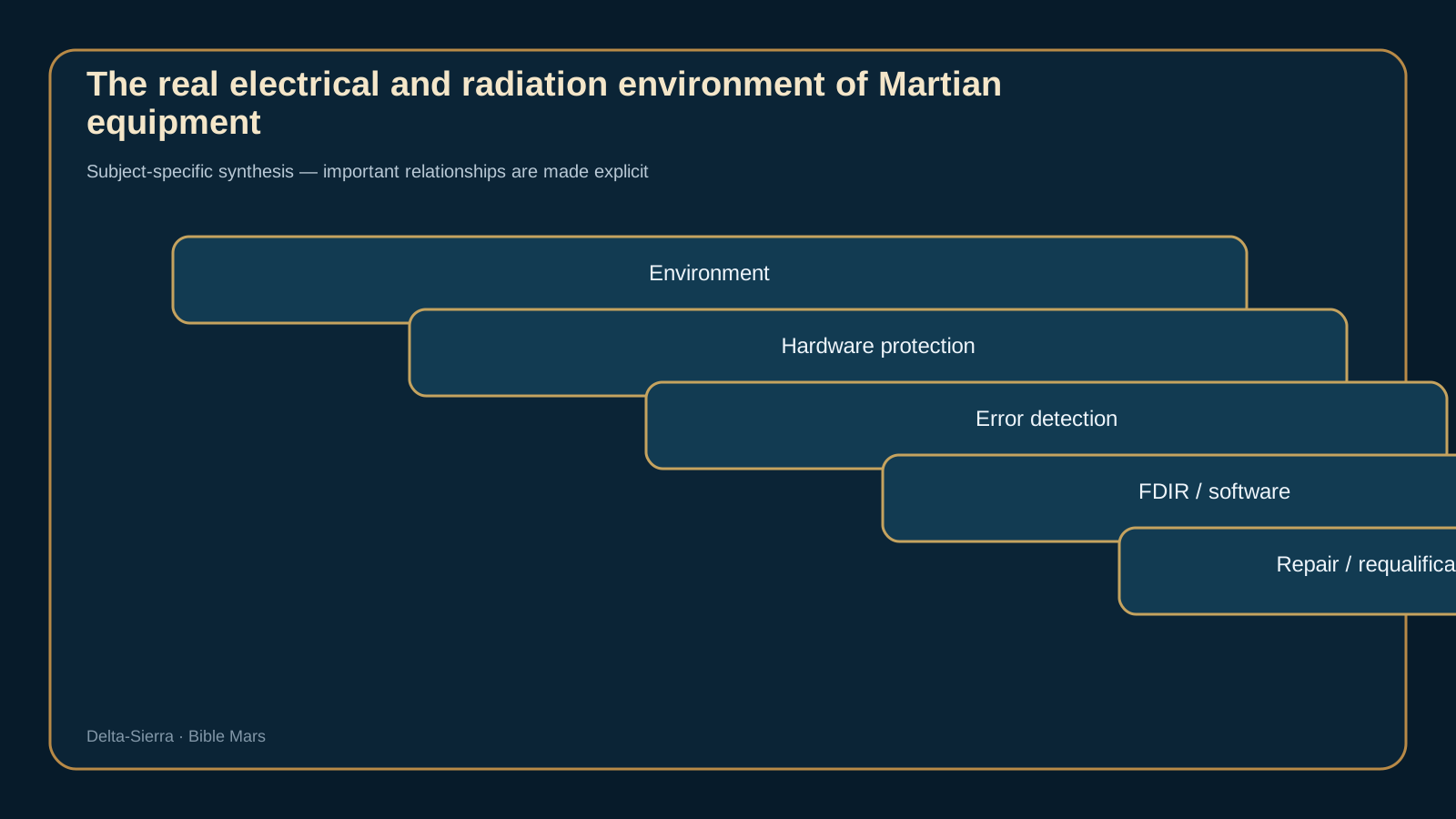
The real electrical and radiation environment of Martian equipment
The real electrical and radiation environment of Martian equipment.
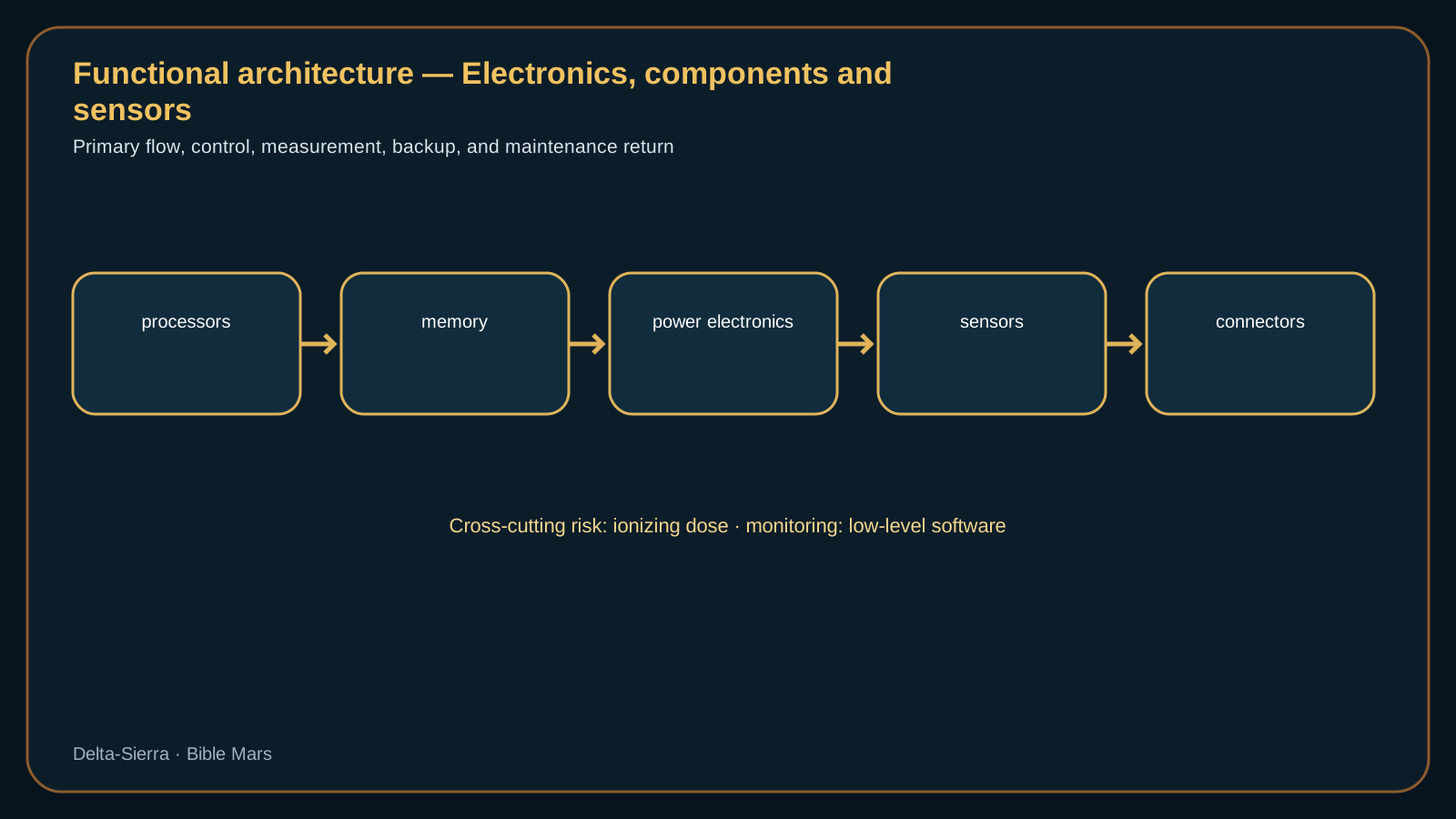
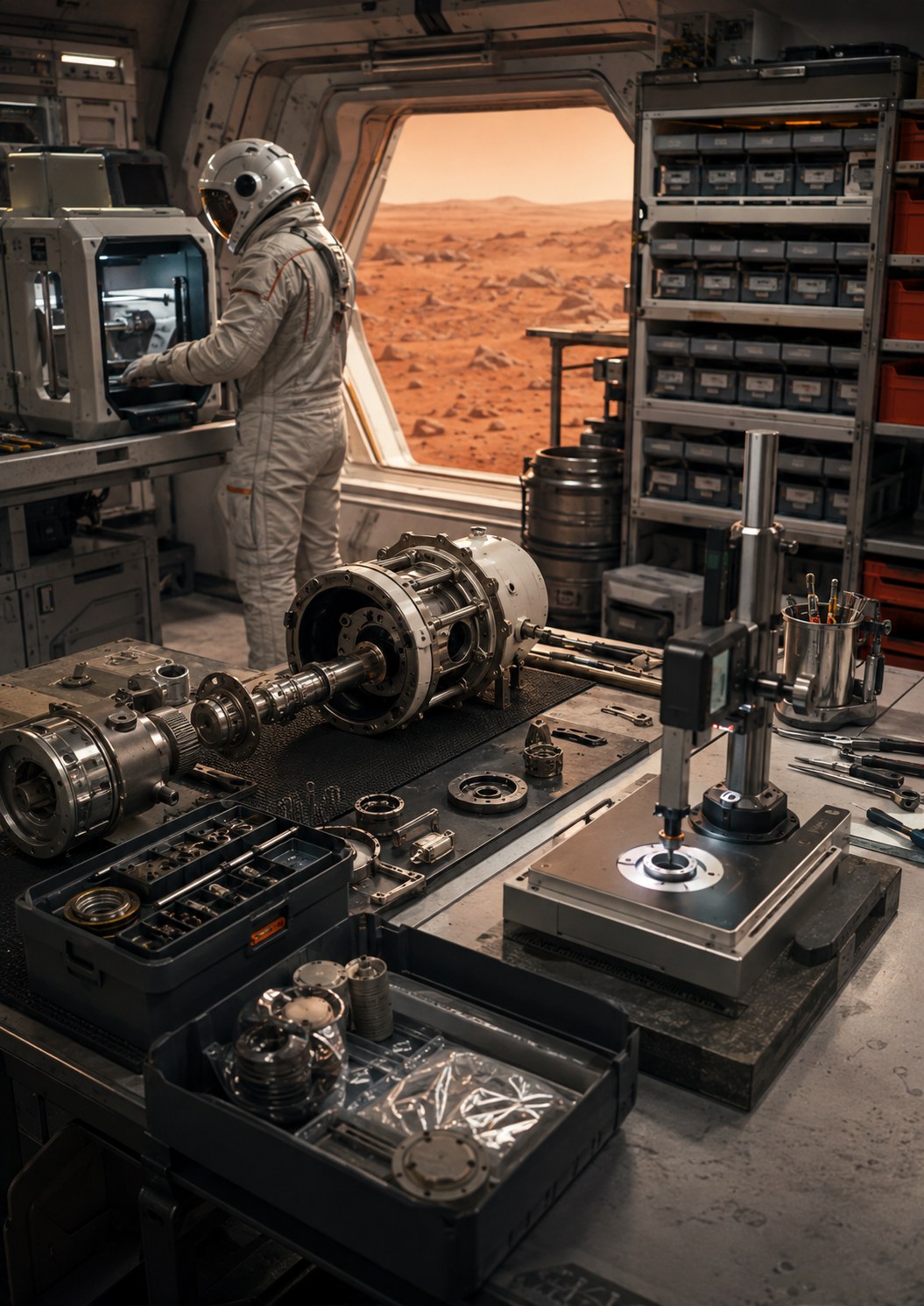
Electronics on Mars — functional architecture showing the flows, interfaces and dependencies developed in the chapter.Conceptual precision-maintenance workshop: diagnosing an electronic fault requires instruments, documentation, parts, electrostatic control and the ability to return a subsystem to a qualified configuration.
Martian electronics does not fail for one reason.
Radiation: cumulative dose, displacement and single-event effects
Radiation: cumulative dose, displacement and single-event effects. Retiring a Martian electronics board can become a form of technological harvesting. A memory device, converter, connector, oscillator, or sensor removed from obsolete hardware may remain valuable when its radiation, thermal, and electrical history is known. An apparently intact component with unknown accumulated dose or cycling history should not automatically become a critical spare. Electronics cannibalization therefore requires identification, controlled desoldering, visual inspection, electrical testing, and renewed traceability. Some boards can become donors, others training hardware or sources of metals and substrates. This parts economy reduces dependence on Earth catalogs but does not replace radiation assurance or local qualification. The ECLSS book only needs the interface requirements of its sensors; recovery, testing, and obsolescence strategy for electronic parts belongs here in the electronics volume.
Radiation: cumulative dose, displacement and single-event effects.
Radiation assurance: environment, selection, test, architecture and margin.
Temperature: cycling, gradients, cold start and solder fatigue.
Dust: insulation, connectors, radiators and optical sensors. To make “Dust: insulation, connectors, radiators and optical sensors” concrete, suppose the function “connectors” begins to drift at the start of a shift just after low-level software has returned from maintenance.
Power electronics: overvoltage, conversion, filtering and failure modes.
A plausible sensor can be more dangerous than a dead sensor
Memory: corruption, error correction, scrubbing and safe state.
Processors: performance versus robustness and power consumption.
Sensors: a digital value has a physical model behind it.
Redundancy: two identical sensors can drift together.
Connections: milliohms and intermittent contacts as systemic failures. The observation chain for power electronics must remain credible after thermal cycling.
Wiring: mass, routing, repair and electromagnetic compatibility.
Reproducible calculations specific to this subject
Radiation qualification margin
Dqual = 2 × Dmission = 2 × 18 krad = 36 krad
The factor of 2 is a teaching project assumption, not a universal NASA rule. The exercise shows that an estimated mission dose must be converted into a qualification level using an explicitly documented margin policy.
Single-event order of magnitude
R = Φ × σ × N = 10⁴ × 10⁻¹² × 10 = 10⁻⁷ s⁻¹ ≈ 1 événement / 116 jours
Flux Φ, cross-section σ and the number N of sensitive devices are simplified assumptions. The calculation shows how a tiny component-level probability becomes operationally relevant when multiplied by device count and mission duration.
Converter resolution
ΔV = 10 V / 2¹⁶ = 0,153 mV par pas
A 16-bit converter over a 0–10 V range has an ideal step of about 0.153 millivolt. Resolution is not accuracy: noise, offset, thermal drift and calibration can dominate the real error.
Repairing boards, connectors and power stages instead of discarding boxes
Repairable boards: component access versus compact integration.
Repairable boards: component access versus compact integration. Recovery case — displacement damage.
Four people: few spares and strong standardization
Four people: few spares and strong standardization.
Twenty people: electronics bench, board stock and dedicated skills.
One hundred people: lab, rework, testing and local qualification. For dust, contamination exclusion belongs upstream of board-level detection, while post-event functional tests decide whether electronics can return to service.
One thousand people: repair chain, limited production and obsolescence management.
One thousand people: repair chain, limited production and obsolescence management. Monitoring of low-level software has to survive obsolescence, not merely nominal operation.
One thousand people: repair chain, limited production and obsolescence management. Who may modify wiring?
Obsolescence: the part disappears on Earth before the base needs it.
Obsolescence becomes an engineering uncertainty when a part disappears from the terrestrial market before the base needs it; substitutes then require qualification rather than assumption.
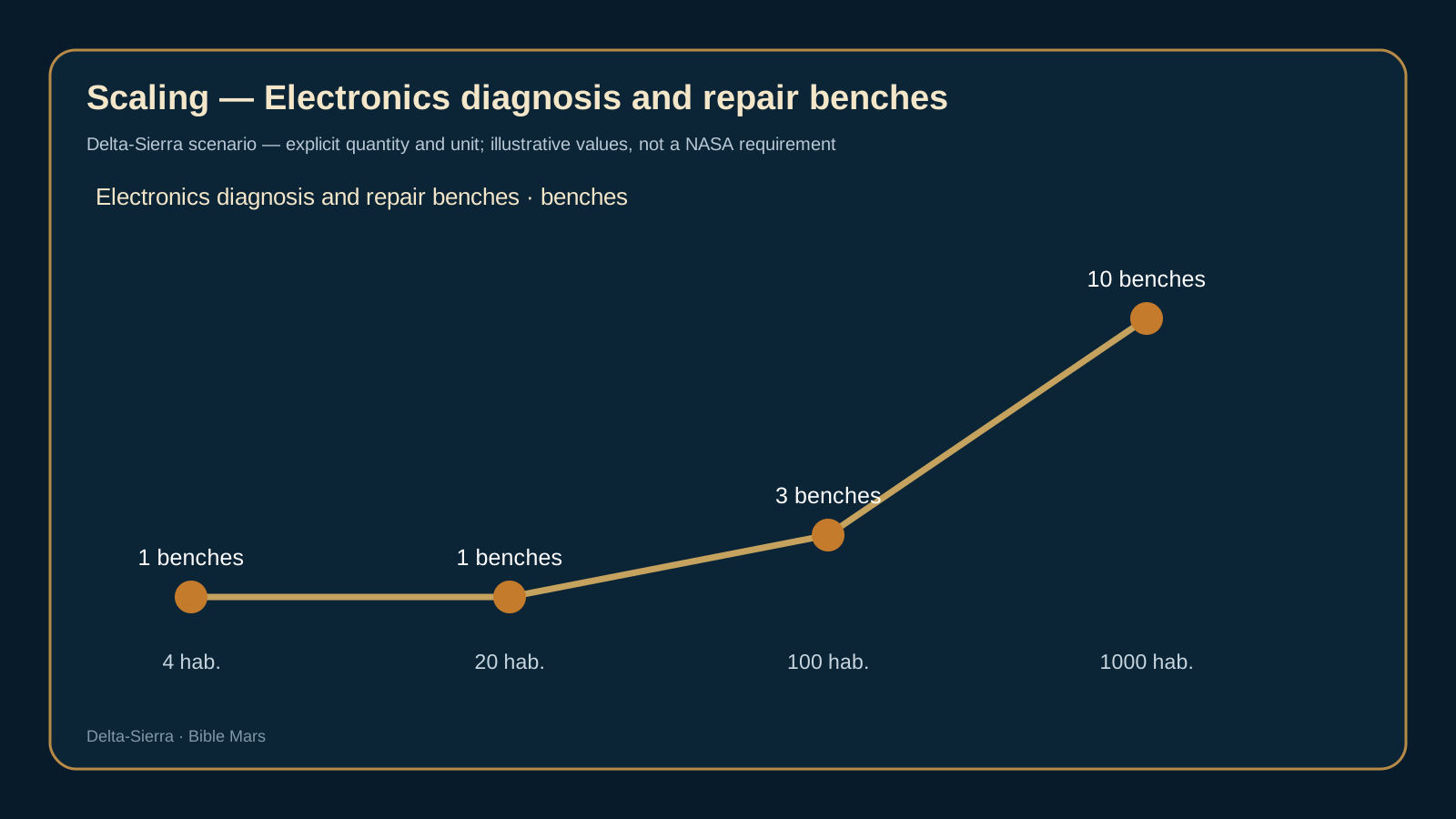
Electronics on Mars — visual synthesis of the system-specific choices and constraints.Electronics diagnosis and repair benches — scaling scenario: the quantity and unit are illustrative and are not a NASA requirement.
Four architecture scenarios that materially change the decision
The sensor is wrong but plausible
The sensor is wrong but plausible. A pressure sensor drifts by a few percent while remaining inside its normal range. No binary health check declares it dead, yet automation makes bad decisions. The scenario requires cross-checks, physical models and sensor diversity rather than blind trust in telemetry.
Latch-up during a critical operation
Latch-up during a critical operation. A component experiences a single-event latch-up just as an actuator is commanded. The system must limit current, isolate the path, preserve a safe state and restart without losing configuration. The case links radiation, electrical design, fault software and process behavior.
Repairing a board instead of replacing a box
Repairing a board instead of replacing a box. The last complete spare module is reserved for a more serious failure; the workshop must locate a faulty converter and replace a few components. The scenario requires schematics, testability, component spares, tools, metrology and post-repair requalification.
A locally manufactured sensor batch drifts
A locally manufactured sensor batch drifts. Local production reduces dependence on Earth but introduces a new question: how is batch performance proven? The scenario puts calibration, sampling, material traceability and rejection criteria at the center.
Aging, obsolescence and strategic component reserves
Substitution: replacing a component without silently changing the system. If uncertainty about condensation can alter the size of low-level software, redundancy type, or settlement layout, it deserves an early test.
Substitution: replacing a component without silently changing the system.
Intermittent diagnosis: the fault that disappears when the box is opened.
Fleet data: every failure should enrich the local reliability library.
Electronics autonomy: repair, test and requalification without an Earth laboratory.
Electronics autonomy: distinguish cable, sensor, board and microprocessor
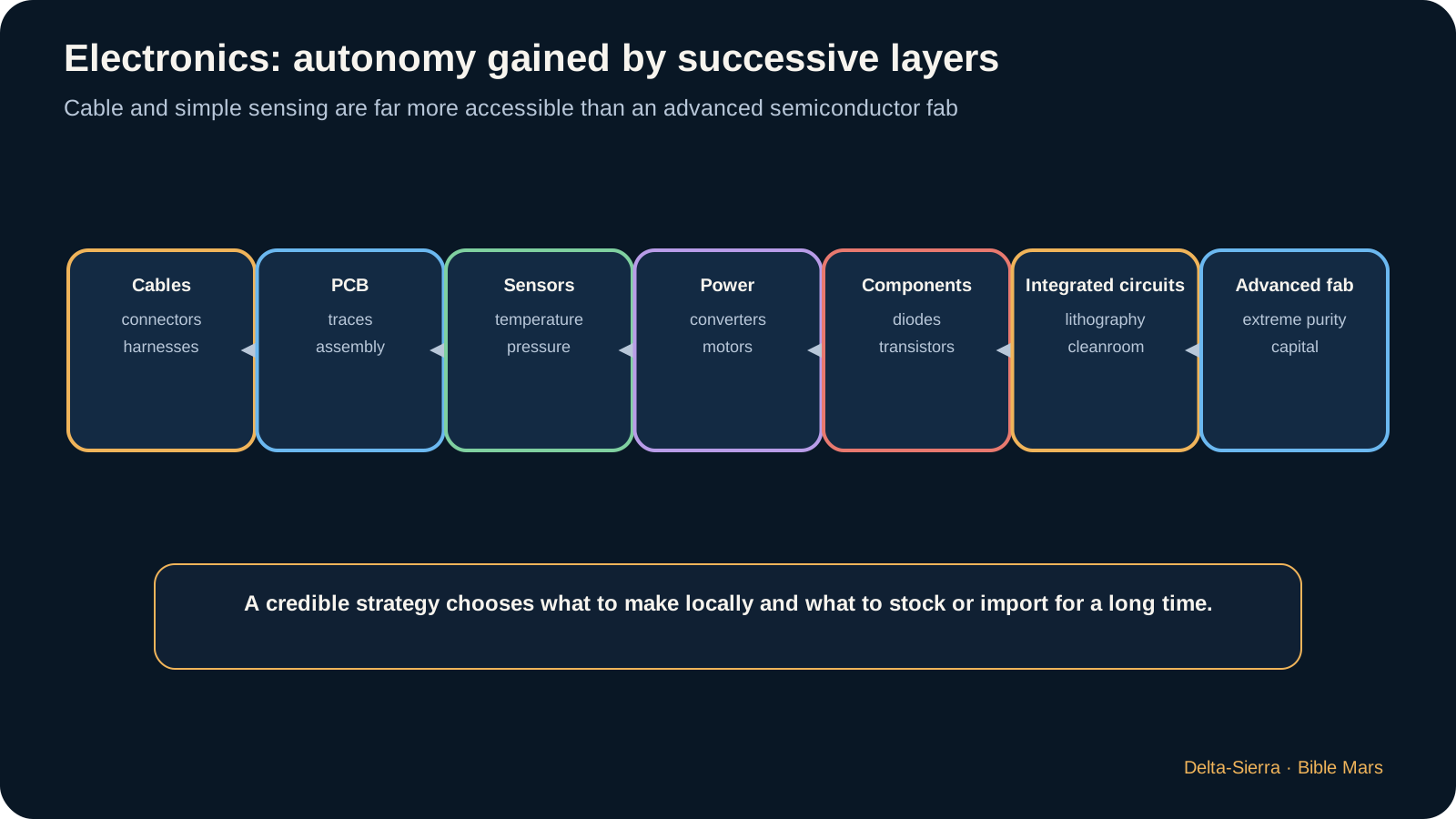
'Manufacturing electronics' covers very different industrial worlds. Producing a sensor or discrete-component board needs more materials, cleanliness and control. Fabricating an advanced integrated circuit requires an infrastructure comparable to a terrestrial industrial ecosystem. A Mars strategy must measure these levels separately instead of declaring electronics either locally possible or impossible.
That distinction creates a realistic path. The settlement first repairs at module and board level, then makes harnesses, enclosures, antennas and simple boards. It may later develop selected sensors and printed devices. Complex chips remain imported but are surrounded by architectures that allow replacement, reuse and substitution. Autonomy can therefore increase without waiting for a semiconductor fab.
Four different levels of “electronics manufacturing”. Level 1 is repair and component replacement. Level 2 is printing conductors or sensors and assembling imported components. Level 3 is local production of selected passive components, substrates and sensors. Level 4 is advanced integrated semiconductor fabrication.
These levels have radically different industrial requirements and should never be conflated.
Electronics autonomy does not start with a microprocessor fab. A settlement can gain major resilience long before manufacturing advanced semiconductors. The first level is diagnosis, board replacement, cable repair, connector crimping, component soldering and power-supply testing.
Later come local board assembly from imported components, relatively simple PCB production, selected sensors and actuators, and only then far more complex semiconductor processes.
Electronics autonomy grows by layers: cable, PCB, sensor, power electronics, components and eventually microelectronics.
Repair before fabrication: design equipment for diagnosis
The best spare is one that can be diagnosed. Boards should expose test points, telemetry and error logs; connectors should be accessible and interfaces standardized. Highly integrated sealed designs may save mass on Earth while making local recovery impossible. Maintainability therefore belongs in electronics requirements from the beginning.
A pressure-sensor failure illustrates the method: verify power and wiring, compare reading against a reference, isolate the analog conditioning, then replace the sensor or module. If calibration data are preserved, a different compatible sensor may sometimes be compensated in software. Diagnosis, standardization and calibration together can reduce the exact part-number inventory required.
Test equipment is itself critical. Oscilloscopes, multimeters, bench supplies, signal generators, programmers and calibration standards are the eyes of an electronics shop. Their failure can block many repairs, so redundancy and calibration strategy matter.
Concrete case: a pressure sensor fails. Do not replace the entire chain first. Diagnose sensor, power, cable, connector, input channel, software and calibration separately.
A compatible replacement should be calibrated and cross-checked. A substitute sensor is acceptable only if range, accuracy, electrical output and software compatibility are verified.
Design electronics for repairability. Industrial autonomy also depends on design choices. Modular boards, standardized connectors, replaceable components, accessible schematics and diagnostic software can turn a small spare inventory into a much larger repair capability. Sealed proprietary hardware can become useless after a minor fault.
A Mars design doctrine should therefore treat common interfaces and complete technical documentation as logistics-reduction technologies.
Worked case: a pressure sensor drifts without clearly failing. An oxygen or pressure sensor can become dangerous while still producing plausible data: it drifts by 2 percent, then 4 percent. If the sensor is replaced, its new calibration curve and serial identity must enter the system configuration.
The failure shows why two identical redundant sensors may still be insufficient. Common contamination, batch history or software can shift both together. A third measurement principle or portable reference can reveal the common cause. Metrology and diversity therefore become part of electronics architecture.
Local repair becomes far easier when hardware exposes test points, accepts standardized components and allows software recalibration. Maintainability is decided in design long before the failure occurs.
Passives, interconnects and sensors: plausible early local products
The earliest plausible local products are not processors. Cables, busbars, enclosures, supports, antennas, heaters and some sensor elements can be made or assembled with relatively macroscopic processes. Producing good conductor still requires purity and dimensional control; producing a stable sensor requires a reproducible relationship between physical input and electrical output. Those requirements are challenging but fundamentally different from nanometre lithography.
Standardization multiplies the value of local capability. Common connectors, board formats, voltages and protocols let tools and inventory serve many systems. A settlement with a hundred proprietary families turns each failure into a special case. Shared interfaces allow temporary substitution, cannibalization and locally made adapters. System architecture itself becomes an industrial autonomy tool.
Standardize connectors, voltages and protocols. Every extra interface increases inventory variety. A settlement can reduce vulnerability by defining a small set of interface families while preserving deliberate keying where safety requires it.
Printed electronics and boards: a credible intermediate industry
NASA's in-space manufacturing portfolio includes on-demand electronics such as printed sensors and devices. These approaches deposit conductors, resistive features or functional layers on substrates without recreating a full semiconductor fab. They are attractive for distributed sensors, antennas, flexible circuits and low-complexity devices. They do not replace advanced processors, but they can move part of the value chain to the settlement.
A locally assembled board can combine a local substrate and printed traces with imported active components. This hybrid is powerful: grams of high-value chips become the core of a much heavier board assembled on Mars. It reduces the diversity of finished spares that must be transported while retaining high technology where it has the greatest functional value per kilogram.
Printed electronics are already a real development path. NASA develops on-demand electronics manufacturing with functional-ink deposition, micro-machining and pick-and-place capabilities. Hybrid printed circuits have also flown on a sounding rocket technology test.
This shows that some electronic functions can be additively manufactured for space applications. It does not demonstrate a Martian semiconductor fab.
Why a semiconductor fab is an industrial world of its own
A semiconductor fab requires far more than a lithography machine. It needs ultra-pure feedstock, dopants, gases, acids, solvents, ultrapure water, vacuum, cleanrooms, thin-film deposition, etching, metrology, packaging and yield control. Each step depends on complex subequipment. Recreating this chain on Mars would be a city-scale industrial project rather than an ordinary workshop upgrade.
It is therefore rational to import low-mass, high-complexity components for a long time. Local effort should preserve, shield, test, reprogram and reuse them. A chip recovered from retired equipment can be worth far more than its mass. Electronic bills of material should record cannibalization options, compatibility across versions and acceptable substitutes.
Why leading-edge chips are a strategic import rather than an early local-industry target. A modern semiconductor fab depends on extreme-precision equipment, ultra-pure chemistry, cleanrooms, specialty gases and a vast supplier network. A young settlement gains more by stocking critical parts, standardizing references and mastering assembly/repair than by trying to reproduce the entire industry immediately.
Why advanced chips are a very long-term target. Modern integrated circuits require ultra-pure wafers, dopants, thin films, lithography, specialty gases, nanometre-scale metrology and cleanrooms. A rational Mars strategy would prioritize robust electronics, standard spares, recycling and printed hybrid systems before advanced chip fabrication.
Inventory strategy: spend transport mass on components that cannot be remade. Advanced semiconductors have extraordinary functional value per kilogram. Ten kilograms of carefully selected devices may enable thousands of repairs, but a badly designed stock can hold many part numbers that never match real failures. The settlement should therefore combine criticality, failure rate, interchangeability and obsolescence to stock families rather than simply shelves of components.
Standardization reduces exposure. If several systems share controller, regulator and interface families, one common inventory covers more failures. Generic programmable boards may be more resilient than a hundred proprietary boards, and connectors can be designed to accept future generations through adapters.
Retired equipment can become a component source, but cannibalization needs records: operating hours, radiation dose, storage temperature and test before reuse. A chip is not new merely because it still responds.
Radiation, temperature and dust: qualify the component in its environment
A circuit that works on a bench is not necessarily a Martian circuit. Electronics may experience ionizing radiation, energetic particles, thermal cycling, dust, rover vibration and specialized internal atmospheres. Effects can be cumulative or transient: parameter drift, insulation degradation, memory errors or logic upset. Design combines tolerant components, local shielding, error correction, redundancy and recovery architecture.
Qualification should reproduce relevant environments or justify margins. A sensor deep inside a shielded habitat does not face the same profile as an external rover controller. The settlement should avoid both overqualifying every low-consequence device and using unproven consumer hardware in survival-critical functions. Criticality and exposure determine the evidence required.
Radiation and reliability still require qualification. A circuit that works on a bench is not automatically ready for Mars. Space and surface systems face radiation, thermal cycling, dust, vibration and long storage. Critical functions may require radiation-tolerant components and redundant architecture.
Locally printed sensors may therefore mature far earlier than flight computers, reactor controls or critical medical electronics. The higher the consequence of failure, the stronger the qualification burden.
Martian electronics age in several ways at once. Outdoor electronics face cold, thermal cycling, dust and radiation. Radiation can create cumulative effects such as total ionizing dose—TID and single-particle disturbances grouped as single-event effects—SEE. Some events merely flip a bit; others can lock or damage a circuit. Robustness therefore comes from component qualification, electrical architecture, software, shielding, redundancy and recovery procedures—not a thick box alone.
NASA describes radiation-hardness assurance as a process: define the environment, select and test parts, design margins and bound residual risk. That logic applies directly to a Mars settlement, where failed hardware cannot be replaced quickly from Earth.
A wrong bit must not become a wrong decision
Critical functions need consistency checks. Memory can use error correction; two or three computers can compare results; independent sensors can observe the same physical variable. Redundancy only helps when channels do not all share the same failure cause.
Example: three pressure sensors read 101.2 kPa, 101.1 kPa and suddenly 143 kPa. A resilient controller should not immediately move a life-support valve based on the isolated value. It flags disagreement, compares other measurements and checks channel health. The exact voting scheme depends on hazard, but the cross-checking principle is general.
Calibration is a resource
A sensor may continue producing numbers while slowly drifting. Electronic metrology therefore needs references, standards, built-in tests and periodic comparisons. Temperature, radiation, aging light sources or contamination can all change response.
For instruments that cannot be recalibrated locally, the settlement needs replacement stock or a substitute measurement route. The best electronics are not those assumed never to fail; they are systems whose condition can be diagnosed before degradation becomes a dangerous decision.
Making chips on Mars is far harder than repairing boards
A settlement can sensibly target repair first: connectors, cables, sensors, circuit boards, discrete components and standardized modules. Local manufacture of modern integrated circuits would require extreme purity, lithography, specialized gases and a metrology chain far beyond ordinary workshops. Electronic autonomy should therefore be layered: strategic stocks of critical chips, standardized interfaces, repairable boards and only later local production of simpler components where justified.
Boundary between fault tolerance and local fabrication. Radiation-induced errors illustrate a key limit: the ability to assemble a local board does not prove that its components are suitable for an external critical function. Tolerance can come from specialized parts, shielding, architecture, error correction and software recovery. The correct combination depends on exposure and consequence.
A settlement may therefore manufacture the board, enclosure, traces and harness locally while importing qualified active components. This hybrid is likely to be a durable stage rather than a failure of autonomy. It moves bulk and labour local while reserving interplanetary transport for grams of the hardest technology.
The next step — making even simple semiconductors — already requires remarkable purity, deposition, patterning, etching and metrology. The page should treat that transition as a capability ladder, not as an assumption that a city quickly manufactures advanced processors.
From 4 to 1,000 people: manage dependence on advanced components without immobilizing the settlement
With four people, electronics strategy relies on redundancy, complete spares and swappable modules. At twenty, a diagnostic and board-repair laboratory becomes worthwhile. At one hundred, local cable, simple-board and sensor assembly can substantially reduce logistics. At a thousand residents, specialized production lines and component libraries may appear, while advanced integrated circuits remain strategic imports until the settlement develops an enormous supporting industry.
That dependence can still be made resilient. Multi-year stocks, cross-generation compatibility, harvesting from obsolete hardware, radiation protection and controlled storage reduce risk. Electronics autonomy is therefore not binary; it is the ability to sustain functions despite being unable to reproduce every critical component locally.
Five levels of electronics capability
Repair: multimeters, oscilloscopes, soldering/rework and documentation.
Wiring: harnesses, connectors, fibres and power distribution.
Firmware, source code and cybersecurity are part of the spare
A board may be physically repairable yet unusable if its controller can no longer be programmed. Binaries, source code, toolchains, signing keys and recovery procedures must be preserved under a secure policy.
Local resources may first supply simpler materials
ESA is studying, for the Moon, conversion of metal-rich regolith residues into conductive inks and powders for printed electronics. Mars would require its own feedstock research, but the systems principle is important: use one industrial waste stream as another process input.
The next step is not adding more sensors; it is knowing when not to believe them. Mars 2020 carried MEDA, combining wind, pressure, humidity, temperature and radiation/dust measurements. A human settlement will multiply environmental and industrial sensing across air, fire protection, structures, tanks, machines, greenhouses, power and airlocks. The challenge becomes agreement between sensors, software and physical reality.
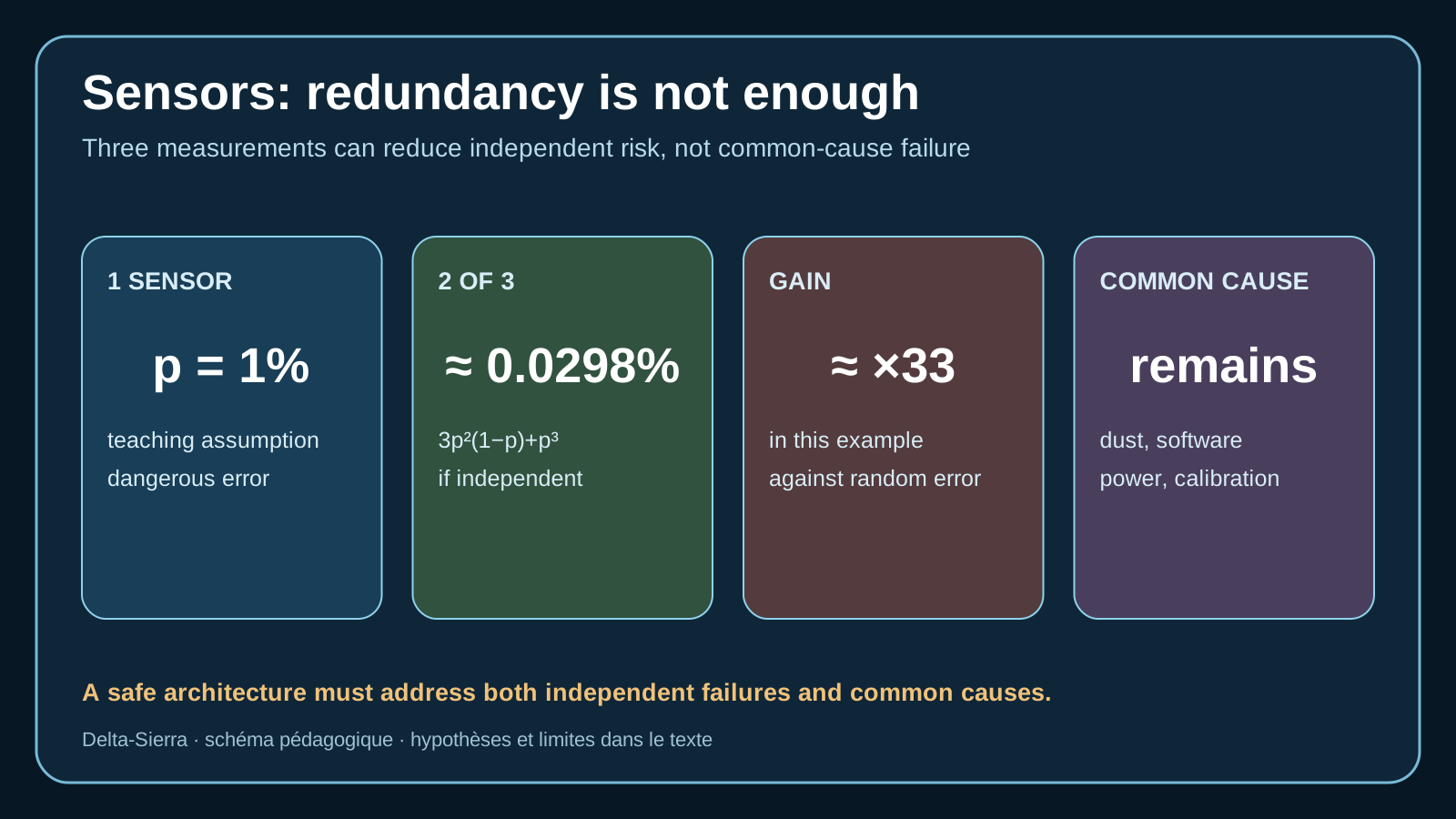
Three-sensor voting can reduce independent random error, not a shared calibration or environmental bias.
A probability example shows both strength and limitation. Assume only for teaching that one sensor has a probability p = 0.01 of a dangerous wrong output during a chosen interval, and that three sensors are genuinely independent. A two-out-of-three vote fails if exactly two or all three fail: P = 3p²(1−p)+p³. At p = 0.01, P = 0.000298, or 0.0298%, roughly a 33-fold reduction in this simplified case.
Independence is the weak assumption. Sensors from one batch can drift together; dust can bias all units in one location; a shared ADC, power rail or software service can defeat all three simultaneously. Mars systems therefore need diversity: different sensing principles, locations, power paths and physics-based plausibility checks.
Qualification also has to include thermal cycling, radiation and fine dust. NASA work on engineering cameras for Mars missions used flight-like assemblies subjected to multiple times the expected thermal-cycle exposure to reveal structural and electrical degradation. The settlement should institutionalize that idea: not merely “does it work now?” but “how does it drift after thousands of cycles?”
Local independent references are essential. Oxygen sensors need periodic comparison with standards or alternate methods; thermal imagers need radiometric checks; force and dimensional instruments need traceable artifacts. Otherwise a display can show six decimal places while the entire measurement chain is wrong.
Data systems should preserve provenance: sensor identity, calibration date, firmware, environmental conditions and uncertainty. In a settlement where one reading may shut down a greenhouse or evacuate a pressure module, the critical datum may be the justified confidence in the number, not the number itself.
Sensor diversity matters as much as sensor count. Three identical sensors mounted together may all be fooled by the same dust, temperature excursion or software defect. A stronger architecture can combine different physical principles: direct pressure measurement, flow reconstructed from mass balance, and state inferred from actuator consumption. These estimates are not perfectly independent, but their errors need not share the same cause.
Failure, drift and plausible-but-wrong data are different problems. A dead sensor is easy to identify. A device drifting 0.5% per month may remain believable for weeks. The base should keep long trends, compare neighboring measurements and trigger calibration when statistical drift appears. Perseverance's MEDA suite illustrates the variety of environmental quantities measured on Mars; a human habitat adds the requirement that measurements remain trustworthy enough for life-critical decisions.
Electronics should be replaceable at the lowest realistic level. If every fault requires an entire Earth-built box, industrial autonomy remains shallow. Standard boards, common connectors, replaceable sensors, power-conversion modules and local test benches allow repair to move gradually from line-replaceable units toward component-level work. Such standardization may sacrifice a little mass optimization in exchange for a much larger logistics benefit.
Local electronics face a basic asymmetry: a settlement may manufacture heavy structures long before it can fabricate advanced semiconductors. Autonomy must distinguish board- or module-level repair from components that remain Earth-dependent. That favors modular designs, standard interfaces and strategic stocks of high-value, low-mass parts.
Redundancy is not sufficient when sensors, computers or power supplies share the same weakness. Critical functions benefit from diverse measurement, diagnostics and a manual or degraded operating path. At city scale, configuration management becomes as important as inventory because operators must know which hardware and software revision is actually installed.
Primary sources to read
Martian electronics need to be diagnosable before they are sophisticated. Computers, converters, sensors, and networks face temperature swings, dust, connector cycling, and radiation exposure that can create intermittent faults that are difficult to reproduce. A board that works nine times out of ten can be more dangerous than a hard failure because it contaminates the diagnosis of other systems. Design should support isolation through test points, event logs, measurable voltage and current, replaceable modules, and comparison with an independent channel. Diversity of sensing principles is especially valuable when a vital quantity must not depend on one shared software or calibration failure.
Electronic maintenance also requires a hierarchy between what can be repaired locally and what remains an imported spare. Replacing a connector, cable, or power supply is fundamentally different from fabricating an integrated circuit. A realistic settlement therefore carries spare boards, simple components, wiring-repair capability, and the configuration files required to restore a known state. Software updates must be reversible, and compatibility with installed hardware has to remain documented. Long-term resilience comes less from a promise to manufacture everything on Mars than from knowing exactly which electronic dependencies cannot yet be reproduced locally.
Sources and documentary findings
The real electrical and radiation environment of Martian equipment: the references below are retained because they contribute a result, technology status or verification framework directly useful to this subject.
NASA Standards — Safety, Quality, Reliability, Maintainability
NASA’s standards catalog includes R&M, metrology, EEE-parts assurance, wiring and software standards. For Martian industry, quality therefore cannot be separated from process traceability and configuration control.
The metrology and calibration standard formalizes measurement traceability, equipment control and uncertainty. On Mars it becomes a model for building a local chain of trust when a terrestrial laboratory is not immediately available.
NASA-STD-8729.1A — Reliability and Maintainability Standard
The active standard structures reliability and maintainability objectives and strategies for space systems. It provides a framework connecting requirements, design, verification and data rather than treating reliability as a catalog number.
CHAPEA Mission 2 is useful here as an analogue for human information systems: four people work for a long duration with limited resources, communication delay and simulated equipment problems. For electronics and sensors, the value is not that the habitat reproduces Mars, but that crews must diagnose imperfect information locally.
NASA — Establishing Crew Exposure Limits of Martian Dust (2026)
For electronics and sensors, NASA's 2026 Martian dust limit is primarily a reminder that dust measurement is a safety function. Sensor placement, calibration and alarm thresholds have to remain credible in the same environment where deposits can also interfere with instruments.