


MARS BIBLE — PEOPLE & PIONEERS
Konstantin Tsiolkovsky
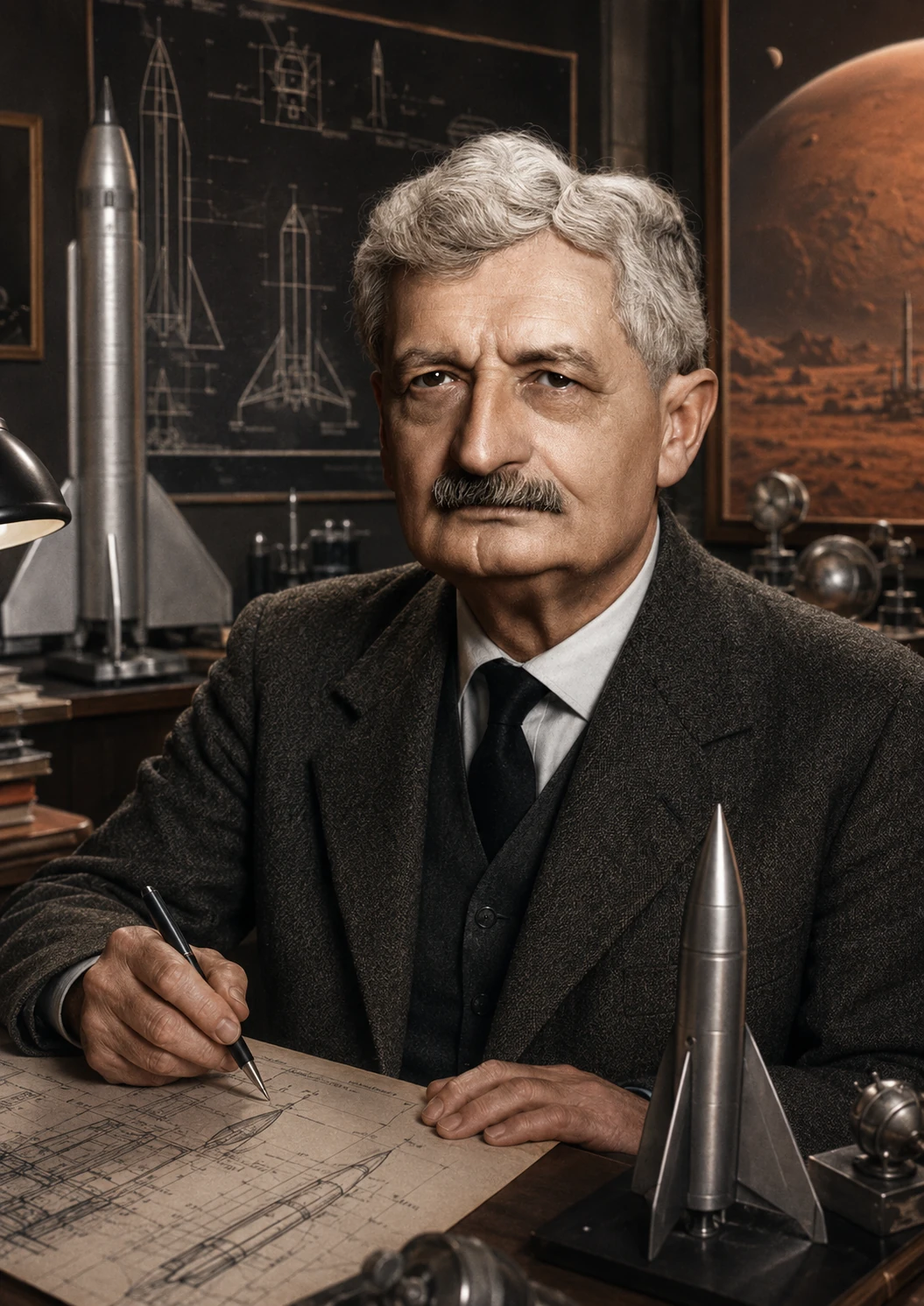
Konstantin Tsiolkovsky's documented nationality or citizenship is Russian; the documented birthplace is Izhevskoye, Ryazan Governorate, Russian Empire. Konstantin Tsiolkovsky is one of the intellectual founders of astronautics. After childhood hearing loss left him largely self-educated, he transformed a fascination with mechanics and cosmic travel into work on reaction propulsion, staged rockets and the velocity required for spaceflight. He matters to Mars because he formulated, long before the launch-vehicle era, principles that make interplanetary journeys physically conceivable and imagined humanity living beyond Earth.
Chronological biography
1857–1879 — Deafness, self-education and the making of an autodidact
From intuition to mathematical constraint. Tsiolkovsky’s most famous contribution is the mathematical relationship between expelling mass and accelerating a vehicle. The equation looks compact once written, yet it exposes a severe constraint: for a given propulsion technology, more delta-v demands a higher mass ratio, making every kilogram of structure and payload consequential. Source.
Space Academy should use this relationship not as a magic formula but as an entry point into mass budgets, staging, propulsion and mission tradeoffs.
As a young man he spent time in Moscow, where libraries gave him access to deeper scientific study. There was no professional route into astronautics because astronautics did not yet exist as an established profession. Tsiolkovsky became a mathematics and physics teacher. Teaching provided income, but it also reinforced a habit that mattered to his later work: define variables, reduce a phenomenon to its essential relationships and test whether an argument is internally consistent. The apparently ordinary profession of schoolteacher thus contributed directly to his technical way of thinking. Source
1879–1903 — Teaching, experimenting and turning intuition into method
Why an isolated teacher became central: the power of a simple model linking velocity and mass. Tsiolkovsky did not possess a major laboratory or a national rocket programme comparable with those of the mid-twentieth century. His historical power came from a different kind of work: reducing powered flight to mathematical relationships general enough to show what a rocket must achieve. The equation bearing his name connects change in velocity, exhaust velocity and mass ratio. [source]
That relationship imposes a brutal intellectual discipline. One cannot simply announce a more distant destination; each additional velocity requirement drives propellant demand and can make initial mass rise very quickly. Staging then becomes a logical response because discarding dead mass improves the performance of the complete system. [source]
For Mars, Tsiolkovsky remains relevant precisely because modern concepts cannot escape this accounting. Reuse, orbital refuelling, nuclear propulsion or locally produced propellant can change the terms of the problem, but never remove the need to close the mass and velocity budget. His legacy is therefore less a particular architecture than a rule of method: before admiring a mission concept, verify that its numbers actually permit the journey. [source]
Why staging matters. Tsiolkovsky also understood the value of multistage rockets. Once an empty stage is discarded, the mission no longer has to accelerate structure that has become useless. The principle later became universal in large chemical launch vehicles. [source]
For Mars the same logic appears repeatedly: which masses must be accelerated for the whole trip, which can stay behind, be discarded, pre-positioned or manufactured locally? [source]
1879–1892: becoming a teacher and making calculation a daily craft. His proficiency in mathematics and science led to teaching posts, first in Borovsk and later, from 1892, in Kaluga. Teaching gave him a modest livelihood and a disciplined routine: explain, calculate, repeat and check. While no nation possessed an orbital launcher, he worked on physical models, aeronautical ideas and the mechanics of leaving Earth. Source
Kaluga became less an institutional laboratory than a personal intellectual workshop. His key achievement in this phase was learning to translate a dream into constraints. Reaching space requires velocity; velocity requires momentum exchange; that leads to propellant mass, exhaust velocity and the ratio between initial and final mass. The move from aspiration to quantified balance was his first great engineering contribution. [source]
The gap between theory and industry also defines the limits of his legacy. Tsiolkovsky did not build a tested liquid-engine program like Goddard, nor did he command an industrial rocket organization. What he provided was a language through which later engineers could understand what their hardware needed to achieve. For Mars that role remains fundamental. Before habitat mass, crew size or local resource production can be debated, the velocity and mass budgets must show that the transportation architecture is physically coherent. Source
Tsiolkovsky’s career shows why a compact theoretical relationship can outlive the conditions in which it was written. The rocket equation does not specify a destination, engine cycle or mission architecture. It exposes the penalty imposed by velocity change and mass ratio, leaving later engineers to decide how staging, propulsion and refuelling should respond. That is why the equation still appears whenever a Mars architecture is compared seriously rather than rhetorically. [source]
His broader writing also connected technical flight to the idea of long-term human presence beyond Earth. Those speculative elements should not be mistaken for engineering plans, but they help explain why his influence reached both scientists and advocates. The useful distinction is therefore between the durable physics he formalised and the future societies he imagined. One is a constraint; the other is a historical vision shaped by its era. [source]
A pioneer without a large laboratory: building spaceflight first with equations
Tsiolkovsky presents almost the opposite path from von Braun or Korolev. NASA records that at fourteen he began independent study using science and mathematics books from his father's library, later became a mathematics teacher, and never had the resources — nor perhaps the inclination — to develop rockets experimentally. His historical power therefore lies in modelling: identify what must be true before workshops can build it.
1903–1935 — Publishing the modern rocket before industry could build it
A life far from the great laboratories: why theory can precede industry. Tsiolkovsky’s trajectory has to preserve its central paradox. He worked far from the major centers that would later build rockets and had little access to large experimental facilities, yet he systematically treated problems for which no industry yet existed. Teaching kept him in daily contact with basic mathematics; private work pushed those tools toward propulsion, velocity, and mass. The equation associated with his name did not invent an engine, but it exposed a constraint every rocket would have to respect: acceleration requires carrying and then expelling mass, and the relationship becomes severe as required velocity rises. In a chronological biography that continuity explains how an isolated teacher became a reference for generations of engineers without ever leading the program that would later realize parts of his interplanetary vision.
1903–1935: publishing an architecture before industry could build it. In the early twentieth century Tsiolkovsky published the relationship now associated with the rocket equation and advocated liquid propellants and staging. He also discussed space stations, airlocks and closed biological systems. Some ideas were visionary and others speculative, but they shared a systems logic: spaceflight had to be treated as a problem of mass, energy, life support and trajectory rather than a single spectacular machine. Source
Recognition came late. He received institutional support after the Russian Revolution and continued publishing until his death in 1935. His Mars legacy is therefore not a specific mission plan. It is the language that forces a Mars architecture to close its budgets: delta-v, propellant mass, staging, habitat autonomy and local resources. A settlement concept becomes credible only when the vision can be calculated.
Tsiolkovsky’s writings combined propulsion, habitats, stations and a very long-term vision of human expansion. Part of that material belongs to philosophical forecasting rather than demonstrated engineering, and the distinction should stay visible.
What remains remarkable is the continuity between a very concrete physical relationship and a systems-level vision. He understood that a spacefaring civilization would depend on more than a rocket: it would need living environments, trajectories, resources and durable organization. That is why his relevance to Mars extends beyond the equation alone.
Calculation as a conceptual prototype
His work developed ideas about orbital flight, liquid propellants, staging, specific impulse, weightlessness, solar power and orbital stations. In that setting an equation can behave like a prototype: it reveals why structural mass or inadequate exhaust velocity makes a design impossible before metal is cut.
Primary institutional source: NASA History — Konstantin Tsiolkovskiy.
Supplementary documentary analysis
Biographical analysis, context and legacy
Thematic analysis and deeper reading
Essential timeline
- Born in the Russian Empire.
- Illness leaves him with major hearing loss; much of his education becomes self-directed.
- Works on aerodynamics, balloons and the possibilities of spaceflight.
- Publishes a foundational paper on exploring space with reaction devices.
- Develops ideas on multistage rockets, space stations and human life in space.
- Dies in Kaluga.
A vision larger than the rocket
His writings also explored space stations, human life away from Earth and the long-term future of humanity in space. Much of this material is visionary and must be read in the intellectual context of his era.
That breadth explains his cultural importance: Tsiolkovsky did not merely provide an equation; he linked physics, engineering and a civilizational horizon — precisely the kind of bridge a rigorous history of Mars engineering should make explicit.
What the Tsiolkovsky equation actually says
The ideal rocket equation is written Δv = ve × ln(m0/mf). Delta-v is the ideal velocity change the vehicle can provide; ve is effective exhaust velocity; m0 is initial mass before the burn; mf is final mass after propellant consumption. The natural logarithm ln shows why simply doubling propellant does not double delta-v.
The relationship explains why engineers constantly discuss mass fraction, specific impulse and staging. It cannot design a real mission by itself — it omits gravity, drag, trajectory and losses — but it provides an immediate order-of-magnitude check.
Deep reading: what this trajectory teaches
1857–1873: Izhevskoye, deafness and the making of a self-taught mind
Konstantin Eduardovich Tsiolkovsky was born in 1857 in Izhevskoye in the Russian Empire, into a large family whose circumstances were modest and mobile. His father worked in forestry administration and the household moved more than once. The decisive childhood event came when scarlet fever left Konstantin with severe hearing loss. Institutional biographies from ESA and NASA emphasize that the disability largely removed him from ordinary schooling. The result was not a magical conversion of illness into genius, but a different learning environment in which books, long solitary concentration and self-directed problem solving became unusually important. ESA NASA History
Later accounts often present the young Tsiolkovsky as already destined for astronautics. The reality was slower. He read natural science and mathematics, built devices, experimented with mechanical ideas and gradually developed a habit of reducing an imagined machine to physical relationships. Fiction mattered because it supplied questions. Jules Verne and the broader nineteenth-century culture of technological speculation made travel beyond Earth thinkable. Tsiolkovsky’s distinctive move was to ask what mechanics would have to be true for those stories to become engineering. NASA
His hearing loss also shaped his social life. A person who cannot easily follow classroom discussion may rely more heavily on written material and internal reasoning. That does not make isolation desirable, but it helps explain why Tsiolkovsky later tolerated years of working on problems for which no professional community yet existed. He could continue calculating when there was no institute of astronautics, no rocket company and no state program to validate the subject. ESA
1873–1876: Moscow, libraries and the intellectual climate around Nikolai Fyodorov
His family sent him to Moscow to deepen his education. He did not enter a conventional university course. Instead he used libraries and studied largely on his own. ESA’s biography associates this period with the influence of the philosopher Nikolai Fyodorov, an important figure in Russian thinking about humanity’s future and mastery of nature. The connection should be handled carefully. Fyodorov’s philosophy may help explain the scale of Tsiolkovsky’s ambitions, but the rocket equation is not a philosophical proposition. Mechanical results can be tested independently of cosmism. ESA
Moscow nevertheless gave the young autodidact access to a much wider intellectual world. He developed enough mathematics and physics to attack problems involving mechanics, gases and motion. The contrast with later space programs is striking. He had no wind tunnel, propulsion laboratory or design bureau. His main research instrument was calculation. Where Robert Goddard would become the great experimentalist of liquid propulsion, Tsiolkovsky became an architect of theoretical possibilities that industry could not yet build. NASA Sputnik History
That position had both strength and weakness. Freedom from existing industrial practice allowed him to think about multistage rockets, orbital habitats and closed ecosystems decades early. The absence of experimental feedback also meant that some ideas remained speculative or underdeveloped. A serious reading therefore separates robust physics, visionary engineering and philosophical extrapolation rather than treating every page as equally predictive. NASA History
1878–1892: teaching mathematics to finance a field that did not yet exist
Tsiolkovsky qualified as a teacher and worked first in Borovsk, later moving to Kaluga in 1892. Teaching gave him the material stability needed to continue research on subjects for which no recognized profession existed. There was no job advertisement for an astronautical engineer in imperial Russia. His career therefore resembles that of other pioneers whose discipline emerged before the institutions that would eventually fund it. ESA NASA
The profession also rewarded general relationships and clear reasoning. The equation later associated with his name is powerful partly because it does not describe one specific engine. It states a structural relationship between exhaust velocity, changing mass and attainable velocity change. Such equations become enduring tools because they survive generations of hardware. NASA Rocket Equation
Kaluga became the center of his intellectual life for decades. The geographical scale of his daily world remained modest while the scale of his subject expanded from the atmosphere to the Solar System. That contrast is part of the fascination of the biography: a provincial schoolteacher could reason correctly about constraints that would later govern machines designed by organizations employing tens of thousands of people. ESA
1883 and the problem of living in free space
NASA notes that Tsiolkovsky imagined occupants floating in an orbiting spacecraft in his nineteenth-century writings. The concept matters because it changes the question from trajectory to habitation. A person in orbit must still breathe, eat, move, work and manage equipment under conditions different from those on Earth. Astronautics therefore becomes a human-environment problem rather than only a propulsion problem. NASA — Historical Origins of ISS
No human had yet experienced sustained weightlessness, so the reasoning was necessarily theoretical. Tsiolkovsky could infer from mechanics that a spacecraft and its occupants in free fall would not feel ordinary weight. From that followed practical questions about orientation, storage, fluids and bodily function. Many answers remained uncertain, but the structure of the inquiry was correct. Spaceflight required the design of an artificial environment. NASA
For Mars this insight is foundational. An interplanetary transfer vehicle is a temporary habitat, and a surface settlement is a much more demanding artificial environment. Propulsion creates access; life-support systems make access survivable. Tsiolkovsky linked those domains long before any space agency existed. ESA
Airships and aerodynamics: the atmospheric detour that clarified the rocket problem
Tsiolkovsky spent substantial effort on airships and atmospheric vehicles, including ideas for metal-clad dirigibles. That work may appear peripheral to Mars, but it reveals a continuous engineering habit. He thought about light structures, volume, buoyancy, drag and mass. In other words, he learned to treat a vehicle as a coupled physical system. ESA
The atmospheric work also sharpened the distinction between aircraft and spacecraft. Wings, propellers and balloons depend on surrounding air. A vehicle leaving the atmosphere cannot rely on ambient oxygen or aerodynamic lift in the same way. A rocket carries both fuel and oxidizer and creates reaction by expelling mass. That independence is what makes it a space vehicle. NASA History
Mars reinforces the distinction. Its atmosphere is real but thin. Aircraft can operate there under specialized conditions, as modern missions have demonstrated, yet ascent to orbit requires propulsion that does not depend on atmospheric oxygen. Tsiolkovsky’s conceptual separation between atmospheric flight and reaction propulsion remains essential. NASA
1903: making interplanetary travel a calculable engineering problem
Tsiolkovsky’s 1903 publication on exploration by reaction devices is the central milestone in his technical legacy. NASA history describes the work as an early rigorous treatment of liquid-propellant rockets and the mathematics needed for spaceflight. Some ideas had been developed earlier and later installments expanded them, but 1903 stands as the moment when the rocket ceased to be merely a literary image and became a vehicle whose mission could be analyzed quantitatively. NASA Challenge to Apollo NASA Glenn
He proposed high-energy liquid propellants, including liquid oxygen and liquid hydrogen. The pair is striking because industrial handling of cryogenic hydrogen would remain difficult for decades. Tsiolkovsky could not build a practical hydrogen engine, but thermodynamics allowed him to recognize the value of high exhaust velocity long before the required materials and test facilities existed. NASA Rocket Engine Test Facility history
The deeper change was conceptual scale. A rocket no longer merely climbed “as high as possible.” It became a variable-mass machine whose mission capability could be related to exhaust performance and mass ratio. This is the origin of the modern habit of thinking in delta-v budgets. NASA Rocket Equation
The Tsiolkovsky equation: why a few symbols still govern space architecture
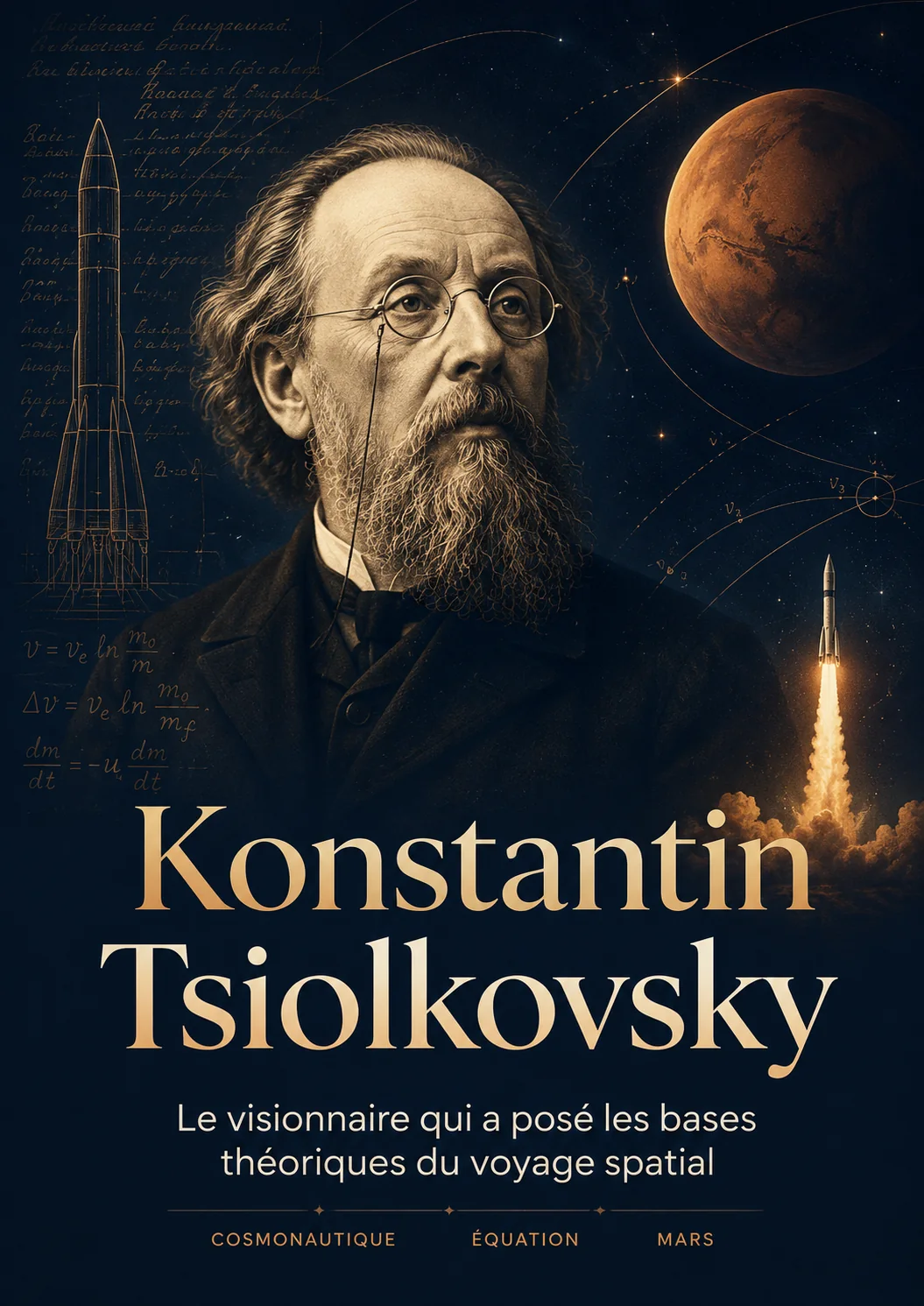
In modern notation the ideal rocket equation is commonly written as Δv = ve × ln(m0/mf). The Greek capital delta, Δ, means a change; Δv therefore represents the ideal change in velocity produced by the propulsion system. ve is effective exhaust velocity. m0 is the initial vehicle mass and mf the final mass after propellant has been consumed. ln is the natural logarithm. NASA explicitly identifies this relationship as the ideal or Tsiolkovsky rocket equation. NASA
The formula contains a severe engineering lesson. Performance does not rise linearly with propellant mass. The mass ratio appears inside a logarithm. To obtain ever more velocity change, a vehicle needs increasing propellant fraction or greater exhaust velocity. Yet more propellant requires tanks and structure, which themselves add mass. The equation turns the intuitive suggestion “add more fuel” into a systems optimization problem. NASA Glenn
That is why dry mass is so expensive. Every kilogram of tanks, landing gear, shielding or payload must be accelerated through every relevant burn. A Mars architecture can therefore be transformed by reducing structural mass, improving propulsion or producing consumables at the destination. Tsiolkovsky’s equation is not a historical curiosity; it is a recurring constraint in mission design. NASA Glenn
A worked example: how mass ratio turns into kilometers per second
Consider an idealized stage with an effective exhaust velocity of 4,400 meters per second. Suppose the initial mass m0 is 100 tonnes and the final mass mf after propellant consumption is 25 tonnes. The mass ratio is 100/25 = 4. The natural logarithm of 4 is approximately 1.386. The ideal velocity change is therefore 4,400 × 1.386 ≈ 6,098 m/s, or about 6.1 km/s. NASA Glenn
This value is not a travel distance and not necessarily the spacecraft’s final absolute speed. It is a propulsion budget: the amount by which the vehicle can change its velocity in the ideal model. Real missions subtract gravity, drag, steering and reserve margins. They combine several burns to reach orbit, depart from it, correct trajectories and arrive at destinations. Delta-v therefore functions like a currency of orbital mechanics. NASA
Change only the final mass to 35 tonnes while leaving initial mass at 100 tonnes. The ratio becomes about 2.857 and the natural logarithm roughly 1.05. Ideal delta-v falls to around 4.62 km/s. Ten tonnes of extra dry mass have removed almost 1.5 km/s of capability in this simplified example. This is why engineers pursue lighter structures and why producing propellant on Mars can reshape an entire return architecture. NASA Glenn
Why staging becomes almost unavoidable
The rocket equation naturally leads to staging. Once a tank or engine has completed its role, continuing to accelerate it wastes propellant. Discarding dead mass allows the next stage to begin with a better mass ratio. Tsiolkovsky analyzed multistage concepts early and made the logic part of theoretical astronautics. ESA NASA
Staging also creates new failure modes. Stages must separate cleanly, the upper engine must ignite, attitude must remain controlled and structural interfaces must survive the transition. A single-stage vehicle is organizationally simpler, but chemical propulsion and terrestrial gravity make the required mass fraction extremely demanding. Twentieth-century launch systems therefore relied heavily on stages or discardable boosters. NASA Glenn
Mars mission design generalizes the idea. Launch vehicle, departure stage, cruise habitat, entry vehicle, surface habitat and ascent vehicle may each exist only for one phase. Functional staging is therefore as important as physical rocket staging. Tsiolkovsky’s basic lesson is that mass which has finished its job should not automatically be carried forever. NASA History
The mass-ratio trap: why extra propellant eventually becomes propellant carried for propellant
The logarithm in the rocket equation creates diminishing returns. Add propellant and the vehicle can gain more velocity, but the added propellant itself must be accelerated during the early part of the burn. Larger tanks add structure; heavier structure may require more thrust; more thrust can increase engine and support mass. The first answer to insufficient performance — simply add fuel — quickly becomes a recursive mass problem. NASA Rocket Equation
Staging, higher exhaust velocity and rendezvous architectures are methods for escaping parts of that trap. Instead of carrying one enormous vehicle through every phase, designers distribute functions and discard or park hardware when it is no longer required. Apollo did this dramatically, and Mars studies extend the principle through specialized transfer, descent and ascent systems. NASA History
In-situ resource utilization is another response. If oxygen, water or methane can be produced from Martian resources, some consumable mass no longer has to be launched from Earth. Tsiolkovsky did not design modern ISRU plants, but the equation bearing his name explains why local production is so valuable. It changes the mass that must pass through the deepest part of the gravity well. NASA Glenn
Orbital stations: turning space from a trajectory into a place
Tsiolkovsky’s vision extended well beyond rockets. NASA’s history of space stations notes early depictions of people living in orbit and links later station thinking to pioneers such as Tsiolkovsky. The conceptual leap is important. If every mission is only a departure followed by a return, space remains a route. A station turns it into a location where people can work, observe and prepare further activity. NASA — Historical Origins of ISS
Once an installation already exists in orbit, much of the energy required to lift it from Earth has already been paid. It can function as a laboratory, logistics node or staging point. Tsiolkovsky also considered rotation as a means of generating artificial gravity. The physics is straightforward: rotation produces centripetal acceleration that occupants perceive against the outer wall. Practical design depends on radius, rotation rate, structure and human tolerance. ESA
Salyut, Mir and the International Space Station realized only a fraction of these ideas. They are not interplanetary ports in the full visionary sense, but they proved that human presence can be maintained for years through resupply, maintenance and crew turnover. The station therefore became a real laboratory for environmental control, physiology and remote operations — problems Tsiolkovsky had already identified in principle. NASA
Airlocks and closed biological loops: thinking of a colony as an artificial ecology
ESA lists airlocks, spacesuits and closed biological systems among Tsiolkovsky’s concepts. The common theme is environmental separation. A short flight can operate by carrying stocks of oxygen, water and food. A durable settlement must increasingly recycle. Exhaled carbon dioxide, wastewater, nutrients and solid waste become streams to be processed rather than simply discarded. ESA
Closing loops improves mass efficiency but increases dependence on equipment reliability. A nearly open system can survive a failed recycler by consuming stored reserves. A highly closed system needs redundancy, maintainability and careful control of contaminants. Mars settlements will therefore trade recycling efficiency against spare mass, energy use and repair capability. Tsiolkovsky could not know modern membranes, catalysts or microbiology, but he saw the strategic direction correctly. ESA
The airlock is the same systems idea at a boundary. Going outside is not simply opening a door. Pressure volumes must be isolated, gas losses limited and contamination managed. On Mars the exterior is not vacuum, but it remains incompatible with unprotected human life. The settlement is therefore an engineered island whose boundary must be deliberately controlled. ESA
Solar power and infrastructure: thinking beyond propulsion
Tsiolkovsky also considered the use of solar energy in space. The reasoning was farsighted. A spacecraft can receive continuous or repeated sunlight without carrying chemical fuel solely to produce electricity. Photovoltaic technology did not yet exist in its modern form, but the systems insight was correct: propulsion solves transportation, while long-duration activity requires an independent energy architecture. NASA History
Later satellites and the International Space Station would make solar power ordinary. Mars complicates the picture through greater distance from the Sun, atmospheric dust and seasonal variation, leading modern architectures to consider combinations of solar and nuclear power. The current solution is more nuanced than Tsiolkovsky’s era could anticipate, but the category remains the same: sustained presence depends on continuous power after the main engines are silent. NASA
This separation between transportation energy and habitation energy is essential. A high-thrust chemical stage can deliver a vehicle and then become useless as a power plant for a 500-day surface stay. A solar or nuclear source provides little launch thrust yet may be indispensable to life support, communications and industry. Tsiolkovsky’s broad astronautical vision recognized that a civilization needs multiple energy systems. ESA
Atmospheric return: realizing that the outbound journey is only half the mission
NASA histories note that Tsiolkovsky considered the heating problem of an object returning to Earth. The issue is fundamental. Reaching orbit requires large velocity; coming home means safely dissipating a large amount of kinetic energy. A spacecraft architecture that addresses departure but ignores return is incomplete. NASA Challenge to Apollo
Reentry would later become an engineering discipline through ballistic missiles and crew capsules. Heating depends on velocity, atmospheric density, vehicle shape and trajectory. Ablative shields and reusable thermal-protection systems provide different solutions. Tsiolkovsky could not design Apollo’s heat shield, but he recognized that spaceflight creates a distinct atmospheric-entry problem. NASA
Mars makes the problem especially difficult for heavy payloads. The atmosphere is dense enough to produce substantial heating yet thin enough that parachutes alone struggle to land very large masses. Modern entry, descent and landing design is therefore a direct extension of the principle that a space journey must be analyzed as a complete chain, including arrival and return. NASA History
Publishing before an astronautics community existed
Tsiolkovsky’s ideas circulated slowly. Early work appeared in Russian journals with limited international reach. Publications were sometimes fragmented or delayed, and one journal closure interrupted the continuation of his major 1903 article. This helps explain why his immediate world influence was smaller than his posthumous reputation might suggest. The work became much more visible when Soviet institutions and later historians systematically presented it as part of the genealogy of cosmonautics. NASA Challenge to Apollo
The history illustrates the role of language and publication networks in innovation. A correct equation that remains unknown cannot influence a foreign laboratory. Oberth in the German-speaking world and Goddard in the United States independently developed related insights. Astronautics therefore emerged from several intellectual centers rather than one inventor from whom everything simply diffused. NASA rocket history
Independent convergence is historically significant. When researchers in different environments conclude that spaceflight requires reaction propulsion, large exhaust velocity and often liquid propellants, the agreement suggests that the architecture is strongly constrained by physics rather than by local fashion. NASA Glenn
1917–1921: revolution, delayed recognition and a Soviet pension
The Russian Revolution transformed the institutional world around Tsiolkovsky. After a period of upheaval, Soviet authorities increasingly recognized his work. NASA records that he received a lifetime pension in 1921, allowing him to retire from teaching and devote more time to research. ESA also describes his growing official status. NASA ESA
The recognition fit the new state’s rhetoric of science, industrial modernization and mastery of nature. A self-taught thinker who had imagined interplanetary travel offered a powerful symbol even before the Soviet Union possessed the rockets needed to realize his ideas. Tsiolkovsky gradually became an ancestor of cosmonautics before modern Soviet cosmonautics existed. NASA History
Hindsight can make this process look inevitable. It was not. Tsiolkovsky died in 1935, before the R-7, before Korolev became Chief Designer and before an integrated Soviet space program. His influence was intellectual and cultural rather than managerial. He supplied a language of possibilities that later generations could adopt. NASA Sputnik History
From Tsiolkovsky to Korolev: influence, national memory and intellectual continuity
Soviet engineers of the interwar period knew Tsiolkovsky’s work, and later memory strongly linked his name with Sergei Korolev. NASA notes that his ideas inspired future Soviet engineers and scientists. Yet a simple arrow from Tsiolkovsky’s books to Sputnik would be misleading. Korolev also came through aviation, experimental rocket groups, military requirements and collaboration with engineers such as Friedrich Tsander and Valentin Glushko. Influence was one ingredient, not a complete design transfer. NASA
The strongest continuity may have been legitimacy. Tsiolkovsky had shown decades earlier that space travel could be discussed scientifically. Engineers attempting to build rockets in the 1920s and 1930s therefore had a national theoretical predecessor whose work gave historical depth to their ambitions. That memory became part of Russian and Soviet technological identity. NASA History
After Sputnik and Gagarin, the state naturally amplified this lineage. Success made Tsiolkovsky appear prophetic. Posthumous fame simplified a complicated body of work into symbols that could be taught and celebrated. A serious biography should preserve both truths: real intellectual influence and later construction of a national founding myth. NASA
Russian cosmism and astronautics: an intellectual relationship that requires caution
Connections between Tsiolkovsky and Russian cosmism attract attention because they give astronautics an unexpectedly philosophical background. Nikolai Fyodorov wrote about humanity’s collective future and the transformation of nature. Tsiolkovsky encountered this environment during his Moscow years. Yet his mechanics cannot be reduced to philosophy. Conservation of momentum and the rocket equation are physical relationships that stand or fall independently of any cosmological worldview. ESA
Philosophy may nevertheless help explain why he pushed the consequences of technology so far. Many physicists might calculate a rocket and stop there. Tsiolkovsky connected rockets to orbital settlements, biological loops and the future of the species. For him engineering was part of a much larger human trajectory. NASA
Similar ambitions appear today in some Mars-settlement rhetoric. They can motivate engineering, but they can also encourage underestimation of political, biological and social difficulty. Tsiolkovsky is therefore useful precisely because he forces readers to distinguish the mobilizing power of a vision from the technical evidence required to realize it. ESA
Science fiction, philosophy and human expansion: vision is not the same thing as demonstration
Tsiolkovsky wrote not only equations but also speculative and fictional texts about humanity’s future beyond Earth. ESA describes hundreds of works on space travel and related subjects, including visions of colonies and long-term expansion. Those writings explain much of his cultural influence, but they must be separated from his mechanical results. ESA
The famous statement that Earth is humanity’s cradle but that one cannot live in a cradle forever comes from a 1911 letter according to NASA. It condenses a philosophy of expansion: space is not merely a scientific destination but a possible next phase in the history of the species. That idea would influence astronautical culture for generations and appears again today in arguments for Mars settlement. NASA
Critical reading prevents every long-term projection from becoming a scientific prediction. Scenarios involving millions of years, biological transformation or expansion to other stars belong to speculative philosophy. Their value is to enlarge the space of questions, not to provide a schedule. Tsiolkovsky’s strength lies partly in the coexistence of enormous imagination with a smaller set of mechanical results that remain independently verifiable. ESA
1935: death in Kaluga and transformation into a national ancestor of spaceflight
Tsiolkovsky died in Kaluga in September 1935 at the age of seventy-eight. He received official recognition and became progressively embedded in Soviet scientific memory. A lunar crater bears his name, and Kaluga became a major site of commemoration. Yet he died before the events that would give his ideas spectacular validation: long-range ballistic missiles, artificial satellites and human orbital flight. ESA
The chronology shows that a pioneer may die before industrialization of the field. Unlike von Braun, Tsiolkovsky did not direct a giant program that embodied his ideas. His legacy travelled through texts, equations and culture. That form of influence is diffuse but durable. The rocket equation remains standard even for engineers who know little of his life. NASA
There are therefore two Tsiolkovskys in public memory: the theorist whose mechanical analysis became a standard tool, and the visionary whose imagined civilizations expanded the horizon of astronautics. A long biography should preserve both without allowing one to masquerade as the other. NASA History
Tsiolkovsky and Mars: the general grammar of an interplanetary civilization
Tsiolkovsky did not leave a modern Mars mission plan with a launch date, payload table and descent architecture. His relevance is more fundamental. High-exhaust-velocity rockets, staging, orbital habitats, airlocks, suits, biological recycling and solar energy are categories that a Mars architecture still has to combine. He did not provide the dimensions of a contemporary methane lander or nuclear surface reactor; he identified families of problem. ESA
The rocket equation imposes discipline on Mars dreams. Every mass sent toward Mars must be accelerated, redirected or landed. Every kilogram of dry structure reduces the fraction available to other functions. Modern missions can use aerobraking, electric propulsion or local resource production to change the budget, but they cannot abolish momentum conservation. NASA Rocket Equation
Tsiolkovsky also reminds us that settlement is more than a successful one-way trip. A durable presence needs energy, air, water, food, maintenance and environmental boundaries. The move from vehicle to civilization is exactly what makes his broad work still relevant to any serious discussion of living on Mars. ESA
What he saw correctly, what he could not know and why the distinction matters
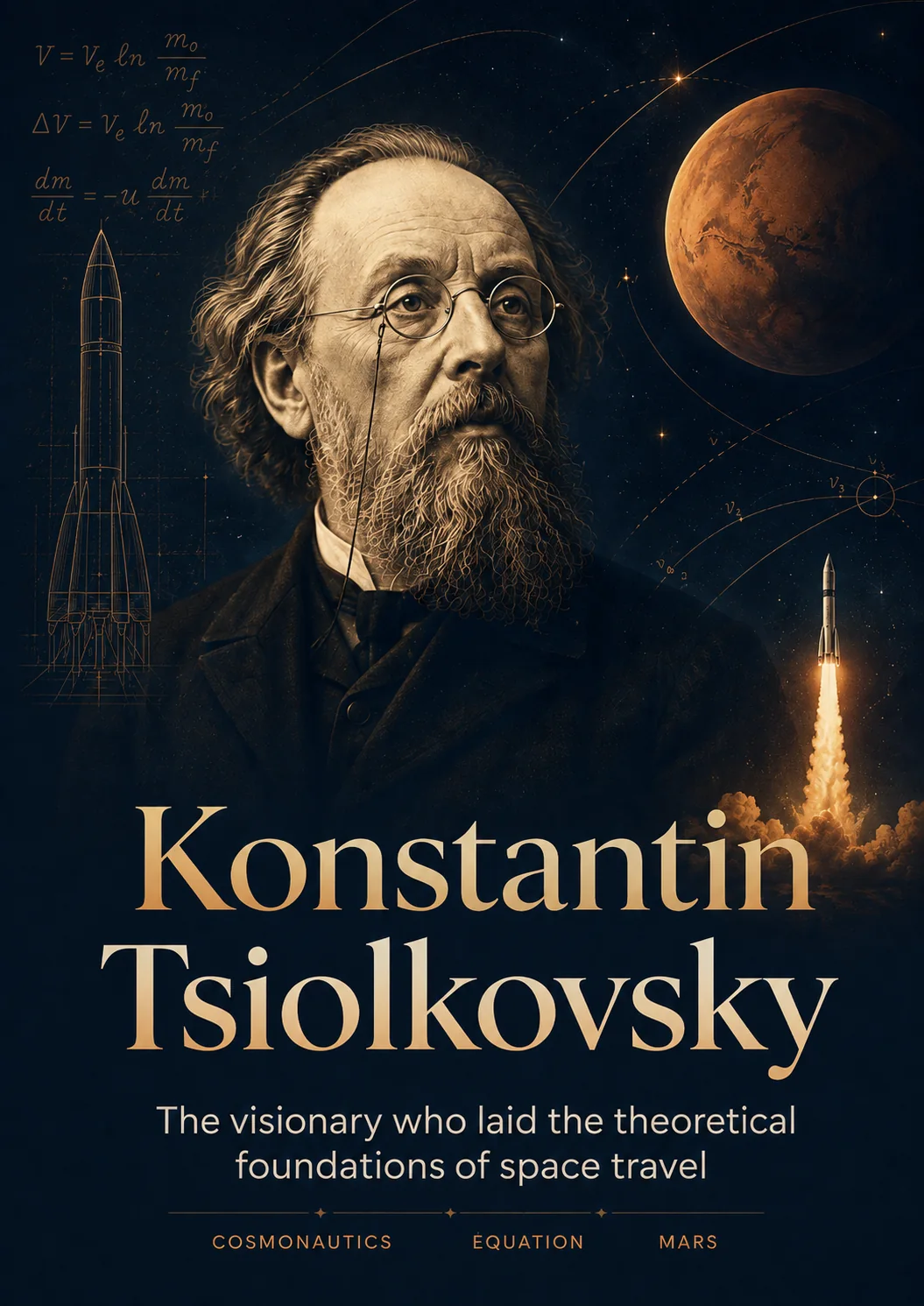
A serious biography should resist selecting only predictions that later came true. Tsiolkovsky anticipated liquid rockets, staging, stations, extravehicular activity and closed life-support concepts with remarkable breadth. He also wrote before modern radiation science, digital electronics, detailed Mars data and long-duration human spaceflight experience. Many implementation details were therefore missing, unrealistic or simply unknowable. NASA History
A pioneer’s value does not depend on guessing every feature of the future. It depends on the quality of the problems formulated and the tools left behind. The rocket equation remains useful because it derives from mechanics. His social and biological projections are more contingent because they depend on economics, ethics, physiology and politics. Preserving that hierarchy protects him from opposite caricatures: infallible prophet or irrelevant dreamer. NASA
The method also applies to modern Mars plans. A proposal may contain exact orbital mechanics while making uncertain assumptions about life-support reliability, launch cost or maintenance. Tsiolkovsky’s legacy therefore encourages readers to classify claims by evidence rather than treating all numbers in an architecture as equally secure. NASA
Museums, quotations and memory: how a theorist became the ancestor of a space power
After Soviet space successes, Tsiolkovsky’s public image expanded dramatically. Kaluga museums, monuments, textbooks and lunar naming turned the theorist into a national ancestor of cosmonautics. The recognition is understandable, but public memory necessarily compresses a complicated life into a few symbols: the equation, the cradle of humanity, the liquid rocket and cosmic settlement. ESA
An open long-form biography can restore the contradictions. Tsiolkovsky was both an isolated autodidact and a thinker later adopted by the state; rigorous on some mechanical questions and extravagantly speculative on others; a provincial teacher who thought at Solar-System scale. That plurality is more interesting than a frozen portrait of the “father of astronautics.” NASA History
His memory also shows how nations organize technological ancestry. Americans name a NASA center after Goddard, Russian and Soviet culture celebrates Tsiolkovsky, and German and European history remembers Oberth. These traditions matter, while actual astronautics emerged through independent discoveries and cross-border circulation. NASA Rocket History
Reading a Mars architecture through Tsiolkovsky: propulsion, power, habitat and autonomy in one system
Imagine a human Mars mission as a table of functions. Propulsion provides delta-v. Staging prevents useless mass from being carried forever. A cruise habitat protects the crew. Airlocks control the boundary with vacuum or Mars atmosphere. Recycling closes part of the water and oxygen loops. Solar or nuclear power runs systems after the main engines shut down. Artificial gravity might reduce some physiological risks during transit. Nearly all of these categories appear in primitive form in Tsiolkovsky’s conceptual universe. ESA
What is missing is equally informative. He did not know galactic cosmic radiation with modern precision, lacked detailed Martian geology, could not anticipate semiconductor computing and had no experience with autonomous software. A real Mars architecture therefore combines his general grammar with a century of new science. The useful tribute is not to claim that he predicted everything, but to measure how many structural questions he posed correctly. NASA History
That makes Tsiolkovsky a strong teaching figure. His work links one compact equation to a civilizational consequence: mass constrains choices, choices produce architecture, and architecture determines what a society can actually do beyond Earth. That causal chain is still central to evaluating serious settlement proposals. NASA Glenn
A legacy that crosses the century: from Kaluga to modern mission calculators
The most powerful sign of Tsiolkovsky’s legacy is not a monument but the presence of his equation in mission software, engineering courses and back-of-the-envelope design studies. A student calculating delta-v uses a relationship whose structure was formulated before powered aviation matured. Materials, computers, engines and organizations changed; the underlying mass constraint did not. NASA Glenn
His station concepts also found partial realization. Salyut, Mir and the ISS are not the giant orbital settlements of speculative writing, but they demonstrate that a human habitat can persist in orbit through repeated crews, maintenance and resupply. NASA explicitly traces the long historical roots of orbital-station thinking back to early visionaries including Tsiolkovsky. NASA
The most productive way to read him today is therefore as a generator of questions. How much velocity change is needed? What mass can be discarded? How do people live without ordinary gravity? How is air recycled? Where does power come from? How is the boundary with the exterior managed? What infrastructure prepares the next step? These remain the skeleton of interplanetary architecture. ESA
Where the equation comes from: momentum conservation in a machine that is losing mass
The mathematical difficulty of a rocket is that its mass changes while it accelerates. For an ordinary vehicle, mass can often be treated as nearly constant and Newton’s second law used in familiar form. A rocket continuously expels propellant. Over a short interval, a small mass element leaves the vehicle at a relative exhaust velocity, and momentum conservation connects that ejected mass with a small change in vehicle velocity. Integrating those changes from initial to final mass produces the natural logarithm in the ideal rocket equation. NASA Glenn
The logarithm is therefore not arbitrary mathematical decoration. It records the fact that every kilogram of propellant acts on a vehicle whose mass differs from the previous instant. Early propellant must accelerate the nearly full rocket; late propellant accelerates a lighter one. Integration adds those unequal increments correctly. NASA Glenn
The derivation also clarifies the model’s limits. Gravity, drag, pressure losses, steering and reserve margins are not automatically represented in the simple ideal equation. The equation isolates the propulsion core; real mission analysis adds the environment. Tsiolkovsky’s pedagogical power lies in exactly that separation: one general relationship, then layers of real-world correction. NASA
Orbital velocity versus escape velocity: reaching about 8 km/s is not the same as escaping Earth
Tsiolkovsky biographies often connect his work with the roughly 8 km/s scale of low Earth orbit. That value must be distinguished from Earth-surface escape velocity, about 11.2 km/s in a simplified model. Orbit is not an escape from gravity. It is continuous free fall around Earth. The spacecraft has enough sideways speed that the planet’s surface curves away as rapidly as the vehicle falls. ESA
The distinction changes Mars architecture. A launcher does not have to acquire escape velocity in one uninterrupted burn. It can enter orbit, assemble or refuel there, and later perform an interplanetary injection. Space missions are sequences of orbital states and maneuvers rather than projectiles simply “going up” until they reach another planet. NASA Rocket Equation
Tsiolkovsky helped establish this velocity-centered way of thinking. Altitude alone is not enough. A vehicle hundreds of kilometers high without orbital speed falls back; a vehicle at the same altitude with roughly orbital velocity remains in free fall around Earth. Understanding that difference is one of the conceptual gateways to interplanetary mechanics. NASA History
Liquid hydrogen: thermodynamic insight before tanks, pumps and test stands could make it practical
Tsiolkovsky identified the potential of liquid hydrogen and liquid oxygen unusually early. The attraction comes from exhaust performance: light combustion products and high energy can support high effective exhaust velocity. Recognizing an energetic optimum, however, is not the same as building an engine. Hydrogen is difficult to liquefy, extremely cold, low in density and prone to leakage. Industrial infrastructure would lag theoretical attraction by decades. NASA — hydrogen development
The history shows the complementarity of theory and industrial capability. Tsiolkovsky could identify a promising direction without having suitable alloys, turbopumps, insulation or large-scale cryogenic test facilities. Practical high-performance hydrogen propulsion became possible only after a much broader technological ecosystem matured. NASA
Mars design makes the tradeoff vivid. Hydrogen offers excellent specific impulse but difficult long-duration storage. Methane has lower performance but can be easier to store and may be produced from Martian resources. The rocket equation provides one part of the decision; logistics and operations provide another. NASA Glenn
From isolated theorist to network: Perelman, Tsander and the generations that turned ideas into a movement
Tsiolkovsky worked in isolation for long periods, but his ideas eventually circulated through popular writers and young engineers. Smithsonian material highlights Yakov Perelman’s role in popularizing spaceflight in Russian and Friedrich Tsander’s place among pioneers who connected theoretical astronautics with experimental rocket work. Such intermediaries created a bridge from the teacher in Kaluga to the organized groups of the 1920s and 1930s. Smithsonian — Innovative People in Early Rocketry
The transmission was never a simple one-author lineage. Young engineers read multiple sources, came through aviation and military work, and incorporated foreign information. Tsiolkovsky nevertheless gave the project national intellectual legitimacy. Russian engineers could point to a domestic theorist who had treated spaceflight scientifically before modern missiles existed. NASA Sputnik History
The cultural function resembles Oberth’s role in the German-speaking world. Theory becomes powerful when it produces communities able to test and extend it. Mars settlement will require the same multiplication of actors across engineering, biology, medicine, geology and operations. Smithsonian
Settling space: a mobilizing vision and ethical questions that mechanics cannot solve
Tsiolkovsky often treated human expansion into the cosmos as a positive long-term trajectory. That conviction gave his writing enormous imaginative force, but it is not an ethical proof. The technical ability to alter an environment or settle a planet does not automatically answer questions about scientific responsibility, planetary protection or political organization. ESA
Mars makes those questions concrete. A world that appears sterile may still preserve ancient biosignatures or hard-to-detect niches. Human settlement would introduce microbes, industrial chemistry and excavation. Site selection therefore cannot be a delta-v calculation alone. It includes choices about contamination, governance and preservation of scientific evidence. Tsiolkovsky’s tools can help create access; they do not determine how access should be used. NASA History
The distinction belongs in any serious settlement encyclopedia. Science can calculate tank mass or artificial-gravity acceleration and estimate biological risks. The balance among cautious exploration, intensive resource use and permanent settlement is also political and ethical. Tsiolkovsky supplied part of the technical grammar of space civilization; future societies will still have to write the rules. NASA
Why stages exist: a worked example that turns the equation into architecture
Tsiolkovsky’s equation becomes far more intuitive when it is used to compare a single-stage rocket with a multistage vehicle. Imagine an effective exhaust velocity of 3,400 meters per second. To obtain 9,500 meters per second of ideal delta-v in one stage, the required mass ratio is exp(9,500 / 3,400), or roughly 16.3. Initial mass would have to exceed final mass by more than a factor of sixteen. If structure, engines, tanks and payload together represent more than about six percent of liftoff mass, the architecture rapidly becomes impossible.
Two stages can escape this trap because part of the structure is discarded on the way. Suppose, as a teaching example, that each stage supplies about 4,750 meters per second. With the same effective exhaust velocity, the ideal mass ratio for each stage is exp(4,750 / 3,400), or about 4.04. That does not mean the complete vehicle becomes four times lighter, because stage masses are nested and real flight still includes gravity and aerodynamic losses. The order of magnitude nevertheless reveals why dropping empty tanks can be preferable to accelerating them all the way to the destination. NASA Glenn — ideal rocket equation
The word “stage” therefore hides an economic and industrial decision. Another stage adds engines, separation mechanisms, interfaces and failure modes. It reduces dead mass after propellant depletion but increases complexity. The right number of stages does not emerge directly from the equation; it is a compromise among performance, reliability, cost, possible recovery and mission constraints.
For Mars the same logic reappears at a larger scale. An architecture can “stage” the mission itself: Earth launch vehicle, orbital depot, transfer ship, entry system, surface habitat and ascent vehicle. Each element can be optimized for its environment instead of forcing one machine to perform the entire journey. Yet every separation creates an interface and therefore a risk. Tsiolkovsky’s mathematics naturally leads from propulsion theory to systems engineering.
Reusability changes the optimum again. A stage intended for recovery must retain propellant, protection and additional hardware. Dry mass increases and some delta-v is spent on return. The operation can still be economically attractive if the hardware flies often enough. The equation sets the physical price; economics decides whether the industrial price is worth paying. NASA
Artificial gravity: from the rotating-station intuition to a Mars-transfer habitat calculation
Tsiolkovsky was among the early thinkers to take large orbital habitats seriously. A problem appears immediately: how can occupants experience weight while the vehicle is in free fall? One answer is rotation. The perceived acceleration is approximately a = ω²r, where a is acceleration, ω is angular velocity in radians per second and r is rotation radius. This simple relation turns the visual idea of a space wheel into a measurable engineering parameter. NASA — space-station history
Consider a habitat with a radius of 50 meters. To generate roughly Martian gravity, about 3.71 meters per second squared, angular velocity must be the square root of 3.71 / 50, approximately 0.272 radian per second. Converting to revolutions per minute by multiplying by 60 / 2π gives roughly 2.6 rpm. This is not a medical prescription: human tolerance depends on head movement, gravity gradients and adaptation. It simply shows how an idea associated with science fiction becomes an engineering variable.
If radius doubles to 100 meters, the rotation rate required for the same acceleration falls to about 1.84 rpm. Large structures can therefore provide a given acceleration with slower rotation. They are also heavier, more difficult to launch or assemble and subject to different structural loads. A Mars-transfer architecture must trade physiological comfort against mass, size and complexity.
The lesson connects directly to Tsiolkovsky’s broader vision. His descriptions of orbital settlements should not be read as construction drawings ready for a factory. Their significance is that they treat living in space as an environment to be designed. A months-long Mars mission is not only a propulsion problem. It requires sleep, exercise, radiation protection, food, sanitation, maintenance, psychology and perhaps artificial gravity. Space settlement begins when these functions become systems rather than accessories.
This is also a useful way to compare modern proposals. One spacecraft may advertise enormous internal volume while leaving the physiological consequences of prolonged microgravity unresolved. Another may propose rotation at the price of complex mechanisms. The centrifugal-acceleration formula does not choose for us. Like the rocket equation, it defines a physical constraint around which engineers must build a compromise. NASA History
The provincial teacher: why education belongs in the origin story of astronautics
Tsiolkovsky did not command a great imperial laboratory. For much of his life he taught mathematics and physics far from major centers of power. That position limited his experimental means but shaped his style of thought. A teacher must decompose a problem, search for general relationships and make abstract ideas visible. His rocket work carries this imprint: it seeks less to describe one particular machine than to establish relationships governing an entire class of machines. ESA
His deafness also increased the importance of solitary work, reading and writing. It would be simplistic to treat disability as a mechanical explanation for achievement, yet it forms part of a life outside conventional academic careers. Tsiolkovsky produced a large body of work without the infrastructure that would later allow Korolev to turn principles into actual vehicles. NASA History
The story matters for Mars because collective capability begins long before a launch pad. It begins in schools, textbooks, clubs, universities and exercises where generations learn how to reason. A civilization capable of maintaining Martian systems will need not merely a few elite engineers but a sufficiently broad technical population to replace specialists, diagnose failures and transmit knowledge.
Tsiolkovsky’s role is therefore pedagogical in a historical sense. He gave readers a grammar with which space travel could be imagined as a calculable problem. Future Soviet programs were not his direct creations, but they developed in an environment where the cosmic rocket already possessed vocabulary, equations and a national genealogy. NASA
The equation contains no margin: why a correct calculation can still produce a fragile mission
Delta-v calculated from the ideal rocket equation can be perfectly correct and still inadequate for real flight. Engineers must add losses, dispersions, trajectory corrections and reserve for unexpected events. An architecture sized exactly to the theoretical value is not necessarily “optimized”; it may simply be vulnerable to the first deviation. NASA
Margin therefore transforms theory into a decision. Ten percent extra propellant may reduce payload but significantly increase robustness. On Mars, where no nearby service station exists, that prudence becomes even more important. Tsiolkovsky supplies the fundamental relationship; modern engineering adds uncertainty statistics and risk management.
A universal equation still requires explicit units
Tsiolkovsky’s relationship is independent of language, but using it requires discipline about units. Exhaust velocity in meters per second must be compared with delta-v expressed in the same unit; mixing kilometers per second with meters per second creates an error by a factor of one thousand. NASA Glenn
This elementary point becomes crucial in an international Mars mission. Symbols, conventions, interfaces and units must be shared without ambiguity. Spaceflight history has shown that a unit error can destroy a mission. Teaching equations is therefore also teaching technical communication.
The same discipline will continue: every equation will be tied to units, assumptions, a numerical example and an architectural consequence so that readers can reproduce the reasoning instead of merely accepting the result.
Primary and institutional sources
Verification rule: this biography prioritizes institutional, archival and primary sources. Statements about living people or active programs are dated and attributed; uncertain or disputed points must remain explicitly qualified.
- ESA — Konstantin Tsiolkovsky
- NASA — Basics of Space Flight, Rocket Equation
- NASA — Challenge to Apollo
- NASA Glenn — Rocket History: Tsiolkovsky
- ESA — Konstantin Tsiolkovsky
- NASA Science — Basics of Space Flight: Rocket Equation
- NASA Glenn — Rocket History: 20th Century and Beyond
- NASA History — Challenge to Apollo
- NASA Glenn — Modern Rocketry and Tsiolkovsky
- NASA Glenn — Ideal Rocket Equation
- NASA History — Early Space Station Activities
- NASA Glenn — Rocket History and liquid propulsion
- NASA Glenn — Ideal Rocket Equation
- Smithsonian NASM — Innovative People in Early Rocketry
Sources checked for this version on 17 August 2026. Future targets are dated and kept distinct from demonstrated capabilities.