


MARS BIBLE — HISTORY
History of Mars: From a Red Wanderer to the Dream of a Martian Civilization
From the planet’s formation to Starship, 4.5 billion years of geology and millennia of human observation transformed Mars from a red point of light into a possible destination.
For thousands of years Mars has accompanied human history. Long before rockets, probes or settlement plans, it was already one of the most striking objects in the sky: a reddish wandering point that moved against the stars and periodically dominated the night. No single person “discovered” Mars in the way an invisible planet can be discovered. What humanity discovered, century after century, was what that red point actually was.
The history of Mars is therefore a history of successive transformations. First a mythic object, then an astronomical problem, Mars became a mapped world, then a robotic destination, and finally a human engineering problem. The same pattern repeats: observe, interpret, make mistakes, measure better, correct the model, then build new ambitions on firmer ground.
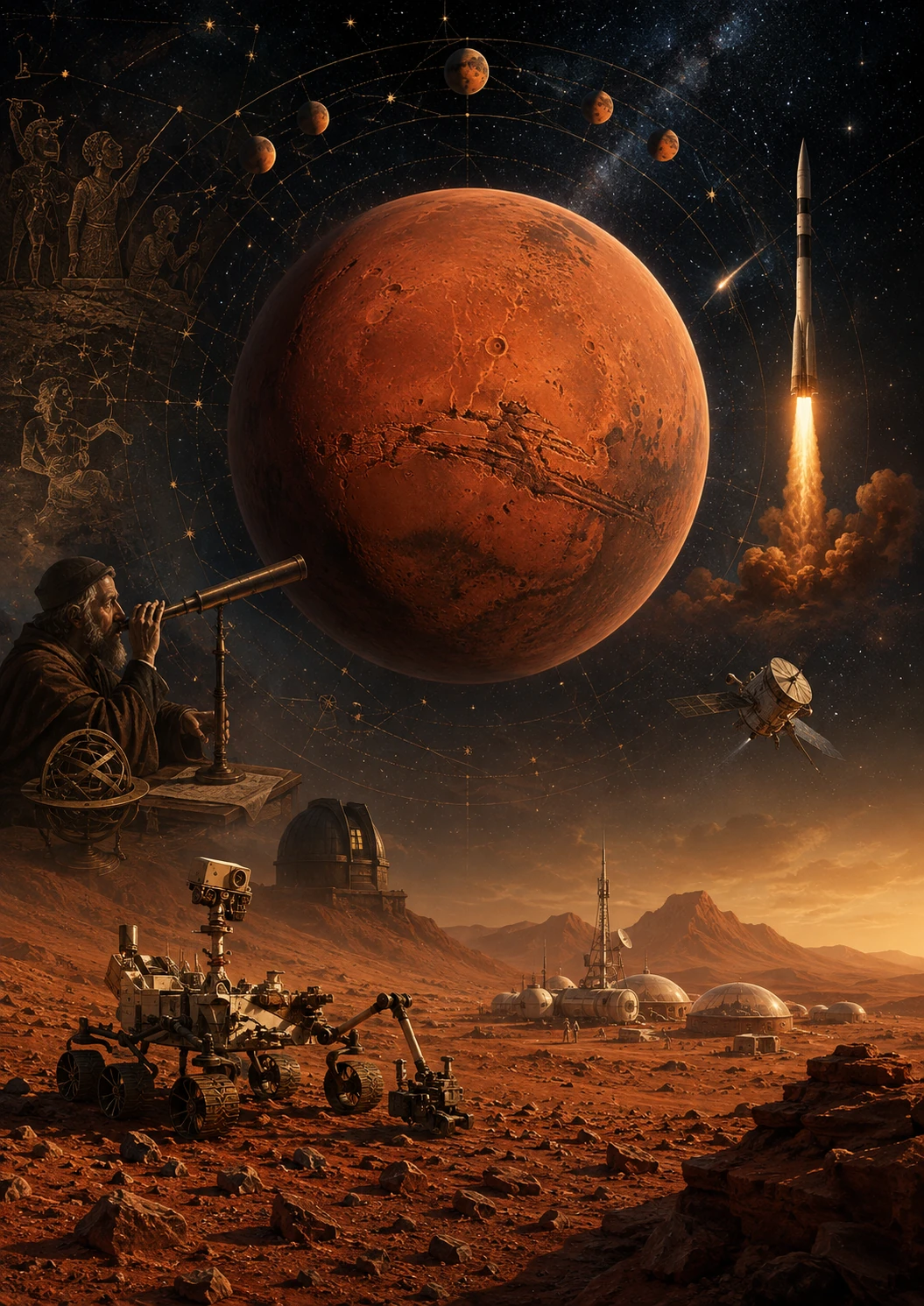
Because Mars was already a famous classical planet. Galileo's breakthrough in 1609-1610 was to turn improved telescopes systematically toward the heavens. The Museo Galileo describes the Sidereus Nuncius as part of that transformation of the telescope into a scientific instrument, while NASA dates his first telescopic observation of Mars to 1610. [S43] [S02] No reliable source establishes a special mysterious reason for choosing Mars; it was an obvious bright planetary target once the sky could finally be magnified.
From antiquity to the first telescopes: why Mars kept demanding better explanations
Mars was not discovered in a single moment. Ancient observers knew it as one of the lights that wandered against the fixed constellations, changed brightness and sometimes appeared to reverse direction. Babylonian tablets preserve actual planetary observations of Mars. [S42] The modern name is Roman: the reddish planet was associated with Mars, god of war, but earlier cultures had already linked the same object to Nergal, the Egyptian “Red One” and Greek Ares. [S41]
From naked-eye astronomy to mapped features and the canal controversy
1 — Mars before modern astronomy
2 — What is a planet?
3 — Galileo, Huygens and Cassini
Schiaparelli, Lowell and the canal era
5 — Phobos and Deimos
The red planet before the telescope: motion, color and memory
From a point of light to a rotating world
Spacecraft rewrite the planet again
The observational story matters because Mars repeatedly sat close to the limit of what an instrument could resolve. Naked-eye observers could establish that it wandered, changed brightness and returned to recognizable configurations, but they could not infer a physical landscape. The telescope changed the question from where Mars was to what kind of world it might be. Galileo’s early views were still tiny and crude, yet the very fact that a planet could present a disk helped sever planetary astronomy from the old picture of fixed lights on a celestial sphere. As optics improved, observers such as Huygens and Cassini could follow surface markings and rotation, while polar brightening and seasonal changes encouraged the idea of a dynamic world. That progress also exposed a permanent scientific danger: more apparent detail does not automatically mean more reliable interpretation. During favorable oppositions in the nineteenth century, observers worked near the combined limits of telescope, atmosphere and human vision. Schiaparelli’s canali became especially influential after the Italian term was rendered in English as canals, a word that carried an artificial implication the original did not require. Lowell then built a coherent civilizational story around a planet supposedly crossed by engineered waterways. The story was wrong, but it was historically productive: it made Mars a destination in the public imagination decades before engineers could seriously calculate an interplanetary mission. The later spacecraft era therefore did more than replace low-resolution maps with photographs. Mariner and Viking forced observers to separate real morphology from visual expectation, while preserving the deeper questions that had made Mars interesting in the first place. The biological question did not disappear with the canals; it became more precise, moving from supposed cities and vegetation to habitability, organic chemistry, ancient water and the preservation of possible biosignatures. Read this way, the pre-rocket centuries are not a decorative prologue. They establish the method that the rest of Mars exploration still uses: measure at the limit, state what the instrument actually resolves, keep interpretation separate from observation, and allow better evidence to overturn an attractive story.
From literature and equations to modern rocketry
The intellectual bridge from astronomy to mission design was built in stages. Tsiolkovsky supplied the mathematical logic of the rocket equation; Oberth and other early theorists treated spaceflight as an engineering problem rather than a literary device; von Braun then worked inside organizations capable of building large propulsion systems. That sequence matters because Mars did not become technically thinkable when one inventor produced a complete plan. It became thinkable when propulsion, guidance, structures, operations and institutional scale could be discussed in the same calculation.
The history also carries an ethical boundary that must not be blurred by later space achievements. The V-2 program combined major technical advances with a dictatorship, war and forced labor that caused immense suffering. Paperclip moved German specialists and knowledge into the United States after 1945, but the later success of Saturn V does not erase the conditions under which part of that expertise had been developed. Mars history is stronger when it preserves both facts at once: the engineering lineage and the human cost of the wartime program.

1 — Tsiolkovsky, Goddard and Oberth
2 — The young von Braun
3 — Peenemünde, V-2 and forced labor
4 — Paperclip and the American transition
5 — The Mars Project
6 — Saturn V and the road not taken
Why rocketry had to become an engineering discipline before Mars could become a plan
Peenemünde and the V-2: technical achievement inside a criminal system
The Mars Project: a fleet, not a single heroic spaceship
Von Braun’s 1950s Mars study imagined interplanetary travel as a fleet assembled in Earth orbit rather than a single vehicle launched directly from the ground. That choice exposed the true systems problem: launch accumulation, orbital assembly, crew support, cargo allocation, landing elements, surface exploration and return all had to work as one campaign. The study’s numbers are historical artifacts rather than current requirements, but its architecture still matters because it made mass flow and mission sequence visible. Modern concepts differ radically in propulsion, automation and knowledge of Mars, yet they still have to close those same categories.
Young Wernher von Braun: how a spaceflight dream became an engineering profession
Wernher von Braun's story becomes much more interesting when it begins before the V-2. In the 1920s there was no space industry, no degree in astronautical engineering and no agency able to hire hundreds of rocket specialists. A young enthusiast therefore had to learn a profession that barely existed, combining books, classical physics, hazardous experiments and a small community trying to turn the idea of spaceflight into a measurable engineering problem.
1925: an incomprehensible book becomes a study programme
NASA's historical biography records a revealing episode. Von Braun encountered Hermann Oberth's work on rockets and interplanetary flight and discovered that he could not follow its mathematics. The important point is not a myth of predestination; it is the mechanism of learning. If he wanted to understand the rocket, he needed mathematics and physics, so those subjects acquired a practical purpose. Spaceflight stopped being only an aspiration and became a reason to master calculation, mechanics and propulsion. NASA Earth Observatory — Wernher von Braun.
Oberth, Riedel and Nebel: early rocketry was a team craft
In Berlin, von Braun entered the circle around the Verein für Raumschiffahrt and assisted Hermann Oberth. Klaus Riedel and Rudolf Nebel matter because they destroy the convenient myth of a lone inventor. Equipment was crude, ignition could be dangerous and materials had to be scavenged. In 1930 a small liquid-oxygen and gasoline engine produced about seven kilograms of thrust for ninety seconds in a certified test. It was not an operational rocket, but it turned liquid propulsion into something that could be measured, repeated and improved. Smithsonian — Oberth Kegeldüse motor.
The Raketenflugplatz that followed was simultaneously workshop, test stand, launch field and informal school. The group did not recruit graduates from an established rocket industry; such an industry did not exist. It assembled people who could solve pieces of the problem: mechanics, students, experimenters, welders and theorists. That distinction matters later at Peenemünde, where the same basic problem — how to coordinate different specialties — scales from a handful of enthusiasts to thousands of workers.
1931: a public failure teaches the logic of diagnosis
One public launch in 1931 is more instructive than a heroic summary. The vehicle moved part-way along its guide and settled back. The team traced the trouble to unreliable pressurisation of the propellant tanks, corrected it and soon achieved repeated flights. The important sequence is symptom → diagnosis → modification → retest. Large rocket programmes later institutionalised this logic, but here it can be seen in a small field outside Berlin, where each failure was valuable only if the team could isolate what it had learned.
1932: the Army does not discover a lone genius; it absorbs an experimental community
There is no need to invent a cinematic scene in which a Nazi official suddenly tells von Braun to work for the regime. The documented transition is more revealing. The German Army had been examining the military potential of rockets; a 1967 Smithsonian oral-history record has von Braun recounting a 1932 demonstration to the Army and his hiring at Kummersdorf that year. Military sponsorship offered what the civilian society could not sustain: secure ranges, money, instrumentation, staff and continuity. Smithsonian — 1967 von Braun interview.
From Kummersdorf to Peenemünde: prototypes, failure analysis and the growth of a rocket organisation
A-1 and A-2: learning at a scale small enough to understand
The German Army's A-1 and A-2 experiments of 1932–34 were still modest compared with the later V-2. The Smithsonian describes liquid-oxygen/alcohol vehicles of roughly 300 kilograms thrust, with two A-2s successfully flown from Borkum in December 1934. Their purpose was not simply to set records. A small vehicle allowed the team to learn combustion, tank pressurisation, control and measurement before committing to a much larger missile.
A-3 failure and the A-5 test vehicle: when a programme must simplify the problem
The four A-3 launches in 1937 failed. That is one of the most useful episodes in the entire development story. The response was not merely to build a larger replacement. The A-5 became a redesigned test vehicle used from 1938 to 1943, including as a platform for guidance development. When a prototype contains too many coupled unknowns, engineers often create a more controllable test article so that causes can be isolated. The Smithsonian explicitly identifies the A-5 as the test bed that followed the four A-3 failures. National Air and Space Museum — V-2 technical history.
Peenemünde: about ninety people become a workforce of thousands
In April 1937 the rocket group, then about ninety people, moved to the much larger Peenemünde facility. By 1942 Peenemünde-East employed roughly five thousand people. This growth explains why the A-4 cannot literally be understood as “von Braun's rocket.” His technical leadership was central, but propulsion, guidance, electronics, aerodynamics, structures, test operations, production drawings and launch procedures required specialists and managers. The history of the vehicle is therefore also a history of recruiting and organising expertise.
Peenemünde's surviving document collections contain reports, memoranda and specialised technical series. They show the emergence of an institution in which knowledge is divided into disciplines and then recombined at interfaces. That management problem — making separate expert groups produce one functioning system — would later become one of the defining features of von Braun's American career. Smithsonian — Peenemünde Document Collection.
1942: two failed launches before the flight that worked
The A-4 did not emerge as an immediate success. The Smithsonian records two failed launches in June and August 1942 before the successful V4 flight of 3 October. That flight demonstrated a complete architecture, but it did not automatically make the missile a production system. Industrial drawings, tooling, reliability, logistics and training still had to follow. The difference between “a prototype flew once” and “a system can be produced and operated repeatedly” is as relevant to modern Mars hardware as it was to wartime rocketry.
Never reduce the history of the V-2 to a technical victory
The V-2 was both a major technical break and a weapon of the Nazi state. Von Braun joined the Nazi Party in 1937 and became a junior SS officer in 1940. After the 1943 bombing of Peenemünde, production moved to the underground Mittelwerk complex connected to Mittelbau-Dora. NASA's current biography states that von Braun visited the Nordhausen area repeatedly, knew the conditions and participated in decisions concerning the use of slave labour. NASA — Wernher von Braun.
The National Air and Space Museum estimates that 20,000 to 25,000 detainees died within the Mittelbau camp system out of roughly 60,000 sent there, and historian Michael Neufeld has estimated that at least 10,000 deaths may be attributed to the V-2 programme at Mittelwerk. Forced labour is therefore part of the production history itself, not an ethical footnote appended after an account of engine performance. Smithsonian — Wonder Weapons and Slave Labor.
1945 and Mars: what was transferred was not only hardware but accumulated experience
At the end of the war, the United States sought not just drawings and captured vehicles but engineers who knew how to test, troubleshoot and operate large liquid-fuel rockets. The Smithsonian records 118 members of the German group eventually sent to the United States under Overcast/Paperclip. Tacit knowledge — how to interpret a failed test, how to prepare a launch, how to recognise a bad subsystem — does not live completely in blueprints.
Only after that continuity is understood does Das Marsprojekt make historical sense. The Library of Congress preserves files for The Mars Project and The Exploration of Mars in the von Braun papers. The man who later calculated a huge interplanetary expedition was not simply a visionary author; he had learned, under radically different moral and political circumstances, how a small experimental circle becomes a large systems organisation. Library of Congress — Wernher Von Braun Papers.
What a large engine actually requires: feed, cooling and control
Saying that the A-4 produced about twenty-five metric tons of thrust barely describes the engineering task. Liquid oxygen and water-alcohol had to enter a chamber at sufficient pressure, the chamber had to survive temperatures near 2,700 °C, and several tonnes of propellant had to be delivered during roughly a minute of operation. Smithsonian artifacts show how cooling passages, injectors, a steam generator and a turbopump turned a “motor” into a complete thermal and hydraulic system. Smithsonian — V-2 turbopump.
Scaling thrust therefore multiplied failure modes. A pump could cavitate or fail to deliver the expected flow; combustion could damage the chamber; mixture changes altered temperature and thrust; plumbing and seals became critical. The history is useful because it shows why “make the engine bigger” is almost never a single design change. Each increase in scale creates new interfaces and new reasons for a test to fail.
Guidance: a perfect engine is useless if the vehicle cannot control itself
The A-4 also needed a control system capable of correcting attitude while its mass and aerodynamic environment changed rapidly. The Smithsonian preserves an air-vane actuator linked to roll control and identifies Helmut Hoelzer as a Peenemünde guidance specialist and computing pioneer. Guidance, electrical engineering and actuation thus became specialties in their own right. Smithsonian — V-2 air-vane actuator.
Recruiting when “rocket engineer” is not yet a profession
Peenemünde had to recruit people from adjacent disciplines. Werner Gengelbach, for example, was an electrical engineer and university researcher in high-voltage work before joining classified rocket projects; in 1942 von Braun invited him to Peenemünde, where he took major responsibilities in testing and launching completed V-2 vehicles. The programme therefore did not search for people who had already built large rockets. It searched for deep specialists who could transfer their knowledge into a new system. Smithsonian — Werner K. Gengelbach.
This is why a mature rocket organisation contains aerodynamicists, electrical engineers, guidance specialists, test engineers, production planners and propulsion experts. The Smithsonian's surviving Peenemünde collections include separate aerodynamic-report series as well as memoranda and correspondence. Knowledge is divided into disciplines and then has to be recombined at interfaces. Von Braun increasingly became a manager of that recombination.
Prototype success is not production readiness
The successful October 1942 flight did not make the A-4 an operational product. Production required drawings, tooling, configuration control, repeatable tests and trained operators. Smithsonian histories estimate that an A-4 at Peenemünde could require ten to twenty thousand man-hours, later reduced at Mittelwerk. That industrial story is inseparable from the criminal exploitation of concentration-camp labour there, but it also exposes a general systems lesson: a vehicle demonstrated once is not yet a capability that can be reproduced and operated reliably.
Spacecraft reach Mars: from Mariner correction to Viking surface operations
Public imagination becomes part of the engineering ecosystem
1969: Mars appears on the horizon immediately after the Moon
Mariner 4: the first close-up correction
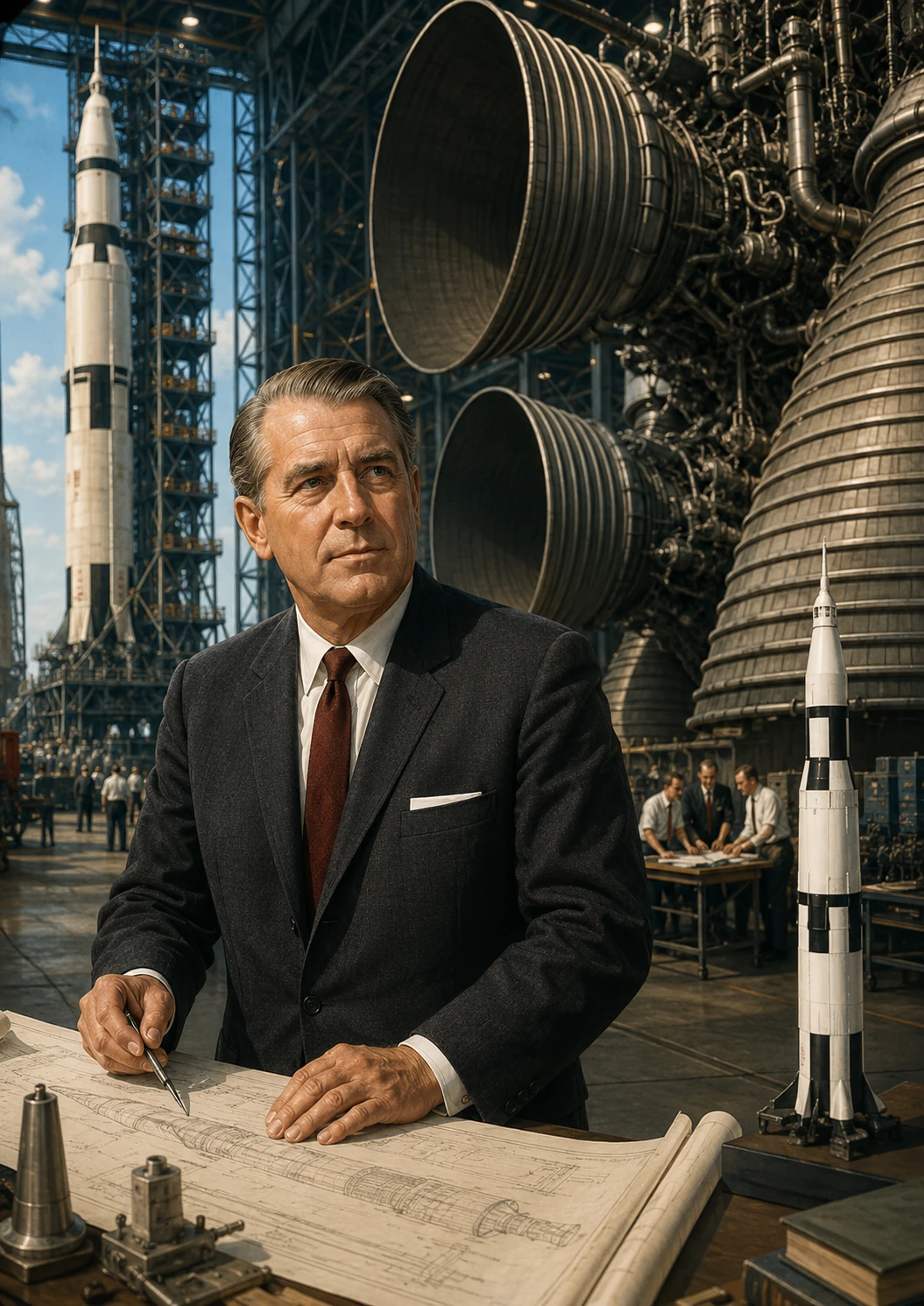
Mariner 4’s 1965 flyby produced the first close-range images of Mars and helped overturn the popular expectation of an Earth-like world with obvious surface infrastructure or vegetation. Its small image set showed heavily cratered terrain and its radio-occultation experiment supported a much thinner atmosphere than earlier optimistic interpretations had assumed. The mission did not reveal the whole planet; that is precisely why it is historically important. It demonstrated how a limited but direct measurement could invalidate an attractive model while still leaving major regional and geological questions unresolved.
Mariner 9: complexity returns
Mariner 9 corrected the correction. After arriving during a global dust storm, the orbiter eventually mapped volcanic provinces, Valles Marineris, channels and other large-scale features that could not be inferred from Mariner 4’s narrow sample. Mars was still cold and dry at the surface, but it was no longer adequately described as a uniformly lunar-like crater field. This sequence—first close-up evidence, then broader orbital context—is a recurring lesson in planetary exploration: architecture should preserve uncertainty when the dataset covers only a small fraction of the environment.
Viking and surface operations. 4 — Pathfinder, rovers and distributed learning
5 — 1969 And the post-Apollo Mars question
The Space Exploration Initiative
The 1989 Space Exploration Initiative placed human Mars exploration inside a broader national program that also included a return to the Moon. Its later difficulty was not evidence that the physical problem of reaching Mars had been solved and rejected; it showed how architecture, cost, schedule, institutions and political durability interact. Large human-exploration proposals can fail before hardware reaches flight because the coalition needed to sustain them does not survive the implied budget or timescale. Later reference missions therefore worked increasingly hard to expose mass drivers and identify technologies that could reduce the architecture rather than simply enlarge it.
Mars Direct and reference missions: attacking mass and complexity
The Space Exploration Initiative showed another kind of limit: technical possibility does not automatically create a funded program. Large architectures can collapse when their cost, schedule and political coalition are not durable enough. Mars Direct responded by challenging assumptions about assembly and propellant, while NASA design-reference architectures provided common cases against which alternative choices could be compared. A reference architecture is useful precisely because it is not a promise to fly; it is a structured benchmark for mass, risk, surface stay, logistics and technology decisions.
That distinction remains important in 2026. NASA describes the Mars architecture as a trade space with many still-open choices, including propulsion, ascent, surface systems and the relationship between cargo and crew. Some decisions narrow that space, but the agency still presents forward work rather than a single frozen Mars mission. Historically, this is a shift from the iconic vehicle drawings of earlier eras toward an evolving system-of-systems process in which architecture changes as evidence, technology and objectives change.
Master chronology
Mars is visible to the naked eye and receives names linked to its color and to warfare in several cultures.
Mars observations help drive modern celestial mechanics; Kepler uses Tycho Brahe’s measurements to establish the elliptical orbit.
Galileo observes Mars through a telescope. [S02]
Huygens sketches Syrtis Major; Cassini observes polar regions and estimates the Martian day. [S02][S15]
Schiaparelli reports canali and Asaph Hall discovers Phobos and Deimos. [S18]
Percival Lowell popularizes the idea of artificial canals and a Martian civilization. [S16][S17]
Oberth publishes on interplanetary rockets; Goddard flies a liquid-fueled rocket.
The V-2 demonstrates a new scale of propulsion within a Nazi weapons program tied to forced labor. [S19]
von Braun develops and publishes The Mars Project, one of the first detailed human Mars expedition architectures. [S06][S38]
Explorer 1, NASA, Saturn V and Apollo create an unprecedented American industrial space capability. [S08][S21]
Mariner 4 returns the first close-up images of Mars. [S03][S25]
von Braun presents a human Mars architecture during post-Apollo planning. [S24][S39]
Mariner 9 becomes the first orbiter of another planet and reveals a far more complex Mars. [S04]
Viking 1 and 2 conduct successful surface operations and search for signs of life. [S05][S27]
Mars Direct and NASA reference missions attempt to reduce and standardize human Mars architectures. [S30][S31]
SpaceX is founded in a context where Mars becomes a long-term organizing objective.
SpaceX develops and revises Starship while officially presenting Mars as the destination for a durable human presence. [S11][S13]

Mars Oasis and the creation of SpaceX. 2 — Falcon and reuse
3 — Starlink and the Mars narrative
ITS, BFR and Starship. 5 — Mars and Beyond in 2026
6 — Transport is not a colony
Mars as an organizing objective rather than a single mission
Transport is not a colony
Mars today: robotic exploration and human ambition
In 2026 Mars remains, above all, a world explored by robots. Missions have measured its atmosphere, geology, ice, ancient watery environments and the constraints of surface operations. No human has yet traveled there. SpaceX meanwhile continues to describe Starship as a system intended for Earth orbit, the Moon, Mars and beyond, and presents a self-sustaining Martian city as a long-term objective. [S13] That is a declared objective, not a demonstrated capability.
A history that is not finished
Mars has changed status without ever losing its power over the imagination. It has been a god, an omen, a red wandering point, a world of supposed canals, a cratered desert, a geologically complex planet, a robotic laboratory and, today, the destination most often invoked when people discuss a durable human presence beyond Earth.
None of those stages erased the previous ones. Lowell still helps explain the cultural image of Mars; Tsiolkovsky and Oberth explain why interplanetary travel can be treated as a physical problem; von Braun shows that a Mars architecture can be calculated decades before it is practical; Mariner and Viking show how the real planet overturns assumptions; NASA planning demonstrates that budgets and politics shape calendars as strongly as engineering; SpaceX has pushed cadence, reuse and cost back to the center of the debate.
The next historic break may not be the first human footprint. It may be the moment when transport, power, life support and industry operate long enough for a human presence to stop being a visit and become a settlement. That is where history meets the rest of the Delta-Sierra Mars Bible.
Mars before names: a world formed long before there were observers
The history of Mars begins as planetary history, not human history.
Mars formed from solids and planetesimals in the young solar nebula roughly 4.5 billion years ago, while the terrestrial planets were still assembling.
Its smaller mass meant that it lost internal heat more rapidly than Earth and evolved along a different geophysical path.
Ancient valley networks, delta deposits and mineral evidence show that liquid water interacted with the surface in environments very different from the modern cold desert.
The loss of a global magnetic field and the long-term escape of atmosphere helped transform climate and surface conditions. For Mars, consequences propagate.
Volcanism, impacts and crustal evolution produced a planet whose history can be reconstructed from orbital imagery, landed missions and meteorites.
Modern seismology from InSight added direct constraints on the crust, mantle and core, turning planetary biography into a measurable interior model.
From red wanderer to mathematical problem
Long before telescopes, Mars could be recognized because it did not behave like the fixed stellar background.
Night after night the planet changed position relative to familiar star patterns, so patient observers could separate wandering lights from fixed stars.
Its reddish color was conspicuous enough to acquire cultural meanings in several societies, but those names were not universal and should not be collapsed into one Western lineage.
Babylonian astronomical records show that Mars was tracked over repeated intervals, demonstrating disciplined observation before modern gravitational theory existed.
Retrograde motion was especially valuable because it forced models of the heavens to reproduce a conspicuous reversal against the stars. For Mars, consequences propagate.
Opposition made Mars brighter and larger in apparent diameter, concentrating the attention of later telescopic observers at favorable intervals.
The Roman name Mars survived into European scientific language through Latin scholarly traditions; it did not erase the older names by proving them wrong.
Tycho, Kepler and the orbit that refused to behave
Mars became central to the collapse of the perfect-circle model because accurate data made small errors impossible to ignore.
Tycho Brahe accumulated unusually precise naked-eye positional measurements before the telescope became an astronomical instrument.
Johannes Kepler inherited access to a powerful observational record and spent years trying to make Mars fit geometrical expectations.
The residual discrepancies were too large to dismiss once the measurements were trusted, forcing Kepler to reconsider the assumed form of the orbit.
Mars therefore became the planet through which an ellipse replaced a perfect circle in the description of planetary motion. For Mars, consequences propagate.
This episode illustrates a recurring scientific pattern: improved precision does not merely refine a model; sometimes it destroys the model that organized the observations.
The later Newtonian synthesis would explain why Kepler’s empirical laws worked, linking Mars to a universal dynamics rather than a special celestial mechanism.
Galileo and the beginning of physical Mars
The telescope did not instantly reveal canals, continents or a second Earth; it changed what kind of question could be asked.
Galileo adapted and improved the early telescope into a scientific instrument and used it on many targets rather than selecting Mars as a unique obsession.
Mars was nevertheless an obvious member of the classical planetary system and therefore a natural test object once telescopic astronomy began.
With a small aperture and limited magnification, Mars was far more difficult than Jupiter because its apparent disk often remained tiny and atmospheric seeing blurred detail.
Even a modest disk mattered intellectually because it reinforced the idea that a planet was a physical body rather than a perfect point of celestial light. For Mars, consequences propagate.
Later observers such as Huygens and Cassini could exploit better instruments and repeated observations to infer rotation and surface markings.
The scientific importance lies in the chain of instruments and measurements, not in a mythical single night when Mars suddenly became a world.
From Mariner to Viking: the planet corrects the observers
Robotic spacecraft repeatedly overturned confident expectations formed from Earth.
Mariner 4 returned the first close-range images and showed cratered terrain at a time when many popular depictions still imagined a more Earthlike surface.
Mariner 9 arrived during a global dust storm, then revealed volcanoes, canyons and channels as the atmosphere cleared, restoring geological complexity to the planet.
Soviet Mars missions contributed important experience and the first successful soft landing signal, even when surface operation was extremely brief.
Viking combined orbiters and instrumented landers, turning Mars from a distant target into an environment in which long-duration surface science could be conducted. For Mars, consequences propagate.
Later orbiters and rovers progressively mapped water-related minerals, sedimentary environments and atmospheric processes rather than seeking one dramatic answer in isolation.
Each generation changed the boundary conditions of human mission studies because mass, hazards, terrain, atmosphere and resources became better constrained.
Human mission architectures rise and fall with institutions
Technical possibility has never been enough to create a human Mars program.
Von Braun’s postwar Mars studies showed that interplanetary expeditions could be organized into masses, trajectories, fleets and operational phases even with imperfect planetary data.
Apollo demonstrated extraordinary national launch capability but was driven by a geopolitical objective that did not automatically survive the lunar landing.
Post-Apollo proposals repeatedly encountered the cost of developing new systems, maintaining political support and committing to programs lasting beyond electoral cycles.
The Space Exploration Initiative revived human Mars planning in 1989 but also exposed the political danger of architectures associated with enormous long-term cost estimates. For Mars, consequences propagate.
Mars Direct later argued that local resource use and a more constrained architecture could reduce mass and complexity rather than simply scaling Apollo upward.
NASA reference architectures continue to change because propulsion, entry systems, surface power, human health constraints and program strategy continue to change.
Musk and SpaceX: Mars becomes an industrial objective
The SpaceX era is historically important because it reframes Mars around transport cadence and industrial repetition.
Mars Oasis began as a relatively modest concept intended to rekindle public interest, but attempts to buy launch capability exposed how strongly cost constrained the idea.
SpaceX was created around the belief that launch costs and expendable hardware were structural barriers to larger space ambitions.
Falcon development and booster recovery created operational experience in reuse, but reuse alone does not solve life support, radiation, Mars entry or surface industry.
Starlink expanded SpaceX manufacturing and launch cadence and supplies recurring revenue, although it should not be described simplistically as a network invented solely to finance Mars. For Mars, consequences propagate.
ITS, BFR and Starship show a design evolving through changing dimensions, engines, materials and intermediate missions rather than a frozen master plan.
A self-sustaining settlement would require an economic and industrial system on Mars; a successful transport vehicle only lowers one of the barriers.
What the story means today
The most useful history is not a parade of heroes but a record of how knowledge, tools and institutions change constraints.
Ancient observers established regularity without knowing what Mars physically was; telescopic astronomers turned a moving light into a disk with measurable behavior.
Orbital mechanics transformed observations into predictive laws while spacecraft converted speculation into environmental data.
Rocket pioneers made interplanetary travel calculable, but war, national competition and public finance determined which machines were actually built.
Robotic exploration showed that each new measurement could invalidate assumptions embedded in ambitious human plans. For Mars, consequences propagate.
Private launch development has introduced new industrial capabilities and new public goals, while leaving the hardest settlement systems unresolved.
The history is therefore unfinished: every claim about colonization should be read against the long record of ideas that became engineering only when measurement, money and institutions aligned.
Reading the whole arc: why Mars history is a sequence of corrected assumptions
Mars repeatedly rewards observers by making their previous certainty obsolete. The naked-eye planet was predictable enough to support calendars and omen traditions, yet its physical nature remained inaccessible. Telescopes converted a moving light into a tiny disk, but the small disk encouraged generations of over-interpretation. Orbital mechanics made the planet predictable in space while leaving its climate and surface largely unknown. Robotic spacecraft then replaced visual inference with direct measurements, only to reveal a world more geologically diverse than the first close-up images had suggested. This pattern is not embarrassing evidence that science “keeps changing its mind.” It is the normal result of gaining instruments capable of asking questions that older instruments could not answer.
The same pattern appears in mission design. Von Braun could calculate an interplanetary expedition before anyone knew the atmosphere well enough to design a realistic landing system. Mariner measurements improved the atmosphere model and therefore invalidated parts of earlier vehicle concepts. Viking proved that sophisticated surface operations were possible, but it also demonstrated how carefully biology, chemistry and contamination had to be separated. Mars Direct changed the mass logic by treating local resources as part of the architecture. Modern EDL studies, surface-power studies and life-support work keep revising the problem because every new capability changes the trade space. A history written as a straight line toward an inevitable colony would therefore be false; the real history is a sequence of architectures repeatedly tested against better knowledge.
Political institutions follow a similar rhythm. Apollo demonstrated that a nation could mobilize extraordinary resources for a clearly defined geopolitical objective, but it did not create an automatic long-term human exploration program. The Space Exploration Initiative demonstrated how rapidly an ambitious architecture could encounter concern over cost and duration. Private launch companies changed the industrial landscape, yet they did not remove the need for regulation, public contracts, planetary protection or international coordination. The history of Mars therefore cannot be separated into “science” on one side and “politics” on the other. What can be built depends on what can be financed and sustained, and what can be financed depends partly on what a society believes the effort is for.
This is why the modern Mars question remains open. We possess high-resolution orbital maps, meteorological records, rover traverses, seismology, atmospheric escape measurements and decades of mission-design literature. We also possess launch systems and spacecraft capabilities far beyond anything available to the authors of the first Mars studies. Yet the hardest settlement problems remain coupled: transportation, radiation, energy, food, repair, medicine, local manufacturing and governance reinforce one another. History does not tell us that colonization will succeed or fail. It tells us which obstacles were once imaginary, which were solved, which were merely moved elsewhere in the system and which still lack an operational answer.
One final caution runs through the entire chronology. The word ‘Mars’ creates an illusion of continuity because the same name appears in Babylonian records, Roman traditions, telescopic notebooks, NASA mission plans and SpaceX presentations. The object is continuous, but the questions are not. Ancient observers wanted to predict a wandering light; Kepler wanted an orbit that fit precise positions; nineteenth-century astronomers tried to interpret markings on a tiny disk; robotic missions measured atmosphere, geology and chemistry; human-mission architects ask how people, machines and supplies could survive an interplanetary system. Treating all of those activities as one unbroken project of colonization would distort the past. Their connection is historical: each period inherits a better-defined planet and therefore asks a new class of question. That is why this history must move slowly enough for the reader to see the question itself changing, not merely the answer.
That changing question is the thread that makes the story coherent. The reader can follow Mars from a visible wanderer, to a mathematical orbit, to a physical landscape, to an operating environment, and finally to a proposed destination for human settlement. Each transition required a new instrument, a new institution or a new way of organizing evidence, and none was guaranteed in advance.
A final reason to tell the history at length is that Mars repeatedly changes category without changing name. To a Babylonian observer it is a moving red light whose cycles can be recorded. To Kepler it becomes the orbital case that exposes the limits of the circle. To Galileo and later telescopic astronomers it becomes a physical disk whose appearance can be compared over time. To Mariner it becomes a target whose atmosphere and terrain can be measured directly. To Viking it becomes a working environment for a laboratory. To modern mission designers it becomes a destination defined by entry mass, radiation, energy, resources, communications and human physiology. The same word therefore carries different scientific objects across the centuries. A good history makes those transformations visible, because they explain why old claims can be sincere and sophisticated in their own context while still being wrong in light of later measurements.
This long view also changes the way present-day Mars ambitions should be judged. The first question is not whether a proposal sounds futuristic, but which category of evidence supports each part of it. Some facts belong to astronomy and planetary science; some capabilities have flown; some systems exist only as prototypes; some are reference architectures; some are corporate or governmental objectives; some are settlement scenarios that have never been operated anywhere. Keeping those categories separate is not a way to reduce ambition. It is the method that allows ambition to become testable. The entire history of Mars shows the same progression: ideas become engineering only when assumptions are exposed to measurement, failure and revision.
One of the most revealing continuities is the repeated gap between what an era can calculate and what it can observe directly. Kepler could describe the orbit of Mars with extraordinary precision without knowing the planet's geology. Von Braun could calculate interplanetary trajectories and fleet masses before spacecraft had measured the atmosphere closely. Early human-mission studies could estimate transit and propulsion while knowing far less about radiation, dust and local resources than modern teams do. Each generation therefore combines strong knowledge in one domain with deep uncertainty in another. That asymmetry is why historical mission plans should be read neither as naive fantasies nor as blueprints waiting to be executed unchanged. They are engineering responses to the boundary conditions available at a particular moment.
The arrival of robotic spacecraft changed the balance of evidence because Mars itself began to answer questions. A telescope on Earth filters the planet through distance, atmosphere and limited angular resolution. A flyby can measure at close range, an orbiter can return repeatedly, and a lander can test the environment directly. The resulting progression is more than a sequence of better pictures. It is a shift from interpreting appearance to measuring processes: atmospheric density, mineralogy, temperature cycles, radiation, seismic structure, dust behavior and the chemical context of ancient water. Human exploration becomes more plausible only because this robotic archive narrows the set of unknowns that a crewed system would otherwise have to absorb as margin.
History also explains why Mars remains unusually powerful in public culture. It is close enough to reveal seasons, polar caps and landscapes that invite comparison with Earth, yet distant enough to preserve enormous uncertainty for most of the modern era. That combination made it a screen for hopes and fears: canals, dying civilizations, invasion stories, scientific laboratories, frontier settlements and eventually multiplanetary futures. Popular imagination often ran ahead of evidence, but it also helped keep Mars in political and cultural view long enough for governments and companies to invest in real exploration. The challenge for a modern reference site is to preserve that emotional history without allowing imagery to masquerade as measurement.
The current period is therefore historically unusual. We can compare public visions almost immediately with a vast technical record: orbital data, landing histories, engine tests, environmental measurements and published architecture studies. This makes exaggeration easier to detect, but it also makes serious ambition easier to evaluate. A proposal to land large payloads can be compared with known EDL constraints; a claim about local propellant can be compared with resource and chemistry studies; a settlement scenario can be tested against power, life-support and logistics budgets. The result is a history that increasingly merges with engineering analysis. The closer Mars comes to becoming an operational destination, the less useful vague futurism becomes.
The history also becomes clearer when distance itself is treated as a changing technical fact. For ancient observers, Mars was unreachable in every practical sense; distance could be inferred only indirectly. Early modern astronomy made its orbit calculable, but travel remained physically unimaginable. Rocket theory then converted distance into velocity requirements and launch windows. Robotic missions converted it into months of cruise, light-time delays and navigation operations. Human planning converts the same distance into radiation exposure, medical autonomy, food reserves and the impossibility of rapid evacuation. Nothing about the number of kilometers changed, yet the operational meaning of that distance changed repeatedly as technology advanced. This is why a historical narrative should return to the same constraint at different periods: it allows the reader to see progress not as magic but as a gradual change in what the distance demands from a mission.
Mars also played an unusual role in the history of life beyond Earth. Long before spacecraft, canals and seasonal color changes were sometimes interpreted as evidence of vegetation or civilization. Mariner and Viking destroyed many of those specific expectations while making the biological question more scientifically precise. Instead of asking whether telescopes could see engineered canals, researchers began asking whether ancient environments could have supported microbial life, whether organics could be preserved, and how surface chemistry might alter biological measurements. Modern rover missions now investigate sedimentary settings and sample context with a sophistication that earlier observers could not have imagined. The question of life therefore did not disappear when the canal myth collapsed; it migrated from visual speculation into geochemistry, geology and planetary protection.
A similar migration occurred in the human-exploration debate. Early proposals often treated a Mars expedition as the destination of an advanced launch program. Later studies had to absorb environmental realities: a thin atmosphere that is useful for drag but insufficient for conventional heavy parachute landings, radiation that accumulates over long missions, dust that affects mechanisms and power, and communications delays that require autonomy. Each discovery shifts effort from the rocket alone toward an integrated mission system. The result is a useful historical correction to the heroic image of exploration. The farther the destination, the more success depends on quiet subsystems — recycling loops, maintenance procedures, spares, software, navigation and logistics — that rarely dominate public illustrations but determine whether crews survive.
Finally, Mars history is a history of scale. A telescope involves one observer and an instrument; a flyby mission involves a spacecraft and a ground network; a sustained robotic campaign involves orbiters, landers, relays and decades of institutional continuity; a human settlement would require a transport fleet and a surface economy. Each increase in scale creates interfaces that become problems in their own right. Coordination, standardization, production rate and failure recovery become as important as peak performance. This shift from singular object to network is one reason modern colonization proposals cannot be judged by the specifications of a single spacecraft. The history has gradually moved from asking whether Mars can be seen, to whether it can be reached, to whether an entire system can operate there continuously.
That progression is why the page treats chronology as more than a date list. A date matters because it marks a change in evidence, capability or institutional commitment. The reader should be able to ask after every major episode not only 'what happened?' but 'what became possible to know or build afterward that had not been possible before?' That question keeps the narrative focused on genuine historical development rather than accumulating famous names.
That continuity of method is the deepest thread in the story: Mars becomes progressively less mysterious because each generation leaves the next one better instruments, better measurements and better questions.
Rocket theory then converted distance into velocity requirements and launch windows.
A similar migration occurred in the human-exploration debate.
Finally, Mars history is a history of scale.
From a red point to a systems problem: what the long history teaches us
The long chronology of Mars also reveals a change in what counts as a meaningful question. Ancient observers could ask when the red wanderer would rise or reverse its apparent motion. Early modern astronomers could ask which orbit reproduced those positions. Nineteenth-century observers could ask whether markings on the disk changed with the seasons. Spacecraft engineers could ask whether a probe would survive arrival, whether an atmosphere could be measured directly, or whether a lander could transmit from the surface. Human-settlement studies ask a still broader question: can many independent systems remain functional together for years? The questions do not simply become more difficult. They move from observation, to explanation, to intervention, and finally to sustained operation.
That change helps explain why historical milestones should not be ranked only by spectacle. A first close-up image is memorable, but so is a more accurate atmospheric profile that forces engineers to redesign an entry system. A dramatic launch is visible, but an improved navigation model may be what actually makes a later landing possible. A rover photograph can dominate public attention while the less visible accumulation of mineral maps, weather records and radiation measurements quietly changes the feasibility of future human operations. Mars history is therefore partly the history of infrastructure for knowledge: observatories, tracking networks, test facilities, archives, laboratories and data systems that allow each generation to begin from a more accurate model than the previous one.
The same is true socially. Ideas of Mars have repeatedly been shaped by the institutions able to sustain them. Court astronomers, national observatories, military laboratories, civilian space agencies, universities and private companies all ask different questions because they possess different missions, budgets and time horizons. An engineering proposal that appears irrational inside one institution can become reasonable inside another if launch costs, political objectives or acceptable risk change. This is why comparing proposals across decades requires more than comparing vehicle diagrams. The surrounding industrial and political system is part of the architecture even when it is not drawn on the page.
For a future reader, perhaps the most useful lesson is that progress toward Mars has never been monotonic. Programs are canceled, instruments fail, missions disappear during cruise, budgets are redirected and promising architectures are abandoned. Yet knowledge survives many of those interruptions. Tracking techniques migrate to new missions; materials research finds another vehicle; maps remain useful long after the project that funded them has ended. The history therefore contains both discontinuity and accumulation. Human settlement, if it ever occurs, will likely inherit technology and data from many programs that were never designed as direct steps toward a colony.
Seen this way, the modern question is less “when will humanity colonize Mars?” than “which uncertainties are we actually retiring, and which dependencies remain hidden?” That wording is less theatrical but far more useful. It connects the ancient discipline of watching a moving point of light with the modern discipline of testing a complex architecture. In both cases, the decisive act is the same: replace an attractive story with a prediction that can be checked, then revise the model when Mars refuses to behave as expected.
One final way to read this history is as the progressive enlargement of responsibility. An ancient observer could be wrong about Mars without endangering anyone. A nineteenth-century astronomer could publish a mistaken map and eventually be corrected. A robotic mission could fail at great cost but without risking a crew. Human exploration changes the moral weight of every assumption because errors in atmosphere, radiation, reliability or medicine become risks carried by people. Settlement would enlarge that responsibility again: decisions about redundancy, governance, contamination and resource use would affect a community that could not simply evacuate to Earth. The history of Mars therefore moves not only toward more capable machines but toward decisions with larger human consequences.
A history still being written
Mars history does not end with the latest rocket test or mission announcement. Each generation inherits a different planet: the reddish wandering light of antiquity, the telescopic disk of early modern astronomy, the canal world imagined in the nineteenth century, the cratered landscape revealed by Mariner, the geologically diverse planet mapped by orbiters, and now a destination discussed in terms of cargo cadence, local industry and long-duration human survival. The transitions between those versions matter because they show how quickly confident narratives can be overturned by better instruments and harder evidence.
That is why the modern settlement debate belongs inside the history rather than outside it. Future historians will judge today's architectures by what was actually built, measured and sustained, not by the ambition of presentations. The most useful historical habit is therefore to keep the chain intact: observation, interpretation, engineering response, test, failure, correction and new evidence. Mars has repeatedly rewarded that discipline and punished certainty unsupported by data.
Viking at fifty: Mars history now reveals a continuous chain of evidence
The fiftieth anniversary of Viking 1 in July 2026 offers an unusually useful vantage point. Enough time has passed to see continuity among technologies that once looked like separate eras. Mariner 4 returned the first close-up strip of another planet in 1965. Mariner 9 converted a strip into global context. Viking combined orbiters, landers, chemistry, meteorology and years of surface operations. Later rovers added mobility; modern orbiters added increasingly detailed mapping; Perseverance carried MOXIE, the first demonstration of oxygen production from the Martian atmosphere.
This continuity changes the meaning of “exploration.” A mission does not erase the mission before it. It inherits data, mistakes, communications experience, navigation methods and sometimes hardware infrastructure. A first human expedition, if it comes, will not begin on an unknown Mars. It will enter an environment constrained by decades of robotic measurement, then create a new class of questions involving long-duration maintenance, health, local decision-making, logistics and protection of scientific sites.
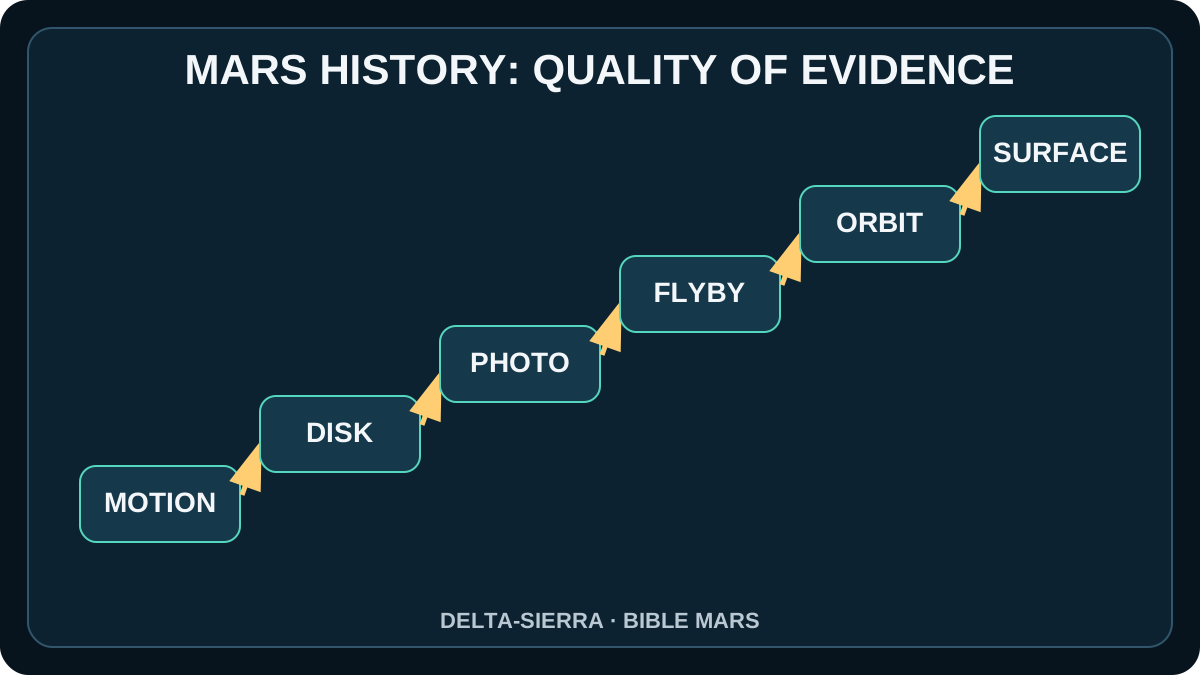
The history can be read as a sequence of shrinking uncertainty
Before spacecraft, even fundamental properties of Mars had to be inferred from light crossing tens of millions of kilometres and then Earth's atmosphere. After flybys, local morphology became measurable but global interpretation remained weak. Orbiters solved much of the coverage problem. Landers added ground truth. Rovers added spatial context at walking scale. Each step reduced one uncertainty while exposing another. The planet did not become simpler; the questions became better defined.
That pattern matters because popular Mars narratives repeatedly overcorrect. The canal era turned weak visual structure into a civilization. Mariner 4 then encouraged an image of a uniformly old, dead world from a very limited sample. Mariner 9 and Viking restored complexity. Modern missions have continued to reveal ancient habitable environments without demonstrating extant surface life. Scientific maturity lies in maintaining the category of evidence instead of letting one discovery become a total story.
A future human landing would be another epistemic transition, not the end of the history. Humans could sample rapidly, repair instruments and make field decisions, but they would also contaminate the environment, disturb sites and introduce new observational biases. The historical lesson is therefore double: proximity increases capability, and increased capability increases responsibility for measurement quality.
From Viking to Moon to Mars: the target changed from “reach Mars” to “operate a system there”
In the early robotic era, mission success could be defined by surviving a flyby, entering orbit or returning a surface image. Human architecture changes the success criterion. NASA's 2026 Mars trade-space material separates transportation, landing, crew systems, surface systems and ascent because reaching the planet is only one function among several. The historical axis moves from access toward sustained operations.
This distinction helps explain why the distance between robotic success and human settlement remains large even after sixty years of exploration. A rover may operate for years with tiny average power, no food, no medical system and no requirement to return. A human settlement must maintain atmosphere, water, thermal balance, food, health, mobility, repair and decision-making simultaneously. Robotic history gives essential environmental knowledge, but it does not make those additional systems disappear.
The result is a more interesting history than a simple race toward footprints. Mars has progressively changed category: celestial object, physical world, geological planet, robotic workplace and now candidate environment for human systems engineering. Whether the last category becomes operational remains an open historical question.
A modern chronology should tell the history of instruments as well as missions
Mars dates acquire different meaning when paired with the measurement tool. 1610 is not merely “Galileo looked at Mars”; it is the point when a new optical instrument turned a light point into an object with measurable angular size. 1965 is not only Mariner 4; it is the first close-range photographic record of Martian geology. 1971 adds orbit and therefore coverage. 1976 adds sustained surface operation. Rovers add mobility; orbital radar and spectroscopy add properties that the eye cannot see.
This reading prevents a purely heroic history built around people and flags. Instruments change what a society is able to ask of a planet. They also create new biases: limited resolution, partial coverage, calibration uncertainty, contamination and site selection. The history of Mars is therefore inseparable from the history of measurement.
Seen this way, the apparent acceleration of Mars knowledge is not mysterious. Each instrument becomes infrastructure for the next question. Global maps identify landing sites. Surface missions calibrate orbital interpretations. Weather records constrain human systems. Mineral maps direct resource studies. The historical sequence becomes a network of inherited evidence rather than a collection of isolated “firsts.”
The history of Mars becomes clearer when read as successive changes in the nature of evidence. A red wanderer becomes a telescopic disk, then a spectrum, a close image, an orbital map and finally ground measured by instruments in contact with the surface. Each step does more than add data: it makes some previous interpretations impossible and creates new questions.
Viking is a durable break in that sequence. From 1976 onward, Mars is an environment in which a laboratory can operate for years and daily surface operations can accumulate experience. Fifty years later, continuity of this knowledge infrastructure matters as much as the drama of a new landing.
NASA’s 2026 Viking retrospective places the July 20, 1976 Viking 1 landing and September 3 Viking 2 landing inside a fifty-year continuity of surface exploration. That continuity is used here as historical evidence, not merely anniversary framing.
1965 to 1976: eleven years that changed the planet faster than the previous centuries
Mariner 4 provided close range, Mariner 9 provided a planet-wide context, and Viking provided sustained presence on the ground. The pace captures the spacecraft revolution. In eleven years, humanity moved from an object observed across interplanetary distance to two automated laboratories operating on its surface. Maps, atmospheric models and biological questions changed at a rate that no telescope improvement alone could have matched.
The sequence is also a warning about first images. Mariner 4's craters were real; the idea of a uniformly Moon-like Mars was an extrapolation from a narrow sample. Scientific history is therefore a history of instruments and of the discipline required not to turn an instrument's field of view into an entire world.
1997 to the 2020s: mobility changed Mars from a landing site into field geology
Pathfinder and Sojourner introduced a new operational idea: a lander did not have to study only the material within reach of an arm. Spirit and Opportunity made traverses part of the science plan. Curiosity and Perseverance combined mobility with increasingly capable laboratories and long-duration campaign planning. The unit of exploration changed from “landing site” to “route.”
This matters historically because route planning is a bridge toward human field operations. Terrain becomes something to traverse and choose among rather than a fixed backdrop. Communications relays, autonomous hazard avoidance, energy management and navigation accumulate as operational knowledge. Robotic mobility does not make crewed mobility easy, but it turns unknown categories into measured constraints.
MOXIE added another category: using Mars as a process input
Perseverance's MOXIE experiment was historically different from simply measuring Mars. It took atmospheric carbon dioxide as feedstock and produced oxygen. NASA reported 122 grams of oxygen over the experiment's Mars campaign, with a best published rate of 12 grams per hour. The quantity was tiny compared with human needs, but the category was new: a spacecraft used the planet as part of a production process.
That does not mean Mars ISRU is solved. Scale-up, power, storage, maintenance and reliability remain major gaps. The historical significance is narrower and stronger: the idea of “living off the land” moved from terrestrial test hardware to a demonstrated chemical transformation on Mars itself.
The history of Mars is also a history of shrinking uncertainty
Every era inherited a different Mars. Ancient observers had a wandering red light whose motion could be predicted but whose physical nature was unknown. Telescopic astronomers gained a disk, phase, polar brightness and changing markings. Photographic and spectroscopic observers gained records that could be compared across nights and seasons, while also inheriting new opportunities for instrumental error. Spacecraft then replaced many global inferences with local measurements. The story is therefore not a sequence in which ignorance suddenly becomes knowledge; it is a sequence in which some uncertainties shrink while new, more precise questions appear.
Mariner 4 is an ideal example. Its close-range images damaged popular visions of a densely vegetated or canal-engineered planet, but they did not make Mars “understood.” Later orbiters revealed volcanic provinces, canyon systems and channels outside the narrow first-imaging strips. Viking added lander meteorology and chemistry but opened biological ambiguities that remained debated. Every apparent closing chapter created a new level of investigation.
Maps are arguments about what counts as a feature
A map of Mars is never just a neutral picture. The nineteenth-century observer decided where a dark region began and ended; later cartographers decided which names and coordinate conventions to preserve; geologists classified terrains by morphology and inferred age; modern teams merge imagery, topography, mineralogy and subsurface evidence. Each map embeds a measurement system and an interpretation.
This is why historical maps deserve to be read alongside instruments. A line that looks obvious on a hand-drawn disk may disappear under better angular resolution. A feature invisible in ordinary imagery may become decisive in a thermal or mineralogical map. The evolution from eyepiece sketch to digital planetary GIS is not merely an improvement in graphic quality: it changes what kinds of Martian questions can be asked.
A future human landing will not end robotic exploration; it will change its division of labour
Human presence is sometimes narrated as the replacement of robots. The historical record suggests the opposite. Better human missions will require more orbiters, relays, weather observations, mapping, autonomous scouts and sample handling. Robots extend reach and persistence; people bring flexible interpretation, repair, sampling judgment and the ability to change objectives rapidly at the site. The relationship is complementary.
If humans eventually work on Mars, historians may look back at today's rover and orbiter network the way we look at early telescopic observatories: not as a primitive phase made irrelevant by what followed, but as the infrastructure that created the questions and maps the next phase inherited.
Photography did not remove interpretation; it changed where interpretation occurred
Drawings at an eyepiece openly passed through a human hand. Photography appeared to offer a more objective Mars, but plates introduced their own exposure limits, emulsions, optical artifacts and processing choices. Later electronic detectors improved sensitivity and repeatability while adding calibration pipelines. Each technological generation moved some interpretation away from the observer and into instrumentation and processing.
This matters historically because “the image” is never the whole evidence chain. Plate scale, seeing conditions, filter band, detector response and geometric correction determine what the image can support. Spacecraft science made this chain even more explicit: raw telemetry becomes calibrated data products, mosaics, maps and models. The modern archive is stronger not because interpretation disappeared, but because more of the transformation can be documented and reproduced.
Spectroscopy gave Mars a second history running beside the history of images
Images answer questions about shape and spatial pattern. Spectra ask what light was absorbed, emitted or reflected at different wavelengths. Over time, spectroscopy transformed debates about atmosphere, minerals, ice and surface alteration. A visually subtle region can become scientifically important because its spectrum indicates hydrated minerals; a bright polar feature can be investigated through composition rather than appearance alone.
This parallel history is easy to lose in a narrative dominated by spectacular pictures. Yet the path toward evaluating habitability depends heavily on non-visual measurements. A complete history of Mars therefore has to follow both the increasingly sharp picture and the increasingly discriminating measurement of composition.
Landing changed the epistemology of Mars
An orbiter can map enormous areas repeatedly; a lander touches one tiny place. That apparent limitation is also a strength. Surface missions can measure pressure and temperature directly, analyze local material, watch dust settle, test mechanical interaction with soil and observe the same horizon through time. They exchange global coverage for contact.
Viking made this contrast historically visible. Its orbiters provided regional context while the landers created long local records and carried chemistry and biology experiments. Later rover missions extended the contact point into traverses, allowing geology to become a sequence of field decisions. A future human scientist would extend that flexibility again, but would still rely on orbital context and robotic reach.
The search for water repeatedly changed meaning
Early observers could only reason indirectly from polar brightness and seasonal appearance. Spacecraft imagery revealed landforms suggestive of past fluid activity. Spectrometers and landers constrained minerals and ice. Radar and neutron measurements added sensitivity to the subsurface. The phrase “water on Mars” therefore refers to different claims in different decades: atmospheric vapour, polar ice, ground ice, hydrated minerals, ancient flowing water or transient brines are not interchangeable.
This semantic history is scientifically important. Headlines can make each new water-related result sound like discovery of the same thing. A reference work should instead state what form of water was measured or inferred, at what depth or scale, with which instrument and with what uncertainty.
The habitability question became more precise as the evidence became less romantic
Twentieth-century popular culture often treated life as a yes-or-no question about visible Martians or vegetation. Planetary science replaced that image with more demanding questions: Was liquid water stable? For how long? Were energy sources and essential elements present? Were environments shielded from radiation or oxidants? Could biosignatures survive alteration and burial?
The result is less dramatic visually but more scientifically productive. “Could Mars have been habitable?” can be tested against ancient lake deposits, mineral assemblages, organic chemistry, radiation environment and geological context. The history of Mars exploration is therefore also the history of learning to ask a life question that instruments can actually answer.
Sample return represents another change in the evidence hierarchy
Remote sensing can cover a planet; in-situ instruments can examine selected targets; terrestrial laboratories can bring far larger instruments, repeated preparation methods and future techniques to a returned sample. This does not make remote observations obsolete. It creates a nested evidence system in which orbital context guides landing, field geology guides sampling and laboratory analysis can test hypotheses at scales unavailable on the spacecraft.
Whether and when particular Mars samples are returned is a programmatic question that can change. The historical principle is stable: preserving well-documented samples can extend a mission's scientific life far beyond the hardware that collected them, because future laboratories can ask questions that mission designers did not yet know how to formulate.
Orbital longevity turned Mars exploration from a sequence of visits into an observing system
Long-lived orbiters changed the historical rhythm of Mars science. A flyby gives a narrow slice of geometry and time; an orbiter can revisit terrain, watch atmosphere and dust evolve, relay surface missions and build datasets that outlive the question that originally justified the spacecraft. This continuity matters because Mars changes. Dust storms develop, frost advances and retreats, new impact sites appear and surface missions need communications through different seasons.
Once several orbiters and landers coexist, history is no longer a simple sequence of independent spacecraft. One mission calibrates or contextualizes another. An orbiter can image a rover's traverse, a lander can ground-truth atmospheric models, and relay infrastructure can extend the useful life of surface assets. The scientific network becomes part of the planet's exploration infrastructure.
Rovers changed the scale at which geology could become a story
A stationary lander can study one site deeply. A rover can select the next outcrop based on what the previous one revealed. This ability to turn measurement into a new route made Martian geology increasingly resemble field science: context, stratigraphy, texture and mineral measurements could be connected along a traverse instead of treated as isolated samples.
Mobility also made uncertainty visible. A terrain unit that appears uniform from orbit may contain several lithologies on the ground. A promising route can be blocked by slope, wheel risk or sand. Engineering constraints therefore shape the scientific record: what we know is partly determined by what a machine could safely reach.
Mars exploration has accumulated an infrastructure of comparison
Modern missions inherit decades of coordinate systems, atmospheric models, image mosaics, landing-site studies, laboratory analogues and archived telemetry. A new spacecraft does not begin from zero; its instrument teams can compare new measurements with older observations and select targets from increasingly detailed context. This cumulative infrastructure is one reason later missions can ask narrower, more demanding questions.
The archive itself is therefore part of exploration capability. Preserving raw data, calibration information, software documentation and mission chronology allows a future analyst to reinterpret an old observation with new models. A reference site should make this cumulative nature visible rather than presenting each mission as a self-contained adventure.
Martian meteorites created a laboratory connection before sample return
Some meteorites found on Earth were eventually identified as Martian through trapped gases and isotopic signatures consistent with measurements of the Martian atmosphere. They created an unusual bridge in the evidence chain: material excavated from Mars by natural impacts could be examined with terrestrial laboratory instruments even though no spacecraft had deliberately returned it. The samples are scientifically powerful but geologically incomplete because their exact launch sites on Mars are generally unknown and their transit and terrestrial history can alter what is preserved.
This combination of extraordinary analytical access and weak field context is a useful lesson in planetary geology. A laboratory can measure minerals, ages and isotopes with precision, yet interpretation improves dramatically when a sample is linked to mapped stratigraphy and documented collection conditions. That is one reason deliberately selected and documented samples have a different scientific value from meteorites even when both are genuinely Martian.
The communications network became part of what missions could attempt
As missions became more complex, exploration depended increasingly on the infrastructure around the spacecraft: the Deep Space Network on Earth, Mars orbiters that could relay surface data, navigation products, software updates and long-term operational teams. A rover's scientific reach is partly created by this invisible system. Higher data return can support more images and measurements; reliable relay can change how surface operations are planned.
The history of Mars is therefore also a history of infrastructure becoming less visible as it becomes more essential. Spectacular spacecraft sit at the centre of public memory, while antennas, orbit determination, archival pipelines and relay planning quietly determine how much knowledge those spacecraft can deliver. A reference history should keep both layers in view.
Another historical consequence follows from this networked view: mission capability depends on continuity between generations of hardware. Orbiters that were launched for science can later become relay infrastructure; archived maps can become landing-site inputs; engineering telemetry can support models for vehicles that did not yet exist. This reuse of knowledge is one reason planetary exploration benefits from long-lived archives and interoperable data. The spacecraft is temporary, but a well-documented observation can remain operationally useful decades later.
Disney and Collier’s did more than popularize rockets. They translated payloads, staging, crew size and mission sequence into images that a non-specialist audience could interrogate. That public language mattered because a Mars architecture competes for money and institutional attention long before hardware exists. The historical lesson is not that publicity proves feasibility, but that technically literate public imagination can become part of the political infrastructure of a program.
NASA’s Design Reference Missions served a different role from a single mission proposal. A reference architecture gives engineers a common set of assumptions against which mass, propulsion, surface duration, entry systems and local-resource options can be compared. Later Moon to Mars studies continue that habit of structured comparison. The continuity is methodological: define assumptions, expose trades and update the architecture when evidence or technology changes rather than treating one drawing as the inevitable route to Mars.
From observation to engineering, the history of Mars is also a history of changing standards of evidence. Ancient observers could identify the planet’s unusual motion and color but had no physical information about its surface. Telescopes added geometry and apparent detail, yet they also showed how easily interpretation could outrun resolution. Spacecraft changed the epistemic regime: Mariner 4 replaced imagined landscapes with close-up measurements, Mariner 9 revealed a planet-scale geological history, and Viking combined orbital reconnaissance with long-lived surface operations. The important continuity is not a straight march toward “colonization.” It is the gradual replacement of inference by measurements that can be repeated, mapped, and compared across missions.
The astronautical lineage also deserves to be kept distinct from the scientific lineage. Early rocketry demonstrated that interplanetary flight could be treated as a problem of mass ratio, staging, trajectory, propulsion, and mission sequence rather than as literary fantasy. Von Braun’s post-war Mars studies were important because they made crews, fleets, orbital assembly, landing vehicles, and return architecture explicit engineering objects. They were not flight programs. Their historical value lies in showing how a destination can become technically discussable decades before institutions, budgets, technology maturity, or political commitment are sufficient to fly it.
That distinction becomes even more important in the commercial era. SpaceX changed the scale of public Mars discussion by linking reusable launch systems, high launch cadence, on-orbit refilling, and a long-term settlement objective. But an industrial roadmap is not the same thing as a demonstrated Mars transport system. SpaceX’s current Mars page describes cargo flights to the Martian surface no earlier than 2028 and frames a self-sufficient city in terms of millions of tonnes of cargo and ultimately a very large population. Those statements are best read as declared objectives and architecture assumptions. They should not be retroactively inserted into the historical record as capabilities already achieved.
Transport and settlement are therefore two different historical thresholds. Reaching the surface once proves access. Returning safely, repeating the trip across several launch windows, supporting crews between arrivals, replacing failed equipment, and sustaining life without emergency resupply define a much harder transition. Mars history becomes misleading when these stages are collapsed into one word. The development of oceanic travel offers a useful structural analogy only at the level of logistics: a route can exist long before a remote community can survive the failure of that route. On Mars, the gap is magnified by launch windows, communication delay, lack of evacuation, and the dependence of every inhabitant on engineered life support.
NASA’s 2026 Moon-to-Mars Architecture makes the same point from a different institutional direction. NASA describes the Mars trade space as still relatively open, with multiple possible propulsion, landing, surface, power, habitation, and ascent choices under study. That is historically significant because it shows that even after decades of Mars design-reference missions, there is no single frozen “NASA Mars mission” waiting to be executed. The architecture is being narrowed through explicit decisions and risk-reduction work. The history of human Mars planning is therefore not a sequence of cancelled identical missions; it is a sequence of changing assumptions about what must be transported, what can be produced locally, how long crews stay, how they return, and which risks are retired before commitment.
The fiftieth anniversary of Viking in 2026 provides a useful marker for that long arc. Viking 1 reached the surface on 20 July 1976 and Viking 2 followed in September, while their orbiters continued mapping and relaying data. Half a century later, Curiosity and Perseverance operate in a scientific landscape built partly on that first sustained surface experience. The continuity matters: human exploration proposals do not start from a blank planet. They inherit five decades of increasingly detailed knowledge about terrain, atmosphere, radiation, dust, geology, landing, communications, and operations. What remains uncertain is not whether Mars can be reached robotically, but how those facts combine when human survival, repairability, medical autonomy, and multi-year logistics are added.
SpaceX in the long chronology: an industrial experiment, not a shortcut to settlement
SpaceX belongs in a history of Mars for a different reason from Mariner, Viking or the rovers. Those missions changed what humanity knew about the planet by returning measurements from Mars. SpaceX has changed the practical vocabulary of reaching deep space by making launch cadence, hardware reuse, serial production and operational iteration central to public discussion. Falcon 1 proved that the company could reach orbit, Falcon 9 turned booster recovery and reuse into routine operations, and Dragon accumulated experience with repeated spacecraft missions to the International Space Station. None of those achievements is a Mars landing demonstration. Their historical relevance is that they attack one of the old assumptions behind Mars planning: that every large interplanetary campaign must begin with a small number of extremely rare, largely expendable launches.
That distinction matters because a settlement-scale Mars architecture is dominated by repetition. A crewed expedition can be described as a finite mission with a launch date, a vehicle stack and a return plan. A settlement requires continuing flows of cargo, replacement hardware, propellant infrastructure, food, medical supplies, computing equipment and eventually industrial feedstocks. Reusable launchers and higher flight rates can reduce the marginal burden of putting those flows into Earth orbit, but they do not remove the other bottlenecks. Mars entry, descent and landing at very large mass, long-duration life support, radiation exposure, surface power, dust, maintenance, local manufacturing and the reliability of thousands of coupled components remain separate engineering problems. The historical lesson is therefore not that reuse “solves Mars,” but that it changes one important term in a much larger system.
Starlink is relevant to the chronology for a similarly indirect reason. It demonstrated that SpaceX could manufacture, launch and operate a very large population of spacecraft as an evolving service rather than as isolated prestige missions. That industrial experience says something about production cadence, fleet management, software updates and the economics of repeated launches. It does not demonstrate a Martian communications network, and it should not be rewritten as if it had been built for that purpose. In a history of Mars, the useful connection is methodological: large infrastructures become credible only when they can be produced, deployed, monitored, repaired or replaced repeatedly. A future Mars system would face the same logic under much harsher conditions and with far less access to Earth.
Starship then moved the Mars discussion from an abstract aspiration toward a specific family of hardware and operational claims: a very large reusable launch vehicle, orbital refilling, high payload mass and repeated interplanetary departures. The design has evolved through successive vehicles, engines, test campaigns and mission priorities; it is not a frozen blueprint inherited unchanged from an early presentation. That evolution is historically significant in itself. It shows how a declared destination can remain stable while the engineering route changes. A careful chronology therefore records separately what has flown, what has been tested in a relevant environment, what is still under development and what remains an objective. Collapsing those categories would make the history easier to tell but much less accurate.
SpaceX’s current Mars material places a self-sustaining city at the far end of the roadmap and describes cargo flights to Mars as a future objective rather than an accomplished capability. [S13] The scale implied by such a vision is not a larger version of an Apollo-style landing. It presupposes many transfer opportunities, a durable surface logistics chain, power and propellant systems, storage, maintenance, habitation and the ability to survive missed deliveries. Those requirements are why the history of transport must eventually separate from the history of settlement. A successful interplanetary vehicle would be a necessary enabling system, but a city would be judged by whether people can keep essential functions operating when a vehicle is late, a plant fails or a component cannot be replaced from Earth.
The chronology also benefits from separating company objectives from evidence. A declared timetable can change because testing, regulation, launch infrastructure, vehicle performance or mission priorities change. A flown mission, by contrast, becomes part of the empirical record. For readers, the disciplined approach is to attach a status to each claim: demonstrated in flight, demonstrated in another environment, under active development, or publicly stated objective. This avoids two opposite errors. One is dismissing industrial progress because Mars has not yet been reached by people. The other is treating every future milestone in a presentation as if it had already been technically retired.
Seen across the full history, SpaceX therefore occupies a bridge between two traditions. It inherits the old astronautical ambition of Tsiolkovsky, Oberth and von Braun, who treated interplanetary travel as an engineering problem that could be decomposed. It also inherits the operational lesson of the space age: real hardware repeatedly overturns elegant paper architectures. The company’s contribution to Mars history should be judged over time by what its systems actually demonstrate, how reliably they can be repeated and how much of the settlement problem is transferred from launch to the surface. That framing gives SpaceX an important place in the story without allowing the story of a transport system to stand in for the much harder story of a functioning Martian society.
The commercial chronology also matters because Falcon and Dragon established operational habits before Starship existed. Falcon 9 reuse turned recovery, inspection and reflighting into recurring work rather than a one-off demonstration. Dragon added repeated spacecraft operations, rendezvous and cargo or crew servicing in low Earth orbit. Those achievements do not simulate a Mars transfer, but they show why the company’s Mars argument became increasingly centered on cadence: if transport hardware can be flown, inspected and flown again, the number of missions becomes an industrial planning variable rather than a sequence of individually exceptional events.
Mars Oasis belongs earlier in that chain. The proposed small biological payload was not a settlement architecture, yet it forced attention onto launch price and access to space. The historical importance is therefore causal rather than technical: a relatively modest Mars idea helped redirect the problem toward the cost and availability of transportation. Falcon 1, Falcon 9 and later reuse addressed that bottleneck from Earth outward. The sequence is useful precisely because it shows how an ambition can survive while the immediate engineering target changes from “send something to Mars” to “build a launch system that can be used often enough for much larger missions to become thinkable.”
The ITS, BFR and Starship stages then reveal another recurring feature of Mars planning: architecture changes when hardware confronts development reality. Vehicle dimensions, materials, engine iterations, launch infrastructure and intermediate missions evolve. The historical record should therefore resist treating an old presentation as a fixed specification for a future flight. What persists is a set of intended functions—large payloads, reusability, orbital refilling and interplanetary transport—while the particular implementation remains under development. That is consistent with the broader history of Mars architectures, in which the destination can remain stable even as mass models, propulsion, mission sequence and risk assumptions change repeatedly.
In 2026 SpaceX publicly describes Mars cargo flights as beginning no earlier than 2028 and describes a self-sustaining city in terms of a very large population, millions of tonnes of cargo and a broad industrial base. [S13] These statements are historically relevant because they reveal the scale of the declared objective, not because they certify that the required capability exists. A future historian will be able to separate the chronology into milestones that actually occurred—vehicle flights, refilling demonstrations, Mars departures, landings, surface operations—and objectives that were revised or delayed. Keeping that distinction visible today prevents the narrative from turning a development roadmap into retrospective fact.
Sources and bibliography
- S01 NASA Science — Mars: Facts.
- S02 NASA Science — Triumph of Mariner 4 (historique des observations, Galileo/Cassini).
- S03 NASA Science — First Close Up Image of Mars by Mariner 4.
- S04 NASA Science — Mariner 9.
- S05 NASA Science — Viking Project.
- S06 Smithsonian National Air and Space Museum — Mars Project: Wernher von Braun as a Science-Fiction Writer.
- S07 Smithsonian NASM — Von Braun research files / Rocket and the Reich.
- S08 NASA — Wernher von Braun.
- S09 Smithsonian — Project Paperclip and American Rocketry after World War II.
- S11 Elon Musk — Making Humans a Multi-Planetary Species, New Space 5(2), 2017.
- S13 SpaceX — Mars & Beyond / A City on Mars.
- S14 NASA Science — Planetary Motion: The History of an Idea That Launched the Scientific Revolution.
- S15 ESA — Jean-Dominique Cassini: Astrology to astronomy.
- S16 Library of Congress — Percival Lowell, Mars and Its Canals (1906).
- S17 Library of Congress — Percival Lowell, Mars as the Abode of Life (1908).
- S18 NASA Science — Mars Moons: Facts.
- S19 Smithsonian NASM — V-2 Missile (historique et travail forcé).
- S20 Smithsonian NASM — Project Paperclip and American Rocketry after World War II.
- S21 Smithsonian NASM — The Missing History of the Explorer 1 Satellite.
- S24 NASA NTRS — Wernher von Braun, Manned Mars Landing.
- S25 NASA Science — Mariner 4.
- S26 NASA Science — Mars Mariner Missions.
- S27 NASA Science — Viking Project and Astrobiology.
- S29 NASA History — Space Exploration Initiative.
- S30 NASA Ames — Robert Zubrin, Mars Direct: Humans to the Red Planet within a Decade.
- S31 NASA NTRS — Human Exploration of Mars: The Reference Mission (1997).
- S32 NASA — Moon to Mars Architecture — Mars Architecture Studies.
- S33 CBS News — Elon Musk interview, Mars Oasis.
- S34 WIRED — Elon Musk’s Mission to Mars (interview).
- S35 SpaceNews — Musk on Starlink funding Mars ambitions.
- S36 Defense News — SpaceX Enters Satellite Business (2015; Starlink revenues and Mars city).
- S37 Library of Congress — Wernher Von Braun Papers, 1796–1970
- S38 Library of Congress — The Mars Project, Wernher Von Braun Papers
- S39 NASA History — Space Task Group Report and post-Apollo Mars planning (1969)
- S40 NASA Science — Mars Facts: formation, structure, atmosphere and namesake
- S41 NASA Spinoff — Raised Relief Mars Globe Brings the Red Planet Closer (anciens noms de Mars)
- S42 British Museum — tablette astronomique babylonienne SP.132, observations de Mars
- S43 Museo Galileo — Sidereus Nuncius (1610), le télescope comme instrument scientifique
- S44 ESA — Europe reclaims a stake in Mars exploration, jalons des observations européennes
- S45 ESA/Hubble — Mars in opposition, opposition et mouvement rétrograde apparent
- S46 Lowell Observatory — Percival Lowell’s Search for Life on Mars
- S47 Smithsonian — Mars Globe, opposition de 1877 et cartographie de Schiaparelli
- S48 British Museum — tablette 36600, observations planétaires de Mars et Mercure
- S50 NASA History — MAVEN Continues Mars Exploration Begun 50 Years Ago by Mariner 4 (von Braun commence The Mars Project en 1947)
- S51 Library of Congress — Das Marsprojekt; Studie einer interplanetarischen Expedition, édition 1952
- S52 Library of Congress — Wernher von Braun Papers, dossiers Collier's, 1951-1953
- S53 NASA — Wernher von Braun, biographie historique et responsabilité autour de Mittelwerk
- S54 NASA History — Sputnik Biographies: Wernher von Braun
- S55 United States Holocaust Memorial Museum — Dora-Mittelbau et travail forcé
- S56 Smithsonian National Air and Space Museum — V-2 Missile
- S57 Smithsonian National Air and Space Museum — Project Paperclip and American Rocketry after World War II
- S58 Smithsonian National Air and Space Museum Archives — Peenemünde Document Collection
- S59 NASA History — First Launch of a Saturn Rocket
- S60 NASA/NSSDC — Chronology of Mars Exploration
- S61 NASA Science — Mars Exploration, 60 years of Mars exploration
- S62 NASA Science — Mariner Missions to Mars
- S63 NASA Science — Viking: 50 Years on Mars
- S64 NASA History — 25 years ago: Mars Global Surveyor launches to the Red Planet
- S65 NASA Science — How We Land on Mars
- S70 NASA — NASA Selects Blue Origin, Dynetics, SpaceX for Artemis Human Landers (Starship, Moon/Mars)
- S71 NASA Kennedy Space Center — Starship/Super Heavy Operations, objectif Lune et Mars, mise à jour 2026
- S72 Reuters — SpaceX prioritise lunar self-growing city while retaining Mars ambition, 8 Feb. 2026
- S73 NASA — Certification of first human-rated commercial space system, Musk on Moon/Mars/multi-planetary goal