


Mars atmospheric entry: heat shield, corridor and guidance
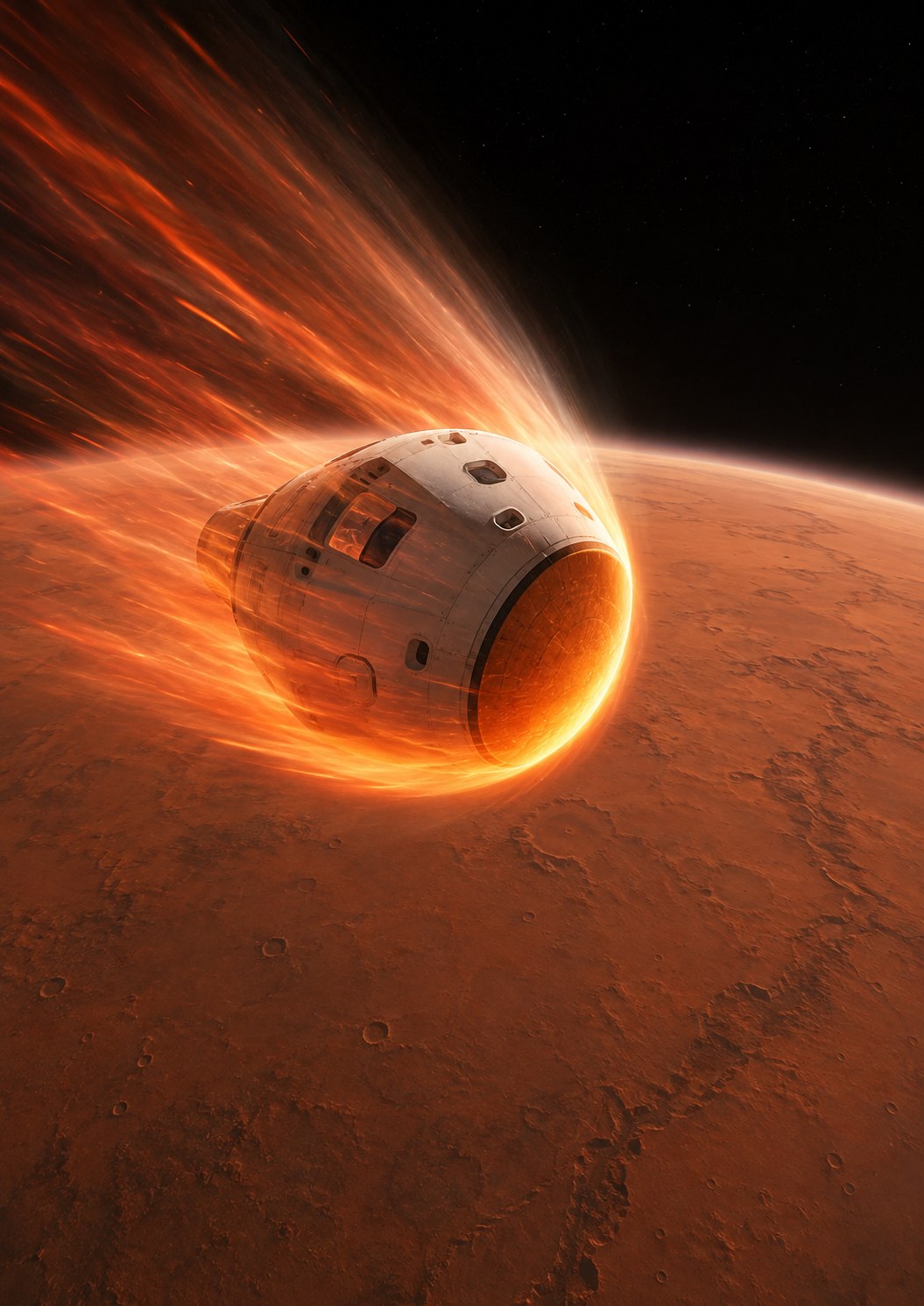
Atmospheric entry begins long before the vehicle gets hot
“Mars atmospheric entry: heat shield, corridor and guidance” addresses hypersonic entry as a trade among heating, deceleration and trajectory corridor.
The central observables are heat flux, temperature, pressure, deceleration, flight-path angle, ablation and material margin.
Those omissions are engineering information.
MEDLI2 and Mars 2020 TPS sizing provide measurements and validation methods directly tied to atmospheric entry
This evidence is used only for what it demonstrates.
Recompute heat rate depends on the aerodynamic state and integrated thermal load must be tracked through time with units visible. The result is not accepted in isolation: then check whether the change also modifies heat flux, temperature, pressure, deceleration, flight-path angle, ablation and material margin.
The entry corridor is a coupled envelope
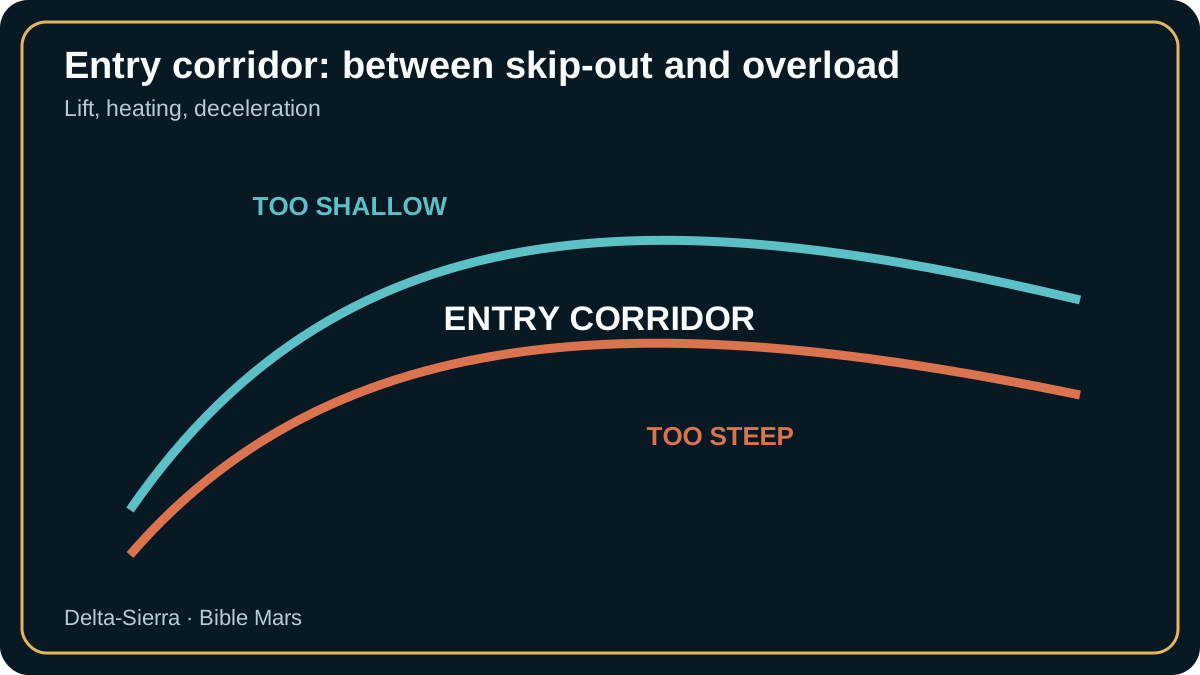
Mars entry does not have one magic altitude or flight-path angle. The acceptable trajectory is a corridor bounded on one side by skip-out or insufficient deceleration and on the other by thermal and mechanical loading. Navigation must deliver the pre-entry state with uncertainty small enough that guidance still has useful control authority. Thermal protection is sized for more than a peak heat flux: integrated heat load matters as well, so two trajectories with similar peaks can demand very different material thickness or temperature histories. Geometry, thermal-protection material, seams, penetrations and sensor locations therefore belong to one protection problem.
Robustness is a dispersion question. Atmospheric density, vehicle mass, aerodynamic coefficients, winds and state-estimation error can all shift the flown path. Monte Carlo or equivalent uncertainty studies should return distributions of load, heating and exit conditions, and those outputs must connect directly to the next phase: parachute deployment, supersonic retropropulsion or terrain-relative navigation. Guidance is valuable because it preserves a feasible downstream state, not because it produces an aesthetically perfect reference trajectory.
Heating, deceleration and guidance compete through the same trajectory
Atmospheric entry trades cannot be separated into one thermal calculation and one guidance calculation. A steeper trajectory can increase deceleration and heating while reducing time in the atmosphere; a shallower one can extend exposure and risk leaving too much energy for the downstream system. Vehicle lift-to-drag ratio and bank control move the flown path inside the corridor, but control authority is finite and depends on a usable state estimate. The protection system must survive the resulting heat-flux history, while guidance must deliver an altitude, velocity and position compatible with the next event. A robust design therefore evaluates integrated trajectories under density and navigation dispersions rather than applying independent margins to heating and landing location.
Thermal margin must be spatial as well as global
A heat shield does not experience one uniform temperature. Stagnation regions, seams, shoulders, penetrations and local flow features can create very different heating histories. Instrumentation and analysis should therefore connect trajectory dispersion to locations on the protection system, not only to a vehicle-average heat load. A local exceedance can be mission-limiting even when an integrated thermal budget still looks acceptable.
What a fault-tolerant entry must actually demonstrate
reducing thermal load without excessive protection mass, guidance sensitivity or landing dispersion
material testing, arc-jet work, aerothermal models, flight instrumentation and post-flight correlation
Verification asks whether the requirement is met;
Preparing entry systems for ever-heavier vehicles
Deepening — entry as an energy, guidance and margin problem
Before discussing a heat shield, count the energy that must be managed
Mars entry begins as a kinetic-energy problem. At an illustrative 5.5 km/s, or 5,500 m/s, kinetic energy per kilogram is E = 1/2 × v², where v is velocity and the superscript ² means that velocity is multiplied by itself. The result is roughly 0.5 × 5,500² = 15,125,000 joules per kilogram, or 15.1 megajoules per kilogram. Not all of that energy flows into the heat shield; much is transferred into the shock layer and atmosphere. The calculation nevertheless shows why a few kilometres per second dominate the problem.
Total mass does not change this specific energy, but it changes how difficult the vehicle is to slow. A heavy vehicle with small reference area has a high ballistic coefficient and penetrates farther before losing speed. Designers can enlarge diameter, use deployable or inflatable devices, combine lift, parachutes and propulsion, but every option adds mass, mechanisms and transition regimes that must be qualified. Robotic landers near the tonne class are therefore not simply scale models of human landers weighing many tens of tonnes.
Readers should also separate three energies often blended together: heliocentric energy before arrival, hyperbolic excess relative to Mars and the energy remaining during atmospheric descent. Direct entry, orbital capture or a future aerocapture architecture redistributes where braking is paid. It does not remove the physics.
The entry corridor is a compromise envelope, not one perfect line
An entry that is too shallow may skip or fail to decelerate enough; one that is too steep can raise heat flux, acceleration and structural loads sharply. The entry corridor is therefore an envelope of acceptable initial conditions. Its width depends on vehicle geometry, lift, mass, thermal margins, guidance authority and atmospheric uncertainty. A single quoted entry angle without dispersion is not a mission description.
Mars makes the envelope harder because atmospheric density changes with season, local time, altitude, dust and weather. Navigation can know vehicle position accurately while the density encountered lower down differs from the model. Designers therefore run dispersions: denser atmosphere, lighter atmosphere, navigation bias, delayed actuator, mass error and combinations of these cases. A robust system is not one that succeeds nominally; it preserves a useful success region when uncertainties stack.
Human entry adds physiology. A trajectory that saves propellant while raising acceleration or orientation changes may be a poor choice after months in microgravity. Crewed EDL therefore couples aerodynamics, thermal design, structure, guidance and human condition rather than optimizing each discipline independently.
Guidance manages energy by controlling lift orientation
An entry vehicle does not merely fall. If it generates aerodynamic lift, changing attitude and bank changes how it traverses the atmosphere. Guidance uses that authority to manage remaining energy while targeting a geographic region. Bank angle can redirect lift upward or sideways, trading deceleration, range, heating and cross-range. The guidance law is therefore continuously balancing several limits.
The vehicle also learns the atmosphere while flying through it. Measured accelerations contain information about actual density. Estimation and guidance compare observations with the expected model and adapt without producing unstable or late corrections. This estimation-guidance-control loop is one reason crewed EDL cannot rely on an Earth operator: the physical event unfolds in minutes while the radio round trip is much longer.
A good educational treatment should show a family of trajectories rather than one nominal curve: nominal atmosphere, low density, high density, velocity error and flight-path-angle error. The reader then sees that the engineering task is to prove that an envelope of paths remains inside thermal, structural and geographic limits.
A thermal-protection system is made of interfaces, joints and ageing materials
“The heat shield survives the heat” hides the engineering. Thermal protection has materials, seams, attachments, sensor penetrations and sometimes deliberate ablation. Heat flux is not uniform: stagnation regions, shoulders, separated flow and interfaces see different environments. Qualification must demonstrate the manufactured assembly, not only a coupon of material.
Time also matters for hardware stored or reused. Has the material absorbed moisture before launch? Has it seen thermal cycling, radiation or micrometeoroid damage? Can orbital or Martian repairs be inspected? Can internal damage be detected? A crew-rated protection system belongs in the maintainability and logistics architecture, not only in an arc-jet test campaign.
Interfaces can dominate risk. A conductive attachment creates a heat path; a poorly designed seam concentrates flow; a hatch brings its own closure chain. Thermal protection, primary structure, sensing, wiring, mechanisms and state software must therefore be verified edge-to-edge.
Heavy landing requires a complete sequence, not one miracle device
It is tempting to search for one technology that “solves” Mars EDL: a giant parachute, supersonic retropropulsion, an inflatable decelerator or a lifting body. A heavy human system is more likely to be a sequence in which each device works in the regime where it offers the best trade. The hard part becomes transition: when to jettison, when to ignite, how to confirm the previous phase is complete and what to do when an engine is late, radar loses the surface or the touchdown zone becomes unsafe.
As landed mass grows, the landing zone itself becomes infrastructure. Plumes can erode terrain and throw debris; precision must bring vehicles near resources without threatening habitats; abort trajectories must avoid occupied zones. Lander design and settlement geography therefore become one coupled problem.
Validation ultimately needs combined off-nominal cases: adverse atmosphere plus biased sensor, degraded engine plus unexpected terrain, nominal navigation plus weather variation. Those cases expose whether margins are truly independent or whether several “safeties” depend on the same sensor, software path or atmospheric assumption.
Connecting the entry corridor to mass, energy and guidance decisions
Translate entry velocity into energy that must be managed
Mars entry speed is not merely a navigation number; it represents kinetic energy that must be redistributed through atmospheric heating, drag, maneuvering and residual velocity. At 5.5 km/s, or 5,500 m/s, specific kinetic energy is v²/2 = 15,125,000 J/kg, about 15.1 MJ per kilogram. J means joule, a unit of energy, and MJ means megajoule, one million joules. For a vehicle measured in tens of tonnes, the scale is enormous. This is why apparently modest changes in velocity, mass or trajectory can strongly affect heating and the distance available for deceleration.
The heat shield does not store all of that energy. Much is transferred to the surrounding gas, and the distribution depends on shape, density, angle of attack and time spent in each regime. But the simple calculation gives the correct intuition: material selection makes sense only after the energy-management problem is understood.
Treat the entry corridor as an envelope of consequences
A trajectory that is too high may produce insufficient deceleration and a skip-out risk; one that is too low may increase thermal and structural loads. Guidance therefore manages a path through uncertainty in atmospheric density, winds, navigation state, mass, aerodynamics and entry-interface dispersion. The vehicle does not simply follow a perfect precomputed curve. It measures, estimates and corrects, which makes state covariance and predicted landing footprint operational variables.
For a heavy lander, entry also has to be connected to what follows. Flying several kilometres long can reduce time before powered descent, move the plume hazard zone or make the trajectory incompatible with a prepared site. Entry, descent and landing are consequently one chain even when the detailed subsystems are covered in separate books.
Design margin as a quantified resource
Human mission architectures cannot base safety on an average atmosphere. Margin is built through dispersion analysis, Monte Carlo cases and simultaneous limits on peak load, heat flux, dynamic pressure and remaining propellant. The useful result is not a single beautiful trajectory but the fraction of cases that satisfy all constraints together. Thermal margin does not automatically compensate for insufficient propulsive margin, and vice versa.
This also changes how technology readiness is described. A heat shield that succeeds on a demonstrator does not become a twenty-tonne human landing system by simple scaling. NASA treats human Mars EDL as an architectural trade space in which mass, diameter, decelerators, propulsion, site and operations interact. A serious Mars reference should make those dependencies visible instead of listing technologies as if they matured independently.
The entry corridor is a band of compromises, not a magic angle
By the time a spacecraft reaches the entry interface, much of its geometry has already been set by interplanetary navigation. Flight-path angle controls how quickly the vehicle descends into denser layers. A steep entry removes energy quickly but tends to increase deceleration and thermal loads. An overly shallow entry can extend heating and may allow the vehicle to climb back toward the upper atmosphere before enough energy has been dissipated.
The “corridor” is the set of entry conditions that deliver an acceptable state for the rest of the descent. Its boundaries depend on the vehicle. Mass, area, drag coefficient, lift, centre of gravity, thermal protection, g limits, navigation accuracy, and the real atmosphere all matter. A corridor calculated for a robotic capsule cannot simply be rescaled to a human lander.
Lift adds control authority. By rotating the lift vector through bank angle, the vehicle can alter vertical and lateral motion, manage range, and compensate for dispersions. That capability also adds guidance complexity and depends on sufficiently predictable aerodynamics in an atmosphere whose density is never known exactly.
Dynamic pressure and heating describe different parts of the problem
Dynamic pressure is q = ½ ρ v². Here q is in pascals, ρ (“rho”) is atmospheric density in kg/m³, and v is velocity in m/s. It is useful for understanding aerodynamic loading but it is not a heating model. Heating also depends strongly on velocity, density, nose geometry, high-temperature chemistry, and flow regime.
Example — sensitivity of q to velocity
If ρ = 0.01 kg/m³ and v = 3,000 m/s, q = 0.5 × 0.01 × 3,000² = 45,000 Pa, or 45 kPa. At the same density and 4,000 m/s, q becomes 80 kPa. Speed rises by 33% while dynamic pressure rises by about 78% at constant density. Real entry density is not constant; this calculation isolates only the v² dependence.
Thermal protection is sized for a heat-load history, not a single peak. Ablative material deliberately consumes itself to carry energy away. A reusable system instead seeks to survive cycles with limited degradation. The correct choice depends on mission architecture, number of entries, inspection capability, and whether Mars-based maintenance is realistic.
The Martian atmosphere is a mission state variable
Density and temperature vary with season, local time, altitude, topography, and dust. A dust event does not simply mean “more atmosphere”; it changes atmospheric temperature structure and therefore density at the altitudes relevant to entry. Forecasts and orbital observations can improve the pre-entry model, but the vehicle still has to tolerate a family of plausible profiles.
That uncertainty propagates into lower events. A denser atmosphere may decelerate the spacecraft earlier and shift transition conditions; a thinner profile can hand powered descent a higher speed. EDL validation therefore requires dispersions and physically justified edge cases, not one elegant nominal trajectory.
Entry guidance must know when precision is no longer the first priority
Guidance attempts to reduce range error and deliver a favourable state for descent. As entry progresses, remaining control authority shrinks. A late lateral correction can increase thermal load or move the vehicle into a less favourable atmospheric region. A sensible hierarchy is survival limits first, controllability second, landing precision third.
Navigation provides an estimated state and covariance. If uncertainty grows, guidance should not behave as though position were exact. It may select a more conservative target or preserve more propellant for powered flight. Precision is valuable only while the vehicle remains inside its thermal and control envelopes.
Three scenarios that test the design better than a nominal trajectory
Atmosphere is denser than predicted near peak load
Dynamic pressure builds earlier. Guidance can adjust bank or lift usage, but structure and thermal protection must survive the transient. The useful question is which limit is reached first and what control authority remains at that instant.
A small entry-angle error is correlated with a speed error
Two individually modest dispersions can combine to approach a corridor boundary. Monte Carlo analysis must preserve realistic correlations rather than applying unrelated margins to each variable.
A navigation measurement is temporarily lost
The estimator propagates the state inertially while covariance grows. Guidance should avoid aggressive corrections until absolute information returns. The case directly couples navigation quality to thermal and trajectory margin.
NASA EDLAS work and mid-lift-to-drag vehicle simulations document these coupled issues for human-scale delivery. See NASA NTRS — Entry, Descent, and Landing Performance for a Mid-Lift-to-Drag Ratio Vehicle at Mars and NASA NTRS — Human Mars Entry, Descent, and Landing Architecture Study: Phase 3 Summary. They describe analysed design spaces, not a flight-qualified human lander.
The entry corridor is where three constraints intersect
Mars entry must avoid excessive heating, excessive deceleration and atmospheric skip-out at the same time. A steeper path generally encounters dense air earlier and concentrates deceleration; a path that is too shallow may remain energetic or leave the atmosphere. The corridor is therefore a region in state space, not one universal entry angle.
Lift lets guidance move within that region. Bank angle rotates the lift vector: one component changes vertical trajectory while another produces crossrange. Bank reversals manage downrange without accumulating excessive lateral error. Available authority depends on lift-to-drag ratio, speed and atmospheric density.
Dynamic pressure and heating need not peak together
Dynamic pressure is q = ½ρv², where ρ is atmospheric density in kg/m³ and v is relative speed in m/s. It is a useful aerodynamic-load indicator. Convective heating also depends strongly on speed but follows a different relation involving density and nose geometry, so maximum q and maximum heat flux need not occur at the same instant.
Dynamic-pressure example
With ρ = 0.010 kg/m³ and v = 1,500 m/s, q = 0.5 × 0.010 × 1,500² = 11,250 Pa, or 11.25 kPa. This is an order-of-magnitude example; real analyses vary atmosphere with altitude, season, dust and location.
Structures, TPS and guidance therefore cannot be sized from one average trajectory. Monte Carlo campaigns disperse atmosphere, mass, aerodynamics, navigation and execution to estimate distributions of peaks and the probability of staying inside limits.
Thermal protection is a measurable, inspectable and consumable system
Ablative material protects by degrading on purpose: pyrolysis, gas release and surface recession carry energy away. Performance depends on thickness, density, conductivity, joints and surface condition. A small local defect can matter if heating concentrates there. For long-duration assembled vehicles, inspection and aging become mission concerns.
Peak heat flux is not the only sizing quantity. Integrated heat load can require substantial thickness even with a moderate peak. Designers also have to limit temperatures transmitted to substructure and equipment and avoid thermal shortcuts at joints and fasteners.
What crew need to understand when guidance leaves nominal conditions
A human entry cannot be manually flown second-by-second from Earth. Crew may nevertheless need a compact picture: too much or too little energy, remaining corridor margin, degraded navigation, assumed TPS state and reachable region. The display must convert hundreds of variables into a few safe decisions.
If navigation diverges, “correct harder” may be unsafe. A large bank command might reduce range error while increasing load or heating. Guidance must rank constraints: survival and envelope compliance come before landing precision.
Sources: NASA NTRS — Entry, Descent, and Landing Performance for a Mid-Lift-to-Drag Ratio Vehicle at Mars; NASA NTRS — Human Mars Entry, Descent, and Landing Architecture Study: Phase 3 Summary.
Atmospheric uncertainty is a navigation problem as well as an aerodynamics problem
The vehicle does not know future density perfectly. It infers how the actual atmosphere differs from prediction by comparing measured deceleration and sensed state with the onboard model. Guidance then adapts bank history within its authority. A robust design therefore pairs an aerodynamic envelope with an estimator capable of recognising when the atmosphere is off-nominal.
Integrated heat load and local peak are different design questions
A sharp short peak can challenge surface material response while a longer lower flux can dominate total absorbed energy. Joints, penetrations and sensor windows deserve local analysis because a global average heat rate can hide the location that actually limits the TPS.
For a crewed vehicle, inspection before entry also matters. Cruise damage, contamination or a deployment problem can change confidence in the thermal model, creating a mission decision before the atmosphere is ever reached.
Case study — track dynamic pressure and heating together
Dynamic pressure q = ½ρv². With ρ = 0.002 kg/m³ and v = 3,500 m/s, q ≈ 12.25 kPa. ρ is density and v velocity. The v² term explains why a modest velocity change can strongly move loads while peak heating follows a different history.
An entry that is too high may fail to dissipate enough energy; too low increases heating and load. Guidance therefore manages a multidimensional envelope rather than one limit.
Material tests, aerodynamics and dispersed trajectories must demonstrate bond-line temperature, recession, load and a usable state after the hypersonic phase.
The entry corridor is an energy-management corridor
Entering too steeply increases deceleration and heating; entering too shallowly can lengthen heating, increase downrange error or even skip back out. The corridor therefore represents a coupled constraint on trajectory, thermal protection, structural load and guidance authority. Its useful width depends on atmospheric uncertainty and on how much lift or bank control the vehicle can generate.
Guidance does not remove the need for margin. It spends control authority to manage dispersions. A credible analysis tracks peak heating, integrated heat load, dynamic pressure and remaining corridor width together, because improving one metric can worsen another. Thermal protection sizing and navigation accuracy are therefore connected by the same trajectory.
Atmospheric uncertainty should be propagated into heating and guidance margins
Density at a given altitude varies with season, dust and local atmospheric state. A denser-than-expected profile can raise deceleration and heating earlier; a thinner profile can delay energy loss and push the vehicle deeper before the same velocity is removed. Corridor analysis should therefore run ensembles of plausible atmospheres rather than one reference profile. Guidance performance, thermal load and structural load are then judged against the same dispersion set.
Thermal margin should be traced to the trajectory that creates it
A heat-shield margin is meaningful only when it is tied to the trajectory and atmosphere used to compute the heat load. A thicker material layer can increase protection, but it also increases entry mass and can shift the center of mass, which changes guidance authority and therefore the trajectory producing the heating. Thermal protection and flight mechanics are coupled by the same vehicle.
Engineers therefore distinguish peak heating rate from integrated heat load. A short, intense pulse may drive surface temperature and material response, while a longer lower-rate exposure can dominate the total energy absorbed by deeper layers. Instrumentation on a test article or flight vehicle should preserve both histories. Temperature alone is not enough: pressure, acceleration, reconstructed density, attitude and ablation measurements help determine whether a discrepancy came from the atmosphere, the trajectory or the material model.
A useful sensitivity exercise is to perturb entry flight-path angle and atmospheric density within their plausible dispersions and recompute the corridor rather than attaching one percentage margin to every case. The result is an envelope showing where structural load, heating and downrange constraints become limiting. Such an envelope tells guidance which deviations are recoverable and tells thermal designers which trajectory uncertainties their material must actually tolerate.
Sources and references
Primary sources to read
- NASA NTRS — Mars 2020 Thermal Protection Systems Sizing and Development
- NASA NTRS — Mars 2020 Entry, Descent and Landing Instrumentation 2 (MEDLI2)
- NASA NTRS — Assessment of the Mars 2020 Entry, Descent, and Landing Simulation
- NASA Moon to Mars — Mars EDL Challenges (2026) — crewed Mars EDL challenges
- NASA — Mars Architecture Trade Space — lander, sequence and entry trades