





NASA NTRS — Additive Construction with In-Situ Materials
Construction research shows how local mineral material can become structural elements after preparation and processing.
MARS BIBLE — GLASS · CERAMICS · SILICATES · MATERIALS
Industrial autonomy will not rest on metals alone. Martian silicates and oxides may support glass, ceramics, fibres, refractory parts, shielding and construction materials if their compositions and thermal processing are controlled.
Essential foundations already established
The word regolith hides industrially important variability. Samples separated by modest distances may differ in grain size, oxides, salts, natural glass, water content and contaminants. A glass or ceramic plant cannot treat soil as a uniform bag of powder: it must sample, dry, screen, separate, blend and record lot provenance. The first machine of the materials industry is as much a laboratory as a furnace.
Variability leads to formulation rather than slogans. Instead of asking whether 'Martian regolith' makes good glass, engineers must ask which blend, after which corrections, provides viscosity, shrinkage, porosity and strength suitable for a specific product. Local matter becomes a family of qualified feedstocks with recipes and limits. That knowledge can be nearly as valuable as the extracted mass.
Hybrid material systems may be optimal. A wall can combine compacted regolith, a metal frame, polymer pressure liner, insulation and imported specialty parts. Minimizing scarce imported layers is often more realistic than demanding a single 100% local material.
Composition control becomes its own industry. Transparent glass, electrical ceramics and refractory materials may all start from mineral oxides, but their formulations differ. A settlement therefore needs laboratories able to characterize feedstock, correct mixtures and verify batch consistency. Without analytical chemistry, local production remains limited to low-criticality materials.
This links materials science back to prospecting: geology identifies candidate sources, while industry purifies, blends and documents them.
Qualify materials for the Martian environment. Earth-qualified materials can age differently under Martian thermal cycling, ultraviolet and ionizing radiation, abrasive dust and electrostatic charging. Local materials must be tested under representative environments.
A practical strategy may use imported specialty layers for pressure sealing or chemical protection while local bulk materials provide structure, shielding and thermal mass.
ENGINEERING READING
To reason correctly about this system, we must consider regolith composition, preparation, temperature, microstructure, defects, testing and repeatability together. An isolated performance number can look impressive while being operationally useless if the element immediately before or after it limits the real throughput.
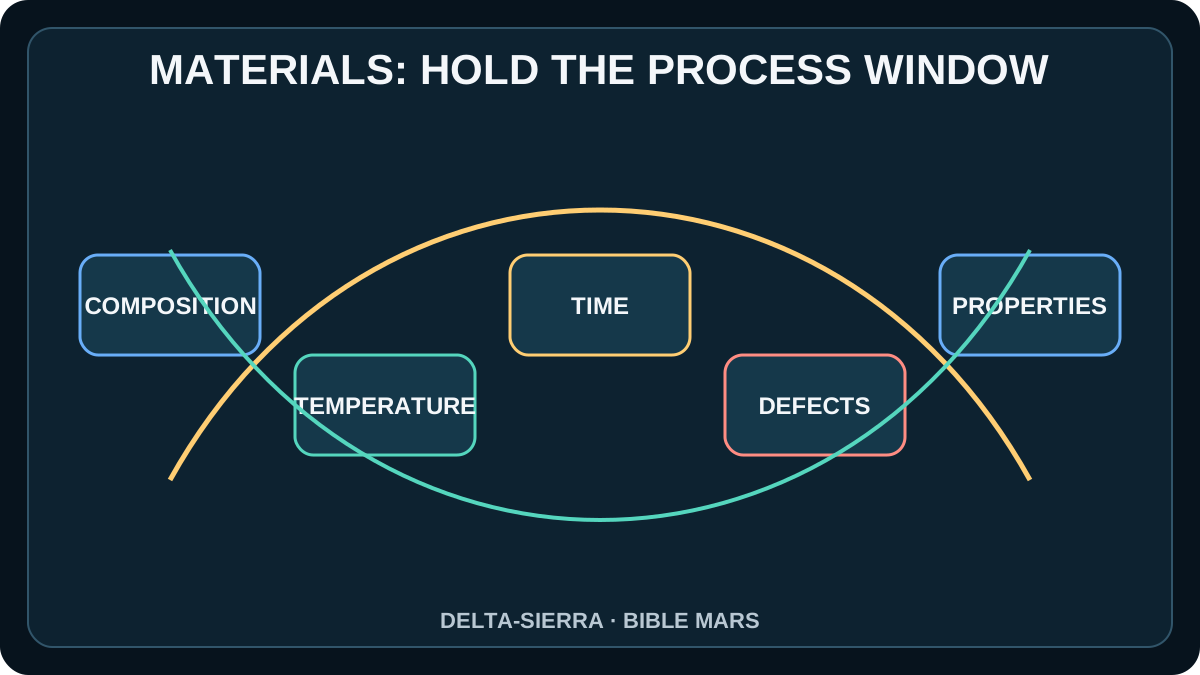
A local glass or ceramic process is credible only when feedstock variability and process windows are measured. Grain size, oxide composition, salts, drying, furnace profile and cooling history can change porosity, cracking and strength even when the finished object looks identical. The materials system therefore needs sampling, witness coupons and property tests before a batch is approved for a structural or pressure-related use. The useful margin is not a generic percentage of stock; it is the separation between the measured material distribution and the minimum property required by the application, including drift between successive local batches.
LEARNING SCENARIO — if 30 critical items from a materials production chain face average demand of 3 per day, 30 ÷ 3 = 10 days is the gross margin. It is useful only when composition, dimensions and qualification make those items truly substitutable; physical inventory alone is not operational availability.
In a glass-and-ceramics chain, a composition or firing drift can invalidate an entire batch just as a finishing machine becomes unavailable. The common-cause risk is therefore not confined to the machine tool; it can originate in off-spec material, a furnace, a shared reference standard or a common inspection method.
A material process has recovered only after it returns to a qualified process window: feed composition is controlled, temperature and dwell time are bounded, defects are inspected, and final properties are verified. Producing an object that merely looks correct is not enough if porosity, strength, or chemical stability remain unknown.
From Martian grain to qualified part: the complete industrial chain. Saying “we will make glass from regolith” is still far from an industrial process. A real production chain begins with knowledge of the deposit and ends with a part whose properties have been measured. Between those points lie excavation, particle-size control, removal of undesirable phases, drying, batch preparation, melting or sintering, forming, controlled cooling, possible machining, inspection and batch traceability.
Mars mission results show that surface material is not a chemically uniform powder. Martian soils are broadly basaltic but also contain amorphous phases, iron oxides, sulfates, chlorides, oxychlorine compounds and other constituents. A Mars factory therefore cannot start from the assumption “one regolith equals one recipe.” It must start from the opposite rule: each deposit has to be characterized before it becomes industrial feedstock.
1 — Prospect before building the furnace. The first machine in a Martian glass industry may therefore be a sampling and laboratory chain rather than a furnace: controlled sampling, crushing, sieving, spectroscopy, diffraction or equivalent methods, weighing, water/ice characterization, salt detection and a geological database. A deposit suitable for coarse glass may be poor for a refractory ceramic; material acceptable as shielding may be unacceptable for an electrical insulator.
2 — Prepare a repeatable batch. Particle size matters because fine grains heat and react differently from coarse fragments. Dust can contaminate clean zones and mechanisms. Perchlorates and other salts cannot simply be ignored because the final product will be heated. Preparation can include crushing, sieving, magnetic or density separation where useful, washing only when water treatment permits it, thermal conditioning, blending and buffer storage.
3 — Melting, sintering and vitrification are different operations. Melting takes material mainly into the liquid state. Sintering bonds grains without necessarily melting the entire body. Vitrification creates a glassy phase. Depending on composition and thermal history, the result may be glass, glass-ceramic or a multiphase material. Energy demand, production rate and final properties therefore depend strongly on the chosen route.
Four product families worth separating
A — Bulk construction products. Pavers, tiles, vitrified surfaces, shielding blocks, sintered aggregates and other non-pressure-critical parts may be the earliest useful products because transparency and optical quality are irrelevant.
B — Glass or basalt fibres. Historic NASA work on lunar materials examined fibres drawn from basaltic glasses. The concept is relevant to Mars but cannot simply be transferred without testing real Martian compositions. Local fibres could eventually reinforce composites, provide insulation, filtration media or technical textiles.
C — Functional ceramics. Ceramics can provide electrical insulation, wear resistance, high-temperature stability, filtration, thermal protection and catalyst supports. A mature settlement will require multiple ceramic families rather than one universal “regolith ceramic.”
D — Glass-ceramics. A glass-ceramic starts from a glassy state and undergoes controlled crystallization. The engineering goal is to combine manufacturability with improved thermal or mechanical properties. The practical answer depends on local chemistry and process control.
The furnace is critical infrastructure, not just a hot box. An industrial furnace requires energy, heaters or another heat source, refractories, insulation, sensors, handling equipment, heat rejection and maintenance. On Mars, every imported refractory brick, heating element and thermocouple remains a strategic consumable until replacements can be made locally.
The energy ledger must include wall losses, heating the furnace hardware itself, holding time, startup and shutdown, rejected batches and production schedule. A process that looks acceptable on a theoretical heat calculation may become inefficient if it runs tiny batches and cools completely between cycles.
Recovering useful heat. A mature settlement should recover heat from hot products and exhaust streams to preheat incoming feed, industrial water, another process or thermal storage. “Waste heat” is often a resource that has not yet been connected to a demand.
Measure properties before authorizing use. A locally produced part is not qualified because it looks solid. Depending on function, engineers may need density, porosity, compressive or flexural strength, fracture behavior, abrasion resistance, thermal expansion, thermal-cycle endurance, permeability, electrical resistivity and other relevant properties.
Qualification must be tied to use. A ballast block can tolerate broad variation; a pressure boundary, electrical feedthrough or high-temperature insulator cannot. The settlement therefore needs use classes, not a vague “made on Mars” label.
Dust, low pressure and thermal cycling are part of the material problem. Mars combines fine dust, radiation, large temperature variation, low atmospheric pressure and thermal gradients. A single room-temperature laboratory value is not enough. Aging, cycling, abrasion and interface testing are needed.
Many failures will occur at interfaces rather than in the bulk material itself: seal, bearing, hinge, coating, fastener or bonded joint. Qualification must therefore include the assembled system, not only a pristine coupon.
Recycling: glass can be remelted, but composition still matters. Broken glass can become feedstock, but mixing structural glass, specialty glass, ceramics and metallic contamination without identification can produce unpredictable material. Batches need marking, composition records and controlled return streams. Ceramics are more difficult to remelt directly but may be crushed and reused as aggregate, filler or feedstock component.
An industrial maturity ladder
What NASA evidence supports — and what it does not yet prove. NASA material and ISRU work shows that glass, glass-ceramics, fibres and sintered regolith belong to the long-studied family of ways to reduce imported mass. More recent autonomous-construction work strengthens that direction. But a lunar simulant demonstration or a thermal-processing concept is not a certification of a Martian product. The rigorous conclusion is stronger: a local resource becomes credible only when characterization, processing, inspection, aging, repair and recycling are demonstrated as one chain.
Essential vocabulary
Why a local material database may become one of the settlement’s most valuable assets. Every feedstock lot can be linked to origin, particle-size distribution, preparation, firing history and measured properties. The database then answers questions that a catalogue on Earth normally hides: which quarry zone produced the most stable ceramic, which furnace recipe reduced cracking, how much strength was lost after 500 thermal cycles, and which composition remains acceptable after recycling.
This history enables statistical acceptance instead of anecdote. A designer can select a material class with a known distribution of strength rather than the best sample ever produced. Maintenance teams can compare failed hardware with its manufacturing population. Procurement can decide whether a difficult imported additive genuinely improves reliability enough to justify transport mass.
Across decades, preserving this evidence is also a cultural task. Losing the material database would not remove the furnaces, yet it could erase the settlement’s ability to justify what those furnaces produce. Industrial autonomy therefore includes preservation of tested knowledge.
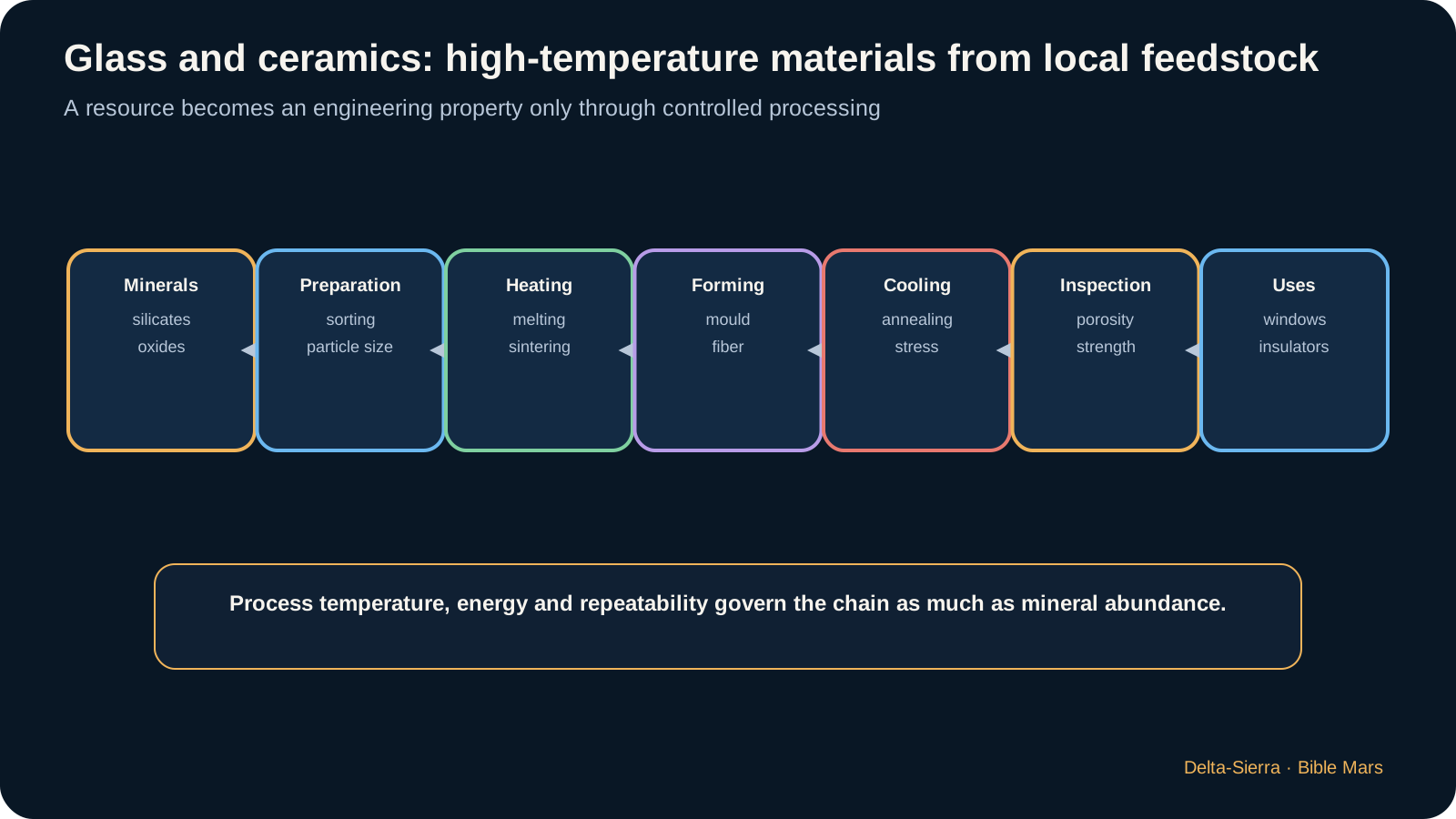
Glass matters because related processes can yield very different products: panels, fibres, foams, sensor covers, coarse optical elements and composite matrices. Structural and optical glass do not share the same requirements. A pressure window demands extraordinary defect control; reinforcement fibre can tolerate another chemistry; a dust-control surface may accept more impurities.
Industrial progression should therefore begin with products whose failure consequence is low and logistics value high. Tiles, protective layers, fibres and insulation can precede critical glazing. ESA has studied glass fibres made from lunar-regolith simulants; such work does not prove a ready Mars supply chain, but it shows why local silicates can become manufacturing resources once composition, process and properties are characterized.
Glass is more than windows. Glass can serve internal glazing, fibres, insulation, simple optics, containers and protective layers. Technical glass requires controlled composition, so feedstock must be separated and blended rather than simply melting random regolith.
Why glass and ceramics are strategic materials. A Martian industrial base cannot think only in steel and aluminium. Silicates in planetary materials can become feedstock for glasses, glass-ceramics, fibers, insulation, coatings and refractory components. NASA laboratory work has shown that compositions simulating lunar and Martian soils can be melted into glasses and can offer viscosity ranges suitable for drawing fibers. That does not mean raw regolith automatically becomes a transparent window: purity, composition and thermal control still determine the product.
Structural glass is not optical glass. A block, mineral fiber, insulation tile or abrasion shield may tolerate substantial chemical variability. A pressure window, optical fiber or laboratory component requires far tighter control of impurities, bubbles, residual stress and optical transmission. The industrial system should therefore classify products by required quality rather than seek one universal “Martian glass.”
A glass-ceramic begins as a glass and is then deliberately crystallized. The purpose is to create a controlled microstructure rather than allow random crystallization. Mechanical, thermal and wear properties can be adjusted through composition and thermal cycle.
The hard part: heat, furnaces and refractory life. Melting silicates requires high temperature. The industrial challenge is therefore not only electric power; it also includes furnaces, crucibles, electrodes, insulation and refractory materials that survive repeated thermal cycles and corrosive melts. These components become strategic consumables themselves. A plant that can melt regolith but depends on one Earth-supplied crucible is not autonomous.
Heat recovery should be considered from the first design. Cooling a hot batch releases useful thermal energy; an integrated facility may use some of it to preheat the next charge or support another process, provided temperature levels match.
Abrasion, dust and local qualification. Martian material contains fine abrasive particles. Exposed surfaces, seals, sliding interfaces and glazing therefore need testing for erosion, scratching and thermal cycling as well as static strength. Local test coupons can compare formulations before the settlement commits to larger structures.
A sensible development path starts with products tolerant of variability—pavers, shielding masses, thermal storage, fibers or noncritical components—then progresses toward high-specification products as chemistry, furnaces and metrology mature.
Primary references: NASA NTRS — glass and glass-ceramics from simulated lunar and Martian soils ↗ · NASA NTRS — Glass and ceramics ↗.
A transparent element is one of the hardest places to demand local material early because pressure, impact tolerance, optical quality, sealing and long-term flaw growth meet in one component. A settlement can gain much more from local glass by using it first where failure is less severe: protective covers, interior partitions, insulation fibres, laboratory ware, tiles and selected sensor windows. Imported pressure windows can remain strategic items while the bulk glass industry matures around them.
The same principle applies to shielding. Regolith or glassy local products can provide mass outside a certified pressure shell. They do not need to be perfectly airtight to be useful. This layered architecture lets a local materials industry contribute thousands of kilograms before it has achieved the process capability required for a human-rated transparent pressure boundary.
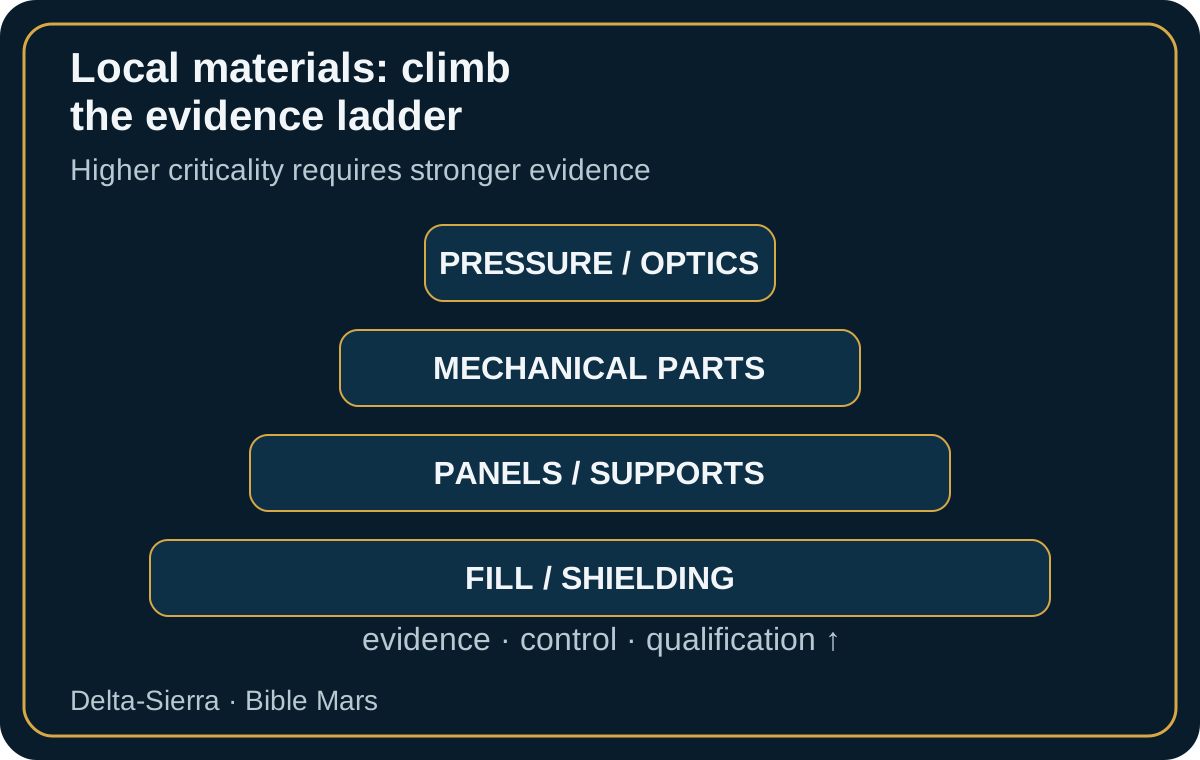
Over time, inspection data can expand the permitted service envelope. If batches show controlled composition, flaw density and thermal-cycle behaviour, local glass may move from noncritical products to increasingly demanding uses. Qualification is therefore a ladder, not a binary declaration that Mars can or cannot make glass.
Consider a batch process that requires a hypothetical 500 kWh of electrical and thermal input per tonne of prepared product before losses and auxiliary loads. Ten tonnes in one production campaign would represent 5 MWh. The number is deliberately pedagogical rather than a NASA requirement: actual energy depends on material, temperature, furnace, insulation and recovery. Its purpose is to show why material production cannot be planned independently from power.
If the microgrid has large periods of surplus solar or nuclear capacity, batch heating can be scheduled around them. If the furnace must remain hot continuously, the plant becomes a baseload consumer and needs backup power for safe shutdown. Thermal storage and heat recovery may reduce peaks, but they add equipment and maintenance. Industrial scheduling therefore becomes part of energy-system operations.
The same calculation should be repeated with measured pilot data as soon as a process exists. A Mars industry should progressively replace illustrative assumptions with logged kWh per kilogram, yield, cycle time and refractory consumption.
Ceramics occupy another niche: they tolerate heat, abrasion and often corrosion but are brittle in tension and sensitive to flaws. They can become insulators, supports, ducts, thermal protection, furnace hardware and process tools. For a settlement their importance is recursive: ceramics can replace imported parts and enable the metallurgy and chemistry that later make other materials.
That circular dependency shapes the industrial sequence. Metallurgy needs crucibles and refractories; making good refractories can itself require prepared powders, furnaces and metrology. Imported refractory items may therefore bootstrap the first local furnaces, after which local production progressively replaces the heaviest consumables.
Ceramics for heat, wear and insulation. Ceramics can serve furnaces, electrical insulation, filters, wear surfaces and high-temperature parts. ESA work has produced shapes from Martian regolith simulant, a useful fabrication demonstration but not validation of a crewed habitat.
The best Martian structure may not be monolithic. A hybrid can use metal for tension and sealing, glass or ceramic for wear and heat, compacted regolith for shielding mass and imported polymers for seals or membranes. Systems thinking avoids forcing one imperfect local material to perform every function at once.
It also lowers purity requirements. A local product may be excellent as fill, shielding or support while remaining prohibited in a pressure boundary. Qualification must be use-specific. The question is not simply 'is it good enough?' but 'good enough for which function, for how many cycles, with what inspection and what failure mode?'
Polymers and composites are harder. Seals, cable insulation, membranes, textiles and lubricants make polymers strategically important. Local polymer production requires a much more complex organic-chemistry chain, so imports and recycling will remain important for a long time.
Moving from coupons to urban production changes the problem. A laboratory selects the best sample; an industrial line must manage variability, failures, yield, rejects and labour. A process that makes one excellent tonne out of ten is not necessarily useful. Material yield, energy per kilogram and machine time become as important as peak strength.
NASA and ESA work on extraterrestrial manufacturing, regolith, fibres, glass-ceramics and construction provides evidence and research directions, not a complete Martian industrial chain. The page must keep that boundary visible: material study, process demonstrator, pilot line and autonomous industrial capability are four very different states.
DELTA-SIERRA / ARCADIA PROSPECTIVE ARCHITECTURE
Go deeper with ArcadiaAdditional interfaces and boundary conditions
This system within the settlement
Martian regolith is not a constant industrial recipe. Composition changes with location, depth and particle-size fraction. Useful glass and ceramics, however, depend on chemistry, thermal history and defect control. A local process therefore has to absorb variability upstream: characterize the batch, adjust composition when necessary, define temperature and hold time, then verify shrinkage, porosity, cracks and performance.
NASA work on melting, vitrification and sintering of regolith simulants has long shown the attraction of turning local mineral material into infrastructure feedstock. Planetary construction programs also investigate sintering, binders and additive approaches. The critical distinction for Mars is between “a brick was made from simulant” and “a local production line makes qualified parts from a real deposit.” Prospecting, preparation, energy, chemistry control, repeatability and qualification occupy the gap.
Consider a generic teaching example, not a claim about a specific Martian deposit. One tonne of prepared material loses 8% during sorting and preparation, leaving 920 kg. Thermal processing recovers 90%, leaving 828 kg. If 12% of manufactured pieces are rejected for porosity, cracking or dimensional error, qualified output becomes 828 × 0.88 ≈ 729 kg. Overall first-pass yield is therefore about 72.9%.
ηoverall = 0.92 × 0.90 × 0.88 ≈ 0.729.
1,000 kg × 0.729 ≈ 729 kg of qualified output.
The missing 271 kg is not necessarily permanent waste. Some material can be crushed, remelted or reintroduced. But rework consumes energy, machine time and inspection capacity. A serious material balance therefore separates first-pass yield, recovered yield after rework and true loss. Reporting only “mass manufactured” can hide a workshop that spends much of its capacity remaking rejected parts.
Lunar work on sintering and ceramics is a useful precursor for high-temperature processing, not a recipe for Martian glass. Composition, impurities and cooling history on the chosen site will determine whether a local material actually meets optical, thermal or structural requirements.
Document check: 2026-08-10.
Martian industry cannot live on metals and polymers alone. Glasses, ceramics, insulation, and mineral materials provide windows, electrical barriers, wear surfaces, refractories, thermal protection, and chemically stable parts. Their attraction often comes from abundant feedstocks but demanding thermal processing.
A town needs transparency, insulation, hardness, chemical resistance, thermal capability, or mass. Material selection should begin with functions and the local ability to make consistent quality.
Stiffness. A structure or optical mount requires limited deformation, linking material modulus, geometry, and temperature.
Thermal resistance. Furnaces, hot ducts, and protection systems require materials that retain function through thermal cycles.
Electrical insulation. Ceramics and glasses can provide electrical insulation while tolerating heat or vacuum, but brittleness must be considered.
Chemical resistance. Reactors, laboratories, and storage require surfaces that do not react with the fluids in service.
Transparency. A window must transmit the useful spectrum, carry pressure, and remain inspectable; optical material is also structural hardware.
Making glass requires control of composition, melting, homogenization, forming, and cooling. A clear pane and an insulating fiber are not the same product even if they begin with similar minerals.
Batch composition. Silica, modifiers, and impurities determine melting temperature, viscosity, color, and durability.
Melting and homogenization. Bubbles and composition gradients become defects unless the melt is sufficiently mixed and degassed.
Glass annealing. Poorly controlled cooling traps stresses that can later break a part without exceptional load.
Glass fibers. Turning glass into fibers radically changes its uses toward reinforcement, filtration, or insulation.
Glass recycling. Sorted glass can be remelted, but incompatible compositions and contamination limit mixing of streams.
Q̇ = k × S × ΔT / e
Conductivity k, area S, temperature difference ΔT, and thickness e give ideal heat flow through a layer. Interfaces and thermal bridges must then be added.
Ceramics can offer hardness, insulation, and high-temperature performance, but brittleness and defect sensitivity require different control than ductile metals.
Powder preparation. Particle size, purity, and moisture affect compaction and sintering; powder is a feedstock that needs control.
Compaction. Uniform green density limits differential shrinkage and cracking during heat treatment.
Sintering. Temperature, time, and atmosphere transform contacts between particles into a dense structure with measurable properties.
Furnace refractories. Metallurgy and chemistry themselves depend on materials able to contain hot melts and gases.
Abrasive wear. Ceramic parts can protect pipes and machines from regolith abrasion provided impact and mounting are managed.
The settlement will often combine a matrix with fibers, particles, or layers to obtain properties that one material alone cannot economically provide.
Fiber reinforcement. Fibers can increase strength or control cracking in a mineral or polymer matrix.
Sandwich structures. Two strong skins separated by a light core provide stiffness at low mass but add interfaces and debonding modes.
Barrier layers. A thin layer can provide sealing, chemical protection, or abrasion resistance over a structural substrate.
Surface repair. A worn coating can sometimes be replaced locally without rebuilding the whole component.
Thermal compatibility. Thermal expansion coefficients need compatibility so temperature cycling does not delaminate layers.
ΔL = α × L × ΔT
A part of length L changes dimension according to coefficient α and temperature change. This explains why joints and composites require expansion compatibility.
A microscopic flaw can govern failure in glass or ceramic. Quality therefore relies on inspection, batch tests, and statistics rather than visual perfection.
Optical inspection. Bubbles, cracks, inclusions, and surface flaws should be classified by their effect on function.
Batch strength. Coupons allow dispersion and process drift to be estimated without destroying every useful part.
Thermal shock. A material that survives high temperature can still crack if thermal gradients are too fast.
Chemical compatibility. Glass or refractory can be slowly attacked by a process and contaminate product before losing structural integrity.
Material traceability. Composition, firing, and inspection should follow each batch so a future failure can be linked to manufacturing conditions.
Over time, the town should turn its tests into a local catalog of compositions, processes, and properties. That library becomes infrastructure as important as the furnaces that produced it.
Material data sheets. Each useful composition needs property ranges, process route, limits, and approved uses.
Reference samples. Keeping reference specimens allows aging and new-batch drift to be compared with a physical reference.
Local substitutions. When ideal material is unavailable, the library helps select a substitute with known tradeoffs.
Martian aging. Dust, UV, cold, and pressure cycles will provide data that terrestrial tests never reproduce perfectly.
Town standards. Materials proven reliable gradually become internal standards that reduce variety and simplify maintenance and inventory.
m = ρ × S × e
This relation links density, area, and thickness to actual material mass that must be produced and moved.
On Earth, a material arrives with standards, supplier history and decades of industrial experience. A Martian production line would have to build some of that memory locally. Keeping reference specimens from known batches — with composition, thermal cycle, density, strength and exposure history — allows a new batch to be compared with a physical reference. Drift can then be detected before it appears in an important structure.
The library should include failures. A cracked ceramic, devitrified glass or overly porous block contains information about the process window. Keeping only the best samples would discard part of the operating history. Local materials become more valuable when the settlement understands not only how they succeed but how and why they fail.
At larger scale, that material memory supports substitution. If an imported product disappears, engineers can search for a required property — insulation, abrasion resistance, stiffness or transparency — rather than a commercial name. Material autonomy begins when a function can be satisfied by more than one qualified formulation.
A window develops a crack
The scenario requires evaluation of crack growth, pressure, volume isolation, and replacement before complete failure.
A ceramic batch is brittle
Witness tests detect unusual scatter. The batch is held, sintering parameters are reviewed, and already installed parts are identified through traceability.
A refractory contaminates metallurgy
Metal develops a new impurity. Analysis links drift to furnace lining and forces a change in material or thermal regime.
An imported material is no longer available
The local material library identifies a substitute with known properties and limits, followed by testing and restricted use before general adoption.
Local composition drives the process. Basaltic regolith can supply silicates and oxides useful for glass and ceramics, but two sites will not have identical chemistry. Melting temperature, viscosity, and crystallization tendency therefore cannot be fixed once for all. The laboratory must analyze each batch, adjust recipes, and preserve the link between origin and final properties. Mineral variation acceptable for a brick can be critical in a technical ceramic. The town must distinguish bulk materials from high-requirement functional materials.
A sintered material can look solid while containing pores, cracks, or thermal gradients that sharply reduce strength. Characterization work using tomography shows the value of seeing inside without destroying every part. On Mars, destructive coupons combined with nondestructive inspection can connect process conditions to defects. Scrap rate then becomes an industrial variable: a process using less energy per kilogram may become more expensive if it rejects a large fraction of parts. The base should track density, porosity, strength dispersion, and causes of nonconformance, then return scrap to the cycle where chemistry permits.
The word glass covers very different functions. A protective tile, pressure window, fiber, greenhouse pane, and optical component do not require the same purity or residual stress. Local industry will likely begin with tolerant uses: bulk materials, vitrified surfaces, or protection. Optical applications demand far tighter control of bubbles, inclusions, composition, and annealing. That progression should be explicit rather than promising the full terrestrial glass industry immediately. Each new material class becomes an industrial capability level with its own tests and authorized uses.
Technical ceramics appear in insulators, electrical feedthroughs, wear parts, refractories, and thermal protection. They may be small in mass yet critical to other processes. Locally producing a furnace-compatible refractory can unlock metallurgy; making a reliable insulator can enable electrical repair. This interdependence means early ceramics should be selected not by tonnage but by the industrial chains they make repairable. The road map should begin with a matrix of critical part → material → process → tests, then identify which local compositions and furnaces close the most dependencies with the least specialized equipment.
Glass, ceramics, and mineral materials offer many local pathways, but their properties depend strongly on the actual resource composition and thermal cycle. Terrestrial recipes cannot simply be copied. A base will need to build a qualified library of Martian materials recording composition, process, properties, defects, authorized uses, and aging history.
“Mars has plenty of rock” is not a construction specification. Particle size, mineralogy, salts, porosity and thermal behavior determine possible processes. Material suitable for berm fill may be unsuitable for transparent glass, dense ceramic or electrical insulation. Early materials industry therefore needs a strong laboratory function: sampling, sorting, crushing, drying, measuring and batch tracking.
NASA work on vacuum laser additive manufacturing of regolith, published in 2025, demonstrates a TRL-5 laser-regolith directed-energy-deposition system with a dust-mitigated vacuum-rated robotic arm. It is relevant as a technology option for planetary construction, not proof that Mars pressure vessels can already be printed from raw soil.
Glass forms when a melt avoids crystallization as it cools. Composition controls viscosity, softening temperature and optical behavior. Early Martian glass may be more useful as fiber, insulation, coating or simple technical glazing than as large habitat windows. Thermal gradients matter because rapid surface cooling can leave internal stress and cracking.
Heating 500 kg of material from 220 K to 1,500 K with an assumed average heat capacity of 0.9 kJ/(kg·K) requires about 576,000 kJ, or 160 kWh, before latent heat and losses. Heat recovery therefore becomes a major industrial lever.
Ceramics can provide hardness, wear resistance and thermal stability while remaining weak in tension. Pressing, sintering, vitrification and feed preparation control porosity and flaw population. A paving tile, electrical insulator and pump wear part need very different acceptance criteria.
Quality control should follow function: density, absorption, dimensions, flexural strength or ultrasonic inspection may matter. Local industry needs material grades with different qualification levels rather than Earth-like perfection for every use.
By-products create an industrial palette
The Mars Aqueous Processing System produced iron, alumina, magnesia and silica-rich fractions from simulants. The system lesson is co-production. A silica-rich stream may feed glass or ceramic; metal oxides may feed reduction; coarse fractions may become aggregate. Waste from one process can become feed for another.
Initial local tonnes can go into forgiving applications: roads, berms, plume protection, shielding mass, supports and blocks. Later uses may include nonpressure piping, greenhouse components and secondary structure. Pressure vessels, windows and safety hardware demand the highest evidence.
This progression matters because replacing 80% of infrastructure mass with simple local materials may reduce logistics more than locally making 5% of sophisticated components. Industrial planning should measure avoided launch mass and criticality, not technological glamour.
Regolith varies by site and depth. Serious industry maps particle size, mineralogy, salts, thermal behavior, compacted density and response to melting or sintering. The catalog assigns resources to suitable uses and avoids overprocessing material destined for simple functions.
Bulk materials may deliver the earliest autonomy gains. A cubic meter of shielding, fill or landing-pad material can exceed a tonne; replacing it locally saves more transport mass than a tiny sophisticated part. Processes should therefore be compared in useful tonnes per kilowatt-hour and machine-hour, not only maximum material quality.
Glass spans very different grades. Fiber or insulation tolerates defects unlike pressure glazing; optical fiber demands far greater purity. “Glass made on Mars” is meaningless without function, quality and evidence.
Ceramics also form a hierarchy. Bricks, wear liners, electrical insulators and high-temperature parts need different microstructures. Firing, porosity and internal stress control strength. Testing can begin with density, absorption and dimensions, then progress to mechanical and nondestructive methods for critical pieces.
Repairability should influence selection. A high-performance composite that cannot be repaired locally may be less useful than a heavier weldable metal. As new processes become available, the design catalog can evolve. Martian engineers choose not only best property but availability, repair path and confidence.
Waste becomes qualified feedstock. Broken glass, crushed ceramic and process scrap can return to some chains if composition and contamination are tracked. Uncontrolled recycling merely carries defects into the next generation.
Mars exposes materials to thermal cycling, radiation, dust and very low external pressure. A material that performs well in an Earth laboratory may change through moisture loss, repeated temperature swings or abrasive contamination. Qualification therefore needs relevant environmental cycles, not only room-temperature strength.
Transparent materials illustrate the problem. A greenhouse cover must transmit useful wavelengths, tolerate pressure and dust cleaning, and retain optical performance after years of ultraviolet exposure. A window for a pressurized habitat has a different safety case. Local glass production may begin with nonpressure panels and fibers before moving toward large pressure boundaries.
Ceramic wear parts can be valuable in pumps, guides and seals exposed to abrasive dust, but brittleness makes flaw control important. A small crack can dominate strength. Manufacturing methods that reduce porosity and careful edge design may matter more than nominal hardness.
Composite materials add another layer because matrix, fiber and interface can age differently. They may offer excellent mass efficiency but complicate inspection and repair. Early Martian infrastructure may deliberately prefer monolithic materials in places where local repair outweighs launch-mass optimization.
Fire behavior must be part of material selection inside habitats. A polymer or coating that is convenient to fabricate may produce smoke, toxic products or rapid flame spread in an oxygen-rich environment. Local manufacturing should not bypass flammability and off-gassing requirements merely because feedstock is scarce.
The material catalog should therefore record not only strength and density but environment, repair method, inspection, recyclability and confidence. A city builds trust in local materials one application class at a time.
An agricultural expansion needs 200 m² of translucent panels. Imported multilayer polymer is light and proven but limited in stock. Local glass costs energy and mass yet reduces logistics dependence. The choice cannot be reduced to kilograms.
Light transmission, pressure, thermal cycling, dust and replaceability should be compared. Heavier local glass can be used in small replaceable panes while polymer is reserved for locations where mass or geometry makes it superior. Greenhouse structure can evolve around local material properties.
If 10% of panels fail acceptance, 200 m² of installed area requires at least 200 ÷ 0.90 ≈ 222 m² gross production before installation breakage. Scrap can return to the furnace if composition and contamination remain controlled.
The best architecture may therefore be hybrid. Material autonomy means moving large mass progressively toward what Mars can produce, measure and repair rather than replacing every imported product immediately.
The easiest local materials to trust are those whose failure has limited consequence. Fill, shielding berms, road base and nonstructural blocks can tolerate broader variation. Their performance still needs measurement, but one defect rarely threatens a pressure cabin. These uses allow industry to gain experience at high tonnage.
Secondary structures come next. Brackets, trays, covers and panels can use local glass, ceramic or mineral composites when loads are understood and inspection is easy. The settlement learns how Martian raw material varies and how process parameters affect final properties.
Pressure or fracture-critical applications should require much stronger evidence. Large transparent panels, pressure fittings or high-temperature mechanical parts need flaw detection, proof testing and life models. A local material does not gain critical status simply because a prototype survived once.
Environmental exposure tests should include dust abrasion, thermal cycling and relevant radiation. Optical materials may lose transmission; ceramics may accumulate surface damage; seals or bonded joints can age differently. Test programs should reproduce the failure mechanisms expected in service.
Design can ease qualification by reducing consequence. Smaller replaceable panes, segmented shields and redundant load paths allow local materials to enter service earlier without pretending their evidence equals mature terrestrial supply chains.
This staged approach turns the city itself into a controlled learning program. Each application class produces data that supports the next, while failures remain bounded. Material autonomy grows through accumulated confidence rather than declarations.
Dust mitigation should be considered during material design, not added later. Surface texture, hardness and electrostatic behavior influence how easily panels and optical surfaces can be cleaned. A slightly less transparent glazing that survives repeated cleaning may outperform a delicate high-transmission surface over years.
Thermal expansion mismatch matters in hybrid assemblies. Glass bonded to metal, ceramic inserted into a steel housing or local material joined to an imported component can accumulate stress through day-night and operational temperature changes. Interface design may therefore be more demanding than either material alone.
Material databases should record negative results. Failed batches, cracking conditions and unsuitable feedstock are valuable knowledge because they prevent repeated experiments. A growing Mars industry needs a memory of what not to do as much as a catalog of successful recipes.
A Martian city does not need every material to meet aerospace-grade specifications. It needs enormous volumes of simple material for earthworks, shielding, roads, foundations and protection; reliable structural materials for buildings and machines; and smaller quantities of demanding materials for sealing, optics, electronics, pressure or high temperature. Thinking in this pyramid prevents expensive purification capability from being spent on uses where coarse material is sufficient.
The first tier can use characterized regolith with little transformation: fill, shielding mass, leveling layers or aggregate. The second requires processing into bricks, sintered elements, glass, ceramics, binders or composites. The third requires tighter control of composition and microstructure. The final tier may remain Earth-dependent for a long time. Autonomy grows as the boundary between these tiers moves upward, not by pretending that everything is local from day one.
Useful glass depends on oxide composition, proportions, melt temperature, cooling and impurities. A pressure window, fiber, greenhouse panel, insulation product and technical glass do not share one formulation. Martian regolith contains potentially useful components but also elements that change color, viscosity, crystallization and durability. Early glass industry therefore needs sorting, blending and characterization, not merely a hot furnace.
Energy balance matters. Heating a simplified 1,000 kg mineral charge from 20 °C to 1,400 °C with average heat capacity of 900 J/kg/K requires at least Q = 1,000 × 900 × 1,380 ≈ 1.24 GJ, about 345 kWh of ideal sensible heat, before fusion, losses and hold time. A real furnace would use more. That is why furnaces are likely to operate in campaigns and must be integrated with electrical generation and thermal management.
Electrical insulation, abrasion resistance, high temperature and chemical stability make ceramics attractive for nozzles, insulators, coatings, refractory bricks, supports and wear parts. Their weakness is often brittleness and sensitivity to defects. A pore or microcrack can dominate strength. Powder control, forming, drying, firing and cooldown therefore become part of material quality.
For noncritical uses, large variability may be acceptable with margin and sorting. For pressure or thermal-shock hardware, fracture statistics matter. “Local material” says nothing about confidence level. Testing, process control and traceability are what turn matter into engineering material.
Fibers, particles or fabrics combined with a matrix can improve stiffness, strength or insulation. The interface between phases then becomes critical: bonding, moisture, differential thermal expansion, ageing and repair. A locally made composite may be excellent for a nonpressurized panel while remaining inappropriate for a crew pressure shell.
Regolith-filled composites can reduce imported mineral mass but often depend on a binder. The real balance should expose the imported fraction. If a 100 kg panel contains 85 kg local filler and 15 kg imported polymer, its local mass fraction is 85%. Producing 10 tonnes of panels still requires 1.5 tonnes of imported binder unless local chemistry replaces it. Autonomy metrics should track critical ingredients, not only total mass.
A Martian materials library should associate every lot with composition, process, properties and approved uses. Instead of a vague label such as “local glass,” it can distinguish construction glass, noncritical optical glass, protective glass and material not approved for pressure service. This lets imperfect local materials be used quickly where they are sufficient without contaminating critical supply chains.
A series of ten specimens teaches more than a record strength value. Mean, scatter, defects and lot-to-lot drift determine confidence. If average compressive strength is 60 MPa but some specimens fall to 35 MPa, a designer cannot simply claim “60 MPa material.” The causes of scatter must be understood and a conservative allowable chosen.
Variation may come from extraction site, moisture, particle size, furnace behavior or operator practice. Process metrology — temperature, mass, composition and time — becomes as important as the final test. With enough data, the settlement can link manufacturing parameters to properties and tighten variability.
Low pressure, CO₂ atmosphere, abrasive dust, thermal cycling, ultraviolet and radiation can affect surfaces, seals, polymers and coatings. Materials inside a habitat see a different environment from roads or exterior panels. Tests should therefore reproduce function: cycling, abrasion, temperature, gas composition and duration.
A repair material must also be compatible with the original. Differential thermal expansion can create stress every cycle. An adhesive may bond at room temperature but embrittle in cold conditions. A successful repair on day one is not evidence of long-term durability.
A high-performance material that cannot be repaired locally may be a poor choice for long-duration hardware. A slightly less optimized alloy, glass or composite that can be reproduced, measured and recycled may deliver better system availability. Martian design should therefore include the lifecycle at material-selection time.
This logic also changes standardization. Reducing the number of material grades used in the city can simplify inventory, testing, recycling and training. Diversity remains necessary for special functions, but each new material adds a supply chain and qualification debt. Standardization becomes an industrial-autonomy tool.
NASA Advanced Manufacturing Technologies provides current context for manufacturing and materials maturation. NASA NTRS — Advanced Manufacturing in Space contains many regolith and materials studies, but each must be cited with its test environment and maturity. Strength measured on an Earth simulant must never be presented as guaranteed performance of real Martian material.
A nonpressurized protective panel must tolerate dust, thermal cycling and maintenance impacts. Three local options exist: a heavy but simple sintered plate, a mineral-filled composite using imported binder, or thinner metal sheet from an already constrained metallurgy line. The best material is not necessarily the strongest; it is the one that minimizes total dependency.
The sintered plate needs substantial heat but almost no imported ingredient. The composite reduces melting energy but consumes polymer. Sheet metal is light and repairable but uses metallurgical capacity reserved for higher-criticality parts. The comparison should therefore include energy, imported material, machine time and competition for scarce industrial capacity.
Options can be compared across normalized axes such as mass, energy, critical imports and repairability. The tool must expose its weights. If import dependence receives double weight because the next logistics window is distant, that assumption should be visible. A score explains a decision; it should not create false mathematical objectivity.
The decision can change as the settlement matures. A polymer solution may be rational while inventory is plentiful; a decade later, local glass or metal production may dominate. Material choice is dynamic because the industrial portfolio changes.
Large quantities of shielding, road material and secondary structures do not need perfectly repeatable composition if variation is measured and the design tolerates it. Thicker geometry, replaceable elements and suitable margins can make variable local material useful. Instead of purifying endlessly, engineers can sometimes design systems robust to material variability.
Critical functions require the opposite approach: variability must be reduced and demonstrated. A use-class policy keeps the two philosophies separate. Local industry can grow quickly without pretending that every product is interchangeable with fully qualified Earth material.
Glass and ceramics show why Martian industry cannot be metal-only. Windows, insulators, coatings, fibers, refractories and electrical components need different properties; an element abundant in soil is not automatically suitable for each. Regolith becomes valuable through characterization and compositional control.
Qualification remains use-specific. Material adequate for a slab or dust barrier may be unacceptable for a pressure boundary or high-voltage insulator. Use classes allow local materials to enter gradually without demanding terrestrial-grade purity and reproducibility for every application on day one.
Regolith-based construction experiments are promising because they investigate abundant feedstock, but a strong laboratory coupon is not an industrial process. A production line must tolerate variation in particle size, composition, residual volatiles, machine temperature and binder state. A recipe whose properties collapse after a few percent of feedstock variation will be difficult to operate far from a laboratory.
A NASA work item on vacuum laser additive manufacturing of regolith describes a directed-energy-deposition system developed as a relevant demonstration for off-Earth construction. The Mars lesson is not that a lunar-oriented system is automatically Mars-ready. It is that robotic motion, feed handling, dust mitigation and thermal protocol have to mature together. “Material” and “machine” are one coupled process.
Two bricks with the same mass and external dimensions may differ in porosity, cracks, residual stress or microstructural orientation. Visual inspection alone is insufficient for critical service. Martian industry will have to decide which properties matter for each application: density, compressive strength, toughness, conductivity, permeability, thermal stability, radiation ageing or pressure-cycle behaviour.
This hierarchy prevents a common conceptual mistake: calling a material “suitable for a habitat” because one coupon has high strength. A habitat also requires joints, sealing, inspection, repairability, ageing, fire behaviour and compatibility with other layers. A material is not an architecture.
Industrial materials have to be specified by function, not by familiar Earth product names. A transparent panel may be selected for optical transmission, abrasion resistance, thermal cycling, pressure containment, or radiation shielding, and those requirements point to different compositions and processing routes. Likewise, a ceramic used as an electrical insulator is not interchangeable with a refractory lining or structural tile. Local industry therefore begins by translating each application into measurable properties—strength, porosity, thermal expansion, dielectric behavior, optical quality, chemical resistance—and then asking which Martian feedstocks and furnaces can reach them reproducibly.
Process control matters because glass and ceramics remember their thermal history. Grain size, moisture, mixing, heating rate, peak temperature, atmosphere, cooling rate, and post-processing can change defects and final properties even when bulk chemistry is unchanged. A settlement that can melt or sinter material but cannot reproduce the process window does not yet possess a dependable materials industry. The valuable capability is a qualified recipe tied to measurements and acceptance tests, plus the ability to diagnose why a batch drifted before using it in a pressure boundary, electrical system, or optical instrument.
Repairability also affects material choice. A high-performance composite or coating can be attractive on Earth yet difficult to reproduce or inspect on Mars. In some applications, a slightly heavier material with a simple heat-treatment route, measurable properties, and repairable joints may provide higher system availability. Material optimization should therefore include the industrial ecosystem needed to keep the material in service, not only its laboratory performance.
Construction research shows how local mineral material can become structural elements after preparation and processing.
Testing reminds us that end use imposes properties and hazards to verify beyond manufacturing itself.
The challenge explored local and recycled materials across several demonstration levels, providing design cases rather than a universal material.
This source describes the evolution of nozzles, binders, and deposition with in-situ material, linking formulation to construction hardware.
Temperatures and containment challenges of molten-regolith processes directly inform refractory needs for future mineral industry.
Habitat architecture reminds us that a material never exists alone: it serves interfaces, living functions, maintenance, and future modification.
Vacuum Laser Additive Manufacturing of Regolith; Mars Aqueous Processing System; 3D Additive Construction with Regolith; and Application of Manufactured Products.