


Crew operations, procedures and Earth–Mars communications
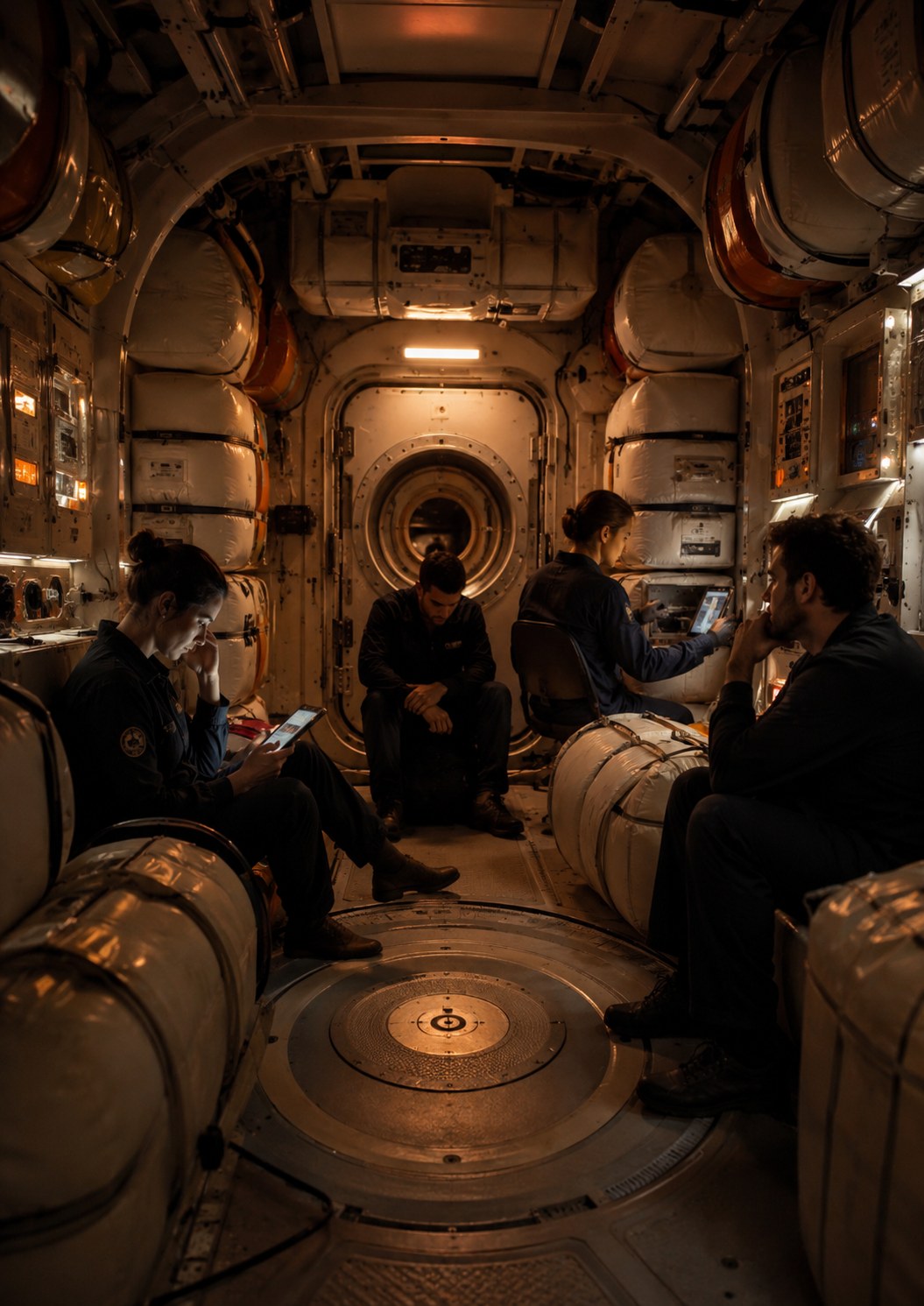
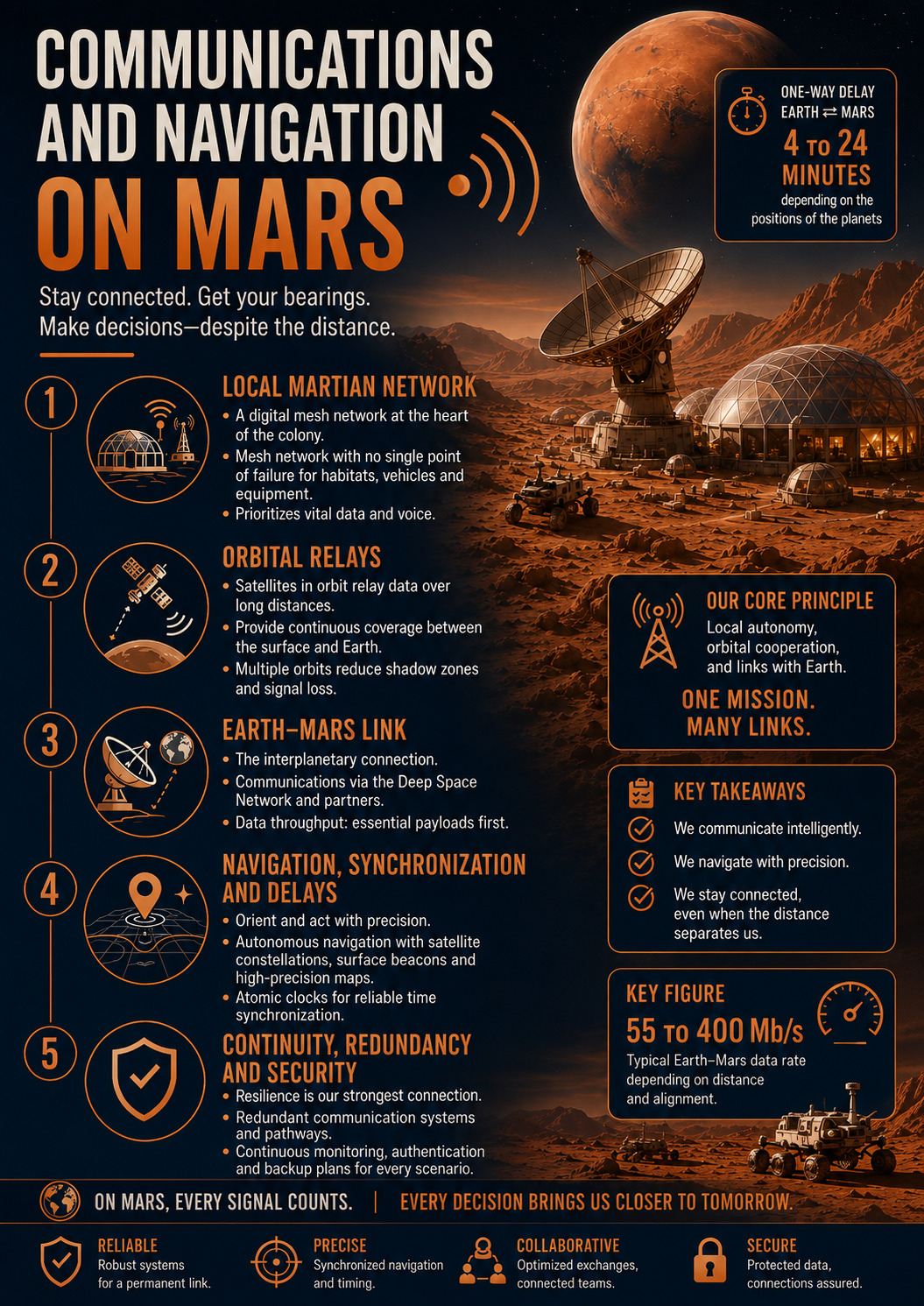
A Martian day is a chain of decisions, not a task list
“Crew operations, procedures and Earth–Mars communications” addresses operations as management of authority and information when Earth advises but cannot command every second.

The central observables are radio delay, workload, open events, alarms, procedure state, fatigue, acknowledgments and reserves.
Those omissions are engineering information.
NASA communication-delay research and NASA-STD-3001 show why autonomy and human factors are system requirements
This evidence is used only for what it demonstrates.
Recompute interaction loop = one-way delay + processing + return delay with units visible. The result is not accepted in isolation: then check whether the change also modifies radio delay, workload, open events, alarms, procedure state, fatigue, acknowledgments and reserves.
A Mars procedure must remain usable without an immediate Earth reply
Earth–Mars delay changes the structure of operating procedures. An urgent action cannot depend on asking mission control a question, even though Earth teams remain extremely valuable for delayed analysis. Every critical procedure therefore needs a local authority boundary, a minimum set of observations, a preference for reversible actions when time allows, and a defined point at which safety requires refuge mode or termination of the activity. Cognitive load is an engineering variable: a failure checklist used at the end of a long shift, under multiple alarms and with an injured crewmember must be simpler than the system it is trying to recover.
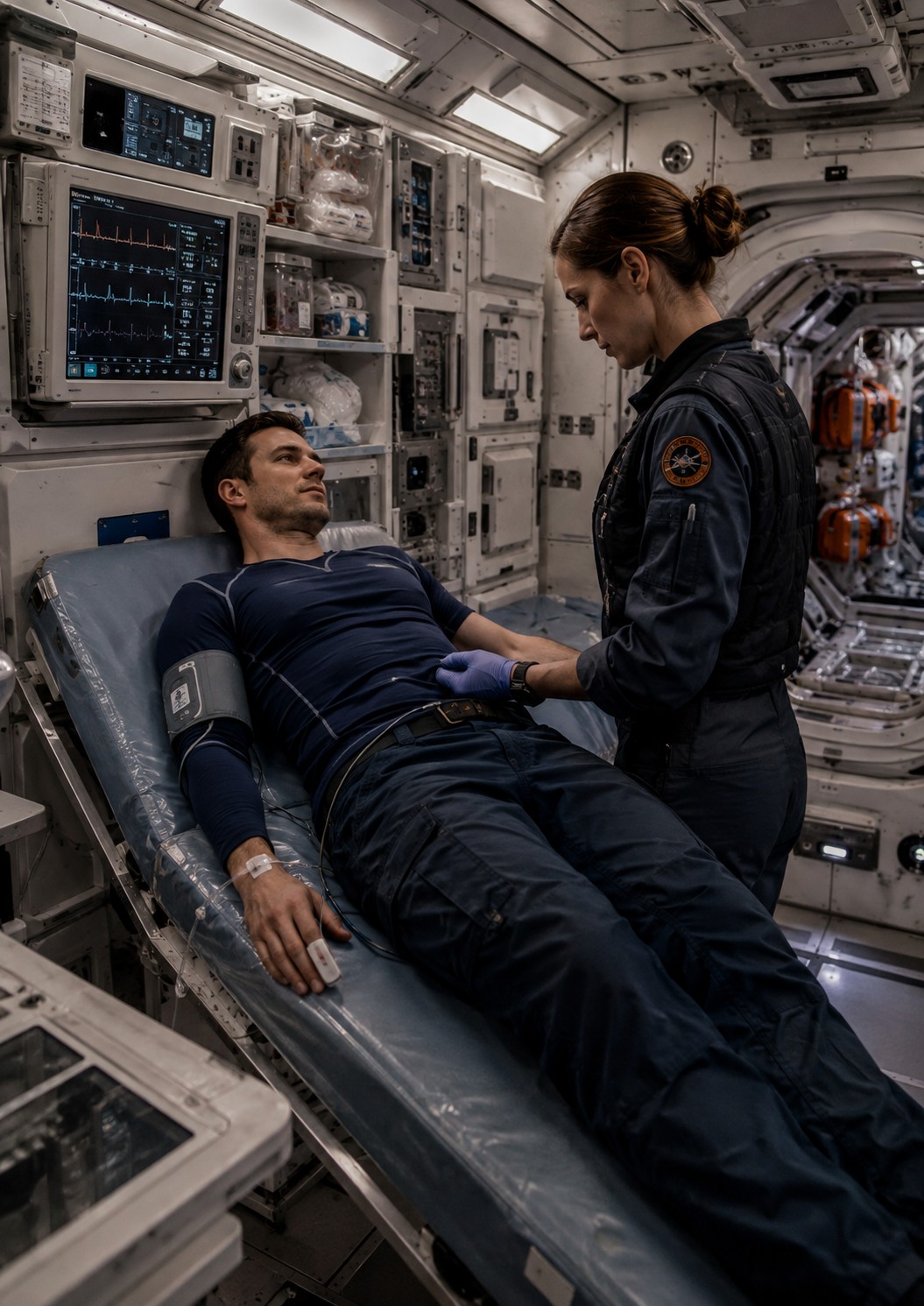
Communications are consequently organised by priority and context. A useful status packet carries time, configuration and enough raw evidence for a remote team to reconstruct the event after the delay. Local logs preserve decisions and reasons so that a later crew shift does not repeat a dangerous experiment. The goal is not to recreate a terrestrial control room inside the habitat; it is to allocate which decisions must be local, which can wait for remote expertise and which contingencies should be prepared before an anomaly occurs.
Shift handover is part of fault containment
A long-duration mission cannot assume that the person who first saw an anomaly will remain responsible until recovery. Fatigue, sleep cycles and simultaneous work create handovers during unresolved events. A useful handover record states current configuration, confirmed facts, rejected hypotheses, temporary limits, actions already attempted and the next decision point. This prevents a new shift from repeating a risky test or unknowingly undoing a protective configuration. Earth advice can be appended when it arrives, but it should not erase the local chronology. Operational resilience therefore includes information continuity between people, not only redundancy between machines.
Procedure design should include stopping rules
Operators need to know not only what action comes next but when troubleshooting must stop. A repeated reset, valve cycle or software restart can consume finite resources or deepen an unknown fault. Procedures should therefore define attempts, observation intervals and escalation criteria. This protects the crew from turning understandable uncertainty into damage through unlimited experimentation.
Managing anomalies without saturating the crew
keeping Earth useful as delayed expertise without disempowering the crew or saturating communications
delayed-communication simulations, handovers, timed procedures, comm-loss cases and decision review
Verification asks whether the requirement is met;
Evolving mission operations into community operations
Deepening — operating a mission when Earth can no longer hold the crew’s hand
The real paradigm shift: move decisions toward Mars
In low Earth orbit, mission control can still act as an enormous collective memory. Propulsion, thermal, software, medical and operations specialists can analyse what the crew sees with little delay. Mars breaks that arrangement structurally. Even when the link is healthy, propagation adds minutes each way, and some geometries degrade or interrupt communications. The design question is therefore not “how do we preserve Earth control?” but “which decisions must move onboard or onto the Martian surface, under what limits, with what data and with what recovery path?” That shift affects training, documentation, responsibility, software and the very shape of procedures.
A Martian procedure must work for somebody who cannot immediately ask what to do next. It should state expected system state, preconditions, stop points, consequences, unsafe thresholds and a way back. A simple checklist becomes fragile when reality departs from the nominal case. Sequential steps therefore need decision logic and a representation of system state. This is where timeline/procedure integration matters: the crew must understand not only the current action, but the resources it consumes, the constraints it moves and the conflicts it creates with later work.
Autonomy should still be graded. Routine maintenance may be fully local; a critical software change may require cross-review; a decision that deliberately consumes the last redundancy may need a predefined authority. A Mars town cannot operate around a “call Houston” button, but it should not romanticize improvisation either. The robust model is bounded autonomy: rules of engagement, authority limits, event logs, retrospective review and the power to stop when an assumption becomes false.
Build a schedule that absorbs failures instead of merely suffering them
A schedule optimized to 100 percent is already late. Mars operations need reserved time for anomalies, maintenance, repeated tests and documentation. This margin looks unproductive until a pump, rover or airlock takes four hours instead of one. The effect is measurable: four people providing eight useful work hours each create 32 person-hours. An unplanned six-person-hour response consumes about 19 percent of that daily capacity because 6 ÷ 32 × 100 ≈ 18.75 percent. In a small crew, a single technical problem can therefore displace a large fraction of the science and industrial program.
Planning must separate rigid work from movable work. A communications pass, an EVA tied to lighting or a biological sampling sequence may have strong timing constraints; reporting and some preventive maintenance can move. This hierarchy lets local planning software propose alternatives without hiding their consequences. The purpose is not algorithmic micromanagement. It is to make scarce resources visible: human time, power, airlock availability, shared vehicles, specialist availability and fatigue.
Four people can coordinate much of this through one daily meeting. Twenty residents need domain leads. At one hundred, maintenance, medicine, production and logistics develop separate queues. At one thousand, the settlement is no longer a crew: it has public services, companies, night shifts, standby teams and competing priorities. The reference library should make that phase change explicit because tools that work for an expedition do not automatically scale into civic infrastructure.
Handovers become a safety technology
A shift handover can look administrative, but it is a barrier against error. A difficult anomaly has a history: first symptoms, measurements, discarded hypotheses, replaced parts, drifting values and remaining hazards. If that history is compressed into “pump unstable, monitor,” the next team restarts the investigation and can repeat a dangerous action. A useful handover preserves three states: system state, reasoning state and decision state. It says what is known, what is assumed and what is still unknown.
Earth-Mars latency strengthens this requirement. Ground analysis may arrive after the crew has already changed strategy. Recommendations need timestamps and a statement of which vehicle or habitat configuration they refer to. Otherwise an old message can be applied to a new state. The technical timeline becomes a form of configuration control for reality: commands, procedures and configuration files should never be treated as “latest” without date, origin, context and approval status.
For life-critical events, a robust handover can use a fixed short structure: situation, changes since last handover, unavailable barriers, prohibited actions, next decision and escalation conditions. A common form is not bureaucracy for its own sake. It releases working memory under fatigue. The format must remain concise, however; a twenty-page handover nobody reads is not a safety barrier.
Train generalists without pretending specialists can disappear
NASA work on exploration mission tasks and crew complement shows why staffing is an architectural problem. As Earth recedes, expertise normally available on the ground must either be represented locally or made accessible through tools, documentation and training. Yet four people cannot simultaneously be expert surgeons, electricians, mechanics, biologists, pilots, software engineers and geologists. A viable crew therefore combines primary specialties, secondary skills and decision support rather than assuming universal mastery.
Training must also be designed against skill decay. A capability used once every six months cannot be treated as secure because it was certified two years before launch. Refresher drills, simulation and cross-training become permanent operational loads. Their frequency should reflect both probability of use and the consequence of poor execution. A rare but life-critical task may deserve more practice than a frequent, easily reversible operation.
Population growth changes the solution. A twenty-person base can finally support more specialists and backups. A community of one hundred can organize rotations and local training. A town of one thousand needs technical education, certification, apprenticeship and continuity independent of the founding crew. Human autonomy then meets industrial autonomy: a durable society must reproduce not only parts, but the skills required to design, inspect and repair them.
Turn every incident into searchable collective memory
A Mars settlement cannot afford to pay twice for the same failure. Every significant anomaly should leave a structured record: context, symptoms, chronology, hypotheses, root cause when known, contributing factors, corrective actions and limits of the conclusion. Cause analysis must be separated from automatic blame. If operators expect every report to become punishment, near-misses will disappear from the database before they disappear from reality.
That memory should be searchable. When a sensor begins to drift, the team should be able to retrieve similar events, environmental conditions, affected parts and actions that succeeded or failed. Local AI can help connect cases, but it must preserve provenance. Operators should see which observations support a suggestion. A generated answer with no traceable basis is not a certified procedure.
After years, the result is a distinct Martian operating culture. It will be neither a copy of the ISS nor a frozen command manual. It will combine autonomy, documentation discipline, stop-work authority, clear responsibility and continuous learning. That is what turns an exceptional crew capable of heroic survival into infrastructure in which ordinary people can live and work without every day requiring heroism.
Sizing operational autonomy as a safety system
Measure usable team capacity, not just headcount
Saying that a base has twenty residents says little about its operational capacity. Population has to be translated into usable hours, skills, on-call coverage and expected unavailability. If twenty people each provide six genuinely schedulable hours per sol after sleep, meals, hygiene, meetings and personal tasks, the theoretical pool is 120 person-hours. Reserving 15% for unplanned maintenance, 10% for training and 10% for documentation leaves 78 person-hours for planned objectives: 120 × (1 − 0.15 − 0.10 − 0.10) = 78. The symbol “×” means multiplication. This exposes designs that look generously staffed yet are saturated before the first anomaly occurs.
Capacity also has to be tied to competencies. One hour from a physician, EVA operator or power-system specialist is not interchangeable with any other hour. Scheduling therefore needs to track critical functions and backups, not only total labor. A settlement is fragile when a vital skill exists in one person, even if its aggregate manpower looks comfortable. At one hundred or one thousand residents, the architecture requires shifts, rest days, training pipelines and a reserve of qualified people who can respond without shutting down every other service.
Build procedures around hazardous states and irreversible steps
A robust procedure identifies which actions are reversible. Closing a valve, isolating an electrical bus or loading a software configuration may be recoverable; venting a tank, disabling thermal hardware or initiating a one-shot mechanism may cross a point of no return. Those thresholds have to be visible before the action. The procedure should also state the minimum evidence required to proceed: pressure, temperature, current, mechanism position, software state, redundancy status and people who must be informed. A checklist that never states the required system state is only a sequence of verbs.
NASA work on greater crew autonomy supports another principle: procedures cannot be tunnels. When observations diverge from the expected state, the operator needs an explicit stop point, the identity of the last safe configuration and a branch into diagnosis. That requires interfaces that show current configuration and recent history. On Mars, where Earth support arrives late, representation of state becomes part of the safety barrier rather than a convenience.
Turn handovers and incident memory into transferable infrastructure
A settlement also succeeds by preserving what it learns when people rotate or retire. Significant incidents should be linked to equipment identities, software versions, environmental conditions and decisions. The archive is useful only if it can retrieve analogues without mistaking correlation for cause. A local AI may suggest that five earlier events resemble the current one, but operators must be able to open the underlying evidence and see why the recommendation was produced.
At a thousand residents, this knowledge can no longer live in the memories of a few founders. It becomes institutional infrastructure: report-quality rules, retention policy, access rights, privacy safeguards, periodic review of corrective actions and use of real cases in technical training. That is a practical definition of autonomy: not isolation from Earth, but the ability to keep learning when Earth is no longer the center of every decision.
Make crew autonomy a measurable capability
“The crew will be autonomous” is not a verifiable requirement. Mission design has to say which decisions are local, which information is available, how quickly action is required and what limits apply to crew authority. A Mars mission must preserve vital functions through periods when Earth is unavailable and through the more common condition in which Earth is reachable but too slow to participate in the immediate loop.
Communication delay becomes labour time
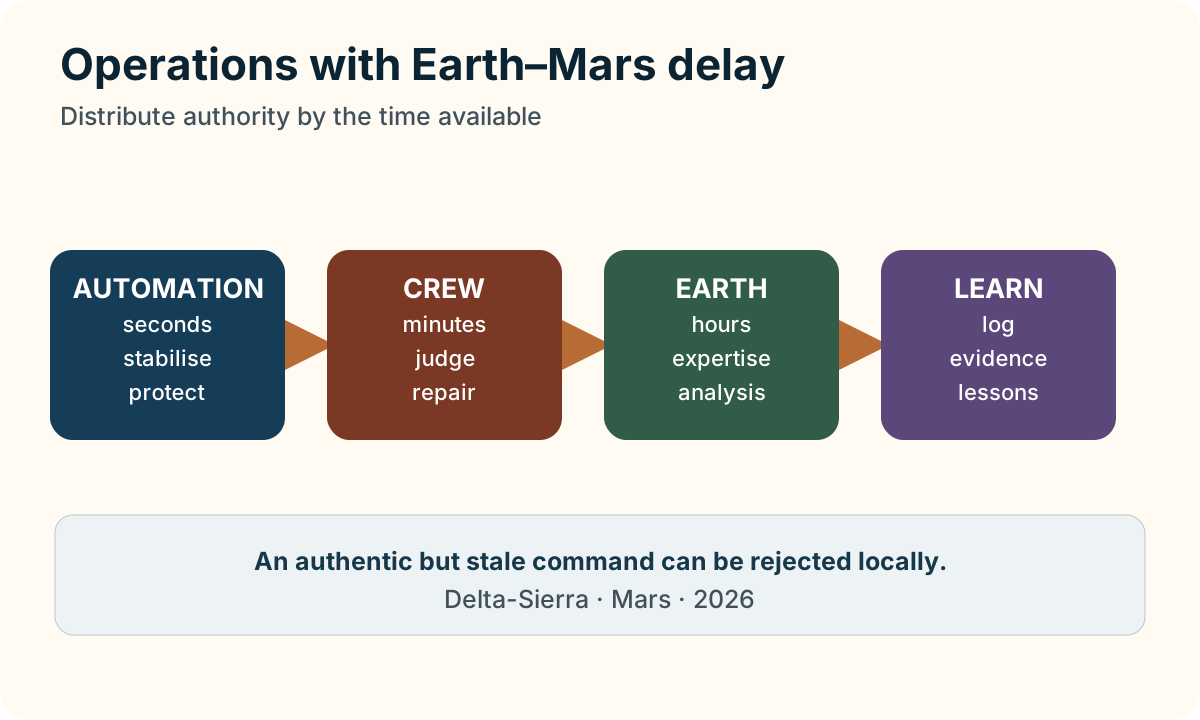
With a one-way delay to = 15 min, a question that truly requires Earth cannot receive an answer in less than about 2to = 30 min, even before either side reads and analyses it. Five sequential clarification cycles can consume hours. The symbol to denotes one-way propagation time. Operations therefore need complete information packages and work that can continue between exchanges, rather than a terrestrial telephone-style conversation stretched across space.
Procedure, rule and intent solve different problems
A procedure describes a known sequence. A rule establishes a boundary or priority. Mission intent states the outcome that must be preserved when the known sequence no longer fits. Mars crews need all three. Overly rigid steps can be hazardous during a novel fault, while vague guidance transfers too much reasoning to people already managing stress and uncertainty.
Handover must transmit the mission’s current mental model
Shift change is more than completed and pending tasks. It needs assumptions, open anomalies, temporary configurations, consumed margins and deferred decisions. A valve deliberately left in a nonstandard state or a sensor temporarily removed from a voting set must be obvious to the next operator. The operations log is therefore part of the safety architecture.
Human, automation and Earth must not become three competing commanders
Authority should be explicit by timescale and phase. Automation handles rapid, bounded reactions; crew members resolve ambiguous local conditions; Earth contributes deep expertise, independent analysis and future planning. Poorly defined authority can produce contradictory actions: software tries to preserve a safe mode, a crew member continues repair, and Earth transmits a command based on a state that is already twenty minutes old.
Temporal authority: an authentic command can still be stale
Commands should carry the assumed configuration, procedure version, validity interval and execution conditions. If the state has changed, crew or automation must be able to reject a cryptographically authentic instruction whose operational premise is no longer true. Delay makes time part of command safety.
Failure case: communications loss during a slow leak
Earth connectivity disappears as pressure trending becomes suspicious. The local team validates the measurement, estimates loss rate, identifies isolatable volumes, chooses whether a zone should be closed and updates gas endurance. When the link returns, the outgoing package includes useful raw data, actions already taken, current configuration and the questions requiring Earth expertise. This lets Earth add value without pretending to retake real-time control.
Workload, sleep and competence are mission resources
A technically correct procedure can be operationally impossible if it occupies two specialists for six hours while another anomaly consumes the rest of the crew. Planning should track skills, rest, suit time, monitoring duties and the ability to handle a second fault. Autonomy is not achieved by demanding more effort from humans. It is achieved by giving them better information, bounded authority and tools that reduce unnecessary cognitive load.
Measure remaining operational capability

After a fault, a useful status display shows which functions remain available, the endurance of key reserves, tasks that can no longer be performed, required skills and the next decision point. “Habitat operational” is too coarse. A habitat can remain pressurised while losing its ability to repair water processing or conduct EVA; such capability debt must be visible before the next fault arrives.
Training case: twenty-four hours with no Earth support
Before departure, teams should rehearse full sequences without real-time Earth intervention: daily planning, a technical fault, a non-emergency medical judgement, reconfiguration, maintenance and delayed reporting. The exercise should identify every point where the crew lacks information or authority. Repeated dependence on a terrestrial specialist is a design signal: convert that dependence into onboard documentation, diagnostics, training or computational tools.
CHAPEA and analogue missions are operational evidence, not proof of Mars equivalence
NASA’s CHAPEA work is useful because it exercises isolation, communication constraints, schedules and team processes in a controlled analogue. It does not reproduce Martian gravity, radiation or every hardware consequence. The disciplined use of analogue evidence is to learn about human and organisational mechanisms while keeping the boundary between simulation and planetary flight explicit.
A settlement eventually owns its exceptions
Long-duration operations move from “mission controlled on Earth” toward local institutional competence. Procedures will be amended on Mars, reviewed, versioned and taught. Every incident should enrich the system without turning one successful workaround into an unexamined universal rule. Operational maturity means that local changes preserve rationale, evidence and rollback information.
Build an authority matrix: who may decide what when Earth is unavailable?
Mars operations benefit from an explicit matrix connecting decisions with authority. Automation may isolate an electrical short or close a valve on an urgent threshold; crew may change operating mode, terminate an EVA or isolate a compartment; Earth may perform deep analysis, recommend complex changes or review long-horizon configuration. This is not a simple hierarchy. Authority follows response time and local information.
Every authority needs limits. Software may shed loads from an approved class but perhaps may not turn off occupied medical equipment. Crew may modify a procedure during an emergency but must capture the change and subject it to later review. Authority without boundaries creates conflicting actions; boundaries without exception authority create brittleness.
Adapt responsibility matrices to light-time
Terrestrial organisations sometimes use RACI: Responsible, Accountable, Consulted and Informed. On Mars, “Consulted” must include a timing condition. Earth cannot be a mandatory consulted party before action on rapid depressurisation. For a nonurgent software update, delayed Earth review may be exactly the right safeguard. The same organisation tool changes meaning when consultation takes tens of minutes.
Authority envelopes should be exercised
Training can deliberately remove Earth contact and inject an unfamiliar fault. Evaluators observe whether the rules permit decisive stabilisation, whether onboard information is sufficient and whether crew know when evidence is too weak to continue. Every hesitation caused by missing authority or missing data becomes a design or training requirement.
Write procedures that remain usable when reality leaves the expected script
Robust procedures include verification points and branches. “Close V12” is less informative than “if P2 continues to decrease after V11 isolation, close V12 and verify oxygen flow remains above threshold X.” Explicit values, units and success criteria make action testable. Yet branching must remain readable; a procedure turned into a hundred-page decision tree can fail under time pressure.
Known and unknown states need different behaviour
A crew should be allowed to state “cause not isolated.” Recovery can then favour reversible actions: reduce load, isolate a zone, increase monitoring and preserve diagnostic evidence. Operations culture should reward correct uncertainty rather than a fast unsupported diagnosis.
Rollback belongs inside the procedure
After reconfiguration, the path back can be as risky as the initial action. Which parameters return to previous values? Which equipment changed temperature while off? What test proves the original fault is absent? Without rollback criteria, a temporary workaround can silently become the permanent configuration.
Manage simultaneous anomalies without consuming human decision capacity
Real incidents can stack. Degraded communications, ongoing maintenance and a minor medical issue may collectively overload the team even though none is catastrophic by itself. Mission leadership needs authority to stop activities, reduce the day’s objectives and preserve attention for stabilisation. Nominal productivity is not valuable when it consumes the last human reserve.
A simple workload measure is L = Σ niti, where ni is the number of people needed for task i and ti its duration. Two people for three hours consume six person-hours. If only eight unplanned person-hours remain that day, one repair consumes 75 percent of the reserve. The arithmetic reveals a vulnerability hidden by a flat task list.
Scenario: EVA interruption and habitat fault at the same time
Two crew are outside when an internal system enters a degraded state. Immediate EVA recall may remove useful external capability; continuing EVA may leave too few people for habitat response. The decision depends on degraded-mode endurance, EVA consumables, skill distribution and the time before either condition becomes irreversible. Predefined priority logic helps without pretending every case can be scripted.
Incident closeout includes organisational recovery
After hardware is repaired, the crew may be fatigued, deferred tasks have accumulated and several systems remain under watch. Return to nominal schedule should be gradual: restore sleep, close open anomalies, reconcile configuration and only then increase science and maintenance workload. Human resilience follows the same pattern as technical resilience—stabilise, repair, verify, resume.
Handover quality matters more when Earth cannot close the loop
On Earth, a missing detail can often be recovered by calling the previous shift or an external specialist. On Mars, the person who made the observation may be asleep, outside the habitat or unavailable, while Earth is tens of minutes away in round-trip light time. Handover records therefore need to capture intent, current configuration, unresolved hypotheses and the condition that would trigger escalation.
A useful procedure separates facts from interpretation. “Pump current increased by 8% after filter change” is evidence; “bearing damage is beginning” is a hypothesis. Keeping those layers distinct allows the next team to continue the investigation instead of inheriting an assumption as if it were a measurement.
Procedure quality can be measured by recovery from ambiguity
A robust procedure does not assume that every step produces the expected observation. It tells the crew what to check when the result is ambiguous, which actions are reversible and when to stop before making the system harder to diagnose. This matters under communication delay because a badly designed branch can consume the evidence that Earth specialists would later need. Procedures should preserve observability while they protect the crew.
Primary sources to read
- NASA NTRS — Assessment of the State of Communication Delay Research in Preparation for Missions Beyond Low Earth Orbit
- NASA-STD-3001 Volume 2 Revision F
- NASA — Systems Engineering Handbook
- NASA NTRS — Crew Autonomy Through Self-Scheduling — crew autonomy and operational workload
- NASA NTRS — Humans to Mars, But How Many? A Historical Review of Crew Size Determinations for Mars Missions — crew complement and skills trade space
- NASA NTRS — Integrating Mission Timelines and Procedures to Enhance Situational Awareness in Human Spaceflight Operations — timeline/procedure integration and situational awareness
- NASA NTRS — Planetary Surface Operations and Utilization: How ISS and Artemis Missions Can Be Used to Model Human Exploration of Mars — Mars surface crew operations
Case study — treat human attention as a finite resource
If four urgent tasks arrive per hour and each requires ten minutes, utilisation is ρ = λs = 4×(10/60) ≈ 0.67. λ is arrival rate, s mean service time in hours and ρ the occupied capacity fraction. As ρ approaches 1, task queues grow rapidly.
A leak, degraded EVA or life-critical alarm cannot wait for an Earth reply. Procedures need to distinguish immediate reversible action, irreversible local decision and deferrable decision.
Long simulations with fatigue, latency and multiple incidents measure procedure errors, diagnosis time, workload, log quality and resumption of interrupted tasks.