


MARS BIBLE — HISTORY
Origins of Mars: From Planet Formation to the First Maps
How Mars formed, why it looks red, how ancient cultures recognized it, and how telescopes gradually turned a wandering point into a physical world.
From a moving red light to a planet with a history
For most of human existence, Mars was not a landscape. Nobody could see its volcanoes, valleys, ice or dust storms. It was a point of light with an unusual colour and an unusual behaviour. That distinction matters, because the history of Mars begins not with a single discovery but with a very long act of recognition. Generations of observers learned that the sky was not made only of fixed patterns. A few bright objects wandered against the constellations. Their positions changed from night to night; their brightness changed over months; and Mars in particular sometimes appeared to slow, stop and reverse its direction before resuming its eastward drift. Long before anyone possessed a physical model of the Solar System, patient watching had already separated Mars from the ordinary stars.
The surviving written record shows that this recognition was systematic in ancient Mesopotamia. Babylonian astronomical tablets preserve observations in which Mars is treated as a recurrent celestial body whose appearances can be recorded and compared. [S42] The significance is easy to underestimate from a modern viewpoint. Writing down where a planet was seen, when it vanished in the Sun's glare, when it returned and how it moved turned memory into a dataset. Once observations could outlive the observer, the sky became something that could be tested against earlier skies. Mars was no longer merely an omen seen once; it was an object with a repeatable history.
Why do we call it Mars?
No individual can be identified as the person who named the planet for humanity. Different cultures already had their own names and associations. NASA notes that ancient Egyptians called it Her Desher, “the red one”, while the name used in modern English descends from the Roman god Mars. [S40] In the Greco-Roman tradition the planet's red appearance invited an association with war, blood and martial power: the Greeks connected the wandering red light with Ares, and the Romans with Mars. The Roman name later survived in Latin scholarly culture and then in the scientific vocabulary inherited by much of Europe. What looks today like a universal name is therefore the historical victory of one naming tradition, not the moment when the planet itself was discovered.
This also explains why asking “When did people decide that this star was Mars?” produces the wrong mental picture. There was no committee and no single observing night. Ancient skywatchers already distinguished the wandering object by motion. Names were attached within different languages and mythologies. Centuries later, the Latin name became the conventional label used in Western astronomy. The physical planet remained the same while the human meaning around it changed repeatedly: omen, deity, mathematical problem, telescopic world, destination for robotic spacecraft and finally candidate for human exploration.
How can a naked-eye observer tell a planet from a star?
Without a telescope, the decisive instrument is time. A bright star remains embedded in the same constellation pattern from one night to the next. Mars does not. An observer who returns to the same stretch of sky after several nights can watch it migrate. Around opposition the geometry becomes even more striking: Earth, moving faster on the inner orbit, overtakes Mars, and the planet appears temporarily to trace a backward loop against the stars. ESA's explanations of opposition and retrograde motion show how this apparent reversal follows directly from the relative motions of the two planets. [S45] To an ancient observer the geometry was unknown, but the behaviour was obvious enough to demand explanation.
Brightness offered another clue. Mars can become dramatically brighter when Earth and Mars are favourably placed and much fainter when the planets are far apart. Its colour reinforced the impression that it was a special object. The redness is not a human projection: NASA explains that iron-bearing minerals in Martian rocks and dust oxidised, producing the rusty tones that dominate the planet's surface and airborne dust. [S40] Ancient observers could not know the chemistry, but they could see the consequence. Motion, changing brightness and colour together made Mars one of the most memorable wanderers of the night sky.
Mars becomes a problem for mathematical astronomy
Recognition did not immediately produce understanding. For centuries astronomers developed geometrical schemes capable of predicting planetary positions while preserving the philosophical preference for combinations of circular motion. Mars was especially troublesome because its apparent motion varies strongly and because the geometry of its orbit makes discrepancies easier to expose. The breakthrough depended on an unusual combination of personalities. Tycho Brahe accumulated positional observations of exceptional precision. Johannes Kepler inherited access to those measurements and refused to treat the remaining errors as mere inconvenience. Mars became the case that would not quite fit the inherited perfect circle.
Kepler's achievement was not simply that he “looked harder” at Mars. He changed what counted as an acceptable explanation. When a model disagreed with precise observations, the observations were allowed to defeat the model. By replacing the circular orbit with an ellipse and placing the Sun at a focus, Kepler turned Mars from a recalcitrant wandering light into one of the strongest empirical arguments for a new celestial mechanics. The episode is one reason Mars occupies such an important place in the history of science: long before spacecraft reached it, the planet was already forcing humans to revise fundamental ideas about how worlds move.
Why did Galileo point his telescope at Mars?
The tempting answer is to invent a special fascination: perhaps Galileo chose Mars because he dreamed of another inhabited world, or because its colour made it irresistible. The surviving evidence does not justify that story. The more convincing explanation is also more revealing. By 1609 and 1610 Galileo was turning the new astronomical telescope into a general instrument for interrogating the heavens. He observed the Moon, Jupiter and its satellites, the Milky Way and planets. Museo Galileo's documentation of Sidereus Nuncius illustrates how broad this observing programme was, and NASA's historical material dates the first telescopic observation of Mars to 1610. [S41] [S43]
Mars was therefore a natural target because it was already one of the classical planets: bright enough to find easily, known to move against the stars and important to every serious theory of planetary motion. The question was no longer “Which anonymous star should I choose?” Mars already had an identity. The telescope offered a new question: what would a known planet look like when magnified? Galileo's instruments were still too limited to reveal the detailed Martian geography later generations imagined, but the act itself marked a profound transition. A planet could now be approached as a visible physical object rather than only as a coordinate in a mathematical table.
From Galileo to Huygens, Cassini and Herschel: extracting a world from a tiny disk
Progress after Galileo came slowly because Mars remained a difficult telescopic target. Its apparent disk is small, atmospheric turbulence blurs detail, and observing conditions vary strongly from one apparition to another. Yet improvements in optics and repeated observations began to reveal persistent features. Christiaan Huygens drew a major dark marking later associated with Syrtis Major and used the recurrence of visible features to estimate the rotation period. Giovanni Domenico Cassini and other seventeenth-century observers refined measurements of the Martian day. The conceptual change was enormous: surface markings could act like hands on a clock.
By the eighteenth century William Herschel could study the tilt of the rotational axis, seasonal changes and polar caps. Each result made Mars look simultaneously more familiar and more dangerous to interpret. A rotating planet with seasons invited comparison with Earth, but similarity in geometry did not guarantee similarity in climate, atmosphere or habitability. This tension would dominate the next two centuries. Every improvement in observation produced more physical knowledge while also creating new opportunities for humans to project Earth-like assumptions onto a world still seen through a very small, shimmering disk.
1877 And the canal controversy: when better observation produced a larger mistake
The opposition of 1877 became one of the defining episodes in the cultural history of Mars. Giovanni Schiaparelli mapped linear-looking features and used the Italian word canali. In English, “canals” carried a stronger implication of artificial engineering than “channels”. At almost the same time Asaph Hall discovered Phobos and Deimos, proving that Mars possessed two small moons. The planet was becoming richer scientifically at exactly the moment when ambiguous surface detail was about to fuel one of astronomy's most famous interpretive errors.
Percival Lowell transformed the canal idea into an elaborate picture of a drying world whose inhabitants had built a planet-wide hydraulic network. Lowell Observatory documents how his Mars programme grew from Schiaparelli's observations and from his own sustained campaign in Arizona. [S46] The theory was wrong, but the episode is historically valuable because it shows how instrumentation, language and cultural expectation can reinforce one another. The eye works near the limit of resolution; the brain connects fragments; translation adds artificiality; and a compelling narrative then encourages the observer to see the next observation through the existing story.
On the eve of spacecraft: much was known, yet the planet itself remained distant
By the middle of the twentieth century astronomers could predict the Martian orbit accurately, knew the length of the day, understood the existence of seasons and polar caps, and had accumulated a long record of telescopic changes. Yet basic questions about the surface, atmosphere and environment remained surprisingly open. The canal civilization had largely collapsed as a scientific hypothesis, but maps still depended on remote observations made through Earth's atmosphere. Even the best telescope could not replace the experiment that history had not yet performed: sending a camera close enough to Mars to see the surface directly.
That is why the first successful flybys would have an impact far beyond the number of pictures they returned. They were not merely adding detail to a well-known planet. They were breaking a chain of interpretation that stretched from naked-eye colour to telescopic markings and cultural imagination. When Mariner 4 returned close-up images in 1965, Mars entered a new historical era. From that moment onward the planet would increasingly be described by instruments travelling to it rather than by observers trying to reconstruct it from a tiny disk across interplanetary space.
Before human history: how Mars became Mars
Long before it became a red point in the night sky, Mars was a planet under construction. When the Solar System settled into its present architecture roughly 4.5 billion years ago, gravity gathered dust, rock and primitive material around the young Sun. Mars formed as the fourth planet, smaller than Earth but massive enough to differentiate into a crust, a rocky mantle and a metallic core. [S40]
That beginning was violent rather than serene. Young planets grew through accretion, collisions and giant impacts. Modern measurements, including seismic evidence returned by InSight, show that the interior of Mars still carries traces of that violent early era. The landscape seen today is the product of billions of years of cooling, volcanism, impacts, erosion and climate change.
Early Mars was not simply the frozen desert familiar today. Orbiters and rovers have identified valleys, deltas, water-altered minerals and terrains shaped in environments that were much wetter. A thicker atmosphere and warmer episodes allowed liquid water to move across or beneath the surface. [S01] The planet later lost much of that atmosphere and accessible water, becoming the cold, dry and low-pressure world explored by modern spacecraft.
This geological evolution matters to the human story. Ancient skywatchers saw only a colored wandering light. Telescope observers saw markings, caps and apparent lines. Spacecraft revealed a world with its own deep history. Each new instrument changed the Mars humanity thought it knew.
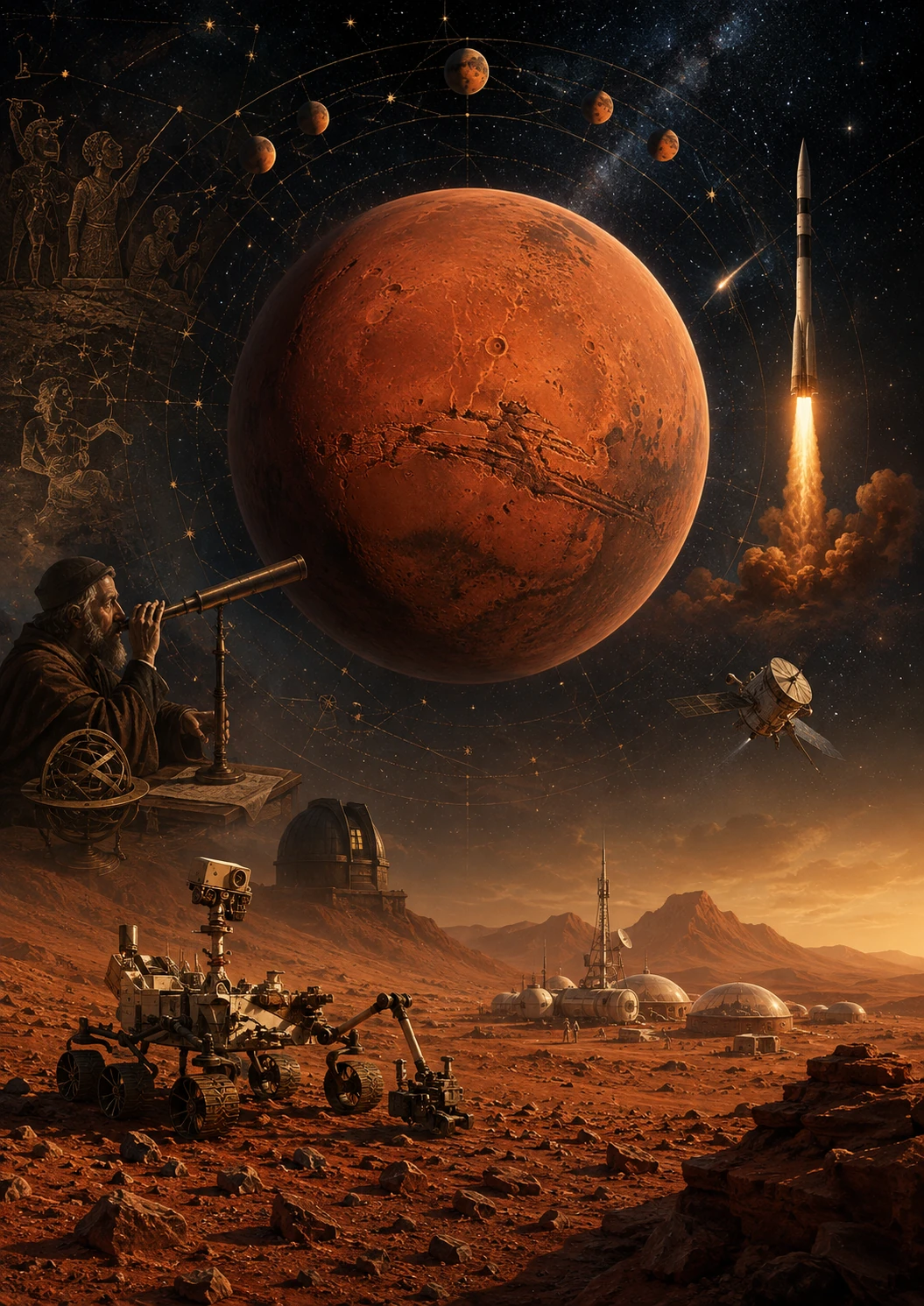
1 — Mars before modern astronomy
Mars has no single discoverer. It is visible to the naked eye, so its history begins in ancient skywatching rather than with a telescope. Different cultures tracked its motion and often linked its red color to war, fire or danger. The Roman name Mars became standard in European scientific tradition, but it is only one layer of a much older human relationship with the planet.
2 — What is a planet?
Modern readers benefit from making the basic concept explicit. A planet is not merely a bright object. It is a gravitationally rounded body orbiting a star; in the Solar System, the current IAU definition also distinguishes planets by their dynamical dominance around their orbit. Mars is the fourth planet from the Sun, smaller than Earth, with a thin carbon-dioxide atmosphere and a surface shaped by impact, volcanism, wind, ice and ancient water.
3 — Galileo, Huygens and Cassini
The telescope turned Mars from a moving point into a disk. Galileo observed it telescopically in 1610. As optical instruments improved, astronomers identified persistent markings and polar caps. Cassini’s seventeenth-century estimate of the rotation period came remarkably close to the modern Martian sol, illustrating how repeated observation can extract planetary physics from a tiny image.
4 — Schiaparelli, Lowell and the canal era
During the 1877 opposition, Giovanni Schiaparelli mapped features he called canali. Translation and interpretation helped turn ambiguous lines into the idea of artificial canals. Percival Lowell built a sweeping theory around them. The episode became a global cultural phenomenon and a methodological warning: coherent narratives can emerge from marginal data when expectations shape perception.
Phobos and Deimos
Asaph Hall discovered the two small moons in 1877. Their discovery expanded Mars from a solitary planet into a small planetary system. Later mission designers would sometimes study Phobos as a potential staging or science target, showing how a nineteenth-century astronomical discovery can become a twentieth- and twenty-first-century engineering variable.
From a red point to a geological world
Spacecraft transformed Mars from an astronomical disk into a planetary system of volcanoes, canyons, sedimentary deposits, deltas, ice and mineralogical provinces. This matters to settlement engineering because site selection, water extraction, construction and science all depend on local geology rather than a generic image of “the red planet.”
The red planet before the telescope: motion, color and memory
For ancient observers Mars was not a landscape but a behavior in the sky. It wandered against the fixed stars, brightened dramatically near favorable oppositions, and sometimes seemed to reverse direction before resuming its path. Those motions were visible without instruments, which is why Mars entered calendars, cosmologies and mythologies long before anyone could know its diameter, atmosphere or geology. The important historical point is not that one culture “discovered” Mars, but that many societies recognized the same conspicuous wandering object and attached different meanings to its red appearance.
The scientific transformation began when precise positional measurements made it possible to separate appearance from orbital geometry. Tycho Brahe’s exceptionally careful observations gave Johannes Kepler the data needed to abandon perfect circular motion and describe an elliptical orbit. Mars was crucial because its orbit made discrepancies difficult to hide. The red wanderer therefore helped force a change in the mathematical description of the Solar System, decades before telescopes revealed useful surface detail. [S14]
From a point of light to a rotating world
The telescope did not immediately deliver a modern Mars. Galileo could establish that Mars was a telescopic object with changing apparent size and phase, but later observers gradually extracted more. Christiaan Huygens sketched a dark marking now associated with Syrtis Major and used its recurrence to estimate rotation. Giovanni Domenico Cassini also followed surface markings and polar regions, helping establish that the Martian day is close to Earth’s in length. [S02][S15] These measurements mattered because Mars began to behave not as a symbolic light but as a physical rotating planet.
Nineteenth-century instruments then made mapping possible but also exposed the danger of interpretation at the limit of resolution. Schiaparelli’s canali became “canals” in English, and Percival Lowell built an elaborate vision of a dry world whose inhabitants might have engineered a planetary irrigation system. Lowell’s own books preserve how seriously that hypothesis could be argued at the time. [S16][S17] Better optics and later spacecraft would erase the artificial-canal interpretation, but the episode remains important because it shows how a technically plausible narrative can grow from ambiguous data.
Spacecraft rewrite the planet again
The decisive correction came when cameras crossed interplanetary space. Mariner 4 returned the first close-up images in 1965, replacing much of the old telescopic imagination with a cratered surface seen from nearby. Later orbiters, especially Mariner 9, revealed volcanoes, canyons, channels and a much more varied geological world. [S03][S04] Viking then combined orbital mapping with successful landers. From that point onward, the history of Mars observation became inseparable from geochemistry, atmospheric science, mineralogy and the search for evidence of past habitable environments.
Why did the name 'Mars' survive while older names disappeared?
The word used today was not the planet's first name. It is the name carried forward by the Greco-Roman tradition and then by European scientific culture. Long before Rome, Mesopotamian observers had already isolated the red wanderer from the stellar background. Astronomical tablets preserved by the British Museum record systematic observations of Mars across extended periods. The important point is not a modern label attached retrospectively to an ancient sky; it is that people learned, with no telescope at all, that some lights wandered while the constellations largely kept their shapes. [S42] [S48]
Babylonian tradition associated the planet with Nergal, a deity connected with war and calamity. Egyptian tradition used a name rendered in modern summaries as 'the red one'. Greek culture associated the planet with Ares, and Roman culture with Mars, its god of war. NASA explicitly notes the ancient Roman naming and the association between the planet's reddish appearance and blood. There was therefore no single astronomer who discovered Mars and officially named it on a known night. The modern name is the survivor of a cultural lineage. [S40] [S41]
That distinction matters. Mars was never 'discovered' in the same sense as Neptune. It had always been visible. What changed was the type of question humans could ask of it: omen, calendar object, geometrical problem, telescopic world, robotic destination and finally a possible target for human settlement.
How do you recognize a planet before you possess a theory of planets?
To a naked-eye observer, Mars can look like a bright star. The difference appears through memory rather than magnification. Return night after night and the constellations retain their overall patterns while a few bright objects drift through them. The ancient idea of wandering stars grew from precisely that behavior. Identifying Mars therefore depended on repeated observation, record keeping and cultural continuity more than on a single moment of discovery.
Mars adds two memorable signatures. It can appear conspicuously reddish, and around opposition it becomes brighter and larger while its apparent motion against the stars temporarily reverses. Retrograde motion is a perspective effect caused by the relative orbital motion of Earth and Mars: Earth, moving faster on the inner orbit, overtakes Mars. In geocentric systems this behavior required elaborate geometrical devices; in heliocentric astronomy it becomes a natural consequence of orbital motion. [S45]
Mars was not the only planet to display retrograde motion, but it became an unusually powerful test of models because its changing brightness, favorable oppositions and accumulated positional observations gave astronomers rich data against which a theory could fail.
Why Mars helped Kepler break the perfect circle
When Johannes Kepler gained access to Tycho Brahe's exceptionally precise observations, Mars became a methodological adversary. Long astronomical tradition had treated circular and uniform motion as the natural geometry of the heavens. Mars refused to fit the available constructions closely enough. The mismatch was small by everyday standards but too large to dismiss once Tycho had improved the precision of the observations. [S14] [S44]
Kepler's eventual move to an elliptical orbit was more than an improved prediction table. Mars had helped force an astronomer to prefer stubborn data over an ideal form. That pattern repeats throughout Martian history: when a thin atmosphere, a cratered surface or a complex geological record contradicted expectation, the model had to move. Mars repeatedly became valuable because it did not cooperate with elegant assumptions.
Galileo: why point the new telescope at Mars when the whole sky had just opened?
It would be easy to invent a dramatic motive and say that Galileo singled out Mars because he dreamed of another inhabited world. The surviving evidence does not justify that story. The stronger explanation is more revealing. In 1609 and 1610, improving telescopes suddenly made the entire sky a new field of investigation. Galileo observed the Moon, the Milky Way and Jupiter's satellites; the Museo Galileo's account of the Sidereus Nuncius documents that broad transformation of the telescope into a scientific instrument. Mars, already one of the classical wandering planets, was an obvious member of the target list. [S43]
NASA dates Galileo's first telescopic observation of Mars to 1610. What he could see was modest: a small disk limited by aperture, optical aberrations and Earth's atmosphere. Yet the historical threshold was enormous. Mars had entered an instrumental chain. The naked eye was no longer the limit, and each generation could now enlarge the disk, improve contrast, measure rotation, follow seasons and eventually send instruments to the planet itself. [S02]
So the best historical answer to 'Why Mars?' is not that Galileo possessed a secret Martian obsession. It is that Mars was already one of the great visible problems of the sky. Once a new instrument could be turned on the known planets, ignoring Mars would have been more surprising than observing it.
From Huygens to Herschel: Mars acquires a face, a clock and seasons
During the seventeenth century, time and improving optics supplied what Galileo lacked. Christiaan Huygens drew a prominent dark marking and used its recurrence to infer rotation. Giovanni Domenico Cassini produced a rotation estimate close to the modern value. Mars was no longer merely a light circling the Sun; it was a turning world with a day surprisingly close to Earth's. [S02] [S15]
In the eighteenth century William Herschel studied the axis, polar caps and seasonal changes. The vocabulary applied to Mars started to sound like the vocabulary of a place: day, axis, season, pole, atmosphere. The conceptual transformation is easy to underestimate. A point of reddish light known for millennia was becoming, within a few generations of telescopic work, a world whose climate and geography could be debated.
1877: When an excellent observing season also produced a historic error
The opposition of 1877 brought Mars into especially favorable view while telescopes and mapping practices had improved. Asaph Hall discovered Phobos and Deimos. Giovanni Schiaparelli mapped networks of lines and used the Italian word canali. The term could mean channels or grooves, yet translation and interpretation helped turn it into the artificial 'canals' of popular culture. [S47]
Percival Lowell made that ambiguity into an intellectual program. He built an observatory at a site selected in part for observing conditions and devoted extraordinary effort to Mars. In his books the canals became possible evidence of a civilization distributing water across a drying planet. The interpretation was wrong, but narratively irresistible. It offered the mass public an inhabited Mars at the very moment illustrated magazines and popular literature could spread the idea globally. [S46]
The episode also warns against a naive idea of scientific progress. Better instruments do not automatically eliminate error. At the resolution limit, the eye and brain can connect discontinuous features, and expectation can shape a drawing. Mars became a laboratory not only for astronomy but for the psychology of observation. Spacecraft would finally remove the need to fill missing detail with imagination.
On the eve of spacecraft: a planet precisely located but still physically mysterious
By the middle of the twentieth century astronomers could calculate the Martian orbit accurately and knew the length of its day, the existence of seasons, polar caps and two moons. They possessed photographs and spectra. Yet elementary physical questions remained open or uncertain: surface pressure, atmospheric density, the nature of changing markings, the scale of topography and the possibility of stable liquid water or vegetation. Celestial mechanics was becoming good enough to send a spacecraft to a planet that was still poorly understood as an environment.
That is the real end of the era of Earth-bound observation. From the 1960s onward, every successful Mars mission added a second mode of knowing: instead of only looking from afar, humanity could send a camera and spectrometer past the planet, place an orbiter around it and ultimately operate laboratories on its surface. Spaceflight did not erase four millennia of observation; it finally gave that long history a physical answer.
From omen to ephemeris: Mars becomes a prediction problem
Ancient observations were not primitive in the sense of being casual. Once a court, temple or scholarly tradition keeps records over generations, the sky becomes an archive. The position of Mars can be compared with previous appearances; cycles can be recognized; anomalous motion can be anticipated. Babylonian astronomical records are therefore important not because they contain a modern physical theory, but because they demonstrate the institutional continuity required to turn visual impressions into data. The British Museum's Mars tablets are surviving pieces of that long transition. [S42] [S48]
Prediction changes the social meaning of an object. A red light that simply appears can be mythologized; a red light whose position can be tabulated becomes something more demanding. The observer must distinguish it from nearby stars, preserve dates and use a reference system. Centuries before a telescope, Mars was already forcing people to create procedures that look recognizably like the ancestors of scientific observation.
Why color mattered so much in a sky without images
Modern readers live among high-resolution photographs, so the color of a point of light can sound trivial. In a naked-eye sky, however, color is one of the few persistent physical characteristics available. Mars does not always appear the same shade or brightness, but its warm reddish tone is distinctive enough to have shaped names and associations across cultures. NASA's modern Mars facts page links the Roman name with the god of war and the blood-like appearance of the planet, while also noting the Egyptian expression translated as “the red one.” [S40]
The irony is that the redness is itself a geological message. The color that helped ancient cultures identify and symbolize Mars is related to oxidized iron-bearing materials in Martian rocks and dust. A visual property that once belonged to mythology is now understood in terms of mineral chemistry. The same photon can therefore sit at both ends of the story: first as cultural sign, later as physical evidence.
Opposition: why some years made Mars suddenly irresistible
Mars is not equally rewarding every year. Because Earth and Mars move around the Sun at different rates, there are periods when Earth lies roughly between Mars and the Sun and the two planets are relatively close. Around such oppositions Mars becomes brighter and its apparent disk grows, making fine detail easier to pursue. That periodic geometry helps explain why certain observing seasons — especially 1877 — became historical turning points rather than mere calendar dates. [S45]
This also answers part of the recurring question, “Why did astronomers look at Mars so intensely?” They did not all choose it at random on ordinary nights. Observing programs were shaped by celestial mechanics. A favorable opposition could justify months of preparation because the same telescope would temporarily reveal more. In other words, Mars itself set a rhythm for the history of Martian astronomy.
What Galileo could not yet know
Galileo's telescope crossed a conceptual threshold, but it did not suddenly provide a modern planet. He could not know the surface pressure, the mineralogy, the scale of the great volcanoes or whether the dark markings were topographic, atmospheric or optical. Even the apparent diameter of Mars remained tiny compared with the Moon. The instrument created a new question faster than it created a complete answer.
That is why the centuries after 1610 matter. Huygens, Cassini and later Herschel accumulated different kinds of evidence, each reducing a different uncertainty. Rotation makes a recurring dark marking meaningful. Polar changes connect geometry with season. A better estimate of the axis makes those seasons physically interpretable. Scientific knowledge did not arrive as one revelation through one eyepiece; it accumulated as separate measurements became mutually consistent. [S15]
Schiaparelli and Lowell: how a scientific observation becomes a global story
The canal episode is often caricatured as a foolish mistake by old astronomers. The real history is more useful. Schiaparelli was mapping an object near the limits of telescopic resolution. His terminology entered another language and another media culture. Lowell then built a larger explanatory system around those observations and defended it through books, lectures and an observatory devoted in large part to Mars. [S46] [S47]
The episode demonstrates how science and public imagination can amplify each other. The idea of a dying civilization constructing planetary-scale waterways was vivid because it connected an uncertain telescopic pattern with contemporary ideas about engineering, deserts and social organization. By the time spacecraft arrived, Mars already existed twice in public culture: as a physical world and as a narrative world. The two would collide dramatically when cameras finally crossed interplanetary space.
What the pre-space age actually achieved
It would be wrong to end this period by saying that astronomers “knew nothing” before spacecraft. They had solved the orbit, measured the day to remarkable precision, understood seasons, identified polar phenomena, discovered two moons and built increasingly sophisticated maps. Their limitations were physical rather than intellectual: Earth's atmosphere blurred fine detail, spectral interpretation was difficult and no telescope could directly sample Martian air or rock.
By the 1950s the strange situation was therefore this: humanity possessed enough celestial mechanics to calculate a route to Mars, yet did not possess a trustworthy close view of the destination. Rocket engineers could estimate departure windows while planetary scientists still argued over the environment awaiting the spacecraft. The next chapter of Mars history begins when those two traditions — orbital calculation and planetary observation — are joined by a machine capable of traveling between the worlds.
A planetary childhood reconstructed from rocks and physics
Mars can be narrated as a changing world whose earliest chapters survive in terrain, minerals and interior structure.
The planet accreted from material orbiting the young Sun and differentiated into crust, mantle and core while the inner solar system was still violent.
Its lower gravity and smaller volume changed the pace at which heat was retained and shaped the long-term evolution of volcanism and tectonic activity.
Impact basins record an era when large collisions could reorganize regional geology and leave structures still visible billions of years later.
Valley networks and sedimentary deposits show that water once flowed or pooled under conditions that cannot be reproduced by the modern atmosphere for long periods. For Mars, consequences propagate.
The disappearance of a strong global magnetic field exposed the upper atmosphere to solar-wind interaction in ways later investigated directly by MAVEN.
InSight seismic measurements provided a new class of evidence about the planet’s interior, allowing the story to move beyond surface appearance.
The first human Mars was a pattern in time
Before anyone could see a disk, Mars existed in human culture as a recurring behavior in the night sky.
Observers did not need a theory of gravity to notice that Mars migrated among the constellations while the stellar pattern remained comparatively stable.
Repeated watching revealed cycles of visibility, disappearance, retrograde motion and return that could be recorded and predicted.
Babylonian tablets demonstrate an astronomical culture able to preserve planetary observations over intervals much longer than a single observing night.
The act of writing a position on clay changed astronomy because a memory could be checked by another observer and by another generation. For Mars, consequences propagate.
Color provided a second identity cue, giving the planet cultural associations that differed across societies rather than a single universal mythology.
Prediction could become surprisingly sophisticated even before the physical reason for planetary motion was known.
How Mars became the Roman Mars
The familiar name is a historical inheritance rather than a scientific discovery.
Roman observers inherited a wider Mediterranean tradition in which the conspicuous red planet was associated with a war deity, and Latin Mars became the name transmitted through later European scholarship.
The association between redness and blood or warfare made the Roman name culturally memorable but did not make it the original or only name for the planet.
Greek Ares, Babylonian Nergal and Egyptian descriptions of the red object belong to different linguistic and religious systems and should be described on their own terms.
As Latin became a scholarly language in Europe, astronomical vocabulary carried Roman names through manuscripts, teaching and later printed works. For Mars, consequences propagate.
The scientific revolution changed what astronomers believed Mars to be without requiring them to rename the object itself.
Modern international astronomy therefore combines a globally standardized scientific object with a Western conventional name inherited from a particular historical tradition.
Mars as the test that broke the circle
The planet’s orbit was difficult enough to make excellent measurements intellectually dangerous to an old model.
Tycho Brahe’s measurements reduced the room available for convenient geometrical adjustment.
Kepler initially tried to preserve inherited expectations rather than immediately inventing an ellipse, which makes the eventual break more important.
Small residual errors mattered because the observations were good enough that the discrepancy could not simply be blamed on careless measurement.
The elliptical orbit emerged from an iterative struggle between data and geometry rather than one sudden flash of intuition. For Mars, consequences propagate.
Mars became the crucial case because its orbital eccentricity made departures from a perfect circle easier to expose than for some other planets.
The lesson survives in modern Mars mission design: a model earns authority by surviving precise data, not by looking elegant on paper.
Telescopes, angular size and the limits of seeing
Mars teaches why a better instrument does not automatically produce an easy image.
The apparent diameter of Mars changes greatly with Earth-Mars geometry, so an observation near opposition can be far more productive than one made at an unfavorable distance.
Galileo’s early telescope had a tiny objective by modern standards, narrow field and limited image quality, making subtle surface detail exceptionally difficult.
Jupiter offered moons separated from the planet and therefore dramatic evidence even with early optics, whereas Mars required discerning structure inside a small shimmering disk.
Huygens could later follow a dark marking and infer rotation because repeated observation converted an ambiguous marking into periodic behavior. For Mars, consequences propagate.
Cassini refined the rotational period by comparing markings over time, while Herschel used changes in polar caps and geometry to discuss seasons and axial tilt.
Every improvement in optical performance also increased the temptation to interpret uncertain patterns, setting the stage for the nineteenth-century canal controversy.
The transition from naked-eye astronomy to telescopic astronomy was therefore not a clean break between ignorance and knowledge. It was a change in the type of evidence available. Positional astronomy had already become sophisticated enough to predict where Mars would appear and to expose anomalies in geometrical models. The telescope added a new class of observation: apparent diameter, markings, polar regions and changes on the disk itself. Those new data were often ambiguous, and ambiguity could generate both discoveries and mistakes. The canal episode is the best-known example, but the broader lesson is more useful: every instrument has a characteristic set of things it reveals well and things it tempts the observer to over-interpret. That is why the history of Mars is also a history of learning the limits of seeing.
The long pre-telescopic record also reminds us that astronomy was once inseparable from timekeeping, religion, administration and state power. Planetary observations could matter because calendars mattered, eclipses mattered and rulers valued predictions associated with celestial order. Modern categories such as 'professional astronomer' cannot simply be projected backward. The people who recorded Mars worked inside institutions with different purposes, languages and concepts of evidence. What survives in tablets and manuscripts is therefore both astronomical data and a record of how societies organized knowledge. Recovering that context makes the first chapters of Mars history richer than a list of names and dates.
The emergence of printed astronomy then changed the speed and scale at which observations could circulate. Tables, diagrams and arguments could be compared across Europe with a consistency that manuscript copying had made harder to achieve. Mars became part of a shared mathematical problem. By the time telescopic reports appeared, observers could situate new claims against established ephemerides and competing cosmological systems. The telescope did not create scientific Mars out of nothing; it entered an information network already capable of arguing about where the planet should be and how its motion should be represented. That is why Galileo's observation belongs to a continuum of measurement rather than a sudden isolated discovery.
The development of ephemerides is another quiet revolution in the story. Once observers could compare long series of positions, a planet became something whose future place in the sky could be calculated and checked. Accuracy turned prediction into a test of theory. When Mars appeared where a table expected, confidence grew; when systematic residuals remained, the discrepancy became evidence. This habit of comparing prediction with observation is the ancestor of modern mission navigation, where a calculated trajectory is repeatedly confronted with tracking data and corrected. The instruments and mathematics changed beyond recognition, but the intellectual discipline is continuous: Mars teaches by refusing to be exactly where an inadequate model says it should be.
The canal controversy later demonstrated the opposite danger: better instruments can increase confidence faster than they increase truth. Fine markings near the threshold of resolution are vulnerable to atmospheric seeing, optical artifacts and the brain's tendency to connect ambiguous features. Schiaparelli's terminology, translation, repeated maps and Lowell's persuasive interpretation created a self-reinforcing cultural system around an uncertain observation. The episode matters because it shows that scientific error does not always come from carelessness. It can arise when skilled observers work at the limit of their instruments and then build a coherent explanation around unstable evidence. Modern planetary science responds with imaging systems, calibration, independent instruments and repeatable datasets precisely because the history taught how convincing an illusion can become.
By the early twentieth century, Mars was therefore both familiar and elusive. Astronomers could predict its orbit with great accuracy, estimate its rotation, observe polar changes and discuss atmospheric properties, yet no one had seen the surface at spacecraft resolution or measured the atmosphere directly in situ. The planet was mathematically domesticated but physically remote. This distinction prepares the reader for the shock of the space age: Mariner did not discover where Mars was; celestial mechanics had already solved that problem. It discovered that the world located so precisely in the sky was not the world many people had imagined on the ground.
The result is a continuous chain from memory to measurement. Mars first becomes recognizable because people remember how it moved; it becomes predictable because observations are recorded; it becomes mathematically revealing because positions become precise; and it becomes physically investigable when instruments begin to resolve a disk. Each stage depends on the previous one, which is why the early history deserves the same narrative care as the spacecraft era.
In that sense, the earliest observers are not a decorative prologue. They created the habit of treating Mars as a repeatable phenomenon whose behavior could be checked against memory and record, the foundation on which every later astronomical model depends.
This chain also explains why the word discovery is misleading when applied to Mars itself. No single observer found the planet; generations progressively discovered properties of a world that had always been visible. The real milestones are discoveries about Mars: how it moves, how long its day lasts, what its surface is like, how thin its atmosphere is and what geological history its rocks preserve.
The development of ephemerides is another quiet revolution in the story. Accuracy turned prediction into a test of theory.
The planet was mathematically domesticated but physically remote.
Why Mars became a laboratory for the scientific method
Mars became unusually important to astronomy because it is difficult in exactly the productive way. Its motion is obvious enough to distinguish it from the fixed stars, yet complicated enough to expose weaknesses in a model of the heavens. Its brightness changes strongly, its retrograde loops are visually striking, and its orbital eccentricity is large enough that inaccurate assumptions become harder to hide. For generations, that made Mars a kind of stress test for planetary theory. A model that could reproduce Mars convincingly earned confidence not because Mars was the only planet that mattered, but because it was one of the planets least willing to forgive a bad approximation.
This is why Tycho Brahe's observational program and Kepler's later analysis belong in the story as more than a list of famous names. Precision creates intellectual pressure. When observations are coarse, several geometrical models may look equally successful. As measurement improves, the residual differences stop being philosophical details and become quantitative failures. Kepler's work on Mars shows how a stubborn mismatch can become productive: instead of smoothing away the disagreement, he treated it as evidence that the assumed geometry was wrong. The eventual ellipse was not a decorative improvement to a circle; it changed the mathematical language in which planetary motion was understood.
The telescope introduced a different kind of uncertainty. A planet that had been a point for naked-eye observers became a tiny disk, but a tiny disk is not automatically an informative image. Atmospheric seeing, limited aperture, optical aberrations and the changing apparent diameter of Mars restrict what can be resolved. This matters when interpreting early telescopic reports. Jupiter rewarded Galileo quickly because its moons could be seen as separate points; Mars offered far less obvious structure. Observing it was nevertheless important because the telescope could test whether planets possessed measurable disks and changing appearances consistent with their being physical worlds rather than lights embedded in a celestial sphere.
Later observers improved instruments and accumulated seasonal observations, but improvement did not eliminate interpretation. The canal episode demonstrates how a real increase in observing capability can coexist with a false explanatory system. Fine contrast near the threshold of vision can be organized by the eye and brain into patterns that appear more regular than the underlying surface. Repetition can then reinforce confidence, especially when maps and terminology circulate between observers. The eventual spacecraft images did more than disprove canals; they showed why planetary science needs calibrated instruments, repeatable datasets and independent measurements rather than confidence based on visual impression alone.
The intellectual path from Babylonian position records to spacecraft imaging is therefore continuous in one important sense. Each step asks how to transform an observation into a claim that another observer could challenge. Dates, coordinates, instrument characteristics, calibration and uncertainty all exist to make that challenge possible. Mars did not merely acquire more detailed pictures over time. It helped astronomy develop the habits by which increasingly precise pictures could be interpreted without mistaking precision for certainty.
Mars also demonstrates why “discovery” is rarely a single moment. No one discovered the planet in the modern sense because it was already visible, yet successive generations discovered different properties: its wandering motion, a calculable orbit, a measurable disk, rotation, polar changes, an atmosphere, surface geology and finally the internal structure sampled indirectly by seismology. Each discovery required a new instrument or a new way of combining observations. The history is therefore better imagined as layers being removed from an object that was always in sight. Humanity knew where Mars was long before it knew what Mars was, and even today every new dataset modifies part of that answer.
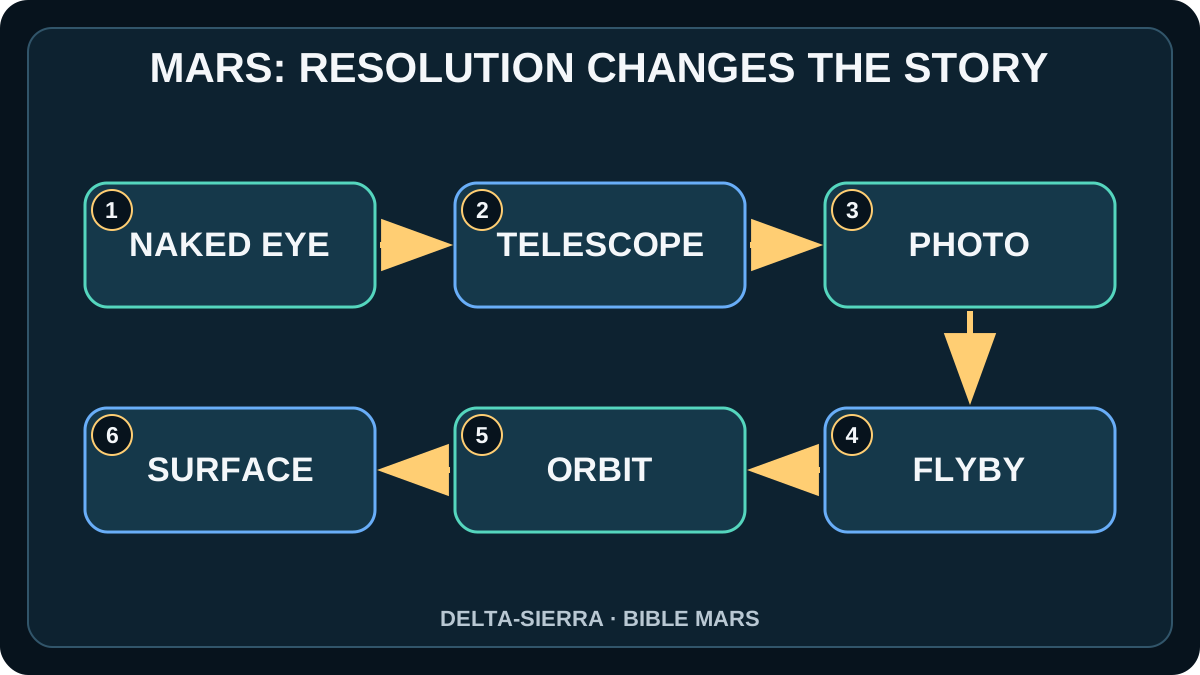
From naked-eye astronomy to flyby imaging: progress mostly removed illusions
The history of observing Mars is not a smooth accumulation of detail. It is a sequence of corrections. To naked-eye observers, Mars was first a wandering object whose motion and color set it apart from the fixed-star background. The telescope turned the point into a disk and revealed changing markings, but the angular resolution remained poor enough for the visual system to complete patterns that instruments could not securely resolve. Nineteenth-century mapping became more systematic at the same time that some of the most influential mistakes — especially the canal interpretation — became culturally powerful.
Photography and spectroscopy slowly shifted authority from drawing to recorded measurement, yet the decisive break came when a spacecraft no longer had to look through Earth's atmosphere from tens of millions of kilometres away. NASA's Mariner 4 returned the first close-up images in 1965. The heavily cratered terrain in that narrow sample sharply weakened popular visions of an Earth-like Mars. But the correction was itself incomplete. Mariner 9 entered orbit in 1971 and revealed giant volcanoes, a vast canyon system and landforms connected to past water. The lesson is subtle: a better measurement can overturn an old model, while broader coverage can then overturn the overly simple interpretation of that better measurement.
Viking added another dimension: persistence. Orbiters mapped the planet and two landers operated on the surface, returning imagery, atmospheric measurements and biological experiment results. In 2026 NASA's fiftieth-anniversary Viking material is a useful reminder of how quickly the epistemic scale changed. Only a decade separated Mariner 4's first close-up strip from a functioning laboratory on the ground. The story is therefore not “telescopes were wrong and spacecraft were right.” It is that every instrument sees through a window, and scientific maturity comes from understanding the size and shape of that window.
Why Galileo looked at Mars: not because it was mysterious, but because it was a moving test target
Galileo did not select Mars from an otherwise anonymous sky. By 1610 the classical planets were already familiar naked-eye objects with established names and predicted motions. Mars was particularly valuable because its apparent size and brightness changed with geometry, and because a telescope offered a new way to ask whether a “wandering star” showed a physical disk rather than behaving like a point source. The early telescope could not reveal the modern Martian landscape, but showing that planets had measurable disks was itself part of dismantling the older picture of the heavens.
Later observers extracted information from repetition rather than from one spectacular view. Huygens used recurring markings to estimate rotation. Cassini improved estimates of the Martian day. Polar brightening, seasonal change and changing apparent diameter gradually turned Mars into a world with geometry and time. This is why the history matters to a modern engineering site: the earliest useful Mars science already depended on calibration, repeated observation, uncertainty and comparison across time — the same habits that later govern spacecraft operations.
What changed after the telescope was not simply that people could “see Mars better.” They gained new observables. Angular diameter could be tracked. Surface contrast could be compared. Rotation could be inferred from periodicity. Spectra could later constrain atmospheric composition. Photography separated the record from the observer's memory. Spacecraft then changed the geometry of observation itself. Each step added a variable that could be measured independently, which is why the history of Mars is also a history of measurement science.
Why the red colour mattered before anyone knew its physical cause
Mars's colour did more than make the planet easier to recognize. It provided a stable visual difference around which cultures built names and stories. Long before spectroscopy or orbital mineralogy, an observer could see that this moving light did not look exactly like Jupiter or Venus. The Roman name “Mars” belongs to that cultural history, while the modern physical explanation involves iron-bearing oxidized material in surface dust. The two layers must not be collapsed: ancient observers named an appearance and a motion, not a mineralogical mechanism.
This distinction shows how a scientific object is constructed in layers. The name survives while interpretation changes. Positions become mathematical, maps replace isolated sketches, photography removes some dependence on visual memory, and spacecraft add composition and topography. Mars keeps one name while becoming a radically different object of knowledge from century to century.
It also explains why arguments about “who discovered Mars?” are misleading. No single person discovered a naked-eye planet known across civilizations. Individuals instead discovered properties: telescopic disk, rotation, polar features, atmospheric clues, surface geology. A rigorous history assigns credit to measured transitions rather than forcing an ancient object into the model of a modern geographic discovery.
Before spacecraft, Mars history was also the history of instrument limits. A difficult spot, transient contrast or perceived color could become a durable geographical feature when no independent measurement could settle the issue. Better telescopes, photography and spectroscopy gradually shifted discussion from apparent form toward composition and physical conditions.
The key change was not simply that one observer saw better than another; different measurements began to constrain each other. Mariner and Viking did not erase telescopic history. They completed a long change in evidence that began when Mars became an object that could be compared night after night.
NASA’s 2026 Viking retrospective is used here to mark the transition from remote observation to repeated surface measurement, sampling, weather observations and laboratory experiments on Mars.
A planet known long before it was understood as a world
Mars belongs to a rare category of objects: humans named and tracked it long before they understood it as another world. Positional tables, astrological traditions and calendars preceded planetary physics. That is why the history of the name cannot be separated from the cultural history of the sky.
Modern astronomy did not erase that layer; it reclassified it. The same object that carried mythological meaning became a body with measured period, diameter, rotation, atmosphere and topography. The transition is extraordinary because visual tradition provided enough continuity of identity for centuries of measurement to accumulate on “the same Mars.”
Opposition made Mars a recurring laboratory for better telescopes
Mars does not appear equally large in the sky at all times. Around favourable oppositions its angular diameter becomes much larger than when it is far from Earth. This changing geometry made Mars a natural test object for telescopes and observers. An instrument that could not resolve useful detail one season might reveal more at another, which encouraged repeated campaigns rather than one definitive observation.
Repeated opposition observing also helped create one of the classic traps of planetary astronomy. Observers compared markings seen through different instruments, atmospheric conditions and visual expectations. Apparent agreement could strengthen a feature that was near the limit of resolution. The canal controversy belongs partly to this interaction between real contrast, inadequate resolution and human pattern recognition.
Spacecraft changed not only resolution but the observer's location
A telescope on Earth improves angular resolution but still observes Mars from Earth. A flyby changes the distance by orders of magnitude. An orbiter changes the viewing geometry repeatedly. A lander eliminates global distance for one local site. The history of observation is therefore a history of moving the observer as well as improving the instrument.
This is why spacecraft did more than produce sharper pictures. They created measurements that were geometrically impossible from Earth: direct atmospheric entry profiles, local pressure cycles, soil contact, subsurface radar from orbit and in-situ chemistry. Each relocation of the observer opened a new class of question.
Why did Mars become a privileged telescopic target?
The answer is geometry as much as mythology. Mars can approach Earth far more closely than the outer giant planets, and its apparent angular diameter changes strongly through its synodic cycle. Near favourable oppositions, a modest telescope obtains much more disk area to work with than when Mars is far away. Its high surface brightness and distinctive colour also make it easy to locate. Observers did not choose one random star and decide it was Mars; they aimed at a classical planet whose path and identity were already established.
This changing angular size shaped observing culture. It concentrated major campaigns around oppositions and encouraged comparison between apparitions separated by years. It also created a trap: observers wanted to preserve apparent changes across very different atmospheric seeing, instruments and drawing conventions. Much of the history of Martian observation is therefore a history of learning how to separate the planet from the observing system.
The telescope made Mars physical before it made Mars detailed
One of the most important early changes was conceptual. A planet that shows a measurable disk is not simply a luminous point fixed to a celestial sphere. Telescopic observations contributed to a new physical astronomy in which planets were worlds with sizes, rotation and changing illumination. Fine surface detail came later and remained difficult for centuries.
This distinction matters when discussing Galileo. His instruments were transformative, but attributing modern Martian detail to them would be anachronistic. The historical importance lies in the expansion of what could be measured and compared, not in pretending that the seventeenth-century telescope delivered spacecraft-like geography.
The “canals” episode is a lesson in correlated interpretation
When many observers use similar expectations, terminology and drawing conventions, agreement does not guarantee that a feature is physically real. Linear markings became easier to report once the category itself existed. Some observers saw complex networks; others did not. The episode demonstrates a problem still familiar to science: observations are filtered through instruments, processing, expectations and the human visual system.
Modern planetary science attacks that problem with calibration, independent instruments, raw-data archives and repeatable processing. The lesson is not that earlier observers were foolish. It is that evidence becomes stronger when the route from photon to claim can be reconstructed.
Coordinate systems quietly made observations comparable
A named marking is useful, but a longitude and latitude allow different observers and later spacecraft teams to refer to the same region systematically. Establishing Martian coordinates required choices about reference meridians, rotation and mapping conventions. Those choices evolved as measurements improved.
The history may sound bureaucratic, yet it marks the transition from describing a disk to surveying a world. Once observations can be registered to a common coordinate frame, changes can be tested against location rather than memory, and maps from different instruments can be combined.
Opposition campaigns created an early form of distributed planetary science
Before spacecraft, no single observatory could control weather, seeing or longitude on Earth. Major Martian oppositions encouraged observations from multiple sites and countries, creating overlapping records that could be compared. The data were heterogeneous and often subjective, but the organizational idea was important: a planetary phenomenon could be studied by coordinating observers around geometry set by celestial mechanics. Modern global telescope networks and multi-spacecraft campaigns use far more precise instruments, yet they inherit the same basic advantage of separating a planetary signal from one observer's local conditions.
Kepler’s use of Mars is one of the clearest examples of an observation changing the mathematics rather than merely adding another datum. Tycho Brahe’s precise positions could not be reconciled indefinitely with a perfect circular orbit. Mars therefore helped force the transition to an ellipse, showing how a stubborn residual can be more scientifically valuable than a convenient fit.
The canal episode demonstrates a different failure mode. Better telescopes increased detail, but more detail also increased the opportunity for expectation, contrast effects and cultural narratives to shape what observers believed they saw. Schiaparelli’s terminology and Lowell’s interpretation became part of a global story about an inhabited planet. Spacecraft imaging later removed that specific picture, illustrating why improved resolution does not by itself guarantee a correct model unless the observation process is also understood.
Before spacecraft, Mars knowledge advanced by improving both instruments and restraint. Telescopes revealed a disk, polar changes, albedo markings, and the planet’s seasonal behavior, but resolution and atmospheric seeing imposed severe limits. The history of the “canals” is therefore more than a curiosity. It demonstrates how ambiguous visual features can become stable narratives when observers expect to see structure. Better instruments did not immediately eliminate interpretation; they changed the range of claims that could be tested.
Orbital mechanics provided a different kind of progress. Kepler’s use of Mars observations was central to the move from circular planetary models toward elliptical orbits, making Mars part of the history of physics long before it became a spacecraft destination. Later measurements refined rotation, size, atmosphere, and surface properties, but many questions remained underdetermined from Earth. Even the best telescopic observations could not provide the local atmospheric density profile needed for landing design or directly sample surface chemistry. Pre-spaceflight knowledge was therefore rich but structurally incomplete.
Mariner 4 created an epistemic break because it returned close-range images and in-situ radio-occultation information that constrained the atmosphere in ways telescopes could not. Mariner 9 then showed that the heavily cratered landscapes first seen were not representative of the entire planet, revealing volcanoes, canyons, channels, and a dynamic dust-covered world. Viking added long-duration orbital and surface measurements. The lesson is methodological: one mission can overturn an overconfident model, and a later mission can overturn the overcorrection. Mars history repeatedly rewards architectures that preserve uncertainty instead of converting a limited dataset into a complete picture.
That pattern remains relevant for present settlement debates. Remote sensing can identify candidate ice, minerals, slopes, and hazards, but local operations will still encounter heterogeneity at scales smaller than orbital datasets. Historical astronomy therefore has a direct engineering lesson: resolution defines what can responsibly be claimed. A map pixel, a rover traverse, and a drill core answer different questions. The transition from observation to settlement will require the same discipline that transformed Mars science—matching each decision to evidence gathered at the scale that actually controls the risk.
The same caution applies to modern remote sensing. Higher resolution can reduce ambiguity without eliminating it: subsurface ice depth, mechanical properties, grain-scale chemistry, and local hazards may still require measurements on the ground. The historical progression from naked-eye observation to telescopes and spacecraft is therefore not a story in which each new instrument makes uncertainty disappear. It is a story in which better instruments move the boundary of what can be claimed.
What pre-space astronomy could know — and what it could not
By the early twentieth century astronomers could predict Mars's position with great precision, estimate its rotation period, recognize polar changes and map recurring albedo features. Those achievements were substantial. They did not mean that the surface geology, atmospheric circulation or habitability of Mars were understood. The canal controversy is the clearest warning: better telescopes increased the quantity of visual detail while human perception and expectation still shaped how marginal features were connected into apparent lines. Instrumental improvement therefore reduced some uncertainties while exposing new forms of interpretive error.
This is why the transition from telescope to spacecraft is more than a story about sharper pictures. A flyby changes the geometry of observation, adds calibrated instruments and forces hypotheses to confront measurements that were impossible from Earth. Mariner 4 did not simply photograph craters; it disrupted a family of expectations about surface pressure, environment and Earth-like appearance. Mariner 9 then showed that a small early sample had itself encouraged overgeneralization by revealing volcanoes, canyons and global dust. The sequence demonstrates a recurring rule of planetary science: a measurement can be accurate while the sample is still too narrow for the conclusion drawn from it.
The most useful way to read the pre-space era is therefore as a history of progressively constrained inference. Naked-eye observers established periodic motion. Telescopes revealed a disk, rotation and seasonal-looking changes. Spectroscopy and photometry added physical clues. None of those steps was worthless because a later spacecraft corrected part of the interpretation. Each reduced the set of plausible models and taught observers which questions required a different instrument. Modern Mars science inherits that discipline whenever it distinguishes what orbital remote sensing can infer from what must eventually be sampled in situ.
Sources and bibliography
- S01 NASA Science — Mars: Facts.
- S02 NASA Science — Triumph of Mariner 4 (historique des observations, Galileo/Cassini).
- S03 NASA Science — First Close Up Image of Mars by Mariner 4.
- S04 NASA Science — Mariner 9.
- S14 NASA Science — Planetary Motion: The History of an Idea That Launched the Scientific Revolution.
- S15 ESA — Jean-Dominique Cassini: Astrology to astronomy.
- S16 Library of Congress — Percival Lowell, Mars and Its Canals (1906).
- S17 Library of Congress — Percival Lowell, Mars as the Abode of Life (1908).
- S18 NASA Science — Mars Moons: Facts.
- S40 NASA Science — Mars Facts: formation, structure, atmosphere and namesake
- S41 NASA Spinoff — Raised Relief Mars Globe Brings the Red Planet Closer (anciens noms de Mars)
- S42 British Museum — tablette astronomique babylonienne SP.132, observations de Mars
- S43 Museo Galileo — Sidereus Nuncius (1610), le télescope comme instrument scientifique
- S44 ESA — Europe reclaims a stake in Mars exploration, jalons des observations européennes
- S45 ESA/Hubble — Mars in opposition, opposition et mouvement rétrograde apparent
- S46 Lowell Observatory — Percival Lowell’s Search for Life on Mars
- S47 Smithsonian — Mars Globe, opposition de 1877 et cartographie de Schiaparelli
- S48 British Museum — tablette 36600, observations planétaires de Mars et Mercure