


MARS BIBLE — PEOPLE
Nathalie Cabrol
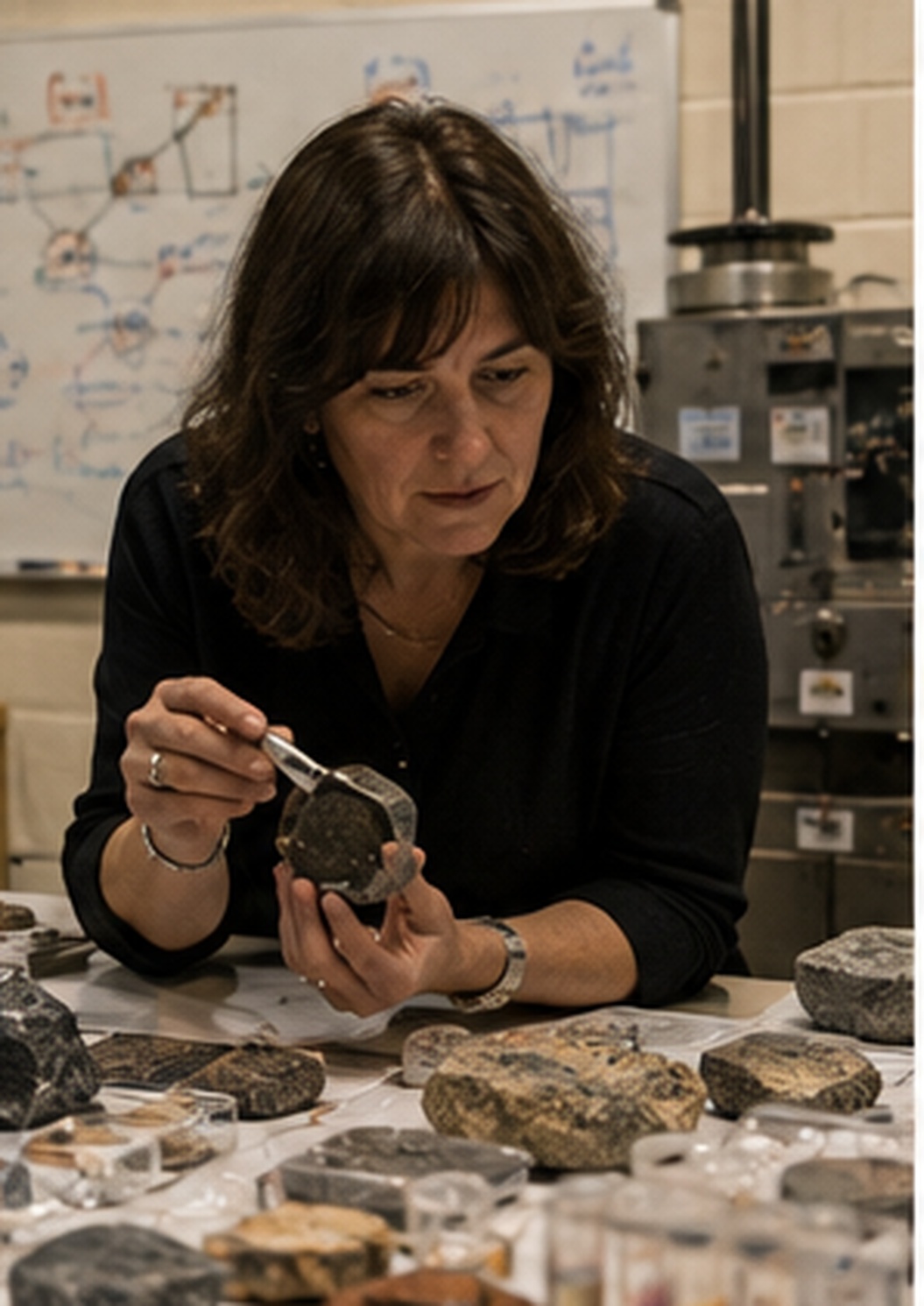
Nathalie Cabrol's documented nationality or citizenship is French and American; the documented birthplace is Not stated in the institutional sources cited. Nathalie Cabrol built a career around the relationship between landscapes, water, extreme environments and the search for life. An early interest in astronomy led to physical geography, Meudon and studies of Gusev, then to NASA Ames and the high Andes, where she explored terrestrial analogs for Martian conditions. Her importance comes from this method: before claiming to recognize a biosignature on Mars, researchers must learn on Earth how life, rocks and environment interact at the limits of habitability.
Chronological biography
Childhood, the Sorbonne and Meudon — learning to read landscapes as archives
Binoculars, then physical geography: learning to read nature before Mars. Nathalie Cabrol recalls that as a child her grandfather gave her binoculars he had brought back from Germany after the liberation of France. She looked at the Moon and stars, but did not simply follow a straight road into professional astronomy. She also describes herself as a naturalist. During her studies, a physical-geography professor introduced landscapes as systems shaped by climate, hydrology and geology. That became the bridge between fascination with the sky and the scientific reading of worlds. Source.
Cabrol did not begin her career with astrobiology in the modern sense. She began with physical geography, landscape observation and a long-standing fascination with the sky. At Meudon, Viking imagery brought her to Gusev and Ma’adim Vallis, landforms that immediately raised questions about ancient water. Geomorphology gradually became an entry point into habitability. That evolution is essential to understanding her career: she does not search for life as an abstraction; she first learns how environments can preserve it, erase it or make evidence ambiguous.. A professor later arranged a meeting with André Cailleux at the Meudon Observatory. Cailleux and Audouin Dollfus were working with Viking imagery and Martian water history. Cabrol saw mosaics of Mars and was drawn to the Ma’adim Vallis–Gusev crater system. It began not as a mission but as a geomorphology problem: if a channel entered an impact basin, what sedimentary and climatic history might that basin preserve? Institutional source
Institutional sources: NASA — Nathalie Cabrol interview · NASA — Exploring Earth’s alien spaces
Sorbonne and Meudon: turning Gusev into a long-lived scientific question. Cabrol earned a master’s degree in planetary science at the Sorbonne in 1986 and a Ph.D. in 1991. Her work focused on the history of water and ancient Martian environments. At Meudon, she and Edmond Grin developed maps and interpretations of Gusev and Ma’adim Vallis. The site became a mission question years before a rover arrived: if a lake had existed in the crater, could its deposits preserve an accessible record of water? Source.
Moving to NASA Ames and working with researchers such as Chris McKay widened her field. High-altitude Andean lakes, the Atacama and other extreme environments let her confront models with real organisms exposed to ultraviolet radiation, cold, aridity and scarce nutrients. The value goes beyond visual analogy with Mars: she learned to separate geological, chemical and biological signals and to understand how biosignatures can be preserved or erased. That field discipline is what gives her Mars work much of its caution and power. Institutional source.
Her early professional path was not smooth. Permanent positions were scarce, and she moved through postdoctoral work. She met Chris McKay in 1992. When he later needed a scientifically credible site for a Mars astrobiology concept, Cabrol showed him the Gusev work. The capability therefore became collaborative: French geomorphology, U.S. astrobiology, orbital data and landing constraints began to converge.
Institutional sources: Cabrol institutional CV · NASA — career interview
NASA’s long interview allows Nathalie Cabrol’s entry into planetary science to be told without inventing a scene. At Paris-Meudon Observatory, André Cailleux and Audouin Dollfus showed her Viking mosaics and research on Martian water. One system caught her attention: Ma’adim Vallis ending in Gusev crater. That landscape became a thread running through her thesis and later work. [NC1] [NC2]
After her 1991 doctorate she continued studying water evolution, crater lakes and Gusev. Meeting Chris McKay in the early 1990s helped connect geology with astrobiology. The change is subtle but decisive: the question is no longer only how a valley formed, but where water persisted, what sediments it left and whether such environments could preserve biological evidence. [NC2] [NC3]
Cabrol also illustrates a fundamental site-selection trade. Choosing a Mars site means choosing which questions will be accessible. A safe but geologically uniform area may limit science; a layered delta may increase navigation risk while preserving a richer record. Modern missions balance safety, geological diversity and biosignature preservation potential.
A settlement will face the same problem at greater scale. The best energy location may not be the best water location or the best scientific preserve. Industrial zones, protected sites and exploration corridors may need to be separated. Cabrol’s trajectory provides an intellectual basis for that zoning: investigate and protect the environments that preserve the strongest archives before human activity changes them.
1994–2004 — Ames, Gusev and Mars landing-site selection
1994–2004: Ames, landing-site selection and Spirit at Gusev. Cabrol arrived at NASA Ames in 1994 for postdoctoral work and became associated with the SETI Institute in 1998. She continued to advocate Gusev through landing-site workshops. In 2001 it was one of many candidate sites; the list was repeatedly reduced until Gusev was selected for Spirit. That selection was not a personal preference. Scientific promise had to coexist with the engineering geometry and known landing hazards. Source.
Spirit landed in Gusev in January 2004. The terrain did not simply reveal an obvious lakebed. That is exactly why field exploration matters: a hypothesis derived from orbital images meets the physical surface and may have to change. For Cabrol, the transition from Viking mosaics to a rover panorama represented nearly two decades of continuity on one evolving question.
Institutional sources: NASA Astrobiology — Gusev and Spirit · NASA — Cabrol interview
Cabrol and colleagues advocated Gusev during Mars Exploration Rover landing-site selection because a major channel enters the crater and an ancient lake was a plausible hypothesis. Yet interviews around Spirit’s arrival show her stressing a fundamental rule: the rover is there to test hypotheses. If deposits prove volcanic or aeolian rather than lacustrine, the result is still scientifically valuable. [NC2] [NC3]
That attitude creates genuine suspense, but scientific suspense. The question is not whether one researcher “wins.” It is which interpretation survives instruments on the ground. For a reference site about Mars, the distinction matters: exploration advances when scenarios are exposed to the possibility of being falsified. [NC3] [NC4]
Nathalie Cabrol’s work on ancient Martian lake environments shows that a lake is more than stored water. Sediments record river input, changing water levels, chemistry and potentially biological traces. Studying Gusev and other basins therefore means reconstructing a system of catchments, channels, deposits, transport energy and chronology. The same geological thinking matters to future settlers because these structures may concentrate minerals or preserve evidence about subsurface reservoirs.
Orbital missions first provide regional geometry, while rovers test those interpretations against real rock textures. Cabrol’s work emphasizes that loop between remote sensing and field evidence. A settlement should preserve the same discipline: orbital resource maps must be verified by drilling, local analysis and seasonal monitoring before a critical infrastructure depends on an assumed deposit.
Andes and Atacama — fieldwork at the limits of life
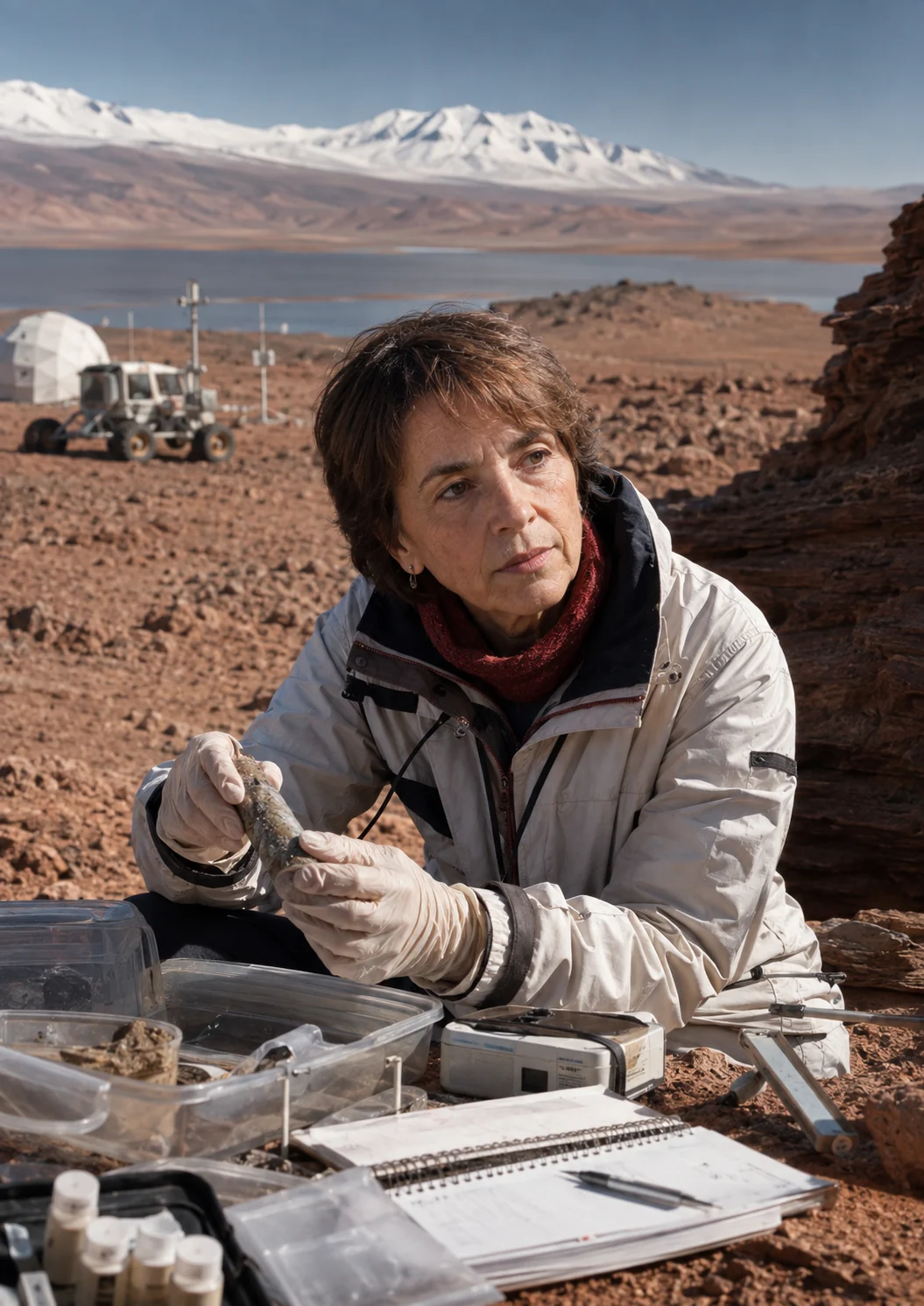
Andes and Atacama: using Earth to study limits imposed by Mars. Cabrol also built field programs in the Andes, Altiplano and Atacama, including high-altitude lakes exposed to intense ultraviolet radiation, cold, dryness and low pressure. These sites are laboratories for microbial survival, biosignatures and robotic exploration. They also force operational discipline because humans and instruments have to work in terrain that is already logistically difficult on Earth.
In 2015 she became leader of the Carl Sagan Center at the SETI Institute. Her career now connects three scales: reading Martian landscapes, testing life-detection ideas in terrestrial analogues and shaping strategies for biosignature exploration. For settlement planning, the implication is direct: before assigning land to industry or habitation, explorers need to know which scientific signals are present and how human operations could erase, move or contaminate them.
Institutional sources: NASA Astrobiology — Carl Sagan Center leadership · NASA Astrobiology — extreme-UV field work
From the early 2000s Cabrol led campaigns at very high-altitude Andean lakes. These sites combine cold, large temperature variation, reduced pressure, intense ultraviolet radiation, aridity, volcanism and sometimes hydrothermal activity. NASA stresses that no Earth site is a copy of Mars. The value is in combining constraints useful for studying the limits of life, preservation of biosignatures and instrument behavior. [NC3] [NC4]
Terrestrial life in a Bolivian lake therefore proves nothing about life on Mars. It provides a natural laboratory: which adaptations are visible, which signatures persist and which instruments can detect them? That progression — from habitability to biosignature to detectability — places Cabrol at the intersection of geology, astrobiology and exploration strategy. [NC3] [NC4] [NC5]
Studying Mars by climbing higher on Earth: a career built around extreme environments. Nathalie Cabrol built an important part of her work by seeking terrestrial environments where organisms are pushed close to their limits. High Andean plateaus, high-altitude lakes and environments exposed to intense ultraviolet radiation are obviously not Mars, but they allow researchers to study how water, temperature, salinity, geology and energy select forms of life and the biosignatures they leave behind.
This approach is valuable because it connects disciplines that missions often separate: geomorphology, limnology, microbiology, climate and remote sensing. Cabrol is not simply looking for 'a place that looks like Mars'; she compares mechanisms and asks which ones can genuinely help interpret an ancient Martian lake or a life-detection strategy.
For human presence, her work also reinforces that the Martian environment will never reduce to a single hazard such as cold or radiation. Risks combine, and biological systems respond to combinations. Extreme analogues therefore help both to avoid overinterpreting biosignatures and to learn how terrestrial life might be protected, monitored and distinguished from any possible Martian biology.
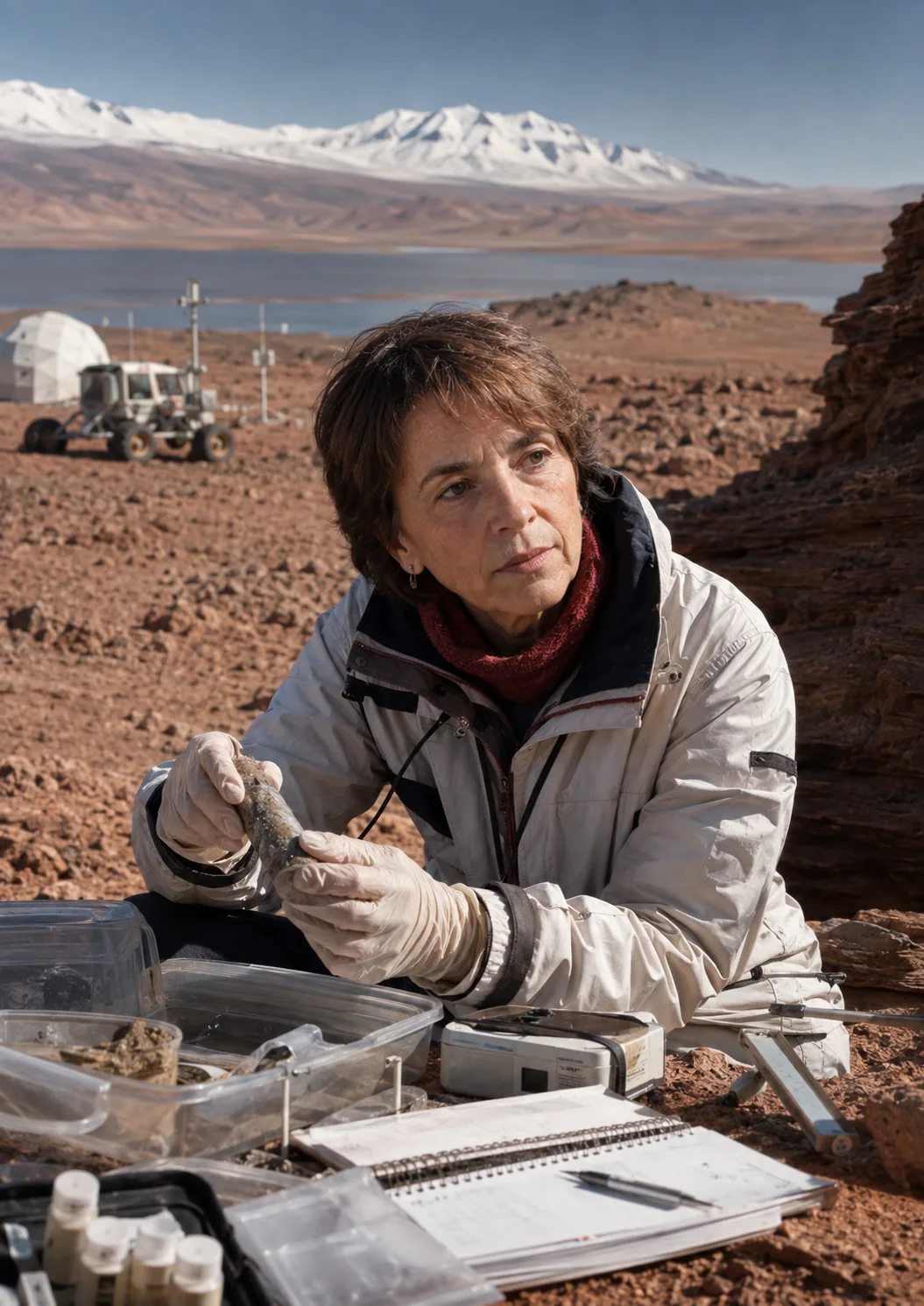
High-altitude lakes, strong ultraviolet radiation, cold and aridity in the Andes create environments in which life operates near important physiological limits. Cabrol uses such field sites to study adaptation, biosignatures and exploration methods.
An analog is never Mars. Pressure, gravity, chemical history and exposure time differ. Scientific value comes from controlled comparison: identifying which variables are meaningfully similar and which are not.
From Spirit to biosignatures — linking exploration, astrobiology and site protection
High Andean lakes as laboratories for biosignatures under stress. Field campaigns in high Andean lakes allow Cabrol and colleagues to study environments exposed to strong ultraviolet radiation, altitude, cold, aridity and unusual chemistry. The goal is not to claim that the Andes are Mars. It is to ask how life distributes itself when several stresses combine and which signatures remain detectable. That distinction separates the presence of organisms from the ability of an instrument to detect them.
Human exploration will make the distinction even more important. A biologically interesting Martian site may be difficult to sample cleanly, while settlement activities can introduce molecules that resemble the signatures being sought. Analogue-field methods therefore teach not only how to collect material, but where to look and how to avoid manufacturing the signal the mission hopes to discover.
From Viking maps to Andean lakes: doing fieldwork to learn where a biosignature can survive. Cabrol’s trajectory becomes linear when the same question is followed through different environments. Viking imagery and the study of Ma’adim Vallis first directed attention toward ancient water and Gusev crater. Terrestrial analog work then added a skill that remote sensing alone cannot provide: walking a landscape, observing gradients, selecting a sampling site, and understanding why a biological trace may survive a few meters from a place where it disappears. High Andean lakes became natural laboratories for thinking about ultraviolet radiation, aridity, cold, and microbial survival. The geologist gradually became an astrobiologist. For Mars the progression is decisive. Finding life is not simply a matter of sending a sensitive detector; it requires learning where a biosignature has a reasonable chance of being produced and then preserved.
Supplementary documentary analysis
Biographical analysis, context and legacy
Thematic analysis and deeper reading
Essential timeline
- 1991Ph.D. and early work focused on Mars and water.
- 1992–1993Work at Meudon; meets Chris McKay and begins collaborations linking landing sites and astrobiology.
- 1990s–2000sStudies Gusev, Ma’adim Vallis and ancient lake systems.
- 2000s–2010sField campaigns in the Andes and other extreme environments.
- 2014Leads a NASA astrobiology team aimed at improving biosignature-search strategy for missions including Mars 2020.
- 2015Becomes head of the Carl Sagan Center at the SETI Institute.
Deep reading: what this trajectory teaches
Nathalie Cabrol: searching for life without pretending Earth is Mars
Nathalie Cabrol is a French-American planetary geologist and astrobiologist whose career connects Martian geomorphology, rover science and field expeditions in some of Earth's most extreme environments. The SETI Institute identifies her as Director of the Carl Sagan Center for the Study of Life in the Universe, a position she has held since 2015 after joining the institute in 1998. [source] Her work revolves around a deceptively difficult question: how can a mission recognize evidence of life after climate, radiation and geology have altered the original biological signal?
Her method is especially valuable because it rejects easy analogies. High-altitude Andean lakes and the Atacama Desert are not “Mars on Earth.” Gravity, atmospheric history, chemistry and radiation differ. Their value lies in isolating particular stresses—ultraviolet exposure, aridity, cold, salinity, nutrient scarcity or rapid environmental change—and asking how organisms respond and what traces remain detectable.
For human settlement, that distinction is crucial. A base will not arrive on an empty industrial site. It will enter a scientific archive whose biological or geological value may be fragile. Cabrol's career therefore forces settlement planning to consider resource use, contamination and astrobiology together.
A French childhood pointed toward the sky before planetary geology had a clear career path
In a long NASA interview published in 2021, Cabrol describes an interest in astronomy that began extremely early. She grew up in France in the 1960s, when planetary geology was barely established as a recognizable academic path there. Her mother worked as an X-ray technician and her father with early business computing. Cabrol remembers studying radiographs with her mother and seeing room-sized computers through her father's work. [source]
She also describes difficult teenage years in mathematics and physics, enough to make her think the scientific future she imagined might be closed. The turning point was discovering that she was a naturalist: someone drawn to climate, hydrology, landforms and the history recorded in landscapes.
This matters for Mars because planetary work rarely respects the boundaries of one school subject. Reading an ancient valley requires geometry, geology, remote sensing and climate history. Cabrol's path is a reminder that scientific aptitude can emerge as an ability to connect systems rather than as uniformly perfect performance in every early course.
The “mirror brain”: connecting patterns across disciplinary boundaries
Cabrol has described a childhood habit of reading in unusual directions, making codes and looking for hidden patterns, later jokingly calling this her “mirror brain.” [source] The anecdote should not be turned into a neurological claim, but it helps explain how she understands her own scientific style: connecting observations that may look unrelated when disciplines are kept separate.
Astrobiology requires exactly that caution. A potential biosignature must be interpreted within mineralogy, chemistry, climate and preservation history. Organic material can be produced without biology. A biological trace can disappear from the surface while surviving in a protected microenvironment. A convincing interpretation therefore depends on multiple independent lines of evidence.
A Mars settlement will make that task harder by introducing terrestrial microbes, organic compounds, exhaust and industrial residues. Future scientists will need detailed contamination maps in addition to geology. Cabrol's integrative approach is therefore not only about finding life; it is about knowing when a signal can be trusted.
Physical geography becomes the doorway to other worlds
Cabrol credits a professor of physical geography with revealing a new intellectual landscape: climate, hydrology, geology and landforms treated as interacting processes rather than as descriptive facts. [source] That change redirected her toward Earth sciences at precisely the moment when a conventional astronomy career seemed inaccessible.
Planetary geology benefits from this process-oriented view. On Mars, a researcher cannot walk every valley. Orbital images must be used to infer flow direction, sediment transport, erosion and the relative timing of events. The landscape becomes a record whose grammar is physical geography.
Settlers will use the same terrain for practical decisions—routes, construction, ice prospecting and hazard avoidance. The scientific and operational maps will overlap, but they should not be confused. A site that is convenient for infrastructure may be scientifically sensitive, and a spectacular geologic site may be unsuitable for habitation.
André Cailleux, Audouin Dollfus and the first close encounter with Mars imagery
In the NASA interview, Cabrol recounts meeting geologist André Cailleux and astronomer Audouin Dollfus at the Paris-Meudon Observatory. Cailleux showed her Viking mosaics and work on Martian water. Among those images, the Ma'adim Vallis–Gusev Crater system captured her attention and became a long-term research focus. [source]
The episode demonstrates the long afterlife of mission archives. Viking data collected years earlier could still generate new research questions and shape the training of a young scientist. A spacecraft's scientific value is therefore not limited to its operational period.
Human Mars exploration will create even larger archives. Routine site photographs, drilling logs and environmental measurements may become scientifically important decades later. Preserving context, calibration and location will determine whether future researchers can use them.
A doctorate on the evolution of water on Mars
Cabrol completed her Ph.D. in 1991 on the evolution of water on Mars. Her SETI Institute curriculum vitae lists earlier training in dynamic geomorphology, climate, hydrology, remote sensing and mapping. [source] She was working before modern Mars altimetry and spectroscopy provided the precision now taken for granted.
That limitation shaped the research method. Impact craters offered recognizable topographic basins even when absolute elevation data were poor. Valley networks entering those basins could therefore be investigated as candidates for ancient lakes. Good methodology used the geometry that was reliable and remained explicit about what was uncertain.
This is a powerful lesson for settlement planning. Engineers and scientists will rarely have complete subsurface maps before committing resources. The correct response is not to pretend uncertainty is absent but to design reconnaissance that reduces the uncertainties with the largest consequences.
Gusev and Ma'adim Vallis: building a testable lake hypothesis
Cabrol and Edmond Grin developed a model in which Ma'adim Vallis delivered water into Gusev Crater and other crater basins could preserve evidence of ancient lakes. NASA Astrobiology reported that Cabrol identified nearly two hundred locations where channels appeared to enter impact craters. [source]
The scientific strength of the idea was not certainty but testability. In her 2004 interview after Spirit landed, Cabrol emphasized that Gusev could preserve fluvial, lacustrine, volcanic or aeolian histories. If the rover found volcanic deposits instead of a lakebed, that would still be a scientific result rather than a personal defeat. [source]
This attitude is directly relevant to resource exploration. A settlement may prefer to believe orbital signatures indicate abundant ice, but operational decisions must remain conditional until drilling confirms the deposit. Hypotheses should guide measurements, not replace them.
Chris McKay and the transition from water history to astrobiology
Cabrol describes meeting NASA astrobiologist Chris McKay in the early 1990s. In 1993 McKay was developing a Mars astrobiology mission concept and needed a scientifically compelling landing-site context. Cabrol showed him work on Gusev and Ma'adim Vallis, helping connect her geomorphology with questions about habitability and the search for life. [source]
An ancient lake is not automatically an astrobiology site. Researchers must ask how long water persisted, what sediments formed, whether organic material could be preserved and whether a spacecraft can reach the relevant layer. Geology provides the context that turns a biological question into a mission design.
The same distinction will matter to settlers. Water-rich terrain is attractive as a resource, while ancient lake deposits may be valuable as an archive. If both occur together, industrial plans must include scientific protection before excavation begins.
1994: NASA Ames and a larger interdisciplinary ecosystem
Cabrol arrived at NASA Ames in November 1994 through a French research fellowship, later became a National Research Council fellow and joined the SETI Institute in 1998. Her CV records this progression. [source] The move placed her close to NASA research on Mars, robotics and the emerging field of astrobiology.
Ames also provided an environment in which planetary geology, field analogs and robotic experiments could be combined. This changed the scale of the question. Instead of only mapping possible ancient lakes, a team could test how a rover identifies a target or how biological signatures behave under extreme terrestrial conditions.
Mars settlement will need the same interdisciplinarity. A drilling campaign will simultaneously involve mechanics, geology, contamination control, energy and data. Organizational structures that isolate those disciplines too rigidly will create dangerous gaps at the interfaces.
Marsokhod and Nomad: learning what science looks like through a robot's eyes
Cabrol's CV lists participation in Marsokhod field experiments in 1995–1996 and a science-lead role for the Nomad rover experiment in the Atacama in 1997. [source] Such tests are useful not because the Earth site perfectly reproduces Mars but because they force scientists to work through remote sensors and operational constraints.
A geologist standing next to a rock has texture, scale, peripheral vision and freedom to move. A rover offers a narrower information channel. Field experiments reveal which additional images or measurements are required before a remote team can make a confident decision.
Precursor robots for settlement should be tested the same way. An ice-prospecting rover must encounter irregular soils, sensor noise, slopes and imperfect maps. Operational realism often teaches more than visual similarity to Mars.
Spirit at Gusev: a hypothesis reaches the surface
Cabrol became a spokesperson for Gusev during Mars Exploration Rover landing-site selection and later a member of the MER science team. The SETI Institute notes that Gusev was her primary candidate and Gale Crater a backup candidate. [source] Spirit landed at Gusev in January 2004.
The landing tested years of orbital interpretation. Early views revealed a flat, rock-strewn plain rather than a simple exposed lakebed. Cabrol's 2004 interview emphasized that the site could test competing hypotheses and that a volcanic interpretation would still be scientifically valuable. [source]
That intellectual flexibility is a model for site selection. The best site is not necessarily one that confirms a favorite theory. It is one where available instruments can distinguish among plausible histories.
Fifteen years with the Mars Exploration Rover science story
Cabrol's institutional CV lists her as a participating scientist on the Mars Exploration Rover mission for many years and includes research on the systematic sedimentology of rocks and soils in Gusev Crater. [source] Long-duration rover work transformed the initial “lake or no lake” question into a richer reconstruction of volcanic, hydrothermal, aeolian and aqueous processes.
This is why rover longevity matters scientifically. Each new outcrop creates context for old measurements. A rock observed in isolation can be ambiguous; a traverse through multiple units reveals relationships and sequence.
A human settlement will create an even longer observational baseline. Revisiting sites across seasons and decades could make Mars one of the most continuously monitored planetary environments, provided data are georeferenced and preserved well enough to support comparison.
Why climb to nearly six kilometers above sea level to think about Mars?
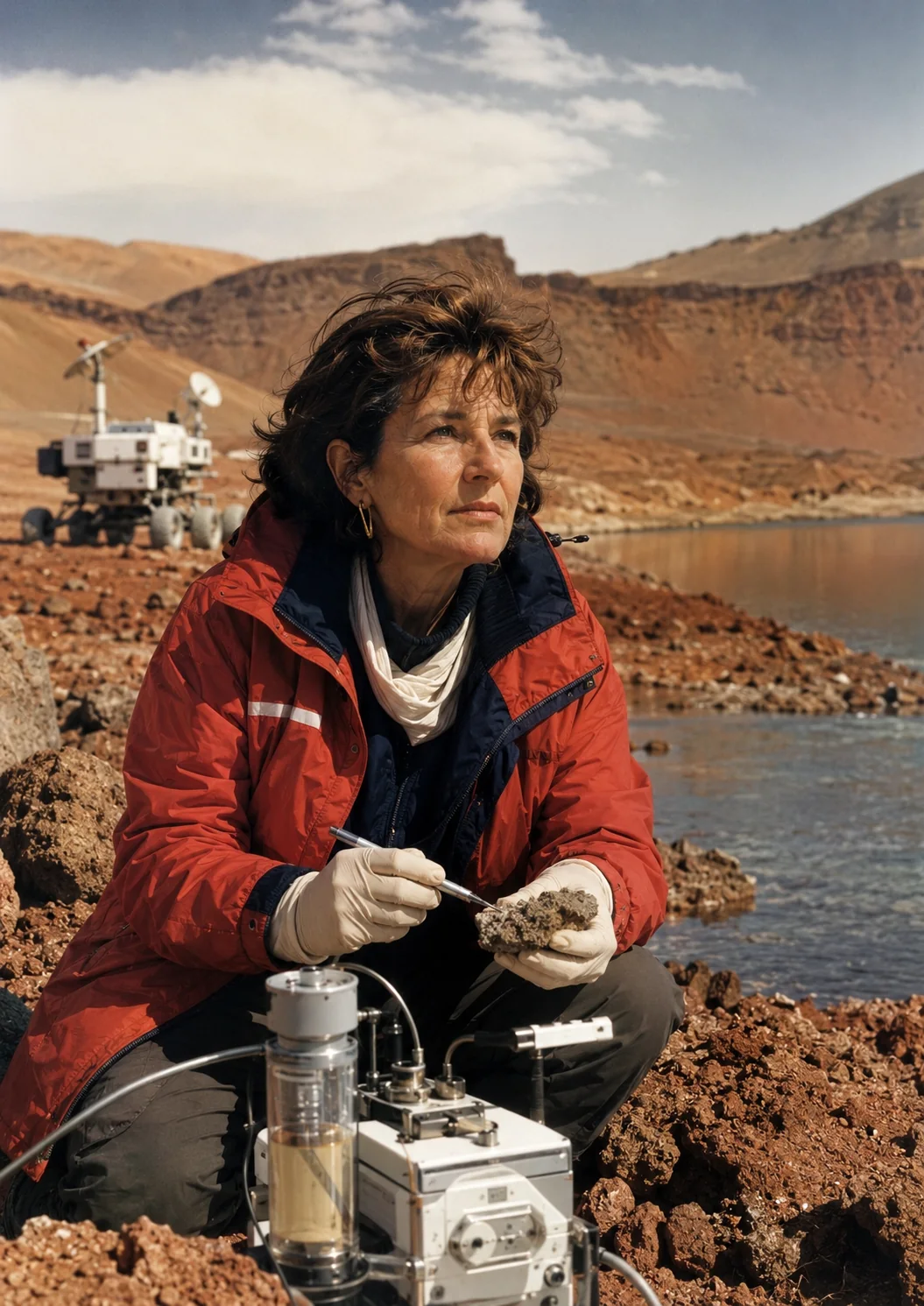
Cabrol led or participated in expeditions to high Andean lakes, including the Licancabur region. The SETI Institute emphasizes the combination of strong UV exposure, cold, aridity and high-altitude lake ecosystems as partial analogs for early Martian environments. [source]
NASA accounts highlight another dimension: researchers themselves become part of the experiment. At extreme altitude, hypoxia, cold and fatigue affect field performance. [source] The team is therefore testing both biological questions and the logistics of science under physical constraint.
Mars analogs cannot reproduce reduced gravity or the full radiation environment, but they can reveal how human cognition and procedure degrade when conditions become difficult. That information is valuable for designing realistic field operations.
Licancabur: diving into a summit lake to examine the limits of life
The SETI Institute credits Cabrol with high-altitude free-diving and scuba records associated with work at Licancabur's summit lake. [source] The physical achievement attracts attention, but the scientific purpose was to examine microbial ecosystems living under intense UV, cold and low atmospheric pressure.
Diving also reveals vertical structure that surface sampling cannot capture. Light, temperature, chemistry and biological communities can change rapidly with depth. A lake is therefore not one environment but a stack of interacting niches.
On Mars, protected niches may likewise exist below the irradiated surface. The lesson is not that a Martian lake currently exists, but that biological potential can be concentrated in gradients invisible from orbit.
UV radiation and the problem of biosignature survival
NASA descriptions of the high-lakes work emphasize adaptation to ultraviolet radiation and the effort to identify signatures that future Mars missions could recognize remotely or in situ. [source] The central distinction is between life itself and evidence of life.
A surface may once have hosted organisms yet now preserve only altered molecules, mineral associations or textures. Search strategies therefore need models of degradation. Instruments should target environments where traces are likely to survive, not simply places that were once habitable.
Human settlement adds another layer because terrestrial biological material will enter the environment. Mapping the settlement's contamination plume will become necessary if future biosignature claims are to remain credible.
Planetary Lake Lander: turning a changing lake into a robotic laboratory
Cabrol led the Planetary Lake Lander project between 2011 and 2015. Her CV records the project and a NASA group achievement award connected with the team. [source] The project used robotic observation to study a dynamic lake environment and explore autonomous scientific operations.
The value of a persistent robot is temporal. A short field campaign samples moments; a resident platform can detect change and connect environmental drivers with biological response. That resembles the role a long-lived planetary station could play.
A settlement will have the opportunity to build such persistent networks around Mars. Autonomous sensors could monitor scientifically important sites while crews focus elsewhere, increasing both coverage and the chance of recognizing rare events.
Atacama and the shift from visible surface to hidden microhabitats
Cabrol's CV includes projects on subsurface life in the Atacama and Mars biosignature detection. [source] Extremely dry environments demonstrate that life may persist in small protected niches even when the exposed surface appears nearly sterile.
Such microhabitats change search strategy. A mission may need to look beneath stones, within salt-bearing materials or below the most irradiated layer. A camera image of barren ground cannot rule out localized biological activity.
Settlement resource extraction may target those same depths. Drilling protocols should therefore distinguish industrial prospecting from clean astrobiology investigations and preserve scientifically sensitive cores before heavy contamination occurs.
TextureCam and onboard scientific triage
Cabrol's project history includes work associated with TextureCam, an approach to onboard image-texture analysis. [source] The goal is part of a broader challenge: a remote robot may collect more imagery than humans can evaluate quickly, so some local processing can help identify unusual targets.
Scientific autonomy is not the same as handing all interpretation to an algorithm. A useful system can rank anomalies while preserving raw data and allowing researchers to inspect the reasoning. The best division of labor uses computers for consistency and humans for context.
Mars settlements will need this approach across thousands of sensors. Automated triage should help crews focus attention without becoming an opaque gatekeeper that silently discards evidence.
Caves and thermal remote sensing
Cabrol's research record includes a NASA-supported study of thermal detection of caves on Earth and Mars. [source] Caves are interesting because they may offer more stable temperatures and shielding from surface radiation, but identifying them remotely is a separate problem from proving they are safe or habitable.
Thermal anomalies can suggest openings or voids, yet terrain, rock properties and illumination create alternative explanations. Confirmation requires multiple observations and eventually local reconnaissance.
For settlement, this distinction should prevent overclaiming. Natural caves may one day provide useful shielding, but no remote-sensing detection alone establishes structural integrity, access geometry or contamination status.
2015 and the Carl Sagan Center: from personal research to scientific leadership
Cabrol became Director of the SETI Institute's Carl Sagan Center in August 2015. The institute describes her role as shaping scientific vision across astrobiology and exploration strategies for Mars, Titan and icy ocean worlds. [source]
The leadership challenge is to create connections without flattening distinct disciplines. Exoplanet atmospheres, terrestrial extremophiles and Martian sediments all address aspects of life in the universe, but they use different evidence and methods.
For Mars, this broader context is useful because habitability should not be defined solely by human comfort. Comparing very different worlds reveals which environmental factors are essential to biology and which are merely familiar to Earth organisms.
The NASA Astrobiology Institute team: where, what and how to search
Cabrol led the SETI Institute NAI team “Changing Planetary Environments and the Fingerprints of Life.” NASA's 2018 report described the effort as building a roadmap for biosignature exploration with Mars 2020 as a major opportunity. [source]
The program's three questions—where to search, what to search for and how to search—form a disciplined sequence. Site context comes before instrument enthusiasm. A sophisticated sensor aimed at the wrong geological layer can produce less knowledge than a simpler instrument placed well.
Settlement science should institutionalize the same sequence. Before drilling or sampling, teams should define the environmental process, expected signal and alternative explanations. That makes scarce field time more informative.
Gusev and Gale: a lesson in humility about landing sites
The SETI Institute notes Cabrol's advocacy for Gusev and her consideration of Gale Crater during MER site studies. [source] Later, Curiosity's selection of Gale gave the site enormous scientific prominence, but it would be misleading to frame that as a personal prediction.
Landing-site choice is collective and constrained by engineering. A scientifically extraordinary site may be rejected if safe arrival cannot be demonstrated. Cabrol's more important contribution is methodological: choose places where several hypotheses can be discriminated with the available payload.
A base should follow the same logic. Resource maps should not be selected only because they support optimistic plans. Good sites are places where critical uncertainties can be tested quickly and where failure of one hypothesis does not make the location useless.
Planetary protection: humans are contamination sources
Astrobiology makes planetary protection unavoidable. Robotic missions already require contamination controls when searching for life. A human base will carry vastly more terrestrial biology, organic material and industrial residues.
Settlement planners must therefore identify scientific zones before large-scale construction. Rover tracks, exhaust plumes, drilling fluids and dust transport may distribute contaminants beyond the habitat perimeter. A site can be operationally attractive yet scientifically inappropriate for early occupation.
Cabrol's work provides a useful restraint on conquest narratives: exploration includes the obligation not to destroy the evidence one traveled so far to find.
Mars, Titan and ocean worlds: habitability is broader than Earth-like surfaces
Cabrol's current scientific leadership extends beyond Mars to Titan and icy ocean worlds. Her CV also records participation in work connected with an Ocean Worlds roadmap. [source] The expansion reflects a major development in astrobiology: environments potentially suitable for life may be buried, chemically unusual or very unlike Earth's surface.
This comparison helps separate two ideas often confused in public discussion. An environment can be habitable for microbes while being impossible for unprotected humans. Conversely, a pressurized base can make a biologically uninteresting site comfortable for people.
Mars settlement decisions therefore need two maps: human habitability and astrobiological interest. The overlap may be small, and responsible planning should preserve that difference.
Earth's climate enters the astrobiology strategy
In her NASA interview, Cabrol describes making environmental science on Earth more central to the Carl Sagan Center's strategic vision. [source] The decision reflects what field researchers see directly: analog sites are changing under modern climate pressure while they are being studied.
This creates a natural experiment in how ecosystems respond, migrate or leave altered signatures. The work feeds both planetary interpretation and understanding of environmental change on Earth.
Mars technology should not be justified primarily through terrestrial “spinoff” slogans, but techniques for remote sensing, water monitoring and closed-loop systems can benefit both planets when the transfer is technically honest.
Fieldwork as a technology of truth
Cabrol's career repeatedly returns to fieldwork because real environments expose assumptions. Weather changes, access fails, sensors drift and samples do not appear where a clean diagram predicted them. Field teams must adapt while preserving scientific traceability.
This operational messiness is exactly what planetary missions experience. Remote systems rarely encounter the ideal target at the ideal distance with the ideal lighting. Field practice helps researchers design questions that remain meaningful when conditions are imperfect.
Settlers will live in that reality continuously. Every excursion should generate both science and operational lessons, with logs detailed enough that the next crew understands not only what was collected but what made the collection difficult.
Women, planetary science and the importance of visible professional paths
The SETI Institute describes Cabrol as the first woman in France to receive a Ph.D. in planetary geology. [source] She later led field expeditions and a major international research center, making a career path visible that was difficult to imagine when she was a student.
The milestone should not replace the science. Her importance comes from research on Martian lakes, field analogs, rover science and biosignature strategy. Its social value is that younger researchers can see those achievements attached to a broader range of professional identities.
A small Mars community will depend on using talent efficiently. It cannot afford cultural assumptions that restrict who is considered suitable for field leadership, engineering or science.
Books and long-form science communication
Cabrol is also the author of multiple books, including works aimed at a broader public. The SETI Institute lists her book publications alongside her scientific record. [source] Long-form writing allows her to connect personal exploration, planetary questions and the uncertainty that disappears from short headlines.
Astrobiology benefits from that format because negative evidence and changing hypotheses require narrative context. A failed prediction can be scientifically productive if readers understand what it eliminated and what new question followed.
Future Mars communities will need both formal reports and long-form histories. Procedures preserve actions; narratives preserve reasoning, doubt and institutional memory.
Avoiding the false positive in the most emotionally charged scientific search
The search for extraterrestrial life carries enormous public expectation. That makes methodological restraint especially important. Cabrol's approach emphasizes geological context, preservation and multiple signatures rather than a single dramatic signal.
Any candidate Martian biosignature must be tested against abiotic chemistry, instrument artifacts and terrestrial contamination. The presence of settlers will increase all three interpretive difficulties by introducing new organic and microbial backgrounds.
A mature Mars society should therefore value the scientist who says “not enough evidence” as much as the one who announces an exciting candidate. Scientific credibility will depend on making extraordinary claims harder, not easier, after humans arrive.
What extreme lakes teach about human systems
High-altitude expeditions are not complete Mars simulations, but they do reveal how environmental stress changes human work. Hypoxia, cold, fatigue and logistics influence attention, speed and judgment. Cabrol has noted that researchers studying limits of life became part of the experiment themselves. [source]
Mars crews will likewise be instruments with changing performance. Procedure design should account for cognitive load, suit limitations and the fact that scientifically interesting terrain may also be physically exhausting.
Good mission architecture therefore supports the human observer with automation, checklists and margins instead of assuming that expertise alone cancels environmental stress.
What Nathalie Cabrol really contributes to future Mars settlement
Cabrol has not designed a Martian city or industrial system. Her contribution lies in site science, biosignature detection, extreme-environment fieldwork, robotic exploration strategy and the protection of scientific value. She helps answer a question that should precede construction: what evidence could be lost if humans alter this place?
A settlement will need resource prospecting and infrastructure, but it should also map zones of high astrobiological value, document contamination and use robots to investigate sensitive environments before large human activity reaches them.
Cabrol's legacy for settlement is therefore active scientific restraint: go into difficult terrain, test the hypothesis, improve the instrument and remain willing to let evidence defeat the preferred story. On Mars, that humility may be as important as any machine.
Caves, lava tubes and the problem of environments hidden from orbit
Cabrol's field programme increasingly moved from the obvious landscape to the less visible environments where biological traces may survive longest. Her long curriculum vitae documents work on caves, high-altitude sites and remote sensing approaches designed to connect surface observations with environments that cannot be characterized from a single orbital image. [source] This matters on Mars because the surface is exposed to radiation, oxidation and extreme dryness. A biologically interesting environment may therefore be one that an orbiter can barely see.
The practical problem is an inversion problem: scientists observe temperature, mineralogy, geometry or atmospheric exchange and infer what may exist beneath the surface. The conclusion is always conditional. A thermal anomaly can identify a candidate void, not prove a habitable cave. A skylight can provide access, not demonstrate safety. Cabrol's work reinforces the discipline of separating a detection cue from the phenomenon it may indicate.
For settlement, lava tubes and caves are often proposed as natural radiation shelters. The astrobiological lesson adds a constraint: an apparently attractive shelter may also preserve scientifically valuable material. Reconnaissance must therefore precede occupation, and planetary-protection rules may need to distinguish industrial caves from protected scientific sites.
Spherules, textures and why morphology alone can mislead
Cabrol's research record includes work on small-scale textures and spherules in terrestrial analog environments. [source] The broader astrobiology question is fundamental: shapes that resemble biological structures can also be produced by abiotic mineral processes. The same caution applies to filaments, layers, cavities and chemical gradients.
A convincing biosignature therefore benefits from convergence. Morphology should be compared with mineral context, chemistry, isotopes where available, environmental history and the possibility of contamination. No single striking image should carry the full burden of proof. This is especially important for Mars, where the public and media interest in life can encourage premature interpretation.
Human presence would multiply the ambiguity. Drilling fluids, lubricants, polymers, food residues and terrestrial microorganisms could all generate patterns that future investigators might misread if operational records are incomplete. Settlement science will need contamination provenance at the same level of seriousness as geological mapping.
TextureCam and the ambition to let a field system recognize geological context
Cabrol's curriculum vitae lists involvement with TextureCam, a project exploring onboard interpretation of geological textures. [source] The strategic idea is important even beyond the particular instrument: when communication is slow, a rover or field system gains value if it can prioritize observations locally rather than treating every pixel equally.
Autonomy does not mean replacing scientists. It means allocating scarce bandwidth, time and energy more intelligently. An algorithm can identify an unusual texture, but the scientific interpretation still depends on context and review. The best architecture combines automatic triage with the ability to preserve raw data so later teams can challenge the machine's classification.
A Mars settlement will generate a similar flood of routine environmental and geological measurements. Local systems may need to flag unusual chemistry, radiation events or biological contamination before Earth can respond. Cabrol's connection between field geology and intelligent observation therefore anticipates a wider problem of planetary operations.
Human exploration planning: science sites cannot simply become construction zones
Cabrol's professional record includes participation in Mars exploration planning groups concerned with science and future human missions. [source] The issue is not merely where astronauts could land, but how their mobility, power systems, waste streams and sampling would change the scientific environment they came to study.
A robotic rover can already disturb a small site. A human expedition introduces orders of magnitude more mass, heat, exhaust, organics and microbial material. A settlement multiplies that again. The design problem is therefore spatial: some regions may become operational zones, while others require controlled access, clean equipment or long-term preservation.
This is one of Cabrol's strongest contributions to a colonization-oriented Mars library. Scientific protection is not an obstacle added after the habitat is designed. It is a land-use requirement that can influence roads, drilling sites, water extraction and even where a settlement should not expand.
Astrobiology after the first settlers: the control experiment becomes harder
Before humans arrive, investigators can at least begin with a planet that has not hosted a permanent terrestrial biosphere. After settlement, every search for indigenous life becomes a contamination problem as well as a biological one. Cabrol's career, with its emphasis on extremophiles and preservation, helps show why that transition matters.
The solution cannot be perfect sterilization of an entire settlement. It must instead be traceability: genomic records of carried organisms, maps of waste and water systems, controlled clean zones, archived environmental samples and procedures for distinguishing operational microbes from unexplained signals. The settlement itself becomes part of the experimental metadata.
This approach treats planetary protection as information architecture rather than only as cleaning. Future scientists need to know what humans introduced, when, where and in what quantity. Without that history, a potentially extraordinary observation may become impossible to interpret.
SETI and technosignatures broaden the question from microbes to intelligence
As Director of the Carl Sagan Center, Cabrol works within an institution whose remit extends beyond microbial astrobiology to the search for technological signatures. The SETI Institute describes the Center as studying life in the universe across planetary environments and the search for intelligence. [source]
The two searches require different evidence but share a methodological principle: an unusual signal is not enough. Investigators must test instrumental effects, natural alternatives and independent confirmation. The discipline developed for biosignatures—multiple lines of evidence, environmental context and explicit uncertainty—has a close analogue in technosignature research.
For Mars settlement, this is philosophically important. Human activity will itself create a technosignature visible from orbit: heat, radio emissions, artificial materials and geometric infrastructure. The first extraterrestrial technological signature that humanity can study in detail may therefore be its own.
Climate change on Earth as a field lesson in moving baselines
Cabrol has argued that rapidly changing terrestrial environments are relevant to astrobiology because analog sites do not remain static while scientists study them. [source] A lake, glacier or desert margin measured in one decade can present different hydrology and biology in the next. The reference condition itself moves.
Mars changes more slowly in many respects, but a settlement can create its own moving baseline. Heat leakage, dust disturbance, water extraction and imported biology may transform local conditions faster than natural processes would. Environmental monitoring must therefore begin before major construction, not after impacts become visible.
The lesson is methodological: every long-duration programme needs a baseline, repeated measurements and explicit recognition that “normal” is a time-dependent concept. This is as true for an Andean lake as for the surroundings of a future Martian industrial site.
Training the next generation is part of the scientific instrument
Cabrol's career spans university research, NASA collaborations, field expeditions and leadership at the SETI Institute. Her public interviews repeatedly return to the importance of curiosity, interdisciplinary training and giving younger scientists opportunities to work across traditional boundaries. [source]
A long Mars programme cannot rely on a handful of founding experts. Instruments outlive their designers, missions take decades and field methods must be transmitted. Training therefore behaves like infrastructure: if knowledge transfer fails, expensive hardware can remain physically intact while its effective capability declines.
A settlement will face the same problem more acutely. The first generation may include specialists from Earth; later generations will need local education, laboratories and apprenticeships. Cabrol's trajectory suggests that the capacity to ask good questions is as important to preserve as any particular technique.
Books and public communication: explaining uncertainty without making science sound weak
Cabrol has written for both specialist and general audiences and has participated extensively in public communication. [source] Astrobiology is particularly difficult to explain because its most interesting conclusions are often probabilistic: a site is promising, a mineral is compatible with life, an environment could preserve biosignatures.
Public discourse can distort that language into certainty. “Could preserve” becomes “contains,” and “candidate biosignature” becomes “life discovered.” A responsible communicator must therefore make uncertainty intellectually exciting rather than presenting it as an embarrassment.
This will matter after humans reach Mars. Operational teams will make discoveries under intense public attention. A culture trained to distinguish measurement, hypothesis and conclusion will be better able to preserve trust when early interpretations change.
Origin-of-life questions force Mars and Earth into the same comparative frame
Cabrol's astrobiology work ultimately connects Mars exploration to the broader question of how life begins and persists. Mars is useful not because it is a copy of early Earth, but because it preserves a different planetary experiment: similar basic materials, a different climate history and a surface record that may retain very ancient environments.
If life emerged independently on Mars, the implications would be enormous. If it did not, equally important questions remain about which environmental thresholds were missing. The scientific value therefore survives either result. A sterile Mars would not be a failed experiment; it could help constrain the conditions required for biology.
Settlement planning should protect that comparative value. The oldest, least altered deposits may matter more scientifically than the easiest sites to excavate. Industrial priorities and origin-of-life science will sometimes point in opposite directions.
Mapping the invisible: from buried water to hidden biological refuges
A recurring theme in Cabrol's work is that the scientifically decisive component of a landscape may not be directly visible. Ancient water is reconstructed from landforms; microbial refuges may be inferred from environmental gradients; subsurface habitats may require geophysical or thermal clues. The field scientist learns to map evidence rather than appearances.
This is also a settlement skill. The most important resources—ice lenses, stable subsurface temperatures, voids, contamination plumes—may be invisible at the surface. A mature base will therefore depend on geophysics, drilling and long-term environmental sensing rather than on visual inspection alone.
Cabrol's contribution is to keep those maps scientifically disciplined. An inferred feature should retain a confidence level and provenance, so that later measurements can confirm or overturn it without erasing the reasoning that produced the first map.
Human physiology and field safety: analog work is also an operational reality check
High-altitude expeditions in the Andes expose researchers to hypoxia, cold, ultraviolet radiation and logistical isolation. Cabrol's teams have worked in environments where scientific ambition must remain subordinate to acclimatization, weather and rescue constraints. [source]
The analogy to Mars is limited but useful. A scientist who becomes a casualty cannot collect data, and a mission that consumes its contingency resources for one spectacular objective may weaken the entire programme. Field leadership therefore includes deciding when not to proceed.
On Mars the medical margin will be much thinner. The value of terrestrial analogs is not that they reproduce Martian physiology, but that they teach teams to integrate science goals with human limitations, communications and emergency planning.
What Nathalie Cabrol contributes to a Mars settlement—and what she does not claim
Cabrol is not a habitat architect, propulsion designer or settlement economist. Her distinctive contribution lies elsewhere: understanding water-shaped landscapes, identifying environments where biological traces may persist, testing astrobiological methods in extreme terrestrial sites and helping institutions decide what evidence deserves confidence. [source]
For a future settlement, those competencies become governance constraints. Where should drilling avoid sensitive deposits? Which samples require clean handling? What environmental baseline must be recorded before expansion? How can field teams distinguish an imported organism from a possible indigenous one? These are infrastructure questions as much as scientific questions.
The deeper lesson of her biography is that Mars cannot become merely real estate. Before it is a place to exploit, it is a planetary archive. A settlement worthy of the scientific opportunity would need to learn how to inhabit that archive without destroying the evidence it came to understand.
Primary and institutional sources
Verification rule: this biography prioritizes institutional, archival and primary sources. Statements about living people or active programs are dated and attributed; uncertain or disputed points must remain explicitly qualified.
- NASA — Interview with Nathalie Cabrol
- NASA Astrobiology — Ask an Astrobiologist: Nathalie Cabrol
- NASA/JPL — NASA selects new science teams for astrobiology research
- NASA Astrobiology — Mars Lakes
- NASA Astrobiology — The Search for Mars Biosignatures Up at High Altitudes
- SETI Institute — Nathalie Cabrol biography and current research
- SETI Institute — Scientist interview: Nathalie Cabrol
- SETI Institute — Nathalie A. Cabrol long curriculum vitae
- SETI Institute — Mars, field experiments and astrobiology work
- NASA Astrobiology — Search for Mars biosignatures at high altitudes
- SETI Institute — Curriculum vitae and Mars exploration background
- SETI High Lakes Project — Nathalie Cabrol field profile
- NASA Astrobiology — high-altitude analog field research
- SETI Institute — Fingerprints of Life and extreme-environment exploration