


MARS BIBLE — PEOPLE
Ashwin Vasavada
Ashwin Vasavada's documented nationality or citizenship is American; the documented birthplace is Not stated in the institutional sources cited. Ashwin Vasavada is one of the scientists who gave Curiosity its intellectual continuity. Trained in geophysics and planetary science at UCLA and Caltech, he learned to interpret atmospheres, surfaces and mission constraints before serving for a decade as deputy project scientist and then becoming Mars Science Laboratory project scientist. His career shows that planetary exploration is built less by a single spectacular moment than by years of preparation, instrument trade-offs, geological interpretation and daily decisions about an aging rover.
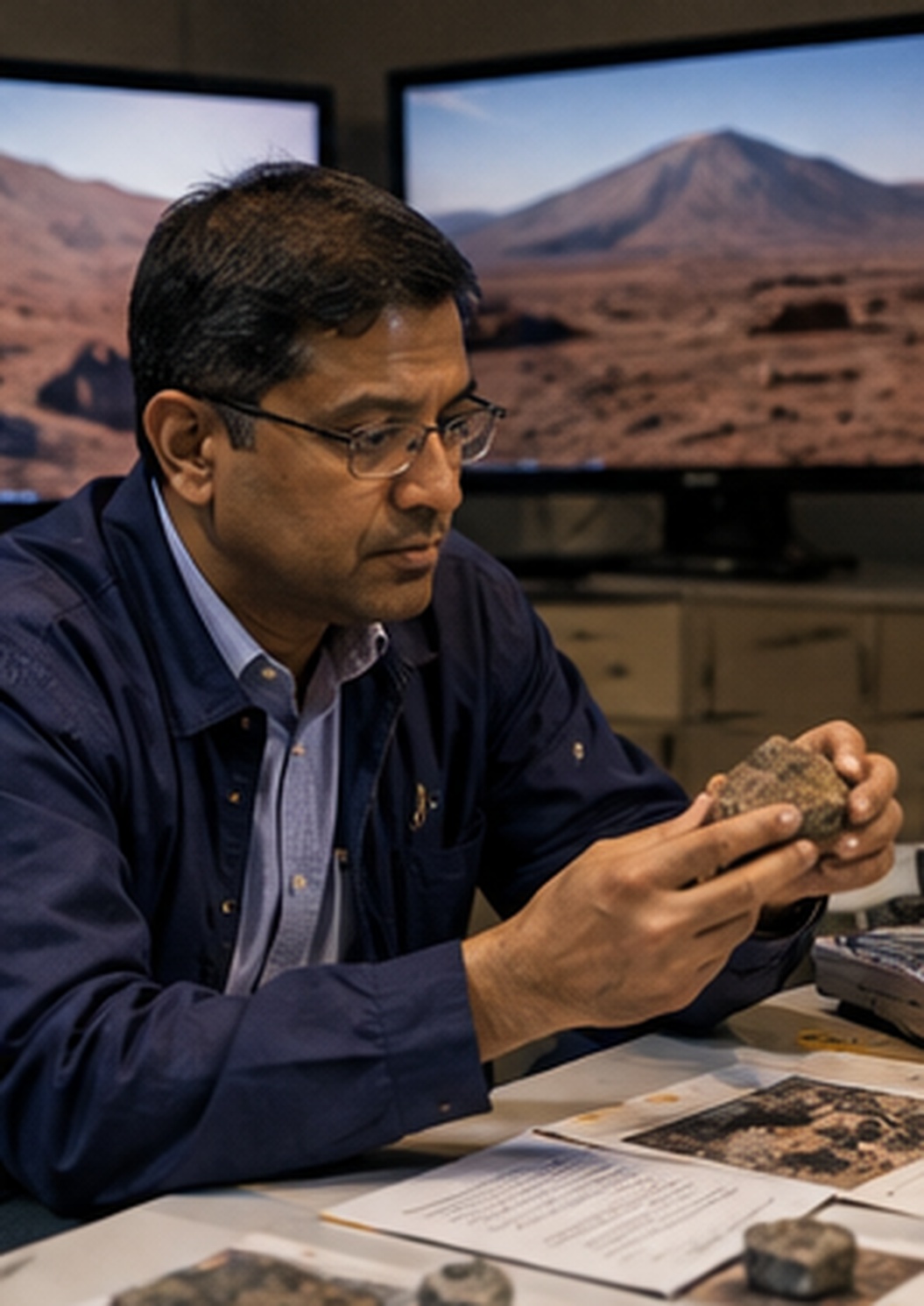
Chronological biography
The main narrative now follows the life in order: training, early work, acquired skills, missions, difficulties, teams, and responsibilities before reaching the Mars legacy.
UCLA and Caltech — broad training as Mars again became difficult
Finding planetary science just as a Mars mission failed. Ashwin Vasavada completed a degree in geophysics and space physics at UCLA in 1992 and then entered Caltech for graduate study in planetary science. His own account adds a revealing detail: on the day he was driving to Caltech to begin graduate school, Mars Observer had just been lost before orbital insertion. The mission he expected to work on effectively disappeared before his graduate research had begun. His career in planetary exploration therefore started not with a triumph but with a programmatic shock.. Vasavada did not become a Mars specialist by following a single predetermined track. His education combined geophysics, space physics and then planetary science: UCLA gave him a broad quantitative foundation, while Caltech pushed him toward the processes shaping atmospheres and surfaces. That combination is especially useful on Mars, where visible landforms must be connected to physical mechanisms, climate history and instrument constraints. Long before leading Curiosity science, he therefore learned to move repeatedly from measurement to model and from model back to observation.. Source
He pivoted toward the outer planets and worked with Galileo-era science. That detour became useful rather than wasted time. Remote sensing, thermophysics and the interpretation of planetary surfaces are transferable skills. The first lesson was scientific, but also organizational: a researcher must be able to reformulate a question when a spacecraft fails and the original dataset will never arrive. [source]
Institutional sources: JPL — education and professional experience · JPL/NASA — career account
Ashwin Vasavada earned a B.S. in geophysics and space physics from UCLA in 1992 and a Ph.D. in planetary science from Caltech in 1998. That combination matters because a rover project scientist must understand both the physical planet and the instruments that turn physical properties into evidence. JPL Science — Ashwin Vasavada
His path then included academic research and a 2001–2002 AAAS Science and Technology Policy Fellowship in the U.S. Congress. In 2004 he joined Mars Science Laboratory as deputy project scientist, eight years before Curiosity landed. He therefore learned the mission before the public ever saw a finished rover: science requirements, instrument development, schedule and risk trades, and the preparation of a team that would later have to do field geology by remote control. [source]
Leading Curiosity science is also a problem of time allocation. Every sol imposes a budget for communications, energy, driving and instrument activities. The scientific value of an observation therefore cannot be separated from its operational cost. Vasavada works at the interface where specialists from different disciplines have to turn priorities into a sequence that one rover can actually execute without losing the coherence of the long-term geological investigation. [source]
A deliberately broad formation: Mars, outer planets and science policy. Vasavada's career becomes more interesting when it is not reduced to a straight line toward Mars. His UCLA degree combined geophysics and space physics; his Caltech doctorate moved him into planetary science. His professional interests then ranged from Martian surface properties, volatiles and climate history to atmospheric dynamics on Jupiter and Saturn and polar volatiles on Mercury and the Moon. That breadth trained him to separate a problem that is uniquely Martian from a physical process that can be understood by comparing several worlds.
He also acquired a less visible form of mission competence. In 2001–2002 he served as an AAAS Science and Technology Policy Fellow in the U.S. Congress, seeing how scientific priorities become budgets and public decisions. He then returned to research and became Mars Science Laboratory deputy project scientist from 2004 through 2014 and project scientist from 2015 onward. The continuity is unusual: Vasavada followed Curiosity before the rover existed as flight hardware, through instrument and landing-site decisions, and then through years of actual operations in Gale crater. He learned the institutional lifetime of a planetary mission as well as its science. [av1] [av2]
Ashwin Vasavada recalls that his desire to explore planets began with Viking images of the Martian surface, which he would stare at in a book when he was eight or nine. He was not primarily dreaming of becoming an astronaut. He wanted to see planetary landscapes from ground level, discover what lay around the next bend and use robots as extensions of the observer. That distinction between fascination with space and the profession of science shaped his later career.
Research and science policy — learning how a mission becomes possible
Research and science policy: learning how missions become institutions. After his 1998 doctorate, Vasavada continued research on planetary surfaces, volatiles and climate history. He also spent 2001–2002 as an AAAS Science and Technology Policy Fellow in the U.S. Congress. For a future project scientist, this was more than an unusual line on a résumé. Flagship missions exist inside budgets, national priorities, peer review, advocacy and multi-year institutional commitments. Knowing how evidence is communicated outside a laboratory complements knowing how to analyze it. Source.
A period in science policy then broadened his education beyond research itself. A mission does not exist simply because a question is interesting; it must be formulated, funded, traded, built and operated for years. When Vasavada became MSL deputy project scientist in 2004, he entered a decade in which Mars science was also a profession of integration. Geologists, chemists, atmospheric scientists, engineers and instrument teams had to work through one operational plan. That experience directly prepared him to become project scientist in 2015. Institutional source.
His Mars work increasingly connected surface properties and climate history with the question Curiosity would later address: what environments existed in Gale crater, and what do rocks and minerals say about ancient habitability? A project scientist is not simply the person with the strongest favorite hypothesis. The job is to make a large scientific community use instruments, rover time and engineering margins in a way that preserves the mission’s highest-value questions.
Institutional sources: JPL — Ashwin Vasavada science profile
When Curiosity landed in Gale crater in 2012, Vasavada had already spent years helping build the mission. He became project scientist in 2015. The job is not to choose targets alone; it is to keep a large science community connected to a real vehicle constrained by power, time, mobility, and mechanical health. Long duration changes the role again: the science plan becomes a learning loop in which discoveries and rover constraints continuously reshape the next question. JPL — New Project Scientist for Mars Rover
At UCLA, however, he did not immediately know how to reach that goal. In a JPL account he describes changing majors several times, initially choosing aerospace engineering largely because it contained the word 'space', before realising that he was more interested in understanding nature than in solving technical design problems. He eventually found planetary science and entered Caltech for graduate study. In a striking historical coincidence, the day he drove south to begin graduate school, Mars Observer — the mission he expected to work on — was lost shortly before orbital insertion.
2004–2014 — A decade as deputy before leading Curiosity science
2004–2014: a decade as deputy project scientist before the lead role. Vasavada became deputy project scientist for Mars Science Laboratory in 2004, many years before Curiosity landed. That span included instrument definition, site-selection debates, development problems, delays, launch preparation and early surface operations. By the time the rover returned data, he had accumulated a memory of why hardware existed in a particular form and which compromises had already been made. Source.
The period also teaches the core negotiation of rover science. A geologist may want a difficult outcrop; mobility engineers may see a wheel hazard; power, thermal state, communications and time budgets impose other limits. The mission succeeds when those constraints are made explicit and traded intelligently, not when science or engineering simply defeats the other side.
Institutional sources: JPL — MSL deputy project scientist 2004–2014
That disruption forced him to pivot to other planets before returning to Mars. It was formative: a scientific career does not proceed according to a perfectly written mission plan. Vasavada became deputy project scientist for Mars Science Laboratory in 2004 and project scientist in 2015, coordinating an international science team of hundreds. His path therefore gives a concrete definition of scientific leadership: enough science to rank the questions, enough engineering understanding to respect rover constraints, and enough organisational skill to turn many disciplines into a coherent daily exploration programme.
Since 2015 — Doing science with an aging rover and a landscape that keeps surprising the team
From 2015 onward: doing science with an aging, irreplaceable laboratory. Vasavada became MSL project scientist in 2015. Curiosity was no longer a new spacecraft executing a prewritten script. The rover had accumulated wear, the team had learned the terrain, and Mount Sharp presented geological layers that could only be understood by adapting the traverse as observations arrived. Science became a daily operations problem: maximize the value of a target while protecting a vehicle that cannot be replaced on site.
That is directly relevant to human Mars exploration. A settlement will also need people who can connect scientific questions to the actual condition of equipment, mobility constraints, crew time and risk. Vasavada’s path shows that this kind of judgment is not acquired in a single course. It grows from mission failure, research, institutional experience and repeated decisions under real operational limits.
Institutional sources: JPL — MSL Project Scientist
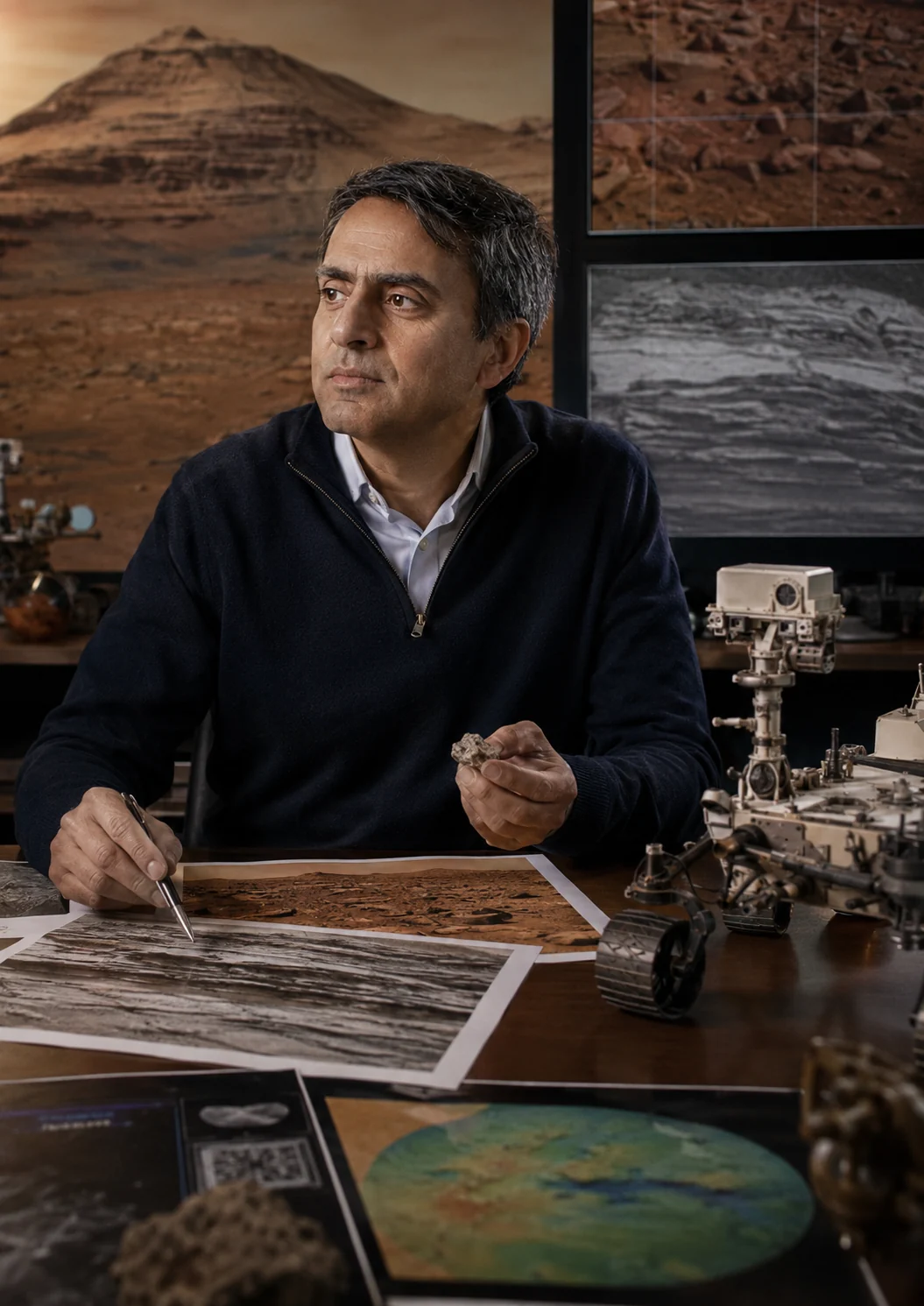
From researcher to project scientist: learning that leading science is not the same as choosing alone. Vasavada’s chronology becomes most revealing when the change in profession is followed step by step. Training in geophysics and planetary science taught him to read the physical processes of a world; joining Mars Science Laboratory taught him that a scientific question does not automatically become a measurement. Instruments, mass, power, communications, rover safety, and the priorities of many teams must all fit together. The years before landing therefore became an education in interfaces and tradeoffs. After 2012 the problem changed again. Curiosity aged, real terrain contradicted prepared scenarios, and discoveries forced the team to ask different questions. Becoming project scientist meant organizing a collective intelligence rather than imposing a fixed plan. That progression—from understanding planetary physics to coordinating a mobile observatory—is the biographical thread that explains his role in Mars exploration.
The project scientist as a living interface between scientific questions and rover constraints
The project scientist role is easily misunderstood because it is neither a conventional laboratory director nor a single systems engineer. On Curiosity, Ashwin Vasavada works at the interface between a scientific community numbering in the hundreds and the real vehicle JPL teams must operate. A scientific question is not directly a rover command: it must be converted into observations, sequences, priorities, power and time constraints, mobility limits and safety rules.
His academic path is equally instructive. He began in aerospace engineering, moved through physics, then found his direction in Earth and space science before completing a doctorate in planetary science. A Mars mission needs people able to speak several disciplinary languages: enough engineering to avoid asking for the impossible, and enough science to avoid reducing the mission to merely keeping the vehicle alive.
Curiosity has also demonstrated that scientific operations are adaptive. The rover identified ancient habitable environments, encountered more wheel damage than expected and progressively built long geological and weather records. The science plan therefore cannot remain a frozen pre-launch list. Every discovery changes the next questions; every ageing mechanism changes the operational cost of an observation.
For future human geologists on Mars, the lesson transfers directly. Field scientists will not simply execute a programme prepared on Earth. They will rank samples, alter routes, recognize unexpected observations and document decisions so distant specialists can understand why the plan changed. Exploration becomes a continuous loop: observe, interpret, reformulate a hypothesis, choose a discriminating measurement and preserve the resources needed for what comes next.
Supplementary documentary analysis
Biographical analysis, context and legacy
Thematic analysis and deeper reading
Essential timeline
- 1992B.S. in geophysics and space physics from UCLA.
- 1998Ph.D. in planetary science from Caltech.
- 2004Becomes deputy project scientist for Mars Science Laboratory.
- August 2012Curiosity lands in Gale Crater.
- 2015Becomes Mars Science Laboratory project scientist.
- 2024Curiosity encounters unexpected elemental sulfur crystals, illustrating how open-ended the investigation remains.
Deep reading: what this trajectory teaches
Primary and institutional sources
Additional sources: JPL podcast — Curiosity
Verification rule: this biography prioritizes institutional, archival and primary sources. Statements about living people or active programs are dated and attributed; uncertain or disputed points must remain explicitly qualified.