


MARS BIBLE — PEOPLE
Jennifer Trosper
Jennifer Trosper's documented nationality or citizenship is American; the documented birthplace is Not stated in the institutional sources cited. Jennifer Trosper embodies the operational memory of modern Mars exploration. Raised on a farm in Ohio and educated at MIT, she joined JPL early in her career and moved through Cassini, Pathfinder, Spirit, Opportunity, Curiosity and Perseverance while taking on steadily greater responsibility. Her significance lies in that progression: she shows how the lessons of one spacecraft, anomaly or control room become team habits that are carried into the next mission.
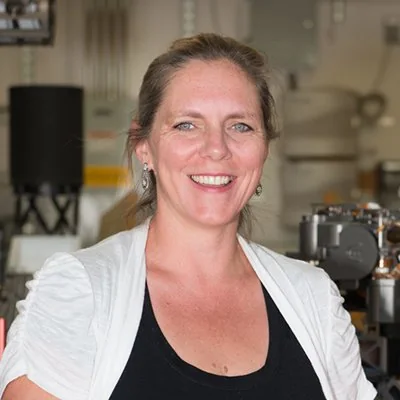
Jennifer Trosper — a continuous history of Mars operations, from Pathfinder to Perseverance
Jennifer Trosper’s career connects missions, operational crises, systems engineering, teams and the transmission of knowledge across several generations of Mars rovers. Her personal chronology remains the organising thread: technical detail is included when it explains a responsibility, a decision, a difficulty or a lesson learned during her career.
I. Origins, training and Pathfinder: learning to operate a rover before rover operations had a tradition
Distance makes accurate local records essential. A manufacturer on Earth cannot be assumed to send an expert immediately. The person opening a panel on Mars needs current drawings, change history and known limitations. Technical memory becomes a survival resource.
Rover programs gradually learned to make operations more sustainable instead of treating constant exceptional effort as a sign of commitment. That shift is a marker of institutional maturity. A mission that can be kept alive only through permanent crisis staffing is not truly routine, regardless of the quality of its hardware.
Pathfinder and Sojourner imposed a new discipline: driving on another planet with delayed communications, limited energy and no mechanic available. Spirit and Opportunity then turned a one-off experience into a real profession of Mars surface operations. Teams learned to plan sols, diagnose anomalies remotely, protect energy margins and translate science goals into robust command sequences.
In JPL's oral account, Trosper remembers a family farm producing crops such as corn, soybeans and wheat. A farm is not a spacecraft laboratory, but it makes dependencies visible. Weather changes the schedule, machinery affects timing, and a failure that looks local can alter work across the operation. Spaceflight multiplies the technical sophistication while preserving the systems lesson: performance emerges from relationships among parts rather than from the excellence of one component.
Sojourner's small size can hide the size of the organizational experiment. Teams had to decide how to name features, build shared maps, translate science priorities into traverses, interpret wheel and power telemetry, and decide when the benefit of reaching a target justified the risk. These are not glamorous technologies, but they are the operating language without which a rover cannot become a scientific tool.
The rover sequence also shows that autonomy does not eliminate people. As machines become more capable, human attention moves toward higher-level choices: selecting targets, interpreting unexpected results, judging risk and planning several days ahead. Automation removes some tasks and creates new responsibilities around limits and supervision.
Her interest in piano provides a second, limited analogy. A score is highly structured, yet performance requires attention to timing, anticipation and recovery from small errors without abandoning the whole sequence. Rover operations also rely on exact procedures while demanding adaptation when telemetry differs from expectation. Procedure is not the opposite of intelligence. By stabilizing the normal work, it preserves attention for the abnormal event.
Pathfinder also reopened an era of repeated U.S. Mars surface missions after a long gap. For Trosper it became an apprenticeship in operating a robot across a communications delay, where every command has to be checked before transmission because the vehicle cannot simply stop and ask for clarification.
Trosper has described that era as more “cowboyish” than later missions: the team did not yet know everything it did not know. That is what made Pathfinder foundational. It produced operational knowledge that simulation alone could not supply.
In 1997, driving on Mars was not routine. Teams were learning to deal with latency, uncertain terrain, limited power, thermal constraints and the translation of human goals into safe command sequences.
Trosper's career makes the modern Mars program look cumulative rather than episodic. Pathfinder was not erased by Spirit; Spirit was not erased by Curiosity; Curiosity was not made irrelevant by Perseverance. Each generation left techniques, software concepts, test practices and operating habits that became inputs to the next.
Jennifer Trosper provides a rare line of continuity across several generations of Mars rovers. Pathfinder and Sojourner demonstrated that a small rover could be operated on Mars; Spirit and Opportunity turned driving into a long-duration daily activity; Curiosity increased mass, scientific complexity and autonomy; Perseverance further increased mobility and prepared complex tasks such as sample collection. Progress is therefore not simply a matter of building a ‘bigger’ rover: each generation incorporates lessons from the one before it.
By the time Trosper took senior roles on Perseverance, she therefore brought more than project expertise; she carried operational memory across several rover generations. For a future Mars settlement this is a fundamental lesson. Experience cannot be replaced by a manual. Durable systems will need people and organisations able to transmit what real incidents taught, so that the next generation does not start again at Pathfinder level.
Pathfinder then provided the kind of experience no classroom can reproduce: operating a machine actually sitting on Mars with limited time, limited resources and anomalies that must be understood without physical access to the hardware. Trosper learned operational discipline, the distinction between symptom and cause, and the way a team converts telemetry into decisions. That culture became professional capital. With every later rover she did not start from zero; she carried forward methods, remembered failures and collective habits that allowed the next mission to be more ambitious. Institutional source.
Jennifer Trosper belongs to a generation of engineers whose Mars knowledge was built mission by mission. Her JPL career spans Pathfinder, the Mars Exploration Rovers and Mars 2020. That continuity is valuable because an engineer can see the operational consequences of design decisions years later, then feed that experience into the next vehicle.
Pathfinder also demonstrated the value of a limited system that opens a broader domain. The mission did not need to perform every task later rovers would perform. It needed to show that mobility, airbag landing, surface communications and a new operations culture could work. JPL's later retrospective explicitly connects Pathfinder with the rover generation that followed.[2]
The need sounds administrative until a team acts on the wrong version. A command safe under one software build may behave differently under another. A procedure written before degradation may request a motion that is now prohibited. If teams consult inconsistent references, the failure can begin on Earth before the command is transmitted. Baselines, change history and approval therefore form part of operational safety.
From an Ohio farm to MIT: learning to think in systems before Mars became a career
A rural childhood where problem solving was practical before it was professional
Jennifer Trosper’s Mars career can look almost inevitable when read backward: Pathfinder, Spirit and Opportunity, Curiosity, Mars 2020 and Perseverance form an unusually continuous line. Her own account is less linear. She grew up on a farm in Ohio, in a setting where machines, work, schedules and practical problems were part of ordinary life. She also played piano and sports and was strong in mathematics. None of those details alone predicts a career at the Jet Propulsion Laboratory, but together they describe a useful combination for systems engineering: comfort with abstraction, discipline developed through practice, and an instinct that a problem is something to be worked through rather than admired from a distance.
In JPL’s oral-history-style podcast episode “Driven to Mars,” Trosper describes how mathematics came easily enough that engineering became a plausible path, even though she did not grow up inside an aerospace family or an established NASA network.[1] This matters because later public biographies can flatten engineers into people who “always knew” their destination. Trosper’s story is more useful when it preserves contingency: ability opened a door, education supplied a language, and actual mission work gradually turned that language into judgment.
MIT: from mathematical confidence to aerospace engineering
At the Massachusetts Institute of Technology, aerospace engineering required a shift from solving bounded classroom problems to thinking about systems that must satisfy many constraints simultaneously. Structures, controls, propulsion, dynamics, computing and operations are not independent subjects once they are assembled into a spacecraft. The intellectual move is central to Trosper’s later career. A mission manager or project system engineer cannot optimize one subsystem in isolation; the task is to understand how a local decision changes the behavior of the whole mission.
Formal education also teaches the limits of calculation. Equations are powerful only when their assumptions match the real system. Mars missions repeatedly expose those assumptions to reality: temperatures differ from predictions, terrain damages wheels faster than expected, a rock crumbles instead of forming a core, or a redundant computer behaves differently enough that software must compensate. The engineer therefore learns to combine models with observation.
Joining JPL in 1990: entering planetary exploration before rovers became routine
Trosper joined JPL in 1990. The timing is significant. Mars surface mobility had not yet become the defining architecture that later generations would take for granted. Viking had demonstrated stationary surface science, but the operational culture of driving a robot across another planet still had to be invented. Her early years placed her inside a laboratory whose work ranged across planetary missions and spacecraft systems, giving her a broader mission culture before her career became closely identified with Mars rovers.
JPL’s current research profile lists her as an Engineering Fellow and notes a 2013 fellowship recognizing leadership and technical expertise in Mars surface mission operations.[23] That later institutional recognition makes more sense when seen against these early years: the expertise was not acquired from a single successful landing but accumulated through repeated development and operations cycles.
Leaving JPL: Peru, Ukraine and a career interruption that became part of the story
Trosper did something that a conventional career narrative might treat as a deviation: she left JPL. Her account includes travel in Peru and time in Ukraine, where she taught in Sevastopol. The episode is valuable because it shows that technical careers can contain real interruptions without becoming failures. When she returned to the United States and wanted to re-enter JPL, professional relationships mattered. Joe Savino, a mentor from her earlier years, helped connect her with Mars Pathfinder.[1]
The episode also illustrates a feature of technical institutions that rarely appears in mission diagrams: organizational memory includes people remembering one another. Skills matter, but so do reputations for judgment, collaboration and reliability. A laboratory that can bring back capable people and move them into new contexts preserves more human capital than one that treats every career as a rigid sequence of positions.
Pathfinder as the decisive return: a small team and an entirely new operational problem
Mars Pathfinder put Trosper back at JPL at precisely the moment when surface mobility was about to become operational reality. The mission combined a lander, airbags and Sojourner, the first rover to operate on Mars. NASA later summarized the importance of the little 11-kilogram vehicle: it worked for 83 days and demonstrated that exploring Mars with a rover was practical, leading directly toward the larger machines on which Trosper would later work.[2]
Pathfinder also embodied the “Faster, Better, Cheaper” era. Smaller teams and constrained budgets could create unusually direct relationships between designers, testers and operators. Trosper has described the reduced volume of documentation and the greater individual responsibility that came with that culture. This closeness could be powerful: the person confronting a behavior on Mars often knew the design history behind it. But later failures in the Mars program would also show why agility cannot substitute for rigorous interface control.
July 4, 1997: landing is only the beginning of operations
The public event was the landing. For the operations team, landing opened a new sequence of risks. The lander had to unfold, establish a stable communications and power configuration, deploy Sojourner and begin learning how to plan movement on a planet where no one could intervene physically. Every apparently simple action required assumptions about geometry, timing and system state.
This is the first major theme running through Trosper’s career: an engineering mission is not complete when the hardware works once. The organization has to turn a one-time success into a repeatable operational practice. Pathfinder taught a small team how to live with a spacecraft on Mars day after day. That lesson mattered at least as much as the raw performance of Sojourner.
Sojourner: mobility changes science by changing choice
A stationary lander studies whatever happens to be within reach. A rover introduces selection. Scientists can compare rocks, approach a target, reject another target, and make the landscape itself part of the experiment. Mobility therefore changes not only distance but the structure of scientific decision making. Every scientific choice becomes partly a mobility choice, and every mobility choice becomes partly a risk decision.
Trosper’s later work on Spirit, Curiosity and Perseverance can be read as a continuous expansion of this first operational problem. The rover travels farther, carries more instruments and makes more local decisions, but the fundamental interface remains: the science team wants to know something, the engineering team must turn that intention into a safe sequence, the machine acts at a distance, and the returned data changes the next decision.
From Pathfinder to the failures of 1999: turning a success into method rather than recipe
Mars Climate Orbiter and Mars Polar Lander: two losses that changed the next rover generation
After Pathfinder, it would have been easy to conclude that the new model had been validated. The losses of Mars Climate Orbiter and Mars Polar Lander in 1999 destroyed that complacency. Trosper’s JPL interview explicitly connects those failures to the decision to pursue Spirit and Opportunity as two rovers using an enlarged airbag landing approach derived from Pathfinder.[1]
The lesson was not that Pathfinder had been wrong. It was that a successful architecture does not eliminate system risk. Interfaces, navigation, software, requirements and organizational assumptions can defeat a mission even when every major component has heritage. A mature program therefore asks what exactly was learned from success and what remains unproven.
Scaling airbags is not copying airbags
Spirit and Opportunity were much larger and more scientifically capable than Sojourner. Enlarging Pathfinder’s airbag concept changed loads, geometry, deployment behavior and the operational consequences of landing. Heritage reduced uncertainty but did not remove the need to verify the new configuration.
This distinction between heritage and proof becomes a recurring principle in Trosper’s career. Curiosity’s sky-crane architecture could inform Perseverance without making Mars 2020 a copy. A spare Curiosity heat shield could appear attractive for Perseverance but still fail a later test and require replacement. Experience is a starting point for verification, not permission to stop verifying.
Two rovers, two sites, one operational institution
Building Spirit and Opportunity created an unusual form of redundancy. The vehicles were closely related, but they would live in different terrain and develop different histories. Operations teams could compare behavior while learning from two simultaneous surface missions. The program also had to support a larger and more durable organization than Pathfinder.
That organizational scale is the bridge from the small-team Pathfinder era to the mature rover enterprise that follows. The mission is no longer a demonstration of whether mobility can work. It is an attempt to make mobile Mars science a repeatable institutional capability.
Pathfinder operations in detail: learning to run a rover before rover operations had a tradition
The first problem was not driving far; it was making mobility operationally real
Sojourner is tiny beside Curiosity or Perseverance, but that difference can make the Pathfinder era look deceptively simple. In 1997 there was no accumulated JPL tradition for routinely operating a rover on Mars. The team had to turn a technology demonstration into a working tactical cycle: understand the lander state, deploy the rover, establish communications, assess terrain, sequence movement and interpret the behavior of a vehicle that could not be touched after launch. The procedures later generations inherited had to be invented while the mission was already in progress.
JPL’s twenty-fifth-anniversary history of Pathfinder emphasizes how profoundly the mission changed the style of Mars exploration, while Trosper’s “Driven to Mars” account makes the operational transition personal.[2][1] She describes Sojourner deployment as interactive, with teams using returned data to decide the next action. That is very different from a modern rover receiving a larger tactical plan and handling more local decisions itself.
Small teams magnify both agility and dependence on individuals
Pathfinder is often celebrated for a faster, lower-cost development approach. The organizational advantage is clear: fewer layers can shorten communication paths and let engineers see more of the whole mission. The risk is equally important. When a small number of people hold a large fraction of the knowledge, illness, fatigue or turnover can become a system vulnerability. Agility is therefore not the absence of process; it requires processes sized to the team and clear enough that essential knowledge survives beyond one person.
Trosper’s later career is a useful counterpoint because Mars rover teams became far larger. The lesson she carried forward was not that Pathfinder’s exact organization should be copied. It was that engineers responsible for one activity benefit from seeing its neighboring interfaces and from understanding why a requirement exists rather than merely receiving it.
Landing success immediately created a new category of uncertainty
Once Pathfinder was on the surface, the team had something previous Mars programs had never possessed: a mobile agent that could approach targets after landing. Mobility turned site selection from a fixed prelaunch decision into an ongoing campaign. It also created new operational questions. How much terrain could be inferred from images? How much slippage would occur? Which path was safe? When should the team accept risk to reach a better scientific target?
Those questions became more important as rovers grew. In that sense Pathfinder’s most durable heritage was not a particular wheel or command format. It was the beginning of a discipline in which motion, science, communications and vehicle health had to be planned as one surface system.
The program lesson: demonstrate, measure, then scale
Sojourner proved that a rover could function on Mars, but it did not prove that an airbag landing system could be scaled indefinitely or that a larger rover would behave identically. Spirit and Opportunity required new engineering for a much larger vehicle; Curiosity eventually left airbags behind and adopted sky crane. The lineage demonstrates a disciplined form of technological ambition: use operational evidence to justify the next step, while refusing to treat demonstration at one scale as automatic certification at another.
This pattern recurs throughout Trosper’s career. Experience creates confidence, but confidence is useful only when paired with renewed verification.
II. Spirit and Opportunity: the emergence of Mars rover operations as a discipline
The generational comparison shows the value of institutional memory. An innovation such as the sky crane did not appear in isolation; it emerged from a culture of testing, operations and lessons accumulated over decades.
The idea of a command therefore expands into configuration change. Operators need to know the starting state, record what was actually changed and verify the ending state. Without the final step, a procedure can appear complete while a valve, parameter or protection remains in a temporary configuration. Many complex-system accidents emerge from exactly this gap between intended and actual state.
This discipline should not prevent emergency action. Rover teams prepare validated responses for known conditions so they do not have to invent every step during a crisis. Mars residents can maintain similar playbooks for pressure loss, fire, battery thermal runaway or water contamination. Slow preparation before an event creates the possibility of fast, coherent action during it.
This raises the design question that a Mars settlement will face across many machines: which decisions should be delegated? Too little autonomy turns every robot into a permanent consumer of crew attention. Too much opaque autonomy can make behavior difficult to predict and diagnose. Reliable systems need explicit boundaries, health checks and records that allow operators to understand why the machine stopped, detoured or rejected a command.
One mission passes habits to the next: operational memory as a professional skill. Trosper’s career reveals something a list of job titles cannot: the way an organization learns through people. Pathfinder taught a young engineer what it meant to command a vehicle on Mars. Spirit and Opportunity added duration, wear, and anomalies; Curiosity added a much larger and more complex system; Perseverance inherited procedures, software, review methods, and above all human habits built over two decades. Trosper’s responsibilities changed from mission to mission, but part of the role remained the transfer of that memory. A chronological biography therefore has to show not only promotions but problems encountered and lessons retained. Future human exploration of Mars will require the same mechanism: each new crew and engineering generation cannot begin again from zero at every launch window.
Operational authority must increasingly be local. Earth specialists will remain valuable, but emergency control loops cannot close across interplanetary distance. Crews need administrative access, diagnostic tools and documentation sufficient to act without waiting for permission or expertise to arrive by radio. That is technical autonomy imposed by physics.
Curiosity represented a major increase in rover mass and scientific capability. The vehicle could no longer use the same airbag approach as Spirit and Opportunity. Mars Science Laboratory therefore combined atmospheric entry, a supersonic parachute, powered descent and the sky-crane maneuver that placed the rover directly on its wheels. Trosper's generation of operations had to live with a system whose critical landing sequence contained many tightly timed transitions.
Planetary projects span many years from design through operations. Leadership changes are therefore normal, not exceptional. Trosper's assumption of Perseverance project management illustrates why a mission must be transferable.[3] A good handover does more than transfer documents. It transfers the rationale behind decisions, the remaining uncertainties and the difference between a risk that has been closed and one that is merely being tolerated.
For settlers, the relationship reverses. People on Mars will naturally live by the sol, while Earth becomes the external clock. Support centers may use rotating staff or accept narrower synchronization windows. The radio delay already prevents real-time control; the different day length reinforces local operational independence. Mars time becomes part of the reason residents must be capable of making decisions without waiting for Earth.
Rover history also teaches that a correct sequence can produce an unexpected outcome when the environmental model is wrong. Perseverance's first sampling attempt made that distinction visible: mechanisms can execute while the rock fails to produce the expected core. In a habitat, a pump can spin at its commanded speed while actual flow falls because of blockage. Verification has to measure the function, not merely the actuator's obedience.
Spirit and Opportunity: when rover operations became a discipline of their own
Landing Spirit: the first week is a sequence of deferred decisions
Spirit landed in Gusev crater in early January 2004. The first days were devoted to becoming a rover rather than merely surviving as a spacecraft: standing up, deploying systems, checking instruments, preparing to disconnect from the lander and choosing a path to the surface. JPL news releases identify Jennifer Trosper as Spirit mission manager during this period and document the careful sequence of stand-up and egress activities.[3]
The operational rhythm was unlike terrestrial robotics. Commands were prepared on Earth, transmitted during available windows, executed on Mars, then evaluated from delayed telemetry and imagery. A mistake could not be corrected with a joystick. The team had to build each sol around a model of the rover’s state and wait for reality to confirm or contradict it.
Sol 18: a computer problem threatens a physically healthy rover
Only weeks after landing, Spirit stopped communicating normally and entered repeated resets. The crisis is one of the clearest examples of why spacecraft reliability is more than mechanical robustness. The rover’s wheels, structure and instruments had not been destroyed; an information-management problem could still make the vehicle nearly unusable.
Engineers gradually discovered that the problem involved flash-memory file management. By commanding a mode that avoided normal use of flash memory, they regained enough control to diagnose the system. Cruise files were removed, memory was reformatted and the rover progressively returned to normal operations. On February 6, JPL reported that Spirit was back to full health and quoted Trosper describing the “patient” as healed.[5]
Why the recovery mattered beyond Spirit
The technical fix was important, but the larger inheritance was a way of reasoning. A distant system has to be designed with diagnostic paths, safe modes, observability and enough reconfiguration capability to isolate failures after launch. The team also has to distinguish symptoms from causes. A reset may be visible; the root cause may lie in storage, software, timing or corrupted metadata.
Later missions would experience their own computer anomalies. Curiosity’s switch from its A-side computer to its B-side after a flash-memory problem was not the same failure, but it occurred in an organization that had already learned not to treat “computer problem” as a single category.
Mars time: a 39-minute difference that becomes a human-factors problem
A Martian sol is about 24 hours and 39 minutes long. When operations teams work on Mars time, their shifts move roughly 39 minutes later each Earth day. Within a few weeks, a normal daytime shift can become a night shift. This schedule helps align planning with the rover’s solar day, especially during early operations, but it moves fatigue and family life into the mission architecture.
The lesson is systemic. A highly reliable rover can still be endangered by an exhausted organization. Shift design, cross-training and limits on dependence on unique experts are therefore safety measures. The human team is not external support; it is part of the distributed Earth-Mars system.
Orbital relays: the rover becomes a node in a Martian network
Spirit and Opportunity also operated in a communications environment far richer than Pathfinder’s. Orbiters could receive UHF data from the rovers and relay it to Earth, increasing the practical science return without requiring the surface vehicle to send every bit directly across interplanetary distance. JPL reported in January 2004 that Spirit sent about 180 megabits of science data in a sol, nearly ten times Pathfinder’s maximum daily capability.[4]
The mission also demonstrated cross-agency relay operations. Mars Express communicated with Spirit, showing the value of interoperable infrastructure around Mars.[7] This evolution matters for future exploration: a rover is never truly alone. Its scientific productivity depends on orbiters, the Deep Space Network, planning systems, data archives and people.
From a 90-sol mission to years of operations
Spirit and Opportunity were designed around a 90-sol prime mission, yet both greatly exceeded it. Longevity changes the problem. Early operations are staffed by teams that know the design intimately; years later, people change, mechanisms age, environmental conditions vary and procedures accumulate exceptions. A short mission can rely more heavily on memory. A long mission must institutionalize memory.
Opportunity’s survival for more than fourteen years made this point dramatically. Spirit also operated for years before its mission ended. JPL’s formal closure of Spirit in 2011 marked the end of a vehicle but not the end of its operational knowledge.[6]
Maintenance without touch: Mars as a laboratory for remote reliability
No engineer can replace a wheel, reseat a connector or clean a circuit board. Maintenance therefore happens through software updates, altered drive strategies, thermal planning, reconfiguration and creative reuse of remaining capabilities. The team has to know the actual vehicle, including every workaround and limitation accumulated since landing.
This is why configuration management becomes more important as a mission ages. The “real Spirit” or “real Opportunity” is not the pristine design drawing. It is the vehicle with a particular software version, degraded components, known constraints and an operational history. Reliability depends on keeping that history accurate.
Two rovers as parallel experience
Because Spirit and Opportunity shared much of their design, differences between them offered valuable evidence. A behavior seen on one vehicle could prompt checks on the other; different terrain produced different mobility lessons; long-term degradation did not occur in identical ways. The program was effectively learning from two related experiments at once.
For Trosper, this period transformed rover operations from a novel activity into a professional discipline. The team developed roles, routines, training and anomaly practices that would shape the much more complex Curiosity mission. Mars mobility was no longer a demonstration. It had become an enduring institutional capability.
Spirit, January-February 2004: anatomy of a remote recovery
Before the crisis: a rover still learning how to stand, leave and work
Spirit’s flash-memory anomaly occurred so early that the operations team was still building its first Mars routines. The rover had landed, stood up, released hardware and begun surface work, but the organization did not yet possess months of flight experience. JPL news releases from the period show Trosper reporting the stand-up and mission status as engineers methodically prepared egress.[3]
This context made diagnosis harder. Operators had to distinguish truly abnormal behavior from characteristics of a Mars vehicle they were still learning. Early mission commissioning creates both data and confidence; Spirit’s crisis arrived before that confidence was mature.
Loss of expected behavior is itself data
When the rover stopped responding normally, engineers did not receive a message saying “flash file system fault.” They observed reset patterns, limited communications and failures to complete expected sequences. The diagnosis had to be built from absence and partial telemetry.
Remote engineering therefore depends on observability designed before launch. Diagnostic modes, low-level command paths and telemetry channels become the only instruments available when the nominal software stack is unreliable.
Avoid flash, regain control, then investigate
The team discovered a way to operate while avoiding normal flash-memory use. This did not immediately prove the root cause, but it created a stable enough condition to retrieve information and issue further commands. That was the critical first victory.
JPL then described removal of stored cruise files and memory reformatting. Public communications moved from Trosper’s image of a patient in rehabilitation to a patient restored to health.[5] The operational sequence matters more than the metaphor: isolate, observe, clean up the faulty state, verify, then resume science.
Why reformatting was a mission decision, not ordinary computer maintenance
On Earth, reformatting a storage device is routine because backups and physical access exist. On Mars, every command has to be justified against the risk of losing irreplaceable information or making the computer unbootable. The team needed confidence in what files were expendable and how the rover would rebuild its state.
The episode shows how familiar computing concepts become high-consequence engineering when physical recovery is impossible.
Returning to science is another verification phase
After the memory work, Spirit resumed activities such as brushing a rock and using its instruments. JPL’s February 6 report did not merely state that communications had returned; it described restored scientific function.[5]
A recovery is complete only when the mission can sustainably perform its intended work. Communication recovery, system stabilization, root-cause understanding and science restoration are separate milestones.
The human side: urgency cannot make Mars answer faster
During a public mission crisis, pressure for action is intense. Yet light-time, communication windows and careful review impose their own pace. Working faster than the evidence arrives does not produce better diagnosis. It produces more guesses.
Leadership has to protect the team’s reasoning under pressure: create shifts, preserve logs, use independent analysis and prevent one popular hypothesis from shutting down alternatives too early.
The lasting legacy: design future systems for recovery, not only nominal operation
Spirit’s crisis reinforced the importance of safe modes, alternate boot paths, reconfiguration and telemetry. Future missions cannot anticipate every fault, but they can preserve enough control to let Earth reason about an unexpected state.
This is a direct line to human Mars systems. A crew will be physically present, but many failures will still require isolation and controlled recovery. The principle remains: design for the moment when the system no longer behaves like the manual says it should.
Spirit’s 2004 crisis in operational detail: regaining control of a rover that was still physically alive
The first clue was a broken expectation, not a diagnosis
On January 22, 2004, Spirit stopped behaving normally only eighteen sols after landing. The timing made the event especially difficult: the team was still commissioning surface operations while Opportunity was approaching its own landing. Contemporary JPL updates show the uncertainty clearly. Spirit transmitted limited data and reset repeatedly; engineers could communicate in restricted ways but did not yet control the vehicle normally.[3] An operator’s first task in such a situation is not to invent a compelling cause. It is to stabilize communication and build an accurate picture of state.
Flash-memory avoidance was a diagnostic and recovery tool
Engineers learned that the rover could operate more predictably when it avoided the flash file system. That observation narrowed the problem and provided a way to regain useful control. JPL reported that the computer-reset behavior could be stopped by operating in a mode that did not use flash memory, while the team prepared to remove thousands of cruise-phase files and ultimately reformat the flash system.[6]
The sequence is a powerful example of fault containment. Rather than attempting a complete repair immediately, the team established a degraded state in which the rover could communicate and accept commands. Recovery was staged: obtain state, reduce instability, test hypotheses, remove likely triggers, then restore normal functions.
The crisis happened while a second rover demanded attention
Opportunity’s landing could not be postponed because Spirit was in trouble. The project therefore had to split attention between anomaly recovery and the arrival of its twin. This is an organizational stress test that a single-rover narrative can hide. Redundancy at the spacecraft level created a parallel demand on people, test assets and decision processes.
The twin mission also produced an immediate learning opportunity. If Spirit’s problem reflected a shared design weakness, Opportunity might encounter it too. The team had to determine quickly which aspects of the anomaly were vehicle-specific and which belonged to the common architecture.
Reformatting was not the end of the recovery
By early February, JPL reported that Spirit had reformatted flash memory and returned to full health, with Trosper describing the “patient” as healed.[5] That public milestone did not make the earlier uncertainty disappear. The mission now carried new knowledge about file-system behavior, operational conservatism and how the organization responded under pressure.
A mature post-anomaly culture therefore asks a second set of questions after the vehicle is working again. Which telemetry was most useful? Which procedures slowed diagnosis? Which modes preserved control? Which assumptions were wrong? What should be changed on the twin vehicle or in the ground process? Recovery becomes program value only when these answers are retained.
Why this event matters beyond Spirit
Future Mars systems will contain more software, not less. Habitats and autonomous vehicles will accumulate files, databases, updates and configuration state. A fault that looks like “software” can still threaten a physically healthy system. Spirit’s crisis remains relevant because it demonstrates the operational priority of observability, degraded modes and staged recovery when the internal state is uncertain.
Time on Mars: an organizational problem hidden inside astronomy
A 24-hour 39-minute sol slowly detaches the team from Earth
The Martian day is only about 39 minutes longer than an Earth day, yet operations scheduled on Mars time drift nearly 40 minutes later each terrestrial day. During early rover missions, this synchronization helped teams plan around the rover’s local solar cycle. It also created a human-factors experiment in which work hours moved continuously through the Earth day.
Trosper experienced this operational culture during MER. The practical consequence is that celestial mechanics becomes a personnel issue. Sleep, commuting, family schedules and cognitive performance become part of the risk system.
Fatigue is a mission variable
Engineers working critical shifts need judgment more than endurance. Chronic sleep disruption can degrade attention, memory and willingness to challenge assumptions. A project therefore has to manage shifts, handovers and staffing so that enthusiasm does not become operational impairment.
This is another reason rover missions are socio-technical systems. The vehicle’s reliability is not independent of the condition of the people writing commands.
Returning toward Earth-time operations is a sign of maturity
As missions settle into sustained operations, teams can reduce dependence on strict Mars time. Better autonomy, improved planning tools and accumulated experience allow more work to occur within terrestrial schedules. The organization changes even when the rover does not.
This transition shows how operational efficiency comes from learning. A process needed during commissioning may be unnecessary later. Mature projects periodically ask whether inherited practices still create enough value to justify their cost.
Scientific interpretation has its own clock
Data may arrive in time for the next planning cycle but still require longer analysis. A spectrum or unexpected texture can change the science team’s priorities. The mission must decide whether to wait for interpretation or execute preplanned observations.
Campaign planning therefore benefits from branches: if result A arrives, perform sequence A; if result B, choose B; if interpretation remains uncertain, use a safe fallback. The team manages time by preparing decisions before all information exists.
Solar conjunction: sometimes the safest command is no command
When Mars passes near the Sun in Earth’s sky, radio signals can be disrupted. Missions reduce or suspend commanding and place spacecraft in conservative plans. Curiosity’s 2013 operations explicitly prepared for such a moratorium.[12]
Conjunction institutionalizes restraint. It reminds the team that constant intervention is not synonymous with control. A robust spacecraft should be able to remain safe while Earth deliberately does less.
Seasons and environmental time
Surface missions also experience seasonal changes in sunlight, temperature and atmospheric dust. Solar-powered MER vehicles were especially sensitive to energy and dust. Radioisotope-powered Curiosity and Perseverance reduce some energy dependence but still operate in a changing thermal and atmospheric environment.
Planning therefore spans several clocks at once: the sol, communication windows, seasonal cycles, conjunctions and the long-term aging of hardware. Operations is the art of fitting human decisions into all of them.
Human Mars settlements would live on two clocks at once
A crew on Mars would naturally organize much of daily life around the local sol, while Earth institutions remain on a 24-hour schedule. Communication would be asynchronous not only because of light-time but because the communities would be awake at different phases.
Rover operations already demonstrate the need for structured handover across time domains. Messages, logs and priorities must remain understandable without assuming simultaneous conversation. This seemingly mundane skill would become part of interplanetary governance.
Mars time as a human-systems problem
A 24-hour 39-minute sol slowly moves the entire team away from Earth time
A Martian solar day is only about thirty-nine minutes longer than an Earth day, but operations teams experience the difference cumulatively. If a shift is synchronized to the rover’s local solar time, reporting for work moves later by roughly forty minutes every Earth day. In less than two weeks, a comfortable daytime shift can migrate deep into the night. Early rover missions accepted this burden because the tight tactical cycle rewarded it: receive telemetry, understand the vehicle and the scientific results, decide what should happen next, validate the command load, and transmit it in time for the next Martian work period.
Jennifer Trosper’s career spans the period in which Mars-time operations changed from an extraordinary new practice into a managed operational technique. The lesson is not that every future Mars mission should force its Earth teams to live indefinitely on a 24-hour 39-minute clock. It is that celestial mechanics reaches directly into human performance. Sleep, commuting, family life, handovers and cognitive endurance become part of mission architecture whenever the organization chooses to synchronize itself closely to another planet.
Fatigue belongs in the risk register
Spacecraft reliability is often discussed in terms of parts, software and redundancy. Human reliability is easier to treat as background. That is a mistake. A highly trained operator can make a poor decision after prolonged sleep disruption, particularly when the work requires comparing telemetry, remembering unusual vehicle states and reasoning about consequences that may not be visible until the next communications pass. A mature operations organization therefore treats fatigue as a system variable rather than a private problem for individuals to solve.
This is one reason cross-training and distributed authority matter. If only one person can interpret a subsystem or approve a critical sequence, the project becomes dependent on that person’s physical availability. Resilient teams deliberately create overlap, documentation and handover mechanisms so expertise can be exercised without exhausting the people who hold it.
Moving back toward Earth time is a sign of operational maturity
As missions mature, teams can often reduce full Mars-time staffing. Better automation, more predictable vehicle behavior, richer planning tools and accumulated experience make asynchronous work possible. The transition is not evidence that Mars time was a mistake; it shows that the organization has learned which decisions truly require synchronization and which can be prepared earlier or handed across shifts.
A crewed Mars settlement would make this issue permanent. People on Mars would naturally organize much of daily life around the local sol, while Earth support organizations would remain tied to terrestrial clocks. No communications technology can erase that difference. The correct design principle is therefore not perfect synchronization but deliberate asynchronous collaboration: clear deadlines, explicit ownership, shared state, and systems that remain understandable after long pauses.
Scientific time is different from command time
Receiving a data product does not mean understanding it. A complex image set, mineralogical result or engineering anomaly may require hours or days of interpretation, while the tactical planning cycle continues. Projects must decide when to wait for deeper analysis and when to move forward using previously prepared branches of a campaign. This is why rover planning is better understood as management of decision trees than as the invention of one new day from a blank page.
The same principle scales upward. Solar conjunction temporarily reduces commanding; seasons alter temperatures and sometimes available solar energy; launch windows constrain interplanetary departures. Trosper’s career repeatedly connects these different clocks. Mars operations succeed when the organization makes human time, machine time, scientific time and planetary time coexist without pretending they are the same.
III. NASA Headquarters and Curiosity: widening the frame from vehicle to mission architecture
Curiosity changed the scale again through mass, instrumentation, power source, EDL and scientific ambition. Trosper worked in a mission where operational decisions had to protect a long-lived rover while maximizing science return.
Surface operations also become more interconnected. Driving competes with arm work, drilling, instrument use, communication windows, thermal constraints and power. Planning becomes an allocation problem: the team cannot maximize every objective at once. A scientifically attractive action may consume time or create risk that makes another objective impossible.
Curiosity raised the scale again in mass, autonomy and scientific capability. Surface operations had to coordinate more subsystems and more complex sequences. Greater onboard autonomy did not remove humans from the loop. It moved the boundary: software handled more local, repetitive decisions while the team retained responsibility for objectives, constraints and anomaly analysis. That partnership is a direct precursor of settlement systems, where local automation must continue operating while Earth is too far away to answer immediately.
Curiosity and Perseverance then pushed autonomy further. Trosper has compared the process to giving a growing child more freedom while hoping the right decision tools have been provided. That analogy is directly useful for a Mars settlement. Autonomy does not mean abandoning the machine. It means specifying what it may decide, the boundaries it must respect and the telemetry that allows humans to retain confidence and recover when behavior becomes uncertain.
Perseverance was designed to accomplish more scientific work and traverse more terrain. The team explicitly examined what slowed Curiosity and changed both vehicle capability and operations. That is a mature use of lessons learned: experience is not a report filed after a mission, but an input to the next design. A future Mars fleet should institutionalize that loop, retaining failure data, maintenance time, consumed spares and procedural errors for every new hardware generation.
NASA Headquarters and Curiosity: widening the frame from one rover to an exploration architecture
Stepping away from daily rover operations
After the intense Mars Exploration Rover period, Trosper spent time at NASA Headquarters working on studies related to future lunar and Mars exploration. Her JPL interview describes this phase as a change of scale: instead of living entirely inside the daily operation of one rover, she was exposed to questions about how individual missions fit into a broader exploration strategy.[1]
The distinction is important. A project team asks whether its spacecraft can meet requirements, survive launch, land and accomplish its science. Headquarters has to ask how that project fits with budgets, program priorities, other missions and political commitments. Technical feasibility is necessary but not sufficient. An architecture must also be fundable, sequenced and institutionally sustainable.
Returning to JPL with a different view of the system
Trosper later returned to JPL and joined Curiosity, the Mars Science Laboratory, relatively late in its development cycle. In the podcast she estimates that the mission was roughly a year from launch when she came aboard.[1] That was very different from her Pathfinder and MER experience, where she had lived through more of the full development cycle. Curiosity required her to enter a mature project, learn a much more complex machine and focus heavily on confirming how the rover behaved after landing.
She describes Curiosity as a “beast,” reflecting both its physical scale and its operational complexity. The rover was not simply Spirit enlarged. It carried ten science instruments, an internal sample-processing chain, a drill, a large robotic arm, a radioisotope power source and a new landing architecture. The mission manager had to understand how those capabilities interacted without pretending to be the deepest technical expert in each one.
Mission manager: building a Martian workday, not driving with a joystick
The title “mission manager” can sound as if one person commands the rover. In practice, daily Mars operations are collective. Science teams identify priorities, engineers assess constraints, rover planners construct mobility or arm activities, sequence teams integrate commands, and multiple reviews check safety. The mission manager helps the organization converge on a plan that is scientifically valuable and technically executable.
This role requires translation. A geologist may describe a target in terms of stratigraphy and mineralogy; a mobility engineer sees slope, wheel placement and slip; a thermal engineer sees allowable temperatures; a communications engineer sees downlink volume. The daily plan is where those different descriptions of Mars must become one executable sequence.
Curiosity’s first weeks: establish the real vehicle before maximizing science
After landing in August 2012, Curiosity went through a careful commissioning period. JPL reporting quoted Trosper emphasizing the need to ensure the rover was stable before raising the mast and using its new systems aggressively.[8] The first images, instrument checks, drives and arm tests created an operational baseline for the vehicle on Mars.
This baseline is not bureaucratic overhead. Years later, engineers need to know whether a current temperature, motor current or pointing error represents degradation. They can only answer if the mission carefully characterized the rover when it was new.
The arm and contact science: geometry turns scientific intention into an engineering problem
Curiosity’s arm carries MAHLI and APXS as well as hardware supporting sampling. In September 2012, as the team completed arm testing, Trosper said they were preparing to find the right rock for contact science.[8] Reaching a rock requires far more than identifying an interesting target. The rover’s attitude, terrain stability, arm collision envelopes, joint temperatures and instrument clearances all matter.
The operation illustrates a recurring theme: scientific value is produced by a chain of engineering conditions. A target can be exceptional geologically and still be unusable if the rover cannot safely place an instrument on it. Mission success depends on creating a large enough safe operating envelope that science retains meaningful choice.
The first drill sample: Curiosity becomes a mobile analytical laboratory
In February 2013, Curiosity drilled into the target John Klein and delivered rock powder to CheMin and SAM. JPL reported that data confirmed the delivery, quoting Trosper as mission manager.[9] The achievement was historically important, but operationally it was a chain: target selection, placement, drilling, powder handling, portioning, transfer and confirmation.
Every interface had to work. A successful drill with failed sample transfer would not achieve the analytical objective. A delivered sample without trustworthy context would lose scientific value. Curiosity therefore prepared the conceptual ground for Perseverance’s even more demanding caching system.
Yellowknife Bay: science can justify staying rather than driving
Curiosity’s early work at Yellowknife Bay produced evidence for an ancient lake environment with water, chemical ingredients and an energy gradient that could have supported microbial life. That result met the mission’s core habitability objective much earlier than a simple distance-based narrative would suggest.
The operational lesson is that rover productivity is not measured in kilometers. Mobility exists to reach places where stationary time becomes valuable. A mission has to know when to drive and when to stop. This judgment depends on science and engineering understanding each other’s priorities.
Curiosity in long-duration operations: keeping science alive as the machine changes
Redundant computers are not perfectly interchangeable computers
In 2013, a flash-memory problem on Curiosity’s A-side computer led the team to switch to the redundant B-side. The transition preserved the mission, but it created a new operational state. JPL later reported that the Navcam pair associated with the B-side showed greater temperature sensitivity than expected, requiring compensating software before visual odometry and autonomous navigation could be used across a wider thermal range.[10]
This is a useful systems lesson. Redundancy provides another path, not necessarily an identical path. Backup hardware has its own calibration, history and characteristics. Once activated, it becomes the new baseline and has to be understood on its own terms.
Safe mode and solar conjunction: operational safety includes knowing when not to command
Curiosity entered safe mode again in March 2013 because of a software issue. Engineers diagnosed the trigger and prepared the rover to resume science. At the same time, the mission was approaching solar conjunction, when Mars passes near the Sun as seen from Earth and command transmission is curtailed to avoid corruption.[12]
The combination shows two kinds of operational restraint. One is local: stabilize the vehicle after an anomaly. The other is celestial: accept that communications geometry creates periods when doing less is safer. A mature mission does not measure success by constant activity; it preserves the option to be productive later.
Wheel damage: a progressive anomaly creates no single moment of decision
Curiosity’s aluminum wheels accumulated punctures and deformation in sharp rocky terrain. Unlike a sudden fault, wheel wear did not produce one clean boundary between healthy and failed. Engineers had to estimate rates, understand terrain effects, alter routes and continue monitoring. Trosper explained in 2014 that wheel concerns contributed to taking the rover farther south earlier, while emphasizing that the decision to begin Mount Sharp investigations remained science-driven.[11]
That nuance is a model of project reasoning. A technical constraint can reshape the option space without becoming the sole objective. The team’s job is neither to ignore wear nor to allow preservation of the rover to replace the scientific mission entirely.
Arriving at Mount Sharp: the operating style changes when the scientific question changes
When Curiosity reached the base of Mount Sharp, the team shifted from an emphasis on sustained travel to systematic study of the mountain’s layers. Trosper described the transition publicly and later presented a rover report explaining the first drilling campaign at the mountain.[11]
The mountain acts like a stratigraphic archive. Studying it layer by layer requires a different cadence from a traverse. Drives become shorter, contact science more frequent and interpretation more iterative. The mission architecture has to support changes in scientific tempo rather than enforce one operational rhythm for the entire project.
Training operators: maturity belongs to the team as much as to the rover
Curiosity’s complexity made training a major mission function. Operators had to learn not just commands but the reasoning behind constraints. A sequence that is safe in one geometry may be unsafe in another. Competence therefore comes from simulation, supervised shifts, review experience and exposure to anomalies.
Long missions make this training unavoidable. The people present at launch cannot remain in every role indefinitely. A project that fails to create new qualified operators becomes dependent on a shrinking number of experts. Human cross-training is a form of redundancy.
Curiosity day by day: turning a mobile laboratory into a geological campaign
Commission first, exploit second
Curiosity’s early operations were intentionally methodical. Engineers checked stability, mast deployment, cameras, mobility and the arm before demanding full science performance. Trosper’s comments at the time emphasized caution with a rover that had arrived using a new landing system.[8]
Commissioning produces the baseline against which aging is later measured. A sensor reading is meaningful only if the team understands what normal looked like under comparable conditions.
Contact science turns geometry into science infrastructure
Placing APXS or MAHLI on a rock requires more than scientific interest. Rover pose, arm kinematics, terrain stability and collision envelopes all have to be acceptable. The team builds an executable relationship between a geological target and a mechanical configuration.
This is why rover operations are a systems activity. The scientific question is translated into spatial coordinates, joint motions, thermal constraints and timing.
Drilling creates a multi-stage process
Curiosity’s first drilled sample at John Klein had to move through acquisition and handling before reaching CheMin and SAM. Trosper confirmed through returned data that portions had been delivered to the instruments.[9]
Each stage can succeed or fail independently. The mission therefore needs state information at every interface. This chain is conceptually simpler than Perseverance’s caching system but belongs to the same engineering lineage.
The B-side becomes the real rover
After the switch from the A-side computer, the B-side was no longer “backup” in an abstract sense. It became the operational computer. The team had to understand its associated camera behavior, calibrations and limitations. New software compensated for temperature-dependent visual odometry behavior.[10]
This is a practical lesson in configuration management: recovery creates a new normal. Procedures and models must follow the actual system state.
Yellowknife Bay demonstrates the value of stopping
Curiosity’s early drilling and analysis revealed an ancient environment with conditions favorable to microbial life. That result came because the rover spent time investigating rather than maximizing traverse distance.
Mobility is valuable because it gives a mission the power to choose where to become stationary. The best rover is not the one that always moves; it is the one that can reach and exploit the right place.
Mount Sharp turns the mission into stratigraphic reading
After the long drive from Yellowknife Bay, Curiosity arrived at the mountain that had motivated the landing-site selection. Trosper described the change from a drive-focused phase to a layer-by-layer investigation.[11]
Operations had to change cadence. More contact science, drilling and local interpretation meant fewer days dominated by distance. The mission organization adapted to the question being asked.
Wheel preservation is strategic, not absolute
Damage to Curiosity’s wheels required route changes and more careful terrain selection. But preserving wheels was never the scientific objective. The team sought routes that reduced damaging loads while still reaching high-value terrain.
This is an example of constrained optimization. Engineering defines what remains safe; science determines which safe option creates the greatest value.
Long-duration operations are continuous redesign without hardware replacement
The physical rover cannot be rebuilt, but the mission can change software, parameters, routes and procedures. In that sense, operations continuously redesign how the fixed hardware is used.
Trosper’s Curiosity years show why mission design should preserve flexibility. The most useful capability may be one the original team did not expect to need in exactly that form.
Curiosity’s redundant computers and wheel wear: two different forms of aging
Redundancy is useful only if the backup is understood as a real configuration
Curiosity carries redundant main computers, but redundancy is not the same as perfect duplication. After a flash-memory problem on the A-side in early 2013, the team switched to the B-side. JPL later reported that the Navcam pair associated with the B-side responded differently across temperatures, so software compensation had to be validated before visual odometry and autonomous navigation could be used as broadly as planned.[10]
This is an important systems lesson. A backup can preserve mission capability while still introducing a different set of characteristics. The team must know which sensors, calibrations, software versions and operational limits now define the active vehicle. “We have redundancy” is therefore not a complete risk statement; the project needs evidence that the alternate path is usable under current conditions.
Wheel damage was not a discrete failure
Curiosity’s aluminum wheels developed holes and tears as the rover encountered sharp rocks. Unlike a computer reset, wheel wear did not present one instant at which the system changed from healthy to failed. The team had to infer trends from images, terrain and driving history, then adjust routes and operational practices while continuing science.
Trosper’s public comments around the approach to Mount Sharp preserve a critical distinction: wheel condition influenced route planning, but the science campaign was not reduced to wheel preservation.[11] Engineering constraints shape scientific opportunity; they do not automatically replace the mission’s purpose.
Slow degradation requires different management from sudden anomalies
A sudden fault triggers an incident response. Wear demands monitoring and forecasting. Teams need thresholds for concern, inspection cadence, models of future damage and decisions about how much remaining capability to spend on a high-value target. These are portfolio decisions at the scale of one machine: preserve margin for an uncertain future or use it to obtain science now.
The same category of problem will dominate long-lived human Mars infrastructure. Pumps, seals, batteries, pressure vessels and dust-exposed mechanisms will age gradually. Operations cannot wait for binary failure. They need condition-based maintenance and the ability to change usage before degradation becomes irreversible.
Perseverance converts Curiosity’s wear into design change
Perseverance uses wheels with thicker skins and 48 gently curved grousers instead of Curiosity’s 24 chevron-pattern treads. JPL explicitly links the redesign to damage observed on Curiosity.[28] Trosper also noted that wheel wear constrained Curiosity’s use of AutoNav because autonomous driving could not simply ignore rocks known to threaten the wheels.[16]
This is a particularly clean example of a feedback loop across missions: operations reveals a weakness; the weakness alters procedures; the accumulated evidence changes the next design. Program learning is strongest when all three steps are visible.
IV. Mars 2020: integration, verification and landing at Jezero
Long missions accumulate change. Software is patched, parameters are updated, a mechanism develops a restriction, a sensor is recharacterized and a procedure is rewritten after an anomaly. Years after landing, the operational rover is not perfectly described by the launch manual. Configuration management is the discipline that preserves an authoritative representation of that evolving reality.
During landing, Earth cannot intervene. The vehicle has to estimate its state and execute the sequence locally. This is an important precursor to crewed Mars flight. Any seconds-critical function must be managed onboard because the speed of light makes terrestrial reaction impossible. Ground control remains essential for planning and expertise, but it cannot close a control loop whose events are over before a message could return.
Mars 2020: systems engineering as the art of making an entire mission remain coherent
Project System Engineer: not the expert in everything, but the guardian of relationships between expertise
On Mars 2020, Trosper moved into a role that made her long operational experience especially valuable: Project System Engineer. Systems engineering is sometimes caricatured as a high-level layer of documentation. On a mission such as Perseverance, its real task is to ensure that requirements, interfaces, tests and operational concepts remain mutually consistent while thousands of details change.
A subsystem can be excellent by itself and still create a mission failure at an interface. A mechanical change alters mass properties; a new software behavior changes timing; an instrument requests more data than communications planning assumed; a contamination-control requirement modifies how hardware can be handled. Systems engineering makes those consequences visible before Mars does.
Requirements, verification and validation: three questions rather than one paperwork process
A requirement says what the mission or subsystem must do. Verification asks whether objective evidence shows that the requirement has been met, through test, analysis, inspection or demonstration. Validation asks whether the resulting system actually serves the mission need. These concepts overlap in ordinary language but matter deeply in aerospace work.
A component can pass every local acceptance test while the integrated mission remains poorly validated. Conversely, a system can work in a demonstration while its requirements or margins remain inadequately controlled. Trosper’s movement from operations into system engineering placed her at the point where paper evidence had to remain connected to the physical rover and to the realities learned from previous Mars missions.
Integration: the rover becomes real one interface at a time
Perseverance was assembled from structures, mobility hardware, avionics, instruments, a robotic arm, mast, sampling hardware and flight software arriving on different schedules. During integration, relationships previously represented by drawings and models become physical. Cable routing, clearances, connectors, alignment and accessibility can reveal issues that individual subsystem tests cannot.
NASA’s 2019 Mars 2020 build updates documented the rover’s assembly and environmental testing while identifying Trosper in the project systems role.[13] At this stage, configuration management becomes critical: everyone must know exactly which hardware and software is installed and which earlier verification evidence remains valid after each change.
Configuration management: describing the rover that actually exists
Configuration control sounds administrative until a team discovers that the drawing, software build or calibration file it is using does not match the flight system. A mission contains thousands of parts and parameters. Each approved change must be traceable: what changed, why, who accepted it and what testing must be repeated.
The need continues after launch. Software updates, parameter changes, disabled components and new operational constraints create a historical vehicle. The “Perseverance of sol 1,000” is operationally different from the pristine rover on Earth. A trustworthy mission knows that difference precisely.
Jezero landing: using heritage without allowing heritage to become complacency
Perseverance inherited the broad sky-crane concept demonstrated by Curiosity, but Jezero crater required more precise landing. Range Trigger and Terrain-Relative Navigation were added to improve where the vehicle could safely reach. JPL described the mission as preparing for its most precise Mars landing yet.[15]
The architecture illustrates disciplined inheritance. Proven components and concepts are reused where that reduces risk; new capability is added where it unlocks important science. Every addition, however, introduces interfaces that must be verified. Heritage is evidence, not exemption from testing.
The cracked heat shield: a spare part can become a new development problem
Mars 2020 initially planned to use a spare heat shield associated with Curiosity. Testing revealed a crack that could not simply be accepted. The team had to investigate the cause and produce a replacement while the planetary launch window remained fixed. JPL later cited the heat-shield episode in an article about the ways the Perseverance team had itself persevered.[22]
The event is a concise lesson in hardware heritage. A component with a respected pedigree still has a storage history, material history and new mission environment. Testing remains necessary precisely because assumptions can age.
Environmental testing: no single Earth test can reproduce Mars, so confidence is assembled from evidence
A Mars spacecraft cannot be tested end to end in the exact environment it will encounter. Earth gravity is wrong, the atmosphere is wrong, interplanetary communications are different and full-scale entry conditions cannot be reproduced in one facility. Engineers therefore decompose the problem: vibration tests represent launch loads, thermal-vacuum tests represent temperature and vacuum, component tests represent mechanisms, simulations represent flight dynamics, and integrated rehearsals represent operations.
Systems engineering has to connect those separate proofs. The key question is not whether every team has a successful test report; it is whether the collection of evidence covers the mission-level requirements without gaps or incompatible assumptions.
The pandemic: when human interfaces become the limiting infrastructure
The final Mars 2020 campaign unfolded during the COVID-19 pandemic. A Mars launch window cannot be moved casually by weeks or months. Critical work had to continue while teams reduced physical contact and reorganized access. The crisis made explicit something spacecraft projects already know: people are mission hardware in the broad systems sense.
If the correct specialist cannot reach a test, if a review cannot assemble safely or if communication channels break down, technical readiness is not enough. Organizational resilience has to be designed alongside engineering resilience.
The name Perseverance: public meaning enters a technical program
On March 5, 2020, the rover was named Perseverance through a student contest. Trosper appeared with the rover nameplate at the JPL event, captured in a NASA/JPL-Caltech image.[26] The name was chosen before the pandemic fully reshaped daily life, but it soon became closely associated with the team’s challenge of protecting the launch schedule.
For a public agency, such events are not separate from the mission’s social role. The spacecraft is built with public funding, inspires education and becomes part of how society imagines exploration. Trosper’s later outreach to students continues this connection between technical work and public transmission.
Launch as an irreversible boundary
Before launch, a technician can inspect a connector, replace a board or reopen a mechanism. After launch, physical intervention disappears. Every repair must come through software, reconfiguration or a capability already designed into the spacecraft. Launch therefore converts design decisions into operational constraints.
This is why preflight verification carries such weight. A small known issue on Earth may be cheap to fix; the same issue in cruise or on Mars can consume months of analysis. Trosper’s systems role sits exactly at that boundary between what can still be physically changed and what future operators will have to live with.
Building Perseverance: the hidden work between integration and launch
A rover begins as subsystems that have not yet lived together
Finished spacecraft photographs conceal how fragmented a project is during assembly. Avionics, mobility hardware, instruments, structures, harnesses, sampling mechanisms and software mature on different schedules. Integration is the moment when assumptions meet physical interfaces.
Clearances, cable routes, connector access, thermal paths and alignment can reveal conflicts that looked harmless on drawings. Systems engineering has to maintain a coherent configuration while work proceeds in parallel.
The clean room protects mechanisms and scientific meaning
Planetary spacecraft are assembled under contamination controls partly to protect hardware and optics. Perseverance adds another scientific motive: future sample analysis may look for extremely small chemical or biological signals. Terrestrial contamination has to be minimized and characterized.
Cleanliness therefore connects manufacturing to astrobiology. A material choice made on Earth can affect how confidently a molecule is interpreted years later.
Testing the heat shield: heritage does not remove the need for evidence
The failure of the spare heat shield during testing is one of Mars 2020’s clearest reminders that inherited hardware remains subject to current verification. The team investigated the cracking and produced a replacement under schedule pressure.[22]
Had the project simply trusted the Curiosity connection, the flaw might have remained hidden. Testing is valuable precisely because heritage can create overconfidence.
Terrain-Relative Navigation: new capability means new verification space
Jezero’s scientific value came with landing hazards. Terrain-Relative Navigation enabled the descent system to compare observed terrain with onboard maps and steer toward a safer reachable site. The capability expanded the set of scientifically attractive landing zones.[15]
But autonomy also expands test space. Engineers have to ask how the system behaves with image errors, map uncertainty, unexpected terrain and timing limits. Every new decision delegated to software creates a new responsibility for verification.
Assembly during a fixed planetary schedule
The launch window made late work especially consequential. A terrestrial project can sometimes shift a milestone by a few months. A Mars mission may face a delay measured in years if it misses the window. Project management therefore has to protect both schedule and technical rigor.
The correct response is not to pretend every task is equally critical. The team has to identify what truly gates flight safety and mission success, what can be simplified and what can move to later surface operations.
COVID-19: the mission learns that the workforce is an interface
The pandemic disrupted the final campaign. Teams had to limit contact while preserving critical access to spacecraft and test facilities. The event was external to the rover design but internal to mission readiness.
It exposed organizational dependencies: if one specialized person is unavailable, does the task stop? Can reviews work remotely? Are procedures clear enough for smaller on-site teams? Resilience depends on answers to these questions.
Public engagement and the nameplate
The Perseverance naming event connected the technical project to students and the public. Trosper was photographed holding the rover nameplate at JPL.[26] Later, she would participate in messages to students recognized for their own perseverance.[22]
Public engagement has engineering relevance because it sustains the social ecosystem that funds missions and attracts future specialists. A mission’s institutional life extends beyond its hardware.
Launch removes the last physical repair path
Before launch, technicians can open, replace and retest. After launch, the project owns whatever configuration left Earth. Software and command become the only repair tools. Every preflight decision therefore acquires a different cost after liftoff.
Trosper’s development-to-operations experience is valuable precisely because she understands both sides of this boundary. Design choices eventually become someone’s operational constraint.
Mars 2020 integration: configuration control under a launch window that will not move
A planetary launch window turns schedule into a physical constraint
Ordinary projects can sometimes delay delivery while preserving the same basic opportunity. Interplanetary missions face a different geometry. Efficient Earth-to-Mars launch opportunities occur in limited windows roughly every twenty-six months. Missing the planned period can therefore mean a delay measured not in weeks but in years, with large programmatic consequences. Schedule margin is not simply management preference; it is partly imposed by orbital mechanics.
That constraint makes late integration decisions unusually consequential. A project must resist both extremes: accepting an unresolved problem because the calendar is frightening, or demanding unnecessary perfection that consumes the margin needed for genuinely critical work.
The cracked heat shield demonstrates why heritage cannot override test evidence
Mars 2020 planned to use hardware derived from Curiosity heritage, but testing of a flight heat shield revealed a fracture that could not be dismissed. The team investigated and replaced the unit while preserving the launch plan.[22] The event is a powerful example of verification doing exactly what it is meant to do: finding a problem before the flight configuration becomes unreachable.
The correct institutional reaction to a failed test is therefore not embarrassment. A test that discovers a real defect has created value. The dangerous test is one whose result is explained away because the project is emotionally or financially committed to a schedule.
Configuration management turns a changing assembly into one known spacecraft
During integration, the Mars 2020 vehicle existed in many temporary states. Some flight hardware was installed while other components were still in test or awaiting delivery. Software versions changed. Mechanical interfaces were opened and closed. Environmental testing introduced new evidence. NASA’s 2019 assembly material shows Trosper explaining the major flight elements and the coming environmental tests.[13]
For systems engineering, the crucial question is always which configuration a result applies to. A vibration test proves something about the hardware and software present during that test. If a later change touches the same interface, the project has to determine whether earlier evidence remains valid or whether regression testing is required.
Integration is where local excellence meets system reality
A subsystem can pass every internal test and still create a mission-level problem when connected to neighbors. Harness routing, electromagnetic compatibility, thermal paths, mechanical clearances, software timing and data formats become visible at integration boundaries. This is why large missions need system-level ownership rather than assuming that successful components automatically add up to a successful spacecraft.
Trosper’s Project System Engineer role sits in this space. The task is not to perform every specialist’s work but to ensure that the relationships between specialist products are explicit, verified and traceable to mission needs.
Jezero landing: increasing scientific value by increasing onboard capability
A more valuable landing site can be a more difficult landing site
Jezero Crater was selected because its ancient river delta and lake deposits offered unusually strong scientific potential for reconstructing past environments and searching for signs of ancient microbial life. Those same geological features helped make the site less forgiving than the broad, safer ellipses of earlier missions. Science and engineering were therefore coupled from the beginning: reaching a better target required increasing the landing system’s ability to understand where it was.
Range Trigger improves when the parachute opens
Traditional entry sequences can deploy a parachute according to precomputed velocity and timing conditions that leave significant downrange uncertainty. Mars 2020’s Range Trigger used navigation information to choose parachute deployment based more directly on the spacecraft’s remaining range to target. The purpose was not novelty for its own sake; it reduced one source of landing dispersion and increased the area the mission could safely consider scientifically useful.
Terrain-Relative Navigation converts images into local landing authority
During descent, the Lander Vision System could image the surface, compare observed features with an onboard map and estimate the vehicle’s location relative to hazards and safe zones. Terrain-Relative Navigation then allowed the descent system to divert toward a safer reachable point. JPL described Perseverance as targeting the most challenging Martian terrain yet attempted by a rover mission.[15]
The governance significance is as important as the algorithm. Earth could not approve the last-second diversion. The project had to certify in advance a domain within which onboard software was authorized to choose. The autonomy was bounded by maps, hazard definitions, reachable geometry and extensively verified software.
Landing autonomy is a model for high-consequence local decisions
Perseverance’s descent demonstrates a broader architecture for deep-space autonomy. Humans select objectives and constraints before the event; the vehicle uses local sensing to make a decision that cannot wait for Earth; telemetry later allows the team to reconstruct what happened. This pattern will appear repeatedly in human Mars infrastructure, from autonomous cargo landing to local power protection and robotic construction.
The key is not to maximize machine freedom. It is to identify decisions whose timing makes Earth control impossible and then create enough evidence, bounds and fault protection that local authority can be trusted.
The successful landing begins a different project
After touchdown, landing hardware and EDL specialists no longer define the dominant daily problem. The project shifts to surface commissioning, mobility, science and sample caching. This is why leadership transitions and team restructuring matter. Organizations should change shape as the mission phase changes rather than preserve the development structure indefinitely.
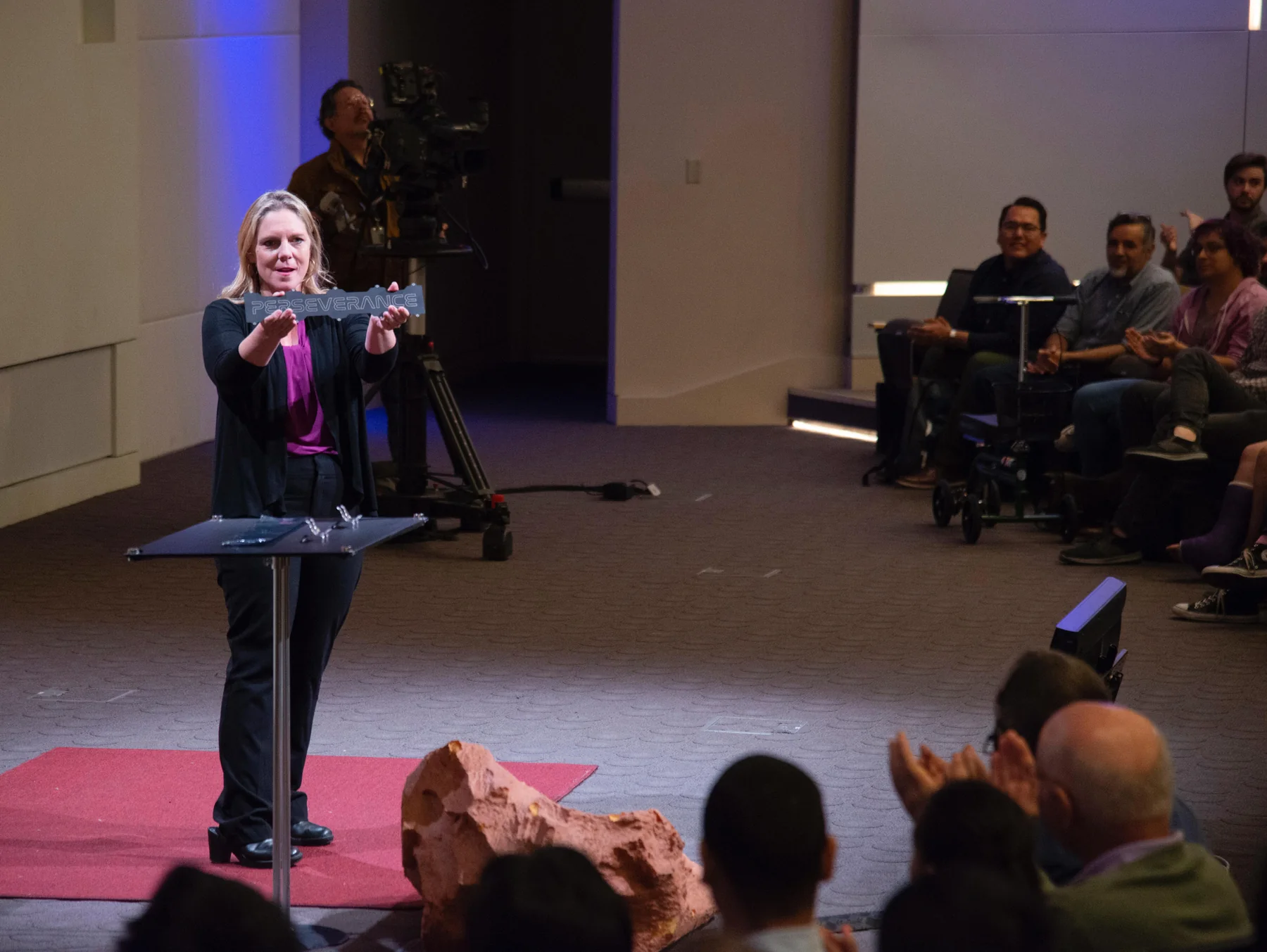
V. Perseverance: autonomy, science campaigns and the sample-caching chain
Perseverance does more than search for ancient habitability. It caches samples, carries MOXIE, uses advanced navigation and served as the deployment platform for Ingenuity. The mission is therefore unusually connected to future Mars capabilities.
Perseverance inherited major elements of Curiosity's architecture but pursued a different set of objectives at Jezero crater. In addition to geology, past habitability and technology demonstrations, the rover was designed to collect and seal samples in tubes. Those samples are valuable because future laboratories could apply analytical methods impossible to fly on the rover. Mars 2020 therefore operates as the beginning of a scientific chain whose later steps may belong to other missions.
Perseverance: doing more on Mars without pretending to remove the human team
Landing success creates a new mission rather than closing the project
Perseverance landed in Jezero crater on February 18, 2021. The landing ended years of design and verification, but it immediately began another kind of engineering. The rover had to be commissioned: systems checked, mast and instruments activated, mobility verified, flight configurations converted into surface configurations and the team’s models compared against the real vehicle. The first weeks were therefore not simply “science delayed by engineering.” They established the operational truth on which later science would depend.
The Mars 2020 landing press kit listed Jennifer Trosper as one of the deputy project managers under project manager John McNamee, alongside Matt Wallace.[14] Her role placed her at the intersection of the vehicle, surface operations and the transition from development team to sustained mission organization.
From Sojourner to AutoNav: autonomy as a controlled transfer of local decisions
The most visible difference between early rovers and Perseverance is not merely speed but how much local navigation can be delegated to the rover. Interplanetary light-time prevents real-time driving. A rover that stops after every short segment to wait for Earth wastes much of the day. Perseverance’s AutoNav processes terrain imagery while driving, builds local maps and selects safe paths within constraints defined by the team.
JPL described Perseverance as able to drive farther without depending on humans to plan every meter.[16] The autonomy does not understand the scientific campaign in the human sense. It solves a bounded problem: how to move toward a commanded goal while avoiding hazards. That distinction is critical. Useful autonomy removes a communications bottleneck without transferring project-level responsibility to the machine.
Five times farther, more samples: start from the bottlenecks of the previous rover
One way to understand Perseverance is as a response to operational lessons from Curiosity. Curiosity’s science return was constrained not by one dramatic flaw but by the cumulative time required for drives, planning, sampling and verification. Mars 2020 was designed to increase the rate at which the vehicle could move through terrain and collect a scientifically diverse cache.
Trosper’s experience across generations made those bottlenecks tangible. An engineering improvement matters when it changes mission-level throughput. Faster image processing or autonomous driving matters because it produces more useful distance per planning cycle. A more capable sampling system matters because it allows a sequence of well-documented cores rather than one internal analysis at a time.
Communications: autonomy can increase the amount of data that must be managed
More autonomous driving and more capable instruments produce more data. The rover remains dependent on a network of Mars orbiters and the Deep Space Network. The mission has to schedule what returns first: engineering data needed for the next plan, science images, high-resolution products and diagnostic telemetry.
This creates an important systems effect. Solving one bottleneck can expose another. If the rover can drive much farther in a day, it may create more terrain imagery than a slower operations pipeline can inspect. Mission-level design has to keep the chain balanced.
Commissioning: prove the surface configuration before demanding peak performance
The commissioning phase tested mobility, instruments, the robotic arm and the helicopter deployment sequence while teams built confidence in the rover’s Mars behavior. Ingenuity then demonstrated powered flight in the Martian atmosphere, another example of one mission carrying a technology pathfinder for the future.
Commissioning is a form of staged risk. Instead of exercising every capability at once, the team expands the operating envelope step by step. Each successful test adds evidence. If a behavior differs from expectation, the divergence can be investigated before it is entangled with a more complex sequence.
June 7, 2021: Trosper becomes project manager as the first science campaign begins
JPL announced that Jennifer Trosper became Perseverance project manager on June 7, 2021, succeeding Matt Wallace as the rover began its first science campaign.[17] The timing is revealing. Project leadership transitioned after landing and commissioning, when the mission’s dominant challenge was shifting toward sustained science, traverse and caching.
A project-manager handover is itself a systems operation. Knowledge has to transfer without assuming that documents capture every rationale. Accepted risks, team relationships, unresolved issues and operational habits all matter. A long-lived mission must be able to survive management changes just as it survives hardware changes.
Project management as distributed decision making
The project manager does not personally select every rock, write every sequence or diagnose every fault. The role is to ensure that the system of expertise works: risks are visible, conflicts are arbitrated, resources align with priorities and specialists can raise concerns. The complexity of Perseverance makes heroic central control impossible.
Trosper’s description of herself as a problem solver and team player is therefore technically meaningful. A high-level leader creates value by asking the right specialist the right question and by maintaining a culture where an uncomfortable answer can change the plan.
The sample caching system: when a Martian rock becomes an inter-mission chain of custody
Sampling for the future is different from sampling for an onboard instrument
Curiosity drills material, processes it and delivers portions to laboratories inside the rover. Perseverance has a different responsibility: collect cores that may be studied in laboratories on Earth by instruments that did not exist when the rover launched. The sample therefore has to survive as a trustworthy scientific object across years, programs and teams.
The mission carries 43 sample tubes, including witness tubes used to help characterize contamination. The caching architecture uses multiple robotic elements to acquire, transfer, inspect and seal samples. NASA and JPL have described the system as unprecedented in complexity for a Mars rover. The complexity is not gratuitous. A future laboratory must be able to trust both the material and its history.
Three robotic domains: acquire, handle, seal
The rover’s main arm positions the coring drill at a selected target. Inside the rover, additional handling mechanisms move tubes through inspection and sealing steps. The operations team therefore commands a chain in which the output of one mechanism becomes the input of another. The system has to know which tube is where, what state it is in and whether each transition completed correctly.
This state-tracking problem is as important as the mechanics. A tube physically present in the wrong state would threaten scientific traceability. Configuration management extends down to the sample itself.
Biological cleanliness: contamination control becomes part of scientific interpretation
A future discovery of organic compounds would be scientifically weak if the mission could not estimate whether Earth contributed them. Perseverance’s cleaning, materials controls and witness tubes are therefore part of the science. The goal is not to claim an impossible absolute sterility. It is to characterize contamination well enough that future analysts can distinguish plausible terrestrial contributions from Martian signals.
This is a profound systems lesson: science requirements can reach backward into manufacturing. A laboratory question asked years later changes how engineers clean, assemble and document hardware before launch.
The first sampling attempt: hardware can function and still fail to produce the expected scientific result
In August 2021, Perseverance’s first attempt to collect a core produced a drilled hole but no measurable core in the tube. JPL reported that the team was assessing the event and that telemetry indicated the sampling process had executed as intended.[18] The leading explanation became that the rock had fragmented instead of producing a coherent core.
The distinction is central. A mechanism can meet its functional requirements while the natural target responds differently from assumptions. Mars itself is part of the system boundary. The team therefore had to separate mechanical performance from material behavior rather than label the event simply a “drill failure.”
A successful core: test the hypothesis by changing the target
The next campaign selected a more suitable rock. Perseverance successfully acquired a core, and JPL reported the result in September 2021.[19] The sequence did more than fill a tube; it provided evidence that the sampling hardware worked and that the previous outcome was target-dependent.
This is engineering diagnosis through controlled change. Instead of modifying the mechanism immediately, the team changed one major variable—the rock—and observed whether the result changed. The logic is close to scientific experimentation.
Pebbles in the bit carousel: slow down to protect an irreplaceable mechanism
Later, small pieces of rock were observed in the bit carousel. Trosper wrote a mission update describing the team’s deliberate effort to image, understand and clear the debris before continuing.[20] A rushed attempt to force normal operations could have endangered the handling system that the rover would need for many future samples.
The decision demonstrates long-horizon optimization. Losing several sols is acceptable if it protects years of future sampling capability. Mission management must value remaining options, not only immediate activity.
Witness tubes: measure the mission’s own fingerprint
Witness tubes contain materials designed to capture contaminants that may accompany the rover’s sampling environment. They allow future analysts to ask whether compounds seen in a Martian sample also appear in a control exposed to the spacecraft. This is not a guarantee against ambiguity, but it makes ambiguity measurable.
The witness concept illustrates mature contamination science. Cleanliness is not treated as a binary label. It becomes a documented uncertainty that can be incorporated into later interpretation.
Context is part of the sample
A rock core without geological context is far less valuable. Perseverance therefore documents target location, textures, nearby units, abrasion patches, instrument observations and imagery. The physical tube and the digital record form one scientific product.
The mission paper coauthored by project scientist Ken Farley and Trosper describes Perseverance as a campaign in which human planning and machinery together build this scientific record.[21] The significance is intergenerational: a researcher examining the sample decades later needs to reconstruct why it was chosen and what it represented in Jezero.
Caching as program architecture
By placing samples in sealed tubes and, where appropriate, depositing them on the surface, Perseverance creates options for future retrieval architectures. Program plans can change; the cache is designed to retain value across those changes.
This is systems engineering on a longer timescale than a single spacecraft. The current mission has to make decisions whose benefit may be realized by a different team, different vehicle and different budget cycle. Reliability includes protecting the usefulness of the future.
The sample-caching chain in operational detail: a scientific promise that must survive interfaces
Three robotic domains have to behave like one instrument
Perseverance’s Sample Caching System is often summarized as a drill and a set of tubes. The actual architecture is much more demanding. JPL describes three robotic elements working together: the rover’s large external arm and coring drill, the bit carousel that transfers bits and tubes between outside and inside, and the Adaptive Caching Assembly with its internal sample-handling arm.[29] Each transition is an interface at which mechanical alignment, software state, sensing, cleanliness and sequence timing must agree.
For project management, this means that “take a sample” is not one action. It is a chain of individually verifiable states. The rover has to present the tool, acquire material, return the bit, transfer the tube, measure and image it, seal it and place it into storage. The chain has to leave enough telemetry that Earth can understand where a problem occurred if the expected end state is not reached.
Forty-three tubes create a campaign-design problem, not merely storage capacity
Perseverance launched with 43 tubes, including witness tubes designed to record contamination and environmental background.[30] The number is operationally important, but the harder question is how to use the finite collection. The team must balance geological diversity, scientific priority, redundancy and the uncertain future of sample retrieval architecture.
A scientifically strong cache is therefore curated. Each tube needs provenance: the target, images, geological unit, abrasion and sampling history, instrument observations and the decision context that made the sample valuable. The sample is not just the physical cylinder of rock. It is the rock plus the evidence that lets a future laboratory interpret it.
Cleanliness is part of the measurement system
JPL describes the sample-caching components as the cleanest hardware of their kind ever launched, because returned samples may be examined for extremely subtle organic or biological signatures.[31] This creates a form of systems engineering that extends beyond classical spacecraft cleanliness. Manufacturing history, materials, cleaning procedures, witness tubes and documentation become part of the future scientific experiment.
The operational consequence is profound: contamination control cannot be bolted on after collection. It must be built into the entire chain from assembly through surface handling and eventual laboratory analysis. A future researcher may need to distinguish a Martian signal from a terrestrial molecule introduced years earlier. Every interface therefore carries epistemic risk as well as mechanical risk.
The first empty core shows why material behavior belongs inside systems thinking
During the first 2021 sampling attempt, telemetry indicated that the commanded sequence had executed, yet no measurable core appeared in the tube.[18] The drilled rock had apparently fragmented rather than producing the expected coherent core. A later attempt in a different target succeeded.[19]
The episode is a compact systems-engineering lesson. A machine can perform nominally while the total activity fails because the natural environment does not behave as assumed. On Mars, the “system” includes geology. Future human operations will face the same category of problem with regolith handling, excavation, ice extraction and construction: the environment is not an external backdrop but an active participant in technical behavior.
Project leadership after landing: changing the organization when the mission changes phase
June 2021 marks an operational transition, not merely a title change
JPL announced that Jennifer Trosper became Perseverance project manager on June 7, 2021, succeeding Matt Wallace as the rover entered its first science campaign.[17] The timing is revealing. Landing and early commissioning had established that the rover could operate on Mars; the dominant challenge was becoming sustained traverse, science, autonomy and sample caching.
A project organization should evolve with that shift. Development rewards design closure, integration, test and readiness for launch. Surface operations reward tactical discipline, campaign planning, anomaly response and maintenance of a changing vehicle. The project manager remains responsible for the whole mission, but the information flows and decisions that demand attention are different.
Leadership is distributed even when accountability is not
No project manager can personally decide every scientific target, mobility path, thermal limit or instrument sequence. Mission leadership depends on delegated owners whose expertise is deep enough to make local decisions and whose interfaces are structured enough that project-level consequences become visible. Accountability therefore sits on top of a network of authority rather than replacing it.
This helps explain why systems experience matters in management. A leader trained to look for interfaces can ask where a local decision crosses into another subsystem, whether a margin is shared, and which team must be involved before a change becomes safe.
Campaign operations make priorities explicit
Perseverance cannot simultaneously maximize driving, imaging, drilling, sampling, instrument observations and communications. Energy, time, data volume and terrain create continuous trade-offs. The science team identifies valuable targets; engineers define constraints and operational costs; the project turns the combination into a sequence that the rover can execute safely.
Farley and Trosper’s project descriptions of the early campaign show this human-machine structure clearly.[21] The rover’s autonomy speeds bounded tasks, but campaign strategy remains a negotiated product of science and engineering.
Project management includes preserving future options
Long-duration missions face decisions whose future value is uncertain. A detour may produce exceptional science but consume wheel life and time. An aggressive sampling sequence may fill tubes quickly but reduce flexibility later. Delaying an activity can preserve a mechanism while sacrificing a short-term target. Leadership must therefore manage option value as well as immediate productivity.
This is one reason the response to sample-system debris was deliberately cautious. The team used imaging and controlled motion to understand the condition before resuming normal operations.[20] Preserving a unique system’s future capability was worth more than recovering a few sols of schedule.
Handovers are part of reliability
Mission roles change over time, and the quality of the handover determines how much context survives. A strong transition includes unresolved risks, rationale behind limits, relationships among teams, assumptions embedded in schedules and the informal knowledge that may not be obvious in formal documentation. In a program whose missions last for years, leadership succession is not an administrative afterthought. It is another interface that has to work.
VI. The invisible organization: teams, training, leadership and institutional memory
Complex systems are easy to teach when everything is nominal: input, process, output and expected values. Real competence appears when symptoms conflict. Rover missions provide a library of cases involving resets, memory, wheels, power, sampling and changing performance. Each case can train reasoning rather than memorization of one historical fix.
Simulators can inject failures without endangering real hardware, test handovers and reveal how teams communicate under pressure. Debriefing should separate decision quality from the fact that a scenario happened to end well. A poor method can occasionally produce a good outcome through luck.
Preservation also requires format maintenance. A perfectly intact file that can be opened only by abandoned software is a degraded archive. Residents will need data migration, schema documentation and independent copies. Technical memory must be maintained like physical infrastructure.
Spirit’s computer and memory problems, for example, demonstrated remote troubleshooting under pressure. For a future settlement, that kind of experience matters: autonomy does not mean systems never fail; it means local and remote teams can understand, isolate and recover failures with limited resources.
In human Mars architecture, team knowledge will itself be a critical resource. Written procedures cannot fully replace experienced people who recognize anomaly patterns and understand why a design evolved the way it did.
Trosper's career therefore shows that martian autonomy is not only a matter of intelligent machines. It depends on institutions that know which system actually exists, why it changed and what earlier incidents taught. A durable settlement will preserve technical memory as carefully as it preserves oxygen.
This matters because operations depend on human cognition. Fatigue affects attention, handovers and judgment. Procedures reduce risk but cannot make biological operators independent of sleep. Mars mission design therefore includes a social and physiological system: staffing, transport, meals, shift length, information transfer and limits on how long a team can sustain unusual schedules.
The experience also broadens the idea of an interface. Interfaces are not only connectors and protocols. A handover between two tired teams is an interface. A correct number without the assumptions behind it can be misused. A safe organization must preserve both the data and the context required to interpret it.
Institutional memory also permits innovation. Teams can change a procedure confidently when they understand why the previous version existed. Without that history, every modification becomes either reckless or paralyzed by fear. The purpose of records is not to freeze the system; it is to make change safer.
Trosper's long arc across Mars programs shows that exploration becomes cumulative only when lessons cross project boundaries. A drawing stored in an archive is not yet a lesson. The lesson exists when the next team can recognize the pattern and use it before repeating the failure.
Rover operations are built around an asymmetry: teams can spend hours preparing a command sequence, while execution on Mars creates consequences that cannot be instantly reversed. That asymmetry encourages a verification culture. Commands are built, simulated, reviewed and checked before transmission. The purpose is not an impossible promise to remove all human error. It is to catch errors that are cheap to detect on Earth before they become physical events on another planet.
Bandwidth is a resource. Engineering telemetry needed for health assessment may have higher immediate value than a large image. Some data can wait, some can be compressed, and some may be retransmitted later. The team continuously converts scientific desires into an information budget. This is another reason autonomy matters: if a rover requires extensive imagery before every meter of motion, communications can become the limiting factor.
Trosper’s career shows why a settlement will need to institutionalize that memory through logs, training, simulation, responsibility rotation and knowledge transfer across crews. Technical autonomy is also a human continuity problem.
Pathfinder therefore created operational knowledge as well as technology. Each sol produced procedures, diagnostic habits and an understanding of margin that did not exist entirely in design documents. A future Mars base will face the same distinction. Manuals describe nominal behaviour, but resilience comes from incident memory, anomaly recognition and teams able to reconstruct a causal chain from incomplete telemetry. Some knowledge is only created after a system encounters the real environment.
Accumulation is not automatic. Organizations can lose skills when teams disperse and tools become obsolete. People who span multiple projects act as bridges, but reliable continuity requires archives and deliberate knowledge transfer. Individual memory is valuable precisely because it reveals what formal records must learn to preserve.
A Mars base should build the same pedagogy. New residents need more than button sequences. They need scenarios with incomplete information in which they form hypotheses, request discriminating measurements and choose reversible actions before irreversible ones. Training becomes rehearsal for uncertainty.
A settlement that preserves this memory gains more than a database. It gains the ability to understand its own technical history. After ten or twenty years, that may separate infrastructure that accumulates undocumented workarounds from infrastructure that genuinely learns.
Trosper’s progression across Pathfinder, the twin rovers, Curiosity and Perseverance is unusually valuable because the missions form an institutional memory rather than a set of isolated jobs. Each generation changes hardware and software, but operational habits can migrate: how anomalies are framed, how commands are reviewed, how the science team interacts with engineering and how a project decides when a risk is acceptable. [source]
That link matters most when staff changes. The engineer who understood an anomaly in one year may be gone when the symptom returns years later. If reasoning was not recorded, the team repeats the investigation. If only the conclusion remains without supporting evidence, a rule becomes difficult to challenge when conditions change.
A rover generates enormous quantities of data, but data does not automatically become knowledge. Telemetry can show that temperature rose, current fell or a reset occurred. To understand the event years later, engineers also need the command sequence, software configuration, operating context and assumptions used at the time. Operational memory links measurement, decision and configuration.
Interplanetary driving is not remote control in the familiar sense. Radio delay prevents an operator from steering around a rock in real time. The team constructs command sequences from available imagery and engineering data, sends them, and later receives the result. The rover needs enough local capability to avoid some hazards, while the ground must give commands whose effects remain safe when knowledge of the terrain is incomplete. That creates a discipline of delayed action and delayed verification.
The rover entered repeated resets and no longer behaved as the team expected. The important feature of this kind of anomaly is that partial communication can create false confidence. A machine that responds is not necessarily in a state engineers correctly understand. Sending a large number of corrective commands before the state is reconstructed can compound the problem. The first task is therefore epistemic: establish what the rover is actually doing.
Trosper's multi-generation experience represents the human continuity needed to turn archives into culture. People who know what information was missing during an earlier anomaly can improve what the next mission records. Institutional maturity is the ability to let a new project benefit from an old incident it never personally experienced.
Databases can preserve events, but an organization also has to preserve hierarchy: which issues are critical, which workarounds are fragile, which assumptions should be revisited if conditions change. Reviews, anomaly records, configuration systems and formal responsibilities reduce dependence on memory held by one expert.
Trosper's career therefore illustrates mature autonomy. Local teams must be able to act without waiting for Earth, but autonomy should not be confused with improvisation. A Mars settlement needs more disciplined verification precisely because no terrestrial mission control can undo a poorly prepared action in real time.
Trosper's continuity across missions illustrates this culture. An anomaly does not belong only to the rover that experienced it; it can become training material for the program. A robust settlement will do the same, turning every sufficiently documented incident into competence for people who were not present when it happened.
The invisible machine: teams, procedures, training and operational memory
A rover mission has a daily production system on Earth
Each Martian day produces a new cycle of work. Telemetry and images are received, engineering state is assessed, science results are interpreted, priorities are proposed, activities are sequenced, constraints are checked and commands are transmitted. The rover’s physical movement is only the visible end of this production system.
Perseverance’s mission updates frequently reveal this human machinery. Farley and Trosper’s descriptions of campaign operations show a team continuously turning evidence into the next set of actions.[21] The organization has to be fast enough to use the next communications window and careful enough not to trade speed for hidden risk.
Training takes months because command knowledge is not the same as operational judgment
Learning which command moves an arm joint is easier than learning when that movement is safe. Operators need to understand geometry, thermal constraints, fault responses, software state and interactions with other activities. Training therefore combines formal instruction, simulation, supervised shifts and gradual qualification.
The goal is to transform tacit expert knowledge into observable competence. A trainee should not merely imitate a senior operator; the trainee must be able to explain the reasoning behind a plan and recognize conditions that invalidate it.
Long missions force succession planning
Opportunity, Curiosity and Perseverance operate longer than many initial project assignments. People change roles, retire, take leave or move to new programs. If a mission depends on a handful of original experts, human attrition becomes a single-point failure.
Cross-training, documentation and deliberate handover are therefore reliability mechanisms. They are the organizational equivalent of redundant hardware paths.
Configuration knowledge: the team must remember the actual vehicle, not the ideal vehicle
Every workaround, software update and degraded component changes what operators should do. The project’s state information must capture those changes. A procedure written for the prelaunch configuration may become unsafe if it ignores a later limitation.
Configuration management connects design history to daily operations. It tells an engineer which assumptions are still valid and which verification evidence applies to the current system.
Decision logs: preserving why, not only what
Knowing that a team changed a route or disabled a function is not enough. Future operators need to know why. A decision log should preserve the evidence, alternatives and accepted risk that led to the choice. Otherwise, a later team may reverse a precaution without understanding its origin.
This contextual memory is difficult to automate. It requires disciplined writing and a culture that treats rationale as a mission product.
Anomaly reviews without blame
After a fault, the mission needs honest reconstruction. Punishing the person who first reports a problem discourages early disclosure. A useful review separates accountability from scapegoating: it asks what conditions made the error possible and what system change would reduce recurrence.
Spirit’s flash-memory recovery is an example of why this matters. The recovery involved software architecture, file management, operations and prior stored data. Reducing it to one person’s mistake would have produced less useful knowledge than understanding the interacting conditions.
Leadership as coordination rather than omniscience
A project manager cannot be the top expert in mobility, thermal control, sampling, software and science simultaneously. The role is to create a process where those experts can make their knowledge actionable. That includes asking for evidence, identifying cross-system consequences and deciding when trade-offs cannot be resolved within one subsystem.
Trosper’s self-description as a problem solver and team player fits this architecture. Technical leadership is strongest when specialists remain responsible for their domains while the project keeps a coherent mission-level view.
Mentoring: experience moves through relationships as well as reports
Trosper’s own return to JPL involved mentor Joe Savino, illustrating the role of professional trust in technical institutions. Later in her career, her participation in outreach and technical leadership positions places her on the transmitting side of that relationship.
Mentoring conveys things that formal procedures capture poorly: how to frame an uncertain problem, how to challenge a plan respectfully, when to ask for independent review and how to communicate bad news clearly.
Women in STEM: visibility can expand the future technical workforce
JPL Education documented Trosper’s participation in a Women in STEM event for girls, where she used tangible demonstrations—including the effect of Mars gravity—to make engineering accessible.[25] Such outreach is more than public relations. Aerospace organizations depend on a future workforce, and students first have to imagine themselves in the field.
Her own path is useful precisely because it is not a perfect straight line. It includes music, sports, a career interruption, travel, return to JPL, operations and management. That complexity can make technical careers feel more realistic rather than less ambitious.
Institutional memory as infrastructure
Laboratories invest in test facilities, clean rooms and networks. They also need repositories, review practices, communities of expertise and people who carry knowledge across projects. Pathfinder informs MER only if lessons are transmitted; MER informs Curiosity only if someone recognizes which lessons still apply.
Trosper’s multi-generation career is part of this infrastructure. Her value is not merely what she did on one rover but the continuity she helps create between missions separated by decades.
Leadership, mentoring and institutional memory: building teams that outlast their leaders
A thirty-year career is an institutional asset, not only a personal record
Trosper joined JPL in 1990 and later became an Engineering Fellow. JPL’s current profile notes that her 2013 fellowship recognized technical expertise and leadership in Mars surface mission operations.[23] The significance of such a role lies in continuity. Project titles are tied to a specific phase; institutional expertise can be used across reviews, mentoring and future missions.
This matters in a laboratory where missions take many years from concept to extended operations. The people who remember why a past program made a particular decision can help a new project avoid repeating an old debate without evidence.
Mentorship received: the career itself depended on institutional relationships
Trosper’s return to JPL after time away was helped by mentor Joe Savino, as she recounts in the JPL podcast.[1] The episode shows how technical institutions retain knowledge through networks of trust. A resume can show skills; a former colleague also knows how someone behaves when a problem is ambiguous or a schedule is under pressure.
Mentorship transmits tacit norms: when to request another review, how to report uncertainty, how to distinguish a workaround from a root cause, and how to challenge a senior colleague without turning a technical disagreement into a personal conflict.
Training operators: converting tacit knowledge into observable competence
Experienced rover operators recognize patterns that can be difficult to express as simple rules. Training has to make those patterns teachable. Simulations, supervised shifts and anomaly exercises expose trainees to situations where the correct action depends on context rather than memorized command syntax.
A mature qualification process asks the trainee to explain the reasoning, not only to obtain the correct result. That makes competence more transferable and exposes hidden misunderstandings before they reach the flight vehicle.
Leadership transition is a technical transition
Trosper became Perseverance project manager in June 2021 and later moved out of the role; JPL’s 2022 Pathfinder retrospective said she had served as Perseverance project manager “until recently.”[2] The mission continued. That is exactly what a healthy organization must be able to do.
A handover involves more than documentation. The incoming manager needs the living map of accepted risks, unresolved issues, team relationships and the meaning behind recent decisions. Leadership succession therefore deserves the same deliberate planning as a major hardware transition.
No lone hero can manage Perseverance
The project spans mobility, flight software, EDL, sampling, instruments, contamination control, communications and science. No individual can master each domain at specialist depth. Leadership must preserve distributed expertise while maintaining mission-level coherence.
This is why the language of “team player” is not modest decoration. In a complex technical organization, collaborative behavior is itself a performance requirement. A brilliant manager who suppresses specialist dissent can make the system less safe.
Outreach to girls in STEM: visibility as workforce development
JPL Education documented Trosper speaking at a Women in STEM event and using hands-on demonstrations to make Mars engineering tangible.[25] The event addressed a practical pipeline problem: students cannot pursue careers they do not know exist or do not imagine as open to them.
Trosper’s own non-linear path can be particularly useful. It contains technical achievement without presenting life as one uninterrupted ascent. That makes the profession more credible to students whose interests and circumstances may also change.
Institutional memory needs both archives and people
Reports and databases preserve precision. People preserve context: which report matters, which assumption was controversial, which workaround became routine and which apparent success was partly luck. The strongest institutions connect both forms of memory.
Pathfinder’s lessons reached MER because people and documentation moved forward. MER lessons influenced Curiosity; Curiosity influenced Mars 2020. Trosper’s career is one of the human channels through which that continuity occurred.
A technical fellow as a bridge after project management
Moving out of a project-manager title does not make accumulated expertise obsolete. An engineering fellow can contribute to reviews, future mission concepts and mentoring without owning the daily schedule of one rover. This may be one of the most efficient ways for an institution to retain senior judgment.
For Mars exploration, where missions are separated by years and technologies change quickly, such bridges reduce the risk that every new project learns the same operational lessons from scratch.
Institutional success: when an individual career becomes reusable knowledge
The value of Trosper’s career is not merely a sequence of promotions. It is that experience acquired in one mission becomes available to the next. That conversion of personal experience into collective capability is one of the essential functions of a mature space program.
It also changes how a biography should be judged. The important question is not simply what title she held, but what knowledge could move through that role and how the organization became more capable because the knowledge survived.
Why Mars teams matter as much as Mars rovers
The visible vehicle depends on an invisible organization
Public images encourage a simple mental model: a rover sits alone on Mars and performs exploration. Operationally, the vehicle is one endpoint of a distributed system that includes the Deep Space Network, relay orbiters, flight software teams, rover planners, scientists, instrument teams, testbeds, configuration databases, review processes and people working different shifts. Every apparently autonomous action rests on this invisible infrastructure.
Trosper’s career moves through many of these organizational layers. On Pathfinder and MER she was close to tactical surface operations. On Curiosity she worked within a much larger and more capable rover project. On Mars 2020 she held systems and project-management responsibilities that required seeing the mission across disciplines. The progression shows why experience in operations can be valuable in senior leadership: decisions are grounded in how the integrated system actually behaves rather than only how it was intended to behave on paper.
Human interfaces can fail just like technical interfaces
A spacecraft interface has defined signals, units, timing and responsibility. Human interfaces often rely on assumptions. Who is authorized to change a sequence? Which team owns a late anomaly? Has science understood the engineering constraint? Has the night shift recorded enough context for the day shift? Does a subsystem lead know that a configuration changed elsewhere?
Many organizations try to solve these problems by adding meetings. Meetings alone are not architecture. Effective interfaces define products, decisions, owners, entry criteria and handover expectations. They create a shared state that another person can reconstruct later.
Training builds judgment, not merely procedural memory
Trosper has described rover roles that require months of training before an operator can exercise them independently.[1] The duration is understandable. Knowing the command syntax is not the same as knowing when a command is unsafe, what telemetry must be checked first, which contingency is reversible and when a specialist must be called.
High-fidelity simulations and anomaly exercises matter because they let teams practice reasoning before real hardware is at risk. A mature training program includes off-nominal scenarios, incomplete information and conflicting objectives rather than only rehearsing the expected sequence.
Diversity of disciplines improves the model of Mars
Mars operations combine people who reason from different evidence: geologists see scientific opportunity, mobility engineers see terrain and wheel risk, thermal engineers see environmental boundaries, software engineers see state machines, communications specialists see windows and bandwidth. The purpose of the organization is not to eliminate those different perspectives. It is to combine them into a plan whose trade-offs are explicit.
This will be even more important for human Mars settlements, where technical, medical, scientific and social constraints will interact continuously. The rover program already demonstrates the basic principle: mission intelligence is distributed across a team, and good leadership creates structures that let that distributed intelligence become coherent action.
Mentoring, visibility and the pipeline of future Mars engineers
A technical career is built inside relationships as well as institutions
Trosper’s return to JPL after time away was connected to mentor Joe Savino, whose invitation led her toward Pathfinder.[1] Decades later, she remembered Savino not only for giving her an opportunity but for an engineering ethic that favored the simple solution over unnecessary complication.[24] The episode illustrates a feature of technical institutions that organizational charts rarely capture: trusted people help transmit standards, judgment and opportunity.
Mentoring is therefore not a soft supplement to engineering. It is one mechanism by which tacit knowledge moves across generations. Formal documents can describe a process; experienced colleagues can explain why a rule exists, what warning signs matter and how a project behaves when a schedule or anomaly changes the normal procedure.
Visibility changes who can imagine belonging in the field
JPL Education documented Trosper participating in a Women in STEM event for girls, using practical Mars demonstrations to make engineering tangible.[25] Such outreach matters because the future technical workforce is partly shaped before university. Students are unlikely to choose a path they cannot see or that culture presents as belonging to somebody else.
For a Mars program expected to last many decades, workforce development is a mission dependency. Rover projects need systems engineers, scientists, software specialists, operators, machinists, test engineers and managers long after the original team has moved on. Public communication therefore has an operational consequence: it enlarges the pool from which future missions can recruit.
Representation should not flatten the person into a symbol
Trosper’s visibility as a woman in aerospace is important, but a serious biography should not reduce her career to representation alone. Her technical record—Pathfinder operations, MER mission management, Curiosity leadership, Mars 2020 systems engineering and Perseverance project management—deserves the same detailed treatment that would be given to any major engineering leader.
The strongest form of representation is therefore specificity. Students should be able to see not only that she held senior roles but what those roles required: judgment under uncertainty, system-level thinking, recovery from anomalies, training, communication and responsibility for collective decisions.
The pipeline is also a resilience problem
Programs become fragile when expertise is concentrated in too few people. Recruiting broadly, training deeply and promoting people through different mission roles reduces that fragility. Diversity of background can also improve the set of questions asked during reviews, because people carry different assumptions and experiences into the same technical problem.
For a sustained human presence on Mars, this principle becomes even more literal. A settlement cannot depend on one irreplaceable expert for each critical system. The workforce must be designed for redundancy of competence, mentorship and succession just as hardware is designed for fault tolerance.
VII. Five rover generations: autonomy, communications and changing scale
Trosper's career across multiple rover generations gives this problem unusual depth. Tools differ from mission to mission, but the organizational requirement becomes stronger as systems become more complex. Configuration control allows hundreds of specialists to operate one physical machine without creating hundreds of conflicting descriptions of that machine.
This matters even more for a settlement. Early residents may know why a route was forbidden or why a valve sequence contains an apparently unnecessary step. A later generation may see only inconvenience. If the original cause is lost, it becomes tempting to remove the safeguard. Technical history must therefore remain accessible and connected to the actual configuration.
A human settlement will increase the stakes. Voice messages, medical files, software updates, scientific datasets, personal communications and infrastructure telemetry will share channels. Priority policies cannot be invented only after congestion begins. Safety-critical data need defined precedence and local systems must remain functional when the link to Earth is interrupted.
The five rover generations connected to Trosper are more than a technological progression. They accumulate methods: drive through communication delay, diagnose a machine that cannot be touched, preserve configuration, learn from anomalies and transfer responsibility. Human continuity gives that sequence its operational coherence.
Autonomy lets the rover execute more safe travel and routine work between human planning cycles. It does not remove scientists or engineers; it changes the level at which they intervene. For a future Mars settlement, the progression is central: the more local machines can handle routine situations, the more human attention can be reserved for genuinely new or dangerous events. [JT3] [JT4]
The rover lineage demonstrates a useful balance: use the network aggressively when it is available, but design the surface system to survive gaps. For human life support, that principle becomes mandatory. Earth can advise; Mars must continue breathing without a reply.
The durable lesson is therefore operational rather than ceremonial: know the real state of the system, preserve why it changed, give machines only the autonomy appropriate to a defined domain, and organize people so the mission can last longer than its original calendar. On Mars, the first day may make history. The thousandth day determines whether exploration has become infrastructure.
That beginning matters because Trosper did not arrive at Mars as the specialist of a single machine. She entered JPL as robotic exploration was moving toward a new generation of surface vehicles. Her profession would be built by accumulating real operations, seeing what fails, deciding what can be automated, and learning what one mission must preserve so the next does not start from zero.
Five rover generations: learning by changing scale
Sojourner: mobility as proof of concept
Sojourner was small enough to appear almost toy-like next to later Mars rovers, yet its historical importance is difficult to overstate. It proved that a mobile robotic vehicle could be deployed, commanded and used for science on Mars. NASA’s 25-year Pathfinder retrospective links that success directly to the larger rovers that followed and notes Trosper’s involvement across the generations.[2]
The mission taught a first operational grammar: plan a movement, transmit it, observe the result, update the map and choose again. Later missions would add complexity, but the basic Earth-Mars decision loop was established.
Spirit and Opportunity: mobility becomes the primary scientific platform
MER moved the rover from companion to centerpiece. The vehicles carried panoramic cameras, spectrometers, microscopic imagers and rock abrasion tools. Their task was not simply to demonstrate driving but to reconstruct the role of water at two distinct landing sites.
The twin architecture also created parallel learning. Similar vehicles faced different terrain, weather and degradation. Operations became a comparative experiment in reliability.
Curiosity: the rover becomes a mobile laboratory
Curiosity added internal analytical instruments and a sample-acquisition system. Its radioisotope power source changed energy constraints, while the sky crane enabled a much larger vehicle. The rover could not simply be operated as MER with more commands. Sampling, laboratory analysis and more complex autonomy created new operational chains.
Trosper’s description of Curiosity as a “beast” captures the qualitative change.[1] More capability meant more interactions, more states and more ways for an anomaly to cross subsystem boundaries.
Perseverance: the rover becomes the first stage of a future laboratory chain
Perseverance inherited much of Curiosity’s chassis concept but added a sophisticated caching system and more autonomous driving. Its samples are intended to preserve value beyond the rover’s own lifetime. The vehicle therefore participates in a program architecture extending across missions.
This changes the definition of success. A tube must be collected well, documented well and stored in a way that remains useful to a future retrieval system. The rover’s operation becomes a promise to researchers who are not yet part of the project.
Ingenuity: a pathfinder carried by a mature rover
Perseverance carried Ingenuity, echoing the way Pathfinder carried Sojourner. The helicopter was a technology demonstration nested within a flagship rover mission. Its success showed that powered controlled flight was possible in Mars’ thin atmosphere.
The pattern is strategically powerful: a mature mission can host a smaller experiment that proves a capability for the next generation. Exploration progresses not only by replacing old systems but by using reliable systems to test new ones.
Mass is not the only measure of scaling
From Sojourner to Perseverance, vehicle mass grows dramatically, but organizational complexity grows too. More instruments mean more science teams. More software means more configuration. More autonomy means more verification. More mission duration means more turnover in personnel.
The true scale-up is therefore socio-technical. A larger rover requires a larger system of evidence and responsibility around it.
Autonomy grows with capability but does not eliminate human work
Each generation can do more locally. Yet the planning organization remains essential because scientific meaning is not reduced to obstacle avoidance. Humans decide which outcrop matters, when a sample is worth spending, how risk should be balanced against opportunity, and how a surprising result changes the campaign.
Autonomy changes where human attention is spent. It should free people from repetitive local decisions so they can make better strategic ones.
Communications grow into infrastructure
Pathfinder’s limited return gave way to powerful relay networks supporting later rovers. Surface missions now assume a broader Mars communications ecosystem. That infrastructure makes larger science campaigns possible.
A future human presence would extend the same trend. Local communication, orbital relay and asynchronous links to Earth would become a permanent Martian utility.
Sampling grows into provenance
Sojourner could examine rocks locally. MER could abrade them. Curiosity could drill and analyze powder internally. Perseverance can cache cores for future laboratories. The progression is not simply more sophisticated hardware; it is a growing ability to preserve scientific context across distance and time.
Trosper’s career provides an unusual human thread through this progression. It shows how one institution learns to transform each generation’s operational limitations into the next generation’s design priorities.
Mars as a network: the rover never exists alone
The lonely-rover image is operationally false
Photographs show a machine in an empty landscape, which encourages the idea of a solitary explorer. In practice, every rover is the surface node of a distributed infrastructure. Mars orbiters relay data, the Deep Space Network connects planets, navigation teams maintain geometry, ground software converts telemetry into usable products, and archives preserve the scientific record. Trosper’s career spans the period in which this network became progressively richer and more routine.
Pathfinder operated with far more limited communications than later rovers. By the Spirit and Opportunity era, relay orbiters could dramatically increase daily return. JPL reported roughly 180 megabits of science data from Spirit in one Martian day, almost ten times Pathfinder’s maximum daily capability.[4] The rover itself was more capable, but the infrastructure around it was equally important.
Orbital relay: separate local communication from interplanetary communication
A rover can send UHF data to an orbiter passing overhead, allowing the orbiter to store the data and forward them to Earth with a more capable telecommunications system. This architecture avoids forcing the surface vehicle to perform every long-distance transmission directly. It also creates redundancy when multiple orbiters are available.
Spirit’s communications with ESA’s Mars Express provided an early demonstration of cross-agency relay interoperability.[7] Such capability has strategic value. A mature Mars program benefits when surface missions are not tied to a single dedicated relay.
The Deep Space Network: a shared resource that shapes science timing
The DSN serves many missions. Tracking and downlink time must therefore be scheduled. A rover may have more data than can be returned immediately, forcing the mission to prioritize products needed for safety and next-sol planning. Communications capacity becomes part of the science architecture.
This explains why more capable instruments can create a mission-level bottleneck. Collecting data is not enough; the team must move, process and interpret them in time to affect future decisions. Throughput is a property of the entire chain.
Store and forward: designing for interruption rather than assuming continuity
Deep-space communications are intermittent by nature. Spacecraft therefore store data and forward them when geometry and network access permit. This principle reduces dependence on continuous links and is conceptually important for future Mars infrastructure.
A human settlement would require local networks able to keep functioning when Earth is unavailable or an orbiter is temporarily out of service. Habitats, vehicles, science stations and surface robots would need to exchange and cache information independently. The robotic era already teaches the architecture of asynchronous communication.
Autonomy grows because communication cannot become instantaneous
No improvement in antenna technology removes the speed-of-light delay. As rover speed and scientific ambition increase, more local decisions have to be delegated. Perseverance’s AutoNav is one example: the surface vehicle can evaluate hazards and continue a drive without waiting for Earth to approve each segment.[16]
The result is not a detached robot but a different division of labor. Earth defines goals and constraints; Mars handles some high-frequency local decisions. The network carries intent outward and evidence back.
Data provenance: communication is useful only if context survives
Science data must remain interpretable after transmission. Images need calibration and geometry; spectra need instrument state; engineering measurements need timestamps and configuration. Perseverance’s samples extend this requirement to physical material: the tube and its digital provenance have to remain linked.
This creates two parallel mission histories. One unfolds physically on Mars. The other is an information history on Earth recording what the rover did, where, with which configuration and under which assumptions. Systems engineering protects both histories.
Network failures are mission risks too
Rover reliability is often discussed in terms of wheels, computers and instruments, but a loss of relay availability or ground-network capacity can reduce science even when the vehicle is healthy. The mission therefore plans around multiple communication paths and periods of reduced access.
For future human operations, telecommunications would become even more clearly safety-critical. A robust architecture would require redundancy not only in radio hardware but in routing, power, data storage and operational authority when links fail.
The operational insight: Mars exploration is already infrastructure, not a sequence of isolated machines
From Trosper’s Pathfinder experience to Perseverance, the rover has become increasingly embedded in an enduring Mars system. Orbiters outlive individual surface missions and support several vehicles. Ground tools, personnel and procedures are reused. Scientific archives connect generations.
This is one of the less visible transitions in Mars history. The planet is still remote, but exploration is no longer a single expedition arriving alone. It is an accumulating network of assets and knowledge. Trosper’s career belongs to that transition.
Autonomy: moving the boundary of decision rather than removing humans
Distance makes some autonomy mandatory
No rover can be driven in real time from Earth. Commands travel for minutes, and the response takes just as long to return. The vehicle must execute sequences, monitor safety limits and make some local choices without waiting. Autonomy begins as a physical necessity before it becomes a performance feature.
The relevant question is therefore not whether a rover is “autonomous” in the abstract. It is which decisions are delegated, what sensors support them, what limits constrain them and what the system does when confidence is low.
Curiosity AutoNav: extend the drive beyond the fully validated segment
Curiosity’s autonomous navigation allows the rover to continue past terrain that Earth planners can completely validate from the previous sol’s imagery. Stereo cameras and onboard processing help assess hazards. In 2013, the team progressively validated AutoNav on the B-side computer while compensating for temperature sensitivity in the associated navigation cameras.[10]
The staged introduction is important. New autonomy should first operate where humans can compare its behavior against expectations. Confidence grows through measured performance rather than declaration.
Perseverance AutoNav: speed the decision loop, not merely the wheels
Perseverance processes navigation information faster and can make more local driving decisions. JPL described the rover as able to take the wheel for longer traverses.[16] The major mission benefit is reduced waiting for Earth, not simply higher wheel speed.
This distinction guides good automation. A capability is valuable when it attacks a true mission bottleneck. Automating a non-limiting task may add software complexity without increasing scientific return.
Fault protection: safety autonomy is less visible but equally important
Spacecraft continuously monitor temperatures, currents, voltages and software states. When limits are exceeded, they may stop an activity or enter safe mode. These reactions protect the vehicle during periods without contact.
Fault protection itself must be engineered carefully. Thresholds that are too permissive fail to protect; thresholds that are too conservative can repeatedly interrupt useful work. Operational experience helps refine the boundary.
Explainability in operational terms
When autonomous software stops a drive or rejects an activity, engineers need enough telemetry to understand why. A black-box decision that cannot be reconstructed creates a new risk. Operational explainability is therefore not philosophical luxury; it is required for diagnosis and future trust.
As future missions use more complex planning or machine-learning methods, the same principle will grow in importance. Performance has to be paired with monitoring, bounds and post-event analysis.
Human strategy, robotic local speed
Rovers illustrate an effective division: humans define scientific goals, risk posture and campaign strategy; the robot handles local, repetitive decisions that would otherwise be delayed by communications. This boundary can shift as software matures, but it remains explicit.
Trosper’s work from Curiosity to Perseverance sits inside this shift. More autonomy did not shrink the operations organization into irrelevance. It allowed the organization to spend more attention on higher-level planning and interpretation.
Autonomy as a budget of authority
Every delegated decision should have a domain. A rover may choose among safe paths but not redefine the mission’s scientific destination. A fault-protection routine may shut down hardware but not decide to sacrifice an irreplaceable instrument for optional science. Authority is encoded in software boundaries.
This concept would matter even more for human Mars systems. Crew, automation and Earth support would each need defined rights to act. Ambiguity about who may override whom can become a hazard during emergencies.
The paradox: more autonomy demands stronger systems engineering
As the machine receives more decision authority, verification becomes harder. Engineers must test not only one commanded sequence but a space of possible choices. Sensors, algorithms and maps interact. The project therefore needs better models, simulation and operational monitoring.
Autonomy reduces one kind of workload while creating another. It is successful when the new verification burden is smaller than the mission value created by faster and more resilient local action.
Remote operations under light-time delay: designing for a world that never answers immediately
Distance converts command into intent
On Earth, a technician can watch a machine move and stop it when something looks wrong. Mars eliminates that feedback loop. Depending on planetary geometry, one-way radio time is measured in minutes. By the time Earth sees the result of a command, the action has already happened. Rover operations therefore package intent into sequences that must remain safe across a range of plausible local conditions.
This is why autonomy and fault protection are complementary. Navigation autonomy handles local terrain decisions. Fault protection monitors internal state and stops or safes activities when limits are exceeded. Earth retains strategic authority, but the vehicle must be capable of surviving the interval during which strategic authority cannot intervene.
The communications network changes what surface vehicles can accomplish
Spirit and Opportunity demonstrated the increasing value of relay orbiters. A surface rover with constrained power and antenna geometry can send data to an orbiter during a short overhead pass; the orbiter can later return a much larger volume to Earth. Early MER operations already treated Mars Odyssey as important communications infrastructure, and the 2004 Mars Express relay demonstration showed that the network could cross agency boundaries.[7]
Trosper’s later description of Perseverance emphasizes the same system-level idea: the team improved UHF communications and data compression in order to move more science through the existing physical network.[1] Increasing mission productivity did not require only a faster rover. It required reducing the communications bottleneck around the rover.
Operational latency is broader than radio latency
Even if radio delay vanished, Earth teams would still need time to receive products, assess vehicle health, interpret science, negotiate priorities, build commands, test them and conduct reviews. The full decision loop may last many hours. Autonomous driving helps because it allows a rover to continue through terrain that Earth has not mapped at command-level resolution, but it does not remove the larger human planning cycle.
Perseverance’s “thinking while driving” architecture is valuable because it shifts a well-bounded local problem into the vehicle while the team focuses on campaign-scale decisions.[16] This is a practical model for future Mars systems: automate the latency-sensitive local task while keeping goals, exceptions and high-consequence trade-offs at the human level.
A human settlement will need local command authority by design
A crewed base cannot wait for Earth before isolating a power fault, changing a life-support mode or responding to a medical emergency. The rover program therefore offers a governance lesson as much as a technical one. Authority has to be pre-delegated. Local teams need thresholds within which they can act, escalation rules for non-urgent decisions, and documentation that keeps Earth informed without requiring Earth to be synchronous.
The communications delay is sometimes portrayed only as an obstacle. It is also a design constraint that forces clarity: who may decide, what information is required, which actions are reversible and what the system should do when no human answer is available.
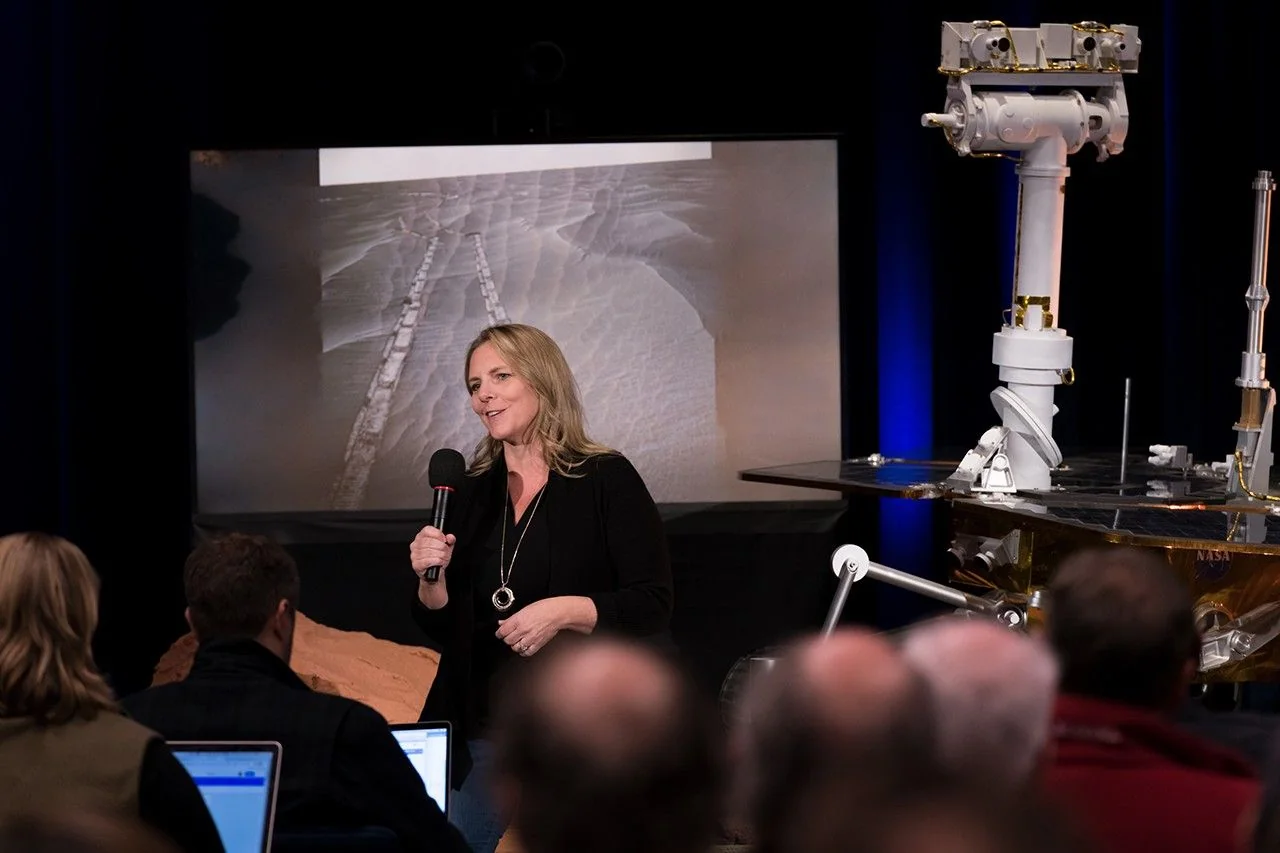
VIII. Anomalies, evidence, margins and doubt: building reliability under uncertainty
Long rover life creates a second lesson. A mechanism that is used freely during year one may become a scarce resource after years of wear. Operations then become age-aware. Procedures, traverse choices and energy policies adapt to degradation. A Mars settlement will almost always contain equipment of different ages and histories. Maturity means operating that mixed fleet safely rather than assuming every system still possesses its launch-day margins.
Long rover missions demonstrate the value of deep history. Years of measurements reveal trends in power, temperature, mobility and component behavior. A later failure may have precursors that appeared ordinary when they were first recorded. Historical comparison can turn old telemetry into new evidence.
Still, rover operations contribute essential methods: build safe states, separate command from verification, simulate sequences before execution, keep telemetry useful for diagnosis, document configuration and treat anomalies as investigations rather than surprises to be hidden. These disciplines can apply to oxygen generation, water recycling, electrical distribution and autonomous construction machinery.
Trosper's biography can therefore be read as an operations textbook. How does a team reduce uncertainty during an anomaly? How does it preserve expertise when a mission outlives its original staffing plan? How does it decide which choices can be delegated to the machine? How does a new manager inherit years of technical history without restarting from zero? Those questions will become routine when Mars rovers are no longer isolated scientific visitors but members of a working fleet supporting people.
Managing a rover means trading science, safety, schedule and hardware health. A route can be shorter but riskier; a target can be fascinating but expensive; an anomaly can erase weeks of planning. Trosper’s biography therefore illustrates a form of Mars preparation less spectacular than rockets or landing systems but just as necessary: learning to operate a complex machine for years without losing the ability to change the plan. [JT4] [JT5] [JT6]
Trosper's career across Sojourner, the MER rovers and Curiosity shows why sophistication does not replace basic discipline. The team still has to know the vehicle state, test sequences, preserve margins and diagnose anomalies. Greater capability increases the number of interactions, making those practices more—not less—important.
A settlement will follow a similar trajectory. A young base may rely on manual intervention. A mature base will automate environmental control, logistics and routine inspection. Yet residents will still need to understand underlying mechanisms because rare failures occur outside the ordinary behavior for which automation was optimized.
Procedures also have to evolve. A real anomaly may expose an assumption that tests did not capture. The correct response is to revise the procedure with rationale and history, not quietly replace the old file. Versioned operational knowledge makes it possible to understand why a safeguard exists and when it became necessary.
The crisis also demonstrates why diagnostic data must be designed before failure occurs. During nominal operation, logs and counters can appear secondary. During an anomaly, those traces may be the only way to reconstruct sequence and causality. A human base will need the same philosophy in life support, electrical distribution and thermal systems. Critical equipment should retain enough history to support diagnosis even when communications to Earth are restricted.
Anomalies as an engineering school: the real vehicle teaches more than the ideal vehicle
A fault reveals the actual dependency map
Design documentation describes intended relationships between components. An anomaly reveals which relationships matter when assumptions fail. This is why long-duration operations create a kind of knowledge no preflight review can fully reproduce. Spirit’s flash-memory crisis, Curiosity’s computer switch and Perseverance’s sampling surprises each forced teams to discover the system under conditions it had not been designed to encounter in exactly that way.
The value of an anomaly is not the drama but the information. A mission that merely restores function and moves on loses part of that value. A mature project captures the symptoms, hypotheses, tests, workaround and residual uncertainty so that the same reasoning does not have to be rediscovered later.
Spirit: stabilize before solving
When Spirit repeatedly reset and communicated abnormally, the team first had to recover a stable path to the rover. Avoiding normal flash-memory use allowed engineers to gather more information. Only then could they reduce the problem to file-management behavior and implement the reformatting strategy that restored normal science operations.[5]
The sequence is a general recovery pattern: communicate, stabilize, observe, isolate, test, then restore. Skipping directly to a presumed fix can destroy diagnostic evidence or move the system into a worse state.
Curiosity: redundancy creates a second personality, not an abstract duplicate
Switching from the A-side to the B-side computer after a flash issue demonstrated the value of hardware redundancy. It also revealed differences. The B-side Navcam pair required thermal compensation for visual odometry. The mission therefore had to validate new software before expanding autonomous driving.[10]
The lesson is subtle: a backup can save the mission and still demand new engineering work. Reliability planning should expect that the recovery configuration will have its own limits.
Curiosity’s wheels: some anomalies are trends, not events
Wheel damage accumulated progressively. There was no single “wheel failure” moment. Engineers monitored punctures, modeled forces, adjusted routes and changed driving practices. The decision problem was therefore continuous: how much risk is acceptable today given the value of reaching tomorrow’s science?
Trosper’s public comments about the route to Mount Sharp preserve an important distinction. Wheel concerns influenced the path, but the science team’s decision to begin studying the mountain was not reduced to wheel preservation.[11] Good project management keeps technical constraints visible without allowing them to become the mission’s only purpose.
Perseverance: natural material can be the anomalous component
The empty first core tube was not evidence of a broken rover in the ordinary sense. The drill made a hole, mechanisms moved, and telemetry looked nominal. The unexpected element was how the rock behaved. That forced the team to include geology in the fault tree.
This is one reason Mars missions are intellectually demanding. Engineers do not operate a machine against a controlled factory input. They interact with an environment whose mechanical properties are only partially known. The system boundary has to include the planet.
Diagnostic discipline: hypotheses must produce different predictions
A useful fault hypothesis is one that suggests a test. If a problem is caused by temperature, behavior should change with temperature; if it is caused by one computer side, switching sides should change signatures; if rock competence is the cause, another target should behave differently. The team therefore turns uncertainty into a sequence of discriminating observations.
This approach limits cognitive bias. Under pressure, teams can become attached to the first plausible explanation. Requiring predictions forces the preferred explanation to compete with alternatives.
Workarounds versus root causes
A workaround can restore science without fully explaining the fault. That can be the correct mission decision, especially when destructive testing is impossible. But the documentation must preserve the distinction. Calling a workaround a root-cause fix may lead a later team to remove precautions that are still needed.
Long-lived missions therefore maintain histories of open and closed anomalies, known limitations and accepted residual risks. The “health” of the rover is not a simple green or red indicator; it is a structured description of what the project currently understands.
Anomaly culture: bad news has to travel faster than reassurance
Technical organizations become dangerous when people fear being the person who slows the schedule. A Mars project needs the opposite norm: early reporting of uncertainty is valuable. A small problem disclosed early can be analyzed; a problem hidden until it affects the spacecraft may be irreversible.
Trosper’s leadership career spans missions that lived through both public failures and remarkable recoveries. The common institutional lesson is that reliability requires psychological as well as technical channels for information to move upward.
From robotic missions to human Mars operations
Human crews would face the same need for disciplined diagnosis but with far shorter safety timelines. They could physically inspect and repair equipment, an advantage rovers lack, but they would also depend on life-support systems whose failures carry immediate consequences. The rover tradition of stabilizing, preserving evidence and making reversible decisions would therefore remain highly relevant.
The deepest transferable lesson is that fault response is a learned organizational capability. Hardware redundancy matters; so does a team that knows how to use it without creating a second failure.
Testing a mission that can never be tested as one complete Mars system on Earth
The Mars verification paradox
Spacecraft engineering demands high confidence, yet a Mars mission cannot be reproduced exactly before flight. Earth gravity is different, atmospheric density is different, interplanetary communications cannot be recreated physically at full scale, and entry, descent and landing combine conditions no single test facility can provide. Confidence therefore has to be assembled from partial evidence.
Engineers test mechanisms, vibrate structures, cycle hardware through temperature and vacuum, run simulations, test software on flight-like computers and rehearse operations with simulators. Each activity proves something different. Systems engineering has to demonstrate that there are no dangerous gaps between those proofs.
Test, analysis, inspection, demonstration
Not every requirement is verified the same way. A structural load may be demonstrated through analysis supported by material tests. A connector installation can be inspected. A mechanism can be cycled. An operational capability can be demonstrated in a realistic sequence. The verification plan has to choose evidence appropriate to the failure mode.
The plan also has to remain alive. If hardware changes after qualification, earlier evidence may no longer apply completely. Configuration control is therefore inseparable from verification.
Integrated testing: the interfaces are often the real test article
A component can pass acceptance testing and fail when connected to another component because timing, voltage levels, mechanical tolerances or software assumptions differ. Integrated testing exists to expose those relationships. The larger the mission, the more difficult it becomes to recreate every interface at once.
Mars 2020’s system engineering effort had to track not only whether the rover subsystems worked but whether the cruise stage, aeroshell, descent stage, rover, flight software and ground systems would behave coherently across mission phases. The spacecraft changes configuration repeatedly from launch to landing.
Entry, descent and landing: a sequence where correction arrives too late
During Mars EDL, the spacecraft acts autonomously. By the time Earth receives a signal indicating a critical event, that event occurred minutes earlier. The sequence must therefore be verified before flight to a degree different from ordinary surface activities, where the team may be able to stop and recover later.
Terrain-Relative Navigation adds a new autonomous decision layer. It has to interpret imagery fast enough, compare it with onboard maps and divert within known constraints. Testing must cover nominal performance, sensor errors, map uncertainties and cases where the system should decline to make an aggressive correction.
Operational readiness tests: the people are part of the verification campaign
Even perfect flight hardware can be endangered by an unprepared operations team. Mission rehearsals therefore test the ground system and people: data arrive, teams assess state, science priorities are translated into sequences, constraints are checked and commands are approved. Simulated anomalies test whether the organization knows who decides what.
These rehearsals are particularly important when a mission has many specialists. The exercise may reveal a communication gap or role ambiguity that no hardware test can detect. Human interfaces can fail just like electrical interfaces.
The value of independent review
Teams close to a design accumulate context, but they can also share assumptions. Independent reviewers are valuable because they ask basic questions insiders may stop asking. What evidence proves this requirement? What happens if the sensor is wrong? Why is this margin sufficient? Which failure is common to both redundant paths?
Review is not useful when it becomes ceremonial approval. Its purpose is to expose weak assumptions before the spacecraft makes them expensive.
Testing operations after landing
Verification does not end on Earth. Commissioning uses Mars itself as the final environment. Curiosity’s arm tests, Perseverance’s mobility checks and staged activation of instruments are forms of on-planet verification. The team deliberately expands the envelope rather than assuming Earth qualification predicts every detail.
Long missions continue this process. Software updates and new operational techniques are tested on Earth simulators, then introduced carefully to the flight vehicle. The rover becomes both operational asset and experimental subject.
What verification teaches about humility
The impossibility of one perfect end-to-end test means no mission launches with absolute proof. Engineers instead build a structured argument that the residual risk is acceptable. That argument is strongest when it states its uncertainty rather than hiding it.
Trosper’s career across development and operations embodies this loop. Preflight teams predict; Mars measures. Operations reveal which predictions were strong and which assumptions need revision. Those lessons then feed the next mission’s verification strategy.
Decision-making under uncertainty: technical management as explicit margin management
Margin is not waste; it is an option on the unknown
Space missions carry budgets for mass, power, energy, data, processor time and schedule. Every discipline would like to use more of those resources to improve its own performance. If all margins are consumed before launch, however, the project becomes fragile to the inevitable surprises of integration and operations.
Systems engineering makes margin visible. A few kilograms added to an instrument affect launch loads and landing mass. Higher data volume affects storage and downlink. A software feature can consume memory and test time. Local improvement always has a system price.
The Mars launch window: schedule is partly celestial mechanics
Favorable Earth-Mars launch opportunities occur roughly every 26 months. Missing a window can mean a major delay, with cost and workforce consequences. Mars 2020 therefore operated under a schedule that could not simply slide week by week like an ordinary terrestrial project.
The cracked heat shield and the COVID-19 pandemic both occurred in this context. Management had to protect the launch date without allowing schedule pressure to erase technical evidence. The right question was not “How do we launch no matter what?” but “Which work is mandatory for acceptable residual risk, and how can we preserve it?”
Reviews turn disagreement into inspectable technical claims
Design and readiness reviews are valuable when they force teams to show evidence. A risk should have a description, consequence, likelihood, mitigation, owner and closure criterion. A requirement should point to verification. A schedule concern should show the dependency that makes it critical.
This structure allows disagreements to be argued technically. People can challenge a model or margin without challenging the competence or loyalty of the person presenting it.
No flight system launches with literally zero known risk
Some issues are eliminated before launch. Others are reduced or accepted because further work would introduce more schedule or technical risk than the remaining concern justifies. The key is conscious acceptance. The project should know which uncertainties it carries and how it will monitor them.
The same principle applies on Mars. A damaged wheel, aging mechanism or backup computer becomes a managed risk. The vehicle does not have to return to a perfect state; the team has to understand the state well enough to operate responsibly.
Scientific uncertainty consumes margin too
Perseverance did not know the mechanical behavior of every Jezero rock before arrival. The empty first core attempt showed that natural targets could violate assumptions. The project therefore needed enough sample tubes, time and target diversity to learn.
Preserving capacity for future unknown terrain is the scientific analogue of engineering margin. Spending every resource on the first attractive target would be poor portfolio management.
Distributed risk ownership
One project manager cannot personally own every technical risk. Subsystem leaders, scientists, safety specialists and operations teams track issues at their level. The project manager integrates consequences that cross boundaries and decides when a local trade becomes a mission-level trade.
This distributed architecture is a protection against individual blind spots. It only works when concerns can move upward. A culture that rewards good news and punishes delay will eventually hide its own risk.
Cognitive margin: teams can become overloaded too
Projects budget hardware resources precisely but often discuss human attention less formally. An exhausted team with too many simultaneous anomalies loses capacity to reason, document and challenge assumptions. This is a real reduction in mission margin.
Long operations therefore need staffing depth, deliberate priorities and time to learn. Trosper’s career demonstrates that organizational resilience depends on protecting the ability to think, not only the ability to execute.
Reversible decisions as a form of margin
When information is incomplete, a decision that preserves several future paths can be more valuable than the immediately optimal one. Put the rover in a safe state; acquire more imagery; choose a test target; defer an irreversible mechanism action. These choices buy information.
Perseverance’s careful response to sample-system debris is an example. The team traded time for preservation of future sampling capability.[20] In deep-space operations, reversibility is often the most powerful reserve.
Failure, success and JPL culture: learning requires precise stories
The danger of narratives that become too clean after the event
Successful missions are often remembered as a sequence of correct choices. Failed missions can be reduced to a single mistake. Both simplifications are dangerous for engineers. The useful historical question is not merely what eventually worked or failed, but what information was available at each decision point, what alternatives seemed plausible, which signals were ambiguous and which organizational assumptions shaped the response.
Trosper’s trajectory connects Pathfinder’s celebrated success, the losses of Mars Climate Orbiter and Mars Polar Lander, the deliberately redundant Mars Exploration Rover strategy, and later generations of increasingly complex surface systems. That history argues against two opposite forms of complacency. Pathfinder did not prove that every faster and cheaper mission architecture would succeed. The 1999 losses did not prove that agility itself was wrong. Institutional learning requires separating causes instead of converting events into slogans.
A blameless investigation is not an absence of responsibility
Engineering organizations need people to own requirements, interfaces, tests and decisions. They also need anomaly reviews that do more than find the last person who touched the system. If the investigation stops at individual error, it may miss weak interfaces, ambiguous procedures, inadequate test environments, schedule pressure, confusing displays or assumptions shared by an entire team.
The Spirit flash-memory crisis is valuable partly because it can be studied as a system. The rover’s hardware was physically intact, yet interactions between file-system state, memory management and repeated resets threatened the mission. Recovery required diagnosis, temporary operating modes, careful commanding and eventually reformatting the flash memory. The useful lesson is not simply “do not make that mistake again.” It is to design observability, safe states and recovery paths that let operators regain control of a complicated machine whose internal condition has become uncertain.
Success can hide risk as effectively as failure exposes it
A component or process that worked once acquires heritage, and heritage is valuable. But repeated success can turn heritage into unexamined confidence. Mars 2020 reused broad architectural ideas demonstrated by Curiosity, yet the project still had to verify them within a different vehicle, landing site, mission and sample-caching architecture. The cracked spare heat shield discovered during testing is an especially clear reminder: inherited hardware still has to survive the requirements and verification of the current mission.
The same discipline applies to procedures. A recovery sequence that helped Spirit is not automatically appropriate for Perseverance. A navigation practice that preserved Curiosity’s wheels may not be optimal for a rover with different wheel geometry and a different autonomous driving system. Heritage reduces uncertainty; it does not eliminate the need to understand the present configuration.
Institutional memory must survive personnel turnover
JPL’s Mars program spans decades. No single engineer can remain in every role for the entire lifetime of the program. Lessons therefore need multiple forms: documents, test records, anomaly reports, design reviews, operational tools, oral history, mentoring and people who move between projects. Trosper’s value as an Engineering Fellow is best understood in this context. Her experience is not only biographical; it becomes useful when it can influence a review, a training program or the way a younger project frames a risk.
This creates a demanding standard for technical history. A good institution does not merely preserve the triumphant story. It preserves enough of the messy decision process that future teams can recognize the conditions that produced both success and failure.
The place of doubt: what a mission must be able to say when it does not yet know
Do not turn a hypothesis into a fact because the organization wants reassurance
After an anomaly, teams naturally want closure. Managers need schedules, public affairs needs a coherent update, scientists want to resume observations and engineers want to know whether hardware is safe. The pressure can make an early explanation feel more certain than the evidence supports. Strong mission culture resists that pressure. It separates observed facts, working hypotheses, excluded causes and unresolved questions.
Perseverance’s first unsuccessful coring attempt is a useful example. Telemetry showed that the sampling sequence had executed and images showed a hole in the target, but the tube did not contain the expected core. The project did not immediately declare a sampling-system failure. It investigated the material response and moved to another rock, where a later attempt succeeded.[18][19] The evidence gradually separated the behavior of the machine from the behavior of the rock.
Uncertainty can be represented rather than hidden
Engineering decisions rarely have perfect information. Teams can nevertheless describe confidence, bounds and sensitivities. A thermal prediction can carry margin; a wheel-wear model can express a range; a navigation plan can identify terrain that has been imaged at different resolution; a fault tree can show causes that remain plausible. Quantifying or classifying uncertainty keeps it visible as the decision moves upward through management.
This is especially important for long-duration surface missions because yesterday’s uncertain behavior can become tomorrow’s operational rule. If the record stores only the final conclusion, future operators lose the conditions under which that conclusion was reached.
Reversible actions preserve learning capacity
When uncertainty is high, a reversible step is often more valuable than a faster irreversible one. Safe mode, reduced activity, a short test drive, a mini-drill or additional imaging can produce information while preserving options. Perseverance’s deliberate investigation of debris in the bit carousel is a clear example: the team accepted schedule cost in order to understand the mechanism and protect a system essential to the entire sampling campaign.[20]
This principle scales directly to a future Mars base. If a life-support system behaves unexpectedly, the crew should prefer actions that preserve alternate paths and diagnostic evidence. Speed matters, but speed without observability can convert an ambiguous anomaly into an irreversible failure.
Doubt is a collective competence
Individuals can be appropriately skeptical, but organizations determine whether skepticism is usable. Engineers need permission to report weak signals, challenge an assumption and slow a decision without being treated as obstacles. Managers need mechanisms for independent review and clear criteria for reopening an accepted conclusion when new data appears.
Trosper’s career is instructive because operations makes uncertainty impossible to avoid. Mars will always answer some questions later than the team wants. Reliability therefore depends on an institution that can remain decisive without pretending uncertainty has disappeared.
Configuration, evidence and recoverability: the hidden architecture behind dependable Mars missions
The question “what vehicle do we actually have today?” is harder than it sounds
At launch, a spacecraft has a documented hardware and software configuration. After landing, operations begin to change its effective state. Software patches alter behavior. A redundant computer may become primary. Damaged wheels change route rules. Calibration knowledge evolves. Workarounds disable or limit functions. Years later, the machine in operational reality may differ significantly from the nominal vehicle described in early design documents.
Curiosity’s switch from its A-side to B-side computer illustrates this clearly. Redundancy preserved capability, but the B-side’s associated navigation-camera behavior required additional thermal compensation before visual odometry and autonomous navigation could be expanded.[10] The recovered rover was not simply “back to normal.” It was operating in a different known configuration.
Evidence has to travel with change
A configuration change should retain the reason for the change, the verification performed, the affected interfaces, the new limits and the rollback or contingency plan. Without that record, future operators inherit a fact without its justification. Over a long mission, undocumented changes can accumulate into an architecture nobody fully understands.
This concern helps explain why systems engineering and operations are so tightly connected. Verification is not finished at launch. Operational changes need their own evidence. Testbeds on Earth, software simulation and incremental deployment allow teams to explore changes without immediately committing the flight system.
Recoverability should be designed before the anomaly
Safe states, redundant compute, command pathways and diagnostic telemetry are most valuable when they already exist before the crisis. Spirit’s memory failure and Curiosity’s computer transition both show that teams cannot invent every recovery mechanism after they have lost normal control. Architecture creates the space in which human ingenuity can act.
For future Mars habitats, recoverability should be treated as a first-class requirement. Critical systems should define degraded modes, local isolation boundaries, alternate power and communications paths, spare or repair strategies, and diagnostic data that remains available even when normal service is interrupted.
Reliability is distributed across time
Some design decisions are made years before launch; some operational rules are learned years after landing. The people who diagnose a late-life anomaly may never have met the engineers who wrote the original requirement. Dependability therefore has a temporal dimension. It requires institutions capable of transmitting context across handovers and generations.
Jennifer Trosper’s career makes that temporal architecture visible. Pathfinder, MER, Curiosity and Perseverance are separate missions, but their lessons interact. The continuity is not magical “experience.” It is experience converted into evidence, procedures, design changes, training and people capable of asking better questions on the next project.
IX. Science, engineering and systems management: measuring success without simplifying the mission
At a base, autonomous vehicles might carry cargo, inspect cables, map dust accumulation or prepare construction sites. The practical measure of success is not how impressive the demonstration looks. It is how much scarce human labor the system saves while keeping risk understandable. The rover program provides decades of evidence for that economy of attention.
AutoNav is effective because its problem is constrained. The rover has a destination direction, geometric limits and models of terrain danger. It does not receive the vague instruction to “explore intelligently.” This distinction is useful in modern discussions of artificial intelligence. Operational autonomy begins with a defined decision space and with conditions under which the system must stop rather than improvise.
A settlement will need the same combination of specialists and integrators. Experts may understand water processing or battery chemistry deeply, but operations leaders must understand how one constraint propagates. A colder battery reduces usable energy. Reduced energy may limit heating or communications. That can alter the science plan or the ability to charge a rover needed for maintenance. Systems engineering turns those chains into explicit decisions.
She went to MIT for aerospace engineering and also completed a minor in music. The musical background is not a causal explanation for engineering success, but it belongs in the life story: disciplined practice, teamwork and performance under pressure developed alongside mathematics and spacecraft systems.
The Mars Exploration Rovers turned Sojourner’s experiment into sustained rover operations. The vehicles were larger, their science more ambitious and their actual lifetimes far beyond the nominal mission. Trosper’s career crossed this growth in complexity and illustrates a recurring rule: heritage is valuable, but it cannot be copied mechanically. More mass, different instruments or a new landing system create new failure modes. Experience helps teams ask better questions; it does not guarantee that yesterday’s solution will survive tomorrow’s architecture.
On Pathfinder she participated in surface-operations testing and served as flight director on the first Martian day. The experience is fundamental: after landing, a rover is no longer a development object but a living system of constraints. Power, communications, navigation, commands, science and anomalies must be reconciled every day. That operational culture followed her throughout her career. [JT2] [JT3]
Jennifer Trosper offers a way to tell recent Mars history through operational continuity. JPL describes an engineering career connected to all five NASA rovers that have driven on Mars, from Sojourner through Perseverance, with responsibilities spanning systems engineering, flight operations and mission management.[1] That continuity makes her career more than a sequence of projects. It shows how an organization learns to operate progressively larger machines, keep them productive far beyond nominal lifetimes, hand authority from one team to another and increase onboard autonomy without losing the ability to understand the vehicle.
Science and engineering: arbitration without making one side defeat the other
A Mars rover is not a terrestrial laboratory placed unchanged on another planet
Scientists want access to compelling targets, favorable instrument conditions and enough time to follow unexpected discoveries. Engineers have to protect power, thermal limits, mechanical life, communications and vehicle safety. Treating these interests as permanent opponents misrepresents the mission. The rover exists to do science, but science only continues if the rover survives.
Project leadership translates this tension into explicit trade-offs. Curiosity’s route to Mount Sharp is an example. Wheel damage influenced route choices, yet Trosper stressed that the decision to begin climbing and studying the mountain was driven by scientific priorities as well.[11] The mission preserved the vehicle by changing the option space rather than replacing science with preservation.
Opportunity cost: every sol spent on one activity is unavailable to another
Surface missions have finite time, energy, mechanism life and data volume. A drilling campaign can occupy several sols. A detour toward a target consumes traverse time. A diagnostic test delays another measurement. The project therefore manages opportunity cost as much as physical risk.
The locally most interesting target is not automatically the globally best decision. A mission has to consider what will be learned, what future options remain and how much capacity is consumed. This is why rover science planning is a portfolio problem.
Perseverance: the geological context can be as important as the core
A returned sample would be scientifically diminished if future researchers did not know precisely where it came from and how it related to surrounding units. Perseverance therefore builds a context record around each core using imagery, abrasion, spectroscopy and geological interpretation. The sample is a material object plus an information package.
The mission paper associated with Farley and Trosper describes the rover as a human-machine campaign rather than an autonomous sample collector.[21] Scientists choose what matters; engineers make the sequence safe and repeatable; the rover performs local actions; the returned data reshape the next choice.
Different instruments want different Mars days
A camera may prefer a specific sun angle. APXS benefits from certain thermal conditions. Arm activities demand stable geometry. Drilling consumes power and requires careful positioning. Atmospheric observations may have their own local-time priorities. The rover cannot give every instrument its ideal conditions simultaneously.
Planning therefore integrates constraints. Science teams propose observations; subsystem engineers evaluate feasibility; sequence teams construct the schedule; reviews resolve conflicts. The operational product is a negotiated plan made executable by the machine.
Science changes the mission after launch
Curiosity’s discovery of ancient habitable conditions at Yellowknife Bay changed the intellectual context of the rest of the mission. The rover no longer needed only to ask whether Gale had ever been habitable; it could investigate how environmental conditions evolved through the layers of Mount Sharp.
Perseverance similarly adapts to the geology actually encountered in Jezero. The empty first sampling attempt led the team to rethink target mechanical properties. Exploration remains scientific because it is capable of changing its plan in response to evidence.
Engineering constraints can create new scientific strategies
Constraint is not always lost science. A route selected to protect wheels may expose different outcrops. A temporary mobility limitation may encourage detailed stationary observations. A communications delay may be used for atmospheric measurements. Strong teams look for ways to preserve scientific value inside new constraints.
This flexibility is one reason long-lived rovers become more capable operationally even as hardware ages. The organization learns how to use remaining capability more intelligently.
Why project leadership needs scientific literacy without becoming the science team
A manager does not need to be the principal investigator for every instrument, but must understand enough to know what a proposed restriction would cost. Likewise, scientists need enough engineering understanding to recognize when a desired observation creates unacceptable vehicle risk. Shared literacy reduces conflict.
Trosper’s movement among mission operations, systems engineering and project management placed her in this translator role repeatedly. Her contribution is therefore not a single scientific conclusion. It is helping build the machinery—technical and organizational—that allows scientific conclusions to be produced safely.
Why engineering needs scientific purpose
A perfectly preserved rover that avoids meaningful terrain would be a poor scientific mission. Engineering cannot optimize only for survival. Its margins and restrictions must be connected to objectives. The question is not “How do we remove risk?” but “Which risk is justified by which scientific return?”
That framing creates accountable decisions. A high-risk activity may be accepted for exceptional value; a low-value activity may be rejected even if its risk is moderate. Mission goals provide the scale on which technical conservatism is judged.
The mature interface: disagreement becomes information
When science and engineering disagree, the conflict can reveal an assumption that needs examination. Perhaps the scientific value is higher than engineers understood; perhaps a hazard is more severe than scientists realized; perhaps an alternative sequence preserves both. Good project culture treats disagreement as a source of information rather than a loyalty test.
This culture is essential for future Mars missions. Human exploration will multiply the number of competing objectives and raise the consequences of risk. The rover era already shows that the strongest decisions emerge from explicit trade-offs, not from one discipline dominating the others.
Measuring mission success: landing is only the first gate
Touchdown is a necessary condition, not the scientific product
Mars landings attract intense attention because entry, descent and landing compress years of engineering into a few minutes in which the spacecraft cannot be repaired or redirected from Earth in real time. Yet a rover that lands safely and produces little science would not satisfy the purpose for which it was built. Trosper’s career is unusually useful because it continues far beyond touchdown. Pathfinder had to deploy Sojourner and operate it; Spirit had to recover from a serious computer anomaly; Curiosity had to become a long-duration mobile laboratory; Perseverance had to convert mobility and sampling into a coherent campaign whose products may be used by future missions and laboratories.
The project manager therefore needs a hierarchy of success criteria. Survival is first. Commissioning establishes that the vehicle can perform required functions. Scientific operations then have to produce measurements, traverse and samples with sufficient context and quality. Long-duration value depends on maintaining the vehicle, the ground system and the team. Institutional success goes further still: the project should leave knowledge, software, procedures, trained people and reusable hardware lessons that improve what comes next.
Simple metrics are useful but can become misleading
Rover missions generate attractive numbers: sols survived, kilometers driven, images returned, samples sealed. Each can summarize one dimension of performance, but none can stand alone as the definition of success. A long traverse through scientifically uninteresting terrain may be less valuable than several weeks spent characterizing one exceptional outcrop. A huge image count may reflect high communications capacity rather than better scientific decisions. A sample count says little about geological diversity or provenance.
Perseverance illustrates the problem particularly well. The mission was designed to drive farther and collect far more samples than Curiosity, and Trosper has described the systematic effort to identify what slowed Curiosity and remove those bottlenecks.[1] Yet speed remains a means. The scientific product is a well-documented collection selected within a geological campaign, not a race to maximize tubes or distance.
Reliability should be measured by recoverability as well as uptime
Spirit’s 2004 memory crisis, Curiosity’s computer switch, wheel wear and Perseverance’s sampling surprises all complicate a simplistic notion of reliability. None of these missions was reliable because nothing unexpected happened. They were reliable because faults could be detected, vehicle state could be reconstructed, safe options existed, and the organization retained enough knowledge to recover or adapt.
For future human Mars systems, this definition becomes even more important. A habitat, power network or life-support plant will eventually experience degraded components. The relevant metric is not only mean time between failures. It is also the probability that the failure can be isolated, the time required to restore essential service, the availability of alternate paths and the amount of information preserved for diagnosis.
The institutional metric: what can the next mission do because this mission existed?
Sojourner changed expectations for mobility. Spirit and Opportunity built a generation of rover operations experience. Curiosity demonstrated a larger mobile laboratory, sky-crane landing, drilling and long-duration operations. Perseverance inherited that experience while adding more autonomous mobility, a sample-caching chain and technologies that link one surface mission to possible future return architecture. This cumulative capability is difficult to express in a single performance number, but it is one of the most important products of a program.
Trosper’s career makes that cumulative metric visible. She is not the sole author of any rover generation, but her movement across projects embodies a program in which knowledge is deliberately carried forward. Success, in that sense, is the ability to begin the next mission from a higher level of understanding rather than from zero.
An engineer between detail and system: changing scale without losing reality
The manager who moves too far from hardware can lose the mission
Large projects create layers of summaries. A project manager cannot personally inspect every drawing, test log or line of flight software, so information is compressed through leads, reviews and dashboards. Compression is necessary, but it carries a risk: a difficult technical problem can become a green box on a chart before the underlying uncertainty has actually been resolved.
Trosper’s operations background offers a counterweight. Surface missions force senior engineers to remain interested in real telemetry, real configuration and the sequence by which a command becomes hardware behavior. The project leader does not need to replace subsystem experts, but must know when a summary is insufficient and when to ask for the data, the failure history or the actual verification evidence.
The opposite trap: expertise so deep that the mission disappears
Specialists can also become isolated inside a subsystem. A perfect local solution may create power, mass, thermal, software or schedule problems elsewhere. Systems engineering exists because the spacecraft is not a collection of independent optimums. It is a negotiated whole. Mars 2020 magnifies this challenge: entry and landing, the rover, instruments, mobility, power, communications and the sampling system each contain major technical communities, yet the mission succeeds only if their interfaces remain coherent.
The Project System Engineer role Trosper held on Mars 2020 is therefore not “expert in everything.” It is closer to guardian of relationships between expertise. Requirements need provenance. Interfaces need owners. Verification needs to prove the integrated behavior that matters to the mission, not merely the internal correctness of each box.
First-principles questions cut through complexity
When a project becomes complicated, apparently simple questions can be powerful: What problem are we solving? What evidence tells us it is solved? Which assumption would invalidate this conclusion? What happens if this sensor lies? Which version of the software produced this result? Can the action be reversed? What capability do we lose if we wait?
These questions are not substitutes for detailed engineering. They are tools for locating where the detail matters. Trosper’s accounts repeatedly return to practical problem solving rather than prestige attached to complexity. Her admiration for mentor Joe Savino included his insistence that engineers look for the simple way rather than make a problem more elaborate than necessary.[24]
Shared language is itself a technical asset
Science, flight software, mechanical engineering, thermal control, navigation and mission operations often describe risk differently. A project cannot require everyone to become an expert in every discipline, but it can establish shared concepts: configuration, margin, fault containment, verification, uncertainty, criticality, recoverability and evidence. Those terms allow disagreements to become actionable rather than personal.
For human Mars exploration, this bridging role will expand. Medical teams, habitat engineers, power-system operators, scientists and local crew commanders will need compatible ways to describe system state and risk. The rover program’s organizational lesson is that interfaces between people deserve the same attention as interfaces between machines.
X. From rovers to human Mars: what transfers and what does not
A Mars base will need to connect history across systems. An electrical incident may originate in a thermal modification or maintenance action. Logs therefore need compatible time references, stable equipment identifiers and consistent naming. These apparently administrative conventions become investigative tools.
At settlement scale, trend analysis can support predictive maintenance. The goal is not to surrender judgment to an algorithm but to focus scarce human attention on systems drifting from their historical behavior. Models need understandable thresholds and links to physical mechanisms so an alert can be investigated rather than merely obeyed.
A Mars settlement will confront the same issue at city scale. A pipe rerouted during a repair, a sensor replaced by a different model or a battery permanently isolated after a fault must be reflected in local documentation. Otherwise a later crew may work from a design that no longer matches the habitat.
For a human base, the same principle applies to robotic support. Small autonomous vehicles may begin with narrow tasks: inspecting a power cable, moving samples, mapping a route. If operations prove reliable, those functions can expand into logistics, excavation and maintenance. The crucial transition is from a demonstration that receives exceptional attention to an infrastructure service that works without consuming all of the crew's time.
A crewed base will apply those methods to systems whose loss can threaten lives. It gains the advantage of local operators but also a greater responsibility: change equipment without losing history, automate without losing understanding and repair without creating a configuration the next crew cannot reconstruct.
A crewed base needs the same principle for high-consequence changes. Updating an oxygen-production controller, reconfiguring an electrical bus or isolating a life-support loop should not become casual simply because the operator is physically nearby. Proximity makes repair possible but does not eliminate hidden dependencies. Planned changes can be simulated, independently reviewed and paired with a rollback path.
This operational memory becomes even more important with humans. A settlement will never operate perfectly identical systems; every change to a pump, software build, habitat or rover creates new interfaces. The objective is not to prevent evolution but to preserve the reasons behind it. An organization that can say ‘we changed this rule because this failure appeared in that configuration’ has a major advantage over one that preserves only the final version of the procedure.
Robotic Mars missions can accept the possibility of losing the spacecraft. A human base cannot accept loss of every critical function on the same terms. The transfer from rover engineering to crewed systems is therefore not a matter of scaling Perseverance upward. Life support, power and shelter require different fault-tolerance and recovery standards.
Trosper's five-rover experience follows the movement from a Mars where nearly every meaningful decision is made in Pasadena toward a Mars where the machine makes more local decisions. The next stage is a Mars where humans on the surface work alongside those machines. Decades of rover operations are the school for that future, not a blueprint that can simply be copied.
From robots to human crews: what rover operations genuinely transfer, and what they do not
The dangerous shortcut: treating a human Mars base as a larger robotic mission
Rover operations offer some of humanity’s best experience in managing complex systems far from Earth, but a crewed base would add requirements that robots do not model: life support, radiation protection, medical care, food, hygiene, psychology, continuous habitation, rescue policy and moral responsibility for human lives. The useful question is therefore not whether rover methods “solve” human Mars operations. It is which principles remain valid when the consequence structure changes.
Trosper’s career is especially useful for this distinction because it is rich in operations rather than only design. She has worked with systems that cannot be physically repaired from Earth, whose communications are delayed and whose safe operation depends on local automation. Those constraints would remain on a human Mars mission, even though the local crew would add hands, judgment and vulnerability.
Transferable lesson one: local autonomy is not optional
A crew facing a fire, pressure loss or power fault could not wait for a round-trip conversation with Earth. Mars rovers already demonstrate the basic organizational consequence of light-time: Earth should set high-level objectives and provide deep expertise, while local systems must make time-critical decisions. For robots, local autonomy often lives in flight software. For crews, it would also live in command authority.
The Perseverance AutoNav model is conceptually relevant. The rover has a bounded domain in which it can decide quickly; outside that domain it stops or defers. Human mission governance would likewise need explicit boundaries: which decisions belong to the Mars commander, which require consultation when time permits, and which are constrained by mission rules.
Transferable lesson two: configuration memory is a survival system
Long-lived rovers accumulate software updates, degraded components and workarounds. A habitat would accumulate physical repairs, substituted parts, temporary bypasses and locally manufactured replacements. The nominal design would rapidly diverge from the actual installation.
The crew and Earth support teams would therefore need rigorous configuration records. A maintenance procedure written for the original vehicle may be unsafe after several years of modifications. The rover tradition of tracking the real spacecraft is directly applicable.
Transferable lesson three: communication must be redundant infrastructure
Surface rovers depend on orbiters and the DSN. Human exploration would require a stronger local network: habitat links, vehicles, suits, science stations, navigation aids and multiple orbital relays. Earth communication would remain valuable but could not be the sole path for critical information.
Store-and-forward architectures would become normal. A base should be able to continue local operations during a long Earth outage, just as a rover stores data until a relay opportunity. Resilience comes from accepting interruption as normal rather than treating continuous connectivity as guaranteed.
Transferable lesson four: anomaly response has to be rehearsed before the anomaly
Spirit’s recovery was possible because the spacecraft included modes and command paths that engineers could exploit. A human base would need the equivalent at larger scale: isolation valves, manual controls, independent power domains, emergency inventories and practiced decision procedures.
Training should include situations that do not match the nominal checklist exactly. The crew needs a method for stabilizing, gathering evidence, generating hypotheses and using Earth expertise asynchronously. Rover operations provide a mature example of this discipline.
What does not transfer directly: risk acceptance
A project manager can rationally accept a significant risk of rover damage for exceptional science. The same numerical framework cannot simply be applied to crew lives. Safety thresholds, authority and ethical obligations change. An action that is an acceptable engineering gamble for an unmanned vehicle may be unacceptable for people.
This distinction matters because “Mars heritage” can become a dangerous rhetorical shortcut. Robotic success proves that certain technologies and operational principles work. It does not prove that their risk policies are suitable for human systems.
What robots teach about maintenance, and what they cannot
Rovers teach the value of observability, redundancy and reconfiguration precisely because nobody can touch them. Human crews gain the ability to repair physically, but that creates new design requirements: access panels, standardized tools, replaceable modules, spares and procedures that can be performed in suits or confined spaces.
The robotic lesson is therefore not “design a habitat like a rover.” It is “assume failure will happen and preserve multiple recovery paths.” Human presence expands those paths if the hardware is designed to be maintainable.
The organizational lesson: reliability is collective capability
Spirit, Curiosity and Perseverance continued because teams could interpret telemetry, change procedures and transfer knowledge. A Mars crew would need an even stronger culture of cross-training. No life-critical function should depend on a single individual. Medical, power, communications and life-support knowledge should overlap.
Trosper’s career demonstrates that the most important redundancy may be the ability of an organization to learn. Hardware can fail; a team that understands the system can sometimes create a new path. A team without shared knowledge can lose a healthy system through bad decisions.
The final transfer: prepare options for futures you cannot predict
No rover team predicted every anomaly it eventually faced. Designers instead created telemetry, modes, spare capacity and reconfigurability that gave later operators options. Human Mars systems should follow the same philosophy more aggressively.
The objective is not to foresee every emergency. It is to build an architecture in which unknown emergencies do not immediately become irreversible. That is the strongest bridge between Trosper’s robotic experience and the challenge of sustained human presence.
Heritage: learning from an entire career instead of copying one rover
Copy the mechanisms of learning, not yesterday’s architecture
Pathfinder, Spirit, Opportunity, Curiosity and Perseverance differ too much for literal imitation to be a useful engineering philosophy. Their masses, instruments, landing systems, computers, power systems and mission goals changed. The durable heritage lies in how projects create evidence: end-to-end testing where possible, safe modes, useful redundancy, configuration control, telemetry that supports diagnosis, testbeds on Earth, rehearsed operations, anomaly documentation and independent review.
This distinction protects future missions from cargo-cult engineering. A successful component can be inherited, but the team must still understand why it worked, which interfaces have changed and which assumptions no longer apply.
Design for teams that do not exist yet
Long-lived spacecraft are eventually operated by people who did not build them. If critical knowledge exists only in the memories of original designers, mission risk grows as personnel changes. Tools, documents and interfaces therefore need to be understandable by successors. This is not administrative overhead; it is a form of fault tolerance.
Perseverance extends the idea through time in an unusual way. The sample-caching system creates objects intended for scientific users who may work with them years after the original surface decisions were made. Provenance, imagery, geological context, cleanliness records and tube history become a message from one mission generation to another.
Heritage is evidence, not proof
Curiosity’s flight history gave Mars 2020 enormous advantages, but a new mission still had to verify its own configuration. The wheel redesign is a textbook example. Curiosity’s experience with sharp rocks informed thicker wheel skins and different grousers on Perseverance.[28] The lesson was not “Curiosity’s wheel is certified forever.” It was that real operations provided data that could improve the next design.
The same reasoning applies to autonomy and fault protection. Algorithms inherit experience, but their sensing, computing environment and operational domain change. Confidence has to be rebuilt around the actual integrated vehicle.
A mission is a historical organism
After years on Mars, a rover is no longer exactly the machine that landed. It accumulates software updates, degraded hardware, changed operational limits, learned calibration behavior, workarounds and new scientific priorities. The team changes as well. The operational identity of the mission is therefore historical.
Trosper’s career is valuable precisely because it spans this historical dimension. She connects vehicles separated by decades and shows how a sequence of missions becomes a program only when experience can cross the boundary between them.
From robotic missions to human Mars operations: what really transfers
Do not scale a rover into a habitat by analogy
A crewed Mars base is not simply a larger rover. Human life adds continuous metabolic needs, medical uncertainty, social dynamics, moral responsibility and consequences that cannot be represented by the loss of a robotic asset. Any transfer of rover lessons has to preserve that distinction.
Yet several constraints remain identical in kind. Light-time delay prevents real-time Earth control. Physical repair from Earth is impossible. Environmental state is only partially known. Hardware ages in place. Communications can be intermittent. Teams must operate for years while configuration changes accumulate. These shared constraints make rover operations a valuable methodological precursor even when the mission stakes are very different.
Local autonomy is an architectural requirement
Perseverance demonstrates one form of bounded autonomy: local navigation decisions are delegated because waiting for Earth wastes time and limits traverse capability.[16] A human base will need a broader version. Power control, thermal management, life support, inventory, robotics and fault isolation must continue when Earth is unavailable. The appropriate question is not whether the base is “autonomous,” but which functions can run without intervention, which require local human approval and which can wait for strategic consultation with Earth.
Configuration memory becomes life-critical
Rover teams need to know which software is active, which computer side is in use, which hardware is degraded and what operational limits have changed. A settlement will multiply that problem across buildings, vehicles, power networks, water systems, software services and locally fabricated parts. If operators cannot reconstruct the current configuration, troubleshooting becomes guesswork.
The rover heritage suggests a solution: configuration is a maintained technical product, not a one-time drawing. Changes should be traceable to tests, reasons and current limits. The system should make it possible for somebody who was not present during the modification to understand the state years later.
Anomaly culture matters more when lives depend on it
Spirit’s recovery shows the value of safe modes, diagnostic telemetry and teams willing to separate symptoms from causes.[5] In a human settlement, the same discipline must be combined with immediate life-safety priorities. Bad news has to travel quickly. Operators need authority to isolate faults. Reviews must distinguish a temporary workaround from a verified repair.
The temptation to normalize degraded conditions may be one of the greatest long-term risks. Rover teams continually update operational limits as vehicles age; a human base will need similar discipline without allowing temporary compromises to become invisible permanent assumptions.
The deepest transferable lesson is organizational
Trosper’s career shows that reliability emerges from a network of machines, procedures and people. No single component provides mission resilience. Testbeds, telemetry, communications, training, mentorship, reviews, fault protection and honest reporting reinforce one another. Human Mars exploration will require more technology, but it will also require an institution capable of remembering why the technology is trusted.
XI. Thirty years of Mars: reasoned chronology, legacy and collective attribution
Familiarity creates its own hazard. Residents who know their equipment intimately may feel justified in bypassing checks. That expertise is valuable, but it can turn into complacency when consequences are severe. Rover operations demonstrate the opposite approach: routine becomes safe because essential controls remain present after the work has become familiar.
Surface robots can also become layers of resilience. An autonomous vehicle may carry a spare battery, inspect an antenna after a storm or move supplies while people remain inside. But every robotic service creates a dependency that must be analyzed. What happens if it is unavailable for a week? Can people perform the task manually? Is there another machine with compatible interfaces?
A settlement will face comparable problems in resource processing. An ice extractor or oxygen plant may execute its commands correctly and still produce less output because the feedstock differs from the model. Diagnosis has to measure not just whether the machine moved, but whether the physical process achieved its purpose.
A reasoned chronology: thirty years of Mars responsibility
1990–1994: entering JPL before rover operations were a mature discipline
Trosper joined JPL after studying aerospace engineering at MIT. Her early work exposed her to spacecraft engineering before she became associated with Mars rovers. The important point is not to retroactively turn every early assignment into Mars preparation. Rather, she was learning the engineering language—interfaces, testing, hardware, software and team coordination—that later became essential to surface missions.
1994–1997: Pathfinder changes the direction of a career
After time away from JPL, she returned through the Pathfinder opportunity connected to mentor Joe Savino, an episode she recounts in “Driven to Mars.”[1] Pathfinder placed her inside a small, ambitious team building a new kind of surface operation around Sojourner. The 1997 landing and deployment turned rover driving from an experimental idea into demonstrated Mars capability.
1999–2004: failure, redesign and the twin-rover strategy
The losses of Mars Climate Orbiter and Mars Polar Lander created a very different institutional environment. Spirit and Opportunity used an enlarged airbag approach related to Pathfinder, but their scale, scientific payloads and operational ambitions were far greater. Two vehicles also meant parallel preparation and, after landing, a deeper pool of operational experience.
2004 onward: Spirit crisis and long-duration operations
As Spirit mission manager, Trosper was publicly visible during egress, early science and the January flash-memory crisis. Recovery and the unexpectedly long lives of the Mars Exploration Rovers expanded the definition of rover operations. Teams had to manage aging, seasonal effects, changing hardware condition and years of accumulated vehicle history rather than only execute a ninety-sol prime mission.
Curiosity: a larger mobile laboratory
When Trosper joined Curiosity closer to launch, she entered a vehicle whose complexity exceeded the MER experience she knew. Curiosity integrated sophisticated sampling and onboard laboratory systems with a new landing architecture and long-range traverse goals. Her later public role as deputy project manager included discussions of autonomous navigation, wheel wear and the transition into Mount Sharp science.[10][11]
Mars 2020 and Perseverance: from systems integration to project leadership
Mars 2020 brought her into a systems role during development and later deputy project management. Perseverance landed at Jezero in February 2021; on June 7 she became project manager as the rover began its first science campaign.[17] The project’s responsibilities extended beyond a single rover mission through sample caching and the possibility of future retrieval.
After project management: expertise remains part of the institution
JPL’s current profile lists Trosper as an Engineering Fellow and records institutional recognition for leadership and technical expertise in Mars surface mission operations.[23] The title captures the final arc of this chronology: experience that began in individual missions becomes a resource available across projects.
The limits of a technical biography: assigning collective achievement correctly
A project leader is not the sole inventor of the systems she manages
Writing about Jennifer Trosper requires methodological restraint. Mars rovers are created by large teams at JPL and partner institutions, with university scientists, NASA centers, industrial suppliers and international contributors. Her titles—mission manager, deputy project manager, Project System Engineer and project manager—do not mean she personally invented every mechanism described in this biography.
When this book explains AutoNav, sky crane, the Sample Caching System or relay communications, the purpose is to describe the technical environment she helped operate, integrate or govern. Credit for specific inventions belongs to the teams and individuals documented in the relevant technical histories. This distinction matters because biographies of technical leaders can otherwise transform coordination responsibility into fictional individual authorship.
Titles must be dated because responsibilities change
Trosper was identified as Spirit mission manager in 2004, served in Curiosity mission and deputy-project-management roles, worked as Project System Engineer on Mars 2020, was listed as a deputy project manager around Perseverance landing, and became Perseverance project manager on June 7, 2021.[17] Treating any one title as if it described her entire career would create a false continuity.
The chronology is operationally meaningful. A tactical mission manager is close to daily surface decisions. A deputy project manager shares wider responsibility for project execution. A system engineer concentrates on relationships among requirements and interfaces. A project manager is accountable for coherence across the enterprise. The growing scale of responsibility is one of the main stories of her career.
Public records are uneven
JPL’s public archive is richest around landings, anomalies, major science events and mission transitions. Long years of integration work, design reviews, negotiation and routine decision making receive less narrative coverage. A biography based only on public visibility can therefore exaggerate dramatic days and understate the slow work that made them survivable.
The correct response is not invention. It is triangulation: oral history, mission press kits, contemporary news releases, technical papers, research profiles, photographs and project documentation. Where a source establishes project context but not Trosper’s personal action, the wording should make that distinction explicit.
A serious biography becomes institutional history
This limitation is productive. Explaining why Trosper matters requires explaining JPL’s rover lineage, surface operations, systems engineering and the transfer of knowledge between projects. The biography becomes a history of collective capability rather than a heroic story about one person.
That approach also aligns with the recurring language of teamwork in her public accounts. The highest contribution of a technical leader is often not a component with her name on it but an organization that can understand, decide and recover when the system behaves in a way nobody predicted.
XII. Conclusion: turning experience into collective capability
Conclusion: turning experience into collective capability
From Ohio to Jezero, continuity lies in method rather than destination
Jennifer Trosper’s story begins far from Mars, on an Ohio farm, with mathematics, piano, sport and practical problem solving. MIT provided formal aerospace training; JPL provided an environment where equations and designs had to become functioning spacecraft. The path was not linear. She left, traveled and taught, then returned through professional relationships and joined Pathfinder. That interruption makes the career more informative, not less: technical expertise develops through choices, mentors, institutions and opportunities rather than through a predetermined sequence.
Real progress increases capability without losing the ability to understand the system
From Sojourner to Perseverance, rover mass, computing, scientific instrumentation and autonomy grew dramatically. Every new capability also created new interfaces and failure modes. Progress therefore cannot be defined as complexity alone. The program had to add capability while preserving enough observability, configuration knowledge and operational discipline to diagnose the integrated system when it behaved unexpectedly.
Trosper’s career sits exactly on that boundary. She moved from direct rover operations toward systems and project leadership while the vehicles themselves became more capable. Her history shows that organizational maturity has to grow with technical ambition.
Engineering is active memory
A mission lesson has value only when it changes a future decision. The 1999 Mars losses shaped the strategy that produced Spirit and Opportunity. Spirit’s anomaly strengthened recovery knowledge. Curiosity’s wheel experience influenced Perseverance wheel design.[28] Perseverance’s sample chain is built to preserve scientific meaning for future laboratories. History becomes useful when it is converted into architecture, procedure and training.
Human Mars exploration can inherit method without pretending people are rovers
Future crews will add biological, social and moral dimensions that robotic missions do not simulate. But they will inherit the same communications delay, the impossibility of immediate physical help from Earth and the need to manage systems whose condition changes over time. They will need autonomous local capability, configuration memory, disciplined anomaly response, redundant communications and teams trained to make decisions under uncertainty.
Rover operations therefore offer methodology rather than a complete model of settlement. They demonstrate how to preserve options, reason from incomplete telemetry, validate changes and document a system that can no longer be touched by its designers.
Reliability is not the absence of failure
Spirit suffered a serious computer crisis. Curiosity changed computers, adapted routes and managed wheel degradation. Perseverance encountered unexpected sampling behavior and debris. These events do not erase their reliability. They support a more realistic definition: a reliable system is one whose faults can be detected, contained, understood and worked around without losing the mission’s essential purpose.
The same definition applies to the organization. Reliable teams preserve expertise while training successors, transmit bad news quickly, document why decisions were made and know when to slow down because the evidence is incomplete. Jennifer Trosper’s career is one of the clearest modern Mars examples of reliability distributed across machines, procedures and people.
Primary and institutional sources
Verification rule: this biography prioritizes institutional, archival and primary sources. Statements about living people or active programs are dated and attributed; uncertain or disputed points must remain explicitly qualified.
- NASA/JPL — Driven to Mars
- NASA/JPL — 25 years since Pathfinder
- NASA/JPL — Jennifer Trosper profile
- NASA/JPL — Perseverance early science briefing
- NASA — Driven to Mars
- NASA — 25 Years Since Pathfinder Touched Down on Mars
- JPL — Perseverance begins first science campaign
- JPL — assessing Perseverance first sampling attempt
- NASA/JPL — On a Mission: Driven to Mars
- NASA/JPL — 25 years since Pathfinder touched down on Mars
- NASA/JPL — Perseverance begins its first science campaign
- NASA/JPL — Perseverance AutoNav takes the wheel
- NASA/JPL — Perseverance team assesses first Mars sampling attempt
- NASA/JPL — On a Mission: Driven to Mars
- JPL — NASA Marks 25 Years Since Pathfinder Touched Down on Mars
- JPL — Spirit Ready to Drive onto Mars Surface
- JPL — NASA Mars Rover’s First Soil Analysis Yields Surprises
- JPL — Healthy Spirit Cleans a Mars Rock; Opportunity Rolls
- JPL — First Images of Opportunity Site Show Bizarre Landscape
- JPL — International Interplanetary Networking Succeeds
- JPL — Curiosity Stretches Its Arm
- JPL — NASA Rover Confirms First Drilled Mars Rock Sample
- JPL — Curiosity Makes Its Longest One-Day Drive on Mars
- JPL — Curiosity Rover Report: A Taste of Mount Sharp
- JPL — Curiosity safe-mode recovery and Mount Sharp operations ; JPL — Curiosity Rover Report: A Taste of Mount Sharp
- NASA Science — Mars 2020 Rover Build Update
- JPL — Mars 2020 landing press kit: Perseverance rover
- JPL — Mars 2020 landing architecture and Jezero operations
- JPL — NASA’s Self-Driving Perseverance Mars Rover ‘Takes the Wheel’
- JPL — Perseverance Rover Begins Its First Science Campaign on Mars
- JPL — Perseverance Team Assessing First Mars Sampling Attempt
- JPL — Perseverance Rover Collects First Mars Rock Sample
- NASA Science — Pebbles Before Mountains, by Jennifer Trosper
- NASA Science — The Mars 2020 Perseverance Mission, Ken Farley and Jennifer Trosper
- JPL — Results of Heat Shield Testing
- JPL — Jennifer Trosper profile
- JPL Universe — institutional history and Joe Savino interview material
- JPL Education — JPL Role Models and Rovers Promote STEM for Girls
- JPL — Mars Rover Team Celebrates Their Perseverance
- JPL — Perseverance Mars Rover Gets Its Wheels and Air Brakes
- JPL — The Extraordinary Sample-Gathering System of Perseverance
- JPL — A Martian Roundtrip: Perseverance Rover Sample Tubes
- JPL — Mars 2020 landing press kit: biological cleanliness