


MARS BIBLE — PEOPLE
Giovanni Schiaparelli
Giovanni Schiaparelli's documented nationality or citizenship is Italian; the documented birthplace is Savigliano, Piedmont, then Kingdom of Sardinia. Giovanni Schiaparelli matters to Mars because his observations during the 1877 opposition produced one of the planet’s most influential early maps and introduced the famous language of the “canali.” His scientific life was much richer than the later misunderstanding surrounding that word: trained in Turin and at leading European observatories, he became director of Brera and built his reputation on precision measurement. His biography shows how rigorous observation can be amplified, translated and sometimes distorted by public imagination.
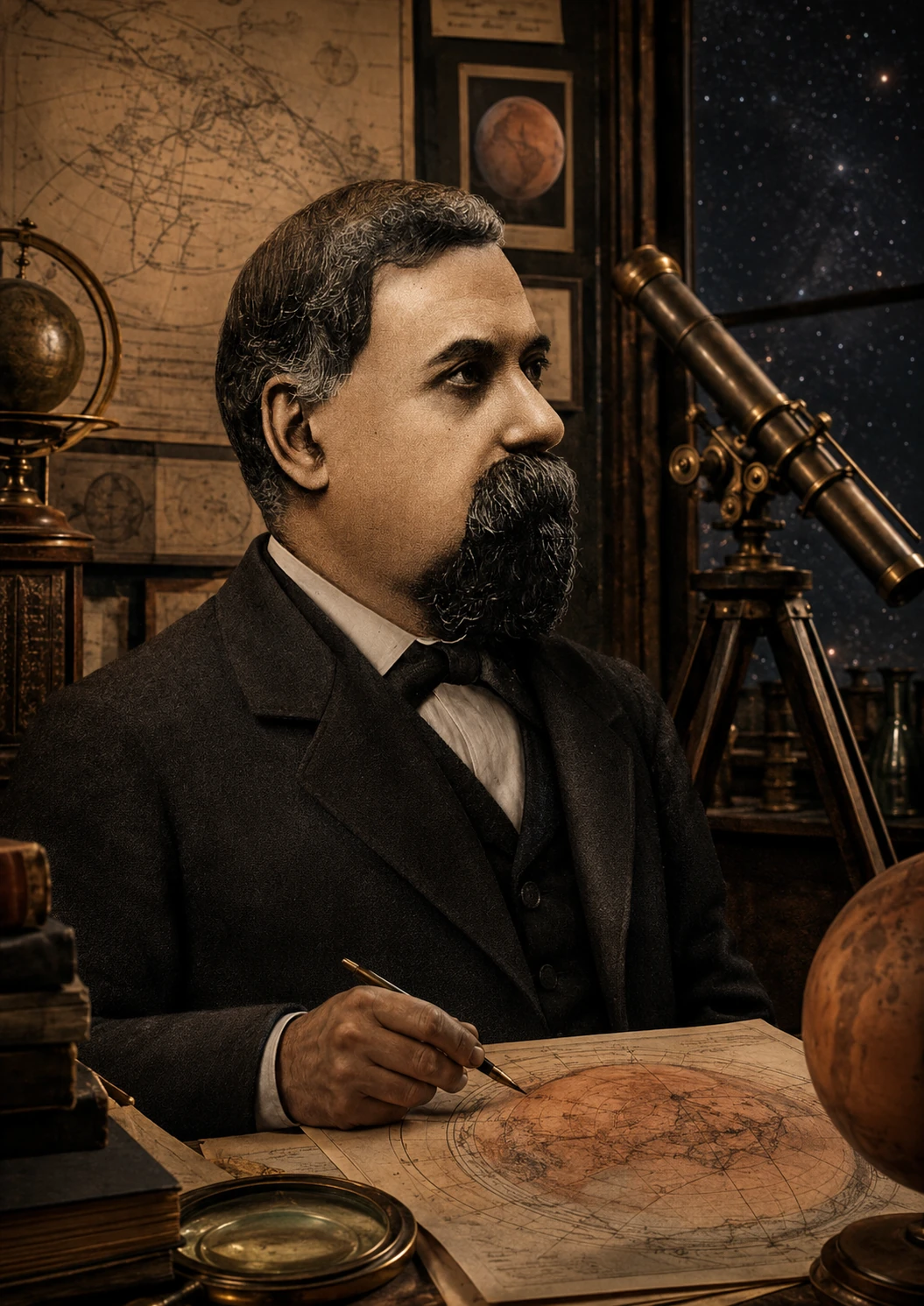
Chronological biography
The main narrative now follows the life in order: training, early work, acquired skills, missions, difficulties, teams, and responsibilities before reaching the Mars legacy.
1835–1862 — Turin, Berlin and Pulkovo: moving from education to professional astronomy
1835–1862: Turin, Berlin, Pulkovo, and then Brera. Giovanni Virginio Schiaparelli was born in 1835 and trained in Turin. A scholarship then allowed him to study elsewhere in Europe, including Berlin under Johann Franz Encke and the Pulkovo Observatory near St. Petersburg. Moving through several astronomical centers exposed him to a culture of precision measurement that would shape his later work. He joined the Brera Observatory in Milan in 1860 as second astronomer and became its director only two years later, at age twenty-seven. INAF — Museo Astronomico di Brera Source.
Before Mars, Schiaparelli trained in a Europe where precision astronomy was changing rapidly. Turin gave him foundations, while work in Berlin and Pulkovo exposed him to advanced observing and calculation. At Brera he took on major responsibility while still young, forcing him to run an observatory as well as observe. That combination of instrumentation, calculation and organization explains why his Martian drawings carried so much authority: they came from an astronomer already respected for precision, not from a marginal observer interested only in the Red Planet.. Long before his famous maps of Mars, Schiaparelli therefore built a reputation through positional astronomy and careful instrumentation. The newly unified Italian state funded a Merz refractor for Brera that came into use in the 1870s. The institutional detail matters: maps of another planet do not come from an observer alone, but from instruments, funding, an observatory, and a method for comparing observations over time. Institutional source
Giovanni Virginio Schiaparelli was born in 1835 and trained at the Polytechnic University of Turin. A scholarship then allowed him to study across Europe, including work in Berlin with Johann Franz Encke and at Pulkovo Observatory near Saint Petersburg. This gave him an international education in positional astronomy and celestial mechanics before he joined Brera Observatory. Source
He became second astronomer at Brera in 1860 and director two years later, at only twenty-seven. The rapid promotion rested on substantial preparation: experience at major observatories, mathematical competence and the ability to argue for better instruments.
Giovanni Schiaparelli was born in Piedmont in 1835 and first trained as an engineer in Turin. That background matters because it gave him a culture of geometry, measurement and instrumentation before he specialized in astronomy. With scholarship support he continued his education in Berlin under Johann Encke and then at Pulkovo Observatory. He therefore learned inside several scientific traditions before returning to Italy. His Mars career began with a long apprenticeship in precision rather than with an isolated fascination for the red planet. Source
Before the canali: a reputation built on measurement. Reducing Giovanni Schiaparelli to the famous Martian canali hides most of his scientific formation. At Brera he worked on celestial mechanics, double stars, comets, meteors and mapping. His studies linking meteor showers with cometary orbits show a scientist accustomed to connecting observations that initially appeared separate. That background matters for Mars. Schiaparelli was trying to turn a variable telescopic image into named, measured features that could be compared from one opposition to another. He had no high-resolution planetary photography, no spacecraft and no modern detector; the observer, telescope and terrestrial atmosphere were all part of the measurement chain. Source.
Directing Brera Observatory also placed him inside an institution that had to maintain instruments, train observers, preserve series and publish results for comparison elsewhere. Mars was therefore one dramatic chapter in a much broader career. This perspective is important when judging later errors: the interpretation that grew around the canals should not be projected backward onto every part of his work. A careful history separates what Schiaparelli reported, the words he used, and the much larger story that later writers and observers built from those words. [source]
His Mars campaigns beginning around the 1877 opposition attempted to compare details from one observing season to another and establish a stable nomenclature. The Italian word 'canali' described linear features seen or interpreted near the limit of the instrument. Translation into the English word 'canals' encouraged a much stronger implication of artificial engineering. The episode shows that scientific information can be distorted not only by limited instruments but also by the vocabulary used to communicate observations. Source
The 1877 observations are also a lesson in how a technical word can acquire a public life of its own. Schiaparelli’s canali described linear features in an observational vocabulary; later translations and popular interpretations helped turn them into ‘canals’ carrying implications of construction and intelligence. The biography therefore has to separate the observer’s measurement problem from the cultural story that grew around it. Better instruments eventually changed the evidential landscape, but the episode had already shaped decades of Mars imagination. [source]
Brera matters in that story because repeated planetary observation depends on institutional continuity: instruments, observing time, comparison across oppositions and disciplined recording. Schiaparelli’s legacy is not that every interpretation survived. It is that the map, the nomenclature and the observational record gave later astronomers something explicit to test and revise. That is a durable scientific contribution even when a famous interpretation proves unstable. [source]
1862–1877 — Brera: becoming director and building a reputation through measurement
1877 — Mapping Mars: when measurement matters more than narrative
1877: the scientific problem was comparison, not merely seeing. The favourable 1877 opposition allowed Schiaparelli to pursue systematic mapping. Bright and dark features changed with resolution, atmospheric seeing and visual adaptation, so the central challenge was to build a geography that other observers could discuss. His nomenclature became one of the most durable products of that work. Even when spacecraft later transformed the physical interpretation of Mars, naming features created continuity between observations separated by decades and by entirely different instruments.
The word canali then became the centre of a historic misunderstanding. In Italian it can refer to channels or grooves without asserting that they were engineered. In English, canals strongly suggested artificial construction. A linguistic nuance therefore acquired a technological implication and eventually a civilizational narrative. The episode is a powerful rule for a modern technical encyclopedia: translation must not add mechanism or intention that the observation itself did not establish. A rigorous account should preserve original terminology when it matters, explain the possible meanings, and visibly separate observation, interpretation and speculation.
Schiaparelli's maps contained fine structures he called canali. In Italian the word can mean channels and does not automatically imply artificial construction. Translation and later interpretation nevertheless helped turn the markings into “canals” and then into supposed evidence of Martian engineering. Schiaparelli himself was more cautious than some popularisers who followed him. Source
The episode became a classic lesson in perception near an instrument's limit. The eye can organise weak details into coherent lines, especially when observers know what pattern they are seeking. Spacecraft later removed the artificial network from Mars, but they did not make Schiaparelli irrelevant. His career shows how planetary cartography worked before close-up imaging and why modern science uses independent instruments and observers before turning ambiguous shapes into geology.
Modern spacecraft replaced telescopic sketches with images and measurements of incomparably greater precision. Yet the basic practices of mapping, naming, comparing and searching for change remain central to planetary science. Schiaparelli's contribution should therefore be read on two levels at once: specific surface interpretations were superseded, while the effort to build a coherent geography helped transform Mars from a small telescopic disk into a world with regions that observers could compare across time. Source
1877 and after: mapping Mars, then learning to separate a word from what the instrument really shows. During the 1877 opposition Schiaparelli mapped the Martian surface and used the Italian word “canali” for some linear features. Its translation into English as “canals” helped turn uncertain visual structures into a story of artificial works. The episode became a lasting lesson in scientific method: ambiguous observations, suggestive language, and cultural expectation can build a theory stronger in public imagination than in the data. Spacecraft later corrected the interpretation without erasing the historical importance of one of the first sustained attempts to compare and map Mars as a world. ESA — From canals to craters Source.
Under Schiaparelli, Brera obtained a high-quality refractor. Much of his work concerned double stars, comets and meteors; he famously connected meteor showers with cometary orbits. That work reveals his method—accumulate measurements, compare geometries and search for a common physical explanation. Source
His systematic Mars programme began almost opportunistically. When conditions were poor for precise double-star work, he turned the telescope toward Mars and realised the new instrument showed surface detail missing from existing maps. He then observed the planet over successive oppositions. Mars became a programme because instrument, method and question met at the right time.
At Brera, Schiaparelli quickly became a central figure and took responsibility for the observatory while still young. He helped obtain improved instruments and worked on subjects beyond Mars, including small bodies and the relationship between meteor streams and comets. That work is important because it reveals an astronomer accustomed to connecting observations separated in time and reasoning through orbital relationships, not merely a draftsman of planetary maps. Source
After the canali — Separating what the instrument shows from what the public remembers
After the canali: a career should not be reduced to the mistake that became famous. Reducing Schiaparelli to the “canals” produces a poor biography because it erases the scientist who built maps, nomenclature, and a method of comparing repeated observations. Directing Brera also meant maintaining an observatory, working with available instruments, and placing measurements inside an institutional continuity. The Mars controversy then exposed the difference between observing, describing, and interpreting. A feature can be honestly recorded at the eyepiece, given a word, translated into another language, and finally supplied with an explanation far more ambitious than the original information supports. Reading Schiaparelli in order therefore reveals both the growth of a precision astronomer and the way science can drift collectively without every individual observation being fraudulent. The lesson remains directly relevant to modern images and maps of Mars.
What spacecraft corrected without erasing Schiaparelli. Space missions rebuilt the map of Mars. Mariner 4 revealed a much thinner atmosphere than many had expected and showed cratered terrain; Mariner 9 and Viking later exposed volcanoes, canyons, plains, valley networks and a geological diversity incompatible with a simple planet-wide system of artificial canals. The correction did not make the telescopic era scientifically useless. It showed how science changes when a new instrument alters both resolution and the type of measurement available.
Schiaparelli remains important for two reasons. He helped turn Mars into a coherent cartographic object, and his legacy offers a lesson about observation near the limit of perception. Future Mars exploration will face analogous problems with automated classifiers, compressed imagery and AI-generated interpretations. The more convincing an analytical tool appears, the more important it becomes to preserve the path back to raw data, reproducible processing and independent comparison. The historical canal problem is therefore not an obsolete curiosity; it is a warning about every instrument that sits between a distant world and the human conclusion drawn from it.
Supplementary documentary analysis
Biographical analysis, context and legacy
Thematic analysis and deeper reading
Essential timeline
- Period1835–1910
- MarsMartian mapping and nomenclature
- LegacyCanali: observation, translation and collective error
Deep reading: what this trajectory teaches
Primary and institutional sources
Additional sources: Brera Astronomical Museum — Schiaparelli
Verification rule: this biography prioritizes institutional, archival and primary sources. Statements about living people or active programs are dated and attributed; uncertain or disputed points must remain explicitly qualified.