


MARS BIBLE — PEOPLE
Asaph Hall
Asaph Hall's documented nationality or citizenship is American; the documented birthplace is Goshen, Connecticut, United States. Asaph Hall matters to Mars because in 1877 he discovered Phobos and Deimos, the planet’s two natural satellites. Yet his biography is more than the famous nights of discovery. Beginning with limited formal scientific preparation, he advanced through mathematics, observation and painstaking measurement until he reached the U.S. Naval Observatory. Following Hall’s career shows how patience, instrumentation and verification turned a self-made astronomer into the person who permanently expanded humanity’s map of the Martian system.
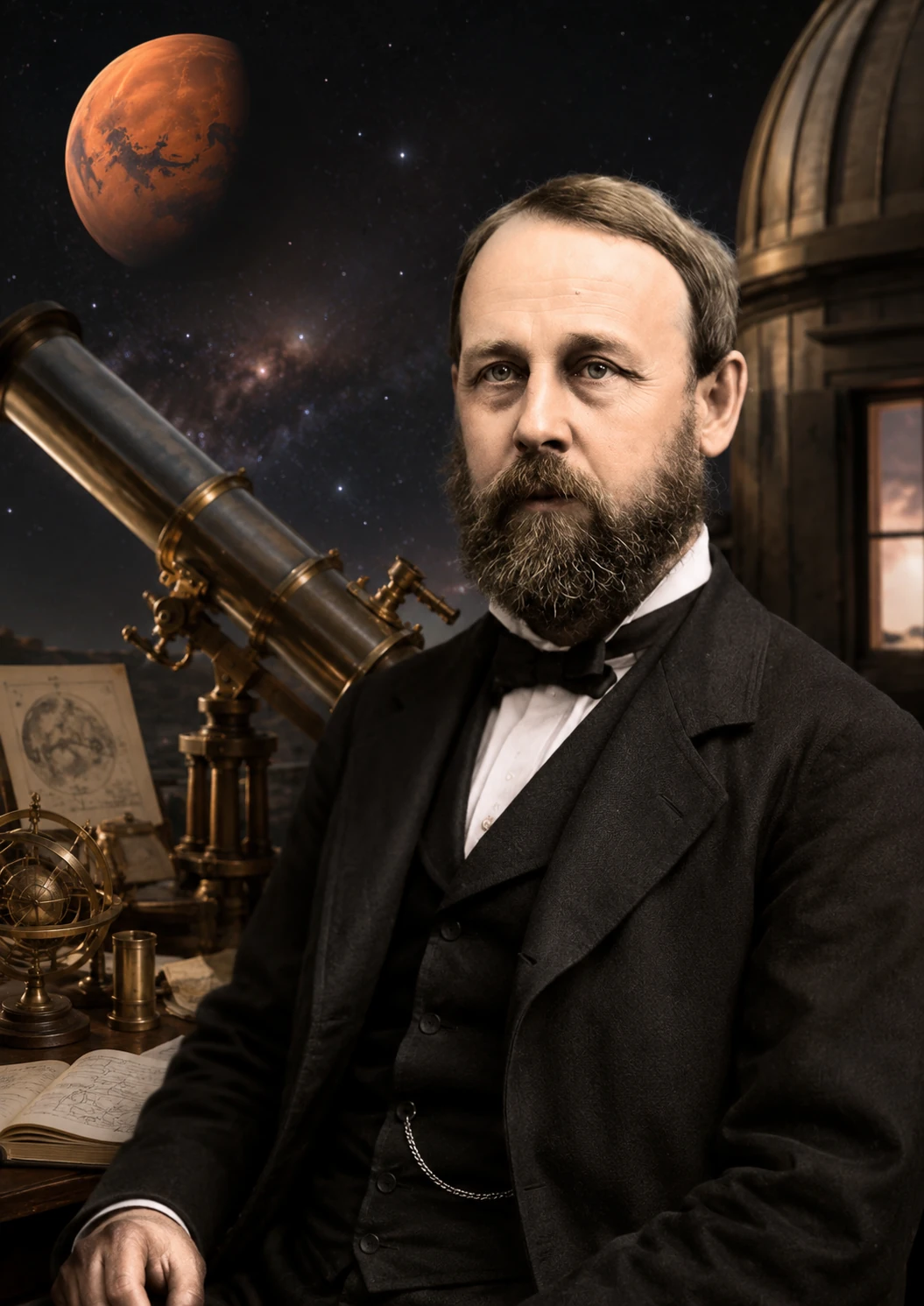
Chronological biography
The main narrative now follows the life in order: training, early work, acquired skills, missions, difficulties, teams, and responsibilities before reaching the Mars legacy.
1829–1862 — From Goshen to professional astronomy
1829–1862: from Goshen to professional astronomy. Asaph Hall III was born on October 15, 1829, in Goshen, Connecticut. His route into astronomy was gradual rather than the product of an elite observatory career planned from childhood. By 1857 he had become an assistant at Harvard College Observatory, where the daily discipline of positional astronomy taught him that precision, repetition, and patience mattered as much as inspiration. Library of Congress — Asaph Hall Papers Source.
Hall did not begin with a private observatory or an elite academic career. He built his competence gradually through mathematics and observation until he entered an environment where precision measurement became everyday work. That slow ascent is essential to understanding 1877: when he searched for Martian satellites with the large Washington refractor, the discovery was not an isolated stroke of luck but the result of years spent mastering weak signals, repeating observations and refusing to treat a result as secure before verification.. In 1862 Hall moved to the U.S. Naval Observatory in Washington as an aide and became professor of mathematics there in 1864. The transition placed him in an institution where timekeeping, celestial mechanics, instrument control, and exact measurement were routine work. His later discovery of the Martian moons therefore makes more sense when read as the culmination of years spent learning how to distinguish a faint moving object from instrumental error or wishful thinking. Institutional source
Asaph Hall III was born on 15 October 1829 in Goshen, Connecticut. Library of Congress records show a career that did not begin in an elite observatory. His mathematical education developed gradually, and his early working life included manual trade skills before astronomy became a profession. His marriage to Chloe Angeline Stickney, an educated woman with strong mathematical interests, belongs to the same period in which study at home and personal discipline preceded institutional astronomy. Source
When Hall joined Harvard College Observatory as an assistant in 1857, he arrived as a working observer rather than a celebrity. The job meant repeated measurements, instrument preparation and learning how atmosphere and optics can mislead the eye. The future discoverer of Phobos and Deimos built expertise by learning which faint signal deserved another observation.
Hall joined the U.S. Naval Observatory in 1862 and became professor of mathematics in 1864. The observatory served practical needs in timekeeping, celestial positions and navigation. That culture demanded reproducible measurement rather than impressionistic observation. Source
This background explains why the 1877 search for Martian moons should be told as an investigation, not a lucky glance. The large refractor provided reach, but Mars itself was bright and the satellites were faint. Hall had to return to the same region, compare positions and distinguish real orbital motion from background stars. The well-known account of Angeline urging him not to give up also shows that persistence can be a team property even when history remembers one name.
Asaph Hall's youth did not resemble the path of an astronomer trained from childhood in elite scientific institutions. Born in Connecticut in 1829, he grew up in a rural setting and first worked in occupations far removed from a prestigious research career. That origin makes his transition into astronomy especially instructive. He accumulated education, mathematics and observational practice step by step rather than entering a major observatory with a ready-made professional identity. Source
A career in precision before the famous discovery. Asaph Hall is often compressed into two nights in August 1877, but his career was built in the precision astronomy of the nineteenth century. After work at Harvard he joined the U.S. Naval Observatory, an institution deeply connected with navigation, timekeeping and accurate celestial positions. That environment demanded repeatable measurement rather than dramatic speculation. When Hall searched around Mars, he brought years of experience in detecting and checking small changes in position. Source.
The Observatory’s 26-inch refractor was one of the great instruments of its time, yet aperture did not remove the difficulty. The moons were faint and close to the glare of Mars. The task combined optics, atmospheric seeing, contrast and orbital geometry. Discovery required repeated observations of the same field and proof that a point of light moved like a body bound to Mars rather than a background star. The instrument made the search possible; disciplined comparison turned a possible detection into a discovery.
During the 1877 Mars opposition Hall used the observatory's large refractor to search for companions close to the bright planet in the apparent field. The problem involved glare, instrumental limits and extremely small targets. Observations had to be repeated and relative motion verified. The episode is therefore a useful lesson in method: persistence only becomes scientific when it is paired with a procedure for confirmation rather than a desire to see what the observer hopes is present. Source
1877 — Searching around Mars until doubt became part of the method
1877: searching around Mars until doubt becomes part of the method. During the favorable 1877 opposition of Mars, Hall used the U.S. Naval Observatory’s large refractor to search the planet’s immediate neighborhood. In August he found first Deimos and then Phobos. The episode is more useful than the usual one-line summary suggests: the work required the right instrument, repeated observations, orbital reasoning, and the discipline to verify that a point of light behaved like a satellite. The result added two worlds to the Mars system and, much later, gave mission designers additional scientific targets and orbital stepping stones. NASA Science — Mars Moons Source.
Hall gradually strengthened his training and worked in astronomy before joining the U.S. Naval Observatory in the early 1860s. Daily observatory work emphasized precise measurement: star positions, timing, orbital calculations and repeated observations. That background is essential to understanding 1877. The discovery of Phobos and Deimos was not a lucky glance by an amateur; it came after years of learning what an instrument could show and how to distinguish a weak moving object from an observational error. Source
The discovery of Phobos and Deimos was not only a matter of having a large refractor available. Hall had to decide where to look, repeat observations and determine whether a faint point of light moved consistently enough to be a satellite rather than an artefact or background star. That process makes the episode useful to a modern Mars audience: discovery is a chain of observation, doubt, confirmation and communication rather than one dramatic glance through a telescope. [source]
The moons later became engineering destinations in their own right, especially Phobos. Hall could not have anticipated modern sample-return studies, relay concepts or crewed staging scenarios, but the objects he identified changed the geometry of Mars exploration permanently. His biography therefore connects nineteenth-century positional astronomy with mission questions that still exist today. [source]
August 1877: persistence as part of method. NASA’s historical account preserves the well-known story that Hall was close to abandoning the search when his wife, Angelina Stickney, encouraged him to continue. Deimos was detected and Phobos followed several nights later. The anecdote should not replace the observational method, but it captures a reality of field science: fatigue, weather, access to equipment and the decision to continue one more night can affect whether a phenomenon is ever recorded.
Once confirmed, the moons did more than add two names to the Solar System. Their orbits offered new constraints on the Martian system, and later spacecraft turned Phobos and Deimos into worlds with their own geology and dynamical history. Hall’s discovery therefore opened a scientific branch that remains active: capture versus impact origin, the inward evolution of Phobos, the composition of both bodies and their value as records of early Mars.
Hall found Deimos and then Phobos in August 1877. The discovery immediately changed the geography of Mars: the planet was now a small orbital system with two additional bodies to measure. They later became targets for spacecraft imaging, clues to satellite origins and possible elements in human exploration concepts. Source
For Mars settlement studies, Hall's lesson is methodological. He did not invent settlement technology; he expanded the system by revealing real objects that future maps, trajectories and mission assumptions had to include. Exploration often advances this way: one careful observation changes the model of the whole system.
Phobos and Deimos later changed status completely. Points discovered through a telescope became bodies mapped by spacecraft and possible targets for future missions. Their weak gravity and Mars-centered orbits now create navigation, science and perhaps logistics questions. Hall did not design any of those modern uses. His legacy is more fundamental: he added two physical worlds to the Mars system and provided the observations from which later generations could begin treating them as actual destinations. Source
After 1877 — Verification, measurement and the legacy of discovery
After 1877: discovery becomes a responsibility to verify. The discovery of Phobos and Deimos did not end Hall’s professional story. It required the opposite of a victory lap: positions had to be repeated, motions calculated, other observers enabled to confirm the objects, and the new moons incorporated into the celestial mechanics of Mars. That stage matters in a scientific biography because fame can arrive in days while durable value comes from the slower work that follows. Hall continued at the Naval Observatory as a practitioner of precision measurement. For a Mars reader the sequence creates a direct bridge from nineteenth-century astronomy to modern engineering. The moons’ orbits, periods, masses, and long-term evolution are no longer curiosities; they are physical constraints that robotic and human mission designers must respect.
From telescopic points to mission architecture. Phobos and Deimos are now targets for close observation and sample-return concepts. JAXA’s MMX mission is designed to investigate the moons and return material from Phobos, connecting a nineteenth-century visual discovery with twenty-first-century planetary geochemistry. This gives Hall a direct place in a Mars colonization encyclopedia. Small moons may become useful scientific or operational locations, but that value has to be demonstrated rather than assumed.
It would be premature to describe them automatically as refuelling depots or crewed staging bases. Their utility depends on composition, trajectories, surface hazards, propulsion and the cost of building infrastructure there. Hall’s deeper lesson is that apparently minor objects can acquire strategic importance after later measurements reveal new possibilities. Mars exploration should therefore preserve curiosity about secondary targets. The future operational value of a dataset is not always visible when the observation is first made.
Supplementary documentary analysis
Biographical analysis, context and legacy
Thematic analysis and deeper reading
Essential timeline
- Period1829–1907
- MarsPhobos and Deimos, August 1877
- LegacyPersistence in visual observing before planetary photography
Deep reading: what this trajectory teaches
Primary and institutional sources
Additional sources: Library of Congress — Asaph Hall Papers · USNO — history
Verification rule: this biography prioritizes institutional, archival and primary sources. Statements about living people or active programs are dated and attributed; uncertain or disputed points must remain explicitly qualified.