


MARS BIBLE — PEOPLE
Percival Lowell
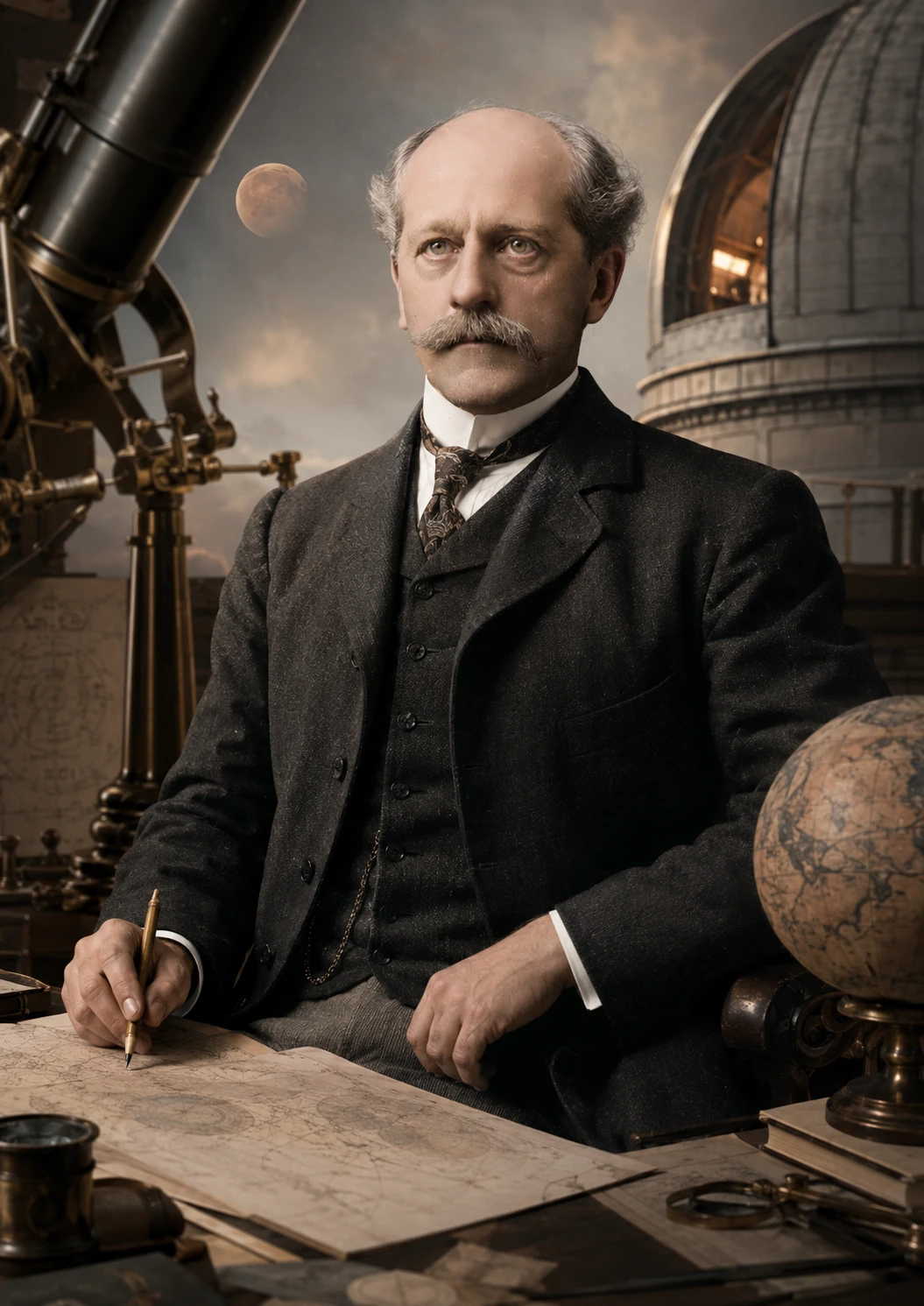
Percival Lowell's documented nationality or citizenship is American; the documented birthplace is Boston, Massachusetts, United States. Percival Lowell profoundly shaped the popular image of Mars, for better and for worse. Born into a prominent Boston family, educated at Harvard and later a traveler and observer, he founded his own observatory and devoted a major part of his life to Mars, convinced that he saw a network of artificial canals. His biography matters because it reveals both the power of new instrumentation and the danger of letting an attractive hypothesis blur the boundary between observation, interpretation and desire.
Chronological biography
The main narrative now follows the life in order: training, early work, acquired skills, missions, difficulties, teams, and responsibilities before reaching the Mars legacy.
1855–1893 — Boston, Harvard, family business and a decade in Asia
1855–1893: Boston, Harvard, family business, and a decade in Asia. Percival Lowell was born into a wealthy Boston family in 1855. He studied mathematics at Harvard and then spent several years in the family business. A long period in Asia came before his return to astronomy. The detail matters because the man who would found an observatory around planetary questions was not a professional astronomer following an uninterrupted academic career. He instead brought private means, mathematical training, and a habit of organizing his own projects. Lowell Observatory — founding correspondence. Before becoming associated with Martian “canals,” Lowell was a classically educated traveler and observer who chose to put substantial private resources behind an astronomical question. His choice of Flagstaff was not merely romantic: he sought altitude, dry air and a sky that could improve observing conditions. He installed dedicated instruments, organized observing campaigns and published extensively. That ability to create the infrastructure needed for his own hypothesis helps explain the enormous influence he later had on the image of Mars, even after his interpretations were superseded.. Source
When he returned to the United States in 1893, he decided to resume astronomy on an unusual scale. Schiaparelli’s observations and the debate over Martian “canali” gave him a question strong enough to justify building his own scientific infrastructure.
Percival Lowell was born into a wealthy Boston family in 1855. He studied mathematics at Harvard, spent years in family business and travelled extensively in Asia before returning to astronomy. That chronology matters because the founder of Lowell Observatory was not the product of an uninterrupted academic career. He returned to planetary science with mathematical training, experience organising independent projects and enough private resources to build infrastructure around a question he cared about. Source
This independence shaped his research style. He did not need an existing observatory to make Mars its priority. By the early 1890s he could turn a hypothesis into logistics: select a site, acquire instruments, hire observers and conduct repeated campaigns.
Percival Lowell was born in 1855 into a wealthy Boston family and received an education that gave him early access to mathematics, languages and travel. After Harvard he did not immediately become a professional astronomer. He worked in family business interests and spent long periods in Asia, writing about societies very different from his own. That stage matters because it strengthened a habit of building broad interpretations from scattered signs, a valuable skill for an essayist but a dangerous one when interpretation begins to outrun measurement. Source
1894 — Building Mars Hill to pursue a hypothesis
1894–1916: building Mars Hill to test an idea, then learning how an idea can survive its evidence. Lowell sent Andrew Douglass to search for a site with stable skies and selected Flagstaff, Arizona. The observatory opened in 1894, and Lowell devoted much of his energy and fortune to Mars. He drew, mapped, published, and defended networks of linear features until they became, in his interpretation, evidence for an engineering civilization on a drying planet. Lowell Observatory — Search for Life on Mars Source.
Lowell’s strength was also his weakness: he could build a coherent story from fragmentary observations and defend it with exceptional energy. The lines he believed he saw gradually became, in his interpretation, an organized network and then evidence of a civilization distributing water. That conclusion was wrong, but it had enormous cultural impact and stimulated further observation of Mars. For a modern Mars reference, his story is therefore valuable: it teaches us to admire the ambition of an observing program while separating strictly what an instrument shows from what the mind adds. Institutional source.
The biography then becomes a lesson in confirmation bias: an institution can produce real observations and a wrong theory at the same time. The canals did not survive better observations and twentieth-century spacecraft, but the observatory did. For a Mars reference work, Lowell therefore matters in two opposite ways — as an example of intellectual investment in a question and as a warning about allowing narrative coherence to outrun evidence.
When Lowell turned intensely toward Mars in the 1890s, he had the financial means to build an institution around the question. He selected Flagstaff, Arizona, and founded an observatory intended in part to benefit from favorable observing conditions. That decision created a genuine institutional legacy. Instead of merely commenting on other astronomers' work, he funded a site, instruments and sustained observing campaigns. His later scientific error over canals should not erase the fact that he built infrastructure capable of supporting research beyond his own hypotheses. Source
Building an observatory around a scientific hypothesis. Percival Lowell did not enter Mars studies through a conventional academic career. Coming from a wealthy Boston family after years of travel and writing, he turned his interest in Martian observations into an institution in the early 1890s. Establishing the observatory at Flagstaff was a scientific and logistical decision: leave bright, turbulent cities, test candidate sites, install instruments and organize repeated observing campaigns. Lowell Observatory’s own archives show how site testing by Andrew Douglass and local support contributed to the choice. The method of building a durable observing capability was serious even though the central Martian interpretation would later prove wrong. Source.
The episode demonstrates how a compelling question can create infrastructure that outlives the question itself. A Mars settlement should be designed with the same possibility in mind. Laboratories, archives and observation systems must remain useful when initial expectations about water, biology or resources are overturned. Infrastructure becomes scientifically mature when it can survive the failure of the theory that originally justified it. [source]
In 1894 Andrew Douglass travelled through Arizona for Lowell with a telescope, testing atmospheric stability and sky quality. Flagstaff was selected and the observatory was established on Mars Hill. The logistics are scientifically important: before Mars could be interpreted, the programme needed access, a dome, a mount, good optics, weather and repeated nights of observation. Source
Lowell therefore converted a private fascination into an institution that outlived several of his Martian conclusions. That distinction is valuable: good infrastructure and an important question do not guarantee that the first interpretation will be correct. [source]
The central problem was interpretation. Starting from Schiaparelli's 'canali', Lowell developed a picture of regular networks that he connected to an intelligent Martian civilization managing a drying planet. The story was coherent, memorable and culturally powerful, but coherence is not measurement. As instruments improved, Mars resisted the model. The biography therefore becomes a useful study in confirmation bias: the more completely a theory seems to explain a world, the more important it becomes to define in advance what observations would count against it. Source
Lowell’s money was not a footnote to the science: it gave him the ability to turn a personal hypothesis into observing infrastructure. Site selection at Flagstaff, telescope construction, publication and repeated observing campaigns created an institution capable of pursuing a question for years. That is precisely why his case is more instructive than a simple story about ‘wrong canals’. Scientific influence can come from the combination of capital, institutional persistence and a compelling explanatory story even when the interpretation itself eventually fails. [source]
The later history of Lowell Observatory also prevents the biography from ending with a verdict of failure. The canal hypothesis did not survive better evidence, but the institution did. That distinction is valuable for a Mars reference site: a project can be scientifically wrong in one generation and still leave instruments, archives, trained observers and organizational capacity that enable better science in the next. The observatory’s own historical material and ESA’s retrospective on the canal era support that two-level reading. Lowell Observatory · ESA.
The “canals” — When a coherent narrative becomes stronger than ambiguous evidence
When a coherent story becomes stronger than ambiguous evidence. Lowell did more than report linear markings. He built a comprehensive story in which Mars was an ageing, drying world and intelligent inhabitants had constructed an irrigation network carrying water from the polar regions. The idea was persuasive because it connected many observations into one narrative. Every line could appear to belong to the network; seasonal changes could be interpreted as evidence of activity. That coherence was exactly the methodological danger. A theory can become so flexible that ambiguous observations are absorbed into it rather than used to test whether it is wrong.
Books such as Mars and Its Canals gave this interpretation an audience far beyond specialist astronomy. The public encountered an engineered, inhabited Mars, and the concept flowed into popular culture and science fiction. A modern Mars encyclopedia has to learn from that success as well as the error. The more dramatic the conclusion, the more visible the uncertainty must become. A beautiful map, rendering or engineering scenario should never be presented as an official architecture or as the necessary implication of data that still permit several explanations.
Lowell's legacy is therefore double. His artificial-canal interpretation was abandoned, yet the observatory he created endured and supported other work, including Clyde Tombaugh's discovery of Pluto in 1930. For Mars science, Lowell is a reminder that a mistaken interpretation can coexist with useful infrastructure. The lesson is neither to mock the observer nor to rescue the theory, but to keep data, interpretation, institutional achievement and level of evidence clearly separated. Source
The story matters because it demonstrates both the power and the risk of an institution built around a very strong question. Lowell created a site capable of producing genuinely high-level observations, but his interpretation of Martian canals also shaped the reading of those observations. The observatory would survive that hypothesis and later produce major discoveries. In Mars history Lowell is therefore more interesting as an example of how funding, instruments, people and conviction can accelerate research — and sometimes amplify an error — than as a prophet who simply 'got Mars right'. [source]
Refutation and legacy — A theory disappears while a scientific institution remains
A false theory can still leave a productive institution. Lowell’s canals gradually lost credibility as observations improved and became incompatible with spacecraft imagery. Yet the observatory he founded continued to produce important astronomy. Later work at Flagstaff contributed to the search that led Clyde Tombaugh to discover Pluto in 1930. The continuity is a reminder that institutions can outlive the mistakes of founders when their instruments, archives and methods remain open to correction.
Lowell therefore deserves neither hero worship nor caricature. His Mars work combines private funding, sincere observation, confirmation bias, powerful public communication and durable institution-building. That combination is directly relevant to future Mars programs. A mature settlement must be able to admit that an early hypothesis was wrong without destroying the organizations that accumulated useful measurements. Error correction is not a scandal in science; it is one of the functions an institution must be designed to perform.
Mars, canals and the cost of confirmation bias. Lowell adopted the linear features associated with Schiaparelli's observations and interpreted them as a network of canals built by an intelligent civilisation on a drying planet. He mapped, published and argued for the idea with extraordinary energy. The story was powerful because it linked multiple observations to one global explanation. Source
Later observations and spacecraft destroyed the artificial-canal hypothesis. Yet Lowell remains central to Mars history because he illustrates a modern scientific rule: a hypothesis must remain vulnerable to contrary evidence. His legacy is therefore both cultural and methodological—an example of how a compelling narrative can outrun the data that first inspired it.
1916: why a scientific biography must also tell what does not survive new evidence. Lowell died in 1916 without seeing the spacecraft that would dismantle the Mars he had helped popularize. That is exactly why the end of his chronology matters. He built a lasting institution, drew public attention toward planetary astronomy, and pursued observations with remarkable energy while defending an interpretation of Martian markings that later evidence would not confirm. A serious biography has to keep both realities together. The institutional legacy of the observatory does not validate the canal theory, and the failure of the canal theory does not erase the observatory’s historical importance. Separating person, institution, method, and conclusion remains a useful lesson for Mars today: an attractive architecture or a popular interpretation must remain revisable when a better instrument produces better evidence.
Supplementary documentary analysis
Biographical analysis, context and legacy
Thematic analysis and deeper reading
Essential timeline
- Period1855–1916
- MarsMars and the canal theory
- LegacyA major case study in science, bias and popular culture
Deep reading: what this trajectory teaches
Primary and institutional sources
Additional sources: Lowell Observatory — founding correspondence · Lowell Observatory — The Founding
Verification rule: this biography prioritizes institutional, archival and primary sources. Statements about living people or active programs are dated and attributed; uncertain or disputed points must remain explicitly qualified.