


MARS BIBLE — PEOPLE
Donna Shirley
Donna Shirley's documented nationality or citizenship is American; the documented birthplace is Pauls Valley, Oklahoma, United States. Donna Shirley helped make a new generation of Mars exploration possible at a time when aerospace engineering still offered women very few open doors. Joining JPL in 1966 as an engineer, she moved from aerodynamics and planetary studies into mobile vehicles and ultimately led the Mars program that delivered Pathfinder and Sojourner. Her career is exemplary because it shows how technical work becomes institutional capability: persuade an organization to try a small rover, learn from it, and make mobility a normal tool of Martian exploration.
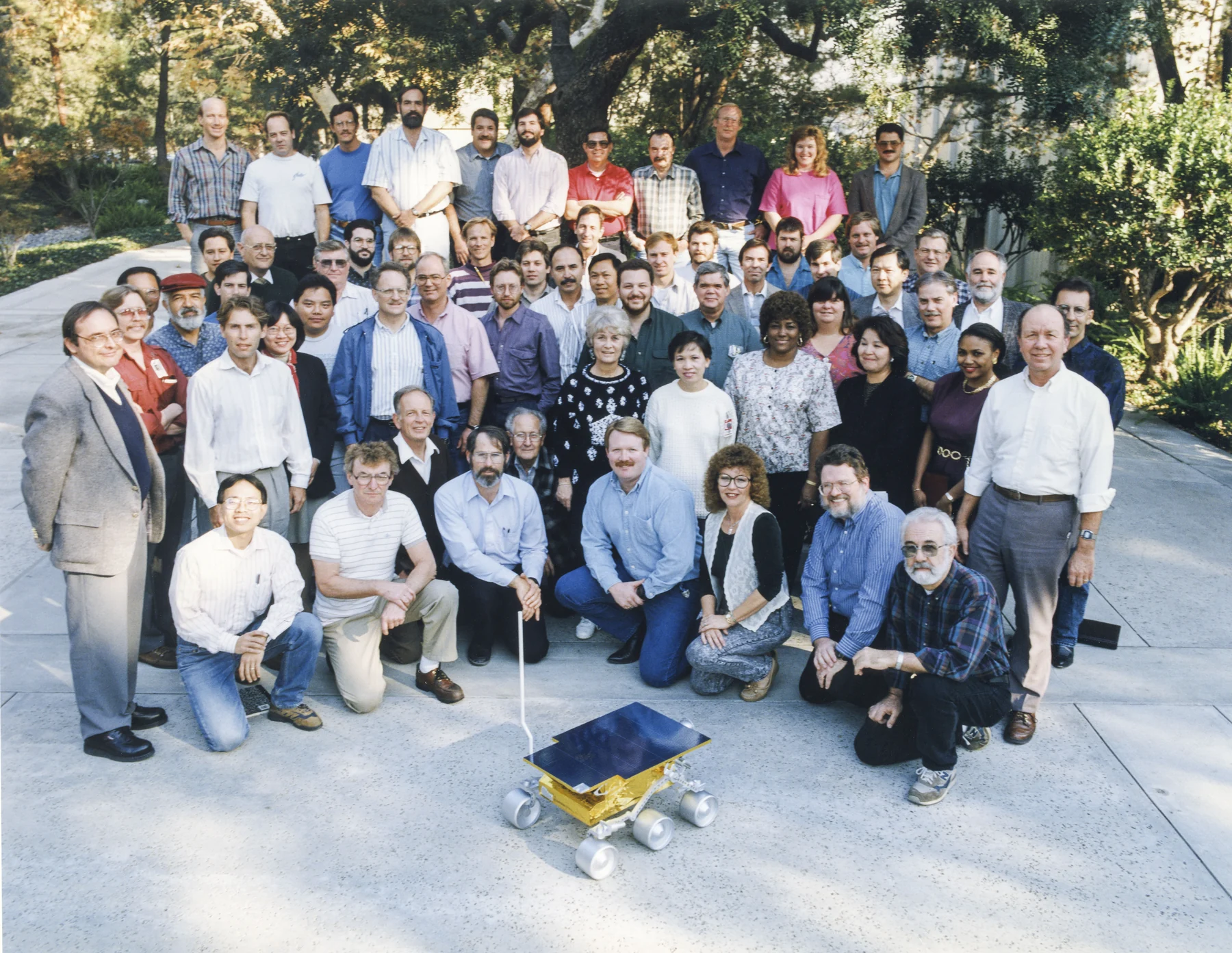
Donna Shirley — from the first Mars microrover to a management method for planetary exploration
Donna Shirley’s career connects personal chronology, technical choices, integration conflicts, Mars-program organisation and management learning. The narrative stays centred on her trajectory: what she learned, the responsibilities she assumed, the decisions she made and what she transmitted to later teams.
I. Oklahoma, education and early work: becoming an engineer before the path was open
Donna Shirley was born in Oklahoma in 1941 and grew up at a time when aviation could inspire young people while engineering remained unusually closed to women. Her interest in flight appeared early: as a teenager she learned to fly and earned a pilot license before she had a professional engineering career. That detail helps explain her later work. She did not encounter vehicles only as drawings and equations; she also understood that a machine has to be operated, that procedures matter and that real hardware always exposes assumptions that looked harmless on paper. Source
From Wynnewood to JPL: writing, engineering and systems before the rovers. Donna Shirley was born in Wynnewood, Oklahoma. Her education was not narrowly technical: she first earned a degree in technical writing, then a bachelor's degree in aerospace engineering from the University of Oklahoma and later a master's degree in aerospace engineering from USC. That combination matters. Large space programs need calculations, but they also need requirements that can be understood across disciplines, decisions that can be documented and architectures that can be explained well enough for teams and institutions to change them.
At the University of Oklahoma Shirley entered engineering in an environment where women were still rare. The challenge was not merely cultural. She had to acquire the same mechanics, structures, propulsion and analytical foundations as everyone else while repeatedly proving that she belonged in the discipline. That experience helps explain a later management style centered on making unconventional projects credible. A new technical idea is not enough: a team must earn the budget, test time and institutional confidence required to turn the idea into flight hardware. Source
Future settlement programs should preserve the same logic. A campaign becomes robust when failure of one demonstration does not invalidate the entire objective. A drilling test can fail without cancelling the crewed program if the campaign has time and resources to learn and retry. Exploration becomes mature when it treats failure as information without becoming casual about avoidable mistakes.
Mars settlers will need an even stronger version of this norm. A repaired valve, locally manufactured seal or modified robot should be tested in a safe configuration before being trusted with life-critical duty. A community that treats test failure as shame will hide problems; one that treats it as information can improve before the environment chooses the test conditions for them.
After JPL, Shirley continued to teach and write about the management of creative technical teams. The University of Oklahoma notes that she later served as an assistant dean and instructor in aerospace and mechanical engineering after her 32-year JPL career. [source] That later work provides a useful lens for Pathfinder: an innovative team does not succeed because everyone is unconstrained. It succeeds when the organization makes room for unconventional solutions while preserving cost, schedule, interface and safety requirements.
Oklahoma before Mars: choosing engineering when the expected path pointed elsewhere
Donna Shirley's connection to Mars begins long before there was a practical rover program to join. She grew up in Wynnewood, Oklahoma, in an era when engineering was presented to many girls as somebody else's profession. In later interviews she recalled being told, in direct terms, that girls could not be engineers. Her response was not a developed social theory but a stubborn decision that the rule did not describe her. The 2024 Caltech Heritage Project interview preserves that memory, while JPL historical material makes clear how unusual it remained for a woman with an engineering degree to enter the laboratory in the mid-1960s. [1] [2]
The often-retold decision to take mechanical drawing rather than the class expected of girls matters because it is more than a symbolic act. Mechanical drawing is a language of interfaces. It forces a designer to convert an idea into dimensions and relationships that another person can inspect. Decades later Shirley would spend much of her career doing the organizational equivalent: translating between specialists, projects, contractors and managers so that separate ideas could become one flight system.
She also learned to fly as a teenager and is widely documented as earning a pilot's license at sixteen. That fact should not be turned into a deterministic origin story, as though aviation automatically leads to planetary engineering. Its value is that flying teaches the relationship between a physical system, procedures, perception and consequence. An aircraft does not care whether an incorrect decision was well intentioned. Spacecraft engineering would later extend that discipline to vehicles that cannot be reached after launch. [3]
Shirley has also been unusually open about not being a uniformly perfect student. Her path involved social life, changing plans, an engagement that did not last and a decision to complete a writing degree before returning to engineering. That irregularity makes the story more useful, not less. It shows that high-level technical careers are not produced only by linear academic biographies. Future Mars programs will need organizations capable of recognizing persistence, judgment and systems ability in people whose histories do not resemble an idealized pipeline.
The gender context also requires precision. Women already performed essential work at JPL, including the human computers who carried out calculations before modern digital computing became ubiquitous. Shirley should not be used to erase those histories. Her distinctive trajectory lies in entering as a degree-holding engineer when such women were exceptionally rare, then moving through technical and managerial roles until she was leading a major planetary program. [2]
That progression creates the central question for the rest of the book. How does a person move from being permitted to work on one technical problem to being trusted to organize many technical communities? In Shirley's case, the answer is not a single breakthrough. It is decades spent learning how calculations become requirements, how requirements become hardware, how hardware becomes operations and how institutions either preserve or destroy the knowledge generated along the way.
Professional writing and aerospace engineering: learning that precise language is part of system safety
Shirley's educational record is often compressed into a list of degrees, but the sequence is revealing. She first completed a degree in professional writing, worked as a specification writer in the aerospace industry, returned to the University of Oklahoma to finish aerospace engineering and later earned a master's degree at the University of Southern California. The writing degree was not simply an abandoned detour. It taught a discipline that would remain relevant throughout systems engineering: an idea has to be expressed in a form another person can implement without sharing the author's private assumptions. [1] [4]
A technical specification is a boundary object between organizations. It states what a component must do, under which conditions, within what tolerances and with what evidence of compliance. Many famous engineering failures are not failures of basic physics. They are failures of interfaces, conventions, units, requirements or responsibility. The ability to write clearly is therefore not cosmetic. In a distributed program, language is part of the control system.
Her time at McDonnell also exposed her to aerospace as a contractual enterprise. Missions and vehicles are built through proposals, budgets, suppliers and formal deliverables. Shirley later described working on a Mars-related proposal before seeing an opportunity at JPL. The laboratory represented the place where planetary exploration was actually being done, and she joined it in 1966. [1]
This industrial background helps explain why she later cared so much about integrated teams. A mission may involve NASA, JPL, contractors, universities and instrument organizations. A contract can define responsibilities, but it cannot by itself create a common mental model. Teams need shared data and a shared understanding of what counts as success. Shirley would later praise tightly integrated project cultures in which the practical distinction between laboratory and contractor mattered less than the common cost and schedule constraint.
Her graduate aerospace education remained heavily rooted in aeronautics, as was normal for the period. That training was directly useful when she entered work connected to planetary atmospheric entry. Mars has a thin atmosphere, but it is dense enough to create heating and aerodynamic forces while being too thin to make descent easy. The problem sits precisely at the boundary between aeronautics and spaceflight.
The combination of writing and engineering later made Shirley an unusually effective recorder of organizational experience. Managing Martians and Managing Creativity are not substitutes for official mission reports, but they preserve decisions, conflicts and management patterns that formal documents often omit. A program that retains only hardware drawings and loses the reasons behind its decisions has not preserved its full design.
Entering JPL in 1966: Mars entry studies, human computers and the culture of early planetary engineering
When Shirley arrived at JPL, planetary exploration was still young. Mariner 4 had only recently returned the first close images of Mars, and the successful Viking landings were still a decade away. Her early work included aerodynamic studies relevant to bringing vehicles through the Martian atmosphere. The uncertainty was far greater than engineers face today because atmospheric properties, surface conditions and mission heritage were limited. [3] [6]
The laboratory itself was in a transition between human calculation and increasingly capable electronic computers. Shirley remembers women whose job title was effectively “computer,” carrying out navigation calculations with mechanical or electromechanical machines. Later, some of those women worked in organizations she managed. The memory is important because it shows that computation is always embedded in an institution: somebody defines the equations, checks the inputs, reviews the result and decides whether the number can be trusted. [1]
That experience contributed to a management lesson she would repeat in different forms. A manager of a complex system cannot personally redo every specialist calculation. The job is to know where expertise resides, what review makes it trustworthy and which assumptions could change the decision. Authority and technical depth are distributed across different people.
JPL also exposed Shirley to rapid changes of assignment. She has described moving between trajectory analysis and an automated drug identification project when she and a colleague realized that each was more interested in the other's work. Such movement may look inefficient from a narrow specialization model, but it developed her ability to learn new systems and identify interfaces. The skill later became central to program management.
Work on terrestrial systems and technology applications further widened the boundary of what she understood as engineering. A technically feasible solution could fail because of regulation, economics or user behavior. That discovery would matter when she later treated Mars not as one spacecraft but as a program with budgets, institutions and public legitimacy.
These early years therefore created the foundation for the role she would play in robotics. She learned that the physical vehicle is only part of the system. The rest includes calculations, people, organizations, documentation and decisions. Sojourner would succeed not because a clever rover existed in isolation, but because those layers were made compatible enough to survive flight.
Mariner 10: gravity assist, navigation and the management of expertise
In the early 1970s Shirley worked on the Mariner Venus-Mercury mission, later known as Mariner 10. The mission used a Venus gravity assist to reach Mercury, demonstrating an operational technique that would become fundamental to deep-space mission design. JPL's biographical material identifies Shirley as a mission analyst, and her later interview describes her contact with the navigation and mission-design teams. [7] [1]
The mission illustrates a systems principle that would follow her career: the environment can become part of the vehicle architecture. Venus is not merely an intermediate destination. Its gravity and orbital motion change the spacecraft's trajectory, reducing what propulsion alone must provide. Future Mars transportation will rely on the same kind of whole-system thinking when designers compare launch windows, staging, aerobraking, propellant depots or repeated cycler trajectories.
Mariner 10 also gave Shirley a memorable lesson about expertise and hierarchy. In her 2024 recollection, a manager became frustrated because the navigation work was difficult to understand and criticized the specialists. Shirley reacted strongly in defense of the navigators. The story is not important because managers should never challenge experts. It is important because challenge must be structured around evidence rather than the manager's comfort with the mathematics.
Complex engineering needs a third model between blind trust and managerial omniscience. Specialists should expose assumptions, uncertainty and validation. Reviewers should be able to ask how conclusions were obtained. Managers should know what evidence is sufficient without pretending to reproduce every calculation. That is the governance problem of technical authority.
Shirley later compared some characteristics of the Mariner era with the tightly constrained teams of the “faster, better, cheaper” period. A credible cost ceiling can force useful simplification. It can also become dangerous if managers assume that experience can compensate forever for shrinking time and verification. Mariner 10 gave her an early example of the productive side of constraint; the late-1990s Mars failures would expose the other side.
Most importantly, Mariner 10 prevents the Sojourner story from beginning in 1994. Shirley entered Mars robotics after already spending years in planetary mission analysis and navigation organizations. The rover was not her first encounter with irreversible flight decisions. It was a new application of a systems culture she had been building for decades.
Civil systems and energy work: discovering that the hardest barrier may sit outside the machine
During the 1970s Shirley managed work on civil systems and energy problems that JPL took on in response to national priorities. In the NASA oral history she describes solar, coal, geothermal and other projects that followed the energy crises of the decade. The work forced engineers accustomed to spacecraft to confront systems whose limiting factors included law, utility economics, zoning and institutional incentives. [9]
Geothermal energy offered a clear lesson. The physics of extracting heat could be difficult, but the viability of a project also depended on where the resource existed, how energy could be transported and how regulated utilities recovered investment. A technically elegant design could therefore remain unusable because the surrounding system had not been modeled.
This was valuable preparation for Mars program management. A planetary mission is also embedded in a nontechnical environment: congressional budgets, NASA policy, launch opportunities, contracting structures and public expectations. An engineering solution that ignores those constraints may be impossible even if every equation is correct.
The lesson becomes stronger for human settlement. Water extraction, power generation and construction will be governed by physical constraints, but they will also depend on allocation rules, maintenance responsibility and the value assigned to scarce resources. A settlement is an institution as much as a collection of machines.
Shirley also describes the Civil Systems Group as containing people who did not fit easily elsewhere. Managing such a team helped shape her later interest in creative organizations. People who challenge conventional structures can generate unusual solutions, but they also need interfaces that allow their work to be integrated. Creativity without integration produces prototypes that nobody can use.
The period therefore broadened her definition of “system.” In a spacecraft, engineers may draw a boundary around the vehicle and ground segment. In energy policy, the boundary expands to regulations, markets and users. Mars settlement will demand an even wider model. A device that produces oxygen but requires unavailable maintenance expertise is not a successful oxygen system. Shirley's civil-systems experience teaches the habit of asking where the real boundary lies before declaring a problem solved.
II. JPL before Mars: Mariner 10, civil systems, Saturn, space station and robotics
1966: joining JPL before Mars rovers truly existed. Donna Shirley joined the Jet Propulsion Laboratory in 1966 as an aerodynamicist. JPL records then trace work in systems analysis, automation, robotics and mobile vehicles. In 1979 she led an advanced study of an orbiter and probe for Saturn and Titan, work JPL connects with the path toward Cassini. Long before Sojourner, she was already working at the intersection of two problems: making machines act far from Earth and organizing teams that could turn fragile concepts into missions. In the 1960s, simply building a lasting career in aerospace engineering was already a professional conquest for Donna Shirley. After training that combined technical writing and aeronautical engineering, she joined JPL in 1966 as an engineer. She first worked on aerodynamics and planetary mission concepts, then moved increasingly toward mobile vehicles. That progression matters: she did not arrive at the Mars program as a manager detached from engineering, but as someone who had spent years learning how an idea becomes hardware and how hardware becomes a mission that a large institution is willing to trust.. Her academic path adds to that profile: technical writing, aerospace engineering and a graduate engineering degree. In the history of Mars exploration, the combination matters. Planetary missions require engineers to explain, persuade, document, trade and transmit. Shirley would not only lead a vehicle project; she would become one of the people organizing a new way to explore Mars through mobile machines and coordinated missions. [DS1] [DS2] [DS3]
She joined JPL in 1966 as an aerodynamicist and moved through mission systems analysis, Mariner 10 work, a Saturn orbiter/probe study that helped lead toward Cassini, and concepts for automation, robotics and mobile planetary vehicles. Sojourner was therefore not a sudden encounter with Mars robotics. By the time the small rover became real, Shirley had spent nearly three decades connecting mission analysis, systems engineering, automation and surface mobility. That continuity explains why she could move from technical work into leadership of the Mars Exploration Program rather than appearing in the story only when Pathfinder became famous. [ds1] [ds3]
The same perspective applies to settlement: orbital reconnaissance, cargo, surface robotics, ISRU demonstrations and human infrastructure must form a program. A series of isolated successes is not yet an architecture.
Donna Shirley's career is a useful way to understand a period when American planetary exploration had to relearn how to build frequent missions under tighter cost and schedule constraints. Born in Wynnewood, Oklahoma, she studied professional writing and aerospace engineering before joining the Jet Propulsion Laboratory in 1966 as an aerodynamicist. That origin matters because her later work in robotics did not begin as public advocacy detached from engineering. Over more than three decades she moved through systems analysis, mission studies, automation, mobile robotics and program management. JPL's own retirement notice links her work to Mariner 10, a 1979 Saturn orbiter-and-probe study that helped mature ideas later embodied in Cassini, early space-station studies, automation and planetary surface vehicles. [source]
Her work around Mariner 10 exposed her to the unforgiving nature of planetary opportunities. Scientists may wait years for one instrument to reach its target. Engineers may invest a significant part of their careers in a spacecraft that has no repair crew once launched. In NASA's oral history interview, Shirley speaks about how deeply teams become attached to spacecraft after years of effort and how rare flight opportunities shape the behavior of science teams. [source] That emotional intensity is not separate from engineering discipline; it helps explain why planetary organizations become conservative around interfaces and late changes.
In 1979 she led an advanced study for a Saturn orbiter and probe, work JPL later cited as part of the long conceptual lineage that led to Cassini. [source] The episode gave her experience with the opposite end of the mission spectrum from Sojourner: large concepts that require decades of institutional continuity. Her later career would therefore connect two useful modes of exploration—long-horizon architectures and small demonstrations that can produce evidence quickly.
Shirley retired from JPL in August 1998 after 32 years. JPL's announcement summarized a career spanning Mars program management, Sojourner, Mariner 10, Cassini studies, automation and robotics. [source] She continued through teaching, consulting and writing. The University of Oklahoma notes that she later served as assistant dean and an instructor in aerospace and mechanical engineering and helped found the Science Fiction Museum and Hall of Fame in Seattle. [source]
Shirley did not design a Martian habitat, nuclear power system or closed-loop life-support plant, and this biography should not pretend otherwise. Her contribution is more foundational: she helped make mobile planetary robotics operationally credible and demonstrated how a disputed technology can be shepherded through an institution until it becomes a flight capability.
Every planetary payload enters a competition for mass and energy. The rover team could not simply ask Pathfinder to “carry a small robot” as if smallness removed consequences. Mechanical attachment, deployment geometry, communications, power, thermal constraints and mission procedures all created interfaces. Each interface had to be owned, tested and protected from late change.
The 1979 Saturn study and Cassini: why studies that do not fly immediately still matter
In 1979 Shirley led an advanced study of a Saturn orbiter and probe. JPL later connected that study with the long intellectual path that eventually produced Cassini-Huygens. It would be misleading to claim that one study “invented Cassini.” Large missions emerge through many scientific committees, international negotiations and redesigns. Shirley's role is valuable precisely because it represents the formulation stage, when a scientific ambition is forced to confront trajectory, instruments, communications, mass and cost. [4] [10]
Formulation is a discipline of discovering reasons not to proceed. What observations justify the trip? Which architecture makes them possible? What technology is immature? Which interface is likely to dominate cost? A study succeeds when it reduces uncertainty, even if the resulting mission is delayed or transformed. This is a different kind of success from launch, but it is how an institution creates options.
Shirley returned to Cassini-related work in the early 1990s as a project engineer. That continuity between concept and project reinforced her understanding that ideas can survive for years while their names, partners and budgets change. The same pattern appears in planetary robotics: mobile-vehicle research existed long before Sojourner found a flight opportunity.
Her experience also exposed her to both ends of the mission spectrum. Cassini became a large international flagship with a long development cycle. Pathfinder was deliberately constrained and relatively small. Shirley therefore cannot be reduced to an advocate for small missions in every circumstance. The appropriate scale depends on the question and on what uncertainty needs to be removed.
For human Mars planning, the distinction is essential. Some technologies should be tested as small demonstrations; other functions, such as a crew-rated return system or a long-lived habitat, may require extensive integrated verification. The lesson is to match program scale to consequence rather than to adopt “small” or “large” as an ideology.
Advanced studies also preserve strategic flexibility. If a launch vehicle, partner or technology changes, a program with several documented concepts can pivot faster than one that has invested intellectually in a single architecture. Shirley's career repeatedly crossed this boundary between studies and flight, teaching that knowledge produced by an unflown concept can still be part of the infrastructure of future missions.
Space station and NASA-wide management work: systems engineering beyond one laboratory
During the 1980s Shirley led JPL work connected with early U.S. space-station concepts and later participated in NASA-wide efforts on systems engineering and management processes. These assignments expanded the organizational scale of her engineering. A planetary probe may have a compact mission structure; a long-lived station involves multiple centers, contractors, modules, operations teams and political stakeholders. [4]
At that scale, interfaces become questions of institutional power as well as engineering. A center's technical responsibility may determine its budget and influence. Reorganizing a program can therefore generate resistance even when a proposed structure looks rational on paper. In her later recollections Shirley described management-reform work that center directors strongly disliked, a reminder that organizations themselves have inertia. [1]
Systems engineering cannot eliminate that politics, but it can make the consequences visible. If responsibilities overlap, who owns the requirement? If one center changes a design, who must reverify the interfaces? If several organizations share a resource, who decides priority during a conflict? These questions are as important as the component equations because ambiguity can propagate into hardware.
Shirley's management philosophy developed in this environment. She came to value creative teams, but she did not treat process as the enemy of creativity. The problem was to identify which processes protected mission-level understanding and which merely consumed time. Pathfinder would later test that boundary under far tighter cost and schedule constraints.
A human Mars architecture will resemble a distributed space station more than a single rover. Transportation, power, communications, medicine, surface mobility and science will likely be owned by different organizations. The settlement becomes safe only when those systems are integrated across organizational boundaries.
The space-station period therefore contributes a crucial layer to Shirley's Mars legacy. Before leading a planetary program, she had already experienced systems too large for any one manager or engineer to understand in full detail. That experience prepared her to treat coordination itself as a technical function rather than an administrative afterthought.
Robotics in the 1980s: from scattered research vehicles to a NASA capability
Shirley's path into Mars rovers passed through years of automation and mobile-robot research. In the 2024 Caltech interview she recalled a fragmented field at JPL, with different groups pursuing different approaches and funding pressures creating conflict. Some efforts focused on road following or defense-related applications while planetary mobility demanded more difficult off-road behavior. Eventually she led work that helped integrate these strands within a broader NASA robotics effort. [1]
This history matters because Sojourner was not a single invention by a single manager. Mobility, suspension, sensing, software and autonomy had accumulated through many engineers and prototype programs. Shirley's distinctive contribution was to help turn that technical reservoir into a flight opportunity. The Pathfinder microrover technical literature names a broad rover team, making the collective nature of the accomplishment explicit. [11]
The transition from research to flight is often harder than improving a laboratory prototype. Flight hardware must survive launch, cruise, thermal cycles, vibration and an environment that cannot be repaired by technicians. It needs mass and power allocations, software interfaces, communications and a credible operations plan. A technology becomes a capability only when all of those constraints are accepted by the host mission.
Robotics also taught Shirley a practical definition of autonomy. The goal was not artificial general intelligence. It was to delegate the decisions that could not wait for Earth, such as local hazard responses and controlled motion, while keeping science planning with human operators. This division of authority made autonomy both useful and testable.
The same principle will govern future Mars robots. Excavators, inspectors and logistics vehicles may operate with substantial local autonomy, especially when crews cannot supervise every movement. Yet higher autonomy also increases the burden of verification near people and critical infrastructure. The right level depends on consequence, not on a desire to make the machine appear intelligent.
Most importantly, the robotics period showed that a research community needs a flight destination. Without a mission host, technology can remain in endless terrestrial demonstrations. Pathfinder became the forcing function that exposed mobile robotics to the disciplines of mass, integration and irreversible operation. That transition is the real beginning of Sojourner as a space system.
The microrover fights for a ride: innovation has no automatic right to integration
By the early 1990s a small Mars rover was technically plausible, but that did not make it welcome on Pathfinder. The lander project already had to demonstrate a low-cost way to reach the surface. A rover added mass, interfaces, software, deployment hardware and operational work. From the lander's perspective, saying no could be a rational act of risk control. From Shirley's perspective, the mission represented a rare chance to turn years of robotics research into planetary capability.
She has described obtaining a separate budget for the microrover and then having to negotiate intensely with Pathfinder project leadership. Her disagreements with Tony Spear are a prominent part of her memoir and later interviews. The useful interpretation is not that one side represented innovation and the other obstruction. They held different system responsibilities. The engineering challenge was to create criteria under which the rover could prove that its value exceeded the burden it placed on the host. [1] [12]
That burden included more than the rover's physical mass. Deployment geometry, communications, command sequences, thermal interactions and testing all had to be incorporated. Every interface created a potential failure path. Innovation therefore had to become measurable: watts, kilograms, data, schedule and verified behavior.
Sojourner succeeded partly because the experiment was deliberately limited. It was not designed to travel kilometers or carry the full scientific payload of later rovers. It had to prove that a mobile vehicle could be delivered, deployed, commanded and used productively on Mars. Limiting the question protected the demonstration from turning into a flagship mission before the basic capability had flown.
This is one of the strongest lessons for settlement technology. A new excavator, oxygen plant or construction robot should not be integrated merely because it is futuristic. It should identify the uncertainty it removes and the system burden it adds. If the burden is larger than the learning value, the mission should reject it or test it elsewhere.
Shirley's story therefore offers a disciplined model of innovation. She was persistent enough to defend the rover, but the rover still had to meet the host mission's constraints. The combination of advocacy and verification is what turns a champion's idea into a program capability.
Pathfinder and “faster, better, cheaper”: constraint as a design tool, not a magic formula
Mars Pathfinder emerged within NASA's “faster, better, cheaper” era, when Administrator Daniel Goldin pushed the agency to fly more often with smaller teams and lower mission costs. The strategy responded to the long development cycles and concentrated risk of earlier planetary projects, and it gained urgency after the loss of Mars Observer in 1993. NASA histories explicitly describe Pathfinder as part of this attempt to reset the economics and cadence of exploration. [14] [15]
Shirley did not see a hard budget cap only as deprivation. In a 1997 government interview she argued that credible constraints could stimulate creativity by preventing teams from solving every problem with more money or schedule. She compared the atmosphere to earlier compact projects where contractors and JPL personnel functioned as one team under a fixed ceiling. [5]
The critical word is credible. A stable constraint allows an architecture to be simplified. An impossible constraint merely hides work. Pathfinder reduced scope, accepted a short nominal rover mission and relied on experienced people who understood which corners could be cut and which could not. That is very different from reducing testing across a complex mission without changing its ambitions.
The later Mars failures demonstrated the danger of turning a successful method into a slogan. Mars Climate Orbiter and Mars Polar Lander had specific technical and organizational causes, but the broader program was also under pressure from cost, cadence and accumulated requirements. Shirley later argued that the program had been asked to do too much for the resources provided.
Human Mars missions make this distinction even more important. Low-cost robotic demonstrations can rationally accept more risk when failure does not threaten a crew. Crew habitats, ascent vehicles and life-support systems require a different verification budget. “Cheaper” is not a universal virtue if it is achieved by moving cost into probability of loss.
The mature lesson of Pathfinder is therefore not that NASA should always do more with less. It is that a program should simplify the mission before it simplifies the evidence needed to trust the mission. Constraint can generate elegant engineering, but only when the organization knows which protections are essential.
III. The microrover must earn its ride: turning technology into a flight experiment
Donna Shirley’s role becomes especially instructive when Pathfinder is read as a learning programme rather than merely the delivery of a small rover. The team had to make a lighter mission credible, build an organisation able to work under severe mass and cost constraints, and prepare operations in which Sojourner’s mobility was very limited compared with later rovers. That experience helped make mobile Mars exploration institutionally credible before Spirit and Opportunity. [source]
Sojourner: deliberately small, deliberately instructive. Pathfinder’s rover weighed about 10.6 kilograms. Beside Curiosity or Perseverance it appears tiny. Its ambition, however, was methodological: demonstrate that a mobile vehicle could be deployed, commanded and operated on Mars inside a mission built under severe cost and schedule constraints. Shirley led the microrover effort before taking responsibility for JPL’s broader Mars program. [DS2] [DS3]
When Sojourner was proposed, the bet was not to send a massive autonomous vehicle immediately, but to prove that a small rover could actually move, be commanded and return scientific value on Mars. Shirley therefore had to defend incremental learning inside an institution emerging from the cost and complexity of earlier large missions. Pathfinder and Sojourner validated more than one machine: they established mobility as a practical function of Mars exploration. The transition from demonstrator to durable capability captures a large part of her contribution. Institutional source.
Pathfinder simultaneously tested entry, parachute descent, airbags, communications, surface operations, mobility and lander-rover cooperation. Sojourner did not travel kilometers, yet it changed scientific logic. A mobile instrument can select a rock, approach it, compare another target and change the work plan. A technology that had been experimental on Earth became a demonstrated method of Mars exploration. [DS3]
1994–1998: when the problem becomes continuity of a program. In August 1994 JPL created the Office of Mars Exploration and put Donna Shirley in charge. She continued supervising the Pathfinder microrover while also having to think about the missions that would follow. The change in scale was substantial: delivering one vehicle was no longer enough. The program had to connect orbital and surface missions, move technical lessons across projects and build decision processes that could survive changing teams. [DS3]
When Shirley joined the Jet Propulsion Laboratory in 1966, operational Mars rovers did not yet exist. Her early JPL career therefore matters because it prevents a misleading jump directly to Sojourner. She spent decades inside interplanetary engineering organizations, learning how autonomous systems, mission design and program management interact with mass, cost and risk. By the time rover concepts became practical, she understood both the technical problem and the institutional problem of convincing a large organization to accept a small mobile vehicle as a useful experiment. Source
Leading a program rather than a single machine. As Shirley’s responsibilities expanded, the problem became one of connecting missions, budgets, scientific communities and technologies. The key question moved from whether one rover worked to whether a sequence of missions built durable knowledge and capability.
Donna Shirley’s Mars legacy. Sojourner is Shirley’s most visible legacy. The deeper legacy is the move toward mobile, iterative exploration that the public could follow. Later rovers became larger and more autonomous, but they inherited the principle that Mars is understood by moving through it.
At Mars, Shirley is especially associated with the transition toward the 'faster, better, cheaper' philosophy of the 1990s. That period included both successes and failures, but it forced NASA to experiment with different ways of managing cost, schedule and innovation. Her legacy therefore extends beyond the small Sojourner rover; it concerns the possibility of organising a portfolio in which multiple missions learn from one another rather than relying on a single enormous programme.
Sojourner: learning to drive on another planet. Before Pathfinder, Mars rovers tended to be imagined as large, expensive machines. Sojourner demonstrated that a small vehicle could leave a lander, navigate unknown terrain, approach rocks and return useful measurements.
From calculations to program responsibility: learning to defend a small mission inside a large institution. Shirley’s progression at JPL shows that engineering does not automatically lead to program leadership. Early years build technical credibility; later responsibilities require persuasion, tradeoffs, team formation, and the protection of an idea when it competes with other priorities. Mars Pathfinder and Sojourner emerged while NASA was seeking smaller and more frequent missions. Getting a small rover accepted therefore required institutional work as well as robotics: define what it could genuinely demonstrate, limit ambition, find partners, and keep science objectives aligned with the mobility experiment. In a linear biography this stage explains how an engineer became a program manager and why Sojourner’s success subsequently changed the place of rovers in both the public imagination and Mars planning.
The common thread is not a single machine but the transition from possibility to flight. A rover can be impressive in a laboratory and still be useless to a mission if it cannot win mass, power, money, interfaces and scientific relevance. Shirley repeatedly worked at that boundary. She learned that technology must be translated into requirements, that a program manager must arbitrate between teams with incompatible priorities, and that an innovation becomes real only after it survives reviews, testing and integration.
The JPL Shirley entered in the 1960s was rapidly evolving from its rocket-development heritage into an interplanetary mission laboratory. Spacecraft forced specialists in trajectories, telecommunications, power, thermal control, structures, software and science to work as one system. Her early systems-analysis experience taught a lesson that later became essential for Sojourner: no subsystem is optimized in isolation. Adding capability can increase mass, power demand, software complexity or test burden somewhere else.
During the 1980s Shirley became increasingly involved in automation, robotics and planetary mobility. Sojourner therefore did not emerge from a sudden inspiration in the mid-1990s. JPL had been developing test rovers, navigation concepts, hazard detection and control software for years. Brian Wilcox, who supervised the Robotic Vehicles Group, describes responsibilities spanning electronics, navigation sensors, communications, command sequencing, obstacle avoidance and mission operations. [source]
Planetary mobility differs sharply from factory automation. A Mars rover operates with limited power, delayed communication, uncertain terrain and no technician who can reach into the machine after a fault. The vehicle cannot be continuously teleoperated because radio delay makes joystick-style control impossible. Instead, humans choose goals and construct command sequences while onboard software must protect the rover during local execution. Every meter therefore combines remote planning with bounded autonomy.
Pathfinder did not begin with Sojourner as an unquestioned component. In the Caltech Heritage Project interview, Shirley explains that the rover came from a separate robotics effort and that she proposed a small vehicle that could ride with Pathfinder. Tony Spear, Pathfinder project manager, saw the additional experiment as a threat to a mission already operating under severe cost pressure. [source] The conflict is sometimes reduced to personality, but it was also a legitimate system-level disagreement: the lander manager carried responsibility for the whole landing while the rover team saw a rare chance to fly a technology demonstration.
The rover consequently had to become scientifically useful, not merely technologically interesting. It carried an Alpha Proton X-ray Spectrometer and was assigned tasks that would produce real data while also testing wheel-soil interaction, autonomous navigation and hazard avoidance. NASA's Planetary Data System describes the Microrover Flight Experiment in exactly those dual terms. [source]
Sojourner was tiny by later rover standards. Its modest processor, solar power, six-wheel mobility and UHF link to the lander imposed severe constraints, but those constraints were part of the strategy. The rover's purpose was not to behave like a miniature Curiosity. It was to prove that useful mobile operations were possible on Mars. NASA documentation describes a nominal seven-sol mission focused on engineering performance, wheel-soil interaction, autonomous navigation and science measurements. [source]
For settlement planning, the distinction between a prototype and an operational plant is crucial. The first Martian water-extraction unit does not need to supply an entire base. It may be more useful if it proves the geology, excavation method and processing chain at small scale. Once those uncertainties are reduced, the next generation can focus on durability and throughput. Sojourner belongs to the lineage of this staged learning strategy.
A planetary rover is only partly on another world. Its other half exists in control rooms, procedures, software tools, communications links and human decision processes on Earth. Brian Cooper, who became the primary Sojourner rover driver, describes the Rover Control Workstation as an approximately 80,000-line C++ system used to command the rover and plan movement. [source] This ground architecture is easy to overlook because photographs naturally focus on the hardware.
A Mars settlement will face the same split between hardware and operating knowledge. The value of a repair robot will depend on diagnostic databases, procedures, maps, spare-part inventories and people who understand failure history. Settlers will need local autonomy because Earth cannot intervene in real time. The Sojourner program therefore foreshadows a much broader principle: reliable autonomy is an ecosystem, not a single algorithm.
In August 1994 JPL appointed Shirley manager of the newly created Office of Mars Exploration while she continued to oversee the microrover experiment. [source] The timing was important. Mars Observer had failed in 1993 shortly before orbital insertion, and NASA was rebuilding a sustained robotic Mars strategy. The new office was expected to coordinate Pathfinder, Mars Global Surveyor and future missions as a program rather than as isolated projects.
This mattered for Sojourner because an innovation is easier to accept inside a program that has multiple opportunities to learn. If the rover had been treated as the single decisive test of mobile Mars exploration, every requirement would have grown. Because it was a demonstration within a broader campaign, the team could define limited success criteria and accept modest range and lifetime.
For settlement, the deeper lesson is that movement changes infrastructure economics. A fixed base with mobile machines can exploit a larger area without duplicating every facility. Rovers can carry instruments to resources, retrieve samples, inspect distant equipment and act as remote extensions of the crew. Shirley helped prove the first small version of that operating model.
Popular retellings can blur responsibility. Sojourner rode aboard Pathfinder, but the lander's entry, descent and landing system—including heat shield, parachute, rockets and airbags—was a separate engineering achievement led through the Pathfinder project. JPL's mission description distinguishes the rover from the lander's innovative landing architecture. [source] Shirley should therefore not be credited with inventing Pathfinder's entire EDL system.
The rover's name came from a student competition organized with the Planetary Society. Participants were asked to nominate a heroine and explain how her achievements related to exploration. The winning essay honored Sojourner Truth, the abolitionist and women's-rights advocate. [source] The choice gave a small technology experiment a cultural identity that “Microrover Flight Experiment” could never have achieved.
Shirley later described bureaucratic resistance to the naming contest, a reminder that large institutions sometimes treat public engagement as something separate from engineering. Yet Pathfinder's public success showed the opposite. Images of a named rover exploring named rocks made Mars understandable to people who would never read a telemetry table. Communication did not change the rover's technical performance, but it increased the mission's social reach.
The Sojourner story contains both sides. Early rover concepts competed; requirements were negotiated; the team argued over interfaces and scientific usefulness. But once flight configuration matured, creativity had to be translated into testable hardware and controlled software. An idea that changes every week cannot be qualified for Mars.
Shirley's career unfolded when women were still a small minority in aerospace engineering. By the 1990s she had become manager of the Mars Exploration Program and a visible leader of the Sojourner effort. Women in Technology International inducted her into its Hall of Fame in 1997, citing both technical contribution and advancement of women in engineering. [source]
This part of the story should neither dominate everything else nor be erased. Leadership styles are not evaluated in a social vacuum, and an engineer who is visibly atypical may have to establish technical legitimacy repeatedly. Shirley's direct management style and willingness to fight for rover resources therefore belong within a broader institutional context.
Sojourner's deepest legacy is not its distance traveled. It closed a fundamental uncertainty. Later rover teams no longer had to prove that a rover could exist on Mars at all; they could focus on endurance, science, precision landing, autonomy and sample handling. That is how large exploration architectures become feasible—one uncertainty at a time.
One of the most revealing parts of the Sojourner story is the bargain required to get science and technology communities to share the same small vehicle. A technology office could justify mobility experiments, but Pathfinder's science community wanted measurements that contributed directly to Mars research. The APXS therefore became more than an instrument attached for prestige. It gave the rover a reason to approach selected rocks and place a sensor against them, turning mobility into scientific workflow rather than a driving demonstration.
Sojourner was not autonomous in the modern sense of a vehicle independently planning kilometers of travel. Its autonomy was bounded: sensing nearby hazards, executing commanded motion and protecting itself within a narrow operational envelope. Yet that limited capability was transformative because the communication delay to Mars makes continuous human control impossible.
A crewed settlement will operate with the same principle. Local machines may autonomously stop when a wheel slips, isolate an electrical fault or reroute around an obstacle, while humans retain authority over strategic changes. Earth can advise but cannot become the real-time controller. The Sojourner era therefore began a gradual redistribution of decision-making from Earth toward the machine and, eventually, toward humans living off Earth.
Robotic systems become trustworthy by being made to fail on Earth. Prototype rovers were driven into awkward terrain, subjected to vibration, thermal conditions and software edge cases, and repeatedly modified. The goal of testing is not to demonstrate that the engineering team was right. It is to discover where the design is wrong while failure is still cheap.
This is why tensions between the rover and lander teams were structurally predictable. From the rover perspective, removing a few hundred grams might threaten capability. From the lander perspective, the same mass could represent reserve against an unknown elsewhere. Program management exists to decide which margin belongs to whom and what evidence is required before it can be spent.
Pathfinder demonstrated how rapidly public attention can amplify a technically modest mission. A small rover photographed next to rocks became easier to understand than many more expensive spacecraft. The early Web multiplied that effect. People could follow Mars as an unfolding activity rather than as a distant scientific report.
Sojourner's extended operation was not merely a bonus. It created a larger dataset about component aging, dust, thermal cycles, wheel interaction and operations rhythm. Every additional sol tested assumptions that had been made with limited Mars surface experience. The vehicle became more valuable precisely because it outlived the minimum demonstration window.
Space hardware is expensive partly because failure happens far from repair. Yet refusing all risk can make learning impossibly slow. Sojourner represented a middle path: a constrained experiment attached to a larger mission, funded through a technology program and designed to answer a set of focused questions. Its success increased confidence enough to justify more capable rovers.
Innovations often begin with champions who are willing to spend political capital. But a technology becomes strategically useful only when it no longer depends on one champion. Sojourner succeeded because the rover moved from Shirley's advocacy into a documented flight project with engineers, operators, software, science requirements and institutional ownership.
This transition is a measure of maturity. A prototype that only its inventor understands is not infrastructure. A mature capability can survive staff changes, be reviewed by outsiders and be reproduced in a new context. The later Mars rover lineage demonstrates that mobility became an institutional capability rather than a one-off achievement.
Shirley's career repeatedly placed her near such thresholds: mission studies, rover integration, program planning and public commitment. A manager must know which questions demand more analysis and which are simply delaying decisions. The skill is partly technical judgment and partly organizational awareness—understanding whether more work is likely to change the answer.
That sequence describes Sojourner, but it can also describe a serious settlement campaign. The most dangerous Mars architecture would be one that tries to jump directly from terrestrial prototypes to a self-sufficient city. Every intermediate demonstration should close a specific uncertainty and feed the next design cycle.
Sojourner weighed only about eleven kilograms, yet its institutional importance was far larger. JPL's 25-year retrospective notes that it became the first rover to operate on Mars and worked for 83 days, demonstrating that mobile surface exploration was practical. [source] Shirley had led development of the microrover before becoming a senior manager of the wider Mars program that carried it.
Mass, power and interfaces: the invisible politics behind a tiny rover
Sojourner's public image is simple: a small six-wheeled vehicle moving among Martian rocks. The engineering story is dominated by budgets that are less visible. Every kilogram placed on the lander affects descent margins. Every watt must be produced and managed. Every cable, command and deployment mechanism creates an interface that has to be designed, reviewed and tested. A “small” experiment can therefore create a surprisingly large systems burden.
Shirley's career placed her repeatedly at this boundary between technical detail and program allocation. A mass budget is not just arithmetic; it is governance. If every subsystem protects generous local margins, the total vehicle can exceed what the launch and landing system can support. If program management takes margins away indiscriminately, the design can become fragile. The purpose of systems engineering is to make those exchanges explicit.
Sojourner was constrained enough that the relationship between function and resource was unusually clear. Solar power, computation and communication capacity were modest. The rover could not carry every desired instrument or perform every behavior. That forced the team to identify the minimum set of capabilities needed to prove mobility and return useful science.
Dependence on Pathfinder also reduced some requirements while creating others. The rover did not need to be a fully independent interplanetary spacecraft. It could rely on the lander and mission architecture for functions that would otherwise add mass. But this meant that rover success depended on interfaces with a host system controlled by another project organization.
The negotiation around those interfaces explains why historical attribution should remain collective. Shirley led and advocated; other engineers designed locomotion, electronics, software, instruments and tests. Her importance lies partly in getting those specialties to exist within one flight system. That is different from claiming she personally invented the rover's components.
The same accounting discipline will dominate human settlement. Power plants, habitats, robots and scientific equipment will compete for cargo mass, maintenance time and spare parts. A component that looks efficient by itself may be expensive at system level. Shirley's experience teaches a lasting principle: evaluate innovation by the full burden it creates at interfaces, not only by the attractiveness of the object.
Testing as a form of discovery: finding the failure before Mars does
Pathfinder is remembered for unusual ideas, especially airbags and the small rover, but JPL veterans have repeatedly emphasized the intensity of testing behind the apparent simplicity. Tests are not merely ceremonies that confirm a finished design. They are experiments intended to reveal where the design team's mental model is wrong. [16]
A rover has to survive vibration, thermal extremes, deployment and motion over terrain. Software must interpret imperfect sensors and react to situations that cannot all be scripted in advance. Operations teams must understand how telemetry represents physical behavior. Every test therefore evaluates both the machine and the organization's ability to diagnose it.
Shirley's management writing fits naturally with this culture. Creative teams need permission to propose unconventional solutions, but those solutions must be easy to challenge with evidence. A team that protects an idea from testing because people are emotionally invested in it is not creative; it is fragile.
Testing also changes the economics of error. A flaw found in a prototype may cost time. The same flaw discovered after launch may cost the entire mission. The earlier a project can make its assumptions fail, the cheaper the learning becomes. This creates a rational reason to design tests that are uncomfortable rather than demonstrations that merely make the system look successful.
For Mars settlement, verification will require a ladder of environments. Earth laboratories can isolate temperature, pressure or mechanical loads. Analog sites can expose equipment to dust and terrain. Orbital or lunar tests may validate particular operational concepts. Uncrewed Mars demonstrations can finally expose systems to the actual planet before a crew depends on them.
The key is to define what each test can and cannot prove. No terrestrial desert perfectly reproduces Martian gravity or atmosphere. No chamber reproduces the full operational system. Pathfinder shows how to use multiple imperfect tests to reduce uncertainty until the residual risk is small enough to accept in flight.
Naming Sojourner: public participation becomes part of mission culture
The rover's name came from a student competition organized with The Planetary Society. Participants were asked to nominate a heroine and explain the connection between that person's achievements and a rover exploring Mars. The winning essay honored abolitionist and women's-rights advocate Sojourner Truth. JPL's archive documents the contest and the choice. [17]
Shirley's own retelling includes bureaucratic friction surrounding the contest. The episode is useful because it shows that outreach was not always treated as a routine mission function. An initiative that later appeared perfectly suited to Pathfinder could initially collide with procedural expectations. [18]
Public participation did not make the rover safer or change its wheel geometry. Its value was cultural. It gave young people a concrete way to enter the mission and linked the spacecraft to a human history outside engineering. That connection helped turn a small technology experiment into an object with unusually broad public identity.
For a public agency, such identity can become a strategic asset. Missions need long-term political and educational support. A generation that follows a rover may later supply scientists, engineers and taxpayers who understand why planetary exploration exists. Outreach can therefore contribute indirectly to program continuity.
The risk is allowing symbolism to drive technical decisions. A compelling name or story cannot substitute for mission evidence. Shirley's career is interesting because she treated communication as important while remaining deeply embedded in technical management. The two functions could reinforce each other without becoming interchangeable.
Future human Mars programs will create an even richer naming culture: habitats, routes, landing zones and geological features will acquire public meaning. Sojourner provides an early example of how exploration already carries cultural history to another world, long before humans live there.
August 1994: from rover champion to Mars program manager
On August 1, 1994, Shirley became manager of JPL's newly formed Office of Mars Exploration while continuing to oversee the Pathfinder microrover experiment. JPL described the office as part of NASA's attempt to lower mission cost and development time while establishing a sustained Mars exploration program. It would coordinate Pathfinder, Mars Global Surveyor and future missions through a “concept-to-completion” philosophy. [19]
The appointment changed the scale of her responsibility. A rover advocate can optimize one experiment. A program manager must protect a portfolio, sometimes against the interests of the technology or mission that built her reputation. This requires moving from advocacy to arbitration.
Concept-to-completion sought to preserve continuity between formulation and delivery. When one organization conceives a mission and another inherits a frozen design, the reasons behind requirements can disappear. Keeping management continuity does not solve every interface, but it improves the chance that design intent survives into implementation.
The program also had to think in Mars launch windows. Opportunities occur roughly every twenty-six months, creating a natural cadence. Shirley later noted the difficulty: by the time one mission returns lessons, the next is already far into development. Learning may therefore affect the mission after next rather than the immediate successor. [6]
This overlap turns a program into a pipeline. Teams may be formulating, building, cruising and operating different spacecraft simultaneously. Resources and experts become shared. A change that is simple for one project can disrupt another. Program management becomes an engineering problem in time as well as hardware.
Human Mars logistics will face the same structure. Cargo and crew systems will be designed years before the surface reveals all operating lessons. The program must decide which changes are urgent enough to affect hardware already in production and which belong to the next cycle. Shirley's 1994 transition provides an early model of that overlapping learning system.
After Mars Observer: rebuilding confidence without pretending failure can be eliminated
Mars Observer disappeared in August 1993 shortly before orbital insertion, after a long and expensive development. The loss shaped the environment in which Pathfinder and Mars Global Surveyor were framed. NASA moved toward smaller, more frequent missions intended to distribute scientific and financial risk. [15]
The transition should not be turned into a morality tale in which older missions were simply wasteful and new missions were automatically efficient. Pathfinder benefited from knowledge produced by Viking and other predecessors. In the 2001 oral history Shirley specifically emphasized that detailed prior information about Mars made a low-cost rover more feasible. [6]
That is the essence of program learning. Earlier missions pay for information that can reduce later design uncertainty. If each project is judged only by its isolated budget, the value of heritage disappears from the accounting. A cheap mission may be cheap precisely because expensive earlier missions mapped the environment.
Rebuilding confidence after a failure therefore means preserving useful knowledge while changing the processes that allowed the loss. It is not a reset to zero. Mars Global Surveyor rebuilt orbital capability; Pathfinder tested a new surface architecture. Together they diversified the program rather than placing every objective on one spacecraft.
The philosophy also accepted that individual losses could occur without ending Mars exploration. That is rational for robotic science, but it requires careful public communication because even a “low-cost” planetary mission represents major effort and years of opportunity.
For human exploration, the tolerance changes. A program may still distribute cargo and technology risk across multiple flights, but crew-critical systems must be proven to a much higher standard. The durable lesson from Shirley's era is to move uncertainty into demonstrations where failure is survivable, then use the resulting knowledge to reduce risk before people depend on the capability.
IV. From the Office of Mars Exploration to July 4, 1997: building a program around Pathfinder
A limited demonstrator can be more valuable than an overambitious first system because failure remains affordable and lessons arrive sooner. That principle was aligned with the 1990s emphasis on smaller, faster planetary missions, although later failures would also show that cost reduction cannot remove the need for rigorous mission assurance. Pathfinder succeeded because simplification was combined with a clear demonstration objective.
Program thinking changes the question from “did this spacecraft work?” to “what capability does this mission leave behind for the next launch window?” Mars opportunities recur approximately every 26 months. A sustainable campaign can use one mission to map sites, another to test landing methods and another to study the surface. But cadence also creates risk if the organization attempts too many overlapping developments. Shirley therefore operated inside a tension that remains unresolved today: planetary exploration benefits from continuity, yet each mission still requires enough independence to survive setbacks elsewhere.
The loss of Mars Observer damaged more than a hardware inventory. Long gaps between successful Mars missions erode teams, political confidence and the ability to test new operational methods. NASA History describes Pathfinder's 1997 landing as the beginning of a new era of continuous Mars exploration. [source] Mars Global Surveyor and Pathfinder together rebuilt confidence through complementary architectures: one long-lived orbital observer and one inexpensive surface demonstrator.
Mars Pathfinder landed at Ares Vallis on July 4, 1997, and Sojourner subsequently rolled onto the surface as the first wheeled vehicle to operate on another planet. A mission planned for about a week lasted 83 days. [source] The achievement altered the practical vocabulary of Mars exploration. Scientists no longer had to imagine every measurement from one fixed landing point; a target could be selected after the terrain was seen.
After Pathfinder, Shirley became widely associated with the management of creative technical teams, including through her memoir Managing Martians. Her experience illustrates a problem common to high-risk engineering: innovation requires freedom to challenge established solutions, while flight hardware requires strict configuration control. The organization has to know when to explore and when to freeze.
The Office of Mars Exploration created in 1994 was intended to coordinate missions across formulation and implementation rather than treat every project as an isolated event. JPL described a “concept-to-completion” philosophy in which the same program structure would carry responsibility from early planning through flight. [source]
In August 1994, JPL named Donna Shirley manager of the new Office of Mars Exploration. The change was more significant than a title. The laboratory was trying to coordinate Pathfinder, Mars Global Surveyor and future missions as a program while NASA was also pushing toward faster and less expensive planetary projects. [source] Shirley therefore operated at the interface of technology, schedule, budgets, science teams and multiple projects that needed to learn from one another.
Two spacecraft in 1996: turning individual missions into a Mars portfolio
The 1996 launch opportunity sent both Mars Global Surveyor and Mars Pathfinder toward the planet. They represented very different capabilities: an orbiter intended for sustained global observations and a lander designed to demonstrate a lower-cost surface architecture while carrying the small Sojourner rover. For the new Office of Mars Exploration, the pairing made the word “program” concrete. Mars was no longer represented by one spacecraft expected to do everything. [20]
The scientific logic was complementary. Orbiters provide global context, atmospheric observations and mapping. Landers can produce long local time series. Rovers add the ability to move instruments between targets. Later Mars exploration would integrate these roles even more tightly, with orbital imagery guiding rover operations and orbiters serving as communications relays.
The organizational logic was equally important. Separate teams competed for shared expertise, network time, facilities and institutional attention. Program management had to preserve the mission-specific authority needed to deliver hardware while ensuring that one project's urgency did not consume the capability of the others.
Public visibility also differed. A rover moving among rocks is naturally compelling. An orbiter accumulating years of measurements can be scientifically transformative while generating less dramatic daily imagery. A portfolio manager cannot allocate value only according to public excitement. Infrastructure and long-duration observations often produce benefits that are visible only when later missions use them.
The two successful missions restored American Mars momentum and created a sense that regular exploration was possible. That success contained a risk of its own: organizations tend to infer that a method is universally robust after a short run of good outcomes. The next generation would demonstrate that cost and cadence pressures could still overwhelm verification.
For settlement planning, the portfolio model is more relevant than any single Pathfinder technology. A functioning Mars presence will require orbiters or equivalent communications infrastructure, surface power, logistics, mobility and habitats to operate as a network. Program management is the discipline that makes separate assets behave like one capability.
July 4, 1997: the landing succeeds because a chain of interfaces succeeds
Mars Pathfinder landed in Ares Vallis on July 4, 1997. The public sequence was memorable: atmospheric entry, parachute, rockets, airbags, bouncing across the surface and the lander opening. From a systems perspective, the important feature is that every event depended on the previous one. A single failure could prevent the rover from ever becoming relevant. [21]
For Shirley, the landing had two meanings. As Mars program manager, she saw a mission designed to restore a sustainable exploration cadence reach the surface. As the original rover-team leader and advocate, she saw a technology that had struggled for integration finally arrive in the environment it was intended to explore.
The lander's success still did not guarantee rover success. Sojourner had to survive, communicate, deploy down a ramp and move. Each of those events converted another uncertainty into evidence. The first motion mattered far beyond the distance traveled because it changed rover mobility from a proposal into a demonstrated planetary capability.
Mobility also introduced new operational risks. The vehicle could become stuck, encounter rocks or misinterpret terrain. Earth could not drive it continuously because of light-time delay. The operations concept therefore had to combine human planning with local machine behavior, establishing a pattern that later rovers would develop much further.
Pathfinder's landing demonstrates the limit of terrestrial verification. Engineers can test components and integrated sequences, but they cannot reproduce every aspect of Mars at full scale on Earth. Flight remains the final integrated test. The program must decide which uncertainties are small enough to carry into that test.
Human Mars systems will face the same problem with far greater consequences. Chambers and analog sites can remove many unknowns, but only Mars combines the actual gravity, atmosphere, dust, radiation and communication delays. The rational strategy is to push the highest-risk novelty into uncrewed flights before crew survival depends on it.
Seven sols planned, eighty-three days achieved: requirement, margin and extended mission
JPL records that Sojourner operated for 83 days although its planned rover mission was only about seven sols. That endurance became part of the mission's legend, but it also teaches a precise systems lesson. A minimum requirement and an actual capability are not the same thing. The project did not have to pay for a guarantee of eighty-three days in order to benefit from hardware that happened to retain sufficient margin. [22]
Had a long rover lifetime been mandatory, the design might have needed more redundancy, analysis and environmental qualification. Those additions could have increased mass and cost enough to threaten the demonstration. A short nominal mission allowed the team to focus on proving mobility while still exploiting whatever durability the hardware provided.
Extended operations generated a second layer of learning. Procedures designed for a short campaign became routine. Teams experienced repeated thermal and power cycles, learned how the vehicle behaved on different surfaces and developed a richer understanding of operational workload.
The success should not be misused for crewed systems. A life-support unit cannot be specified for one week on the assumption that it will probably last months. Human-rated requirements must reflect the consequence of failure. The demonstration model is more appropriate for noncritical precursor technologies, where exceeding the minimum provides valuable evidence without endangering life.
Sojourner's endurance strengthened the case for future rovers because it demonstrated not only movement but sustained operations. The strategic value exceeded the nominal mission. Yet the correct inference was not to copy the vehicle unchanged. Spirit, Opportunity and later rovers used the evidence while creating new architectures appropriate to larger mass, longer life and deeper science.
This is a general rule for Mars development: successful margin is information, not entitlement. Engineers can use the observed performance to update models, but the next system must still be verified for its own requirements and scale.
Science through mobility: choosing where to measure becomes a new instrument
Sojourner carried an Alpha Proton X-ray Spectrometer and could move that instrument to selected rocks and soils. Its scientific capability was modest compared with later rovers, but mobility changed the logic of measurement. The team was no longer limited to whatever happened to lie within reach of a fixed platform. It could observe context, choose a target, approach it and compare multiple materials. [23]
This ability effectively increases the value of every mobile instrument. A highly precise sensor fixed in one place may sample a narrow environment. A somewhat simpler sensor on a rover can access variation across the site. Mission design therefore becomes a trade between instrument performance, mobility and operational complexity.
Later Mars rovers would make this strategy far more sophisticated, planning traverses across geological units and using remote sensing to decide where contact science or drilling was worth the time. Sojourner's contribution was to prove the basic operational grammar.
Shirley understood mobility as a program capability rather than a replacement for all landers. Some measurements benefit from remaining fixed for long periods, especially meteorology or geophysics. A mature Mars architecture combines fixed and mobile assets according to the question.
Human exploration will add another layer. Astronauts can interpret terrain flexibly, but their time and exposure are constrained. Robots can scout routes, transport samples and perform repetitive measurements before or after crew excursions. Mobility becomes a network of human and machine capabilities rather than a competition between them.
The broader lesson is that infrastructure should be valued by the decisions it enables. A rover is not important only because it has wheels; it is important because the wheels allow the science team to choose. Roads, relays and depots on a future Mars may have the same indirect but transformative value.
The Web changes Mars: public access becomes part of program legitimacy
Pathfinder arrived as the Web was becoming a mass medium, and JPL's rapid publication of images generated enormous public attention. Planetary exploration could be followed with a new kind of immediacy. The public no longer had to wait only for a television documentary or printed retrospective; mission material could be encountered directly as operations unfolded. [24]
The rover was ideal for this environment. Its movement created a natural narrative and its scale made it easy to understand. A new image of a rock or a change in position could become a story. This helped transform a relatively small technology demonstrator into one of the most recognizable planetary missions of its era.
Visibility created new obligations. Teams had to communicate uncertainty while events were still unfolding. A preliminary interpretation could travel widely before analysis was complete. The distinction between telemetry, engineering interpretation and scientific conclusion became important for public trust.
Shirley's background in writing and her interest in outreach made her comfortable treating communication as a legitimate program function. That does not mean publicity should overrule engineering. It means a public institution benefits when the people funding a mission can see what the mission is learning and why the technical difficulty matters.
Public excitement is also a strategic resource but an unstable one. A program that depends on constant spectacle will struggle during years of development or routine operations. The management challenge is to convert attention into durable capability: education, political understanding, archived data and a workforce pipeline.
Human Mars missions will magnify the issue. Early crews will attract intense attention, followed eventually by normalization. Safety and logistics cannot be optimized for audience cycles. Pathfinder's communication legacy is therefore valuable when read carefully: openness can strengthen legitimacy, but program continuity must rest on more than novelty.
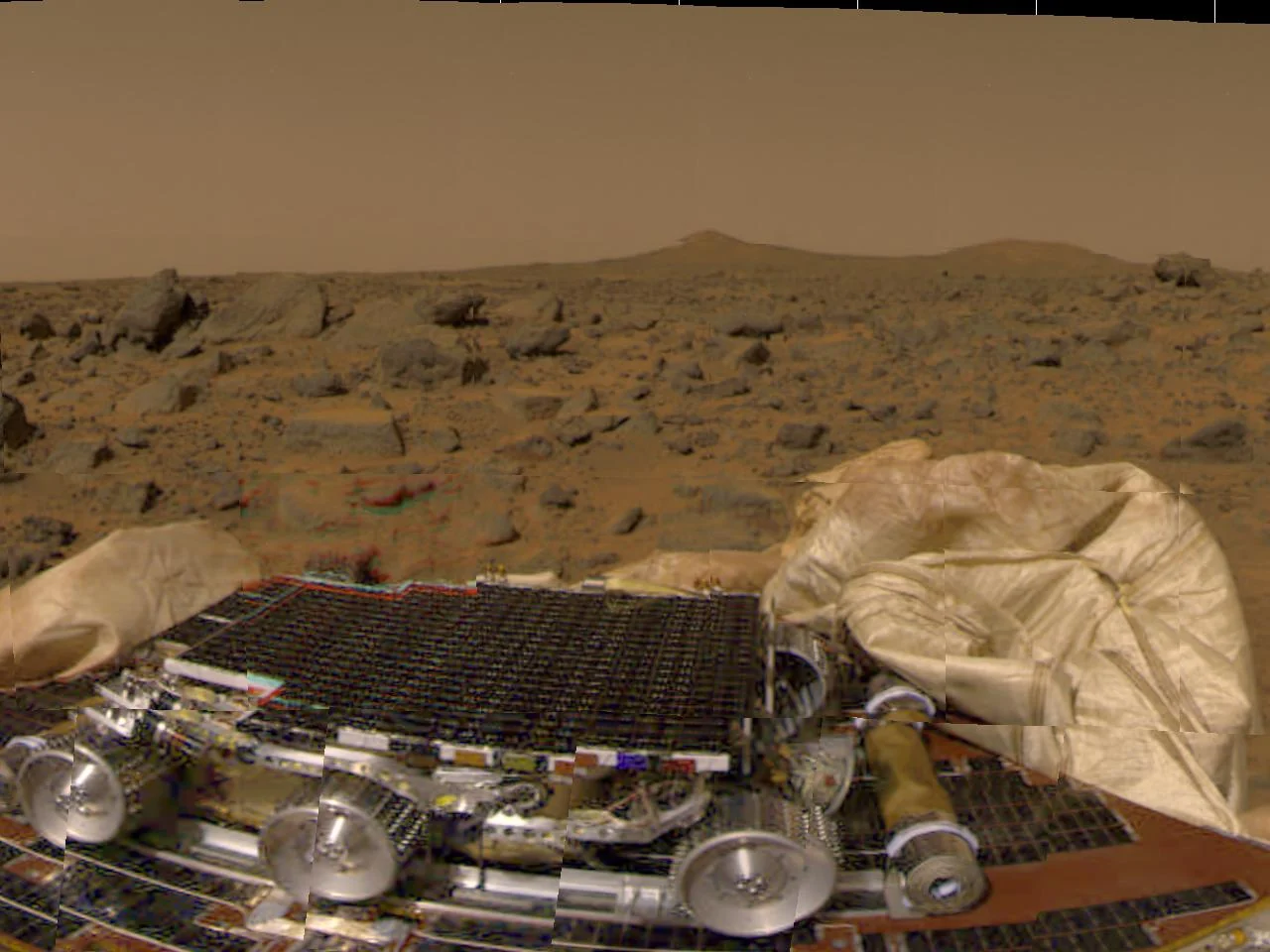
V. From success to the limits of Faster, Better, Cheaper: continuity, cadence and warnings
By her 1998 retirement, Pathfinder had demonstrated a new surface capability and Mars Global Surveyor was helping renew Mars exploration. JPL records also note Shirley’s work on NASA systems-engineering and management processes. Her legacy is therefore broader than the familiar association with Sojourner. It includes the invisible infrastructure that lets an organization turn a one-time success into repeatable competence. [DS1] [DS2] [DS3]
Pathfinder and the culture of demonstration. Pathfinder is often linked to the slogan “faster, better, cheaper.” That era produced both successes and failures, so it should not be treated as a universal recipe. Pathfinder’s more durable lesson is that a focused mission can accept measured risk to demonstrate airbags, surface operations and a rover.
In 1998, Shirley retired from JPL after serving as manager of the Mars Exploration Program, closing a career that had linked aerodynamics, mission analysis, robotics and programme leadership. The retirement announcement also marks a useful biographical boundary: after Pathfinder and Sojourner, her influence increasingly moved from direct programme responsibility toward teaching, writing and transmitting the organisational lessons of robotic exploration [DS1].
That second career matters because technical organizations are vulnerable to knowledge loss. Programs last longer than many individual assignments. Suppliers change, software becomes obsolete and the people who remember why a design choice was made retire. Oral histories, memoirs, courses and post-project reviews are therefore part of infrastructure.
After the triumph: converting one mission into institutional capability
The day after a successful space mission can be dangerous for an organization. Success compresses a complicated history into a simple story: the method worked. Yet one mission cannot fully separate robust design from favorable margins, excellent local decisions or circumstances that may not repeat. As Mars program manager, Shirley's task after Pathfinder was therefore to convert success into learning without turning Pathfinder into doctrine.
The first requirement was continuity of people. Engineers who understood airbags, rover interfaces, operations and Martian surface constraints held knowledge that no report could capture completely. They remembered alternatives tested and rejected, assumptions that nearly failed and subtle behaviors seen during integration. If those people scattered immediately, the program would have to pay again to rediscover much of the same understanding.
The second requirement was documentation. A later project needs not only the final parameter but the reason behind it. Otherwise a value can be copied into a new architecture outside its domain of validity. Program memory must distinguish between a rule that is physically general and a solution that made sense only for Pathfinder's mass, schedule or landing system.
Continuity does not mean cloning. Spirit and Opportunity were not supposed to be enlarged Sojourners. They could use the proof of mobility while changing science payload, energy, communications, range and landing details. A healthy program preserves competence while allowing architecture to evolve.
Pathfinder therefore produced several different proofs: a lower-cost landing architecture could work, a rover could be delivered and operated, a small team could execute under hard constraints and the public would respond strongly to mobile exploration. Each proof had a different domain of validity. The program had to know which one it was using when making the next decision.
The same logic applies to settlement infrastructure. A cargo lander that succeeds once is not yet a transportation service. Repetition is needed to measure dispersion, understand maintenance and demonstrate that success is not dependent on one heroic team. A program is the mechanism that turns isolated accomplishments into capabilities that survive the original champions.
The twenty-six-month cadence: strategic rhythm and schedule trap
Mars launch opportunities occur at roughly twenty-six-month intervals, creating a powerful natural rhythm for program planning. In the 1990s NASA envisioned regular missions that could maintain expertise and progressively answer new questions. Shirley later pointed out the hidden problem: the next mission is already deep in development before the previous one has returned enough operational experience to redesign it. [6]
The result is an overlapping pipeline. One project may be operating at Mars while another is in integration and a third is in formulation. A lesson from the first can sometimes change the second, but often it can only be safely incorporated into the third. The program needs a disciplined method for deciding when a late change is important enough to justify schedule risk.
This overlap also concentrates expert workload. The people best able to review a new design may be the same people supporting a flight mission. If the program assumes that experience is infinitely shareable, the schedule can look healthy while the human verification capacity becomes overloaded.
Regular cadence therefore creates resilience only when learning has time to propagate. Simply launching often is not the same as learning quickly. Two consecutive missions can share the same hidden organizational weakness, and their proximity may prevent the first from teaching the second.
Human Mars logistics will be governed by the same orbital rhythm. A missing spare part or failed cargo mission cannot be corrected on terrestrial shipping timescales. Surface inventories must bridge launch windows, and hardware changes based on operations will often reach Mars years later.
Shirley's experience suggests that cadence should be treated as an output of real capability, not a political target independent of resources. A program can exploit every opportunity only if its teams, verification facilities and budgets can sustain the pipeline without turning permanent urgency into normal operations.
The 1998 launch cycle and the 1999 losses: where the low-cost doctrine showed its limits
Shirley retired from JPL in August 1998. Mars Climate Orbiter and Mars Polar Lander, launched during the 1998 opportunity, were lost the following year. She was no longer Mars program manager when the failures occurred, but her later interviews addressed the pressures that surrounded the era. She believed the program had become oversubscribed relative to the resources available and recalled that Daniel Goldin eventually accepted responsibility for pushing too far. [1] [25]
The interpretation must remain technically careful. Mars Climate Orbiter and Mars Polar Lander had different immediate failure mechanisms. Official investigations examined specific interface, process and flight-system problems. Budget pressure is not a substitute for those causal chains. The organizational question is how local errors passed through multiple barriers without being detected in time.
A team operating with inadequate schedule or staffing has fewer opportunities for integrated testing and independent challenge. Specialists may be shared across projects. Contractors may use conventions that are not reconciled. None of those conditions guarantees failure, but together they can thin the defenses that normally keep one mistake from reaching the spacecraft.
Shirley's recollections also emphasize human cost. Intensive schedules affected families and health. That matters because labor cannot be treated as an invisible margin. A project can appear to stay within a financial ceiling by moving cost into overtime, fatigue and staff turnover, but the technical system eventually feels those effects through mistakes and lost expertise.
For a Mars settlement, permanent heroics would be even more dangerous. Crew members cannot work around inadequate resources forever. Sleep, conflict, stress and willingness to report errors are safety parameters. An architecture that depends on exceptional human endurance is not operationally mature.
The mature reading of “faster, better, cheaper” is therefore balanced. Pathfinder and Mars Global Surveyor proved that constrained missions could succeed brilliantly. The 1999 losses demonstrated that cost and cadence could not substitute for systems understanding. Program design must choose where simplicity is safe and where verification must remain expensive.
Leaving JPL: recognizing when organizational constraints can no longer be solved by individual effort
JPL's 1998 retirement announcement presented Shirley's departure as the close of a remarkable thirty-two-year career, summarizing her roles from aerodynamics and Mariner 10 to robotics, Cassini studies and the Mars Exploration Program. Her later personal accounts add a sharper perspective: she felt the political and budget environment had become difficult enough that continuing was no longer attractive. [4] [26]
The two accounts are not mutually exclusive. A retirement can be both a natural career transition and a response to organizational strain. The difference is methodologically useful because institutional press releases and personal oral histories answer different questions.
Her decision also illustrates a limit to the mythology of determined leadership. Shirley's career had repeatedly rewarded persistence in the face of people who said a goal was impossible. But a manager must eventually distinguish a social barrier that should be challenged from a system constraint that cannot be overcome simply by asking the team to work harder.
High-performance organizations are especially vulnerable to this confusion. Their best people have histories of rescuing projects under pressure, so leadership can begin to assume that impossible schedules are merely opportunities for another rescue. Each success then becomes evidence for setting the next constraint even tighter.
A mature engineering organization needs indicators that show when workload and requirements have exceeded sustainable capacity. Staff turnover, repeated late changes, compressed testing and unresolved anomalies are system signals, not signs that individuals need more motivation.
For human Mars operations the lesson is direct. Crew resilience is a resource with limits. A settlement that survives only because a few people continually compensate for design deficiencies has not achieved robustness. Shirley's departure is therefore part of the engineering story: sometimes the correct diagnosis is that the organization itself must change.
Managing Creativity: leadership as the design of an environment for expertise
Shirley's online book Managing Creativity formalized ideas developed during decades of technical leadership. It is not an official NASA standard and should not be treated as one. Its value lies in showing how she understood the manager's role after experiencing projects where no individual could possess all necessary expertise. [27]
The central idea is that a manager of creative professionals is not supposed to be the source of every solution. The manager must create conditions in which specialists can propose, challenge and integrate ideas. That requires clear goals and constraints, but also enough autonomy that people can explore methods not already encoded in procedure.
Constraint can help creativity when it is stable. A fixed mass allocation forces a team to make real tradeoffs. A budget ceiling can prevent endless feature growth. By contrast, constantly changing constraints waste creative effort because the team repeatedly solves different problems without completing any of them.
Conflict is also normal. An organization with no technical disagreement may be suppressing useful criticism. The goal is not harmony but productive contradiction: evidence should determine which idea survives. The Pathfinder rover dispute is an obvious example, where competing responsibilities had to be turned into interfaces and acceptance criteria.
This philosophy anticipates challenges of autonomous Mars crews. People far from Earth will need the authority to improvise when conditions depart from plans. Yet improvisation near life-support or power systems must remain disciplined and documented. The organization must protect critical boundaries without reducing the crew to passive executors of Earth-generated procedures.
Shirley's management work therefore extends her rover legacy. Sojourner showed how limited machine autonomy could be useful. Managing Creativity addresses the human equivalent: limited local autonomy within clear system constraints. Both are strategies for making distributed decision-making safe enough to operate far from immediate central control.
VI. Managing creativity: conflict, technical authority, women and organization
Building a career in an engineering culture with few women. Shirley’s path cannot be separated from the institutional context of postwar American engineering. Women had limited access not only to technical teams but especially to program authority. Her rise at JPL therefore reflects both individual persistence and organizational change.
Building a career and then a programme in a field that opened few doors to women. Donna Shirley's trajectory matters at two levels: technical and institutional. She entered aerospace engineering when women were a very small minority in teams designing aircraft and spacecraft. Her JPL career nevertheless led to progressively broader responsibilities, eventually including leadership of the Mars Exploration Program and the programme environment that produced Mars Pathfinder and Sojourner.
Settlers will face an even sharper form of this tension. Local teams will need permission to improvise when a pump fails or a robot is damaged, yet changes to oxygen, water or electrical systems cannot become undocumented experiments. The right culture is neither rigid obedience nor unrestricted tinkering. It is disciplined creativity: propose, analyze, test at safe scale, document, review and only then deploy.
The famous tension between Shirley and Pathfinder manager Tony Spear is valuable because it exposes how technical organizations actually behave. Both sides had rational concerns. The rover team feared losing a once-in-a-generation flight opportunity; the lander team feared that an external experiment could jeopardize a mission it was accountable for. Conflict arose because both claims were real.
Good program structure does not eliminate such conflict. It makes the decision path explicit. Which manager owns the interface? What test evidence closes the concern? Who has authority to accept residual risk? When these questions are clear, strong personalities can argue without paralyzing the project. When they are vague, politics becomes a substitute for engineering.
The manager's task is to distinguish constraints that cannot be violated from methods that remain open to invention. Prescribe everything and the team cannot discover a better answer. Define nothing and interfaces become incoherent. Technical creativity lives between those two failures.
Conflict as a design instrument: reading the Shirley-Spear dispute without caricature
The clashes between Donna Shirley and Pathfinder project manager Tony Spear are among the most memorable episodes in accounts of the mission. It is tempting to reduce them to a familiar narrative in which an innovator fights a conservative manager. That interpretation loses the systems lesson. Spear was responsible for delivering the lander. Every added interface, kilogram and command path increased the risk carried by his project. Shirley was responsible for making the rover experiment viable and believed the flight opportunity was too valuable to lose.
Both positions could therefore be rational. Productive governance had to turn the disagreement into engineering criteria. The rover team needed stable allocations and a chance to prove compliance. The lander team needed evidence that the experiment would not compromise its own mission. Higher management had to prevent territorial conflict from replacing technical judgment.
Shirley's memoir describes the conflict from her perspective and should be read as a primary personal source rather than a neutral verdict on every participant. Its value is in revealing how program interfaces feel to the people inside them: budget disputes are not abstract, and responsibility for failure changes the emotional meaning of every request.
The rover ultimately forced Pathfinder to solve deployment, communication and operations questions that otherwise would not have existed. Those costs were real. In exchange, the mission gained a capability that transformed its historical significance. Program management exists to compare exactly this kind of certain burden with uncertain strategic benefit.
The same pattern will recur in settlement design. A power team may demand redundancy that a logistics team considers too heavy. Scientists may want protected regions that constrain construction. Habitat engineers may seek energy that mobility systems also require. Each subsystem is locally rational. The program must make the trade at system level.
Shirley's story therefore does not teach that resistance should be defeated. Competent resistance can improve innovation by forcing it to become explicit and testable. The danger begins when criteria move arbitrarily or when people become unable to distinguish their professional identity from the design they are defending.
Women, technical authority and the long process of changing who is assumed to belong
JPL historical material describes Shirley's arrival in an engineering culture where women with engineering degrees were exceptionally rare. She remembered being mistaken at times for a secretary while other women worked in computing roles essential to navigation and analysis. Over three decades she moved into section leadership, project engineering and eventually Mars program management. [2]
The barriers were not only individual acts of discrimination. They included expectations about education, dress, professional networks and which kinds of authority seemed normal. Shirley's personal response was often confrontational persistence. Her 2024 interview describes that trait with characteristic blunt humor. It helped her, but a healthy institution cannot require every excluded person to possess an unusually combative personality. [1]
Her visibility later mattered because it changed the range of plausible careers visible to younger engineers. By the time Pathfinder landed, the person publicly managing the Mars program was a woman with a long technical history rather than someone placed only in outreach or administrative support.
This matters to engineering quality. An organization that excludes capable people for reasons unrelated to performance shrinks its own problem-solving capacity. Diversity does not automatically make every decision better, but artificial barriers make the available talent pool worse by definition.
Human Mars missions will depend on small crews where each person's competence has disproportionate importance. Importing old assumptions about who should command, repair or make technical decisions would be operationally expensive. Roles must follow demonstrated ability, training and mission need.
Shirley's legacy in this area is therefore not just representational. Her career is evidence that institutions can change the category of person they consider technically authoritative. That organizational learning is as relevant to future exploration as the specific machines built during her tenure.
Managing Martians: preserving the human system that official reports do not fully capture
After Pathfinder, Shirley published Managing Martians with Danelle Morton. The book became a prominent account of a woman navigating JPL and of the organizational struggle behind the rover. It complements mission reports because it records a different class of information: arguments, relationships, frustrations and the way decisions were experienced. [28]
An autobiography is not a neutral archive. It selects episodes and interprets the motives of other people from the author's perspective. That limitation is not a reason to discard it. It is a reason to triangulate it with JPL announcements, technical papers and oral histories from other participants.
Formal engineering documentation is excellent at recording requirements and test results. It is often weaker at preserving why a team tolerated one risk, why a manager resisted an interface or how workload affected judgment. Those human factors can matter greatly when a later program tries to reproduce the success.
Shirley's frank style therefore becomes a form of organizational memory. Future engineers can see that successful missions were not smooth machines. They were produced by people with conflicting responsibilities who needed structures capable of converting argument into decisions.
For Mars settlement, such archives will be essential. Incident reports alone will not capture how crews experienced isolation or why local workarounds became normal. Oral histories, decision logs and personal accounts can expose patterns that quantitative telemetry misses.
The public also benefits from this complexity. Treating exploration as a flawless sequence of technical triumphs creates unrealistic expectations and makes failure appear scandalous rather than analyzable. Shirley's writing contributes to a more mature story in which engineering excellence includes the capacity to confront disagreement and learn.
Returning to the University of Oklahoma: turning mission experience into teachable method
After leaving JPL, Shirley returned to the University of Oklahoma and served as an assistant dean in engineering while teaching aerospace and mechanical engineering. University profiles place this phase at the end of the 1990s and early 2000s. The move is a logical extension of a career increasingly concerned with institutional memory. [29]
Teaching after Pathfinder requires separating principle from anecdote. A student does not need to memorize every detail of a 1990s rover. The enduring lessons concern requirements, interfaces, tradeoffs, testing, configuration and team structure. Good instruction shows why a decision was made and under what conditions it would no longer be valid.
Shirley's early degree in writing gave her an unusual tool for this transition. She had spent much of her career translating between specialist communities and managers. Education is another translation problem: building a mental model in someone who does not yet share the assumptions of an experienced engineer.
The return to Oklahoma also closed a biographical loop. A student who had been told engineering was not an expected path for a girl returned as an accomplished Mars-program leader. The example itself could expand what younger students imagined possible.
From a program perspective, university teaching distributes expertise beyond JPL. Graduates may enter contractors, agencies, research laboratories or companies. A method taught outside the originating institution becomes part of a broader aerospace ecosystem.
That diffusion will be necessary for sustained Mars exploration. No single organization can retain every skill across decades. Education converts mission-specific knowledge into professional capability that can survive changes in employer, technology and program structure.
The Science Fiction Museum: keeping imagination and demonstrated capability in productive tension
Shirley later helped create the Science Fiction Museum and Hall of Fame in Seattle. At first glance the role sits outside engineering, yet it connects directly to a career spent moving ideas from imagination toward flight. Science fiction generates possible worlds long before engineering can implement them. The technical profession then has to separate useful questions from physically or economically unsupported assumptions. [29]
Sojourner itself occupied that boundary. A mobile robot on Mars had belonged to speculative imagination for decades. For the public, the mission felt futuristic. For the rover team, it was a system of wheels, electronics, thermal limits, command sequences and tests. The inspiration came from making the imagined capability real, not from pretending the constraints had disappeared.
A museum devoted to speculative culture can show how stories influence generations of engineers and scientists. It can also expose how predictions fail. That is useful for Mars, where images of cities under domes or rapid terraforming often become confused with engineering roadmaps.
Shirley's career encourages a disciplined relationship with vision. Imagination is valuable because it proposes states that do not yet exist. Engineering asks what sequence of evidence would be required to reach them. Program management asks whether society is willing to fund and sustain that sequence.
Human Mars exploration will need compelling narratives because the program will extend across long periods when no spectacular milestone occurs. But narratives become dangerous when they harden into deadlines unsupported by mass, energy or verification budgets.
The museum phase therefore belongs in the same intellectual biography as Pathfinder. Shirley moved from building a futuristic object to curating the cultural machinery that makes such objects imaginable. Both activities matter to exploration, provided the boundary between inspiration and proof remains visible.
VII. After JPL and beyond Sojourner: teaching, lineage and institutional learning
Sojourner can then be understood as the result of that accumulated experience rather than as an isolated invention. The rover was deliberately small because Pathfinder had to demonstrate surface mobility, local communications and operations within severe cost and mass limits. Shirley helped turn that demonstration into a program capability. The important Mars legacy is not just that Sojourner moved across the surface; it is that an organization learned how to design, test, command and operate a mobile robot on another planet, creating a lineage that would lead to Spirit, Opportunity, Curiosity and Perseverance. Source
Its scale was tiny compared with Curiosity or Perseverance, but its historical leverage was enormous. It validated surface mobility as a scientific tool and opened the lineage of rovers that followed. For human settlement, the same logic extends into scouting, inspection, logistics and autonomous transport.
Mobility creates operational geography. Rocks acquire priorities, slopes become hazards, routes are compared and science plans change with new observations. Spirit, Opportunity, Curiosity and Perseverance would expand that concept dramatically, but Sojourner closed the foundational uncertainty: a mobile robotic field geologist could function on Mars. JPL explicitly describes Pathfinder as a foundation for later rover exploration. [source]
The episode is valuable because a modest demonstrator can reshape decades of architecture. Spirit and Opportunity, Curiosity and Perseverance were not simply enlarged Sojourners, but the small mission removed a fundamental uncertainty: a rover could be deployed, commanded and used productively on Mars. Demonstrations matter because of the uncertainty they retire.
From Sojourner to Spirit, Opportunity, Curiosity and Perseverance: lineage without mythology
JPL correctly presents Sojourner as a forerunner of later Mars rovers, but the lineage needs careful definition. Spirit and Opportunity were much larger and scientifically richer. Curiosity and Perseverance moved to an entirely different landing architecture and far greater mass, software complexity and operational ambition. Modern rovers are not simply enlarged Sojourners. [30]
The first inheritance is institutional proof. Pathfinder showed that a rover could be integrated, landed, deployed and operated successfully. Future teams no longer had to justify mobility as an exotic add-on at the same fundamental level. They could spend political and technical capital on range, science and lifetime.
The second inheritance is selective technical knowledge. Locomotion concepts, hazard sensing, operations tools and testing practices evolved through teams that retained people and documentation. But every new mass class required engineers to revalidate the domain of the old solution.
The third inheritance is scientific culture. Once mobility became normal, scientists could frame questions that assumed access to multiple targets and geological units. That changed mission formulation. A rover was no longer merely a technology payload; it could be the central scientific platform.
Shirley did not manage the later rovers and should not be credited with their detailed engineering. Her historical role is earlier: she helped push mobile exploration through the period when it still had to earn permission to exist on a Mars lander.
This distinction is important for human Mars technology. A robotic demonstration can validate a principle without solving the next scale. Rover mobility demonstrates autonomy and surface operations, not crew transportation. Every new mass and consequence regime must be treated as a new engineering problem informed by heritage rather than guaranteed by it.
Small size as an experiment strategy: remove uncertainty before buying the final system
Sojourner's small size is often described as a consequence of limited budgets. It was also strategically useful. A small vehicle could demonstrate mobility while limiting the burden imposed on Pathfinder. The mission did not need the best rover imaginable; it needed enough rover to answer a decisive question.
This is the logic of a good technology demonstrator. The experiment is designed around the uncertainty to be removed. Extra capability is valuable only if it contributes to that question or can be added without threatening schedule and verification.
Spaceflight makes the demonstrator more demanding than a terrestrial prototype. Even a small rover must survive launch and the actual planet. It cannot be recovered by technicians for adjustment. The experiment must therefore be sufficiently flight-like that its result has engineering meaning.
The danger is requirements growth. Once a project exists, every stakeholder can identify another useful instrument or capability. If all are accepted, the demonstrator becomes a large mission and loses the speed and cost advantages that justified it.
Settlement technology should follow the same structure. A small regolith excavator can test wear and mobility before a construction fleet is sent. A compact ISRU unit can measure real maintenance and contamination before propellant production becomes crew-critical.
The key measure is uncertainty removed per unit of burden, not raw performance. Sojourner traveled only modest distances, but it eliminated a fundamental uncertainty about mobile Mars operations. That is why a small machine could have a strategic effect much larger than its physical scale.
Limited autonomy: let the machine decide exactly what the delay requires
Sojourner's autonomy was modest by modern standards, but that makes it conceptually clean. The rover did not independently choose a scientific campaign. Human teams planned goals while the vehicle handled selected local behaviors needed to move safely despite communication delay.
Autonomy is therefore best understood as an allocation of decision rights. Earth keeps decisions that benefit from human context and broad scientific reasoning. The rover receives decisions that must happen locally or repeatedly. The allocation depends on sensors, computation, verification and consequence.
More autonomy is not automatically better. A complicated behavior can be difficult to test across all relevant states. If the mission can achieve its goals with a simpler verified behavior, simplicity may be safer. Conversely, insufficient autonomy can consume enormous ground-operations time and make movement impractically slow.
Shirley's background in robotics developed before contemporary machine-learning systems, but the governance question remains identical. What is the machine authorized to do, what evidence shows that this authority is safe and how does the system return control when confidence falls?
Human Mars settlements will use robots around people and critical infrastructure. Autonomy may be broad in distant work zones and tightly constrained near habitats. The same machine may need different operational envelopes according to location and task.
Sojourner thus offers a useful antidote to vague claims about “intelligent robots.” The engineering question is specific: which local decision is delegated, under which conditions, with which fallback? That formulation scales from a tiny rover to future construction and logistics systems.
Operations are part of the spacecraft: software, procedures and people on Earth
A Mars rover is not only the hardware on the planet. The real system includes ground software, communication networks, planning tools, procedures and teams who interpret telemetry. Sojourner's limited onboard autonomy made this relationship obvious because every drive depended on carefully prepared commands and subsequent analysis.
Operational decisions balance science against vehicle protection. An attractive target may require a risky approach. A conservative route may consume precious time. A power or thermal concern may postpone an observation. These trades continue after landing; the spacecraft remains an evolving decision system rather than a finished product.
Extended mission life also changes the human system. A team prepared for a short campaign must sustain attention and handovers for longer than expected. Success can therefore create workload. The organization needs staffing, documentation and routines capable of surviving its own good fortune.
Shirley's management philosophy distributes authority toward the people closest to the relevant information while preserving program-level priorities. Operations are a natural setting for this model because specialists see telemetry before senior managers can understand every detail.
Human Mars operations will shift more authority to the planet. Light-time makes Earth unsuitable for real-time control of emergencies or detailed daily activity. Crews will need procedures, but they will also need permission to adapt those procedures when local conditions differ from planning assumptions.
Designing the human organization is therefore part of designing the mission. A technically perfect vehicle paired with an exhausted or confused operations team is not a reliable system. Sojourner's era already demonstrates that human interfaces deserve the same deliberate engineering as electronic ones.
Distributed organizations: NASA, JPL, contractors and the need for a common systems language
Planetary missions are networks of institutions. NASA headquarters shapes budgets and priorities, JPL manages systems, contractors manufacture components, universities build instruments and communication networks support operations. The spacecraft may look like one object, but it is produced by a distributed organization.
Shirley experienced these boundaries from several directions: industry at McDonnell, interagency civil projects, NASA-wide management teams, Cassini formulation and Mars program leadership. She learned that different organizations can use different vocabularies, incentives and schedules even when they believe they are working on the same mission.
A contract defines responsibility but cannot guarantee shared understanding. Two teams can satisfy their local documents and still create an incompatible interface if the documents themselves are ambiguous. Integrated work therefore requires active technical communication in addition to legal boundaries.
At the same time, close teamwork must not erase accountability. When a problem appears, the program needs to know who owns the requirement, who verified it and who has authority to change it. Informal trust complements formal configuration; it does not replace it.
Human Mars infrastructure will likely be even more distributed across agencies and companies. The surface crew will depend on hardware produced by organizations that may not exist in the same form ten years later. Stable interface standards and long-lived documentation become part of survival.
Shirley's career therefore points toward a core rule of interplanetary infrastructure: the more distributed the organizations, the more important a common systems language becomes. Mass, power, data, safety and configuration must be represented consistently enough that expertise can transfer without depending on one translator.
VIII. Autonomy, interfaces and irreversible decisions: what a small rover reveals about systems engineering
That progression shows that a space organisation also learns by widening the population to whom it entrusts responsibility. The issue is not merely moral or symbolic: artificially restricting recruitment reduces the number of experiences, trajectories and decision-making styles available to solve complex systems.
The design demonstrates a useful hierarchy. Some decisions should remain with humans because they involve science priorities, risk acceptance or ambiguous interpretation. Other decisions should be delegated because they must happen faster than Earth can respond. The challenge is not to maximize autonomy but to place it at the correct level. Too little autonomy creates paralysis; too much poorly validated autonomy creates opaque risk.
Continuity matters because early assumptions often disappear when teams change. The reason a sensor was selected, a site rejected or a margin reserved may be obvious during formulation and mysterious five years later. Keeping program memory close to the project reduces the chance that later decisions unknowingly violate the logic of the original architecture.
This creates a useful economic concept for exploration: cost per uncertainty removed. A cheap experiment that answers a fundamental question may be more valuable than a larger system that adds capability without reducing strategic uncertainty. Program managers should therefore ask not only what a demonstration can do, but what future decision becomes easier after its result.
A Mars settlement will need formal mechanisms for exactly this reason. Power, water, mobility, health and science teams will compete for scarce resources. Transparent decision rights and documented risk acceptance can keep disagreements technical. The goal is not harmony; it is the ability to disagree without losing the system.
Planetary missions contain moments after which no management decision can recover the hardware. Launch and atmospheric entry are obvious examples, but many configuration choices become practically irreversible months earlier. Leadership therefore involves deciding when evidence is sufficient, not waiting for certainty that can never exist.
Mars settlers will encounter irreversible choices in a harsher form. A crew may have to abandon a damaged module, consume a strategic reserve or commit a rover to a risky route. Training leaders to distinguish uncertainty from indecision will therefore be as important as teaching procedures.
A Mars settlement will face the same transition from project to program. Building a first habitat may be managed as an exceptional campaign. Operating ten habitats, several power plants and permanent logistics will require an organization that preserves interfaces and lessons beyond any single construction team.
Irreversible decisions: why spaceflight changes the meaning of management
Many terrestrial projects preserve the option to repair. Hardware can be recalled, people can access the system and software can often be changed after deployment. Interplanetary missions sharply reduce that freedom. Some decisions become irreversible at launch, and others at separation or landing. This gives technical management a distinctive responsibility.
Shirley worked at multiple points along this chain, from mission analysis to program leadership. She learned that an early architecture decision can lock in cost and risk long before the public ever sees the spacecraft. Management must therefore know when to keep options open and when to converge.
Converging too early freezes immature assumptions. Converging too late prevents manufacturing, testing and training from stabilizing. The creative phase and the configuration-controlled phase require different kinds of freedom. A healthy project changes its decision rules as maturity increases.
The Pathfinder rover dispute can be read through this lens. Rover interfaces had to be resolved early enough to become part of the integrated lander. A vague promise to “figure it out later” would have shifted conflict into the period when changes were most expensive.
Human Mars missions will amplify irreversibility. Equipment sent during one launch opportunity may be unreachable for years except by the local crew. A missing function cannot be added by overnight shipping. Early architecture must therefore include recovery paths and local decision authority.
Shirley's management model is relevant because it does not assume the senior manager personally knows every answer. Instead the organization must give experts authority at the right time, expose assumptions to review and treat irreversible decisions in proportion to their consequence.
Unflown concepts are still engineering assets
Space history naturally emphasizes missions that launched, but Shirley spent significant parts of her career on studies and concepts that did not immediately become flight hardware. Saturn studies, station architectures, robotics programs and alternative mission ideas all generated knowledge even when the exact design did not survive.
An option can be rejected for reasons unrelated to technical quality: budget, political priority, launch capacity or schedule. Years later those conditions may change. If the reasoning behind the rejected design has been preserved, a new team can restart from evidence rather than from memory.
This makes concept archives a form of resilience. A Mars program dependent on one launch vehicle or one partner needs alternatives when circumstances change. Keeping several concepts documented does not mean funding them equally; it means retaining enough information to understand the trade space.
Shirley's formulation experience taught her that a study can succeed by proving a concept is unattractive. Eliminating a bad path before hardware development saves far more money than the study cost. That value should be recognized in program metrics.
Settlement planning needs the same humility. Water extraction, power storage or habitat construction may have several candidate methods. Prematurely declaring one architecture final can create systemic dependence. Alternatives should be documented and, where uncertainty is large, demonstrated at small scale.
The history of Sojourner itself reinforces the point. Mobile robotics existed through years when no Mars rover flight was guaranteed. The capability became available because enough knowledge and people survived until Pathfinder provided the opportunity.
Reading Mars again in 2024: an engineer looking at Perseverance and sample return
The Caltech Heritage Project interview recorded in January 2024 allows Shirley to reflect on Mars exploration after decades of additional missions. She still follows the program and discusses Mars Sample Return and the extraordinary capability of contemporary rovers. Her comments are notable for what they do not claim: she does not appropriate the later missions as personal achievements. [1]
When discussing the scientific value of returning samples, Shirley explicitly frames herself as an engineer and defers to scientists on the question of what laboratory analysis is required. This is a useful demonstration of epistemic discipline. Systems leaders need broad understanding, but broad understanding is not permission to overrule specialists outside one's domain without evidence.
Sample return also reveals how far the architecture has moved from Sojourner. A modern rover can select and cache material for a chain involving surface operations, potential launch from Mars, rendezvous and Earth return. Each added function creates new interfaces and contamination-control requirements.
The progression still follows a pattern Shirley would recognize. Mobility is demonstrated, then expanded. Geological context improves. Sampling becomes a capability. The program seeks to connect that capability to a larger architecture. The steps build on one another even when the hardware is radically different.
The 2024 conversation also occurs during renewed budget pressure at JPL. Asked for reassurance, Shirley does not pretend that institutional continuity is guaranteed. Her long career taught her that budgets can reshape organizations and cancel options. Mars exploration persists because people repeatedly choose to maintain it.
This late perspective prevents the biography from ending in 1998. Shirley remains a witness to the program's evolution, and her willingness to distinguish her expertise from others provides a management lesson as important as any specific technical opinion.
Robotic precursors for human missions: reduce the unknowns before people inherit them
In the 2024 interview Shirley recalled serving on committees that studied future human missions and the robotic missions needed to prepare for them. Her relationship to human Mars planning is therefore not merely a retrospective analogy built from Sojourner. She participated in discussions about how robotic exploration could remove uncertainties before crews arrived. [1]
Precursor missions can serve several functions: characterize environmental hazards, identify resources, test processes, survey landing sites and demonstrate infrastructure. The key is to connect each measurement to a future decision. A datum may be scientifically interesting without materially reducing the risk of a crew architecture.
Robots can also prepare a site physically. Modern concepts include power deployment, logistics handling, surface construction and resource-processing demonstrations. Shirley did not demonstrate all of these with the Pathfinder rover; the transferable lesson is how to introduce a new capability at a scale where failure remains affordable.
Crewed systems require a different safety threshold. A robotic test can accept loss in exchange for information. The rational strategy is to move as much novelty as possible into those uncrewed phases so that the system used for survival has already accumulated relevant operational evidence.
Her earlier civil-systems experience adds another requirement: test maintainability, not only nominal performance. A machine that works but demands constant specialized intervention may be unsuitable for a small crew. Precursors should measure spare consumption, cleaning, calibration and operator time.
Robotic preparation becomes most useful when organized as a program chain rather than a catalogue of demonstrations. Each flight should reduce an uncertainty that changes the design or confidence of the next. That is the deepest connection between Shirley's Mars program experience and future settlement.
Resilience is more than repetition: design a program that can lose a mission and still learn
One argument for smaller, more frequent planetary missions is that they distribute risk. A single expensive spacecraft can carry many objectives, so its loss removes an entire generation of science. Multiple missions can prevent one failure from ending the program. But distribution works only if the missions do not share the same hidden vulnerability.
True resilience therefore requires attention to common-cause failure. Three identical systems may provide excellent spare compatibility while remaining vulnerable to one design defect. Diverse systems reduce that common risk but increase maintenance and training complexity. Program management has to trade standardization against independence.
Shirley's Mars era demonstrated both sides. Pathfinder and Global Surveyor succeeded, while the following cycle suffered two separate losses. NASA then reorganized and reexamined the program. The ability to pause and redesign was itself a form of institutional resilience.
A human settlement cannot pause life on Mars. Surface systems must continue operating while Earth redesigns future hardware. This makes local redundancy, repair capability and stored resources more important than in robotic programs.
Logistics also creates time-dependent resilience. A spare that exists on Earth but cannot reach Mars for twenty-six months is not an immediate backup. Surface architecture must carry or manufacture enough capability to bridge the transport interval.
Shirley's program perspective helps separate resilience from simply adding duplicates. The real goal is continued function after assumptions fail. That may require extra hardware, alternative modes, different suppliers or people trained to improvise safely. Resilience is a property of the whole program, not a count of spare boxes.
IX. Standardization, full cost, operations, error culture and technical authority
A settlement program will need decades of public patience. It should use compelling images and human stories while resisting the temptation to describe every test as a historic breakthrough. Durable support is more likely when audiences can see a sequence of measurable milestones and understand why apparently small achievements—an extra month of equipment life, a successful repair, a kilogram of locally produced oxygen—matter to the larger goal.
Human exploration should treat precursor systems the same way. A small ISRU plant, experimental power network or robotic construction unit does not need to resemble the final industrial system. It should be designed to kill the most dangerous unknowns before they are embedded in infrastructure that is far more expensive to change.
Standardize without freezing: what should stay stable across generations of Mars systems
Once a technology works, programs naturally want to standardize it. Standardization reduces training cost, simplifies spares and allows organizations to accumulate comparable operational data. But a field that is still learning can freeze an immature architecture if it standardizes too early. Shirley's career crossed multiple periods where this tension was visible, from mission design to robotics and Mars program management.
Sojourner illustrates selective standardization. The exact rover was not reproduced indefinitely. Instead, useful principles of mobility, testing and operations became part of institutional heritage while later vehicles changed mass, science and landing architecture. The program standardized some methods more strongly than the machine.
Human Mars infrastructure will need the same layered approach. Electrical interfaces, data protocols, cargo dimensions and safety conventions benefit from stability because many systems depend on them. Power generation, robotics or habitat technologies may need faster evolution. The architecture should deliberately identify which layer serves as infrastructure and which layer remains open to innovation.
Stable interfaces enable modular replacement. If a new rover or processing unit can connect without forcing every other system to change, the settlement can improve incrementally. That is systems engineering used as an architecture of evolution rather than only as a method of initial design.
Standards also need remembered reasons. A procedure inherited without context can become ritual. If the original hazard disappears, the procedure may consume resources for no benefit. If conditions become more severe, the old standard may be dangerously weak. Documentation should therefore preserve the rationale and evidence behind each rule.
Shirley's experience points toward a balanced Mars culture: stable enough to maintain remote infrastructure, flexible enough to use new evidence. Neither permanent prototyping nor permanent repetition is sustainable. A program becomes mature when it knows which parts of itself must be boring and which parts must keep changing.
The full cost of innovation includes software, operators and training
New technology is often introduced through a simple budget: development dollars, kilograms and watts. The real system cost extends much further. A rover needs command software, telemetry tools, simulators, procedures, training, data handling and people able to diagnose faults. Sojourner was physically small but operationally it created an entire support system.
Shirley's position between engineering and management made these hidden costs visible. A feature that is cheap in hardware can be expensive in operations. Additional autonomy may cost development effort while reducing daily operator workload. A new sensor can make fault diagnosis easier and save hours during an anomaly. Program trades should therefore use life-cycle burden rather than purchase price alone.
This perspective also exposes false savings. Cutting test time can lower a development budget while increasing operational uncertainty. Removing diagnostic telemetry saves data volume but can make a later failure impossible to understand. The cost has not disappeared; it has moved to a different phase.
Human Mars missions will make operator time exceptionally valuable. A device that requires two crew-hours every day may be more expensive to the settlement than a heavier system that performs the same function autonomously. Precursor missions should therefore record maintenance time, spare consumption and failure-recovery workload as engineering data.
Technology diversity creates another full-cost trade. Many unique machines require many unique spares and training paths. Standardization reduces that burden but may create common-mode failure. The correct answer is a portfolio decision rather than an isolated component optimization.
Shirley's career repeatedly returned to the transition from prototype to usable capability. The transition occurs when an organization can afford not only to own the object but to understand, operate, repair and eventually replace it. That definition will be central to any Mars infrastructure expected to last longer than one expedition.
Science, engineering and management: three kinds of authority that must disagree productively
Planetary missions combine different forms of authority. Scientists define questions and measurements. Engineers determine what can be built and operated. Managers allocate budget, schedule and responsibility. None of these communities can succeed alone, and each can damage the mission if it treats its own criterion as the only one that matters.
Shirley often worked at this interface. She was not Pathfinder's principal scientist and she did not personally design every rover mechanism. Her role was to understand enough of each discipline to translate needs into program decisions and to make conflicts visible.
A scientifically excellent requirement can be unaffordable. An elegant engineering simplification can remove the measurement that justifies the mission. A management decision can keep the budget green while destroying technical margin. Good governance forces the trade into the open so that the program understands what it is sacrificing.
Pathfinder worked partly because its scientific ambition was compatible with its demonstration role. The lander and rover could collect useful data without carrying the complexity of a later mobile laboratory. Science was not ignored; it was shaped to fit the architecture.
Human Mars missions will add a fourth authority: the local crew, responsible for immediate safety. Earth-based scientists may want an excursion that the crew judges too dangerous. Program rules will need to define veto rights and escalation before the conflict occurs.
Shirley's management legacy is therefore less about avoiding disagreement than about designing disagreement. A robust program can reject a good idea when it threatens the whole system, and it can also protect a valuable innovation against caution that has become reflexive. The mechanism is evidence, clear responsibility and documented tradeoffs.
Technical biography and attribution: leadership is not the same as inventing every component
Public storytelling sometimes compresses the Sojourner story into the phrase that Donna Shirley “built the rover.” The phrase recognizes her leadership but can hide the engineering structure. Technical papers list a broad rover team responsible for mechanics, software, electronics, navigation, science interfaces and testing. Accurate history needs to distinguish program leadership from component invention. [11]
This precision strengthens rather than weakens Shirley's importance. The transition from a research idea to flight is itself a rare skill. Somebody has to obtain resources, negotiate the host interface, keep the team aligned and preserve the experiment through program conflict. Many technologies fail at this institutional stage even when their laboratory performance is excellent.
Correct attribution also protects the rest of the Pathfinder team. Tony Spear, Brian Muirhead, Matthew Golombek and many rover engineers held distinct responsibilities. Treating one person as the sole author prevents readers from learning how complex missions distribute authority.
The same rule should be applied to failure. An identifiable software mistake does not necessarily make one programmer the cause of a lost mission. The engineering question is why reviews, tests or interfaces failed to prevent the mistake from propagating.
This systems view is particularly valuable for a Mars reference library. Biographies should lead outward into teams and organizations rather than turning collective work into celebrity mythology. A person matters partly because of the network of decisions she connects.
Shirley's story is at its best when it shows that leadership is an integration technology. She helped create conditions under which specialists could turn mobility into a flight capability. That is a different accomplishment from designing a wheel, and it deserves to be described on its own terms.
Margins: design for the unknown without pretending resources are infinite
Mars contains uncertainties that engineering can reduce but never eliminate. Surface properties, dust, thermal behavior and component performance have distributions rather than single exact values. Margin is the traditional response: provide more capability than the nominal requirement. Yet every margin costs mass, power or money.
Sojourner's extended lifetime shows that the system possessed useful margin beyond its minimum requirement. That does not imply every subsystem was generously oversized. It means the mission converted conservative design and favorable conditions into additional operating time.
Margin must be managed at system level. If every subsystem hides its reserve, the total vehicle may carry unnecessary excess in some areas while lacking margin where failure would be critical. Conversely, aggressively reclaiming all local margin can create a design that has no room for uncertainty.
Human Mars settlements will manage physical margins in water, oxygen, food, power and spare parts. Designing only to average consumption is unsafe because real operations fluctuate. But transporting unlimited contingency is impossible. The program must understand which margin protects which failure mode.
Recovery modes can substitute for some raw reserve. A temporary reduction in scientific load may preserve power. Multiple water-processing paths may protect against one maintenance event. The best margin is sometimes the ability to reconfigure rather than simply carrying more.
Shirley's experience with constrained missions encourages explicit margin governance. Success should never be used to pretend margin was unnecessary. The reason a system survives an unexpected condition may be precisely that the designers preserved capacity that was not consumed during nominal operation.
Operations make the flight system larger than the hardware
A rover on Mars is only one part of the operational system. Ground software turns engineering state into displays, planners build command sequences, scientists prioritize targets and communication networks move data across interplanetary distance. Sojourner's relatively limited autonomy made this human architecture easy to see.
Each drive required a balance between scientific value and vehicle protection. A target could be attractive but difficult to approach. A conservative route could consume time and power. An anomaly could force the team to delay science while engineers reconstructed what the rover had experienced.
Extended operations increased the human burden. A campaign expected to be brief had to continue while maintaining disciplined review and handover. Success therefore creates its own operational risk when teams are not staffed for the additional lifetime.
Shirley's management model favored giving authority to the people closest to relevant evidence while preserving system-level priorities. Operations naturally require this distribution because specialists see telemetry and understand local details before senior leaders can.
Human Mars missions will move much of the control loop to the planet. Earth cannot supervise emergency actions or every maintenance step in real time. Crews will need procedures, but also authority to change those procedures when local conditions invalidate assumptions.
The broader lesson is that operations should be designed, simulated and reviewed like hardware. A spacecraft with excellent components but poor planning tools or exhausted operators is not a reliable system. Sojourner's program era already makes the human control architecture visible.
Error culture: make bad news useful before it becomes an accident
Creative engineering guarantees that some ideas will be wrong. Spaceflight makes the timing of discovery critical. A mistake found during a prototype test is valuable information. The same mistake found after launch may be unrecoverable. A project culture should therefore reward early discovery of weakness rather than reward the appearance of uninterrupted progress.
Shirley's emphasis on testing and open technical conflict fits this principle. If engineers believe that reporting a problem will be treated as personal failure, they naturally wait until evidence becomes overwhelming. By then the cheapest corrective options may already have disappeared.
The opposite extreme is also harmful. If every anomaly triggers a program-level crisis, teams lose the ability to prioritize. Organizations need graded categories that distinguish observation, deviation, significant risk and mission-threatening defect.
The Mars failures of 1999 later showed how local information must cross organizational boundaries. A warning that remains inside one team cannot protect the integrated spacecraft. Communication interfaces are therefore as important as electrical interfaces.
A human settlement will face the danger of normalizing deviation. When crews repeatedly work around a nuisance, the workaround can become normal until a related condition turns it into a major hazard. Logs, thresholds and periodic independent review are defenses against that drift.
Shirley's broader lesson is that creativity and rigor reinforce one another when error is made cheap enough to expose. The goal is not a culture where nobody makes mistakes. It is a culture that converts mistakes into information before Mars converts them into loss.
Mobility changes geology because it changes what can be chosen
Scientific instruments are usually compared by sensitivity or precision, but mobility can increase the value of an entire instrument suite by changing where measurement occurs. Sojourner demonstrated this at small scale: a sensor could be brought to different rocks and soils instead of being limited to the lander's immediate surroundings.
The operation introduced a decision loop: inspect the environment, choose a target, move, position the instrument, measure and use the result to plan again. Later rovers expanded that loop across kilometers and much more complex geological reasoning.
Mobility is therefore an enabling capability rather than merely a transport feature. A less powerful instrument that can reach the right geological contact may answer a question that a stationary high-performance instrument cannot.
This does not make fixed platforms obsolete. Meteorology, geophysics and some long-duration measurements benefit from remaining in place. Program architecture should combine mobility and persistence according to the scientific objective.
Human explorers will add flexible judgment but face time and safety limits. Robots can scout routes, transport samples and extend work into hazardous terrain. The most productive architecture is likely to pair human interpretation with machine reach.
Sojourner's small traverse therefore had strategic meaning. It taught the program to value the ability to choose measurement location. Future infrastructure such as roads, relays and depots can be evaluated similarly: not only by their direct output, but by the new decisions and destinations they make possible.
The Martian environment as the final reviewer of theory
No Earth test reproduces Mars in full. Thermal chambers isolate temperature and pressure, analog terrain reproduces rocks and slopes under Earth gravity, and software simulations explore thousands of cases without the real dust or hardware aging. Flight is the first time all environmental dimensions meet the actual system.
This is why a small rover demonstration could be so valuable. Sojourner exposed mobility hardware, solar power, sensors, software and operations to the real surface. Every successful cycle reduced uncertainty that terrestrial testing could only approximate.
The lesson does not weaken ground testing. It clarifies its purpose. Tests should isolate failure mechanisms and build confidence, while engineers remain honest about the dimensions they do not reproduce. A good verification plan is a map of evidence and residual unknowns.
Settlement systems will need an even more deliberate ladder. Regolith properties affect excavation and seals. Dust changes radiators and solar surfaces. Resource-processing performance depends on local material. Precursor systems should therefore operate at the intended site whenever a local variable could change architecture.
Actual Mars experience also creates options. If a route is worse than predicted, mobility should allow a detour. If a resource deposit is weaker, the plan should include alternatives. Flexibility is a physical engineering margin.
Shirley's rover work helped establish this experimental philosophy: use models aggressively, test on Earth, then send a system small enough to learn from the real planet before the final architecture depends on assumptions that have never encountered Mars.
Communication as technical infrastructure: explain uncertainty without selling certainty
Public missions must communicate before outcome is known. Teams need political and educational support while the spacecraft still faces launch and landing risk. That creates a tension between making the mission understandable and preserving uncertainty.
Shirley's writing background and public role during Pathfinder made her unusually attentive to this function. Sojourner offered an easy narrative, but the program still needed to distinguish nominal objectives, extended possibilities and speculation.
After success, the risk reverses. History can be rewritten as though the outcome had been inevitable. That version removes exactly the uncertainty that made the engineering difficult and hides why testing and margins mattered.
The Web intensified both opportunity and responsibility. Data and images could reach the public quickly, but premature interpretation could spread equally quickly. Programs had to separate telemetry from engineering diagnosis and scientific conclusion.
Human Mars missions will make this challenge more sensitive because incidents may involve crew health and immediate risk. Excessive secrecy can destroy trust, while uncontextualized real-time information can generate misinformation or unnecessary alarm.
Pathfinder suggests a durable rule: enthusiasm is legitimate when anchored to documented reality. Communication should not replace engineering evidence; it should allow society to understand what the evidence means and why a difficult technical achievement is worth supporting.
X. Translation, succession, resources and program memory: making innovation survive its champions
Operations convert engineering capability into useful behavior. Teams must decide which rock is worth approaching, estimate energy, interpret terrain, sequence commands and verify the resulting telemetry. A rover can be mechanically healthy and still achieve little if planning tools are poor or if mission roles are unclear. Conversely, good operations can often extend a vehicle far beyond its nominal lifetime by learning its real margins.
Correct attribution is not pedantry. Complex missions depend on distributed expertise, and later engineers need to know which team solved which problem. When organizations collapse a collective achievement into one celebrity figure, they risk losing the map of competence needed to reproduce it. Pathfinder succeeded because lander, rover, navigation, software, science and operations teams all functioned together despite tension.
A Mars settlement will need even stricter attribution. If a life-support system performs well, operators must know whether the margin comes from the membrane, pump, software, water pretreatment or operating procedure. Otherwise a later modification may remove the very factor that made the system reliable. Historical accuracy and engineering traceability are therefore closely related.
Spaceflight failures are often described as hardware or software failures, but communication can sit upstream of both. Ambiguous interfaces, undocumented assumptions and inconsistent units can travel through an organization until they become physical errors. Good technical writing therefore belongs to safety culture. It preserves not just conclusions but the assumptions that generated them.
This integration changed the rover's requirements. A science target is not equivalent to a convenient engineering obstacle. The vehicle needed to reach rocks, position itself accurately, maintain communications and survive long enough to return useful measurements. Each scientific objective therefore propagated backward into mobility and operations design. That is a miniature example of systems engineering: a small sentence in a science requirement can reshape hardware, software and test plans.
For Mars settlement, concept-to-completion should extend into operations. The people who design a water plant should ideally help define its maintenance model and train those who will use it. When that is impossible, the reasoning must travel in documentation. A design is not finished when drawings are complete; it is finished when operators can safely live with the consequences.
Shirley's media role shows both the power and cost of this visibility. Engineers must sometimes step away from control rooms to explain events before all details are known. Good communication therefore requires disciplined uncertainty: say what telemetry confirms, what is expected and what remains unknown. Overstatement may produce headlines but damages trust when reality changes.
Extended missions also teach organizations to operate under changing constraints. Teams learn which procedures are essential and which were artifacts of early caution. They identify real power margins, discover recurring anomalies and improve planning tools. This operational learning can influence the next mission more strongly than a single dramatic engineering event.
Settlers should consciously seek the same transition. A locally invented repair method should be converted into a standard procedure if it proves robust. A clever one-person technique for managing a greenhouse should become teachable knowledge. The survival of a remote community depends on converting personal expertise into shared competence.
Mars crews will need the same discipline every day. Distance from Earth will force improvisation, but improvisation must remain compatible with safety standards, inventories, configuration control and a shared understanding of critical systems. Creative freedom without memory can become another form of risk.
Translation as leadership: moving from aerodynamics to management without losing engineering judgment
Technical leaders are sometimes described as people who leave engineering as they rise in hierarchy. Shirley's career suggests a more useful model. She stopped doing the same detailed calculations, but her effectiveness depended on retaining enough technical judgment to understand what specialists were telling her and to translate their constraints into program decisions.
That translation is a distinct skill. A manager does not need to reproduce a navigation analysis, but must know which assumptions matter, how the result was validated and what consequence follows if the assumption is wrong. The same manager must then explain to senior leadership why a test, margin or interface deserves resources.
Technical education helps but does not guarantee this ability. Shirley combined engineering with writing, cross-disciplinary projects and years of managing people whose expertise differed from her own. Her career became an apprenticeship in several professional languages.
A Mars settlement commander will face the same problem across medicine, power, geology, agriculture and robotics. Nobody will be deepest expert in every domain. Leadership must connect consequences and arbitrate shared resources without reducing specialists to data providers.
Dashboards and artificial intelligence may summarize information, but judgment will still require models of uncertainty and consequence. Data show a state; they do not automatically determine the mission priority.
Shirley's movement through many technical areas therefore looks less like loss of specialization and more like training in reconstruction: learn enough of a new system to see its interfaces, then build a decision structure around the experts who know it best.
Succession: innovation is mature when the institution can continue without its champion
New capabilities often depend initially on a small number of advocates. That dependence becomes a weakness if it never disappears. If the champion leaves and the program loses the capability, the innovation was not fully institutionalized.
Shirley was an important champion for the microrover and left JPL after Pathfinder. Mars rovers continued. This does not mean later missions happened because of her alone. It means mobile exploration crossed a threshold where new teams could own and expand the capability without requiring the same argument for its existence.
Succession requires documentation, training and opportunities for the next generation to make decisions. People who worked on Pathfinder carried knowledge into later projects, while new engineers were able to question old assumptions.
Maturity can therefore look like disappearance of the original advocate from daily discussion. A technology that once needed protection becomes one normal option in the architecture. Its success is no longer tied to one personality.
Human Mars infrastructure will need the same transition. Early systems may be closely associated with designers on Earth, but surface crews must eventually repair, modify and teach them without waiting for those individuals.
The deepest leadership legacy is not perpetual ownership. It is creating a capability that survives the leader. Shirley's story demonstrates this principle unusually clearly because the rover concept continued to evolve dramatically after her retirement.
Plan resources before promises: a doctrine for settlement infrastructure
Shirley's career repeatedly confronted the gap between the number of attractive ideas and the resources available to integrate them. Engineering organizations rarely suffer from a shortage of things worth doing. They suffer from limits in mass, power, money, schedule, test capacity and experienced people.
Pathfinder forced explicit selection. The mission could not carry every desired function. The rover itself had to justify a limited allocation. This pressure encouraged a coherent demonstration rather than an accumulation of features.
Early human Mars cargo will face the same structure at much larger scale. Every kilogram allocated to science, redundancy, construction or comfort displaces something else. These trades cannot be resolved by purchase price because their consequences are different.
A spare component may have little nominal output but enormous risk-reduction value. Additional science equipment may capture a unique opportunity. More food margin may protect against a delayed return. Resource budgets therefore encode priorities as much as engineering.
Programs should expose those priorities before committing to dates. A politically fixed deadline tends to turn technical margin into the adjustable variable. History shows how dangerous that can become when several independent protections are simultaneously compressed.
A credible settlement roadmap should start from minimum capabilities and evidence needed for safety, estimate resources with explicit margin and only then derive schedule. Ambition remains essential, but it becomes connected to the system that must deliver it.
Earth authority and local authority: Mars will make organizational distance physical
JPL has always operated within a distributed authority structure. NASA headquarters controls strategic priorities and budgets while the laboratory holds deep operational expertise. The relationship works when information moves upward honestly and decisions move downward with enough stability to be implemented.
Shirley spent decades navigating that interface. She translated technical needs into program arguments and learned how central decisions could either protect or disrupt local engineering. A headquarters that changes requirements too frequently creates configuration churn; a project that hides bad news creates false confidence.
Mars settlement will turn organizational distance into literal light-time. Earth cannot supervise urgent surface actions. Local crews will have better situational awareness and will need greater authority than most current remote teams.
That autonomy does not imply political independence. Launches, budgets and strategic objectives may remain Earth-controlled. The architecture must therefore define categories of decision: local actions, consultative decisions and long-term commitments.
These boundaries should be designed like technical interfaces. Who may act? On what evidence? Within which limits? How is the action recorded and later reviewed? Ambiguity becomes dangerous when communication is delayed.
Shirley's systems-management experience provides a useful precursor. She worked in organizations where expertise and authority were already separated geographically and hierarchically. Mars will simply make the cost of poor allocation much higher.
Defining success: minimum objective, extended mission and strategic consequence
Pathfinder demonstrates that “success” has several layers. The first is completion of minimum objectives: reach Mars, operate the lander and deploy the rover. The second is extended performance, such as Sojourner operating far beyond its nominal duration. The third is strategic consequence, when a mission changes what future programs consider normal.
These layers should not be collapsed during planning. A project can reasonably guarantee the minimum while hoping for extension. Strategic impact is even harder to promise because it depends on how useful the evidence becomes to later decisions.
The distinction protects against requirement inflation. A technology demonstration does not need to revolutionize the field to be worth flying. If it removes a major uncertainty or shows that a proposed approach is unattractive, it can still succeed.
Settlement demonstrations should use the same hierarchy. An ISRU unit might have a minimum objective of operating for a defined number of hours, an extended objective of supplying useful reserve and a strategic objective of justifying a larger plant.
Clear levels also improve communication. The public can celebrate an extended mission without being misled into thinking the extra life was guaranteed. Teams can take measured risks after the minimum objective is secure.
Sojourner's enormous historical effect emerged from a deliberately limited first step. That is perhaps the strongest argument for disciplined demonstrations: a small verified success can change strategy more effectively than a grand architecture that never reaches the environment it was meant to serve.
The value of program memory: every result needs a future recipient
In the NASA oral history Shirley gave a concise definition of why a program matters: one mission learns something, and the next missions are designed using that knowledge. The statement sounds obvious until the organizational requirements are considered. Learning has no value if the next project has already frozen its design, if the experts have left or if the reason behind the earlier decision was never documented. [6]
Program memory therefore needs several layers. Raw data preserve observation. Engineering reports preserve analyses. Configuration records preserve what was built. Oral histories and decision logs preserve why people chose one path over another. A later mission may need all of them to decide whether heritage remains applicable.
The overlap of Mars launch windows makes this especially difficult. Lessons from one landing may arrive too late for the mission already preparing to launch next. Program managers need mechanisms for identifying which lessons demand immediate intervention and which can safely wait for the following generation.
Institutional memory is also vulnerable to success. When an architecture works repeatedly, teams stop asking why some rules exist. New people inherit procedures as tradition. Eventually a context change can make an old rule ineffective or unnecessary. Preserving rationale allows a program to evolve without forgetting the hazard the rule originally controlled.
Human Mars infrastructure will operate on even longer timelines. Hardware generations will coexist on the surface, and Earth-based organizations may change while old equipment remains in service. Documentation must therefore be durable, interpretable and locally available.
Shirley's career is a study in this continuity. She moved through several technical generations and then deliberately wrote and taught. Her legacy is not just stored in Pathfinder artifacts; it is stored in methods that allow later teams to ask better questions about their own systems.
Recognition and awards: useful evidence of institutional memory, not substitutes for technical history
Shirley received NASA group awards and an Outstanding Leadership Medal, was honored by Women in Technology International and had asteroid 5649 Shirley named for her connection to the Mars rover effort. These honors demonstrate how institutions remembered her contributions. They should not, however, be used as shortcuts for establishing the details of what she designed or decided. [4] [31]
Technical biography should use recognition as one source category among several. Awards show that peers or institutions considered a contribution important. Mission documentation shows the role. Engineering papers identify the wider team. Oral histories reveal the person's own interpretation.
This distinction prevents heroic simplification. Space agencies naturally create public figures because a collective program is difficult to narrate. The public figure can be historically meaningful while still representing a network of thousands of contributions.
The asteroid naming is especially evocative. A manager associated with getting a rover to Mars is commemorated by an object whose orbit crosses Mars's orbital region. The symbolism belongs to scientific culture rather than engineering evidence, but it demonstrates the way technical communities preserve memory.
Future Mars settlements will create their own traditions of recognition. The challenge will be to celebrate people without making critical systems dependent on personality cults. Awards should mark service; architecture should remain reviewable regardless of who designed it.
Shirley's honors are therefore best read as a map of influence, directing the reader back toward the mission records, team histories and management ideas that explain why that influence mattered.
Using memoir and oral history responsibly
Shirley's interviews are unusually candid. She speaks openly about conflicts, managers she disliked, organizational politics and her own mistakes. That candor makes the sources valuable but also requires disciplined use. An oral history recorded years later is direct evidence of how Shirley remembers and interprets an event; it is not automatically a neutral account of every other participant's motives.
The best method is triangulation. JPL announcements establish dates and official responsibilities. Technical papers document architecture. Contemporary reporting shows what was understood at the time. Shirley's memoir and oral histories provide the human context that those formal sources often omit.
This approach is especially necessary for Pathfinder conflicts. Her account can reveal why she felt an interface or decision was unreasonable, but a biography should avoid turning that perception into an unqualified judgment about another person's intentions.
The same method will matter for future Mars incidents. Telemetry, official reports and crew memories may tell different aspects of the same event. Understanding failure will require preserving all of them rather than selecting the most convenient narrative.
Shirley's own willingness to distinguish her engineering expertise from scientific expertise is a useful model for source criticism. Knowledge has boundaries. A reliable history should say when evidence is strong, when interpretation is reasonable and when a question remains open.
The result is a richer biography. It can include personality and conflict without becoming gossip, and it can extract organizational lessons without pretending that one person's memory is the entire system.
What is known, what is inferred and what should remain open
A long biography can create the illusion that every detail is known. In Shirley's case, some facts are exceptionally well documented: dates of appointments, major mission roles, education and the broad sequence of her career. Other questions rely more heavily on personal recollection or retrospective interpretation.
The distinction becomes important when connecting her work to human Mars settlement. There is evidence that she participated in planning discussions involving human missions and robotic precursors. It is reasonable to apply her systems-management principles to settlement architecture. It would be wrong to attribute every contemporary Mars-colony proposal to her as a personal opinion.
The same caution applies to claims of “firsts.” Historical sources describe her as a pioneering woman engineer and as the first woman to lead certain NASA project responsibilities, but wording varies. A precise account should explain the documented context rather than stack superlatives.
Uncertainty is not a flaw in a reference work when it is labeled. It tells the reader where additional archival research could add value. In engineering, a known unknown is safer than an assumption disguised as fact.
That principle mirrors Shirley's professional world. Program managers continuously make decisions with incomplete information, but they must know which inputs are measured and which are estimates. Historical writing should apply the same discipline.
A Mars library built this way becomes more than promotion. It teaches readers how evidence itself is engineered: sources have scope, interpretations have limits and strong conclusions require multiple independent supports.
XI. Mars infrastructure and governance: local decisions, maintenance, crew time and portfolios
That is why her story matters to future Mars settlement. Early settlement hardware will also begin as disputed demonstrations: resource prospectors, regolith movers, water processors, greenhouse systems and autonomous inspection robots. They will not be valuable because they sound futuristic. They will be valuable if they remove important uncertainties at an affordable level of risk. Shirley's path shows how an institution can turn a small, vulnerable experiment into a new operational capability.
For Mars settlement, that pattern scales far beyond science. Robots may inspect power farms, scout routes, move cargo, clean radiators, examine structures after dust events, prospect for ice and perform work before astronauts enter a risky area. Shirley's contribution belongs to the history of making that operational model credible. Mobility is not merely transportation. It is a way of extending the effective reach of a fixed base.
This bargaining process is central to exploration. New capabilities rarely receive free mass or power. They survive when advocates can show that the added burden buys enough mission value. Future Mars infrastructure will face the same issue. A novel drilling robot, repair drone or greenhouse sensor must compete with food, radiation shielding, spare parts and communications. A good architecture therefore needs explicit criteria for when an experiment has earned its place.
This is directly relevant to settlement. A human base should not depend on a single heroic launch. Reconnaissance, communications, cargo, resource demonstrations and crew systems must be staged so that each flight produces useful infrastructure even if another is delayed. Shirley's move into program management shows the organizational level at which those dependencies become visible.
A Mars settlement will depend on that capability every day. Procedures must be executable under stress, repairs must be documented for later crews, and Earth-based experts will need concise descriptions of local anomalies despite communication delay. Shirley's background suggests a useful rule: engineering knowledge is not complete until another competent person can understand and reproduce the reasoning.
For settlement, the practical conclusion is simple. A small off-world population cannot afford to waste capability because of stereotypes unrelated to performance. Diversity is not a decorative goal in a resource-constrained system; it expands the pool of approaches, experience and talent available when the community faces a problem no procedure anticipated.
A settlement campaign should adopt the same discipline. The first oxygen plant, excavator, greenhouse or maintenance robot should have explicit questions it is meant to answer. If a small demonstrator produces reliable data that reshapes the next generation, it has succeeded even if it is nowhere near the final scale. Shirley's story is ultimately about turning uncertainty into institutional knowledge, which may be one of the most important resources any Mars program can accumulate.
Future Mars settlement systems will need the same multi-use logic. Cargo vehicles may also carry prospecting instruments; excavation equipment may map subsurface structure while collecting regolith; maintenance robots may monitor dust deposition and structural strain while performing routine work. Multi-function systems save mass, but only when interfaces remain understandable and failure in one role does not cripple all the others.
Settlement engineering will turn this politics of grams into a politics of kilograms, kilowatt-hours and crew-hours. Water extraction may compete with greenhouse lighting; science may compete with maintenance for rover time. The answer cannot be informal bargaining alone. Resource allocation must be visible enough that every team understands what risk is being accepted when a margin is reassigned.
For settlement, early investment should target unknowns with large downstream consequences: accessible ice properties, dust abrasion, long-duration seals, crop performance under partial gravity analogs, autonomous maintenance and local manufacturing quality. Shirley's rover story is a model of paying a limited amount to buy knowledge that changes the architecture of later missions.
Resource budgets are value decisions, not only engineering tables
Every complex mission has more good ideas than it can carry. Shirley spent much of her career in environments where mass, power, money and schedule forced explicit selection. The rover itself had to compete for limited Pathfinder resources. That pressure made priorities visible.
Human Mars cargo will face a harsher version of the same trade. One tonne of spare parts, scientific equipment, construction machinery or food margin has a different kind of value. The launch vehicle cannot evaluate those values; the program must.
Engineering budgets therefore encode policy. A decision to allocate more power to science may reduce reserve. More redundancy may reduce payload diversity. More crew comfort may improve long-duration performance even if it does not appear in a narrow technical requirement.
Shirley's systems experience suggests that these exchanges should be made in a common framework and before political schedules harden. A deadline that is fixed independently of resources turns margins into the easiest variable to consume.
The late-1990s Mars experience shows the danger of allowing ambition and available verification capacity to diverge. The lesson is not to abandon ambitious schedules, but to calculate what team, test and integration resources they actually require.
For settlement planning, the sequence should be explicit: define minimum safe capabilities, quantify resource needs and uncertainty, preserve margins, then derive a credible transport and deployment cadence. Vision remains essential, but it becomes connected to evidence.
Local decision rights: designing governance for a planet that cannot wait for Earth
JPL already operates with distributed authority between NASA headquarters, laboratory management, project teams and technical specialists. Shirley spent decades translating across those levels. Mars will turn the organizational distance into a communication delay that cannot be managed by faster meetings.
Surface crews will possess information Earth does not yet have and will face events that require immediate action. They therefore need preauthorized decision envelopes. Waiting for Earth approval for every non-nominal condition would be operationally unsafe.
At the same time, local authority cannot mean that every crew rewrites the program. Launch commitments, international agreements and scarce resources create strategic constraints that remain larger than one site. Governance has to separate emergency, operational and strategic decisions.
This separation should be documented like an engineering interface. The crew needs to know which conditions permit automatic action, which require notification and which demand consultation when time permits.
Shirley's management philosophy supports this model because it treats expertise as distributed. The manager's role is not to centralize every decision but to create boundaries within which capable people can act without losing system coherence.
Future Mars governance will therefore be partly a systems-engineering problem. Authority, information and responsibility must be allocated deliberately. A poorly designed command structure can become as dangerous as a poorly designed power interface.
From expedition to infrastructure: the durable Mars lesson in Shirley's career
Donna Shirley did not design a Martian city and should not be turned into a settlement theorist after the fact. Her contribution is more credible because it is indirect. She spent a career moving ideas from study to system, and systems from one-off projects toward program capability.
An expedition can be optimized for one mission. Infrastructure must be maintained, repaired and upgraded. It must survive staff turnover, changes in suppliers and failures that occur after the original designers are gone. This is fundamentally a program problem.
Sojourner offers the demonstration principle: test a limited capability before making it critical. The Mars Exploration Program offers the continuity principle: connect missions so that learning has somewhere to go. The failures of the era add the verification principle: cadence and cost cannot be allowed to outrun systems understanding.
Managing Creativity adds the human principle: local specialists need room to solve unexpected problems, but inside boundaries that protect the mission. Together these ideas form a coherent settlement method: demonstrate, connect, verify and learn.
A base that follows this loop can become progressively more autonomous. A base that attempts the final architecture on its first flight concentrates too many unknowns. A base that never moves beyond demonstrations never becomes infrastructure.
Shirley's deepest relevance to human Mars exploration is therefore institutional. She helped normalize mobile exploration and helped frame Mars as a recurring program. A future human era will require the same transition from extraordinary missions dependent on heroic teams to services that can operate reliably without daily heroism.
Conclusion: from refusing the wrong limits to learning how to impose the right ones
Shirley's biography has an instructive symmetry. Early in life she rejected social limits imposed on her: the idea that a girl should not pursue mechanical drawing or engineering. Later, as a manager, much of her responsibility involved imposing limits on projects: mass, cost, interfaces, schedule and risk.
The two attitudes are not contradictory. Engineering depends on distinguishing conventional barriers from physical constraints. A stereotype should be challenged. The heat load on an entry vehicle cannot be negotiated away. Good leadership knows which category it is facing.
Sojourner captures that distinction. Shirley rejected the assumption that a rover had no place on Pathfinder, but the rover still had to become small enough, integrated enough and testable enough to earn the ride. Persistence was useful because it was paired with verification.
Her move into Mars program management broadened the lesson. The goal became not one robot but an institution able to fly repeatedly and learn. The stress of the late 1990s showed that even successful organizations must respect the limits of people and verification.
Human Mars exploration will need exactly that combination: people willing to challenge inherited assumptions and systems strong enough to constrain unsafe optimism. Imagination without evidence produces promises; evidence without imagination produces stagnation.
Donna Shirley belongs in Mars history because she helped make a once-marginal capability normal. Her more durable legacy is the method behind that change: give new ideas a testable place, expose them to real constraints, learn from the result and transfer the capability beyond the people who first fought for it.
The mission's public image and the engineering reality must remain connected but separate
Pathfinder became unusually popular because the mission produced images and a moving machine that non-specialists could understand immediately. That public success helped create a durable cultural place for Mars rovers. Yet the engineering team could not allow the public narrative to define technical priorities.
A rover that appears active can still be operating within severe power or thermal constraints. A successful image can arrive while engineers are investigating an anomaly. Public interpretation tends to compress uncertainty, whereas mission operations depend on preserving it.
Shirley's dual background in writing and engineering made this boundary visible. She understood the importance of telling the story and the danger of allowing the story to become the requirement. Communication should follow evidence while translating it into accessible form.
Future human Mars programs will face far stronger pressure. Crew personalities may become famous, and daily events may be followed continuously. An operational decision should never be optimized for how it will look to an audience if that conflicts with safety.
At the same time, secrecy is not a sustainable answer for publicly funded exploration. Programs need procedures for releasing data, explaining anomalies and acknowledging uncertainty without compromising private medical information or active safety operations.
Pathfinder's Web-era experience is therefore not a side note. It is an early case in which planetary mission management had to operate inside a rapidly accelerating information environment. Shirley's career helps connect the technical and public systems without pretending they are the same system.
Maintenance must be treated as a design function, not an afterthought
Robotic planetary missions are generally designed with little or no physical maintenance after launch. Human settlement changes that assumption. People will be present, but access does not make repair easy. Dust, pressure boundaries, limited tools and scarce spares can make a theoretically serviceable system impractical.
Shirley's career offers an indirect but useful foundation because she repeatedly considered whole-life system burden. A technology that is difficult to integrate or operate imposes costs beyond its nominal performance. The same reasoning should be applied to maintainability.
Precursor missions can measure failure frequency, cleaning needs, calibration drift and spare consumption. These are not secondary operational details. They determine how much mass and crew time a settlement must reserve for keeping the system alive.
Standardized interfaces can make maintenance easier, but excessive standardization may block better designs. The program should therefore standardize service points, tools and diagnostics where possible while allowing internal technology to evolve.
Local manufacturing may eventually reduce dependence on Earth, but it too requires maintenance and raw materials. “We will print the spare” is not a complete architecture unless the printer, feedstock, quality control and design files are themselves available and trusted.
Shirley's systems perspective encourages this recursive view. Every support system is also a system that can fail. Sustainable Mars engineering asks not only whether a device works, but how the organization restores it when it does not.
Crew time as the hidden budget of settlement engineering
Pathfinder made invisible operational labor visible because small spacecraft still required planning, review and analysis. Human Mars settlements will face the same issue with crew time. A machine that saves launch mass but requires constant attention may be a poor system-level trade.
Crew time should therefore be budgeted like power. Maintenance, scientific operations, exercise, medical care, training and household work all compete for the same limited hours. Chronic overload cannot be solved by asking astronauts to be more dedicated.
Automation can reduce repetitive labor, but it introduces software-verification and recovery costs. The program must compare those costs across the life cycle rather than assuming either human labor or autonomy is free.
Shirley's experience with teams under intense schedule pressure adds a warning. Human performance can temporarily cover design weakness, which makes the weakness harder to see. A system that only works because skilled people continually intervene is not mature.
Precursor missions and analog operations should therefore record human workload as a primary metric. How many interventions were required? Which tasks demanded specialist judgment? Which procedures could be simplified? The answers directly affect crew size and training.
A sustainable Mars program will use technology to protect human attention for the decisions that truly require it. That principle is consistent with the limited autonomy of Sojourner and with Shirley's management philosophy: delegate routine local decisions, preserve expert attention for uncertainty and keep clear boundaries around critical actions.
The institution must be able to learn after the people who remember the original decision are gone
Long programs outlive careers. A Mars settlement could still be using infrastructure whose original designers retired decades earlier. This makes documentation and configuration history a form of operational safety.
Shirley's own career spans enough technological generations to show how quickly context changes. A decision that made perfect sense under one computer, budget or launch vehicle can look arbitrary later unless its rationale has been preserved.
Engineering records should therefore capture assumptions, not merely outcomes. Why was this margin chosen? Which failure mode justified this redundancy? What alternative was considered? The answers determine whether a future team can safely modify the system.
Oral histories add a different layer by preserving organizational reasoning that formal records omit. They should be treated critically, but they can reveal why teams distrusted an interface or why a process was created after an incident.
On Mars, local archives will need to survive communication outages and institutional change on Earth. The settlement cannot depend on a corporate server that disappears when a contractor is reorganized. Knowledge preservation becomes infrastructure.
Shirley's movement from engineering to writing and teaching demonstrates one solution: deliberately turn experience into material other people can challenge and reuse. The program becomes resilient when memory no longer resides only in the people who were there.
A settlement needs a portfolio, not one heroic machine
Pathfinder is a reminder that Mars capability emerges from complementary assets. The rover needed a lander, communications and a wider program. Later rovers benefited from orbiters and network infrastructure. The popular image may focus on one vehicle, but the operational system is a portfolio.
Human settlement will amplify that dependence. Habitats need power; power systems need maintenance; maintenance needs tools and spares; logistics need communications and navigation. No single “Mars ship” can solve the architecture after arrival.
Portfolio design requires accepting that some assets are not spectacular. Relay satellites, weather stations, storage depots and standardized connectors may produce less public excitement than crew vehicles, but their absence can limit every other capability.
Shirley's Mars program work is relevant because it moved management attention from isolated missions toward a sequence of complementary projects. Pathfinder and Global Surveyor were not identical approaches competing for the same historical role; they were different pieces of sustained exploration.
Settlement planners should apply the same logic to budget protection. Infrastructure with broad reuse deserves evaluation by the missions it enables, not only by its direct science or publicity. A relay that serves ten vehicles has value distributed across all ten.
The transition from expedition to settlement therefore begins when programs fund boring continuity alongside dramatic milestones. Shirley's legacy helps explain why that institutional transition is as important as any individual technology.
Designing for handover: every Mars system should assume a new team will inherit it
Project teams often understand their own systems through shared history. A shorthand develops, and many assumptions never need to be written because everybody in the room remembers the decision. Handover exposes the fragility of that knowledge.
Shirley's career repeatedly involved moving between programs and later teaching others. That experience shows why systems need documentation that survives changes of team. A newcomer should be able to reconstruct not only how to operate the hardware but what constraints shaped it.
For robotic missions, handover may occur between development and operations or between mission generations. For settlement, it will occur continuously as crews rotate, staff on Earth change and contractors reorganize.
Good handover requires stable identifiers, version history, training scenarios and access to evidence. It should include known weaknesses and workarounds rather than only nominal procedures. Otherwise each new team repeats the learning curve at operational risk.
Shirley's books and oral histories represent an informal version of this process. They preserve details that formal diagrams do not. Future Mars programs should make such memory capture systematic rather than dependent on whether a retired manager decides to write.
A system is not mature merely because its creators can operate it. It is mature when a qualified successor can take responsibility using the records and tools the program intentionally left behind.
The ethical dimension of constrained engineering: risk is carried by people even when budgets are carried by institutions
Budget and schedule are often treated as neutral management variables. Shirley's recollections of intense program pressure show that constraints are ultimately carried by human beings. When resources are insufficient, somebody works longer, accepts more uncertainty or delays another obligation.
This does not mean demanding programs are unethical by definition. Exploration necessarily involves risk and concentrated effort. The ethical question is whether risk is explicit, proportionate and voluntarily understood, or whether institutional incentives hide it until individuals absorb the consequences.
Robotic missions externalize much of that risk into hardware loss and professional stress. Crewed Mars missions add direct physical danger. The program will need governance that prevents schedule prestige from silently overriding medical or engineering limits.
Shirley's willingness to describe burnout and organizational strain is valuable because it restores the human system to the technical record. A mission can be within cost while consuming unsustainable labor.
Settlement operations should therefore track human margins: sleep, workload, conflict, training and recovery. These variables are not soft additions to engineering; they affect error probability and resilience.
The same principle applies on Earth to the teams supporting Mars. A supposedly autonomous settlement that depends on exhausted ground crews working around the clock has merely moved its dependency. Sustainable exploration requires sustainable organizations on both planets.
Donna Shirley's place in Mars history: the capability mattered more than the celebrity
Shirley became one of the public faces associated with Pathfinder and Sojourner, but her historical significance is best understood through capability creation rather than celebrity. She helped move mobile robotics from research programs into a flight experiment and then helped manage Mars as a continuing exploration program.
The distinction matters because the rover's component innovations belonged to a broad team. Her role was partly integrative: obtaining a place for the experiment, connecting technologies to mission constraints and defending the program logic that made repeated Mars exploration possible.
This kind of contribution can be harder to photograph than hardware. A successful interface leaves no visible artifact because the systems simply work together. A good management decision may be remembered only when later teams realize they inherited a capability.
Her career also spans enough domains to demonstrate that program leadership is built over time. Aerodynamics, navigation, civil systems, Saturn studies, station work and robotics all contributed to the judgment later applied to Mars.
For a reference work, the most useful result is therefore not to elevate Shirley above the Pathfinder team but to use her career as a route through the team, the institution and the evolution of program thinking.
Mars exploration became more continuous, more mobile and more publicly accessible during the era in which she worked. Her biography helps explain how those changes were made organizationally possible, which is a deeper contribution than simply attaching one person's name to one successful rover.
A Mars program should measure learning, not only launches
Launch count is an easy metric. It is visible, comparable and politically attractive. Yet a program can launch frequently without improving if each mission repeats assumptions and teams lack time to absorb results. Shirley's comments on the twenty-six-month cadence show why learning rate and launch rate are not the same thing.
A more useful metric asks what uncertainty each mission removed and which later decision changed because of the result. Pathfinder changed the credibility of rover mobility. A failed mission can also score highly on learning if the investigation identifies a systemic weakness that is actually corrected.
This approach discourages launches whose purpose is mainly to protect a calendar. A mission should occupy a Mars window because the hardware is ready to answer a meaningful question, not because missing the window would look like loss of momentum.
Settlement programs should formalize this idea. Each precursor should identify the design decision it is intended to inform. After the mission, the program should record whether the decision changed, confidence increased or a new uncertainty appeared.
Learning metrics also protect research that does not immediately become hardware. An advanced study can remove an option or establish a mass boundary. That knowledge may prevent a costly dead end and should count as progress.
Shirley's career, moving repeatedly between concepts and flight, demonstrates why a program is fundamentally a learning institution. The spacecraft are instruments not only for science but for improving the architecture that follows them.
The hidden importance of interface reviews
Interface reviews rarely become public milestones, yet they are where many mission failures are prevented. Two teams may each possess valid internal designs while disagreeing about units, timing, data formats, mechanical tolerances or ownership of a requirement. The integrated system fails in the gap.
Shirley's experience in navigation, station work, robotics and program management repeatedly placed her near these gaps. Her leadership contribution is difficult to separate from the discipline of forcing teams to make assumptions visible before hardware integration.
An effective review does not simply ask whether a document exists. It asks whether both sides of the interface interpret the document the same way and whether tests exercise the actual boundary conditions. This requires representatives with enough authority to change their own subsystem.
Human Mars infrastructure will contain interfaces between different generations of hardware and different organizations. Some systems may be decades old. Interface control documents must therefore be treated as living infrastructure and preserved locally.
Automated compatibility checks can help, but they cannot replace review of meaning. Two data fields can have matching names and still represent different physical quantities. The famous history of unit and convention errors in spaceflight makes this risk concrete.
Shirley's career supports a simple conclusion: integration is not what happens after design. Designing the interfaces is part of designing the system. Programs that treat integration as a final assembly phase discover expensive truths too late.
Why a small rover became a large organizational proof
Sojourner's mass and traverse were small, but the organizational proof was large. The mission demonstrated that a novel robotics community could work inside a Mars flight project, survive integration conflict, deliver flight hardware and operate it productively after landing.
This matters because institutions are often more conservative than technology. Engineers may know that a component can work while managers remain uncertain whether the organization can qualify, schedule and operate it. Flight success reduces both kinds of uncertainty.
Once the rover succeeded, future proposals could point to evidence rather than aspiration. The political cost of saying “rover” changed because the word now described a demonstrated class of Mars asset.
Technology demonstrations should therefore be chosen partly for institutional leverage. A small experiment is especially valuable when success opens an architecture that many later missions can reuse.
Human Mars planning needs the same leverage points. Demonstrating reliable cargo landing, local propellant production or autonomous construction could change entire roadmaps because each capability removes a cluster of assumptions.
Shirley's rover story is powerful because the experiment did more than return data. It changed what the program believed it was capable of doing. That shift in institutional confidence is one of the highest-value outcomes a demonstrator can produce.
Final perspective: demonstrate, connect, verify, learn
Four verbs summarize the most transferable logic in Donna Shirley's career. Demonstrate a new capability at a scale where failure remains affordable. Connect that capability to a wider program so the result has a future recipient. Verify the interfaces and assumptions strongly enough that success is evidence rather than luck. Learn by preserving the reasons behind decisions and changing the next architecture when the evidence requires it.
These verbs explain Sojourner without turning it into mythology. The rover was a limited demonstration, not a miniature version of every later Mars vehicle. Its value multiplied because NASA and JPL connected it to a continuing program whose later teams could use the proof.
They also explain the failures of the era. When cadence and resource pressure weaken verification or shorten the loop between learning and the next frozen design, the program becomes less able to absorb its own experience.
For human Mars settlement, the sequence provides a disciplined alternative to both excessive caution and reckless acceleration. Demonstrations allow ambitious ideas to be tested early. Program continuity prevents every flight from starting over. Verification protects crew-critical functions. Learning keeps standards from becoming frozen tradition.
Shirley's biography is therefore not merely a story of the first successful Mars rover. It is a study of how institutions turn uncertain ideas into repeatable capability and how easily that process can be damaged when resources, authority or memory are misaligned.
The final measure of her influence is not whether future Mars vehicles resemble Sojourner. They should not. It is whether future programs preserve the habit of making new capabilities testable, integrating them honestly and passing the resulting knowledge forward. That is the organizational technology behind sustained exploration.
XII. Evidence, writing, public memory and succession: what Shirley’s history leaves to future Mars programs
That matters to Mars because complex missions depend on institutions that can identify talent, assign responsibility and preserve knowledge from one generation of hardware to the next.
Shirley represents a program culture in which technology becomes an organized learning chain. Mars architecture cannot wait for every subsystem to become perfect on paper; it needs progressive demonstrations whose results become requirements for the next generation.
Her biography also shows that Mars exploration is an institutional construction. People who lead programs, arbitrate risk and preserve team continuity can matter as much as the inventors of individual technologies.
Settlement programs will have the same dual responsibility. Infrastructure must be documented with scientific precision, but people also build attachment through names, stories and images. The challenge is to use symbolism without letting it replace evidence. A compelling name can bring a public to the project; honest performance data must keep them there.
Shirley's academic path combined professional writing with aerospace engineering and later graduate engineering study. [source] That combination is more consequential than it first appears. Program managers must translate between technical communities, senior leadership, budget offices, scientists and the public. A requirement that cannot be written clearly may not be implementable consistently.
Mars settlement will magnify this requirement. Early crews must record not only what worked but why, what failed, what alternative was rejected and under which environmental conditions a workaround remained safe. Knowledge that exists only in one person's memory is a single-point failure. Shirley's transition from program leader to teacher illustrates the final stage of engineering work: making experience portable.
That mindset is culturally difficult. Teams become attached to solutions they created, schedules reward apparent progress and managers dislike discovering late problems. Effective testing therefore requires permission to produce bad news. Shirley's management experience belongs to a JPL tradition in which prototypes are useful precisely because they expose assumptions. The more dramatic the field demonstration, the more important the quiet test culture behind it.
Early settlement hardware should be judged similarly. A prototype that works once proves basic feasibility; one that works through hundreds of cycles begins to reveal maintainability. Mars settlement is not primarily a problem of performing an extraordinary action once. It is the problem of making ordinary actions reliable for years.
The cleanest way to summarize Shirley's contribution is not to list titles but to identify a method. Start with a capability that seems useful. Build enough prototype evidence to make it credible. Find a mission context where the experiment creates real value. Negotiate constraints until it can fly. Operate it hard enough to discover what the models missed. Then use the result to justify a more capable generation.
Shirley therefore belongs in a Mars biography collection not because she promised a colony but because she helped institutionalize one of the habits that make such a distant objective technically believable: learn on the real planet as early as possible, at a scale where failure remains survivable.
Two years later JPL created a Mars Exploration Directorate above the office, evidence that Mars activity had grown large enough to require another layer of program governance. Shirley remained manager of the Mars Exploration Program Office. [source] The institutional evolution shows that mature exploration is not merely a sequence of spacecraft. It requires mechanisms that move experience from one mission into the next.
Writing as systems engineering: turning assumptions into shared objects
Donna Shirley's early experience with professional writing is not a decorative prelude to her engineering career. It helps explain a skill that becomes essential in programs too large for any one person to hold the complete rationale. An interplanetary mission is built from requirements, assumptions, margins, interfaces, waivers, test evidence and decisions. If these exist only in individual memory, the system becomes fragile when people move, a problem appears years later or a subsystem is reused in a different mission. Writing becomes one of the mechanisms that makes collective engineering possible. [1]
The same is true of proposals. A rover concept does not win because its mechanics are interesting in isolation. The team must explain what it will demonstrate, what it demands from the lander, how it will be commanded, which risks are new and why the return justifies those risks. The proposal converts a technical intuition into an institutional object that people outside the robotics group can inspect, challenge, fund or reject.
Good writing also improves reviews because vague requirements hide disagreement. A statement such as “the rover shall operate on Martian terrain” says little about slope, obstacle size, illumination, duration or fault tolerance. A useful requirement makes disagreement visible. If two teams can read the same sentence and imagine incompatible behavior, documentation has not yet done its job.
Shirley often worked at levels where she could not personally design every component. Her effectiveness therefore depended on reliable descriptions that could be related to each other. Management did not require memorizing every equation. It required asking questions that revealed contradictions between different descriptions of the same integrated system.
For a Mars settlement, this function becomes more important because systems will outlive their original designers and immediate access to Earth experts will be constrained by distance and crew rotation. A maintenance manual that records only what to do, without preserving why a limit exists, encourages later operators to remove precautions they consider arbitrary. A decision record that preserves assumption, evidence and consequence allows a rule to be re-evaluated intelligently when conditions change.
Different documentation layers should therefore serve different purposes. An operational procedure should be short and actionable. A design justification should preserve reasoning and tests. A configuration record should say which hardware and software version is actually installed. A decision log should preserve tradeoffs. Combining all of them into one enormous reference can be as dangerous as having no documentation, because an operator in an emergency must not search through history for a command sequence.
This distinction reflects a persistent theme in Shirley's thinking about creativity. Discipline and creativity are not opposites. Teams can explore many ideas while still recording which solution was selected and why. Documentation suppresses creativity when it becomes a bureaucratic substitute for thought; used as memory for reasoning, it allows teams to take intellectual risks without losing continuity.
Sojourner can therefore be understood as a product of written culture as much as motors and wheels. To place an experimental rover on Pathfinder, interfaces had to become explicit. To operate it remotely, procedures had to be transmissible. To make its success useful to later missions, results and rationales had to be preserved. Writing connected proposal, integration, operations and inheritance.
The microrover as a demanding passenger: autonomy without taking over Pathfinder
A retrospective history can make Pathfinder appear as though it was naturally built around Sojourner. It was not. The microrover was an ambitious experiment carried by a mission with its own objectives, schedule, risks and lander team. That asymmetry explains much of Shirley's work: win enough autonomy for the rover to be meaningful without forcing the host mission to become an architecture designed entirely around it. [11]
Each rover request could be reasonable by itself: power, thermal support, launch volume, deployment geometry, communication through the lander, imagery for route planning, operations time and ground-network attention. The sum of reasonable requests can still exceed what the host project is willing to give. Integration therefore becomes a negotiation over value. The rover team must show that a resource demand produces enough demonstration or science return to justify the cost imposed on the main system.
This gives “interface” a broader meaning than an electrical connector. The interface includes when the rover is released, which lander attitudes are acceptable, how communication is routed, who owns deployment logic and which team has authority during an anomaly. If rover planning depends on lander imagery, that dependency must be scheduled. If a rover activity competes for a resource needed to keep the station healthy, priority rules must exist before operations begin.
Shirley's team could not resolve these conflicts by saying the rover was innovative. Innovation that degrades the host mission's robustness will not survive serious review. The team had to reduce demands, accept constraints and concentrate risk on the capabilities that genuinely needed demonstration. Sojourner's modest scale was therefore partly an institutional condition of flight.
That constraint ultimately increased the historical value of the experiment. Because the rover did not require a completely new mission, Pathfinder could test mobility without committing the resources of a large dedicated rover program. A small platform changed the credibility of an entire mission class.
The logic applies directly to precursor payloads for human Mars logistics. An oxygen-production unit, construction robot or cryogenic-storage experiment can be flown on cargo missions before it becomes crew critical. But the experiment should remain a controlled passenger. It should not endanger the primary delivery on which the wider architecture depends.
Governance must also decide what happens if the experiment fails. If its failure necessarily causes loss of the host mission, it is no longer genuinely experimental. A good demonstration isolates failure modes where possible while preserving enough realistic interfaces that success is transferable. Sojourner was tightly connected to Pathfinder, but the lander's purpose did not collapse to rover survival alone.
This view gives Shirley a more precise role than the shorthand “manager of the first Mars rover.” She led a team that had to place an unfamiliar capability inside a flight system that had no natural obligation to make room for it. Success therefore began with institutional integration before the wheels ever moved on Mars.
Invisible resources: engineering attention, review capacity and coordination cost
Space budgets are often described through hardware, launches and contracts, yet a program can be overloaded even when money appears available because experienced people are not. Shirley's management work and her reflections on the Faster, Better, Cheaper era show that organizational capacity is itself a finite engineering resource. [27]
An experienced engineer is not simply a number of labor hours. The person carries implicit history: which assumptions have failed before, which tests actually discriminate between hypotheses, which suppliers need close attention and which unusual telemetry deserves escalation. When several projects simultaneously claim the same specialists, schedules can show complete teams while critical expertise is fragmented across too many obligations.
Review capacity illustrates the problem. Adding an independent review sounds like added safety, but it consumes the time of the people most qualified to perform it. If every project multiplies reviews without ranking risks, specialists can be pulled away from design and the reviews themselves become superficial. The objective is not maximum meeting count. It is to place experienced attention where an error is costly or otherwise hard to detect.
Coordination cost also grows with interfaces. Two teams can communicate directly. Twenty teams require configuration rules, shared tools, integration meetings and explicit ownership. Growth is not linear because each new participant can create several new relationships. A program that appears to save money by distributing work across many partners may pay part of the savings back in coordination.
Full-cost accounting attempts to expose some of these hidden burdens. An activity does not cost only the hardware it purchases. It uses facilities, management, quality organizations, communication networks and expert time. If those resources are treated as free because the institution already owns them, a portfolio can accept more missions than the institution can responsibly support.
A Mars base will face the same constraint more sharply. Specialists cannot be multiplied at will, and every crew-hour has high opportunity cost. A maintenance activity requiring four people for two days may be mechanically simple but operationally expensive for a small settlement. Architecture trades therefore need a labor metric alongside mass and power.
That metric should include monitoring. An automated system that saves ten kilograms but requires constant human attention may be inferior to a heavier system that runs independently. Conversely, equipment requiring one rare specialist for every repair creates a single organizational point of failure. Maintainability and skill distribution become design requirements.
Shirley's career helps explain why program management belongs inside engineering. When human resources are saturated, apparent technical margins lose value because the organization no longer has the capacity to investigate weak signals. Protecting engineering time, limiting simultaneous change and preserving people who can connect several subsystems are safety decisions just as surely as power margin or hardware redundancy.
From flight project to museum: why technical culture needs an honest public narrative
After leaving JPL, Donna Shirley did not leave exploration behind; she changed position within its ecosystem. Her work at the University of Oklahoma, her teaching and consulting around creativity, and her involvement with the Science Fiction Museum reveal a less obvious continuity. Space capability depends partly on how a society imagines technology, teaches its limits and preserves its history. [29]
Science fiction is not an engineering report. It can ignore mass, energy or communication delay. Yet it performs a function formal reports perform poorly: it explores human consequences before technology exists. A story can ask who controls an autonomous system, who owns resources or how a crew handles isolation before a program is mature enough to write formal requirements.
The danger comes when imagination is confused with prediction. A Mars city described in fiction does not demonstrate a viable logistics chain. Scientific education therefore needs two attitudes at once: welcome scenarios that expand the question space, then return to physical constraints that determine feasibility.
Shirley's career makes this balance unusually concrete because she worked on both distant concepts and hardware that had to survive flight review. Vision is useful when it creates a research direction. It becomes dangerous when it turns into a political schedule independent of technical maturity.
Museums and public archives can also preserve failure, abandoned prototypes and conflict. Institutions naturally prefer to display success, but later generations learn more when they can see rejected paths and the reasons behind them. A Pathfinder exhibit limited to an image of a rover on Mars would hide the integration disputes, tests, mass trades and organizational work that made the image possible.
This requirement aligns with the purpose of a serious open biography. A technical life should not become a hero gallery. It should expose networks, institutions and constraints. Shirley matters not because she single-handedly “invented Sojourner,” but because she helped create an environment in which a contested technology could become a flight experiment and then program heritage.
Public narrative also affects risk tolerance. Communication that presents every mission as a guaranteed triumph makes failure politically harder to absorb. A mature exploration culture explains that demonstrations exist precisely because some answers remain unknown.
Shirley's cultural work after JPL therefore continues her engineering career in another form. It contributes to a social vocabulary in which innovation, uncertainty and learning can coexist. A society that can describe technology honestly is better equipped to decide which ambitious experiments deserve to be attempted.
Succession as a maturity test: programs must work after their founders leave
An organization that depends permanently on the person who launched a capability has not yet turned that capability into an institution. Shirley's 1998 retirement therefore provides an important test. Pathfinder had succeeded and the Mars Exploration Program office existed, but the program had to continue without its first manager. JPL's retirement notice emphasized both her thirty-two years at the laboratory and the breadth of roles she had held, from mission analysis to program leadership. [4]
Succession requires more than replacing a name on an organization chart. Earlier decisions must be documented well enough that a successor can distinguish physical constraints from political choices and historical habits. Without that distinction, a new manager may either treat every precedent as law or remove a safeguard whose origin is no longer understood.
Relationships also have to transfer. A Mars program spans NASA centers, science teams, contractors and international partners. Much leadership work consists of knowing where information lives and where a conflict can be resolved. That network cannot be written down completely, but stable forums, clear responsibilities and accessible archives can make it less dependent on a single individual.
Maturity also means being able to criticize the founder's legacy. Respecting Shirley does not mean preserving her organization forever. Mission scale, risk and budget context change. A structure suitable for Pathfinder may be inappropriate a decade later. The transferable inheritance is a decision method, not a frozen organization chart.
This distinction is fundamental for a Mars settlement. Early operations will likely depend on a few specialists who helped design systems on Earth. The base must still function when those people rotate home, retire or become unavailable. Critical systems therefore need multiple competent operators, and knowledge must be transferred through real exercises rather than manuals alone.
Leadership itself must be transferable. A veteran who resolves crises through decades of experience is valuable but creates risk if no one learns how that person reasons. Post-incident reviews can make part of the logic explicit: which information mattered, which options were rejected and what threshold triggered action.
Succession is thus a systems test. It reveals hidden human dependencies. If a program loses coherence when a manager leaves, an essential interface was never institutionalized. If it continues to learn, departure becomes evidence that knowledge has become collective capability.
That continuity is visible in the rover lineage. Later vehicles became far larger and teams changed, but Mars mobility no longer had to justify its existence from first principles. The program had absorbed the result. That may be one of the strongest forms of influence a program manager can leave.
Final assessment: engineering possibilities while preserving limits
Donna Shirley is often summarized with an appealing phrase: the woman who led the team behind the first Mars rover. The phrase is true but incomplete. It hides more than three decades of work involving Mars entry analysis, interplanetary navigation, civil systems, Saturn studies, space-station concepts, robotics, portfolio management and finally the construction of a continuing Mars program. [4]
The diversity gives her career coherence. She did not advocate one technology in every context. She repeatedly moved into new domains by looking for the constraints that structured the problem and the interfaces connecting specialists. That habit later allowed her to champion a rover without pretending the rover was the answer to every Mars question.
Her legacy is also a defense of experiments at controlled scale. A new capability can be demonstrated with a small system when the experiment is designed to produce transferable evidence. Sojourner did not need to be a several-hundred-kilogram geological laboratory to change the program's trajectory. It needed to show that mobility, local autonomy, lander integration and remote operations could function together on Mars.
Her career also warns about speed. A rapid cadence produces learning only when the organization has time to absorb results. When several projects freeze designs before lessons from the previous mission can be incorporated, a portfolio can accumulate velocity without accumulating robustness.
That tension between ambition and discipline is directly relevant to human exploration. A Mars settlement cannot wait for every technology to become perfect; some uncertainties must be tested in flight. But schedule pressure should not convert assumptions into facts. Each demonstrator should be followed by explicit decisions: what did we learn, what remains unproven, and which architecture changes because of the evidence?
The deepest lesson may be that management is not administrative decoration around engineering. It organizes resources, interfaces, information flow and memory that determine whether a good idea reaches Mars at all. Shirley's career sits precisely where technical and institutional systems become inseparable.
A future human presence on Mars will require propulsion, habitats, energy and life support. It will equally require organizations able to do at larger scale what the Sojourner team achieved: defend an unfamiliar idea, accept constraints, verify interfaces, learn from real operations and pass the resulting knowledge to the people who build the next generation.
Donna Shirley's durable value therefore lies less in one artifact than in a method: turn possibility into experiment, experiment into evidence, and evidence into institutional capability. That chain connects Pathfinder's small rover to the far more ambitious architectures Mars may eventually require.
Continuity after success: prevent an exceptional mission from becoming a historical accident
Pathfinder could have remained a brilliant but isolated demonstration. The creation of a Mars program and plans for a continuing mission cadence addressed the opposite problem: converting one success into institutional capability. JPL envisioned recurring Mars missions that would share methods, technologies and experience across generations. [source]
The actual cadence did not follow the original plan exactly, and later Mars missions included serious failures. That makes the lesson more useful. A durable strategy must survive the gap between schedule charts and reality. It has to preserve skills when launches move and convert failures into process changes rather than simple loss of confidence.
For human Mars exploration, continuity may be the most important capability of all. One spectacular expedition does not create a civilization. Institutions must be able to repeat, correct, train and finance for decades, including periods when public attention declines.
Documentary references for the monograph
- Caltech Heritage Project — Donna Shirley oral-history interview, 31 January 2024
- NASA/JPL — Mars Exploration Program Manager Donna Shirley to Retire
- NASA Oral History — Donna L. Shirley interview, 17 July 2001
- NASA/JPL — Donna Shirley career retrospective and Mars program record
- Project Management Institute — Creative Genius: Donna Shirley on creativity under constraints
- NASA Oral History — Donna L. Shirley, Mars entry studies and program management
- Caltech Heritage Project — Shirley on Mariner Venus-Mercury / Mariner 10
- Donna Shirley — Managing Creativity, chapter 1
- NASA Oral History — Shirley on terrestrial energy and civil-systems work at JPL
- NASA/JPL — 1979 Saturn orbiter/probe study and later Cassini project role
- Caltech Heritage Project — Shirley on robotics, microrover advocacy and Pathfinder
- Caltech Heritage Project — Shirley on negotiations with Pathfinder project leadership
- NASA/JPL — Pathfinder rover and Martian terrain, Sojourner mission documentation
- NASA — NASA's First 50 Years: Faster, Better, Cheaper and Mars Pathfinder
- NASA — Voyages to Mars: Pathfinder and the Faster, Better, Cheaper era
- NASA APPEL/ASK — Pathfinder: Build a Little, Test a Little, Wreck a Little
- NASA — Origins of 21st-Century Space Travel: Sojourner naming and Pathfinder public impact
- NASA Oral History — Donna Shirley on outreach, rover advocacy and institutional friction
- NASA/JPL — Shirley Named Program Manager of Office of Mars Exploration
- NASA/JPL — Office of Mars Exploration and sustained Mars mission architecture
- NASA/JPL — Pathfinder's Rover, Airbags, & Martian Terrain
- NASA/JPL — Sojourner's 83-day mission, Pathfinder Photojournal documentation
- NASA/JPL — Sojourner & Terrain; APXS target context
- NASA — Origins of 21st-Century Space Travel: Pathfinder as an early real-time Web event
- Voices of Oklahoma — Donna Shirley interview on the 1998 Mars missions and resource limits
- NASA/JPL — Shirley retirement announcement and 32-year JPL career summary
- Donna Shirley — Managing Creativity: management, communication and constraints
- Caltech Heritage Project — Shirley on women, authority and technical leadership at JPL
- University of Oklahoma — Donna Shirley distinguished graduate profile
- NASA/JPL — NASA Marks 25 Years Since Pathfinder Touched Down on Mars
- NASA/JPL — Women in Technology International Honors Donna Shirley and Marcia Neugebauer
- NASA/JPL Archives — Mars Pathfinder Rover Team, 1994
Primary and institutional sources
Verification rule: this biography prioritizes institutional, archival and primary sources. Statements about living people or active programs are dated and attributed; uncertain or disputed points must remain explicitly qualified.
- NASA/JPL — Donna Shirley to retire
- NASA/JPL — 25 years since Pathfinder
- NASA/JPL — Shirley Named Program Manager of Office of Mars Exploration
- NASA/JPL — Donna Shirley retires as Mars Exploration Program manager
- NASA/JPL — Shirley named manager of the Office of Mars Exploration
- NASA/JPL — 25 years since Mars Pathfinder and Sojourner
- University of Oklahoma — Donna Shirley distinguished graduate profile
- NASA/JPL — Women in Technology International honors Donna Shirley
- NASA/JPL — JPL creates Mars Exploration Directorate
- NASA/JPL Archives — Mars Pathfinder rover team, 1994
- NASA/JPL — Donna Shirley career and Mars program retrospective
- NASA/JPL — Office of Mars Exploration appointment and early rover work
- NASA/JPL — Shirley career, Saturn study and Cassini project engineering
- University of Oklahoma — Education and post-JPL teaching
- NASA/JPL — Pathfinder legacy and rover lineage
- NASA/JPL — Mars Surveyor program engineering and management structure