Carl Sagan's documented nationality or citizenship is American; the documented birthplace is Brooklyn, New York, United States. Carl Sagan made planetary science understandable to millions while remaining a researcher directly involved in robotic exploration. From Brooklyn to the University of Chicago, and from atmospheric studies to Mariner, Viking and Voyager, he built a career linking research, planetary protection and public understanding. For Mars, his importance lies in his ability to place every measurement inside the larger questions of habitability, life and humanity’s place in the cosmos without separating scientific rigor from the power of explanation.
Period1934–1996
RolePlanetary scientist and science communicator
Mars connectionMariner 9, Viking, Mars climate and the search for life
BirthplaceBrooklyn, New York, United States
Nationality / citizenshipAmerican
Primary country of space activityUnited States
Main institutionsCornell University / NASA / JPL
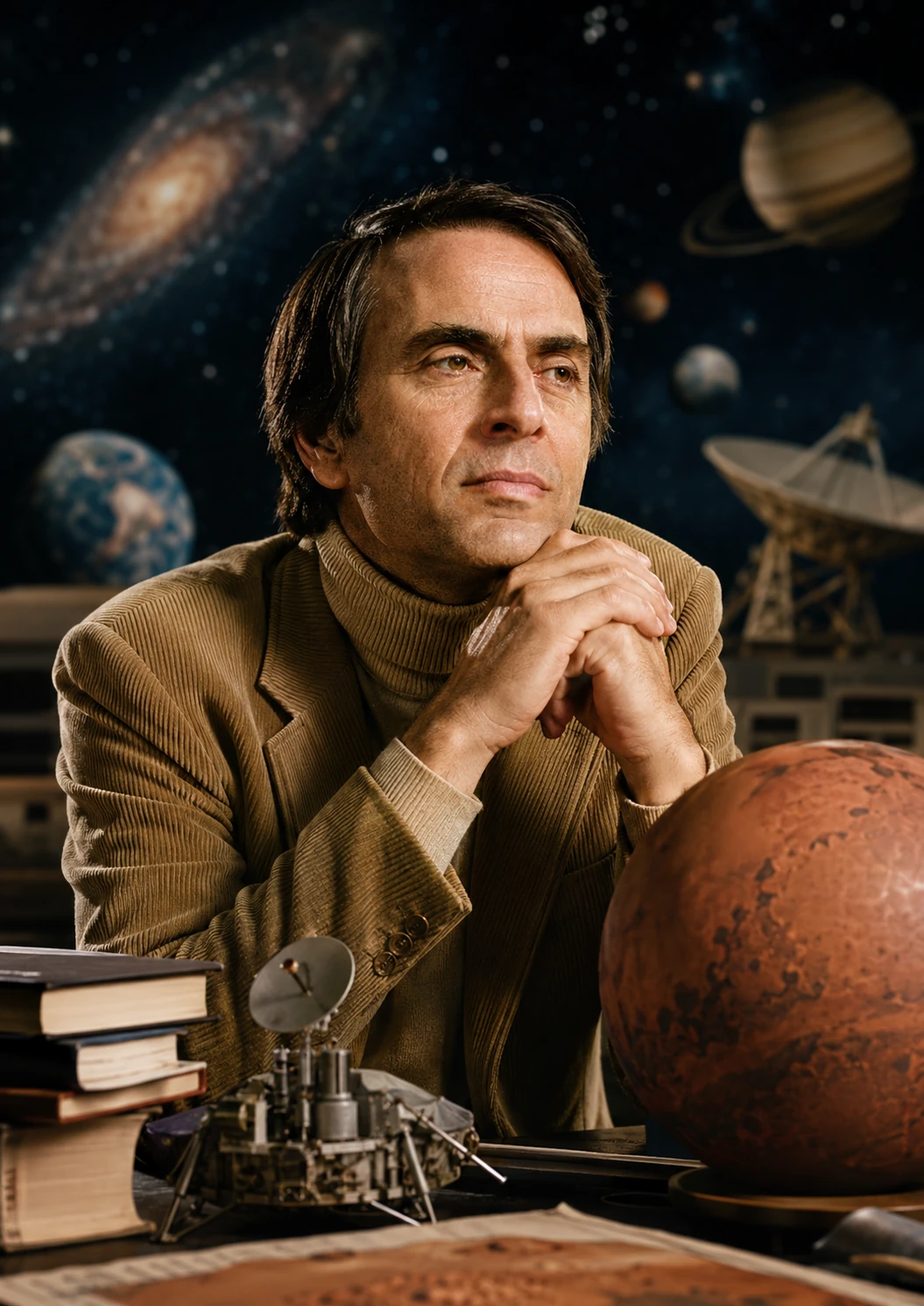
Carl Sagan. Conceptual reconstruction, not an archival photograph.
Chronological biography
1934–1960 — Brooklyn, libraries and scientific education
1934–1960: Brooklyn, Chicago, and learning to treat planets as physical worlds. Carl Edward Sagan was born in Brooklyn on November 9, 1934. Cornell’s biographical records note an early fascination with science and the 1939–40 New York World’s Fair, followed by an unusually broad university education at the University of Chicago. He earned undergraduate and master’s degrees in physics and a doctorate in astronomy and astrophysics in 1960. The sequence is important because his later Mars work combined physical reasoning about atmospheres with a willingness to ask biological questions that did not fit neatly inside one department. Cornell Chronicle — Carl Sagan biographySource.
Sagan’s youth in Brooklyn fed a curiosity that did not remain amateur astronomy. At the University of Chicago he entered an environment in which physics, chemistry, biology and astronomy could be combined, allowing him to build an interdisciplinary view of planets early in his career. That education explains what followed: understanding Mars meant studying atmosphere, organic chemistry, the conditions for life and the limits of robotic evidence together. Public communication came later, but it rested first on this scientific ability to connect disciplines. Institutional source.
Before becoming a global science communicator, Sagan built a research career on planetary atmospheres, surfaces, and the conditions under which life might exist. He taught at Harvard in the early 1960s and joined Cornell in 1968, becoming a full professor in 1971. That academic progression matters for Mars: by the time Mariner and Viking changed what humanity knew about the planet, Sagan already had the vocabulary of atmospheric physics, chemistry, biology, and skeptical inference needed to interpret ambiguous evidence without reducing the problem to a single instrument reading.
Sagan's path toward Mars began long before Viking. Growing up in Brooklyn, he became fascinated with astronomy and then pursued a broad scientific education at the University of Chicago. His training crossed physics, astronomy and planetary science at a time when planets were becoming laboratory problems rather than only telescopic objects. That interdisciplinary formation later allowed him to move between atmospheric chemistry, climate, instrumentation and public communication without treating those activities as unrelated careers. Source
The 1960s — Planetary science, atmospheres and learning the discipline of evidence
1960–1971: from planetary atmospheres to missions that force theory to confront a changing Mars. After completing his doctorate in astronomy and astrophysics, Sagan worked on planetary atmospheres at a time when the Solar System was still being reconstructed from sparse observations. His research on Venus helped establish a habit that would matter for Mars: a planet’s visible surface cannot be understood without its atmosphere and climate. He taught at Harvard and then joined Cornell, where he would spend the rest of his academic career. The transition from telescope-era planetary science to spacecraft-era science happened during these years. Mariner missions began replacing broad visual impressions with measurements of temperature, pressure, topography, and atmospheric behavior. For Sagan, this was not merely more data. It was a demonstration that familiar stories about another world could collapse quickly when a spacecraft arrived. Cornell Chronicle — Carl Sagan biographySource.
Mariner 9 and Viking gave Sagan a scientific education in disappointment as well as discovery. Mars repeatedly resisted simple stories: seasonal changes did not automatically imply vegetation, atmospheric conditions constrained surface biology, and lander results demanded cautious interpretation. Sagan’s importance lies partly in how he responded. He did not abandon the search for life; he sharpened the standards of evidence. That distinction is crucial for a Mars biography because it shows a scientist willing to keep an ambitious question while accepting that a favored explanation may fail. Institutional source.
Mariner 9’s arrival at Mars in 1971 provided a particularly vivid lesson because a planet-wide dust storm obscured much of the surface. Mission scientists had to wait, observe atmospheric evolution, and reinterpret what instruments were telling them before the landscape emerged. Sagan’s work on dust and climate belonged to this broader effort to understand Mars as a dynamic system rather than a static desert. The episode also foreshadowed a theme that ran through his career: uncertainty is not an embarrassment to hide from the public. It is a condition that scientists manage by gathering better evidence and changing explanations when the evidence changes. [source]
Early research on planetary atmospheres gave Sagan a route into the first era of spacecraft exploration. Mars was especially difficult because telescopic observations had accumulated decades of speculation about climate, vegetation and seasonal change. Spacecraft data forced those interpretations to be tested. Sagan's value was not that every hypothesis he entertained proved correct, but that he worked in a generation learning how to replace remote visual impressions with radiometry, spectroscopy, imaging and in-situ measurements. Source
Sagan’s value to Mars science becomes clearer when the missions are read as corrections to earlier expectations. Mariner 9 arrived to a planet temporarily hidden by dust, then revealed volcanoes, canyons and channels on a scale that forced scientists to rethink a world once imagined through telescopes. Viking then made the biological question harder rather than easier: a lander could perform carefully designed experiments and still leave interpretation contested. Sagan’s career matters because he stayed willing to let a better instrument change the story. [source]
His work around planetary atmospheres also linked Mars to comparative planetology. Venus, Earth and Mars could be treated as different outcomes of atmospheric physics rather than as isolated worlds. That comparison mattered because temperature, pressure, clouds and greenhouse effects became questions that could be constrained by measurements across several planets. The intellectual move is important: understanding Mars is often easier when the planet is placed inside a family of physical systems rather than treated as an exception. [source]
The same comparative habit later informed discussions of climate and habitability. Sagan’s public writing could move from a spacecraft observation to a broader planetary lesson because the underlying method was continuous: identify the mechanism, compare environments and ask what evidence could falsify the explanation. That bridge between specialist science and public reasoning is one of the reasons his influence on Mars outlasted the missions on which he formally served. [source]
The Planetary Society added an institutional dimension to that public role. Sagan helped create a durable organisation able to support planetary exploration, communicate science and keep missions in public debate after an individual television series or spacecraft had ended. In that sense his legacy includes not only explanations and hypotheses, but a mechanism for sustaining interest in exploration across generations. [source]
That habit also shaped his public work. He did not treat uncertainty as an embarrassment that had to be hidden from non-specialists. The public could be shown why a hypothesis was attractive, what observation challenged it and what remained unresolved. On a Mars reference site, that method is as important as any individual prediction: it teaches the reader to separate a beautiful narrative from the evidence available at the time. [source]
That approach still matters whenever Mars headlines move faster than the underlying data. Sagan’s legacy encourages readers to ask what was measured, what was inferred and what would count as a decisive test. A reference site that adopts that discipline is not merely preserving his biography; it is preserving the scientific habit he tried to popularise. [source]
Cornell, teaching and the transmission of scientific method. Carl Sagan left more than missions and books; he also helped train a generation of planetary scientists. At Cornell, research and teaching created an environment in which Mars, other worlds and the question of extraterrestrial life could be studied without separating rigor from explanation. Source.
His work on planetary protection followed the same logic. If Mars might preserve indigenous life or evidence of it, spacecraft cleanliness and sample handling are not bureaucratic details but conditions for trustworthy science. Sagan helped make that ethical and methodological problem visible to a broader audience. The same instinct later shaped his public communication: wonder was valuable only if it remained compatible with evidence. That combination is why he became such a powerful interpreter of Mars—he could make the possibility of life emotionally compelling while insisting that extraordinary interpretations earn their place through data. Institutional source.
That transmission matters as much as his media presence. Durable science depends on students, laboratories and methods that survive the individual who made the subject famous.
Viking made the problem sharper. The landers could perform biological experiments, but an instrument result is not identical to a biological conclusion. Sagan strongly supported the search for life while also participating in debates about what the data could justify. That tension belongs in a serious biography because it illustrates the difference between scientific motivation and evidentiary threshold. Mars can be the place a scientist most hopes to find life and still demand unusually strict controls against contamination and ambiguous chemistry. Source
1971–1976 — Mariner 9, Viking and the real Mars behind the images
Mariner 9: when the planet changes before our eyes. Mariner 9 arrived at Mars while a vast dust storm obscured much of the surface. Waiting became a scientific method: as the atmosphere cleared, giant volcanoes, canyons, flow features and geological diversity emerged, destroying the image of a simple uniform world.
Sagan contributed to interpreting this new Mars. The episode illustrates a fundamental idea: observation can overturn the most appealing mental picture and replace it with something even more complex.
Later work in public communication, the Voyager record, Cosmos and the Planetary Society made Sagan an unusually influential bridge between research institutions and the public. That role helped keep planetary exploration culturally visible, but it also created a responsibility to distinguish possibility from evidence. For a Mars encyclopedia, his legacy is therefore methodological as much as inspirational: ask ambitious questions, design measurements capable of surprising you and communicate uncertainty without draining the question of its importance. Source
1971: a dust storm hides Mars just as humanity finally arrives to watch it. Mariner 9 reached Mars in November 1971 and became the first spacecraft to orbit another planet. Yet Mars nearly vanished beneath a global dust storm just as the spacecraft arrived. JPL records how the programmable probe could wait and resume systematic observation as the atmosphere cleared. [S5] The episode is almost a perfect model of planetary science: the scientist does not receive a clean, motionless target. The planet changes the experiment and forces the plan to change with it.
Sagan was deeply involved in NASA planetary missions and in the scientific interpretation of Mars. JPL links him with Mariner 9 and Viking, while Cornell and the Library of Congress document his long research career and NASA advisory work. [S2][S3] The Mars reconstructed by this generation was neither the simple cratered world suggested by early flybys nor Lowell’s inhabited planet. Volcanoes, canyons, channels and storms turned Mars into a dynamic geological world.
1970s: Viking, the search for life, and learning how difficult it is to design an experiment for an unknown biology. Viking turned the question of Martian life from speculation into an experiment conducted on the surface. Sagan participated in the scientific debate surrounding mission objectives, landing sites, and interpretation. The difficulty was fundamental: an experiment could only detect forms of metabolism or chemistry that its designers had imagined in advance. A positive signal might have a non-biological explanation, while a negative result might mean that the instrument had asked the wrong question. Viking’s ambiguous biology results therefore became a lesson in epistemology as much as astrobiology. A responsible scientist had to distinguish what the experiment measured from the larger claim the public wanted answered.
Planetary protection belonged to the same chain of reasoning. If Mars might preserve indigenous life, sending terrestrial organisms could confuse future experiments or damage the very environment scientists wanted to study. Sagan argued publicly for exploration while also treating contamination as a scientific problem. That combination matters to a future human Mars program because human presence makes sterilization impossible in the simple robotic sense. The biography therefore connects Viking not only to the historical search for life but to a continuing operational tension: the better humanity becomes at reaching Mars, the harder it becomes to guarantee that evidence of Martian biology remains uncontaminated.
Viking’s biology experiments show why the search for life is unusually demanding. Intriguing results can support several interpretations, and lack of consensus requires a strict distinction among signal, hypothesis and demonstration.
Sagan promoted Mars exploration without turning enthusiasm into certainty. That stance remains directly relevant: the more extraordinary the claimed discovery, the stronger and more contamination-resistant the evidence chain must be.
The 1980s — From mission scientist to public interpreter of science
Choosing Viking landing sites: geology, engineering and biology pull in different directions. Viking forced Sagan and the wider science community to confront a problem that future human missions will know well: the scientifically most interesting terrain is not automatically the safest place to land. A search for evidence of water or unusual chemistry has to be reconciled with slopes, rocks, atmospheric uncertainty, communications and the limited mobility of the landed system. Site selection therefore became a practical negotiation between disciplines. That experience is important in Sagan's Mars biography because it shows skepticism operating inside mission design, not only in public debate. The right scientific question is useless if the spacecraft cannot safely reach the place where it could answer it. [S6][S7]
Viking: when the honest story is the one that accepts ambiguity. Viking placed two laboratories on Mars in 1976 with a question that sounds simple: can the soil reveal signs of life? Biological experiments produced results that were difficult to interpret, while chemical measurements failed to provide the clear confirmation many hoped for. JPL now summarizes Viking as a mission that transformed knowledge of Mars without establishing evidence of life. [S6]
Sagan was exactly where an easy narrative became dangerous. He had spent a career thinking about life elsewhere, but interest in the hypothesis did not remove the need for strong evidence. The Library of Congress preserves a 1974 draft in which he reassessed the prospects for Martian life after Mariner 9 and before Viking. [S4] The documents show scientific method as a process: hypotheses, new observations, revision and new experiments.
The tension is therefore not whether “Sagan was right.” It is how to remain curious when the data refuse a dramatic verdict. That is still the essential Mars skill. A possible biosignature, organic molecule or strange structure is not proof of life until geological, chemical and instrumental alternatives have been tested.
1980–1996 — The Planetary Society, Pale Blue Dot and legacy
Planetary protection and the responsibility of the explorer. The search for life creates a methodological responsibility: carrying Earth organisms to another planet can contaminate the environment and confuse future observations. Sagan was involved early in discussions about biological caution and avoiding irreversible contamination.
The issue becomes far more difficult with human missions. A base carries vastly more microbes and organic material than a sterilized probe. The scientific concern Sagan helped articulate therefore connects directly to modern engineering of clean zones, waste streams and sampling campaigns.
Searching for Martian life creates an extra responsibility. A spacecraft from Earth carries terrestrial microbes, organic material and contamination pathways. If a Martian measurement is to be interpreted, the mission must control what it brings and document what it cannot eliminate. The Library of Congress archive documents Sagan’s NASA, Viking and exobiology work in detail. [S3]
The problem becomes harder with future human crews, for whom local biological contamination will be much more difficult to avoid. The objective is therefore not only an abstract injunction to “protect Mars,” but to preserve places, samples and procedures that can still distinguish indigenous signals from imported ones. Sagan’s appetite for large questions leads here to an intensely practical conclusion: the more extraordinary the hypothesis, the more disciplined the sampling architecture must be.
From mission scientist to public interpreter: explaining when data destroys a beautiful story. Sagan's public importance grew because he did not treat uncertainty as an embarrassment. Mariner and Viking repeatedly replaced older images of Mars with a more complicated planet, and he learned to make that revision itself part of the story. The skill is rare: explain why a result is disappointing without turning disappointment into distrust of science. For a Mars reference site, that is a direct methodological inheritance. A mission can fail to confirm life, a favored hypothesis can weaken, or a dramatic image can receive a mundane explanation; the scientific achievement may be precisely the reduction of what can honestly be claimed. [S4][S7]
1980–1996: Cosmos, the Planetary Society, skepticism, and building a public institution around evidence. Cosmos made Sagan one of the most recognizable scientists in the world, but communication should not be treated as a career separate from his scientific work. The television series, books, lectures, and later writings all repeated a method: wonder is valuable when paired with evidence, scale, and a willingness to reject attractive claims. He co-founded the Planetary Society in 1980, helping create an institution that could advocate for planetary exploration across changes in government programs. That mattered for Mars because scientific missions require cultural and political continuity as well as hardware. A public that understands why exploration matters is part of the infrastructure that keeps missions possible over decades.
Sagan died in 1996, before the modern sequence of Mars rovers transformed the surface into a continuously explored field site. Yet those missions inhabit a scientific culture he helped popularize: Mars is compelling not because canals or civilizations must exist, but because the real planet is complex enough to reward disciplined curiosity. His chronological legacy therefore ends with a productive tension. He helped make Mars emotionally important to millions of people while repeatedly warning that emotional investment must not be allowed to decide what the data mean.
Sagan understood that planetary science also depends on public support, education and the ability of citizens to understand why distant missions deserve time and money. His books and broadcasts became a form of cultural infrastructure around exploration.
For Mars, that is not secondary. Long-duration human settlement would require decades of investment, failure, debate and political choices. Without shared scientific culture, even excellent technical programs remain fragile.
Cornell records Sagan’s hundreds of scientific and popular publications, his teaching, his direction of the Laboratory for Planetary Studies and the extraordinary reach of Cosmos. [S1] It is tempting to split “the scientist” from “the popularizer.” His career suggests the roles were mutually reinforcing. Explaining clearly requires mental models, and a society that understands why a mission matters is more capable of supporting its cost and duration.
This influence was tied directly to the space program. Sagan advised and worked on multiple planetary missions and co-founded The Planetary Society. JPL highlights his position as a bridge among research, missions and the public. [S2] A Mars biography should therefore treat communication as infrastructure. Probes need antennas; long-lived programs also need a public able to understand what those antennas are sending home.
By the 1980s Sagan had become more than a planetary scientist with a public profile. Cosmos made the logic of evidence, scale and cosmic perspective accessible to a mass audience, while the Planetary Society gave exploration advocacy an institution that could outlive a television series or one person's career. That combination matters for Mars. Public enthusiasm can sustain exploration, but enthusiasm becomes durable only when it is paired with a culture that distinguishes observation from inference. Sagan's distinctive achievement was to make rigor part of the attraction rather than the obstacle to it. [S1][S3]
Pale Blue Dot: Mars as a destination, Earth as the reference point. Sagan's later writing placed exploration inside a larger moral frame. Mars remained scientifically and culturally compelling, but the view of Earth from deep space made clear that expansion beyond Earth does not reduce the value of the planet on which civilization already depends. This is not a technical constraint in the same sense as delta-v or radiation dose. It is a design ethic for the story of settlement: the desire to become multiplanetary should not require pretending that Mars is easy, empty of scientific responsibility or a substitute for stewardship of Earth. In that sense, Sagan's relevance to colonization is partly a warning against turning destination into mythology. [S3]
1996 and after: a body of work that continues to train readers. Sagan died in 1996, but his Mars legacy did not end with a mission or a hardware program. His papers, lectures, books and mission work continue to model a specific habit: begin with wonder, then insist that the claim become narrower as the evidence becomes stronger. That habit is exactly what a living Mars encyclopedia needs. The page can admire the ambition of exploration while labeling what has been observed, what has been demonstrated, what remains under development and what is still speculation. Sagan's contribution is therefore not only historical; it is editorial and methodological. [S1][S3]
A planetary scientist becomes a public institution. Sagan's later influence came from combining several careers rather than abandoning one for another. He continued scientific work on planetary atmospheres and mission interpretation while becoming involved in mission teams, planetary protection debates and public communication. The Voyager record project and Cosmos expanded the audience, but they also reveal a recurring method: translate technical planetary science without stripping away uncertainty. The Planetary Society then gave that public role an institutional form. For a Mars history, this matters because Sagan did not simply popularize a destination; he helped create a culture in which atmospheric evolution, possible life, spacecraft exploration and ethical caution could be discussed together by scientists, agencies and the public.
Supplementary documentary analysis
Biographical analysis, context and legacy
Thematic analysis and deeper reading
Essential timeline
Born in Brooklyn, New York.
Scientific training and research on planetary atmospheres and surfaces.
Contributes to JPL missions including Mariner and Viking.
Mariner 9 becomes the first spacecraft to orbit another planet: Mars.
Viking 1 and 2 land on Mars and conduct major biological and geological experiments.
Cosmos brings planetary science to an enormous global audience.
Dies after a career combining research, missions and science communication.
Viking and the question of life
Viking carried the first biological experiments performed directly on the Martian surface. Their results became a classic astrobiology debate: several signals were intriguing, but the overall evidence did not establish Martian life.
Sagan argued for exploration while remaining careful about interpretation. A modern profile should place Viking in the continuum leading to today’s work on habitability, biosignatures and sample return.
Communicating without flattening the science
Sagan’s public talent was his ability to move from molecules and spectra to humanity’s place in the cosmos. That narrative deeply influenced space culture.
His legacy is also methodological: explain enough for the reader to feel the power of a result without asking them to believe a conclusion stronger than the data support.
From “canals” to orbital data: a cultural revolution
At the beginning of the twentieth century much of the public imagined Mars through Lowell’s canals and the idea of a civilization. Space missions gradually replaced that landscape with measurements: very low pressure, climate, craters, volcanoes, canyons and evidence of a complex water history. Sagan belonged to the scientific generation that accompanied that transformation.
His public achievement was not to present the disappearance of older fantasies as a loss. The real planet, colder and more hostile, became more interesting because it raised testable questions about climate, chemistry and possible past life.
Brooklyn, Chicago, and the making of a method: loving extraordinary possibilities without manufacturing evidence
Carl Sagan was born in Brooklyn on November 9, 1934, into a family outside the professional scientific establishment. NASA and Cornell both emphasize the intensity of his childhood curiosity: astronomy and science fiction opened the door, while his parents encouraged him to look for answers rather than merely collect mysteries. That combination became a recognizable feature of his adult work. Sagan did not treat imagination as the enemy of science. He treated it as a generator of hypotheses that had to survive contact with evidence. The distinction is essential to understanding his lifelong relationship with Mars, because the planet reached him first through culture and only later through spacecraft data. [S9]
For a child growing up in the middle of the twentieth century, Mars arrived packaged with canals, dying civilizations, monsters, heroic explorers, and the stories of Edgar Rice Burroughs. The mature Sagan would help dismantle much of that imagined planet. Yet he never accepted the idea that a less inhabited Mars was a less interesting Mars. The actual planet, with global dust storms, extinct river systems, giant volcanoes, a thin atmosphere, and a still unresolved history of possible habitability, offered a deeper mystery than the old fiction. That transition—from a desired answer to a more complicated reality—is one of the central stories of his life.
At the University of Chicago he acquired the disciplinary structure needed to pursue those questions. He earned degrees in physics and later a doctorate in astronomy and astrophysics in 1960. Chicago gave him access to an intellectual culture in which physics, chemistry, biology, and astronomy could meet. Planetary science was still forming as a modern field, and Sagan’s instinct was interdisciplinary from the beginning. A planet was not merely an astronomical object with an orbit. It was an atmosphere, a surface, a chemical reactor, a climate history, and potentially an environment in which biology might emerge. Cornell’s institutional accounts of his career show how naturally he moved among those levels. [S1]
This training also helps explain the later communicator. Sagan could simplify because he had learned to connect fields, not because he ignored complexity. When he explained a planet to a general audience, he often reconstructed a causal chain: sunlight changes chemistry, chemistry changes opacity, opacity changes temperature, temperature changes what kinds of liquids or reactions can persist. That habit made it possible to tell the public not only what scientists thought, but why they thought it.
Venus, Mars, and Titan: learning that a planet is a history rather than a photograph
Sagan’s work becomes easier to understand when Venus, Mars, and Titan are treated as parts of one comparative project. On Venus, his research helped establish the importance of a powerful greenhouse effect in explaining the planet’s extreme surface temperature. On Mars, he worked on dust, seasonal changes, wind erosion, and mechanisms capable of explaining a climate that had once allowed liquid water to modify the surface. On Titan, he and collaborators investigated photochemical processes capable of producing complex organic material. NASA and Cornell summarize these contributions as central examples of his planetary science. [S17][S23]
The comparative method changed the intellectual status of Earth itself. If Venus, Earth, and Mars could begin with some broadly related ingredients yet develop radically different climates, then habitability was not a permanent property granted to a planet by size and distance alone. Atmospheres evolve. Water moves or is lost. Surfaces record catastrophes and long cycles. Chemistry can create complicated organic molecules in places where nobody is claiming that organisms exist. The search for life therefore had to be embedded in planetary history.
Mars provided an especially useful lesson because telescopic observers had long interpreted seasonal changes as possible vegetation. Sagan’s work favored moving dust as a far stronger physical explanation. This did not make him hostile to the possibility of Martian life. It made him unwilling to use life as an explanation when atmospheric and surface physics could account for the observation more convincingly. That distinction strengthened his later advocacy for biological experiments: the claim would matter only if nonbiological alternatives were seriously tested.
Titan added another caution. Complex organic chemistry does not automatically mean biology. Sunlight acting on methane and other atmospheric constituents can produce dark organic material through abiotic chemistry. The implication for Mars and for exoplanets is profound. A molecule can be exciting without being diagnostic. The more consequential the interpretation, the more necessary it becomes to identify other mechanisms that could produce the same signal.
NASA, Apollo, and planetary missions: learning that exploration is a collective system
NASA describes Sagan as a consultant and adviser beginning in the 1950s and notes that he briefed Apollo astronauts before their lunar flights. That fact places him at a revealing intersection. He was not an astronaut, spacecraft program manager, or launch-vehicle designer. His contribution was to bring planetary science and biological thinking into programs that were becoming operational at unprecedented speed. [S17]
His work with Mariner, Viking, Voyager, and Galileo also exposed him to the real architecture of space exploration. A successful planetary mission is never the achievement of a single charismatic individual. It depends on propulsion engineers, navigators, instrument teams, software, telecommunications, imaging specialists, industry, budgets, test programs, and decision structures. Sagan became unusually visible because he could interpret and communicate the discoveries, but the discoveries themselves emerged from organizations containing thousands of specialized tasks.
The Library of Congress collection makes that network visible in another way. Its hundreds of boxes contain NASA files, academic material, correspondence, drafts, and mission-related records. The archive reveals a career embedded in institutions and collaborations rather than a solitary thinker moving from insight to insight. [S18]
This experience gave Sagan a practical understanding of tradeoffs. A mission has limited mass, power, time, and money. A scientifically attractive landing site may be more dangerous. An additional instrument can consume resources needed elsewhere. A communications link can determine which observations are possible. That discipline matters to human Mars exploration. Desire cannot substitute for architecture; architecture cannot substitute for testing; and testing cannot eliminate every uncertainty. Exploration advances by turning ambition into constrained, reviewable choices.
Mariner 9: the spacecraft that erased an old Mars and revealed a more compelling one
When Mariner 9 entered Mars orbit in November 1971, it achieved a historic first: a spacecraft had entered orbit around another planet. Yet the planet was largely hidden by a global dust storm. For scientists who had waited years for sustained orbital observation, the timing seemed almost perverse. But the storm turned delay into discovery. The spacecraft watched the atmosphere evolve, and as the dust cleared, a new Mars emerged. [S5]
The surface did not resemble a monotonous lunar desert. It contained enormous volcanoes, a canyon system spanning a significant fraction of the planet, layered terrains, and landforms consistent with ancient flowing water. The scientific question changed. Earlier flybys had damaged popular hopes for a biologically active surface, but Mariner 9 made the planet’s past much more interesting. Mars could have experienced environmental conditions very different from those of the present.
Sagan and colleagues contributed to interpreting this dynamic world. Cornell’s memorial statement records his work with James Pollack and Joseph Veverka on wind erosion and with Brian Toon and Peter Gierasch on climate mechanisms that might help explain drainage patterns produced when the planet could sustain liquid water. [S23]
This shift still shapes Mars exploration. Ancient channels and sedimentary environments are not merely scenic features. They help identify places where evidence of past habitability may have been preserved. A future settlement would also read the same geological archive for resources, water history, terrain stability, and environmental change. Mariner 9 therefore represents a recurring pattern in Sagan’s career: a mission does not simply answer the questions written before launch. It improves the questions that come next.
Viking and life detection: designing experiments when even the target biology is unknown
Viking turned the Martian life question into an experiment conducted on the surface. The two landers carried three biological investigations alongside chemistry, meteorology, imaging, and other instruments. The intellectual challenge was enormous: how do engineers and biologists design a test for organisms that may not share familiar terrestrial metabolism? Before landing, Sagan and Joshua Lederberg published a pre-Viking assessment that classified possible ecological niches according to temperature and water activity and considered how hypothetical organisms might obtain water from ice or hydrated minerals. [S12]
The results refused to become a clean headline. Viking detected striking chemical reactivity. Some biological experiments produced responses that could resemble metabolism, while the broader suite of observations did not provide a definitive case for living microorganisms. NASA’s current description remains deliberately careful: unexpected and enigmatic chemistry, but no clear evidence of life in the soils sampled near the landing sites. [S21]
Sagan’s own contemporary discussions were similarly nuanced. In a 1977 review of planetary exploration he noted that the organic-chemistry result was negative while some microbiological experiments gave positive responses. At minimum, Mars had demonstrated nonbiological chemistry capable of imitating steps associated with familiar biological processes. [S20]
The Viking problem remains a model for modern astrobiology. A positive-looking signal is not sufficient when several processes can produce it. At the same time, a failure to confirm life at two landing sites does not prove that the entire planet has always been sterile. Site selection, depth, chemistry, preservation, and geological history all matter. Sagan’s contribution was not a verdict. It was a way of keeping the question rigorous after the easy answers failed.
Planetary protection: exploration must not destroy the evidence it hopes to find
Planetary protection can look like administrative caution attached to the exciting work of exploration. For Sagan and other early exobiologists, it followed directly from the scientific problem. If Mars might contain indigenous biology, then microorganisms carried from Earth could create false positives, alter local environments, or contaminate sites before they were studied. The reverse problem also mattered: if material were returned from another world, a responsible program had to consider what was not yet known about its chemistry or biology.
NASA now defines planetary protection as a discipline intended to preserve the scientific integrity of explored environments and to manage contamination risks. The modern rules are more detailed than those of Sagan’s early career, but the logic is continuous: the act of measuring a world changes it unless the investigator controls the measurement process. [S15]
Human settlement makes the problem much harder. Robots can be assembled and cleaned according to specified contamination standards. Human beings carry complex microbiomes, require water, release organic compounds, grow food, and produce waste. A permanent base would therefore create a biological footprint that could eventually spread beyond the habitat. That creates a genuine conflict between two legitimate goals: investigating a possibly independent Martian biosphere and establishing a functioning human biosphere.
Sagan’s legacy does not prescribe one simple solution, but it encourages a sequence. Study the most sensitive environments before changing them. Preserve samples and records. Establish protected scientific zones where necessary. Track terrestrial organisms that are intentionally or unintentionally transported. The point is not to freeze Mars forever. It is to avoid throwing away unique information merely because the consequences of contamination were inconvenient to plan for.
Choosing Viking landing sites: when biology, geology, and engineering pull in different directions
Landing-site selection shows how quickly planetary science becomes systems engineering. A biologist might prefer terrain associated with water. A geologist may want diversity of rocks and landforms. An engineer needs manageable slopes, acceptable altitude, sufficient atmospheric density for descent, and a surface unlikely to destroy the spacecraft. Sagan participated in the scientific environment surrounding Viking site selection, and NASA retains imagery connecting him directly to the program. [S7]
Viking 1’s originally favored landing area looked rougher than expected when improved orbital imagery became available. The landing was delayed while the team searched for a safer site. That decision matters because it demonstrates a core principle of exploration: new evidence must be allowed to change the plan, even when the plan is politically visible and the schedule carries symbolic value. The safe decision can be the scientifically mature decision.
Site choice also changes the meaning of a negative result. If the safest reachable soil is not the most promising biological environment, then a life-detection experiment has sampled a limited hypothesis, not the whole planet. This is one reason Viking did not close astrobiology. Later missions increasingly targeted geological context: ancient lakes, sedimentary rocks, deltas, hydrated minerals, and places where traces of past environments might be preserved.
The same logic will govern human settlement. The best location for accessible ice may not be the best for solar power. A scientifically protected site may not be the best place for industrial activity. Landing safety, communications, terrain, radiation, water, energy, and scientific value form a multi-variable problem. Viking’s lesson is that no single map layer can choose a Martian city.
Voyager: from planetary encounters to a comparative geography of the Solar System
Voyager gave Sagan a laboratory far larger than Mars. As a member of the imaging team, he participated in the scientific interpretation of the outer planets and their satellites. The encounters revealed active volcanism on Io, complex rings and atmospheres, strange icy surfaces, and a diversity of moons that transformed ideas about where geologically or chemically interesting environments might exist. The Planetary Society summarizes his role across Voyager and other planetary missions. [S22]
The important lesson was not that Mars had become less important. It was that habitability could no longer be imagined as a simple Earth-versus-everything-else category. The Solar System contained worlds powered by sunlight, tidal heating, atmospheric chemistry, internal heat, and combinations that had barely been considered before close reconnaissance. Each encounter expanded the range of environments relevant to the study of life.
Voyager also changed the meaning of mission duration. The spacecraft were launched for planetary encounters, yet decades later they continued returning measurements from the outer heliosphere and interstellar space. NASA still operates the mission in 2026, nearly half a century after launch. [S27]
That longevity is a useful model for Mars infrastructure. A settlement will eventually depend on systems that outlive their original designers. Documentation, spare-part strategies, maintainable software, institutional memory, and the ability to train successors are therefore not secondary management concerns. Voyager demonstrates how engineering becomes intergenerational when hardware survives long enough.
The Golden Record: an interstellar message that became a mirror held up to Earth
NASA asked a committee led by Sagan to prepare a message for the Voyager spacecraft. The resulting Golden Record contained 115 images, natural sounds, music from multiple cultures and eras, spoken greetings in fifty-five languages, and messages from political leaders. The probability of interception by an extraterrestrial civilization is extraordinarily small, but that improbability is part of the object’s power. Humanity was forced to decide how it would introduce itself if it had only a compact package and an unknown recipient. [S17]
The project was collaborative. Frank Drake, Ann Druyan, Timothy Ferris, Jon Lomberg, Linda Salzman Sagan, and others contributed scientific, creative, technical, musical, and linguistic expertise. A letter preserved by the Library of Congress shows Sagan asking ethnomusicologist Alan Lomax to help with musical selections. [S24]
The communication problem was deliberately extreme. The intended audience might not share human language, senses, mathematics education, or cultural assumptions. The record therefore relied on physical references, encoded images, and symbolic playback instructions. None of those choices guarantees comprehension. The project should be understood as an attempt to reduce ambiguity using assumed physical invariants, not as the invention of a proven universal language.
For a future Mars society, the deeper lesson is cultural transmission. A remote settlement cannot carry or preserve everything with equal priority. It must decide which languages, histories, techniques, works of art, scientific records, and social institutions deserve redundancy. The Golden Record turns that problem into a symbolic exercise. Mars would turn it into infrastructure.
Pale Blue Dot: using deep-space exploration to make Earth visible as a finite world
After Voyager 1 had completed its major planetary encounters, Sagan strongly supported the idea of turning its camera back toward the inner Solar System. On February 14, 1990, Earth appeared in the resulting family portrait as an almost negligible point of light seen from billions of kilometers away. The image contained little geographic information, yet it became one of the most powerful products of the mission because it changed scale rather than detail. [S27]
Sagan used the image to argue that human political divisions look different when the entire known arena of civilization occupies a tiny fraction of one pixel. The point was not that human suffering becomes trivial at cosmic scale. It was that no known external power is responsible for managing Earth’s biosphere, wars, or future. Astronomy could therefore produce an ethical effect: distance reveals dependence.
This perspective complicates the popular idea that Mars is an escape from terrestrial problems. A functioning Martian settlement would likely make Earth’s natural services more visible. Air pressure, oxygen, liquid water, agricultural soil, and radiation shielding are not line items in most terrestrial household budgets because the planet supplies them at enormous scale. On Mars, each becomes part of an engineered system whose failure can be measured in hours.
Pale Blue Dot and Mars settlement therefore point toward the same systems insight. Civilization rests inside an environmental support structure. Earth provides one naturally; Mars would require humans to build partial substitutes. Becoming multiplanetary would not make Earth less valuable. It could make the physical meaning of habitability impossible to ignore.
Cosmos: turning scientific method into mass culture without pretending the story was finished
The 1980 television series Cosmos: A Personal Voyage made Sagan a global public figure. Institutional biographies describe an audience of hundreds of millions across dozens of countries. The scale matters, but the method matters more. The series did not present science as a warehouse of correct answers. It presented a historical process containing error, imagination, measurement, and revision. [S17]
Sagan combined narrative, visual effects, music, and historical reconstruction with causal explanation. The strategy was sometimes criticized as theatrical, yet it allowed viewers with little formal training to understand why a scientific question was emotionally and intellectually important before encountering the technical details. This was not the same as eliminating complexity. At its best, the series used wonder to create the patience required for explanation.
His media success also exposed a cultural tension inside academia. Visibility can make colleagues suspect that a scientist is trading rigor for celebrity. Sagan’s career demonstrates that science communication is judged by two audiences with different incentives: specialists ask whether the claims survive technical scrutiny, while the public asks whether the explanation is intelligible and worth attention. Doing both well is a specialized skill.
Mars exploration will need that skill. A program lasting decades cannot rely on a permanent reserve of public enthusiasm. Citizens and future settlers will need to understand why a mission is delayed, why a risk is unacceptable, why an experiment needs protection, or why an expensive infrastructure component matters. Communication is therefore not decoration around engineering; it helps determine whether long-term engineering institutions can survive.
The Planetary Society: turning scientific enthusiasm into a durable civic institution
In 1980 Sagan joined Bruce Murray and Louis Friedman in founding The Planetary Society. That decision expanded his role beyond research and communication. The organization was designed to give the public a continuing way to support planetary exploration, science, and the search for life. Sagan served as its first president, and the Society later became one of the most visible citizen organizations devoted to space science. [S22]
The institutional logic is important. Space missions do not exist solely because a scientific community finds them worthwhile. They must survive annual budgets, changing administrations, industrial competition, program cancellations, and shifts in national strategy. A public organization can help explain why a mission matters before a crisis arrives and can maintain attention during the long periods when no dramatic launch or landing is occurring.
Sagan understood that communication and institutional continuity were connected. A spacecraft needs engineering, but engineering requires a program; a program requires authorization and money; long-term authorization requires legitimacy. Public understanding does not automatically produce funding, yet ignorance makes any ambitious exploration strategy more fragile.
A sustained human Mars program would face the same problem at much larger scale. A settlement project might span generations of political leadership. Institutions capable of preserving goals, arguments, historical records, and technical knowledge would be as important as the initial launch vehicles. The Planetary Society represents one way Sagan attempted to convert public curiosity into continuity.
SETI: making a spectacular question scientifically respectable by making the tests stricter
Sagan’s support for the search for extraterrestrial intelligence placed him in another field vulnerable to sensationalism. The proposition that other technological civilizations may exist is not itself evidence that any particular signal is artificial. Sagan therefore argued for observational programs that could define frequencies, repeat detections, exclude terrestrial interference, and use independent confirmation. The Planetary Society supported radio SETI work among its scientific activities. [S25]
This position allowed him to be simultaneously optimistic and skeptical. The enormous number of stars made extraterrestrial intelligence plausible enough to search for, while the absence of confirmed detections required restraint. The logic is identical to his approach to Mars. Plausibility determines whether an experiment is worth doing; evidence determines what can be claimed afterward.
SETI also teaches the management of false positives. A single unusual signal can result from hardware, local transmitters, satellites, natural astrophysical processes, or statistical coincidence. A compelling detection would require behavior difficult to produce through those alternatives. The more revolutionary the claim, the more valuable independent replication becomes.
That lesson is directly applicable to Martian biosignatures. An organic molecule, isotope ratio, microscopic shape, or seasonal gas variation can be interesting without being uniquely biological. A mature Mars science program must therefore be designed not to find “signs of life” in the broadest sense, but to distinguish biological hypotheses from the strongest abiotic competitors.
Nuclear winter: bringing planetary-atmosphere reasoning back to a human-made terrestrial risk
In the early 1980s Sagan worked with Richard Turco, Owen Toon, Thomas Ackerman, and James Pollack on the possible climatic consequences of a major nuclear exchange. The argument drew on exactly the type of atmospheric physics used in planetary science: large quantities of smoke and dust injected into the atmosphere could alter the radiative balance and produce severe global cooling. The work became known through the initials of the authors as TTAPS and helped popularize the term “nuclear winter.” The Library of Congress preserves extensive drafts, correspondence, conference records, and material surrounding the debate. [S22]
The episode was scientifically and politically controversial. Early models contained substantial uncertainties, and researchers debated the magnitude, duration, and assumptions behind different scenarios. Sagan nevertheless argued that even uncertain low-probability global consequences deserved serious attention when the stakes were civilizational. That position brought him into public debate with figures including Edward Teller and into direct activism against nuclear weapons and testing.
The biographical lesson is not that every early number was permanently correct. It is that Sagan was willing to move from scientific modeling to public advocacy when he judged the implications sufficiently grave. Doing so increased the obligation to separate calculated results, scenario assumptions, and value judgments. The archive shows how much work went into that public argument rather than presenting it as a single dramatic speech. [S26]
Mars settlement will generate comparable questions about low-probability, high-consequence hazards: biological contamination, reactor accidents, habitat fires, loss of power during dust events, or failures in food production. Sagan’s example suggests that uncertainty is not a reason to ignore catastrophic possibilities. It is a reason to state assumptions clearly and improve the models before policy turns them into slogans.
From Venus to Earth: planetary science as a way of seeing atmospheric vulnerability
Sagan’s research on Venus made atmospheric feedback impossible to regard as a small correction to planetary climate. Venus is not a prediction of Earth’s future in any simple sense; the worlds differ in composition, solar input, water history, and many other parameters. But the comparison demonstrates a general principle: atmosphere and radiative balance can determine the thermal state of an entire planet.
That comparative background shaped Sagan’s willingness to discuss terrestrial environmental change. Cornell and the Library of Congress record his work and public engagement on greenhouse warming and other environmental issues. [S14]
The intellectual move is valuable because it prevents two opposing mistakes. Space exploration is not automatically a distraction from Earth, and Earth science is not separate from planetary exploration. Studying other worlds reveals alternative climate states; studying Earth provides the detailed physics and chemistry needed to interpret those worlds. Comparative planetology makes each side stronger.
For Mars settlers, atmospheric thinking becomes immediate engineering. A habitat is a tiny artificial climate system. Gas composition, humidity, pressure, heat rejection, contaminants, and circulation have to remain inside narrow operating envelopes. Processes that seem abstract at planetary scale become life-support alarms at room scale. Sagan’s career repeatedly moved between those scales.
Skepticism without cynicism: keeping openness and evidential standards in the same mind
Sagan became one of the best-known advocates of a form of skepticism that did not begin by assuming unusual claims were false. It began by asking what evidence would distinguish the claim from alternatives. This matters because the subjects that fascinated him—Martian life, extraterrestrial intelligence, unidentified phenomena, catastrophic risks, and future technologies—are exactly the subjects in which hope or fear can overwhelm judgment.
Scientific reasoning often requires more categories than “true” and “false.” A proposition can be plausible but unconfirmed, compatible with observations but non-unique, or interesting but poorly tested. Viking belongs in this middle territory. SETI belongs there as well. Ancient Martian habitability is strongly supported; ancient Martian biology remains unconfirmed. The ability to hold a question open without turning it into a belief is one of Sagan’s most useful public lessons.
This is not merely philosophical etiquette. Exploration crews will make decisions with incomplete information. Sensors may disagree; unexpected phenomena will occur; failures will have several candidate causes. A crew that jumps to the first attractive explanation can lose time or lives. A crew that refuses unfamiliar hypotheses can do the same. The operational answer is to design discriminating tests.
Sagan’s skepticism was therefore compatible with radical curiosity. He could take extraterrestrial life seriously precisely because he did not need to pretend it had already been detected. The discipline protects wonder from becoming misinformation.
Contact: using fiction to stress-test the human consequences of a scientific discovery
When Sagan wrote Contact, he changed medium without abandoning his core questions. Fiction allowed him to examine a scenario that no laboratory could reproduce: an unambiguous artificial message from another civilization. The scientific detection is only the beginning. Governments, religious communities, media organizations, security institutions, and researchers immediately compete to interpret what the event means. The Library of Congress preserves drafts and working material from the novel. [S18]
The novel is useful because it separates data from social meaning. A signal can be measured while its implications remain contested. Institutions can agree on the frequency and disagree completely on what to do next. That is a realistic model for any discovery with political consequences. Science can constrain what happened without deciding every value judgment that follows.
The story also explores a painful asymmetry in evidence. An individual may be convinced by an experience that cannot be independently reproduced. A scientific community cannot simply accept private certainty, even if the person is honest. Sagan therefore turns skepticism back on the skeptic: absence of publicly available evidence limits what others should believe, but it does not logically prove that an event never occurred.
Martian settlement will benefit from serious fiction used this way. Stories can test legal, social, and ethical consequences before the relevant event exists: first death beyond Earth, discovery of a possible microfossil under a habitat, a quarantine conflict, or an accident involving several national jurisdictions. Fiction cannot replace engineering, but it can reveal missing questions in an architecture.
Cornell: the laboratory, students, and collaborators behind the television face
Sagan joined Cornell in 1968 and remained there through the rest of his career, eventually serving as David Duncan Professor of Astronomy and Space Sciences and directing the Laboratory for Planetary Studies. The institution provided a home for the less visible side of his work: students, data analysis, modeling, mission preparation, and long-running collaborations. [S23]
Names such as James Pollack, Brian Toon, Peter Gierasch, Joseph Veverka, Bishun Khare, and many others complicate the simplistic image of Sagan as a lone celebrity scientist. Different problems required different teams. Mars climate, wind erosion, Titan photochemistry, and imaging did not emerge from one person’s intuition but from communities that combined instruments, laboratory work, mathematics, and interpretation.
The university also provided continuity between missions. Spacecraft have launch dates and official end dates; scientific questions can remain open for decades. Viking data continued to be debated after the landers went silent. Atmospheric models evolved. Voyager observations were reanalyzed. A laboratory preserves expertise between projects whose administrative labels may change.
A permanent Mars community will eventually need its own version of that continuity. Delayed communications make it unrealistic to assume every scientific judgment can be outsourced to Earth. Local laboratories will need to train specialists, maintain environmental records, and build institutional memory. Sagan’s Cornell career demonstrates why exploration eventually becomes education.
The Sagan-Druyan archive: seeing the drafts, disagreements, and unfinished work behind polished public language
The Library of Congress acquired an enormous collection of Sagan and Druyan material, described as roughly eight hundred boxes containing correspondence, book drafts, publication files, NASA records, academic material, scripts, subject files, and other documents. That archive changes the possibilities of biography. A finished book or television episode shows the conclusion; an archive shows the process that produced it. [S18]
Drafts reveal uncertainty. Correspondence shows who supplied criticism or data. Mission files locate a famous scientist inside a much larger team. Several versions of a paragraph may show how technical language was made accessible without changing the claim. The archive therefore protects history from the tendency to convert a complicated career into a sequence of inevitable triumphs.
This has a direct engineering analogue. Long-lived space systems generate decisions, software versions, test results, waivers, anomalies, and tacit knowledge. If only the final configuration is preserved, future maintainers may know what was built without understanding why. A Martian settlement should treat technical archives as safety infrastructure.
Sagan’s papers also allow later historians to correct myths. A popular anecdote can be checked against dated letters; a claimed role in a mission can be compared with team documents. A strong tribute is not one protected from verification. It is one that becomes more precise because verification is possible.
Ann Druyan and creative collaboration: Sagan’s public work was never a one-person broadcast
Ann Druyan became central to Sagan’s later intellectual and creative life. She participated in the Voyager Golden Record, collaborated on books and television, and helped carry the Cosmos tradition forward after his death. The Library of Congress deliberately preserves their papers together because the projects and correspondence are deeply intertwined. [S18]
The Golden Record makes the point visible. Druyan served as creative director while other collaborators handled scientific, production, visual, musical, and linguistic work. Sagan’s name is a useful entry point for public history, but the object itself was collaborative by design. The same is true of television: writing, research, visual production, editing, and music create the final experience.
Good scientific biography has to resist two errors. It should not erase the contribution of a major figure by saying everything was done by teams, but it should not absorb every team achievement into the famous person’s identity. The task is to identify who proposed, who led, who calculated, who built, who criticized, and who communicated.
That distinction will matter intensely on Mars. A culture that attributes survival systems to lone heroes becomes brittle because it hides the people who actually know how those systems work. Accurate credit is therefore not only ethical. It helps preserve capability.
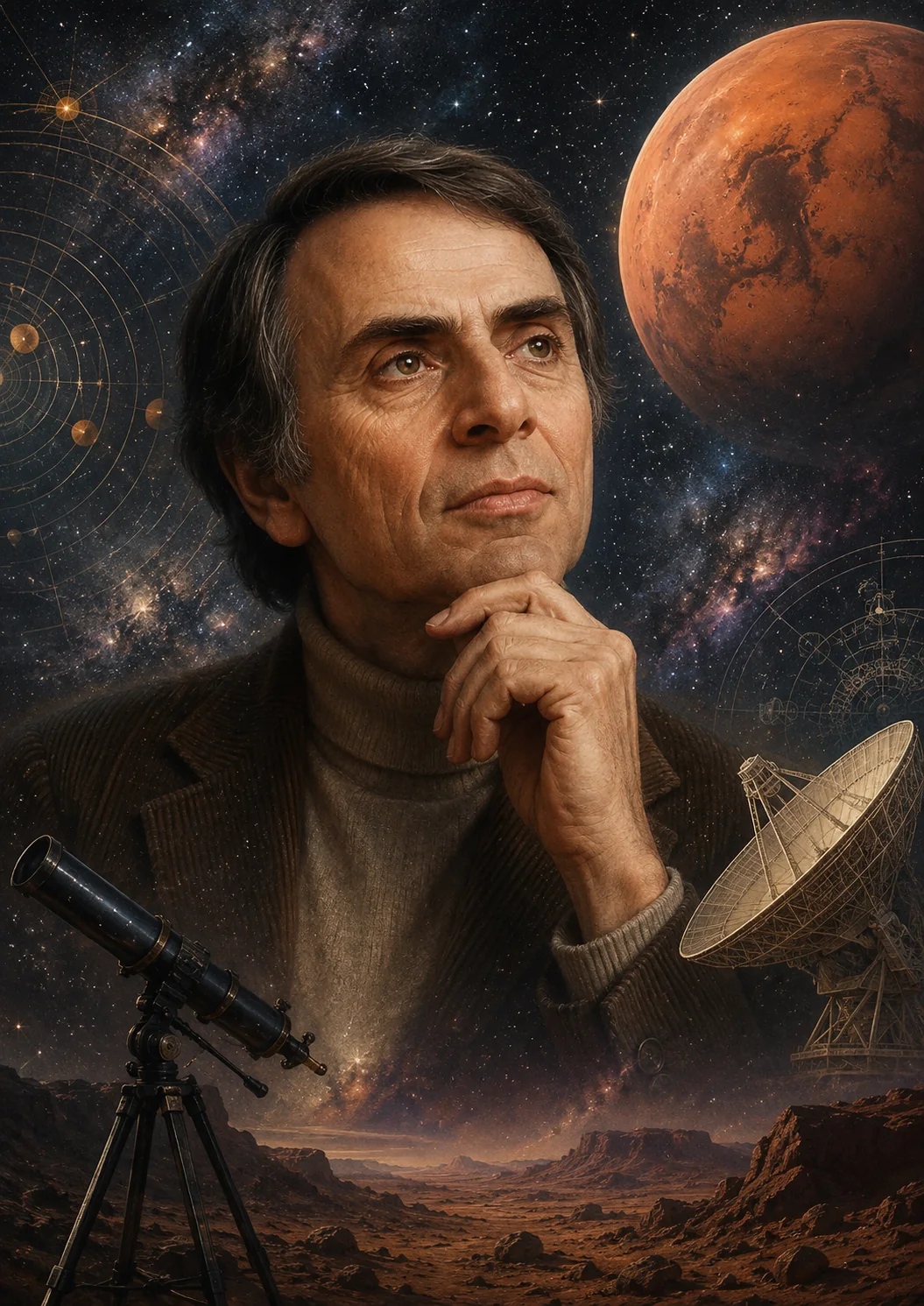
Editorial illustration inspired by Carl Sagan: astronomy, Mars, and scientific communication. Conceptual reconstruction, not an archival photograph.
Illness and the final years: continuing to write as the personal horizon narrowed
Sagan’s final years were marked by myelodysplasia, a serious bone-marrow disease, and intensive treatment. NASA and Cornell record that he died in Seattle on December 20, 1996, at the age of sixty-two from complications related to the illness. He remained intellectually active during this period: The Demon-Haunted World appeared in 1996 and the film adaptation of Contact was in development. [S9]
The temptation in biography is to turn illness into a sentimental final act that swallows the work. A more useful reading is continuity. Sagan spent his final years returning to a question present throughout his career: how can a society distinguish knowledge from wishful thinking, fraud, fear, and error? The child attracted to imaginary Mars had become a scientist who helped replace imagined Martian vegetation with dust physics and then a communicator concerned with the public tools of reasoning.
His death produced an unusually broad response because his influence crossed professional boundaries. Scientists remembered a colleague and mentor; readers and viewers remembered someone who made the universe intellectually accessible. That kind of legacy cannot be measured only by citation counts or mission assignments.
For Mars, the final lesson is institutional. Critical knowledge must survive the people who hold it. A settlement that depends on one irreplaceable engineer, physician, agronomist, or software specialist is unsafe. Teaching, documentation, and redundancy are forms of life support.
From exobiology to modern astrobiology: a marginal-looking question becomes a major research framework
When Sagan entered science, the study of life beyond Earth lacked the mature institutional framework now associated with astrobiology. The field was difficult by definition: researchers were studying possibilities without possessing a confirmed extraterrestrial organism. Yet planetary missions, prebiotic chemistry, extreme terrestrial environments, and increasingly sophisticated models made the question experimentally tractable.
NASA now presents Sagan as a pioneer of exobiology, while modern astrobiology connects origins of life, planetary habitability, geochemistry, microbiology, atmospheric science, and astronomy. [S17]
Mars remains central because it preserves ancient terrains that may record environmental conditions erased on Earth by plate tectonics and active geology. If life ever emerged there, evidence might survive in minerals, sediments, isotopic patterns, or microscopic structures. Modern mission strategies therefore combine geology and chemistry rather than relying on a single metabolism experiment.
Sagan did not create this field alone. His historical contribution was to help make the question scientifically durable. He connected it to missions, laboratory work, and public understanding while insisting that enthusiasm could not substitute for evidence. That balance is still the core problem of astrobiology.
Humans on Mars: exploration creates obligations as well as opportunities
Sagan’s association with exploration should not be reduced to a generic demand to go farther. His interest in life and contamination creates a harder question. What if the arrival of humans makes one of Mars’s most important scientific discoveries more difficult? People bring microorganisms, water systems, food production, organic waste, leaks, and complex chemical signatures. A permanent settlement would eventually alter its surroundings.
That does not automatically argue against human exploration. It argues for sequencing. Sensitive environments can be mapped and sampled before nearby industrial development. Protected zones can be established where the probability of preserving unique biological information is high. Terrestrial organisms carried to Mars can be genetically catalogued. Samples can be archived before the local environment changes.
The goal is not to keep Mars untouched forever. It is to avoid irreversible loss of information when preservation is still possible. Humanity has often transformed environments on Earth before understanding them. Mars offers the unusual opportunity to write some rules in advance.
A settlement built with that philosophy would treat science as part of governance. Exploration and habitation would not be competing slogans. They would be coordinated activities with explicit priorities, boundaries, and revision rules as knowledge improves.
The Mars of the twenty-first century: more habitable in its past, still without a confirmed biological verdict
Sagan did not live to see Spirit, Opportunity, Phoenix, Curiosity, InSight, or Perseverance, so any statement about what he “would have thought” must be labeled as inference. Yet the questions he helped frame make one comparison reasonable. Modern missions have greatly strengthened the case that ancient Mars possessed rivers, lakes, groundwater, and chemically habitable environments. They have not produced an accepted demonstration that Martian life existed.
This is exactly the kind of situation Sagan’s method was designed to handle. Habitability is not biology. Organic chemistry is not biology. A seasonal signal can be interesting without being uniquely biological. Increasing the number of suggestive observations should increase the quality of follow-up experiments rather than lower the standard of proof.
Modern rover science also validates the geological turn initiated by Mariner 9. Instead of scooping relatively context-poor soil and asking one broad question, missions reconstruct ancient environments layer by layer, identify deltas and sediments, and select samples with known geological history. The search for life has become an investigation of a planetary archive.
That continuity is perhaps the best measure of Sagan’s influence on Mars science. He did not leave a final answer. He helped establish a question strong enough to remain productive for half a century.
Why Sagan requires a biography commensurate with his influence on our view of Mars
Sagan’s relationship with Mars cannot be contained in a mission list. It connects the cultural Mars of childhood, the formation of planetary science, atmospheric physics, dust, ancient water, Viking, life detection, planetary protection, public communication, SETI, institutions, and the politics required to keep exploration alive. Each theme can be studied independently, but together they explain how a civilization learned to replace a desired Mars with a measured Mars without losing the desire to explore it.
His career also provides a useful contrast with engineers and entrepreneurs. Sagan did not build a launch vehicle or found a spacecraft manufacturer. His contribution was to improve the questions, interpret discoveries, and help millions of people understand why planetary science mattered. Long-duration exploration requires that function as surely as it requires propulsion, because public institutions cannot sustain what they cannot explain or evaluate.
A target near exceptional documentary depth is therefore meaningful only if it exposes more of the real intellectual network: his education, mentors, scientific papers, mission teams, disagreements, students, public debates, archives, collaborations, and cases in which later science revised or narrowed earlier hypotheses. Mere repetition would betray the method this page is meant to honor.
An open web biography can do something a memorial plaque cannot. It can improve when archives are digitized, link claims to sources, separate fact from interpretation, and preserve disagreement. A biography that remains revisable is unusually appropriate for a scientist whose central message was that knowledge improves when claims remain testable.
Martian dust: how a visual nuisance became a central climate mechanism
Dust runs through Sagan’s Mars work because it sits at the boundary between what an observer sees and what a planet is physically doing. Telescopic color changes had once encouraged biological interpretations. Spacecraft observations made it possible to connect those changes to atmospheric transport, deposition, global storms, and radiative effects. Cornell’s memorial statement records Sagan’s work with James Pollack, Joseph Veverka, Brian Toon, and Peter Gierasch on wind erosion and Martian climate mechanisms. [S23]
The conceptual advance is from description to mechanism. “The surface changed color” is an observation. “Fine mineral particles were lifted, transported, and redeposited by an atmosphere whose opacity altered heating” is a physical model. A good model then generates new questions: when are storms likely, how does dust modify atmospheric temperature, how long do deposits persist, and what surface features indicate prevailing winds?
Human missions turn those questions into engineering requirements. Dust can abrade moving parts, contaminate seals, coat radiators, reduce solar output, enter airlocks, and complicate optical navigation. A global storm can change energy availability over large regions. The atmospheric science that began as an effort to interpret Mars from afar therefore becomes part of the maintenance plan for a settlement.
This is an important pattern in the history of exploration. Natural-science knowledge becomes engineering knowledge when people begin depending on an environment. Weather, geology, radiation, and chemistry stop being background descriptions and become design inputs. Sagan’s Mars research belongs at that transition.
Before Apollo: thinking biologically about another world before humans touched it
The Library of Congress catalog notes material related to a proposed biology briefing for Apollo astronauts in 1967. The detail is easy to overlook, but it places Sagan inside one of the first moments when theoretical questions about contamination had to become procedures for human exploration. The Moon is now considered extraordinarily hostile to life, yet the teams of the 1960s operated with less information and treated biological uncertainty seriously enough to build quarantine practices around early returns. [S26]
The important point is that biological risk management begins before an organism is discovered. A mission team must decide what samples can be opened, what exposure is acceptable, what isolation is required, and who has authority to change the plan. Waiting until an unexpected result appears is too late to invent all of those procedures.
Mars amplifies the problem because the planet has a far stronger scientific case for ancient habitability and may preserve chemically or biologically interesting environments. Human missions will therefore require explicit protocols for drilling, sample transfer, quarantine, waste release, and the separation of high-value science zones from routine habitation.
Prudence should not be confused with timidity. A bold mission can be scientifically irresponsible if it destroys the signal it was sent to investigate. Sagan’s early biological thinking belongs to a tradition in which caution is part of exploration quality.
The scientist in mass media: earning attention without letting attention rewrite the evidence
Sagan’s frequent television appearances changed the public image of astronomy in the United States. He was willing to explain planetary science in formats built for entertainment, conversation, and limited time rather than for seminars. That decision expanded his reach enormously but also intensified suspicion among some academics who regarded celebrity as a possible threat to seriousness. Cornell’s accounts of his career preserve both dimensions: a productive scientist and an unusually visible public intellectual. [S14]
The real communication problem is not simply shortening an explanation. Mass media rewards certainty and memorable conclusions; research often produces probability, ranges, caveats, and competing models. Sagan’s strongest technique was to use scale, analogy, and historical narrative while preserving the causal structure underneath. He tried to make the question memorable rather than make the uncertainty disappear.
This skill has democratic consequences. Space programs are publicly funded and politically authorized. A society cannot evaluate a Mars mission if the only available explanations are either technical documents accessible to specialists or promotional slogans designed to generate enthusiasm. Public science communication creates a middle layer in which difficult tradeoffs can be understood well enough to debate.
A Mars settlement would make that layer essential to daily life. Residents will need explanations of radiation exposure, air quality, water reserves, contamination, maintenance, and risk. Communication that is too simplified can be dangerous; communication that is technically perfect but incomprehensible can be equally dangerous. Sagan’s career is an extended attempt to solve that translation problem.
The books: building frameworks that outlive missions, headlines, and television schedules
Sagan’s books formed a slower but more durable communication system than television. The Dragons of Eden, Cosmos, Contact, Pale Blue Dot, The Demon-Haunted World, and other works addressed different problems rather than simply packaging one message repeatedly. The Planetary Society and Cornell both emphasize the unusual breadth and public reach of this writing. [S22]
One book explored the evolution of human intelligence, another reconstructed a history of scientific understanding, another tested the social consequences of extraterrestrial contact, and another asked how citizens could protect themselves from bad reasoning. That variety matters because Sagan’s public project was not merely “space advocacy.” It was an attempt to connect cosmic perspective with methods of thought.
Books also reveal why long-form explanation remains useful in an age of short media. A mission update can report that a rover found a mineral. A long work can explain why that mineral matters, what alternatives exist, how instruments detect it, and how the interpretation changed over time. Length earns its value when it preserves causal context.
An open deep documentary biography should therefore be judged the same way. Word count is not the achievement. The achievement is whether the reader can return after several days, reopen a section, follow a source, and understand how one part of the career changed another. Long form should create memory, not merely volume.
Science and politics: when technical expertise enters arguments about collective survival
Sagan’s anti-nuclear work and criticism of the Strategic Defense Initiative placed him in debates where scientific expertise could not be separated cleanly from national policy. The Sagan-Druyan archive contains material on conferences, testimony, debate with Edward Teller, nuclear testing, and civil disobedience. [S22]
The difficulty is structural. If scientists remain silent whenever evidence has policy consequences, decisions may be made using selective expertise. If scientists advocate too confidently, critics may suspect that political preferences have replaced analysis. The only durable defense is transparency: distinguish measured facts, modeled outcomes, scenario assumptions, uncertainties, and the value judgment that turns evidence into a recommendation.
Sagan did not remove controversy by speaking publicly. In some cases he intensified it. That is historically useful because real scientific careers include disagreement. The question is not whether a respected scientist was always right, but whether the reasoning, assumptions, and later revisions can be reconstructed.
Mars governance will face similar tensions. Engineers and physicians may recommend limits that conflict with economic or political goals. Planetary-protection scientists may want restrictions that settlers consider burdensome. Expertise must be able to warn without becoming unaccountable authority. Sagan’s public career shows why that balance is difficult and necessary.
Teaching as exploration infrastructure: creating successors rather than audiences only
Sagan’s public communication often receives more attention than his teaching, but the two served different purposes. An audience can become interested in science; a university program trains people who can perform it. At Cornell, Sagan taught, supervised research, and helped sustain a laboratory culture in which students could move from planetary data to independent scientific judgment. [S23]
This distinction matters for long-term exploration. A settlement cannot remain dependent on a permanent stream of fully trained experts from Earth. It must develop local education capable of producing maintenance specialists, physicians, geologists, programmers, biologists, and eventually researchers who ask questions not anticipated by the founding crews.
Teaching also forces knowledge to become explicit. An expert may solve a problem through intuition built over decades; a teacher must break the intuition into steps another person can reconstruct. That conversion is a form of redundancy. It prevents a technical culture from collapsing when a small number of experienced people leave.
Sagan’s combined identity as researcher, teacher, and communicator therefore represents three layers of the same system: discover, transmit professionally, and explain publicly. A mature Mars society will require all three.
Writing Sagan historically: avoiding both hagiography and the fashionable correction that erases achievement
A famous scientist attracts two bad forms of biography. Hagiography removes mistakes, collaborators, and institutional context until every event looks like the inevitable consequence of one person’s genius. Reaction against that style can produce the opposite distortion, in which correcting the myth becomes more important than explaining the real contribution. Sagan requires a middle path because his fame was genuinely exceptional and his scientific work was genuinely collaborative.
Primary and institutional archives make that middle path possible. NASA records can identify mission roles. Cornell records collaborations and appointments. The Library of Congress preserves drafts, correspondence, activism, and working files. The Planetary Society documents organizational leadership. No single source can tell the whole story, and institutional accounts themselves can contain commemorative simplifications. The biography therefore has to compare evidence rather than adopt one official narrative.
This matters especially for claims about priority. Saying that Sagan “solved” Venus, “invented” exobiology, or “created” Voyager’s message alone would erase communities of researchers. Saying he was merely a television personality would be equally misleading. The accurate story is more interesting: he became unusually effective at moving among scientific research, mission teams, institutions, books, and public culture.
The open-web format is useful because it can make that method visible. Sources can sit beside claims, corrections can be dated, and interpretations can be revised without pretending the older version never existed. Historical humility is compatible with admiration.
Sagan’s deepest Mars legacy: a civilization should be capable of changing its mind before it changes a planet
Across the different parts of Sagan’s career, one rule appears repeatedly: observations should be allowed to revise expectations. Dust replaced the old vegetation interpretation. Mariner 9 replaced a monotonous Mars with a geologically dynamic one. Viking replaced a simple life-or-no-life expectation with a chemically ambiguous surface. Voyager replaced simplified outer planets with a diversity of active worlds.
That capacity to change the model is not only a scientific virtue. It is a survival skill for a settlement. Engineers must be able to revise maintenance schedules when real wear differs from estimates. Physicians must update health rules when long-duration partial gravity produces unexpected effects. Farmers must modify crop systems when Martian constraints interact in ways Earth simulations did not reveal.
A civilization that treats its first architecture as doctrine becomes fragile. A civilization that records hypotheses, measures outcomes, and changes procedures can improve. This is one reason Sagan belongs in a Mars encyclopedia even though he never designed a colony. His career is a long demonstration of how intellectual flexibility can coexist with ambitious goals.
Going to Mars is a technological project. Remaining there without turning ignorance into tradition will also be an epistemological project. Sagan’s work provides part of that operating philosophy.
Venus as a warning and a laboratory: comparative planetology as Sagan’s real intellectual home
A Mars-centered biography can easily miss the method that made Sagan important: he did not treat planets as isolated stories. NASA’s scientific biography highlights his work on the greenhouse effect on Venus, Martian seasonal changes associated with windblown dust, and the organic haze of Titan.[S17] These subjects belong to one comparative question: how do atmospheres, surfaces, sunlight and chemistry produce radically different planetary histories?
Venus demonstrates how a world similar to Earth in size can occupy a climate regime that is almost unimaginably different. Mars presents an inverse puzzle: a planet now cold and dry preserves evidence that liquid water and a denser atmosphere once mattered far more. Titan adds a chemistry-rich atmosphere at very low temperature. The value of comparison is that each world becomes an experiment that nature has already run.
Sagan used this comparative perspective to talk about Earth as well. The point was not to claim that terrestrial climate would mechanically become Venus. The deeper lesson was that atmospheres are active physical systems, not permanent backgrounds. Planetary science can therefore inform environmental thinking without collapsing distinct worlds into simple analogies. For the Mars Bible, this is central: Mars is scientifically valuable not only because humans may visit it, but because its climate history helps define what habitability means and how it can be lost.
James Pollack and the collaborators behind the public figure
Sagan’s celebrity can distort the history of his science by making a collective research program look like the work of one unusually articulate individual. Cornell’s memorial material points to close scientific relationships with James Pollack, Joseph Veverka, Brian Toon, Peter Gierasch and other researchers working on atmospheres, surfaces, dust and planetary climate.[S23]
Pollack is especially important in the Mars story. Dust is not merely something that obscures a camera. Suspended particles absorb and scatter sunlight, alter atmospheric heating and can change the relationship between surface and atmosphere. Mariner 9’s arrival during a major dust storm turned an operational frustration into a planetary-climate problem. The collaboration between modelers and mission observers was what made the event scientifically useful.
Restoring collaborators to the biography also restores the real structure of scientific authority. Sagan’s public confidence was built on a community capable of challenging models, operating instruments and producing independent evidence. A scientist becomes historically influential not only through personal brilliance but through networks of colleagues, students, engineers and institutions. The open-book format should therefore expand these relationships rather than letting the television image consume the laboratory.
Viking’s uncomfortable answer: when an experiment gives signals without giving certainty
The Viking biology experiments are one of the best episodes for understanding Sagan’s scientific temperament because the results resisted a clean story. Some experiments produced reactions after Martian soil was exposed to nutrients, yet the chemistry instruments did not find the organic molecules that would have made a biological interpretation straightforward. NASA’s current astrobiology history describes Viking as revealing active chemistry without providing definitive evidence for life.[S21]
That ambiguity generated decades of argument. Were strong oxidants responsible? Did the analytical procedures destroy some organics? Were the experiments based on terrestrial assumptions that an alien metabolism might not satisfy? Did the landers sample places where surface radiation and chemistry make extant life exceptionally unlikely? Later discoveries, including perchlorate chemistry, showed that the Martian surface was more chemically complicated than the first interpretations assumed.
Sagan had participated before Viking in assessments of possible Martian environments and life-detection strategy.[S12] The historical value lies in the refusal of the experiment to reward expectation. A scientist invested in the question of life had to live with a result that remained unresolved. The episode is a practical definition of disciplined curiosity: the more important the desired conclusion, the more carefully an ambiguous signal must be treated.
The Golden Record as an impossible editorial problem: representing Earth without pretending to summarize humanity
Voyager’s Golden Record is often described as poetry attached to a spacecraft, but its construction was also an extreme problem of selection. NASA records that the Sagan-led committee assembled 115 images, natural sounds, music, greetings in 55 languages and institutional messages.[S19] A finite object had to suggest the diversity of a planet without any plausible way to be complete.
No selection could be neutral. Which families, landscapes, technologies, bodies, rituals and musical traditions should represent Earth? Should war and suffering appear? Would an idealized portrait misrepresent the civilization that built Voyager? A comprehensive archive was physically impossible. The object therefore records the cultural choices of its makers as much as it records humanity.
Its significance does not depend on an extraterrestrial civilization ever finding it. The act of designing the record forced humans to imagine themselves as one planetary species seen from outside. That perspective links directly with Sagan’s later use of the Pale Blue Dot. The record and the photograph are mirror images: one sends a deliberately composed portrait outward; the other brings back an image in which all human composition has vanished into a point.
Turning Voyager around: how a mission decision became a global moral image
The Pale Blue Dot was not inevitable. It came from the decision to use Voyager 1, already far beyond the main planetary encounters, to look back toward the inner Solar System. NASA’s Voyager history preserves the relationship between Sagan’s advocacy and the 1990 “family portrait” sequence.[S27]
Scientifically, Earth occupies almost nothing in the frame. That is precisely why the image became philosophically powerful. Political borders, cities and armies disappear. Human history is compressed into a fraction of a pixel inside scattered sunlight. The camera does not provide the moral interpretation; Sagan supplied that interpretation later through prose and public speech.
This is one of the clearest examples of his ability to move from instrument to meaning without falsifying the instrument. The image remains a physical observation. The ethical argument is an additional layer that the audience can accept or reject. Good scientific communication often works this way: preserve the measurement, then explain why a change of scale can change the questions we ask about ourselves.
Sagan’s work on nuclear winter placed him in a far more controversial role than popular astronomy. With Richard Turco, Owen Toon, Thomas Ackerman and James Pollack, he participated in early-1980s research on the climatic consequences of smoke from large-scale nuclear war. The Library of Congress Sagan archive includes extensive material on this work and on the relationship between scientific analysis and public intervention.[S22]
The intellectual bridge from planetary science is important. Research on Martian dust and planetary aerosols had trained scientists to think about how suspended particles alter radiation and climate. Applied to Earth, the same class of physical reasoning raised the possibility that smoke injected over large regions could darken and cool the surface far beyond the blast zones.
The early models carried substantial uncertainties and later work refined them. Sagan nevertheless believed that the magnitude of the potential consequence justified public engagement. The episode raises a durable question about scientific responsibility: when does uncertainty counsel silence, and when does a low-probability catastrophic outcome demand warning? Sagan’s answer was activist. A historical biography should show both the modeling and the controversy rather than treating the issue as a settled moral anecdote.
SETI and skepticism: being open to extraterrestrial intelligence without manufacturing evidence for it
Few scientists did more to make the search for extraterrestrial intelligence culturally legitimate, yet Sagan also insisted on a high evidentiary threshold for extraordinary claims. The apparent tension disappears once his method is understood. A hypothesis can be important enough to test without being probable enough to believe in advance.
SETI can be framed experimentally: choose frequencies, characterize interference, search for signals with properties that natural sources or terrestrial transmitters do not easily explain, and demand independent verification. The Golden Record performs the inverse thought experiment by creating an artifact that another intelligence might recognize as artificial. Neither activity requires pretending that contact has occurred.
This distinction is central to Mars astrobiology. The possibility of past or present Martian life deserves ambitious missions precisely because the answer is unknown. Organic molecules, methane variations or unusual textures can motivate investigation without becoming proof. Sagan’s combination of imaginative scope and skeptical discipline remains a useful antidote to both cynicism and credulity.
Cosmos as engineered communication: wonder was designed, not improvised
The success of Cosmos can make Sagan’s public voice seem effortless. A television series of that scale is an engineered object: script, visual metaphor, music, editing, historical reconstruction, animation and scientific review have to work together. Ann Druyan was central to this intellectual and creative world, and the Sagan-Druyan papers at the Library of Congress preserve the breadth of their collaboration.[S22]
The editorial problem is the same one faced by this Mars Bible: simplify enough that a new reader can enter, but not so aggressively that causality disappears. An animation of stellar evolution is useful only if it leaves the audience understanding what changes and why. A dramatic image of Mars should lead toward atmosphere, geology or exploration rather than replacing explanation.
Sagan’s importance as a communicator therefore lies in architecture as much as voice. He constructed sequences in which a human story opened a question, a visual widened the scale, a measurement constrained the answer, and a philosophical reflection returned the result to ordinary life. Long-form digital writing can use the same rhythm. One hundred thousand words should feel like a succession of discoveries, not a wall of uninterrupted exposition.
Hundreds of archive boxes: why a serious Sagan biography cannot be built from famous quotations
The Library of Congress acquisition of the Sagan-Druyan papers encompassed roughly 800 boxes of correspondence, drafts, academic material, mission files, book projects and records of public activity.[S18] That scale is a warning against the easy biography assembled from television clips and celebrated passages.
Published books show thought after revision. Archives show the work of revision: rejected formulations, letters from collaborators, scheduling conflicts, institutional negotiations, grant material and the preparation behind public statements. They reveal which ideas arrived early, which changed under criticism and which were shaped by other people. They also restore mundane scientific labor that celebrity tends to erase.
If this page is to approach 100,000 useful words, archives are where much of the next depth must come from. The goal should not be another summary of Cosmos. It should be an intellectual history in which missions, papers, correspondence and collaborators can be followed through time. The existence of such a large primary-source record makes that ambition realistic.
Humans on Mars: exploration ambition meets planetary protection
Sagan was not simply opposed to human Mars exploration, but his work on life detection and planetary protection makes a purely conquest-oriented view difficult to sustain. Human missions carry far more terrestrial biology than sterilized robotic spacecraft. If Mars still contains environments capable of supporting indigenous life, contamination can damage the very evidence explorers hope to study.
The problem is scientific before it is rhetorical. Future molecular analyses must distinguish a Martian biosignature from organisms or biomolecules carried by the crew and life-support systems. Returning samples and crews to Earth also raises backward-contamination questions, even when the probability of a hazardous organism is considered low or unknown. Planetary-protection policy exists to manage such uncertainties through categories and procedures rather than vague fear.[S15]
A mature human architecture may therefore need protected zones, sample-handling protocols and special treatment of astrobiologically sensitive environments. Sagan’s legacy is a reminder that reaching a world is not the only objective. Exploration should preserve our ability to understand what was there before us.
The next documentary layers of Sagan’s biography
This expansion makes the English biography far less compressed, but a true deep documentary open book still requires several deeper layers. The Chicago years need a finer chronology of teachers, laboratories and early publications. Scientific collaborations should be followed paper by paper where they changed understanding of Venus, Mars or Titan. Each major mission can be reconstructed from pre-launch questions through instrument results and later reinterpretation.
The Library of Congress archive creates another path: correspondence with institutions, drafts of major books, work on nuclear policy, SETI, television and public science. Relationships with Ann Druyan, James Pollack, Steven Soter and other collaborators can be connected to concrete projects rather than reduced to names. The biography can become a history of networks as well as a history of one person.
Finally, the book must follow the afterlife of the questions. Modern astrobiology, Mars sample return debates, exoplanet climate science, science communication and planetary defense all operate in intellectual territory that Sagan helped make public. The objective is not to construct a digital shrine. It is to show how a method combining imagination, measurement and responsibility continued to evolve after the individual was gone.
Mariner 2: learning early that spacecraft could decide between worlds imagined from Earth
Sagan entered planetary science just as spacecraft began turning theoretical arguments into direct measurements. Mariner 2’s 1962 Venus flyby belongs to that transition. NASA’s biography places Sagan among the advisers and scientists engaged with planetary missions from the early space age onward.[S17] Microwave and infrared observations helped constrain the extreme thermal environment of Venus and gave atmospheric models a new empirical foundation.
The methodological lesson was larger than Venus. Telescopes had generated competing interpretations; spacecraft created new classes of constraint. Throughout Sagan’s career, Mars, Jupiter, Saturn and their moons would undergo the same transformation from distant astronomical targets into measured physical systems. The biography of the scientist is therefore inseparable from the biography of the instruments that changed what could be known.
Mariner 9 after the dust: a planet with a geological history on an enormous scale
When the global dust storm cleared after Mariner 9 reached Mars in 1971, the spacecraft revealed volcanoes, canyons, channels and layered terrains that permanently changed the planet’s scientific identity. JPL records Mariner 9 as the first spacecraft to orbit another planet and as a mission that mapped much of Mars.[S5]
For Sagan, those landscapes forced climate and geology into the same story. Channels suggested ancient environmental conditions different from the present. Giant volcanoes recorded internal history. Dust showed that the contemporary atmosphere could still alter the appearance of the world on a planetary scale. Mars became historical: its current cold desert was no longer enough to explain its surface. That intellectual shift prepared the questions Viking and later rovers would pursue.
Titan: an orange haze extends prebiotic chemistry beyond the Mars question
Voyager’s encounters with Titan revealed a dense atmosphere hidden under haze. Sagan’s interest in the moon’s organic chemistry fit his wider work on environments in which complex prebiotic molecules could arise.[S17] Titan showed that scientifically interesting organic chemistry does not require an Earth-like surface.
The distinction remains important for astrobiology. Organic molecules, habitability and life are three different categories. A cold world may produce rich chemistry without being hospitable to familiar organisms. Applied back to Mars, this protects interpretation from a common error: discovering carbon-bearing compounds is exciting, but it is not by itself a biological detection.
Galileo: the scientific career did not end when television fame began
The success of Cosmos can create a false chronology in which Sagan becomes a media personality and leaves mission science behind. NASA continues to identify him with major planetary missions including Galileo.[S17] Public communication and scientific participation remained parallel tracks.
This matters because it helps explain his authority with audiences. He was not speaking about the Solar System only as an outside commentator. He remained embedded in communities interpreting atmospheres, surfaces and mission results. That did not make every public statement correct, but it kept the communication connected to rapidly changing scientific evidence.
Cornell: teaching students to move from equations to the largest questions
Sagan built much of his academic career at Cornell, where institutional records emphasize research, teaching and mentorship.[S14] The university gave him an environment in which astronomy, planetary science and questions about life could be joined.
A professor’s influence is not measured only by lectures. Faculty define research problems, recommend students, edit drafts, create collaborations and transmit standards of evidence. A future expansion of this biography should identify Sagan’s students and postdoctoral collaborators in more detail. That will reveal a scientific legacy that cannot be measured by book sales or television audiences.
The Planetary Society: giving public enthusiasm an institution that could outlast a mission cycle
In 1980 Sagan joined Bruce Murray and Louis Friedman in founding The Planetary Society and became its first president. The organization’s history emphasizes his founding role and its continuing mission of planetary exploration advocacy.[S28]
The institutional move matters. Spacecraft take years to design and political priorities change faster than that. An independent organization can preserve public attention, create a constituency, support educational work and react to budget decisions. Sagan understood that exploration needed social infrastructure as well as launch vehicles.
UFO claims: an unidentified observation is not automatically an extraterrestrial explanation
Sagan was willing to examine extraordinary claims while rejecting the shortcut that turns an unexplained observation into proof of alien visitation. “Unidentified” first describes the state of available information. Aircraft, atmospheric effects, perception errors, hoaxes and other causes must still be tested before invoking an unknown technology.
This is fully consistent with support for SETI. The possible existence of other civilizations is a broad scientific hypothesis; the claim that a particular light or encounter is extraterrestrial is a specific historical assertion. The second requires evidence tied to that event. Sagan’s approach illustrates how openness and skepticism can reinforce each other rather than compete.
A toolkit for skepticism: teaching the public to inspect the structure of an argument
In his later writing Sagan emphasized habits for evaluating claims: seek independent confirmation, separate correlation from causation, avoid relying on authority alone, compare multiple hypotheses and ask whether a proposition can be tested. The value is not a memorized checklist but a pattern of reasoning.
That pattern is especially relevant in a digital Mars encyclopedia. A dramatic image, viral video or graph can circulate without instrument context. Readers should learn to ask where the data came from, how the image was processed, what date and mission apply, and which alternative explanations remain. A page faithful to Sagan should not merely provide conclusions. It should expose enough of the evidentiary path that the conclusion can be checked.
Scientific citizenship: method as part of democratic competence
Sagan treated scientific literacy as more than entertainment. Modern societies depend on technologies, medicine, energy systems and environmental decisions that require people to evaluate evidence. Citizens who cannot distinguish a measured result from an assertion become dependent on whoever communicates most confidently.
Science does not automatically choose a policy. It can constrain the debate. A dose, temperature, concentration or probability does not change with political preference. Societies still decide which values and risks they accept. Sagan’s public project was partly an attempt to improve the quality of that decision by making evidence and uncertainty intelligible.
Mars after Sagan: later missions keep answering his questions and creating new ones
Since Sagan’s death in 1996, Mars has been transformed by Pathfinder, Mars Global Surveyor, Odyssey, Mars Express, Spirit, Opportunity, Phoenix, Curiosity, MAVEN, InSight, Perseverance and many orbiters and instruments. The planet is mapped and measured at a level that Viking scientists could not have imagined.
Questions about ancient habitability, organic chemistry, water history and climate remain directly connected to the themes Sagan helped bring into public and scientific discussion. The resolution has changed: mineralogy, isotopes, stratigraphy, meteorology and geophysics now support far more specific models. Some older hypotheses were discarded; others became sharper.
This gives the biography an unusual structure. It does not end in 1996. Each later mission can be read as another response to questions in which Sagan participated. Scientific legacy becomes visible in the continuity of problems, not merely in commemorations or quotations.
Choosing where Viking should land: a scientific decision before an engineering triumph
Viking landing-site selection required safety and biological interest to coexist. Engineers needed terrain smooth enough to reduce landing risk; scientists wanted environments where geology, past water and surface materials offered a meaningful chance to learn about habitability. Sagan belonged to a mission culture in which an orbital image was not merely a picture but an operational decision tool.
The same tension remains for human exploration. Scientifically dramatic terrain may contain slopes, rocks and relief that make landing difficult. A broad safe plain can place explorers far from the most interesting geology. Modern maps and navigation are far better than Viking-era capabilities, but the trade has not disappeared.
The history also reinforces Sagan’s emphasis on uncertainty. A mission never selects “the best place on Mars” in an absolute sense. It selects a compromise shaped by the instruments, landing technology and scientific hypotheses of its time. Results must be interpreted inside that boundary.
Planetary images: learning not to confuse what we see with what we have demonstrated
Sagan belonged to the generation in which spacecraft images became one of science’s great public languages. A Mars photograph can reveal geology while simultaneously provoking human pattern recognition. That double role demands discipline: a feature that resembles a channel, layer or face is not by itself an explanation of origin.
The scientific method restores context: resolution, illumination, viewing geometry, image processing, comparison with other frames and spectral data. A geological interpretation becomes stronger when it explains independent observations. A visual resemblance may disappear under different lighting or higher resolution.
The lesson is even more important in an era of social media and artificial intelligence. Images can be cropped, enhanced or generated entirely. A Sagan-inspired Mars encyclopedia should always distinguish editorial illustration, raw data, processed imagery and scientific interpretation. Visual beauty should lead toward evidence, never replace it.
The long timescale of missions: allowing a scientific question to outlive generations of instruments
Sagan’s career spans a period in which major Martian questions return from mission to mission. Mariner transforms geography, Viking tests chemistry and biology, later orbiters map minerals and water-related signatures, and rovers investigate sedimentary records in place. No instrument closes the case alone.
This continuity shows how science actually advances. A major question can survive a negative result because the result exposes limitations in the previous method. Viking does not demonstrate life; it forces researchers to understand Martian soil chemistry more deeply. Later missions do not erase Viking. They add dimensions the first instruments could not measure.
An open biography should therefore follow questions as well as dates. That is how Sagan’s life becomes a history of exploration: readers can watch a problem change as instruments become capable of asking it more precisely.
Primary and institutional sources
Verification rule: institutional, archival and primary sources are preferred. Company statements are treated as statements, not proof of future achievement. Contested or potentially harmful claims are included only when supported by identifiable documentary sources, with uncertainty stated when necessary.