


MARS BIBLE — PEOPLE
Jim Green
Jim Green's documented nationality or citizenship is American; the documented birthplace is Burlington, Iowa, United States. Jim Green connected several generations of planetary science, from space-data analysis to leadership of NASA science. Born in Iowa and drawn early to astronomy, he trained in the University of Iowa’s space-physics tradition before building data infrastructure and eventually leading NASA’s Planetary Science Division. For Mars, his importance lies in serving as a bridge between research, missions, archives and strategy: a planet can only be understood if decades of observations remain usable and comparable.

This continuous open book fuses chronology, scientific career, mission governance, and the institutional lessons of Jim Green into a single reading architecture.
Part I — Burlington, amateur astronomy, and the making of a scientific method
A Mississippi River childhood before space became a profession
Jim Green’s story begins in Burlington, Iowa, on the Mississippi River. NASA’s own profile describes a childhood of water skiing and fishing before astronomy became more than a fascination. The decisive change came at Burlington High School, where a twelve-inch Alvan Clark refractor and an energetic teacher, Don Vinson, gave students practical access to the sky. Green learned to attach a 35 mm camera to telescope eyepieces, photograph celestial targets, and develop black-and-white film. [1]
The significance of that episode is not romantic destiny. Nothing in a school observatory guarantees a NASA career. What it demonstrates is the leverage of accessible infrastructure. A good instrument becomes transformative when a teacher turns it into a place where students can manipulate, fail, repeat, and compare. Green did not simply look through a telescope; he began generating records that could be organized over time.
That habit matters because planetary science is built on chains of evidence. A photograph is not merely an attractive picture. It has an exposure, optical geometry, date, processing history, and uncertainty. A repeated set of solar images becomes a time series. A time series can reveal patterns, and patterns can be tested against hypotheses. Green’s later work in data systems, archives, and planetary missions can be read as a massive institutional extension of this early lesson: observations become durable knowledge only when the process that produced them is understood.
The educational lesson is especially relevant to a future Mars settlement. Early residents will live inside an environment saturated with scientific opportunity. Weather stations, radiation monitors, habitat sensors, geological instruments, agricultural systems, and engineering telemetry will continuously produce observations. If those systems are treated only as specialist equipment, the colony will waste much of its potential. If they are integrated into education and daily practice, ordinary operational records can become decades-long scientific series.
Green also emphasizes determination in the advice he gives students. That message should not be stripped from its institutional context. His own determination worked because he encountered teachers, a telescope, a university, computing systems, research mentors, and eventually a federal science agency. Persistence is not a substitute for infrastructure. It is the human quality that turns infrastructure into opportunity.
This first phase therefore introduces a theme that will recur across Green’s career: creating environments in which other people can learn faster. At Marshall it appears in scientific networking. At Goddard it becomes archives and data operations. At Headquarters it becomes program architecture and community priority-setting. Later, Gravity Assist makes the same logic explicit by asking scientists which people and events changed their trajectories.
James Van Allen and the difference between teaching answers and teaching questions
At the University of Iowa, Green encountered James Van Allen not only as a famous scientist but as a teacher. NASA recounts that Green took an astronomy course from Van Allen and later enrolled in a small readings course that turned out to have a single student. Green showed Van Allen a collection of solar photographs he had made, and Van Allen recognized that the material could support a real research exercise on differential rotation of the Sun. [1]
The important act was not the transfer of a fact. It was the recognition of a researchable question inside imperfect student data. Mentorship at its best changes the learner’s relationship to evidence. Instead of asking what the correct answer is, the student begins asking what can be inferred, what would count as a test, and what uncertainty remains.
Van Allen’s scientific environment reinforced this style of reasoning. Space physics often studies phenomena that cannot be seen directly: energetic particles, magnetic fields, plasma boundaries, and wave emissions. Instruments sample these systems indirectly, frequently along a spacecraft trajectory rather than as a complete image. Understanding therefore depends on models, calibration, comparison, and disciplined inference.
That intellectual training transfers naturally to Mars. Many conditions most important to future residents are invisible or only partly visible: radiation fields, subsurface ice, volatile exchange, electrical charging of dust, atmospheric escape, and thermal structure beneath the ground. A scientifically mature settlement cannot equate “I cannot see it” with “it is not important.” It needs people comfortable reasoning from indirect measurements.
Green’s development at Iowa also involved Don Gurnett. When practical financial circumstances required a different graduate arrangement, Green changed advisers and became a research assistant for Gurnett. That shift is worth preserving because it prevents the story from becoming a single-mentor myth. Intellectual inspiration and material support both matter. Scientific careers depend on systems that allow talented people to keep working.
The future Mars analogy is straightforward. Small settlements may have only one or two experts in a field. The strongest mentors will not merely teach procedures; they will teach how to frame uncertainties, where to look for error, and how to know when a result is strong enough to act on. That kind of judgment is much harder to transmit than a manual and therefore deserves explicit institutional attention.
From telescopes to data tapes: astronomy becomes computational
Green entered university with practical astronomy experience but moved toward space physics as computing and mission data became central to his work. NASA’s profile describes him writing programs for Don Gurnett, processing data from missions including IMP-6, IMP-8, Voyager 1, and Voyager 2, and working as a computer operator on large Univac systems. [1] The shift was not away from science. It was a change in the tools through which science could be done.
His early paper on auroral kilometric radiation required a large collection of data tapes and substantial computer time by the standards of the period. That detail shows how computational cost shapes research questions. Analyses that are routine today could once consume scarce institutional resources. Scientists had to understand not only the physics but the architecture of computation.
This experience helps explain why Green later treated networks and archives as scientific infrastructure rather than clerical support. If data cannot be found, read, transferred, or interpreted, a mission’s scientific value is partially lost. Space science magnifies this problem because many observations cannot be repeated. A planetary flyby, a rare solar event, or a historic occultation may be unique.
A Mars settlement will face a similar challenge at larger temporal scale. The first decades will generate records of an environment before and during substantial human modification. Some data that appear routine may become extraordinarily valuable fifty years later. Preserving those records requires formats, software, metadata, calibration history, and a culture that understands why long-term readability matters.
Green’s computational training also illustrates professional mobility. He did not remain a specialist performing one type of analysis. The analytical discipline became a foundation for later roles in data management, mission operations, proposal systems, and program leadership. Expertise in one domain can become a language for managing interfaces without becoming expertise in everything.
That distinction matters for Mars governance. Leaders should know enough to ask technically meaningful questions, but they must also recognize when specialist judgment is required. Green’s path from programmer-scientist to agency strategist provides a useful example of how technical literacy can expand into systems leadership without pretending that management replaces deep expertise.
A teacher can be scientific infrastructure
Biographies of scientists often emphasize the moment when a famous mentor appears, but the more useful question is what the mentor changed in the student’s method. Green’s education at the University of Iowa placed him inside an environment shaped by James Van Allen and by a tradition in which instruments, data reduction, theory, and spacecraft operations were tightly connected. That setting taught more than a set of facts about radiation belts.
A strong mentor makes standards visible. How precise must a claim be? Which uncertainty is acceptable? When does an apparent signal deserve another instrument check before interpretation? How should a student defend a result when a senior colleague disagrees? These habits are rarely captured in course titles, yet they are the core of professional formation.
Mars will need to treat teaching in the same way. In a small settlement, an experienced engineer or scientist who spends time training others is not being diverted from “real work.” They are multiplying the population’s future capacity. The accounting system should recognize that value because the alternative is a brittle society in which a few specialists become irreplaceable.
Green’s later attention to careers and mentorship in public communication can be read as an extension of this early experience: institutions reproduce themselves through people who explain not only what they know, but how they learned to know it.
Astrophotography as an early lesson in calibration and evidence chains
Amateur astronomy can look romantic from a distance: a telescope, a clear night, a photograph of the sky. In practice, useful imaging is a chain of alignment, exposure, timing, optics, detector response, processing, and interpretation. The image is never simply “what the sky looked like.” It is an instrument-mediated product.
This is a valuable precursor to space science. A spacecraft image or plasma measurement also arrives through a chain. Detector characteristics, geometry, gain, background subtraction, software versions, and environmental effects shape the product. Scientists must understand enough of that chain to know which features belong to nature and which could belong to the instrument.
Green’s career repeatedly returned to this problem at greater scale: computational processing in graduate work, distributed observations, archival metadata, and later the public interpretation of planetary mission results. The common discipline is traceability.
Future Mars residents will produce enormous quantities of imagery for navigation, construction, geology, agriculture, medicine, and public communication. If images become operational evidence, calibration and provenance should be retained. A beautiful photograph may be culturally important, but a measurement used to decide where to drill must preserve the chain that makes it trustworthy.
A doctorate as training in refutability rather than credential accumulation
The lasting value of doctoral training is not the title attached to a name. It is the requirement to transform a broad interest into a question that can be answered with evidence and challenged by others. The researcher must define assumptions, select methods, show intermediate reasoning, and accept that an attractive interpretation may fail.
For Green, doctoral work in space physics occurred in a field where many objects of interest are invisible to human senses. Fields and particle distributions are inferred through instruments and models. That makes methodological discipline especially visible: the phenomenon cannot be defended by saying that everyone can see it.
Mars engineering will frequently confront similar indirect evidence. Subsurface ice, structural fatigue, microbial contamination, radiation dose, and atmospheric dynamics may be inferred from partial measurements. Decision-makers will need people trained to distinguish a model output from a direct observation and a plausible mechanism from a demonstrated cause.
A settlement that values credentials but not refutability will accumulate authority without science. The better inheritance from Green’s academic formation is procedural: make claims inspectable, preserve evidence, and define what observation would force a change of mind.
Burlington, Iowa: a high-school telescope turns curiosity into scientific practice. Jim Green grew up in Burlington, Iowa, on the Mississippi River. In high school a very concrete opportunity changed his relationship with the sky: chemistry teacher Don Vinson opened access to the school’s 12-inch Alvan Clark refractor. Green did more than look through it. He attached a 35-mm camera to eyepieces, learned to develop film and repeatedly photographed the Sun. Some of his images eventually appeared in Sky & Telescope. Source.
Green grew up in Iowa with the curiosity of an amateur astronomer that gradually became a scientific vocation. The University of Iowa then immersed him in a space-physics tradition shaped by James Van Allen and Donald Gurnett. He learned to work with mission data, fields, particles and instruments before taking responsibility for scientific archives. That first part of his career explains his later leadership style: a mission has lasting value only if its data remain accessible, documented and comparable with observations from missions before and after it. Institutional source.
The episode deserves more than a line in a facts table because it shows how scientific skill begins: access to an instrument, a mentor willing to trust a student and repeated observation. Daily solar imaging already introduces calibration, observing conditions and time series. By the end of high school Green knew he wanted astronomy because he had started producing data himself.
Institutional sources: NASA Science — Jim Green early life and telescope
From a high-school telescope to spacecraft data: a career shaped by mentors and tools. Jim Green provides a particularly concrete example of how scientific interest becomes a profession. In his NASA biography he recalls that Burlington High School in Iowa possessed a twelve-inch Alvan Clark refractor. Chemistry teacher Don Vinson opened the instrument to students and organised an astronomy activity. Green learned not only to observe but to photograph, develop film and turn repeated solar observations into material that could be analysed.
At the University of Iowa two encounters changed the scale of the problem. James Van Allen showed him that a set of solar images could become a real research question; Don Gurnett took him on as a research assistant when he entered graduate school. Green also describes how working as a computer operator and moving from ground-based astronomy to spacecraft data shifted his intellectual centre of gravity: the science remained, but the instruments became space vehicles and data systems.
That origin helps explain his later career leading planetary science and then serving as NASA chief scientist. He knew research not only as an author of papers but as a user of infrastructure, software, archives and programmes. For Mars, that matters because a portfolio leader must choose among competing missions, preserve data chains and defend long-term progression. Green's influence is therefore not reducible to one Martian discovery; it concerns the institutional architecture that allows hundreds of researchers and engineers to produce successive generations of them.
In 2006 Green became director of NASA’s Planetary Science Division. The job required balancing Mars, the Moon, giant planets and small bodies while managing different mission classes, technology readiness and scientific priorities.
Mars especially benefits from continuity: orbiters, landers and rovers form a chain rather than isolated spectacles.
Jim Green’s NASA biography begins far from agency leadership. In Burlington, Iowa, access to a school telescope and teachers who encouraged practical astronomy turned curiosity into a habit of observation. At the University of Iowa, encounters with James Van Allen and Don Gurnett shifted him toward space physics and spacecraft data. That change matters because it taught him that modern exploration is not only about an object in the sky. It is also about instruments, networks, archives and people able to transform telemetry into shared knowledge. Green carried that systems view through the rest of his NASA career.
At Marshall and later Goddard he worked on magnetospheric physics while also building and managing data infrastructure. NASA credits him with work on the Space Physics Analysis Network and later leadership of the National Space Science Data Center. Mars missions depend on exactly this invisible layer. A rover can survive for years, but its scientific legacy depends on calibration, archiving, distribution and the ability of researchers who were not on the original team to reanalyse the measurements. A future settlement will face the same principle with maintenance, medical, environmental and resource data: information architecture becomes part of operational resilience rather than a clerical afterthought.
University of Iowa: James Van Allen turns photographs into research. At the University of Iowa, Green took Astronomy 101 from James Van Allen. Later, a small reading course brought him into much closer contact with Van Allen. Green showed his solar-photo series; Van Allen suggested using it to measure differential rotation of the Sun and guided him through a first science-like paper. The photographs changed category: they were no longer merely images but observations that could answer a question. Source.
Green then developed within the Iowa space-physics environment associated with Van Allen and Donald Gurnett. He learned particle and field science as well as the computing required to handle space data, completing a Ph.D. in space physics in 1979. That background matters to his later leadership career: before managing mission portfolios, he knew the chain from instrument to data to analysis to result.
Institutional sources: NASA Science — Van Allen mentorship
University of Iowa: invisible environments and evidence
The University of Iowa had a deep tradition in space physics associated with James Van Allen and generations of researchers studying charged particles and magnetic fields. Green trained in that intellectual environment. Magnetospheric science teaches an unusual form of reasoning because the object of study is largely invisible. Researchers reconstruct structure from particle detectors, field measurements, plasma waves and models.
That method transfers naturally to planetary science. A planet's evolution cannot be read only from photographs. Atmospheres, internal dynamos, radiation and solar-wind interaction all shape the world that later geology records. Mars is a particularly important example because the disappearance of its global magnetic field and long-term atmospheric loss are central to understanding how an earlier, wetter planet became today's cold and thin-atmosphere environment.
A settlement program will live inside the consequences of that history. Radiation exposure, electronics design and solar-storm procedures are all affected by the absence of a global Martian magnetosphere. Green's early scientific training therefore belongs directly to the practical story of habitability even though it began far from the design of a base.
Three NASA centers, three professional languages
Green's career moved from Marshall to Goddard and then Headquarters. Each location emphasizes different aspects of NASA's identity: engineering and human-spaceflight heritage at Marshall, scientific missions and data at Goddard, strategy and budget at Headquarters.
Crossing those cultures helps a leader see why apparently simple decisions generate resistance. A Headquarters schedule may collide with a center's test reality; a science requirement may have major engineering cost; an archive policy may require long-term software support no mission originally budgeted.
Mars settlements will develop similar internal cultures surprisingly quickly. Power engineers, physicians, geologists and greenhouse operators will all see different definitions of “critical.” People who can translate across those professional languages will be essential to system safety.
Part II — Marshall: magnetospheric physics, operational discipline, and early scientific networks
Joining NASA in 1980: science inside a center built around operations
After completing his Ph.D. in space physics at the University of Iowa in 1979, Green joined NASA’s Marshall Space Flight Center in the Magnetospheric Physics Branch. The Chief Scientist history places this move at the beginning of a career that would span more than four decades and three major NASA environments: Marshall, Goddard, and Headquarters. [2]
Marshall exposed Green to a culture shaped not only by research but by engineering, hardware, training, and operational safety. That environment matters because the consequences of error vary by context. In an academic analysis, a mistake may invalidate a conclusion. In operational aerospace, a mistake can threaten an expensive system or a person. The organization therefore develops rituals of review, configuration control, procedure, and readiness that may look bureaucratic from outside but often encode lessons from earlier failures.
Green did not become a launch-vehicle engineer, yet living inside that culture broadened the way scientific infrastructure could be understood. A measurement campaign is not independent of power, communications, scheduling, software, safety, and maintenance. This systems perspective later becomes central when he is responsible for programs rather than individual research questions.
Marshall in the early 1980s was also part of a computing transition. Researchers needed to exchange data and communicate across institutions, but modern internet habits did not yet exist. Scientific networking required deliberate construction. Green became involved in that environment because he already understood the practical pain of moving and processing mission data.
For Mars, the transfer is institutional rather than technological. A future settlement will combine scientists, engineers, operators, physicians, software specialists, and logistics teams. If those communities remain isolated, critical interactions will be missed. A scientific objective may create an operational hazard; a maintenance decision may unknowingly break a valuable time series. Regular cross-disciplinary reviews should therefore be normal, not only responses to emergencies.
Marshall also illustrates why scientific leadership benefits from exposure to operational reality. A leader who has never seen how procedures protect people may dismiss them too quickly. A leader who has never done research may over-standardize work that requires creativity. Green’s career gains strength from crossing both environments.
SPAN: building a scientific community before the modern Web
The Space Physics Analysis Network, SPAN, represents one of the less glamorous but highly consequential elements of Green’s early NASA career. NASA technical documentation describes SPAN as a network through which space-physics researchers could obtain information from NASA and related projects, with an American network and a European counterpart, E-SPAN. [12] It supported capabilities such as electronic mail, file transfer, and remote login at a time when these were not universally routine.
The technical problem was only part of the challenge. Networks join communities that use different machines, protocols, security assumptions, and working habits. A successful research network therefore requires social agreement as much as hardware. Users must trust availability, understand naming and access rules, and know that the system will still work when they depend on it.
This is an early lesson in interoperability. Scientists do not gain much from a perfectly optimized local system if it cannot exchange meaningful data with collaborators. The same principle now applies to planetary missions from different agencies. Shared standards, metadata conventions, and communications protocols multiply the value of each asset.
A Mars settlement will need interoperability at a level far beyond SPAN. Orbiters, habitats, vehicles, weather stations, navigation services, scientific laboratories, and Earth links may be operated by different governments and companies. The communications architecture must tolerate delay and disruption, but the institutional challenge remains familiar: who defines the standards, who maintains compatibility, and how are changes governed?
Reliability will also determine behavior. If a common network is unreliable, teams will build private workarounds. Those workarounds may improve local resilience but create inconsistent copies and hidden dependencies. Mars therefore needs a design that combines distributed redundancy with explicit synchronization and integrity checking.
SPAN should not be treated as a technical blueprint for interplanetary networking. Its value is historical. It demonstrates that scientific communities become dramatically more productive when information moves easily, and that creating that ease requires sustained institutional effort before users can take it for granted.
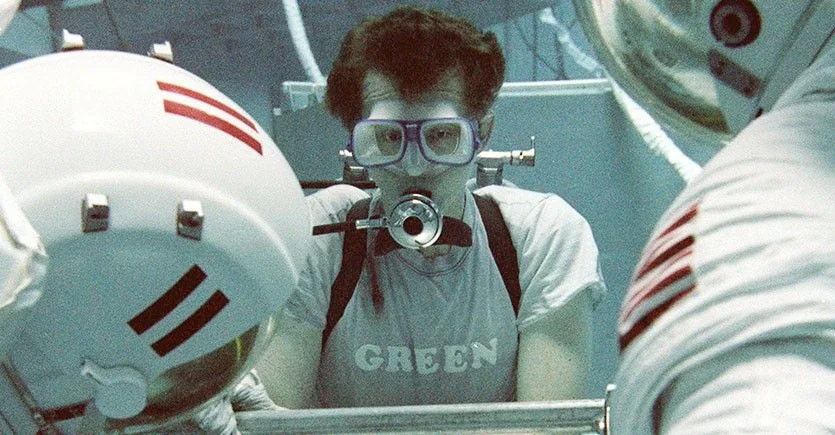
More than 150 safety dives: operational risk in the education of a scientist
NASA’s Chief Scientist history states that Green served as a safety diver in Marshall’s neutral buoyancy facility and made more than 150 dives before leaving the center in 1985. [2] NASA’s profile also describes a potentially dangerous situation in which his training helped him respond effectively. [1] This is not a side story merely because it did not produce planetary-science papers.
A safety diver works in an environment where procedures have immediate physical consequences. The task demands preparation, observation, awareness of the trainee’s condition, and the ability to intervene without creating additional danger. It turns “safety culture” from an abstract administrative phrase into a practiced form of teamwork.
That experience is relevant to Green’s later management because major space missions live at the intersection of ambition and hazard. Leaders must encourage teams to solve difficult problems while making sure urgency does not become an excuse to bypass essential checks. The balance cannot be learned from slogans alone.
Neutral buoyancy also teaches a deeper lesson about simulation. Water is not space. It reproduces some useful features while introducing others that do not apply. A good training program knows exactly which aspects are being simulated and which are not. This is directly analogous to Mars analog sites on Earth. Deserts, polar regions, and isolated habitats can test procedures and human factors, but none reproduces Mars completely.
Future Mars crews will live where science and safety are inseparable. A field excursion to place an instrument is also an EVA. A sample may pose contamination questions. A repair can affect exposure to radiation or dust. Organizations that divide “science,” “engineering,” and “safety” too rigidly will create blind spots at the interfaces.
Green’s diving experience therefore adds a human-operational layer to a career otherwise dominated by data and strategy. It suggests why hybrid experience matters. Mars will need scientists who understand operational constraints and operators who understand the scientific consequences of their actions.
Marshall and the coexistence of scientific and operational cultures
Marshall Space Flight Center is strongly associated with launch vehicles and engineering, yet Green entered a space-physics environment inside that operational culture. This combination matters because science and flight operations use different tolerances for uncertainty. A scientist can explore several competing interpretations; a flight controller may need one conservative action before the ambiguity is resolved.
Neither culture is superior. They answer different questions. The organizational challenge is to prevent one from colonizing the other. If operational urgency dominates all research, curiosity shrinks. If exploratory ambiguity dominates safety decisions, people and hardware are placed at risk.
Green’s later career required repeated translation between these modes. A division director must protect long-horizon research while operating programs under budget and schedule constraints. A Chief Scientist must explain uncertainty without leaving executives unable to decide.
On Mars, science and operations will physically share the same settlement. A geologist may want a longer traverse to inspect an unexpected outcrop while an operations lead sees battery, weather, and medical limits. The institution needs explicit decision rights and shared language so disagreement becomes analyzable rather than personal.
Networks are built from trust as well as protocols
SPAN and related scientific networks were technical systems, but their usefulness depended on social expectations. Researchers had to believe that messages would arrive, that identifiers referred to the right people, that shared resources would be maintained, and that collaborators would respect norms. Protocols create interoperability; trust creates willingness to use it.
This distinction matters whenever infrastructure becomes distributed. A network can be physically connected yet institutionally fragmented if teams refuse to share data, maintain incompatible naming conventions, or fear that openness will cost them scientific credit.
Green’s experience with networking therefore anticipates later open-science challenges. The problem is not solved by bandwidth alone. Incentives, attribution, governance, and standards determine whether information actually circulates.
Mars will depend on distributed networks among surface sites, orbital relays, Earth, and perhaps lunar infrastructure. Communications outages will be expected. Local caching, priority rules, authentication, and conflict resolution will matter, but so will trust among operators. A civilization whose technical links work while its institutions do not share critical information remains disconnected in the most important sense.
Internationalizing a scientific network means governing standards
As scientific networking expands beyond one center or country, seemingly small technical choices become governance questions. Character encodings, time standards, naming conventions, access policies, security requirements, and responsibility for failed links all affect participation.
A dominant institution can impose its preferred standard, but that may create hidden barriers for partners. Conversely, accepting every local convention without translation produces a network that is connected only on paper. Interoperability requires agreed interfaces and processes for changing them.
Green’s network and data-center years sit inside this broader history of scientific collaboration before today’s Web made connectivity feel ordinary. They remind us that infrastructure becomes invisible only after generations of people negotiate the details.
A Mars-Earth research network will face far more extreme asymmetry. Earth will initially contain most computing resources, institutions, and archives, while Mars will contain unique local data and operational urgency. Standards must not make Mars a passive terminal. Local institutions need the authority to curate, prioritize, and publish their own evidence while remaining interoperable with Earth systems.
Marshall and Goddard: science becomes a data infrastructure problem. Green joined NASA Marshall after the Ph.D., working in magnetospheric physics. His career also moved into the networks and data systems that allow scientists to exchange and preserve observations. At Goddard he eventually led organizations including the National Space Science Data Center and other science-operations functions. This is less visible than a landing but strategically important: a spacecraft’s value persists only if its measurements can still be found, understood and compared years later. Source.
That work builds a different institutional skill from leading one instrument. It involves standards, archives, networks, proposal systems and continuity across missions. A Mars settlement would need the same capability. Technical resilience includes not only spare hardware but the ability to recover decades of measurements, procedures and engineering decisions. [source]
Institutional sources: NASA — Jim Green career history [source]
Green earned a PhD in space physics from the University of Iowa in 1979 and joined NASA in 1980. His early work included magnetospheric science and data networks that gave researchers faster access to observations and computing resources. [source]
Exploration depends on those invisible systems as much as on spacecraft: data must move, remain interpretable and reach communities able to use it. [source]
Green’s move from research to scientific-data infrastructure is one of the most important steps in his development. Planetary science only becomes cumulative when observations can be stored, exchanged and re-used by people who were not present when the instrument operated. His work at Marshall and Goddard therefore belongs in the biography for the same reason as a spacecraft assignment: it taught him that a scientific program is also an information system. That systems perspective later becomes central when a division director has to compare missions with very different targets, technologies, schedules and communities. [source]
As Planetary Science Division director and later NASA Chief Scientist, Green’s role shifts again from doing one piece of science to maintaining interfaces among many. Curiosity, InSight and other missions appear in the biography not because he personally designed their instruments, but because leadership at that level means preserving a portfolio, defending scientific priorities and helping disciplines communicate with agency decision-making. NASA’s institutional profiles make the progression unusually traceable, from an Iowa student working with James Van Allen to an agency-wide strategic role. NASA Science profile · Chief Scientist history.
Marshall and the Space Physics Analysis Network
At Marshall, Green developed and managed the Space Physics Analysis Network, known as SPAN. NASA describes it as a system that gave scientists rapid access to data, colleagues and computing resources at a time when networked science was far less seamless than it is today. [source] The project placed him at the intersection of science and information infrastructure.
This experience is easy to underestimate because networks rarely produce the iconic image of a launch. Yet a mission's value depends on whether its data can circulate. Scientists need common formats, remote access, metadata and ways to compare measurements made by different instruments. A network changes the pace at which hypotheses can be tested because a researcher no longer has to wait for physical media or local access.
Mars settlement will generate a similar problem at much larger scale. Health telemetry, power systems, habitat atmosphere, geology, radiation and maintenance records will produce continuous streams. If those streams remain isolated inside incompatible tools, the settlement will accumulate data without accumulating knowledge. Green's early career is therefore a reminder that information architecture is part of exploration architecture.
More than 150 safety dives: an operational side of a scientist
NASA's official chief-scientist history records that Green also served as a safety diver in Marshall's neutral-buoyancy tank, making more than 150 dives. [source] The detail stands out because it is far removed from data networks or magnetospheric papers. It placed him inside a training environment where human performance, procedures and emergency response mattered immediately.
Safety diving requires attention to someone else's task while maintaining readiness to intervene. It teaches that operations are never identical to laboratory plans and that equipment must remain understandable under physical stress. Those lessons are especially relevant to extravehicular activity, where a scientific or maintenance objective unfolds inside a life-critical envelope.
On Mars, every field excursion will combine those same layers. A geologist may be focused on a sample while another system tracks suit pressure, radiation, fatigue and remaining consumables. The scientific goal and the safety system must coexist without one making the other impossible. Green's unusual side role gives his biography a small but concrete connection to that culture.
Part III — Goddard and the National Space Science Data Center: preserving what cannot be flown again
1985: becoming responsible for the survival of other people’s science
Green moved from Marshall to Goddard Space Flight Center in 1985 and led the National Space Science Data Center for seven years, according to NASA’s Chief Scientist history. [2] The change is more profound than a job title suggests. A researcher is primarily responsible for the quality of his own analysis. An archive director becomes responsible for whether entire communities can continue to use observations produced by missions that may no longer exist.
A scientific archive is not a warehouse. A file without context can be physically intact and scientifically dead. Long-term usability depends on instrument descriptions, calibration information, coordinate systems, timing, processing levels, known anomalies, software, and documentation of how products were created. Curation therefore preserves meaning, not just bits.
This responsibility is unusually important in space science because observations are often irreproducible. A spacecraft cannot be sent back through the same historic environment merely because metadata were lost. A flyby geometry may never occur again. A long solar event or planetary encounter may be unique. Preserving data is consequently part of preserving the original mission investment.
Green’s 1996 Kotani Prize recognized international science-data-management activities, evidence that this was not an administrative detour in his career. [2] It became a core part of his professional identity and later shaped the way he thought about distributed programs.
Mars will make archival responsibility even more strategic. The first settlements will generate data about an environment before and during sustained human alteration. Future researchers may want to know the microbial, chemical, meteorological, or dust conditions that existed before a site was heavily occupied. If routine operational records are discarded, that baseline disappears permanently.
A mature Mars archive should therefore be treated as critical infrastructure: redundant copies, integrity verification, open documentation, persistent identifiers, software preservation, version history, and tested restoration procedures. The lesson from Green’s Goddard years is simple but demanding: a mission is not fully scientific unless its evidence remains interpretable after the people who produced it have gone.
Metadata, software, and migration: preserving interpretation across technological generations
Long-lived archives face a recurring illusion: if the file still exists, the information is safe. In reality, formats become obsolete, libraries disappear, operating systems change, and institutional memory fades. The same bytes may become unreadable or ambiguous. Preservation therefore requires active migration and documentation.
Green’s earlier experience as a programmer and computer operator gave him an unusually concrete understanding of this problem. Data analysis is always mediated by software and hardware. At Goddard, that personal experience becomes institutional responsibility: the archive must serve future users who never met the mission team.
This demands humility. Mission designers cannot know all questions that will later be asked. They should therefore avoid documenting only the interpretation they consider important today. Raw or low-level products, calibration histories, and transformation chains give future researchers the ability to reinterpret evidence under new theories.
For Mars, software preservation will be especially important. A local research team may be separated from Earth by communication delay and may need to reproduce a decades-old analysis during an emergency or scientific dispute. Archiving code, dependencies, test data, and environment descriptions can make the difference between a reproducible result and an opaque artifact.
Migration itself must be auditable. Copying data to a new medium or converting a format should include checksums, logs, and validation that scientific meaning has not changed. Otherwise a preservation action can silently alter the evidence it is supposed to protect.
The same reasoning applies to operational systems. A Mars settlement will replace sensors, computers, and software over time. Overlap periods and cross-calibration should be planned so that technological improvement does not create artificial discontinuities in long time series.
Archives as mission multipliers and institutional memory
Good archives change the economics of planetary science. Launching a spacecraft is expensive; reanalyzing its data is relatively inexpensive. New algorithms, improved models, and comparisons with later missions can produce discoveries long after the original mission ends. An archive therefore multiplies the return on hardware already flown.
This principle later becomes crucial when Green manages a planetary portfolio. A visible fleet of spacecraft is only one component of a science program. Research and Analysis grants, archives, software, and people who understand the data convert operations into knowledge. If those elements are underfunded, the program can launch impressive machines without fully exploiting them.
Mars settlement would create an even richer archive because humans can maintain instruments, move them, repair them, and respond to rare events. The scientific value of those capabilities grows when records from surface stations, orbiters, vehicles, and laboratories can be combined across time.
Archives are also mechanisms of accountability. When a major claim is disputed, independent researchers should be able to return to the original observations. This becomes particularly important for discoveries involving life, resource ownership, environmental change, or human health. The evidence must outlive the political moment surrounding the claim.
Failure data deserve equal treatment. Telemetry before an anomaly, software configurations, repair logs, and operational decisions may teach more than a successful nominal sequence. Institutions that archive only polished success stories force later generations to repeat avoidable mistakes.
Green’s archive years therefore belong at the center of his Mars relevance. Before he managed famous missions, he worked on the less visible problem of making knowledge survive. A durable human presence on another planet will depend on exactly that capability.
Format survival is part of scientific survival
Saving bits is not the same as saving data. A file can remain perfectly intact while the software, documentation, byte order, units, or calibration tables required to interpret it disappear. Long-lived archives therefore need active migration and validation.
The danger is greatest when a format is tied to a proprietary or mission-specific environment. During the active mission, everyone knows how to open the product. Twenty years later the expertise may be gone and the hardware unavailable. Preservation work looks unnecessary until the moment it is too late.
NSSDC culture exposed Green to this problem at a time when storage media and computing platforms were changing rapidly. The lesson remains current even though modern formats are more standardized.
Mars will create an unusually strong preservation obligation because first-generation observations cannot be recreated after settlement changes the environment. Data formats for early atmospheric baselines, microbiology, radiation, and medicine should be designed with migration in mind. A simple, documented representation may sometimes be more valuable than an efficient but opaque one.
Preserving software is sometimes as important as preserving measurements
Modern scientific products are often inseparable from code. Calibration, reconstruction, filtering, coordinate transforms, and model inversion may all be performed by software that evolves during a mission. A table of final numbers does not necessarily preserve the reasoning that produced it.
Software preservation therefore requires version control, build instructions, dependencies, test cases, and documentation of known limitations. In some cases a virtualized environment may be needed to recreate old processing. The objective is not to freeze technology forever but to keep enough context that results remain inspectable.
This is particularly important when old data are reprocessed using improved algorithms. Scientists should be able to distinguish a change caused by better processing from a change in the underlying observation.
A Mars settlement will depend heavily on autonomous software. Scientific archives should preserve not only sensor outputs but the versions of onboard and ground code that selected, compressed, or interpreted them. If an autonomous system decided which samples to discard, future investigators need the decision logic as part of the scientific record.
Primary data, derived products, and the chain between them
Derived products make science usable. A calibrated map, spectrum, or time series can be far more valuable to most researchers than raw telemetry. Yet derived products embed choices. Backgrounds are removed, coordinate systems selected, bad values flagged, and models applied.
Good archives preserve the relationship between levels. Researchers can begin with a convenient product and move backward when an anomaly requires inspection. This layered architecture supports both accessibility and rigor.
Green’s path from data centers to mission leadership makes this distinction central to his institutional legacy. A program director who understands archives is more likely to see data delivery as a mission requirement rather than a post-launch clerical task.
For Mars, the chain should extend into operational decisions. If a resource map drives construction, the settlement should preserve which raw measurements and transformations produced the map. Otherwise a later dispute about an unexpected drilling failure becomes impossible to reconstruct scientifically.
The National Space Science Data Center: preserving missions that cannot be repeated
From 1985 to 1992 Green led NASA's National Space Science Data Center at Goddard, described by NASA as the agency's largest space-science data archive. [source] Archiving planetary data is not clerical storage. A spacecraft may be gone forever, so the original measurements, calibration files, geometry and documentation become the only way future researchers can revisit the event.
Data longevity requires more than keeping bits on a disk. Units, coordinate systems, instrument versions and uncertainty models must survive technological change. A file without context may be technically preserved but scientifically dead. Green therefore worked on an infrastructure whose value increases with time as later researchers apply new algorithms to old observations.
Early Mars settlements will create records that may be equally irreplaceable: first measurements of subsurface ice, first long-duration health data under reduced gravity, dust infiltration histories and local construction performance. Preserving those observations with complete metadata will be an act of both science and survival engineering.
Open data and the politics of who gets to learn
Green's path from data systems to senior leadership makes him unusually suited to understanding that access policy shapes science. Planetary missions create public assets when calibrated data are archived and made available beyond the original instrument teams. Later researchers can ask questions the mission designers did not anticipate.
This openness increases the return on mission cost and allows errors or alternative interpretations to be tested. It also requires investment in documentation, because open files without calibration and context do not create reproducible science.
A Mars settlement will have to define its own data constitution. Safety telemetry may need broad access, biomedical data may require privacy protection and commercial systems may claim proprietary information. The design of access rules will influence whether Mars becomes a shared laboratory or a collection of isolated databases.
The archive as infrastructure for civilization
Green's years leading the National Space Science Data Center can look less dramatic than Curiosity or New Horizons, yet they address scientific continuity directly. NASA identifies the NSSDC as its largest archive of space-science data during his tenure. [source] A completed mission can keep producing science for decades if its observations, metadata, calibrations and software remain understandable.
On Mars, archival discipline will extend far beyond science. A settlement will need durable records of repairs, water chemistry, energy performance, subsurface maps, software versions and anonymized medical trends. Data without context quickly becomes unusable; lost context forces the next generation to repeat old work.
One of Green's deepest institutional lessons is therefore that exploration is not only the acquisition of new measurements. It is the construction of memory that allows other people to reinterpret them. A Martian civilization will be more resilient when every operation can become durable knowledge.
Part IV — WIND, POLAR, and IMAGE: learning to understand invisible systems through distributed observation
Returning to missions without leaving data infrastructure behind
After leading the NSSDC, Green moved into broader data-operations responsibilities and then held scientific roles on major geospace missions. NASA records that he served as Deputy Project Scientist for Mission Operations and Data Analysis for WIND and POLAR from 1992 to 2000, while also working as a co-investigator and Deputy Project Scientist on the Imager for Magnetopause-to-Aurora Global Exploration, IMAGE. [2] The important feature is the combination. He did not choose between being a scientist and being an infrastructure person. He worked at the seam between the two.
WIND and POLAR were part of an effort to understand the geospace environment as a coupled system rather than a collection of isolated measurements. One spacecraft samples upstream solar-wind conditions; another examines polar regions and magnetospheric responses. The scientific product emerges from relationships among measurements taken at different locations and times. That kind of reasoning is fundamentally distributed.
This matters for Mars because future environmental understanding will also be distributed. Radiation at a habitat depends partly on solar conditions measured elsewhere. A dust storm evolves across regions. Atmospheric escape links the upper atmosphere to solar forcing. Subsurface ice maps must be connected to local ground truth. No single instrument can define the complete environment.
Mission Operations and Data Analysis is also a revealing title. Scientific objectives become sequences only after teams translate them into power, pointing, communications, scheduling, and instrument constraints. An observation can be scientifically desirable yet operationally impossible at a given moment. People working at this interface learn that scientific value is created through negotiation with physical limits.
A Mars settlement will face the same issue at higher stakes. Science time may compete with communications, maintenance, power storage, and crew safety. The right institutional response is not to subordinate science automatically, but to create transparent mechanisms for comparing requirements and identifying when a temporary operational constraint should override a scientific request.
Green’s geospace work therefore prepared him for program leadership in a very specific way. It taught him to look for system behavior, interfaces, timing, and the difference between local measurements and global interpretation. Those habits later appear in his planetary portfolio and in his interest in Mars as a coupled atmosphere-space system.
IMAGE and the excitement of seeing something that had not been seen before
Green has described the arrival of the first IMAGE data as one of the most exciting moments of his career. NASA’s profile says that after years of work he saw measurements that revealed something genuinely new and experienced the “aha” moment that motivates scientific research. [1] The detail matters because it keeps the later manager connected to the emotional reality of discovery.
IMAGE was designed to provide more global views of magnetospheric structures that had previously been inferred largely from local spacecraft measurements. That change in representation was scientifically powerful. A system can look different when the observing architecture moves from sampling a line through space to imaging a large-scale structure.
Planetary exploration repeatedly benefits from the same complementarity. A rover delivers extraordinary local detail. An orbiter supplies regional context. A network of stations reveals temporal and spatial variation. Human explorers could eventually add adaptive measurements that respond to unexpected events. The strongest science comes from combining scales rather than declaring one observing mode superior.
Green’s enjoyment of discovery also helps explain why a scientifically trained program director can understand the frustration of researchers whose proposed observations are cut or whose mission extension is denied. Empathy does not eliminate resource constraints, but it can improve the quality of the conversation. Scientists need to believe that the person making an allocation understands what may be lost.
At the same time, a biography must avoid attributing the science of IMAGE to Green alone. He was part of a mission organization containing instrument teams, engineers, operators, analysts, and principal leadership. His contribution is meaningful precisely when it is described accurately rather than expanded into ownership of collective results.
This precision is relevant to Mars culture. Future settlements will generate achievements involving hundreds or thousands of people. Public narratives should celebrate leaders without erasing operators, maintainers, software teams, sample handlers, and technicians. Accurate attribution is not only historical fairness; it supports trust inside the organization.
Time synchronization, calibration, and the hidden logic of multi-spacecraft science
Distributed observations introduce a technical problem that is easy to underestimate: measurements must be comparable. Two instruments with different calibrations, coordinate systems, sampling cadences, or timing errors can create apparent scientific structure that does not exist. Data systems therefore need common conventions and well-documented transformations.
Space physics developed strong habits around time synchronization because plasma phenomena can propagate rapidly. A mismatch of seconds or minutes can change interpretation. Green’s career in this environment reinforces the idea that metadata are part of the observation, not an optional note appended later.
Mars will require even more elaborate temporal discipline. Operations may use local solar time, mission elapsed time, Earth UTC, spacecraft event time, and perhaps settlement calendars. Scientific data need unambiguous machine-readable references so that measurements from orbit and surface can be aligned years later.
Calibration also becomes more difficult over decades. Sensors age, replacements arrive, and manufacturers change. A long climate or radiation series can be broken if a new instrument is installed without a period of overlap or cross-calibration. Settlement engineering should therefore treat continuity of measurement as a design requirement.
Redundant sensors are useful not only for safety but for science. Disagreement between two instruments may expose a failure, a calibration issue, or a real spatial gradient. Automatic systems should preserve the disagreement rather than silently forcing values to match.
The lesson is that distributed science depends on invisible discipline. The public sees discoveries; the scientific system depends on synchronized clocks, calibration files, coordinate definitions, and carefully maintained data pipelines. Green’s early career belongs to this hidden layer of planetary capability.
Jupiter as a thread connecting the researcher to the later program director
Green’s scientific publications included work on Earth’s and Jupiter’s magnetospheres, according to NASA’s career history. [2] That fact gives additional context to his visible excitement during Juno’s arrival. Jupiter was not simply one more destination in the portfolio; it belonged to a scientific environment he had studied for years.
This continuity demonstrates one advantage of long technical careers in management. A leader who has worked with earlier mission data understands why certain questions persist. The arrival of a new instrument can then be seen not as an isolated event but as another step in a decades-long chain of inquiry.
The danger is that personal scientific interest can bias a portfolio. A responsible director must therefore use community priorities and formal review mechanisms rather than fund favorite subjects. Green’s frequent insistence that he did not have a favorite planet is relevant because the job required precisely that discipline. [3]
Mars institutions will face the same tension. Senior scientists may have spent their careers on a specific region or method. Their expertise is valuable, but resource allocation should not become a private extension of personal research programs.
A balanced governance structure uses deep expertise to ask better questions while relying on peer review, rotating advisory bodies, and published criteria to constrain favoritism.
Visualization as a scientific instrument for thought
One of the broader lessons of IMAGE is that representation changes reasoning. A global visualization allows researchers to perceive patterns that are hard to construct mentally from tables of point measurements. The visualization is not merely communication after the science; it can be part of the discovery process.
Mars science will increasingly depend on this kind of synthesis. Three-dimensional subsurface models, atmospheric assimilations, radiation maps, resource probability fields, and digital twins of infrastructure can help teams understand relationships too complex for a single plot.
However, every visualization embeds decisions. Interpolation methods fill gaps. Color scales exaggerate or suppress differences. Projections distort geometry. Model outputs may look more certain than the measurements that constrain them. A mature scientific culture must therefore make the transformation chain accessible.
For operational Mars decisions, the distinction between measured and inferred values should be visible. A map of “water abundance” might combine direct detections, modeled probabilities, and assumptions about depth. Engineers planning an extraction system need to know which is which.
Green’s career across data systems and program science reinforces a simple principle: the interface through which humans see data can shape the decision as strongly as the sensor itself.
From distributed science to distributed settlement
The geospace missions Green worked on were scientific networks, not communities trying to survive. Yet they offer a useful organizational analogy for Mars because they demonstrate how value emerges from coordinated assets. A surface station, orbiter, mobile rover, and solar monitor can each be useful alone; together they can describe a coupled environment.
A settlement should therefore avoid designing scientific equipment as isolated projects. Communications, clocks, data standards, navigation, calibration facilities, and archives should be treated as shared services. The cost may appear indirect because no single experiment “owns” them, but every experiment benefits.
Shared infrastructure creates governance questions. Who pays for a relay satellite? Which mission receives bandwidth during a rare event? Who approves a software update that affects multiple instruments? These are program-level problems, exactly the type Green would later face in planetary science.
Distributed systems also improve resilience. If one sensor fails, another may provide partial coverage. If a central laboratory is unavailable, local nodes can continue to record. But redundancy only works when the system has been designed to recognize and integrate alternate sources.
The deeper Mars lesson is that scientific capability is a network property. Counting instruments is less meaningful than asking whether those instruments can be combined into trustworthy, interpretable knowledge.
A common clock is hidden infrastructure
Distributed measurements become scientifically powerful only when events can be compared in time. Spacecraft at different positions may observe different parts of a propagating disturbance. Without trustworthy timestamps, apparent sequence can be an artifact of clock error.
Time synchronization therefore belongs to the measurement system. Clock drift, leap-second handling, onboard conversions, ground-processing delays, and metadata all need explicit treatment. The requirement sounds mundane until a scientific conclusion depends on which signal arrived first.
Green’s work in multi-platform space physics offers a direct lesson for Mars. A settlement will operate weather stations, seismic sensors, radiation monitors, power systems, vehicles, and medical devices across large distances. Correlating events requires a shared time basis with known accuracy.
The same infrastructure supports accident investigation. If a habitat pressure anomaly, power transient, and software restart occur within seconds, investigators need to know their true ordering. A reliable clock can therefore be both scientific infrastructure and safety infrastructure.
Redundant sensors are most useful when they are allowed to disagree
Redundancy is often described as a way to obtain the same answer twice. Scientifically, disagreement can be more informative. Two instruments with different geometries, energy ranges, or systematics may expose an assumption that would remain invisible in a single measurement.
The temptation is to average discrepancies away. A better approach is to treat disagreement as a diagnostic signal until calibration, environment, and model differences have been examined.
Multi-spacecraft missions teach this habit because spatial separation makes different measurements expected. The analyst must decide whether variation is physical or instrumental rather than assuming uniformity.
Mars operations should preserve this mindset. Independent pressure sensors, radiation dosimeters, water assays, and medical measurements may disagree. Safety procedures need conservative rules, but scientific analysis should retain the original values and reasons for resolution. A settlement that forces every sensor into one clean database value may erase early warning of a real problem.
Visualization changes what a community can think about
Global imaging of magnetospheric structures did more than create attractive pictures. It changed the cognitive scale at which researchers could discuss systems that had previously been inferred from point measurements. Visualization can therefore function as a scientific instrument for thought.
The danger is that images look more direct than they are. Color scales, interpolation, projection, and model assumptions shape what viewers perceive. Good visualization makes these choices available rather than hiding them behind aesthetic authority.
Green’s IMAGE-era experience offers a useful bridge between specialist measurement and public communication. The same skill—turning complex data into a comprehensible representation—can support discovery or oversimplification depending on how transparently it is done.
Mars will need visualization for geology, subsurface resources, weather, radiation, logistics, and settlement health. Maps should communicate uncertainty and data density, not just a smooth surface. Empty areas are scientifically different from measured areas with ordinary values.
Wind, Polar and IMAGE: learning from distributed observation
Green also served in science roles connected with WIND, POLAR and IMAGE. NASA lists him as deputy project scientist for mission operations and data analysis for the Global Geospace Science missions and as a co-investigator and deputy project scientist on IMAGE. [source] Such missions study coupled environments where one measurement point is not enough.
Distributed observation teaches a key lesson: a change seen by one spacecraft may be temporal, spatial or both. Multiple vantage points allow researchers to reconstruct how the solar wind and magnetosphere evolve. The scientific value comes from the network, not merely from each instrument.
A human Mars system will depend on similar networks. Orbital weather sensors, surface radiation monitors, navigation beacons and local stations will jointly describe conditions. Redundancy also improves resilience. A settlement that relies on one environmental sensor is fragile; a distributed system can detect faults and preserve situational awareness after a local failure.
Earth and Moon as a coupled magnetic system
Green remained scientifically active while serving as Chief Scientist. In 2020 he led a NASA-associated study proposing that the early Earth and Moon may once have had interacting magnetic fields that helped shield Earth's atmosphere from the solar wind. [source]
The study illustrates why planetary environments must be understood historically. Magnetic fields evolve as planetary interiors cool and orbital configurations change. Atmospheres therefore record long interactions between internal dynamics and the Sun rather than a single permanent condition.
For Mars settlers, the practical consequence is clear: the modern planet lacks the kind of global magnetic protection Earth enjoys. Radiation monitoring and shielding must be designed for the Mars that exists now, even while science investigates how its earlier environment differed.
Part V — Proposal support and peer review: the machinery that decides which science gets the chance to exist
From data operations to the Science Proposal Support Office
NASA’s career history records that Green became Chief of the Science Proposal Support Office at Goddard in 2005. [2] The role is easy to overlook next to later planetary leadership, but it placed him inside one of the most consequential systems in research: the process by which many reasonable ideas are reduced to a smaller number that can actually be funded.
Scientific selection contains an unavoidable tension. Agencies want originality, which means proposals may not be directly comparable, yet they need procedures that are fair, repeatable, and defensible. Peer review does not eliminate judgment. It organizes judgment through expertise, criteria, conflict-of-interest rules, panels, and documentation.
The quality of that organization matters. Poorly designed review can reward familiarity over innovation, favor communities already skilled at proposal writing, or create excessive administrative burden. Conversely, an unstructured process can become arbitrary and politically vulnerable.
Green’s experience here becomes preparation for division leadership. A planetary director cannot personally evaluate every scientific idea. The director depends on systems that translate expert communities into recommendations and ranked opportunities. Knowing how those systems work makes it easier to recognize both their value and their failure modes.
A Mars settlement will need comparable mechanisms surprisingly early. Access to EVA time, deep drilling, clean laboratories, power, sample storage, and specialized vehicles will be limited. If scientific priority is allocated informally, hierarchy and personal relationships will dominate. A formal proposal process can distribute scarce capability more credibly.
The lesson is not to import terrestrial bureaucracy wholesale. Mars should design lighter processes where stakes are small and stronger reviews where consequences are large. The governing principle is proportionality: enough structure to protect trust, but not so much that the procedure consumes the science it is meant to enable.
Peer review is necessary because expertise is distributed—and imperfect because experts are human
Peer review works because no central administrator can possess the depth required to judge every specialized proposal. It mobilizes distributed expertise. Yet the same experts may know the applicants, compete for similar resources, or share disciplinary assumptions. Conflict management is therefore not an optional ethical decoration; it is part of the technical design of review.
In a mature system, conflicts are disclosed, panel composition is monitored, and criteria are communicated in advance. Reviewers should distinguish scientific significance, methodological strength, technical feasibility, team capability, and programmatic relevance rather than compress everything into an intuitive score.
Novel ideas create a special difficulty. A proposal that challenges established assumptions may initially appear less safe than one extending a successful method. Agencies therefore need mechanisms that preserve some space for high-risk, high-information work. Otherwise peer review can unintentionally optimize the portfolio for predictability.
Mars will intensify these problems because the scientific community may be small. The geologist reviewing a drilling proposal could share a habitat with the applicant. The operator of the drilling system might also be a co-investigator. Earth-based reviewers can add independence, but communication delay and incomplete local knowledge may limit them.
A credible Mars review system may therefore combine local operational assessment with external scientific evaluation. The division of roles should be explicit: local teams can determine whether a proposal is safe and feasible; broader peers can judge scientific merit. Neither should silently substitute for the other.
Green’s proposal-support phase matters because it shows that scientific excellence depends on the quality of these invisible interfaces. Missions do not begin with launch. They begin when institutions decide which questions deserve scarce resources.
The proposal as a contract among ambition, method, resources, and evidence
A strong scientific proposal connects an interesting question to a method capable of answering it. It defines observations, expected uncertainty, required equipment, schedule, team responsibilities, and the relationship between cost and scientific return. In space science, the proposal is therefore partly a contract between imagination and reality.
This discipline helps explain an important feature of Green’s later public ideas. When he discusses a long-range concept such as a magnetic shield for Mars, the concept should not be confused with a selected mission. A strategic idea can be worth exploring before it has the technical closure, cost model, and risk posture required for implementation.
The distinction protects both innovation and credibility. If speculative ideas are forbidden until they are fully engineered, institutions become intellectually conservative. If speculation is described as operational capability, institutions lose trust. A mature science program needs explicit categories of maturity.
Mars settlement will live with this distinction constantly. Long-range visions—large pressurized regions, climate modification, deep subsurface cities, industrial-scale resource systems—may shape research priorities long before they are feasible. The responsible question is not “is this future true?” but “which unknowns would need to be reduced before this option could be evaluated?”
Proposal archives can also become learning tools. They preserve what teams believed at the time, which risks were identified, and which assumptions later proved wrong. Comparing proposal to outcome is one of the best ways to improve institutional judgment.
Green’s career therefore links data archives to decision archives. One preserves observations of nature; the other preserves observations of institutional reasoning. Mars will need both.
The hidden cost of reviewing science
Peer review consumes expert time. Thousands of hours can disappear into reading, conflict checks, panel meetings, and documentation. Because this labor is distributed across the scientific community, its true cost is often invisible in administrative budgets.
A good proposal-support system therefore has to optimize not only fairness but effort. Requirements should be proportional to award size and risk. A small exploratory grant should not demand the same documentation as a flagship mission. Excessive process can reduce total scientific productivity even when every rule is individually defensible.
This issue will be severe on Mars. A small settlement may have only a few experts in a domain, each already responsible for operations, teaching, and research. Asking them to spend weeks on formal review could create a larger loss than the funding decision is worth.
Automation may help with conflict detection, completeness checks, and data extraction, but it should not replace expert judgment when scientific novelty is involved. Algorithms trained on past successful proposals may encode precisely the conservatism a review system is meant to resist.
The design objective is therefore not “maximum procedure.” It is a process that produces a credible decision with the least burden consistent with the stakes.
Knowing when to stop a project after selecting it
Selection is not a permanent entitlement. Space projects pass through design phases and reviews because cost, schedule, or feasibility can change. The institution needs points at which a mission can be restructured or cancelled without treating that decision as a moral failure.
This protects against the sunk-cost fallacy. Teams naturally become committed to projects they have invested years in. Managers may also fear the political embarrassment of cancellation. Yet continuing an architecture that no longer fits the evidence can consume resources that would create more value elsewhere.
Green’s movement from proposal support to program leadership exposed him to both sides of this process. The system that encourages ambitious ideas must also be able to reduce ambition when engineering and budget no longer support it.
Mars infrastructure will require even clearer exit criteria because local resources are scarce. Large experiments, mining pilots, or habitat expansions should include pre-defined review points. A plan to stop safely is part of the plan to start responsibly.
Good governance separates the value of the original idea from the value of continuing the current implementation. A project can have been reasonable to begin and still be reasonable to stop.
Training judgment through participation in review
Proposal review is also a form of education. Scientists who serve on panels see how other teams frame questions, estimate uncertainty, justify resources, and respond to criticism. They learn what makes a proposal persuasive without reducing quality to writing style.
A Mars scientific community could use review service deliberately as leadership development. Early-career researchers might first observe panels, then review lower-stakes proposals, and eventually participate in major resource decisions. This creates a pipeline of people who understand both research and governance.
The process should include reflection after decisions. Did the funded projects perform as expected? Were rejected risks later validated by other evidence? Without feedback, reviewers cannot calibrate their judgment.
Green’s own career is an example of judgment being accumulated through changing roles. He was a researcher, data manager, operations scientist, proposal-support leader, division director, and Chief Scientist. Each role exposed him to a different part of the decision chain.
A durable Mars institution should create similar opportunities for people to understand the system beyond their immediate specialty.
Conflict of interest is a systems problem, not a character accusation
Peer review brings experts into decisions about fields in which they are often active participants. That creates unavoidable conflicts of interest. The existence of a conflict does not imply misconduct; it means the process needs rules for disclosure, recusal, confidentiality, and balanced panels.
Weak systems rely on personal virtue. Strong systems assume that incentives exist and design around them. Records should show why reviewers were selected and how conflicts were handled without exposing confidential deliberations unnecessarily.
Green’s proposal-support and Headquarters experience placed him inside these mechanisms. The lesson for Mars is broader than science funding. A small settlement will have overlapping roles: the person evaluating a contractor may be a former colleague; the doctor reviewing a medical protocol may have helped design it.
Transparent conflict rules protect both the institution and individuals. They allow expertise to be used without pretending relationships disappear.
Reviewer time is a scarce scientific resource
Peer review appears cheap because reviewers are often not billed to the program at commercial consulting rates. But the opportunity cost is real. Hours spent reading proposals are hours not spent on experiments, teaching, analysis, or mentoring.
A funding system should therefore optimize not only fairness but burden. Excessively long proposals, repetitive reporting requirements, and poorly triaged submissions consume collective expertise. Streamlining can improve science if it removes low-value administrative work without weakening evidence.
This matters for a Mars research community because the expert pool will be small. Requiring every specialist to sit on every committee could paralyze actual scientific work. Review systems will need thresholds, rotating service, remote participation, and perhaps staged submissions.
Green’s career demonstrates that governance has a resource footprint. The cost of deciding how to spend money must itself be managed.
Selecting a project does not remove the need to stop it later
Selection creates psychological commitment. Teams are formed, careers become attached, and public announcements create expectations. Yet new evidence can show that a project is unaffordable, technically immature, scientifically weakened, or overtaken by another approach.
Stage gates are therefore essential. The question at each gate is not whether the original selection was a mistake but whether continuation remains justified now. This framing reduces the tendency to defend sunk costs.
Planetary programs use formal reviews and confirmation decisions to manage this problem. Green’s movement from proposal support into portfolio leadership exposed both sides: the excitement of selecting ambitious work and the responsibility to constrain it when conditions change.
Mars settlement will need explicit kill criteria for experiments and infrastructure projects. Scarcity makes endless rescue attempts dangerous. A failed greenhouse design can teach valuable lessons without receiving unlimited resources merely because it was once approved.
Proposal support and the hidden machinery of scientific selection
Before moving to NASA Headquarters, Green led the Science Proposal Support Office at Goddard. [source] This placed him on another invisible layer of science: the processes used to receive, review and fund research proposals. Space agencies always have more credible ideas than money, so selection systems strongly influence which scientific communities grow and which technologies mature.
Peer review must compare novelty, feasibility, scientific return and cost while managing conflicts of interest. It cannot remove judgment, but it can make judgment auditable. Without such mechanisms, the loudest network can become more important than the strongest evidence.
A Mars settlement will eventually face a local version of the same problem. Crew time, laboratory capacity and field access will be scarce. Scientific priorities will have to be reviewed and ranked rather than allocated by enthusiasm alone. Green's career shows that the governance of ideas is itself a technical system worthy of design.
Part VI — 2006: running planetary science as a portfolio rather than a list of destinations
Becoming Planetary Science Division director means inheriting commitments, not starting with a blank page
Green became Director of NASA’s Planetary Science Division in August 2006 and remained in that position until April 2018. NASA later described him as the longest-serving planetary director in the agency’s history at that time. [3] The most important fact about taking the job is that he inherited a portfolio already in motion.
Many missions associated with his tenure were conceived, selected, or launched before he became director. New Horizons launched in January 2006. Spirit and Opportunity were already on Mars. MESSENGER was en route to Mercury. A historically responsible account should therefore say that Green managed, supported, defended, or oversaw portions of these programs rather than claiming he created them.
This is how long-duration institutions actually work. One leadership team commits resources; another manages development; another may be present at arrival. The quality of governance depends on honoring useful commitments while still being willing to revise those that no longer make sense.
The portfolio was heterogeneous. A spacecraft cruising toward Pluto had different needs from an operating Mars rover, a mission in development, a Research and Analysis grant program, or an archive. The director needed a higher-level language for comparing them: scientific priority, technical risk, cost, schedule, strategic balance, and commitments to partners.
NASA defined the division’s purpose broadly around understanding the origin and evolution of the solar system and searching for conditions related to life. [3] That framework gave intellectual unity to missions going in very different directions.
A Mars settlement will eventually face the same challenge. Local urgency will naturally favor research tied directly to survival and resources. A mature institution must preserve some work that has no immediate operational payoff, because comparative planetary science, fundamental physics, and long-term observation may create future capabilities that cannot be predicted in advance.
Decadal surveys: community priority-setting that outlives individual directors
Planetary science in the United States uses National Academies decadal surveys to establish community priorities over roughly ten-year periods. The document that became Vision and Voyages for Planetary Science in the Decade 2013–2022 identifies Green as NASA’s technical point of contact for the survey process. [13]
The value of the decadal is not that it removes politics or budget constraints. It creates a public structure of scientific legitimacy. When resources are insufficient for every mission concept, a director can refer to a ranking developed through broad community participation rather than present all choices as personal preference.
Implementation remains difficult. Minutes from the Planetary Science Subcommittee in 2011 show Green discussing how decadal priorities had to be reconciled with constrained budgets and the goal of maintaining a balanced program. [14] The record is useful because it exposes the ordinary tension behind celebrated missions.
A future Mars scientific community will need something comparable. Research on life detection, climate, deep geology, resource mapping, human health, agriculture, and environmental monitoring will all compete for attention. Without periodic community strategy, day-to-day emergencies can consume the entire agenda.
The process should be iterative. Mars will surprise its residents. A major biological discovery, a new resource, or an unexpected hazard could reorder priorities before a ten-year plan ends. The strategy must therefore contain mechanisms for revision rather than become sacred text.
The deeper institutional lesson is that priority-setting should be designed to survive leaders. Green used community processes, but the priorities did not belong to him. Mars governance will be more credible if scientific direction is similarly larger than any individual officeholder.
Balanced program does not mean equal money for every community
NASA documents from Green’s tenure repeatedly use the concept of a balanced planetary program. Balance can be misunderstood as equal funding. In practice it means maintaining a sustainable mix of mission sizes, destinations, research programs, technologies, data analysis, and future development while responding to formal priorities.
That balance changes with time. A flagship project entering a costly phase may temporarily dominate. A launch window can force spending forward. An unexpected failure can require a replacement decision. The portfolio is therefore dynamic rather than mathematically even.
Directors must explain these differences to communities that reasonably focus on their own field. A scientist studying Venus may see Mars funding as excessive; a Mars scientist may see an outer-planets flagship as consuming too much. The institution needs transparent reasons that can be debated even when no one receives everything requested.
Mars settlement will confront a comparable problem between science and infrastructure. A year of major habitat expansion may reduce available energy or crew time for research. The governance challenge is to prevent temporary imbalance from becoming permanent neglect.
Published baselines and multi-year plans can help. If a scientific program knows that a temporary reduction is part of an explicit transition rather than an indefinite promise, trust is easier to maintain.
Green’s tenure demonstrates that management is partly the discipline of saying no without destroying the cooperative system needed for the next decision.
Discovery, New Frontiers, Flagship: a portfolio at multiple speeds
Planetary science uses different mission classes because no single financial model can address every question. Competitive programs such as Discovery support relatively focused missions within cost constraints. New Frontiers tackles larger priority objectives. Flagship-scale missions can address questions requiring extensive architectures, long development, or major international partnerships.
The mix distributes risk. An all-flagship portfolio would be vulnerable to a single overrun. An all-small-mission portfolio might never attempt certain transformative measurements. Maintaining multiple scales allows technology, science, and management approaches to evolve in parallel.
The principle is directly transferable to Mars. Large drilling systems, regional power networks, or sample laboratories should coexist with low-cost sensors, small rovers, student experiments, and rapidly deployed instruments. A settlement that requires every scientific idea to justify a massive integrated project will suppress innovation.
Cost caps can be productive because they force teams to prioritize. But they can become dangerous if they reward unrealistically low estimates. A credible program must pair constraints with reserves and independent cost assessment.
Green’s portfolio leadership therefore offers a governance template more valuable than any single mission story: create several pathways by which science can move from idea to operation, each matched to a different scale of risk and ambition.
Pu-238 and the industrial foundations that science budgets often hide
Planetary missions sometimes rely on enabling materials and facilities that are not part of the spacecraft’s public identity. Radioisotope power systems are a clear example. During Green’s tenure, the availability and domestic production of plutonium-238 were strategic issues discussed in planetary planning and federal budgets. Planetary Science Subcommittee records show concern with infrastructure and production. [14]
This demonstrates that scientific strategy depends on industrial policy. A mission can be highly ranked and technically elegant yet impossible if a key material, test facility, or manufacturing skill disappears. Program leadership must therefore look beyond funded missions to the supply chains that make future missions possible.
Mars will magnify this issue. A settlement may manufacture most structural mass locally while remaining critically dependent on a few imported membranes, catalysts, semiconductor devices, medical compounds, or precision components. Autonomy should be measured by bottlenecks, not by gross tonnage.
Maintaining a registry of critical dependencies, replacement time, stock levels, alternate suppliers, and local substitution pathways would be a logical extension of the portfolio mindset. Science infrastructure must be included because a missing detector component can halt an entire research program.
The Pu-238 case is therefore not a niche energy story. It is a lesson in how long-range exploration depends on decisions made years before a mission becomes visible.
The value of reserves: uncertainty is not a management defect
Complex missions require cost and schedule reserves because uncertainty does not disappear when a project passes review. Components fail tests, suppliers change, software reveals interactions, and launch services evolve. Eliminating all reserve to make a plan appear efficient simply hides risk.
A program director must protect enough margin while also preventing reserves from becoming an excuse for poor control. The distinction depends on realistic risk registers, independent review, and continual updates rather than a single optimistic estimate.
Mars settlement will require the same logic in physical resources. Power, water, oxygen, spare parts, communications capacity, and crew time all need margin. A system designed for 100 percent nominal utilization may be cheaper on paper and dangerously brittle in reality.
Scientific plans also need margin. Unexpected events may create opportunities that deserve rapid observation. If every instrument hour is committed months in advance, the settlement cannot respond to a rare dust storm, impact, or solar event.
Green’s portfolio experience can therefore be summarized as management of options. Reserves preserve the ability to absorb bad surprises and exploit good ones.
Discovery, New Frontiers, and flagship missions are different governance instruments
NASA’s planetary mission classes are not simply size labels. They distribute decision-making, competition, technical ambition, and financial exposure differently. Smaller competed missions can explore diverse questions; medium-class missions can attack larger objectives; flagship missions can create capabilities impossible at smaller scales but concentrate risk.
A balanced program therefore needs several speeds. If every idea must become a flagship, the launch cadence collapses. If all missions are forced under tight cost caps, some strategic questions become impossible.
Green’s directorship involved managing this ecology rather than choosing one ideal mission size. [3] The institutional insight is more general than NASA.
A Mars settlement should also separate project classes. Small crew-led experiments, medium infrastructure demonstrations, and civilization-scale plants need different approval thresholds. A single procurement process would either overburden small innovation or under-govern large risk.
Pu-238 shows how scientific ambition depends on invisible industrial chains
Outer-solar-system and low-sunlight missions can depend on radioisotope power, which in turn depends on production, processing, safety, specialized facilities, and long-term national planning. The scientific community may focus on instruments while the mission is constrained by an industrial material that few scientists ever handle.
This is a recurring pattern in technology programs. The visible system sits on hidden supply chains. A shortage that begins years earlier can determine which mission concepts are practical later.
Green’s planetary leadership included periods when radioisotope supply was an active strategic concern. The appropriate lesson is not about one isotope alone. It is to map enabling resources before they become emergencies.
Mars will have its own hidden dependencies: catalyst materials, seals, electronics, medical reagents, specialized lubricants, reactor components, and replacement sensors. Strategic planning should identify items whose failure would disable multiple systems and develop stockpiles, recycling, substitution, or local production where possible.
Budget reserves are a recognition of uncertainty, not evidence of poor planning
Complex missions encounter unknowns. Components fail qualification, interfaces change, test results force redesign, and external suppliers slip. A budget with no reserve assumes a level of foresight that engineering cannot honestly provide.
Reserves protect the mission and the portfolio. Without them, every technical surprise becomes a request to raid other projects. That transfers uncertainty from one mission into the whole program.
The key is governance: reserves should not become a hidden pool that encourages careless spending. Release criteria, authority, and reporting need to be clear.
Mars infrastructure planning should use the same logic. Mass, power, time, spares, and money all need margins. A settlement that treats every margin as “waste” will appear efficient until the first anomaly. Robustness often looks inefficient on a spreadsheet precisely because its value appears only when the expected plan fails.
Cost caps can force creativity while protecting the rest of the portfolio
A cost cap changes design behavior. Teams must choose which science objectives are essential, which technologies are mature enough, and which complexity is affordable. Constraint can stimulate elegant architectures because it prevents every desirable feature from becoming mandatory.
But a cap becomes destructive if it is politically fixed below realistic cost. Teams may hide risk, defer necessary tests, or assume implausible efficiencies to remain eligible. The governance challenge is to make the constraint hard enough to protect the portfolio and realistic enough to preserve truth.
Green’s management environment repeatedly involved this balance. The lesson applies to Mars construction programs where every project will claim urgency. Caps can preserve diversity only if estimates include full lifecycle costs and contingencies.
Launch windows make celestial mechanics part of political planning
Earth-Mars opportunities occur on a cadence imposed by orbital mechanics. Budgets, industrial schedules, and political announcements cannot negotiate with the geometry. Missing a window can produce a delay measured in years rather than months.
This creates unusual pressure near schedule boundaries. A program may be tempted to accept technical risk because delay is so costly. Governance must decide in advance who has authority to stop the launch and what evidence justifies proceeding.
Green’s planetary portfolio lived with launch-window constraints across many destinations. The broader lesson is to identify physical deadlines separately from artificial ones.
Mars settlement logistics will make this distinction central. Cargo manifests, crew rotations, maintenance stocks, and construction schedules should include robust plans for a missed synodic opportunity. A civilization that assumes every launch occurs on time has confused a schedule with a guarantee.
Mars Sample Return and the decadal process: a scientific priority can become a multi-decade architecture problem
Mars sample return illustrates the difference between a scientific objective and a single spacecraft. The 2013–2022 planetary decadal strategy treated returned samples as a high scientific priority because laboratories on Earth can apply families of instruments, repeat analyses, and adopt techniques that do not yet exist at launch. But the objective implies a chain: reconnaissance, sample selection, collection, caching, retrieval, ascent from Mars, interplanetary transfer, Earth return, containment, curation, and laboratory access.
For a program director, the challenge is to defend the scientific purpose without pretending that one implementation must remain unchanged for decades. Technology, budgets, partners, and knowledge of Mars all evolve. Robust strategy preserves the function while allowing vehicles and interfaces to be redesigned.
This distinction will matter in settlement planning. Civil objectives such as local propellant, navigation, or deep drilling should be defined through required capability and evidence rather than one politically protected machine. If an architecture becomes unaffordable or technically obsolete, changing it should not be treated as abandoning the objective.
ExoMars and interrupted partnerships: cooperation also requires a plan for rupture
International programs are often narrated through agreements, but their history also includes reductions and reconfigurations. During Green’s planetary-science leadership, NASA’s participation in ExoMars changed substantially as budget and program conditions evolved. The episode is a reminder that no partner controls all variables required to keep a collaboration stable.
The lesson is not to avoid cooperation. It is to map dependence. Which instruments depend on another country’s schedule? Which mechanical and software interfaces have only one supplier? Who owns launch responsibility, data rights, and replacement if a contribution disappears?
Mars settlements will be more interdependent still. A base may rely on launch services from one nation, a relay owned by another, commercial software, and medical equipment built on Earth. Mature governance does not call every dependence weakness. It identifies those whose interruption would threaten survival or irreplaceable science and creates alternatives, stockpiles, or standardized interfaces.
Planetary defense: governing a rare, global, and highly asymmetric risk
Planetary defense has an unusual risk profile. Most years contain no threatening object, yet a major impact could have extreme consequences. Investment in discovery, orbit refinement, characterization, and mitigation therefore looks abstract until it suddenly becomes urgent. NASA’s establishment of the Planetary Defense Coordination Office in 2016 gave this function clearer institutional identity during Green’s time leading planetary science.
The program demonstrates risk management under long odds. Average probability is not enough. Institutions must improve the catalog, reduce orbital uncertainty, coordinate warnings, clarify international responsibility, and test mitigation before an emergency removes the time needed to learn.
Mars will have analogous low-frequency, high-consequence hazards: severe solar events, local impacts, cascading supply failures, or rare environmental conditions. Preparedness infrastructure should exist before the hazard becomes visible to the public. A portfolio leader’s task is partly to protect such work from the argument that “nothing happened this year.”
2006–2021: from planetary portfolio to NASA-wide science strategy. Green became director of NASA’s Planetary Science Division in 2006 and served until 2018 before becoming NASA Chief Scientist. The portfolio under his leadership included missions across the solar system, with Curiosity and InSight among the Mars programs. The job had moved far from designing one instrument: it required balancing destinations, scientific questions, technology maturity and budgets while preserving a coherent exploration strategy.
His Mars legacy is therefore programmatic continuity. No single mission explains a planet. Orbiters map, landers characterize local environments, rovers select and interrogate terrain, atmospheric missions follow climate, and later projects inherit all of those results. Green’s career shows the transition from a scientist learning how to measure to a science administrator responsible for making generations of measurements accumulate into knowledge.
Institutional sources: NASA — a decade of planetary discovery
When Green became director of NASA’s Planetary Science Division in 2006, the scale of the problem changed. He was no longer responsible for one experiment or one mission but for a portfolio spanning multiple worlds, teams, budgets and schedules. During his tenure missions including MESSENGER, Dawn, Juno, New Horizons and Curiosity were executed or reached major milestones, while other projects moved through formulation and development. NASA notes that he became its longest-serving planetary science director. That longevity matters because planetary exploration is vulnerable to discontinuity: a mission may take longer to build than the political cycle that approved it.
Mars is especially demanding inside such a portfolio because it combines fundamental science, astrobiology, human-exploration preparation and intense public attention. Curiosity advanced the study of ancient habitability while also demonstrating a new landing architecture for a one-ton rover. InSight asked a very different question about the planet’s interior. A portfolio leader has to preserve both approaches rather than collapse Mars into one fashionable narrative. A settlement will face the same need for diversity: science, power, life support, health, industry and transportation will compete for resources, and no single subsystem can be allowed to define the whole program.
Green became NASA Chief Scientist in 2018, representing agency-wide science at senior leadership levels. Planetary exploration then had to coexist with Earth science, astrophysics and human exploration priorities.
He retired from NASA at the start of 2022 after more than forty years of service.
2006: directing the Planetary Science Division
Green became director of NASA's Planetary Science Division in August 2006 and remained in the position until 2018. NASA describes him as the longest-serving director of the division at that time. [source] His responsibility expanded from individual data and missions to a portfolio spanning much of the Solar System.
The role requires balancing communities with legitimate but competing goals. Mercury, the Moon, Mars, asteroids, Jupiter and the outer Solar System cannot all receive flagship-level investment simultaneously. The director therefore converts community priorities into executable sequences while absorbing cost growth, launch delays and international opportunities.
This portfolio perspective matters for Mars settlement. A settlement program that consumes all planetary resources could damage the broader science system that supplies comparison, technology and political support. Green's tenure demonstrates that strong Mars advocacy can coexist with a deliberately plural planetary program.
Decadal surveys: strategy designed to outlive a director
In his 2017 NASA oral history, Green explains the role of National Academies decadal surveys. Scientific communities debate the most important questions, prioritize mission concepts and consider affordability. [source] The resulting strategy constrains but also legitimizes agency decisions.
The process addresses a fundamental mismatch: planetary missions take longer than political cycles. If every change in leadership reset priorities, missions would never mature. A decadal survey creates a public reference that can survive individual managers while still being revised periodically.
Any serious multi-decade Mars settlement strategy will need an equivalent institution. Goals should be reassessed against evidence and budgets, but not rewritten every year. Long projects become credible when there is a transparent process for changing course rather than arbitrary continuity or arbitrary cancellation.
Budgets: the discipline of saying no
A planetary director is often remembered for missions that flew, but much of the job consists of postponing, reformulating or declining proposals. Green's oral history emphasizes that decadal priorities must still be translated into programs that fit federal budgets. [source]
This is not a failure of ambition. In a constrained system, saying yes to everything destroys schedule credibility and can starve projects already in development. Responsible strategy therefore includes explicit trade-offs and the willingness to protect a small number of high-priority goals.
Mars settlement plans face the same temptation to label every capability “essential.” A mature architecture must distinguish immediate survival requirements from desirable later functions and record why some investments were deferred. Otherwise the plan becomes a wish list rather than an executable program.
Deciding decades ahead: planetary science as a portfolio of risk
Jim Green's NASA oral history reveals a reality rarely visible in mission press releases. Leading planetary science means making decisions whose financial and scientific consequences may not appear for years. Green describes balancing decadal priorities, technical readiness, federal budgets and international opportunities while knowing that a decision made today can cost millions later if the underlying assumption proves wrong. [source]
This perspective prevents NASA history from becoming a simple chain of successes. A science portfolio contains mature projects, bets, technology demonstrations and missions that may have to be postponed or restructured. The objective is not to eliminate all failure. It is to distribute risk so that the overall program continues to learn when one architecture changes.
A multi-decade Mars strategy will need the same governance. Spending the entire program on one transport system, one power source or one ISRU pathway creates strategic fragility. Portfolio thinking preserves alternatives until evidence justifies narrowing the design space.
Part VII — Mercury to Pluto: governing a decade of discovery without turning a program director into a sole author
MESSENGER and the responsibility to care for missions inherited from earlier leadership
MESSENGER was selected, built, and launched before Green became Planetary Science Division director, yet much of its most important orbital science occurred during his tenure. The distinction is historically important. A program director does not become the creator of every mission active under the office. The director inherits commitments and becomes responsible for sustaining the environment in which missions can complete their work.
MESSENGER’s journey to Mercury also illustrates the temporal scale of planetary exploration. Years can separate proposal, launch, planetary arrival, primary operations, extended operations, and final analysis. Political leadership, NASA administrators, center managers, project staff, and university teams may change several times before a mission reaches its scientific peak.
This continuity is itself an institutional technology. Budgets must survive annual appropriations; technical knowledge must survive staff turnover; science teams must preserve calibration and operational understanding. A weak institution can lose value from a technically healthy spacecraft simply because the organizational memory around it degrades.
For Mars, long-lived infrastructure will make this challenge routine. A surface power plant or deep-drilling observatory may operate for decades. The people responsible for its design may no longer be present when a subtle anomaly appears. Configuration histories and rationale must therefore be maintained as carefully as hardware.
MESSENGER also reinforces comparative planetary science. Mercury’s magnetic field, exosphere, interior, and polar deposits inform broader models of rocky planets. A Mars-centered civilization should resist the intellectual trap of treating other worlds as irrelevant. Comparative science is one of the best ways to identify which features of Mars are general and which are exceptional.
Green’s role was to steward a portfolio in which such cross-destination value remained visible even when Mars and human exploration attracted more public attention.
Dawn and the value of missions that change destination
Dawn’s exploration of Vesta and Ceres demonstrated an unusual architecture made possible by ion propulsion. One spacecraft could enter orbit around one body, depart, and later orbit another. The mission therefore produced comparative science within a single flight system.
For program management, the architecture created a different risk and schedule profile than a short flyby. Long cruise phases, electric propulsion, and multiple orbital campaigns require patient operations and stable teams. The scientific return is distributed over many years rather than concentrated in one encounter.
The mission also showed why planetary science cannot be reduced to a hierarchy of famous planets. Vesta and Ceres preserve different evidence about early solar-system materials, differentiation, volatiles, and thermal history. Their relevance to Mars is indirect but real: planetary formation is a comparative problem.
A future Mars settlement may eventually operate spacecraft to asteroids or the main belt for science and perhaps resource reconnaissance. Dawn’s broader lesson is that mobility and destination flexibility can change the economics of exploration when propulsion enables it.
Institutionally, the mission reinforces a recurring Green-era theme: design programs that can sustain scientific value across long periods, not only during the most visible public event.
GRAIL and the importance of science that does not look spectacular
GRAIL mapped the Moon’s gravity field with extraordinary precision. Its primary products were not dramatic landscape photographs but measurements that reveal subsurface structure and interior history. This is a useful reminder that public visibility is a poor proxy for scientific importance.
Green’s background in invisible magnetospheric phenomena makes this kind of science conceptually familiar. Fields, gravity, particle populations, and seismic waves often require transformation into models before humans can interpret them. The mission’s value lies in the inferred structure, not merely the raw signal.
Mars settlement will need to protect this category of research. Human presence naturally creates demand for geology that identifies resources, but fundamental geodesy, seismology, gravimetry, and atmospheric dynamics may produce benefits only over long time horizons.
The Moon also provides an institutional comparison for integrating science and human exploration. It is not a perfect Mars analog, but it exposes similar governance questions: which sites should be protected, how does infrastructure affect scientific access, and how can crews add value without contaminating or disturbing every target?
A mature exploration program therefore needs room for science whose payoff is understanding rather than immediate utility.
New Horizons: scientific value survives changes in labels
New Horizons was already on its way when Pluto’s formal classification changed. The spacecraft did not become less scientifically valuable because the International Astronomical Union adopted the category “dwarf planet.” This episode demonstrates the difference between scientific questions and public labels.
Green was visible during the 2015 encounter, and NASA later highlighted his excitement as the team received humanity’s first close views of Pluto. [3] But the more useful institutional story is that the mission remained protected through years of travel while the cultural meaning of its destination changed.
Long Mars programs will face comparable shifts. A site may be reclassified after new geological evidence. A technology once considered essential may become obsolete. An international objective may change. Strong institutions preserve underlying goals while remaining flexible about labels and implementation.
New Horizons also demonstrates planning under profound ignorance. Before close approach, many of Pluto’s detailed features were unknown. The observation strategy had to anticipate possibilities without pretending to know what the spacecraft would find.
Mars settlers will benefit from the same intellectual posture. Even after decades of orbital and surface exploration, large parts of the subsurface and climate system will remain uncertain. Planning should preserve options rather than assume maps are complete.
Juno and the moment when management can no longer help
NASA describes Green waiting nervously for Juno’s 2016 Jupiter orbit insertion. [3] The scene captures a truth about spacecraft operations: management can spend years improving the probability of success, but during a critical autonomous sequence there may be nothing a senior leader can do except wait for telemetry.
This is why program management should be judged before the dramatic event. Architecture, verification, redundancy, software review, navigation, staffing, and contingency planning are the actual management contributions. The public sees a few minutes; the risk was shaped over years.
Human Mars entry, descent, and landing will intensify the same issue because communication delay prevents Earth from controlling events in real time. Crews and autonomous systems must have authority and capability locally. A program that depends on last-minute terrestrial rescue is not truly ready.
Juno also operated in a harsh radiation environment, requiring careful spacecraft design and trajectory choices. The general lesson is that environment drives architecture. Mars has different hazards, but the principle remains: design for the actual physical world rather than for an idealized mission diagram.
Green’s scientific history with Jupiter adds another layer. He had studied magnetospheres long before becoming program director, so the mission’s success connected his early research interests with later institutional responsibility.
Mission extensions and the problem of marginal value
Successful spacecraft often outlive their primary missions. Extended operations can be scientifically efficient because the hardware already exists, but they still consume money, staff time, Deep Space Network capacity, and analytical support. The program must decide whether another year of an old mission produces more value than alternative uses of those resources.
Green’s tenure included several long-lived Mars missions, making this problem familiar. The correct decision cannot be reduced to sentiment. Teams understandably become attached to spacecraft that have exceeded expectations, but institutional responsibility requires periodic review of health, science potential, cost, and risk.
For Mars settlement, the same issue will apply to rovers, habitats, observatories, and industrial systems. Maintenance can extend useful life dramatically, yet an aging system may eventually consume more scarce parts and crew time than replacement would require.
A formal extension review is therefore a useful governance tool beyond spacecraft. It converts attachment into a documented comparison and forces the organization to articulate what additional value is expected.
The principle also protects innovation. If every successful legacy system receives indefinite priority, the next generation never gains resources.
Why a “decade of discovery” must remain a collective history
NASA’s phrase “a decade of planetary discovery” captures a remarkable concentration of mission successes during Green’s directorship. [3] A long biography must resist the temptation to turn that phrase into evidence that one director personally produced all of those discoveries.
Planetary missions are intergenerational. Principal investigators, project managers, engineers, contractors, university scientists, operations teams, international partners, and previous administrators all contribute. Green’s specific achievement lies in stewardship, programmatic continuity, budget advocacy, strategic preparation, and the ability to represent the portfolio at Headquarters.
Accurate attribution is not pedantic. Organizations become unhealthy when leaders collect symbolic ownership of work performed by teams. People become less willing to share bad news and less motivated to document contributions if recognition flows only upward.
Mars settlement will need a deliberate culture of credit because the stakes and visibility of “firsts” will be enormous. First deep core, first human traverse, first local fuel plant, first potential biosignature—each will involve large systems.
The Green story is strongest when it demonstrates how leadership can enable collective achievement without being substituted for it.
Mission control emotion does not reduce professional responsibility
Images of mission teams cheering at arrival have become part of spaceflight culture. They reveal that highly technical work remains human. Years of effort converge into a moment whose outcome may already be physically determined before the signal reaches Earth.
Green appeared publicly during several such milestones. The important lesson is not that leaders should suppress emotion. It is that emotion should follow, not replace, disciplined preparation. A team can celebrate precisely because it spent years treating risk seriously.
Mars settlement will have its own public milestones and losses. Institutional culture should leave room for human response while maintaining accurate records. Celebration should not erase anomalies, and grief should not prevent investigation.
The Deep Space Network is a portfolio constraint, not background scenery
Deep-space missions compete for communication resources. Antennas, geometry, data rates, emergencies, and mission events create scheduling conflicts. A spacecraft can be scientifically healthy yet unable to return every desired bit at every moment.
Program management therefore includes infrastructure that belongs to no single mission. Teams naturally optimize for their own needs; Headquarters and network managers must optimize the shared system.
Green’s mission portfolio operated inside this constraint. The analogy to Mars is direct. Orbital relays and Earth links will become shared utilities. Scheduling policy should define priorities for emergencies, navigation, science, public communication, and commercial traffic before congestion becomes a crisis.
Ending a mission well is part of scientific professionalism
Spacecraft eventually fail or reach planned disposal. End-of-mission decisions can involve planetary protection, orbital safety, remaining fuel, data return, workforce transitions, and the scientific value of one final campaign.
Teams may experience termination as loss because a mission has become part of their professional identity. Institutions should recognize that human dimension while still making rational decisions about resources.
For Mars settlement, decommissioning will be equally important. Abandoned hardware can become debris, contamination, or a future archaeological record. Retirement procedures should include data preservation, hazardous-material handling, recoverable parts, and documentation of the final configuration.
OSIRIS-REx and decisions whose principal result arrives after the decision-maker has moved on
OSIRIS-REx was selected while Green led NASA’s Planetary Science Division. Its architecture demonstrates the temporal distance between program decisions and scientific return. The mission had to be developed, launched, navigate to an asteroid, characterize the target, collect material, depart, and return a capsule years later.
The person who approves such an investment may not hold the same office when the sample arrives. That makes documentation of original rationale essential. Later teams need to know which requirements protect the scientific objective and which were merely implementation choices.
Mars society will undertake similarly long projects: deep boreholes, climate observatories, manufacturing systems, and perhaps regional infrastructure whose benefits mature across decades. A civilization must be able to commit beyond one leader’s tenure while still reviewing whether continuation remains justified.
InSight and the strategic value of a narrowly focused mission
InSight did not roam across dramatic landscapes. Its primary value was geophysics: seismic activity, interior structure, and the thermal and evolutionary history of a rocky planet. That specialization is precisely why a diversified portfolio matters. Not every mission should answer the same public-facing question.
A visibility-driven program might undervalue a stationary platform. Yet understanding the interior of Mars improves comparative planetology and can eventually inform hazard assessment and subsurface engineering. Fundamental knowledge often produces practical value later rather than on the schedule used to justify the original mission.
Human settlement will create strong pressure toward immediately useful geology. Institutions should still protect long-duration seismology, geodesy, and climate series whose benefit accumulates slowly. A mature science program can fund knowledge whose first purpose is understanding.
Lucy and Psyche: selecting today for scientific work that matures after your departure
The late Green years in planetary leadership included selection of missions such as Lucy and Psyche. These decisions capture a structural feature of planetary exploration: leadership evaluates a future that will largely be built by other people. Teams, costs, technology, and even scientific context can evolve before arrival.
This is why governance is not the same as control. A director cannot dictate every future technical decision. The director can establish review chains, cost thresholds, scientific requirements, and correction mechanisms that remain meaningful after leadership changes.
Mars settlements will need the same patience. Multi-decade projects cannot be personal extensions of founders. They must survive elections, crew rotations, economic stress, and new discoveries. Continuity should be institutional, while architecture remains revisable.
A golden age of planetary missions—and what Green did not personally design
Green's time as planetary director overlapped with MESSENGER at Mercury, Dawn at Vesta and Ceres, GRAIL at the Moon, Juno at Jupiter, New Horizons at Pluto and multiple Mars missions. NASA highlights these missions when describing his leadership. [source] Correct attribution is important: principal investigators, project managers and engineering teams designed and operated the spacecraft. Green's contribution was at portfolio and institutional level.
That distinction makes his role more, not less, interesting. Portfolio management means protecting multiple projects through budget negotiations, technical crises and changing political conditions. A mission can be scientifically excellent and still fail institutionally if funding disappears before launch.
Mars settlement will also depend on leaders who do not personally design every subsystem. Their responsibility will be to keep power, transport, communications, science and health programs balanced enough that the system as a whole can mature.
New Horizons and the difference between scientific value and labels
New Horizons reached Pluto in July 2015 during Green's tenure as planetary director. The mission arrived after Pluto had been reclassified as a dwarf planet, a cultural change that could easily have overshadowed the science. From a programmatic perspective, however, the target's administrative label was almost irrelevant. The spacecraft still offered humanity its first close look at a complex distant world and its moons.
This episode illustrates why science strategy should be resilient to fashion. A destination may appear less politically important while remaining scientifically transformative. Green's portfolio had to protect long-duration missions through changes in public vocabulary, leadership and budget context.
Mars settlement will receive far more attention than many other destinations, but a healthy space program should not let one narrative consume all exploration. Research at the Moon, asteroids and icy worlds may yield technologies or comparative science that later improves Mars operations. Strategic pluralism is therefore a practical asset.
Europa Clipper and technology transfer across destinations
While Green directed planetary science, NASA was also preparing Europa Clipper. The destination is radically different from Mars, but the mission pushes technologies relevant to any long-duration deep-space activity: radiation tolerance, autonomous fault protection, communications and operations far from Earth.
This is a reminder that technology transfer does not follow mission labels. A component or operational method developed for Jupiter may later help a Mars system, while a Mars navigation technique may support asteroid exploration. Agencies become more capable when they can move knowledge between programs rather than rebuilding it in isolated silos.
A Mars settlement should therefore maintain technical awareness beyond its own planet. Closed-loop life support may benefit from submarine or polar research on Earth; radiation electronics may come from outer-planet missions; autonomy may come from terrestrial mining. Destination loyalty should never become engineering tunnel vision.
Part VIII — Mars during the Green years: a sequence of scientific questions, not an automatic march toward settlement
Spirit and Opportunity: inheriting a Mars program already in motion
When Green became planetary director in 2006, Spirit and Opportunity were already operating on Mars and had exceeded their planned mission durations. He therefore inherited not only spacecraft but scientific communities, operational teams, public expectations, and extension decisions.
The twin rovers transformed Mars from a place visited episodically into a landscape observed almost daily. Their longevity created a new programmatic problem: success can generate continuing obligations. Keeping an old mission alive may be scientifically efficient, yet the costs still compete with development of the next generation.
This is the essence of portfolio management. The director must ask not whether a beloved mission is “good,” but what its expected additional science is relative to other opportunities. Extended-mission reviews are a mechanism for making that comparison explicit.
For a Mars settlement, the analogy becomes direct. Long-lived rovers and infrastructure will create maintenance communities. A machine that has worked for fifteen years may have tremendous value and deep local knowledge embedded in its operators, but replacement parts and crew time may become increasingly expensive.
The correct answer will vary. Institutional maturity lies in making the trade transparently rather than allowing nostalgia or novelty to decide automatically.
Phoenix, MRO, and the difference between detecting water-related evidence and proving a resource
The Green-era Mars portfolio included Phoenix in the northern polar region and Mars Reconnaissance Orbiter in sustained orbital operations. Together with other missions, they improved knowledge of ice, minerals, geomorphology, and atmospheric processes. The program increasingly connected orbital reconnaissance to measurements on the ground.
This relationship is important for future resource planning. Remote sensing can identify regions likely to contain ice, hydrated minerals, or other useful materials, but an industrial resource requires additional evidence: depth, concentration, mechanical properties, contaminants, seasonality, and extraction energy.
A common public error is to turn “evidence for water” into “water is readily available.” Planetary science must preserve the distinction between detection, interpretation, and engineering usability. Green’s background in indirect measurements makes this a natural methodological theme.
Site selection for human operations will therefore need staged reconnaissance. Orbital maps can narrow the search. Robotic ground truth can reduce uncertainty. Pilot extraction can test economics. Only then should large infrastructure depend on the resource.
The portfolio view is useful because different missions can own different steps of this evidence chain rather than forcing one vehicle to answer everything.
Curiosity and the seven minutes that represent years of institutional preparation
Curiosity’s August 2012 landing became one of the defining public moments of Green’s tenure. NASA later recalled him sharing the anxiety of the “seven minutes of terror,” and the mission soon demonstrated that ancient Gale crater contained an environment that could have supported microbial life. [3]
The landing sequence was dramatic because the rover was large and its entry, descent, and landing architecture was novel. Yet a program director’s contribution to such a moment exists mainly in years of preparation: protecting resources, supporting reviews, resolving cross-program issues, and ensuring that the mission remains integrated into the larger scientific strategy.
Curiosity also represents a shift in Mars questions. Earlier missions established extensive evidence for water. Curiosity focused more directly on ancient habitability, geochemistry, and environmental context. Mars exploration became a sequence of progressively refined questions rather than a repetition of “is there water?”
This sequence matters for human exploration. Settlement should not be portrayed as the automatic next scientific step after habitability findings. Human presence has separate motivations and introduces contamination, safety, and cost questions. Science can inform settlement without logically requiring it.
For future crews, Curiosity offers a cultural lesson: spectacular autonomous operations are enabled by years of engineering work that the public rarely sees. A settlement should reward the invisible preparation as strongly as the visible success.
MAVEN and atmospheric escape: connecting Green’s original field to Mars
MAVEN reached Mars in 2014 to study the upper atmosphere and its interaction with the Sun and solar wind. This mission sits unusually close to Green’s original scientific training in magnetospheric physics. Questions about charged particles, solar forcing, and atmospheric loss connect the early researcher to the later planetary director.
The science is central to reconstructing how Mars changed. Geological evidence suggests a past with more surface water and different atmospheric conditions. Understanding loss processes helps explain how a planet can evolve from one climate regime to another.
For human settlement, the lesson is partly a warning against simplistic “restoration” narratives. Mars’s current atmosphere is the outcome of billions of years of coupled processes. It cannot be transformed into a terrestrial environment by reversing one mechanism.
MAVEN’s results helped motivate Green’s later interest in an exploratory magnetic-shield concept, but the relationship must be kept precise. A measurement mission can reveal mechanisms; it does not validate a planetary-engineering proposal. Scientific understanding creates questions for engineering rather than automatically creating solutions.
This distinction is one of the most important habits in Green’s story: keep the chain from observation to model to concept visible.
Comet Siding Spring: turning an external hazard into a coordinated science campaign
In October 2014, Comet C/2013 A1 Siding Spring passed exceptionally close to Mars. NASA prepared its Mars fleet both to reduce dust risk and to observe a scientifically rare event. Goddard visualizations show how multiple orbiters and surface assets formed a temporary observing network. [15]
Green was one of the public voices explaining the encounter and why comets matter as records of early solar-system material. [16] Programmatically, the event is more interesting than a media appearance. Missions built for different objectives had to coordinate around a short-lived opportunity.
This requires authority and flexibility. Teams must decide which observations are worth rescheduling, which spacecraft geometries are safe, and how to preserve primary mission health. The best possible measurement is not automatically the best program decision if it creates unacceptable risk.
Mars settlement will encounter rare events—major dust storms, impacts, extreme solar activity, unusual atmospheric structures—that justify rapid network-wide campaigns. Procedures should allow instruments to switch into event modes without creating chaos.
Siding Spring therefore offers a model of scientific agility: a portfolio can become a coordinated observatory when the event justifies it.
InSight, Mars 2020, and the expansion of the scientific question set
By the end of Green’s Planetary Science Division tenure, NASA was preparing InSight and Mars 2020, both explicitly cited in agency profiles of his period. [3][4] The two missions demonstrate that a mature Mars program expands rather than narrows.
InSight focused on the planet’s interior—seismology, heat flow, and geophysics—rather than the most publicly dominant life-search narrative. Mars 2020, later Perseverance, linked geology, potential biosignatures, technology demonstration, and the caching of samples for possible future return.
This diversity is scientifically healthy. A world is not a single question. Understanding its interior, atmosphere, climate, surface chemistry, and biological potential creates a much stronger foundation for any future human decisions.
Mars 2020 also introduced a multi-generation architecture. The value of cached samples depends partly on later systems that retrieve and analyze them. The mission therefore creates obligations for documentation, sample integrity, location tracking, and future governance.
A settlement will routinely create this kind of deferred value. Core archives, environmental baselines, and preserved samples may be used by researchers not yet born. Institutions must learn to protect assets whose payoff belongs to the future.
Planetary protection when humans arrive: preserving the ability to tell Mars from ourselves
Robotic Mars missions operate under planetary-protection requirements designed to limit harmful contamination and preserve scientific interpretability. Human presence changes the problem dramatically. People carry complex microbiomes, release water and air, move large amounts of material, and make complete biological cleanliness impossible.
The right response is not to abandon protection but to redesign it. Some regions may need to remain scientifically protected, perhaps explored by cleaner robotic systems. Human infrastructure can be concentrated in zones where contamination risk is accepted and thoroughly documented.
Data management becomes part of planetary protection. If a future instrument detects an organism, researchers need records of what terrestrial organisms, materials, cleaning agents, and waste streams were present nearby. A contamination registry can preserve interpretability even when perfect sterility is impossible.
Green did not personally write all planetary-protection policy, and his biography should not imply that he did. His relevance lies in managing a program moving toward increasingly sensitive life-detection and sample-return questions, then serving as Chief Scientist while human exploration planning grew.
For Mars civilization, the governing principle is to preserve the ability to know. Once contamination has erased the distinction between indigenous and imported biology, no later technology can fully restore the lost baseline.
Mars Reconnaissance Orbiter became both scientist and infrastructure
MRO was designed for powerful reconnaissance, but its relay role also became essential to the surface fleet. This dual identity is strategically important. A mission can produce its own science while enabling the science and operations of other assets.
That creates governance questions about extension and maintenance. The value of the orbiter can no longer be measured only by its primary instrument publications. Network effects matter.
A Mars civilization should design some systems intentionally for such multi-use roles. Communications, navigation, weather sensing, mapping, and timing infrastructure can serve many missions. Shared capability may justify redundancy or maintenance that would look excessive for one experiment alone.
MAVEN’s relay service demonstrates the value of designing for secondary roles
MAVEN’s primary science concerns the upper atmosphere, yet its communications capability has supported surface missions. This is an example of architectural foresight: a secondary function can become operationally important after the primary mission is complete.
Multi-role systems are attractive on Mars because launch mass is expensive, but they create coupling. If one orbiter is simultaneously a unique science platform and a critical relay, a failure has multiple consequences.
The correct response is not to avoid multifunctionality. It is to identify coupled dependencies and build network redundancy around them. A settlement should know which assets carry hidden infrastructure roles before approving risky experiments or end-of-life disposal.
Witness samples and blanks are part of the argument, not laboratory housekeeping
Life-detection and sample-return science require evidence that a signal belongs to Mars rather than to spacecraft contamination or laboratory processing. Witness materials, blanks, contamination records, and handling histories are therefore part of the scientific dataset.
This is a subtle but fundamental point. A future extraordinary claim may depend less on finding an organic molecule than on demonstrating that terrestrial pathways cannot plausibly explain it.
Green’s programmatic interest in Mars and astrobiology makes contamination control a necessary element of the biography’s settlement perspective. Human presence will increase the background of terrestrial biology enormously.
Martian laboratories should preserve controls as carefully as samples. Once human microbes spread widely, pristine baselines cannot be recreated.
Site selection turns maps into multidisciplinary decisions
A landing site is never chosen by geology alone. Engineering safety, elevation, terrain, communications, thermal conditions, scientific diversity, traverse capability, planetary protection, and future resource interests can point in different directions.
Program leadership needs a process where these criteria are visible and weighted rather than hidden inside disciplinary advocacy. The best geological site may be unreachable; the safest site may contain little scientific diversity.
For human Mars missions, the trade becomes even larger because long-term infrastructure, water access, power, emergency ascent, and settlement expansion enter the decision. Site selection should therefore be treated as an architecture decision with documented assumptions that can be revisited as reconnaissance improves.
Long-term meteorology becomes more valuable after people arrive
Weather observations are scientifically useful before settlement and operationally essential afterward. Dust, pressure, temperature, winds, opacity, and seasonal cycles affect power, thermal management, aviation concepts, surface mobility, communications, and human scheduling.
The value of a meteorological record grows with continuity. A short campaign can characterize conditions; a multi-decade series can reveal variability and rare events. Instruments that appear repetitive may therefore be building infrastructure for future forecasting.
Green’s portfolio approach encourages this long view. Not every mission needs novelty as its primary justification. Some measurements are valuable because they continue a baseline.
The Mars Exploration Program as a system: science, relay, mapping, and laboratories form one capability
Viewed mission by mission, Mars exploration can look like a sequence of orbiters and rovers. Viewed as a program, it is cumulative infrastructure. Orbiters map candidate sites, monitor climate, and relay surface data. Landers provide ground truth. Rovers connect observations across terrain. Archives connect generations of missions.
Green’s tenure made these network effects increasingly visible. Curiosity depended on inherited orbital relay capability, Mars 2020 prepared samples for future retrieval, and older spacecraft continued to provide services beyond their original headline objectives.
Human exploration should adopt the same systems view. A crewed lander is not an isolated vehicle. Navigation, weather, communications, mapping, emergency sites, power, and logistics should already form a network. Success belongs to the architecture around the vehicle as much as to the vehicle itself.
Landing-site choice is also a conservation decision
As exploration deepens, some Martian sites acquire unusual scientific value: rare stratigraphy, ice-rich deposits, possible biosignature preservation, or long environmental baselines. Human construction can permanently alter the context that makes those locations scientifically valuable.
A mature Mars policy may therefore distinguish industrial zones, protected science sites, test ranges, and transport corridors. Zoning does not require treating Mars as untouchable. It recognizes that geological and biological information can be destroyed once and cannot necessarily be recreated.
Portfolio thinking helps because it refuses to reduce all value to one measure. A resource-rich site may be excellent for settlement and poor for low-contamination life-detection work. The trade should be explicit rather than hidden behind whichever constituency arrives first.
Mars 2020 and the sample as an intergenerational promise
Perseverance’s sample cache creates a remarkable temporal contract. One mission selects, documents, cores, seals, and deposits material so that a future chain can retrieve it and laboratories not yet involved can study it. The present team therefore works for future scientists.
Context is part of the sample. Location, geology, imaging, tool history, contamination controls, anomalies, and metadata all contribute to interpretability. A physical tube without those records loses scientific value.
Human Mars society will create many similar obligations. Early environmental, medical, and biological datasets may become most valuable fifty years later. The first generations must learn to produce evidence for researchers they will never meet.
Curiosity and the seven minutes when management can no longer help
Green was Planetary Science Division director when Curiosity landed in Gale Crater in August 2012. NASA remembers him waiting through the famous entry, descent and landing sequence and later celebrating the rover's evidence that Mars once hosted environments compatible with microbial life. [source]
An atmospheric entry concentrates years of management into minutes during which Earth cannot intervene. The real leadership work has already happened: independent reviews, margins, tests, decision gates and budget protection. Once the spacecraft reaches Mars, the institution has to trust the system it built.
Settlement operations will contain similar irreversible moments. A crew may commit to a long traverse, a new habitat may be pressurized for the first time, or a resource plant may consume a strategic reserve. Good governance moves risk reduction upstream, before the moment when choices disappear.
Mars science as a sequence of questions
Under Green, NASA's Mars strategy continued shifting from the broad search for water toward habitability, biosignatures and sample return. Curiosity asked whether ancient environments could have supported microbial life. Mars 2020 was formulated to search for signs of ancient life and cache carefully documented samples for later return.
This progression shows how exploration matures. Missions should not simply repeat the same question with larger hardware. Each generation should close one uncertainty strongly enough that the next can ask something more precise. That logic is a useful antidote to vague settlement roadmaps that promise a city without identifying the sequence of questions that must first be answered.
A robust settlement campaign should therefore be written as an uncertainty ladder: where is accessible ice, how variable is it, how reliably can it be processed, how long do components survive, what maintenance can be performed locally? Green's institutional career is an example of turning scientific questions into ordered programs.
Siding Spring: coordinating a fleet around Mars
When comet C/2013 A1 Siding Spring passed extremely close to Mars in October 2014, NASA used multiple Mars assets to observe the event while also protecting spacecraft from possible dust hazards. Green publicly explained the encounter and its scientific significance. [source]
The event demonstrated the value of a distributed planetary fleet. Orbiters and surface missions provided different geometries, instruments and risk profiles. Coordination allowed the system to become a temporary observatory larger than any one mission.
A settled Mars will need the same capability for dust storms, solar events and unusual astronomical phenomena. Environmental monitoring should be designed as a network in which many platforms contribute, rather than as isolated sensors owned by separate projects.
Mars 2020: building a mission whose value extends beyond its own lifetime
Mars 2020 was formulated while Green led planetary science. The mission that became Perseverance was designed not only to investigate ancient habitable environments but also to select, core, seal and document samples for possible future return. That choice makes it fundamentally intergenerational: some of the most important science depends on missions and laboratories that did not yet exist when the rover was designed.
This architecture forces unusual discipline. Sample tubes need contamination control, geological context and records accurate enough for future scientists to trust material collected years earlier. The rover is therefore creating a physical archive on another planet.
Settlement infrastructure will be filled with similar time-shifted interfaces. A power cable installed by one crew may be expanded by another decade later. A cached resource or buried conduit must remain discoverable and documented. Mars 2020 demonstrates that good engineering includes future users who are absent from the design room.
InSight and the value of quiet science
InSight landed on Mars in 2018, shortly after Green moved to the Chief Scientist role. Unlike a rover, it did not create a daily narrative of travel. Its value came from geophysical measurements: seismic activity, rotation and the internal structure of Mars. That kind of mission can be harder to communicate even though it addresses fundamental questions about planetary formation.
Program leadership must protect science whose importance is not immediately visual. The same will be true in a settlement. Structural monitoring, microbial ecology, corrosion studies and long-term physiological measurements may produce fewer dramatic images than exploration traverses, but their cumulative value could determine whether the settlement remains safe.
Green's broad portfolio perspective helps show why a mature exploration strategy needs both spectacle and patience. A civilization that funds only what looks exciting will neglect the measurements that reveal slow failure.
Sample return as a governance problem
Mars sample return is often described through hardware: launch a retrieval system, place samples into Mars orbit and bring them to Earth. But the campaign is equally a governance challenge. It crosses missions, agencies, budget cycles, contamination rules and scientific communities. A design change in one element can alter requirements throughout the chain.
Green's career helps explain why such programs are difficult even when the science case is strong. Portfolio leaders must protect long-term objectives while responding to cost growth and changing technical assumptions. No single project manager controls the whole environment.
Settlement planning will face the same structural problem. Water, energy, health and transport programs will have independent teams but shared dependencies. Governance must therefore expose cross-system consequences early enough for leaders to change course before commitments become irreversible.
Part IX — The Martian, Gravity Assist, and public communication: translating science without turning possibility into certainty
Advising The Martian without pretending fiction is a mission plan
Green coordinated NASA’s scientific involvement with the film The Martian in 2015, and NASA later described him explicitly as a science adviser. [5] He also discussed science fiction directly with author Andy Weir on Gravity Assist. [17] The episode is useful because Mars is unusually vulnerable to confusion between engineering studies and popular narratives.
A science adviser to fiction does not certify every plot device. Drama compresses timelines, combines capabilities, and sometimes violates realism for storytelling. The productive role of scientific advice is to keep the world coherent enough that viewers can ask better questions afterward.
The film gave NASA a communication opportunity. Audiences encountered delayed communications, life support, habitat engineering, surface mobility, and resource use in a way far more emotionally engaging than a technical report. Scientists could then explain which elements had real research behind them and which remained narrative devices.
This layered communication model is useful for Mars education. Start with an accessible story, then expose mechanism, uncertainty, and sources. Removing all simplification makes public communication inaccessible; leaving simplification uncorrected makes it misleading.
Green’s involvement is therefore not evidence that NASA endorsed the film as a forecast. It is evidence that the agency understood fiction as an interface with public curiosity.
Gravity Assist and the idea that careers have orbital mechanics too
Green launched NASA’s Gravity Assist podcast while still leading planetary science. NASA describes the program as conversations with scientists and other space professionals, using the metaphor of a gravity assist for the people and experiences that change a career trajectory. [6]
The format reflects Green’s own history. Don Vinson, James Van Allen, Don Gurnett, computing work, Marshall, data systems, and later leadership roles all changed his direction. The metaphor makes a complex career legible without pretending it was planned from the beginning.
Institutionally, the podcast reveals the human network behind a large agency. Missions can make NASA look like a collection of machines and logos. Conversations expose the scientists, engineers, operators, doctors, historians, communicators, and managers whose work creates the program.
This has long-term archival value. Technical documents rarely preserve why someone changed a method, what surprised a team, or how a mentor influenced a decision. Oral histories and interviews preserve forms of knowledge that formal configuration systems omit.
A Mars settlement should treat oral history as part of technical memory. Interviews with maintainers, physicians, software engineers, EVA planners, and technicians may later explain decisions better than official summaries. The archive should not focus only on commanders.
Explaining uncertainty is a decision-support function
Science communication often becomes most difficult when evidence is strong enough to be interesting but not strong enough to be definitive. Mars provides repeated examples: possible liquid-water processes, methane variations, habitability indicators, and potential biosignatures. Public excitement can outrun the data.
A senior science leader needs to communicate both significance and limits. Qualifiers are not weakness. They tell decision-makers what kind of action the evidence can support. Removing uncertainty to create a cleaner headline can lead to overreaction; burying a meaningful signal in caveats can lead to inaction.
Green’s magnetic-shield idea is a useful test case. NASA Astrobiology presented it as an exploratory concept, not an approved engineering program. [18] The communication remains responsible only if that maturity boundary stays visible.
On Mars, uncertainty communication will affect safety and economics directly. A geological model may indicate a high probability of ice without proving an extraction site. A medical signal may justify precaution without proving a disease mechanism. Leaders need probability, scenarios, and consequences, not artificial certainty.
Scientific communication is therefore part of governance. The quality of the interface between evidence and action can determine whether a correct analysis produces a reasonable decision.
Congressional testimony and translating a program into public accountability
NASA’s 2022 retrospective says Green testified before Congress five times on behalf of the agency. [5] Congressional testimony differs radically from a scientific conference. Time is constrained, questions may be political, and the audience must connect technical choices to public expenditure.
The witness has to separate evidence from advocacy. A NASA official can explain mission risk, scientific priority, budget consequences, and program status. Elected officials ultimately decide appropriations and national priorities. Maintaining that boundary protects scientific credibility.
For Mars, public accountability will remain important for as long as terrestrial taxpayers and governments fund major infrastructure. Even a partially autonomous settlement will need institutions capable of explaining why a project costs what it does, what uncertainty remains, and which benefits are scientific rather than economic or symbolic.
Transparent documentation makes this translation easier. A testimony backed by published program baselines and community priorities is stronger than one depending solely on the authority of the speaker.
Green’s path through data, program management, and policy gave him unusual fluency across these layers. He could describe not only the scientific objective but the system required to pursue it.
Communication is also workforce development
Green’s own NASA biography gives substantial credit to teachers who created his first opportunities. [1] Public communication can be understood as extending that process. A podcast episode or film cannot train an engineer, but it can create the initial connection that motivates someone to seek training.
Long-duration programs depend on this recruitment loop. A mission arriving at Jupiter in ten years needs students beginning technical education now. Institutions therefore communicate partly because future capability requires future people.
Mars settlement will face an even tighter labor market. It cannot assume unlimited availability of specialists. Education, cross-training, and realistic public descriptions of work will be essential to maintain critical skills.
Over-romanticization can be counterproductive. If Mars careers are described only through exploration heroism, people may be unprepared for maintenance, documentation, calibration, repetitive operations, and safety work. Honest communication can make those roles visible and prestigious.
Green’s people-centered approach in Gravity Assist offers a useful template: show trajectories, setbacks, mentors, and ordinary work alongside the moments of discovery.
Metaphors are doors, not mechanisms
Green is comfortable with memorable phrases: “gravity assist,” “seven minutes of terror,” and “magnetic shield” all compress complex ideas into language that can travel. Such metaphors are valuable because they give a non-specialist a mental handle.
The danger comes when the handle replaces the mechanism. A gravity assist is not free propulsion from nothing; it is a momentum exchange within orbital mechanics. The seven minutes are not generic terror but a tightly engineered entry-descent-landing sequence. A magnetic shield is not a magic atmospheric generator.
A high-quality public science system therefore uses two levels. The metaphor attracts and orients. The next layer explains equations, constraints, evidence, and limits. Delta-Sierra’s open-book model is well suited to that pattern because a reader can enter through a simple explanation and continue into technical depth.
Mars governance will need the same discipline when citizens vote on or evaluate technical infrastructure. Accessible language is democratic; oversimplification that hides key constraints is not.
The communication lesson from Green is that enthusiasm and precision do not have to be enemies if the structure allows both.
Science fiction as a laboratory for questions, not a calendar of promises
Green has a long-standing interest in science fiction, and his public work with The Martian makes the relationship explicit. Fiction can test social and technical questions before systems exist: isolation, communication delay, dependence on Earth, emergency repair, food production, and crew psychology.
The value is exploratory. A story can expose a hidden dependency or motivate a real research question. It cannot establish that the scenario will happen or that a depicted solution is ready.
Institutions benefit from maintaining spaces where speculative futures can be discussed without immediate commitment. Vision workshops, design studies, and fiction all serve different versions of this purpose. The key is metadata about maturity: concept, model, prototype, demonstration, operational capability.
Mars has suffered from narratives presented as inevitabilities. A scientifically responsible strategy should instead maintain multiple futures and identify which research would keep options open.
Green’s career is interesting because he moves comfortably between near-term mission reality and long-range concepts, while the reader’s responsibility is to preserve the boundary between them.
Public images and scientific images have different obligations
NASA imagery serves science, navigation, engineering, education, and public communication. A processed color view can be ideal for outreach while a calibrated product is required for quantitative analysis. Confusion begins when the purposes are not labeled.
Green’s communication work occurred in an era when spectacular mission imagery could travel globally within minutes. That visibility helps build public support, but it also accelerates premature interpretation.
Mars institutions should maintain a clear distinction between documentary, processed, simulated, and scientific-calibration products. Public trust improves when presentation choices are explained rather than hidden.
A podcast can become an archive of scientific professions
Gravity Assist is useful not only because it explains planetary science. Its conversations preserve how researchers describe their own paths, mentors, turning points, and uncertainties. Over time, such material becomes an archive of professional culture.
Formal papers rarely describe why someone changed field, how a collaboration began, or which failed idea trained a later success. Oral formats can capture these dimensions, though memories should always be treated as perspective rather than infallible fact.
Mars should deliberately record comparable professional histories. The first generations of settlement will make thousands of decisions that later look obvious only because the outcome is known. Interviews can preserve the alternatives that were considered and the constraints people actually faced.
Crisis communication should not fill silence with speculation
When a spacecraft anomaly occurs, public demand for explanation arrives faster than engineering certainty. Leaders face pressure to provide a narrative before telemetry has been fully reviewed. The safest communication may be to state what is known, what is unknown, and what the team is doing next.
Speculation can harden into perceived fact, making later correction look like concealment. Conversely, saying nothing can create a vacuum filled by rumor. Good crisis communication therefore has cadence and boundaries.
Mars settlement will face higher-stakes versions after accidents. Public briefings should protect privacy and investigation integrity while making operational risk legible. The communication protocol should be designed before the crisis.
The Martian as an interface between real engineering and public imagination
NASA engagement around The Martian created an unusual bridge between fiction and public science. The value was not to certify the story as a mission architecture. It was to discuss real systems—water, power, communications, trajectories, agriculture, and survival—through a narrative that audiences could remember.
The opportunity carries risk because dramatic coherence can be mistaken for feasibility. Responsible science communication identifies what is plausible, what has been simplified, and what belongs entirely to fiction.
A future Mars society will also live through stories. Literature, film, games, and myth will shape political expectations of settlement. Scientists should neither govern art nor abandon the cultural arena in which technical ideas become public intuition. They can offer boundaries and questions without turning fiction into a manual.
Gravity Assist as method: preserving intellectual trajectories rather than only final discoveries
The structure of Gravity Assist allows Green to ask a question that press releases rarely answer: how did you arrive at this problem? Scientists describe mentors, wrong turns, changing disciplines, and unexpected opportunities. The result is an archive of intellectual development.
This matters for training because professional biographies are often falsely linear. A young reader may assume a successful scientist always knew the final destination. Real careers show recombination of skills and chance.
Mars institutions should encourage similar flexibility. Occupational categories will evolve rapidly. An atmospheric scientist may become a data-governance leader or environmental-safety officer. Institutions should recognize transferable methods rather than imprisoning people inside their first specialty.
The Martian: using fiction without certifying fiction
In 2015 Green coordinated NASA's scientific engagement with the film The Martian, a role NASA later cited in his career retrospective. [source] The film offered the agency an unusual communications opportunity because audiences were already interested in practical survival problems on Mars.
Science advisers do not turn a dramatic screenplay into a mission plan. Their value is in identifying where the fiction can remain plausible, where it simplifies reality and how the story can open a conversation about actual technology. NASA could discuss power, communications, agriculture and Mars operations through a cultural reference millions of people already understood.
That is an important editorial model. Popular imagination can be an entry point to rigorous explanation as long as the boundary between narrative device and engineering evidence remains visible.
Gravity Assist: careers are trajectories, too
Green hosted NASA's Gravity Assist podcast, interviewing scientists about discoveries and the people or experiences that changed their careers. NASA still links the series from his profile. [source] The title works as a metaphor: a relatively brief encounter can redirect a long trajectory.
This style of communication presents science as a human process rather than a list of results. Mentors, unexpected data and failed plans often matter as much as formal milestones. Such stories help younger researchers understand that a scientific career can change direction without being a failure.
A Mars community will need this culture of mentorship intensely. Small populations cannot rely on massive specialist labor markets. People will have to cross disciplines and teach successors. Narratives of how expertise was acquired can therefore become part of professional training.
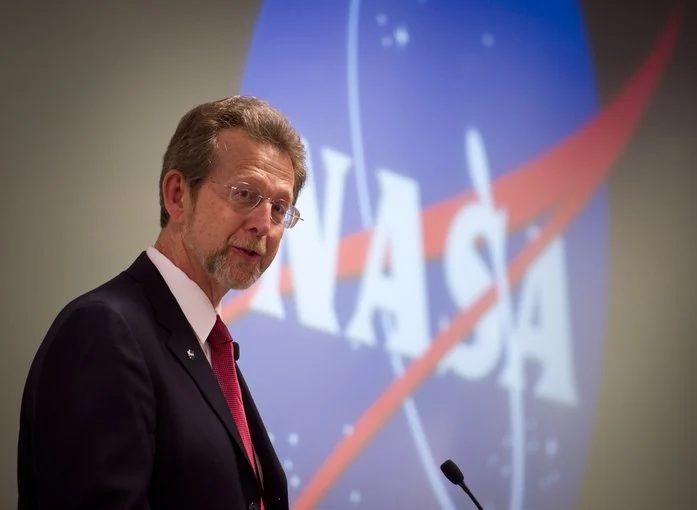
Part X — Chief Scientist: representing all of NASA science without pretending to be an expert in everything
2018: from one scientific portfolio to the scientific interests of an entire agency
When Green became NASA Chief Scientist in 2018, the change was larger than a promotion inside planetary science. The Planetary Science Division has a defined portfolio, communities, mission lines, and recurring strategic processes. The Chief Scientist must instead work across disciplines whose methods, timescales, infrastructures, and public controversies differ profoundly. Earth science, heliophysics, astrophysics, planetary science, biological and physical research, aeronautics-related science, and human exploration do not ask the same questions or use the same evidence.
The role therefore rewards a particular kind of expertise: the ability to know where one’s expertise ends. A scientist who mistakes seniority for universal competence can become dangerous because institutional authority makes weak judgments sound stronger than they are. The Chief Scientist needs networks of trusted specialists, transparent advisory processes, and the discipline to ask for evidence before offering a recommendation.
Green’s earlier career had prepared him for this kind of boundary work. He had moved from research to networks, from data curation to missions, from peer review to portfolio management, and from specialist communities to agency-wide public communication. Each transition required learning how decisions are made outside one’s original discipline. [4]
For a future Mars settlement, the analogy is immediate. A chief science officer on Mars could never be the best expert in geology, medicine, microbiology, agriculture, atmospheric science, radiation physics, materials, and ecology simultaneously. The office would succeed only if it created a reliable process by which specialized knowledge reached leadership without being flattened into a single voice.
This makes institutional humility a design requirement. The more complex the environment, the more leadership must distinguish between expertise it possesses directly and expertise it is responsible for convening.
Advising an administrator: separating scientific judgment, strategic advice, and executive decision
A Chief Scientist advises leadership but does not replace leadership. The distinction is easy to state and difficult to preserve when technical evidence becomes politically salient. A scientific assessment may show that one option carries greater uncertainty, but the administrator may still choose it because of budget, schedule, international commitments, industrial policy, workforce, or safety considerations that lie outside the narrow scientific comparison.
The scientist’s responsibility is therefore not to make every decision. It is to make the scientific consequences legible. What is well established? What is uncertain? Which uncertainties could be reduced with additional work? Which cannot be reduced on the available timetable? What assumptions would cause the recommendation to change?
This style of advice is stronger than advocacy disguised as analysis. If a scientist presents a preferred policy as though the data uniquely require it, trust may collapse when reasonable alternatives emerge. Conversely, if leadership ignores scientific consequences, the institution may incur costs that were predictable but politically inconvenient.
Green’s Chief Scientist role placed him near precisely these interfaces. NASA’s own history of the office emphasizes its function as senior scientific adviser to the Administrator and as an agency-wide representative of scientific priorities. [2]
On Mars, the boundary will be even sharper because operational survival, science, economics, and governance will overlap. A proposal to drill through an ice-rich layer may have scientific value, resource value, contamination risk, and legal implications at the same time. The science office should document the evidence and consequences while elected or otherwise legitimate governance bodies retain responsibility for policy.
Artemis and Moon to Mars: science as a component of human exploration rather than decorative justification
As Chief Scientist, Green operated during the growth of Artemis and the broader Moon-to-Mars framing. NASA publicly discussed the scientific opportunities created by returning humans to the lunar surface and by building a sustained exploration architecture. [19] The important institutional challenge is to prevent science from becoming a slogan added after engineering decisions have already been made.
Human exploration can create extraordinary scientific capability. Crews can recognize context, adapt sampling plans, repair instruments, deploy complex arrays, drill, and react to unexpected findings faster than a distant team can command a robot. But crews also consume mass, power, communications, mobility, and schedule. A scientific payload competes with life-support equipment and operational margin.
Serious integration begins early. Landing-site selection, surface mobility, habitat placement, power architecture, contamination controls, and sample handling should all include scientific requirements before configurations harden. If science enters only after the architecture is fixed, it will receive whatever residual capability remains.
The Moon provides a comparatively accessible environment in which NASA can test these institutional interfaces. It is not a complete analog for Mars; gravity, atmosphere, communication delay, radiation, dust, resources, and planetary-protection constraints differ. Yet it can reveal whether human-exploration organizations know how to incorporate science into operational planning.
For Mars, the lesson is to define science as an operational customer with measurable needs, not as a ceremonial reason for exploration. The science program should be able to say what measurements are required, what contamination limits matter, what samples must be preserved, and which sites should remain undisturbed.
Earth science and Mars: distant exploration should deepen, not weaken, understanding of our own planet
An agency-wide scientific role also exposes a false competition common in public debate: Earth versus space. The disciplines draw on shared physics, instruments, numerical methods, data systems, remote sensing, calibration practices, and engineering infrastructure. Comparative planetology often improves understanding precisely because Earth is one member of a broader class of planetary systems.
Mars climate studies, for example, sharpen questions about atmospheric escape, radiative balance, aerosols, surface-atmosphere exchange, and long-term climate evolution. They do not provide direct one-to-one analogies for modern terrestrial climate change, but the comparative exercise tests models under radically different boundary conditions.
Green’s move to Chief Scientist required attention to Earth science even though his original research was in space physics and planetary environments. That makes the office a useful case study in how institutions should resist disciplinary tribalism. Budget decisions can create real competition, but intellectual competition should not become denial of mutual value.
A Mars settlement will need the same discipline. Its residents may be tempted to treat terrestrial research as someone else’s problem. Yet Earth will remain the best-observed inhabited planet and the primary source of comparative data for ecology, climate, medicine, agriculture, and closed-loop systems. Mars science and Earth science will be partners for generations.
The broader principle is that exploration should enlarge the domain of comparison. A civilization that studies Mars while neglecting Earth would be using its most extraordinary experiment without a control case.
Open science, data access, and reproducibility at agency scale
Green’s earlier years at the National Space Science Data Center make open-data questions especially relevant to his later agency-wide role. A scientific program creates enduring value only when its evidence can be inspected, reanalyzed, combined, and questioned by people who were not present during acquisition.
Open science is more than putting files on a server. Data need calibration histories, metadata, software context, coordinate definitions, units, uncertainty descriptions, and persistent identifiers. Without those layers, nominal access can still leave the evidence practically unusable. The archive becomes a graveyard rather than an infrastructure.
Reproducibility also requires retaining the chain from raw observation to published result. Derived data products are often more accessible, but future researchers need enough provenance to understand how corrections and transformations were applied. This is particularly important when software environments disappear.
On Mars, data preservation will face additional risks. Local storage may be isolated by communications outages; bandwidth to Earth may be limited; instruments may be unique; and the operators who understand undocumented quirks may rotate home or die. Scientific infrastructure therefore needs redundant repositories and deliberate transfer of tacit knowledge.
The Green career links these concerns across decades: network access, archival stewardship, mission science, and agency policy are not separate stories. They are successive layers of the same problem—how to turn transient measurements into durable collective knowledge.
Retirement in 2022: the final test of whether an institution can continue without the person
Green retired from NASA in 2022 after more than four decades at the agency. NASA announced that Kate Calvin would succeed him as Chief Scientist. [7] The succession matters because a healthy institution treats transition as a normal process rather than as an emergency caused by the departure of a central personality.
Long careers create a paradox. Experience becomes extraordinarily valuable, but the organization can become vulnerable if too much context remains inside one person. The proper response is not to reduce the value of experience. It is to build mechanisms that convert experience into records, mentoring, review culture, and accessible networks before departure.
Oral histories are part of this infrastructure. Green’s recorded recollections preserve perspectives that formal mission reports do not contain: how decisions felt, which relationships mattered, where assumptions came from, and how institutional culture changed. Such memories are subjective and must not replace documentary evidence, but they provide context for interpreting it. [11]
A Mars settlement will face succession earlier and more sharply than NASA. Small populations create key-person risks. A single engineer may be the only resident who has diagnosed a rare power-system failure; a physician may hold unique experience with local physiology; a scientist may understand the quirks of a long-running instrument.
Transition plans, apprenticeships, decision logs, and post-role advisory structures should therefore be designed from the beginning. The final measure of a leader is not whether the organization needs them forever, but whether it becomes more capable because they were there.
The Chief Scientist is a node in a knowledge network, not the summit of all expertise
An agency-wide science leader is most effective when information can move through the office in both directions. Specialists bring evidence upward; strategic context and cross-disciplinary questions move back down. The office connects communities rather than replacing them.
This network model avoids the “chief expert” misconception. It also makes succession easier because the value resides in relationships and processes, not only in personal memory.
Mars governance should use the same design. A central science office can maintain standards, archives, ethics, and cross-sector coordination while disciplinary institutes retain authority over specialized methods. Centralization of interfaces need not mean centralization of all judgment.
Scientific integrity includes the capacity to say what the data do not show
Institutional pressure does not always ask scientists to fabricate results. More commonly it rewards overstatement: presenting preliminary evidence as mature, ignoring caveats, or selecting the most politically convenient interpretation.
A Chief Scientist needs the authority and culture to resist that drift. Integrity includes negative statements—this dataset cannot distinguish the hypotheses, this result is not yet replicated, this model depends on assumptions that remain uncertain.
Such statements can frustrate leaders who need decisions, but they improve decisions by identifying where judgment rather than evidence is carrying the weight.
For Mars, where local data may have immediate operational consequences, scientific integrity should be protected institutionally. Whistleblower channels, independent review, and preservation of raw evidence can reduce pressure to make the numbers fit a desired narrative.
Advisory committees should inform decisions without becoming substitute executives
External and community advisory bodies provide breadth, legitimacy, and independent challenge. But a committee usually does not carry the same accountability for budget, workforce, integration, and implementation as the executive who must decide.
Healthy governance therefore records advisory recommendations and explains significant departures without pretending the committee owns the final decision. This preserves both expertise and responsibility.
Green’s Headquarters experience operated amid decadal surveys and advisory structures that shaped planetary priorities. A Mars settlement should similarly separate scientific advice, public consultation, and executive authority rather than blending them into one opaque process.
Handover documents are engineering artifacts
Leadership transitions often focus on titles and announcements, but the real transfer is informational. Budgets have assumptions, projects have unresolved trades, people have commitments, and risks have histories that may not be visible in formal schedules.
A good handover records open decisions, why earlier options were rejected, which relationships need attention, and which apparently stable systems depend on temporary fixes. It gives successors enough context to question the past intelligently rather than rediscovering it through failure.
Mars should treat handovers as required technical artifacts for critical roles. Small populations and communication delay make undocumented institutional memory especially dangerous.
Advising through crisis: preserving scientific function when organizations become distributed
The COVID-19 pandemic forced NASA, like many organizations, to operate under restrictions that changed laboratory access, collaboration, and workplace presence. For an agency-wide scientific leader, continuity meant more than keeping spacecraft in flight. Research communities, early-career scientists, laboratories, and reviews all had different levels of dependence on physical access.
Robust institutions need to identify functions that are truly essential and those that can move online. Decision chains must continue even when offices are closed, while safety rules remain credible.
Mars will experience other forms of isolation: quarantine, habitat failures, severe weather, or temporary separation among outposts. The capacity for distributed scientific operation—an issue Green encountered in much earlier form through networking—becomes a resilience property.
Science and national objectives: serving a public agency without turning evidence into policy decoration
NASA is a federal agency whose missions exist inside national priorities. Science gains resources and infrastructure from that context, while political calendars, industrial goals, diplomacy, and prestige can also influence programs. The scientific leader’s task is to make the relationship productive without allowing desired policy to dictate what the data must say.
A mission can simultaneously serve science, education, diplomacy, and industry. Conflict begins when those objectives require suppression or distortion of evidence.
Early Mars institutions will likely be funded by states, companies, or coalitions with non-scientific goals. Rules for publication, conflicts of interest, and independent review should be designed early. Scientific autonomy does not require absence of sponsors; it requires that the evidence remain capable of disappointing them.
From program leadership to strategic scientific advice. Green became NASA Chief Scientist in 2018, moving from division management to agency-wide advice on science objectives, policy, strategy and investment. The role highlights a form of expertise that is easy to overlook: translating between researchers, engineers, senior managers and the public. Space decisions can commit large budgets and decades of work. They must be explained clearly enough to earn trust while still preserving uncertainty and the limits of the evidence.
His public communication, including the Gravity Assist series and NASA’s scientific support for The Martian, belongs to the same continuum. A scientific institution cannot rely on being correct inside technical reports; it has to show how conclusions are built, what remains hypothetical, and why some questions deserve sustained investment. Green’s career connects three infrastructures that are rarely photographed but are essential to Mars exploration: data systems, portfolio governance and public understanding. A civilization-scale project fails if any one of those layers becomes weaker than the vehicles it is meant to support.
2018: NASA Chief Scientist
NASA appointed Green Chief Scientist effective May 1, 2018. The agency described the role as representing strategic science objectives and advising the administrator and senior leadership on science programs, planning, policy and investments. [source]
The move required another change of scale. Green no longer represented only planetary science but had to work across Earth science, astrophysics, heliophysics, biology and other agency priorities. The role is fundamentally integrative: specialist communities need a mechanism for translating their work into a coherent agency science strategy.
A Mars settlement will eventually need a similar function. Medicine, geology, ecology, engineering and astronomy will all compete for attention. An integrated scientific authority should not replace specialists, but it can ensure that local research remains connected to the settlement's long-term knowledge needs.
International partnerships: capability multiplied, dependencies multiplied
Green's planetary portfolio included frequent negotiations with international partners. NASA's 2018 announcement noted his involvement in preparations and negotiations for future missions including Mars and Europa activities with partner agencies. [source]
International cooperation can distribute cost, diversify expertise and increase scientific return. It also introduces dependencies: national budgets, launch schedules, export rules and political relationships can all change. Good partnerships therefore require clear interfaces and contingency options.
A multinational Mars settlement will depend on even deeper cooperation. Standards for communications, medical response, resource access and maintenance responsibilities should be explicit long before a crisis. Scientific goodwill is valuable, but resilient operations require contractual and technical clarity.
Congress and the need to translate uncertainty into public decisions
NASA's 2022 career retrospective notes that Green testified before Congress five times. [source] Scientific testimony is a different communication problem from peer review. Lawmakers need enough detail to understand risk and value without receiving an entire technical archive.
The temptation is to present certainty in order to protect a program. Yet long-term trust depends on describing uncertainty honestly, especially when costs or schedules change. Space programs funded year by year must explain why a temporary setback does not invalidate the scientific objective and why a successful mission still cannot guarantee the next one.
A Mars settlement will remain politically dependent on Earth for a long time. Its leaders will need to communicate partial progress, failures and risk without turning every event into either catastrophe or triumph. That is an institutional skill, not a public-relations accessory.
Why planetary science needs a Chief Scientist even when divisions already exist
NASA already has specialized science divisions, so the Chief Scientist role may appear redundant. Its purpose is different: it provides an agency-wide scientific perspective to senior leadership, connecting disciplines and ensuring that strategy is not fragmented into independent portfolios.
Green's move into that position in 2018 therefore represented a change from optimizing planetary science to advising on the balance of NASA science as a whole. The value lies in integration, especially when questions such as climate, biology, heliophysics and exploration overlap.
A Mars settlement will need similar integration. Radiation is simultaneously a heliophysics, engineering and medical issue. Water is geological, chemical, agricultural and political. No single specialist owns the entire consequence chain.
Science policy as an engineering interface
Green's career demonstrates that science policy is not merely administration surrounding “real” technical work. Policy sets the interfaces between questions, budgets, review systems, archives and missions. A poorly designed policy can produce the same kind of system failure as a poorly designed hardware interface: incompatible expectations propagate until the program breaks.
Decadal surveys, peer review, data-access requirements and partnership agreements are therefore forms of institutional engineering. They define how information and authority flow through a large system.
Settlement governance will need to be designed with the same seriousness. Rules for resource use, research access and safety authority should be tested against realistic scenarios before a crisis exposes ambiguity.
Part XI — The Mars magnetic-shield concept: how to treat a speculative planetary-engineering idea seriously
From terrestrial magnetospheres to a Martian engineering question
Green’s proposal for an artificial magnetic shield near Mars attracted attention because it connects his earliest scientific specialty—magnetospheric physics—with an audacious planetary-engineering thought experiment. The concept is often summarized too casually as “giving Mars a magnetic field.” That phrase hides the actual question.
Mars lacks a strong present-day global magnetic field comparable to Earth’s. Its upper atmosphere therefore interacts directly with the solar wind in ways that contribute to atmospheric escape. MAVEN was designed in part to study these processes. The engineering thought experiment asks whether a large artificial magnetic structure placed appropriately in the Mars-Sun interaction region could alter that interaction and reduce some loss processes. [17]
This is not equivalent to installing an Earth-like dynamo inside Mars. It is a problem of plasma interaction, field geometry, solar-wind conditions, and long-term atmospheric response. Those distinctions matter because different mechanisms produce different engineering requirements.
The value of the concept is partly intellectual even if it never becomes practical. It forces scientists and engineers to connect measurements of atmospheric escape with intervention scenarios and to identify which variables would actually control the outcome.
A mature open book should therefore neither ridicule the idea because it is speculative nor advertise it as an available terraforming technology. It belongs in the category of long-horizon research questions whose assumptions must remain explicit.
Reducing a loss mechanism is not the same as creating a breathable atmosphere
Public discussions of planetary engineering often collapse several stages into one. Reducing atmospheric escape, increasing total atmospheric mass, raising surface pressure, altering temperature, producing oxygen, and creating a biosphere are separate problems. Progress on one does not automatically solve the others.
An artificial magnetic shield, if it affected loss processes as hoped, would address only part of that chain. Mars would still require a source of atmospheric material. The composition and quantity of accessible volatiles would matter. Surface and subsurface reservoirs would interact with climate. Chemistry would determine what gases persist.
Breathable oxygen is an additional requirement. A thicker carbon-dioxide atmosphere could alter pressure and thermal conditions without becoming safe for humans. Oxygen production at planetary scale would involve immense quantities of matter and energy and could interact with surface minerals.
This separation of goals is essential for responsible communication. A speculative mechanism that improves retention should not be translated into a promise of shirtsleeve living. Otherwise a research concept becomes a political myth before its basic physics has been demonstrated.
For settlement planning, the immediate implication is conservative: habitats, pressure systems, radiation protection, and life support must be designed for Mars as it exists. Long-term planetary engineering, if pursued, is a separate research program that cannot be credited as a near-term safety margin.
Energy, infrastructure, and maintenance: the questions a conceptual diagram cannot answer
Planetary-scale intervention is easy to draw and difficult to operate. Any magnetic-shield architecture would require generation of substantial fields, deployment of large hardware, power, thermal management, communications, station keeping or orbital control, fault tolerance, and replacement capability. A concept study can identify possible physical effects without proving that these systems are affordable or maintainable.
Maintenance is especially important because atmospheric change would occur over long periods. A device whose benefit depends on continuous operation becomes part of planetary infrastructure. Failure could stop progress or, depending on the mature climate state, permit gradual reversal of some gains.
This creates a governance burden across generations. Who owns the infrastructure? Who pays for replacement? What performance must be maintained? Is there a safe mode? What happens during geopolitical conflict or economic contraction? Engineering feasibility cannot be separated from institutional durability.
Mars settlers would encounter smaller versions of the same problem in power grids and life-support networks. A technically efficient system can be socially fragile if it requires rare components that only one supplier knows how to manufacture.
The Green concept therefore provides a useful training case in systems thinking. The scientific question is about fields and atmospheric escape. The civilization-level question is about sustaining a planetary service for decades or centuries.
Radiation protection: why a planetary magnetosphere is not a personal shield
Magnetic-field discussions can also create confusion about radiation. Earth’s magnetosphere contributes to the radiation environment around our planet, but astronaut exposure depends on particle energy, field geometry, atmosphere, shielding, location, and event conditions. A field designed primarily to change solar-wind interaction with the Martian atmosphere would not automatically make surface radiation safe.
Galactic cosmic rays include very energetic particles that are difficult to deflect with practical local magnetic systems. Solar particle events create different spectra and timescales. Mars’s thin atmosphere provides much less mass shielding than Earth’s atmosphere.
Therefore human radiation strategy must remain independent: habitat shielding, storm shelters, operational forecasting, exposure tracking, mission-duration limits, possibly water or regolith placement, and continued biological research. Planetary-engineering concepts can be studied in parallel without being booked as guaranteed protection.
The distinction illustrates a recurring problem in interdisciplinary megaprojects. One physical word—“radiation” or “magnetic”—can connect mechanisms that operate at very different scales. Good systems engineering asks which particles, which energies, which geometry, which location, and which time period.
Green’s magnetospheric background is valuable precisely because it can help maintain these distinctions. The lesson for readers is not that magnetic fields solve radiation but that large concepts must be decomposed into testable mechanisms.
Ethics and governance: who has the authority to alter a planetary environment?
Even a technically feasible climate intervention would not become automatically legitimate. Mars may contain records of ancient environments, preserved chemistry, or perhaps evidence relevant to the history of life. Large-scale environmental change could destroy some of that information before it is understood.
The ethical problem becomes sharper if indigenous Martian life is ever discovered. Human preferences for temperature, pressure, or resource access would then interact with the value of an independent biosphere. A project framed as “making Mars habitable” for humans could be destructive from another biological perspective.
Governance must also address representation. Early settlers may be the people most directly affected by harsh environmental conditions, but long-term transformation would affect future generations and scientific communities on Earth. No small group should quietly acquire irreversible authority simply because it possesses the machinery.
Reversibility is therefore a useful criterion. Early experiments should favor interventions that are bounded, monitorable, and stoppable. The burden of evidence should increase with spatial scale, duration, and irreversibility.
A speculative magnetic shield is valuable partly because it forces these questions before capability exists. Civilization can practice the ethics of planetary engineering while the technology is still hypothetical, rather than waiting until commercial or political momentum makes reflection inconvenient.
How to preserve an ambitious idea: an open dossier with assumptions, tests, and reasons to change course
Very ambitious concepts are often trapped between hype and dismissal. Hype presents a preliminary calculation as a roadmap. Dismissal rejects the question because implementation is distant. A better scientific method is to keep an open dossier that records assumptions and defines what evidence would strengthen or weaken the concept.
For the magnetic-shield idea, such a dossier would separate plasma-physics modeling, atmospheric-response modeling, field-generation architecture, deployment, energy demand, station keeping, materials, maintenance, economics, and governance. Each layer can mature independently.
Small experiments or simulations could test particular mechanisms without implying commitment to planetary transformation. New MAVEN results could update escape estimates. Better measurements of subsurface volatiles could change assumptions about atmosphere supply. Advances in superconductors or space power could change engineering feasibility.
The dossier should also contain stop conditions. If required power remains orders of magnitude beyond realistic infrastructure, if atmospheric reservoirs prove insufficient, or if biological discoveries create unacceptable ethical risk, the project may remain scientifically interesting without becoming an engineering objective.
This style of governance is transferable to many Mars ideas: space elevators, orbital mirrors, enormous greenhouses, nuclear fleets, or synthetic ecosystems. The point is not to suppress ambition. It is to make ambition auditable.
Magnetosphere and climate are related but not interchangeable concepts
A planetary magnetic field affects interactions with charged particles, while climate depends on atmospheric composition, pressure, radiation balance, clouds, dust, surface properties, volatile reservoirs, and circulation. The two systems interact, but neither can be used as shorthand for the other.
This matters when evaluating the magnetic-shield concept. A change in atmospheric escape rate would alter one boundary condition. Climate response would still depend on how much atmosphere exists and what it contains.
Keeping disciplinary boundaries visible is not bureaucratic caution. It prevents a plausible result in one model from being silently promoted into a conclusion about another system.
Measure before modifying
Planetary engineering should begin with baselines. Before changing an atmosphere, ice deposit, watershed-like subsurface system, or biological environment, science needs enough observation to determine what changed later.
This sounds obvious but becomes politically difficult once infrastructure is urgent. Baseline campaigns may be framed as delay because they do not immediately produce resources.
Green’s career in observational science and archives supports the opposite view: measurement is part of the infrastructure. A Martian environmental-impact regime should require pre-intervention datasets proportional to the scale and irreversibility of the proposed change.
Reversible experiments are a bridge between curiosity and caution
Many long-horizon Mars concepts cannot be tested at full scale ethically or economically. Reversible experiments offer an intermediate path. They isolate mechanisms, limit geographic scope, monitor unintended effects, and include a way to stop.
Reversibility does not eliminate risk, but it changes governance. Investigators can define thresholds for termination and learn from response before commitment becomes planetary.
This principle is useful far beyond magnetic shielding: local warming, subsurface access, microbial experiments, dust control, and resource extraction can all be designed with containment and restoration in mind.
Intergenerational governance is part of engineering feasibility
A project whose benefits and obligations span centuries cannot be evaluated only by present-day capital cost. It requires institutions capable of maintaining records, funding replacement, monitoring consequences, and revising objectives across generations.
This is one reason planetary-scale engineering is fundamentally political. Technical hardware is only one component of a long-lived commitment.
Mars settlers may eventually possess the capacity to initiate changes whose full consequences they will never see. Decision procedures should therefore represent future uncertainty explicitly, preserve exit options where possible, and require stronger evidence as irreversibility grows.
Terraforming, local habitability, and habitat engineering are different scales
Discussion of a magnetic shield can blur three levels of intervention. Habitat engineering protects a limited pressurized volume. Local habitability might involve greenhouses, caverns, or partially modified work zones. Terraforming aims at durable planetary-scale change. Their energy, duration, risk, and governance requirements are not comparable.
The separation clarifies priorities. A human base cannot depend on eventual planetary transformation; it needs pressure, temperature control, water, oxygen, and radiation protection locally. Long-horizon research can continue without being counted as a survival system.
The pedagogical value of Green’s speculative concept is that it forces the reader to ask which scale is actually being discussed. A planetary idea should never hide the concrete engineering requirements of the first decades.
A visionary concept should publish its failure conditions
Ambitious projects attract communities that naturally collect evidence in favor of continuation. Scientific discipline requires the reverse exercise as well: define observations or calculations that would cause the concept to be reduced, redesigned, or abandoned.
For a Martian magnetic shield, failure conditions could include prohibitive power, unstable field geometry, insufficient effect on escape, inadequate volatile reservoirs, or unacceptable environmental consequences. A serious research program accepts in advance that some results can close a pathway.
Mars governance should generalize the rule. Every megaproject publishes not only success metrics but conditions for stopping or changing course. That protects ambition from becoming institutional belief.
The Mars magnetic-shield proposal: bold concept, carefully bounded claim
At the 2017 Planetary Science Vision 2050 Workshop, Green discussed simulations of a possible large magnetic dipole near Mars's Sun-Mars L1 point. NASA Astrobiology presented the idea as exploratory thinking about whether reducing solar-wind stripping could allow atmospheric conditions to evolve over long timescales. [source]
The proposal is often exaggerated into a ready-made terraforming plan. It is not. Engineering a field of the required scale, supplying power, maintaining the system and understanding long-term atmospheric consequences are enormous unresolved problems. Nor would magnetic protection instantly produce breathable air, water or agriculture.
The scientific value lies in the question: how strongly did atmospheric loss shape Mars, and what would change if that driver were reduced? A rigorous Mars reference should preserve that distinction between an interesting physical hypothesis and an available settlement technology.
Magnetic shielding does not remove the need for local protection
Green's proposed artificial magnetic shield for Mars is useful precisely when treated as a research concept rather than a settlement shortcut. Reducing solar-wind stripping, if technically possible, would not automatically produce Earth-like pressure, breathable oxygen or safe surface radiation conditions.
Near-term settlements must therefore rely on local measures: shielding mass, storm shelters, dosimetry, operational forecasting and possibly subsurface construction. Global planetary engineering belongs to a different timescale from keeping a crew alive during the next solar event.
The distinction is an excellent example of responsible Mars thinking. Large-scale concepts can be explored without allowing them to replace the mundane engineering that people actually need. Green's proposal should stimulate modeling, not excuse under-designed habitats.
Part XII — Legacy: what Jim Green’s career teaches a scientific civilization on Mars
Three NASA centers, three professional cultures, one career built at the interfaces
Green’s career crossed Marshall Space Flight Center, Goddard Space Flight Center, and NASA Headquarters. Each environment rewards different habits. Marshall’s operational and engineering heritage, Goddard’s scientific missions and data infrastructure, and Headquarters’ programmatic and political responsibilities create different definitions of success.
Moving among them can be uncomfortable because practices that work in one setting may fail in another. A research group may tolerate exploratory ambiguity that a flight operation cannot. A data center may prioritize standards that a small instrument team sees as overhead. Headquarters may need a decision before specialists feel uncertainty has been reduced enough.
The capacity to translate among these cultures is itself a technical capability. Interfaces are where assumptions collide. People who have lived on more than one side can identify misunderstandings before they become failures.
A Mars settlement will quickly develop analogous subcultures: surface operations, science, medicine, agriculture, maintenance, construction, computing, logistics, and governance. Each will develop jargon and local priorities. The settlement should actively cultivate people who rotate across boundaries instead of allowing silos to harden.
Green’s career suggests that breadth does not have to mean superficiality when it is built sequentially on real responsibility. The best integrators have enough experience in specific systems to respect the difficulty of specialized work.
Data as civilization infrastructure
The most durable lesson from Green’s NSSDC years may be that data infrastructure is part of civilization, not an administrative afterthought. Mars will generate information that cannot be reacquired easily: first observations of a freshly exposed layer, medical records under partial gravity, environmental histories before large settlements, and baseline measurements before industrial activity.
If these records are lost, later generations cannot simply rerun the early decades. The environment and the population will have changed. This makes archival preservation ethically important as well as scientifically useful.
A robust Martian data system should include redundant storage on Mars and Earth, checksums, documented formats, migration plans, software preservation, provenance, access controls where privacy is necessary, and public release where openness is appropriate. It should also retain negative results and operational anomalies, not only polished publications.
Bandwidth constraints make prioritization unavoidable. Some raw data may be too large to transmit immediately. Local repositories therefore need durable custody and schedules for later transfer. Compression and derived products must not silently destroy information that future methods could use.
Green’s history makes the archive visible as an active scientific instrument. It turns one mission generation into a resource for the next.
Portfolio risk: never make an entire civilization strategy depend on one mission or one technology
Planetary science portfolios distribute risk across mission classes, destinations, and timescales. Some spacecraft fail, some arrive late, some exceed expectations, and some produce different discoveries than originally imagined. A diversified program prevents a single loss from ending an entire scientific agenda.
Mars settlement should apply the same principle to survival infrastructure. One power source, one water field, one communications link, one landing site, or one supply chain can create unacceptable common-mode risk. Redundancy is not necessarily identical duplication; it can mean different technologies whose failure modes are not correlated.
Portfolio thinking also protects long-term development. A settlement can operate proven systems while testing a small number of new ones. Experimental technology should have space to fail without threatening life support.
Political systems often prefer a single grand solution because it is easier to explain. Engineering reality is less elegant. Resilience usually comes from layers, margins, inventories, independent verification, and the willingness to maintain apparently redundant capabilities.
Green’s years balancing Discovery, New Frontiers, flagship missions, research programs, and enabling infrastructure offer a useful institutional analogy. The objective is not equal funding. It is a coherent mixture that preserves capability when uncertainty becomes real.
International cooperation: multiplying capability while acknowledging dependence
Modern planetary exploration is deeply international. Instruments, tracking, scientific teams, launch services, and data analysis frequently cross national boundaries. Cooperation can distribute cost, widen expertise, and create political durability, but it also creates interfaces and dependencies that must be managed explicitly.
A contribution is not free merely because another partner pays for it. Schedule changes, export controls, standards, political relationships, intellectual-property rules, and funding cycles can affect the whole mission. Mature cooperation documents these dependencies rather than celebrating partnership in abstract terms.
Mars settlement will likely depend on an even denser network. No early settlement should assume it can manufacture every component or expertise locally. International and commercial partners may provide launch, communications, medical support, software, power equipment, or replacement hardware.
The objective should not be autarky. It should be resilience: understand which dependencies are critical, maintain alternatives where feasible, stock long-lead parts, and make interfaces standardized enough that suppliers can change.
Green’s public-facing career repeatedly required presenting NASA science as a cooperative enterprise while still operating inside national institutions. That tension will not disappear on Mars; it will become one of the settlement’s constitutional questions.
Transmitting judgment rather than only procedures
Procedures are essential, but they encode responses to known situations. Judgment is needed when evidence is incomplete, procedures conflict, or a new failure does not resemble the training case. Long careers create judgment through exposure to patterns, consequences, and institutional memory.
The danger is that judgment is difficult to document. Experts may say a proposal “doesn’t feel right” because they recognize a hidden coupling, but if they cannot articulate the reason, the organization cannot teach it or challenge it.
Mentoring should therefore include explanation of decisions, not only instructions. Senior staff can walk younger colleagues through old proposals, anomaly reports, budget trades, failed concepts, and successful reviews. The apprentice learns how evidence was weighed rather than memorizing the final answer.
Green’s Gravity Assist interviews performed a public version of this function by asking scientists about career paths and intellectual development, not merely current findings. [6] The archive of professional stories becomes a map of how scientific judgment is built.
Mars will need deliberate apprenticeship because its early technical workforce will be small. Every critical specialty should have more than one person capable of making independent decisions, and every leader should be evaluated partly on whether successors are becoming stronger.
The final lesson: build institutions that can ask better questions and change their minds
The strongest thread through Green’s career is not a single mission. It is movement among questions. Magnetospheres led to networks; networks led to archives; archives led back to missions; mission experience led to program management; program management led to agency-wide advice; retirement returned him to long-horizon concepts and scientific reflection.
This trajectory argues against defining scientific institutions by a fixed answer. The purpose of a good institution is to preserve the ability to ask better questions as evidence changes. A Mars strategy written today should therefore contain mechanisms for revision, not only milestones.
Changing course is not necessarily evidence that earlier work was incompetent. New measurements can alter priorities. Technologies mature at different speeds. Costs change. Biological findings could transform planetary-protection rules. A settlement that cannot revise its assumptions will eventually be governed by obsolete certainty.
At the same time, constant improvisation is not adaptation. Changes should be documented with reasons, evidence, expected consequences, and criteria for review. That preserves institutional memory and prevents every new leadership team from rewriting history.
Green’s legacy is therefore useful for Mars because it connects curiosity with governance. Scientific civilization is not built merely by accumulating facts. It is built by creating systems in which evidence survives, expertise can disagree, leaders can decide, and future generations retain enough context to decide differently.
Documentary failure can be as dangerous as hardware failure
A machine can be physically healthy while the institution loses the knowledge required to maintain it. Missing drawings, undocumented software patches, forgotten calibration decisions, and unrecorded supplier substitutions can turn a manageable anomaly into a crisis.
This is documentary failure. It often appears only after staff turnover, which makes it easy to ignore during early operations.
Green’s data-centered career makes documentary continuity a natural part of his Martian legacy. Critical settlement systems should be audited not only for physical condition but for whether a competent new team could understand and reproduce the current configuration from records.
Mentoring multiplies capacity instead of merely transferring knowledge
The best mentoring changes how a less experienced person approaches new problems. It does not create a copy of the mentor. It provides standards, examples, access to networks, and gradually increasing responsibility.
This distinction matters for Mars because the settlement cannot afford apprenticeship systems that keep junior staff permanently dependent. Every critical role needs a succession ladder in which trainees eventually make independent decisions and teach the next cohort.
Green’s long engagement with education, interviews, and scientific community service reinforces a model of leadership in which capability left behind matters as much as personal output.
Awards recognize service but cannot measure a scientific life
Green received honors for planetary-science leadership and service, including recognition associated with the Harold Masursky Award. [20] Such awards are useful historical markers because peers identify contributions they consider important.
They should not become the metric of a career. Awards reflect selection processes, visibility, timing, and community norms. Large amounts of enabling work—review panels, mentoring, archive maintenance, internal problem solving—may never produce a famous prize.
A Mars society should be cautious about prestige systems that reward only spectacular firsts. Maintenance, documentation, safety, teaching, and long-term datasets are civilization-building activities even when they do not generate heroic narratives.
The retired expert should become critical memory, not a shadow chain of command
Retired leaders can provide context that no database captures, but continued influence can become unhealthy if successors remain unable to act without informal approval. Institutions need a role that preserves access to experience without creating an unelected parallel hierarchy.
Advisory panels, oral histories, mentoring, and time-bounded reviews can use retired expertise while keeping current accountability clear. The former leader should be able to say, “Here is why we did it that way,” without turning that history into a veto.
Mars will need such mechanisms early because the founding generation will accumulate disproportionate authority. Respect for experience should coexist with deliberate transfer of decision rights.
Measure legacy by the capabilities that remain
A leader’s legacy is often narrated through missions launched during a tenure. A deeper measure asks what the institution can do afterward that it could not do before. Are archives stronger? Are review processes more credible? Are new scientific communities represented? Are successors better prepared? Can the portfolio absorb failure without collapse?
This capability-based measure fits Green’s unusually broad career. The through-line is not ownership of one spacecraft but participation in networks, data systems, missions, strategic processes, public communication, and scientific leadership.
For Mars, this is the most useful definition of leadership. The objective is not to leave monuments to individual authority. It is to leave systems that make the next generation more capable of discovering, deciding, and correcting mistakes.
A scientific career cannot be measured by the number of missions attached to a name
Institutional biographies often count launches, arrivals, and discoveries. For Green, such a list would be impressive but incomplete. Much of his value lies in work that produces no spectacular image: networks, archives, review systems, budget trades, coordination, communication, and mentoring.
This is a useful corrective for Martian culture. A society obsessed with “firsts” may neglect the technician who preserves a sensor network for twenty years or the archivist who makes future discoveries possible. Civilization is sustained by enabling work.
Leadership should therefore be evaluated through capabilities left behind. Green’s story gradually becomes less the story of one person than the story of scientific infrastructure and institutional interfaces.
Interdisciplinary teaching: learning to speak beyond one profession
Interdisciplinary environments are difficult because every profession carries invisible assumptions. An engineer may treat mass as the dominant constraint while a scientist sees measurement quality as non-negotiable; a physician and lawyer use other frameworks. Training across disciplines begins by making those assumptions explicit.
Green’s engagement with international and educational settings complements his program-management career. Explaining a system to students from different backgrounds forces a teacher to distinguish fundamental principles from local jargon.
Mars should train integrators deliberately. Future leaders can rotate through science, operations, maintenance, medicine, and governance before assuming cross-system authority. The aim is not shallow generalism but knowing when another profession’s expertise is decisive.
Institutional capacity to change one’s mind is a form of safety
An organization that can never admit an assumption has become false turns every new observation into a political threat. An organization that changes objective after every difficulty has no strategy. Competence lies in defining when revision is justified.
Green’s career moved through several roles and perspectives while retaining a consistent commitment to evidence and scientific infrastructure. That mobility demonstrates that professional identity can evolve without abandoning methodological foundations.
For Mars, revisability will be a literal safety function. Resources, health effects, environmental behavior, and technologies will be less certain than on Earth. Institutions must be able to say, “A was reasonable with the evidence we had; new evidence now justifies B,” and preserve the record of why the change occurred.
From data scientist to program leader: changing scale without leaving the questions behind. Green progressively moved from direct work with data and instruments into responsibilities that required managing an entire portfolio of missions. That transition can look like a move away from Mars, but it taught a different part of the problem: planetary questions depend on budgets, mission selections, schedules, research communities, and decisions made years before launch. As director of NASA’s Planetary Science Division and later chief scientist, he worked at the level where Mars missions had to coexist with exploration of the rest of the Solar System. A chronological biography should show this change of scale. Understanding a data set, leading a project, and organizing a program require different skills. For Mars the last stage is crucial because a sustained campaign needs institutional continuity far longer than the operational life of any one rover.
Biographical analysis, context and legacy
Thematic analysis and deeper reading
Essential timeline
- PeriodNASA 1980–2021
- MarsChief Scientist 2018–2021
- LegacyCuriosity, InSight and planetary strategy
Deep reading: what this trajectory teaches
Jim Green: forty-two years learning how planetary science works as an institution
Jim Green's career is valuable because it connects several layers that are usually told separately. He began as a space physicist, became a builder of scientific data networks, ran NASA's largest space-science archive, managed proposal-support organizations, directed the Planetary Science Division for more than a decade and eventually served as NASA Chief Scientist. Rather than representing one spacecraft, he represents the institutional machinery that decides which questions are pursued, how data remain usable and how multiple missions coexist within a limited budget.
Green grew up in Burlington, Iowa, on the Mississippi River. NASA's profile recalls a childhood of water skiing and fishing before his path toward space physics. He earned a Ph.D. in space physics from the University of Iowa in 1979 and joined NASA's Marshall Space Flight Center in 1980. [source] His first scientific world was magnetospheric physics, not Mars geology. That beginning matters because it gave him a habit of thinking about planets as systems interacting with the solar wind rather than as surfaces alone.
For future Mars settlement this systems view is essential. Habitats, radiation protection, communications and science all depend on the larger space environment. Green's biography therefore provides an institutional complement to the engineers and geologists elsewhere in this library: how does an agency learn enough, across enough disciplines, to make a long sequence of missions coherent?
Retirement in 2022: institutions must survive the people who shape them
Green retired at the beginning of 2022 after more than forty years at NASA. Kate Calvin succeeded him as Chief Scientist. [source] The transition underlines a central property of a mature agency: no individual, however experienced, can become indispensable to continuity.
The strongest legacy of a senior leader is therefore a system of priorities, archives, processes and people capable of functioning after departure. Green's movement through three NASA centers and Headquarters gave him a broad view of how institutional memory can be preserved or lost.
Early Mars settlements should design succession from the beginning. Command, medical expertise, power-system knowledge and scientific leadership cannot remain concentrated in a few founders. Rotation and documentation are engineering requirements because they remove single points of human failure.
What Jim Green really contributes to the path toward Mars settlement
Green did not design a Mars base. His contribution is institutional: magnetic-environment science, scientific networking, archival stewardship, portfolio management, community priority-setting and the translation of research into long-lived agency strategy.
Those capabilities form the invisible infrastructure behind hardware. A settlement cannot be built by launching isolated machines. It requires decades of decisions about which uncertainties to close, which data to preserve, which missions to sequence and which partnerships to trust.
Green's biography therefore belongs beside the engineers because he illustrates another necessary form of engineering: designing the learning system around the missions. Rockets move hardware through space; institutions move knowledge through time.
Failure as information without normalizing preventable failure
A broad planetary portfolio inevitably includes missions or instruments that underperform. Leadership must avoid two opposite mistakes: treating every failure as proof that ambitious exploration is reckless, or treating failure so casually that preventable errors become acceptable.
The correct response is structured learning. Independent review, data preservation and public technical findings help later projects understand which assumptions failed. Green's long experience across NASA placed him inside an institution that repeatedly had to convert mission problems into revised practice.
Settlement operations need the same culture. A failed pump test should be mined for evidence, but a recurring pump failure caused by ignored maintenance is not productive experimentation. The difference lies in whether the organization learns and changes.
Mentoring and the transmission of career judgment
Green's public talks after retirement emphasize lessons learned across more than four decades at NASA. The agency's 2022 summer series presented his career explicitly as a behind-the-scenes account of how work gets done inside NASA. [source]
That kind of reflection is valuable because formal procedures cannot capture every judgment call. Experienced leaders know when a review is revealing a real risk, when a schedule is optimistic or when two teams are using the same word differently. Mentoring transfers some of that tacit knowledge before retirement removes it from the organization.
A small Mars community cannot afford to lose such experience. Apprenticeship, rotation and recorded debriefs should be built into work schedules rather than treated as optional education after operations are complete.
The final Mars lesson: build an institution that can keep asking better questions
Green's most durable connection to Mars is not any one concept, including the magnetic shield. It is the progression of questions made possible by an institution that archives results and funds the next step. Water evidence leads to habitability; habitability leads to biosignatures; biosignatures lead to carefully selected samples and more demanding laboratory analysis.
Settlement should progress the same way. The objective is not to predict every detail of a city from Earth. It is to build a program capable of asking better questions after each real experience on Mars.
An institution that can preserve data, revise priorities and survive leadership changes is therefore part of the settlement hardware in the broadest sense. Jim Green's career shows how that invisible machine is built.
International cooperation as an operational skill, not diplomatic decoration
In his second 2017 oral-history session, Green describes international partnerships as relationships that have to be made to work around real technical and institutional differences. He discusses cooperation with JAXA on a future Phobos and Deimos sample-return mission, the program that would become MMX. [source] Scientific partnership therefore requires technical interfaces, schedules, data rules and enough trust to resolve inevitable problems.
Mars will make that competence more important. No country currently controls every technology required for an autonomous settlement. But combining flags does not automatically create a coherent system. Teams must define ownership, certification, replacement responsibilities, data exchange and authority during emergencies.
Green's career shows that “international” is not a layer added after engineering. In modern planetary missions, it is part of engineering itself.
Primary and institutional sources
Additional sources: NASA — Chief Scientist appointment
Verification rule: this biography prioritizes institutional, archival and primary sources. Statements about living people or active programs are dated and attributed; uncertain or disputed points must remain explicitly qualified.
- NASA Science — Dr. Jim Green
- NASA — Chief Scientist History
- NASA — Announces New Chief Scientist (2018)
- NASA — Green retirement succession
- NASA Science — Dr. Jim Green profile and career
- NASA — Chief Scientist history: James L. Green
- NASA — Jim Green: a decade of planetary discovery
- NASA Headquarters Oral History — James L. Green, 11 April 2017
- NASA/JPL — Mars spacecraft reveal effects of Comet Siding Spring
- NASA — 2022 Summer Series: Jim Green, behind the scenes of 40 years at NASA
- NASA Astrobiology — exploratory Mars magnetic-shield concept
- NASA — Jim Green appointed Chief Scientist in 2018
- NASA — Earth and Moon once shared a magnetic shield
- NASA — Kate Calvin succeeds Jim Green after his January 2022 retirement
- NASA Headquarters Oral History — James L. Green, 7 June 2017
- NASA Science — Jim Green profile
- NASA — Chief Scientist history: James L. Green
- NASA — Jim Green: a decade of planetary discovery
- NASA — Jim Green appointed Chief Scientist
- NASA Ames — 2022 Summer Series: Jim Green
- NASA — Gravity Assist podcast
- NASA — Chief Scientist succession and Green retirement
- NASA — Earth and Moon once shared a magnetic shield
- NASA NTRS — Introduction to the Space Physics Analysis Network (SPAN)
- National Academies — Vision and Voyages for Planetary Science 2013–2022
- NASA Planetary Science Subcommittee — program governance records
- NASA — Comet Siding Spring and Mars campaign
- NASA/JPL — Siding Spring campaign results
- NASA — Gravity Assist: Andy Weir and The Martian
- NASA Astrobiology — exploratory Mars magnetic-shield concept
- NASA — Moon to Mars architecture and exploration strategy
- NASA NTRS — Network access to PCDS (SPAN, ESN, SESNET, ARPANET)