


MARS BIBLE — PEOPLE & PIONEERS
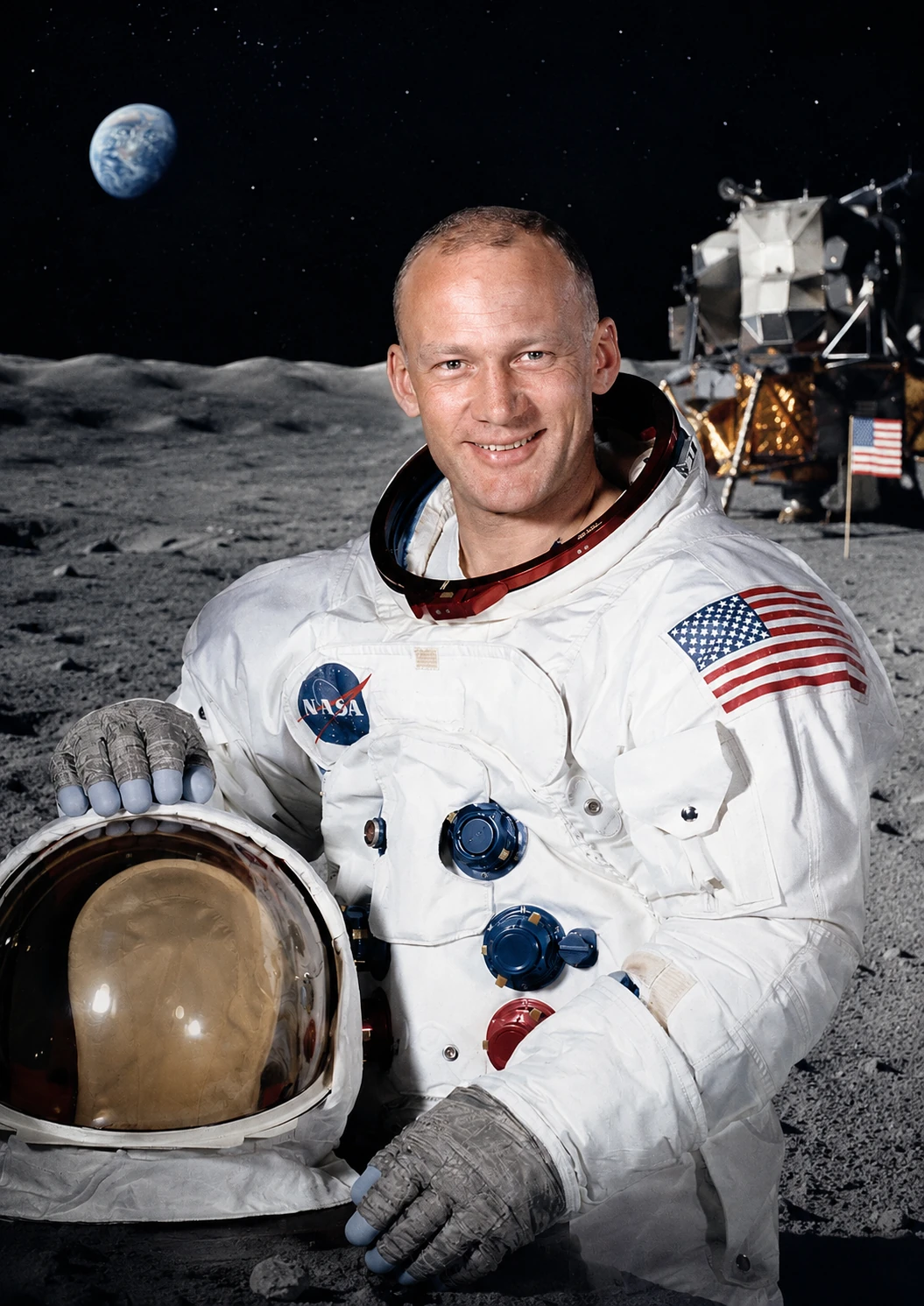
Buzz Aldrin
Buzz Aldrin's documented nationality or citizenship is American; the documented birthplace is Glen Ridge, New Jersey, United States. Buzz Aldrin is far more than the second person to walk on the Moon. An engineer, fighter pilot, MIT doctor and specialist in orbital rendezvous, he devoted a substantial part of his post-Apollo career to architectures that could make Earth–Mars travel more regular. His Mars cycler concept extends a habit of thought learned long before Apollo 11: reduce difficult missions to trajectories, rendezvous, reusable vehicles and operations that can be calculated, rehearsed and repeated.
Chronological biography
1930–1963 — Montclair, West Point, Korea and the MIT doctorate
West Point, Korea and MIT: arriving at NASA with a rendezvous doctrine. Aldrin did not enter the astronaut corps through exactly the same test-pilot path as many of his peers. A West Point graduate, he served as an Air Force fighter pilot during the Korean War and flew 66 combat missions. He then returned to advanced study at MIT and devoted his doctorate in astronautics to manned orbital rendezvous. The combination gave his career a distinctive shape: operational flying experience, military discipline and the ability to reduce an orbital problem to geometry and procedures at the moment lunar-mission architecture made rendezvous indispensable.
Orbital rendezvous before Apollo. Aldrin’s doctorate focused on rendezvous between vehicles in orbit. This was not an academic side issue: lunar travel and later interplanetary architectures require predicting where vehicles will be, synchronizing orbital planes and understanding the delta-v cost of each correction. Source.
Gemini XII became a turning point because it showed Aldrin that human exploration was not only a propulsion problem. Earlier American spacewalks had shown how quickly an astronaut could exhaust himself while merely trying to move and work in vacuum. Aldrin prepared movements, restraints and procedures with an engineer-test-pilot mindset. The mission demonstrated that extravehicular activity could become controllable when the system accounted for the human body, interfaces and procedure. That lesson remains central to any crewed Mars architecture. Institutional source.
That expertise is why his profile belongs inside Space Academy as well as Mars history: it shows how trajectory mathematics becomes operational procedure.
The Korean War became his first demanding operational environment. Flying F-86 fighters, Aldrin completed 66 combat missions. Such experience did not make him a spacecraft designer, but it trained habits that would matter later: mission preparation, awareness of vehicle limits, rapid interpretation of relative motion and decisions made with incomplete time. His career therefore connected two cultures often separated in simplified biographies, the pilot's culture of operating a real machine and the engineer's culture of describing motion mathematically. Source
1963–1966 — From rendezvous theory to Gemini XII
Before Apollo 11, Aldrin worked on orbital rendezvous techniques and developed expertise in the geometry of bringing spacecraft together. The subject can look abstract, but it becomes central whenever an architecture separates launch vehicle, habitat, transfer stage and lander.
For Mars, rendezvous is not merely Apollo history. Architectures based on orbital refueling, assembly or cyclers face the same families of problems: phasing, windows, delta-v reserves, navigation and abort options.
1967–1971 — Apollo 11 and real experience on another world
After Apollo — Rendezvous, Mars cyclers and a public role
The Mars Cycler: reuse the large habitat. A Mars cycler follows a solar orbit designed to return periodically near Earth and Mars. In principle, a large interplanetary habitat can be reused without repeating the full propulsive cost of capturing that habitat around a planet on every mission. [source]
Complexity shifts toward taxi vehicles, encounter velocities, timing, maintenance and rescue. The concept is an excellent architecture lesson: simplifying one function can move complexity somewhere else. [source]
Aldrin’s cycler concept extends the logic that made rendezvous so central to his earlier career. Instead of asking every vehicle to carry a large habitat from Earth to Mars and back, a long-lived interplanetary vehicle could repeatedly follow a solar orbit and be met by smaller transfer craft near each planet. The attraction is architectural reuse; the penalty is that rendezvous accuracy, timing, logistics and contingency planning become even more important. [source]
This is why his Mars advocacy belongs in the biography rather than as an unrelated late-life addendum. The doctorate, Gemini rendezvous work, Apollo operations and later cycler proposals all revolve around the same question: how should separate vehicles meet and exchange people safely in a larger transportation system? The technology changes, but the systems problem remains recognisably continuous. [source]
Aldrin after Apollo: using fame to keep Mars in the debate. After his NASA career Aldrin also became a public advocate for long-term space exploration. Apollo gave him an audience few trajectory engineers possess, and he used that visibility to keep Mars in political and cultural discussion.
That public role should not replace the technical analysis. The value of his profile is precisely the combination: an icon of the lunar era who continued working on the mathematics and architecture of interplanetary transportation.
Before Mars, orbital rendezvous: why Gemini experience matters to interplanetary architectures. Buzz Aldrin is naturally associated with Apollo 11, but his relevance to Mars architecture begins earlier. His MIT doctoral work dealt with orbital rendezvous techniques, a central problem for any architecture using multiple vehicles, assembly or crew transfer. Gemini XII then gave him operational experience in rendezvous and extravehicular activity before Apollo took him to the lunar surface.
That sequence — theory, training, orbital demonstration, then lunar mission — is a model of capability maturation. Mars architectures that assume refuelling, assembly or orbital rendezvous cannot treat those operations as arrows on a diagram. Each phase requires relative navigation, procedures, mechanical interfaces, schedule margin and abort options.
Aldrin's later Mars concepts, including cycler trajectories, extended this network view rather than treating the mission as one isolated vehicle. Their technical or economic merits can be debated, but they preserve an important lesson: efficient interplanetary transport may depend as much on rendezvous architecture and reuse as on the raw performance of a launcher.
Apollo 11: real experience on another world. Aldrin participated in the first crewed landing on another celestial body. That experience does not “prove” Mars, but it provides a precedent for systems, procedures, communications, EVA and crew discipline when the outside environment is not naturally habitable.
The differences are enormous: travel time, gravity, atmosphere, radiation, return windows and Mars autonomy go far beyond Apollo.
After Apollo, Aldrin devoted significant effort to recurring Mars transportation architectures. A cycler places a large habitat on a trajectory that repeatedly passes near Earth and Mars; smaller vehicles transfer crews between planet and cycler. NASA histories of Mars mission planning identify Aldrin as a major proponent of the approach. [A7] Later work on cycler orbits extends the concept. [A6][A8]
The Mars Cycler concept associated with Aldrin uses a repeating trajectory between the neighborhoods of Earth and Mars. A large interplanetary habitat would remain on the cycling orbit while smaller vehicles perform rendezvous at each end.
The architecture does not eliminate difficulty; it redistributes it. Crews must reach the cycler accurately, cope with relative velocity and rely on capable taxis. That is its pedagogical value: good space architecture does not erase constraints; it chooses where to pay for them.
Supplementary documentary analysis
Biographical analysis, context and legacy
Thematic analysis and deeper reading
Essential timeline
- Born in Montclair, New Jersey.
- Graduates from West Point and begins a U.S. Air Force fighter-pilot career.
- Completes an MIT doctorate on orbital rendezvous and is selected as a NASA astronaut.
- Gemini XII demonstrates EVA and orbital techniques.
- Apollo 11: becomes the second human to walk on the Moon.
- Develops and promotes Earth–Mars cycler architectures.
- Cycler trajectories remain a field of study but are not an operational Mars transportation architecture.
Why a cycler is not a free interplanetary train
The image of an ocean liner passing repeatedly near two planets is attractive, but it hides encounter costs. To board the cycler a crew must leave the planet, arrive at the right place at the right time and match a significant relative velocity. At the destination another vehicle must leave the cycler and manage arrival at Mars or Earth.
A cycler may save repeated acceleration of the large interplanetary habitat, but it demands fast taxis and precise operations. Its value therefore depends on habitat mass, number of cycles, consumables, maintenance and the selected level of redundancy.
Deep reading: what this trajectory teaches
Buzz Aldrin — from orbital rendezvous to a Mars transport network
Buzz Aldrin — an expanded open book: from fighter-pilot discipline to interplanetary transport architecture
1. Before the capsules: training in which precision was never abstract
Reducing Buzz Aldrin to “the other man on the Moon” erases the part of his career that most clearly explains how he came to think about spaceflight. Before white pressure suits, before Gemini, and before the lunar module Eagle, he was an officer trained in an environment where a technical decision mattered only if it worked under pressure. West Point was not simply an engineering school. It trained officers to combine mathematics, discipline, hierarchy, physical endurance and rapid judgment. Aldrin graduated third in the class of 1951. The West Point Association of Graduates records that ranking, and it mattered in practical terms because the newly independent United States Air Force was still building its officer corps. Aldrin chose the Air Force rather than an Army career and entered a world in which performance limits, operating procedures and safety margins were encountered every day rather than discussed only in classrooms. [source]
That setting is important to the later story of the man nicknamed “Dr Rendezvous.” In a jet fighter the allowance for error can be extremely small. Speed turns a mistaken reading into a trajectory problem within seconds. Fuel use imposes planning discipline. Weather, machine condition, terrain, other aircraft and an adversary make it impossible to pretend that the vehicle is an isolated system. Decades later the vocabulary of interplanetary exploration would be different, but the structure of the problem would remain familiar. A Mars crew would also need to know the true state of its vehicle, anticipate resource consumption, understand where its trajectory was taking it, and retain options when a sensor, propulsion element or communications link no longer delivered the expected service. The continuity between the fighter pilot and the cycler advocate is therefore more than a biographical metaphor. It is continuity of method: know the system well enough to reason when the system stops behaving ideally.
The Korean War added a dimension that commemorative biographies often compress into two figures: sixty-six combat missions and two MiG-15s destroyed. Those figures are supported by institutional sources including the Department of Defense, the U.S. Air Force and West Point. But they become more meaningful when read as indicators of repeated operations rather than as heroic shorthand. A combat mission involves intelligence, briefing, navigation planning, aircraft condition, fuel, weapons, coordination with other pilots, rules of engagement, return options and debriefing. Repetition matters as much as any spectacular encounter. Aldrin was learning not merely how to survive a single dangerous event but how an organization returns people and machines to a condition in which they can fly again. That logic of repeatability later became central to his Mars thinking: a credible architecture is not one that succeeds once, but one that can be reconfigured and used again. [source]
The F-86 Sabre also imposed an immediate relationship between energy and geometry. A fighter does not simply “turn toward” a moving point in the way a car turns toward an address. Future position depends on speed, altitude, maneuver load, energy loss and the time required to recover a favorable state. It would be misleading to call air-combat maneuvering an orbital-mechanics exercise. It is not. Yet it teaches an intuition that becomes fundamental in rendezvous: reaching a moving target means reasoning about where it will be, not merely where it is now. At MIT that intuition would acquire a mathematical framework. The transition from combat aviation to astronautics was therefore not the replacement of instinct by theory; it was the conversion of experience with relative motion into a problem that could be formalized, calculated and taught.
Another part of Aldrin’s military career receives less popular attention because it lacks the drama of Korea. He continued in operational aviation rather than moving directly into space work. West Point records assignments as a gunnery instructor pilot, officer schooling, service as an aide at the Air Force Academy, and later F-100 Super Sabre operations in Germany. The Department of Defense notes his service as a flight commander in the 22nd Fighter Squadron at Bitburg from 1956 to 1959, within the Cold War structure of NATO. That period matters because it exposed him to aviation as a networked capability. A pilot depended on bases, maintainers, fuel, spare parts, communications, allied procedures, sortie planning and the continuing availability of the aircraft. A brilliant airplane that cannot be supported is not much of a military capability. The same distinction applies in space: an impressive launch vehicle is not yet a transportation infrastructure. [source]
This helps explain the later appeal of the Mars cycler. Aldrin did not treat interplanetary transportation solely as a contest in launcher performance. Cycler concepts are attractive because they allow functions to be separated. A large long-duration vehicle can carry habitable volume, shielding, power and systems intended for repeated use, while smaller transfer vehicles perform the difficult task of catching the cycler near a planet and departing from it at the appropriate encounter. The analogy with military logistics must not be pushed too far; an orbital network obeys celestial mechanics rather than road or air traffic rules. But the organizational logic is recognizable. A robust capability can emerge from distributing functions among specialized elements instead of forcing one vehicle to perform every phase of every trip.
It is equally important not to romanticize war as ideal preparation for spaceflight. The risks, objectives and moral context are fundamentally different. What can be said more carefully is that Aldrin experienced environments in which stress degrades performance and procedures exist partly to preserve judgment when circumstances are uncertain. The Department of Defense has quoted his reflections on combat flying and the need to deal with fear and uncertainty. In human-spaceflight engineering, that becomes a technical concern. A procedure must still be usable when a crew is tired or under time pressure. A display should reduce ambiguity. A mission architecture should not require a long chain of perfect human actions in order to survive an anomaly. Reliability therefore means more than lowering component failure rates; it means reducing the chance that an individual failure can grow into a situation the crew cannot control.
Aldrin’s later decision to pursue a doctorate is also revealing. For an Air Force officer who wanted to become an astronaut, the more obvious route might have been test-pilot training, which was a strong credential in the early astronaut corps. Aldrin moved instead toward theoretical astronautics. The choice carried career risk because there was no guarantee that a dissertation on orbital rendezvous would ever put him inside a NASA spacecraft. It shifted his value from being solely an operator of advanced machines toward understanding one of the mission-design problems that would determine whether future spacecraft could work together. That willingness to specialize in a difficult emerging problem would become one of the defining features of his NASA identity.
The timing was fortunate. The American lunar program was making rendezvous a central architectural question. If a lunar mission used a separate lander, vehicles would have to separate, navigate independently, meet again in orbit and dock. Rendezvous therefore was not mathematical ornament. It was an enabling capability. If crews could not reliably find and join another vehicle in orbit, many lunar architectures would become much heavier, more dangerous or simply impractical. Aldrin was building expertise in a bottleneck before operational experience with that bottleneck existed in abundance. This is one reason his technical specialization would later make him unusually visible among astronauts who were otherwise often defined by test-pilot credentials.
For Mars, the lasting lesson of this first phase of his life is not the simplistic claim that military pilots automatically make good astronauts. The more useful lesson is that difficult human systems require people who can connect theory, procedure and real operations. An operator who knows only the checklist may struggle when a sensor disappears. A theorist who knows only the equation may underestimate workload and fatigue. A manager who sees only a schedule may fail to understand why a small hardware limitation changes an entire sequence. Aldrin gradually accumulated experience in all three domains. That combination, rather than the later fame of Apollo 11 by itself, explains why his career remains relevant to the design of a Mars transportation system.
The difference between an expedition and an infrastructure can even be traced through this chronology. Korea taught the recurrence of missions; Germany exposed the importance of support networks; MIT supplied the geometry of rendezvous; Gemini tested the ergonomics of working outside a spacecraft; Apollo integrated multiple vehicles and teams; cycler studies explored the idea of reusing an interplanetary habitat. These stages were not a master plan written in advance. They are a pattern visible in retrospect. Yet the pattern is consistent: as an architecture matures, individual heroism should become less necessary. In a mature transportation system, the best operational day may be one on which nothing remarkable happens because every interface has become routine. The astronaut immortalized in one of history’s most famous photographs devoted much of his later technical advocacy to a future in which a Mars journey would no longer be a unique event.
2. MIT and orbital rendezvous: turning a pilot’s intuition into a teachable method
When Buzz Aldrin arrived at the Massachusetts Institute of Technology near the end of the 1950s, human astronautics was still close to the beginning of practical experience. No American had yet flown in space, no crewed orbital rendezvous had been completed, and techniques that would later become routine in Gemini and Apollo were still being formalized. Aldrin chose rendezvous as his doctoral subject: the problem of bringing two orbiting vehicles together with acceptable geometry, relative velocity and propellant expenditure. His 1963 dissertation, Line-of-Sight Guidance Techniques for Manned Orbital Rendezvous, remains available through MIT and is an unusually valuable primary source because it reveals the technical expertise that existed behind the later public mythology. [source]
The title itself is revealing. Aldrin was not interested only in an optimal trajectory computed in advance by a ground computer. He examined guidance methods that a crew could use while observing a target, interpreting how the line of sight changed, and converting that information into corrections. The question therefore was not simply “what trajectory should be flown?” but also “what information can a human actually perceive, and how can those observations support robust decisions?” That distinction is central to crewed systems. A mathematically perfect solution may be operationally poor if it assumes unavailable data, excessive computation, unrealistic sensor precision or a workload that a crew cannot sustain. Aldrin’s research sat directly at the boundary between orbital mechanics and human operation.
Orbital rendezvous is profoundly unintuitive if approached with the mental model of driving on a road. Accelerating in the direction of motion does not simply mean catching a vehicle that appears to be ahead. An impulse changes orbital energy and therefore changes the shape and period of the orbit; the new orbit then alters relative angular motion. Catching another spacecraft may require changing altitude to build the proper phase relationship before arriving in the same region with sufficiently low relative velocity. The precise models differ by phase and mission design, but the central idea is stable: the pilot is not steering toward a fixed point. The pilot is manipulating a time-dependent relationship between two trajectories. Rendezvous is therefore a problem of temporal geometry as much as navigation.
Aldrin sought cues that could be observed. A target whose line of sight remains nearly constant while its apparent size increases can indicate an intercept geometry, much as an object that stays at the same bearing while growing larger can represent collision danger in terrestrial navigation. Orbital motion is more complicated because both vehicles are falling around Earth and their accelerations vary with position, but line-of-sight reasoning remains powerful because it connects guidance to information the crew can actually see. That concern for pilot-understandable navigation later became operationally valuable when Gemini XII experienced radar problems and the crew had to rely heavily on visual information during rendezvous.
The unusual feature of Aldrin’s background was that he did not enter NASA as a pilot who later learned some orbital mathematics. He entered with a doctorate directly connected to one of Gemini’s enabling capabilities. The specialization earned him the nickname “Dr Rendezvous.” The nickname can make the skill sound almost personal or magical; the opposite interpretation is more accurate. He had spent years breaking a difficult problem into observable parameters, examining how a line of sight evolves, connecting observation to correction, and thinking about the limits of manual control. Expertise was not an instinct. It was structured knowledge that could be documented, tested and communicated.
The Smithsonian National Air and Space Museum has highlighted the historical significance of Aldrin’s doctorate, and his selection also illustrates a gradual widening of the astronaut profile. Early astronaut groups were dominated by test pilots, appropriately for spacecraft that were themselves highly experimental machines. Specialists with advanced scientific and engineering backgrounds signaled a transition toward missions in which crew members would carry domain expertise as well as piloting skill. Mars will push that transition much further. A crew living away from Earth for months cannot consist only of pilots. It will need medical, geological, mechanical, electrical, computing and life-support competence, plus enough cross-training that the loss or illness of one specialist does not destroy the mission.
Rendezvous is also a good example of how a local capability can transform an entire architecture. Before reliable orbital joining exists, every separation between vehicles creates a major mission risk. Once rendezvous and docking are dependable, functions can be distributed. A transfer habitat does not need to land. A lander does not need to carry an entire interplanetary vehicle to the surface. Stages can be discarded, stations can be resupplied, and crews can transfer between specialized elements. Rendezvous becomes an interface technology that enables modular systems. That is exactly the logic later required by Mars cyclers. A cycler is useful only if smaller taxis can meet it, exchange crew and cargo, and depart toward a planet. Without reliable rendezvous, a habitat that repeatedly flies past Earth and Mars would be nearly useless.
This lineage helps explain Aldrin’s later fascination with recurring trajectories. His professional identity begins with studying how two objects can meet; decades later, his Mars advocacy focuses on arranging repeated meetings among planets, transfer vehicles and long-lived interplanetary habitats. The scale changes dramatically. Flight times, encounter speeds, communication delays and propulsion demands are nothing like low Earth orbit. Yet the architectural family resemblance remains: create predictable opportunities for encounter, then design vehicles and operating rules capable of exploiting those opportunities safely.
A rigorous account must avoid giving Aldrin sole credit for American rendezvous capability. Gemini was a collective development involving NASA engineers, contractors, flight controllers, crews and researchers. Rendezvous techniques came from a broad institutional effort, not one dissertation. Aldrin’s contribution matters because of his focus on crew guidance and because he became one of the astronaut corps’ recognized specialists, not because he single-handedly invented orbital rendezvous. Distinguishing personal expertise from collective accomplishment makes the biography more accurate rather than less impressive.
That distinction is useful when approaching Apollo 11. Famous programs are often compressed into a few names, even though success depends on thousands of interfaces. One paradox of space history is that the more iconic a mission becomes, the easier it is to forget the system that made it possible. Aldrin’s dissertation restores that system perspective. It shows a future Moon walker working on a narrowly defined problem that looked far less dramatic than a launch but was essential to lunar-orbit rendezvous architecture. Large missions are made possible by specialized competencies that may be almost invisible to the public until they fail.
The same lesson applies more strongly to Mars settlement. The failure point may not be the biggest rocket or most visible machine. It may be maintenance policy, docking standards, software incompatibility, biological contamination, inventory errors or an emergency procedure that places impossible demands on the crew. The MIT work shows the value of formalizing interfaces before they become crises. An Aldrin biography that treats rendezvous only as a pre-Apollo anecdote therefore misses the intellectual thread connecting his early research to his later infrastructure proposals.
The thesis also raises a broader question about autonomy. NASA in the 1960s already relied on tracking networks, ground computation and powerful mission-control organizations, yet Aldrin was interested in what a crew could infer from direct observation. For Mars that problem becomes unavoidable because communications delay rules out real-time piloting from Earth. Crews will have to understand vehicle dynamics, diagnose anomalies and make decisions without waiting for immediate instructions. The technology will be vastly more sophisticated—advanced inertial navigation, optical sensors, redundant computers and autonomous software—but the philosophy is familiar: do not design a human system in which the people aboard are unable to understand their situation well enough to recover when automation or ground support is insufficient.
3. Joining NASA without the standard test-pilot path: the value of rare expertise
Aldrin’s selection in NASA’s third astronaut group, announced in October 1963, came as the agency was beginning to broaden the criteria that had shaped its first crews. The Mercury Seven had embodied the image of experienced military test pilots who could tolerate highly experimental vehicles and describe their behavior with engineering discipline. Aldrin certainly had operational flying experience, but he had not followed the canonical test-pilot-school route. His candidacy became viable because NASA was placing greater value on advanced education and specialized technical knowledge. A doctorate in astronautics focused on orbital rendezvous turned what might once have looked like a career detour into an unusually well matched qualification for Project Gemini. [source]
The institutional change matters because a space program does not merely select people; it implicitly selects the kinds of knowledge it believes a mission requires. Mercury needed pilots who could master vehicles near the edge of the known flight envelope. Gemini had to demonstrate operations: long-duration flight, orbital maneuvering, rendezvous, docking and extravehicular activity. Apollo would require crews to operate multiple modules, navigate around the Moon and use a dedicated landing vehicle. Aldrin’s selection belongs to the transition from an “experimental capsule” model toward a “mission system” model. As the architecture became more modular, rendezvous expertise became more important.
Once selected, Aldrin did not arrive as an outside academic who simply taught equations to pilots. He had to become a complete astronaut: physical training, spacecraft systems, survival, launch vehicles, simulations, procedures and the ability to work inside an organization in which every crew depended on hundreds of people on the ground. Specialization did not remove the requirement for versatility. That remains highly relevant to Mars. A crew may include a physician, geologist or propulsion specialist, but every member must be capable of responding to failures that do not respect job descriptions. Deep expertise and human redundancy have to coexist.
Aldrin also participated in the development of Gemini rendezvous methods. The “Dr Rendezvous” nickname reflects how colleagues perceived his specialty, but the deeper point is how academic knowledge had to be converted into crew procedures. A dissertation is not a flight manual. Mathematical relationships must become cues, sequences, tables, decision rules and training scenarios. Flight controllers need compatible mental models. Simulators must reproduce useful situations. Crews need to recognize when they are drifting outside a safe corridor. Translating theory into operations is one of the hardest parts of human-systems engineering.
Backup assignments were important in that translation. Before Gemini XII, Aldrin became part of the Gemini IX backup crew with Jim Lovell after the deaths of Elliot See and Charles Bassett changed crew assignments. Being a backup astronaut was not passive. The backup crew had to know the mission well enough to replace the prime crew, and therefore participated deeply in simulations, procedures and technical discussions. Proximity to Gemini IX became especially important because that mission revealed how difficult extravehicular work could be. Gene Cernan’s EVA involved severe fatigue, overheating and mobility problems. The central lesson was not a lack of courage or skill. It was that the interface among the human body, pressure suit, restraints, tools and spacecraft had not yet matured.
Earlier Gemini EVAs had already shown that “being outside in space” and “working effectively in space” were very different achievements. Without restraints, every action creates a reaction. An astronaut attempting to turn a handle or move hardware may move his own body instead. Pressurized gloves fatigue hands and forearms. Suits constrain motion. Sunlight and shadow create extreme thermal differences. Simple tasks expand in duration. The missing element was not necessarily a revolutionary new suit; it was a worksite designed for a body in weightlessness: handholds, foot restraints, tethers, reachable tools and planned rest periods.
Gemini XII therefore became a laboratory for transforming EVA. NASA made greater use of neutral-buoyancy training, using water to reproduce some aspects of free-floating mobility and to allow full sequences to be practiced around mockups. The simulation was imperfect. Water is not vacuum, suit behavior is different and hydrodynamic forces do not exist in orbit. But neutral buoyancy provided something short parabolic flights could not: time. An astronaut could repeat an entire task, discover where body restraint was inadequate, and identify operations that appeared easy in drawings but became exhausting in practice. [source]
Aldrin approached the preparation almost as an engineering experiment. Tasks were broken down, supports were added, rest periods were planned and movements were rehearsed. The objective was not to prove that an unusually athletic astronaut could force his way through difficult work. It was to make the work sustainable. That represents a philosophy of design. A procedure that succeeds only when an exceptional operator performs near maximum capacity is not mature. Infrastructure should reduce human variability by providing stable interfaces. Mars will demand the same principle with partial gravity, abrasive dust, repeated suit use, airlock cycles and equipment that must remain repairable for years.
The preparation also illustrates the value of learning from failure without simplistic blame. Problems on earlier missions were not reduced to claims that an astronaut “was not good enough.” They revealed weaknesses in the design of EVA work. This is central to complex systems. When qualified operators repeatedly struggle with a task, the interface itself has to be examined before simply demanding greater effort. Programs learn fastest when incidents are converted into design requirements rather than treated only as individual mistakes.
Lovell and Aldrin’s assignment to the final Gemini mission therefore carried a special responsibility. Several capabilities had to be closed out before Apollo. Rendezvous and docking needed to become repeatable; EVA had to become usable work rather than merely survival outside the vehicle; automatic reentry and multiple experiments had to be demonstrated. Gemini XII was not simply another flight. It was a program-closing mission intended to convert fragile capabilities into procedures robust enough to support the lunar program that followed.
That closure logic resembles what a Mars program would need before declaring any capability operational. A spectacular prototype demonstration would not be enough. Repeatability, maintenance, vehicle compatibility, off-nominal behavior, emergency procedures, consumables and the ability of different crews to achieve the same result would all have to be demonstrated. Gemini XII is a historical example of that transition: achievement was turned into a profession. A space capability becomes truly useful when it no longer depends on heroic improvisation.
Aldrin entered NASA with rare expertise, but the most useful part of the story is not that he already knew the answers. He joined an organization that was learning quickly. Gemini flights were close enough together that problems from one mission could shape hardware and procedures for the next. Gemini IX informed Gemini XII; Gemini XII informed Apollo; docking and EVA knowledge later fed Skylab, the Shuttle and the International Space Station. Mars will make such rapid learning far harder because missions will be separated by long launch windows. That makes terrestrial, lunar and orbital testing even more important before crews are sent into an environment where the next rescue opportunity may be months or years away.
4. Gemini XII in detail: making rendezvous and EVA reliable enough for Apollo
Gemini XII launched on November 11, 1966, about an hour and a half after the Agena Target Vehicle it was expected to meet. The mission lasted just under four days and completed fifty-nine revolutions around Earth. Those numbers can look modest beside modern orbital expeditions, but the flight concentrated an extraordinary list of objectives into a small spacecraft. The final Gemini mission had to verify docking, relative-motion operations, multiple EVAs, a tether experiment, scientific work and automatic reentry. NASA was no longer merely proving that two people could survive for several days in orbit. It was closing specific capabilities on which Apollo would depend. [source]
The Agena rendezvous immediately demonstrated the value of robust manual understanding. NASA’s mission history notes that visual sightings became especially important because of problems with the onboard radar. Under nominal conditions, radar gives range and relative velocity. When that information is degraded, the crew needs another way to understand the geometry. Aldrin did not single-handedly rescue the rendezvous: Lovell commanded the spacecraft, ground controllers supported the operation and procedures had been developed collectively. But the situation validated training in which a pilot could reason from line-of-sight behavior rather than simply follow an opaque instrument cue.
That redundancy between sensor output and human understanding remains important for Mars. Modern vehicles will carry far more capable sensors and software than Gemini, but additional automation does not remove the need for degraded modes. Optical systems can be blinded by glare, lidars can lose a target, state estimators can diverge, clocks can drift and data links between computers can fail. A crew does not need to reproduce the entire navigation solution with pencil and paper, but it should have independent cues that reveal whether the automated answer is physically sensible. Gemini XII provides a simple historical example: operations continue because more than one path to situational awareness exists.
The first EVA was a stand-up activity. Aldrin remained largely at the hatch, with his upper body outside, for two hours and twenty-nine minutes. He mounted a camera and recovered a micrometeorite experiment among other tasks. The sequence also prepared for the more difficult work planned for the following day. It demonstrates that EVA is not a single category. Looking outside, working from a hatch, translating along a spacecraft, using tools, handling a tether and servicing remote hardware impose different ergonomic problems. Each task must be designed rather than treated as generic “spacewalking.”
On November 13 Aldrin performed a two-hour, six-minute EVA while attached by an umbilical roughly nine meters long. NASA describes the handrails, foot restraints and retention devices that allowed him to position himself in front of a work panel. He performed seventeen relatively simple manual tasks and then moved toward the Agena adapter, where he conducted additional operations including the use of a torque wrench. That level of description matters. The mission was not merely measuring time spent outside; it was testing whether useful work with tools could be produced. Spaceflight was becoming a question of technical productivity.
Planned rest periods were another quiet innovation. Mission planners included roughly a dozen two-minute rests to avoid the exhaustion experienced during earlier EVAs. The decision sounds almost trivial, yet it reflects a major shift. Human endurance was no longer treated as an unlimited resource to be consumed until the task was complete. It became a design parameter. Mars surface operations will have to extend the same logic to temperature, heart rate, hydration, muscle fatigue, radiation exposure and suit consumables. A planetary EVA that routinely returns astronauts in a state of exhaustion is not mature simply because the scheduled tasks were technically completed.
The torque-wrench work is a useful mechanical example. In a terrestrial workshop, a person transmits reaction forces to the floor through the feet. In weightlessness, applying torque to a fastener produces an equal reaction on the astronaut. Without restraint, the operator may rotate instead of the tool. A foot restraint therefore changes the mechanics of the entire task. It is not a comfort accessory; it is part of the work system. Mars gravity, about thirty-eight percent of Earth’s, will change the problem but not eliminate it. Maintenance stations will need to let suited astronauts apply force without falling, slipping in dust or overloading joints constrained by pressure garments.
After the EVA, Gemini XII used a tether about thirty meters long between the spacecraft and Agena to explore gravity-gradient stabilization. The experiment did not produce a dramatic success. The tether tended to remain slack, although the crew believed the vehicles gradually achieved some stabilization. That is exactly why the event is instructive. Flight tests need not produce binary triumphs to be valuable. An imperfect result can reveal that real behavior is less orderly than expected, produce data and identify parameters that require better modeling. Mature engineering preserves the value of ambiguous outcomes instead of rewriting them as simple success or failure.
The mission also experienced minor fuel-cell and attitude-control-thruster problems. None threatened the flight, which is why simplified histories often omit them. Yet minor anomalies are essential evidence about robustness. Real missions are rarely perfectly nominal. A system needs enough margin to absorb several small problems without allowing them to combine into a crisis. Mars planning should explicitly consider accumulated degradation: a pump losing efficiency, a battery with reduced capacity, a damaged EVA garment and delayed logistics may each be acceptable separately and dangerous in combination.
Automatic reentry ended the flight with splashdown about 4.8 kilometers from the target point. For the period, that accuracy was impressive and it completed Gemini’s logic: conduct sophisticated orbital operations while preserving a controlled path home. Apollo would demand more, including return from lunar velocity. Mars will be more demanding still, with interplanetary arrival speeds, narrow entry corridors and potentially separate entry systems for crew and cargo. Yet the Gemini lesson is durable: architecture should never be evaluated only up to the headline objective. The ability to return, abort or remain safe after the objective is part of the mission itself.
Gemini XII helped make EVA credible as work. The improvement was not achieved by making Aldrin physically stronger than previous spacewalkers. It came from changing the work environment and preparation. That difference should be central in human-systems education. Human performance depends on design. When the environment supplies restraints, suitable tools, reasonable sequencing and rest, a task becomes repeatable. When it forces the operator to fight basic mechanics at every step, each individual becomes a critical variable.
One of Gemini XII’s most durable legacies is therefore less visible than its photographs. It helped move human spaceflight from an exploration paradigm toward an operations paradigm. Going outside the spacecraft was no longer the objective; using the exterior as a workplace was. Reaching another vehicle was no longer the objective; making docking dependable enough for a multi-vehicle architecture to rely on it was. That distinction is decisive for Mars. A base will not be viable merely because astronauts can walk outside. It will be viable when they can service power systems, replace components, inspect radiators, repair fluid lines and assemble new structures without turning every excursion into an exceptional event.
Finally, Gemini XII demonstrates that technical maturity is often a sum of details: degraded radar but available visual methods; a correctly placed handrail; a foot restraint that makes torque possible; a rest period built into the timeline; a tool within reach; a controller monitoring consumables; a fallback plan when Agena’s primary propulsion cannot be used. None of these items individually looks like “the conquest of space.” Together they make the next program possible. An expanded Aldrin biography has to preserve that culture of detail if it is to become more than a celebration of the lunar image.
5. Apollo: when rendezvous became the backbone of a lunar architecture
To understand Aldrin’s role in Apollo 11, it is necessary to move beyond the simplified story in which three astronauts board one rocket, go to the Moon and return. Apollo was an assembly of specialized vehicles: the Saturn V launch vehicle, command module, service module and lunar module. Lunar-orbit rendezvous allowed the main spacecraft to remain around the Moon while a much lighter vehicle descended and later climbed back to orbit. The architecture saved enormous mass compared with a single vehicle capable of leaving Earth, landing on the Moon and taking off again with everything attached. But it created a critical dependency: after surface operations, the lunar module had to find the command module. Rendezvous was no longer a Gemini exercise. It was a condition for coming home.
The title Lunar Module Pilot assigned to Aldrin does not map perfectly onto the modern everyday meaning of “pilot.” Neil Armstrong, as commander, performed the final manual landing. Aldrin shared responsibility for lunar-module systems, navigation, procedures and many descent and ascent operations. The crew functioned as an integrated team with differentiated but overlapping duties. Michael Collins, remaining in Columbia in lunar orbit, managed the command module and had to be ready for rendezvous operations. That distribution of responsibility illustrates a central principle of multi-vehicle missions: every crew member depends on systems and people outside his immediate control.
Apollo 11 preparation involved extensive simulator training. Crews practiced not only nominal sequences but failures involving computers, propulsion, communications, electrical power, sensors and pressure systems. Mission controllers trained in parallel, sometimes with anomalies introduced without warning. The purpose was not to memorize a solution for every conceivable failure. It was to recognize the class of problem, protect critical functions and decide whether the mission could continue. Mars will require the same philosophy at a higher level because communications delay will force crews to make more decisions without immediate ground direction.
The lunar module itself was a study in compromise. It did not require atmospheric aerodynamics because the Moon has essentially no atmosphere, so its irregular form could be optimized for mass and function rather than streamlining. The descent stage supported the landing engine and surface platform; the ascent stage contained the crew cabin and engine needed to return to orbit. This separation produced a particular concentration of risk: once the crew had landed, the ascent engine became absolutely critical. There was no rescue vehicle waiting nearby. Configuration control and system protection therefore mattered enormously.
Lunar navigation depended on several layers of computation and measurement: inertial platforms, optical observations, ground updates and onboard computers. Aldrin and his crewmates had to understand enough about these systems to recognize divergence. Apollo’s later prestige can create the myth that its computers were primitive but automatically dependable because they were simple. In reality, they were extraordinarily advanced for the period while operating with tiny resources by modern standards. Their usefulness came from software designed around explicit modes and priorities. The famous 1201 and 1202 program alarms during the Apollo 11 descent illustrate that relationship: the computer reported overload conditions but retained priority tasks while ground specialists rapidly determined that landing could continue. [source]
That sequence remains a valuable Mars case study. Future autonomous systems will be vastly more complex, creating many more possible unexpected modes. The objective cannot be to eliminate every alarm. Systems need alarms that crews can interpret. A warning that gives no indication of severity or effect on critical functions may paralyze decision-making. A system that hides too much can allow degradation to continue unnoticed. Apollo demonstrates the importance of priority hierarchy: preserve navigation and flight control even when less essential computation must be dropped.
The lunar approach also illustrates cognitive workload. Armstrong monitored the terrain and adjusted the flight path to avoid a rough area while Aldrin called out navigation, altitude and velocity information. The division of tasks reduced the need for one person to inspect every display while controlling the vehicle. Their verbal sharing of state created a form of human redundancy: one crew member flew while the other monitored and announced. Mars landers will probably use far greater autonomy, but interface design will still need to consider how a crew builds and maintains a shared understanding of the vehicle’s state.
Stories about fuel remaining at landing are often dramatized into a single number of seconds before exhaustion. Exact figures depend on definitions and postflight estimates, so caution is appropriate. What is certain is that the crew was operating near planned low-level thresholds and mission control was tracking the remaining margin carefully. The useful point is not to search for the most sensational countdown but to understand decision thresholds. Continuing an approach consumes abort capability. Margin management is a discipline: know what resource remains, what is required to retreat and when the fallback option disappears.
Mars operations will be full of such margins. A cargo lander may keep propellant for diverting to an alternate area; an outpost may reserve water exclusively for emergencies; batteries may have levels below which nonessential activity stops; EVA suits may impose mandatory turnaround times before contingency consumables are threatened. Margin is not waste. It is the physical representation of uncertainty. Apollo 11 demonstrates that ambitious programs do not succeed by consuming every kilogram and every second to zero, but by knowing how much capability can be spent before the plan must change.
The rendezvous after lunar liftoff is less famous than the landing even though it was one of the mission’s most irreversible stages. Eagle’s ascent stage left the surface, met Columbia, and allowed crew and samples to transfer. The lunar module was then discarded. Rendezvous was being used exactly as the architecture required: not as a demonstration but as a life-critical routine. The success depended on lessons accumulated across Project Gemini and on procedures refined over the previous years. Aldrin’s individual expertise had become embedded within an institutional capability.
Modularity may be Apollo’s most important architectural legacy for Mars. It is rarely optimal for one vehicle to excel in every environment. A launch vehicle is constrained by Earth’s atmosphere and gravity; an interplanetary habitat must prioritize volume, shielding and long-duration reliability; a Mars lander must survive atmospheric entry, descent and dust; a surface vehicle must operate for months. Interfaces among these elements become as important as their individual performance. That is precisely where Aldrin’s rendezvous-centered engineering culture retains its relevance.
Multi-vehicle architecture also creates new dependencies. If one module is unavailable, the whole mission can fail. Modularity succeeds only when interfaces and fallback options are mature. Apollo used carefully defined docking, transfer, power and communications procedures. Mars systems will require much more: compatible mechanical standards, fluid transfer, cross-power capability, data networks, common tools, interchangeable parts and the ability to isolate a contaminated or damaged element. Modularity without standardization can become a collection of vehicles that cannot help one another.
Aldrin’s position as Lunar Module Pilot therefore belongs to a richer technical story than simply being the second person to step onto the Moon. He worked inside an architecture based on separating and rejoining vehicles, the same broad class of problem he had studied before NASA. His career displays an unusually direct continuity from doctoral research to Gemini demonstration to Apollo operations. When he later advocated Mars cyclers, he extended that logic again: instead of joining only two modules around one world, he imagined a network in which specialized elements would meet repeatedly on an interplanetary scale.
6. Apollo 11 from launch to first step: the mission behind the image
On July 16, 1969, Apollo 11 left Kennedy Space Center on a Saturn V. The image has become so powerful that it can hide the complexity of everything that followed. The launch vehicle was only the first element in a chain: Earth-orbit insertion, systems checkout, translunar injection, command-module separation and transposition, lunar-module extraction, cruise navigation, possible corrections, lunar-orbit insertion, preparation of two spacecraft, undocking and descent. Each phase changed the configuration of the system. With every change, responsibilities, power paths, communications and abort options changed as well. [source]
For Aldrin, that sequence meant repeated transitions in role. During the trip he operated within a three-person command-module crew. Preparing Eagle moved him into a vehicle with different volume, systems and controls. When the lunar module separated from Columbia, Armstrong and Aldrin suddenly occupied a much smaller technical world: two people, two stages, one propulsion chain and finite resources. The change was not merely spatial. It was organizational and psychological. The immediate redundancy represented by the third crew member was no longer physically present.
Powered descent to the Sea of Tranquility concentrated many requirements at once. The lunar module had to reduce horizontal velocity, manage altitude, maintain attitudes compatible with communications and navigation, monitor consumables and gradually give the commander more direct control during final approach. The guidance computer calculated continuously while mission control watched telemetry. The crew was therefore part of a distributed team in which critical judgments were made at multiple locations separated by the Earth-Moon distance, still short enough for almost immediate conversation.
The computer alarms during descent show how much crewed architecture depends on a good relationship between vehicle and ground support. Armstrong and Aldrin had no time to analyze internal software code. They reported the alarms; specialists in Houston interpreted them and confirmed that the computer was still performing priority tasks. The sequence worked because responsibility had been designed in advance. The crew knew what to transmit, mission control knew who would interpret it, and the answer returned quickly. Mars will require a different loop: a comparable alarm cannot wait for Earth when round-trip communication delay reaches tens of minutes.
During final approach Armstrong flew beyond the originally expected area to avoid unfavorable terrain, while Aldrin supported him with regular calls of flight parameters. The episode reminds us that automation and human control are not opposites. The computer delivered the vehicle into an envelope from which the commander could select a safer location; the human used terrain perception that the automatic system of the era could not match. Future Mars landers may reverse the balance, using terrain-relative navigation to identify hazards automatically. Yet the design question will remain: when should a human be able to override an automated decision, and what information is necessary to do so intelligently?
After landing, Eagle did not instantly become a base. The crew first had to secure the vehicle, verify systems and preserve departure capability. In an architecture where the ascent engine represented the only route back to orbit, the period after touchdown required as much discipline as the approach. Popular narrative naturally jumps to the opening hatch. Engineering pays attention to the configuration work that made opening the hatch acceptable. A permanent Mars outpost will live in that “after landing” condition for years: power configuration, pressure checks, inventories, damage inspection and continued confirmation that emergency systems remain usable.
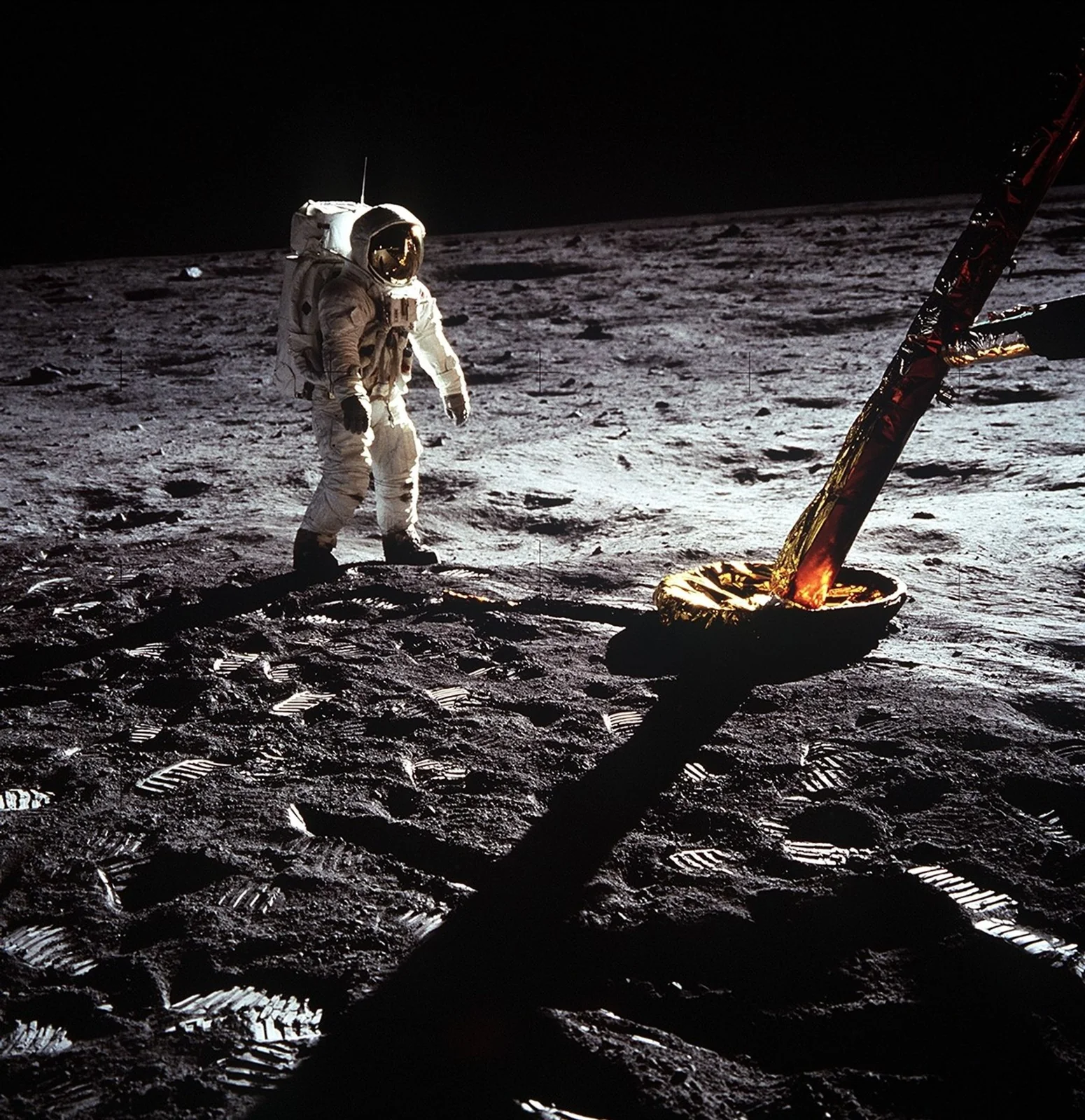
Armstrong descended first and Aldrin followed. The iconic photograph of Aldrin on the lunar surface, taken by Armstrong, is powerful partly because it places a human figure at the center and reflects the surrounding scene in the visor. Yet the EVA was a structured operation: camera deployment, sample collection, experiment installation, photography, lunar-module inspection, movement across the surface and time management. The crew had only a few hours, so every minute represented a trade among science, documentation, safety and the public objectives of the mission.
Sample collection illustrates the difference between reaching a place and producing useful knowledge. A lunar rock has greater scientific value when its location and context are documented. Photography and labeling become extensions of the scientific instrument. Mars will raise the stakes because crews may search for records of ancient environments or even biosignatures. Future explorers cannot simply collect whatever looks interesting. Context, orientation, contamination control and chain of custody will matter as much as the sample itself.
Aldrin helped deploy the passive seismometer and participated in the mission’s other scientific activities. Apollo 11’s science program was limited compared with later lunar missions, yet it established a complete chain: transport instruments to another world, deploy them, acquire data and return samples. Mars will require a much larger version of that chain. Instruments may need years of operation, recalibration, dust protection, maintenance and integration into local power networks. Apollo nevertheless shows that field science is not an optional activity added after landing. It influences vehicle design, containers, tools and timelines from the start.
Lunar dust also provided an early warning of a problem that will be central on Mars. The materials are not the same: lunar regolith is dry, abrasive and electrostatically active, while Martian dust has different mineralogy, can contain perchlorates and is transported by an atmosphere. But Apollo already showed that fine granular material enters interfaces, coats suits and complicates operations. A durable Mars architecture has to treat dust as a system-aging mechanism rather than merely a cleanliness issue.
Apollo 11’s surface stay was short, and that is precisely what separates the mission from settlement. Some risks can be accepted for a few hours because cumulative probability remains low and hardware has little time to age. A Mars base will not have that statistical protection. A seal with a tiny probability of leaking on each cycle becomes important after thousands of cycles. A filter that works for two weeks is not a solution for an outpost expected to last years. One common error in Mars rhetoric is direct extrapolation from Apollo: because people lived briefly on the Moon, long-duration planetary residence must be straightforward. Apollo proved access and short operations, not sustainability.
Eagle’s liftoff and rendezvous with Columbia closed the lunar cycle. Samples and astronauts transferred into the command module, and the vehicle that had landed the first humans on the Moon was later discarded. Such expendability was acceptable in a national program built around a small number of missions. It becomes expensive in a permanent transportation system. This is one point at which Aldrin’s post-Apollo thinking moved in a new direction: how much infrastructure could be preserved, reused and made to serve repeated journeys? The Mars cycler can be understood partly as an answer to that question.
The return to Earth still required navigation, possible correction, service-module separation, atmospheric entry and ocean recovery. Even splashdown did not end the operational story because quarantine followed under the biological assumptions of the time. The flight therefore demonstrates that a geographic objective is not the end of a mission. Mars will make that principle more severe. Reaching Martian orbit on the way home is only one stage; transit, Earth entry, biosafety and medical rehabilitation still remain. Any architecture that stops at the dramatic landing describes only a fraction of the actual system.
7. After the Moon: returning to the Air Force and moving from achievement to program
Apollo 11’s return instantly transformed Armstrong, Collins and Aldrin into global public figures. Operationally, however, the mission continued after splashdown on July 24, 1969. The crew entered quarantine because NASA could not yet exclude a biological hazard associated with lunar material. The procedure was abandoned after early missions reduced that uncertainty, but it established an important precedent: when explorers visit an unknown environment, landing back on Earth does not automatically end the risk. Sample handling and planetary protection are part of the scientific architecture. [source]
For Mars, the comparison is direct but should not be simplistic. Potential Martian life is a far more serious astrobiological question than lunar concerns in 1969 because Mars once had liquid water and still contains environments of scientific interest. Sample return or crews coming back from a Martian outpost would need protocols defined before departure: containment, analysis, separation of material flows, release criteria and institutional responsibility. Apollo 11 demonstrates that biosafety cannot be improvised after a historic mission has returned into intense public attention.
Quarantine was followed by tours, ceremonies and political meetings. Apollo 11 had enormous diplomatic value. The mission was American and emerged from Cold War competition, yet the first lunar landing was quickly described as an achievement for humanity. That tension between national prestige and universal narrative will likely reappear on Mars. Governments will seek strategic, industrial and symbolic returns; scientists will press for open data; crews may depend on multinational supply chains. Technical architecture therefore cannot be completely separated from governance—who pays, who commands, who receives access to results and who carries responsibility for failure.
Aldrin left NASA in 1971 and returned to the Air Force as commandant of the Air Force Test Pilot School at Edwards. The assignment was paradoxical: the astronaut who had not followed the classic test-pilot-school route before NASA later led the institution most strongly associated with that culture. It also demonstrates how far his experience had expanded beyond doctoral research. After Gemini and Apollo, he could transmit lessons about complex systems, judgment and testing at the edge of operational capability. He retired from the Air Force in 1972 as a colonel. [source]
The transition from operational astronaut to public advocate changed the scale of his decisions. In a cockpit, consequences can unfold in seconds. In a national program, consequences develop over decades. Advocates have to persuade agencies, industry, elected officials and the public to invest in architectures whose benefits may be distant. Aldrin became an author, speaker and promoter of future space-transport concepts. The change exposes another difficulty of Mars: engineering can produce a coherent solution without a political environment capable of funding it consistently.
Apollo itself is a warning. The United States demonstrated extraordinary lunar capability and then stopped after Apollo 17. Skills do not vanish overnight, but industrial lines close, teams disperse, suppliers change and tacit knowledge becomes difficult to recreate. Transportation capability does not exist simply because drawings and reports remain. It exists while an organization continues to build, test, launch and maintain systems. Aldrin’s later Mars thinking is strongly shaped by that reality: avoid a model in which each launch window requires rebuilding almost an entire expedition from scratch.
Industrial memory is therefore a serious engineering resource. An agency can preserve thousands of documents while losing implicit knowledge about how hardware really behaves. Technicians may know that a component should be assembled in a particular sequence, that a connector needs a special inspection or that a test produces false positives under certain conditions. Such knowledge is not always captured in formal documentation. A long-lived Mars program will require intergenerational knowledge management because people who design the first mission may no longer be working when the first infrastructure is twenty years old.
Aldrin’s public work can also be read as a response to Apollo’s episodic character. The lunar program created a historic peak but not a transportation economy. Saturn V stages were not reused, lunar modules were consumed, and production depended on exceptional national spending. Repeated Mars transport suggested a different logic: separate elements that must be launched often from elements that can remain in space and spread their cost over many journeys.
This changes the fundamental question. Instead of asking only “what rocket can send a crew to Mars?” the architect asks “what network of vehicles, trajectories and transfer points can produce a regular cadence?” The first question naturally creates a mission; the second creates infrastructure. Both are necessary, but they produce different design choices. A mission may tolerate an interplanetary habitat that is discarded. A network has to account for maintenance, reserves, obsolescence and interface incompatibilities accumulating over years.
Aldrin’s long post-Apollo period also demonstrates that a space concept evolves as technology changes. Early cycler studies emerged when launch was extremely expensive, orbital assembly was difficult and no permanent station had yet accumulated the maintenance experience later provided by the ISS. Subsequent decades brought partially reusable launch vehicles, far more autonomous navigation, extensive experience with orbital life support and a much larger commercial sector. Architectures therefore should not be judged as frozen objects. Some assumptions become more credible while others become less useful.
None of this means that fame makes an engineering proposal correct. Aldrin’s concepts must face the same analysis as any other architecture: mass, energy, cadence, risk, cost, human factors and rescue options. Apollo 11 celebrity may attract attention to the cycler, but it is not a substitute for mission analysis. This distinction matters in serious documentation: the authority of experience and the authority of evidence are different. Aldrin possesses extraordinary experience; each proposal still has to be evaluated on its own parameters.
His post-Apollo legacy is therefore not merely a list of public roles. It represents a transformation of the spaceflight problem. He moved from operating a system created by a national program to asking how exploration could remain sustainable over time. Mars became increasingly central because it required thinking in terms of a recurring flow between planets. The Moon could serve as laboratory or node, but the larger challenge was an enduring transportation pattern. That shift from event to flow prepares the intellectual ground for the cycler.
8. From “flags and footprints” to the cycler: changing the unit of thought
The cycler concept associated with Buzz Aldrin belongs to a broader attempt to make interplanetary travel repetitive rather than episodic. A conventional Mars mission is often imagined as a set of vehicles assembled for a particular launch opportunity: a transfer vehicle leaves Earth, reaches Mars, remains or enters orbit, and later returns using a chosen trajectory. At the end, much of the mass may be discarded or require major refurbishment. A cycler changes the unit of thought. A large habitable spacecraft follows a trajectory that repeatedly encounters the neighborhoods of Earth and Mars. It does not need to stop in orbit around either planet. Smaller transfer vehicles meet it during each passage. [source]
The idea is not that a cycler travels “for free.” Every interplanetary trajectory obeys celestial mechanics, and corrections, rendezvous, launch and insertion require energy. The potential benefit is reuse of heavy infrastructure. A habitat carrying shielding, life-support equipment, work volume, spares and perhaps artificial-gravity systems could be designed for many cycles instead of launched anew for every crew. The train analogy is attractive but incomplete. A train stops at a station. A cycler passes a planet at high relative velocity; the passengers have to reach it inside a precise window.
Studies published through the NASA Technical Reports Server examine Earth-Mars cycling trajectories capable of repeating encounters over periods of years. Aldrin’s name is associated with work by James Longuski and other trajectory specialists. The challenge is not simply finding a mathematically periodic orbit. Designers must calculate encounter excess velocities, correction requirements, rescue possibilities and the performance needed for taxis to reach and depart the cycler. A trajectory can be elegant on a diagram and very expensive for the access vehicles. [source]
The separation between transit infrastructure and access vehicles is the heart of the architecture. Commercial aviation offers a loose analogy: a long-haul aircraft is not designed to perform every local journey because several transport layers work together. In space the separation can be much stronger. A vehicle that spends months between planets does not need to survive atmospheric entry, while an Earth-to-cycler taxi can be optimized for a shorter trip, higher acceleration and much less onboard living volume. A Mars-side taxi can be optimized for Martian orbit, atmosphere or surface operations depending on the chosen network.
The potential mass benefit comes from preserving long-duration heavy systems. Radiation shielding, pressurized volume, medical capability and maintenance equipment are costly to launch. If they serve ten, twenty or fifty encounters, their cost per crew can fall. But the saving exists only if maintenance is realistic. A habitat reused for decades accumulates radiation damage, thermal cycles, mechanical wear and electronic obsolescence. The cycler therefore exchanges some launch expenditure for maintenance debt.
That exchange is frequently misunderstood. Reuse is not automatically cheaper. Reusable systems may require extra structure, sensors, replaceable interfaces, spare inventories and inspection access. Economic advantage appears only when enough cycles occur to amortize those features. A cycler used twice may make little sense; one used reliably for thirty years may be attractive if refurbishment remains manageable. Serious analysis therefore requires an assumed cadence, not merely an initial launch mass.
Cadence is constrained by planetary mechanics. Efficient Earth-Mars opportunities recur roughly every twenty-six months as the relative geometry of the planets repeats. Cycler networks can be arranged around that rhythm, but permanent settlement requires traffic in both directions. Planning cannot focus only on departures from Earth. Return crews, replacements, cargo, emergencies and missed encounters all have to be included. A robust network needs alternative timing or enough stored resources to survive the loss of a planned passage.
This changes the meaning of punctuality. Missing a train on Earth means waiting minutes or hours. Missing a cycler rendezvous could mean waiting for a distant orbital opportunity. Launch readiness, crew health, taxi availability and space weather become connection requirements. Architecture must avoid letting a small fault a few hours before departure become a two-year delay. That may require multiple cyclers, backup taxis or alternate transfer modes.
The cycler also creates an operations ownership problem. Who maintains a vehicle that never remains near one planet for long? Crews can join during passages, but some repairs may require heavy equipment or external intervention. Designers may need upgrade opportunities during favorable encounters or modular replacement units that are launched to meet the cycler. Maintenance becomes a mission class in its own right, resembling station servicing but with much tighter access windows.
The International Space Station provides useful but limited comparison. The ISS has shown that a complex habitat can be occupied, modified and repaired for decades. It also benefits from extraordinary proximity to Earth: frequent cargo, near-continuous communications, evacuation options and access to a complete industrial base. A Mars cycler would be isolated during most of its path. The ISS lesson is therefore not that cycler maintenance is already solved. It is that long-duration habitation creates a permanent workload of logistics, inspection and repair.
Aldrin’s proposal thus reframes Mars travel as a network problem. Mars is no longer simply a destination; it becomes a node. Earth is another node. Cyclers are interplanetary lines, taxis are connections, depots are reserves and surface habitats are permanent terminals. That perspective is powerful because it forces questions that one-off expeditions can postpone: frequency, capacity, failure rate, repair time, inventory, redundancy and cost per traveler.
Network language must never hide the physics. Every connection has a relative velocity and therefore a propulsion demand. If a cycler is difficult to catch, the taxi may become so demanding that the mass saved on the large habitat disappears. Cycler studies therefore optimize a system rather than a single orbit. The best trajectory is not necessarily the one requiring the least correction of the large vehicle; it is the one that minimizes total system cost while respecting transit time, access performance, comfort and risk.
The intellectual contribution remains the change in unit of thought. Apollo showed that a nation could build an architecture for a historic mission. The cycler asks what would allow an architecture to keep operating after the cameras move elsewhere. That is central to durable Mars ambitions. Success would not be only a flag on red soil. It would be the ability to send another crew, and another, with costs and risks that decline rather than returning to zero each time.
9. Catching a cycler: the real cost is hidden in the transfer taxis
The simplest cycler diagram shows a large spacecraft repeatedly passing Earth and Mars. It is useful for explaining the concept but dangerous if it makes the access vehicles disappear. A cycler does not park in low Earth orbit. It crosses the planetary neighborhood with velocity and direction set by a heliocentric trajectory. To transfer a crew onto it, a taxi must depart Earth at the right time, acquire sufficient energy, correct its path and arrive near the cycler with a relative velocity compatible with rendezvous and docking. A delay of hours or inadequate performance can make the encounter impossible.
The mechanics resemble an interplanetary version of the problem Aldrin studied at MIT, but the scales are different. In low Earth orbit a crew may complete multiple revolutions, adjust phase gradually and sometimes retain many correction opportunities. A cycler encounter can be a unique high-energy window. The access vehicle cannot necessarily wait for another orbit. Mission design therefore has to include launch margin, correction authority and an abort strategy if the rendezvous can no longer be achieved.
That abort strategy is crucial. What happens if the taxi misses the cycler? “Return to Earth” is not an adequate answer by itself. Depending on trajectory energy, the taxi may already be committed to a path that carries it far from the planet. Returning may demand major propulsion or days of travel. Safe architecture therefore needs a free-return mode or alternate destination where practical, or enough resources to survive another trajectory. Cycler selection cannot be separated from failure-scenario design.
NASA studies and the mission-design literature describe several families of cycling trajectories. Some favor repeated planetary encounters, while others trade periodicity for lower approach velocity or more acceptable trip time. The Aldrin cycler became famous because it offers a structured recurring Earth-Mars pattern, but no single trajectory satisfies every objective. A settlement might prefer several vehicles on complementary paths to serve both directions and provide redundancy. [source]
The Earth-side taxi is itself a compromise. Reaching the cycler quickly may require a high-energy stage. Carrying extra propellant for corrections and emergency return increases mass. Using a reusable launcher raises the question of which elements return and which continue. Docking requires very low final relative velocity even though the overall transfer may be highly energetic. Reusing the habitat therefore does not remove complexity. It redistributes complexity across the network.
The Mars-side problem can be more difficult. A crew departing the cycler near Mars has to reach an orbit or atmospheric-entry trajectory. If the taxi lands, it combines separation, navigation, thermal protection, supersonic deceleration and landing. If another vehicle waits in orbit, an additional rendezvous is required. Every interface adds a possible failure while also allowing specialization. The best architecture depends strongly on the maturity of entry, descent and landing technology.
Cargo has different requirements. It does not necessarily need a cycler at all. Nonurgent material can use slower low-energy trajectories, different launch windows or electric propulsion. This suggests a hybrid network in which cyclers are reserved for crews and material that benefits from a habitable environment, while most structural mass, water, consumables and spares travel by other routes. Efficient networks do not force every payload through the same transport mode.
Segmentation is common in terrestrial transportation: people, urgent goods and bulk materials often use different systems. Space magnifies the advantage because supporting humans is mass intensive. Sending a solar array or structural beam on a slow trajectory is not equivalent to sending a person exposed to radiation and weightlessness. A cycler can therefore be understood as a fast habitable line within a larger system whose cargo traffic follows different paths.
Propellant depots naturally fit into such a network. If taxis repeatedly perform high-energy transfers, refueling from depots in Earth, lunar or Mars space may reduce launch requirements. But a depot is not a simple service station. Cryogenic propellants must be stored with low losses, fluids transferred in microgravity, interfaces kept clean and tanks inspected. Every depot is additional infrastructure that must be launched, maintained and protected. System economics must demonstrate that the extra node actually reduces total mass and cost.
Aldrin frequently connected Mars advocacy with increased activity in cislunar space and possible use of lunar resources. The general argument is that an economy already operating between Earth and Moon can become a training ground and support layer for Mars. The learning value for rendezvous, refueling and maintenance is plausible, but resource claims require quantification. Mining lunar water, converting it into propellant and delivering it to a transfer point requires mines, power plants, processing equipment and vehicles. Local resources are economically useful only when the complete chain outperforms the terrestrial alternative.
The taxi is therefore the element that prevents the cycler from becoming a magical solution. The more stable and reusable the central infrastructure becomes, the more capable, punctual and integrated the peripheral vehicles must be. This is a general network principle: moving complexity from a node into a connection does not make it disappear. Serious architecture needs a mass and energy budget for every segment, not just an attractive trajectory for the main vehicle.
This reasoning also completes the biographical thread. Aldrin’s doctorate concerned the interface between moving spacecraft. Gemini XII gave him operational experience with rendezvous under degraded instrumentation. Apollo made rendezvous a condition of return. The cycler extends the same focus on interfaces to interplanetary scale. The story is coherent because it is more specific than saying Aldrin simply “liked Mars.” He returned for decades to the same engineering question: how can encounters between elements on different trajectories be made dependable?
A future Mars civilization may never operate one canonical cycler bearing Aldrin’s name. It may instead use a family of trajectories, cargo systems, taxis, stations and docking standards derived from multiple concepts. In that case, Aldrin’s durable legacy lies less in the exact geometry of one orbit than in the insistence that transport be treated as a system of connections. That intellectual contribution can survive even if the eventual hardware looks very different from the original diagrams.
10. Living aboard the cycler: life support, radiation, volume and the psychology of repeated travel
A trajectory alone does not make a cycler a human transportation system. A vehicle repeatedly crossing the space between Earth and Mars must first be a habitat. That changes priorities. For a propulsion stage used for hours, structural and engine mass dominate. For a habitat occupied for months, the critical function is maintaining breathable air, thermal control, sanitation and a psychologically tolerable environment without immediate resupply. The cycler is attractive precisely because these heavy systems can remain aboard and serve many crews.
Mars life support cannot rely entirely on consumables. Carrying all oxygen, water and supplies from Earth for successive crews would erase much of the benefit of reuse. Loops have to be closed as far as practical: recover humidity, purify water, remove carbon dioxide, manage wastes, control trace contaminants and perhaps produce some food. The ISS has accumulated major experience with these technologies, but it benefits from regular cargo. A cycler would need greater robustness and the ability to continue operating through delayed resupply.
“Closed loop” is a matter of degree. A system can recycle ninety percent of a resource and still require substantial replacement over years. A small daily loss becomes large across hundreds of days. Air and water quality also depend on filters, membranes, catalysts and pumps that wear out. Durability therefore requires two forms of closure: recycle matter and maintain the machines that perform the recycling. Architecture lacking parts and skills for the second loop is not truly autonomous.
Radiation is another reason to concentrate mass in a reusable habitat. Beyond Earth’s magnetosphere, crews face galactic cosmic radiation and solar particle events. Protection can include hydrogen-rich materials, water, consumables and dedicated shielding. If a new vehicle is launched for every mission, shielding mass is paid repeatedly. A cycler can protect many crews with the same mass if the structure remains healthy. Reuse can therefore amortize passive protection as well as equipment.
No realistic shield makes deep-space radiation disappear. Additional mass reduces some exposure, but very energetic particles and secondary interactions complicate the relationship. Likely strategies combine distributed shielding, a more protected storm shelter, dosimetry and control of transit time. A cycler may provide volume for stronger shelters, but if its trajectory produces much longer travel than an alternative, some advantage can be lost. Orbital design and radiological design have to be evaluated together.
Habitable volume is a health resource. A capsule can be acceptable for days and psychologically damaging for many months. Crews need privacy, separate work areas, exercise capability, adjustable lighting and controlled acoustics. Interpersonal conflict is inevitable in an isolated small group; architecture can amplify or reduce it. A reusable cycler can justify more mass devoted to habitability because that mass serves many voyages.
Exercise is especially important in weightlessness. Long-duration orbital experience shows losses in muscle, bone and cardiovascular conditioning without countermeasures. A cycler could carry more capable equipment than a minimum-mass expedition vehicle. Some variants even consider artificial gravity through rotation. Rotation adds structural, attitude-control and docking problems. Spinning the whole habitat complicates taxi interfaces; rotating arms or tethered modules create moving structures that must remain stable and maintainable for years.
Artificial gravity is not merely a comfort issue. It may reduce physiological degradation, but optimal parameters remain uncertain: gravity level, daily exposure duration and tolerable rotation rate. Large radius reduces Coriolis effects but increases structure. Small radius is compact but may create unpleasant sensations during head movement. A cycler provides a place where such capability could be permanent, yet it is useful only if the machinery does not create more maintenance and risk than the health benefit it provides.
Mental health must also be treated as a system function. Mars crews will live with communications delay, no rapid return and the knowledge that some medical emergencies cannot be transferred to a terrestrial hospital. A cycler can provide more space and delayed communication resources, but it cannot remove isolation. Design should support autonomy, privacy and individual rhythms without destroying group cohesion.
Interplanetary medical capability raises mass and training questions. Short missions can accept limited medical resources because the probability of some events remains small. Across thousands of accumulated passengers, serious emergencies will eventually occur. A mature Mars network must decide what level of imaging, pharmacy, surgery and diagnostic capability exists in transit. A reusable cycler is one of the few architectures in which heavy medical equipment may become economically rational because it serves many voyages.
Food illustrates the same scaling problem. Prepared packaged meals may be acceptable for an initial expedition. A regular transport line has to consider variety, nutrient stability, packaging mass and waste. Small crop systems might provide fresh food and psychological benefit, but they use water, energy, volume and crew time. A cycler could allow such systems to mature gradually without requiring them to supply most calories immediately.
Internal biological risk also matters. Closed habitats accumulate microbes, allergens, volatile compounds and biofilms in water systems. A vehicle reused for decades will need cleaning, inspection and occasional decontamination. Interior materials must tolerate cleaning agents and avoid inaccessible wet areas. Sanitary maintenance becomes a form of environmental control as important as temperature and pressure.
The cycler is therefore a habitat before it is an orbit. Its value depends on amortizing heavy functions: shielding, medical capability, exercise, workshops, private space, inventories and recycling systems. Reuse creates a matching requirement that every function be replaceable and maintainable. A spacecraft that cannot be opened to reach its pumps, or whose software cannot be upgraded safely, will become technical debt rather than infrastructure.
This creates an instructive contrast with Apollo. Eagle was extraordinarily efficient for a mission lasting hours because it did not need to survive for years. A cycler represents the opposite extreme: a machine whose value comes from longevity. Moving from Apollo to Mars therefore requires a cultural inversion. Designers must optimize not only the mass of the first flight but the total cost of owning and sustaining a habitat for decades.
11. Maintaining a vehicle for decades: spares, inspection, obsolescence and workshops
Cycler reuse is credible only if maintenance shapes the design from the first day. In many projects maintenance appears late as a budget line. For interplanetary infrastructure it has to be architectural. Pumps, fans, valves, computers, sensors, seals, batteries and medical equipment all have service lives. Some fail randomly, some wear according to cycles, and some become obsolete while still functioning. A vehicle intended to operate for thirty years must be able to evolve without being completely rebuilt.
The first requirement is accessibility. A critical component buried behind nonremovable structure may be acceptable in a disposable spacecraft and disastrous in a reusable habitat. Designers need access paths, replaceable connectors, fluid isolation points and documentation allowing crews to remove equipment without damaging neighboring systems. This “maintenance mass” can look unproductive at launch, but it increases operating life and therefore the value of the infrastructure.
The second requirement is spare inventory. Carrying a duplicate of every component is impossible. Failures must be classified by probability, criticality, time to loss of function and repairability. Some parts need several spares; others can be cannibalized from secondary equipment; still others may be manufactured aboard. Inventory becomes a probabilistic design problem: enough variety to cover credible failures without turning the cycler into an unusable warehouse.
Additive manufacturing can reduce some spare mass but cannot replace everything. Printing a handle, bracket or enclosure is comparatively easy; producing a precision bearing, medical membrane, integrated circuit or calibrated sensor is much harder. A mature space workshop will probably combine polymer and metal printing, light machining, hand tools, diagnostic equipment and stocks of standardized components. The objective is not to manufacture everything but to postpone the point at which a failure requires terrestrial resupply.
Standardization can be more valuable than spectacular optimization. If ten pumps use ten different bearing types, inventory expands rapidly. If connectors, motors, computers and actuators are grouped into common families, a smaller set of spares can repair many systems. Modern spacecraft often pursue local mass efficiency by selecting the lightest component for each subsystem. Mars infrastructure may accept a small mass penalty in exchange for major logistics simplification. The metric changes from launch optimization to lifetime system optimization.
Preventive inspection is equally important. Waiting for a bearing to seize or a cable to burn is too late when no outside technician can arrive. Vibration, temperature, current and pressure sensors can reveal drift before failure. Artificial intelligence may help detect patterns, but it needs trustworthy reference data and auditable procedures. An algorithm that simply announces “possible anomaly” without explaining the measurement chain can increase uncertainty rather than reduce it.
Maintenance also creates a schedule. Some work can be performed during long cruise phases; other tasks may require the cycler to be near a logistics node or external servicing vehicle. Fleet management therefore has to integrate technical condition with orbital mechanics. If major refurbishment is required every five encounters, the trajectory and taxi network must provide a realistic opportunity. Maintenance becomes a mission constraint as fundamental as launch windows.
Software obsolescence may be harder still. A cycler built in 2040 might remain active in 2070. Computers, communications protocols and cybersecurity standards will change. Replacing an entire computing architecture in flight is risky because software controls life-critical functions. Designers need layers: simple stable safety control, mission functions that can be upgraded, interfaces testable offline and a reliable rollback path. Configuration management becomes permanent work.
Cyber risk does not vanish in deep space. A vehicle connected to Earth and Mars networks will receive updates, data and commands. Authentication mechanisms must remain valid for decades. Cryptographic keys need rotation, vulnerabilities discovered after launch require patches, and critical control systems should be isolated from less trusted services. Reusable architecture accumulates digital as well as mechanical debt.
Technical documentation has to survive too. A procedure stored in an obsolete format or dependent on an unreachable terrestrial server is not robust. Crews require a local versioned library containing diagrams, torque values, part references, failure histories and modification decisions. Every major repair should improve that memory. A cycler becomes a knowledge base as well as a vehicle.
The human factors of maintenance are easily underestimated. Working for hours in a confined volume, perhaps with gloves or in a noisy equipment bay, creates fatigue and secondary errors. Workshops need good lighting, ventilation and restraints. Tools must be organized so that free-floating objects cannot damage hardware. Work organization is part of reliability.
Exterior inspection adds another challenge. Micrometeoroid impacts, radiator damage or leaks may require EVA. Cameras, free-flying inspection devices or small robots can reduce the need to expose people immediately. Robotic arms may perform some repairs. The cycler becomes a maintenance ecosystem in which humans and machines share tasks according to risk and required dexterity.
This logic follows the history of human spaceflight. Apollo discarded much of its hardware. The Shuttle and ISS showed that reuse moves effort into inspection, refurbishment and logistics. A cycler takes the principle further by moving the workshop away from Earth. The real question is not simply how many times a vehicle can be reused, but what maintenance organization makes each reuse less risky than launching a new habitat.
Aldrin helped popularize the idea of preserving transit infrastructure. Making that idea operational requires accepting its least glamorous consequence: much of future Mars transportation will look like industrial maintenance. The heroes will often be the people who replace a filter before it clogs, upgrade software without interrupting life support, or discover a crack before it becomes critical. That is exactly what it means for exploration to become a technical civilization.
12. Economics of a Mars network: amortizing infrastructure without hiding costs
The cycler is often presented as a way to reduce Mars transportation cost because it reuses a heavy habitat. That can be true in some architectures, but it is not automatic. The correct framework is lifecycle cost. The first cycler carries design, test, launch, assembly and commissioning expense. Every encounter adds maintenance, resupply, spares, taxis, operations and risk. Savings appear only after enough rotations to compensate for the initial investment.
Cadence therefore dominates the calculation. Imagine a habitat that is expensive to build but can support twenty Earth-Mars encounters. If only three missions are ultimately funded, the architecture may have created excessive stranded capacity. If a settlement regularly moves hundreds of people and large cargo flows, the fixed investment can be spread over much greater traffic. Cyclers are therefore more naturally associated with permanent presence than with a single scientific expedition.
This creates political dependency. A reusable network makes sense only if the program can survive multiple governments, economic cycles and technological changes. Apollo demonstrates the risk: an extraordinary capability can be interrupted when national priorities change. A cycler designed for thirty years and abandoned after six becomes a stranded asset. Space transportation economics cannot be separated from institutional stability.
Hardware capital is only part of the cost. Operations consume human labor. Every encounter requires trajectory planning, mission control, software verification, taxi preparation, medical monitoring and logistics. An architecture can reduce launched mass while increasing operational complexity. Cost per passenger or tonne should therefore include ground organizations and supporting infrastructure rather than only launch price.
Reuse becomes more valuable when onboard equipment is expensive but durable. A substantial medical facility, workshop, heavy shielding or artificial-gravity system may be prohibitive in a disposable mission and rational in a vehicle used for decades. The cycler creates an economy of shared capability: as traffic increases, sophisticated common services become easier to justify.
Cargo follows a different logic. A kilogram of urgent food is not equivalent to a kilogram of structure that can arrive six months later. Flows should be classified by time sensitivity. People and critical spares justify faster transfers; surface structures, empty tanks, mining equipment or shielding can use slower paths. Segmentation reduces pressure on the crew line and allows efficient low-thrust propulsion for much of the mass.
“Cost per seat” is therefore an inadequate metric. A settlement needs cost per safe person-year on Mars. That includes outbound transportation, surface logistics, return capability, equipment replacement and reserves. A cheap interplanetary ticket has little value if the destination cannot provide water or power. The cycler network must be evaluated as part of a larger economic system.
Insurance and liability may also shape operations. Government programs can absorb much risk directly. Commercial networks would have to divide responsibility among cycler builders, taxi operators, resupply providers and destination habitats. An accident caused by an interface failure could involve several companies and jurisdictions. Technical standardization would need matching contracts and certification rules.
Certification is itself a useful cost. A component used in a crewed cycler has to demonstrate reliability, sometimes in conditions difficult to reproduce on Earth. Software updates need validation. Parts manufactured aboard may require qualification for safety-critical uses. A mature space economy cannot operate permanently as a prototype culture. It will need risk-proportionate regulation that allows innovation without treating every passenger flight as an experiment.
Reserves are another hidden expense. Reliable networks carry more food, water, spares and power capability than the average case consumes. Those stocks add mass but buy time during failure. Conventional accounting may view excess inventory as inefficiency; in deep space it can be the primary insurance mechanism. Optimization must include the expected cost of interruption, not just nominal payload mass.
Cycler availability becomes a metric analogous to industrial fleet availability but shaped by orbital mechanics. A vehicle that is usable ninety-nine percent of the year can still provide terrible service if its one percent downtime coincides with the encounter window. Metrics therefore need to include availability on critical dates, rendezvous-success probability, replacement capability and time to restore service.
Alternative architectures also have to be compared. Cyclers compete with reusable transit habitats that remain in planetary orbit, vehicles that perform the entire journey themselves, nuclear-propulsion systems and networks with intermediate stations. The best option will depend on actual launch cost, cadence and vehicle performance. The cycler’s merit is not that it ends comparison but that it creates a structured reuse option against which other systems can be measured.
Reusable launch vehicles change the equation relative to the era of early cycler studies. If launch to orbit becomes much cheaper, flying a new habitat for each opportunity is less punitive. But lower launch cost also helps cyclers by reducing the expense of taxis, inventories and upgrades. It is therefore wrong to say simply that reusable rockets make cyclers obsolete. Effects must be recalculated at the complete-network level.
The final economic lesson matches the engineering lesson: avoid local optimization. A trajectory that saves cycler propellant but demands an enormous taxi may cost more. A habitat designed to last fifty years but impossible to upgrade may become obsolete before it is amortized. A hyper-autonomous surface base may require more mass than a system supported by regular logistics. Architecture should minimize total cost under safety constraints, not maximize one subsystem record.
Aldrin’s contribution was to push the discussion toward recurrence. Even if future numbers favor a different technical solution, the question remains valuable: how can transportation be built so that marginal cost falls as use increases? That is the economic question separating a prestigious expedition from an actual route.
13. When Houston cannot answer immediately: autonomy, software and onboard judgment
Apollo built such an effective mission-control culture that it became part of the mythology of spaceflight. Dozens of specialists watched systems, calculated solutions and advised crews. That model remains powerful in Earth orbit and at the Moon because communications delay is small. Mars changes the relationship. Depending on planetary geometry, a message can take many minutes in one direction. Conversation becomes an exchange separated by long waits. During a fast-moving emergency, Houston is no longer a real-time copilot.
A crewed cycler therefore needs much greater operational autonomy than Apollo. This does not mean removing ground control. Earth teams will retain enormous analytical capability, prepare updates and assist with complex diagnosis. The temporal boundary changes: decisions that cannot wait have to be made aboard. Architecture should define in advance which classes of event belong to the crew and which can be deferred.
Procedures must therefore combine checklists with goals. An Apollo checklist can prescribe a sequence for isolating a known failure. Mars crews still need that precision for anticipated cases, but they also need functional principles: protect pressure, maintain cooling, isolate an electrical branch, preserve a safe trajectory. When a failure matches no training scenario, understanding the priority function allows improvisation without destroying another critical resource.
Autonomous software can reduce workload. It may detect leaks, reconfigure electrical networks, isolate modules, plan trajectories or monitor medical state. But autonomy creates a trust problem. If software acts without explaining why, crews may ignore it after false alarms or follow it too blindly. Interfaces should expose essential evidence, confidence and consequences so that humans can decide whether an automated action remains appropriate.
Apollo 11’s 1201 and 1202 alarms are instructive because the computer had a clear priority structure. It dropped lower-priority work to preserve functions required for descent. A modern cycler may process vastly more data, yet it still needs explicit hierarchy: life support, thermal control, navigation, power, communications and comfort. When resources become scarce, the system must know what can be sacrificed.
Cybersecurity and safety meet at this point. A command from Earth may be valid, corrupted or malicious. A software update may introduce regression. The vehicle needs authentication without removing the crew’s ability to recover local control. Life-critical systems should have degraded local modes accessible even if the primary network is compromised. The principle resembles Gemini XII’s ability to use visual methods when radar became less dependable: preserve more than one independent path to an essential function.
Autonomous navigation is equally important. Stars, Sun, planets and radio signals can update vehicle state. Modern optical sensors can provide very accurate measurements. Earth may send improved ephemerides and solutions, but the crew should be able to maintain a safe trajectory between updates. In a cycler network this is especially important for taxis because timing errors can make an encounter impossible.
Medical diagnosis will undergo the same transition. A physician on Earth cannot guide an urgent intervention in real time. Crews need local imaging, knowledge bases and decision-support tools. Telemedicine becomes asynchronous: specialists can analyze data and respond later, while the first minutes are managed aboard. Crew selection and cross-training must therefore include capabilities that short missions could outsource to Earth.
Autonomy also affects daily governance. A Mars commander cannot request Earth approval for every schedule change, crew conflict or resource trade. Decision rights should be defined before departure: who can shut down a system, who ends an EVA, who arbitrates science against maintenance, how disagreement between commander and safety software is handled. Technical autonomy without institutional autonomy is contradictory.
Autonomy should not be confused with isolation. Ground control remains a collective second brain. During nonurgent periods, large teams can study trends the crew lacks time to examine. The best architecture combines rapid local decisions with deep terrestrial analysis. Crews do not need to know everything; they need to know enough to survive until the support network can contribute.
Communications themselves require priority management. High-definition video is not as critical as life-support telemetry. If bandwidth falls, vital data should be protected. Systems must also tolerate long outages caused by antenna failures or solar geometry. Local procedures, maps, software and technical archives cannot depend on permanent access to a terrestrial cloud.
Solar conjunction provides a familiar example: communications with Mars spacecraft can be degraded and robotic operations are often simplified. Human crews cannot simply pause, but they can enter more conservative operating modes with fewer risky activities and larger reserves. Architecture should treat such periods as operational seasons rather than surprises.
Autonomy ultimately continues Aldrin’s central theme. Line-of-sight guidance gave a Gemini crew some independence from a single sensor. The cycler extends the same philosophy much further: equip travelers with tools, knowledge and decision authority to continue when Earth is not immediately available. A Mars route will truly be open only when its crews can be more than passengers of a distant mission control.
14. When turning back no longer exists: aborts, rescue and graceful degradation
Human spaceflight keeps the word abort, but its meaning changes radically when the destination is Mars. In the first minutes of launch, an escape system may pull a capsule away from a failing rocket. In low Earth orbit, a spacecraft can often return within hours. From the Moon, Apollo could still contemplate a journey home measured in days. An interplanetary trajectory imposes a different reality: after some departure decisions, “going home” is not a rapid maneuver but another mission lasting months. NASA now calls out this break explicitly in its Moon to Mars work on Mars mission aborts.[12]
That constraint forces planners to distinguish several classes of failure. First are incidents detected before an Earth taxi departs, when the crew can remain on the ground or in orbit. Next come anomalies during acceleration toward the cycler encounter. Once interception has succeeded, some failures can be absorbed by the large habitat while others affect the very infrastructure intended to be the refuge. Near Mars, a rendezvous error or taxi failure can turn a planned arrival into an independent survival problem. “Abort” therefore covers very different geometries and resource states.
The first defense is to preserve fallback paths before every irreversible commitment. A launch toward a cycler should not immediately consume every return option. Where mechanics permit, the taxi can retain delta-v margin, life-support reserves and a trajectory from which Earth or a safe orbit remains reachable. Yet margin costs mass. The more fallback choices are demanded, the larger the vehicle becomes. Architecture must explicitly decide where safety justifies that mass rather than pretend that an optimal system can keep every option simultaneously.
A second defense is avoiding common-mode failure. Two identical pumps installed together are not true redundancy if the same design defect can stop both. Two electrical networks are not independent if they share the same controller software. A cycler intended as a refuge should separate critical chains as far as practical: power, air circulation, cooling, safety computing and communications. Separation can look inefficient in a mass budget, but it converts total loss into degraded operation.
Graceful degradation is more realistic than imagining a vehicle as either “nominal” or “lost.” A transit station may continue to hold pressure while abandoning part of its volume. It may stop a centrifuge, lower electrical demand, cancel experiments or shut several cabins. The design should define these intermediate states. Crews need to know which functions can be sacrificed and for how long. Survival becomes managed prioritization of capabilities rather than a desperate search for instant return.
Compartmentation becomes crucial. A single large open volume is efficient to arrange but makes a leak or fire potentially catastrophic. Pressure bulkheads, internal hatches and isolatable loops add mass and complexity but allow the loss of one module without losing the entire spacecraft. Submarines and ships have long used this logic. A Mars habitat has to adapt it to microgravity, airflow and evacuation routes.
Fire is especially dangerous because smoke does not behave as it does in a terrestrial room. Ventilation carries toxic products and particles, while extinguishing agents can themselves degrade the atmosphere. Survival planning therefore combines very early detection, electrical isolation, local suppression, filtration and the ability to house the crew in another volume during recovery. Wiring discipline, material selection and preventive maintenance become rescue measures before any fire exists.
Loss of cooling can be just as serious. Electronics and life support create heat that must eventually be rejected to space. A radiator punctured by impact is not merely an exterior hardware problem; it can limit usable power aboard. Architecture needs multiple loops, bypasses and loads that can be shed. Available electrical power does little good when the heat produced by using it cannot be rejected.
External rescue is harder still. At sea another vessel may sometimes divert. Between planets, trajectories restrict encounters. A second cycler cannot necessarily “turn around” to recover a distressed crew. The network must therefore be designed with realistic knowledge of vehicle-to-vehicle interception opportunities, travel time and propulsive cost. Fleet redundancy matters only when orbital mechanics actually allow the fleet to help.
This leads to the concept of autonomous refuge. Rather than counting on rapid rescue, each major element should be able to house a crew after partial loss of capability. Emergency consumables, breathing equipment, minimum potable-water production, independent communications and medical tools should remain accessible even if the main network fails. Reserves should not all sit behind one hatch or on one power bus.
Taxis face the mirror-image problem. They are smaller and carry fewer reserves, yet their flight phases may be highly dynamic. Their emergency strategy can include independent engines, autonomous navigation, several days of refuge and alternate rendezvous cases. Designing a taxi only for the nominal trip would rebuild a fragility that human-spaceflight history has spent decades trying to remove.
Abort procedures need to be tested as missions in their own right. A manual line saying “emergency return” is not enough. Simulators should inject combined failures, contradictory information, incapacitated crew members and communication outages. Teams need to encounter conflicts among trajectory, power, oxygen and health during training. The objective is not to memorize every possible answer but to develop a decision method under constraint.
Apollo remains relevant without being directly transferable. Apollo 13 showed that a vehicle designed for one function could become a refuge and that resources across modules could be recombined under pressure. Mars removes the closeness to Earth that let ground teams work almost in real time. A future system therefore has to build into its architecture some of what was extraordinary improvisation in the earlier era.
Aldrin’s cycler is interesting precisely because it turns the transit habitat into a permanent asset. Permanence can provide more volume, tools and spares than a small direct vehicle. It also creates a network risk: if that refuge itself becomes unavailable, an essential node can disappear. Reliability must therefore be considered at network level, with substitution, crew replanning and minimum service after loss of an element.
At the deepest level, Mars architecture has to replace the intuitive promise “we can always come home” with a more mature doctrine: we can keep living through failure. That doctrine is less spectacular than an escape capsule, but it matches the geography of the Solar System. The farther people go from Earth, the more safety depends on absorbing failure locally.
15. From cycler to surface: the Mars terminal, local propellant and the survival chain
A transit network matters only if it reaches a destination able to receive its passengers. Arrival near Mars is therefore as important as the crossing. A cycler does not stop like a train at a platform: a taxi must leave at the right instant, perform its own navigation, enter the Martian sphere of influence and then reach orbit, an entry vehicle or a direct descent corridor depending on the architecture. The Martian “terminal” is consequently a distributed set of vehicles, communications, inventories and infrastructure.
Mass is the enemy of this chain. Every kilogram that must decelerate, land and perhaps launch again drives additional hardware. NASA reference studies have long examined in-situ resource utilization, including production of oxygen from the Martian atmosphere, as a way to reduce mass launched from Earth.[13] That does not prescribe one solution, but it shows why permanent settlement cannot treat Mars merely as a place that consumes terrestrial cargo.
Atmospheric carbon dioxide is a resource almost everywhere on the planet if energy and machinery are available to process it in a cold, dusty environment. Producing oxygen for ascent propulsion or life support can save substantial imported mass. But ISRU does not create propellant for free. It shifts mass into reactors, compressors, filters, radiators, power sources, spares and storage. A fair trade compares those masses and risks against an imported alternative.
The most important rule is preproduction. A crew should not discover after landing that the machine expected to make return propellant operates at half capacity. A robust architecture sends equipment ahead, commissions it robotically, fills tanks and transmits measured proof before people depart Earth. Human launch becomes conditional on an inventory that actually exists. This sequence turns ISRU from a wager into verified infrastructure.
The logic can extend to water, with greater local uncertainty. Subsurface ice is abundant at some latitudes and depths, but a base has to characterize its particular site. Extracting ice requires drilling or excavation, dust separation, purification, storage and protection against freezing lines. A geological “resource” is therefore not automatically an industrial resource. Between an orbital map and a glass of water lies a mining chain.
Landing-site selection becomes a multidimensional trade. Engineers want an altitude favorable for entry and descent, safe terrain, accessible resources, workable energy conditions, strong science value and reliable communications. Those criteria do not always coincide. An ice-rich site may be colder or harder to reach; a smooth plain may be less scientifically interesting. A Martian terminal should be chosen as decades-long infrastructure, not merely as a landing ellipse.
Power is the real multiplier. Without energy there is no oxygen production, water recycling, heating, communication or maintenance. Surface systems therefore need to separate vital loads from work that can be postponed. A dust storm, reactor fault or storage failure should not immediately erase return capability. Locally produced propellant is itself a form of long-term energy storage: months of plant operation embodied in a chemical reserve.
The terminal should prepare for arrival before the crew appears in the sky. Navigation beacons, relays, weather data and terrain maps need verification. Surface vehicles can be prepositioned. Habitats can be pressurized and diagnosed. Every element confirmed before departure reduces the uncertainty humans must manage during the first hours, when landing and adaptation to Martian gravity already consume attention.
Geographic redundancy could become useful with maturity. An initial base will probably depend on one site. A developed network might have several landing zones, depots and refuges, allowing diversion after local weather, dust, infrastructure damage or political disruption. Each extra site, however, requires maintenance and inventory. Redundancy helps only when nodes are genuinely kept alive.
Return to the cycler creates an even stricter punctuality problem. An airplane can wait for a late passenger; an interplanetary trajectory offers a limited encounter window. The Mars ascent vehicle needs confirmed tanks, trained crew and rendezvous solutions long before passage. A delay of hours may sometimes be manageable, while a major anomaly may lose the opportunity and impose a long wait. Base maintenance schedules must therefore be organized around critical departure dates.
The Mars terminal has to keep people alive if departure fails. That means food, power, spares and habitable volume beyond the nominal return date. The rule is expensive but essential: no crew should depend on one launch at one instant without reserves for extension. A permanent settlement naturally absorbs this problem better than a minimal outpost because its stores and local production provide depth.
Freight can be separated from human transport. Slow cargo may arrive months or years before crews, carrying structures, machinery and nonurgent consumables. Human vehicles then carry only what absolutely must travel with people. The logic resembles maritime logistics: passengers and bulk goods need not share the same ship or schedule. A Mars network grows more robust when it accepts a diversity of services.
Containers and interfaces then gain surprising importance. If every cargo vehicle uses a unique format, every habitat needs special adapters and procedures. Standard pallets, electrical connections, fluid couplings and data interfaces simplify transfer. On Mars, a compatible connector can be more valuable than a theoretically higher-performing but isolated system. Standardization is the common language of logistics.
The terminal also has to be reconciled with science and planetary protection. Extraction zones, habitats, landing areas and biological research sites should not be mixed without discipline. Engine plumes, vehicle-carried dust and human waste can contaminate locations. Infrastructure needs corridors, procedures and control zones that allow science to continue without pretending that a human installation can remain sterile.
The cycler thus finds its real role: not carrying astronauts simply “to Mars,” but linking terrestrial and Martian industrial systems. The journey is one link. When departures, terminals, inventories, propellant and habitats can absorb delay and failure, the route stops being a sequence of independent feats and becomes a service.
16. The Moon as a learning ground: what it can prove and what it can never prove
Aldrin is inseparable from the Moon historically, yet his Mars thinking invites the Moon to be viewed less as an endpoint than as a learning environment. NASA now describes Moon to Mars as an evolutionary architecture in which lunar segments demonstrate systems and operations useful to later Mars missions.[14] The continuity is compelling provided that the Moon is not treated as a simplistic copy of Mars.
Proximity is its first advantage. A serious failure on the Moon unfolds days from Earth rather than months away. Habitats, suits, vehicles and logistics can be tested in an environment where rescue remains difficult but conceivable. Engineers can learn to maintain dusty hardware, manage vacuum, radiation and severe thermal cycles while preserving a much faster path home than Mars permits.
Lunar dust is a harsh laboratory for mechanisms and interfaces. It is abrasive, electrostatically troublesome and capable of entering seals. Martian dust is different, transported through an atmosphere and associated with distinct chemistry. A lunar solution is not automatically a Mars solution, but methods for intrusion control, cleaning, filter monitoring and joint maintenance can be tested in real operations.
The Moon also allows infrastructure to be operated with intermittent crews. Robots can prepare a site, monitor stores and maintain some functions while nobody is present. That alternation is highly relevant to early Mars architectures in which bases may spend long periods uncrewed. Systems need to restart, diagnose themselves and survive human absence.
Lunar communications can test networks and relays but cannot reproduce the psychology of Mars delay. At the Moon, a ground operator can still converse almost in real time. A crew can ask for advice and receive it immediately. Mars imposes many minutes each way and planned or unplanned outages. Lunar exercises therefore need deliberately inserted delay if they are to train autonomous procedure rather than preserve terrestrial comfort.
Gravity is another fundamental difference. The Moon provides about one-sixth Earth gravity, Mars a little over one-third. Long-duration effects on human health are not identical and remain incompletely known. Testing a suit or rover on the Moon teaches a great deal about reduced-gravity mobility, but it does not answer every biomedical Mars question.
The Martian atmosphere changes landing as well. The Moon is essentially airless and requires propulsive velocity cancellation. Mars has an atmosphere too thin to behave like Earth’s but dense enough to cause major entry heating and enable aerodynamic braking. Mars EDL technology therefore requires its own demonstrations; lunar landing success alone cannot validate entry at interplanetary speed.
Resource chemistry also diverges. Lunar interest includes polar ice and oxygen bound in minerals, while Mars offers a carbon-dioxide atmosphere and different ice reservoirs. Industrial principles transfer: prospecting, excavation, separation, storage, reliability and energy accounting. The exact machines often do not.
Interoperability standards, by contrast, can be built in cislunar space. Docking interfaces, freight formats, communications protocols, identification systems, refueling standards and cybersecurity rules can be used by multiple partners. A standard proven by years of lunar traffic will be more valuable for Mars than one written only in conference rooms.
International governance can also be exercised there. Infrastructure used by several agencies and companies raises questions of priority, liability, compatibility, data and mutual rescue. ISS already offers valuable experience, but separate installations will make the issues more complex. The Moon offers a place where rules can evolve before Mars distance makes every operational dispute more costly.
Long-duration maintenance may be one of the most transferable benefits. A pump that operates three years on the Moon inside an actually occupied habitat is stronger evidence than a short accelerated test. Replacement cycles, spare inventories and unexpected behavior can feed Mars designs. The Moon’s value lies less in reproducing Mars than in producing operational data.
Yet planners must avoid the trap of perpetual detour. Not every lunar capability is necessary for Mars. Building complex infrastructure merely because it might someday be “useful for Mars” can lock budgets without reducing the dominant Mars risks. Objectives need to be explicit: what data, system or skill is the lunar mission meant to validate? If the answer stays vague, the Mars connection becomes rhetoric rather than strategy.
The right method is a testbed with measurable objectives. A mission can seek to demonstrate a thousand cumulative days of recycling, a defined number of propellant transfers, maintenance without physical assistance from Earth or a given level of robotic autonomy. Success is then judged by evidence rather than narrative proximity between Moon and Mars.
Aldrin’s legacy gives the discussion special resonance. The man who walked on the Moon did not treat that achievement as the logical end of human exploration. His interest in recurrent Mars trajectories reminds us that a milestone has strategic value when it increases the next capability. Honoring Apollo may therefore mean not reproducing it, but using its methods to build a progression later generations do not have to restart from zero.
17. Who boards for years: selection, training, command and crew culture
Space architectures are often drawn with interchangeable human silhouettes. Crew composition, however, can determine success as much as propulsion. A Mars mission combines isolation, confinement, permanent hazard, technical work, science, fatigue and collective life for a duration far beyond Apollo. Selecting only the most individually brilliant people does not guarantee a robust team.
Aldrin’s military background provides one reference point. A fighter squadron does not work as a collection of independent pilots. It depends on procedure, trust, briefing, debriefing and role clarity. Yet a Mars crew should not mechanically reproduce military hierarchy. It will need clear command during emergencies together with genuine debate in complex medical, scientific and engineering decisions.
Skills need redundancy. If one person alone can repair the electrical system, illness removes that capability. If the physician is the only person able to conduct advanced procedures, that physician cannot be the sole answer to his or her own incapacity. Every critical role should have at least a second level of mastery. Cross-training consumes time but removes human single points of failure.
Command has to distinguish authority from expertise. A commander may hold final safety authority without being the best specialist in every subsystem. Healthy culture allows the propulsion lead or physician to challenge a plan when evidence demands it. Complex-system accidents often involve correct information that failed to influence a decision because hierarchy was too rigid.
Rules for disagreement should therefore be trained. Who can stop an EVA? Who can impose medical quarantine? What happens when a crewmember refuses a task judged unsafe? How is a rare science opportunity balanced against urgent maintenance? Writing principles before departure reduces the chance that a personal crisis becomes a mission crisis.
Chronic fatigue deserves a work architecture. Heroic schedules may function for days; they become dangerous over months. Crews need protected sleep, privacy, exercise, recreation and time without productive objectives. An organization that treats every hour as a resource to maximize may obtain lower total performance through error and conflict.
Habitable volume directly shapes culture. Six people can survive in a minimal space, but the question is whether they can work there effectively for years. Sleep, hygiene, meal and work areas should permit some separation. A person in conflict with the group needs a place to withdraw temporarily without losing all privacy. Habitability is social infrastructure.
International crews add richness and complexity. Language, communication habits, medical norms and attitudes to authority differ. ISS programs have accumulated valuable experience, but Mars raises the stakes because no rapid replacement is possible. Training should expose cultural differences under fatigue, not only during ceremonial cooperation when everything is going well.
Handover between crews becomes important when a cycler operates for decades. A relief team needs more than a manual. Previous occupants know normal noises, a stubborn valve, where dust collects and which procedures work in practice. Structured handover can combine databases, video, simulation and overlap periods. The objective is to prevent the system from losing memory as people change.
That memory must avoid the opposite trap of unverified tradition. A practice may be passed down because “we have always done it this way” after the hardware has changed. Every procedure should preserve context: system version, rationale, date, associated incidents and conditions where it no longer applies. Safety culture depends on forgetting bad habits as well as retaining good ones.
Training cannot stop at launch. During a multiyear mission, rarely used skills decay. Crews need to rehearse fire, depressurization, surgery, manual docking and module evacuation. Virtual reality, training mannequins and onboard simulators can keep skills alive. A monthly drill feels repetitive until the day it turns hesitation into controlled response.
Psychological selection should avoid caricature too. Choosing only people who appear “stress resistant” may reward those who conceal difficulty. A robust team recognizes fatigue, conflict or distress early and seeks help. Earth support remains useful despite communication delay: delayed counseling, family messages and structured private communication can preserve cohesion.
Privacy becomes an ethical issue. An agency may want to monitor sleep, biomarkers and behavior to protect the mission. Astronauts remain people rather than biological sensors. Rules for data access, medical confidentiality and intervention need definition before departure. The more autonomous the vehicle, the more explicit local governance must become.
A future settlement changes the profile again. Early crews will likely be highly selected and mission oriented. A larger population may include teachers, technicians, builders, researchers and eventually children or people whose value cannot be measured by spacecraft-repair skill. The transition from expedition to society will progressively require civil institutions and services beyond the crew model.
Aldrin came from an era when astronauts were few and exceptionally selected. The road he imagined toward Mars asks the inverse question: how can travel become systematic enough not to depend forever on a handful of extraordinary individuals? The ultimate success of a network is not producing better heroes but building systems in which competent ordinary humans can live without needing heroism every week.
18. From expedition to regular line: fleet, cadence and interplanetary traffic management
One cycler is a mission concept. Several vehicles used for decades form a network. At that point, problems unknown to a single expedition appear: fleet scheduling, availability, maintenance queues, passenger allocation, freight delay and replacement capacity. Interplanetary space begins to look like a transport system, except that celestial mechanics imposes the timetable.
Cadence is the first variable. Earth and Mars return to broadly favorable geometry about every twenty-six months. Cyclers use more complex recurring encounters, but the same fact remains: traffic is highly seasonal. Terrestrial industries feeding the network must therefore produce in waves. A manufacturing delay shortly before a window can cost years of schedule.
A mature fleet should avoid making one vehicle indispensable. If two or more cyclers provide complementary sequences, heavy maintenance can be planned without stopping all service. That redundancy raises initial investment sharply and makes sense only with sufficiently regular traffic. Network growth should therefore be progressive, adding the second or third asset when demand and safety actually justify its cost.
Functional allocation may evolve as well. Early cyclers might be nearly identical to simplify certification and spares. Later, some vehicles could favor freight, passengers, science or maintenance. Specialization may improve efficiency but reduces substitutability. A fleet in which every ship is unique is difficult to rescue. The useful balance is likely common core standards with interchangeable mission modules.
Booking a passage is not merely commercial. Every person brings food, water, oxygen, space and medical implications. Manifests have to reflect health, skills, settlement needs and return plans. A late passenger change can alter hundreds of kilograms of logistics. Interplanetary ticketing will remain an engineering operation for a long time.
Freight requires end-to-end tracking. A part sent from Earth may change launch vehicle, depot, taxi and habitat before reaching its user. Every transfer adds a chance of loss or misrouting. Robust identifiers, synchronized inventories and condition histories become essential. A box of medicine whose temperature history is unknown cannot be treated as available merely because the database says it arrived.
Delay accumulates differently from a terrestrial network. Cargo that misses a launch window cannot simply take tomorrow’s flight. Mars safety stock must cover not only consumption variation but the possibility that a whole shipment slips to another campaign. That inventory depth looks expensive, but it is the price of a supply chain whose replenishment time is measured in months or years.
Orbital ports and depots can relax some constraints. If propellant, parts and standby vehicles are stored near Earth or Mars, operations can decouple several schedules. Each depot, however, becomes a maintained system with boiloff or storage issues, surveillance and collision risk. More nodes create flexibility and additional failure surfaces at the same time.
Traffic management must also prevent collision and interference. Around Mars, human vehicles, cargo, relays and science spacecraft may share orbital regions. Approach trajectories need coordination. Communications and navigation systems need common standards. A dense space economy will require services analogous to traffic control even though long distances make the aviation analogy imperfect.
The network has to plan its own growth. A settlement expanding from six to sixty people does not simply multiply every requirement by ten. Some infrastructure gains economies of scale, such as workshops and laboratories; other thresholds create new risk. More people produce more waste, medical demand and conflict but also more skills and repair capacity. Transport models need to be coupled to population models.
Return flows are often forgotten. Vehicles bringing people may also carry crews home, science samples, repairable equipment and perhaps high-value products. An unbalanced network can accumulate containers or vehicles at the wrong end. Terrestrial shipping already knows this container-repositioning problem; Mars makes it vastly more expensive to correct.
Fleet maintenance requires common records. Every component needs a history of hours, cycles, repairs and anomalies. Parts removed from one cycler may sometimes be inspected and reused elsewhere, but only with reliable traceability. Aviation culture provides a better model here than disposable prototype spacecraft.
Statistical reliability changes meaning as flight count rises. A one-in-a-thousand loss probability may sound small on one mission; across thousands of trips it becomes an expected event. A Mars civilization cannot rely on risks that look acceptable only because flights are rare. Traffic growth therefore requires continued risk reduction or systems able to survive accidents without collapse of the network.
This evolution distinguishes “vehicle safety” from “service resilience.” A spacecraft can be extraordinarily reliable while the network remains fragile because one factory makes every engine. Conversely, imperfect vehicles can support robust service if replacements, inventories and alternate paths exist. Aldrin’s concept reaches its deepest systems meaning at this level.
A regular interplanetary line therefore does not begin on the day a cycler completes its first passage. It begins when repeated campaigns can absorb a failure, industrial delay or crew change without calling the existence of the route into question. At that point Mars gradually stops being a mission destination and becomes a served destination.
19. The cycler against other architectures: compare without turning an idea into dogma
A powerful idea can become a trap when defended independently of the numbers. Aldrin’s cycler should therefore be compared with other architectures using the same rigor that produced it. Parameters have changed since early studies: partially or fully reusable launchers, better electric propulsion, new materials, autonomous software and concepts for very large spacecraft. No configuration from the 1990s deserves treatment as permanent truth.
The first alternative is a reusable direct vehicle. Instead of meeting a habitat on a cycling orbit, one large spacecraft leaves the Earth environment, travels to Mars, brakes or enters, then returns after refueling. The advantage is interface simplicity: fewer human rendezvous and transfers. The disadvantage is that the habitat itself must carry or obtain propulsion for large energy changes. The result depends heavily on dry mass and available refueling.
The cycler reverses that trade. It leaves habitable mass on a trajectory needing relatively small correction and concentrates major propulsive work in taxis. That can make a heavy comfortable habitat attractive. But the taxis become demanding: they must catch an object that does not stop and retain margin for rendezvous error. A delta-v saving aboard the cycler can simply move cost into access vehicles.
Classical conjunction architectures provide long Mars surface stays and trajectories chosen to control energy needs. They do not necessarily require a permanent transport network. For an initial science mission with low cadence, that institutional simplicity can be an advantage. Building a cycler before anyone knows whether a second mission will be funded may be difficult to justify.
Opposition-class trajectories can shorten surface stay while imposing other energy costs and geometry. They illustrate a broader rule: reducing one duration does not necessarily reduce total risk. Faster transfer can demand more propulsion, leave less margin and increase failure consequences. NASA reference architectures have compared many branches of this kind rather than assuming one generic “Mars mission.”[13]
Nuclear thermal propulsion could change travel-time and mass trades. Higher specific impulse than chemical propulsion offers possibilities while introducing reactors, thermal constraints, radiological safety, testing and political acceptance. Nuclear electric propulsion offers high efficiency for freight but low thrust unsuited to some rapid phases. Cyclers can coexist with such technologies rather than compete with them as mutually exclusive ideas.
Solar electric propulsion has already demonstrated value robotically. At large scale it can move freight, propellant or modules slowly. That strengthens network segmentation: nonurgent hardware follows the energy-efficient route while people use a faster one. An optimum architecture may therefore combine propulsion types rather than seek one universal engine.
Very large reusable launch vehicles reduce the cost of reaching orbit, changing every trade without eliminating later mass. A tonne in Earth orbit does not automatically become a tonne on Mars; it still needs propulsion, energy, thermal protection and support. If launch becomes inexpensive, carrying more redundancy and volume may be wiser than optimizing every kilogram. That trend can improve safety under any architecture.
A large direct vehicle can offer habitability comparable to a cycler and can itself become reusable infrastructure if refueled at both ends. The conceptual distinction then narrows: the real question becomes where energy is spent changing trajectory and how long each element lasts. Vocabulary matters less than mass and maintenance flows.
Artificial gravity is another potential differentiator. A permanent cycler may justify a rotating structure heavier than a mission-optimized direct spacecraft. If large launchers make such a structure easy to deploy, the advantage shrinks. If biomedical evidence shows artificial gravity to be essential, however, the value of a permanent habitat able to provide it increases sharply. Medical knowledge can therefore change an orbital-architecture choice.
Rendezvous risk has to be quantified without caricature. Gemini and Apollo showed that orbital rendezvous can become routine with mature systems. A high-energy interplanetary interception is nevertheless not identical to docking in low Earth orbit. Windows, navigation errors and failure consequences need Monte Carlo treatment across many cases. Architecture should not depend on an encounter with no credible second chance.
Direct architectures have their own irreversible commitments: atmospheric entry of a very large vehicle, local propellant production, thermal performance and launch from Mars. There is no design without critical events. Fair comparison counts critical functions, maturity, margins and recovery paths rather than highlighting one dramatic risk in a competing system.
Industrial policy also matters. A cycler may favor specialized operators for interplanetary habitat, taxis, depots and cargo. An integrated direct ship concentrates more functions in one provider. The first model can stimulate an ecosystem while multiplying interfaces; the second may simplify accountability while creating dependence on one platform. These are economic choices as well as technical ones.
Strategy should therefore remain open while operational data reduce uncertainty. Early missions can demonstrate refueling, long-duration habitation, high-energy rendezvous and ISRU separately. As real costs emerge, the network may converge on one dominant architecture or remain hybrid. Flexibility is insurance against forecast error.
The cycler’s historical value is ultimately not that it must win a competition among concepts. It forced planners to think about Mars transit as reusable infrastructure. Even if a future integrated vehicle performs that function better, it answers the same question: how do we avoid rebuilding the travelers’ entire transit world from Earth for every crew? An Aldrin idea can be technically superseded while remaining intellectually productive.
20. From West Point to a Mars route: what Aldrin’s legacy actually contributes
Reducing Buzz Aldrin to the photograph of a man on the Moon creates a spectacular but incomplete story. His career connects several transformations in spaceflight: military aviation discipline, mathematical formalization of orbital rendezvous, resolution of Gemini EVA difficulties, operational mastery of Apollo and, decades later, an attempt to think of planetary travel as a recurring transport system. That continuity is more instructive than Apollo 11 celebrity alone.
West Point and Korea do not mechanically explain his later work, but they show an early environment in which procedure and judgment coexist. A fighter pilot works with a complex machine, rules, a chain of command and a situation that may evolve faster than outside instruction. The logic reappears in Mars autonomy: humans need enough system understanding to act when no distant authority can answer in time.
The MIT doctorate adds a second dimension. Aldrin was not merely an operator who became an astronaut; his doctoral work addressed spacecraft rendezvous. That specialization gained direct value when Gemini had to prove that vehicles could meet and dock in orbit. The lesson reaches beyond biography: capabilities that seem abstract before a program can become indispensable to the next architecture.
Gemini XII added an almost opposite lesson: theory is not enough. Earlier EVAs had shown that a strong, trained astronaut could exhaust himself without suitable restraints. Preparation, body restraint, tools and work pacing transformed the task. It was human-centered design before the phrase became common. Mars habitats, suits and workshops face the same rule: system performance depends on what a human body can actually accomplish inside it.
Apollo 11 placed those skills inside a vastly larger system. No astronaut could alone design Saturn V, the lunar module, tracking networks and computers. Success belonged to an organization able to coordinate hundreds of thousands of people through defined interfaces and responsibilities. A future Mars route will require even longer coordination, probably among states and companies. Apollo’s legacy is therefore institutional as much as technological.
The Mars Cycler extends that reasoning by changing the unit of design. The main object is no longer one mission but the route. The transit habitat can outlive several crews, be maintained, upgraded and amortized. Taxis become interfaces, planets become terminals and orbital mechanics becomes a kind of timetable. Details may change, but this way of framing the problem turns exploration into infrastructure.
It would be wrong to present Aldrin as the sole author of that transformation. Cycling trajectories have been studied by many specialists, and Mars architectures are products of decades of NASA, academic, industrial and international work. Aldrin had an identifiable role in formulating and promoting particular Earth-Mars cycler trajectories with collaborators including Dennis Byrnes and James Longuski.[10] Historical credit should remain collective.
It would also be wrong to treat the cycler as adopted NASA policy. It is one architecture concept among many. NASA continues to examine a broad solution space for human Mars missions, explicitly separating transportation, habitation, autonomy, ISRU, logistics and other sub-architectures.[14] The concept’s documentary value lies precisely in being comparable, correctable or rejectable as evidence develops.
What remains particularly modern is interoperability. A permanent route needs standards for docking, data, power, freight and safety. Innovation cannot mean making every vehicle incompatible with every other one. A young space civilization will sometimes need to accept an interface that is locally suboptimal for one builder so the whole system becomes more robust.
The second durable idea is maintenance as a design function. Apollo could be magnificent while largely disposable because its missions were short. A cycler or Mars base must be repairable by people without access to the original factory. Component access, documentation, spares, diagnostics and updates become performance measures alongside thrust and dry mass.
The third is gradual autonomy. Twentieth-century human spaceflight depended on a dense link to Earth. A twenty-first- or twenty-second-century Mars presence must work even when that link is slow or interrupted. This does not mean severing contact; it means moving some judgment into local crews and software. The system matures when it can continue without instant supervision.
The fourth is economic recurrence. Infrastructure makes sense only when used repeatedly. That fact connects technology to demographics, politics and industry. What traffic justifies a cycler? How many rotations amortize it? What Martian population supports a fleet? What budget stability permits a thirty-year investment? Such questions prevent the dream from hiding inside an illustration.
The fifth is depth of margin. The farther rescue moves from Earth, the more adaptation, stores and skill a vehicle has to carry. Nominal performance is no longer enough. A Mars system must continue after failure, injury, delayed cargo or software error. Resilience becomes a measure of civilization.
Aldrin also embodies a tension common to pioneers. A person can be both a historic symbol and a promoter of visions that will never be built exactly as proposed. Apollo prestige should not be turned into proof that every later proposal is correct, but those proposals should not be ignored because they remain unbuilt. Historical method separates verified achievement, published concept, technical assumption and advocacy.
A true biography-book therefore needs multiple scales. It tells the person’s story but also the institutions, machines, equations and limits of the era. It shows how a doctoral student studying rendezvous entered a program that needed the skill, how a Gemini astronaut learned physical constraints of EVA, how a lunar-module pilot joined a mission that became a global symbol, and how the same actor tried to extend the logic beyond a planted flag.
Photograph AS11-40-5902 is consequently an excellent cover image, but it should not be the last page. Behind the visor is a story of rendezvous, interfaces, procedures and reuse. The lunar step was a completed event on July 20, 1969; the question Aldrin kept asking afterward remains open: how can the ability to reach another world become the ability to reach it regularly?
For Mars, that distinction is fundamental. A first human footprint would be an immense achievement but would not prove durable presence. Durability begins when the second, tenth and hundredth journeys can use infrastructure already in place, teams that learned from predecessors and systems designed to be repaired rather than celebrated and abandoned. Aldrin’s technical and public work offers its most coherent thread in that transition.
His legacy can therefore be stated without exaggeration: learn to rendezvous, learn to work outside, learn to land, then learn to do it again. The first three steps belong largely to Gemini and Apollo history. The fourth remains unfinished. The Mars Cycler is one proposal for giving it geometry. Whether or not it becomes the real vehicle of the future, it helped shift the discussion from “can we go to Mars?” toward “how would we build a route that still exists after the first journey?”
21. Reading the cycler as orbital mechanics: periods, energy, rendezvous and gravity assist
The word “cycler” can suggest a simple orbit drawn once between two planets. Reality is subtler. Earth and Mars orbit the Sun at different distances and speeds. A vehicle that meets them repeatedly has to arrive at the right places at the right times with relative velocities that taxis can realistically match. The geometry is not a circle between fixed points but a dynamic phasing problem.
A first reference is the synodic period. Earth circles the Sun in about one year and Mars in about 1.88 Earth years. Because Earth moves faster, it periodically catches Mars in relative phase. Broadly similar favorable geometry returns about every twenty-six months. This is not the travel time; it is the rhythm at which certain relative configurations repeat. It explains why Mars campaigns have windows rather than daily departures.
Engineers often describe propulsive effort with the symbol Δv, pronounced “delta-v.” The Greek letter Δ means a change and v represents velocity, so Δv is the change in velocity a propulsion system must produce. It is not the spacecraft’s absolute speed. A vehicle can travel tens of kilometers per second around the Sun while needing a correction of only tens of meters per second. The distinction is central to understanding a cycling trajectory.
Propellant demand does not grow linearly with Δv. The Tsiolkovsky rocket equation relates initial-to-final mass ratio to exhaust velocity and required Δv. Without choosing a particular engine, its consequence is enough here: large added maneuvers rapidly demand substantial propellant. Leaving a massive habitat on a continuing trajectory can therefore be attractive, while large velocity changes are assigned to smaller taxis.
Reducing cycler Δv can, however, increase taxi Δv. At each encounter, the cycler passes the Earth or Mars region with a particular relative speed. A taxi must depart a planetary environment, accelerate, reach the cycler within acceptable error, dock, and later perform the inverse sequence. A beautiful trajectory for the large habitat may be poor if passengers require an unrealistic interception. Optimization belongs at network level.
Relative speed also controls how much time exists to correct error. A slow encounter provides more time to observe, recompute and maneuver. A fast one requires precision long before contact. A taxi that discovers error too late cannot always “accelerate a little more” because reserves were sized for an envelope. The timing of correction belongs in the propellant budget as much as its magnitude.
Interplanetary departures are often described using a characteristic energy called C3. In a planetary departure context, C3 is the square of hyperbolic excess velocity, the residual speed when the spacecraft is treated as having escaped the planet’s dominant gravitational influence. It is commonly expressed in square kilometers per square second. Higher C3 generally means a more demanding departure, and launch providers often publish performance against this quantity.
Cyclers can exploit gravity assists. As a spacecraft passes a planet it accelerates and decelerates in that planet’s frame while its direction is deflected. In the Sun-centered frame, the deflection can change trajectory energy and orientation because the planet itself is moving. No energy appears from nowhere: the spacecraft exchanges an immeasurably small amount of momentum with a planet whose mass is enormous by comparison.
This helps explain why the 1993 publication by Aldrin, Dennis Byrnes and James Longuski described a cycling orbit maintained largely through Earth gravity assists with moderate correction over the years.[10] The point is not that the vehicle never maneuvers, but that gravity helps return its path toward useful future geometry. Corrections compensate errors and control subsequent encounters.
Navigation accuracy has to be managed across multiple passages. A small error that looks acceptable today can move a future encounter years later. Operators therefore need a precise state estimate for the cycler: position, velocity and uncertainty. Star and planet observations, radio tracking and eventually optical links can update that solution. Navigation becomes permanent stewardship just like physical maintenance.
Perturbations accumulate. Other planets, solar radiation pressure, model imperfections and maneuvers themselves slightly alter the path. A large vehicle also changes internal distribution as cargo arrives and stores are consumed, affecting attitude and local maneuver behavior. Planners cannot copy a launch-day trajectory table forever. Each cycle has to be reconciled with measured reality.
Earth gravity assist creates a safety constraint because a useful pass may bring the vehicle relatively near the planet. Navigation error must never turn an encounter into impact. Targeting plans and correction opportunities are therefore designed to protect Earth. For a crewed habitat containing complex systems and materials, control of this geometry would carry major regulatory and political importance.
Rendezvous itself is a relative-motion problem. Two vehicles may each move kilometers per second around the Sun while being nearly stationary relative to each other at docking if their velocity vectors match closely enough. Conversely, physical proximity is useless when relative velocity is excessive. Gemini taught astronauts to think in relative orbital mechanics rather than road-driving intuition.
That lesson illuminates Aldrin’s thesis work. In orbit, simply “pointing at the target” is not a general solution. Accelerating toward an object can change one’s orbit in a way that causes a later miss. Rendezvous techniques use planned sequences that change period, phase and relative altitude. Scaling that understanding to interplanetary architecture is one intellectual thread connecting the MIT doctoral student to the later cycler advocate.
Transit time depends on trajectory choice. An ideal Hohmann transfer between circular orbits is a useful minimum-energy reference in a simplified problem, but real Mars missions account for elliptical orbits, inclination, departure date, arrival constraints and acceptable crew duration. The cycler adds another demand: the trajectory must remain useful after the first pass.
Repetition can create alternation. Not every pass has exactly the same duration or encounter velocity. An operational system must therefore be designed for the difficult cases in its sequence or define multiple taxi classes. Historical cycler literature reflects this irregularity: encounters recur, but maneuvers and conditions need not be identical on every cycle.
The idea of a “free return” also needs distinction. A free-return trajectory is designed so that after certain events gravity naturally brings a vehicle back toward a useful region without a major maneuver. Apollo 13 benefited from circumlunar geometry that could return it toward Earth after passing the Moon. Earth-Mars free returns are more complex and can be lengthy, but the philosophy is similar: preserve survival geometry if propulsion becomes unavailable.
A cycler is not automatically a free return for every taxi. The permanent habitat and transfer vehicles must be analyzed separately. The cycler can continue its path while a taxi misses the encounter. That taxi therefore requires its own contingency trajectory. Confusing the stability of the trunk network with the safety of each passenger would be an architectural error.
Orbital mechanics finally imposes economic discipline. A railway can add a train when demand grows; another cycler has to be injected into a trajectory whose future encounters are planned years ahead. Fleet construction therefore requires unusual anticipation. Industrial decisions made today determine transport capacity several launch windows in the future.
The constraint can also create predictability. If a cycler trajectory is stable and known far in advance, taxi builders, Mars bases and shippers can plan around a durable calendar. Celestial mechanics becomes a kind of public timetable. Unlike a program decided mission by mission, the network possesses a temporal structure that outlives individual crews.
The key for the reader is therefore not to imagine the cycler as a magical shortcut. It exchanges one set of difficulties for another. It may reduce the energy repeatedly spent accelerating a heavy habitat, but it demands fast rendezvous, precise navigation, capable taxis, decades of maintenance and network planning. Its strength is precisely that it forces Mars to be evaluated as a complete transportation system.
Aldrin did not invent orbital mechanics and his cycler work was collaborative. His contribution lies in continuity of expertise and in making a change of perspective visible. Rendezvous, in Gemini, was a problem between two craft orbiting Earth. In the cycler, it becomes an architecture where whole planets act as nodes. The scale changes enormously while the intellectual principle remains recognizable: to travel through space, one must first learn how to meet a target that is itself falling around another body.
22. After Apollo: from mission pilot to public advocate for continuity in space
The post-Apollo period is essential to understanding why Aldrin’s name remains associated with Mars. He left NASA in July 1971 and then served as commandant of the U.S. Air Force Aerospace Research Pilot School at Edwards before retiring from active duty in March 1972 after twenty-one years of service.[5][15] This transition ended his role as an operational astronaut without ending his engagement with space planning.
Apollo prestige could have produced a largely commemorative career. Aldrin instead continued to intervene in debates over the future direction of human exploration. NASA’s own 1990s biography described him as remaining involved in efforts to sustain a leading U.S. role in crewed exploration and as lecturing on the future of spaceflight.[15] That public activity helps explain why his concepts reached audiences far beyond astrodynamics specialists.
Several roles nevertheless need separation. An astronaut is a selected crewmember operating inside a NASA responsibility chain. A researcher or engineer publishes analysis that can be criticized and reproduced. An advocate tries to persuade decision makers and the public. After Apollo, Aldrin often occupied the latter two roles at the same time. Reading a Mars text therefore requires knowing whether it is a technical paper, an architecture proposal or public advocacy.
The distinction prevents opposite errors. One is assuming that a proposal must be correct because it comes from someone who walked on the Moon. Biographical authority cannot replace mass, trajectory and risk analysis. The other is assuming that a former astronaut has no technical relevance after the last flight. Aldrin’s cycler publications instead show continuity with his earlier rendezvous specialty.
His books also participated in the transition from witness to interpreter. Return to Earth described the experience surrounding his return after Apollo, while Men from Earth placed the program in a broader history of the space race. NASA historical biographies note these works.[16] They show that postflight life was not merely ceremonial; Aldrin tried to turn experience into narrative and argument about the direction of space activity.
Every Apollo figure faces the power of the symbol. One lunar photograph can overwhelm the decades that follow. The public remembers an instant while the person continues to change. A documentary biography therefore should not make 1969 the narrative endpoint. How someone later uses the authority created by the event tells us what that person believed had been learned from it.
For Aldrin, one recurring theme is resistance to treating Apollo only as a monument. Rendezvous, navigation and EVA experience becomes material for proposing a next step. The continuity does not require accepting every proposal. It establishes an intellectual thread: historic success should create future capacity rather than nostalgia alone.
Public communication has an indirect technical role here. Space architectures are not selected by engineers alone. They must be funded, explained and sustained over long periods. A cycler system that requires decades of infrastructure needs a political and cultural coalition. Aldrin used his visibility to keep Mars inside that conversation. Effective advocacy does not prove feasibility, but lack of advocacy can prevent feasible technology from ever reaching demonstration.
The danger is simplification. Public explanation compresses hundreds of parameters into a few images: a vehicle cycling between planets, a taxi catching it, a settlement growing. Documentary work then has to restore what the illustration removes: energy, encounter frequency, radiation, maintenance, medical capability, aborts and cost. A vision becomes useful when it survives the return of complexity.
The cycler survives enough scrutiny to remain worth study, but not enough to become a universal answer. The 1993 technical publication and later work make it possible to separate orbital mechanism from popular presentation.[10] A vehicle can cycle on calculable geometry; whether a real Mars civilization chooses that architecture depends on parameters that continue to change.
The age of the concept is itself instructive. Since the 1990s, launch cost assumptions, computers, robotic autonomy and commercial ambitions have changed. Yet the core problems remain recognizable: how to transport a heavy habitat, reduce disposable mass, manage human time in transit and create cadence. When an idea survives several technology generations, it deserves reevaluation rather than repetition.
Reevaluation must allow a better launcher to make some savings less important. If launching a fresh habitat becomes inexpensive, preserving an old cycler may lose value. Conversely, if shielding, artificial gravity and medical equipment prove heavy, amortizing a large habitat becomes more valuable. Aldrin’s contribution is not a frozen answer but a structural variable: reuse of the transit living volume.
His public role also helped bridge generations. Engineers working on Mars today were born long after Apollo. Direct witnesses are gradually disappearing. Lectures, interviews and archives preserve not only facts but ways of reasoning about risk and exploration. Human memory must still be checked against contemporary documents because recollection inevitably reconstructs events.
NASA archives are valuable for exactly that reason. Mission pages, surface journals, historical biographies and technical documents distinguish what was planned before flight from what was said afterward. The Apollo 11 Lunar Surface Journal preserves operational detail that anniversary narratives compress. A serious biography should make these layers interact instead of choosing between human story and engineering record.
Aldrin also became a symbol of the difficulty of returning to ordinary terrestrial life after an extraordinary event, a subject he addressed publicly. This personal dimension is not merely a psychological aside. It reminds us that a human mission has consequences after landing. Future Mars programs, involving absences of years and far more isolation, will need to prepare reintegration as seriously as launch.
That preparation includes institutional recognition. A program can celebrate a crew for weeks and then move to the next mission. Astronauts have to convert an identity organized around one objective into a durable life. Modern agencies benefit from treating return as a mission phase involving health, family, career, knowledge transfer and psychological support. Apollo history teaches precisely because success did not erase human vulnerability.
Aldrin’s long public life finally illustrates another form of reuse: reuse of experience. A flight lasting days can generate decades of thought when its lessons are documented, challenged and transmitted. Space heritage consists of more than capsules in museums. It includes procedures, reasoning, failures, testimony and ideas that a later generation can recombine using different technology.
This chapter therefore closes the biographical loop without closing the Mars question. The pilot, astronautics Ph.D., astronaut and advocate are not four unrelated figures. They are phases in which the same expertise encountered different institutions. This continuity explains why the Mars Cycler does not appear merely as an arbitrary appendix after Apollo but as a debatable, ambitious extension of a problem Aldrin had studied much earlier: how to organize rendezvous among moving objects.
A fiche that has become a book should enable precisely this long reading. The reader can admire Apollo 11 without having to accept the cycler, and study the cycler without turning Aldrin into a prophet. The interest lies in following the chain linking experience, theory, demonstration, fame and proposal. That chain, more than the ordinal label “second man,” gives his career a distinctive place in the history of space-transport ideas.
Primary and institutional sources
Verification rule: institutional, archival and primary sources are preferred. Company statements are treated as statements, not proof of future achievement. Contested or potentially harmful claims are included only when supported by identifiable documentary sources, with uncertainty stated when necessary.
- NASA — Former Astronaut Edwin “Buzz” Aldrin
- NASA — Apollo 11
- NASA NTRS — Cycler orbit between Earth and Mars
- NASA NTRS — Apollo and Beyond — Buzz Aldrin
- NASA — Gemini XII
- NASA — Gemini XII Crew Masters the Challenges of Spacewalks
- MIT — Apollo 11 astronaut Aldrin gives talk
- NASA NTRS — Apollo and Beyond — Buzz Aldrin
- NASA History / NTRS — Humans to Mars: Fifty Years of Mission Planning
- NASA NTRS — A Free-Return Earth-Moon Cycler Orbit
- NASA — Former Astronaut Edwin “Buzz” Aldrin
- MIT — Line-of-Sight Guidance Techniques for Manned Orbital Rendezvous, doctoral thesis (1963)
- NASA — Gemini XII mission
- NASA History — Neutral buoyancy facilities for spacewalk training
- NASA — Apollo 11 mission
- NASA NTRS — Cycling spacecraft between Earth and Mars (Aldrin, Byrnes, Longuski)
- West Point Association of Graduates — Buzz Aldrin / Distinguished Graduate
- U.S. Department of Defense — Air Force Service Prepared Aldrin for Apollo 11
- U.S. Air Force — Veterans in Blue: Buzz Aldrin
- MIT DSpace — Line-of-Sight Guidance Techniques for Manned Orbital Rendezvous
- NASA — Former Astronaut Edwin “Buzz” Aldrin
- NASA History — Neutral Buoyancy Facilities for Spacewalk Training
- NASA — Gemini XII
- NASA — Apollo 11
- NASA History — Apollo 11 Astronauts Leave Quarantine
- NASA NTRS — Cycler orbit between Earth and Mars (Aldrin, Byrnes, Longuski)
- NASA NTRS — Earth–Mars cycler / free-return trajectory study
- NASA Moon to Mars Architecture — White Papers: Mars Mission Abort Considerations
- NASA NTRS — Mars Design Reference Architecture 5.0 / ISRU trades
- NASA — Moon to Mars Architecture Components
- NASA — Buzz Aldrin biographical data (archival PDF)
- NASA History — Project Apollo: Astronaut Biographies, Buzz Aldrin
Sources checked for this version on 17 August 2026. Future targets are dated and kept distinct from demonstrated capabilities.