


MARS BIBLE — PEOPLE
Bruce Jakosky
Bruce Jakosky's documented nationality or citizenship is American; the documented birthplace is Not stated in the institutional sources cited. Bruce Jakosky is central to one of the defining questions in Martian history: how did Mars lose so much of its atmosphere and water? Beginning with Viking data, he built a decades-long career around the planet’s climate and evolution before carrying MAVEN from a scientific question to a flight mission. His biography therefore follows the transformation of a stubborn research problem into a spacecraft capable of directly measuring atmospheric escape and connecting present-day processes with ancient Mars.
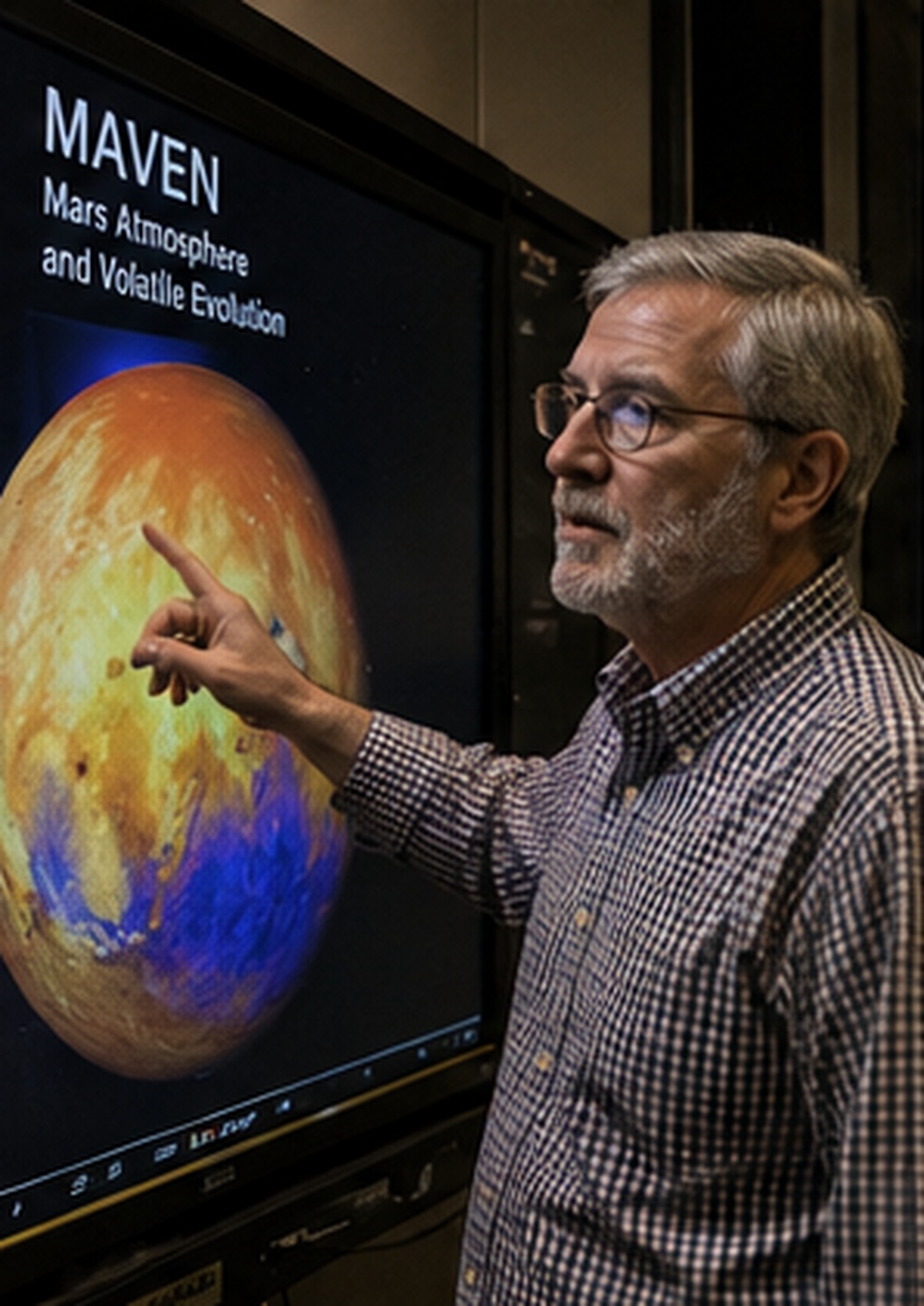
Chronological biography
Viking and Caltech — starting with data before Mars became a career
The Viking years: learning from data before leading a mission. Bruce Jakosky has worked on Mars since the 1970s. LASP notes that he was already analyzing Viking data as an undergraduate. That order matters. Long before he proposed MAVEN, he spent years trying to extract a planetary history from measurements designed by other teams. He therefore learned the limits of available observations, the ambiguities in climate models and the questions Viking could expose without resolving.. Jakosky’s relationship with Mars began long before MAVEN. As a young researcher he worked with Viking data and encountered a planet whose surface recorded a much wetter past than its present atmosphere seemed able to support. He increasingly specialized in exchanges among atmosphere, surface and space, looking not for one dramatic event but for losses accumulated over billions of years. That persistence explains MAVEN’s origins: the mission was not an isolated idea but the culmination of years spent identifying what earlier spacecraft could not measure directly.. Source Institutional source
He completed a Ph.D. at Caltech in 1982, including work on the seasonal behavior of water vapor in the Martian atmosphere. The subject established a theme that would continue throughout his career: Mars is not merely a surface. Climate emerges from exchanges among the soil, polar caps, atmosphere and space. Explaining a warmer and wetter ancient Mars requires connecting geology to atmospheric evolution. [source]
Institutional sources: MAVEN/LASP — principal investigator biography · LASP — eighteen years leading MAVEN
Bruce Jakosky began working on Mars in the 1970s, analyzing Viking data as an undergraduate. He earned his Ph.D. at Caltech in 1982 after studying, among other topics, the seasonal behavior of water vapor in the Martian atmosphere. That climate-centered entry point shaped the rest of his career: rather than treating Mars as a collection of landscapes, he wanted to understand how a world with evidence for ancient water became the cold, dry planet seen today. MAVEN/LASP — Bruce Jakosky
At the University of Colorado and the Laboratory for Atmospheric and Space Physics he built a career spanning planetary geology, atmospheres, astrobiology, and participation in many spacecraft missions. That continuity is the key to understanding MAVEN: it was not a late-career topic chosen from scratch, but the culmination of a question developed over decades. [source]
MAVEN places Jakosky in front of a question that directly connects ancient Martian climate to habitability: how did a planet that once held more water and a thicker atmosphere lose much of that protection? By observing present-day interactions among the upper atmosphere, solar wind and escaping gases, the mission cannot reconstruct every detail of the past, but it can measure mechanisms capable of explaining part of the long-term evolution. [source]
From Viking data to a doctorate: turning one old question into a forty-year career. When he became MAVEN principal investigator, Jakosky had to translate the broad question — how Mars lost much of the atmosphere and surface water implied by its ancient geology — into measurable quantities: particles, fields, the upper atmosphere and interaction with the solar wind. He led MAVEN from its conception through seven years of orbital operations before handing the PI role to a new leader in 2021. The career is a useful model for future Mars science: some questions are not closed by one mission; one generation of data has to make the next experiment possible. [bj1] [bj2]
Bruce Jakosky has been studying Mars since the 1970s. LASP notes that he was already analysing Viking data as an undergraduate, then completed a Caltech PhD in 1982 on the seasonal behaviour of Martian water vapour. That continuity matters. MAVEN did not begin as a sudden desire to build another orbiter; it emerged from decades in which the climate question became sharper. How had a planet showing evidence of earlier wetter environments lost so much of its atmosphere?
The 1980s to 2008 — from Martian climate research to the MAVEN concept
Building a career around a question that would not go away. At the University of Colorado and the Laboratory for Atmospheric and Space Physics, Jakosky developed research linking planetary surfaces, atmospheres, climate and habitability. His participation in missions including Viking, Mars Observer, Mars Global Surveyor, Mars Odyssey and Mars Science Laboratory exposed him to different instruments and different slices of the same planet. Over time that produces systems thinking: a surface measurement is conditioned by atmosphere and climate, while the present atmosphere tells the past only through processes that added or removed material. Source.
To win support for MAVEN, Jakosky then had to convert a broad question—where did the atmosphere go?—into measurements precise enough for a spacecraft mission. The team had to identify which particles and fields to observe, which altitudes mattered, how solar variability changed the system and which signatures could connect present-day escape to climate history. This act of formulation is a key stage in his career: a good scientific question becomes a mission only when observations can genuinely test, quantify and refine it. Institutional source.
Teaching planetary geology and the search for life also sharpened the skill required to define a mission. “Understand Mars climate” is too broad to fly. A proposal has to identify observables: species, ions, fluxes, solar-wind interactions and the models that connect them to atmospheric escape. That translation from a large question into measurable requirements is one of the hidden steps between a scientist and a principal investigator.
Institutional sources: University of Colorado — research and education
NASA’s early MAVEN results described links among solar energy, the solar wind, the upper atmosphere, ion acceleration and escape to space. Jakosky described a chain whose links were progressively becoming visible. That wording avoids false simplicity: Mars did not lose its atmosphere in one identifiable event, but through processes whose importance changes with time and solar activity. [BJ2] [BJ3]
The mission itself is collective engineering. Hundreds of people, several institutions, different instruments and orbital navigation have to produce coherent data. The principal investigator therefore does more than propose a science question; the role organizes an investigation in which each measurement must be connectable to the others. [BJ3] [BJ4]
2003: turning a scientific gap into a mission concept. LASP traces MAVEN’s direct origin to an hour-long conversation in the summer of 2003 with Janet Luhmann and Bob Lin. The problem was clear enough to state but difficult to measure: how did Mars move from a warmer, wetter past toward its present cold and dry state, and how much did atmospheric loss to space contribute? The concept was therefore not “another orbiter.” It was an attempt to measure a gap that earlier missions had left open. Source.
As principal investigator, Jakosky had to acquire a second professional identity without abandoning the first. Mission leadership means partners, budgets, reviews, schedules, instrument interfaces and requirements. LASP describes its model as full-cycle science: identify the question, build and operate the tools that can test it, analyze the evidence and use the answer to define the next question. MAVEN made Jakosky responsible for that entire loop.
Institutional sources: LASP — MAVEN origin story · LASP — being the MAVEN PI
In the summer of 2003, a conversation with Janet Luhmann and Bob Lin crystallized the concept for a mission focused on atmospheric escape from Mars. Jakosky became MAVEN’s principal investigator and had to move from scientist to organization builder: define objectives, assemble institutions, integrate instruments and operations, pass reviews, and lead the team through development, launch, and orbital science. He remained principal investigator from the mission’s inception until 2021. MAVEN/LASP — the origin of MAVEN
MAVEN's institutional origin is unusually well documented. Jakosky recalls that in the summer of 2003 an hour-long phone conversation with Janet Luhmann and Bob Lin at the University of California, Berkeley helped crystallise the concept of a mission devoted to atmospheric escape. From there the challenge became collective: turn a good question into a competitive proposal, assemble LASP, Goddard, Berkeley, JPL, Lockheed Martin and other partners, define complementary instruments and build a spacecraft able to observe the upper atmosphere for long enough to answer the question.
2008–2021 — Building, launching and operating MAVEN
2008–2021: keeping the question alive beyond the prime mission. NASA selected MAVEN in 2008; the spacecraft launched in 2013 and entered Mars orbit in 2014. It was designed to study the upper atmosphere and its loss to space. The institutional result was more than a set of measurements. The mission created an operating team and scientific framework that continued far beyond its primary mission. Jakosky remained PI until 2021, roughly eighteen years after the concept began to take shape.
For human Mars exploration, the biography is a reminder that atmospheric science is infrastructure for knowledge. Atmospheric density, solar interaction and the history of water constrain what can be inferred about past habitability and what future exploration must preserve. Jakosky’s deeper lesson is methodological: stay with a hard question long enough for the limitations of old data to become the requirements of a new instrument.
Institutional sources: MAVEN/LASP — transition to a new PI
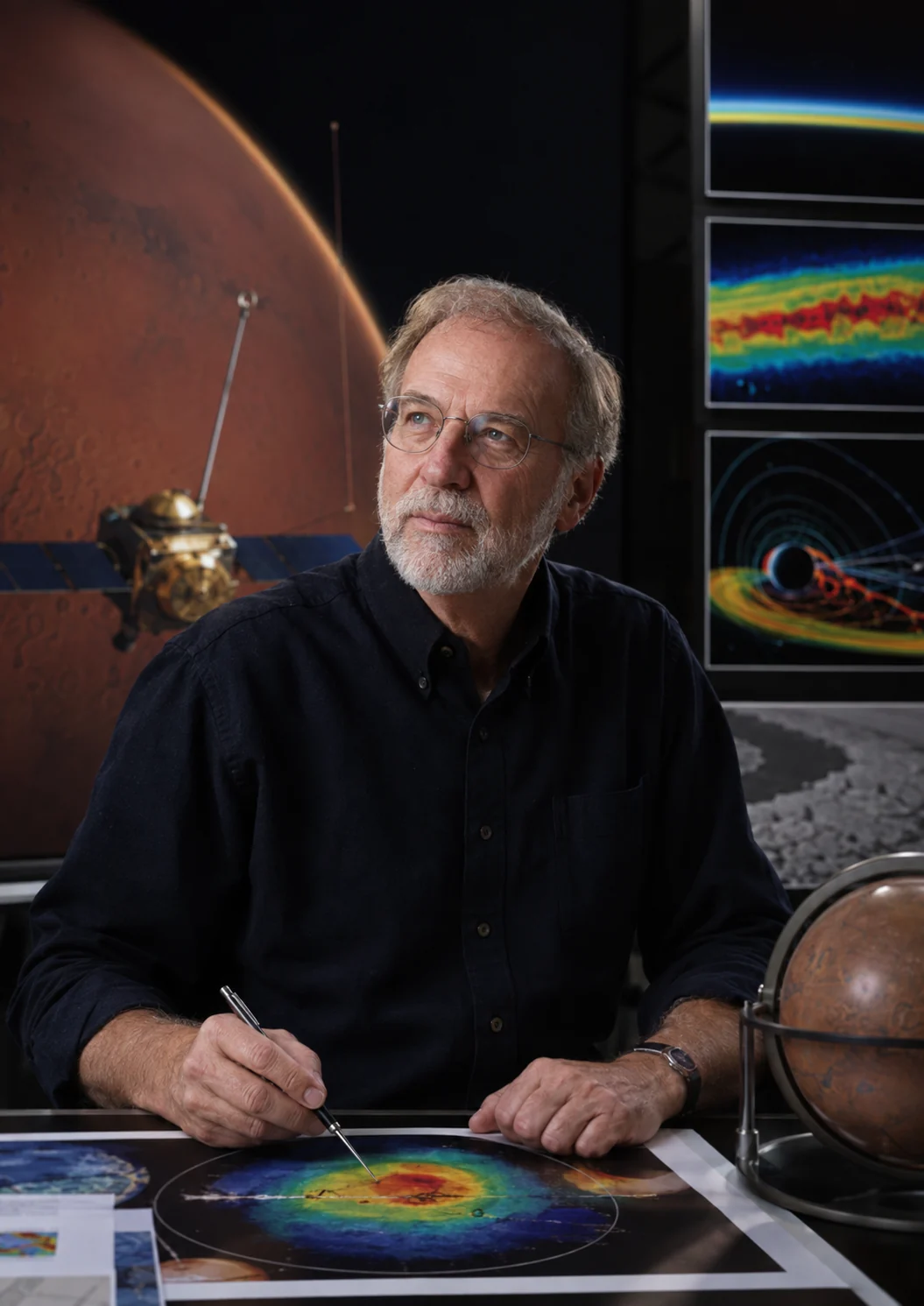
A long mission must prepare its own succession. Jakosky also oversaw a transition in MAVEN leadership after years of operations. A spacecraft that survives beyond its prime mission will outlast individual roles, budgets and sometimes original objectives. Scientific continuity then depends on documentation and on transferring the reasons behind past choices, not merely the current command procedures.
A Mars settlement will face the same issue continuously. The first architects will not be the operators twenty years later. Every system needs an accessible history of failures, compromises and modifications. MAVEN’s longevity is a reminder that a space project becomes mature when it can survive the departure of the people who originally designed it.
At the project's peak, NASA/LASP accounts describe several hundred people. The principal investigator's job therefore extends far beyond personal scientific output. It involves protecting scientific coherence while dealing with mass, cost, schedule and integration constraints. Jakosky remained PI from concept through years of operations before handing over the role in 2021. His trajectory shows how a durable Mars mission is built: a strong question, a network of institutions, a team that survives successive project phases and scientific leadership stable enough that the final instrument suite still answers the original question.
Supplementary documentary analysis
Biographical analysis, context and legacy
Thematic analysis and deeper reading
Essential timeline
- Scientific careerLong-term research on Mars, climate and planetary evolution.
- 2008–2009MAVEN selected and developed under Jakosky’s scientific leadership.
- November 2013MAVEN launches.
- September 2014Mars orbit insertion and beginning of the science campaign.
- 2014–2021Jakosky leads the mission science through its first seven years of orbital operations.
- 2021Principal-investigator leadership transitions to Shannon Curry.
Deep reading: what this trajectory teaches
MAVEN: observing the present to reconstruct the past
Bruce Jakosky and the MAVEN team work on a classic planetary-science problem: the goal is to understand ancient Mars, but direct measurements come from the present planet and its surviving records. MAVEN studies the upper atmosphere, solar interaction and processes that allow particles to escape. Those observations are then combined with isotopes, geology and climate models to estimate how atmospheric loss evolved over time.
The chain of inference has to remain visible. Measuring a present escape rate does not mean the rate was constant for billions of years. Reconstructing the past requires assumptions about the young Sun, magnetic environment and extreme events. Jakosky is valuable to the history of Mars science because his mission shows how to move from a measured process to planetary history without hiding the intermediate reasoning.
Why atmospheric escape constrains terraforming claims
MAVEN results support the conclusion that Mars lost a substantial part of its atmosphere to space. Any terraforming scenario therefore faces a stability question. Even if pressure or temperature could be increased, the design must account for available reservoirs, escape processes and whether the created state can be maintained. Planetary change is not only an initial input problem; it is a continuing balance of sources and losses.
The same logic already applies inside a habitat. Air is a valuable inventory subject to leakage, airlock losses and chemical reactions. The scale differs, but the engineering method is identical: measure flows. How much enters, how much leaves, which losses are unavoidable and what reserves replace them? MAVEN provides a natural bridge from planetary atmospheric science to practical resource accounting.
Viking before a career: learning Mars from real data
The biographical detail matters: Bruce Jakosky did not enter planetary science through a generic fascination with Mars, but through Viking data. LASP recalls that he analysed those measurements as an undergraduate and later completed a 1982 Caltech PhD on the seasonal behaviour of Martian water vapour. That sequence explains the continuity of his later work: surface reservoirs, atmospheric seasons and long-term climate loss were parts of one physical history rather than disconnected topics. 1
Working with Viking also taught a durable lesson about archives. A spacecraft can stop operating while its calibrated measurements continue to train new scientists and answer questions that were not central when the data were acquired. Jakosky’s later approach to MAVEN follows that logic in reverse: measure the upper atmosphere in the present with enough precision that future researchers can use those observations to reconstruct a past no spacecraft can directly revisit.
Bruce Jakosky began working on Mars while still an undergraduate at UCLA in the mid-1970s. Viking was turning the planet into a measured world: pressure, temperature, water vapor, orbital imaging and surface observations became available to a new generation of researchers. Entering Mars science through imperfect but physical data shaped his career. Mars was not first a science-fiction world to be made habitable; it was an atmospheric and geological system to be constrained by observation. [source] [source]
In the chapter “Viking before a career: learning Mars from real data,” this framework forces a check between the precise historical fact, the scientific question actually being asked and the constraints specific to that stage of the career.
In the career of this climate and upper-atmosphere scientist, “Viking before a career: learning Mars from real data” provides a comparison with earlier stages.
For “Viking before a career: learning Mars from real data,” the Mars application should therefore be stated as a specific reduction of uncertainty rather than a general promise of settlement.
As a teaching case, “Viking before a career: learning Mars from real data” also separates three levels that are often blurred together: the observed or documented fact, the scientific interpretation that gives it meaning, and the operational decision made from that interpretation.
In “Viking before a career: learning Mars from real data,” that boundary is intentionally part of the result: it states what this stage supports and what it still leaves open.
Caltech: water vapor as a doorway into climate
Jakosky earned his planetary science doctorate at Caltech in 1982, studying among other topics the seasonal behavior of Martian water vapor. The question sounds narrow but immediately connects reservoirs: atmosphere, polar caps, regolith and climate. Determining where water resides in a given season requires mass balances and exchange processes. That habit of closing the inventory prepared the later MAVEN question: what remains on Mars, what is trapped in the crust or ice, and what has escaped to space? [source]
What matters is not only what worked. That vulnerability makes the episode instructive. In the chapter “Caltech: water vapor as a doorway into climate,” this framework forces a check between the precise historical fact, the scientific question actually being asked and the constraints specific to that stage of the career.
The chapter “Caltech: water vapor as a doorway into climate” also shows that the work of a climate and upper-atmosphere scientist is collective by construction.
For “Caltech: water vapor as a doorway into climate,” the Mars application should therefore be stated as a specific reduction of uncertainty rather than a general promise of settlement.
As a teaching case, “Caltech: water vapor as a doorway into climate” also separates three levels that are often blurred together: the observed or documented fact, the scientific interpretation that gives it meaning, and the operational decision made from that interpretation.
In “Caltech: water vapor as a doorway into climate,” that boundary is intentionally part of the result: it states what this stage supports and what it still leaves open.
LASP: a full-cycle science culture
Jakosky joined the University of Colorado Boulder in 1982 and worked at the Laboratory for Atmospheric and Space Physics. LASP describes a 'full-cycle' culture: identify a question, build or fly the needed instruments, operate them, analyze the data, compare observations with models and allow answers to generate new questions. That continuity was central to MAVEN. The PI did not simply receive a spacecraft built elsewhere; the university participated in science, instruments, operations and communication. [source] [source]
In the chapter “LASP: a full-cycle science culture,” this framework forces a check between the precise historical fact, the scientific question actually being asked and the constraints specific to that stage of the career.
To understand “LASP: a full-cycle science culture,” the full chain matters more than one headline result. The climate and upper-atmosphere scientist works inside a system where a schedule decision can change an observation, an instrument limit can redefine the testable hypothesis, and the documentation of an anomaly can matter as much as nominal success.
For “LASP: a full-cycle science culture,” the Mars application should therefore be stated as a specific reduction of uncertainty rather than a general promise of settlement.
As a teaching case, “LASP: a full-cycle science culture” also separates three levels that are often blurred together: the observed or documented fact, the scientific interpretation that gives it meaning, and the operational decision made from that interpretation.
In “LASP: a full-cycle science culture,” that boundary is intentionally part of the result: it states what this stage supports and what it still leaves open.
Before MAVEN: climate, surface, astrobiology and many missions
Before becoming identified with an atmospheric orbiter, Jakosky participated in Viking, Solar Mesosphere Explorer, Clementine, Mars Observer, Mars Global Surveyor, Mars Odyssey, Mars Science Laboratory and other projects. His work spans surfaces, atmosphere, climate evolution, habitability and philosophical questions around the search for life. That breadth matters: MAVEN was not invented by someone interested only in the upper atmosphere but by a scientist asking how upper-atmosphere processes connect to past surface conditions. [source]
Every observation has an opportunity cost. In the chapter “Before MAVEN: climate, surface, astrobiology and many missions,” this framework forces a check between the precise historical fact, the scientific question actually being asked and the constraints specific to that stage of the career.
At this stage, “Before MAVEN: climate, surface, astrobiology and many missions” reveals how experience changes judgment. The climate and upper-atmosphere scientist never has perfect information; the skill is learning which uncertainties can be tolerated, which require another measurement and which should stop a sequence.
For “Before MAVEN: climate, surface, astrobiology and many missions,” the Mars application should therefore be stated as a specific reduction of uncertainty rather than a general promise of settlement.
As a teaching case, “Before MAVEN: climate, surface, astrobiology and many missions” also separates three levels that are often blurred together: the observed or documented fact, the scientific interpretation that gives it meaning, and the operational decision made from that interpretation.
In “Before MAVEN: climate, surface, astrobiology and many missions,” that boundary is intentionally part of the result: it states what this stage supports and what it still leaves open.
2003: a phone call that becomes a mission
MAVEN’s concrete origin is notably unheroic in the best sense. Jakosky traces the concept to an hour-long 2003 telephone conversation with Janet Luhmann and Bob Lin about the need to understand how a once wetter Mars became the cold and dry planet observed today. The scientific question was enormous; the practical task was to compress it into a mission that could survive the competitive Mars Scout process, fit within a constrained budget and still make decisive measurements. 2
This is where the biography of a principal investigator differs from a list of discoveries. Jakosky had to connect university science, Lockheed Martin engineering, NASA mission management and instruments from several institutions. The intellectual problem therefore became a long sequence of trade-offs: orbit geometry, instrument complement, cost, schedule, risk and the amount of scientific ambiguity the team could tolerate.
In the summer of 2003 Jakosky spoke with Janet Luhmann and Bob Lin at Berkeley about a persistent gap: no Mars mission had yet been designed specifically to measure how the Sun and solar wind remove gas from the upper atmosphere. The idea did not immediately become a spacecraft. A scientific intuition had to be transformed into measurable objectives, instruments, an orbit, an organization and a proposal credible enough for a competitive program. [source]
In the chapter “2003: a phone call that becomes a mission,” this framework forces a check between the precise historical fact, the scientific question actually being asked and the constraints specific to that stage of the career.
In the career of this climate and upper-atmosphere scientist, “2003: a phone call that becomes a mission” provides a comparison with earlier stages.
For “2003: a phone call that becomes a mission,” the Mars application should therefore be stated as a specific reduction of uncertainty rather than a general promise of settlement.
As a teaching case, “2003: a phone call that becomes a mission” also separates three levels that are often blurred together: the observed or documented fact, the scientific interpretation that gives it meaning, and the operational decision made from that interpretation.
In “2003: a phone call that becomes a mission,” that boundary is intentionally part of the result: it states what this stage supports and what it still leaves open.
Mars Scout: reducing a large question to a fundable mission
MAVEN was selected in 2008 through the Mars Scout program. The large question—how did Mars lose conditions once more favorable to liquid water?—had to be reduced to observables: upper-atmosphere composition and structure, ionosphere, solar-wind interactions, present escape rates and processes that allow cautious extrapolation backward. Scientific discipline meant choosing the part of the problem a spacecraft could actually measure rather than claiming that one orbiter would solve the planet's entire climate history. [source] [source]
What matters is not only what worked. That vulnerability makes the episode instructive. In the chapter “Mars Scout: reducing a large question to a fundable mission,” this framework forces a check between the precise historical fact, the scientific question actually being asked and the constraints specific to that stage of the career.
The chapter “Mars Scout: reducing a large question to a fundable mission” also shows that the work of a climate and upper-atmosphere scientist is collective by construction.
For “Mars Scout: reducing a large question to a fundable mission,” the Mars application should therefore be stated as a specific reduction of uncertainty rather than a general promise of settlement.
As a teaching case, “Mars Scout: reducing a large question to a fundable mission” also separates three levels that are often blurred together: the observed or documented fact, the scientific interpretation that gives it meaning, and the operational decision made from that interpretation.
In “Mars Scout: reducing a large question to a fundable mission,” that boundary is intentionally part of the result: it states what this stage supports and what it still leaves open.
Being PI: budget, hardware, science and responsibility
Jakosky has described the PI's daily work as far less romantic than the public image: documents, teleconferences, trades, schedules, risk, interfaces and budget. Yet MAVEN is specifically a PI-led mission. The Principal Investigator carries overarching responsibility for scientific success while depending on Goddard, Lockheed Martin, Berkeley, JPL and multiple instrument teams. Leadership is not mastery of every detail; it is knowing where a technical decision changes the science promised to the agency. [source] [source]
In the chapter “Being PI: budget, hardware, science and responsibility,” this framework forces a check between the precise historical fact, the scientific question actually being asked and the constraints specific to that stage of the career.
To understand “Being PI: budget, hardware, science and responsibility,” the full chain matters more than one headline result. The climate and upper-atmosphere scientist works inside a system where a schedule decision can change an observation, an instrument limit can redefine the testable hypothesis, and the documentation of an anomaly can matter as much as nominal success.
For “Being PI: budget, hardware, science and responsibility,” the Mars application should therefore be stated as a specific reduction of uncertainty rather than a general promise of settlement.
As a teaching case, “Being PI: budget, hardware, science and responsibility” also separates three levels that are often blurred together: the observed or documented fact, the scientific interpretation that gives it meaning, and the operational decision made from that interpretation.
In “Being PI: budget, hardware, science and responsibility,” that boundary is intentionally part of the result: it states what this stage supports and what it still leaves open.
An architecture designed to cross atmospheric regions
MAVEN's elliptical orbit was not an arbitrary compromise. It enabled close passes through the upper atmosphere and more global observations from higher altitude, supplemented by 'deep dip' campaigns that temporarily lowered periapsis. Instruments measured particles, fields, neutral and ion composition, ultraviolet emissions and solar forcing. The mission therefore assembled a causal chain: solar input, plasma interaction, atmospheric response and escape. [source] [source]
Every observation has an opportunity cost. In the chapter “An architecture designed to cross atmospheric regions,” this framework forces a check between the precise historical fact, the scientific question actually being asked and the constraints specific to that stage of the career.
At this stage, “An architecture designed to cross atmospheric regions” reveals how experience changes judgment. The climate and upper-atmosphere scientist never has perfect information; the skill is learning which uncertainties can be tolerated, which require another measurement and which should stop a sequence.
For “An architecture designed to cross atmospheric regions,” the Mars application should therefore be stated as a specific reduction of uncertainty rather than a general promise of settlement.
As a teaching case, “An architecture designed to cross atmospheric regions” also separates three levels that are often blurred together: the observed or documented fact, the scientific interpretation that gives it meaning, and the operational decision made from that interpretation.
In “An architecture designed to cross atmospheric regions,” that boundary is intentionally part of the result: it states what this stage supports and what it still leaves open.
2013–2014: launch, arrive, calibrate before concluding
MAVEN launched in November 2013 and entered Mars orbit in September 2014. Before headline results, the team had to commission instruments, adjust the orbit and build a dataset long enough to separate daily variability, seasonal behavior and solar events. A single measurement of atmospheric escape does not say how much Mars lost over billions of years. The mission first had to understand how escape rates change with solar forcing and atmospheric state. [source] [source]
In the chapter “2013–2014: launch, arrive, calibrate before concluding,” this framework forces a check between the precise historical fact, the scientific question actually being asked and the constraints specific to that stage of the career.
In the career of this climate and upper-atmosphere scientist, “2013–2014: launch, arrive, calibrate before concluding” provides a comparison with earlier stages.
For “2013–2014: launch, arrive, calibrate before concluding,” the Mars application should therefore be stated as a specific reduction of uncertainty rather than a general promise of settlement.
As a teaching case, “2013–2014: launch, arrive, calibrate before concluding” also separates three levels that are often blurred together: the observed or documented fact, the scientific interpretation that gives it meaning, and the operational decision made from that interpretation.
In “2013–2014: launch, arrive, calibrate before concluding,” that boundary is intentionally part of the result: it states what this stage supports and what it still leaves open.
2015: watching the solar wind accelerate escape
Early major results showed that the solar wind can enhance atmospheric erosion, especially during solar events. Jakosky and the team placed present-day escape rates into a history in which the young Sun was more active. The backward extrapolation remains a model, but it is constrained by observed processes rather than intuition. Moving from 'Mars may have lost its atmosphere' to 'here is how these mechanisms operate and how their rates respond today' is central to MAVEN's contribution. [source]
What matters is not only what worked. That vulnerability makes the episode instructive. In the chapter “2015: watching the solar wind accelerate escape,” this framework forces a check between the precise historical fact, the scientific question actually being asked and the constraints specific to that stage of the career.
The chapter “2015: watching the solar wind accelerate escape” also shows that the work of a climate and upper-atmosphere scientist is collective by construction.
For “2015: watching the solar wind accelerate escape,” the Mars application should therefore be stated as a specific reduction of uncertainty rather than a general promise of settlement.
As a teaching case, “2015: watching the solar wind accelerate escape” also separates three levels that are often blurred together: the observed or documented fact, the scientific interpretation that gives it meaning, and the operational decision made from that interpretation.
In “2015: watching the solar wind accelerate escape,” that boundary is intentionally part of the result: it states what this stage supports and what it still leaves open.
Argon: using isotopes as a memory of a vanished atmosphere
MAVEN measured light and heavy isotopes of argon, a noble gas not readily consumed by rock chemistry or biology. Escape preferentially removes lighter isotopes, leaving a signature in what remains. The team inferred that a large fraction of atmospheric argon had been lost. The methodological value is enormous: the atmosphere of four billion years ago cannot be observed directly, but a statistical memory of loss survives in present composition. [source] [source]
In the chapter “Argon: using isotopes as a memory of a vanished atmosphere,” this framework forces a check between the precise historical fact, the scientific question actually being asked and the constraints specific to that stage of the career.
To understand “Argon: using isotopes as a memory of a vanished atmosphere,” the full chain matters more than one headline result. The climate and upper-atmosphere scientist works inside a system where a schedule decision can change an observation, an instrument limit can redefine the testable hypothesis, and the documentation of an anomaly can matter as much as nominal success.
For “Argon: using isotopes as a memory of a vanished atmosphere,” the Mars application should therefore be stated as a specific reduction of uncertainty rather than a general promise of settlement.
As a teaching case, “Argon: using isotopes as a memory of a vanished atmosphere” also separates three levels that are often blurred together: the observed or documented fact, the scientific interpretation that gives it meaning, and the operational decision made from that interpretation.
In “Argon: using isotopes as a memory of a vanished atmosphere,” that boundary is intentionally part of the result: it states what this stage supports and what it still leaves open.
Sputtering: directly confirming a long-sought mechanism
In 2025 MAVEN data enabled the first direct observation of atmospheric sputtering at Mars. Energetic ions strike the upper atmosphere and can eject neutral atoms to space. The result closed a loop begun long before launch: isotopic signatures suggested the mechanism, models assigned it an important role, and direct observation finally showed it operating. For the history of Martian water, this strengthens the connection between ancient solar activity and atmospheric thinning. [source]
Every observation has an opportunity cost. In the chapter “Sputtering: directly confirming a long-sought mechanism,” this framework forces a check between the precise historical fact, the scientific question actually being asked and the constraints specific to that stage of the career.
At this stage, “Sputtering: directly confirming a long-sought mechanism” reveals how experience changes judgment. The climate and upper-atmosphere scientist never has perfect information; the skill is learning which uncertainties can be tolerated, which require another measurement and which should stop a sequence.
For “Sputtering: directly confirming a long-sought mechanism,” the Mars application should therefore be stated as a specific reduction of uncertainty rather than a general promise of settlement.
As a teaching case, “Sputtering: directly confirming a long-sought mechanism” also separates three levels that are often blurred together: the observed or documented fact, the scientific interpretation that gives it meaning, and the operational decision made from that interpretation.
In “Sputtering: directly confirming a long-sought mechanism,” that boundary is intentionally part of the result: it states what this stage supports and what it still leaves open.
2026: a mission ended, data still alive
MAVEN lost contact on December 6, 2025 after more than eleven years in orbit. In 2026 NASA concluded that the spacecraft was not recoverable and declared the mission over. Yet publications continued: archived observations still revealed the Zwan-Wolf effect and refined the physics of Martian auroras. A spacecraft can stop transmitting without its scientific mission ending immediately. The archive, calibrations and contextual knowledge become a research infrastructure in their own right. [source] [source] [source]
In the chapter “2026: a mission ended, data still alive,” this framework forces a check between the precise historical fact, the scientific question actually being asked and the constraints specific to that stage of the career.
In the career of this climate and upper-atmosphere scientist, “2026: a mission ended, data still alive” provides a comparison with earlier stages.
For “2026: a mission ended, data still alive,” the Mars application should therefore be stated as a specific reduction of uncertainty rather than a general promise of settlement.
As a teaching case, “2026: a mission ended, data still alive” also separates three levels that are often blurred together: the observed or documented fact, the scientific interpretation that gives it meaning, and the operational decision made from that interpretation.
In “2026: a mission ended, data still alive,” that boundary is intentionally part of the result: it states what this stage supports and what it still leaves open.
2021: handing MAVEN to Shannon Curry
The 2021 transfer of the principal-investigator role to Shannon Curry is part of Jakosky’s scientific biography rather than a footnote. He said he wanted a new leader to bring new ideas and directions while he remained involved as a scientist. NASA and LASP describe a leadership arc extending from MAVEN’s inception through seven years of orbital operations before that handover. 3
Mission leadership can also be measured by the community left behind. LASP credited the programme under Jakosky with more than 700 scientific publications and nearly two dozen PhD dissertations. MAVEN therefore functioned as a training environment in which students learned calibration, modelling, peer review and collaborative mission science. In Jakosky’s case, “transmission” is not a reusable lesson pasted onto any biography; it is visible in the specific academic lineage created around one atmospheric mission.
After eighteen years leading the project from concept, Jakosky stepped down as PI in 2021 to focus more on research; Shannon Curry succeeded him. The transition is a test of organizational maturity. A mission dependent on the founder's private memory would be fragile. A successful handover preserves objectives, instrument knowledge, inter-institutional relationships, decision history and the ability to interpret data acquired under changing conditions. [source] [source]
What matters is not only what worked. That vulnerability makes the episode instructive. In the chapter “2021: handing MAVEN to Shannon Curry,” this framework forces a check between the precise historical fact, the scientific question actually being asked and the constraints specific to that stage of the career.
The chapter “2021: handing MAVEN to Shannon Curry” also shows that the work of a climate and upper-atmosphere scientist is collective by construction.
For “2021: handing MAVEN to Shannon Curry,” the Mars application should therefore be stated as a specific reduction of uncertainty rather than a general promise of settlement.
As a teaching case, “2021: handing MAVEN to Shannon Curry” also separates three levels that are often blurred together: the observed or documented fact, the scientific interpretation that gives it meaning, and the operational decision made from that interpretation.
In “2021: handing MAVEN to Shannon Curry,” that boundary is intentionally part of the result: it states what this stage supports and what it still leaves open.
Hope: sharing atmospheric science beyond NASA
Jakosky also participates as a co-investigator on the Emirates Mars Mission Hope. Hope observes the atmosphere from an orbit very different from MAVEN's, providing broad local-time and seasonal coverage. Complementarity is more interesting than competition: no spacecraft can optimize every altitude regime, local time and instrument simultaneously. Mature Mars science therefore becomes a network of missions whose different geometries connect lower-atmosphere weather, upper-atmosphere dynamics and escape. [source]
In the chapter “Hope: sharing atmospheric science beyond NASA,” this framework forces a check between the precise historical fact, the scientific question actually being asked and the constraints specific to that stage of the career.
To understand “Hope: sharing atmospheric science beyond NASA,” the full chain matters more than one headline result. The climate and upper-atmosphere scientist works inside a system where a schedule decision can change an observation, an instrument limit can redefine the testable hypothesis, and the documentation of an anomaly can matter as much as nominal success.
For “Hope: sharing atmospheric science beyond NASA,” the Mars application should therefore be stated as a specific reduction of uncertainty rather than a general promise of settlement.
As a teaching case, “Hope: sharing atmospheric science beyond NASA” also separates three levels that are often blurred together: the observed or documented fact, the scientific interpretation that gives it meaning, and the operational decision made from that interpretation.
In “Hope: sharing atmospheric science beyond NASA,” that boundary is intentionally part of the result: it states what this stage supports and what it still leaves open.
What MAVEN changes for human presence
Jakosky’s relevance to eventual human exploration is correspondingly narrow and valuable. MAVEN does not design habitats, propulsion systems or landing vehicles. It reduces uncertainty about the environment through which those systems must operate and about the processes that produced present-day Mars. Its measurements of atmospheric escape also constrain grand terraforming narratives: protecting a crew or modifying a local environment is an engineering problem on one scale; rebuilding a planetary atmosphere lost over geological time is a very different proposition.
MAVEN does not directly measure an astronaut's surface dose and it does not provide a terraforming plan. Its contribution is more fundamental: Mars' weakly protected atmosphere interacts continuously with the Sun, and climate history depends on processes operating at the top of the atmosphere. A settlement therefore cannot treat the external atmosphere as a stable reservoir that merely needs to be thickened. Any planetary-engineering ambition must close gas inventories and account for loss to space. [source] [source]
Every observation has an opportunity cost. In the chapter “What MAVEN changes for human presence,” this framework forces a check between the precise historical fact, the scientific question actually being asked and the constraints specific to that stage of the career.
At this stage, “What MAVEN changes for human presence” reveals how experience changes judgment. The climate and upper-atmosphere scientist never has perfect information; the skill is learning which uncertainties can be tolerated, which require another measurement and which should stop a sequence.
For “What MAVEN changes for human presence,” the Mars application should therefore be stated as a specific reduction of uncertainty rather than a general promise of settlement.
As a teaching case, “What MAVEN changes for human presence” also separates three levels that are often blurred together: the observed or documented fact, the scientific interpretation that gives it meaning, and the operational decision made from that interpretation.
In “What MAVEN changes for human presence,” that boundary is intentionally part of the result: it states what this stage supports and what it still leaves open.
Primary and institutional sources
Additional sources: LASP MAVEN — Bruce Jakosky · LASP — Origins of MAVEN
- NASA — MAVEN begins a new chapter with a new leader
- NASA — Gravity Assist: Mars with Bruce Jakosky
- NASA SVS — MAVEN PI interview
- NASA Astrobiology — MAVEN
- NASA — MAVEN Reveals Most of Mars’ Atmosphere Was Lost to Space
- NASA — MAVEN Identifies Links in Chain Leading to Atmospheric Loss
- LASP — MAVEN principal investigator page
- LASP — Celebrating Bruce Jakosky and eighteen years leading MAVEN
- NASA Science — MAVEN mission page and end of mission
- NASA Science — first direct observation of atmospheric sputtering at Mars
- NASA Science — measuring Mars atmospheric loss with argon isotopes
- NASA Science — first discovery of the Zwan-Wolf effect at Mars
- NASA Science — MAVEN aurora results in 2026
- NASA — MAVEN press kit
- NASA Science — MAVEN: NASA’s next mission to Mars
- UAE Space Agency publications — Hope Probe science results including Bruce Jakosky
- LASP — Being the MAVEN Principal Investigator