


MARS BIBLE — PEOPLE
Pascal Lee
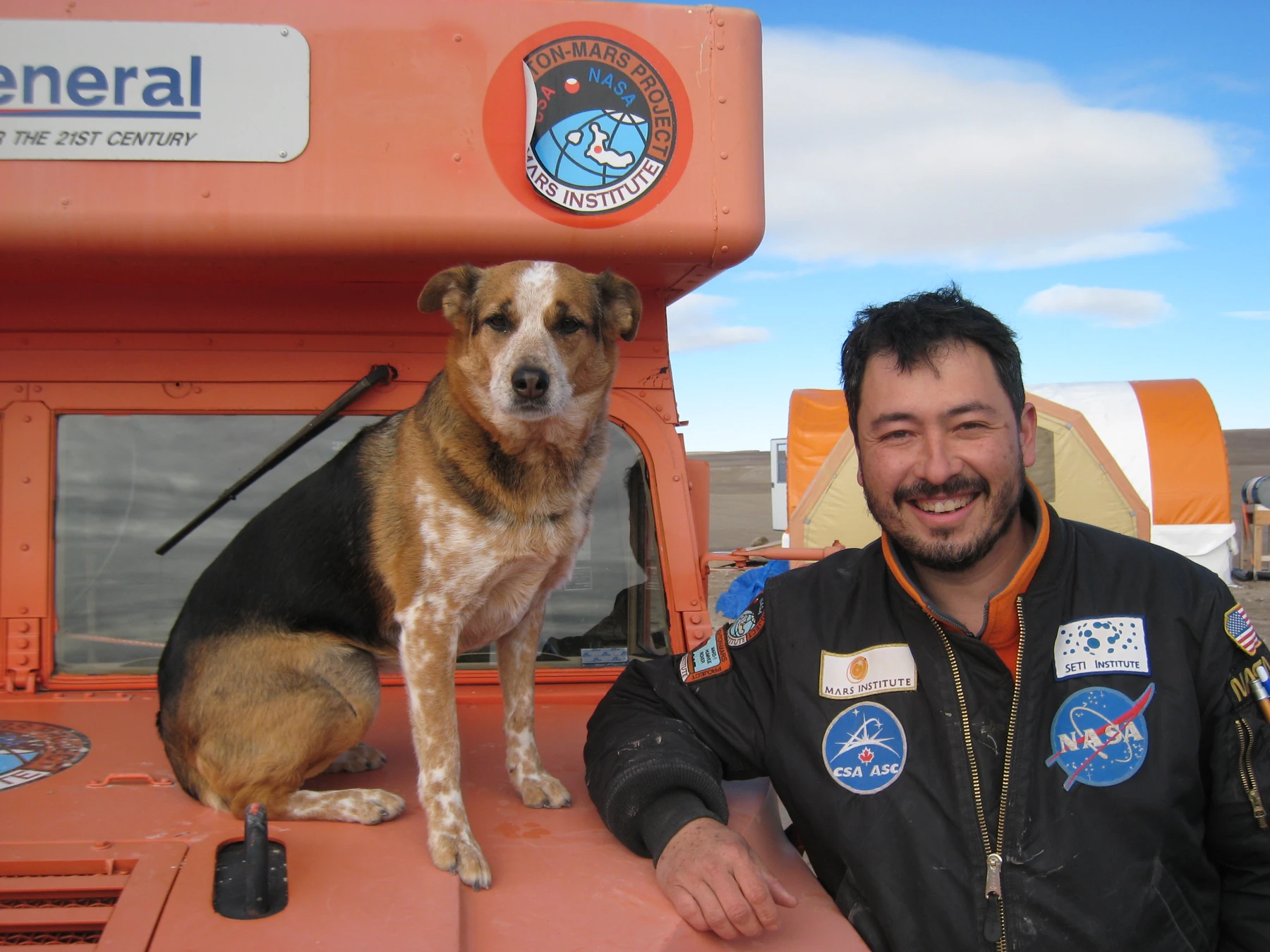
The nationality or citizenship of Pascal Lee is not established with sufficient precision by the institutional sources currently cited on this page; the documented birthplace is Hong Kong ; a grandi en France. Pascal Lee is one of the figures who most concretely brought preparations for human Mars exploration into field operations. Trained in physics and astronomy and then active in planetary research, he turned polar environments and Haughton into full-scale laboratories for testing vehicles, suits, procedures and scientific organization. His biography matters because it follows one continuous idea: convert a Martian ambition into repeated Earth-based operations so that failures, fatigue and real constraints are discovered before departure.
Chronological biography
The main narrative now follows the life in order: training, early work, acquired skills, missions, difficulties, teams, and responsibilities before reaching the Mars legacy.
Hong Kong, Paris and Cornell — Learning Mars through geology, astronomy and expedition
From Hong Kong to Paris and Cornell: learning Mars through geology and astronomy. Pascal Lee trained in geology and geophysics at the University of Paris and then earned graduate degrees in astronomy and space sciences at Cornell, where his academic environment included Joseph Veverka and Carl Sagan. The combination of field geology, planetary science, and exploration culture prepared a career in which Mars would be treated less as an image than as a place where people may one day have to work. SETI Institute — Pascal Lee Source.
Pascal Lee’s path developed across physics, astronomy, planetary geology and an appetite for field work. Rather than restricting Mars preparation to computer studies, he sought terrestrial places where isolation, cold, logistics and the demands of field science would force teams to behave more like future explorers. Haughton became a laboratory of integration. Vehicles, suits, communications and scientific methods could all be confronted with reality. That culture of testing in analog environments became one of his most durable contributions to preparing for human Mars exploration. Institutional source.
Lee then chose an unusual form of apprenticeship: repeated expeditions to polar regions and planetary analog environments. He wintered for more than a year in Antarctica and has led dozens of Arctic and Antarctic expeditions. The point is not to pretend Earth reproduces Mars, but to study what becomes difficult when terrain, isolation, logistics, and weather impose their own rules.
Pascal Lee first trained in geology and geophysics in Paris, then earned graduate degrees in astronomy and space sciences at Cornell, where he served as Carl Sagan's last teaching assistant. The combination explains much of his later work: field geology, planetary science and human exploration are not separate careers but layers of one problem. Source
His doctoral work examined physical properties and processing of asteroid regoliths and interiors. Before leading Mars analog projects, Lee therefore learned to reason about surfaces known through remote sensing, dynamics and indirect samples. That skill is central to Mars: an Earth analog can test a process, but it must never be mistaken for a copy of another planet.
An international path oriented toward Mars. From Hong Kong to the Arctic: learning Mars through expedition rather than imitation. The SETI Institute describes Pascal Lee as a planetary scientist associated with the SETI Institute, the Mars Institute and NASA Ames. An institutional archive states that he was born in Hong Kong and grew up in France. The current SETI biography does not state a nationality, so this page leaves that field explicitly unresolved rather than inventing one. Lee studied physics, geology and geophysics in Paris before earning a Ph.D. in astronomy and space sciences from Cornell in 1997. His career repeatedly connects planetary science, field exploration and the design of future operations.
His relationship with Mars is best understood as a methodological question: which properties of an extreme place on Earth can help prepare a mission, and which similarities are misleading? No terrestrial site simultaneously reproduces Martian pressure, gravity, radiation, dust and interplanetary isolation. An analogue is useful only when the team specifies what part of the problem it is intended to reproduce.
Haughton-Mars Project: an operational laboratory in the Arctic. The Haughton-Mars Project began in 1997 and uses Devon Island in the Canadian High Arctic as a planetary-analogue field environment. The impact structure, polar climate, isolation and difficult logistics create conditions in which scientists and engineers have to move equipment, plan activities, manage failures and conduct fieldwork far from an urban laboratory. The value is not the slogan “Mars on Earth.” It is that real logistics and field constraints expose weaknesses that can remain invisible in a conventional test facility.
Haughton work has included rovers, drones, suit concepts, habitats, field science and operational procedures. A procedure that looks efficient indoors may fail in cold, wind or when an operator is wearing restrictive gloves. The reverse must also be stated: a system that works in the Arctic is not thereby qualified for Mars. The analogue reveals operational and ergonomic problems; it does not reproduce the complete Martian environment.
Polar experience: isolation, autonomy and human limits. Lee has led many Arctic and Antarctic expeditions and spent more than a year wintering at Dumont d’Urville Station. Such experience is not a simulation of interplanetary flight, but it offers observations about factors that mass budgets capture poorly: fatigue, confined living, work rhythms, maintenance, monotony, dependence on inventories and the value of simple procedures. In an isolated environment, a small failure becomes disproportionately important if the necessary part or tool is not available locally.
The Mars lesson is that a human architecture cannot be reduced to a pressurized habitat and a consumables list. Work organization, tools, spares, documentation, refuge areas and cross-training matter. Psychological and social resilience also depends partly on the technical system: a crew is more resilient when every small malfunction does not become an emergency. Polar analogues are valuable when they expose those dependencies.
Vehicles, drones and field science: testing the complete operational chain. The Haughton-Mars Project has investigated pressurized vehicles, robotic rovers, drones and field tools for planetary exploration. The important question is not whether an Earth drone behaves like Ingenuity. It cannot, because Martian atmospheric density radically changes flight physics. What can be tested is how a team selects reconnaissance areas, turns imagery into a traverse plan, shares data and coordinates a vehicle with scientists and operators.
That distinction between non-representative physics and transferable procedure is central to analogue research. A future settlement will need to survey terrain before sending people, inspect routes after storms, map construction areas and monitor infrastructure. Earth campaigns can teach organization and ergonomics, while actual Martian vehicle performance must still be established by analysis, appropriate environmental testing and flight demonstration.
Why Lee belongs in the history of Mars settlement without proving settlement feasible. Pascal Lee is often publicly associated with base concepts, exploration vehicles and preparations for human Mars missions. It is important to separate contribution to operational preparation from validation of an entire settlement architecture. An Arctic camp can be resupplied from Earth, breathes Earth’s atmosphere and operates at one Earth gravity. It does not demonstrate closed-loop life support on Mars, the economics of an autonomous city or the safety of a months-long interplanetary voyage.
Its role is narrower and more useful: expose problems before they become mission failures. Which task becomes impossible with gloves? Which tool is consistently missing? How much science time does a repair consume? How does a team allocate a scarce vehicle? Through Haughton and polar field campaigns, Lee helped make those questions visible parts of Mars exploration. A future settlement will need the same testing culture: use Earth for what Earth can genuinely test, use space-relevant environments for what it cannot, and keep those levels of evidence separate.
Haughton-Mars Project — Turning an Arctic crater into an operations school
Haughton-Mars Project: turning an Arctic crater into an operations school. As director of the NASA Haughton-Mars Project on Devon Island, Lee turned a High Arctic impact crater into an operations laboratory for mobility, habitats, robots, drones, instruments, procedures, field science, and teamwork. The approach ties his biography directly to human exploration: a future Mars crew will need more than knowledge of Mars science; it will have to work with limited time, imperfect equipment, and a distant base. SETI Institute — Pascal Lee Source.
Lee wintered for more than a year at Dumont d'Urville Station in Antarctica and later led many Arctic and Antarctic expeditions. Cold, isolation and logistics do not reproduce Mars, but they force teams to plan equipment, mobility, communications and safety where mistakes cost time and outside help is distant. Source
This experience fed into the NASA Haughton-Mars Project on Devon Island in the Canadian High Arctic. The site became a laboratory for geology, traverse planning, equipment and operations. Its value lies in real friction—weather, maintenance, fatigue and changing plans. A useful analog is not scenery; it is a place where procedures meet constraints.
Lee works with the SETI Institute, Mars Institute and NASA Ames on future human exploration. His work on Phobos, base sites and long traverses continues the same logic: before promising permanence, planners must decompose real operations. Where do crews land? How far can they work from shelter? What happens when a vehicle, weather or instrument changes the plan? Source
His Mars contribution is therefore not a single architecture to copy. It is a culture of testing procedures and equipment in demanding field conditions. A Mars settlement will need laboratories and industry, but first it needs crews able to execute a traverse, document an outcrop and return with data and samples whose context has not been lost.
From analogs to human architectures — Testing without pretending to copy Mars
Terrestrial analogs as testbeds, not copies of Mars. Pascal Lee has devoted much of his work to using polar environments as Mars analogs. The Haughton Mars Project on Devon Island in the Canadian Arctic became a field laboratory where geology, astrobiology, mobility, human operations, vehicle testing and exploration planning can be combined. The value of an analog is not the claim that the Arctic is Mars. Pressure, gravity, radiation and atmosphere are obviously different. The value is the ability to isolate selected difficulties: cold, polar desert terrain, remoteness, logistics, communications, scientific field campaigns and the need to repair equipment with limited local resources. Source.
Lee’s decades of expeditions show why field operations deserve as much attention as hardware. A suit, vehicle or instrument can perform perfectly during a short demonstration and become cumbersome when the same action has to be repeated every day, equipment has to be stored, samples documented, schedules maintained and weather dealt with. Analogs expose those frictions. They also allow teams to test how scientists and operators share time, workspace and priorities. [source]
That experience is especially relevant to settlement because a permanent outpost will not be a series of isolated experiments. It will have to sustain routines for months and years. The central problem then becomes the robustness of the human and material system: maintenance, inventory, procedures, the ability to improvise without losing traceability, and structured lessons learned after each campaign. [source]
From Martian geology to preparation for human exploration. SETI Institute material describes Lee as working across Mars science, terrestrial analogs and future human exploration. That combination is useful because the questions reinforce one another. Understanding ice, landforms, caves or impact terrains helps identify exploration targets; thinking about crews forces operational questions in return: where to drive, where to seek shelter, what distances are realistic, how much data must be returned and how to avoid contaminating a scientifically valuable site. [source]
Lee has long argued, in effect, for evaluating analog sites by function. A location may be excellent for mobility testing but poor for biology, or valuable for isolation without reproducing Martian dust. That prevents the idea of a universal analog: each experiment should state which aspect of Mars is being simulated, which is not, and what the experiment actually demonstrates. [source]
His more recent work continues to connect Mars science with site selection. The SETI Institute profile notes involvement in the study of a major volcanic structure and interest in future exploration bases in the Noctis region. Such proposals must be kept distinct from an official program, but they illustrate a useful method: begin with geology, resources and accessibility, build an exploration architecture from them, and state clearly which assumptions remain to be tested. [source]
Lee’s Arctic work is most useful when it is treated as an operations laboratory rather than a visual imitation of Mars. Devon Island cannot reproduce Martian gravity, atmosphere or radiation, but it can force teams to live with distance, weather, logistics, constrained mobility, equipment failures and the friction of conducting real field science. Those are precisely the human and organizational variables that are easy to hide in a clean simulation. [source]
The Haughton-Mars Project also connects scientific exploration to settlement planning. Routes, vehicles, field communications, sampling procedures and habitat routines have to function together, which means an expedition becomes a systems test. Lee’s biography therefore explains why analog programs remain relevant even when everyone involved knows that Earth is not Mars: they expose interfaces between people, tools and procedures before those interfaces become expensive or dangerous on another planet. [source]
Supplementary documentary analysis
Biographical analysis, context and legacy
Thematic analysis and deeper reading
Essential timeline
- PeriodHaughton-Mars Project
- MarsArctic analogs and human exploration
- LegacyTesting procedures and technologies before Mars
Deep reading: what this trajectory teaches
Primary and institutional sources
Verification rule: this biography prioritizes institutional, archival and primary sources. Statements about living people or active programs are dated and attributed; uncertain or disputed points must remain explicitly qualified.